EP3841166B2 - Stabilized rotomolded polyolefin - Google Patents
Stabilized rotomolded polyolefin Download PDFInfo
- Publication number
- EP3841166B2 EP3841166B2 EP19765356.1A EP19765356A EP3841166B2 EP 3841166 B2 EP3841166 B2 EP 3841166B2 EP 19765356 A EP19765356 A EP 19765356A EP 3841166 B2 EP3841166 B2 EP 3841166B2
- Authority
- EP
- European Patent Office
- Prior art keywords
- bis
- triazine
- tetramethylpiperidin
- tetramethyl
- ppm
- Prior art date
- Legal status (The legal status is an assumption and is not a legal conclusion. Google has not performed a legal analysis and makes no representation as to the accuracy of the status listed.)
- Active
Links
Classifications
-
- C—CHEMISTRY; METALLURGY
- C08—ORGANIC MACROMOLECULAR COMPOUNDS; THEIR PREPARATION OR CHEMICAL WORKING-UP; COMPOSITIONS BASED THEREON
- C08K—Use of inorganic or non-macromolecular organic substances as compounding ingredients
- C08K5/00—Use of organic ingredients
- C08K5/0008—Organic ingredients according to more than one of the "one dot" groups of C08K5/01 - C08K5/59
- C08K5/005—Stabilisers against oxidation, heat, light, ozone
-
- C—CHEMISTRY; METALLURGY
- C08—ORGANIC MACROMOLECULAR COMPOUNDS; THEIR PREPARATION OR CHEMICAL WORKING-UP; COMPOSITIONS BASED THEREON
- C08K—Use of inorganic or non-macromolecular organic substances as compounding ingredients
- C08K5/00—Use of organic ingredients
- C08K5/16—Nitrogen-containing compounds
- C08K5/34—Heterocyclic compounds having nitrogen in the ring
- C08K5/3412—Heterocyclic compounds having nitrogen in the ring having one nitrogen atom in the ring
- C08K5/3432—Six-membered rings
- C08K5/3435—Piperidines
-
- C—CHEMISTRY; METALLURGY
- C08—ORGANIC MACROMOLECULAR COMPOUNDS; THEIR PREPARATION OR CHEMICAL WORKING-UP; COMPOSITIONS BASED THEREON
- C08K—Use of inorganic or non-macromolecular organic substances as compounding ingredients
- C08K5/00—Use of organic ingredients
- C08K5/16—Nitrogen-containing compounds
- C08K5/34—Heterocyclic compounds having nitrogen in the ring
- C08K5/3467—Heterocyclic compounds having nitrogen in the ring having more than two nitrogen atoms in the ring
- C08K5/3477—Six-membered rings
- C08K5/3492—Triazines
- C08K5/34926—Triazines also containing heterocyclic groups other than triazine groups
-
- C—CHEMISTRY; METALLURGY
- C08—ORGANIC MACROMOLECULAR COMPOUNDS; THEIR PREPARATION OR CHEMICAL WORKING-UP; COMPOSITIONS BASED THEREON
- C08K—Use of inorganic or non-macromolecular organic substances as compounding ingredients
- C08K5/00—Use of organic ingredients
- C08K5/36—Sulfur-, selenium-, or tellurium-containing compounds
- C08K5/37—Thiols
- C08K5/372—Sulfides, e.g. R-(S)x-R'
-
- C—CHEMISTRY; METALLURGY
- C08—ORGANIC MACROMOLECULAR COMPOUNDS; THEIR PREPARATION OR CHEMICAL WORKING-UP; COMPOSITIONS BASED THEREON
- C08L—COMPOSITIONS OF MACROMOLECULAR COMPOUNDS
- C08L23/00—Compositions of homopolymers or copolymers of unsaturated aliphatic hydrocarbons having only one carbon-to-carbon double bond; Compositions of derivatives of such polymers
- C08L23/02—Compositions of homopolymers or copolymers of unsaturated aliphatic hydrocarbons having only one carbon-to-carbon double bond; Compositions of derivatives of such polymers not modified by chemical after-treatment
- C08L23/04—Homopolymers or copolymers of ethene
- C08L23/06—Polyethylene
-
- C—CHEMISTRY; METALLURGY
- C08—ORGANIC MACROMOLECULAR COMPOUNDS; THEIR PREPARATION OR CHEMICAL WORKING-UP; COMPOSITIONS BASED THEREON
- C08K—Use of inorganic or non-macromolecular organic substances as compounding ingredients
- C08K2201/00—Specific properties of additives
- C08K2201/019—Specific properties of additives the composition being defined by the absence of a certain additive
-
- C—CHEMISTRY; METALLURGY
- C08—ORGANIC MACROMOLECULAR COMPOUNDS; THEIR PREPARATION OR CHEMICAL WORKING-UP; COMPOSITIONS BASED THEREON
- C08L—COMPOSITIONS OF MACROMOLECULAR COMPOUNDS
- C08L2201/00—Properties
- C08L2201/08—Stabilised against heat, light or radiation or oxydation
Definitions
- the disclosure is directed to polyolefin compositions prepared by a rotomolding process having improved mechanical properties.
- Rotational molding is a manufacturing process in which hollow plastic articles are prepared.
- a plastic material is filled into one half of a mold which is then closed with the other half.
- the closed mold is heated and rotated around different axes, wherein molten polymer coats the interior of the mold - a process referred to as "sintering".
- the mold is then cooled and the molded article removed.
- the process may require temperatures of greater than about 300°C or even greater than about 400°C.
- the rotomolding process may be employed to prepare articles such as storage tanks for water, oil and the like; kayaks, toys, refuse containers, equipment housings, etc.
- a rotomolding process employs a polyolefin substrate, for instance polyethylene.
- US 2006/276571 A1 discloses polyolefin hollow articles produced by the rotomolding process comprising polyethylene, HALS compounds and also stabilizers such as a hydroxyphenylbenzotriazole or a tris-aryl-s-triazine ultraviolet light absorber, a hindered phenolic antioxidant and an organic phosphorus processing stabilizer.
- a hollow plastic article stabilized against the deleterious effects of heat, light and oxygen comprising a polyolefin substrate, the polyolefin substrate having incorporated therein a hindered amine light stabilizer, an ultraviolet light absorber selected from oxamide ultraviolet light absorbers, and a thioether additive.
- Also disclosed is a process for the production of a hollow plastic article comprising incorporating into a polyolefin substrate a hindered amine light stabilizer, an ultraviolet light absorber selected from oxamide ultraviolet light absorbers, and a thioether additive to provide a fully formulated polyolefin mixture, adding the mixture to a mold, heating the mold to a temperature of greater than 280°C, rotating the mold about at least 2 axes, wherein molten polyolefin mixture coats the interior of the mold, cooling the mold while still rotating, opening the mold and removing the formed hollow article.
- a polyolefin substrate comprises a polyethylene.
- Polyethylene includes, for example, high density polyethylene (HDPE), high molecular weight high density polyethylene (HMW HDPE), ultrahigh molecular weight high density polyethylene (UHMW HDPE), medium density polyethylene (MDPE), low density polyethylene (LDPE), linear low density polyethylene (LLDPE), branched low density polyethylene (BLDPE) or polyethylenes and ethylene copolymers prepared using Phillips catalysts and polyethylene blends.
- Ethylene copolymers may contain differing proportions of comonomers.
- comonomers include 1-olefins such as propene, 1-butene, 1-pentene, 1-hexene, 1-heptene, 1-octene or isobutylene, styrene, cycloolefins such as cyclopentene, cyclohexene or norbornene or dienes such as butadiene, isoprene, 1,4-hexadiene, cyclopentadiene, dicyclopentadiene, norbornadiene or ethylidenenorbornene.
- 1-olefins such as propene, 1-butene, 1-pentene, 1-hexene, 1-heptene, 1-octene or isobutylene, styrene, cycloolefins such as cyclopentene, cyclohexene or norbornene or dienes such as butadiene, isoprene, 1,4-hexadiene,
- Polyolefin substrates also include polyethylene blends with polyolefins.
- examples include mixtures of polyethylene with polypropylene (PP) and mixtures of various PE types, for example mixtures including two or more of high density polyethylene (HDPE), high molecular weight high density polyethylene (HMW HDPE), ultrahigh molecular weight high density polyethylene (UHMW HDPE), medium density polyethylene (MDPE), low density polyethylene (LDPE), linear low density polyethylene (LLDPE), branched low density polyethylene (BLDPE) or ethylene-propylene-diene terpolymers (EPDM) containing high proportions of diene.
- HDPE high density polyethylene
- HMW HDPE high molecular weight high density polyethylene
- UHMW HDPE ultrahigh molecular weight high density polyethylene
- MDPE medium density polyethylene
- LDPE low density polyethylene
- LLDPE linear low density polyethylene
- BLDPE branched low density polyethylene
- EPDM ethylene-propylene-diene
- polymer mixtures include, for example, PP/HDPE, PP/LLDPE, and LLDPE/HDPE as well as ternary mixtures such as PP/HDPE/LLDPE.
- polymers can be linear or branched and can be formulated with or without crosslinking (e.g., chemical crosslinking).
- the polyolefin substrate may have other polymers incorporated therein, for example polystyrene, polyamide, polyester, polycarbonate, epoxy resins, polyurethane, copolymers thereof (e.g., random or block copolymers) or mixtures thereof.
- such "other" polymers may be present in a finished article from any of about 1 wt% (weight percent), about 2 wt%, about 3 wt%, about 4 wt%, about 5 wt%, about 6 wt% or about 7 wt% to any of about 8 wt%, about 9 wt%, about 10 wt%, about 11 wt%, about 12 wt%, about 13 wt%, about 14 wt% or about 15 wt%, based on the total weight of the finished article.
- Present hollow articles may in some embodiments comprise a hindered amine light stabilizer from any of about 50 ppm (parts per million), about 100 ppm, about 200 ppm, about 300 ppm, about 400 ppm, about 500 ppm or about 600 ppm to any of about 700 ppm, about 800 ppm, about 900 ppm, about 1000 ppm, about 1100 ppm, about 1200 ppm, about 1300 ppm, about 1400 ppm, about 1500 ppm, about 1600 ppm, about 1700 ppm, about 1800 ppm, about 1900 ppm or about 2000 ppm, by weight, based on the total weight of the article.
- a hindered amine light stabilizer from any of about 50 ppm (parts per million), about 100 ppm, about 200 ppm, about 300 ppm, about 400 ppm, about 500 ppm or about 600 ppm to any of about 700 ppm, about 800 ppm, about 900
- the hollow articles may comprise a hindered amine light stabilizer from any of about 0.1 wt% (weight percent), about 0.2 wt%, about 0.5 wt%, about 1.0 wt%, about 1.5 wt%, about 2.0 wt%, about 2.5 wt% or about 3.0 wt% to any of about 3.5 wt%, about 4.0 wt%, about 4.5 wt%, about 5.0 wt%, about 5.5 wt%, about 6.0 wt%, about 6.5 wt%, about 7.0 wt% or about 7.5 wt%, based on the total weight of the article.
- a hindered amine light stabilizer from any of about 0.1 wt% (weight percent), about 0.2 wt%, about 0.5 wt%, about 1.0 wt%, about 1.5 wt%, about 2.0 wt%, about 2.5 wt% or about 3.0 wt% to any of about 3.5 wt%
- Present hollow articles may in some embodiments comprise an ultraviolet light absorber from any of about 50 ppm (parts per million), about 100 ppm, about 200 ppm, about 300 ppm, about 400 ppm, about 500 ppm or about 600 ppm to any of about 700 ppm, about 800 ppm, about 900 ppm, about 1000 ppm, about 1100 ppm, about 1200 ppm, about 1300 ppm, about 1400 ppm, about 1500 ppm, about 1600 ppm, about 1700 ppm, about 1800 ppm, about 1900 ppm or about 2000 ppm, by weight, based on the total weight of the article.
- an ultraviolet light absorber from any of about 50 ppm (parts per million), about 100 ppm, about 200 ppm, about 300 ppm, about 400 ppm, about 500 ppm or about 600 ppm to any of about 700 ppm, about 800 ppm, about 900 ppm, about 1000 ppm, about
- the hollow articles may comprise an ultraviolet light absorber from any of about 0.1 wt% (weight percent), about 0.2 wt%, about 0.5 wt%, about 1.0 wt%, about 1.5 wt%, about 2.0 wt%, about 2.5 wt% or about 3.0 wt% to any of about 3.5 wt%, about 4.0 wt%, about 4.5 wt%, about 5.0 wt%, about 5.5 wt%, about 6.0 wt%, about 6.5 wt%, about 7.0 wt% or about 7.5 wt%, based on the total weight of the article.
- Present hollow articles may in some embodiments comprise a thioether additive from any of about 50 ppm (parts per million), about 100 ppm, about 200 ppm, about 300 ppm, about 400 ppm, about 500 ppm or about 600 ppm to any of about 700 ppm, about 800 ppm, about 900 ppm, about 1000 ppm, about 1100 ppm, about 1200 ppm, about 1300 ppm, about 1400 ppm, about 1500 ppm, about 1600 ppm, about 1700 ppm, about 1800 ppm, about 1900 ppm or about 2000 ppm, by weight, based on the total weight of the article.
- a thioether additive from any of about 50 ppm (parts per million), about 100 ppm, about 200 ppm, about 300 ppm, about 400 ppm, about 500 ppm or about 600 ppm to any of about 700 ppm, about 800 ppm, about 900 ppm, about 1000
- the hollow articles may comprise a thioether additive from any of about 0.1 wt% (weight percent), about 0.2 wt%, about 0.5 wt%, about 1.0 wt%, about 1.5 wt%, about 2.0 wt%, about 2.5 wt% or about 3.0 wt% to any of about 3.5 wt%, about 4.0 wt%, about 4.5 wt%, about 5.0 wt%, about 5.5 wt%, about 6.0 wt%, about 6.5 wt%, about 7.0 wt% or about 7.5 wt%, based on the total weight of the article.
- a thioether additive from any of about 0.1 wt% (weight percent), about 0.2 wt%, about 0.5 wt%, about 1.0 wt%, about 1.5 wt%, about 2.0 wt%, about 2.5 wt% or about 3.0 wt% to any of about 3.5 wt%, about 4.0 w
- a weight/weight ratio of hindered amine light stabilizer to thioether additive is from any of about 7/1, about 6/1, about 5/1 or about 4/1 to any of about 3/1, about 2/1 or about 1/1.
- a weight/weight ratio of ultraviolet light absorber to thioether additive is from any of about 3/1, about 2/1, about 1.5/1 or about 1/1 to any of about 1/1.5, about 1/2 or about 1/3.
- the hollow articles comprise the polyolefin substrate from any of about 50 wt%, about 55 wt%, about 60 wt%, about 65 wt%, about 70 wt%, about 73 wt%, about 76 wt%, about 79 wt% or about 82 wt% to any of about 85 wt%, about 88 wt%, about 90 wt%, about 93 wt% or about 95 wt%, based on the total weight of the article.
- Hindered amine light stabilizers are disclosed for example in US2015/0284535 and U.S. Pat. Nos. 5,004,770 , 5,204,473 , 5,096,950 , 5,300,544 , 5,112,890 , 5,124,378 , 5,145,893 , 5,216,156 , 5,844,026 , 5,980,783 , 6,046,304 , 6,117,995 , 6,271,377 , 6,297,299 , 6,392,041 , 6,376,584 and 6,472,456 .
- HALS Hindered amine light stabilizers
- Hindered amine light stabilizers include for example:
- N-H, N-methyl, N-hydroxy and N-acyloxy analogues of any of the above mentioned compounds.
- replacing an N-H hindered amine with an N-methyl hindered amine would be employing the N-methyl analogue in place of the N-H.
- hindered amine light stabilizers may be selected from a group consisting of
- HALS (38) or (39) may be substituted for HALS (36) in the binary and ternary combinations.
- hindered amine stabilizers are commercial, for example TINUVIN 770, CHIMASSORB 944, CHIMASSORB 2020, CYASORB UV 3853, CYASORB UV 3529, TINUVIN NOR 371, UVINUL 4050, UVINUL 5050, etc.
- the weight/weight ratio is from any of about 1/19, about 1/18, about 1/17, about 1/16, about 1/15, about 1/14, about 1/13, about 1/12, about 1/11, about 1/10, about 1/9, about 1/8, about 1/7, about 1/6, about 1/5, about 1/4, about 1/3, about 1/2 or about 1/1 to any of about 1/2, about 1/3, about 1/4, about 1/5, about 1/6, about 1/7, about 1/8, about 1/9, about 1/10, about 1/11, about 1/12, about 1/13, about 1/14, about 1/15, about 1/16, about 1/17, about 1/18, about 1/19 or about 1/20.
- a weight/weight ratios of any two of the HALS is as for the binary combinations.
- a combination of a low molecular weight and a high molecular weight HALS may be employed.
- the low molecular weight stabilizers have a molecular weight of from about 200 g/mol to about 1000 g/mol.
- the high molecular weight stabilizers have a molecular weight from about 1200 g/mol to about 10,000 g/mol.
- Some low molecular weight hindered amines are (1)-(33a). Some high molecular weight hindered amines are (34)-(49).
- the repeating unit "n" is a value such that the average molecular weight is from about 1200 g/mol to about 10,000 g/mol.
- UV light absorbers are selected from oxamide ultraviolet light absorbers (UVAs).
- Oxamide UVAs include for example 4,4'-dioctyloxyoxanilide, 2,2'-diethoxyoxanilide, 2,2'-dioctyloxy-5,5'-di-tert-butoxanilide, 2,2'-didodecyloxy-5,5'-di-tert-butoxanilide, 2-ethoxy-2'-ethyloxanilide (N'-(2-ethoxyphenyl)-N-(2-ethylphenyl)oxamide), N,N'-bis(3-dimethylaminopropyl)oxamide, 2-ethoxy-5-tert-butyl-2'-ethoxanilide and its mixture with 2-ethoxy-2'-ethyl-5,4'-di-tert-butoxanilide, mixtures of o- and p-methoxy-disubstituted oxanilides and mixtures of o-
- hydroxyphenylbenzotriazole UVAs as for instance disclosed in U.S. Pat. Nos. 3,004,896 ; 3,055,896 ; 3,072,585 ; 3,074,910 ; 3,189,615 ; 3,218,332 ; 3,230,194 ; 4,127,586 ; 4,226,763 ; 4,275,004 ; 4,278,589 ; 4,315,848 ; 4,347,180 ; 4,383,863 ; 4,675,352 ; 4,681,905 , 4,853,471 ; 5,268,450 ; 5,278,314 ; 5,280,124 ; 5,319,091 ; 5,410,071 ; 5,436,349 ; 5,516,914 ; 5,554,760 ; 5,563,242 ; 5,574,166 ; 5,607,987 , 5,977,219 and 6,166,218 , such as 2-(2-hydroxy-5-methylphenyl)-2
- hydroxybenzoate UV absorbers for instance esters of substituted and unsubstituted benzoic acids, as for example 4-tert-butylphenyl salicylate, phenyl salicylate, octylphenyl salicylate, dibenzoyl resorcinol, bis(4-tert-butylbenzoyl) resorcinol, benzoyl resorcinol, 2,4-di-tert-butylphenyl 3,5-di-tert-butyl-4-hydroxybenzoate, hexadecyl 3,5-di-tert-butyl-4-hydroxybenzoate, octadecyl 3,5-di-tert-butyl-4-hydroxybenzoate, 2-methyl-4,6-di-tert-butylphenyl 3,5-di-tert-butyl-4-hydroxybenzoate.
- esters of substituted and unsubstituted benzoic acids as for example 4-
- cyanoacrylate UV absorbers for instance pentaerythritol tetrakis(2-cyano-3,3-diphenylacrylate), ⁇ -cyano- ⁇ , ⁇ -diphenylacylic acid ethyl ester or isooctyl ester and ⁇ -cyano- ⁇ -methyl-p-methoxy-cinnamic acid methyl ester or butyl ester.
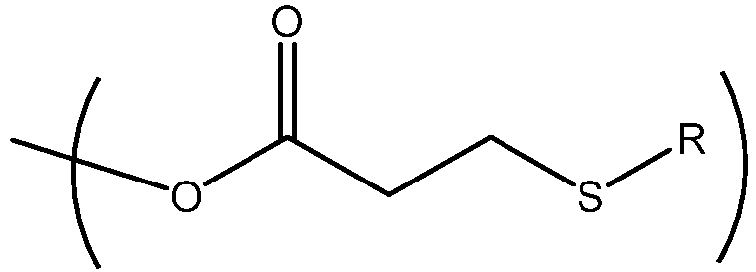
- mercaptan-containing compounds contain one or more, for instance 1, 2, 3 or 4 moieties of formula or wherein R is a hydrocarbyl group.
- Disulfide-containing compounds are of formula R-S-S-R, wherein each R is independently a hydrocarbyl group.
- each R is independently a hydrocarbyl group
- each R may be the same as, or different than, any other R group.
- thioether additives include dilauryl thiodipropionate, distearyl thiodipropionate, pentaerythritol tetrakis( ⁇ -laurylthiopropionate), distearyl disulfide or dilauryl disulfide.
- a hydrocarbyl group may be a C 2 -C 40 hydrocarbyl group, a C 2 -C 24 hydrocarbyl group, or a C 2 -C 5 hydrocarbyl group.
- Hydrocarbyl is any hydrocarbon containing group, for example straight or branched chain alkyl or alkenyl which may be interrupted by or substituted by one or more heteroatom-containing groups or aryl groups, for instance interrupted by one or more -O-, -NH- or-C(O)O- groups and/or substituted by one or more hydroxyl, carboxylic, amino, thiol, phosphonate or aryl groups.
- Aryl includes phenyl.
- hydrocarbyl may be nonyl, decyl, undecyl, 1-methylundecyl, lauryl (dodecyl), tridecyl or stearyl (octadecyl).
- Alkyl groups may be linear or branched and may include methyl, ethyl, propyl, isopropyl, n-butyl, sec-butyl, isobutyl, tert-butyl, 2-ethylbutyl, n-pentyl, isopentyl, 1-methylpentyl, 1,3-dimethylbutyl, n-hexyl, 1-methylhexyl, n-heptyl, isoheptyl, 1,1,3,3-tetramethylbutyl, 1-methylheptyl, 3-methylheptyl, n-octyl, tert-octyl, 2-ethylhexyl, 1,1,3-trimethylhexyl, 1,1,3,3-tetramethylpentyl, nonyl, decyl, undecyl, 1-methylundecyl, dodecyl and octadecyl.
- one or more further additives may be incorporated into the hollow articles of the invention.
- Further additives may be selected from a group consisting of antioxidants and acid scavengers.
- Antioxidants may be selected from a group consisting of hindered phenolic antioxidants, organophosphorus stabilizers, dialkylhydroxylamine stabilizers, amine oxide stabilizers and tocopherols.
- antioxidants include a combination of an organophosphorus stabilizer and a hindered phenolic antioxidant, a dialkylhydroxylamine stabilizer, a combination of an organophosphorus stabilizer and a dialkylhydroxylamine stabilizer, an amine oxide stabilizer or a combination of an organophosphorus stabilizer and an amine oxide stabilizer.
- Antioxidants also include vitamin E and vitamin E acetate (tocopherols). Each may be employed alone, in combination with each other or in combination with one or more antioxidants selected from the group consisting of hindered phenolic antioxidants, dialkylhydroxylamine stabilizers, organophosphorus stabilizers and amine oxide stabilizers.
- Organophosphorus stabilizers are for example known phosphite and phosphonite stabilizers and include triphenyl phosphite, diphenyl alkyl phosphites, phenyl dialkyl phosphites, tris(nonylphenyl) phosphite, trilauryl phosphite, trioctadecyl phosphite, distearyl pentaerythritol diphosphite, tris(2,4-di-tert-butylphenyl) phosphite, bis(2,4-di- ⁇ -cumylphenyl) pentaerythrtitol diphosphite, diisodecyl pentaerythritol diphosphite, bis(2,4-di-tert-butylphenyl) pentaerythritol diphosphite (D), bis(2,6-di-tert-but
- Suitable organophosphorus stabilizers are also liquid stabilizers as disclosed in U.S. Pub. No. 2010/048782 and U.S. Pat. No. 7,888,414 , for example liquid phosphites P-2, P-3 and P-4 therein. Suitable liquid organophosphorus stabilizers are also disclosed in U.S. Pub. Nos. 2013/0225736 and 2010/0029844 and U.S. Pat. Nos. 7,468,410 and 8,304,477 .
- Hindered phenolic antioxidants include for example tris(3,5-di-tert-butyl-4-hydroxybenzyl) isocyanurate, 1,3,5-tris-(3,5-di-tert-butyl-4-hydroxybenzyl)-2,4,6-trimethylbenzene, the calcium salt of the monoethyl ester of 3,5-di-tert-butyl-4-hydroxybenzylphosphonic acid, pentaerythritol tetrakis [3-(3,5-di-tert-butyl-4-hydroxyphenyl) propionate] or octadecyl 3-(3,5-di-tert-butyl-4-hydroxyphenyl) propionate.
- a combination of an organophosphorus stabilizer and a hindered phenolic antioxidant may be tris(2,4-di-tert-butylphenyl) phosphite and pentaerythritol tetrakis [3-(3,5-di-tert-butyl-4-hydroxyphenyl) propionate] or octadecyl 3-(3,5-di-tert-butyl-4-hydroxyphenyl) propionate.
- a weight/weight ratio of organophosphorus stabilizer to hindered phenolic antioxidant may be from any of about 9/1, about 8/1, about 7/1, about 6/1, about 5/1, about 4/1, about 3/1, about 2/1 or about 1/1 to any of about 1/2, about 1/3, about 1/4, about 1/5, about 1/6, about 1/7, about 1/8 or about 1/9.
- Hydroxylamine stabilizers are for example N,N-dibenzylhydroxylamine, N,N-diethylhydroxylamine, N,N-dioc-tylhydroxylamine, N,N-dilaurylhydroxylamine, N,N-didodecylhydroxylamine, N,N-ditetradecylhydroxylamine, N,N-dihexadecylhydroxylamine, N,N-dioctadecylhydroxylamine, N-hexadecyl-N-tetradecylhydroxylamine, N-hexadecyl-N-heptadecylhydroxylamine, N-hexadecyl-N-octadecylhydroxylamine, N-heptadecyl-N-octadecylhydroxylamine, N-methyl-N-octadecylhydroxylamine or N,N-di(C 16 -C 18 alkyl)hydroxy
- the amine oxide stabilizer is for instance a di(C 16 -C 18 )alkyl methyl amine oxide, CAS# 204933-93-7 .
- a combination of an organophosphorus stabilizer and a dialkylhydroxylamine is for example tris(2,4-di-tert-butylphenyl) phosphite and N,N-di(C 16 -C 18 alkyl)hydroxylamine
- a combination of an organophosphorus stabilizer and an amine oxide stabilizer is for example tris(2,4-di-tert-butylphenyl) phosphite and di(C 16 -C 18 )alkyl methyl amine oxide.
- a weight/weight ratio of these combinations may be from any of about 9/1, about 8/1, about 7/1, about 6/1, about 5/1, about 4/1, about 3/1, about 2/1 or about 1/1 to any of about 1/2, about 1/3, about 1/4, about 1/5, about 1/6, about 1/7, about 1/8 or about 1/9.
- Acid scavengers include hydrotalcites and amorphous basic aluminum magnesium carbonates, such as those described in U.S. Pat. Nos. 4,427,816 , 5,106,898 and 5,234,981 .
- Hydrotalcite is also known as hycite, DHT4A, DHT4V, DHT4Z, DHT4A2 or DHT4C.
- Hydrotalcites are natural or synthetic and may include a coating.
- Natural hydrotalcite is held to possess a structure Mg 6 Al 2 (OH) 16 CO 3.4 H 2 O.
- a typical empirical formula of a synthetic hydrotalcite is Al 2 Mg 4.35 OH 11.36 CO 3(1.67 ).x H 2 O.
- Examples of the synthetic product include Mg 0.7 Al 0.3 (OH) 2 (CO 3 ) 0.15 0.54 H 2 O, Mg 4.5 Al 2 (OH) 13 CO 3 .3.5 H 2 O and Mg 4.2 Al(OH) 12.4 CO 3 ⁇
- Acid scavengers may be present, in total, from any of about 50 ppm (parts per million), about 100 ppm, about 200 ppm, about 300 ppm, about 400 ppm, about 500 ppm or about 600 ppm to any of about 700 ppm, about 800 ppm, about 900 ppm, about 1000 ppm, about 1100 ppm, about 1200 ppm, about 1300 ppm, about 1400 ppm, about 1500 ppm, about 1600 ppm, about 1700 ppm, about 1800 ppm, about 1900 ppm or about 2000 ppm, based on the total weight of the article.
- the hollow articles may comprise acid scavengers from any of about 0.1 wt% (weight percent), about 0.2 wt% or about 0.5 wt% to any of about 1.0 wt%, about 1.5 wt%, about 2.0 wt%, about 2.5 wt% or about 3.0 wt%, based on the total weight of the article.
- Colorants, pigments or fillers may also be added to the present polyolefin substrates.
- Pigments include inorganic pigments, such as titanium dioxide in its three crystalline forms: rutile, anatase, or brookite, ultramarine blue, iron oxides, bismuth vanadates, carbon black, effect pigments including metallic pigments such as aluminum flake and pearlescent pigments such as micas, and organic pigments, for example phthalocyanines, perylenes, azo compounds, isoindolines, quinophthalones, diketopyrrolopyrroles, quinacridones, dioxazines, and indan-thrones. Pigments may be included singly or in any combination in amounts typically of up to about 5% by weight, based on the total weight of the article.
- inorganic pigments such as titanium dioxide in its three crystalline forms: rutile, anatase, or brookite, ultramarine blue, iron oxides, bismuth vanadates, carbon black, effect pigments including metallic pigments such as aluminum flake and pearlescent pigments such as micas,
- Dyes are any of the colorants which dissolve completely in the plastic used or are present in molecularly dispersed form and therefore can be used to provide high-transparency, non-diffusion coloring of polymers.
- Other dyes are organic compounds which fluoresce in the visible portion of the electromagnetic spectrum, e.g. fluorescent dyes. Dyes may be included singly or in any combination in amounts typically of up to about 5% by weight, based on the total weight of the article.
- Particulate fillers may be present in an amount from any of about 0.01 wt%, about 0.1 wt%, about 1 wt%, about 5 wt%, about 10 wt%, about 15 wt% or about 20 wt% to any of about 25 wt%, about 30 wt%, about 35 wt%, about 40 wt%, about 45 wt% or about 50 wt%, based on the total weight of the article.
- Fillers include but are not limited to titanium dioxide, silicon carbide, silica (and other oxides of silica, precipitated or not), antimony oxide, lead carbonate, zinc white, lithopone, zircon, corundum, spinel, apatite, barytes powder, barium sulfate, carbon black, dolomite, calcium carbonate, talc and hydrotalcite compounds of the ions Mg, Ca, or Zn with Al, Cr or Fe and CO 3 and/or HPO 4 , hydrated or not; quartz powder, hydrochloric magnesium carbonate, glass fibers, clays, alumina, and other metal oxides and carbonates, metal hydroxides, chrome, phosphorous, antimony trioxide, silica, silicone, and blends thereof.
- These fillers may include any other fillers and porous fillers and supports known in the art.
- Further additives also include benzofuranone stabilizers, for example those disclosed in U.S. Pat. Nos. 4,325,863 , 4,338,244 , 5,175,312 , 5,216,052 , 5,252,643 , 5,369,159 , 5,356,966 , 5,367,008 , 5,428,177 or 5,428,162 or U.S. Patent App. Pub. No.
- Rotomolding is used for the production of fairly large plastic hollow articles which may be reinforced with glass fibers.
- the process includes filling one half of a mold with the plastic material.
- the mold is then closed with the other half and heated and rotated in an oven such that the molten plastic spreads to the walls of the mold while being rotated around different axes.
- the hollow article is obtained after cooling. In this manner it is possible to produce, for example, storage tanks from HD polyethylene.
- the process requires heating a polyolefin mixture to temperatures in the range of from any of about 170°C, about 190°C, about 210°C, about 215°C, about 220°C, about 230°C, about 240°C, about 260°C or about 280°C to any of about 300°C, about 340°C to about 370°C or about 400°C or higher.
- These temperatures represent the peak internal air temperature (PIAT) of an oven.
- a 125 mil thick, 5 inch x 5 inch test sample of a present hollow article may exhibit an impact strength of ⁇ 21 ft/lbs (foot/pounds), ⁇ 23 ft/lbs, ⁇ 25 ft/lbs, ⁇ 27 ft/lbs, ⁇ 29 ft/lbs, ⁇ 31 ft/lbs, ⁇ 33 ft/lbs, ⁇ 35 ft/lbs, ⁇ 37 ft/lbs, ⁇ 39 ft/lbs, ⁇ 40 ft/lbs, ⁇ 41 ft/lbs, ⁇ 42 ft/lbs or ⁇ 43 ft/lbs.
- a 125 mil thick, 5 inch x 5 inch test sample of a present hollow article may exhibit a ductility of ⁇ 50%, ⁇ 55%, ⁇ 60%,2: 65%, ⁇ 70%, ⁇ 75%, ⁇ 80%, ⁇ 85%, ⁇ 90%, ⁇ 95%, ⁇ 96%, ⁇ 97%, ⁇ 98% or ⁇ 99%.
- a 125 mil thick, 5 inch x 5 inch test sample of a present hollow article may exhibit a yellowness index (YI) of ⁇ 0.0, ⁇ -0.5, ⁇ -0.7, ⁇ -1.0, ⁇ - 1.2, ⁇ - 1.4, ⁇ -1.6, ⁇ -1.8, ⁇ -2.0, ⁇ -2.2, ⁇ -2.4, ⁇ -2.6, ⁇ -2.7, ⁇ -2.8 or ⁇ -2.9.
- YI yellowness index
- a 125 mil thick, 5 inch x 5 inch test sample of a present hollow article may exhibit a yellowness index (YI) of ⁇ -3.0, ⁇ -3.3, ⁇ -3.5, ⁇ -3.7, ⁇ -3.9, ⁇ -4.0, ⁇ -4.1, ⁇ -4.2, ⁇ -4.3, ⁇ -4.4 or ⁇ -4.5.
- YI yellowness index
- a 125 mil thick, 5 inch x 5 inch test sample of a present hollow article may exhibit an impact strength of from ⁇ 40 ft/lbs, a ductility of ⁇ 90% and a YI of ⁇ 0.0 or ⁇ -1.0 or ⁇ -1.5 or ⁇ -2.0.
- Mechanical properties may be determined according to the Association of Rotational Molders (ARM) Impact Test.
- ARM Association of Rotational Molders
- the above embodiments referring to impact strength, ductility and color may be determined on test samples of rotomolded hollow articles wherein the peak internal air temperature is about 380°F, about 400°F or about 420°F.
- Incorporation of the phosphonate ester, N-alkoxy hindered amine, melamine cyanurate (present additives) and optional further additives into the polyolefin substrate is carried out by known methods, for example before or after molding or also by applying the dissolved or dispersed additive mixture to the polyolefin, with or without subsequent evaporation of the solvent.
- Present additives can also be added to the polyolefin in the form of a masterbatch which contains the additives in a concentration of, for example, about 2.5% to about 40% by weight, based on the total weight of the masterbatch.
- the polymer of the masterbatch need not be the same as the polyolefin substrate.
- Molding is carried out with known mixing machines, for instance mixers, kneaders or extruders.
- Present additives and optional further additives can be premixed or added individually.
- Present additives and optional further additives can also be added before or during the polymerization or before crosslinking.
- Present additives and optional further additives can be incorporated into the polymer to be made flame retardant in pure form or encapsulated in waxes, oils or polymers.
- Present additives and optional further additives can also be sprayed onto the polyolefin substrate. They are able to dilute other additives or their melts so that they can be sprayed also together with these additives onto the polyolefin. Addition by spraying during the deactivation of the polymerization catalysts may be advantageous, it being possible to carry out spraying using, for example, the steam used for deactivation.
- a present process includes the measurement of raw materials by weight followed by dry blending of the ingredients.
- the present additives and optional further additives are incorporated into the thermoplastic polyolefin substrate by melt blending in an extruder.
- the present additives and optional additives may be added together or separately.
- the term "incorporating into a polyolefin" means melt blending, that is, subjecting a mixture to melt conditions at an elevated temperature.
- a mixture may be fed to a melt mixing device such as an extruder at a constant feed rate to extrude the material into a desired form, for example pellets.
- the pellets are a "fully formulated polyolefin substrate".
- the pellets may be ground to a small, generally uniform particle size, for example to an average particle size of from about 150 microns to about 500 microns prior to rotomolding.
- the fully formulated polyolefin particles are filled into one half of a mold which is then closed with the other half.
- Molds are typically made of aluminum or steel.
- the closed mold is heated and rotated around different axes, wherein molten polymer coats the interior of the mold - a process referred to as "sintering".
- the mold is then cooled and the molded article removed.
- Rotomolded articles may in many cases have a relatively large average wall thickness.
- present rotomolded articles have an average wall thickness of ⁇ about 1.50 mm, ⁇ about 1.75 mm, ⁇ about 2.00 mm, ⁇ about 2.25 mm, ⁇ about 2.50 mm, ⁇ about 2.75 mm, ⁇ about 3.00 mm, ⁇ about 3.25 mm, ⁇ about 3.50 mm, ⁇ about 3.75 mm, ⁇ about 4.00 mm, ⁇ about 4.25 mm, ⁇ about 4.50 mm or ⁇ about 4.75 mm.
- rotomolded articles have an average wall thickness of from any of about 1.50 mm, about 1.75 mm, about 2.00 mm, about 2.25 mm, about 2.50 mm, about 2.75 mm or about 3.00 mm to any of about 3.25 mm, about 3.50 mm, about 3.75 mm, about 4.00 mm, about 4.25 mm, about 4.50 mm, about 4.75 mm, about 5.00 mm, about 5.25 mm, about 5.50 mm, about 5.75 mm or about 6.00 mm.
- the articles “a” and “an” herein refer to one or to more than one (e.g. at least one) of the grammatical object. Any ranges cited herein are inclusive.
- the term “about” used throughout is used to describe and account for small fluctuations. For instance, “about” may mean the numeric value may be modified by ⁇ 5%, ⁇ 4%, ⁇ 3%, ⁇ 2%, ⁇ 1%, ⁇ 0.5%, ⁇ 0.4%, ⁇ 0.3%, ⁇ 0.2%, ⁇ 0.1 % or ⁇ 0.05%. All numeric values are modified by the term “about” whether or not explicitly indicated. Numeric values modified by the term “about” include the specific identified value. For example "about 5.0” includes 5.0.
- Weight percent if not otherwise indicated, is based on an entire composition free of any volatiles.
- Additives are dry blended with low density polyethylene (LDPE, 0.935 g/cm 3 ) to provide the formulations Additive levels are reported in ppm (parts per million) by weight, based on the weight of the polyethylene.
- the dry blends are melt extruded into pellets, which are ground to 35 mesh and placed in a laboratory scale FST M20 "clamshell" aluminum mold.
- the mold is rotated biaxially in a gas-fired oven. Hot air is circulated by blowers in the chamber while the temperature is increased to provide a peak internal air temperature (PIAT) of 400°F or 420°F.
- PIAT peak internal air temperature
- the temperature is maintained for 20 minutes.
- the oven is opened and is cooled over 24 minutes while still rotating.
- the mold is opened and the hollow article is removed.
- a control formulation contains no additives.
- Each of formulations 1-4 contain 400 ppm of tris(3,5-di-tert-butyl-4-hydroxybenzyl) isocyanurate (phenolic antioxidant), 600 ppm of N,N-di(C 16 -C 18 alkyl)hydroxylamine (hydroxylamine stabilizer), 1200 ppm of tris(2,4-di-tert-butylphenyl) phosphite (organophosphorus stabilizer), 1200 ppm of oligomeric condensate of 4,4'-hexamethylenebis(amino-2,2,6,6-tetramethylpiperidine) and 2,4-dichloro-6-[(2,2,6,6-tetramethylpiperidin-4-yl)butylamino]-s-triazine end-capped with 2-chloro-4,6-bis(dibutyl-amino)-s-triazine (hindered amine light stabilizer), 400 ppm
- Thio1 is distearyl thiodipropionate.
- Thio2 is pentaerythritol tetrakis( ⁇ -laurylthiopropionate).
- Thio3 is distearyl disulfide. Weights of additives are ppm (parts per million) based on the weight of polyethylene.
- Samples tested are 125 mil thick (3.175 mm) according to the Association of Rotational Molders (ARM) Impact Test. The samples are tested for impact strength, ductility and color formation. Impact strength is reported in foot/pounds (ft/lbs). Ductility is reported in percent (%). Color is reported as YI. Results for samples of hollow articles prepared with a peak internal air temperature of 400°F and of 420°F are below.
Landscapes
- Chemical & Material Sciences (AREA)
- Health & Medical Sciences (AREA)
- Chemical Kinetics & Catalysis (AREA)
- Medicinal Chemistry (AREA)
- Polymers & Plastics (AREA)
- Organic Chemistry (AREA)
- Compositions Of Macromolecular Compounds (AREA)
- Moulding By Coating Moulds (AREA)
- Graft Or Block Polymers (AREA)
Description
- The disclosure is directed to polyolefin compositions prepared by a rotomolding process having improved mechanical properties.
- Rotational molding (rotomolding) is a manufacturing process in which hollow plastic articles are prepared. In general, a plastic material is filled into one half of a mold which is then closed with the other half. The closed mold is heated and rotated around different axes, wherein molten polymer coats the interior of the mold - a process referred to as "sintering". The mold is then cooled and the molded article removed. The process may require temperatures of greater than about 300°C or even greater than about 400°C.
- The rotomolding process may be employed to prepare articles such as storage tanks for water, oil and the like; kayaks, toys, refuse containers, equipment housings, etc. Typically, a rotomolding process employs a polyolefin substrate, for instance polyethylene.
- In the rotomolding process, there are typically high processing temperatures and prolonged heating times. Even during the cooling cycle (crystallization) of the polymer, there may be exposure to the deleterious effects of heat. The rotomolded part is typically cooled slowly to avoid distortion and warping and, depending on the part size and thickness, the part may be exposed to a significant amount of heat during the cooling stage. Even after removal from the mold, a plastic part may still be cooling and crystallizing. Prolonged exposure to heat and oxygen have a negative impact on the mechanical properties of a rotomolded plastic part. Current processing stabilization packages do not provide rotomolded parts with the desired mechanical properties, for example impact strength or ductility.
-
US 2006/276571 A1 discloses polyolefin hollow articles produced by the rotomolding process comprising polyethylene, HALS compounds and also stabilizers such as a hydroxyphenylbenzotriazole or a tris-aryl-s-triazine ultraviolet light absorber, a hindered phenolic antioxidant and an organic phosphorus processing stabilizer. - Accordingly, disclosed is a hollow plastic article stabilized against the deleterious effects of heat, light and oxygen, the article comprising a polyolefin substrate, the polyolefin substrate having incorporated therein a hindered amine light stabilizer, an ultraviolet light absorber selected from oxamide ultraviolet light absorbers, and a thioether additive.
- Also disclosed is a process for the production of a hollow plastic article, the process comprising incorporating into a polyolefin substrate a hindered amine light stabilizer, an ultraviolet light absorber selected from oxamide ultraviolet light absorbers, and a thioether additive to provide a fully formulated polyolefin mixture, adding the mixture to a mold, heating the mold to a temperature of greater than 280°C, rotating the mold about at least 2 axes, wherein molten polyolefin mixture coats the interior of the mold, cooling the mold while still rotating, opening the mold and removing the formed hollow article.
- In certain embodiments, a polyolefin substrate comprises a polyethylene. Polyethylene includes, for example, high density polyethylene (HDPE), high molecular weight high density polyethylene (HMW HDPE), ultrahigh molecular weight high density polyethylene (UHMW HDPE), medium density polyethylene (MDPE), low density polyethylene (LDPE), linear low density polyethylene (LLDPE), branched low density polyethylene (BLDPE) or polyethylenes and ethylene copolymers prepared using Phillips catalysts and polyethylene blends. Ethylene copolymers may contain differing proportions of comonomers. In some embodiments, comonomers include 1-olefins such as propene, 1-butene, 1-pentene, 1-hexene, 1-heptene, 1-octene or isobutylene, styrene, cycloolefins such as cyclopentene, cyclohexene or norbornene or dienes such as butadiene, isoprene, 1,4-hexadiene, cyclopentadiene, dicyclopentadiene, norbornadiene or ethylidenenorbornene.
- Polyolefin substrates also include polyethylene blends with polyolefins. Examples include mixtures of polyethylene with polypropylene (PP) and mixtures of various PE types, for example mixtures including two or more of high density polyethylene (HDPE), high molecular weight high density polyethylene (HMW HDPE), ultrahigh molecular weight high density polyethylene (UHMW HDPE), medium density polyethylene (MDPE), low density polyethylene (LDPE), linear low density polyethylene (LLDPE), branched low density polyethylene (BLDPE) or ethylene-propylene-diene terpolymers (EPDM) containing high proportions of diene. Certain embodiments of polymer mixtures include, for example, PP/HDPE, PP/LLDPE, and LLDPE/HDPE as well as ternary mixtures such as PP/HDPE/LLDPE. In certain embodiments, polymers can be linear or branched and can be formulated with or without crosslinking (e.g., chemical crosslinking).
- The polyolefin substrate may have other polymers incorporated therein, for example polystyrene, polyamide, polyester, polycarbonate, epoxy resins, polyurethane, copolymers thereof (e.g., random or block copolymers) or mixtures thereof. In some embodiments, such "other" polymers may be present in a finished article from any of about 1 wt% (weight percent), about 2 wt%, about 3 wt%, about 4 wt%, about 5 wt%, about 6 wt% or about 7 wt% to any of about 8 wt%, about 9 wt%, about 10 wt%, about 11 wt%, about 12 wt%, about 13 wt%, about 14 wt% or about 15 wt%, based on the total weight of the finished article.
- Present hollow articles may in some embodiments comprise a hindered amine light stabilizer from any of about 50 ppm (parts per million), about 100 ppm, about 200 ppm, about 300 ppm, about 400 ppm, about 500 ppm or about 600 ppm to any of about 700 ppm, about 800 ppm, about 900 ppm, about 1000 ppm, about 1100 ppm, about 1200 ppm, about 1300 ppm, about 1400 ppm, about 1500 ppm, about 1600 ppm, about 1700 ppm, about 1800 ppm, about 1900 ppm or about 2000 ppm, by weight, based on the total weight of the article.
- In other embodiments, the hollow articles may comprise a hindered amine light stabilizer from any of about 0.1 wt% (weight percent), about 0.2 wt%, about 0.5 wt%, about 1.0 wt%, about 1.5 wt%, about 2.0 wt%, about 2.5 wt% or about 3.0 wt% to any of about 3.5 wt%, about 4.0 wt%, about 4.5 wt%, about 5.0 wt%, about 5.5 wt%, about 6.0 wt%, about 6.5 wt%, about 7.0 wt% or about 7.5 wt%, based on the total weight of the article.
- Present hollow articles may in some embodiments comprise an ultraviolet light absorber from any of about 50 ppm (parts per million), about 100 ppm, about 200 ppm, about 300 ppm, about 400 ppm, about 500 ppm or about 600 ppm to any of about 700 ppm, about 800 ppm, about 900 ppm, about 1000 ppm, about 1100 ppm, about 1200 ppm, about 1300 ppm, about 1400 ppm, about 1500 ppm, about 1600 ppm, about 1700 ppm, about 1800 ppm, about 1900 ppm or about 2000 ppm, by weight, based on the total weight of the article.
- In other embodiments, the hollow articles may comprise an ultraviolet light absorber from any of about 0.1 wt% (weight percent), about 0.2 wt%, about 0.5 wt%, about 1.0 wt%, about 1.5 wt%, about 2.0 wt%, about 2.5 wt% or about 3.0 wt% to any of about 3.5 wt%, about 4.0 wt%, about 4.5 wt%, about 5.0 wt%, about 5.5 wt%, about 6.0 wt%, about 6.5 wt%, about 7.0 wt% or about 7.5 wt%, based on the total weight of the article.
- Present hollow articles may in some embodiments comprise a thioether additive from any of about 50 ppm (parts per million), about 100 ppm, about 200 ppm, about 300 ppm, about 400 ppm, about 500 ppm or about 600 ppm to any of about 700 ppm, about 800 ppm, about 900 ppm, about 1000 ppm, about 1100 ppm, about 1200 ppm, about 1300 ppm, about 1400 ppm, about 1500 ppm, about 1600 ppm, about 1700 ppm, about 1800 ppm, about 1900 ppm or about 2000 ppm, by weight, based on the total weight of the article.
- In other embodiments, the hollow articles may comprise a thioether additive from any of about 0.1 wt% (weight percent), about 0.2 wt%, about 0.5 wt%, about 1.0 wt%, about 1.5 wt%, about 2.0 wt%, about 2.5 wt% or about 3.0 wt% to any of about 3.5 wt%, about 4.0 wt%, about 4.5 wt%, about 5.0 wt%, about 5.5 wt%, about 6.0 wt%, about 6.5 wt%, about 7.0 wt% or about 7.5 wt%, based on the total weight of the article.
- In certain embodiments, a weight/weight ratio of hindered amine light stabilizer to thioether additive is from any of about 7/1, about 6/1, about 5/1 or about 4/1 to any of about 3/1, about 2/1 or about 1/1.
- In some embodiments, a weight/weight ratio of ultraviolet light absorber to thioether additive is from any of about 3/1, about 2/1, about 1.5/1 or about 1/1 to any of about 1/1.5, about 1/2 or about 1/3.
- In some embodiments, the hollow articles comprise the polyolefin substrate from any of about 50 wt%, about 55 wt%, about 60 wt%, about 65 wt%, about 70 wt%, about 73 wt%, about 76 wt%, about 79 wt% or about 82 wt% to any of about 85 wt%, about 88 wt%, about 90 wt%, about 93 wt% or about 95 wt%, based on the total weight of the article.
- Hindered amine light stabilizers (HALS) are disclosed for example in
US2015/0284535 andU.S. Pat. Nos. 5,004,770 ,5,204,473 ,5,096,950 ,5,300,544 ,5,112,890 ,5,124,378 ,5,145,893 ,5,216,156 ,5,844,026 ,5,980,783 ,6,046,304 ,6,117,995 ,6,271,377 ,6,297,299 ,6,392,041 ,6,376,584 and6,472,456 . - Hindered amine light stabilizers include for example:
- (1) 1-cyclohexyloxy-2,2,6,6-tetramethyl-4-octadecylaminopiperidine,
- (2) bis(2,2,6,6-tetramethylpiperidin-4-yl) sebacate,
- (3) bis(1-acetoxy-2,2,6,6-tetramethylpiperidin-4-yl) sebacate,
- (4) bis(1,2,2,6,6-pentamethylpiperidin-4-yl) sebacate,
- (5) bis(1-cyclohexyloxy-2,2,6,6-tetramethylpiperidin-4-yl) sebacate,
- (6) bis(1-octyloxy-2,2,6,6-tetramethylpiperidin-4-yl) sebacate;
- (7) bis(1-acyl-2,2,6,6-tetramethylpiperidin-4-yl) sebacate,
- (8) bis(1,2,2,6,6-pentamethyl-4-piperidyl) n-butyl-3,5-di-tert-butyl-4-hydroxybenzylmalonate
- (9) 2,4-bis[(1-cyclohexyloxy-2,2,6,6-tetramethylpiperidin-4-yl)butylamino]-6-(2-hydroxyethyl amino-s-triazine,
- (10) bis(1-cyclohexyloxy-2,2,6,6-tetramethylpiperidin-4-yl) adipate,
- (11) 2,4-bis[(1-cyclohexyloxy-2,2,6,6-piperidin-4-yl)butylamino]-6-chloro-s-triazine,
- (12) 1-(2-hydroxy-2-methylpropoxy)-4-hydroxy-2,2,6,6-tetramethylpiperidine,
- (13) 1-(2-hydroxy-2-methylpropoxy)-4-oxo-2,2,6,6-tetramethylpiperidine,
- (14) 1-(2-hydroxy-2-methylpropoxy)-4-octadecanoyloxy-2,2,6,6-tetramethylpiperidine,
- (15) bis(1-(2-hydroxy-2-methylpropoxy)-2,2,6,6-tetramethylpiperidin-4-yl) sebacate,
- (16) bis(1-(2-hydroxy-2-methylpropoxy)-2,2,6,6-tetramethylpiperidin-4-yl) adipate,
- (17) 2,4-bis{N-[1-(2-hydroxy-2-methylpropoxy)-2,2,6,6-tetramethylpiperidin-4-yl]-N-butyl-amino}-6-(2-hydroxyethylamino)-s-triazine,
- (18) 4-benzoyl-2,2,6,6-tetramethylpiperidine,
- (19) di-(1,2,2,6,6-pentamethylpiperidin-4-yl) p-methoxybenzylidenemalonate,
- (20) 2,2,6,6-tetramethylpiperidin-4-yl octadecanoate,
- (21) bis(1-octyloxy-2,2,6,6-tetramethylpiperidyl) succinate,
- (22) 1,2,2,6,6-pentamethyl-4-aminopiperidine,
- (23) 2-undecyl-7,7,9,9-tetramethyl-1-oxa-3,8-diaza-4-oxo-spiro[4,5]decane,
- (24) tris(2,2,6,6-tetramethyl-4-piperidyl) nitrilotriacetate,
- (25) tris(2-hydroxy-3-(amino-(2,2,6,6-tetramethylpiperidin-4-yl)propyl) nitrilotriacetate,
- (26) tetrakis(2,2,6,6-tetramethyl-4-piperidyl)-1,2,3,4-butane-tetracarboxylate,
- (27) tetrakis(1,2,2,6,6-pentamethyl-4-piperidyl)-1,2,3,4-butane-tetracarboxylate,
- (28) 1,1'-(1,2-ethanediyl)-bis(3,3,5,5-tetramethylpiperazinone),
- (29) 3-n-octyl-7,7,9,9-tetramethyl-1,3,8-triazaspiro[4.5]decan-2,4-dione,
- (30) 8-acetyl-3-dodecyl-7,7,9,9-tetramethyl-1,3,8-triazaspiro[4.5]decane-2,4-dione,
- (31) 3-dodecyl-1-(2,2,6,6-tetramethyl-4-piperidyl)pyrrolidin-2,5-dione,
- (32) 3-dodecyl-1-(1,2,2,6,6-pentamethyl-4-piperidyl)pyrrolidine-2,5-dione,
- (33) N,N'-bis-formyl-N,N'-bis(2,2,6,6-tetramethyl-4-piperidyl)hexamethylenediamine,
- (33a) bis(1-undecanyloxy-2,2,6,6-tetramethylpiperidin-4-yl) carbonate,
- (34) reaction product of 2,4-bis[(1-cyclohexyloxy-2,2,6,6-piperidin-4-yl)butylamino]-6-chloro-s-triazine with N,N'-bis(3-aminopropyl)ethylenediamine),
- (35) condensate of 1-(2-hydroxyethyl)-2,2,6,6-tetramethyl-4-hydroxypiperidine and succinic acid,
- (36) condensate of N,N'-bis(2,2,6,6-tetramethyl-4-piperidyl)-hexamethylenediamine and 4-tert-octylamino-2,6-dichloro-1,3,5-triazine,
- (37) condensate of N,N'-bis(2,2,6,6-tetramethyl-4-piperidyl)-hexamethylenediamine and 4-cyclohexylamino-2,6-dichloro-1,3,5-triazine,
- (38) condensate of N,N'-bis-(2,2,6,6-tetramethyl-4-piperidyl)hexamethylenediamine and 4-morpholino-2,6-dichloro-1,3,5-triazine,
- (39) condensate of N,N'-bis-(1,2,2,6,6-pentamethyl-4-piperidyl)hexamethylenediamine and 4-morpholino-2,6-dichloro-1,3,5-triazine,
- (40) condensate of 2-chloro-4,6-bis(4-n-butylamino-2,2,6,6-tetramethylpiperidyl)-1,3,5-triazine and 1,2-bis(3-aminopropylamino)ethane,
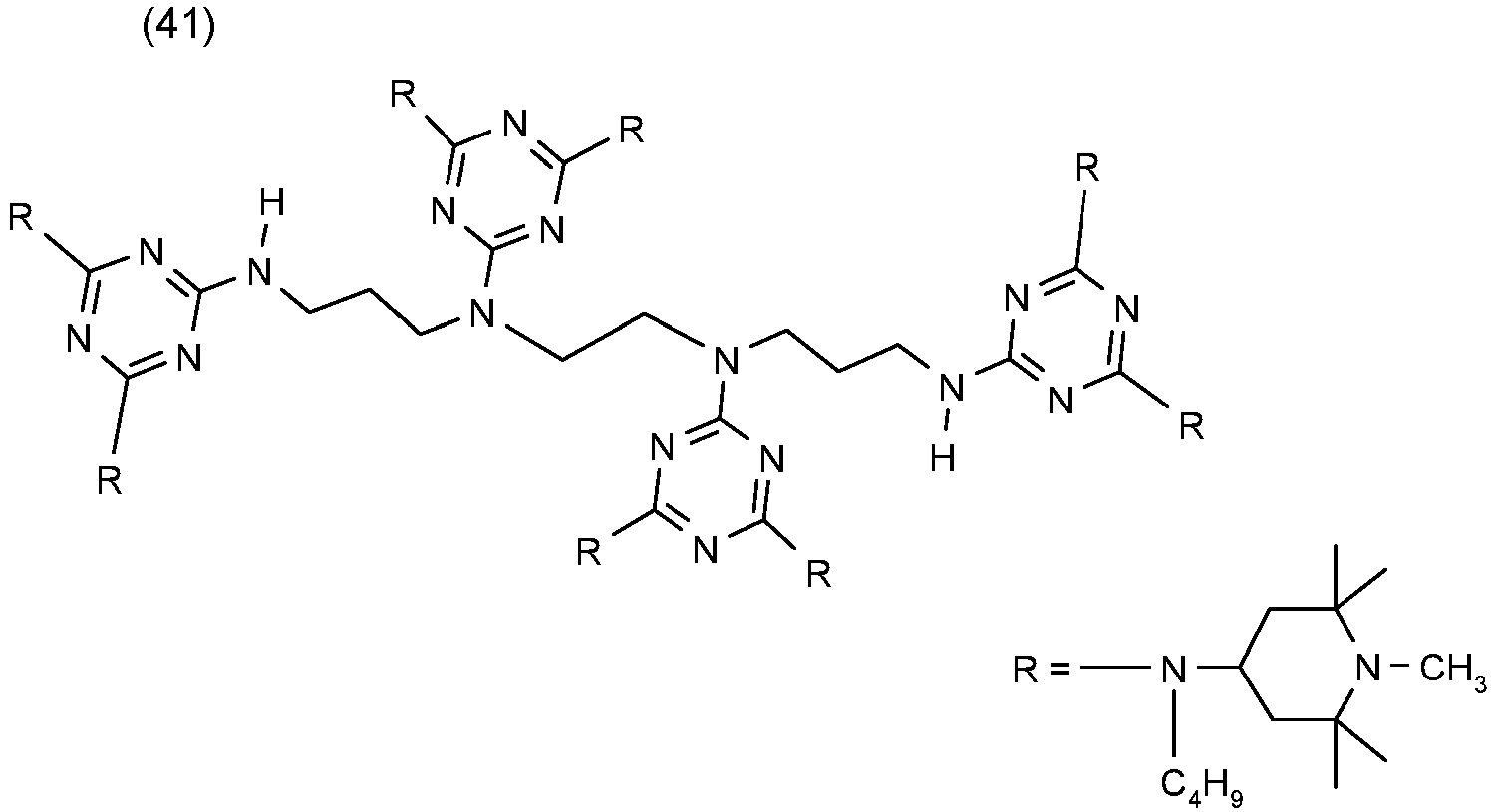
- (41) condensate of 2-chloro-4,6-di-(4-n-butylamino-1,2,2,6,6-pentamethylpiperidyl)-1,3,5-triazine and 1,2-bis-(3-aminopropylamino)ethane,
- (42) a reaction product of 7,7,9,9-tetramethyl-2-cycloundecyl-1-oxa-3,8-diaza-4-oxospiro [4,5]decane and epichlorohydrin,
- (43) poly[methyl,(3-oxy-(2,2,6,6-tetramethylpiperidin-4-yl)propyl)] siloxane, CAS#182635-99-0,
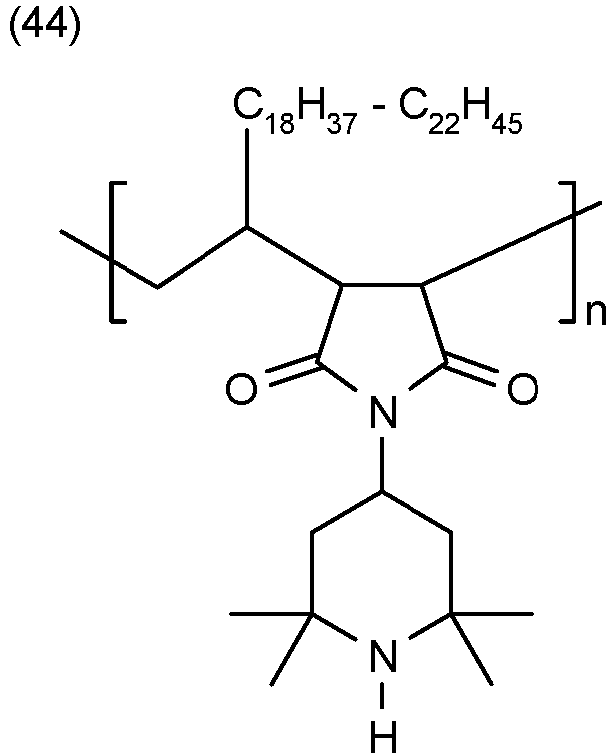
- (44) reaction product of maleic acid anhydride-C18-C22-a-olefin-copolymer with 2,2,6,6-tetramethyl-4-aminopiperidine,
- (45) oligomeric condensate of 4,4'-hexamethylenebis(amino-2,2,6,6-tetramethylpiperidine) and 2,4-dichloro-6-[(2,2,6,6-tetramethylpiperidin-4-yl)butylamino]-s-triazine end-capped with 2-chloro-4,6-bis(dibutylamino)-s-triazine,
- (46) oligomeric condensate of 4,4'-hexamethylenebis(amino-1,2,2,6,6-pentaamethyl-piperidine) and 2,4-dichloro-6-[(1,2,2,6,6-pentaamethylpiperidin-4-yl)butylamino]-s-triazine end-capped with 2-chloro-4,6-bis(dibutylamino)-s-triazine,
- (47) oligomeric condensate of 4,4'-hexamethylenebis(amino-1-propoxy-2,2,6,6-tetramethyl
piperidine) and 2,4-dichloro-6-[(1-propoxy-2,2,6,6-tetramethylpiperidin-4-yl)butylamino]-s-triazine end-capped with 2-chloro-4,6-bis(dibutylamino)-s-triazine, - (48) oligomeric condensate of 4,4'-hexamethylenebis(amino-1-acyloxy-2,2,6,6-tetramethyl
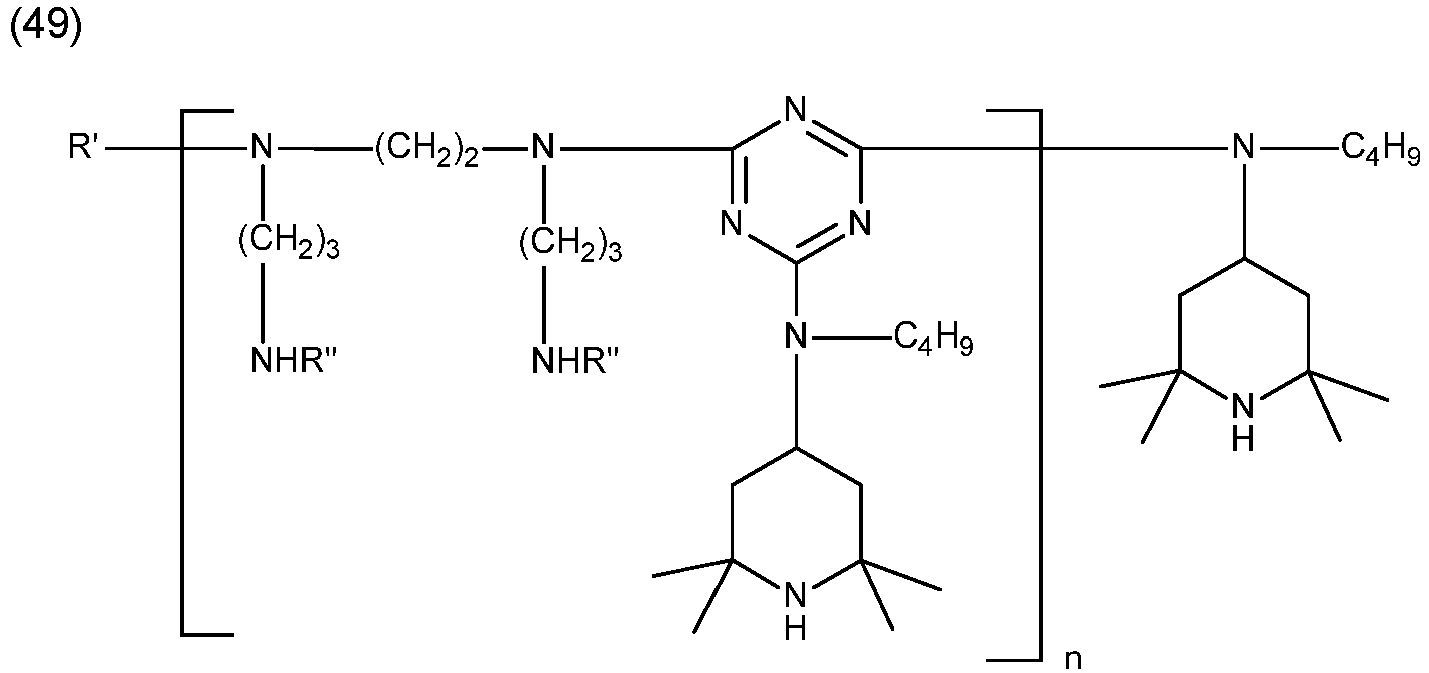
piperidine) and 2,4-dichloro-6-[(1-acyloxy-2,2,6,6-tetramethylpiperidin-4-yl)butylamino]-s-triazine end-capped with 2-chloro-4,6-bis(dibutylamino)-s-triazine and - (49) product obtained by reacting (a) with (b) where (a) is product obtained by reacting 1,2-bis(3-aminopropylamino)ethane with cyanuric chloride and (b) is (2,2,6,6-tetramethyl piperidin-4-yl)butylamine.
- Also included are the sterically hindered N-H, N-methyl, N-hydroxy and N-acyloxy analogues of any of the above mentioned compounds. For example, replacing an N-H hindered amine with an N-methyl hindered amine would be employing the N-methyl analogue in place of the N-H.
- For illustrative purposes, some of the structures for the above-named compounds are shown below.





- where R' = R" or H
- n = 2 or 3
- and where R" =

- In some embodiments, hindered amine light stabilizers may be selected from a group consisting of
- (2) bis(2,2,6,6-tetramethylpiperidin-4-yl) sebacate,
- (20) 2,2,6,6-tetramethylpiperidin-4-yl octadecanoate,
- (14) 1-(2-hydroxy-2-methylpropoxy)-4-octadecanoyloxy-2,2,6,6-tetramethylpiperidine,
- (33) N,N'-bis-formyl-N,N'-bis(2,2,6,6-tetramethyl-4-piperidyl)hexamethylenediamine,
- (36) condensate of N,N'-bis(2,2,6,6-tetramethyl-4-piperidyl)-hexamethylenediamine and 4-tert-octylamino-2,6-dichloro-1,3,5-triazine,
- (38) condensate of N,N'-bis-(2,2,6,6-tetramethyl-4-piperidyl)hexamethylenediamine and 4-morpholino-2,6-dichloro-1,3,5-triazine,
- (39) condensate of N,N'-bis-(1,2,2,6,6-pentamethyl-4-piperidyl)hexamethylenediamine and 4-morpholino-2,6-dichloro-1,3,5-triazine,
- (44) reaction product of maleic acid anhydride-C18-C22-□-olefin-copolymer with 2,2,6,6-tetramethyl-4-aminopiperidine,
- (45) oligomeric compound condensate of 4,4'-hexamethylenebis(amino-2,2,6,6-tetramethyl piperidine) and 2,4-dichloro-6-[(2,2,6,6-tetramethylpiperidin-4-yl)butylamino]-s-triazine end-capped with 2-chloro-4,6-bis(dibutylamino)-s-triazine,
- (47) oligomeric compound condensate of 4,4'-hexamethylenebis(amino-1-propoxy-2,2,6,6-tetramethylpiperidine) and 2,4-dichloro-6-[(1-propoxy-2,2,6,6-tetramethylpiperidin-4-yl)butylamino]-s-triazine end-capped with 2-chloro-4,6-bis(dibutylamino)-s-triazine and binary or ternary combinations thereof.
- Certain binary or ternary combinations of hindered amine light stabilizers may be advantageous. For instance, binary or ternary combinations:
- (2) bis(2,2,6,6-tetramethylpiperidin-4-yl) sebacate and
- (36) condensate of N,N'-bis(2,2,6,6-tetramethyl-4-piperidyl)-hexamethylenediamine and 4-tert-octylamino-2,6-dichloro-1,3,5-triazine;
- (2) bis(2,2,6,6-tetramethylpiperidin-4-yl) sebacate and
- (45) oligomeric compound condensate of 4,4'-hexamethylenebis(amino-2,2,6,6-tetramethyl piperidine) and 2,4-dichloro-6-[(2,2,6,6-tetramethylpiperidin-4-yl)butylamino]-s-triazine end-capped with 2-chloro-4,6-bis(dibutylamino)-s-triazine;
- (20) 2,2,6,6-tetramethylpiperidin-4-yl octadecanoate and
- (45) oligomeric condensate of 4,4'-hexamethylenebis(amino-2,2,6,6-tetramethylpiperidine) and
2,4-dichloro-6-[(2,2,6,6-tetramethylpiperidin-4-yl)butylamino]-s-triazine end-capped with 2-chloro-4,6-bis(dibutylamino)-s-triazine; - (2) bis(2,2,6,6-tetramethylpiperidin-4-yl) sebacate and
- (20) 2,2,6,6-tetramethylpiperidin-4-yl octadecanoate; or
- (2) bis(2,2,6,6-tetramethylpiperidin-4-yl) sebacate,
- (14) 1-(2-hydroxy-2-methylpropoxy)-4-octadecanoyloxy-2,2,6,6-tetramethylpiperidine and (36) condensate of N,N'-bis(2,2,6,6-tetramethyl-4-piperidyl)-hexamethylenediamine and 4-tert-octylamino-2,6-dichloro-1,3,5-triazine.
- In some embodiments, HALS (38) or (39) may be substituted for HALS (36) in the binary and ternary combinations.
- Many of the present hindered amine stabilizers are commercial, for example TINUVIN 770, CHIMASSORB 944, CHIMASSORB 2020, CYASORB UV 3853, CYASORB UV 3529, TINUVIN NOR 371, UVINUL 4050, UVINUL 5050, etc.
- In the binary HALS combinations, the weight/weight ratio is from any of about 1/19, about 1/18, about 1/17, about 1/16, about 1/15, about 1/14, about 1/13, about 1/12, about 1/11, about 1/10, about 1/9, about 1/8, about 1/7, about 1/6, about 1/5, about 1/4, about 1/3, about 1/2 or about 1/1 to any of about 1/2, about 1/3, about 1/4, about 1/5, about 1/6, about 1/7, about 1/8, about 1/9, about 1/10, about 1/11, about 1/12, about 1/13, about 1/14, about 1/15, about 1/16, about 1/17, about 1/18, about 1/19 or about 1/20.
- In ternary HALS combinations, a weight/weight ratios of any two of the HALS is as for the binary combinations.
- In some embodiments, a combination of a low molecular weight and a high molecular weight HALS may be employed. The low molecular weight stabilizers have a molecular weight of from about 200 g/mol to about 1000 g/mol. The high molecular weight stabilizers have a molecular weight from about 1200 g/mol to about 10,000 g/mol.
- Some low molecular weight hindered amines are (1)-(33a). Some high molecular weight hindered amines are (34)-(49). In oligomeric or polymeric hindered amines, the repeating unit "n" is a value such that the average molecular weight is from about 1200 g/mol to about 10,000 g/mol.
- The ultraviolet (UV) light absorbers are selected from oxamide ultraviolet light absorbers (UVAs).
- Oxamide UVAs include for example 4,4'-dioctyloxyoxanilide, 2,2'-diethoxyoxanilide, 2,2'-dioctyloxy-5,5'-di-tert-butoxanilide, 2,2'-didodecyloxy-5,5'-di-tert-butoxanilide, 2-ethoxy-2'-ethyloxanilide (N'-(2-ethoxyphenyl)-N-(2-ethylphenyl)oxamide), N,N'-bis(3-dimethylaminopropyl)oxamide, 2-ethoxy-5-tert-butyl-2'-ethoxanilide and its mixture with 2-ethoxy-2'-ethyl-5,4'-di-tert-butoxanilide, mixtures of o- and p-methoxy-disubstituted oxanilides and mixtures of o- and p-ethoxy-disubstituted oxanilides.
- Further disclosed herein are hydroxyphenylbenzotriazole UVAs, as for instance disclosed in
U.S. Pat. Nos. 3,004,896 ;3,055,896 ;3,072,585 ;3,074,910 ;3,189,615 ;3,218,332 ;3,230,194 ;4,127,586 ;4,226,763 ;4,275,004 ;4,278,589 ;4,315,848 ;4,347,180 ;4,383,863 ;4,675,352 ;4,681,905 ,4,853,471 ;5,268,450 ;5,278,314 ;5,280,124 ;5,319,091 ;5,410,071 ;5,436,349 ;5,516,914 ;5,554,760 ;5,563,242 ;5,574,166 ;5,607,987 ,5,977,219 and6,166,218 , such as 2-(2-hydroxy-5-methylphenyl)-2H-benzotriazole, 2-(3,5-dit-butyl-2-hydroxyphenyl)-2H-benzotriazole, 2-(2-hydroxy-5-t-butylphenyl)-2H-benzotriazole, 2-(2-hydroxy-5-t-octylphenyl)-2H-benzotriazole, 5-chloro-2-(3,5-di-t-butyl-2-hydroxyphenyl)-2H-benzotriazole, 5-chloro-2-(3-t-butyl-2-hydroxy-5-methylphenyl)-2H-benzotriazole, 2-(3-sec-butyl-5-t-butyl-2-hydroxyphenyl)-2H-benzotriazole, 2-(2-hydroxy-4-octyloxyphenyl)-2H-benzotriazole, 2-(3,5-di-t-amyl-2-hydroxyphenyl)-2H-benzotriazole, 2-(3,5-bis-α-cumyl-2-hydroxyphenyl)-2H-benzotriazole, 2-(3-t-butyl-2-hydroxy-5-(2-(ω-hydroxy-octa-(ethyleneoxy)carbonyl-ethyl)-, phenyl)-2H-benzotriazole, 2-(3-dodecyl-2-hydroxy-5-methylphenyl)-2H-benzotriazole, 2-(3-t-butyl-2-hydroxy-5-(2-octyloxycarbonyl)ethylphenyl)-2H-benzotriazole, dodecylated 2-(2-hydroxy-5-methylphenyl)-2H-benzotriazole, 2-(3-t-butyl-2-hydroxy-5-(2-octyloxycarbonylethyl)phenyl)-5-chloro-2H-benzotriazole, 2-(3-tert-butyl-5-(2-(2-ethylhexyloxy)-carbonylethyl)-2-hydroxyphenyl)-5-chloro-2H-benzotriazole, 2-(3-t-butyl-2-hydroxy-5-(2-methoxycarbonylethyl)phenyl)-5-chloro-2H-benzotriazole, 2-(3-t-butyl-2-hydroxy-5-(2-methoxycarbonylethyl)phenyl)-2H-benzotriazole, 2-(3-t-butyl-5-(2-(2-ethylhexyloxy)carbonylethyl)-2-hydroxyphenyl)-2H-benzotriazole, 2-(3-t-butyl-2-hydroxy-5-(2-isooctyloxycarbonylethyl)phenyl-2H-benzotriazole, 2,2'-methylene-bis(4-t-octyl-(6-2H-benzotriazol-2-yl)phenol), 2-(2-hydroxy-3-α-cumyl-5-t-octylphenyl)-2H-benzotriazole, 2-(2-hydroxy-3-t-octyl-5-α-cumylphenyl)-2H-benzotriazole, 5-fluoro-2-(2-hydroxy-3,5-di-□-cumylphenyl)-2H-benzotriazole, 5-chloro-2-(2-hydroxy-3,5-di-a-cumylphenyl)-2H-benzotriazole, 5-chloro-2-(2-hydroxy-3-α-cumyl-5-t-octylphenyl)-2H-benzotriazole, 2-(3-t-butyl-2-hydroxy-5-(2-isooctyloxycarbonylethyl)phenyl)-5-chloro-2H-benzotriazole, 5-trifluoromethyl-2-(2-hydroxy-3-α-cumyl-5-t-octylphenyl)-2H-benzotriazole, 5-trifluoromethyl-2-(2-hydroxy-5-t-octylphenyl)-2H-benzotriazole, 5-trifluoromethyl-2-(2-hydroxy-3,5-di-t-octylphenyl)-2H-benzotriazole, methyl 3-(5-trifluoromethyl-2H-benzotriazol-2-yl)-5-t-butyl-4-hydroxyhydrocinnamate, 5-butylsulfonyl-2-(2-hydroxy-3-a-cumyl-5-t-octylphenyl)-2H-benzotriazole, 5-trifluoromethyl-2-(2-hydroxy-3-a-cumyl-5-t-butylphenyl)-2H-benzotriazole, 5-trifluoromethyl-2-(2-hydroxy-3,5-di-t-butylphenyl)-2H-benzotriazole, 5-trifluoromethyl-2-(2-hydroxy-3,5-di-□-cumylphenyl)-2H-benzotriazole, 5-butylsulfonyl-2-(2-hydroxy-3,5-di-t-butylphenyl)-2H-benzotriazole and 5-phenylsulfonyl-2-(2-hydroxy-3,5-di-t-butylphenyl)-2H-benzotriazole. - Further disclosed herein are tris-aryl-s-triazine UVAs, for instance those disclosed in
U. S. Pat. Nos. 3,843,371 ;4,619,956 ;4,740,542 ;5,096,489 ;5,106,891 ;5,298,067 ;5,300,414 ;5,354,794 ;5,461,151 ;5,476,937 ;5,489,503 ;5,543,518 ;5,556,973 ;5,597,854 ;5,681,955 ;5,726,309 ;5,736,597 ;5,942,626 ;5,959,008 ;5,998,116 ;6,013,704 ;6,060,543 ;6,242,598 and6,255,483 , for example 4,6-bis-(2,4-dimethylphenyl)-2-(2-hydroxy-4-octyloxyphenyl)-s-triazine, CYASORB 1164, 4,6-bis-(2,4-dimethylphenyl)-2-(2,4-dihydroxyphenyl)-s-triazine, 2,4-bis(2,4-dihydroxyphenyl)-6-(4-chlorophenyl)-s-triazine, 2,4-bis[2-hydroxy-4-(2-hydroxyethoxy)phenyl]-6-(4-chlorophenyl)-s-triazine, 2,4-bis[2-hydroxy-4-(2-hydroxy-4-(2-hydroxyethoxy)phenyl]-6-(2,4-dimethylphenyl)-s-triazine, 2,4-bis[2-hydroxy-4-(2-hydroxyethoxy)phenyl]-6-(4-bromophenyl)-s-triazine, 2,4-bis[2-hydroxy-4-(2-acetoxyethoxy)phenyl]-6-(4-chlorophenyl)-s-triazine, 2,4-bis(2,4-dihydroxyphenyl)-6-(2,4-dimethylphenyl)-s-triazine, 2,4-bis(4-biphenylyl)-6-(2-hydroxy-4-octyloxycarbonylethylidene-oxyphenyl)-s-triazine, 2-phenyl-4-[2-hydroxy-4-(3-sec-butyloxy-2-hydroxypropyloxy)phenyl]-6-[2-hydroxy-4-(3-sec-amyloxy-2-hydroxypropyloxy)phenyl]-s-triazine, 2,4-bis(2,4-dimethylphenyl)-6-[2-hydroxy-4-(3-benzyloxy-2-hydroxypropyloxy)phenyl]-s-triazine, 2,4-bis(2-hydroxy-4-n-butyloxyphenyl)-6-(2,4-di-n-butyloxyphenyl)-s-triazine, 2,4-bis(2,4-dimethylphenyl)-6-[2-hydroxy-4-(3-nonyloxy*-2-hydroxypropyloxy)-5-a-cumylphenyl]-s-triazine (* denotes a mixture of octyloxy, nonyloxy and decyloxy groups), methylenebis-{2,4-bis(2,4-dimethylphenyl)-6-[2-hydroxy-4-(3-butyloxy-2-hydroxypropoxy)phenyl]-s-triazine}, methylene bridged dimer mixture bridged in the 3:5', 5:5' and 3:3' positions in a 5:4:1 ratio, 2,4,6-tris(2-hydroxy-4-isooctyloxycarbonylisopropylideneoxyphenyl)-s-triazine, 2,4-bis(2,4-dimethylphenyl)-6-(2-hydroxy-4-hexyloxy-5-a-cumylphenyl)-s-triazine, 2-(2,4,6-trimethylphenyl)-4,6-bis[2-hydroxy-4-(3-butyloxy-2-hydroxypropyloxy)phenyl]-s-triazine, 2,4,6-tris[2-hydroxy-4-(3-sec-butyloxy-2-hydroxypropyloxy)phenyl]-s-triazine, mixture of 4,6-bis-(2,4-dimethylphenyl)-2-(2-hydroxy-4-(3-dodecyloxy-2-hydroxypropoxy)-phenyl)-s-triazine and 4,6-bis-(2,4-dimethylphenyl)-2-(2-hydroxy-4-(3-tridecyloxy-2-hydroxypropoxy)-phenyl)-s-triazine, TINUVIN 400, 4,6-bis-(2,4-dimethylphenyl)-2-(2-hydroxy-4-(3-(2-ethylhexyloxy)-2-hydroxypropoxy)-phenyl)-s-triazine and 4,6-diphenyl-2-(4-hexyloxy-2-hydroxyphenyl)-s-triazine. - Further disclosed herein are hydroxybenzoate UV absorbers, for instance esters of substituted and unsubstituted benzoic acids, as for example 4-tert-butylphenyl salicylate, phenyl salicylate, octylphenyl salicylate, dibenzoyl resorcinol, bis(4-tert-butylbenzoyl) resorcinol, benzoyl resorcinol, 2,4-di-tert-butylphenyl 3,5-di-tert-butyl-4-hydroxybenzoate, hexadecyl 3,5-di-tert-butyl-4-hydroxybenzoate, octadecyl 3,5-di-tert-butyl-4-hydroxybenzoate, 2-methyl-4,6-di-tert-butylphenyl 3,5-di-tert-butyl-4-hydroxybenzoate.
- Further disclosed herein are 2-hydroxybenzophenone UV absorbers, for example the 4-hydroxy, 4-methoxy, 4-octyloxy, 4-decyloxy, 4-dodecyloxy, 4-benzyloxy, 4,2',4'-trihydroxy and 2'-hydroxy-4,4'-dimethoxy derivatives.
- Further disclosed herein are cyanoacrylate UV absorbers, for instance pentaerythritol tetrakis(2-cyano-3,3-diphenylacrylate), α-cyano-β,β-diphenylacylic acid ethyl ester or isooctyl ester and α-cyano-β-methyl-p-methoxy-cinnamic acid methyl ester or butyl ester.
- Many of the UVAs are commercial, for example TINUVIN 326, TINUVIN 234, TINUVIN 1577, TINUVIN 1600, CYASORB UV 1164, CYASORB THT, CYASORB UV 2908, CHIMASSORB 81, UVINUL 3030, etc.
- Thioether additives include for example mercaptan-containing compounds or disulfide-containing compounds. In some embodiments, mercaptan-containing compounds contain one or more, for instance 1, 2, 3 or 4 moieties of formula
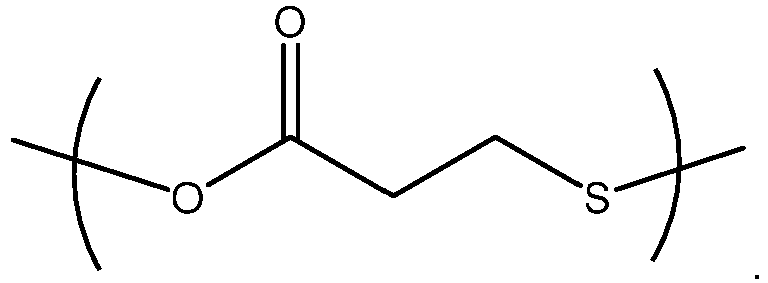
- In some embodiments, mercaptan-containing compounds contain one or more, for instance 1, 2, 3 or 4 moieties of formula

- For example, in some embodiments, thioether additives include compounds of formula


- Disulfide-containing compounds are of formula R-S-S-R, wherein each R is independently a hydrocarbyl group.
- The phrase "each R is independently a hydrocarbyl group" means each R may be the same as, or different than, any other R group.
- In some embodiments, thioether additives include dilauryl thiodipropionate, distearyl thiodipropionate, pentaerythritol tetrakis(β-laurylthiopropionate), distearyl disulfide or dilauryl disulfide.
- In some embodiments, a hydrocarbyl group may be a C2-C40 hydrocarbyl group, a C2-C24 hydrocarbyl group, or a C2-C5 hydrocarbyl group. Hydrocarbyl is any hydrocarbon containing group, for example straight or branched chain alkyl or alkenyl which may be interrupted by or substituted by one or more heteroatom-containing groups or aryl groups, for instance interrupted by one or more -O-, -NH- or-C(O)O- groups and/or substituted by one or more hydroxyl, carboxylic, amino, thiol, phosphonate or aryl groups. Aryl includes phenyl.
- In some embodiments, hydrocarbyl may be nonyl, decyl, undecyl, 1-methylundecyl, lauryl (dodecyl), tridecyl or stearyl (octadecyl).
- Alkyl groups may be linear or branched and may include methyl, ethyl, propyl, isopropyl, n-butyl, sec-butyl, isobutyl, tert-butyl, 2-ethylbutyl, n-pentyl, isopentyl, 1-methylpentyl, 1,3-dimethylbutyl, n-hexyl, 1-methylhexyl, n-heptyl, isoheptyl, 1,1,3,3-tetramethylbutyl, 1-methylheptyl, 3-methylheptyl, n-octyl, tert-octyl, 2-ethylhexyl, 1,1,3-trimethylhexyl, 1,1,3,3-tetramethylpentyl, nonyl, decyl, undecyl, 1-methylundecyl, dodecyl and octadecyl. Alkenyl is alkyl containing an ethylenically unsaturated group.
- In some embodiments, one or more further additives may be incorporated into the hollow articles of the invention. Further additives may be selected from a group consisting of antioxidants and acid scavengers.
- Antioxidants may be selected from a group consisting of hindered phenolic antioxidants, organophosphorus stabilizers, dialkylhydroxylamine stabilizers, amine oxide stabilizers and tocopherols. In some embodiments, antioxidants include a combination of an organophosphorus stabilizer and a hindered phenolic antioxidant, a dialkylhydroxylamine stabilizer, a combination of an organophosphorus stabilizer and a dialkylhydroxylamine stabilizer, an amine oxide stabilizer or a combination of an organophosphorus stabilizer and an amine oxide stabilizer.
- Antioxidants also include vitamin E and vitamin E acetate (tocopherols). Each may be employed alone, in combination with each other or in combination with one or more antioxidants selected from the group consisting of hindered phenolic antioxidants, dialkylhydroxylamine stabilizers, organophosphorus stabilizers and amine oxide stabilizers.
- Organophosphorus stabilizers are for example known phosphite and phosphonite stabilizers and include triphenyl phosphite, diphenyl alkyl phosphites, phenyl dialkyl phosphites, tris(nonylphenyl) phosphite, trilauryl phosphite, trioctadecyl phosphite, distearyl pentaerythritol diphosphite, tris(2,4-di-tert-butylphenyl) phosphite, bis(2,4-di-α-cumylphenyl) pentaerythrtitol diphosphite, diisodecyl pentaerythritol diphosphite, bis(2,4-di-tert-butylphenyl) pentaerythritol diphosphite (D), bis(2,6-di-tert-butyl-4-methylphenyl) pentaerythritol diphosphite (E), bisisodecyloxy-pentaerythritol diphosphite, bis(2,4-di-tert-butyl-6-methylphenyl) pentaerythritol diphosphite, bis(2,4,6-tri-tert-butylphenyl) pentaerythritol diphosphite, tristearyl sorbitol triphosphite, tetrakis (2,4-di-tert-butylphenyl) 4,4'-biphenylene-diphosphonite (H), 6-isooctyloxy-2,4,8,10-tetra-tert-butyl-dibenzo[d,f][1,3,2]dioxaphosphepin (C), 6-fluoro-2,4,8,10-tetra-tert-butyl-12-methyl-dibenzo[d,g][1,3,2]dioxaphosphocin (A), bis(2,4-di-tert-butyl-6-methylphenyl) methyl phosphite, bis(2,4-di-tert-butyl-6-methylphenyl) ethyl phosphite (G), 2,2',2"-nitrilo[triethyltris(3,3'5,5'-tetra-tert-butyl-1,1'-biphenyl-2,2'-diyl) phosphite] (B), bis(2,4-di-t-butylphenyl) octylphosphite, poly(4,4'- {2,2'-dimethyl-5,5'-di-t-butylphenylsulfide-}octylphosphite), poly(4,4'{-isopropylidenediphenol}-octylphosphite), poly(4,4'-{isopropylidenebis[2,6-dibromophenol]}-octylphosphite), poly(4,4'- {2,2'-dimethyl-5,5'-di-t-butylphenylsulfide}-pentaerythrityl diphosphite),


- Suitable organophosphorus stabilizers are also liquid stabilizers as disclosed in
U.S. Pub. No. 2010/048782 andU.S. Pat. No. 7,888,414 , for example liquid phosphites P-2, P-3 and P-4 therein. Suitable liquid organophosphorus stabilizers are also disclosed inU.S. Pub. Nos. 2013/0225736 and2010/0029844 andU.S. Pat. Nos. 7,468,410 and8,304,477 . - Hindered phenolic antioxidants include for example tris(3,5-di-tert-butyl-4-hydroxybenzyl) isocyanurate, 1,3,5-tris-(3,5-di-tert-butyl-4-hydroxybenzyl)-2,4,6-trimethylbenzene, the calcium salt of the monoethyl ester of 3,5-di-tert-butyl-4-hydroxybenzylphosphonic acid, pentaerythritol tetrakis [3-(3,5-di-tert-butyl-4-hydroxyphenyl) propionate] or octadecyl 3-(3,5-di-tert-butyl-4-hydroxyphenyl) propionate.
- A combination of an organophosphorus stabilizer and a hindered phenolic antioxidant may be tris(2,4-di-tert-butylphenyl) phosphite and pentaerythritol tetrakis [3-(3,5-di-tert-butyl-4-hydroxyphenyl) propionate] or octadecyl 3-(3,5-di-tert-butyl-4-hydroxyphenyl) propionate.
- A weight/weight ratio of organophosphorus stabilizer to hindered phenolic antioxidant may be from any of about 9/1, about 8/1, about 7/1, about 6/1, about 5/1, about 4/1, about 3/1, about 2/1 or about 1/1 to any of about 1/2, about 1/3, about 1/4, about 1/5, about 1/6, about 1/7, about 1/8 or about 1/9.
- Hydroxylamine stabilizers are for example N,N-dibenzylhydroxylamine, N,N-diethylhydroxylamine, N,N-dioc-tylhydroxylamine, N,N-dilaurylhydroxylamine, N,N-didodecylhydroxylamine, N,N-ditetradecylhydroxylamine, N,N-dihexadecylhydroxylamine, N,N-dioctadecylhydroxylamine, N-hexadecyl-N-tetradecylhydroxylamine, N-hexadecyl-N-heptadecylhydroxylamine, N-hexadecyl-N-octadecylhydroxylamine, N-heptadecyl-N-octadecylhydroxylamine, N-methyl-N-octadecylhydroxylamine or N,N-di(C16-C18alkyl)hydroxylamine
- The amine oxide stabilizer is for instance a di(C16-C18)alkyl methyl amine oxide, CAS# 204933-93-7.
- A combination of an organophosphorus stabilizer and a dialkylhydroxylamine is for example tris(2,4-di-tert-butylphenyl) phosphite and N,N-di(C16-C18alkyl)hydroxylamine
- A combination of an organophosphorus stabilizer and an amine oxide stabilizer is for example tris(2,4-di-tert-butylphenyl) phosphite and di(C16-C18)alkyl methyl amine oxide.
- A weight/weight ratio of these combinations may be from any of about 9/1, about 8/1, about 7/1, about 6/1, about 5/1, about 4/1, about 3/1, about 2/1 or about 1/1 to any of about 1/2, about 1/3, about 1/4, about 1/5, about 1/6, about 1/7, about 1/8 or about 1/9.
- Antioxidants may be present, in total, from any of about 0.05 wt%, about 0.10 wt%, about 0.20 wt%, about 0.30 wt%, about 0.40 wt%, about 0.50 wt% or about 0.60 wt% to any of about 0.70 wt%, about 0.80 wt%, about 0.90 wt%, about 1.0 wt%, about 1.5 wt% or about 2.0 wt%, based on the total weight of the hollow article.
- Acid scavengers include hydrotalcites and amorphous basic aluminum magnesium carbonates, such as those described in
U.S. Pat. Nos. 4,427,816 ,5,106,898 and5,234,981 . Hydrotalcite is also known as hycite, DHT4A, DHT4V, DHT4Z, DHT4A2 or DHT4C. Hydrotalcites are natural or synthetic and may include a coating. Natural hydrotalcite is held to possess a structure Mg6Al2(OH)16CO3.4 H2O. A typical empirical formula of a synthetic hydrotalcite is Al2Mg4.35OH11.36CO3(1.67).x H2O. Examples of the synthetic product include Mg0.7Al0.3(OH)2(CO3)0.150.54 H2O, Mg4.5Al2(OH)13CO3.3.5 H2O and Mg4.2Al(OH)12.4CO3· - In some embodiments, acid scavengers include metal salts of fatty acids, for example alkali or alkali earth metal salts of fatty acids. In some embodiments, acid scavengers include calcium, magnesium, zinc, sodium, potassium or aluminum salts of fatty acids. In some embodiments, acid scavengers include calcium, magnesium, zinc, sodium, potassium or aluminum stearate, behenate, ricinoleate or palmitate. In certain embodiments, acid scavengers include calcium stearate, zinc stearate, magnesium behenate, magnesium stearate, sodium ricinoleate and potassium palmitate. In other embodiments, acid scavengers include zinc oxide.
- In some embodiments, a combination of one or more acid scavengers may be employed.
- Acid scavengers may be present, in total, from any of about 50 ppm (parts per million), about 100 ppm, about 200 ppm, about 300 ppm, about 400 ppm, about 500 ppm or about 600 ppm to any of about 700 ppm, about 800 ppm, about 900 ppm, about 1000 ppm, about 1100 ppm, about 1200 ppm, about 1300 ppm, about 1400 ppm, about 1500 ppm, about 1600 ppm, about 1700 ppm, about 1800 ppm, about 1900 ppm or about 2000 ppm, based on the total weight of the article.
- In other embodiments, the hollow articles may comprise acid scavengers from any of about 0.1 wt% (weight percent), about 0.2 wt% or about 0.5 wt% to any of about 1.0 wt%, about 1.5 wt%, about 2.0 wt%, about 2.5 wt% or about 3.0 wt%, based on the total weight of the article.
- Colorants, pigments or fillers may also be added to the present polyolefin substrates.
- Pigments include inorganic pigments, such as titanium dioxide in its three crystalline forms: rutile, anatase, or brookite, ultramarine blue, iron oxides, bismuth vanadates, carbon black, effect pigments including metallic pigments such as aluminum flake and pearlescent pigments such as micas, and organic pigments, for example phthalocyanines, perylenes, azo compounds, isoindolines, quinophthalones, diketopyrrolopyrroles, quinacridones, dioxazines, and indan-thrones. Pigments may be included singly or in any combination in amounts typically of up to about 5% by weight, based on the total weight of the article. Dyes are any of the colorants which dissolve completely in the plastic used or are present in molecularly dispersed form and therefore can be used to provide high-transparency, non-diffusion coloring of polymers. Other dyes are organic compounds which fluoresce in the visible portion of the electromagnetic spectrum, e.g. fluorescent dyes. Dyes may be included singly or in any combination in amounts typically of up to about 5% by weight, based on the total weight of the article.
- Particulate fillers may be present in an amount from any of about 0.01 wt%, about 0.1 wt%, about 1 wt%, about 5 wt%, about 10 wt%, about 15 wt% or about 20 wt% to any of about 25 wt%, about 30 wt%, about 35 wt%, about 40 wt%, about 45 wt% or about 50 wt%, based on the total weight of the article. Fillers include but are not limited to titanium dioxide, silicon carbide, silica (and other oxides of silica, precipitated or not), antimony oxide, lead carbonate, zinc white, lithopone, zircon, corundum, spinel, apatite, barytes powder, barium sulfate, carbon black, dolomite, calcium carbonate, talc and hydrotalcite compounds of the ions Mg, Ca, or Zn with Al, Cr or Fe and CO3 and/or HPO4, hydrated or not; quartz powder, hydrochloric magnesium carbonate, glass fibers, clays, alumina, and other metal oxides and carbonates, metal hydroxides, chrome, phosphorous, antimony trioxide, silica, silicone, and blends thereof. These fillers may include any other fillers and porous fillers and supports known in the art.
- Still further additives may be incorporated into the polyolefin substrate, for instance additives such as anti-static agents (antistats), antiscratch additives, slip agents, polymer processing aids, etc. (see Plastic Additives Handbook; 6th Edition). Included are metal salts of fatty acids, for example, calcium, magnesium, zinc, or aluminum stearate. Further additives also include thioether additives, for example dilauryl thiodipropionate or distearyl thiodipropionate.
- Further additives also include benzofuranone stabilizers, for example those disclosed in
U.S. Pat. Nos. 4,325,863 ,4,338,244 ,5,175,312 ,5,216,052 ,5,252,643 ,5,369,159 ,5,356,966 ,5,367,008 ,5,428,177 or5,428,162 orU.S. Patent App. Pub. No. 2012/0238677 , including 3-[4-(2-acetoxyethoxy)phenyl]-5,7-di-tert-butyl-benzofuran-2-one, 5,7-di-tert-butyl-3-[4-(2- stearoyloxyethoxy)phenyl]benzofuran-2-one, 3,3'-bis[5,7-di-tert-butyl-3-(4-[2-hydroxyethoxy]phenyl)benzofuran-2-one], 5,7-di-tert-butyl-3-(4-ethoxyphenyl)benzofuran-2-one, 3-(4-acetoxy-3,5-dimethylphenyl)-5,7-di-tert-butyl-benzofuran-2-one, 3-(3,5-dimethyl-4-pivaloyloxyphenyl)-5,7-di-tert-butyl-benzofuran-2-one, 3-(3,4-dimethylphenyl)-5,7-di-tert-butyl-benzofuran-2-one, 3-(2-acetyl-5-isooctylphenyl)-5-isooctylbenzofuran-2-one and 3-(2,3-dimethylphenyl)-5,7-di-tert-butyl-benzofuran-2-one. Further additives also include compatibilizers or dispersing aids, for example, maleic anhydride grafted PE or PP, poly(ethylene-co-vinyl acetate), poly(ethylene-acrylic acid), etc. The further additives may be present from any of about 0.05 wt%, about 0.1 wt%, 0.2 wt%, about 0.5 wt%, about 0.7 wt% or about 1.0 wt% to any of about 1.5 wt%, about 2.0 wt%, about 2.5 wt%, about 3.0 wt%, about 3.5 wt%, about 4.0 wt%, about 4.5 wt% or about 5.0 wt%, based on a total weight of the article. - Rotomolding (rotational molding) is used for the production of fairly large plastic hollow articles which may be reinforced with glass fibers. The process includes filling one half of a mold with the plastic material. The mold is then closed with the other half and heated and rotated in an oven such that the molten plastic spreads to the walls of the mold while being rotated around different axes. The hollow article is obtained after cooling. In this manner it is possible to produce, for example, storage tanks from HD polyethylene. In some embodiments, the process requires heating a polyolefin mixture to temperatures in the range of from any of about 170°C, about 190°C, about 210°C, about 215°C, about 220°C, about 230°C, about 240°C, about 260°C or about 280°C to any of about 300°C, about 340°C to about 370°C or about 400°C or higher. These temperatures represent the peak internal air temperature (PIAT) of an oven.
- In some embodiments, a 125 mil thick, 5 inch x 5 inch test sample of a present hollow article may exhibit an impact strength of ≥ 21 ft/lbs (foot/pounds), ≥ 23 ft/lbs, ≥ 25 ft/lbs, ≥ 27 ft/lbs, ≥ 29 ft/lbs, ≥ 31 ft/lbs, ≥ 33 ft/lbs, ≥ 35 ft/lbs, ≥ 37 ft/lbs, ≥ 39 ft/lbs, ≥ 40 ft/lbs, ≥ 41 ft/lbs, ≥ 42 ft/lbs or ≥ 43 ft/lbs.
- In certain embodiments, a 125 mil thick, 5 inch x 5 inch test sample of a present hollow article may exhibit a ductility of ≥ 50%, ≥ 55%, ≥ 60%,2: 65%, ≥ 70%, ≥ 75%, ≥ 80%, ≥ 85%, ≥ 90%, ≥ 95%,≥ 96%, ≥ 97%, ≥ 98% or ≥ 99%.
- In certain other embodiments, a 125 mil thick, 5 inch x 5 inch test sample of a present hollow article may exhibit a yellowness index (YI) of ≤ 0.0, ≤ -0.5, ≤ -0.7, ≤ -1.0, ≤ - 1.2, ≤ - 1.4,
≤ -1.6, ≤ -1.8, ≤ -2.0, ≤ -2.2, ≤ -2.4, ≤ -2.6, ≤ -2.7, ≤ -2.8 or ≤ -2.9. - In some embodiments, a 125 mil thick, 5 inch x 5 inch test sample of a present hollow article may exhibit a yellowness index (YI) of ≤ -3.0, ≤ -3.3, ≤ -3.5, ≤ -3.7, ≤ -3.9, ≤-4.0, ≤-4.1,
≤ -4.2, ≤ -4.3, ≤ -4.4 or ≤ -4.5. - In certain embodiments, a 125 mil thick, 5 inch x 5 inch test sample of a present hollow article may exhibit an impact strength of from ≥ 40 ft/lbs, a ductility of ≥ 90% and a YI of ≤ 0.0 or ≤ -1.0 or ≤ -1.5 or ≤ -2.0.
- Mechanical properties may be determined according to the Association of Rotational Molders (ARM) Impact Test. The above embodiments referring to impact strength, ductility and color may be determined on test samples of rotomolded hollow articles wherein the peak internal air temperature is about 380°F, about 400°F or about 420°F.
- Incorporation of the phosphonate ester, N-alkoxy hindered amine, melamine cyanurate (present additives) and optional further additives into the polyolefin substrate is carried out by known methods, for example before or after molding or also by applying the dissolved or dispersed additive mixture to the polyolefin, with or without subsequent evaporation of the solvent. Present additives can also be added to the polyolefin in the form of a masterbatch which contains the additives in a concentration of, for example, about 2.5% to about 40% by weight, based on the total weight of the masterbatch. In the form of a masterbatch, the polymer of the masterbatch need not be the same as the polyolefin substrate.
- Molding is carried out with known mixing machines, for instance mixers, kneaders or extruders. Present additives and optional further additives can be premixed or added individually. Present additives and optional further additives can also be added before or during the polymerization or before crosslinking. Present additives and optional further additives can be incorporated into the polymer to be made flame retardant in pure form or encapsulated in waxes, oils or polymers.
- Present additives and optional further additives can also be sprayed onto the polyolefin substrate. They are able to dilute other additives or their melts so that they can be sprayed also together with these additives onto the polyolefin. Addition by spraying during the deactivation of the polymerization catalysts may be advantageous, it being possible to carry out spraying using, for example, the steam used for deactivation.
- In some embodiments, a present process includes the measurement of raw materials by weight followed by dry blending of the ingredients. In certain embodiments, the present additives and optional further additives are incorporated into the thermoplastic polyolefin substrate by melt blending in an extruder. The present additives and optional additives may be added together or separately. In some embodiments, the term "incorporating into a polyolefin" means melt blending, that is, subjecting a mixture to melt conditions at an elevated temperature.
- A mixture may be fed to a melt mixing device such as an extruder at a constant feed rate to extrude the material into a desired form, for example pellets. The pellets are a "fully formulated polyolefin substrate". The pellets may be ground to a small, generally uniform particle size, for example to an average particle size of from about 150 microns to about 500 microns prior to rotomolding.
- The fully formulated polyolefin particles are filled into one half of a mold which is then closed with the other half. Molds are typically made of aluminum or steel. The closed mold is heated and rotated around different axes, wherein molten polymer coats the interior of the mold - a process referred to as "sintering". The mold is then cooled and the molded article removed.
- In addition to storage tanks, many other articles may be manufactures with a rotomolding process, for example kayaks, toys, refuse containers, equipment housings, etc. Rotomolded articles may in many cases have a relatively large average wall thickness. In some embodiments, present rotomolded articles have an average wall thickness of ≥ about 1.50 mm, ≥ about 1.75 mm, ≥ about 2.00 mm, ≥ about 2.25 mm, ≥ about 2.50 mm, ≥ about 2.75 mm, ≥ about 3.00 mm, ≥ about 3.25 mm, ≥ about 3.50 mm, ≥ about 3.75 mm, ≥ about 4.00 mm, ≥ about 4.25 mm, ≥ about 4.50 mm or ≥ about 4.75 mm. In some embodiments, rotomolded articles have an average wall thickness of from any of about 1.50 mm, about 1.75 mm, about 2.00 mm, about 2.25 mm, about 2.50 mm, about 2.75 mm or about 3.00 mm to any of about 3.25 mm, about 3.50 mm, about 3.75 mm, about 4.00 mm, about 4.25 mm, about 4.50 mm, about 4.75 mm, about 5.00 mm, about 5.25 mm, about 5.50 mm, about 5.75 mm or about 6.00 mm.
- The articles "a" and "an" herein refer to one or to more than one (e.g. at least one) of the grammatical object. Any ranges cited herein are inclusive. The term "about" used throughout is used to describe and account for small fluctuations. For instance, "about" may mean the numeric value may be modified by ± 5%, ± 4%, ± 3%, ± 2%, ± 1%, ± 0.5%, ± 0.4%, ± 0.3%, ± 0.2%, ± 0.1 % or ± 0.05%. All numeric values are modified by the term "about" whether or not explicitly indicated. Numeric values modified by the term "about" include the specific identified value. For example "about 5.0" includes 5.0.
- Unless otherwise indicated, all parts and percentages are by weight. Weight percent (wt%), if not otherwise indicated, is based on an entire composition free of any volatiles.
- Additives are dry blended with low density polyethylene (LDPE, 0.935 g/cm3) to provide the formulations Additive levels are reported in ppm (parts per million) by weight, based on the weight of the polyethylene. The dry blends are melt extruded into pellets, which are ground to 35 mesh and placed in a laboratory scale FST M20 "clamshell" aluminum mold. The mold is rotated biaxially in a gas-fired oven. Hot air is circulated by blowers in the chamber while the temperature is increased to provide a peak internal air temperature (PIAT) of 400°F or 420°F. The temperature is maintained for 20 minutes. The oven is opened and is cooled over 24 minutes while still rotating. The mold is opened and the hollow article is removed.
- A control formulation contains no additives. Each of formulations 1-4 contain 400 ppm of tris(3,5-di-tert-butyl-4-hydroxybenzyl) isocyanurate (phenolic antioxidant), 600 ppm of N,N-di(C16-C18alkyl)hydroxylamine (hydroxylamine stabilizer), 1200 ppm of tris(2,4-di-tert-butylphenyl) phosphite (organophosphorus stabilizer), 1200 ppm of oligomeric condensate of 4,4'-hexamethylenebis(amino-2,2,6,6-tetramethylpiperidine) and 2,4-dichloro-6-[(2,2,6,6-tetramethylpiperidin-4-yl)butylamino]-s-triazine end-capped with 2-chloro-4,6-bis(dibutyl-amino)-s-triazine (hindered amine light stabilizer), 400 ppm of N'-(2-ethoxyphenyl)-N-(2-ethylphenyl)oxamide (oxamide ultraviolet light absorber), 400 ppm of hydrotalcite (acid scavenger) and 200 ppm of zinc stearate (acid scavenger) Formulations 2-4 additionally contain 500 ppm of a thioether additive as outlined below. Thio1 is distearyl thiodipropionate. Thio2 is pentaerythritol tetrakis(β-laurylthiopropionate). Thio3 is distearyl disulfide. Weights of additives are ppm (parts per million) based on the weight of polyethylene.
formulation Thio1 Thio2 Thio3 control ---- ---- ---- ---- ---- ---- 2 500 ---- ---- 3 ---- 500 ---- formulation Thio 1 Thio2 Thio3 4 ---- ---- 500 - Samples tested are 125 mil thick (3.175 mm) according to the Association of Rotational Molders (ARM) Impact Test. The samples are tested for impact strength, ductility and color formation. Impact strength is reported in foot/pounds (ft/lbs). Ductility is reported in percent (%). Color is reported as YI. Results for samples of hollow articles prepared with a peak internal air temperature of 400°F and of 420°F are below.
-
formulation impact strength ductility color (YI) control 7.8 0 -1.5 1 39.3 94 -1.0 2 43.4 100 -4.5 3 36.1 83 -4.5 4 38.7 94 -4.6 -
formulation impact strength ductility color (YI) control 7.8 0 -2.0 1 20.6 56 0.5 2 43.4 100 -2.0 3 29.2 72 -2.9 4 21.8 50 -2.4
Claims (20)
- A plastic article stabilized against the deleterious effects of heat, light and oxygen, comprising a polyolefin substrate and additives incorporated in the polyolefin substrate, the additives comprisingi) a hindered amine light stabilizer,ii) an ultraviolet light absorber selected from oxamide ultraviolet light absorbers, andiii) a thioether additive,wherein the plastic article contains a hollow portion therein.
- The plastic article according to claim 1, wherein the hindered amine light stabilizer is selected from the group consisting of(1) 1-cyclohexyloxy-2,2,6,6-tetramethyl-4-octadecylaminopiperidine,(2) bis(2,2,6,6-tetramethylpiperidin-4-yl) sebacate,(3) bis(1-acetoxy-2,2,6,6-tetramethylpiperidin-4-yl) sebacate,(4) bis(1,2,2,6,6-pentamethylpiperidin-4-yl) sebacate,(5) bis(1-cyclohexyloxy-2,2,6,6-tetramethylpiperidin-4-yl) sebacate,(6) bis(1-octyloxy-2,2,6,6-tetramethylpiperidin-4-yl) sebacate;(7) bis(1-acyl-2,2,6,6-tetramethylpiperidin-4-yl) sebacate,(8) bis(1,2,2,6,6-pentamethyl-4-piperidyl) n-butyl-3,5-di-tert-butyl-4-hydroxybenzylmalonate(9) 2,4-bis[(1-cyclohexyloxy-2,2,6,6-tetramethylpiperidin-4-yl)butylamino]-6-(2-hydroxyethyl amino-s-triazine,(10) bis(1-cyclohexyloxy-2,2,6,6-tetramethylpiperidin-4-yl) adipate,(11) 2,4-bis[(1-cyclohexyloxy-2,2,6,6-piperidin-4-yl)butylamino]-6-chloro-s-triazine,(12) 1-(2-hydroxy-2-methylpropoxy)-4-hydroxy-2,2,6,6-tetramethylpiperidine,(13) 1-(2-hydroxy-2-methylpropoxy)-4-oxo-2,2,6,6-tetramethylpiperidine,(14) 1-(2-hydroxy-2-methylpropoxy)-4-octadecanoyloxy-2,2,6,6-tetramethylpiperidine,(15) bis(1-(2-hydroxy-2-methylpropoxy)-2,2,6,6-tetramethylpiperidin-4-yl) sebacate,(16) bis(1-(2-hydroxy-2-methylpropoxy)-2,2,6,6-tetramethylpiperidin-4-yl) adipate,(17) 2,4-bis{N-[1-(2-hydroxy-2-methylpropoxy)-2,2,6,6-tetramethylpiperidin-4-yl]-N-butyl-amino}-6-(2-hydroxyethylamino)-s-triazine,(18) 4-benzoyl-2,2,6,6-tetramethylpiperidine,(19) di-(1,2,2,6,6-pentamethylpiperidin-4-yl) p-methoxybenzylidenemalonate,(20) 2,2,6,6-tetramethylpiperidin-4-yl octadecanoate,(21) bis(1-octyloxy-2,2,6,6-tetramethylpiperidyl) succinate,(22) 1,2,2,6,6-pentamethyl-4-aminopiperidine,(23) 2-undecyl-7,7,9,9-tetramethyl-1-oxa-3,8-diaza-4-oxo-spiro[4,5]decane,(24) tris(2,2,6,6-tetramethyl-4-piperidyl) nitrilotriacetate,(25) tris(2-hydroxy-3-(amino-(2,2,6,6-tetramethylpiperidin-4-yl)propyl) nitrilotriacetate,(26) tetrakis(2,2,6,6-tetramethyl-4-piperidyl)-1,2,3,4-butane-tetracarboxylate,(27) tetrakis(1,2,2,6,6-pentamethyl-4-piperidyl)-1,2,3,4-butane-tetracarboxylate,(28) 1,1'-(1,2-ethanediyl)-bis(3,3,5,5-tetramethylpiperazinone),(29) 3-n-octyl-7,7,9,9-tetramethyl-1,3,8-triazaspiro[4.5]decan-2,4-dione,(30) 8-acetyl-3-dodecyl-7,7,9,9-tetramethyl-1,3,8-triazaspiro[4.5]decane-2,4-dione,(31) 3-dodecyl-1-(2,2,6,6-tetramethyl-4-piperidyl)pyrrolidin-2,5-dione,(32) 3-dodecyl-1-(1,2,2,6,6-pentamethyl-4-piperidyl)pyrrolidine-2,5-dione,(33) N,N'-bis-formyl-N,N'-bis(2,2,6,6-tetramethyl-4-piperidyl)hexamethylenediamine,(33a) bis(1-undecanyloxy-2,2,6,6-tetramethylpiperidin-4-yl)carbonate,(34) reaction product of 2,4-bis[(1-cyclohexyloxy-2,2,6,6-piperidin-4-yl)butylamino]-6-chloro-s-triazine with N,N'-bis(3-aminopropyl)ethylenediamine),(35) condensate of 1-(2-hydroxyethyl)-2,2,6,6-tetramethyl-4-hydroxypiperidine and succinic acid,(36) condensate of N,N'-bis(2,2,6,6-tetramethyl-4-piperidyl)-hexamethylenediamine and 4-tert-octylamino-2,6-dichloro-1,3,5-triazine,(37) condensate of N,N'-bis(2,2,6,6-tetramethyl-4-piperidyl)-hexamethylenediamine and 4-cyclohexylamino-2,6-dichloro-1,3,5-triazine,(38) condensate of N,N'-bis-(2,2,6,6-tetramethyl-4-piperidyl)hexamethylenediamine and 4-morpholino-2,6-dichloro-1,3,5-triazine,(39) condensate of N,N'-bis-(1,2,2,6,6-pentamethyl-4-piperidyl)hexamethylenediamine and 4-morpholino-2,6-dichloro-1,3,5-triazine,(40) condensate of 2-chloro-4,6-bis(4-n-butylamino-2,2,6,6-tetramethylpiperidyl)-1,3,5-triazine and 1,2-bis(3-aminopropylamino)ethane,(41) condensate of 2-chloro-4,6-di-(4-n-butylamino-1,2,2,6,6-pentamethylpiperidyl)-1,3,5-triazine and 1,2-bis-(3-aminopropylamino)ethane,(42) a reaction product of 7,7,9,9-tetramethyl-2-cycloundecyl-1-oxa-3,8-diaza-4-oxospiro [4,5]decane and epichlorohydrin,(43) poly[methyl,(3-oxy-(2,2,6,6-tetramethylpiperidin-4-yl)propyl)] siloxane, CAS#182635-99-0,(44) reaction product of maleic acid anhydride-C18-C22-α-olefin-copolymer with 2,2,6,6-tetramethyl-4-aminopiperidine,(45) oligomeric condensate of 4,4'-hexamethylenebis(amino-2,2,6,6-tetramethylpiperidine) and 2,4-dichloro-6-[(2,2,6,6-tetramethylpiperidin-4-yl)butylamino]-s-triazine end-capped with 2-chloro-4,6-bis(dibutylamino)-s-triazine,(46) oligomeric condensate of 4,4'-hexamethylenebis(amino-1,2,2,6,6-pentaamethyl-piperidine) and 2,4-dichloro-6-[(1,2,2,6,6-pentaamethylpiperidin-4-yl)butylamino]-s-triazine end-capped with 2-chloro-4,6-bis(dibutylamino)-s-triazine,(47) oligomeric condensate of 4,4'-hexamethylenebis(amino-1-propoxy-2,2,6,6-tetramethyl piperidine) and 2,4-dichloro-6-[(1-propoxy-2,2,6,6-tetramethylpiperidin-4-yl)butylamino]-s-triazine end-capped with 2-chloro-4,6-bis(dibutylamino)-s-triazine,(48) oligomeric condensate of 4,4'-hexamethylenebis(amino-1-acyloxy-2,2,6,6-tetramethyl piperidine) and 2,4-dichloro-6-[(1-acyloxy-2,2,6,6-tetramethylpiperidin-4-yl)butylamino]-s-triazine end-capped with 2-chloro-4,6-bis(dibutylamino)-s-triazine and(49) product obtained by reacting (a) with (b) where (a) is product obtained by reacting 1,2-bis(3-aminopropylamino)ethane with cyanuric chloride and (b) is (2,2,6,6-tetramethyl piperidin-4-yl)butylamine.
- The plastic article according to any of the preceding claims, wherein the thioether additives comprise mercaptan-containing compounds containing one or more moieties of formula

- The plastic article according to any of the preceding claims, wherein the thioether additives comprise mercaptan-containing compounds containing one or more moieties of formula

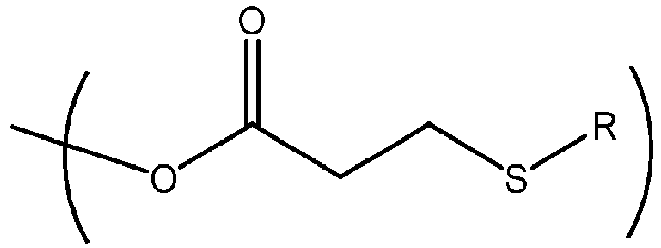
- The plastic article according to any of the preceding claims, wherein thioether additives are of formula
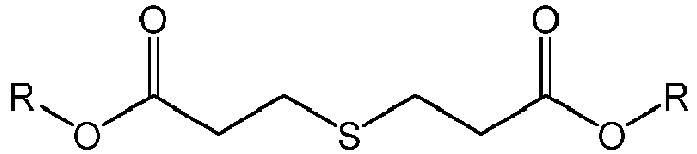

- The plastic article according to any of the preceding claims, wherein the thioether additives comprise disulfide-containing compounds of formula R-S-S-R, wherein each R is independently a hydrocarbyl group.
- The plastic article according to any of the preceding claims, wherein the polyolefin substrate comprises polyethylene.
- The plastic article according to any of the preceding claims, wherein the article comprises from about 50 wt% to about 95 wt% polyolefin, based on the total weight of the article.
- The plastic article according to any of the preceding claims, wherein the article comprises from about 50 ppm to about 2000 ppm of the hindered amine light stabilizer, by weight, based on the total weight of the article.
- The plastic article according to any of the preceding claims, wherein the article comprises from about 50 ppm to about 2000 ppm of the ultraviolet light absorber, by weight, based on the total weight of the article.
- The plastic article according to any of the preceding claims, wherein the article comprises from about 50 ppm to about 2000 ppm of the thioether additive, by weight, based on the total weight of the article.
- The plastic article according to any of the preceding claims, wherein a weight/weight ratio of the hindered amine light stabilizer to the thioether additive is from about 7/1 to about 1/1.
- The plastic article according to any of the preceding claims, wherein a weight/weight ratio of the ultraviolet light absorber to the thioether additive is from about 3/1 to about 1/3.
- The plastic article according to any of the preceding claims, wherein the article further comprises one or more additives selected from a group consisting of phenolic antioxidants, hydroxylamine stabilizers, organophosphorus stabilizers and acid scavengers.
- The plastic article according to any of the preceding claims, wherein the article comprises from about 0.1 wt% to about 50 wt% of one or more fillers, based on the total weight of the article.
- The plastic article according to any of the preceding claims, wherein the article has an average wall thickness of from about 1.50 mm to about 6.00 mm.
- The plastic article according to any of the preceding claims, wherein a 125 mil thick, 5 inch x 5 inch test sample of the article exhibits an impact strength of ≥ 21 ft/lbs.
- The plastic article according to any of the preceding claims, wherein a 125 mil thick, 5 inch x 5 inch test sample of the article exhibits ductility of ≥ 50%.
- The plastic article according to any of the preceding claims, wherein a 125 mil thick, 5 inch x 5 inch test sample of the article exhibits a yellowness index (YI) of ≤ -2.0.
- A process for the production of a hollow plastic article, the process comprisingincorporating into a polyolefin substrate additives comprising i) a hindered amine light stabilizer, ii) an ultraviolet light absorber selected from oxamide ultraviolet light absorbers, and iii) a thioether additive, to provide a fully formulated polyolefin mixture,adding the mixture to a mold, heating the mold to a temperature of greater than 280°C, rotating the mold about at least 2 axes, wherein molten polyolefin mixture coats the interior of the mold, cooling the mold while still rotating, opening the mold and removing the formed hollow article.
Applications Claiming Priority (2)
| Application Number | Priority Date | Filing Date | Title |
|---|---|---|---|
| US201862721286P | 2018-08-22 | 2018-08-22 | |
| PCT/US2019/047034 WO2020041181A1 (en) | 2018-08-22 | 2019-08-19 | Stabilized rotomolded polyolefin |
Publications (3)
| Publication Number | Publication Date |
|---|---|
| EP3841166A1 EP3841166A1 (en) | 2021-06-30 |
| EP3841166B1 EP3841166B1 (en) | 2022-07-20 |
| EP3841166B2 true EP3841166B2 (en) | 2025-05-07 |
Family
ID=67874510
Family Applications (1)
| Application Number | Title | Priority Date | Filing Date |
|---|---|---|---|
| EP19765356.1A Active EP3841166B2 (en) | 2018-08-22 | 2019-08-19 | Stabilized rotomolded polyolefin |
Country Status (13)
| Country | Link |
|---|---|
| US (1) | US20210301102A1 (en) |
| EP (1) | EP3841166B2 (en) |
| JP (3) | JP7478135B2 (en) |
| KR (2) | KR20260007290A (en) |
| CN (1) | CN112771108B (en) |
| AU (1) | AU2019326374B2 (en) |
| CA (1) | CA3107042A1 (en) |
| ES (1) | ES2924897T5 (en) |
| MX (1) | MX2021002030A (en) |
| PL (1) | PL3841166T5 (en) |
| SA (1) | SA521421281B1 (en) |
| TW (2) | TWI880896B (en) |
| WO (1) | WO2020041181A1 (en) |
Families Citing this family (6)
| Publication number | Priority date | Publication date | Assignee | Title |
|---|---|---|---|---|
| US20220282064A1 (en) * | 2019-07-30 | 2022-09-08 | Basf Se | Stabilizer composition |
| EP4240793A1 (en) * | 2020-11-03 | 2023-09-13 | Basf Se | Method for stabilizing an organic material using a stabilizer mixture |
| EP4251690A1 (en) * | 2020-11-27 | 2023-10-04 | Cytec Industries Inc. | Compositions and methods for protecting organic polymeric materials from the deleterious effects exposure to uv-c light |
| CN113861102B (en) * | 2021-10-12 | 2024-03-08 | 安阳加成新材料科技有限公司 | Preparation and application of hindered amine light stabilizer |
| WO2026088945A1 (en) * | 2024-10-21 | 2026-04-30 | 株式会社Adeka | Resin composition, molded article, light stabilizer composition, method for producing resin composition, method for suppressing decrease in molecular weight of synthetic resin under light irradiation, and hindered amine compound |
| WO2026125640A1 (en) * | 2024-12-12 | 2026-06-18 | Cytec Industries Inc. | Translucent thick section polymer articles stabilized against uv light and thermal degradation and method of making the same |
Citations (15)
| Publication number | Priority date | Publication date | Assignee | Title |
|---|---|---|---|---|
| GB1001471A (en) † | 1961-05-30 | 1965-08-18 | Ici Ltd | Solid olefine polymer compositions |
| EP0200684B1 (en) † | 1985-05-02 | 1990-08-01 | Ciba-Geigy Ag | Method for stabilizing spherical polymerized polyolefins |
| US5260381A (en) † | 1991-10-08 | 1993-11-09 | Neeco, Inc. | Crosslinkable polyethylene-based composition for rotational molding |
| US5367025A (en) † | 1991-10-08 | 1994-11-22 | Wedtech, (Usa) Inc. | Crosslinkable polyethylene-based composition for rotational molding |
| EP0839623A1 (en) † | 1996-10-30 | 1998-05-06 | Ciba SC Holding AG | Stabiliser combination for rotomolding process |
| JP2003082172A (en) † | 2001-09-14 | 2003-03-19 | Furukawa Electric Co Ltd:The | Insulating resin composition and insulated wire excellent in heat resistance and weather resistance |
| US6719941B1 (en) † | 1998-08-21 | 2004-04-13 | Borealis Technology Oy | Polymer for rotomoulding |
| US20040152807A1 (en) † | 1999-03-01 | 2004-08-05 | Urs Leo Stadler | Stabilizer combination for the rotomolding process |
| JP2011256293A (en) † | 2010-06-10 | 2011-12-22 | Adeka Corp | Antistatic polyolefin-based resin composition |
| WO2012082578A2 (en) † | 2010-12-13 | 2012-06-21 | Cytec Technology Corp. | Processing additives and uses of same in rotational molding |
| CN102604209A (en) † | 2012-02-20 | 2012-07-25 | 金发科技股份有限公司 | Thermal-oxidizing-aging resisting polypropylene composite |
| WO2017013028A1 (en) † | 2015-07-20 | 2017-01-26 | Basf Se | Flame retardant polyolefin articles |
| JP2017020628A (en) † | 2015-07-15 | 2017-01-26 | 日立Geニュークリア・エナジー株式会社 | Fluid transportation piping |
| WO2017033142A1 (en) † | 2015-08-26 | 2017-03-02 | Versalis S.P.A. | Polyethylene powder, process for its preparation and its use for rotomolding |
| EP3272804A1 (en) † | 2015-03-18 | 2018-01-24 | Adeka Corporation | Resin additive master batch |
Family Cites Families (91)
| Publication number | Priority date | Publication date | Assignee | Title |
|---|---|---|---|---|
| BE563210A (en) | 1956-12-14 | 1958-06-13 | ||
| US3004896A (en) | 1956-12-14 | 1961-10-17 | Geigy Ag J R | Ultra-violet light-absorbing composition of matter |
| US3055896A (en) | 1959-06-11 | 1962-09-25 | American Cyanamid Co | Aminohydroxyphenylbenzotriazoles and triazine derivatives thereof |
| US3072585A (en) | 1960-01-13 | 1963-01-08 | American Cyanamid Co | Vinylbenzyloxy phenylbenzotriazoles |
| US3074910A (en) | 1960-11-17 | 1963-01-22 | Hercules Powder Co Ltd | Stabilization of polyolefins with a nickel phenolate of a bis(p-alkyl phenol) monosulfide and an o-hydroxy phenyl benzotriazole |
| BE630549A (en) | 1961-06-16 | |||
| US3230194A (en) | 1961-12-22 | 1966-01-18 | American Cyanamid Co | 2-(2'-hydroxy-5'-tertiary-octylphenyl)-benzotriazole and polyolefins stabilized therewith |
| CH533853A (en) | 1970-03-23 | 1973-02-15 | Ciba Geigy Ag | Use of 2'-hydroxyphenyl-1,3,5-triazines as stabilizers against ultraviolet radiation in photographic material |
| US4127586A (en) | 1970-06-19 | 1978-11-28 | Ciba-Geigy Corporation | Light protection agents |
| US4226763A (en) | 1978-06-26 | 1980-10-07 | Ciba-Geigy Corporation | 2-[2-Hydroxy-3,5-di-(.alpha.,α-dimethylbenzyl)-phenyl]-2H-benzotriazole and stabilized compositions |
| US4278589A (en) | 1978-06-26 | 1981-07-14 | Ciba-Geigy Corporation | 2-[2-Hydroxy-3,5-di-(α,α-dimethylbenzyl)phenyl]-2H-benzotriazole and stabilized compositions |
| US4275004A (en) | 1978-06-26 | 1981-06-23 | Ciba-Geigy Corporation | High caustic coupling process for preparing substituted 2-nitro-2'-hydroxyazobenzenes |
| GB2044272B (en) | 1979-02-05 | 1983-03-16 | Sandoz Ltd | Stabilising polymers |
| US4315848A (en) | 1979-05-10 | 1982-02-16 | Ciba-Geigy Corporation | 2-[2-Hydroxy-3,5-di-(α,α-dimethylbenzyl)-phenyl]-2H-benzotriazole and stabilized compositions |
| US4347180A (en) | 1979-05-16 | 1982-08-31 | Ciba-Geigy Corporation | High caustic coupling process for preparing substituted 2-nitro-2'-hydroxyazobenzenes |
| US4383863A (en) | 1979-12-17 | 1983-05-17 | Ciba-Geigy Corporation | 2-[2-Hydroxy-3,5-di-tert-octylphenyl]-2H-benzotriazole in stabilized photographic compositions |
| JPS5836012B2 (en) | 1980-11-07 | 1983-08-06 | アデカ・ア−ガス化学株式会社 | Halogen-containing resin composition |
| US4853471A (en) | 1981-01-23 | 1989-08-01 | Ciba-Geigy Corporation | 2-(2-Hydroxyphenyl)-benztriazoles, their use as UV-absorbers and their preparation |
| JPS61113649A (en) | 1984-11-07 | 1986-05-31 | Adeka Argus Chem Co Ltd | Polymeric material composition with improved light resistance |
| US4675352A (en) | 1985-01-22 | 1987-06-23 | Ciba-Geigy Corporation | Liquid 2-(2-hydroxy-3-higher branched alkyl-5-methyl-phenyl)-2H-benzotriazole mixtures, stabilized compositions and processes for preparing liquid mixtures |
| US4619956A (en) | 1985-05-03 | 1986-10-28 | American Cyanamid Co. | Stabilization of high solids coatings with synergistic combinations |
| US5204473A (en) | 1987-09-21 | 1993-04-20 | Ciba-Geigy Corporation | O-substituted N-hydroxy hindered amine stabilizers |
| US5124378A (en) | 1987-09-21 | 1992-06-23 | Ciba-Geigy Corporation | Stabilization of ambient cured coatings |
| US5112890A (en) | 1987-09-21 | 1992-05-12 | Ciba-Geigy Corporation | Stabilization of acid catalyzed thermoset resins |
| US5004770A (en) | 1988-10-19 | 1991-04-02 | Ciba-Geigy Corporation | Polymeric substrates stabilized with N-substituted hindered amines |
| US5096950A (en) | 1988-10-19 | 1992-03-17 | Ciba-Geigy Corporation | Polyolefin compositions stabilized with NOR-substituted hindered amines |
| JP2851942B2 (en) * | 1989-01-12 | 1999-01-27 | 三井化学株式会社 | Cyclic olefin resin composition |
| US5145893A (en) | 1989-03-21 | 1992-09-08 | Ciba-Geigy Corporation | Non-migrating 1-hydrocarbyloxy hindered amine derivatives as polymer stabilizers |
| JP2758031B2 (en) | 1989-07-04 | 1998-05-25 | 協和化学工業株式会社 | Stabilizer composition for halogen-containing resin |
| DE59008517D1 (en) | 1989-08-25 | 1995-03-30 | Ciba Geigy Ag | Light stabilized inks. |
| US5175312A (en) | 1989-08-31 | 1992-12-29 | Ciba-Geigy Corporation | 3-phenylbenzofuran-2-ones |
| US5736597A (en) | 1989-12-05 | 1998-04-07 | Ciba-Geigy Corporation | Stabilized organic material |
| DE59107052D1 (en) | 1990-03-30 | 1996-01-25 | Ciba Geigy Ag | Paint compositions |
| EP0483488B1 (en) | 1990-10-29 | 1997-03-12 | Cytec Technology Corp. | Synergistic ultraviolet absorber compositions containing hydroxy aryl triazines and tetraalkyl piperidines |
| US5278314A (en) | 1991-02-12 | 1994-01-11 | Ciba-Geigy Corporation | 5-thio-substituted benzotriazole UV-absorbers |
| US5280124A (en) | 1991-02-12 | 1994-01-18 | Ciba-Geigy Corporation | 5-sulfonyl-substituted benzotriazole UV-absorbers |
| KR100187320B1 (en) | 1991-02-21 | 1999-04-01 | 월터 클리웨인 | Coating compositions resistant to light deterioration |
| FR2675149B1 (en) | 1991-04-09 | 1994-06-24 | Rhone Poulenc Chimie | HALOGEN POLYMER COMPOSITIONS STABILIZED USING A MINERAL ADDITIVE. |
| TW206220B (en) | 1991-07-01 | 1993-05-21 | Ciba Geigy Ag | |
| US5252643A (en) | 1991-07-01 | 1993-10-12 | Ciba-Geigy Corporation | Thiomethylated benzofuran-2-ones |
| EP0531258B1 (en) | 1991-09-05 | 1997-09-10 | Ciba SC Holding AG | Photographic material containing a UV-absorber |
| US5216156A (en) | 1992-05-05 | 1993-06-01 | Ciba-Geigy Corporation | Non-migrating 1-hydrocarbyloxy-2,2,6,6-tetramethylpiperidine 1,3,5-triazine derivatives |
| TW260686B (en) | 1992-05-22 | 1995-10-21 | Ciba Geigy | |
| NL9300801A (en) | 1992-05-22 | 1993-12-16 | Ciba Geigy | 3- (ACYLOXYPHENYL) BENZOFURAN-2-ON AS STABILIZERS. |
| GB2267490B (en) | 1992-05-22 | 1995-08-09 | Ciba Geigy Ag | 3-(Carboxymethoxyphenyl)benzofuran-2-one stabilisers |
| TW255902B (en) | 1992-09-23 | 1995-09-01 | Ciba Geigy | |
| MX9305489A (en) | 1992-09-23 | 1994-03-31 | Ciba Geigy Ag | 3- (DIHIDROBENZOFURAN-5-IL) BENZOFURAN-2-ONAS, STABILIZERS. |
| US5268450A (en) | 1992-11-24 | 1993-12-07 | Phillips Petroleum Company | Compositions comprising sulfur-containing derivatives of hydroxyphenylbenzotriazole and process therefor |
| US5319091A (en) | 1992-11-24 | 1994-06-07 | Phillips Petroleum Company | Process for sulfur containing derivatives of hydroxyphenyl/benzotriazoles |
| US5489503A (en) | 1992-12-03 | 1996-02-06 | Ciba-Geigy Corp. | UV absorbers |
| US5354794A (en) | 1993-02-03 | 1994-10-11 | Ciba-Geigy Corporation | Electro coat/base coat/clear coat finishes stabilized with S-triazine UV absorbers |
| US5556973A (en) | 1994-07-27 | 1996-09-17 | Ciba-Geigy Corporation | Red-shifted tris-aryl-s-triazines and compositions stabilized therewith |
| EP0711804A3 (en) | 1994-11-14 | 1999-09-22 | Ciba SC Holding AG | Latent light stabilizers |
| US6255483B1 (en) | 1995-03-15 | 2001-07-03 | Ciba Specialty Chemicals Corporation | Biphenyl-substituted triazines |
| TW358820B (en) | 1995-04-11 | 1999-05-21 | Ciba Sc Holding Ag | Synergistic stabilizer mixture |
| JPH08283490A (en) * | 1995-04-17 | 1996-10-29 | Mitsui Petrochem Ind Ltd | Propylene-based random copolymer composition and use thereof |
| US5574166A (en) | 1995-04-19 | 1996-11-12 | Ciba-Geigy Corporation | Crystalline form of 2-(2-hydroxy-3-α-cumyl-5-tert-octylphenyl)-2H-benzotriazole |
| US6046304A (en) | 1995-12-04 | 2000-04-04 | Ciba Specialty Chemicals Corporation | Block oligomers containing 2,2,6,6-tetramethyl-4-piperidyl groups as stabilizers for organic materials |
| JP3742139B2 (en) * | 1996-02-20 | 2006-02-01 | 日本ポリオレフィン株式会社 | Filler-containing ethylene polymer composition and molded article using the same |
| CH692739A5 (en) | 1996-03-26 | 2002-10-15 | Ciba Sc Holding Ag | Use of new and known hydroxyphenyl-triazine derivatives |
| US5726309A (en) | 1996-08-27 | 1998-03-10 | Ciba Specialty Chemicals Corporation | Tris-aryls-triazines substituted with biphenylyl groups |
| BE1012529A3 (en) | 1996-09-13 | 2000-12-05 | Ciba Sc Holding Ag | Triaryltriazines mixing and its use for the stabilization of organic materials. |
| US5998116A (en) | 1996-09-13 | 1999-12-07 | Ciba Specialty Chemicals Corporation | Color-photographic recording material |
| US6013704A (en) | 1996-09-13 | 2000-01-11 | Ciba Specialty Chemicals Corporation | Hydroxyphenyltriazines |
| US5977219A (en) | 1997-10-30 | 1999-11-02 | Ciba Specialty Chemicals Corporation | Benzotriazole UV absorbers having enhanced durability |
| US6166218A (en) | 1996-11-07 | 2000-12-26 | Ciba Specialty Chemicals Corporation | Benzotriazole UV absorbers having enhanced durability |
| US5844026A (en) | 1997-06-30 | 1998-12-01 | Ciba Specialty Chemicals Corporation | N,N',N''-tris{2,4-bis Hydrocarbyloxy-2,2,6,6-tetra-methylpiperidin-4-yl)alkylamino!-s-triazin-6-yl}-3,3'-ethylenediiminodipropylamines, their isomers and bridged derivatives and polymer compositions stabilized therewith |
| US6472456B1 (en) | 1997-06-30 | 2002-10-29 | Ciba Specialty Chemicals Corp. | Flame retardant compositions |
| ITMI980366A1 (en) | 1998-02-25 | 1999-08-25 | Ciba Spec Chem Spa | PREPARATION OF STERICALLY PREVENTED AMINE ETHERS |
| EP0941989B1 (en) | 1998-03-02 | 2009-07-08 | Ciba Holding Inc. | Process for the preparation of 2,4-diaryl-6-o-hydroxyphenyl-1,3,5-triazine derivatives in the presence of a protic acid catalyst |
| US6376584B1 (en) | 1999-02-25 | 2002-04-23 | Ciba Specialty Chemicals Corporation | Hydroxy-substituted N-alkoxy hindered amines and compositions stabilized therewith |
| US6271377B1 (en) | 1999-02-25 | 2001-08-07 | Ciba Specialty Chemicals Corporation | Hydroxy-substituted N-alkoxy hindered amines and compositions stabilized therewith |
| US6392041B1 (en) | 1999-02-25 | 2002-05-21 | Ciba Specialty Chemicals Corporation | Hydroxy-substituted N-alkoxy hindered amines and compositions stabilized therewith |
| US6444733B1 (en) * | 1999-03-01 | 2002-09-03 | Ciba Specialty Chemicals Corporation | Stabilizer combination for the rotomolding process |
| JP4868651B2 (en) * | 2001-04-06 | 2012-02-01 | 株式会社Adeka | Thermoplastic resin composition |
| ZA200301683B (en) | 2002-03-04 | 2004-09-06 | Ciba Sc Holding Ag | Synergistic combinations of UV absorbers for pigmented polyolefins. |
| DK1888686T3 (en) * | 2005-06-07 | 2013-04-29 | Basf Se | Scratch-resistant polyolefins |
| CN101203567A (en) * | 2005-06-07 | 2008-06-18 | 西巴特殊化学品控股有限公司 | scratch-resistant polyolefin |
| JP5236466B2 (en) | 2005-07-21 | 2013-07-17 | チバ ホールディング インコーポレーテッド | Stabilization of polyolefins using liquid tris- (mono-alkyl) phenyl phosphites |
| JP5151134B2 (en) * | 2005-12-14 | 2013-02-27 | 住友化学株式会社 | Polyolefin resin composition and molded product thereof |
| SA07280006B1 (en) * | 2006-02-01 | 2011-05-14 | سيبا سبشيالتي كيميكالز هولدينج انك | Use of Secondary Sterically Hindered Amines as Processing Additives in Rotomolding Processes |
| US7888414B2 (en) | 2006-06-20 | 2011-02-15 | Chemtura Corporation | Liquid phosphite blends as stabilizers |
| CN101511913B (en) | 2006-09-08 | 2011-06-22 | 西巴控股有限公司 | Liquid polymer phosphites and phosphonites as stabilizers |
| ES2390411T3 (en) | 2008-07-11 | 2012-11-12 | Basf Se | Liquid mixtures of bis and tris phosphite ester with oxyalkylene bridge |
| CA2651514C (en) * | 2009-01-29 | 2016-05-03 | Nova Chemicals Corporation | Stabilized rotomolded parts |
| PL2536781T3 (en) | 2010-02-19 | 2018-10-31 | Dover Chemical Corporation | Alkylphenol free - liquid polymeric phosphite polymer stabilizers |
| CN103339172A (en) * | 2011-01-31 | 2013-10-02 | 巴斯夫欧洲公司 | Methods of flame retarding polyethylene processed at high temperatures |
| TWI403507B (en) | 2011-03-17 | 2013-08-01 | Chitec Technology Co Ltd | Benzofuranone derivatives and application of the same |
| AU2013233958A1 (en) | 2012-03-16 | 2014-10-02 | Basf Se | NOR-HALS compounds as flame retardants |
| KR101915874B1 (en) | 2014-05-01 | 2018-11-06 | 사이텍 인더스트리스 인코포레이티드 | Stabilizing compositions for stabilizing materials against ultraviolet light and thermal degradation |
| WO2017110057A1 (en) * | 2015-12-21 | 2017-06-29 | パナソニックIpマネジメント株式会社 | Fiber assembly |
-
2019
- 2019-08-19 EP EP19765356.1A patent/EP3841166B2/en active Active
- 2019-08-19 PL PL19765356.1T patent/PL3841166T5/en unknown
- 2019-08-19 US US17/268,305 patent/US20210301102A1/en active Pending
- 2019-08-19 CN CN201980053017.4A patent/CN112771108B/en active Active
- 2019-08-19 MX MX2021002030A patent/MX2021002030A/en unknown
- 2019-08-19 AU AU2019326374A patent/AU2019326374B2/en active Active
- 2019-08-19 WO PCT/US2019/047034 patent/WO2020041181A1/en not_active Ceased
- 2019-08-19 KR KR1020257042116A patent/KR20260007290A/en active Pending
- 2019-08-19 ES ES19765356T patent/ES2924897T5/en active Active
- 2019-08-19 KR KR1020217004660A patent/KR102902822B1/en active Active
- 2019-08-19 CA CA3107042A patent/CA3107042A1/en active Pending
- 2019-08-19 JP JP2021509179A patent/JP7478135B2/en active Active
- 2019-08-22 TW TW108130033A patent/TWI880896B/en active
- 2019-08-22 TW TW114116322A patent/TWI915258B/en active
-
2021
- 2021-02-21 SA SA521421281A patent/SA521421281B1/en unknown
-
2023
- 2023-12-11 JP JP2023208720A patent/JP2024037842A/en active Pending
-
2026
- 2026-02-06 JP JP2026018331A patent/JP2026071349A/en active Pending
Patent Citations (15)
| Publication number | Priority date | Publication date | Assignee | Title |
|---|---|---|---|---|
| GB1001471A (en) † | 1961-05-30 | 1965-08-18 | Ici Ltd | Solid olefine polymer compositions |
| EP0200684B1 (en) † | 1985-05-02 | 1990-08-01 | Ciba-Geigy Ag | Method for stabilizing spherical polymerized polyolefins |
| US5260381A (en) † | 1991-10-08 | 1993-11-09 | Neeco, Inc. | Crosslinkable polyethylene-based composition for rotational molding |
| US5367025A (en) † | 1991-10-08 | 1994-11-22 | Wedtech, (Usa) Inc. | Crosslinkable polyethylene-based composition for rotational molding |
| EP0839623A1 (en) † | 1996-10-30 | 1998-05-06 | Ciba SC Holding AG | Stabiliser combination for rotomolding process |
| US6719941B1 (en) † | 1998-08-21 | 2004-04-13 | Borealis Technology Oy | Polymer for rotomoulding |
| US20040152807A1 (en) † | 1999-03-01 | 2004-08-05 | Urs Leo Stadler | Stabilizer combination for the rotomolding process |
| JP2003082172A (en) † | 2001-09-14 | 2003-03-19 | Furukawa Electric Co Ltd:The | Insulating resin composition and insulated wire excellent in heat resistance and weather resistance |
| JP2011256293A (en) † | 2010-06-10 | 2011-12-22 | Adeka Corp | Antistatic polyolefin-based resin composition |
| WO2012082578A2 (en) † | 2010-12-13 | 2012-06-21 | Cytec Technology Corp. | Processing additives and uses of same in rotational molding |
| CN102604209A (en) † | 2012-02-20 | 2012-07-25 | 金发科技股份有限公司 | Thermal-oxidizing-aging resisting polypropylene composite |
| EP3272804A1 (en) † | 2015-03-18 | 2018-01-24 | Adeka Corporation | Resin additive master batch |
| JP2017020628A (en) † | 2015-07-15 | 2017-01-26 | 日立Geニュークリア・エナジー株式会社 | Fluid transportation piping |
| WO2017013028A1 (en) † | 2015-07-20 | 2017-01-26 | Basf Se | Flame retardant polyolefin articles |
| WO2017033142A1 (en) † | 2015-08-26 | 2017-03-02 | Versalis S.P.A. | Polyethylene powder, process for its preparation and its use for rotomolding |
Non-Patent Citations (3)
| Title |
|---|
| ANNA & GEORGE WYPYCH: "Databook of UV stabilizers", 2015, CHEMTEC PUBLISHING, Toronto, ISBN: 978-1-895198-88-1 † |
| JOACHIM VOIGT: "DIE STABILISIERUNG DER KUNSTSTOFFE GEGEN LICHT UND WÄRME", 1 January 1966, SPRINGER-VERLAG, ISBN: 978-3-642-52097-6, article JOACHIM VOIGT: "7.1.1. Meravptane und Mercaptoallcohole", pages: 331 - 348, XP009555210 † |
| JOHN MURPHY: "Additives for Plastics Handbook, 2nd Edition", 2001, ELSEVIER SCIENCE LTD., ISBN: 1 85617 370 4, article "CHAPTER 8 Modifying Specific Properties: Resistance to Heat - Heat Stabilizers", pages: 93-96 † |
Also Published As
| Publication number | Publication date |
|---|---|
| EP3841166A1 (en) | 2021-06-30 |
| TWI880896B (en) | 2025-04-21 |
| CN112771108A (en) | 2021-05-07 |
| JP7478135B2 (en) | 2024-05-02 |
| BR112021001412A2 (en) | 2021-04-27 |
| EP3841166B1 (en) | 2022-07-20 |
| AU2019326374B2 (en) | 2025-07-24 |
| WO2020041181A1 (en) | 2020-02-27 |
| JP2026071349A (en) | 2026-04-28 |
| AU2019326374A1 (en) | 2021-03-04 |
| CA3107042A1 (en) | 2020-02-27 |
| BR112021001412A8 (en) | 2023-01-17 |
| SA521421281B1 (en) | 2023-06-15 |
| KR20260007290A (en) | 2026-01-13 |
| KR102902822B1 (en) | 2025-12-24 |
| TW202024207A (en) | 2020-07-01 |
| BR122022016585A8 (en) | 2023-01-17 |
| ES2924897T5 (en) | 2025-09-15 |
| JP2024037842A (en) | 2024-03-19 |
| TW202532557A (en) | 2025-08-16 |
| ES2924897T3 (en) | 2022-10-11 |
| JP2021534303A (en) | 2021-12-09 |
| BR122022016585A2 (en) | 2022-10-25 |
| MX2021002030A (en) | 2021-04-28 |
| PL3841166T5 (en) | 2025-08-18 |
| US20210301102A1 (en) | 2021-09-30 |
| KR20210045996A (en) | 2021-04-27 |
| CN112771108B (en) | 2023-05-05 |
| PL3841166T3 (en) | 2022-09-26 |
| TWI915258B (en) | 2026-02-11 |
Similar Documents
| Publication | Publication Date | Title |
|---|---|---|
| EP3841166B1 (en) | Stabilized rotomolded polyolefin | |
| EP3325547B1 (en) | Flame retardant polyolefin articles | |
| EP4004099A1 (en) | Stabilizer composition | |
| US12012542B2 (en) | Flame retardant rotomolded polyolefin | |
| RU2831778C2 (en) | Stabilized polyolefin obtained by rotational moulding | |
| BR122022016585B1 (en) | POLYOLEFINE COMPOSITION | |
| BR112021001412B1 (en) | PLASTIC ARTICLE STABILIZED AGAINST THE DELETERAL EFFECTS OF HEAT, LIGHT AND OXYGEN, AND, PROCESS FOR PRODUCING A HOLLOW PLASTIC ARTICLE | |
| US20240352229A1 (en) | Flame retardant polyolefin articles | |
| BR112022001641B1 (en) | AUTOMOTIVE COMPONENT AND PLASTIC ARTICLE |
Legal Events
| Date | Code | Title | Description |
|---|---|---|---|
| STAA | Information on the status of an ep patent application or granted ep patent |
Free format text: STATUS: UNKNOWN |
|
| STAA | Information on the status of an ep patent application or granted ep patent |
Free format text: STATUS: THE INTERNATIONAL PUBLICATION HAS BEEN MADE |
|
| PUAI | Public reference made under article 153(3) epc to a published international application that has entered the european phase |
Free format text: ORIGINAL CODE: 0009012 |
|
| STAA | Information on the status of an ep patent application or granted ep patent |
Free format text: STATUS: REQUEST FOR EXAMINATION WAS MADE |
|
| 17P | Request for examination filed |
Effective date: 20210322 |
|
| AK | Designated contracting states |
Kind code of ref document: A1 Designated state(s): AL AT BE BG CH CY CZ DE DK EE ES FI FR GB GR HR HU IE IS IT LI LT LU LV MC MK MT NL NO PL PT RO RS SE SI SK SM TR |
|
| DAV | Request for validation of the european patent (deleted) | ||
| DAX | Request for extension of the european patent (deleted) | ||
| GRAP | Despatch of communication of intention to grant a patent |
Free format text: ORIGINAL CODE: EPIDOSNIGR1 |
|
| STAA | Information on the status of an ep patent application or granted ep patent |
Free format text: STATUS: GRANT OF PATENT IS INTENDED |
|
| INTG | Intention to grant announced |
Effective date: 20220217 |
|
| GRAS | Grant fee paid |
Free format text: ORIGINAL CODE: EPIDOSNIGR3 |
|
| GRAA | (expected) grant |
Free format text: ORIGINAL CODE: 0009210 |
|
| STAA | Information on the status of an ep patent application or granted ep patent |
Free format text: STATUS: THE PATENT HAS BEEN GRANTED |
|
| AK | Designated contracting states |
Kind code of ref document: B1 Designated state(s): AL AT BE BG CH CY CZ DE DK EE ES FI FR GB GR HR HU IE IS IT LI LT LU LV MC MK MT NL NO PL PT RO RS SE SI SK SM TR |
|
| REG | Reference to a national code |
Ref country code: CH Ref legal event code: EP |
|
| REG | Reference to a national code |
Ref country code: DE Ref legal event code: R096 Ref document number: 602019017261 Country of ref document: DE |
|
| REG | Reference to a national code |
Ref country code: NL Ref legal event code: FP |
|
| REG | Reference to a national code |
Ref country code: AT Ref legal event code: REF Ref document number: 1505535 Country of ref document: AT Kind code of ref document: T Effective date: 20220815 |
|
| REG | Reference to a national code |
Ref country code: SE Ref legal event code: TRGR |
|
| REG | Reference to a national code |
Ref country code: IE Ref legal event code: FG4D |
|
| REG | Reference to a national code |
Ref country code: ES Ref legal event code: FG2A Ref document number: 2924897 Country of ref document: ES Kind code of ref document: T3 Effective date: 20221011 |
|
| REG | Reference to a national code |
Ref country code: LT Ref legal event code: MG9D |
|
| PG25 | Lapsed in a contracting state [announced via postgrant information from national office to epo] |
Ref country code: RS Free format text: LAPSE BECAUSE OF FAILURE TO SUBMIT A TRANSLATION OF THE DESCRIPTION OR TO PAY THE FEE WITHIN THE PRESCRIBED TIME-LIMIT Effective date: 20220720 Ref country code: PT Free format text: LAPSE BECAUSE OF FAILURE TO SUBMIT A TRANSLATION OF THE DESCRIPTION OR TO PAY THE FEE WITHIN THE PRESCRIBED TIME-LIMIT Effective date: 20221121 Ref country code: NO Free format text: LAPSE BECAUSE OF FAILURE TO SUBMIT A TRANSLATION OF THE DESCRIPTION OR TO PAY THE FEE WITHIN THE PRESCRIBED TIME-LIMIT Effective date: 20221020 Ref country code: LV Free format text: LAPSE BECAUSE OF FAILURE TO SUBMIT A TRANSLATION OF THE DESCRIPTION OR TO PAY THE FEE WITHIN THE PRESCRIBED TIME-LIMIT Effective date: 20220720 Ref country code: LT Free format text: LAPSE BECAUSE OF FAILURE TO SUBMIT A TRANSLATION OF THE DESCRIPTION OR TO PAY THE FEE WITHIN THE PRESCRIBED TIME-LIMIT Effective date: 20220720 Ref country code: FI Free format text: LAPSE BECAUSE OF FAILURE TO SUBMIT A TRANSLATION OF THE DESCRIPTION OR TO PAY THE FEE WITHIN THE PRESCRIBED TIME-LIMIT Effective date: 20220720 |
|
| REG | Reference to a national code |
Ref country code: AT Ref legal event code: MK05 Ref document number: 1505535 Country of ref document: AT Kind code of ref document: T Effective date: 20220720 |
|
| PG25 | Lapsed in a contracting state [announced via postgrant information from national office to epo] |
Ref country code: IS Free format text: LAPSE BECAUSE OF FAILURE TO SUBMIT A TRANSLATION OF THE DESCRIPTION OR TO PAY THE FEE WITHIN THE PRESCRIBED TIME-LIMIT Effective date: 20221120 Ref country code: HR Free format text: LAPSE BECAUSE OF FAILURE TO SUBMIT A TRANSLATION OF THE DESCRIPTION OR TO PAY THE FEE WITHIN THE PRESCRIBED TIME-LIMIT Effective date: 20220720 Ref country code: GR Free format text: LAPSE BECAUSE OF FAILURE TO SUBMIT A TRANSLATION OF THE DESCRIPTION OR TO PAY THE FEE WITHIN THE PRESCRIBED TIME-LIMIT Effective date: 20221021 |
|
| REG | Reference to a national code |
Ref country code: CH Ref legal event code: PL |
|
| REG | Reference to a national code |
Ref country code: DE Ref legal event code: R026 Ref document number: 602019017261 Country of ref document: DE |
|
| PG25 | Lapsed in a contracting state [announced via postgrant information from national office to epo] |
Ref country code: SM Free format text: LAPSE BECAUSE OF FAILURE TO SUBMIT A TRANSLATION OF THE DESCRIPTION OR TO PAY THE FEE WITHIN THE PRESCRIBED TIME-LIMIT Effective date: 20220720 Ref country code: RO Free format text: LAPSE BECAUSE OF FAILURE TO SUBMIT A TRANSLATION OF THE DESCRIPTION OR TO PAY THE FEE WITHIN THE PRESCRIBED TIME-LIMIT Effective date: 20220720 Ref country code: MC Free format text: LAPSE BECAUSE OF FAILURE TO SUBMIT A TRANSLATION OF THE DESCRIPTION OR TO PAY THE FEE WITHIN THE PRESCRIBED TIME-LIMIT Effective date: 20220720 Ref country code: LU Free format text: LAPSE BECAUSE OF NON-PAYMENT OF DUE FEES Effective date: 20220819 Ref country code: LI Free format text: LAPSE BECAUSE OF NON-PAYMENT OF DUE FEES Effective date: 20220831 Ref country code: DK Free format text: LAPSE BECAUSE OF FAILURE TO SUBMIT A TRANSLATION OF THE DESCRIPTION OR TO PAY THE FEE WITHIN THE PRESCRIBED TIME-LIMIT Effective date: 20220720 Ref country code: CZ Free format text: LAPSE BECAUSE OF FAILURE TO SUBMIT A TRANSLATION OF THE DESCRIPTION OR TO PAY THE FEE WITHIN THE PRESCRIBED TIME-LIMIT Effective date: 20220720 Ref country code: CH Free format text: LAPSE BECAUSE OF NON-PAYMENT OF DUE FEES Effective date: 20220831 Ref country code: AT Free format text: LAPSE BECAUSE OF FAILURE TO SUBMIT A TRANSLATION OF THE DESCRIPTION OR TO PAY THE FEE WITHIN THE PRESCRIBED TIME-LIMIT Effective date: 20220720 |
|
| PLBI | Opposition filed |
Free format text: ORIGINAL CODE: 0009260 |
|
| PLAX | Notice of opposition and request to file observation + time limit sent |
Free format text: ORIGINAL CODE: EPIDOSNOBS2 |
|
| 26 | Opposition filed |
Opponent name: CYTEC INDUSTRIES INC. Effective date: 20230420 Opponent name: GRAFE POLYMER SOLUTIONS GMBH Effective date: 20230420 |
|
| PG25 | Lapsed in a contracting state [announced via postgrant information from national office to epo] |
Ref country code: SK Free format text: LAPSE BECAUSE OF FAILURE TO SUBMIT A TRANSLATION OF THE DESCRIPTION OR TO PAY THE FEE WITHIN THE PRESCRIBED TIME-LIMIT Effective date: 20220720 Ref country code: EE Free format text: LAPSE BECAUSE OF FAILURE TO SUBMIT A TRANSLATION OF THE DESCRIPTION OR TO PAY THE FEE WITHIN THE PRESCRIBED TIME-LIMIT Effective date: 20220720 |
|
| P01 | Opt-out of the competence of the unified patent court (upc) registered |
Effective date: 20230519 |
|
| PG25 | Lapsed in a contracting state [announced via postgrant information from national office to epo] |
Ref country code: AL Free format text: LAPSE BECAUSE OF FAILURE TO SUBMIT A TRANSLATION OF THE DESCRIPTION OR TO PAY THE FEE WITHIN THE PRESCRIBED TIME-LIMIT Effective date: 20220720 |
|
| PG25 | Lapsed in a contracting state [announced via postgrant information from national office to epo] |
Ref country code: IE Free format text: LAPSE BECAUSE OF NON-PAYMENT OF DUE FEES Effective date: 20220819 |
|
| PG25 | Lapsed in a contracting state [announced via postgrant information from national office to epo] |
Ref country code: SI Free format text: LAPSE BECAUSE OF FAILURE TO SUBMIT A TRANSLATION OF THE DESCRIPTION OR TO PAY THE FEE WITHIN THE PRESCRIBED TIME-LIMIT Effective date: 20220720 |
|
| PLBB | Reply of patent proprietor to notice(s) of opposition received |
Free format text: ORIGINAL CODE: EPIDOSNOBS3 |
|
| PLAB | Opposition data, opponent's data or that of the opponent's representative modified |
Free format text: ORIGINAL CODE: 0009299OPPO |
|
| R26 | Opposition filed (corrected) |
Opponent name: CYTEC INDUSTRIES INC. Effective date: 20230420 |
|
| PG25 | Lapsed in a contracting state [announced via postgrant information from national office to epo] |
Ref country code: CY Free format text: LAPSE BECAUSE OF FAILURE TO SUBMIT A TRANSLATION OF THE DESCRIPTION OR TO PAY THE FEE WITHIN THE PRESCRIBED TIME-LIMIT Effective date: 20220720 |
|
| PG25 | Lapsed in a contracting state [announced via postgrant information from national office to epo] |
Ref country code: MK Free format text: LAPSE BECAUSE OF FAILURE TO SUBMIT A TRANSLATION OF THE DESCRIPTION OR TO PAY THE FEE WITHIN THE PRESCRIBED TIME-LIMIT Effective date: 20220720 Ref country code: HU Free format text: LAPSE BECAUSE OF FAILURE TO SUBMIT A TRANSLATION OF THE DESCRIPTION OR TO PAY THE FEE WITHIN THE PRESCRIBED TIME-LIMIT; INVALID AB INITIO Effective date: 20190819 |
|
| PG25 | Lapsed in a contracting state [announced via postgrant information from national office to epo] |
Ref country code: BG Free format text: LAPSE BECAUSE OF FAILURE TO SUBMIT A TRANSLATION OF THE DESCRIPTION OR TO PAY THE FEE WITHIN THE PRESCRIBED TIME-LIMIT Effective date: 20220720 |
|
| PG25 | Lapsed in a contracting state [announced via postgrant information from national office to epo] |
Ref country code: MT Free format text: LAPSE BECAUSE OF FAILURE TO SUBMIT A TRANSLATION OF THE DESCRIPTION OR TO PAY THE FEE WITHIN THE PRESCRIBED TIME-LIMIT Effective date: 20220720 |
|
| PGFP | Annual fee paid to national office [announced via postgrant information from national office to epo] |
Ref country code: SE Payment date: 20240826 Year of fee payment: 6 |
|
| PUAH | Patent maintained in amended form |
Free format text: ORIGINAL CODE: 0009272 |
|
| STAA | Information on the status of an ep patent application or granted ep patent |
Free format text: STATUS: PATENT MAINTAINED AS AMENDED |
|
| 27A | Patent maintained in amended form |
Effective date: 20250507 |
|
| AK | Designated contracting states |
Kind code of ref document: B2 Designated state(s): AL AT BE BG CH CY CZ DE DK EE ES FI FR GB GR HR HU IE IS IT LI LT LU LV MC MK MT NL NO PL PT RO RS SE SI SK SM TR |
|
| REG | Reference to a national code |
Ref country code: DE Ref legal event code: R102 Ref document number: 602019017261 Country of ref document: DE |
|
| REG | Reference to a national code |
Ref country code: NL Ref legal event code: FP |
|
| PGFP | Annual fee paid to national office [announced via postgrant information from national office to epo] |
Ref country code: NL Payment date: 20250825 Year of fee payment: 7 |
|
| REG | Reference to a national code |
Ref country code: ES Ref legal event code: DC2A Ref document number: 2924897 Country of ref document: ES Kind code of ref document: T5 Effective date: 20250915 |
|
| PGFP | Annual fee paid to national office [announced via postgrant information from national office to epo] |
Ref country code: ES Payment date: 20250916 Year of fee payment: 7 |
|
| PGFP | Annual fee paid to national office [announced via postgrant information from national office to epo] |
Ref country code: DE Payment date: 20250827 Year of fee payment: 7 |
|
| PGFP | Annual fee paid to national office [announced via postgrant information from national office to epo] |
Ref country code: PL Payment date: 20250730 Year of fee payment: 7 Ref country code: TR Payment date: 20250731 Year of fee payment: 7 Ref country code: IT Payment date: 20250825 Year of fee payment: 7 |
|
| PGFP | Annual fee paid to national office [announced via postgrant information from national office to epo] |
Ref country code: BE Payment date: 20250825 Year of fee payment: 7 Ref country code: GB Payment date: 20250826 Year of fee payment: 7 |
|
| PGFP | Annual fee paid to national office [announced via postgrant information from national office to epo] |
Ref country code: FR Payment date: 20250825 Year of fee payment: 7 |
|
| REG | Reference to a national code |
Ref country code: SE Ref legal event code: NAV |