EP3840288B1 - Pre-registration of authentication devices - Google Patents
Pre-registration of authentication devices Download PDFInfo
- Publication number
- EP3840288B1 EP3840288B1 EP20214859.9A EP20214859A EP3840288B1 EP 3840288 B1 EP3840288 B1 EP 3840288B1 EP 20214859 A EP20214859 A EP 20214859A EP 3840288 B1 EP3840288 B1 EP 3840288B1
- Authority
- EP
- European Patent Office
- Prior art keywords
- security key
- application
- authentication code
- security
- key
- Prior art date
- Legal status (The legal status is an assumption and is not a legal conclusion. Google has not performed a legal analysis and makes no representation as to the accuracy of the status listed.)
- Active
Links
Images


Classifications
-
- G—PHYSICS
- G06—COMPUTING OR CALCULATING; COUNTING
- G06F—ELECTRIC DIGITAL DATA PROCESSING
- G06F21/00—Security arrangements for protecting computers, components thereof, programs or data against unauthorised activity
- G06F21/30—Authentication, i.e. establishing the identity or authorisation of security principals
- G06F21/44—Program or device authentication
-
- G—PHYSICS
- G06—COMPUTING OR CALCULATING; COUNTING
- G06F—ELECTRIC DIGITAL DATA PROCESSING
- G06F21/00—Security arrangements for protecting computers, components thereof, programs or data against unauthorised activity
- G06F21/30—Authentication, i.e. establishing the identity or authorisation of security principals
- G06F21/45—Structures or tools for the administration of authentication
-
- G—PHYSICS
- G06—COMPUTING OR CALCULATING; COUNTING
- G06F—ELECTRIC DIGITAL DATA PROCESSING
- G06F21/00—Security arrangements for protecting computers, components thereof, programs or data against unauthorised activity
- G06F21/60—Protecting data
- G06F21/62—Protecting access to data via a platform, e.g. using keys or access control rules
-
- H—ELECTRICITY
- H04—ELECTRIC COMMUNICATION TECHNIQUE
- H04L—TRANSMISSION OF DIGITAL INFORMATION, e.g. TELEGRAPHIC COMMUNICATION
- H04L63/00—Network architectures or network communication protocols for network security
- H04L63/06—Network architectures or network communication protocols for network security for supporting key management in a packet data network
-
- H—ELECTRICITY
- H04—ELECTRIC COMMUNICATION TECHNIQUE
- H04L—TRANSMISSION OF DIGITAL INFORMATION, e.g. TELEGRAPHIC COMMUNICATION
- H04L63/00—Network architectures or network communication protocols for network security
- H04L63/06—Network architectures or network communication protocols for network security for supporting key management in a packet data network
- H04L63/062—Network architectures or network communication protocols for network security for supporting key management in a packet data network for key distribution, e.g. centrally by trusted party
-
- H—ELECTRICITY
- H04—ELECTRIC COMMUNICATION TECHNIQUE
- H04L—TRANSMISSION OF DIGITAL INFORMATION, e.g. TELEGRAPHIC COMMUNICATION
- H04L63/00—Network architectures or network communication protocols for network security
- H04L63/08—Network architectures or network communication protocols for network security for authentication of entities
- H04L63/083—Network architectures or network communication protocols for network security for authentication of entities using passwords
-
- H—ELECTRICITY
- H04—ELECTRIC COMMUNICATION TECHNIQUE
- H04L—TRANSMISSION OF DIGITAL INFORMATION, e.g. TELEGRAPHIC COMMUNICATION
- H04L63/00—Network architectures or network communication protocols for network security
- H04L63/08—Network architectures or network communication protocols for network security for authentication of entities
- H04L63/0876—Network architectures or network communication protocols for network security for authentication of entities based on the identity of the terminal or configuration, e.g. MAC address, hardware or software configuration or device fingerprint
-
- H—ELECTRICITY
- H04—ELECTRIC COMMUNICATION TECHNIQUE
- H04L—TRANSMISSION OF DIGITAL INFORMATION, e.g. TELEGRAPHIC COMMUNICATION
- H04L9/00—Cryptographic mechanisms or cryptographic arrangements for secret or secure communications; Network security protocols
- H04L9/32—Cryptographic mechanisms or cryptographic arrangements for secret or secure communications; Network security protocols including means for verifying the identity or authority of a user of the system or for message authentication, e.g. authorization, entity authentication, data integrity or data verification, non-repudiation, key authentication or verification of credentials
- H04L9/321—Cryptographic mechanisms or cryptographic arrangements for secret or secure communications; Network security protocols including means for verifying the identity or authority of a user of the system or for message authentication, e.g. authorization, entity authentication, data integrity or data verification, non-repudiation, key authentication or verification of credentials involving a third party or a trusted authority
-
- H—ELECTRICITY
- H04—ELECTRIC COMMUNICATION TECHNIQUE
- H04L—TRANSMISSION OF DIGITAL INFORMATION, e.g. TELEGRAPHIC COMMUNICATION
- H04L9/00—Cryptographic mechanisms or cryptographic arrangements for secret or secure communications; Network security protocols
- H04L9/32—Cryptographic mechanisms or cryptographic arrangements for secret or secure communications; Network security protocols including means for verifying the identity or authority of a user of the system or for message authentication, e.g. authorization, entity authentication, data integrity or data verification, non-repudiation, key authentication or verification of credentials
- H04L9/3271—Cryptographic mechanisms or cryptographic arrangements for secret or secure communications; Network security protocols including means for verifying the identity or authority of a user of the system or for message authentication, e.g. authorization, entity authentication, data integrity or data verification, non-repudiation, key authentication or verification of credentials using challenge-response
-
- G—PHYSICS
- G06—COMPUTING OR CALCULATING; COUNTING
- G06F—ELECTRIC DIGITAL DATA PROCESSING
- G06F2221/00—Indexing scheme relating to security arrangements for protecting computers, components thereof, programs or data against unauthorised activity
- G06F2221/21—Indexing scheme relating to G06F21/00 and subgroups addressing additional information or applications relating to security arrangements for protecting computers, components thereof, programs or data against unauthorised activity
- G06F2221/2141—Access rights, e.g. capability lists, access control lists, access tables, access matrices
-
- H—ELECTRICITY
- H04—ELECTRIC COMMUNICATION TECHNIQUE
- H04L—TRANSMISSION OF DIGITAL INFORMATION, e.g. TELEGRAPHIC COMMUNICATION
- H04L2463/00—Additional details relating to network architectures or network communication protocols for network security covered by H04L63/00
- H04L2463/082—Additional details relating to network architectures or network communication protocols for network security covered by H04L63/00 applying multi-factor authentication
Definitions
- the disclosure generally relates to computer security, and more in particular it relates to security keys.
- Two-factor authentication requires two factors for confirming a user's claimed identity at a time of access attempt.
- the factors used in two-factor authentication can include, for example, a secret (e.g., password, PIN), a physical object (e.g., a key, a bank card, a security key), location information (e.g., GPS signal, connection to a network), and/or inherence (e.g., biometrics).
- FIDO Fast Identity Online
- U2F Universal 2 nd Factor
- FIDO/U2F/FIDO2 a user logs into an account with an online service using a login and password as a first factor and presents a security key as a second factor.
- the security key conveniently allows internet users to access different online services using a single security key instead of using various drivers or client software, while providing high level of security and privacy to the users.
- the security key When a user registers the security key for the first time for an account of an online service or an application, the security key generates a unique authentication code such as an asymmetric key pair and provides the public key to the online service to be associated with the account.
- the online service verifies user identity using the asymmetric key pair registered for the account. Because the security key generates a unique asymmetric key pair for each account, an online service cannot link different accounts that belongs to a same user even if the user is using the same security key to log into these different accounts from the same online service. This prevents the online service from identifying that the different accounts belong to the same user based on public key information.
- the security keys in accordance with the FIDO/U2F/FIDO2 standards prevent collection of personal information about a user to ensure user privacy and thus prevents online services from being able to link different user accounts.
- the FIDO/U2F/FIDO2 specifications require security key provider systems to ship the security keys with the same attestation certificate and private key information in large batches (e.g., 100,000 devices or more). Because core principles of the FIDO/U2F/FIDO2 standard include ensuring privacy of users, online services do not receive unique identifiers of security key devices (e.g., a serial number), and it is impossible to distinguish one device from another device from an online service's perspective.
- a user may own multiple security keys and register the multiple security keys for the same account to allow the user to access the account using any one of the multiple security keys, and the online service cannot distinguish an authentication request sent from one device (e.g., a company-issued authentication device) from another authentication device (e.g., a personal authentication device). Therefore, a security key cannot be traced back to a particular user.
- US 2010/050251 A1 explains the use of security token devices.
- One token device is provided per one user to let the user access different applications across an enterprise. The token has been selected from multiple available types of security token devices.
- the present disclosure relates to pre-registration of security keys by a security key provider system with one or more specified applications and/or user accounts in response to a request from an enterprise.
- the description uses the prefix "pre-" to indicate different operation time intervals.
- pre-registration refers to a period of time during manufacturing or after manufacturing during which the security key provider system prepares the security keys to be used with the one or more specified applications prior to being distributed to the enterprise and/or end users (e.g., employees of the enterprise).
- the prefix is therefore just a convenient writing convention.
- the security key provider system may perform the pre-registration with the one or more specified applications prior to distributing the security keys to the enterprise or may provide the pre-registration information to the enterprise along with the security keys to be pre-registered by the enterprise or a third party system identify their specific devices provided to their users.
- the enterprise may benefit from being able to identify specific security keys, but because the FIDO/U2F/FIDO2 standards do not allow identifying individual security keys, it is difficult to implement this security policy.
- an enterprise may want to improve its security profile by enforcing a policy to limit access to certain applications to a known set of unique security keys. For example, the enterprise may wish to only allow access to application X from pre-authorized set of security keys Y and prevent any other security keys from being able to access application X.
- a security key provider system may receive instructions from an enterprise via a computer system to pre-register one or more security keys with a set of applications prior to sending the security keys to the enterprise. For each security key and application pair, the security key provider system identifies an authentication code and registers the authentication code of the security key to an application.
- the pre-registration process may be performed in batch offline using an apparatus that emulates and/or automates the registration process.
- the security keys are then provided to the enterprise, which may distribute security keys to individuals (e.g., employees) based on corresponding set of applications for those individuals, and may record which employee is receiving each security key.
- pre-registration information generated during the pre-registration process is provided to the enterprise along with the security keys such that the enterprise may make use of the pre-registration data at a later time.
- the enterprise may prevent access of applications associated with the enterprise domain from any security key that has not been pre-registered with the applications. This allows the enterprise to limit access to a particular set of security keys.
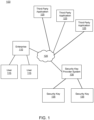
- FIG. 1 is a block diagram of a system environment 100 in which a security key provider system 130 operates.
- the system environment 100 shown by FIG. 1 comprises one or more enterprises 110 associated with one or more of users 115, a network 120, one or more third-party applications 125, and the security key provider system 130 that provides security keys 135.
- different and/or additional components may be included in the system environment 100.
- the description uses the term "third-party" as a convenient and conventional pointer to indicate that the entities running the applications and running the security key provider system 130 are not necessarily the same.
- the enterprise 110 is an organization such as a business or a company associated with a plurality of users 115.
- the plurality of users 115 may be employees of the enterprise 110.
- the description also uses the term "enterprise” for technical systems, such as computer systems, operated by the organization.
- the users 115 are computer users who will eventually interact with third party application 125 at a later point in time, when properly authenticated.
- the plurality of users 115 may use third-party applications 125 using a computing device capable of receiving user input as well as transmitting and/or receiving data via the network 120.
- the computing device is a conventional computer system, such as a desktop or a laptop computer.
- the computing device may be a device having computer functionality, such as a personal digital assistant (PDA), a mobile telephone, a smartphone, a wearable, biometric, or Internet-of-Things (IoT) device, or another suitable device.
- PDA personal digital assistant
- a computing device is configured to communicate via the network 120.
- a computing device executes a browser application to enable interaction between the third-party application 125 and the computing device via the network 120.
- a computing device interacts with the third-party application 125 through an application programming interface (API) running on a native operating system of the computing device, such as IOS ® or ANDROID TM .
- API application programming interface
- the computing devices are configured to communicate via the network 120, which may comprise any combination of local area and/or wide area networks, using both wired and/or wireless communication systems.
- the network 120 uses standard communications technologies and/or protocols.
- the network 120 includes communication links using technologies such as Ethernet, 802.11, worldwide interoperability for microwave access (WiMAX), 3G, 4G, division multiple access (CDMA), digital subscriber line (DSL), etc.
- networking protocols used for communicating via the network 120 include multiprotocol label switching (MPLS), transmission control protocol/Internet protocol (TCP/IP), hypertext transport protocol (HTTP), simple mail transfer protocol (SMTP), and file transfer protocol (FTP).
- Data exchanged over the network 120 may be represented using any suitable format, such as hypertext markup language (HTML) or extensible markup language (XML).
- HTML hypertext markup language
- XML extensible markup language
- all or some of the communication links of the network 120 may be encrypted
- One or more third-party applications 125 may be coupled to the network 120 to provide online services to the enterprise 110.
- a third-party application 125 may be one or more programs that provide online service to users 115 to allow the users 115 to perform tasks (e.g., manage documents, access database, send email).
- a third-party application 125 may be one or more websites and/or web-based services that are accessed by a user 115 of the enterprise 110 via a computing device.
- a third-party application 125 may be a mobile application installed on the computing device to access the online services.
- a third-party application 125 provides content or other information for presentation and services via a computing device to the users 115.
- Third-party applications 125 may be applications subscribed to by the enterprise 110, and may provide, as an example, secure e-mail for the enterprise 110 or other services.
- the third-party application 125 may manage one or more user accounts for each of the users 115, and the third-party application 125 may require two-factor authentication prior to granting access to a user 115.
- One of the factors for the two-factor authentication may be a user login and password pair, and the other factor may be an authentication code from a security key 135.
- Each user account may be associated with a unique authentication code that is requested by the third-party application 125 before allowing access to services on the third-party application 125.
- a security key provider system 130 provides one or more security keys 135 to the enterprise 110.
- the security key provider system 130 may be connected to the enterprise 110 via the network 120 and receive orders for security keys 135.
- An enterprise 110 may pre-register the security keys 135 with third-party applications 125 using pre-registration information received from the security key provider system 130.
- the security key provider system 130 may perform the pre-registration on behalf of the enterprise 110 prior to providing the one or more security keys 135 to the enterprise 110. Details on the security key provider system 130 is described with respect to Fig. 2 .
- the security key 135 is a physical device for identification and authentication of a user 115 connecting to a third-party application 125.
- User 115 inserts the security key into a port of a computing device.
- the security key 135 generates an asymmetric key pair to be used for accessing the third-party application 125. Further details on security keys themselves, as well as security key identification and authentication is provided in U.S. Patent No. 8,806,586 .
- FIG. 2 is a block diagram of a security key provider system 130, in accordance with an embodiment.
- the modules depicted in FIG. 2 are merely exemplary, and any number of modules may be used to affect the functionality of security key provider system 130 disclosed herein.
- the security key provider system 130 may include a web server 215, an authentication code generation module 220, a pre-registration module 225, and a pre-registration information database 230. In alternative configurations, different and/or additional components may be included in the security key provider system 130. Conventional components such as network interfaces, security functions, load balancers, failover servers, management and network operations consoles, and the like are not shown so as to not obscure the details of the system architecture.
- the security key provider system 130 may use a single processor or a multi-processor system in conjunction with a storage medium such as a non-transitory computer-readable storage medium that stores instructions executable by the processor(s) to carry out various functions described herein.
- the web server 215 may link the security key provider system 130 via the network 120 to the enterprise 110, and may also link the security key provider system 130 to the one or more third-party applications 125.
- the web server 215 serves web pages, as well as other content, such as JAVA ® , FLASH ® , XML and so forth.
- the web server 215 may receive information from and transmit information to the enterprise 110 and the one or more third-party applications 125. Additionally, the web server 215 may provide application programming interface (API) functionality to send data directly to native client device operating systems, such as IOS ® , ANDROID TM , or BlackberryOS.
- API application programming interface
- the security key provider system 130 receives a request from an enterprise 110 for one or more security keys 135 through the web server 215.
- the request may include desired model(s) of security keys 135, quantity of security keys 135, identifiers associated with third-party applications 125 for the security keys 135 to be pre-registered to, and any other parameter specified by the enterprise 110.
- the request may specify a different set of identifiers for third-party applications 125 for at least one security key 135 based on the needs of the users 115 that the security keys 135 will be assigned to. For example, a manager at the enterprise 110 may need access to a different set of applications or additional applications compared to a newly hired employee at the enterprise 110, so the security keys 135 are pre-registered to different applications based on user needs.
- the request may also include a quantity of accounts and types of accounts to be pre-registered to the one or more third-party applications 125.
- managers at the enterprise 110 may need to manage multiple accounts (e.g., one personal account and one group account) for a given application, so keys to be provided to managers many be pre-registered to be used with multiple accounts for one or more applications.
- the request from the enterprise 110 may also include information that identifies the enterprise 110 to the third-party applications 125 such as a domain name such that the third-party applications 125 may associate a security key 135 to the enterprise 110 after pre-registration.
- the web server 215 may provide a user interface (UI) to the enterprise 110 to receive the request.
- the Ul may display options for the enterprise 110 to select models, quantity of security keys 135, and third-party application identifiers as well as additional input fields.
- the authentication code generation module 220 provides instructions to security keys 135 to generate authentication codes for the pre-registration process. Based on instructions from the enterprise 110 to pre-register the security keys 135 with one or more third-party applications 125, the security key provider system 130 pre-registers the security keys 135 with each of the identified one or more third-party applications. For pre-registering a given security key 135 with the one or more third-party applications 125, the authentication code generation module 220 instructs the security key 135 to generate a unique authentication code for each of the one or more third-party applications 125.
- the authentication code generation module 220 instructs the security key 135 to generate a unique authentication code for each of the plurality of accounts of the third-party application 125.
- the pre-registration module 225 receives authentication codes generated by security keys 135 in response to instructions from the authentication code generation module 220 and pre-registers security keys 135 using the authentication codes.
- Each authentication code may be an asymmetric key pair associated with an account of a third-party application 125, and the public key of the asymmetric key pair is transmitted to the third-party application 125 during the pre-registration.
- security key identifiers and auxiliary key information may also be collected from the authentication code generation module 220 and included in pre-registration information that is provided to the third-party application 125.
- the pre-registration information transmitted to the third-party application 125 may be signed and encrypted by the pre-registration module 225 prior to transmission for additional security measures.
- the pre-registration module 225 may pre-register a plurality of third-party applications 125 for a same security key 135 either at the same time, or in sequence. This efficiently enables security key provider system 130 to pre-register a security key 135 for multiple third-party applications 125 requested by enterprise 110. Moreover, where a third-party application 125 has multiple sites (e.g., a top-level domain with multiple sites, such as accounts.acme.com; recovery.acme.com; security.acme.com), the pre-registration may occur for each of these multiple sites.
- sites e.g., a top-level domain with multiple sites, such as accounts.acme.com; recovery.acme.com; security.acme.com
- Pre-registration module 225 may determine the multiple sites by, for example, performing a web crawling operation through links found at a page of the top-level domain, and following links at each subsequent page, where the sub-domains based on the addresses of the crawled pages.
- Each of the multiple sites may be pre-registered with a same authentication code such that a same account is pre-registered across the multiple sites, or different authentication codes may be used for some or all of the multiple sites of the third-party application. This may occur for multi-domains and cross-domains; for example, if acme.com just bought acme2.com, the pre-registration process can cover all the different sub-companies or sub-organizations in one automated way, thus simplifying the registration process. Similarly, the multi-domains and cross-domains may be pre-registered with a same authentication code such that a same account is pre-registered across the domains, or different authentication codes may be used for some or all of the domains.
- the pre-registration module 225 may pre-register a plurality of accounts for a given security key 135 for one or more of the third-party applications 125.
- the security key provider system 130 may receive a request from the enterprise 110 for a security key 135 to be registered to a plurality of accounts for one or more third-party applications 125.
- a unique authentication code is generated for each of the plurality of accounts by the security key 135, and the public key of the authentication code is transmitted to the third-party application 125 for each of the plurality of accounts during the pre-registration.
- a security key provider system 130 distributes security keys without first performing a pre-registration process.
- the security key provider system 130 simply receives an order for one or more security keys 135 from a user, and the security key provider system 130 fulfills the order by providing the user with an untouched security key.
- the user seeking to set up two-factor authentication receives the security key 135, the user sets up the security key 135 for future authentication sessions with each of the user's accounts with one or more online services by registering the security key 135 with the accounts.
- the typical registration process may require a user to log into the account using a username and password pair through a computing device (e.g., laptop, phone), provide the security key to the computing device (e.g., plugging the security key into a laptop, tapping the security key against a phone), and then provide explicit instructions to the security key to generate and transmit a unique authentication code for the account (e.g., touch a button on the security key).
- the unique authentication code may be an asymmetric key pair, and the public key is stored by the online service in association with the account. Once the security key is registered, the online service can use the authentication code to verify a user's identity during a future authentication session.
- the security keys 135 require a human touch with a button or another sensor to prove physical presence of a user during registration to prevent unwanted remote access of the security keys 135.
- the security keys 135 may be set to a state during manufacturing or during a batch pre-registration process post-manufacturing that eliminates the touch requirement during pre-registration. With the elimination of the touch requirement, the pre-registration process may be performed in batches for a plurality of security keys 135 instead of requiring a human operator to repeat touching the button for each registration with an application.
- the security key provider system 130 communicates with the third-party applications 125 for pre-registration via connection through the network 120.
- the pre-registration module 225 transmits the authentication code to the third-party applications 125 using an apparatus that automates pre-registration by emulating a connection with a website of the third-party application 125.
- the emulation of network connection may be performed offline and in batches for a plurality of security keys 135 at once.
- the security key provider system 130 performs the emulation by performing the pre-registration (e.g., communicating to a hardware authenticator) as if pre-registration module 225 were a platform or browser.
- pre-registration module 225 may or may not be transmitting communications to the associated third-party application 125.
- pre-registration module 225 may or may not be adding pre-registration information during the pre-registration process to the third-party application 125 in substantially real time. That is, the pre-registration module 225 may provide the pre-registration information to the third-party application 125 for a set of security keys 135 after pre-registration information is generated for the set of security keys 135.
- pre-registration module 225 may or may not be doing so by using FIDO/U2F/FIDO2 or web-authentication JavaScript APIs. Rather, the emulation may be a simulation of that experience, where pre-registration information may be delivered or used later to third-party application 125.
- the pre-registration module 225 directly uploads the authentication code information to the third-party application 125 on behalf of an enterprise 110.
- the security key provider system 130 provides authentication code information to the enterprise 110 or another party to be uploaded to the third-party application 125.
- Security key provider system 130 may use the client to authenticator protocol ("CTAP").
- CTAP client to authenticator protocol
- Pre-registration module 225 may use CTAP when performing pre-registration.
- the security keys 135 After the security keys 135 have been pre-registered, the security keys 135 are provided to an enterprise 110 to be provisioned to the users 115. In other words, the physical security keys 135 are distributed to the users.
- the enterprise 110 may also receive pre-registration information that identifies which third-party applications 125 each of the security keys 135 have been pre-registered with. Because the security keys 135 have already been pre-registered, the users 115 do not need to perform the registration prior to authentication.
- the third-party application 125 checks whether the private key of the security key 135 matches with one of the public keys that were provided to the third-party application 125 during pre-registration. If the third-party application 125 determines that there is a match, the third-party application 125 grants access to the user 115. Otherwise, the third-party application 125 determines that the security key 135 has not been pre-registered and does not allow the user 115 to authenticate using the security key 135 by denying the authentication.
- the enterprise 110 may specify to one or more third-party applications 125 to restrict access to the respective application unless a user 115 authenticates using an authentication code that has been pre-registered.
- the enterprise 110 may limit access to an application to specific users on specific security keys 135.
- the security keys 135 may be configured to specific users using device identity mapping.
- an enterprise 110 may provide user identification (e.g., employee identification number) to be included in a pre-registration of a security key 135.
- the user identification may be stored in the pre-registration information data base 230 and uploaded to third-party applications 125 by the security key provider system 130 during pre-registration.
- the security keys 135 may be set to a configuration in which an enterprise 110 may add user identification for each security key 135 when the security keys 135 are registered by the enterprise 110 (instead of the security key provider system 130) with third-party applications 125.
- the enterprise 110 may provide instructions to the third-party applications 125 to restrict access to its respective application according to user identification, where a table of authorized user identification is provided to the third-party applications 125 by the enterprise 110.
- the pre-registration information database 230 stores pre-registration information to be provided to one or more third-party applications 125.
- the pre-registration information includes authentication codes generated by the security keys 135, security key identifiers, auxiliary key information, information associated with an enterprise 110 that the security keys 135 are to be pre-registered to, and a third-party application identifier for the pre-registration information to be uploaded to.
- the pre-registration information in the pre-registration information data base 230 may be uploaded to a third-party application 125 by the security key provider system 130 with authorization from an enterprise 110 or transmitted to the enterprise 110 to be uploaded by the enterprise 110 or a different party.
- An exemplary table of pre-registration information for a given security key is shown in FIG. 3 .
- FIG. 3 is an exemplary pre-registration information associated with one or more security keys, in accordance with an embodiment.
- Table 300 includes various information that might be encoded during pre-registration, including a timestamp 310 of the pre-registration process, a serial number 320 of the security key 135 being pre-registered, an application ID 330, a challenge 340, a public point 350, a key handle 360, a registration signature 370, and an attestation certificate 380. These parameters are merely exemplary; any other parameters may be used.
- Each row of the table 300 represents a pre-registration process of a security key 135 associated with the serial number 320 with a third-party application 125 associated with the application ID 330.
- each security key 135 may be pre-registered with a plurality of third-party applications 125. Moreover, for each of the plurality of the third-party applications 125, a plurality of accounts may be pre-registered to the security key 135.
- the timestamp 310 indicates a time at which a pre-registration process is initiated by the security key provider system 130.
- the timestamp may represent when an associated authentication code was generated and may be used for any useful purpose such as verification or indexing.
- the serial number 320 is a unique identifier associated with a security key 135 assigned by the security key provider system 130.
- the serial number 320 may identify a particular security key 135 as well as a model of the security key 135. For example, a portion of the serial number 320 may correspond to the model of the security key 135.
- the serial number 320 may be used by the security key provider system 130 to identify which sets of third-party applications 125 the associated security key 135 is pre-registered to.
- the application ID 330 identifies a third-party application 125 that the security keys 135 are pre-registered to.
- the request may include the application IDs 330 associated with the one or more third-party applications 125.
- the enterprise 110 may provide an identifier associated with a third-party application 125 (e.g., name of the third-party application) to the security key provider system 130, and the security key provider system 130 may look up one or more application IDs 330 associated with the identifier.
- a third-party application 125 may have a domain associated with multiple sites or multiple domains, and the security key provider system 130 may automatically identify one or more application ID 330 associated with the third-party application 125 such that the pre-registration process is performed for all the different sub-companies or sub-organizations associated with the third-party application 125, which simplifies the pre-registration process for the enterprise 110.
- the application ID 330 may be a relying party identifier.
- the challenge 340 is data received from a server associated with a third-party application 125 during pre-registration process of a security key 135.
- the security key provider system 130 may receive the challenge 340 from the third-party application 125 when it connects to the third-party application 125 during the pre-registration process.
- the challenge 340 may be unique to each pre-registration process, and the challenge 340 may be different for each of the plurality of security keys 135 that are being pre-registered with a same third-party application 125.
- the challenge 340 is signed by a private key of the corresponding security key 135 and sent as a response to the third-party application 125 when the security key 135 is used to authenticate the security key 135 with the third-party application 125 following the pre-registration process.
- the public point 350 is a value representative of a public key of an authentication code associated with a pre-registration process.
- the authentication code may be generated using elliptic-curve cryptography (ECC), and the public point 350 may be an (x,y) representation of a point on the elliptic curve.
- ECC elliptic-curve cryptography
- the key handle 360 is an identifier associated with each authentication code that allows a security key 135 to identify a private key during authentication.
- Each security key 135 may manage a plurality of authentication codes, and the key handle 360 allows the security key 135 to distinguish the plurality of authentication codes.
- the pre-registration module 225 provides a key handle 360 to the third-party application 125 along with the public key of the authentication code.
- the third-party application 125 stores the key handle 360 with the public key.
- the third-party application 125 sends the key handle 360 to the security key 135 to indicate which authentication code should be used for the authentication.
- the key handle 360 may be a credential ID.
- the registration signature 370 is a signature over the application ID 330, the challenge 340, the public point 350, and the key handle 360.
- the registration signature 370 is sent to the third-party application 125 corresponding to the application ID 330. Responsive to receiving the registration signature 370, the third-party application 125 verifies the registration signature 370. Responsive to verifying the registration signature 370, the third-party application 125 stores the pre-registration information included in the table 300 to be used for future authentication processes.
- the attestation certificate 380 is information that proves that an associated authentication code was generated by a genuine security key 135 of the security key provider system 130.
- the attestation certificate 380 may be shared by a plurality of security keys 135, for example, security keys 135 from a same manufacturing batch.
- the security key provider system 130 may provide the table 300 to the enterprise 110 such that the enterprise 110 may correctly provision the different types of security keys 135 to its employees. For example, employee A of the enterprise 110 may require a security key 135 that has been registered with applications x and y while employee B of the enterprise 110 may require a security key 135 that has been registered with applications x and z.
- the table 300 may allow the enterprise 110 to map the security key 135 to the third-party applications 125 it was pre-registered to.
- the security key provider system 130 may provide the table 300 to the enterprise 110 along with the security keys 135 such that the enterprise 110 may perform the pre-registration using the pre-registration information.
- FIG. 4 is an interaction diagram 400 illustrating a pre-registration process, in accordance with an embodiment.
- the interaction diagram 400 illustrates interactions between an enterprise 110, a security key provider system 130, a first third-party application 125A, a second third-party application 125B, and a user 115 during pre-registration and authentication.
- the enterprise 110 sends 405 a request to the security key provider system 130 to pre-register one or more security keys.
- the request may include desired model(s) of security keys, quantity of security keys, identifiers associated with third-party applications 125 for the security keys to be pre-registered to.
- the request may also indicate whether pre-registration information is to be provided to the third-party applications 125 by the security key provider system 130 on behalf of the enterprise 110 or whether to send the pre-registration information to the enterprise 110 such that the enterprise 110 may complete the process by uploading the pre-registration information.
- the security key provider system 130 sends instructions to the one or more security keys to be pre-registered to generate authentication codes.
- Each security key may be pre-registered to one or more third-party applications 125, and the security key may generate a different authentication code for each of the one or more third-party applications 125 included in the request for pre-registration.
- the security key provider system 130 may generate 410 pre-registration information (e.g., information included in table 300).
- the security key provider system 130 provides 415A pre-registration information associated with one or more security keys to be pre-registered with the first third-party application 125A.
- the third-party application 125A may be associated with one or more application IDs (e.g., application ID 330), and pre-registration information for these one or more application IDs may be provided by the security key provider system 130 to the first third-party application 125A on behalf of the enterprise 110.
- the security key provider system 130 may provide pre-registration information in real-time as pre-registration information for a particular security key is generated or the security key provider system 130 may emulate the pre-registration process for a batch of security keys and deliver the pre-registration information for the entire batch at once.
- the security key provider system 130 provides 415B pre-registration information to be pre-registered with the second third-party application 125B. Different sets of security keys may be pre-registered with the first third-party application 125A and the second third-party application 125B.
- the enterprise 110 requests that the security key provider system 130 generate 410 the pre-registration information without uploading the pre-registration information to the third-party applications 125A, 125B.
- the security key provider system 130 provides 420 the pre-registration information to the enterprise 110 for the enterprise 110 to upload the pre-registration information to the third-party applications 125A, 125B.
- the enterprise 110 uploads 425A the pre-registration information associated with the first third-party application 125A to the first third-party application 125A and uploads 425B the pre-registration information associated with the second third-party application 125B to the second third-party application 425B to complete pre-registration.
- the security key provider system 130 provides one or more security keys to the enterprise 110 according to the request from the enterprise 110 that are either already pre-registered by the security key provider system 130 or pre-registered by the enterprise 110 using the pre-registration information from the security key provider system 130. Responsive to receiving the security keys, the enterprise 110 provisions the security keys to users 115 associated with the enterprise 110.
- the one or more security keys may be pre-registered to different sets of applications.
- a security key may be matched to a user 115 based the types of third-party applications 125 that the security key is pre-registered with. For example, the user 115 may require access to both the first third-party application 125A and the second third-party application 125B, so the enterprise 110 provides a security key that has been pre-registered with both of the third-party applications 125.
- the user 115 after receiving the security key from the enterprise 110, the user 115 attempts to authenticate 430 with the second third-party application 125B using the security key. If the received security key has been pre-registered with the second third-party application 125B, the second third-party application 125B allows 435 the authentication. Otherwise, the second third-party application 125B denies the authentication.
- FIG. 5 is a flowchart illustrating a process 500 of pre-registering a security key, in accordance with an embodiment.
- a security key provider receives 510 an instruction (e.g., from enterprise 110) to pre-register the security key to an application (e.g., third-party application 125).
- the security key provider identifies 520 an authentication code of the security key to pre-register the security key to the application (e.g., using authentication code generation module 220).
- the security key provider may instruct the security key to generate an authentication code for the pre-registration.
- the security key provider pre-registers 530 the authentication code of the security key for the specified application. Because the security key has been pre-registered, when a user attempts to authenticate with the application, the application authenticates the user using the authentication code without the user having to register the security key.
- the enterprise may manually tag security keys and register devices for applications during a provisioning process.
- security keys are designed to perform a physical user presence test by requiring human interaction such as touching a button to provide explicit instructions to generate and transmit a unique authentication code during the registration process with an account.
Landscapes
- Engineering & Computer Science (AREA)
- Computer Security & Cryptography (AREA)
- Computer Hardware Design (AREA)
- General Engineering & Computer Science (AREA)
- Theoretical Computer Science (AREA)
- Signal Processing (AREA)
- Computer Networks & Wireless Communication (AREA)
- Computing Systems (AREA)
- Physics & Mathematics (AREA)
- General Physics & Mathematics (AREA)
- Software Systems (AREA)
- Bioethics (AREA)
- General Health & Medical Sciences (AREA)
- Health & Medical Sciences (AREA)
- Power Engineering (AREA)
- Storage Device Security (AREA)
- Management, Administration, Business Operations System, And Electronic Commerce (AREA)
- Telephonic Communication Services (AREA)
Description
- In general, the disclosure generally relates to computer security, and more in particular it relates to security keys.
- With growing concerns regarding cyber security, several methods of improving authentication have been developed. One such authentication method is two-factor authentication, which requires two factors for confirming a user's claimed identity at a time of access attempt. The factors used in two-factor authentication can include, for example, a secret (e.g., password, PIN), a physical object (e.g., a key, a bank card, a security key), location information (e.g., GPS signal, connection to a network), and/or inherence (e.g., biometrics).
- To simplify the two-factor authentication across different online services, an open authentication standard called FIDO (Fast Identity Online) U2F (Universal 2nd Factor) was created. According to FIDO/U2F/FIDO2 standards, a user logs into an account with an online service using a login and password as a first factor and presents a security key as a second factor. The security key conveniently allows internet users to access different online services using a single security key instead of using various drivers or client software, while providing high level of security and privacy to the users. When a user registers the security key for the first time for an account of an online service or an application, the security key generates a unique authentication code such as an asymmetric key pair and provides the public key to the online service to be associated with the account. Once the security key is registered, when the user authenticates to the account using the security key, the online service verifies user identity using the asymmetric key pair registered for the account. Because the security key generates a unique asymmetric key pair for each account, an online service cannot link different accounts that belongs to a same user even if the user is using the same security key to log into these different accounts from the same online service. This prevents the online service from identifying that the different accounts belong to the same user based on public key information.
- The security keys in accordance with the FIDO/U2F/FIDO2 standards prevent collection of personal information about a user to ensure user privacy and thus prevents online services from being able to link different user accounts. To maintain anonymity for the security keys, the FIDO/U2F/FIDO2 specifications require security key provider systems to ship the security keys with the same attestation certificate and private key information in large batches (e.g., 100,000 devices or more). Because core principles of the FIDO/U2F/FIDO2 standard include ensuring privacy of users, online services do not receive unique identifiers of security key devices (e.g., a serial number), and it is impossible to distinguish one device from another device from an online service's perspective. A user may own multiple security keys and register the multiple security keys for the same account to allow the user to access the account using any one of the multiple security keys, and the online service cannot distinguish an authentication request sent from one device (e.g., a company-issued authentication device) from another authentication device (e.g., a personal authentication device). Therefore, a security key cannot be traced back to a particular user.
US 2010/050251 A1 explains the use of security token devices. One token device is provided per one user to let the user access different applications across an enterprise. The token has been selected from multiple available types of security token devices. - The present disclosure relates to pre-registration of security keys by a security key provider system with one or more specified applications and/or user accounts in response to a request from an enterprise. The description uses the prefix "pre-" to indicate different operation time intervals. The term "pre-registration" refers to a period of time during manufacturing or after manufacturing during which the security key provider system prepares the security keys to be used with the one or more specified applications prior to being distributed to the enterprise and/or end users (e.g., employees of the enterprise). The prefix is therefore just a convenient writing convention. The security key provider system may perform the pre-registration with the one or more specified applications prior to distributing the security keys to the enterprise or may provide the pre-registration information to the enterprise along with the security keys to be pre-registered by the enterprise or a third party system identify their specific devices provided to their users.
- While security key provider systems under the FIDO/U2F/FIDO2 standard ensure privacy preservation by making security keys indistinguishable, this scheme thus far has prevented enterprises from being able to identify specific security keys provided to users (e.g., employees) of their systems. The enterprise may benefit from being able to identify specific security keys, but because the FIDO/U2F/FIDO2 standards do not allow identifying individual security keys, it is difficult to implement this security policy. As an example of a benefit, an enterprise may want to improve its security profile by enforcing a policy to limit access to certain applications to a known set of unique security keys. For example, the enterprise may wish to only allow access to application X from pre-authorized set of security keys Y and prevent any other security keys from being able to access application X.
- Systems and methods are provided herein for maintaining user privacy while enabling enterprises to impose mechanisms for limiting application access to users that authenticate using particular security keys that have been pre-registered. The pre-registration process of the present disclosure allows an enterprise to identify particular security keys that have been provided to its users, and otherwise limit application access to, sets of pre-registered security keys, while avoiding administrative burden. In an embodiment, a security key provider system may receive instructions from an enterprise via a computer system to pre-register one or more security keys with a set of applications prior to sending the security keys to the enterprise. For each security key and application pair, the security key provider system identifies an authentication code and registers the authentication code of the security key to an application. The pre-registration process may be performed in batch offline using an apparatus that emulates and/or automates the registration process. In an embodiment, after the security keys are pre-registered, the security keys are then provided to the enterprise, which may distribute security keys to individuals (e.g., employees) based on corresponding set of applications for those individuals, and may record which employee is receiving each security key. In another embodiment, pre-registration information generated during the pre-registration process is provided to the enterprise along with the security keys such that the enterprise may make use of the pre-registration data at a later time. The enterprise may prevent access of applications associated with the enterprise domain from any security key that has not been pre-registered with the applications. This allows the enterprise to limit access to a particular set of security keys. The invention is disclosed in the appended claims.
-
-
FIG. 1 is a block diagram of a system environment in which a security key provider system operates, in accordance with an embodiment. -
FIG. 2 is a block diagram of a security key provider system, in accordance with an embodiment. -
FIG. 3 is an exemplary pre-registration information associated with one or more security keys, in accordance with an embodiment. -
FIG. 4 is an interaction diagram illustrating a pre-registration process, in accordance with an embodiment. -
FIG. 5 is a flowchart illustrating a process of pre-registering a security key, in accordance with an embodiment. - The figures depict various embodiments for purposes of illustration only. One skilled in the art will readily recognize from the following discussion that alternative embodiments of the structures and methods illustrated herein may be employed without departing from the principles described herein.
-
FIG. 1 is a block diagram of asystem environment 100 in which a securitykey provider system 130 operates. Thesystem environment 100 shown byFIG. 1 comprises one ormore enterprises 110 associated with one or more ofusers 115, anetwork 120, one or more third-party applications 125, and the securitykey provider system 130 that providessecurity keys 135. In alternative configurations, different and/or additional components may be included in thesystem environment 100. The description uses the term "third-party" as a convenient and conventional pointer to indicate that the entities running the applications and running the securitykey provider system 130 are not necessarily the same. - The
enterprise 110 is an organization such as a business or a company associated with a plurality ofusers 115. The plurality ofusers 115 may be employees of theenterprise 110. For simplicity, the description also uses the term "enterprise" for technical systems, such as computer systems, operated by the organization. Theusers 115 are computer users who will eventually interact withthird party application 125 at a later point in time, when properly authenticated. The plurality ofusers 115 may use third-party applications 125 using a computing device capable of receiving user input as well as transmitting and/or receiving data via thenetwork 120. In one embodiment, the computing device is a conventional computer system, such as a desktop or a laptop computer. Alternatively, the computing device may be a device having computer functionality, such as a personal digital assistant (PDA), a mobile telephone, a smartphone, a wearable, biometric, or Internet-of-Things (IoT) device, or another suitable device. A computing device is configured to communicate via thenetwork 120. In one embodiment, a computing device executes a browser application to enable interaction between the third-party application 125 and the computing device via thenetwork 120. In another embodiment, a computing device interacts with the third-party application 125 through an application programming interface (API) running on a native operating system of the computing device, such as IOS® or ANDROID™. - The computing devices are configured to communicate via the
network 120, which may comprise any combination of local area and/or wide area networks, using both wired and/or wireless communication systems. In one embodiment, thenetwork 120 uses standard communications technologies and/or protocols. For example, thenetwork 120 includes communication links using technologies such as Ethernet, 802.11, worldwide interoperability for microwave access (WiMAX), 3G, 4G, division multiple access (CDMA), digital subscriber line (DSL), etc. Examples of networking protocols used for communicating via thenetwork 120 include multiprotocol label switching (MPLS), transmission control protocol/Internet protocol (TCP/IP), hypertext transport protocol (HTTP), simple mail transfer protocol (SMTP), and file transfer protocol (FTP). Data exchanged over thenetwork 120 may be represented using any suitable format, such as hypertext markup language (HTML) or extensible markup language (XML). In some embodiments, all or some of the communication links of thenetwork 120 may be encrypted - One or more third-
party applications 125 may be coupled to thenetwork 120 to provide online services to theenterprise 110. A third-party application 125 may be one or more programs that provide online service tousers 115 to allow theusers 115 to perform tasks (e.g., manage documents, access database, send email). A third-party application 125 may be one or more websites and/or web-based services that are accessed by auser 115 of theenterprise 110 via a computing device. A third-party application 125 may be a mobile application installed on the computing device to access the online services. A third-party application 125 provides content or other information for presentation and services via a computing device to theusers 115. Third-party applications 125 may be applications subscribed to by theenterprise 110, and may provide, as an example, secure e-mail for theenterprise 110 or other services. - The third-
party application 125 may manage one or more user accounts for each of theusers 115, and the third-party application 125 may require two-factor authentication prior to granting access to auser 115. One of the factors for the two-factor authentication may be a user login and password pair, and the other factor may be an authentication code from asecurity key 135. Each user account may be associated with a unique authentication code that is requested by the third-party application 125 before allowing access to services on the third-party application 125. - A security
key provider system 130 provides one ormore security keys 135 to theenterprise 110. The securitykey provider system 130 may be connected to theenterprise 110 via thenetwork 120 and receive orders forsecurity keys 135. Anenterprise 110 may pre-register thesecurity keys 135 with third-party applications 125 using pre-registration information received from the securitykey provider system 130. Alternatively, the securitykey provider system 130 may perform the pre-registration on behalf of theenterprise 110 prior to providing the one ormore security keys 135 to theenterprise 110. Details on the securitykey provider system 130 is described with respect toFig. 2 . - The
security key 135 is a physical device for identification and authentication of auser 115 connecting to a third-party application 125.User 115 inserts the security key into a port of a computing device. Thesecurity key 135 generates an asymmetric key pair to be used for accessing the third-party application 125. Further details on security keys themselves, as well as security key identification and authentication is provided inU.S. Patent No. 8,806,586 . -
FIG. 2 is a block diagram of a securitykey provider system 130, in accordance with an embodiment. The modules depicted inFIG. 2 are merely exemplary, and any number of modules may be used to affect the functionality of securitykey provider system 130 disclosed herein. The securitykey provider system 130 may include aweb server 215, an authentication code generation module 220, apre-registration module 225, and apre-registration information database 230. In alternative configurations, different and/or additional components may be included in the securitykey provider system 130. Conventional components such as network interfaces, security functions, load balancers, failover servers, management and network operations consoles, and the like are not shown so as to not obscure the details of the system architecture. The securitykey provider system 130 may use a single processor or a multi-processor system in conjunction with a storage medium such as a non-transitory computer-readable storage medium that stores instructions executable by the processor(s) to carry out various functions described herein. - The
web server 215 may link the securitykey provider system 130 via thenetwork 120 to theenterprise 110, and may also link the securitykey provider system 130 to the one or more third-party applications 125. Theweb server 215 serves web pages, as well as other content, such as JAVA®, FLASH®, XML and so forth. Theweb server 215 may receive information from and transmit information to theenterprise 110 and the one or more third-party applications 125. Additionally, theweb server 215 may provide application programming interface (API) functionality to send data directly to native client device operating systems, such as IOS®, ANDROID™, or BlackberryOS. - The security
key provider system 130 receives a request from anenterprise 110 for one ormore security keys 135 through theweb server 215. The request may include desired model(s) ofsecurity keys 135, quantity ofsecurity keys 135, identifiers associated with third-party applications 125 for thesecurity keys 135 to be pre-registered to, and any other parameter specified by theenterprise 110. The request may specify a different set of identifiers for third-party applications 125 for at least onesecurity key 135 based on the needs of theusers 115 that thesecurity keys 135 will be assigned to. For example, a manager at theenterprise 110 may need access to a different set of applications or additional applications compared to a newly hired employee at theenterprise 110, so thesecurity keys 135 are pre-registered to different applications based on user needs. The request may also include a quantity of accounts and types of accounts to be pre-registered to the one or more third-party applications 125. For example, managers at theenterprise 110 may need to manage multiple accounts (e.g., one personal account and one group account) for a given application, so keys to be provided to managers many be pre-registered to be used with multiple accounts for one or more applications. The request from theenterprise 110 may also include information that identifies theenterprise 110 to the third-party applications 125 such as a domain name such that the third-party applications 125 may associate asecurity key 135 to theenterprise 110 after pre-registration. Theweb server 215 may provide a user interface (UI) to theenterprise 110 to receive the request. The Ul may display options for theenterprise 110 to select models, quantity ofsecurity keys 135, and third-party application identifiers as well as additional input fields. - The authentication code generation module 220 provides instructions to
security keys 135 to generate authentication codes for the pre-registration process. Based on instructions from theenterprise 110 to pre-register thesecurity keys 135 with one or more third-party applications 125, the securitykey provider system 130 pre-registers thesecurity keys 135 with each of the identified one or more third-party applications. For pre-registering a givensecurity key 135 with the one or more third-party applications 125, the authentication code generation module 220 instructs thesecurity key 135 to generate a unique authentication code for each of the one or more third-party applications 125. If the instructions from theenterprise 110 includes a request to pre-register a plurality of accounts to a third-party application 125, the authentication code generation module 220 instructs thesecurity key 135 to generate a unique authentication code for each of the plurality of accounts of the third-party application 125. - The
pre-registration module 225 receives authentication codes generated bysecurity keys 135 in response to instructions from the authentication code generation module 220 andpre-registers security keys 135 using the authentication codes. Each authentication code may be an asymmetric key pair associated with an account of a third-party application 125, and the public key of the asymmetric key pair is transmitted to the third-party application 125 during the pre-registration. In addition to the public key, security key identifiers and auxiliary key information may also be collected from the authentication code generation module 220 and included in pre-registration information that is provided to the third-party application 125. The pre-registration information transmitted to the third-party application 125 may be signed and encrypted by thepre-registration module 225 prior to transmission for additional security measures. - The
pre-registration module 225 may pre-register a plurality of third-party applications 125 for asame security key 135 either at the same time, or in sequence. This efficiently enables securitykey provider system 130 to pre-register asecurity key 135 for multiple third-party applications 125 requested byenterprise 110. Moreover, where a third-party application 125 has multiple sites (e.g., a top-level domain with multiple sites, such as accounts.acme.com; recovery.acme.com; security.acme.com), the pre-registration may occur for each of these multiple sites.Pre-registration module 225 may determine the multiple sites by, for example, performing a web crawling operation through links found at a page of the top-level domain, and following links at each subsequent page, where the sub-domains based on the addresses of the crawled pages. Each of the multiple sites may be pre-registered with a same authentication code such that a same account is pre-registered across the multiple sites, or different authentication codes may be used for some or all of the multiple sites of the third-party application. This may occur for multi-domains and cross-domains; for example, if acme.com just bought acme2.com, the pre-registration process can cover all the different sub-companies or sub-organizations in one automated way, thus simplifying the registration process. Similarly, the multi-domains and cross-domains may be pre-registered with a same authentication code such that a same account is pre-registered across the domains, or different authentication codes may be used for some or all of the domains. - The
pre-registration module 225 may pre-register a plurality of accounts for a givensecurity key 135 for one or more of the third-party applications 125. The securitykey provider system 130 may receive a request from theenterprise 110 for asecurity key 135 to be registered to a plurality of accounts for one or more third-party applications 125. A unique authentication code is generated for each of the plurality of accounts by thesecurity key 135, and the public key of the authentication code is transmitted to the third-party application 125 for each of the plurality of accounts during the pre-registration. - Typically, a security
key provider system 130 distributes security keys without first performing a pre-registration process. The securitykey provider system 130 simply receives an order for one ormore security keys 135 from a user, and the securitykey provider system 130 fulfills the order by providing the user with an untouched security key. When the user seeking to set up two-factor authentication receives thesecurity key 135, the user sets up thesecurity key 135 for future authentication sessions with each of the user's accounts with one or more online services by registering thesecurity key 135 with the accounts. The typical registration process may require a user to log into the account using a username and password pair through a computing device (e.g., laptop, phone), provide the security key to the computing device (e.g., plugging the security key into a laptop, tapping the security key against a phone), and then provide explicit instructions to the security key to generate and transmit a unique authentication code for the account (e.g., touch a button on the security key). The unique authentication code may be an asymmetric key pair, and the public key is stored by the online service in association with the account. Once the security key is registered, the online service can use the authentication code to verify a user's identity during a future authentication session. - By design, in a typical registration process, the
security keys 135 require a human touch with a button or another sensor to prove physical presence of a user during registration to prevent unwanted remote access of thesecurity keys 135. However, for pre-registering thesecurity keys 135, thesecurity keys 135 may be set to a state during manufacturing or during a batch pre-registration process post-manufacturing that eliminates the touch requirement during pre-registration. With the elimination of the touch requirement, the pre-registration process may be performed in batches for a plurality ofsecurity keys 135 instead of requiring a human operator to repeat touching the button for each registration with an application. - In some embodiments, the security
key provider system 130 communicates with the third-party applications 125 for pre-registration via connection through thenetwork 120. In other embodiments, thepre-registration module 225 transmits the authentication code to the third-party applications 125 using an apparatus that automates pre-registration by emulating a connection with a website of the third-party application 125. However, the emulation of network connection may be performed offline and in batches for a plurality ofsecurity keys 135 at once. The securitykey provider system 130 performs the emulation by performing the pre-registration (e.g., communicating to a hardware authenticator) as ifpre-registration module 225 were a platform or browser. When performing this emulation,pre-registration module 225 may or may not be transmitting communications to the associated third-party application 125. Similarly, when performing this emulation,pre-registration module 225 may or may not be adding pre-registration information during the pre-registration process to the third-party application 125 in substantially real time. That is, thepre-registration module 225 may provide the pre-registration information to the third-party application 125 for a set ofsecurity keys 135 after pre-registration information is generated for the set ofsecurity keys 135. Yet similarly, when performing this emulation,pre-registration module 225 may or may not be doing so by using FIDO/U2F/FIDO2 or web-authentication JavaScript APIs. Rather, the emulation may be a simulation of that experience, where pre-registration information may be delivered or used later to third-party application 125. - In some embodiments, the
pre-registration module 225 directly uploads the authentication code information to the third-party application 125 on behalf of anenterprise 110. In another embodiment, the securitykey provider system 130 provides authentication code information to theenterprise 110 or another party to be uploaded to the third-party application 125. Securitykey provider system 130 may use the client to authenticator protocol ("CTAP").Pre-registration module 225 may use CTAP when performing pre-registration. - After the
security keys 135 have been pre-registered, thesecurity keys 135 are provided to anenterprise 110 to be provisioned to theusers 115. In other words, thephysical security keys 135 are distributed to the users. When thesecurity keys 135 are provided to theenterprise 110, theenterprise 110 may also receive pre-registration information that identifies which third-party applications 125 each of thesecurity keys 135 have been pre-registered with. Because thesecurity keys 135 have already been pre-registered, theusers 115 do not need to perform the registration prior to authentication. When theusers 115 attempt to access a third-party application 125 by presenting an assignedsecurity key 135 for authentication, the third-party application 125 checks whether the private key of thesecurity key 135 matches with one of the public keys that were provided to the third-party application 125 during pre-registration. If the third-party application 125 determines that there is a match, the third-party application 125 grants access to theuser 115. Otherwise, the third-party application 125 determines that thesecurity key 135 has not been pre-registered and does not allow theuser 115 to authenticate using thesecurity key 135 by denying the authentication. - The
enterprise 110 may specify to one or more third-party applications 125 to restrict access to the respective application unless auser 115 authenticates using an authentication code that has been pre-registered. Theenterprise 110 may limit access to an application to specific users onspecific security keys 135. Thesecurity keys 135 may be configured to specific users using device identity mapping. In one embodiment, anenterprise 110 may provide user identification (e.g., employee identification number) to be included in a pre-registration of asecurity key 135. The user identification may be stored in the pre-registrationinformation data base 230 and uploaded to third-party applications 125 by the securitykey provider system 130 during pre-registration. In another embodiment, thesecurity keys 135 may be set to a configuration in which anenterprise 110 may add user identification for eachsecurity key 135 when thesecurity keys 135 are registered by the enterprise 110 (instead of the security key provider system 130) with third-party applications 125. Theenterprise 110 may provide instructions to the third-party applications 125 to restrict access to its respective application according to user identification, where a table of authorized user identification is provided to the third-party applications 125 by theenterprise 110. - The
pre-registration information database 230 stores pre-registration information to be provided to one or more third-party applications 125. In one embodiment, the pre-registration information includes authentication codes generated by thesecurity keys 135, security key identifiers, auxiliary key information, information associated with anenterprise 110 that thesecurity keys 135 are to be pre-registered to, and a third-party application identifier for the pre-registration information to be uploaded to. The pre-registration information in the pre-registrationinformation data base 230 may be uploaded to a third-party application 125 by the securitykey provider system 130 with authorization from anenterprise 110 or transmitted to theenterprise 110 to be uploaded by theenterprise 110 or a different party. An exemplary table of pre-registration information for a given security key is shown inFIG. 3 . -
FIG. 3 is an exemplary pre-registration information associated with one or more security keys, in accordance with an embodiment. Table 300 includes various information that might be encoded during pre-registration, including atimestamp 310 of the pre-registration process, aserial number 320 of thesecurity key 135 being pre-registered, anapplication ID 330, achallenge 340, apublic point 350, akey handle 360, aregistration signature 370, and anattestation certificate 380. These parameters are merely exemplary; any other parameters may be used. Each row of the table 300 represents a pre-registration process of asecurity key 135 associated with theserial number 320 with a third-party application 125 associated with theapplication ID 330. Although not shown in the figures, eachsecurity key 135 may be pre-registered with a plurality of third-party applications 125. Moreover, for each of the plurality of the third-party applications 125, a plurality of accounts may be pre-registered to thesecurity key 135. - The
timestamp 310 indicates a time at which a pre-registration process is initiated by the securitykey provider system 130. The timestamp may represent when an associated authentication code was generated and may be used for any useful purpose such as verification or indexing. - The
serial number 320 is a unique identifier associated with asecurity key 135 assigned by the securitykey provider system 130. Theserial number 320 may identify aparticular security key 135 as well as a model of thesecurity key 135. For example, a portion of theserial number 320 may correspond to the model of thesecurity key 135. Theserial number 320 may be used by the securitykey provider system 130 to identify which sets of third-party applications 125 the associatedsecurity key 135 is pre-registered to. - The
application ID 330 identifies a third-party application 125 that thesecurity keys 135 are pre-registered to. When theenterprise 110 sends a request to the securitykey provider system 130 to pre-register one ormore security keys 135 to one or more third-party applications 125, the request may include theapplication IDs 330 associated with the one or more third-party applications 125. In some embodiments, theenterprise 110 may provide an identifier associated with a third-party application 125 (e.g., name of the third-party application) to the securitykey provider system 130, and the securitykey provider system 130 may look up one ormore application IDs 330 associated with the identifier. A third-party application 125 may have a domain associated with multiple sites or multiple domains, and the securitykey provider system 130 may automatically identify one ormore application ID 330 associated with the third-party application 125 such that the pre-registration process is performed for all the different sub-companies or sub-organizations associated with the third-party application 125, which simplifies the pre-registration process for theenterprise 110. In some embodiments, theapplication ID 330 may be a relying party identifier. - The
challenge 340 is data received from a server associated with a third-party application 125 during pre-registration process of asecurity key 135. The securitykey provider system 130 may receive thechallenge 340 from the third-party application 125 when it connects to the third-party application 125 during the pre-registration process. Thechallenge 340 may be unique to each pre-registration process, and thechallenge 340 may be different for each of the plurality ofsecurity keys 135 that are being pre-registered with a same third-party application 125. Thechallenge 340 is signed by a private key of thecorresponding security key 135 and sent as a response to the third-party application 125 when thesecurity key 135 is used to authenticate thesecurity key 135 with the third-party application 125 following the pre-registration process. - The
public point 350 is a value representative of a public key of an authentication code associated with a pre-registration process. The authentication code may be generated using elliptic-curve cryptography (ECC), and thepublic point 350 may be an (x,y) representation of a point on the elliptic curve. - The
key handle 360 is an identifier associated with each authentication code that allows asecurity key 135 to identify a private key during authentication. Eachsecurity key 135 may manage a plurality of authentication codes, and thekey handle 360 allows thesecurity key 135 to distinguish the plurality of authentication codes. During pre-registration of an authentication code with a third-party application 125, thepre-registration module 225 provides akey handle 360 to the third-party application 125 along with the public key of the authentication code. The third-party application 125 stores thekey handle 360 with the public key. After pre-registration, when thesecurity key 135 is used to authenticate a user, the third-party application 125 sends thekey handle 360 to thesecurity key 135 to indicate which authentication code should be used for the authentication. In some embodiments, thekey handle 360 may be a credential ID. - The
registration signature 370 is a signature over theapplication ID 330, thechallenge 340, thepublic point 350, and thekey handle 360. Theregistration signature 370 is sent to the third-party application 125 corresponding to theapplication ID 330. Responsive to receiving theregistration signature 370, the third-party application 125 verifies theregistration signature 370. Responsive to verifying theregistration signature 370, the third-party application 125 stores the pre-registration information included in the table 300 to be used for future authentication processes. - The
attestation certificate 380 is information that proves that an associated authentication code was generated by agenuine security key 135 of the securitykey provider system 130. Theattestation certificate 380 may be shared by a plurality ofsecurity keys 135, for example,security keys 135 from a same manufacturing batch. - After pre-registering the
security keys 135, the securitykey provider system 130 may provide the table 300 to theenterprise 110 such that theenterprise 110 may correctly provision the different types ofsecurity keys 135 to its employees. For example, employee A of theenterprise 110 may require asecurity key 135 that has been registered with applications x and y while employee B of theenterprise 110 may require asecurity key 135 that has been registered with applications x and z. The table 300 may allow theenterprise 110 to map thesecurity key 135 to the third-party applications 125 it was pre-registered to. - In some embodiments, the security
key provider system 130 may provide the table 300 to theenterprise 110 along with thesecurity keys 135 such that theenterprise 110 may perform the pre-registration using the pre-registration information. -
FIG. 4 is an interaction diagram 400 illustrating a pre-registration process, in accordance with an embodiment. The interaction diagram 400 illustrates interactions between anenterprise 110, a securitykey provider system 130, a first third-party application 125A, a second third-party application 125B, and auser 115 during pre-registration and authentication. - The
enterprise 110 sends 405 a request to the securitykey provider system 130 to pre-register one or more security keys. The request may include desired model(s) of security keys, quantity of security keys, identifiers associated with third-party applications 125 for the security keys to be pre-registered to. The request may also indicate whether pre-registration information is to be provided to the third-party applications 125 by the securitykey provider system 130 on behalf of theenterprise 110 or whether to send the pre-registration information to theenterprise 110 such that theenterprise 110 may complete the process by uploading the pre-registration information. - Based on the request, the security
key provider system 130 sends instructions to the one or more security keys to be pre-registered to generate authentication codes. Each security key may be pre-registered to one or more third-party applications 125, and the security key may generate a different authentication code for each of the one or more third-party applications 125 included in the request for pre-registration. Based on the authentication codes, the securitykey provider system 130 may generate 410 pre-registration information (e.g., information included in table 300). - In one embodiment, the security
key provider system 130 provides 415A pre-registration information associated with one or more security keys to be pre-registered with the first third-party application 125A. The third-party application 125A may be associated with one or more application IDs (e.g., application ID 330), and pre-registration information for these one or more application IDs may be provided by the securitykey provider system 130 to the first third-party application 125A on behalf of theenterprise 110. The securitykey provider system 130 may provide pre-registration information in real-time as pre-registration information for a particular security key is generated or the securitykey provider system 130 may emulate the pre-registration process for a batch of security keys and deliver the pre-registration information for the entire batch at once. Similarly, the securitykey provider system 130 provides 415B pre-registration information to be pre-registered with the second third-party application 125B. Different sets of security keys may be pre-registered with the first third-party application 125A and the second third-party application 125B. - In another embodiment, the
enterprise 110 requests that the securitykey provider system 130 generate 410 the pre-registration information without uploading the pre-registration information to the third-party applications key provider system 130 provides 420 the pre-registration information to theenterprise 110 for theenterprise 110 to upload the pre-registration information to the third-party applications enterprise 110uploads 425A the pre-registration information associated with the first third-party application 125A to the first third-party application 125A and uploads 425B the pre-registration information associated with the second third-party application 125B to the second third-party application 425B to complete pre-registration. - The security
key provider system 130 provides one or more security keys to theenterprise 110 according to the request from theenterprise 110 that are either already pre-registered by the securitykey provider system 130 or pre-registered by theenterprise 110 using the pre-registration information from the securitykey provider system 130. Responsive to receiving the security keys, theenterprise 110 provisions the security keys tousers 115 associated with theenterprise 110. The one or more security keys may be pre-registered to different sets of applications. A security key may be matched to auser 115 based the types of third-party applications 125 that the security key is pre-registered with. For example, theuser 115 may require access to both the first third-party application 125A and the second third-party application 125B, so theenterprise 110 provides a security key that has been pre-registered with both of the third-party applications 125. - In an example, after receiving the security key from the
enterprise 110, theuser 115 attempts to authenticate 430 with the second third-party application 125B using the security key. If the received security key has been pre-registered with the second third-party application 125B, the second third-party application 125B allows 435 the authentication. Otherwise, the second third-party application 125B denies the authentication. -
FIG. 5 is a flowchart illustrating aprocess 500 of pre-registering a security key, in accordance with an embodiment. In theprocess 500 for pre-registering, a security key provider receives 510 an instruction (e.g., from enterprise 110) to pre-register the security key to an application (e.g., third-party application 125). In response to receiving the instruction, the security key provider identifies 520 an authentication code of the security key to pre-register the security key to the application (e.g., using authentication code generation module 220). The security key provider may instruct the security key to generate an authentication code for the pre-registration. Based on the generated authentication code, the security key provider pre-registers 530 the authentication code of the security key for the specified application. Because the security key has been pre-registered, when a user attempts to authenticate with the application, the application authenticates the user using the authentication code without the user having to register the security key. - As described above, because of the design of the FIDO/U2F/FIDO2 standard, it is not easy for an enterprise with hundreds or thousands of employees to ensure that the employees are accessing applications with only a set of company authorized security keys and prevent any other security key (e.g., personal security keys) from accessing the applications. In one embodiment, the enterprise may manually tag security keys and register devices for applications during a provisioning process. However, this is administratively burdensome and time consuming as each device needs to be with each application to be used by a user. The security keys are designed to perform a physical user presence test by requiring human interaction such as touching a button to provide explicit instructions to generate and transmit a unique authentication code during the registration process with an account. Therefore, it would be time consuming and expensive to implement this approach of a human administrator registering each device for a plurality of applications, especially for an enterprise with a large workforce. Instead, the above-described pre-registration of security keys allows for enterprises to control application access without having to manually tag and link each security key with a user account during provisioning.
- The foregoing description of the embodiments has been presented for the purpose of illustration; it is not intended to be exhaustive or to limit the patent rights to the precise forms disclosed. Persons skilled in the relevant art can appreciate that many modifications and variations are possible in light of the above disclosure.
Claims (15)
- A computer-implemented method (500) for pre-registering a security key (135) to an application (125), wherein the security key (135) is a physical device, wherein a technical system is being operated by an organization that is associated with a plurality of users, and wherein the application (125) is adapted to provide services to the users of the organization, the method comprising:receiving (510), by a security key provider system (130), and from the technical system that is operated by the organization, an instruction to pre-register (405) the security key (135) to the application (125);identifying (520), by the security key provider system (130), an authentication code generated by the security key (135) to pre-register the security key (135) to the application (125), wherein the authentication code comprises a public key and a private key; andby the security key provider system (130), transmitting the public key of the authentication code of the security key (135) to the application (125), thereby pre-registering the security key (135) to the application;wherein, responsive to determining a user attempt (430) to authenticate with the application (125) after the pre-registering, by the user presenting the security key (135), the application (125) grants access to the user, when the private key of the security key (135) matches the public key.
- The method of claim 1, wherein pre-registering the authentication code of the security key (135) to the application (125) comprises uploading, by the security key provider system (130), the authentication code to the application (125).
- The method of claim 1, wherein pre-registering the authentication code of the security key (135) to the application (125) comprises providing the authentication code to the organization, the authentication code uploaded to the application (125) by the organization.
- The method of claim 1, wherein pre-registering the authentication code of the security key (135) to the application (125) comprises:emulating a connection to the application (125); andproviding the authentication code to the application (125) through the emulated connection.
- The method of claim 1, wherein the instruction is to pre-register a plurality of security keys (135) comprising the security key (135) to the application (125), and wherein a different authentication code is pre-registered to each of the plurality of security keys (135).
- The method of claim 5, wherein the pre-registering is performed for the plurality of security keys (135) at a same time in batch.
- The method of claim 1, wherein the security key (135) is pre-registered to a set of applications (125A, 125B) comprising the application (125), and wherein the security key (135) is pre-registered to each application (125A, 125B) of the set of applications with a different authentication code.
- The method of claim 1, wherein the application (125) is associated with a plurality of sites, and the plurality of sites are pre-registered with a same authentication code, or wherein the application (125) is associated with a plurality of domains, and the plurality of domains are pre-registered with a same authentication code.
- The method of claim 1, wherein the security key generates the authentication code by using elliptic-curve cryptography (ECC), with the public key being a (x, y) representation of a point on an elliptic curve.
- The method of claim 1, with a further step of using the private key to sign a challenge (340) of the corresponding security key (135) and sending the challenge as a response to the application (125) when the security key (135) is used to authenticate the security key (135) with the application (125) following the pre-registration.
- The method of claim 1, wherein the security key (135) is pre-registered to the application (125) under a plurality of accounts, each of the plurality of accounts pre-registered with a different authentication code.
- A non-transitory computer-readable medium comprising computer program instructions that, when executed by respective computer processors, cause the respective computer processors to perform steps of a computer-implemented method according to any of claims 1-11.
- A system comprising:
an application;a processor of a security key provider system (130); anda non-transitory computer-readable medium comprising computer program instructions that, when executed by the processor, causes the processor to perform steps comprising:receiving (510), by the security key provider system (130), and from a technical systemthat is operated by an organization, an instruction to pre-register (405) a securitykey (135) to the application (125), wherein the security key is a physical device and the technical system is being operated by the organization that is associated with a plurality of users, and wherein the application is adapted to provide services to the users of the organization;identifying (520), by the security key provider system (130), an authentication code generated by the security key (135) to pre-register the security key (135) to the application (125), wherein the authentication code comprises a public key and a private key; andby the security key provider system (130), transmitting the public key of the authentication code of the security key (135) to the application (125), thereby pre-registering the security key (135) to the application;wherein, responsive to determining a user attempt (430) to authenticate with the application (125) after the pre-registering, by the user presenting the security key (135), the application (125) grants access to the user, when the private key of the security key (135) matches the public key. - The system of claim 13, wherein pre-registering the authentication code of the security key (135) to the application (125) comprises uploading, by the security key provider system (130), the authentication code to the application (125), or comprises providing the authentication code to the enterprise, the authentication code uploaded to the application (125) by the enterprise.
- The system of claim 13, wherein pre-registering the authentication code to the security key (135) comprises:emulating a connection to the application; andproviding the authentication code to the application (125) through the emulated connection.
Applications Claiming Priority (2)
| Application Number | Priority Date | Filing Date | Title |
|---|---|---|---|
| US201962949728P | 2019-12-18 | 2019-12-18 | |
| US16/904,017 US11698957B2 (en) | 2019-12-18 | 2020-06-17 | Pre-registration of authentication devices |
Publications (3)
| Publication Number | Publication Date |
|---|---|
| EP3840288A1 EP3840288A1 (en) | 2021-06-23 |
| EP3840288B1 true EP3840288B1 (en) | 2024-04-24 |
| EP3840288C0 EP3840288C0 (en) | 2024-04-24 |
Family
ID=73855248
Family Applications (1)
| Application Number | Title | Priority Date | Filing Date |
|---|---|---|---|
| EP20214859.9A Active EP3840288B1 (en) | 2019-12-18 | 2020-12-17 | Pre-registration of authentication devices |
Country Status (4)
| Country | Link |
|---|---|
| US (3) | US11698957B2 (en) |
| EP (1) | EP3840288B1 (en) |
| AU (1) | AU2020273301B2 (en) |
| CA (1) | CA3100164C (en) |
Families Citing this family (4)
| Publication number | Priority date | Publication date | Assignee | Title |
|---|---|---|---|---|
| JP7351873B2 (en) * | 2021-06-18 | 2023-09-27 | ヤフー株式会社 | Information processing device, information processing method, and information processing program |
| US20240250806A1 (en) * | 2023-01-23 | 2024-07-25 | Capital One Services, Llc | Multi-modal access to an online service using hierarchical cryptographic keys for user authentication of accounts and subaccounts |
| TWI847516B (en) * | 2023-01-31 | 2024-07-01 | 系微股份有限公司 | Remote authentication physical security key system and method |
| CN118432819A (en) * | 2023-01-31 | 2024-08-02 | 系微股份有限公司 | System and method for remote verification of entity security keys |
Family Cites Families (19)
| Publication number | Priority date | Publication date | Assignee | Title |
|---|---|---|---|---|
| RU2469391C2 (en) | 2006-04-24 | 2012-12-10 | Сипак Аб | Apparatus and method for identification and authentication |
| JP4993733B2 (en) * | 2007-09-28 | 2012-08-08 | 東芝ソリューション株式会社 | Cryptographic client device, cryptographic package distribution system, cryptographic container distribution system, and cryptographic management server device |
| US8032932B2 (en) | 2008-08-22 | 2011-10-04 | Citibank, N.A. | Systems and methods for providing security token authentication |
| JP4929321B2 (en) | 2009-08-21 | 2012-05-09 | 株式会社三井住友銀行 | System and method for registering a password |
| US20110314534A1 (en) * | 2010-04-14 | 2011-12-22 | Lee James | Secured Execution Environments and Methods |
| US20180336547A1 (en) * | 2011-12-20 | 2018-11-22 | Mshift, Inc. | Systems and methods for mobile devices with optical recognition |
| US20130268687A1 (en) * | 2012-04-09 | 2013-10-10 | Mcafee, Inc. | Wireless token device |
| US9547761B2 (en) | 2012-04-09 | 2017-01-17 | Mcafee, Inc. | Wireless token device |
| US20140325328A1 (en) * | 2012-10-09 | 2014-10-30 | Robert Dale Beadles | Memory tag hybrid multidimensional bar-text code with social media platform |
| JP2017518712A (en) * | 2014-03-14 | 2017-07-06 | ロウェム インコーポレイテッド | Secret data management method and apparatus, and security authentication method and system |
| KR20160099358A (en) | 2015-02-12 | 2016-08-22 | 주식회사 케이티월드 | Certification method for cloud document centralized system |
| KR101966818B1 (en) | 2015-09-10 | 2019-04-08 | 주식회사 엘지화학 | Optical film and display device comprising the same |
| US10541813B2 (en) | 2016-05-09 | 2020-01-21 | Aetna Inc. | Incorporating multiple authentication systems and protocols in conjunction |
| US9997054B2 (en) * | 2016-06-07 | 2018-06-12 | Ecolink Intelligent Technology, Inc. | Method and apparatus for disarming a security system |
| KR101690989B1 (en) | 2016-07-29 | 2017-01-02 | 한국스마트아이디 주식회사 | Method of electric signature using fido authentication module |
| US20180167383A1 (en) | 2016-12-12 | 2018-06-14 | Qualcomm Incorporated | Integration of password-less authentication systems with legacy identity federation |
| US10652282B2 (en) * | 2017-02-15 | 2020-05-12 | Microsoft Technology Licensing, Llc | Brokered authentication with risk sharing |
| KR101816650B1 (en) * | 2017-02-21 | 2018-01-09 | 주식회사 코인플러그 | Method for providing simplified account registration service and authentication service, and authentication server using the same |
| US10469490B2 (en) | 2017-10-19 | 2019-11-05 | Mastercard International Incorporated | Methods and systems for providing FIDO authentication services |
-
2020
- 2020-06-17 US US16/904,017 patent/US11698957B2/en active Active
- 2020-11-19 AU AU2020273301A patent/AU2020273301B2/en active Active
- 2020-11-20 CA CA3100164A patent/CA3100164C/en active Active
- 2020-12-17 EP EP20214859.9A patent/EP3840288B1/en active Active
-
2023
- 2023-05-24 US US18/201,653 patent/US12061686B2/en active Active
-
2024
- 2024-07-02 US US18/762,000 patent/US20240354396A1/en active Pending
Also Published As
| Publication number | Publication date |
|---|---|
| CA3100164A1 (en) | 2021-06-18 |
| US11698957B2 (en) | 2023-07-11 |
| US20230306103A1 (en) | 2023-09-28 |
| US12061686B2 (en) | 2024-08-13 |
| US20240354396A1 (en) | 2024-10-24 |
| US20210192037A1 (en) | 2021-06-24 |
| AU2020273301A1 (en) | 2021-07-08 |
| AU2020273301B2 (en) | 2021-11-18 |
| CA3100164C (en) | 2023-08-01 |
| EP3840288A1 (en) | 2021-06-23 |
| EP3840288C0 (en) | 2024-04-24 |
Similar Documents
| Publication | Publication Date | Title |
|---|---|---|
| US12579573B2 (en) | Single sign-on through customer authentication systems | |
| US11995174B2 (en) | Systems, methods, and storage media for migrating identity information across identity domains in an identity infrastructure | |
| US9245103B2 (en) | Personal authentication and access | |
| US12061686B2 (en) | Pre-registration of authentication devices | |
| US9300653B1 (en) | Delivery of authentication information to a RESTful service using token validation scheme | |
| CN105007280B (en) | A kind of application login method and device | |
| Berbecaru et al. | Providing login and Wi-Fi access services with the eIDAS network: a practical approach | |
| US20140189799A1 (en) | Multi-factor authorization for authorizing a third-party application to use a resource | |
| US11818114B2 (en) | Systems, methods, and storage media for synchronizing identity information across identity domains in an identity infrastructure | |
| CN109684801B (en) | Method and device for generating, issuing and verifying electronic certificate | |
| US20160065579A1 (en) | Method and system for interoperable identity and interoperable credentials | |
| US12282531B2 (en) | Establishing access sessions | |
| CN103986584A (en) | Double-factor identity verification method based on intelligent equipment | |
| CN102710621B (en) | A kind of user authentication method and system | |
| US11381405B1 (en) | System and method for authenticating a user at a relying party application using an authentication application and automatically redirecting to a target application | |
| CN106161475A (en) | The implementation method of subscription authentication and device | |
| Baker | OAuth2 | |
| EP2822216A1 (en) | Method of privacy preserving during an access to a restricted service | |
| JP7839296B2 (en) | Web-based authentication for desktop applications | |
| Berbecaru et al. | Federating e-identities across Europe, or how to build cross-border e-services | |
| WO2025072035A1 (en) | Web-based wallet authentication |
Legal Events
| Date | Code | Title | Description |
|---|---|---|---|
| PUAI | Public reference made under article 153(3) epc to a published international application that has entered the european phase |
Free format text: ORIGINAL CODE: 0009012 |
|
| STAA | Information on the status of an ep patent application or granted ep patent |
Free format text: STATUS: THE APPLICATION HAS BEEN PUBLISHED |
|
| AK | Designated contracting states |
Kind code of ref document: A1 Designated state(s): AL AT BE BG CH CY CZ DE DK EE ES FI FR GB GR HR HU IE IS IT LI LT LU LV MC MK MT NL NO PL PT RO RS SE SI SK SM TR |
|
| STAA | Information on the status of an ep patent application or granted ep patent |
Free format text: STATUS: REQUEST FOR EXAMINATION WAS MADE |
|
| 17P | Request for examination filed |
Effective date: 20211221 |
|
| RBV | Designated contracting states (corrected) |
Designated state(s): AL AT BE BG CH CY CZ DE DK EE ES FI FR GB GR HR HU IE IS IT LI LT LU LV MC MK MT NL NO PL PT RO RS SE SI SK SM TR |
|
| GRAP | Despatch of communication of intention to grant a patent |
Free format text: ORIGINAL CODE: EPIDOSNIGR1 |
|
| STAA | Information on the status of an ep patent application or granted ep patent |
Free format text: STATUS: GRANT OF PATENT IS INTENDED |
|
| RIC1 | Information provided on ipc code assigned before grant |
Ipc: G06F 21/45 20130101ALI20231024BHEP Ipc: H04L 9/40 20220101ALI20231024BHEP Ipc: G06F 21/34 20130101ALI20231024BHEP Ipc: H04L 9/08 20060101ALI20231024BHEP Ipc: H04L 9/32 20060101AFI20231024BHEP |
|
| INTG | Intention to grant announced |
Effective date: 20231115 |
|
| RAP3 | Party data changed (applicant data changed or rights of an application transferred) |
Owner name: YUBICO AB |
|
| GRAS | Grant fee paid |
Free format text: ORIGINAL CODE: EPIDOSNIGR3 |
|
| GRAA | (expected) grant |
Free format text: ORIGINAL CODE: 0009210 |
|
| STAA | Information on the status of an ep patent application or granted ep patent |
Free format text: STATUS: THE PATENT HAS BEEN GRANTED |
|
| AK | Designated contracting states |
Kind code of ref document: B1 Designated state(s): AL AT BE BG CH CY CZ DE DK EE ES FI FR GB GR HR HU IE IS IT LI LT LU LV MC MK MT NL NO PL PT RO RS SE SI SK SM TR |
|
| REG | Reference to a national code |
Ref country code: GB Ref legal event code: FG4D |
|
| REG | Reference to a national code |
Ref country code: CH Ref legal event code: EP |
|
| REG | Reference to a national code |
Ref country code: DE Ref legal event code: R096 Ref document number: 602020029484 Country of ref document: DE |
|
| REG | Reference to a national code |
Ref country code: IE Ref legal event code: FG4D |
|
| U01 | Request for unitary effect filed |
Effective date: 20240516 |
|
| U07 | Unitary effect registered |
Designated state(s): AT BE BG DE DK EE FI FR IT LT LU LV MT NL PT SE SI Effective date: 20240603 |
|
| PG25 | Lapsed in a contracting state [announced via postgrant information from national office to epo] |
Ref country code: IS Free format text: LAPSE BECAUSE OF FAILURE TO SUBMIT A TRANSLATION OF THE DESCRIPTION OR TO PAY THE FEE WITHIN THE PRESCRIBED TIME-LIMIT Effective date: 20240824 |
|
| PG25 | Lapsed in a contracting state [announced via postgrant information from national office to epo] |
Ref country code: HR Free format text: LAPSE BECAUSE OF FAILURE TO SUBMIT A TRANSLATION OF THE DESCRIPTION OR TO PAY THE FEE WITHIN THE PRESCRIBED TIME-LIMIT Effective date: 20240424 |
|
| PG25 | Lapsed in a contracting state [announced via postgrant information from national office to epo] |
Ref country code: GR Free format text: LAPSE BECAUSE OF FAILURE TO SUBMIT A TRANSLATION OF THE DESCRIPTION OR TO PAY THE FEE WITHIN THE PRESCRIBED TIME-LIMIT Effective date: 20240725 |
|
| PG25 | Lapsed in a contracting state [announced via postgrant information from national office to epo] |
Ref country code: ES Free format text: LAPSE BECAUSE OF FAILURE TO SUBMIT A TRANSLATION OF THE DESCRIPTION OR TO PAY THE FEE WITHIN THE PRESCRIBED TIME-LIMIT Effective date: 20240424 |
|
| PG25 | Lapsed in a contracting state [announced via postgrant information from national office to epo] |
Ref country code: PL Free format text: LAPSE BECAUSE OF FAILURE TO SUBMIT A TRANSLATION OF THE DESCRIPTION OR TO PAY THE FEE WITHIN THE PRESCRIBED TIME-LIMIT Effective date: 20240424 |
|
| PG25 | Lapsed in a contracting state [announced via postgrant information from national office to epo] |
Ref country code: PL Free format text: LAPSE BECAUSE OF FAILURE TO SUBMIT A TRANSLATION OF THE DESCRIPTION OR TO PAY THE FEE WITHIN THE PRESCRIBED TIME-LIMIT Effective date: 20240424 Ref country code: NO Free format text: LAPSE BECAUSE OF FAILURE TO SUBMIT A TRANSLATION OF THE DESCRIPTION OR TO PAY THE FEE WITHIN THE PRESCRIBED TIME-LIMIT Effective date: 20240724 Ref country code: IS Free format text: LAPSE BECAUSE OF FAILURE TO SUBMIT A TRANSLATION OF THE DESCRIPTION OR TO PAY THE FEE WITHIN THE PRESCRIBED TIME-LIMIT Effective date: 20240824 Ref country code: HR Free format text: LAPSE BECAUSE OF FAILURE TO SUBMIT A TRANSLATION OF THE DESCRIPTION OR TO PAY THE FEE WITHIN THE PRESCRIBED TIME-LIMIT Effective date: 20240424 Ref country code: GR Free format text: LAPSE BECAUSE OF FAILURE TO SUBMIT A TRANSLATION OF THE DESCRIPTION OR TO PAY THE FEE WITHIN THE PRESCRIBED TIME-LIMIT Effective date: 20240725 Ref country code: ES Free format text: LAPSE BECAUSE OF FAILURE TO SUBMIT A TRANSLATION OF THE DESCRIPTION OR TO PAY THE FEE WITHIN THE PRESCRIBED TIME-LIMIT Effective date: 20240424 Ref country code: RS Free format text: LAPSE BECAUSE OF FAILURE TO SUBMIT A TRANSLATION OF THE DESCRIPTION OR TO PAY THE FEE WITHIN THE PRESCRIBED TIME-LIMIT Effective date: 20240724 |
|
| U20 | Renewal fee for the european patent with unitary effect paid |
Year of fee payment: 5 Effective date: 20241107 |
|
| PG25 | Lapsed in a contracting state [announced via postgrant information from national office to epo] |
Ref country code: CZ Free format text: LAPSE BECAUSE OF FAILURE TO SUBMIT A TRANSLATION OF THE DESCRIPTION OR TO PAY THE FEE WITHIN THE PRESCRIBED TIME-LIMIT Effective date: 20240424 |
|
| PG25 | Lapsed in a contracting state [announced via postgrant information from national office to epo] |
Ref country code: SK Free format text: LAPSE BECAUSE OF FAILURE TO SUBMIT A TRANSLATION OF THE DESCRIPTION OR TO PAY THE FEE WITHIN THE PRESCRIBED TIME-LIMIT Effective date: 20240424 Ref country code: RO Free format text: LAPSE BECAUSE OF FAILURE TO SUBMIT A TRANSLATION OF THE DESCRIPTION OR TO PAY THE FEE WITHIN THE PRESCRIBED TIME-LIMIT Effective date: 20240424 |
|
| REG | Reference to a national code |
Ref country code: DE Ref legal event code: R097 Ref document number: 602020029484 Country of ref document: DE |
|
| PG25 | Lapsed in a contracting state [announced via postgrant information from national office to epo] |
Ref country code: SM Free format text: LAPSE BECAUSE OF FAILURE TO SUBMIT A TRANSLATION OF THE DESCRIPTION OR TO PAY THE FEE WITHIN THE PRESCRIBED TIME-LIMIT Effective date: 20240424 |
|
| PG25 | Lapsed in a contracting state [announced via postgrant information from national office to epo] |
Ref country code: SM Free format text: LAPSE BECAUSE OF FAILURE TO SUBMIT A TRANSLATION OF THE DESCRIPTION OR TO PAY THE FEE WITHIN THE PRESCRIBED TIME-LIMIT Effective date: 20240424 Ref country code: SK Free format text: LAPSE BECAUSE OF FAILURE TO SUBMIT A TRANSLATION OF THE DESCRIPTION OR TO PAY THE FEE WITHIN THE PRESCRIBED TIME-LIMIT Effective date: 20240424 Ref country code: RO Free format text: LAPSE BECAUSE OF FAILURE TO SUBMIT A TRANSLATION OF THE DESCRIPTION OR TO PAY THE FEE WITHIN THE PRESCRIBED TIME-LIMIT Effective date: 20240424 Ref country code: CZ Free format text: LAPSE BECAUSE OF FAILURE TO SUBMIT A TRANSLATION OF THE DESCRIPTION OR TO PAY THE FEE WITHIN THE PRESCRIBED TIME-LIMIT Effective date: 20240424 |
|
| PLBE | No opposition filed within time limit |
Free format text: ORIGINAL CODE: 0009261 |
|
| STAA | Information on the status of an ep patent application or granted ep patent |
Free format text: STATUS: NO OPPOSITION FILED WITHIN TIME LIMIT |
|
| 26N | No opposition filed |
Effective date: 20250127 |
|
| PG25 | Lapsed in a contracting state [announced via postgrant information from national office to epo] |
Ref country code: MC Free format text: LAPSE BECAUSE OF FAILURE TO SUBMIT A TRANSLATION OF THE DESCRIPTION OR TO PAY THE FEE WITHIN THE PRESCRIBED TIME-LIMIT Effective date: 20240424 |
|
| REG | Reference to a national code |
Ref country code: CH Ref legal event code: PL |
|
| PG25 | Lapsed in a contracting state [announced via postgrant information from national office to epo] |
Ref country code: CH Free format text: LAPSE BECAUSE OF NON-PAYMENT OF DUE FEES Effective date: 20241231 |
|
| PG25 | Lapsed in a contracting state [announced via postgrant information from national office to epo] |
Ref country code: IE Free format text: LAPSE BECAUSE OF NON-PAYMENT OF DUE FEES Effective date: 20241217 |
|
| U20 | Renewal fee for the european patent with unitary effect paid |
Year of fee payment: 6 Effective date: 20251110 |
|
| U1H | Name or address of the proprietor changed after the registration of the unitary effect |
Owner name: YUBICO AB; SE |
|
| PGFP | Annual fee paid to national office [announced via postgrant information from national office to epo] |
Ref country code: GB Payment date: 20251001 Year of fee payment: 6 |
|
| U1N | Appointed representative for the unitary patent procedure changed after the registration of the unitary effect |
Representative=s name: FLEUCHAUS & GALLO PARTNERSCHAFT MBB; DE |