EP3838945A1 - Thermoplastisches aliphatisches polyurethanpolymer mit verbessertem schmelzverhalten - Google Patents
Thermoplastisches aliphatisches polyurethanpolymer mit verbessertem schmelzverhalten Download PDFInfo
- Publication number
- EP3838945A1 EP3838945A1 EP19216787.2A EP19216787A EP3838945A1 EP 3838945 A1 EP3838945 A1 EP 3838945A1 EP 19216787 A EP19216787 A EP 19216787A EP 3838945 A1 EP3838945 A1 EP 3838945A1
- Authority
- EP
- European Patent Office
- Prior art keywords
- thermoplastic
- mol
- polyurethane polymer
- range
- aliphatic polyurethane
- Prior art date
- Legal status (The legal status is an assumption and is not a legal conclusion. Google has not performed a legal analysis and makes no representation as to the accuracy of the status listed.)
- Pending
Links
Images


Classifications
-
- C—CHEMISTRY; METALLURGY
- C08—ORGANIC MACROMOLECULAR COMPOUNDS; THEIR PREPARATION OR CHEMICAL WORKING-UP; COMPOSITIONS BASED THEREON
- C08G—MACROMOLECULAR COMPOUNDS OBTAINED OTHERWISE THAN BY REACTIONS ONLY INVOLVING UNSATURATED CARBON-TO-CARBON BONDS
- C08G18/00—Polymeric products of isocyanates or isothiocyanates
- C08G18/06—Polymeric products of isocyanates or isothiocyanates with compounds having active hydrogen
- C08G18/08—Processes
- C08G18/10—Prepolymer processes involving reaction of isocyanates or isothiocyanates with compounds having active hydrogen in a first reaction step
-
- C—CHEMISTRY; METALLURGY
- C08—ORGANIC MACROMOLECULAR COMPOUNDS; THEIR PREPARATION OR CHEMICAL WORKING-UP; COMPOSITIONS BASED THEREON
- C08G—MACROMOLECULAR COMPOUNDS OBTAINED OTHERWISE THAN BY REACTIONS ONLY INVOLVING UNSATURATED CARBON-TO-CARBON BONDS
- C08G18/00—Polymeric products of isocyanates or isothiocyanates
- C08G18/06—Polymeric products of isocyanates or isothiocyanates with compounds having active hydrogen
- C08G18/08—Processes
- C08G18/0895—Manufacture of polymers by continuous processes
-
- C—CHEMISTRY; METALLURGY
- C08—ORGANIC MACROMOLECULAR COMPOUNDS; THEIR PREPARATION OR CHEMICAL WORKING-UP; COMPOSITIONS BASED THEREON
- C08G—MACROMOLECULAR COMPOUNDS OBTAINED OTHERWISE THAN BY REACTIONS ONLY INVOLVING UNSATURATED CARBON-TO-CARBON BONDS
- C08G18/00—Polymeric products of isocyanates or isothiocyanates
- C08G18/06—Polymeric products of isocyanates or isothiocyanates with compounds having active hydrogen
- C08G18/28—Polymeric products of isocyanates or isothiocyanates with compounds having active hydrogen characterised by the compounds used containing active hydrogen
- C08G18/30—Low-molecular-weight compounds
- C08G18/32—Polyhydroxy compounds; Polyamines; Hydroxyamines
- C08G18/3203—Polyhydroxy compounds
- C08G18/3206—Polyhydroxy compounds aliphatic
-
- C—CHEMISTRY; METALLURGY
- C08—ORGANIC MACROMOLECULAR COMPOUNDS; THEIR PREPARATION OR CHEMICAL WORKING-UP; COMPOSITIONS BASED THEREON
- C08G—MACROMOLECULAR COMPOUNDS OBTAINED OTHERWISE THAN BY REACTIONS ONLY INVOLVING UNSATURATED CARBON-TO-CARBON BONDS
- C08G18/00—Polymeric products of isocyanates or isothiocyanates
- C08G18/06—Polymeric products of isocyanates or isothiocyanates with compounds having active hydrogen
- C08G18/70—Polymeric products of isocyanates or isothiocyanates with compounds having active hydrogen characterised by the isocyanates or isothiocyanates used
- C08G18/72—Polyisocyanates or polyisothiocyanates
- C08G18/73—Polyisocyanates or polyisothiocyanates acyclic
Definitions
- the present invention relates to thermoplastic aliphatic polyurethane polymers having a M. w of ⁇ 170000 g / mol, where the enthalpy of fusion ⁇ H is independent of the polymer M. w of the thermoplastic aliphatic polyurethane polymer, compositions containing such polyurethane polymers, a process for the production thereof and the use of these polyurethane polymers.
- Polyurethanes and in particular thermoplastic polyurethanes have been used for a wide variety of purposes for years because of their excellent physical properties.
- polyurethanes there are areas of application in which other plastics, such as polyamide plastics, are used because polyurethanes with suitable physical properties are not available or these are difficult to provide.
- the melting behavior of TPU is influenced by the ratio of soft and hard segments in the polymer.
- Hard segments are understood to mean the urethane units of the polyurethane and soft segments are understood to mean the polyol chains.
- soft and hard segments are arranged in a polymeric two-phase system. The domains lying next to one another in the hard segments are associated via hydrogen bonds and form crystalline structures. The ends of the polymer chains represent defects that cannot be built into the crystalline structures.
- the melting enthalpy is lower for a TPU with a comparatively high molecular weight than for a TPU with a comparatively low molecular weight.
- the CN 10 714 1437 refers to TPU to be used in 3D printing processes.
- the document discloses a synthesis by reactive extrusion and teaches that the enthalpy of fusion of a TPU can be influenced by the addition of a chain extender, the chain extender being a cyclodextrin derivative.
- the CN 10 500 1626 also discloses a process for reactive extrusion of polyurethane.
- the publication discloses that the flow properties of the TPU can be influenced by adding a mixture of diphenylsilylglycol and ethylene glycol.
- the US 2017/145146 refers to TPU made from components that come from renewable, vegetable resources.
- the document discloses the synthesis in a batch process and teaches that the melting temperature of a TPU depends, among other things, on the isocyanate index and the polymerization time.
- thermoplastic aliphatic polyurethane polymer with good processing properties, such as, for example, good melting behavior, and a method for its production.
- thermoplastic aliphatic polyurethane polymer with a M. w of ⁇ 170,000 g / mol, characterized in that the enthalpy of fusion ⁇ H is independent of the polymer M. w of the thermoplastic aliphatic polyurethane polymer, ⁇ H polymer is the measured enthalpy of fusion in [J / g] of the thermoplastic aliphatic polyurethane polymer, determined using dynamic differential calorimetry (DSC) according to DIN EN ISO 11357-1: 2017-02 with a heating rate of 20 K / min in the range from -40 ° C to 220 ° C, and M.
- DSC dynamic differential calorimetry
- w is the weight average of the molar mass, determined by gel permeation chromatography, the sample being dissolved in a solution of potassium trifluoroacetate in hexafluoroisopropanol at a concentration of 2 mg / cm 3 and a polymethyl methacrylate standard being used.
- thermoplastic aliphatic polyurethane polymers according to the invention from one M. w of ⁇ 170,000 g / mol have an almost constant enthalpy of fusion, ie the enthalpy of fusion is independent of the mass-averaged molecular weight M. w is.
- This has the advantage that, for polyurethane polymers according to the invention with different molecular weights, less energy has to be expended for liquefying. In the case of melt-forming processes, this leads to a broader temperature processing window, lower quality fluctuations and less effort with regard to the settings on machines for thermoplastic processing, e.g. extruders.
- polyurethanes according to the invention with a very high molecular weight have almost the same thermal stability as polyurethane polymers according to the invention with a significantly lower molecular weight. This opens up the possibility of tailoring a material that meets the requirements in terms of processing and application.
- aliphatic or “aliphatic radical” is understood to mean acyclic saturated hydrocarbon radicals which are branched or linear and preferably unsubstituted. These aliphatic hydrocarbon radicals preferably contain 2, 3, 4, 5 or 6 carbon atoms.
- the terms “comprising” or “containing” preferably mean “essentially consisting of” and particularly preferably “consisting of”.
- the centrifuge means are molar mass M. z , the weight average of the molecular weight M. w and the number average molecular weight M. n determined by gel permeation chromatography (GPC) using polymethyl methacrylate as the standard.
- the sample to be measured is dissolved in a solution of 3 g of potassium trifluoroacetate in 400 cubic centimeters of hexafluoroisopropanol (sample concentration approx.
- RI detector refractive index detector
- the thermoplastic aliphatic polyurethane polymer according to the invention has a M. w in the range from 170,000 g / mol to 350,000 g / mol, preferably in the range from 175,000 g / mol to 300,000 g / mol, particularly preferably in the range from 200,000 g / mol to 300,000 g / mol, even more preferably in the range from 250,000 g / mol to 285000 g / mol.
- the enthalpy of fusion .DELTA.H is independent of the polymer M.
- thermoplastic aliphatic polyurethane polymer according to the invention and the melt enthalpy values of corresponding polyurethane polymers with different M. w which is 170,000 g / mol in each case, differ no more than 2%, preferably no more 1.5% and particularly preferably no more 1% from the arithmetic mean of the enthalpies of fusion of these polyurethane polymers.
- polymer / ⁇ H crystal 100 % ⁇ 100 % , where ⁇ H M, polymer is the measured enthalpy of fusion in [J / g] of the thermoplastic aliphatic polyurethane polymer, determined with dynamic differential calorimetry (DSC) according to DIN EN ISO 11357-1: 2017-02 with a heating rate of 20 K / min in the range of - 40 ° C to 220 ° C, and ⁇ H crystal, 100% is the enthalpy of fusion of the corresponding 100% crystalline thermoplastic aliphatic polyurethane polymer in [J / g], determined with dynamic differential calorimetry and X-ray scattering analysis.
- DSC dynamic differential calorimetry
- the enthalpy of fusion of the sample is determined by dynamics Differential calorimetry (DSC) measured, preferably with dynamic differential calorimetry, and the crystallinity of the sample determined by means of X-ray scattering.
- DSC dynamics Differential calorimetry
- the ratio of the two values then corresponds to ⁇ H crystal, 100% , according to the literature ( Kajiyama, T .; MacKnight, WJ; Polymer Journal, volume 1, 548-554 (1970 )).
- thermoplastic aliphatic polyurethane polymer according to the invention has a degree of crystallinity ⁇ in the range from 40% to 55%, preferably in the range from 45% to 54%, even more preferably in the range from 48% to 53% and most preferably in the range from 50 % to 53%.
- the melting enthalpy ⁇ H M, polymer of the thermoplastic aliphatic polyurethane polymer according to the invention is ⁇ 100 J / g, determined using dynamic differential calorimetry (DSC) according to DIN EN ISO 11357-1: 2017-02 with a heating rate of 20 K / min Range from -40 ° C to 220 ° C.
- DSC dynamic differential calorimetry
- the melting enthalpy ⁇ H M, polymer of the thermoplastic aliphatic polyurethane polymer according to the invention is preferably in a range from 90 J / g to 100 J / g, particularly preferably in a range from 95 J / g to 100 J / g, particularly preferably in a range from 98 J / g to 100 g / J, each determined with dynamic differential calorimetry (DSC) according to DIN EN ISO 11357-1: 2017-02 with a heating rate of 20 K / min in the range from -40 ° C to 220 ° C.
- DSC dynamic differential calorimetry
- the ratio is M. w / M. n of the thermoplastic aliphatic polyurethane polymer according to the invention in a range from 8.5 to 20, preferably in a range from 9 to 18, particularly preferably in a range from 10 to 15, where M. n is the number average of the molar mass and M. w is the weight average of the molar mass, determined in each case by gel permeation chromatography, the sample being dissolved in a solution of potassium trifluoroacetate in hexafluoroisopropanol at a concentration of 2 mg / cm 3 and a polymethyl methacrylate standard being used.
- the ratio is M. z / M. w of the thermoplastic aliphatic polyurethane polymer according to the invention in a range from 3 to 8, preferably in a range from 4.5 to 6.1, wherein M. z is the centrifuge agent of molar mass and M. w is the weight average of the molar mass, in each case determined by gel permeation chromatography, the sample being in a solution of potassium trifluoroacetate in Hexafluoroisopropanol was dissolved at a concentration of 2 mg / cm 3 and a polymethyl methacrylate standard was used.
- thermoplastic aliphatic polyurethane polymers according to the invention, one or more aliphatic polyisocyanates are reacted with one or more aliphatic polyols.
- aliphatic polyisocyanates known to the person skilled in the art, in particular monomeric aliphatic diisocyanates, are suitable as aliphatic polyisocyanates.
- Suitable compounds are preferably those of the molecular weight range from 140 g / mol to 400 g / mol, it being irrelevant whether these were obtained by means of phosgenation or by a phosgene-free process.
- the polyisocyanates and / or their precursor compounds can have been obtained from fossil or biological sources.
- 1,6-diisocyanatohexane is produced from 1,6-hexamethylenediamine and 1,5-diisocyanatopentane from 1,5-pentamethylenediamine, 1,6-hexamethylenediamine and 1,5-pentamethylenediamine from biological sources, preferably by bacterial fermentation , be won.
- Suitable aliphatic diisocyanates are 1,4-diisocyanatobutane (BDI), 1,5-diisocyanatopentane (PDI), 1,6-diisocyanatohexane (HDI), 2-methyl-1,5-diisocyanatopentane, 1,5-diisocyanato-2 , 2-dimethylpentane, 2,2,4- or 2,4,4-trimethyl-1,6-diisocyanatohexane, 1,8-diisocyanatooctane and 1,10-diisocyanatodecane.
- BDI 1,4-diisocyanatobutane
- PDI 1,5-diisocyanatopentane
- HDI 1,6-diisocyanatohexane
- 2-methyl-1,5-diisocyanatopentane 1,5-diisocyanato-2
- 2-dimethylpentane 2,2,4- or
- the term “monomeric diisocyanate” is understood to mean a diisocyanate which has no dimeric, trimeric etc. structures, is part of dimeric, trimeric etc. structures and / or is a reaction product of an NCO group with an NCO group.
- reactive group such as urethane, urea, carbodiimide, acylurea, amide, isocyanurate, allophanate, biuret, oxadiazinetrione, uretdione and / or iminooxadiazinedion structures.
- the one or more aliphatic polyisocyanates are selected from the group consisting of 1,4-diisocyanatobutane, 1,5-diisocyanatopentane, 1,6-diisocyanatohexane, 2-methyl-1,5-diisocyanatopentane and / or Mixtures of at least two of these.
- 1,5-diisocyanatopentane and / or 1,6-diisocyanatohexane are used as aliphatic polyisocyanates.
- only 1,6-diisocyanatohexane is used as the aliphatic polyisocyanate.
- Suitable aliphatic polyols are all organic diols known to those skilled in the art which have a molecular weight of 62 g / mol to 210 g / mol, preferably diols which have a molecular weight in the range from 62 g / mol to 120 g / mol.
- the diols and / or their precursor compounds can have been obtained from fossil or biological sources.
- the aliphatic diols for building up the thermoplastic polyurethane polymer according to the invention are preferably selected from the group consisting of 1,2-ethanediol, 1,2-propanediol, 1,3-propanediol, 1,2-butanediol, 1,3-butanediol, 1,4 -Butanediol, 1,2-pentanediol, 1,3-pentanediol, 1,4-pentanediol, 1,5-pentanediol, 1,2-hexanediol, 1,3-hexanediol, 1,4-hexanediol, 1,5-hexanediol and 1,6-hexanediol or a mixture of at least two thereof. It is preferred not to use branched aliphatic diols
- the one or more aliphatic diols are selected from the group consisting of 1,2-ethanediol, 1,2-propanediol, 1,3-propanediol, 1,2-butanediol, 1,3-butanediol, 1 , 4-butanediol, 1,5-pentanediol, 1,6-hexanediol and / or mixtures of at least two of these.
- 1,3-propanediol, 1,4-butanediol, 1,6-hexanediol and / or mixtures of at least two of these are used as aliphatic diols.
- 1,4-butanediol and / or 1,6-hexanediol are used as aliphatic diols. In another preferred embodiment, only 1,4-butanediol is used as the aliphatic diol.
- the thermoplastic aliphatic polyurethane polymer according to the invention is produced by reacting one or more aliphatic polyisocyanates with a molecular weight in the range from 140 g / mol to 400 g / mol, preferably one or more aliphatic diisocyanates with a molecular weight in the range of 140 g / mol to 170 g / mol, with one or more aliphatic polyols with a molecular weight in the range from 62 g / mol to 210 g mol, preferably one or more aliphatic diols with a molecular weight in the range from 62 g / mol to 210 g / mol, particularly preferably one or more unbranched aliphatic diols with a molecular weight in the range from 62 g / mol to 120 g / mol.
- thermoplastic aliphatic polyurethane polymer according to the invention consists of at least 80% by weight, preferably at least 90% by weight, particularly preferably at least 95% by weight, even more preferably at least 98% by weight, even more preferably at least 99% by weight, and most preferably at least 99.9% by weight from the reaction product of the reaction of 1 , 6-hexamethylene diisocyanate with 1,4-butanediol, based on the total mass of the thermoplastic aliphatic polyurethane polymer.
- the invention also relates to a process for producing a thermoplastic aliphatic polyurethane polymer according to the invention, wherein in a first step at least one or more aliphatic polyisocyanates are reacted with one or more aliphatic polyols, optionally in the presence of a catalyst and / or auxiliaries and additives, to form at least one prepolymer are, preferably to at least one hydroxy-terminated prepolymer, and the at least one prepolymer obtained in the first step is reacted in a second step with at least one chain extender, preferably at least one polyisocyanate, particularly preferably at least one diisocyanate, to form the thermoplastic polyurethane polymer, a total of a molar NCO / OH ratio of all polyisocyanates and polyols used in the process is in the range from 1.0: 0.95 to 0.95: 1.0.
- one or more aliphatic polyols with a molecular weight in the range from 62 g / mol to 210 g / mol are used as aliphatic polyols up to 210 g / mol, particularly preferably one or more unbranched aliphatic diols with a molecular weight in the range from 62 g / mol to 120 g / mol.
- an aliphatic diisocyanate is used independently of one another as the aliphatic polyisocyanate, preferably selected from the group consisting of 1,4-diisocyanatobutane (BDI), 1,5-diisocyanatopentane (PDI), 1,6-diisocyanatohexane ( HDI), 2-methyl-1,5-diisocyanatopentane, 1,5-diisocyanato-2,2-dimethylpentane, 2,2,4- or 2,4,4-trimethyl-1,6-diisocyanatohexane, 1.8 -Diisocyanatooctane, 1,10-diisocyanatodecane and / or mixtures of at least 2 thereof, particularly preferably selected from the group consisting of 1,4-diisocyanatobutane (BDI), 1,5-diisocyanatopentane (PDI), 1,6-d
- BDI 1,4-diisocyan
- 1,6-diisocyanatohexane (HDI) is used as the aliphatic polyisocyanate and 1,4-butanediol as the aliphatic polyol.
- thermoplastic aliphatic polyurethane polymer according to the invention can take place in the presence of one or more catalysts.
- Suitable catalysts according to the invention are the conventional tertiary amines known from the prior art, such as. B. triethylamine, dimethylcyclohexylamine, N-methylmorpholine, N, N'-dimethylpiperazine, 2- (dimethylaminoethoxy) ethanol, diazabicyclo (2,2,2) octane and similar, and in particular organic metal compounds such as titanic acid esters, iron compounds, Tin compounds, for example tin diacetate, tin dioctoate, tin dilaurate or the tin dialkyl salts of aliphatic carboxylic acids such as dibutyl tin diacetate, dibutyl tin dilaurate or the like.
- Preferred catalysts are organic metal compounds, in particular titanic acid esters, iron and / or tin compounds.
- the catalyst is used in amounts from 0.001% by weight to 2.0% by weight, preferably from 0.005% by weight to 1.0% by weight, particularly preferably from 0.01% by weight to 0.1% by weight .-% based on the diisocyanate component used.
- the catalyst can be used in bulk or dissolved in the diol component.
- One advantage here is that the thermoplastic polyurethanes then obtained do not contain any impurities from any solvents used for the catalyst.
- the catalyst can be added in one or more portions or continuously, e.g. B. with the help of a suitable metering pump over the entire duration of the implementation.
- catalyst (s) it is also possible to use mixtures of the catalyst (s) with a catalyst solvent, preferably with an organic catalyst solvent.
- a catalyst solvent preferably with an organic catalyst solvent.
- the degree of dilution of the catalyst solutions can be chosen freely within a very broad range. Solutions with a concentration of 0.001% or more are catalytically effective.
- Suitable solvents for the catalyst are, for example, solvents which are inert towards isocyanate groups, such as, for example, hexane, toluene, xylene, chlorobenzene, ethyl acetate, butyl acetate, diethylene glycol dimethyl ether, dipropylene glycol dimethyl ether, ethylene glycol monomethyl or methyl ether acetate, ether acetate, 1-propylene glycol acetate, 1-propylene glycol acetate, 2-propylene glycol acetate, 1-propyl-butyl-butyl-acetate acetate, 3-methoxy-n-butyl acetate, propylene glycol diacetate, acetone, methyl ethyl ketone, methyl isobutyl ketone, cyclohexanone, lactones such as ⁇ -propiolactone, ⁇ -butyrolactone, ⁇ -caprolactone and ⁇ -methylcaprol
- solvents for the catalyst which carry groups which are reactive toward isocyanates and which can be incorporated into the diisocyanate are mono- or polyhydric simple alcohols, such as. B. methanol, ethanol, n-propanol, isopropanol, n-butanol, n-hexanol, 2-ethyl-1-hexanol, ethylene glycol, propylene glycol, the isomeric butanediols, 2-ethyl-1,3-hexanediol or glycerol; Ether alcohols, such as. B.
- Ester alcohols such as. B. ethylene glycol monoacetate, propylene glycol monolaurate, glycerol mono- and diacetate, glycerol monobutyrate or 2,2,4-trimethyl-1,3-pentanediol monoisobutyrate; unsaturated alcohols such as. B. allyl alcohol, 1,1-dimethyl-allyl alcohol or oleic alcohol; araliphatic alcohols such as. B. benzyl alcohol; N-monosubstituted amides, e.g. B. N-methylformamide, N-methylacetamide, cyanoacetamide or 2-pyrrolidinone or any mixtures of such solvents.
- Ester alcohols such as. B. ethylene glycol monoacetate, propylene glycol monolaurate, glycerol mono- and diacetate, glycerol monobutyrate or 2,2,4-trimethyl-1,3-pentanediol monoisobutyrate
- auxiliaries and additives can be, for example, auxiliaries and additives common in the field of thermoplastic technology, such as dyes, fillers, processing aids, plasticizers, nucleating agents, stabilizers, flame retardants, mold release agents or reinforcing auxiliaries and additives. More detailed information on the auxiliaries and additives mentioned can be found in the specialist literature, for example the Monograph by JH Saunders and KC Frisch "High Polymers", Volume XVI, Polyurethane, Parts 1 and 2, Interscience Publishers 1962 and 1964, the Paperback book for plastic additives by R. Gumbleter and H. Müller (Hanser Verlag Kunststoff 1990 ) or the DE-A 29 01 774 refer to. Of course, it can also be advantageous to use several auxiliaries and additives of several types.
- a “hydroxy-terminated prepolymer” is understood to mean a prepolymer mixture in which at least 90% by number of the molecular ends have a hydroxyl group and the remaining 10% by number of molecular ends have further hydroxyl groups, NCO groups or non-reactive groups .
- a “non-reactive group” is understood to mean a group which, under the reaction conditions according to the invention, reacts neither with NCO groups nor with OH groups in a unit of time which corresponds to the reaction time according to the invention.
- a non-reactive group can, for example, be converted from a reactive NCO group or OH group into a non-reactive group by reacting with suitable reaction partners (chain terminators).
- Suitable chain terminators are all monofunctional compounds which react either with an isocyanate group or with a hydroxyl group under the reaction conditions according to the invention, for example monoalcohols such as methanol, monoamines such as diethylamine and monoisocyanates such as butyl isocyanate.
- the hydroxy-terminated prepolymer can, for example, have a hydroxyl group at one end of the molecule and, for example, an alkyl group at the other end of the molecule.
- a hydroxy-terminated prepolymer is spoken of in the context of the present invention, this also always includes a mixture of the at least one hydroxy-terminated prepolymer and a non-reactively terminated prepolymer.
- the at least one hydroxy-terminated prepolymer can also be a mixture of at least one hydroxy-terminated prepolymer and at least one non-reactively terminated prepolymer.
- a "non-reactively terminated prepolymer” is understood to mean a prepolymer in which the reactive groups (NCO groups or OH groups) were converted into chemical groups by reaction with suitable reaction partners (chain terminators) which, under the reaction conditions mentioned, react neither with NCO groups nor with OH groups.
- suitable reaction partners are, for example, monoalcohols such as methanol, monoamines such as diethylamine and monoisocyanates such as butyl isocyanate.
- the molar fraction of chain terminators can be, for example, from 0.001 mol% to 2 mol% and preferably from 0.002 mol% to 1 mol%, based in each case on the total amount of the corresponding monomer component.
- the at least one hydroxy-terminated prepolymer can be formed, for example, from the total amount of the aliphatic polyols and a first partial amount of the aliphatic polyisocyanates. In one or more subsequent steps, further partial amounts of the aliphatic polyisocyanates, i.e. a second, third etc. partial amount, can then be added in order to build up further inventive, on average higher molecular weight, hydroxy-terminated prepolymers. Alternatively, the at least one hydroxy-terminated prepolymer can be formed, for example, from a first subset of the aliphatic polyols and a first subset of the aliphatic polyisocyanates. In one or more subsequent process stages, further partial amounts of the aliphatic polyols and the aliphatic polyisocyanates can then be added in order to build up further, on average, higher molecular weight hydroxy-terminated prepolymers.
- the reaction can be carried out with or without a catalyst, but a catalyzed reaction is preferred.
- the catalysts listed above are suitable as catalysts.
- the reaction can be carried out without a solvent or in solution. In solution means that at least one of the reactants is dissolved in a solvent before it is added to the other reactant.
- the reaction is preferably carried out without a solvent.
- the process in the context of the present invention is still to be regarded as solvent-free if the content of the solvent is up to 1% by weight, preferably up to 0.1% by weight, more preferably up to 0.01% by weight, based on the total weight of the reaction mixture.
- the temperatures for forming the at least one prepolymer, preferably hydroxy-terminated prepolymer, by the process according to the invention can be selected as a function of the compounds used. However, it is preferred here if the reaction is carried out at temperatures from 40 ° C. to 260 ° C., preferably from 60 ° C. to 250 ° C., more preferably from 100 ° C. to 240 ° C., particularly preferably 120 ° C to ⁇ 220 ° C. It is tolerated that the product experiences short-term ( ⁇ 60 seconds) deviations in the reaction temperature from the above-mentioned ranges during implementation.
- the at least one prepolymer produced in this way can be reacted, for example, in at least one further process stage with at least one chain extender to form the thermoplastic polyurethane polymer.
- Either the total amounts of the two components, ie the at least one prepolymer produced, preferably hydroxy-terminated prepolymer, and the at least one chain extender, can be reacted with one another in one process stage, or a subset of one component is combined with the total amount or a subset of the other Component implemented in several process stages.
- One or more aliphatic diisocyanates with a molecular weight of 140 g / mol to 170 g / mol are preferably used as chain extenders.
- the prepolymer is a hydroxyl-terminated prepolymer, then this can be reacted with chain extenders which are reactive toward hydroxyl groups, such as, for example, polyisocyanates. All polyisocyanates known to the person skilled in the art are suitable as polyisocyanates. One or more aliphatic diisocyanates with a molecular weight of 140 g / mol to 170 g / mol are preferably used as chain extenders. If the prepolymer is an NCO-terminated prepolymer, then this can be reacted with NCO-reactive chain extenders such as, for example, organic diols, thiols, diamines and mixtures of at least two of these. Suitable organic diols, thiols and diamines are known to the person skilled in the art. The reaction of the prepolymer with the chain extender to form the polymer can take place, for example, in an extruder.
- the temperatures for forming the thermoplastic polyurethane polymer according to the invention by reacting the at least one prepolymer, preferably hydroxy-terminated prepolymer, with the at least one chain extender in the process according to the invention can be selected depending on the compounds used. However, it is preferred here if the reaction is carried out at temperatures from 60 ° C to ⁇ 260 ° C, preferably from 80 ° C to 250 ° C, particularly preferably from 100 ° C to 245 ° C and very particularly preferably from ⁇ 120 ° C to ⁇ 240 ° C is carried out. It is tolerated that the product experiences short-term ( ⁇ 60 seconds) deviations in the reaction temperature from the above-mentioned ranges during implementation.
- thermoplastic aliphatic polyurethane polymer of the present invention can be carried out in a single apparatus or in a plurality of apparatuses.
- the prepolymer preferably hydroxy-terminated prepolymer
- the reaction mixture in another Apparatus for example extruder or other high-viscosity reactors
- the at least one prepolymer preferably hydroxy-terminated prepolymer, is reacted with the at least one chain extender in an extruder.
- thermoplastic aliphatic polyurethane polymer according to the invention is produced in a combination of a loop reactor with an extruder.
- thermoplastic aliphatic polyurethane polymer according to the invention is produced in a combination of a static mixer, dynamic mixer, loop reactor or mixer-heat exchanger with a heated conveyor belt.
- thermoplastic aliphatic polyurethane polymer according to the invention is in the molten state, is comminuted in the molten state and solidified by cooling or first solidified by cooling and then comminuted.
- the cooling is preferably carried out with water; Cooling with air or other media is also possible.
- thermoplastic aliphatic polyurethane polymer according to the invention can also be cooled, crushed and ground.
- thermoplastic aliphatic polyurethane polymer according to the invention can according to the invention be mixed in a solids mixing process and melted in a further extruder and granulated again. This is particularly preferred when thermoplastic aliphatic polyurethane polymer according to the invention is cooled and ground after the belt reactor, because this process also homogenizes the product shape.
- the production process according to the invention can be carried out continuously or discontinuously, i.e. as a batch process or a semi-batch process.
- thermoplastic aliphatic polyurethane polymer obtainable or obtained by the process according to the invention.
- thermoplastic polymers that can be part of the composition according to the invention are, for example, polystyrenes, polyamides, polyethylene, polypropylene, polyacrylates, polymethacrylates, polyurethanes or acrylonitrile-butadiene-styrene copolymers (ABS).
- Thermoplastic molding compounds can be produced from the compositions according to the invention.
- the invention therefore also provides a thermoplastic molding composition which comprises at least one composition according to the invention.
- the thermoplastic molding compositions according to the invention can be prepared, for example, by mixing the respective constituents of the compositions in a known manner and at temperatures of preferably 180 ° C to 320 ° C, particularly preferably at 200 ° C to 300 ° C in conventional units such as internal kneaders, Melt compounded and melt extruded extruders and twin screw screws. This process is generally referred to as compounding in the context of this application.
- Molding compound is understood to mean the product that is obtained when the constituents of the composition are melt-compounded or melt-extruded.
- the individual constituents of the compositions can be mixed in a known manner, both successively and simultaneously, both at about 20 ° C. (room temperature) and at a higher temperature. This means that, for example, some of the constituents can be dosed via the main intake of an extruder and the remaining constituents can be fed in later in the compounding process via a side extruder.
- the invention also relates to a process for producing the molding compositions according to the invention.
- thermoplastic molding compositions according to the invention can be used to produce moldings, films and / or fibers of all types.
- the invention therefore also provides a molded article, a film and / or a fiber, the molded article, the film or the fiber comprising at least one thermoplastic polyurethane polymer according to the invention, at least one thermoplastic molding compound according to the invention or at least one composition according to the invention. This can be done, for example, by injection molding, extrusion, blow molding processes and / or melt spinning. Another form of processing is the production of moldings by deep drawing from previously produced sheets or foils.
- the invention further provides the use of a thermoplastic polyurethane polymer according to the invention, a thermoplastic molding composition according to the invention or a composition according to the invention for producing a molded article, a film and / or a fiber.
- the invention also provides the use of a thermoplastic polyurethane polymer according to the invention for producing a composition, a thermoplastic molding compound or a polyurethane dispersion.
- the invention further provides an article comprising or containing a thermoplastic molding composition according to the invention, a thermoplastic polyurethane according to the invention or a composition according to the invention.
- thermoplastic polyurethane polymers Five thermoplastic polyurethane polymers were compared with one another, which had been produced with the same synthesis process but had different degrees of polymerization. The enthalpy of fusion and the molecular weight of these polyurethane polymers were investigated.
- the enthalpy of fusion is determined by means of differential scanning calorimetry (DSC) based on DIN EN ISO 11357-1: 2017-02. The measurement was carried out on a Q2000 (TA Instruments). Two heating and cooling were carried out in the range -40 ° C to 220 ° C with a heating / cooling rate of 20 K / min. The sample mass was approximately 6 mg. The purge gas flow (nitrogen) was 50 ml / min.
- GPC method for determining M n and M w The number average and the weight average of the molar mass were determined with the aid of gel permeation chromatography (GPC), the sample to be examined being dissolved in a solution of potassium trifluoroacetate in hexafluoroisopropanol at a concentration of 2 mg / cm 3 and a polymethyl methacrylate standard being used.
- HPLC pump 515 Waters GmbH
- Detector Smartline RI detector 2300 (Knauermaschineliche Automatic GmbH)
- Columns 1 guard column, 1000 ⁇ PSS PFG 7 ⁇ m, 300 ⁇ PSS PFG 7 ⁇ m 100 ⁇ PSS PFG 7 ⁇ m in this order (PSS Polymer Standards Service GmbH)
- Degasing Degaser PSS (PSS Polymer Standards Service GmbH)
- Injection volume 100 microliters
- Temperature 23 ° C - 25 ° C Molar mass standard: Polymethyl methacrylate standard kit (PSS Polymer Standards Service GmbH)
- the centrifuge agent of molar mass M z was determined by means of gel permeation chromatography (GPC) using polymethyl methacrylate as the standard.
- the sample to be measured was dissolved in a solution of 3 g of potassium trifluoroacetate in 400 cubic centimeters of hexafluoroisopropanol (sample concentration approx.
- M i is the molar mass of the polymers of fraction i, so that M i ⁇ M i +1 for all i, in g / mol, n i is the amount of substance of the polymer of fraction i, in mol.
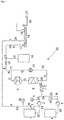
- a polyisocyanate stream A consisting of 1,6-hexamethylene diisocyanate was conveyed to a static mixer 7 from a 250 liter receiver 1 for 1,6-hexamethylene diisocyanate with the aid of a toothed ring pump 2 (from HNP, MZR 7255).
- the throughput of the polyisocyanate stream A was measured by means of a mass flow meter 3 (Bronkhorst, Mini Cori-Flow M1X, max. Flow 12 kg / h).
- the temperature of the 1,6-hexamethylene diisocyanate was room temperature.
- a polyol stream B consisting of 1,4-butanediol was conveyed to the static mixer 7 from a 250 liter receiver 4 for 1,4-butanediol with the aid of a gerotor pump 5 (from HNP, MZR 7205).
- the throughput of the polyol stream B was measured by means of a mass flow meter 6 (Bronkhorst Company, Mini Cori-Flow M1X, max. Flow rate 8 kg / h).
- the temperature of the 1,4-butanediol was 40 ° C.
- the polyisocyanate stream A and the polyol stream B were mixed with one another, so that a mixed stream C was obtained.
- the mass flows of the polyisocyanate stream A and of the polyol stream B were adjusted so that the isocyanate index in the mixture stream C was 78.
- the temperature-controllable static mixer 9 was constructed similarly to a Sulzer SMR reactor with internal, crossed tubes. It had an internal volume of 1.9 liters and a heat exchange area of 0.44 square meters. It was heated / cooled with thermal oil. The heating medium temperature at the inlet was 180 ° C.
- the circulating stream D emerged from the temperature-controllable static mixer 9 at a temperature of 183.degree. Downstream of the temperature-controllable static mixer 9, a prepolymer stream E was separated from the circulating stream D at a junction 11 and the circulating stream D was passed on to a gear pump 10. The prepolymer stream E was passed into an extruder 18.
- the pressure of the circulating flow D was increased at a gear pump 10.
- the pressure of the prepolymer stream E was measured in the prepolymer feed line (30) between the fourth confluence (11) and the pressure holding valve (12).
- the gear pump 10 (Witte Chem 25.6-3) had a volume per revolution of 25.6 cubic centimeters and a speed of 50 per minute.
- the circulating stream D was combined with the mixed stream C at the confluence 28 downstream of the pump, as already described.
- the circulation line 29 consisted of double-walled pipes that were heated with thermal oil.
- the heating medium temperature was 182 ° C.
- the static mixer 8, the temperature-controlled static mixer 9 and the gear pump 10 consisted of apparatuses which were heated with thermal oil.
- the heating medium temperature was 182 ° C.
- the reactive extrusion was carried out in an extruder 18 at a temperature of 200 ° C. and a speed of 66 revolutions per minute.
- the extruder 18 was a ZSK 26 MC from Coperion, with a screw diameter of 26 mm and a length to diameter ratio of 36 to 40.
- vent 17 On the extruder 18 there was a vent 17 which was operated at about 1 mbar underpressure compared to normal pressure and in the prepolymer stream E was freed of any inert gases and possible gaseous reaction products entrained with the polyisocyanate stream A and the polyol stream B.
- An isocyanate feed stream F consisting of 1,6-hexamethylene diisocyanate was taken from template 1 with the aid of a micro annular gear pump 15 (MZR 6355 from HNP).
- the throughput of the isocyanate feed stream F was measured by means of a mass flow meter 16 (Bronkhorst, Mini Cori-Flow, M1X, maximum flow rate 2 kg / h).
- the temperature of the 1,6-hexamethylene diisocyanate was room temperature.
- the isocyanate feed stream F was passed into the extruder 18 downstream of the prepolymer stream E. In the extruder 18, the prepolymer stream E was reacted with the isocyanate feed stream F at an isocyanate index of 99 to form a thermoplastic polyurethane G.
- thermoplastic polyurethane G was freed of volatile constituents at 200 mbar under normal pressure with the aid of a vacuum dome, which was arranged on a degassing shaft of the extruder.
- the thermoplastic polyurethane G was cooled through two nozzles in a water bath 20 filled with deionized water (deionized water) and cut into granules by a granulator 21.
- Table 1 Material flows in the production of the TPUs in Examples 1 to 5
- Example-# Current A (HDI) Stream B (BDO) Current J (HDI) Pressure in prepolymer feed line (30) 1 2.91 kg / h 2 kg / h 0.784 kg / h 4.4 bar 2 2.91 kg / h 2 kg / h 0.784 kg / h 4.6 bar 3 2.91 kg / h 2 kg / h 0.784 kg / h 4.9 bar 5 2.91 kg / h 2 kg / h 0.784 kg / h 5.4 bar 4th 2.91 kg / h 2 kg / h 0.784 kg / h 5.7 bar
- thermograms in the second heating of the examined materials are in Figure 2 shown, the characteristic values determined from it in Fig. 3 .
- the thermoplastic polyurethanes from the examples each have a weight average molecular weight in a similar range from approx. 86 kg / mol to approx. 283 g / mol and also similar peak melting temperatures in the range from 176.5 ° C to 181.4 ° C . In the case of the enthalpy of fusion, however, from around 170 kg / mol, there is a plateau depending on the molecular weight.
- TPU according to the invention Due to the lower enthalpy of fusion of the TPU according to the invention, further processing must be carried out by melting and subsequent Shaping requires less energy for melting than for TPU with Mw ⁇ 170 kg / mol. If the same amount of energy is used in each case for the melting of the thermoplastic polyurethanes from the two examples, the TPU according to the invention melts more quickly.
Landscapes
- Chemical & Material Sciences (AREA)
- Health & Medical Sciences (AREA)
- Chemical Kinetics & Catalysis (AREA)
- Medicinal Chemistry (AREA)
- Polymers & Plastics (AREA)
- Organic Chemistry (AREA)
- Engineering & Computer Science (AREA)
- Manufacturing & Machinery (AREA)
- Polyurethanes Or Polyureas (AREA)
Abstract
Die vorliegende Erfindung betrifft thermoplastische aliphatische Polyurethanpolymere mit einem M w von ≥ 170000 g/mol, wobei die Schmelzenthalpie ΔHPolymer unabhängig von dem M w des thermoplastischen aliphatischen Polyurethanpolymers ist, Zusammensetzungen enthaltend solche Polyurethanpolymere, ein Verfahren zu dessen Herstellung und die Verwendung dieser Polyurethanpolymere.
Description
- Die vorliegende Erfindung betrifft thermoplastische aliphatische Polyurethanpolymere mit einem
M w von ≥ 170000 g/mol, wobei die Schmelzenthalpie ΔHPolymer unabhängig von demM w des thermoplastischen aliphatischen Polyurethanpolymers ist, Zusammensetzungen enthaltend solche Polyurethanpolymere, ein Verfahren zu dessen Herstellung und die Verwendung dieser Polyurethanpolymere. - Polyurethane und insbesondere thermoplastische Polyurethane werden aufgrund ihrer hervorragenden physikalischen Eigenschaften seit Jahren für die unterschiedlichsten Einsatzzwecke verwendet. Trotz der breiten Verwendbarkeit von Polyurethanen gibt es Anwendungsbereiche, in denen andere Kunststoffe, wie beispielsweise Polyamid-Kunststoffe, verwendet werden, weil keine Polyurethane mit geeigneten physikalischen Eigenschaften verfügbar sind oder diese nur schwer bereitgestellt werden können.
- Das Schmelzverhalten von TPU wird durch das Verhältnis von Weich- und Hartsegmenten im Polymer beeinflusst. Dabei werden unter Hartsegmenten die Urethan-Einheiten des Polyurethans verstanden und unter Weichsegmenten die Polyol-Ketten. In einem ausgehärteten, abgekühlten TPU sind Weich- und Hartsegmente in einem polymeren Zweiphasensystem angeordnet. Darin sind die in den Hartsegmenten nebeneinander liegenden Domänen über Wasserstoffbrücken assoziiert und bilden kristalline Strukturen. Die Enden der Polymerketten stellen Defekte dar, die nicht in die kristallinen Strukturen eingebaut werden können. Um TPU mit einem geringeren Kristallisationsgrad aufzuschmelzen, muss weniger Energie aufgebracht werden als für das Aufschmelzen von TPU mit einem hohen Kristallisationsgrad, d.h. die Schmelzenthalpie ist bei einem TPU mit einem vergleichsweise hohen Molekulargewicht niedriger als bei einem TPU mit einem vergleichsweise niedrigen Molekulargewicht.
- Die
CN 10 714 1437 bezieht sich auf TPU, das in 3D-Druckverfahren verwendet werden soll. Die Druckschrift offenbart eine Synthese durch Reaktivextrusion und lehrt, dass die Schmelzenthalpie eines TPU durch die Zugabe eines Kettenverlängerers beeinflusst werden kann, wobei der Kettenverlängerer ein Cyclodextrin-Derivat ist. - Die
CN 10 500 1626 offenbart ebenfalls ein Verfahren für die Reaktiv-Extrusion von Polyurethan. Die Druckschrift offenbart, dass die Fließeigenschaften des TPU durch Zugabe einer Mischung aus Diphenylsilylglykol und Ethylenglykol beeinflusst werden können. - Die
US 2017/145146 bezieht sich auf TPU aus Komponenten, die aus nachwachsenden, pflanzlichen Ressourcen stammen. Die Druckschrift offenbart die Synthese in einem Batch-Verfahren und lehrt, dass die Schmelztemperatur eines TPU unter anderem vom Isocyanat-Index und der Polymerisationszeit abhängt. - Es ist Aufgabe der vorliegenden Erfindung ein thermoplastisches aliphatisches Polyurethanpolymer mit guten verarbeitungstechnischen Eigenschaften wie zum Beispiel gutem Schmelzverhalten bereitzustellen sowie ein Verfahren zu dessen Herstellung.
- Diese Aufgabe wurde gelöst durch ein thermoplastisches aliphatisches Polyurethanpolymer mit einem
M w von ≥ 170000 g/mol, dadurch gekennzeichnet, dass die Schmelzenthalpie ΔHPolymer unabhängig von demM w des thermoplastischen aliphatischen Polyurethanpolymers ist, ΔHPolymer die gemessene Schmelzenthalpie in [J/g] des thermoplastischen aliphatischen Polyurethanpolymers ist, ermittelt mit Dynamischer Differenzkalorimetrie (DSC) gemäß DIN EN ISO 11357-1:2017-02 mit einer Heizrate von 20 K/min im Bereich von -40 °C bis 220 °C, undM w das Massenmittel der Molmasse ist, ermittelt mit Gelpermeationschromatographie, wobei die Probe in einer Lösung aus Kaliumtrifluoracetat in Hexafluorisopropanol mit einer Konzentration von 2 mg/cm3 aufgelöst wurde und ein Polymethylmethacrylatstandard verwendet wurde. - Es wurde überraschend gefunden, dass die erfindungsgemäßen thermoplastischen aliphatischen Polyurethanpolymere ab einem
M w von ≥ 170000 g/mol eine nahezu konstante Schmelzenthalpie aufweisen, d.h. das die Schmelzenthalpie unabhängig vom massengemittelten MolekulargewichtM w ist. Dies hat den Vorteil, dass für erfindungsgemäße Polyurethanpolymere mit unterschiedlichen Molekulargewichten weniger Energie zum Verflüssigen aufgewandt werden muss. Bei schmelzeformenden Verfahren führt dies zu einem breiteren Temperaturverarbeitungsfenster, geringeren Qualitätsschwankungen und einem geringeren Aufwand bzgl. der Einstellungen an Maschinen zum thermoplastischen Verarbeiten z.B. Extruder. Ein weiterer Vorteil ist, dass erfindungsgemäße Polyurethane mit einem sehr hohen Molekulargewicht die nahezu gleiche thermische Stabilität aufweisen, wie erfindungsgemäße Polyurethanpolymere mit einem deutlich geringeren Molekulargewicht. Es eröffnet sich also die Möglichkeit ein in Bezug auf die Verarbeitung und die Anwendung anforderungsgerechtes Material maßzuschneidern. - Das Wort "ein" im Zusammenhang mit zählbaren Größen ist im Rahmen der vorliegenden Erfindung nur dann als Zahlwort zu verstehen, wenn dies ausdrücklich gesagt wird (z. B. durch den Ausdruck "genau ein"). Wenn im Folgenden beispielsweise von "einem Polyol" gesprochen wird, ist das Wort "ein" lediglich als unbestimmter Artikel und nicht als Zahlwort aufzufassen, es ist also damit auch eine Ausführungsform umfasst, die ein Gemisch aus mindestens zwei Polyolen enthält.
- Unter "aliphatisch" oder "aliphatischer Rest" werden im Sinne der Erfindung azyklische gesättigte Kohlenwasserstoffreste verstanden, die verzweigt oder linear sowie vorzugsweise unsubstituiert sind. Diese aliphatischen Kohlenwasserstoffreste enthalten vorzugsweise 2, 3, 4, 5 oder 6 Kohlenstoffatome.
- Bevorzugt bedeuten erfindungsgemäß die Ausdrücke "umfassend" oder "enthaltend", "im Wesentlichen bestehend aus" und besonders bevorzugt "bestehend aus".
- Falls nicht explizit anders angegeben, werden in der vorliegende Erfindung das Zentrifugenmittel der Molmasse
M z, das Massenmittel der MolmasseM w und das Zahlenmittel der MolmasseM n mittels Gelpermeationschromatographie (GPC) unter Verwendung von Polymethylmethacrylat als Standard bestimmt. Die zu vermessende Probe wird in einer Lösung von 3 g Kaliumtrifluoracetat in 400 Kubikzentimeter Hexafluorisopropanol aufgelöst (Probenkonzentration ca. 2 mg/Kubikzentimeter), dann mit einer Flussrate von 1 Kubikzentimeter/Minute über eine Vorsäule gegeben und anschließend über drei in Reihe geschaltete Chromatographiesäulen getrennt, zuerst über eine 1000 Ä PSS PFG 7 µm Chromatographiesäule, dann über eine 300 Ä PSS PFG 7 µm Chromatographiesäule und zuletzt über eine 100 Å PSS PFG 7 µm Chromatographiesäule. Als Detektor wurde ein Brechungsindex-Detektor (RI-Detektor) verwendet. - Das Zentrifugenmittel der Molmasse (
M z ) wurde aus den durch die Messung der Gelpermeationschromatographie erhaltenen Daten mit Hilfe der folgenden Gleichung errechnet:
- Mi die molare Masse der Polymere der Fraktion i ist, so dass Mi < M i+1 für alle i, in g/mol ist,
- ni die Stoffmenge des Polymers der Fraktion i, in mol ist.
- Das Massenmittel der Molmasse (
M w ) wurde ebenfalls aus den durch die Messung der Gelpermeationschromatographie erhaltenen Daten mit Hilfe der folgenden Gleichung errechnet:
- Mi die molare Masse der Polymere der Fraktion i ist, so dass Mi < M i+1 für alle i, in g/mol ist,
- ni die Stoffmenge des Polymers der Fraktion i, in mol ist.
- Das Zahlenmittel der Molmasse
M n wurde ebenfalls aus den durch die Messung der Gelpermeationschromatographie erhaltenen Daten mit Hilfe der folgenden Gleichung errechnet:
- Mi die molare Masse der Polymere der Fraktion i ist, so dass Mi < M i+1 für alle i, in g/mol ist,
- ni die Stoffmenge des Polymers der Fraktion i, in mol ist.
- In einer bevorzugten Ausführungsform weist das erfindungsgemäße thermoplastische aliphatische Polyurethanpolymer ein
M w im Bereich von 170000 g/mol bis 350000 g/mol, vorzugsweise im Bereich von 175000 g/mol bis 300000 g/mol, besonders bevorzugt im Bereich von 200000 g/mol bis 300000 g/mol, noch bevorzugter im Bereich von 250000 g/mol bis 285000 g/mol auf.
In einer bevorzugten Ausführungsform ist die Schmelzenthalpie ΔHPolymer unabhängig von demM w des erfindungsgemäßen thermoplastischen aliphatischen Polyurethanpolymers und die Schmelzenthalpiewerte entsprechender Polyurethanpolmere mit unterschiedlichemM w , welches jeweils ≥ 170000 g/mol ist, unterscheiden sich nicht mehr als 2%, vorzugsweise nicht mehr 1,5% und besonders bevorzugt nicht mehr 1% von arithmetischen Mittel der Schmelzenthalpien dieser Polyurethanpolymere. - Dies hat den Vorteil, dass es zu einem geringeren Schrumpf kommt und höhere Maßhaltigkeit bei der Weiterverarbeitung erzielt werden kann. Dieses ist insbesondere für Prozesse vorteilhaft in welchen die Schmelze möglichst lange flüssig bleiben soll und das Verarbeitungsfenster in der Schmelze der begrenzende Prozess für das Verarbeitungsfenster ist, z.B. beim Extrusionsschäumen oder dem Thermoformen. Für den Spritzguss lässt sich so die Anzahl an Einspritzpunkten reduzieren und es lassen sich größere Bauteile realisieren.
- In einer weiteren bevorzugten Ausführungsform weist das erfindungsgemäße thermoplastische aliphatische Polyurethanpolymer einen Kristallinitätsgrad χ von ≥ 40 % auf, wobei der Kristallinitätsgrad χ gemäß der folgenden Gleichung bestimmt wird:

- Für ein Polymer aufgebaut aus 1,6-Diisocyanatohexan (HDI) und 1,4-Butandiol ist in der Literatur (Kajiyama, T.; MacKnight, W.J.; Polymer Journal, volume 1, 548-554 (1970)) ein Wert für ΔHKristall,100% von 188 J/g bestimmt worden ermittelt nach dem oben beschriebenen Verfahren.
- In einer weiteren bevorzugten Ausführungsform weist das erfindungsgemäße thermoplastische aliphatische Polyurethanpolymer einen Kristallinitätsgrad χ im Bereich von 40 % bis 55 %, bevorzugt im Bereich von 45 % bis 54 %, noch bevorzugter im Bereich von 48 % bis 53 % und am bevorzugsten im Bereich von 50 % bis 53 % aufweist.
- In einer weiteren bevorzugten Ausführungsform ist die Schmelzenthalpie ΔHM,Polymer des erfindungsgemäßen thermoplastischen aliphatischen Polyurethanpolymers ≤ 100 J/g, ermittelt mit Dynamischer Differenzkalorimetrie (DSC) gemäß DIN EN ISO 11357-1:2017-02 mit einer Heizrate von 20 K/min im Bereich von -40 °C bis 220 °C. Vorzugsweise liegt die Schmelzenthalpie ΔHM,Polymer des erfindungsgemäßen thermoplastischen aliphatischen Polyurethanpolymers in einem Bereich von 90 J/g bis 100 J/g, besonders bevorzugt in einem Bereich von 95 J/g bis 100 J/g, besonders bevorzugt in einem Bereich von 98 J/g bis 100 g/J, jeweils ermittelt mit Dynamischer Differenzkalorimetrie (DSC) gemäß DIN EN ISO 11357-1:2017-02 mit einer Heizrate von 20 K/min im Bereich von -40 °C bis 220 °C.
- In einer weiteren bevorzugten Ausführungsform liegt das Verhältnis
M w /M n des erfindungsgemäßen thermoplastischen aliphatischen Polyurethanpolymers in einem Bereich von 8.5 bis 20, vorzugsweise in einem Bereich von 9 bis 18, besonders bevorzugt in einem Bereich von 10 bis 15, wobeiM n das Zahlenmittel der Molmasse undM w das Massenmittel der Molmasse ist, jeweils ermittelt mit Gelpermeationschromatographie, wobei die Probe in einer Lösung aus Kaliumtrifluoracetat in Hexafluorisopropanol mit einer Konzentration von 2 mg/cm3 aufgelöst wurde und ein Polymethylmethacrylatstandard verwendet wurde. - In einer weiteren bevorzugten Ausführungsform liegt das Verhältnis
M z /M w des erfindungsgemäßen thermoplastischen aliphatischen Polyurethanpolymers in einem Bereich von 3 bis 8 vorzugsweise in einem Bereich von 4,5 bis 6,1, wobeiM z das Zentrifugenmittel der Molmasse undM w das Massenmittel der Molmasse ist, jeweils ermittelt mit Gelpermeationschromatographie, wobei die Probe in einer Lösung aus Kaliumtrifluoracetat in Hexafluorisopropanol mit einer Konzentration von 2 mg/cm3 aufgelöst wurde und ein Polymethylmethacrylatstandard verwendet wurde. - Zur Herstellung der erfindungsgemäßen thermoplastischen aliphatischen Polyurethanpolymere werden eine oder mehrere aliphatische Polyisocyanate mit einem oder mehreren aliphatischen Polyolen umgesetzt.
- Als aliphatische Polyisocyanate eignen sich alle dem Fachmann bekannten aliphatischen Polyisocyanate, insbesondere monomere aliphatische Diisocyanate. Geeignete Verbindungen sind vorzugsweise solche des Molekulargewichtsbereiches von ≥ 140 g/mol bis ≤ 400 g/mol, wobei es unerheblich ist, ob diese mittels Phosgenierung oder nach phosgenfreien Verfahren erhalten wurden. Die Polyisocyanate und / oder deren Vorläuferverbindungen können aus fossilen oder biologischen Quellen gewonnen worden sein. Vorzugsweise wird 1,6-Diisocyanatohexan (HDI) aus 1,6-Hexamethylendiamin und 1,5-Diisocyanatopentan aus 1,5-Pentamethylendiamin hergestellt, wobei 1,6-Hexamethylendiamin und 1,5-Pentamethylendiamin aus biologischen Quellen, vorzugsweise durch bakterielle Fermentation, gewonnen werden.
- Beispiele für geeignete aliphatische Diisocyanate sind 1,4-Diisocyanatobutan (BDI), 1,5-Diisocyanatopentan (PDI), 1,6-Diisocyanatohexan (HDI), 2-Methyl-1,5-diisocyanatopentan, 1,5-Diisocyanato-2,2-dimethylpentan, 2,2,4- bzw. 2,4,4-Trimethyl-1,6-diisocyanatohexan, 1,8-Diisocyanatooctan und 1,10-Diisocyanatodecan.
- Weitere ebenfalls geeignete Diisocyanate finden sich darüber hinaus beispielsweise in HOUBEN-WEYL "Methoden der organischen Chemie", Band E20 "Makromolekulare Stoffe", Georg Thieme Verlag, Stuttgart, New York 1987, S. 1587-1593 oder in Justus Liebigs Annalen der Chemie Band 562 (1949) S. 75 - 136.
- Im Rahmen der vorliegenden Erfindung wird unter dem Begriff "monomeres Diisocyanat" ein Diisocyanat verstanden, welches keine dimeren, trimeren etc. Strukturen aufweist, Teil von dimeren, trimeren etc. Strukturen ist und/oder ein Reaktionsprodukt von einer NCO-Gruppe mit einer NCO-reaktiven Gruppe, wie beispielsweise Urethan-, Harnstoff-, Carbodiimid-, Acylharnstoff-, Amid-, Isocyanurat-, Allophanat-, Biuret-, Oxadiazintrion-, Uretdion- und/oder Iminooxadiazindi onstrukturen.
- In einer bevorzugten Ausführungsform ist das eine oder sind die mehreren aliphatischen Polyisocyanate ausgewählt aus der Gruppe bestehend aus 1,4-Diisocyanatobutan, 1,5-Diisocyanatopentan, 1,6-Diisocyanatohexan, 2-Methyl-1,5-diisocyanatopentan und / oder Mischungen aus mindestens zwei hieraus. In einer anderen bevorzugten Aufführungsform werden 1,5-Diisocyanatopentan und / oder 1,6-Diisocyanatohexan als aliphatische Polyisocyanate eingesetzt. In einer weiteren bevorzugten Aufführungsform wird nur 1,6-Diisocyanatohexan als aliphatisches Polyisocyanate eingesetzt.
- Als aliphatische Polyole eignen sich alle dem Fachmann bekannten organische Diole, die ein Molekulargewicht von 62 g/mol bis 210 g/mol, vorzugsweise Diole, die ein Molekulargewicht im Bereich von 62 g/mol bis 120 g/mol aufweisen. Die Diole und / oder deren Vorläuferverbindungen können aus fossilen oder biologischen Quellen gewonnen worden sein. Bevorzugt sind die aliphatischen Diole zum Aufbau des erfindungsgemäßen thermoplastischen Polyurethanpolymers ausgewählt aus der Gruppe bestehend aus 1,2-Ethandiol, 1,2-Propandiol, 1,3-Propandiol, 1,2-Butandiol, 1,3-Butandiol, 1,4-Butandiol, 1,2-Pentandiol, 1,3-Pentandiol, 1,4-Pentandiol, 1,5-Pentandiol, 1,2-Hexandiol, 1,3-Hexandiol, 1,4-Hexandiol, 1,5-Hexandiol und 1,6-Hexandiol oder einer Mischung aus mindestens zwei hieraus. Vorzugsweise werden keinen verzweigten aliphatischen Diole eingesetzt
- In einer bevorzugten Ausführungsform ist das eine oder sind die mehreren aliphatischen Diole ausgewählt aus der Gruppe bestehend aus 1,2-Ethandiol, 1,2-Propandiol, 1,3-Propandiol, 1,2-Butandiol, 1,3-Butandiol, 1,4-Butandiol, 1,5-Pentandiol, 1,6-Hexandiol und / oder Mischungen aus mindestens zwei hieraus. In einer weiteren bevorzugten Aufführungsform werden 1,3-Propandiol, 1,4-Butandiol, 1,6-Hexandiol und / oder Mischungen aus mindestens zwei hieraus als aliphatische Diole eingesetzt. In einer weiteren bevorzugten Aufführungsform werden 1,4-Butandiol und / oder 1,6-Hexandiol als aliphatische Diole eingesetzt. In einer anderen bevorzugten Aufführungsform wird nur 1,4-Butandiol als aliphatisches Diol eingesetzt.
- In einer weiteren bevorzugten Ausführungsform ist das erfindungsgemäße thermoplastische aliphatische Polyurethanpolymer durch Umsetzung von einem oder mehreren aliphatischen Polyisocyanaten mit einem Molekulargewicht im Bereich von ≥ 140 g/mol bis ≤ 400 g/mol, vorzugsweise von einem oder mehreren aliphatischen Diisocyanaten mit einem Molekulargewicht im Bereich von 140 g/mol bis 170 g/mol, mit einem oder mehreren aliphatischen Polyolen mit einem Molekulargewicht im Bereich von 62 g/mol bis 210 g/mol, vorzugsweise einem oder mehreren aliphatischen Diolen mit einem Molekulargewicht im Bereich von 62 g/mol bis 210 g/mol, besonders bevorzugt einem oder mehreren unverzweigten aliphatischen Diolen mit einem Molekulargewicht im Bereich von 62 g/mol bis 120 g/mol erhältlich.
- In einer weiteren bevorzugten Ausführungsform besteht das erfindungsgemäße thermoplastische aliphatische Polyurethanpolymer zu mindestens 80 Gew.-%, vorzugsweise zu mindestens 90 Gew.-%, besonders bevorzugt zu mindestens 95 Gew.-%, noch bevorzugter zu mindestens 98 Gew.-%, noch mehr bevorzugter zu mindestens 99 Gew.-%, und am bevorzugtesten zu mindestens 99,9 Gew.-% aus dem Reaktionsprodukt der Umsetzung von 1,6-Hexamethylendiisocyanat mit 1,4-Butandiol, bezogen auf die Gesamtmasse des thermoplastischen aliphatischen Polyurethanpolymers. Bei der Ermittlung des Anteils des Reaktionsprodukts der Umsetzung von 1,6-Hexamethylendiisocyanat mit 1,4-Butandiol werden nur die polymeren Bestandteile betrachtet, bezogen auf die Gesamtmasse des polymeren thermoplastischen aliphatischen Polyurethanpolymers.
- Die Erfindung ebenfalls betrifft ein Verfahren zur Herstellung eines erfindungsgemäßen thermoplastischen aliphatischen Polyurethanpolymers, wobei in einem ersten Schritt zumindest ein oder mehrere aliphatische Polyisocyanate mit einem oder mehreren aliphatischen Polyolen, gegebenenfalls in Gegenwart eines Katalysators und/ oder Hilfs- und Zusatzstoffen, zu mindestens einem Prepolymer umgesetzt werden, vorzugsweise zu mindestens einem Hydroxy-terminierten Prepolymer, und das im ersten Schritt erhaltende mindestens eine Prepolymer in einem zweiten Schritt mit mindestens einem Kettenverlängerer, vorzugsweise mindestens einem Polyisocyanat, besonders bevorzugt mindestens einem Diisocyanat, zum thermoplastischen Polyurethanpolymer umgesetzt wird, wobei insgesamt ein molares NCO/OH-Verhältnis aller im Verfahren eingesetzter Polyisocyanate und Polyole im Bereich von 1,0 : 0,95 bis 0,95 : 1,0 vorliegt.
In einer bevorzugten Ausführungsform des erfindungsgemäßen Verfahrens werden unabhängig voneinander als aliphatische Polyisocyanate ein oder mehrere aliphatische Polyisocyanate mit einem Molekulargewicht im Bereich von ≥ 140 g/mol bis ≤ 400 g/mol, vorzugsweise von ein oder mehrere aliphatische Diisocyanate mit einem Molekulargewicht im Bereich von 140 g/mol bis 170 g/mol eingesetzt. - In einer bevorzugten Ausführungsform des erfindungsgemäßen Verfahrens werden unabhängig voneinander als aliphatische Polyole ein oder mehrere aliphatische Polyole mit einem Molekulargewicht im Bereich von 62 g/mol bis 210 g/mol, vorzugsweise ein oder mehrere aliphatische Diole mit einem Molekulargewicht im Bereich von 62 g/mol bis 210 g/mol, besonders bevorzugt ein oder mehrere unverzweigte aliphatische Diole mit einem Molekulargewicht im Bereich von 62 g/mol bis 120 g/mol.
- In einer weiteren bevorzugten Ausführungsform des erfindungsgemäßen Verfahrens werden unabhängig voneinander als aliphatische Polyisocyanate ein aliphatische Diisocyanate eingesetzt, vorzugweise ausgewählt aus der Gruppe bestehend aus 1,4-Diisocyanatobutan (BDI), 1,5-Diisocyanatopentan (PDI), 1,6-Diisocyanatohexan (HDI), 2-Methyl-1,5-diisocyanatopentan, 1,5-Diisocyanato-2,2-dimethylpentan, 2,2,4- bzw. 2,4,4-Trimethyl-1,6-diisocyanatohexan, 1,8-Diisocyanatooctan, 1,10-Diisocyanatodecan und/oder Mischungen aus mindestens 2 hieraus, besonders bevorzugt ausgewählt aus der Gruppe bestehend aus 1,4-Diisocyanatobutan (BDI), 1,5-Diisocyanatopentan (PDI), 1,6-Diisocyanatohexan (HDI) und/oder Mischungen aus mindestens 2 hieraus und noch bevorzugter wobei als aliphatisches Polyisocyanat 1,6-Diisocyanatohexan (HDI) eingesetzt wird, und als aliphatische Polyole aliphatische Diole eingesetzt, vorzugsweise ausgewählt aus der Gruppe bestehend aus 1,2-Ethandiol, 1,2-Propandiol, 1,3-Propandiol, 1,2-Butandiol, 1,3-Butandiol, 1,4-Butandiol, 1,5-Pentandiol, 1,6-Hexandiol, 1,7-Heptandiol, 1,8-Octandiol, 1,9-Nonandiol und/oder Mischungen aus mindestens 2 hieraus, besonders bevorzugt ausgewählt aus der Gruppe bestehend aus 1,2-Ethandiol, 1,2-Propandiol, 1,3-Propandiol, 1,2-Butandiol, 1,3-Butandiol, 1,4-Butandiol, 1,5-Pentandiol, 1,6-Hexandiol und/oder Mischungen aus mindestens 2 hieraus, noch bevorzugter ausgewählt wobei als aliphatisches Polyol 1,4-Butandiol eingesetzt wird.
- In einer weiteren bevorzugten Ausführungsform des erfindungsgemäßen Verfahrens wird als aliphatisches Polyisocyanat 1,6-Diisocyanatohexan (HDI) und als aliphatisches Polyol 1,4-Butandiol eingesetzt.
- Die Umsetzung von ein oder mehreren aliphatischen Polyisocyanate mit einem oder mehreren aliphatischen Polyolen zur Erzeugung des erfindungsgemäßen thermoplastischen aliphatischen Polyurethanpolymers kann in Gegenwart von einem oder mehreren Katalysatoren stattfinden.
- Geeignete erfindungsgemäße Katalysatoren sind die nach dem Stand der Technik bekannten und üblichen tertiären Amine, wie z. B. Triethylamin, Dimethylcyclohexylamin, N-Methylmorpholin, N,N'-Dimethyl-piperazin, 2-(Dimethylaminoethoxy)-ethanol, Diazabicyclo-(2,2,2)-octan und ähnliche, sowie insbesondere organische Metallverbindungen wie Titansäureester, Eisenverbindungen, Zinnverbindungen, z.B. Zinndiacetat, Zinndioctoat, Zinndilaurat oder die Zinndialkylsalze aliphatischer Carbonsäuren wie Dibutylzinndiacetat, Dibutylzinndilaurat oder ähnliche. Bevorzugte Katalysatoren sind organische Metallverbindungen, insbesondere Titansäureester, Eisen- und / oder Zinnverbindungen.
- Der Katalysator wird in Mengen von 0,001 Gew.-% bis 2,0 Gew.-%, bevorzugt von 0,005 Gew.-% bis 1,0 Gew.-% besonders bevorzugt von 0,01 Gew.-% bis 0,1 Gew.-% bezogen auf die Diisocyanatkomponente eingesetzt. Der Katalysator kann in Substanz eingesetzt werden oder gelöst in der Diol-Komponente. Ein Vorteil ist hierbei, dass die dann erhaltenen thermoplastischen Polyurethane keine Verunreinigungen durch gegebenenfalls mitverwendete Lösungsmittel für den Katalysator enthalten. Die Zugabe des Katalysators kann dabei in einer oder mehreren Portionen oder auch kontinuierlich, z. B. mit Hilfe einer geeigneten Dosierpumpe, über die gesamte Dauer der Umsetzung erfolgen.
- Alternativ können aber auch Mischungen des bzw. der Katalysatoren mit einem Katalysatorlösungsmittel, bevorzugt mit einem organischen Katalysatorlösungsmittel, eingesetzt werden. Der Verdünnungsgrad der Katalysatorlösungen kann dabei innerhalb eines sehr breiten Bereichs frei gewählt werden. Katalytisch wirksam sind Lösungen ab einer Konzentration von 0,001 Gew.-%.
- Geeignete Lösungsmittel für den Katalysator sind beispielsweise gegenüber Isocyanatgruppen inerte Lösungsmittel wie z.B. Hexan, Toluol, Xylol, Chlorbenzol, Essigsäureethylester, Essigsäurebutylester, Diethylenglykoldimethylether, Dipropylenglykoldimethylether, Ethylenglykolmonomethyl- oder -ethyletheracetat, Diethylenglykolethyl- und -butyletheracetat, Propylenglykolmonomethyl-etheracetat, 1-Methoxypropyl-2-acetat, 3- Methoxy-n-butylacetat, Propylenglykoldiacetat, Aceton, Methylethylketon, Methylisobutylketon, Cyclohexanon, Lactone, wie β-Propiolacton, γ-Butyrolacton, ε-Caprolacton und ε-Methylcaprolacton, aber auch Lösungsmittel wie N-Methylpyrrolidon und N-Methylcaprolactam, 1,2-Propylencarbonat, Methylenchlorid, Dimethylsulfoxid, Triethylphosphat oder beliebige Gemische derartiger Lösungsmittel.
- Es können aber auch Lösungsmittel für den Katalysator zum Einsatz kommen, die gegenüber Isocyanaten reaktive Gruppen tragen und in das Diisocyanat eingebaut werden können. Beispiele für solche Lösungsmittel sind ein- oder mehrwertige einfache Alkohole, wie z. B. Methanol, Ethanol, n-Propanol, Isopropanol, n-Butanol, n-Hexanol, 2-Ethyl-1-hexanol, Ethylenglykol, Propylenglykol, die isomeren Butandiole, 2-Ethyl-1,3-hexandiol oder Glycerin; Etheralkohole, wie z. B. 1-Methoxy-2-propanol, 3-Ethyl-3-hydroxymethyloxetan, Tetrahydrofurfurylalkohol, Ethylengylkol-monomethylether, Ethylenglykolmonoethylether, Ethylenglykolmonobutylether, Diethylenglykolmonomethylether, Diethylenglykolmonoethylether, Diethylenglykolmonobutylether, Diethylenglykol, Dipropylenglykol oder auch flüssige höhermolekulare Polyethylenglykole, Polypropylenglykole, gemischte Polyethylen/polypropylenglykole sowie deren Monoalkylether; Esteralkohole, wie z. B. Ethylenglykolmonoacetat, Propylenglykolmonolaurat, Glycerinmono- und diacetat, Glycerinmonobutyrat oder 2,2,4-Trimethyl-1,3-pentandiol-monoisobutyrat; ungesättigte Alkohole wie z. B. Allylalkohol, 1,1-Dimethyl-allylalkohol oder Oleinalkohol; araliphatische Alkohole wie z. B. Benzylalkohol; N-monosubstituierte Amide, wie z. B. N-Methylformamid, N-Methylacetamid, Cyanacetamid oder 2-Pyrrolidinon oder beliebige Gemische derartiger Lösungsmittel.
- Bei Hilfs- und Zusatzstoffen kann es sich beispielsweise um im Bereich der Thermoplasttechnologie gängige Hilfs- und Zusatzstoffe wie Farbstoffe, Füllstoffe, Verarbeitungshilfsmittel, Weichmacher, Nucleierungsmittel, Stabilisatoren, Flammschutzmittel, Entformungsmittel oder verstärkende Hilfs- und Zusatzstoffe handeln. Nähere Angaben über die genannten Hilfs- und Zusatzstoffe sind der Fachliteratur, beispielsweise der Monographie von J.H. Saunders und K.C. Frisch "High Polymers", Band XVI, Polyurethane, Teil 1 und 2, Verlag Interscience Publishers 1962 bzw. 1964, dem Taschenbuch für Kunststoff-Additive von R. Gächter u. H. Müller (Hanser Verlag München 1990) oder der
DE-A 29 01 774 zu entnehmen. Selbstverständlich kann es ebenfalls von Vorteil sein, mehrere Hilfs- und Zusatzstoffe mehrerer Typen zu verwenden. - Im Rahmen der vorliegenden Erfindung wird unter einem "Hydroxy-terminierten Prepolymer" ein Prepolymergemisch verstanden, in dem mindestens 90 Anzahl-% der Molekülenden eine Hydroxygruppe aufweisen und die verbleibenden 10 Anzahl-% Molekülenden weitere HydroxyGruppen, NCO-Gruppen oder nicht-reaktive Gruppen aufweisen. Unter einer "nicht-reaktiven Gruppe" wird im Rahmen der vorliegenden Erfindung eine Gruppe verstanden, die unter den erfindungsgemäßen Reaktionsbedingungen weder mit NCO-Gruppen, noch mit OH-Gruppen in einer Zeiteinheit reagiert, die der erfindungsgemäßen Reaktionszeit entspricht. Eine nicht-reaktive Gruppe kann beispielsweise aus einer reaktiven NCO-Gruppe oder OH-Gruppe durch Reaktion mit geeigneten Reaktionspartnern (Kettenabbrecher) in eine nicht-reaktive Gruppe umgewandelt werden. Als Kettenabbrecher eignen sich alle monofunktionellen Verbindungen, die unter den erfindungsgemäßen Reaktionsbedingungen entweder mit einer Isocyanatgruppe oder mit einer Hydroxygruppe reagieren, beispielsweise Mono-Alkohole, wie Methanol, Mono-Amine, wie Diethylamin und Monoisocyanate, wie Butylisocyanat. Das Hydroxy-terminierte Prepolymer kann beispielsweise an einem Molekülende eine Hydroxygruppe aufweisen und an dem oder den anderen Molekülenden beispielsweise eine Alkylgruppe. Wenn im Rahmen der vorliegenden Erfindung von einem Hydroxy-terminierten Prepolymer gesprochen wird, ist hiermit auch immer ein Gemisch aus dem mindestens einen Hydroxy-terminierten Prepolymer und einem nicht-reaktiv terminierten Prepolymer umfasst. Ferner kann es sich aufgrund der Statistik der Reaktion abgesehen von Nebenreaktionen auch um ein Gemisch von nicht Hydroxy-terminierten bis zu zweifach Hydroxy-terminierten Prepolymeren handeln. Vorzugsweise handelt es sich überwiegend um ein Gemisch von zweifach Hydroxy-terminierten Prepolymeren. Erfindungsgemäß kann es sich bei dem mindestens einen Hydroxy-terminierten Prepolymer auch um ein Gemisch von mindestens einem Hydroxy-terminierten Prepolymer und mindestens einem nicht-reaktiv terminierten Prepolymer handeln.
Im Rahmen der vorliegenden Erfindung wird unter einem "nicht-reaktiv terminierten Prepolymer" ein Prepolymer verstanden, bei dem die reaktiven Gruppen (NCO-Gruppen oder OH-Gruppen) durch Reaktion mit geeigneten Reaktionspartnern (Kettenabbrechern) in chemische Gruppen umgewandelt wurden, die unter den genannten Reaktionsbedingungen weder mit NCO-Gruppen, noch mit OH-Gruppen reagieren. Als Kettenabbrecher eignen sich beispielsweise Mono-Alkohole wie Methanol, Mono-Amine wie Diethylamin und Monoisocyanate wie Butylisocyanat. Der molare Anteil der Kettenabbrecher kann beispielsweise von 0,001 mol-% bis 2 mol-% und bevorzugt von 0,002 mol-% bis 1 mol-% betragen, jeweils bezogen auf die Gesamtstoffmenge der entsprechenden Monomerkomponente. - Das mindestens eine Hydroxy-terminierte Prepolymer kann beispielsweise aus der Gesamtmenge der aliphatischen Polyole und einer ersten Teilmenge der aliphatischen Polyisocyanate gebildet werden. In einem oder mehreren darauffolgenden Schritten können dann weitere Teilmengen der aliphatischen Polyisocyanate, d.h. eine zweite, dritte etc. Teilmenge hinzugefügt werden, um weitere erfindungsgemäße, im Mittel höher molekulare, Hydroxy-terminierte Prepolymere aufzubauen. Alternativ kann das mindestens eine Hydroxy-terminierte Prepolymer beispielsweise aus einer ersten Teilmenge der aliphatischen Polyole und einer ersten Teilmenge der aliphatischen Polyisocyanate gebildet werden. In einer oder mehreren darauffolgenden Verfahrensstufen können dann weitere Teilmengen der aliphatischen Polyole und der aliphatischen Polyisocyanate zugeführt werden, um weitere im Mittel höher molekulare Hydroxy-terminierte Prepolymere aufzubauen.
- Die Umsetzung kann mit oder ohne Katalysator durchgeführt werden, allerdings ist eine katalysierte Umsetzung bevorzugt. Als Katalysatoren eigenen sich die oben aufgeführten Katalysatoren. Die Umsetzung kann Lösungsmittelfrei oder in Lösung erfolgen. In Lösung bedeutet, dass zumindest einer der Reaktionspartner in einem Lösungsmittel gelöst ist, bevor er zu dem anderen Reaktionspartner gegeben wird. Vorzugsweise wird die Umsetzung Lösungsmittelfrei durchgeführt. Dabei ist das Verfahren im Sinne der vorliegenden Erfindung noch als lösungsmittelfrei anzusehen, wenn der Gehalt des Lösungsmittels bis 1 Gew.-%, vorzugsweise bis 0,1 Gew.-%, noch bevorzugter bis 0,01 Gew.-% bezogen auf das Gesamtgewicht der Reaktionsmischung beträgt.
- Die Temperaturen zur Bildung des mindestens einen Prepolymers, vorzugsweise Hydroxy-terminierten Prepolymers, durch das erfindungsgemäße Verfahren können in Abhängigkeit von den eingesetzten Verbindungen ausgewählt werden. Bevorzugt ist hierbei jedoch, wenn die Umsetzung bei Temperaturen von ≥ 40 °C bis ≤ 260 °C, vorzugsweise von ≥ 60 °C bis ≤ 250 °C, bevorzugter von ≥ 100 °C bis ≤ 240 °C, besonders bevorzugt von ≥ 120 °C bis ≤ 220 °C durchgeführt wird. Dabei wird toleriert, dass das Produkt bei der Umsetzung kurzfristige (< 60 Sekunden) Abweichungen der Reaktionstemperatur von den oben genannten Bereichen erfährt.
- Das so erzeugte mindestens eine Prepolymer, vorzugsweise Hydroxy-terminierte Prepolymer, kann beispielsweise in mindestens einer weiteren Verfahrensstufe mit mindestens einem Kettenverlängerer zum thermoplastischen Polyurethanpolymer umgesetzt werden. Dabei können entweder die Gesamtmengen der beiden Komponenten, d.h. des erzeugten mindestens einen Prepolymers, vorzugsweise Hydroxy-terminierten Prepolymers, und des mindestens einen Kettenverlängerers, miteinander in einer Verfahrensstufe umgesetzt werden oder es wird eine Teilmenge der einen Komponenten mit der Gesamtmenge oder einer Teilmenge der anderen Komponente in mehreren Verfahrensstufen umgesetzt. Vorzugsweise werden ein oder mehrere aliphatische Diisocyanate mit einem Molekulargewicht von 140 g/mol bis 170 g/mol als Kettenverlängerer eingesetzt.
- Wenn es sich bei dem Prepolymer um ein Hydroxy-terminiertes Prepolymere handelt, dann kann dieses mit Hydroxygruppenreaktiven Kettenverängerern wie beispielsweise Polyisocyanaten umgesetzt werden. Als Polyisocyanate eigen sich dabei alle dem Fachmann bekannten Polyisocyanate. Vorzugsweise werden ein oder mehrere aliphatische Diisocyanate mit einem Molekulargewicht von 140 g/mol bis 170 g/mol als Kettenverlängerer eingesetzt. Wenn es sich bei dem Prepolymer um ein NCO-terminierten Prepolymer handelt, dann kann dieses mit NCO-reaktiven Kettenverängerern wie beispielsweise organischen Diolen, Thiolen, Diaminen und Mischungen aus mindestens zwei hiervon umgesetzt werden. Geeignete organische Diole, Thiole und Diamine sind dem Fachmann bekannt. Die Umsetzung des Prepolymers mit dem Ketternverlängerer zum Polymer kann beispielsweise in einem Extruder erfolgen.
- Die Temperaturen zur Bildung des erfindungsgemäßen thermoplastischen Polyurethanpolymers durch Umsetzung des mindestens einen Prepolymers, vorzugsweise Hydroxy-terminierten Prepolymers, mit dem mindestens einen Kettenverlängerer im erfindungsgemäßen Verfahren können in Abhängigkeit von den eingesetzten Verbindungen ausgewählt werden. Bevorzugt ist hierbei jedoch, wenn die Umsetzung bei Temperaturen von ≥ 60 °C bis ≤ 260 °C, vorzugsweise von ≥ 80 °C bis ≤ 250 °C, besonders bevorzugt von ≥ 100 °C bis ≤ 245 °C und ganz besonders bevorzugt von ≥ 120 °C bis ≤ 240 °C durchgeführt wird. Dabei wird toleriert, dass das Produkt bei der Umsetzung kurzfristige (< 60 Sekunden) Abweichungen der Reaktionstemperatur von den oben genannten Bereichen erfährt.
- Die Verfahrensstufen zur Erzeugung des erfindungsgemäßen thermoplastischen aliphatischen Polyurethanpolymers kann in einem einzelnen Apparat oder in einer Vielzahl von Apparaten durchgeführt werden. Beispielsweise kann die Erzeugung des Prepolymers, vorzugsweise Hydroxy-terminierten Prepolymers, zunächst in einem ersten Apparat (z.B. Loop-Reaktor oder kühlbarer Mischer) durchgeführt werden und dann das Reaktionsgemisch in einen weiteren Apparat (z.B. Extruder oder andere Hochviskosreaktoren) überführt werden, um das erfindungsgemäße thermoplastische aliphatische Polyurethanpolymer zu erzeugen.
- In einer weiteren bevorzugten Ausführungsform findet die Umsetzung des mindestens einen Prepolymers, vorzugsweise Hydroxy-terminierten Prepolymers, mit dem mindestens einen Kettenverlängerer in einem Extruder statt.
- In einer weiteren bevorzugten Ausführungsform findet die Herstellung des erfindungsgemäßen thermoplastischen aliphatischen Polyurethanpolymers in einer Kombination eines Loop-Reaktors mit einem Extruder statt.
- In einer weiteren bevorzugten Ausführungsform findet die Herstellung des erfindungsgemäßen thermoplastischen aliphatischen Polyurethanpolymers in einer Kombination eines Statikmischers, Dynamikmischers, Loop-Reaktors oder Mischer-Wärmeübertragers mit einem beheizten Transportband statt.
- Im Anschluss an die Umsetzung zum erfindungsgemäßen thermoplastischen aliphatischen Polyurethanpolymer wird dieses in eine Handelsform gebracht, typischerweise Granulat. Nach der Umsetzung in der finalen Verfahrensstufe liegt das erfindungsgemäße thermoplastischen aliphatischen Polyurethanpolymer im schmelzeflüssigen Zustand vor, wird im Schmelzezustand zerkleinert und durch Abkühlung zum Erstarren gebracht oder zuerst durch Abkühlen zum Erstarren gebracht und anschließend zerkleinert. Dies kann beispielsweise mit den dem Fachmann bekannten Methoden der Stranggranulierung, der Unterwasser-Stranggranulierung, der Wasserringgranulierung und der Unterwassergranulierung geschehen. Die Abkühlung erfolgt bevorzugt mit Wasser; auch eine Abkühlung mit Luft oder anderen Medien ist möglich.
- Nach Umsetzung auf einem Bandreaktor kann das erfindungsgemäße thermoplastische aliphatische Polyurethanpolymer auch abgekühlt, gebrochen und gemahlen werden.
- Das so erhaltene erfindungsgemäße thermoplastische aliphatische Polyurethanpolymer kann erfindungsgemäß in einem Feststoffmischprozess gemischt und in einem weiteren Extruder aufgeschmolzen und wieder granuliert werden. Dies ist vor allem dann bevorzugt, wenn erfindungsgemäße thermoplastische aliphatische Polyurethanpolymer nach dem Bandreaktor gekühlt und gemahlen wird, weil dieser Vorgang auch die Produktform homogenisiert.
- Das erfindungsgemäße Herstellungsverfahren kann kontinuierlich oder diskontinuierlich, d.h. als Batch-Verfahren oder Semi-Batch-Verfahren durchgeführt werden.
- Eine weitere Ausführungsform der Erfindung betrifft ein thermoplastisches aliphatisches Polyurethanpolymer erhältlich oder erhalten durch das erfindungsgemäße Verfahren.
- Eine weitere Ausführungsform der Erfindung betrifft eine Zusammensetzung enthaltend mindestens ein erfindungsgemäßes thermoplastisches aliphatisches Polyurethanpolymer und mindestens ein Additiv und / oder ein weiteres thermoplastisches Polymer. Als Additive eigenen sich alle oben genannten Zusatzstoffe und Hilfsstoffe. Geeignete thermoplastische Polymere, die Bestandteil der erfindungsgemäßen Zusammensetzung sein können, sind beispielsweise Polystyrole, Polyamide, Polyethylen, Polypropylen, Polyacrylate, Polymethacrylate, Polyurethane oder auch Acrylnitril-Butadien-Styrol-Copolymere (ABS).
- Aus den erfindungsgemäßen Zusammensetzungen können thermoplastische Formmassen hergestellt werden. Ein weiterer Gegenstand der Erfindung ist daher eine thermoplastische Formmasse, welche mindestens eine erfindungsgemäße Zusammensetzung umfasst. Die erfindungsgemäßen thermoplastischen Formmassen können beispielsweise hergestellt werden, indem man die jeweiligen Bestandteile der Zusammensetzungen in bekannter Weise vermischt und bei Temperaturen von bevorzugt 180 °C bis 320 °C, besonders bevorzugt bei 200 °C bis 300 °C in üblichen Aggregaten wie beispielsweise Innenknetern, Extrudern und Doppelwellenschnecken schmelzcompoundiert und schmelzextrudiert. Dieser Prozess wird im Rahmen dieser Anmeldung allgemein als Compoundieren bezeichnet.
- Unter Formmasse wird also das Produkt verstanden, das erhaltend wird, wenn die Bestandteile der Zusammensetzung schmelzcompoundiert oder schmelzextrudiert werden.
- Die Vermischung der einzelnen Bestandteile der Zusammensetzungen kann in bekannter Weise sowohl sukzessive als auch simultan erfolgen, und zwar sowohl bei etwa 20°C (Raumtemperatur) als auch bei höherer Temperatur. Das bedeutet, dass beispielsweise manche der Bestandteile über den Haupteinzug eines Extruders dosiert und die restlichen Bestandteile über einen Seitenextruder später im Compoundierverfahren zugeführt werden können.
- Gegenstand der Erfindung ist auch ein Verfahren zur Herstellung der erfindungsgemäßen Formmassen.
- Die erfindungsgemäßen thermoplastischen Formmassen können zur Herstellung von Formkörpern, Folien und / oder Fasern jeder Art verwendet werden. Ein weiterer Gegenstand der Erfindung ist daher ein Formkörper, eine Folie und / oder eine Faser, wobei der Formkörper, die Folie oder die Faser mindestens ein erfindungsgemäßes thermoplastisches Polyurethanpolymer, mindestens eine erfindungsgemäße thermoplastische Formmasse oder mindestens eine erfindungsgemäße Zusammensetzung umfasst. Diese können beispielsweise durch Spritzguss, Extrusion, Blasformverfahren und / oder Schmelzspinnen hergestellt werden. Eine weitere Form der Verarbeitung ist die Herstellung von Formkörpern durch Tiefziehen aus zuvor hergestellten Platten oder Folien.
- Es ist auch möglich, die Bestandteile der Zusammensetzungen direkt in eine Spritzgussmaschine oder in ein Extrusionsaggregat zu dosieren und zu Formkörper zu verarbeiten.
Ein weiterer Gegenstand der Erfindung ist die Verwendung eines erfindungsgemäßen thermoplastischen Polyurethanpolymers, einer erfindungsgemäßen thermoplastischen Formmasse oder einer erfindungsgemäßen Zusammensetzung zur Herstellung eines Formkörpers, einer Folie und / oder einer Faser. - Ein weiterer Gegenstand der Erfindung ist die Verwendung eines erfindungsgemäßen thermoplastischen Polyurethanpolymers zur Herstellung einer Zusammensetzung, einer thermoplastischen Formmasse oder einer Polyurethan-Dispersion.
- Ein weiterer Gegenstand der Erfindung ist ein Artikel umfassend oder enthaltend eine erfindungsgemäße thermoplastische Formmasse, ein erfindungsgemäßes thermoplastisches Polyurethan oder eine erfindungsgemäße Zusammensetzung.
- Die vorliegende Erfindung wird im Folgenden anhand der
Figuren 1 bis 3 näher erörtert. Darin zeigt - Fig.1
- eine Vorrichtung zur Durchführung des erfindungsgemäßen Verfahrens, sowie
- Fig. 2
- ein Thermogramm aus einer Differentialthermoanalyse der Vergleichsbeispiele 1 bis 3 und der erfindungsgemäßen Beispiele 4 und 5, das die zweite Aufheizung zeigt (materialabhängige Schmelzeigenschaften)
- Fig. 3
- Kennwerte als Funktion des massengemittelten Molekulargewichtes Mw a) Peak-Schmelztemperatur b) Schmelzenthalpie □HM
- Die vorliegende Erfindung wird anhand der nachfolgenden Beispiele weiter erläutert, ohne jedoch darauf beschränkt zu sein.
- Es wurden fünf thermoplastische Polyurethanpolymere miteinander verglichen, die mit dem gleichen Syntheseverfahren hergestellt wurden, aber unterschiedliche Polymerisationsgrade aufweisen. Dabei wurden die Schmelzenthalpie und das Molekulargewicht dieser Polyurethanpolymere untersucht.
- Die Bestimmung der Schmelzenthalpie erfolgt mittels Dynamischer Differenzkalorimetrie (engl. Differential scanning calorimetry, DSC) anhand DIN EN ISO 11357-1:2017-02. Die Messung erfolgte an einer Q2000 (TA Instruments). Es wurden zwei Aufheizungen und die Abkühlung im Bereich -40 °C bis 220 °C mit einer Heiz-/Kühlrate von 20 K/min durchgeführt. Die Probenmasse betrug circa 6 mg. Der Spülgasstrom (Stickstoff) betrug 50 ml/min.
- GPC-Methode zur Bestimmung von Mn und Mw:
Das Zahlenmittel und das Massenmittel der Molmasse wurden mit Hilfe einer Gelpermeationschromatographie (GPC) bestimmt, wobei die zu untersuchende Probe in einer Lösung aus Kaliumtrifluoracetat in Hexafluorisopropanol mit einer Konzentration von 2 mg/cm3 aufgelöst wurde und ein Polymethylmethacrylatstandard verwendet wurde,.Pumpe: HPLC-Pumpe 515 (Waters GmbH) Detektor: Smartline RI-Detektor 2300 (Knauer Wissenschaftliche Geräte GmbH) Säulen: 1 Vorsäule, 1000 Å PSS PFG 7µm, 300 Å PSS PFG 7µm 100 Å PSS PFG 7µm in dieser Reihenfolge (PSS Polymer Standards Service GmbH) Entgasung: Degaser PSS (PSS Polymer Standards Service GmbH) Injektionsvolumen: 100 Mikroliter Temperatur: 23 °C - 25 °C Molmassen-Standard: Polymethylmethacrylat-Standard-Kit (PSS Polymer Standards Service GmbH) - Falls nicht explizit anders angegeben, wurden in der vorliegende Erfindung das Zentrifugenmittel der Molmasse Mz mittels Gelpermeationschromatographie (GPC) unter Verwendung von Polymethylmethacrylat als Standard bestimmt. Die zu vermessende Probe wurde in einer Lösung von 3 g Kaliumtrifluoracetat in 400 Kubikzentimeter Hexafluorisopropanol aufgelöst (Probenkonzentration ca. 2 mg/Kubikzentimeter) und dann mit einer Flussrate von 1 Kubikzentimeter/Minute über eine Vorsäule gegeben und dann über drei in Reihe geschaltete Chromatographiesäulen getrennt, zuerst über eine 1000 Å PSS PFG 7 µm Chromatographiesäule, dann über eine 300 Ä PSS PFG 7 µm Chromatographiesäule und zuletzt über eine 100 Ä PSS PFG 7 µm Chromatographiesäule. Als Detektor wurde ein Brechungsindex-Detektor (RI-Detektor) verwendet. Das zahlengemittelte Molekulargewicht wurde aus den durch die Messung der Gelpermeationschromatographie erhaltenen Daten mit Hilfe der folgenden Gleichung errechnet:

Mi die molare Masse der Polymere der Fraktion i ist, so dass Mi < M i+1 für alle i, in g/mol ist, ni die Stoffmenge des Polymers der Fraktion i, in mol ist. - Das zentrifugengemittelte Molekulargewicht wurde aus den durch die Messung der Gelpermeationschromatographie erhaltenen Daten mit Hilfe der folgenden Gleichung errechnet:

Mi die molare Masse der Polymere der Fraktion i ist, so dass Mi < M i+1 für alle i, in g/mol ist, ni die Stoffmenge des Polymers der Fraktion i, in mol ist. - Aus einer 250 - Liter - Vorlage 1 für 1,6-Hexamethylendiisocyanat wurde mit Hilfe einer Zahnringpumpe 2 (Firma HNP, MZR 7255) ein Polyisocyanatstrom A bestehend aus 1,6-Hexamethylendiisocyanat zu einem Statikmischer 7 gefördert. Der Durchsatz des Polyisocyanatstroms A wurde mittels eines Massendurchflussmessers 3 (Firma Bronkhorst, Mini Cori-Flow M1X, max. Durchfluss 12 kg/h) gemessen. Die Temperatur des 1,6-Hexamethylendiisocyanats betrug dabei Raumtemperatur.
- Aus einer 250 - Liter - Vorlage 4 für 1,4-Butandiol wurde mit Hilfe einer Zahnringpumpe 5 (Firma HNP, MZR 7205) ein Polyolstrom B bestehend aus 1,4-Butandiol zum Statikmischer 7 gefördert. Der Durchsatz des Polyolstroms B wurde mittels eines Massendurchflussmessers 6 (Firma Bronkhorst, Mini Cori-Flow M1X, max. Durchfluss 8 kg/h) gemessen. Die Temperatur des 1,4-Butandiols betrug 40 °C.
- In dem Statikmischer 7 (Sulzer SMX, Durchmesser 6 mm, Verhältnis von Länge zu Durchmesser L/D = 10) wurden der Polyisocyanatstrom A und der Polyolstrom B miteinander gemischt, so dass ein Mischungsstrom C erhalten wurde. Die Massenströme des Polyisocyanatstroms A und des Polyolstroms B wurden so eingestellt, dass der Isocyanat-Index im Mischungsstrom C 78 betrug.
- Mischungsstrom C wurde über eine Einmündung 28 in die Kreislaufleitung 29 geleitet, in dem ein Kreislaufstrom D in einem Kreislauf geführt wurde. Stromabwärts der Einmündung 28 wurde der Kreislaufstrom D in einen Statikmischer 8 (Statikmischer äquivalent zu Sulzer SMX, Innendurchmesser 34 mm, L/D=20) geführt. Die Temperatur des Prepolymerstromes D betrug 182 °C.
- Stromabwärts des Statikmischers 8 wurde der Kreislaufstrom D in einen temperierbaren statischen Mischer 9 geführt. Dort fand die Oligomerisierung des Kreislaufstroms D mit Mischungsstrom C zum großen Teil statt und die entstehende Reaktionswärme wurde abgeführt. Der temperierbare statische Mischer 9 war ähnlich aufgebaut wie ein Sulzer SMR-Reaktor mit innenliegenden, gekreuzten Rohren. Er hatte ein Innenvolumen von 1,9 Litern und eine Wärmeaustauschfläche von 0,44 Quadratmeter. Er war mit Wärmeträgeröl beheizt/gekühlt. Die Heizmitteltemperatur am Eintritt betrug 180 °C.
- Aus dem temperierbaren statischen Mischer 9 trat der Kreislaufstrom D mit einer Temperatur von 183 °C aus. Stromabwärts des temperierbaren statischen Mischers 9 wurde an einer Einmündung 11 ein Prepolymerstrom E aus dem Kreislaufstrom D abgeteilt und der Kreislaufstrom D weiter zu einer Zahnradpumpe 10 geführt. Der Prepolymerstrom E wurde in einen Extruder 18 geleitet.
- Der Druck des Kreislaufstroms D wurde an einer Zahnradpumpe 10 erhöht. Der Druck des Prepolymerstroms E wurde in der Prepolymerzuführungsleitung (30) zwischen der vierten Einmündung (11) und dem Druckhalteventiel (12) gemessen. Die Zahnradpumpe 10 (Firma Witte Chem 25,6-3) hatte ein Volumen pro Umdrehung von 25,6 Kubikzentimeter und eine Drehzahl von 50 pro Minute. Der Kreislaufstrom D wurde stromabwärts der Pumpe an Einmündung 28 mit Mischungsstrom C vereinigt, wie bereits beschrieben.
- Die Kreislaufleitung 29 bestand aus doppelwandig ausgeführten Rohrleitungen, die mit Thermoöl beheizt waren. Die Heizmitteltemperatur betrug 182 °C. Der Statikmischer 8, der temperierbare statischen Mischer 9 und die Zahnradpumpe 10 bestanden aus Apparaten, die mit Thermoöl beheizt waren. Die Heizmitteltemperatur betrug 182 °C.
- Die Reaktivextrusion wurde in einem Extruder 18 bei einer Temperatur von 200 °C und einer Drehzahl von 66 Umdrehungen pro Minute durchgeführt. Der Extruder 18 war ein ZSK 26 MC der Firma Coperion, mit einem Schneckendurchmesser von 26 mm und einem Länge zu Durchmesser Verhältnis von 36 bis 40.
- An dem Extruder 18 befand sich eine Entlüftung 17, die bei ca. 1 mbar Unterdruck gegenüber dem Normaldruck betrieben wurde und in der Prepolymerstrom E von eventuell mit dem Polyisocyanatstrom A und dem Polyolstrom B eingeschleppten Inertgasen und möglichen gasförmigen Reaktionsprodukten befreit wurde.
- Aus Vorlage 1 wurde mit Hilfe einer Mikrozahnringpumpe 15 (MZR 6355 der Firma HNP) ein Isocyanatzuführungsstrom F bestehend aus 1,6-Hexamethylendiisocyanat entnommen. Der Durchsatz des Isocyanatzuführungsstroms F wurde mittels eines Massendurchflussmessers 16 (Firma Bronkhorst, Mini Cori-Flow, M1X, maximaler Durchfluss 2 kg/h) gemessen. Die Temperatur des 1,6-Hexamethylendiisocyanat betrug Raumtemperatur. Der Isocyanatzuführungsstrom F wurde stromabwärts des Prepolymerstroms E in den Extruder 18 geleitet. In dem Extruder 18 wurde der Prepolymerstrom E mit dem Isocyanatzuführungsstrom F bei einem Isocyanatindex von 99 zu einem thermoplastischen Polyurethan G umgesetzt.
- Am in Durchflussrichtung betrachtet letzten Drittel des Extruders 18 war eine Entgasung 19 angeordnet an der das thermoplastische Polyurethan G bei 200 mbar unter Normaldruck mit Hilfe eines Vakuumdoms, der auf einem Entgasungsschacht des Extruders angeordnet war, von flüchtigen Bestandteilen befreit wurde. Das thermoplastische Polyurethan G wurde nach dem Austritt aus dem Extruder 18 durch zwei Düsen in einem mit deionisierten Wasser (VE-Wasser) gefüllten Wasserbad 20 abgekühlt und durch einen Granulator 21 zu Granulat zerschnitten.
Tabelle 1: Stoffströme bei der Herstellung der TPUs in Beispiel 1 bis 5 Beispiel-# Strom A (HDI) Strom B (BDO) Strom J (HDI) Druck in Prepolymerzuführungsleitung (30) 1 2,91 kg/h 2 kg/h 0,784 kg/h 4,4 bar 2 2,91 kg/h 2 kg/h 0,784 kg/h 4,6 bar 3 2,91 kg/h 2 kg/h 0,784 kg/h 4,9 bar 5 2,91 kg/h 2 kg/h 0,784 kg/h 5,4 bar 4 2,91 kg/h 2 kg/h 0,784 kg/h 5,7 bar - Die Schmelzeigenschaften und die Molekulargewichte der aus den Beispielen erhaltenen thermoplastischen Polyurethane wurden nach den oben beschriebenen Verfahren untersucht. Die Ergebnisse sind in Tabelle 2 zusammengefasst:
Tabelle 2: Schmelzenthalpie und Molekulargewicht der erhaltenen Polyurethane Beispiel 1 Beispiel 2 Beispiel 3 Beispiel 4 Beispiel 5 Mw [kg/mol] 85,7 111,5 152,2 238,3 282,9 Mw/Mn 5,2 7,2 8,0 15,0 11,0 Mz/Mw, 3,9 4,8 5,0 4,6 6,1 ΔHKristall,100% [J/g] 188 188 188 188 188 Schmelzenthalpie (2. Aufh.) ΔHM [J/g] 108,7 105,7 101,3 99,1 98,9 Peak-Schmelztemperatur (2. Aufh.) [C°] 181,4 181,1 181,0 179,5 181,1 Kristallinitätsgrad χ [%] 57,8 56,2 53,9 52,7 52,6 - Die DSC Thermogramme in der zweiten Aufheizung der untersuchten Materialien sind in
Figur 2 dargestellt, die daraus ermittelten Kennwerte inFig. 3 . Die thermoplastischen Polyurethane aus den Beispielen weisen jeweils ein massengemitteltes Molekulargewicht in einem ähnlichen Bereich von ca. 86 kg/mol bis ca. 283 g/mol und auch ähnliche Peak-Schmelztemperaturen im Bereich von 176,5 °C bis 181,4 °C auf. Bei der Schmelzenthalpie zeigt sich jedoch ab circa 170 kg/mol ein Plateau in Abhängigkeit vom Molekulargewicht. Aufgrund der niedrigeren Schmelzenthalpie des erfindungsgemäßen TPU muss bei der Weiterverarbeitung durch Aufschmelzen und nachfolgender Formgebung weniger Energie für das Aufschmelzen aufgebracht werden, als für die TPU mit Mw < 170 kg/mol. Wird für das Aufschmelzen der thermoplastischen Polyurethane aus den beiden Beispielen jeweils die gleiche Menge an Energie verwendet, so schmilzt das erfindungsgemäße TPU schneller. -
- (A)
- Polyisocyanatstrom
- (B)
- Polyolstrom
- (C)
- Mischungsstrom
- (D)
- Kreislaufstrom
- (E)
- Prepolymerstrom
- (F)
- Isocyanatzuführungsstrom
- (G)
- thermoplastisches Polyurethan
- (1)
- Isocyanat-Vorratsbehälter
- (2)
- erste Fördereinrichtung
- (3)
- erster Massendurchflussmesser
- (4)
- Polyol-Vorratsbehälter
- (5)
- zweite Fördereinrichtung
- (6)
- zweiter Massendurchflussmesser
- (7)
- erste Mischungseinrichtung
- (8)
- zweite Mischungseinrichtung
- (9)
- temperierbare Mischungseinrichtung
- (10)
- temperierbare Fördereinrichtung
- (11)
- vierte Einmündung
- (12)
- Druckregelventil
- (13)
- Dreiwegeventil
- (14)
- Abfallbehälter
- (15)
- dritte Fördereinrichtung
- (16)
- dritter Massendurchflussmesser
- (17)
- Entlüftungseinrichtung
- (18)
- Extruder
- (19)
- Entgasungsschacht
- (20)
- Kühlungseinrichtung
- (21)
- Zerkleinerungseinrichtung
- (22)
- Isocyanatleitung
- (23)
- erste Einmündung
- (24)
- Isocyanatzuführungsleitung
- (25)
- Polyolleitung
- (26)
- zweite Einmündung
- (27)
- Kreislaufzuführungsleitung
- (28)
- dritte Einmündung
- (29)
- Kreislaufleitung
- (30)
- Prepolymerzuführungsleitung
- (31)
- Abfallleitung
- (32)
- Vorrichtung
Claims (18)
- Thermoplastisches aliphatisches Polyurethanpolymer mit einem
M w von ≥ 170000 g/mol, dadurch gekennzeichnet, dass die Schmelzenthalpie ΔHPolymer unabhängig von demM w des thermoplastischen aliphatischen Polyurethanpolymers ist, ΔHPolymer die gemessene Schmelzenthalpie in [J/g] des thermoplastischen aliphatischen Polyurethanpolymers ist, ermittelt mit Dynamischer Differenzkalorimetrie (DSC) gemäß DIN EN ISO 11357-1:2017-02 mit einer Heizrate von 20 K/min im Bereich von -40 °C bis 220 °C, undM w das Massenmittel der Molmasse ist, ermittelt mit Gelpermeationschromatographie, wobei die Probe in einer Lösung aus Kaliumtrifluoracetat in Hexafluorisopropanol mit einer Konzentration von 2 mg/cm3 aufgelöst wurde und ein Polymethylmethacrylatstandard verwendet wurde. - Thermoplastisches aliphatisches Polyurethanpolymer nach Anspruch 1, dadurch gekennzeichnet, dass das thermoplastisches aliphatisches Polyurethanpolymer ein
M w im Bereich von 170000 g/mol bis 350000 g/mol, vorzugsweise im Bereich von 175000 g/mol bis 300000 g/mol, besonders bevorzugt im Bereich von 200000 g/mol bis 300000 g/mol, noch bevorzugter im Bereich von 250000 g/mol bis 285000 g/mol aufweist. - Thermoplastisches aliphatisches Polyurethanpolymer nach Anspruch 1 oder 2, dadurch gekennzeichnet, dass die Schmelzenthalpie ΔHPolymer unabhängig von dem
M w des thermoplastischen aliphatischen Polyurethanpolymers ist und sich die Schmelzenthalpiewerte entsprechender Polyurethanpolmere mit unterschiedlichemM w, welches jeweils ≥ 170000 g/mol ist, nicht mehr als 2%, vorzugsweise nicht mehr 1,5% und besonders bevorzugt nicht mehr 1% von arithmetischen Mittel der Schmelzenthalpien dieser Polyurethanpolymere unterscheiden. - Thermoplastisches aliphatisches Polyurethanpolymer nach einem der Ansprüche 1 bis 3, dadurch gekennzeichnet, dass das thermoplastisches aliphatisches Polyurethanpolymer einen Kristallinitätsgrad χ von ≥ 40 % aufweist, wobei der Kristallinitätsgrad χ gemäß der folgenden Gleichung bestimmt wird:
 wobei ΔHM,Polymer die gemessene Schmelzenthalpie in [J/g] des thermoplastischen aliphatischen Polyurethanpolymers ist, ermittelt mit Dynamischer Differenzkalorimetrie (DSC) gemäß DIN EN ISO 11357-1:2017-02 mit einer Heizrate von 20 K/min im Bereich von -40 °C bis 220 °C, undΔHKristall, 100% die Schmelzenthalpie des entsprechenden zu 100 % kristallinen thermoplastischen aliphatischen Polyurethanpolymers in [J/g] ist, ermittelt mit Dynamischer Differenzkalorimetrie und Röntgenstreuanalyse.
 - Thermoplastisches aliphatisches Polyurethanpolymer nach einem der Ansprüche 1 bis 4, dadurch gekennzeichnet, dass das thermoplastische aliphatische Polyurethanpolymer einen Kristallinitätsgrad χ im Bereich von 40 % bis 55 %, bevorzugt im Bereich von 45 % bis 54 %, noch bevorzugter im Bereich von 48 % bis 53 % und am bevorzugsten im Bereich von 50 % bis 53 % aufweist.
- Thermoplastisches aliphatisches Polyurethanpolymer nach einem der Ansprüche 1 bis 5, dadurch gekennzeichnet, dass das Verhältnis
M w /M n des thermoplastischen aliphatischen Polyurethanpolymers in einem Bereich von 8.5 bis 20, vorzugsweise in einem Bereich von 9 bis 18, besonders bevorzugt in einem Bereich von 10 bis 15 liegt, wobeiM n das Zahlenmittel der Molmasse undM w das Massenmittel der Molmasse ist, jeweils ermittelt mit Gelpermeationschromatographie, wobei die Probe in einer Lösung aus Kaliumtrifluoracetat in Hexafluorisopropanol mit einer Konzentration von 2 mg/cm3 aufgelöst wurde und ein Polymethylmethacrylatstandard verwendet wurde. - Thermoplastisches aliphatisches Polyurethanpolymer nach einem der Ansprüche 1 bis 6, dadurch gekennzeichnet, dass das Verhältnis
M z /M w des thermoplastischen aliphatischen Polyurethanpolymers in einem Bereich von 3 bis 8 vorzugsweise in einem Bereich von 4,5 bis 6,1 liegt, wobeiM z das Zentrifugenmittel der Molmasse undM w das Massenmittel der Molmasse ist, jeweils ermittelt mit Gelpermeationschromatographie, wobei die Probe in einer Lösung aus Kaliumtrifluoracetat in Hexafluorisopropanol mit einer Konzentration von 2 mg/cm3 aufgelöst wurde und ein Polymethylmethacrylatstandard verwendet wurde. - Thermoplastisches aliphatisches Polyurethanpolymer nach einem der Ansprüche 1 bis 7, dadurch gekennzeichnet, dass das thermoplastische aliphatische Polyurethanpolymer durch Umsetzung von einem oder mehreren aliphatischen Polyisocyanaten mit einem Molekulargewicht im Bereich von ≥ 140 g/mol bis ≤ 400 g/mol, vorzugsweise von einem oder mehreren aliphatischen Diisocyanaten mit einem Molekulargewicht im Bereich von 140 g/mol bis 170 g/mol, mit einem oder mehreren aliphatischen Polyolen mit einem Molekulargewicht im Bereich von 62 g/mol bis 210 g/mol, vorzugsweise einem oder mehreren aliphatischen Diolen mit einem Molekulargewicht im Bereich von 62 g/mol bis 210 g/mol, besonders bevorzugt einem oder mehreren unverzweigten aliphatischen Diolen mit einem Molekulargewicht im Bereich von 62 g/mol bis 120 g/mol erhältlich ist.
- Thermoplastisches aliphatisches Polyurethanpolymer nach einem der Ansprüche 1 bis 8, dadurch gekennzeichnet, dass das thermoplastische aliphatische Polyurethanpolymer zu mindestens 80 Gew.-%, vorzugsweise zu mindestens 90 Gew.-%, besonders bevorzugt zu mindestens 95 Gew.-%, noch bevorzugter zu mindestens 98 Gew.-%, noch mehr bevorzugter zu mindestens 99 Gew.-%, und am bevorzugtesten zu mindestens 99,9 Gew.-% aus dem Reaktionsprodukt der Umsetzung von 1,6-Hexamethylendiisocyanat mit 1,4-Butandiol besteht, bezogen auf die Gesamtmasse des thermoplastischen aliphatischen Polyurethanpolymers.
- Thermoplastisches aliphatisches Polyurethanpolymer nach einem der Ansprüche 1 bis 9, dadurch gekennzeichnet, dass die Schmelzenthalpie ΔHM,Polymer des thermoplastischen aliphatischen Polyurethanpolymers ≤ 100 J/g ist, ermittelt mit Dynamischer Differenzkalorimetrie (DSC) gemäß DIN EN ISO 11357-1:2017-02 mit einer Heizrate von 20 K/min im Bereich von -40 °C bis 220 °C.
- Verfahren zur Herstellung eines thermoplastischen aliphatischen Polyurethanpolymers nach einem der Ansprüche 1 bis 10, dadurch gekennzeichnet, dass in einem ersten Schritt zumindest ein oder mehrere aliphatische Polyisocyanate mit einem oder mehreren aliphatischen Polyolen, gegebenenfalls in Gegenwart eines Katalysators und/ oder Hilfs- und Zusatzstoffen, zu mindestens einem Prepolymer umgesetzt werden, vorzugsweise zu mindestens einem Hydroxy-terminierten Prepolymer, und das im ersten Schritt erhaltende mindestens eine Prepolymer in einem zweiten Schritt mit mindestens einem Kettenverlängerer, vorzugsweise mindestens einem Polyisocyanat, besonders bevorzugt mindestens einem Diisocyanat, zum thermoplastischen Polyurethanpolymer umgesetzt wird, wobei insgesamt ein molares NCO/OH-Verhältnis aller im Verfahren eingesetzter Polyisocyanate und Polyole im Bereich von 1,0 : 0,95 bis 0,95 : 1,0 vorliegt.
- Verfahren nach Anspruch 11, dadurch gekennzeichnet, dass unabhängig voneinander als aliphatisches Polyisocyanat ein aliphatisches Diisocyanat eingesetzt wird, vorzugweise ausgewählt aus der Gruppe bestehend aus 1,4-Diisocyanatobutan (BDI), 1,5-Diisocyanatopentan (PDI), 1,6-Diisocyanatohexan (HDI), 2-Methyl-1,5-diisocyanatopentan, 1,5-Diisocyanato-2,2-dimethylpentan, 2,2,4- bzw. 2,4,4-Trimethyl-1,6-diisocyanatohexan, 1,8-Diisocyanatooctan, 1,10-Diisocyanatodecan und/oder Mischungen aus mindestens 2 hieraus, besonders bevorzugt ausgewählt aus der Gruppe bestehend aus 1,4-Diisocyanatobutan (BDI), 1,5-Diisocyanatopentan (PDI), 1,6-Diisocyanatohexan (HDI) und/oder Mischungen aus mindestens 2 hieraus und noch bevorzugter wobei als aliphatisches Polyisocyanat 1,6-Diisocyanatohexan (HDI) eingesetzt wird, und als aliphatisches Polyol ein aliphatisches Diol eingesetzt wird, vorzugsweise ausgewählt aus der Gruppe bestehend aus 1,2-Ethandiol, 1,2-Propandiol, 1,3-Propandiol, 1,2-Butandiol, 1,3-Butandiol, 1,4-Butandiol, 1,5-Pentandiol, 1,6-Hexandiol, 1,7-Heptandiol, 1,8-Octandiol, 1,9-Nonandiol und/oder Mischungen aus mindestens 2 hieraus, besonders bevorzugt ausgewählt aus der Gruppe bestehend aus 1,2-Ethandiol, 1,2-Propandiol, 1,3-Propandiol, 1,2-Butandiol, 1,3-Butandiol, 1,4-Butandiol, 1,5-Pentandiol, 1,6-Hexandiol und/oder Mischungen aus mindestens 2 hieraus, noch bevorzugter ausgewählt wobei als aliphatisches Polyol 1,4-Butandiol eingesetzt wird.
- Zusammensetzung enthaltend mindestens ein thermoplastisches aliphatisches Polyurethanpolymer nach einem der Ansprüche 1 bis 10 und mindestens ein Additiv und / oder ein weiteres thermoplastisches Polymer umfasst.
- Thermoplastische Formmasse, dadurch gekennzeichnet, dass sie mindestens eine Zusammensetzung nach Anspruch 13 umfasst.
- Formkörper, Folie und / oder Faser dadurch gekennzeichnet, dass der Formkörper, die Folie oder die Faser mindestens ein thermoplastisches Polyurethanpolymer nach einem der Ansprüche 1 bis 10, mindestens eine thermoplastische Formmasse nach Anspruch 14 oder mindestens eine Zusammensetzung nach Anspruch 13 umfasst.
- Verwendung eines thermoplastischen Polyurethanpolymers nach einem der Ansprüche 1 bis 10, einer thermoplastischen Formmasse nach Anspruch 14 oder einer Zusammensetzung nach Anspruch 13 zur Herstellung eines Formkörpers, einer Folie und / oder einer Faser.
- Verwendung eines thermoplastischen aliphatischen Polyurethanpolymers nach einem der Ansprüche 1 bis 10 zur Herstellung einer Zusammensetzung, einer thermoplastischen Formmasse oder einer Polyurethan-Dispersion.
- Artikel umfassend oder enthaltend ein thermoplastisches aliphatisches Polyurethanpolymer nach einem der Ansprüche 1 bis 10, eine thermoplastische Formmasse nach Anspruch 14 oder eine Zusammensetzung nach Anspruch 13.
Priority Applications (2)
| Application Number | Priority Date | Filing Date | Title |
|---|---|---|---|
| EP19216787.2A EP3838945A1 (de) | 2019-12-17 | 2019-12-17 | Thermoplastisches aliphatisches polyurethanpolymer mit verbessertem schmelzverhalten |
| PCT/EP2020/085522 WO2021122305A1 (de) | 2019-12-17 | 2020-12-10 | Thermoplastisches aliphatisches polyurethanpolymer mit verbessertem schmelzverhalten |
Applications Claiming Priority (1)
| Application Number | Priority Date | Filing Date | Title |
|---|---|---|---|
| EP19216787.2A EP3838945A1 (de) | 2019-12-17 | 2019-12-17 | Thermoplastisches aliphatisches polyurethanpolymer mit verbessertem schmelzverhalten |
Publications (1)
| Publication Number | Publication Date |
|---|---|
| EP3838945A1 true EP3838945A1 (de) | 2021-06-23 |
Family
ID=68917763
Family Applications (1)
| Application Number | Title | Priority Date | Filing Date |
|---|---|---|---|
| EP19216787.2A Pending EP3838945A1 (de) | 2019-12-17 | 2019-12-17 | Thermoplastisches aliphatisches polyurethanpolymer mit verbessertem schmelzverhalten |
Country Status (2)
| Country | Link |
|---|---|
| EP (1) | EP3838945A1 (de) |
| WO (1) | WO2021122305A1 (de) |
Citations (5)
| Publication number | Priority date | Publication date | Assignee | Title |
|---|---|---|---|---|
| DE2901774A1 (de) | 1979-01-18 | 1980-07-24 | Elastogran Gmbh | Rieselfaehiges, mikrobenbestaendiges farbstoff- und/oder hilfsmittelkonzentrat auf basis eines polyurethan-elastomeren und verfahren zu seiner herstellung |
| EP0598283A1 (de) * | 1992-11-16 | 1994-05-25 | Bayer Ag | Kontinuierliches Verfahren zur Umsatzsteuerung von Polyurethan-Prepolymeren durch teilweise Vermischung des Prepolymeren mit den Monomeren |
| CN105001626A (zh) | 2015-07-22 | 2015-10-28 | 东莞市吉鑫高分子科技有限公司 | 一种挤出级热塑性聚氨酯弹性体及其制备方法 |
| US20170145146A1 (en) | 2015-11-25 | 2017-05-25 | Trent University | Renewably derived thermoplastic polyester-based urethanes and methods of making and using the same |
| CN107141437A (zh) | 2017-06-20 | 2017-09-08 | 万华化学集团股份有限公司 | 一种可控结晶的热塑性聚氨酯材料及其制备方法 |
-
2019
- 2019-12-17 EP EP19216787.2A patent/EP3838945A1/de active Pending
-
2020
- 2020-12-10 WO PCT/EP2020/085522 patent/WO2021122305A1/de not_active Ceased
Patent Citations (5)
| Publication number | Priority date | Publication date | Assignee | Title |
|---|---|---|---|---|
| DE2901774A1 (de) | 1979-01-18 | 1980-07-24 | Elastogran Gmbh | Rieselfaehiges, mikrobenbestaendiges farbstoff- und/oder hilfsmittelkonzentrat auf basis eines polyurethan-elastomeren und verfahren zu seiner herstellung |
| EP0598283A1 (de) * | 1992-11-16 | 1994-05-25 | Bayer Ag | Kontinuierliches Verfahren zur Umsatzsteuerung von Polyurethan-Prepolymeren durch teilweise Vermischung des Prepolymeren mit den Monomeren |
| CN105001626A (zh) | 2015-07-22 | 2015-10-28 | 东莞市吉鑫高分子科技有限公司 | 一种挤出级热塑性聚氨酯弹性体及其制备方法 |
| US20170145146A1 (en) | 2015-11-25 | 2017-05-25 | Trent University | Renewably derived thermoplastic polyester-based urethanes and methods of making and using the same |
| CN107141437A (zh) | 2017-06-20 | 2017-09-08 | 万华化学集团股份有限公司 | 一种可控结晶的热塑性聚氨酯材料及其制备方法 |
Non-Patent Citations (5)
| Title |
|---|
| "HOUBEN-WEYL ''Methoden der organischen Chemie", vol. E20, 1987, GEORG THIEME VERLAG, article "Makromolekulare Stoffe", pages: 1587 - 1593 |
| J.H. SAUNDERSK.C. FRISCH: "Polyurethane", vol. XVI, 1962, VERLAG INTERSCIENCE PUBLISHERS, article "High Polymers" |
| JUSTUS LIEBIGS ANNALEN DER CHEMIE, vol. 562, 1949, pages 75 - 136 |
| KAJIYAMA, T.MACKNIGHT, W.J., POLYMER JOURNAL, vol. 1, 1970, pages 548 - 554 |
| R. GÄCHTERH. MÜLLER: "Taschenbuch für Kunststoff-Additive", 1990, HANSER VERLAG |
Also Published As
| Publication number | Publication date |
|---|---|
| WO2021122305A1 (de) | 2021-06-24 |
Similar Documents
| Publication | Publication Date | Title |
|---|---|---|
| EP3838961A1 (de) | Hydroxy-terminiertes polyurethanprepolymer mit niedrigem allophanatgehalt | |
| WO2021122429A1 (de) | Additives fertigungsverfahren mit einem aufbaumaterial mit hohem hartsegmentanteil | |
| EP3838942A1 (de) | Verfahren zur herstellung von polyurethanen mit hoher reaktionsenthalpie | |
| WO2021122280A1 (de) | Thermoplastisches polyurethan mit hohem biegemodul | |
| EP3838944A1 (de) | Thermoplastisches aliphatisches polyurethanpolymer mit niedriger kristallisationsenthalpie | |
| EP3887421B1 (de) | Kontinuierliche herstellung eines ppg basierten tpus | |
| WO2021122307A1 (de) | Verfahren zur kontinuierlichen herstellung eines thermoplastischen polyurethans | |
| WO2022128172A1 (de) | Thermoplastische formmasse mit guten mechanischen eigenschaften | |
| EP3838950A1 (de) | Thermoplastisches aliphatisches polyurethanprepolymer mit niedriger schmelzenthalpie | |
| WO2021122305A1 (de) | Thermoplastisches aliphatisches polyurethanpolymer mit verbessertem schmelzverhalten | |
| EP4015549A1 (de) | Thermoplastische formmasse mit guten mechanischen eigenschaften | |
| EP4077441B1 (de) | Thermoplastisches polyurethan mit hoher biegespannung | |
| EP4015550A1 (de) | Thermoplastische formmasse mit guten mechanischen eigenschaften | |
| EP3838948A1 (de) | Thermoplastisches aliphatisches polyurethanprepolymer mit niedriger kristallisationsenthalpie | |
| EP3838943A1 (de) | Verfahren zur herstellung von semikristallinen polyurethanen mit hoher reaktionsenthalpie | |
| EP4077440A1 (de) | Thermoplastische formmasse mit gutem entformungsverhalten | |
| EP4077444A1 (de) | Verfahren zur kontinuierlichen herstellung von thermoplastischem polyurethan | |
| EP3838952A1 (de) | Thermoplastisches polyurethan mit hohem hartsegmentanteil | |
| EP3838947A1 (de) | Verfahren zur herstellung von hydroxy-terminierten prepolymeren | |
| EP4105256A1 (de) | Thermoplastische formmasse mit guter bewitterungsstabilität | |
| EP4105255A1 (de) | Thermoplastische formmasse mit gutem kristallisationsverhalten | |
| EP4077445A1 (de) | Verfahren zur herstellung eines thermoplastischen polyurethans mit niedriger farbzahl | |
| WO2022037819A1 (de) | Thermoplastische formmasse mit guten thermischen und mechanischen eigenschaften | |
| EP3838960A1 (de) | Verfahren zur einstellung der molekulargewichtsverteilung bei polykondensationen und/oder polyadditionen |
Legal Events
| Date | Code | Title | Description |
|---|---|---|---|
| PUAI | Public reference made under article 153(3) epc to a published international application that has entered the european phase |
Free format text: ORIGINAL CODE: 0009012 |
|
| STAA | Information on the status of an ep patent application or granted ep patent |
Free format text: STATUS: THE APPLICATION HAS BEEN PUBLISHED |
|
| AK | Designated contracting states |
Kind code of ref document: A1 Designated state(s): AL AT BE BG CH CY CZ DE DK EE ES FI FR GB GR HR HU IE IS IT LI LT LU LV MC MK MT NL NO PL PT RO RS SE SI SK SM TR |