EP3838714B1 - Chariot à timon amovible et basculant par pivotement - Google Patents
Chariot à timon amovible et basculant par pivotement Download PDFInfo
- Publication number
- EP3838714B1 EP3838714B1 EP20210331.3A EP20210331A EP3838714B1 EP 3838714 B1 EP3838714 B1 EP 3838714B1 EP 20210331 A EP20210331 A EP 20210331A EP 3838714 B1 EP3838714 B1 EP 3838714B1
- Authority
- EP
- European Patent Office
- Prior art keywords
- bar
- cart
- drawbar
- support
- movable transport
- Prior art date
- Legal status (The legal status is an assumption and is not a legal conclusion. Google has not performed a legal analysis and makes no representation as to the accuracy of the status listed.)
- Active
Links
Images



Classifications
-
- B—PERFORMING OPERATIONS; TRANSPORTING
- B62—LAND VEHICLES FOR TRAVELLING OTHERWISE THAN ON RAILS
- B62B—HAND-PROPELLED VEHICLES, e.g. HAND CARTS OR PERAMBULATORS; SLEDGES
- B62B5/00—Accessories or details specially adapted for hand carts
- B62B5/06—Hand moving equipment, e.g. handle bars
- B62B5/067—Stowable or retractable handle bars
-
- B—PERFORMING OPERATIONS; TRANSPORTING
- B62—LAND VEHICLES FOR TRAVELLING OTHERWISE THAN ON RAILS
- B62B—HAND-PROPELLED VEHICLES, e.g. HAND CARTS OR PERAMBULATORS; SLEDGES
- B62B5/00—Accessories or details specially adapted for hand carts
- B62B5/0026—Propulsion aids
- B62B5/0079—Towing by connecting to another vehicle
-
- B—PERFORMING OPERATIONS; TRANSPORTING
- B62—LAND VEHICLES FOR TRAVELLING OTHERWISE THAN ON RAILS
- B62D—MOTOR VEHICLES; TRAILERS
- B62D59/00—Trailers with driven ground wheels or the like
- B62D59/02—Trailers with driven ground wheels or the like driven from external propulsion unit
-
- A—HUMAN NECESSITIES
- A47—FURNITURE; DOMESTIC ARTICLES OR APPLIANCES; COFFEE MILLS; SPICE MILLS; SUCTION CLEANERS IN GENERAL
- A47B—TABLES; DESKS; OFFICE FURNITURE; CABINETS; DRAWERS; GENERAL DETAILS OF FURNITURE
- A47B31/00—Service or tea tables, trolleys, or wagons
- A47B31/02—Service or tea tables, trolleys, or wagons with heating, cooling or ventilating means
-
- B—PERFORMING OPERATIONS; TRANSPORTING
- B60—VEHICLES IN GENERAL
- B60D—VEHICLE CONNECTIONS
- B60D1/00—Traction couplings; Hitches; Draw-gear; Towing devices
- B60D2001/001—Traction couplings; Hitches; Draw-gear; Towing devices specially adapted for use on vehicles other than cars
- B60D2001/005—Traction couplings; Hitches; Draw-gear; Towing devices specially adapted for use on vehicles other than cars for carts, scooters or the like
-
- B—PERFORMING OPERATIONS; TRANSPORTING
- B62—LAND VEHICLES FOR TRAVELLING OTHERWISE THAN ON RAILS
- B62B—HAND-PROPELLED VEHICLES, e.g. HAND CARTS OR PERAMBULATORS; SLEDGES
- B62B2202/00—Indexing codes relating to type or characteristics of transported articles
- B62B2202/67—Service trolleys, e.g. in aircraft
-
- B—PERFORMING OPERATIONS; TRANSPORTING
- B62—LAND VEHICLES FOR TRAVELLING OTHERWISE THAN ON RAILS
- B62B—HAND-PROPELLED VEHICLES, e.g. HAND CARTS OR PERAMBULATORS; SLEDGES
- B62B2204/00—Ventilation; Heating; Cooling; Insulation
- B62B2204/02—Ventilation; Heating; Cooling; Insulation comprising a heating unit
-
- B—PERFORMING OPERATIONS; TRANSPORTING
- B62—LAND VEHICLES FOR TRAVELLING OTHERWISE THAN ON RAILS
- B62B—HAND-PROPELLED VEHICLES, e.g. HAND CARTS OR PERAMBULATORS; SLEDGES
- B62B2204/00—Ventilation; Heating; Cooling; Insulation
- B62B2204/04—Ventilation; Heating; Cooling; Insulation comprising a cooling unit
-
- B—PERFORMING OPERATIONS; TRANSPORTING
- B62—LAND VEHICLES FOR TRAVELLING OTHERWISE THAN ON RAILS
- B62B—HAND-PROPELLED VEHICLES, e.g. HAND CARTS OR PERAMBULATORS; SLEDGES
- B62B3/00—Hand carts having more than one axis carrying transport wheels; Steering devices therefor; Equipment therefor
- B62B3/002—Hand carts having more than one axis carrying transport wheels; Steering devices therefor; Equipment therefor characterised by a rectangular shape, involving sidewalls or racks
- B62B3/003—Non-transparent side walls
-
- B—PERFORMING OPERATIONS; TRANSPORTING
- B62—LAND VEHICLES FOR TRAVELLING OTHERWISE THAN ON RAILS
- B62B—HAND-PROPELLED VEHICLES, e.g. HAND CARTS OR PERAMBULATORS; SLEDGES
- B62B3/00—Hand carts having more than one axis carrying transport wheels; Steering devices therefor; Equipment therefor
- B62B3/002—Hand carts having more than one axis carrying transport wheels; Steering devices therefor; Equipment therefor characterised by a rectangular shape, involving sidewalls or racks
- B62B3/004—Details of doors or cover lids
Definitions
- the present invention relates to the technical field of mobile carts, for example used for the storage and distribution of products such as foodstuffs prepared in advance and placed on a meal tray, with a view to being distributed in communities, in particular hospitals or homes for seniors.
- products such as foodstuffs prepared in advance and placed on a meal tray
- a view to being distributed in communities, in particular hospitals or homes for seniors In this context, what is stored in each trolley must at least be maintained at a temperature, cold or hot, or even be able to be heated or cooled by suitable devices integrated into the trolley itself.
- such a carriage consists of a casing forming a closed volume of generally parallelepiped shape, provided with at least one access door placed in a side or front wall, relative to the direction of movement.
- the exterior walls of the volume containing the meal trays delimit one or more interior compartments, and may in particular include in the same enclosed space cold and hot temperature compartments, allowing the storage of meals to be placed or maintained at the expected temperature or temperatures. (s) for them.
- trolleys are nowadays more and more commonly driven by a tractor which transports them in the corridors lined with rooms, and returns to the meal tray preparation hub as soon as the storage volumes are empty.
- the opposite operation is implemented at the end of the meal, to collect the consumed trays.
- the trains can be of variable size, and it is therefore preferable that the methods of attaching/detaching the trolleys are simple and ergonomic.
- Coupling means in particular based on connecting drawbars are used, providing the fixing link between two consecutive carriages or between the tractor and the first (or only) carriage of the train.
- These drawbars which are in reality very basically connection means of the elongated rigid bar type secured to the front or rear of each trolley, allow mounting between trolleys which grants them a rotating degree of freedom along a vertical axis, so that the trolley trains can take turns or simply change orientation.
- they have a hook-type mechanical connection at at least one of their ends, which is inserted into a loop of the cart to be hitched.
- the bars serving as drawbars can be dismantled, however involving manipulations that are often restrictive for the operator, especially when they must be repeated.
- This solution is in fact hardly ergonomic, in particular because it forces the user to perform gestures almost at ground level, forcing them to bend down frequently.
- Drawbars have also been designed which are pivotable or tilting so as to be able to bring them into contact with the transverse wall of the trolley at the foot of which they are secured, when the connection with another trolley is dismantled. This configuration may also require the operator to bend down to grasp the free end of the drawbar in order to fold it against the wall.
- These drawbars generally equip trolleys whose doors are located in a wall lateral, as is for example the case of the solution shown in the document US 2008/0315624 A1 .
- the configuration described allows the pivoting of the drawbar between a grouped position, in the vicinity of a wall of the cart, and a functional position, for attachment to another cart, with a drawbar which is fixed to each cart.
- the present invention remedies the drawbacks mentioned above, by proposing a technical solution which in particular does not require complex handling operations and/or requiring the operator to bend down, eliminating any arduousness in the coupling maneuvers between carts. From a safety point of view, moreover, the preferred design is encouraging in relation to the recommended standards. Finally, on an economic level, the technical option chosen is also favorable for trolley owners, because it does not require the manufacture of a drawbar per trolley.
- the mobile cart for transporting and storing products of the invention has the characteristics of claim 1.
- the invention is based on a drawbar coupling structure that is not only removable, that is to say in the sense of the invention detachable without tools, manually, but also tilting by pivoting so that its handling is as easy as possible, as we will see later.
- the removable nature allows, where necessary, to manage the number of drawbars independently of the number of trolleys, with a view to encouraging users to respect the safety rules in force.
- the benefit is also economical for the user, who is not required to have a drawbar per cart owned, knowing that the cost of such equipment is far from negligible.
- the bar is pivotally mounted near one of its ends on a drawbar support provided with removable attachment means to the fixing plate.
- the conditions for tilting the bar to fulfill its main function with a view to coupling the carts result in practice from this pivoting assembly.
- the removable hooking means may consist of at least two centering studs protruding from a console fixed to a base of said support, the studs being oriented in a direction parallel to said base, and arranged to insert in through holes made in the fixing plate.
- Said plate being preferably fixed to the chassis so as to be substantially horizontal, the removable drawbar finds itself, when the bar is in its retracted position, with a vertical bar and positioned in the vicinity of the storage volume of the cart.
- the support can be presented, in a preferred configuration of the invention, in the form of a U-shaped profile whose bottom constitutes said base of the support, which can then include a shaft parallel to said bottom and connecting the two walls facing the U, the bar being pivotally mounted relative to said shaft.
- a torsion spring returning the bar substantially parallel and close to the bottom is then interposed between said bar and the support.
- the tilt towards the horizontal position of the bar, to implement the coupling to another trolley is carried out by the operator against the force of the spring, and the reverse tilting to in some way "store" the bar in the vicinity of the trolley container is automatic, generated by the restoring force.
- the bar includes means for attaching to the coupling attachment of another carriage. More particularly, according to the invention, said attachment means may consist of an orifice made at the level of the free end of the bar.
- the hitch hitch comprises for example a rod projecting from the underside of a bottom plate of the hitch hitch, which is secured horizontally to the chassis.
- the operation is then as follows: the drawbar bar is tilted by the operator, starting from its initial substantially vertical position, by an angle greater than the right angle, so that its free end reaches a level located in -below the free end of this rod of the hitch attachment, so that the coupling between carriages can be done by housing said rod in the orifice fitted to the bar at this location.
- the pivoting bar comprises, at its proximal end of the pivoting connection of the bar to the support, at least one pad made of resilient material capable of forming an abutment against a flat lower surface of a part fixed to the chassis of the trolley , when the bar is in the deployed position.
- This stop makes it possible to achieve the proper tilting to allow the coupling between carriages mentioned above, without allowing the free end of the bar to hit the ground, at the risk of damaging the bar and/or the ground.
- the pivoting bar preferably comprises a handling handle, consisting for example of a rod fixed to the free end of the pivoting bar and comprising a portion oriented perpendicular to a longitudinal axis of the bar. This portion can be grasped by the operator to transport the removable drawbar when it is removed from a cart or to bring it there. Secondarily, it is on this part of the drawbar or on a portion of the bar which is adjacent to it - when the drawbar is coupled to a first carriage - that the operator can act, for example with his foot, to tilt the bar against the torsion spring and bring its end under the rod preferably vertical of the hitch attachment of a second carriage to be coupled to the first.
- a handling handle consisting for example of a rod fixed to the free end of the pivoting bar and comprising a portion oriented perpendicular to a longitudinal axis of the bar. This portion can be grasped by the operator to transport the removable drawbar when it is removed from a cart or to bring it there. Secondarily,
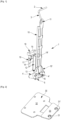
- the removable drawbar 1 of the figure 1 comprises a bar 10, one of the ends of which is free and provided with an orifice 11 intended to cooperate with a towing hook 40 fixed for example to the rear of the carriage 50 (see in Figure 3 ).
- the other end of the bar 10 is fixed by a pivoting connection to a support 12 based on a U-shaped profile. This serves as a sort of housing and guide for the bar 10 in its first retracted position.
- Said bar 10 is pivotally mounted around a shaft 13 connecting two lugs 16, 16' of the side walls 14, 14' of the U-shaped profile.
- a torsion spring (not visible) completes the connection, mounted in a conventional manner with a first end resting against the support 12 and a second end resting against the bar 10.
- a console 17 supporting a stirrup 18 with two studs 19, 19' is fixed to the bottom 15 of said U-shaped profile, outside it. It is in fact a centering device including the two studs 19, 19', which have two diameter portions different, can be inserted into a fixing plate 30 (see in figure 2 ) fixed to the front of the carriage 50 and provided with two orifices 31, 31' of corresponding size and spacing. These orifices 31, 31' are preferably chamfered, so as to facilitate centering with a view to inserting the studs 19, 19', centering which is also made easier by the existence of a first portion for inserting the studs 19, 19' of reduced diameter, near their free ends.
- the vertical orientation of the coupling makes it possible to use the weight of the drawbar 1 to ensure the mechanical strength of the coupling, in reality mainly subject to horizontal constraints during operation. This verticality also makes removability very easy since it is enough, to uncouple the drawbar 1 from the carriage 50, to pull it upwards.
- a handle 2 is provided for this purpose, made in the form of a metal rod 3, a portion of which is perpendicular to the longitudinal axis of the bar 1 allowing the drawbar 1 to be gripped, for assembly and disassembly manipulations. or transport.
- the end of the rod is fixed near the orifice 11.
- pads 4, 4' of substantially frustoconical shape are fixed to a plate 5 extending the bar 10, with which it is preferably in one piece.
- FIG. 2 shows the fixing plate 30 which is secured for example to the front of each carriage 50, and which comprises a plate 33 of trapezoidal shape having the chamfered orifices 31, 31' provided to accommodate the studs 19, 19' of the drawbar 1
- a second substantially rectangular plate 32 is fixed to the carriage, for example by screws. It should be noted that when the studs 19, 19' are inserted into the orifices 31, 31', the lower wall of the console 17 serves as a stop against the plate 33.
- FIG. 3 shows the hitch attachment 40 secured for example to the rear of the trolley frames 50. It is made up of two main parts: a side a stirrup 41 for fixing to the carriage 50 comprising two wings 42, 42' surmounted by fixing angles 43, 43', the fixing being done for example by means of screws.
- the hitch clip 40 comprises a through-hole assembly 44 adjacent to a rod 45, which extends downward, i.e. protrudes from the underside of a plate 46 at the bottom of the hitch hitch 40.
- the Figure 4 shows the positioning of this attachment 40 under the chassis of the trolley.
- the rod 45 protruding downwards is particularly clearly visible, as well as the orifice 44.
- FIG 4 also represents a configuration of cart 50 according to the invention, comprising a volume or closed storage container 51, accessible by at least one door (see in Figure 7 ) and surmounting a chassis 52 equipped with four wheels, operating in this case with pairs 54, 53, of respectively front and rear wheels of different sizes.
- the assembly of the removable drawbar 1 appears in Figure 5 .
- the drawbar 1, held by the operator by the handle 2, is lowered gradually by centering the studs 19, 19' in the chamfered orifices 31, 31', the insertion taking place naturally by gravity until it abuts against the lower wall of the console 17.
- the drawbar 1 is then solidly coupled to the carriage 50. It should be noted that in the rest position of the bar 10, it is retracted due to the action of the torsion spring, making the drawbar 1 compact, extending in a vertical direction during transport, and therefore particularly easy for the operator to carry.
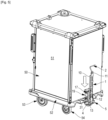
- Bar 10 can then be tilted, as shown in Figure 6 , until the elastic pads 4, 4' abut against the exterior horizontal plate of part 35 (see in Figure 4 ), which represents an angle slightly greater than 90°.
- the bar being vertical and at a certain distance from the proximal facade of the carriage 50, particularly in its portion above the U-shaped support 12 (see in Figure 5 ), it is easy for the operator to place the foot between said facade and the bar 10, and to engage the latter in a downward pivoting movement.
- the orifice 11 is then at a level lower than that of the free end of the rod 45, which can then be inserted there. The insertion again takes place very naturally, gravity being here replaced by the restoring torque exerted by the torsion spring interposed on the shaft 13 between the bar 10 and the support 12 of the drawbar 1.
- FIG. 7 shows that the trolleys 50 of the invention can be equipped with at least one door 55 placed in a facade of the storage volume 51 which is substantially normal to the direction of rolling, which is not possible for trolleys equipped with drawbars simply retractable as in many existing configurations, such a door then potentially being blocked.
- the drawbar 1 is simply removed to open the door.
Landscapes
- Engineering & Computer Science (AREA)
- Chemical & Material Sciences (AREA)
- Combustion & Propulsion (AREA)
- Transportation (AREA)
- Mechanical Engineering (AREA)
- Handcart (AREA)
Description
- La présente invention a trait au domaine technique des chariots mobiles par exemple utilisés pour le stockage et la distribution de produits du type denrées alimentaires préparées à l'avance et placées sur un plateau repas, en vue d'être distribuées dans des collectivités, notamment des hôpitaux ou des maisons pour seniors. Dans ce contexte, ce qui est stocké dans chaque chariot doit être à minima maintenu à température, froide ou chaude, voire pouvoir être réchauffé ou refroidi par des dispositifs adaptés intégrés au chariot lui-même.
- Traditionnellement, un tel chariot est constitué d'un carter formant volume fermé de forme généralement parallélépipédique, munie d'au moins une porte d'accès placée dans une paroi latérale ou frontale, par rapport au sens du déplacement. Les parois extérieures du volume contenant les plateaux repas délimitent un ou plusieurs compartiments intérieurs, et peuvent notamment comprendre dans le même espace clos des compartiments à température froide et chaude, permettant le stockage des repas à mettre ou à maintenir à la température ou aux températures prévue(s) pour eux.
- Pour réduire le temps total des livraisons, les chariots sont de nos jours de plus en plus couramment entraînés par un tracteur qui les véhicule dans les couloirs bordés de chambres, et retourne vers le hub de préparation des plateaux repas dès que les volumes de stockage sont vides. L'opération inverse est mise en oeuvre en fin de repas, pour collecter les plateaux consommés. Pour optimiser la durée des opérations de livraison ou de collecte, il est courant que plusieurs chariots soient attachés à un tracteur, formant en quelque sorte un train de transport des plateaux. Selon la nature des besoins, ou la taille de la structure, les trains peuvent être de taille variable, et il est donc préférable que les modalités d'attachement/détachement des chariots soient simples et ergonomiques.
- Des moyens d'attelage notamment basés sur des timons de liaison sont utilisés, réalisant le lien de fixation entre deux chariots consécutifs ou entre le tracteur et le premier (ou l'unique) chariot du train. Ces timons, qui sont en réalité très basiquement des moyens de liaison de type barre rigide allongée solidarisée à l'avant ou à l'arrière de chaque chariot, permettent un montage entre chariots qui leur accorde un degré de liberté rotatif selon un axe vertical, afin que les trains de chariots puissent prendre des virages ou simplement changer d'orientation. Ainsi, ils ont par exemple une liaison mécanique de type crochet à au moins l'une de leurs extrémités, qui s'insère dans une boucle du chariot à atteler.
- Pour faciliter le stockage des chariots proprement dits lorsqu'ils ne sont pas en cours d'utilisation, il est aussi prévu de pouvoir déplacer le timon, faute de quoi il augmenterait sensiblement l'empreinte au sol et empêcherait les chariots au repos d'être accolées les uns aux autres, dans le but d'occuper collectivement l'espace le plus réduit possible.
- Selon des solutions existantes, les barres servant de timon peuvent être démontables, impliquant cependant des manipulations souvent contraignantes pour l'opérateur, surtout quand elles doivent être répétées. Cette solution n'est de fait guère ergonomique, en particulier parce qu'elle contraint l'utilisateur à une gestuelle se situant presque au niveau du sol, l'obligeant à se baisser fréquemment.
- Des configurations alternatives connues comportent par exemple des timons coulissables sous le châssis du véhicule. Leur utilisation n'est toutefois guère plus commode, car il faut - à chaque utilisation - tirer la barre pour la déployer et la rentrer après usage. Avec le temps, cela devient de plus en plus difficile. Compte tenu que la manipulation s'effectue aussi pratiquement au niveau du sol, elle n'est jamais agréable puisqu'il faut systématiquement se baisser, et elle peut devenir franchement pénible parce qu'il n'est pas rare que la liaison mécanique de coulissement se grippe, le temps passant. Pour ce type de chariots, les portes d'accès à l'intérieur du chariot peuvent être latérales ou placées dans la paroi avant ou arrière, par rapport à la direction de roulage.
- Il a aussi été imaginé des timons qui sont pivotables ou basculants de manière à pouvoir les ramener au contact de la paroi transversale du chariot au pied de laquelle ils sont arrimés, lorsque la liaison avec un autre chariot est démontée. Cette configuration peut également nécessiter, pour l'opérateur, de se baisser pour saisir l'extrémité libre du timon en vue de la rabattre contre la paroi. Ces timons équipent en général des chariots dont les portes se situent dans une paroi latérale, comme c'est par exemple le cas de la solution montrée dans le document
US 2008/0315624 A1 . La configuration décrite permet le pivotement du timon entre une position regroupée, au voisinage d'une paroi du chariot, et une position fonctionnelle, pour l'accrochage à un autre chariot, avec un timon qui est fixé à chaque chariot. - Dans les deux derniers cas, les timons sont installés à demeure sur les chariots, bien qu'éventuellement démontables moyennant la possession des outils adéquats, ce qui implique deux conséquences principales : cette configuration nécessite la fabrication d'un timon par chariot d'une part, et elle permet d'autre part de contourner aisément les règles de sécurité qui imposent en principe de ne pas constituer de trains comportant plus de trois chariots attachés au tracteur.
- La présente invention remédie aux inconvénients mentionnés ci-dessus, en proposant une solution technique qui ne nécessite en particulier pas d'opérations de manipulations complexes et/ou imposant à l'opérateur de se baisser, supprimant toute pénibilité dans les manoeuvres d'accouplements entre chariots. D'un point de vue sécuritaire, par ailleurs, la conception privilégiée est incitative par rapport aux normes préconisées. Enfin, sur un plan économique, l'option technique retenue est également favorable pour les possesseurs de chariots, car elle n'impose pas la fabrication d'un timon par chariot.
- Pour remplir ces objectifs, et d'autres qui seront apparents à la lecture de la description qui en est faite dans la suite, le chariot mobile de transport et de stockage de produits de l'invention, comporte les caractéristiques de la revendication 1.
- En substance, l'invention est basée sur une structure d'attelage à timon non seulement amovible, c'est-à-dire au sens de l'invention détachable sans outil, manuellement, mais encore basculant par pivotement de sorte que sa manipulation soit la plus aisée possible, comme on le verra dans la suite. En outre, le caractère amovible permet le cas échéant de gérer le nombre de timons indépendamment du nombre de chariots, en vue d'inciter les utilisateurs à respecter les règles de sécurité en vigueur. L'intérêt est également économique pour l'utilisateur, qui n'est pas assujetti à disposer d'un timon d'attelage par chariot possédé, sachant que le coût d'un tel équipement est loin d'être négligeable.
- En fait, plus précisément, dans la configuration de l'invention, la barre est montée pivotante au voisinage d'une de ses extrémités sur un support du timon muni de moyens d'accrochage amovible à la platine de fixation. Les conditions d'un basculement de la barre pour remplir sa fonction principale en vue de l'attelage des chariots résultent en pratique de ce montage à pivotement.
- Selon une configuration possible, les moyens d'accrochage amovible peuvent consister en au moins deux plots de centrage dépassant d'une console fixée à une base dudit support, les plots étant orientés dans une direction parallèle à ladite base, et agencés pour s'insérer dans des orifices traversants pratiqués dans la platine de fixation. Ladite platine étant de préférence fixée au châssis de sorte à être sensiblement horizontale, le timon amovible se retrouve, lorsque la barre est dans sa position rétractée, avec une barre verticale et positionnée au voisinage du volume de stockage du chariot.
- Cela résulte notamment du fait que le support peut se présenter, dans une configuration préférentielle de l'invention, sous la forme d'un profilé en U dont le fond constitue ladite base du support, qui peut alors comporter un arbre parallèle audit fond et reliant les deux parois en regard du U, la barre étant montée pivotante par rapport audit arbre. Un ressort de torsion rappelant la barre sensiblement parallèlement et à proximité du fond est ensuite interposé entre ladite barre et le support. En somme, le basculement vers la position horizontale de la barre, pour mettre en oeuvre l'attelage à un autre chariot est réalisé par l'opérateur à l'encontre de la force du ressort, et le basculement inverse pour en quelque sorte « ranger » la barre au voisinage du conteneur du chariot est automatique, généré par la force de rappel.
- Pour finaliser l'opération d'attelage, la barre comporte des moyens d'accrochage à l'attache d'attelage d'un autre chariot. Plus particulièrement, selon l'invention, lesdits moyens d'accrochage peuvent consister en un orifice pratiqué au niveau de l'extrémité libre de la barre.
- De son côté, l'attache d'attelage comporte par exemple une tige dépassant de la face inférieure d'une plaque de fond de l'attache d'attelage, qui est solidarisée horizontalement au châssis. Le fonctionnement est alors le suivant : la barre du timon est basculée par l'opérateur, en partant de sa position initiale sensiblement verticale, d'un angle supérieur à l'angle droit, de façon à que son extrémité libre atteigne un niveau situé en-dessous de l'extrémité libre de cette tige de l'attache d'attelage, pour que l'accouplement entre chariots puisse se faire en logeant ladite tige dans l'orifice équipant la barre à cet endroit.
- Il est à noter que la barre pivotante comporte, à son extrémité proximale de la liaison de pivotement de la barre au support, au moins un patin en matériau résilient apte à former butée contre une surface inférieure plane d'une pièce fixée au châssis du chariot, lorsque la barre est en position déployée. Cette butée permet de réaliser le basculement propre à permettre l'accouplement entre chariots mentionné ci-dessus, sans pour autant permettre à l'extrémité libre de la barre de heurter le sol, au risque d'abîmer la barre et/ou le sol.
- Par ailleurs, la barre pivotante comporte de préférence une poignée de manipulation, consistant par exemple en une tige fixée à l'extrémité libre de la barre pivotante et comportant une portion orientée perpendiculairement à un axe longitudinal de la barre. Cette portion peut être saisie par l'opérateur pour transporter le timon amovible lorsqu'il est retrié d'un chariot ou pour l'y amener. Secondairement, c'est sur cette partie du timon ou sur une portion de la barre qui en est voisine - lorsque le timon est accouplé à un premier chariot - que l'opérateur peut agir, par exemple avec son pied, pour faire basculer la barre à l'encontre du ressort de torsion et amener son extrémité sous la tige préférentiellement verticale de l'attache d'attelage d'un second chariot à accoupler au premier.
- L'invention va à présent être décrite plus en détail, en référence aux figures annexées, qui ne représentent qu'un exemple non limitatif de l'invention, et pour lesquelles :
- [
Fig.1 ] représente en vue perspective le timon amovible ; - [
Fig.2 ] illustre, en vue perspective, la platine de fixation amovible du timon à un chariot équipant un côté du chariot d'allure normale à la direction de roulage ; - [
Fig.3 ] est une vue en perspective de l'attache d'attelage équipant le côté du chariot opposé à celui qui est équipé de la platine de lafigure 2 ; - [
Fig.4 ] est une vue en perspective du dessous d'un chariot selon l'invention, équipé de l'attache d'attelage visible au voisinage d'un côté du chariot ; - [
Fig.5 ] montre, en vue perspective selon une autre incidence, le timon amovible en cours de couplage sur la platine de fixation solidarisée à l'autre côté du chariot ; - [
Fig.6 ] illustre en vue perspective la barre du timon accouplé à un chariot et basculée pour fixation à un autre chariot (non représenté) ; et - [
Fig.7 ] représente une vue en perspective d'un chariot figuré porte ouverte. - Le timon d'attelage 1 amovible de la
figure 1 comporte une barre 10 dont l'une des extrémités est libre et dotée d'un orifice 11 destiné à coopérer avec un crochet d'attelage 40 fixé par exemple à l'arrière du chariot 50 (voir enfigure 3 ). L'autre extrémité de la barre 10 est fixée par une liaison à pivotement à un support 12 basé sur un profilé en U. Celui-ci sert en quelque sorte de logement et de guide pour la barre 10 dans sa première position rétractée. Ladite barre 10 est montée à pivotement autour d'un arbre 13 reliant deux oreilles 16, 16' des parois latérales 14, 14' du profilé en U. Un ressort de torsion (non apparent) complète la liaison, monté de manière classique avec une première extrémité en appui contre le support 12 et une seconde extrémité en appui contre la barre 10. - Une console 17 supportant un étrier 18 à deux plots 19, 19' est fixée sur le fond 15 dudit profilé en U, à l'extérieur de celui-ci. Il s'agit en fait d'un dispositif de centrage dont les deux plots 19, 19', qui présentent deux portions de diamètres différents, sont insérables dans une platine de fixation 30 (voir en
figure 2 ) fixée à l'avant du chariot 50 et dotée de deux orifices 31, 31' de taille et d'écartement correspondants. Ces orifices 31, 31' sont de préférence chanfreinés, de manière à faciliter le centrage en vue de l'insertion des plots 19, 19', centrage qui est également rendu plus aisé par l'existence d'une première portion d'insertion des plots 19, 19' de diamètre réduit, au voisinage de leurs extrémités libres. L'orientation verticale de l'accouplement, visible par exemple enfigure 5 , permet d'utiliser le poids du timon 1 pour assurer la tenue mécanique de l'accouplement, en réalité surtout soumis à des contraintes d'allure horizontale en cours de fonctionnement. Cette verticalité rend au surplus l'amovibilité très aisée puisqu'il suffit, pour désaccoupler le timon 1 du chariot 50, de le tirer vers le haut. - Une poignée 2 est prévue à cet effet, réalisée sous la forme d'une tige métallique 3 dont une portion d'allure perpendiculaire à l'axe longitudinal de la barre 1 permet la préhension du timon 1, en vue des manipulations de montage, démontage ou transport. L'extrémité de la tige est fixée à proximité de l'orifice 11. A l'autre extrémité, solidaire de la barre 10 et de ses déplacements, des patins 4, 4' de forme substantiellement tronconique sont fixés à une plaque 5 prolongeant la barre 10, avec laquelle elle est de préférence d'un seul tenant. L'orientation de ladite plaque 5 et des patins qui lui sont normaux, ainsi que les dimensions desdits patins 4, 4', sont telles que lesdits patins 4, 4' arrivent en butée sur la surface inférieure d'une pièce 35 apparaissant en
figure 4 et fixée sous le châssis 52 du chariot 50 lorsque la barre 10 est basculée pour réaliser l'accouplement avec l'attache d'attelage 40 d'un chariot 50 adjacent (explications plus détaillées ci-après). - La
figure 2 montre la platine de fixation 30 qui est solidarisée par exemple à l'avant de chaque chariot 50, et qui comporte une plaque 33 d'allure trapézoïdale présentant les orifices 31, 31' chanfreinés prévus pour loger les plots 19, 19' du timon 1. Une seconde plaque 32 sensiblement rectangulaire est fixée au chariot, par exemple par des vis. Il est à noter que lorsque les plots 19, 19' sont insérés dans les orifices 31, 31', la paroi inférieure de la console 17 sert de butée contre la plaque 33. - La
figure 3 montre l'attache d'attelage 40 solidarisé par exemple à l'arrière des châssis des chariots 50. Elle se compose de deux parties principales : d'un côté un étrier 41 de fixation au chariot 50 comportant deux ailes 42, 42' surmontées de cornières de fixation 43, 43', la fixation se faisant par exemple au moyen de vis. De l'autre côté, l'attache d'attelage 40 comporte un ensemble à orifice traversant 44 adjacent à une tige 45, laquelle s'étend vers le bas, c'est-à-dire dépasse de la face inférieure d'une plaque 46 de fond de l'attache d'attelage 40. Lafigure 4 montre le positionnement de cette attache 40 sous le châssis du chariot. La tige 45 dépassant vers le bas est particulièrement bien visible, ainsi que l'orifice 44. Ces deux moyens de couplage permettent le cas échéant un fonctionnement mâle/femelle inversé. - La
figure 4 représente par ailleurs une configuration de chariot 50 selon l'invention, comportant un volume ou conteneur de stockage 51 fermé, accessible par au moins une porte (voir enfigure 7 ) et surmontant un châssis 52 équipé de quatre roues, fonctionnant en l'occurrence avec des paires 54, 53, de roues respectivement avant et arrière de tailles différentes. - Le montage du timon 1 amovible apparaît en
figure 5 . Le timon 1, tenu par l'opérateur par la poignée 2, est descendu progressivement en centrant les plots 19, 19' dans les orifices chanfreinés 31, 31', l'insertion se faisant naturellement par gravité jusqu'à arriver en butée contre la paroi inférieure de la console 17. Le timon 1 est alors solidement accouplé au chariot 50. Il est à noter que dans la position de repos de la barre 10, elle est rétractée du fait de l'action du ressort de torsion, rendant le timon 1 compact, s'étendant dans une direction verticale au cours du transport, et dès lors particulier aisé à porter pour l'opérateur. - La barre 10 peut alors être basculée, comme montré en
figure 6 , jusqu'à ce que les patins élastiques 4, 4' soient en butée contre la plaque horizontale extérieure de la pièce 35 (voir enfigure 4 ), ce qui représente un angle un peu supérieur à 90°. On note que, la barre se trouvant verticale et à une certaine distance de la façade proximale du chariot 50, notamment dans sa portion au-dessus du support 12 en U (voir enfigure 5 ), il est facile pour l'opérateur de placer le pied entre ladite façade et la barre 10, et de solliciter cette dernière en un mouvement de pivotement vers le bas. En fin de basculement, c'est-à-dire lorsque les patins 4, 4' sont au contact de la plaque 35 (voir enfigure 4 ), l'orifice 11 se trouve alors à un niveau inférieur à celui de l'extrémité libre de la tige 45, qui peut ensuite y être insérée. L'insertion s'effectue là encore très naturellement, la gravité étant ici remplacée par le couple de rappel exercé par le ressort de torsion interposé sur l'arbre 13 entre la barre 10 et le support 12 du timon 1. - La contrainte de rappel tend à faire remonter la barre 10, laquelle est toujours contrôlée par le pied de l'opérateur, l'orifice 11 logeant progressivement la tige 45 jusqu'à l'arrivée en butée de l'extrémité libre de la barre 10 contre la surface inférieure de la plaque de fond 46 de l'attache d'attelage 40 . L'accouplement au second chariot 50 est alors réalisé. Cet accouplement est également très robuste, puisque les efforts sont principalement horizontaux pendant le fonctionnement normal en cours de traction.
- La
figure 7 montre que les chariot 50 de l'invention peuvent être équipés d'au moins une porte 55 placée dans une façade du volume de stockage 51 qui est sensiblement normale au sens de roulage, ce qui n'est pas possible pour des chariots équipés de timons simplement rétractables comme dans de nombreuses configurations existantes, une telle porte se trouvant alors potentiellement bloquée. Dans le cas de l'invention, le timon 1 est simplement retiré pour ouvrir la porte. - Les exemples donnés ci-dessus ne sont pas exhaustifs de l'invention, qui englobe au contraire les variantes de forme et d'agencement entre les différents éléments (support, platine de fixation, attache d'attelage) à la portée de l'homme de l'art.
Claims (10)
- Chariot (50) mobile de transport et de stockage de produits comportant un volume fermé (51) dont l'espace intérieur est accessible via au moins une porte (55) et surmonte un châssis (52) équipé de roues (53, 54), ledit chariot (50) comportant des moyens d'attelage à deux autres chariots (50) dans la direction du roulage en vue de créer un train de chariots (50), lesdits moyens d'attelage comportant:- un timon (1) de liaison détachable, comprenant une barre (10) pivotante mobile entre une première position déployée de liaison à un autre chariot (50) et une seconde position rétractée au voisinage du volume de stockage (51) du chariot (50) ;- une platine (30) pour la fixation du timon (1) de liaison détachable au châssis (52) du chariot (50), ladite platine (30) étant solidarisée à l'un des côtés du châssis (52) du chariot (50) d'allure perpendiculaire à la direction de roulage ;caractérisé en ce que le timon (1) est amovible, c'est-à-dire détachable de la platine (30) sans outil, manuellement, et en ce que le chariot comporte une attache d'attelage (40) d'une extrémité libre de la barre (10), ladite attache (40) étant fixée à l'autre côté du châssis (52) par rapport à la direction de roulage.
- Chariot (50) mobile de transport et de stockage selon la revendication précédente, caractérisé en ce que la barre (10) est montée pivotante au voisinage d'une de ses extrémités sur un support (12) du timon (1) muni de moyens d'accrochage (19, 19') amovible à la platine (30) de fixation.
- Chariot (50) mobile de transport et de stockage selon la revendication précédente, caractérisé en ce que les moyens d'accrochage consistent en au moins deux plots (19, 19') de centrage dépassant d'une console (17) fixée à une base (15) dudit support (12), les plots (19, 19') étant orientés dans une direction parallèle à ladite base (15), et agencés pour s'insérer dans des orifices (31, 31') traversants pratiqués dans la platine (30) de fixation.
- Chariot (50) mobile de transport et de stockage selon l'une des revendications précédentes, caractérisé en ce que la platine (30) est fixée au châssis (52) de sorte à être sensiblement horizontale.
- Chariot (50) mobile de transport et de stockage selon l'une des revendications 3 et 4, caractérisé en ce que le support (12) présente un profilé en U dont le fond (15) constitue ladite base (15) du support (12), et comporte un arbre (13) parallèle audit fond (15) et reliant les deux parois (14, 14') en regard du U, la barre (10) étant montée pivotante par rapport audit arbre (13), un ressort de torsion rappelant la barre (10) sensiblement parallèlement et à proximité du fond (15) étant interposé entre ladite barre (10) et le support (12).
- Chariot (50) mobile de transport et de stockage selon l'une des revendications précédentes, caractérisé en ce que la barre (10) comporte des moyens d'accrochage (11) à l'attache d'attelage (40).
- Chariot (50) mobile de transport et de stockage selon la revendication précédente, caractérisé en ce que les moyens d'accrochage consistent en un orifice (11) pratiqué au niveau de l'extrémité libre de la barre (10).
- Chariot (50) mobile de transport et de stockage selon l'une des revendications précédentes, caractérisé en ce que l'attache d'attelage (40) comporte une tige (45) dépassant de la face inférieure d'une plaque de fond (46) de l'attache d'attelage (40), qui est solidarisée horizontalement au châssis (52).
- Chariot (50) mobile de transport et de stockage selon la revendication 2, et optionnellement, selon l'une des revendications 3 à 8, caractérisé en ce que la barre (10) pivotante comporte, à son extrémité proximale de la liaison de pivotement de la barre (10) au support (12), au moins un patin (4, 4') en matériau résilient apte à former butée contre une surface inférieure plane d'une pièce (35) fixée au châssis (52), lorsque la barre (10) est en position déployée.
- Chariot (50) mobile de transport et de stockage selon l'une des revendications précédentes, caractérisé en ce que la barre (10) pivotante comporte une poignée (2) de manipulation consistant en une tige (3) fixée à l'extrémité libre de la barre (10) pivotante et comportant une portion orientée perpendiculairement à un axe longitudinal de la barre (10). 1
Applications Claiming Priority (1)
| Application Number | Priority Date | Filing Date | Title |
|---|---|---|---|
| FR1914459A FR3104528B1 (fr) | 2019-12-16 | 2019-12-16 | Chariot à timon amovible et basculant par pivotement |
Publications (2)
| Publication Number | Publication Date |
|---|---|
| EP3838714A1 EP3838714A1 (fr) | 2021-06-23 |
| EP3838714B1 true EP3838714B1 (fr) | 2023-12-27 |
Family
ID=69700182
Family Applications (1)
| Application Number | Title | Priority Date | Filing Date |
|---|---|---|---|
| EP20210331.3A Active EP3838714B1 (fr) | 2019-12-16 | 2020-11-27 | Chariot à timon amovible et basculant par pivotement |
Country Status (3)
| Country | Link |
|---|---|
| EP (1) | EP3838714B1 (fr) |
| ES (1) | ES2971842T3 (fr) |
| FR (1) | FR3104528B1 (fr) |
Citations (6)
| Publication number | Priority date | Publication date | Assignee | Title |
|---|---|---|---|---|
| US20210213987A1 (en) * | 2020-01-10 | 2021-07-15 | Marlin Steel Wire Products LLC | Material handling cart |
| DE102021211775A1 (de) * | 2020-10-29 | 2022-05-05 | Robert Bosch Gesellschaft mit beschränkter Haftung | Fahrzeugbatterieservicewagen mit konfigurierbarem rahmen |
| DE102021211754A1 (de) * | 2020-10-29 | 2022-05-05 | Robert Bosch Gesellschaft mit beschränkter Haftung | Servicewagen für elektrofahrzeugbatterie mit konfigurierbaren stützen |
| DE102021211767A1 (de) * | 2020-10-29 | 2022-05-05 | Robert Bosch Gesellschaft mit beschränkter Haftung | Servicewagen für elektrofahrzeugbatterie mit überlastungsschutz |
| DE102021211979A1 (de) * | 2020-10-29 | 2022-05-05 | Robert Bosch Gesellschaft mit beschränkter Haftung | Fahrzeugbatterieservicewagen mit bremsmechanismus |
| DE102021211796A1 (de) * | 2020-10-29 | 2022-05-05 | Robert Bosch Gesellschaft mit beschränkter Haftung | Fahrzeugbatterieservicewagen mit externen schleppmerkmalen |
Family Cites Families (3)
| Publication number | Priority date | Publication date | Assignee | Title |
|---|---|---|---|---|
| CH269372A (de) * | 1948-08-18 | 1950-06-30 | Ag M Schaerer | Speisetransportwagen. |
| FR2894919B1 (fr) * | 2005-12-21 | 2009-07-17 | Bekaert Handling Snc | Systeme d'articulation pour un timon pour chariot autoporteur et chariot le comportant et son procede de demontage |
| US7950679B2 (en) * | 2007-06-25 | 2011-05-31 | Joseph Claffy | Insulated food tray wagon |
-
2019
- 2019-12-16 FR FR1914459A patent/FR3104528B1/fr active Active
-
2020
- 2020-11-27 EP EP20210331.3A patent/EP3838714B1/fr active Active
- 2020-11-27 ES ES20210331T patent/ES2971842T3/es active Active
Patent Citations (6)
| Publication number | Priority date | Publication date | Assignee | Title |
|---|---|---|---|---|
| US20210213987A1 (en) * | 2020-01-10 | 2021-07-15 | Marlin Steel Wire Products LLC | Material handling cart |
| DE102021211775A1 (de) * | 2020-10-29 | 2022-05-05 | Robert Bosch Gesellschaft mit beschränkter Haftung | Fahrzeugbatterieservicewagen mit konfigurierbarem rahmen |
| DE102021211754A1 (de) * | 2020-10-29 | 2022-05-05 | Robert Bosch Gesellschaft mit beschränkter Haftung | Servicewagen für elektrofahrzeugbatterie mit konfigurierbaren stützen |
| DE102021211767A1 (de) * | 2020-10-29 | 2022-05-05 | Robert Bosch Gesellschaft mit beschränkter Haftung | Servicewagen für elektrofahrzeugbatterie mit überlastungsschutz |
| DE102021211979A1 (de) * | 2020-10-29 | 2022-05-05 | Robert Bosch Gesellschaft mit beschränkter Haftung | Fahrzeugbatterieservicewagen mit bremsmechanismus |
| DE102021211796A1 (de) * | 2020-10-29 | 2022-05-05 | Robert Bosch Gesellschaft mit beschränkter Haftung | Fahrzeugbatterieservicewagen mit externen schleppmerkmalen |
Also Published As
| Publication number | Publication date |
|---|---|
| FR3104528A1 (fr) | 2021-06-18 |
| ES2971842T3 (es) | 2024-06-10 |
| EP3838714A1 (fr) | 2021-06-23 |
| FR3104528B1 (fr) | 2022-01-14 |
Similar Documents
| Publication | Publication Date | Title |
|---|---|---|
| EP0337043B1 (fr) | Chariot d'achat comportant une corbeille pivotante | |
| EP0939019B1 (fr) | Véhicule de déplacement pour enfant en bas âge | |
| EP3512751B1 (fr) | Accessoire pour poussette, ainsi qu'ensemble de transport comprenant une poussette et un tel accessoire | |
| EP2590849B1 (fr) | Chariot d'achats | |
| FR2708898A1 (fr) | Chariot destiné à la manutention d'objets divers. | |
| EP3838714B1 (fr) | Chariot à timon amovible et basculant par pivotement | |
| FR2562019A1 (fr) | Dispositif combine a chariot et panier pour denrees diverses | |
| EP2819910B1 (fr) | Chariot de transport transformable à hauteur adaptable par rabattement de jambes et de roues et actionnement de moyens d'adaptation | |
| FR2523060A1 (fr) | Chariot avec porte-marchandises | |
| FR2530570A3 (fr) | Chariot libre-service emboitable avec porte-caisse | |
| FR2752406A1 (fr) | Chariot a provisions ayant un siege destine a un enfant ou a un bebe | |
| EP0349423B1 (fr) | Chariot d'achat de type emboîtable comportant un plateau escamotable sous la corbeille de ce chariot | |
| FR2610613A1 (fr) | Appareil pour le levage, le deplacement et la pose de tampons de regard et de grilles d'ecoulement | |
| FR2915183A1 (fr) | Contenant de type coffre, malle ou cantine a couvercle articule muni d'un dispositif de maintien du couvercle en position ouverte. | |
| CH678041A5 (fr) | ||
| CH633996A5 (en) | Supplementary device for movement members | |
| EP0279999B1 (fr) | Support de caisse pour chariot de transport, et chariot equipe d'un tel support | |
| FR2651349A1 (fr) | Dispositif de consignation pour chariot de type encastrable, et chariots pourvus d'un tel dispositif. | |
| EP1714596B1 (fr) | Dispositif de distribution d'une matière en poudre, en particulier de boissons liophilisées | |
| FR2785251A1 (fr) | Chariot emboitable a compartiments | |
| FR2703014A1 (fr) | Diable porte-sac pour le nettoyage de locaux. | |
| EP0057800A1 (fr) | Etagère pivotante pourvue d'un dispositif de verrouillage en position relevée, destinée notamment à des containers pliants et à des chariots de réassortiment de magasins | |
| FR3073377A1 (fr) | Dispositif pour la fixation amovible d'une etagere | |
| EP2097306A1 (fr) | Chariot de service de chambre pour les hôtels | |
| EP1726486B1 (fr) | Crochet pour le maintien d'au moins un élément |
Legal Events
| Date | Code | Title | Description |
|---|---|---|---|
| PUAI | Public reference made under article 153(3) epc to a published international application that has entered the european phase |
Free format text: ORIGINAL CODE: 0009012 |
|
| STAA | Information on the status of an ep patent application or granted ep patent |
Free format text: STATUS: THE APPLICATION HAS BEEN PUBLISHED |
|
| AK | Designated contracting states |
Kind code of ref document: A1 Designated state(s): AL AT BE BG CH CY CZ DE DK EE ES FI FR GB GR HR HU IE IS IT LI LT LU LV MC MK MT NL NO PL PT RO RS SE SI SK SM TR |
|
| STAA | Information on the status of an ep patent application or granted ep patent |
Free format text: STATUS: REQUEST FOR EXAMINATION WAS MADE |
|
| 17P | Request for examination filed |
Effective date: 20210830 |
|
| RBV | Designated contracting states (corrected) |
Designated state(s): AL AT BE BG CH CY CZ DE DK EE ES FI FR GB GR HR HU IE IS IT LI LT LU LV MC MK MT NL NO PL PT RO RS SE SI SK SM TR |
|
| STAA | Information on the status of an ep patent application or granted ep patent |
Free format text: STATUS: EXAMINATION IS IN PROGRESS |
|
| 17Q | First examination report despatched |
Effective date: 20220809 |
|
| P01 | Opt-out of the competence of the unified patent court (upc) registered |
Effective date: 20230529 |
|
| GRAP | Despatch of communication of intention to grant a patent |
Free format text: ORIGINAL CODE: EPIDOSNIGR1 |
|
| STAA | Information on the status of an ep patent application or granted ep patent |
Free format text: STATUS: GRANT OF PATENT IS INTENDED |
|
| INTG | Intention to grant announced |
Effective date: 20230823 |
|
| GRAS | Grant fee paid |
Free format text: ORIGINAL CODE: EPIDOSNIGR3 |
|
| GRAA | (expected) grant |
Free format text: ORIGINAL CODE: 0009210 |
|
| STAA | Information on the status of an ep patent application or granted ep patent |
Free format text: STATUS: THE PATENT HAS BEEN GRANTED |
|
| AK | Designated contracting states |
Kind code of ref document: B1 Designated state(s): AL AT BE BG CH CY CZ DE DK EE ES FI FR GB GR HR HU IE IS IT LI LT LU LV MC MK MT NL NO PL PT RO RS SE SI SK SM TR |
|
| REG | Reference to a national code |
Ref country code: GB Ref legal event code: FG4D Free format text: NOT ENGLISH |
|
| REG | Reference to a national code |
Ref country code: CH Ref legal event code: EP |
|
| REG | Reference to a national code |
Ref country code: DE Ref legal event code: R096 Ref document number: 602020023329 Country of ref document: DE |
|
| REG | Reference to a national code |
Ref country code: IE Ref legal event code: FG4D Free format text: LANGUAGE OF EP DOCUMENT: FRENCH |
|
| PG25 | Lapsed in a contracting state [announced via postgrant information from national office to epo] |
Ref country code: GR Free format text: LAPSE BECAUSE OF FAILURE TO SUBMIT A TRANSLATION OF THE DESCRIPTION OR TO PAY THE FEE WITHIN THE PRESCRIBED TIME-LIMIT Effective date: 20240328 |
|
| REG | Reference to a national code |
Ref country code: LT Ref legal event code: MG9D |
|
| PG25 | Lapsed in a contracting state [announced via postgrant information from national office to epo] |
Ref country code: LT Free format text: LAPSE BECAUSE OF FAILURE TO SUBMIT A TRANSLATION OF THE DESCRIPTION OR TO PAY THE FEE WITHIN THE PRESCRIBED TIME-LIMIT Effective date: 20231227 |
|
| PG25 | Lapsed in a contracting state [announced via postgrant information from national office to epo] |
Ref country code: LT Free format text: LAPSE BECAUSE OF FAILURE TO SUBMIT A TRANSLATION OF THE DESCRIPTION OR TO PAY THE FEE WITHIN THE PRESCRIBED TIME-LIMIT Effective date: 20231227 Ref country code: GR Free format text: LAPSE BECAUSE OF FAILURE TO SUBMIT A TRANSLATION OF THE DESCRIPTION OR TO PAY THE FEE WITHIN THE PRESCRIBED TIME-LIMIT Effective date: 20240328 Ref country code: FI Free format text: LAPSE BECAUSE OF FAILURE TO SUBMIT A TRANSLATION OF THE DESCRIPTION OR TO PAY THE FEE WITHIN THE PRESCRIBED TIME-LIMIT Effective date: 20231227 Ref country code: BG Free format text: LAPSE BECAUSE OF FAILURE TO SUBMIT A TRANSLATION OF THE DESCRIPTION OR TO PAY THE FEE WITHIN THE PRESCRIBED TIME-LIMIT Effective date: 20240327 |
|
| REG | Reference to a national code |
Ref country code: NL Ref legal event code: MP Effective date: 20231227 |
|
| PG25 | Lapsed in a contracting state [announced via postgrant information from national office to epo] |
Ref country code: NL Free format text: LAPSE BECAUSE OF FAILURE TO SUBMIT A TRANSLATION OF THE DESCRIPTION OR TO PAY THE FEE WITHIN THE PRESCRIBED TIME-LIMIT Effective date: 20231227 |
|
| PG25 | Lapsed in a contracting state [announced via postgrant information from national office to epo] |
Ref country code: SE Free format text: LAPSE BECAUSE OF FAILURE TO SUBMIT A TRANSLATION OF THE DESCRIPTION OR TO PAY THE FEE WITHIN THE PRESCRIBED TIME-LIMIT Effective date: 20231227 Ref country code: RS Free format text: LAPSE BECAUSE OF FAILURE TO SUBMIT A TRANSLATION OF THE DESCRIPTION OR TO PAY THE FEE WITHIN THE PRESCRIBED TIME-LIMIT Effective date: 20231227 Ref country code: NO Free format text: LAPSE BECAUSE OF FAILURE TO SUBMIT A TRANSLATION OF THE DESCRIPTION OR TO PAY THE FEE WITHIN THE PRESCRIBED TIME-LIMIT Effective date: 20240327 Ref country code: NL Free format text: LAPSE BECAUSE OF FAILURE TO SUBMIT A TRANSLATION OF THE DESCRIPTION OR TO PAY THE FEE WITHIN THE PRESCRIBED TIME-LIMIT Effective date: 20231227 Ref country code: LV Free format text: LAPSE BECAUSE OF FAILURE TO SUBMIT A TRANSLATION OF THE DESCRIPTION OR TO PAY THE FEE WITHIN THE PRESCRIBED TIME-LIMIT Effective date: 20231227 Ref country code: HR Free format text: LAPSE BECAUSE OF FAILURE TO SUBMIT A TRANSLATION OF THE DESCRIPTION OR TO PAY THE FEE WITHIN THE PRESCRIBED TIME-LIMIT Effective date: 20231227 |
|
| REG | Reference to a national code |
Ref country code: ES Ref legal event code: FG2A Ref document number: 2971842 Country of ref document: ES Kind code of ref document: T3 Effective date: 20240610 |
|
| REG | Reference to a national code |
Ref country code: AT Ref legal event code: UEP Ref document number: 1644276 Country of ref document: AT Kind code of ref document: T Effective date: 20231227 |
|
| PG25 | Lapsed in a contracting state [announced via postgrant information from national office to epo] |
Ref country code: IS Free format text: LAPSE BECAUSE OF FAILURE TO SUBMIT A TRANSLATION OF THE DESCRIPTION OR TO PAY THE FEE WITHIN THE PRESCRIBED TIME-LIMIT Effective date: 20240427 |
|
| PG25 | Lapsed in a contracting state [announced via postgrant information from national office to epo] |
Ref country code: CZ Free format text: LAPSE BECAUSE OF FAILURE TO SUBMIT A TRANSLATION OF THE DESCRIPTION OR TO PAY THE FEE WITHIN THE PRESCRIBED TIME-LIMIT Effective date: 20231227 |
|
| PG25 | Lapsed in a contracting state [announced via postgrant information from national office to epo] |
Ref country code: SK Free format text: LAPSE BECAUSE OF FAILURE TO SUBMIT A TRANSLATION OF THE DESCRIPTION OR TO PAY THE FEE WITHIN THE PRESCRIBED TIME-LIMIT Effective date: 20231227 |
|
| PG25 | Lapsed in a contracting state [announced via postgrant information from national office to epo] |
Ref country code: SM Free format text: LAPSE BECAUSE OF FAILURE TO SUBMIT A TRANSLATION OF THE DESCRIPTION OR TO PAY THE FEE WITHIN THE PRESCRIBED TIME-LIMIT Effective date: 20231227 Ref country code: SK Free format text: LAPSE BECAUSE OF FAILURE TO SUBMIT A TRANSLATION OF THE DESCRIPTION OR TO PAY THE FEE WITHIN THE PRESCRIBED TIME-LIMIT Effective date: 20231227 Ref country code: RO Free format text: LAPSE BECAUSE OF FAILURE TO SUBMIT A TRANSLATION OF THE DESCRIPTION OR TO PAY THE FEE WITHIN THE PRESCRIBED TIME-LIMIT Effective date: 20231227 Ref country code: IS Free format text: LAPSE BECAUSE OF FAILURE TO SUBMIT A TRANSLATION OF THE DESCRIPTION OR TO PAY THE FEE WITHIN THE PRESCRIBED TIME-LIMIT Effective date: 20240427 Ref country code: EE Free format text: LAPSE BECAUSE OF FAILURE TO SUBMIT A TRANSLATION OF THE DESCRIPTION OR TO PAY THE FEE WITHIN THE PRESCRIBED TIME-LIMIT Effective date: 20231227 Ref country code: CZ Free format text: LAPSE BECAUSE OF FAILURE TO SUBMIT A TRANSLATION OF THE DESCRIPTION OR TO PAY THE FEE WITHIN THE PRESCRIBED TIME-LIMIT Effective date: 20231227 |
|
| PG25 | Lapsed in a contracting state [announced via postgrant information from national office to epo] |
Ref country code: PT Free format text: LAPSE BECAUSE OF FAILURE TO SUBMIT A TRANSLATION OF THE DESCRIPTION OR TO PAY THE FEE WITHIN THE PRESCRIBED TIME-LIMIT Effective date: 20240429 Ref country code: PL Free format text: LAPSE BECAUSE OF FAILURE TO SUBMIT A TRANSLATION OF THE DESCRIPTION OR TO PAY THE FEE WITHIN THE PRESCRIBED TIME-LIMIT Effective date: 20231227 |
|
| PG25 | Lapsed in a contracting state [announced via postgrant information from national office to epo] |
Ref country code: PT Free format text: LAPSE BECAUSE OF FAILURE TO SUBMIT A TRANSLATION OF THE DESCRIPTION OR TO PAY THE FEE WITHIN THE PRESCRIBED TIME-LIMIT Effective date: 20240429 Ref country code: PL Free format text: LAPSE BECAUSE OF FAILURE TO SUBMIT A TRANSLATION OF THE DESCRIPTION OR TO PAY THE FEE WITHIN THE PRESCRIBED TIME-LIMIT Effective date: 20231227 |
|
| REG | Reference to a national code |
Ref country code: DE Ref legal event code: R097 Ref document number: 602020023329 Country of ref document: DE |
|
| PG25 | Lapsed in a contracting state [announced via postgrant information from national office to epo] |
Ref country code: DK Free format text: LAPSE BECAUSE OF FAILURE TO SUBMIT A TRANSLATION OF THE DESCRIPTION OR TO PAY THE FEE WITHIN THE PRESCRIBED TIME-LIMIT Effective date: 20231227 |
|
| PG25 | Lapsed in a contracting state [announced via postgrant information from national office to epo] |
Ref country code: DK Free format text: LAPSE BECAUSE OF FAILURE TO SUBMIT A TRANSLATION OF THE DESCRIPTION OR TO PAY THE FEE WITHIN THE PRESCRIBED TIME-LIMIT Effective date: 20231227 |
|
| PLBE | No opposition filed within time limit |
Free format text: ORIGINAL CODE: 0009261 |
|
| STAA | Information on the status of an ep patent application or granted ep patent |
Free format text: STATUS: NO OPPOSITION FILED WITHIN TIME LIMIT |
|
| 26N | No opposition filed |
Effective date: 20240930 |
|
| PG25 | Lapsed in a contracting state [announced via postgrant information from national office to epo] |
Ref country code: SI Free format text: LAPSE BECAUSE OF FAILURE TO SUBMIT A TRANSLATION OF THE DESCRIPTION OR TO PAY THE FEE WITHIN THE PRESCRIBED TIME-LIMIT Effective date: 20231227 |
|
| REG | Reference to a national code |
Ref country code: CH Ref legal event code: PL |
|
| PG25 | Lapsed in a contracting state [announced via postgrant information from national office to epo] |
Ref country code: MC Free format text: LAPSE BECAUSE OF FAILURE TO SUBMIT A TRANSLATION OF THE DESCRIPTION OR TO PAY THE FEE WITHIN THE PRESCRIBED TIME-LIMIT Effective date: 20231227 |
|
| PG25 | Lapsed in a contracting state [announced via postgrant information from national office to epo] |
Ref country code: LU Free format text: LAPSE BECAUSE OF NON-PAYMENT OF DUE FEES Effective date: 20241127 |
|
| REG | Reference to a national code |
Ref country code: CH Ref legal event code: PL |
|
| GBPC | Gb: european patent ceased through non-payment of renewal fee |
Effective date: 20241127 |
|
| PG25 | Lapsed in a contracting state [announced via postgrant information from national office to epo] |
Ref country code: CH Free format text: LAPSE BECAUSE OF NON-PAYMENT OF DUE FEES Effective date: 20241130 |
|
| PG25 | Lapsed in a contracting state [announced via postgrant information from national office to epo] |
Ref country code: GB Free format text: LAPSE BECAUSE OF NON-PAYMENT OF DUE FEES Effective date: 20241127 |
|
| PGFP | Annual fee paid to national office [announced via postgrant information from national office to epo] |
Ref country code: FR Payment date: 20250916 Year of fee payment: 6 |
|
| PG25 | Lapsed in a contracting state [announced via postgrant information from national office to epo] |
Ref country code: IE Free format text: LAPSE BECAUSE OF NON-PAYMENT OF DUE FEES Effective date: 20241127 |
|
| PGFP | Annual fee paid to national office [announced via postgrant information from national office to epo] |
Ref country code: DE Payment date: 20251117 Year of fee payment: 6 |
|
| PGFP | Annual fee paid to national office [announced via postgrant information from national office to epo] |
Ref country code: AT Payment date: 20251024 Year of fee payment: 6 |
|
| PGFP | Annual fee paid to national office [announced via postgrant information from national office to epo] |
Ref country code: IT Payment date: 20251107 Year of fee payment: 6 |
|
| PGFP | Annual fee paid to national office [announced via postgrant information from national office to epo] |
Ref country code: BE Payment date: 20251120 Year of fee payment: 6 |
|
| PGFP | Annual fee paid to national office [announced via postgrant information from national office to epo] |
Ref country code: ES Payment date: 20251210 Year of fee payment: 6 |
|
| PG25 | Lapsed in a contracting state [announced via postgrant information from national office to epo] |
Ref country code: HU Free format text: LAPSE BECAUSE OF FAILURE TO SUBMIT A TRANSLATION OF THE DESCRIPTION OR TO PAY THE FEE WITHIN THE PRESCRIBED TIME-LIMIT; INVALID AB INITIO Effective date: 20201127 |
|
| PG25 | Lapsed in a contracting state [announced via postgrant information from national office to epo] |
Ref country code: CY Free format text: LAPSE BECAUSE OF FAILURE TO SUBMIT A TRANSLATION OF THE DESCRIPTION OR TO PAY THE FEE WITHIN THE PRESCRIBED TIME-LIMIT; INVALID AB INITIO Effective date: 20201127 |