EP3836300B1 - Battery - Google Patents
Battery Download PDFInfo
- Publication number
- EP3836300B1 EP3836300B1 EP20213044.9A EP20213044A EP3836300B1 EP 3836300 B1 EP3836300 B1 EP 3836300B1 EP 20213044 A EP20213044 A EP 20213044A EP 3836300 B1 EP3836300 B1 EP 3836300B1
- Authority
- EP
- European Patent Office
- Prior art keywords
- electrode
- insulating sheet
- battery
- electrode plate
- conduction hole
- Prior art date
- Legal status (The legal status is an assumption and is not a legal conclusion. Google has not performed a legal analysis and makes no representation as to the accuracy of the status listed.)
- Active
Links
Images



Classifications
-
- H—ELECTRICITY
- H01—ELECTRIC ELEMENTS
- H01M—PROCESSES OR MEANS, e.g. BATTERIES, FOR THE DIRECT CONVERSION OF CHEMICAL ENERGY INTO ELECTRICAL ENERGY
- H01M50/00—Constructional details or processes of manufacture of the non-active parts of electrochemical cells other than fuel cells, e.g. hybrid cells
- H01M50/50—Current conducting connections for cells or batteries
- H01M50/572—Means for preventing undesired use or discharge
- H01M50/584—Means for preventing undesired use or discharge for preventing incorrect connections inside or outside the batteries
- H01M50/59—Means for preventing undesired use or discharge for preventing incorrect connections inside or outside the batteries characterised by the protection means
- H01M50/593—Spacers; Insulating plates
-
- H—ELECTRICITY
- H01—ELECTRIC ELEMENTS
- H01M—PROCESSES OR MEANS, e.g. BATTERIES, FOR THE DIRECT CONVERSION OF CHEMICAL ENERGY INTO ELECTRICAL ENERGY
- H01M50/00—Constructional details or processes of manufacture of the non-active parts of electrochemical cells other than fuel cells, e.g. hybrid cells
- H01M50/20—Mountings; Secondary casings or frames; Racks, modules or packs; Suspension devices; Shock absorbers; Transport or carrying devices; Holders
- H01M50/204—Racks, modules or packs for multiple batteries or multiple cells
- H01M50/207—Racks, modules or packs for multiple batteries or multiple cells characterised by their shape
- H01M50/216—Racks, modules or packs for multiple batteries or multiple cells characterised by their shape adapted for button or coin cells
-
- H—ELECTRICITY
- H01—ELECTRIC ELEMENTS
- H01M—PROCESSES OR MEANS, e.g. BATTERIES, FOR THE DIRECT CONVERSION OF CHEMICAL ENERGY INTO ELECTRICAL ENERGY
- H01M50/00—Constructional details or processes of manufacture of the non-active parts of electrochemical cells other than fuel cells, e.g. hybrid cells
- H01M50/50—Current conducting connections for cells or batteries
- H01M50/543—Terminals
- H01M50/552—Terminals characterised by their shape
- H01M50/559—Terminals adapted for cells having curved cross-section, e.g. round, elliptic or button cells
-
- H—ELECTRICITY
- H01—ELECTRIC ELEMENTS
- H01M—PROCESSES OR MEANS, e.g. BATTERIES, FOR THE DIRECT CONVERSION OF CHEMICAL ENERGY INTO ELECTRICAL ENERGY
- H01M10/00—Secondary cells; Manufacture thereof
- H01M10/04—Construction or manufacture in general
- H01M10/0422—Cells or battery with cylindrical casing
- H01M10/0427—Button cells
-
- H—ELECTRICITY
- H01—ELECTRIC ELEMENTS
- H01M—PROCESSES OR MEANS, e.g. BATTERIES, FOR THE DIRECT CONVERSION OF CHEMICAL ENERGY INTO ELECTRICAL ENERGY
- H01M10/00—Secondary cells; Manufacture thereof
- H01M10/04—Construction or manufacture in general
- H01M10/0477—Construction or manufacture in general with circular plates
-
- H—ELECTRICITY
- H01—ELECTRIC ELEMENTS
- H01M—PROCESSES OR MEANS, e.g. BATTERIES, FOR THE DIRECT CONVERSION OF CHEMICAL ENERGY INTO ELECTRICAL ENERGY
- H01M50/00—Constructional details or processes of manufacture of the non-active parts of electrochemical cells other than fuel cells, e.g. hybrid cells
- H01M50/10—Primary casings; Jackets or wrappings
- H01M50/102—Primary casings; Jackets or wrappings characterised by their shape or physical structure
- H01M50/109—Primary casings; Jackets or wrappings characterised by their shape or physical structure of button or coin shape
-
- H—ELECTRICITY
- H01—ELECTRIC ELEMENTS
- H01M—PROCESSES OR MEANS, e.g. BATTERIES, FOR THE DIRECT CONVERSION OF CHEMICAL ENERGY INTO ELECTRICAL ENERGY
- H01M50/00—Constructional details or processes of manufacture of the non-active parts of electrochemical cells other than fuel cells, e.g. hybrid cells
- H01M50/10—Primary casings; Jackets or wrappings
- H01M50/147—Lids or covers
- H01M50/148—Lids or covers characterised by their shape
- H01M50/153—Lids or covers characterised by their shape for button or coin cells
-
- H—ELECTRICITY
- H01—ELECTRIC ELEMENTS
- H01M—PROCESSES OR MEANS, e.g. BATTERIES, FOR THE DIRECT CONVERSION OF CHEMICAL ENERGY INTO ELECTRICAL ENERGY
- H01M50/00—Constructional details or processes of manufacture of the non-active parts of electrochemical cells other than fuel cells, e.g. hybrid cells
- H01M50/20—Mountings; Secondary casings or frames; Racks, modules or packs; Suspension devices; Shock absorbers; Transport or carrying devices; Holders
- H01M50/233—Mountings; Secondary casings or frames; Racks, modules or packs; Suspension devices; Shock absorbers; Transport or carrying devices; Holders characterised by physical properties of casings or racks, e.g. dimensions
- H01M50/24—Mountings; Secondary casings or frames; Racks, modules or packs; Suspension devices; Shock absorbers; Transport or carrying devices; Holders characterised by physical properties of casings or racks, e.g. dimensions adapted for protecting batteries from their environment, e.g. from corrosion
-
- H—ELECTRICITY
- H01—ELECTRIC ELEMENTS
- H01M—PROCESSES OR MEANS, e.g. BATTERIES, FOR THE DIRECT CONVERSION OF CHEMICAL ENERGY INTO ELECTRICAL ENERGY
- H01M50/00—Constructional details or processes of manufacture of the non-active parts of electrochemical cells other than fuel cells, e.g. hybrid cells
- H01M50/40—Separators; Membranes; Diaphragms; Spacing elements inside cells
- H01M50/463—Separators, membranes or diaphragms characterised by their shape
- H01M50/469—Separators, membranes or diaphragms characterised by their shape tubular or cylindrical
-
- Y—GENERAL TAGGING OF NEW TECHNOLOGICAL DEVELOPMENTS; GENERAL TAGGING OF CROSS-SECTIONAL TECHNOLOGIES SPANNING OVER SEVERAL SECTIONS OF THE IPC; TECHNICAL SUBJECTS COVERED BY FORMER USPC CROSS-REFERENCE ART COLLECTIONS [XRACs] AND DIGESTS
- Y02—TECHNOLOGIES OR APPLICATIONS FOR MITIGATION OR ADAPTATION AGAINST CLIMATE CHANGE
- Y02E—REDUCTION OF GREENHOUSE GAS [GHG] EMISSIONS, RELATED TO ENERGY GENERATION, TRANSMISSION OR DISTRIBUTION
- Y02E60/00—Enabling technologies; Technologies with a potential or indirect contribution to GHG emissions mitigation
- Y02E60/10—Energy storage using batteries
-
- Y—GENERAL TAGGING OF NEW TECHNOLOGICAL DEVELOPMENTS; GENERAL TAGGING OF CROSS-SECTIONAL TECHNOLOGIES SPANNING OVER SEVERAL SECTIONS OF THE IPC; TECHNICAL SUBJECTS COVERED BY FORMER USPC CROSS-REFERENCE ART COLLECTIONS [XRACs] AND DIGESTS
- Y02—TECHNOLOGIES OR APPLICATIONS FOR MITIGATION OR ADAPTATION AGAINST CLIMATE CHANGE
- Y02P—CLIMATE CHANGE MITIGATION TECHNOLOGIES IN THE PRODUCTION OR PROCESSING OF GOODS
- Y02P70/00—Climate change mitigation technologies in the production process for final industrial or consumer products
- Y02P70/50—Manufacturing or production processes characterised by the final manufactured product
Definitions
- aspects of one or more embodiments relate to a battery.
- secondary batteries refer to batteries that can be repeatedly charged and recharged, unlike non-rechargeable primary batteries. Secondary batteries may be used as energy sources of devices such as mobile devices, electric vehicles, hybrid vehicles, electric bicycles, or uninterruptible power supplies. Secondary batteries may be individually used or secondary battery modules each including a plurality of secondary batteries connected as one unit may be used according to the types of external devices using the secondary batteries.
- US 3891462 A1 discloses a miniature-sized sealed galvanic button cell including an insulating ring in which a conduction hole is defined.
- a battery in which an output terminal having a relatively large size is provided for a relatively small electrode of a core cell, such that a circuit board may be easily electrically connected to the battery, the circuit board may have a freely designed conduction point, and a possibility of failure, such as conduction failure, may be reduced.
- a battery includes: a core cell including a first surface and a second surface which are opposite to each other and on which first and second electrodes are located, and a lateral surface connecting the first and second surfaces and including the second electrode thereon; an insulating sheet arranged on the first surface of the core cell and in which a conduction hole facing the first electrode is defined; and an electrode plate arranged on the insulating sheet and electrically connected to the first electrode through the conduction hole.
- a part of the first surface may form a first electrode
- the other part of the first surface, the second surface and the lateral surface may form a second electrode.
- a conductive connection member is arranged in the conduction hole to electrically connect the first electrode to the electrode plate, the electrode plate is located on an upper side of the insulating sheet and the first electrode is located on a lower side of the insulating sheet, and the conductive connection member comprises a compressible conductor which is compressible so as to be compressed in mutually-facing directions between the electrode plate and the first electrode for contacting with the electrode plate and the first electrode.
- first and second surfaces of the core cell may have a circular shape
- the lateral surface of the core cell may include a rounded circumferential surface connecting the first and second surfaces
- the core cell may have a cylindrical shape with a height less than a diameter of the first surface.
- an aspect ratio of the height of the core cell to the diameter of the first surface may be in a range from about 5.4:12 to about 5.4:14.
- the first electrode of the core cell may be located at a center position of the first surface, and the second electrode of the core cell may extend from the entirety of the second surface via the lateral surface to a peripheral position of the first surface surrounding the center position of the first surface.
- the first and second electrodes may be spaced apart from each other on the first surface with an insulating gap therebetween to electrically insulate therebetween.
- the electrode plate may be configured as a first output terminal of the battery which is connected to the first electrode to form a potential of the first electrode to the outside, and the second electrode may be configured as a second output terminal of the battery.
- the conduction hole may expose at least a portion of the first electrode from the insulating sheet.
- the conductive connection member may include an anisotropic conductive film (ACF).
- ACF anisotropic conductive film
- a thickness of conductive connection member may be greater than a thickness of the insulating sheet surrounding the conduction hole before the conductive connection member is compressed, and may be equal to the thickness of the insulating sheet after the conductive connection member is compressed.
- the electrode plate may be in contact with both the conductive connection member, which is arranged in the conduction hole, and the insulating sheet which surrounds the conduction hole.
- the electrode plate may be configured as a first output terminal of the battery which is connected to the first electrode to externally form a potential of the first electrode and the electrode plate may have a size greater than a size of the first electrode.
- the electrode plate may have a radius which is greater than a radius of the first electrode defined at a center position of the first surface and is less than a radius of the first surface.
- the insulating sheet may have a ring shape surrounding the conduction hole defined at a center position of the insulating sheet, and the insulating sheet may be arranged between the second electrode located at a peripheral position of the first surface and the electrode plate connected to the first electrode through the conduction hole.
- the insulating sheet may be defined by an inner circumference and an outer circumference which form concentric circles, and the inner circumference corresponds to a boundary with the conduction hole.
- an extension end of the second electrode which extends from the second surface to a peripheral position of the first surface via the lateral surface may be located on the inner circumference of the insulating sheet or between the inner circumference and the outer circumference of the insulating sheet.
- a radius of the outer circumference of the insulating sheet may be greater than a radius of the electrode plate and less than a radius of the first surface.
- the conduction hole, the inner and outer circumferences of the insulating sheet, the electrode plate, and the first surface may have concentric circle shapes.
- a layer, region, or component when a layer, region, or component is referred to as being “connected to" another layer, region, or component, it may be directly connected to the other layer, region, or component or may be indirectly connected to the other layer, region, or component with one or more intervening layers, regions, or components interposed therebetween.
- a layer, region, or component when a layer, region, or component is referred to as being “electrically connected to" another layer, region, or component, it may be directly electrically connected to the other layer, region, or component or may be indirectly electrically connected to the other layer, region, or component with one or more intervening layers, regions, or components interposed therebetween.
- spatially relative terms such as “beneath,” “below,” “lower,” “above,” “upper,” and the like, may be used herein for ease of description to describe one element or feature's relationship to another element(s) or feature(s) as illustrated in the figures. It is to be understood that the spatially relative terms are intended to encompass different orientations of the device in use or operation in addition to the orientation depicted in the figures. For example, if the device in the figures is turned over, elements described as “below” or “beneath” other elements or features would then be oriented “above” the other elements or features. Thus, the exemplary term “below” can encompass both an orientation of above and below. The device may be otherwise oriented (rotated 90 degrees or at other orientations) and the spatially relative descriptors used herein interpreted accordingly.
- FIG. 1 is a perspective view illustrating a battery according to an embodiment
- FIG. 2 is an exploded perspective view illustrating the battery shown in FIG. 1
- FIG. 3 is a plan view illustrating an insulating sheet 20 shown in FIG. 2
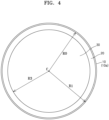
- FIG. 4 is a plan view illustrating an electrode plate 30 shown in FIG. 2
- FIGS. 5A and 5B are views respectively illustrating a pre-compression state and a post-compression state of a conductive connection member 50.
- a battery includes a core cell 10 that includes first and second surfaces 10a and 10b which are opposite to each other and on which first and second electrodes 11 and 12 are formed, and a lateral surface 10c which connects the first and second surfaces 10a and 10b to each other; the insulating sheet 20 that is arranged on the first surface 10a of the core cell 10 and includes a conduction hole 20' facing the first electrode 11; and the electrode plate 30 that is arranged on the insulating sheet 20 and is electrically connected to the first electrode 11 through the conduction hole 20'.
- the core cell 10 includes: the first and second surfaces 10a and 10b which are opposite each other; and the lateral surface 10c which connects the first and second surfaces 10a and 10b to each other.
- the core cell 10 may include the first and second surfaces 10a and 10b that have a circular shape; and the lateral surface 10c that forms a rounded circumferential surface through which the first and second surfaces 10a and 10b are connected to each other.
- the core cell 10 may be formed in a slim cylindrical shape such that the core cell 10 may have a small height H which is less than a diameter of the first surface 10a (the diameter is twice a radius R1 of the first surface 10a).
- an aspect ratio that is, a ratio of the height H and the diameter (twice the radius R1) of the core cell 10 may be in a range from about 5.4:12 to about 5.4:14.
- the first and second electrodes 11 and 12 having opposite polarities may be formed on the first and second surfaces 10a and 10b of the core cell 10.
- the first electrode 11 may be formed at a center position of the first surface 10a
- the second electrode 12 may be formed entirely on the second surface 10b and the lateral surface 10c and may extend from the lateral surface 10c to a peripheral position around the center position of the first surface 10a.
- the first and second electrodes 11 and 12 may be formed together on the first surface 10a at different positions.
- the first electrode 11 may be formed at the center position of the first surface 10a
- the second electrode 12 may be formed at the peripheral position of the first surface 10a.
- first and second electrodes 11 and 12 which are formed on the first surface 10a, may be spaced apart from each other with an insulating gap (g) therebetween and may thus be electrically insulated from each other.
- the expression that the first and second electrodes 11 and 12 are formed on the first and second surfaces 10a and 10b of the core cell 10 may mean that the first and second electrodes 11 and 12 are formed at center positions of the first and second surfaces 10a and 10b.
- the insulating sheet 20 is arranged on the first surface 10a of the core cell 10
- the conduction hole 20' may be formed at a center position of the insulating sheet 20 such that at least a portion of the first electrode 11 formed on the first surface 10a may be exposed through the conduction hole 20'.
- the conduction hole 20' may have a circular shape, and the conduction hole 20' and the first surface 10a having a circular shape may be concentric with a same center axis C.
- the insulating sheet 20 may include a polymer resin material, such as polyimide (PI).
- the insulating sheet 20 may have a shape surrounding the conduction hole 20' and may be arranged between the second electrode 12, which is formed at the peripheral position of the first surface 10a, and the electrode plate 30, which is connected to the first electrode 11 through the conduction hole 20', such that the second electrode 12 and the first electrode 11 may be insulated from each other by the insulating sheet 20.
- the insulating sheet 20 may be arranged between the first surface 10a of the core cell 10 and the electrode plate 30 such that the second electrode 12 formed at the peripheral position of the first surface 10a may be insulated from the electrode plate 30 connected to the first electrode 11.
- the insulating sheet 20 may be defined between the first surface 10a having a circular shape and the conduction hole 20' having a circular shape by an inner circumference (I) (corresponding to a boundary of the conduction hole 20') and an outer circumference (O) which are shaped like concentric circles having the same center axis C, and the insulating sheet 20 may have a ring shape, or annular shape, between the inner circumference (I) and the outer circumference (O).
- the inner circumference (I) of the insulating sheet 20 may correspond to the boundary of the conduction hole 20', and throughout the present specification, the inner circumference (I) and the conduction hole 20' of the insulating sheet 20 may form substantially the same circular profile.
- each of the first surface 10a having a circular shape, the conduction hole 20' having a circular shape, and the inner circumference (I) (corresponding to the boundary of the conduction hole 20') and the outer circumference (O) of the insulating sheet 20 may be concentric with the same center axis C.
- the inner circumference (I) of the insulating sheet 20 may correspond to the boundary between the insulating sheet 20 and the conduction hole 20', and, in an embodiment, the outer circumference (O) of the insulating sheet 20 may have a radius RO between a radius of the conduction hole 20' and the radius R1 of the first surface 10a.
- the radius RO of the outer circumference (O) may be less than the radius R1 of the first surface 10a but greater than the radius of the conduction hole 20', or a radius RI of the inner circumference (I).
- the radius RO of the outer circumference (O) forming the outer boundary of the insulating sheet 20 is less than the radius R1 of the first surface 10a, the insulating sheet 20 may not protrude from the core cell 10 along the outer circumference of the core cell 10, and since the battery may have no portion protruding from the core cell 10, the battery may be effectively used in a small device.
- an extension end of the second electrode 12 which extends from the second surface 10b to the peripheral position of the first surface 10a via the lateral surface 10c of the core cell 10, may be located on the inner circumference (I) of the insulating sheet 20 or between the inner circumference (I) and the outer circumference (O) of the insulating sheet 20. If the extension end (refer to the one-dot chain lines in FIG. 2
- both the first electrode 11 and the second electrode 12 would be exposed through the conduction hole 20' and may thus be electrically connected to the electrode plate 30 through the conduction hole 20' to cause a short circuit.
- the electrode plate 30 is arranged on the insulating sheet 20 and is electrically connected to the first electrode 11 through the conduction hole 20' of the insulating sheet 20. Since the electrode plate 30 is connected to the first electrode 11 through the conduction hole 20', the electrode plate 30 may have a same potential as the first electrode 11 of the core cell 10 and may function as a first output terminal providing the potential of the first electrode 11 to the outside. In an embodiment, the potential of the first electrode 11 of the core cell 10 may be provided to the outside through the electrode plate 30 functioning as a first output terminal, and the second electrode 12 of the core cell 10 may function as a second output terminal by itself.
- the first output terminal (the electrode plate 30) of the battery may be formed on an upper surface of the battery which corresponds to the first surface 10a of the core cell 10
- the second output terminal of the battery may be formed on a lower surface of the battery which corresponds to the second surface 10b of the core cell 10.
- the electrode plate 30 may have a size greater than a size of the first electrode 11 formed on the first surface 10a of the core cell 10.
- the electrode plate 30 and the first electrode 11 may have a circular shape corresponding to the first surface 10a of the core cell 10, and a radius R3 (refer to FIG. 4 ) of the electrode plate 30 may be greater than a radius R11 (refer to FIG. 2 ) of the first electrode 11.
- the electrode plate 30 has a size greater than the first electrode 11 which is relatively small and formed at the center position of the first surface 10a of the core cell 10, and the first output terminal (the electrode plate 30) having an enlarged size may be provided to the outside of the battery.
- the first output terminal provided by the electrode plate 30 and the second output terminal provided by the second electrode 12 of the core cell 10 may have sizes corresponding to the upper and lower surfaces of the battery, for example, equal to or at least similar to the sizes of the upper and lower surfaces of the battery, and, thus, electrical connection between the battery and a circuit board (not shown) may be easily made.
- a contact point of a contact spring of the circuit board (not shown) may be freely designed, and the possibility of failure, such as conduction failure, may be reduced.
- the radius R3 of the electrode plate 30 may be less than the radius R1 of the first surface 10a of the core cell 10. Therefore, the electrode plate 30 may not protrude from the core cell 10 along the outer circumference of the core cell 10, and since the electrode plate 30 does not form a portion protruding from the core cell 10, the battery may be effectively used in a small device.
- the electrode plate 30 and the insulating sheet 20 may have a circular shape corresponding to the first surface 10a of the core cell 10, and the radius R3 of the electrode plate 30 may be less than the radius RO of the outer circumference (O) of the insulating sheet 20. Therefore, it may be possible to prevent or substantially prevent a case in which a portion of the electrode plate 30 is exposed from the insulating sheet 20 and forms a short circuit with the second electrode 12 formed at the peripheral position of the first surface 10a of the core cell 10.
- the electrode plate 30 may include a metal plate having high electrical conductivity, and, in an embodiment, the electrode plate 30 may include a nickel plate or a nickel alloy plate.
- the conduction hole 20' may be formed through the insulating sheet 20 such that the first surface 10a of the core cell 10 (or the first electrode 11 formed on the first surface 10a) and the electrode plate 30, which are provided at upper and lower sides of the insulating sheet 20, may be electrically connected to each other through the conduction hole 20'.
- the conductive connection member 50 may be arranged in the conduction hole 20' as a medium for electrical connection between the first surface 10a of the core cell 10 (or the first electrode 11 formed on the first surface 10a) and the electrode plate 30.
- the conductive connection member 50 is arranged in the conduction hole 20' between the electrode plate 30 and the first electrode 11, which may be arranged on respective sides of the insulating sheet 20 in which the conduction hole 20' is formed, and may then be compressed as being pressed in mutually-facing directions, such that the electrode plate 30 and the first electrode 11 may be electrically connected to each other in a state in which the conductive connection member 50 is in tight contact with the electrode plate 30 and the first electrode 11 due to the resilience or elasticity of the compressed conductive connection member 50.
- the conductive connection member 50 includes a compressible conductor.
- the compressible conductor may include a contact-type elastic part such as a contact spring or an anisotropic conductive film (ACF).
- ACF anisotropic conductive film
- the conductive connection member 50 may include an ACF.
- the ACF (conductive connection member 50) arranged between the electrode plate 30 and the first electrode 11 may be compressed by pressing the electrode plate 30, which is arranged above the first surface 10a of the core cell 10, toward the first electrode 11 in a state in which the ACF (conductive connection member 50) is placed in the conduction hole 20' between the electrode plate 30 and the first electrode 11, and then conductive particles dispersed in an insulating base material of the ACF (conductive connection member 50) may be connected to each other such that the electrode plate 30 and the first electrode 11 may be electrically connected to each other through the ACF (conductive connection member 50).
- the thickness of the ACF (conductive connection member 50) may be reduced from a pre-compression thickness t5' which is relatively great to a post-compression thickness t5 corresponding to the thickness of the insulating sheet 20, and, as a result, the total thickness of the battery may be reduced such that the battery may be slim in the height direction thereof.
- the ACF having a large thickness reduction when compressed is used as the conductive connection member 50, and, thus, the battery may be slimmer than in a case in which a contact-type elastic part such as a contact spring is used as the conductive connection member 50.
- the conductive connection member 50 arranged in the conduction hole 20' may have the pre-compression thickness t5' before being compressed, which is greater than the thickness of the insulating sheet 20 surrounding the conduction hole 20', and the post-compression thickness t5 after being compressed, which is equivalent to the thickness of the of the insulating sheet 20.
- the conductive connection member 50 may be reduced to a thickness (post-compression thickness t5) equivalent to the thickness of the insulating sheet 20 after being compressed, the conductive connection member 50 may not form an additional height from the insulating sheet 20.
- the post-compression thickness t5 of the conductive connection member 50 may be equivalent to the thickness of the insulating sheet 20 such that the electrode plate 30 arranged on the insulating sheet 20 may not be spaced upward from the insulating sheet 20. That is, in an embodiment, the electrode plate 30 may be brought into contact with both the conductive connection member 50 arranged in the conduction hole 20' and the insulating sheet 20 surrounding the conduction hole 20'.
- an output terminal having a relatively large size is provided for a relatively small electrode of the core cell 10, such that a circuit board may be easily electrically connected to the battery, the circuit board may have a freely designed conduction point, and a possibility of failure, such as conduction failure, may be reduced.
Landscapes
- Chemical & Material Sciences (AREA)
- Chemical Kinetics & Catalysis (AREA)
- Electrochemistry (AREA)
- General Chemical & Material Sciences (AREA)
- Engineering & Computer Science (AREA)
- Manufacturing & Machinery (AREA)
- Connection Of Batteries Or Terminals (AREA)
- Battery Mounting, Suspending (AREA)
Description
- Aspects of one or more embodiments relate to a battery.
- In general, secondary batteries refer to batteries that can be repeatedly charged and recharged, unlike non-rechargeable primary batteries. Secondary batteries may be used as energy sources of devices such as mobile devices, electric vehicles, hybrid vehicles, electric bicycles, or uninterruptible power supplies. Secondary batteries may be individually used or secondary battery modules each including a plurality of secondary batteries connected as one unit may be used according to the types of external devices using the secondary batteries.
-
US 3891462 A1 discloses a miniature-sized sealed galvanic button cell including an insulating ring in which a conduction hole is defined. - According to an aspect of one or more embodiments, a battery is provided in which an output terminal having a relatively large size is provided for a relatively small electrode of a core cell, such that a circuit board may be easily electrically connected to the battery, the circuit board may have a freely designed conduction point, and a possibility of failure, such as conduction failure, may be reduced.
- Additional aspects will be set forth, in part, in the description which follows and, in part, will be apparent from the description, or may be learned by practice of the presented embodiments of the disclosure.
- According to one or more embodiments, a battery includes: a core cell including a first surface and a second surface which are opposite to each other and on which first and second electrodes are located, and a lateral surface connecting the first and second surfaces and including the second electrode thereon; an insulating sheet arranged on the first surface of the core cell and in which a conduction hole facing the first electrode is defined; and an electrode plate arranged on the insulating sheet and electrically connected to the first electrode through the conduction hole. A part of the first surface may form a first electrode, the other part of the first surface, the second surface and the lateral surface may form a second electrode. Here, a conductive connection member is arranged in the conduction hole to electrically connect the first electrode to the electrode plate, the electrode plate is located on an upper side of the insulating sheet and the first electrode is located on a lower side of the insulating sheet, and the conductive connection member comprises a compressible conductor which is compressible so as to be compressed in mutually-facing directions between the electrode plate and the first electrode for contacting with the electrode plate and the first electrode.
- In an embodiment, the first and second surfaces of the core cell may have a circular shape, and the lateral surface of the core cell may include a rounded circumferential surface connecting the first and second surfaces.
- In an embodiment, the core cell may have a cylindrical shape with a height less than a diameter of the first surface.
- In an embodiment, an aspect ratio of the height of the core cell to the diameter of the first surface may be in a range from about 5.4:12 to about 5.4:14. In an embodiment, the first electrode of the core cell may be located at a center position of the first surface, and the second electrode of the core cell may extend from the entirety of the second surface via the lateral surface to a peripheral position of the first surface surrounding the center position of the first surface.
- In an embodiment, the first and second electrodes may be spaced apart from each other on the first surface with an insulating gap therebetween to electrically insulate therebetween.
- In an embodiment, the electrode plate may be configured as a first output terminal of the battery which is connected to the first electrode to form a potential of the first electrode to the outside, and the second electrode may be configured as a second output terminal of the battery.
- In an embodiment, the conduction hole may expose at least a portion of the first electrode from the insulating sheet.
- .
- .
- In an embodiment, the conductive connection member may include an anisotropic conductive film (ACF).
- In an embodiment, a thickness of conductive connection member may be greater than a thickness of the insulating sheet surrounding the conduction hole before the conductive connection member is compressed, and may be equal to the thickness of the insulating sheet after the conductive connection member is compressed.
- In an embodiment, the electrode plate may be in contact with both the conductive connection member, which is arranged in the conduction hole, and the insulating sheet which surrounds the conduction hole.
- In an embodiment, the electrode plate may be configured as a first output terminal of the battery which is connected to the first electrode to externally form a potential of the first electrode and the electrode plate may have a size greater than a size of the first electrode.
- In an embodiment, the electrode plate may have a radius which is greater than a radius of the first electrode defined at a center position of the first surface and is less than a radius of the first surface.
- In an embodiment, the insulating sheet may have a ring shape surrounding the conduction hole defined at a center position of the insulating sheet, and the insulating sheet may be arranged between the second electrode located at a peripheral position of the first surface and the electrode plate connected to the first electrode through the conduction hole.
- In an embodiment, the insulating sheet may be defined by an inner circumference and an outer circumference which form concentric circles, and the inner circumference corresponds to a boundary with the conduction hole.
- In an embodiment, an extension end of the second electrode which extends from the second surface to a peripheral position of the first surface via the lateral surface may be located on the inner circumference of the insulating sheet or between the inner circumference and the outer circumference of the insulating sheet.
- In an embodiment, a radius of the outer circumference of the insulating sheet may be greater than a radius of the electrode plate and less than a radius of the first surface.
- In an embodiment, the conduction hole, the inner and outer circumferences of the insulating sheet, the electrode plate, and the first surface may have concentric circle shapes.
- The above and other aspects, features, and advantages of certain embodiments of the disclosure will be more apparent from the following description taken in conjunction with the accompanying drawings, in which:
-
FIG. 1 is a perspective view illustrating a battery according to an embodiment; -
FIG. 2 is an exploded perspective view illustrating the battery shown inFIG. 1 ; -
FIG. 3 is a plan view illustrating an insulating sheet shown inFIG. 2 ; -
FIG. 4 is a plan view illustrating an electrode plate shown inFIG. 2 ; and -
FIGS. 5A and 5B are views respectively illustrating a pre-compression state and a post-compression state of a conductive connection member. - Reference will now be made in further detail to embodiments, examples of which are illustrated in the accompanying drawings, wherein like reference numerals refer to like elements throughout. In this regard, the present embodiments may have different forms and should not be construed as being limited to the descriptions set forth herein. Accordingly, the embodiments are described below, by referring to the figures, to explain aspects of the present disclosure. As used herein, the term "and/or" includes any and all combinations of one or more of the associated listed items. Expressions such as "at least one of," when preceding a list of elements, modify the entire list of elements and do not modify the individual elements of the list.
- It is to be understood that, although the terms "first," "second," etc. may be used herein to describe various components, these components should not be limited by these terms. These terms are used to distinguish one component from another.
- As used herein, the singular forms "a," "an," and "the" are intended to include the plural forms as well, unless the context clearly indicates otherwise.
- It is to be understood that the terms "comprise," "include," and "have" used herein specify the presence of stated features or components, but do not preclude the presence or addition of one or more other features or components.
- Sizes of components in the drawings may be exaggerated for convenience of description. In other words, since the sizes and thicknesses of components in the drawings may be arbitrarily illustrated for convenience of description, the following embodiments are not limited thereto.
- It is to be understood that when a layer, region, or component is referred to as being "connected to" another layer, region, or component, it may be directly connected to the other layer, region, or component or may be indirectly connected to the other layer, region, or component with one or more intervening layers, regions, or components interposed therebetween. For example, it is to be understood that when a layer, region, or component is referred to as being "electrically connected to" another layer, region, or component, it may be directly electrically connected to the other layer, region, or component or may be indirectly electrically connected to the other layer, region, or component with one or more intervening layers, regions, or components interposed therebetween.
- Spatially relative terms, such as "beneath," "below," "lower," "above," "upper," and the like, may be used herein for ease of description to describe one element or feature's relationship to another element(s) or feature(s) as illustrated in the figures. It is to be understood that the spatially relative terms are intended to encompass different orientations of the device in use or operation in addition to the orientation depicted in the figures. For example, if the device in the figures is turned over, elements described as "below" or "beneath" other elements or features would then be oriented "above" the other elements or features. Thus, the exemplary term "below" can encompass both an orientation of above and below. The device may be otherwise oriented (rotated 90 degrees or at other orientations) and the spatially relative descriptors used herein interpreted accordingly.
- Unless otherwise defined, all terms (including technical and scientific terms) used herein have the same meaning as commonly understood by one of ordinary skill in the art to which example embodiments of the inventive concept belong. It is to be further understood that terms, such as those defined in commonly-used dictionaries, should be interpreted as having a meaning that is consistent with their meaning in the context of the relevant art and will not be interpreted in an idealized or overly formal sense unless expressly so defined herein.
- Herein, batteries will be described according to some example embodiments with reference to the accompanying drawings.
-
FIG. 1 is a perspective view illustrating a battery according to an embodiment;FIG. 2 is an exploded perspective view illustrating the battery shown inFIG. 1 ;FIG. 3 is a plan view illustrating aninsulating sheet 20 shown inFIG. 2 ;FIG. 4 is a plan view illustrating anelectrode plate 30 shown inFIG. 2 ; andFIGS. 5A and 5B are views respectively illustrating a pre-compression state and a post-compression state of aconductive connection member 50. - Referring to
FIGS. 1 and2 , a battery includes acore cell 10 that includes first andsecond surfaces second electrodes lateral surface 10c which connects the first andsecond surfaces sheet 20 that is arranged on thefirst surface 10a of thecore cell 10 and includes a conduction hole 20' facing thefirst electrode 11; and theelectrode plate 30 that is arranged on the insulatingsheet 20 and is electrically connected to thefirst electrode 11 through the conduction hole 20'. - The
core cell 10 includes: the first andsecond surfaces lateral surface 10c which connects the first andsecond surfaces core cell 10 may include the first andsecond surfaces lateral surface 10c that forms a rounded circumferential surface through which the first andsecond surfaces core cell 10 may be formed in a slim cylindrical shape such that thecore cell 10 may have a small height H which is less than a diameter of thefirst surface 10a (the diameter is twice a radius R1 of thefirst surface 10a). For example, an aspect ratio, that is, a ratio of the height H and the diameter (twice the radius R1) of thecore cell 10 may be in a range from about 5.4:12 to about 5.4:14. - The first and
second electrodes second surfaces core cell 10. In an embodiment, for example, thefirst electrode 11 may be formed at a center position of thefirst surface 10a, and thesecond electrode 12 may be formed entirely on thesecond surface 10b and thelateral surface 10c and may extend from thelateral surface 10c to a peripheral position around the center position of thefirst surface 10a. The first andsecond electrodes first surface 10a at different positions. For example, thefirst electrode 11 may be formed at the center position of thefirst surface 10a, and thesecond electrode 12 may be formed at the peripheral position of thefirst surface 10a. In this case, the first andsecond electrodes first surface 10a, may be spaced apart from each other with an insulating gap (g) therebetween and may thus be electrically insulated from each other. Throughout the present specification, the expression that the first andsecond electrodes second surfaces core cell 10 may mean that the first andsecond electrodes second surfaces - The insulating
sheet 20 is arranged on thefirst surface 10a of thecore cell 10 The conduction hole 20' may be formed at a center position of the insulatingsheet 20 such that at least a portion of thefirst electrode 11 formed on thefirst surface 10a may be exposed through the conduction hole 20'. In an embodiment, for example, the conduction hole 20' may have a circular shape, and the conduction hole 20' and thefirst surface 10a having a circular shape may be concentric with a same center axis C. In an embodiment, the insulatingsheet 20 may include a polymer resin material, such as polyimide (PI). - The insulating
sheet 20 may have a shape surrounding the conduction hole 20' and may be arranged between thesecond electrode 12, which is formed at the peripheral position of thefirst surface 10a, and theelectrode plate 30, which is connected to thefirst electrode 11 through the conduction hole 20', such that thesecond electrode 12 and thefirst electrode 11 may be insulated from each other by the insulatingsheet 20. In other words, the insulatingsheet 20 may be arranged between thefirst surface 10a of thecore cell 10 and theelectrode plate 30 such that thesecond electrode 12 formed at the peripheral position of thefirst surface 10a may be insulated from theelectrode plate 30 connected to thefirst electrode 11. - Referring to
FIG. 3 , the insulatingsheet 20 may be defined between thefirst surface 10a having a circular shape and the conduction hole 20' having a circular shape by an inner circumference (I) (corresponding to a boundary of the conduction hole 20') and an outer circumference (O) which are shaped like concentric circles having the same center axis C, and the insulatingsheet 20 may have a ring shape, or annular shape, between the inner circumference (I) and the outer circumference (O). Here, the inner circumference (I) of the insulatingsheet 20 may correspond to the boundary of the conduction hole 20', and throughout the present specification, the inner circumference (I) and the conduction hole 20' of the insulatingsheet 20 may form substantially the same circular profile. - In an embodiment, each of the
first surface 10a having a circular shape, the conduction hole 20' having a circular shape, and the inner circumference (I) (corresponding to the boundary of the conduction hole 20') and the outer circumference (O) of the insulatingsheet 20 may be concentric with the same center axis C. The inner circumference (I) of the insulatingsheet 20 may correspond to the boundary between the insulatingsheet 20 and the conduction hole 20', and, in an embodiment, the outer circumference (O) of the insulatingsheet 20 may have a radius RO between a radius of the conduction hole 20' and the radius R1 of thefirst surface 10a. That is, the radius RO of the outer circumference (O) may be less than the radius R1 of thefirst surface 10a but greater than the radius of the conduction hole 20', or a radius RI of the inner circumference (I). In an embodiment, since the radius RO of the outer circumference (O) forming the outer boundary of the insulatingsheet 20 is less than the radius R1 of thefirst surface 10a, the insulatingsheet 20 may not protrude from thecore cell 10 along the outer circumference of thecore cell 10, and since the battery may have no portion protruding from thecore cell 10, the battery may be effectively used in a small device. - As indicated by one-dot chain lines in
FIG. 2 , an extension end of thesecond electrode 12, which extends from thesecond surface 10b to the peripheral position of thefirst surface 10a via thelateral surface 10c of thecore cell 10, may be located on the inner circumference (I) of the insulatingsheet 20 or between the inner circumference (I) and the outer circumference (O) of the insulatingsheet 20. If the extension end (refer to the one-dot chain lines inFIG. 2 ) of thesecond electrode 12 provided on thefirst surface 10a were located inside the inner circumference I of the insulatingsheet 20, both thefirst electrode 11 and thesecond electrode 12 would be exposed through the conduction hole 20' and may thus be electrically connected to theelectrode plate 30 through the conduction hole 20' to cause a short circuit. - Referring to
FIGS. 2 and4 , theelectrode plate 30 is arranged on the insulatingsheet 20 and is electrically connected to thefirst electrode 11 through the conduction hole 20' of the insulatingsheet 20. Since theelectrode plate 30 is connected to thefirst electrode 11 through the conduction hole 20', theelectrode plate 30 may have a same potential as thefirst electrode 11 of thecore cell 10 and may function as a first output terminal providing the potential of thefirst electrode 11 to the outside. In an embodiment, the potential of thefirst electrode 11 of thecore cell 10 may be provided to the outside through theelectrode plate 30 functioning as a first output terminal, and thesecond electrode 12 of thecore cell 10 may function as a second output terminal by itself. For example, the first output terminal (the electrode plate 30) of the battery may be formed on an upper surface of the battery which corresponds to thefirst surface 10a of thecore cell 10, and the second output terminal of the battery may be formed on a lower surface of the battery which corresponds to thesecond surface 10b of thecore cell 10. - In an embodiment, the
electrode plate 30 may have a size greater than a size of thefirst electrode 11 formed on thefirst surface 10a of thecore cell 10. In an embodiment, for example, theelectrode plate 30 and thefirst electrode 11 may have a circular shape corresponding to thefirst surface 10a of thecore cell 10, and a radius R3 (refer toFIG. 4 ) of theelectrode plate 30 may be greater than a radius R11 (refer toFIG. 2 ) of thefirst electrode 11. In an embodiment, theelectrode plate 30 has a size greater than thefirst electrode 11 which is relatively small and formed at the center position of thefirst surface 10a of thecore cell 10, and the first output terminal (the electrode plate 30) having an enlarged size may be provided to the outside of the battery. For example, the first output terminal provided by theelectrode plate 30 and the second output terminal provided by thesecond electrode 12 of thecore cell 10 may have sizes corresponding to the upper and lower surfaces of the battery, for example, equal to or at least similar to the sizes of the upper and lower surfaces of the battery, and, thus, electrical connection between the battery and a circuit board (not shown) may be easily made. For example, a contact point of a contact spring of the circuit board (not shown) may be freely designed, and the possibility of failure, such as conduction failure, may be reduced. - Referring to
FIG. 4 , in an embodiment, the radius R3 of theelectrode plate 30 may be less than the radius R1 of thefirst surface 10a of thecore cell 10. Therefore, theelectrode plate 30 may not protrude from thecore cell 10 along the outer circumference of thecore cell 10, and since theelectrode plate 30 does not form a portion protruding from thecore cell 10, the battery may be effectively used in a small device. - In an embodiment, the
electrode plate 30 and the insulatingsheet 20 may have a circular shape corresponding to thefirst surface 10a of thecore cell 10, and the radius R3 of theelectrode plate 30 may be less than the radius RO of the outer circumference (O) of the insulatingsheet 20. Therefore, it may be possible to prevent or substantially prevent a case in which a portion of theelectrode plate 30 is exposed from the insulatingsheet 20 and forms a short circuit with thesecond electrode 12 formed at the peripheral position of thefirst surface 10a of thecore cell 10. - The
electrode plate 30 may include a metal plate having high electrical conductivity, and, in an embodiment, theelectrode plate 30 may include a nickel plate or a nickel alloy plate. - Referring to
FIGS. 2 ,5A, and 5B , the conduction hole 20' may be formed through the insulatingsheet 20 such that thefirst surface 10a of the core cell 10 (or thefirst electrode 11 formed on thefirst surface 10a) and theelectrode plate 30, which are provided at upper and lower sides of the insulatingsheet 20, may be electrically connected to each other through the conduction hole 20'. For example, theconductive connection member 50 may be arranged in the conduction hole 20' as a medium for electrical connection between thefirst surface 10a of the core cell 10 (or thefirst electrode 11 formed on thefirst surface 10a) and theelectrode plate 30. Theconductive connection member 50 is arranged in the conduction hole 20' between theelectrode plate 30 and thefirst electrode 11, which may be arranged on respective sides of the insulatingsheet 20 in which the conduction hole 20' is formed, and may then be compressed as being pressed in mutually-facing directions, such that theelectrode plate 30 and thefirst electrode 11 may be electrically connected to each other in a state in which theconductive connection member 50 is in tight contact with theelectrode plate 30 and thefirst electrode 11 due to the resilience or elasticity of the compressedconductive connection member 50. In an embodiment, theconductive connection member 50 includes a compressible conductor. For example, the compressible conductor may include a contact-type elastic part such as a contact spring or an anisotropic conductive film (ACF). In an embodiment, theconductive connection member 50 may include an ACF. - Referring to
FIGS. 5A and 5B , in an embodiment, the ACF (conductive connection member 50) arranged between theelectrode plate 30 and thefirst electrode 11 may be compressed by pressing theelectrode plate 30, which is arranged above thefirst surface 10a of thecore cell 10, toward thefirst electrode 11 in a state in which the ACF (conductive connection member 50) is placed in the conduction hole 20' between theelectrode plate 30 and thefirst electrode 11, and then conductive particles dispersed in an insulating base material of the ACF (conductive connection member 50) may be connected to each other such that theelectrode plate 30 and thefirst electrode 11 may be electrically connected to each other through the ACF (conductive connection member 50). In this case, as being compressed between theelectrode plate 30 and thefirst electrode 11, the thickness of the ACF (conductive connection member 50) may be reduced from a pre-compression thickness t5' which is relatively great to a post-compression thickness t5 corresponding to the thickness of the insulatingsheet 20, and, as a result, the total thickness of the battery may be reduced such that the battery may be slim in the height direction thereof. In an embodiment, the ACF having a large thickness reduction when compressed is used as theconductive connection member 50, and, thus, the battery may be slimmer than in a case in which a contact-type elastic part such as a contact spring is used as theconductive connection member 50. - In other words, in an embodiment, the
conductive connection member 50 arranged in the conduction hole 20' may have the pre-compression thickness t5' before being compressed, which is greater than the thickness of the insulatingsheet 20 surrounding the conduction hole 20', and the post-compression thickness t5 after being compressed, which is equivalent to the thickness of the of the insulatingsheet 20. For example, since the thickness of theconductive connection member 50 may be reduced to a thickness (post-compression thickness t5) equivalent to the thickness of the insulatingsheet 20 after being compressed, theconductive connection member 50 may not form an additional height from the insulatingsheet 20. In other words, the post-compression thickness t5 of theconductive connection member 50 may be equivalent to the thickness of the insulatingsheet 20 such that theelectrode plate 30 arranged on the insulatingsheet 20 may not be spaced upward from the insulatingsheet 20. That is, in an embodiment, theelectrode plate 30 may be brought into contact with both theconductive connection member 50 arranged in the conduction hole 20' and the insulatingsheet 20 surrounding the conduction hole 20'. - As described above, according to one or more embodiments, an output terminal having a relatively large size is provided for a relatively small electrode of the
core cell 10, such that a circuit board may be easily electrically connected to the battery, the circuit board may have a freely designed conduction point, and a possibility of failure, such as conduction failure, may be reduced. - It is to be understood that embodiments described herein should be considered in a descriptive sense and not for purposes of limitation. Descriptions of features or aspects within each embodiment should typically be considered as available for other similar features or aspects in other embodiments. While one or more embodiments have been described with reference to the figures, it will be understood by those of ordinary skill in the art that various changes in form and details may be made therein without departing from the scope of the disclosure as set forth in the following claims. The invention is defined by the claims.
Claims (14)
- A battery comprising:a core cell (10) comprising a first surface (10a) and a second surface (10b) which are opposite to each other and forming first and second electrodes (11, 12), and a lateral surface (10c) connecting the first and second surfaces (10a, 10b);an insulating sheet (20) arranged on the first surface (10a) of the core cell (10) and in which a conduction hole (20') is defined in a position corresponding to the first electrode (11); andan electrode plate (30) arranged on the insulating sheet (20) and electrically connected to the first electrode (11) through the conduction hole (20'),characterized in thata conductive connection member (50) is arranged in the conduction hole (20') to electrically connect the first electrode (11) to the electrode plate (30),the electrode plate (30) is located on an upper side of the insulating sheet (20) and the first electrode (11) is located on a lower side of the insulating sheet (20), andthe conductive connection member (50) comprises a compressible conductor which is compressible so as to be compressed in mutually-facing directions between the electrode plate (30) and the first electrode (11) for contacting with the electrode plate and the first electrode (11).
- The battery of claim 1, whereinthe first and second surfaces (10a, 10b) of the core cell (10) have a circular shape, andthe lateral surface (10c) of the core cell (10) comprises a rounded circumferential surface connecting the first and second surfaces (10a, 10b).
- The battery of claim 1 or 2, wherein the core cell (10) has a cylindrical shape with a height less than a diameter of the first surface (10a), and/or wherein an aspect ratio of the height of the core cell (10) to the diameter of the first surface (10a) is in a range from 5.4:12 to 5.4:14.
- The battery of any of the preceding claims, whereinthe first electrode (11) of the core cell (10) is located at a center position of the first surface (10a), andthe second electrode (12) of the core cell (10) extends from an entire second surface (10b) via the lateral surface (10c) to a peripheral position of the first surface (10a) surrounding the center position of the first surface (10a), and/or, wherein the first and second electrodes (11, 12) are spaced apart from each other on the first surface (10a) with an insulating gap (g) therebetween to electrically insulate therebetween.
- The battery of any of the preceding claims, whereinthe electrode plate (30) is configured as a first output terminal of the battery, connected to the first electrode (11) and externally forms a potential of the first electrode (11), andthe second electrode (12) is configured as a second output terminal of the battery.
- The battery of any of the preceding claims, wherein the conduction hole (20') exposes at least a portion of the first electrode (11) from the insulating sheet (20).
- The battery of claim 1, wherein the conductive connection member (50) comprises an anisotropic conductive film,
wherein a thickness of conductive connection member (50) is greater than a thickness of the insulating sheet (20) surrounding the conduction hole before the conductive connection member is compressed, and is equal to the thickness of the insulating sheet (20) after the conductive connection member has been compressed - The battery of claim 1 or 7, wherein the electrode plate (30) is in contact with both the conductive connection member (30), which is arranged in the conduction hole, and the insulating sheet (20) which surrounds the conduction hole.
- The battery of any of the preceding claims, wherein the electrode plate has a size greater than a size of the first electrode (11), wherein the electrode plate has a radius which is greater than a radius of the first electrode (11) defined at a center position of the first surface and is less than a radius of the first surface (10a).
- The battery of any of the preceding claims, whereinthe insulating sheet (20) has a ring shape surrounding the conduction hole (20') defined at a center position of the insulating sheet (20), andthe insulating sheet (20) is arranged between the second electrode (12) located at a peripheral position of the first surface (10a) and the electrode plate (30) connected to the first electrode (11) through the conduction hole (20').
- The battery of any of the preceding claims, wherein the insulating sheet (20) is defined by an inner circumference (I) and an outer circumference (O) which define concentric circles, and the inner circumference (I) corresponds to a boundary with the conduction hole (20').
- The battery of claim 11, wherein an extension end of the second electrode (12) which extends from the second surface to a peripheral position of the first surface (10a) via the lateral surface is located on the inner circumference (I) of the insulating sheet (20) or between the inner circumference and the outer circumference of the insulating sheet.
- The battery of claim 11 or 12, wherein a radius of the outer circumference (O) of the insulating sheet (20) is greater than a radius of the electrode plate (30) and less than a radius of the first surface (10a).
- The battery of any of claims 11 to 13, wherein the conduction hole (20'), the inner and outer circumferences (I, O) of the insulating sheet (20), the electrode plate (30), and the first surface (10a) have concentric circle shapes.
Applications Claiming Priority (1)
| Application Number | Priority Date | Filing Date | Title |
|---|---|---|---|
| KR1020190164644A KR102903848B1 (en) | 2019-12-11 | 2019-12-11 | Battery |
Publications (3)
| Publication Number | Publication Date |
|---|---|
| EP3836300A2 EP3836300A2 (en) | 2021-06-16 |
| EP3836300A3 EP3836300A3 (en) | 2021-07-21 |
| EP3836300B1 true EP3836300B1 (en) | 2023-09-06 |
Family
ID=73793040
Family Applications (1)
| Application Number | Title | Priority Date | Filing Date |
|---|---|---|---|
| EP20213044.9A Active EP3836300B1 (en) | 2019-12-11 | 2020-12-10 | Battery |
Country Status (6)
| Country | Link |
|---|---|
| US (1) | US11594794B2 (en) |
| EP (1) | EP3836300B1 (en) |
| KR (1) | KR102903848B1 (en) |
| CN (1) | CN112952280B (en) |
| HU (1) | HUE064241T2 (en) |
| PL (1) | PL3836300T3 (en) |
Families Citing this family (8)
| Publication number | Priority date | Publication date | Assignee | Title |
|---|---|---|---|---|
| JP1673639S (en) * | 2020-03-11 | 2020-11-30 | ||
| JP1678224S (en) * | 2020-03-11 | 2021-02-01 | ||
| JP1682616S (en) * | 2020-05-13 | 2021-04-05 | ||
| JP1679297S (en) * | 2020-05-13 | 2021-02-15 | ||
| JP1686595S (en) * | 2020-09-03 | 2021-05-31 | ||
| JP1686594S (en) * | 2020-09-03 | 2021-05-31 | ||
| JP1686593S (en) * | 2020-09-03 | 2021-05-31 | ||
| KR102847216B1 (en) * | 2022-06-08 | 2025-08-14 | 삼성에스디아이 주식회사 | Battery |
Family Cites Families (13)
| Publication number | Priority date | Publication date | Assignee | Title |
|---|---|---|---|---|
| US3891462A (en) | 1973-10-29 | 1975-06-24 | Union Carbide Corp | Galvanic cell structure |
| EP0996180B1 (en) | 1998-10-23 | 2004-01-14 | Renata AG | Button cell support with vertical positioning |
| US6451477B1 (en) | 1999-03-23 | 2002-09-17 | Micron Technology, Inc. | Button-type battery constructions |
| US6325552B1 (en) * | 2000-02-14 | 2001-12-04 | Cisco Technology, Inc. | Solderless optical transceiver interconnect |
| JP4851707B2 (en) | 2004-12-15 | 2012-01-11 | セイコーインスツル株式会社 | Method for producing alkaline battery |
| US7754386B2 (en) * | 2005-11-28 | 2010-07-13 | Pure Energy Visions Corporation | Rechargeable alkaline manganese cell having reduced capacity fade and improved cycle life |
| KR100982468B1 (en) | 2008-04-25 | 2010-09-16 | 지에스나노텍 주식회사 | High capacity thin film battery module and its manufacturing method |
| DE102010012977A1 (en) | 2010-03-22 | 2011-09-22 | Varta Microbattery Gmbh | Protected against short circuit button cell |
| KR101233535B1 (en) * | 2011-02-18 | 2013-02-14 | 로베르트 보쉬 게엠베하 | Secondary battery |
| JP6372821B2 (en) | 2014-01-21 | 2018-08-15 | セイコーインスツル株式会社 | Nonaqueous electrolyte secondary battery |
| JP6537133B2 (en) | 2015-03-12 | 2019-07-03 | セイコーインスツル株式会社 | Connecting member, electrochemical cell module, series connection method of electrochemical cells, and method of manufacturing electrochemical cell module |
| KR102415749B1 (en) | 2015-08-05 | 2022-07-01 | 삼성에스디아이 주식회사 | Flexible battery |
| WO2018153156A1 (en) * | 2017-02-27 | 2018-08-30 | 比亚迪股份有限公司 | Battery electrode assembly and cover plate assembly, and battery |
-
2019
- 2019-12-11 KR KR1020190164644A patent/KR102903848B1/en active Active
-
2020
- 2020-12-02 US US17/109,517 patent/US11594794B2/en active Active
- 2020-12-10 EP EP20213044.9A patent/EP3836300B1/en active Active
- 2020-12-10 PL PL20213044.9T patent/PL3836300T3/en unknown
- 2020-12-10 HU HUE20213044A patent/HUE064241T2/en unknown
- 2020-12-11 CN CN202011460888.9A patent/CN112952280B/en active Active
Also Published As
| Publication number | Publication date |
|---|---|
| KR102903848B1 (en) | 2025-12-23 |
| HUE064241T2 (en) | 2024-02-28 |
| CN112952280A (en) | 2021-06-11 |
| US11594794B2 (en) | 2023-02-28 |
| CN112952280B (en) | 2023-07-25 |
| EP3836300A3 (en) | 2021-07-21 |
| EP3836300A2 (en) | 2021-06-16 |
| PL3836300T3 (en) | 2024-02-26 |
| KR20210073888A (en) | 2021-06-21 |
| US20210184322A1 (en) | 2021-06-17 |
Similar Documents
| Publication | Publication Date | Title |
|---|---|---|
| EP3836300B1 (en) | Battery | |
| US8871375B2 (en) | Coupling member between battery cells and battery cell assembly using the same | |
| US11695183B2 (en) | Battery pack | |
| US9017859B2 (en) | Secondary battery structure | |
| JP5996302B2 (en) | Battery unit | |
| JP5878564B2 (en) | Battery unit | |
| US12062813B2 (en) | Battery pack | |
| KR20160109396A (en) | Rechargeable battery | |
| KR20150119662A (en) | Battery Pack | |
| US12548834B2 (en) | Battery pack | |
| US20150303409A1 (en) | Battery pack | |
| JP5885508B2 (en) | Battery unit | |
| KR20180010470A (en) | Battery pack and manufacturing method thereof | |
| CN121885813A (en) | Management module and battery module comprising same | |
| TWM499653U (en) | Battery core and battery pack using the same | |
| JP2004022458A (en) | Cylindrical battery |
Legal Events
| Date | Code | Title | Description |
|---|---|---|---|
| PUAI | Public reference made under article 153(3) epc to a published international application that has entered the european phase |
Free format text: ORIGINAL CODE: 0009012 |
|
| STAA | Information on the status of an ep patent application or granted ep patent |
Free format text: STATUS: REQUEST FOR EXAMINATION WAS MADE |
|
| 17P | Request for examination filed |
Effective date: 20201210 |
|
| AK | Designated contracting states |
Kind code of ref document: A2 Designated state(s): AL AT BE BG CH CY CZ DE DK EE ES FI FR GB GR HR HU IE IS IT LI LT LU LV MC MK MT NL NO PL PT RO RS SE SI SK SM TR |
|
| PUAL | Search report despatched |
Free format text: ORIGINAL CODE: 0009013 |
|
| AK | Designated contracting states |
Kind code of ref document: A3 Designated state(s): AL AT BE BG CH CY CZ DE DK EE ES FI FR GB GR HR HU IE IS IT LI LT LU LV MC MK MT NL NO PL PT RO RS SE SI SK SM TR |
|
| RIC1 | Information provided on ipc code assigned before grant |
Ipc: H01M 50/559 20210101AFI20210617BHEP Ipc: H01M 50/109 20210101ALI20210617BHEP Ipc: H01M 50/153 20210101ALI20210617BHEP Ipc: H01M 50/148 20210101ALI20210617BHEP Ipc: H01M 50/40 20210101ALI20210617BHEP Ipc: H01M 50/474 20210101ALI20210617BHEP Ipc: H01M 50/477 20210101ALI20210617BHEP |
|
| GRAP | Despatch of communication of intention to grant a patent |
Free format text: ORIGINAL CODE: EPIDOSNIGR1 |
|
| STAA | Information on the status of an ep patent application or granted ep patent |
Free format text: STATUS: GRANT OF PATENT IS INTENDED |
|
| INTG | Intention to grant announced |
Effective date: 20230403 |
|
| GRAS | Grant fee paid |
Free format text: ORIGINAL CODE: EPIDOSNIGR3 |
|
| GRAA | (expected) grant |
Free format text: ORIGINAL CODE: 0009210 |
|
| STAA | Information on the status of an ep patent application or granted ep patent |
Free format text: STATUS: THE PATENT HAS BEEN GRANTED |
|
| AK | Designated contracting states |
Kind code of ref document: B1 Designated state(s): AL AT BE BG CH CY CZ DE DK EE ES FI FR GB GR HR HU IE IS IT LI LT LU LV MC MK MT NL NO PL PT RO RS SE SI SK SM TR |
|
| REG | Reference to a national code |
Ref country code: GB Ref legal event code: FG4D |
|
| REG | Reference to a national code |
Ref country code: CH Ref legal event code: EP |
|
| REG | Reference to a national code |
Ref country code: IE Ref legal event code: FG4D |
|
| REG | Reference to a national code |
Ref country code: DE Ref legal event code: R096 Ref document number: 602020017157 Country of ref document: DE |
|
| REG | Reference to a national code |
Ref country code: SE Ref legal event code: TRGR |
|
| REG | Reference to a national code |
Ref country code: LT Ref legal event code: MG9D |
|
| REG | Reference to a national code |
Ref country code: NL Ref legal event code: MP Effective date: 20230906 |
|
| PG25 | Lapsed in a contracting state [announced via postgrant information from national office to epo] |
Ref country code: GR Free format text: LAPSE BECAUSE OF FAILURE TO SUBMIT A TRANSLATION OF THE DESCRIPTION OR TO PAY THE FEE WITHIN THE PRESCRIBED TIME-LIMIT Effective date: 20231207 |
|
| PG25 | Lapsed in a contracting state [announced via postgrant information from national office to epo] |
Ref country code: RS Free format text: LAPSE BECAUSE OF FAILURE TO SUBMIT A TRANSLATION OF THE DESCRIPTION OR TO PAY THE FEE WITHIN THE PRESCRIBED TIME-LIMIT Effective date: 20230906 Ref country code: NO Free format text: LAPSE BECAUSE OF FAILURE TO SUBMIT A TRANSLATION OF THE DESCRIPTION OR TO PAY THE FEE WITHIN THE PRESCRIBED TIME-LIMIT Effective date: 20231206 Ref country code: LV Free format text: LAPSE BECAUSE OF FAILURE TO SUBMIT A TRANSLATION OF THE DESCRIPTION OR TO PAY THE FEE WITHIN THE PRESCRIBED TIME-LIMIT Effective date: 20230906 Ref country code: LT Free format text: LAPSE BECAUSE OF FAILURE TO SUBMIT A TRANSLATION OF THE DESCRIPTION OR TO PAY THE FEE WITHIN THE PRESCRIBED TIME-LIMIT Effective date: 20230906 Ref country code: HR Free format text: LAPSE BECAUSE OF FAILURE TO SUBMIT A TRANSLATION OF THE DESCRIPTION OR TO PAY THE FEE WITHIN THE PRESCRIBED TIME-LIMIT Effective date: 20230906 Ref country code: GR Free format text: LAPSE BECAUSE OF FAILURE TO SUBMIT A TRANSLATION OF THE DESCRIPTION OR TO PAY THE FEE WITHIN THE PRESCRIBED TIME-LIMIT Effective date: 20231207 Ref country code: FI Free format text: LAPSE BECAUSE OF FAILURE TO SUBMIT A TRANSLATION OF THE DESCRIPTION OR TO PAY THE FEE WITHIN THE PRESCRIBED TIME-LIMIT Effective date: 20230906 |
|
| REG | Reference to a national code |
Ref country code: AT Ref legal event code: MK05 Ref document number: 1609754 Country of ref document: AT Kind code of ref document: T Effective date: 20230906 |
|
| REG | Reference to a national code |
Ref country code: HU Ref legal event code: AG4A Ref document number: E064241 Country of ref document: HU |
|
| PG25 | Lapsed in a contracting state [announced via postgrant information from national office to epo] |
Ref country code: NL Free format text: LAPSE BECAUSE OF FAILURE TO SUBMIT A TRANSLATION OF THE DESCRIPTION OR TO PAY THE FEE WITHIN THE PRESCRIBED TIME-LIMIT Effective date: 20230906 |
|
| PG25 | Lapsed in a contracting state [announced via postgrant information from national office to epo] |
Ref country code: IS Free format text: LAPSE BECAUSE OF FAILURE TO SUBMIT A TRANSLATION OF THE DESCRIPTION OR TO PAY THE FEE WITHIN THE PRESCRIBED TIME-LIMIT Effective date: 20240106 |
|
| PG25 | Lapsed in a contracting state [announced via postgrant information from national office to epo] |
Ref country code: AT Free format text: LAPSE BECAUSE OF FAILURE TO SUBMIT A TRANSLATION OF THE DESCRIPTION OR TO PAY THE FEE WITHIN THE PRESCRIBED TIME-LIMIT Effective date: 20230906 |
|
| PG25 | Lapsed in a contracting state [announced via postgrant information from national office to epo] |
Ref country code: ES Free format text: LAPSE BECAUSE OF FAILURE TO SUBMIT A TRANSLATION OF THE DESCRIPTION OR TO PAY THE FEE WITHIN THE PRESCRIBED TIME-LIMIT Effective date: 20230906 |
|
| PG25 | Lapsed in a contracting state [announced via postgrant information from national office to epo] |
Ref country code: SM Free format text: LAPSE BECAUSE OF FAILURE TO SUBMIT A TRANSLATION OF THE DESCRIPTION OR TO PAY THE FEE WITHIN THE PRESCRIBED TIME-LIMIT Effective date: 20230906 Ref country code: RO Free format text: LAPSE BECAUSE OF FAILURE TO SUBMIT A TRANSLATION OF THE DESCRIPTION OR TO PAY THE FEE WITHIN THE PRESCRIBED TIME-LIMIT Effective date: 20230906 Ref country code: IS Free format text: LAPSE BECAUSE OF FAILURE TO SUBMIT A TRANSLATION OF THE DESCRIPTION OR TO PAY THE FEE WITHIN THE PRESCRIBED TIME-LIMIT Effective date: 20240106 Ref country code: ES Free format text: LAPSE BECAUSE OF FAILURE TO SUBMIT A TRANSLATION OF THE DESCRIPTION OR TO PAY THE FEE WITHIN THE PRESCRIBED TIME-LIMIT Effective date: 20230906 Ref country code: EE Free format text: LAPSE BECAUSE OF FAILURE TO SUBMIT A TRANSLATION OF THE DESCRIPTION OR TO PAY THE FEE WITHIN THE PRESCRIBED TIME-LIMIT Effective date: 20230906 Ref country code: CZ Free format text: LAPSE BECAUSE OF FAILURE TO SUBMIT A TRANSLATION OF THE DESCRIPTION OR TO PAY THE FEE WITHIN THE PRESCRIBED TIME-LIMIT Effective date: 20230906 Ref country code: AT Free format text: LAPSE BECAUSE OF FAILURE TO SUBMIT A TRANSLATION OF THE DESCRIPTION OR TO PAY THE FEE WITHIN THE PRESCRIBED TIME-LIMIT Effective date: 20230906 Ref country code: PT Free format text: LAPSE BECAUSE OF FAILURE TO SUBMIT A TRANSLATION OF THE DESCRIPTION OR TO PAY THE FEE WITHIN THE PRESCRIBED TIME-LIMIT Effective date: 20240108 Ref country code: SK Free format text: LAPSE BECAUSE OF FAILURE TO SUBMIT A TRANSLATION OF THE DESCRIPTION OR TO PAY THE FEE WITHIN THE PRESCRIBED TIME-LIMIT Effective date: 20230906 |
|
| PG25 | Lapsed in a contracting state [announced via postgrant information from national office to epo] |
Ref country code: IT Free format text: LAPSE BECAUSE OF FAILURE TO SUBMIT A TRANSLATION OF THE DESCRIPTION OR TO PAY THE FEE WITHIN THE PRESCRIBED TIME-LIMIT Effective date: 20230906 |
|
| REG | Reference to a national code |
Ref country code: DE Ref legal event code: R097 Ref document number: 602020017157 Country of ref document: DE |
|
| PG25 | Lapsed in a contracting state [announced via postgrant information from national office to epo] |
Ref country code: DK Free format text: LAPSE BECAUSE OF FAILURE TO SUBMIT A TRANSLATION OF THE DESCRIPTION OR TO PAY THE FEE WITHIN THE PRESCRIBED TIME-LIMIT Effective date: 20230906 |
|
| PLBE | No opposition filed within time limit |
Free format text: ORIGINAL CODE: 0009261 |
|
| STAA | Information on the status of an ep patent application or granted ep patent |
Free format text: STATUS: NO OPPOSITION FILED WITHIN TIME LIMIT |
|
| PG25 | Lapsed in a contracting state [announced via postgrant information from national office to epo] |
Ref country code: DK Free format text: LAPSE BECAUSE OF FAILURE TO SUBMIT A TRANSLATION OF THE DESCRIPTION OR TO PAY THE FEE WITHIN THE PRESCRIBED TIME-LIMIT Effective date: 20230906 Ref country code: SI Free format text: LAPSE BECAUSE OF FAILURE TO SUBMIT A TRANSLATION OF THE DESCRIPTION OR TO PAY THE FEE WITHIN THE PRESCRIBED TIME-LIMIT Effective date: 20230906 |
|
| REG | Reference to a national code |
Ref country code: CH Ref legal event code: PL |
|
| 26N | No opposition filed |
Effective date: 20240607 |
|
| PG25 | Lapsed in a contracting state [announced via postgrant information from national office to epo] |
Ref country code: LU Free format text: LAPSE BECAUSE OF NON-PAYMENT OF DUE FEES Effective date: 20231210 |
|
| PG25 | Lapsed in a contracting state [announced via postgrant information from national office to epo] |
Ref country code: MC Free format text: LAPSE BECAUSE OF FAILURE TO SUBMIT A TRANSLATION OF THE DESCRIPTION OR TO PAY THE FEE WITHIN THE PRESCRIBED TIME-LIMIT Effective date: 20230906 |
|
| REG | Reference to a national code |
Ref country code: BE Ref legal event code: MM Effective date: 20231231 |
|
| PG25 | Lapsed in a contracting state [announced via postgrant information from national office to epo] |
Ref country code: MC Free format text: LAPSE BECAUSE OF FAILURE TO SUBMIT A TRANSLATION OF THE DESCRIPTION OR TO PAY THE FEE WITHIN THE PRESCRIBED TIME-LIMIT Effective date: 20230906 Ref country code: LU Free format text: LAPSE BECAUSE OF NON-PAYMENT OF DUE FEES Effective date: 20231210 |
|
| REG | Reference to a national code |
Ref country code: IE Ref legal event code: MM4A |
|
| PG25 | Lapsed in a contracting state [announced via postgrant information from national office to epo] |
Ref country code: IE Free format text: LAPSE BECAUSE OF NON-PAYMENT OF DUE FEES Effective date: 20231210 |
|
| PG25 | Lapsed in a contracting state [announced via postgrant information from national office to epo] |
Ref country code: BE Free format text: LAPSE BECAUSE OF NON-PAYMENT OF DUE FEES Effective date: 20231231 |
|
| PG25 | Lapsed in a contracting state [announced via postgrant information from national office to epo] |
Ref country code: CH Free format text: LAPSE BECAUSE OF NON-PAYMENT OF DUE FEES Effective date: 20231231 |
|
| PG25 | Lapsed in a contracting state [announced via postgrant information from national office to epo] |
Ref country code: IE Free format text: LAPSE BECAUSE OF NON-PAYMENT OF DUE FEES Effective date: 20231210 Ref country code: CH Free format text: LAPSE BECAUSE OF NON-PAYMENT OF DUE FEES Effective date: 20231231 Ref country code: BE Free format text: LAPSE BECAUSE OF NON-PAYMENT OF DUE FEES Effective date: 20231231 |
|
| PG25 | Lapsed in a contracting state [announced via postgrant information from national office to epo] |
Ref country code: BG Free format text: LAPSE BECAUSE OF FAILURE TO SUBMIT A TRANSLATION OF THE DESCRIPTION OR TO PAY THE FEE WITHIN THE PRESCRIBED TIME-LIMIT Effective date: 20230906 |
|
| PG25 | Lapsed in a contracting state [announced via postgrant information from national office to epo] |
Ref country code: BG Free format text: LAPSE BECAUSE OF FAILURE TO SUBMIT A TRANSLATION OF THE DESCRIPTION OR TO PAY THE FEE WITHIN THE PRESCRIBED TIME-LIMIT Effective date: 20230906 |
|
| PG25 | Lapsed in a contracting state [announced via postgrant information from national office to epo] |
Ref country code: CY Free format text: LAPSE BECAUSE OF FAILURE TO SUBMIT A TRANSLATION OF THE DESCRIPTION OR TO PAY THE FEE WITHIN THE PRESCRIBED TIME-LIMIT; INVALID AB INITIO Effective date: 20201210 |
|
| PG25 | Lapsed in a contracting state [announced via postgrant information from national office to epo] |
Ref country code: TR Free format text: LAPSE BECAUSE OF FAILURE TO SUBMIT A TRANSLATION OF THE DESCRIPTION OR TO PAY THE FEE WITHIN THE PRESCRIBED TIME-LIMIT Effective date: 20230906 |
|
| PGFP | Annual fee paid to national office [announced via postgrant information from national office to epo] |
Ref country code: DE Payment date: 20251126 Year of fee payment: 6 |
|
| PGFP | Annual fee paid to national office [announced via postgrant information from national office to epo] |
Ref country code: GB Payment date: 20251127 Year of fee payment: 6 |
|
| PGFP | Annual fee paid to national office [announced via postgrant information from national office to epo] |
Ref country code: HU Payment date: 20251212 Year of fee payment: 6 Ref country code: FR Payment date: 20251128 Year of fee payment: 6 |
|
| PGFP | Annual fee paid to national office [announced via postgrant information from national office to epo] |
Ref country code: SE Payment date: 20251126 Year of fee payment: 6 |
|
| PGFP | Annual fee paid to national office [announced via postgrant information from national office to epo] |
Ref country code: PL Payment date: 20251202 Year of fee payment: 6 |