EP3836248B1 - Battery module including foldable side plate and method for manufacturing same - Google Patents
Battery module including foldable side plate and method for manufacturing same Download PDFInfo
- Publication number
- EP3836248B1 EP3836248B1 EP19908412.0A EP19908412A EP3836248B1 EP 3836248 B1 EP3836248 B1 EP 3836248B1 EP 19908412 A EP19908412 A EP 19908412A EP 3836248 B1 EP3836248 B1 EP 3836248B1
- Authority
- EP
- European Patent Office
- Prior art keywords
- module
- pair
- bus bar
- cell stack
- side plates
- Prior art date
- Legal status (The legal status is an assumption and is not a legal conclusion. Google has not performed a legal analysis and makes no representation as to the accuracy of the status listed.)
- Active
Links
Images



Classifications
-
- H—ELECTRICITY
- H01—ELECTRIC ELEMENTS
- H01M—PROCESSES OR MEANS, e.g. BATTERIES, FOR THE DIRECT CONVERSION OF CHEMICAL ENERGY INTO ELECTRICAL ENERGY
- H01M50/00—Constructional details or processes of manufacture of the non-active parts of electrochemical cells other than fuel cells, e.g. hybrid cells
- H01M50/20—Mountings; Secondary casings or frames; Racks, modules or packs; Suspension devices; Shock absorbers; Transport or carrying devices; Holders
-
- H—ELECTRICITY
- H01—ELECTRIC ELEMENTS
- H01M—PROCESSES OR MEANS, e.g. BATTERIES, FOR THE DIRECT CONVERSION OF CHEMICAL ENERGY INTO ELECTRICAL ENERGY
- H01M10/00—Secondary cells; Manufacture thereof
- H01M10/04—Construction or manufacture in general
- H01M10/0413—Large-sized flat cells or batteries for motive or stationary systems with plate-like electrodes
-
- H—ELECTRICITY
- H01—ELECTRIC ELEMENTS
- H01M—PROCESSES OR MEANS, e.g. BATTERIES, FOR THE DIRECT CONVERSION OF CHEMICAL ENERGY INTO ELECTRICAL ENERGY
- H01M10/00—Secondary cells; Manufacture thereof
- H01M10/04—Construction or manufacture in general
- H01M10/0468—Compression means for stacks of electrodes and separators
-
- H—ELECTRICITY
- H01—ELECTRIC ELEMENTS
- H01M—PROCESSES OR MEANS, e.g. BATTERIES, FOR THE DIRECT CONVERSION OF CHEMICAL ENERGY INTO ELECTRICAL ENERGY
- H01M10/00—Secondary cells; Manufacture thereof
- H01M10/04—Construction or manufacture in general
- H01M10/0481—Compression means other than compression means for stacks of electrodes and separators
-
- H—ELECTRICITY
- H01—ELECTRIC ELEMENTS
- H01M—PROCESSES OR MEANS, e.g. BATTERIES, FOR THE DIRECT CONVERSION OF CHEMICAL ENERGY INTO ELECTRICAL ENERGY
- H01M50/00—Constructional details or processes of manufacture of the non-active parts of electrochemical cells other than fuel cells, e.g. hybrid cells
- H01M50/20—Mountings; Secondary casings or frames; Racks, modules or packs; Suspension devices; Shock absorbers; Transport or carrying devices; Holders
- H01M50/204—Racks, modules or packs for multiple batteries or multiple cells
- H01M50/207—Racks, modules or packs for multiple batteries or multiple cells characterised by their shape
- H01M50/211—Racks, modules or packs for multiple batteries or multiple cells characterised by their shape adapted for pouch cells
-
- H—ELECTRICITY
- H01—ELECTRIC ELEMENTS
- H01M—PROCESSES OR MEANS, e.g. BATTERIES, FOR THE DIRECT CONVERSION OF CHEMICAL ENERGY INTO ELECTRICAL ENERGY
- H01M50/00—Constructional details or processes of manufacture of the non-active parts of electrochemical cells other than fuel cells, e.g. hybrid cells
- H01M50/20—Mountings; Secondary casings or frames; Racks, modules or packs; Suspension devices; Shock absorbers; Transport or carrying devices; Holders
- H01M50/233—Mountings; Secondary casings or frames; Racks, modules or packs; Suspension devices; Shock absorbers; Transport or carrying devices; Holders characterised by physical properties of casings or racks, e.g. dimensions
- H01M50/238—Flexibility or foldability
-
- H—ELECTRICITY
- H01—ELECTRIC ELEMENTS
- H01M—PROCESSES OR MEANS, e.g. BATTERIES, FOR THE DIRECT CONVERSION OF CHEMICAL ENERGY INTO ELECTRICAL ENERGY
- H01M50/00—Constructional details or processes of manufacture of the non-active parts of electrochemical cells other than fuel cells, e.g. hybrid cells
- H01M50/20—Mountings; Secondary casings or frames; Racks, modules or packs; Suspension devices; Shock absorbers; Transport or carrying devices; Holders
- H01M50/249—Mountings; Secondary casings or frames; Racks, modules or packs; Suspension devices; Shock absorbers; Transport or carrying devices; Holders specially adapted for aircraft or vehicles, e.g. cars or trains
-
- H—ELECTRICITY
- H01—ELECTRIC ELEMENTS
- H01M—PROCESSES OR MEANS, e.g. BATTERIES, FOR THE DIRECT CONVERSION OF CHEMICAL ENERGY INTO ELECTRICAL ENERGY
- H01M50/00—Constructional details or processes of manufacture of the non-active parts of electrochemical cells other than fuel cells, e.g. hybrid cells
- H01M50/20—Mountings; Secondary casings or frames; Racks, modules or packs; Suspension devices; Shock absorbers; Transport or carrying devices; Holders
- H01M50/258—Modular batteries; Casings provided with means for assembling
-
- H—ELECTRICITY
- H01—ELECTRIC ELEMENTS
- H01M—PROCESSES OR MEANS, e.g. BATTERIES, FOR THE DIRECT CONVERSION OF CHEMICAL ENERGY INTO ELECTRICAL ENERGY
- H01M50/00—Constructional details or processes of manufacture of the non-active parts of electrochemical cells other than fuel cells, e.g. hybrid cells
- H01M50/20—Mountings; Secondary casings or frames; Racks, modules or packs; Suspension devices; Shock absorbers; Transport or carrying devices; Holders
- H01M50/262—Mountings; Secondary casings or frames; Racks, modules or packs; Suspension devices; Shock absorbers; Transport or carrying devices; Holders with fastening means, e.g. locks
-
- H—ELECTRICITY
- H01—ELECTRIC ELEMENTS
- H01M—PROCESSES OR MEANS, e.g. BATTERIES, FOR THE DIRECT CONVERSION OF CHEMICAL ENERGY INTO ELECTRICAL ENERGY
- H01M50/00—Constructional details or processes of manufacture of the non-active parts of electrochemical cells other than fuel cells, e.g. hybrid cells
- H01M50/20—Mountings; Secondary casings or frames; Racks, modules or packs; Suspension devices; Shock absorbers; Transport or carrying devices; Holders
- H01M50/269—Mechanical means for varying the arrangement of batteries or cells for different uses, e.g. for changing the number of batteries or for switching between series and parallel wiring
-
- H—ELECTRICITY
- H01—ELECTRIC ELEMENTS
- H01M—PROCESSES OR MEANS, e.g. BATTERIES, FOR THE DIRECT CONVERSION OF CHEMICAL ENERGY INTO ELECTRICAL ENERGY
- H01M50/00—Constructional details or processes of manufacture of the non-active parts of electrochemical cells other than fuel cells, e.g. hybrid cells
- H01M50/20—Mountings; Secondary casings or frames; Racks, modules or packs; Suspension devices; Shock absorbers; Transport or carrying devices; Holders
- H01M50/296—Mountings; Secondary casings or frames; Racks, modules or packs; Suspension devices; Shock absorbers; Transport or carrying devices; Holders characterised by terminals of battery packs
-
- H—ELECTRICITY
- H01—ELECTRIC ELEMENTS
- H01M—PROCESSES OR MEANS, e.g. BATTERIES, FOR THE DIRECT CONVERSION OF CHEMICAL ENERGY INTO ELECTRICAL ENERGY
- H01M50/00—Constructional details or processes of manufacture of the non-active parts of electrochemical cells other than fuel cells, e.g. hybrid cells
- H01M50/50—Current conducting connections for cells or batteries
-
- H—ELECTRICITY
- H01—ELECTRIC ELEMENTS
- H01M—PROCESSES OR MEANS, e.g. BATTERIES, FOR THE DIRECT CONVERSION OF CHEMICAL ENERGY INTO ELECTRICAL ENERGY
- H01M50/00—Constructional details or processes of manufacture of the non-active parts of electrochemical cells other than fuel cells, e.g. hybrid cells
- H01M50/50—Current conducting connections for cells or batteries
- H01M50/502—Interconnectors for connecting terminals of adjacent batteries; Interconnectors for connecting cells outside a battery casing
- H01M50/503—Interconnectors for connecting terminals of adjacent batteries; Interconnectors for connecting cells outside a battery casing characterised by the shape of the interconnectors
-
- H—ELECTRICITY
- H01—ELECTRIC ELEMENTS
- H01M—PROCESSES OR MEANS, e.g. BATTERIES, FOR THE DIRECT CONVERSION OF CHEMICAL ENERGY INTO ELECTRICAL ENERGY
- H01M50/00—Constructional details or processes of manufacture of the non-active parts of electrochemical cells other than fuel cells, e.g. hybrid cells
- H01M50/50—Current conducting connections for cells or batteries
- H01M50/502—Interconnectors for connecting terminals of adjacent batteries; Interconnectors for connecting cells outside a battery casing
- H01M50/507—Interconnectors for connecting terminals of adjacent batteries; Interconnectors for connecting cells outside a battery casing comprising an arrangement of two or more busbars within a container structure, e.g. busbar modules
-
- H—ELECTRICITY
- H01—ELECTRIC ELEMENTS
- H01M—PROCESSES OR MEANS, e.g. BATTERIES, FOR THE DIRECT CONVERSION OF CHEMICAL ENERGY INTO ELECTRICAL ENERGY
- H01M50/00—Constructional details or processes of manufacture of the non-active parts of electrochemical cells other than fuel cells, e.g. hybrid cells
- H01M50/50—Current conducting connections for cells or batteries
- H01M50/502—Interconnectors for connecting terminals of adjacent batteries; Interconnectors for connecting cells outside a battery casing
- H01M50/514—Methods for interconnecting adjacent batteries or cells
- H01M50/516—Methods for interconnecting adjacent batteries or cells by welding, soldering or brazing
-
- H—ELECTRICITY
- H01—ELECTRIC ELEMENTS
- H01M—PROCESSES OR MEANS, e.g. BATTERIES, FOR THE DIRECT CONVERSION OF CHEMICAL ENERGY INTO ELECTRICAL ENERGY
- H01M2220/00—Batteries for particular applications
- H01M2220/20—Batteries in motive systems, e.g. vehicle, ship, plane
-
- H—ELECTRICITY
- H01—ELECTRIC ELEMENTS
- H01M—PROCESSES OR MEANS, e.g. BATTERIES, FOR THE DIRECT CONVERSION OF CHEMICAL ENERGY INTO ELECTRICAL ENERGY
- H01M50/00—Constructional details or processes of manufacture of the non-active parts of electrochemical cells other than fuel cells, e.g. hybrid cells
- H01M50/10—Primary casings; Jackets or wrappings
- H01M50/172—Arrangements of electric connectors penetrating the casing
- H01M50/174—Arrangements of electric connectors penetrating the casing adapted for the shape of the cells
- H01M50/178—Arrangements of electric connectors penetrating the casing adapted for the shape of the cells for pouch or flexible bag cells
-
- H—ELECTRICITY
- H01—ELECTRIC ELEMENTS
- H01M—PROCESSES OR MEANS, e.g. BATTERIES, FOR THE DIRECT CONVERSION OF CHEMICAL ENERGY INTO ELECTRICAL ENERGY
- H01M50/00—Constructional details or processes of manufacture of the non-active parts of electrochemical cells other than fuel cells, e.g. hybrid cells
- H01M50/20—Mountings; Secondary casings or frames; Racks, modules or packs; Suspension devices; Shock absorbers; Transport or carrying devices; Holders
- H01M50/289—Mountings; Secondary casings or frames; Racks, modules or packs; Suspension devices; Shock absorbers; Transport or carrying devices; Holders characterised by spacing elements or positioning means within frames, racks or packs
-
- H—ELECTRICITY
- H01—ELECTRIC ELEMENTS
- H01M—PROCESSES OR MEANS, e.g. BATTERIES, FOR THE DIRECT CONVERSION OF CHEMICAL ENERGY INTO ELECTRICAL ENERGY
- H01M50/00—Constructional details or processes of manufacture of the non-active parts of electrochemical cells other than fuel cells, e.g. hybrid cells
- H01M50/50—Current conducting connections for cells or batteries
- H01M50/543—Terminals
- H01M50/547—Terminals characterised by the disposition of the terminals on the cells
- H01M50/548—Terminals characterised by the disposition of the terminals on the cells on opposite sides of the cell
-
- Y—GENERAL TAGGING OF NEW TECHNOLOGICAL DEVELOPMENTS; GENERAL TAGGING OF CROSS-SECTIONAL TECHNOLOGIES SPANNING OVER SEVERAL SECTIONS OF THE IPC; TECHNICAL SUBJECTS COVERED BY FORMER USPC CROSS-REFERENCE ART COLLECTIONS [XRACs] AND DIGESTS
- Y02—TECHNOLOGIES OR APPLICATIONS FOR MITIGATION OR ADAPTATION AGAINST CLIMATE CHANGE
- Y02E—REDUCTION OF GREENHOUSE GAS [GHG] EMISSIONS, RELATED TO ENERGY GENERATION, TRANSMISSION OR DISTRIBUTION
- Y02E60/00—Enabling technologies; Technologies with a potential or indirect contribution to GHG emissions mitigation
- Y02E60/10—Energy storage using batteries
-
- Y—GENERAL TAGGING OF NEW TECHNOLOGICAL DEVELOPMENTS; GENERAL TAGGING OF CROSS-SECTIONAL TECHNOLOGIES SPANNING OVER SEVERAL SECTIONS OF THE IPC; TECHNICAL SUBJECTS COVERED BY FORMER USPC CROSS-REFERENCE ART COLLECTIONS [XRACs] AND DIGESTS
- Y02—TECHNOLOGIES OR APPLICATIONS FOR MITIGATION OR ADAPTATION AGAINST CLIMATE CHANGE
- Y02P—CLIMATE CHANGE MITIGATION TECHNOLOGIES IN THE PRODUCTION OR PROCESSING OF GOODS
- Y02P70/00—Climate change mitigation technologies in the production process for final industrial or consumer products
- Y02P70/50—Manufacturing or production processes characterised by the final manufactured product
Definitions
- the present disclosure relates to a battery module including a foldable side plate, and a battery pack and a vehicle including the battery module. More specifically, the present disclosure relates to a battery module having a structure in which an electrode lead and a bus bar are welded to each other in a state where a pair of unit modules are pressed simultaneously by using two pairs of foldable side plates connecting the pair of unit modules and then the foldable side plates are unfolded so that the pairs of unit modules are disposed side by side in a longitudinal direction, and a battery pack and a vehicle including the battery module.
- a welding process is performed for coupling the electrode lead and the bus bar in a state where surface pressurization applied to the cell stack pressure is maintained for one unit module, and then the same process is performed for another unit module to make a pair of unit modules. After that, in a state where two unit modules are arranged side by side in the longitudinal direction, a housing is assembled or welded thereto.
- the accumulated stress may lead to a product failure due to breakage of a part or damage to the welded portion while a product is being produced or used.
- the present disclosure is designed to solve the problems of the related art, and therefore the present disclosure is directed to continuously maintaining a surface pressurization state for unit modules without repeatedly applying surface pressurization to the unit modules and releasing the surface pressurization, when manufacturing a battery module of a long module type having a structure in which a pair of unit modules are arranged side by side in the longitudinal direction.
- a surface pressurization state for unit modules may be continuously maintained without repeatedly applying surface pressurization to the unit modules and releasing the surface pressurization, when manufacturing a battery module of a long module type having a structure in which a pair of unit modules are arranged side by side in the longitudinal direction. Also, it is possible to prevent stress from being accumulated in the electrode lead and the welded portion between the electrode lead and the bus bar
- a battery module may be implemented to include a cell stack 100, a pair of foldable side plates 200, a pair of bus bar frame assemblies 300, an upper housing 400, a lower housing 500 and end plates 600.
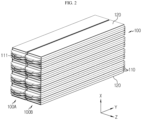
- the cell stack 100 includes a plurality of battery cells 110 stacked in a vertical direction (a direction parallel to an X axis of FIG. 2 ) and a plurality of buffering pads 120 disposed between neighboring battery cells 110 or on an outer side surface of a battery cell 110 disposed at an outermost side.
- the battery cells 110 may be, for example, pouch-type battery cells. If the pouch-type battery cell is used as the battery cell 110, electrode leads 111 are provided at one side and the other side of the battery cell 110 in the longitudinal direction in parallel to a Y axis in Fig. 2 , respectively.
- the electrode lead 111 is a thin metal plate connected to an electrode tab formed at an electrode assembly (not shown) that is disposed inside the battery cell 110, namely inside a pouch case, and is drawn out of the pouch case.
- the buffering pads 120 are interposed at the outer side of the cell stack 100 and/or between neighboring battery cells 110 to allow the cell stack 100 to contract when both surfaces of the cell stack 100 are pressed.
- the buffering pad 120 is preferably made of an elastic material such as a sponge.
- the cell stack 100 includes a first cell stack 100A and a second cell stack 100B arranged side by side in a width direction of the cell stack 100 (a direction parallel to the Z axis of FIG. 2 ).
- the first cell stack 100A and the second cell stack 100B are arranged side by side in the width direction as described above when the foldable side plates 200 are in a folded state, as explained later. If the foldable side plates 200 are in an unfolded state, the first cell stack 100A and the second cell stack 100B are arranged side by side along the longitudinal direction (a direction parallel to the Y axis of FIG. 2 ).
- the foldable side plate 200 is provided in a pair, and the foldable side plates 200 are respectively attached to one side surface and the other side surface of the first cell stack 100A and the second cell stack 100B arranged side by side in the width direction (a direction parallel to the Z axis of FIG. 3 ).
- the foldable side plates 200 press the cell stack 100 to contract.
- the foldable side plates 200 are disposed to cover one side and the other side of the cell stack 100 by coupling with the upper housing 400 and the lower housing 500, explained later, and also serve to press the cell stack 100.
- the foldable side plates 200 include a first side plate 210 and a second side plate 220 which are hinged to allow relative rotation with each other.
- the hinge coupling as shown in FIG. 5 , the pair of side plates 210 and the pair of side plates 220 may be folded so as to be arranged side by side in the width direction (a direction parallel to the Z axis of FIG. 5 ), and, as shown in FIG. 6 , the pair of side plates 210, 220 may be unfolded so as to be arranged side by side in the longitudinal direction (a direction parallel to the Y axis of FIG. 6 ).
- the hinge coupling between the first side plate 210 and the second side plate 220 may be performed by, for example, fastening between a coupling hole H formed in a corner region at one longitudinal end of the first side plate 210 and a coupling protrusion P formed in a corner region of one longitudinal end of the second side plate 220.
- the coupling hole H is formed at the second side plate 220 and the coupling protrusion P is formed at the first side plate 210.
- the first pair of side plates 210 covers one side surface and the other side surface of the first cell stack 100A (a surface parallel to the Y-Z plane of FIG.. 3 ).
- the second pair of side plates 220 covers one side surface and the other side surface of the second cell stack 100B (a surface parallel to the Y-Z plane of FIG. 3 ).
- each bus bar frame assembly 300 is provided in a pair, each bus bar frame assembly 300 includes a front bus bar frame 310, a rear bus bar frame 320 and a cover plate 330.
- the front bus bar frame 310, the rear bus bar frame 320 and the cover plate 330 are made of a material with electrical insulation such as resin.
- the pair of bus bar frame assemblies 300 are coupled to cover the front surface and the rear surface (surfaces parallel to the X-Z plane of FIGS. 7 and 8 ) and the upper surface (a surface plane parallel to the X-Y plane of FIGS. 7 and 8 ) of the first cell stack 100A and the second cell stack 100B.
- the pair of front bus bar frames 310 are coupled to cover the front surfaces of the first cell stack 100A and the second cell stack 100B, respectively, and the pair of rear bus bar frames 320 are coupled to cover the rear surfaces of the first cell stack 100A and the second cell stack 100B, respectively.
- the pair of cover plates 330 are coupled to cover the upper surfaces of the first cell stack 100A and the second cell stack 100B, respectively. Both longitudinal ends of the cover plate 330 may be hinged to the front bus bar frame 310 and the rear bus bar frame 320, respectively, so that the front bus bar frame 310 and the rear bus bar frame 320 may rotate relative to the cover plate 330.
- the bus bar frames 310, 320 may be rotated to accurately cover rotate the front surfaces and the rear surfaces of the cell stacks 100A, 100B.
- a plurality of bus bars B are provided on the bus bar frames 310, 320 in its longitudinal direction (a direction parallel to the X axis of FIGS. 7 and 8 ), and the bus bars B are coupled to electrode leads 111 drawn out through slits formed at the bus bar frames 310, 320 by welding.
- the electrode leads 111 of two or more battery cells 110 to be electrically connected to each other may be coupled to one bus bar B.
- a pair of module terminals T are provided on the front bus bar frame 310, and the pair of module terminals T are coupled to the electrode leads 111 of the battery cell 110 located at an outermost side along a width direction (a direction parallel to the X axis of FIGS. 7 and 8 ) of the cell stacks 100A, 100B.
- the front bus bar frame 310 and the rear bus bar frame 320 are distinguished depending on whether the module terminal T is provided or not. That is, in the present disclosure, a bus bar frame at which the module terminal T is formed is defined as the front bus bar frame 310, and a bus bar frame at which the module terminal T is not formed is defined as the rear bus bar frame 320.
- the welding between the electrode lead 111 and the bus bar B and the welding between the electrode lead 111 and the module terminal T are performed in a state where the pressurization by the foldable side plates 200 is maintained, and also are performed in a state where the pair of cell stacks 100A, 100B are arranged adjacently side by side in the width direction since the foldable side plates 200 are folded.
- a first module M1 including the first cell stack 100A, the first side plate 210 and the bus bar frame assembly 300 and a second module M2 including the second cell stack 100B, the second side plate 220 and the bus bar frame assembly 300 are provided.
- the first side plate 210 and the second side plate 220 of the foldable side plates 200 extend in a direction toward the front bus bar frame 310 from the rear bus bar frame 320 and have a length extending further to the front bus bar frame 320.
- the first side plate 210 and the second side plate 220 are hinged to each other at a position corresponding to the front bus bar frame 310, among both longitudinal ends thereof.
- the first module M1 and the second module M2 are adjacently arranged side by side in the longitudinal direction (a direction parallel to the Y axis of FIG. 9 ) in a state where the front bus bar frames 310 thereof face each other. Accordingly, the pair of module terminals T provided to the first module M1 and the pair of module terminals T provided to the second module M2 face each other.
- the upper housing 400 and the lower housing 500 cover the upper surfaces and the lower surfaces (surfaces parallel to the X-Y plane of FIG. 10 ) of the first module M1 and the second module M2, respectively, in a state where the pair of foldable side plates 200 are unfolded while maintaining the pressurization to the first module M1 and the second module M2.
- Both edges of the upper housing 400 and the lower housing 500 in the width direction are coupled to both edges of the foldable side plate 200 in the width direction (a surface parallel to the Y-Z plane of FIG.10 ) by welding.
- the coupling between the housings 400, 500 and the foldable side plates 200 by welding is performed in a state where the cell stack 100 keeps pressed by the foldable side plates 200.
- the end plate 600 is provided in a pair, and the pair of end plates 600 cover with the front surface and the rear surface of the battery module according to an embodiment of the present disclosure (surfaces parallel to the X-Z plane of FIG. 10 ), respectively. That is, the pair of end plates 600 are coupled to the rear surfaces of the first module M1 and the second module M2, respectively.
- the battery module according to an embodiment of the present disclosure has a structure capable of performing a following process while continuously maintaining a state where the pair of modules M1, M2 are pressed using the foldable side plates 200.
- the pair of modules M1, M2 may be easily pressurized in a state of being adjacently arranged side by side in the width direction, and the electrode lead 111 and the bus bar B may be welded smoothly.
- the electrode lead and the bus bar must be welded in a state where both sides of the pair of modules are pressed using the side plates.
- welding may not be performed smoothly at the front surface of the module.
- the pair of modules are arranged side by side in the longitudinal direction and the side plates are attached thereto after the welding process is individually performed to each of the pair of modules, it is not possible to continuously pressurize the modules.
- welding is performed in a state where the foldable side plates 200 are folded, while maintaining the pressurization to the modules M1, M2 by the foldable side plates 200. Also, since the housings 400, 500 are folded in a state where the foldable side plates 200 are unfolded, it is possible to ensure easy welding and maintain continuous pressurization during in the process.
- a method for manufacturing the battery module according to an embodiment of the present disclosure includes (S1) a cell stack arranging step; (S2) a pressurization initiating step; (S3) a module forming step; (S4) an unfolding step; (S5) a housing coupling step; and (S6) an end plate coupling step.
- a pair of battery cell stacks 100A, 100B are provided to be arranged side by side in the width direction of the battery cell stacks 100A, 100B.
- the pressurization initiating step (S2) both sides of the pair of battery cell stacks 100A, 100B in the width direction are pressurized using a pair of hinge-coupled foldable side plates 200 in a folded state.
- bus bar frame assemblies 300 are coupled to cover front surfaces and rear surfaces of the cell stacks 100A, 100B, respectively, to form a first module M1 and a second module M2, each including the cell stack 100 and the bus bar frame assembly 300.
- the unfolding step (S4) in a state where the pressurization to the cell stack 100 performed in the module forming step (S3) is maintained, the foldable side plates 200 are unfolded so that the first module M1 and the second module M2 are arranged side by side in the longitudinal direction.
- the housing coupling step (S5) in a state where the pressurization to the cell stack 100 performed in the unfolding step (S4) maintained, an upper housing 400 and a lower housing 500 covering the upper surfaces and the lower surfaces of the first module M1 and the second module M2 are coupled to the foldable side plates 200 by welding.
- the end plate coupling step (S6) a pair of end plates 600 covering rear surfaces of the first module M1 and the second module M2 are coupled. The steps S1 to S6 are performed in order.
Landscapes
- Chemical & Material Sciences (AREA)
- Chemical Kinetics & Catalysis (AREA)
- Electrochemistry (AREA)
- General Chemical & Material Sciences (AREA)
- Engineering & Computer Science (AREA)
- Manufacturing & Machinery (AREA)
- Aviation & Aerospace Engineering (AREA)
- Battery Mounting, Suspending (AREA)
- Connection Of Batteries Or Terminals (AREA)
Description
- The present application claims priority to
Korean Patent Application No. 10-2019-0002468 filed on January 8, 2019 - The present disclosure relates to a battery module including a foldable side plate, and a battery pack and a vehicle including the battery module. More specifically, the present disclosure relates to a battery module having a structure in which an electrode lead and a bus bar are welded to each other in a state where a pair of unit modules are pressed simultaneously by using two pairs of foldable side plates connecting the pair of unit modules and then the foldable side plates are unfolded so that the pairs of unit modules are disposed side by side in a longitudinal direction, and a battery pack and a vehicle including the battery module.
- Conventionally, when manufacturing a long module by arranging a pair of unit modules, in each of which a cell stack and a bus bar frame are coupled, side by side in a longitudinal direction, surface pressurization is performed to each cell stack individually in order to perform a welding process between an electrode lead and a bus bar for each unit module.
- That is, a welding process is performed for coupling the electrode lead and the bus bar in a state where surface pressurization applied to the cell stack pressure is maintained for one unit module, and then the same process is performed for another unit module to make a pair of unit modules. After that, in a state where two unit modules are arranged side by side in the longitudinal direction, a housing is assembled or welded thereto.
- However, if this conventional process is used, surface pressurization is inevitably applied to and released from each unit module repeatedly, which causes relative movement between the electrode lead and the bus bar. As a result, stress is accumulated in the electrode lead and the welded portion between the electrode lead and the bus bar.
- In addition, the accumulated stress may lead to a product failure due to breakage of a part or damage to the welded portion while a product is being produced or used.
- Thus, when manufacturing a battery module of a long module type having a structure in which a pair of unit modules are arranged side by side in the longitudinal direction, it is necessary to continuously maintain the surface pressurization state for the unit modules without repeatedly applying surface pressurization to the unit modules and releasing the surface pressurization. Also, it is demanded to develop a battery module having a structure capable of maintaining the surface pressurization state.
- Further prior art is desribed in
US 2007/020516 A1 andEP 2 410 590 A2 . - The present disclosure is designed to solve the problems of the related art, and therefore the present disclosure is directed to continuously maintaining a surface pressurization state for unit modules without repeatedly applying surface pressurization to the unit modules and releasing the surface pressurization, when manufacturing a battery module of a long module type having a structure in which a pair of unit modules are arranged side by side in the longitudinal direction.
- However, the technical problem to be solved by the present disclosure is not limited to the above, and other objects not mentioned herein will be understood from the following description by those skilled in the art.
- According to one aspect of the present disclosure, the above object is accomplished with the features of claim 1 and with a method for manufacturing a battery module with the features of claim 8.
- Dependent claims are directed on features of preferred embodiments of the present invention.
- According to an embodiment of the present disclosure, a surface pressurization state for unit modules may be continuously maintained without repeatedly applying surface pressurization to the unit modules and releasing the surface pressurization, when manufacturing a battery module of a long module type having a structure in which a pair of unit modules are arranged side by side in the longitudinal direction. Also, it is possible to prevent stress from being accumulated in the electrode lead and the welded portion between the electrode lead and the bus bar
- The accompanying drawings illustrate a preferred embodiment of the present disclosure and together with the foregoing disclosure, serve to provide further understanding of the technical features of the present disclosure, and thus, the present disclosure is not construed as being limited to the drawing.
-
FIG. 1 is an exploded perspective view showing a battery module according to an embodiment of the present disclosure. -
FIG. 2 is a perspective view showing a cell stack. -
FIG. 3 is an exploded perspective view showing a cell stack and a foldable side plate. -
FIG. 4 is an exploded perspective view and a partially enlarged view showing the foldable side plate. -
FIG. 5 is a diagram showing that the foldable side plate is in a folded state. -
FIG. 6 is a diagram showing that the foldable side plate in an unfolded state. -
FIGS. 7 to 9 are diagrams for illustrating that surface pressurization to the cell stack is maintained from process of coupling a bus bar frame assembly to the cell stack to a process of unfolding the foldable side plate so that a pair of unit modules are arranged side by side in a longitudinal direction. -
FIG. 10 is a perspective view showing an assembled battery module according to an embodiment of the present disclosure. - Hereinafter, preferred embodiments of the present disclosure will be described in detail with reference to the accompanying drawings. Prior to the description, it should be understood that the terms used in the specification and the appended claims should not be construed as limited to general and dictionary meanings, but interpreted based on the meanings and concepts corresponding to technical aspects of the present disclosure on the basis of the principle that the inventor is allowed to define terms appropriately for the best explanation.
- First, referring to
FIG. 1 , a battery module according to an embodiment of the present disclosure may be implemented to include acell stack 100, a pair offoldable side plates 200, a pair of busbar frame assemblies 300, anupper housing 400, alower housing 500 andend plates 600. - Referring to
FIG. 2 , thecell stack 100 includes a plurality ofbattery cells 110 stacked in a vertical direction (a direction parallel to an X axis ofFIG. 2 ) and a plurality ofbuffering pads 120 disposed between neighboringbattery cells 110 or on an outer side surface of abattery cell 110 disposed at an outermost side. - The
battery cells 110 may be, for example, pouch-type battery cells. If the pouch-type battery cell is used as thebattery cell 110,electrode leads 111 are provided at one side and the other side of thebattery cell 110 in the longitudinal direction in parallel to a Y axis inFig. 2 , respectively. Theelectrode lead 111 is a thin metal plate connected to an electrode tab formed at an electrode assembly (not shown) that is disposed inside thebattery cell 110, namely inside a pouch case, and is drawn out of the pouch case. - The
buffering pads 120 are interposed at the outer side of thecell stack 100 and/or between neighboringbattery cells 110 to allow thecell stack 100 to contract when both surfaces of thecell stack 100 are pressed. In order to enable contraction of thecell stack 100 as described above, thebuffering pad 120 is preferably made of an elastic material such as a sponge. - The
cell stack 100 is coupled to the busbar frame assembly 300 in a state where both sides thereof are pressurized by thefoldable side plates 200, and is also coupled by welding thefoldable side plates 200 and thehousings buffering pad 120 is in a contracted state, thereby suppressing the generation of swelling caused by repeated use of the battery module, by means of the elastic energy stored therein. - As shown in
FIG. 2 , thecell stack 100 includes afirst cell stack 100A and asecond cell stack 100B arranged side by side in a width direction of the cell stack 100 (a direction parallel to the Z axis ofFIG. 2 ). Thefirst cell stack 100A and thesecond cell stack 100B are arranged side by side in the width direction as described above when thefoldable side plates 200 are in a folded state, as explained later. If thefoldable side plates 200 are in an unfolded state, thefirst cell stack 100A and thesecond cell stack 100B are arranged side by side along the longitudinal direction (a direction parallel to the Y axis ofFIG. 2 ). - Referring to
FIG. 3 , thefoldable side plate 200 is provided in a pair, and thefoldable side plates 200 are respectively attached to one side surface and the other side surface of thefirst cell stack 100A and thesecond cell stack 100B arranged side by side in the width direction (a direction parallel to the Z axis ofFIG. 3 ). Thefoldable side plates 200 press thecell stack 100 to contract. - Namely, the
foldable side plates 200 are disposed to cover one side and the other side of thecell stack 100 by coupling with theupper housing 400 and thelower housing 500, explained later, and also serve to press thecell stack 100. - Referring to
FIGS. 4 to 6 , thefoldable side plates 200 include afirst side plate 210 and asecond side plate 220 which are hinged to allow relative rotation with each other. By the hinge coupling, as shown inFIG. 5 , the pair ofside plates 210 and the pair ofside plates 220 may be folded so as to be arranged side by side in the width direction (a direction parallel to the Z axis ofFIG. 5 ), and, as shown inFIG. 6 , the pair ofside plates FIG. 6 ). - Referring to
FIG. 4 , the hinge coupling between thefirst side plate 210 and thesecond side plate 220 may be performed by, for example, fastening between a coupling hole H formed in a corner region at one longitudinal end of thefirst side plate 210 and a coupling protrusion P formed in a corner region of one longitudinal end of thesecond side plate 220. In addition, it is also possible that the coupling hole H is formed at thesecond side plate 220 and the coupling protrusion P is formed at thefirst side plate 210. - Referring to
FIGS. 5 and6 along withFIG. 3 , the first pair ofside plates 210 covers one side surface and the other side surface of thefirst cell stack 100A (a surface parallel to the Y-Z plane ofFIG.. 3 ). Similarly, the second pair ofside plates 220 covers one side surface and the other side surface of thesecond cell stack 100B (a surface parallel to the Y-Z plane ofFIG. 3 ). - Referring to
FIGS. 7 and8 , the busbar frame assembly 300 is provided in a pair, each busbar frame assembly 300 includes a frontbus bar frame 310, a rearbus bar frame 320 and acover plate 330. The frontbus bar frame 310, the rearbus bar frame 320 and thecover plate 330 are made of a material with electrical insulation such as resin. - In a state where the
cell stack 100 is pressed by thefoldable side plates 200 in an arrow direction, the pair of busbar frame assemblies 300 are coupled to cover the front surface and the rear surface (surfaces parallel to the X-Z plane ofFIGS. 7 and8 ) and the upper surface (a surface plane parallel to the X-Y plane ofFIGS. 7 and8 ) of thefirst cell stack 100A and thesecond cell stack 100B. - The pair of front
bus bar frames 310 are coupled to cover the front surfaces of thefirst cell stack 100A and thesecond cell stack 100B, respectively, and the pair of rearbus bar frames 320 are coupled to cover the rear surfaces of thefirst cell stack 100A and thesecond cell stack 100B, respectively. In addition, the pair ofcover plates 330 are coupled to cover the upper surfaces of thefirst cell stack 100A and thesecond cell stack 100B, respectively. Both longitudinal ends of thecover plate 330 may be hinged to the frontbus bar frame 310 and the rearbus bar frame 320, respectively, so that the frontbus bar frame 310 and the rearbus bar frame 320 may rotate relative to thecover plate 330. - Due to the hinge coupling structure between the
bus bar frames cover plate 330, after thecover plate 330 is placed at a predetermined position on the upper surface of thecell stacks bus bar frames cell stacks - A plurality of bus bars B are provided on the bus bar frames 310, 320 in its longitudinal direction (a direction parallel to the X axis of
FIGS. 7 and8 ), and the bus bars B are coupled to electrode leads 111 drawn out through slits formed at the bus bar frames 310, 320 by welding. The electrode leads 111 of two ormore battery cells 110 to be electrically connected to each other may be coupled to one bus bar B. - In addition, a pair of module terminals T are provided on the front
bus bar frame 310, and the pair of module terminals T are coupled to the electrode leads 111 of thebattery cell 110 located at an outermost side along a width direction (a direction parallel to the X axis ofFIGS. 7 and8 ) of the cell stacks 100A, 100B. In the present disclosure, the frontbus bar frame 310 and the rearbus bar frame 320 are distinguished depending on whether the module terminal T is provided or not. That is, in the present disclosure, a bus bar frame at which the module terminal T is formed is defined as the frontbus bar frame 310, and a bus bar frame at which the module terminal T is not formed is defined as the rearbus bar frame 320. - Meanwhile, the welding between the
electrode lead 111 and the bus bar B and the welding between theelectrode lead 111 and the module terminal T are performed in a state where the pressurization by thefoldable side plates 200 is maintained, and also are performed in a state where the pair ofcell stacks foldable side plates 200 are folded. - As the pair of bus
bar frame assemblies 300 are coupled, a first module M1 including thefirst cell stack 100A, thefirst side plate 210 and the busbar frame assembly 300 and a second module M2 including thesecond cell stack 100B, thesecond side plate 220 and the busbar frame assembly 300 are provided. - Referring to
FIGS. 8 and9 , thefirst side plate 210 and thesecond side plate 220 of thefoldable side plates 200 extend in a direction toward the frontbus bar frame 310 from the rearbus bar frame 320 and have a length extending further to the frontbus bar frame 320. In addition, thefirst side plate 210 and thesecond side plate 220 are hinged to each other at a position corresponding to the frontbus bar frame 310, among both longitudinal ends thereof. - By doing so, when the
foldable side plates 200 are unfolded, the first module M1 and the second module M2 are adjacently arranged side by side in the longitudinal direction (a direction parallel to the Y axis ofFIG. 9 ) in a state where the front bus bar frames 310 thereof face each other. Accordingly, the pair of module terminals T provided to the first module M1 and the pair of module terminals T provided to the second module M2 face each other. - Meanwhile, even when the
foldable side plates 200 are unfolded so that the pair of modules M1, M2 are adjacently arranged side by side in the longitudinal direction, the pressurization to thecell stack 100 by thefoldable side plates 200 is maintained. - Referring to
FIG. 10 , theupper housing 400 and thelower housing 500 cover the upper surfaces and the lower surfaces (surfaces parallel to the X-Y plane ofFIG. 10 ) of the first module M1 and the second module M2, respectively, in a state where the pair offoldable side plates 200 are unfolded while maintaining the pressurization to the first module M1 and the second module M2. - Both edges of the
upper housing 400 and thelower housing 500 in the width direction (a direction parallel to the X axis ofFIG.10 ) are coupled to both edges of thefoldable side plate 200 in the width direction (a surface parallel to the Y-Z plane ofFIG.10 ) by welding. The coupling between thehousings foldable side plates 200 by welding is performed in a state where thecell stack 100 keeps pressed by thefoldable side plates 200. - As shown in
FIG. 10 , theend plate 600 is provided in a pair, and the pair ofend plates 600 cover with the front surface and the rear surface of the battery module according to an embodiment of the present disclosure (surfaces parallel to the X-Z plane ofFIG. 10 ), respectively. That is, the pair ofend plates 600 are coupled to the rear surfaces of the first module M1 and the second module M2, respectively. - As described above, the battery module according to an embodiment of the present disclosure has a structure capable of performing a following process while continuously maintaining a state where the pair of modules M1, M2 are pressed using the
foldable side plates 200. - Specifically, in the battery module, by applying the
foldable side plates 200, as shown inFIG. 8 , the pair of modules M1, M2 may be easily pressurized in a state of being adjacently arranged side by side in the width direction, and theelectrode lead 111 and the bus bar B may be welded smoothly. In case of a battery module to which thefoldable side plate 200 is not applied, similar to that shown inFIG. 9 , after the pair of modules are arranged adjacent to each other along the longitudinal direction, the electrode lead and the bus bar must be welded in a state where both sides of the pair of modules are pressed using the side plates. However, in this case, due to a very narrow space between the modules, welding may not be performed smoothly at the front surface of the module. In addition, if the pair of modules are arranged side by side in the longitudinal direction and the side plates are attached thereto after the welding process is individually performed to each of the pair of modules, it is not possible to continuously pressurize the modules. - In the battery module structure according to an embodiment of the present disclosure, however, welding is performed in a state where the
foldable side plates 200 are folded, while maintaining the pressurization to the modules M1, M2 by thefoldable side plates 200. Also, since thehousings foldable side plates 200 are unfolded, it is possible to ensure easy welding and maintain continuous pressurization during in the process. - A method for manufacturing the battery module according to an embodiment of the present disclosure includes (S1) a cell stack arranging step; (S2) a pressurization initiating step; (S3) a module forming step; (S4) an unfolding step; (S5) a housing coupling step; and (S6) an end plate coupling step.
- Firstly, in the cell stack arranging step (S1), a pair of battery cell stacks 100A, 100B are provided to be arranged side by side in the width direction of the battery cell stacks 100A, 100B. In the pressurization initiating step (S2), both sides of the pair of battery cell stacks 100A, 100B in the width direction are pressurized using a pair of hinge-coupled
foldable side plates 200 in a folded state. - Then, in the module forming step (S3), in a state where the pressurization to the cell stacks 100A, 100B initiated in the pressurization initiating step (S2) is maintained, bus
bar frame assemblies 300 are coupled to cover front surfaces and rear surfaces of the cell stacks 100A, 100B, respectively, to form a first module M1 and a second module M2, each including thecell stack 100 and the busbar frame assembly 300. Then, in the unfolding step (S4), in a state where the pressurization to thecell stack 100 performed in the module forming step (S3) is maintained, thefoldable side plates 200 are unfolded so that the first module M1 and the second module M2 are arranged side by side in the longitudinal direction. - In the housing coupling step (S5), in a state where the pressurization to the
cell stack 100 performed in the unfolding step (S4) maintained, anupper housing 400 and alower housing 500 covering the upper surfaces and the lower surfaces of the first module M1 and the second module M2 are coupled to thefoldable side plates 200 by welding. In the end plate coupling step (S6), a pair ofend plates 600 covering rear surfaces of the first module M1 and the second module M2 are coupled. The steps S1 to S6 are performed in order. - The present disclosure has been described in detail. However, it should be understood that the detailed description and specific examples, while indicating preferred embodiments of the disclosure, are given by way of illustration only, since various changes and modifications within the scope of the disclosure will become apparent to those skilled in the art from this detailed description.
-
- 100: cell stack
- 100A: first stack
- 100B: second stack
- 110: battery cell
- 120: buffering pad
- 111: electrode lead
- 200: foldable side plate
- 210: first side plate
- H: coupling hole
- 220: second side plate
- P: coupling protrusion
- 300: bus bar frame assembly
- 310: front bus bar frame
- 320: rear bus bar frame
- B: bus bar
- T: module terminal
- M1: first module
- M2: second module
- 330: cover plate
- 400: upper housing
- 410: terminal exposing portion
- 500: lower housing
- 600: end plate
Claims (8)
- A battery module comprising:a first module (M1) and a second module (M2), each including a cell stack (100) having a plurality of battery cells (110) stacked vertically in a direction parallel to an X-axis of a rectangular coordinate system, and a bus bar frame assembly (300) configured to cover a front surface and a rear surface, each extending in parallel to an X-Z plane of the above coordinate system of the cell stack (100); andtwo pairs of foldable side plates (200) including a first pair of side plates (210) configured to cover and pressurize one side surface and the other side surface of the first module (M1) and a second pair of side plates (220) configured to cover and pressurize one side surface and the other side surface of the second module (M2) and hinged to the first pair of side plates (210), each pair of side plates (210, 220) being provided such that their surfaces are parallel to a Y-Z plane in the above coordinate system,wherein the bus bar frame assembly (300) includes:a front bus bar frame (310) configured to cover a front surface of the cell stack (100); anda rear bus bar frame (320) configured to cover a rear surface of the cell stack (100),characterized in that the front bus bar frame (310) includes a pair of module terminals (T) electrically connected to the cell stack (100),wherein, when the pair of foldable side plates (210, 220) are unfolded, the pair of module terminals (T) provided to the first module (M1) and the pair of module terminals (T) provided to the second module (M2) face each other,and in that the battery module further comprises:
an upper housing (400) and a lower housing (500) coupled to pairs of foldable side plates (210, 220) to cover upper surfaces and lower surfaces of the first module (M1) and the second module (M2) in a state where the pair of foldable side plates (210, 220) are unfolded while maintaining pressurization to the first module (M1) and the second module (M2). - The battery module according to claim 1,
wherein in the foldable side plates (200), the first side plate (210) and the second side plate (220) rotate relative to each other with respect to the hinged portion to be folded with each other so as to be arranged side by side in a width direction or to be unfolded from each other so as to be arranged side by side in a longitudinal direction. - The battery module according to claim 2,
wherein the first module (M1) and the second module (M2) are arranged side by side in the width direction as the foldable side plates (200) are folded, and the first module (M1) and the second module (M2) are arranged side by side in the longitudinal direction as the foldable side plates (200) are unfolded. - The battery module according to claim 1,
wherein the first side plate (210) and the second side plate (220) extend in a direction toward the front bus bar frame (310) from the rear bus bar frame (320) and have a length to extend further to the front bus bar frame (310). - The battery module according to claim 1, further comprising:
a pair of end plates coupled to rear surfaces of the first module (M1) and the second module (M2), respectively. - A battery pack, comprising the battery module according to any one of claims 1 to 5.
- A vehicle, comprising the battery module according to any one of claims 1 to 5.
- A method for manufacturing a battery module according to claim 1, comprising:a cell stack arranging step (S1) of providing a pair of battery cell stacks (100A, 100B) to be arranged side by side in a width direction of the battery cell stacks (100A, 100B), followed bya pressurization initiating step (S2) of pressing both sides of the pair of battery cell stacks (100A, 100B) in the width direction by using a pair of hinge-coupled foldable side plates (210, 220) in a folded state;a module forming step (S3) of forming a first module (M1) and a second module (M2), respectively equipped with a cell stack (100A, 100B) and a bus bar frame assembly (300), by coupling the bus bar frame assemblies (300) to cover a front surface and a rear surface of each cell stack (100A, 100B) while maintaining pressurization to the cell stack (100A, 100B), followed byan unfolding step (S4) of unfolding the foldable side plates (200) while maintaining pressurization to the cell stack (100) so that the first module (M1) and the second module (M2) are arranged side by side in a longitudinal direction, followed bya housing coupling step (S5) of coupling an upper housing (400) and a lower housing (500) configured to cover upper surfaces and lower surfaces of the first module (M1) and the second module (M2) to the foldable side plates (200) by welding while maintaining pressurization to the cell stack (100); andan end plate coupling step (S6) of coupling a pair of end plates (600) to cover rear surfaces of the first module (M1) and the second module (M2).
Applications Claiming Priority (2)
| Application Number | Priority Date | Filing Date | Title |
|---|---|---|---|
| KR1020190002468A KR102392788B1 (en) | 2019-01-08 | 2019-01-08 | A battery module having a foldable side plate, and Method for manufacturing the same |
| PCT/KR2019/017942 WO2020145539A1 (en) | 2019-01-08 | 2019-12-18 | Battery module including foldable side plate and method for manufacturing same |
Publications (3)
| Publication Number | Publication Date |
|---|---|
| EP3836248A1 EP3836248A1 (en) | 2021-06-16 |
| EP3836248A4 EP3836248A4 (en) | 2021-10-27 |
| EP3836248B1 true EP3836248B1 (en) | 2024-10-09 |
Family
ID=71492738
Family Applications (1)
| Application Number | Title | Priority Date | Filing Date |
|---|---|---|---|
| EP19908412.0A Active EP3836248B1 (en) | 2019-01-08 | 2019-12-18 | Battery module including foldable side plate and method for manufacturing same |
Country Status (9)
| Country | Link |
|---|---|
| US (1) | US20210336287A1 (en) |
| EP (1) | EP3836248B1 (en) |
| JP (1) | JP7062794B2 (en) |
| KR (1) | KR102392788B1 (en) |
| CN (2) | CN111416076B (en) |
| ES (1) | ES2994067T3 (en) |
| HU (1) | HUE068925T2 (en) |
| PL (1) | PL3836248T3 (en) |
| WO (1) | WO2020145539A1 (en) |
Families Citing this family (23)
| Publication number | Priority date | Publication date | Assignee | Title |
|---|---|---|---|---|
| KR102392788B1 (en) * | 2019-01-08 | 2022-04-28 | 주식회사 엘지에너지솔루션 | A battery module having a foldable side plate, and Method for manufacturing the same |
| KR102469872B1 (en) * | 2019-04-15 | 2022-11-23 | 에스케이온 주식회사 | Battery Module |
| KR102929045B1 (en) | 2020-08-07 | 2026-02-19 | 주식회사 엘지에너지솔루션 | Battery module and battery pack including the same |
| KR102945051B1 (en) * | 2020-09-22 | 2026-03-26 | 주식회사 엘지에너지솔루션 | Battery module and battery pack including the same |
| KR20220040867A (en) * | 2020-09-24 | 2022-03-31 | 현대자동차주식회사 | High voltage battery pack for vehicle |
| EP3981631B1 (en) * | 2020-10-12 | 2024-12-18 | Volvo Truck Corporation | A battery assembly |
| KR20220051709A (en) * | 2020-10-19 | 2022-04-26 | 주식회사 엘지에너지솔루션 | Battery module and battery pack including the same |
| KR102917117B1 (en) | 2020-11-05 | 2026-01-22 | 주식회사 엘지에너지솔루션 | Battery module and battery pack including the same |
| KR20220065601A (en) * | 2020-11-13 | 2022-05-20 | 주식회사 엘지에너지솔루션 | Battery pack having a structure capable of swelling control and Vehicle including the same |
| KR102853166B1 (en) * | 2021-02-08 | 2025-08-29 | 주식회사 엘지에너지솔루션 | Baettery module, battery pack and vehicle comprising the battery module |
| CN112928365A (en) * | 2021-02-09 | 2021-06-08 | 合肥国轩高科动力能源有限公司 | Power battery module and system thereof |
| CN113193280A (en) * | 2021-04-29 | 2021-07-30 | 合肥国轩高科动力能源有限公司 | Power battery module and system thereof |
| KR102861602B1 (en) * | 2021-06-21 | 2025-09-17 | 주식회사 엘지에너지솔루션 | Battery module and battery pack including the same |
| KR102839732B1 (en) * | 2021-10-27 | 2025-07-28 | 주식회사 엘지에너지솔루션 | Battery moule and battery pack including the same |
| KR102886196B1 (en) * | 2021-11-12 | 2025-11-13 | 주식회사 엘지에너지솔루션 | Battery moule and battery pack including the same |
| KR102885313B1 (en) * | 2021-12-17 | 2025-11-13 | 주식회사 엘지에너지솔루션 | Battery module to prevent breakage of battery |
| KR102889707B1 (en) * | 2021-12-24 | 2025-11-21 | 주식회사 엘지에너지솔루션 | Logical cell, secondary battery module and secondary battery pack including the same |
| KR20230102738A (en) * | 2021-12-30 | 2023-07-07 | 삼성에스디아이 주식회사 | Bus bar holder, bus bar assembly and battery module |
| EP4391156A4 (en) * | 2022-03-10 | 2025-05-07 | LG Energy Solution, Ltd. | Battery pack and device comprising same |
| JP7586131B2 (en) * | 2022-05-09 | 2024-11-19 | トヨタ自動車株式会社 | vehicle |
| KR20240030364A (en) * | 2022-08-30 | 2024-03-07 | 에스케이온 주식회사 | Battery module |
| US12015163B2 (en) * | 2022-10-13 | 2024-06-18 | Sk On Co., Ltd. | Eco-friendly power source such as battery module for a transportation vehicle and method of manufacturing battery module |
| WO2024085713A1 (en) * | 2022-10-20 | 2024-04-25 | 주식회사 엘지에너지솔루션 | Battery module and battery pack including same |
Family Cites Families (18)
| Publication number | Priority date | Publication date | Assignee | Title |
|---|---|---|---|---|
| US6218043B1 (en) * | 1998-10-20 | 2001-04-17 | The United States Of America As Represented By The Secretary Of The Army | Dual voltage multiple configuration battery and adapter |
| JP2001035462A (en) * | 1999-07-27 | 2001-02-09 | Nec Mobile Commun Ltd | Dry cell pack capable of storing a number of cells |
| KR100933426B1 (en) * | 2005-07-21 | 2009-12-23 | 주식회사 엘지화학 | Variable battery cartridge and medium-large battery module |
| WO2007102670A1 (en) * | 2006-03-06 | 2007-09-13 | Lg Chem, Ltd. | Middle or large-sized battery module |
| JPWO2009125544A1 (en) * | 2008-04-11 | 2011-07-28 | 川崎重工業株式会社 | Sealed prismatic battery and battery module using the same |
| CN104078630B (en) * | 2009-12-24 | 2017-02-08 | 三洋电机株式会社 | Battery pack |
| JP5490516B2 (en) * | 2009-12-24 | 2014-05-14 | 三洋電機株式会社 | Battery pack |
| JP5945435B2 (en) * | 2012-03-16 | 2016-07-05 | 本田技研工業株式会社 | Battery module |
| KR101709562B1 (en) * | 2013-07-31 | 2017-03-08 | 주식회사 엘지화학 | Battery Module Assembly |
| KR101686583B1 (en) * | 2013-11-29 | 2016-12-14 | 주식회사 엘지화학 | Battery Module of Cartridge Stacking Structure |
| KR101841801B1 (en) * | 2014-06-11 | 2018-05-04 | 주식회사 엘지화학 | Battery pack having bushing for coupling end plate |
| KR102058689B1 (en) * | 2015-09-22 | 2019-12-23 | 주식회사 엘지화학 | Battery module, battery pack comprising the battery module and vehicle comprising the battery pack |
| KR102619723B1 (en) * | 2016-04-14 | 2023-12-28 | 삼성에스디아이 주식회사 | Battery pack |
| EP3448849B1 (en) | 2016-04-29 | 2020-05-13 | Bayer Pharma Aktiengesellschaft | Synthesis of indazoles |
| KR102178818B1 (en) * | 2016-09-19 | 2020-11-13 | 주식회사 엘지화학 | Battery module, battery pack comprising the battery module and vehicle comprising the battery pack |
| WO2018124751A1 (en) * | 2016-12-27 | 2018-07-05 | 주식회사 유라코퍼레이션 | Flexible circuit board and frame assembly including same |
| CN207097973U (en) * | 2017-07-06 | 2018-03-13 | 深圳市海目星激光科技有限公司 | A kind of battery core switching chip bonding machine |
| KR102392788B1 (en) * | 2019-01-08 | 2022-04-28 | 주식회사 엘지에너지솔루션 | A battery module having a foldable side plate, and Method for manufacturing the same |
-
2019
- 2019-01-08 KR KR1020190002468A patent/KR102392788B1/en active Active
- 2019-12-18 WO PCT/KR2019/017942 patent/WO2020145539A1/en not_active Ceased
- 2019-12-18 EP EP19908412.0A patent/EP3836248B1/en active Active
- 2019-12-18 US US16/972,053 patent/US20210336287A1/en active Pending
- 2019-12-18 PL PL19908412.0T patent/PL3836248T3/en unknown
- 2019-12-18 HU HUE19908412A patent/HUE068925T2/en unknown
- 2019-12-18 JP JP2020566934A patent/JP7062794B2/en active Active
- 2019-12-18 ES ES19908412T patent/ES2994067T3/en active Active
-
2020
- 2020-01-08 CN CN202010017915.9A patent/CN111416076B/en active Active
- 2020-01-08 CN CN202020038035.5U patent/CN211125767U/en active Active
Also Published As
| Publication number | Publication date |
|---|---|
| HUE068925T2 (en) | 2025-02-28 |
| KR20200086170A (en) | 2020-07-16 |
| US20210336287A1 (en) | 2021-10-28 |
| WO2020145539A1 (en) | 2020-07-16 |
| CN211125767U (en) | 2020-07-28 |
| CN111416076B (en) | 2021-09-14 |
| KR102392788B1 (en) | 2022-04-28 |
| ES2994067T3 (en) | 2025-01-16 |
| CN111416076A (en) | 2020-07-14 |
| PL3836248T3 (en) | 2024-12-16 |
| JP7062794B2 (en) | 2022-05-06 |
| JP2021525445A (en) | 2021-09-24 |
| EP3836248A4 (en) | 2021-10-27 |
| EP3836248A1 (en) | 2021-06-16 |
Similar Documents
| Publication | Publication Date | Title |
|---|---|---|
| EP3836248B1 (en) | Battery module including foldable side plate and method for manufacturing same | |
| EP3698914B1 (en) | Pressurization jig for pressurizing bus bar and battery module manufacturing system comprising same | |
| US12555873B2 (en) | Pressure jig apparatus for bringing electrode lead into close contact with bus bar and battery module manufacturing system including same | |
| EP3780155B1 (en) | Battery module and manufacturing method therefor | |
| JP7142765B2 (en) | Battery module with extended insulating pad, battery pack and automobile including same | |
| JP7632203B2 (en) | Battery pack and manufacturing method thereof | |
| CN114930631B (en) | Battery module, battery pack including the same, and vehicle | |
| KR102391985B1 (en) | Battery module and manufacturing method thereof | |
| JP7372466B2 (en) | Battery module with improved electrode lead connection structure, battery pack and automobile including the same | |
| KR102802529B1 (en) | Battery module and battery pack including the same | |
| KR20220147240A (en) | Battery modules comprising zigzag arranged connection terminals | |
| KR102701469B1 (en) | A pressing jig for pressing a bus bar and a battery module manufacturing system comprising the same | |
| CN104871339A (en) | Battery module | |
| KR102485173B1 (en) | Busbar assembly with integrated side plate and manufacturing method thereof | |
| JP7218330B2 (en) | assembled battery | |
| KR20210039215A (en) | Battery module and manufacturing method thereof | |
| EP4700970A1 (en) | Method for bending lead of battery |
Legal Events
| Date | Code | Title | Description |
|---|---|---|---|
| STAA | Information on the status of an ep patent application or granted ep patent |
Free format text: STATUS: THE INTERNATIONAL PUBLICATION HAS BEEN MADE |
|
| PUAI | Public reference made under article 153(3) epc to a published international application that has entered the european phase |
Free format text: ORIGINAL CODE: 0009012 |
|
| STAA | Information on the status of an ep patent application or granted ep patent |
Free format text: STATUS: REQUEST FOR EXAMINATION WAS MADE |
|
| 17P | Request for examination filed |
Effective date: 20210312 |
|
| AK | Designated contracting states |
Kind code of ref document: A1 Designated state(s): AL AT BE BG CH CY CZ DE DK EE ES FI FR GB GR HR HU IE IS IT LI LT LU LV MC MK MT NL NO PL PT RO RS SE SI SK SM TR |
|
| REG | Reference to a national code |
Ref country code: DE Ref legal event code: R079 Free format text: PREVIOUS MAIN CLASS: H01M0002100000 Ipc: H01M0050516000 Ref country code: DE Ref legal event code: R079 Ref document number: 602019060322 Country of ref document: DE Free format text: PREVIOUS MAIN CLASS: H01M0002100000 Ipc: H01M0050516000 |
|
| A4 | Supplementary search report drawn up and despatched |
Effective date: 20210924 |
|
| RIC1 | Information provided on ipc code assigned before grant |
Ipc: H01M 50/507 20210101ALI20210920BHEP Ipc: H01M 50/503 20210101ALI20210920BHEP Ipc: H01M 50/296 20210101ALI20210920BHEP Ipc: H01M 50/258 20210101ALI20210920BHEP Ipc: H01M 50/249 20210101ALI20210920BHEP Ipc: H01M 50/238 20210101ALI20210920BHEP Ipc: H01M 50/211 20210101ALI20210920BHEP Ipc: H01M 10/04 20060101ALI20210920BHEP Ipc: H01M 50/269 20210101ALI20210920BHEP Ipc: H01M 50/516 20210101AFI20210920BHEP |
|
| RAP1 | Party data changed (applicant data changed or rights of an application transferred) |
Owner name: LG ENERGY SOLUTION LTD. |
|
| RAP3 | Party data changed (applicant data changed or rights of an application transferred) |
Owner name: LG ENERGY SOLUTION, LTD. |
|
| DAV | Request for validation of the european patent (deleted) | ||
| DAX | Request for extension of the european patent (deleted) | ||
| STAA | Information on the status of an ep patent application or granted ep patent |
Free format text: STATUS: EXAMINATION IS IN PROGRESS |
|
| 17Q | First examination report despatched |
Effective date: 20230920 |
|
| REG | Reference to a national code |
Ref country code: DE Ref legal event code: R079 Free format text: PREVIOUS MAIN CLASS: H01M0050516000 Ipc: H01M0050500000 Ref document number: 602019060322 Country of ref document: DE |
|
| RIC1 | Information provided on ipc code assigned before grant |
Ipc: H01M 50/262 20210101ALI20240307BHEP Ipc: H01M 50/507 20210101ALI20240307BHEP Ipc: H01M 50/503 20210101ALI20240307BHEP Ipc: H01M 50/296 20210101ALI20240307BHEP Ipc: H01M 50/258 20210101ALI20240307BHEP Ipc: H01M 50/249 20210101ALI20240307BHEP Ipc: H01M 50/238 20210101ALI20240307BHEP Ipc: H01M 50/211 20210101ALI20240307BHEP Ipc: H01M 10/04 20060101ALI20240307BHEP Ipc: H01M 50/269 20210101ALI20240307BHEP Ipc: H01M 50/516 20210101ALI20240307BHEP Ipc: H01M 50/50 20210101AFI20240307BHEP |
|
| GRAP | Despatch of communication of intention to grant a patent |
Free format text: ORIGINAL CODE: EPIDOSNIGR1 |
|
| STAA | Information on the status of an ep patent application or granted ep patent |
Free format text: STATUS: GRANT OF PATENT IS INTENDED |
|
| INTG | Intention to grant announced |
Effective date: 20240502 |
|
| P01 | Opt-out of the competence of the unified patent court (upc) registered |
Free format text: CASE NUMBER: APP_33836/2024 Effective date: 20240606 |
|
| GRAS | Grant fee paid |
Free format text: ORIGINAL CODE: EPIDOSNIGR3 |
|
| GRAA | (expected) grant |
Free format text: ORIGINAL CODE: 0009210 |
|
| STAA | Information on the status of an ep patent application or granted ep patent |
Free format text: STATUS: THE PATENT HAS BEEN GRANTED |
|
| AK | Designated contracting states |
Kind code of ref document: B1 Designated state(s): AL AT BE BG CH CY CZ DE DK EE ES FI FR GB GR HR HU IE IS IT LI LT LU LV MC MK MT NL NO PL PT RO RS SE SI SK SM TR |
|
| REG | Reference to a national code |
Ref country code: CH Ref legal event code: EP |
|
| REG | Reference to a national code |
Ref country code: NL Ref legal event code: FP |
|
| REG | Reference to a national code |
Ref country code: DE Ref legal event code: R096 Ref document number: 602019060322 Country of ref document: DE |
|
| REG | Reference to a national code |
Ref country code: IE Ref legal event code: FG4D |
|
| REG | Reference to a national code |
Ref country code: SE Ref legal event code: TRGR |
|
| REG | Reference to a national code |
Ref country code: ES Ref legal event code: FG2A Ref document number: 2994067 Country of ref document: ES Kind code of ref document: T3 Effective date: 20250116 |
|
| REG | Reference to a national code |
Ref country code: LT Ref legal event code: MG9D |
|
| REG | Reference to a national code |
Ref country code: HU Ref legal event code: AG4A Ref document number: E068925 Country of ref document: HU |
|
| REG | Reference to a national code |
Ref country code: AT Ref legal event code: MK05 Ref document number: 1731613 Country of ref document: AT Kind code of ref document: T Effective date: 20241009 |
|
| PG25 | Lapsed in a contracting state [announced via postgrant information from national office to epo] |
Ref country code: HR Free format text: LAPSE BECAUSE OF FAILURE TO SUBMIT A TRANSLATION OF THE DESCRIPTION OR TO PAY THE FEE WITHIN THE PRESCRIBED TIME-LIMIT Effective date: 20241009 Ref country code: IS Free format text: LAPSE BECAUSE OF FAILURE TO SUBMIT A TRANSLATION OF THE DESCRIPTION OR TO PAY THE FEE WITHIN THE PRESCRIBED TIME-LIMIT Effective date: 20250209 Ref country code: PT Free format text: LAPSE BECAUSE OF FAILURE TO SUBMIT A TRANSLATION OF THE DESCRIPTION OR TO PAY THE FEE WITHIN THE PRESCRIBED TIME-LIMIT Effective date: 20250210 |
|
| PG25 | Lapsed in a contracting state [announced via postgrant information from national office to epo] |
Ref country code: FI Free format text: LAPSE BECAUSE OF FAILURE TO SUBMIT A TRANSLATION OF THE DESCRIPTION OR TO PAY THE FEE WITHIN THE PRESCRIBED TIME-LIMIT Effective date: 20241009 |
|
| PG25 | Lapsed in a contracting state [announced via postgrant information from national office to epo] |
Ref country code: BG Free format text: LAPSE BECAUSE OF FAILURE TO SUBMIT A TRANSLATION OF THE DESCRIPTION OR TO PAY THE FEE WITHIN THE PRESCRIBED TIME-LIMIT Effective date: 20241009 |
|
| PG25 | Lapsed in a contracting state [announced via postgrant information from national office to epo] |
Ref country code: NO Free format text: LAPSE BECAUSE OF FAILURE TO SUBMIT A TRANSLATION OF THE DESCRIPTION OR TO PAY THE FEE WITHIN THE PRESCRIBED TIME-LIMIT Effective date: 20250109 |
|
| PG25 | Lapsed in a contracting state [announced via postgrant information from national office to epo] |
Ref country code: LV Free format text: LAPSE BECAUSE OF FAILURE TO SUBMIT A TRANSLATION OF THE DESCRIPTION OR TO PAY THE FEE WITHIN THE PRESCRIBED TIME-LIMIT Effective date: 20241009 Ref country code: AT Free format text: LAPSE BECAUSE OF FAILURE TO SUBMIT A TRANSLATION OF THE DESCRIPTION OR TO PAY THE FEE WITHIN THE PRESCRIBED TIME-LIMIT Effective date: 20241009 Ref country code: GR Free format text: LAPSE BECAUSE OF FAILURE TO SUBMIT A TRANSLATION OF THE DESCRIPTION OR TO PAY THE FEE WITHIN THE PRESCRIBED TIME-LIMIT Effective date: 20250110 |
|
| PG25 | Lapsed in a contracting state [announced via postgrant information from national office to epo] |
Ref country code: RS Free format text: LAPSE BECAUSE OF FAILURE TO SUBMIT A TRANSLATION OF THE DESCRIPTION OR TO PAY THE FEE WITHIN THE PRESCRIBED TIME-LIMIT Effective date: 20250109 |
|
| PG25 | Lapsed in a contracting state [announced via postgrant information from national office to epo] |
Ref country code: SM Free format text: LAPSE BECAUSE OF FAILURE TO SUBMIT A TRANSLATION OF THE DESCRIPTION OR TO PAY THE FEE WITHIN THE PRESCRIBED TIME-LIMIT Effective date: 20241009 |
|
| PG25 | Lapsed in a contracting state [announced via postgrant information from national office to epo] |
Ref country code: MC Free format text: LAPSE BECAUSE OF FAILURE TO SUBMIT A TRANSLATION OF THE DESCRIPTION OR TO PAY THE FEE WITHIN THE PRESCRIBED TIME-LIMIT Effective date: 20241009 |
|
| PG25 | Lapsed in a contracting state [announced via postgrant information from national office to epo] |
Ref country code: DK Free format text: LAPSE BECAUSE OF FAILURE TO SUBMIT A TRANSLATION OF THE DESCRIPTION OR TO PAY THE FEE WITHIN THE PRESCRIBED TIME-LIMIT Effective date: 20241009 |
|
| REG | Reference to a national code |
Ref country code: DE Ref legal event code: R097 Ref document number: 602019060322 Country of ref document: DE |
|
| PG25 | Lapsed in a contracting state [announced via postgrant information from national office to epo] |
Ref country code: EE Free format text: LAPSE BECAUSE OF FAILURE TO SUBMIT A TRANSLATION OF THE DESCRIPTION OR TO PAY THE FEE WITHIN THE PRESCRIBED TIME-LIMIT Effective date: 20241009 |
|
| PG25 | Lapsed in a contracting state [announced via postgrant information from national office to epo] |
Ref country code: RO Free format text: LAPSE BECAUSE OF FAILURE TO SUBMIT A TRANSLATION OF THE DESCRIPTION OR TO PAY THE FEE WITHIN THE PRESCRIBED TIME-LIMIT Effective date: 20241009 |
|
| PG25 | Lapsed in a contracting state [announced via postgrant information from national office to epo] |
Ref country code: SK Free format text: LAPSE BECAUSE OF FAILURE TO SUBMIT A TRANSLATION OF THE DESCRIPTION OR TO PAY THE FEE WITHIN THE PRESCRIBED TIME-LIMIT Effective date: 20241009 |
|
| PG25 | Lapsed in a contracting state [announced via postgrant information from national office to epo] |
Ref country code: CZ Free format text: LAPSE BECAUSE OF FAILURE TO SUBMIT A TRANSLATION OF THE DESCRIPTION OR TO PAY THE FEE WITHIN THE PRESCRIBED TIME-LIMIT Effective date: 20241009 |
|
| REG | Reference to a national code |
Ref country code: CH Ref legal event code: PL |
|
| PLBE | No opposition filed within time limit |
Free format text: ORIGINAL CODE: 0009261 |
|
| STAA | Information on the status of an ep patent application or granted ep patent |
Free format text: STATUS: NO OPPOSITION FILED WITHIN TIME LIMIT |
|
| PG25 | Lapsed in a contracting state [announced via postgrant information from national office to epo] |
Ref country code: LU Free format text: LAPSE BECAUSE OF NON-PAYMENT OF DUE FEES Effective date: 20241218 |
|
| 26N | No opposition filed |
Effective date: 20250710 |
|
| PG25 | Lapsed in a contracting state [announced via postgrant information from national office to epo] |
Ref country code: CH Free format text: LAPSE BECAUSE OF NON-PAYMENT OF DUE FEES Effective date: 20241231 |
|
| PG25 | Lapsed in a contracting state [announced via postgrant information from national office to epo] |
Ref country code: IE Free format text: LAPSE BECAUSE OF NON-PAYMENT OF DUE FEES Effective date: 20241218 |
|
| PGFP | Annual fee paid to national office [announced via postgrant information from national office to epo] |
Ref country code: NL Payment date: 20251120 Year of fee payment: 7 |
|
| PGFP | Annual fee paid to national office [announced via postgrant information from national office to epo] |
Ref country code: DE Payment date: 20251120 Year of fee payment: 7 |
|
| PGFP | Annual fee paid to national office [announced via postgrant information from national office to epo] |
Ref country code: GB Payment date: 20251120 Year of fee payment: 7 |
|
| PGFP | Annual fee paid to national office [announced via postgrant information from national office to epo] |
Ref country code: IT Payment date: 20251121 Year of fee payment: 7 |
|
| PGFP | Annual fee paid to national office [announced via postgrant information from national office to epo] |
Ref country code: HU Payment date: 20251216 Year of fee payment: 7 Ref country code: FR Payment date: 20251125 Year of fee payment: 7 |
|
| PGFP | Annual fee paid to national office [announced via postgrant information from national office to epo] |
Ref country code: TR Payment date: 20251125 Year of fee payment: 7 Ref country code: BE Payment date: 20251120 Year of fee payment: 7 |
|
| PGFP | Annual fee paid to national office [announced via postgrant information from national office to epo] |
Ref country code: SE Payment date: 20251121 Year of fee payment: 7 |
|
| PGFP | Annual fee paid to national office [announced via postgrant information from national office to epo] |
Ref country code: PL Payment date: 20251124 Year of fee payment: 7 |
|
| PGFP | Annual fee paid to national office [announced via postgrant information from national office to epo] |
Ref country code: ES Payment date: 20260122 Year of fee payment: 7 |