EP3835158B1 - Engine start controller for hybrid vehicle, and hybrid vehicle - Google Patents
Engine start controller for hybrid vehicle, and hybrid vehicle Download PDFInfo
- Publication number
- EP3835158B1 EP3835158B1 EP19859310.5A EP19859310A EP3835158B1 EP 3835158 B1 EP3835158 B1 EP 3835158B1 EP 19859310 A EP19859310 A EP 19859310A EP 3835158 B1 EP3835158 B1 EP 3835158B1
- Authority
- EP
- European Patent Office
- Prior art keywords
- engine
- clutch
- hybrid vehicle
- engine speed
- target
- Prior art date
- Legal status (The legal status is an assumption and is not a legal conclusion. Google has not performed a legal analysis and makes no representation as to the accuracy of the status listed.)
- Active
Links
Images






Classifications
-
- B—PERFORMING OPERATIONS; TRANSPORTING
- B60—VEHICLES IN GENERAL
- B60L—PROPULSION OF ELECTRICALLY-PROPELLED VEHICLES; SUPPLYING ELECTRIC POWER FOR AUXILIARY EQUIPMENT OF ELECTRICALLY-PROPELLED VEHICLES; ELECTRODYNAMIC BRAKE SYSTEMS FOR VEHICLES IN GENERAL; MAGNETIC SUSPENSION OR LEVITATION FOR VEHICLES; MONITORING OPERATING VARIABLES OF ELECTRICALLY-PROPELLED VEHICLES; ELECTRIC SAFETY DEVICES FOR ELECTRICALLY-PROPELLED VEHICLES
- B60L15/00—Methods, circuits, or devices for controlling the traction-motor speed of electrically-propelled vehicles
- B60L15/20—Methods, circuits, or devices for controlling the traction-motor speed of electrically-propelled vehicles for control of the vehicle or its driving motor to achieve a desired performance, e.g. speed, torque, programmed variation of speed
- B60L15/2054—Methods, circuits, or devices for controlling the traction-motor speed of electrically-propelled vehicles for control of the vehicle or its driving motor to achieve a desired performance, e.g. speed, torque, programmed variation of speed by controlling transmissions or clutches
-
- B—PERFORMING OPERATIONS; TRANSPORTING
- B60—VEHICLES IN GENERAL
- B60W—CONJOINT CONTROL OF VEHICLE SUB-UNITS OF DIFFERENT TYPE OR DIFFERENT FUNCTION; CONTROL SYSTEMS SPECIALLY ADAPTED FOR HYBRID VEHICLES; ROAD VEHICLE DRIVE CONTROL SYSTEMS FOR PURPOSES NOT RELATED TO THE CONTROL OF A PARTICULAR SUB-UNIT
- B60W20/00—Control systems specially adapted for hybrid vehicles
- B60W20/10—Controlling the power contribution of each of the prime movers to meet required power demand
- B60W20/15—Control strategies specially adapted for achieving a particular effect
-
- B—PERFORMING OPERATIONS; TRANSPORTING
- B60—VEHICLES IN GENERAL
- B60K—ARRANGEMENT OR MOUNTING OF PROPULSION UNITS OR OF TRANSMISSIONS IN VEHICLES; ARRANGEMENT OR MOUNTING OF PLURAL DIVERSE PRIME-MOVERS IN VEHICLES; AUXILIARY DRIVES FOR VEHICLES; INSTRUMENTATION OR DASHBOARDS FOR VEHICLES; ARRANGEMENTS IN CONNECTION WITH COOLING, AIR INTAKE, GAS EXHAUST OR FUEL SUPPLY OF PROPULSION UNITS IN VEHICLES
- B60K6/00—Arrangement or mounting of plural diverse prime-movers for mutual or common propulsion, e.g. hybrid propulsion systems comprising electric motors and internal combustion engines
- B60K6/20—Arrangement or mounting of plural diverse prime-movers for mutual or common propulsion, e.g. hybrid propulsion systems comprising electric motors and internal combustion engines the prime-movers consisting of electric motors and internal combustion engines, e.g. HEVs
- B60K6/22—Arrangement or mounting of plural diverse prime-movers for mutual or common propulsion, e.g. hybrid propulsion systems comprising electric motors and internal combustion engines the prime-movers consisting of electric motors and internal combustion engines, e.g. HEVs characterised by apparatus, components or means specially adapted for HEVs
- B60K6/38—Arrangement or mounting of plural diverse prime-movers for mutual or common propulsion, e.g. hybrid propulsion systems comprising electric motors and internal combustion engines the prime-movers consisting of electric motors and internal combustion engines, e.g. HEVs characterised by apparatus, components or means specially adapted for HEVs characterised by the driveline clutches
- B60K6/387—Actuated clutches, i.e. clutches engaged or disengaged by electric, hydraulic or mechanical actuating means
-
- B—PERFORMING OPERATIONS; TRANSPORTING
- B60—VEHICLES IN GENERAL
- B60K—ARRANGEMENT OR MOUNTING OF PROPULSION UNITS OR OF TRANSMISSIONS IN VEHICLES; ARRANGEMENT OR MOUNTING OF PLURAL DIVERSE PRIME-MOVERS IN VEHICLES; AUXILIARY DRIVES FOR VEHICLES; INSTRUMENTATION OR DASHBOARDS FOR VEHICLES; ARRANGEMENTS IN CONNECTION WITH COOLING, AIR INTAKE, GAS EXHAUST OR FUEL SUPPLY OF PROPULSION UNITS IN VEHICLES
- B60K6/00—Arrangement or mounting of plural diverse prime-movers for mutual or common propulsion, e.g. hybrid propulsion systems comprising electric motors and internal combustion engines
- B60K6/20—Arrangement or mounting of plural diverse prime-movers for mutual or common propulsion, e.g. hybrid propulsion systems comprising electric motors and internal combustion engines the prime-movers consisting of electric motors and internal combustion engines, e.g. HEVs
- B60K6/42—Arrangement or mounting of plural diverse prime-movers for mutual or common propulsion, e.g. hybrid propulsion systems comprising electric motors and internal combustion engines the prime-movers consisting of electric motors and internal combustion engines, e.g. HEVs characterised by the architecture of the hybrid electric vehicle
- B60K6/48—Parallel type
-
- B—PERFORMING OPERATIONS; TRANSPORTING
- B60—VEHICLES IN GENERAL
- B60L—PROPULSION OF ELECTRICALLY-PROPELLED VEHICLES; SUPPLYING ELECTRIC POWER FOR AUXILIARY EQUIPMENT OF ELECTRICALLY-PROPELLED VEHICLES; ELECTRODYNAMIC BRAKE SYSTEMS FOR VEHICLES IN GENERAL; MAGNETIC SUSPENSION OR LEVITATION FOR VEHICLES; MONITORING OPERATING VARIABLES OF ELECTRICALLY-PROPELLED VEHICLES; ELECTRIC SAFETY DEVICES FOR ELECTRICALLY-PROPELLED VEHICLES
- B60L15/00—Methods, circuits, or devices for controlling the traction-motor speed of electrically-propelled vehicles
- B60L15/20—Methods, circuits, or devices for controlling the traction-motor speed of electrically-propelled vehicles for control of the vehicle or its driving motor to achieve a desired performance, e.g. speed, torque, programmed variation of speed
- B60L15/2045—Methods, circuits, or devices for controlling the traction-motor speed of electrically-propelled vehicles for control of the vehicle or its driving motor to achieve a desired performance, e.g. speed, torque, programmed variation of speed for optimising the use of energy
-
- B—PERFORMING OPERATIONS; TRANSPORTING
- B60—VEHICLES IN GENERAL
- B60L—PROPULSION OF ELECTRICALLY-PROPELLED VEHICLES; SUPPLYING ELECTRIC POWER FOR AUXILIARY EQUIPMENT OF ELECTRICALLY-PROPELLED VEHICLES; ELECTRODYNAMIC BRAKE SYSTEMS FOR VEHICLES IN GENERAL; MAGNETIC SUSPENSION OR LEVITATION FOR VEHICLES; MONITORING OPERATING VARIABLES OF ELECTRICALLY-PROPELLED VEHICLES; ELECTRIC SAFETY DEVICES FOR ELECTRICALLY-PROPELLED VEHICLES
- B60L50/00—Electric propulsion with power supplied within the vehicle
- B60L50/10—Electric propulsion with power supplied within the vehicle using propulsion power supplied by engine-driven generators, e.g. generators driven by combustion engines
- B60L50/16—Electric propulsion with power supplied within the vehicle using propulsion power supplied by engine-driven generators, e.g. generators driven by combustion engines with provision for separate direct mechanical propulsion
-
- B—PERFORMING OPERATIONS; TRANSPORTING
- B60—VEHICLES IN GENERAL
- B60W—CONJOINT CONTROL OF VEHICLE SUB-UNITS OF DIFFERENT TYPE OR DIFFERENT FUNCTION; CONTROL SYSTEMS SPECIALLY ADAPTED FOR HYBRID VEHICLES; ROAD VEHICLE DRIVE CONTROL SYSTEMS FOR PURPOSES NOT RELATED TO THE CONTROL OF A PARTICULAR SUB-UNIT
- B60W10/00—Conjoint control of vehicle sub-units of different type or different function
- B60W10/02—Conjoint control of vehicle sub-units of different type or different function including control of driveline clutches
-
- B—PERFORMING OPERATIONS; TRANSPORTING
- B60—VEHICLES IN GENERAL
- B60W—CONJOINT CONTROL OF VEHICLE SUB-UNITS OF DIFFERENT TYPE OR DIFFERENT FUNCTION; CONTROL SYSTEMS SPECIALLY ADAPTED FOR HYBRID VEHICLES; ROAD VEHICLE DRIVE CONTROL SYSTEMS FOR PURPOSES NOT RELATED TO THE CONTROL OF A PARTICULAR SUB-UNIT
- B60W10/00—Conjoint control of vehicle sub-units of different type or different function
- B60W10/04—Conjoint control of vehicle sub-units of different type or different function including control of propulsion units
- B60W10/06—Conjoint control of vehicle sub-units of different type or different function including control of propulsion units including control of combustion engines
-
- B—PERFORMING OPERATIONS; TRANSPORTING
- B60—VEHICLES IN GENERAL
- B60W—CONJOINT CONTROL OF VEHICLE SUB-UNITS OF DIFFERENT TYPE OR DIFFERENT FUNCTION; CONTROL SYSTEMS SPECIALLY ADAPTED FOR HYBRID VEHICLES; ROAD VEHICLE DRIVE CONTROL SYSTEMS FOR PURPOSES NOT RELATED TO THE CONTROL OF A PARTICULAR SUB-UNIT
- B60W10/00—Conjoint control of vehicle sub-units of different type or different function
- B60W10/04—Conjoint control of vehicle sub-units of different type or different function including control of propulsion units
- B60W10/08—Conjoint control of vehicle sub-units of different type or different function including control of propulsion units including control of electric propulsion units, e.g. motors or generators
-
- B—PERFORMING OPERATIONS; TRANSPORTING
- B60—VEHICLES IN GENERAL
- B60W—CONJOINT CONTROL OF VEHICLE SUB-UNITS OF DIFFERENT TYPE OR DIFFERENT FUNCTION; CONTROL SYSTEMS SPECIALLY ADAPTED FOR HYBRID VEHICLES; ROAD VEHICLE DRIVE CONTROL SYSTEMS FOR PURPOSES NOT RELATED TO THE CONTROL OF A PARTICULAR SUB-UNIT
- B60W10/00—Conjoint control of vehicle sub-units of different type or different function
- B60W10/10—Conjoint control of vehicle sub-units of different type or different function including control of change-speed gearings
-
- B—PERFORMING OPERATIONS; TRANSPORTING
- B60—VEHICLES IN GENERAL
- B60W—CONJOINT CONTROL OF VEHICLE SUB-UNITS OF DIFFERENT TYPE OR DIFFERENT FUNCTION; CONTROL SYSTEMS SPECIALLY ADAPTED FOR HYBRID VEHICLES; ROAD VEHICLE DRIVE CONTROL SYSTEMS FOR PURPOSES NOT RELATED TO THE CONTROL OF A PARTICULAR SUB-UNIT
- B60W20/00—Control systems specially adapted for hybrid vehicles
- B60W20/10—Controlling the power contribution of each of the prime movers to meet required power demand
- B60W20/11—Controlling the power contribution of each of the prime movers to meet required power demand using model predictive control [MPC] strategies, i.e. control methods based on models predicting performance
-
- B—PERFORMING OPERATIONS; TRANSPORTING
- B60—VEHICLES IN GENERAL
- B60W—CONJOINT CONTROL OF VEHICLE SUB-UNITS OF DIFFERENT TYPE OR DIFFERENT FUNCTION; CONTROL SYSTEMS SPECIALLY ADAPTED FOR HYBRID VEHICLES; ROAD VEHICLE DRIVE CONTROL SYSTEMS FOR PURPOSES NOT RELATED TO THE CONTROL OF A PARTICULAR SUB-UNIT
- B60W20/00—Control systems specially adapted for hybrid vehicles
- B60W20/40—Controlling the engagement or disengagement of prime movers, e.g. for transition between prime movers
-
- B—PERFORMING OPERATIONS; TRANSPORTING
- B60—VEHICLES IN GENERAL
- B60W—CONJOINT CONTROL OF VEHICLE SUB-UNITS OF DIFFERENT TYPE OR DIFFERENT FUNCTION; CONTROL SYSTEMS SPECIALLY ADAPTED FOR HYBRID VEHICLES; ROAD VEHICLE DRIVE CONTROL SYSTEMS FOR PURPOSES NOT RELATED TO THE CONTROL OF A PARTICULAR SUB-UNIT
- B60W30/00—Purposes of road vehicle drive control systems not related to the control of a particular sub-unit, e.g. of systems using conjoint control of vehicle sub-units
- B60W30/18—Propelling the vehicle
- B60W30/182—Selecting between different operative modes, e.g. comfort and performance modes
-
- B—PERFORMING OPERATIONS; TRANSPORTING
- B60—VEHICLES IN GENERAL
- B60W—CONJOINT CONTROL OF VEHICLE SUB-UNITS OF DIFFERENT TYPE OR DIFFERENT FUNCTION; CONTROL SYSTEMS SPECIALLY ADAPTED FOR HYBRID VEHICLES; ROAD VEHICLE DRIVE CONTROL SYSTEMS FOR PURPOSES NOT RELATED TO THE CONTROL OF A PARTICULAR SUB-UNIT
- B60W50/00—Details of control systems for road vehicle drive control not related to the control of a particular sub-unit, e.g. process diagnostic or vehicle driver interfaces
- B60W50/0097—Predicting future conditions
-
- B—PERFORMING OPERATIONS; TRANSPORTING
- B60—VEHICLES IN GENERAL
- B60K—ARRANGEMENT OR MOUNTING OF PROPULSION UNITS OR OF TRANSMISSIONS IN VEHICLES; ARRANGEMENT OR MOUNTING OF PLURAL DIVERSE PRIME-MOVERS IN VEHICLES; AUXILIARY DRIVES FOR VEHICLES; INSTRUMENTATION OR DASHBOARDS FOR VEHICLES; ARRANGEMENTS IN CONNECTION WITH COOLING, AIR INTAKE, GAS EXHAUST OR FUEL SUPPLY OF PROPULSION UNITS IN VEHICLES
- B60K6/00—Arrangement or mounting of plural diverse prime-movers for mutual or common propulsion, e.g. hybrid propulsion systems comprising electric motors and internal combustion engines
- B60K6/20—Arrangement or mounting of plural diverse prime-movers for mutual or common propulsion, e.g. hybrid propulsion systems comprising electric motors and internal combustion engines the prime-movers consisting of electric motors and internal combustion engines, e.g. HEVs
- B60K6/22—Arrangement or mounting of plural diverse prime-movers for mutual or common propulsion, e.g. hybrid propulsion systems comprising electric motors and internal combustion engines the prime-movers consisting of electric motors and internal combustion engines, e.g. HEVs characterised by apparatus, components or means specially adapted for HEVs
- B60K6/26—Arrangement or mounting of plural diverse prime-movers for mutual or common propulsion, e.g. hybrid propulsion systems comprising electric motors and internal combustion engines the prime-movers consisting of electric motors and internal combustion engines, e.g. HEVs characterised by apparatus, components or means specially adapted for HEVs characterised by the motors or the generators
- B60K2006/268—Electric drive motor starts the engine, i.e. used as starter motor
-
- B—PERFORMING OPERATIONS; TRANSPORTING
- B60—VEHICLES IN GENERAL
- B60K—ARRANGEMENT OR MOUNTING OF PROPULSION UNITS OR OF TRANSMISSIONS IN VEHICLES; ARRANGEMENT OR MOUNTING OF PLURAL DIVERSE PRIME-MOVERS IN VEHICLES; AUXILIARY DRIVES FOR VEHICLES; INSTRUMENTATION OR DASHBOARDS FOR VEHICLES; ARRANGEMENTS IN CONNECTION WITH COOLING, AIR INTAKE, GAS EXHAUST OR FUEL SUPPLY OF PROPULSION UNITS IN VEHICLES
- B60K6/00—Arrangement or mounting of plural diverse prime-movers for mutual or common propulsion, e.g. hybrid propulsion systems comprising electric motors and internal combustion engines
- B60K6/20—Arrangement or mounting of plural diverse prime-movers for mutual or common propulsion, e.g. hybrid propulsion systems comprising electric motors and internal combustion engines the prime-movers consisting of electric motors and internal combustion engines, e.g. HEVs
- B60K6/42—Arrangement or mounting of plural diverse prime-movers for mutual or common propulsion, e.g. hybrid propulsion systems comprising electric motors and internal combustion engines the prime-movers consisting of electric motors and internal combustion engines, e.g. HEVs characterised by the architecture of the hybrid electric vehicle
- B60K6/48—Parallel type
- B60K2006/4825—Electric machine connected or connectable to gearbox input shaft
-
- B—PERFORMING OPERATIONS; TRANSPORTING
- B60—VEHICLES IN GENERAL
- B60L—PROPULSION OF ELECTRICALLY-PROPELLED VEHICLES; SUPPLYING ELECTRIC POWER FOR AUXILIARY EQUIPMENT OF ELECTRICALLY-PROPELLED VEHICLES; ELECTRODYNAMIC BRAKE SYSTEMS FOR VEHICLES IN GENERAL; MAGNETIC SUSPENSION OR LEVITATION FOR VEHICLES; MONITORING OPERATING VARIABLES OF ELECTRICALLY-PROPELLED VEHICLES; ELECTRIC SAFETY DEVICES FOR ELECTRICALLY-PROPELLED VEHICLES
- B60L2240/00—Control parameters of input or output; Target parameters
- B60L2240/40—Drive Train control parameters
- B60L2240/42—Drive Train control parameters related to electric machines
- B60L2240/423—Torque
-
- B—PERFORMING OPERATIONS; TRANSPORTING
- B60—VEHICLES IN GENERAL
- B60L—PROPULSION OF ELECTRICALLY-PROPELLED VEHICLES; SUPPLYING ELECTRIC POWER FOR AUXILIARY EQUIPMENT OF ELECTRICALLY-PROPELLED VEHICLES; ELECTRODYNAMIC BRAKE SYSTEMS FOR VEHICLES IN GENERAL; MAGNETIC SUSPENSION OR LEVITATION FOR VEHICLES; MONITORING OPERATING VARIABLES OF ELECTRICALLY-PROPELLED VEHICLES; ELECTRIC SAFETY DEVICES FOR ELECTRICALLY-PROPELLED VEHICLES
- B60L2240/00—Control parameters of input or output; Target parameters
- B60L2240/40—Drive Train control parameters
- B60L2240/44—Drive Train control parameters related to combustion engines
- B60L2240/441—Speed
-
- B—PERFORMING OPERATIONS; TRANSPORTING
- B60—VEHICLES IN GENERAL
- B60L—PROPULSION OF ELECTRICALLY-PROPELLED VEHICLES; SUPPLYING ELECTRIC POWER FOR AUXILIARY EQUIPMENT OF ELECTRICALLY-PROPELLED VEHICLES; ELECTRODYNAMIC BRAKE SYSTEMS FOR VEHICLES IN GENERAL; MAGNETIC SUSPENSION OR LEVITATION FOR VEHICLES; MONITORING OPERATING VARIABLES OF ELECTRICALLY-PROPELLED VEHICLES; ELECTRIC SAFETY DEVICES FOR ELECTRICALLY-PROPELLED VEHICLES
- B60L2240/00—Control parameters of input or output; Target parameters
- B60L2240/40—Drive Train control parameters
- B60L2240/50—Drive Train control parameters related to clutches
- B60L2240/507—Operating parameters
-
- B—PERFORMING OPERATIONS; TRANSPORTING
- B60—VEHICLES IN GENERAL
- B60W—CONJOINT CONTROL OF VEHICLE SUB-UNITS OF DIFFERENT TYPE OR DIFFERENT FUNCTION; CONTROL SYSTEMS SPECIALLY ADAPTED FOR HYBRID VEHICLES; ROAD VEHICLE DRIVE CONTROL SYSTEMS FOR PURPOSES NOT RELATED TO THE CONTROL OF A PARTICULAR SUB-UNIT
- B60W50/00—Details of control systems for road vehicle drive control not related to the control of a particular sub-unit, e.g. process diagnostic or vehicle driver interfaces
- B60W2050/0001—Details of the control system
- B60W2050/0019—Control system elements or transfer functions
- B60W2050/0026—Lookup tables or parameter maps
-
- B—PERFORMING OPERATIONS; TRANSPORTING
- B60—VEHICLES IN GENERAL
- B60W—CONJOINT CONTROL OF VEHICLE SUB-UNITS OF DIFFERENT TYPE OR DIFFERENT FUNCTION; CONTROL SYSTEMS SPECIALLY ADAPTED FOR HYBRID VEHICLES; ROAD VEHICLE DRIVE CONTROL SYSTEMS FOR PURPOSES NOT RELATED TO THE CONTROL OF A PARTICULAR SUB-UNIT
- B60W50/00—Details of control systems for road vehicle drive control not related to the control of a particular sub-unit, e.g. process diagnostic or vehicle driver interfaces
- B60W2050/0001—Details of the control system
- B60W2050/0019—Control system elements or transfer functions
- B60W2050/0028—Mathematical models, e.g. for simulation
- B60W2050/0037—Mathematical models of vehicle sub-units
- B60W2050/0039—Mathematical models of vehicle sub-units of the propulsion unit
-
- B—PERFORMING OPERATIONS; TRANSPORTING
- B60—VEHICLES IN GENERAL
- B60W—CONJOINT CONTROL OF VEHICLE SUB-UNITS OF DIFFERENT TYPE OR DIFFERENT FUNCTION; CONTROL SYSTEMS SPECIALLY ADAPTED FOR HYBRID VEHICLES; ROAD VEHICLE DRIVE CONTROL SYSTEMS FOR PURPOSES NOT RELATED TO THE CONTROL OF A PARTICULAR SUB-UNIT
- B60W50/00—Details of control systems for road vehicle drive control not related to the control of a particular sub-unit, e.g. process diagnostic or vehicle driver interfaces
- B60W2050/0062—Adapting control system settings
- B60W2050/0075—Automatic parameter input, automatic initialising or calibrating means
- B60W2050/0083—Setting, resetting, calibration
- B60W2050/0088—Adaptive recalibration
-
- B—PERFORMING OPERATIONS; TRANSPORTING
- B60—VEHICLES IN GENERAL
- B60W—CONJOINT CONTROL OF VEHICLE SUB-UNITS OF DIFFERENT TYPE OR DIFFERENT FUNCTION; CONTROL SYSTEMS SPECIALLY ADAPTED FOR HYBRID VEHICLES; ROAD VEHICLE DRIVE CONTROL SYSTEMS FOR PURPOSES NOT RELATED TO THE CONTROL OF A PARTICULAR SUB-UNIT
- B60W2510/00—Input parameters relating to a particular sub-units
- B60W2510/06—Combustion engines, Gas turbines
- B60W2510/0638—Engine speed
-
- B—PERFORMING OPERATIONS; TRANSPORTING
- B60—VEHICLES IN GENERAL
- B60W—CONJOINT CONTROL OF VEHICLE SUB-UNITS OF DIFFERENT TYPE OR DIFFERENT FUNCTION; CONTROL SYSTEMS SPECIALLY ADAPTED FOR HYBRID VEHICLES; ROAD VEHICLE DRIVE CONTROL SYSTEMS FOR PURPOSES NOT RELATED TO THE CONTROL OF A PARTICULAR SUB-UNIT
- B60W2510/00—Input parameters relating to a particular sub-units
- B60W2510/06—Combustion engines, Gas turbines
- B60W2510/0685—Engine crank angle
-
- B—PERFORMING OPERATIONS; TRANSPORTING
- B60—VEHICLES IN GENERAL
- B60W—CONJOINT CONTROL OF VEHICLE SUB-UNITS OF DIFFERENT TYPE OR DIFFERENT FUNCTION; CONTROL SYSTEMS SPECIALLY ADAPTED FOR HYBRID VEHICLES; ROAD VEHICLE DRIVE CONTROL SYSTEMS FOR PURPOSES NOT RELATED TO THE CONTROL OF A PARTICULAR SUB-UNIT
- B60W2540/00—Input parameters relating to occupants
- B60W2540/10—Accelerator pedal position
-
- B—PERFORMING OPERATIONS; TRANSPORTING
- B60—VEHICLES IN GENERAL
- B60W—CONJOINT CONTROL OF VEHICLE SUB-UNITS OF DIFFERENT TYPE OR DIFFERENT FUNCTION; CONTROL SYSTEMS SPECIALLY ADAPTED FOR HYBRID VEHICLES; ROAD VEHICLE DRIVE CONTROL SYSTEMS FOR PURPOSES NOT RELATED TO THE CONTROL OF A PARTICULAR SUB-UNIT
- B60W2710/00—Output or target parameters relating to a particular sub-units
- B60W2710/02—Clutches
- B60W2710/027—Clutch torque
-
- B—PERFORMING OPERATIONS; TRANSPORTING
- B60—VEHICLES IN GENERAL
- B60W—CONJOINT CONTROL OF VEHICLE SUB-UNITS OF DIFFERENT TYPE OR DIFFERENT FUNCTION; CONTROL SYSTEMS SPECIALLY ADAPTED FOR HYBRID VEHICLES; ROAD VEHICLE DRIVE CONTROL SYSTEMS FOR PURPOSES NOT RELATED TO THE CONTROL OF A PARTICULAR SUB-UNIT
- B60W2710/00—Output or target parameters relating to a particular sub-units
- B60W2710/06—Combustion engines, Gas turbines
- B60W2710/0644—Engine speed
-
- B—PERFORMING OPERATIONS; TRANSPORTING
- B60—VEHICLES IN GENERAL
- B60W—CONJOINT CONTROL OF VEHICLE SUB-UNITS OF DIFFERENT TYPE OR DIFFERENT FUNCTION; CONTROL SYSTEMS SPECIALLY ADAPTED FOR HYBRID VEHICLES; ROAD VEHICLE DRIVE CONTROL SYSTEMS FOR PURPOSES NOT RELATED TO THE CONTROL OF A PARTICULAR SUB-UNIT
- B60W2710/00—Output or target parameters relating to a particular sub-units
- B60W2710/06—Combustion engines, Gas turbines
- B60W2710/0644—Engine speed
- B60W2710/0661—Speed change rate
-
- F—MECHANICAL ENGINEERING; LIGHTING; HEATING; WEAPONS; BLASTING
- F02—COMBUSTION ENGINES; HOT-GAS OR COMBUSTION-PRODUCT ENGINE PLANTS
- F02N—STARTING OF COMBUSTION ENGINES; STARTING AIDS FOR SUCH ENGINES, NOT OTHERWISE PROVIDED FOR
- F02N11/00—Starting of engines by means of electric motors
- F02N11/04—Starting of engines by means of electric motors the motors being associated with current generators
-
- F—MECHANICAL ENGINEERING; LIGHTING; HEATING; WEAPONS; BLASTING
- F02—COMBUSTION ENGINES; HOT-GAS OR COMBUSTION-PRODUCT ENGINE PLANTS
- F02N—STARTING OF COMBUSTION ENGINES; STARTING AIDS FOR SUCH ENGINES, NOT OTHERWISE PROVIDED FOR
- F02N15/00—Other power-operated starting apparatus; Component parts, details, or accessories, not provided for in, or of interest apart from groups F02N5/00 - F02N13/00
- F02N15/02—Gearing between starting-engines and started engines; Engagement or disengagement thereof
-
- Y—GENERAL TAGGING OF NEW TECHNOLOGICAL DEVELOPMENTS; GENERAL TAGGING OF CROSS-SECTIONAL TECHNOLOGIES SPANNING OVER SEVERAL SECTIONS OF THE IPC; TECHNICAL SUBJECTS COVERED BY FORMER USPC CROSS-REFERENCE ART COLLECTIONS [XRACs] AND DIGESTS
- Y02—TECHNOLOGIES OR APPLICATIONS FOR MITIGATION OR ADAPTATION AGAINST CLIMATE CHANGE
- Y02T—CLIMATE CHANGE MITIGATION TECHNOLOGIES RELATED TO TRANSPORTATION
- Y02T10/00—Road transport of goods or passengers
- Y02T10/60—Other road transportation technologies with climate change mitigation effect
- Y02T10/62—Hybrid vehicles
-
- Y—GENERAL TAGGING OF NEW TECHNOLOGICAL DEVELOPMENTS; GENERAL TAGGING OF CROSS-SECTIONAL TECHNOLOGIES SPANNING OVER SEVERAL SECTIONS OF THE IPC; TECHNICAL SUBJECTS COVERED BY FORMER USPC CROSS-REFERENCE ART COLLECTIONS [XRACs] AND DIGESTS
- Y02—TECHNOLOGIES OR APPLICATIONS FOR MITIGATION OR ADAPTATION AGAINST CLIMATE CHANGE
- Y02T—CLIMATE CHANGE MITIGATION TECHNOLOGIES RELATED TO TRANSPORTATION
- Y02T10/00—Road transport of goods or passengers
- Y02T10/60—Other road transportation technologies with climate change mitigation effect
- Y02T10/64—Electric machine technologies in electromobility
-
- Y—GENERAL TAGGING OF NEW TECHNOLOGICAL DEVELOPMENTS; GENERAL TAGGING OF CROSS-SECTIONAL TECHNOLOGIES SPANNING OVER SEVERAL SECTIONS OF THE IPC; TECHNICAL SUBJECTS COVERED BY FORMER USPC CROSS-REFERENCE ART COLLECTIONS [XRACs] AND DIGESTS
- Y02—TECHNOLOGIES OR APPLICATIONS FOR MITIGATION OR ADAPTATION AGAINST CLIMATE CHANGE
- Y02T—CLIMATE CHANGE MITIGATION TECHNOLOGIES RELATED TO TRANSPORTATION
- Y02T10/00—Road transport of goods or passengers
- Y02T10/60—Other road transportation technologies with climate change mitigation effect
- Y02T10/7072—Electromobility specific charging systems or methods for batteries, ultracapacitors, supercapacitors or double-layer capacitors
-
- Y—GENERAL TAGGING OF NEW TECHNOLOGICAL DEVELOPMENTS; GENERAL TAGGING OF CROSS-SECTIONAL TECHNOLOGIES SPANNING OVER SEVERAL SECTIONS OF THE IPC; TECHNICAL SUBJECTS COVERED BY FORMER USPC CROSS-REFERENCE ART COLLECTIONS [XRACs] AND DIGESTS
- Y02—TECHNOLOGIES OR APPLICATIONS FOR MITIGATION OR ADAPTATION AGAINST CLIMATE CHANGE
- Y02T—CLIMATE CHANGE MITIGATION TECHNOLOGIES RELATED TO TRANSPORTATION
- Y02T10/00—Road transport of goods or passengers
- Y02T10/60—Other road transportation technologies with climate change mitigation effect
- Y02T10/72—Electric energy management in electromobility
Definitions
- the present invention relates to an engine start controller for a hybrid vehicle and to a hybrid vehicle.
- US 2011/040333 A1 describes a method and a device for determining, ascertaining, and predicting at least one starting torque or starting torque characteristic curve required for starting an internal combustion engine for a vehicle, especially a hybrid vehicle having at least one internal combustion engine and at least one additional motor. The determination and the ascertainment of the starting torque or the starting torque characteristic curve are carried out during the operation of the vehicle. A method for operating at least one motor in a hybrid vehicle is also described.
- DE 10 2007 062796 A1 describes a method for operating a hybrid drive device, in particular for a motor vehicle, which has at least one internal combustion engine and at least one electric machine, wherein the internal combustion engine and the electric machine may be operatively connected to one another mechanically by means of a disconnect clutch.
- the slip torque is determined as a function of the rotational speed characteristic of an output shaft of the internal combustion engine at least during starting and/or stopping of the internal combustion engine and is taken into account during operation of the hybrid drive device.
- EP 1 839 986 A1 describes a driving mode transition controller for a hybrid vehicle equipped with engine, motor-generator, and clutch installed between the engine and the motor-generator, wherein the engine is started by engaging the clutch and using the motor-generator as a starter motor for the engine when making a mode transition from an "EV mode” which utilizes only motor-generator as the power source to an "HEV mode” which includes the engine as part of the power source.
- transmission torque from the motor to the engine fluctuates by a factor other than the engine stop crank position.
- the factor other than the engine stop crank position has to be considered to reliably start the engine.
- an amount of the engine start torque that has to be saved as the redundant power by the motor during the motor travel is increased, which in turn narrows the motor travel range (an EV travel range) where the vehicle can travel only using the motor.
- the present invention has been made in view of such a point and therefore has a purpose of providing an engine start controller for a hybrid vehicle, and a hybrid vehicle capable of expanding an EV travel range and improving fuel economy by reducing engine start torque as low as possible, and the engine start torque of a motor having to be saved as redundant power during driving of the hybrid vehicle by using the motor.
- an engine start controller for a hybrid vehicle, and a hybrid vehicle are provided.
- the underlying problem is solved by an engine start controller for a hybrid vehicle, and a hybrid vehicle, having the features of claims 1 and 4. Additional embodiments are defined in the dependent claims.
- the hybrid vehicle has, as drive sources of the hybrid vehicle, an engine and a motor that are mutually coupled via a clutch.
- the engine start controller includes: a clutch transmission torque control section that controls transmission torque of the clutch on the basis of a target engine speed value at the time of starting the engine using the motor via the clutch; and a target engine speed value setting section that sets the target engine speed value on the basis of a stop crank position of the engine.
- the target engine speed value setting section sets the target engine speed value on the basis of the stop crank position of the engine, and the clutch transmission torque control section controls the clutch such that the required transmission torque for starting of the engine is generated at a speed of the target engine speed value.
- An engine start time can also be optimized.
- the engine start controller for the hybrid vehicle further preferably includes: a correction section that corrects the target engine speed value set by the target engine speed value setting section on the basis of mechanical resistance of the engine.
- the correction section which corrects the target engine speed value, can appropriately corrects the target engine speed value on the basis of the mechanical resistance of the engine.
- the engine start controller for the hybrid vehicle further includes: a feedback correction section that subjects the transmission torque of the clutch controlled by the clutch transmission torque control section to feedback correction on the basis of the target engine speed value, which is set by the target engine speed value setting section, and a measured value of an engine speed.
- the feedback correction section can convert the difference between the target engine speed value and the measured value of the engine speed into the transmission torque of the clutch (a feedback correction amount).
- a feedback correction amount a feedback correction amount
- the target engine speed value setting section is preferably configured to set the target engine speed value such that an engine start time, which is based on the target engine speed value, becomes short at the time of starting the engine by increasing requested drive power by a driver of the hybrid vehicle and becomes long at the time of starting the engine by another cause.
- the engine in the case where the engine is started by increasing requested drive power (an acceleration request) by a driver of the hybrid vehicle, the engine can be started with an emphasis on responsiveness, that is, can be started promptly. In the case where the engine is started by the other cause, it takes a long time. However, the engine can be started while a shock is suppressed, that is, with low energy.
- SOC state of charge
- a hybrid vehicle includes: an engine and a motor that serve as drive sources of the hybrid vehicle and are mutually coupled via a clutch; and an engine start controller as defined above.
- the engine start controller for the hybrid vehicle and the hybrid vehicle according to the present invention it is possible to reduce the engine start torque of the motor, which has to be saved as redundant power during driving of the hybrid vehicle by using the motor, as low as possible, which in turn expands an EV travel range. Therefore, fuel economy can be improved.
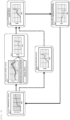
- Fig. 1 schematically and partially illustrates a mechanical system, an electric system, and a hydraulic system of a hybrid vehicle 10 (hereinafter referred to as a vehicle 10) that includes an engine start controller 1 according to the exemplary embodiment.
- the vehicle 10 includes an engine 20, a clutch 30, a motor 40, and a transmission 50.
- the transmission 50 can be coupled to wheels 51 (front wheels, rear wheels, or both of these) of the vehicle 10.
- the engine 20 (particularly, a crankshaft 21 thereof), the clutch 30, the motor 40, and the transmission 50 include a common shaft C that extends in a longitudinal direction of the vehicle 10. It is configured that necessary components rotate about this shaft C.
- the engine 20 and the motor 40 are drive sources of the vehicle 10.
- the engine 20 and the transmission 50 are connected via the clutch 30 and the motor 40.
- output (rotational torque) of the engine 20 is transmitted to the transmission 50 via the clutch 30 and the motor 40.
- the motor 40 is directly coupled to the transmission 50, and output (rotational torque) of the motor 40 is transmitted to the transmission 50.
- the vehicle 10 can travel by selecting one of three travel modes.
- the three travel modes are (a) an engine travel mode in which the output of the engine 20 is transmitted to the transmission 50 via the clutch 30 in a state where the clutch 30 is engaged and the motor 40 is stopped, (b) a hybrid travel mode in which the output of the engine 20 is transmitted to the transmission 50 via the clutch 30 and rotation of the motor 40 is transmitted to the transmission 50 in a state where the clutch 30 is engaged and the motor 40 is driven, and (c) a motor travel mode (EV travel mode) in which the rotation of the motor 40 is transmitted to the transmission 50 in a state where the clutch 30 is disengaged and the motor 40 is driven.
- a motor travel mode in which the output of the engine 20 is transmitted to the transmission 50 via the clutch 30 in a state where the clutch 30 is engaged and the motor 40 is stopped
- a hybrid travel mode in which the output of the engine 20 is transmitted to the transmission 50 via the clutch 30 and rotation of the motor 40 is transmitted to the transmission 50 in a state where the clutch 30 is engaged and the motor 40 is driven
- a motor travel mode EV travel mode
- the engine 20 may be a gasoline engine or a diesel engine, for example.
- the engine 20 includes the crankshaft 21 as an output section.
- the engine 20 can be started when the output of the motor 40 is transmitted to the crankshaft 21 via the clutch 30 in the state where the clutch 30 is engaged. Transmission torque that is transmitted from the motor 40 to the engine 20 via the clutch 30 can be regulated by a hydraulic pressure control circuit 52.
- the control by the hydraulic pressure control circuit 52 will be described below.
- the motor 40 includes, for example: a ring-shaped stator 42 that is fixed to a motor housing 41; and a rotor 43 configured to be arranged on a radially inner side of the stator 42 and be rotatable about the shaft C.
- the stator 42 is configured by winding a coil 44 around a stator core.
- the coil 44 is connected to a battery 46 via an inverter 45. Accordingly, when a DC current that is supplied from the battery 46 is converted into an AC current by the inverter 45, and the AC current is then applied to the coil 44, the rotor 43 rotates, and the motor 40 thereby generates the torque.
- the engine 20 includes a crank angle sensor 71, and, optionally, a temperature sensor 72 and an engine speed sensor 73.
- the crank angle sensor 71 is a sensor that detects and outputs a crank angle of the crankshaft 21 in the engine 20 (a rotation angle of the crankshaft 21 that is expressed by degree unit with top dead center of a piston in a cylinder being a reference).
- the temperature sensor 72 is a sensor that measures and outputs a temperature of a coolant that flows through inside of the engine 20, for example.
- the engine speed sensor 73 is a sensor that detects and outputs a speed of the engine 20 (also referred to as an engine speed).
- the vehicle 10 includes the engine start controller 1 that controls a start of the engine 20.
- the engine start controller 1 includes an electronic control unit 60, and this electronic control unit 60 receives signals from the various sensors. Examples of these input signals are signals from an accelerator operation amount sensor 74, a motor rotational speed sensor 75, a vehicle speed sensor 76, and the like in addition to signals from the crank angle sensor 71, the temperature sensor 72, and the engine speed sensor 73 described above.
- the accelerator operation amount sensor 74 is a sensor that detects and outputs requested drive power (an accelerator operation amount) by a driver of the vehicle 10, is provided in an operation device used by the driver of the vehicle 10 to drive the vehicle 10, for example, and detects and outputs an operation amount of the operation device.
- the motor rotational speed sensor 75 is a sensor that detects and outputs a rotational speed of the motor 40, and can be provided to the motor 40, for example.
- the vehicle speed sensor 76 is a sensor that detects and outputs a speed of the vehicle 10, is provided to the transmission 50, for example, detects a rotational speed of the transmission 50, and outputs the signal corresponding to the rotational speed of the transmission 50.
- the electronic control unit 60 is also connected to the inverter 45 and the battery 46 and can acquire information on a charged rate or a state of charge (SOC) of the battery 46.
- the electronic control unit 60 is a controller that is based on a well-known microcomputer and includes: a central processing unit (CPU) that executes computer programs (including a basic control program such as an OS and an application program that is run on the OS to implement a particular function); memory including RAM and ROM, for example; and an input/output (I/O) bus that inputs/outputs an electric signal.
- CPU central processing unit
- I/O input/output
- the ROM stores the various computer programs, data including various maps, and the like.
- the RAM is provided with a processing area that is used when the CPU executes a series of processing.
- the electronic control unit 60 is provided with a clutch transmission torque control section 61.
- the clutch transmission torque control section 61 is connected to the hydraulic pressure control circuit 52 and controls the clutch 30 through the hydraulic pressure control circuit 52.
- the electronic control unit 60 controls the transmission 50 through the hydraulic pressure control circuit 52 by a transmission control section, which is not illustrated.
- the electronic control unit 60 is provided with a motor control section 65 that controls driving of the motor 40.
- the motor control section 65 is connected to the inverter 45, and controls driving of the motor 40 through the inverter 45 on the basis of the signal from the motor rotational speed sensor 75.
- Fig. 3 illustrates a temporal change in the transmission torque of the clutch 30 (hereinafter referred to as clutch transmission torque or the transmission torque), and the transmission torque is transmitted from the motor 40 to the engine 20 at the time of starting the engine 20.
- clutch transmission torque As illustrated in Fig. 3 , the clutch transmission torque is rapidly increased at an initial stage of the start. Then, at specified time onward, an increasing rate of the clutch transmission torque is reduced, and the clutch transmission torque is gradually increased. This is to facilitate execution of feedback correction, which will be described below, by detecting a measured value of the engine speed (an actual engine speed) at the specified time onward.
- Fig. 4 is a graph illustrating a relationship between this stop crank position and the loss torque.
- a vertical axis of this graph represents the loss torque [Nm]
- a horizontal axis represents the crank angle [deg].
- Each of line graphs illustrates how the loss torque is changed (a trajectory of the resistance) according to advancement of the crank angle (that is, according to rotation of the engine 20) from four particular stop crank positions (-180 degrees, -150 degrees, -120 degrees, and -90 degrees).
- the stop crank position is -180 degrees, and the change in the loss torque according to the advancement of the crank angle therefrom is illustrated.
- the stop crank position is -90 degrees, and the change in the loss torque according to the advancement of the crank angle therefrom is illustrated.
- the transmission torque (the loss torque) that is required for the rotation thereafter differs by the stop crank position.
- an optimum value of the transmission torque that is transmitted from the motor 40 via the clutch 30 differs by the stop crank position.
- the clutch transmission torque control section 61 controls the clutch transmission torque on the basis of a target engine speed value.
- the target engine speed value is set by a target engine speed value setting section 62, which is illustrated in Fig. 2 .
- the target engine speed value setting section 62 is provided in the electronic control unit 60 and receives the signal from the crank angle sensor 71. Based on the stop crank position in the received signal from the crank angle sensor 71, the target engine speed value setting section 62 sets the target engine speed value (that is, a target value of the engine speed by the motor 40). Then, based on the target engine speed value, the clutch transmission torque control section 61 optimizes the transmission torque to be transmitted via the clutch 30. In this way, a start time of the engine 20 is also optimized.
- the electronic control unit 60 includes a correction section 63 for correcting the target engine speed value, which is set by the target engine speed value setting section 62, on the basis of the mechanical resistance of the engine 20.
- the mechanical resistance of the engine 20 is changed by a change in friction by the engine speed, a change in sliding resistance by a cylinder temperature, and the like.
- correction that is based on the mechanical resistance of the engine 20 can be set in advance in consideration of these factors (the change in the friction by the engine speed, the change in the sliding resistance by the cylinder temperature, and the like).
- the correction section 63 corrects the target engine speed value on the basis of the signal (temperature information) from the temperature sensor 72, for example. Instead thereof or in addition thereto, the correction section 63 can correct the target engine speed value on the basis of the signal from the engine speed sensor 73 and/or the motor rotational speed sensor 75. The correction section 63 sends a correction amount of the target engine speed value to the target engine speed value setting section 62.
- the target engine speed value setting section 62 sets the optimum target engine speed value on the basis of the stop crank position (that is, the loss torque), the correction amount by the correction section 63, and inertia (moment of inertia) of the engine 20 that is acquired by measurement in advance, a set value, or the like.
- a vertical axis in a graph of Fig. 5 represents the engine speed [rpm]
- a horizontal axis therein represents time [ms]
- a broken line in the graph illustrates an example of a change in the optimum target engine speed value after initiation of start control for the engine 20.
- the clutch transmission torque control section 61 calculates the required transmission torque (the transmission torque from the motor 40 to the engine 20 via the clutch 30) to cause the rotation of the engine 20 at the speed in the optimum target engine speed value (hereinafter also referred to as a target value), and controls the clutch 30 (the hydraulic pressure control circuit 52) such that the calculated transmission torque is generated.
- a feedback correction section 64 see Fig.
- the electronic control unit 60 measures the actual engine speed (hereinafter also referred to as a measured value) from the signal received from the engine speed sensor 73, converts a difference between these target value and measured value into the transmission torque (a feedback correction amount), and performs the feedback correction of the clutch transmission torque, which is controlled by the clutch transmission torque control section 61, on the basis of this converted transmission torque.
- a measured value the actual engine speed
- a feedback correction amount the transmission torque
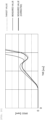
- Fig. 6 illustrates an example of the change in the actual engine speed, which is controlled on the basis of the target value in Fig. 5 , by a solid line.
- Fig. 7 the target value in Fig. 5 and the measured value in Fig. 6 are drawn on the same graph, and a difference therebetween in a vertical axis direction corresponds to the difference between the measured value and the target value of the engine speed.
- Fig. 8 illustrates the feedback correction amount (described as "TORQUE" in Fig. 8 ) of the clutch transmission torque that is calculated on the basis of this difference.
- TORQUE feedback correction amount
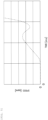
- Fig. 8 represents a torque value [Nm], a horizontal axis therein represents the time [ms], and this torque value is subjected to the feedback so as to correct (performs the feedback correction of) the clutch transmission torque.
- Fig. 8 illustrates an example of the feedback correction amount (a negative value) for reducing the clutch transmission torque in the case where the measured value of the engine speed is higher than the target value thereof, for example, as illustrated in Fig. 7 .
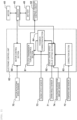
- Fig. 9 collectively illustrates a flow of the engine start control by the engine start controller 1 so as to facilitate visual understanding of the flow.
- the clutch transmission torque ( Fig. 3 ) at the time of executing the engine start control is set, the target value (the predicted value) of the engine speed, which is based on the stop crank position of the engine 20, is set ( Fig. 4 and Fig. 5 ), the actual engine speed (the measured value) is measured ( Fig. 6 ), the difference between the target value and the measured value is calculated ( Fig. 7 ), the feedback correction amount of the clutch transmission torque is calculated ( Fig. 8 ), and the clutch transmission torque is subjected to the feedback correction.
- Fig. 10 illustrates a relationship among these target value and measured value and the measured value after the feedback correction (described as "MEASURED VALUE (CORRECTED)" in Fig. 10 ).
- Fig. 11 illustrates an example of target transmission torque and actual transmission torque in the case where the feedback correction is not performed (the correction is not made) (simply described as “TARGET TRANSMISSION TORQUE” and “ACTUAL TRANSMISSION TORQUE” in Fig. 11 ) and an example of the target transmission torque and the actual transmission torque in the case where the feedback correction is performed (the correction is made) (described as “TARGET TRANSMISSION TORQUE (CORRECTED)” and “ACTUAL TRANSMISSION TORQUE (CORRECTED)” in Fig. 11 ).
- a thin broken line represents the transmission torque (the target transmission torque) that is estimated from the target value in the case where the correction is not made.
- a thin solid line represents the transmission torque (the actual transmission torque) that is estimated from the measured value and is actually transmitted for the engine start in the case where the correction is not made. As illustrated in Fig. 11 , due to a difference between these types of the torque, the correction is made to bring the actual transmission torque in proximity to or to match the target transmission torque.
- the actual transmission torque is higher than the target transmission torque in the case where the correction is not made. Accordingly, a command value of the transmission torque (command transmission torque) is reduced by a value that is determined from the difference between the actual transmission torque and the target transmission torque (see Fig. 8 ).
- This command transmission torque corresponds to the target transmission torque in the case where the correction is made (a bold broken line in Fig. 11 ).
- the actual transmission torque after the correction can substantially be equal to the initial target transmission torque without the correction (the thin broken line in Fig. 11 ). In this way, the feedback correction is performed on the basis of the difference between the measured value and the target value.
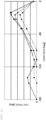
- Fig. 12 illustrates an example of such a case.
- a vertical axis represents a peak value of the transmission torque [Nm]
- a horizontal axis represents the start time [ms].
- Each symbol represents the stop crank position (-180 degrees, -150 degrees, -120 degrees, or -90 degrees).
- a difference between white and black of the same symbol indicates a difference in use of the target value.
- a white symbol indicates a simulation result of a case where the feedback correction is performed without setting the target value, which is based on the stop crank position (the stop crank angle)
- a black symbol indicates a simulation result of a case where the feedback correction is performed by setting the target value, which is based on the stop crank position.
- the above-described control relates to control for reducing the start time of the engine 20 as short as possible. That is, when the engine 20 is started by increasing the requested drive power (an acceleration request) by the driver of the vehicle 10, the start time of the engine 20 is reduced as short as possible such that the vehicle 10 can be accelerated responsively. Meanwhile, in the case where the engine 20 is started by a cause other than the above, there is no problem even when the start time of the engine 20 becomes longer than the start time of the engine 20 by increasing the requested drive power.
- the target engine speed value setting section 62 may be configured to set the target engine speed value such that the engine start time, which is based on the target engine speed value, is short when the engine 20 is started by increasing the requested drive power by the driver of the vehicle 10 (determined on the basis of the signal from the accelerator operation amount sensor 74) and that the engine start time is long when the engine 10 is started by the cause other than the above. That is, the target engine speed value setting section 62 sets the target engine speed value to be lower when the engine 20 is started by the other cause than when the engine 20 is started by increasing the requested drive power. As a result, the start time is extended. However, the engine 20 can be started with lower energy.
- the vehicle can travel for a long distance in the EV travel mode, which improves the fuel economy, for example. It is also possible to alleviate a shock at the time of the start of the engine 20.
- An example of the other cause is that the SOC of the battery 46 for driving the motor 40 becomes equal to or lower than a specified value (determined on the basis of history of a voltage/a current value from the inverter 45).
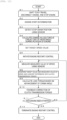
- Fig. 13 is a flowchart of the engine start control by the electronic control unit 60.
- step S1 in order to shift from the engine travel mode or the hybrid travel mode to the EV travel mode, the clutch 30 is disengaged to disconnect the engine 20, and the engine 20 is stopped.
- the motor 40 is driven.
- the hybrid travel mode is shifted to the EV travel mode, a driven state of the motor 40 is maintained.
- an engine start determination to start the engine 20 is made.
- the engine start determination is made in step S2.
- the engine start time is set to be short.
- the start time is set to be long.
- next step S3 the stop crank position of the engine 20 is detected by using the signal from the crank angle sensor 71.
- step S4 the loss torque (more specifically, a temporal change in the loss torque as illustrated in Fig. 4 ) is calculated on the basis of the stop crank position detected in step S3.
- step S5 target rotation behavior of the engine 20 (that is, the target engine speed value) is calculated and set on the basis of the loss torque, which is calculated in step S4, the correction amount, which is calculated by the correction section 63, and the inertia of the engine 20.
- step S6 restart control for the engine 20 by using the motor 40, which currently drives the vehicle 10, is initiated. In this restart control for the engine 20, the clutch transmission torque is subjected to the feedback correction.
- step S7 the engine speed sensor 73 measures the actual engine speed (the measured value).
- step S8 the target value, which is set in step S5, and the measured value, which is measured in step S7, are compared, and the difference therebetween is converted into the clutch transmission torque (the feedback correction amount).
- the loss torque is calculated on the basis of the advancement of the crank angle and the temporal change in the loss torque, which is calculated in step S4.
- step S10 the clutch transmission torque is subjected to the feedback correction by adding the feedback correction amount, which is calculated in step S8, and the loss torque, which is calculated in step S9. Then, the clutch 30 is controlled such that this clutch transmission torque, which has been subjected to the feedback correction, is generated.
- next step S11 it is determined whether the engine 20 has been started. The processing operation from step S7 to S11 is repeated until it is determined in this step S11 that the engine 20 has been started. If it is determined that the engine 20 has been started in step S11, the restart control for the engine 20 is terminated in step S12.
- the engine start controller 1 includes: the clutch transmission torque control section 61 that controls the transmission torque of the clutch 30 on the basis of the target engine speed value at the time of starting the engine 20 by the motor 40; and the target engine speed value setting section 62 that sets the target engine speed value on the basis of the stop crank position of the engine 20.
- the present invention is useful for the hybrid vehicle that includes, as the drive sources of the hybrid vehicle, the engine and the motor that are mutually coupled via the clutch, and is also useful for the engine start controller of the hybrid vehicle.
Landscapes
- Engineering & Computer Science (AREA)
- Transportation (AREA)
- Mechanical Engineering (AREA)
- Chemical & Material Sciences (AREA)
- Combustion & Propulsion (AREA)
- Automation & Control Theory (AREA)
- Power Engineering (AREA)
- Human Computer Interaction (AREA)
- Hybrid Electric Vehicles (AREA)
- Electric Propulsion And Braking For Vehicles (AREA)
Description
- The present invention relates to an engine start controller for a hybrid vehicle and to a hybrid vehicle.
- Control for starting an engine by using a motor in a hybrid vehicle that includes, as drive sources, the engine and the motor and that is driven by at least one of engine output and motor output has been proposed. For example, in
PTL 1, it is disclosed that engine start torque, which is output from the motor at the time of starting the engine during driving of the vehicle by using the motor (during motor travel), is calculated on the basis of a rotation stop position of a crankshaft in the engine immediately before an initiation of the engine start (a stop crankshaft position of the engine) and that, during the motor travel, a motor travel range is set such that the motor is actuated in a state of saving redundant power for generating the engine start torque. -
US 2011/040333 A1 describes a method and a device for determining, ascertaining, and predicting at least one starting torque or starting torque characteristic curve required for starting an internal combustion engine for a vehicle, especially a hybrid vehicle having at least one internal combustion engine and at least one additional motor. The determination and the ascertainment of the starting torque or the starting torque characteristic curve are carried out during the operation of the vehicle. A method for operating at least one motor in a hybrid vehicle is also described. -
DE 10 2007 062796 A1 describes a method for operating a hybrid drive device, in particular for a motor vehicle, which has at least one internal combustion engine and at least one electric machine, wherein the internal combustion engine and the electric machine may be operatively connected to one another mechanically by means of a disconnect clutch. The slip torque is determined as a function of the rotational speed characteristic of an output shaft of the internal combustion engine at least during starting and/or stopping of the internal combustion engine and is taken into account during operation of the hybrid drive device. -
EP 1 839 986 A1 describes a driving mode transition controller for a hybrid vehicle equipped with engine, motor-generator, and clutch installed between the engine and the motor-generator, wherein the engine is started by engaging the clutch and using the motor-generator as a starter motor for the engine when making a mode transition from an "EV mode" which utilizes only motor-generator as the power source to an "HEV mode" which includes the engine as part of the power source. - PTL 1:
JP-A-2012-86662 - By the way, it is considered that transmission torque from the motor to the engine fluctuates by a factor other than the engine stop crank position. Thus, the factor other than the engine stop crank position has to be considered to reliably start the engine. However, in the case where the engine start torque of the motor is set in a manner to reliably start the engine, an amount of the engine start torque that has to be saved as the redundant power by the motor during the motor travel is increased, which in turn narrows the motor travel range (an EV travel range) where the vehicle can travel only using the motor.
- The present invention has been made in view of such a point and therefore has a purpose of providing an engine start controller for a hybrid vehicle, and a hybrid vehicle capable of expanding an EV travel range and improving fuel economy by reducing engine start torque as low as possible, and the engine start torque of a motor having to be saved as redundant power during driving of the hybrid vehicle by using the motor.
- In order to achieve the above purpose, an engine start controller for a hybrid vehicle, and a hybrid vehicle are provided. The underlying problem is solved by an engine start controller for a hybrid vehicle, and a hybrid vehicle, having the features of
claims - In regard to the engine start controller for the hybrid vehicle, the hybrid vehicle has, as drive sources of the hybrid vehicle, an engine and a motor that are mutually coupled via a clutch. The engine start controller includes: a clutch transmission torque control section that controls transmission torque of the clutch on the basis of a target engine speed value at the time of starting the engine using the motor via the clutch; and a target engine speed value setting section that sets the target engine speed value on the basis of a stop crank position of the engine.
- With the above configuration, when the engine is started, the target engine speed value setting section sets the target engine speed value on the basis of the stop crank position of the engine, and the clutch transmission torque control section controls the clutch such that the required transmission torque for starting of the engine is generated at a speed of the target engine speed value. In this way, it is possible to optimize the required transmission torque of the clutch to start the engine. An engine start time can also be optimized.
- The engine start controller for the hybrid vehicle further preferably includes: a correction section that corrects the target engine speed value set by the target engine speed value setting section on the basis of mechanical resistance of the engine.
- In this way, the correction section, which corrects the target engine speed value, can appropriately corrects the target engine speed value on the basis of the mechanical resistance of the engine.
- The engine start controller for the hybrid vehicle further includes: a feedback correction section that subjects the transmission torque of the clutch controlled by the clutch transmission torque control section to feedback correction on the basis of the target engine speed value, which is set by the target engine speed value setting section, and a measured value of an engine speed.
- In this way, the feedback correction section can convert the difference between the target engine speed value and the measured value of the engine speed into the transmission torque of the clutch (a feedback correction amount). Thus, it is possible to appropriately subject the transmission torque, which is controlled by the clutch transmission torque control section, to the feedback correction.
- In the engine start controller for the hybrid vehicle, the target engine speed value setting section is preferably configured to set the target engine speed value such that an engine start time, which is based on the target engine speed value, becomes short at the time of starting the engine by increasing requested drive power by a driver of the hybrid vehicle and becomes long at the time of starting the engine by another cause.
- In this way, in the case where the engine is started by increasing requested drive power (an acceleration request) by a driver of the hybrid vehicle, the engine can be started with an emphasis on responsiveness, that is, can be started promptly. In the case where the engine is started by the other cause, it takes a long time. However, the engine can be started while a shock is suppressed, that is, with low energy.
- An example of the other cause is that a state of charge (SOC) of a battery for driving the motor becomes equal to or lower than a specified value.
- A hybrid vehicle according to another aspect of the present invention includes: an engine and a motor that serve as drive sources of the hybrid vehicle and are mutually coupled via a clutch; and an engine start controller as defined above.
- With this configuration, it is possible to obtain similar effects to the engine start controller for the hybrid vehicle. Advantageous Effects of Invention
- As it has been described so far, according to the engine start controller for the hybrid vehicle and the hybrid vehicle according to the present invention, it is possible to reduce the engine start torque of the motor, which has to be saved as redundant power during driving of the hybrid vehicle by using the motor, as low as possible, which in turn expands an EV travel range. Therefore, fuel economy can be improved.
-
- [
Fig. 1] Fig. 1 is schematic view partially illustrating a mechanical system, an electric system, and a hydraulic system of a hybrid vehicle that includes an engine start controller according to an exemplary embodiment. - [
Fig. 2] Fig. 2 is a block diagram illustrating electrical connection between components of an electronic control unit and components connected to the electronic control unit. - [
Fig. 3] Fig. 3 is a graph illustrating a temporal change in clutch transmission torque that is transmitted from a motor to an engine via a clutch. - [
Fig. 4] Fig. 4 is a graph illustrating a relationship between an engine stop crank position (crank angle) and loss torque. - [
Fig. 5] Fig. 5 is a graph illustrating a temporal change in an engine speed (target value). - [
Fig. 6] Fig. 6 is a graph illustrating a temporal change in the engine speed (measured value). - [
Fig. 7] Fig. 7 is a graph illustrating the temporal changes in the engine speed (target value and measured value). - [
Fig. 8] Fig. 8 is a graph illustrating a feedback correction amount of the clutch transmission torque that is calculated on the basis of a difference between the target value and the measured value of the engine speed. - [
Fig. 9] Fig. 9 is a chart for illustrating a control flow usingFig. 3 to Fig. 8 . - [
Fig. 10] Fig. 10 is a graph illustrating the temporal changes in the engine speed (target value, measured value, and measured value after feedback correction). - [
Fig. 11] Fig. 11 is a graph illustrating a change in the clutch transmission torque and illustrating the feedback correction of the clutch transmission torque. - [
Fig. 12] Fig. 12 is a graph illustrating fluctuation in the clutch transmission torque and a start time in engine start control using the target value and engine start control not using the target value. - [
Fig. 13] Fig. 13 is a flowchart of the engine start control by the electronic control unit. - A detailed description will hereinafter be made on an exemplary embodiment with reference to the drawings.
-
Fig. 1 schematically and partially illustrates a mechanical system, an electric system, and a hydraulic system of a hybrid vehicle 10 (hereinafter referred to as a vehicle 10) that includes anengine start controller 1 according to the exemplary embodiment. - As illustrated in
Fig. 1 , thevehicle 10 includes anengine 20, aclutch 30, amotor 40, and atransmission 50. Thetransmission 50 can be coupled to wheels 51 (front wheels, rear wheels, or both of these) of thevehicle 10. The engine 20 (particularly, acrankshaft 21 thereof), theclutch 30, themotor 40, and thetransmission 50 include a common shaft C that extends in a longitudinal direction of thevehicle 10. It is configured that necessary components rotate about this shaft C. Theengine 20 and themotor 40 are drive sources of thevehicle 10. - The
engine 20 and thetransmission 50 are connected via theclutch 30 and themotor 40. In a state where theclutch 30 is engaged, output (rotational torque) of theengine 20 is transmitted to thetransmission 50 via theclutch 30 and themotor 40. Themotor 40 is directly coupled to thetransmission 50, and output (rotational torque) of themotor 40 is transmitted to thetransmission 50. Thus, thevehicle 10 can travel by selecting one of three travel modes. The three travel modes are (a) an engine travel mode in which the output of theengine 20 is transmitted to thetransmission 50 via the clutch 30 in a state where the clutch 30 is engaged and themotor 40 is stopped, (b) a hybrid travel mode in which the output of theengine 20 is transmitted to thetransmission 50 via the clutch 30 and rotation of themotor 40 is transmitted to thetransmission 50 in a state where the clutch 30 is engaged and themotor 40 is driven, and (c) a motor travel mode (EV travel mode) in which the rotation of themotor 40 is transmitted to thetransmission 50 in a state where the clutch 30 is disengaged and themotor 40 is driven. - The
engine 20 may be a gasoline engine or a diesel engine, for example. Theengine 20 includes thecrankshaft 21 as an output section. Theengine 20 can be started when the output of themotor 40 is transmitted to thecrankshaft 21 via the clutch 30 in the state where the clutch 30 is engaged. Transmission torque that is transmitted from themotor 40 to theengine 20 via the clutch 30 can be regulated by a hydraulicpressure control circuit 52. The control by the hydraulicpressure control circuit 52 will be described below. - The
motor 40 includes, for example: a ring-shapedstator 42 that is fixed to amotor housing 41; and arotor 43 configured to be arranged on a radially inner side of thestator 42 and be rotatable about the shaft C. Thestator 42 is configured by winding acoil 44 around a stator core. Thecoil 44 is connected to abattery 46 via aninverter 45. Accordingly, when a DC current that is supplied from thebattery 46 is converted into an AC current by theinverter 45, and the AC current is then applied to thecoil 44, therotor 43 rotates, and themotor 40 thereby generates the torque. - The
engine 20 includes acrank angle sensor 71, and, optionally, atemperature sensor 72 and anengine speed sensor 73. Thecrank angle sensor 71 is a sensor that detects and outputs a crank angle of thecrankshaft 21 in the engine 20 (a rotation angle of thecrankshaft 21 that is expressed by degree unit with top dead center of a piston in a cylinder being a reference). Thetemperature sensor 72 is a sensor that measures and outputs a temperature of a coolant that flows through inside of theengine 20, for example. Theengine speed sensor 73 is a sensor that detects and outputs a speed of the engine 20 (also referred to as an engine speed). - As illustrated in
Fig. 1 , thevehicle 10 includes theengine start controller 1 that controls a start of theengine 20. Theengine start controller 1 includes anelectronic control unit 60, and thiselectronic control unit 60 receives signals from the various sensors. Examples of these input signals are signals from an acceleratoroperation amount sensor 74, a motorrotational speed sensor 75, avehicle speed sensor 76, and the like in addition to signals from thecrank angle sensor 71, thetemperature sensor 72, and theengine speed sensor 73 described above. - The accelerator
operation amount sensor 74 is a sensor that detects and outputs requested drive power (an accelerator operation amount) by a driver of thevehicle 10, is provided in an operation device used by the driver of thevehicle 10 to drive thevehicle 10, for example, and detects and outputs an operation amount of the operation device. The motorrotational speed sensor 75 is a sensor that detects and outputs a rotational speed of themotor 40, and can be provided to themotor 40, for example. Thevehicle speed sensor 76 is a sensor that detects and outputs a speed of thevehicle 10, is provided to thetransmission 50, for example, detects a rotational speed of thetransmission 50, and outputs the signal corresponding to the rotational speed of thetransmission 50. Theelectronic control unit 60 is also connected to theinverter 45 and thebattery 46 and can acquire information on a charged rate or a state of charge (SOC) of thebattery 46. - The
electronic control unit 60 is a controller that is based on a well-known microcomputer and includes: a central processing unit (CPU) that executes computer programs (including a basic control program such as an OS and an application program that is run on the OS to implement a particular function); memory including RAM and ROM, for example; and an input/output (I/O) bus that inputs/outputs an electric signal. - The ROM stores the various computer programs, data including various maps, and the like. The RAM is provided with a processing area that is used when the CPU executes a series of processing.
- As illustrated in
Fig. 2 , theelectronic control unit 60 is provided with a clutch transmissiontorque control section 61. The clutch transmissiontorque control section 61 is connected to the hydraulicpressure control circuit 52 and controls the clutch 30 through the hydraulicpressure control circuit 52. Theelectronic control unit 60 controls thetransmission 50 through the hydraulicpressure control circuit 52 by a transmission control section, which is not illustrated. - The
electronic control unit 60 is provided with amotor control section 65 that controls driving of themotor 40. Themotor control section 65 is connected to theinverter 45, and controls driving of themotor 40 through theinverter 45 on the basis of the signal from the motorrotational speed sensor 75. -
Fig. 3 illustrates a temporal change in the transmission torque of the clutch 30 (hereinafter referred to as clutch transmission torque or the transmission torque), and the transmission torque is transmitted from themotor 40 to theengine 20 at the time of starting theengine 20. As illustrated inFig. 3 , the clutch transmission torque is rapidly increased at an initial stage of the start. Then, at specified time onward, an increasing rate of the clutch transmission torque is reduced, and the clutch transmission torque is gradually increased. This is to facilitate execution of feedback correction, which will be described below, by detecting a measured value of the engine speed (an actual engine speed) at the specified time onward. - It has experimentally been known that, when the
engine 20 is started, required torque to start theengine 20, that is, required torque for rotation of the crankshaft 21 (here, torque corresponding to compression resistance by the piston, that is, loss torque) is changed by a stop angle of the crankshaft 21 (a stop crank position of the engine 20). Accordingly, in order to start theengine 20 efficiently, it is desired to detect the stop crank position (the crank angle) of the engine and regulate the clutch transmission torque according to the detected stop crank position. -
Fig. 4 is a graph illustrating a relationship between this stop crank position and the loss torque. A vertical axis of this graph represents the loss torque [Nm], and a horizontal axis represents the crank angle [deg]. Each of line graphs illustrates how the loss torque is changed (a trajectory of the resistance) according to advancement of the crank angle (that is, according to rotation of the engine 20) from four particular stop crank positions (-180 degrees, -150 degrees, -120 degrees, and -90 degrees). For example, on the graph drawn by a solid line, the stop crank position is -180 degrees, and the change in the loss torque according to the advancement of the crank angle therefrom is illustrated. On the graph drawn by a two-dot chain line, the stop crank position is -90 degrees, and the change in the loss torque according to the advancement of the crank angle therefrom is illustrated. As it is apparent fromFig. 4 , the transmission torque (the loss torque) that is required for the rotation thereafter differs by the stop crank position. Thus, it is understood that an optimum value of the transmission torque that is transmitted from themotor 40 via the clutch 30 differs by the stop crank position. - At the start of the
engine 20 by themotor 40, the clutch transmissiontorque control section 61 controls the clutch transmission torque on the basis of a target engine speed value. The target engine speed value is set by a target engine speedvalue setting section 62, which is illustrated inFig. 2 . The target engine speedvalue setting section 62 is provided in theelectronic control unit 60 and receives the signal from thecrank angle sensor 71. Based on the stop crank position in the received signal from thecrank angle sensor 71, the target engine speedvalue setting section 62 sets the target engine speed value (that is, a target value of the engine speed by the motor 40). Then, based on the target engine speed value, the clutch transmissiontorque control section 61 optimizes the transmission torque to be transmitted via the clutch 30. In this way, a start time of theengine 20 is also optimized. - Here, the torque that is required to start the
engine 20 can also be changed by mechanical resistance of theengine 20. Accordingly, in this embodiment, as illustrated inFig. 2 , theelectronic control unit 60 includes acorrection section 63 for correcting the target engine speed value, which is set by the target engine speedvalue setting section 62, on the basis of the mechanical resistance of theengine 20. The mechanical resistance of theengine 20 is changed by a change in friction by the engine speed, a change in sliding resistance by a cylinder temperature, and the like. Thus, correction that is based on the mechanical resistance of theengine 20 can be set in advance in consideration of these factors (the change in the friction by the engine speed, the change in the sliding resistance by the cylinder temperature, and the like). Thecorrection section 63 corrects the target engine speed value on the basis of the signal (temperature information) from thetemperature sensor 72, for example. Instead thereof or in addition thereto, thecorrection section 63 can correct the target engine speed value on the basis of the signal from theengine speed sensor 73 and/or the motorrotational speed sensor 75. Thecorrection section 63 sends a correction amount of the target engine speed value to the target engine speedvalue setting section 62. - When the
engine 20 is started by the torque transmission from themotor 40 via the clutch 30, the target engine speedvalue setting section 62 sets the optimum target engine speed value on the basis of the stop crank position (that is, the loss torque), the correction amount by thecorrection section 63, and inertia (moment of inertia) of theengine 20 that is acquired by measurement in advance, a set value, or the like. A vertical axis in a graph ofFig. 5 represents the engine speed [rpm], a horizontal axis therein represents time [ms], and a broken line in the graph illustrates an example of a change in the optimum target engine speed value after initiation of start control for theengine 20. - Next, the clutch transmission
torque control section 61 calculates the required transmission torque (the transmission torque from themotor 40 to theengine 20 via the clutch 30) to cause the rotation of theengine 20 at the speed in the optimum target engine speed value (hereinafter also referred to as a target value), and controls the clutch 30 (the hydraulic pressure control circuit 52) such that the calculated transmission torque is generated. At this time, a feedback correction section 64 (seeFig. 2 ) that is provided in theelectronic control unit 60 measures the actual engine speed (hereinafter also referred to as a measured value) from the signal received from theengine speed sensor 73, converts a difference between these target value and measured value into the transmission torque (a feedback correction amount), and performs the feedback correction of the clutch transmission torque, which is controlled by the clutch transmissiontorque control section 61, on the basis of this converted transmission torque. Hereinafter, such processing of the prediction and the measurement is repeated to optimize the transmission torque for starting theengine 20. -
Fig. 6 illustrates an example of the change in the actual engine speed, which is controlled on the basis of the target value inFig. 5 , by a solid line. InFig. 7 , the target value inFig. 5 and the measured value inFig. 6 are drawn on the same graph, and a difference therebetween in a vertical axis direction corresponds to the difference between the measured value and the target value of the engine speed.Fig. 8 illustrates the feedback correction amount (described as "TORQUE" inFig. 8 ) of the clutch transmission torque that is calculated on the basis of this difference. A vertical axis inFig. 8 represents a torque value [Nm], a horizontal axis therein represents the time [ms], and this torque value is subjected to the feedback so as to correct (performs the feedback correction of) the clutch transmission torque.Fig. 8 illustrates an example of the feedback correction amount (a negative value) for reducing the clutch transmission torque in the case where the measured value of the engine speed is higher than the target value thereof, for example, as illustrated inFig. 7 . -
Fig. 9 collectively illustrates a flow of the engine start control by theengine start controller 1 so as to facilitate visual understanding of the flow. Here, the following flow is illustrated. When the clutch transmission torque (Fig. 3 ) at the time of executing the engine start control is set, the target value (the predicted value) of the engine speed, which is based on the stop crank position of theengine 20, is set (Fig. 4 andFig. 5 ), the actual engine speed (the measured value) is measured (Fig. 6 ), the difference between the target value and the measured value is calculated (Fig. 7 ), the feedback correction amount of the clutch transmission torque is calculated (Fig. 8 ), and the clutch transmission torque is subjected to the feedback correction.Fig. 10 illustrates a relationship among these target value and measured value and the measured value after the feedback correction (described as "MEASURED VALUE (CORRECTED)" inFig. 10 ). -
Fig. 11 illustrates an example of target transmission torque and actual transmission torque in the case where the feedback correction is not performed (the correction is not made) (simply described as "TARGET TRANSMISSION TORQUE" and "ACTUAL TRANSMISSION TORQUE" inFig. 11 ) and an example of the target transmission torque and the actual transmission torque in the case where the feedback correction is performed (the correction is made) (described as "TARGET TRANSMISSION TORQUE (CORRECTED)" and "ACTUAL TRANSMISSION TORQUE (CORRECTED)" inFig. 11 ). A thin broken line represents the transmission torque (the target transmission torque) that is estimated from the target value in the case where the correction is not made. A thin solid line represents the transmission torque (the actual transmission torque) that is estimated from the measured value and is actually transmitted for the engine start in the case where the correction is not made. As illustrated inFig. 11 , due to a difference between these types of the torque, the correction is made to bring the actual transmission torque in proximity to or to match the target transmission torque. - More specifically, in the example illustrated in
Fig. 11 , the actual transmission torque is higher than the target transmission torque in the case where the correction is not made. Accordingly, a command value of the transmission torque (command transmission torque) is reduced by a value that is determined from the difference between the actual transmission torque and the target transmission torque (seeFig. 8 ). This command transmission torque corresponds to the target transmission torque in the case where the correction is made (a bold broken line inFig. 11 ). When the target transmission torque is corrected, just as described, the actual transmission torque after the correction (a bold solid line inFig. 11 ) can substantially be equal to the initial target transmission torque without the correction (the thin broken line inFig. 11 ). In this way, the feedback correction is performed on the basis of the difference between the measured value and the target value. - In the case where the feedback correction is performed without using the target value, for which the above-described stop crank position is considered, the clutch transmission torque and the start time fluctuate significantly.
Fig. 12 illustrates an example of such a case. In a graph illustrated inFig. 12 , a vertical axis represents a peak value of the transmission torque [Nm], and a horizontal axis represents the start time [ms]. Each symbol represents the stop crank position (-180 degrees, -150 degrees, -120 degrees, or -90 degrees). A difference between white and black of the same symbol indicates a difference in use of the target value. More specifically, a white symbol (o and the like) indicates a simulation result of a case where the feedback correction is performed without setting the target value, which is based on the stop crank position (the stop crank angle), and a black symbol (• and the like) indicates a simulation result of a case where the feedback correction is performed by setting the target value, which is based on the stop crank position. As it is understood fromFig. 12 , in the case where the feedback correction is performed without setting the target value, both of the clutch transmission torque and the start time fluctuate significantly. On the other hand, in the case where the feedback correction is performed by setting the target value, the fluctuation in the clutch transmission torque and the start time is reduced. - The above-described control relates to control for reducing the start time of the
engine 20 as short as possible. That is, when theengine 20 is started by increasing the requested drive power (an acceleration request) by the driver of thevehicle 10, the start time of theengine 20 is reduced as short as possible such that thevehicle 10 can be accelerated responsively. Meanwhile, in the case where theengine 20 is started by a cause other than the above, there is no problem even when the start time of theengine 20 becomes longer than the start time of theengine 20 by increasing the requested drive power. - Accordingly, the target engine speed
value setting section 62 may be configured to set the target engine speed value such that the engine start time, which is based on the target engine speed value, is short when theengine 20 is started by increasing the requested drive power by the driver of the vehicle 10 (determined on the basis of the signal from the accelerator operation amount sensor 74) and that the engine start time is long when theengine 10 is started by the cause other than the above. That is, the target engine speedvalue setting section 62 sets the target engine speed value to be lower when theengine 20 is started by the other cause than when theengine 20 is started by increasing the requested drive power. As a result, the start time is extended. However, theengine 20 can be started with lower energy. In this way, the vehicle can travel for a long distance in the EV travel mode, which improves the fuel economy, for example. It is also possible to alleviate a shock at the time of the start of theengine 20. An example of the other cause is that the SOC of thebattery 46 for driving themotor 40 becomes equal to or lower than a specified value (determined on the basis of history of a voltage/a current value from the inverter 45). -
Fig. 13 is a flowchart of the engine start control by theelectronic control unit 60. First, in step S1, in order to shift from the engine travel mode or the hybrid travel mode to the EV travel mode, the clutch 30 is disengaged to disconnect theengine 20, and theengine 20 is stopped. When the engine travel mode is shifted to the EV travel mode, themotor 40 is driven. When the hybrid travel mode is shifted to the EV travel mode, a driven state of themotor 40 is maintained. - In the case where an engine start condition is satisfied in the state where the
engine 20 is stopped, an engine start determination to start theengine 20 is made. Here, it is assumed that the engine start determination is made in step S2. At this time, it is determined whether the engine is promptly started or the engine is started in a manner to minimize an energy consumption amount as much as possible according to a cause of the engine start determination (for example, an acceleration request by the driver, a reduction in the SOC of thebattery 46, or the like). More specifically, at the time of the start by increasing the requested drive power (the accelerator operation amount), the engine start time is set to be short. At the time of the start other than the above (for example, at the time of the start due to the reduction in the SOC of the battery 46), the start time is set to be long. - In next step S3, the stop crank position of the
engine 20 is detected by using the signal from thecrank angle sensor 71. - In next step S4, the loss torque (more specifically, a temporal change in the loss torque as illustrated in
Fig. 4 ) is calculated on the basis of the stop crank position detected in step S3. Next, in step S5, target rotation behavior of the engine 20 (that is, the target engine speed value) is calculated and set on the basis of the loss torque, which is calculated in step S4, the correction amount, which is calculated by thecorrection section 63, and the inertia of theengine 20. Then, in next step S6, restart control for theengine 20 by using themotor 40, which currently drives thevehicle 10, is initiated. In this restart control for theengine 20, the clutch transmission torque is subjected to the feedback correction. - More specifically, in step S7, the
engine speed sensor 73 measures the actual engine speed (the measured value). Next, in step S8, the target value, which is set in step S5, and the measured value, which is measured in step S7, are compared, and the difference therebetween is converted into the clutch transmission torque (the feedback correction amount). In next step S9, the loss torque is calculated on the basis of the advancement of the crank angle and the temporal change in the loss torque, which is calculated in step S4. In next step S10, the clutch transmission torque is subjected to the feedback correction by adding the feedback correction amount, which is calculated in step S8, and the loss torque, which is calculated in step S9. Then, the clutch 30 is controlled such that this clutch transmission torque, which has been subjected to the feedback correction, is generated. - In next step S11, it is determined whether the
engine 20 has been started. The processing operation from step S7 to S11 is repeated until it is determined in this step S11 that theengine 20 has been started. If it is determined that theengine 20 has been started in step S11, the restart control for theengine 20 is terminated in step S12. - According to the invention, the
engine start controller 1 includes: the clutch transmissiontorque control section 61 that controls the transmission torque of the clutch 30 on the basis of the target engine speed value at the time of starting theengine 20 by themotor 40; and the target engine speedvalue setting section 62 that sets the target engine speed value on the basis of the stop crank position of theengine 20. Thus, it is possible to optimize the transmission torque of the clutch 30 that is required to start theengine 20. As a result, during driving of thevehicle 10 by using themotor 40, the engine start torque of themotor 40, which has to be saved as redundant power, can be reduced as low as possible, which in turn expands the EV travel range where thevehicle 10 can travel in the EV travel mode. Therefore, the fuel economy can be improved. - The present invention is useful for the hybrid vehicle that includes, as the drive sources of the hybrid vehicle, the engine and the motor that are mutually coupled via the clutch, and is also useful for the engine start controller of the hybrid vehicle.
-
- 1:
- engine start controller
- 10:
- hybrid vehicle
- 20:
- engine
- 30:
- clutch
- 40:
- motor
- 61:
- clutch transmission torque control section
- 62:
- target engine speed value setting section
- 63:
- correction section
- 64:
- feedback correction section
Claims (4)
- An engine start controller (1) for a hybrid vehicle (10), the hybrid vehicle (10) having,as drive sources of said hybrid vehicle (10), an engine (20) and a motor (40) that are mutually coupled via a clutch (30), anda crank angle sensor (71) that detects and outputs a crank angle of the crank shaft (21) in the engine (20),characterized in that the engine start controller (1) for the hybrid vehicle (10) comprisesa target engine speed value setting section (62) that sets, at the time of starting the engine (20) using the motor (40) via the clutch (30), a target engine speed value based on a stop crank position of the engine (20) detected by using a signal from the crank angle sensor (71);a clutch transmission torque control section (61) that controls the clutch (30) via a hydraulic pressure control circuit (52) to control transmission torque of the clutch (30) on the basis of the target engine speed value; anda feedback correction section (64) thatcalculates, after initiation of start control for the engine (20), a feedback correction amount on the basis of a difference between the target engine speed value and a measured value of an engine speed and calculates a loss torque on the basis of advancement of the crank angle, andadds the feedback correction amount and the loss torque togetherto subject the transmission torque of the clutch (30) controlled by the clutch transmission torque control section (61) to feedback correction.
- The engine start controller (1) for the hybrid vehicle (10) according to claim 1 further comprising:
a correction section (63) that corrects the target engine speed value set by the target engine speed value setting section (62) on the basis of mechanical resistance of the engine (20). - The engine start controller (1) for the hybrid vehicle (10) according to claim 1 or 2,
wherein the target engine speed value setting section (62) is configured to set the target engine speed value such that an engine start time, which is based on the target engine speed value, becomes short at the time of starting the engine (20) by increasing requested drive power by a driver of the hybrid vehicle (10) and becomes long at the time of starting the engine (20) by another cause. - A hybrid vehicle (10) comprising:an engine (20) and a motor (40) that serve as drive sources of said hybrid vehicle (10) and are mutually coupled via a clutch (30);a crank angle sensor (71) that detects and outputs a crank angle of a crank shaft (21) in the engine (20);a hydraulic pressure control circuit (52) that controls the clutch (30); andan engine start controller (1) according to claim 1 that controls a start of the engine (20).
Applications Claiming Priority (2)
| Application Number | Priority Date | Filing Date | Title |
|---|---|---|---|
| JP2018171523A JP2020040614A (en) | 2018-09-13 | 2018-09-13 | Engine start control device for hybrid vehicle |
| PCT/JP2019/031639 WO2020054295A1 (en) | 2018-09-13 | 2019-08-09 | Engine start control device for hybrid vehicle and hybrid vehicle |
Publications (3)
| Publication Number | Publication Date |
|---|---|
| EP3835158A1 EP3835158A1 (en) | 2021-06-16 |
| EP3835158A4 EP3835158A4 (en) | 2021-10-13 |
| EP3835158B1 true EP3835158B1 (en) | 2023-04-12 |
Family
ID=69777517
Family Applications (1)
| Application Number | Title | Priority Date | Filing Date |
|---|---|---|---|
| EP19859310.5A Active EP3835158B1 (en) | 2018-09-13 | 2019-08-09 | Engine start controller for hybrid vehicle, and hybrid vehicle |
Country Status (5)
| Country | Link |
|---|---|
| US (1) | US20210339733A1 (en) |
| EP (1) | EP3835158B1 (en) |
| JP (1) | JP2020040614A (en) |
| CN (1) | CN112654541B (en) |
| WO (1) | WO2020054295A1 (en) |
Families Citing this family (5)
| Publication number | Priority date | Publication date | Assignee | Title |
|---|---|---|---|---|
| JP7381998B2 (en) * | 2019-08-29 | 2023-11-16 | マツダ株式会社 | Hybrid vehicle control device |
| US11951972B2 (en) * | 2022-03-28 | 2024-04-09 | Ford Global Technologies, Llc | Method for shaping motor torque profile during a launch engine start |
| CN115123271B (en) * | 2022-07-25 | 2025-02-14 | 北理慧动(常熟)车辆科技有限公司 | A hybrid vehicle wheel side demand torque drivability filtering method, system and storage medium |
| US12227163B1 (en) * | 2023-11-20 | 2025-02-18 | Fca Us Llc | Model-based engine speed profiling techniques for improved hybrid powertrain synchronization |
| CN117549880B (en) * | 2024-01-12 | 2024-04-09 | 山东赛马力发电设备有限公司 | Hybrid electric vehicle energy management control system |
Family Cites Families (17)
| Publication number | Priority date | Publication date | Assignee | Title |
|---|---|---|---|---|
| JP2007261442A (en) * | 2006-03-29 | 2007-10-11 | Nissan Motor Co Ltd | Hybrid vehicle operation mode transition control device |
| JP2008024287A (en) * | 2006-06-21 | 2008-02-07 | Denso Corp | Control device for hybrid electric vehicle |
| DE102007061730A1 (en) * | 2007-12-20 | 2009-06-25 | Robert Bosch Gmbh | Method and device for determining and predicting a starting torque or starting torque curve necessary for starting an internal combustion engine |
| DE102007062796A1 (en) * | 2007-12-27 | 2009-07-02 | Robert Bosch Gmbh | Method for operating a hybrid drive device |
| JP2011230521A (en) * | 2010-04-23 | 2011-11-17 | Toyota Motor Corp | Start control device |
| JP2012086662A (en) | 2010-10-19 | 2012-05-10 | Toyota Motor Corp | Engine start control device for vehicle |
| JP5832736B2 (en) * | 2010-10-26 | 2015-12-16 | 日産自動車株式会社 | Engine start control device for hybrid vehicle |
| DE112011104909B4 (en) * | 2011-02-17 | 2022-04-14 | Suzuki Motor Corporation | Control unit of a hybrid vehicle |
| JP5899657B2 (en) * | 2011-05-19 | 2016-04-06 | 日産自動車株式会社 | Engine start control device for hybrid vehicle |
| JP5951340B2 (en) * | 2011-12-16 | 2016-07-13 | 株式会社日本自動車部品総合研究所 | Start control device for internal combustion engine |
| JP2015077847A (en) * | 2013-10-15 | 2015-04-23 | トヨタ自動車株式会社 | Hybrid vehicle drive device |
| US10023177B2 (en) * | 2016-03-09 | 2018-07-17 | Ford Global Technologies, Llc | System and method for engine starting in a hybrid vehicle based on engine stop position |
| KR102518585B1 (en) * | 2016-12-13 | 2023-04-05 | 현대자동차 주식회사 | Method and device for controlling engine clutch of hybrid vehicle |
| US10407053B2 (en) * | 2017-02-28 | 2019-09-10 | Ford Global Technologies, Llc | Systems and methods for hybrid vehicle launch |
| KR101974357B1 (en) * | 2017-04-17 | 2019-09-05 | 현대자동차주식회사 | Hybrid vehicle and method of controlling engine |
| US10330193B2 (en) * | 2017-05-02 | 2019-06-25 | GM Global Technology Operations LLC | Vehicle propulsion system and method for a vehicle |
| US10724458B2 (en) * | 2017-10-10 | 2020-07-28 | Ford Global Technologies, Llc | Methods and system for controlling engine starting |
-
2018
- 2018-09-13 JP JP2018171523A patent/JP2020040614A/en active Pending
-
2019
- 2019-08-09 CN CN201980058587.2A patent/CN112654541B/en not_active Expired - Fee Related
- 2019-08-09 US US17/274,188 patent/US20210339733A1/en not_active Abandoned
- 2019-08-09 EP EP19859310.5A patent/EP3835158B1/en active Active
- 2019-08-09 WO PCT/JP2019/031639 patent/WO2020054295A1/en not_active Ceased
Also Published As
| Publication number | Publication date |
|---|---|
| US20210339733A1 (en) | 2021-11-04 |
| EP3835158A1 (en) | 2021-06-16 |
| CN112654541A (en) | 2021-04-13 |
| CN112654541B (en) | 2024-02-02 |
| JP2020040614A (en) | 2020-03-19 |
| EP3835158A4 (en) | 2021-10-13 |
| WO2020054295A1 (en) | 2020-03-19 |
Similar Documents
| Publication | Publication Date | Title |
|---|---|---|
| EP3835158B1 (en) | Engine start controller for hybrid vehicle, and hybrid vehicle | |
| US8738205B2 (en) | Method and device for determining the beginning of a start phase of an internal combustion engine in a hybrid vehicle | |
| EP3477095A1 (en) | Idle stop and go system and method controlling thereof | |
| EP3553300B1 (en) | Start controller and start controlling method | |
| CN110159440B (en) | Engine start control device for vehicle | |
| WO2014045477A1 (en) | Controller and control method for engines | |
| US10322714B2 (en) | Hybrid vehicle and control method for same | |
| US11976621B2 (en) | Engine start control device | |
| JP4075508B2 (en) | Control device for internal combustion engine | |
| CN107933547B (en) | Method and system for controlling travel mode of hybrid vehicle | |
| JP2006275019A (en) | Control device for hybrid vehicle | |
| EP2593652B1 (en) | In-vehicle internal combustion engine control device, and control method for internal combustion engine | |
| EP4227133B1 (en) | Control device of hybrid vehicle | |
| JP6192191B2 (en) | Engine torque assist device and torque assist method using ISG | |
| WO2017094841A1 (en) | Hybrid vehicle and control method therefor | |
| JP7147130B2 (en) | Drive control device for hybrid vehicle | |
| JP2017178005A (en) | Hybrid vehicle and control method therefor | |
| EP3988411B1 (en) | Control device of hybrid vehicle | |
| JP7067053B2 (en) | Hybrid car | |
| JP2013173408A (en) | Control device | |
| JP2019196719A (en) | Stop control device of engine | |
| JP7110718B2 (en) | Start control device for internal combustion engine | |
| JP2017121896A (en) | Hybrid vehicle and control method of hybrid vehicle | |
| JP2017140972A (en) | Hybrid vehicle and method for controlling the same | |
| JP2020102985A (en) | Control device for electric motor |
Legal Events
| Date | Code | Title | Description |
|---|---|---|---|
| STAA | Information on the status of an ep patent application or granted ep patent |
Free format text: STATUS: THE INTERNATIONAL PUBLICATION HAS BEEN MADE |
|
| PUAI | Public reference made under article 153(3) epc to a published international application that has entered the european phase |
Free format text: ORIGINAL CODE: 0009012 |
|
| STAA | Information on the status of an ep patent application or granted ep patent |
Free format text: STATUS: REQUEST FOR EXAMINATION WAS MADE |
|
| 17P | Request for examination filed |
Effective date: 20210311 |
|
| AK | Designated contracting states |
Kind code of ref document: A1 Designated state(s): AL AT BE BG CH CY CZ DE DK EE ES FI FR GB GR HR HU IE IS IT LI LT LU LV MC MK MT NL NO PL PT RO RS SE SI SK SM TR |
|
| A4 | Supplementary search report drawn up and despatched |
Effective date: 20210909 |
|
| RIC1 | Information provided on ipc code assigned before grant |
Ipc: B60K 6/387 20071001ALI20210903BHEP Ipc: B60W 30/182 20200101ALI20210903BHEP Ipc: B60W 20/11 20160101ALI20210903BHEP Ipc: F02N 11/00 20060101ALI20210903BHEP Ipc: B60W 10/08 20060101ALI20210903BHEP Ipc: B60W 10/06 20060101ALI20210903BHEP Ipc: B60W 10/02 20060101ALI20210903BHEP Ipc: B60L 50/16 20190101ALI20210903BHEP Ipc: B60K 6/48 20071001ALI20210903BHEP Ipc: B60W 20/40 20160101AFI20210903BHEP |
|
| DAV | Request for validation of the european patent (deleted) | ||
| DAX | Request for extension of the european patent (deleted) | ||
| STAA | Information on the status of an ep patent application or granted ep patent |
Free format text: STATUS: EXAMINATION IS IN PROGRESS |
|
| 17Q | First examination report despatched |
Effective date: 20220602 |
|
| GRAP | Despatch of communication of intention to grant a patent |
Free format text: ORIGINAL CODE: EPIDOSNIGR1 |
|
| STAA | Information on the status of an ep patent application or granted ep patent |
Free format text: STATUS: GRANT OF PATENT IS INTENDED |
|
| INTG | Intention to grant announced |
Effective date: 20221221 |
|
| GRAS | Grant fee paid |
Free format text: ORIGINAL CODE: EPIDOSNIGR3 |
|
| GRAA | (expected) grant |
Free format text: ORIGINAL CODE: 0009210 |
|
| STAA | Information on the status of an ep patent application or granted ep patent |
Free format text: STATUS: THE PATENT HAS BEEN GRANTED |
|
| AK | Designated contracting states |
Kind code of ref document: B1 Designated state(s): AL AT BE BG CH CY CZ DE DK EE ES FI FR GB GR HR HU IE IS IT LI LT LU LV MC MK MT NL NO PL PT RO RS SE SI SK SM TR |
|
| REG | Reference to a national code |
Ref country code: GB Ref legal event code: FG4D |
|
| REG | Reference to a national code |
Ref country code: CH Ref legal event code: EP |
|
| REG | Reference to a national code |
Ref country code: DE Ref legal event code: R096 Ref document number: 602019027558 Country of ref document: DE |
|
| REG | Reference to a national code |
Ref country code: IE Ref legal event code: FG4D |
|
| REG | Reference to a national code |
Ref country code: AT Ref legal event code: REF Ref document number: 1559619 Country of ref document: AT Kind code of ref document: T Effective date: 20230515 |
|
| REG | Reference to a national code |
Ref country code: LT Ref legal event code: MG9D |
|
| REG | Reference to a national code |
Ref country code: NL Ref legal event code: MP Effective date: 20230412 |
|
| REG | Reference to a national code |
Ref country code: AT Ref legal event code: MK05 Ref document number: 1559619 Country of ref document: AT Kind code of ref document: T Effective date: 20230412 |
|
| PG25 | Lapsed in a contracting state [announced via postgrant information from national office to epo] |
Ref country code: NL Free format text: LAPSE BECAUSE OF FAILURE TO SUBMIT A TRANSLATION OF THE DESCRIPTION OR TO PAY THE FEE WITHIN THE PRESCRIBED TIME-LIMIT Effective date: 20230412 |
|
| PG25 | Lapsed in a contracting state [announced via postgrant information from national office to epo] |
Ref country code: SE Free format text: LAPSE BECAUSE OF FAILURE TO SUBMIT A TRANSLATION OF THE DESCRIPTION OR TO PAY THE FEE WITHIN THE PRESCRIBED TIME-LIMIT Effective date: 20230412 Ref country code: PT Free format text: LAPSE BECAUSE OF FAILURE TO SUBMIT A TRANSLATION OF THE DESCRIPTION OR TO PAY THE FEE WITHIN THE PRESCRIBED TIME-LIMIT Effective date: 20230814 Ref country code: NO Free format text: LAPSE BECAUSE OF FAILURE TO SUBMIT A TRANSLATION OF THE DESCRIPTION OR TO PAY THE FEE WITHIN THE PRESCRIBED TIME-LIMIT Effective date: 20230712 Ref country code: ES Free format text: LAPSE BECAUSE OF FAILURE TO SUBMIT A TRANSLATION OF THE DESCRIPTION OR TO PAY THE FEE WITHIN THE PRESCRIBED TIME-LIMIT Effective date: 20230412 Ref country code: AT Free format text: LAPSE BECAUSE OF FAILURE TO SUBMIT A TRANSLATION OF THE DESCRIPTION OR TO PAY THE FEE WITHIN THE PRESCRIBED TIME-LIMIT Effective date: 20230412 |
|
| PG25 | Lapsed in a contracting state [announced via postgrant information from national office to epo] |
Ref country code: RS Free format text: LAPSE BECAUSE OF FAILURE TO SUBMIT A TRANSLATION OF THE DESCRIPTION OR TO PAY THE FEE WITHIN THE PRESCRIBED TIME-LIMIT Effective date: 20230412 Ref country code: PL Free format text: LAPSE BECAUSE OF FAILURE TO SUBMIT A TRANSLATION OF THE DESCRIPTION OR TO PAY THE FEE WITHIN THE PRESCRIBED TIME-LIMIT Effective date: 20230412 Ref country code: LV Free format text: LAPSE BECAUSE OF FAILURE TO SUBMIT A TRANSLATION OF THE DESCRIPTION OR TO PAY THE FEE WITHIN THE PRESCRIBED TIME-LIMIT Effective date: 20230412 Ref country code: LT Free format text: LAPSE BECAUSE OF FAILURE TO SUBMIT A TRANSLATION OF THE DESCRIPTION OR TO PAY THE FEE WITHIN THE PRESCRIBED TIME-LIMIT Effective date: 20230412 Ref country code: IS Free format text: LAPSE BECAUSE OF FAILURE TO SUBMIT A TRANSLATION OF THE DESCRIPTION OR TO PAY THE FEE WITHIN THE PRESCRIBED TIME-LIMIT Effective date: 20230812 Ref country code: HR Free format text: LAPSE BECAUSE OF FAILURE TO SUBMIT A TRANSLATION OF THE DESCRIPTION OR TO PAY THE FEE WITHIN THE PRESCRIBED TIME-LIMIT Effective date: 20230412 Ref country code: GR Free format text: LAPSE BECAUSE OF FAILURE TO SUBMIT A TRANSLATION OF THE DESCRIPTION OR TO PAY THE FEE WITHIN THE PRESCRIBED TIME-LIMIT Effective date: 20230713 Ref country code: AL Free format text: LAPSE BECAUSE OF FAILURE TO SUBMIT A TRANSLATION OF THE DESCRIPTION OR TO PAY THE FEE WITHIN THE PRESCRIBED TIME-LIMIT Effective date: 20230412 |
|
| PG25 | Lapsed in a contracting state [announced via postgrant information from national office to epo] |
Ref country code: FI Free format text: LAPSE BECAUSE OF FAILURE TO SUBMIT A TRANSLATION OF THE DESCRIPTION OR TO PAY THE FEE WITHIN THE PRESCRIBED TIME-LIMIT Effective date: 20230412 |
|
| REG | Reference to a national code |
Ref country code: DE Ref legal event code: R097 Ref document number: 602019027558 Country of ref document: DE |
|
| PG25 | Lapsed in a contracting state [announced via postgrant information from national office to epo] |
Ref country code: SK Free format text: LAPSE BECAUSE OF FAILURE TO SUBMIT A TRANSLATION OF THE DESCRIPTION OR TO PAY THE FEE WITHIN THE PRESCRIBED TIME-LIMIT Effective date: 20230412 |
|
| PG25 | Lapsed in a contracting state [announced via postgrant information from national office to epo] |
Ref country code: SM Free format text: LAPSE BECAUSE OF FAILURE TO SUBMIT A TRANSLATION OF THE DESCRIPTION OR TO PAY THE FEE WITHIN THE PRESCRIBED TIME-LIMIT Effective date: 20230412 Ref country code: SK Free format text: LAPSE BECAUSE OF FAILURE TO SUBMIT A TRANSLATION OF THE DESCRIPTION OR TO PAY THE FEE WITHIN THE PRESCRIBED TIME-LIMIT Effective date: 20230412 Ref country code: RO Free format text: LAPSE BECAUSE OF FAILURE TO SUBMIT A TRANSLATION OF THE DESCRIPTION OR TO PAY THE FEE WITHIN THE PRESCRIBED TIME-LIMIT Effective date: 20230412 Ref country code: EE Free format text: LAPSE BECAUSE OF FAILURE TO SUBMIT A TRANSLATION OF THE DESCRIPTION OR TO PAY THE FEE WITHIN THE PRESCRIBED TIME-LIMIT Effective date: 20230412 Ref country code: DK Free format text: LAPSE BECAUSE OF FAILURE TO SUBMIT A TRANSLATION OF THE DESCRIPTION OR TO PAY THE FEE WITHIN THE PRESCRIBED TIME-LIMIT Effective date: 20230412 Ref country code: CZ Free format text: LAPSE BECAUSE OF FAILURE TO SUBMIT A TRANSLATION OF THE DESCRIPTION OR TO PAY THE FEE WITHIN THE PRESCRIBED TIME-LIMIT Effective date: 20230412 |
|
| PLBE | No opposition filed within time limit |
Free format text: ORIGINAL CODE: 0009261 |
|
| STAA | Information on the status of an ep patent application or granted ep patent |
Free format text: STATUS: NO OPPOSITION FILED WITHIN TIME LIMIT |
|
| PG25 | Lapsed in a contracting state [announced via postgrant information from national office to epo] |
Ref country code: MC Free format text: LAPSE BECAUSE OF FAILURE TO SUBMIT A TRANSLATION OF THE DESCRIPTION OR TO PAY THE FEE WITHIN THE PRESCRIBED TIME-LIMIT Effective date: 20230412 |
|
| 26N | No opposition filed |
Effective date: 20240115 |
|
| REG | Reference to a national code |
Ref country code: CH Ref legal event code: PL |
|
| PG25 | Lapsed in a contracting state [announced via postgrant information from national office to epo] |
Ref country code: MC Free format text: LAPSE BECAUSE OF FAILURE TO SUBMIT A TRANSLATION OF THE DESCRIPTION OR TO PAY THE FEE WITHIN THE PRESCRIBED TIME-LIMIT Effective date: 20230412 |
|
| PG25 | Lapsed in a contracting state [announced via postgrant information from national office to epo] |
Ref country code: LU Free format text: LAPSE BECAUSE OF NON-PAYMENT OF DUE FEES Effective date: 20230809 |
|
| GBPC | Gb: european patent ceased through non-payment of renewal fee |
Effective date: 20230809 |
|
| PG25 | Lapsed in a contracting state [announced via postgrant information from national office to epo] |
Ref country code: LU Free format text: LAPSE BECAUSE OF NON-PAYMENT OF DUE FEES Effective date: 20230809 Ref country code: CH Free format text: LAPSE BECAUSE OF NON-PAYMENT OF DUE FEES Effective date: 20230831 |
|
| PG25 | Lapsed in a contracting state [announced via postgrant information from national office to epo] |
Ref country code: SI Free format text: LAPSE BECAUSE OF FAILURE TO SUBMIT A TRANSLATION OF THE DESCRIPTION OR TO PAY THE FEE WITHIN THE PRESCRIBED TIME-LIMIT Effective date: 20230412 |
|
| REG | Reference to a national code |
Ref country code: BE Ref legal event code: MM Effective date: 20230831 |
|
| REG | Reference to a national code |
Ref country code: IE Ref legal event code: MM4A |
|
| PG25 | Lapsed in a contracting state [announced via postgrant information from national office to epo] |
Ref country code: SI Free format text: LAPSE BECAUSE OF FAILURE TO SUBMIT A TRANSLATION OF THE DESCRIPTION OR TO PAY THE FEE WITHIN THE PRESCRIBED TIME-LIMIT Effective date: 20230412 Ref country code: IT Free format text: LAPSE BECAUSE OF FAILURE TO SUBMIT A TRANSLATION OF THE DESCRIPTION OR TO PAY THE FEE WITHIN THE PRESCRIBED TIME-LIMIT Effective date: 20230412 |
|
| PG25 | Lapsed in a contracting state [announced via postgrant information from national office to epo] |
Ref country code: IE Free format text: LAPSE BECAUSE OF NON-PAYMENT OF DUE FEES Effective date: 20230809 |
|
| PG25 | Lapsed in a contracting state [announced via postgrant information from national office to epo] |
Ref country code: GB Free format text: LAPSE BECAUSE OF NON-PAYMENT OF DUE FEES Effective date: 20230809 |
|
| PG25 | Lapsed in a contracting state [announced via postgrant information from national office to epo] |
Ref country code: IE Free format text: LAPSE BECAUSE OF NON-PAYMENT OF DUE FEES Effective date: 20230809 Ref country code: GB Free format text: LAPSE BECAUSE OF NON-PAYMENT OF DUE FEES Effective date: 20230809 Ref country code: FR Free format text: LAPSE BECAUSE OF NON-PAYMENT OF DUE FEES Effective date: 20230831 |
|
| PG25 | Lapsed in a contracting state [announced via postgrant information from national office to epo] |
Ref country code: BE Free format text: LAPSE BECAUSE OF NON-PAYMENT OF DUE FEES Effective date: 20230831 |
|
| PG25 | Lapsed in a contracting state [announced via postgrant information from national office to epo] |
Ref country code: BG Free format text: LAPSE BECAUSE OF FAILURE TO SUBMIT A TRANSLATION OF THE DESCRIPTION OR TO PAY THE FEE WITHIN THE PRESCRIBED TIME-LIMIT Effective date: 20230412 |
|
| PG25 | Lapsed in a contracting state [announced via postgrant information from national office to epo] |
Ref country code: BG Free format text: LAPSE BECAUSE OF FAILURE TO SUBMIT A TRANSLATION OF THE DESCRIPTION OR TO PAY THE FEE WITHIN THE PRESCRIBED TIME-LIMIT Effective date: 20230412 |
|
| PG25 | Lapsed in a contracting state [announced via postgrant information from national office to epo] |
Ref country code: CY Free format text: LAPSE BECAUSE OF FAILURE TO SUBMIT A TRANSLATION OF THE DESCRIPTION OR TO PAY THE FEE WITHIN THE PRESCRIBED TIME-LIMIT; INVALID AB INITIO Effective date: 20190809 |
|
| PG25 | Lapsed in a contracting state [announced via postgrant information from national office to epo] |
Ref country code: HU Free format text: LAPSE BECAUSE OF FAILURE TO SUBMIT A TRANSLATION OF THE DESCRIPTION OR TO PAY THE FEE WITHIN THE PRESCRIBED TIME-LIMIT; INVALID AB INITIO Effective date: 20190809 |
|
| PGFP | Annual fee paid to national office [announced via postgrant information from national office to epo] |
Ref country code: DE Payment date: 20250702 Year of fee payment: 7 |
|
| PG25 | Lapsed in a contracting state [announced via postgrant information from national office to epo] |
Ref country code: TR Free format text: LAPSE BECAUSE OF FAILURE TO SUBMIT A TRANSLATION OF THE DESCRIPTION OR TO PAY THE FEE WITHIN THE PRESCRIBED TIME-LIMIT Effective date: 20230412 |