EP3834603B1 - Système et procédé d'estimation de la longueur d'une balle de matériau récolté lors de la formation de la balle - Google Patents
Système et procédé d'estimation de la longueur d'une balle de matériau récolté lors de la formation de la balle Download PDFInfo
- Publication number
- EP3834603B1 EP3834603B1 EP20212836.9A EP20212836A EP3834603B1 EP 3834603 B1 EP3834603 B1 EP 3834603B1 EP 20212836 A EP20212836 A EP 20212836A EP 3834603 B1 EP3834603 B1 EP 3834603B1
- Authority
- EP
- European Patent Office
- Prior art keywords
- bale
- crop material
- length
- baling chamber
- baling
- Prior art date
- Legal status (The legal status is an assumption and is not a legal conclusion. Google has not performed a legal analysis and makes no representation as to the accuracy of the status listed.)
- Active
Links
Images




Classifications
-
- A—HUMAN NECESSITIES
- A01—AGRICULTURE; FORESTRY; ANIMAL HUSBANDRY; HUNTING; TRAPPING; FISHING
- A01F—PROCESSING OF HARVESTED PRODUCE; HAY OR STRAW PRESSES; DEVICES FOR STORING AGRICULTURAL OR HORTICULTURAL PRODUCE
- A01F15/00—Baling presses for straw, hay or the like
- A01F15/08—Details
- A01F15/0825—Regulating or controlling density or shape of the bale
-
- G—PHYSICS
- G01—MEASURING; TESTING
- G01S—RADIO DIRECTION-FINDING; RADIO NAVIGATION; DETERMINING DISTANCE OR VELOCITY BY USE OF RADIO WAVES; LOCATING OR PRESENCE-DETECTING BY USE OF THE REFLECTION OR RERADIATION OF RADIO WAVES; ANALOGOUS ARRANGEMENTS USING OTHER WAVES
- G01S13/00—Systems using the reflection or reradiation of radio waves, e.g. radar systems; Analogous systems using reflection or reradiation of waves whose nature or wavelength is irrelevant or unspecified
- G01S13/02—Systems using reflection of radio waves, e.g. primary radar systems; Analogous systems
- G01S13/50—Systems of measurement based on relative movement of target
-
- G—PHYSICS
- G01—MEASURING; TESTING
- G01S—RADIO DIRECTION-FINDING; RADIO NAVIGATION; DETERMINING DISTANCE OR VELOCITY BY USE OF RADIO WAVES; LOCATING OR PRESENCE-DETECTING BY USE OF THE REFLECTION OR RERADIATION OF RADIO WAVES; ANALOGOUS ARRANGEMENTS USING OTHER WAVES
- G01S13/00—Systems using the reflection or reradiation of radio waves, e.g. radar systems; Analogous systems using reflection or reradiation of waves whose nature or wavelength is irrelevant or unspecified
- G01S13/88—Radar or analogous systems specially adapted for specific applications
-
- A—HUMAN NECESSITIES
- A01—AGRICULTURE; FORESTRY; ANIMAL HUSBANDRY; HUNTING; TRAPPING; FISHING
- A01F—PROCESSING OF HARVESTED PRODUCE; HAY OR STRAW PRESSES; DEVICES FOR STORING AGRICULTURAL OR HORTICULTURAL PRODUCE
- A01F15/00—Baling presses for straw, hay or the like
- A01F15/08—Details
- A01F15/0841—Drives for balers
- A01F15/0858—Drives for balers for the tying devices or needles
- A01F2015/0866—Clutching means for the knotting process; Bale length measuring means for triggering the clutching mean
Definitions
- the present subject matter relates generally to agricultural balers comprising systems for estimating the length of bales of crop material during bale formation and to methods of estimating the length of bales of crop material during bale formation within an agricultural baler.
- Agricultural balers are used to consolidate and package crop material to facilitate storage and handling of the crop material for later use.
- a mower-conditioner is typically used to cut and condition the crop material for windrow drying in the sun.
- an agricultural combine discharges non-grain crop material from the rear of the combine (such as wheat or oat straw), which is subsequently picked up by the baler.
- the cut crop material is typically raked and dried, and a baler, such as a large square baler or round baler, straddles the windrows and travels along the windrows to pick up the crop material and form it into bales.
- a pickup unit at the front of the baler gathers the cut and windrowed crop material from the ground.
- a packer unit is used to move the crop material from the pickup unit to a duct or pre-compression chamber.
- the packer unit is typically configured to form a wad or charge of crop material within the pre-compression chamber, which is then transferred to a main baling chamber.
- a plunger compresses the charges of crop material to form a bale and, at the same time, gradually advances the bale toward the outlet of the baling chamber.
- the length of the bale is typically monitored to determine when to initiate the knotting cycle.
- length measurements are performed using a "star wheel” sensor mounted to the top of the baling chamber.
- "star wheel” sensors are inherently low resolution sensors and suffer from various drawbacks, including measurement errors due to movement of the sensor during actuation and retraction of the plunger.
- significant variability can exist in the length of the bales being formed within the chamber, as the knotting cycle or process may be initiated too early (resulting in a shorter bale) or too late (resulting in a longer bale) given the inability to accurately monitor the bale length during bale formation.
- AU2010101429A4 describes a parallelepiped baler yield mapping system that facilitates the generation of yield maps, by recording material accumulation rates in the final stages of bale construction, within the bale chamber.
- Linear movement of material toward the rear of the bale chamber is continuously sensed by electronic encoders or position sensors. This movement is recorded per unit time by an electronic controller.
- the segments of data are assigned GPS co-ordinates by an on-board GPS receiver.
- the recorded data is post processed, correction factors applied, and a material weight is assigned to the data sets in order to generate a yield map of material baled for a given area.
- WO 2014/125029 A1 discloses an agricultural baler and a corresponding method in accordance with the preambles of claims 1 and 7, respectively.
- the present subject matter is directed to an agricultural baler as defined in appended claim 1.
- the present subject matter is directed to a method for estimating the length of bales of crop material during bale formation within an agricultural baler as defined in appended claim 7.
- the present subject matter is directed to systems and methods for estimating the length of bales of crop material during bale formation within an agricultural baler.
- the disclosed system and method utilizes a radar-based length sensor to transmit radar waves towards a bale of crop material being formed within a baling chamber of the agricultural baler and to receive return waves corresponding to the radar waves as reflected off the bale.
- the wave-related radar data collected by the length sensor is used to estimate the current length of the bale being formed within the chamber.
- the radar-based bale length monitoring disclosed herein may allow for high resolution length measurements to be obtained with increased accuracy, thereby minimizing measurement errors and the resulting bale length variability.
- the bale will advance or move within baling chamber (and relative to the length sensor) in the baling direction while the length sensor continuously transmits radar waves towards the bale.
- the frequency of the return waves received by the length sensor will be modulated due to the Doppler Effect, with such frequency modulation being indicative of the distance traveled by the bale within the baling chamber relative to the sensor.
- the frequency is proportional to the speed or movement velocity of the bale within the baling chamber.
- the distance traveled by the bale within the baling chamber can be determined as a function of the movement velocity, which can then be used to estimate or determine the current length of the bale within the baling chamber.
- the above-described calculations or estimations are performed by a computing device or controller that is communicatively coupled to the radar-based length sensor. For instance, the controller may receive radar data from the length sensor and subsequently analyze such data to determine the distance the bale moves within the chamber within each actuation of the plunger. Thus, by summing the various distances associated with the plunger actuations performed during formation of the bale, the controller may estimate or determine the current length of the bale within the baling chamber.
- the controller may control the operation of a knotting assembly of the baler (e.g., knotters and associated needles) to allow twine, string, cable or any other suitable elongated twine-like member (referred to hereinafter simply as "twine” for the sake of simplicity and without intent to limit) to be tied and wrapped around the formed bale.
- a knotting assembly of the baler e.g., knotters and associated needles
- twine any other suitable elongated twine-like member
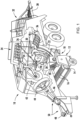
- FIGS. 1 and 2 illustrate differing views of one embodiment of an agricultural baler 10 in accordance with aspects of the present subject matter.
- FIG. 1 illustrates a perspective, partially cut-away view of the agricultural baler 10.
- FIG. 2 illustrates a schematic, internal view of the baler components that allow for the two-stages of crop compression within the baler 10.
- the baler 10 is configured as a rectangular baler.
- the baler 10 may have any other suitable baler configuration.
- the baler 10 is configured to operate using a two-stage feeding system for intaking crop material and forming a bale therefrom.
- crop material is lifted from windrows into the baler 10 using a pickup unit 12.
- the pickup unit 12 includes a rotating pickup roll 14 with tines 16 which move the crop rearward toward a packer unit 18.
- An optional pair of stub augers (one of which is shown, but not numbered) is positioned above the pickup roll 14 to move the crop material laterally inward.
- the packer unit 18 includes packer tines 20 which push the crop into an inlet 21 ( FIG. 2 ) of a pre-compression chamber 22 to form a wad or charge of crop material.
- the packer tines 20 intertwine the crop together and pack the crop within the pre-compression chamber 22, with the pre-compression chamber 22 and the packer tines 20 generally functioning as the first stage of crop compression within the baler 10.
- a stuffer assembly 24 moves the charge of crop material through an outlet 23 ( FIG. 2 ) of the pre-compression chamber 22 to a main baling chamber 26 of the baler 10.
- the stuffer assembly 24 includes stuffer forks 28 which thrust the bale charge 80 directly in front of an actuating mechanism, such as a plunger 30, which reciprocates back and forth relative to the baling chamber 26 to compress each new charge of crop material 80 into a bale 82.
- the plunger 30 is actuated in a baling direction (indicated by arrow 31 shown in FIG.
- baling chamber 26 and the plunger 30 generally function as the second stage if crop compression within the baler 10.
- the stuffer forks 28 of the stuffer assembly 26 may generally be configured to be actuated relative to the pre-compression chamber 22 using any suitable actuation means known in the art.
- the stuffer assembly 26 includes a first stuffer actuator 52 (e.g., a hydraulic cylinder or motor) coupled to the stuffer forks 28 and a second stuffer actuator 54 (e.g., a hydraulic cylinder or motor) coupled to the first stuffer actuator 52 via a lever 56.
- the stuffer forks 28 may be moved or actuated relative to the pre-compression chamber 22 to allow a charge of crop material to be formed therein and to also permit the charge of crop material to be pushed upwardly into the main baling chamber 26.
- the stuffer forks 28 are shown in FIG. 2 at a loading position 58 (indicated by the solid lines) at which the stuffer forks 28 essentially cover or close the outlet 23 of the pre-compression chamber 22, thereby allowing crop material entering the chamber 22 via the chamber inlet 21 to be compressed therein.
- the first stuffer actuator 52 may be initially retracted to move the stuffer forks 28 away from the chamber outlet 23 (e.g., in direction A), which then allows the first stuffer actuator 52 (and, thus, the stuffer forks 28 coupled thereto) to be pivoted downwardly (e.g., in pivot direction B) via retraction of the second stuffer actuator 54.
- the first stuffer actuator 52 can then be extended to actuate the stuffer forks 28 outwardly again towards the pre-compression chamber 22 (e.g., in direction C) to the charging position 60 (indicated by the dashed lines).
- the second stuffer actuator 54 can be extended to pivot the stuffer forks 28 upwardly (e.g., in pivot direction D), thereby allowing the stuffer forks 28 to sweep upwardly along a curved path following the curved shape of the pre-compression chamber 22 to push the charge of crop material through the chamber outlet 23 and into the baling chamber 26.
- the process can be repeated to allow a new charge of material to be compressed within the pre-compression chamber 22 and subsequently pushed into the main baling chamber 26 via actuation of the stuffer forks 28.
- the plunger 30 may be configured to be actuated relative to the baling chamber 26 using any suitable reciprocation or actuation means known in the art.
- the plunger 30 is connected via a crank arm 40 to a gear box 42.
- the gear box 42 is driven by a flywheel 44, which, in turn, is connected via a drive shaft 46 with a power take-off (PTO) coupler 48.
- the PTO coupler 48 is detachably connected with the PTO spline at the rear of the associated traction unit, such as a tractor (not shown).
- the PTO coupler 48, the drive shaft 46, and the flywheel 44 collectively define a portion of a driveline 50, which provides rotative power to the gearbox 42.
- the flywheel 44 has a sufficient mass to carry the plunger 30 through a compression stroke as power is applied to the drive shaft 46 by the traction unit (not shown).
- a knotting assembly 33 ( FIG. 6 ) of the baler 10 can be used to tie-up the bale.
- knotters 34 FIG. 1
- knotting assembly 33 can be actuated which wrap and tie twine around the bale while it is still in the baling chamber 26.
- needles 36 FIG. 1
- the twine is cut and the formed bale is ejected from a discharge chute 38 ( FIG. 1 ) of the baler as a new bale is being formed within the baling chamber 26.
- length sensor 102 is provided in operative association with the baling chamber 26 for sensing or detecting one or more parameters associated with a current length 84 ( FIG. 2 ) of the bale 82 being formed therein.
- the length sensor 102 is a radar-based length sensor configured to transmit radar waves towards the bale 82 being formed within the baling chamber 26 and receive return waves corresponding to the radar waves as reflected off the bale 82.
- the wave-related radar data associated with the return waves received by the length sensor 102 are then used to estimate the current length 84 of the bale 82 within the baling chamber 26 as the bale 82 is advanced relative to the sensor 102 in the baling direction 31 with each stroke or actuation of the plunger 30.
- the length sensor 102 is generally configured to be located within or adjacent to the baling chamber 26, such as by mounting the length sensor 102 to a wall(s) of the baling chamber 26. For instance, as shown in FIG. 2 , the length sensor 102 is mounted to or otherwise supported by a top wall 27 of the baling chamber 26, such as at the same or a similar position that a conventional "star wheel" measurement device would be located. As a result, as the bale 82 advances through the baling chamber 26 with the addition of each new bale charge 80, the length sensor 102 may be used to detect parameters associated with the length of the bale 82. However, it should be appreciated that, in other embodiments, the length sensor 102 may be positioned at any other suitable location relative to the baling chamber 26 that allows the sensor 102 to generally function as described herein.
- FIG. 3 a partial, schematic view of an upper portion of the baling chamber 36 shown in FIG. 2 is illustrated in accordance with aspects of the present subject matter, particularly illustrating the length sensor 102 positioned relative to a bale 82 being formed within the baling chamber 26.
- the length sensor 102 is mounted to the top wall 27 of the baling chamber 26 such that the sensor 102 has a field of view or line-of-sight oriented towards a top side 82A of the bale 82 being formed within the chamber 26.
- the length sensor 102 may be mounted at any other suitable location relative to the baling chamber 26 that allows the sensor 102 to have a field of view or line-of-sight directed towards a portion of the bale 82, such as by coupling the sensor 102 to one of the sidewalls of the chamber 26 or the bottom wall of the chamber 26.
- the length sensor 102 is a radar-based length sensor configured to transmit radar waves (indicated by arrow 104) towards the adjacent portion of the bale 82 and receive return waves (indicated by arrow 106) corresponding to the radar waves 104 as reflected off the bale 82.
- the length sensor 102 may be oriented relative to the baling chamber 26 and/or the adjacent bale 82 such that the radar waves 104 are transmitted at an acute transmission angle 108 relative to the baling direction 31.
- the length sensor 102 may be supported relative to the baling chamber 26 such that the radar waves 104 are transmitted at the acute transition angle 108 in a direction opposite the baling direction 31.
- the bale 82 will advance or move relative to the length sensor 102 in the baling direction 31 while the length sensor 102 continuously transmits radar waves 104 towards the bale 82.
- the frequency of the return waves 106 received by the length sensor 102 will be modulated due to the Doppler Effect, with such frequency modulation being indicative of the distance traveled by the bale 82 relative to the sensor 102 within the baling chamber 26.
- the frequency is proportional to the speed or movement velocity of the bale 82 within the baling chamber 26.
- the movement velocity of the bale 82 can be determined with each actuation or stroke of the plunger 30. Thereafter, by knowing the time period across which the bale 82 is moved relative to the length sensor 102 due to the actuation of the plunger 30, the distance traveled by the bale 82 within the baling chamber 26 can be determined as a function of the movement velocity. For instance, the equations below provide relationships between the detected frequency of the return waves 106 received by the length sensor 102 and the bale movement velocity (Equation 1) and between the bale movement velocity and the distance traveled by the bale 82 within the baling chamber 26.
- v corresponds to the movement velocity of the bale 82 within the baling chamber 26
- f d corresponds to the doppler frequency of the return waves 106 received by the length sensor 102
- c corresponds to the speed of light
- f c corresponds to the carrier frequency of the radar-based length sensor 102
- ⁇ corresponds to the transmission angle 108 at which the radar waves 104 are transmitted relative to the baling direction
- d corresponds to the distance moved by the bale 82 in the baling direction 31 relative to the sensor 102
- t corresponds to the time period across which the bale 82 was moving at the velocity ( v ).
- the length or size of the bale 82 grows incrementally with each actuation of the plunger 30 as a new charge of material is being compressed into the existing bale 82 being formed within the baling chamber 26.
- the distance moved by the bale 82 e.g., as calculated per Equation 2 with each actuation of the plunger 30 generally corresponds to an incremental length adjustment distance ( d ) across which the length of the bale 82 was increased due to the addition of the new charge of crop material within the baling chamber 26.
- the incremental length adjustment distance calculated for the current plunger actuation may be summed with the incremental length adjustment distances calculated for previous plunger actuations associated with the formation of the current bale 82 to allow the current length of the bale 82 to be estimated or inferred. For instance, as provided below in Equation 3, each incremental length adjustment distance calculated for the bale 82 being formed may be summed to determine a total bale distance across which the bale 82 has moved relative to the length sensor 102 in the baling direction 31.
- d total d 1 + d 2 + d 3 + ... + d n
- d total corresponds to the total bale distance across which the bale 82 has moved relative to the length sensor 102 during the bale's formation within the baling chamber 26
- d corresponds to the incremental length adjustment distance across which the bale 82 moved relative to the length sensor 102 with each individual plunger actuation
- n generally corresponds to the number of plunger actuations occurring during formation of the current bale 82.
- the total bale distance calculated using Equation 3 may correspond to the current length of the bale 82 within the baling chamber 26 or may be used to estimate the current length of the bale 82.
- the length sensor 102 may be positioned within the baling chamber 26 such that only a percentage of the length of the bale 82 being formed therein (e.g., 50-75%) is advanced past the length sensor 102 prior to the bale 82 reaching its desired length.
- the current length of the bale 82 being formed within the baling chamber 26 is equal to the desired bale length.
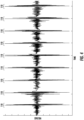
- FIG. 4 a sample data plot showing the voltage signal generated by the length sensor 102 (which can be correlated to the frequency of the return waves 106 ( FIG. 3 ) received by the length sensor 102) (y-axis) relative to time (x-axis) during the formation of a bale 82 within the baling chamber 26 is illustrated in accordance with aspects of the present subject matter. It should be appreciated that the data plot shown in FIG. 4 is simply illustrated to provide an example data plot for purposes of discussion. The data associated with the return waves 106 received by the length sensor 102 may vary from that shown in FIG. 4 .
- the variation in the voltage signal associated with the frequency of the return waves 106 received by the length sensor 102 exhibits a periodic or repeating pattern that generally corresponds to the frequency or interval at which the plunger 30 is being actuated relative to the baling chamber 26.
- the voltage spikes or increases e.g., at peak ranges 110
- the voltage spikes or increases along short time periods corresponding to when the plunger 30 is being actuated in the baling direction 31 to compress a new charge of crop material into the bale 82 being formed within the baling chamber 26, which results in the bale 82 being pushed or advanced in the baling direction 31 relative to the sensor 102 by a given distance (e.g., the incremental length adjustment distance).
- each peak range 110 is generally associated with a change in the current length of the bale 82 being formed within the baling chamber 26.
- FIG. 5 another sample data plot showing the voltage signal generated by the length sensor 102 (which can be correlated to the frequency of the return waves 106 ( FIG. 3 ) received by the length sensor 102) (y-axis) relative to time (x-axis) during the formation of a bale 82 within the baling chamber 26 is illustrated in accordance with aspects of the present subject matter.
- the data plot shown in FIG. 5 provides example data for a single plunger actuation (e.g., voltage data associated with the time period extending across one of the peak ranges 110 shown in FIG. 4 ).
- the data plot shown in FIG. 5 is simply illustrated to provide an example data plot for purposes of discussion.
- the data associated with the return waves 106 received by the length sensor 102 may vary from that shown in FIG. 5 .
- the voltage signal associated with the frequency of the return waves 106 received by the length sensor 102 may vary across the overall compression stroke of the plunger 30.
- the return wave or radar data has a first average frequency ( f 1 ) across a first time period ( ⁇ t 1 ) and a second average frequency ( f 2 ) across a second time period ( ⁇ t 2 ), with the first average frequency ( f 1 ) differing significantly from the second average frequency ( f 2 ) (e.g., by being significantly higher than the second average frequency ( f 2 )).
- first average frequency ( f 1 ) may be associated with a time period (e.g., the first time period ( ⁇ t 1 )) across which the plunger 30 is being initially actuated and begins to compress the new charge of crop material into the bale 82, such as during the first 60%-90% of the compression stroke of the plunger 30.
- the lower, second average frequency ( f 2 ) may be associated with a time period (e.g., the second time period ( ⁇ t 2 )) across which the plunger 30 is being actuated along the final portion of its compression stroke and during which the compressive forces within the bale 82 increase significantly while the bale movement velocity is reduced.
- the plunger 30 may be desirable to analyze the frequency data across two or more time periods corresponding to different portions or sections of the stroke of the plunger 30 when determining the total distance (e.g., the incremental length adjustment distance) across which the bale 82 has moved relative to the length sensor 102 during a given plunger actuation.
- the first average frequency ( f 1 ) may be used to calculate a first movement velocity for the bale 82 (e.g., via Equation 1), which can then be used together with the first time period ( ⁇ t 1 ) to calculate a first distance across which the bale 82 moved during such time period (e.g., via Equation 2).
- the second average frequency ( f 2 ) may be used to calculate a second movement velocity for the bale 82 (e.g., via Equation 1), which can then be used together with the first time period ( ⁇ t 2 ) to calculate a second distance across which the bale 82 moved during such time period (e.g., via Equation 2).
- the first and second distances may then, for example, be summed to calculate the total distance (e.g., the incremental length adjustment distance) across which the bale 82 moved during the relevant plunger actuation.
- the data may, instead, be considered collectively along the entire time period associated with the full compression stroke of the plunger 30 or may be split or divided into any other number of time periods, such as three or more time periods.
- average frequency values may be determined over a larger number of shorter time periods to provide a more accurate estimate of the total distance across which the bale 82 moves during a given plunger actuation.
- the bale 82 being formed within the baling chamber 26 may have a tendency to relax slightly as the plunger 30 is being retracted away from the bale 82 to allow a new charge of crop material to be delivered into the baling chamber 26.
- the radar data received by the length sensor 102 may also be analyzed to estimate or determine the relaxation distance of the bale 82 (i.e., the distance the bale 82 moved in the direction opposite the baling direction 31 following retraction of the plunger 30).
- the associated relaxation distance may be used to calculate a final incremental length adjustment distance associated with a given plunger actuation.
- the relaxation distance of the bale 82 following retraction of the plunger 30 may be used to adjust the distance across which the bale 82 moved in the baling direction 31 during actuation of the plunger 30 to calculate the final incremental length adjustment distance associated with such plunger actuation. This final distance value may then be used as the estimate for the amount of bale growth or the increase in the bale length occurring for the previous plunger actuation.
- FIG. 6 a schematic view of one embodiment of a system 100 for estimating the length of a bale of crop material during bale formation within an agricultural baler is illustrated in accordance with aspects of the present subject matter.
- the system 100 will generally be described herein with reference to the baler 10 described above with reference to FIGS. 1 and 2 and the length sensor 102 described above with reference to FIGS. 2 and 3 .
- the disclosed system 100 may generally be utilized with any baler have any suitable baler configuration and/or any length sensor have any other suitable sensor configuration.
- the system 100 includes a length sensor provided in operative association with the baling chamber 26 to provide data associated with the length of the bale of crop material being formed therein.
- the length sensor is configured as a radar-based length sensor, such as the length sensor 102 described above with reference to FIGS. 2 and 3 .
- the length sensor 102 is configured to transmit radar waves towards the adjacent portion of the bale 82 being formed within the baling chamber 26 and receive return waves corresponding to the radar waves as reflected off the bale 82.
- the system 100 also includes one or more processor-based or computing devices for receiving and subsequently processing the wave-related data (or "radar data") generated by the length sensor 102.
- the system 100 includes a controller 140 communicatively coupled to length sensor 102 for receiving radar data from the length sensor 102 associated with the frequency of the return waves 106 ( FIG. 3 ) detected or received by the length sensor 106.
- the controller 140 is configured to analyze the radar data received from the length sensor 102 to estimate the current length of the bale 82 being formed within the baling chamber 26. For instance, as described above with reference to Equations 1 and 2, the controller 140 may be configured to analyze the frequency of the return waves 106 received by the length sensor 102 to determine the speed or movement velocity of the bale 82 within the baling chamber 26, which may then be used to calculate or estimate the distance (e.g., the incremental length adjustment distance) across which the bale 82 moved in association with the previous plunger actuation.
- the distance e.g., the incremental length adjustment distance
- the controller 140 may estimate the current length 84 of the bale 82 within the chamber 26 by summing the individual incremental length adjustment distances together. Once the controller 140 determines that the current bale length 84 is equal to or exceeds a predetermined length threshold (e.g., a desired bale length), the controller 140 may, for instance, execute a suitable control action to complete the bale formation process, such as by controlling the operation of the knotting assembly 33 to wrap and tie twine around the formed bale 82 while it is still in the baling chamber 26.
- a predetermined length threshold e.g., a desired bale length
- the controller 140 may correspond to any suitable processor-based device(s), such as a computing device or any combination of computing devices.
- the controller 140 may generally include one or more processor(s) 142 and associated memory devices 144 configured to perform a variety of computer-implemented functions (e.g., performing the methods, steps, algorithms, calculations and the like disclosed herein).
- processor refers not only to integrated circuits referred to in the art as being included in a computer, but also refers to a controller, a microcontroller, a microcomputer, a programmable logic controller (PLC), an application specific integrated circuit, and other programmable circuits.
- PLC programmable logic controller
- the memory 144 may generally comprise memory element(s) including, but not limited to, computer readable medium (e.g., random access memory (RAM)), computer readable non-volatile medium (e.g., a flash memory), a floppy disk, a compact disc-read only memory (CD-ROM), a magneto-optical disk (MOD), a digital versatile disc (DVD) and/or other suitable memory elements.
- RAM random access memory
- RAM computer readable non-volatile medium
- CD-ROM compact disc-read only memory
- MOD magneto-optical disk
- DVD digital versatile disc
- Such memory 144 may generally be configured to store information accessible to the processor(s) 142, including data 146 that can be retrieved, manipulated, created and/or stored by the processor(s) 142 and instructions 148 that can be executed by the processor(s) 142.
- the data 146 may be stored in one or more databases.
- the memory 144 may include a sensor database 150 for storing data received from one or more sensors of the disclosed system 100.
- the radar data received from the length sensor 102 may be stored within the sensor database 150, such as frequency data associated with the return waves 106 ( FIG. 3 ) received by the length sensor 102.
- suitable data derived from the sensor data may also be stored within the sensor database 150. For instance, in one embodiment, data associated with movement velocity of the bale 82, as determined based on the frequency data, may be stored within the sensor database 150
- the memory 144 may include a bale length database 152 for storing information related to the length of each bale 82 formed within the baling chamber 26. For instance, as indicated above, by analyzing the frequency data associated with each plunger actuation as a bale 82 is being formed within the baler 10, the distance (e.g., the incremental length adjustment distance) across which the bale 82 is moved relative to the length sensor 102 may be determined. In such embodiments, the incremental length adjustment distance associated with each plunger actuation may be stored within the bale length database 152. Additionally, the current length estimated for the bale 82 (e.g., based on the sum of the incremental length adjustment distances associated with the various plunger actuations performed during formation of such bale) may also be stored within the bale length database 152.
- the distance e.g., the incremental length adjustment distance
- the current length estimated for the bale 82 e.g., based on the sum of the incremental length adjustment distances associated with the various plunger actuations performed during formation of
- the instructions 148 stored within the memory 144 of the controller 140 may be executed by the processor(s) 142 to implement a data analysis module 154.
- the data analysis module 154 may be configured to analyze the radar data received from length sensor 102 to estimate the length of the bale 82 that is currently being formed within the baling chamber 26.
- the controller 140 may include mathematical expressions (e.g., Equations 1 and 2) and/or look-up tables stored within its memory 144 that correlate the frequency data associated with the return waves 106 ( FIG.
- the data analysis module 154 may then sum the various incremental length adjustment distances to calculate or estimate the current length of the bale 82 being formed within the baling chamber 26.
- the controller 140 may also be configured to actively control the operation one or more components of the baler 10. For instance, in several embodiments, the controller 140 may be configured to control the operation of the knotting assembly 33 of the baler 10 based on the estimated length of the bale 82 currently being formed within the baler 10. Specifically, in several embodiments, with each incremental adjustment in the length of the bale 82 following actuation of the plunger 30, the controller 140 may compare the newly calculated bale length to a predetermined bale length threshold (e.g., a desired bale length).
- a predetermined bale length threshold e.g., a desired bale length
- the controller 140 may be configured to control the operation of the knotting assembly 33, such as by actuating the knotters 34 and the needles 36 of the knotting assembly 33, to wrap and tie twine around the formed bale 82 while it is still in the baling chamber 26. The twine may then be cut and to allow the blade 82 to be ejected from the discharge chute 38 ( FIG. 1 ) of the baler 10.
- the controller 140 may also include a communications interface 160 to provide a means for the controller 140 to communicate with any of the various other system components described herein.
- a communications interface 160 to provide a means for the controller 140 to communicate with any of the various other system components described herein.
- one or more respective communicative links or interfaces 162 e.g., one or more data buses
- one or more respective communicative links or interfaces 164 may be provided between the communications interface 160 and the knotting assembly 33 to allow the controller 140 to transmit control signals for controlling the operation of the knotting assembly 33.
- FIG. 7 a flow diagram of one embodiment of a method 200 for estimating the length of a bale of crop material during bale formation within an agricultural baler is illustrated in accordance with aspects of the present subject matter.
- the method 200 will be described herein with reference to the baler 10 and the embodiments of the system 100 described above with reference to FIGS. 1-3 and 6 .
- the disclosed method 200 may generally be implemented with any agricultural baler having any suitable baler configuration and/or any system having any suitable system configuration.
- FIG. 7 depicts steps performed in a particular order for purposes of illustration and discussion, the methods discussed herein are not limited to any particular order or arrangement.
- the method 200 includes forming a bale of crop material within a baling chamber of an agricultural baler.
- each bale may be formed by a plurality of bale charges, with each bale charge being separately delivered into the baling chamber (e.g., via the stuffer assembly 24).
- a plunger 30 is actuated (e.g., in a baling direction 31) to compress the bale charge into the bale being formed within the chamber 26.
- the method 200 includes transmitting radar waves towards the bale of crop material within the baling chamber and receiving return waves corresponding to the radar waves as reflected off the bale of crop material within the baling chamber.
- a radar-based length sensor 102 is mounted or otherwise supported relative to the baling chamber 26 in a manner that allows the sensor 102 to transmit radar waves towards the adjacent bale being formed within the chamber 26. The radar waves reflected off the bale are then received by the length sensor 102 as return waves.
- the method 200 includes estimating a parameter associated with a current length of the bale of crop material within the baling chamber based at least in part on radar data associated with the received return waves.
- the parameter associated with a current length of the bale of crop material is the current length of the bale of crop material.
- the radar collected by the length sensor 102 may be transmitted to a computing device or controller 140 for subsequent processing and analysis.
- the controller 140 may be configured to analyze the frequency of the return waves received by the length sensor 102 to determine the speed or movement velocity of the bale within the baling chamber 26, which may then be used to calculate or estimate the distance (e.g., the incremental length adjustment distance) across which the bale moved in association with the previous plunger actuation.
- the controller 140 may estimate the current length of the bale within the chamber 26 by summing the individual incremental length adjustment distances together.
- the steps of the method 200 are performed by the controller 140 upon loading and executing software code or instructions which are tangibly stored on a tangible computer readable medium, such as on a magnetic medium, e.g., a computer hard drive, an optical medium, e.g., an optical disc, solid-state memory, e.g., flash memory, or other storage media known in the art.
- a tangible computer readable medium such as on a magnetic medium, e.g., a computer hard drive, an optical medium, e.g., an optical disc, solid-state memory, e.g., flash memory, or other storage media known in the art.
- any of the functionality performed by the controller 140 described herein, such as the method 200 is implemented in software code or instructions which are tangibly stored on a tangible computer readable medium.
- the controller 140 loads the software code or instructions via a direct interface with the computer readable medium or via a wired and/or wireless network. Upon loading and executing such software code or instructions by the controller 140, the controller 140
- software code or “code” used herein refers to any instructions or set of instructions that influence the operation of a computer or controller. They may exist in a computer-executable form, such as machine code, which is the set of instructions and data directly executed by a computer's central processing unit or by a controller, a human-understandable form, such as source code, which may be compiled in order to be executed by a computer's central processing unit or by a controller, or an intermediate form, such as object code, which is produced by a compiler.
- the term "software code” or “code” also includes any human-understandable computer instructions or set of instructions, e.g., a script, that may be executed on the fly with the aid of an interpreter executed by a computer's central processing unit or by a controller.
Landscapes
- Engineering & Computer Science (AREA)
- Radar, Positioning & Navigation (AREA)
- Remote Sensing (AREA)
- Physics & Mathematics (AREA)
- Computer Networks & Wireless Communication (AREA)
- General Physics & Mathematics (AREA)
- Electromagnetism (AREA)
- Life Sciences & Earth Sciences (AREA)
- Environmental Sciences (AREA)
- Preliminary Treatment Of Fibers (AREA)
Claims (11)
- Presse à balles agricole (10) comprenant une chambre de mise en balles (26), comprenant un système (100) pour estimer la longueur des balles de matériau de récolte (82) pendant la formation de balles, dans laquelle la balle de matériau de récolte (82) est formée à partir d'une pluralité de charges de balles (80) livrées séparément dans la chambre de mise en balles (26), la presse à balles agricole (10) comprenant en outre un piston (30) configuré pour être actionné par rapport à la chambre de mise en balles (26) dans un sens de mise en balles (31) lorsque chaque charge de balles (80) de la pluralité de charges de balles (80) est livrée dans la chambre de mise en balles (26) pour comprimer chacune desdites charges de balles (80) dans la balle de matériau de récolte (82) formée à l'intérieur de la chambre de mise en balles (26), le système (100) étant caractérisé par ;un capteur de longueur à base de radar (102) fourni en association fonctionnelle avec la chambre de mise en balles (26), le capteur de longueur (102) étant configuré pour transmettre des ondes radar (104) vers une balle de matériau de récolte (82) formée dans la chambre de mise en balles (26) et recevoir des ondes de retour (106) correspondant aux ondes radar (104) telles que reflétées par la balle de matériau de récolte (82) ; etun dispositif de commande (140) couplé de manière communicative au capteur de longueur (102), le dispositif de commande (140) étant configuré pour, en se basant au moins en partie sur les données radar associées aux ondes de retour (106) reçues par le capteur de longueur (102),déterminer une vitesse de déplacement de la balle de matériau de récolte (82) à l'intérieur de la chambre de mise en balles (26) à chaque actionnement du piston (30) par rapport à la chambre de mise en balles (26) dans le sens de mise en balles (31), etestimer la longueur actuelle (84) de la balle de matériau de récolte (82) formée dans la chambre de mise en balles (26).
- Système (100) selon la revendication 1, dans lequel, lorsque chacune desdites charges de balle (80) est comprimée dans la balle de matériau de récolte (82) formée dans la chambre de mise en balles (26), le dispositif de commande (140) est configuré pour déterminer une distance d'ajustement de longueur incrémentielle de la balle de matériau de récolte (82) dans la chambre de mise en balles (26) en se basant au moins en partie sur les données radar.
- Système (100) selon la revendication 2, dans lequel le dispositif de commande (140) est configuré pour estimer la longueur actuelle (84) de la balle de matériau de récolte (82) en additionnant les distances d'ajustement de longueur incrémentielle déterminées en association avec chacune desdites charges de balle (80) qui est comprimée dans la balle de matériau de récolte (82) formée à l'intérieur de la chambre de mise en balles (26).
- Système (100) selon la revendication 2, dans lequel la distance d'ajustement de longueur incrémentielle est déterminée au moins en partie par le calcul d'une distance de déplacement de la balle de matériau de récolte (82) par rapport au capteur de longueur (102) à l'intérieur de la chambre de mise en balles (26) dans le sens de mise en balles (31).
- Système (100) selon la revendication 4, dans lequel le dispositif de commande (140) est en outre configuré pour calculer une distance à laquelle la balle de matériau de récolte (82) est déplacée par rapport au capteur de longueur (102) sur la base, au moins en partie, de la vitesse de déplacement, la longueur actuelle (84) de la balle de matériau de récolte (82) étant estimée sur la base, au moins en partie, de la distance calculée.
- Système (100) selon l'une quelconque des revendications précédentes, dans lequel le dispositif de commande (140) est en outre configuré pour comparer la longueur actuelle (84) de la balle de matériau de récolte (82) à un seuil de longueur de balle prédéterminé, le dispositif de commande (104) étant configuré pour commander une opération d'un ensemble de nouage (33) de la presse à balles agricole (10) pour enrouler et lier de la ficelle autour de la balle de matériau de récolte (82) lorsque la longueur actuelle (84) de la balle de matériau de récolte (82) est égale ou supérieure au seuil de longueur de balle prédéterminé.
- Procédé (200) d'estimation de la longueur des balles de matériau de récolte (82) pendant la formation de balles dans une presse à balles agricole (10), le procédé comprenant la formation d'une balle de matériau de récolte (82) à partir d'une pluralité de charges de balles (80) livrées séparément dans une chambre de mises en balles (26) de la presse à balles agricole (10), dans lequel la formation de la balle de matériau de récolte (82) dans la chambre de mise en balles (26) comprend l'actionnement d'un piston (30) par rapport à la chambre de mise en balles (26) dans un sens de mise en balles (31) à mesure que chaque charge de balle (80) de la pluralité de charges de balles (80) est livrée dans la chambre de mise en balles (26) pour comprimer chacune desdites charges de balle (80) dans la balle de matériau de récolte (82), le procédé (200) étant caractérisé par les étapes consistant à :transmettre des ondes radar (104) en direction de la balle de matériau de récolte (82) dans la chambre de mise en balles (26) ;recevoir des ondes de retour (106) correspondant aux ondes radar (104) reflétées par la balle de matériau de récolte (82) à l'intérieur de la chambre de mise en balles (26) ; eten se basant au moins en partie sur les données radar associées aux ondes de retour (106) reçues par le capteur de longueur (102), déterminer une vitesse de déplacement de la balle de matériau de récolte (82) à l'intérieur de la chambre de mise en balles (26) à chaque actionnement du piston (30) par rapport à la chambre de mise en balles (26) dans le sens de mise en balles (31), et estimer une longueur actuelle (84) de la balle de matériau de récolte (82) à l'intérieur de la chambre de mise en balles (26) en se basant au moins en partie sur les données radar associées aux ondes de retour reçues (106).
- Procédé (200) selon la revendication 7, dans lequel l'estimation de la longueur actuelle (84) de la balle de matériau de récolte (82) dans la chambre de mise en balles (26) comprend la détermination, avec chacune desdites charges de balle (80) comprimée dans la balle de matériau de récolte (82), d'une distance d'ajustement de longueur incrémentielle de la balle de matériau de récolte (82) dans la chambre de mises en balles (26) sur la base, au moins en partie, des données radar.
- Procédé (200) selon la revendication 8, comprenant en outre l'estimation de la longueur actuelle (84) de la balle de matériau de récolte (82) en additionnant les distances d'ajustement de longueur incrémentielle déterminées en association avec chacune desdites charges de balle (80) comprimée dans la balle de matériau de récolte (82).
- Procédé (200) selon la revendication 8, dans lequel la détermination de la distance d'ajustement de longueur incrémentielle comprend le calcul d'une distance de déplacement de la balle de matériau de récolte (82) à l'intérieur de la chambre de mise en balles (26) dans le sens de mise en balles (31) sur la base, au moins en partie, des données radar.
- Procédé (200) selon l'une quelconque des revendications précédentes 7 à 10, comprenant en outre la comparaison de la longueur actuelle (84) de la balle de matériau de récolte (82) à un seuil de longueur de balle prédéterminé et la commande d'une opération d'un ensemble de nouage (33) de la presse à balles agricole (10) pour enrouler et lier de la ficelle autour de la balle de matériau de récolte (82) lorsque la longueur actuelle (84) de la balle de matériau de récolte (82) est égale ou supérieure au seuil de longueur de balle prédéterminé.
Applications Claiming Priority (1)
| Application Number | Priority Date | Filing Date | Title |
|---|---|---|---|
| IT102019000023379A IT201900023379A1 (it) | 2019-12-09 | 2019-12-09 | Sistema e metodo per stimare la lunghezza di una balla di materiale raccolto durante la formazione di una balla |
Publications (2)
| Publication Number | Publication Date |
|---|---|
| EP3834603A1 EP3834603A1 (fr) | 2021-06-16 |
| EP3834603B1 true EP3834603B1 (fr) | 2023-08-30 |
Family
ID=70009292
Family Applications (1)
| Application Number | Title | Priority Date | Filing Date |
|---|---|---|---|
| EP20212836.9A Active EP3834603B1 (fr) | 2019-12-09 | 2020-12-09 | Système et procédé d'estimation de la longueur d'une balle de matériau récolté lors de la formation de la balle |
Country Status (2)
| Country | Link |
|---|---|
| EP (1) | EP3834603B1 (fr) |
| IT (1) | IT201900023379A1 (fr) |
Families Citing this family (1)
| Publication number | Priority date | Publication date | Assignee | Title |
|---|---|---|---|---|
| US12674654B2 (en) * | 2022-06-07 | 2026-07-07 | Cnh Industrial America Llc | Agricultural baler with flake prediction for bale length control |
Family Cites Families (4)
| Publication number | Priority date | Publication date | Assignee | Title |
|---|---|---|---|---|
| ES2311388B1 (es) * | 2006-12-27 | 2009-12-17 | Orona, S. Coop. | Aparato elevador y metodo con sistema para determinar posicion y/o velocidad. |
| AU2010101429A4 (en) * | 2010-12-17 | 2011-02-17 | Precision Agronomics Australia | Baler Yield Mapping System |
| BE1021130B1 (nl) * | 2013-02-15 | 2016-01-05 | Cnh Industrial Belgium Nv | Balenkamersensor |
| US11385342B2 (en) * | 2017-02-06 | 2022-07-12 | Nec Corporation | Object sensing apparatus, object sensing method, and computer readable recording medium |
-
2019
- 2019-12-09 IT IT102019000023379A patent/IT201900023379A1/it unknown
-
2020
- 2020-12-09 EP EP20212836.9A patent/EP3834603B1/fr active Active
Also Published As
| Publication number | Publication date |
|---|---|
| EP3834603A1 (fr) | 2021-06-16 |
| IT201900023379A1 (it) | 2021-06-09 |
Similar Documents
| Publication | Publication Date | Title |
|---|---|---|
| US6546705B2 (en) | Method and apparatus for controlling a tractor/baler combination | |
| EP3398420B1 (fr) | Procédé et dispositif de contrôle de la vitesse d'une presse à balles | |
| US9101092B2 (en) | Square baler comprising a control system | |
| US7140170B2 (en) | Device and method for measuring and controlling bale length | |
| US9949440B2 (en) | Sensor arrangement | |
| EP3262921B1 (fr) | Ramasseuse-presse | |
| EP3726958B1 (fr) | Presse à balles avec capteur nir dans une face de piston | |
| EP2720527B1 (fr) | Améliorations apportées à des presses à fourrage à balles carrées | |
| AU2021351010A1 (en) | An agricultural system | |
| EP2816889B1 (fr) | Système de commande multi-modes pour une presse à balles rectangulaires et procédé associé | |
| EP3834604B1 (fr) | Systeme et méthode pour déterminer des paramètres associés à unecharge formée dans une chambre de pré-compression associée à une presse agricole | |
| US11994479B2 (en) | System and method for determining bale properties of a crop material bale using microwave-based sensing | |
| US20070245704A1 (en) | Yield monitor system | |
| EP3834603A1 (fr) | Système et procédé d'estimation de la longueur d'une balle de matériau récolté lors de la formation de la balle | |
| US10426097B2 (en) | Agricultural baler with startup mode | |
| EP3939412A1 (fr) | Système et procédé d'estimation ou de prédiction de l'état de vie des composants d'une ramasseuse-presse agricole | |
| US20150373919A1 (en) | Improvements in Square Balers | |
| US12593755B2 (en) | Agricultural baler with remote bale length control | |
| US20230392917A1 (en) | Agricultural baler with flake prediction for bale length control | |
| WO2024261567A1 (fr) | Presse à balles agricole |
Legal Events
| Date | Code | Title | Description |
|---|---|---|---|
| PUAI | Public reference made under article 153(3) epc to a published international application that has entered the european phase |
Free format text: ORIGINAL CODE: 0009012 |
|
| STAA | Information on the status of an ep patent application or granted ep patent |
Free format text: STATUS: THE APPLICATION HAS BEEN PUBLISHED |
|
| AK | Designated contracting states |
Kind code of ref document: A1 Designated state(s): AL AT BE BG CH CY CZ DE DK EE ES FI FR GB GR HR HU IE IS IT LI LT LU LV MC MK MT NL NO PL PT RO RS SE SI SK SM TR |
|
| STAA | Information on the status of an ep patent application or granted ep patent |
Free format text: STATUS: REQUEST FOR EXAMINATION WAS MADE |
|
| 17P | Request for examination filed |
Effective date: 20211216 |
|
| RBV | Designated contracting states (corrected) |
Designated state(s): AL AT BE BG CH CY CZ DE DK EE ES FI FR GB GR HR HU IE IS IT LI LT LU LV MC MK MT NL NO PL PT RO RS SE SI SK SM TR |
|
| GRAP | Despatch of communication of intention to grant a patent |
Free format text: ORIGINAL CODE: EPIDOSNIGR1 |
|
| STAA | Information on the status of an ep patent application or granted ep patent |
Free format text: STATUS: GRANT OF PATENT IS INTENDED |
|
| RIC1 | Information provided on ipc code assigned before grant |
Ipc: G01S 13/88 20060101ALI20230302BHEP Ipc: G01S 13/50 20060101ALI20230302BHEP Ipc: A01F 15/08 20060101AFI20230302BHEP |
|
| INTG | Intention to grant announced |
Effective date: 20230321 |
|
| RAP3 | Party data changed (applicant data changed or rights of an application transferred) |
Owner name: CNH INDUSTRIAL ITALIA S.P.A. |
|
| GRAS | Grant fee paid |
Free format text: ORIGINAL CODE: EPIDOSNIGR3 |
|
| GRAA | (expected) grant |
Free format text: ORIGINAL CODE: 0009210 |
|
| STAA | Information on the status of an ep patent application or granted ep patent |
Free format text: STATUS: THE PATENT HAS BEEN GRANTED |
|
| AK | Designated contracting states |
Kind code of ref document: B1 Designated state(s): AL AT BE BG CH CY CZ DE DK EE ES FI FR GB GR HR HU IE IS IT LI LT LU LV MC MK MT NL NO PL PT RO RS SE SI SK SM TR |
|
| REG | Reference to a national code |
Ref country code: GB Ref legal event code: FG4D |
|
| REG | Reference to a national code |
Ref country code: CH Ref legal event code: EP |
|
| REG | Reference to a national code |
Ref country code: DE Ref legal event code: R096 Ref document number: 602020016639 Country of ref document: DE |
|
| REG | Reference to a national code |
Ref country code: IE Ref legal event code: FG4D |
|
| REG | Reference to a national code |
Ref country code: LT Ref legal event code: MG9D |
|
| REG | Reference to a national code |
Ref country code: NL Ref legal event code: MP Effective date: 20230830 |
|
| REG | Reference to a national code |
Ref country code: AT Ref legal event code: MK05 Ref document number: 1604139 Country of ref document: AT Kind code of ref document: T Effective date: 20230830 |
|
| PG25 | Lapsed in a contracting state [announced via postgrant information from national office to epo] |
Ref country code: GR Free format text: LAPSE BECAUSE OF FAILURE TO SUBMIT A TRANSLATION OF THE DESCRIPTION OR TO PAY THE FEE WITHIN THE PRESCRIBED TIME-LIMIT Effective date: 20231201 |
|
| PG25 | Lapsed in a contracting state [announced via postgrant information from national office to epo] |
Ref country code: IS Free format text: LAPSE BECAUSE OF FAILURE TO SUBMIT A TRANSLATION OF THE DESCRIPTION OR TO PAY THE FEE WITHIN THE PRESCRIBED TIME-LIMIT Effective date: 20231230 |
|
| PG25 | Lapsed in a contracting state [announced via postgrant information from national office to epo] |
Ref country code: SE Free format text: LAPSE BECAUSE OF FAILURE TO SUBMIT A TRANSLATION OF THE DESCRIPTION OR TO PAY THE FEE WITHIN THE PRESCRIBED TIME-LIMIT Effective date: 20230830 Ref country code: RS Free format text: LAPSE BECAUSE OF FAILURE TO SUBMIT A TRANSLATION OF THE DESCRIPTION OR TO PAY THE FEE WITHIN THE PRESCRIBED TIME-LIMIT Effective date: 20230830 Ref country code: NO Free format text: LAPSE BECAUSE OF FAILURE TO SUBMIT A TRANSLATION OF THE DESCRIPTION OR TO PAY THE FEE WITHIN THE PRESCRIBED TIME-LIMIT Effective date: 20231130 Ref country code: LV Free format text: LAPSE BECAUSE OF FAILURE TO SUBMIT A TRANSLATION OF THE DESCRIPTION OR TO PAY THE FEE WITHIN THE PRESCRIBED TIME-LIMIT Effective date: 20230830 Ref country code: LT Free format text: LAPSE BECAUSE OF FAILURE TO SUBMIT A TRANSLATION OF THE DESCRIPTION OR TO PAY THE FEE WITHIN THE PRESCRIBED TIME-LIMIT Effective date: 20230830 Ref country code: IS Free format text: LAPSE BECAUSE OF FAILURE TO SUBMIT A TRANSLATION OF THE DESCRIPTION OR TO PAY THE FEE WITHIN THE PRESCRIBED TIME-LIMIT Effective date: 20231230 Ref country code: HR Free format text: LAPSE BECAUSE OF FAILURE TO SUBMIT A TRANSLATION OF THE DESCRIPTION OR TO PAY THE FEE WITHIN THE PRESCRIBED TIME-LIMIT Effective date: 20230830 Ref country code: GR Free format text: LAPSE BECAUSE OF FAILURE TO SUBMIT A TRANSLATION OF THE DESCRIPTION OR TO PAY THE FEE WITHIN THE PRESCRIBED TIME-LIMIT Effective date: 20231201 Ref country code: FI Free format text: LAPSE BECAUSE OF FAILURE TO SUBMIT A TRANSLATION OF THE DESCRIPTION OR TO PAY THE FEE WITHIN THE PRESCRIBED TIME-LIMIT Effective date: 20230830 Ref country code: AT Free format text: LAPSE BECAUSE OF FAILURE TO SUBMIT A TRANSLATION OF THE DESCRIPTION OR TO PAY THE FEE WITHIN THE PRESCRIBED TIME-LIMIT Effective date: 20230830 |
|
| PG25 | Lapsed in a contracting state [announced via postgrant information from national office to epo] |
Ref country code: PL Free format text: LAPSE BECAUSE OF FAILURE TO SUBMIT A TRANSLATION OF THE DESCRIPTION OR TO PAY THE FEE WITHIN THE PRESCRIBED TIME-LIMIT Effective date: 20230830 Ref country code: NL Free format text: LAPSE BECAUSE OF FAILURE TO SUBMIT A TRANSLATION OF THE DESCRIPTION OR TO PAY THE FEE WITHIN THE PRESCRIBED TIME-LIMIT Effective date: 20230830 |
|
| PG25 | Lapsed in a contracting state [announced via postgrant information from national office to epo] |
Ref country code: ES Free format text: LAPSE BECAUSE OF FAILURE TO SUBMIT A TRANSLATION OF THE DESCRIPTION OR TO PAY THE FEE WITHIN THE PRESCRIBED TIME-LIMIT Effective date: 20230830 |
|
| PG25 | Lapsed in a contracting state [announced via postgrant information from national office to epo] |
Ref country code: SM Free format text: LAPSE BECAUSE OF FAILURE TO SUBMIT A TRANSLATION OF THE DESCRIPTION OR TO PAY THE FEE WITHIN THE PRESCRIBED TIME-LIMIT Effective date: 20230830 Ref country code: RO Free format text: LAPSE BECAUSE OF FAILURE TO SUBMIT A TRANSLATION OF THE DESCRIPTION OR TO PAY THE FEE WITHIN THE PRESCRIBED TIME-LIMIT Effective date: 20230830 Ref country code: ES Free format text: LAPSE BECAUSE OF FAILURE TO SUBMIT A TRANSLATION OF THE DESCRIPTION OR TO PAY THE FEE WITHIN THE PRESCRIBED TIME-LIMIT Effective date: 20230830 Ref country code: EE Free format text: LAPSE BECAUSE OF FAILURE TO SUBMIT A TRANSLATION OF THE DESCRIPTION OR TO PAY THE FEE WITHIN THE PRESCRIBED TIME-LIMIT Effective date: 20230830 Ref country code: DK Free format text: LAPSE BECAUSE OF FAILURE TO SUBMIT A TRANSLATION OF THE DESCRIPTION OR TO PAY THE FEE WITHIN THE PRESCRIBED TIME-LIMIT Effective date: 20230830 Ref country code: CZ Free format text: LAPSE BECAUSE OF FAILURE TO SUBMIT A TRANSLATION OF THE DESCRIPTION OR TO PAY THE FEE WITHIN THE PRESCRIBED TIME-LIMIT Effective date: 20230830 Ref country code: SK Free format text: LAPSE BECAUSE OF FAILURE TO SUBMIT A TRANSLATION OF THE DESCRIPTION OR TO PAY THE FEE WITHIN THE PRESCRIBED TIME-LIMIT Effective date: 20230830 Ref country code: PT Free format text: LAPSE BECAUSE OF FAILURE TO SUBMIT A TRANSLATION OF THE DESCRIPTION OR TO PAY THE FEE WITHIN THE PRESCRIBED TIME-LIMIT Effective date: 20240102 |
|
| REG | Reference to a national code |
Ref country code: DE Ref legal event code: R097 Ref document number: 602020016639 Country of ref document: DE |
|
| PLBE | No opposition filed within time limit |
Free format text: ORIGINAL CODE: 0009261 |
|
| STAA | Information on the status of an ep patent application or granted ep patent |
Free format text: STATUS: NO OPPOSITION FILED WITHIN TIME LIMIT |
|
| PG25 | Lapsed in a contracting state [announced via postgrant information from national office to epo] |
Ref country code: SI Free format text: LAPSE BECAUSE OF FAILURE TO SUBMIT A TRANSLATION OF THE DESCRIPTION OR TO PAY THE FEE WITHIN THE PRESCRIBED TIME-LIMIT Effective date: 20230830 |
|
| REG | Reference to a national code |
Ref country code: CH Ref legal event code: PL |
|
| 26N | No opposition filed |
Effective date: 20240603 |
|
| PG25 | Lapsed in a contracting state [announced via postgrant information from national office to epo] |
Ref country code: LU Free format text: LAPSE BECAUSE OF NON-PAYMENT OF DUE FEES Effective date: 20231209 |
|
| PG25 | Lapsed in a contracting state [announced via postgrant information from national office to epo] |
Ref country code: MC Free format text: LAPSE BECAUSE OF FAILURE TO SUBMIT A TRANSLATION OF THE DESCRIPTION OR TO PAY THE FEE WITHIN THE PRESCRIBED TIME-LIMIT Effective date: 20230830 |
|
| REG | Reference to a national code |
Ref country code: BE Ref legal event code: MM Effective date: 20231231 |
|
| PG25 | Lapsed in a contracting state [announced via postgrant information from national office to epo] |
Ref country code: MC Free format text: LAPSE BECAUSE OF FAILURE TO SUBMIT A TRANSLATION OF THE DESCRIPTION OR TO PAY THE FEE WITHIN THE PRESCRIBED TIME-LIMIT Effective date: 20230830 Ref country code: LU Free format text: LAPSE BECAUSE OF NON-PAYMENT OF DUE FEES Effective date: 20231209 |
|
| REG | Reference to a national code |
Ref country code: IE Ref legal event code: MM4A |
|
| PG25 | Lapsed in a contracting state [announced via postgrant information from national office to epo] |
Ref country code: IE Free format text: LAPSE BECAUSE OF NON-PAYMENT OF DUE FEES Effective date: 20231209 |
|
| PG25 | Lapsed in a contracting state [announced via postgrant information from national office to epo] |
Ref country code: BE Free format text: LAPSE BECAUSE OF NON-PAYMENT OF DUE FEES Effective date: 20231231 |
|
| PG25 | Lapsed in a contracting state [announced via postgrant information from national office to epo] |
Ref country code: CH Free format text: LAPSE BECAUSE OF NON-PAYMENT OF DUE FEES Effective date: 20231231 |
|
| PG25 | Lapsed in a contracting state [announced via postgrant information from national office to epo] |
Ref country code: IE Free format text: LAPSE BECAUSE OF NON-PAYMENT OF DUE FEES Effective date: 20231209 Ref country code: CH Free format text: LAPSE BECAUSE OF NON-PAYMENT OF DUE FEES Effective date: 20231231 Ref country code: BE Free format text: LAPSE BECAUSE OF NON-PAYMENT OF DUE FEES Effective date: 20231231 |
|
| PG25 | Lapsed in a contracting state [announced via postgrant information from national office to epo] |
Ref country code: BG Free format text: LAPSE BECAUSE OF FAILURE TO SUBMIT A TRANSLATION OF THE DESCRIPTION OR TO PAY THE FEE WITHIN THE PRESCRIBED TIME-LIMIT Effective date: 20230830 |
|
| PG25 | Lapsed in a contracting state [announced via postgrant information from national office to epo] |
Ref country code: BG Free format text: LAPSE BECAUSE OF FAILURE TO SUBMIT A TRANSLATION OF THE DESCRIPTION OR TO PAY THE FEE WITHIN THE PRESCRIBED TIME-LIMIT Effective date: 20230830 |
|
| PG25 | Lapsed in a contracting state [announced via postgrant information from national office to epo] |
Ref country code: CY Free format text: LAPSE BECAUSE OF FAILURE TO SUBMIT A TRANSLATION OF THE DESCRIPTION OR TO PAY THE FEE WITHIN THE PRESCRIBED TIME-LIMIT; INVALID AB INITIO Effective date: 20201209 |
|
| PG25 | Lapsed in a contracting state [announced via postgrant information from national office to epo] |
Ref country code: HU Free format text: LAPSE BECAUSE OF FAILURE TO SUBMIT A TRANSLATION OF THE DESCRIPTION OR TO PAY THE FEE WITHIN THE PRESCRIBED TIME-LIMIT; INVALID AB INITIO Effective date: 20201209 |
|
| PG25 | Lapsed in a contracting state [announced via postgrant information from national office to epo] |
Ref country code: TR Free format text: LAPSE BECAUSE OF FAILURE TO SUBMIT A TRANSLATION OF THE DESCRIPTION OR TO PAY THE FEE WITHIN THE PRESCRIBED TIME-LIMIT Effective date: 20230830 |
|
| PGFP | Annual fee paid to national office [announced via postgrant information from national office to epo] |
Ref country code: GB Payment date: 20251223 Year of fee payment: 6 |
|
| PGFP | Annual fee paid to national office [announced via postgrant information from national office to epo] |
Ref country code: IT Payment date: 20251218 Year of fee payment: 6 |
|
| PGFP | Annual fee paid to national office [announced via postgrant information from national office to epo] |
Ref country code: FR Payment date: 20251223 Year of fee payment: 6 |
|
| PGFP | Annual fee paid to national office [announced via postgrant information from national office to epo] |
Ref country code: DE Payment date: 20251229 Year of fee payment: 6 |