EP3834362B1 - Fälschungsschutz für digitale dateien - Google Patents
Fälschungsschutz für digitale dateien Download PDFInfo
- Publication number
- EP3834362B1 EP3834362B1 EP19737560.3A EP19737560A EP3834362B1 EP 3834362 B1 EP3834362 B1 EP 3834362B1 EP 19737560 A EP19737560 A EP 19737560A EP 3834362 B1 EP3834362 B1 EP 3834362B1
- Authority
- EP
- European Patent Office
- Prior art keywords
- digital
- file
- test
- data
- signature
- Prior art date
- Legal status (The legal status is an assumption and is not a legal conclusion. Google has not performed a legal analysis and makes no representation as to the accuracy of the status listed.)
- Active
Links
Images


Classifications
-
- H—ELECTRICITY
- H04—ELECTRIC COMMUNICATION TECHNIQUE
- H04L—TRANSMISSION OF DIGITAL INFORMATION, e.g. TELEGRAPHIC COMMUNICATION
- H04L9/00—Cryptographic mechanisms or cryptographic arrangements for secret or secure communications; Network security protocols
- H04L9/32—Cryptographic mechanisms or cryptographic arrangements for secret or secure communications; Network security protocols including means for verifying the identity or authority of a user of the system or for message authentication, e.g. authorization, entity authentication, data integrity or data verification, non-repudiation, key authentication or verification of credentials
- H04L9/3247—Cryptographic mechanisms or cryptographic arrangements for secret or secure communications; Network security protocols including means for verifying the identity or authority of a user of the system or for message authentication, e.g. authorization, entity authentication, data integrity or data verification, non-repudiation, key authentication or verification of credentials involving digital signatures
-
- H—ELECTRICITY
- H04—ELECTRIC COMMUNICATION TECHNIQUE
- H04L—TRANSMISSION OF DIGITAL INFORMATION, e.g. TELEGRAPHIC COMMUNICATION
- H04L9/00—Cryptographic mechanisms or cryptographic arrangements for secret or secure communications; Network security protocols
- H04L9/32—Cryptographic mechanisms or cryptographic arrangements for secret or secure communications; Network security protocols including means for verifying the identity or authority of a user of the system or for message authentication, e.g. authorization, entity authentication, data integrity or data verification, non-repudiation, key authentication or verification of credentials
- H04L9/3236—Cryptographic mechanisms or cryptographic arrangements for secret or secure communications; Network security protocols including means for verifying the identity or authority of a user of the system or for message authentication, e.g. authorization, entity authentication, data integrity or data verification, non-repudiation, key authentication or verification of credentials using cryptographic hash functions
- H04L9/3239—Cryptographic mechanisms or cryptographic arrangements for secret or secure communications; Network security protocols including means for verifying the identity or authority of a user of the system or for message authentication, e.g. authorization, entity authentication, data integrity or data verification, non-repudiation, key authentication or verification of credentials using cryptographic hash functions involving non-keyed hash functions, e.g. modification detection codes [MDCs], MD5, SHA or RIPEMD
-
- G—PHYSICS
- G06—COMPUTING OR CALCULATING; COUNTING
- G06F—ELECTRIC DIGITAL DATA PROCESSING
- G06F16/00—Information retrieval; Database structures therefor; File system structures therefor
- G06F16/10—File systems; File servers
- G06F16/14—Details of searching files based on file metadata
- G06F16/148—File search processing
- G06F16/152—File search processing using file content signatures, e.g. hash values
-
- H—ELECTRICITY
- H04—ELECTRIC COMMUNICATION TECHNIQUE
- H04L—TRANSMISSION OF DIGITAL INFORMATION, e.g. TELEGRAPHIC COMMUNICATION
- H04L9/00—Cryptographic mechanisms or cryptographic arrangements for secret or secure communications; Network security protocols
- H04L9/50—Cryptographic mechanisms or cryptographic arrangements for secret or secure communications; Network security protocols using hash chains, e.g. blockchains or hash trees
Definitions
- the present invention relates to the technical field of protection of digital data against forgery or tampering, and traceability of digital files.
- the patent application EP 3 031 169 A1 discloses at least one node in a distributed hash tree document verification infrastructure which is augmented with an identifier of an entity in a registration path.
- a data signature which includes parameters for recomputation of a verifying value, and which is associated with a digital input record, will therefore also include data that identifies at least one entity in the hash tree path used for its initial registration in the infrastructure.
- the patent application EP 3 820 712 A1 discloses a solution for securing an article against forgery and falsifying of its associated data, and particularly of data relating to its belonging to a specific batch of articles, while allowing offline or online checking of the authenticity of a secured article and conformity of its associated data with respect to that of a genuine article.
- the patent application WO 2010/0112101 A1 discloses a digital document which is protected through: receiving the digital document; receiving associated data comprising at least partially data from the digital document; creating a hash of the associated data; asymmetrically encrypting the hash with a private key to generate a digital signature; encoding in a machine-readable code the digital signature and the associated data; and recording the machine-readable code onto a resulting hardcopy.
- the authenticity of a printed hardcopy of the digital document can be verified through comparison of data extracted from the printed hardcopy with the associated data decoded and verified from the machine-readable code.
- the invention is also aimed at securing printable digital files so that it is easy to check authenticity of the data content of both the printable digital files and their printed versions.
- a goal of the invention is to secure print-ready digital files, a print ready digital file being known as a print file that meets the following criteria: all (possible) RGB images are converted into CMYK color, the file is in proper format like PSD, EPS, AL, High-Resolition JPG, PDF or TIF, and final image has enough resolution (i.e. 300 dpi or higher).
- the invention relates to a method of securing a given original digital file belonging to a batch of a plurality of original digital files against forgery or tampering, each original digital file including its own digital data, characterized by comprising the steps of:
- the digital security marking included in the digital file is printable as a barcode
- the printed document (including the printed barcode) obtained by printing the secured digital file is also secured, i.e. its printed data are secured against forgery or tampering.
- the reference root digital signature of the root node of the tree may either be published in a media accessible to the user, or stored in a searchable root database accessible to the user, or stored in a blockchain, or in a database secured by a blockchain, accessible to the user.
- the reference root digital signature is made immutable.
- the entanglement of the digital signatures of all the original digital files of a batch due to the tree structure and use of robust one-way functions for calculating the node values of the tree, together with the root digital signature of the tree that is made immutable and the inclusion of the digital data and its associated digital verification key in a digital security marking included in the corresponding original digital file, allow tracking and tracing the marked files and their copies, as well as their printed versions, with a very high level of reliability while preventing falsification of data and forgery of the marked files.
- the marked original digital file may further comprise root node access data included thereto and containing information sufficient to allow the user to access to the reference root digital signature of the root node of the tree corresponding to the batch of original digital files, said information being a link to an access interface operable to receive from the user a root request containing digital data, or digital file signature, obtained from a digital security marking of a marked original digital file, and send back a reference root digital signature of corresponding tree, the access interface allowing access to, respectively, one of the following:
- the one-way function may be a hash function and an a digital signature of an original digital file may be a sequence of a given plurality of bits of lower weights selected from the bits of a hash value of the corresponding digital data.
- additional digital data corresponding to the digital data associated with the marked original digital file may be stored in a searchable information database accessible to the user via an information database interface operable to receive from the user an information request containing digital data, or a digital file signature, obtained from a digital security marking of a marked original digital file, and send back corresponding additional digital data.
- the digital data of the marked original digital file may further include reference characteristic digital data of a corresponding unique physical characteristic of an associated object or individual.
- the unique physical characteristic of the associated object or individual may be, respectively, that of a material-based security marking applied on the associated object or identifying biometric feature of the associated individual.
- the sequence of digital signatures in the digital verification key included in the digital security marking may be arranged according to a sequence ordering of the nodes which is distinct from the ordering of corresponding nodes defined by the tree concatenation ordering, and the digital security marking may further include an ordering code associated with said sequence ordering.
- Another aspect of the invention relates to a method of verifying the authenticity of a digital file secured according to the above securing method, or the conformity of a copy of such secured digital file with respect to the original one, comprising the steps of, upon processing a test file being said digital file or said copy of the digital file by means of a processing unit connected to a memory:
- the memory of the processing unit may further store the associated fields data block, and the step of calculating a test digital signature corresponding to a test leaf node in a test tree corresponding to the digital security marking on the test file may comprise calculating with the one-way function a digital signature of a concatenation of the extracted test digital data and the stored fields data block.
- the above verifying method may comprise the preliminary steps of:
- the above verifying method may comprise the preliminary steps of:
- the imager may further be equipped with communication means operable to send to the information database interface an information request containing digital data, or a digital file signature, obtained from the digital security marking of the test file, and receive back corresponding additional digital data.
- the imager is further equipped with a sensor operable to detect a unique physical characteristic of respectively an associated object or individual, and the processing unit is programmed to extract corresponding characteristic digital data from a detection signal received from the sensor, the imager having stored in the memory reference characteristic digital data CDD corresponding to said unique physical characteristic of respectively the associated object or individual, the verifying method may comprise the further steps of, upon viewing a subject being said associated object or individual:
- Another aspect of the invention relates to a digital file belonging to a batch of a plurality of original digital files and secured according to the above mentioned securing method, each original digital file of the batch having its own digital data and corresponding digital verification key, said batch having a corresponding reference root digital signature, the digital file comprising a machine readable security marking including a representation of its digital data and its verification key.
- the digital data of the digital file may further include reference characteristic digital data CDD of a corresponding unique physical characteristic of an associated object or individual.
- the unique physical characteristic of the associated object may be that of a material-based security marking applied on the associated object.
- Another aspect of the invention relates to a system for verifying the authenticity of a digital file, or the conformity of a copy of such digital file, with respect to a marked original digital file belonging to a batch of original digital files secured according to the above mentioned securing method, comprising an imager having an imaging unit, a processing unit with a memory, and an image processing unit, the memory storing a reference root digital signature of a tree corresponding to the batch of original digital files, and the one-way function to calculate a digital signature of digital data and of a concatenation of digital signatures according to the nodes ordering of the tree and the tree concatenation ordering being programmed in the processing unit, said system being operable to:
- the memory of the processing unit further storing the associated fields data block
- the programmed operations of calculating a test digital signature corresponding to a test leaf node in a test tree corresponding to the digital security marking of the test file then comprise calculating with the one-way function a digital signature of a concatenation of the extracted test digital data and the stored fields data block.
- the above system being further equipped with a sensor connected to the processing unit and operable to detect a unique physical characteristic of an associated object or individual, and the processing unit being programmed to extract corresponding characteristic digital data from a detection signal received from the sensor, the system having stored in the memory reference characteristic digital data CDD corresponding to said unique physical characteristic of the associated object or individual, the system may further be operable to:
- Figure 1 illustrates a general concept of the invention relating to securing a batch of digital files and a method of computing an encoding of verifying information that may be associated with each digital file.
- Figure 1 illustrates a group or "batch" of digital files A 1 ,...,A 8 , containing a digital representation of a machine readable security marking 110 (here illustrated by a 2D barcode).
- digital security marking 110 in fact means "digital representation of a machine readable security marking 110".
- Figure 1 in fact illustrates a group or "batch" of digital files and its associated tree wherein, for simplicity, only eight original digital files are shown: A 1 ,...,A 8 .
- the tree associated with the batch of files A 1 ,...,A 8 is here a mere binary tree.
- a digital file may relate to a manufactured item or its packaging, a physical document or image, a package containing several items (such as a blister pack of medicine), or a container containing pallets of cartons of goods etc.
- An object but even a person may be "associated" with a digital file in the sense of the embodiments of the invention; for example, authorized attendees at an event or members of a group, or members of a flock or herd, could carry some form of ID badge or be physically marked with some marking containing data recorded in a corresponding digital file.
- a batch of digital files might, for example, relate to a common manufacturing run, items delivered by a particular supplier, items made or shipped during a time period, a set of related images, a group of people, a flock or herd, or any other user-defined grouping of any objects for which digital file A i (having digital content D i ) can be defined.
- any one of the articles shown on Figure 1 could be a "virtual article” A v , which is an optional software construct that may be included to enable encoding of selected data.
- a v virtual article
- one of the eight articles, e.g. article A 8 may in fact be a virtual article A v that is counted as belonging to the batch of eight articles, and is treated as any one of the other seven real articles since it may be processed substantially in the same way (although it does not correspond to a real object).
- a plurality of virtual articles A v1 ,A v2 ,...,A vk can be used for encoding digital data and produce more robust article digital signatures (see below).
- This data might be some measure of physical characteristics, textual data such as completed form or product information, a serial number or other identifier, indications of content, a digital representation of an image, or any other information that the system designer chooses to associate with an article.
- the article digital data D i may be extracted from human readable data (e.g. alphanumeric data) marked on an associated article (e.g.
- the associated digital data may include, for example, a batch identification number, the number of articles in the batch, a (pseudo-) random number for the sake of increasing security by increasing data entropy, date and/or time information, etc.
- One other form of associated data might be indications of allowable or non-permissible operations rules, expiration dates, etc.
- the digital data D v may be anything that can be represented in digital form.
- each article of the batch its respective digital article data D 1 ,D 2 ,...,D 7 ,D 8 is preferably transformed mathematically in such a way that it is essentially concealed, although this is not an absolute requirement for any embodiment.
- This transformation applied to the article digital data D i of an article A i serves to create a corresponding digital signature x i .
- This digital signature is produced by means of a one-way function, i.e. a function easy to compute but hard to invert (see S. Goldwasser and M. Bellare "Lecture Notes on Cryptography", MIT, July 2008, http://www-cse.ucsd.edu/users/mihir ) .
- the Hash function is a well-known example of a one-way function.
- a cryptographic hash function such as the SHA (Secure Hash Algorithm) class of functions, for example, SHA-256, is used, then there are the additional benefits that the function is practically irreversible and collision resistant, that is, the probability is negligible that two different inputs will lead to the same output. As will be understood from the description below, this is also not a requirement of the invention, although it is advantageous for the same reasons as in other applications.
- the values x 1 ,x 2 ,x 3 ,...,x 8 are the hash values, i.e.
- the article digital signature x j of article A j may even be just a sequence of a given plurality of bits of lower weights selected from the bits of the hash value H(D j ): for example, with the SHA-256 hash function of the SHA-2 family, it suffices to retain only the 128 bits of lower weights from the 256 bits of the signature to still have a robust signature with respect to codebreaking attack.
- Fig.1 shows a batch of eight marked original articles A 1 ,...,A 8 , each having a corresponding security 110 marking applied on it, and illustrates the method of securing the articles and their respective associated article digital data D 1 ,...D 8 (symbolically represented on files A i on Fig.1 by a sequence of bits "0" and "1") by means of a tree of digital signatures of the digital data.
- Trees associated with digital signatures are well known (binary hash trees, n-ary hash trees, or Merkle trees), they generally have base nodes, or leaf nodes, which are used to build next (intermediate) level nodes by digitally signing a concatenation of the digital signatures associated with the leaf nodes according to a certain grouping of the leaf nodes.
- the digital signatures associated with the first intermediate level nodes are respectively calculated by digitally signing (e.g. with a one-way hash function H, or a one-way elliptic curve function%) a concatenation of the digital signatures associated with two consecutive leaf nodes.
- the values of the first intermediate level nodes are obtained by concatenation of the values of n consecutive leaf nodes.
- a tree may as well have a more complex structure (mixed-trees) as the concatenation of the leaf nodes may be performed by pairs of consecutive nodes for certain leaf nodes, by triplet of nodes for other consecutive leaf nodes etc.
- the value of the first index i.e.
- the values of the next level (non-leaf) nodes i.e. the four nodes of level two a(2,1), a(2,2), a(2,3) and a(2,4), are obtained by digitally signing a concatenation (symbolically represented by an operator "+"), here by means of a hash function, of the values of pairs of leaf nodes, i.e. pairs of their child nodes in the tree. This grouping of child nodes for obtaining the values of the nodes of the next level defines the tree concatenation ordering.
- a(i,j) For simplifying the notations, we use the node symbol a(i,j) to also represent its associated value (i.e. its associated digital signature).
- the tree has only two intermediate levels above the leaf nodes level, and the root node on top level.
- the root node level is in fact the last non-leaf node level of the tree.
- a(2,1) H(H(D 1 )+H(D 2 )), (as a(1,1) and a(1,2) are the child nodes of node a(2,1))
- a 2,2 H a 1,3 + a 1,4 a
- 2,3 H a 1,5 + a 1,6 a
- R H(a(3,1)+a(3,2)).
- the reference root digital signature R of the batch of original digital files is made immutable, and thus forgery-proof, by being published in a (public) media accessible to a user having to check the authenticity of an article (or its associated data), or stored in a searchable root database accessible to the user, or, in a preferred mode, stored in a blockchain (or in a database secured by a blockchain) accessible to the user.
- the user may then store the reference value R acquired from these available sources.
- a corresponding digital verification key k i (or verification path) of the associated tree is then computed as a sequence of the respective digital signatures, from the leaf nodes level to the penultimate nodes level, of every other leaf node having the same parent node in the tree that the leaf-node corresponding to the digital signature of the original digital file A i , and successively at each next level in the tree, of every non-leaf node having the same parent node in the tree that the previous same parent node considered at the preceding level.
- R H(H(H(a(1,1)+a(1,2))+a(2,2))+a(3,2)).
- R H(H(H(a(1,1)+a(1,2))+a(2,2))+a(3,2)).
- R H(H(a(2,1)+H(a(1,3)+a(1,4)))+a(3,2)).
- R H(H(a(2,1)+H(a(1,3)+a(1,4)))+a(3,2)).
- R H(a(3,1)+H(H(a(1,5)+a(1,6))+a(2,4))).
- R H(a(3,1)+H(H(a(1,5)+a(1,6))+a(2,4))).
- R H(a(3,1)+H(a(2,3)+H(a(1,7)+a(1,8))).
- R H(a(3,1)+H(a(2,3)+H(a(1,7)+a(1,8))).
- the root node value R can finally be retrieved from any given leaf node value by a digital signature of a concatenation of this leaf node value with only the node values specified in the corresponding verification key.
- the volume of data in the verification information that is necessary for retrieving the root node value is clearly much lower than the volume of data necessary for calculating the reference root node value (i.e. based only on the leaf node values, by calculating all the non-leaf node values of the intermediate levels of the tree) : this is an advantage of the invention in view of the constraint of limited size available on a security marking (like a two-dimensional barcode).
- This securing scheme which has the advantage of not necessitating data encryption and thus, management of encryption/decryption keys (particularly, no cryptographic key is included in the digital security marking), is much more robust with respect to codebreaking attack compared to conventional encryption of data by means of public encryption key-private decryption key (like RSA "Rivest-Shamir-Adleman" system, for example).
- the size of digital data to be represented in the digital security marking according to the invention is compact and allows to use conventional representation of 2D barcodes (e.g. a QR code) (particularly useful for print-ready digital files), and thus conventional barcode readers (or even a mere programmed smartphone having a camera), while providing a very high level of robustness against codebreaking attacks.
- 2D barcodes e.g. a QR code
- this security marking is compatible with both online (via a server communicating with a code reader) and offline (via a programmed code reader) check of authenticity of a marked digital file and conformity of its data with respect to that of a genuine (original) digital file.
- the representation of digital data D i and that of key data k i may differ, the data concatenation scheme and/or the one-way function may depend on node level in the tree, which provide additional levels of robustness with respect to codebreaking attacks.
- digital data i.e. verification information V
- digital data D i of the respective original digital files A i of the batch are spread between given fields that are common to all the digital files of the batch, digital data relating to these fields are not included in each digital data Di but are clustered in a separate fields data block FDB associated with the batch of digital files, and:
- the fields data block FDB is made accessible to the user independently of the reference root digital signature.
- QR code as a representation of a 2D image included in a digital file.
- module density roughly, density of black/white "squares"
- QR codes are also generally classified depending on what level of error correction they include.
- L, M, Q, and H each representing the degree of "damage", that is, data loss, the QR code image can sustain and recover from.
- the levels L, M, Q, and H can sustain roughly 7%, 15%, 25% and 30% damage, respectively.
- the following table shows at least approximate values for different QR code versions: Version Size (in modules) Number of encodable bits ECC level L ECC level H 10 57 ⁇ 57 2192 976 25 117 ⁇ 117 10208 4304 40 177 ⁇ 177 23648 10208
- a suitable one-way function H should therefore also be chosen: a function of which output is too large in terms of required bits may be impossible to use at all, and a function of which range is too small may not be secure enough.
- scalability may be an issue. For example, some data security schemes involve signatures that grow as the number of members of a batch increases, and that could impermissibly limit the size of a batch from the perspective of how many bits the digital security marking 110 can encode. This is why, according to a preferred mode of the invention, the type of function chosen is the one-way hash function of the SHA-2 family.
- a computation module (not shown) is preferably included within a securing system to execute the code provided for performing the computations for digitally signing the digital data of the original digital files of a batch, for determining the digital verification keys for the different digital files, and for calculating the reference root digital signature of the corresponding tree.
- the securing system may also include suitable modules for inputting (pre-programmed) values corresponding to the digital data D v of the virtual digital file(s) A v . It would also be possible to perform the file-related hashing computations externally (e.g.
- corresponding verification information V i is compiled and is encoded (represented) in some form of machine readable digital security marking 110 that is then included in the respective article.
- V v (D v ,k v )
- Additional digital data may further be associated with a digital file and may include, for example, the batch value, i.e. reference root digital signature R, or any other information the system designer (or system administrator) chooses to include, such as, for example, an associated item serial number, batch ID, date/time information, product name, a URL that points to other, online information associated with either the individual item (such as an image of the item, or of its labelling or packaging, etc.), or the batch, or the supplier/manufacturer, a telephone number one may call for verification, etc.
- the additional digital data may be stored in a searchable information database accessible to a user (via an information database interface).
- the user may for example receive the one-way function securely (for example, using a public/private key pair) or by requesting this from the digital file provider or whichever entity having created the signatures and keys, or having it already programmed in a user's processing unit of its imager.
- the user will need to further know the type of data concatenation scheme (for concatenating node values via H(a(i,j)+a(i,k)) to be used for that: the user may receive this information in any known manner, either securely (for example, using a public/private key pair) or simply by requesting this from the digital file provider or whichever entity created the verification data, or having it already programmed in the user's processing unit.
- the concatenation scheme my in fact correspond to a mere conventional "joining end-to-end" of the two digital data blocks respectively corresponding to the two node values: in this case, no specific scheme must be transmitted to the user.
- the concatenation scheme may further insert a concatenation block, which may contain data specific to the rank or level of the concatenated digital data blocks in the tree, with the result of making even more difficult a codebreaking attack.
- the user can then compute (e.g. via the suitably programmed imager) the candidate root digital signature R c as explained above by step by step digitally signing a concatenation of the digital signature x 1 and node values according to the sequence of nodes specified in the digital verification key k 1 , see above the item "1)" relating to the node a(1,1), executed according to the nodes ordering in the tree and the tree concatenation ordering.
- This calculated candidate root digital signature R c should then be equal to the available (or published) reference R value: this value may have been previously acquired by the user and/or already stored in a memory of the imager's processing unit, it could also be a value that the recipient requests and receives from the system administrator in any known manner. If the candidate R c and the available reference root digital signatures R match, this computation then verifies the information in the digital secure marking 110 and confirms that the digital file A 1 is from the right batch.
- a link to access the reference root digital signature R for the batch corresponding to the digital file A 1 could be included in the digital security marking 110 (for example, a web address, if R can be retrieved on a corresponding web site), although it is not a preferred variant.
- a reader is a computer with a display, or even a (programmable) smartphone.
- the user may for example receive the one-way function securely (for example, using a public/private key pair) or by requesting this from the digital file provider or whichever entity having created the signatures and keys, or having it already programmed in a user's processing unit of its reader.
- the reference root digital signature (i.e. "batch value”) R is stored in a searchable root database that can be accessed (via a communication link) by the user by means of its computer equipped with a communication unit, as this is the case with the above example of a smartphone.
- the database may be secured by a blockchain in order to strengthen the immutability of the stored root digital signatures.
- An advantage of the invention is to make the link between a physical object, i.e. an original digital file stored in a memory, and its attributes, i.e. the associated digital data and its belonging to a specific batch of digital files, practically immutable through the corresponding root digital signature.
- the above mentioned verification process of a digital file A i may also serve to authenticate human readable data content of A i on a corresponding printed version of the digital file A i .
- a user can read on a display of a computer the corresponding digital data D i as decoded from the digital security marking in the digital file A i by the computer, and visually check that the displayed information is consistent with the printed data on the printed version of the digital file.
- the digital data D i further include characteristic digital data (CDD) of corresponding unique physical characteristic of an object, or an individual, associated with the marked original digital file A i that can be used for (materially) authenticating the associated object, or the associated individual, by comparing the characteristic digital data extracted from the digital security marking and corresponding detection data of the unique physical characteristic obtained from a suitable sensor.
- CDD characteristic digital data
- the corresponding unique physical signature data UPS i can be obtained by encoding of CDD i (preferably by means of a one-way function): for example, by taking a hash of the characteristic digital data CDD i , i.e.
- UPS i H(CDD i ).
- any other known encoding could be used instead: for example, in order to have a short signature, it is possible to use an elliptic curve digital signature algorithm.
- characteristic digital data CDD i corresponding to a unique physical characteristic of an object OBJ i associated with a digital file A i
- the corresponding unique physical signature data UPS i being, for example, a hash of the digital image
- UPS i H(CDD i ).
- the characteristic digital data CDD i having generated the signature UPS i is the reference characteristic digital data for A i and the obtained signature UPS i is the corresponding reference unique physical signature data for A i .
- UPS i i.e. the reference unique physical signature data for digital file A i
- the stored UPS i acquires an immutable character.
- a copy of CDD i may be further stored in the memory of the user's smartphone (or reader or computer).
- a copy of UPS i may also be further stored in the memory of the user's smartphone (or reader or computer) to allow offline checking operation.
- a user may further check the authenticity of a received digital file A i , still via offline (self-verifying) process, by detecting said unique physical characteristic on the object or individual associated with the digital file A i , by means of a sensor capable to perform such measurement (here, the camera of the smartphone), and obtaining a candidate characteristic digital data CDD i c from the detected characteristic (here, a digital image taken by the smartphone). Then, the user can compare (via the image processing unit of its smartphone, or visually on a display of the smartphone) the obtained CDD i c with a copy of the reference CDD i (stored in the memory of the smartphone): in case of "reasonable" matching CDD i c ⁇ CDD i (i.e. the two digital data agree within some given tolerance or similarity criterion), the digital file A i is considered as genuine (i.e. its digital content corresponds to that of a genuine marked original digital file).
- the digital data D i associated with A i which has been verified as corresponding to that of a genuine digital file, as explained above by retrieving the corresponding batch value R from the read verification information (D i ,k i ) stored in the digital security marking in A i , is also authenticated.
- the checking of authenticity of a digital file A i by a user may be performed via online process.
- the reference data i.e. the characteristic digital data CDDi and/or the reference unique physical signature data UPSi
- a conventional way of securing an object is to apply on it a material-based security marking (possibly tamperproof), i.e. a marking having detectable intrinsic physical or chemical property that is very hard (if not impossible) to reproduce. If an appropriate sensor detects this intrinsic property on a marking, this marking is then considered as genuine with a high degree of confidence, and thus also the corresponding marked object.
- a material-based security marking possibly tamperproof
- the marking can include some particles, possibly randomly dispersed, or has a specific layered structure, having intrinsic optical reflection or transmission or absorption or even emission (luminescence, for example, or polarization or diffraction or interference...) properties, possibly detectable upon specific illumination conditions with "light" of specific spectral content.
- This intrinsic property can result from the specific chemical composition of the material of the marking: for example, luminescent pigments (possibly not commercially available) can be dispersed in an ink used for printing some pattern on the object and are used to emit specific light (for example, in a spectral window within the infrared range) upon illumination with a specific light (for example, with light in the UV spectral range). This is used for securing banknotes, for example.
- Other intrinsic properties can be used: for example, the luminescent particles in the marking can have a specific luminescence emission decay time after illumination with an appropriate excitation light pulse.
- intrinsic properties are the magnetic property of included particles, or even a "fingerprint" property of the object itself such as, for example, the relative positioning of inherently randomly dispersed fibers of a paper substrate of a document, in a given zone on the document, which, when observed at sufficient resolution, can serve to extract a unique characterizing signature, or some random printing artefacts of data printed on the object which, viewed with sufficient magnification, can also lead to a unique signature etc....
- the main problem with an inherent fingerprint property of an object is its robustness with respect to aging or wear.
- a material-based security marking does not always allow also securing data associated with the marked object: for example, even if a document is marked with a material-based security marking like a logo printed with a security ink in some zone of the document, data printed on the remaining part of the document can still be falsified.
- too complex authenticating signatures often necessitate significant storage capabilities involving external databases, and communication links for querying such databases, so that offline authentication of an object is not possible.
- an object marked by means of a material-based security marking and associated with a (digitally) marked digital file is secured by the entanglement resulting from the fact that the characteristic digital data corresponding to the unique physical characteristic of the marked object, or its corresponding unique physical signature data, is immutably (thanks to the publication or storage of the aggregated digital signature in a blockchain) and forgery-proof linked with the digital data in the digital security marking being part of the associated digital file.
- the invention can thus be used for both securing a batch of objects and a corresponding batch of associated digital files.
- any other known intrinsic physical/chemical property can be used to obtain the characteristic digital data CDD i relating to a unique physical characteristic of an object OBJ i associated with a digital file A i , and the corresponding unique physical signature data UPS i .
- a user's reader may be equipped with a flash capable to deliver the excitation light to the barcode, a photodiode capable to collect the corresponding luminescence light intensity profile I(t) (over a detection time interval) from the barcode, and the reader's CPU being programmed to calculate a decay time value from the collected intensity profile I(t).
- the excitation wavelength window may be within the UV (ultra violet) band and the emission wavelength window within the IR (infrared) band. If, during verification of the object, the luminescence light intensity collected by the user's imager shows a characteristic decay over time corresponding to a candidate decay time ⁇ c , then the ink, and consequently the object, is considered as genuine if ⁇ c ⁇ ⁇ (within a given range of tolerance).
- the characteristic digital data CDD i of a marked object OBJ i includes at least the reference decay time value ⁇ (and possibly data relating to the excitation wavelength window and the emission wavelength window).
- biometric identification documents e.g. biometric digital passports
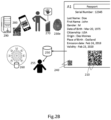
- Fig.2A Another illustrative embodiment of the invention relates to a batch of biometric identification documents, e.g. biometric digital passports, as shown on Fig.2A .
- Each digital passport as a digital file, is associated with a corresponding individual, i.e. the owner of the passport.
- the digital data of A 1 is represented on Fig.2A as equivalent textual and alphanumerical information (i.e. human readable), for example, as it could be displayed from a digital pdf ("Portable Document Format") file, and the digital security marking is shown as equivalent conventional QR code two-dimensional pattern.
- This embodiment of the invention is particularly useful for creating printable digital files, like print-ready digital files, to allow a printer to deliver a printed secured document directly from a corresponding secured printable digital file (e.g. a digital file relating to identity document, diploma, contract etc.).
- a hash function as a one-way function for signing the passport digital data, preferably a SHA-256 hash function in view of its well-known robustness.
- the hash function that is selected (having its known bucket listing) for the purpose of signing the passport digital data is thus an example of a one-way encryption function such that each distinct digital passport has its distinct digital passport signature, which thus make the signature unique.
- the domain of a hash function i.e.
- Fig.2A shows an example of digital biometric passport A 1 secured with a machine readable digital security marking 210 (here a QR code) encoded in A 1 , and comprising passport digital data 230 containing conventional passport data, e.g. digital data representing a title of the document 230a ("Passport"), a set of biography data of the owner of the passport 230b: last name ("Doe"), first name ("John”), gender ("M”), date of birth (“March 20, 1975”), citizenship (“USA”), origin (“Des Moines”), place of birth (“Oakland”), a date of emission of the passport 230c ("February 24, 2018”) and a validity period 230d ("February 23, 2020”).
- passport digital data 230 containing conventional passport data e.g. digital data representing a title of the document 230a ("Passport"), a set of biography data of the owner of the passport 230b: last name (“Doe"), first name (“John”), gender (“M”), date of birth (“March 20, 1975”), citizenship (“USA
- passport digital data may further comprise some (unique) serial number(s) 235 assigned by the authority delivering the passport (here "12345").
- the passport digital data further comprise biometry data of the owner of the passport as characteristic digital data (CDD) corresponding to a unique physical characteristic of an individual associated with the digital passport.
- CDD characteristic digital data
- a machine readable representation 230e e.g. an alphanumeric one
- a representation of digital data is to be understood in a broad sense of the term: this representation of data only needs to enable retrieving the original digital data.
- the machine readable data representation 230e i.e.
- biometry data 230e corresponding to a fingerprint of a person may result from an analysis of a set of specific minutia features of fingerprint ridges like ridge ending, bifurcation and short ridges (according to the conventional Henry System of Classification).
- the associated passport digital data D j includes the above mentioned digital data 230a-230e.
- the associated passport digital data D j may only include the values of the fields which are common to all the delivered passports, while the fields in common, i.e.
- D 1 only contain a representation of the field values "Doe”, "John”, “M”, “March 20, 1975”, “USA”, “Des Moines”, “Oakland”, “February 24, 2018” and “February 23, 2020”.
- additional passport digital data are associated with the above mentioned passport digital data 230.
- these additional passport digital data are stored in a searchable information database 250 that can be searched via an information request containing some passport data (for example, the name of the owner or the biometry data or data from the security marking or the unique serial number 235) to retrieve the corresponding fingerprint pattern data and receive it back.
- a link to the information database 250 is included, as information access data 240, in the digital passport: here this information access data is encoded in a digital representation of a QR code containing a reference index to retrieve corresponding additional data in the information database 250.
- the QR code could contain, for example, the URL of the information database that is accessible via the web.
- the passport digital signatures of all the digital passports in the batch, for all the different owners, are calculated.
- a reference root digital signature R is calculated according to a tree ordering and tree concatenation ordering of an associated (binary) tree, as explained above.
- the corresponding binary tree has 1024 leaf nodes a(1,1),...,a(1024) for the first level, 512 non-leaf nodes a(2,1),...,a(2,512) for the second level, 256 non-leaf nodes a(3,1),...,a(3,256) for the third level etc..., up to the penultimate nodes level (here, level 10) with non-leaf nodes a(10,1) and a(10,2), and the top node corresponding to the root node R (level 11 of the tree).
- Each digital verification key k j is thus a sequence of 10 node values.
- a biometric digital passport secured according to the invention provides both a forgery-proof link between the "personal data” and the “biometry data” of its holder, and a unique and forgery-proof link between the physical person of the holder and the holder's identity.
- Fig.2B illustrates a control process of the secured biometric digital passport A 1 of Fig.2A , with its passport data marking 230 corresponding to a certain John Doe, with its biometry data 230e corresponding to John Doe's fingerprint, and with additional passport digital data corresponding to a digital identity photograph 255 of John Doe that is accessible via the link to the information database 250 included in the information access marking 240.
- the passport data further comprises the unique serial number 235 assigned by the authority having delivered the passport.
- the reference root digital signature R may be time-stamped and stored in a blockchain 260.
- the biometry data 230e of the respective holders of the biometric passports of the batch are also stored in the blockchain 260 in association with, respectively, their corresponding unique serial numbers (so as to make these data immutable).
- the stored biometry data of John Doe can be retrieved by sending a request to the blockchain 260 indicating the unique serial number 235 mentioned on his passport.
- the authorities in charge of controlling identity of people can access the blockchain 260 via a communication link, and, in this illustrative embodiment, have also local storage capabilities for storing the (published) root digital signatures of all the delivered batches of biometric digital passports.
- the information database 250 is local (i.e.
- these authorities are equipped with fingerprint scanners 270 to capture the fingerprints of individuals and calculate corresponding machine readable representations of data characterizing the captured fingerprints, i.e. biometry data 230e.
- the officer receives the secured biometric digital passport A 1 of John Doe, reads and decodes the verification information (D 1 ,k 1 ) stored in the digital security marking 210 of the digital passport by means of an appropriate reader, that may be for example a suitably programmed computer 290, the computer being connected to the local storage capabilities 250.
- an appropriate reader that may be for example a suitably programmed computer 290, the computer being connected to the local storage capabilities 250.
- the computer can, for example, search in the local information database 250 a reference root digital signature R matching the candidate value R c : in case there is no matching, the passport is a forged one and "John Doe" (i.e. the screened individual claiming that his name is John Doe) may be arrested. In case R c matches some stored reference root digital signature, the passport is considered as genuine and the officer may perform additional security checks:
- Another illustrative embodiment of the invention relates to components of an aircraft, as shown on Fig.3 .
- These counterfeit airplane parts are generally defective and can cause severe damages or even plane crashes. This is a growing security problem today.
- each component has a corresponding (possibly digital) technical data sheet indicating e.g. the component technical name, the component unique serial number, the component manufacturer name, the manufacturing date of the component and certification information.
- a corresponding record contains all the (digital) technical data sheets of its respective components.
- counterfeited components may have their corresponding fake digital technical data sheet and thus, it is not obvious (unless by performing technical tests, for example) to detect fraud. For example, how to be sure that a digital technical data sheet corresponds well to a component mounted on a specific aircraft (and vice versa)?
- the allowed parts to be used for manufacturing or repairing a given aircraft, or that are mounted on the aircraft are considered as belonging to a batch of "components" (or "objects") for that very aircraft.
- each component of an aircraft batch i.e. each allowed aircraft component for mount or repair on a given aircraft
- a conventional technical data sheet e.g. the aircraft ID code, the aircraft manufacturer name, the component technical name, the component unique serial number, the component manufacturer name, and the manufacturing date of the component
- each aircraft component digital identification document AC-ID is secured by means of a machine readable digital security marking added to it.
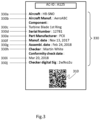
- the digital data of AC-ID:A 125 is represented on Fig.3 as equivalent textual and alphanumerical information (i.e. human readable), and the digital security marking 310 is shown as equivalent conventional QR code two-dimensional pattern.
- corresponding secured digital AC-ID documents are created and a corresponding updated version of the aircraft batch is also created, with the above mentioned corresponding additional digital data (relating to the new mounting operations).
- all the (critical) mounted components on a specific aircraft (here, having the aircraft ID reference HB-SNO), belong to a corresponding batch of mounted components (here, having a total of ⁇ components) and are documented in a corresponding batch of associated ⁇ digital files, i.e. the digital identification document AC-ID.
- a digital security marking 310 (here in the form of a QR code) is included in each aircraft component digital identification document, for example AC-ID:A 125 , that is associated with the corresponding aircraft component, here A 125 , mounted on the aircraft HB-SNO.
- Fig.3 particularly shows the component A 125 of the aircraft batch being a turbine blade adapted to the reactor type mounted on the aircraft HB-SNO and marked with a unique manufacturing serial number (here, 12781, generally engraved by the manufacturer).
- the component digital data D 125 in the digital security marking 310 of the aircraft component digital identification document AC-ID:A 125 associated with component A 125 comprises the digital data corresponding to that of the technical data sheet: the aircraft ID code 330a (here, HB-SNO), the aircraft manufacturer name 330b (here, AeroABC), the component technical name 330c (here, turbine blade - 1 st ring), the component serial number 330d (here, 12781), the component manufacturer name 330e (here, PCX), the manufacturing date of the component 330f (here, November 13, 2017), the assembly date of the component on the reactor 330g (here, February 24, 2018), the name of the technician in charge of performing the conformity check 330h (here, the checker is Martin
- a tree associated with the batch of components A 1 ,...,A ⁇ (here, a binary tree), and thus with the corresponding batch of digital files AC-ID:A 1 ,...,AC-ID:A ⁇ , is built having ⁇ leaf nodes a(1,1),...,a(1, ⁇ ) respectively corresponding to the ⁇ component digital signatures x 1 ,...,x ⁇ of respective component digital data D 1 ,...,D ⁇ of the component digital identification documents AC-ID : A 1 ,...,AC-ID:A ⁇ of components A 1 ,...,A ⁇ .
- the nodes ordering of the binary tree is the conventional one, i.e.
- the tree comprising node levels from the leaf nodes to the root node, every non-leaf node of the tree corresponding to a digital signature by means of the one-way function H of a concatenation of the respective digital signatures of its child nodes according to the tree concatenation ordering.
- a reference root digital signature R for the batch of ⁇ aircraft components A 1 ,...A ⁇ is calculated by means of a one-way function of a (conventional) concatenation of node values of the tree (as explained below).
- the reference root digital signature R is then stored in a searchable database (preferably a blockchain) accessible to technicians in charge of controlling or changing the mounted components.
- the tree thus comprises node levels from the leaf nodes to the root node of the tree, every non-leaf node of the tree corresponding to a digital signature by means of the one-way function H of a concatenation of the respective digital signatures of its (two) child nodes according to the tree concatenation ordering (here conventional), the root node corresponding to the reference root digital signature R, i.e. the digital signature by means of the one-way function H of a concatenation of the digital signatures of the nodes of the penultimate nodes level in the tree (according to the nodes ordering in the tree and the tree concatenation ordering).
- a digital verification key k i corresponding to the component digital signature x i (i.e. leaf node a(1,i)) of the component digital data D i , is calculated as the sequence of the respective digital signatures, from the leaf nodes level to the penultimate nodes level of the tree, of every other leaf node having the same parent node in the tree that the leaf-node a(1,i) corresponding to the digital signature x i , and successively at each next level in the tree, of every non-leaf node having the same parent node in the tree that the previous same parent node considered at the preceding level.
- the associated component digital data D i and the corresponding digital verification key k i are embedded in the digital security marking 310 included in the corresponding aircraft component digital identification document AC-ID:A i .
- a technician may send a request to the searchable database containing the component serial number 12781 read on the digital file AC-ID:A 125 of component A 125 to be controlled, or its digital verification key k 125 as read on the digital security marking 310 on the corresponding AC-ID:A 125 document with an appropriate reader, as for example a computer programmed for decoding the content of the digital security marking,, and will receive back the corresponding batch value R.
- the technician's computer has a memory storing all the root digital signatures relating to the aircrafts to be controlled.
- the component A 125 is considered as genuine and belongs to the (up-to-date) aircraft batch of allowed components of the HB-SNO aircraft, if R c does not match a stored reference root digital signature R, or if the serial numbers do not match, the component A 125 is possibly counterfeit, or is a genuine component not allowed for the aircraft HB-SNO (e.g. A 125 does not belong to the right batch for this aircraft), and must be changed.
- the invention would allow detecting fraud (or errors) from batches of secured AC-IDs of replacement parts stored in a warehouse by verifying the authenticity of the markings on the stored parts and checking that the component serial number from the digital security marking matches that marked on the corresponding component.
- a tamperproof material-based security marking may further be applied on the component, while the digital data relating to the corresponding reference unique physical characteristic, i.e.
- UPS H(CDD)
- This additional level of security improves the security provided by the unique serial number marked on the component by its manufacturer.
- the reference UPC and UPS are stored in the blockchain (to make them immutable) and are accessible to the technician.
- these reference values may also be further stored in the memory of the technician's computer in order to allow offline authentication of the material-based security marking on the highly critical component.
- the further offline operation of authentication of this material-based security marking may comprise measuring the unique physical characteristic on the component, by means of a suitable sensor connected to the computer, and obtaining a candidate characteristic digital data CDD c from the measured characteristic (for example, via a specific application programmed in the CPU of the computer). Then, the technician (or the CPU of his computer, if suitably programmed) compares the obtained CDD c with the copy of the reference CDD stored in the memory of the computer: in case of "reasonable" matching CDD c ⁇ CDD (i.e. within some predefined error tolerance criterion), the material-based security marking, and thus the component, are considered as genuine.
- a copy of the reference characteristic digital data CDD is part of the digital data D included in the digital security marking in the aircraft component digital identification document AC-ID:A of the component A and can be obtained by direct reading of the digital security marking.
- the checking of authenticity of a component by a technician may alternatively be performed via online process in a similar way as already explained with the first detailed embodiment of the invention, and will not be repeated here.
- the invention is clearly compatible with offline and local checking operations for verifying the authenticity of a secured digital file, or conformity of data of a copy of a secured digital file, with respect to the data associated with the original secured digital file.
- the invention is also compatible with online verification process, for example by receiving (via a communication link) a reference batch value (or root digital signature) form an external source (e.g. server or blockchain), or performing some or all the calculation steps involving the one-way function or the concatenation of digital signatures via external computing means (e.g. operating on a server), or even performing the verification that a candidate root digital signature matches a reference root digital signature (and just receiving the result).
- a reference batch value or root digital signature
Landscapes
- Engineering & Computer Science (AREA)
- Computer Security & Cryptography (AREA)
- Computer Networks & Wireless Communication (AREA)
- Signal Processing (AREA)
- Theoretical Computer Science (AREA)
- Library & Information Science (AREA)
- Data Mining & Analysis (AREA)
- Databases & Information Systems (AREA)
- Physics & Mathematics (AREA)
- General Engineering & Computer Science (AREA)
- General Physics & Mathematics (AREA)
- Storage Device Security (AREA)
Claims (15)
- Verfahren zum Sichern einer gegebenen digitalen Originaldatei (A1,...,A8), die zu einem Stapel einer Vielzahl von digitalen Originaldateien (A1,...,A8) gehört, gegen Fälschung oder Manipulation, wobei jede digitale Originaldatei (A1,...,A8) ihre eigenen digitalen Daten (D1,...,D8) aufweist, aufweisend die Schritte:für jede digitale Originaldatei (A1,...,A8) des Stapels mittels einer Einwegfunktion (H), Berechnen einer zugeordneten digitalen Dateisignatur (x1,...,x8) ihrer digitalen Daten (D1,...,D8);Bilden eines Baums, der auf der Vielzahl von berechneten digitalen Dateisignaturen (x1,...,x8) für die digitalen Originaldateien (A1,...,A8) des Stapels basiert und Knoten aufweist, die gemäß einer gegebenen Reihenfolge von Knoten in dem Baum angeordnet sind, wobei der Baum Knotenebenen von den Blattknoten, die der Vielzahl von digitalen Dateisignaturen (x1,...,x8) entsprechen, die jeweils der Vielzahl von digitalen Originaldateien (A1,...,A8) in dem Stapel zugeordnet sind, bis zum Wurzelknoten des Baums aufweist, wobei jeder Nicht-Blattknoten des Baumes einer digitalen Signatur mittels der Einwegfunktion einer Verkettung der jeweiligen digitalen Signaturen seiner Kindknoten gemäß einer Reihenfolge der Baumverkettung entspricht, wobei der Wurzelknoten einer digitalen Referenzwurzelsignatur (R), d. h. einer digitalen Signatur mittels der Einwegfunktion einer Verkettung der digitalen Signaturen der Knoten einer vorletzten Knotenebene in dem Baum gemäß der Reihenfolge der Baumverkettung, entspricht;Zuordnen zu der gegebenen digitalen Originaldatei (A1,...,A8) eines entsprechenden digitalen Verifizierungsschlüssels (k1,...k8), der eine Sequenz der jeweiligen digitalen Signaturen ist, von der Ebene der Blattknoten bis zur vorletzten Knotenebene, von jedem anderen Blattknoten, der den gleichen Elternknoten in dem Baum wie der Blattknoten hat, der der digitalen Dateisignatur (x1,...,x8) der gegebenen digitalen Originaldatei (A1,...,A8) entspricht, und nacheinanderfolgend auf jeder nächsten Ebene in dem Baum jedes Nicht-Blattknotens, der den gleichen Elternknoten in dem Baum wie der vorhergehende gleiche Elternknoten hat, der auf der vorhergehenden Ebene betrachtet wurde;Bereitstellen der digitalen Referenzwurzelsignatur (R) des Baums für einen Benutzer; und gekennzeichnet durchEinfügen in die gegebene digitale Originaldatei (A1,...,A8) einer entsprechenden maschinenlesbaren digitalen Sicherheitsmarkierung (110), die eine Darstellung ihrer digitalen Daten (D1,...,D8) und ihres entsprechenden digitalen Verifizierungsschlüssels (k1,...k8) aufweist,wodurch eine markierte digitale Originaldatei (A1,...,A8) erhalten wird, deren digitale Daten (D1,...,D8) gegen Fälschung oder Manipulation gesichert sind.
- Verfahren nach Anspruch 1, wobei die digitale Referenzwurzelsignatur (R) des Wurzelknotens des Baums entweder in einem für den Benutzer zugänglichen Medium veröffentlicht oder in einer für den Benutzer zugänglichen durchsuchbaren Wurzeldatenbank gespeichert oder in einer Blockchain oder in einer durch eine Blockchain gesicherten Datenbank gespeichert wird, die für den Benutzer zugänglich ist.
- Verfahren nach Anspruch 1 oder Anspruch 2, wobeieine virtuelle digitale Datei als zu dem Stapel von digitalen Originaldateien (A1,...,A8) gezählt wird, wobei die virtuelle digitale Datei ihre eigenen virtuellen digitalen Daten und eine zugeordnete virtuelle digitale Dateisignatur umfasst, die mittels der Einwegfunktion (H) der virtuellen digitalen Daten erhalten wird, wobei die virtuelle digitale Datei nicht real ist, sondern nur zur Erzeugung der zugeordneten virtuellen digitalen Dateisignatur aus ihren virtuellen digitalen Daten verwendet wird; undwobei die dem Stapel von digitalen Originaldateien (A1,...,A8) zugeordnete digitale Referenzwurzelsignatur (R) aus einem Baum berechnet wird, der alle digitalen Dateisignaturen der digitalen Originaldateien (A1,...,A8) des Stapels, einschließlich der virtuellen digitalen Dateisignatur, als Blattknoten enthält.
- Verfahren nach einem der Ansprüche 1 bis 3, wobei
zusätzliche digitale Daten, die den digitalen Daten (D1,...,D8) entsprechen, die der markierten digitalen Originaldatei (A1,...,A8) zugeordnet sind, in einer durchsuchbaren Informationsdatenbank gespeichert werden, die für den Benutzer über eine Informationsdatenbankschnittstelle zugänglich ist, die dazu geeignet ist, von dem Benutzer eine Informationsanforderung zu empfangen, die digitale Daten (D1,...,D8) oder eine digitale Dateisignatur (x1,...,x8) enthält, die aus einer digitalen Sicherheitsmarkierung (110) einer markierten digitalen Originaldatei (A1,...,A8) erhalten wurden, und entsprechende zusätzliche digitale Daten zurückzusenden. - Verfahren nach einem der Ansprüche 1 bis 4, wobei die digitalen Daten (D1,...,D8) der markierten digitalen Originaldatei (A1,...,A8) charakteristische digitale Referenzdaten einer entsprechenden einzigartigen physikalischen Charakteristik eines zugeordneten Objekts oder Individuums umfassen.
- Verfahren nach einem der Ansprüche 1 bis 5, wobei die digitalen Daten (D1,...,D8) der jeweiligen digitalen Originaldateien (A1,...,A8) des Stapels auf gegebene Felder verteilt sind, die allen digitalen Dateien des Stapels gemeinsam sind, und spezifische digitale Daten, die sich auf diese Felder beziehen, nicht in den digitalen Daten (D1,...,D8) enthalten sind, sondern in einem separaten Felddatenblock zusammengefasst sind, der dem Stapel zugeordnet ist, und wobei:i) die digitale Dateisignatur (x1,...,x8) einer digitalen Originaldatei (A1,...,A8) mittels der Einwegfunktion einer Verkettung der entsprechenden digitalen Daten (D1,...,D8) und des Felddatenblocks berechnet wird; undii) die digitale Referenzwurzelsignatur (R) dem Benutzer zusammen mit dem zugeordneten Felddatenblock zur Verfügung gestellt wird.
- Verfahren zur Verifizierung der Authentizität einer digitalen Datei, die gemäß dem Verfahren nach einem der Ansprüche 1 bis 5 gesichert ist, oder der Übereinstimmung einer Kopie einer solchen gesicherten digitalen Datei mit dem Original, dadurch gekennzeichnet, dass es die Schritte aufweist: beim Verarbeiten einer Testdatei, die die digitale Datei oder die Kopie der digitalen Datei ist, mit Hilfe einer mit einem Speicher verbundenen Verarbeitungseinheit:Speichern der Testdatei im Speicher;Lesen einer Darstellung digitaler Daten (D1,...,D8) und eines digitalen Verifizierungsschlüssels (k1,...k8) auf einer digitalen Sicherheitsmarkierung (110) der gespeicherten Testdatei und Extrahieren jeweils entsprechender digitaler Testdaten und digitaler Testverifizierungsschlüssel aus der gelesenen Darstellung;Speichern einer digitalen Referenzwurzelsignatur (R) eines Wurzelknotens eines Baumes des Stapels von digitalen Originaldateien (A1,...,A8) in dem Speicher und Programmieren der Einwegfunktion (H) in der Verarbeitungseinheit, um eine digitale Signatur von digitalen Daten (D1,...,D8) und einer Verkettung von digitalen Signaturen gemäß der Reihenfolge von Knoten in dem Baum und der Reihenfolge der Baumverkettung zu berechnen;Verifizieren, ob die extrahierten digitalen Testdaten und der zugeordnete digitale Verifizierungsschlüssel tatsächlich der gespeicherten digitalen Referenzwurzelsignatur (R) entsprechen, indem die Schritte durchgeführt werden:Berechnen einer digitalen Testsignatur der extrahierten digitalen Testdaten mittels der Einwegfunktion, wobei die digitale Testsignatur einem Testblattknoten in einem Testbaum entspricht, der der digitalen Sicherheitsmarkierung (110) der Testdatei entspricht;Extrahieren aus der Sequenz digitaler Signaturen im digitalen Testverifizierungsschlüssel einer digitalen Signatur jedes anderen Blattknotens des Testbaums, der den gleichen Elternknoten wie der des Testblattknotens hat, und Berechnen einer digitalen Signatur einer Verkettung der digitalen Testsignatur und der extrahierten digitalen Signatur jedes anderen Blattknotens, wodurch eine digitale Signatur des gleichen Elternknotens des Testblattknotens erhalten wird;nacheinanderfolgend auf jeder nächsten Ebene im Testbaum und bis zur vorletzten Knotenebene, Extrahieren aus der Sequenz digitaler Signaturen im digitalen Testverifizierungsschlüssel einer digitalen Signatur jedes anderen Nicht-Blattknotens des Testbaums, der den gleichen Elternknoten wie der vorhergehende gleiche Elternknoten hat, der im vorhergehenden Schritt betrachtet wurde, und Berechnen einer digitalen Signatur einer Verkettung der digitalen Signatur des jeweiligen jeden anderen Nicht-Blattknotens und der erhaltenen digitalen Signatur des vorhergehenden gleichen Elternknotens, wodurch eine digitale Signatur des gleichen Elternknotens des vorhergehenden gleichen Elternknotens erhalten wird;Berechnen einer digitalen Signatur einer Verkettung der erhaltenen digitalen Signaturen der Nicht-Blattknoten, die der vorletzten Knotenebene des Testbaums entspricht, um dadurch eine digitale Kandidatenwurzelsignatur des Wurzelknotens des Testbaums zu erhalten; undPrüfen, ob die erhaltene digitale Kandidatenwurzelsignatur mit der gespeicherten digitalen Referenzwurzelsignatur (R) übereinstimmt,wobei, falls die digitalen Wurzelsignaturen übereinstimmen, die digitalen Daten (D1,...,D8) der Testdatei die einer echten digitalen Datei sind.
- Verfahren nach Anspruch 7, wobei die markierte digitale Originaldatei (A1,...,A8) gemäß dem Verfahren nach Anspruch 6 gesichert ist, wobei der Speicher der Verarbeitungseinheit ferner den zugeordneten Felddatenblock speichert, und wobei:
der Schritt des Berechnens einer digitalen Testsignatur, die einem Testblattknoten in einem Testbaum entspricht, der der digitalen Sicherheitsmarkierung (110) auf der Testdatei entspricht, die Berechnung mittels der Einwegfunktion einer digitalen Signatur einer Verkettung der extrahierten digitalen Testdaten und des gespeicherten Felddatenblocks aufweist. - Verfahren nach einem der Ansprüche 7 und 8, wobei die digitale Datei durch Speichern der digitalen Referenzwurzelsignatur (R) in einer durchsuchbaren Wurzeldatenbank, auf die der Benutzer gemäß dem Verfahren nach Anspruch 2 zugänglich sein kann, gesichert ist, und die Verarbeitungseinheit ferner mit einer Kommunikationseinheit verbunden ist, die dazu eingerichtet ist, Daten über eine Kommunikationsverbindung zurückzusenden und zu empfängen, mit den vorbereitenden Schritten:Senden mittels der Kommunikationseinheit über den Kommunikationslink einer Anfrage an die Wurzeldatenbank und Zurückempfangen der digitalen Referenzwurzelsignatur (R); undSpeichern der empfangenen digitalen Wurzelsignatur im Speicher.
- Verfahren nach einem der Ansprüche 7 bis 9, wobei die digitale Datei gemäß dem Verfahren nach Anspruch 4 gesichert ist und der Bildgeber ferner mit einem Kommunikationsmittel ausgestattet ist, das dazu geeignet ist, an die Informationsdatenbankschnittstelle eine Informationsanforderung, die digitale Daten (D1,...,D8) oder eine digitale Dateisignatur (x1,...,x8) enthält, die von der digitalen Sicherheitsmarkierung (110) der Testdatei erhalten wurde, zu senden und entsprechende zusätzliche digitale Daten zurück zu empfangen.
- Verfahren nach einem der Ansprüche 7 bis 10, wobei der Bildgeber ferner mit einem Sensor ausgestattet ist, der dazu geeignet ist, eine einzigartige physikalische Charakteristik jeweils eines zugeordneten Objekts oder Individuums zu erfassen, und die Verarbeitungseinheit so programmiert ist, dass sie entsprechende charakteristische digitale Daten aus einem von dem Sensor empfangenen Erfassungssignal extrahiert, wobei der Bildgeber in dem Speicher charakteristische digitale Referenzdaten CDD gespeichert hat, die der einzigartigen physikalischen Charakteristik jeweils des zugeordneten Objekts oder Individuums entsprechen, wobei das Verfahren ferner die Schritte umfasst: beim Betrachten eines Gegenstands, das das zugeordnete Objekt oder Individuum ist:Erkennen einer einzigartigen physikalischen Charakteristik des Gegenstands mittels des Sensors und Extrahieren entsprechender charakteristischer digitaler Kandidatendaten CDDc;Vergleichen der erhaltenen charakteristischen digitalen Kandidatendaten CDDc mit den gespeicherten charakteristischen digitalen Referenzdaten CDD; undfalls die charakteristischen digitalen Kandidatendaten CDDc den gespeicherten charakteristischen digitalen Referenzdaten CDD innerhalb eines gegebenen Toleranzkriteriums ähnlich sind, wird davon ausgegangen, dass der Gegenstand jeweils einem echten Objekt oder einem Individuum entspricht, das gültig einer echten digitalen Datei zugeordnet ist.
- Digitale Datei, die zu einem Stapel einer Vielzahl von digitalen Originaldateien (A1,...,A8) gehört und gemäß dem Verfahren nach einem der Ansprüche 1 bis 6 gesichert ist, wobei jede digitale Originaldatei (A1,...,A8) des Stapels ihre eigenen digitalen Daten (D1,...,D8) und einen entsprechenden digitalen Verifizierungsschlüssel (k1,...k8) hat, wobei der Stapel eine entsprechende digitale Referenzwurzelsignatur (R) hat, aufweisend:
eine maschinenlesbare Sicherheitsmarkierung mit einer Darstellung ihrer digitalen Daten (D1,...,D8) und ihres Verifizierungsschlüssels. - System zur Verifizierung der Authentizität einer digitalen Datei oder der Übereinstimmung einer Kopie einer solchen digitalen Datei in Bezug auf eine markierte Originaldatei (A1,...,A8), die zu einem Stapel von digitalen Originaldateien (A1,...,A8) gehört, die gemäß dem Verfahren nach einem der Ansprüche 1 bis 5 gesichert sind, aufweisend: einen Bildgeber mit einer Abbildungseinheit, eine Verarbeitungseinheit mit einem Speicher und eine Bildverarbeitungseinheit, wobei der Speicher eine digitale Referenzwurzelsignatur (R) eines Baumes speichert, der dem Stapel von digitalen Originaldateien (A1,...,A8) entspricht, und wobei die Einwegfunktion (H) zur Berechnung einer digitalen Signatur von digitalen Daten (D1,...,D8) und einer Verkettung von digitalen Signaturen gemäß der Reihenfolge von Knoten des Baumes und der Reihenfolge der Baumverkettung in der Verarbeitungseinheit programmiert ist, wobei das System dazu geeignet ist:im Speicher eine Testdatei gespeichert zu haben, die die digitale Datei oder die Kopie der digitalen Datei ist;eine Darstellung digitaler Daten (D1,...,D8) und eines digitalen Verifizierungsschlüssels (k1,...k8) auf einer digitalen Sicherheitsmarkierung (110) der gespeicherten Testdatei zu lesen und jeweils entsprechende digitale Testdaten und den digitalen Testverifizierungsschlüssel aus der gelesenen Darstellung zu extrahieren;zu verifizieren, ob die extrahierten digitalen Testdaten und der digitale Testverifizierungsschlüssel tatsächlich der gespeicherten digitalen Referenzwurzelsignatur (R) entsprechen, indem auf der Verarbeitungseinheit die programmierten Operationen durchgeführt werden:Berechnen einer digitalen Testsignatur der extrahierten digitalen Testdaten mittels der Einwegfunktion, wobei die digitale Testsignatur einem Testblattknoten in einem Testbaum entspricht, der der digitalen Sicherheitsmarkierung (110) der Testdatei entspricht;Extrahieren aus der Sequenz digitaler Signaturen im digitalen Testverifizierungsschlüssel einer digitalen Signatur jedes anderen Blattknotens des Testbaums, der den gleichen Elternknoten wie der des Testblattknotens hat, und Berechnen einer digitalen Signatur einer Verkettung der digitalen Testsignatur und der extrahierten digitalen Signatur jedes anderen Blattknotens, wodurch eine digitale Signatur des gleichen Elternknotens des Testblattknotens erhalten wird;nacheinanderfolgend auf jeder nächsten Ebene im Testbaum und bis zur vorletzten Knotenebene, Extrahieren aus der Sequenz digitaler Signaturen im digitalen Testverifizierungsschlüssel einer digitalen Signatur jedes anderen Nicht-Blattknotens des Testbaums, der den gleichen Elternknoten wie der vorhergehende gleiche Elternknoten hat, der im vorhergehenden Schritt betrachtet wurde, und Berechnen einer digitalen Signatur einer Verkettung der digitalen Signatur des jeweiligen jeden anderen Nicht-Blattknotens und der erhaltenen digitalen Signatur des vorhergehenden gleichen Elternknotens, wodurch eine digitale Signatur des gleichen Elternknotens des vorhergehenden gleichen Elternknotens erhalten wird;Berechnen einer digitalen Signatur einer Verkettung der erhaltenen digitalen Signaturen der Nicht-Blattknoten, die der vorletzten Knotenebene des Testbaums entspricht, um dadurch eine digitale Kandidatenwurzelsignatur des Wurzelknotens des Testbaums zu erhalten; undPrüfen, ob die erhaltene digitale Kandidatenwurzelsignatur mit der gespeicherten digitalen Referenzwurzelsignatur (R) übereinstimmt,wobei das System dazu eingerichtet ist, im Falle einer Übereinstimmung der digitalen Wurzelsignaturen eine Anzeige zu liefern, dass die digitalen Daten der Testdatei die einer echten digitalen Datei sind.
- System nach Anspruch 13, wobei die markierte digitale Originaldatei (A1,...,A8) gemäß dem Verfahren nach Anspruch 6 gesichert ist, wobei der Speicher der Verarbeitungseinheit ferner den zugeordneten Felddatenblock speichert, und wobei:
die programmierten Operationen zum Berechnen einer digitalen Testsignatur, die einem Testblattknoten in einem Testbaum entspricht, der der digitalen Sicherheitsmarkierung (110) der Testdatei entspricht, die Berechnung mittels der Einwegfunktion einer digitalen Signatur einer Verkettung der extrahierten digitalen Testdaten und des gespeicherten Felddatenblocks aufweisen. - System nach einem der Ansprüche 13 und 14, wobei die markierte digitale Originaldatei (A1,...,A8) zu einem Stapel von digitalen Originaldateien (A1,...,A8) gehört, die gemäß dem Verfahren nach Anspruch 5 gesichert sind, wobei das System ferner mit einem Sensor ausgestattet ist, der mit der Verarbeitungseinheit verbunden und dazu geeignet ist, eine einzigartige physikalische Charakteristik eines zugeordneten Objekts oder Individuums zu erfassen, und wobei die Verarbeitungseinheit dazu programmiert ist, entsprechende charakteristische digitale Daten aus einem von dem Sensor empfangenen Erfassungssignal zu extrahieren, wobei das System in dem Speicher charakteristische digitale Referenzdaten CDD gespeichert hat, die der einzigartigen physikalischen Charakteristik des zugeordneten Objekts oder Individuums entsprechen, wobei das System ferner dazu geeignet ist:mittels des Sensors eine einzigartige physikalische Charakteristik eines Gegenstandes, bei dem es sich um das zugeordnete Objekt oder Individuum handelt, zu erkennen und entsprechende charakteristische digitale Kandidatendaten CDDc zu extrahieren;Vergleichen der erhaltenen charakteristischen digitalen Kandidatendaten CDDc mit den gespeicherten charakteristischen digitalen Referenzdaten CDD; undfalls die charakteristischen digitalen Kandidatendaten CDDc mit den gespeicherten charakteristischen digitalen Referenzdaten CDD innerhalb eines gegebenen Toleranzkriteriums übereinstimmen, eine Anzeige liefern, dass der Gegenstand als echt angesehen wird.
Applications Claiming Priority (2)
| Application Number | Priority Date | Filing Date | Title |
|---|---|---|---|
| EP18187473 | 2018-08-06 | ||
| PCT/EP2019/068986 WO2020030382A1 (en) | 2018-08-06 | 2019-07-15 | Digital file anti-forgery protection |
Publications (2)
| Publication Number | Publication Date |
|---|---|
| EP3834362A1 EP3834362A1 (de) | 2021-06-16 |
| EP3834362B1 true EP3834362B1 (de) | 2024-04-10 |
Family
ID=63165258
Family Applications (1)
| Application Number | Title | Priority Date | Filing Date |
|---|---|---|---|
| EP19737560.3A Active EP3834362B1 (de) | 2018-08-06 | 2019-07-15 | Fälschungsschutz für digitale dateien |
Country Status (16)
| Country | Link |
|---|---|
| US (1) | US12355894B2 (de) |
| EP (1) | EP3834362B1 (de) |
| JP (1) | JP7342318B2 (de) |
| KR (1) | KR102783381B1 (de) |
| CN (1) | CN112534775B (de) |
| BR (1) | BR112021002269A2 (de) |
| CA (1) | CA3108442A1 (de) |
| EA (1) | EA202190438A1 (de) |
| ES (1) | ES2989818T3 (de) |
| MA (1) | MA53262B1 (de) |
| MX (1) | MX2021001483A (de) |
| MY (1) | MY207357A (de) |
| PL (1) | PL3834362T3 (de) |
| PT (1) | PT3834362T (de) |
| SG (1) | SG11202101179QA (de) |
| WO (1) | WO2020030382A1 (de) |
Families Citing this family (11)
| Publication number | Priority date | Publication date | Assignee | Title |
|---|---|---|---|---|
| US11575519B1 (en) * | 2020-05-21 | 2023-02-07 | Bank Of America Corporation | System and method for authenticating media using barcodes and hash values |
| US20220129443A1 (en) * | 2020-10-27 | 2022-04-28 | Genetec Inc. | Document management system and related method |
| US11697301B2 (en) * | 2020-11-10 | 2023-07-11 | Baysoft LLC | Remotely programmable wearable device |
| AR126882A1 (es) | 2021-09-01 | 2023-11-22 | Sicpa Holding Sa | Método y sistema para validar un contenido digital |
| DE102021131749A1 (de) | 2021-12-02 | 2023-06-07 | Volocopter Gmbh | Verfahren und System zum Erzeugen und manipulationssicheren Verwalten von Flug-Logdateien |
| WO2023101181A1 (ko) * | 2021-12-03 | 2023-06-08 | 삼성전자주식회사 | 개인 정보를 업데이트하기 위한 방법 및 장치 |
| US20240007300A1 (en) * | 2022-06-29 | 2024-01-04 | University Of South Florida | System and method for cryptographic forensic audits on lightweight iot and digital archives |
| CN115080149B (zh) * | 2022-07-20 | 2023-06-27 | 荣耀终端有限公司 | 终端设备的控制方法和终端设备 |
| CN115115011B (zh) * | 2022-08-29 | 2022-11-01 | 江苏铨通印数字印刷有限公司 | 一种智能数字印刷的防伪二维码生成使用方法 |
| US12316678B2 (en) * | 2023-02-13 | 2025-05-27 | Cisco Technology, Inc. | Security audit of data-at-rest |
| US12443686B1 (en) * | 2024-03-26 | 2025-10-14 | Bank Of America Corporation | Spurious less data authentication by method mesh engineering using digital GenAI with proof of digital manipulation (PODM) |
Citations (1)
| Publication number | Priority date | Publication date | Assignee | Title |
|---|---|---|---|---|
| EP3820712A1 (de) * | 2018-07-10 | 2021-05-19 | Sicpa Holding SA | Artikelfälschungsschutz |
Family Cites Families (19)
| Publication number | Priority date | Publication date | Assignee | Title |
|---|---|---|---|---|
| EP0819346A4 (de) | 1994-10-28 | 2001-01-24 | Surety Technologies Inc | Einrichtung zur authentifizierung eines digitalen dokumentsund zur erzeugung eines zertifikates,welches ein dokument authentifiziert und eindeutig identifiziert |
| GB2348343A (en) | 1999-03-26 | 2000-09-27 | Int Computers Ltd | Authentication of MOT certificate using encryption |
| US8868914B2 (en) * | 1999-07-02 | 2014-10-21 | Steven W. Teppler | System and methods for distributing trusted time |
| US7152047B1 (en) * | 2000-05-24 | 2006-12-19 | Esecure.Biz, Inc. | System and method for production and authentication of original documents |
| US7051206B1 (en) | 2000-11-07 | 2006-05-23 | Unisys Corporation | Self-authentication of value documents using digital signatures |
| AU2004320238B2 (en) * | 2004-06-04 | 2008-07-03 | Mitsubishi Denki Kabushiki Kaisha | Certificate issuance server and certification system for certifying operating environment |
| WO2006018890A1 (ja) * | 2004-08-20 | 2006-02-23 | Mitsubishi Denki Kabushiki Kaisha | メモリカード、データ交換システム及びデータ交換方法 |
| FR2895125B1 (fr) * | 2005-12-21 | 2008-12-12 | Novatec Sa | Procede d'authentification de documents et dispositif de lecture desdits documents a des fins d'enregistrement pour preuve |
| US10102439B2 (en) * | 2008-01-14 | 2018-10-16 | Hewlett-Packard Development Company, L.P. | Document verification method and system |
| EP2237546B1 (de) | 2009-03-30 | 2020-05-13 | Cipal Schaubroeck NV | Vorrichtung und Verfahren zum Schutz eines digitalen Dokuments und entsprechendes Verfahren zur Prüfung der Authentizität einer gedruckten Hardcopy |
| US9741265B2 (en) * | 2012-12-31 | 2017-08-22 | Piyush Bhatnagar | System, design and process for secure documents credentials management using out-of-band authentication |
| US9473306B2 (en) * | 2013-08-05 | 2016-10-18 | Guardtime IP Holdings, Ltd. | Document verification with ID augmentation |
| US10200199B2 (en) * | 2013-08-05 | 2019-02-05 | Guardtime Holdings Limited | Strengthened entity identity for digital record signature infrastructure |
| US9853819B2 (en) * | 2013-08-05 | 2017-12-26 | Guardtime Ip Holdings Ltd. | Blockchain-supported, node ID-augmented digital record signature method |
| US9268969B2 (en) * | 2013-08-14 | 2016-02-23 | Guardtime Ip Holdings Limited | System and method for field-verifiable record authentication |
| US11025407B2 (en) * | 2015-12-04 | 2021-06-01 | Verisign, Inc. | Hash-based digital signatures for hierarchical internet public key infrastructure |
| US20180219683A1 (en) * | 2017-01-30 | 2018-08-02 | Factom | Possession and Alteration of Documents |
| US10630483B2 (en) * | 2017-10-23 | 2020-04-21 | Legitipix, LLC | Anonymous image/video digital signature insertion and authentication |
| US10958642B2 (en) * | 2018-04-05 | 2021-03-23 | The Toronto-Dominion Bank | Dynamic biometric authentication based on distributed ledger data |
-
2019
- 2019-07-15 US US17/266,442 patent/US12355894B2/en active Active
- 2019-07-15 MX MX2021001483A patent/MX2021001483A/es unknown
- 2019-07-15 EA EA202190438A patent/EA202190438A1/ru unknown
- 2019-07-15 SG SG11202101179QA patent/SG11202101179QA/en unknown
- 2019-07-15 EP EP19737560.3A patent/EP3834362B1/de active Active
- 2019-07-15 CA CA3108442A patent/CA3108442A1/en active Pending
- 2019-07-15 KR KR1020217006547A patent/KR102783381B1/ko active Active
- 2019-07-15 MA MA53262A patent/MA53262B1/fr unknown
- 2019-07-15 MY MYPI2021000567A patent/MY207357A/en unknown
- 2019-07-15 WO PCT/EP2019/068986 patent/WO2020030382A1/en not_active Ceased
- 2019-07-15 JP JP2021505698A patent/JP7342318B2/ja active Active
- 2019-07-15 BR BR112021002269-4A patent/BR112021002269A2/pt unknown
- 2019-07-15 PT PT197375603T patent/PT3834362T/pt unknown
- 2019-07-15 CN CN201980052683.6A patent/CN112534775B/zh active Active
- 2019-07-15 ES ES19737560T patent/ES2989818T3/es active Active
- 2019-07-15 PL PL19737560.3T patent/PL3834362T3/pl unknown
Patent Citations (1)
| Publication number | Priority date | Publication date | Assignee | Title |
|---|---|---|---|---|
| EP3820712A1 (de) * | 2018-07-10 | 2021-05-19 | Sicpa Holding SA | Artikelfälschungsschutz |
Also Published As
| Publication number | Publication date |
|---|---|
| CN112534775B (zh) | 2024-03-01 |
| PT3834362T (pt) | 2024-06-21 |
| CN112534775A (zh) | 2021-03-19 |
| WO2020030382A1 (en) | 2020-02-13 |
| MX2021001483A (es) | 2021-04-28 |
| KR102783381B1 (ko) | 2025-03-19 |
| MA53262A (fr) | 2021-11-10 |
| KR20210041031A (ko) | 2021-04-14 |
| EP3834362A1 (de) | 2021-06-16 |
| MY207357A (en) | 2025-02-22 |
| US12355894B2 (en) | 2025-07-08 |
| ES2989818T3 (es) | 2024-11-27 |
| MA53262B1 (fr) | 2024-05-31 |
| SG11202101179QA (en) | 2021-03-30 |
| CA3108442A1 (en) | 2020-02-13 |
| US20210258168A1 (en) | 2021-08-19 |
| JP2021533468A (ja) | 2021-12-02 |
| BR112021002269A2 (pt) | 2021-05-04 |
| JP7342318B2 (ja) | 2023-09-12 |
| PL3834362T3 (pl) | 2024-08-05 |
| EA202190438A1 (ru) | 2021-06-30 |
Similar Documents
| Publication | Publication Date | Title |
|---|---|---|
| EP3834362B1 (de) | Fälschungsschutz für digitale dateien | |
| EP3820712B1 (de) | Artikelfälschungsschutz | |
| EP3811280B1 (de) | Digitaler artikelfälschungsschutz aus dualem material | |
| EP3811267B1 (de) | Fälschungsschutz für digitale dateien | |
| OA19973A (en) | Digital file anti-forgery protection. | |
| CA3103856C (en) | Article dual material-digital anti-forgery protection | |
| OA19924A (en) | Article anti-forgery protection. | |
| EA042505B1 (ru) | Защита цифрового файла от подделки | |
| OA19920A (en) | Article dual material-digital anti-forgery protection. | |
| EA040918B1 (ru) | Защита изделия от подделки | |
| OA19921A (en) | Digital file anti-forgery protection. | |
| EA040711B1 (ru) | Двойная материально-цифровая защита изделия от подделки |
Legal Events
| Date | Code | Title | Description |
|---|---|---|---|
| STAA | Information on the status of an ep patent application or granted ep patent |
Free format text: STATUS: UNKNOWN |
|
| STAA | Information on the status of an ep patent application or granted ep patent |
Free format text: STATUS: THE INTERNATIONAL PUBLICATION HAS BEEN MADE |
|
| PUAI | Public reference made under article 153(3) epc to a published international application that has entered the european phase |
Free format text: ORIGINAL CODE: 0009012 |
|
| STAA | Information on the status of an ep patent application or granted ep patent |
Free format text: STATUS: REQUEST FOR EXAMINATION WAS MADE |
|
| 17P | Request for examination filed |
Effective date: 20210305 |
|
| AK | Designated contracting states |
Kind code of ref document: A1 Designated state(s): AL AT BE BG CH CY CZ DE DK EE ES FI FR GB GR HR HU IE IS IT LI LT LU LV MC MK MT NL NO PL PT RO RS SE SI SK SM TR |
|
| DAX | Request for extension of the european patent (deleted) | ||
| RAV | Requested validation state of the european patent: fee paid |
Extension state: MA Effective date: 20210305 |
|
| TPAC | Observations filed by third parties |
Free format text: ORIGINAL CODE: EPIDOSNTIPA |
|
| STAA | Information on the status of an ep patent application or granted ep patent |
Free format text: STATUS: EXAMINATION IS IN PROGRESS |
|
| 17Q | First examination report despatched |
Effective date: 20230307 |
|
| P01 | Opt-out of the competence of the unified patent court (upc) registered |
Effective date: 20230523 |
|
| RIC1 | Information provided on ipc code assigned before grant |
Ipc: H04L 9/00 20060101ALI20230921BHEP Ipc: H04L 9/32 20060101AFI20230921BHEP |
|
| GRAP | Despatch of communication of intention to grant a patent |
Free format text: ORIGINAL CODE: EPIDOSNIGR1 |
|
| STAA | Information on the status of an ep patent application or granted ep patent |
Free format text: STATUS: GRANT OF PATENT IS INTENDED |
|
| GRAJ | Information related to disapproval of communication of intention to grant by the applicant or resumption of examination proceedings by the epo deleted |
Free format text: ORIGINAL CODE: EPIDOSDIGR1 |
|
| INTG | Intention to grant announced |
Effective date: 20231116 |
|
| STAA | Information on the status of an ep patent application or granted ep patent |
Free format text: STATUS: EXAMINATION IS IN PROGRESS |
|
| GRAP | Despatch of communication of intention to grant a patent |
Free format text: ORIGINAL CODE: EPIDOSNIGR1 |
|
| INTC | Intention to grant announced (deleted) | ||
| RAP3 | Party data changed (applicant data changed or rights of an application transferred) |
Owner name: SICPA HOLDING SA |
|
| STAA | Information on the status of an ep patent application or granted ep patent |
Free format text: STATUS: GRANT OF PATENT IS INTENDED |
|
| INTG | Intention to grant announced |
Effective date: 20240118 |
|
| GRAS | Grant fee paid |
Free format text: ORIGINAL CODE: EPIDOSNIGR3 |
|
| GRAA | (expected) grant |
Free format text: ORIGINAL CODE: 0009210 |
|
| STAA | Information on the status of an ep patent application or granted ep patent |
Free format text: STATUS: THE PATENT HAS BEEN GRANTED |
|
| RIN1 | Information on inventor provided before grant (corrected) |
Inventor name: WALLACE, ELISABETH Inventor name: THEVOZ, PHILIPPE Inventor name: GILLET, PHILIPPE Inventor name: DECOUX, ERIC |
|
| AK | Designated contracting states |
Kind code of ref document: B1 Designated state(s): AL AT BE BG CH CY CZ DE DK EE ES FI FR GB GR HR HU IE IS IT LI LT LU LV MC MK MT NL NO PL PT RO RS SE SI SK SM TR |
|
| REG | Reference to a national code |
Ref country code: GB Ref legal event code: FG4D |
|
| REG | Reference to a national code |
Ref country code: CH Ref legal event code: EP |
|
| REG | Reference to a national code |
Ref country code: DE Ref legal event code: R096 Ref document number: 602019050008 Country of ref document: DE |
|
| REG | Reference to a national code |
Ref country code: IE Ref legal event code: FG4D |
|
| REG | Reference to a national code |
Ref country code: MA Ref legal event code: VAGR Ref document number: 53262 Country of ref document: MA Kind code of ref document: B1 |
|
| REG | Reference to a national code |
Ref country code: SE Ref legal event code: TRGR |
|
| REG | Reference to a national code |
Ref country code: PT Ref legal event code: SC4A Ref document number: 3834362 Country of ref document: PT Date of ref document: 20240621 Kind code of ref document: T Free format text: AVAILABILITY OF NATIONAL TRANSLATION Effective date: 20240617 |
|
| REG | Reference to a national code |
Ref country code: NL Ref legal event code: FP |
|
| REG | Reference to a national code |
Ref country code: LT Ref legal event code: MG9D |
|
| PG25 | Lapsed in a contracting state [announced via postgrant information from national office to epo] |
Ref country code: IS Free format text: LAPSE BECAUSE OF FAILURE TO SUBMIT A TRANSLATION OF THE DESCRIPTION OR TO PAY THE FEE WITHIN THE PRESCRIBED TIME-LIMIT Effective date: 20240810 |
|
| PG25 | Lapsed in a contracting state [announced via postgrant information from national office to epo] |
Ref country code: BG Free format text: LAPSE BECAUSE OF FAILURE TO SUBMIT A TRANSLATION OF THE DESCRIPTION OR TO PAY THE FEE WITHIN THE PRESCRIBED TIME-LIMIT Effective date: 20240410 |
|
| PG25 | Lapsed in a contracting state [announced via postgrant information from national office to epo] |
Ref country code: FI Free format text: LAPSE BECAUSE OF FAILURE TO SUBMIT A TRANSLATION OF THE DESCRIPTION OR TO PAY THE FEE WITHIN THE PRESCRIBED TIME-LIMIT Effective date: 20240410 Ref country code: HR Free format text: LAPSE BECAUSE OF FAILURE TO SUBMIT A TRANSLATION OF THE DESCRIPTION OR TO PAY THE FEE WITHIN THE PRESCRIBED TIME-LIMIT Effective date: 20240410 |
|
| PG25 | Lapsed in a contracting state [announced via postgrant information from national office to epo] |
Ref country code: GR Free format text: LAPSE BECAUSE OF FAILURE TO SUBMIT A TRANSLATION OF THE DESCRIPTION OR TO PAY THE FEE WITHIN THE PRESCRIBED TIME-LIMIT Effective date: 20240711 |
|
| PG25 | Lapsed in a contracting state [announced via postgrant information from national office to epo] |
Ref country code: LV Free format text: LAPSE BECAUSE OF FAILURE TO SUBMIT A TRANSLATION OF THE DESCRIPTION OR TO PAY THE FEE WITHIN THE PRESCRIBED TIME-LIMIT Effective date: 20240410 |
|
| PG25 | Lapsed in a contracting state [announced via postgrant information from national office to epo] |
Ref country code: NO Free format text: LAPSE BECAUSE OF FAILURE TO SUBMIT A TRANSLATION OF THE DESCRIPTION OR TO PAY THE FEE WITHIN THE PRESCRIBED TIME-LIMIT Effective date: 20240710 Ref country code: LV Free format text: LAPSE BECAUSE OF FAILURE TO SUBMIT A TRANSLATION OF THE DESCRIPTION OR TO PAY THE FEE WITHIN THE PRESCRIBED TIME-LIMIT Effective date: 20240410 Ref country code: IS Free format text: LAPSE BECAUSE OF FAILURE TO SUBMIT A TRANSLATION OF THE DESCRIPTION OR TO PAY THE FEE WITHIN THE PRESCRIBED TIME-LIMIT Effective date: 20240810 Ref country code: HR Free format text: LAPSE BECAUSE OF FAILURE TO SUBMIT A TRANSLATION OF THE DESCRIPTION OR TO PAY THE FEE WITHIN THE PRESCRIBED TIME-LIMIT Effective date: 20240410 Ref country code: GR Free format text: LAPSE BECAUSE OF FAILURE TO SUBMIT A TRANSLATION OF THE DESCRIPTION OR TO PAY THE FEE WITHIN THE PRESCRIBED TIME-LIMIT Effective date: 20240711 Ref country code: FI Free format text: LAPSE BECAUSE OF FAILURE TO SUBMIT A TRANSLATION OF THE DESCRIPTION OR TO PAY THE FEE WITHIN THE PRESCRIBED TIME-LIMIT Effective date: 20240410 Ref country code: BG Free format text: LAPSE BECAUSE OF FAILURE TO SUBMIT A TRANSLATION OF THE DESCRIPTION OR TO PAY THE FEE WITHIN THE PRESCRIBED TIME-LIMIT Effective date: 20240410 Ref country code: RS Free format text: LAPSE BECAUSE OF FAILURE TO SUBMIT A TRANSLATION OF THE DESCRIPTION OR TO PAY THE FEE WITHIN THE PRESCRIBED TIME-LIMIT Effective date: 20240710 |
|
| REG | Reference to a national code |
Ref country code: ES Ref legal event code: FG2A Ref document number: 2989818 Country of ref document: ES Kind code of ref document: T3 Effective date: 20241127 |
|
| REG | Reference to a national code |
Ref country code: DE Ref legal event code: R097 Ref document number: 602019050008 Country of ref document: DE |
|
| PG25 | Lapsed in a contracting state [announced via postgrant information from national office to epo] |
Ref country code: DK Free format text: LAPSE BECAUSE OF FAILURE TO SUBMIT A TRANSLATION OF THE DESCRIPTION OR TO PAY THE FEE WITHIN THE PRESCRIBED TIME-LIMIT Effective date: 20240410 |
|
| PG25 | Lapsed in a contracting state [announced via postgrant information from national office to epo] |
Ref country code: EE Free format text: LAPSE BECAUSE OF FAILURE TO SUBMIT A TRANSLATION OF THE DESCRIPTION OR TO PAY THE FEE WITHIN THE PRESCRIBED TIME-LIMIT Effective date: 20240410 |
|
| PG25 | Lapsed in a contracting state [announced via postgrant information from national office to epo] |
Ref country code: CZ Free format text: LAPSE BECAUSE OF FAILURE TO SUBMIT A TRANSLATION OF THE DESCRIPTION OR TO PAY THE FEE WITHIN THE PRESCRIBED TIME-LIMIT Effective date: 20240410 |
|
| PG25 | Lapsed in a contracting state [announced via postgrant information from national office to epo] |
Ref country code: RO Free format text: LAPSE BECAUSE OF FAILURE TO SUBMIT A TRANSLATION OF THE DESCRIPTION OR TO PAY THE FEE WITHIN THE PRESCRIBED TIME-LIMIT Effective date: 20240410 Ref country code: SK Free format text: LAPSE BECAUSE OF FAILURE TO SUBMIT A TRANSLATION OF THE DESCRIPTION OR TO PAY THE FEE WITHIN THE PRESCRIBED TIME-LIMIT Effective date: 20240410 |
|
| PG25 | Lapsed in a contracting state [announced via postgrant information from national office to epo] |
Ref country code: SM Free format text: LAPSE BECAUSE OF FAILURE TO SUBMIT A TRANSLATION OF THE DESCRIPTION OR TO PAY THE FEE WITHIN THE PRESCRIBED TIME-LIMIT Effective date: 20240410 |
|
| PG25 | Lapsed in a contracting state [announced via postgrant information from national office to epo] |
Ref country code: SM Free format text: LAPSE BECAUSE OF FAILURE TO SUBMIT A TRANSLATION OF THE DESCRIPTION OR TO PAY THE FEE WITHIN THE PRESCRIBED TIME-LIMIT Effective date: 20240410 Ref country code: SK Free format text: LAPSE BECAUSE OF FAILURE TO SUBMIT A TRANSLATION OF THE DESCRIPTION OR TO PAY THE FEE WITHIN THE PRESCRIBED TIME-LIMIT Effective date: 20240410 Ref country code: RO Free format text: LAPSE BECAUSE OF FAILURE TO SUBMIT A TRANSLATION OF THE DESCRIPTION OR TO PAY THE FEE WITHIN THE PRESCRIBED TIME-LIMIT Effective date: 20240410 Ref country code: EE Free format text: LAPSE BECAUSE OF FAILURE TO SUBMIT A TRANSLATION OF THE DESCRIPTION OR TO PAY THE FEE WITHIN THE PRESCRIBED TIME-LIMIT Effective date: 20240410 Ref country code: DK Free format text: LAPSE BECAUSE OF FAILURE TO SUBMIT A TRANSLATION OF THE DESCRIPTION OR TO PAY THE FEE WITHIN THE PRESCRIBED TIME-LIMIT Effective date: 20240410 Ref country code: CZ Free format text: LAPSE BECAUSE OF FAILURE TO SUBMIT A TRANSLATION OF THE DESCRIPTION OR TO PAY THE FEE WITHIN THE PRESCRIBED TIME-LIMIT Effective date: 20240410 |
|
| PG25 | Lapsed in a contracting state [announced via postgrant information from national office to epo] |
Ref country code: MC Free format text: LAPSE BECAUSE OF FAILURE TO SUBMIT A TRANSLATION OF THE DESCRIPTION OR TO PAY THE FEE WITHIN THE PRESCRIBED TIME-LIMIT Effective date: 20240410 |
|
| PLBE | No opposition filed within time limit |
Free format text: ORIGINAL CODE: 0009261 |
|
| STAA | Information on the status of an ep patent application or granted ep patent |
Free format text: STATUS: NO OPPOSITION FILED WITHIN TIME LIMIT |
|
| PG25 | Lapsed in a contracting state [announced via postgrant information from national office to epo] |
Ref country code: LU Free format text: LAPSE BECAUSE OF NON-PAYMENT OF DUE FEES Effective date: 20240715 |
|
| 26N | No opposition filed |
Effective date: 20250113 |
|
| PG25 | Lapsed in a contracting state [announced via postgrant information from national office to epo] |
Ref country code: LU Free format text: LAPSE BECAUSE OF NON-PAYMENT OF DUE FEES Effective date: 20240715 |
|
| PG25 | Lapsed in a contracting state [announced via postgrant information from national office to epo] |
Ref country code: SI Free format text: LAPSE BECAUSE OF FAILURE TO SUBMIT A TRANSLATION OF THE DESCRIPTION OR TO PAY THE FEE WITHIN THE PRESCRIBED TIME-LIMIT Effective date: 20240410 |
|
| PGFP | Annual fee paid to national office [announced via postgrant information from national office to epo] |
Ref country code: PL Payment date: 20250625 Year of fee payment: 7 |
|
| PGFP | Annual fee paid to national office [announced via postgrant information from national office to epo] |
Ref country code: GB Payment date: 20250619 Year of fee payment: 7 |
|
| PGFP | Annual fee paid to national office [announced via postgrant information from national office to epo] |
Ref country code: NL Payment date: 20250620 Year of fee payment: 7 Ref country code: BE Payment date: 20250619 Year of fee payment: 7 |
|
| PGFP | Annual fee paid to national office [announced via postgrant information from national office to epo] |
Ref country code: PT Payment date: 20250624 Year of fee payment: 7 |
|
| PGFP | Annual fee paid to national office [announced via postgrant information from national office to epo] |
Ref country code: FR Payment date: 20250619 Year of fee payment: 7 |
|
| PGFP | Annual fee paid to national office [announced via postgrant information from national office to epo] |
Ref country code: TR Payment date: 20250625 Year of fee payment: 7 |
|
| PGFP | Annual fee paid to national office [announced via postgrant information from national office to epo] |
Ref country code: IE Payment date: 20250623 Year of fee payment: 7 |
|
| PGFP | Annual fee paid to national office [announced via postgrant information from national office to epo] |
Ref country code: SE Payment date: 20250619 Year of fee payment: 7 |
|
| PGFP | Annual fee paid to national office [announced via postgrant information from national office to epo] |
Ref country code: ES Payment date: 20250801 Year of fee payment: 7 |
|
| PGFP | Annual fee paid to national office [announced via postgrant information from national office to epo] |
Ref country code: DE Payment date: 20250620 Year of fee payment: 7 |
|
| PGFP | Annual fee paid to national office [announced via postgrant information from national office to epo] |
Ref country code: IT Payment date: 20250619 Year of fee payment: 7 |
|
| PGFP | Annual fee paid to national office [announced via postgrant information from national office to epo] |
Ref country code: AT Payment date: 20250623 Year of fee payment: 7 |
|
| PGFP | Annual fee paid to national office [announced via postgrant information from national office to epo] |
Ref country code: CH Payment date: 20250801 Year of fee payment: 7 |
|
| VSFP | Annual fee paid to validation state [announced via postgrant information from national office to epo] |
Ref country code: MA Payment date: 20240830 Year of fee payment: 6 |
|
| PG25 | Lapsed in a contracting state [announced via postgrant information from national office to epo] |
Ref country code: CY Free format text: LAPSE BECAUSE OF FAILURE TO SUBMIT A TRANSLATION OF THE DESCRIPTION OR TO PAY THE FEE WITHIN THE PRESCRIBED TIME-LIMIT; INVALID AB INITIO Effective date: 20190715 |
|
| REG | Reference to a national code |
Ref country code: AT Ref legal event code: UEP Ref document number: 1676018 Country of ref document: AT Kind code of ref document: T Effective date: 20240410 |
|
| VSFP | Annual fee paid to validation state [announced via postgrant information from national office to epo] |
Ref country code: MA Payment date: 20250722 Year of fee payment: 7 |
|
| PG25 | Lapsed in a contracting state [announced via postgrant information from national office to epo] |
Ref country code: HU Free format text: LAPSE BECAUSE OF FAILURE TO SUBMIT A TRANSLATION OF THE DESCRIPTION OR TO PAY THE FEE WITHIN THE PRESCRIBED TIME-LIMIT; INVALID AB INITIO Effective date: 20190715 |