EP3833862B1 - Circuit de lubrification ou de refroidissement d'un organe moteur d'un aéronef et moteur propulsif d'aéronef équipé d'un tel circuit - Google Patents
Circuit de lubrification ou de refroidissement d'un organe moteur d'un aéronef et moteur propulsif d'aéronef équipé d'un tel circuit Download PDFInfo
- Publication number
- EP3833862B1 EP3833862B1 EP19759668.7A EP19759668A EP3833862B1 EP 3833862 B1 EP3833862 B1 EP 3833862B1 EP 19759668 A EP19759668 A EP 19759668A EP 3833862 B1 EP3833862 B1 EP 3833862B1
- Authority
- EP
- European Patent Office
- Prior art keywords
- fluid
- outer casing
- turbomachine
- circuit
- cooling
- Prior art date
- Legal status (The legal status is an assumption and is not a legal conclusion. Google has not performed a legal analysis and makes no representation as to the accuracy of the status listed.)
- Active
Links
Images

Classifications
-
- B—PERFORMING OPERATIONS; TRANSPORTING
- B64—AIRCRAFT; AVIATION; COSMONAUTICS
- B64D—EQUIPMENT FOR FITTING IN OR TO AIRCRAFT; FLIGHT SUITS; PARACHUTES; ARRANGEMENT OR MOUNTING OF POWER PLANTS OR PROPULSION TRANSMISSIONS IN AIRCRAFT
- B64D33/00—Arrangement in aircraft of power plant parts or auxiliaries not otherwise provided for
- B64D33/08—Arrangement in aircraft of power plant parts or auxiliaries not otherwise provided for of power plant cooling systems
- B64D33/10—Radiator arrangement
-
- F—MECHANICAL ENGINEERING; LIGHTING; HEATING; WEAPONS; BLASTING
- F02—COMBUSTION ENGINES; HOT-GAS OR COMBUSTION-PRODUCT ENGINE PLANTS
- F02C—GAS-TURBINE PLANTS; AIR INTAKES FOR JET-PROPULSION PLANTS; CONTROLLING FUEL SUPPLY IN AIR-BREATHING JET-PROPULSION PLANTS
- F02C7/00—Features, components parts, details or accessories, not provided for in, or of interest apart form groups F02C1/00 - F02C6/00; Air intakes for jet-propulsion plants
- F02C7/12—Cooling of plants
- F02C7/14—Cooling of plants of fluids in the plant, e.g. lubricant or fuel
-
- B—PERFORMING OPERATIONS; TRANSPORTING
- B64—AIRCRAFT; AVIATION; COSMONAUTICS
- B64D—EQUIPMENT FOR FITTING IN OR TO AIRCRAFT; FLIGHT SUITS; PARACHUTES; ARRANGEMENT OR MOUNTING OF POWER PLANTS OR PROPULSION TRANSMISSIONS IN AIRCRAFT
- B64D33/00—Arrangement in aircraft of power plant parts or auxiliaries not otherwise provided for
- B64D33/02—Arrangement in aircraft of power plant parts or auxiliaries not otherwise provided for of combustion air intakes
-
- F—MECHANICAL ENGINEERING; LIGHTING; HEATING; WEAPONS; BLASTING
- F01—MACHINES OR ENGINES IN GENERAL; ENGINE PLANTS IN GENERAL; STEAM ENGINES
- F01D—NON-POSITIVE DISPLACEMENT MACHINES OR ENGINES, e.g. STEAM TURBINES
- F01D25/00—Component parts, details, or accessories, not provided for in, or of interest apart from, other groups
- F01D25/08—Cooling; Heating; Heat-insulation
- F01D25/12—Cooling
-
- F—MECHANICAL ENGINEERING; LIGHTING; HEATING; WEAPONS; BLASTING
- F01—MACHINES OR ENGINES IN GENERAL; ENGINE PLANTS IN GENERAL; STEAM ENGINES
- F01D—NON-POSITIVE DISPLACEMENT MACHINES OR ENGINES, e.g. STEAM TURBINES
- F01D25/00—Component parts, details, or accessories, not provided for in, or of interest apart from, other groups
- F01D25/08—Cooling; Heating; Heat-insulation
- F01D25/14—Casings modified therefor
-
- F—MECHANICAL ENGINEERING; LIGHTING; HEATING; WEAPONS; BLASTING
- F01—MACHINES OR ENGINES IN GENERAL; ENGINE PLANTS IN GENERAL; STEAM ENGINES
- F01D—NON-POSITIVE DISPLACEMENT MACHINES OR ENGINES, e.g. STEAM TURBINES
- F01D25/00—Component parts, details, or accessories, not provided for in, or of interest apart from, other groups
- F01D25/18—Lubricating arrangements
- F01D25/20—Lubricating arrangements using lubrication pumps
-
- F—MECHANICAL ENGINEERING; LIGHTING; HEATING; WEAPONS; BLASTING
- F02—COMBUSTION ENGINES; HOT-GAS OR COMBUSTION-PRODUCT ENGINE PLANTS
- F02C—GAS-TURBINE PLANTS; AIR INTAKES FOR JET-PROPULSION PLANTS; CONTROLLING FUEL SUPPLY IN AIR-BREATHING JET-PROPULSION PLANTS
- F02C7/00—Features, components parts, details or accessories, not provided for in, or of interest apart form groups F02C1/00 - F02C6/00; Air intakes for jet-propulsion plants
- F02C7/12—Cooling of plants
- F02C7/16—Cooling of plants characterised by cooling medium
- F02C7/18—Cooling of plants characterised by cooling medium the medium being gaseous, e.g. air
-
- F—MECHANICAL ENGINEERING; LIGHTING; HEATING; WEAPONS; BLASTING
- F02—COMBUSTION ENGINES; HOT-GAS OR COMBUSTION-PRODUCT ENGINE PLANTS
- F02K—JET-PROPULSION PLANTS
- F02K3/00—Plants including a gas turbine driving a compressor or a ducted fan
- F02K3/08—Plants including a gas turbine driving a compressor or a ducted fan with supplementary heating of the working fluid; Control thereof
- F02K3/105—Heating the by-pass flow
- F02K3/115—Heating the by-pass flow by means of indirect heat exchange
-
- B—PERFORMING OPERATIONS; TRANSPORTING
- B64—AIRCRAFT; AVIATION; COSMONAUTICS
- B64D—EQUIPMENT FOR FITTING IN OR TO AIRCRAFT; FLIGHT SUITS; PARACHUTES; ARRANGEMENT OR MOUNTING OF POWER PLANTS OR PROPULSION TRANSMISSIONS IN AIRCRAFT
- B64D33/00—Arrangement in aircraft of power plant parts or auxiliaries not otherwise provided for
- B64D33/02—Arrangement in aircraft of power plant parts or auxiliaries not otherwise provided for of combustion air intakes
- B64D2033/0266—Arrangement in aircraft of power plant parts or auxiliaries not otherwise provided for of combustion air intakes specially adapted for particular type of power plants
- B64D2033/0286—Arrangement in aircraft of power plant parts or auxiliaries not otherwise provided for of combustion air intakes specially adapted for particular type of power plants for turbofan engines
-
- F—MECHANICAL ENGINEERING; LIGHTING; HEATING; WEAPONS; BLASTING
- F05—INDEXING SCHEMES RELATING TO ENGINES OR PUMPS IN VARIOUS SUBCLASSES OF CLASSES F01-F04
- F05D—INDEXING SCHEME FOR ASPECTS RELATING TO NON-POSITIVE-DISPLACEMENT MACHINES OR ENGINES, GAS-TURBINES OR JET-PROPULSION PLANTS
- F05D2220/00—Application
- F05D2220/30—Application in turbines
- F05D2220/36—Application in turbines specially adapted for the fan of turbofan engines
-
- F—MECHANICAL ENGINEERING; LIGHTING; HEATING; WEAPONS; BLASTING
- F05—INDEXING SCHEMES RELATING TO ENGINES OR PUMPS IN VARIOUS SUBCLASSES OF CLASSES F01-F04
- F05D—INDEXING SCHEME FOR ASPECTS RELATING TO NON-POSITIVE-DISPLACEMENT MACHINES OR ENGINES, GAS-TURBINES OR JET-PROPULSION PLANTS
- F05D2240/00—Components
- F05D2240/10—Stators
- F05D2240/14—Casings or housings protecting or supporting assemblies within
-
- F—MECHANICAL ENGINEERING; LIGHTING; HEATING; WEAPONS; BLASTING
- F05—INDEXING SCHEMES RELATING TO ENGINES OR PUMPS IN VARIOUS SUBCLASSES OF CLASSES F01-F04
- F05D—INDEXING SCHEME FOR ASPECTS RELATING TO NON-POSITIVE-DISPLACEMENT MACHINES OR ENGINES, GAS-TURBINES OR JET-PROPULSION PLANTS
- F05D2260/00—Function
- F05D2260/20—Heat transfer, e.g. cooling
- F05D2260/213—Heat transfer, e.g. cooling by the provision of a heat exchanger within the cooling circuit
-
- F—MECHANICAL ENGINEERING; LIGHTING; HEATING; WEAPONS; BLASTING
- F05—INDEXING SCHEMES RELATING TO ENGINES OR PUMPS IN VARIOUS SUBCLASSES OF CLASSES F01-F04
- F05D—INDEXING SCHEME FOR ASPECTS RELATING TO NON-POSITIVE-DISPLACEMENT MACHINES OR ENGINES, GAS-TURBINES OR JET-PROPULSION PLANTS
- F05D2260/00—Function
- F05D2260/98—Lubrication
-
- Y—GENERAL TAGGING OF NEW TECHNOLOGICAL DEVELOPMENTS; GENERAL TAGGING OF CROSS-SECTIONAL TECHNOLOGIES SPANNING OVER SEVERAL SECTIONS OF THE IPC; TECHNICAL SUBJECTS COVERED BY FORMER USPC CROSS-REFERENCE ART COLLECTIONS [XRACs] AND DIGESTS
- Y02—TECHNOLOGIES OR APPLICATIONS FOR MITIGATION OR ADAPTATION AGAINST CLIMATE CHANGE
- Y02T—CLIMATE CHANGE MITIGATION TECHNOLOGIES RELATED TO TRANSPORTATION
- Y02T50/00—Aeronautics or air transport
- Y02T50/60—Efficient propulsion technologies, e.g. for aircraft
Definitions
- the invention relates to a system for cooling a lubricating fluid or for cooling a component of a propulsion engine of an aircraft.
- the invention also relates to a propulsion engine of an aircraft equipped with such a system for cooling a fluid (lubrication or cooling), hereinafter referred to as a fluid circuit.
- an aircraft propulsion engine whatever its type (gas turbine, electric motor, etc.) must provide a lubrication system for its various components (bearings, thrust bearings, gears, accessory boxes, reduction gears, etc.). It is common for such a lubrication system to use a fluid of the lubricating oil type, also referred to as engine oil. This engine oil must be cooled to allow the evacuation of the calories absorbed during its passage through the various lubricated components.
- a certain number of components of a propulsion engine must be cooled by a cooling circuit.
- this may be the electric generator or the starter of this generator.
- Such a cooling circuit generally uses a cooling fluid which is brought into contact with the components to be cooled to absorb the calories evacuated by these components. The fluid of this cooling circuit must be cooled in order to be able to perform its cooling function.
- a cooling system of a fluid which is generally an oil for a lubrication circuit and a heat transfer fluid for a cooling circuit
- a fluid which generally comprises finned heat exchangers cooled either by taking air from the secondary flow of the engine, better known as fan air, air fan or "by-pass air", or by immersing the fins of the heat exchangers directly in the air flow of this secondary flow.
- Bleeding air from the secondary flow reduces the engine's energy performance by increasing the engine's fuel consumption.
- Arranging the vanes directly in the fan airflow creates pressure losses and airflow disturbances, which reduce engine thrust.
- the hot power transmitted to the lubricating oil is much higher than on a conventional aeronautical engine (around 3 times higher), which requires oversizing the oil cooling system.
- the invention therefore aims to provide a system and a method for cooling a fluid in a lubrication circuit or for cooling a fluid, called a circuit of fluid, of a component of a propulsion engine of an aircraft which overcome at least some of the drawbacks of known systems and methods.
- the invention aims in particular to provide, in at least one embodiment, a system and a method for cooling a fluid of a fluid circuit which do not penalize either fuel consumption or engine thrust.
- the invention aims in particular to provide, in at least one embodiment, a system for cooling a fluid of a fluid circuit which has a reduced size compared to known systems.
- the invention also aims to provide, in at least one embodiment, a system and a method for cooling a fluid of a fluid circuit which contribute to improving the thrust of the propulsion engine.
- the invention also aims to provide, in at least one embodiment, a system and a method for cooling a fluid in a fluid circuit which are particularly suitable for aeronautical engines with a high dilution rate and/or a reduction gearbox.
- the invention also aims to provide, in at least one embodiment, a system and a method for cooling a fluid of a fluid circuit which allow better cooling of the lubricating fluid than the known systems and methods.
- the invention relates to a lubrication or cooling circuit according to claim 1.
- a system according to the invention therefore makes it possible to cool the fluid of the fluid circuit (which is either a lubrication fluid of at least one engine component, or a cooling fluid of at least one engine component) by means of a smooth skin exchanger, which does not include any fins immersed in the secondary air flow, which is housed between the blower and the straightening arms, and which allows heat exchanges between the fluid of the fluid circuit and the air of the secondary flow, without disturbing the secondary air flow, or penalizing fuel consumption.
- a smooth skin exchanger which does not include any fins immersed in the secondary air flow, which is housed between the blower and the straightening arms, and which allows heat exchanges between the fluid of the fluid circuit and the air of the secondary flow, without disturbing the secondary air flow, or penalizing fuel consumption.
- the skin exchanger is arranged between the blower and the engine rectifier arms, i.e. in an area of the engine where the air flow is highly disturbed. This advantageous arrangement of the skin exchanger between the blades of the blower and those of the rectifier makes it possible to benefit from the high turbulence of the air flow in this area, which increases the heat exchanges and therefore the cooling capacity of the exchanger.
- a system according to the invention also makes it possible to cool the lubricating or cooling fluid as soon as the engine is operating, including when the aircraft is at low speed or even at zero speed.
- the heat exchanges between the lubricating or cooling fluid and the air flow of the secondary channel have the consequence of increasing the temperature of the air of the secondary flow downstream of the skin exchanger, which contributes to improving the thrust of the propulsion engine.
- a system according to the invention therefore makes it possible not only to reduce the impacts of the cooling system on the performance and consumption of engine fuel, but also increase engine thrust, while increasing the cooling capacity of the fluid.
- Such a system is therefore particularly advantageous for new aeronautical engines with very high dilution rates and/or reduction gearboxes.
- the skin exchanger is curved.
- Such an exchanger therefore makes it possible to match the shape of the inner wall of the outer casing of the engine.
- the outer casing of a propulsion engine is generally formed by an outer annular body in which the fan is housed, connected to a second outer annular body in which the turbomachine carried by the rectifier arms is housed, itself connected to a nacelle.
- nacelle refers, by abuse of language, to the outer casing of the propulsion engine which extends from the air intake mouth to the ejection nozzle.
- said skin exchanger extends over the entire periphery of said inner wall of said outer casing.
- This advantageous variant makes it possible to maximize heat exchanges by providing a curved skin exchanger which extends over the entire periphery of the inner wall of said outer casing, between the air inlet and the straightening arms.
- said fluid circuit is a lubrication circuit
- said fluid is a lubricating oil
- said skin exchanger comprises circulation channels for this lubricating oil.
- said fluid circuit is a cooling circuit
- said fluid is a cooling fluid
- said skin exchanger comprises circulation channels for this cooling fluid.
- the invention also relates to a propulsion engine of an aircraft comprising an outer casing which extends in a longitudinal direction between an air inlet and an exhaust nozzle, a turbomachine comprising a turbomachine casing fixed inside said outer casing by straightening arms, a fan arranged at said air inlet of said outer casing, upstream of said turbomachine, configured to be able to generate a primary air flow supplying said turbomachine and a secondary air flow supplying a channel, called a secondary channel, formed between said outer casing and said turbomachine casing.
- a propulsion engine according to the invention is characterized in that it further comprises a lubrication or cooling circuit according to the invention.
- the invention also relates to an aircraft comprising at least one propulsion engine according to the invention.
- the invention also relates to a method according to claim 8 for cooling a fluid of a lubrication or cooling circuit of at least one member of a propulsion engine of an aircraft comprising an outer casing which extends in a longitudinal direction between an air inlet and an exhaust nozzle, a turbomachine comprising a turbomachine casing fixed inside said outer casing by straightening arms, and a fan arranged at said air inlet of said outer casing, upstream of said turbomachine, and configured to be able to generate a primary air flow supplying said turbomachine and a secondary air flow supplying a channel, called a secondary channel, formed between said outer casing and said turbomachine casing.
- a method according to the invention makes it possible to ensure cooling of a fluid of a lubrication or cooling circuit by installing a skin exchanger between the nacelle fan and the rectifier arms of the engine. It is this specific arrangement, in an area of the engine where the air flow is significantly disturbed, which makes it possible to significantly improve the heat exchanges between the fan air and the lubrication or cooling fluid, and therefore its cooling.
- the cooling method according to the invention contributes to improving the thrust of the propulsion engine, given that the heat exchanges between the fluid of the fluid circuit and the air flow of the secondary channel lead to increasing the temperature of the air of the secondary flow downstream of the skin exchanger.
- said step of arranging the skin exchanger on the inner wall of said outer casing consists of arranging said skin exchanger over the entire periphery of said inner wall of said outer casing.
- the longitudinal direction corresponds to the main direction of the propulsion engine which is the direction followed by the air from the air inlet in the nacelle to the gas ejection nozzle.
- radial is used relative to the X axis of symmetry of the engine propulsive which extends along the longitudinal direction.
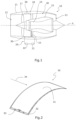
- FIG. 1 schematically illustrates a propulsion engine 10 of an aircraft comprising an external casing 11 which extends along a longitudinal axis X between an air intake vent 12 and an ejection nozzle 13.
- a turbomachine 14 comprises a turbomachine casing 15 fixed inside said outer casing 11 by straightening arms 16.
- This turbomachine 14 can be of any type. It can for example be a turboshaft engine comprising a gas turbine.
- a blower 17 is arranged at the air inlet mouth 12.
- This blower makes it possible to generate a primary air flow which supplies the turbomachine 14 and a secondary air flow which supplies a secondary channel 18, formed between the outer casing 11 and the turbomachine casing 15.
- FIG 1 also illustrates a lubrication circuit 20 according to an embodiment of the invention comprising a lubricating oil reservoir 21, a pump 22 and a plurality of conduits 23 for circulating the lubricating oil between the oil reservoir and the engine components to be lubricated, such as bearings, thrust bearings, gears, accessory boxes, reduction gears, not shown in the drawing.
- a lubrication circuit 20 for clarity purposes.
- the lubrication circuit 20 is shown very schematically for the sake of clarity. In particular, the pipes inside the turboshaft engine 14 are not shown.
- the fluid circuit may be a cooling circuit for at least one engine component.
- the architecture of such a cooling circuit is mutatis mutandis identical to that described in connection with the figures describing the application of the invention to a lubrication circuit for engine components.
- the lubrication circuit 20 comprises a system for cooling the lubricating oil comprising a skin exchanger 30 arranged on the inner wall of the outer casing 11, between the blower 17 and the straightening arms 16.
- This skin exchanger 30 is configured to be able to ensure thermal exchanges between the lubricating fluid circulating in the pipes 23 and the air circulating in said secondary channel 18.
- This skin exchanger 30 can be of any known type. It is formed, as shown in the figure 2 , from two metal sheets 31, 32 facing each other which delimit between them circulation channels 33 for the lubricating oil and of which one of the two sheets, called the interface sheet, is intended to extend over the periphery of the inner wall of the outer casing.
- the air propelled by the blower 17 in the secondary channel comes into contact with the channels 33, which allows thermal exchanges with the lubricating oil which circulates in these channels 33.
- the skin exchanger can have other architectures, particularly with regard to the circuitry of the fluid circulation channels.
- the skin exchanger may be the exchanger described in the application for patent FR3008173 on behalf of the applicant.
- FIG. 3 schematically illustrates a lubrication circuit according to an embodiment of the invention equipped with a cooling system according to one embodiment.
- the lubrication circuit 20 comprises an oil reservoir 22 configured to be able to deliver an oil at a temperature, which is for example between 100°C and 160°C.
- the circuit according to the embodiment of the figure 3 also includes a feed pump 43 for pumping oil from the reservoir 22 to the oil circulation channels of the skin exchanger 30.
- the cooling of the oil of the lubrication circuit 20 is ensured by a skin exchanger 30 arranged on an inner wall of the outer casing of the propulsion engine, between the fan and the straightening arms of the engine.
- This skin exchanger therefore makes it possible to cool the oil received from the tank by heat exchanges with the air circulating in the secondary channel of the engine.
- the air circulating in the secondary channel reaches a temperature of the order of 80°C, so that at the outlet of the skin exchanger 30, the oil is cooled to a temperature of between 90°C and 150°C, depending on the temperature of the oil upstream of the skin exchanger.
- oil cooling can also be provided by an additional oil/fuel heat exchanger 41, better known by the English acronym FCOC for "Fuel Cooled Oil Cooler”.
- FCOC Full Cooled Oil Cooler
- the lubricating oil can then be injected into a component 42 of the engine to be lubricated.
- This may be a power transmission box, a bearing, a thrust bearing, a gear, an accessory box and generally any component to be lubricated (or cooled in the case of the application of the invention to a cooling circuit of a cooling fluid).
- the oil leaving these lubricated elements reaches a temperature of between 100°C and 140°C and is reinjected into the oil reservoir 22 via an extraction pump 44.
- lubricating oil temperature levels are given for illustration purposes only and depend on the lubricating oil considered, the skin exchanger circuitry, the flight conditions which determine the temperature of the air circulating in the secondary channel and the lubricated components 42.
- the lubrication circuit can also include an oil/air heat exchanger, better known by the acronym ACOC for " Air-Cooled Oil Cooler” which allows the oil to be cooled by heat exchanges with the air taken from the secondary channel at a temperature of 120°C. This oil can then be injected into a turbomachine to reach a temperature of 180°C at the outlet, and return to the oil reservoir.
- ACOC Air-Cooled Oil Cooler
Landscapes
- Engineering & Computer Science (AREA)
- Mechanical Engineering (AREA)
- Chemical & Material Sciences (AREA)
- Combustion & Propulsion (AREA)
- General Engineering & Computer Science (AREA)
- Aviation & Aerospace Engineering (AREA)
- Lubrication Of Internal Combustion Engines (AREA)
- Structures Of Non-Positive Displacement Pumps (AREA)
- Heat-Exchange Devices With Radiators And Conduit Assemblies (AREA)
Description
- L'invention concerne un système de refroidissement d'un fluide de lubrification ou de refroidissement d'un organe d'un moteur propulsif d'un aéronef. L'invention concerne également un moteur propulsif d'un aéronef équipé d'un tel système de refroidissement d'un fluide (de lubrification ou de refroidissement), désigné ci-après, par les termes de circuit de fluide.
- Il est connu qu'un moteur propulsif d'un aéronef, quel que soit son type (turbine à gaz, moteur électrique, etc.) doit prévoir un système de lubrification de ses différents composants (paliers, butées, engrenages, boites accessoires, boitier de réduction, etc.). Il est fréquent qu'un tel système de lubrification mette en oeuvre un fluide du type huile de lubrification, aussi désignée par les termes d'huile moteur. Cette huile moteur doit être refroidie pour permettre l'évacuation des calories absorbées au cours de son passage dans les différents composants lubrifiés.
- Il est également connu qu'un certain nombre d'organes d'un moteur propulsif doit être refroidi par un circuit de refroidissement. Par exemple, dans le cas d'un moteur propulsif électrique, il peut s'agir de la génératrice électrique ou du starter de cette génératrice. Un tel circuit de refroidissement met en général en oeuvre un fluide de refroidissement qui est mis en contact avec les organes à refroidir pour absorber les calories évacuées par ces organes. Le fluide de ce circuit de refroidissement doit être refroidi pour pouvoir assurer sa fonction de refroidissement.
- Ainsi, la plupart des aéronefs sont équipés d'un système de refroidissement d'un fluide (qui est en général une huile pour un circuit de lubrification et un fluide caloporteur pour un circuit de refroidissement) qui comprend en général des échangeurs de chaleur à ailettes refroidis soit par un prélèvement d'air sur l'écoulement secondaire du moteur, plus connu sous la dénomination de fan air, d'air fan ou de « by-pass air », soit en plongeant les ailettes des échangeurs de chaleur directement dans le flux d'air de cet écoulement secondaire.
- Le prélèvement d'air sur l'écoulement secondaire réduit les performances énergétiques du moteur en augmentant la consommation de carburant du moteur. L'agencement des ailettes directement dans le flux d'air fan crée des pertes de charges et des perturbations d'écoulement d'air, ce qui réduit la poussée du moteur.
- Dans un moteur aéronautique à très fort taux de dilution, les pertes de charges et les perturbations d'écoulement sur l'air fan ne sont plus acceptables, car elles réduisent fortement la poussée du moteur. En outre, l'impact négatif d'un prélèvement d'air sur la consommation de kérosène du moteur est bien supérieur à celle d'un moteur aéronautique classique. En outre, le volume disponible pour le système de refroidissement est diminué par rapport à celui d'un moteur aéronautique classique.
- Pour un moteur aéronautique comprenant une boite de réduction, la puissance chaude transmise à l'huile de lubrification est beaucoup plus élevée que sur un moteur aéronautique classique (de l'ordre de 3 fois plus élevée), ce qui nécessite de sur dimensionner le système de refroidissement de l'huile.
- Il existe donc un besoin de disposer d'un nouveau système de refroidissement d'huile moteur qui puisse être mis en oeuvre à la fois sur les moteurs aéronautiques standards que sur les moteurs propulsifs à fort taux de dilution.
- Il existe également un besoin de disposer d'un nouveau système de refroidissement d'un fluide d'un circuit de refroidissement d'un organe moteur, tel que par exemple une génératrice électrique et d'une manière générale de tout organe moteur à refroidir.
- L'invention vise donc à fournir un système et un procédé de refroidissement d'un fluide d'un circuit de lubrification ou de refroidissement d'un fluide, dit circuit de fluide, d'un organe d'un moteur propulsif d'un aéronef qui pallient au moins certains des inconvénients des systèmes et procédés connus.
- L'invention vise en particulier à fournir, dans au moins un mode de réalisation, un système et un procédé de refroidissement d'un fluide d'un circuit de fluide qui ne pénalisent ni la consommation de carburant ni la poussée du moteur.
- L'invention vise en particulier à fournir, dans au moins un mode de réalisation, un système de refroidissement d'un fluide d'un circuit de fluide qui présente un encombrement réduit par rapport aux systèmes connus.
- L'invention vise aussi à fournir, dans au moins un mode de réalisation, un système et un procédé de refroidissement d'un fluide d'un circuit de fluide qui contribuent à améliorer la poussée du moteur propulsif.
- L'invention vise aussi à fournir, dans au moins un mode de réalisation, un système et un procédé de refroidissement d'un fluide d'un circuit de fluide qui sont particulièrement adaptés aux moteurs aéronautiques à fort taux de dilution et/ou à boite de réduction.
- L'invention vise aussi à fournir, dans au moins un mode de réalisation, un système et un procédé de refroidissement d'un fluide d'un circuit de fluide qui permettent un meilleur refroidissement du fluide de lubrification que les systèmes et procédés connus.
- D'autres objectifs de l'invention ressortiront également de la description qui suit et des différents modes de réalisation décrits.
- Les documents
WO 2014/130103 A2 ,US 2006/0042225 A1 etUS 2008/0095611 A1 décrivent des circuits de fluide des turboréacteurs de l'art antérieur. - Pour ce faire, l'invention concerne un circuit de lubrification ou de refroidissement selon la revendication 1.
- Un système selon l'invention permet donc de refroidir le fluide du circuit de fluide (qui est soit un fluide de lubrification d'au moins un organe moteur, soit un fluide de refroidissement d'au moins un organe moteur) par l'intermédiaire d'un échangeur de peau lisse, qui ne comprend aucune ailette plongée dans le flux d'air secondaire, qui est logé entre la soufflante et les bras redresseurs, et qui permet des échanges thermiques entre le fluide du circuit de fluide et l'air de l'écoulement secondaire, sans perturber le flux d'air secondaire, ni pénaliser la consommation de carburant.
- L'échangeur de peau est agencé entre la soufflante et les bras redresseurs du moteur, c'est-à-dire dans une zone du moteur où l'écoulement d'air est fortement perturbé. Cet agencement avantageux de l'échangeur de peau entre les pales de la soufflante et celles du redresseur, permet de bénéficier de la forte turbulence de l'écoulement d'air dans cette zone, ce qui augmente les échanges thermiques et donc la capacité de refroidissement de l'échangeur.
- Un système selon l'invention permet également de refroidir le fluide de lubrification ou de refroidissement dès que le moteur fonctionne, y compris lorsque l'aéronef présente une vitesse faible, voire une vitesse nulle.
- Les échanges thermiques entre le fluide de lubrification ou de refroidissement et le flux d'air du canal secondaire ont pour conséquence d'augmenter la température de l'air du flux secondaire en aval de l'échangeur de peau, ce qui contribue à améliorer la poussée du moteur propulsif.
- Un système selon l'invention permet donc non seulement de réduire les impacts du système de refroidissement sur la performance et la consommation de carburant du moteur, mais également d'augmenter la poussée du moteur, tout en augmentant la capacité de refroidissement du fluide.
- Un tel système est donc particulièrement avantageux pour les nouveaux moteurs aéronautiques à très forts taux de dilution et/ou à boite de réduction.
- Avantageusement et selon l'invention, l'échangeur de peau est courbe.
- Un tel échangeur permet donc d'épouser la forme de la paroi intérieure du carter extérieur du moteur.
- Le carter extérieur d'un moteur propulsif est en général formé par un corps annulaire extérieur dans lequel est logé la soufflante, relié à un deuxième corps annulaire extérieur dans lequel est logé la turbomachine portée par les bras redresseurs, lui-même relié à une nacelle. Dans tout le texte qui suit, le terme nacelle désigne, par abus de langage, le carter extérieur du moteur propulsif qui s'étend de la bouche d'entrée d'air à la tuyère d'éjection.
- Avantageusement et selon cette variante, ledit échangeur de peau s'étend sur toute la périphérie de ladite paroi intérieure dudit carter extérieur.
- Cette variante avantageuse permet de maximiser les échanges thermiques en prévoyant un échangeur de peau courbe qui s'étend sur toute la périphérie de la paroi intérieure dudit carter extérieur, entre la bouche d'entrée d'air et les bras redresseurs.
- Avantageusement et selon l'invention, ledit circuit de fluide est un circuit de lubrification, ledit fluide est une huile de lubrification et ledit échangeur de peau comprend des canaux de circulation de cette huile de lubrification.
- Selon une autre variante, ledit circuit de fluide est un circuit de refroidissement, ledit fluide est un fluide de refroidissement et ledit échangeur de peau comprend des canaux de circulation de ce fluide de refroidissement.
- L'invention concerne également un moteur propulsif d'un aéronef comprenant un carter extérieur qui s'étend selon une direction longitudinale entre une bouche d'entrée d'air et une tuyère d'éjection, une turbomachine comprenant un carter de turbomachine fixé à l'intérieur dudit carter extérieur par des bras redresseurs, une soufflante agencée au niveau de ladite bouche d'entrée d'air dudit carter extérieur, en amont de ladite turbomachine, configurée pour pouvoir générer un flux d'air primaire alimentant ladite turbomachine et un flux d'air secondaire alimentant un canal, dit canal secondaire, formé entre ledit carter extérieur et ledit carter de turbomachine.
- Un moteur propulsif selon l'invention est caractérisé en ce qu'il comprend en outre un circuit de lubrification ou de refroidissement selon l'invention.
- Les avantages d'un circuit de lubrification ou de refroidissement d'un organe moteur selon l'invention s'appliquent donc mutatis mutandis à un moteur propulsif selon l'invention.
- L'invention concerne également un aéronef comprenant au moins un moteur propulsif selon l'invention.
- L'invention concerne également un procédé selon la revendication 8 de refroidissement d'un fluide d'un circuit de lubrification ou de refroidissement d'au moins un organe d'un moteur propulsif d'un aéronef comprenant un carter extérieur qui s'étend selon une direction longitudinale entre une bouche d'entrée d'air et une tuyère d'éjection, une turbomachine comprenant un carter de turbomachine fixé à l'intérieur dudit carter extérieur par des bras redresseurs, et une soufflante agencée au niveau de ladite bouche d'entrée d'air dudit carter extérieur, en amont de ladite turbomachine, et configurée pour pouvoir générer un flux d'air primaire alimentant ladite turbomachine et un flux d'air secondaire alimentant un canal, dit canal secondaire, formé entre ledit carter extérieur et ledit carter de turbomachine.
- Un procédé selon l'invention est caractérisé en ce qu'il comprend :
- l'agencement de l'échangeur de peau du circuit de fluide sur une paroi intérieure dudit carter extérieur, longitudinalement entre ladite soufflante et lesdits bras redresseurs,
- la mise en communication fluidique dudit échangeur de peau avec ledit circuit de fluide pour pouvoir assurer des échanges thermiques entre ledit fluide dudit circuit de fluide et l'air circulant dans ledit canal secondaire.
- En outre, les avantages d'un système de refroidissement selon l'invention s'appliquent mutatis mutandis à un procédé de refroidissement selon l'invention.
- En particulier, un procédé selon l'invention permet d'assurer un refroidissement d'un fluide d'un circuit de lubrification ou de refroidissement par l'installation d'un échangeur de peau entre la soufflante nacelle et les bras redresseurs du moteur. C'est cet agencement spécifique, dans une zone du moteur où l'écoulement d'air est fortement perturbé, qui permet d'améliorer sensiblement les échanges thermiques entre l'air fan et le fluide de lubrification ou de refroidissement, et donc son refroidissement.
- En outre, le procédé de refroidissement selon l'invention contribue à améliorer la poussée du moteur propulsif, étant donné que les échanges thermiques entre le fluide du circuit de fluide et le flux d'air du canal secondaire conduisent à augmenter la température de l'air du flux secondaire en aval de l'échangeur de peau.
- Avantageusement et selon l'invention, ladite étape d'agencement de l'échangeur de peau sur la paroi intérieure dudit carter extérieur consiste à agencer ledit échangeur de peau sur toute la périphérie de ladite paroi intérieure dudit carter extérieur.
- D'autres buts, caractéristiques et avantages de l'invention apparaîtront à la lecture de la description suivante donnée à titre uniquement non limitatif et qui se réfère aux figures annexées dans lesquelles :
- [
Fig 1 ] est une vue schématique en perspective coupe d'un moteur propulsif selon un mode de réalisation de l'invention comprenant un système de refroidissement selon un mode de réalisation de l'invention, - [
Fig 2 ] est une vue schématique d'un échangeur de peau d'un système de refroidissement selon un mode de réalisation de l'invention, - [
Fig 3 ] est une vue schématique d'un circuit de lubrification d'un moteur propulsif selon un mode de réalisation de l'invention. - Sur les figures, les échelles et les proportions ne sont pas strictement respectées et ce, à des fins d'illustration et de clarté.
- La direction longitudinale correspond à la direction principale du moteur propulsif qui est la direction suivie par l'air de la bouche d'entrée d'air dans la nacelle à la tuyère d'éjection des gaz.
- Le terme radial est utilisé par rapport à l'axe X de symétrie du moteur propulsif qui s'étend le long de la direction longitudinale.
- La
figure 1 illustre schématiquement un moteur propulsif 10 d'un aéronef comprenant un carter extérieur 11 qui s'étend selon un axe X longitudinal entre une bouche d'entrée d'air 12 et une tuyère d'éjection 13. - En outre, une turbomachine 14 comprend un carter 15 de turbomachine fixé à l'intérieur dudit carter extérieur 11 par des bras redresseurs 16. Cette turbomachine 14 peut être de tous types. Il peut par exemple s'agir d'un turbomoteur comprenant une turbine à gaz.
- Une soufflante 17 est agencée au niveau de la bouche d'entrée d'air 12.
- Cette soufflante permet de générer un flux d'air primaire qui alimente la turbomachine 14 et un flux d'air secondaire qui alimente un canal secondaire 18, formé entre le carter extérieur 11 et le carter 15 de turbomachine.
- La
figure 1 illustre également un circuit de lubrification 20 selon un mode de réalisation de l'invention comprenant un réservoir d'huile de lubrification 21, une pompe 22 et une pluralité de conduites 23 de circulation de l'huile de lubrification entre le réservoir d'huile et les organes du moteur à lubrifier, tels que des paliers, butées, engrenages, boites accessoires, boitier de réduction, non représentés sur lafigure 1 à des fins de clarté. Sur lafigure 1 , le circuit de lubrification 20 est représenté de manière très schématique à des fins de clarté. En particulier, les conduites à l'intérieur du turbomoteur 14 ne sont pas représentées. - Selon d'autres variantes, le circuit de fluide peut être un circuit de refroidissement d'au moins un organe moteur. L'architecture d'un tel circuit de refroidissement est mutatis mutandis identique à celle décrite en lien avec les figures décrivant l'application de l'invention à un circuit de lubrification d'organes moteurs.
- Le circuit de lubrification 20 comprend un système de refroidissement de l'huile de lubrification comprenant un échangeur de peau 30 agencé sur la paroi intérieure du carter extérieur 11, entre la soufflante 17 et les bras redresseurs 16.
- Cet échangeur de peau 30 est configuré pour pouvoir assurer des échanges thermiques entre le fluide de lubrification circulant dans les conduites 23 et l'air circulant dans ledit canal secondaire 18.
- Cet échangeur de peau 30 peut être de tous types connus. Il est formé, tel que représenté sur la
figure 2 , à partir de deux feuilles métalliques 31, 32 en regard l'une de l'autre qui délimitent entre elles des canaux de circulation 33 de l'huile de lubrification et dont une des deux feuilles, dite feuille d'interface, est destinée à s'étendre sur la périphérie de la paroi intérieure du carter extérieur. - Une fois agencé en périphérie de la paroi intérieure du carter extérieur qui définit la paroi extérieure de la veine d'air du canal secondaire 18, l'air propulsé par la soufflante 17 dans le canal secondaire, représenté schématiquement par la flèche 34 sur la
figure 2 , vient en contact avec les canaux 33, ce qui permet des échanges thermiques avec l'huile de lubrification qui circule dans ces canaux 33. - Bien entendu, l'échangeur de peau peut présenter d'autres architectures, notamment en ce qui concerne la circuiterie des canaux de circulation du fluide.
- Ainsi, l'échangeur de peau peut être l'échangeur décrit dans la demande de
brevet FR3008173 - La
figure 3 illustre schématiquement un circuit de lubrification selon un mode de réalisation de l'invention équipé d'un système de refroidissement selon un mode de réalisation. - Le circuit de lubrification 20 comprend un réservoir d'huile 22 configuré pour pouvoir délivrer une huile à une température, qui est par exemple comprise dans entre 100°C et 160°C.
- Le circuit selon le mode de réalisation de la
figure 3 comprend également une pompe de gavage 43 permettant de pomper l'huile du réservoir 22 vers les canaux de circulation d'huile de l'échangeur de peau 30. - Le refroidissement de l'huile du circuit de lubrification 20 est assuré par un échangeur de peau 30 agencé sur une paroi intérieure du carter extérieur du moteur propulsif, entre la soufflante et les bras redresseurs du moteur. Cet échangeur de peau permet donc de refroidir l'huile reçue du réservoir par des échanges thermiques avec l'air circulant dans le canal secondaire du moteur. L'air circulant dans le canal secondaire atteint une température de l'ordre de 80°C, de sorte qu'en sortie d'échangeur de peau 30, l'huile est refroidie à une température comprise entre 90°C et 150°C, selon la température de l'huile en amont de l'échangeur de peau.
- Selon le mode de réalisation de la
figure 3 , le refroidissement de l'huile peut également être assuré par un échangeur de chaleur huile/carburant 41 additionnel, plus connu sous l'acronyme anglais FCOC pour « Fuel Cooled Oil Cooler ». Le carburant qui entre dans l'échangeur de chaleur atteint une température comprise entre 40°C et 60°C de sorte que l'huile en sortie d'échangeur est refroidie à une température comprise entre 70°C et 120°C, selon la température de l'huile en aval de l'échangeur de peau. - L'huile de lubrification peut ensuite être injectée dans un organe 42 du moteur à lubrifier. Il peut s'agir d'une boite de transmission de puissance, d'un palier, d'une butée, d'un engrenage, d'une boite accessoire et d'une manière générale de tout organe à lubrifier (ou à refroidir dans le cas de l'application de l'invention à un circuit de refroidissement d'un fluide de refroidissement).
- L'huile en sortie de ces éléments lubrifiés atteint une température comprise entre 100 °C et 140°C et est réinjectée dans le réservoir 22 d'huile par l'intermédiaire d'une pompe d'extraction 44.
- Bien entendu, les niveaux de température de l'huile de lubrification ne sont donnés qu'à titre d'illustration et dépendent de l'huile de lubrification considérée, de la circuiterie de l'échangeur de peau, des conditions de vol qui déterminent la température de l'air circulant dans le canal secondaire et des organes 42 lubrifiés.
- Le circuit de lubrification peut également comprendre un échangeur de chaleur huile/air, plus connu sous l'acronyme ACOC pour « Air-Cooled Oil Cooler » qui permet de refroidir l'huile par des échanges de chaleur avec l'air prélevé dans le canal secondaire à une température de 120°C. Cette huile peut ensuite être injectée dans une turbomachine pour atteindre en sortie une température de 180°C, et rejoindre le réservoir d'huile.
Claims (9)
- Circuit de lubrification ou de refroidissement, dit circuit de fluide (20), d'au moins un organe (42) d'un moteur propulsif (10) d'un aéronef comprenant un carter extérieur (11) qui s'étend selon une direction longitudinale (X) entre une bouche d'entrée d'air (12) et une tuyère d'éjection (13), une turbomachine (14) comprenant un carter de turbomachine (15) fixé à l'intérieur dudit carter extérieur (11) par des bras redresseurs (16) et une soufflante (17) agencée au niveau de ladite bouche d'entrée d'air (12) dudit carter extérieur (11), en amont de ladite turbomachine (14), configurée pour pouvoir générer un flux d'air primaire alimentant ladite turbomachine (14) et un flux d'air secondaire alimentant un canal, dit canal secondaire (18), formé entre ledit carter extérieur (11) et ledit carter de turbomachine (15) ; ledit circuit de fluide (20) étant caractérisé en ce qu'il comprend :- un réservoir (22) de fluide de lubrification ou de refroidissement,- ledit au moins un organe (42) dudit moteur à lubrifier et/ou refroidir,- au moins une conduite de circulation (23) de fluide reliant ledit réservoir (22) de fluide et ledit au moins un organe (42), dudit moteur (10), à lubrifier et/ou refroidir,- un système de refroidissement dudit fluide comprenant un échangeur thermique lisse, dit échangeur de peau (30), formé à partir de deux feuilles métalliques (31, 32) en regard l'une de l'autre et délimitant entre elles des canaux de circulation (33) dudit fluide et dont l'une des feuilles, dite feuille d'interface, est destinée à s'étendre sur la périphérie de la paroi intérieure du carter extérieur (11) de sorte que ledit échangeur de peau ne comprenne aucune ailette plongée dans ledit flux d'air secondaire et soit configuré pour être agencé sur une paroi intérieure dudit carter extérieur; ledit échangeur de peau (30) étant configuré pour être en communication fluidique avec ledit circuit (20) de fluide et configuré pour pouvoir assurer des échanges thermiques entre ledit fluide dudit circuit (20) de fluide et l'air circulant dans ledit canal secondaire (18),le circuit de fluide (20) étant caractérisé en ce que l'échangeur (30) est configuré pour être agencé longitudinalement entre ladite soufflante (17) et lesdits bras redresseurs (16).
- Circuit de fluide (20) selon la revendication 1, caractérisé en ce que ledit échangeur de peau (30) dudit système de refroidissement est courbe.
- Circuit de fluide (20) selon l'une des revendications 1 ou 2, caractérisé en ce que ledit échangeur de peau (30) s'étend sur toute la périphérie de ladite paroi intérieure dudit carter extérieur (11).
- Circuit de fluide (20) selon l'une des revendications 1 à 3, caractérisé en ce que ledit circuit (20) de fluide est un circuit de lubrification, ledit fluide est une huile de lubrification et ledit échangeur de peau (30) comprend des canaux de circulation (33) de cette huile de lubrification.
- Circuit de fluide (20) selon l'une des revendications 1 à 3, caractérisé en ce que ledit circuit (20) de fluide est un circuit de refroidissement, ledit fluide est un fluide de refroidissement et ledit échangeur de peau (30) comprend des canaux de circulation (33) de ce fluide de refroidissement.
- Moteur propulsif (10) d'un aéronef comprenant un carter extérieur (11) qui s'étend selon une direction longitudinale (X) entre une bouche d'entrée d'air (12) et une tuyère d'éjection (13), une turbomachine (14) comprenant un carter (15) de turbomachine fixé à l'intérieur dudit carter extérieur (11) par des bras redresseurs (16), une soufflante (17) agencée au niveau de ladite bouche d'entrée d'air (12) dudit carter extérieur, en amont de ladite turbomachine (14), configurée pour pouvoir générer un flux d'air primaire alimentant ladite turbomachine et un flux d'air secondaire alimentant un canal, dit canal secondaire (18), formé entre ledit carter extérieur (11) et ledit carter (15) de turbomachine (14), caractérisé en ce qu'il comprend en outre un circuit de fluide (20) selon l'une des revendications 1à 5.
- Aéronef comprenant au moins un moteur propulsif, caractérisé en ce que ledit moteur propulsif est un moteur selon la revendication 6.
- Procédé de refroidissement et/ou de lubrification d'un fluide d'un circuit de lubrification ou de refroidissement, selon la revendication 1,dit circuit de fluide (20), d'un organe (42) d'un moteur propulsif (10) d'un aéronef comprenant un carter extérieur (11) qui s'étend selon une direction longitudinale (X) entre une bouche d'entrée d'air (12) et une tuyère d'éjection (13), une turbomachine (14) comprenant un carter (15) de turbomachine fixé à l'intérieur dudit carter extérieur (11) par des bras redresseurs (16), et une soufflante (17) agencée au niveau de ladite bouche d'entrée d'air (12) dudit carter extérieur (11), en amont de ladite turbomachine (14), et configurée pour pouvoir générer un flux d'air primaire alimentant ladite turbomachine et un flux d'air secondaire alimentant un canal, dit canal secondaire (18), formé entre ledit carter extérieur (11) et ledit carter (15) de turbomachine,caractérisé en ce que ledit procédé comprend :- l'agencement de l'échangeur de peau (30) dudit circuit de fluide (20) sur une paroi intérieure dudit carter extérieur (11), longitudinalement entre ladite soufflante (17) et lesdits bras redresseurs (16),- la mise en communication fluidique dudit échangeur de peau (30) avec ledit circuit de fluide (20) pour pouvoir assurer des échanges thermiques entre ledit fluide du circuit de fluide (20) et l'air circulant dans ledit canal secondaire (18).
- Procédé selon la revendication 8, caractérisé en ce que ladite étape d'agencement de l'échangeur de peau sur la paroi intérieure dudit carter extérieur consiste à agencer ledit échangeur de peau sur toute la périphérie de ladite paroi intérieure dudit carter extérieur.
Applications Claiming Priority (2)
| Application Number | Priority Date | Filing Date | Title |
|---|---|---|---|
| FR1870922A FR3084915B1 (fr) | 2018-08-10 | 2018-08-10 | Système et procédé de refroidissement d’un fluide d’un circuit de lubrification ou de refrodissement d’un organe moteur d’un aéronef et moteur propulsif d’aéronef équipé d’un tel système de refroidissement |
| PCT/FR2019/051906 WO2020030874A1 (fr) | 2018-08-10 | 2019-08-06 | Système et procédé de refroidissement d'un fluide d'un circuit de lubrification ou de refrodissement d'un organe moteur d'un aéronef et moteur propulsif d'aéronef équipé d'un tel système de refroidissement |
Publications (2)
| Publication Number | Publication Date |
|---|---|
| EP3833862A1 EP3833862A1 (fr) | 2021-06-16 |
| EP3833862B1 true EP3833862B1 (fr) | 2025-01-01 |
Family
ID=65201586
Family Applications (1)
| Application Number | Title | Priority Date | Filing Date |
|---|---|---|---|
| EP19759668.7A Active EP3833862B1 (fr) | 2018-08-10 | 2019-08-06 | Circuit de lubrification ou de refroidissement d'un organe moteur d'un aéronef et moteur propulsif d'aéronef équipé d'un tel circuit |
Country Status (5)
| Country | Link |
|---|---|
| US (1) | US12172769B2 (fr) |
| EP (1) | EP3833862B1 (fr) |
| ES (1) | ES3010183T3 (fr) |
| FR (1) | FR3084915B1 (fr) |
| WO (1) | WO2020030874A1 (fr) |
Families Citing this family (2)
| Publication number | Priority date | Publication date | Assignee | Title |
|---|---|---|---|---|
| FR3097901B1 (fr) * | 2019-06-25 | 2021-07-16 | Safran Aircraft Engines | Turbomachine d'aeronef comportant des moyens d'amorçage de la pompe de lubrification |
| FR3155863B1 (fr) * | 2023-11-27 | 2026-01-09 | Safran Nacelles | Echangeur de chaleur surfacique comprenant un réducteur de pertes de charge et nacelle d’aéronef équipée d’un tel échangeur de chaleur |
Citations (1)
| Publication number | Priority date | Publication date | Assignee | Title |
|---|---|---|---|---|
| US20080095611A1 (en) * | 2006-10-19 | 2008-04-24 | Michael Ralph Storage | Method and apparatus for operating gas turbine engine heat exchangers |
Family Cites Families (6)
| Publication number | Priority date | Publication date | Assignee | Title |
|---|---|---|---|---|
| US7377100B2 (en) * | 2004-08-27 | 2008-05-27 | Pratt & Whitney Canada Corp. | Bypass duct fluid cooler |
| US20080053060A1 (en) * | 2006-08-29 | 2008-03-06 | Pratt & Whitney Canada Corp. | Bypass lip seal |
| US8510945B2 (en) * | 2009-12-22 | 2013-08-20 | Unison Industries, Llc | Method of mounting a heat exchanger in a gas turbine engine assembly |
| WO2014130103A2 (fr) * | 2013-02-20 | 2014-08-28 | United Technologies Corporation | Échangeurs de chaleur intégrés pour un réacteur à double flux à engrenages à faible rapport de pression de ventilateur |
| FR3008173B1 (fr) * | 2013-07-08 | 2018-11-23 | Liebherr-Aerospace Toulouse Sas | Dispositif d'echange thermique et procede de fabrication d'un tel dispositif |
| US10145304B2 (en) * | 2014-01-13 | 2018-12-04 | United Technologies Corporation | Dual function air diverter and variable area fan nozzle |
-
2018
- 2018-08-10 FR FR1870922A patent/FR3084915B1/fr active Active
-
2019
- 2019-08-06 US US17/267,797 patent/US12172769B2/en active Active
- 2019-08-06 WO PCT/FR2019/051906 patent/WO2020030874A1/fr not_active Ceased
- 2019-08-06 ES ES19759668T patent/ES3010183T3/es active Active
- 2019-08-06 EP EP19759668.7A patent/EP3833862B1/fr active Active
Patent Citations (1)
| Publication number | Priority date | Publication date | Assignee | Title |
|---|---|---|---|---|
| US20080095611A1 (en) * | 2006-10-19 | 2008-04-24 | Michael Ralph Storage | Method and apparatus for operating gas turbine engine heat exchangers |
Also Published As
| Publication number | Publication date |
|---|---|
| ES3010183T3 (en) | 2025-04-01 |
| WO2020030874A1 (fr) | 2020-02-13 |
| US20210163147A1 (en) | 2021-06-03 |
| FR3084915A1 (fr) | 2020-02-14 |
| FR3084915B1 (fr) | 2020-12-04 |
| EP3833862A1 (fr) | 2021-06-16 |
| US12172769B2 (en) | 2024-12-24 |
Similar Documents
| Publication | Publication Date | Title |
|---|---|---|
| EP3735518B1 (fr) | Turbomachine comportant un échangeur de chaleur dans la veine secondaire | |
| CA2678657C (fr) | Systeme de refroidissement et de regulation en temperature d'equipements d'un ensemble propulsif d'aeronef | |
| US9945325B2 (en) | Integrated heat exchangers for low fan pressure ratio geared turbofan | |
| EP3111077B1 (fr) | Rotor de soufflante pour une turbomachine telle qu'un turboréacteur multiflux entraîné par réducteur | |
| EP3615780B1 (fr) | Ensemble propulsif pour aéronef comportant des échangeurs de chaleur air-liquide | |
| EP3070317B1 (fr) | Refroidissement de turbomachine par évaporation | |
| FR3016956A1 (fr) | Echangeur de chaleur d'une turbomachine | |
| EP4259916A1 (fr) | Turbomachine pour un aéronef | |
| EP3719279A1 (fr) | Echangeur de chaleur surfacique pour système de refroidissement de turboréacteur pour aéronef | |
| EP3833862B1 (fr) | Circuit de lubrification ou de refroidissement d'un organe moteur d'un aéronef et moteur propulsif d'aéronef équipé d'un tel circuit | |
| US10060290B2 (en) | Method and system for centrifugal pump | |
| EP4305289B1 (fr) | Échangeur de chaleur surfacique avec sorties additionelles | |
| FR3093765A1 (fr) | Systeme echangeur de chaleur air-huile de turbomachine optimise | |
| WO2024175850A1 (fr) | Turbomachine d'aeronef comportant un systeme d'echange de chaleur | |
| FR3146166A1 (fr) | Systeme d’echange de chaleur pour une turbomachine d’aeronef | |
| EP4669843A1 (fr) | Systeme d'echange de chaleur pour une turbomachine d'aeronef | |
| FR3162472A1 (fr) | Ensemble comprenant un boitier, un circuit d’huile et un circuit de carburant | |
| WO2025114671A1 (fr) | Turbomachine pour un aeronef et son procede de refroidissement | |
| WO2025078763A1 (fr) | Procede de rechauffage du carburant d'un systeme d'alimentation en carburant d'une turbomachine |
Legal Events
| Date | Code | Title | Description |
|---|---|---|---|
| STAA | Information on the status of an ep patent application or granted ep patent |
Free format text: STATUS: UNKNOWN |
|
| STAA | Information on the status of an ep patent application or granted ep patent |
Free format text: STATUS: THE INTERNATIONAL PUBLICATION HAS BEEN MADE |
|
| PUAI | Public reference made under article 153(3) epc to a published international application that has entered the european phase |
Free format text: ORIGINAL CODE: 0009012 |
|
| STAA | Information on the status of an ep patent application or granted ep patent |
Free format text: STATUS: REQUEST FOR EXAMINATION WAS MADE |
|
| 17P | Request for examination filed |
Effective date: 20210209 |
|
| AK | Designated contracting states |
Kind code of ref document: A1 Designated state(s): AL AT BE BG CH CY CZ DE DK EE ES FI FR GB GR HR HU IE IS IT LI LT LU LV MC MK MT NL NO PL PT RO RS SE SI SK SM TR |
|
| DAV | Request for validation of the european patent (deleted) | ||
| DAX | Request for extension of the european patent (deleted) | ||
| STAA | Information on the status of an ep patent application or granted ep patent |
Free format text: STATUS: EXAMINATION IS IN PROGRESS |
|
| 17Q | First examination report despatched |
Effective date: 20230830 |
|
| REG | Reference to a national code |
Ref country code: DE Ref legal event code: R079 Free format text: PREVIOUS MAIN CLASS: F02K0003115000 Ipc: F01D0025120000 Ref country code: DE Ref legal event code: R079 Ref document number: 602019064276 Country of ref document: DE Free format text: PREVIOUS MAIN CLASS: F02K0003115000 Ipc: F01D0025120000 |
|
| RIC1 | Information provided on ipc code assigned before grant |
Ipc: F02C 7/18 20060101ALI20240712BHEP Ipc: F02C 7/14 20060101ALI20240712BHEP Ipc: F02K 3/115 20060101ALI20240712BHEP Ipc: F01D 25/20 20060101ALI20240712BHEP Ipc: F01D 25/14 20060101ALI20240712BHEP Ipc: F01D 25/12 20060101AFI20240712BHEP |
|
| GRAP | Despatch of communication of intention to grant a patent |
Free format text: ORIGINAL CODE: EPIDOSNIGR1 |
|
| STAA | Information on the status of an ep patent application or granted ep patent |
Free format text: STATUS: GRANT OF PATENT IS INTENDED |
|
| INTG | Intention to grant announced |
Effective date: 20240918 |
|
| GRAS | Grant fee paid |
Free format text: ORIGINAL CODE: EPIDOSNIGR3 |
|
| GRAA | (expected) grant |
Free format text: ORIGINAL CODE: 0009210 |
|
| STAA | Information on the status of an ep patent application or granted ep patent |
Free format text: STATUS: THE PATENT HAS BEEN GRANTED |
|
| AK | Designated contracting states |
Kind code of ref document: B1 Designated state(s): AL AT BE BG CH CY CZ DE DK EE ES FI FR GB GR HR HU IE IS IT LI LT LU LV MC MK MT NL NO PL PT RO RS SE SI SK SM TR |
|
| REG | Reference to a national code |
Ref country code: GB Ref legal event code: FG4D Free format text: NOT ENGLISH |
|
| REG | Reference to a national code |
Ref country code: CH Ref legal event code: EP |
|
| REG | Reference to a national code |
Ref country code: DE Ref legal event code: R096 Ref document number: 602019064276 Country of ref document: DE |
|
| REG | Reference to a national code |
Ref country code: IE Ref legal event code: FG4D Free format text: LANGUAGE OF EP DOCUMENT: FRENCH |
|
| REG | Reference to a national code |
Ref country code: ES Ref legal event code: FG2A Ref document number: 3010183 Country of ref document: ES Kind code of ref document: T3 Effective date: 20250401 |
|
| REG | Reference to a national code |
Ref country code: LT Ref legal event code: MG9D |
|
| REG | Reference to a national code |
Ref country code: NL Ref legal event code: MP Effective date: 20250101 |
|
| REG | Reference to a national code |
Ref country code: AT Ref legal event code: MK05 Ref document number: 1756431 Country of ref document: AT Kind code of ref document: T Effective date: 20250101 |
|
| PG25 | Lapsed in a contracting state [announced via postgrant information from national office to epo] |
Ref country code: NL Free format text: LAPSE BECAUSE OF FAILURE TO SUBMIT A TRANSLATION OF THE DESCRIPTION OR TO PAY THE FEE WITHIN THE PRESCRIBED TIME-LIMIT Effective date: 20250101 |
|
| PG25 | Lapsed in a contracting state [announced via postgrant information from national office to epo] |
Ref country code: FI Free format text: LAPSE BECAUSE OF FAILURE TO SUBMIT A TRANSLATION OF THE DESCRIPTION OR TO PAY THE FEE WITHIN THE PRESCRIBED TIME-LIMIT Effective date: 20250101 |
|
| PG25 | Lapsed in a contracting state [announced via postgrant information from national office to epo] |
Ref country code: PL Free format text: LAPSE BECAUSE OF FAILURE TO SUBMIT A TRANSLATION OF THE DESCRIPTION OR TO PAY THE FEE WITHIN THE PRESCRIBED TIME-LIMIT Effective date: 20250101 |
|
| PG25 | Lapsed in a contracting state [announced via postgrant information from national office to epo] |
Ref country code: IS Free format text: LAPSE BECAUSE OF FAILURE TO SUBMIT A TRANSLATION OF THE DESCRIPTION OR TO PAY THE FEE WITHIN THE PRESCRIBED TIME-LIMIT Effective date: 20250501 Ref country code: NO Free format text: LAPSE BECAUSE OF FAILURE TO SUBMIT A TRANSLATION OF THE DESCRIPTION OR TO PAY THE FEE WITHIN THE PRESCRIBED TIME-LIMIT Effective date: 20250401 |
|
| PG25 | Lapsed in a contracting state [announced via postgrant information from national office to epo] |
Ref country code: HR Free format text: LAPSE BECAUSE OF FAILURE TO SUBMIT A TRANSLATION OF THE DESCRIPTION OR TO PAY THE FEE WITHIN THE PRESCRIBED TIME-LIMIT Effective date: 20250101 |
|
| PG25 | Lapsed in a contracting state [announced via postgrant information from national office to epo] |
Ref country code: PT Free format text: LAPSE BECAUSE OF FAILURE TO SUBMIT A TRANSLATION OF THE DESCRIPTION OR TO PAY THE FEE WITHIN THE PRESCRIBED TIME-LIMIT Effective date: 20250502 Ref country code: LV Free format text: LAPSE BECAUSE OF FAILURE TO SUBMIT A TRANSLATION OF THE DESCRIPTION OR TO PAY THE FEE WITHIN THE PRESCRIBED TIME-LIMIT Effective date: 20250101 |
|
| PG25 | Lapsed in a contracting state [announced via postgrant information from national office to epo] |
Ref country code: GR Free format text: LAPSE BECAUSE OF FAILURE TO SUBMIT A TRANSLATION OF THE DESCRIPTION OR TO PAY THE FEE WITHIN THE PRESCRIBED TIME-LIMIT Effective date: 20250402 Ref country code: BG Free format text: LAPSE BECAUSE OF FAILURE TO SUBMIT A TRANSLATION OF THE DESCRIPTION OR TO PAY THE FEE WITHIN THE PRESCRIBED TIME-LIMIT Effective date: 20250101 |
|
| PG25 | Lapsed in a contracting state [announced via postgrant information from national office to epo] |
Ref country code: AT Free format text: LAPSE BECAUSE OF FAILURE TO SUBMIT A TRANSLATION OF THE DESCRIPTION OR TO PAY THE FEE WITHIN THE PRESCRIBED TIME-LIMIT Effective date: 20250101 |
|
| PG25 | Lapsed in a contracting state [announced via postgrant information from national office to epo] |
Ref country code: CZ Free format text: LAPSE BECAUSE OF FAILURE TO SUBMIT A TRANSLATION OF THE DESCRIPTION OR TO PAY THE FEE WITHIN THE PRESCRIBED TIME-LIMIT Effective date: 20250101 |
|
| PG25 | Lapsed in a contracting state [announced via postgrant information from national office to epo] |
Ref country code: SE Free format text: LAPSE BECAUSE OF FAILURE TO SUBMIT A TRANSLATION OF THE DESCRIPTION OR TO PAY THE FEE WITHIN THE PRESCRIBED TIME-LIMIT Effective date: 20250101 |
|
| REG | Reference to a national code |
Ref country code: DE Ref legal event code: R097 Ref document number: 602019064276 Country of ref document: DE |
|
| PG25 | Lapsed in a contracting state [announced via postgrant information from national office to epo] |
Ref country code: SM Free format text: LAPSE BECAUSE OF FAILURE TO SUBMIT A TRANSLATION OF THE DESCRIPTION OR TO PAY THE FEE WITHIN THE PRESCRIBED TIME-LIMIT Effective date: 20250101 |
|
| PGFP | Annual fee paid to national office [announced via postgrant information from national office to epo] |
Ref country code: ES Payment date: 20250902 Year of fee payment: 7 |
|
| PG25 | Lapsed in a contracting state [announced via postgrant information from national office to epo] |
Ref country code: DK Free format text: LAPSE BECAUSE OF FAILURE TO SUBMIT A TRANSLATION OF THE DESCRIPTION OR TO PAY THE FEE WITHIN THE PRESCRIBED TIME-LIMIT Effective date: 20250101 |
|
| PGFP | Annual fee paid to national office [announced via postgrant information from national office to epo] |
Ref country code: DE Payment date: 20250828 Year of fee payment: 7 |
|
| PGFP | Annual fee paid to national office [announced via postgrant information from national office to epo] |
Ref country code: IT Payment date: 20250827 Year of fee payment: 7 |
|
| PGFP | Annual fee paid to national office [announced via postgrant information from national office to epo] |
Ref country code: GB Payment date: 20250827 Year of fee payment: 7 |
|
| PGFP | Annual fee paid to national office [announced via postgrant information from national office to epo] |
Ref country code: FR Payment date: 20250826 Year of fee payment: 7 |
|
| PG25 | Lapsed in a contracting state [announced via postgrant information from national office to epo] |
Ref country code: EE Free format text: LAPSE BECAUSE OF FAILURE TO SUBMIT A TRANSLATION OF THE DESCRIPTION OR TO PAY THE FEE WITHIN THE PRESCRIBED TIME-LIMIT Effective date: 20250101 |
|
| PG25 | Lapsed in a contracting state [announced via postgrant information from national office to epo] |
Ref country code: RO Free format text: LAPSE BECAUSE OF FAILURE TO SUBMIT A TRANSLATION OF THE DESCRIPTION OR TO PAY THE FEE WITHIN THE PRESCRIBED TIME-LIMIT Effective date: 20250101 |
|
| PG25 | Lapsed in a contracting state [announced via postgrant information from national office to epo] |
Ref country code: SK Free format text: LAPSE BECAUSE OF FAILURE TO SUBMIT A TRANSLATION OF THE DESCRIPTION OR TO PAY THE FEE WITHIN THE PRESCRIBED TIME-LIMIT Effective date: 20250101 |
|
| PLBE | No opposition filed within time limit |
Free format text: ORIGINAL CODE: 0009261 |
|
| STAA | Information on the status of an ep patent application or granted ep patent |
Free format text: STATUS: NO OPPOSITION FILED WITHIN TIME LIMIT |
|
| REG | Reference to a national code |
Ref country code: CH Ref legal event code: L10 Free format text: ST27 STATUS EVENT CODE: U-0-0-L10-L00 (AS PROVIDED BY THE NATIONAL OFFICE) Effective date: 20251112 |
|
| 26N | No opposition filed |
Effective date: 20251002 |
|
| REG | Reference to a national code |
Ref country code: CH Ref legal event code: H13 Free format text: ST27 STATUS EVENT CODE: U-0-0-H10-H13 (AS PROVIDED BY THE NATIONAL OFFICE) Effective date: 20260324 |
|
| PG25 | Lapsed in a contracting state [announced via postgrant information from national office to epo] |
Ref country code: MC Free format text: LAPSE BECAUSE OF FAILURE TO SUBMIT A TRANSLATION OF THE DESCRIPTION OR TO PAY THE FEE WITHIN THE PRESCRIBED TIME-LIMIT Effective date: 20250101 |
|
| PG25 | Lapsed in a contracting state [announced via postgrant information from national office to epo] |
Ref country code: LU Free format text: LAPSE BECAUSE OF NON-PAYMENT OF DUE FEES Effective date: 20250806 |
|
| PG25 | Lapsed in a contracting state [announced via postgrant information from national office to epo] |
Ref country code: CH Free format text: LAPSE BECAUSE OF NON-PAYMENT OF DUE FEES Effective date: 20250831 |