EP3833416B1 - High pressure inhalation device - Google Patents
High pressure inhalation device Download PDFInfo
- Publication number
- EP3833416B1 EP3833416B1 EP19746525.5A EP19746525A EP3833416B1 EP 3833416 B1 EP3833416 B1 EP 3833416B1 EP 19746525 A EP19746525 A EP 19746525A EP 3833416 B1 EP3833416 B1 EP 3833416B1
- Authority
- EP
- European Patent Office
- Prior art keywords
- inhalation device
- piston
- pressure
- plunger
- chamber
- Prior art date
- Legal status (The legal status is an assumption and is not a legal conclusion. Google has not performed a legal analysis and makes no representation as to the accuracy of the status listed.)
- Active
Links
Images

Classifications
-
- A—HUMAN NECESSITIES
- A61—MEDICAL OR VETERINARY SCIENCE; HYGIENE
- A61M—DEVICES FOR INTRODUCING MEDIA INTO, OR ONTO, THE BODY; DEVICES FOR TRANSDUCING BODY MEDIA OR FOR TAKING MEDIA FROM THE BODY; DEVICES FOR PRODUCING OR ENDING SLEEP OR STUPOR
- A61M11/00—Sprayers or atomisers specially adapted for therapeutic purposes
- A61M11/006—Sprayers or atomisers specially adapted for therapeutic purposes operated by applying mechanical pressure to the liquid to be sprayed or atomised
- A61M11/007—Syringe-type or piston-type sprayers or atomisers
-
- A—HUMAN NECESSITIES
- A61—MEDICAL OR VETERINARY SCIENCE; HYGIENE
- A61M—DEVICES FOR INTRODUCING MEDIA INTO, OR ONTO, THE BODY; DEVICES FOR TRANSDUCING BODY MEDIA OR FOR TAKING MEDIA FROM THE BODY; DEVICES FOR PRODUCING OR ENDING SLEEP OR STUPOR
- A61M15/00—Inhalators
- A61M15/0065—Inhalators with dosage or measuring devices
-
- A—HUMAN NECESSITIES
- A61—MEDICAL OR VETERINARY SCIENCE; HYGIENE
- A61M—DEVICES FOR INTRODUCING MEDIA INTO, OR ONTO, THE BODY; DEVICES FOR TRANSDUCING BODY MEDIA OR FOR TAKING MEDIA FROM THE BODY; DEVICES FOR PRODUCING OR ENDING SLEEP OR STUPOR
- A61M11/00—Sprayers or atomisers specially adapted for therapeutic purposes
- A61M11/001—Particle size control
-
- A—HUMAN NECESSITIES
- A61—MEDICAL OR VETERINARY SCIENCE; HYGIENE
- A61M—DEVICES FOR INTRODUCING MEDIA INTO, OR ONTO, THE BODY; DEVICES FOR TRANSDUCING BODY MEDIA OR FOR TAKING MEDIA FROM THE BODY; DEVICES FOR PRODUCING OR ENDING SLEEP OR STUPOR
- A61M16/00—Devices for influencing the respiratory system of patients by gas treatment, e.g. ventilators; Tracheal tubes
- A61M16/20—Valves specially adapted to medical respiratory devices
- A61M16/208—Non-controlled one-way valves, e.g. exhalation, check, pop-off non-rebreathing valves
-
- A—HUMAN NECESSITIES
- A61—MEDICAL OR VETERINARY SCIENCE; HYGIENE
- A61M—DEVICES FOR INTRODUCING MEDIA INTO, OR ONTO, THE BODY; DEVICES FOR TRANSDUCING BODY MEDIA OR FOR TAKING MEDIA FROM THE BODY; DEVICES FOR PRODUCING OR ENDING SLEEP OR STUPOR
- A61M2205/00—General characteristics of the apparatus
- A61M2205/07—General characteristics of the apparatus having air pumping means
- A61M2205/071—General characteristics of the apparatus having air pumping means hand operated
-
- A—HUMAN NECESSITIES
- A61—MEDICAL OR VETERINARY SCIENCE; HYGIENE
- A61M—DEVICES FOR INTRODUCING MEDIA INTO, OR ONTO, THE BODY; DEVICES FOR TRANSDUCING BODY MEDIA OR FOR TAKING MEDIA FROM THE BODY; DEVICES FOR PRODUCING OR ENDING SLEEP OR STUPOR
- A61M2205/00—General characteristics of the apparatus
- A61M2205/33—Controlling, regulating or measuring
- A61M2205/3331—Pressure; Flow
-
- A—HUMAN NECESSITIES
- A61—MEDICAL OR VETERINARY SCIENCE; HYGIENE
- A61M—DEVICES FOR INTRODUCING MEDIA INTO, OR ONTO, THE BODY; DEVICES FOR TRANSDUCING BODY MEDIA OR FOR TAKING MEDIA FROM THE BODY; DEVICES FOR PRODUCING OR ENDING SLEEP OR STUPOR
- A61M2205/00—General characteristics of the apparatus
- A61M2205/58—Means for facilitating use, e.g. by people with impaired vision
-
- A—HUMAN NECESSITIES
- A61—MEDICAL OR VETERINARY SCIENCE; HYGIENE
- A61M—DEVICES FOR INTRODUCING MEDIA INTO, OR ONTO, THE BODY; DEVICES FOR TRANSDUCING BODY MEDIA OR FOR TAKING MEDIA FROM THE BODY; DEVICES FOR PRODUCING OR ENDING SLEEP OR STUPOR
- A61M2205/00—General characteristics of the apparatus
- A61M2205/82—Internal energy supply devices
- A61M2205/8218—Gas operated
-
- A—HUMAN NECESSITIES
- A61—MEDICAL OR VETERINARY SCIENCE; HYGIENE
- A61M—DEVICES FOR INTRODUCING MEDIA INTO, OR ONTO, THE BODY; DEVICES FOR TRANSDUCING BODY MEDIA OR FOR TAKING MEDIA FROM THE BODY; DEVICES FOR PRODUCING OR ENDING SLEEP OR STUPOR
- A61M2206/00—Characteristics of a physical parameter; associated device therefor
- A61M2206/10—Flow characteristics
- A61M2206/16—Rotating swirling helical flow, e.g. by tangential inflows
Definitions
- the invention relates to the field of inhalation devices for medically active liquids.
- the invention relates to an inhalation device providing a particularly high pressure for nebulization.
- Nebulizers or other aerosol generators for liquids are known from the art since a long time ago. Amongst others, such devices are used in medical science and therapy. There, they serve as inhalation devices for the application of active ingredients in the form of aerosols, i.e. small liquid droplets embedded in a gas. Such an inhalation device is known e.g. from document EP 0 627 230 B1 .
- Essential components of this inhalation device are a reservoir in which the liquid that is to be aerosolized is contained; a pumping unit for generation of a pressure being sufficiently high for nebu-lizing; as well as an atomizing device in the form of a nozzle.
- the amount of nebulized liquid per single dose is, with currently available soft mist inhalation devices, typically in the range of about 15 ⁇ l, whereas the delivery of higher volumes of up to 250 ⁇ l per dose would be desirable.
- Even conventional propellant-driven metered-dose inhalers are only suitable for delivering single doses up to 50 - 80 ⁇ l per actuation.
- One potential solution is to simply repeat a dosing cycle for one or more times, such that one single dose is delivered with two or more consecutive device actuations. However, this results in a longer emission time, which is further increased by that fact that the time for re-filling of the device's pumping chamber must be added as well.
- the repeated and reproducible activation of a device by a user might be problematic; in particular with respect to active components that must unfold their effect immediately such as asthma medicaments or the like.
- the object of the invention is the provision of a device that avoids the drawbacks of the known art.
- the device shall allow to emit high volume amounts of a medically active liquid in a sufficiently short time with only a single dosing cycle.
- an inhalation device for generation of an aerosol of a medically active liquid comprising:
- the disclosure provides a method for generation of an aerosol of a liquid by means of an inhalation device according to the first aspect of the disclosure, wherein the method comprises the following steps:
- an inhalation device for generation of an aerosol of a medically active liquid comprising:
- such an inhalation device comprises a housing, inside this housing a reservoir for storing a liquid, such as a medically active liquid.
- the reservoir may have a capacity for storing e.g. a liquid volume of about 1 to about 50 ml or from about 5 ml to about 15 ml.
- the device Downstream of this reservoir, the device comprises a pumping unit which is preferably based on the principle of a piston pump or plunger pump, and downstream said pumping unit a nozzle. Obviously, the pumping unit is fluidically connected to both the nozzle and the reservoir.
- the pumping unit which serves for generation of a pressure is connected to, or driven by, a means for the delivery of mechanical energy to said pumping unit.
- the pumping unit is supplied with a predefined, relatively constant peak amount of mechanical energy which is sufficient for generating the required emission pressure which typically ranges from about 30 bar to about 300 bar as described in further detail below.
- said pumping unit comprises a hollow cylindrical part having an interior space, typically with a volume within the range of from about 1 ⁇ l to about 500 ⁇ l, or from about 5 ⁇ l to about 250 ⁇ l.
- cylindrical part refers to a part having a cylindrical internal surface; the outside as well as a portion which does not come in contact with the riser pipe and/or the seal do not have to be cylindrical.
- the pumping unit further comprises a piston.
- the interior space of the cylindrical part has a defined cross section (subsequently also referred to as "first" cross section) and is configured to receive an upstream end portion of said piston.
- first cross section subsequently also referred to as "first" cross section
- the cross section of the piston must substantially match the cross section of said interior space.
- the piston's cross section could also be used to further describe the present technology.
- said cylindrical part and said piston are linearly moveable relative to one another such as to form a pumping chamber having a variable volume.
- a pumping chamber having a variable volume.
- the aforesaid means for the delivery of mechanical energy is a pressurised gas.
- the present technology makes use of a means that can provide a much higher pumping pressure.
- said pressure can also be supplied for a longer time within a pumping cycle, thus enabling a higher dosing volume per cycle.
- the device comprises a "pressure chamber” (not to be confused with the aforesaid pumping chamber).
- This pressure chamber has an internal volume for holding said pressurized gas.
- One wall of said pressure chamber is provided by a moveable plunger which is configured to perform a reciprocating linear movement such as to change the internal volume of the pressure chamber.
- the plunger is driven by the increase (or decrease) of pressure within the pressure chamber, which is containing a pressurized gas. The higher the pressure is, the larger is the force that acts onto the plunger.
- the plunger is mechanically coupled to the piston or to the cylindrical part (depending on which of these components of the pumping unit is moveable). As a result, a movement of the plunger results in a movement of the piston or the cylindrical part. In other words, the plunger "drives" the piston or cylindrical part and thus, can effect a change of volume (and thus, of pressure) inside the pumping chamber.
- the plunger exhibits a (second) cross section which is larger than the (first) cross section of the pumping chamber to which it is mechanically coupled.
- a "pneumatic lever" mechanism is provided which makes use of the fact that the force is proportional to the product of pressure and area. Since the areas, namely the first and (larger) second cross section, are different, a first pressure (inside the pressure chamber) is translated into a second (and higher) pressure inside the pumping chamber. Said pressure can advantageously be used for high emission rates and/or short emission times.
- the ratio of second to first cross section is greater than 2, or greater than 5, and preferably even greater than 10, such as within a range of from about 10 to about 500.
- the pressure can as well be increased by a factor of 10 or higher, such as from about 10 to about 100. If e.g. the means for the delivery of mechanical energy provides a pressurised gas having a pressure of 10 bar, a pressure of 100 bar can be obtained in the pumping chamber of the pumping unit, which is particularly advantageous as such high pressure enables long aerosol emission phases, high emission rates and thereby high liquid volumes that can be delivered per pumping cycle.
- liquids with higher viscosities than typical aqueous formulations may be aerosolized, such as liquids with a viscosity in the range of from about 1 to about 100 mPa ⁇ s (cP).
- the invention is particularly suitable for inhalation devices which exhibit nozzles requiring a high working pressure, such as impingement-type nozzles.
- a volume typically within the range of from about 1 ⁇ l to about 500 ⁇ l, or from about 5 ⁇ l to about 250 ⁇ l, for example of about 50 ⁇ l can be nebulized.
- the pressurised gas is provided by a container filled with pressurized and/or liquefied gas.
- the container contains liquefied gas; as is commonly known, a container which comprises some liquefied gas (without being entirely filled by the liquefied gas) will also contain some pressurized gaseous (non-liquid) gas which is at equilibrium with the liquid gas.
- liquefied gases include liquefied propane, n-butane, isobutane, nitrous oxide, carbon dioxide, dimethyl ether, methyl ethyl ether, hexafluoroacetone, hydrofluoro-alkanes (such as HFA 134a or HFA 227), or any mixtures thereof.
- the preferred liquefied gases to be used according to the technology are liquefied propane, propane/butane mixtures and/or nitrous oxide.
- the container is part of a preferably exchangeable cartridge, so that, when the remaining pressure inside the container falls below a minimum threshold, the container can be removed from the housing of the inhalation device, and a fresh cartridge can be inserted.
- a number of e.g. 50 to 200 cycles can be reached without any problems.
- the pressurised gas is provided by a chamber which is manually pressurizeable, and which can temporarily hold and controllably release said pressurised gas.
- a chamber which is manually pressurizeable, and which can temporarily hold and controllably release said pressurised gas.
- the pressure within the pressure chamber can be increased manually, e.g. by repeatedly actuating a pump or the like.
- a pump can be actuated by a linear as well as a rotating motion and is preferably a part of the inhalation device.
- the inhalation device can comprise a means for monitoring the pressure, and/or for notification that a sufficient amount of pressure is present for using the device. After reaching the required pressure, the device is ready to use. Since the manual loading of the pressure chamber is performed prior to the actual dosing, the latter is not interrupted as it is the case with devices known in the art which make use of a series of dosing strokes.
- the latter embodiment i.e. an embodiment using on-demand manually pressurizeable gas
- the latter embodiment is very flexible as it is potentially independent of the necessity of refilling, except with regard to the liquid to be aerosolized, e.g. the medically active liquid.
- the fact that a device according to the latter embodiment does, in the inactivated state, not contain any pressurised components, may be advantageous in that less regulatory requirements apply which must be complied with.
- the piston is hollow.
- the hollow space can serve as a means for fluidically connecting the pumping chamber with the nozzle(s), or with the reservoir.
- the downstream end of the piston can directly or indirectly be fluidically connected with said nozzle, or the upstream end of the piston may be provided with a direct or indirect fluid connection to the reservoir.
- the piston is solid.
- other measures must be taken in order to provide an outlet from the pumping chamber. This can e.g. be achieved by providing one or more openings in the side walls of the pumping chamber that are not covered at any stage of the pumping cycle by the upstream end of the piston, e.g. at a position close to the inlet which is connected with the reservoir. Said opening(s) is (are) then connected with the nozzle(s).
- the piston is immobile and firmly attached to the housing or to the nozzle, and the hollow cylindrical part is moveable relative to the housing or to the nozzle.
- This embodiment could be called a "moving chamber” embodiment, since the major part of the chamber including the side wall are mobile.
- the movement of the hollow cylindrical part is driven by the mechanically coupled plunger.
- the hollow cylindrical part is immobile and firmly attached to the housing or to the nozzle, and the piston is moveable relative to the housing or to the nozzle. Accordingly, this embodiment could be called a “moving piston” embodiment. The movement of said piston is driven by the mechanically coupled plunger.
- the cylindrical part as well as the piston are moveable. A relative movement of both parts with respect to each other still results in the desired volume change of the pumping chamber. Both parts can be moveable in parallel or anti-parallel direction upon a propulsive movement of the plunger.
- a check valve is arranged upstream the pumping chamber in order to "actively" block backflow of liquid in direction of the reservoir.
- actively indicates that a dedicated component is provided to avoid said backflow.
- a “passive” means is a means that functions simply due to its dimensions, such as a particularly narrow tube, or a specifically shaped outlet opening towards the nozzle. In any case, measures should be taken in order to at least reduce said backflow.
- a mechanical lever mechanism for further increasing the amplification effect of the aforesaid ratio.
- a mechanical lever or the like which transfers e.g. a long, but weaker stroke into a short, but stronger stroke, the amplification can further be increased.
- Such a lever can be constructed as e.g. a two-arm lever, or make use of a cam mechanism that uses an inclined surface as the lever means.
- a means for the temporary storage of mechanical energy which is loadable by a propulsive movement of the plunger, and which is configured, by unloading its stored energy, to effect a retropulsive movement of the plunger.
- said means which must not be confused with the above-mentioned means for the delivery of mechanical energy which effects an increase of pressure in the pumping chamber, serves for generating a vacuum, or negative gauge pressure, inside the pumping chamber so that it is refilled with liquid from the reservoir.
- said means is, during the emission phase, loaded with an amount of mechanical energy which is, during the refilling phase, sufficient to "push away" the cylindrical part from the piston or vice versa and thus enlarge the interior space of the pumping chamber.
- This amount of energy is significantly lower than the amount which is provided by the means for the delivery of mechanical energy; therefore, the energy available for the dosing is only insignificantly reduced by the loading of the means for the temporary storage of mechanical energy.
- the means for the temporary storage of mechanical energy serves as a means for resetting the volume of the pumping chamber.
- said means for the temporary storage of mechanical energy is an elastic spring, a gas spring, or a magnetic spring.
- the spring is arranged in that it rests against an inside wall of the housing with one end, and against the moveable part (piston or cylindrical part) with the other. By compressing the spring during the emission phase, the energy is stored; it is released again when the spring relaxes while resetting the volume of the pumping chamber.
- the nozzle of the inhalation device is selected from the nozzle types which exhibit, or require, a high operational pressure for atomizing a liquid.
- the nozzle may require a pressure of 30 bar or higher, such as from 30 to 300 bar; or of 50 bar or higher, such as from 50 to 300 bar; or of 100 bar or higher, such as from 100 to 300 bar, respectively.
- the nozzle is of the impingement type.
- Such nozzles are well known and provide, by collision of two or more colliding jets of liquid, a fine and sufficiently homogenous atomisation into droplets which can be inhaled by the user.
- the nozzle can also provide more than one layer with nozzle exits, or more than one pair of nozzle exits in one layer in order to further increase the amount of liquid that can be atomized in one cycle.
- the nozzle is of the Raleigh or swirl type.
- the volume of the pumping chamber amounts to at least 15 ⁇ l, or at least 30 ⁇ l, or at least 50 ⁇ l, or about 100 ⁇ l to 250 ⁇ l, respectively.
- the pumping unit is configured to provide a peak pressure of at least 30 bar, and preferably at least 100 bar, and most preferably at least 200 bar inside the pumping chamber.
- the means for the delivery of mechanical energy is configured to provide a pressure of at least 10 bar, and preferably at least 20 bar, and most preferably at least 50 bar inside the pressure chamber.
- these (peak) pressure values refer to the maximum pressure in the pumping chamber during a pumping cycle.
- the pumping chamber has an internal volume of at least about 50 ⁇ l, such as from about 50 ⁇ l to about 500 ⁇ l or to about 250 ⁇ l and is configured to provide a peak pressure of at least about 100 bar.
- the plunger and (ii) the piston and/or the cylindrical part are moveable in parallel directions. Both component groups can be arranged next to each other, but they can also be aligned with each other, so that their respective moving directions are collinear.
- the pressure chamber is provided by two parallel plates, such as disks, that are capable of sliding inside the housing. If the distance between said plates is enlarged, the pressure chamber's volume increases and vice-versa.
- One of the plates may serve as the mechanical connection or “coupling” to the pumping unit.
- said “coupling” plate preferably moves alone and in a direction that decreases the volume of the pumping chamber.
- the coupling plate stays in place and the other "pressure” plate moves such that the volume of the pressure chamber is reduced (reset) again.
- both plates move in parallel, so that the volume of the pumping chamber is enlarged, while the volume of the pressure chamber remains constant.
- liquid as used herein is to be understood in a broad sense and, in specific embodiments, means a liquid or liquid composition that may be useful for the treatment, stabilization or prevention of a condition, disorder or disease, specifically of a pulmonary condition, disorder or disease of an animal or human, preferably of a human.
- a 'medically active liquid' may be a compound or a mixture of compounds per se.
- a medically active liquid may be a solution, suspension or dispersion of an ingredient or active ingredient in a physiologically acceptable carrier or liquid.
- the physiologically acceptable carrier liquid may be water or an aqueous mixture comprising water and one or more further physiologically acceptable solvents such as ethanol, propylene glycol or polyethylene glycol.
- the medically active liquid my be an aqueous solution of a physiologically acceptable salt such as sodium chloride (saline).
- the medically active liquid as used herein may be an aqueous solution of sodium chloride (saline) which may have a concentration of sodium chloride typically within the range of from about 0.5 wt.-% to about 15 wt.-%, or from about 0,9 wt.-% to about 10 wt.-% or from about 2 wt.-% to about 5 wt.-% or to about 4 wt.-% such as about 3,0 wt.-%, wherein the concentration refers to the weight of the final aqueous solution.
- the term 'medically active liquid' as used herein may refer to a medically active liquid in form of a pharmaceutical composition comprising at least one active pharmaceutical ingredient (API), more specifically at least one inhalable active pharmaceutical ingredient.
- API active pharmaceutical ingredient
- such at least one inhalable active pharmaceutical ingredient may, for example, be selected from long-acting muscarinic antagonists (LAMA), long-acting beta agonists (LABA) and inhalable glucocorticoids (ICS), as well as from analgetics and antidiabetics, either alone or in combination which each other.
- LAMA long-acting muscarinic antagonists
- LABA long-acting beta agonists
- ICS inhalable glucocorticoids
- LAMA long-acting muscarinic antagonists
- examples for long-acting muscarinic antagonists comprise, but are not limited to aclidinium bromide, glycopyrronium salts, such as glycopyrronium bromide, revefenacin, tiotropium, such as tiotropium bromide, umeclidinium bromide, oxitropium bromide, flutropium bromide, ipratropium bromide, trospium chloride, tolterodine.
- Examples for long-acting beta agonists comprise, but are not limited to, albuterol, arformoterol, bambuterol, bitolterol, broxaterol, carbuterol, clenbuterol, fenoterol, formoterol, hexo-prenaline, ibuterol, indacaterol, indacterol, isoetharine, isoprenaline levosalbutamol, mabuterol meluadrine, metaproterenol, olodaterol, orciprenaline, pirbuterol, procaterol, reproterol, rimit-erol, ritodrine, salmeterol, salmefamol, soterenot, sulphonterol, tiaramde, terbutaline, terbuterol.
- ICS inhalable glucocorticoids
- prednisolone predni-sone
- butixocort propionate flunisolide
- beclomethasone triamcinolone
- budesonide fluticasone
- mometasone ciclesonide
- rofleponide dexamethasone
- etiprednol-dichloroacetat deflazacort
- etiprednol loteprednol
- RPR-106541 NS-126, ST-26.
- active pharmaceutical ingredients may be selected from analgetics, such as opioid analgetics (e.g. morphine, fentanyl) or non-opioid analgetics (e.g. salicylic acid derivates, e.g. acetylsalicylic acid) or cannabinoids (e.g. tetrahydrocannabinol), antidiabetics, such as insulin.
- opioid analgetics e.g. morphine, fentanyl
- non-opioid analgetics e.g. salicylic acid derivates, e.g. acetylsalicylic acid
- cannabinoids e.g. tetrahydrocannabinol
- antidiabetics such as insulin.
- the medically active liquid or liquid pharmaceutical composition that may be nebulized or aerosolized by the present inhalation device may comprise at least one active pharmaceutically ingredient as described above, but may also comprise a mixture of two or more active pharmaceutically ingredients that may be administered by inhalation.
- the medically active liquid or pharmaceutical composition that may be aerosolized by the inhalation device according to the technology is preferably formulated as a composition that is suitable, and adapted for inhalative use, in other words a composition that may be nebulized or aerosolized for inhalation and that is physiologically acceptable for inhalation by a subject.
- the medically active liquid or pharmaceutical composition that may be administered by the inhalation device according to this aspect of the technology or contained within the inhalation device and reservoir may be in the form of a dispersion, for example a suspension with a liquid continuous phase, and a solid dispersed phase or in the form of a solution.
- the medically active liquid or pharmaceutical composition as described above may comprise, optionally and in addition to the one or more active pharmaceutical ingredient, one or more physiologically acceptable excipients, which are suitable for inhalative use.
- Excipients which may be featured in the composition may include, but are not limited to, one or more buffering agents to regulate or control pH of the solution, salts, taste-masking agents, surfactants, lipids, antioxidants, and co-solvents, which may be used to enhance or improve solubility, for example ethanol, or a glycol.
- the medically active liquid as described above may be essentially free of a propellant.
- the medically active liquid as described above may be an aqueous solution, in which one or more active pharmaceutical ingredients as described above are dissolved and solubilized in a liquid carrier solution comprising water.
- aqueous solutions optionally may also comprise one or more excipients as described above.
- the technology also relates to a method for generation of an aerosol of a medically active liquid by means of an inhalation device as defined above.
- an inhalation device as defined above.
- the method comprises the following steps which form an entire dosing cycle:
- the pressure of the pressure chamber is amplified with respect to the pressure of the pumping chamber according to said ratio.
- a high delivery rate of nebulized liquid and/or a prolonged duration of aerosol emission per actuation of the device (or per pumping cycle) may be achieved.
- a high amount of liquid can nevertheless be atomized within a sufficiently short period of time, e.g. an amount of about 50 ⁇ l in 1 to 3 seconds.
- the pressure within the pressure chamber is provided by opening a valve to a container with a pressurized gas.
- the pressure within the pressure chamber is kept relatively constant during the emission phase.
- the pressure which is amplified and transferred to the pumping chamber is constant as well, resulting in a more constant volume flow of nebulized liquid from the nozzle.
- a short pulse of pressurized gas is released into the pressure chamber, such that the pressure decreases as its volume increases.
- the pressure within the pressure chamber is provided by manually pressurizing said pressure chamber. As a result, the pressure is built up before the emission phase starts. Then also, during the emission phase, the pressure decreases as its volume increases.
- the aforesaid means for temporary storage of mechanical energy which has been loaded during the emission phase releases the stored energy.
- the pumping chamber's interior space is increased again. This, in turn, results in a generation of a negative gauge pressure therein, thereby refilling the pumping chamber with liquid from the reservoir.
- the energy necessary for "resetting" the volume of the pumping chamber is provided manually, i.e. by manually pushing the respective parts to the reset position.
- the volume of the pressure chamber is reset to its initial (minimum) value.
- the pressurized gas should be discharged from said chamber such that said volume reduction is achievable with minimum effort; i.e. it does not become necessary to work against the high pressure to further compress the already pressurised gas. Therefore, in one embodiment, at the beginning of the refilling phase, or between the emission and refilling phase, the pressure chamber's content is discharged from the device into the external environment.
- a valve can preferably be used for this purpose. It can be opened and closed automatically as well as manually.
- the present technology relates to the use of the inhalation device according to the first aspect of the invention for the inhalative administration of a medically active liquid in aerosolized form to an animal or human, preferably to a human.
- the present technology relates to a method for the treatment, stabilization or prevention of a pulmonary disease or condition (e.g. asthma or chronic obstructive pulmonary disease (COPD)) by inhalative administration of a medically active liquid, wherein the medically active liquid is generated and administered by an inhalation device according to the first aspect of the technology.
- a pulmonary disease or condition e.g. asthma or chronic obstructive pulmonary disease (COPD)
- COPD chronic obstructive pulmonary disease
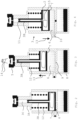
- Figure 1 a schematic drawing of some components of one embodiment of an inhalation device is shown.
- a reservoir 2 is arranged for storing a liquid F.
- the depicted reservoir 2 contains a collapsible bag which in turn contains liquid F (liquid not depicted).
- a pumping unit 3 is arranged downstream reservoir 2, a pumping unit 3 is arranged.
- the pumping unit 3 is connected to a means for the delivery of mechanical energy 4 which feeds said energy to the pumping unit 3.
- a nozzle 5 Downstream of said pumping unit 3, a nozzle 5 is arranged downstream of said pumping unit 3.
- the nozzle 5 is of the impingement type.
- the pumping unit 3 comprises a hollow cylindrical part 3A and a (in this case) hollow piston 3B.
- Hollow cylindrical part 3A is immobile and firmly attached to housing 1, and piston 3B is moveable relative to housing 1.
- plunger 7 and piston 3B are moveable in parallel, and in fact along collinear, directions.
- the cylindrical part 3A has an interior space 3C with a defined first cross section A1.
- the cross section A1 can have any shape, but is preferably circular.
- the interior space 3C is configured to receive an upstream end portion 3B' of said piston 3B. In case that the interior space 3C is wider, only that portion of the space 3C is taken in account which in fact serves for receiving piston 3B.
- Cylindrical part 3A and piston 3B are linearly moveable relative to one another such as to form a pumping chamber. Due to the possibility of said linear movement, the pumping chamber has a variable volume.
- the means for the delivery of mechanical energy 4 is a pressurised gas, as described above.
- the inhalation device comprises a pressure chamber 6 having an internal volume for holding said pressurized gas.
- a wall of said pressure chamber 6 is provided by a plunger 7.
- Said plunger 7 is configured to perform a reciprocating linear movement (up- and downwards in the figure).
- the internal volume of the pressure chamber 6 is related to the position of the plunger, which is in turn dependent on the pressure inside the pressure chamber.
- An increase of pressure results in a propulsive movement (here, upwards), and a decrease of pressure in a retropulsive movement (here, downwards).
- Plunger 7 is mechanically coupled to piston 3B; in a non-depicted embodiment, it can instead or additionally be coupled to cylindrical part 3A. As can be seen, plunger 7 exhibits a cross section A2 which is larger than cross section A1 of the pumping chamber. As a result, an amplification of pressure is achieved, i.e. the pressure in the pumping chamber is higher than in the pressure chamber 6 by an amplification factor or ratio, which is determined by the ratio of cross section A2 to A1.
- the pressurised gas is provided by a container 8 comprising liquefied gas. Part of the gas is present in gaseous form (above level of liquid part, drawn in black). A valve 9 separates container 8 from pressure chamber 6.
- a further valve 10 is arranged in a discharge duct of pressure chamber 6.
- a check valve 11 is arranged upstream the pumping chamber in order to block possible backflow of liquid in direction of the reservoir 2.
- Means 12 is arranged and configured to effect, by unloading its stored energy, a retropulsive (here, downward) movement of the plunger 7 which will be shown below.
- Figure 2 shows the situation at the end of the filling phase, with pumping chamber and pressure chamber volumes reset.
- Interior space 3C of pumping chamber is at a maximum, since piston 3B is at its maximally retracted position with respect to cylindrical part 3A.
- Plunger 7 is at its lowermost position, so that the volume of pressure chamber 6 is very small, or almost zero.
- the means for the temporary storage of mechanical energy 12 is relaxed and ready to be loaded with mechanical energy.
- Valve 9 is now open, such that pressurised gas can flow from container 8 into pressure chamber 6.
- Plunger 7 moves in direction of arrow 13 (here, upwards), transferring the force acting on the same to piston 3B.
- Liquid contained in the pumping chamber is therefore emitted through nozzle 5 under high pressure.
- Arrows 14 indicate two impinging liquid beams that result in the desired nebulization.
- Means 12 is being compressed, thus temporarily storing mechanical energy.
- FIG. 4 shows the situation in the refilling phase. Now, valve 10 is open, such that the pressurized gas can be discharged from pressure chamber 6. No fresh gas can flow into said chamber 6, since valve 9 is now closed. A negative gauge pressure forms inside the pumping chamber which results in refilling the same from reservoir 2. The flow direction is indicated by arrow 15.
- plunger 7 will come to an end when being in the reset position which is depicted in Fig. 2 .
- the cycle is then complete and another cycle can start from the beginning.
Landscapes
- Health & Medical Sciences (AREA)
- Engineering & Computer Science (AREA)
- Life Sciences & Earth Sciences (AREA)
- Animal Behavior & Ethology (AREA)
- Public Health (AREA)
- Heart & Thoracic Surgery (AREA)
- Hematology (AREA)
- Anesthesiology (AREA)
- Veterinary Medicine (AREA)
- General Health & Medical Sciences (AREA)
- Biomedical Technology (AREA)
- Mechanical Engineering (AREA)
- Biophysics (AREA)
- Bioinformatics & Cheminformatics (AREA)
- Pulmonology (AREA)
- Containers And Packaging Bodies Having A Special Means To Remove Contents (AREA)
- Medicinal Preparation (AREA)
- Pharmaceuticals Containing Other Organic And Inorganic Compounds (AREA)
Applications Claiming Priority (3)
| Application Number | Priority Date | Filing Date | Title |
|---|---|---|---|
| US201862717614P | 2018-08-10 | 2018-08-10 | |
| EP18188584 | 2018-08-10 | ||
| PCT/EP2019/071195 WO2020030682A1 (en) | 2018-08-10 | 2019-08-07 | High pressure inhalation device |
Publications (2)
| Publication Number | Publication Date |
|---|---|
| EP3833416A1 EP3833416A1 (en) | 2021-06-16 |
| EP3833416B1 true EP3833416B1 (en) | 2025-01-01 |
Family
ID=67482951
Family Applications (1)
| Application Number | Title | Priority Date | Filing Date |
|---|---|---|---|
| EP19746525.5A Active EP3833416B1 (en) | 2018-08-10 | 2019-08-07 | High pressure inhalation device |
Country Status (9)
| Country | Link |
|---|---|
| US (1) | US20210290863A1 (https=) |
| EP (1) | EP3833416B1 (https=) |
| JP (2) | JP7796529B2 (https=) |
| CN (1) | CN112533656B (https=) |
| BR (1) | BR112021001981A2 (https=) |
| CA (1) | CA3105734A1 (https=) |
| ES (1) | ES3014610T3 (https=) |
| TW (1) | TWI819055B (https=) |
| WO (1) | WO2020030682A1 (https=) |
Families Citing this family (3)
| Publication number | Priority date | Publication date | Assignee | Title |
|---|---|---|---|---|
| BR112022019274A2 (pt) * | 2020-03-31 | 2022-11-16 | Softhale Nv | Entrega de aerossol de pelo menos duas composições líquidas |
| EP4049700A1 (en) * | 2021-02-25 | 2022-08-31 | Sanofi | Fluid dispensing device |
| WO2026017276A1 (en) * | 2024-07-17 | 2026-01-22 | Vectura Delivery Devices Limited | Soft mist inhaler |
Family Cites Families (15)
| Publication number | Priority date | Publication date | Assignee | Title |
|---|---|---|---|---|
| US4603794A (en) * | 1985-03-29 | 1986-08-05 | Battelle Development Corporation | Pressure multiplying dispenser |
| SG45171A1 (en) | 1990-03-21 | 1998-01-16 | Boehringer Ingelheim Int | Atomising devices and methods |
| CN1106888C (zh) * | 1998-03-10 | 2003-04-30 | 瓦卢瓦股份有限公司 | 容器、容器的灌注方法及容器中流体制品的分配装置 |
| US7335186B2 (en) * | 1998-03-13 | 2008-02-26 | Alexander George Brian O'Neil | Patient controlled drug delivery device |
| DE10154237A1 (de) * | 2001-11-07 | 2003-05-15 | Steag Microparts Gmbh | Zerstäuber für manuelle Betätigung |
| BR0314035A (pt) * | 2002-09-05 | 2005-07-12 | Boehringer Ingelheim Pharma | Aparelho para descarga de lìquidos, cartuchos para apropriados para este aparelho, e sistema consistindo no aparelho para a descarga de lìquidos e no cartucho |
| DE102006022002A1 (de) * | 2006-05-10 | 2007-11-15 | Boehringer Ingelheim International Gmbh | Zerstäuber und Verfahren zur Zerstäubung von Fluid |
| TW200911311A (en) * | 2007-06-15 | 2009-03-16 | Boehringer Ingelheim Int | Inhaler |
| JP5713406B2 (ja) * | 2008-12-02 | 2015-05-07 | クール セラピューティクス, インコーポレイテッド | 微細氷粒子を有する呼吸ガスの送達のためのシステム |
| CA2752677A1 (en) | 2009-02-18 | 2010-08-26 | Boehringer Ingelheim International Gmbh | Nebuliser |
| ES2657238T3 (es) * | 2009-02-18 | 2018-03-02 | Boehringer Ingelheim International Gmbh | Dispositivo, cartucho y método para distribuir un líquido |
| DE102009021501B4 (de) * | 2009-05-15 | 2011-09-01 | F. Holzer Gmbh | Vorratsbehälter sowie Verwendung des Vorratsbehälters |
| JP2012530567A (ja) * | 2009-06-25 | 2012-12-06 | ベーリンガー インゲルハイム フェトメディカ ゲゼルシャフト ミット ベシュレンクテル ハフツング | 吸入器 |
| PL3184136T3 (pl) * | 2010-03-25 | 2022-01-17 | New Injection Systems Ltd | Wstrzykiwacz |
| DE102014203246B4 (de) * | 2014-02-24 | 2017-05-11 | Heraeus Medical Gmbh | Vakuummotor zum Betreiben eines Lavage-Systems und Verfahren zum Erzeugen einer periodischen Bewegung |
-
2019
- 2019-08-07 BR BR112021001981-2A patent/BR112021001981A2/pt not_active Application Discontinuation
- 2019-08-07 WO PCT/EP2019/071195 patent/WO2020030682A1/en not_active Ceased
- 2019-08-07 CN CN201980051388.9A patent/CN112533656B/zh active Active
- 2019-08-07 US US17/266,121 patent/US20210290863A1/en active Pending
- 2019-08-07 EP EP19746525.5A patent/EP3833416B1/en active Active
- 2019-08-07 TW TW108128160A patent/TWI819055B/zh active
- 2019-08-07 JP JP2021505977A patent/JP7796529B2/ja active Active
- 2019-08-07 ES ES19746525T patent/ES3014610T3/es active Active
- 2019-08-07 CA CA3105734A patent/CA3105734A1/en active Pending
-
2024
- 2024-05-31 JP JP2024089512A patent/JP2024109965A/ja not_active Withdrawn
Also Published As
| Publication number | Publication date |
|---|---|
| CN112533656B (zh) | 2024-07-05 |
| WO2020030682A1 (en) | 2020-02-13 |
| CN112533656A (zh) | 2021-03-19 |
| TW202019509A (zh) | 2020-06-01 |
| US20210290863A1 (en) | 2021-09-23 |
| CA3105734A1 (en) | 2020-02-13 |
| JP2021532923A (ja) | 2021-12-02 |
| TWI819055B (zh) | 2023-10-21 |
| ES3014610T3 (en) | 2025-04-23 |
| JP7796529B2 (ja) | 2026-01-09 |
| EP3833416A1 (en) | 2021-06-16 |
| BR112021001981A2 (pt) | 2021-04-27 |
| JP2024109965A (ja) | 2024-08-14 |
Similar Documents
| Publication | Publication Date | Title |
|---|---|---|
| JP2024109965A (ja) | 高圧吸入装置 | |
| TWI855054B (zh) | 用於產生醫學活性液體的氣溶膠的吸入裝置 | |
| US20240382701A1 (en) | Inhalation device system with a counting and blocking assembly | |
| JP7422727B2 (ja) | 改善された吸入デバイス | |
| US20230142260A1 (en) | Inhalation device system | |
| TWI910142B (zh) | 用於產生至少兩種液體組合物的氣霧劑的吸入裝置及其筒單元以及該筒單元的用途 | |
| HK40046097B (en) | High pressure inhalation device | |
| HK40046097A (en) | High pressure inhalation device | |
| RU2801255C2 (ru) | Ингаляционное устройство высокого давления | |
| RU2833773C1 (ru) | Ингаляционное устройство для образования аэрозоля из по меньшей мере двух жидких композиций, способ (варианты) лечения субъекта, страдающего от заболевания, с использованием ингаляционного устройства, применение комбинации первой и второй жидких композиций в способе лечения субъекта, страдающего от заболевания, с использованием ингаляционного устройства, первый резервуар, содержащий первую жидкую композицию, содержащую бета-агонист длительного действия, и второй резервуар, содержащий вторую жидкую композицию, выполненные с возможностью использования с ингаляционным устройством, применение ингаляционного устройства или первого резервуара, содержащего первую жидкую композицию, содержащую бета-агонист длительного действия, и способ доставки по меньшей мере двух жидких композиций субъекту | |
| HK40084749A (en) | Aerosol delivery of at least two liquid compositions | |
| HK40084749B (en) | Aerosol delivery of at least two liquid compositions | |
| HK40104372A (en) | Improved inhalation device | |
| HK40046043A (en) | Improved inhalation device |
Legal Events
| Date | Code | Title | Description |
|---|---|---|---|
| STAA | Information on the status of an ep patent application or granted ep patent |
Free format text: STATUS: UNKNOWN |
|
| STAA | Information on the status of an ep patent application or granted ep patent |
Free format text: STATUS: THE INTERNATIONAL PUBLICATION HAS BEEN MADE |
|
| PUAI | Public reference made under article 153(3) epc to a published international application that has entered the european phase |
Free format text: ORIGINAL CODE: 0009012 |
|
| STAA | Information on the status of an ep patent application or granted ep patent |
Free format text: STATUS: REQUEST FOR EXAMINATION WAS MADE |
|
| 17P | Request for examination filed |
Effective date: 20210310 |
|
| AK | Designated contracting states |
Kind code of ref document: A1 Designated state(s): AL AT BE BG CH CY CZ DE DK EE ES FI FR GB GR HR HU IE IS IT LI LT LU LV MC MK MT NL NO PL PT RO RS SE SI SK SM TR |
|
| REG | Reference to a national code |
Ref country code: HK Ref legal event code: DE Ref document number: 40046097 Country of ref document: HK |
|
| DAV | Request for validation of the european patent (deleted) | ||
| DAX | Request for extension of the european patent (deleted) | ||
| P01 | Opt-out of the competence of the unified patent court (upc) registered |
Effective date: 20230529 |
|
| STAA | Information on the status of an ep patent application or granted ep patent |
Free format text: STATUS: EXAMINATION IS IN PROGRESS |
|
| 17Q | First examination report despatched |
Effective date: 20240104 |
|
| REG | Reference to a national code |
Ref country code: DE Free format text: PREVIOUS MAIN CLASS: A61M0011000000 Ipc: A61M0015000000 Ref country code: DE Ref legal event code: R079 Ref document number: 602019064266 Country of ref document: DE Free format text: PREVIOUS MAIN CLASS: A61M0011000000 Ipc: A61M0015000000 |
|
| GRAP | Despatch of communication of intention to grant a patent |
Free format text: ORIGINAL CODE: EPIDOSNIGR1 |
|
| STAA | Information on the status of an ep patent application or granted ep patent |
Free format text: STATUS: GRANT OF PATENT IS INTENDED |
|
| RAP3 | Party data changed (applicant data changed or rights of an application transferred) |
Owner name: INVOX BELGIUM NV |
|
| RIC1 | Information provided on ipc code assigned before grant |
Ipc: A61M 11/00 20060101ALI20240730BHEP Ipc: A61M 16/20 20060101ALI20240730BHEP Ipc: A61M 15/00 20060101AFI20240730BHEP |
|
| INTG | Intention to grant announced |
Effective date: 20240812 |
|
| GRAS | Grant fee paid |
Free format text: ORIGINAL CODE: EPIDOSNIGR3 |
|
| GRAA | (expected) grant |
Free format text: ORIGINAL CODE: 0009210 |
|
| STAA | Information on the status of an ep patent application or granted ep patent |
Free format text: STATUS: THE PATENT HAS BEEN GRANTED |
|
| AK | Designated contracting states |
Kind code of ref document: B1 Designated state(s): AL AT BE BG CH CY CZ DE DK EE ES FI FR GB GR HR HU IE IS IT LI LT LU LV MC MK MT NL NO PL PT RO RS SE SI SK SM TR |
|
| REG | Reference to a national code |
Ref country code: GB Ref legal event code: FG4D |
|
| REG | Reference to a national code |
Ref country code: CH Ref legal event code: EP |
|
| REG | Reference to a national code |
Ref country code: DE Ref legal event code: R096 Ref document number: 602019064266 Country of ref document: DE |
|
| REG | Reference to a national code |
Ref country code: IE Ref legal event code: FG4D |
|
| REG | Reference to a national code |
Ref country code: ES Ref legal event code: FG2A Ref document number: 3014610 Country of ref document: ES Kind code of ref document: T3 Effective date: 20250423 |
|
| REG | Reference to a national code |
Ref country code: LT Ref legal event code: MG9D |
|
| REG | Reference to a national code |
Ref country code: NL Ref legal event code: MP Effective date: 20250101 |
|
| REG | Reference to a national code |
Ref country code: AT Ref legal event code: MK05 Ref document number: 1755597 Country of ref document: AT Kind code of ref document: T Effective date: 20250101 |
|
| PG25 | Lapsed in a contracting state [announced via postgrant information from national office to epo] |
Ref country code: NL Free format text: LAPSE BECAUSE OF FAILURE TO SUBMIT A TRANSLATION OF THE DESCRIPTION OR TO PAY THE FEE WITHIN THE PRESCRIBED TIME-LIMIT Effective date: 20250101 |
|
| PG25 | Lapsed in a contracting state [announced via postgrant information from national office to epo] |
Ref country code: FI Free format text: LAPSE BECAUSE OF FAILURE TO SUBMIT A TRANSLATION OF THE DESCRIPTION OR TO PAY THE FEE WITHIN THE PRESCRIBED TIME-LIMIT Effective date: 20250101 |
|
| PG25 | Lapsed in a contracting state [announced via postgrant information from national office to epo] |
Ref country code: PL Free format text: LAPSE BECAUSE OF FAILURE TO SUBMIT A TRANSLATION OF THE DESCRIPTION OR TO PAY THE FEE WITHIN THE PRESCRIBED TIME-LIMIT Effective date: 20250101 |
|
| PG25 | Lapsed in a contracting state [announced via postgrant information from national office to epo] |
Ref country code: NO Free format text: LAPSE BECAUSE OF FAILURE TO SUBMIT A TRANSLATION OF THE DESCRIPTION OR TO PAY THE FEE WITHIN THE PRESCRIBED TIME-LIMIT Effective date: 20250401 Ref country code: IS Free format text: LAPSE BECAUSE OF FAILURE TO SUBMIT A TRANSLATION OF THE DESCRIPTION OR TO PAY THE FEE WITHIN THE PRESCRIBED TIME-LIMIT Effective date: 20250501 |
|
| PG25 | Lapsed in a contracting state [announced via postgrant information from national office to epo] |
Ref country code: HR Free format text: LAPSE BECAUSE OF FAILURE TO SUBMIT A TRANSLATION OF THE DESCRIPTION OR TO PAY THE FEE WITHIN THE PRESCRIBED TIME-LIMIT Effective date: 20250101 |
|
| PG25 | Lapsed in a contracting state [announced via postgrant information from national office to epo] |
Ref country code: PT Free format text: LAPSE BECAUSE OF FAILURE TO SUBMIT A TRANSLATION OF THE DESCRIPTION OR TO PAY THE FEE WITHIN THE PRESCRIBED TIME-LIMIT Effective date: 20250502 Ref country code: LV Free format text: LAPSE BECAUSE OF FAILURE TO SUBMIT A TRANSLATION OF THE DESCRIPTION OR TO PAY THE FEE WITHIN THE PRESCRIBED TIME-LIMIT Effective date: 20250101 |
|
| PG25 | Lapsed in a contracting state [announced via postgrant information from national office to epo] |
Ref country code: GR Free format text: LAPSE BECAUSE OF FAILURE TO SUBMIT A TRANSLATION OF THE DESCRIPTION OR TO PAY THE FEE WITHIN THE PRESCRIBED TIME-LIMIT Effective date: 20250402 Ref country code: BG Free format text: LAPSE BECAUSE OF FAILURE TO SUBMIT A TRANSLATION OF THE DESCRIPTION OR TO PAY THE FEE WITHIN THE PRESCRIBED TIME-LIMIT Effective date: 20250101 |
|
| PG25 | Lapsed in a contracting state [announced via postgrant information from national office to epo] |
Ref country code: AT Free format text: LAPSE BECAUSE OF FAILURE TO SUBMIT A TRANSLATION OF THE DESCRIPTION OR TO PAY THE FEE WITHIN THE PRESCRIBED TIME-LIMIT Effective date: 20250101 |
|
| PG25 | Lapsed in a contracting state [announced via postgrant information from national office to epo] |
Ref country code: CZ Free format text: LAPSE BECAUSE OF FAILURE TO SUBMIT A TRANSLATION OF THE DESCRIPTION OR TO PAY THE FEE WITHIN THE PRESCRIBED TIME-LIMIT Effective date: 20250101 |
|
| PG25 | Lapsed in a contracting state [announced via postgrant information from national office to epo] |
Ref country code: SE Free format text: LAPSE BECAUSE OF FAILURE TO SUBMIT A TRANSLATION OF THE DESCRIPTION OR TO PAY THE FEE WITHIN THE PRESCRIBED TIME-LIMIT Effective date: 20250101 |
|
| REG | Reference to a national code |
Ref country code: DE Ref legal event code: R097 Ref document number: 602019064266 Country of ref document: DE |
|
| PG25 | Lapsed in a contracting state [announced via postgrant information from national office to epo] |
Ref country code: SM Free format text: LAPSE BECAUSE OF FAILURE TO SUBMIT A TRANSLATION OF THE DESCRIPTION OR TO PAY THE FEE WITHIN THE PRESCRIBED TIME-LIMIT Effective date: 20250101 |
|
| PGFP | Annual fee paid to national office [announced via postgrant information from national office to epo] |
Ref country code: ES Payment date: 20250926 Year of fee payment: 7 |
|
| PG25 | Lapsed in a contracting state [announced via postgrant information from national office to epo] |
Ref country code: DK Free format text: LAPSE BECAUSE OF FAILURE TO SUBMIT A TRANSLATION OF THE DESCRIPTION OR TO PAY THE FEE WITHIN THE PRESCRIBED TIME-LIMIT Effective date: 20250101 |
|
| PGFP | Annual fee paid to national office [announced via postgrant information from national office to epo] |
Ref country code: DE Payment date: 20250820 Year of fee payment: 7 |
|
| PGFP | Annual fee paid to national office [announced via postgrant information from national office to epo] |
Ref country code: IT Payment date: 20250825 Year of fee payment: 7 |
|
| PGFP | Annual fee paid to national office [announced via postgrant information from national office to epo] |
Ref country code: BE Payment date: 20250820 Year of fee payment: 7 Ref country code: GB Payment date: 20250820 Year of fee payment: 7 |
|
| PGFP | Annual fee paid to national office [announced via postgrant information from national office to epo] |
Ref country code: FR Payment date: 20250828 Year of fee payment: 7 |
|
| PG25 | Lapsed in a contracting state [announced via postgrant information from national office to epo] |
Ref country code: EE Free format text: LAPSE BECAUSE OF FAILURE TO SUBMIT A TRANSLATION OF THE DESCRIPTION OR TO PAY THE FEE WITHIN THE PRESCRIBED TIME-LIMIT Effective date: 20250101 |
|
| PG25 | Lapsed in a contracting state [announced via postgrant information from national office to epo] |
Ref country code: RO Free format text: LAPSE BECAUSE OF FAILURE TO SUBMIT A TRANSLATION OF THE DESCRIPTION OR TO PAY THE FEE WITHIN THE PRESCRIBED TIME-LIMIT Effective date: 20250101 |
|
| PG25 | Lapsed in a contracting state [announced via postgrant information from national office to epo] |
Ref country code: SK Free format text: LAPSE BECAUSE OF FAILURE TO SUBMIT A TRANSLATION OF THE DESCRIPTION OR TO PAY THE FEE WITHIN THE PRESCRIBED TIME-LIMIT Effective date: 20250101 |
|
| PLBE | No opposition filed within time limit |
Free format text: ORIGINAL CODE: 0009261 |
|
| STAA | Information on the status of an ep patent application or granted ep patent |
Free format text: STATUS: NO OPPOSITION FILED WITHIN TIME LIMIT |
|
| REG | Reference to a national code |
Ref country code: CH Ref legal event code: L10 Free format text: ST27 STATUS EVENT CODE: U-0-0-L10-L00 (AS PROVIDED BY THE NATIONAL OFFICE) Effective date: 20251112 |
|
| 26N | No opposition filed |
Effective date: 20251002 |
|
| REG | Reference to a national code |
Ref country code: CH Ref legal event code: H13 Free format text: ST27 STATUS EVENT CODE: U-0-0-H10-H13 (AS PROVIDED BY THE NATIONAL OFFICE) Effective date: 20260324 |
|
| PG25 | Lapsed in a contracting state [announced via postgrant information from national office to epo] |
Ref country code: MC Free format text: LAPSE BECAUSE OF FAILURE TO SUBMIT A TRANSLATION OF THE DESCRIPTION OR TO PAY THE FEE WITHIN THE PRESCRIBED TIME-LIMIT Effective date: 20250101 |
|
| PG25 | Lapsed in a contracting state [announced via postgrant information from national office to epo] |
Ref country code: LU Free format text: LAPSE BECAUSE OF NON-PAYMENT OF DUE FEES Effective date: 20250807 |
|
| PG25 | Lapsed in a contracting state [announced via postgrant information from national office to epo] |
Ref country code: CH Free format text: LAPSE BECAUSE OF NON-PAYMENT OF DUE FEES Effective date: 20250831 |