EP3832757A1 - Single-ion conductive polymers for electrochemical devices - Google Patents
Single-ion conductive polymers for electrochemical devices Download PDFInfo
- Publication number
- EP3832757A1 EP3832757A1 EP19213351.0A EP19213351A EP3832757A1 EP 3832757 A1 EP3832757 A1 EP 3832757A1 EP 19213351 A EP19213351 A EP 19213351A EP 3832757 A1 EP3832757 A1 EP 3832757A1
- Authority
- EP
- European Patent Office
- Prior art keywords
- electrode
- ion conductive
- polymer
- conductive polymer
- solid single
- Prior art date
- Legal status (The legal status is an assumption and is not a legal conclusion. Google has not performed a legal analysis and makes no representation as to the accuracy of the status listed.)
- Pending
Links
- 229920001940 conductive polymer Polymers 0.000 title claims abstract description 62
- 229920000642 polymer Polymers 0.000 claims abstract description 59
- 239000007787 solid Substances 0.000 claims abstract description 56
- 125000000217 alkyl group Chemical group 0.000 claims abstract description 25
- 125000003342 alkenyl group Chemical group 0.000 claims abstract description 13
- 125000006193 alkinyl group Chemical group 0.000 claims abstract description 13
- OKTJSMMVPCPJKN-UHFFFAOYSA-N Carbon Chemical compound [C] OKTJSMMVPCPJKN-UHFFFAOYSA-N 0.000 claims description 28
- 238000003490 calendering Methods 0.000 claims description 25
- 239000011263 electroactive material Substances 0.000 claims description 20
- 239000003792 electrolyte Substances 0.000 claims description 15
- 229910052744 lithium Inorganic materials 0.000 claims description 15
- WHXSMMKQMYFTQS-UHFFFAOYSA-N Lithium Chemical compound [Li] WHXSMMKQMYFTQS-UHFFFAOYSA-N 0.000 claims description 14
- 229910052799 carbon Inorganic materials 0.000 claims description 14
- PNEYBMLMFCGWSK-UHFFFAOYSA-N Alumina Chemical compound [O-2].[O-2].[O-2].[Al+3].[Al+3] PNEYBMLMFCGWSK-UHFFFAOYSA-N 0.000 claims description 12
- ZBZJXHCVGLJWFG-UHFFFAOYSA-N trichloromethyl(.) Chemical group Cl[C](Cl)Cl ZBZJXHCVGLJWFG-UHFFFAOYSA-N 0.000 claims description 7
- 229910052794 bromium Inorganic materials 0.000 claims description 6
- 229910021393 carbon nanotube Inorganic materials 0.000 claims description 6
- 239000002041 carbon nanotube Substances 0.000 claims description 6
- 229910052801 chlorine Inorganic materials 0.000 claims description 6
- 229910052731 fluorine Inorganic materials 0.000 claims description 6
- 229910002804 graphite Inorganic materials 0.000 claims description 6
- 239000010439 graphite Substances 0.000 claims description 6
- 150000001875 compounds Chemical class 0.000 claims description 5
- 229910052739 hydrogen Inorganic materials 0.000 claims description 5
- 238000004519 manufacturing process Methods 0.000 claims description 5
- PFYQFCKUASLJLL-UHFFFAOYSA-N [Co].[Ni].[Li] Chemical compound [Co].[Ni].[Li] PFYQFCKUASLJLL-UHFFFAOYSA-N 0.000 claims description 4
- 229910000625 lithium cobalt oxide Inorganic materials 0.000 claims description 4
- GELKBWJHTRAYNV-UHFFFAOYSA-K lithium iron phosphate Chemical compound [Li+].[Fe+2].[O-]P([O-])([O-])=O GELKBWJHTRAYNV-UHFFFAOYSA-K 0.000 claims description 4
- BFZPBUKRYWOWDV-UHFFFAOYSA-N lithium;oxido(oxo)cobalt Chemical compound [Li+].[O-][Co]=O BFZPBUKRYWOWDV-UHFFFAOYSA-N 0.000 claims description 4
- 229910052596 spinel Inorganic materials 0.000 claims description 4
- 239000011029 spinel Substances 0.000 claims description 4
- XUIMIQQOPSSXEZ-UHFFFAOYSA-N Silicon Chemical compound [Si] XUIMIQQOPSSXEZ-UHFFFAOYSA-N 0.000 claims description 2
- YTBWYQYUOZHUKJ-UHFFFAOYSA-N oxocobalt;oxonickel Chemical compound [Co]=O.[Ni]=O YTBWYQYUOZHUKJ-UHFFFAOYSA-N 0.000 claims description 2
- XOLBLPGZBRYERU-UHFFFAOYSA-N tin dioxide Chemical compound O=[Sn]=O XOLBLPGZBRYERU-UHFFFAOYSA-N 0.000 claims description 2
- 229910001887 tin oxide Inorganic materials 0.000 claims description 2
- 102100035249 Carbonyl reductase [NADPH] 3 Human genes 0.000 claims 1
- 101000737274 Homo sapiens Carbonyl reductase [NADPH] 3 Chemical group 0.000 claims 1
- YMWUJEATGCHHMB-UHFFFAOYSA-N Dichloromethane Chemical compound ClCCl YMWUJEATGCHHMB-UHFFFAOYSA-N 0.000 description 15
- ZMXDDKWLCZADIW-UHFFFAOYSA-N N,N-Dimethylformamide Chemical group CN(C)C=O ZMXDDKWLCZADIW-UHFFFAOYSA-N 0.000 description 15
- 229910001416 lithium ion Inorganic materials 0.000 description 11
- 125000002496 methyl group Chemical group [H]C([H])([H])* 0.000 description 11
- 239000000203 mixture Substances 0.000 description 9
- 239000000243 solution Substances 0.000 description 9
- 239000002904 solvent Substances 0.000 description 9
- WMFOQBRAJBCJND-UHFFFAOYSA-M Lithium hydroxide Chemical compound [Li+].[OH-] WMFOQBRAJBCJND-UHFFFAOYSA-M 0.000 description 8
- 238000000034 method Methods 0.000 description 8
- 150000001450 anions Chemical class 0.000 description 6
- SECXISVLQFMRJM-UHFFFAOYSA-N N-Methylpyrrolidone Chemical compound CN1CCCC1=O SECXISVLQFMRJM-UHFFFAOYSA-N 0.000 description 4
- 230000015572 biosynthetic process Effects 0.000 description 4
- -1 buthyl Chemical group 0.000 description 4
- 238000006243 chemical reaction Methods 0.000 description 4
- 125000001495 ethyl group Chemical group [H]C([H])([H])C([H])([H])* 0.000 description 4
- 238000002360 preparation method Methods 0.000 description 4
- XLYOFNOQVPJJNP-UHFFFAOYSA-N water Substances O XLYOFNOQVPJJNP-UHFFFAOYSA-N 0.000 description 4
- WEVYAHXRMPXWCK-UHFFFAOYSA-N Acetonitrile Chemical compound CC#N WEVYAHXRMPXWCK-UHFFFAOYSA-N 0.000 description 3
- RTZKZFJDLAIYFH-UHFFFAOYSA-N Diethyl ether Chemical compound CCOCC RTZKZFJDLAIYFH-UHFFFAOYSA-N 0.000 description 3
- IAZDPXIOMUYVGZ-UHFFFAOYSA-N Dimethylsulphoxide Chemical compound CS(C)=O IAZDPXIOMUYVGZ-UHFFFAOYSA-N 0.000 description 3
- HEMHJVSKTPXQMS-UHFFFAOYSA-M Sodium hydroxide Chemical compound [OH-].[Na+] HEMHJVSKTPXQMS-UHFFFAOYSA-M 0.000 description 3
- 239000011149 active material Substances 0.000 description 3
- 150000002500 ions Chemical class 0.000 description 3
- 239000005518 polymer electrolyte Substances 0.000 description 3
- 239000000843 powder Substances 0.000 description 3
- 125000001436 propyl group Chemical group [H]C([*])([H])C([H])([H])C([H])([H])[H] 0.000 description 3
- 239000007784 solid electrolyte Substances 0.000 description 3
- 238000003786 synthesis reaction Methods 0.000 description 3
- 229910001868 water Inorganic materials 0.000 description 3
- 238000004293 19F NMR spectroscopy Methods 0.000 description 2
- 238000005160 1H NMR spectroscopy Methods 0.000 description 2
- XKRFYHLGVUSROY-UHFFFAOYSA-N Argon Chemical compound [Ar] XKRFYHLGVUSROY-UHFFFAOYSA-N 0.000 description 2
- 0 CCCNCC(CCC(C)*C)C(C)C(C)C#O Chemical compound CCCNCC(CCC(C)*C)C(C)C(C)C#O 0.000 description 2
- 229910000531 Co alloy Inorganic materials 0.000 description 2
- KMTRUDSVKNLOMY-UHFFFAOYSA-N Ethylene carbonate Chemical compound O=C1OCCO1 KMTRUDSVKNLOMY-UHFFFAOYSA-N 0.000 description 2
- 229910014422 LiNi1/3Mn1/3Co1/3O2 Inorganic materials 0.000 description 2
- VYPSYNLAJGMNEJ-UHFFFAOYSA-N Silicium dioxide Chemical compound O=[Si]=O VYPSYNLAJGMNEJ-UHFFFAOYSA-N 0.000 description 2
- 229910001128 Sn alloy Inorganic materials 0.000 description 2
- ATJFFYVFTNAWJD-UHFFFAOYSA-N Tin Chemical compound [Sn] ATJFFYVFTNAWJD-UHFFFAOYSA-N 0.000 description 2
- RTAQQCXQSZGOHL-UHFFFAOYSA-N Titanium Chemical compound [Ti] RTAQQCXQSZGOHL-UHFFFAOYSA-N 0.000 description 2
- DTQVDTLACAAQTR-UHFFFAOYSA-N Trifluoroacetic acid Chemical compound OC(=O)C(F)(F)F DTQVDTLACAAQTR-UHFFFAOYSA-N 0.000 description 2
- 239000002585 base Substances 0.000 description 2
- 238000004146 energy storage Methods 0.000 description 2
- 238000005516 engineering process Methods 0.000 description 2
- 229910021389 graphene Inorganic materials 0.000 description 2
- 229910052736 halogen Inorganic materials 0.000 description 2
- 125000001449 isopropyl group Chemical group [H]C([H])([H])C([H])(*)C([H])([H])[H] 0.000 description 2
- 239000007788 liquid Substances 0.000 description 2
- 239000011244 liquid electrolyte Substances 0.000 description 2
- 229910002102 lithium manganese oxide Inorganic materials 0.000 description 2
- VGYDTVNNDKLMHX-UHFFFAOYSA-N lithium;manganese;nickel;oxocobalt Chemical compound [Li].[Mn].[Ni].[Co]=O VGYDTVNNDKLMHX-UHFFFAOYSA-N 0.000 description 2
- VLXXBCXTUVRROQ-UHFFFAOYSA-N lithium;oxido-oxo-(oxomanganiooxy)manganese Chemical compound [Li+].[O-][Mn](=O)O[Mn]=O VLXXBCXTUVRROQ-UHFFFAOYSA-N 0.000 description 2
- 238000011068 loading method Methods 0.000 description 2
- FPYJFEHAWHCUMM-UHFFFAOYSA-N maleic anhydride Chemical compound O=C1OC(=O)C=C1 FPYJFEHAWHCUMM-UHFFFAOYSA-N 0.000 description 2
- 239000000463 material Substances 0.000 description 2
- 229910052751 metal Inorganic materials 0.000 description 2
- 239000002184 metal Substances 0.000 description 2
- 238000002156 mixing Methods 0.000 description 2
- 239000011255 nonaqueous electrolyte Substances 0.000 description 2
- 230000000269 nucleophilic effect Effects 0.000 description 2
- 239000011541 reaction mixture Substances 0.000 description 2
- 238000010992 reflux Methods 0.000 description 2
- 150000003839 salts Chemical class 0.000 description 2
- 239000002002 slurry Substances 0.000 description 2
- 238000003756 stirring Methods 0.000 description 2
- XOAAWQZATWQOTB-UHFFFAOYSA-N taurine Chemical compound NCCS(O)(=O)=O XOAAWQZATWQOTB-UHFFFAOYSA-N 0.000 description 2
- 229960003080 taurine Drugs 0.000 description 2
- ROWMQJJMCWDJDT-UHFFFAOYSA-N tribromomethane Chemical group Br[C](Br)Br ROWMQJJMCWDJDT-UHFFFAOYSA-N 0.000 description 2
- BXXSNBKEBJHZJI-UHFFFAOYSA-N 2-[(2-methylpropan-2-yl)oxycarbonylamino]ethanesulfonic acid Chemical compound CC(C)(C)OC(=O)NCCS(O)(=O)=O BXXSNBKEBJHZJI-UHFFFAOYSA-N 0.000 description 1
- NLXLAEXVIDQMFP-UHFFFAOYSA-N Ammonia chloride Chemical compound [NH4+].[Cl-] NLXLAEXVIDQMFP-UHFFFAOYSA-N 0.000 description 1
- QGZKDVFQNNGYKY-UHFFFAOYSA-O Ammonium Chemical compound [NH4+] QGZKDVFQNNGYKY-UHFFFAOYSA-O 0.000 description 1
- SNRUBQQJIBEYMU-UHFFFAOYSA-N Dodecane Natural products CCCCCCCCCCCC SNRUBQQJIBEYMU-UHFFFAOYSA-N 0.000 description 1
- IAYPIBMASNFSPL-UHFFFAOYSA-N Ethylene oxide Chemical group C1CO1 IAYPIBMASNFSPL-UHFFFAOYSA-N 0.000 description 1
- DGAQECJNVWCQMB-PUAWFVPOSA-M Ilexoside XXIX Chemical compound C[C@@H]1CC[C@@]2(CC[C@@]3(C(=CC[C@H]4[C@]3(CC[C@@H]5[C@@]4(CC[C@@H](C5(C)C)OS(=O)(=O)[O-])C)C)[C@@H]2[C@]1(C)O)C)C(=O)O[C@H]6[C@@H]([C@H]([C@@H]([C@H](O6)CO)O)O)O.[Na+] DGAQECJNVWCQMB-PUAWFVPOSA-M 0.000 description 1
- 229910001290 LiPF6 Inorganic materials 0.000 description 1
- 229920003171 Poly (ethylene oxide) Polymers 0.000 description 1
- 229910006074 SO2NH2 Inorganic materials 0.000 description 1
- 229910001413 alkali metal ion Inorganic materials 0.000 description 1
- 229910052782 aluminium Inorganic materials 0.000 description 1
- XAGFODPZIPBFFR-UHFFFAOYSA-N aluminium Chemical compound [Al] XAGFODPZIPBFFR-UHFFFAOYSA-N 0.000 description 1
- 239000006183 anode active material Substances 0.000 description 1
- 239000008346 aqueous phase Substances 0.000 description 1
- 229910052786 argon Inorganic materials 0.000 description 1
- 239000012267 brine Substances 0.000 description 1
- 239000006257 cathode slurry Substances 0.000 description 1
- 239000011248 coating agent Substances 0.000 description 1
- 238000000576 coating method Methods 0.000 description 1
- 230000001351 cycling effect Effects 0.000 description 1
- 230000003247 decreasing effect Effects 0.000 description 1
- 125000002704 decyl group Chemical group [H]C([H])([H])C([H])([H])C([H])([H])C([H])([H])C([H])([H])C([H])([H])C([H])([H])C([H])([H])C([H])([H])C([H])([H])* 0.000 description 1
- 230000002950 deficient Effects 0.000 description 1
- 239000008367 deionised water Substances 0.000 description 1
- 229910021641 deionized water Inorganic materials 0.000 description 1
- 230000001419 dependent effect Effects 0.000 description 1
- 230000008034 disappearance Effects 0.000 description 1
- 239000006185 dispersion Substances 0.000 description 1
- 238000004090 dissolution Methods 0.000 description 1
- 125000003438 dodecyl group Chemical group [H]C([H])([H])C([H])([H])C([H])([H])C([H])([H])C([H])([H])C([H])([H])C([H])([H])C([H])([H])C([H])([H])C([H])([H])C([H])([H])C([H])([H])* 0.000 description 1
- 238000001035 drying Methods 0.000 description 1
- 230000000694 effects Effects 0.000 description 1
- 239000007772 electrode material Substances 0.000 description 1
- 239000002001 electrolyte material Substances 0.000 description 1
- 239000008151 electrolyte solution Substances 0.000 description 1
- JBTWLSYIZRCDFO-UHFFFAOYSA-N ethyl methyl carbonate Chemical compound CCOC(=O)OC JBTWLSYIZRCDFO-UHFFFAOYSA-N 0.000 description 1
- 238000001914 filtration Methods 0.000 description 1
- 239000011888 foil Substances 0.000 description 1
- 125000005843 halogen group Chemical group 0.000 description 1
- 150000002367 halogens Chemical class 0.000 description 1
- 125000003187 heptyl group Chemical group [H]C([*])([H])C([H])([H])C([H])([H])C([H])([H])C([H])([H])C([H])([H])C([H])([H])[H] 0.000 description 1
- 125000004051 hexyl group Chemical group [H]C([H])([H])C([H])([H])C([H])([H])C([H])([H])C([H])([H])C([H])([H])* 0.000 description 1
- 150000003949 imides Chemical class 0.000 description 1
- 229910003480 inorganic solid Inorganic materials 0.000 description 1
- 239000000543 intermediate Substances 0.000 description 1
- 229920000554 ionomer Polymers 0.000 description 1
- 239000012528 membrane Substances 0.000 description 1
- 239000012982 microporous membrane Substances 0.000 description 1
- 239000004570 mortar (masonry) Substances 0.000 description 1
- 125000001400 nonyl group Chemical group [H]C([*])([H])C([H])([H])C([H])([H])C([H])([H])C([H])([H])C([H])([H])C([H])([H])C([H])([H])C([H])([H])[H] 0.000 description 1
- 125000002347 octyl group Chemical group [H]C([*])([H])C([H])([H])C([H])([H])C([H])([H])C([H])([H])C([H])([H])C([H])([H])C([H])([H])[H] 0.000 description 1
- 150000005677 organic carbonates Chemical class 0.000 description 1
- 239000012074 organic phase Substances 0.000 description 1
- 230000001590 oxidative effect Effects 0.000 description 1
- 125000001147 pentyl group Chemical group C(CCCC)* 0.000 description 1
- 229920000447 polyanionic polymer Polymers 0.000 description 1
- 239000012429 reaction media Substances 0.000 description 1
- 230000000284 resting effect Effects 0.000 description 1
- 239000012047 saturated solution Substances 0.000 description 1
- 239000000377 silicon dioxide Substances 0.000 description 1
- 229910052708 sodium Inorganic materials 0.000 description 1
- 239000011734 sodium Substances 0.000 description 1
- HPALAKNZSZLMCH-UHFFFAOYSA-M sodium;chloride;hydrate Chemical compound O.[Na+].[Cl-] HPALAKNZSZLMCH-UHFFFAOYSA-M 0.000 description 1
- 125000006850 spacer group Chemical group 0.000 description 1
- 229910052566 spinel group Inorganic materials 0.000 description 1
- 239000010935 stainless steel Substances 0.000 description 1
- 229910001220 stainless steel Inorganic materials 0.000 description 1
- 238000010561 standard procedure Methods 0.000 description 1
- 238000003860 storage Methods 0.000 description 1
- 238000000859 sublimation Methods 0.000 description 1
- 230000008022 sublimation Effects 0.000 description 1
- 239000000126 substance Substances 0.000 description 1
- QAHVHSLSRLSVGS-UHFFFAOYSA-N sulfamoyl chloride Chemical class NS(Cl)(=O)=O QAHVHSLSRLSVGS-UHFFFAOYSA-N 0.000 description 1
- 125000000999 tert-butyl group Chemical group [H]C([H])([H])C(*)(C([H])([H])[H])C([H])([H])[H] 0.000 description 1
- KAKQVSNHTBLJCH-UHFFFAOYSA-N trifluoromethanesulfonimidic acid Chemical compound NS(=O)(=O)C(F)(F)F KAKQVSNHTBLJCH-UHFFFAOYSA-N 0.000 description 1
- 125000002023 trifluoromethyl group Chemical group FC(F)(F)* 0.000 description 1
- 125000001889 triflyl group Chemical group FC(F)(F)S(*)(=O)=O 0.000 description 1
- UCPYLLCMEDAXFR-UHFFFAOYSA-N triphosgene Chemical compound ClC(Cl)(Cl)OC(=O)OC(Cl)(Cl)Cl UCPYLLCMEDAXFR-UHFFFAOYSA-N 0.000 description 1
- 125000002948 undecyl group Chemical group [H]C([*])([H])C([H])([H])C([H])([H])C([H])([H])C([H])([H])C([H])([H])C([H])([H])C([H])([H])C([H])([H])C([H])([H])C([H])([H])[H] 0.000 description 1
Images


Classifications
-
- C—CHEMISTRY; METALLURGY
- C08—ORGANIC MACROMOLECULAR COMPOUNDS; THEIR PREPARATION OR CHEMICAL WORKING-UP; COMPOSITIONS BASED THEREON
- C08F—MACROMOLECULAR COMPOUNDS OBTAINED BY REACTIONS ONLY INVOLVING CARBON-TO-CARBON UNSATURATED BONDS
- C08F122/00—Homopolymers of compounds having one or more unsaturated aliphatic radicals each having only one carbon-to-carbon double bond, and at least one being terminated by a carboxyl radical and containing at least one other carboxyl radical in the molecule; Salts, anhydrides, esters, amides, imides or nitriles thereof
- C08F122/36—Amides or imides
- C08F122/40—Imides, e.g. cyclic imides
-
- C—CHEMISTRY; METALLURGY
- C08—ORGANIC MACROMOLECULAR COMPOUNDS; THEIR PREPARATION OR CHEMICAL WORKING-UP; COMPOSITIONS BASED THEREON
- C08F—MACROMOLECULAR COMPOUNDS OBTAINED BY REACTIONS ONLY INVOLVING CARBON-TO-CARBON UNSATURATED BONDS
- C08F8/00—Chemical modification by after-treatment
- C08F8/34—Introducing sulfur atoms or sulfur-containing groups
-
- C—CHEMISTRY; METALLURGY
- C08—ORGANIC MACROMOLECULAR COMPOUNDS; THEIR PREPARATION OR CHEMICAL WORKING-UP; COMPOSITIONS BASED THEREON
- C08F—MACROMOLECULAR COMPOUNDS OBTAINED BY REACTIONS ONLY INVOLVING CARBON-TO-CARBON UNSATURATED BONDS
- C08F220/00—Copolymers of compounds having one or more unsaturated aliphatic radicals, each having only one carbon-to-carbon double bond, and only one being terminated by only one carboxyl radical or a salt, anhydride ester, amide, imide or nitrile thereof
- C08F220/02—Monocarboxylic acids having less than ten carbon atoms; Derivatives thereof
- C08F220/08—Anhydrides
-
- H—ELECTRICITY
- H01—ELECTRIC ELEMENTS
- H01M—PROCESSES OR MEANS, e.g. BATTERIES, FOR THE DIRECT CONVERSION OF CHEMICAL ENERGY INTO ELECTRICAL ENERGY
- H01M4/00—Electrodes
- H01M4/02—Electrodes composed of, or comprising, active material
- H01M4/62—Selection of inactive substances as ingredients for active masses, e.g. binders, fillers
- H01M4/621—Binders
- H01M4/622—Binders being polymers
-
- C—CHEMISTRY; METALLURGY
- C08—ORGANIC MACROMOLECULAR COMPOUNDS; THEIR PREPARATION OR CHEMICAL WORKING-UP; COMPOSITIONS BASED THEREON
- C08F—MACROMOLECULAR COMPOUNDS OBTAINED BY REACTIONS ONLY INVOLVING CARBON-TO-CARBON UNSATURATED BONDS
- C08F210/00—Copolymers of unsaturated aliphatic hydrocarbons having only one carbon-to-carbon double bond
- C08F210/02—Ethene
-
- C—CHEMISTRY; METALLURGY
- C08—ORGANIC MACROMOLECULAR COMPOUNDS; THEIR PREPARATION OR CHEMICAL WORKING-UP; COMPOSITIONS BASED THEREON
- C08F—MACROMOLECULAR COMPOUNDS OBTAINED BY REACTIONS ONLY INVOLVING CARBON-TO-CARBON UNSATURATED BONDS
- C08F8/00—Chemical modification by after-treatment
- C08F8/30—Introducing nitrogen atoms or nitrogen-containing groups
- C08F8/32—Introducing nitrogen atoms or nitrogen-containing groups by reaction with amines
-
- C—CHEMISTRY; METALLURGY
- C08—ORGANIC MACROMOLECULAR COMPOUNDS; THEIR PREPARATION OR CHEMICAL WORKING-UP; COMPOSITIONS BASED THEREON
- C08F—MACROMOLECULAR COMPOUNDS OBTAINED BY REACTIONS ONLY INVOLVING CARBON-TO-CARBON UNSATURATED BONDS
- C08F8/00—Chemical modification by after-treatment
- C08F8/34—Introducing sulfur atoms or sulfur-containing groups
- C08F8/36—Sulfonation; Sulfation
-
- C—CHEMISTRY; METALLURGY
- C08—ORGANIC MACROMOLECULAR COMPOUNDS; THEIR PREPARATION OR CHEMICAL WORKING-UP; COMPOSITIONS BASED THEREON
- C08F—MACROMOLECULAR COMPOUNDS OBTAINED BY REACTIONS ONLY INVOLVING CARBON-TO-CARBON UNSATURATED BONDS
- C08F8/00—Chemical modification by after-treatment
- C08F8/34—Introducing sulfur atoms or sulfur-containing groups
- C08F8/38—Sulfohalogenation
-
- H—ELECTRICITY
- H01—ELECTRIC ELEMENTS
- H01M—PROCESSES OR MEANS, e.g. BATTERIES, FOR THE DIRECT CONVERSION OF CHEMICAL ENERGY INTO ELECTRICAL ENERGY
- H01M10/00—Secondary cells; Manufacture thereof
- H01M10/05—Accumulators with non-aqueous electrolyte
- H01M10/052—Li-accumulators
- H01M10/0525—Rocking-chair batteries, i.e. batteries with lithium insertion or intercalation in both electrodes; Lithium-ion batteries
-
- H—ELECTRICITY
- H01—ELECTRIC ELEMENTS
- H01M—PROCESSES OR MEANS, e.g. BATTERIES, FOR THE DIRECT CONVERSION OF CHEMICAL ENERGY INTO ELECTRICAL ENERGY
- H01M10/00—Secondary cells; Manufacture thereof
- H01M10/05—Accumulators with non-aqueous electrolyte
- H01M10/054—Accumulators with insertion or intercalation of metals other than lithium, e.g. with magnesium or aluminium
-
- H—ELECTRICITY
- H01—ELECTRIC ELEMENTS
- H01M—PROCESSES OR MEANS, e.g. BATTERIES, FOR THE DIRECT CONVERSION OF CHEMICAL ENERGY INTO ELECTRICAL ENERGY
- H01M10/00—Secondary cells; Manufacture thereof
- H01M10/05—Accumulators with non-aqueous electrolyte
- H01M10/056—Accumulators with non-aqueous electrolyte characterised by the materials used as electrolytes, e.g. mixed inorganic/organic electrolytes
- H01M10/0564—Accumulators with non-aqueous electrolyte characterised by the materials used as electrolytes, e.g. mixed inorganic/organic electrolytes the electrolyte being constituted of organic materials only
- H01M10/0565—Polymeric materials, e.g. gel-type or solid-type
-
- H—ELECTRICITY
- H01—ELECTRIC ELEMENTS
- H01M—PROCESSES OR MEANS, e.g. BATTERIES, FOR THE DIRECT CONVERSION OF CHEMICAL ENERGY INTO ELECTRICAL ENERGY
- H01M4/00—Electrodes
- H01M4/02—Electrodes composed of, or comprising, active material
- H01M4/36—Selection of substances as active materials, active masses, active liquids
- H01M4/38—Selection of substances as active materials, active masses, active liquids of elements or alloys
- H01M4/386—Silicon or alloys based on silicon
-
- H—ELECTRICITY
- H01—ELECTRIC ELEMENTS
- H01M—PROCESSES OR MEANS, e.g. BATTERIES, FOR THE DIRECT CONVERSION OF CHEMICAL ENERGY INTO ELECTRICAL ENERGY
- H01M4/00—Electrodes
- H01M4/02—Electrodes composed of, or comprising, active material
- H01M4/36—Selection of substances as active materials, active masses, active liquids
- H01M4/48—Selection of substances as active materials, active masses, active liquids of inorganic oxides or hydroxides
- H01M4/485—Selection of substances as active materials, active masses, active liquids of inorganic oxides or hydroxides of mixed oxides or hydroxides for inserting or intercalating light metals, e.g. LiTi2O4 or LiTi2OxFy
-
- H—ELECTRICITY
- H01—ELECTRIC ELEMENTS
- H01M—PROCESSES OR MEANS, e.g. BATTERIES, FOR THE DIRECT CONVERSION OF CHEMICAL ENERGY INTO ELECTRICAL ENERGY
- H01M4/00—Electrodes
- H01M4/02—Electrodes composed of, or comprising, active material
- H01M4/36—Selection of substances as active materials, active masses, active liquids
- H01M4/48—Selection of substances as active materials, active masses, active liquids of inorganic oxides or hydroxides
- H01M4/50—Selection of substances as active materials, active masses, active liquids of inorganic oxides or hydroxides of manganese
- H01M4/505—Selection of substances as active materials, active masses, active liquids of inorganic oxides or hydroxides of manganese of mixed oxides or hydroxides containing manganese for inserting or intercalating light metals, e.g. LiMn2O4 or LiMn2OxFy
-
- H—ELECTRICITY
- H01—ELECTRIC ELEMENTS
- H01M—PROCESSES OR MEANS, e.g. BATTERIES, FOR THE DIRECT CONVERSION OF CHEMICAL ENERGY INTO ELECTRICAL ENERGY
- H01M4/00—Electrodes
- H01M4/02—Electrodes composed of, or comprising, active material
- H01M4/36—Selection of substances as active materials, active masses, active liquids
- H01M4/48—Selection of substances as active materials, active masses, active liquids of inorganic oxides or hydroxides
- H01M4/52—Selection of substances as active materials, active masses, active liquids of inorganic oxides or hydroxides of nickel, cobalt or iron
- H01M4/525—Selection of substances as active materials, active masses, active liquids of inorganic oxides or hydroxides of nickel, cobalt or iron of mixed oxides or hydroxides containing iron, cobalt or nickel for inserting or intercalating light metals, e.g. LiNiO2, LiCoO2 or LiCoOxFy
-
- H—ELECTRICITY
- H01—ELECTRIC ELEMENTS
- H01M—PROCESSES OR MEANS, e.g. BATTERIES, FOR THE DIRECT CONVERSION OF CHEMICAL ENERGY INTO ELECTRICAL ENERGY
- H01M4/00—Electrodes
- H01M4/02—Electrodes composed of, or comprising, active material
- H01M4/36—Selection of substances as active materials, active masses, active liquids
- H01M4/58—Selection of substances as active materials, active masses, active liquids of inorganic compounds other than oxides or hydroxides, e.g. sulfides, selenides, tellurides, halogenides or LiCoFy; of polyanionic structures, e.g. phosphates, silicates or borates
- H01M4/583—Carbonaceous material, e.g. graphite-intercalation compounds or CFx
- H01M4/587—Carbonaceous material, e.g. graphite-intercalation compounds or CFx for inserting or intercalating light metals
-
- H—ELECTRICITY
- H01—ELECTRIC ELEMENTS
- H01M—PROCESSES OR MEANS, e.g. BATTERIES, FOR THE DIRECT CONVERSION OF CHEMICAL ENERGY INTO ELECTRICAL ENERGY
- H01M4/00—Electrodes
- H01M4/02—Electrodes composed of, or comprising, active material
- H01M4/36—Selection of substances as active materials, active masses, active liquids
- H01M4/60—Selection of substances as active materials, active masses, active liquids of organic compounds
- H01M4/602—Polymers
- H01M4/606—Polymers containing aromatic main chain polymers
-
- H—ELECTRICITY
- H01—ELECTRIC ELEMENTS
- H01M—PROCESSES OR MEANS, e.g. BATTERIES, FOR THE DIRECT CONVERSION OF CHEMICAL ENERGY INTO ELECTRICAL ENERGY
- H01M4/00—Electrodes
- H01M4/02—Electrodes composed of, or comprising, active material
- H01M4/62—Selection of inactive substances as ingredients for active masses, e.g. binders, fillers
- H01M4/624—Electric conductive fillers
- H01M4/625—Carbon or graphite
-
- H—ELECTRICITY
- H01—ELECTRIC ELEMENTS
- H01M—PROCESSES OR MEANS, e.g. BATTERIES, FOR THE DIRECT CONVERSION OF CHEMICAL ENERGY INTO ELECTRICAL ENERGY
- H01M50/00—Constructional details or processes of manufacture of the non-active parts of electrochemical cells other than fuel cells, e.g. hybrid cells
- H01M50/40—Separators; Membranes; Diaphragms; Spacing elements inside cells
- H01M50/409—Separators, membranes or diaphragms characterised by the material
- H01M50/411—Organic material
-
- C—CHEMISTRY; METALLURGY
- C08—ORGANIC MACROMOLECULAR COMPOUNDS; THEIR PREPARATION OR CHEMICAL WORKING-UP; COMPOSITIONS BASED THEREON
- C08F—MACROMOLECULAR COMPOUNDS OBTAINED BY REACTIONS ONLY INVOLVING CARBON-TO-CARBON UNSATURATED BONDS
- C08F2810/00—Chemical modification of a polymer
- C08F2810/50—Chemical modification of a polymer wherein the polymer is a copolymer and the modification is taking place only on one or more of the monomers present in minority
-
- H—ELECTRICITY
- H01—ELECTRIC ELEMENTS
- H01M—PROCESSES OR MEANS, e.g. BATTERIES, FOR THE DIRECT CONVERSION OF CHEMICAL ENERGY INTO ELECTRICAL ENERGY
- H01M2300/00—Electrolytes
- H01M2300/0017—Non-aqueous electrolytes
- H01M2300/0065—Solid electrolytes
- H01M2300/0082—Organic polymers
-
- Y—GENERAL TAGGING OF NEW TECHNOLOGICAL DEVELOPMENTS; GENERAL TAGGING OF CROSS-SECTIONAL TECHNOLOGIES SPANNING OVER SEVERAL SECTIONS OF THE IPC; TECHNICAL SUBJECTS COVERED BY FORMER USPC CROSS-REFERENCE ART COLLECTIONS [XRACs] AND DIGESTS
- Y02—TECHNOLOGIES OR APPLICATIONS FOR MITIGATION OR ADAPTATION AGAINST CLIMATE CHANGE
- Y02E—REDUCTION OF GREENHOUSE GAS [GHG] EMISSIONS, RELATED TO ENERGY GENERATION, TRANSMISSION OR DISTRIBUTION
- Y02E60/00—Enabling technologies; Technologies with a potential or indirect contribution to GHG emissions mitigation
- Y02E60/10—Energy storage using batteries
Definitions
- the present invention is in the field of energy storage devices, in particular lithium-based energy storage devices, more particularly batteries. Specifically, the invention is in the field of ion conductive polymers and their uses.
- Li-batteries which are nowadays used in portable electronics and even electric vehicles. Li-batteries are so important today that the 2019 nobel prize in physics was awarded to the pioneers of this technology.
- Lithium batteries are commonly based on three essential components: two electrodes, anode and cathode, as well as an electrolyte.
- the anode is usually based on carbon, in most cases graphite, while the cathode is often based on one of three base materials, a layered oxide, a polyanion or a spinel.
- the electrolyte is often a non-aqueous liquid electrolyte based on mixtures of organic carbonates comprising complexes of lithium or other alkali metal ions.
- liquid non-aqueous electrolytes are a high Li-ion conductivity and a good solid-electrolyte-interface formation.
- these electrolytes also show significant disadvantages, such as being volatile and flammable. As such, defective or inadequate Li batteries using these liquid non-aqueous electrolytes are a safety risk. Aside from liquid electrolytes, lithium batteries are now also built using solid electrolytes.
- electrolytes which may be a suitable alternative, are polymer electrolytes which can offer significant advantages in terms of thermal and electrochemical stability.
- polymer electrolytes which can offer significant advantages in terms of thermal and electrochemical stability.
- inorganic solid electrolytes which offer an advantage of a better thermal stability, at the cost of a reduced flexibility.
- a new class of polymer electroytes are single-ion conductive polymer electrolytes. These polymers are in general lithiated ionomers with a poly(ethylene oxide) functionality and tethered anions. These electrolytes can show high oxidative stability and support higher charge/discharge rates.
- the present invention relates to novel single-ion conductive polymers, their production and the use of said polymers in batteries.
- the novel polymers are suitable as electrolyte material and can be used in an anode or cathode of a rechargeable lithium battery.
- the new polymers offer several advantages, in particular the possibility to adjust the porosity of an electrode using said polymers, thus allowing a control of the volumetric energy density.
- the invention relates to a solid single-ion conductive polymer comprising a repeat unit of formula (Ia):
- the invention relates to solid single-ion conductive polymers of the general formula (I)
- the polymers of the present invention are particularly suitable for use in rechargeable batteries, especially lithium batteries.
- a particular advantage of the polymers of the invention is their porosity, which can be adjusted e.g. based on the treatment during the preparation of an electrode. As such, the polymers allow to adjust the volumetric energy density of a battery comprising said solid single-ion conductive polymer.
- the invention further relates to an electrode for a battery comprising a solid single-ion conductive polymer of the present invention and a battery comprising an electrode of the invention or the polymer of the invention.
- the invention relates to a method of producing the solid single-ion conductive polymer of the present invention.
- R 1 is C 1 to C 16 linear or branched alkyl.
- Preferred C 1 to C 16 linear or branched alkyl moieties include methyl, ethyl, propyl, buthyl, pentyl, hexyl, heptyl, octyl, nonyl, decyl, undecyl, dodecyl, isopropyl, C(CH 3 ) 3 .
- the linear or branched alkyl is selected from linear C 1 -C 16 alkyl, preferably C 1 C 8 linear or branched alkyl, particularly preferred linear, unsubsituted C 1 C 8 alykl.
- R 1 is selected from methyl, ethyl, propyl, buthyl or isopropyl. In particularly preferred embodiments R 1 is methyl, ethyl or propyl, most preferably ethyl.
- n is an integer selected from 1, 2, 3, 4 or 5.
- m is 1, 2 or 3.
- m is 2.
- n is 200 to 1000. In a preferred embodiment n is 200 to 500.
- the solid single-ion conductive polymer has an average molecular weight of 400.000 to 1.000.000 Da.
- X is preferably a halogen or a group comprising a halogen.
- X is selected from CF 3 , CCl 3 , CBr 3 , F, Cl or Br.
- X is selected from CF 3 , CCl, CBr 3 or Cl 3 .
- X is CF 3 .
- the invention relates to a solid single-ion conductive polymer comprising a repeat unit of formula (Ia): Wherein
- the invention relates to a solid single-ion conductive polymer comprising a repeat unit of formula (Ia): Wherein
- the solid single-ion conductive polymer of the invention has several advantageous properties.
- the polymer of the invention is compatible with different electroactive materials. As such the polymer is suitable as electrolyte in batteries, but also as part of an anode or cathode.
- the solid single ion conductive polymer can be produced in several ways, which are readily apparent to the skilled person.
- the invention relates to a method for producing a solid single ion conductive polymer according to the present invention.
- a polymer according to the invention can be produced by grafting a compound of formula (III) onto a polymer of formula (II).
- Alternative methods of producing a polymer of formula (I) are known to the skilled person.
- the invention relates to a method for producing a solid-single-ion conductive polymer of formula I as described above comprising the steps of:
- R 1 , n, M + , m and X are the same preferred embodiments as for the polymer as defined above.
- Suitable reaction conditions for producing a polymer according to the present invention are known to the skilled person.
- the polymer of formula (II) is reacted with a compound of formula (III) in a suitable solvent under reflux conditions.
- said solvent is dimethylformamide (DMF) or DMSO.
- DMF dimethylformamide
- DMSO dimethylformamide
- the invention relates to a battery comprising a solid single-ion conductive polymer as defined above as well as electrodes comprising said solid single-ion conductive polymer.
- the invention relates to an electrode comprising a solid single-ion conductive polymer as described above.
- said electrode is an electrode for a battery.
- said polymer may be used in any kind of electrodes.
- An electrode comprising a solid single-ion conductive polymer according to the present invention may be any kind of electrode.
- an electrode comprising said polymer may be either the anode, cathode or both electrodes may comprise the polymer.
- the invention relates to an electrode, wherein the electrode is a cathode, comprising a solid single-ion conductive polymer of formula I according to the invention.
- said cathode comprises a polymer according to the invention, an electroactive material, preferably cathode electroactive material and optionally conductive carbon.
- the invention relates to an electrode, wherein the electrode is an anode, comprising a solid single-ion conductive polymer according to the invention, an electroactive material, preferably anode electroactive material, and optionally a conductive carbon.
- Non-limiting examples of conductive carbon include graphit, graphene and carbon nanotubes.
- the solid single-ion conductive polymer according to the present invention can be used with essentially any electroactive material.
- the polymer of the invention may be used with any cathode electroactive material and any anode electroactive material.
- Non-limiting examples for cathode electroactive materials include lithium cobalt oxide, lithium manganese nickel cobalt oxide, lithium nickel cobalt aluminium oxide, lithium iron phosphate, lithium manganese oxide and spinels.
- Non-limiting examples for anode electroactive materials include graphite, carbon nanotubes, silcon/carbon compositions, tin/cobalt alloys and lithium titanate.
- the invention relates to an electrode, in particular a cathode as defined above, wherein the cathode electrode material is selected from Lithium cobalt oxide, lithium manganese nickel cobalt oxide, lithium nickel cobalt aluminium oxide, lithium iron phosphate, lithium manganese oxide and a spinel.
- the cathode electrode material is selected from Lithium cobalt oxide, lithium manganese nickel cobalt oxide, lithium nickel cobalt aluminium oxide, lithium iron phosphate, lithium manganese oxide and a spinel.
- the invention relates to an electrode, in particular an anode as defined above, wherein the anode active material is selected from graphite, carbon nanotubes, silcon/carbon compositions, tin/cobalt alloys and lithium titanate.
- the anode active material is selected from graphite, carbon nanotubes, silcon/carbon compositions, tin/cobalt alloys and lithium titanate.
- an electrode comprising the solid single-ion conductive polymer of the invention comprises up to 25 wt% of the polymer of the invention. In some embodiments the electrode comprises about up to 10 wt%, about up to 15 wt% or about up to 20 wt% of the solid single-ion conductive polymer.
- the use of the solid single-ion conductive polymer of the invention is not limited to electrodes in a battery.
- the invention relates to a battery comprising the solid single-ion conductive polymer of the present invention as a solid electrolyte.
- the porosity of an electrode utilizing the polymer of the invention, which allows to specifically adjust the energy density of a battery using said electrodes.
- the invention relates to an electrode comprising the solid single-ion conductive polymer of the invention or a battery comprising said electrode, wherein the electrode was calendered.
- the porosity of the polymer or the electrode can be adjusted by the calendering temperature.
- the invention relates to an electrode comprising the solid single-ion conductive polymer of the invention or a battery comprising said electrode, wherein the electrode was calendered at a temperature of between 20 to 110 °C. In some embodiments the electrode was calendered at 40 °C, 60 °C, 80 °C or 100°C.
- the invention further relates to an electrode as defined above, comprising a solid single-ion conductive polymer according to the invention, wherein wherein the electrode has a porosity of up to 50 %.
- the electrode has a porosity of about 10 % to about 50 %.
- the invention relates to an electrolyte for use in batteries comprising a solid single-ion conductive polymer as defined above.
- the invention also relates to a battery comprising the solid single-ion conductive as defined above, or at least one electrode as defined above or an electrolyte as defined above or a combination thereof.
- the invention relates to a method of producing an electrode (a cathode or an anode) for a battery comprising the steps of:
- the electrode may be calendered at the conditions described above. In some embodiments the electrode is calendered at a temperature between 20 and 110 °C. In some embodiments, the electrode is calendered at 40 °C, 60 °C, 80 °C or 100°C.
- the invention relates in particular to the following numbered items:
- the polymers in this invention were prepared by grafting an amine-terminated anion to maleic anhydride polymer backbone.
- the amine-terminated anions were prepared from the reaction of amino sulfonyl chlorides, NR2(CH2)mSO2Cl, and trifluoromethanesulfonamide, CF3SO2NH2, in the presence of a non-nucleophilic base.
- Intermediates containing non-nucleophilic ammonium cation-containing trifluoromethanesulfonyl imides were converted to the desired cation salt (typically lithium) via standard methods known in the state-of-art.
- the amine-terminated anion was grafted to maleic anhydride polymer backbone. Taking the polymer with the chemical structure shown in Scheme 1 (hereafter abbreviated as polymer 1#) as an example, the synthetic details are given below.
- aqueous phase was diluted with water (650 mL), treated with LiOH (3.8 g, 1 eq., 160 mmol) and n-Bu4Br (52.6 g, 1 eq., 160 mmol), and stirred at room temperature for 30 min. The resulting mixture was then extracted with dichloromethane (3x200 mL), the organic phase dried and evaporated at reduced pressure to yield NBoc-taurine nBu 4 N. salt.
- reaction mixture was stirred at room temperature for a further 60 min, then cooled to 0°C and treated with a solution of DBU (42.0 g, 2.1 eq., 275.8 mmol) and CF3SO2NH2 (29.4 g, 1.5 eq, 197.0 mmol) in dichloromethane (43 mL) by dropwise addition (20 min). Those were previously mixed at 0°C as well.
- the mixture was stirred overnight at room temperature, then washed with aqueous NH 4 Cl saturated solution (2x100 mL) and brine (2x100 mL). Silica was added to the dichloromethane solution and then filtered off after stirring for 1h. Then solvent was partially removed in vacuo.
- Trifluoroacetic acid 28 mL, 7 eq., 367.0 mmol
- Trifluoroacetic acid 28 mL, 7 eq., 367.0 mmol
- the product precipitated in the reaction media. It was filtered and washed with dichloromethane.
- Product was isolated as a white powder Traces of CF 3 SO 2 NH 2 can be removed by sublimation.
- a solution of LiOH 23 g, 2 eq., 94.5 mmol
- H2O 160 mL
- Example 2 Preparation of a cathode for a battery using polymer 1#
- the NMC cathode slurry was prepared by mixing 6.375 g of NMC 111 (LiNi 1/3 Mn 1/3 Co 1/3 O 2 ) powder with 0.375 g of C-65 conductive carbon in a mortar until a homogenous dispersion was formed.
- NMP N -methyl-pyrrolidone
- the mixture of NMC/C-65 was added to the binderlyte solution and mixed at 10K rpm for 2 minutes. Subsequently, another 2 grams of NMP solvent were added (9 grams of NMP in total). The resulting solution was mixed 20 minutes at 13k rpm.
- the final slurry was allowed to degas for 5 hours to eliminate possible air bubbles generated during mixing.
- the cathodes were fabricated by coating the slurry over an aluminum current collector foil and drying at 100 °C overnight under vacuum.
- the mass loading of the active material before calendaring varied from 15 mg/cm 2 to 19 mg/cm 2 with a porosity of 46 %.
- the calendaring procedure was done in a dry room at controlled temperature (22 °C and dew point -60 °C). The rollers were let to temper for 1 hour at 100 °C. The laminate was passed four times (two in each direction) for each selected rollers opening at a speed of 0.4 m/min. The first gap between rollers was selected close to the laminate thickness (76 ⁇ m) to be progressively decreased later (56 ⁇ m and 46 ⁇ m). The calendaring pressure was controlled to be lower than 43 Tons. The laminate was punched at 12 mm of diameter with an automatic puncher and dried at 50 oC under vacuum overnight. The mass loading for the active material after calendaring varied from 15 mg/cm 2 to 19 mg/cm 2 with a porosity of 24 %.
- Cathodes were prepared as described above, utilizing different temperatures of the rollers during calendering.
- the following table shows thows the porosity of the calendered cathode dependent of the calendaring temperature: Calendering Temperature Porisity in % No calendaring 46 ⁇ 2 40 °C 39 ⁇ 2 80 °C 36 ⁇ 2 100 °C 24 ⁇ 2
- Example 4 Battery preparation using a cathode comprising polymer 1#
- Coin cells were composed of LiNi 1/3 Mn 1/3 Co 1/3 O 2 (NMC111) as the active material of the positive electrode and lithium metal as the negative electrode.
- the cathode was prepared as described above and calendered at 100 °C.
- the electrolyte used for the coin cell preparation contained 1 mol/L LiPF 6 in a 1:1 solvent blend by volume of ethylene carbonate (EC) and methyl ethyl carbonate (EMC).
- EC ethylene carbonate
- EMC methyl ethyl carbonate
- a Celgard® 2400 microporous membrane was used as separator.
- Coin cells were assembled in an argon-filled glove box following the configuration.
- the NMC cathode (12 mm of diameter) was wetted with 80 ⁇ L of the electrolyte solution. Over that, a Celgard 2400 membrane of 16 mm of diameter was used as separator between electrodes.
- the NMC 111 electrode was paired versus a Li metal disc of 14 mm of diameter and 500 ⁇ m of thickness. A stainless steel spacer and spring were added to the cell before closing.
- NMC 111 The theoretical capacity of NMC 111 was fixed to 150 mAh/g.
- the cells were evaluated using a Maccor Battery Tester (Series 4000) in an oven at 25 °C at different C-rates. The procedure used for testing the cells was as follows.
Landscapes
- Chemical & Material Sciences (AREA)
- Chemical Kinetics & Catalysis (AREA)
- General Chemical & Material Sciences (AREA)
- Electrochemistry (AREA)
- Engineering & Computer Science (AREA)
- Health & Medical Sciences (AREA)
- Medicinal Chemistry (AREA)
- Polymers & Plastics (AREA)
- Organic Chemistry (AREA)
- Inorganic Chemistry (AREA)
- Manufacturing & Machinery (AREA)
- Materials Engineering (AREA)
- Physics & Mathematics (AREA)
- Condensed Matter Physics & Semiconductors (AREA)
- Dispersion Chemistry (AREA)
- General Physics & Mathematics (AREA)
- Battery Electrode And Active Subsutance (AREA)
- Secondary Cells (AREA)
- Addition Polymer Or Copolymer, Post-Treatments, Or Chemical Modifications (AREA)
- Conductive Materials (AREA)
Abstract

m is 1 to 5;
each M+ is independently selected from Li+, Na+ or K+; and
X is selected from CF3,CH3, or F;
and the polymer has an average molecular weight of 350.000 to 1.200.000 Da.
Description
- The present invention is in the field of energy storage devices, in particular lithium-based energy storage devices, more particularly batteries. Specifically, the invention is in the field of ion conductive polymers and their uses.
- The importance of batteries and other energy storarge devices is growing rapidly. Next generation consumer electronics such as smartphones, tablet computers or laptops are part of almost everyone's life and are expected to have sufficient battery storage for extended perioids of use. Further, the rise of e-mobility, in particular electronically driven automobiles and e-scooters, requires batteries with high capacity and a reasonable weight. Current research in battery technology evolves around new materials to improve the safety of batteries as well as increasing and optimizing volumetric and gravimetric energy density.
- The most commonly used rechargeable batteries are Li-batteries, which are nowadays used in portable electronics and even electric vehicles. Li-batteries are so important today that the 2019 nobel prize in physics was awarded to the pioneers of this technology.
- Lithium batteries are commonly based on three essential components: two electrodes, anode and cathode, as well as an electrolyte. The anode is usually based on carbon, in most cases graphite, while the cathode is often based on one of three base materials, a layered oxide, a polyanion or a spinel. As lithium is a highly reactive metal, the electrolyte is often a non-aqueous liquid electrolyte based on mixtures of organic carbonates comprising complexes of lithium or other alkali metal ions.
- The advantages of these liquid non-aqueous electrolytes are a high Li-ion conductivity and a good solid-electrolyte-interface formation. However, these electrolytes also show significant disadvantages, such as being volatile and flammable. As such, defective or inadequate Li batteries using these liquid non-aqueous electrolytes are a safety risk. Aside from liquid electrolytes, lithium batteries are now also built using solid electrolytes.
- One class of electrolytes, which may be a suitable alternative, are polymer electrolytes which can offer significant advantages in terms of thermal and electrochemical stability. A further alternative are inorganic solid electrolytes, which offer an advantage of a better thermal stability, at the cost of a reduced flexibility.
- A new class of polymer electroytes are single-ion conductive polymer electrolytes. These polymers are in general lithiated ionomers with a poly(ethylene oxide) functionality and tethered anions. These electrolytes can show high oxidative stability and support higher charge/discharge rates.
- There is no single electrolyte which is suitable for all applications. There is ongoing research for new electrolytes, in particular polymer electrolytes which show advanced or adjustable properties.
- The present invention relates to novel single-ion conductive polymers, their production and the use of said polymers in batteries. The novel polymers are suitable as electrolyte material and can be used in an anode or cathode of a rechargeable lithium battery.
- The new polymers offer several advantages, in particular the possibility to adjust the porosity of an electrode using said polymers, thus allowing a control of the volumetric energy density.
-
-
Figure1A and1B : Reaction scheme of the synthesis of the polymer of the invention -
Figure 2 : Performance of batteries utilizing the polymer of the invention - The invention relates to a solid single-ion conductive polymer comprising a repeat unit of formula (Ia):

- wherein R1 is H, or C1 to C16 linear or branched alkyl, alkenyl, alkinyl;
- m is 1 to 5;
- each M+ is independently selected from Li+, Na+ or K+; and
- X is selected from CF3,CH3, or F;
- and the polymer has an average molecular weight of 350.000 to 1.200.000 Da.
- In a particular embodiment, the invention relates to solid single-ion conductive polymers of the general formula (I)

- wherein R1 is H, or C1 to C16 linear or branched alkyl, alkenyl, alkinyl;
- n is 50 to 5000;
- m is 1 to 5;
- each M+ is independently selected from Li+, Na+ or K+; and
- X is selected from CF3, CH3, or F.
- The polymers of the present invention are particularly suitable for use in rechargeable batteries, especially lithium batteries. A particular advantage of the polymers of the invention is their porosity, which can be adjusted e.g. based on the treatment during the preparation of an electrode. As such, the polymers allow to adjust the volumetric energy density of a battery comprising said solid single-ion conductive polymer.
- The invention further relates to an electrode for a battery comprising a solid single-ion conductive polymer of the present invention and a battery comprising an electrode of the invention or the polymer of the invention.
- In a further aspect, the invention relates to a method of producing the solid single-ion conductive polymer of the present invention.
- The different aspects and embodiments of the invention are discussed in detail below.
- In one aspect invention relates to a solid single-ion conductive polymer comprising a repeat unit of formula (Ia):

- wherein R1 is H, or C1 to C16 linear or branched alkyl, alkenyl, alkinyl;
- m is 1 to 5;
- each M+ is independently selected from Li+, Na+ or K+; and
- X is selected from CF3,CH3, or F;
- and the polymer has an average molecular weight of 350.000 to 1.200.000 Da.
- In a particular embodiment invention relates to solid single-ion conductive polymers of the general formula (I)

- wherein R1 is H, or C1 to C16 linear or branched alkyl, alkenyl, alkinyl;
- n is 50 to 5000;
- m is 1 to 5;
- each M+ is independently selected from Li+, Na+ or K+; and
- X is selected from CF3,CH3, or F.
- R1 may be H or a linear or branched C1 to C16 alkyl, alkenyl or alkinyl.
- In a preferred embodiment R1 is C1 to C16 linear or branched alkyl. Preferred C1 to C16 linear or branched alkyl moieties include methyl, ethyl, propyl, buthyl, pentyl, hexyl, heptyl, octyl, nonyl, decyl, undecyl, dodecyl, isopropyl, C(CH3)3. Preferably, the linear or branched alkyl is selected from linear C1-C16 alkyl, preferably C1 C8 linear or branched alkyl, particularly preferred linear, unsubsituted C1 C8 alykl.
- In some embodiments, R1 is selected from methyl, ethyl, propyl, buthyl or isopropyl. In particularly preferred embodiments R1 is methyl, ethyl or propyl, most preferably ethyl.
- In some embodiments m is an integer selected from 1, 2, 3, 4 or 5. Preferably, m is 1, 2 or 3. In a particularly preferred embodiments, m is 2.
- In some embodiments n is 200 to 1000. In a preferred embodiment n is 200 to 500.
- In an alternative embodiment the solid single-ion conductive polymer has an average molecular weight of 400.000 to 1.000.000 Da.
- X is preferably a halogen or a group comprising a halogen. In preferred embodiments, X is selected from CF3, CCl3, CBr3, F, Cl or Br. In particular preferred embodiments, X is selected from CF3, CCl, CBr3 or Cl3. In a particular embodiment, X is CF3.
- In a specific embodiment, the invention relates to a solid single-ion conductive polymer comprising a repeat unit of formula (Ia):

- R1 is C8 to C16 alkyl;
- M+ is selected from Li+ or Na+;
- X is selected from CF3, CBR3, CCl3.
- In a particular embodiment the invention relates to a solid single-ion conductive polymer comprising a repeat unit of formula (Ia):

- R1 is C16 alkyl;
- M+ is Li+;
- X is CF3.
- The solid single-ion conductive polymer of the invention has several advantageous properties. The polymer of the invention is compatible with different electroactive materials. As such the polymer is suitable as electrolyte in batteries, but also as part of an anode or cathode.
- The solid single ion conductive polymer can be produced in several ways, which are readily apparent to the skilled person. In one aspect the invention relates to a method for producing a solid single ion conductive polymer according to the present invention.
- The inventors found that a polymer according to the invention can be produced by grafting a compound of formula (III) onto a polymer of formula (II). Alternative methods of producing a polymer of formula (I) are known to the skilled person.
- In one embodiment, the invention relates to a method for producing a solid-single-ion conductive polymer of formula I as described above comprising the steps of:
- a) providing a polymer of formula (II)

- R1 is H, or C1 to C16 linear or branched alkyl, alkenyl, alkinyl; and
- n is 85 to 3900;
- b) reacting said polymer with a compound of formula (III)

- m is 1 to 5;
- M+ is selected from Li+, Na+ or K+;
- X is selected from CF3,CH3, CBR3, CCl3, F, Cl, Br, H or OH.
- Preferred embodiments for R1, n, M+, m and X are the same preferred embodiments as for the polymer as defined above.
- Suitable reaction conditions for producing a polymer according to the present invention are known to the skilled person. In one non-limiting embodiment the polymer of formula (II) is reacted with a compound of formula (III) in a suitable solvent under reflux conditions. In one embodiment said solvent is dimethylformamide (DMF) or DMSO. In general, any solvent in which the polymer is soluble is suitable.
- In further aspects, the invention relates to a battery comprising a solid single-ion conductive polymer as defined above as well as electrodes comprising said solid single-ion conductive polymer.
- Accordingly, in one embodiment, the invention relates to an electrode comprising a solid single-ion conductive polymer as described above. Preferably, said electrode is an electrode for a battery. However, said polymer may be used in any kind of electrodes.
- An electrode comprising a solid single-ion conductive polymer according to the present invention may be any kind of electrode. In a battery, an electrode comprising said polymer may be either the anode, cathode or both electrodes may comprise the polymer.
- Accordingly, in one embodiment, the invention relates to an electrode, wherein the electrode is a cathode, comprising a solid single-ion conductive polymer of formula I according to the invention. In a preferred embodiment said cathode comprises a polymer according to the invention, an electroactive material, preferably cathode electroactive material and optionally conductive carbon.
- In a further embodiment, the invention relates to an electrode, wherein the electrode is an anode, comprising a solid single-ion conductive polymer according to the invention, an electroactive material, preferably anode electroactive material, and optionally a conductive carbon.
- Non-limiting examples of conductive carbon include graphit, graphene and carbon nanotubes.
- The solid single-ion conductive polymer according to the present invention can be used with essentially any electroactive material. In particular, the polymer of the invention may be used with any cathode electroactive material and any anode electroactive material.
- Non-limiting examples for cathode electroactive materials include lithium cobalt oxide, lithium manganese nickel cobalt oxide, lithium nickel cobalt aluminium oxide, lithium iron phosphate, lithium manganese oxide and spinels.
- Non-limiting examples for anode electroactive materials include graphite, carbon nanotubes, silcon/carbon compositions, tin/cobalt alloys and lithium titanate.
- Accordingly, in one embodiment, the invention relates to an electrode, in particular a cathode as defined above, wherein the cathode electrode material is selected from Lithium cobalt oxide, lithium manganese nickel cobalt oxide, lithium nickel cobalt aluminium oxide, lithium iron phosphate, lithium manganese oxide and a spinel.
- In a further embodiment, the invention relates to an electrode, in particular an anode as defined above, wherein the anode active material is selected from graphite, carbon nanotubes, silcon/carbon compositions, tin/cobalt alloys and lithium titanate.
- It is readily apparent to the skilled person to select appropriate amounts of the polymer according to the invention for an electrode. In some embodiments of the invention, an electrode comprising the solid single-ion conductive polymer of the invention comprises up to 25 wt% of the polymer of the invention. In some embodiments the electrode comprises about up to 10 wt%, about up to 15 wt% or about up to 20 wt% of the solid single-ion conductive polymer.
- The use of the solid single-ion conductive polymer of the invention is not limited to electrodes in a battery. In some embodiments, the invention relates to a battery comprising the solid single-ion conductive polymer of the present invention as a solid electrolyte.
- The inventors surprisingly found that the solid single-ion conductive polymer of the present invention can be calendered, which allows to adapt the porosity of the polymer and thus of electrodes, in particular cathodes and anodes. Thus, it is possible to adapt the porosity of an electrode utilizing the polymer of the invention, which allows to specifically adjust the energy density of a battery using said electrodes.
- Accordingly, in one embodiment, the invention relates to an electrode comprising the solid single-ion conductive polymer of the invention or a battery comprising said electrode, wherein the electrode was calendered.
- The porosity of the polymer or the electrode can be adjusted by the calendering temperature. The inventors found that the porosity of an electrode is lower if the electrode was calendered at higher temperatures.
- Accordingly, in one embodiment, the invention relates to an electrode comprising the solid single-ion conductive polymer of the invention or a battery comprising said electrode, wherein the electrode was calendered at a temperature of between 20 to 110 °C. In some embodiments the electrode was calendered at 40 °C, 60 °C, 80 °C or 100°C.
- The invention further relates to an electrode as defined above, comprising a solid single-ion conductive polymer according to the invention, wherein wherein the electrode has a porosity of up to 50 %. In particular embodiments, the electrode has a porosity of about 10 % to about 50 %.
- In a further embodiment, the invention relates to an electrolyte for use in batteries comprising a solid single-ion conductive polymer as defined above.
- The invention also relates to a battery comprising the solid single-ion conductive as defined above, or at least one electrode as defined above or an electrolyte as defined above or a combination thereof.
- In a further aspect the invention relates to a method of producing an electrode (a cathode or an anode) for a battery comprising the steps of:
- a) providing a solid single-ion conductive polymer of the invention as defined above
- b) providing cathoide or anode electroactive materials and optionally conductive carbon
- c) combining the polymer and the electroactive materials and optionally conductive carbon
- d) optionally calendering the electrode.
- The electrode may be calendered at the conditions described above. In some embodiments the electrode is calendered at a temperature between 20 and 110 °C. In some embodiments, the electrode is calendered at 40 °C, 60 °C, 80 °C or 100°C.
- The invention relates in particular to the following numbered items:
- 1. A solid single-ion conductive polymer comprising a repeat unit of formula (Ia):
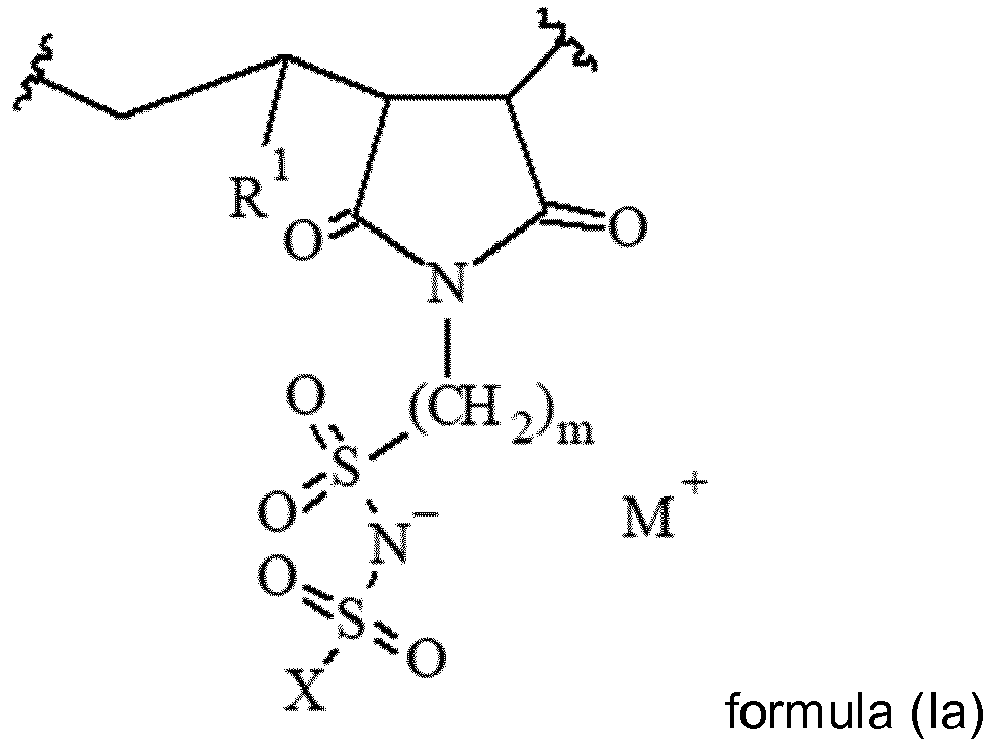
- wherein R1 is H, or C1 to C16 linear or branched alkyl, alkenyl, alkinyl; m is 1 to 5;
- each M+ is independently selected from Li+, Na+ or K+; and
- X is selected from CF3,CH3, or F;
- and the polymer has an average molecular weight of 350.000 to 1.200.000 Da.
- 2. A solid single-ion conductive polymer according to
item 1, wherein the polymer is of formula (I)
- R1 is H, or C1 to C16 linear or branched alkyl, alkenyl, alkinyl;
- n is 85 to 3900;
- m is 1 to 5;
- each M+ is independently selected from Li+, Na+ or K+;
- X is selected from CF3,CH3, CBR3, CCl3, F, Cl, Br, H or OH.
- 3. The solid single-ion conductive polymer of
item - 4. The solid single-ion conductive polymer of item 3, wherein R1 is a C10-C18 linear or branched alkyl.
- 5. The solid single-ion conductive polymer of any preceding item, wherein m is 2.
- 6. The solid single-ion conductive polymer of any preceding item, wherein X is CF3.
- 7 The solid single-ion conductive polymer of any one of
items 2 to 6, wherein n is 200 to 500. - 8. The solid single-ion conductive polymer of any preceding item, wherein R1 is C16 linear alkyl, m is 2, M+ is Li and X is CF3 and the polymer has an average molecular weight of 400.000 Da to 1.000.000 Da.
- 9. An electrode for a battery comprising the solid single-ion conductive polymer of any one of
items 1 to 8. - 10. The electrode of item 9, wherein said electrode is a cathode additionally comprising cathode electroactive material and optionally a conductive carbon.
- 11. The electrode according to
item 10, wherein the cathode electroactive material is selected from lithium cobalt oxide, lithium mangane nickel cobalt oxide, lithium nickel cobalt aluminium oxide, lithium iron phosphate, or a spinel. - 12. The electrode of item 9, wherein said electrode is an anode, additionally comprising anode electroactive material and optionally a conductive carbon.
- 13. The electrode of item 12, whereim the anode electroactive material is selected from graphite or carbon nanotubes, silicium, lithiumtinatates or tin oxide.
- 14. The electrode of item 12 or 13, wherein the conductive carbon is graphite, graphene or carbon nanotubes.
- 15 The electrode according to any one of items 9 to 14, wherein the electrode comprises up to 25 wt% of the solid single-ion conductive polymer.
- 16 The electrode according to
item 15, wherein the electrode comprises about up to 10 wt%, about up to 15 wt% or about up to 20 wt% of the solid single-ion conductive polymer. - 17 The electrode according to any one of items 9 to 16, wherein the electrode was calendered.
- 18. The electrode according to item 17, wherein the electrode was calendered at a temperature of between 20 to 110 °C.
- 19. The electrode according to item 18, wherein the electrode was calendered at 40 °C, 60 °C, 80 °C or 100°C.
- 20. The electrode according to any one of items 9 to 19, wherein the electrode has a porosity of up to 50 %.
- 21. The electrode according to
items 20, wherein the electrode has a porosity of about 10 % to about 50 %. - 22. An electrolyte for use in batteries, comprising a solid single-ion conductive polymer according to any one of
items 1 to 8. - 23. A battery comprising the conductive polymer according to any one of
items 1 to 8, at least one electrode according to any one of items 9 to 21 or an electrolyte according to claim 22. - 24. A battery according to item 23, wherein said battery is lithium or sodium battery.
- 25. A method for producing a solid-single-ion conductive polymer according to any one of item s1 to 8 comprising the steps of:
- a) providing a polymer of formula (II)

- R1 is H, or C1 to C16 linear or branched alkyl, alkenyl, alkinyl; and
- n is 85 to 3900;
- b) reacting said polymer under suitable conditions with a compound of formula (III)

- m is 1 to 5;
- M+ is selected from Li+, Na+ or K+;
- X is selected from CF3,CH3, CBR3, CCl3, F, Cl, Br, H or OH.
- a) providing a polymer of formula (II)
- The polymers in this invention were prepared by grafting an amine-terminated anion to maleic anhydride polymer backbone. Firstly, the amine-terminated anions were prepared from the reaction of amino sulfonyl chlorides, NR2(CH2)mSO2Cl, and trifluoromethanesulfonamide, CF3SO2NH2, in the presence of a non-nucleophilic base. Intermediates containing non-nucleophilic ammonium cation-containing trifluoromethanesulfonyl imides were converted to the desired cation salt (typically lithium) via standard methods known in the state-of-art. Then, the amine-terminated anion was grafted to maleic anhydride polymer backbone. Taking the polymer with the chemical structure shown in Scheme 1 (hereafter abbreviated as
polymer 1#) as an example, the synthetic details are given below.
- The synthetic procedure of lithium (2-aminoethanesulfonyl)(trifluoromethanesulfonyl)imide (LiATI) as an example is described in
Scheme 2; see alsoFigure 1A .
- A solution of taurine (20 g, 160 mmol) in aqueous NaOH (2M, 6.4 g, 1 eq., 160 mmol) was treated by dropwise addition with a solution of (Boc)2O (34.9 g, 1 eq., 160 mmol) in THF (25 mL) at 0°C. The mixture was stirred at room temperature for 15 h and the disappearance of (Boc)2O was monitored by TLC. The resulting mixture was extracted once with diethyl ether (80 mL). The aqueous phase was diluted with water (650 mL), treated with LiOH (3.8 g, 1 eq., 160 mmol) and n-Bu4Br (52.6 g, 1 eq., 160 mmol), and stirred at room temperature for 30 min. The resulting mixture was then extracted with dichloromethane (3x200 mL), the organic phase dried and evaporated at reduced pressure to yield NBoc-taurine nBu4N. salt.
- A solution of N-Boc-taurine n-Bu4N. salt (61.3 g, 131.3 mmol) in dichloromethane (340 mL) was treated with DMF (2.2 mL) and then with triphosgene (15.6 g, 0.4 eq., 52.5 mmol) at 0°C and then allow to reach room temperature while stirring. The reaction mixture was stirred at room temperature for a further 60 min, then cooled to 0°C and treated with a solution of DBU (42.0 g, 2.1 eq., 275.8 mmol) and CF3SO2NH2 (29.4 g, 1.5 eq, 197.0 mmol) in dichloromethane (43 mL) by dropwise addition (20 min). Those were previously mixed at 0°C as well. The mixture was stirred overnight at room temperature, then washed with aqueous NH4Cl saturated solution (2x100 mL) and brine (2x100 mL). Silica was added to the dichloromethane solution and then filtered off after stirring for 1h. Then solvent was partially removed in vacuo. Trifluoroacetic acid (28 mL, 7 eq., 367.0 mmol) was added at 0°C and then allowed to reach room temperature. It was stirred for 1-2 h. The product precipitated in the reaction media. It was filtered and washed with dichloromethane. Product was isolated as a white powder Traces of CF3SO2NH2 can be removed by sublimation. A solution of LiOH (2.3 g, 2 eq., 94.5 mmol) in H2O (160 mL) was added slowly. The reaction mixture was stirred for 16 h at room temperature. Then solvent was removed in vacuo to yield a white solid. Excess of LiOH was removed by redissolving in acetonitrile and filtering of undissolved LiOH. Solvent was removed in vacuo to yield LiATI a white powder (12 g, 46 mmol). 1H NMR (300 MHz, D2O) δ (ppm) 3,43 (t, J = 6,6 Hz, 2H, S-CH2), 3,15 (t, J = 6,5 Hz, 2H, N-CH2); 19F-NMR (282 MHz, D2O) δ (ppm) -78,54.
-

- This synthetic procedure is described in Scheme 3; see also
Figure 1B . 9 g of LiATI dissolved in 70 mL of dry dimethylformamide were added over a solution of Poly(ethylene-alt-maleic anhydride) in dimethylformamide (110 mL). The reaction was kept at room temperature for 2 h, at 50°C for 2 h and under reflux (170 °C) for 16 h. Solvent was mostly removed under reduced pressure and product was precipitated in THF (2x500mL) and the obtained viscous solid was dialyzed against deionized water. Water was removed under reduced pressure to yieldpolymer 1# (10 g, 25.7 mmol). 1H NMR (300 MHz, D2O) δ (ppm) 4.09 - 3.68 (m, 2H, S-CH2), 3.58 - 3.33 (m, 2H, N-CH2), 2.78 - 2.52 (m, 2H, CH-CH), 2.10 - 1.51 (m, 4H, CH-CH 2-CH 2). 19F-NMR (282 MHz, D2O) δ (ppm) -78.18. - The NMC cathode slurry was prepared by mixing 6.375 g of NMC 111 (LiNi1/3Mn1/3Co1/3O2) powder with 0.375 g of C-65 conductive carbon in a mortar until a homogenous dispersion was formed. In a vial 0.750 g of
polymer 1# was dissolved in 7 grams of N-methyl-pyrrolidone (NMP) until complete dissolution. The mixture of NMC/C-65 was added to the binderlyte solution and mixed at 10K rpm for 2 minutes. Subsequently, another 2 grams of NMP solvent were added (9 grams of NMP in total). The resulting solution was mixed 20 minutes at 13k rpm. The final slurry was allowed to degas for 5 hours to eliminate possible air bubbles generated during mixing. - The cathodes were fabricated by coating the slurry over an aluminum current collector foil and drying at 100 °C overnight under vacuum. The mass loading of the active material before calendaring varied from 15 mg/cm2 to 19 mg/cm2 with a porosity of 46 %.
- The calendaring procedure was done in a dry room at controlled temperature (22 °C and dew point -60 °C). The rollers were let to temper for 1 hour at 100 °C. The laminate was passed four times (two in each direction) for each selected rollers opening at a speed of 0.4 m/min. The first gap between rollers was selected close to the laminate thickness (76 µm) to be progressively decreased later (56 µm and 46 µm). The calendaring pressure was controlled to be lower than 43 Tons. The laminate was punched at 12 mm of diameter with an automatic puncher and dried at 50 oC under vacuum overnight. The mass loading for the active material after calendaring varied from 15 mg/cm2 to 19 mg/cm2 with a porosity of 24 %.
- Cathodes were prepared as described above, utilizing different temperatures of the rollers during calendering. The following table shows thows the porosity of the calendered cathode dependent of the calendaring temperature:
Calendering Temperature Porisity in % No calendaring 46 ± 2 40 °C 39 ± 2 80 °C 36 ± 2 100 °C 24 ± 2 - Coin cells were composed of LiNi1/3Mn1/3Co1/3O2 (NMC111) as the active material of the positive electrode and lithium metal as the negative electrode. The cathode was prepared as described above and calendered at 100 °C. The electrolyte used for the coin cell preparation contained 1 mol/L LiPF6 in a 1:1 solvent blend by volume of ethylene carbonate (EC) and methyl ethyl carbonate (EMC). A Celgard® 2400 microporous membrane was used as separator.
- Coin cells were assembled in an argon-filled glove box following the configuration. The NMC cathode (12 mm of diameter) was wetted with 80 µL of the electrolyte solution. Over that, a Celgard 2400 membrane of 16 mm of diameter was used as separator between electrodes. The NMC 111 electrode was paired versus a Li metal disc of 14 mm of diameter and 500 µm of thickness. A stainless steel spacer and spring were added to the cell before closing.
- The theoretical capacity of NMC 111 was fixed to 150 mAh/g. The cells were evaluated using a Maccor Battery Tester (Series 4000) in an oven at 25 °C at different C-rates. The procedure used for testing the cells was as follows.
- First 24 h of resting at 25 °C, then the batteries were keept at a constant charging rate of 0.2 C, while the discharge rate was changed gradually as follows: 5 cycles at 0.2 C, other 5 at 0.5 C, other 5 at 1 C, 5 at 2 C, 5 at 5 C, 5 at 10 C and 5 at 0.5C. An example of the cell performance with this cycling procedure is showed in
Figure 2 .
Claims (15)
- A solid single-ion conductive polymer comprising a repeat unit of formula (Ia):
 wherein R1 is H, or C1 to C16 linear or branched alkyl, alkenyl, alkinyl; m is 1 to 5;each M+ is independently selected from Li+, Na+ or K+; andX is selected from CF3,CH3, or F;and the polymer has an average molecular weight of 350.000 to 1.200.000 Da.
 - A solid single-ion conductive polymer according to claim 1, wherein the polymer is of formula (I)
 R1 is H, or C1 to C16 linear or branched alkyl, alkenyl, alkinyl;n is 85 to 3900;m is 1 to 5;each M+ is independently selected from Li+, Na+ or K+;X is selected from CF3,CH3, CBR3, CCl3, F, Cl, Br, H or OH.
 - The solid single-ion conductive polymer of claim 1 or 2, wherein R1 is a C10-C18 linear or branched alkyl.
- The solid single-ion conductive polymer of any preceding claim, wherein m is 2.
- The solid single-ion conductive polymer of any preceding claim, wherein X is CF3.
- The solid single-ion conductive polymer of any preceding claim, wherein R1 is C16 linear alkyl, m is 2, M+ is Li and X is CF3 and the polymer has an average molecular weight of 400.000 Da to 1.000.000 Da.
- An electrode for a battery comprising the solid single-ion conductive polymer of any one of claims 1 to 6.
- The electrode of claim 7, wherein said electrode is a cathode additionally comprising cathode electroactive material and optionally a conductive carbon, preferably the cathode electroactive material is selected from lithium cobalt oxide, lithium mangane nickel cobalt oxide, lithium nickel cobalt aluminium oxide, lithium iron phosphate, or a spinel.
- The electrode of claim 7, wherein said electrode is an anode, additionally comprising anode electroactive material and optionally a conductive carbon, preferably wherein the anode electroactive material is selected from graphite or carbon nanotubes, silicium, lithiumtinatates or tin oxide.
- The electrode according to any one of claims 7 to 9, wherein the electrode comprises about up to 10 wt%, about up to 15 wt% or about up to 20 wt% of the solid single-ion conductive polymer.
- The electrode according to any one of claims 7 to 10, wherein the electrode was calendered at a temperature of between 20 to 110 °C.
- The electrode according to any one of claims 7 to 11, wherein the electrode has a porosity of about 10 % to about 50 %.
- An electrolyte for use in batteries, comprising a solid single-ion conductive polymer according to any one of claims 1 to 6.
- A battery comprising the conductive polymer according to any one of claims 1 to 6, at least one electrode according to any one of claims 7 to 12 or an electrolyte according to claim 13.
- A method for producing a solid-single-ion conductive polymer according to any one of claims 1 to 6 comprising the steps of:a) providing a polymer of formula (II)
 R1 is H, or C1 to C16 linear or branched alkyl, alkenyl, alkinyl; andn is 85 to 3900;b) reacting said polymer under suitable conditions with a compound of formula (III)
 m is 1 to 5;M+ is selected from Li+, Na+ or K+;X is selected from CF3, CH3, CBR3, CCl3, F, Cl, Br, H or OH.
Priority Applications (8)
| Application Number | Priority Date | Filing Date | Title |
|---|---|---|---|
| EP19213351.0A EP3832757A1 (en) | 2019-12-03 | 2019-12-03 | Single-ion conductive polymers for electrochemical devices |
| TW109136283A TWI756875B (en) | 2019-12-03 | 2020-10-20 | Single-ion conductive polymers for electrochemical devices |
| US17/077,092 US11479626B2 (en) | 2019-12-03 | 2020-10-22 | Single-ion conductive polymers for electrochemical devices |
| JP2020186262A JP7128877B2 (en) | 2019-12-03 | 2020-11-09 | Single conducting polymer for electrochemical devices |
| KR1020200156034A KR102539814B1 (en) | 2019-12-03 | 2020-11-19 | Single-ion conductive polymers for electrochemical devices |
| CN202011388578.0A CN112898457B (en) | 2019-12-03 | 2020-12-02 | Single ion conductive polymer for electrochemical device |
| JP2022095721A JP7297127B2 (en) | 2019-12-03 | 2022-06-14 | Single conducting polymer for electrochemical devices |
| KR1020220114286A KR102516919B1 (en) | 2019-12-03 | 2022-09-08 | Single-ion conductive polymers for electrochemical devices |
Applications Claiming Priority (1)
| Application Number | Priority Date | Filing Date | Title |
|---|---|---|---|
| EP19213351.0A EP3832757A1 (en) | 2019-12-03 | 2019-12-03 | Single-ion conductive polymers for electrochemical devices |
Publications (1)
| Publication Number | Publication Date |
|---|---|
| EP3832757A1 true EP3832757A1 (en) | 2021-06-09 |
Family
ID=68771382
Family Applications (1)
| Application Number | Title | Priority Date | Filing Date |
|---|---|---|---|
| EP19213351.0A Pending EP3832757A1 (en) | 2019-12-03 | 2019-12-03 | Single-ion conductive polymers for electrochemical devices |
Country Status (6)
| Country | Link |
|---|---|
| US (1) | US11479626B2 (en) |
| EP (1) | EP3832757A1 (en) |
| JP (2) | JP7128877B2 (en) |
| KR (2) | KR102539814B1 (en) |
| CN (1) | CN112898457B (en) |
| TW (1) | TWI756875B (en) |
Families Citing this family (6)
| Publication number | Priority date | Publication date | Assignee | Title |
|---|---|---|---|---|
| JP7716965B2 (en) * | 2021-11-24 | 2025-08-01 | 住友化学株式会社 | Electrolyte composition and battery |
| EP4601044A1 (en) * | 2022-11-04 | 2025-08-13 | Sumitomo Chemical Company, Limited | Positive electrode material, positive electrode, and battery |
| WO2024232342A1 (en) * | 2023-05-08 | 2024-11-14 | 住友化学株式会社 | Method for producing organic lithium salt, composition containing said organic lithium salt, and polymer |
| CN121866666A (en) | 2023-09-12 | 2026-04-14 | 住友化学株式会社 | Electrolyte composition and battery |
| WO2025057818A1 (en) | 2023-09-12 | 2025-03-20 | 住友化学株式会社 | Electrolyte composition and battery |
| CN121844426A (en) | 2023-09-12 | 2026-04-10 | 住友化学株式会社 | Electrolyte composition and battery |
Citations (2)
| Publication number | Priority date | Publication date | Assignee | Title |
|---|---|---|---|---|
| US20140272600A1 (en) * | 2011-09-05 | 2014-09-18 | Universite D'aix-Marseille | Block copolymer including a polyanion based on a tfsili anion monomer as a battery electrolyte |
| CN108878777A (en) * | 2017-05-11 | 2018-11-23 | 杭州聚力氢能科技有限公司 | A kind of single-ion conductor polymer lithium-sulfur cell |
Family Cites Families (16)
| Publication number | Priority date | Publication date | Assignee | Title |
|---|---|---|---|---|
| JP4060465B2 (en) | 1998-11-02 | 2008-03-12 | Tdk株式会社 | Polymer solid electrolyte and electrochemical device using the same |
| JP2005100966A (en) | 2003-08-20 | 2005-04-14 | Nippon Soda Co Ltd | High polymer solid electrolyte battery, electrode, manufacturing method for them |
| JP4576830B2 (en) * | 2003-12-12 | 2010-11-10 | 株式会社豊田中央研究所 | Solid polymer electrolyte, method for producing the same, and fuel cell |
| JP2009242790A (en) * | 2008-03-11 | 2009-10-22 | Sumitomo Chemical Co Ltd | Polymer electrolyte composition |
| WO2016196688A1 (en) | 2015-06-01 | 2016-12-08 | Energy Power Systems LLC | Nano-engineered coatings for anode active materials, cathode active materials, and solid-state electrolytes and methods of making batteries containing nano-engineered coatings |
| CA2987938C (en) | 2015-06-01 | 2023-09-26 | Pneumaticoat Technologies Llc | Nano-engineered coatings for anode active materials, cathode active materials, and solid-state electrolytes and methods of making batteries containing nano-engineered coatings |
| CN107851840B (en) * | 2015-06-01 | 2022-08-23 | 气动覆层科技有限责任公司 | Nano-engineered coatings for solid state electrolytes |
| CN105131728A (en) * | 2015-08-13 | 2015-12-09 | 蚌埠南自仪表有限公司 | Air permeability heat-dissipating coating material and preparation method thereof |
| EP3154111B1 (en) * | 2015-10-07 | 2019-06-12 | VARTA Microbattery GmbH | Composite material, electrode, method to produce the material and the electrode and electrochemical cell comprising the electrode |
| FR3049114B1 (en) * | 2016-03-18 | 2018-03-09 | Blue Solutions | POLYMER LITHIUM METAL BATTERY WITH HIGH ENERGY DENSITY |
| CN107459647B (en) | 2016-06-02 | 2020-04-14 | 杭州聚力氢能科技有限公司 | Polyimide type single ion conducting polymer with side chain grafted bis-sulfimide and application thereof |
| US10535892B2 (en) * | 2017-05-30 | 2020-01-14 | Global Graphene Group, Inc. | Shape-conformable alkali metal battery having a conductive and deformable quasi-solid polymer electrode |
| CN109096433B (en) * | 2017-06-20 | 2020-08-21 | 天津大学 | Single-ion conductor polymer lithium salt and preparation method thereof |
| JP7168851B2 (en) * | 2017-12-06 | 2022-11-10 | セントラル硝子株式会社 | Electrolyte for non-aqueous electrolyte battery and non-aqueous electrolyte battery using the same |
| CN108716025B (en) * | 2018-04-16 | 2019-09-17 | 中国地质大学(武汉) | A method of preparing single-ion conductor polymer dielectric composite fibre diaphragm |
| CN109273647B (en) * | 2018-08-10 | 2020-12-08 | 中国地质大学(武汉) | Porous single-ion conductive polymer electrolyte separator, preparation method and application thereof |
-
2019
- 2019-12-03 EP EP19213351.0A patent/EP3832757A1/en active Pending
-
2020
- 2020-10-20 TW TW109136283A patent/TWI756875B/en active
- 2020-10-22 US US17/077,092 patent/US11479626B2/en active Active
- 2020-11-09 JP JP2020186262A patent/JP7128877B2/en active Active
- 2020-11-19 KR KR1020200156034A patent/KR102539814B1/en active Active
- 2020-12-02 CN CN202011388578.0A patent/CN112898457B/en active Active
-
2022
- 2022-06-14 JP JP2022095721A patent/JP7297127B2/en active Active
- 2022-09-08 KR KR1020220114286A patent/KR102516919B1/en active Active
Patent Citations (2)
| Publication number | Priority date | Publication date | Assignee | Title |
|---|---|---|---|---|
| US20140272600A1 (en) * | 2011-09-05 | 2014-09-18 | Universite D'aix-Marseille | Block copolymer including a polyanion based on a tfsili anion monomer as a battery electrolyte |
| CN108878777A (en) * | 2017-05-11 | 2018-11-23 | 杭州聚力氢能科技有限公司 | A kind of single-ion conductor polymer lithium-sulfur cell |
Also Published As
| Publication number | Publication date |
|---|---|
| JP2021088695A (en) | 2021-06-10 |
| US11479626B2 (en) | 2022-10-25 |
| US20210163649A1 (en) | 2021-06-03 |
| TW202126702A (en) | 2021-07-16 |
| JP7297127B2 (en) | 2023-06-23 |
| CN112898457B (en) | 2023-11-17 |
| TWI756875B (en) | 2022-03-01 |
| JP7128877B2 (en) | 2022-08-31 |
| KR20210070189A (en) | 2021-06-14 |
| KR102516919B1 (en) | 2023-03-31 |
| CN112898457A (en) | 2021-06-04 |
| KR20220129515A (en) | 2022-09-23 |
| JP2022120129A (en) | 2022-08-17 |
| KR102539814B1 (en) | 2023-06-02 |
Similar Documents
| Publication | Publication Date | Title |
|---|---|---|
| US11479626B2 (en) | Single-ion conductive polymers for electrochemical devices | |
| CN103563155B (en) | Include the lithium ion electrochemical cells of fluorocarbon additive agent electrolyte | |
| CN103038924B (en) | Method for preparing lithium battery or sodium battery | |
| US20170012277A1 (en) | Open framework composites, methods for producing and using such composites | |
| US11387489B2 (en) | Polymer electrolyte and preparation method therefor | |
| US10297829B2 (en) | Polyanthraquinone-based organic cathode for high-performance rechargeable magnesium-ion batteries | |
| CN113285118A (en) | Compound solid electrolyte based on MOF three-dimensional framework support and preparation method thereof | |
| KR20190072968A (en) | Negative electrode for metal battery, metal battery comprising the same, and method of preparing the negative electrode for metal battery | |
| US20090233173A1 (en) | Cobalt oxyhydroxide, method for producing the same and alkaline storage battery using the same | |
| CN115850697B (en) | A triazine covalent organic framework material based on pyrenetetraone, preparation method and application thereof | |
| KR20170047661A (en) | Random copolymer, Electrolyte, Protected anode and Lithium battery comprising Random copolymer, and Preparation method of Random copolymer | |
| EP3709425B1 (en) | Polymer electrolyte and method for producing same | |
| CN116706225B (en) | Lithium-rich PAF composite single-ion quasi-solid polymer electrolyte, preparation method and application | |
| CN107251278B (en) | Electrochemical element comprising polymeric material and use of the polymeric material | |
| CN110600711A (en) | Silicon-based Si-C negative electrode material prepared based on calcium carbonate and preparation method and application thereof | |
| CN113773487A (en) | Mussel biomimetic polymer and preparation method thereof, solid polymer electrolyte and solid state battery | |
| CN111620822A (en) | Imidazole ionic liquid and preparation method and application thereof | |
| KR102867568B1 (en) | Method for preparing polymer electrolyte based on poly(ethylene oxide) for lithium ion battery and polymer electrolyte prepared by the same | |
| US20220285732A1 (en) | Lithium bis(trimethylsilyl) phosphate as a novel bi-functional additive for lithium ion batteries | |
| Al-Salih | Design, Development and Structure of Liquid and Solid Electrolytes for Lithium Batteries | |
| CH716885A2 (en) | Mono-ionic conductive polymers for electronic devices. | |
| TW201728594A (en) | Magnesium salts | |
| CN121862837A (en) | A cyclotriphosphazene-derived salt-based composite solid electrolyte and its preparation and application | |
| CN111584811A (en) | Diaphragm, preparation method and lithium ion battery | |
| CN117682972A (en) | Organic compounds containing sulfonamide groups and fluorinated groups and their applications |
Legal Events
| Date | Code | Title | Description |
|---|---|---|---|
| PUAI | Public reference made under article 153(3) epc to a published international application that has entered the european phase |
Free format text: ORIGINAL CODE: 0009012 |
|
| STAA | Information on the status of an ep patent application or granted ep patent |
Free format text: STATUS: THE APPLICATION HAS BEEN PUBLISHED |
|
| AK | Designated contracting states |
Kind code of ref document: A1 Designated state(s): AL AT BE BG CH CY CZ DE DK EE ES FI FR GB GR HR HU IE IS IT LI LT LU LV MC MK MT NL NO PL PT RO RS SE SI SK SM TR |
|
| STAA | Information on the status of an ep patent application or granted ep patent |
Free format text: STATUS: REQUEST FOR EXAMINATION WAS MADE |
|
| 17P | Request for examination filed |
Effective date: 20211209 |
|
| RBV | Designated contracting states (corrected) |
Designated state(s): AL AT BE BG CH CY CZ DE DK EE ES FI FR GB GR HR HU IE IS IT LI LT LU LV MC MK MT NL NO PL PT RO RS SE SI SK SM TR |
|
| P01 | Opt-out of the competence of the unified patent court (upc) registered |
Effective date: 20230718 |