EP3832157B1 - Engine damper cooling utilizing cab a/c circuit - Google Patents
Engine damper cooling utilizing cab a/c circuit Download PDFInfo
- Publication number
- EP3832157B1 EP3832157B1 EP20203528.3A EP20203528A EP3832157B1 EP 3832157 B1 EP3832157 B1 EP 3832157B1 EP 20203528 A EP20203528 A EP 20203528A EP 3832157 B1 EP3832157 B1 EP 3832157B1
- Authority
- EP
- European Patent Office
- Prior art keywords
- hose
- vehicle
- engine damper
- engine
- damper
- Prior art date
- Legal status (The legal status is an assumption and is not a legal conclusion. Google has not performed a legal analysis and makes no representation as to the accuracy of the status listed.)
- Active
Links
Images

Classifications
-
- F—MECHANICAL ENGINEERING; LIGHTING; HEATING; WEAPONS; BLASTING
- F01—MACHINES OR ENGINES IN GENERAL; ENGINE PLANTS IN GENERAL; STEAM ENGINES
- F01P—COOLING OF MACHINES OR ENGINES IN GENERAL; COOLING OF INTERNAL-COMBUSTION ENGINES
- F01P3/00—Liquid cooling
- F01P3/12—Arrangements for cooling other engine or machine parts
-
- F—MECHANICAL ENGINEERING; LIGHTING; HEATING; WEAPONS; BLASTING
- F01—MACHINES OR ENGINES IN GENERAL; ENGINE PLANTS IN GENERAL; STEAM ENGINES
- F01P—COOLING OF MACHINES OR ENGINES IN GENERAL; COOLING OF INTERNAL-COMBUSTION ENGINES
- F01P1/00—Air cooling
- F01P1/06—Arrangements for cooling other engine or machine parts
-
- F—MECHANICAL ENGINEERING; LIGHTING; HEATING; WEAPONS; BLASTING
- F01—MACHINES OR ENGINES IN GENERAL; ENGINE PLANTS IN GENERAL; STEAM ENGINES
- F01P—COOLING OF MACHINES OR ENGINES IN GENERAL; COOLING OF INTERNAL-COMBUSTION ENGINES
- F01P11/00—Component parts, details, or accessories not provided for in, or of interest apart from, groups F01P1/00 - F01P9/00
- F01P11/04—Arrangements of liquid pipes or hoses
-
- F—MECHANICAL ENGINEERING; LIGHTING; HEATING; WEAPONS; BLASTING
- F01—MACHINES OR ENGINES IN GENERAL; ENGINE PLANTS IN GENERAL; STEAM ENGINES
- F01P—COOLING OF MACHINES OR ENGINES IN GENERAL; COOLING OF INTERNAL-COMBUSTION ENGINES
- F01P3/00—Liquid cooling
- F01P3/22—Liquid cooling characterised by evaporation and condensation of coolant in closed cycles; characterised by the coolant reaching higher temperatures than normal atmospheric boiling-point
-
- F—MECHANICAL ENGINEERING; LIGHTING; HEATING; WEAPONS; BLASTING
- F01—MACHINES OR ENGINES IN GENERAL; ENGINE PLANTS IN GENERAL; STEAM ENGINES
- F01P—COOLING OF MACHINES OR ENGINES IN GENERAL; COOLING OF INTERNAL-COMBUSTION ENGINES
- F01P5/00—Pumping cooling-air or liquid coolants
- F01P5/02—Pumping cooling-air; Arrangements of cooling-air pumps, e.g. fans or blowers
-
- F—MECHANICAL ENGINEERING; LIGHTING; HEATING; WEAPONS; BLASTING
- F02—COMBUSTION ENGINES; HOT-GAS OR COMBUSTION-PRODUCT ENGINE PLANTS
- F02B—INTERNAL-COMBUSTION PISTON ENGINES; COMBUSTION ENGINES IN GENERAL
- F02B67/00—Engines characterised by the arrangement of auxiliary apparatus not being otherwise provided for, e.g. the apparatus having different functions; Driving auxiliary apparatus from engines, not otherwise provided for
- F02B67/04—Engines characterised by the arrangement of auxiliary apparatus not being otherwise provided for, e.g. the apparatus having different functions; Driving auxiliary apparatus from engines, not otherwise provided for of mechanically-driven auxiliary apparatus
- F02B67/06—Engines characterised by the arrangement of auxiliary apparatus not being otherwise provided for, e.g. the apparatus having different functions; Driving auxiliary apparatus from engines, not otherwise provided for of mechanically-driven auxiliary apparatus driven by means of chains, belts, or like endless members
-
- F—MECHANICAL ENGINEERING; LIGHTING; HEATING; WEAPONS; BLASTING
- F01—MACHINES OR ENGINES IN GENERAL; ENGINE PLANTS IN GENERAL; STEAM ENGINES
- F01P—COOLING OF MACHINES OR ENGINES IN GENERAL; COOLING OF INTERNAL-COMBUSTION ENGINES
- F01P3/00—Liquid cooling
- F01P3/22—Liquid cooling characterised by evaporation and condensation of coolant in closed cycles; characterised by the coolant reaching higher temperatures than normal atmospheric boiling-point
- F01P2003/2214—Condensers
-
- F—MECHANICAL ENGINEERING; LIGHTING; HEATING; WEAPONS; BLASTING
- F01—MACHINES OR ENGINES IN GENERAL; ENGINE PLANTS IN GENERAL; STEAM ENGINES
- F01P—COOLING OF MACHINES OR ENGINES IN GENERAL; COOLING OF INTERNAL-COMBUSTION ENGINES
- F01P5/00—Pumping cooling-air or liquid coolants
- F01P5/02—Pumping cooling-air; Arrangements of cooling-air pumps, e.g. fans or blowers
- F01P2005/025—Pumping cooling-air; Arrangements of cooling-air pumps, e.g. fans or blowers using two or more air pumps
-
- F—MECHANICAL ENGINEERING; LIGHTING; HEATING; WEAPONS; BLASTING
- F16—ENGINEERING ELEMENTS AND UNITS; GENERAL MEASURES FOR PRODUCING AND MAINTAINING EFFECTIVE FUNCTIONING OF MACHINES OR INSTALLATIONS; THERMAL INSULATION IN GENERAL
- F16F—SPRINGS; SHOCK-ABSORBERS; MEANS FOR DAMPING VIBRATION
- F16F15/00—Suppression of vibrations in systems; Means or arrangements for avoiding or reducing out-of-balance forces, e.g. due to motion
- F16F15/10—Suppression of vibrations in rotating systems by making use of members moving with the system
- F16F15/12—Suppression of vibrations in rotating systems by making use of members moving with the system using elastic members or friction-damping members, e.g. between a rotating shaft and a gyratory mass mounted thereon
- F16F15/121—Suppression of vibrations in rotating systems by making use of members moving with the system using elastic members or friction-damping members, e.g. between a rotating shaft and a gyratory mass mounted thereon using springs as elastic members, e.g. metallic springs
- F16F15/124—Elastomeric springs
- F16F15/1245—Elastic elements arranged between substantially-radial walls of two parts rotatable with respect to each other, e.g. between engaging teeth
-
- F—MECHANICAL ENGINEERING; LIGHTING; HEATING; WEAPONS; BLASTING
- F16—ENGINEERING ELEMENTS AND UNITS; GENERAL MEASURES FOR PRODUCING AND MAINTAINING EFFECTIVE FUNCTIONING OF MACHINES OR INSTALLATIONS; THERMAL INSULATION IN GENERAL
- F16F—SPRINGS; SHOCK-ABSORBERS; MEANS FOR DAMPING VIBRATION
- F16F15/00—Suppression of vibrations in systems; Means or arrangements for avoiding or reducing out-of-balance forces, e.g. due to motion
- F16F15/10—Suppression of vibrations in rotating systems by making use of members moving with the system
- F16F15/14—Suppression of vibrations in rotating systems by making use of members moving with the system using masses freely rotating with the system, i.e. uninvolved in transmitting driveline torque, e.g. rotative dynamic dampers
- F16F15/1407—Suppression of vibrations in rotating systems by making use of members moving with the system using masses freely rotating with the system, i.e. uninvolved in transmitting driveline torque, e.g. rotative dynamic dampers the rotation being limited with respect to the driving means
- F16F15/1414—Masses driven by elastic elements
- F16F15/1435—Elastomeric springs, i.e. made of plastic or rubber
- F16F15/1442—Elastomeric springs, i.e. made of plastic or rubber with a single mass
-
- F—MECHANICAL ENGINEERING; LIGHTING; HEATING; WEAPONS; BLASTING
- F16—ENGINEERING ELEMENTS AND UNITS; GENERAL MEASURES FOR PRODUCING AND MAINTAINING EFFECTIVE FUNCTIONING OF MACHINES OR INSTALLATIONS; THERMAL INSULATION IN GENERAL
- F16F—SPRINGS; SHOCK-ABSORBERS; MEANS FOR DAMPING VIBRATION
- F16F15/00—Suppression of vibrations in systems; Means or arrangements for avoiding or reducing out-of-balance forces, e.g. due to motion
- F16F15/10—Suppression of vibrations in rotating systems by making use of members moving with the system
- F16F15/16—Suppression of vibrations in rotating systems by making use of members moving with the system using a fluid or pasty material
- F16F15/167—Suppression of vibrations in rotating systems by making use of members moving with the system using a fluid or pasty material having an inertia member, e.g. ring
-
- F—MECHANICAL ENGINEERING; LIGHTING; HEATING; WEAPONS; BLASTING
- F16—ENGINEERING ELEMENTS AND UNITS; GENERAL MEASURES FOR PRODUCING AND MAINTAINING EFFECTIVE FUNCTIONING OF MACHINES OR INSTALLATIONS; THERMAL INSULATION IN GENERAL
- F16F—SPRINGS; SHOCK-ABSORBERS; MEANS FOR DAMPING VIBRATION
- F16F15/00—Suppression of vibrations in systems; Means or arrangements for avoiding or reducing out-of-balance forces, e.g. due to motion
- F16F15/10—Suppression of vibrations in rotating systems by making use of members moving with the system
- F16F15/16—Suppression of vibrations in rotating systems by making use of members moving with the system using a fluid or pasty material
- F16F15/167—Suppression of vibrations in rotating systems by making use of members moving with the system using a fluid or pasty material having an inertia member, e.g. ring
- F16F15/173—Suppression of vibrations in rotating systems by making use of members moving with the system using a fluid or pasty material having an inertia member, e.g. ring provided within a closed housing
-
- F—MECHANICAL ENGINEERING; LIGHTING; HEATING; WEAPONS; BLASTING
- F16—ENGINEERING ELEMENTS AND UNITS; GENERAL MEASURES FOR PRODUCING AND MAINTAINING EFFECTIVE FUNCTIONING OF MACHINES OR INSTALLATIONS; THERMAL INSULATION IN GENERAL
- F16F—SPRINGS; SHOCK-ABSORBERS; MEANS FOR DAMPING VIBRATION
- F16F2222/00—Special physical effects, e.g. nature of damping effects
- F16F2222/08—Inertia
-
- F—MECHANICAL ENGINEERING; LIGHTING; HEATING; WEAPONS; BLASTING
- F16—ENGINEERING ELEMENTS AND UNITS; GENERAL MEASURES FOR PRODUCING AND MAINTAINING EFFECTIVE FUNCTIONING OF MACHINES OR INSTALLATIONS; THERMAL INSULATION IN GENERAL
- F16F—SPRINGS; SHOCK-ABSORBERS; MEANS FOR DAMPING VIBRATION
- F16F2224/00—Materials; Material properties
- F16F2224/02—Materials; Material properties solids
- F16F2224/025—Elastomers
-
- F—MECHANICAL ENGINEERING; LIGHTING; HEATING; WEAPONS; BLASTING
- F16—ENGINEERING ELEMENTS AND UNITS; GENERAL MEASURES FOR PRODUCING AND MAINTAINING EFFECTIVE FUNCTIONING OF MACHINES OR INSTALLATIONS; THERMAL INSULATION IN GENERAL
- F16F—SPRINGS; SHOCK-ABSORBERS; MEANS FOR DAMPING VIBRATION
- F16F2232/00—Nature of movement
- F16F2232/02—Rotary
-
- F—MECHANICAL ENGINEERING; LIGHTING; HEATING; WEAPONS; BLASTING
- F16—ENGINEERING ELEMENTS AND UNITS; GENERAL MEASURES FOR PRODUCING AND MAINTAINING EFFECTIVE FUNCTIONING OF MACHINES OR INSTALLATIONS; THERMAL INSULATION IN GENERAL
- F16F—SPRINGS; SHOCK-ABSORBERS; MEANS FOR DAMPING VIBRATION
- F16F2236/00—Mode of stressing of basic spring or damper elements or devices incorporating such elements
- F16F2236/08—Torsion
Definitions
- the present disclosure is generally related to engine dampers, and, more particularly, operational temperature control involving engine dampers.
- Dampers including torsional vibration dampers, are used on many engines to reduce vibrations by converting energy to heat. Dampers often are constructed using an inertia ring in a viscous fluid (e.g., oils, grease, liquids with high silica content, etc., or an inertia ring cooperating with an elastomeric material), where torsional vibration (e.g., imposed by crankshaft forces) forces the fluid through narrow passages that dissipate the vibration as heat. This heat should be dissipated to keep the damper fluid functioning.
- engines are mounted behind a cooling packages that expend a considerable amount of heat, making it difficult to keep the engine damper cool. Efforts have focused on damper designs to alleviate high temperature effects, but sometimes conditions arise that present challenges in dissipating heat.
- US 5,067,557 discloses a portable air conditioning unit having a compressor, an evaporator, and a condenser fluidly connected by hoses to form a closed loop fluid circuit and an internal combustion engine drives the compressor.
- the engine also drives a fan which draws air through the condenser via a drive shaft coupled to an output shaft of the engine through a torsional damper.
- a vehicle as defined in claim 1 there is provided a vehicle as defined in claim 1. Further optional features of the vehicle according to this aspect of the invention are set out in the claims jury on claim 1. According to a further aspect of the invention, there is provided a method for cooling an engine damper in a vehicle according to first aspect as defined in claim 13. Further optional features of the method according to this aspect of the invention are set out in claim 14.
- the engine damper cooling system comprises an engine damper, and a temperature control system that converts gas (e.g., refrigerant) to a liquid, and passes the liquid through a tube portion located between air flow (e.g., from one or more fans) and the engine damper. In this way, the air flowing over the exterior of the tube portion is cooled (e.g., via convective cooling), reducing the air temperature around the engine damper.
- gas e.g., refrigerant
- FIG. 1 is a schematic diagram that conceptually illustrates, in overhead plan, fragmentary view, an embodiment of an example engine damper cooling system 10.
- the engine damper cooling system 10 may be part of an engine assembly for a vehicle of any one of a plurality of different types and/or uses, including incorporation into a tractor (e.g., the MT800 from AGCO), passenger vehicle, commercial truck, mining or construction vehicle, among other types of vehicles using wheels, tracks, or a combination thereof, for any one of a plurality of different recreational or commercial uses.
- a tractor e.g., the MT800 from AGCO
- passenger vehicle e.g., the MT800 from AGCO
- mining or construction vehicle e.g., the engine damper cooling system 10
- the engine damper cooling system 10 is described in the context of an agricultural tractor that uses a high horsepower (e.g., over 400 horsepower) engine at a relatively low travel speed (compared to a vehicle normally used in a highway environment).
- the lower travel speed often results in a lower volume of air flow, which may give rise to excessive heat exposure to an engine damper without the benefit of an engine damper cooling system 10.
- the engine damper cooling system 10 may provide a benefit in prolonging the life of the engine damper and/or enabling efficient engine damper operation, and hence such vehicles are contemplated to be within the scope of the engine damper cooling system 10.
- the engine damper cooling system 10 comprises a temperature control system 12 and an engine damper 14, the engine damper 14 connected on its outward face (e.g., via plural bolts) to a pulley 15.
- the connection between the engine damper 14 and the pulley 15 may be via a clutch mechanism (or in some embodiments, there may be no connection between the engine damper 14 and the pulley 15).
- an engine and associated cooling system comprises a plurality of known components including electrical wiring, additional tubing/hoses, valves, solenoids, refrigerant containers, a charge air cooler, oil cooler, fuel cooler, accumulators, receiver dryers, among other known components.
- the engine damper 14 may comprise a torsional vibration damper constructed using an inertia ring in a viscous fluid or an inertia ring cooperating with an elastomeric material.
- Certain embodiments of an engine damper cooling system 10 cool the air at and/or around the engine damper 14, which maintains the viscous fluid and/or elastomeric material at an acceptable operating temperature (e.g., 120C, though not limited to this temperature specification) despite low travel speeds (and hence low air flow due to travel speeds).
- an engine damper cooling system 10 may be beneficial for other types of vehicles.
- the temperature control system 12 comprises, beginning at the front of the engine damper cooling system 10, a condenser 16, a radiator 18, and a plurality of hoses/tubing (hereinafter, tube(s) or tubing) that enable closed loop fluid flow, the fluid (e.g., gas, liquid) including air conditioning refrigerant (e.g., HFC-134a, HFC-152a, newer climate friendly refrigerants, etc.).
- air conditioning refrigerant e.g., HFC-134a, HFC-152a, newer climate friendly refrigerants, etc.
- fluid flow e.g., of engine coolant
- discussion of these known systems and others, such as vacuum systems, other heat exchangers, etc.
- a tube 20 is coupled to an outlet of the condenser 16 and is routed past an outward face of the engine damper 14, wherein a portion 22 of the tube 20 is routed adjacent to (proximal to) the outward face of the engine damper 14.
- the portion 22 is routed at least partially between the pulley 15 and the engine damper 14, past which the tube 20 is routed to an evaporator (e.g., via an orifice tube or expansion valve), not shown in FIG. 1 .
- the temperature control system 12 further comprises a fan 30 (e.g., a radiator cooling fan).
- the fan 30 may be arranged relative to the engine damper 14 such that most of the air flow, of which the tube portion 22 is exposed, is primarily from a lower portion of the fan 30. In some embodiments, more or less area of the fan 30 may primarily contribute to the air flow received by the tube portion 22 (and hence the fluid flowing within).
- the compressor 24 is powered by the engine 26 via a pulley 15 (e.g., to drive a serpentine or other arrangements of belt(s)), internally pressurizing the refrigerant.
- the compressor 24 comprises a low pressure-side port and a high pressure-side port, with the low pressure-side port connected to the evaporator (via a hose) and the high pressure-side port connected to the condenser 16 (via the tube 28).
- a compressor may be used that is powered electrically (e.g., in hybrid engines via a battery, where the refrigerant is pressurized using a motor integral to the compressor).
- the pulley 15 may not be connected to the engine damper 14.
- the condenser 16 is located in front of the engine radiator 18 and cools the refrigerant flowing from the compressor 24 before it heads to the evaporator.
- the temperature control system 12 comprises plural (e.g., two) fans (e.g., a separate fan for the condenser 16 instead of using the radiator cooling fan 30, or an additional fan to help the radiator fan 30 cool the refrigerant).
- the fan 30 draws air through the condenser 16 and radiator 18.
- the evaporator is typically used in conjunction with an expansion valve or orifice tube, which cools the high pressure liquid refrigerant. When the temperature control system 12 is inactive, the refrigerant exists as a low pressure gas.
- the compressor 24 increases the refrigerant to a high pressure, hot gas (e.g., 120-125C), and when the refrigerant passes through the condenser 16, the gas is converted or transformed to a warm, high pressure liquid (e.g., 40-45C).
- a high pressure, hot gas e.g., 120-125C
- the gas is converted or transformed to a warm, high pressure liquid (e.g., 40-45C).
- the air flowing over the exterior of the tube portion 22 is cooled, which in turn cools the surrounding air of the engine damper 14 as the refrigerant liquid passes through the tube portion 22 of the tube 20.
- the liquid passes through the expansion valve/orifice to a low pressure gas within the evaporator, the further cooled air distributed via a ventilation system and blower to cool a cab of the vehicle.
- the gas flows through the compressor 24, and the temperature control operation is repeated.
- the tube 20 is connected to the condenser outlet, and is routed past and proximal to the outward (e.g., front) face of the engine damper 14 where air flow from the fan 30 passes over the tube portion 22, convectively cooling the air surrounding the engine damper 14.
- the tube 20 is routed toward the evaporator.
- the tube 20 branches off (e.g., via a tee fitting, valve, etc.) at or around point A as shown in FIG. 1 , resulting in a main portion 32 and a bypass portion 34.
- the bypass portion 34 is routed past the front of the engine damper 14 and the main portion 32 (e.g., having a greater flow capacity, though not necessarily in all embodiments) is routed in a different manner (e.g., passes forward of and beneath the pulley 15).
- the bypass portion 34 and main portion 32 are fluidly coupled to each other and the tube 20, and the bypass portion 34 and the main portion 32 are arranged in parallel, joining back together (e.g., via a fitting, valve, etc.) at point B as shown in FIG. 1 .
- the illustrated locations of points A and B are used as one example, and that in some embodiments, other locations and/or a different routing of the tubes 32 and 34 may be implemented as long as at least a portion of the fluid flowing from the condenser 16 passes proximal to the front face (e.g., disposed between the pulley 15 and engine damper 14) of the engine damper 14 and the fluid carrying tube is exposed to the air flow of the fan 30 to enable convective cooling of the air over the exterior of the tubing and hence the surrounding air of the engine damper 14.
- the routing of tubes to and from the evaporator are also merely illustrative, and that in some embodiments, other routing arrangements may be used.
- the tube portion 22 may be supported using a harness or other known support structure coupled to the frame of the vehicle. In some embodiments, the tube portion 22 may be supported from a harness or other support structure coupled to the engine 26.
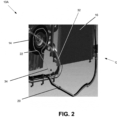
- FIG. 2 shown are select components of an embodiment of an engine damper cooling system 10A, similar to that shown in FIG. 1 .
- shown is one example arrangement of the engine damper 14 relative to certain components of the temperature control system 12.
- the pulley 15 is omitted from FIG. 2 to better illustrate an example configuration for the tube portion 22.
- a damper may be used that integrates the pulley assembly.
- the tube 20 is routed from (a lower end of) the condenser 16 to an area proximal to the outward face of the engine damper 14 and then beyond toward the evaporator.
- the tube portion 22 adjacent the engine damper 14 is routed circumferentially in front of the engine damper 14 to expose as much of the tube portion 22 (and hence fluid flowing within) to air flow from the fan 30 ( FIG. 1 ) as possible to enable convective cooling of the tubing surface to the surrounding air.
- the tube portion 22 is routed in a manner that is substantially concentric (e.g., almost entirely fashioned in a circle) to the outward or front face of the engine damper 14.
- the tube 20 may be made of a different material than the material used for other refrigerant tubes (e.g., tube 28).
- the tube 20 is comprised of a metal material or a mix of metal material and elastomeric material or nylon or other material or combinations of materials.
- only the tube portion 22 is comprised of the metal-based material, with an additional or intermediary tube of a different material (e.g., elastomeric) fluidly coupled (and physically coupled, such as via a fitting) between the tube portion 22 (e.g., at point A) and the condenser 16 and/or between the tube portion 22 (at point B) and the evaporator (or valve/orifice).
- a different material e.g., elastomeric
- the main portion 32 may be comprised of non-metal material (e.g., an elastomeric material), and the bypass portion 34 may be comprised of a metal or metal mix type material as described above.
- the tube portion 22 includes one or more heat exchange structures.
- the heat exchange structures may include attached (e.g., soldered) or integrated (e.g., embedded) fins or fin tubes, corrugated tubes, among others.
- An example of some types of heat exchange structures may be similar to those provided by Unity Tube in East furniture, OH.
- the main portion 32 is omitted (e.g., the tube 20 enables fluid flow from the condenser 16, through the portion 22, and to the evaporator, and hence no branching).
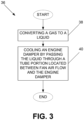
- an example damper engine cooling method comprises converting a gas to a liquid (38), and cooling an engine damper by passing the liquid through a tube portion located between fan air flow and the engine damper (40).
- the conversion (38) may be achieved via the inherent operations of the condenser 16 ( FIG. 1 ), and the cooling of the air over an exterior surface of the tube by fan air flow (or air flow from plural fans), and the resultant cooled air of and around the engine damper, enables operation of the engine damper at an acceptable operating temperature.
Landscapes
- Engineering & Computer Science (AREA)
- Chemical & Material Sciences (AREA)
- Combustion & Propulsion (AREA)
- Mechanical Engineering (AREA)
- General Engineering & Computer Science (AREA)
- Cooling, Air Intake And Gas Exhaust, And Fuel Tank Arrangements In Propulsion Units (AREA)
Description
- The present disclosure is generally related to engine dampers, and, more particularly, operational temperature control involving engine dampers.
- Dampers, including torsional vibration dampers, are used on many engines to reduce vibrations by converting energy to heat. Dampers often are constructed using an inertia ring in a viscous fluid (e.g., oils, grease, liquids with high silica content, etc., or an inertia ring cooperating with an elastomeric material), where torsional vibration (e.g., imposed by crankshaft forces) forces the fluid through narrow passages that dissipate the vibration as heat. This heat should be dissipated to keep the damper fluid functioning. Typically, engines are mounted behind a cooling packages that expend a considerable amount of heat, making it difficult to keep the engine damper cool. Efforts have focused on damper designs to alleviate high temperature effects, but sometimes conditions arise that present challenges in dissipating heat.
-
US 5,067,557 discloses a portable air conditioning unit having a compressor, an evaporator, and a condenser fluidly connected by hoses to form a closed loop fluid circuit and an internal combustion engine drives the compressor. The engine also drives a fan which draws air through the condenser via a drive shaft coupled to an output shaft of the engine through a torsional damper. - According to a first aspect of the invention, there is provided a vehicle as defined in claim 1. Further optional features of the vehicle according to this aspect of the invention are set out in the claims defendant on claim 1. According to a further aspect of the invention, there is provided a method for cooling an engine damper in a vehicle according to first aspect as defined in claim 13. Further optional features of the method according to this aspect of the invention are set out in
claim 14. - These aspects of the invention will be apparent from and elucidated with reference to the embodiment(s) described hereinafter.
- Many aspects of a vehicle having an engine damper cooling system and method of the present invention can be better understood with reference to the following drawings. The components in the drawings are not necessarily to scale, emphasis instead being placed upon clearly illustrating the principles of an engine damper cooling system. Moreover, in the drawings, like reference numerals designate corresponding parts throughout the several views.
-
FIG. 1 is a schematic diagram that conceptually illustrates, in overhead plan, fragmentary view, an embodiment of an example engine damper cooling system in a vehicle. -
FIG. 2 is a schematic diagram that illustrates, in isometric view, select components of an embodiment of an example engine damper cooling system in a vehicle. -
FIG. 3 is a flow diagram that illustrates an embodiment of an example engine damper cooling method. - Certain embodiments of an engine damper cooling system and method are disclosed that help reduce an operating temperature at or around an engine damper, enabling the viscous fluid of the engine damper to be maintained at acceptable operating temperatures. In one embodiment, the engine damper cooling system comprises an engine damper, and a temperature control system that converts gas (e.g., refrigerant) to a liquid, and passes the liquid through a tube portion located between air flow (e.g., from one or more fans) and the engine damper. In this way, the air flowing over the exterior of the tube portion is cooled (e.g., via convective cooling), reducing the air temperature around the engine damper.
- Digressing briefly, current solutions for controlling the temperature of engine dampers focus on the design of the engine damper itself, which in of itself may not provide sufficient temperature control under some conditions (e.g., lower travel speed induced air flow). Certain embodiments of an engine damper cooling system may be used, with or without the benefits of specialized damper designs, to provide a cooler environment within which the engine damper may operate.
- Having summarized various features of certain embodiments of an engine damper cooling system of the present disclosure, reference will now be made in detail to the detailed description of an engine damper cooling system as illustrated in the drawings. While the disclosure is described in connection with these drawings, there is no intent to limit it to the embodiment or embodiments disclosed herein. Further, although the description identifies or describes specifics of one or more embodiments, such specifics are not necessarily part of every embodiment, nor are all various stated advantages associated with a single embodiment. On the contrary, the intent is to cover all alternatives, modifications and equivalents included within the scope of a vehicle having an engine damper cooling system as defined by the appended claims. Further, it should be appreciated in the context of the present disclosure that the claims are not necessarily limited to the particular embodiments set out in the description.
-
FIG. 1 is a schematic diagram that conceptually illustrates, in overhead plan, fragmentary view, an embodiment of an example enginedamper cooling system 10. The enginedamper cooling system 10 may be part of an engine assembly for a vehicle of any one of a plurality of different types and/or uses, including incorporation into a tractor (e.g., the MT800 from AGCO), passenger vehicle, commercial truck, mining or construction vehicle, among other types of vehicles using wheels, tracks, or a combination thereof, for any one of a plurality of different recreational or commercial uses. For purposes of illustration, the enginedamper cooling system 10 is described in the context of an agricultural tractor that uses a high horsepower (e.g., over 400 horsepower) engine at a relatively low travel speed (compared to a vehicle normally used in a highway environment). In such applications, the lower travel speed often results in a lower volume of air flow, which may give rise to excessive heat exposure to an engine damper without the benefit of an enginedamper cooling system 10. However, it is appreciated that even when used in vehicles having improved airflow conditions, the enginedamper cooling system 10 may provide a benefit in prolonging the life of the engine damper and/or enabling efficient engine damper operation, and hence such vehicles are contemplated to be within the scope of the enginedamper cooling system 10. - In the depicted embodiment, the engine
damper cooling system 10 comprises atemperature control system 12 and anengine damper 14, theengine damper 14 connected on its outward face (e.g., via plural bolts) to apulley 15. Note that in some embodiments, the connection between theengine damper 14 and thepulley 15 may be via a clutch mechanism (or in some embodiments, there may be no connection between theengine damper 14 and the pulley 15). It should be appreciated that the schematic depicted inFIG. 1 is a conceptual, fragmentary view that is used to facilitate an understanding of operations of the enginedamper cooling system 10, and that one having ordinary skill in the art would understand that an engine and associated cooling system comprises a plurality of known components including electrical wiring, additional tubing/hoses, valves, solenoids, refrigerant containers, a charge air cooler, oil cooler, fuel cooler, accumulators, receiver dryers, among other known components. - The
engine damper 14 may comprise a torsional vibration damper constructed using an inertia ring in a viscous fluid or an inertia ring cooperating with an elastomeric material. Certain embodiments of an enginedamper cooling system 10 cool the air at and/or around theengine damper 14, which maintains the viscous fluid and/or elastomeric material at an acceptable operating temperature (e.g., 120C, though not limited to this temperature specification) despite low travel speeds (and hence low air flow due to travel speeds). As indicated above, certain embodiments of an enginedamper cooling system 10 may be beneficial for other types of vehicles. - The
temperature control system 12 comprises, beginning at the front of the enginedamper cooling system 10, acondenser 16, aradiator 18, and a plurality of hoses/tubing (hereinafter, tube(s) or tubing) that enable closed loop fluid flow, the fluid (e.g., gas, liquid) including air conditioning refrigerant (e.g., HFC-134a, HFC-152a, newer climate friendly refrigerants, etc.). There is also fluid flow (e.g., of engine coolant) that is achieved via a plurality of tubes and theradiator 18, though discussion of these known systems (and others, such as vacuum systems, other heat exchangers, etc.) is omitted here to avoid obfuscating principles of the present disclosure. In one embodiment of the enginedamper cooling system 10, atube 20 is coupled to an outlet of thecondenser 16 and is routed past an outward face of theengine damper 14, wherein aportion 22 of thetube 20 is routed adjacent to (proximal to) the outward face of theengine damper 14. For instance, theportion 22 is routed at least partially between thepulley 15 and theengine damper 14, past which thetube 20 is routed to an evaporator (e.g., via an orifice tube or expansion valve), not shown inFIG. 1 . From the evaporator, fluid is routed to acompressor 24 that is mounted to anengine 26 and driven by the pulley 15 (which in turn is driven by the crankshaft of the engine 26), and from thecompressor 24, back to thecondenser 16 viatube 28. Thetemperature control system 12 further comprises a fan 30 (e.g., a radiator cooling fan). In some embodiments, thefan 30 may be arranged relative to theengine damper 14 such that most of the air flow, of which thetube portion 22 is exposed, is primarily from a lower portion of thefan 30. In some embodiments, more or less area of thefan 30 may primarily contribute to the air flow received by the tube portion 22 (and hence the fluid flowing within). - In one example operation, the
compressor 24 is powered by theengine 26 via a pulley 15 (e.g., to drive a serpentine or other arrangements of belt(s)), internally pressurizing the refrigerant. Thecompressor 24 comprises a low pressure-side port and a high pressure-side port, with the low pressure-side port connected to the evaporator (via a hose) and the high pressure-side port connected to the condenser 16 (via the tube 28). Note that in some embodiments, a compressor may be used that is powered electrically (e.g., in hybrid engines via a battery, where the refrigerant is pressurized using a motor integral to the compressor). In such embodiments, thepulley 15 may not be connected to theengine damper 14. Thecondenser 16 is located in front of theengine radiator 18 and cools the refrigerant flowing from thecompressor 24 before it heads to the evaporator. In some embodiments, thetemperature control system 12 comprises plural (e.g., two) fans (e.g., a separate fan for thecondenser 16 instead of using theradiator cooling fan 30, or an additional fan to help theradiator fan 30 cool the refrigerant). Thefan 30 draws air through thecondenser 16 andradiator 18. The evaporator is typically used in conjunction with an expansion valve or orifice tube, which cools the high pressure liquid refrigerant. When thetemperature control system 12 is inactive, the refrigerant exists as a low pressure gas. Once activated, thecompressor 24 increases the refrigerant to a high pressure, hot gas (e.g., 120-125C), and when the refrigerant passes through thecondenser 16, the gas is converted or transformed to a warm, high pressure liquid (e.g., 40-45C). The air flowing over the exterior of thetube portion 22 is cooled, which in turn cools the surrounding air of theengine damper 14 as the refrigerant liquid passes through thetube portion 22 of thetube 20. The liquid passes through the expansion valve/orifice to a low pressure gas within the evaporator, the further cooled air distributed via a ventilation system and blower to cool a cab of the vehicle. The gas flows through thecompressor 24, and the temperature control operation is repeated. - The
tube 20 is connected to the condenser outlet, and is routed past and proximal to the outward (e.g., front) face of theengine damper 14 where air flow from thefan 30 passes over thetube portion 22, convectively cooling the air surrounding theengine damper 14. Thetube 20 is routed toward the evaporator. In some embodiments thetube 20 branches off (e.g., via a tee fitting, valve, etc.) at or around point A as shown inFIG. 1 , resulting in amain portion 32 and abypass portion 34. Thebypass portion 34 is routed past the front of theengine damper 14 and the main portion 32 (e.g., having a greater flow capacity, though not necessarily in all embodiments) is routed in a different manner (e.g., passes forward of and beneath the pulley 15). In other words, thebypass portion 34 andmain portion 32 are fluidly coupled to each other and thetube 20, and thebypass portion 34 and themain portion 32 are arranged in parallel, joining back together (e.g., via a fitting, valve, etc.) at point B as shown inFIG. 1 . Note that the illustrated locations of points A and B are used as one example, and that in some embodiments, other locations and/or a different routing of thetubes condenser 16 passes proximal to the front face (e.g., disposed between thepulley 15 and engine damper 14) of theengine damper 14 and the fluid carrying tube is exposed to the air flow of thefan 30 to enable convective cooling of the air over the exterior of the tubing and hence the surrounding air of theengine damper 14. Further, the routing of tubes to and from the evaporator are also merely illustrative, and that in some embodiments, other routing arrangements may be used. In one embodiment, thetube portion 22 may be supported using a harness or other known support structure coupled to the frame of the vehicle. In some embodiments, thetube portion 22 may be supported from a harness or other support structure coupled to theengine 26. - Referring now to
FIG. 2 , shown are select components of an embodiment of an enginedamper cooling system 10A, similar to that shown inFIG. 1 . In particular, shown is one example arrangement of theengine damper 14 relative to certain components of thetemperature control system 12. Thepulley 15 is omitted fromFIG. 2 to better illustrate an example configuration for thetube portion 22. Note that in some embodiments, a damper may be used that integrates the pulley assembly. As shown, in one embodiment, thetube 20 is routed from (a lower end of) thecondenser 16 to an area proximal to the outward face of theengine damper 14 and then beyond toward the evaporator. In one example arrangement, thetube portion 22 adjacent theengine damper 14 is routed circumferentially in front of theengine damper 14 to expose as much of the tube portion 22 (and hence fluid flowing within) to air flow from the fan 30 (FIG. 1 ) as possible to enable convective cooling of the tubing surface to the surrounding air. In other words, thetube portion 22 is routed in a manner that is substantially concentric (e.g., almost entirely fashioned in a circle) to the outward or front face of theengine damper 14. In one embodiment, thetube 20 may be made of a different material than the material used for other refrigerant tubes (e.g., tube 28). In one embodiment, thetube 20 is comprised of a metal material or a mix of metal material and elastomeric material or nylon or other material or combinations of materials. In some embodiments, only thetube portion 22 is comprised of the metal-based material, with an additional or intermediary tube of a different material (e.g., elastomeric) fluidly coupled (and physically coupled, such as via a fitting) between the tube portion 22 (e.g., at point A) and thecondenser 16 and/or between the tube portion 22 (at point B) and the evaporator (or valve/orifice). In embodiments where amain portion 32 andbypass portion 34 are used, themain portion 32 may be comprised of non-metal material (e.g., an elastomeric material), and thebypass portion 34 may be comprised of a metal or metal mix type material as described above. In some embodiments, the tube portion 22 (including thebypass portion 34 in some embodiments) includes one or more heat exchange structures. In one embodiment, the heat exchange structures may include attached (e.g., soldered) or integrated (e.g., embedded) fins or fin tubes, corrugated tubes, among others. An example of some types of heat exchange structures may be similar to those provided by Unity Tube in East Palestine, OH. Note that in embodiments that do not use the parallel arrangement of thebypass portion 34 and themain portion 32, themain portion 32 is omitted (e.g., thetube 20 enables fluid flow from thecondenser 16, through theportion 22, and to the evaporator, and hence no branching). - In view of the various embodiments of an engine damper cooling system (e.g.,
systems method 36 and depicted inFIG. 3 between start and end steps, comprises converting a gas to a liquid (38), and cooling an engine damper by passing the liquid through a tube portion located between fan air flow and the engine damper (40). For instance, the conversion (38) may be achieved via the inherent operations of the condenser 16 (FIG. 1 ), and the cooling of the air over an exterior surface of the tube by fan air flow (or air flow from plural fans), and the resultant cooled air of and around the engine damper, enables operation of the engine damper at an acceptable operating temperature.
Claims (14)
- A vehicle (10), comprising:
an engine (26), an engine damper (14), and a temperature control system (12) for a cab of the vehicle, the temperature control system (12) comprising at least one fan (30), a condenser (16), and plural hoses (20, 22, 28, 32) that enable closed loop fluid flow, the plural hoses including a first hose (20) coupled to an outlet of the condenser; characterized in that the vehicle includes a cooling system (10) for the engine damper in which at least a portion (22) of the first hose (20) is located proximal to an outward face of the engine damper and disposed between the at least one fan (30) and the engine damper (14), the arrangement configured such that, in use, air flowing from the fan over the exterior of the at least a portion (22) of the first hose (20) is cooled, reducing the air temperature around the engine damper. - The vehicle of claim 1, wherein the first hose (20) is coupled between the outlet of the condenser (16) and an inlet to an evaporator.
- The vehicle of any one of the preceding claims, wherein the first hose (20) is coupled to one or both of the condenser (16) and the evaporator via an intermediate hose or intermediate hoses, respectively, wherein the first hose comprises a first material and the intermediate hose or hoses comprises a second material that is of a different material than the first material.
- The vehicle of any one of the preceding claims, further comprising a pulley (15) adjacent to the engine damper (14), wherein the pulley is located between the at least one fan (30) and the at least a portion (22) of the first tube (20).
- The vehicle of any one of the preceding claims, wherein the first hose (20) is comprised of a metal material.
- The vehicle of any one of the preceding claims, wherein the first hose (20) comprises one or more heat exchange structures, wherein the one or more heat exchange structures comprise one or more fins.
- The vehicle of any one of the preceding claims, wherein the at least a portion (22) of the first tube (20) is arranged substantially concentric to the outward face of the engine damper (14).
- The vehicle of any one of the preceding claims, wherein the temperature control system (12) comprises plural fans (30).
- The vehicle of any one of the preceding claims, wherein the first hose (20) comprises a bypass hose (34) and a main hose (32), the bypass hose coupled to and arranged in parallel with the main hose, and wherein the at least a portion (22) of the first hose is a portion of the bypass hose (34).
- The vehicle of claim 9, wherein the bypass hose (34) comprises a first material and the main hose (32) comprises a second material that is of a different material than the first material.
- The vehicle of claim 9 or claim 10, wherein the bypass hose (34) is comprised of one or any combination of a metal material or one or more heat exchange structures, the one or more heat exchange structures comprising one or more fins, wherein the temperature control system comprises plural fans (30).
- The vehicle of any one of the preceding claims, wherein the vehicle is an agricultural tractor.
- A method (36) for cooling an engine damper in a vehicle according to any one of the preceding claims, the method comprising cooling the engine damper (14) by passing fluid in the cooling system closed loop fluid circuit through the at least a portion (22) of the first hose (20) such that air flow from the fan (30) is cooled as it passes over the exterior of the at least a portion (22) of the first hose, reducing the air temperature around the engine damper (14).
- The method of claim 13, the method comprising converting a gas to a liquid and passing the liquid through the at least a portion (22) of the first hose (20).
Applications Claiming Priority (1)
| Application Number | Priority Date | Filing Date | Title |
|---|---|---|---|
| US201962942392P | 2019-12-02 | 2019-12-02 |
Publications (2)
| Publication Number | Publication Date |
|---|---|
| EP3832157A1 EP3832157A1 (en) | 2021-06-09 |
| EP3832157B1 true EP3832157B1 (en) | 2024-07-17 |
Family
ID=73014276
Family Applications (1)
| Application Number | Title | Priority Date | Filing Date |
|---|---|---|---|
| EP20203528.3A Active EP3832157B1 (en) | 2019-12-02 | 2020-10-23 | Engine damper cooling utilizing cab a/c circuit |
Country Status (2)
| Country | Link |
|---|---|
| US (1) | US11549425B2 (en) |
| EP (1) | EP3832157B1 (en) |
Families Citing this family (1)
| Publication number | Priority date | Publication date | Assignee | Title |
|---|---|---|---|---|
| CN118912140A (en) * | 2024-08-30 | 2024-11-08 | 东风汽车集团股份有限公司 | Shock absorber oil liquid cooling device, control method, control system and medium thereof |
Family Cites Families (8)
| Publication number | Priority date | Publication date | Assignee | Title |
|---|---|---|---|---|
| US1320430A (en) * | 1918-06-05 | 1919-11-04 | English & Mersick Company | Manufacture of radiator-tubing. |
| US2594555A (en) | 1949-03-18 | 1952-04-29 | Schwitzer Cummins Company | Vibration damper |
| US2716604A (en) | 1951-06-15 | 1955-08-30 | Ford Motor Co | Process for producing nodular iron |
| US4041803A (en) | 1975-12-01 | 1977-08-16 | Caterpillar Tractor Co. | Rubber torsional vibration damper with cooling means |
| DE3930901C2 (en) * | 1989-09-15 | 1998-12-17 | Gnieser Gmbh Auto Technik | Machine unit |
| DE102004042240B4 (en) * | 2004-09-01 | 2007-05-24 | Mtu Friedrichshafen Gmbh | Internal combustion engine with a vibration damper and method for supplying a provided with a vibration damper internal combustion engine with lubricating oil |
| WO2018181246A1 (en) * | 2017-03-31 | 2018-10-04 | 株式会社フコク | Viscous damper |
| CA3000362C (en) * | 2017-04-11 | 2025-09-02 | Bendix Commercial Vehicle Systems Llc | Hybrid commercial vehicle thermal management using dynamic heat generator |
-
2020
- 2020-10-23 EP EP20203528.3A patent/EP3832157B1/en active Active
- 2020-11-18 US US16/951,787 patent/US11549425B2/en active Active
Also Published As
| Publication number | Publication date |
|---|---|
| US11549425B2 (en) | 2023-01-10 |
| US20210164382A1 (en) | 2021-06-03 |
| EP3832157A1 (en) | 2021-06-09 |
Similar Documents
| Publication | Publication Date | Title |
|---|---|---|
| US7481287B2 (en) | Vehicle cooling package | |
| US5180003A (en) | Dual fan cooling system | |
| KR20020031052A (en) | Vehicular cooling system | |
| US9212598B2 (en) | Modular cooling unit for automotive vehicle | |
| KR101601409B1 (en) | Fluid management system for a heat exchanger of a vehicle air conditioning system | |
| JP4323307B2 (en) | Vehicle heat exchanger system | |
| CN101734142A (en) | Method and system for additional cooling of coolant in a vehicle cooling system | |
| JP4706314B2 (en) | Vehicle engine cooling device | |
| EP2665612B1 (en) | Motor vehicle | |
| US8127722B2 (en) | Cooling circuit for the thermal engine of an automotive vehicle | |
| JP2006144703A (en) | Hybrid vehicle | |
| EP3832157B1 (en) | Engine damper cooling utilizing cab a/c circuit | |
| US20180051933A1 (en) | A Cooling System | |
| JPS582416A (en) | Cooling device for car engine | |
| WO2022042582A1 (en) | Cooling system for an electric vehicle | |
| WO2024130891A1 (en) | Engineering vehicle cooling system, engineering vehicle and cooling method therefor | |
| US20210164556A1 (en) | Engine damper cooling with pulley integrated fan | |
| JP2012247120A (en) | Combined heat exchanger system | |
| CN215633284U (en) | All-terrain vehicle and heat dissipation system thereof | |
| JP2012245866A (en) | Combined heat exchanger system | |
| JP4487926B2 (en) | Cooling module | |
| US20060196647A1 (en) | Heat Exchanger Having an Integral Air Guide | |
| JP4504711B2 (en) | Construction machinery | |
| EP4592104A1 (en) | Method for controlling a thermal management system of an electric vehicle, data processing apparatus, computer program, computer-readable storage medium, and uses | |
| US10550758B2 (en) | Cooling system for a work vehicle |
Legal Events
| Date | Code | Title | Description |
|---|---|---|---|
| PUAI | Public reference made under article 153(3) epc to a published international application that has entered the european phase |
Free format text: ORIGINAL CODE: 0009012 |
|
| STAA | Information on the status of an ep patent application or granted ep patent |
Free format text: STATUS: THE APPLICATION HAS BEEN PUBLISHED |
|
| AK | Designated contracting states |
Kind code of ref document: A1 Designated state(s): AL AT BE BG CH CY CZ DE DK EE ES FI FR GB GR HR HU IE IS IT LI LT LU LV MC MK MT NL NO PL PT RO RS SE SI SK SM TR |
|
| STAA | Information on the status of an ep patent application or granted ep patent |
Free format text: STATUS: REQUEST FOR EXAMINATION WAS MADE |
|
| 17P | Request for examination filed |
Effective date: 20211209 |
|
| RBV | Designated contracting states (corrected) |
Designated state(s): AL AT BE BG CH CY CZ DE DK EE ES FI FR GB GR HR HU IE IS IT LI LT LU LV MC MK MT NL NO PL PT RO RS SE SI SK SM TR |
|
| STAA | Information on the status of an ep patent application or granted ep patent |
Free format text: STATUS: EXAMINATION IS IN PROGRESS |
|
| 17Q | First examination report despatched |
Effective date: 20230627 |
|
| REG | Reference to a national code |
Ref country code: DE Free format text: PREVIOUS MAIN CLASS: F16F0009140000 Ref country code: DE Ref legal event code: R079 Ref document number: 602020034023 Country of ref document: DE Free format text: PREVIOUS MAIN CLASS: F16F0009140000 Ipc: F16F0015124000 |
|
| RIC1 | Information provided on ipc code assigned before grant |
Ipc: F16F 15/167 20060101ALI20240411BHEP Ipc: F16F 15/10 20060101ALI20240411BHEP Ipc: F16H 45/02 20060101ALI20240411BHEP Ipc: F01P 1/06 20060101ALI20240411BHEP Ipc: F16F 9/14 20060101ALI20240411BHEP Ipc: F16F 15/124 20060101AFI20240411BHEP |
|
| GRAP | Despatch of communication of intention to grant a patent |
Free format text: ORIGINAL CODE: EPIDOSNIGR1 |
|
| STAA | Information on the status of an ep patent application or granted ep patent |
Free format text: STATUS: GRANT OF PATENT IS INTENDED |
|
| GRAS | Grant fee paid |
Free format text: ORIGINAL CODE: EPIDOSNIGR3 |
|
| GRAA | (expected) grant |
Free format text: ORIGINAL CODE: 0009210 |
|
| STAA | Information on the status of an ep patent application or granted ep patent |
Free format text: STATUS: THE PATENT HAS BEEN GRANTED |
|
| INTG | Intention to grant announced |
Effective date: 20240523 |
|
| AK | Designated contracting states |
Kind code of ref document: B1 Designated state(s): AL AT BE BG CH CY CZ DE DK EE ES FI FR GB GR HR HU IE IS IT LI LT LU LV MC MK MT NL NO PL PT RO RS SE SI SK SM TR |
|
| REG | Reference to a national code |
Ref country code: CH Ref legal event code: EP |
|
| REG | Reference to a national code |
Ref country code: DE Ref legal event code: R096 Ref document number: 602020034023 Country of ref document: DE |
|
| REG | Reference to a national code |
Ref country code: IE Ref legal event code: FG4D |
|
| REG | Reference to a national code |
Ref country code: LT Ref legal event code: MG9D |
|
| REG | Reference to a national code |
Ref country code: NL Ref legal event code: MP Effective date: 20240717 |
|
| PG25 | Lapsed in a contracting state [announced via postgrant information from national office to epo] |
Ref country code: PT Free format text: LAPSE BECAUSE OF FAILURE TO SUBMIT A TRANSLATION OF THE DESCRIPTION OR TO PAY THE FEE WITHIN THE PRESCRIBED TIME-LIMIT Effective date: 20241118 |
|
| REG | Reference to a national code |
Ref country code: AT Ref legal event code: MK05 Ref document number: 1704413 Country of ref document: AT Kind code of ref document: T Effective date: 20240717 |
|
| PG25 | Lapsed in a contracting state [announced via postgrant information from national office to epo] |
Ref country code: NL Free format text: LAPSE BECAUSE OF FAILURE TO SUBMIT A TRANSLATION OF THE DESCRIPTION OR TO PAY THE FEE WITHIN THE PRESCRIBED TIME-LIMIT Effective date: 20240717 |
|
| PG25 | Lapsed in a contracting state [announced via postgrant information from national office to epo] |
Ref country code: PT Free format text: LAPSE BECAUSE OF FAILURE TO SUBMIT A TRANSLATION OF THE DESCRIPTION OR TO PAY THE FEE WITHIN THE PRESCRIBED TIME-LIMIT Effective date: 20241118 Ref country code: NL Free format text: LAPSE BECAUSE OF FAILURE TO SUBMIT A TRANSLATION OF THE DESCRIPTION OR TO PAY THE FEE WITHIN THE PRESCRIBED TIME-LIMIT Effective date: 20240717 |
|
| PG25 | Lapsed in a contracting state [announced via postgrant information from national office to epo] |
Ref country code: NO Free format text: LAPSE BECAUSE OF FAILURE TO SUBMIT A TRANSLATION OF THE DESCRIPTION OR TO PAY THE FEE WITHIN THE PRESCRIBED TIME-LIMIT Effective date: 20241017 |
|
| PG25 | Lapsed in a contracting state [announced via postgrant information from national office to epo] |
Ref country code: GR Free format text: LAPSE BECAUSE OF FAILURE TO SUBMIT A TRANSLATION OF THE DESCRIPTION OR TO PAY THE FEE WITHIN THE PRESCRIBED TIME-LIMIT Effective date: 20241018 Ref country code: FI Free format text: LAPSE BECAUSE OF FAILURE TO SUBMIT A TRANSLATION OF THE DESCRIPTION OR TO PAY THE FEE WITHIN THE PRESCRIBED TIME-LIMIT Effective date: 20240717 Ref country code: PL Free format text: LAPSE BECAUSE OF FAILURE TO SUBMIT A TRANSLATION OF THE DESCRIPTION OR TO PAY THE FEE WITHIN THE PRESCRIBED TIME-LIMIT Effective date: 20240717 |
|
| PG25 | Lapsed in a contracting state [announced via postgrant information from national office to epo] |
Ref country code: BG Free format text: LAPSE BECAUSE OF FAILURE TO SUBMIT A TRANSLATION OF THE DESCRIPTION OR TO PAY THE FEE WITHIN THE PRESCRIBED TIME-LIMIT Effective date: 20240717 |
|
| PG25 | Lapsed in a contracting state [announced via postgrant information from national office to epo] |
Ref country code: LV Free format text: LAPSE BECAUSE OF FAILURE TO SUBMIT A TRANSLATION OF THE DESCRIPTION OR TO PAY THE FEE WITHIN THE PRESCRIBED TIME-LIMIT Effective date: 20240717 |
|
| PG25 | Lapsed in a contracting state [announced via postgrant information from national office to epo] |
Ref country code: AT Free format text: LAPSE BECAUSE OF FAILURE TO SUBMIT A TRANSLATION OF THE DESCRIPTION OR TO PAY THE FEE WITHIN THE PRESCRIBED TIME-LIMIT Effective date: 20240717 Ref country code: IS Free format text: LAPSE BECAUSE OF FAILURE TO SUBMIT A TRANSLATION OF THE DESCRIPTION OR TO PAY THE FEE WITHIN THE PRESCRIBED TIME-LIMIT Effective date: 20241117 |
|
| PG25 | Lapsed in a contracting state [announced via postgrant information from national office to epo] |
Ref country code: HR Free format text: LAPSE BECAUSE OF FAILURE TO SUBMIT A TRANSLATION OF THE DESCRIPTION OR TO PAY THE FEE WITHIN THE PRESCRIBED TIME-LIMIT Effective date: 20240717 |
|
| PG25 | Lapsed in a contracting state [announced via postgrant information from national office to epo] |
Ref country code: ES Free format text: LAPSE BECAUSE OF FAILURE TO SUBMIT A TRANSLATION OF THE DESCRIPTION OR TO PAY THE FEE WITHIN THE PRESCRIBED TIME-LIMIT Effective date: 20240717 Ref country code: RS Free format text: LAPSE BECAUSE OF FAILURE TO SUBMIT A TRANSLATION OF THE DESCRIPTION OR TO PAY THE FEE WITHIN THE PRESCRIBED TIME-LIMIT Effective date: 20241017 |
|
| PG25 | Lapsed in a contracting state [announced via postgrant information from national office to epo] |
Ref country code: RS Free format text: LAPSE BECAUSE OF FAILURE TO SUBMIT A TRANSLATION OF THE DESCRIPTION OR TO PAY THE FEE WITHIN THE PRESCRIBED TIME-LIMIT Effective date: 20241017 Ref country code: PL Free format text: LAPSE BECAUSE OF FAILURE TO SUBMIT A TRANSLATION OF THE DESCRIPTION OR TO PAY THE FEE WITHIN THE PRESCRIBED TIME-LIMIT Effective date: 20240717 Ref country code: NO Free format text: LAPSE BECAUSE OF FAILURE TO SUBMIT A TRANSLATION OF THE DESCRIPTION OR TO PAY THE FEE WITHIN THE PRESCRIBED TIME-LIMIT Effective date: 20241017 Ref country code: LV Free format text: LAPSE BECAUSE OF FAILURE TO SUBMIT A TRANSLATION OF THE DESCRIPTION OR TO PAY THE FEE WITHIN THE PRESCRIBED TIME-LIMIT Effective date: 20240717 Ref country code: IS Free format text: LAPSE BECAUSE OF FAILURE TO SUBMIT A TRANSLATION OF THE DESCRIPTION OR TO PAY THE FEE WITHIN THE PRESCRIBED TIME-LIMIT Effective date: 20241117 Ref country code: HR Free format text: LAPSE BECAUSE OF FAILURE TO SUBMIT A TRANSLATION OF THE DESCRIPTION OR TO PAY THE FEE WITHIN THE PRESCRIBED TIME-LIMIT Effective date: 20240717 Ref country code: GR Free format text: LAPSE BECAUSE OF FAILURE TO SUBMIT A TRANSLATION OF THE DESCRIPTION OR TO PAY THE FEE WITHIN THE PRESCRIBED TIME-LIMIT Effective date: 20241018 Ref country code: FI Free format text: LAPSE BECAUSE OF FAILURE TO SUBMIT A TRANSLATION OF THE DESCRIPTION OR TO PAY THE FEE WITHIN THE PRESCRIBED TIME-LIMIT Effective date: 20240717 Ref country code: ES Free format text: LAPSE BECAUSE OF FAILURE TO SUBMIT A TRANSLATION OF THE DESCRIPTION OR TO PAY THE FEE WITHIN THE PRESCRIBED TIME-LIMIT Effective date: 20240717 Ref country code: BG Free format text: LAPSE BECAUSE OF FAILURE TO SUBMIT A TRANSLATION OF THE DESCRIPTION OR TO PAY THE FEE WITHIN THE PRESCRIBED TIME-LIMIT Effective date: 20240717 Ref country code: AT Free format text: LAPSE BECAUSE OF FAILURE TO SUBMIT A TRANSLATION OF THE DESCRIPTION OR TO PAY THE FEE WITHIN THE PRESCRIBED TIME-LIMIT Effective date: 20240717 |
|
| PG25 | Lapsed in a contracting state [announced via postgrant information from national office to epo] |
Ref country code: SM Free format text: LAPSE BECAUSE OF FAILURE TO SUBMIT A TRANSLATION OF THE DESCRIPTION OR TO PAY THE FEE WITHIN THE PRESCRIBED TIME-LIMIT Effective date: 20240717 Ref country code: RO Free format text: LAPSE BECAUSE OF FAILURE TO SUBMIT A TRANSLATION OF THE DESCRIPTION OR TO PAY THE FEE WITHIN THE PRESCRIBED TIME-LIMIT Effective date: 20240717 Ref country code: DK Free format text: LAPSE BECAUSE OF FAILURE TO SUBMIT A TRANSLATION OF THE DESCRIPTION OR TO PAY THE FEE WITHIN THE PRESCRIBED TIME-LIMIT Effective date: 20240717 |
|
| REG | Reference to a national code |
Ref country code: DE Ref legal event code: R097 Ref document number: 602020034023 Country of ref document: DE |
|
| PG25 | Lapsed in a contracting state [announced via postgrant information from national office to epo] |
Ref country code: EE Free format text: LAPSE BECAUSE OF FAILURE TO SUBMIT A TRANSLATION OF THE DESCRIPTION OR TO PAY THE FEE WITHIN THE PRESCRIBED TIME-LIMIT Effective date: 20240717 |
|
| PG25 | Lapsed in a contracting state [announced via postgrant information from national office to epo] |
Ref country code: CZ Free format text: LAPSE BECAUSE OF FAILURE TO SUBMIT A TRANSLATION OF THE DESCRIPTION OR TO PAY THE FEE WITHIN THE PRESCRIBED TIME-LIMIT Effective date: 20240717 |
|
| PG25 | Lapsed in a contracting state [announced via postgrant information from national office to epo] |
Ref country code: SK Free format text: LAPSE BECAUSE OF FAILURE TO SUBMIT A TRANSLATION OF THE DESCRIPTION OR TO PAY THE FEE WITHIN THE PRESCRIBED TIME-LIMIT Effective date: 20240717 |
|
| PLBE | No opposition filed within time limit |
Free format text: ORIGINAL CODE: 0009261 |
|
| STAA | Information on the status of an ep patent application or granted ep patent |
Free format text: STATUS: NO OPPOSITION FILED WITHIN TIME LIMIT |
|
| REG | Reference to a national code |
Ref country code: CH Ref legal event code: PL |
|
| 26N | No opposition filed |
Effective date: 20250422 |
|
| GBPC | Gb: european patent ceased through non-payment of renewal fee |
Effective date: 20241023 |
|
| PG25 | Lapsed in a contracting state [announced via postgrant information from national office to epo] |
Ref country code: MC Free format text: LAPSE BECAUSE OF FAILURE TO SUBMIT A TRANSLATION OF THE DESCRIPTION OR TO PAY THE FEE WITHIN THE PRESCRIBED TIME-LIMIT Effective date: 20240717 |
|
| PG25 | Lapsed in a contracting state [announced via postgrant information from national office to epo] |
Ref country code: GB Free format text: LAPSE BECAUSE OF NON-PAYMENT OF DUE FEES Effective date: 20241023 |
|
| PG25 | Lapsed in a contracting state [announced via postgrant information from national office to epo] |
Ref country code: LU Free format text: LAPSE BECAUSE OF NON-PAYMENT OF DUE FEES Effective date: 20241023 Ref country code: BE Free format text: LAPSE BECAUSE OF NON-PAYMENT OF DUE FEES Effective date: 20241031 |
|
| PG25 | Lapsed in a contracting state [announced via postgrant information from national office to epo] |
Ref country code: CH Free format text: LAPSE BECAUSE OF NON-PAYMENT OF DUE FEES Effective date: 20241031 |
|
| REG | Reference to a national code |
Ref country code: BE Ref legal event code: MM Effective date: 20241031 |
|
| PG25 | Lapsed in a contracting state [announced via postgrant information from national office to epo] |
Ref country code: SE Free format text: LAPSE BECAUSE OF FAILURE TO SUBMIT A TRANSLATION OF THE DESCRIPTION OR TO PAY THE FEE WITHIN THE PRESCRIBED TIME-LIMIT Effective date: 20240717 |
|
| PG25 | Lapsed in a contracting state [announced via postgrant information from national office to epo] |
Ref country code: IE Free format text: LAPSE BECAUSE OF NON-PAYMENT OF DUE FEES Effective date: 20241023 |
|
| PGFP | Annual fee paid to national office [announced via postgrant information from national office to epo] |
Ref country code: DE Payment date: 20251021 Year of fee payment: 6 |
|
| PGFP | Annual fee paid to national office [announced via postgrant information from national office to epo] |
Ref country code: FR Payment date: 20251030 Year of fee payment: 6 |
|
| PG25 | Lapsed in a contracting state [announced via postgrant information from national office to epo] |
Ref country code: CY Free format text: LAPSE BECAUSE OF FAILURE TO SUBMIT A TRANSLATION OF THE DESCRIPTION OR TO PAY THE FEE WITHIN THE PRESCRIBED TIME-LIMIT; INVALID AB INITIO Effective date: 20201023 Ref country code: IT Free format text: LAPSE BECAUSE OF FAILURE TO SUBMIT A TRANSLATION OF THE DESCRIPTION OR TO PAY THE FEE WITHIN THE PRESCRIBED TIME-LIMIT Effective date: 20240717 |
|
| PG25 | Lapsed in a contracting state [announced via postgrant information from national office to epo] |
Ref country code: HU Free format text: LAPSE BECAUSE OF FAILURE TO SUBMIT A TRANSLATION OF THE DESCRIPTION OR TO PAY THE FEE WITHIN THE PRESCRIBED TIME-LIMIT; INVALID AB INITIO Effective date: 20201023 |