EP3832074B1 - Integral engine case precooler - Google Patents
Integral engine case precooler Download PDFInfo
- Publication number
- EP3832074B1 EP3832074B1 EP20212191.9A EP20212191A EP3832074B1 EP 3832074 B1 EP3832074 B1 EP 3832074B1 EP 20212191 A EP20212191 A EP 20212191A EP 3832074 B1 EP3832074 B1 EP 3832074B1
- Authority
- EP
- European Patent Office
- Prior art keywords
- gas turbine
- turbine engine
- engine case
- heat exchanging
- flow
- Prior art date
- Legal status (The legal status is an assumption and is not a legal conclusion. Google has not performed a legal analysis and makes no representation as to the accuracy of the status listed.)
- Active
Links
Images

Classifications
-
- F—MECHANICAL ENGINEERING; LIGHTING; HEATING; WEAPONS; BLASTING
- F01—MACHINES OR ENGINES IN GENERAL; ENGINE PLANTS IN GENERAL; STEAM ENGINES
- F01D—NON-POSITIVE DISPLACEMENT MACHINES OR ENGINES, e.g. STEAM TURBINES
- F01D25/00—Component parts, details, or accessories, not provided for in, or of interest apart from, other groups
- F01D25/08—Cooling; Heating; Heat-insulation
-
- F—MECHANICAL ENGINEERING; LIGHTING; HEATING; WEAPONS; BLASTING
- F02—COMBUSTION ENGINES; HOT-GAS OR COMBUSTION-PRODUCT ENGINE PLANTS
- F02C—GAS-TURBINE PLANTS; AIR INTAKES FOR JET-PROPULSION PLANTS; CONTROLLING FUEL SUPPLY IN AIR-BREATHING JET-PROPULSION PLANTS
- F02C7/00—Features, components parts, details or accessories, not provided for in, or of interest apart form groups F02C1/00 - F02C6/00; Air intakes for jet-propulsion plants
- F02C7/12—Cooling of plants
- F02C7/16—Cooling of plants characterised by cooling medium
- F02C7/18—Cooling of plants characterised by cooling medium the medium being gaseous, e.g. air
-
- F—MECHANICAL ENGINEERING; LIGHTING; HEATING; WEAPONS; BLASTING
- F01—MACHINES OR ENGINES IN GENERAL; ENGINE PLANTS IN GENERAL; STEAM ENGINES
- F01D—NON-POSITIVE DISPLACEMENT MACHINES OR ENGINES, e.g. STEAM TURBINES
- F01D25/00—Component parts, details, or accessories, not provided for in, or of interest apart from, other groups
- F01D25/08—Cooling; Heating; Heat-insulation
- F01D25/12—Cooling
-
- F—MECHANICAL ENGINEERING; LIGHTING; HEATING; WEAPONS; BLASTING
- F01—MACHINES OR ENGINES IN GENERAL; ENGINE PLANTS IN GENERAL; STEAM ENGINES
- F01D—NON-POSITIVE DISPLACEMENT MACHINES OR ENGINES, e.g. STEAM TURBINES
- F01D25/00—Component parts, details, or accessories, not provided for in, or of interest apart from, other groups
- F01D25/08—Cooling; Heating; Heat-insulation
- F01D25/14—Casings modified therefor
-
- F—MECHANICAL ENGINEERING; LIGHTING; HEATING; WEAPONS; BLASTING
- F28—HEAT EXCHANGE IN GENERAL
- F28D—HEAT-EXCHANGE APPARATUS, NOT PROVIDED FOR IN ANOTHER SUBCLASS, IN WHICH THE HEAT-EXCHANGE MEDIA DO NOT COME INTO DIRECT CONTACT
- F28D1/00—Heat-exchange apparatus having stationary conduit assemblies for one heat-exchange medium only, the media being in contact with different sides of the conduit wall, in which the other heat-exchange medium is a large body of fluid, e.g. domestic or motor car radiators
- F28D1/06—Heat-exchange apparatus having stationary conduit assemblies for one heat-exchange medium only, the media being in contact with different sides of the conduit wall, in which the other heat-exchange medium is a large body of fluid, e.g. domestic or motor car radiators with the heat-exchange conduits forming part of, or being attached to, the tank containing the body of fluid
-
- F—MECHANICAL ENGINEERING; LIGHTING; HEATING; WEAPONS; BLASTING
- F05—INDEXING SCHEMES RELATING TO ENGINES OR PUMPS IN VARIOUS SUBCLASSES OF CLASSES F01-F04
- F05D—INDEXING SCHEME FOR ASPECTS RELATING TO NON-POSITIVE-DISPLACEMENT MACHINES OR ENGINES, GAS-TURBINES OR JET-PROPULSION PLANTS
- F05D2260/00—Function
- F05D2260/20—Heat transfer, e.g. cooling
- F05D2260/211—Heat transfer, e.g. cooling by intercooling, e.g. during a compression cycle
-
- F—MECHANICAL ENGINEERING; LIGHTING; HEATING; WEAPONS; BLASTING
- F05—INDEXING SCHEMES RELATING TO ENGINES OR PUMPS IN VARIOUS SUBCLASSES OF CLASSES F01-F04
- F05D—INDEXING SCHEME FOR ASPECTS RELATING TO NON-POSITIVE-DISPLACEMENT MACHINES OR ENGINES, GAS-TURBINES OR JET-PROPULSION PLANTS
- F05D2260/00—Function
- F05D2260/20—Heat transfer, e.g. cooling
- F05D2260/213—Heat transfer, e.g. cooling by the provision of a heat exchanger within the cooling circuit
-
- F—MECHANICAL ENGINEERING; LIGHTING; HEATING; WEAPONS; BLASTING
- F05—INDEXING SCHEMES RELATING TO ENGINES OR PUMPS IN VARIOUS SUBCLASSES OF CLASSES F01-F04
- F05D—INDEXING SCHEME FOR ASPECTS RELATING TO NON-POSITIVE-DISPLACEMENT MACHINES OR ENGINES, GAS-TURBINES OR JET-PROPULSION PLANTS
- F05D2260/00—Function
- F05D2260/20—Heat transfer, e.g. cooling
- F05D2260/232—Heat transfer, e.g. cooling characterized by the cooling medium
-
- F—MECHANICAL ENGINEERING; LIGHTING; HEATING; WEAPONS; BLASTING
- F28—HEAT EXCHANGE IN GENERAL
- F28D—HEAT-EXCHANGE APPARATUS, NOT PROVIDED FOR IN ANOTHER SUBCLASS, IN WHICH THE HEAT-EXCHANGE MEDIA DO NOT COME INTO DIRECT CONTACT
- F28D21/00—Heat-exchange apparatus not covered by any of the groups F28D1/00 - F28D20/00
- F28D2021/0019—Other heat exchangers for particular applications; Heat exchange systems not otherwise provided for
- F28D2021/0021—Other heat exchangers for particular applications; Heat exchange systems not otherwise provided for for aircrafts or cosmonautics
-
- F—MECHANICAL ENGINEERING; LIGHTING; HEATING; WEAPONS; BLASTING
- F28—HEAT EXCHANGE IN GENERAL
- F28D—HEAT-EXCHANGE APPARATUS, NOT PROVIDED FOR IN ANOTHER SUBCLASS, IN WHICH THE HEAT-EXCHANGE MEDIA DO NOT COME INTO DIRECT CONTACT
- F28D21/00—Heat-exchange apparatus not covered by any of the groups F28D1/00 - F28D20/00
- F28D2021/0019—Other heat exchangers for particular applications; Heat exchange systems not otherwise provided for
- F28D2021/0026—Other heat exchangers for particular applications; Heat exchange systems not otherwise provided for for combustion engines, e.g. for gas turbines or for Stirling engines
-
- Y—GENERAL TAGGING OF NEW TECHNOLOGICAL DEVELOPMENTS; GENERAL TAGGING OF CROSS-SECTIONAL TECHNOLOGIES SPANNING OVER SEVERAL SECTIONS OF THE IPC; TECHNICAL SUBJECTS COVERED BY FORMER USPC CROSS-REFERENCE ART COLLECTIONS [XRACs] AND DIGESTS
- Y02—TECHNOLOGIES OR APPLICATIONS FOR MITIGATION OR ADAPTATION AGAINST CLIMATE CHANGE
- Y02T—CLIMATE CHANGE MITIGATION TECHNOLOGIES RELATED TO TRANSPORTATION
- Y02T50/00—Aeronautics or air transport
- Y02T50/60—Efficient propulsion technologies, e.g. for aircraft
Definitions
- the present invention relates to gas turbine engines, and in particular, tc a gas turbine engine with an integral engine case precooler that can provide cooling of air that is discharged from a gas turbine engine.
- Gas turbine engines are widely used in aircraft propulsion, electric power generation, and ship propulsion. In all gas turbine engine applications, efficiency is a prime objective. Improved gas turbine engine efficiency can be obtained by operating at higher temperatures, necessitating the provision of cooling for components in the hottest portions of gas turbine engines, typically in the turbine section. Cooling is provided by flowing relatively cool air from the compressor section of the engine through passages in the turbine components to be cooled. Moreover, some compressor stage discharge air is typically diverted to be provided to other systems (i.e., downstream components) for various purposes including actuation and control, heat exchange, and for providing cabin air.
- compressor stage discharge air is at a temperature that is higher than is desired for some purposes, thereby requiring that the diverted discharge air flow through an external heat exchanger for cooling to a lower temperature.
- Hot air can also be drawn from other components on a gas turbine engine (e.g., turbine discharge), requiring cooling. Therefore, the space and cooling requirements of downstream components (e.g., an external heat exchanger) must be considered in the design of a gas turbine engine.
- the higher operating temperatures that provide improved gas turbine engine efficiency can place greater demands on the space and/or cooling requirements of an external heat exchanger that is used for cooling the diverted compressor stage discharge air.
- the patent application US-3842597 discloses for example a gas turbine engine case, with integrated heat exchanger arrangement.
- a gas turbine engine case is provided as defined by claim 1.
- the present disclosure is directed to an integral engine case precooler that can be adapted to providing precooling of gas turbine engine discharge air that can be provided from a compressor or a turbine.
- the precooler can be referred to as an integral precooler or a heat exchanging arrangement.
- the discharge air that flows through the integral engine case precooler can be referred to as precooled discharge air, or as the heat exchanging arrangement flow.
- This precooled discharge air having a temperature that is lower than without precooling, can be directed to other systems.
- the precooled discharge air is directed to a heat exchanger for additional cooling, the cooling requirement for the heat exchanger can be less than if the integral engine case precooler were not used.
- the precooled discharge air can be directed to various downstream components without first passing through a heat exchanger (i.e., a heat exchanger in addition to the integral engine case precooler).
- a downstream component that can receive precooled discharge air include a heat exchanger, a valve, an actuation system, ducting, and a sensing device.
- the precooled discharge air that is supplied to a downstream component can be referred to as a working fluid.
- the exemplary embodiment in the present disclosure illustrates precooling of gas turbine engine compressor stage discharge air received from a high-pressure compressor.
- discharge air can be received from a low-pressure compressor, from a turbine discharge, or any other source of hot air or other gas.
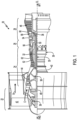
- Fan section 22 drives air along bypass flowpath B while compressor section 24 draws air in along core flowpath C where air is compressed and communicated to combustor section 26.
- combustor section 26 air is mixed with fuel and ignited to generate a high pressure exhaust gas stream that expands through turbine section 28 where energy is extracted and utilized to drive fan section 22 and compressor section 24.
- the gas flow in core flowpath C is compressed first by low pressure compressor 44 and then by high pressure compressor 52, then mixed with fuel and ignited in combustor 56 to produce high speed exhaust gases that are then expanded through high pressure turbine 54 and low pressure turbine 46.
- Mid-turbine frame 58 includes vanes 60, which are in the core flowpath and function as an inlet guide vane for low pressure turbine 46.
- precooler 62 provides precooling of high pressure compressor section 52 discharge air that is diverted from gas turbine engine 20.
- precooler 62 can provide precooling of low pressure compressor section 44 discharge air that is diverted from gas turbine engine 20. Precooler 62 will be shown and described in greater detail in FIGS. 2A - 2B and 3-4 .
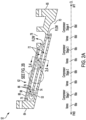
- FIG. 2A is a partial cross-sectional side view of integral engine case precooler 62 shown in FIG. 1 .
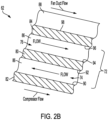
- FIG. 2B is an enlarged section of integral engine case precooler 62 shown in FIG. 2A .
- Shown in FIGS. 2A - 2B are high pressure compressor section 52, engine case 53, precooler 62, forward flange 64, aft flange 65, compressor vanes 66a, 66b, 66c, 66d, compressor first stage 68a, compressor second stage 68b, compressor third stage 68c, compressor fourth stage 68d, precooler inlet 70, interpass region 72, first pass channel 74, turnabout region 75, second pass channel 76, precooler outlet 78, flow divider 80, interior wall 82, exterior wall 84, interior wall interpass surface 90, flow divider first pass surface 92, flow divider second pass surface 94, exterior wall interpass surface 96, and engine case exterior surface 98.
- precooler 62 is configured to receive discharge air from high pressure compressor section 52. In some embodiments, precooler 62 can be configured to receive discharge air from low pressure compressor section 44. In other embodiments, precooler 62 can be configured to receive discharge air from any stage of any compressor, turbine, or other source of heated gas (e.g., air).
- the temperature relationships in equation 1 apply to a compressor. It is to be appreciated that an inverse temperature relationship can apply to the stages of a turbine (not shown).
- precooler 62 is integral to engine case 53 and can be referred to as an integral engine case precooler.
- Engine case 53 has an annular structure surrounding high pressure compressor section 52, having forward flange 64 at the forward end and aft flange 65 at the aft end. It is to be appreciated that various components of gas turbine engine 20 are manufactured as separate assemblies which are then assembled to form gas turbine engine 20. Accordingly, forward and aft flanges 64, 65 can be used to attach high pressure compressor section 52 to other components of gas turbine engine 20.
- Engine case 53 with precooler 62 can be made of a metallic material, with non-limiting examples being nickel, aluminum, titanium, copper, iron, cobalt, and all alloys that include these various metals.
- a high-temperature super alloy can be used.
- various alloys of INCONEL TM can be used, with non-limiting examples being Inconel 625 and Inconel 718.
- precooler inlet 70 can be referred to as an inlet port, and is configured to receive a flow of air from a compressor.
- Precooler outlet 78 can be referred to as an outlet port, and is configured to deliver flow of precooled air to any other system for any various purpose, as described earlier.
- precooler 62 can include one or more precooler inlets 70 (inlet ports) and one or more precooler outlets 78 (i.e., outlet ports).
- Interpass region 72 includes first pass channel 74 and second pass channel 76, each being partially formed by flow divider 80. Interpass region 72 is partially formed by interior wall 82 and exterior wall 84, as shown in FIG. 2B . Accordingly, the flow through first pass channel 74 is contained by interior wall 82 and flow divider 80. Similarly, the flow through second pass channel 76 is contained by flow divider 80 and exterior wall 84. Flow transitions from first pass channel 74 into second pass channel 76 at turnabout region 75, whereby the flow direction reverses. Hot air from compressor fourth stage 68d having temperature T 4 enters precooler 62 at precooler inlet 70 and flows through first pass channel 74, moving in a direction toward the earlier compressor stages 68, each having a successively lower operating temperature.
- Airflow through first pass channel 74 is generally in a direction from aft to forward (i.e., opposite that of core flowpath C as shown in FIG. 1 ).
- first pass channel 74 heat is transferred into interior wall 82 which is at a successively lower temperature moving toward earlier compressor stages 68, thereby cooling the air flowing through first pass channel 74.
- Flow reverses direction while moving through turnabout region 75 into second pass channel 76, thereby flowing is a direction that is counter to the flow through first pass channel 74.
- airflow through second pass channel 76 is generally in a direction from forward to aft (i.e., similar to that of core flowpath C as shown in FIG. 1 ).
- bypass flowpath B (as shown in FIG. 1 ) provides cooling of engine case exterior surface 98, thereby removing heat from exterior wall 84.
- Engine case exterior surface 98 will be shown and described in greater detail later, in FIG. 3 .
- FIG. 3 is a partial cross-sectional end view of precooler 62 shown in FIG. 2A , taken along cut line 3-3. Shown in FIG. 3 are engine case 53, precooler 62, interpass region 72, first pass channel 74, second pass channel 76, flow divider 80, interior wall 82, exterior wall 84, interpass vanes 86, exterior vanes 88, and engine case exterior surface 98. Directions of air flow are also shown in FIG. 3 .
- the description of interpass region 72, first pass channel 74, second pass channel 76, flow divider 80, interior wall 82, and exterior wall 84 are substantially as provided above in regard to FIGS. 2A - 2B .
- interpass vanes 86 are located in first pass channel 74, extending from interior wall 82 to flow divider 80. Similarly, several interpass vanes 86 are located in second pass channel 76, extending from flow divider 80 to exterior wall 84. Interpass vanes 86 support flow divider 80 between interior wall 82 and exterior wall 84 (i.e., within engine case 53), thereby providing structural rigidity while maintaining the physical dimensions of first pass channel 74, second pass channel 76, and engine case 53. In some embodiments, interpass vanes 86 also enhance heat transfer in first and/or second pass channels 74, 76 by providing a thermal conduction path through interpass region 72 (i.e., between interior wall 82 and exterior wall 84).
- interpass vanes 86 can also enhance heat transfer by creating turbulence in air flow through first and/or second pass channels 74, 76.
- interpass vanes 86 can include additional flow-enhancing and/or turbulence-generating features, with non-limiting examples sinuous shapes (i.e., waviness), turbulators, riblets, trip strips, and other texturing along some or all portions of one or more interpass vanes 86.
- flow divider 80, interior wall 82, and exterior wall 84 each have a curvature, which corresponds to the annular shape of engine case 53. Additional aspects of precooler 62 will be shown and described in more detail later, in FIG. 4 .
- Air flow in first pass channel 74 is depicted into the page as shown in FIG. 3
- air flow in second pass channel 76 is depicted out of the page.
- Exterior vanes 88 extend outward from engine case exterior surface 98.
- Bypass flowpath B is depicted in FIG. 3 flowing outward from the page over engine case exterior surface 98, flowing along exterior vanes 88.
- Bypass flowpath B provides cooling of engine case exterior surface 98, thereby removing heat from exterior wall 84 as described above in regard to FIGS. 2A - 2B .
- Exterior vanes 88 provide a greater surface area for convective heat transfer from engine case exterior surface 98, thereby providing a greater rate of heat transfer from engine case 53. Accordingly, greater cooling is provided in second pass channel 76, as described above in regard to FIGS. 2A - 2B .
- FIG. 4 is a schematic cross-sectional end view of engine case 53 shown in FIG. 2A , taken along cut line 4-4.
- FIG. 4 schematically depicts four precoolers 62 within engine case 53. Shown in FIG. 4 are engine case 53 precoolers 62. Also labeled in FIG. 4 are center axis CL and precooler circumferential arc ⁇ . It is to be appreciated that FIG. 4 is provided to schematically show the circumferential orientation of several precoolers 62, and it is not a full cross-sectional drawing of engine case 53.
- engine case 53 includes four precoolers 62 arranged circumferentially and spaced about equally from the others.
- Each precooler 62 has a circumferential dimension of precooler circumferential arc ⁇ .
- precooler circumferential arc ⁇ is about 30 degrees, thereby providing a circumferential spacing of about 60 degrees between adjacent precoolers 62.
- precooler loading factor F can range from about 10 - 80%. In various embodiments, precooler loading factor F can range anywhere from 0 - 100%, with all values of precooler loading factor F being within the scope of the present disclosure. A value of 0% means that no precoolers 62 are on a particular engine case 53, while a value of 100% means that one or more precoolers 62 fully surround a particular engine case 53. Higher values of precooler loading factor F can provide greater precooling of compressor stage discharge air. On the other hand, lower values of precooler loading factor F can provide greater structural strength and/or rigidity of engine case 53.
- precooler circumferential arc ⁇ is about 30 degrees. In some embodiments, precooler circumferential arc ⁇ can range from about 15 - 90 degrees. In other embodiments, precooler circumferential arc ⁇ can range from about 5 - 180 degrees.
- precooler circumferential arc ⁇ can range from 0 - 360 degrees. All values of precooler circumferential arc ⁇ are within the scope of the present disclosure. Moreover, in a particular embodiment where two or more precoolers 62 are used, each precooler 62 can be different (e.g., different value of precooler circumferential arc ⁇ ) from any of the others.
- a grouping of precoolers 62 within engine case 53 can be referred to as a precooler arrangement, or as an integrated precooler arrangement.
- precooler 62 provided precooling of air by transferring heat to interior wall 82 (i.e., being cooled by compressor flow) and to exterior wall 84 (i.e., being cooled by fan duct flow).
- compressor flow and fan duct flow are both in a general direction from forward to aft through gas turbine engine 20. Accordingly, flow through first pass channel 74 is in a direction generally opposite of the directions of compressor flow and fan duct flow, while flow through second pass channel 76 is in a direction generally the same directions of compressor flow and fan duct flow.
- precooler 62 can be oriented differently with regard to compressor flow and/or fan duct flow.
- precooler 62 could be configured to transfer heat to only interior wall 82 or to exterior wall 84.
- a negligible heat sink i.e., lower temperature source of heat removal
- precooler 62 could be configured to transfer heat to a fluid other than air.
- Non-limiting examples of other heat transfer fluids include fuel and oil.
Landscapes
- Engineering & Computer Science (AREA)
- Mechanical Engineering (AREA)
- General Engineering & Computer Science (AREA)
- Chemical & Material Sciences (AREA)
- Combustion & Propulsion (AREA)
- Physics & Mathematics (AREA)
- Thermal Sciences (AREA)
- Turbine Rotor Nozzle Sealing (AREA)
- Structures Of Non-Positive Displacement Pumps (AREA)
Description
- The present invention relates to gas turbine engines, and in particular, tc a gas turbine engine with an integral engine case precooler that can provide cooling of air that is discharged from a gas turbine engine.
- Gas turbine engines are widely used in aircraft propulsion, electric power generation, and ship propulsion. In all gas turbine engine applications, efficiency is a prime objective. Improved gas turbine engine efficiency can be obtained by operating at higher temperatures, necessitating the provision of cooling for components in the hottest portions of gas turbine engines, typically in the turbine section. Cooling is provided by flowing relatively cool air from the compressor section of the engine through passages in the turbine components to be cooled. Moreover, some compressor stage discharge air is typically diverted to be provided to other systems (i.e., downstream components) for various purposes including actuation and control, heat exchange, and for providing cabin air. During operation, compressor stage discharge air is at a temperature that is higher than is desired for some purposes, thereby requiring that the diverted discharge air flow through an external heat exchanger for cooling to a lower temperature. Hot air can also be drawn from other components on a gas turbine engine (e.g., turbine discharge), requiring cooling. Therefore, the space and cooling requirements of downstream components (e.g., an external heat exchanger) must be considered in the design of a gas turbine engine. The higher operating temperatures that provide improved gas turbine engine efficiency can place greater demands on the space and/or cooling requirements of an external heat exchanger that is used for cooling the diverted compressor stage discharge air. The patent application
US-3842597 discloses for example a gas turbine engine case, with integrated heat exchanger arrangement. - A gas turbine engine case is provided as defined by
claim 1. - A method of using a gas turbine engine case to cool a portion of an airflow received from an inlet port provided as defined by claim 9.
-
-
FIG. 1 is a partial cross-sectional side view of a gas turbine engine with an integral engine case precooler. -
FIG. 2A is a partial cross-sectional side view of the integral engine case precooler shown inFIG. 1 . -
FIG. 2B is an enlarged section of the integral engine case precooler shown inFIG. 2A . -
FIG. 3 is a partial cross-sectional end view of the integral engine case precooler shown inFIG. 2A . -
FIG. 4 is a schematic cross-sectional end view of an engine case shown inFIG. 2A . - The present disclosure is directed to an integral engine case precooler that can be adapted to providing precooling of gas turbine engine discharge air that can be provided from a compressor or a turbine. The precooler can be referred to as an integral precooler or a heat exchanging arrangement. The discharge air that flows through the integral engine case precooler can be referred to as precooled discharge air, or as the heat exchanging arrangement flow. This precooled discharge air, having a temperature that is lower than without precooling, can be directed to other systems. When the precooled discharge air is directed to a heat exchanger for additional cooling, the cooling requirement for the heat exchanger can be less than if the integral engine case precooler were not used. In some embodiments, the precooled discharge air can be directed to various downstream components without first passing through a heat exchanger (i.e., a heat exchanger in addition to the integral engine case precooler). Non-limiting examples of a downstream component that can receive precooled discharge air include a heat exchanger, a valve, an actuation system, ducting, and a sensing device. Accordingly, the precooled discharge air that is supplied to a downstream component can be referred to as a working fluid. The exemplary embodiment in the present disclosure illustrates precooling of gas turbine engine compressor stage discharge air received from a high-pressure compressor. In other embodiments, discharge air can be received from a low-pressure compressor, from a turbine discharge, or any other source of hot air or other gas.
-
FIG. 1 is a partial cross-sectional side view of a gas turbine engine with an integral engine case precooler that schematically illustrates exemplarygas turbine engine 20 that includesfan section 22,compressor section 24,combustor section 26 and turbine section 28. Also shown inFIG. 1 arelow speed spool 30, high speed spool 32, engine static structure 36,bearing system 38, inner shaft 40,fan 42, lowpressure compressor section 44, lowpressure turbine section 46, gearedarchitecture 48, outer shaft 50, highpressure compressor section 52, high pressure turbine section 54,combustor 56, mid-turbine frame 58,turbine vane 60, andprecooler 62. Center axis CL, bypass flowpath B, core flowpath C, forward (fwd) and aft directions are also labeled inFIG. 1 . Alternative engines might include an augmenter section (not shown) among other systems or features.Fan section 22 drives air along bypass flowpath B whilecompressor section 24 draws air in along core flowpath C where air is compressed and communicated tocombustor section 26. Incombustor section 26, air is mixed with fuel and ignited to generate a high pressure exhaust gas stream that expands through turbine section 28 where energy is extracted and utilized to drivefan section 22 andcompressor section 24. - Although the disclosed non-limiting embodiment depicts a turbofan gas turbine engine, it should be understood that the concepts described herein are not limited to use with turbofans as the teachings may be applied to other types of turbine engines; for example, an industrial gas turbine; a reverse-flow gas turbine engine; and a turbine engine including a three-spool architecture in which three spools concentrically rotate about a common axis and where a low spool enables a low pressure turbine to drive a fan via a gearbox, an intermediate spool that enables an intermediate pressure turbine to drive a first compressor of the compressor section, and a high spool that enables a high pressure turbine to drive a high pressure compressor of the compressor section.
- The exemplary
gas turbine engine 20 generally includeslow speed spool 30 and high speed spool 32 mounted for rotation about center axis CL ofgas turbine engine 20 relative to engine static structure 36 viaseveral bearing systems 38. It should be understood thatvarious bearing systems 38 at various locations may alternatively or additionally be provided.Low speed spool 30 generally includes inner shaft 40 that connectsfan 42 and low pressure (or first)compressor section 44 to low pressure (or first)turbine section 46. Inner shaft 40 drivesfan 42 through a speed change device, such as gearedarchitecture 48, to drivefan 42 at a lower speed thanlow speed spool 30. High-speed spool 32 includes outer shaft 50 that interconnects high pressure (or second)compressor section 52 and high pressure (or second) turbine section 54. Inner shaft 40 and outer shaft 50 are concentric and rotate viabearing systems 38 about center axis CL. Combustor 56 is arranged betweenhigh pressure compressor 52 and high pressure turbine 54. In one example, high pressure turbine 54 includes at least two stages to provide double stage high pressure turbine 54. In another example, high pressure turbine 54 includes only a single stage. As used herein, a "high pressure" compressor or turbine experiences a higher pressure than a corresponding "low pressure" compressor or turbine. Mid-turbine frame 58 of engine static structure 36 can be arranged generally between high pressure turbine 54 andlow pressure turbine 46. Mid-turbine frame 58 further supports bearingsystems 38 in turbine section 28 as well as setting airflow entering thelow pressure turbine 46. The gas flow in core flowpath C is compressed first bylow pressure compressor 44 and then byhigh pressure compressor 52, then mixed with fuel and ignited incombustor 56 to produce high speed exhaust gases that are then expanded through high pressure turbine 54 andlow pressure turbine 46. Mid-turbine frame 58 includesvanes 60, which are in the core flowpath and function as an inlet guide vane forlow pressure turbine 46. In the illustrated embodiment,precooler 62 provides precooling of highpressure compressor section 52 discharge air that is diverted fromgas turbine engine 20. In other embodiments,precooler 62 can provide precooling of lowpressure compressor section 44 discharge air that is diverted fromgas turbine engine 20. Precooler 62 will be shown and described in greater detail inFIGS. 2A - 2B and3-4 . -
FIG. 2A is a partial cross-sectional side view of integralengine case precooler 62 shown inFIG. 1 .FIG. 2B is an enlarged section of integralengine case precooler 62 shown inFIG. 2A . Shown inFIGS. 2A - 2B are highpressure compressor section 52, engine case 53,precooler 62, forward flange 64,aft flange 65,compressor vanes first stage 68a, compressorsecond stage 68b, compressorthird stage 68c, compressorfourth stage 68d,precooler inlet 70,interpass region 72,first pass channel 74,turnabout region 75,second pass channel 76,precooler outlet 78,flow divider 80,interior wall 82,exterior wall 84, interiorwall interpass surface 90, flow dividerfirst pass surface 92, flow dividersecond pass surface 94, exteriorwall interpass surface 96, and engine caseexterior surface 98. Center axis CL is also labeled inFIG. 2A . Fan duct flow and compressor flow are also labeled inFIG. 2B . During operation ofgas turbine engine 20, the airflow through highpressure compressor section 52 increases in both pressure and temperature from one stage to the next higher stage (e.g., from compressorfirst stage 68a to compressorsecond stage 68b). The operating temperature can be depicted as Tn, where n is the stage number (e.g., T1 is the operating temperature offirst compressor stage 68a). Accordingly, the operating temperature relationship in highpressure compressor section 52 can be depicted by the inequality relationship shown in equation 1:
- In the exemplary embodiment of the present disclosure,
precooler 62 is configured to receive discharge air from highpressure compressor section 52. In some embodiments,precooler 62 can be configured to receive discharge air from lowpressure compressor section 44. In other embodiments,precooler 62 can be configured to receive discharge air from any stage of any compressor, turbine, or other source of heated gas (e.g., air). The temperature relationships inequation 1 apply to a compressor. It is to be appreciated that an inverse temperature relationship can apply to the stages of a turbine (not shown). Referring again toFIG. 2A ,precooler 62 is integral to engine case 53 and can be referred to as an integral engine case precooler. Engine case 53 has an annular structure surrounding highpressure compressor section 52, having forward flange 64 at the forward end andaft flange 65 at the aft end. It is to be appreciated that various components ofgas turbine engine 20 are manufactured as separate assemblies which are then assembled to formgas turbine engine 20. Accordingly, forward andaft flanges 64, 65 can be used to attach highpressure compressor section 52 to other components ofgas turbine engine 20. - In the illustrated embodiment, high
pressure compressor section 52 includes four stages (i.e., compressorfirst stage 68a, compressorsecond stage 68b, compressorthird stage 68c, and compressorfourth stage 68d), with compressor air flow being in the direction from left to right as shown inFIG. 2A (i.e., from forward to aft). In an exemplary embodiment, engine case 53 withprecooler 62 is manufactured using an additive manufacturing process, with laser powder bed fusion (LPBF) being a non-limiting exemplary additive-manufacturing process. Other exemplary additive manufacturing processes include use electron beam melting (EBM), laser beam melting (LBM), direct metal laser sintering (DMLS), selective laser sintering (SLS), powder bed fusion (PBF), sheet lamination, directed energy deposition, binder jetting, and material extrusion. Engine case 53 withprecooler 62 can be made of a metallic material, with non-limiting examples being nickel, aluminum, titanium, copper, iron, cobalt, and all alloys that include these various metals. In some embodiments, a high-temperature super alloy can be used. In some embodiments, various alloys of INCONEL™ can be used, with non-limiting examples being Inconel 625 and Inconel 718. Other exemplary alloys include WASPALOY™ and HAYNES™ 282. All materials that include metals, metal oxides, and alloys thereof are within the scope of the present disclosure. In other embodiments, a nonmetallic material can be used to fabricate engine case 53 withprecooler 62. All materials that can be used to make engine case 53 withprecooler 62, by any manufacturing process, are within the scope of the present disclosure. After manufacturing, engine case 53 withprecooler 62 is mounted withingas turbine engine 20 using forward andaft flanges 64, 65. - Referring again to
FIGS. 2A - 2B , during operation ofgas turbine engine 20, air flows from a discharge of compressorfourth stage 68d throughprecooler 62 by enteringprecooler inlet 70, flowing throughinterpass region 72, and exitingprecooler outlet 78.Precooler inlet 70 can be referred to as an inlet port, and is configured to receive a flow of air from a compressor.Precooler outlet 78 can be referred to as an outlet port, and is configured to deliver flow of precooled air to any other system for any various purpose, as described earlier. In an embodiment,precooler 62 can include one or more precooler inlets 70 (inlet ports) and one or more precooler outlets 78 (i.e., outlet ports).Interpass region 72 includesfirst pass channel 74 andsecond pass channel 76, each being partially formed byflow divider 80.Interpass region 72 is partially formed byinterior wall 82 andexterior wall 84, as shown inFIG. 2B . Accordingly, the flow throughfirst pass channel 74 is contained byinterior wall 82 andflow divider 80. Similarly, the flow throughsecond pass channel 76 is contained byflow divider 80 andexterior wall 84. Flow transitions fromfirst pass channel 74 intosecond pass channel 76 atturnabout region 75, whereby the flow direction reverses. Hot air from compressorfourth stage 68d having temperature T4 entersprecooler 62 atprecooler inlet 70 and flows throughfirst pass channel 74, moving in a direction toward the earlier compressor stages 68, each having a successively lower operating temperature. Airflow throughfirst pass channel 74 is generally in a direction from aft to forward (i.e., opposite that of core flowpath C as shown inFIG. 1 ). As air flows throughfirst pass channel 74, heat is transferred intointerior wall 82 which is at a successively lower temperature moving toward earlier compressor stages 68, thereby cooling the air flowing throughfirst pass channel 74. Flow reverses direction while moving throughturnabout region 75 intosecond pass channel 76, thereby flowing is a direction that is counter to the flow throughfirst pass channel 74. Accordingly, airflow throughsecond pass channel 76 is generally in a direction from forward to aft (i.e., similar to that of core flowpath C as shown inFIG. 1 ). As air flows throughsecond pass channel 76, in the illustrated embodiment, additional cooling can occur by transferring heat toexterior wall 84. During operation ofgas turbine engine 20, bypass flowpath B (as shown inFIG. 1 ) provides cooling of engine caseexterior surface 98, thereby removing heat fromexterior wall 84. Engine caseexterior surface 98 will be shown and described in greater detail later, inFIG. 3 . -
FIG. 3 is a partial cross-sectional end view ofprecooler 62 shown inFIG. 2A , taken along cut line 3-3. Shown inFIG. 3 are engine case 53,precooler 62,interpass region 72,first pass channel 74,second pass channel 76,flow divider 80,interior wall 82,exterior wall 84,interpass vanes 86,exterior vanes 88, and engine caseexterior surface 98. Directions of air flow are also shown inFIG. 3 . The description ofinterpass region 72,first pass channel 74,second pass channel 76,flow divider 80,interior wall 82, andexterior wall 84 are substantially as provided above in regard toFIGS. 2A - 2B . In the illustrated embodiment,several interpass vanes 86 are located infirst pass channel 74, extending frominterior wall 82 to flowdivider 80. Similarly,several interpass vanes 86 are located insecond pass channel 76, extending fromflow divider 80 toexterior wall 84. Interpass vanes 86support flow divider 80 betweeninterior wall 82 and exterior wall 84 (i.e., within engine case 53), thereby providing structural rigidity while maintaining the physical dimensions offirst pass channel 74,second pass channel 76, and engine case 53. In some embodiments,interpass vanes 86 also enhance heat transfer in first and/orsecond pass channels interior wall 82 and exterior wall 84). In other embodiments,interpass vanes 86 can also enhance heat transfer by creating turbulence in air flow through first and/orsecond pass channels interpass vanes 86 can include additional flow-enhancing and/or turbulence-generating features, with non-limiting examples sinuous shapes (i.e., waviness), turbulators, riblets, trip strips, and other texturing along some or all portions of one ormore interpass vanes 86. - Referring again to
FIG. 3 , flowdivider 80,interior wall 82, andexterior wall 84 each have a curvature, which corresponds to the annular shape of engine case 53. Additional aspects ofprecooler 62 will be shown and described in more detail later, inFIG. 4 . Air flow infirst pass channel 74 is depicted into the page as shown inFIG. 3 , and air flow insecond pass channel 76 is depicted out of the page.Exterior vanes 88 extend outward from engine caseexterior surface 98. Bypass flowpath B is depicted inFIG. 3 flowing outward from the page over engine caseexterior surface 98, flowing alongexterior vanes 88. Bypass flowpath B provides cooling of engine caseexterior surface 98, thereby removing heat fromexterior wall 84 as described above in regard toFIGS. 2A - 2B .Exterior vanes 88 provide a greater surface area for convective heat transfer from engine caseexterior surface 98, thereby providing a greater rate of heat transfer from engine case 53. Accordingly, greater cooling is provided insecond pass channel 76, as described above in regard toFIGS. 2A - 2B . -
FIG. 4 is a schematic cross-sectional end view of engine case 53 shown inFIG. 2A , taken along cut line 4-4.FIG. 4 schematically depicts fourprecoolers 62 within engine case 53. Shown inFIG. 4 are engine case 53precoolers 62. Also labeled inFIG. 4 are center axis CL and precooler circumferential arc α. It is to be appreciated thatFIG. 4 is provided to schematically show the circumferential orientation ofseveral precoolers 62, and it is not a full cross-sectional drawing of engine case 53. In the embodiment shown inFIG. 4 , engine case 53 includes fourprecoolers 62 arranged circumferentially and spaced about equally from the others. Eachprecooler 62 has a circumferential dimension of precooler circumferential arc α. In the illustrated embodiment, precooler circumferential arc α is about 30 degrees, thereby providing a circumferential spacing of about 60 degrees betweenadjacent precoolers 62. Accordingly, a precooler loading factor F can be defined as the ratio of the total of precooler circumferential arcs α to a full circumferential dimension (i.e., 360 degrees), as shown inequation 2, where n is the number ofprecoolers 62 and αx is the particular value of precooler circumferential arc α for aparticular precooler 62. :
- In
equation 2, the expression
precooler 62 has precooler circumferential arc α of about 30 degrees, the cumulative circumferential arc is about 120 degrees, and precooler loading factor F is about 33%. In some embodiments, either fewer than or more than fourprecoolers 62 can be used. In an exemplary embodiment, as few as oneprecooler 62 can be used. In other embodiments, an unlimited number ofprecoolers 62 can be used. In some embodiments, precooler loading factor F can range from about 20 - 50%. In other embodiments, precooler loading factor F can range from about 10 - 80%. In various embodiments, precooler loading factor F can range anywhere from 0 - 100%, with all values of precooler loading factor F being within the scope of the present disclosure. A value of 0% means that noprecoolers 62 are on a particular engine case 53, while a value of 100% means that one or more precoolers 62 fully surround a particular engine case 53. Higher values of precooler loading factor F can provide greater precooling of compressor stage discharge air. On the other hand, lower values of precooler loading factor F can provide greater structural strength and/or rigidity of engine case 53. Accordingly, in a particular embodiment, the number n ofprecoolers 62 and/or the value of precooler loading factor F will depend on many factors, with non-limiting examples including the operating temperatures and pressures of the particular compressor, the material that engine case 53 is made of, the physical dimensions (e.g., thicknesses) of engine case 53,interior wall 82, andexterior wall 84, the size and configuration ofinterpass vanes 86, and the desired rate of heat transfer throughprecooler 62. In the illustrated embodiment, precooler circumferential arc α is about 30 degrees. In some embodiments, precooler circumferential arc α can range from about 15 - 90 degrees. In other embodiments, precooler circumferential arc α can range from about 5 - 180 degrees. In various embodiments, precooler circumferential arc α can range from 0 - 360 degrees. All values of precooler circumferential arc α are within the scope of the present disclosure. Moreover, in a particular embodiment where two or more precoolers 62 are used, eachprecooler 62 can be different (e.g., different value of precooler circumferential arc α) from any of the others. A grouping ofprecoolers 62 within engine case 53 can be referred to as a precooler arrangement, or as an integrated precooler arrangement. - In the embodiment shown and described in above,
precooler 62 provided precooling of air by transferring heat to interior wall 82 (i.e., being cooled by compressor flow) and to exterior wall 84 (i.e., being cooled by fan duct flow). In the illustrated embodiment, compressor flow and fan duct flow are both in a general direction from forward to aft throughgas turbine engine 20. Accordingly, flow throughfirst pass channel 74 is in a direction generally opposite of the directions of compressor flow and fan duct flow, while flow throughsecond pass channel 76 is in a direction generally the same directions of compressor flow and fan duct flow. In some embodiments,precooler 62 can be oriented differently with regard to compressor flow and/or fan duct flow. As a non-limiting example, ifprecooler 62 were configured to provide precooling of turbine discharge air, then the relative directions of flow through first andsecond pass channels precooler 62 could be configured to transfer heat to onlyinterior wall 82 or toexterior wall 84. For example, in some of these other embodiments, a negligible heat sink (i.e., lower temperature source of heat removal) could be available toexterior wall 84 orinterior wall 82. In yet other embodiments,precooler 62 could be configured to transfer heat to a fluid other than air. Non-limiting examples of other heat transfer fluids include fuel and oil. - While the invention has been described with reference to an exemplary embodiment(s), it will be understood by those skilled in the art that various changes may be made without departing from the scope of the invention as defined by the claims. In addition, many modifications may be made to adapt a particular situation or material to the teachings of the invention without departing from the scope of the claims. Therefore, it is intended that the invention not be limited to the particular embodiment(s) disclosed, but that the invention will include all embodiments falling within the scope of the appended claims.
Claims (9)
- A gas turbine engine case at least partially enclosing a gas turbine engine (20) in a compressor section (24), the gas turbine engine having an upstream end and a downstream end defined by a core fluid flow through the gas turbine engine, the gas turbine case (53) having integrated therein a heat exchanging arrangement comprising:at least one flow passage defined within the gas turbine engine case having an inlet port (70) and an outlet port (78), the at least one flow passage being configured to direct at least a portion of a fluid flowing through the gas turbine engine from between a downstream position and an upstream position while traveling between the inlet port and the outlet port;wherein the inlet port is configured to receive the heat exchanging arrangement flow from a higher temperature stage of the compressor section (24);and wherein the heat exchanging arrangement flow through the first pass channel is cooled while flowing from a region near the compressor higher temperature stage to a region near a compressor lower temperature stage; and characterised in thatthe heat exchanging arrangement further comprising an interpass region (72) disposed between the inlet port and the outlet port within the gas turbine engine case, the interpass region comprising:a first pass channel (74);a flow divider (80);a turnabout region (75); anda second pass channel (76);wherein:the flow divider is configured to provide a fluid separation between the first pass channel and the second pass channel;the interpass region is configured to direct a fluid flow through the first pass channel, the turnabout region, and the second pass channel, thereby defining a heat exchanging arrangement flow; andthe outlet port is configured to discharge the heat exchanging arrangement flow to one or more other systems; and wherein:the heat exchanging arrangement defines an interior wall (82) and an exterior wall (84);the interior wall partially forms a fluid boundary for the first pass channel; andthe exterior wall partially forms a fluid boundary for the second pass channel, and optionally wherein:the interior wall defines an interior wall interpass surface;the flow divider defines a flow divider first pass surface and a flow divider second pass surface; andthe exterior wall defines an exterior wall interpass surface; and further wherein:the flow divider is structurally supported between the interior wall and the exterior wall by a plurality of support vanes; andthe flow divider and the plurality of support vanes are integral to the gas turbine engine case, and optionallywherein at least some of the plurality of support vanes are configured to enhance heat transfer in the first and/or second pass channels.
- The gas turbine engine case of claim 1, wherein:the inlet port is configured to receive the heat exchanging arrangement flow from a compressor higher pressure stage disposed at a compressor section aft end;a compressor lower pressure stage is disposed at a compressor section forward end;the compressor higher pressure stage has an operating pressure that is higher than the operating pressure in the compressor lower pressure stage;the compressor higher pressure stage has an operating temperature that is higher than the operating temperature in the compressor lower pressure stage; andthe heat exchanging arrangement flow through the first pass channel is cooled while flowing from a region near the compressor higher pressure stage to a region near the compressor lower pressure stage.
- The gas turbine engine case of any preceding claim, wherein:at least one of the one or more other systems comprises a heat exchanger, a valve, an actuation system, a sensing device, or ducting; andthe at least one of the one or more other systems is configured to receive the heat exchanging arrangement flow from the outlet port as a working fluid.
- The gas turbine engine case of any preceding claim, wherein:the turnabout region is configured to direct the heat exchanging arrangement flow from the first pass channel to the second pass channel;the upstream end defines a forward end;the downstream end defines an aft end; andthe second pass channel is configured to direct the heat exchanging arrangement flow in a direction from the forward end toward the aft end.
- The gas turbine engine case of any preceding claim, wherein:the heat exchanging arrangement is disposed within a radial arc of the gas turbine engine case;the heat exchanging arrangement defines a precooler circumferential arc; andthe precooler circumferential arc ranges from 5 - 180 degrees.
- The gas turbine engine case of any preceding claim, wherein:the gas turbine engine case comprises nickel, aluminum, titanium, iron, cobalt, and/or alloys thereof; andthe heat exchanging arrangement is integrated within the gas turbine engine case during an additive manufacturing process.
- The gas turbine engine case of any preceding claim, comprising one or more heat exchanging arrangements, each of the one or more heat exchanging arrangements disposed within a radial arc of the gas turbine engine case defining an associated precooler circumferential arc, wherein:a sum of the associated precooler circumferential arcs of the one or more heat exchanging arrangements defines a cumulative circumferential arc;a ratio of the cumulative circumferential arc to 360 degrees defines a precooler loading factor; andthe precooler loading factor ranges from 10 - 80%.
- The gas turbine engine case of claim 7, wherein:the gas turbine engine case defines an engine case exterior surface;the gas turbine engine case is cooled by a gas turbine engine bypass flow; andthe heat exchanging arrangement flow through the second pass channel is cooled by transferring heat to the engine case exterior surface.
- A method of using a gas turbine engine case as claimed in any preceding claim to cool a portion of an airflow received from an inlet port in the compressor section (24), the method comprising:operating the gas turbine engine to pressurize the airflow received at the inlet port;directing the portion of the airflow through the inlet port, the heat exchanging arrangement, and the outlet port; anddischarging the portion of the airflow from the outlet port to one or more other systems; whereindirecting the portion of the airflow through the heat exchanging arrangement further comprises directing the portion of the airflow through the interpass region disposed between the inlet port and the outlet port within the gas turbine engine case.
Applications Claiming Priority (1)
| Application Number | Priority Date | Filing Date | Title |
|---|---|---|---|
| US16/704,819 US10975770B1 (en) | 2019-12-05 | 2019-12-05 | Integral engine case precooler |
Publications (2)
| Publication Number | Publication Date |
|---|---|
| EP3832074A1 EP3832074A1 (en) | 2021-06-09 |
| EP3832074B1 true EP3832074B1 (en) | 2024-08-07 |
Family
ID=73740273
Family Applications (1)
| Application Number | Title | Priority Date | Filing Date |
|---|---|---|---|
| EP20212191.9A Active EP3832074B1 (en) | 2019-12-05 | 2020-12-07 | Integral engine case precooler |
Country Status (2)
| Country | Link |
|---|---|
| US (1) | US10975770B1 (en) |
| EP (1) | EP3832074B1 (en) |
Families Citing this family (3)
| Publication number | Priority date | Publication date | Assignee | Title |
|---|---|---|---|---|
| US11598265B2 (en) * | 2021-02-03 | 2023-03-07 | Pratt & Whitney Canada Corp. | Tangential on-board injector |
| FR3125844B1 (en) * | 2021-08-02 | 2024-01-12 | Safran Aircraft Engines | Turbomachine comprising an outlet cone integrating components cooled by circulation of a cooling flow |
| US11873758B1 (en) | 2022-10-28 | 2024-01-16 | Pratt & Whitney Canada Corp. | Gas turbine engine component with integral heat exchanger |
Family Cites Families (10)
| Publication number | Priority date | Publication date | Assignee | Title |
|---|---|---|---|---|
| US3842597A (en) * | 1973-03-16 | 1974-10-22 | Gen Electric | Gas turbine engine with means for reducing the formation and emission of nitrogen oxides |
| DE10019437A1 (en) | 2000-04-19 | 2001-12-20 | Rolls Royce Deutschland | Method and device for cooling the housings of turbines of jet engines |
| US8434997B2 (en) | 2007-08-22 | 2013-05-07 | United Technologies Corporation | Gas turbine engine case for clearance control |
| US10094285B2 (en) | 2011-12-08 | 2018-10-09 | Siemens Aktiengesellschaft | Gas turbine outer case active ambient cooling including air exhaust into sub-ambient cavity |
| US9719372B2 (en) * | 2012-05-01 | 2017-08-01 | General Electric Company | Gas turbomachine including a counter-flow cooling system and method |
| WO2015122949A2 (en) * | 2013-12-17 | 2015-08-20 | United Technologies Corporation | Adaptive turbomachine cooling system |
| GB201409991D0 (en) | 2014-07-04 | 2014-07-16 | Rolls Royce Plc | Turbine case cooling system |
| US10344674B2 (en) * | 2016-01-08 | 2019-07-09 | General Electric Company | Heat exchanger for embedded engine applications: transduct segments |
| US10830097B2 (en) | 2016-02-04 | 2020-11-10 | General Electric Company | Engine casing with internal coolant flow patterns |
| US10914185B2 (en) | 2016-12-02 | 2021-02-09 | General Electric Company | Additive manufactured case with internal passages for active clearance control |
-
2019
- 2019-12-05 US US16/704,819 patent/US10975770B1/en active Active
-
2020
- 2020-12-07 EP EP20212191.9A patent/EP3832074B1/en active Active
Also Published As
| Publication number | Publication date |
|---|---|
| US10975770B1 (en) | 2021-04-13 |
| EP3832074A1 (en) | 2021-06-09 |
Similar Documents
| Publication | Publication Date | Title |
|---|---|---|
| US12078426B2 (en) | Contoured wall heat exchanger | |
| CA2947350C (en) | Heat exchanger for embedded engine applications: curvilinear plate | |
| EP3196443B1 (en) | Heat exchanger array | |
| CN106959035B (en) | Heat exchanger for embedded engine applications: traversing pipe section | |
| US10184400B2 (en) | Methods of cooling a fluid using an annular heat exchanger | |
| EP3054252B1 (en) | Heat exchanger system with additively manufactured heat transfer tube that follows a non-linear path | |
| US20180038654A1 (en) | System for fault tolerant passage arrangements for heat exchanger applications | |
| CN114991961B (en) | Multi-fluid heat exchanger | |
| EP3190271A1 (en) | Heat exchanger for embedded engine applications | |
| EP3889535B1 (en) | Duct mounted heat exchanger | |
| EP2942489B1 (en) | Shrouded conduit for arranging in a fluid flowpath and corresponding method of manufacturing | |
| EP3832074B1 (en) | Integral engine case precooler | |
| EP3514468A1 (en) | Hybrid additive manufactured heat exchanger with tubes | |
| CN114991963A (en) | Three-flow engine with heat exchanger | |
| EP3239512B1 (en) | Heat exchanger with heat resistant center body | |
| US10598026B2 (en) | Engine component wall with a cooling circuit | |
| EP3734043B1 (en) | Heat transfer augmentation feature | |
| US20170328213A1 (en) | Engine component wall with a cooling circuit | |
| US12188374B2 (en) | Turbine engine with component having a cooling hole with a layback surface | |
| WO2024208524A1 (en) | Hex strut arrangement |
Legal Events
| Date | Code | Title | Description |
|---|---|---|---|
| PUAI | Public reference made under article 153(3) epc to a published international application that has entered the european phase |
Free format text: ORIGINAL CODE: 0009012 |
|
| STAA | Information on the status of an ep patent application or granted ep patent |
Free format text: STATUS: THE APPLICATION HAS BEEN PUBLISHED |
|
| AK | Designated contracting states |
Kind code of ref document: A1 Designated state(s): AL AT BE BG CH CY CZ DE DK EE ES FI FR GB GR HR HU IE IS IT LI LT LU LV MC MK MT NL NO PL PT RO RS SE SI SK SM TR |
|
| STAA | Information on the status of an ep patent application or granted ep patent |
Free format text: STATUS: REQUEST FOR EXAMINATION WAS MADE |
|
| 17P | Request for examination filed |
Effective date: 20211209 |
|
| RBV | Designated contracting states (corrected) |
Designated state(s): AL AT BE BG CH CY CZ DE DK EE ES FI FR GB GR HR HU IE IS IT LI LT LU LV MC MK MT NL NO PL PT RO RS SE SI SK SM TR |
|
| STAA | Information on the status of an ep patent application or granted ep patent |
Free format text: STATUS: EXAMINATION IS IN PROGRESS |
|
| 17Q | First examination report despatched |
Effective date: 20230130 |
|
| GRAP | Despatch of communication of intention to grant a patent |
Free format text: ORIGINAL CODE: EPIDOSNIGR1 |
|
| STAA | Information on the status of an ep patent application or granted ep patent |
Free format text: STATUS: GRANT OF PATENT IS INTENDED |
|
| INTG | Intention to grant announced |
Effective date: 20240312 |
|
| GRAS | Grant fee paid |
Free format text: ORIGINAL CODE: EPIDOSNIGR3 |
|
| GRAA | (expected) grant |
Free format text: ORIGINAL CODE: 0009210 |
|
| STAA | Information on the status of an ep patent application or granted ep patent |
Free format text: STATUS: THE PATENT HAS BEEN GRANTED |
|
| AK | Designated contracting states |
Kind code of ref document: B1 Designated state(s): AL AT BE BG CH CY CZ DE DK EE ES FI FR GB GR HR HU IE IS IT LI LT LU LV MC MK MT NL NO PL PT RO RS SE SI SK SM TR |
|
| REG | Reference to a national code |
Ref country code: GB Ref legal event code: FG4D |
|
| REG | Reference to a national code |
Ref country code: CH Ref legal event code: EP |
|
| REG | Reference to a national code |
Ref country code: IE Ref legal event code: FG4D |
|
| REG | Reference to a national code |
Ref country code: DE Ref legal event code: R096 Ref document number: 602020035234 Country of ref document: DE |
|
| REG | Reference to a national code |
Ref country code: LT Ref legal event code: MG9D |
|
| REG | Reference to a national code |
Ref country code: NL Ref legal event code: MP Effective date: 20240807 |
|
| PG25 | Lapsed in a contracting state [announced via postgrant information from national office to epo] |
Ref country code: NO Free format text: LAPSE BECAUSE OF FAILURE TO SUBMIT A TRANSLATION OF THE DESCRIPTION OR TO PAY THE FEE WITHIN THE PRESCRIBED TIME-LIMIT Effective date: 20241107 |
|
| REG | Reference to a national code |
Ref country code: AT Ref legal event code: MK05 Ref document number: 1711153 Country of ref document: AT Kind code of ref document: T Effective date: 20240807 |
|
| PG25 | Lapsed in a contracting state [announced via postgrant information from national office to epo] |
Ref country code: NL Free format text: LAPSE BECAUSE OF FAILURE TO SUBMIT A TRANSLATION OF THE DESCRIPTION OR TO PAY THE FEE WITHIN THE PRESCRIBED TIME-LIMIT Effective date: 20240807 Ref country code: GR Free format text: LAPSE BECAUSE OF FAILURE TO SUBMIT A TRANSLATION OF THE DESCRIPTION OR TO PAY THE FEE WITHIN THE PRESCRIBED TIME-LIMIT Effective date: 20241108 Ref country code: FI Free format text: LAPSE BECAUSE OF FAILURE TO SUBMIT A TRANSLATION OF THE DESCRIPTION OR TO PAY THE FEE WITHIN THE PRESCRIBED TIME-LIMIT Effective date: 20240807 Ref country code: PL Free format text: LAPSE BECAUSE OF FAILURE TO SUBMIT A TRANSLATION OF THE DESCRIPTION OR TO PAY THE FEE WITHIN THE PRESCRIBED TIME-LIMIT Effective date: 20240807 Ref country code: PT Free format text: LAPSE BECAUSE OF FAILURE TO SUBMIT A TRANSLATION OF THE DESCRIPTION OR TO PAY THE FEE WITHIN THE PRESCRIBED TIME-LIMIT Effective date: 20241209 |
|
| PG25 | Lapsed in a contracting state [announced via postgrant information from national office to epo] |
Ref country code: BG Free format text: LAPSE BECAUSE OF FAILURE TO SUBMIT A TRANSLATION OF THE DESCRIPTION OR TO PAY THE FEE WITHIN THE PRESCRIBED TIME-LIMIT Effective date: 20240807 |
|
| PG25 | Lapsed in a contracting state [announced via postgrant information from national office to epo] |
Ref country code: LV Free format text: LAPSE BECAUSE OF FAILURE TO SUBMIT A TRANSLATION OF THE DESCRIPTION OR TO PAY THE FEE WITHIN THE PRESCRIBED TIME-LIMIT Effective date: 20240807 |
|
| PG25 | Lapsed in a contracting state [announced via postgrant information from national office to epo] |
Ref country code: IS Free format text: LAPSE BECAUSE OF FAILURE TO SUBMIT A TRANSLATION OF THE DESCRIPTION OR TO PAY THE FEE WITHIN THE PRESCRIBED TIME-LIMIT Effective date: 20241207 Ref country code: AT Free format text: LAPSE BECAUSE OF FAILURE TO SUBMIT A TRANSLATION OF THE DESCRIPTION OR TO PAY THE FEE WITHIN THE PRESCRIBED TIME-LIMIT Effective date: 20240807 |
|
| PG25 | Lapsed in a contracting state [announced via postgrant information from national office to epo] |
Ref country code: HR Free format text: LAPSE BECAUSE OF FAILURE TO SUBMIT A TRANSLATION OF THE DESCRIPTION OR TO PAY THE FEE WITHIN THE PRESCRIBED TIME-LIMIT Effective date: 20240807 |
|
| PG25 | Lapsed in a contracting state [announced via postgrant information from national office to epo] |
Ref country code: RS Free format text: LAPSE BECAUSE OF FAILURE TO SUBMIT A TRANSLATION OF THE DESCRIPTION OR TO PAY THE FEE WITHIN THE PRESCRIBED TIME-LIMIT Effective date: 20241107 Ref country code: ES Free format text: LAPSE BECAUSE OF FAILURE TO SUBMIT A TRANSLATION OF THE DESCRIPTION OR TO PAY THE FEE WITHIN THE PRESCRIBED TIME-LIMIT Effective date: 20240807 |
|
| PG25 | Lapsed in a contracting state [announced via postgrant information from national office to epo] |
Ref country code: RS Free format text: LAPSE BECAUSE OF FAILURE TO SUBMIT A TRANSLATION OF THE DESCRIPTION OR TO PAY THE FEE WITHIN THE PRESCRIBED TIME-LIMIT Effective date: 20241107 Ref country code: PT Free format text: LAPSE BECAUSE OF FAILURE TO SUBMIT A TRANSLATION OF THE DESCRIPTION OR TO PAY THE FEE WITHIN THE PRESCRIBED TIME-LIMIT Effective date: 20241209 Ref country code: PL Free format text: LAPSE BECAUSE OF FAILURE TO SUBMIT A TRANSLATION OF THE DESCRIPTION OR TO PAY THE FEE WITHIN THE PRESCRIBED TIME-LIMIT Effective date: 20240807 Ref country code: NO Free format text: LAPSE BECAUSE OF FAILURE TO SUBMIT A TRANSLATION OF THE DESCRIPTION OR TO PAY THE FEE WITHIN THE PRESCRIBED TIME-LIMIT Effective date: 20241107 Ref country code: NL Free format text: LAPSE BECAUSE OF FAILURE TO SUBMIT A TRANSLATION OF THE DESCRIPTION OR TO PAY THE FEE WITHIN THE PRESCRIBED TIME-LIMIT Effective date: 20240807 Ref country code: LV Free format text: LAPSE BECAUSE OF FAILURE TO SUBMIT A TRANSLATION OF THE DESCRIPTION OR TO PAY THE FEE WITHIN THE PRESCRIBED TIME-LIMIT Effective date: 20240807 Ref country code: IS Free format text: LAPSE BECAUSE OF FAILURE TO SUBMIT A TRANSLATION OF THE DESCRIPTION OR TO PAY THE FEE WITHIN THE PRESCRIBED TIME-LIMIT Effective date: 20241207 Ref country code: HR Free format text: LAPSE BECAUSE OF FAILURE TO SUBMIT A TRANSLATION OF THE DESCRIPTION OR TO PAY THE FEE WITHIN THE PRESCRIBED TIME-LIMIT Effective date: 20240807 Ref country code: GR Free format text: LAPSE BECAUSE OF FAILURE TO SUBMIT A TRANSLATION OF THE DESCRIPTION OR TO PAY THE FEE WITHIN THE PRESCRIBED TIME-LIMIT Effective date: 20241108 Ref country code: FI Free format text: LAPSE BECAUSE OF FAILURE TO SUBMIT A TRANSLATION OF THE DESCRIPTION OR TO PAY THE FEE WITHIN THE PRESCRIBED TIME-LIMIT Effective date: 20240807 Ref country code: ES Free format text: LAPSE BECAUSE OF FAILURE TO SUBMIT A TRANSLATION OF THE DESCRIPTION OR TO PAY THE FEE WITHIN THE PRESCRIBED TIME-LIMIT Effective date: 20240807 Ref country code: BG Free format text: LAPSE BECAUSE OF FAILURE TO SUBMIT A TRANSLATION OF THE DESCRIPTION OR TO PAY THE FEE WITHIN THE PRESCRIBED TIME-LIMIT Effective date: 20240807 Ref country code: AT Free format text: LAPSE BECAUSE OF FAILURE TO SUBMIT A TRANSLATION OF THE DESCRIPTION OR TO PAY THE FEE WITHIN THE PRESCRIBED TIME-LIMIT Effective date: 20240807 |
|
| PG25 | Lapsed in a contracting state [announced via postgrant information from national office to epo] |
Ref country code: SM Free format text: LAPSE BECAUSE OF FAILURE TO SUBMIT A TRANSLATION OF THE DESCRIPTION OR TO PAY THE FEE WITHIN THE PRESCRIBED TIME-LIMIT Effective date: 20240807 Ref country code: DK Free format text: LAPSE BECAUSE OF FAILURE TO SUBMIT A TRANSLATION OF THE DESCRIPTION OR TO PAY THE FEE WITHIN THE PRESCRIBED TIME-LIMIT Effective date: 20240807 |
|
| PG25 | Lapsed in a contracting state [announced via postgrant information from national office to epo] |
Ref country code: EE Free format text: LAPSE BECAUSE OF FAILURE TO SUBMIT A TRANSLATION OF THE DESCRIPTION OR TO PAY THE FEE WITHIN THE PRESCRIBED TIME-LIMIT Effective date: 20240807 |
|
| PG25 | Lapsed in a contracting state [announced via postgrant information from national office to epo] |
Ref country code: CZ Free format text: LAPSE BECAUSE OF FAILURE TO SUBMIT A TRANSLATION OF THE DESCRIPTION OR TO PAY THE FEE WITHIN THE PRESCRIBED TIME-LIMIT Effective date: 20240807 |
|
| PG25 | Lapsed in a contracting state [announced via postgrant information from national office to epo] |
Ref country code: SK Free format text: LAPSE BECAUSE OF FAILURE TO SUBMIT A TRANSLATION OF THE DESCRIPTION OR TO PAY THE FEE WITHIN THE PRESCRIBED TIME-LIMIT Effective date: 20240807 |
|
| REG | Reference to a national code |
Ref country code: DE Ref legal event code: R097 Ref document number: 602020035234 Country of ref document: DE |
|
| PLBE | No opposition filed within time limit |
Free format text: ORIGINAL CODE: 0009261 |
|
| STAA | Information on the status of an ep patent application or granted ep patent |
Free format text: STATUS: NO OPPOSITION FILED WITHIN TIME LIMIT |
|
| PG25 | Lapsed in a contracting state [announced via postgrant information from national office to epo] |
Ref country code: MC Free format text: LAPSE BECAUSE OF FAILURE TO SUBMIT A TRANSLATION OF THE DESCRIPTION OR TO PAY THE FEE WITHIN THE PRESCRIBED TIME-LIMIT Effective date: 20240807 |
|
| 26N | No opposition filed |
Effective date: 20250508 |
|
| REG | Reference to a national code |
Ref country code: CH Ref legal event code: PL |
|
| PG25 | Lapsed in a contracting state [announced via postgrant information from national office to epo] |
Ref country code: LU Free format text: LAPSE BECAUSE OF NON-PAYMENT OF DUE FEES Effective date: 20241207 |
|
| PG25 | Lapsed in a contracting state [announced via postgrant information from national office to epo] |
Ref country code: SE Free format text: LAPSE BECAUSE OF FAILURE TO SUBMIT A TRANSLATION OF THE DESCRIPTION OR TO PAY THE FEE WITHIN THE PRESCRIBED TIME-LIMIT Effective date: 20240807 |
|
| REG | Reference to a national code |
Ref country code: BE Ref legal event code: MM Effective date: 20241231 |
|
| PG25 | Lapsed in a contracting state [announced via postgrant information from national office to epo] |
Ref country code: BE Free format text: LAPSE BECAUSE OF NON-PAYMENT OF DUE FEES Effective date: 20241231 |
|
| PG25 | Lapsed in a contracting state [announced via postgrant information from national office to epo] |
Ref country code: CH Free format text: LAPSE BECAUSE OF NON-PAYMENT OF DUE FEES Effective date: 20241231 |
|
| PG25 | Lapsed in a contracting state [announced via postgrant information from national office to epo] |
Ref country code: IE Free format text: LAPSE BECAUSE OF NON-PAYMENT OF DUE FEES Effective date: 20241207 |
|
| PG25 | Lapsed in a contracting state [announced via postgrant information from national office to epo] |
Ref country code: RO Free format text: LAPSE BECAUSE OF FAILURE TO SUBMIT A TRANSLATION OF THE DESCRIPTION OR TO PAY THE FEE WITHIN THE PRESCRIBED TIME-LIMIT Effective date: 20240807 |
|
| PGFP | Annual fee paid to national office [announced via postgrant information from national office to epo] |
Ref country code: DE Payment date: 20251126 Year of fee payment: 6 |
|
| PGFP | Annual fee paid to national office [announced via postgrant information from national office to epo] |
Ref country code: GB Payment date: 20251119 Year of fee payment: 6 |
|
| PGFP | Annual fee paid to national office [announced via postgrant information from national office to epo] |
Ref country code: FR Payment date: 20251119 Year of fee payment: 6 |
|
| PG25 | Lapsed in a contracting state [announced via postgrant information from national office to epo] |
Ref country code: IT Free format text: LAPSE BECAUSE OF FAILURE TO SUBMIT A TRANSLATION OF THE DESCRIPTION OR TO PAY THE FEE WITHIN THE PRESCRIBED TIME-LIMIT Effective date: 20240807 |
|
| PG25 | Lapsed in a contracting state [announced via postgrant information from national office to epo] |
Ref country code: CY Free format text: LAPSE BECAUSE OF FAILURE TO SUBMIT A TRANSLATION OF THE DESCRIPTION OR TO PAY THE FEE WITHIN THE PRESCRIBED TIME-LIMIT; INVALID AB INITIO Effective date: 20201207 |