EP3830730B1 - A method and system for securing data - Google Patents
A method and system for securing data Download PDFInfo
- Publication number
- EP3830730B1 EP3830730B1 EP19848073.3A EP19848073A EP3830730B1 EP 3830730 B1 EP3830730 B1 EP 3830730B1 EP 19848073 A EP19848073 A EP 19848073A EP 3830730 B1 EP3830730 B1 EP 3830730B1
- Authority
- EP
- European Patent Office
- Prior art keywords
- data item
- algorithm
- data
- prime number
- character string
- Prior art date
- Legal status (The legal status is an assumption and is not a legal conclusion. Google has not performed a legal analysis and makes no representation as to the accuracy of the status listed.)
- Active
Links
Images




Classifications
-
- H—ELECTRICITY
- H04—ELECTRIC COMMUNICATION TECHNIQUE
- H04L—TRANSMISSION OF DIGITAL INFORMATION, e.g. TELEGRAPHIC COMMUNICATION
- H04L9/00—Cryptographic mechanisms or cryptographic arrangements for secret or secure communications; Network security protocols
- H04L9/30—Public key, i.e. encryption algorithm being computationally infeasible to invert or user's encryption keys not requiring secrecy
- H04L9/3006—Public key, i.e. encryption algorithm being computationally infeasible to invert or user's encryption keys not requiring secrecy underlying computational problems or public-key parameters
- H04L9/3033—Public key, i.e. encryption algorithm being computationally infeasible to invert or user's encryption keys not requiring secrecy underlying computational problems or public-key parameters details relating to pseudo-prime or prime number generation, e.g. primality test
-
- G—PHYSICS
- G06—COMPUTING OR CALCULATING; COUNTING
- G06F—ELECTRIC DIGITAL DATA PROCESSING
- G06F21/00—Security arrangements for protecting computers, components thereof, programs or data against unauthorised activity
- G06F21/60—Protecting data
- G06F21/602—Providing cryptographic facilities or services
-
- G—PHYSICS
- G06—COMPUTING OR CALCULATING; COUNTING
- G06F—ELECTRIC DIGITAL DATA PROCESSING
- G06F21/00—Security arrangements for protecting computers, components thereof, programs or data against unauthorised activity
- G06F21/60—Protecting data
- G06F21/62—Protecting access to data via a platform, e.g. using keys or access control rules
- G06F21/6209—Protecting access to data via a platform, e.g. using keys or access control rules to a single file or object, e.g. in a secure envelope, encrypted and accessed using a key, or with access control rules appended to the object itself
-
- H—ELECTRICITY
- H04—ELECTRIC COMMUNICATION TECHNIQUE
- H04L—TRANSMISSION OF DIGITAL INFORMATION, e.g. TELEGRAPHIC COMMUNICATION
- H04L9/00—Cryptographic mechanisms or cryptographic arrangements for secret or secure communications; Network security protocols
- H04L9/08—Key distribution or management, e.g. generation, sharing or updating, of cryptographic keys or passwords
- H04L9/0816—Key establishment, i.e. cryptographic processes or cryptographic protocols whereby a shared secret becomes available to two or more parties, for subsequent use
- H04L9/085—Secret sharing or secret splitting, e.g. threshold schemes
-
- H—ELECTRICITY
- H04—ELECTRIC COMMUNICATION TECHNIQUE
- H04L—TRANSMISSION OF DIGITAL INFORMATION, e.g. TELEGRAPHIC COMMUNICATION
- H04L9/00—Cryptographic mechanisms or cryptographic arrangements for secret or secure communications; Network security protocols
- H04L9/08—Key distribution or management, e.g. generation, sharing or updating, of cryptographic keys or passwords
- H04L9/0861—Generation of secret information including derivation or calculation of cryptographic keys or passwords
- H04L9/0872—Generation of secret information including derivation or calculation of cryptographic keys or passwords using geo-location information, e.g. location data, time, relative position or proximity to other entities
-
- H—ELECTRICITY
- H04—ELECTRIC COMMUNICATION TECHNIQUE
- H04L—TRANSMISSION OF DIGITAL INFORMATION, e.g. TELEGRAPHIC COMMUNICATION
- H04L9/00—Cryptographic mechanisms or cryptographic arrangements for secret or secure communications; Network security protocols
- H04L9/14—Cryptographic mechanisms or cryptographic arrangements for secret or secure communications; Network security protocols using a plurality of keys or algorithms
-
- G—PHYSICS
- G06—COMPUTING OR CALCULATING; COUNTING
- G06F—ELECTRIC DIGITAL DATA PROCESSING
- G06F2221/00—Indexing scheme relating to security arrangements for protecting computers, components thereof, programs or data against unauthorised activity
- G06F2221/21—Indexing scheme relating to G06F21/00 and subgroups addressing additional information or applications relating to security arrangements for protecting computers, components thereof, programs or data against unauthorised activity
- G06F2221/2107—File encryption
-
- G—PHYSICS
- G06—COMPUTING OR CALCULATING; COUNTING
- G06F—ELECTRIC DIGITAL DATA PROCESSING
- G06F2221/00—Indexing scheme relating to security arrangements for protecting computers, components thereof, programs or data against unauthorised activity
- G06F2221/21—Indexing scheme relating to G06F21/00 and subgroups addressing additional information or applications relating to security arrangements for protecting computers, components thereof, programs or data against unauthorised activity
- G06F2221/2111—Location-sensitive, e.g. geographical location, GPS
-
- H—ELECTRICITY
- H04—ELECTRIC COMMUNICATION TECHNIQUE
- H04L—TRANSMISSION OF DIGITAL INFORMATION, e.g. TELEGRAPHIC COMMUNICATION
- H04L2209/00—Additional information or applications relating to cryptographic mechanisms or cryptographic arrangements for secret or secure communication H04L9/00
- H04L2209/16—Obfuscation or hiding, e.g. involving white box
Definitions
- the present invention relates to a method and system for securing data and more particularly, although not exclusively, to a system that combines use of multiple strategies.
- Obfuscation of data typically involves offsetting of data with a random key set.
- US7,685,430 to Sun Microsystems utilizes multiple applications of encryption algorithms.
- the techniques are applied in the context of providing a temporary password in an internet hosted environment - more particularly a one-time password.
- the keys which are used for the encryption algorithms comprise static data - which is to say the same data used repeatedly across multiple instances of the encryption algorithms.
- the arrangement of the present application is intended for data which needs to be preserved sometimes for significant periods of time - of the order of one year or sometimes longer. It is particularly suited and intended for data which has commercial significance - that is to say data which tends to be a particularly attractive target for the hacking community - a so called 'honey pot'. Such data may include credit card data, server certificates and the like.
- ELETTE BOYLE ET AL "Homomorphic Secret Sharing: Optimizations and Applications”IACR, INTERNATIONAL ASSOCIATION FOR CRYPTOLOGIC RESEARCH vol. 20180511:07350511 May 2018 (2018-05-11), pages 1-58 , discloses an example of homomorphic secret sharing.
- the present application provides a method of securing a data item and a distributed encryption system in accordance with the claims which follow.
- Obfuscation Conceal data or code by use of an algorithm applied to the data or code. Knowledge of the algorithm is required to reveal the data or code that has been concealed.
- Alphanumeric Element A single character selected from numbers or letters or special characters,
- Character String Two or more characters concatenated into a single string of characters.
- Data Encryption Apply an algorithm to an input character string which outputs a character string different from the input character string.
- the output character string is an encryption of the input character string.
- the input character string is recoverable from the output character string subject to use of decryption parameters or arguments (known as keys in some instances). Access to the parameters or arguments is controlled whereby only authorized parties can recover (or decrypt) the input character string from the output character string.
- Remote Location A location which is separated from another location by distance or logic.
- a method of encrypting and storing a data item comprising:
- the location separation is by logical memory separation.
- the location separation is by use of separate servers.
- the location separation is by geographic separation.
- the location separation is geographic separation of separate servers, each server holding different ones of the component parts forming the encrypted data item.
- the location separation is by logical memory separation whereby the at least a first component part is stored in a first logical memory and the at least a second component part is stored in a second logical memory.
- the location separation is by use of separate servers whereby the at least a first component part is stored in a first server and the at least a second component part is stored in a second server.
- the location separation is by geographic separation whereby the at least a first component part is stored in a first geographic location and the at least a second component part is stored in a second geographic location and wherein the first geographic location is geographically separated from the second geographic location.
- the data encryption step includes the step of encrypting the data item using an encryption key as a parameter in an algorithm which encrypts the data item.
- the data item is padded before the data encryption step.
- the encryption key is a symmetric key.
- the encrypted data item is mapped by an encrypted data item mapping step to form a mapped encrypted data item prior to the mathematical disassembly step.
- the mathematical disassembly step includes use of a disassembly key as a parameter in the algorithm which splits the encrypted data item into component parts.
- the disassembly key is a prime number.
- the disassembly key is a symmetric key.
- the data item is stored with reference to a credential.
- the data item is associated with an entity.
- the credential is an entity credential of the entity where the data item is associated with an entity.
- the algorithm is irreversible such that the data item character string 16 input into the algorithm 17 cannot be obtained merely having possession of one or other of others of the arguments of the algorithm.
- an argument is the data item public key.
- an argument is the data item private key.
- an argument is the second data item argument.
- an argument is the first data item argument.
- the second data item argument is the numerical value delta.
- the first data item argument is an ASCII look up table.
- the first function converts the character string into a numeric string.
- the second function/algorithm adds a numerical value delta to the first modified character string in order to form the second modified character string.
- the algorithm is irreversible such that the data item character string 16 input into the algorithm 17 cannot be obtained merely having possession of one or other of others of the arguments of the algorithm.
- a method of securing a data item N comprising the steps of:
- a record is maintained of the data item character string, the first function/algorithm and the second function/algorithm whereby the data item can be calculated by supply of arguments to the first function/algorithm and the second function/algorithm.
- an argument is the data item public key.
- an argument is the data item private key.
- an argument is the second data item argument.
- an argument is the first data item argument.
- the second data item argument is the numerical value delta.
- the first data item argument is an ASCII look up table.
- the first function converts the character string into a numeric string.
- the second function/algorithm adds a numerical value delta to the first modified character string in order to form the second modified character string; whereby the first modified data item character string is embedded in a second modified data item character string; said second modified data item character string in the form of a first data item prime number; selecting a second data item prime number different from said first data item prime number; defining at least the first data item prime number as a data item private key in respect of the data item; defining the product of the first data item prime number and the second data item prime number as a data item public key in respect of the data item.
- an argument is dynamically created immediately prior to its application to an algorithm.
- each secondary argument is dynamically created immediately prior to its application to an algorithm.
- At least some of the secondary arguments are dynamically created immediately prior to their application as am input to an algorithm.
- the algorithms are applied to the data item character string within a first environment 20.
- one or more of the arguments are stored in a second environment 21.
- At least one of the primary arguments is stored in the second environment.
- at least one of the primary arguments is stored in the second environment and then deleted from the first environment.
- At least one of the secondary arguments is stored in the second environment.
- at least one of the secondary arguments is stored in the second environment and then deleted from the first environment.
- At least a first algorithm 14 and a second algorithm 17 is applied consecutively to the data item character string 13.
- at least one primary argument and at least one secondary argument is stored in the second environment after application of the at least a first algorithm 14 and at least a second algorithm 17 to the data item character string 13.
- the process is repeated N times.
- N 2
- N 3
- N 4
- At least one primary argument and the at least one secondary argument is deleted from the first environment after storage in the second environment.
- the second environment 21 is separated from the first environment 20.
- the second environment 21 is separated from the first environment 20 by virtue of the second environment being located at a location which is a remote location from the location of the first environment.
- the second environment 21 is logically separated from the first environment 20.
- those outputs or arguments which are stored in the second environment are then deleted from the first environment.
- the data item 11 including the data item character string 13 is deleted from the first environment once one or more of the algorithms have been applied.
- the data item 11 including the data item character string 13 is deleted from the first environment once one or more of the algorithms have been applied and once one or more of the outputs of the algorithms or arguments are stored in the second environment 21.
- the first step in the reversal is to bring to the one location the outputs of the algorithms or arguments stored in the first environment 20 and the second environment 21.
- the arguments are then applied to the algorithms to reverse the process whereby the data item 11 is recovered for use.
- the above described process is reapplied to the data item 11 after it has been used thereby to secure the information 12 contained in it once more for a potentially indefinite period of time.
- the algorithm is irreversible such that the data item character string 16 input into the algorithm 17 cannot be obtained merely having possession of one or other of others of the arguments of the algorithm.
- the data item arguments comprising arguments for at least two functions; the at least two functions receiving representations of the data item as input and outputting modified forms of the representations of the data item.
- the arguments comprise one or more of first modified data item character string, the second modified data item character string, the first data item argument and the second data item argument.
- the algorithm is irreversible such that the data item character string 16 input into the algorithm 17 cannot be obtained merely having possession of one or other of others of the arguments of the algorithm.
- a digital input/output device incorporating means to implement the method as described above.
- the device implemented as a software application on a smart phone.
- a medium storing code thereon which, when executed by a processor, effects the method as described above.
- the medium is a non-transitory medium.
- a digital input/output device incorporating means to recognize a physiological feature preparatory to transferring the data item in accordance with the method as described above.
- the device implemented as a software application on a smart phone.
- the initial prime number is deleted from memory and not stored.
- resultant components are then stored in disparate locations.
- the symmetric encryption key and the string of packing data are stored on a primary server; the public key is stored on a secondary server; and the additional prime number is stored on a tertiary server.
- the system uses any form of public key encryption including but not limited to RSA or Shamir's algorithm.
- the symmetric encryption key and the string of packing data are stored on a primary server; the public key is stored on a secondary server; and the additional prime number is stored on a tertiary server.
- decryption of the data is performed by reversing the steps.
- a method of encrypting and storing a data item comprising:
- the location separation is by logical memory separation whereby the at least a first component part is stored in a first logical memory and the at least a second component part is stored in a second logical memory.
- the location separation is by use of separate servers whereby the at least a first component part is stored in a first server and the at least a second component part is stored in a second server.
- the location separation is by geographic separation whereby the at least a first component part is stored in a first geographic location and the at least a second component part is stored in a second geographic location and wherein the first geographic location is geographically separated from the second geographic location.
- the location separation is geographic separation of separate servers, each server holding different ones of the component parts forming the encrypted data item.
- an argument is the data item public key.
- an argument is the data item private key.
- an argument is the second data item argument.
- an argument is the first data item argument.
- the second data item argument is the numerical value delta.
- the first data item argument is an ASCII look up table.
- the first algorithm converts the character string into a numeric string.
- the second algorithm adds a numerical value delta to the first modified character string in order to form the second modified character string.
- the second environment 21 is separated from the first environment 20 by virtue of the second environment being located at a location which is a remote location from the location of the first environment.
- the second environment 21 is logically separated from the first environment 20.
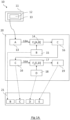
- preferred embodiments of the system 10 of the present invention seek to secure a data item 11 for secure storage of the information 12 contained in the data item 11.
- the data item 11 is in the form of a data item character string 13.
- at least a first algorithm 14 is applied to the data item character string 13 thereby to produce a first modified data item character string 16 as an output of the at least a first algorithm 14.
- the first algorithm 14 is in the form of a mathematical function having at least a first data item primary argument 13A and having at least a first data item secondary argument 15.
- the first data item primary argument 13A is the data item character string 13.
- At least a second algorithm 17 is applied to the data item character string 13 thereby to produce a second modified data item character string 19 as an output of the at least a second algorithm 17.
- the second algorithm 17 is in the form of a mathematical function having at least a second data item primary argument 16A and having at least a second data item secondary argument 18.
- the second data item primary argument 16A is the first modified data item character string 16, (which is to say the data item character string 13 after it has been modified by application of an algorithm previous to application of the at least a second algorithm 17). In this instance it has been modified by application of the at least a first algorithm 14 applied to the data item character string 13.
- an argument is dynamically created immediately prior to its application to an algorithm.
- each secondary argument is dynamically created immediately prior to its application to an algorithm.
- At least some of the secondary arguments are dynamically created immediately prior to their application as an input to an algorithm.
- the algorithms are applied to the data item character string within a first environment 20.
- one or more of the arguments are stored in a second environment 21.
- At least one of the primary arguments is stored in the second environment. In a preferred form at least one of the primary arguments is stored in the second environment and then deleted from the first environment.
- At least one of the secondary arguments is stored in the second environment. In a preferred form at least one of the secondary arguments is stored in the second environment and then deleted from the first environment.
- At least a first algorithm 14 and a second algorithm 17 is applied consecutively to the data item character string 13.
- at least one primary argument and at least one secondary argument is stored in the second environment after application of the at least a first algorithm 14 and at least a second algorithm 17 to the data item character string 13.
- the at least one primary argument and the at least one secondary argument is deleted from the first environment after storage in the second environment.
- the second environment 21 is separated from the first environment 20. In preferred forms the second environment 21 is separated from the first environment 20 by virtue of the second environment being located at a location which is a remote location from the location of the first environment.
- the second environment 21 is logically separated from the first environment 20. Preferably those outputs or arguments which are stored in the second environment are then deleted from the first environment.
- the data item 11 including the data item character string 13 is deleted from the first environment once one or more of the algorithms have been applied.
- the data item 11 including the data item character string 13 is deleted from the first environment once one or more of the algorithms have been applied and once one or more of the outputs of the algorithms or arguments are stored in the second environment 21.
- the first step in the reversal is to bring to the one location the outputs of the algorithms or arguments stored in the first environment 20 and the second environment 21.
- the arguments are then applied to the algorithms to reverse the process whereby the data item 11 is recovered for use.
- the above described process is reapplied to the data item 11 after it has been used thereby to secure the information 12 contained in it once more for a potentially indefinite period of time.
- embodiments to be described are not merely a higher level of encryption with the 'keys' distributed.
- the data is deconstructed and recreated using algorithms that require several stored pieces of segregated information to be brought together before the algorithms can be processed.
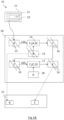
- any given algorithm 14, 17 may produce more than one output, in this instance outputs E, F. This may result depending on the nature of the algorithm utilized.
- the second embodiment described below included application of Shamir's algorithm which can produce this form of output.
- the algorithm is such that the data item character string 16 input into the algorithm 17 cannot be obtained merely having possession of one or other of E or F or D.
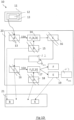
- FIG. 2 there is disclosed a flow chart of a method of securing a data item in accordance with a first preferred embodiment; said data item in the form of a data item character string; for secure storage of a representation of the data item; the method comprising the steps of:
- an argument is the data item public key.
- an argument is the data item private key.
- an argument is the second data item argument.
- an argument is the first data item argument.
- the second data item argument is the numerical value delta.
- the first data item argument is an ASCII look up table.
- the first function converts the character string into a numeric string.
- the second function/algorithm adds a numerical value delta to the first modified character string in order to form the second modified character string.
- a data item character string 120 to be secured comes from a source such as a client device 110 and arrives at a first environment 20 in this instance in the form of a main process server 112 by means of a public network such as the Internet 111.
- the main process server 112 then, in a preferred form, encrypts the data item character string 120 to form encrypted data item character string 113.
- a first algorithm 14 is then applied to the encrypted data item character string 113.
- the first algorithm 14 finds the next available prime number 114 numerically next above the numerical value of the encrypted data item character string 113.
- First algorithm 14 outputs this prime number 114 as first modified data item character string 16. In this instance the first algorithm 14 has been used to obfuscate the encrypted data item character string 113.
- a complimentary prime number 15 is generated using a public key algorithm that is known in the art.
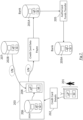
- the secondary prime number 15 and the encryption key 19 that was used to encrypt the data to be protected 13 are stored on the main process server 12.
- the initial prime number 14 and the secondary prime number 15 are combined to produce a public key using public key techniques known in the art and is then stored 17 on a remote server 16 along with the differential 18 between the encrypted data 13 and the initial prime number 14.
- the secondary server 16 is used to send the public key 17 along with the differential 18 to the primary server 12 to be de-obfuscated and decrypted.
- the stored prime number 15 is applied to the public key 17 to retrieve the initial prime number 14.
- the differential 18 is then applied to the initial prime number 14 resulting in the encrypted original data set 13.
- the locally stored encryption key 19 is then used to decrypt the protected data to its unencrypted state 21.
- the main server is used for storing the encryption key of the data to be protected as well as the secondary prime number that is later used in the deobfuscation process.
- a second server is used to store a public key generated from the initial prime number and the secondary prime number as well as the differential between the first prime number and the data in its encrypted state.
- An alternative embodiment could see any of the key components stored at any accessible location on any number of remote servers as long as the components can be retrieved.
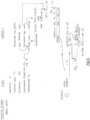
- FIG 4 With reference to figure 4 there is shown a flowchart of the steps to perform at least a second embodiment of the system of the present invention. The detailed steps of implementation are further illustrated in figures 5 and 6 .
- the example embodiment uses public key encryption techniques to obfuscate and allow the secure distribution of key components for later recompilation and decryption.
- An alternative embodiment could use a nonpublic key encryption system such as Shamir's Secret Sharing algorithm which is known in the art.
- the encrypted data still has a prime number applied to it however rather than generating a secondary prime number using public key methods the prime number is applied as a salt to the encrypted data to produce random points on a mathematical line.
- at least two locations are required to distribute the random points. So the locations are stored on separate servers and the salt is stored on one of the servers.
- an indefinite number of random points can be stored on an indefinite number of locations.
- small data encryption method is used when the data to be encrypted is of less than 200 chars in length. This number was chosen to allow for sufficient random padding of the data before encryption and to also ensure that the generated prime number is not too large that it has an impact on creation time.
- the user will enter data items 11 including a username (U1), vault name (VN1) unencrypted credentials (UC1) (e.g. a credit card number), transaction type (TT1) and transaction reference (TR1), at least one of which data items 11 includes information 12 which is to be secured. In this instance the information 12 is within the unencrypted credentials 13 (UC1).
- U1 username
- VN1 vault name
- UC1 unencrypted credentials
- TR1 transaction reference
- the system will generate one or more arguments 15, 18 in this instance including a random vault ID (ID1), prime number (P1) and symmetric key (K1) at least some of which will be used as arguments for at least a first and a second algorithms or functions 14, 17 operating consecutively on the information 12.
- ID1 random vault ID
- P1 prime number
- K1 symmetric key
- the system will execute algorithms or functions 14, 17 in a predetermined order, in this instance comprising firstly padding the unencrypted credentials 13 (UC1) with random data (as argument), to create padded unencrypted credentials (PUC1).
- the system will then apply at least a second algorithm 17 in this instance an encryption algorithm in order to encrypt the padded unencrypted credentials (PUC1) with the at least second data item argument 18 in this instance in the form of the symmetric key (K1) to create an encrypted string (ES1).
- PUC1 padded unencrypted credentials
- K1 symmetric key
- the system will then separate one or more of the arguments and outputs of the functions or algorithms into separate remote locations.
- the system will store the vault ID (ID1), the first part (SP1) and the symmetric key (K1) and Prime number (P1) within the database store.
- the system will return the ID (ID1), the remaining parts (SP2...n) to a different location.
- large data encryption method is used when the data to be encrypted is of more that our 200 chars in length.
- the system automatically determines which method to use based on the passed unencrypted credentials.
- Figure 7 is a block system diagram of a use scenario applicable to any of the embodiments of the system.
- a user 201 provides credit card details 202 to an entity 203 for the purpose of receiving goods or services.
- the entity 203 may require access to the credit card details 202 again or at some future time the entity 203 may enlist the system 10 of the present application to secure the credit card details 202.
- the entity 203 may cause the credit card details 202 to be subject to the algorithms 14, 17 and securing process of one or more of the above described embodiments thereby to cause arguments 202A and 202B to be stored in separate locations 206 and 207 respectively.
- the credit card details 202 may be entirely deleted once the securing process is completed.
- the entity 203 wishes to recover the credit card details 202 in order to, for example, make use of them to trigger a periodic payment to entity 203 authorized by user 201
- the entity 203 causes the arguments 202A and 202B to be brought into a computing environment 204 whereby the credit card details 202 are recreated and, in this instance, caused to trigger an offline or 'card not present' transaction at the computing environment 204 whereby funds 205 are caused to be transferred from a user account 201A to the entity account 203A.
- the computing environment 204 may be an environment 206, 207 in which the arguments 202A or 202B have been stored.
- the computing environment 204 may be an entirely separate environment.
- the entirely separate environment may be an EFTPOS terminal.
- computing environment 204 may be a distributed computing environment.
- the algorithms 14, 17 may be selected such that the arguments output by the algorithms in no circumstance can be reversed without the corresponding secondary argument.
- the source of the data to be encrypted is a client device e.g. mobile phone.
- the source data could come from anywhere.
- additional padding of the initial data can be used to further expand obfuscation options.
- the data to be protected is typically less than 300 bytes.
- the generation of prime numbers of this size is relative easy but becomes harder as the size of the data increases beyond this.
- An alternative embodiment could apply the processes already described to a subset of the initial encrypted data. Ideally the subset would be of a size and location in the data that would make it just as laborious as a brute force attack.
- a large data chunk could be broken up into multiple parts and have the same technique applied.
Landscapes
- Engineering & Computer Science (AREA)
- Theoretical Computer Science (AREA)
- Computer Security & Cryptography (AREA)
- General Engineering & Computer Science (AREA)
- Health & Medical Sciences (AREA)
- Bioethics (AREA)
- General Health & Medical Sciences (AREA)
- Computer Hardware Design (AREA)
- Software Systems (AREA)
- Physics & Mathematics (AREA)
- General Physics & Mathematics (AREA)
- Signal Processing (AREA)
- Computer Networks & Wireless Communication (AREA)
- Computing Systems (AREA)
- Storage Device Security (AREA)
- Information Retrieval, Db Structures And Fs Structures Therefor (AREA)
Applications Claiming Priority (2)
| Application Number | Priority Date | Filing Date | Title |
|---|---|---|---|
| AU2018902873A AU2018902873A0 (en) | 2018-08-07 | A Method and System for Securing Data | |
| PCT/AU2019/050828 WO2020028950A1 (en) | 2018-08-07 | 2019-08-07 | A method and system for securing data |
Publications (4)
| Publication Number | Publication Date |
|---|---|
| EP3830730A1 EP3830730A1 (en) | 2021-06-09 |
| EP3830730A4 EP3830730A4 (en) | 2021-09-01 |
| EP3830730B1 true EP3830730B1 (en) | 2025-06-11 |
| EP3830730C0 EP3830730C0 (en) | 2025-06-11 |
Family
ID=69413232
Family Applications (1)
| Application Number | Title | Priority Date | Filing Date |
|---|---|---|---|
| EP19848073.3A Active EP3830730B1 (en) | 2018-08-07 | 2019-08-07 | A method and system for securing data |
Country Status (9)
| Country | Link |
|---|---|
| US (1) | US11438156B2 (https=) |
| EP (1) | EP3830730B1 (https=) |
| JP (1) | JP7588854B2 (https=) |
| CN (1) | CN112805704A (https=) |
| AU (1) | AU2019319767B2 (https=) |
| CA (1) | CA3108866A1 (https=) |
| ES (1) | ES3038236T3 (https=) |
| SG (1) | SG11202101201UA (https=) |
| WO (1) | WO2020028950A1 (https=) |
Families Citing this family (5)
| Publication number | Priority date | Publication date | Assignee | Title |
|---|---|---|---|---|
| AU2019319767B2 (en) * | 2018-08-07 | 2022-12-08 | Haventec Pty Ltd | A method and system for securing data |
| US11456855B2 (en) * | 2019-10-17 | 2022-09-27 | Arm Limited | Obfuscating data at-transit |
| AU2020477732B2 (en) * | 2020-11-19 | 2024-02-01 | Ntt, Inc. | Estimation device, estimation method, and estimation program |
| US11777714B2 (en) * | 2021-12-17 | 2023-10-03 | Watson Knox Williams, JR. | Matrix encryption—a symmetric key encryption technology |
| CN117688594B (zh) * | 2024-02-02 | 2024-04-16 | 北京华云安信息技术有限公司 | 数据库加密混淆的方法、装置、设备及存储介质 |
Family Cites Families (29)
| Publication number | Priority date | Publication date | Assignee | Title |
|---|---|---|---|---|
| US6446205B1 (en) * | 1998-12-10 | 2002-09-03 | Citibank, N.A. | Cryptosystems with elliptic curves chosen by users |
| WO2000057290A1 (en) * | 1999-03-19 | 2000-09-28 | Hitachi, Ltd. | Information processor |
| US6662299B1 (en) * | 1999-10-28 | 2003-12-09 | Pgp Corporation | Method and apparatus for reconstituting an encryption key based on multiple user responses |
| EP1179912A1 (en) * | 2000-08-09 | 2002-02-13 | STMicroelectronics S.r.l. | Chaotic encryption |
| US6691141B2 (en) | 2001-04-13 | 2004-02-10 | Science Applications International Corp. | Method and apparatus for generating random number generators |
| BRPI0517026A (pt) * | 2004-10-25 | 2008-09-30 | Rick L Orsini | método e sistema analisador de dados seguros |
| US7685430B1 (en) * | 2005-06-17 | 2010-03-23 | Sun Microsystems, Inc. | Initial password security accentuated by triple encryption and hashed cache table management on the hosted site's server |
| US20140108796A1 (en) * | 2006-01-26 | 2014-04-17 | Unisys Corporation | Storage of cryptographically-split data blocks at geographically-separated locations |
| US7865730B2 (en) * | 2006-01-30 | 2011-01-04 | Kronos Technology Systems Limited Partnership | Bcencryption (BCE)—a public-key based method to encrypt a data stream |
| US8468244B2 (en) * | 2007-01-05 | 2013-06-18 | Digital Doors, Inc. | Digital information infrastructure and method for security designated data and with granular data stores |
| US8472620B2 (en) | 2007-06-15 | 2013-06-25 | Sony Corporation | Generation of device dependent RSA key |
| AU2015203172B2 (en) * | 2010-09-20 | 2016-10-06 | Security First Corp. | Systems and methods for secure data sharing |
| CA2813758C (en) * | 2010-10-08 | 2023-01-03 | Brian Lee Moffat | Private data sharing system |
| CN102236766B (zh) * | 2011-05-10 | 2014-04-09 | 桂林电子科技大学 | 安全的数据项级数据库加密方法 |
| US8958547B2 (en) * | 2012-01-06 | 2015-02-17 | International Business Machines Corporation | Generation of relative prime numbers for use in cryptography |
| US20140082376A1 (en) * | 2012-09-14 | 2014-03-20 | Texas Tech University System | System, Method and Apparatus for Securely Saving/Retrieving Data on a Data Storage |
| US9472189B2 (en) * | 2012-11-02 | 2016-10-18 | Sony Corporation | Language processing method and integrated circuit |
| US20140164790A1 (en) * | 2012-12-06 | 2014-06-12 | David Dodgson | Storage security using cryptographic splitting |
| EP2987267B1 (en) * | 2013-04-18 | 2019-03-20 | Risoftdev, Inc. | System and methods for encrypting data |
| US9800407B2 (en) | 2013-08-30 | 2017-10-24 | Qualcomm Incorporated | Methods and apparatuses for prime number generation and storage |
| CN105282090B (zh) * | 2014-06-03 | 2018-11-27 | 江南大学 | 一种互联网上防非法访问的公开url加密编码方法 |
| WO2016130030A1 (en) * | 2015-02-10 | 2016-08-18 | Nord-Systems Sp. Z O.O. | Method of securing data using threshold cryptography |
| KR101675088B1 (ko) * | 2015-04-30 | 2016-11-10 | 성균관대학교산학협력단 | Mtc에서의 네트워크와의 상호 인증 방법 및 시스템 |
| CN105005718B (zh) * | 2015-06-23 | 2018-02-13 | 电子科技大学 | 一种利用马尔可夫链实现代码混淆的方法 |
| US10725990B2 (en) * | 2015-12-01 | 2020-07-28 | Facebook, Inc. | Co-prime hashing |
| CN105763322B (zh) * | 2016-04-13 | 2019-01-25 | 同济大学 | 一种可混淆的加密密钥隔离数字签名方法及系统 |
| AU2019280577A1 (en) * | 2018-06-04 | 2021-01-21 | Foogal, Inc. | Utility token-based systems and methods |
| US11184157B1 (en) * | 2018-06-13 | 2021-11-23 | Amazon Technologies, Inc. | Cryptographic key generation and deployment |
| AU2019319767B2 (en) * | 2018-08-07 | 2022-12-08 | Haventec Pty Ltd | A method and system for securing data |
-
2019
- 2019-08-07 AU AU2019319767A patent/AU2019319767B2/en active Active
- 2019-08-07 WO PCT/AU2019/050828 patent/WO2020028950A1/en not_active Ceased
- 2019-08-07 SG SG11202101201UA patent/SG11202101201UA/en unknown
- 2019-08-07 JP JP2021506422A patent/JP7588854B2/ja active Active
- 2019-08-07 CN CN201980065945.2A patent/CN112805704A/zh active Pending
- 2019-08-07 US US17/266,537 patent/US11438156B2/en active Active
- 2019-08-07 EP EP19848073.3A patent/EP3830730B1/en active Active
- 2019-08-07 CA CA3108866A patent/CA3108866A1/en active Pending
- 2019-08-07 ES ES19848073T patent/ES3038236T3/es active Active
Also Published As
| Publication number | Publication date |
|---|---|
| WO2020028950A1 (en) | 2020-02-13 |
| AU2019319767B2 (en) | 2022-12-08 |
| US20210320795A1 (en) | 2021-10-14 |
| AU2019319767A1 (en) | 2021-03-11 |
| JP2021534443A (ja) | 2021-12-09 |
| EP3830730A1 (en) | 2021-06-09 |
| JP7588854B2 (ja) | 2024-11-25 |
| CA3108866A1 (en) | 2020-02-13 |
| SG11202101201UA (en) | 2021-03-30 |
| CN112805704A (zh) | 2021-05-14 |
| ES3038236T3 (en) | 2025-10-10 |
| US11438156B2 (en) | 2022-09-06 |
| EP3830730A4 (en) | 2021-09-01 |
| EP3830730C0 (en) | 2025-06-11 |
Similar Documents
| Publication | Publication Date | Title |
|---|---|---|
| EP3830730B1 (en) | A method and system for securing data | |
| US10616213B2 (en) | Password manipulation for secure account creation and verification through third-party servers | |
| US7676040B2 (en) | Changing encryption key of encrypted data | |
| CN107453880B (zh) | 一种云数据安全存储方法和系统 | |
| WO2017033843A1 (ja) | 検索可能暗号処理システム | |
| BE1024812A9 (nl) | Een beveilingingsbenadering voor de opslag van credentials voor offline gebruik en tegen kopiëren beveiligde kluisinhoud in apparaten | |
| JP2021534443A5 (https=) | ||
| US10938790B2 (en) | Security system and method | |
| Mohammed et al. | Implementation of new secure encryption technique for cloud computing | |
| Altarawneh | A Strong Combination of Cryptographic Techniques to Secure Cloud-Hosted Data. | |
| TWI430643B (zh) | Secure key recovery system and method | |
| Bhardwaj | End-to-end data security for multi-tenant cloud environment | |
| Bindel et al. | 3. The Quantum Threat to Cybersecurity and Privacy | |
| Reddy et al. | Data Storage on Cloud using Split-Merge and Hybrid Cryptographic Techniques | |
| Pawar et al. | Survey of cryptography techniques for data security | |
| Shrivas et al. | Migration Model for un secure Database driven Software System to Secure System using Cryptography | |
| Mary Sheeba et al. | Hybrid Security for Data in Cloud Computing: A Review | |
| JP4807785B2 (ja) | 実行権限分散方法及びシステム | |
| Jain et al. | Data Privacy Using Cryptographic Approaches | |
| CN110138545A (zh) | 一种隐私数据的保护方法和系统 | |
| Onyesolu et al. | On Information Security using a Hybrid Cryptographic Model | |
| Kamiyama et al. | Attack on Multiple-Use Password Protected Secret Sharing | |
| KR20140040930A (ko) | 대칭키 암호화 기술의 비밀키 운용방법 및 구현 시스템. | |
| CN121009583A (zh) | 一种基于同态加密的密文检索方法及系统 | |
| CN104125060A (zh) | 无固定算法密匙加密技术 |
Legal Events
| Date | Code | Title | Description |
|---|---|---|---|
| STAA | Information on the status of an ep patent application or granted ep patent |
Free format text: STATUS: THE INTERNATIONAL PUBLICATION HAS BEEN MADE |
|
| PUAI | Public reference made under article 153(3) epc to a published international application that has entered the european phase |
Free format text: ORIGINAL CODE: 0009012 |
|
| STAA | Information on the status of an ep patent application or granted ep patent |
Free format text: STATUS: REQUEST FOR EXAMINATION WAS MADE |
|
| 17P | Request for examination filed |
Effective date: 20210305 |
|
| AK | Designated contracting states |
Kind code of ref document: A1 Designated state(s): AL AT BE BG CH CY CZ DE DK EE ES FI FR GB GR HR HU IE IS IT LI LT LU LV MC MK MT NL NO PL PT RO RS SE SI SK SM TR |
|
| A4 | Supplementary search report drawn up and despatched |
Effective date: 20210730 |
|
| RIC1 | Information provided on ipc code assigned before grant |
Ipc: G06F 21/60 20130101AFI20210726BHEP Ipc: G06F 21/62 20130101ALI20210726BHEP |
|
| DAV | Request for validation of the european patent (deleted) | ||
| DAX | Request for extension of the european patent (deleted) | ||
| STAA | Information on the status of an ep patent application or granted ep patent |
Free format text: STATUS: EXAMINATION IS IN PROGRESS |
|
| 17Q | First examination report despatched |
Effective date: 20240226 |
|
| GRAP | Despatch of communication of intention to grant a patent |
Free format text: ORIGINAL CODE: EPIDOSNIGR1 |
|
| STAA | Information on the status of an ep patent application or granted ep patent |
Free format text: STATUS: GRANT OF PATENT IS INTENDED |
|
| INTG | Intention to grant announced |
Effective date: 20250107 |
|
| GRAS | Grant fee paid |
Free format text: ORIGINAL CODE: EPIDOSNIGR3 |
|
| GRAA | (expected) grant |
Free format text: ORIGINAL CODE: 0009210 |
|
| STAA | Information on the status of an ep patent application or granted ep patent |
Free format text: STATUS: THE PATENT HAS BEEN GRANTED |
|
| AK | Designated contracting states |
Kind code of ref document: B1 Designated state(s): AL AT BE BG CH CY CZ DE DK EE ES FI FR GB GR HR HU IE IS IT LI LT LU LV MC MK MT NL NO PL PT RO RS SE SI SK SM TR |
|
| REG | Reference to a national code |
Ref country code: GB Ref legal event code: FG4D |
|
| REG | Reference to a national code |
Ref country code: CH Ref legal event code: EP |
|
| REG | Reference to a national code |
Ref country code: IE Ref legal event code: FG4D |
|
| REG | Reference to a national code |
Ref country code: DE Ref legal event code: R096 Ref document number: 602019071105 Country of ref document: DE |
|
| U01 | Request for unitary effect filed |
Effective date: 20250710 |
|
| U07 | Unitary effect registered |
Designated state(s): AT BE BG DE DK EE FI FR IT LT LU LV MT NL PT RO SE SI Effective date: 20250814 |
|
| PGFP | Annual fee paid to national office [announced via postgrant information from national office to epo] |
Ref country code: ES Payment date: 20250911 Year of fee payment: 7 |
|
| REG | Reference to a national code |
Ref country code: ES Ref legal event code: FG2A Ref document number: 3038236 Country of ref document: ES Kind code of ref document: T3 Effective date: 20251010 |
|
| PG25 | Lapsed in a contracting state [announced via postgrant information from national office to epo] |
Ref country code: GR Free format text: LAPSE BECAUSE OF FAILURE TO SUBMIT A TRANSLATION OF THE DESCRIPTION OR TO PAY THE FEE WITHIN THE PRESCRIBED TIME-LIMIT Effective date: 20250912 Ref country code: NO Free format text: LAPSE BECAUSE OF FAILURE TO SUBMIT A TRANSLATION OF THE DESCRIPTION OR TO PAY THE FEE WITHIN THE PRESCRIBED TIME-LIMIT Effective date: 20250911 |
|
| PGFP | Annual fee paid to national office [announced via postgrant information from national office to epo] |
Ref country code: GB Payment date: 20250908 Year of fee payment: 7 |
|
| PG25 | Lapsed in a contracting state [announced via postgrant information from national office to epo] |
Ref country code: HR Free format text: LAPSE BECAUSE OF FAILURE TO SUBMIT A TRANSLATION OF THE DESCRIPTION OR TO PAY THE FEE WITHIN THE PRESCRIBED TIME-LIMIT Effective date: 20250611 |
|
| PG25 | Lapsed in a contracting state [announced via postgrant information from national office to epo] |
Ref country code: RS Free format text: LAPSE BECAUSE OF FAILURE TO SUBMIT A TRANSLATION OF THE DESCRIPTION OR TO PAY THE FEE WITHIN THE PRESCRIBED TIME-LIMIT Effective date: 20250911 |
|
| U20 | Renewal fee for the european patent with unitary effect paid |
Year of fee payment: 7 Effective date: 20250925 |
|
| PG25 | Lapsed in a contracting state [announced via postgrant information from national office to epo] |
Ref country code: IS Free format text: LAPSE BECAUSE OF FAILURE TO SUBMIT A TRANSLATION OF THE DESCRIPTION OR TO PAY THE FEE WITHIN THE PRESCRIBED TIME-LIMIT Effective date: 20251011 |
|
| PG25 | Lapsed in a contracting state [announced via postgrant information from national office to epo] |
Ref country code: SM Free format text: LAPSE BECAUSE OF FAILURE TO SUBMIT A TRANSLATION OF THE DESCRIPTION OR TO PAY THE FEE WITHIN THE PRESCRIBED TIME-LIMIT Effective date: 20250611 |
|
| PG25 | Lapsed in a contracting state [announced via postgrant information from national office to epo] |
Ref country code: CZ Free format text: LAPSE BECAUSE OF FAILURE TO SUBMIT A TRANSLATION OF THE DESCRIPTION OR TO PAY THE FEE WITHIN THE PRESCRIBED TIME-LIMIT Effective date: 20250611 |
|
| PG25 | Lapsed in a contracting state [announced via postgrant information from national office to epo] |
Ref country code: PL Free format text: LAPSE BECAUSE OF FAILURE TO SUBMIT A TRANSLATION OF THE DESCRIPTION OR TO PAY THE FEE WITHIN THE PRESCRIBED TIME-LIMIT Effective date: 20250611 |
|
| PG25 | Lapsed in a contracting state [announced via postgrant information from national office to epo] |
Ref country code: SK Free format text: LAPSE BECAUSE OF FAILURE TO SUBMIT A TRANSLATION OF THE DESCRIPTION OR TO PAY THE FEE WITHIN THE PRESCRIBED TIME-LIMIT Effective date: 20250611 |
|
| REG | Reference to a national code |
Ref country code: CH Ref legal event code: H13 Free format text: ST27 STATUS EVENT CODE: U-0-0-H10-H13 (AS PROVIDED BY THE NATIONAL OFFICE) Effective date: 20260324 |
|
| PG25 | Lapsed in a contracting state [announced via postgrant information from national office to epo] |
Ref country code: MC Free format text: LAPSE BECAUSE OF FAILURE TO SUBMIT A TRANSLATION OF THE DESCRIPTION OR TO PAY THE FEE WITHIN THE PRESCRIBED TIME-LIMIT Effective date: 20250611 |
|
| PLBE | No opposition filed within time limit |
Free format text: ORIGINAL CODE: 0009261 |
|
| STAA | Information on the status of an ep patent application or granted ep patent |
Free format text: STATUS: NO OPPOSITION FILED WITHIN TIME LIMIT |
|
| PG25 | Lapsed in a contracting state [announced via postgrant information from national office to epo] |
Ref country code: CH Free format text: LAPSE BECAUSE OF NON-PAYMENT OF DUE FEES Effective date: 20250831 |
|
| REG | Reference to a national code |
Ref country code: CH Ref legal event code: L10 Free format text: ST27 STATUS EVENT CODE: U-0-0-L10-L00 (AS PROVIDED BY THE NATIONAL OFFICE) Effective date: 20260423 |