EP3829403B1 - A beverage preparation apparatus comprising a foaming device and method therefor - Google Patents
A beverage preparation apparatus comprising a foaming device and method therefor Download PDFInfo
- Publication number
- EP3829403B1 EP3829403B1 EP19742365.0A EP19742365A EP3829403B1 EP 3829403 B1 EP3829403 B1 EP 3829403B1 EP 19742365 A EP19742365 A EP 19742365A EP 3829403 B1 EP3829403 B1 EP 3829403B1
- Authority
- EP
- European Patent Office
- Prior art keywords
- plate
- plates
- baffles
- preparation apparatus
- beverage preparation
- Prior art date
- Legal status (The legal status is an assumption and is not a legal conclusion. Google has not performed a legal analysis and makes no representation as to the accuracy of the status listed.)
- Active
Links
Images




Classifications
-
- A—HUMAN NECESSITIES
- A47—FURNITURE; DOMESTIC ARTICLES OR APPLIANCES; COFFEE MILLS; SPICE MILLS; SUCTION CLEANERS IN GENERAL
- A47J—KITCHEN EQUIPMENT; COFFEE MILLS; SPICE MILLS; APPARATUS FOR MAKING BEVERAGES
- A47J31/00—Apparatus for making beverages
- A47J31/44—Parts or details or accessories of beverage-making apparatus
- A47J31/4496—Means to produce beverage with a layer on top, e.g. of cream, foam or froth
-
- A—HUMAN NECESSITIES
- A47—FURNITURE; DOMESTIC ARTICLES OR APPLIANCES; COFFEE MILLS; SPICE MILLS; SUCTION CLEANERS IN GENERAL
- A47J—KITCHEN EQUIPMENT; COFFEE MILLS; SPICE MILLS; APPARATUS FOR MAKING BEVERAGES
- A47J31/00—Apparatus for making beverages
- A47J31/44—Parts or details or accessories of beverage-making apparatus
- A47J31/60—Cleaning devices
-
- B—PERFORMING OPERATIONS; TRANSPORTING
- B01—PHYSICAL OR CHEMICAL PROCESSES OR APPARATUS IN GENERAL
- B01F—MIXING, e.g. DISSOLVING, EMULSIFYING OR DISPERSING
- B01F23/00—Mixing according to the phases to be mixed, e.g. dispersing or emulsifying
- B01F23/20—Mixing gases with liquids
- B01F23/23—Mixing gases with liquids by introducing gases into liquid media, e.g. for producing aerated liquids
- B01F23/232—Mixing gases with liquids by introducing gases into liquid media, e.g. for producing aerated liquids using flow-mixing means for introducing the gases, e.g. baffles
-
- B—PERFORMING OPERATIONS; TRANSPORTING
- B01—PHYSICAL OR CHEMICAL PROCESSES OR APPARATUS IN GENERAL
- B01F—MIXING, e.g. DISSOLVING, EMULSIFYING OR DISPERSING
- B01F23/00—Mixing according to the phases to be mixed, e.g. dispersing or emulsifying
- B01F23/20—Mixing gases with liquids
- B01F23/23—Mixing gases with liquids by introducing gases into liquid media, e.g. for producing aerated liquids
- B01F23/235—Mixing gases with liquids by introducing gases into liquid media, e.g. for producing aerated liquids for making foam
-
- B—PERFORMING OPERATIONS; TRANSPORTING
- B01—PHYSICAL OR CHEMICAL PROCESSES OR APPARATUS IN GENERAL
- B01F—MIXING, e.g. DISSOLVING, EMULSIFYING OR DISPERSING
- B01F25/00—Flow mixers; Mixers for falling materials, e.g. solid particles
- B01F25/40—Static mixers
- B01F25/42—Static mixers in which the mixing is affected by moving the components jointly in changing directions, e.g. in tubes provided with baffles or obstructions
- B01F25/421—Static mixers in which the mixing is affected by moving the components jointly in changing directions, e.g. in tubes provided with baffles or obstructions by moving the components in a convoluted or labyrinthine path
- B01F25/423—Static mixers in which the mixing is affected by moving the components jointly in changing directions, e.g. in tubes provided with baffles or obstructions by moving the components in a convoluted or labyrinthine path by means of elements placed in the receptacle for moving or guiding the components
- B01F25/4231—Static mixers in which the mixing is affected by moving the components jointly in changing directions, e.g. in tubes provided with baffles or obstructions by moving the components in a convoluted or labyrinthine path by means of elements placed in the receptacle for moving or guiding the components using baffles
-
- B—PERFORMING OPERATIONS; TRANSPORTING
- B01—PHYSICAL OR CHEMICAL PROCESSES OR APPARATUS IN GENERAL
- B01F—MIXING, e.g. DISSOLVING, EMULSIFYING OR DISPERSING
- B01F35/00—Accessories for mixers; Auxiliary operations or auxiliary devices; Parts or details of general application
- B01F35/10—Maintenance of mixers
- B01F35/145—Washing or cleaning mixers not provided for in other groups in this subclass; Inhibiting build-up of material on machine parts using other means
- B01F35/1452—Washing or cleaning mixers not provided for in other groups in this subclass; Inhibiting build-up of material on machine parts using other means using fluids
-
- B—PERFORMING OPERATIONS; TRANSPORTING
- B01—PHYSICAL OR CHEMICAL PROCESSES OR APPARATUS IN GENERAL
- B01F—MIXING, e.g. DISSOLVING, EMULSIFYING OR DISPERSING
- B01F2101/00—Mixing characterised by the nature of the mixed materials or by the application field
- B01F2101/06—Mixing of food ingredients
- B01F2101/14—Mixing of ingredients for non-alcoholic beverages; Dissolving sugar in water
Definitions
- the present invention relates to a beverage preparation apparatus comprising a foaming device. Furthermore, the invention relates to methods of foaming a beverage liquid.
- a high-quality crema for a coffee preparation is characterised by a small bubble size and a uniform bubble size distribution.
- the layer of crema improves the appeal of the coffee beverage, resulting in a better experience for consumers and a higher customer satisfaction.
- foam is generated by forcing a beverage preparation (or alternatively any food beverage) to pass through an orifice of reduced dimensions together with a gas (commonly air).
- a gas commonly air
- This orifice is called a restrictor.
- said restrictors are usually positioned along the beverage fluid flow path and after the extraction chamber.
- liquid and gas such as a food beverage and air
- beads of selected diameters which form a turbulent fluid path, allowing air to be incorporated into the beverage and dissolved in it.
- GB 891,152 discloses a method and apparatus for continuously changing the structure of gaseous, liquid and/or solid substances and mixtures of such substances by subjecting them at vibration at frequencies up to supersonic frequencies for dissolving, mixing, atomising, disintegrating, decomposing, pulping, and homogenising such substances through the apparatus described in Figures 1 to 6 .
- CN105559586A related to a beverage capsule comprising foaming devices.
- EP2042063A1 discloses an arrangement for producing milk foam and a method for producing milk foam.
- the arrangement has units for obligatory supply of air serving as liquid foaming medium flowing through milk.
- a mixing element is provided with deflection means where milk and air mixture are deflected multiple times or divided or set in rotation.
- a beverage preparation apparatus as defined in claim 1.
- only one of the plates may be movable with respect to the other to vary a distance between the two plates.
- the first plate and second plate may be both movable.
- first plate and second plate may be detachably connected.
- first and second plates may comprise a first and second plate holders respectively.
- the first and second plate holders may be removably connected to each other through a connection means.
- connection means may comprise external connection means and/or connection means which are integral with the plate holders.
- the external connection means may comprise a casing surrounding said first and second plate holder. More preferably this casing can be a resilient casing such as a rubber and/or silicone casing. In other preferred embodiments, the resilient casing may comprise a sleeve, such as a rubber and/or silicone sleeve.
- the casing may comprise a metal and/or a plastics casing.
- the plastic substrate casing may comprise polylactic acid (PLA), polyethylene (PE), polyethylene terephthalate (PET), polypropylene (PP), polyamide (PA), polycarbonate (PC)and/or a combination thereof.
- connection means within said plate holders may comprise clamping, snap-on, dowel pins, flanged, edged, threaded and/or bayonetted connections.
- said first and second plate holders may be fixedly connected to the first and second plate.
- first and second plate holders can be integral with said first and second plate respectively.
- first and second plate may be considered a surface of the plate holder, from which said baffles protrude.
- the first and second plates and baffles may be integral with said first and second plate holders and each may be moulded in a unitary body.
- said first and second plate holders are removably connected to said first and second plate.
- said first and second plate holders comprise connection means in order to connect to said first and second plate; more preferably the connection means may comprise clamping, snap-on, dowel pins, flanged, edged, threaded and/or bayonetted connections.
- the first and second plate holders may comprise a seal which is arranged in use to seal the periphery of the fluid conduit defined between the first and second plate holders.
- the seal may comprise a resilient seal and more preferably the resilient seal may comprise a rubber and/or plastic seal, such as a gasket.
- the seal may be located in a seal housing provided on the first and second plate holders.
- both first and second plates may comprise baffles projecting into the cavity.
- the baffles projecting into the cavity may comprise hemispherical, cuboid, pyramidal, conical, prismatic, cylindrical, and/or hexagonal baffles.
- the baffles may be integral with said plates.
- the baffles may comprise the same material as the first and/or second plate.
- the baffles may be fixedly attached to said first and second plate.
- said baffles may be removably attached to the first and second plates.
- the first and second plate and the baffles may comprise a reciprocal connection means. More preferably the reciprocal connection means comprises adhesive, or clamp, bayonetted, snap-on, clamping, dowel pin and/or threaded connections.
- said first and second plate may comprise a material selected from a metal and/or a plastic substrate and/or a combination thereof.
- the plastic substrate may comprise polylactic acid (PLA), polyethylene PE, polyethylene terephthalate (PET), polypropylene (PP) polyamide (PA), polycarbonate (PC) and/or a combination thereof.
- Metal substrates may comprise stainless steel.
- said first and second plate holder may comprise different material with respect to said first and second plates.
- said first and second plate holder may comprise the same material as said first and second plates.
- the baffles may comprise the same material as said first and second plates.
- the baffles may comprise a different material with respect to said first and second plates.
- the baffles may comprise a rigid material.
- the baffles may comprise a resilient material.
- resilient material comprises an elastomer.
- the elastomer may comprise a rubber or silicone.
- the first plate comprises baffles of rigid material and said second plate may comprise baffles of resilient material.
- the baffles may extend at least partially along the length of at least one plate, such as along at least a majority of the length of the plate, or the baffles may extend along the entire length of the at least one plate. Even more preferably at least a portion of said baffles on the first and second plate may not be in register (e.g. they are not aligned such that their distal ends are opposite each other, or the baffles of one plate are not entirely superposed with the baffles on the other plate, or the baffles of one plate are superposed above the gaps between baffles of the other plate).
- said baffles may be positioned along said first plate and/or said second plate in a repeated pattern configuration.
- said repeated pattern configuration may comprise a matrix, random and/or labyrinthic configuration.
- the first plate and second plate may be movable with respect to each other within a range of 0.5 and 4.5 mm, preferably between 0.5 and 3 mm.
- the plates may move between an open configuration in which the plates are between 3mm and 10mm apart, especially between 3mm and 5mm or between 3mm and 4.5mm apart, and a closed or operational configuration in which the baffles of one plate abut or touch the opposite plate and/or the baffles of the opposite plate.
- the closed configuration may comprise the plates being spaced apart by between 0.5mm and 3mm, for example 0.5mm to 2mm. It will be appreciated that the baffles will have a length which ensures that they do not touch or abut the opposite plate or baffles of the opposite plate in the open configuration, but which do in the closed configuration.
- the baffles projecting from said first and/or said second plate may create a fluid flow path within said cavity of the fluid conduit.
- said fluid flow path within said cavity may be generated when the distance between said first plate and second plate is in the range of 0.5-3 mm.
- the fluid flow path creates a turbulence generating path, such that fluid flowing through the fluid conduit and along the path formed between the baffles is subjected to turbulence which aids in foaming a fluid conveyed therethrough.
- the baffles may be configured such that they form a fluid flow path which changes in cross-sectional area along the path.
- the cross-sectional area may change along a portion of the path or along the full path formed between the baffles.
- the cross-sectional area of the path may include regions of larger cross-sectional area separated by regions of smaller cross-sectional area.
- the cross-sectional area may increase and decrease in height or width and may cycle through increasing and decreasing cross-sectional area along the path.
- the cross-sectional area of the path may change between 1 mm 2 and 65 mm 2 , such as between 2 mm 2 and 20mm 2 or between 3 mm 2 and 10 mm 2 , for example.
- the cross-sectional area of the baffles changes along the length (height) of the baffle, such that cross-sectional area of the path between baffles also changes in area.
- the radial distance between the centre of each baffle may be in the range of 0.5 and 6.5 mm and/or the distance between the outer surface of each protrusion may be between 0.1 to 3.5 mm, for example. It will be appreciated that the distance between the outer surfaces of each baffle may vary based on the shape and configuration of the baffles (irrespective of whether the spacing between each baffle is constant).
- the baffles when the baffles are dome-shaped or hemispherical, the distance between the outer surfaces of two adjacent baffles at the base of the dome or hemisphere will be less than the distances at the apex of the dome or hemisphere irrespective of whether the spacing between the baffles is substantially constant or not.
- the baffles may have a uniform cross-section and be uniformly spaced apart, such that the distance between the outer surface of adjacent baffles is substantially constant.
- the cavity may comprise the fluid flow inlet and a fluid flow outlet.
- fluid flow inlet may comprise two or more inlets.
- the fluid flow inlet may comprise a combined gas and a liquid inlet, or there may be separate gas and liquid inlets.
- the gas inlet is an air, nitrogen, or carbon dioxide, nitrous oxide inlet.
- the liquid inlet may be a coffee extract, tea, milk, creamer, chocolate, soup, or broth inlet.
- the liquid inlet may comprise hot and cold beverages.
- the fluid flow inlet and/or outlet may comprise a fluid flow rate in the range of 1 to 50 ml/sec, such as between 2 to 40 ml/sec or preferably between 3 to 20 ml/sec. In some embodiments the fluid flow rate may be between 5 and 15 ml/sec. In consequence, the rate of fluid flow through the fluid conduit may be in the same preferred ranges.
- the fluid flow rate may comprise a gas to liquid flow rate ratio in the range of 1:20 to 1:1.2. In embodiments where there are two fluid flow inlets, preferably at least one of said two inlets may be oriented laterally to another.
- At least one of said fluid flow inlets may be parallel with another.
- the beverage preparation apparatus may comprise a beverage machine.
- the beverage machine may comprise a coffee-making machine.
- the coffee-making machine may comprise one or more, and preferably all of: a water container, a heating device, a pressure system, ingredient storage containers, a mixing and/or an extraction chamber, a beverage outlet and a foaming device.
- the water container may comprise a water reservoir.
- the pressure system may comprise at least one pump.
- the heating device may comprise a heating element.
- the foaming device may be positioned downstream the extraction chamber between the extraction chamber and the beverage outlet.
- the beverage outlet may comprise a spout.
- one of said plates may comprise a beverage container holder.
- one of said plates may comprise a beverage dispensing orifice.
- the method may comprise providing a beverage liquid selected from coffee extract, tea, creamer, milk, chocolate, soup or broth, for example.
- a beverage liquid selected from coffee extract, tea, creamer, milk, chocolate, soup or broth, for example.
- the liquid and gas may be as described hereinabove for the first aspect of the invention.
- the flushing or purging liquid may be water, for example.
- FIG. 1 and 2 an embodiment of a foaming device (1) is shown.
- This embodiment comprises a first plate holder (2) and a second plate holder (4) each one provided with a seal housing in the form a half-channel groove (12), cut into opposite and facing surfaces thereof.
- the device (1) is also provided with a seal in the form of a gasket (10) located within the channel formed between the two grooves (12) when the first plate holder (2) and second plate holder (4) are joined.
- a first plate (6) connected to the first plate holder (2) and a second plate (8) connected to the second plate holder (4) are arranged such that that a free surface of each face each other, each plate (6,8) being provided with baffles protruding from the free surfaces, in the form of hemispheres (14).
- the hemispheres (14) on each plate (6, 8) are aligned in a repeated pattern configuration (20), partially extending along the free faces of said plates (6, 8).
- the gasket (10) is arranged to extend around the first and second plates (6,8) thereby sealing the edges thereof and ensuring a fluid-tight channel is formed between the first and second plates (6,8).
- a first plate housing (not shown) and a second plate housing (18) are provided respectively in the first plate holder (2) and the second plate holder (4) to retain and align the respective plates (6, 8).
- Retention means in the form of a clamp/threaded connection (22) are used to secure the plates (6, 8) to said plate housings (16, 18) and the two plate holders (2, 4) to each other.
- a fluid flow inlet (32) and a fluid flow outlet (34) are spaced apart to each other and positioned on the same side of the first plate holder (2) across the first plate (6) and the first plate holder (2) itself.
- the first plate (6) and the second plate (8) have a length in the range of 20 to 120 mm and preferably between 40 and 90 mm and a width of around 5 to 19 mm, preferably 11 mm.
- the first plate (6) and the second plate (8) present baffles in the form of hemispherical protrusions (14), which protrude from the free surfaces of respectively the first plate (6) and/or the second plate (8) toward the corresponding free surface of the opposite plate.
- Said protrusions (14) can be an integral part of the plates (6, 8) or alternatively can be removably/releasably attached to the plates' surfaces through standard connecting means, such as for instance adhesive layers (not shown), or any suitable alternative (e.g. threaded, snap on, clamping, dowel pin connections).
- the protrusions (14) can have a diameter in a range of 0.5 to 3 mm and preferably of 1 to 2 mm.
- the height of said protrusions (14) is in the range of 0.25-1.5 mm and preferably between 0.5 and 1 mm.
- Alternative shapes of the baffles for instance may be a cone, prism, cuboid, or cylinder shape.
- the radial distance (not shown) between the centre of each protrusion (14) is in the range of 0.5 and 6.5 mm and the distance between the outer surface of each protrusion is between 0.1 to 3.5 mm. It will be appreciated that the distance between the outer surfaces of each protrusion may vary based on the shape and configuration of the protrusions.
- the distance between the outer surfaces of two adjacent protrusions at the base of the dome will be less than the distances at the apex of the dome.
- Said protrusions (14) are distributed in a specific configuration in which these protrusions (14) are aligned to each other in both plates (6, 8) in a repeated pattern configuration (20) in the form of a matrix consisting of several rows and columns.
- the number of rows and columns of said repeated pattern configuration (20) is in the range of 2 to 30 rows and 2 to 15 columns.
- Alternative suitable configurations can be used, such as, for example, a random configuration or a labyrinthic configuration provided that said configurations on each plate matches the corresponding configuration on the opposite one, in such a way that when the two plates (6, 8) are combined/coupled to each other (working configuration, not shown) a ramified/branched fluid flow path is generated.
- the hemisphere protrusions (14) in this working configuration touch each other, generating said branched fluid flow path.
- the hemispherical protrusions (14) of the first plate (6) are offset (and so not in register) with respect to the positions of the hemispherical protrusions (14) of the second plate (8) such that when the plates (6,8) are joined and the protrusions (14) brought close together, a winding and forking fluid flow path is created through the gaps between the protrusions.
- Said ramified/branched fluid flow path is a turbulence generating path.
- Said protrusions (14) can be made of stainless steel or any other suitable metal and/or alternatively of polymeric material such as for example polypropylene (PP), polyethylene (PE), polyethylene terephthalate (PET), and/or polylactic acid (PLA), polyamide (PA), polycarbonate (PC) and/or a combination thereof.
- said protrusions (14) can consist of resilient material as for example rubber and/or silicon. The same substrates can be used to manufacture the plates themselves (6, 8).
- the first plate (6) is retained in the first plate holder (2) and the second plate (8) is retained in the second plate holder (4) by means of standard retention means i.e. the threaded connection (22), but any alternative suitable retention means can be used, such as for instance snap-on, clamp-in, dowel pin and/or bayonetted connections.
- On said upper plate holder (2) and lower plate holder (4) is provided the sealing groove (12) to house the gasket (10), which ensures a tight sealing of the two plates (6, 8) when in working configuration, preventing fluid flow around the outside of the baffles, ensuring fluid flows through the branched conduit formed by the baffles (14) and ensuring a good foam quality.
- said groove (12) is formed into each plate holder (2, 4) surrounding the plate housing (16, 18) and the plate (6, 8) itself when the foaming device (1) is in the working (closed) configuration.
- Said first plate holder (2) and second plate holder (4) can also consist of metal and/or plastic substrates, for example stainless steel and/or polypropylene (PP), polyethylene (PE), polyethylene terephthalate (PET), and/or polylactic acid (PLA), polyamide (PA), polycarbonate (PC) and/or a combination thereof.
- PP polypropylene
- PE polyethylene
- PET polyethylene terephthalate
- PLA polylactic acid
- PA polyamide
- PC polycarbonate
- the gasket (10) can be made of plastic material such as polypropylene (PP), polyethylene (PE), polyethylene terephthalate (PET), and/or polylactic acid (PLA), polyamide (PA), polycarbonate (PC) and/or a resilient material as for example rubber and/or silicone.
- plastic material such as polypropylene (PP), polyethylene (PE), polyethylene terephthalate (PET), and/or polylactic acid (PLA), polyamide (PA), polycarbonate (PC) and/or a resilient material as for example rubber and/or silicone.
- the first plate (6) and a second plate (8) are hosted inside the first plate housing (16) and a second plate housing (18), respectively.
- the gasket (10) is retained in the conduit or channel formed by the groove (12) positioned in the second plate (8).
- the protrusions (14) protrude from said plates (6, 8) towards each other.
- Connecting means in the form of pins (not shown) and corresponding receiving holes (26) ensure alignment between the two plates (6, 8) their connection during working configuration of a foaming device (1).
- the protrusions on the plates surfaces are arranged such that the protrusions (14) on the first plate (6) and second plate (8) are offset laterally such that they create a branched fluid flow path between the two plates (6, 8) when the first plate (6) is close to (or abutting) the second plate (8) and sealed.
- the protrusions (14) on the two plates (6, 8) are not in register, to ensure the creation of such a turbulence generating path.
- the embodiment of Figure 2 presents the two plates (6, 8) located inside respective plate holders (2, 4) which are connected to each other through a clamp/ threaded connection (22).
- the gasket (10) is positioned within the channel formed by the grooves (12) to ensure a tight sealing and avoid any potential by-pass of a fluid (not shown).
- the two plates (6,8) and the gasket (10) therefore form a conduit which acts as a fluid flow path, and fluid entering this channel passes between and around the protrusions (14).
- the force exerted to keep together the two plates holder (2, 4) is in the range of 0.5 to 1.6 kN, preferably 0.8 kN (for a 9 bar back pressure).
- the distance between the two plates (6, 8) is in the range between 1 and 2mm and the volume of the cavity of the fluid conduit or channel defined between the two plates (6, 8) varies in between 150 and 1000 mm 3 .
- the foaming device (1) in the working configuration can be placed in the fluid path of a beverage preparation apparatus and receive a fluid mixture in the form of a combination of a liquid beverage preparation (such as for example a coffee extract) and a gas (as for instance air).
- a liquid beverage preparation such as for example a coffee extract
- a gas as for instance air.
- the liquid and gas flow rate ratio is in the range between 1:20 to 1:1.2.
- Said fluid mixture reaches the fluid flow inlet (32) of the foaming device (1) and accesses the cavity of the fluid conduit formed between the two plates (6,8).
- a turbulence generating path is defined by the protrusions (14) protruding from each plate (6, 8).
- the back pressure generated inside the foaming device (1) is up to 5.5 bar.
- the foaming device (1) acts as a flow restrictor, increasing the resistance to the fluid mixture passage and therefore increasing the back pressure.
- the fluid flow rate is in the range between 3 and 20 ml/sec, preferably 10 ml/sec.
- the foam generation mechanism involves two phases a first turbulence generation phase and a second gas in liquid dissolution phase due to higher back pressure. This mechanism allows high-quality foam generation at a lower pressure than simple flow restricting orifices.
- the protrusions (14) have a diameter in the range of range 0.65 to 2.0 mm, which provides a foam layer (crema) which mainly consists of microbubbles and appears to be thicker and last longer than the foam layer generated through small orifices, increasing the time of drainage (time to drain liquid from microbubbles' surfaces which causes the bubbles to burst) and therefore improving the crema stability.
- a foam layer crema
- the fluid mixture is foamed it is pushed out of the cavity of the fluid conduit through the fluid flow outlet (not shown) and sent to the cup for consumption via a state of the art fluid conduit system.
- the distance between the two plates (6, 8) can be varied throughout the beverage dispense cycle and/or the foaming step to better control foam quality or to create different foam densities and/or levels. In fact, the greater the distance between the two plates (6, 8), the larger are the diameters of the generated bubbles.
- the two plates (6, 8) are separated from each other to reach an open position.
- This action can be carried out by acting on the threaded/clamp connection (22) to release the two plate holders (2, 4) and vary the distance between the first plate (6) and the second plate (8).
- a defined amount of water (not shown) in the range of 1 and 100 ml can be sent through the open plates via the fluid flow inlet (32) to flush the foaming device (1) and dislodge potential trapped particles (not shown).
- the purge can also be performed by flushing with air instead of water.
- any suitable standard pump can be used, but a gear pump is preferred, which ensures highly efficient air dispersion.
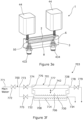
- FIG. 3a an assembly (3) of a foaming device (1) in an open configuration is shown.
- a casing (28) houses the first plate (6) and a second plate (8) connected by means of standard connection means.
- a fluid conduit having a cavity (30) is generated by the connection of the two plates (6, 8).
- a fluid flow inlet (332) and a fluid flow outlet (334) are positioned at opposite ends of said casing (28) along a fluid flow direction (shown by arrow 42).
- a mechanism to vary the distance between the plates in the form of a rack and pinion mechanism (36) is connected to the two plates (6, 8) to allow variation of the distance between them and consequently variation of the height of the cavity (30) itself.
- the rack and pinion (36) is activated through an activation means in the form of a rotating handle (38).
- a supplementary seal (40) is provided to secured sealing of the casing (28).
- the height (not shown) of said cavity (30) can vary in a range between 0.25 and 3 mm.
- the rack and pinion mechanism allows the two plates (6, 8) to slide between an open configuration (in Figure 3a ) where distance between the two plates (6, 8) is higher to a closer, working configuration (in Figure 3b ) where the gap between the two plates (6, 8) is lower or absent and the cavity (30) has a reduced volume.
- the cavity (30) volume can vary from 25 mm 3 to 6840 mm 3 with a height in the range of 0.25 to 3 mm, length in the range of 20 to 120 mm and width in the range of 5 to 19 mm.
- Figure 3c illustrates a perspective view of an alternative assembly (3) of a foaming device (1) of Figure 3b .
- a first plate holder (2) is connected by standard connection means (not shown) to a first plate (6).
- a second plate (8) is formed into a second plate holder (4) in the form of a polymeric block having a slot cut therein, the bottom surface of the slot forming the second plate (8).
- the first plate holder (2) and first plate (6) are positioned directly above the second plate (8) and movable towards and away therefrom.
- the first plate holder (2) is attached to a mechanism to vary the distance between the first plate (6) and the second plate (8) in the form of a cam (36).
- An activating means in the form of a motor (44) is connected to said cam (36).
- a resilient means in the form on a spring (46) is directly connected to said first plate holder (2), to transfer the movement input form the cam (36) to the first plate holder (2).
- a fluid flow inlet (432) and a fluid flow outlet (434) are spaced apart from each other and positioned both on the same side of the second plate holder (4).
- Any alternative -mechanically actuator can be used to adjust distance between the two plates (6, 8) during working and/or cleaning cycles.
- Said foaming device (701) is connected to a main water source (not shown).
- the assembly (703) comprises three main components: a casing (728); a first plate integral with a plate holder (706) with hemispheric protrusions (714) projecting therefrom and a second plate (708) with hemispheric protrusions (714) projecting toward said first plate (706).
- a standard movement transfer means as for example the resilient means in the form on a spring (46) shown in Figures 3c and 3d is directly connected to the first plate (706), to transfer the hydraulic movement input directly to the first plate itself (706).
- Each of the casing (728), first plate (706), and second plate (708) are connected via a main water circuit (700).
- the fluid circuit includes a number of conduits and valves as follows.
- a water inlet (771) enters a main water valve (772); downstream of the main water valve (772) are a T junction pipe (773) which leads to a pressure chamber circuit valve (774) and a foaming device circuit valve (775); downstream of the pressure chamber circuit valve (774) is a pressure chamber flow inlet (776) which enters the pressure chamber (777); downstream of the pressure chamber (777) is a pressure chamber flow outlet (778) which enters a main water discharging valve (779); while downstream of the foaming device circuit valve (775) is a foaming device flow inlet (732) which enters the foaming cavity (730); downstream of the foaming cavity (730) is a foaming devise flow outlet (734).
- a beverage mixing/extraction chamber (not shown) is also operably connect to the foaming device (701) through the foaming device circuit valve (775).
- the main water valve (772) is opened allowing flow downstream thereof, water enters the T junction (773) and consequently the pressure chamber (777) via the pressure chamber circuit valve (774) which is kept open, while the foaming device circuit valve (775) and the main water discharging valve (779) are kept closed.
- the pressure chamber (777) is then filled with water and the hydraulic pressure inside the pressure chamber (777) builds up exerting a hydraulic pressure on top of the first plate (706).
- a standard resilient means i.e.
- a spring allows the movement of said first plate (706) toward the opposite second plate (708), along the direction shown by arrow 742, varying the distance between the two plates (706, 708).
- the main water valve (772) and the pressure chamber circuit valve (774) are then closed to maintain the first plate (706) in the position, while the foaming device circuit valve (775) is opened to allow the beverage (such as for instance coffee beverage and/or milk etc) to enter the cavity (730) left between the two plates (706, 708) in working configuration via the foaming device flow inlet (732) and pass through a branched/ramified path generated between the protrusions (714) on the two plates (706, 708), leading to the creation of fine foam.
- the beverage such as for instance coffee beverage and/or milk etc
- the foam is then sent for consumption through the foaming device flow outlet (734).
- the main water discharging valve (779) is open to release the pressure inside the pressure chamber by discharging the water contained in the pressure chamber during working cycle.
- the main water valve (772) is opened and water is sent to the foaming device circuit valve (775), while the pressure chamber circuit valve (774) is kept closed.
- the water enters the cavity (730) through the foaming device flow inlet (732) and fills it.
- the water exerts a hydraulic pressure which pushes the two plates (706, 708) apart from each other allowing the water to clean the two opposite plates surfaces (not shown) and the protrusions (714) on both plates (706,708).
- a first plate holder (2) and a second plate holder (4) are connected respectively to a first plate (not shown) and a second plate (8) by standard connecting means. Baffles in the form of hemispherical protrusions (14) are protruding from the second plate (8) towards the first plate.
- the first plate is planar and does not include protrusions.
- a fluid flow inlet (532) and a fluid flow outlet (534) are both positioned on the first plate holder (2), spaced apart from each other.
- said fluid flow inlet (532) and fluid flow outlet (534) could both be positioned on the second plate holder (4).
- the turbulence generating conduit is formed when the flat first plate abuts the protrusions (14) of the second plate, so that fluid is forced between and around the protrusions of the first plate (14).
- the first plate (6) and a second plate (8) of Figure 5a comprise baffles in the form of cylindrical protrusions (52) protruding from each plate (6, 8) towards the opposite plate (6, 8).
- the cylindrical protrusions' distribution on the plates' surfaces is such that it creates a turbulence generating path between the two plates (6, 8) when the first plate (6) is connected to the second plate (8) and sealed (as described above for the embodiment and Figures 1 and 2 ).
- the cylindrical protrusions' distributions on the two plates (6, 8) are not in register to ensure the creation of such a turbulence generating path.
- baffle shape and material can be used for the two plates (6, 8) as discussed for Figure 1 .
- Figure 5b represents a portion of a fluid turbulence generating conduit (5) formed between the two sets of protrusions (52) of the first and second plates (6,8) of Figure 5a , when the plates (6,8) are brought together to the working position/configuration.
- the conduit (5) in Figure 5b is shown as a solid negative of the conduit formed by the baffles (52) of Figure 5a .
- Spaces (500) correspond to where the protrusions (52) are located.
- the two sets of protrusions (52) are off-set and not in register, they form a fluid turbulence generating conduit (5) between said plates (6, 8) when the plates are in a working configuration as part of a foaming device.
- FIG. 6a an end cross-sectional view of an alternative embodiment of a foaming device (1) comprising a casing in the form of a resilient sleeve (628) is shown, in an open (e.g. cleaning) configuration.
- a first plate (6) and a second plate (8) are connected to a first plate holder (2) and a second plate holder (4) which are integral to respectively the first plate (6) and the second plate (8).
- a side seal in the form of a protruding rim (54) extends along the sides of the second plate (6), matching a counterpart rim (56) located on the second plate (8).
- Baffles in the form of hemispherical protrusions (14) protrude from each plate towards the opposite one and the baffles on the plates (6, 8) are not in register, in order to create a turbulence generating path between said protrusions (14) when the foaming device (1) is in the working configuration.
- the first and second plate holders (2,4) are housed in a casing in the form of a resilient sleeve (628).
- Said sleeve (628) is made of an elastomeric substrate such as rubber, silicone and/or alternatively of plastic substrate for instance polypropylene (PP), polyethylene (PE), polyethylene terephthalate (PET), and/or polylactic acid (PLA), polyamide (PA), polycarbonate (PC) and/or a combination thereof.
- PP polypropylene
- PE polyethylene
- PET polyethylene terephthalate
- PLA polylactic acid
- PA polyamide
- PC polycarbonate
- the presence of the rim (54) overcomes the necessity of having sealing tight means such as a gasket, reducing the complexity of the foaming device (1) and manufacturing costs. Furthermore, a simplified structure with fewer pieces will ensure easier cleaning, reducing clogging and device failure.
- the plate holders (2, 4) can be co-moulded together with the respective plates (6, 8), but any alternative suitable solution to connect the plate holders (2, 4) to the plates (6, 8), as described for instance for the embodiment of Figure 1 , may be used.
- Said sleeve (628) is made of resilient material, and by action of an external force (such as one of the mechanisms of Figures 3a-3f , for example) it can flex and contract, which allows the two plate holders (2, 4) to move closer together, forming the working configuration, as shown in Figure 6b and then to separate from each other (as shown in Figure 6a ), increasing the distance between the two plates (6, 8)which facilitates cleaning cycles where water can be sent through the foaming device (1) when the two plates (6, 8) are separated from each other.
- an external force such as one of the mechanisms of Figures 3a-3f , for example
- a foaming device (1) comprising a casing device in the form of a rigid plastic cuff (628)
- Said cuff can be made of any suitable plastic material such as for example polypropylene (PP), polyethylene (PE), polyethylene terephthalate (PET), and/or polylactic acid (PLA), polyamide (PA), polycarbonate (PC) and/or a combination thereof.
- PP polypropylene
- PE polyethylene
- PET polyethylene terephthalate
- PLA polylactic acid
- PA polyamide
- PC polycarbonate
- FIG. 7a and 7b a device similar to the one shown in Figures 6a and 6b is shown, save that the resilient casing is absent and the flanges (58, 854) serve to solely seal the sides and create the side walls of the conduit formed between the two plates (6, 8).
- Figures 8a and 8b show cross-sectional views of an alternative embodiment of a foaming device (1) combined with part of a coffee preparation apparatus.
- a first plate (6) is located in a pod holder (904) on a lowermost surface (908) of said pod holder (904)
- the pod holder therefore acts as a first plate holder.
- a coffee pod (902) can be placed into the pod holder (904) as shown in Figure 8b .
- a second plate holder (4) with integral second plate (8) is located in a spout (906) of a coffee preparation apparatus outlet, in such a way to be in register with said first plate (6) when said pod holder (904) is inserted into said spout (906).
- Baffles in the form of hemispherical protrusions (14) protrude from each plate (6, 8) towards the opposite plate (6, 8), to generate a turbulence generating path.
- Figure 8a shows the two parts, pod holder (904) and spout (906) separated such that the first and second plates (6,8) are in the open (e.g. cleaning) configuration, and without an attached coffee pod (902) in the pod holder (904).
- Figure 8b shows the pod holder 904 and spout (906) connected, such that the two plates (6,8) abut and the protrusions (14) form a fluid conduit therebetween.
- a liquid inlet (not shown) provides a water flow (910) through the coffee pod (902) and a gas inlet (not shown) is provided with a gas flow (914) and is positioned laterally with respect to said water flow (910).
- the water flow (910) passing through the coffee pod (902) extracts coffee brew which then reaches the lowermost surface (908) of said pod holder (904) mixing with the gas flow (914) coming from the gas inlet (912).
- the mix of coffee brew and gas then passes through the turbulence generating conduit between the plates (6,8) to generate a foamed beverage.
- Figure 9 shows a comparison between a coffee foam generated through a foamer of the prior art provided with a restrictor (labelled "Ref') and a foaming device (1) of Figure 3a and 3b .
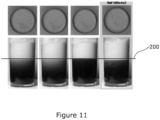
- Figure 11 shows the results of foaming of a coffee beverage over 6 repeats of the experimental conditions, showing foam height differences between the foam produced using the device (1) of the invention and that of the reference foamer of the prior art.
- Figure 10 shows a comparison between milk foam generated through a foamer of the prior art (in the column labelled Ref 100x4x2) provided with bead-in-tube and a foaming device (1) of the invention (the first two unlabelled columns).
- a height level line (200) highlights the interphase between foam and liquid.
- Figure 11 shows a comparison between coffee foam generated through a foamer of the prior art comprising a bead-in-tube foamer (the reference images are in the column labelled Ref 100x4x2) and a foamer device of the invention (the images of the first three columns of Figure 11 ).
- a height level line (200) highlight the interphase between foam and liquid.
Landscapes
- Chemical & Material Sciences (AREA)
- Chemical Kinetics & Catalysis (AREA)
- Engineering & Computer Science (AREA)
- Food Science & Technology (AREA)
- Dispersion Chemistry (AREA)
- Apparatus For Making Beverages (AREA)
- Devices For Dispensing Beverages (AREA)
Applications Claiming Priority (2)
| Application Number | Priority Date | Filing Date | Title |
|---|---|---|---|
| GB1812279.6A GB2575870B (en) | 2018-07-27 | 2018-07-27 | Beverage preparation apparatus comprising a foaming device and method therefor |
| PCT/EP2019/069532 WO2020020781A1 (en) | 2018-07-27 | 2019-07-19 | Foaming device, apparatus and method therefor |
Publications (2)
| Publication Number | Publication Date |
|---|---|
| EP3829403A1 EP3829403A1 (en) | 2021-06-09 |
| EP3829403B1 true EP3829403B1 (en) | 2024-03-13 |
Family
ID=63518024
Family Applications (1)
| Application Number | Title | Priority Date | Filing Date |
|---|---|---|---|
| EP19742365.0A Active EP3829403B1 (en) | 2018-07-27 | 2019-07-19 | A beverage preparation apparatus comprising a foaming device and method therefor |
Country Status (8)
| Country | Link |
|---|---|
| US (1) | US12342956B2 (pl) |
| EP (1) | EP3829403B1 (pl) |
| CN (1) | CN112423632B (pl) |
| ES (1) | ES2983508T3 (pl) |
| GB (1) | GB2575870B (pl) |
| PL (1) | PL3829403T4 (pl) |
| PT (1) | PT3829403T (pl) |
| WO (1) | WO2020020781A1 (pl) |
Families Citing this family (1)
| Publication number | Priority date | Publication date | Assignee | Title |
|---|---|---|---|---|
| JP7783617B2 (ja) * | 2021-10-27 | 2025-12-10 | 安原環境テクノロジー株式会社 | 酸素溶解装置およびこれを用いた酸素溶解方法 |
Citations (1)
| Publication number | Priority date | Publication date | Assignee | Title |
|---|---|---|---|---|
| WO2008049854A1 (de) * | 2006-10-27 | 2008-05-02 | Stockhausen Gmbh | Schäumvorrichtung zur erzeugung eines pflege- oder reinigungsschaums |
Family Cites Families (14)
| Publication number | Priority date | Publication date | Assignee | Title |
|---|---|---|---|---|
| US2508528A (en) * | 1949-01-12 | 1950-05-23 | Mosinee Paper Mills Company | Foam separator |
| GB891152A (en) * | 1957-11-21 | 1962-03-14 | Peter Willems | A method and apparatus for continuously changing the structure of substances or mixtures of such substances |
| US20080066623A1 (en) * | 2004-07-07 | 2008-03-20 | Koninklijke Philips Electronics N. V. | Coffee Maker Comprising Means For Creating Turbulence In A Coffee Flow |
| JP2008542145A (ja) * | 2005-06-07 | 2008-11-27 | コーニンクレッカ フィリップス エレクトロニクス エヌ ヴィ | 飲料メーカーで使用するためのポンプ・ユニットと使い捨てカートリッジ |
| NL2000494C2 (nl) * | 2006-03-21 | 2009-01-20 | Dong-Lei Wang | Schuiminrichting in een koffiemachine. |
| EP2042063A1 (de) | 2007-09-28 | 2009-04-01 | Cafina AG | Anordnung zur Erzeugung von Milchschaum |
| CN103841862B (zh) * | 2011-09-09 | 2017-10-20 | 弗特马斯特有限责任公司 | 饮料机 |
| DE102013224786B3 (de) * | 2013-12-03 | 2015-03-12 | Wmf Ag | Milchaufschäumvorrichtung mit dynamischer Mischeinheit und Getränkebereiter enthaltend dieselbe |
| CN105559586B (zh) * | 2014-10-10 | 2019-05-24 | 广东美的生活电器制造有限公司 | 饮料胶囊 |
| CN204169655U (zh) * | 2014-11-07 | 2015-02-25 | 成都爱维科创科技有限公司 | 一种可消泡豆浆机 |
| ITMI20141968A1 (it) * | 2014-11-14 | 2016-05-14 | De Longhi Appliances Srl | Dispositivo e metodo di schiumatura del latte |
| CA2994198A1 (en) * | 2015-08-25 | 2017-03-02 | Nestec S.A. | Appliance for foaming beverage or foodstuff |
| US11134807B2 (en) * | 2015-09-25 | 2021-10-05 | Societe Des Produits Nestle S.A. | Frothing device |
| JP6609819B2 (ja) * | 2017-04-05 | 2019-11-27 | 株式会社 Toshin | マイクロバブル発生装置、マイクロバブルと泡沫との切替え装置及びシャワーヘッド |
-
2018
- 2018-07-27 GB GB1812279.6A patent/GB2575870B/en active Active
-
2019
- 2019-07-19 EP EP19742365.0A patent/EP3829403B1/en active Active
- 2019-07-19 US US17/263,371 patent/US12342956B2/en active Active
- 2019-07-19 CN CN201980046909.1A patent/CN112423632B/zh active Active
- 2019-07-19 ES ES19742365T patent/ES2983508T3/es active Active
- 2019-07-19 PT PT197423650T patent/PT3829403T/pt unknown
- 2019-07-19 WO PCT/EP2019/069532 patent/WO2020020781A1/en not_active Ceased
- 2019-07-19 PL PL19742365.0T patent/PL3829403T4/pl unknown
Patent Citations (1)
| Publication number | Priority date | Publication date | Assignee | Title |
|---|---|---|---|---|
| WO2008049854A1 (de) * | 2006-10-27 | 2008-05-02 | Stockhausen Gmbh | Schäumvorrichtung zur erzeugung eines pflege- oder reinigungsschaums |
Also Published As
| Publication number | Publication date |
|---|---|
| GB2575870B (en) | 2023-04-19 |
| CN112423632B (zh) | 2023-03-14 |
| US12342956B2 (en) | 2025-07-01 |
| ES2983508T3 (es) | 2024-10-23 |
| WO2020020781A1 (en) | 2020-01-30 |
| GB2575870A (en) | 2020-01-29 |
| US20210282586A1 (en) | 2021-09-16 |
| CN112423632A (zh) | 2021-02-26 |
| PL3829403T3 (pl) | 2024-07-22 |
| GB201812279D0 (en) | 2018-09-12 |
| PL3829403T4 (pl) | 2024-07-29 |
| PT3829403T (pt) | 2024-06-27 |
| EP3829403A1 (en) | 2021-06-09 |
Similar Documents
| Publication | Publication Date | Title |
|---|---|---|
| US20100269705A1 (en) | Device for perforating portioned capsules | |
| JP4891078B2 (ja) | 物質を入れたカプセルを使用して飲み物を準備するための方法と装置 | |
| JP5868493B2 (ja) | 飲料/食料品調製システム | |
| EP1975087B2 (en) | Capsule with flow regulating technology | |
| US9833103B2 (en) | Capsule-based food preparation system | |
| RU2605183C2 (ru) | Капсула для приготовления напитка | |
| JP2004534562A (ja) | カプセルから飲料を準備する装置の水注入器 | |
| RU2610405C2 (ru) | Способ и система для приготовления напитка | |
| EP3829403B1 (en) | A beverage preparation apparatus comprising a foaming device and method therefor | |
| US11091315B2 (en) | Capsule for beverage preparation machine | |
| EP3416897A1 (en) | Disposable capsule for machines for the dispensing of infused beverages | |
| US20200268195A1 (en) | Assembly adapted to be embedded in a mixing head of a food or beverage preparation machine | |
| US20200216257A1 (en) | Single-dose capsule for the production of beverages |
Legal Events
| Date | Code | Title | Description |
|---|---|---|---|
| STAA | Information on the status of an ep patent application or granted ep patent |
Free format text: STATUS: UNKNOWN |
|
| STAA | Information on the status of an ep patent application or granted ep patent |
Free format text: STATUS: THE INTERNATIONAL PUBLICATION HAS BEEN MADE |
|
| PUAI | Public reference made under article 153(3) epc to a published international application that has entered the european phase |
Free format text: ORIGINAL CODE: 0009012 |
|
| STAA | Information on the status of an ep patent application or granted ep patent |
Free format text: STATUS: REQUEST FOR EXAMINATION WAS MADE |
|
| 17P | Request for examination filed |
Effective date: 20210128 |
|
| AK | Designated contracting states |
Kind code of ref document: A1 Designated state(s): AL AT BE BG CH CY CZ DE DK EE ES FI FR GB GR HR HU IE IS IT LI LT LU LV MC MK MT NL NO PL PT RO RS SE SI SK SM TR |
|
| DAV | Request for validation of the european patent (deleted) | ||
| DAX | Request for extension of the european patent (deleted) | ||
| STAA | Information on the status of an ep patent application or granted ep patent |
Free format text: STATUS: EXAMINATION IS IN PROGRESS |
|
| 17Q | First examination report despatched |
Effective date: 20230503 |
|
| P01 | Opt-out of the competence of the unified patent court (upc) registered |
Effective date: 20230504 |
|
| GRAP | Despatch of communication of intention to grant a patent |
Free format text: ORIGINAL CODE: EPIDOSNIGR1 |
|
| STAA | Information on the status of an ep patent application or granted ep patent |
Free format text: STATUS: GRANT OF PATENT IS INTENDED |
|
| INTG | Intention to grant announced |
Effective date: 20231009 |
|
| GRAS | Grant fee paid |
Free format text: ORIGINAL CODE: EPIDOSNIGR3 |
|
| GRAA | (expected) grant |
Free format text: ORIGINAL CODE: 0009210 |
|
| STAA | Information on the status of an ep patent application or granted ep patent |
Free format text: STATUS: THE PATENT HAS BEEN GRANTED |
|
| AK | Designated contracting states |
Kind code of ref document: B1 Designated state(s): AL AT BE BG CH CY CZ DE DK EE ES FI FR GB GR HR HU IE IS IT LI LT LU LV MC MK MT NL NO PL PT RO RS SE SI SK SM TR |
|
| REG | Reference to a national code |
Ref country code: GB Ref legal event code: FG4D |
|
| REG | Reference to a national code |
Ref country code: CH Ref legal event code: EP |
|
| REG | Reference to a national code |
Ref country code: DE Ref legal event code: R096 Ref document number: 602019048224 Country of ref document: DE |
|
| REG | Reference to a national code |
Ref country code: IE Ref legal event code: FG4D |
|
| REG | Reference to a national code |
Ref country code: PT Ref legal event code: SC4A Ref document number: 3829403 Country of ref document: PT Date of ref document: 20240627 Kind code of ref document: T Free format text: AVAILABILITY OF NATIONAL TRANSLATION Effective date: 20240624 |
|
| PG25 | Lapsed in a contracting state [announced via postgrant information from national office to epo] |
Ref country code: LT Free format text: LAPSE BECAUSE OF FAILURE TO SUBMIT A TRANSLATION OF THE DESCRIPTION OR TO PAY THE FEE WITHIN THE PRESCRIBED TIME-LIMIT Effective date: 20240313 |
|
| REG | Reference to a national code |
Ref country code: LT Ref legal event code: MG9D |
|
| PG25 | Lapsed in a contracting state [announced via postgrant information from national office to epo] |
Ref country code: GR Free format text: LAPSE BECAUSE OF FAILURE TO SUBMIT A TRANSLATION OF THE DESCRIPTION OR TO PAY THE FEE WITHIN THE PRESCRIBED TIME-LIMIT Effective date: 20240614 |
|
| PG25 | Lapsed in a contracting state [announced via postgrant information from national office to epo] |
Ref country code: RS Free format text: LAPSE BECAUSE OF FAILURE TO SUBMIT A TRANSLATION OF THE DESCRIPTION OR TO PAY THE FEE WITHIN THE PRESCRIBED TIME-LIMIT Effective date: 20240613 Ref country code: HR Free format text: LAPSE BECAUSE OF FAILURE TO SUBMIT A TRANSLATION OF THE DESCRIPTION OR TO PAY THE FEE WITHIN THE PRESCRIBED TIME-LIMIT Effective date: 20240313 |
|
| REG | Reference to a national code |
Ref country code: NL Ref legal event code: FP |
|
| PG25 | Lapsed in a contracting state [announced via postgrant information from national office to epo] |
Ref country code: RS Free format text: LAPSE BECAUSE OF FAILURE TO SUBMIT A TRANSLATION OF THE DESCRIPTION OR TO PAY THE FEE WITHIN THE PRESCRIBED TIME-LIMIT Effective date: 20240613 Ref country code: NO Free format text: LAPSE BECAUSE OF FAILURE TO SUBMIT A TRANSLATION OF THE DESCRIPTION OR TO PAY THE FEE WITHIN THE PRESCRIBED TIME-LIMIT Effective date: 20240613 Ref country code: LT Free format text: LAPSE BECAUSE OF FAILURE TO SUBMIT A TRANSLATION OF THE DESCRIPTION OR TO PAY THE FEE WITHIN THE PRESCRIBED TIME-LIMIT Effective date: 20240313 Ref country code: HR Free format text: LAPSE BECAUSE OF FAILURE TO SUBMIT A TRANSLATION OF THE DESCRIPTION OR TO PAY THE FEE WITHIN THE PRESCRIBED TIME-LIMIT Effective date: 20240313 Ref country code: GR Free format text: LAPSE BECAUSE OF FAILURE TO SUBMIT A TRANSLATION OF THE DESCRIPTION OR TO PAY THE FEE WITHIN THE PRESCRIBED TIME-LIMIT Effective date: 20240614 Ref country code: FI Free format text: LAPSE BECAUSE OF FAILURE TO SUBMIT A TRANSLATION OF THE DESCRIPTION OR TO PAY THE FEE WITHIN THE PRESCRIBED TIME-LIMIT Effective date: 20240313 Ref country code: BG Free format text: LAPSE BECAUSE OF FAILURE TO SUBMIT A TRANSLATION OF THE DESCRIPTION OR TO PAY THE FEE WITHIN THE PRESCRIBED TIME-LIMIT Effective date: 20240313 |
|
| REG | Reference to a national code |
Ref country code: AT Ref legal event code: MK05 Ref document number: 1664906 Country of ref document: AT Kind code of ref document: T Effective date: 20240313 |
|
| PG25 | Lapsed in a contracting state [announced via postgrant information from national office to epo] |
Ref country code: SE Free format text: LAPSE BECAUSE OF FAILURE TO SUBMIT A TRANSLATION OF THE DESCRIPTION OR TO PAY THE FEE WITHIN THE PRESCRIBED TIME-LIMIT Effective date: 20240313 Ref country code: LV Free format text: LAPSE BECAUSE OF FAILURE TO SUBMIT A TRANSLATION OF THE DESCRIPTION OR TO PAY THE FEE WITHIN THE PRESCRIBED TIME-LIMIT Effective date: 20240313 |
|
| PG25 | Lapsed in a contracting state [announced via postgrant information from national office to epo] |
Ref country code: IS Free format text: LAPSE BECAUSE OF FAILURE TO SUBMIT A TRANSLATION OF THE DESCRIPTION OR TO PAY THE FEE WITHIN THE PRESCRIBED TIME-LIMIT Effective date: 20240713 |
|
| PG25 | Lapsed in a contracting state [announced via postgrant information from national office to epo] |
Ref country code: SM Free format text: LAPSE BECAUSE OF FAILURE TO SUBMIT A TRANSLATION OF THE DESCRIPTION OR TO PAY THE FEE WITHIN THE PRESCRIBED TIME-LIMIT Effective date: 20240313 |
|
| PG25 | Lapsed in a contracting state [announced via postgrant information from national office to epo] |
Ref country code: EE Free format text: LAPSE BECAUSE OF FAILURE TO SUBMIT A TRANSLATION OF THE DESCRIPTION OR TO PAY THE FEE WITHIN THE PRESCRIBED TIME-LIMIT Effective date: 20240313 |
|
| REG | Reference to a national code |
Ref country code: ES Ref legal event code: FG2A Ref document number: 2983508 Country of ref document: ES Kind code of ref document: T3 Effective date: 20241023 |
|
| PG25 | Lapsed in a contracting state [announced via postgrant information from national office to epo] |
Ref country code: AT Free format text: LAPSE BECAUSE OF FAILURE TO SUBMIT A TRANSLATION OF THE DESCRIPTION OR TO PAY THE FEE WITHIN THE PRESCRIBED TIME-LIMIT Effective date: 20240313 |
|
| PG25 | Lapsed in a contracting state [announced via postgrant information from national office to epo] |
Ref country code: SK Free format text: LAPSE BECAUSE OF FAILURE TO SUBMIT A TRANSLATION OF THE DESCRIPTION OR TO PAY THE FEE WITHIN THE PRESCRIBED TIME-LIMIT Effective date: 20240313 |
|
| PG25 | Lapsed in a contracting state [announced via postgrant information from national office to epo] |
Ref country code: SM Free format text: LAPSE BECAUSE OF FAILURE TO SUBMIT A TRANSLATION OF THE DESCRIPTION OR TO PAY THE FEE WITHIN THE PRESCRIBED TIME-LIMIT Effective date: 20240313 Ref country code: SK Free format text: LAPSE BECAUSE OF FAILURE TO SUBMIT A TRANSLATION OF THE DESCRIPTION OR TO PAY THE FEE WITHIN THE PRESCRIBED TIME-LIMIT Effective date: 20240313 Ref country code: RO Free format text: LAPSE BECAUSE OF FAILURE TO SUBMIT A TRANSLATION OF THE DESCRIPTION OR TO PAY THE FEE WITHIN THE PRESCRIBED TIME-LIMIT Effective date: 20240313 Ref country code: IS Free format text: LAPSE BECAUSE OF FAILURE TO SUBMIT A TRANSLATION OF THE DESCRIPTION OR TO PAY THE FEE WITHIN THE PRESCRIBED TIME-LIMIT Effective date: 20240713 Ref country code: EE Free format text: LAPSE BECAUSE OF FAILURE TO SUBMIT A TRANSLATION OF THE DESCRIPTION OR TO PAY THE FEE WITHIN THE PRESCRIBED TIME-LIMIT Effective date: 20240313 Ref country code: AT Free format text: LAPSE BECAUSE OF FAILURE TO SUBMIT A TRANSLATION OF THE DESCRIPTION OR TO PAY THE FEE WITHIN THE PRESCRIBED TIME-LIMIT Effective date: 20240313 |
|
| REG | Reference to a national code |
Ref country code: DE Ref legal event code: R097 Ref document number: 602019048224 Country of ref document: DE |
|
| PG25 | Lapsed in a contracting state [announced via postgrant information from national office to epo] |
Ref country code: DK Free format text: LAPSE BECAUSE OF FAILURE TO SUBMIT A TRANSLATION OF THE DESCRIPTION OR TO PAY THE FEE WITHIN THE PRESCRIBED TIME-LIMIT Effective date: 20240313 |
|
| PLBE | No opposition filed within time limit |
Free format text: ORIGINAL CODE: 0009261 |
|
| STAA | Information on the status of an ep patent application or granted ep patent |
Free format text: STATUS: NO OPPOSITION FILED WITHIN TIME LIMIT |
|
| PG25 | Lapsed in a contracting state [announced via postgrant information from national office to epo] |
Ref country code: DK Free format text: LAPSE BECAUSE OF FAILURE TO SUBMIT A TRANSLATION OF THE DESCRIPTION OR TO PAY THE FEE WITHIN THE PRESCRIBED TIME-LIMIT Effective date: 20240313 |
|
| PG25 | Lapsed in a contracting state [announced via postgrant information from national office to epo] |
Ref country code: MC Free format text: LAPSE BECAUSE OF FAILURE TO SUBMIT A TRANSLATION OF THE DESCRIPTION OR TO PAY THE FEE WITHIN THE PRESCRIBED TIME-LIMIT Effective date: 20240313 |
|
| 26N | No opposition filed |
Effective date: 20241216 |
|
| PG25 | Lapsed in a contracting state [announced via postgrant information from national office to epo] |
Ref country code: LU Free format text: LAPSE BECAUSE OF NON-PAYMENT OF DUE FEES Effective date: 20240719 |
|
| PG25 | Lapsed in a contracting state [announced via postgrant information from national office to epo] |
Ref country code: LU Free format text: LAPSE BECAUSE OF NON-PAYMENT OF DUE FEES Effective date: 20240719 |
|
| PG25 | Lapsed in a contracting state [announced via postgrant information from national office to epo] |
Ref country code: SI Free format text: LAPSE BECAUSE OF FAILURE TO SUBMIT A TRANSLATION OF THE DESCRIPTION OR TO PAY THE FEE WITHIN THE PRESCRIBED TIME-LIMIT Effective date: 20240313 |
|
| PG25 | Lapsed in a contracting state [announced via postgrant information from national office to epo] |
Ref country code: IE Free format text: LAPSE BECAUSE OF NON-PAYMENT OF DUE FEES Effective date: 20240719 |
|
| PGFP | Annual fee paid to national office [announced via postgrant information from national office to epo] |
Ref country code: NL Payment date: 20250726 Year of fee payment: 7 |
|
| PGFP | Annual fee paid to national office [announced via postgrant information from national office to epo] |
Ref country code: ES Payment date: 20250801 Year of fee payment: 7 Ref country code: PT Payment date: 20250702 Year of fee payment: 7 |
|
| PGFP | Annual fee paid to national office [announced via postgrant information from national office to epo] |
Ref country code: DE Payment date: 20250729 Year of fee payment: 7 |
|
| PGFP | Annual fee paid to national office [announced via postgrant information from national office to epo] |
Ref country code: PL Payment date: 20250703 Year of fee payment: 7 Ref country code: IT Payment date: 20250721 Year of fee payment: 7 |
|
| PGFP | Annual fee paid to national office [announced via postgrant information from national office to epo] |
Ref country code: BE Payment date: 20250728 Year of fee payment: 7 Ref country code: GB Payment date: 20250728 Year of fee payment: 7 |
|
| PGFP | Annual fee paid to national office [announced via postgrant information from national office to epo] |
Ref country code: FR Payment date: 20250725 Year of fee payment: 7 |
|
| PGFP | Annual fee paid to national office [announced via postgrant information from national office to epo] |
Ref country code: CH Payment date: 20250801 Year of fee payment: 7 |
|
| PGFP | Annual fee paid to national office [announced via postgrant information from national office to epo] |
Ref country code: CZ Payment date: 20250704 Year of fee payment: 7 |
|
| PG25 | Lapsed in a contracting state [announced via postgrant information from national office to epo] |
Ref country code: CY Free format text: LAPSE BECAUSE OF FAILURE TO SUBMIT A TRANSLATION OF THE DESCRIPTION OR TO PAY THE FEE WITHIN THE PRESCRIBED TIME-LIMIT; INVALID AB INITIO Effective date: 20190719 |