EP3828436B1 - Separation element for a hydraulic anti-vibration module, and hydraulic anti-vibration module equipped with such a separation element - Google Patents
Separation element for a hydraulic anti-vibration module, and hydraulic anti-vibration module equipped with such a separation element Download PDFInfo
- Publication number
- EP3828436B1 EP3828436B1 EP20209829.9A EP20209829A EP3828436B1 EP 3828436 B1 EP3828436 B1 EP 3828436B1 EP 20209829 A EP20209829 A EP 20209829A EP 3828436 B1 EP3828436 B1 EP 3828436B1
- Authority
- EP
- European Patent Office
- Prior art keywords
- mouth
- duct
- separation element
- lid
- main body
- Prior art date
- Legal status (The legal status is an assumption and is not a legal conclusion. Google has not performed a legal analysis and makes no representation as to the accuracy of the status listed.)
- Active
Links
Images

Classifications
-
- F—MECHANICAL ENGINEERING; LIGHTING; HEATING; WEAPONS; BLASTING
- F16—ENGINEERING ELEMENTS AND UNITS; GENERAL MEASURES FOR PRODUCING AND MAINTAINING EFFECTIVE FUNCTIONING OF MACHINES OR INSTALLATIONS; THERMAL INSULATION IN GENERAL
- F16F—SPRINGS; SHOCK-ABSORBERS; MEANS FOR DAMPING VIBRATION
- F16F13/00—Units comprising springs of the non-fluid type as well as vibration-dampers, shock-absorbers, or fluid springs
- F16F13/04—Units comprising springs of the non-fluid type as well as vibration-dampers, shock-absorbers, or fluid springs comprising both a plastics spring and a damper, e.g. a friction damper
- F16F13/06—Units comprising springs of the non-fluid type as well as vibration-dampers, shock-absorbers, or fluid springs comprising both a plastics spring and a damper, e.g. a friction damper the damper being a fluid damper, e.g. the plastics spring not forming a part of the wall of the fluid chamber of the damper
- F16F13/08—Units comprising springs of the non-fluid type as well as vibration-dampers, shock-absorbers, or fluid springs comprising both a plastics spring and a damper, e.g. a friction damper the damper being a fluid damper, e.g. the plastics spring not forming a part of the wall of the fluid chamber of the damper the plastics spring forming at least a part of the wall of the fluid chamber of the damper
- F16F13/14—Units of the bushing type, i.e. loaded predominantly radially
- F16F13/1463—Units of the bushing type, i.e. loaded predominantly radially characterised by features of passages between working chambers
-
- F—MECHANICAL ENGINEERING; LIGHTING; HEATING; WEAPONS; BLASTING
- F16—ENGINEERING ELEMENTS AND UNITS; GENERAL MEASURES FOR PRODUCING AND MAINTAINING EFFECTIVE FUNCTIONING OF MACHINES OR INSTALLATIONS; THERMAL INSULATION IN GENERAL
- F16F—SPRINGS; SHOCK-ABSORBERS; MEANS FOR DAMPING VIBRATION
- F16F13/00—Units comprising springs of the non-fluid type as well as vibration-dampers, shock-absorbers, or fluid springs
- F16F13/04—Units comprising springs of the non-fluid type as well as vibration-dampers, shock-absorbers, or fluid springs comprising both a plastics spring and a damper, e.g. a friction damper
- F16F13/06—Units comprising springs of the non-fluid type as well as vibration-dampers, shock-absorbers, or fluid springs comprising both a plastics spring and a damper, e.g. a friction damper the damper being a fluid damper, e.g. the plastics spring not forming a part of the wall of the fluid chamber of the damper
- F16F13/08—Units comprising springs of the non-fluid type as well as vibration-dampers, shock-absorbers, or fluid springs comprising both a plastics spring and a damper, e.g. a friction damper the damper being a fluid damper, e.g. the plastics spring not forming a part of the wall of the fluid chamber of the damper the plastics spring forming at least a part of the wall of the fluid chamber of the damper
- F16F13/10—Units comprising springs of the non-fluid type as well as vibration-dampers, shock-absorbers, or fluid springs comprising both a plastics spring and a damper, e.g. a friction damper the damper being a fluid damper, e.g. the plastics spring not forming a part of the wall of the fluid chamber of the damper the plastics spring forming at least a part of the wall of the fluid chamber of the damper the wall being at least in part formed by a flexible membrane or the like
- F16F13/105—Units comprising springs of the non-fluid type as well as vibration-dampers, shock-absorbers, or fluid springs comprising both a plastics spring and a damper, e.g. a friction damper the damper being a fluid damper, e.g. the plastics spring not forming a part of the wall of the fluid chamber of the damper the plastics spring forming at least a part of the wall of the fluid chamber of the damper the wall being at least in part formed by a flexible membrane or the like characterised by features of partitions between two working chambers
- F16F13/107—Passage design between working chambers
-
- B—PERFORMING OPERATIONS; TRANSPORTING
- B60—VEHICLES IN GENERAL
- B60K—ARRANGEMENT OR MOUNTING OF PROPULSION UNITS OR OF TRANSMISSIONS IN VEHICLES; ARRANGEMENT OR MOUNTING OF PLURAL DIVERSE PRIME-MOVERS IN VEHICLES; AUXILIARY DRIVES FOR VEHICLES; INSTRUMENTATION OR DASHBOARDS FOR VEHICLES; ARRANGEMENTS IN CONNECTION WITH COOLING, AIR INTAKE, GAS EXHAUST OR FUEL SUPPLY OF PROPULSION UNITS IN VEHICLES
- B60K8/00—Arrangement or mounting of propulsion units not provided for in one of main groups B60K1/00 - B60K7/00
-
- B—PERFORMING OPERATIONS; TRANSPORTING
- B60—VEHICLES IN GENERAL
- B60K—ARRANGEMENT OR MOUNTING OF PROPULSION UNITS OR OF TRANSMISSIONS IN VEHICLES; ARRANGEMENT OR MOUNTING OF PLURAL DIVERSE PRIME-MOVERS IN VEHICLES; AUXILIARY DRIVES FOR VEHICLES; INSTRUMENTATION OR DASHBOARDS FOR VEHICLES; ARRANGEMENTS IN CONNECTION WITH COOLING, AIR INTAKE, GAS EXHAUST OR FUEL SUPPLY OF PROPULSION UNITS IN VEHICLES
- B60K5/00—Arrangement or mounting of internal-combustion or jet-propulsion units
- B60K5/12—Arrangement of engine supports
- B60K5/1208—Resilient supports
-
- B—PERFORMING OPERATIONS; TRANSPORTING
- B62—LAND VEHICLES FOR TRAVELLING OTHERWISE THAN ON RAILS
- B62D—MOTOR VEHICLES; TRAILERS
- B62D21/00—Understructures, i.e. chassis frame on which a vehicle body may be mounted
- B62D21/11—Understructures, i.e. chassis frame on which a vehicle body may be mounted with resilient means for suspension, e.g. of wheels or engine; sub-frames for mounting engine or suspensions
-
- B—PERFORMING OPERATIONS; TRANSPORTING
- B62—LAND VEHICLES FOR TRAVELLING OTHERWISE THAN ON RAILS
- B62D—MOTOR VEHICLES; TRAILERS
- B62D27/00—Connections between superstructure or understructure sub-units
- B62D27/04—Connections between superstructure or understructure sub-units resilient
-
- F—MECHANICAL ENGINEERING; LIGHTING; HEATING; WEAPONS; BLASTING
- F16—ENGINEERING ELEMENTS AND UNITS; GENERAL MEASURES FOR PRODUCING AND MAINTAINING EFFECTIVE FUNCTIONING OF MACHINES OR INSTALLATIONS; THERMAL INSULATION IN GENERAL
- F16F—SPRINGS; SHOCK-ABSORBERS; MEANS FOR DAMPING VIBRATION
- F16F13/00—Units comprising springs of the non-fluid type as well as vibration-dampers, shock-absorbers, or fluid springs
- F16F13/04—Units comprising springs of the non-fluid type as well as vibration-dampers, shock-absorbers, or fluid springs comprising both a plastics spring and a damper, e.g. a friction damper
- F16F13/06—Units comprising springs of the non-fluid type as well as vibration-dampers, shock-absorbers, or fluid springs comprising both a plastics spring and a damper, e.g. a friction damper the damper being a fluid damper, e.g. the plastics spring not forming a part of the wall of the fluid chamber of the damper
- F16F13/08—Units comprising springs of the non-fluid type as well as vibration-dampers, shock-absorbers, or fluid springs comprising both a plastics spring and a damper, e.g. a friction damper the damper being a fluid damper, e.g. the plastics spring not forming a part of the wall of the fluid chamber of the damper the plastics spring forming at least a part of the wall of the fluid chamber of the damper
- F16F13/18—Units comprising springs of the non-fluid type as well as vibration-dampers, shock-absorbers, or fluid springs comprising both a plastics spring and a damper, e.g. a friction damper the damper being a fluid damper, e.g. the plastics spring not forming a part of the wall of the fluid chamber of the damper the plastics spring forming at least a part of the wall of the fluid chamber of the damper characterised by the location or the shape of the equilibration chamber, e.g. the equilibration chamber, surrounding the plastics spring or being annular
-
- F—MECHANICAL ENGINEERING; LIGHTING; HEATING; WEAPONS; BLASTING
- F16—ENGINEERING ELEMENTS AND UNITS; GENERAL MEASURES FOR PRODUCING AND MAINTAINING EFFECTIVE FUNCTIONING OF MACHINES OR INSTALLATIONS; THERMAL INSULATION IN GENERAL
- F16F—SPRINGS; SHOCK-ABSORBERS; MEANS FOR DAMPING VIBRATION
- F16F15/00—Suppression of vibrations in systems; Means or arrangements for avoiding or reducing out-of-balance forces, e.g. due to motion
- F16F15/02—Suppression of vibrations of non-rotating, e.g. reciprocating systems; Suppression of vibrations of rotating systems by use of members not moving with the rotating systems
-
- F—MECHANICAL ENGINEERING; LIGHTING; HEATING; WEAPONS; BLASTING
- F16—ENGINEERING ELEMENTS AND UNITS; GENERAL MEASURES FOR PRODUCING AND MAINTAINING EFFECTIVE FUNCTIONING OF MACHINES OR INSTALLATIONS; THERMAL INSULATION IN GENERAL
- F16F—SPRINGS; SHOCK-ABSORBERS; MEANS FOR DAMPING VIBRATION
- F16F15/00—Suppression of vibrations in systems; Means or arrangements for avoiding or reducing out-of-balance forces, e.g. due to motion
- F16F15/02—Suppression of vibrations of non-rotating, e.g. reciprocating systems; Suppression of vibrations of rotating systems by use of members not moving with the rotating systems
- F16F15/023—Suppression of vibrations of non-rotating, e.g. reciprocating systems; Suppression of vibrations of rotating systems by use of members not moving with the rotating systems using fluid means
Definitions
- the present disclosure relates to a separation element for a hydraulic anti-vibration module for mounting an engine on a vehicle body, and to a hydraulic anti-vibration module equipped with such a separation element.
- Anti-vibration devices for mounting an engine on a vehicle body, comprising a first frame joined to a second frame by means of a hydraulic anti-vibration module that is able to deform at least along a main vibration axis, are known.
- One embodiment relates to a separation element configured to separate a working chamber from a compensation chamber of a hydraulic anti-vibration module configured for mounting an engine on a vehicle body, the separation element comprising a first duct extending between a first mouth and a second mouth, wherein the first mouth is created in a first face of the separation element and is configured to be fluidically connected to the working chamber, wherein the second mouth is created in a second face of the separation element and is configured to be fluidically connected to the compensation chamber, and wherein the first mouth is divided into a plurality of openings.
- a mouth corresponds to an inlet or an outlet of a passage that is configured to convey a fluid.
- a mouth can equally be a fluid inlet or a fluid outlet.
- a first mouth comprising a plurality of openings at the inlet of the first duct makes it possible to increase the fluid resistance and/or the friction at the first mouth (at hence the fluid resistance and/or the friction of the first duct) compared to a single opening of the prior art.
- Increasing the friction makes it possible on one hand to broaden the range of frequencies of the vibrations that are damped by the hydraulic damping module, and makes it possible on the other hand to reduce the amplitude of the maximum amplitude oscillations of the system observed at a given frequency of the oscillations of the fluid in the first duct.
- the range of frequencies of vibrations that are damped is broadened, while retaining satisfactory damping over the entire range of frequencies of vibrations that are damped.
- the implosion of the large bubbles generates vibrations across the whole spectrum of frequencies, since the resulting change in volume can be likened to a Dirac impulse, whose spectrum has a very broad range of excited frequencies.
- the implosion of multiple small bubbles of different diameters excites different, more limited ranges of frequencies. As a result, these implosions of smaller cavitation bubbles generate less noise/vibration.
- the first mouth comprises a plate in which the plurality of openings is created.
- the first mouth can be produced separately from the separation element, by adding a plate into which the plurality of openings is created.
- the openings may be identical in size and/or shape, but not necessarily. This makes it easier to adjust the range of frequencies of the vibrations that are damped, according to requirements.
- the first mouth comprises a grille.
- the first mouth can be produced separately from the separation element, by adding a grille. This makes it easier to adjust the range of frequencies of the vibrations that are damped, according to requirements.
- a second duct extends between a third mouth, created in the first face of the separation element and configured to be fluidically connected to the working chamber, and a fourth mouth, created in the second face of the separation element and configured to be fluidically connected to the compensation chamber, wherein preferably the third mouth comprises a single opening, and wherein more preferably a diameter of the opening of the third mouth is larger than a diameter of any one of the openings of the first mouth.
- second duct When a low-friction duct (second duct) is combined with a higher-friction duct (first duct), it is possible to increase the level of damping, while increasing the range of frequencies of the vibrations that are damped.
- the second mouth and/or the fourth mouth each comprise a single (i.e. a unique) opening.
- the separation element comprises a main body and a lid, wherein the first duct and/or the second duct are channels created in a first face of the main body, and wherein more preferably the channels are covered by the lid.
- the separation element is produced more simply. Indeed, producing a main body comprising channels and a lid covering these channels makes it easier to produce the first duct and the second duct, while retaining a first duct and a second duct in the shape of a pipe when the cover is fitted onto the main body.
- This approach is less technically restrictive than the design of a main body having within it a first duct and a second duct in the form of a pipe, these being entirely bored within the main body. This also makes it easier to adjust the damping.
- the first mouth and/or the third mouth is/are created in the lid, wherein preferably the second mouth and/or the fourth mouth is/are fluidically connected to a through-hole extending from a second face of the main body to the first/second duct, respectively.
- a lid of this kind makes it easier to produce and assemble the separation element, and makes it easy to adjust the damping according to the design of the mouths on the lid.
- the lid is circular in shape and preferably a first element among the main body or the lid includes a recess and the second element among the main body and the lid includes a projection that matches the recess.
- the recess can be provided on the lid or on the main body, while the projection can respectively be provided on the main body or the lid.
- This system forms a poka-yoke system, which guarantees proper mounting of the lid on the main body, such that the mouths are positioned correctly with respect to the ducts. Thus, the damping can be made more reliable.
- At least one portion of the first duct extends in a straight line and parallel to at least one portion of the second duct, wherein preferably at least one portion of the first duct is arranged between two portions of the second duct, and/or wherein more preferably at least one portion of the second duct is arranged between two portions of the first duct.
- the first and second duct can be intertwined, without intersecting, inside the separation element.
- the ducts may have a spiral shape, serving to maximize the length of the straight-line portions and/or the total length of the ducts within the smallest possible space, while matching these lengths to the ranges of frequencies that are to be damped.
- One embodiment also relates to a hydraulic anti-vibration module configured for mounting an engine on a vehicle body, comprising a working chamber, a compensation chamber, and a separation element according to any one of the embodiments described in the present disclosure, wherein the separation element separates the compensation chamber and the working chamber.
- FIG. 1 shows a view in section of an anti-vibration device 10 according to one embodiment.
- the anti-vibration device 10 comprises a support 12 comprising a recess for receiving a hydraulic anti-vibration module 14.
- the hydraulic anti-vibration module 14 is also known to those skilled in the art as a "hydromodule” or a “hydromount”.
- the support 12 is intended to be fastened to a vehicle body or chassis.
- the hydraulic anti-vibration module 14 comprises a fastening means 16 to which the vehicle engine can be fastened.
- the fastening means 16 is a cavity.
- the hydraulic anti-vibration module 14 has a configuration that is known per se.
- the fastening means 16 are borne by an elastic body 18, for example made of elastomer material, delimiting at least in part a working chamber 20.
- a separation element 22 is fastened to the elastic body 18.
- a compensation membrane 24 is fastened to the separation element 22.
- the compensation membrane 24 is flexible but cannot stretch, and at least partially delimits a compensation chamber 25.
- the working chamber 20 is delimited by the elastic body 18 and the separation element 22.
- the compensation chamber 25 is delimited by the separation element 22 and the compensation membrane 24.
- the working chamber 20 and the compensation chamber 25 are connected to one another by a first duct 26 and a second duct 28.
- first duct 26 and a second duct 28 are connected to one another by a first duct 26 and a second duct 28.
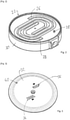
- the configuration of the separation element 22 can be seen more clearly in Figures 2 and 3 .
- the separation element 22 is generally cylindrical, the cylinder having a diameter, an axial direction and a circumferential direction.
- the separation element comprises a main body 30 in which the first duct 26 and the second duct 28 extend.
- the first duct 26 and the second duct 28 extend in a spiral shape, centred on the axis of the separation element 22. More specifically, long portions (representing at least 30% of the diameter of the separation element) of the first duct 26 and of the second duct 28 extend parallel to one another, such that at least one portion of the first duct 26 is arranged between two portions of the second duct 28. Conversely, at least one portion of the second duct 28 is arranged between two portions of the first duct 26. Moreover, at least one portion of the first duct 26 extends in a straight line and parallel to at least one portion of the second duct 28. In particular, the straight-line portion is also arranged as described above, that is to say between two respective portions of the other duct 26 or 28.
- the first duct 26 and the second duct 28 establish a fluid connection between the working chamber 20 and the compensation chamber 25.
- the first duct 26 comprises a first mouth 34 and a second mouth.
- the first mouth 34 corresponds to the inlet into the first duct 26 from the working chamber 20 whereas the second mouth corresponds to the inlet into the compensation chamber 25 from the first duct 26.
- the second duct 28 comprises a third mouth 36 and a fourth mouth.
- the third mouth corresponds to the inlet into the second duct 28 from the working chamber 20 whereas the fourth mouth corresponds to the inlet into the compensation chamber 25 from the second duct 28.
- first mouth 34 and the third mouth 36 are arranged on a first face of the separation element 22 which faces the working chamber 20.
- the second mouth and the fourth mouth are arranged on a second face of the separation element 22 which faces the compensation chamber 25.
- the second mouth and the fourth mouth are respectively arranged at the outlet of the first duct 26 and of the second duct 28.
- the first duct 26 and the second duct 28 are channels carved out of the main body 30, and open onto the first face.
- the channels have a rectangular cross section in a plane of section perpendicular to the plane of the first face and including the axis of the main body 30.
- the channels are closed by the lid 32.
- the lid 32 is arranged in line with the first face of the main body 30.
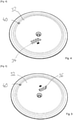
- the first mouth 34 and the third mouth 36 are openings provided in the lid 32. More generally, the first mouth 34 and the third mouth may comprise a plate. This plate may be a perforated plate which comprises a plurality of openings. In certain configurations, this plate may be replaced with a grille.
- the second and fourth mouths are provided on the main body 30 and are not illustrated in the figures.
- the first mouth 34 comprises a plurality of small openings whereas the third mouth 36 consists of a single large opening.
- the first mouth 34 comprising a plurality of openings replaces a known prior art inlet of the first duct 26 comprising a single opening (for example comparable to that of the third mouth 36). This can be brought about by producing a plurality of small openings arranged at the position of the first prior art mouth, for example bored in the lid 32.
- the diameter of the opening of the third mouth 36 is larger than the diameter of any one of the openings of the first mouth 34.
- the first mouth 34 may comprise a large opening, for example similar to that of the third mouth 36, that is covered by a grille.
- the second mouth and the fourth mouth comprise a large opening, for example similar to that of the third mouth.
- the first duct 26 being alone covered by the lid 32 makes it possible to satisfy the imposed technical constraints.
- a lid 32, as illustrated in Figure 4 that does not comprise a third mouth 36 and that comprises only the first mouth 34. In this case, it is possible to omit the second duct 28.
- the lid 32 is also circular in shape, as is the main body 30 with which the lid 32 cooperates.
- a recess 40 is arranged on the lid 32 and a projection 38 is arranged on the main body 30.
- the projection 38 and the recess 40 are configured to cooperate by virtue of matching shapes.
- the orientation can be ensured in other ways, in configurations in which the recess 40 and the projection 38 are not necessary.
Landscapes
- Engineering & Computer Science (AREA)
- General Engineering & Computer Science (AREA)
- Mechanical Engineering (AREA)
- Chemical & Material Sciences (AREA)
- Combustion & Propulsion (AREA)
- Transportation (AREA)
- Physics & Mathematics (AREA)
- Acoustics & Sound (AREA)
- Aviation & Aerospace Engineering (AREA)
- Combined Devices Of Dampers And Springs (AREA)
- Arrangement Or Mounting Of Propulsion Units For Vehicles (AREA)
Description
- The present disclosure relates to a separation element for a hydraulic anti-vibration module for mounting an engine on a vehicle body, and to a hydraulic anti-vibration module equipped with such a separation element.
- Anti-vibration devices for mounting an engine on a vehicle body, comprising a first frame joined to a second frame by means of a hydraulic anti-vibration module that is able to deform at least along a main vibration axis, are known.
- However, the known solutions perform only over a narrow range of vibration frequencies.
- There is therefore a need to broaden the range of vibration frequencies that are damped, while maintaining satisfactory damping.
- Document
US 2016/053845 A1 , which is considered to be the closest prior art, discloses a separation element configured to separate a working chamber from a compensation chamber of a hydraulic anti-vibration module configured for mounting an engine on a vehicle body according to the pre-amble of claim 1. - One embodiment relates to a separation element configured to separate a working chamber from a compensation chamber of a hydraulic anti-vibration module configured for mounting an engine on a vehicle body, the separation element comprising a first duct extending between a first mouth and a second mouth, wherein the first mouth is created in a first face of the separation element and is configured to be fluidically connected to the working chamber, wherein the second mouth is created in a second face of the separation element and is configured to be fluidically connected to the compensation chamber, and wherein the first mouth is divided into a plurality of openings.
- In the present disclosure, a mouth corresponds to an inlet or an outlet of a passage that is configured to convey a fluid. Depending on the direction of flow of the fluid, a mouth can equally be a fluid inlet or a fluid outlet.
- The presence of a first mouth comprising a plurality of openings at the inlet of the first duct makes it possible to increase the fluid resistance and/or the friction at the first mouth (at hence the fluid resistance and/or the friction of the first duct) compared to a single opening of the prior art. Increasing the friction makes it possible on one hand to broaden the range of frequencies of the vibrations that are damped by the hydraulic damping module, and makes it possible on the other hand to reduce the amplitude of the maximum amplitude oscillations of the system observed at a given frequency of the oscillations of the fluid in the first duct. In other words, in comparison with a separation element of the prior art comprising a mouth comprising a single opening having a passage cross section greater than or equal to the plurality of openings according to the present disclosure, the range of frequencies of vibrations that are damped is broadened, while retaining satisfactory damping over the entire range of frequencies of vibrations that are damped.
- It has moreover been observed that, when the first mouth comprises a plurality of openings, bubbles generated by cavitation are split, by the plurality of openings of the first mouth, into a plurality of small bubbles. Thus, in the event of implosion, these smaller bubbles generate less noise/vibration than the implosion of larger bubbles, which are observed in prior art ducts.
- Moreover, the implosion of the large bubbles generates vibrations across the whole spectrum of frequencies, since the resulting change in volume can be likened to a Dirac impulse, whose spectrum has a very broad range of excited frequencies. By contrast, the implosion of multiple small bubbles of different diameters excites different, more limited ranges of frequencies. As a result, these implosions of smaller cavitation bubbles generate less noise/vibration.
- In certain embodiments, the first mouth comprises a plate in which the plurality of openings is created.
- The first mouth can be produced separately from the separation element, by adding a plate into which the plurality of openings is created. The openings may be identical in size and/or shape, but not necessarily. This makes it easier to adjust the range of frequencies of the vibrations that are damped, according to requirements.
- In certain embodiments, the first mouth comprises a grille.
- The first mouth can be produced separately from the separation element, by adding a grille. This makes it easier to adjust the range of frequencies of the vibrations that are damped, according to requirements.
- In certain embodiments, a second duct extends between a third mouth, created in the first face of the separation element and configured to be fluidically connected to the working chamber, and a fourth mouth, created in the second face of the separation element and configured to be fluidically connected to the compensation chamber, wherein preferably the third mouth comprises a single opening, and wherein more preferably a diameter of the opening of the third mouth is larger than a diameter of any one of the openings of the first mouth.
- When a low-friction duct (second duct) is combined with a higher-friction duct (first duct), it is possible to increase the level of damping, while increasing the range of frequencies of the vibrations that are damped.
- In certain embodiments, the second mouth and/or the fourth mouth each comprise a single (i.e. a unique) opening.
- In certain embodiments, the separation element comprises a main body and a lid, wherein the first duct and/or the second duct are channels created in a first face of the main body, and wherein more preferably the channels are covered by the lid.
- The separation element is produced more simply. Indeed, producing a main body comprising channels and a lid covering these channels makes it easier to produce the first duct and the second duct, while retaining a first duct and a second duct in the shape of a pipe when the cover is fitted onto the main body. This approach is less technically restrictive than the design of a main body having within it a first duct and a second duct in the form of a pipe, these being entirely bored within the main body. This also makes it easier to adjust the damping.
- In certain embodiments, the first mouth and/or the third mouth is/are created in the lid, wherein preferably the second mouth and/or the fourth mouth is/are fluidically connected to a through-hole extending from a second face of the main body to the first/second duct, respectively.
- A lid of this kind makes it easier to produce and assemble the separation element, and makes it easy to adjust the damping according to the design of the mouths on the lid.
- In certain embodiments, the lid is circular in shape and preferably a first element among the main body or the lid includes a recess and the second element among the main body and the lid includes a projection that matches the recess.
- The recess can be provided on the lid or on the main body, while the projection can respectively be provided on the main body or the lid. This system forms a poka-yoke system, which guarantees proper mounting of the lid on the main body, such that the mouths are positioned correctly with respect to the ducts. Thus, the damping can be made more reliable.
- In certain embodiments, at least one portion of the first duct extends in a straight line and parallel to at least one portion of the second duct, wherein preferably at least one portion of the first duct is arranged between two portions of the second duct, and/or wherein more preferably at least one portion of the second duct is arranged between two portions of the first duct.
- In other words, the first and second duct can be intertwined, without intersecting, inside the separation element. This make it possible to optimize the total length of the ducts with respect to the space provided by the main body. For example, the ducts may have a spiral shape, serving to maximize the length of the straight-line portions and/or the total length of the ducts within the smallest possible space, while matching these lengths to the ranges of frequencies that are to be damped.
- One embodiment also relates to a hydraulic anti-vibration module configured for mounting an engine on a vehicle body, comprising a working chamber, a compensation chamber, and a separation element according to any one of the embodiments described in the present disclosure, wherein the separation element separates the compensation chamber and the working chamber.
- The invention and its advantages will be better understood upon reading the following detailed description of various embodiments of the invention, provided by way of non-limiting examples. This description refers to the appended pages of figures, in which:
- [
Fig. 1] Figure 1 shows a view in section of an embodiment of an anti-vibration device. - [
Fig. 2] Figure 2 shows the main body of the separator of the embodiment ofFigure 1 . - [
Fig. 3] Figure 3 shows the lid of the separator of the embodiment ofFigure 1 . - [
Fig. 4] Figure 4 shows a first variant of the lid ofFigure 3 . - [
Fig. 5] Figure 5 shows a lid of a separation element known from the prior art. -
Figure 1 shows a view in section of ananti-vibration device 10 according to one embodiment. Theanti-vibration device 10 comprises asupport 12 comprising a recess for receiving a hydraulicanti-vibration module 14. The hydraulicanti-vibration module 14 is also known to those skilled in the art as a "hydromodule" or a "hydromount". Thesupport 12 is intended to be fastened to a vehicle body or chassis. The hydraulicanti-vibration module 14 comprises a fastening means 16 to which the vehicle engine can be fastened. In the embodiment ofFigure 1 , the fastening means 16 is a cavity. - The hydraulic
anti-vibration module 14 has a configuration that is known per se. As shown inFigure 1 , the fastening means 16 are borne by anelastic body 18, for example made of elastomer material, delimiting at least in part a workingchamber 20. Aseparation element 22 is fastened to theelastic body 18. Acompensation membrane 24 is fastened to theseparation element 22. Thecompensation membrane 24 is flexible but cannot stretch, and at least partially delimits acompensation chamber 25. - The working
chamber 20 is delimited by theelastic body 18 and theseparation element 22. Thecompensation chamber 25 is delimited by theseparation element 22 and thecompensation membrane 24. - The working
chamber 20 and thecompensation chamber 25 are connected to one another by afirst duct 26 and asecond duct 28. Thus, when forces act on theelastic body 18, the volume of the workingchamber 20 is reduced owing to compression of theelastic body 18, such that a hydraulic fluid present in the workingchamber 20 flows via thefirst duct 26 and/or thesecond duct 28 towards thecompensation chamber 25, and vice versa. - The configuration of the
separation element 22 can be seen more clearly inFigures 2 and 3 . Theseparation element 22 is generally cylindrical, the cylinder having a diameter, an axial direction and a circumferential direction. The separation element comprises amain body 30 in which thefirst duct 26 and thesecond duct 28 extend. - The
first duct 26 and thesecond duct 28 extend in a spiral shape, centred on the axis of theseparation element 22. More specifically, long portions (representing at least 30% of the diameter of the separation element) of thefirst duct 26 and of thesecond duct 28 extend parallel to one another, such that at least one portion of thefirst duct 26 is arranged between two portions of thesecond duct 28. Conversely, at least one portion of thesecond duct 28 is arranged between two portions of thefirst duct 26. Moreover, at least one portion of thefirst duct 26 extends in a straight line and parallel to at least one portion of thesecond duct 28. In particular, the straight-line portion is also arranged as described above, that is to say between two respective portions of theother duct - The
first duct 26 and thesecond duct 28 establish a fluid connection between the workingchamber 20 and thecompensation chamber 25. To that end, thefirst duct 26 comprises afirst mouth 34 and a second mouth. Thefirst mouth 34 corresponds to the inlet into thefirst duct 26 from the workingchamber 20 whereas the second mouth corresponds to the inlet into thecompensation chamber 25 from thefirst duct 26. Thesecond duct 28 comprises athird mouth 36 and a fourth mouth. The third mouth corresponds to the inlet into thesecond duct 28 from the workingchamber 20 whereas the fourth mouth corresponds to the inlet into thecompensation chamber 25 from thesecond duct 28. - Thus, the
first mouth 34 and thethird mouth 36 are arranged on a first face of theseparation element 22 which faces the workingchamber 20. The second mouth and the fourth mouth are arranged on a second face of theseparation element 22 which faces thecompensation chamber 25. The second mouth and the fourth mouth are respectively arranged at the outlet of thefirst duct 26 and of thesecond duct 28. - The
first duct 26 and thesecond duct 28 are channels carved out of themain body 30, and open onto the first face. In particular, the channels have a rectangular cross section in a plane of section perpendicular to the plane of the first face and including the axis of themain body 30. In order for thefirst duct 26 and thesecond duct 28 to have a tube structure, the channels are closed by thelid 32. Thus, thelid 32 is arranged in line with the first face of themain body 30. However, it is possible for thefirst duct 26 and thesecond duct 28 to be bored entirely in themain body 30, with an identical tube structure, without thelid 32 closing this structure. - In this embodiment, the
first mouth 34 and thethird mouth 36 are openings provided in thelid 32. More generally, thefirst mouth 34 and the third mouth may comprise a plate. This plate may be a perforated plate which comprises a plurality of openings. In certain configurations, this plate may be replaced with a grille. - The second and fourth mouths are provided on the
main body 30 and are not illustrated in the figures. - As shown in
Figure 3 , thefirst mouth 34 comprises a plurality of small openings whereas thethird mouth 36 consists of a single large opening. In this embodiment, thefirst mouth 34 comprising a plurality of openings replaces a known prior art inlet of thefirst duct 26 comprising a single opening (for example comparable to that of the third mouth 36). This can be brought about by producing a plurality of small openings arranged at the position of the first prior art mouth, for example bored in thelid 32. In this embodiment, the diameter of the opening of thethird mouth 36 is larger than the diameter of any one of the openings of thefirst mouth 34. - In certain embodiments which are not shown in the figures, instead of a plurality of openings arranged in the
lid 32, thefirst mouth 34 may comprise a large opening, for example similar to that of thethird mouth 36, that is covered by a grille. - The second mouth and the fourth mouth comprise a large opening, for example similar to that of the third mouth.
- Thus, the
first duct 26 being alone covered by thelid 32 according to this embodiment makes it possible to satisfy the imposed technical constraints. In particular, it is possible to use alid 32, as illustrated inFigure 4 , that does not comprise athird mouth 36 and that comprises only thefirst mouth 34. In this case, it is possible to omit thesecond duct 28. - The
lid 32 is also circular in shape, as is themain body 30 with which thelid 32 cooperates. In the example of the embodiment ofFigures 3 ,4 and 5 , arecess 40 is arranged on thelid 32 and aprojection 38 is arranged on themain body 30. Theprojection 38 and therecess 40 are configured to cooperate by virtue of matching shapes. In the event of themain body 30 and/or thelid 32 being non-circular, the orientation can be ensured in other ways, in configurations in which therecess 40 and theprojection 38 are not necessary. - Although the present invention has been described with reference to specific embodiments, it is clear that modifications and changes to these examples can be made without departing from the general scope of the invention as defined by the claims. In particular, individual features of the various embodiments illustrated/mentioned can be combined in additional embodiments. Consequently, the description and the drawings must be considered as being illustrative rather than restrictive.
- It is also clear that all of the features described with reference to a method can be transposed, either singly or in combination, to a device, and, vice versa, all of the features described with reference to a device can be transposed, either singly or in combination, to a method.
Claims (9)
- Separation element (22) configured to separate a working chamber (20) from a compensation chamber (25) of a hydraulic anti-vibration module (14) configured for mounting an engine on a vehicle body, comprisinga first duct (26) extending between a first mouth (34) and a second mouth, wherein the first mouth (34) is created in a first face of the separation element (22) and is configured to be fluidically connected to the working chamber (20), wherein the second mouth is created in a second face of the separation element (22) and is configured to be fluidically connected to the compensation chamber (25), andwherein the first mouth (34) comprises a plurality of openings, characterized in that there is a second duct (28) extending between a third mouth (36), arranged on the first face of the separation element (22) and configured to be fluidically connected to the working chamber (20), and a fourth mouth, arranged on the second face of the separation element (22) and configured to be fluidically connected to the compensation chamber (25),wherein preferably the third mouth (36) comprises a single opening, and wherein more preferably a diameter of the opening of the third mouth (36) is larger than a diameter of any one of the openings of the first mouth (34)..
- Separation element (22) according to Claim 1, wherein the first mouth (34) comprises a plate in which the plurality of openings is created.
- Separation element (22) according to Claim 1, wherein the first mouth comprises a grille.
- Separation element (22) according to one of Claims 1 to 3, wherein the second mouth and/or the fourth mouth each comprise a single opening.
- Separation element (22) according to one of Claims 1 to 5, comprising
a main body (30) and a lid (32), wherein preferably the first duct (26) and/or the second duct (28) are channels created in a first face of the main body (30), and wherein more preferably the channels are covered by the lid (32). - Separation element (22) according to Claim 5,wherein the first mouth (34) and/or the third mouth (36) is/are created in the lid (32), andwherein preferably the second mouth and/or the fourth mouth is/are fluidically connected to a through-hole extending from a second face of the main body to the first/second duct (26, 28), respectively.
- Separation element (22) according to Claim 5 or 6,wherein the lid (32) is circular in shape,wherein preferably a first element among the main body (30) or the lid (32) includes a recess (40) and the second element among the main body (30) and the lid (32) includes a projection (38) that matches the recess (40).
- Separation element (22) according to one of Claims 4 to 7,wherein at least one portion of the first duct (26) extends in a straight line and parallel to at least one portion of the second duct (28),wherein preferably at least one portion of the first duct (26) is arranged between two portions of the second duct (28), and/orwherein more preferably at least one portion of the second duct (28) is arranged between two portions of the first duct (26).
- Hydraulic anti-vibration module (14) configured for mounting an engine on a vehicle body, comprisinga working chamber (20),a compensation chamber (25), anda separation element (22) according to one of Claims 1 to 8,wherein the separation element (22) separates the compensation chamber (25) and the working chamber (20).
Priority Applications (1)
| Application Number | Priority Date | Filing Date | Title |
|---|---|---|---|
| PL20209829T PL3828436T3 (en) | 2019-11-27 | 2020-11-25 | Separation element for a hydraulic anti-vibration module, and hydraulic anti-vibration module equipped with such a separation element |
Applications Claiming Priority (1)
| Application Number | Priority Date | Filing Date | Title |
|---|---|---|---|
| FR1913340A FR3103527B1 (en) | 2019-11-27 | 2019-11-27 | Anti-vibration hydraulic module separation element and anti-vibration hydraulic module equipped with such a separation element |
Publications (2)
| Publication Number | Publication Date |
|---|---|
| EP3828436A1 EP3828436A1 (en) | 2021-06-02 |
| EP3828436B1 true EP3828436B1 (en) | 2022-02-16 |
Family
ID=69903340
Family Applications (1)
| Application Number | Title | Priority Date | Filing Date |
|---|---|---|---|
| EP20209829.9A Active EP3828436B1 (en) | 2019-11-27 | 2020-11-25 | Separation element for a hydraulic anti-vibration module, and hydraulic anti-vibration module equipped with such a separation element |
Country Status (8)
| Country | Link |
|---|---|
| US (1) | US11801745B2 (en) |
| EP (1) | EP3828436B1 (en) |
| JP (1) | JP7649128B2 (en) |
| KR (1) | KR102890212B1 (en) |
| CN (1) | CN112855838B (en) |
| ES (1) | ES2912591T3 (en) |
| FR (1) | FR3103527B1 (en) |
| PL (1) | PL3828436T3 (en) |
Families Citing this family (2)
| Publication number | Priority date | Publication date | Assignee | Title |
|---|---|---|---|---|
| DE102018213775B4 (en) * | 2018-08-16 | 2025-07-17 | Bayerische Motoren Werke Aktiengesellschaft | Vehicle assembly mounting assembly and modular system |
| FR3103527B1 (en) * | 2019-11-27 | 2022-05-06 | Vibracoustic Nantes Sas | Anti-vibration hydraulic module separation element and anti-vibration hydraulic module equipped with such a separation element |
Citations (1)
| Publication number | Priority date | Publication date | Assignee | Title |
|---|---|---|---|---|
| FR2898647B1 (en) * | 2006-03-15 | 2008-06-06 | Hutchinson Sa | DISSIPATIVE STRUCTURE FOR ANTI-VIBRATION DEVICE, SUCH DEVICE OF THE HYDRAULIC SUPPORT TYPE INCORPORATING IT AND USES THEREOF. |
Family Cites Families (21)
| Publication number | Priority date | Publication date | Assignee | Title |
|---|---|---|---|---|
| FR2575253B1 (en) * | 1984-12-24 | 1989-08-18 | Hutchinson | HYDRAULIC ANTIVIBRATORY SUPPORT |
| JPS62242148A (en) * | 1986-04-09 | 1987-10-22 | Marugo Rubber Kogyo Kk | Liquid sealed mount |
| DE8701876U1 (en) * | 1987-02-07 | 1988-06-09 | Boge AG, 5208 Eitorf | Hydraulically dampening rubber bearing |
| FR2613445B1 (en) * | 1987-04-03 | 1991-07-05 | Caoutchouc Manuf Plastique | ELASTIC SUPPORT WITH INTEGRATED HYDRAULIC DAMPING WITH RIGID PARTITION WITH ADJUSTABLE LIQUID CIRCUIT |
| US4925162A (en) * | 1988-06-17 | 1990-05-15 | Bridgestone Corporation | Vibration isolating devices |
| US5571263A (en) * | 1995-04-14 | 1996-11-05 | General Motors Corporation | Hydraulic engine mount with reduced impulse vibration |
| DE10064762B4 (en) * | 2000-12-22 | 2011-02-10 | Contitech Luftfedersysteme Gmbh | Hydrofeather with damper |
| FR2831630B1 (en) * | 2001-10-29 | 2004-01-30 | Hutchinson | HYDRAULIC ANTI-VIBRATION SUPPORT COMPRISING A CLIPSE DECOUPLING VALVE |
| JP2008303910A (en) * | 2007-06-05 | 2008-12-18 | Toyota Motor Corp | Liquid filled vibration isolator |
| CN101813154B (en) * | 2009-02-24 | 2013-02-13 | 仓敷化工株式会社 | Liquid-filled vibration isolator |
| JP5188424B2 (en) | 2009-03-04 | 2013-04-24 | 倉敷化工株式会社 | Liquid filled vibration isolator |
| CN102431431B (en) * | 2010-08-31 | 2015-03-25 | 住友理工株式会社 | Fluid-filled type vibration damping device |
| KR20130020499A (en) * | 2011-08-19 | 2013-02-27 | 현대자동차주식회사 | Hydro mount having multiple fluid path |
| JP6391186B2 (en) * | 2014-08-20 | 2018-09-19 | 株式会社ブリヂストン | Vibration isolator and method for suppressing generation of abnormal noise caused by cavitation collapse |
| JP6450619B2 (en) | 2015-03-19 | 2019-01-09 | 株式会社ブリヂストン | Vibration isolator |
| JP6562697B2 (en) * | 2015-04-28 | 2019-08-21 | 山下ゴム株式会社 | Vibration isolator |
| DE102015224937A1 (en) * | 2015-12-11 | 2017-06-14 | Contitech Vibration Control Gmbh | Hydro bearing and motor vehicle with such a hydraulic bearing |
| EP3477149A4 (en) * | 2016-06-22 | 2019-06-26 | Bridgestone Corporation | Vibration damping device |
| JP2018204675A (en) * | 2017-06-02 | 2018-12-27 | 株式会社ブリヂストン | Vibration proofing device |
| KR102365152B1 (en) * | 2017-07-14 | 2022-02-18 | 현대자동차주식회사 | Hydraulic engine-mount |
| FR3103527B1 (en) * | 2019-11-27 | 2022-05-06 | Vibracoustic Nantes Sas | Anti-vibration hydraulic module separation element and anti-vibration hydraulic module equipped with such a separation element |
-
2019
- 2019-11-27 FR FR1913340A patent/FR3103527B1/en not_active Expired - Fee Related
-
2020
- 2020-11-25 EP EP20209829.9A patent/EP3828436B1/en active Active
- 2020-11-25 PL PL20209829T patent/PL3828436T3/en unknown
- 2020-11-25 ES ES20209829T patent/ES2912591T3/en active Active
- 2020-11-25 JP JP2020194793A patent/JP7649128B2/en active Active
- 2020-11-25 US US17/104,468 patent/US11801745B2/en active Active
- 2020-11-27 CN CN202011362284.0A patent/CN112855838B/en active Active
- 2020-11-27 KR KR1020200162864A patent/KR102890212B1/en active Active
Patent Citations (1)
| Publication number | Priority date | Publication date | Assignee | Title |
|---|---|---|---|---|
| FR2898647B1 (en) * | 2006-03-15 | 2008-06-06 | Hutchinson Sa | DISSIPATIVE STRUCTURE FOR ANTI-VIBRATION DEVICE, SUCH DEVICE OF THE HYDRAULIC SUPPORT TYPE INCORPORATING IT AND USES THEREOF. |
Also Published As
| Publication number | Publication date |
|---|---|
| CN112855838A (en) | 2021-05-28 |
| ES2912591T3 (en) | 2022-05-26 |
| US11801745B2 (en) | 2023-10-31 |
| US20210155090A1 (en) | 2021-05-27 |
| PL3828436T3 (en) | 2022-06-13 |
| JP2021085526A (en) | 2021-06-03 |
| CN112855838B (en) | 2023-12-01 |
| KR102890212B1 (en) | 2025-11-24 |
| KR20210065893A (en) | 2021-06-04 |
| EP3828436A1 (en) | 2021-06-02 |
| FR3103527A1 (en) | 2021-05-28 |
| FR3103527B1 (en) | 2022-05-06 |
| JP7649128B2 (en) | 2025-03-19 |
Similar Documents
| Publication | Publication Date | Title |
|---|---|---|
| US10508707B2 (en) | Bearing system | |
| CN109253206B (en) | Hydraulic engine mount | |
| US10221916B2 (en) | Anti-vibration apparatus | |
| EP3828436B1 (en) | Separation element for a hydraulic anti-vibration module, and hydraulic anti-vibration module equipped with such a separation element | |
| JP4804404B2 (en) | Fuel pump device and fuel supply device | |
| EP3118480B1 (en) | Vibration isolation device | |
| CN105705823B (en) | Vibration isolation device | |
| EP2733381A1 (en) | Vibration isolator | |
| CN106460999A (en) | Vibration-damping device | |
| KR20180045688A (en) | Air duct for vehicle having function of reducing intake noise | |
| EP3139062B1 (en) | Vibration-damping device | |
| EP3153739B1 (en) | Vibration-damping device | |
| US10451140B2 (en) | Damping support device | |
| JP6595257B2 (en) | Vibration isolator | |
| US9897160B2 (en) | Vibration isolator | |
| CN103403385A (en) | Damping device | |
| EP3135952A1 (en) | Vibration isolation device | |
| JP7346189B2 (en) | Vibration isolator | |
| JP2009052696A (en) | Liquid filled vibration isolator | |
| JP6315782B2 (en) | Vibration isolator | |
| JP2010116987A (en) | Vibration control device | |
| JP2016114145A (en) | Vibration control device |
Legal Events
| Date | Code | Title | Description |
|---|---|---|---|
| PUAI | Public reference made under article 153(3) epc to a published international application that has entered the european phase |
Free format text: ORIGINAL CODE: 0009012 |
|
| STAA | Information on the status of an ep patent application or granted ep patent |
Free format text: STATUS: THE APPLICATION HAS BEEN PUBLISHED |
|
| AK | Designated contracting states |
Kind code of ref document: A1 Designated state(s): AL AT BE BG CH CY CZ DE DK EE ES FI FR GB GR HR HU IE IS IT LI LT LU LV MC MK MT NL NO PL PT RO RS SE SI SK SM TR |
|
| STAA | Information on the status of an ep patent application or granted ep patent |
Free format text: STATUS: REQUEST FOR EXAMINATION WAS MADE |
|
| 17P | Request for examination filed |
Effective date: 20210629 |
|
| RBV | Designated contracting states (corrected) |
Designated state(s): AL AT BE BG CH CY CZ DE DK EE ES FI FR GB GR HR HU IE IS IT LI LT LU LV MC MK MT NL NO PL PT RO RS SE SI SK SM TR |
|
| GRAP | Despatch of communication of intention to grant a patent |
Free format text: ORIGINAL CODE: EPIDOSNIGR1 |
|
| STAA | Information on the status of an ep patent application or granted ep patent |
Free format text: STATUS: GRANT OF PATENT IS INTENDED |
|
| GRAS | Grant fee paid |
Free format text: ORIGINAL CODE: EPIDOSNIGR3 |
|
| INTG | Intention to grant announced |
Effective date: 20211216 |
|
| GRAA | (expected) grant |
Free format text: ORIGINAL CODE: 0009210 |
|
| STAA | Information on the status of an ep patent application or granted ep patent |
Free format text: STATUS: THE PATENT HAS BEEN GRANTED |
|
| AK | Designated contracting states |
Kind code of ref document: B1 Designated state(s): AL AT BE BG CH CY CZ DE DK EE ES FI FR GB GR HR HU IE IS IT LI LT LU LV MC MK MT NL NO PL PT RO RS SE SI SK SM TR |
|
| REG | Reference to a national code |
Ref country code: GB Ref legal event code: FG4D |
|
| REG | Reference to a national code |
Ref country code: CH Ref legal event code: EP |
|
| REG | Reference to a national code |
Ref country code: DE Ref legal event code: R096 Ref document number: 602020001897 Country of ref document: DE |
|
| REG | Reference to a national code |
Ref country code: AT Ref legal event code: REF Ref document number: 1469064 Country of ref document: AT Kind code of ref document: T Effective date: 20220315 |
|
| REG | Reference to a national code |
Ref country code: IE Ref legal event code: FG4D |
|
| REG | Reference to a national code |
Ref country code: RO Ref legal event code: EPE |
|
| REG | Reference to a national code |
Ref country code: ES Ref legal event code: FG2A Ref document number: 2912591 Country of ref document: ES Kind code of ref document: T3 Effective date: 20220526 |
|
| REG | Reference to a national code |
Ref country code: LT Ref legal event code: MG9D |
|
| REG | Reference to a national code |
Ref country code: NL Ref legal event code: MP Effective date: 20220216 |
|
| REG | Reference to a national code |
Ref country code: AT Ref legal event code: MK05 Ref document number: 1469064 Country of ref document: AT Kind code of ref document: T Effective date: 20220216 |
|
| PG25 | Lapsed in a contracting state [announced via postgrant information from national office to epo] |
Ref country code: SE Free format text: LAPSE BECAUSE OF FAILURE TO SUBMIT A TRANSLATION OF THE DESCRIPTION OR TO PAY THE FEE WITHIN THE PRESCRIBED TIME-LIMIT Effective date: 20220216 Ref country code: RS Free format text: LAPSE BECAUSE OF FAILURE TO SUBMIT A TRANSLATION OF THE DESCRIPTION OR TO PAY THE FEE WITHIN THE PRESCRIBED TIME-LIMIT Effective date: 20220216 Ref country code: PT Free format text: LAPSE BECAUSE OF FAILURE TO SUBMIT A TRANSLATION OF THE DESCRIPTION OR TO PAY THE FEE WITHIN THE PRESCRIBED TIME-LIMIT Effective date: 20220616 Ref country code: NO Free format text: LAPSE BECAUSE OF FAILURE TO SUBMIT A TRANSLATION OF THE DESCRIPTION OR TO PAY THE FEE WITHIN THE PRESCRIBED TIME-LIMIT Effective date: 20220516 Ref country code: NL Free format text: LAPSE BECAUSE OF FAILURE TO SUBMIT A TRANSLATION OF THE DESCRIPTION OR TO PAY THE FEE WITHIN THE PRESCRIBED TIME-LIMIT Effective date: 20220216 Ref country code: LT Free format text: LAPSE BECAUSE OF FAILURE TO SUBMIT A TRANSLATION OF THE DESCRIPTION OR TO PAY THE FEE WITHIN THE PRESCRIBED TIME-LIMIT Effective date: 20220216 Ref country code: HR Free format text: LAPSE BECAUSE OF FAILURE TO SUBMIT A TRANSLATION OF THE DESCRIPTION OR TO PAY THE FEE WITHIN THE PRESCRIBED TIME-LIMIT Effective date: 20220216 Ref country code: BG Free format text: LAPSE BECAUSE OF FAILURE TO SUBMIT A TRANSLATION OF THE DESCRIPTION OR TO PAY THE FEE WITHIN THE PRESCRIBED TIME-LIMIT Effective date: 20220516 |
|
| PG25 | Lapsed in a contracting state [announced via postgrant information from national office to epo] |
Ref country code: LV Free format text: LAPSE BECAUSE OF FAILURE TO SUBMIT A TRANSLATION OF THE DESCRIPTION OR TO PAY THE FEE WITHIN THE PRESCRIBED TIME-LIMIT Effective date: 20220216 Ref country code: GR Free format text: LAPSE BECAUSE OF FAILURE TO SUBMIT A TRANSLATION OF THE DESCRIPTION OR TO PAY THE FEE WITHIN THE PRESCRIBED TIME-LIMIT Effective date: 20220517 Ref country code: FI Free format text: LAPSE BECAUSE OF FAILURE TO SUBMIT A TRANSLATION OF THE DESCRIPTION OR TO PAY THE FEE WITHIN THE PRESCRIBED TIME-LIMIT Effective date: 20220216 Ref country code: AT Free format text: LAPSE BECAUSE OF FAILURE TO SUBMIT A TRANSLATION OF THE DESCRIPTION OR TO PAY THE FEE WITHIN THE PRESCRIBED TIME-LIMIT Effective date: 20220216 |
|
| PG25 | Lapsed in a contracting state [announced via postgrant information from national office to epo] |
Ref country code: IS Free format text: LAPSE BECAUSE OF FAILURE TO SUBMIT A TRANSLATION OF THE DESCRIPTION OR TO PAY THE FEE WITHIN THE PRESCRIBED TIME-LIMIT Effective date: 20220617 |
|
| PG25 | Lapsed in a contracting state [announced via postgrant information from national office to epo] |
Ref country code: SM Free format text: LAPSE BECAUSE OF FAILURE TO SUBMIT A TRANSLATION OF THE DESCRIPTION OR TO PAY THE FEE WITHIN THE PRESCRIBED TIME-LIMIT Effective date: 20220216 Ref country code: SK Free format text: LAPSE BECAUSE OF FAILURE TO SUBMIT A TRANSLATION OF THE DESCRIPTION OR TO PAY THE FEE WITHIN THE PRESCRIBED TIME-LIMIT Effective date: 20220216 Ref country code: EE Free format text: LAPSE BECAUSE OF FAILURE TO SUBMIT A TRANSLATION OF THE DESCRIPTION OR TO PAY THE FEE WITHIN THE PRESCRIBED TIME-LIMIT Effective date: 20220216 Ref country code: DK Free format text: LAPSE BECAUSE OF FAILURE TO SUBMIT A TRANSLATION OF THE DESCRIPTION OR TO PAY THE FEE WITHIN THE PRESCRIBED TIME-LIMIT Effective date: 20220216 |
|
| REG | Reference to a national code |
Ref country code: DE Ref legal event code: R097 Ref document number: 602020001897 Country of ref document: DE |
|
| PG25 | Lapsed in a contracting state [announced via postgrant information from national office to epo] |
Ref country code: AL Free format text: LAPSE BECAUSE OF FAILURE TO SUBMIT A TRANSLATION OF THE DESCRIPTION OR TO PAY THE FEE WITHIN THE PRESCRIBED TIME-LIMIT Effective date: 20220216 |
|
| PLBE | No opposition filed within time limit |
Free format text: ORIGINAL CODE: 0009261 |
|
| STAA | Information on the status of an ep patent application or granted ep patent |
Free format text: STATUS: NO OPPOSITION FILED WITHIN TIME LIMIT |
|
| 26N | No opposition filed |
Effective date: 20221117 |
|
| PGFP | Annual fee paid to national office [announced via postgrant information from national office to epo] |
Ref country code: CZ Payment date: 20221123 Year of fee payment: 3 |
|
| REG | Reference to a national code |
Ref country code: DE Ref legal event code: R082 Ref document number: 602020001897 Country of ref document: DE Representative=s name: PATENTANWAELTE OLBRICHT, BUCHHOLD, KEULERTZ PA, DE |
|
| PGFP | Annual fee paid to national office [announced via postgrant information from national office to epo] |
Ref country code: ES Payment date: 20230125 Year of fee payment: 3 |
|
| PG25 | Lapsed in a contracting state [announced via postgrant information from national office to epo] |
Ref country code: MC Free format text: LAPSE BECAUSE OF FAILURE TO SUBMIT A TRANSLATION OF THE DESCRIPTION OR TO PAY THE FEE WITHIN THE PRESCRIBED TIME-LIMIT Effective date: 20220216 |
|
| REG | Reference to a national code |
Ref country code: BE Ref legal event code: MM Effective date: 20221130 |
|
| PG25 | Lapsed in a contracting state [announced via postgrant information from national office to epo] |
Ref country code: RO Free format text: LAPSE BECAUSE OF NON-PAYMENT OF DUE FEES Effective date: 20220216 |
|
| P01 | Opt-out of the competence of the unified patent court (upc) registered |
Effective date: 20230627 |
|
| PG25 | Lapsed in a contracting state [announced via postgrant information from national office to epo] |
Ref country code: LU Free format text: LAPSE BECAUSE OF NON-PAYMENT OF DUE FEES Effective date: 20221125 |
|
| PG25 | Lapsed in a contracting state [announced via postgrant information from national office to epo] |
Ref country code: IE Free format text: LAPSE BECAUSE OF NON-PAYMENT OF DUE FEES Effective date: 20221125 |
|
| PG25 | Lapsed in a contracting state [announced via postgrant information from national office to epo] |
Ref country code: BE Free format text: LAPSE BECAUSE OF NON-PAYMENT OF DUE FEES Effective date: 20221130 |
|
| PG25 | Lapsed in a contracting state [announced via postgrant information from national office to epo] |
Ref country code: CY Free format text: LAPSE BECAUSE OF FAILURE TO SUBMIT A TRANSLATION OF THE DESCRIPTION OR TO PAY THE FEE WITHIN THE PRESCRIBED TIME-LIMIT Effective date: 20220216 |
|
| PG25 | Lapsed in a contracting state [announced via postgrant information from national office to epo] |
Ref country code: PL Free format text: LAPSE BECAUSE OF NON-PAYMENT OF DUE FEES Effective date: 20221125 Ref country code: MK Free format text: LAPSE BECAUSE OF FAILURE TO SUBMIT A TRANSLATION OF THE DESCRIPTION OR TO PAY THE FEE WITHIN THE PRESCRIBED TIME-LIMIT Effective date: 20220216 |
|
| PG25 | Lapsed in a contracting state [announced via postgrant information from national office to epo] |
Ref country code: TR Free format text: LAPSE BECAUSE OF FAILURE TO SUBMIT A TRANSLATION OF THE DESCRIPTION OR TO PAY THE FEE WITHIN THE PRESCRIBED TIME-LIMIT Effective date: 20220216 |
|
| REG | Reference to a national code |
Ref country code: CH Ref legal event code: PL |
|
| PG25 | Lapsed in a contracting state [announced via postgrant information from national office to epo] |
Ref country code: CH Free format text: LAPSE BECAUSE OF NON-PAYMENT OF DUE FEES Effective date: 20231130 |
|
| PG25 | Lapsed in a contracting state [announced via postgrant information from national office to epo] |
Ref country code: CZ Free format text: LAPSE BECAUSE OF NON-PAYMENT OF DUE FEES Effective date: 20231125 |
|
| PG25 | Lapsed in a contracting state [announced via postgrant information from national office to epo] |
Ref country code: CZ Free format text: LAPSE BECAUSE OF NON-PAYMENT OF DUE FEES Effective date: 20231125 Ref country code: CH Free format text: LAPSE BECAUSE OF NON-PAYMENT OF DUE FEES Effective date: 20231130 |
|
| PG25 | Lapsed in a contracting state [announced via postgrant information from national office to epo] |
Ref country code: MT Free format text: LAPSE BECAUSE OF FAILURE TO SUBMIT A TRANSLATION OF THE DESCRIPTION OR TO PAY THE FEE WITHIN THE PRESCRIBED TIME-LIMIT Effective date: 20220216 |
|
| REG | Reference to a national code |
Ref country code: ES Ref legal event code: FD2A Effective date: 20241230 |
|
| PG25 | Lapsed in a contracting state [announced via postgrant information from national office to epo] |
Ref country code: ES Free format text: LAPSE BECAUSE OF NON-PAYMENT OF DUE FEES Effective date: 20231126 |
|
| PG25 | Lapsed in a contracting state [announced via postgrant information from national office to epo] |
Ref country code: ES Free format text: LAPSE BECAUSE OF NON-PAYMENT OF DUE FEES Effective date: 20231126 |
|
| PG25 | Lapsed in a contracting state [announced via postgrant information from national office to epo] |
Ref country code: HU Free format text: LAPSE BECAUSE OF FAILURE TO SUBMIT A TRANSLATION OF THE DESCRIPTION OR TO PAY THE FEE WITHIN THE PRESCRIBED TIME-LIMIT; INVALID AB INITIO Effective date: 20201125 |
|
| PGFP | Annual fee paid to national office [announced via postgrant information from national office to epo] |
Ref country code: DE Payment date: 20251130 Year of fee payment: 6 |
|
| PGFP | Annual fee paid to national office [announced via postgrant information from national office to epo] |
Ref country code: GB Payment date: 20251128 Year of fee payment: 6 |
|
| PGFP | Annual fee paid to national office [announced via postgrant information from national office to epo] |
Ref country code: IT Payment date: 20251128 Year of fee payment: 6 |
|
| PGFP | Annual fee paid to national office [announced via postgrant information from national office to epo] |
Ref country code: FR Payment date: 20251128 Year of fee payment: 6 |
|
| PG25 | Lapsed in a contracting state [announced via postgrant information from national office to epo] |
Ref country code: SI Free format text: LAPSE BECAUSE OF FAILURE TO SUBMIT A TRANSLATION OF THE DESCRIPTION OR TO PAY THE FEE WITHIN THE PRESCRIBED TIME-LIMIT Effective date: 20220216 |