EP3828012A1 - Tire mounting status detection system, tire mounting status detection method and tire mounting status detection program - Google Patents
Tire mounting status detection system, tire mounting status detection method and tire mounting status detection program Download PDFInfo
- Publication number
- EP3828012A1 EP3828012A1 EP19854615.2A EP19854615A EP3828012A1 EP 3828012 A1 EP3828012 A1 EP 3828012A1 EP 19854615 A EP19854615 A EP 19854615A EP 3828012 A1 EP3828012 A1 EP 3828012A1
- Authority
- EP
- European Patent Office
- Prior art keywords
- transmitter
- vehicle
- tire
- state detection
- receiver
- Prior art date
- Legal status (The legal status is an assumption and is not a legal conclusion. Google has not performed a legal analysis and makes no representation as to the accuracy of the status listed.)
- Granted
Links
Images



Classifications
-
- B—PERFORMING OPERATIONS; TRANSPORTING
- B60—VEHICLES IN GENERAL
- B60C—VEHICLE TYRES; TYRE INFLATION; TYRE CHANGING; CONNECTING VALVES TO INFLATABLE ELASTIC BODIES IN GENERAL; DEVICES OR ARRANGEMENTS RELATED TO TYRES
- B60C23/00—Devices for measuring, signalling, controlling, or distributing tyre pressure or temperature, specially adapted for mounting on vehicles; Arrangement of tyre inflating devices on vehicles, e.g. of pumps or of tanks; Tyre cooling arrangements
- B60C23/02—Signalling devices actuated by tyre pressure
- B60C23/04—Signalling devices actuated by tyre pressure mounted on the wheel or tyre
- B60C23/0408—Signalling devices actuated by tyre pressure mounted on the wheel or tyre transmitting the signals by non-mechanical means from the wheel or tyre to a vehicle body mounted receiver
- B60C23/0415—Automatically identifying wheel mounted units, e.g. after replacement or exchange of wheels
- B60C23/0416—Automatically identifying wheel mounted units, e.g. after replacement or exchange of wheels allocating a corresponding wheel position on vehicle, e.g. front/left or rear/right
-
- B—PERFORMING OPERATIONS; TRANSPORTING
- B60—VEHICLES IN GENERAL
- B60C—VEHICLE TYRES; TYRE INFLATION; TYRE CHANGING; CONNECTING VALVES TO INFLATABLE ELASTIC BODIES IN GENERAL; DEVICES OR ARRANGEMENTS RELATED TO TYRES
- B60C23/00—Devices for measuring, signalling, controlling, or distributing tyre pressure or temperature, specially adapted for mounting on vehicles; Arrangement of tyre inflating devices on vehicles, e.g. of pumps or of tanks; Tyre cooling arrangements
- B60C23/005—Devices specially adapted for special wheel arrangements
- B60C23/007—Devices specially adapted for special wheel arrangements having multiple wheels arranged side by side
-
- B—PERFORMING OPERATIONS; TRANSPORTING
- B60—VEHICLES IN GENERAL
- B60C—VEHICLE TYRES; TYRE INFLATION; TYRE CHANGING; CONNECTING VALVES TO INFLATABLE ELASTIC BODIES IN GENERAL; DEVICES OR ARRANGEMENTS RELATED TO TYRES
- B60C23/00—Devices for measuring, signalling, controlling, or distributing tyre pressure or temperature, specially adapted for mounting on vehicles; Arrangement of tyre inflating devices on vehicles, e.g. of pumps or of tanks; Tyre cooling arrangements
- B60C23/02—Signalling devices actuated by tyre pressure
- B60C23/04—Signalling devices actuated by tyre pressure mounted on the wheel or tyre
- B60C23/0408—Signalling devices actuated by tyre pressure mounted on the wheel or tyre transmitting the signals by non-mechanical means from the wheel or tyre to a vehicle body mounted receiver
- B60C23/0415—Automatically identifying wheel mounted units, e.g. after replacement or exchange of wheels
-
- B—PERFORMING OPERATIONS; TRANSPORTING
- B60—VEHICLES IN GENERAL
- B60C—VEHICLE TYRES; TYRE INFLATION; TYRE CHANGING; CONNECTING VALVES TO INFLATABLE ELASTIC BODIES IN GENERAL; DEVICES OR ARRANGEMENTS RELATED TO TYRES
- B60C23/00—Devices for measuring, signalling, controlling, or distributing tyre pressure or temperature, specially adapted for mounting on vehicles; Arrangement of tyre inflating devices on vehicles, e.g. of pumps or of tanks; Tyre cooling arrangements
- B60C23/02—Signalling devices actuated by tyre pressure
- B60C23/04—Signalling devices actuated by tyre pressure mounted on the wheel or tyre
- B60C23/0408—Signalling devices actuated by tyre pressure mounted on the wheel or tyre transmitting the signals by non-mechanical means from the wheel or tyre to a vehicle body mounted receiver
- B60C23/0422—Signalling devices actuated by tyre pressure mounted on the wheel or tyre transmitting the signals by non-mechanical means from the wheel or tyre to a vehicle body mounted receiver characterised by the type of signal transmission means
- B60C23/0433—Radio signals
- B60C23/0435—Vehicle body mounted circuits, e.g. transceiver or antenna fixed to central console, door, roof, mirror or fender
- B60C23/0437—Means for detecting electromagnetic field changes not being part of the signal transmission per se, e.g. strength, direction, propagation or masking
-
- B—PERFORMING OPERATIONS; TRANSPORTING
- B60—VEHICLES IN GENERAL
- B60C—VEHICLE TYRES; TYRE INFLATION; TYRE CHANGING; CONNECTING VALVES TO INFLATABLE ELASTIC BODIES IN GENERAL; DEVICES OR ARRANGEMENTS RELATED TO TYRES
- B60C23/00—Devices for measuring, signalling, controlling, or distributing tyre pressure or temperature, specially adapted for mounting on vehicles; Arrangement of tyre inflating devices on vehicles, e.g. of pumps or of tanks; Tyre cooling arrangements
- B60C23/02—Signalling devices actuated by tyre pressure
- B60C23/04—Signalling devices actuated by tyre pressure mounted on the wheel or tyre
- B60C23/0408—Signalling devices actuated by tyre pressure mounted on the wheel or tyre transmitting the signals by non-mechanical means from the wheel or tyre to a vehicle body mounted receiver
- B60C23/0422—Signalling devices actuated by tyre pressure mounted on the wheel or tyre transmitting the signals by non-mechanical means from the wheel or tyre to a vehicle body mounted receiver characterised by the type of signal transmission means
- B60C23/0433—Radio signals
- B60C23/0435—Vehicle body mounted circuits, e.g. transceiver or antenna fixed to central console, door, roof, mirror or fender
- B60C23/0444—Antenna structures, control or arrangements thereof, e.g. for directional antennas, diversity antenna, antenna multiplexing or antennas integrated in fenders
-
- B—PERFORMING OPERATIONS; TRANSPORTING
- B60—VEHICLES IN GENERAL
- B60C—VEHICLE TYRES; TYRE INFLATION; TYRE CHANGING; CONNECTING VALVES TO INFLATABLE ELASTIC BODIES IN GENERAL; DEVICES OR ARRANGEMENTS RELATED TO TYRES
- B60C23/00—Devices for measuring, signalling, controlling, or distributing tyre pressure or temperature, specially adapted for mounting on vehicles; Arrangement of tyre inflating devices on vehicles, e.g. of pumps or of tanks; Tyre cooling arrangements
- B60C23/20—Devices for measuring or signalling tyre temperature only
Definitions
- the present invention relates to a tire mounting state detection system, a tire mounting state detection method and a tire mounting state detection program for detecting the state of a transmitter equipped on a tire mounted on a vehicle.
- a sensor including a transmitter of a radio signal (radio wave) is widely mounted in the tire.
- the information detected by the sensor needs to be managed in association with the wheel position (Front right wheel, rear left wheel, etc.) of the vehicle on which the tire is mounted.
- the wheel position to which the tire (Sensor) is mounted is changed by rotation or the like, it is necessary to update the correspondence between the identifier (ID) of the sensor and the wheel position each time.
- a method of automatically detecting the position of a wheel on which a tire (Sensor) is mounted is known in order to avoid such complication of updating.
- 2 receivers are disposed in the longitudinal direction of the vehicle, and a sensor provided in the tire for sensing the rotational direction of the tire is used to automatically detect the position of the wheel on which the tire (Sensor) is mounted.
- each sensor is attached to each tire, and it is assumed that each sensor, specifically each transmitter, is operating normally.
- a radio signal from a transmitter may not be detected due to failure, forgetting to turn on a power source, forgetting to install, or the like.
- a plurality of sensors (That is, the transmitter) are erroneously attached to one tire.
- the tire air pressure monitoring system described above cannot correctly detect the position of the wheel on which each tire (Transmitter) is mounted.
- an object of the present invention is to provide a tire mounting state detection system, a tire mounting state detection method, and a tire mounting state detection program capable of detecting a state in which a transmitter is not normally mounted on a tire or is not operating when automatically detecting a wheel position on which a tire (Transmitter) is mounted.
- One aspect of the present invention is a tire mounting state detection system (Tire mounting state detection system 100) for detecting the state of a transmitter (Sensor 41 to sensor 46) equipped on a tire (Tire 31 to 36) mounted on a vehicle (For example, vehicle 10), including a receiving unit (Receiving unit 105) disposed in the vehicle for receiving a radio signal transmitted from the transmitter; and the tire mounting state detection system including: a vehicle configuration holding unit (Vehicle configuration holding unit 230) for holding a vehicle configuration including the number of wheels of the vehicle; a transmitter number detection unit (Transmitter number detection unit 250) for detecting the number of transmitters based on the radio signal received by the receiving unit; a state detection unit (state detection unit 260) for detecting whether or not the number of transmitters exceeds or is short of the number of wheels, based on the number of wheels based on the vehicle configuration held by the vehicle configuration holding unit and the number of transmitters detected by the transmitter number detection unit; an output unit (Output unit 270) for outputting that
- One aspect of the present invention is a tire mounting state detection method for detecting the state of a transmitter equipped on a tire mounted on a vehicle, using a receiving unit disposed in the vehicle and receiving a radio signal transmitted from the transmitter.
- the tire mounting state detection method including the steps of: detecting the number of transmitters based on the radio signal received by the receiving unit; detecting whether or not the number of transmitters exceeds or is short of the number of wheels, based on the number of wheels based on a vehicle configuration including the number of wheels of the vehicle and the number of transmitters detected; and outputting that the state of the transmitter is abnormal when it is determined that the number of the transmitters exceeds or is short for the number of the wheels.
- One aspect of the present invention is a tire mounting state detection program for detecting the state of a transmitter mounted on a tire mounted on a vehicle, using a receiving unit disposed in the vehicle and receiving a radio signal transmitted from the transmitter.
- the tire mounting state detection program causing a computer to execute a process for holding a vehicle configuration including the number of wheels of the vehicle; a process of detecting the number of the transmitters based on the radio signal received by the receiving unit, a process of detecting whether or not the number of transmitters exceeds or is short of the number of wheels, based on the number of wheels based on the vehicle configuration and the number of transmitters detected, and a process of outputting that the state of the transmitter is abnormal when it is determined that the number of the transmitters exceeds or is short for the number of the wheels.
- FIG. 1 is a schematic plan view of a vehicle 10 including a tire mounting state detection system 100.
- the vehicle 10 is an automobile having a front wheel axle 21 and a rear wheel axle 22.
- the type of the vehicle 10 is not particularly limited, but the rear wheel axle 22 is a so-called double tire, and is mainly assumed to be a large vehicle such as a truck and a mining vehicle.
- a vehicle 10 is mounted with tires 31 to 36.
- the tires 31 to 36 are tires (May be called a tire wheel assembly) assembled to a rim wheel.
- the tire 31 is mounted at the left front wheel position ("1" in the figure, hereinafter the same).
- the tires 32 to 36 are mounted at positions of a right front wheel (2), a left outside rear wheel (3), a left inside rear wheel (4), a right inside rear wheel (5), and a right outside rear wheel (6), respectively.
- the tire 31 is equipped with a sensor 41 for measuring the internal pressure and temperature of the tire 31.
- the sensor 41 may include a sensor for measuring acceleration.
- Sensor 41 includes a transmitter for transmitting measured internal pressure and temperature data.
- the tires 32 to 36 are equipped with sensors 42 to 46.
- the sensors 41 to 46 may be suitably used in a tire pressure monitoring system (TPMS) or the like.
- sensors 42 to 46 are assigned “b” to “f” as sensor IDs, respectively.
- a tire mounting state detection system 100 detects the state of a tire mounted on a vehicle 10. Specifically, the tire mounting state detection system 100 detects the state of the transmitter mounted on the tires 10 to 31 mounted on the vehicle 36.
- the tire mounting state detection system 100 includes a receiving unit 105 and a tire state detection device 200.
- the receiving unit 105 is disposed in the vehicle 10 and receives radio signals (radio wave) transmitted from the sensors 41 (Transmitter) to 46 .
- the receiving unit 105 includes a receiver 110 and a receiver 120.
- the receiver 110 constitutes a first receiver.
- the receiver 120 constitutes a second receiver.
- the receiver 110 is appropriately labeled "RX1" for convenience.
- the receiver 110 receives radio signals transmitted from each sensor (Transmitter), i.e., sensors 41 to 46. It should be noted that the strength (Transmit Power) of the radio signal, the frequency band to be used, and the like may vary depending on the area of use of the tire mounting state detection system 100 or the type of vehicle 10.
- the receiver 120 is appropriately labeled "RX2" for convenience.
- the receiver 120 also receives radio signals transmitted from sensors 41 to 46.
- the receiver 120 is located at a different location from the receiver 110. Specifically, the receiver 120 is disposed at a position different from the receiver 110 in the vehicle width direction. The receiver 120 is disposed at the same position as the receiver 110 in the vehicle longitudinal direction.
- the receiver 110 is disposed on one side, more specifically, on the left side, with the center line CL1 (Widthwise center line) between the left wheel (For example, "1") and the right wheel as a reference.
- the receiver 120 is disposed on the other side with respect to the center line CL1, specifically, on the right side.
- the receiver 110 and the receiver 120 are arranged symmetrically with respect to the center line CL1.
- the receiver 110 and the receiver 120 are disposed on one side, more specifically, closer to the front wheels, with the center line CL2 (longitudinal centerline) between the front wheels ("1", “2”) and the rear wheels ("3" to “6") as a reference.
- CL2 longitudinal centerline
- the tire state detection device 200 uses the receiving unit 105 to detect the tire 31 to the tire 36, that is, the position of the wheel ("1" through “6") on which the sensor 41 to the sensor 46 are equipped .
- the tire state detection device 200 is incorporated as a part of an electronic control unit (ECU) mounted on the vehicle 10.
- ECU electronice control unit
- the function realized by the tire state detection device 200 may be provided outside the vehicle 10 connectable via a communication network (Cloud, etc.).
- FIG. 2 is a functional block diagram of the tire state detection device 200.
- the tire state detection device 200 includes a first measurement unit 210, a second measurement unit 220, a vehicle configuration holding unit 230, a calculation unit 240, a transmitter number detection unit 250, a state detection unit 260, and an output unit 270.
- the tire state detection device 200 has hardware such as a CPU and a memory, and the above-mentioned respective functional parts are realized by executing a computer program (Software) on the hardware.
- Software a computer program
- the first measurement unit 210 is connected to the receiver 110.
- the first measurement unit 210 measures the strength (first signal strength) of the radio signal received by the receiver 110 for each of the sensors 41 to 46 (Transmitter).
- the second measurement unit 220 is connected to the receiver 120.
- the second measurement unit 220 measures the strength (second signal strength) of the radio signal received by the receiver 120 for each of the sensors 41 to 46 (Transmitter).
- the signal from the transmitter received by the receiver 110 is appropriately denoted as R1.
- the signal from the transmitter received by the receiver 120 is appropriately denoted as R2.
- the strength of the radio signal to be measured by the first measurement unit 210 and the second measurement unit 220 may be a voltage level or a power level. Further, control may be performed in units of decibels (dB). In this embodiment, a voltage level (Units: V) is used.
- the radio signals transmitted from the sensors 41 to 46 include a sensor ID (identifier) that identifies each sensor (Transmitter).
- a vehicle configuration holding unit 230 holds configuration information of the vehicle 10. Specifically, the vehicle configuration holding unit 230 holds a vehicle configuration including the number of wheels of the vehicle 10.
- the vehicle configuration holding unit 230 holds the vehicle configuration including the number of wheels of the vehicle on which the tire on having the sensor (Transmitter) is mounted.
- the vehicle configuration holding unit 230 may previously hold the configuration information of the vehicle 10 in a memory or may acquire the configuration information from the outside via a communication network.
- the calculation unit 240 executes calculation using the strength (first signal strength) of the radio signal received by the receiver 110 and the strength (second signal strength) of the radio signal received by the receiver 120.
- the calculation unit 240 calculates the overall strength of the radio signal for each transmitter by using the first signal strength and the second signal strength. More specifically, the calculation unit 240 calculates a total value (sum) of the first signal strength and the second signal strength, that is, R1 + R2, for each transmitter.
- the overall strength is not limited to R1 + R2, and may be a value indicating the strength or magnitude of the radio signal using the first signal strength and the second signal strength.
- a power value such as (R1 2 + R2 2 ) may be used.
- the calculation unit 240 calculates a strength ratio, which is a ratio using the first signal strength and the second signal strength, for each transmitter.
- the calculation unit 240 calculates the quotient of the first signal strength and the second signal strength for each sensor as the strength ratio. Specifically, the calculation unit 240 divides the first signal strength by the second signal strength to calculate a quotient (R1/R2).
- the strength ratio may be a ratio using the first signal strength and the second signal strength, and is not limited to R1/R2.
- the quotient may be R2/R1, or it may be such as (R1 - R2)/(R1 + R2) that the values of R1 and R2 can be made dimensionless.
- the transmitter number detection unit 250 detects the number of transmitters equipped on the tires 31 to 36 based on the radio signal received by the receiving unit 105. Specifically, the transmitter number detection unit 250 detects the number of transmitters equipped on the tires 31 to 36 based on radio signals (R1, R2) received by the receiver 110 and the receiver 120.
- the transmitter number detection unit 250 counts the number of transmitters equipped on the tire mounted on the vehicle 10 based on radio signals received by the receiver 110 and the receiver 120 during a predetermined time.
- the transmitter number detection unit 250 counts the number of transmitters based on the sensor ID.
- the transmitter number detection unit 250 detects the number of transmitters equipped on the tire mounted on the vehicle 10 (own vehicle) by using the number of receiving times of a radio signal transmitted from the same transmitter.
- the transmitter number detection unit 250 may exclude the transmitter from the detection target.
- the vehicle 10 is parked (or stop)
- there is a possibility that there is a vehicle of the same specification nearby and there is a case where a radio signal from a tire mounted on the vehicle is erroneously detected.
- the operation itself of the tire state detection device 200 may be stopped in order to prevent such erroneous detection.
- whether or not the vehicle 10 is parked (or stop) may be determined using information provided from the vehicle 10 (Driving speed, etc.), or may be determined using a satellite positioning system such as a global positioning system (GPS).
- GPS global positioning system
- the state detection unit 260 detects whether the number of transmitters exceeds or is short of the number of wheels based on the vehicle configuration held by the vehicle configuration holding unit 230 and the number of transmitters detected by the transmitter number detection unit 250.
- the transmitter number detection unit 250 detects whether the number of detected transmitters exceeds 6 (That is, 7 or more) or is less than 6 (That is, less than or equal to 5).
- the state detection unit 260 detects, based on the overall strength of each detected transmitter, more specifically, based on the magnitude relationship of R1 + R2, whether the number of transmitters exceeds, more specifically, whether the number of transmitters is short, more specifically, whether the transmitter is not activated or the number of transmitters is short, and whether the transmitter is equipped at the wheel position of the front wheel side of the vehicle 10 or at the wheel position of the rear wheel side of the vehicle 10.
- the state detection unit 260 detects, based on the detected strength ratio of the respective transmitters, more specifically, based on the magnitude relationship of R1/R2, whether the number of the transmitters exceeds or the transmitter-unactivated tires are equipped at the left wheel position of the vehicle 10 or the right wheel position of the vehicle 10.
- the state detection unit 260 uses ⁇ n and ⁇ n to detect whether the number of transmitters exceeds or is short of the number of wheels.
- ⁇ n R 1 n + R 2 n ⁇ R 1 n + 1 + R 2 n + 1
- ⁇ n R 1 n / R 2 n ⁇ R 1 n + 1 / R 2 n + 1
- ⁇ n is obtained by sorting the values of R1 + R2 in descending order and calculating the difference between the values of R1 + R2 and the values of R1 + R2 (R1 n + 1 , R2 n + 1 ).
- n indicates the order (Order and correspondence of the rows in the table shown in Figures 4 to 11 ) based on the magnitude relation of R1 + R2.
- ⁇ n is obtained by sorting the values of R1/R2 in descending order to obtain a difference between the values of R1/R2 and the values of R1/R2 (R1 n + 1 , R2 n + 1 ).
- R1 + R2 provides information on the transmitter in the vehicle longitudinal direction, by using ⁇ n, it can be determined whether the tire in which the transmitter is exceeded or insufficient belongs to the front wheel side or the rear wheel side of the vehicle 10.
- R1/R2 provides information on the transmitter in the vehicle width direction (vehicle lateral direction)
- ⁇ n it can be determined whether the tire in which the transmitter is excessive or short belongs to the left wheel side or the right wheel side of the vehicle 10.
- the state detection unit 260 can detect at which wheel position of the vehicle 10 the tire in which the transmitter is excessive or short is mounted.
- the output unit 270 outputs that the state of the transmitter is abnormal when the state detection unit 260 determines that the number of transmitters exceeds or is short for the number of wheels.
- the output unit 270 can output the wheel position where the tire in which the transmitter is excessive or short is mounted. That is, the output unit 270 outputs the detection result of the wheel position by the state detection unit 260.
- the output unit 270 can display, on a display device of the vehicle 10, the state of the transmitter being abnormal, or the wheel position where the tire in which the transmitter is excessive or short is mounted, or can sound an alarm. Alternatively, the output unit 270 may directly output the content to a control device or the like of the vehicle 10.
- the operation of the tire mounting state detection system 100 will be described. Specifically, the operation of detecting the state of the transmitter equipped on the tires 31 to 36 mounted on the vehicle 10 will be described.
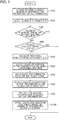
- FIG. 3 shows a state detection flow of the transmitter by the tire mounting state detection system 100.
- the tire mounting state detection system 100 specifically, the tire state detection device 200, acquires the strength of the radio signal received by the receiver 110 (RX1) and the receiver 120 (RX2) (S 10).
- the tire state detection device 200 acquires the signal strength of the radio signal for each transmitter received by the receiver 110 (RX1) and the receiver 120 (RX2).
- the tire state detection device 200 detects the number of transmitters based on the acquired signal strength (S 20).
- the tire state detection device 200 counts the number of transmitters equipped on the tire mounted on the vehicle 10 based on the radio signals received by the receiver 110 and the receiver 120 during a predetermined time.
- the tire state detection device 200 determines whether the number of detected transmitters matches the number of wheels (6) based on the vehicle configuration of the holding vehicle 10 (S 30).
- the tire state detection device 200 determines whether the vehicle 10 is in a stopped state (S 40).
- the stop includes both parking and stopping of the vehicle 10. This is because, as described above, when the vehicle 10 is parked (or stop), there is a possibility that there is a vehicle of the same specification nearby, and a radio signal from a tire mounted on the vehicle may be erroneously detected.
- steps 30 and 40 may be reversed. That is, after determining whether or not the vehicle 10 is in a stopped state, it may be determined whether or not the number of detected transmitters matches the number of wheels based on the vehicle configuration of the vehicle 10 being held.
- the tire state detection device 200 calculates the overall strength of each detected transmitter (S 50). Specifically, the tire state detection device 200 calculates the total value (sum) of the strength (first signal strength) of the radio signal received by the receiver 110 and the strength (second signal strength) of the radio signal received by the receiver 120, that is, R1 + R2, for each transmitter.
- the tire state detection device 200 detects excess or shortage of the transmitter in the vehicle longitudinal direction based on the magnitude relationship of R1 + R2 (S 60). Specifically, the tire state detection device 200 detects whether the wheel position (excess or shortage position of the transmitter) where the number of transmitters is exceeded or the number of transmitters is short is the front wheel side of the vehicle 10 or the rear wheel side of the vehicle 10.
- the tire state detection device 200 detects whether the excess/shortage position of the transmitter is on the front wheel side of the vehicle 10 or the rear wheel side of the vehicle 10 by using the above-described ⁇ n. Further, an example of detecting the excess/shortage position of the transmitter will be described later.
- the tire state detection device 200 calculates the strength ratio of each detected transmitter (S 70). Specifically, the tire state detection device 200 divides the first signal strength by the second signal strength to calculate a quotient (R1/R2).
- the tire state detection device 200 detects excess or shortage of the transmitter in the vehicle width direction based on the magnitude relation of R1/R2 (S 80). Specifically, the tire state detection device 200 detects whether the transmitter is in the left side of the vehicle 10 or the right side of the vehicle 10.
- the tire state detection device 200 detects whether the excess/shortage position of the transmitter is on the left side of the vehicle 10 or on the right side of the vehicle 10 using the above-described ⁇ n.
- the tire state detection device 200 detects the excess or shortage position of the transmitter based on the detection result in step 60, that is, the detection result in the vehicle longitudinal direction, and the detection result in step 80, that is, the detection result in the vehicle width direction (S 90).
- steps 50, 60 and steps 70, 80 may be reversed.
- the tire state detection device 200 outputs the excess/shortage position of the transmitter (S 100). Specifically, the tire state detection device 200 displays information indicating the position of a wheel on which a tire with an excessive or short transmitter is mounted on the display device of the vehicle 10 or outputs the information to the control device of the vehicle 10 or the like.
- the tire state detection device 200 may simply output that the state of the transmitter (Sensor) is abnormal in place of the information indicating the specific wheel position.
- FIGS. 4 to 7 are tables of signal strength and calculation results of the radio signal according to the state detection example 1.
- FIG. 4 shows the signal strength in the case where the tire mounted at the wheel position "1" (See Figure 1 ) is equipped with two transmitters.
- FIG. 5 shows signal strength in a case where two transmitters are equipped on a tire mounted at the wheel position "5".
- the ID (a, b, etc.) of the sensor is not shown, but the wheel position (P1, P2, etc.) where the tire on which the transmitter is equipped is shown. Further, in FIGS. 4 and 5 , the values of R1 + R2 are arranged in descending order so that the value of ⁇ n can be easily confirmed.
- ⁇ 3 is the largest. This means that R1 + R2 is significantly different between P2 and P4.
- the signal strength of the transmitters P1 and P2 is much stronger than the signal strength of the transmitters P3 to P6.
- ⁇ 3 is the largest because the front wheels have two sensors.
- ⁇ 2 is the largest. This is because a tire with an extra transmitter is mounted on the rear wheel. By using such features, it can be determined whether the extra transmitter belongs to the front wheel side or the rear wheel side of the vehicle 10.
- FIG. 6 corresponds to FIG. 4
- FIG. 7 corresponds to FIG. 5 . That is, FIG. 6 shows the signal strength in the case where two transmitters are equipped on the tire mounted at the wheel position "1".
- FIG. 7 shows signal strength in a case where two transmitters are equipped on a tire mounted at the wheel position "5".
- the values of R1/R2 are arranged in descending order for the transmitter groups determined to be mounted on the front wheel side and the transmitter groups determined to be mounted on the rear wheel side so that the value of ⁇ n can be easily confirmed.
- ⁇ 3 in FIG. 6 and ⁇ 2 in FIG. 7 are left blank because they are not used to determine whether the tire on which the extra transmitter is mounted is located on the left or right side of the vehicle 10 because the transmitter on the front wheel side is compared with the transmitter on the rear wheel side.
- ⁇ 1 is the smallest, which means that the difference between the value of R1/R2 of the first line transmitter and the value of R1/R2 of the second line transmitter is the smallest.
- the small difference in the value of R1/R2 is synonymous with the small difference in the position of the transmitter in the vehicle width direction.
- the wheel position on which the tire having each transmitter is mounted can be determined by disregarding the transmitter, determining the wheel position of the other transmitter, and then allocating the same wheel position as the transmitter determined to be equipped on the same tire.
- ⁇ 5 corresponding to P5 in which two transmitters are mounted is the smallest. That is, even when a tire on which two transmitters are equipped is mounted at a wheel position on the rear wheel side which is a double tire, the same determination can be made.
- FIGS. 8 to 11 are tables of signal strength and calculation results of the radio signal according to the state detection example 2.
- FIG. 8 shows the signal strength in the case where the transmitter of the tire mounted at the wheel position "1" (See Figure 1 ) is not activated.
- FIG. 9 shows the signal strength in the case where the transmitter of the tire mounted at the wheel position "5" is not activated.
- the state in which the transmitter is not activated includes a case in which the power supply of the transmitter is not turned on, a case in which the transmitter is broken, or a case in which the transmitter is not equipped.
- the values of R1 + R2 are arranged in descending order so that the value of ⁇ n can be easily confirmed.
- the transmitter which is not activated belongs to the front wheel side or the rear wheel side of the vehicle 10 based on n where ⁇ n is the largest.
- FIG. 10 corresponds to FIG. 8, and FIG. 11 corresponds to FIG. 9 . That is, FIG. 10 shows the signal strength in the case where the transmitter of the tire mounted at the wheel position "1" (See Figure 1 ) is not activated. FIG. 11 shows the signal strength in the case where the transmitter of the tire mounted at the wheel position "5" is not activated.
- the values of R1/R2 are arranged in descending order for each of the transmitter groups determined to be mounted on the front wheel side and the transmitter groups determined to be mounted on the rear wheel side.
- the wheel position on which the tire on which the unactivated transmitter is mounted can be determined using only the value of R1/R2.
- R1/R2 when the value of R1/R2 is 1.00 or more, it can be determined that the tire on which the transmitter is equipped is mounted at the wheel position "2" (P2). On the other hand, when the value of R1/R2 is 1.00 or less, it can be determined that the tire on which the transmitter is mounted is mounted at the wheel position "1" (P1).
- R1 is greater than R2 means that the transmitter should be located on the left side of the vehicle 10.
- R2 is greater than R1 because the transmitter should be located on the right side of the vehicle 10.
- the positions of the wheels on which the tires mounted with the remaining transmitters are mounted may be set from the wheel position "3" (P3) to the wheel position "6" (P6) in descending order of R1/R2.
- ⁇ n is used as shown in FIG. 11 .
- ⁇ n represents the positional relationship between the transmitters in the vehicle width direction, specifically, the distance between the transmitters and the adjacent transmitters in the vehicle width direction. Therefore, when the wheel positions (P3, P4 and P5, P6) in the vehicle width direction on the rear wheel side are compared, ⁇ n becomes largest.
- n at which ⁇ n is largest is 4, it can be determined in either of P5 and P6 that the transmitter is not activated.
- the following effects can be obtained. Specifically, according to the tire mounting state detection system 100, based on the number of wheels based on the vehicle configuration of the vehicle 10 and the number of transmitters (Sensor) detected by the transmitter number detection unit 250, it is detected whether the number of transmitters exceeds or is short of the number of wheels.
- the tire mounting state detection system 100 when it is determined that the number of transmitters exceeds or is short for the number of wheels, the state of the transmitters being abnormal or a detection result of wheel position on which the number of transmitters being exceeded or the number of transmitters being short (excess or shortage position of the transmitter) is output.
- the convenience of the system for automatically detecting the position of the wheel on which the tire (Transmitter) is mounted can be remarkably improved.
- a radio signal from the transmitter cannot be detected due to a failure, forgetting to turn on the power, forgetting to install, or the like, or when a plurality of sensors (That is, the transmitter) are erroneously attached to one tire, it can be quickly recognized that the state of the transmitter is abnormal.
- the overall strength of the radio signal is calculated for each transmitter using the first signal strength and the second signal strength. Further, based on the calculated magnitude relationship of the overall strength, it is detected that the excess/shortage position of the transmitter is attached to the wheel position of either the front wheel side of the vehicle 10 or the rear wheel side of the vehicle 10.
- an strength ratio which is a ratio using the first signal strength and the second signal strength, is calculated for each transmitter. Further, based on the calculated magnitude relationship of the strength ratio, it is detected that the excess/shortage position of the transmitter is attached to the wheel position of either the left side of the vehicle 10 or the right side of the vehicle 10.
- FIG. 12 is a schematic plan view of a vehicle 10 A according to a modification.
- the vehicle 10 A includes a front wheel axle 21 and two rear wheel axles, specifically a rear wheel axle 22 and a rear wheel axle 23.
- the excess/shortage position of the transmitter can be detected by using the above-mentioned total strength (R1 + R2) and the strength ratio (R1/R2).
- the receiver 110 and the receiver 120 are disposed closer to the front wheels with respect to the center line CL2 (See Figure 1 ), but may be disposed closer to the rear wheels with respect to the center line CL2.
- the tire state detection device 200 is incorporated as a part of an electronic control unit (ECU) mounted on the vehicle 10.
- ECU electronice control unit
- FIG. 13 is a schematic plan view and a schematic network configuration view of a vehicle 10 B according to a modification. As shown in FIG. 13 , the vehicle 10 B includes a communication device 310 instead of the tire state detection device 200.
- the communication device 310 may perform wireless communication with a wireless base station 320.
- the communication device 310 is, for example, a wireless communication terminal connectable to a mobile communication network (LTE, etc.).
- the server computer 330 is provided on a communication network and realizes functions (first measurement unit 210, second measurement unit 220, vehicle configuration holding unit 230, calculation unit 240, transmitter number detecting unit 250, state detection unit 260, and output unit 270) which have been realized by the tire state detection device 200.
- the program (software, which may be called a program product) for realizing the function may be stored in a state capable of downloading on the communication network or may be provided in a form stored in a storage medium.
- the radio signal transmitted from the sensor includes an identifier (Sensor ID) for identifying the sensor (Transmitter), but such an identifier is not necessarily required when the sensor can be identified by another method (e.g., the frequency band used, or the channel number).
Landscapes
- Engineering & Computer Science (AREA)
- Mechanical Engineering (AREA)
- Physics & Mathematics (AREA)
- Electromagnetism (AREA)
- Arrangements For Transmission Of Measured Signals (AREA)
- Measuring Fluid Pressure (AREA)
Abstract
Description
- The present invention relates to a tire mounting state detection system, a tire mounting state detection method and a tire mounting state detection program for detecting the state of a transmitter equipped on a tire mounted on a vehicle.
- In order to measure the internal pressure and temperature of a tire (where the tire is mounted on a rim wheel.) mounted on a vehicle, a sensor including a transmitter of a radio signal (radio wave) is widely mounted in the tire.
- The information detected by the sensor needs to be managed in association with the wheel position (Front right wheel, rear left wheel, etc.) of the vehicle on which the tire is mounted. However, since the wheel position to which the tire (Sensor) is mounted is changed by rotation or the like, it is necessary to update the correspondence between the identifier (ID) of the sensor and the wheel position each time.
- Therefore, a method of automatically detecting the position of a wheel on which a tire (Sensor) is mounted is known in order to avoid such complication of updating. For example, in the tire air pressure monitoring system disclosed in
Patent Literature - [PTL 1] Japanese Unexamined Patent Application Publication No.
2007-045201 - In the tire air pressure monitoring system described above, one sensor is attached to each tire, and it is assumed that each sensor, specifically each transmitter, is operating normally.
- However, in a tire mounted on an actual vehicle (In particular, dump trucks running on mining sites such as mines), a radio signal from a transmitter may not be detected due to failure, forgetting to turn on a power source, forgetting to install, or the like. Furthermore, in some cases, a plurality of sensors (That is, the transmitter) are erroneously attached to one tire.
- In such a case, the tire air pressure monitoring system described above cannot correctly detect the position of the wheel on which each tire (Transmitter) is mounted.
- Accordingly, an object of the present invention is to provide a tire mounting state detection system, a tire mounting state detection method, and a tire mounting state detection program capable of detecting a state in which a transmitter is not normally mounted on a tire or is not operating when automatically detecting a wheel position on which a tire (Transmitter) is mounted.
- One aspect of the present invention is a tire mounting state detection system (Tire mounting state detection system 100) for detecting the state of a transmitter (
Sensor 41 to sensor 46) equipped on a tire (Tire 31 to 36) mounted on a vehicle (For example, vehicle 10), including a receiving unit (Receiving unit 105) disposed in the vehicle for receiving a radio signal transmitted from the transmitter; and the tire mounting state detection system including: a vehicle configuration holding unit (Vehicle configuration holding unit 230) for holding a vehicle configuration including the number of wheels of the vehicle; a transmitter number detection unit (Transmitter number detection unit 250) for detecting the number of transmitters based on the radio signal received by the receiving unit; a state detection unit (state detection unit 260) for detecting whether or not the number of transmitters exceeds or is short of the number of wheels, based on the number of wheels based on the vehicle configuration held by the vehicle configuration holding unit and the number of transmitters detected by the transmitter number detection unit; an output unit (Output unit 270) for outputting that the state of the transmitter is abnormal when the state detection unit determines that the number of the transmitters exceeds or is short for the number of the wheels. - One aspect of the present invention is a tire mounting state detection method for detecting the state of a transmitter equipped on a tire mounted on a vehicle, using a receiving unit disposed in the vehicle and receiving a radio signal transmitted from the transmitter. The tire mounting state detection method including the steps of: detecting the number of transmitters based on the radio signal received by the receiving unit; detecting whether or not the number of transmitters exceeds or is short of the number of wheels, based on the number of wheels based on a vehicle configuration including the number of wheels of the vehicle and the number of transmitters detected; and outputting that the state of the transmitter is abnormal when it is determined that the number of the transmitters exceeds or is short for the number of the wheels.
- One aspect of the present invention is a tire mounting state detection program for detecting the state of a transmitter mounted on a tire mounted on a vehicle, using a receiving unit disposed in the vehicle and receiving a radio signal transmitted from the transmitter. The tire mounting state detection program causing a computer to execute a process for holding a vehicle configuration including the number of wheels of the vehicle; a process of detecting the number of the transmitters based on the radio signal received by the receiving unit, a process of detecting whether or not the number of transmitters exceeds or is short of the number of wheels, based on the number of wheels based on the vehicle configuration and the number of transmitters detected, and a process of outputting that the state of the transmitter is abnormal when it is determined that the number of the transmitters exceeds or is short for the number of the wheels.
-
- [
FIG. 1] FIG. 1 is a schematic plan view of avehicle 10 including a tire installationstate detection system 100. - [
FIG. 2] FIG. 2 is a functional block diagram of a tirestate detection device 200. - [
FIG. 3] FIG. 3 shows a state detection flow of the transmitter by the tire mountingstate detection system 100. - [
FIG. 4] FIG. 4 is a table of signal strength and calculation results of the radio signal according to the state detection example 1. - [
FIG. 5] FIG. 5 is a table of signal strength and calculation results of the radio signal according to the state detection example 1. - [
FIG. 6] FIG. 6 is a table of signal strength and calculation results of the radio signal according to the state detection example 1. - [
FIG. 7] FIG. 7 is a table of signal strength and calculation results of the radio signal according to the state detection example 1. - [
FIG. 8] FIG. 8 is a table of signal strength and calculation results of the radio signal according to the state detection example 2. - [
FIG. 9] FIG. 9 is a table of signal strength and calculation results of the radio signal according to the state detection example 2. - [
FIG. 10] FIG. 10 is a table of signal strength and calculation results of the radio signal according to the state detection example 2. - [
FIG. 11] FIG. 11 is a table of signal strength and calculation results of the radio signal according to the state detection example 2. - [
FIG. 12] FIG. 12 is a schematic plan view of avehicle 10 A according to a modification. - [
FIG. 13] FIG. 13 is a schematic plan view and schematic network diagram of avehicle 10 B according to a modification. - Hereinafter, an embodiment will be described based on the drawings. It should be noted that the same or similar reference numerals are given to the same functions and configurations, and the description thereof will be omitted as appropriate.
-
FIG. 1 is a schematic plan view of avehicle 10 including a tire mountingstate detection system 100. As shown inFIG. 1 , thevehicle 10 is an automobile having afront wheel axle 21 and arear wheel axle 22. The type of thevehicle 10 is not particularly limited, but therear wheel axle 22 is a so-called double tire, and is mainly assumed to be a large vehicle such as a truck and a mining vehicle. - A
vehicle 10 is mounted withtires 31 to 36. Thetires 31 to 36 are tires (May be called a tire wheel assembly) assembled to a rim wheel. - Here, the
tire 31 is mounted at the left front wheel position ("1" in the figure, hereinafter the same). Similarly, thetires 32 to 36 are mounted at positions of a right front wheel (2), a left outside rear wheel (3), a left inside rear wheel (4), a right inside rear wheel (5), and a right outside rear wheel (6), respectively. - The
tire 31 is equipped with asensor 41 for measuring the internal pressure and temperature of thetire 31. Thesensor 41 may include a sensor for measuring acceleration.Sensor 41 includes a transmitter for transmitting measured internal pressure and temperature data. Similarly, thetires 32 to 36 are equipped withsensors 42 to 46. Thesensors 41 to 46 may be suitably used in a tire pressure monitoring system (TPMS) or the like. - To the
sensor 41, "a" is assigned as a sensor ID which is an identification for identifying the sensor 41 (Transmitter). Similarly,sensors 42 to 46 are assigned "b" to "f" as sensor IDs, respectively. - A tire mounting
state detection system 100 detects the state of a tire mounted on avehicle 10. Specifically, the tire mountingstate detection system 100 detects the state of the transmitter mounted on thetires 10 to 31 mounted on thevehicle 36. - The tire mounting
state detection system 100 includes a receivingunit 105 and a tirestate detection device 200. Thereceiving unit 105 is disposed in thevehicle 10 and receives radio signals (radio wave) transmitted from the sensors 41 (Transmitter) to 46 . - In this embodiment, the
receiving unit 105 includes areceiver 110 and areceiver 120. In the present embodiment, thereceiver 110 constitutes a first receiver. Thereceiver 120 constitutes a second receiver. - The
receiver 110 is appropriately labeled "RX1" for convenience. Thereceiver 110 receives radio signals transmitted from each sensor (Transmitter), i.e.,sensors 41 to 46. It should be noted that the strength (Transmit Power) of the radio signal, the frequency band to be used, and the like may vary depending on the area of use of the tire mountingstate detection system 100 or the type ofvehicle 10. - The
receiver 120 is appropriately labeled "RX2" for convenience. Thereceiver 120 also receives radio signals transmitted fromsensors 41 to 46. Thereceiver 120 is located at a different location from thereceiver 110. Specifically, thereceiver 120 is disposed at a position different from thereceiver 110 in the vehicle width direction. Thereceiver 120 is disposed at the same position as thereceiver 110 in the vehicle longitudinal direction. - In this embodiment, the
receiver 110 is disposed on one side, more specifically, on the left side, with the center line CL1 (Widthwise center line) between the left wheel (For example, "1") and the right wheel as a reference. On the other hand, thereceiver 120 is disposed on the other side with respect to the center line CL1, specifically, on the right side. - More specifically, the
receiver 110 and thereceiver 120 are arranged symmetrically with respect to the center line CL1. - In the present embodiment, the
receiver 110 and thereceiver 120 are disposed on one side, more specifically, closer to the front wheels, with the center line CL2 (longitudinal centerline) between the front wheels ("1", "2") and the rear wheels ("3" to "6") as a reference. - The tire
state detection device 200 uses the receivingunit 105 to detect thetire 31 to thetire 36, that is, the position of the wheel ("1" through "6") on which thesensor 41 to thesensor 46 are equipped . In this embodiment, the tirestate detection device 200 is incorporated as a part of an electronic control unit (ECU) mounted on thevehicle 10. As will be described later, the function realized by the tirestate detection device 200 may be provided outside thevehicle 10 connectable via a communication network (Cloud, etc.). - Next, a functional block configuration of the tire mounting
state detection system 100 will be described. Specifically, a functional block configuration of the tirestate detection device 200 constituting the tire mountingstate detection system 100 will be described. -
FIG. 2 is a functional block diagram of the tirestate detection device 200. As shown inFIG. 2 , the tirestate detection device 200 includes afirst measurement unit 210, asecond measurement unit 220, a vehicleconfiguration holding unit 230, acalculation unit 240, a transmitternumber detection unit 250, astate detection unit 260, and anoutput unit 270. - The tire
state detection device 200 has hardware such as a CPU and a memory, and the above-mentioned respective functional parts are realized by executing a computer program (Software) on the hardware. - The
first measurement unit 210 is connected to thereceiver 110. Thefirst measurement unit 210 measures the strength (first signal strength) of the radio signal received by thereceiver 110 for each of thesensors 41 to 46 (Transmitter). - The
second measurement unit 220 is connected to thereceiver 120. Thesecond measurement unit 220 measures the strength (second signal strength) of the radio signal received by thereceiver 120 for each of thesensors 41 to 46 (Transmitter). - Hereinafter, the signal from the transmitter received by the receiver 110 (first receiver) is appropriately denoted as R1. Similarly, the signal from the transmitter received by the receiver 120 (second receiver) is appropriately denoted as R2.
- The strength of the radio signal to be measured by the
first measurement unit 210 and thesecond measurement unit 220 may be a voltage level or a power level. Further, control may be performed in units of decibels (dB). In this embodiment, a voltage level (Units: V) is used. - In this embodiment, the radio signals transmitted from the
sensors 41 to 46 include a sensor ID (identifier) that identifies each sensor (Transmitter). - A vehicle
configuration holding unit 230 holds configuration information of thevehicle 10. Specifically, the vehicleconfiguration holding unit 230 holds a vehicle configuration including the number of wheels of thevehicle 10. - That is, the vehicle
configuration holding unit 230 holds the vehicle configuration including the number of wheels of the vehicle on which the tire on having the sensor (Transmitter) is mounted. The vehicleconfiguration holding unit 230 may previously hold the configuration information of thevehicle 10 in a memory or may acquire the configuration information from the outside via a communication network. - The
calculation unit 240 executes calculation using the strength (first signal strength) of the radio signal received by thereceiver 110 and the strength (second signal strength) of the radio signal received by thereceiver 120. - Specifically, the
calculation unit 240 calculates the overall strength of the radio signal for each transmitter by using the first signal strength and the second signal strength. More specifically, thecalculation unit 240 calculates a total value (sum) of the first signal strength and the second signal strength, that is, R1 + R2, for each transmitter. - The overall strength is not limited to R1 + R2, and may be a value indicating the strength or magnitude of the radio signal using the first signal strength and the second signal strength. A power value such as (R12 + R22) may be used.
- The
calculation unit 240 calculates a strength ratio, which is a ratio using the first signal strength and the second signal strength, for each transmitter. - In the present embodiment, the
calculation unit 240 calculates the quotient of the first signal strength and the second signal strength for each sensor as the strength ratio. Specifically, thecalculation unit 240 divides the first signal strength by the second signal strength to calculate a quotient (R1/R2). - The strength ratio may be a ratio using the first signal strength and the second signal strength, and is not limited to R1/R2. The quotient may be R2/R1, or it may be such as (R1 - R2)/(R1 + R2) that the values of R1 and R2 can be made dimensionless.
- The transmitter
number detection unit 250 detects the number of transmitters equipped on thetires 31 to 36 based on the radio signal received by the receivingunit 105. Specifically, the transmitternumber detection unit 250 detects the number of transmitters equipped on thetires 31 to 36 based on radio signals (R1, R2) received by thereceiver 110 and thereceiver 120. - More specifically, the transmitter
number detection unit 250 counts the number of transmitters equipped on the tire mounted on thevehicle 10 based on radio signals received by thereceiver 110 and thereceiver 120 during a predetermined time. - In the present embodiment, as described above, since the wireless signal includes a sensor ID (identifier) for identifying each sensor (Transmitter), the transmitter
number detection unit 250 counts the number of transmitters based on the sensor ID. - The transmitter
number detection unit 250 detects the number of transmitters equipped on the tire mounted on the vehicle 10 (own vehicle) by using the number of receiving times of a radio signal transmitted from the same transmitter. - That is, when the number of times of receiving the radio signal transmitted from the same transmitter is less than the predetermined number, the transmitter
number detection unit 250 may exclude the transmitter from the detection target. In particular, when thevehicle 10 is parked (or stop), there is a possibility that there is a vehicle of the same specification nearby, and there is a case where a radio signal from a tire mounted on the vehicle is erroneously detected. - Furthermore, as will be described later, when the
vehicle 10 is parked (or stop), the operation itself of the tirestate detection device 200 may be stopped in order to prevent such erroneous detection. - It should be noted that whether or not the
vehicle 10 is parked (or stop) may be determined using information provided from the vehicle 10 (Driving speed, etc.), or may be determined using a satellite positioning system such as a global positioning system (GPS). - The
state detection unit 260 detects whether the number of transmitters exceeds or is short of the number of wheels based on the vehicle configuration held by the vehicleconfiguration holding unit 230 and the number of transmitters detected by the transmitternumber detection unit 250. - Specifically, based on the number of wheels (6) of the
vehicle 10, the transmitternumber detection unit 250 detects whether the number of detected transmitters exceeds 6 (That is, 7 or more) or is less than 6 (That is, less than or equal to 5). - More specifically, the
state detection unit 260 detects, based on the overall strength of each detected transmitter, more specifically, based on the magnitude relationship of R1 + R2, whether the number of transmitters exceeds, more specifically, whether the number of transmitters is short, more specifically, whether the transmitter is not activated or the number of transmitters is short, and whether the transmitter is equipped at the wheel position of the front wheel side of thevehicle 10 or at the wheel position of the rear wheel side of thevehicle 10. - Further, the
state detection unit 260 detects, based on the detected strength ratio of the respective transmitters, more specifically, based on the magnitude relationship of R1/R2, whether the number of the transmitters exceeds or the transmitter-unactivated tires are equipped at the left wheel position of thevehicle 10 or the right wheel position of thevehicle 10. - In the present embodiment, the
state detection unit 260 uses Δn and δn to detect whether the number of transmitters exceeds or is short of the number of wheels.

- Δn is obtained by sorting the values of R1 + R2 in descending order and calculating the difference between the values of R1 + R2 and the values of R1 + R2 (R1 n + 1, R2 n + 1). n indicates the order (Order and correspondence of the rows in the table shown in
Figures 4 to 11 ) based on the magnitude relation of R1 + R2. - Similarly, δn is obtained by sorting the values of R1/R2 in descending order to obtain a difference between the values of R1/R2 and the values of R1/R2 (R1 n + 1, R2 n + 1).
- Here, since R1 + R2 provides information on the transmitter in the vehicle longitudinal direction, by using Δn, it can be determined whether the tire in which the transmitter is exceeded or insufficient belongs to the front wheel side or the rear wheel side of the
vehicle 10. - Further, since R1/R2 provides information on the transmitter in the vehicle width direction (vehicle lateral direction), by using Δn, it can be determined whether the tire in which the transmitter is excessive or short belongs to the left wheel side or the right wheel side of the
vehicle 10. - That is, by using Δn and δn, the
state detection unit 260 can detect at which wheel position of thevehicle 10 the tire in which the transmitter is excessive or short is mounted. - The
output unit 270 outputs that the state of the transmitter is abnormal when thestate detection unit 260 determines that the number of transmitters exceeds or is short for the number of wheels. - Specifically, the
output unit 270 can output the wheel position where the tire in which the transmitter is excessive or short is mounted. That is, theoutput unit 270 outputs the detection result of the wheel position by thestate detection unit 260. - The
output unit 270 can display, on a display device of thevehicle 10, the state of the transmitter being abnormal, or the wheel position where the tire in which the transmitter is excessive or short is mounted, or can sound an alarm. Alternatively, theoutput unit 270 may directly output the content to a control device or the like of thevehicle 10. - Next, the operation of the tire mounting
state detection system 100 will be described. Specifically, the operation of detecting the state of the transmitter equipped on thetires 31 to 36 mounted on thevehicle 10 will be described. -
FIG. 3 shows a state detection flow of the transmitter by the tire mountingstate detection system 100. As shown inFIG. 3 , the tire mountingstate detection system 100, specifically, the tirestate detection device 200, acquires the strength of the radio signal received by the receiver 110 (RX1) and the receiver 120 (RX2) (S 10). - Specifically, the tire
state detection device 200 acquires the signal strength of the radio signal for each transmitter received by the receiver 110 (RX1) and the receiver 120 (RX2). - The tire
state detection device 200 detects the number of transmitters based on the acquired signal strength (S 20). - In this embodiment, as described above, the tire
state detection device 200 counts the number of transmitters equipped on the tire mounted on thevehicle 10 based on the radio signals received by thereceiver 110 and thereceiver 120 during a predetermined time. - The tire
state detection device 200 determines whether the number of detected transmitters matches the number of wheels (6) based on the vehicle configuration of the holding vehicle 10 (S 30). - If the number of transmitters does not match the number of wheels, that is, if the number of transmitters exceeds or is short for the number of wheels, the tire
state detection device 200 determines whether thevehicle 10 is in a stopped state (S 40). - The stop includes both parking and stopping of the
vehicle 10. This is because, as described above, when thevehicle 10 is parked (or stop), there is a possibility that there is a vehicle of the same specification nearby, and a radio signal from a tire mounted on the vehicle may be erroneously detected. - The processing in
steps vehicle 10 is in a stopped state, it may be determined whether or not the number of detected transmitters matches the number of wheels based on the vehicle configuration of thevehicle 10 being held. - When the
vehicle 10 is not in the stopped state, the tirestate detection device 200 calculates the overall strength of each detected transmitter (S 50). Specifically, the tirestate detection device 200 calculates the total value (sum) of the strength (first signal strength) of the radio signal received by thereceiver 110 and the strength (second signal strength) of the radio signal received by thereceiver 120, that is, R1 + R2, for each transmitter. - The tire
state detection device 200 detects excess or shortage of the transmitter in the vehicle longitudinal direction based on the magnitude relationship of R1 + R2 (S 60). Specifically, the tirestate detection device 200 detects whether the wheel position (excess or shortage position of the transmitter) where the number of transmitters is exceeded or the number of transmitters is short is the front wheel side of thevehicle 10 or the rear wheel side of thevehicle 10. - More specifically, the tire
state detection device 200 detects whether the excess/shortage position of the transmitter is on the front wheel side of thevehicle 10 or the rear wheel side of thevehicle 10 by using the above-described Δn. Further, an example of detecting the excess/shortage position of the transmitter will be described later. - Next, the tire
state detection device 200 calculates the strength ratio of each detected transmitter (S 70). Specifically, the tirestate detection device 200 divides the first signal strength by the second signal strength to calculate a quotient (R1/R2). - The tire
state detection device 200 detects excess or shortage of the transmitter in the vehicle width direction based on the magnitude relation of R1/R2 (S 80). Specifically, the tirestate detection device 200 detects whether the transmitter is in the left side of thevehicle 10 or the right side of thevehicle 10. - More specifically, the tire
state detection device 200 detects whether the excess/shortage position of the transmitter is on the left side of thevehicle 10 or on the right side of thevehicle 10 using the above-described δn. - The tire
state detection device 200 detects the excess or shortage position of the transmitter based on the detection result in step 60, that is, the detection result in the vehicle longitudinal direction, and the detection result in step 80, that is, the detection result in the vehicle width direction (S 90). - Further, an example of detecting the excess/shortage position of the transmitter will be described later. The order of steps 50, 60 and steps 70, 80 may be reversed.
- The tire
state detection device 200 outputs the excess/shortage position of the transmitter (S 100). Specifically, the tirestate detection device 200 displays information indicating the position of a wheel on which a tire with an excessive or short transmitter is mounted on the display device of thevehicle 10 or outputs the information to the control device of thevehicle 10 or the like. - As described above, the tire
state detection device 200 may simply output that the state of the transmitter (Sensor) is abnormal in place of the information indicating the specific wheel position. - Next, an example of the state detection of the transmitter by the tire mounting
state detection system 100 will be described. Specifically, an example of detecting a state in which the number of transmitters exceeds the number of wheels and an example of detecting a state in which the number of transmitters is short for the number of wheels will be described. - In the present state detection example, a case where the number of transmitters (Sensor) is one more than the number of wheels will be described.
FIGS. 4 to 7 are tables of signal strength and calculation results of the radio signal according to the state detection example 1. -
FIG. 4 shows the signal strength in the case where the tire mounted at the wheel position "1" (SeeFigure 1 ) is equipped with two transmitters.FIG. 5 shows signal strength in a case where two transmitters are equipped on a tire mounted at the wheel position "5". - In
FIGS. 4 and 5 , the ID (a, b, etc.) of the sensor is not shown, but the wheel position (P1, P2, etc.) where the tire on which the transmitter is equipped is shown. Further, inFIGS. 4 and 5 , the values of R1 + R2 are arranged in descending order so that the value of Δn can be easily confirmed. - In
FIG. 4 , Δ3 is the largest. This means that R1 + R2 is significantly different between P2 and P4. - In this embodiment, since the
receiver 110 and thereceiver 120 are disposed in front of thevehicle 10, the signal strength of the transmitters P1 and P2 is much stronger than the signal strength of the transmitters P3 to P6. - Therefore, if no extra transmitter is equipped, if the values of R1 + R2 rearrange the data in descending order, the upper two transmitters are mounted on the front wheel, and Δ2 comparing the second and third transmitters should be the largest.
- In
FIG. 4 , Δ3 is the largest because the front wheels have two sensors. InFIG. 5 , Δ2 is the largest. This is because a tire with an extra transmitter is mounted on the rear wheel. By using such features, it can be determined whether the extra transmitter belongs to the front wheel side or the rear wheel side of thevehicle 10. -
FIG. 6 corresponds toFIG. 4 , andFIG. 7 corresponds toFIG. 5 . That is,FIG. 6 shows the signal strength in the case where two transmitters are equipped on the tire mounted at the wheel position "1".FIG. 7 shows signal strength in a case where two transmitters are equipped on a tire mounted at the wheel position "5". - In
FIGS. 6 and 7 , the values of R1/R2 are arranged in descending order for the transmitter groups determined to be mounted on the front wheel side and the transmitter groups determined to be mounted on the rear wheel side so that the value of δn can be easily confirmed. Note that δ3 inFIG. 6 and δ2 inFIG. 7 are left blank because they are not used to determine whether the tire on which the extra transmitter is mounted is located on the left or right side of thevehicle 10 because the transmitter on the front wheel side is compared with the transmitter on the rear wheel side. - In
FIG. 6 , δ1 is the smallest, which means that the difference between the value of R1/R2 of the first line transmitter and the value of R1/R2 of the second line transmitter is the smallest. - Since the
receiver 110 and thereceiver 120 are arranged side by side in the vehicle width direction, the small difference in the value of R1/R2 is synonymous with the small difference in the position of the transmitter in the vehicle width direction. - That is, it may be determined that the transmitter having the smallest δn is equipped on the same tire as the transmitter in the row above. Therefore, the wheel position on which the tire having each transmitter is mounted can be determined by disregarding the transmitter, determining the wheel position of the other transmitter, and then allocating the same wheel position as the transmitter determined to be equipped on the same tire.
- In
FIG. 7 , δ5 corresponding to P5 in which two transmitters are mounted is the smallest. That is, even when a tire on which two transmitters are equipped is mounted at a wheel position on the rear wheel side which is a double tire, the same determination can be made. - In this state detection example, a case where the number of transmitters (Sensor) is one less than the number of wheels will be described.
FIGS. 8 to 11 are tables of signal strength and calculation results of the radio signal according to the state detection example 2. -
FIG. 8 shows the signal strength in the case where the transmitter of the tire mounted at the wheel position "1" (SeeFigure 1 ) is not activated.FIG. 9 shows the signal strength in the case where the transmitter of the tire mounted at the wheel position "5" is not activated. - The state in which the transmitter is not activated includes a case in which the power supply of the transmitter is not turned on, a case in which the transmitter is broken, or a case in which the transmitter is not equipped. In
FIGS. 8 and 9 , the values of R1 + R2 are arranged in descending order so that the value of Δn can be easily confirmed. - As in the state detection example 1, it can be determined whether the transmitter which is not activated belongs to the front wheel side or the rear wheel side of the
vehicle 10 based on n where Δn is the largest. - When Δ1 is largest, there is only one transmitter on the front wheel side, and the tire on which the transmitter which is not activated is equipped is mounted on the front wheel side (see
Figure 8 ). When Δ2 is largest, the tire on which the transmitter which is not activated is mounted on the rear wheel side (seeFigure 9 ). -
FIG. 10 corresponds toFIG. 8, and FIG. 11 corresponds toFIG. 9 . That is,FIG. 10 shows the signal strength in the case where the transmitter of the tire mounted at the wheel position "1" (SeeFigure 1 ) is not activated.FIG. 11 shows the signal strength in the case where the transmitter of the tire mounted at the wheel position "5" is not activated. - In
FIGS. 10 and 11 , in order to easily confirm the value of δn, the values of R1/R2 are arranged in descending order for each of the transmitter groups determined to be mounted on the front wheel side and the transmitter groups determined to be mounted on the rear wheel side. - If it is determined based on Δn that the unactivated transmitter belongs to the front wheel side of the
vehicle 10, the wheel position on which the tire on which the unactivated transmitter is mounted can be determined using only the value of R1/R2. - Specifically, when the value of R1/R2 is 1.00 or more, it can be determined that the tire on which the transmitter is equipped is mounted at the wheel position "2" (P2). On the other hand, when the value of R1/R2 is 1.00 or less, it can be determined that the tire on which the transmitter is mounted is mounted at the wheel position "1" (P1).
- That is, since the
receiver 110 is located on the left side of thevehicle 10 and thereceiver 120 is located on the right side of thevehicle 10, the fact that R1 is greater than R2 means that the transmitter should be located on the left side of thevehicle 10. On the other hand, R2 is greater than R1 because the transmitter should be located on the right side of thevehicle 10. - In
FIG. 10 , since the value of R1/R2 based on the signal strength of the radio signal from the transmitter in which R1 + R2 is largest (4.85) is 1.00 or less (0.91), it can be determined that the transmitter is equipped on the tire mounted at the wheel position "2" (P2). That is, it can be determined that the tire on which the transmitter which is not activated is mounted is mounted at the wheel position "1" (P1). - It should be noted that the positions of the wheels on which the tires mounted with the remaining transmitters are mounted may be set from the wheel position "3" (P3) to the wheel position "6" (P6) in descending order of R1/R2.
- On the other hand, when it is determined based on Δn that the transmitter which is not activated belongs to the rear wheel side of the
vehicle 10, δn is used as shown inFIG. 11 . - As described above, δn represents the positional relationship between the transmitters in the vehicle width direction, specifically, the distance between the transmitters and the adjacent transmitters in the vehicle width direction. Therefore, when the wheel positions (P3, P4 and P5, P6) in the vehicle width direction on the rear wheel side are compared, δn becomes largest.
- In
FIG. 11 , since the transmitter of the tire mounted at the wheel position "5" (P5) is not activated, δ4 between P4 and P6 becomes the largest. In other words, if n at which δn is maximum is 3, it can be determined that the transmitter is not activated in either of P3 and P4. - Similarly, if n at which δn is largest is 4, it can be determined in either of P5 and P6 that the transmitter is not activated.
- Then, based on the size of R1/R2, it is determined whether the tire in which the transmitter is not activated is P3 or P4 (P5, P6).
- According to the embodiment described above, the following effects can be obtained. Specifically, according to the tire mounting
state detection system 100, based on the number of wheels based on the vehicle configuration of thevehicle 10 and the number of transmitters (Sensor) detected by the transmitternumber detection unit 250, it is detected whether the number of transmitters exceeds or is short of the number of wheels. - Further, according to the tire mounting
state detection system 100, when it is determined that the number of transmitters exceeds or is short for the number of wheels, the state of the transmitters being abnormal or a detection result of wheel position on which the number of transmitters being exceeded or the number of transmitters being short (excess or shortage position of the transmitter) is output. - Therefore, in the case of automatically detecting the position of a wheel on which a tire (Transmitter) is mounted, a state in which the transmitter is not normally equipped on the tire or is not operated can be detected. Further, the excess/shortage position of the transmitter can be detected.
- Thus, the convenience of the system for automatically detecting the position of the wheel on which the tire (Transmitter) is mounted can be remarkably improved. In particular, even when a radio signal from the transmitter cannot be detected due to a failure, forgetting to turn on the power, forgetting to install, or the like, or when a plurality of sensors (That is, the transmitter) are erroneously attached to one tire, it can be quickly recognized that the state of the transmitter is abnormal.
- In this embodiment, the overall strength of the radio signal is calculated for each transmitter using the first signal strength and the second signal strength. Further, based on the calculated magnitude relationship of the overall strength, it is detected that the excess/shortage position of the transmitter is attached to the wheel position of either the front wheel side of the
vehicle 10 or the rear wheel side of thevehicle 10. - In the present embodiment, an strength ratio, which is a ratio using the first signal strength and the second signal strength, is calculated for each transmitter. Further, based on the calculated magnitude relationship of the strength ratio, it is detected that the excess/shortage position of the transmitter is attached to the wheel position of either the left side of the
vehicle 10 or the right side of thevehicle 10. - By combining such detection methods, it is possible to detect the specific excess or shortage position of the transmitter. Therefore, the work of returning the transmitter to the normal state is remarkably facilitated.
- While the contents of the present invention have been described in accordance with the above embodiments, it will be apparent to those skilled in the art that the present invention is not limited to these descriptions and that various modifications and improvements are possible.
- For example, the tire mounting
state detection system 100 may function similarly in a vehicle different in vehicle configuration from thevehicle 10.FIG. 12 is a schematic plan view of avehicle 10 A according to a modification. - As shown in
FIG. 12 , thevehicle 10 A includes afront wheel axle 21 and two rear wheel axles, specifically arear wheel axle 22 and arear wheel axle 23. - Even in the case of the
vehicle 10 A, the excess/shortage position of the transmitter can be detected by using the above-mentioned total strength (R1 + R2) and the strength ratio (R1/R2). - In the above-described embodiment, the case where there are one more transmitters (Sensor) has been described, but even in the case where there are two or more transmitters, the excess/shortage position of the transmitters can be detected by using the above-described total strength (R1 + R2) and the strength ratio (R1/R2).
- In the above-described embodiment, the
receiver 110 and thereceiver 120 are disposed closer to the front wheels with respect to the center line CL2 (SeeFigure 1 ), but may be disposed closer to the rear wheels with respect to the center line CL2. - In the above-described embodiment, the tire
state detection device 200 is incorporated as a part of an electronic control unit (ECU) mounted on thevehicle 10. -
FIG. 13 is a schematic plan view and a schematic network configuration view of avehicle 10 B according to a modification. As shown inFIG. 13 , thevehicle 10 B includes acommunication device 310 instead of the tirestate detection device 200. - The
communication device 310 may perform wireless communication with awireless base station 320. Thecommunication device 310 is, for example, a wireless communication terminal connectable to a mobile communication network (LTE, etc.). - The
server computer 330 is provided on a communication network and realizes functions (first measurement unit 210,second measurement unit 220, vehicleconfiguration holding unit 230,calculation unit 240, transmitternumber detecting unit 250,state detection unit 260, and output unit 270) which have been realized by the tirestate detection device 200. - The program (software, which may be called a program product) for realizing the function may be stored in a state capable of downloading on the communication network or may be provided in a form stored in a storage medium.
- Further, in the above-described embodiment, the radio signal transmitted from the sensor (Transmitter) includes an identifier (Sensor ID) for identifying the sensor (Transmitter), but such an identifier is not necessarily required when the sensor can be identified by another method (e.g., the frequency band used, or the channel number).
- Although embodiments of the invention have been described as described above, the discussion and drawings which form part of this disclosure should not be construed as limiting the invention. Various alternative embodiments, embodiments and operational techniques will be apparent to those skilled in the art from this disclosure.
-
- 10, 10 A, 10 B vehicles
- 21 front wheel axle
- 22, 23 rear wheel axles
- 31 - 36 tires
- 41 - 46 sensors
- 100, 100 A tire mounting state detection system
- 105 receiving unit
- 110, 120 receivers
- 200 tire state detection device
- 210 first measurement unit
- 220 second measurement unit
- 230 vehicle configuration holding unit
- 240 calculation unit
- 250 transmitter number detection unit
- 260 state detection unit
- 270 output unit
- 310 communication device
- 320 wireless base station
- 330 server computer
Claims (6)
- A tire mounting state detection system for detecting the state of a transmitter equipped on a tire mounted on a vehicle, including a receiving unit disposed in the vehicle for receiving a radio signal transmitted from the transmitter; and the tire mounting state detection system comprising:a vehicle configuration holding unit for holding a vehicle configuration including the number of wheels of the vehicle;a transmitter number detection unit for detecting the number of transmitters based on the radio signal received by the receiving unit;a state detection unit for detecting whether or not the number of transmitters exceeds or is short of the number of wheels, based on the number of wheels based on the vehicle configuration held by the vehicle configuration holding unit and the number of transmitters detected by the transmitter number detection unit;an output unit for outputting that the state of the transmitter is abnormal when the state detection unit determines that the number of the transmitters exceeds or is short for the number of the wheels.
- The tire mounting state detection system according to claim 1, wherein
the receiving unit includes a first receiver and a second receiver,
the second receiver is disposed at a position different from the first receiver in the vehicle width direction,
the first receiver and the second receiver are disposed closer to the front wheels of the vehicle or closer to the rear wheels of the vehicle, and the tire mounting state detection system comprising:a first measurement unit for measuring the first signal strength, which is the strength of the radio signal received by the first receiver, for each transmitter;a second measurement unit for measuring the second signal strength, which is the strength of the radio signal received by the second receiver, for each transmitter; anda calculation unit for calculating an overall strength of the radio signal for each transmitter by using the first signal strength and the second signal strength; wherein,the state detection unit detects, based on a magnitude relationship of the overall strength, that a tire in which the number of transmitters exceeds or a tire in which the transmitter is not activated is mounted at a wheel position on either the front wheel side of the vehicle or the rear wheel side of the vehicle. - The tire mounting state detection system according to claim 1, wherein
the receiving unit includes a first receiver and a second receiver,
the first receiver is disposed on one side of a widthwise center line between the left wheel and the right wheel,
the second receiver is disposed on the other side with respect to the widthwise center line, and the tire mounting state detection system comprising:a first measurement unit for measuring the first signal strength, which is the strength of the radio signal received by the first receiver, for each transmitter;a second measurement unit for measuring the second signal strength, which is the strength of the radio signal received by the second receiver, for each transmitter; anda calculation unit for calculating a strength ratio, which is a ratio using the first signal strength and the second signal strength, for each transmitter; wherein,the state detection unit detects, based on a magnitude relationship of the strength ratio, that a tire in which the number of transmitters exceeds or a tire in which the transmitter is not activated is mounted at a wheel position on either the left side of the vehicle or the right side of the vehicle. - The tire mounting state detection system according to claim 2 or 3, wherein the output unit outputs a detection result of the wheel position detected by the state detection unit.
- A tire mounting state detection method for detecting the state of a transmitter equipped on a tire mounted on a vehicle, using a receiving unit disposed in the vehicle and receiving a radio signal transmitted from the transmitter; the tire mounting state detection method comprising the steps of:detecting the number of transmitters based on the radio signal received by the receiving unit;detecting whether or not the number of transmitters exceeds or is short of the number of wheels, based on the number of wheels based on a vehicle configuration including the number of wheels of the vehicle and the number of transmitters detected; andoutputting that the state of the transmitter is abnormal when it is determined that the number of the transmitters exceeds or is short for the number of the wheels.
- A tire mounting state detection program for detecting the state of a transmitter mounted on a tire mounted on a vehicle, using a receiving unit disposed in the vehicle and receiving a radio signal transmitted from the transmitter; the tire mounting state detection program causing a computer to execute:a process of holding a vehicle configuration including the number of wheels of the vehicle;a process of detecting the number of the transmitters based on the radio signal received by the receiving unit;a process of detecting whether or not the number of transmitters exceeds or is short of the number of wheels, based on the number of wheels based on the vehicle configuration and the number of transmitters detected; anda process of outputting that the state of the transmitter is abnormal when it is determined that the number of the transmitters exceeds or is short for the number of the wheels.
Applications Claiming Priority (2)
| Application Number | Priority Date | Filing Date | Title |
|---|---|---|---|
| JP2018159282A JP7365109B2 (en) | 2018-08-28 | 2018-08-28 | Tire mounting state detection system, tire mounting state detection method, and tire mounting state detection program |
| PCT/JP2019/031407 WO2020045036A1 (en) | 2018-08-28 | 2019-08-08 | Tire mounting status detection system, tire mounting status detection method and tire mounting status detection program |
Publications (3)
| Publication Number | Publication Date |
|---|---|
| EP3828012A1 true EP3828012A1 (en) | 2021-06-02 |
| EP3828012A4 EP3828012A4 (en) | 2022-04-20 |
| EP3828012B1 EP3828012B1 (en) | 2024-05-22 |
Family
ID=69644902
Family Applications (1)
| Application Number | Title | Priority Date | Filing Date |
|---|---|---|---|
| EP19854615.2A Active EP3828012B1 (en) | 2018-08-28 | 2019-08-08 | Tire mounting status detection system |
Country Status (5)
| Country | Link |
|---|---|
| US (1) | US12005747B2 (en) |
| EP (1) | EP3828012B1 (en) |
| JP (1) | JP7365109B2 (en) |
| AU (1) | AU2019333661B2 (en) |
| WO (1) | WO2020045036A1 (en) |
Families Citing this family (4)
| Publication number | Priority date | Publication date | Assignee | Title |
|---|---|---|---|---|
| JP2025518564A (en) * | 2022-06-21 | 2025-06-17 | ブリヂストン アメリカズ タイヤ オペレーションズ、 エルエルシー | Vehicle tire location system and method using tire and/or wheel sensors and directional antennas - Patents.com |
| JP2024086430A (en) * | 2022-12-16 | 2024-06-27 | 株式会社ブリヂストン | Tire management device and tire management method |
| JP2024163754A (en) * | 2023-05-12 | 2024-11-22 | 株式会社ブリヂストン | TIRE MANAGEMENT DEVICE, PROGRAM, AND TIRE MANAGEMENT METHOD |
| JP2024163755A (en) * | 2023-05-12 | 2024-11-22 | 株式会社ブリヂストン | TIRE MANAGEMENT DEVICE, PROGRAM, AND TIRE MANAGEMENT METHOD |
Family Cites Families (17)
| Publication number | Priority date | Publication date | Assignee | Title |
|---|---|---|---|---|
| JPS6133306A (en) * | 1984-07-26 | 1986-02-17 | Masasuke Ito | Method of alarming abnormal air pressure of car tire and its device |
| JP3061047B1 (en) * | 1999-02-15 | 2000-07-10 | トヨタ自動車株式会社 | Tire pressure warning device |
| JP4000891B2 (en) | 2002-04-12 | 2007-10-31 | トヨタ自動車株式会社 | Tire condition acquisition device |
| JP4144521B2 (en) * | 2003-12-18 | 2008-09-03 | 株式会社デンソー | Tire theft detection device |
| JP4134924B2 (en) * | 2004-03-18 | 2008-08-20 | 株式会社デンソー | Tire condition monitoring device |
| JP2005349958A (en) * | 2004-06-10 | 2005-12-22 | Mitsubishi Motors Corp | Tire pressure monitoring device |
| JP4458273B2 (en) * | 2005-08-08 | 2010-04-28 | 三菱自動車工業株式会社 | Tire pressure monitoring system |
| JP4816344B2 (en) * | 2006-09-05 | 2011-11-16 | 株式会社デンソー | Wheel position detection device, manufacturing method thereof, and tire air pressure detection device including wheel position detection device |
| JP2008074163A (en) * | 2006-09-19 | 2008-04-03 | Denso Corp | Tire pressure detector |
| US20090002146A1 (en) * | 2007-06-28 | 2009-01-01 | Trw Automotive U.S. Llc | Method and apparatus for determining and associating sensor location in a tire pressure monitoring system using dual antennas |
| JP5339333B2 (en) * | 2008-03-11 | 2013-11-13 | オムロンオートモーティブエレクトロニクス株式会社 | Tire monitor device |
| KR20110052822A (en) * | 2009-11-13 | 2011-05-19 | 현대모비스 주식회사 | Automatic tire position recognition system in tire pressure monitoring system |
| KR101365925B1 (en) * | 2010-05-13 | 2014-02-25 | 주식회사 만도 | Identification Device For Tire Pressure Sensing Module |
| CN102452279B (en) * | 2010-10-22 | 2015-07-15 | 上海保隆汽车科技股份有限公司 | Tyre pressure signal receiving and processing method, and apparatus thereof |
| JP2013001219A (en) * | 2011-06-15 | 2013-01-07 | Denso Corp | Wheel position detection device, and tire pneumatic pressure detection device having the same |
| JP2014031089A (en) * | 2012-08-02 | 2014-02-20 | Tokai Rika Co Ltd | Tire position detection system |
| JP2015058822A (en) * | 2013-09-19 | 2015-03-30 | 株式会社東海理化電機製作所 | Tire id registration system |
-
2018
- 2018-08-28 JP JP2018159282A patent/JP7365109B2/en active Active
-
2019
- 2019-08-08 EP EP19854615.2A patent/EP3828012B1/en active Active
- 2019-08-08 AU AU2019333661A patent/AU2019333661B2/en active Active
- 2019-08-08 US US17/270,896 patent/US12005747B2/en active Active
- 2019-08-08 WO PCT/JP2019/031407 patent/WO2020045036A1/en not_active Ceased
Also Published As
| Publication number | Publication date |
|---|---|
| EP3828012A4 (en) | 2022-04-20 |
| AU2019333661B2 (en) | 2022-10-20 |
| US20210213788A1 (en) | 2021-07-15 |
| US12005747B2 (en) | 2024-06-11 |
| EP3828012B1 (en) | 2024-05-22 |
| AU2019333661A1 (en) | 2021-03-25 |
| JP2020032798A (en) | 2020-03-05 |
| JP7365109B2 (en) | 2023-10-19 |
| WO2020045036A1 (en) | 2020-03-05 |
Similar Documents
| Publication | Publication Date | Title |
|---|---|---|
| EP3828012B1 (en) | Tire mounting status detection system | |
| US7696861B2 (en) | Tire inflation pressure detecting apparatus with function of identifying running and spare wheels | |
| EP3815931B1 (en) | Tire mounting position detection system, tire mounting position detection method, and tire mounting position detection program | |
| US20170164072A1 (en) | Wheel assembly position identifying apparatus | |
| CN102007007A (en) | Method of early warning for vehicle | |
| US10384497B2 (en) | Apparatus and method for monitoring tire pressure considering low pressure situation | |
| US11548332B2 (en) | Control device and electronic wheel unit for a wheel-monitoring system of a vehicle, wheel-monitoring system for a vehicle and method for monitoring wheels in a vehicle | |
| US11506572B2 (en) | Method for locating the position of each wheelset of a motor vehicle | |
| EP3725570B1 (en) | Tire mounting position detecting system, tire mounting position detecting method, and tire mounting position detecting program | |
| JP7551669B2 (en) | Position sensing system and method for determining tire pressure monitoring sensor location using correlation with wheel end sensors - Patents.com | |
| KR101902960B1 (en) | Using accelration and rssi data tpms tire position registration device and method for operating | |
| EP3640063B1 (en) | Tire mounting position detecting system, tire mounting position detecting method, and tire mounting position detecting program | |
| JP2005335525A (en) | Tire monitoring system | |
| CN102395477A (en) | Method for locating the position of the wheels of a vehicle | |
| KR20120121697A (en) | Position detection apparatus of TPM sensor and its method | |
| KR101549085B1 (en) | System and method for detecting error of tire sensor | |
| JP2007045202A (en) | Tire pressure monitoring system | |
| JP2013226861A (en) | Wheel position determining device |
Legal Events
| Date | Code | Title | Description |
|---|---|---|---|
| STAA | Information on the status of an ep patent application or granted ep patent |
Free format text: STATUS: THE INTERNATIONAL PUBLICATION HAS BEEN MADE |
|
| PUAI | Public reference made under article 153(3) epc to a published international application that has entered the european phase |
Free format text: ORIGINAL CODE: 0009012 |
|
| STAA | Information on the status of an ep patent application or granted ep patent |
Free format text: STATUS: REQUEST FOR EXAMINATION WAS MADE |
|
| 17P | Request for examination filed |
Effective date: 20210223 |
|
| AK | Designated contracting states |
Kind code of ref document: A1 Designated state(s): AL AT BE BG CH CY CZ DE DK EE ES FI FR GB GR HR HU IE IS IT LI LT LU LV MC MK MT NL NO PL PT RO RS SE SI SK SM TR |
|
| DAV | Request for validation of the european patent (deleted) | ||
| DAX | Request for extension of the european patent (deleted) | ||
| A4 | Supplementary search report drawn up and despatched |
Effective date: 20220322 |
|
| RIC1 | Information provided on ipc code assigned before grant |
Ipc: B60C 23/20 20060101ALI20220316BHEP Ipc: B60C 23/04 20060101AFI20220316BHEP |
|
| REG | Reference to a national code |
Ref country code: DE Free format text: PREVIOUS MAIN CLASS: B60C0023040000 Ref legal event code: R079 Ref document number: 602019052726 Country of ref document: DE Ipc: B60C0023200000 |
|
| RIC1 | Information provided on ipc code assigned before grant |
Ipc: B60C 23/00 20060101ALI20231206BHEP Ipc: B60C 23/04 20060101ALI20231206BHEP Ipc: B60C 23/20 20060101AFI20231206BHEP |
|
| GRAP | Despatch of communication of intention to grant a patent |
Free format text: ORIGINAL CODE: EPIDOSNIGR1 |
|
| STAA | Information on the status of an ep patent application or granted ep patent |
Free format text: STATUS: GRANT OF PATENT IS INTENDED |
|
| INTG | Intention to grant announced |
Effective date: 20240117 |
|
| P01 | Opt-out of the competence of the unified patent court (upc) registered |
Effective date: 20240131 |
|
| GRAS | Grant fee paid |
Free format text: ORIGINAL CODE: EPIDOSNIGR3 |
|
| GRAA | (expected) grant |
Free format text: ORIGINAL CODE: 0009210 |
|
| STAA | Information on the status of an ep patent application or granted ep patent |
Free format text: STATUS: THE PATENT HAS BEEN GRANTED |
|
| AK | Designated contracting states |
Kind code of ref document: B1 Designated state(s): AL AT BE BG CH CY CZ DE DK EE ES FI FR GB GR HR HU IE IS IT LI LT LU LV MC MK MT NL NO PL PT RO RS SE SI SK SM TR |
|
| REG | Reference to a national code |
Ref country code: GB Ref legal event code: FG4D |
|
| REG | Reference to a national code |
Ref country code: CH Ref legal event code: EP |
|
| REG | Reference to a national code |
Ref country code: DE Ref legal event code: R096 Ref document number: 602019052726 Country of ref document: DE |
|
| REG | Reference to a national code |
Ref country code: IE Ref legal event code: FG4D |
|
| REG | Reference to a national code |
Ref country code: LT Ref legal event code: MG9D |
|
| REG | Reference to a national code |
Ref country code: NL Ref legal event code: MP Effective date: 20240522 |
|
| PG25 | Lapsed in a contracting state [announced via postgrant information from national office to epo] |
Ref country code: IS Free format text: LAPSE BECAUSE OF FAILURE TO SUBMIT A TRANSLATION OF THE DESCRIPTION OR TO PAY THE FEE WITHIN THE PRESCRIBED TIME-LIMIT Effective date: 20240922 |
|
| PG25 | Lapsed in a contracting state [announced via postgrant information from national office to epo] |
Ref country code: BG Free format text: LAPSE BECAUSE OF FAILURE TO SUBMIT A TRANSLATION OF THE DESCRIPTION OR TO PAY THE FEE WITHIN THE PRESCRIBED TIME-LIMIT Effective date: 20240522 |
|
| PG25 | Lapsed in a contracting state [announced via postgrant information from national office to epo] |
Ref country code: HR Free format text: LAPSE BECAUSE OF FAILURE TO SUBMIT A TRANSLATION OF THE DESCRIPTION OR TO PAY THE FEE WITHIN THE PRESCRIBED TIME-LIMIT Effective date: 20240522 Ref country code: FI Free format text: LAPSE BECAUSE OF FAILURE TO SUBMIT A TRANSLATION OF THE DESCRIPTION OR TO PAY THE FEE WITHIN THE PRESCRIBED TIME-LIMIT Effective date: 20240522 |
|
| PG25 | Lapsed in a contracting state [announced via postgrant information from national office to epo] |
Ref country code: GR Free format text: LAPSE BECAUSE OF FAILURE TO SUBMIT A TRANSLATION OF THE DESCRIPTION OR TO PAY THE FEE WITHIN THE PRESCRIBED TIME-LIMIT Effective date: 20240823 |
|
| PG25 | Lapsed in a contracting state [announced via postgrant information from national office to epo] |
Ref country code: PT Free format text: LAPSE BECAUSE OF FAILURE TO SUBMIT A TRANSLATION OF THE DESCRIPTION OR TO PAY THE FEE WITHIN THE PRESCRIBED TIME-LIMIT Effective date: 20240923 |
|
| REG | Reference to a national code |
Ref country code: AT Ref legal event code: MK05 Ref document number: 1688487 Country of ref document: AT Kind code of ref document: T Effective date: 20240522 |
|
| PG25 | Lapsed in a contracting state [announced via postgrant information from national office to epo] |
Ref country code: NL Free format text: LAPSE BECAUSE OF FAILURE TO SUBMIT A TRANSLATION OF THE DESCRIPTION OR TO PAY THE FEE WITHIN THE PRESCRIBED TIME-LIMIT Effective date: 20240522 |
|
| PG25 | Lapsed in a contracting state [announced via postgrant information from national office to epo] |
Ref country code: ES Free format text: LAPSE BECAUSE OF FAILURE TO SUBMIT A TRANSLATION OF THE DESCRIPTION OR TO PAY THE FEE WITHIN THE PRESCRIBED TIME-LIMIT Effective date: 20240522 |
|
| PG25 | Lapsed in a contracting state [announced via postgrant information from national office to epo] |
Ref country code: AT Free format text: LAPSE BECAUSE OF FAILURE TO SUBMIT A TRANSLATION OF THE DESCRIPTION OR TO PAY THE FEE WITHIN THE PRESCRIBED TIME-LIMIT Effective date: 20240522 |
|
| PG25 | Lapsed in a contracting state [announced via postgrant information from national office to epo] |
Ref country code: PL Free format text: LAPSE BECAUSE OF FAILURE TO SUBMIT A TRANSLATION OF THE DESCRIPTION OR TO PAY THE FEE WITHIN THE PRESCRIBED TIME-LIMIT Effective date: 20240522 |
|
| PG25 | Lapsed in a contracting state [announced via postgrant information from national office to epo] |
Ref country code: LV Free format text: LAPSE BECAUSE OF FAILURE TO SUBMIT A TRANSLATION OF THE DESCRIPTION OR TO PAY THE FEE WITHIN THE PRESCRIBED TIME-LIMIT Effective date: 20240522 |
|
| PG25 | Lapsed in a contracting state [announced via postgrant information from national office to epo] |
Ref country code: PT Free format text: LAPSE BECAUSE OF FAILURE TO SUBMIT A TRANSLATION OF THE DESCRIPTION OR TO PAY THE FEE WITHIN THE PRESCRIBED TIME-LIMIT Effective date: 20240923 Ref country code: PL Free format text: LAPSE BECAUSE OF FAILURE TO SUBMIT A TRANSLATION OF THE DESCRIPTION OR TO PAY THE FEE WITHIN THE PRESCRIBED TIME-LIMIT Effective date: 20240522 Ref country code: NO Free format text: LAPSE BECAUSE OF FAILURE TO SUBMIT A TRANSLATION OF THE DESCRIPTION OR TO PAY THE FEE WITHIN THE PRESCRIBED TIME-LIMIT Effective date: 20240822 Ref country code: NL Free format text: LAPSE BECAUSE OF FAILURE TO SUBMIT A TRANSLATION OF THE DESCRIPTION OR TO PAY THE FEE WITHIN THE PRESCRIBED TIME-LIMIT Effective date: 20240522 Ref country code: LV Free format text: LAPSE BECAUSE OF FAILURE TO SUBMIT A TRANSLATION OF THE DESCRIPTION OR TO PAY THE FEE WITHIN THE PRESCRIBED TIME-LIMIT Effective date: 20240522 Ref country code: IS Free format text: LAPSE BECAUSE OF FAILURE TO SUBMIT A TRANSLATION OF THE DESCRIPTION OR TO PAY THE FEE WITHIN THE PRESCRIBED TIME-LIMIT Effective date: 20240922 Ref country code: HR Free format text: LAPSE BECAUSE OF FAILURE TO SUBMIT A TRANSLATION OF THE DESCRIPTION OR TO PAY THE FEE WITHIN THE PRESCRIBED TIME-LIMIT Effective date: 20240522 Ref country code: GR Free format text: LAPSE BECAUSE OF FAILURE TO SUBMIT A TRANSLATION OF THE DESCRIPTION OR TO PAY THE FEE WITHIN THE PRESCRIBED TIME-LIMIT Effective date: 20240823 Ref country code: FI Free format text: LAPSE BECAUSE OF FAILURE TO SUBMIT A TRANSLATION OF THE DESCRIPTION OR TO PAY THE FEE WITHIN THE PRESCRIBED TIME-LIMIT Effective date: 20240522 Ref country code: ES Free format text: LAPSE BECAUSE OF FAILURE TO SUBMIT A TRANSLATION OF THE DESCRIPTION OR TO PAY THE FEE WITHIN THE PRESCRIBED TIME-LIMIT Effective date: 20240522 Ref country code: BG Free format text: LAPSE BECAUSE OF FAILURE TO SUBMIT A TRANSLATION OF THE DESCRIPTION OR TO PAY THE FEE WITHIN THE PRESCRIBED TIME-LIMIT Effective date: 20240522 Ref country code: AT Free format text: LAPSE BECAUSE OF FAILURE TO SUBMIT A TRANSLATION OF THE DESCRIPTION OR TO PAY THE FEE WITHIN THE PRESCRIBED TIME-LIMIT Effective date: 20240522 Ref country code: RS Free format text: LAPSE BECAUSE OF FAILURE TO SUBMIT A TRANSLATION OF THE DESCRIPTION OR TO PAY THE FEE WITHIN THE PRESCRIBED TIME-LIMIT Effective date: 20240822 |
|
| PG25 | Lapsed in a contracting state [announced via postgrant information from national office to epo] |
Ref country code: DK Free format text: LAPSE BECAUSE OF FAILURE TO SUBMIT A TRANSLATION OF THE DESCRIPTION OR TO PAY THE FEE WITHIN THE PRESCRIBED TIME-LIMIT Effective date: 20240522 |
|
| PG25 | Lapsed in a contracting state [announced via postgrant information from national office to epo] |
Ref country code: EE Free format text: LAPSE BECAUSE OF FAILURE TO SUBMIT A TRANSLATION OF THE DESCRIPTION OR TO PAY THE FEE WITHIN THE PRESCRIBED TIME-LIMIT Effective date: 20240522 |
|
| PG25 | Lapsed in a contracting state [announced via postgrant information from national office to epo] |
Ref country code: CZ Free format text: LAPSE BECAUSE OF FAILURE TO SUBMIT A TRANSLATION OF THE DESCRIPTION OR TO PAY THE FEE WITHIN THE PRESCRIBED TIME-LIMIT Effective date: 20240522 |
|
| PG25 | Lapsed in a contracting state [announced via postgrant information from national office to epo] |
Ref country code: SK Free format text: LAPSE BECAUSE OF FAILURE TO SUBMIT A TRANSLATION OF THE DESCRIPTION OR TO PAY THE FEE WITHIN THE PRESCRIBED TIME-LIMIT Effective date: 20240522 Ref country code: RO Free format text: LAPSE BECAUSE OF FAILURE TO SUBMIT A TRANSLATION OF THE DESCRIPTION OR TO PAY THE FEE WITHIN THE PRESCRIBED TIME-LIMIT Effective date: 20240522 |
|
| PG25 | Lapsed in a contracting state [announced via postgrant information from national office to epo] |
Ref country code: SM Free format text: LAPSE BECAUSE OF FAILURE TO SUBMIT A TRANSLATION OF THE DESCRIPTION OR TO PAY THE FEE WITHIN THE PRESCRIBED TIME-LIMIT Effective date: 20240522 |
|
| PG25 | Lapsed in a contracting state [announced via postgrant information from national office to epo] |
Ref country code: SM Free format text: LAPSE BECAUSE OF FAILURE TO SUBMIT A TRANSLATION OF THE DESCRIPTION OR TO PAY THE FEE WITHIN THE PRESCRIBED TIME-LIMIT Effective date: 20240522 Ref country code: SK Free format text: LAPSE BECAUSE OF FAILURE TO SUBMIT A TRANSLATION OF THE DESCRIPTION OR TO PAY THE FEE WITHIN THE PRESCRIBED TIME-LIMIT Effective date: 20240522 Ref country code: RO Free format text: LAPSE BECAUSE OF FAILURE TO SUBMIT A TRANSLATION OF THE DESCRIPTION OR TO PAY THE FEE WITHIN THE PRESCRIBED TIME-LIMIT Effective date: 20240522 Ref country code: EE Free format text: LAPSE BECAUSE OF FAILURE TO SUBMIT A TRANSLATION OF THE DESCRIPTION OR TO PAY THE FEE WITHIN THE PRESCRIBED TIME-LIMIT Effective date: 20240522 Ref country code: DK Free format text: LAPSE BECAUSE OF FAILURE TO SUBMIT A TRANSLATION OF THE DESCRIPTION OR TO PAY THE FEE WITHIN THE PRESCRIBED TIME-LIMIT Effective date: 20240522 Ref country code: CZ Free format text: LAPSE BECAUSE OF FAILURE TO SUBMIT A TRANSLATION OF THE DESCRIPTION OR TO PAY THE FEE WITHIN THE PRESCRIBED TIME-LIMIT Effective date: 20240522 |
|
| PG25 | Lapsed in a contracting state [announced via postgrant information from national office to epo] |
Ref country code: IT Free format text: LAPSE BECAUSE OF FAILURE TO SUBMIT A TRANSLATION OF THE DESCRIPTION OR TO PAY THE FEE WITHIN THE PRESCRIBED TIME-LIMIT Effective date: 20240522 |
|
| REG | Reference to a national code |
Ref country code: DE Ref legal event code: R097 Ref document number: 602019052726 Country of ref document: DE |
|
| PLBE | No opposition filed within time limit |
Free format text: ORIGINAL CODE: 0009261 |
|
| STAA | Information on the status of an ep patent application or granted ep patent |
Free format text: STATUS: NO OPPOSITION FILED WITHIN TIME LIMIT |
|
| REG | Reference to a national code |
Ref country code: CH Ref legal event code: PL |
|
| PG25 | Lapsed in a contracting state [announced via postgrant information from national office to epo] |
Ref country code: LU Free format text: LAPSE BECAUSE OF NON-PAYMENT OF DUE FEES Effective date: 20240808 |
|
| GBPC | Gb: european patent ceased through non-payment of renewal fee |
Effective date: 20240822 |
|
| PG25 | Lapsed in a contracting state [announced via postgrant information from national office to epo] |
Ref country code: CH Free format text: LAPSE BECAUSE OF NON-PAYMENT OF DUE FEES Effective date: 20240831 Ref country code: SI Free format text: LAPSE BECAUSE OF FAILURE TO SUBMIT A TRANSLATION OF THE DESCRIPTION OR TO PAY THE FEE WITHIN THE PRESCRIBED TIME-LIMIT Effective date: 20240522 Ref country code: MC Free format text: LAPSE BECAUSE OF FAILURE TO SUBMIT A TRANSLATION OF THE DESCRIPTION OR TO PAY THE FEE WITHIN THE PRESCRIBED TIME-LIMIT Effective date: 20240522 |
|
| 26N | No opposition filed |
Effective date: 20250225 |
|
| REG | Reference to a national code |
Ref country code: BE Ref legal event code: MM Effective date: 20240831 |
|
| PG25 | Lapsed in a contracting state [announced via postgrant information from national office to epo] |
Ref country code: GB Free format text: LAPSE BECAUSE OF NON-PAYMENT OF DUE FEES Effective date: 20240822 |
|
| PG25 | Lapsed in a contracting state [announced via postgrant information from national office to epo] |
Ref country code: BE Free format text: LAPSE BECAUSE OF NON-PAYMENT OF DUE FEES Effective date: 20240831 |
|
| PG25 | Lapsed in a contracting state [announced via postgrant information from national office to epo] |
Ref country code: IE Free format text: LAPSE BECAUSE OF NON-PAYMENT OF DUE FEES Effective date: 20240808 |
|
| PG25 | Lapsed in a contracting state [announced via postgrant information from national office to epo] |
Ref country code: SE Free format text: LAPSE BECAUSE OF FAILURE TO SUBMIT A TRANSLATION OF THE DESCRIPTION OR TO PAY THE FEE WITHIN THE PRESCRIBED TIME-LIMIT Effective date: 20240522 |
|
| PGFP | Annual fee paid to national office [announced via postgrant information from national office to epo] |
Ref country code: DE Payment date: 20250820 Year of fee payment: 7 |
|
| PGFP | Annual fee paid to national office [announced via postgrant information from national office to epo] |
Ref country code: FR Payment date: 20250828 Year of fee payment: 7 |
|
| PG25 | Lapsed in a contracting state [announced via postgrant information from national office to epo] |
Ref country code: CY Free format text: LAPSE BECAUSE OF FAILURE TO SUBMIT A TRANSLATION OF THE DESCRIPTION OR TO PAY THE FEE WITHIN THE PRESCRIBED TIME-LIMIT; INVALID AB INITIO Effective date: 20190808 |
|
| PG25 | Lapsed in a contracting state [announced via postgrant information from national office to epo] |
Ref country code: HU Free format text: LAPSE BECAUSE OF FAILURE TO SUBMIT A TRANSLATION OF THE DESCRIPTION OR TO PAY THE FEE WITHIN THE PRESCRIBED TIME-LIMIT; INVALID AB INITIO Effective date: 20190808 |