EP3827428B1 - Klassierer von audioszenen eines neuronalen netzes für hörimplantate - Google Patents
Klassierer von audioszenen eines neuronalen netzes für hörimplantate Download PDFInfo
- Publication number
- EP3827428B1 EP3827428B1 EP19839971.9A EP19839971A EP3827428B1 EP 3827428 B1 EP3827428 B1 EP 3827428B1 EP 19839971 A EP19839971 A EP 19839971A EP 3827428 B1 EP3827428 B1 EP 3827428B1
- Authority
- EP
- European Patent Office
- Prior art keywords
- neural network
- processing
- audio
- classification
- signal
- Prior art date
- Legal status (The legal status is an assumption and is not a legal conclusion. Google has not performed a legal analysis and makes no representation as to the accuracy of the status listed.)
- Active
Links
Images



Classifications
-
- A—HUMAN NECESSITIES
- A61—MEDICAL OR VETERINARY SCIENCE; HYGIENE
- A61N—ELECTROTHERAPY; MAGNETOTHERAPY; RADIATION THERAPY; ULTRASOUND THERAPY
- A61N1/00—Electrotherapy; Circuits therefor
- A61N1/18—Applying electric currents by contact electrodes
- A61N1/32—Applying electric currents by contact electrodes alternating or intermittent currents
- A61N1/36—Applying electric currents by contact electrodes alternating or intermittent currents for stimulation
- A61N1/36036—Applying electric currents by contact electrodes alternating or intermittent currents for stimulation of the outer, middle or inner ear
- A61N1/36038—Cochlear stimulation
-
- G—PHYSICS
- G10—MUSICAL INSTRUMENTS; ACOUSTICS
- G10L—SPEECH ANALYSIS TECHNIQUES OR SPEECH SYNTHESIS; SPEECH RECOGNITION; SPEECH OR VOICE PROCESSING TECHNIQUES; SPEECH OR AUDIO CODING OR DECODING
- G10L21/00—Speech or voice signal processing techniques to produce another audible or non-audible signal, e.g. visual or tactile, in order to modify its quality or its intelligibility
-
- G—PHYSICS
- G10—MUSICAL INSTRUMENTS; ACOUSTICS
- G10L—SPEECH ANALYSIS TECHNIQUES OR SPEECH SYNTHESIS; SPEECH RECOGNITION; SPEECH OR VOICE PROCESSING TECHNIQUES; SPEECH OR AUDIO CODING OR DECODING
- G10L25/00—Speech or voice analysis techniques not restricted to a single one of groups G10L15/00 - G10L21/00
- G10L25/03—Speech or voice analysis techniques not restricted to a single one of groups G10L15/00 - G10L21/00 characterised by the type of extracted parameters
- G10L25/18—Speech or voice analysis techniques not restricted to a single one of groups G10L15/00 - G10L21/00 characterised by the type of extracted parameters the extracted parameters being spectral information of each sub-band
-
- G—PHYSICS
- G10—MUSICAL INSTRUMENTS; ACOUSTICS
- G10L—SPEECH ANALYSIS TECHNIQUES OR SPEECH SYNTHESIS; SPEECH RECOGNITION; SPEECH OR VOICE PROCESSING TECHNIQUES; SPEECH OR AUDIO CODING OR DECODING
- G10L25/00—Speech or voice analysis techniques not restricted to a single one of groups G10L15/00 - G10L21/00
- G10L25/27—Speech or voice analysis techniques not restricted to a single one of groups G10L15/00 - G10L21/00 characterised by the analysis technique
- G10L25/30—Speech or voice analysis techniques not restricted to a single one of groups G10L15/00 - G10L21/00 characterised by the analysis technique using neural networks
-
- G—PHYSICS
- G10—MUSICAL INSTRUMENTS; ACOUSTICS
- G10L—SPEECH ANALYSIS TECHNIQUES OR SPEECH SYNTHESIS; SPEECH RECOGNITION; SPEECH OR VOICE PROCESSING TECHNIQUES; SPEECH OR AUDIO CODING OR DECODING
- G10L25/00—Speech or voice analysis techniques not restricted to a single one of groups G10L15/00 - G10L21/00
- G10L25/48—Speech or voice analysis techniques not restricted to a single one of groups G10L15/00 - G10L21/00 specially adapted for particular use
- G10L25/51—Speech or voice analysis techniques not restricted to a single one of groups G10L15/00 - G10L21/00 specially adapted for particular use for comparison or discrimination
-
- H—ELECTRICITY
- H04—ELECTRIC COMMUNICATION TECHNIQUE
- H04R—LOUDSPEAKERS, MICROPHONES, GRAMOPHONE PICK-UPS OR LIKE ACOUSTIC ELECTROMECHANICAL TRANSDUCERS; ELECTRIC HEARING AIDS; PUBLIC ADDRESS SYSTEMS
- H04R25/00—Electric hearing aids
- H04R25/50—Customised settings for obtaining desired overall acoustical characteristics
- H04R25/505—Customised settings for obtaining desired overall acoustical characteristics using digital signal processing
- H04R25/507—Customised settings for obtaining desired overall acoustical characteristics using digital signal processing implemented by neural network or fuzzy logic
-
- H—ELECTRICITY
- H04—ELECTRIC COMMUNICATION TECHNIQUE
- H04R—LOUDSPEAKERS, MICROPHONES, GRAMOPHONE PICK-UPS OR LIKE ACOUSTIC ELECTROMECHANICAL TRANSDUCERS; ELECTRIC HEARING AIDS; PUBLIC ADDRESS SYSTEMS
- H04R2225/00—Details of deaf aids covered by H04R25/00, not provided for in any of its subgroups
- H04R2225/41—Detection or adaptation of hearing aid parameters or programs to listening situation, e.g. pub, forest
Definitions
- the present invention is set out in the appended claims and generally relates to hearing implant systems such as cochlear implants, and specifically to the signal processing used therein associated with audio scene classification.
- a normal ear transmits sounds as shown in Figure 1 through the outer ear 101 to the tympanic membrane 102, which moves the bones of the middle ear 103 (malleus, incus, and stapes) that vibrate the oval window and round window openings of the cochlea 104.
- the cochlea 104 is a long narrow duct wound spirally about its axis for approximately two and a half turns. It includes an upper channel known as the scala vestibuli and a lower channel known as the scala tympani, which are connected by the cochlear duct.
- the cochlea 104 forms an upright spiraling cone with a center called the modiolar where the spiral ganglion cells of the acoustic nerve 113 reside.
- the fluid-filled cochlea 104 functions as a transducer to generate electric pulses which are transmitted to the cochlear nerve 113, and ultimately to the brain.
- Hearing is impaired when there are problems in the ability to transduce external sounds into meaningful action potentials along the neural substrate of the cochlea 104.
- hearing prostheses have been developed.
- a conventional hearing aid may be used to provide mechanical stimulation to the auditory system in the form of amplified sound.
- a cochlear implant with an implanted stimulation electrode can electrically stimulate auditory nerve tissue with small currents delivered by multiple electrode contacts distributed along the electrode.
- Figure 1 also shows some components of a typical cochlear implant system, including an external microphone that provides an audio signal input to an external signal processor 111 where various signal processing schemes can be implemented.
- the processed signal is then converted into a digital data format, such as a sequence of data frames, for transmission into the implant 108.
- the implant 108 also performs additional signal processing such as error correction, pulse formation, etc., and produces a stimulation pattern (based on the extracted audio information) that is sent through an electrode lead 109 to an implanted electrode array 110.
- the electrode array 110 includes multiple electrode contacts 112 on its surface that provide selective stimulation of the cochlea 104.
- the electrode contacts 112 are also referred to as electrode channels.
- a relatively small number of electrode channels are each associated with relatively broad frequency bands, with each electrode contact 112 addressing a group of neurons with an electric stimulation pulse having a charge that is derived from the instantaneous amplitude of the signal envelope within that frequency band.
- stimulation pulses are applied at a constant rate across all electrode channels, whereas in other coding strategies, stimulation pulses are applied at a channel-specific rate.
- Various specific signal processing schemes can be implemented to produce the electrical stimulation signals.
- Signal processing approaches that are well-known in the field of cochlear implants include continuous interleaved sampling (CIS), channel specific sampling sequences (CSSS) (as described in U.S. Patent No. 6,348,070 ), spectral peak (SPEAK), and compressed analog (CA) processing.
- the signal processor only uses the band pass signal envelopes for further processing, i.e., they contain the entire stimulation information.
- the signal envelope is represented as a sequence of biphasic pulses at a constant repetition rate.
- a characteristic feature of CIS is that the stimulation rate is equal for all electrode channels and there is no relation to the center frequencies of the individual channels. It is intended that the pulse repetition rate is not a temporal cue for the patient (i.e., it should be sufficiently high so that the patient does not perceive tones with a frequency equal to the pulse repetition rate).
- the pulse repetition rate is usually chosen at greater than twice the bandwidth of the envelope signals (based on the Nyquist theorem).
- the stimulation pulses are applied in a strictly non-overlapping sequence.
- the overall stimulation rate is comparatively high.
- the stimulation rate per channel is 1.5 kpps.
- Such a stimulation rate per channel usually is sufficient for adequate temporal representation of the envelope signal.
- the maximum overall stimulation rate is limited by the minimum phase duration per pulse.
- the phase duration cannot be arbitrarily short because, the shorter the pulses, the higher the current amplitudes have to be to elicit action potentials in neurons, and current amplitudes are limited for various practical reasons.
- the phase duration is 27 ⁇ s, which is near the lower limit.
- the Fine Structure Processing (FSP) strategy by Med-El uses CIS in higher frequency channels, and uses fine structure information present in the band pass signals in the lower frequency, more apical electrode channels.
- FSP electrode channels the zero crossings of the band pass filtered time signals are tracked, and at each negative to positive zero crossing, a Channel Specific Sampling Sequence (CSSS) is started.
- CSSS Channel Specific Sampling Sequence
- CSSS sequences are applied on up to 3 of the most apical electrode channels, covering the frequency range up to 200 or 330 Hz.
- the FSP arrangement is described further in Hochmair I, Nopp P, Jolly C, Schmidt M, Sch manipulateer H, Garnham C, Anderson I, MED-EL Cochlear Implants: State of the Art and a Glimpse into the Future, Trends in Amplification, vol. 10, 201-219, 2006 .
- the FS4 coding strategy differs from FSP in that up to 4 apical channels can have their fine structure information used.
- stimulation pulse sequences can be delivered in parallel on any 2 of the 4 FSP electrode channels.
- the fine structure information is the instantaneous frequency information of a given electrode channel, which may provide users with an improved hearing sensation, better speech understanding and enhanced perceptual audio quality.
- n-of-m approach where only some number n electrode channels with the greatest amplitude are stimulated in a given sampling time frame. If, for a given time frame, the amplitude of a specific electrode channel remains higher than the amplitudes of other channels, then that channel will be selected for the whole time frame. Subsequently, the number of electrode channels that are available for coding information is reduced by one, which results in a clustering of stimulation pulses. Thus, fewer electrode channels are available for coding important temporal and spectral properties of the sound signal such as speech onset.
- different specific pulse stimulation modes are possible to deliver the stimulation pulses with specific electrodes - i.e. mono-polar, bi-polar, tri-polar, multi-polar, and phased-array stimulation.
- stimulation pulse shapes i.e. biphasic, symmetric triphasic, asymmetric triphasic pulses, or asymmetric pulse shapes.
- These various pulse stimulation modes and pulse shapes each provide different benefits; for example, higher tonotopic selectivity, smaller electrical thresholds, higher electric dynamic range, less unwanted side-effects such as facial nerve stimulation, etc.
- Fine structure coding strategies such as FSP and FS4 use the zero-crossings of the band-pass signals to start a channel-specific sampling sequence (CSSS) pulse sequences for delivery to the corresponding electrode contact.
- CSSS channel-specific sampling sequence
- Zero-crossings reflect the dominant instantaneous frequency quite robustly in the absence of other spectral components. But in the presence of higher harmonics and noise, problems can arise. See, e.g., WO 2010/085477 and Gerhard, David, Pitch extraction and fundamental frequency: History and current techniques, Regina: Department of Computer Science, University of Regina, 2003 .
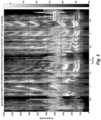
- Figure 2 shows an example of a spectrogram for a sample of clean speech including estimated instantaneous frequencies for Channels 1 and 3 as reflected by evaluating the signal zero-crossings, indicated by the vertical dashed lines.
- the horizontal black dashed lines show the channel frequency boundaries-Channels 1, 2, 3 and 4 range between 100, 198, 325, 491 and 710 Hz, respectively.
- the estimate of the instantaneous frequency is smooth and robust; for example, in Channel 1 from 1.6 to 1.9 seconds, or in Channel 3 from 3.4 to 3.5 seconds.
- the instantaneous frequency estimation becomes inaccurate, and, in particular, the estimated instantaneous frequency may even leave the frequency range of the channel.
- FIG. 3 shows various functional blocks in a signal processing arrangement for a typical hearing implant.
- the initial input sound signal is produced by one or more sensing microphones, which may be omnidirectional and/or directional.
- Preprocessor Filter Bank 301 pre-processes this input sound signal with a bank of multiple parallel band pass filters (e.g. Infinite Impulse Response (IIR) or Finite Impulse Response(FIR)), each of which is associated with a specific band of audio frequencies; for example, using a filter bank with 12 digital Butterworth band pass filters of 6th order, Infinite Impulse Response (IIR) type, so that the acoustic audio signal is filtered into some K band pass signals, U 1 to U K where each signal corresponds to the band of frequencies for one of the band pass filters.
- IIR Infinite Impulse Response
- IIR Infinite Impulse Response
- Each output of sufficiently narrow CIS band pass filters for a voiced speech input signal may roughly be regarded as a sinusoid at the center frequency of the band pass filter which is modulated by the envelope signal. This is also due to the quality factor (Q ⁇ 3) of the filters. In case of a voiced speech segment, this envelope is approximately periodic, and the repetition rate is equal to the pitch frequency.
- the Preprocessor Filter Bank 301 may be implemented based on use of a fast Fourier transform (FFT) or a short-time Fourier transform (STFT). Based on the tonotopic organization of the cochlea, each electrode contact in the scala tympani typically is associated with a specific band pass filter of the Preprocessor Filter Bank 301.
- the Preprocessor Filter Bank 301 also may perform other initial signal processing functions such as and without limitation automatic gain control (AGC) and/or noise reduction and/or wind noise reduction and/or beamforming and other well-known signal enhancement functions.
- AGC automatic gain control
- Figure 4 shows an example of a short time period of an input speech signal from a sensing microphone
- Figure 5 shows the microphone signal decomposed by band-pass filtering by a bank of filters.
- An example of pseudocode for an infinite impulse response (IIR) filter bank based on a direct form II transposed structure is given by Fontaine et al., Brian Hears: Online Auditory Processing Using Vectorization Over Channels, Frontiers in Neuroinformatics, 2011 .
- IIR infinite impulse response
- the band pass signals U 1 to U K (which can also be thought of as electrode channels) are output to an Envelope Detector 302 and Fine Structure Detector 303.
- the Envelope Detector 302 extracts characteristic envelope signals outputs Y 1 , ..., Y K that represent the channel-specific band pass envelopes.
- the Envelope Detector 302 may extract the Hilbert envelope, if the band pass signals U 1 , ..., U K are generated by orthogonal filters.
- the Fine Structure Detector 303 functions to obtain smooth and robust estimates of the instantaneous frequencies in the signal channels, processing selected temporal fine structure features of the band pass signals U 1 , ..., U K to generate stimulation timing signals X 1 , ... , X K .
- the band pass signals U 1 , ..., U k are assumed to be real valued signals, so in the specific case of an analytic orthogonal filter bank, the Fine Structure Detector 303 considers only the real valued part of U k .
- the Fine Structure Detector 303 is formed of K independent, equally-structured parallel sub-modules.
- the extracted band-pass signal envelopes Y 1 , ..., Y K from the Envelope Detector 302, and the stimulation timing signals X 1 , ... , X K from the Fine Structure Detector 303 are input signals to a Pulse Generator 304 that produces the electrode stimulation signals Z for the electrode contacts in the implanted electrode array 305.
- the Pulse Generator 304 applies a patient-specific mapping function-for example, using instantaneous nonlinear compression of the envelope signal (map law)-That is adapted to the needs of the individual cochlear implant user during fitting of the implant in order to achieve natural loudness growth.
- the Pulse Generator 304 may apply logarithmic function with a form-factor C as a loudness mapping function, which typically is identical across all the band pass analysis channels. In different systems, different specific loudness mapping functions other than a logarithmic function may be used, with just one identical function is applied to all channels or one individual function for each channel to produce the electrode stimulation signals.
- the electrode stimulation signals typically are a set of symmetrical biphasic current pulses.
- CN108231067A discloses sound scenery recognition methods based on convolutional neural networks and random forest classification. First, sound scenery generates Mel energy spectrums and its segment sample set by Mel wave filters.
- the error of the neural network measured as the discrepancy between the ideal binary mask and the result at the neural network's final laver (output layer) was calculated. This error was used to change the weights of the neural network's connections.
- One refinement along the way was to build a second deep neural network that would be fed by the first one and fine-tune its results. While that first network had focused on labeling attributes within each individual time-frequency unit, the second network would examine the attributes of several units near a particular one.
- Embodiments of the present invention are directed to a signal processing system and method to generate stimulation signals for a hearing implant implanted in a patient.
- An audio scene classifier is configured for classifying an audio input signal from an audio scene and includes a pre-processing neural network configured for pre-processing the audio input signal based on initial classification parameters to produce an initial signal classification, and a scene classifier neural network configured for processing the initial scene classification based on scene classification parameters to produce an audio scene classification output.
- the initial classification parameters reflect neural network training based on a first set of initial audio training data
- the scene classification parameters reflect neural network training on a second set of classification audio training data separate and different from the first set of initial audio training data.
- the pre-processing neural network optimizes meta-parameters without explicit training of weights via back propagation, and the classifier neural network includes a back propagation procedure.
- a hearing implant signal processor configured for processing the audio input signal and the audio scene classification output to generate the stimulation signals to the hearing implant for perception by the patient as sound.
- the pre-processing neural network includes successive recurrent convolutional layers, which may be implemented as recursive filter banks.
- the pre-processing neural network may include an envelope processing block configured for calculating sub-band signal envelopes for the audio input signal.
- the pre-processing neural network also may include a pooling layer configured for signal decimation within the pre-processing neural network.
- the initial signal classification may be a multi-dimensional feature vector.
- the scene classifier neural network may be a fully connected neural network layer or a linear discriminant analysis (LDA) classifier.
- LDA linear discriminant analysis
- Neural network training is a complicated and demanding process that requires a lot of training data for optimizing the parameters of the network.
- the effectiveness of the training further very much depends on the training data that is used. Many undesirable side effects may occur after the training, and it might even happen that the neural network does not even perform the intended task. This problem is particularly pronounced when trying to classify audio scenes for hearing implants where a nearly infinite number of variations exist for each classified scene and seamless transitions occur between distinct scenes.
- Embodiments of the present invention are directed to an audio scene classifier for hearing implants that uses a multi-layer neural network optimized for iterative training of a low number of parameters that can be trained with reasonable effort and sized training sets. This is accomplished by separating the neural network into an initial pre-processing neural network whose output is then input to a classification neural network. This allows for separate training of the individual neural networks and thereby allows use of smaller training sets and faster training that is carried out in a two-step process as described below.
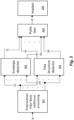
- FIG. 6 shows major functional blocks in a signal processing system according to an embodiment of the present invention for generating stimulation signals for a hearing implant implanted in a patient.
- An audio scene classifier 601 is configured for classifying an audio input signal from an audio scene and includes a pre-processing neural network 603 that is configured for pre-processing the audio input signal based on initial classification parameters to produce an initial signal classification, and a scene classifier neural network 604 that is configured for processing the initial scene classification based on scene classification parameters to produce an audio scene classification output.
- the initial classification parameters reflect neural network training based on a first set of initial audio training data
- the scene classification parameters reflect neural network training on a second set of classification audio training data separate and different from the first set of initial audio training data.
- a hearing implant signal processor 602 is configured for processing the audio input signal and the output of the audio scene classifier 601 to generate the stimulation signals to a pulse generator 304 to provide to the hearing implant 305 for perception by the patient as sound.
- Figure 7 shows processing steps in initially training the pre-processing neural network 603, which starts, step 701, by initializing the pre-processing neural network 603 with precalculated parameter that are within an expected range of parameters, for example, in the middle of a parameter range.
- a first training set of audio training data (Training Set 1) is selected, step 702, and input for training of the pre-processing neural network 603 , step 703.
- the output from the pre-processing neural network 603 then, step 704, is used as the input to the classifier neural network 604 for optimizing it using various known optimization methods.
- Figure 8 shows various subsequent processing steps in iteratively training a classifier neural network 604 starting with the optimized parameters from the initial training of the pre-processing neural network as discussed above with regards to Figure 7 , step 801.
- a second training set of audio training data (Training Set 2), which is different from the first training set, is selected, step 802, and input to the pre-processing neural network 603.
- the output from the pre-processing neural network 603 is further input and processed by the classification neural network 604 , step 804.
- An error vector then is calculated, step 805, by comparing the output from the classification neural network 604 to the audio scene that the second training set data should belong to.
- the error vector then, step 806, is used to optimize the pre-processing neural network 603.
- the new parameterization of the pre-processing neural network 603, then leads to a two-step iterative training procedure that ends when selected stopping criteria are met.
- Figure 9 shows functional details of a pre-processing neural network according to one specific embodiment of the present invention with several linear and non-linear processing blocks.
- the recurrent convolutional layers can be implemented as recursive filters banks.
- the input signal is assumed to be an audio signal x ( k ) with length N , which is first high-pass filtered (HPF-block) and then fed into N TF parallel processing blocks that act as band pass filters. This leads to N TF output sub band signals x T,i ( k ) with different spectral contents.
- b i,n are the feed forward coefficients
- a i,n the feedback coefficients of the i-th filter block.
- the sub band signals envelopes then are calculated by rectification and low pass filtering.
- the low pass filter may be, for example, a fifth-order recursive Chebyshev II filter with 30 dB attenuation in the stop band.
- the cutoff frequency f T,s can be determined by the highest band pass filter upper edge frequency of the next filter bank plus an additional offset.
- the low pass filter prior to the pooling layer helps to avoid aliasing effects.
- the output of the pooling layer is the subsampled sub band envelope signal x R , i ( n ), which then is processed through the non-linear function block.
- This non-linear function can include, for example, range limitation, normalization and further non-linear functions such as logarithms or exponentials.
- the output of this layer Y TF (where each row corresponds to a specific frequency band) is first fed row by row to N M recurrent convolutional layers which can represent a bank of modulation filters.
- the modulation filters can be individually parameterized for each frequency band yielding an overall number of filters N M ⁇ N TF .
- the ordering of the parallel band pass filters for each frequency is analogous to the parallel band pass.
- the classification neural network may be for example a fully connected neural network layer, a linear discriminant analysis (LDA) classifier, or a more complex classification layer.
- LDA linear discriminant analysis
- the outputs of this layer are the predefined class labels C i or/and probabilities P i for them.
- the multi-layer neural network arrangement is iteratively optimized.
- First an initial setting for the pre-processing neural network is chosen and the feature vectors Y MF for the Training Set 1 are calculated.
- the classification neural network can be trained by a standard method such as back propagation or LDA.
- the corresponding class labels or/and probabilities are calculated and used to calculate an error vector that is input to the training approach of the pre-processing neural network. This yields a new setting for the pre-processing neural network. With this new setting, the next iteration of the training procedure starts.
- the training of the pre-processing neural network optimizes it in the sense of minimizing an error function, minimizing the mismatch between the estimated class labels and the ground truth class labels.
- meta-parameters are optimized, for example with generic algorithms or model-based optimization approaches. This significantly reduces the number of tunable weights and also reduces the amount of training data needed due to lower weight vector dimensionality. As a result the neural network has better generalization capabilities, which are important for its performance in previously unseen conditions.
- the meta-parameters could be, for example, filter bandwidths and the neural network weights would be the coefficients of the corresponding filters.
- any filter design rule can be applied for computing the filter coefficients.
- other rules for mapping meta-parameters to network weights may be used as well. This mapping could be learned automatically via an optimization procedure and/or may be adaptive such that the network weights are updated during optimization and/or during the operation of the trained network.
- the optimal bandwidths of the filter for a given classification problem can be found by known optimization algorithms.
- a filter design rule is chosen for mapping meta-parameters to filter coefficients. For example, Butterworth filters can be chosen for the first filter bank and Chebychev 2 filters for the second one, or vice versa.
- FIG 10 shows an example of how filter bank filter bandwidths may be structured according to an embodiment of the present invention.
- the first filters in the filter banks are low pass filters where the edge frequency is the lower edge frequency of the successive band pass filter and so on.
- This mapping rule from meta-parameters to network weights ensures that the network uses all information available in the input signal.
- the specification of the network structure via meta-parameters and filter design rules reduces the optimization complexity.
- the upper and lower edge frequencies of each filter can also be indeendently trained and other design rules are possible.
- the network weights can be achieved by using the defined mapping rule.
- N TF N M + 1) - 1 independently tunable parameters. Finding optimal parameters using an exhaustive search may not be feasible due to the high dimensionality. A gradient descent algorithm also may not be suitable because the multimodal cost function (classification error) is not differentiable. Thus a Covariance Matrix Adaptation Evolution Strategy (CMA-ES) can be used based in order to find an ideal parameter set for the feature extraction step (see e.g., N. Hansen, "The CMA evolution strategy: A comparing review,” in Towards a new evolutionary computation. Advances in estimation of distribution algorithms. Springer, 2006, pp. 75-102 , which is incorporated herein by reference in its entirety).
- CMA-ES Covariance Matrix Adaptation Evolution Strategy
- ES is a subclass of evolutionary algorithms (EA) and shares the idea of imitating natural evolution, for instance by mutation and selection, and it does not require the computation of any derivatives ( H. Beyer, Theory of Evolution Strategies, Springer, 2001 editi on; incorporated herein by reference in its entirety).
- the optimal parameter set can be iteratively approximated by evaluating a fitness function after each step, where the fitness function or cost function may be the classification error (the ratio of the number of misclassified objects to the number of all objects) of the LDA classifier as a function of the independently tunable parameters.
- g is the index of the current generation (iteration)
- x k g + 1 is the k -th offspring from generation g + 1
- ⁇ is the number of offspring
- m ( g ) is the mean value of the search distribution at generation g
- (0, C ( g ) ) is a multivariate normal distribution with the covariance matrix C ( g ) of generation g
- ⁇ ( g ) is the step-size of generation g .
- the covariance matrix C and the step-size ⁇ are adapted according to the success of the sampled offspring.
- the shape of the multivariate normal distribution is formed in the direction of the old mean m ( g ) towards the new mean m ( g +1) .
- the sampling, selection and recombination steps are repeated until reaching either a predefined threshold on the cost function or a maximum number of generations, or the range of the current functional evaluation is below a threshold (local minima is reached).
- the allowed search space of the parameters can be restricted to intervals as described by Colutto et al. in S. Colutto, F. ceremoniesauf, M. Fuchs, and O.
- Optimizing the filter bank parameters used for deriving the weights of the network in order to decrease the classification error is a challenging task due to its high dimensionality and multi-modal error function. Brute-force and gradient-descent may not be feasible for this task.
- One useful approach may be based on Model-Based Optimization (MBO) (see Alexander Forrester, Andras Sobester, and Andy Keane. Engineering Design via Surrogate Modeling: A Practical Guide. Wiley, September 2008 ; and Claus Weihs, Swetlana Herbrandt, Nadja Bauer, Klaus Friedrichs, and Daniel Horn. Efficient Global Optimization: Motivation, Variations, and Applications. In ARCHIVES OF DATA SCIENCE, 2016 ).
- MBO Model-Based Optimization
- MBO is an iterative approach used to optimize a black box objective function. It is used where the evaluation of an objective function (e.g., the classification error depending on different filter bank parameters) is expensive in terms of available resources such as computational time.
- An approximation model, a so-called surrogate model, is constructed of this expensive objective function in order to find the optimal parameter for a given problem.
- the evaluation of the surrogate model is cheaper than the original objective function.
- the MBO steps can be divided as follows:
- the initial step of the MBO is to construct a sampling plan. This means that n points are determined which will then be evaluated by the objective function. These n points should cover the whole region of the parameter space, and for this the space-filling design called Latin hypercube design can be used.
- the parameter space is divided into n equal-sized hyper-cubes (bins), where n ⁇ ⁇ 5 k , 6 k , ..., 10 k ⁇ is recommended and k is the number of parameters.
- the above definition means that one sequentially maximizes d 1 and then minimizes J 1 , maximizes d 2 and then minimizes J 2 and so on. Or in other words, the goal is to have as minimal distinct pairs with maximum distance as possible.
- a surrogate model ⁇ ( x ) can be constructed such that it is a reasonable approximation of the unknown objective function f ( x ) (where x is a k dimensional vector pointing to a point in the parameter space).
- the constant ⁇ 2 is global variance.
- the surrogate prediction f ⁇ n ( x ) and the corresponding prediction uncertainty ⁇ n ( x ) can be determined based on the first n evaluations of f .
- the estimated surrogate function follows a normal distribution g ⁇ x ⁇ N ⁇ ⁇ n x , s ⁇ n 2 x .
- the above criterion gives a balance between exploration (improving global accuracy of the surrogate model) and exploitation (improving local accuracy in the region of the optimum of the surrogate model). This ensures that the optimizer will not get stuck in local optima and yet converges to an optimum.
- the surrogate model After each iteration of MBO, the surrogate model will be updated. Different convergence criteria could be chosen to determine when to stop evaluating new points for updating the surrogate model. Some criteria could be, e.g., to define a preset number of iterations and stop after this or to stop after the expected improvement drops below a predefined threshold.
- the hearing implant may be, without limitation, a cochlear implant, in which the electrodes of a multichannel electrode array are positioned such that they are, for example, spatially divided within the cochlea.
- the cochlear implant may be partially implanted, and include, without limitation, an external speech/signal processor, microphone and/or coil, with an implanted stimulator and/or electrode array.
- the cochlear implant may be a totally implanted cochlear implant.
- the multi-channel electrode may be associated with a brainstem implant, such as an auditory brainstem implant (ABI).
- Embodiments of the invention may be implemented in part in any conventional computer programming language.
- preferred embodiments may be implemented in a procedural programming language (e.g., "C") or an object oriented programming language (e.g., "C++", Python).
- Alternative embodiments of the invention may be implemented as preprogrammed hardware elements, other related components, or as a combination of hardware and software components.
- Embodiments can be implemented in part as a computer program product for use with a computer system.
- Such implementation may include a series of computer instructions fixed either on a tangible medium, such as a computer readable medium (e.g., a diskette, CD-ROM, ROM, or fixed disk) or transmittable to a computer system, via a modem or other interface device, such as a communications adapter connected to a network over a medium.
- the medium may be either a tangible medium (e.g., optical or analog communications lines) or a medium implemented with wireless techniques (e.g., microwave, infrared or other transmission techniques).
- the series of computer instructions embodies all or part of the functionality previously described herein with respect to the system.
- Such computer instructions can be written in a number of programming languages for use with many computer architectures or operating systems. Furthermore, such instructions may be stored in any memory device, such as semiconductor, magnetic, optical or other memory devices, and may be transmitted using any communications technology, such as optical, infrared, microwave, or other transmission technologies. It is expected that such a computer program product may be distributed as a removable medium with accompanying printed or electronic documentation (e.g., shrink wrapped software), preloaded with a computer system (e.g., on system ROM or fixed disk), or distributed from a server or electronic bulletin board over the network (e.g., the Internet or World Wide Web). Of course, some embodiments of the invention may be implemented as a combination of both software (e.g., a computer program product) and hardware. Still other embodiments of the invention are implemented as entirely hardware, or entirely software (e.g., a computer program product).
Landscapes
- Engineering & Computer Science (AREA)
- Health & Medical Sciences (AREA)
- Physics & Mathematics (AREA)
- Signal Processing (AREA)
- Acoustics & Sound (AREA)
- Otolaryngology (AREA)
- Multimedia (AREA)
- Human Computer Interaction (AREA)
- Audiology, Speech & Language Pathology (AREA)
- Computational Linguistics (AREA)
- General Health & Medical Sciences (AREA)
- Evolutionary Computation (AREA)
- Artificial Intelligence (AREA)
- Neurosurgery (AREA)
- Automation & Control Theory (AREA)
- Fuzzy Systems (AREA)
- Mathematical Physics (AREA)
- Software Systems (AREA)
- Animal Behavior & Ethology (AREA)
- Public Health (AREA)
- Veterinary Medicine (AREA)
- Life Sciences & Earth Sciences (AREA)
- Radiology & Medical Imaging (AREA)
- Nuclear Medicine, Radiotherapy & Molecular Imaging (AREA)
- Biomedical Technology (AREA)
- Spectroscopy & Molecular Physics (AREA)
- Quality & Reliability (AREA)
- Prostheses (AREA)
- Electrotherapy Devices (AREA)
Claims (15)
- Signalverarbeitungsverfahren zum Erzeugen von Stimulationssignalen für ein Hörimplantat (305), das in einen Patienten implantiert ist, wobei das Verfahren umfasst:Klassifizieren eines Audioeingangssignals aus einer Audioszene mit einem mehrschichtigen neuronalen Netzwerk, wobei das Klassifizieren umfasst:a) Vorverarbeiten des Audioeingangssignals mit einem vorverarbeitenden neuronalen Netzwerk (603) unter Verwendung von anfänglichen Klassifizierungsparametern, um eine anfängliche Signalklassifizierung zu erzeugen, undb) Verarbeiten der anfänglichen Signalklassifizierung mit einem neuronalen Szenenklassifizierernetzwerk (604) unter Verwendung von Szenenklassifizierungsparametern, um eine Audioszenenklassifizierungsausgabe zu erzeugen,wobei die anfänglichen Klassifizierungsparameter ein neuronales Netzwerktraining basierend auf einem ersten Satz von anfänglichen Audiotrainingsdaten reflektieren und die Szenenklassifizierungsparameter ein neuronales Netzwerktraining auf einem zweiten Satz von Klassifizierungsaudiotrainingsdaten reflektieren, der von dem ersten Satz von anfänglichen Audiotrainingsdaten getrennt ist und sich davon unterscheidet, wobei das vorverarbeitende neuronale Netzwerk (603) Metaparameter ohne explizites Training von Gewichten über Rückausbreitung optimiert und wobei das neuronale Klassifizierernetzwerk (604) ein Rückausbreitungsverfahren beinhaltet;Verarbeiten des Audioeingangssignals und der Audioszenenklassifizierungsausgabe mit einem Hörimplantatsignalprozessor (602) zum Erzeugen der Stimulationssignale.
- Verfahren nach Anspruch 1, wobei das vorverarbeitende neuronale Netzwerk aufeinanderfolgende rekurrente Faltungsschichten beinhaltet.
- Verfahren nach Anspruch 2, wobei die rekurrenten Faltungsschichten als rekursive Filterbänke implementiert sind.
- Verfahren nach Anspruch 1, wobei das vorverarbeitende neuronale Netzwerk einen Hüllkurvenverarbeitungsblock beinhaltet, der zum Berechnen von Teilbandsignalhüllkurven für das Audioeingangssignal konfiguriert ist.
- Verfahren nach Anspruch 1, wobei das vorverarbeitende neuronale Netzwerk eine Pooling-Schicht beinhaltet, die zur Signaldezimierung innerhalb des vorverarbeitenden neuronalen Netzwerks konfiguriert ist.
- Verfahren nach Anspruch 1, wobei die anfängliche Signalklassifizierung ein mehrdimensionaler Merkmalsvektor ist.
- Verfahren nach Anspruch 1, wobei das neuronale Netzwerk des Szenenklassifizierers eine vollständig verbundene neuronale Netzwerkschicht umfasst.
- System nach Anspruch 1, wobei das neuronale Netzwerk des Szenenklassifizierers einen linearen Diskriminanzanalyse(LDA)-Klassifizierer umfasst.
- Signalverarbeitungssystem zum Erzeugen von Stimulationssignalen für ein Hörimplantat (305), das in einen Patienten implantiert ist, wobei das System umfasst:einen Audioszenenklassifizierer (601), der ein mehrschichtiges neuronales Netzwerk umfasst, das zum Klassifizieren eines Audioeingangssignals aus einer Audioszene konfiguriert ist, wobei der Audioszenenklassifizierer beinhaltet:a) ein vorverarbeitendes neuronales Netzwerk (603), das zum Vorverarbeiten des Audioeingangssignals basierend auf anfänglichen Klassifizierungsparametern konfiguriert ist, um eine anfängliche Signalklassifizierung zu erzeugen, undb) ein neuronales Szenenklassifizierernetzwerk (604), das zum Verarbeiten der anfänglichen Signalklassifizierung basierend auf Szenenklassifizierungsparametern konfiguriert ist, um eine Audioszenenklassifizierungsausgabe zu erzeugen,wobei die anfänglichen Klassifizierungsparameter ein neuronales Netzwerktraining basierend auf einem ersten Satz von anfänglichen Audiotrainingsdaten reflektieren und die Szenenklassifizierungsparameter ein neuronales Netzwerktraining auf einem zweiten Satz von Klassifizierungsaudiotrainingsdaten reflektieren, der von dem ersten Satz von anfänglichen Audiotrainingsdaten getrennt ist und sich davon unterscheidet, wobei das vorverarbeitende neuronale Netzwerk (603) Metaparameter ohne explizites Training von Gewichten über Rückausbreitung optimiert und wobei das neuronale Klassifizierernetzwerk (604) ein Rückausbreitungsverfahren beinhaltet;einen Hörimplantatsignalprozessor (602), der zum Verarbeiten des Audioeingangssignals und der Audioszenenklassifizierungsausgabe zum Erzeugen der Stimulationssignale konfiguriert ist.
- System nach Anspruch 9, wobei das vorverarbeitende neuronale Netzwerk aufeinanderfolgende rekurrente Faltungsschichten beinhaltet.
- System nach Anspruch 10, wobei die rekurrenten Faltungsschichten als rekursive Filterbänke implementiert sind.
- System nach Anspruch 9, wobei das vorverarbeitende neuronale Netzwerk einen Hüllkurvenverarbeitungsblock beinhaltet, der zum Berechnen von Teilbandsignalhüllkurven für das Audioeingangssignal konfiguriert ist.
- System nach Anspruch 9, wobei das vorverarbeitende neuronale Netzwerk eine Pooling-Schicht beinhaltet, die zur Signaldezimierung innerhalb des vorverarbeitenden neuronalen Netzwerks konfiguriert ist.
- System nach Anspruch 9, wobei die anfängliche Signalklassifizierung ein mehrdimensionaler Merkmalsvektor ist.
- System nach Anspruch 9, wobei das neuronale Netzwerk des Szenenklassifizierers eine vollständig verbundene neuronale Netzwerkschicht umfasst oder
wobei das neuronale Netzwerk des Szenenklassifizierers einen linearen Diskriminanzanalyse(LDA)-Klassifizierer umfasst.
Applications Claiming Priority (2)
| Application Number | Priority Date | Filing Date | Title |
|---|---|---|---|
| US201862703490P | 2018-07-26 | 2018-07-26 | |
| PCT/US2019/043160 WO2020023585A1 (en) | 2018-07-26 | 2019-07-24 | Neural network audio scene classifier for hearing implants |
Publications (3)
| Publication Number | Publication Date |
|---|---|
| EP3827428A1 EP3827428A1 (de) | 2021-06-02 |
| EP3827428A4 EP3827428A4 (de) | 2022-05-11 |
| EP3827428B1 true EP3827428B1 (de) | 2024-10-30 |
Family
ID=69181911
Family Applications (1)
| Application Number | Title | Priority Date | Filing Date |
|---|---|---|---|
| EP19839971.9A Active EP3827428B1 (de) | 2018-07-26 | 2019-07-24 | Klassierer von audioszenen eines neuronalen netzes für hörimplantate |
Country Status (5)
| Country | Link |
|---|---|
| US (3) | US20210174824A1 (de) |
| EP (1) | EP3827428B1 (de) |
| CN (1) | CN112534500A (de) |
| AU (1) | AU2019312209B2 (de) |
| WO (1) | WO2020023585A1 (de) |
Families Citing this family (8)
| Publication number | Priority date | Publication date | Assignee | Title |
|---|---|---|---|---|
| WO2020049472A1 (en) * | 2018-09-04 | 2020-03-12 | Cochlear Limited | New sound processing techniques |
| WO2021198438A1 (en) * | 2020-04-01 | 2021-10-07 | Universiteit Gent | A closed-loop method to individualize neural-network-based audio signal processing |
| JP2023548670A (ja) | 2020-10-15 | 2023-11-20 | ドルビー ラボラトリーズ ライセンシング コーポレイション | ニューラルネットワークを用いたオーディオの処理方法および装置 |
| CN112447188B (zh) * | 2020-11-18 | 2023-10-20 | 中国人民解放军陆军工程大学 | 一种基于改进softmax函数的声学场景分类方法 |
| CN118541194A (zh) * | 2022-01-28 | 2024-08-23 | 科利耳有限公司 | 信号信息向可植入医疗装置的传输 |
| CN115223589B (zh) * | 2022-06-13 | 2025-08-19 | 浙江诺尔康神经电子科技股份有限公司 | 一种低算力的人工耳蜗自动声音场景分类方法 |
| WO2026052735A1 (en) * | 2024-09-09 | 2026-03-12 | Institut Pasteur | Auditory cortical implant and system and method for generating stimulation patterns for the auditory cortical implant |
| CN120950895B (zh) * | 2025-10-15 | 2026-02-03 | 霍浦科技(宁波)有限公司 | 一种基于神经网络的脉冲信号智能切换控制方法及系统 |
Family Cites Families (18)
| Publication number | Priority date | Publication date | Assignee | Title |
|---|---|---|---|---|
| CA2230188A1 (en) * | 1998-03-27 | 1999-09-27 | William C. Treurniet | Objective audio quality measurement |
| US8948428B2 (en) * | 2006-09-05 | 2015-02-03 | Gn Resound A/S | Hearing aid with histogram based sound environment classification |
| CN101593522B (zh) * | 2009-07-08 | 2011-09-14 | 清华大学 | 一种全频域数字助听方法和设备 |
| WO2013149123A1 (en) * | 2012-03-30 | 2013-10-03 | The Ohio State University | Monaural speech filter |
| US9837102B2 (en) * | 2014-07-02 | 2017-12-05 | Microsoft Technology Licensing, Llc | User environment aware acoustic noise reduction |
| US20170061978A1 (en) * | 2014-11-07 | 2017-03-02 | Shannon Campbell | Real-time method for implementing deep neural network based speech separation |
| CA3156908C (en) * | 2015-01-06 | 2024-06-11 | David Burton | Mobile wearable monitoring systems |
| CN107708798B (zh) * | 2015-06-11 | 2021-03-09 | Med-El电气医疗器械有限公司 | 用于听力植入物的snr调整的包络采样 |
| CN106486127A (zh) * | 2015-08-25 | 2017-03-08 | 中兴通讯股份有限公司 | 一种语音识别参数自动调整的方法、装置及移动终端 |
| US9818431B2 (en) * | 2015-12-21 | 2017-11-14 | Microsoft Technoloogy Licensing, LLC | Multi-speaker speech separation |
| US9949056B2 (en) * | 2015-12-23 | 2018-04-17 | Ecole Polytechnique Federale De Lausanne (Epfl) | Method and apparatus for presenting to a user of a wearable apparatus additional information related to an audio scene |
| US20170311095A1 (en) * | 2016-04-20 | 2017-10-26 | Starkey Laboratories, Inc. | Neural network-driven feedback cancellation |
| CN106919920B (zh) * | 2017-03-06 | 2020-09-22 | 重庆邮电大学 | 基于卷积特征和空间视觉词袋模型的场景识别方法 |
| CN107103901B (zh) * | 2017-04-03 | 2019-12-24 | 浙江诺尔康神经电子科技股份有限公司 | 人工耳蜗声音场景识别系统和方法 |
| CN107203777A (zh) * | 2017-04-19 | 2017-09-26 | 北京协同创新研究院 | 音频场景分类方法及装置 |
| CN107527617A (zh) * | 2017-09-30 | 2017-12-29 | 上海应用技术大学 | 基于声音识别的监控方法、装置及系统 |
| CN108231067A (zh) * | 2018-01-13 | 2018-06-29 | 福州大学 | 基于卷积神经网络与随机森林分类的声音场景识别方法 |
| CN112955954B (zh) * | 2018-12-21 | 2024-04-12 | 华为技术有限公司 | 用于音频场景分类的音频处理装置及其方法 |
-
2019
- 2019-07-24 CN CN201980049500.5A patent/CN112534500A/zh active Pending
- 2019-07-24 WO PCT/US2019/043160 patent/WO2020023585A1/en not_active Ceased
- 2019-07-24 AU AU2019312209A patent/AU2019312209B2/en active Active
- 2019-07-24 US US17/263,068 patent/US20210174824A1/en not_active Abandoned
- 2019-07-24 EP EP19839971.9A patent/EP3827428B1/de active Active
-
2023
- 2023-03-10 US US18/182,139 patent/US20230226352A1/en not_active Abandoned
-
2025
- 2025-12-03 US US19/407,991 patent/US20260088038A1/en active Pending
Also Published As
| Publication number | Publication date |
|---|---|
| EP3827428A4 (de) | 2022-05-11 |
| US20230226352A1 (en) | 2023-07-20 |
| EP3827428A1 (de) | 2021-06-02 |
| US20210174824A1 (en) | 2021-06-10 |
| AU2019312209A1 (en) | 2021-02-18 |
| WO2020023585A1 (en) | 2020-01-30 |
| CN112534500A (zh) | 2021-03-19 |
| US20260088038A1 (en) | 2026-03-26 |
| AU2019312209B2 (en) | 2022-07-28 |
Similar Documents
| Publication | Publication Date | Title |
|---|---|---|
| US20260088038A1 (en) | Neural Network Audio Scene Classifier for Hearing Implants | |
| EP3469586B1 (de) | Rekursive rauschleistungsschätzung mit rauschmodellanpassung | |
| AU2018203534B2 (en) | Detecting neuronal action potentials using a sparse signal representation | |
| EP2811904B1 (de) | Auswertung einer tonqualität und sprachverständlichkeit aus neurogrammen | |
| US20220008722A1 (en) | Bio-Inspired Fast Fitting of Cochlear Implants | |
| CN107708794B (zh) | 具有耳蜗植入物的选择性刺激 | |
| US11979715B2 (en) | Multiple sound source encoding in hearing prostheses | |
| EP2571567A1 (de) | Hüllenspezifisches stimulus-timing | |
| EP3364926B1 (de) | Robuste sofortige frequenzkalkulation für gehörprothese und toncodierung | |
| CN105814911A (zh) | 用于神经刺激的能量信号的反馈门控 | |
| CN120937392A (zh) | 数据高效且个性化的音频场景分类器适配 | |
| US10707836B2 (en) | Estimation of harmonic frequencies for hearing implant sound coding using active contour models | |
| WO2013009805A1 (en) | Test methods for cochlear implant stimulation strategies | |
| AU2018290895B2 (en) | Medial olivocochlear reflex sound coding with bandwidth normalization | |
| EP3826710B1 (de) | Hintergrundstimulation zur anpassung von cochlea-implantaten | |
| WO2022207680A1 (en) | Method and device for updating a model |
Legal Events
| Date | Code | Title | Description |
|---|---|---|---|
| STAA | Information on the status of an ep patent application or granted ep patent |
Free format text: STATUS: THE INTERNATIONAL PUBLICATION HAS BEEN MADE |
|
| PUAI | Public reference made under article 153(3) epc to a published international application that has entered the european phase |
Free format text: ORIGINAL CODE: 0009012 |
|
| STAA | Information on the status of an ep patent application or granted ep patent |
Free format text: STATUS: REQUEST FOR EXAMINATION WAS MADE |
|
| 17P | Request for examination filed |
Effective date: 20210129 |
|
| AK | Designated contracting states |
Kind code of ref document: A1 Designated state(s): AL AT BE BG CH CY CZ DE DK EE ES FI FR GB GR HR HU IE IS IT LI LT LU LV MC MK MT NL NO PL PT RO RS SE SI SK SM TR |
|
| DAV | Request for validation of the european patent (deleted) | ||
| DAX | Request for extension of the european patent (deleted) | ||
| A4 | Supplementary search report drawn up and despatched |
Effective date: 20220408 |
|
| RIC1 | Information provided on ipc code assigned before grant |
Ipc: A61N 1/36 20060101ALI20220404BHEP Ipc: H04R 25/00 20060101ALI20220404BHEP Ipc: H04R 3/00 20060101ALI20220404BHEP Ipc: G10L 21/00 20130101AFI20220404BHEP |
|
| GRAP | Despatch of communication of intention to grant a patent |
Free format text: ORIGINAL CODE: EPIDOSNIGR1 |
|
| STAA | Information on the status of an ep patent application or granted ep patent |
Free format text: STATUS: GRANT OF PATENT IS INTENDED |
|
| INTG | Intention to grant announced |
Effective date: 20240524 |
|
| RAP3 | Party data changed (applicant data changed or rights of an application transferred) |
Owner name: MED-EL ELEKTROMEDIZINISCHE GERAETE GMBH |
|
| GRAS | Grant fee paid |
Free format text: ORIGINAL CODE: EPIDOSNIGR3 |
|
| GRAA | (expected) grant |
Free format text: ORIGINAL CODE: 0009210 |
|
| STAA | Information on the status of an ep patent application or granted ep patent |
Free format text: STATUS: THE PATENT HAS BEEN GRANTED |
|
| AK | Designated contracting states |
Kind code of ref document: B1 Designated state(s): AL AT BE BG CH CY CZ DE DK EE ES FI FR GB GR HR HU IE IS IT LI LT LU LV MC MK MT NL NO PL PT RO RS SE SI SK SM TR |
|
| REG | Reference to a national code |
Ref country code: GB Ref legal event code: FG4D |
|
| REG | Reference to a national code |
Ref country code: CH Ref legal event code: EP |
|
| P01 | Opt-out of the competence of the unified patent court (upc) registered |
Free format text: CASE NUMBER: APP_53117/2024 Effective date: 20240924 |
|
| REG | Reference to a national code |
Ref country code: IE Ref legal event code: FG4D |
|
| REG | Reference to a national code |
Ref country code: DE Ref legal event code: R096 Ref document number: 602019061245 Country of ref document: DE |
|
| REG | Reference to a national code |
Ref country code: LT Ref legal event code: MG9D |
|
| REG | Reference to a national code |
Ref country code: NL Ref legal event code: MP Effective date: 20241030 |
|
| PG25 | Lapsed in a contracting state [announced via postgrant information from national office to epo] |
Ref country code: HR Free format text: LAPSE BECAUSE OF FAILURE TO SUBMIT A TRANSLATION OF THE DESCRIPTION OR TO PAY THE FEE WITHIN THE PRESCRIBED TIME-LIMIT Effective date: 20241030 Ref country code: PT Free format text: LAPSE BECAUSE OF FAILURE TO SUBMIT A TRANSLATION OF THE DESCRIPTION OR TO PAY THE FEE WITHIN THE PRESCRIBED TIME-LIMIT Effective date: 20250228 Ref country code: IS Free format text: LAPSE BECAUSE OF FAILURE TO SUBMIT A TRANSLATION OF THE DESCRIPTION OR TO PAY THE FEE WITHIN THE PRESCRIBED TIME-LIMIT Effective date: 20250228 |
|
| PG25 | Lapsed in a contracting state [announced via postgrant information from national office to epo] |
Ref country code: FI Free format text: LAPSE BECAUSE OF FAILURE TO SUBMIT A TRANSLATION OF THE DESCRIPTION OR TO PAY THE FEE WITHIN THE PRESCRIBED TIME-LIMIT Effective date: 20241030 Ref country code: NL Free format text: LAPSE BECAUSE OF FAILURE TO SUBMIT A TRANSLATION OF THE DESCRIPTION OR TO PAY THE FEE WITHIN THE PRESCRIBED TIME-LIMIT Effective date: 20241030 |
|
| REG | Reference to a national code |
Ref country code: AT Ref legal event code: MK05 Ref document number: 1737758 Country of ref document: AT Kind code of ref document: T Effective date: 20241030 |
|
| PG25 | Lapsed in a contracting state [announced via postgrant information from national office to epo] |
Ref country code: BG Free format text: LAPSE BECAUSE OF FAILURE TO SUBMIT A TRANSLATION OF THE DESCRIPTION OR TO PAY THE FEE WITHIN THE PRESCRIBED TIME-LIMIT Effective date: 20241030 |
|
| PG25 | Lapsed in a contracting state [announced via postgrant information from national office to epo] |
Ref country code: ES Free format text: LAPSE BECAUSE OF FAILURE TO SUBMIT A TRANSLATION OF THE DESCRIPTION OR TO PAY THE FEE WITHIN THE PRESCRIBED TIME-LIMIT Effective date: 20241030 |
|
| PG25 | Lapsed in a contracting state [announced via postgrant information from national office to epo] |
Ref country code: NO Free format text: LAPSE BECAUSE OF FAILURE TO SUBMIT A TRANSLATION OF THE DESCRIPTION OR TO PAY THE FEE WITHIN THE PRESCRIBED TIME-LIMIT Effective date: 20250130 |
|
| PG25 | Lapsed in a contracting state [announced via postgrant information from national office to epo] |
Ref country code: AT Free format text: LAPSE BECAUSE OF FAILURE TO SUBMIT A TRANSLATION OF THE DESCRIPTION OR TO PAY THE FEE WITHIN THE PRESCRIBED TIME-LIMIT Effective date: 20241030 Ref country code: LV Free format text: LAPSE BECAUSE OF FAILURE TO SUBMIT A TRANSLATION OF THE DESCRIPTION OR TO PAY THE FEE WITHIN THE PRESCRIBED TIME-LIMIT Effective date: 20241030 Ref country code: GR Free format text: LAPSE BECAUSE OF FAILURE TO SUBMIT A TRANSLATION OF THE DESCRIPTION OR TO PAY THE FEE WITHIN THE PRESCRIBED TIME-LIMIT Effective date: 20250131 |
|
| PG25 | Lapsed in a contracting state [announced via postgrant information from national office to epo] |
Ref country code: PL Free format text: LAPSE BECAUSE OF FAILURE TO SUBMIT A TRANSLATION OF THE DESCRIPTION OR TO PAY THE FEE WITHIN THE PRESCRIBED TIME-LIMIT Effective date: 20241030 |
|
| PG25 | Lapsed in a contracting state [announced via postgrant information from national office to epo] |
Ref country code: RS Free format text: LAPSE BECAUSE OF FAILURE TO SUBMIT A TRANSLATION OF THE DESCRIPTION OR TO PAY THE FEE WITHIN THE PRESCRIBED TIME-LIMIT Effective date: 20250130 |
|
| PG25 | Lapsed in a contracting state [announced via postgrant information from national office to epo] |
Ref country code: SM Free format text: LAPSE BECAUSE OF FAILURE TO SUBMIT A TRANSLATION OF THE DESCRIPTION OR TO PAY THE FEE WITHIN THE PRESCRIBED TIME-LIMIT Effective date: 20241030 |
|
| PG25 | Lapsed in a contracting state [announced via postgrant information from national office to epo] |
Ref country code: DK Free format text: LAPSE BECAUSE OF FAILURE TO SUBMIT A TRANSLATION OF THE DESCRIPTION OR TO PAY THE FEE WITHIN THE PRESCRIBED TIME-LIMIT Effective date: 20241030 |
|
| PG25 | Lapsed in a contracting state [announced via postgrant information from national office to epo] |
Ref country code: EE Free format text: LAPSE BECAUSE OF FAILURE TO SUBMIT A TRANSLATION OF THE DESCRIPTION OR TO PAY THE FEE WITHIN THE PRESCRIBED TIME-LIMIT Effective date: 20241030 |
|
| PG25 | Lapsed in a contracting state [announced via postgrant information from national office to epo] |
Ref country code: RO Free format text: LAPSE BECAUSE OF FAILURE TO SUBMIT A TRANSLATION OF THE DESCRIPTION OR TO PAY THE FEE WITHIN THE PRESCRIBED TIME-LIMIT Effective date: 20241030 |
|
| PG25 | Lapsed in a contracting state [announced via postgrant information from national office to epo] |
Ref country code: SK Free format text: LAPSE BECAUSE OF FAILURE TO SUBMIT A TRANSLATION OF THE DESCRIPTION OR TO PAY THE FEE WITHIN THE PRESCRIBED TIME-LIMIT Effective date: 20241030 |
|
| PG25 | Lapsed in a contracting state [announced via postgrant information from national office to epo] |
Ref country code: CZ Free format text: LAPSE BECAUSE OF FAILURE TO SUBMIT A TRANSLATION OF THE DESCRIPTION OR TO PAY THE FEE WITHIN THE PRESCRIBED TIME-LIMIT Effective date: 20241030 |
|
| PG25 | Lapsed in a contracting state [announced via postgrant information from national office to epo] |
Ref country code: IT Free format text: LAPSE BECAUSE OF FAILURE TO SUBMIT A TRANSLATION OF THE DESCRIPTION OR TO PAY THE FEE WITHIN THE PRESCRIBED TIME-LIMIT Effective date: 20241030 |
|
| REG | Reference to a national code |
Ref country code: DE Ref legal event code: R097 Ref document number: 602019061245 Country of ref document: DE |
|
| PLBE | No opposition filed within time limit |
Free format text: ORIGINAL CODE: 0009261 |
|
| STAA | Information on the status of an ep patent application or granted ep patent |
Free format text: STATUS: NO OPPOSITION FILED WITHIN TIME LIMIT |
|
| PG25 | Lapsed in a contracting state [announced via postgrant information from national office to epo] |
Ref country code: SE Free format text: LAPSE BECAUSE OF FAILURE TO SUBMIT A TRANSLATION OF THE DESCRIPTION OR TO PAY THE FEE WITHIN THE PRESCRIBED TIME-LIMIT Effective date: 20241030 |
|
| 26N | No opposition filed |
Effective date: 20250731 |
|
| PGFP | Annual fee paid to national office [announced via postgrant information from national office to epo] |
Ref country code: DE Payment date: 20250728 Year of fee payment: 7 |
|
| PGFP | Annual fee paid to national office [announced via postgrant information from national office to epo] |
Ref country code: GB Payment date: 20250722 Year of fee payment: 7 |
|
| PGFP | Annual fee paid to national office [announced via postgrant information from national office to epo] |
Ref country code: FR Payment date: 20250725 Year of fee payment: 7 |
|
| REG | Reference to a national code |
Ref country code: CH Ref legal event code: H13 Free format text: ST27 STATUS EVENT CODE: U-0-0-H10-H13 (AS PROVIDED BY THE NATIONAL OFFICE) Effective date: 20260224 |
|
| PG25 | Lapsed in a contracting state [announced via postgrant information from national office to epo] |
Ref country code: LU Free format text: LAPSE BECAUSE OF NON-PAYMENT OF DUE FEES Effective date: 20250724 |
|
| REG | Reference to a national code |
Ref country code: BE Ref legal event code: MM Effective date: 20250731 |
|
| PG25 | Lapsed in a contracting state [announced via postgrant information from national office to epo] |
Ref country code: BE Free format text: LAPSE BECAUSE OF NON-PAYMENT OF DUE FEES Effective date: 20250731 |
|
| PG25 | Lapsed in a contracting state [announced via postgrant information from national office to epo] |
Ref country code: CH Free format text: LAPSE BECAUSE OF NON-PAYMENT OF DUE FEES Effective date: 20250731 |