EP3826880B1 - Steckverbinder mit flip-chip messelement - Google Patents
Steckverbinder mit flip-chip messelement Download PDFInfo
- Publication number
- EP3826880B1 EP3826880B1 EP19736677.6A EP19736677A EP3826880B1 EP 3826880 B1 EP3826880 B1 EP 3826880B1 EP 19736677 A EP19736677 A EP 19736677A EP 3826880 B1 EP3826880 B1 EP 3826880B1
- Authority
- EP
- European Patent Office
- Prior art keywords
- electrically conductive
- plug
- conductive contact
- contact element
- temperature sensor
- Prior art date
- Legal status (The legal status is an assumption and is not a legal conclusion. Google has not performed a legal analysis and makes no representation as to the accuracy of the status listed.)
- Active
Links
Images
Classifications
-
- B—PERFORMING OPERATIONS; TRANSPORTING
- B60—VEHICLES IN GENERAL
- B60L—PROPULSION OF ELECTRICALLY-PROPELLED VEHICLES; SUPPLYING ELECTRIC POWER FOR AUXILIARY EQUIPMENT OF ELECTRICALLY-PROPELLED VEHICLES; ELECTRODYNAMIC BRAKE SYSTEMS FOR VEHICLES IN GENERAL; MAGNETIC SUSPENSION OR LEVITATION FOR VEHICLES; MONITORING OPERATING VARIABLES OF ELECTRICALLY-PROPELLED VEHICLES; ELECTRIC SAFETY DEVICES FOR ELECTRICALLY-PROPELLED VEHICLES
- B60L53/00—Methods of charging batteries, specially adapted for electric vehicles; Charging stations or on-board charging equipment therefor; Exchange of energy storage elements in electric vehicles
- B60L53/10—Methods of charging batteries, specially adapted for electric vehicles; Charging stations or on-board charging equipment therefor; Exchange of energy storage elements in electric vehicles characterised by the energy transfer between the charging station and the vehicle
- B60L53/14—Conductive energy transfer
- B60L53/16—Connectors, e.g. plugs or sockets, specially adapted for charging electric vehicles
-
- G—PHYSICS
- G01—MEASURING; TESTING
- G01K—MEASURING TEMPERATURE; MEASURING QUANTITY OF HEAT; THERMALLY-SENSITIVE ELEMENTS NOT OTHERWISE PROVIDED FOR
- G01K1/00—Details of thermometers not specially adapted for particular types of thermometer
- G01K1/16—Special arrangements for conducting heat from the object to the sensitive element
-
- G—PHYSICS
- G01—MEASURING; TESTING
- G01K—MEASURING TEMPERATURE; MEASURING QUANTITY OF HEAT; THERMALLY-SENSITIVE ELEMENTS NOT OTHERWISE PROVIDED FOR
- G01K13/00—Thermometers specially adapted for specific purposes
-
- H—ELECTRICITY
- H01—ELECTRIC ELEMENTS
- H01R—ELECTRICALLY-CONDUCTIVE CONNECTIONS; STRUCTURAL ASSOCIATIONS OF A PLURALITY OF MUTUALLY-INSULATED ELECTRICAL CONNECTING ELEMENTS; COUPLING DEVICES; CURRENT COLLECTORS
- H01R13/00—Details of coupling devices of the kinds covered by groups H01R12/70 or H01R24/00 - H01R33/00
- H01R13/66—Structural association with built-in electrical component
- H01R13/665—Structural association with built-in electrical component with built-in electronic circuit
- H01R13/6683—Structural association with built-in electrical component with built-in electronic circuit with built-in sensor
-
- H—ELECTRICITY
- H05—ELECTRIC TECHNIQUES NOT OTHERWISE PROVIDED FOR
- H05K—PRINTED CIRCUITS; CASINGS OR CONSTRUCTIONAL DETAILS OF ELECTRIC APPARATUS; MANUFACTURE OF ASSEMBLAGES OF ELECTRICAL COMPONENTS
- H05K1/00—Printed circuits
- H05K1/02—Details
- H05K1/0201—Thermal arrangements, e.g. for cooling, heating or preventing overheating
- H05K1/0203—Cooling of mounted components
- H05K1/0209—External configuration of printed circuit board adapted for heat dissipation, e.g. lay-out of conductors, coatings
-
- H—ELECTRICITY
- H05—ELECTRIC TECHNIQUES NOT OTHERWISE PROVIDED FOR
- H05K—PRINTED CIRCUITS; CASINGS OR CONSTRUCTIONAL DETAILS OF ELECTRIC APPARATUS; MANUFACTURE OF ASSEMBLAGES OF ELECTRICAL COMPONENTS
- H05K1/00—Printed circuits
- H05K1/16—Printed circuits incorporating printed electric components, e.g. printed resistors, capacitors or inductors
- H05K1/167—Printed circuits incorporating printed electric components, e.g. printed resistors, capacitors or inductors incorporating printed resistors
-
- B—PERFORMING OPERATIONS; TRANSPORTING
- B60—VEHICLES IN GENERAL
- B60L—PROPULSION OF ELECTRICALLY-PROPELLED VEHICLES; SUPPLYING ELECTRIC POWER FOR AUXILIARY EQUIPMENT OF ELECTRICALLY-PROPELLED VEHICLES; ELECTRODYNAMIC BRAKE SYSTEMS FOR VEHICLES IN GENERAL; MAGNETIC SUSPENSION OR LEVITATION FOR VEHICLES; MONITORING OPERATING VARIABLES OF ELECTRICALLY-PROPELLED VEHICLES; ELECTRIC SAFETY DEVICES FOR ELECTRICALLY-PROPELLED VEHICLES
- B60L2240/00—Control parameters of input or output; Target parameters
- B60L2240/10—Vehicle control parameters
- B60L2240/36—Temperature of vehicle components or parts
-
- G—PHYSICS
- G01—MEASURING; TESTING
- G01K—MEASURING TEMPERATURE; MEASURING QUANTITY OF HEAT; THERMALLY-SENSITIVE ELEMENTS NOT OTHERWISE PROVIDED FOR
- G01K7/00—Measuring temperature based on the use of electric or magnetic elements directly sensitive to heat ; Power supply therefor, e.g. using thermoelectric elements
- G01K7/16—Measuring temperature based on the use of electric or magnetic elements directly sensitive to heat ; Power supply therefor, e.g. using thermoelectric elements using resistive elements
-
- H—ELECTRICITY
- H01—ELECTRIC ELEMENTS
- H01R—ELECTRICALLY-CONDUCTIVE CONNECTIONS; STRUCTURAL ASSOCIATIONS OF A PLURALITY OF MUTUALLY-INSULATED ELECTRICAL CONNECTING ELEMENTS; COUPLING DEVICES; CURRENT COLLECTORS
- H01R13/00—Details of coupling devices of the kinds covered by groups H01R12/70 or H01R24/00 - H01R33/00
- H01R13/02—Contact members
- H01R13/04—Pins or blades for co-operation with sockets
-
- H—ELECTRICITY
- H01—ELECTRIC ELEMENTS
- H01R—ELECTRICALLY-CONDUCTIVE CONNECTIONS; STRUCTURAL ASSOCIATIONS OF A PLURALITY OF MUTUALLY-INSULATED ELECTRICAL CONNECTING ELEMENTS; COUPLING DEVICES; CURRENT COLLECTORS
- H01R13/00—Details of coupling devices of the kinds covered by groups H01R12/70 or H01R24/00 - H01R33/00
- H01R13/66—Structural association with built-in electrical component
- H01R13/665—Structural association with built-in electrical component with built-in electronic circuit
- H01R13/6658—Structural association with built-in electrical component with built-in electronic circuit on printed circuit board
-
- H—ELECTRICITY
- H01—ELECTRIC ELEMENTS
- H01R—ELECTRICALLY-CONDUCTIVE CONNECTIONS; STRUCTURAL ASSOCIATIONS OF A PLURALITY OF MUTUALLY-INSULATED ELECTRICAL CONNECTING ELEMENTS; COUPLING DEVICES; CURRENT COLLECTORS
- H01R2201/00—Connectors or connections adapted for particular applications
- H01R2201/26—Connectors or connections adapted for particular applications for vehicles
-
- H—ELECTRICITY
- H05—ELECTRIC TECHNIQUES NOT OTHERWISE PROVIDED FOR
- H05K—PRINTED CIRCUITS; CASINGS OR CONSTRUCTIONAL DETAILS OF ELECTRIC APPARATUS; MANUFACTURE OF ASSEMBLAGES OF ELECTRICAL COMPONENTS
- H05K2201/00—Indexing scheme relating to printed circuits covered by H05K1/00
- H05K2201/09—Shape and layout
- H05K2201/09209—Shape and layout details of conductors
- H05K2201/09218—Conductive traces
- H05K2201/09263—Meander
-
- Y—GENERAL TAGGING OF NEW TECHNOLOGICAL DEVELOPMENTS; GENERAL TAGGING OF CROSS-SECTIONAL TECHNOLOGIES SPANNING OVER SEVERAL SECTIONS OF THE IPC; TECHNICAL SUBJECTS COVERED BY FORMER USPC CROSS-REFERENCE ART COLLECTIONS [XRACs] AND DIGESTS
- Y02—TECHNOLOGIES OR APPLICATIONS FOR MITIGATION OR ADAPTATION AGAINST CLIMATE CHANGE
- Y02T—CLIMATE CHANGE MITIGATION TECHNOLOGIES RELATED TO TRANSPORTATION
- Y02T10/00—Road transport of goods or passengers
- Y02T10/60—Other road transportation technologies with climate change mitigation effect
- Y02T10/70—Energy storage systems for electromobility, e.g. batteries
-
- Y—GENERAL TAGGING OF NEW TECHNOLOGICAL DEVELOPMENTS; GENERAL TAGGING OF CROSS-SECTIONAL TECHNOLOGIES SPANNING OVER SEVERAL SECTIONS OF THE IPC; TECHNICAL SUBJECTS COVERED BY FORMER USPC CROSS-REFERENCE ART COLLECTIONS [XRACs] AND DIGESTS
- Y02—TECHNOLOGIES OR APPLICATIONS FOR MITIGATION OR ADAPTATION AGAINST CLIMATE CHANGE
- Y02T—CLIMATE CHANGE MITIGATION TECHNOLOGIES RELATED TO TRANSPORTATION
- Y02T10/00—Road transport of goods or passengers
- Y02T10/60—Other road transportation technologies with climate change mitigation effect
- Y02T10/7072—Electromobility specific charging systems or methods for batteries, ultracapacitors, supercapacitors or double-layer capacitors
-
- Y—GENERAL TAGGING OF NEW TECHNOLOGICAL DEVELOPMENTS; GENERAL TAGGING OF CROSS-SECTIONAL TECHNOLOGIES SPANNING OVER SEVERAL SECTIONS OF THE IPC; TECHNICAL SUBJECTS COVERED BY FORMER USPC CROSS-REFERENCE ART COLLECTIONS [XRACs] AND DIGESTS
- Y02—TECHNOLOGIES OR APPLICATIONS FOR MITIGATION OR ADAPTATION AGAINST CLIMATE CHANGE
- Y02T—CLIMATE CHANGE MITIGATION TECHNOLOGIES RELATED TO TRANSPORTATION
- Y02T90/00—Enabling technologies or technologies with a potential or indirect contribution to GHG emissions mitigation
- Y02T90/10—Technologies relating to charging of electric vehicles
- Y02T90/14—Plug-in electric vehicles
Definitions
- the present invention relates to a connector for disconnecting and connecting at least one electrical contact for charging a battery unit of a motor vehicle. Furthermore, the present invention relates to a motor vehicle with a battery unit and a connector, and a charging station for charging a battery unit of a motor vehicle, with a connector.
- the battery unit of an electric or hybrid vehicle is usually charged via a charging cable.
- the charging cable can, for example, be connected to a corresponding charging station or charging station for electric vehicles. So that, for example, a rechargeable battery unit or battery can be charged at 50 KW/h in 20 minutes, a charging current of around 100 A and more must flow at voltages in a range from 400 V to 600 V. Because of these high charging currents, high demands are placed on the electrical connectors, or on the charging plug and the charging socket, for charging the battery unit.
- the electrically conductive contact elements of the plug connectors can heat up to a temperature of 150°C.
- the electrically conductive contact elements of the connectors can even heat up to temperatures of 200°C to 220°C.
- connectors with integrated temperature sensor elements are known from the prior art. If the integrated temperature sensor elements detect that the connector is about to overheat, the charging current can be throttled accordingly to prevent overheating.
- a connector that includes a charging cable and a connector housing, and electrically conductive contact elements for separating and connecting a battery unit of a motor vehicle.
- a temperature sensor element by means of a Shrink tubing is arranged on an electrically conductive contact element, with the shrink tubing completely surrounding the area of the contact element and the sensor element of the temperature sensor element, so that the temperature sensor element is thermally conductively and mechanically connected to the contact element by the shrink tubing and the temperature sensor element is on the other hand in a kind of heating chamber, which is the shrink tube is formed, is arranged.
- the solutions known from the prior art have the disadvantage that the temperature is not measured at the point of origin, namely the actual contact point on the electrically conductive contact element, but rather at points in a charging plug that are remote from the actual contact point.
- the resulting thermal bridges can lead to a delayed response of the temperature sensor element if the connector overheats. This can damage the connector, the vehicle or the charging station.
- the feed lines used made of thermally conductive copper, dissipate the heat from the temperature sensor element and can therefore falsify the measurement results.
- the object of the present invention is therefore to provide an improved connector with a temperature sensor element.
- this object is achieved by a connector according to the subject matter of claim 1 .
- connection can be used to designate a plug or socket on a charging cable or on a charging station or on a motor vehicle, with a housing, a plug insert for holding electrically conductive contact elements and with at least one electrically conductive contact element according to the invention .
- the conductor track sections designed as a heat brake minimize the heat dissipation from the temperature sensor element through the connections.
- the plug connector has at least one sensor lead, with the sensor lead being arranged on at least one of the connection elements by means of a soft solder connection.
- the sensor lead can be arranged by means of a soft solder connection on the connection element, since the connection element because of the arrangement according to the invention is exposed to significantly lower temperatures than the flip-chip measuring element. Therefore, significantly higher temperatures can be measured with the arrangement according to the invention than would be permitted with a soft-soldered connection on a conventional temperature sensor element.
- the connector has a second conductor track section designed as a heat brake, a second connection of the flip-chip measuring element being electrically connected to the second connection element via a second conductor track section designed as a heat brake, or the second connection of the flip-chip measuring element is connected to the electrical conductor.
- the conductor track section designed as a heat brake runs in a meandering shape at least in sections, or has a first and a second section, the second section having a smaller cross section than the first section.
- the electrically conductive contact element has a flat bearing surface at the second end region and the temperature sensor element is arranged on the flat bearing surface.
- a first side of the substrate which is opposite a second side of the substrate with the first and/or second connection elements arranged thereon, has a concave recess for connecting the temperature sensor element to the second end region of the electrically conductive contact element , which has a corresponding convex geometry.
- the connector has a thermally conductive material, in particular a thermally conductive paste, arranged between the temperature sensor element and the electrically conductive contact element, and/or a foil, in particular a thermally conductive foil comprising a polyimide material, in particular a polymer filled with a thermally conductive powder, preferably Al2O3, arranged between the temperature sensor element and the electrically conductive contact element.
- a thermally conductive material in particular a thermally conductive paste, arranged between the temperature sensor element and the electrically conductive contact element
- a foil in particular a thermally conductive foil comprising a polyimide material, in particular a polymer filled with a thermally conductive powder, preferably Al2O3, arranged between the temperature sensor element and the electrically conductive contact element.
- the dielectric strength between the electrically conductive contact element and the temperature sensor element can advantageously be improved by arranging a thermally conductive paste and/or foil.
- the conductor track section designed as a heat brake in particular a conductor track section comprising a copper material, has a cross section of 50 ⁇ m x 5 ⁇ m to 500 ⁇ m x 200 ⁇ m, with the first and second conductor track sections being on one side of the substrate or on different sides of the substrate are arranged at least in regions.
- At least one of the conductor track sections can be connected to the flip-chip measuring element via a through-opening, via, in the substrate and can be arranged on a side of the substrate opposite the flip-chip measuring element and the second conductor track section.
- the temperature sensor element is attached to the second end portion of the electrically conductive contact element with a shrink tube, a spring component and/or a clip.
- the substrate comprises an aluminum oxide ceramic, a printed circuit board, PCB, a high-temperature printed circuit board, in particular an aluminum oxide ceramic, or a lead frame
- the temperature sensor element comprises a thermistor, a platinum measuring resistor, a silicon measuring resistor, a pyroelectric Material, a ferromagnetic material, and / or a fiber optic material includes.
- the electrically conductive contact element comprises an electrically conductive material, in particular a copper material, and is of essentially cylindrical design.
- the electrically conductive contact element can be a plug pin or a plug socket in the connector.
- this is the electrically conductive Contact element in the connection area designed in the form of a pin or socket for detachable electrical connection to a corresponding socket-shaped or pin-shaped contact element.
- the invention also proposes a motor vehicle with a battery unit and at least one connector according to the invention.
- the invention proposes a charging station for charging a battery unit of a motor vehicle with at least one connector according to the invention.
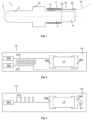
- figure 1 shows a schematic sectional view of a connector 1 according to an embodiment of the invention.
- the connector 1 has at least one electrically conductive contact element 3 with a contact area 5 for detachable electrical connection to a corresponding contact element (not shown in figure 1 ) at a first end region of the electrically conductive contact element 3 .
- the contact area 5 is shown in the form of a plug pin for connection to a corresponding plug socket.
- the electrically conductive contact element 3 has a connection area 7 for connecting to at least one electrical conductor 9 on a second end area of the electrically conductive contact element 3 . In the embodiment shown, the second end portion is opposite the first end portion.
- the electrical conductor 9 can, for example, be soldered, screwed, crimped or clamped onto the connection area 7 .
- the temperature sensor element 15 is arranged on the connection area 7 by means of a shrink tube 11 .
- clamps or other connection elements can also be arranged on the connection area 7 for this purpose, as an alternative or in addition to the shrink tube 11 .
- the flip-chip measuring element 17 is at least thermally connected to the electrically conductive contact element 3 .
- One arranged on the substrate 19 of the temperature sensor element 15 Connection element is connected to a sensor feed line 21 by means of a soft solder connection 23 .
- a stop flange 13 arranged on the second end region of the electrically conductive contact element 3 is shown, which is used to secure the electrically conductive contact element 3 in a plug insert (not shown in figure 1 ) can be held.
- the stop flange 13 can also be designed differently than shown, or can be omitted entirely.
- the connector 1 can have further components, such as a housing and a plug insert, for holding the electrically conductive contact element 3, such as a plug socket.
- figure 2 shows a schematic plan view of a temperature sensor element 15 according to a first embodiment of the invention.
- a first and a second connecting element 25a, 25b, a flip-chip measuring element 17 and a first and a second conductor track section 27a, 27b designed as a heat brake are arranged on the substrate 19.
- a first connection 29a of the flip-chip measuring element 17 is electrically connected to the first connection element 25a via the first conductor track section 27a designed as a heat brake
- a second connection 29b of the flip-chip measuring element 17 is connected via the second conductor track section 27b designed as a heat brake to the second connection element 25b electrically connected.
- connection elements 25a, 25b, the flip-chip measuring element 17, the conductor track sections 27a, 27b, the terminals 29a, 29b of the flip-chip measuring element 17, and the flip-chip measuring element 17 are all on one side of the substrate 19 arranged.
- the connection elements 25a, 25b, the conductor track sections 27a, 27b and the connections 29a, 29b of the flip-chip measuring element 17 can be formed as copper areas of a circuit board, PCB.
- the flip-chip sensing element 17 can be mounted on the leads 29a, 29b of the substrate by known C4 technology, non-conductive adhesive bonding, NCA, isotropically conductive adhesive bonding, ICA, anisotropically conductive adhesive bonding, ACA, or other mounting technology 19 can be arranged.
- both conductor track sections 27a, 27b run in meandering sections.
- the conductor track sections can also have a have a first and a second section, the second section having a smaller cross-section than the first section, in order thereby to realize the heat brake.
- the substrate 19 shown can comprise an aluminum oxide ceramic, a printed circuit board, PCB, a high-temperature printed circuit board, in particular an aluminum oxide ceramic, or a lead frame.
- the shown flip-chip measuring element 17 can comprise a thermistor, a platinum measuring resistor, a silicon measuring resistor, a pyroelectric material, a ferromagnetic material and/or a fiber optic material.
- figure 3 shows a schematic plan view of a temperature sensor element 15' according to a second embodiment of the invention.
- the temperature sensor element 15' shown differs from that in figure 2 shown temperature sensor element characterized in that the second conductor track section and the second connection element on the back, ie not in figure 3 shown side of the substrate 19 'is arranged.
- the second connection element is connected to the flip-chip measuring element 17' via the second conductor track section via a through opening 31', via, in the substrate and is arranged on the side of the substrate 19' that is not shown.
- connection 29 ⁇ is electrically connected directly to the contact element.
Landscapes
- Engineering & Computer Science (AREA)
- Microelectronics & Electronic Packaging (AREA)
- Physics & Mathematics (AREA)
- General Physics & Mathematics (AREA)
- Power Engineering (AREA)
- Transportation (AREA)
- Mechanical Engineering (AREA)
- Electric Propulsion And Braking For Vehicles (AREA)
- Investigating Or Analysing Biological Materials (AREA)
- Testing Of Individual Semiconductor Devices (AREA)
- Details Of Connecting Devices For Male And Female Coupling (AREA)
- Measuring Temperature Or Quantity Of Heat (AREA)
Description
- Die vorliegende Erfindung betrifft einen Steckverbinder zum Trennen und Verbinden von zumindest einem elektrischen Kontakt zum Laden einer Akkueinheit eines Kraftfahrzeugs. Weiterhin betrifft die vorliegende Erfindung ein Kraftfahrzeug mit einer Akkueinheit und einem Steckverbinder, sowie eine Ladestation zum Laden einer Akkueinheit eines Kraftfahrzeugs, mit einem Steckverbinder.
- Die Akkueinheit von einem Elektro- oder Hybridfahrzeug wird üblicherweise über ein Ladekabel geladen. Das Ladekabel kann beispielsweise an eine entsprechende Ladestation oder Stromtankstelle für Elektrofahrzeuge angeschlossen werden. Damit, beispielsweise, in 20 Minuten eine Akkueinheit oder Batterie mit 50 KW/h aufgeladen werden kann, muss bei Spannungen in einem Bereich von 400 V bis 600 V ein Ladestrom von ungefähr 100 A und mehr fließen. Wegen dieser hohen Ladeströme werden hohe Anforderungen an die elektrischen Steckverbinder, bzw. an den Ladestecker und die Ladebuchse, zum Laden der Akkueinheit, gestellt. Bei einer Verwendung der aus dem Stand der Technik bekannten Steckverbinder können sich die elektrisch leitenden Kontaktelemente der Steckverbinder auf einen Temperaturwert von 150°C erwärmen. Beim Laden zukünftiger Generationen von Akkueinheiten können sich die elektrisch leitenden Kontaktelemente der Steckverbinder sogar auf Temperaturwerte von 200°C bis 220°C erwärmen.
- Um eine Überhitzung der Steckverbinder zu verhindern sind aus dem Stand der Technik Steckverbinder mit integrierten Temperatursensorelementen bekannt. Wenn mittels der integrierten Temperatursensorelemente eine drohende Überhitzung des Steckverbinders erkannt wird, kann der Ladestrom entsprechend gedrosselt werden, um eine Überhitzung zu vermeiden.
- Beispielsweise wird in der
WO 2017/211349 A1 ein Steckverbinder beschrieben, der ein Ladekabel und ein Steckergehäuse, sowie elektrisch leitende Kontaktelemente zum Trennen und Verbinden einer Akkueinheit eines Kraftfahrzeugs umfasst. Zur Überwachung der Temperatur in dem Steckverbinder ist ein Temperatursensorelement mittels eines Schrumpfschlauches an einem elektrisch leitenden Kontaktelement angeordnet, wobei der Schrumpfschlauch den Bereich des Kontaktelements und das Sensorelement des Temperatursensorelements vollständig umgibt, so dass das Temperatursensorelement einerseits wärmeleittechnisch und mechanisch mit dem Kontaktelement durch den Schrumpfschlauch verbunden ist und das Temperatursensorelement andererseits in einer Art Wärmekammer, die durch den Schrumpfschlauch gebildet wird, angeordnet ist. - Im Gegensatz zu dem in der
WO 2017/211349 A1 beschrieben direkten Anordnen eines Sensorelements an einem elektrisch leitenden Kontaktelement, beschreibt dieDE 10 2016 107 401 A1 ein Temperatursensorelement in einem Steckverbinder, der beabstandet zu dem elektrisch leitenden Kontaktelement angeordnet ist und eine Temperatur in einem zwischen einem Kontaktbereich und einem Anschlussbereich gelegenen Bereich des Kontaktelementes erfasst. - Weiterhin beschreiben die Dokumente
WO 2012/146766 A1 ,US 9,484,667 B2 WO 2017/137826 A1 , undWO 02/13331 A1 WO 2016/169940 A1 offenbart den Oberbegriff des Anspruchs 1. - Allerdings haben die aus dem Stand der Technik bekannten Lösungen den Nachteil, dass die Temperatur nicht am Ort der Entstehung, nämlich der eigentlichen Kontaktstelle an dem elektrisch leitenden Kontaktelement gemessen wird, sondern an Stellen in einem Ladestecker, die entfernt von der eigentlichen Kontaktstelle liegen. Durch die hierdurch entstehenden Wärmebrücken kann es zu einem verzögerten Ansprechen des Temperatursensorelements bei einer Überhitzung des Steckverbinders führen. Dies kann zu einer Schädigung des Steckverbinders, des Fahrzeugs oder der Ladestation führen. Weiterhin führen die verwendeten Zuleitungen aus wärmeleitfähigem Kupfer die Wärme von dem Temperatursensorelement ab und können somit die Messergebnisse verfälschen.
- Aufgabe der vorliegenden Erfindung ist es daher, einen verbesserten Steckverbinder mit einem Temperatursensorelement bereitzustellen.
- Diese Aufgabe wird erfindungsgemäß durch einen Steckverbinder gemäß des Gegenstands des Anspruchs 1 gelöst.
- Der erfindungsgemäße Steckverbinder zum Trennen und Verbinden von zumindest einem elektrischen Kontakt zum Laden einer Akkueinheit eines Kraftfahrzeugs weist hierfür folgende Merkmale auf:
- zumindest ein elektrisch leitendes Kontaktelement mit einem Kontaktbereich an einem ersten Endbereich des elektrisch leitenden Kontaktelements zum lösbaren elektrischen Verbinden mit einem korrespondierenden Kontaktelement, und mit einem Anschlussbereich an einem zweiten Endbereich des elektrisch leitenden Kontaktelements zum Verbinden mit zumindest einem elektrischen Leiter, wobei der zweite Endbereich dem ersten Endbereich gegenüberliegt; und
- zumindest ein Temperatursensorelement zur Erfassung einer Temperatur des elektrisch leitenden Kontaktelements und angeordnet an dem zweiten Endbereich des elektrisch leitenden Kontaktelements, wobei das Temperatursensorelement ein Substrat mit einem ersten und
- einem zweiten darauf angeordneten Anschlusselement, ein Flip-Chip Messelement und einen ersten als Wärmebremse ausgebildeten Leiterbahnabschnitt umfasst, wobei ein erster Anschluss des Flip-Chip Messelements mit dem ersten Anschlusselement über den ersten als Wärmebremse ausgebildeten Leiterbahnabschnitt elektrisch verbunden ist.
- Der Begriff "Steckverbinder" kann dazu verwendet werden, um einen Stecker oder eine Steckerbuchse an einem Ladekabel oder an einer Ladestation oder an einem Kraftfahrzeug zu bezeichnen, mit einem Gehäuse, einem Steckereinsatz zum Halten von elektrisch leitenden Kontaktelementen und mit zumindest einem erfindungsgemäßen elektrisch leitenden Kontaktelement.
- Mit der Erfindung ist es erstmalig gelungen einen Steckverbinder mit einer sehr guten thermischen Ankopplung des Temperatursensorelements an das elektrisch leitende Kontaktelement zur Verfügung zu stellen und mit daraus resultierenden schnelleren Ansprechzeiten des Temperatursensorelements. Vorteilhaft minimieren die als Wärmebremse ausgebildeten Leiterbahnabschnitte die Wärmeableitung vom Temperatursensorelement durch die Anschlüsse.
- In einem Beispiel weist der Steckverbinder mindestens eine Sensorzuleitung auf, wobei die Sensorzuleitung an mindestens einem der Anschlusselemente mittels einer Weichlotverbindung angeordnet ist.
- Vorteilhaft kann die Sensorzuleitung mittels einer Weichlotverbindung an dem Anschlusselement angeordnet werden, da das Anschlusselement wegen der erfindungsgemäßen Anordnung deutlich niedrigeren Temperaturen ausgesetzt ist als das Flip-Chip Messelement. Deshalb können mit der erfindungsgemäßen Anordnung deutlich höhere Temperaturen gemessen werden, als es eine Weichlotverbindung an einem konventionellen Temperatursensorelement zulassen würde.
- In einem weiteren Beispiel weist der Steckverbinder einen zweiten als Wärmebremse ausgebildeten Leiterbahnabschnitt auf, wobei ein zweiter Anschluss des Flip-Chip Messelements über einen zweiten als Wärmebremse ausgebildeten Leiterbahnabschnitt mit dem zweiten Anschlusselement elektrisch verbunden ist, oder
der zweite Anschluss des Flip-Chip Messelements ist mit dem elektrischen Leiter verbunden. - In noch einem Beispiel verläuft der als Wärmebremse ausgebildete Leiterbahnabschnitt zumindest abschnittsweise mäanderförmig, oder weist einen ersten und einen zweiten Abschnitt auf, wobei der zweite Abschnitt gegenüber dem ersten Abschnitt einen kleineren Querschnitt aufweist.
- In einem Beispiel weist das elektrisch leitende Kontaktelement an dem zweiten Endbereich eine flache Auflagefläche auf und das Temperatursensorelement ist auf der flachen Auflagefläche angeordnet.
- Vorteilhaft kann hierdurch die thermische Ankopplung verbessert werden.
- In einem weiteren Beispiel zur Verbesserung der thermischen Ankopplung weist eine erste Seite des Substrats, die einer zweiten Seite des Substrats mit den darauf angeordneten ersten und/oder zweiten Anschlusselementen gegenüberliegt eine konkave Aussparung auf, zum Verbinden des Temperatursensorelements mit dem zweiten Endbereich des elektrisch leitenden Kontaktelements, der eine entsprechende konvexe Geometrie aufweist.
- In einem Beispiel weist der Steckverbinder ein wärmeleitfähiges Material auf, insbesondere eine Wärmeleitpaste, angeordnet zwischen dem Temperatursensorelement und dem elektrisch leitenden Kontaktelement, und/oder eine Folie, insbesondere eine Wärmeleitfolie aufweisend ein Polyimidmaterial, insbesondere ein Polymer gefüllt mit einem wärmeleitfähigen Pulver, bevorzugt Al2O3, angeordnet zwischen dem Temperatursensorelement und dem elektrisch leitenden Kontaktelement.
- Vorteilhaft kann durch das Anordnen einer Wärmeleitpaste und/oder Folie die Spannungsfestigkeit zwischen dem elektrisch leitenden Kontaktelement und dem Temperatursensorelement verbessert werden.
- In einem weiteren Beispiel weist der als Wärmebremse ausgebildete Leiterbahnabschnitt, insbesondere ein Leiterbahnabschnitt umfassend ein Kupfermaterial, einen Querschnitt von 50 µm x 5 µm bis 500 µm x 200 µm auf, wobei der erste und zweite Leiterbahnabschnitt auf einer Seite des Substrats, oder auf unterschiedlichen Seite des Substrats zumindest bereichsweise angeordnet sind.
- Beispielsweise kann zumindest einer der Leiterbahnabschnitte über eine Durchgangsöffnung, Via, in dem Substrat mit dem Flip-Chip Messelement verbunden sein und auf einer des Flip-Chip Messelements und des zweiten Leiterbahnabschnitts gegenüberliegenden Seite des Substrats angeordnet sein.
- In noch einem Beispiel ist das Temperatursensorelement an dem zweiten Endbereich des elektrisch leitenden Kontaktelements mit einem Schrumpfschlauch, einem Federbauteil und/oder einer Klammer befestigt.
- In noch einem weiteren Beispiel umfasst das Substrat eine Aluminiumoxidkeramik, ein Printed Circuit Board, PCB, eine Hochtemperatur Leiterplatte, insbesondere eine Aluminiumoxidkeramik, oder einen Lead Frame, und wobei das Temperatursensorelement einen Thermistor, einen Platin-Messwiderstand, einen Silizium-Messwiderstand, ein pyroelektrisches Material, ein ferromagnetisches Material, und/oder ein faseroptisches Material umfasst.
- Vorteilhaft ermöglichen besonders flache und massenarme Temperatursensorelemente eine schnelle Ansprechzeit, eine hohe Messgenauigkeit und das Erhalten von reproduzierbaren Werten.
- In einem Beispiel umfasst das elektrisch leitende Kontaktelement ein elektrisch leitendes Material, insbesondere ein Kupfermaterial, und ist im Wesentlichen zylindrisch ausgestaltet.
- Beispielsweise kann das elektrisch leitende Kontaktelement ein Stecker-Stift oder eine Stecker-Buchse in dem Steckverbinder sein. Hierfür ist in einem Beispiel das elektrisch leitende Kontaktelement in dem Anschlussbereich pinförmig oder buchsenförmig ausgestaltet zum lösbaren elektrischen Verbinden mit einem korrespondierenden buchsenförmigen oder pinförmigen Kontaktelement.
- Die Erfindung schlägt auch ein Kraftfahrzeug mit einer Akkueinheit und zumindest einem erfindungsgemäßen Steckverbinder vor.
- Weiterhin schlägt die Erfindung eine Ladestation zum Laden einer Akkueinheit eines Kraftfahrzeugs mit zumindest einem erfindungsgemäßen Steckverbinder vor.
- Weitere Merkmale und Vorteile der Erfindung ergeben sich aus der nachfolgenden Beschreibung, in der bevorzugte Ausführungsformen der Erfindung anhand von schematischen Zeichnungen erläutert sind.
- Dabei zeigt:
- Figur 1
- eine schematische Schnittansicht eines Steckverbinders gemäß einer Ausführungsform der Erfindung;
- Figur 2
- eine schematische Draufsicht auf ein Temperatursensorelement gemäß einer ersten Ausführungsform der Erfindung; und
- Figur 3
- eine schematische Draufsicht auf ein Temperatursensorelement gemäß einer zweiten Ausführungsform der Erfindung.
-
Figur 1 zeigt eine schematische Schnittansicht eines Steckverbinders 1 gemäß einer Ausführungsform der Erfindung. - Wie es in
Figur 1 gezeigt wird, weist der Steckverbinder 1 zumindest ein elektrisch leitendes Kontaktelement 3 mit einem Kontaktbereich 5 zum lösbaren elektrischen Verbinden mit einem korrespondierenden Kontaktelement (nicht gezeigt inFigur 1 ) an einem ersten Endbereich des elektrisch leitenden Kontaktelements 3 auf. InFigur 1 ist der Kontaktbereich 5 in Form eines Stecker-Pins zur Verbindung mit einer korrespondierenden Stecker-Buchse dargestellt. Weiterhin weist das elektrisch leitende Kontaktelement 3 einen Anschlussbereich 7 zum Verbinden mit zumindest einem elektrischen Leiter 9 an einem zweiten Endbereich des elektrisch leitenden Kontaktelements 3 auf. In der gezeigten Ausführungsform liegt der zweite Endbereich dem ersten Endbereich gegenüber. - An dem Anschlussbereich 7 kann beispielsweise der elektrische Leiter 9 angelötet, angeschraubt, angecrimpt oder angeklemmt werden. In der gezeigten Ausführungsform ist das Temperatursensorelement 15 mittels eines Schrumpfschlauchs 11 an dem Anschlussbereich 7 angeordnet. In weiteren, nicht gezeigten, Ausführungsformen können hierfür auch, alternativ oder zusätzlich zu dem Schrumpfschlauch 11, Klemmen oder weitere Anschlusselemente an dem Anschlussbereich 7 angeordnet sein. Das Flip-Chip Messelement 17 ist in der gezeigten Ausführungsform mit dem elektrisch leitenden Kontaktelement 3 zumindest thermisch in Verbindung. Ein auf dem Substrat 19 des Temperatursensorelements 15 angeordnetes Anschlusselement ist mit einer Sensorzuleitung 21 mittels einer Weichlotverbindung 23 verbunden.
- Weiterhin wird in
Figur 1 ein an dem zweiten Endbereich des elektrisch leitenden Kontaktelements 3 angeordneter Anschlagflansch 13 gezeigt, der dazu dient, dass das elektrisch leitenden Kontaktelement 3 in einem Steckereinsatz (nicht gezeigt inFigur 1 ) gehalten werden kann. Abhängig von dem verwendeten Steckereinsatz kann der Anschlagflansch 13 auch anders als gezeigt ausgestaltet sein, bzw. komplett entfallen. - Der Steckverbinder 1 kann in weiteren, nicht gezeigten, Ausführungsformen weitere Komponenten aufweisen, wie beispielsweise ein Gehäuse und einen Steckereinsatz, zum Halten von dem elektrisch leitenden Kontaktelement 3, wie zum Beispiel einer Steckerbuchse.
-
Figur 2 zeigt eine schematische Draufsicht auf ein Temperatursensorelement 15 gemäß einer ersten Ausführungsform der Erfindung. - Auf dem Substrat 19 ist ein erstes und ein zweites Anschlusselement 25a, 25b, ein Flip-Chip Messelement 17 und ein erster und ein zweiter als Wärmebremse ausgebildeter Leiterbahnabschnitt 27a, 27b angeordnet. Wie weiterhin in der
Figur 2 gezeigt, ist ein erster Anschluss 29a des Flip-Chip Messelements 17 mit dem ersten Anschlusselement 25a über den ersten als Wärmebremse ausgebildeten Leiterbahnabschnitt 27a elektrisch verbunden und ein zweiter Anschluss 29b des Flip-Chip Messelements 17 ist über den zweiten als Wärmebremse ausgebildeten Leiterbahnabschnitt 27b mit dem zweiten Anschlusselement 25b elektrisch verbunden. In der gezeigten Ausführungsform sind die Anschlusselemente 25a, 25b, das Flip-Chip Messelement 17, die Leiterbahnabschnitte 27a, 27b, die Anschlüsse 29a, 29b des Flip-Chip Messelements 17, sowie das Flip-Chip Messelements 17 alle auf einer Seite des Substrats 19 angeordnet. Die Anschlusselemente 25a, 25b, die Leiterbahnabschnitte 27a, 27b und die Anschlüsse 29a, 29b des Flip-Chip Messelements 17 können als Kupferbereiche einer Leiterplatte, PCB, ausgeformt sein. Das Flip-Chip Messelement 17 kann mittels einer bekannten C4-Technolgie, Kleben mit nicht leitfähigem Klebstoff, NCA, Kleben mit isotrop leitfähigem Klebstoff, ICA, Kleben mit anisotrop leitfähigem Klebstoff, ACA, oder einer anderen Montagetechnologie auf den Anschlüssen 29a, 29b des Substrats 19 angeordnet sein. - Wie in
Figur 2 gezeigt, verlaufen beide Leiterbahnabschnitte 27a, 27b abschnittsweise mäanderförmig. In einer weiteren Ausführungsform können die Leiterbahnabschnitte auch einen ersten und einen zweiten Abschnitt aufweisen, wobei der zweite Abschnitt gegenüber dem ersten Abschnitt einen kleineren Querschnitt aufweist, um hierdurch die Wärmebremse zu realisieren. - Das gezeigte Substrat 19 kann eine Aluminiumoxidkeramik, ein Printed Circuit Board, PCB, eine Hochtemperatur Leiterplatte, insbesondere eine Aluminiumoxidkeramik, oder einen Lead Frame umfassen. Weiterhin kann das gezeigte Flip-Chip Messelement 17 einen Thermistor, einen Platin-Messwiderstand, einen Silizium-Messwiderstand, ein pyroelektrisches Material, ein ferromagnetisches Material, und/oder ein faseroptisches Material umfassen.
-
Figur 3 zeigt eine schematische Draufsicht auf ein Temperatursensorelement 15' gemäß einer zweiten Ausführungsform der Erfindung. Das inFigur 3 gezeigte Temperatursensorelement 15' unterscheidet sich von dem inFigur 2 gezeigten Temperatursensorelement dadurch, dass der zweite Leiterbahnabschnitt und das zweite Anschlusselement auf der Rückseite, d.h. der nicht inFigur 3 gezeigten Seite des Substrats 19' angeordnet ist. In der gezeigten Ausführungsform ist das zweite Anschlusselement über den zweiten Leiterbahnabschnitt über eine Durchgangsöffnung 31', Via, in dem Substrat mit dem Flip-Chip Messelement 17' verbunden und ist auf der nicht gezeigten Seite des Substrats 19' angeordnet. - In einer weiteren Ausführungsform entsprechend
Figur 3 wird auf das zweite Anschlusselement und die zweite Leiterbahn auf der Rückseite des Substrats verzichtet und der Anschluss 29` wird elektrisch direkt mit dem Kontaktelement verbunden. -
- 1
- Steckverbinder
- 3
- Elektrisch Leitendes Kontaktelement
- 5
- Kontaktbereich
- 7
- Anschlussbereich
- 9
- Elektrischer Leiter
- 11
- Schrumpfschlauch
- 13
- Anschlagflansch
- 15, 15'
- Temperatursensorelement
- 17, 17'
- Flip-Chip Messelement
- 19, 19'
- Substrat
- 21
- Sensorzuleitung
- 23
- Weichlotverbindung
- 25a, 25a`
- erstes Anschlusselement
- 25b
- zweites Anschlusselement
- 27a, 27a'
- erster Leiterbahnabschnitt
- 27b
- zweiter Leiterbahnabschnitt
- 29a, 29a'
- erster Anschluss
- 29b, 29b'
- zweiter Anschluss
- 31'
- Durchgangsöffnung
Claims (13)
- Steckverbinder zum Trennen und Verbinden von zumindest einem elektrischen Kontakt zum Laden einer Akkueinheit eines Kraftfahrzeugs, aufweisend:zumindest ein elektrisch leitendes Kontaktelement (3) mit einem Kontaktbereich (5) an einem ersten Endbereich des elektrisch leitenden Kontaktelements (3) zum lösbaren elektrischen Verbinden mit einem korrespondierenden Kontaktelement, und mit einem Anschlussbereich (7) an einem zweiten Endbereich des elektrisch leitenden Kontaktelements (3) zum Verbinden mit zumindest einem elektrischen Leiter (9), wobei der zweite Endbereich dem ersten Endbereich gegenüberliegt; undzumindest ein Temperatursensorelement (15, 15') zur Erfassung einer Temperatur des elektrisch leitenden Kontaktelements (3),wobei das Temperatursensorelement (15, 15') ein Substrat (19, 19`) mit einem ersten und einem zweiten darauf angeordneten Anschlusselement (25a, 25a`, 25b), ein Flip-Chip Messelement (17, 17`) und einen ersten Leiterbahnabschnitt (27a, 27a') umfasst, wobei ein erster Anschluss (29a, 29a`) des Flip-Chip Messelements (17, 17`) mit dem ersten Anschlusselement (25a, 25a`) über den ersten Leiterbahnabschnitt (27a, 27a`) elektrisch verbunden ist,dadurch gekennzeichnet, dassdas Temperatursensorelement (15, 15') an dem zweiten Endbereich des elektrisch leitenden Kontaktelements (3) angeordnet ist, und dassder erste Leiterbahnabschnitt (27a, 27a') als Wärmebremse ausgebildet ist.
- Steckverbinder nach Anspruch 1, aufweisend mindestens eine Sensorzuleitung (21), wobei die Sensorzuleitung (21) an mindestens einem der Anschlusselemente (25a, 25a`, 25b) mittels einer Weichlotverbindung (23) angeordnet ist.
- Steckverbinder nach Anspruch 2, aufweisend einen zweiten als Wärmebremse ausgebildeten Leiterbahnabschnitt (27b), wobei ein zweiter Anschluss (29b, 29b`) des Flip-Chip Messelements (17, 17`) über einen zweiten als Wärmebremse ausgebildeten Leiterbahnabschnitt (27b) mit dem zweiten Anschlusselement (25b) elektrisch verbunden ist, oder
der zweite Anschluss (29b, 29b`) des Flip-Chip Messelements (17, 17`) mit dem elektrischen Leiter (9) verbunden ist. - Steckverbinder nach einem der vorangehenden Ansprüche, wobei der als Wärmebremse ausgebildete Leiterbahnabschnitt (27a, 27a`, 27b) zumindest abschnittsweise mäanderförmig verläuft, oder einen ersten und einen zweiten Abschnitt aufweist, wobei der zweite Abschnitt gegenüber dem ersten Abschnitt einen kleineren Querschnitt aufweist.
- Steckverbinder nach einem der Ansprüche 1 bis 4, wobei das elektrisch leitende Kontaktelement (3) an dem zweiten Endbereich eine flache Auflagefläche aufweist und das Temperatursensorelement (15, 15') auf der flachen Auflagefläche angeordnet ist.
- Steckverbinder nach einem der Ansprüche 1 bis 4, wobei eine erste Seite des Substrats (19, 19`), die einer zweiten Seite des Substrats (19, 19`) mit den darauf angeordneten ersten und/oder zweiten Anschlusselementen (25a, 25a`, 25b) gegenüberliegt eine konkave Aussparung aufweist, zum Verbinden des Temperatursensorelements (15, 15') mit dem zweiten Endbereich des elektrisch leitenden Kontaktelements (3), der eine entsprechende konvexe Geometrie aufweist.
- Steckverbinder nach einem der vorangehenden Ansprüche, aufweisend ein wärmeleitfähiges Material, insbesondere eine Wärmeleitpaste, angeordnet zwischen dem Temperatursensorelement (15, 15`) und dem elektrisch leitenden Kontaktelement (3), und/oder eine Folie, insbesondere eine Wärmeleitfolie aufweisend ein Polyimidmaterial, insbesondere ein Polymer gefüllt mit einem wärmeleitfähigen Pulver, bevorzugt AI2O3, angeordnet zwischen dem Temperatursensorelement (15, 15') und dem elektrisch leitenden Kontaktelement (3).
- Steckverbinder nach einem der vorangehenden Ansprüche, wobei der als Wärmebremse ausgebildete Leiterbahnabschnitt (27a, 27a`, 27b), insbesondere ein Leiterbahnabschnitt (27a, 27a`, 27b) umfassend ein Kupfermaterial, einen Querschnitt von 50 µm x 5 µm bis 500 µm x 200 µm aufweist, wobei der erste und zweite Leiterbahnabschnitt (27a, 27a`, 27b) auf einer Seite des Substrats (19, 19`), oder auf unterschiedlichen Seite des Substrats (19, 19`) zumindest bereichsweise angeordnet sind.
- Steckverbinder nach einem der vorangehenden Ansprüche, wobei das Temperatursensorelement (15, 15') an dem zweiten Endbereich des elektrisch leitenden Kontaktelements (3) mit einem Schrumpfschlauch (11), einem Federbauteil und/oder einer Klammer befestigt ist.
- Steckverbinder nach einem der vorangehenden Ansprüche, wobei das Substrat (19, 19`) eine Aluminiumoxidkeramik, ein Printed Circuit Board, PCB, eine Hochtemperatur Leiterplatte, insbesondere eine Aluminiumoxidkeramik, oder einen Lead Frame umfasst, und wobei das Temperatursensorelement (15, 15`) einen Thermistor, einen Platin-Messwiderstand, einen Silizium-Messwiderstand, ein pyroelektrisches Material, ein ferromagnetisches Material, und/oder ein faseroptisches Material umfasst.
- Steckverbinder nach einem der vorangehenden Ansprüche, wobei das elektrisch leitende Kontaktelement (3) ein elektrisch leitendes Material, insbesondere ein Kupfermaterial, umfasst und im Wesentlichen zylindrisch ausgestaltet ist, und wobei das elektrisch leitende Kontaktelement (3) in dem Anschlussbereich (7) pinförmig oder buchsenförmig ausgestaltet ist zum lösbaren elektrischen Verbinden mit einem korrespondierenden buchsenförmigen oder pinförmigen Kontaktelement.
- Ein Kraftfahrzeug mit einer Akkueinheit, aufweisend zumindest einen Steckverbinder nach einem der Ansprüche 1 bis 11.
- Eine Ladestation zum Laden einer Akkueinheit eines Kraftfahrzeugs, aufweisend zumindest einen Steckverbinder nach einem der Ansprüche 1 bis 11.
Applications Claiming Priority (2)
| Application Number | Priority Date | Filing Date | Title |
|---|---|---|---|
| DE202018003420.7U DE202018003420U1 (de) | 2018-07-23 | 2018-07-23 | Steckverbinder mit Flip-Chip Messelement |
| PCT/EP2019/067928 WO2020020591A1 (de) | 2018-07-23 | 2019-07-04 | Steckverbinder mit flip-chip messelement |
Publications (2)
| Publication Number | Publication Date |
|---|---|
| EP3826880A1 EP3826880A1 (de) | 2021-06-02 |
| EP3826880B1 true EP3826880B1 (de) | 2023-03-01 |
Family
ID=63450611
Family Applications (1)
| Application Number | Title | Priority Date | Filing Date |
|---|---|---|---|
| EP19736677.6A Active EP3826880B1 (de) | 2018-07-23 | 2019-07-04 | Steckverbinder mit flip-chip messelement |
Country Status (4)
| Country | Link |
|---|---|
| EP (1) | EP3826880B1 (de) |
| DE (1) | DE202018003420U1 (de) |
| ES (1) | ES2945320T3 (de) |
| WO (1) | WO2020020591A1 (de) |
Families Citing this family (4)
| Publication number | Priority date | Publication date | Assignee | Title |
|---|---|---|---|---|
| DE102018131558A1 (de) * | 2018-12-10 | 2020-06-10 | Phoenix Contact E-Mobility Gmbh | Steckverbinderteil mit einer Temperaturüberwachungseinrichtung |
| DE102020124513A1 (de) | 2020-09-21 | 2022-03-24 | Lisa Dräxlmaier GmbH | Vorrichtung zum elektrischen laden einer fahrzeugbatterie eines elektrisch betriebenen fahrzeugs und verfahren zum herstellen einer vorrichtung zum elektrischen laden einer fahrzeugbatterie eines elektrisch betriebenen fahrzeugs |
| CN113725652A (zh) * | 2021-08-06 | 2021-11-30 | 长春捷翼汽车零部件有限公司 | 充电座及汽车 |
| CN116345250A (zh) | 2023-05-04 | 2023-06-27 | 昆山联滔电子有限公司 | 弹簧针模组及弹簧针温度控制方法 |
Citations (1)
| Publication number | Priority date | Publication date | Assignee | Title |
|---|---|---|---|---|
| DE102010030769B4 (de) * | 2010-06-30 | 2013-02-07 | Preh Gmbh | Temperaturfühler zur Messung einer Fahrzeuginnentemperatur |
Family Cites Families (10)
| Publication number | Priority date | Publication date | Assignee | Title |
|---|---|---|---|---|
| DE19913195C2 (de) * | 1999-03-24 | 2001-02-15 | Techem Service Ag | Meßeinsatz für Widerstandsthermometer |
| AU9172801A (en) | 2000-08-04 | 2002-02-18 | Manfred Fladung Gmbh | Electrical plug-in connector |
| WO2012146766A1 (en) | 2011-04-28 | 2012-11-01 | Fci Automotive Holding | Multicontact body, electrical contact, electrical connector device and assembly method |
| JP5822047B2 (ja) | 2013-03-19 | 2015-11-24 | 住友電装株式会社 | 車両側コネクタ |
| DE102014111185A1 (de) * | 2014-08-06 | 2016-02-11 | Phoenix Contact E-Mobility Gmbh | Steckverbinderteil mit einer Temperatursensoreinrichtung |
| DE102015106251A1 (de) * | 2015-04-23 | 2016-10-27 | Phoenix Contact E-Mobility Gmbh | Steckverbinderteil mit einer Temperaturüberwachungseinrichtung |
| DE102016001572A1 (de) | 2016-02-11 | 2017-08-17 | Sumitomo Wiring Systems, Ltd. | Ladeverbinder, Anschlusspassstück und Verfahren zum Fixieren eines Sensors an einem Anschlusspassstück |
| DE102016107401A1 (de) | 2016-02-26 | 2017-08-31 | Amad Mennekes Holding Gmbh & Co. Kg | Steckvorrichtung mit Temperaturerfassung |
| DE202016103030U1 (de) | 2016-06-07 | 2017-09-09 | Müller Plastik GmbH | Stecker, insbesondere mit einem Fahrzeugladekabel eines Elektro- oder Hybridfahrzeuges |
| DE202018002686U1 (de) * | 2018-06-06 | 2018-07-12 | Heraeus Sensor Technology Gmbh | Steckverbinder zum Trennen und Verbinden von zumindest einem elektrischen Kontakt zum Laden einer Akkueinheit eines Kraftfahrzeugs |
-
2018
- 2018-07-23 DE DE202018003420.7U patent/DE202018003420U1/de not_active Expired - Lifetime
-
2019
- 2019-07-04 EP EP19736677.6A patent/EP3826880B1/de active Active
- 2019-07-04 WO PCT/EP2019/067928 patent/WO2020020591A1/de not_active Ceased
- 2019-07-04 ES ES19736677T patent/ES2945320T3/es active Active
Patent Citations (1)
| Publication number | Priority date | Publication date | Assignee | Title |
|---|---|---|---|---|
| DE102010030769B4 (de) * | 2010-06-30 | 2013-02-07 | Preh Gmbh | Temperaturfühler zur Messung einer Fahrzeuginnentemperatur |
Also Published As
| Publication number | Publication date |
|---|---|
| EP3826880A1 (de) | 2021-06-02 |
| ES2945320T3 (es) | 2023-06-30 |
| WO2020020591A1 (de) | 2020-01-30 |
| DE202018003420U1 (de) | 2018-08-16 |
Similar Documents
| Publication | Publication Date | Title |
|---|---|---|
| EP3826880B1 (de) | Steckverbinder mit flip-chip messelement | |
| DE202018002686U1 (de) | Steckverbinder zum Trennen und Verbinden von zumindest einem elektrischen Kontakt zum Laden einer Akkueinheit eines Kraftfahrzeugs | |
| EP2643668B1 (de) | Elektrischer steckverbinder für thermoelemente und verfahren zu dessen herstellung | |
| BE1025169B1 (de) | Steckverbinderteil mit einer Temperaturüberwachungseinrichtung | |
| EP3667831B1 (de) | Steckverbinderteil mit einer leiterplatte | |
| EP3286804A1 (de) | Steckverbinderteil mit einer temperaturüberwachungseinrichtung | |
| CN107004815A (zh) | 用于电池连接器系统的汇流条 | |
| EP3240120A2 (de) | Elektrische steckverbinderanordnung | |
| CN101855783A (zh) | 电池接柱连接器 | |
| CN112345811B (zh) | 用于将磁场传感器芯片安装至汇流排的装置和方法 | |
| US9331413B2 (en) | Dual thickness double-ended male blade terminal | |
| US9099799B2 (en) | Electrical termination unit for a microelectronic device and microelectronic device including such an electrical termination unit | |
| KR20160054655A (ko) | 표면 실장용 온도 퓨즈 및 그 설치 방법 | |
| DE102020119422A1 (de) | Löthilfsteil zum Verbinden eines Kabels mit einer Leiterplatte; Kabel; Leiterplatte; Baugruppe; Verfahren | |
| EP4281737B1 (de) | Anordnung mit einem stiftförmigen elektrischen kontaktelement und einer temperaturmessvorrichtung zum messen einer temperatur des stiftförmigen elektrischen kontaktelements | |
| EP2992306B1 (de) | Anordnung eines temperatursensors mit einer elektrisch isolierenden umhüllung | |
| DE102020124513A1 (de) | Vorrichtung zum elektrischen laden einer fahrzeugbatterie eines elektrisch betriebenen fahrzeugs und verfahren zum herstellen einer vorrichtung zum elektrischen laden einer fahrzeugbatterie eines elektrisch betriebenen fahrzeugs | |
| DE102008040243A1 (de) | Polklemmenanordnung mit integriertem Shuntwiderstand | |
| DE102006054369A1 (de) | Sensoranordnung | |
| DE102023105004A1 (de) | Steckverbinder, Steckverbindung und Verfahren zur Temperaturbestimmung in einem Steckverbinder | |
| DE102024113905A1 (de) | Gehäuse, Sensor und Anordnung | |
| WO2024156636A1 (de) | Steckverbinderteil für ein ladesystem zum aufladen eines elektrofahrzeugs | |
| DE102019217054A1 (de) | Temperierungsvorrichtung | |
| EP3404674A1 (de) | Leistungswiderstand | |
| DE102025131983A1 (de) | Elektrische Leitungseinheit und Verfahren zur Montage einer elektrischen Leitungseinheit |
Legal Events
| Date | Code | Title | Description |
|---|---|---|---|
| STAA | Information on the status of an ep patent application or granted ep patent |
Free format text: STATUS: UNKNOWN |
|
| STAA | Information on the status of an ep patent application or granted ep patent |
Free format text: STATUS: THE INTERNATIONAL PUBLICATION HAS BEEN MADE |
|
| PUAI | Public reference made under article 153(3) epc to a published international application that has entered the european phase |
Free format text: ORIGINAL CODE: 0009012 |
|
| STAA | Information on the status of an ep patent application or granted ep patent |
Free format text: STATUS: REQUEST FOR EXAMINATION WAS MADE |
|
| 17P | Request for examination filed |
Effective date: 20210203 |
|
| AK | Designated contracting states |
Kind code of ref document: A1 Designated state(s): AL AT BE BG CH CY CZ DE DK EE ES FI FR GB GR HR HU IE IS IT LI LT LU LV MC MK MT NL NO PL PT RO RS SE SI SK SM TR |
|
| DAV | Request for validation of the european patent (deleted) | ||
| DAX | Request for extension of the european patent (deleted) | ||
| RAP3 | Party data changed (applicant data changed or rights of an application transferred) |
Owner name: HERAEUS NEXENSOS GMBH |
|
| REG | Reference to a national code |
Ref country code: DE Ref legal event code: R079 Ref document number: 502019007101 Country of ref document: DE Free format text: PREVIOUS MAIN CLASS: B60L0053160000 Ipc: H05K0001020000 |
|
| GRAP | Despatch of communication of intention to grant a patent |
Free format text: ORIGINAL CODE: EPIDOSNIGR1 |
|
| STAA | Information on the status of an ep patent application or granted ep patent |
Free format text: STATUS: GRANT OF PATENT IS INTENDED |
|
| RIC1 | Information provided on ipc code assigned before grant |
Ipc: H01R 13/04 20060101ALN20220914BHEP Ipc: G01K 7/16 20060101ALN20220914BHEP Ipc: G01K 1/16 20060101ALI20220914BHEP Ipc: H01R 13/66 20060101ALI20220914BHEP Ipc: G01K 13/00 20210101ALI20220914BHEP Ipc: B60L 53/16 20190101ALI20220914BHEP Ipc: H05K 1/16 20060101ALI20220914BHEP Ipc: H05K 1/02 20060101AFI20220914BHEP |
|
| INTG | Intention to grant announced |
Effective date: 20220930 |
|
| GRAS | Grant fee paid |
Free format text: ORIGINAL CODE: EPIDOSNIGR3 |
|
| GRAA | (expected) grant |
Free format text: ORIGINAL CODE: 0009210 |
|
| STAA | Information on the status of an ep patent application or granted ep patent |
Free format text: STATUS: THE PATENT HAS BEEN GRANTED |
|
| AK | Designated contracting states |
Kind code of ref document: B1 Designated state(s): AL AT BE BG CH CY CZ DE DK EE ES FI FR GB GR HR HU IE IS IT LI LT LU LV MC MK MT NL NO PL PT RO RS SE SI SK SM TR |
|
| REG | Reference to a national code |
Ref country code: GB Ref legal event code: FG4D Free format text: NOT ENGLISH |
|
| REG | Reference to a national code |
Ref country code: CH Ref legal event code: EP Ref country code: AT Ref legal event code: REF Ref document number: 1551930 Country of ref document: AT Kind code of ref document: T Effective date: 20230315 |
|
| REG | Reference to a national code |
Ref country code: DE Ref legal event code: R096 Ref document number: 502019007101 Country of ref document: DE |
|
| REG | Reference to a national code |
Ref country code: IE Ref legal event code: FG4D Free format text: LANGUAGE OF EP DOCUMENT: GERMAN |
|
| REG | Reference to a national code |
Ref country code: DE Ref legal event code: R081 Ref document number: 502019007101 Country of ref document: DE Owner name: YAGEO NEXENSOS GMBH, DE Free format text: FORMER OWNER: HERAEUS NEXENSOS GMBH, 63801 KLEINOSTHEIM, DE |
|
| RAP4 | Party data changed (patent owner data changed or rights of a patent transferred) |
Owner name: YAGEO NEXENSOS GMBH |
|
| REG | Reference to a national code |
Ref country code: LT Ref legal event code: MG9D |
|
| REG | Reference to a national code |
Ref country code: ES Ref legal event code: FG2A Ref document number: 2945320 Country of ref document: ES Kind code of ref document: T3 Effective date: 20230630 |
|
| REG | Reference to a national code |
Ref country code: NL Ref legal event code: MP Effective date: 20230301 |
|
| PG25 | Lapsed in a contracting state [announced via postgrant information from national office to epo] |
Ref country code: RS Free format text: LAPSE BECAUSE OF FAILURE TO SUBMIT A TRANSLATION OF THE DESCRIPTION OR TO PAY THE FEE WITHIN THE PRESCRIBED TIME-LIMIT Effective date: 20230301 Ref country code: NO Free format text: LAPSE BECAUSE OF FAILURE TO SUBMIT A TRANSLATION OF THE DESCRIPTION OR TO PAY THE FEE WITHIN THE PRESCRIBED TIME-LIMIT Effective date: 20230601 Ref country code: LV Free format text: LAPSE BECAUSE OF FAILURE TO SUBMIT A TRANSLATION OF THE DESCRIPTION OR TO PAY THE FEE WITHIN THE PRESCRIBED TIME-LIMIT Effective date: 20230301 Ref country code: LT Free format text: LAPSE BECAUSE OF FAILURE TO SUBMIT A TRANSLATION OF THE DESCRIPTION OR TO PAY THE FEE WITHIN THE PRESCRIBED TIME-LIMIT Effective date: 20230301 Ref country code: HR Free format text: LAPSE BECAUSE OF FAILURE TO SUBMIT A TRANSLATION OF THE DESCRIPTION OR TO PAY THE FEE WITHIN THE PRESCRIBED TIME-LIMIT Effective date: 20230301 |
|
| PG25 | Lapsed in a contracting state [announced via postgrant information from national office to epo] |
Ref country code: SE Free format text: LAPSE BECAUSE OF FAILURE TO SUBMIT A TRANSLATION OF THE DESCRIPTION OR TO PAY THE FEE WITHIN THE PRESCRIBED TIME-LIMIT Effective date: 20230301 Ref country code: PL Free format text: LAPSE BECAUSE OF FAILURE TO SUBMIT A TRANSLATION OF THE DESCRIPTION OR TO PAY THE FEE WITHIN THE PRESCRIBED TIME-LIMIT Effective date: 20230301 Ref country code: NL Free format text: LAPSE BECAUSE OF FAILURE TO SUBMIT A TRANSLATION OF THE DESCRIPTION OR TO PAY THE FEE WITHIN THE PRESCRIBED TIME-LIMIT Effective date: 20230301 Ref country code: GR Free format text: LAPSE BECAUSE OF FAILURE TO SUBMIT A TRANSLATION OF THE DESCRIPTION OR TO PAY THE FEE WITHIN THE PRESCRIBED TIME-LIMIT Effective date: 20230602 Ref country code: FI Free format text: LAPSE BECAUSE OF FAILURE TO SUBMIT A TRANSLATION OF THE DESCRIPTION OR TO PAY THE FEE WITHIN THE PRESCRIBED TIME-LIMIT Effective date: 20230301 |
|
| PG25 | Lapsed in a contracting state [announced via postgrant information from national office to epo] |
Ref country code: SM Free format text: LAPSE BECAUSE OF FAILURE TO SUBMIT A TRANSLATION OF THE DESCRIPTION OR TO PAY THE FEE WITHIN THE PRESCRIBED TIME-LIMIT Effective date: 20230301 Ref country code: RO Free format text: LAPSE BECAUSE OF FAILURE TO SUBMIT A TRANSLATION OF THE DESCRIPTION OR TO PAY THE FEE WITHIN THE PRESCRIBED TIME-LIMIT Effective date: 20230301 Ref country code: PT Free format text: LAPSE BECAUSE OF FAILURE TO SUBMIT A TRANSLATION OF THE DESCRIPTION OR TO PAY THE FEE WITHIN THE PRESCRIBED TIME-LIMIT Effective date: 20230703 Ref country code: EE Free format text: LAPSE BECAUSE OF FAILURE TO SUBMIT A TRANSLATION OF THE DESCRIPTION OR TO PAY THE FEE WITHIN THE PRESCRIBED TIME-LIMIT Effective date: 20230301 |
|
| PG25 | Lapsed in a contracting state [announced via postgrant information from national office to epo] |
Ref country code: SK Free format text: LAPSE BECAUSE OF FAILURE TO SUBMIT A TRANSLATION OF THE DESCRIPTION OR TO PAY THE FEE WITHIN THE PRESCRIBED TIME-LIMIT Effective date: 20230301 Ref country code: IS Free format text: LAPSE BECAUSE OF FAILURE TO SUBMIT A TRANSLATION OF THE DESCRIPTION OR TO PAY THE FEE WITHIN THE PRESCRIBED TIME-LIMIT Effective date: 20230701 |
|
| REG | Reference to a national code |
Ref country code: DE Ref legal event code: R097 Ref document number: 502019007101 Country of ref document: DE |
|
| PLBE | No opposition filed within time limit |
Free format text: ORIGINAL CODE: 0009261 |
|
| STAA | Information on the status of an ep patent application or granted ep patent |
Free format text: STATUS: NO OPPOSITION FILED WITHIN TIME LIMIT |
|
| PG25 | Lapsed in a contracting state [announced via postgrant information from national office to epo] |
Ref country code: SI Free format text: LAPSE BECAUSE OF FAILURE TO SUBMIT A TRANSLATION OF THE DESCRIPTION OR TO PAY THE FEE WITHIN THE PRESCRIBED TIME-LIMIT Effective date: 20230301 Ref country code: DK Free format text: LAPSE BECAUSE OF FAILURE TO SUBMIT A TRANSLATION OF THE DESCRIPTION OR TO PAY THE FEE WITHIN THE PRESCRIBED TIME-LIMIT Effective date: 20230301 |
|
| 26N | No opposition filed |
Effective date: 20231204 |
|
| PG25 | Lapsed in a contracting state [announced via postgrant information from national office to epo] |
Ref country code: MC Free format text: LAPSE BECAUSE OF FAILURE TO SUBMIT A TRANSLATION OF THE DESCRIPTION OR TO PAY THE FEE WITHIN THE PRESCRIBED TIME-LIMIT Effective date: 20230301 |
|
| PG25 | Lapsed in a contracting state [announced via postgrant information from national office to epo] |
Ref country code: MC Free format text: LAPSE BECAUSE OF FAILURE TO SUBMIT A TRANSLATION OF THE DESCRIPTION OR TO PAY THE FEE WITHIN THE PRESCRIBED TIME-LIMIT Effective date: 20230301 |
|
| REG | Reference to a national code |
Ref country code: BE Ref legal event code: MM Effective date: 20230731 |
|
| PG25 | Lapsed in a contracting state [announced via postgrant information from national office to epo] |
Ref country code: LU Free format text: LAPSE BECAUSE OF NON-PAYMENT OF DUE FEES Effective date: 20230704 |
|
| GBPC | Gb: european patent ceased through non-payment of renewal fee |
Effective date: 20230704 |
|
| PG25 | Lapsed in a contracting state [announced via postgrant information from national office to epo] |
Ref country code: LU Free format text: LAPSE BECAUSE OF NON-PAYMENT OF DUE FEES Effective date: 20230704 |
|
| REG | Reference to a national code |
Ref country code: IE Ref legal event code: MM4A |
|
| PG25 | Lapsed in a contracting state [announced via postgrant information from national office to epo] |
Ref country code: GB Free format text: LAPSE BECAUSE OF NON-PAYMENT OF DUE FEES Effective date: 20230704 |
|
| PG25 | Lapsed in a contracting state [announced via postgrant information from national office to epo] |
Ref country code: IT Free format text: LAPSE BECAUSE OF FAILURE TO SUBMIT A TRANSLATION OF THE DESCRIPTION OR TO PAY THE FEE WITHIN THE PRESCRIBED TIME-LIMIT Effective date: 20230301 Ref country code: BE Free format text: LAPSE BECAUSE OF NON-PAYMENT OF DUE FEES Effective date: 20230731 |
|
| PG25 | Lapsed in a contracting state [announced via postgrant information from national office to epo] |
Ref country code: IE Free format text: LAPSE BECAUSE OF NON-PAYMENT OF DUE FEES Effective date: 20230704 |
|
| PGFP | Annual fee paid to national office [announced via postgrant information from national office to epo] |
Ref country code: CZ Payment date: 20240621 Year of fee payment: 6 |
|
| PG25 | Lapsed in a contracting state [announced via postgrant information from national office to epo] |
Ref country code: IE Free format text: LAPSE BECAUSE OF NON-PAYMENT OF DUE FEES Effective date: 20230704 |
|
| PGFP | Annual fee paid to national office [announced via postgrant information from national office to epo] |
Ref country code: DE Payment date: 20240731 Year of fee payment: 6 |
|
| PGFP | Annual fee paid to national office [announced via postgrant information from national office to epo] |
Ref country code: FR Payment date: 20240725 Year of fee payment: 6 |
|
| PGFP | Annual fee paid to national office [announced via postgrant information from national office to epo] |
Ref country code: CH Payment date: 20240801 Year of fee payment: 6 Ref country code: ES Payment date: 20240806 Year of fee payment: 6 |
|
| PG25 | Lapsed in a contracting state [announced via postgrant information from national office to epo] |
Ref country code: BG Free format text: LAPSE BECAUSE OF FAILURE TO SUBMIT A TRANSLATION OF THE DESCRIPTION OR TO PAY THE FEE WITHIN THE PRESCRIBED TIME-LIMIT Effective date: 20230301 |
|
| PG25 | Lapsed in a contracting state [announced via postgrant information from national office to epo] |
Ref country code: BG Free format text: LAPSE BECAUSE OF FAILURE TO SUBMIT A TRANSLATION OF THE DESCRIPTION OR TO PAY THE FEE WITHIN THE PRESCRIBED TIME-LIMIT Effective date: 20230301 |
|
| PG25 | Lapsed in a contracting state [announced via postgrant information from national office to epo] |
Ref country code: CY Free format text: LAPSE BECAUSE OF FAILURE TO SUBMIT A TRANSLATION OF THE DESCRIPTION OR TO PAY THE FEE WITHIN THE PRESCRIBED TIME-LIMIT; INVALID AB INITIO Effective date: 20190704 |
|
| PG25 | Lapsed in a contracting state [announced via postgrant information from national office to epo] |
Ref country code: HU Free format text: LAPSE BECAUSE OF FAILURE TO SUBMIT A TRANSLATION OF THE DESCRIPTION OR TO PAY THE FEE WITHIN THE PRESCRIBED TIME-LIMIT; INVALID AB INITIO Effective date: 20190704 |
|
| REG | Reference to a national code |
Ref country code: AT Ref legal event code: MM01 Ref document number: 1551930 Country of ref document: AT Kind code of ref document: T Effective date: 20240704 |
|
| PG25 | Lapsed in a contracting state [announced via postgrant information from national office to epo] |
Ref country code: AT Free format text: LAPSE BECAUSE OF NON-PAYMENT OF DUE FEES Effective date: 20240704 |
|
| PG25 | Lapsed in a contracting state [announced via postgrant information from national office to epo] |
Ref country code: TR Free format text: LAPSE BECAUSE OF FAILURE TO SUBMIT A TRANSLATION OF THE DESCRIPTION OR TO PAY THE FEE WITHIN THE PRESCRIBED TIME-LIMIT Effective date: 20230301 |
|
| PG25 | Lapsed in a contracting state [announced via postgrant information from national office to epo] |
Ref country code: CZ Free format text: LAPSE BECAUSE OF NON-PAYMENT OF DUE FEES Effective date: 20250704 |
|
| REG | Reference to a national code |
Ref country code: DE Ref legal event code: R119 Ref document number: 502019007101 Country of ref document: DE |
|
| REG | Reference to a national code |
Ref country code: CH Ref legal event code: H13 Free format text: ST27 STATUS EVENT CODE: U-0-0-H10-H13 (AS PROVIDED BY THE NATIONAL OFFICE) Effective date: 20260224 |
|
| PG25 | Lapsed in a contracting state [announced via postgrant information from national office to epo] |
Ref country code: DE Free format text: LAPSE BECAUSE OF NON-PAYMENT OF DUE FEES Effective date: 20260203 |
|
| PGFP | Annual fee paid to national office [announced via postgrant information from national office to epo] |
Ref country code: AT Payment date: 20260410 Year of fee payment: 5 |
|
| PG25 | Lapsed in a contracting state [announced via postgrant information from national office to epo] |
Ref country code: FR Free format text: LAPSE BECAUSE OF NON-PAYMENT OF DUE FEES Effective date: 20250731 |
|
| PG25 | Lapsed in a contracting state [announced via postgrant information from national office to epo] |
Ref country code: CH Free format text: LAPSE BECAUSE OF NON-PAYMENT OF DUE FEES Effective date: 20250731 |