EP3825915A1 - Procede de classification d'une empreinte biometrique representee par une image d'entree - Google Patents
Procede de classification d'une empreinte biometrique representee par une image d'entree Download PDFInfo
- Publication number
- EP3825915A1 EP3825915A1 EP20209759.8A EP20209759A EP3825915A1 EP 3825915 A1 EP3825915 A1 EP 3825915A1 EP 20209759 A EP20209759 A EP 20209759A EP 3825915 A1 EP3825915 A1 EP 3825915A1
- Authority
- EP
- European Patent Office
- Prior art keywords
- biometric
- cnn
- input image
- fingerprints
- represented
- Prior art date
- Legal status (The legal status is an assumption and is not a legal conclusion. Google has not performed a legal analysis and makes no representation as to the accuracy of the status listed.)
- Pending
Links
Images

Classifications
-
- G—PHYSICS
- G06—COMPUTING OR CALCULATING; COUNTING
- G06N—COMPUTING ARRANGEMENTS BASED ON SPECIFIC COMPUTATIONAL MODELS
- G06N3/00—Computing arrangements based on biological models
- G06N3/02—Neural networks
- G06N3/04—Architecture, e.g. interconnection topology
- G06N3/045—Combinations of networks
-
- G—PHYSICS
- G06—COMPUTING OR CALCULATING; COUNTING
- G06N—COMPUTING ARRANGEMENTS BASED ON SPECIFIC COMPUTATIONAL MODELS
- G06N3/00—Computing arrangements based on biological models
- G06N3/02—Neural networks
- G06N3/08—Learning methods
- G06N3/082—Learning methods modifying the architecture, e.g. adding, deleting or silencing nodes or connections
-
- G—PHYSICS
- G06—COMPUTING OR CALCULATING; COUNTING
- G06N—COMPUTING ARRANGEMENTS BASED ON SPECIFIC COMPUTATIONAL MODELS
- G06N3/00—Computing arrangements based on biological models
- G06N3/02—Neural networks
- G06N3/04—Architecture, e.g. interconnection topology
- G06N3/0464—Convolutional networks [CNN, ConvNet]
-
- G—PHYSICS
- G06—COMPUTING OR CALCULATING; COUNTING
- G06N—COMPUTING ARRANGEMENTS BASED ON SPECIFIC COMPUTATIONAL MODELS
- G06N3/00—Computing arrangements based on biological models
- G06N3/02—Neural networks
- G06N3/04—Architecture, e.g. interconnection topology
- G06N3/048—Activation functions
-
- G—PHYSICS
- G06—COMPUTING OR CALCULATING; COUNTING
- G06N—COMPUTING ARRANGEMENTS BASED ON SPECIFIC COMPUTATIONAL MODELS
- G06N3/00—Computing arrangements based on biological models
- G06N3/02—Neural networks
- G06N3/08—Learning methods
-
- G—PHYSICS
- G06—COMPUTING OR CALCULATING; COUNTING
- G06N—COMPUTING ARRANGEMENTS BASED ON SPECIFIC COMPUTATIONAL MODELS
- G06N3/00—Computing arrangements based on biological models
- G06N3/02—Neural networks
- G06N3/08—Learning methods
- G06N3/084—Backpropagation, e.g. using gradient descent
-
- G—PHYSICS
- G06—COMPUTING OR CALCULATING; COUNTING
- G06N—COMPUTING ARRANGEMENTS BASED ON SPECIFIC COMPUTATIONAL MODELS
- G06N3/00—Computing arrangements based on biological models
- G06N3/02—Neural networks
- G06N3/08—Learning methods
- G06N3/09—Supervised learning
-
- G—PHYSICS
- G06—COMPUTING OR CALCULATING; COUNTING
- G06V—IMAGE OR VIDEO RECOGNITION OR UNDERSTANDING
- G06V10/00—Arrangements for image or video recognition or understanding
- G06V10/70—Arrangements for image or video recognition or understanding using pattern recognition or machine learning
- G06V10/764—Arrangements for image or video recognition or understanding using pattern recognition or machine learning using classification, e.g. of video objects
-
- G—PHYSICS
- G06—COMPUTING OR CALCULATING; COUNTING
- G06V—IMAGE OR VIDEO RECOGNITION OR UNDERSTANDING
- G06V10/00—Arrangements for image or video recognition or understanding
- G06V10/70—Arrangements for image or video recognition or understanding using pattern recognition or machine learning
- G06V10/82—Arrangements for image or video recognition or understanding using pattern recognition or machine learning using neural networks
-
- G—PHYSICS
- G06—COMPUTING OR CALCULATING; COUNTING
- G06V—IMAGE OR VIDEO RECOGNITION OR UNDERSTANDING
- G06V40/00—Recognition of biometric, human-related or animal-related patterns in image or video data
- G06V40/10—Human or animal bodies, e.g. vehicle occupants or pedestrians; Body parts, e.g. hands
- G06V40/12—Fingerprints or palmprints
- G06V40/13—Sensors therefor
-
- G—PHYSICS
- G06—COMPUTING OR CALCULATING; COUNTING
- G06V—IMAGE OR VIDEO RECOGNITION OR UNDERSTANDING
- G06V40/00—Recognition of biometric, human-related or animal-related patterns in image or video data
- G06V40/10—Human or animal bodies, e.g. vehicle occupants or pedestrians; Body parts, e.g. hands
- G06V40/12—Fingerprints or palmprints
- G06V40/1347—Preprocessing; Feature extraction
- G06V40/1353—Extracting features related to minutiae or pores
-
- G—PHYSICS
- G06—COMPUTING OR CALCULATING; COUNTING
- G06V—IMAGE OR VIDEO RECOGNITION OR UNDERSTANDING
- G06V40/00—Recognition of biometric, human-related or animal-related patterns in image or video data
- G06V40/10—Human or animal bodies, e.g. vehicle occupants or pedestrians; Body parts, e.g. hands
- G06V40/12—Fingerprints or palmprints
- G06V40/1347—Preprocessing; Feature extraction
- G06V40/1359—Extracting features related to ridge properties; Determining the fingerprint type, e.g. whorl or loop
-
- G—PHYSICS
- G06—COMPUTING OR CALCULATING; COUNTING
- G06V—IMAGE OR VIDEO RECOGNITION OR UNDERSTANDING
- G06V40/00—Recognition of biometric, human-related or animal-related patterns in image or video data
- G06V40/10—Human or animal bodies, e.g. vehicle occupants or pedestrians; Body parts, e.g. hands
- G06V40/12—Fingerprints or palmprints
- G06V40/1365—Matching; Classification
- G06V40/1371—Matching features related to minutiae or pores
Definitions
- the present invention relates to the field of biometrics, and in particular proposes a method of classifying a biometric fingerprint represented by an input image by means of a convolutional neural network, as well as a method of learning the convolutional neural network.
- Biometric authentication / identification consists in recognizing an individual on the basis of biometric traits of that individual such as fingerprints (fingerprint recognition), palm prints, retinal prints, iris or face (facial recognition).
- biometric approaches use the characteristic information of the biometric trait extracted from the acquired biometrics, called “features”, and the learning / classification is carried out on the basis of the comparison of these characteristics.
- the process for extracting the characteristics of a footprint is thus called “coding”, which makes it possible to compose a signature called a “template” encoding the information useful to the final phase of classification. More precisely, the classification will be carried out by comparing the characteristic maps obtained with one or more reference characteristic maps associated with known individuals.
- the main difficulty lies in the response time when one wishes to make the identification, because it is necessary to make as many comparisons as there are individuals in the base of known individuals.
- the level 1 characteristics (general pattern of the imprint) by deep learning. More precisely, the fingerprint is preclassified from among a set of known types by means of a neural network, so as to limit the number of candidate individuals and therefore the number of comparisons to be made.
- the invention relates to a computer program product comprising code instructions for the execution of a method according to the first aspect of classifying a biometric fingerprint represented by an input image; and Storage medium readable by computer equipment on which a computer program product comprises code instructions for executing a method according to the first aspect of classifying a biometric fingerprint represented by an input image.
- the input or training data are of the image type, and are representative of a biometric fingerprint (in other words they are images of the biometric fingerprint, ie on which the biometric fingerprint is visible ), advantageously chosen from a fingerprint, a palm print, a retinal print, etc., and in general any print which can be represented by an image and uniquely associated with an individual.
- said biometric print is a fingerprint and this example will be taken in the remainder of the description (as will be seen, the present method is most particularly effective in particular in the case of latent fingerprints).
- classification is understood to mean the determination of at least one “general pattern” of the biometric imprint represented by the input image, ie a level 1 characteristic of the imprint. This classification will be distinguished here from an identification / authentication of an individual carrying the biometric imprint (ie determination of an identity associated with the imprint), which can also be called classification of the biometric imprint.
- the general pattern defines the overall structure of the fingerprint and makes it possible to distinguish between several types of biometric fingerprints.
- the present invention will not be limited to these four general patterns, since other general patterns of fingerprints are sometimes found such as the “double loop” or the “hoop arch”.
- the spiral can be distinguished into two patterns depending on the direction of rotation.
- the general left loop and right loop patterns are sometimes grouped together under the general “loop” pattern.
- the principle underlying the present method is not to consider the present classification as the choice of a general pattern of the fingerprint of the input image from among said predefined set of possible general patterns of biometric fingerprint (ie a multi-class classification, in other words a classification in multiple classes), but as the determination, for each of a predefined set of possible general patterns of biometric imprint, of whether said biometric imprint has said pattern or not (ie a multiple binary classification where each class does not exclude another, which is also called a multi-label classification).
- the general pattern of a fingerprint is right loop, left loop, arch, or spiral (i.e. a choice of four patterns general)
- biometric fingerprint it is thus theoretically not impossible for a biometric fingerprint to be determined as being of several types, i.e. having two general patterns at the same time, even if the vast majority of the fingerprints will be clearly determined as having a single general pattern.
- the possible extraction of characteristics which may follow typically consists of a “coding” of the imprint represented by the input image, ie said characteristics sought to be extracted are typically “biometric” characteristics, that is to say the “final” characteristics making it possible to compose a template of the imprint as a biometric trait of an individual in order to identify / authenticate an individual, see below.
- biometric that is to say the “final” characteristics making it possible to compose a template of the imprint as a biometric trait of an individual in order to identify / authenticate an individual, see below.
- said desired characteristics typically describe minutiae, that is to say they include the position and / or orientation of minutiae.
- the present method is not not limited to this embodiment, and all the characteristics possibly of interest in biometrics can be extracted.
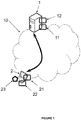
- the present methods are implemented within an architecture such as represented by the figure 1 , thanks to a server 1 and a client 2.
- the server 1 is the learning equipment (implementing the learning method) and the client 2 is a user equipment (implementing the classification method and (if applicable, extraction of characteristics), for example a terminal of a user.
- the two devices 1, 2 are the same, but preferably the server 1 is that of a security solution provider, and the client 2 a consumer device, in particular a biometric fingerprint scanner. , but also a smartphone, a personal computer, etc.
- the client equipment 2 advantageously comprises optical acquisition means 23, so as to be able to directly acquire said input image, typically to process it live, alternatively the input image will be loaded on the client equipment 2 (for example, latent fingerprints can be photographed at a crime scene by a forensic team, and these photos then uploaded to dedicated client equipment 2 back to forensic premises).
- each item of equipment 1, 2 is typically remote computer equipment connected to a wide area network 10 such as the Internet network for the exchange of data.
- Each comprises data processing means 11, 21 of processor type, and data storage means 12, 22 such as a computer memory, for example a flash memory or a hard disk.
- the server 1 stores a training database, ie a set of images of biometric fingerprints already classified (ie for which it is already known, for each of said predefined set of possible general biometric fingerprint patterns, whether the fingerprint present or not this general pattern) as opposed to the so-called input images that we are precisely trying to process.
- the present method of classifying a biometric fingerprint represented by an input image essentially comprises a step (a) of determining, for each one of a predefined set of possible general patterns of biometric fingerprint, by means of a convolutional neural network, CNN, of whether or not said biometric fingerprint exhibits said general pattern.
- CNN convolutional neural network
- the output of the CNN is typically a vector of dimension n or 2n (if there is also for each pattern a score representative of the probability that the imprint has this pattern).
- said input image is advantageously processed so as to extract the desired characteristics from the biometric fingerprint represented by said input image.
- the method can further comprise a step (c) of identifying or authenticating at least one individual by comparing the desired characteristics extracted from the biometric fingerprint represented by said input image, with the characteristics of reference biometric fingerprints exhibiting the general pattern (s) determined in step (a) as presented by the biometric fingerprint represented by the input image: it is understood that this is a subgroup of the set of reference biometric fingerprints, thereby limiting the number of comparisons to be made.
- Said CNN can be of many types, and in particular be a conventional CNN (direct succession of CONV convolution layers, BN batch normalization layers, and NL non-linear layers) .
- said CNN is of the residual network type. It is found that such residual networks are very efficient for pure binary classification (determining whether or not a general pattern is presented), and much lighter than many image processing CNNs such as detection CNNs.
- a residual network is a CNN exhibiting at least one “residual connection” (in English “skip connection” or simply “short-cut”), that is to say a connection which comes to “short-circuit”. »At least one layer, by analogy to what we see in the pyramidal neurons of the brain.
- the operating principle at the base of residual networks is to add point by point the input and the output of a convolutional layer, this makes it possible to propagate the signal from the shallower layers to the deeper layers. As explained, this network provides excellent results, in particular in pure classification.
- ResNet for the implementation of the present method there is for example in a block a main branch (short-circuited by the residual connection) with a plurality of layers of convolutions potentially followed by a non-linear layer (for example ReLU) and / or a batch normalization layer.
- the output of this branch is typically added point by point with the input image (due to the residual connection), and goes through a last layer of dimensionality reduction (typically AveragePool or MaxPool ) .
- a fully connected layer enables the generation of the output vector (ie the result of the classification), and each binary output can include its activation function, in particular of the Softmax type, see below.
- CNN is even of the “densely connected” network type (or just dense network, or DENSENET); that is to say that not only does it present at least one residual connection, but in at least one so-called dense block comprising all the possible residual connections, that is to say each residual connection connecting an input of a first layer of the block at an outlet of a second layer of the block downstream of the first layer.
- DENSENET dense network
- layer must be understood here as limited to convolutional layers (ie we do not bypass nonlinear layers or the normalization layers in batch) or even “unit of convolution” insofar as one can in particular add 1x1 convolution layers before the “active” convolution layers (generally 3x3) just to reduce the number of feature maps ) entrance.
- the size of the characteristic maps of the dense blocks is decreasing going from the input to the output of the CNN and / or the number of layers per dense block is increasing going from the entry to exit from CNN.
- Transition layers can be placed between two dense blocks precisely to allow the reduction in size of feature maps between two blocks (generally comprising a pooling layer and / or a batch normalization layer).
- somewhat more complex sets such as a succession of a 1x1 convolution layer and a 3x3 convolution layer (possibly each followed of a non-linear layer such as ReLU and / or a batch normalization layer), generally from 6 to 48 such elementary “units” of layers.
- Such an increasingly rapid reduction in the size of the feature cards makes it possible as a bonus to limit the memory footprint of the CNN and therefore to facilitate its embarkation on simple client devices 2.
- the method begins with a step (a0) of learning, by the data processing means 11 of the server 1, from a base of images of biometric fingerprints already classified (ie for which it is known for each general pattern of said predefined set of possible general patterns, if presented), of parameters of said CNN.
- the learning cost function can be composed of a classical data attachment - mean squared error - and a regularization by total variation.
- the learning step (a0) may include randomly deactivating layers in accordance with a predetermined dropout rate (probability that a layer will be deactivated) (e.g. 10%).
- a predetermined dropout rate e.g. 10%
- the learned CNN can be stored if necessary on data storage means 22 of the client 2 for use in classification. Note that the same CNN can be embedded on many clients 2, only one learning is necessary.
- said input image can be processed so as to extract said desired characteristics from the biometric imprint represented by said input image, which can in particular comprise the position and / or orientation. minutiae in the case of fingerprints.
- the method further comprises a step (c) of identification or authentication of at least one individual by comparison of the characteristics. sought extracted from the biometric fingerprint represented by said input image, with the characteristics of reference biometric fingerprints, which may be implemented in any manner known to those skilled in the art.
- client 2 can store the characteristics of the fingerprints of one or more people registered in a police file as reference fingerprints, so that they can identify the person who left a latent fingerprint: if the extracted characteristics match those expected of a known individual, his identity is transmitted to the police.
- the client 2 can send the extracted characteristics to a remote database of said characteristics of reference biometric fingerprints, for identification of the individual.
- the present classification makes it possible to compare in step (c) the desired characteristics extracted from the biometric fingerprint represented by said input image, only with the characteristics of reference biometric fingerprints exhibiting the pattern (s). general determined in step (a) as presented by the biometric fingerprint represented by the input image, thereby saving time. Note that we can provide that if the result of the comparison is not conclusive (ie no corresponding reference fingerprint is found), to carry out the comparison of the desired characteristics extracted from the biometric fingerprint represented by said input image, with the other characteristics of reference biometric fingerprints, in the event that the classification of step (a) is incorrect.
- steps (b) and / or (c) can be implemented as a second classification step for a biometric fingerprint, for example via one or more dedicated CNNs, and if necessary include improvement treatments isolated prints, see in particular the request FR 1860323 .
- a test based on 100 latent fingerprints with CNN in accordance with the figure 3 shows a correct classification in 98.86% of cases, with in practice a 31% reduction in the number of reference fingerprints to be tested for identification / authentication.
- the invention relates to a computer program product comprising code instructions for execution (in particular on the data processing means 11, 21 of the server 1 and / or of the client 2) a method of classifying a biometric fingerprint represented by an input image, as well as storage means readable by computer equipment (a memory 12, 22 of the server 1 and / or of the client 2) on which there is this computer program product.
Landscapes
- Engineering & Computer Science (AREA)
- Theoretical Computer Science (AREA)
- Physics & Mathematics (AREA)
- General Physics & Mathematics (AREA)
- Evolutionary Computation (AREA)
- Multimedia (AREA)
- General Health & Medical Sciences (AREA)
- Artificial Intelligence (AREA)
- Health & Medical Sciences (AREA)
- Computing Systems (AREA)
- Software Systems (AREA)
- Human Computer Interaction (AREA)
- Data Mining & Analysis (AREA)
- Life Sciences & Earth Sciences (AREA)
- Biomedical Technology (AREA)
- Biophysics (AREA)
- Computational Linguistics (AREA)
- Molecular Biology (AREA)
- General Engineering & Computer Science (AREA)
- Mathematical Physics (AREA)
- Computer Vision & Pattern Recognition (AREA)
- Medical Informatics (AREA)
- Databases & Information Systems (AREA)
- Collating Specific Patterns (AREA)
- Image Analysis (AREA)
Applications Claiming Priority (1)
| Application Number | Priority Date | Filing Date | Title |
|---|---|---|---|
| FR1913172A FR3103601B1 (fr) | 2019-11-25 | 2019-11-25 | Procédé de classification d’une empreinte biométrique représentée par une image d’entrée |
Publications (1)
| Publication Number | Publication Date |
|---|---|
| EP3825915A1 true EP3825915A1 (fr) | 2021-05-26 |
Family
ID=70008663
Family Applications (1)
| Application Number | Title | Priority Date | Filing Date |
|---|---|---|---|
| EP20209759.8A Pending EP3825915A1 (fr) | 2019-11-25 | 2020-11-25 | Procede de classification d'une empreinte biometrique representee par une image d'entree |
Country Status (4)
| Country | Link |
|---|---|
| US (1) | US11580774B2 (cg-RX-API-DMAC7.html) |
| EP (1) | EP3825915A1 (cg-RX-API-DMAC7.html) |
| JP (1) | JP7737792B2 (cg-RX-API-DMAC7.html) |
| FR (1) | FR3103601B1 (cg-RX-API-DMAC7.html) |
Cited By (1)
| Publication number | Priority date | Publication date | Assignee | Title |
|---|---|---|---|---|
| EP4586213A1 (fr) | 2024-01-12 | 2025-07-16 | IDEMIA Public Security France | Procédé et système de classification de dactylogrammes |
Families Citing this family (2)
| Publication number | Priority date | Publication date | Assignee | Title |
|---|---|---|---|---|
| US12694679B2 (en) | 2022-03-15 | 2026-07-28 | Genetec Inc. | Vehicle identification system |
| EP4668238A1 (en) * | 2024-06-17 | 2025-12-24 | Identy Inc. | Computer-implemented method for obtaining information on bio-metric features of a user |
Citations (4)
| Publication number | Priority date | Publication date | Assignee | Title |
|---|---|---|---|---|
| US20180165508A1 (en) * | 2016-12-08 | 2018-06-14 | Veridium Ip Limited | Systems and methods for performing fingerprint based user authentication using imagery captured using mobile devices |
| US20190171899A1 (en) * | 2017-12-05 | 2019-06-06 | Bull Sas | Automatic extraction of attributes of an object within a set of digital images |
| CN110149541A (zh) * | 2019-04-23 | 2019-08-20 | 腾讯科技(深圳)有限公司 | 视频推荐方法、装置、计算机设备及存储介质 |
| US20190311248A1 (en) * | 2019-06-21 | 2019-10-10 | Intel Corporation | Method for random sampled convolutions with low cost enhanced expressive power |
Family Cites Families (5)
| Publication number | Priority date | Publication date | Assignee | Title |
|---|---|---|---|---|
| US5825907A (en) * | 1994-12-28 | 1998-10-20 | Lucent Technologies Inc. | Neural network system for classifying fingerprints |
| US10721070B2 (en) * | 2018-03-07 | 2020-07-21 | Private Identity Llc | Systems and methods for privacy-enabled biometric processing |
| EP4404111A3 (en) * | 2018-07-30 | 2024-10-23 | Memorial Sloan Kettering Cancer Center | Multi-modal, multi-resolution deep learning neural networks for segmentation, outcomes prediction and longitudinal response monitoring to immunotherapy and radiotherapy |
| US10747989B2 (en) * | 2018-08-21 | 2020-08-18 | Software Ag | Systems and/or methods for accelerating facial feature vector matching with supervised machine learning |
| CN110309708A (zh) * | 2019-05-09 | 2019-10-08 | 北京尚文金泰教育科技有限公司 | 一种基于神经网络的智能皮纹采集分类识别方法 |
-
2019
- 2019-11-25 FR FR1913172A patent/FR3103601B1/fr active Active
-
2020
- 2020-11-16 JP JP2020190435A patent/JP7737792B2/ja active Active
- 2020-11-20 US US17/100,361 patent/US11580774B2/en active Active
- 2020-11-25 EP EP20209759.8A patent/EP3825915A1/fr active Pending
Patent Citations (5)
| Publication number | Priority date | Publication date | Assignee | Title |
|---|---|---|---|---|
| US20180165508A1 (en) * | 2016-12-08 | 2018-06-14 | Veridium Ip Limited | Systems and methods for performing fingerprint based user authentication using imagery captured using mobile devices |
| US20190171899A1 (en) * | 2017-12-05 | 2019-06-06 | Bull Sas | Automatic extraction of attributes of an object within a set of digital images |
| CN110149541A (zh) * | 2019-04-23 | 2019-08-20 | 腾讯科技(深圳)有限公司 | 视频推荐方法、装置、计算机设备及存储介质 |
| US20210281918A1 (en) * | 2019-04-23 | 2021-09-09 | Tencent Technology (Shenzhen) Company Limited | Video recommendation method and device, computer device and storage medium |
| US20190311248A1 (en) * | 2019-06-21 | 2019-10-10 | Intel Corporation | Method for random sampled convolutions with low cost enhanced expressive power |
Non-Patent Citations (3)
| Title |
|---|
| MICHELSANTI, DANIELENE, ANDREEA-DANIELAGUICHI, YANISSTEF, RARESNASROLLAHI, KAMALMOESLUND, THOMAS B, FAST FINGERPRINT CLASSIFICATION WITH DEEP NEURAL NETWORKS |
| RUXIN WANGCONGYING HANYANPING WUTIANDE GUO: "Fingerprint Classification Based", DEPTH NEURAL NETWORK |
| YUANYI ZHONG ET AL: "Towards End-to-End Face Recognition through Alignment Learning", ARXIV.ORG, CORNELL UNIVERSITY LIBRARY, 201 OLIN LIBRARY CORNELL UNIVERSITY ITHACA, NY 14853, 25 January 2017 (2017-01-25), XP080751412, DOI: 10.1109/LSP.2017.2715076 * |
Cited By (2)
| Publication number | Priority date | Publication date | Assignee | Title |
|---|---|---|---|---|
| EP4586213A1 (fr) | 2024-01-12 | 2025-07-16 | IDEMIA Public Security France | Procédé et système de classification de dactylogrammes |
| FR3158383A1 (fr) | 2024-01-12 | 2025-07-18 | Idemia Identity & Security France | Procédé et système de classification de dactylogrammes |
Also Published As
| Publication number | Publication date |
|---|---|
| US11580774B2 (en) | 2023-02-14 |
| FR3103601A1 (fr) | 2021-05-28 |
| FR3103601B1 (fr) | 2023-03-10 |
| US20210158014A1 (en) | 2021-05-27 |
| JP7737792B2 (ja) | 2025-09-11 |
| JP2021086621A (ja) | 2021-06-03 |
Similar Documents
| Publication | Publication Date | Title |
|---|---|---|
| EP3640843B1 (fr) | Procédé d'extraction de caractéristiques d'une empreinte digitale représentée par une image d'entrée | |
| EP3832535A1 (fr) | Procédé de détection d'au moins un élément d'intérêt visible dans une image d'entrée au moyen d'un réseau de neurones à convolution | |
| EP3620970B1 (fr) | Procédé d'extraction de caractéristiques d'une empreinte digitale représentée par une image d'entrée | |
| FR3088467A1 (fr) | Procede de classification d'une image d'entree representative d'un trait biometrique au moyen d'un reseau de neurones a convolution | |
| EP2924609A1 (fr) | Procédé d'enrolement de données dans une base pour la protection desdites données | |
| WO2013092916A1 (fr) | Identification biometrique utilisant des filtres et par calcul multi partiesecurise | |
| FR3102600A1 (fr) | Procédé de segmentation d’une image d’entrée représentant au moins une empreinte biométrique au moyen d’un réseau de neurones à convolution | |
| EP2356773B1 (fr) | Procede d'identification ou d'autorisation, et systeme et module securise associes | |
| EP3582141B1 (fr) | Procédé d'apprentissage de paramètres d'un réseau de neurones à convolution | |
| EP3866064B1 (fr) | Procede d'authentification ou d'identification d'un individu | |
| FR3098960A1 (fr) | Procédé d’extraction d’un vecteur caractéristique à partir d’une image d’entrée représentative d’un iris au moyen d’un réseau de neurones entrainable de bout-en-bout | |
| FR3053500B1 (fr) | Procede de detection de fraude d'un systeme de reconnaissance d'iris | |
| EP1864242A1 (fr) | Procede d'identification de visages a partir d'images de visage, dispositif et programme d'ordinateur correspondants | |
| EP4124942B1 (fr) | Procédé et système de traitement de données personnelles utilisant un chiffrement homomorphique | |
| FR3103601A1 (fr) | Procédé de classification d’une empreinte biométrique représentée par une image d’entrée | |
| FR3003061B1 (fr) | Procede de traitement securise de donnees et application a la biometrie | |
| EP4099200B1 (fr) | Procede et dispositif d'identification et/ou d'authentification biometrique | |
| EP3929809A1 (fr) | Procédé de détection d'au moins un trait biométrique visible sur une image d entrée au moyen d'un réseau de neurones à convolution | |
| FR3103045A1 (fr) | Procédé d’augmentation d’une base d’images d’apprentissage représentant une empreinte sur un arrière-plan au moyen d’un réseau antagoniste génératif | |
| EP2147394A1 (fr) | Procede et dispositif d'authentification automatisee d'un ensemble de points | |
| WO2013034654A1 (fr) | Identification par reconnaissance d'iris | |
| EP3608835A1 (fr) | Procede de traitement d'images d'empreintes | |
| EP2652674B1 (fr) | Procede de comparaison d'images d'iris par selection intelligente de zones texturees | |
| WO2011089517A1 (fr) | Procede et dispositif de reconnaissance de visages en conditions de poses variables | |
| EP4607479A1 (fr) | Méthode et système d'encodage d'une liste de minuties d'un dactylogramme |
Legal Events
| Date | Code | Title | Description |
|---|---|---|---|
| PUAI | Public reference made under article 153(3) epc to a published international application that has entered the european phase |
Free format text: ORIGINAL CODE: 0009012 |
|
| STAA | Information on the status of an ep patent application or granted ep patent |
Free format text: STATUS: REQUEST FOR EXAMINATION WAS MADE |
|
| 17P | Request for examination filed |
Effective date: 20201125 |
|
| AK | Designated contracting states |
Kind code of ref document: A1 Designated state(s): AL AT BE BG CH CY CZ DE DK EE ES FI FR GB GR HR HU IE IS IT LI LT LU LV MC MK MT NL NO PL PT RO RS SE SI SK SM TR |
|
| STAA | Information on the status of an ep patent application or granted ep patent |
Free format text: STATUS: EXAMINATION IS IN PROGRESS |
|
| 17Q | First examination report despatched |
Effective date: 20220720 |
|
| P01 | Opt-out of the competence of the unified patent court (upc) registered |
Effective date: 20230919 |
|
| RAP1 | Party data changed (applicant data changed or rights of an application transferred) |
Owner name: IDEMIA PUBLIC SECURITY FRANCE |
|
| REG | Reference to a national code |
Ref country code: DE Ref legal event code: R079 Free format text: PREVIOUS MAIN CLASS: G06K0009620000 Ipc: G06N0003082000 |
|
| GRAP | Despatch of communication of intention to grant a patent |
Free format text: ORIGINAL CODE: EPIDOSNIGR1 |
|
| STAA | Information on the status of an ep patent application or granted ep patent |
Free format text: STATUS: GRANT OF PATENT IS INTENDED |
|
| RIC1 | Information provided on ipc code assigned before grant |
Ipc: G06N 3/082 20230101AFI20260107BHEP Ipc: G06V 10/82 20220101ALI20260107BHEP |
|
| INTG | Intention to grant announced |
Effective date: 20260120 |