EP3825807B1 - Method, device and assembly for map generation - Google Patents
Method, device and assembly for map generation Download PDFInfo
- Publication number
- EP3825807B1 EP3825807B1 EP20202617.5A EP20202617A EP3825807B1 EP 3825807 B1 EP3825807 B1 EP 3825807B1 EP 20202617 A EP20202617 A EP 20202617A EP 3825807 B1 EP3825807 B1 EP 3825807B1
- Authority
- EP
- European Patent Office
- Prior art keywords
- robot
- lines
- cameras
- map data
- map
- Prior art date
- Legal status (The legal status is an assumption and is not a legal conclusion. Google has not performed a legal analysis and makes no representation as to the accuracy of the status listed.)
- Active
Links
Images



Classifications
-
- G—PHYSICS
- G05—CONTROLLING; REGULATING
- G05D—SYSTEMS FOR CONTROLLING OR REGULATING NON-ELECTRIC VARIABLES
- G05D1/00—Control of position, course, altitude or attitude of land, water, air or space vehicles, e.g. using automatic pilots
- G05D1/20—Control system inputs
- G05D1/22—Command input arrangements
- G05D1/221—Remote-control arrangements
- G05D1/227—Handing over between remote control and on-board control; Handing over between remote control arrangements
-
- G—PHYSICS
- G05—CONTROLLING; REGULATING
- G05D—SYSTEMS FOR CONTROLLING OR REGULATING NON-ELECTRIC VARIABLES
- G05D1/00—Control of position, course, altitude or attitude of land, water, air or space vehicles, e.g. using automatic pilots
- G05D1/02—Control of position or course in two dimensions
- G05D1/021—Control of position or course in two dimensions specially adapted to land vehicles
- G05D1/0231—Control of position or course in two dimensions specially adapted to land vehicles using optical position detecting means
- G05D1/0246—Control of position or course in two dimensions specially adapted to land vehicles using optical position detecting means using a video camera in combination with image processing means
-
- G—PHYSICS
- G01—MEASURING; TESTING
- G01C—MEASURING DISTANCES, LEVELS OR BEARINGS; SURVEYING; NAVIGATION; GYROSCOPIC INSTRUMENTS; PHOTOGRAMMETRY OR VIDEOGRAMMETRY
- G01C21/00—Navigation; Navigational instruments not provided for in groups G01C1/00 - G01C19/00
- G01C21/38—Electronic maps specially adapted for navigation; Updating thereof
- G01C21/3804—Creation or updating of map data
- G01C21/3833—Creation or updating of map data characterised by the source of data
- G01C21/3848—Data obtained from both position sensors and additional sensors
-
- G—PHYSICS
- G05—CONTROLLING; REGULATING
- G05D—SYSTEMS FOR CONTROLLING OR REGULATING NON-ELECTRIC VARIABLES
- G05D1/00—Control of position, course, altitude or attitude of land, water, air or space vehicles, e.g. using automatic pilots
- G05D1/0088—Control of position, course, altitude or attitude of land, water, air or space vehicles, e.g. using automatic pilots characterized by the autonomous decision making process, e.g. artificial intelligence, predefined behaviours
-
- G—PHYSICS
- G05—CONTROLLING; REGULATING
- G05D—SYSTEMS FOR CONTROLLING OR REGULATING NON-ELECTRIC VARIABLES
- G05D1/00—Control of position, course, altitude or attitude of land, water, air or space vehicles, e.g. using automatic pilots
- G05D1/02—Control of position or course in two dimensions
- G05D1/021—Control of position or course in two dimensions specially adapted to land vehicles
- G05D1/0212—Control of position or course in two dimensions specially adapted to land vehicles with means for defining a desired trajectory
-
- G—PHYSICS
- G05—CONTROLLING; REGULATING
- G05D—SYSTEMS FOR CONTROLLING OR REGULATING NON-ELECTRIC VARIABLES
- G05D1/00—Control of position, course, altitude or attitude of land, water, air or space vehicles, e.g. using automatic pilots
- G05D1/02—Control of position or course in two dimensions
- G05D1/021—Control of position or course in two dimensions specially adapted to land vehicles
- G05D1/0212—Control of position or course in two dimensions specially adapted to land vehicles with means for defining a desired trajectory
- G05D1/0223—Control of position or course in two dimensions specially adapted to land vehicles with means for defining a desired trajectory involving speed control of the vehicle
-
- G—PHYSICS
- G05—CONTROLLING; REGULATING
- G05D—SYSTEMS FOR CONTROLLING OR REGULATING NON-ELECTRIC VARIABLES
- G05D1/00—Control of position, course, altitude or attitude of land, water, air or space vehicles, e.g. using automatic pilots
- G05D1/02—Control of position or course in two dimensions
- G05D1/021—Control of position or course in two dimensions specially adapted to land vehicles
- G05D1/0231—Control of position or course in two dimensions specially adapted to land vehicles using optical position detecting means
- G05D1/0246—Control of position or course in two dimensions specially adapted to land vehicles using optical position detecting means using a video camera in combination with image processing means
- G05D1/0251—Control of position or course in two dimensions specially adapted to land vehicles using optical position detecting means using a video camera in combination with image processing means extracting 3D information from a plurality of images taken from different locations, e.g. stereo vision
-
- G—PHYSICS
- G05—CONTROLLING; REGULATING
- G05D—SYSTEMS FOR CONTROLLING OR REGULATING NON-ELECTRIC VARIABLES
- G05D1/00—Control of position, course, altitude or attitude of land, water, air or space vehicles, e.g. using automatic pilots
- G05D1/02—Control of position or course in two dimensions
- G05D1/021—Control of position or course in two dimensions specially adapted to land vehicles
- G05D1/0268—Control of position or course in two dimensions specially adapted to land vehicles using internal positioning means
- G05D1/0274—Control of position or course in two dimensions specially adapted to land vehicles using internal positioning means using mapping information stored in a memory device
-
- G—PHYSICS
- G05—CONTROLLING; REGULATING
- G05D—SYSTEMS FOR CONTROLLING OR REGULATING NON-ELECTRIC VARIABLES
- G05D1/00—Control of position, course, altitude or attitude of land, water, air or space vehicles, e.g. using automatic pilots
- G05D1/20—Control system inputs
- G05D1/24—Arrangements for determining position or orientation
- G05D1/243—Means capturing signals occurring naturally from the environment, e.g. ambient optical, acoustic, gravitational or magnetic signals
- G05D1/2435—Extracting 3D information
-
- G—PHYSICS
- G05—CONTROLLING; REGULATING
- G05D—SYSTEMS FOR CONTROLLING OR REGULATING NON-ELECTRIC VARIABLES
- G05D1/00—Control of position, course, altitude or attitude of land, water, air or space vehicles, e.g. using automatic pilots
- G05D1/20—Control system inputs
- G05D1/24—Arrangements for determining position or orientation
- G05D1/245—Arrangements for determining position or orientation using dead reckoning
-
- G—PHYSICS
- G05—CONTROLLING; REGULATING
- G05D—SYSTEMS FOR CONTROLLING OR REGULATING NON-ELECTRIC VARIABLES
- G05D1/00—Control of position, course, altitude or attitude of land, water, air or space vehicles, e.g. using automatic pilots
- G05D1/20—Control system inputs
- G05D1/24—Arrangements for determining position or orientation
- G05D1/246—Arrangements for determining position or orientation using environment maps, e.g. simultaneous localisation and mapping [SLAM]
-
- G—PHYSICS
- G05—CONTROLLING; REGULATING
- G05D—SYSTEMS FOR CONTROLLING OR REGULATING NON-ELECTRIC VARIABLES
- G05D1/00—Control of position, course, altitude or attitude of land, water, air or space vehicles, e.g. using automatic pilots
- G05D1/20—Control system inputs
- G05D1/24—Arrangements for determining position or orientation
- G05D1/247—Arrangements for determining position or orientation using signals provided by artificial sources external to the vehicle, e.g. navigation beacons
-
- G—PHYSICS
- G05—CONTROLLING; REGULATING
- G05D—SYSTEMS FOR CONTROLLING OR REGULATING NON-ELECTRIC VARIABLES
- G05D1/00—Control of position, course, altitude or attitude of land, water, air or space vehicles, e.g. using automatic pilots
- G05D1/20—Control system inputs
- G05D1/24—Arrangements for determining position or orientation
- G05D1/247—Arrangements for determining position or orientation using signals provided by artificial sources external to the vehicle, e.g. navigation beacons
- G05D1/249—Arrangements for determining position or orientation using signals provided by artificial sources external to the vehicle, e.g. navigation beacons from positioning sensors located off-board the vehicle, e.g. from cameras
-
- G—PHYSICS
- G05—CONTROLLING; REGULATING
- G05D—SYSTEMS FOR CONTROLLING OR REGULATING NON-ELECTRIC VARIABLES
- G05D1/00—Control of position, course, altitude or attitude of land, water, air or space vehicles, e.g. using automatic pilots
- G05D1/60—Intended control result
- G05D1/644—Optimisation of travel parameters, e.g. of energy consumption, journey time or distance
-
- G—PHYSICS
- G05—CONTROLLING; REGULATING
- G05D—SYSTEMS FOR CONTROLLING OR REGULATING NON-ELECTRIC VARIABLES
- G05D1/00—Control of position, course, altitude or attitude of land, water, air or space vehicles, e.g. using automatic pilots
- G05D1/60—Intended control result
- G05D1/646—Following a predefined trajectory, e.g. a line marked on the floor or a flight path
-
- G—PHYSICS
- G05—CONTROLLING; REGULATING
- G05D—SYSTEMS FOR CONTROLLING OR REGULATING NON-ELECTRIC VARIABLES
- G05D1/00—Control of position, course, altitude or attitude of land, water, air or space vehicles, e.g. using automatic pilots
- G05D1/60—Intended control result
- G05D1/65—Following a desired speed profile
-
- G—PHYSICS
- G06—COMPUTING OR CALCULATING; COUNTING
- G06Q—INFORMATION AND COMMUNICATION TECHNOLOGY [ICT] SPECIALLY ADAPTED FOR ADMINISTRATIVE, COMMERCIAL, FINANCIAL, MANAGERIAL OR SUPERVISORY PURPOSES; SYSTEMS OR METHODS SPECIALLY ADAPTED FOR ADMINISTRATIVE, COMMERCIAL, FINANCIAL, MANAGERIAL OR SUPERVISORY PURPOSES, NOT OTHERWISE PROVIDED FOR
- G06Q10/00—Administration; Management
- G06Q10/08—Logistics, e.g. warehousing, loading or distribution; Inventory or stock management
- G06Q10/083—Shipping
- G06Q10/0833—Tracking
-
- G—PHYSICS
- G06—COMPUTING OR CALCULATING; COUNTING
- G06T—IMAGE DATA PROCESSING OR GENERATION, IN GENERAL
- G06T7/00—Image analysis
- G06T7/50—Depth or shape recovery
- G06T7/55—Depth or shape recovery from multiple images
- G06T7/579—Depth or shape recovery from multiple images from motion
-
- G—PHYSICS
- G06—COMPUTING OR CALCULATING; COUNTING
- G06T—IMAGE DATA PROCESSING OR GENERATION, IN GENERAL
- G06T7/00—Image analysis
- G06T7/70—Determining position or orientation of objects or cameras
- G06T7/73—Determining position or orientation of objects or cameras using feature-based methods
-
- G—PHYSICS
- G06—COMPUTING OR CALCULATING; COUNTING
- G06T—IMAGE DATA PROCESSING OR GENERATION, IN GENERAL
- G06T7/00—Image analysis
- G06T7/97—Determining parameters from multiple pictures
-
- G—PHYSICS
- G05—CONTROLLING; REGULATING
- G05D—SYSTEMS FOR CONTROLLING OR REGULATING NON-ELECTRIC VARIABLES
- G05D1/00—Control of position, course, altitude or attitude of land, water, air or space vehicles, e.g. using automatic pilots
- G05D1/02—Control of position or course in two dimensions
- G05D1/021—Control of position or course in two dimensions specially adapted to land vehicles
- G05D1/0231—Control of position or course in two dimensions specially adapted to land vehicles using optical position detecting means
- G05D1/0238—Control of position or course in two dimensions specially adapted to land vehicles using optical position detecting means using obstacle or wall sensors
- G05D1/024—Control of position or course in two dimensions specially adapted to land vehicles using optical position detecting means using obstacle or wall sensors in combination with a laser
-
- G—PHYSICS
- G05—CONTROLLING; REGULATING
- G05D—SYSTEMS FOR CONTROLLING OR REGULATING NON-ELECTRIC VARIABLES
- G05D1/00—Control of position, course, altitude or attitude of land, water, air or space vehicles, e.g. using automatic pilots
- G05D1/02—Control of position or course in two dimensions
- G05D1/021—Control of position or course in two dimensions specially adapted to land vehicles
- G05D1/0255—Control of position or course in two dimensions specially adapted to land vehicles using acoustic signals, e.g. ultra-sonic singals
-
- G—PHYSICS
- G05—CONTROLLING; REGULATING
- G05D—SYSTEMS FOR CONTROLLING OR REGULATING NON-ELECTRIC VARIABLES
- G05D1/00—Control of position, course, altitude or attitude of land, water, air or space vehicles, e.g. using automatic pilots
- G05D1/02—Control of position or course in two dimensions
- G05D1/021—Control of position or course in two dimensions specially adapted to land vehicles
- G05D1/0268—Control of position or course in two dimensions specially adapted to land vehicles using internal positioning means
- G05D1/027—Control of position or course in two dimensions specially adapted to land vehicles using internal positioning means comprising intertial navigation means, e.g. azimuth detector
-
- G—PHYSICS
- G05—CONTROLLING; REGULATING
- G05D—SYSTEMS FOR CONTROLLING OR REGULATING NON-ELECTRIC VARIABLES
- G05D1/00—Control of position, course, altitude or attitude of land, water, air or space vehicles, e.g. using automatic pilots
- G05D1/02—Control of position or course in two dimensions
- G05D1/021—Control of position or course in two dimensions specially adapted to land vehicles
- G05D1/0268—Control of position or course in two dimensions specially adapted to land vehicles using internal positioning means
- G05D1/0272—Control of position or course in two dimensions specially adapted to land vehicles using internal positioning means comprising means for registering the travel distance, e.g. revolutions of wheels
-
- G—PHYSICS
- G05—CONTROLLING; REGULATING
- G05D—SYSTEMS FOR CONTROLLING OR REGULATING NON-ELECTRIC VARIABLES
- G05D1/00—Control of position, course, altitude or attitude of land, water, air or space vehicles, e.g. using automatic pilots
- G05D1/02—Control of position or course in two dimensions
- G05D1/021—Control of position or course in two dimensions specially adapted to land vehicles
- G05D1/0276—Control of position or course in two dimensions specially adapted to land vehicles using signals provided by a source external to the vehicle
- G05D1/0278—Control of position or course in two dimensions specially adapted to land vehicles using signals provided by a source external to the vehicle using satellite positioning signals, e.g. GPS
-
- G—PHYSICS
- G05—CONTROLLING; REGULATING
- G05D—SYSTEMS FOR CONTROLLING OR REGULATING NON-ELECTRIC VARIABLES
- G05D1/00—Control of position, course, altitude or attitude of land, water, air or space vehicles, e.g. using automatic pilots
- G05D1/20—Control system inputs
- G05D1/24—Arrangements for determining position or orientation
- G05D1/247—Arrangements for determining position or orientation using signals provided by artificial sources external to the vehicle, e.g. navigation beacons
- G05D1/248—Arrangements for determining position or orientation using signals provided by artificial sources external to the vehicle, e.g. navigation beacons generated by satellites, e.g. GPS
-
- G—PHYSICS
- G05—CONTROLLING; REGULATING
- G05D—SYSTEMS FOR CONTROLLING OR REGULATING NON-ELECTRIC VARIABLES
- G05D2101/00—Details of software or hardware architectures used for the control of position
- G05D2101/10—Details of software or hardware architectures used for the control of position using artificial intelligence [AI] techniques
-
- G—PHYSICS
- G05—CONTROLLING; REGULATING
- G05D—SYSTEMS FOR CONTROLLING OR REGULATING NON-ELECTRIC VARIABLES
- G05D2111/00—Details of signals used for control of position, course, altitude or attitude of land, water, air or space vehicles
- G05D2111/10—Optical signals
-
- G—PHYSICS
- G05—CONTROLLING; REGULATING
- G05D—SYSTEMS FOR CONTROLLING OR REGULATING NON-ELECTRIC VARIABLES
- G05D2111/00—Details of signals used for control of position, course, altitude or attitude of land, water, air or space vehicles
- G05D2111/50—Internal signals, i.e. from sensors located in the vehicle, e.g. from compasses or angular sensors
-
- G—PHYSICS
- G06—COMPUTING OR CALCULATING; COUNTING
- G06T—IMAGE DATA PROCESSING OR GENERATION, IN GENERAL
- G06T2207/00—Indexing scheme for image analysis or image enhancement
- G06T2207/10—Image acquisition modality
- G06T2207/10004—Still image; Photographic image
-
- G—PHYSICS
- G06—COMPUTING OR CALCULATING; COUNTING
- G06T—IMAGE DATA PROCESSING OR GENERATION, IN GENERAL
- G06T2207/00—Indexing scheme for image analysis or image enhancement
- G06T2207/10—Image acquisition modality
- G06T2207/10016—Video; Image sequence
-
- G—PHYSICS
- G06—COMPUTING OR CALCULATING; COUNTING
- G06T—IMAGE DATA PROCESSING OR GENERATION, IN GENERAL
- G06T2207/00—Indexing scheme for image analysis or image enhancement
- G06T2207/20—Special algorithmic details
- G06T2207/20212—Image combination
-
- G—PHYSICS
- G06—COMPUTING OR CALCULATING; COUNTING
- G06T—IMAGE DATA PROCESSING OR GENERATION, IN GENERAL
- G06T2207/00—Indexing scheme for image analysis or image enhancement
- G06T2207/30—Subject of image; Context of image processing
- G06T2207/30244—Camera pose
-
- G—PHYSICS
- G06—COMPUTING OR CALCULATING; COUNTING
- G06T—IMAGE DATA PROCESSING OR GENERATION, IN GENERAL
- G06T2207/00—Indexing scheme for image analysis or image enhancement
- G06T2207/30—Subject of image; Context of image processing
- G06T2207/30248—Vehicle exterior or interior
- G06T2207/30252—Vehicle exterior; Vicinity of vehicle
Definitions
- the invention relates to mapping performed by a moving robot. More particularly, the invention relates to mapping using multiple cameras taking visual images.
- mapping localisation comprises a coordinate system with respect to which the localisation is done and a pose, which is a combination of position and orientation. Localisation can be done with respect to an absolute coordinate system (such as GPS coordinates) or a relative coordinate system (such as localisation with respect to some known location and/or object).
- the coordinate system can be chosen arbitrarily, as long as it is consistent and can be converted to some standard coordinate system (such as WGS84) if needed.
- SLAM Simultaneous Localisation and Mapping
- US 8,717,545 B2 discloses a system using range and Doppler velocity measurements from a lidar system and images from a video system to estimate a six degree-of-freedom trajectory of a target. Once the motion aspects of the target are estimated, a three-dimensional image of the target may be generated.
- US 7,015,831 B2 discloses a method and apparatus that use a visual sensor and dead reckoning sensors to process Simultaneous Localisation and Mapping (SLAM).
- SLAM Simultaneous Localisation and Mapping
- visual techniques can be used to autonomously generate and update a map.
- the visual techniques are economically practical in a wide range of applications and can be used in relatively dynamic environments, such as environments in which people move.
- the disclosed method can be implemented in an automatic vacuum cleaner operating in an indoor environment.
- US 8,305,430 B2 discloses a visual odometry system and method for a fixed or known calibration of an arbitrary number of cameras in monocular configuration. Images collected from each of the cameras in this distributed aperture system have negligible or absolutely no overlap.
- the system uses multiple cameras, but generates pose hypothesis in each camera separately before comparing and refining them.
- Murillo, A. C., et al. proposes a new vision-based method for global robot localisation using an omnidirectional camera. Topological and metric localisation information are combined in an efficient, hierarchical process, with each step being more complex and accurate than the previous one but evaluating fewer images.
- US 2010/0305854A1 discloses a mapping method which includes using a first mobile unit to map two-dimensional features while the first mobile unit traverses a surface. Three-dimensional positions of the features are sensed during the mapping. A three-dimensional map is created including associations between the three-dimensional positions of the features and the map of the two-dimensional features. The three-dimensional map is provided from the first mobile unit to a second mobile unit. The second mobile unit is used to map the two-dimensional features while the second mobile unit traverses the surface. Three-dimensional positions of the two-dimensional features mapped by the second mobile unit are determined within the second mobile unit and by using the three-dimensional map.
- the authors propose a framework for estimating the 3D head pose in its fine level and tracking it continuously across multiple Degrees of Freedom (DOF) based on ICP and particle filtering.
- DOF Degrees of Freedom
- the authors propose to approach the problem, using 3D computational techniques, by aligning a face model to the 3D dense estimation computed by a stereo vision method, and propose a particle filter algorithm to refine and track the posteriori estimate of the position of the face.
- a mapping method making use of the invention can comprise operating at least one mobile robot comprising at least two cameras and at least one processing component.
- the mapping method can further comprise taking visual images with at least two cameras.
- the mapping method can also comprise extracting at least straight lines from the visual images with at least one processing component.
- the mapping method can further comprise generating map data using the extracted features from the visual images.
- the invention discloses a mobile robot.
- the mobile robot can comprise at least two cameras adapted to take visual images of an operating area.
- the mobile robot can also comprise at least one processing component adapted to at least extract straight lines from the visual images taken by the at least two cameras and generate map data based at least partially on the images.
- the mobile robot can further comprise a communication component adapted to at least send and receive data, particularly image and/or map data.
- the invention discloses an assembly of mobile robots comprising at least two mobile robots.
- Each of the mobile robots can comprise at least two cameras adapted to take visual images of an operating area.
- Each of the mobile robots can further comprise at least one processing component adapted to at least extract straight lines from the visual images taken by the at least two cameras and generate map data based at least partially on the images.
- Each of the mobile robots can also comprise at least one communication component adapted to at least send and receive data at least between the robots, particularly image and/or map data.
- the mapping method further comprises combining the visual images and/or the extracted straight lines in a single reference frame based on the relative placement of the two cameras. That is, the visual images from two of more cameras can be combined into one image. This step can be done before extracting the straight lines or after extracting the straight lines. In the latter case, only the extracted straight lines can be combined in a single reference frame.
- the reference frame can be chosen, for example, with respect to one of the cameras.
- the relative placement of the cameras can be computed precisely prior to starting the mapping process. This can be useful to obtain a fuller picture or map of the robot's surroundings. It can also be useful for determining whether any straight lines extracted from the images of different cameras belong to the same object on the images taken by the robot, that is, belong to the same object in the world.
- the method can further comprise extracting location-related data from at least one further sensor.
- Said sensor can comprise, for example at least one or a combination of at least one GPS sensor, at least one dead-reckoning sensor, at least one accelerometer, at least one gyroscope, at least one time of flight camera, at least one Lidar sensor, at least one odometer, at least one magnetometer and/or at least one altitude sensor.
- the method can then further comprise combining this location-related data with the data from the visual images to build map data. That is, in some embodiments, the mobile robot can use data from its other sensors to obtain an approximate map of an operating area it finds itself in, and then refine this approximate map using the extracted straight lines.
- the robot can build map data using the extracted straight lines and other sensor readings simultaneously. This is advantageous, as the other sensors' data can serve as a "sanity check", or as a means to make the camera images-based map built from the straight lines more precise and reliable. This is described in further detail below.
- operating area can refer to a region where the robot is moving. This can, for example be a certain street, or a patch of a street.
- operating area can comprise a 1 to 1000 m region that the robot is moving through.
- One robot run can comprise one or a plurality of operating areas.
- map data the robot can, for example, generate it based on an area with a radius of 1 to 1000 m, more preferably 10 to 500 m. Once a map of one patch or area or operating area is generated, the robot can generate a map of a subsequent patch or area or operating area.
- camera image can also refer to camera frames.
- the mapping method can further comprise using an iterative algorithm to at least associate the extracted straight lines with physical objects. That is, when generating map data, the algorithm can identify the 2D straight lines from camera images with 3D physical objects or landmarks present in the real world. For example, the algorithm can detect that a certain number of lines all belong to the same physical object or landmark and merge them into one. Conversely, the algorithm can detect that a certain line only appears in one camera image and is likely to belong to a transitory physical object such as a car, or to be caused by light and/or camera effects. In this case, the algorithm can reject this line and not assign it to a 3D physical object or landmark.
- Physical objects or landmarks can comprise non-transitory objects such as buildings, fences, roads, poles, windows, doors, mailboxes, street lights, street signs, and other objects comprising substantially straight features.
- the iterative algorithm can comprise an optimization routine that optimizes at least one robot pose and the position of the physical objects based on the extracted features. That is, the algorithm can for example take one or a plurality of robot poses and the number and positions of physical objects or landmarks as unknown variables, and optimize their values based on the straight lines extracted from camera images. In some embodiments, the algorithm can also take data from other sensors into consideration, for example GPS sensor or other sensors listed above and below.
- the iterative algorithm can comprise at least combining lines belonging to the same physical object from images taken by different cameras. It can also comprise discarding lines belonging to transient objects and/or light or camera effects. That is, one landmark or physical object can be detected by different cameras at the same time frame and/or by the same camera at several time frames and/or by different cameras at several time frames.
- the algorithm can be adapted to combine the lines extracted from several images and associate them to a certain landmark with a certain fixed position on a map (with a corresponding error). Conversely, if a certain line is detected in too few frames - be they from the same camera at different time points and/or from different cameras at the same or different time points, this line can be an artefact of the light or of the camera. It could also be a transient feature such as a car (which should not comprise part of a map). In this case, the algorithm can be adapted to discard or cull the corresponding line.
- each of the robot cameras can be adapted to capture 3 to 5 images or frames per second, preferably 4 images or frames per second.
- the robot comprises at least 4 cameras. In some preferred embodiments, the robot comprises 8 or 9 cameras.
- the map data that the robot can generate can comprise a plurality of vectors, point features and/or grid features defined with respect to a coordinate system.
- This coordinate system can be tied to the robot, for example with one of the cameras serving as the origin and the direction of motion as the x-axis.
- the coordinate system can also be independent of the robot, such as a GPS system for example.
- the grid features can comprise extended objects that are not lines, such as, for example, geometrical shapes.
- the street poles can be modelled as geometrical objects with a radius varying with height. These can then be considered grid features.
- rectangular or substantially rectangular objects can be considered grid features. These can comprise, for example doors, windows and/or other objects.
- substantially circular, oval, triangular and differently shaped objects can comprise grid features.
- the map data can simply comprise a collection of numbers corresponding to the positions of straight lines and/or of physical objects (landmarks) and/or of robot poses with respect to some coordinate system. There can also be a plurality of coordinate systems defined for map data.
- the map data can further comprise lines obtained on the basis of camera image lines. That is, the lines extracted from camera images can be run through an algorithm to verify whether they belong to actual landmarks (that is, physical objects), and whether some of them can be combined.
- Map data can then comprise this collection of lines based on the lines extracted from images, but processed by a certain algorithm to comprise mostly or solely lines belonging to landmarks, combined lines, and/or lines with an adjusted position. Map data can further comprise error estimates associated with vectors, point features, and/or lines associated with landmarks. Map data can further comprise visibility information. That is, information about from which locations given landmarks can be seen.
- this information can also be comprised in map data. This is practical, as when, for example, the robot uses the map to navigate, it will not detect landmarks of physical objects that are nearby, but obstructed.
- the visibility information can also take into account the height of the robot's cameras to determine which object can be visible at which locations.
- the communication component can be adapted to exchange map data and/or image data with a server, particularly for at least refining map data by the server.
- “Refining” can refer, for example, to actually building a map.
- the algorithm for building a map can be run on the server.
- the robot can send map data comprising the extracted straight lines from the camera images, potentially combined and arranged with respect to a single coordinate system, to the server.
- the server can then run the optimization algorithm that can compute the robot poses and the locations of physical objects or landmarks, that is, build a map.
- the algorithm can run on the robot, that is, on the processing component of the robot, and the map data sent to the server comprises a map of some operating area.
- the server can serve to combine the map of multiple operating areas into a single neighbourhood map, town map, city map, world map, or just a map of some larger region.
- "Refining” can also comprise improving the accuracy of the map data sent by the robot, that is running the optimization algorithm again, or running another algorithm to obtain better map data.
- map data is used herein to refer to both map data generated by the robot's processing component and the server. A skilled person will understand, that generating map data can be done on the robot, on the server or on both.
- Intermediate map data such as, for example, straight lines extracted from images, can comprise map data.
- Map data comprising association of lines with landmarks or physical objects with the corresponding errors can comprise further map data and/or final map data that can be generated either by the robot and/or by the server.
- the robot can be further adapted to navigate using the map data from the processing component and/or from the server. That is, the robot can use the map data to localise itself and to chart a course for itself.
- the robot can further comprise sensors adapted to measure further parameters for building map data.
- the sensors can comprise, for example, at least one or a combination of at least one GPS component, at least one accelerometer, at least one gyroscope, a least one odometer, at least one magnetometer, at least one pressure sensor, at least one ultrasonic sensor, at least one time of flight camera sensor, and/or at least one Lidar sensor.
- the robot can be autonomous and/or semi-autonomous. That is, the robot can be adapted to navigate and/or to drive autonomously for a significant proportion of a given run. In some embodiments, the robot is adapted to navigate and/or drive autonomously for at least 50% of its total operating time. In some other embodiments, when gathering image data for building map data, the robot can be remotely controlled by a remote operator. That is, the robot can be controlled and/or driven by a person and/or by a server and/or by a second processing component.
- the robot can further be adapted to travel or drive with a speed of no more than 10 km/h, more preferably no more than 8 km/h, or no more than 6 lm/h, preferably between 3 and 6 km/h, or, more preferably, between 4 and 5 km/h.
- the robots can be adapted to communicate, or exchange data via their respective communication components.
- the communication can be direct and/or routed through a server.
- the data sent between the robots can be combined into a map of multiple operating areas.
- this can, for example, mean that the server can receive map data from at least two mobile robots and combine this data into a map or map data of both of their operating areas.
- a first robot can collect images of an operating area, extract straight lines, build map data out of them, and then transmit said data to a second robot so that it can navigate the same operating area using the map data of the first robot.
- the transmission of map data can be done directly between the robots and/or done via a server. That is, in some embodiments, the assembly can further comprise a server adapted to at least communicate with the robots via their communication component, particularly to receive map data and/or image data from a first robot, process it and send processed data to a second robot when requested.
- processing data by the server refers simply to assigning it to the respective operating area in relation to other operating areas. In other embodiments, “processing” can refer to creating further map data and/or improving the obtained map data.
- mapping method that can be implemented at least partially by the mobile robot.
- the mapping method can be implemented as a probabilistic algorithm that takes certain input variables and returns certain output variables.
- Input variables can comprise, for example, the robot's pose, the lines detected on the visual images and/or certain objects with known real world coordinates.
- the output variables can comprise, for example, location of landmarks on a robot-dependent coordinate system, i.e. a map of a certain region.
- Landmarks can comprise structures such as buildings, doors, fences, poles, street signs, windows and other preferably man-made structures easily identifiable by straight lines.
- Such landmarks can generally be separated into two types: line type landmarks and pole type landmarks. That is, landmarks that are substantially vertical can comprise pole type landmarks and landmarks that are substantially horizontal can comprise line type landmarks.
- a robot is driven through some area. This can be referred to as a robot run. Along the way it can pick up sensor readings such as the GPS position, movement distance from the odometer, rotation information from the gyroscope, camera images, accelerometer data, and potentially other readings.
- sensor readings such as the GPS position, movement distance from the odometer, rotation information from the gyroscope, camera images, accelerometer data, and potentially other readings.
- M map
- R sensor readings
- the values of M are unknown in the mapping problem, so it is the variable to be determined. Furthermore, it is not known how many landmarks there are or the type of those landmarks.
- a pose is represented by six values x i P , y i P , z i P , ⁇ i P , ⁇ i P , ⁇ i P (the robot position and the Euler angles).
- Line type landmarks can be formed by edges (building corners, pavement edges, window edges, etc). In 3D space they can be represented by four numbers: position x i L , y i L and orientation Euler angles ⁇ i L and ⁇ i L , provided a constant reference frame (describing the line's "vertical space") represented by rotation matrix R i L ⁇ R 3 ⁇ 3 and origin c i L ⁇ R 3 ⁇ 1 are given.
- the line type landmark part of the map M is simply a vector of 6 ⁇ N P + 4 ⁇ N L numbers (assuming that the origin and reference frame for the line type landmarks are given).
- Vertical or substantially vertical lines can comprise pole type landmarks. Many vertical lines can be generated by poles - lamp poles, traffic sign posts, fence posts, trash cans, bollards, etc. These landmarks can also be modelled and added as input variables into the map M.
- associating lines detected from camera images to landmarks can be challenging. Some lines belong to the same landmark, while other lines don't belong to landmarks at all (they can be detected due to a shadow on the ground, a moving car, a light trick, or something else).
- lines can be tracked across multiple robot poses (i.e. as the robot moves and the cameras take images at different positions and orientations of the robot), some lines can be merged together, some lines can be discarded, color can be compared on each side of the lines.
- the association can be done as an iterative algorithm smoothly adjusting landmark candidates and culling them as needed.
- P ( R ) const.
- P ( M ) corresponds to the probability of getting a certain map M from the set of all possible maps. This set is unrestricted, and therefore very large. In practice, only maps that are physically possible within the context of the chosen data model are considered. The probability of obtaining such M from the set of all maps is about the same. Therefore, also P ( M ) ⁇ const. What is left to estimate is P M R ⁇ P R M
- M ) is the probability of getting sensor readings R if given map M .
- Sensor readings contain errors.
- a further approximation can be made by stating that the sensor readings are approximately normally distributed, that is R ⁇ N ⁇ ⁇ where ⁇ are the error free values (ground truth that is not known) and ⁇ is the covariance matrix that can be derived from the properties of the sensors and the readings taken. While ⁇ is not known, given the best map, its approximation can be calculated, that is ⁇ ⁇ ⁇ ( M BEST ).
- M ) The form of the probability P ( R
- the goal is to maximize P ( M
- the process can run as an iterative optimization algorithm aiming to maximize the overall probability of obtaining a certain map given the known sensor readings.
- the method comprises an error capping step, wherein the errors associated with the robot's sensors are capped.
- the errors associated with systematic sensor errors and/or invalid physical object (or landmark) associations of the camera image lines are capped.
- systematic errors can include the following: a constant or slowly-decaying offset; bias of the sensor in a certain direction; non-modelled or incorrectly sensed robot behaviour (for example, wheel slippage can result in erroneous odometry reading); incorrect feature association to a landmark (for example, a line extracted from a camera image can be associated to a wrong landmark); sensor reading timing offset (a sensor reading can actually be from a time before or after the sensor-reported time); incorrect calibration of a sensor; change of sensor orientation within the robot reference frame due to the robot flexing during movement or due to vibration; sensor misbehaving due to external environmental factors (for example, magnetometer readings can be unreliable when the robot passes close by a large metal object or an electrical conduit); sensor misbehaving due to inherent problems or defects in its design or manufacture etc.
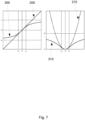
- the function ⁇ ( x ) can be chosen so that ⁇ ( x ) ⁇ x when
- One function that can be used here is the arctangent. Similarly behaving functions can also be used.
- the function ⁇ ( x ) can be strictly monotonic. In other preferred embodiments, the function can have a continuous first derivative.
- the function ⁇ ( x ) can be scaled to pick a suitable range of linearity x L and the maximum error value ⁇ .
- Different parameters of linearity and of maximum error can be used for different sensors. The parameters may also be changed dynamically when additional information is known about the operation of the sensor of during the minimization algorithms as the map M converges to its best value.
- the linear range x L can be within 1-10 and the maximum error value ⁇ can be within the range 10-100 (assuming sensor errors are scaled to realistic values).
- the error capping can instead be applied directly to the elements of vector ⁇ ( M ) - R if suitable scaling is used. Then, the error capping can be applied without transforming S ( M ) to its diagonal form.
- This modification allows for large occasional systematic errors in the sensor readings and feature associations to landmarks, while at the same time yielding to the standard algorithms used for nonlinear minimization.
- Such algorithms can comprise, for example, the gradient descent method, nonlinear conjugate gradient methods, quasi-Newton methods, the Gauss-Newton method, the Levenberg-Marquardt method etc.
- the modification works with Newton-based methods, because the capping function is linear around the origin.
- the modification can work best with gradient-based methods when the capping function ⁇ ( x ) is strictly monotonic.
- the error capping step of the algorithm can be particularly advantageous, as it can increase the robustness of the map finding.
- Using error capping allows the algorithm to cope with systematic sensor and association errors while still producing accurate maps. It further allows for use of standard and efficient optimization algorithms such as the Levenberg-Marquardt for example.
- the optimization algorithm can be run again to further improve the map quality.
- the error capping can comprise a standalone method for modifying error terms in least squares-based optimization algorithms.
- the method comprises acquiring a plurality of data points with corresponding error estimates by measuring a physical system.
- the method further comprises constructing a model comprising a plurality of parameters to be determined, said model describing the physical system.
- the method further comprises computing residual errors of the data points using the model and its parameters.
- the method further comprises scaling the residual errors by data point error estimates.
- the method further comprises applying an error cap function to the scaled residual errors.
- the method further comprises summing the squared capped scaled residual errors.
- the method further comprises minimizing the sum by changing the model parameters.
- the model parameters can comprise, for example, the map in the case where the error capping is used within the mapping method as described in the present document. That is, the landmarks and/or poses of the robot on a certain coordinate system.
- the model can comprise an approximation of the physical system. That is, the model can provide a framework of relations between the measurable quantities. However, the precise mathematical details of the model can be unknown to start with. These can comprise coefficients, exponents, angles, lengths and so on. Those unknowns can comprise the parameters (in the current application, the map).
- the error cap function is strictly monotonic.
- the error cap function can comprise a continuous first derivative.
- the error cap function can be approximately linear around the origin.
- the error cap function can be bounded from below and from above by a maximum allowed error value.
- the error cap function can comprise an arctangent function.
- the error cap function can also be as described above and/or below in the figure description.
- the error capping method is described as a part of the mapping method, a skilled person will understand that it can be applied more generally to a wide array of optimization algorithms. It is particularly advantageous, as it can allow using standard algorithms such as the Levenberg-Marquardt ones for complex problems (such as the present mapping problem). Without the error capping method, the standard algorithm can fail or return sub-optimal results. However, it can be much more robust with this method.
- the method can be used to cap systematic errors comprised in sensor readings. In such embodiments, it can be used to improve the robustness of an optimization algorithm and to increase the likelihood of obtaining parameters that conform the closest to the physical system.
- the method can be used in conjunction with the Levenberg-Marquardt algorithm to at least compute a non-linear least squares problem.
- the method can be used in conjunction with a gradient-based optimization algorithm to at least compute a non-linear least squares problem.
- the method can be used as part of the optimization algorithm to find the best possible map of a mobile robot's surroundings. That is, this use of the error capping method is described in more detail above as pertaining specifically to the current mapping method.
- the method can be used as part of the localization algorithm to find a mobile robot's position and orientation with respect to a map.
- the error capping can be used when localizing the robot using the map built according to the presently described method.
- the method can be used as part of the optimization algorithm for calibrating the positions and orientations of a plurality of cameras fixed with respect to each other. That is, a mobile robot with a plurality of cameras can require a calibration of said cameras. This can be advantageous, as knowing the precise camera positions with respect to each other can yield more accurate combinations of images taken by different cameras for example.
- data points can comprise at least one or a combination of sensor readings such as GPS coordinates, altitude, odometry data, and/or straight lines extracted from camera images.
- parameters can comprise a map comprising a plurality of landmarks placed on a coordinate system.
- the least squares-based optimization algorithm can be used to generate map data of a mobile robot's surroundings using at least sensor data from the mobile robot and wherein parameters comprise a map comprising the path taken by the mobile robot.
- the errors capped comprise at least one or a combination of systematic errors associated with sensors of a mobile robot such as a GPS component and/or errors associated with associating lines extracted from visual images to landmarks on a coordinate system.
- the method can comprise diagonalizing a covariance matrix associated with the error estimates prior to scaling the residual errors by data point error estimates. That is, in some more complex least-squares problems, the errors associated with data points can comprise a covariance matrix.
- the error capping can be performed after diagonalizing this matrix. Then, the error capping function can be applied to the diagonal elements and the method can proceed as before.
- the method can be used to cap association errors arising from associating data points with incorrect model components. That is, in the present mapping method application, this can refer to errors arising from false associations of lines to landmarks.
- the model can comprise a map and model components comprise landmarks and/or physical objects and/or path poses.
- the mapping algorithm can be run on "patches" or "regions" of the total path that the robot is taking.
- the mapping algorithm can be run on 300 robot poses. If the robot travels at about 5 km/h (1.4 m/s) and there are about 4-5 poses per second (as poses can be measured simultaneously with the camera images being taken), 300 poses can correspond to a patch of about 94 meters.
- one patch can comprise between 100 and 10000 robot poses, but preferably around 100-1000 robot poses.
- the method can be used as a SLAM method by an autonomous and/or semi-autonomous mobile robot.
- SLAM refers to simultaneous localisation and mapping. That is, in some embodiments, the method can be run on the robot as it navigates autonomously and/or semi-autonomously. As the algorithm can also yield the path that the robot took, the robot can localise itself and build map data of its surroundings simultaneously. This can be particularly advantageous, as the robot can then just navigate through an unfamiliar area and build map data of it without previously knowing what the area looks like.
- the invention provides a mobile robot comprising (i) at least one memory component comprising at least map data, (ii) at least two cameras adapted to take visual images of an environment, and (iii) at least one processing component adapted to at least extract straight lines from the visual images taken by the at least two cameras and compare them to the map data to at least localise the robot.
- the invention provides an assembly of mobile robots comprising at least two mobile robots, and each of the robots comprising (i) at least one memory component comprising at least map data, (ii) at least two cameras adapted to take visual images of an environment, (iii) at least one processing component adapted to at least extract features from the visual images taken by the at least one camera and compare them to the map data to at least localise the robot, (iv) and at least one communication component adapted to send and receive data between the robots, particularly image and/or map data.
- mapping method making use of the invention.
- the mapping method can make use of any features of the system listed above and below.
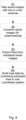
- the mapping method comprises (i) operating at least one mobile robot comprising at least two cameras and at least one processing component, (ii) taking visual images with the at least one robot's at least two cameras, (iii) performing preprocessing on a file generated by combining visual images from the at least two cameras, (iv) extracting features from the individual visual images with at least one processing component, and (v) building map data using the extracted features from the visual images.
- the invention provides a mobile robot comprising (i) at least one memory component comprising at least map data, (ii) at least two cameras adapted to take visual images of an environment, and (iii) at least one processing component adapted to at least extract features from the visual images taken by the at least two cameras and compare them to the map data to at least localise the robot.
- a localisation method making use of the invention comprises (i) operating at least one mobile robot comprising at least two cameras, at least one memory component, and at least one processing component, (ii) taking visual images with the at least one robot's at least two camera components, (iii) performing preprocessing on a file generated by combining visual images from the at least two cameras, (iv) extracting features from the individual visual images with at least one processing component, (v) comparing the extracted features with existing map data stored on the at least one robot's at least one memory component, and (vi) localising the at least one robot using the comparison in (v).
- a localisation method making use of the invention comprises (i) providing at least one mobile robot comprising at least one dead reckoning component, at least two cameras, at least one memory component, and at least one processing component; and (ii) taking visual images with the at least one robot's at least two camera components; and (iii) extracting features from the individual visual images with at least one processing component; and (iv) obtaining location related data from the extracted features in (iii); and (v) receiving location related data from the at least one dead reckoning component; and (vi) combining location related data obtained from the features extracted from the visual images in (iv) and location related data received from the at least one dead reckoning component in (v) weighted based on errors associated with each of them; and (vii) forming a hypothesis on the robot's pose based on the combined data in (vi).
- the mobile robot can be an autonomous and/or a semi-autonomous robot.
- the robot can be land-based.
- the robot can be adapted to move on the ground.
- the robot can be wheeled and adapted to move in unstructured urban areas that include moving and stationary obstacles.
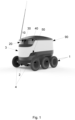
- the robot comprises a set of at least 4 (four) wheels mounted on a frame.
- the robot can further comprise a body mounted on the frame.
- the robot can further comprise lights mounted on the body and/or on the frame.
- the lights can be LED lights.
- the lights can assist the robot with localisation and/or navigation on short scales and/or with obstacle detection.
- the lights can illuminate the environment in which the robot operates in the dark and/or dusk.
- the robot can comprise at least one microphone and/or at least one speaker, for communicating with its surrounding, for example pedestrians in an urban area, such as on a pedestrian path.
- the dimensions of the robot are width: 40 to 70 cm, such as about 55 cm, height: 40 to 70 cm, such as about 60 cm, length: 50 to 80 cm, such as about 65 cm.
- the invention can comprise more than one robot.
- the robot can operate autonomously during most of its operation, such as about 95% of the time, about 97% of the time, about 98% of the time, or about 99% of the time.
- the robot can be adapted to travel with a speed of no more than 10 km/h, or no more than 8 km/h or no more than 6 km/h.
- the robot drives with a speed between 3 and 6 km/h and/or between 4 and 5 km/h.
- the robot can be used for delivery purposes.
- the robot can comprise an enclosed space within its body where at least one delivery can be stored during the transit.
- the robot can further comprise a secure access device for providing access to the space. This device can be a lock and/or a closure mechanism controlled by a secure interface.
- the robot and the delivery can have a combined weight of no more than 40 kg, such as no more than 35 kg, such as no more than 30 kg, such as no more than 25 kg.
- the robot and the delivery have a combined weight of 10-25 kg, more preferably 10-20 kg.
- the memory component of the mobile robot can comprise a Random Access Memory (RAM) device. It can be a standalone component or, in a preferred embodiment, an integrated part of a System on a Chip (SoC).
- the memory component preferably stores at least map data that can relate to the robot's current and/or prospective operating area.
- the operating area also referred to as area of operation, can be fixed or can be modified during the course of the robot's operation.
- the operating area comprises an inhabited region that can consist of a city, a village, a neighbourhood and/or an arbitrarily defined part of a city.
- the operating area can also comprise regions with standalone human habitations and/or regions frequented by humans.
- the map data that can be stored within the memory component can comprise a plurality of vectors, straight lines, point features and/or grid features defined with respect to some coordinate system.
- the map data can comprise two points and/or a point and a direction defined with respect to an arbitrary but fixed coordinate system.
- the coordinate system can be a Cartesian coordinate system approximating such a part of the globe so that the curvature does not introduce significant error.
- the coordinate system can be converted to a GPS coordinate system (for example WGS84) and/or other standard systems.
- the map data can also thus be converted to a standard coordinate system such as GPS coordinates.
- the cameras on the robot are typically adapted to take visual images of the surrounding environment of the robot within its operating area.
- the surrounding environment comprises closely located visual objects, such as objects that are located within a radius of about 1km or less, 500m or less, 300m or less, 200m or less or 100m or less from the robot.
- the robot can be adapted to take and process images of the surroundings of the robot that are within a radius of of about 1km or less, 500m or less, 300m or less, 200m or less or 100m or less.
- the environment is typically an unstructured outdoor environment that changes with time and the geographical surroundings of the robots as it travels along its path.
- the environment can also be at least partially indoor, or under a roof, for example if the robot is travelling through a mall, garage, apartment complex, office buildings, or the like.
- the cameras of the mobile robot can be for example similar to smartphone cameras. They can be adapted to capture 1-10 images per second, more preferably 3-5 images per second or more preferably 4 images per second.
- the camera viewing angles can be 10° - 120°, more preferably 40° - 100°, more preferably 60° by 80°.
- the robot can comprise a plurality of cameras. In a preferred embodiment, the robot comprises at least 4 (four) cameras. In a more preferred embodiment, the robot comprises 9 (nine) cameras.
- the cameras can be placed anywhere around the body of the robot, preferably in positions optimizing the viewing angles of the different cameras. Some cameras can be stereo cameras. In a preferred embodiment, one pair of front cameras are stereo cameras. In a more preferred embodiment, the robot comprises 4 (four) pairs of stereo cameras.
- the stereo cameras are positioned in the front of the robot, on both sides of the robot and on the back of the robot. One more camera is positioned in the front of the robot.
- the stereo cameras can be used to triangulate objects captured in the visual images. Depth perception of the visual images can be improved with stereo cameras.
- the separation between the stereo cameras can be 5-20 cm. In a preferred embodiment, the separation between the front and back stereo cameras is 5-10 cm and the separation between the sides stereo cameras is 15-20 cm.
- the cameras can be placed on the robot so as to take landscape orientation visual images and/or portrait orientation visual images.
- Landscape orientation visual images can be understood to mean visual images wherein the wider camera capture angle is approximately parallel to the ground and the narrower camera capture angle is approximately perpendicular to the ground.
- the side cameras are placed in a portrait orientation and the front and back cameras are placed in a landscape orientation.
- the cameras can take visual images of an unstructured outdoor environment.
- This environment can comprise at least one or any combination of pedestrian paths comprising stationary and moving obstacles (for example pedestrians, animals, strollers, wheelchairs, mailboxes, trash cans, street lights and the like), vehicle roads including vehicles, bicycles, traffic lights and the like and/or other traversable environments such as parking lots, lawns and/or fields.
- a plurality of cameras can be pointed in a plurality of directions, therefore covering a larger part of the robot's surroundings. Furthermore, if one camera comprises a defect and/or gets blocked, the other cameras can allow the robot to still record enough data to build a map and/or to perform localisation. This can be particularly relevant for a robot operating outdoors, as weather conditions such as sunlight, rain, snow, fog, hail or similar can obstruct the view of the cameras.
- Multiple cameras are also particularly advantageous for the current inventions, as some landmarks and/or physical objects can be seen on images taken by different cameras. This can be used by the algorithm to confirm that those lines do belong to a landmark and/or to a physical object.
- the lines can be an artefact of the light and/or a transient object captured only by one camera. This is very advantageous when lines are being associated to landmarks and/or compared with an existing map.
- the processing component can be part of and/or comprise a System on a Chip (SoC), for example similar to smartphone processors.
- SoC System on a Chip
- the memory component can be part of the same SoC.
- the processing component can be adapted to localise the robot using the visual images captured by the cameras.
- the processing component can preferably also be adapted to extract features from the visual images captured by the cameras.
- the features can be straight lines.
- the straight lines can be extracted by applying an edge detection algorithm (such as Canny algorithm for example) followed by a line extractor algorithm (such as Hough transform for example) to the preprocessed visual images.
- Preprocessing can include combining the images, sharpening the images, smoothing the images and/or adding contrast to the images. It can also include any adjustment to image color scheme.
- the extracted features can be used to build a map of the robot's operating area and/or to localise the robot using an existing map.
- a map can comprise a collection of vectors and/or lines and/or line segments and/or point features and/or grid features defined with respect to some coordinate system.
- the map can be preloaded onto a memory component of the robot. Alternatively, the map is downloaded onto the memory component during operation. The map can be downloaded in fragments as the robot is moving between geographical areas.
- the cameras on the robot can take visual images of the robot's surroundings during its roving in an operating area.
- the cameras can be adapted to take images with a frequency of 1 to 10 images per second, such as 2 to 8 images per second, or 3 to 7 images per second, or 3 to 5 images per second, or 4 to 6 images per second.
- the cameras are adapted to take images at a frequency of 4 images per second.
- image capture is performed continuously during the robot's operation at the described frequency, i.e. the robot is preferably adapted to take images continuously using at least one, and preferably all, of the cameras during its operation.
- the visual images can then be combined into one file and preprocessed.
- the images from different cameras are taken simultaneously.
- the file containing preprocessed image data is separated into individual image files representing the different cameras, and the straight lines are extracted from the individual images. The straight lines are then combined and used to build map data of the robot's operating area.
- the robot already has stored map data on its memory component.
- the extracted straight lines are then compared with stored map data and run through a particle filter to model the probability distribution of the robot pose.
- An optimal pose is then chosen based on the comparison.
- the processing component is adapted to localise the robot with an error of at most 10 cm. In a preferred embodiment, the processing component is adapted to localise the robot with an error of at most 5 cm. In a more preferred embodiment, the processing component is adapted to localise the robot with an error of at most 3 cm.
- the precision of the localisation can depend on the number of the cameras and/or on the knowledge of the relative positions of the cameras and/or on the calibration of the system. Localisation can be more precise for objects located closer than for objects located further away.
- the processing component can combine the features extracted from visual images taken by different cameras into a coherent map and/or localise using the combined extracted features.
- the processing component is adapted to provide instructions about navigation of the robot, by using visual localisation based on the extracted features, as well as map information and information about the intended destination of the robot.
- Navigation can include changing the pose of the robot (6 degree-of-freedom position and orientation data) by moving in some direction and/or rotating. Navigation can further include making decisions about the best course of movement and adapting those decisions based on the localisation information.
- the robot can further comprise a plurality of sensors adapted to measure different parameters related to the environment and/or to the localisation of the robot.
- the sensors can comprise at least one or any combination of at least one GPS component, at least one accelerometer, at least one gyroscope (in a preferred embodiment 4 (four) gyroscopes), at least one odometer, at least one magnetometer, at least one time of flight camera and/or at least one Lidar sensor.
- a preferred embodiment comprises at least one of all of those sensors.
- the sensors measure data related to the pose of the robot.
- the processing component localises the robot by first processing the sensor data for an approximate pose estimate, and then improving this estimate by using visual localisation.
- the pose improvement can for example be done by using a particle filter.
- the features extracted from the visual images can be compared to a map comprising features corresponding to a certain set of different poses.
- the particle filter can then select the most likely pose estimate from the set based on the likelihood of each pose.
- the processing component can be adapted to localise the robot based on an iterative algorithm estimating robot pose at set time intervals. This iterative algorithm can rely on an application of the particle filter method.
- a hypothesis on a robot's pose can include data from at least one sensor such as at least one camera, a GPS component, an odometer, an accelerometer, a time of flight camera, and/or a magnetometer.
- a sensor's data can further be absolute (such as data from a GPS component and/or data obtained from visual camera images for example) or relative to previous robot pose (such as data from odometers and/or gyroscopes for example).
- the robot can further comprise a pressure sensor.
- the pressure sensor can be used for precise altitude-based localisation.
- another pressure sensor can be located at a known location within the robot's area of operation, for example at a hub.
- the hub can be a physical location (for example a parking lot), a physical structure (for example a house, a warehouse, a shipping container, a barn, a depot and/or a garage), and/or a mobile structure (for example a truck, a trailer and/or a train wagon).
- the hub can serve as a storage, maintenance, repair, recharging and resupply station for the robot.
- One hub can comprise one or more robots.
- one hub can service a plurality of robots, such as 20-200 robots.
- a pressure sensor placed at the location of the hub, a precise altitude reference is established, and the localisation of the robot can be improved by comparing the data from the robot's pressure sensor to the data from the hub's pressure sensor.
- the robot can further comprise a communication component adapted to exchange data with one or more server, particularly image and/or map data.
- the server can comprise multiple servers and/or a cluster of servers and/or one or more cloud servers.
- the server is a cloud server.
- the server comprises a cluster of servers, some of which can be cloud servers.
- the server can store, analyse and/or send out data, such as for example map and localisation related data.
- the server can also perform calculations, for example calculations related to the generation of a geographical map, localisation calculations, and/or route calculations for the robot.
- the communication component can comprise at least one slot for a Subscriber Identity Module (SIM card), preferably two slots for two SIM cards.
- SIM card Subscriber Identity Module
- SIM cards are an advantage, since it increases reliability and allows for simultaneous communication via both SIM cards for larger and/or faster data transmission.
- two different mobile operators are used for operation using the two SIM cards. In this case, if one mobile operator does not provide coverage in some part of the robot's area of operation, the robot can still communicate via the other SIM card.
- the robot can further be adapted to receive navigation instructions from the server at specific intervals and/or after requesting input from the server.
- the robot receives navigation instructions every 50-150 meters.
- the robot can further send a request for input to the server when faced with an unfamiliar situation.
- the robot can also request manual input about its navigation, for example when facing hazardous conditions such as crossing a street.
- a remote operator can provide navigation instructions to the robot and direct it through the hazard, such as across the street.
- the operator can instruct the robot to resume autonomous navigation.
- the operator can further communicate with people in the immediate surroundings of the robot through the microphone and speakers that can be mounted on the robot.
- the robot can however continue to update its localisation during manual control.
- the invention discloses an assembly of mobile robots comprising at least two mobile robots.
- the robots can be as described above.
- the robots can be adapted to communicate with each other via the communication module.
- the communication can be routed via the server.
- the data sent between the robots and/or between the robots and the server can be combined into a map of an operating area and/or of multiple operating areas.
- the coordinates used for each map data can be different, but they can each be converted into a standard coordinate system and/or combined in one unified arbitrary coordinate system.
- Multiple operating areas can correspond for example to different parts of a city.
- An operating area can comprise one hub and/or multiple hubs.
- the robots benefit from the map data gathered by the other robots via the map data exchange.
- the server can coordinate the exchange of map data.
- the server can further store map data and unify it into a global map.
- the server can send out map data to the robots based on their operating area.
- the map data can further be updated by the robots if the visual images taken by the cameras demonstrate a consistent change in the extracted features. For example, if new construction work is taking place within an operating area, the map of this operating area can be updated correspondingly.
- the method can comprise a plurality of optimization algorithms. That is, the overall goal of the method can be to generate map data which can comprise landmarks with their location determined by the lines extracted from camera images. Therefore, the overall goal can be to find as many landmarks as possible with the best possible precision.
- the best map can be found. This map can be the best given the step's assumptions on which lines correspond to landmarks and which should be removed. Therefore, the best map can be found repeatedly, each time making new associations and removing bad associations, as the map can improve with every step, provided the algorithm is functioning correctly. In this way, finding the best map can be part of an iterative algorithm which repeats at each step of an overlying iterative algorithm that has as a goal the maximisation of the landmarks located on the map.
- the presently described method and/or device and/or assembly can be directed to a vehicle, a car and/or a self-driving car. That is, the mapping method can be used by a self-driving car to build map data, and/or to navigate and/or to perform SLAM.
- the device and/or the assembly described herein that is, the mobile robot and/or the assembly of mobile robots are substantially different from a car and/or a self-driving car. That is, in such embodiments, the mobile robot is significantly smaller than a car.
- typical dimensions of the robot may be as follows. Width: 20 to 100 cm, preferably 40 to 70 cm, such as about 55 cm. Height: 20 to 100 cm, preferably 40 to 70 cm, such as about 60 cm. Length: 30 to 120 cm, preferably 50 to 80 cm, such as about 65 cm.
- the mobile robot is also sufficiently lighter than a car and/or a self-driving car.
- the weight of the robot may be in the range of 2 to 50 kg, preferably in 5 to 40 kg, more preferably 7 to 25 kg, such as 10 to 20 kg.
- the robot can also be adapted to operate on the sidewalks unlike a car and/or a self-driving car. It can further have a velocity of no more than 20 km/h, such as no more than 10 km/h, preferably between 4 and 6 km/h.
- embodiments where the present invention can be applied to cars and/or self-driving cars are substantially different from embodiments where it can be applied to smaller, and/or lighter, and/or slower mobile robots.
- self-driving cars can use a plurality of sensors to autonomously navigate on public roads. Often, self-driving cars use Lidar sensors as a primary or one of the primary means of localisation.
- the current invention presents a cost, space and equipment efficient way to localise a mobile robot with a precision of a few centimetres.
- the current invention can be applied to self-driving cars, however, the technology presently used for self-driving cars can be cumbersome and impractical to use on a mobile delivery robot operating on sidewalks.
Landscapes
- Engineering & Computer Science (AREA)
- Physics & Mathematics (AREA)
- General Physics & Mathematics (AREA)
- Remote Sensing (AREA)
- Radar, Positioning & Navigation (AREA)
- Automation & Control Theory (AREA)
- Aviation & Aerospace Engineering (AREA)
- Computer Vision & Pattern Recognition (AREA)
- Theoretical Computer Science (AREA)
- Business, Economics & Management (AREA)
- Economics (AREA)
- Electromagnetism (AREA)
- Multimedia (AREA)
- Operations Research (AREA)
- Development Economics (AREA)
- General Business, Economics & Management (AREA)
- Quality & Reliability (AREA)
- Marketing (AREA)
- Human Resources & Organizations (AREA)
- Entrepreneurship & Innovation (AREA)
- Strategic Management (AREA)
- Tourism & Hospitality (AREA)
- Health & Medical Sciences (AREA)
- Artificial Intelligence (AREA)
- Evolutionary Computation (AREA)
- Game Theory and Decision Science (AREA)
- Medical Informatics (AREA)
- Control Of Position, Course, Altitude, Or Attitude Of Moving Bodies (AREA)
- Manipulator (AREA)
- Image Analysis (AREA)
Description
- The invention relates to mapping performed by a moving robot. More particularly, the invention relates to mapping using multiple cameras taking visual images.
- Mapping done by mobile robots and localisation of mobile robots has been an active area of research since progress in robotics allowed for semi-autonomous and autonomous robots. A moving robot must have a method of at least estimating its position in space to continue motion with a purpose. The modern framework of mapping localisation comprises a coordinate system with respect to which the localisation is done and a pose, which is a combination of position and orientation. Localisation can be done with respect to an absolute coordinate system (such as GPS coordinates) or a relative coordinate system (such as localisation with respect to some known location and/or object). The coordinate system can be chosen arbitrarily, as long as it is consistent and can be converted to some standard coordinate system (such as WGS84) if needed.
- Multiple sensor readings can contribute to pose calculation - it can be determined using GPS receivers, Lidar (light radar) sensors, cameras, odometers, gyroscopes, accelerometers, magnetometers, time of flight cameras and radar sensors. There is an important distinction to be made in the context of localisation: it can be done based on an existing map, or it can be done simultaneously with mapping. The latter is called SLAM (Simultaneous Localisation and Mapping) and is the preferred approach when localisation is performed while exploring previously unknown surroundings. If a map is already available, the task becomes easier. For example, localisation in indoor environments (such as an apartment or a hospital) or structured outdoor environments (such as a factory complex) is easier, since a detailed map is readily available, and it is unlikely to change significantly in the short term. Localisation outdoors, in unstructured environments (such as cities, suburbs and/or villages) is a greater challenge. First, publicly available maps are not precise enough for autonomous motion by the robot. Second, even when the maps exist, they are likely to get outdated very fast, as new obstacles appear and old pathways disappear. Localisation outdoors can be done with the help of a positioning system such as GPS (Global Positioning System), GLONASS (Global Navigation Satellite System) or Galileo.
- However, the precision of these systems (available for public use) is on the order of 1-10 meters. This would not be enough for localisation used for autonomous robotic navigation.
- Existing solutions to the localisation problem strongly depend on the intended application of the object to be localised.
-
US 8,717,545 B2 discloses a system using range and Doppler velocity measurements from a lidar system and images from a video system to estimate a six degree-of-freedom trajectory of a target. Once the motion aspects of the target are estimated, a three-dimensional image of the target may be generated. -
US 7,015,831 B2 discloses a method and apparatus that use a visual sensor and dead reckoning sensors to process Simultaneous Localisation and Mapping (SLAM). Advantageously, such visual techniques can be used to autonomously generate and update a map. Unlike with laser rangefinders, the visual techniques are economically practical in a wide range of applications and can be used in relatively dynamic environments, such as environments in which people move. - The disclosed method can be implemented in an automatic vacuum cleaner operating in an indoor environment.
-
US 8,305,430 B2 discloses a visual odometry system and method for a fixed or known calibration of an arbitrary number of cameras in monocular configuration. Images collected from each of the cameras in this distributed aperture system have negligible or absolutely no overlap. - The system uses multiple cameras, but generates pose hypothesis in each camera separately before comparing and refining them.
- Schindler, et al. (in 3D Data Processing, Visualization, and Transmission, Third International Symposium on, pp. 846-853. IEEE, 2006) discusses a novel method for recovering the 3D-line structure of a scene from multiple widely separated views. In this approach, 2D-lines are automatically detected in images with the assistance of an EM-based vanishing point estimation method which assumes the existence of edges along mutually orthogonal vanishing directions. 3D reconstruction results for urban scenes based on manually established feature correspondences across images are presented.
- Murillo, A. C., et al. (Robotics and Autonomous Systems 55, no. 5 (2007): 372-382) proposes a new vision-based method for global robot localisation using an omnidirectional camera. Topological and metric localisation information are combined in an efficient, hierarchical process, with each step being more complex and accurate than the previous one but evaluating fewer images.
- Lee, Wangheon & Kim, Dongsu & Kweon, In-So. (2003). Automatic edge detection method for the mobile robot application. 2730 - 2735 vol.3. 10.1109/IROS.2003.1249283. This paper proposes a new edge detection method using a 3×3 ideal binary pattern and lookup table (LUT) for the mobile robot localization without any parameter adjustments. The authors take the mean of the pixels within the 3×3 block as a threshold by which the pixels are divided into two groups. The edge magnitude and orientation are calculated by taking the difference of average intensities of the two groups and by searching directional code in the LUT, respectively. And also the input image is not only partitioned into multiple groups according to their intensity similarities by the histogram, but also the threshold of each group is determined by fuzzy reasoning automatically. Finally, the edges are determined through non-maximum suppression using edge confidence measure and edge linking.
US 2010/0305854A1 discloses a mapping method which includes using a first mobile unit to map two-dimensional features while the first mobile unit traverses a surface. Three-dimensional positions of the features are sensed during the mapping. A three-dimensional map is created including associations between the three-dimensional positions of the features and the map of the two-dimensional features. The three-dimensional map is provided from the first mobile unit to a second mobile unit. The second mobile unit is used to map the two-dimensional features while the second mobile unit traverses the surface. Three-dimensional positions of the two-dimensional features mapped by the second mobile unit are determined within the second mobile unit and by using the three-dimensional map. - Abdul Hafez, A H. (2014). Particle-filter-based Pose Estimation from Controlled Motion with Application to Visual Servoing. International Journal of Advanced Robotic Systems. 11. 10.5772/58928. In this paper, the authors present a Bayesian algorithm based on particle filters to estimate the camera pose for vision-based control. The state model is represented as a relative camera pose between the current and initial camera frames. The particles in the prior motion model are drawn using the velocity control signal collected from the visual controller of the robot. The pose samples are evaluated using an epipolar geometry measurement model and a suitable weight is associated with each sample. The algorithm takes advantage of the a priori knowledge about motion, i.e., the velocity computed by the visual servo control, to estimate the magnitude of the translation in addition to its direction, hence producing a full camera motion estimate.
- Ben Ghorbel, Mahdi & Baklouti, Malek & Couvet, Serge. (2010). 3D Head Pose Estimation and Tracking Using Particle Filtering and ICP Algorithm. 6169. 224-237. 10.1007/978-3-642-14061-7_22. This paper addresses the issue of 3D head pose estimation and tracking.
- The authors propose a framework for estimating the 3D head pose in its fine level and tracking it continuously across multiple Degrees of Freedom (DOF) based on ICP and particle filtering. The authors propose to approach the problem, using 3D computational techniques, by aligning a face model to the 3D dense estimation computed by a stereo vision method, and propose a particle filter algorithm to refine and track the posteriori estimate of the position of the face.
- The invention is set forth in the
independent claims 1 and 8 and in thedependent claims 2 to 7 and 9 to 16. - In a first aspect, a mapping method making use of the invention is provided. The mapping method can comprise operating at least one mobile robot comprising at least two cameras and at least one processing component. The mapping method can further comprise taking visual images with at least two cameras. The mapping method can also comprise extracting at least straight lines from the visual images with at least one processing component. The mapping method can further comprise generating map data using the extracted features from the visual images.
- In a second aspect, the invention discloses a mobile robot. The mobile robot can comprise at least two cameras adapted to take visual images of an operating area. The mobile robot can also comprise at least one processing component adapted to at least extract straight lines from the visual images taken by the at least two cameras and generate map data based at least partially on the images. The mobile robot can further comprise a communication component adapted to at least send and receive data, particularly image and/or map data.
- In a third aspect, the invention discloses an assembly of mobile robots comprising at least two mobile robots. Each of the mobile robots can comprise at least two cameras adapted to take visual images of an operating area. Each of the mobile robots can further comprise at least one processing component adapted to at least extract straight lines from the visual images taken by the at least two cameras and generate map data based at least partially on the images. Each of the mobile robots can also comprise at least one communication component adapted to at least send and receive data at least between the robots, particularly image and/or map data.
- In some embodiments, the mapping method further comprises combining the visual images and/or the extracted straight lines in a single reference frame based on the relative placement of the two cameras. That is, the visual images from two of more cameras can be combined into one image. This step can be done before extracting the straight lines or after extracting the straight lines. In the latter case, only the extracted straight lines can be combined in a single reference frame. The reference frame can be chosen, for example, with respect to one of the cameras. The relative placement of the cameras can be computed precisely prior to starting the mapping process. This can be useful to obtain a fuller picture or map of the robot's surroundings. It can also be useful for determining whether any straight lines extracted from the images of different cameras belong to the same object on the images taken by the robot, that is, belong to the same object in the world.
- In some preferred embodiments, the method can further comprise extracting location-related data from at least one further sensor. Said sensor can comprise, for example at least one or a combination of at least one GPS sensor, at least one dead-reckoning sensor, at least one accelerometer, at least one gyroscope, at least one time of flight camera, at least one Lidar sensor, at least one odometer, at least one magnetometer and/or at least one altitude sensor. The method can then further comprise combining this location-related data with the data from the visual images to build map data. That is, in some embodiments, the mobile robot can use data from its other sensors to obtain an approximate map of an operating area it finds itself in, and then refine this approximate map using the extracted straight lines. Alternatively or additionally, the robot can build map data using the extracted straight lines and other sensor readings simultaneously. This is advantageous, as the other sensors' data can serve as a "sanity check", or as a means to make the camera images-based map built from the straight lines more precise and reliable. This is described in further detail below.
- Note that, the term "operating area" can refer to a region where the robot is moving. This can, for example be a certain street, or a patch of a street. For example, operating area can comprise a 1 to 1000 m region that the robot is moving through. One robot run can comprise one or a plurality of operating areas. When generating map data, the robot can, for example, generate it based on an area with a radius of 1 to 1000 m, more preferably 10 to 500 m. Once a map of one patch or area or operating area is generated, the robot can generate a map of a subsequent patch or area or operating area.
- Note that the term "camera image" can also refer to camera frames.
- The mapping method can further comprise using an iterative algorithm to at least associate the extracted straight lines with physical objects. That is, when generating map data, the algorithm can identify the 2D straight lines from camera images with 3D physical objects or landmarks present in the real world. For example, the algorithm can detect that a certain number of lines all belong to the same physical object or landmark and merge them into one. Conversely, the algorithm can detect that a certain line only appears in one camera image and is likely to belong to a transitory physical object such as a car, or to be caused by light and/or camera effects. In this case, the algorithm can reject this line and not assign it to a 3D physical object or landmark. Physical objects or landmarks can comprise non-transitory objects such as buildings, fences, roads, poles, windows, doors, mailboxes, street lights, street signs, and other objects comprising substantially straight features.
- In some embodiments, the iterative algorithm can comprise an optimization routine that optimizes at least one robot pose and the position of the physical objects based on the extracted features. That is, the algorithm can for example take one or a plurality of robot poses and the number and positions of physical objects or landmarks as unknown variables, and optimize their values based on the straight lines extracted from camera images. In some embodiments, the algorithm can also take data from other sensors into consideration, for example GPS sensor or other sensors listed above and below.
- Note, that in the present document, the terms "physical object" and "landmark" can be used interchangeably.
- In some embodiments, the iterative algorithm can comprise at least combining lines belonging to the same physical object from images taken by different cameras. It can also comprise discarding lines belonging to transient objects and/or light or camera effects. That is, one landmark or physical object can be detected by different cameras at the same time frame and/or by the same camera at several time frames and/or by different cameras at several time frames. The algorithm can be adapted to combine the lines extracted from several images and associate them to a certain landmark with a certain fixed position on a map (with a corresponding error). Conversely, if a certain line is detected in too few frames - be they from the same camera at different time points and/or from different cameras at the same or different time points, this line can be an artefact of the light or of the camera. It could also be a transient feature such as a car (which should not comprise part of a map). In this case, the algorithm can be adapted to discard or cull the corresponding line.
- In some embodiments, each of the robot cameras can be adapted to capture 3 to 5 images or frames per second, preferably 4 images or frames per second.
- In some embodiments, the robot comprises at least 4 cameras. In some preferred embodiments, the robot comprises 8 or 9 cameras.
- The map data that the robot can generate can comprise a plurality of vectors, point features and/or grid features defined with respect to a coordinate system. This coordinate system can be tied to the robot, for example with one of the cameras serving as the origin and the direction of motion as the x-axis. The coordinate system can also be independent of the robot, such as a GPS system for example. The grid features can comprise extended objects that are not lines, such as, for example, geometrical shapes. For instance, in some embodiments, the street poles can be modelled as geometrical objects with a radius varying with height. These can then be considered grid features. Furthermore, rectangular or substantially rectangular objects can be considered grid features. These can comprise, for example doors, windows and/or other objects. Additionally or alternatively, substantially circular, oval, triangular and differently shaped objects can comprise grid features. The map data can simply comprise a collection of numbers corresponding to the positions of straight lines and/or of physical objects (landmarks) and/or of robot poses with respect to some coordinate system. There can also be a plurality of coordinate systems defined for map data. The map data can further comprise lines obtained on the basis of camera image lines. That is, the lines extracted from camera images can be run through an algorithm to verify whether they belong to actual landmarks (that is, physical objects), and whether some of them can be combined. At this stage, the position of the lines with respect to each other and/or with respect to the robot can be adjusted, as lines extracted from images taken by different cameras and/or taken at different time points can be combined if it is determined that they belong to the same landmarks. Some lines can also be discarded if it is determined that they likely belong to transient objects (such as trucks or cars), light effects and/or camera effects. Map data can then comprise this collection of lines based on the lines extracted from images, but processed by a certain algorithm to comprise mostly or solely lines belonging to landmarks, combined lines, and/or lines with an adjusted position. Map data can further comprise error estimates associated with vectors, point features, and/or lines associated with landmarks. Map data can further comprise visibility information. That is, information about from which locations given landmarks can be seen. In other words, if, for example, a wall would obstruct a landmark or physical object, so that it cannot be seen from locations behind the wall, this information can also be comprised in map data. This is practical, as when, for example, the robot uses the map to navigate, it will not detect landmarks of physical objects that are nearby, but obstructed. The visibility information can also take into account the height of the robot's cameras to determine which object can be visible at which locations.
- In some embodiments, the communication component can be adapted to exchange map data and/or image data with a server, particularly for at least refining map data by the server. "Refining" can refer, for example, to actually building a map. In some embodiments, the algorithm for building a map can be run on the server. In such embodiments, the robot can send map data comprising the extracted straight lines from the camera images, potentially combined and arranged with respect to a single coordinate system, to the server. The server can then run the optimization algorithm that can compute the robot poses and the locations of physical objects or landmarks, that is, build a map. In other embodiments, the algorithm can run on the robot, that is, on the processing component of the robot, and the map data sent to the server comprises a map of some operating area. In such embodiments, the server can serve to combine the map of multiple operating areas into a single neighbourhood map, town map, city map, world map, or just a map of some larger region. "Refining" can also comprise improving the accuracy of the map data sent by the robot, that is running the optimization algorithm again, or running another algorithm to obtain better map data. Note, that the term "map data" is used herein to refer to both map data generated by the robot's processing component and the server. A skilled person will understand, that generating map data can be done on the robot, on the server or on both. Intermediate map data, such as, for example, straight lines extracted from images, can comprise map data. Map data comprising association of lines with landmarks or physical objects with the corresponding errors can comprise further map data and/or final map data that can be generated either by the robot and/or by the server.
- In some embodiments, the robot can be further adapted to navigate using the map data from the processing component and/or from the server. That is, the robot can use the map data to localise itself and to chart a course for itself.
- In some preferred embodiments, the robot can further comprise sensors adapted to measure further parameters for building map data. The sensors can comprise, for example, at least one or a combination of at least one GPS component, at least one accelerometer, at least one gyroscope, a least one odometer, at least one magnetometer, at least one pressure sensor, at least one ultrasonic sensor, at least one time of flight camera sensor, and/or at least one Lidar sensor.
- In some preferred embodiments, the robot can be autonomous and/or semi-autonomous. That is, the robot can be adapted to navigate and/or to drive autonomously for a significant proportion of a given run. In some embodiments, the robot is adapted to navigate and/or drive autonomously for at least 50% of its total operating time. In some other embodiments, when gathering image data for building map data, the robot can be remotely controlled by a remote operator. That is, the robot can be controlled and/or driven by a person and/or by a server and/or by a second processing component.
- The robot can further be adapted to travel or drive with a speed of no more than 10 km/h, more preferably no more than 8 km/h, or no more than 6 lm/h, preferably between 3 and 6 km/h, or, more preferably, between 4 and 5 km/h.
- In embodiments comprising an assembly of mobile robots, that is two or more mobile robots, the robots can be adapted to communicate, or exchange data via their respective communication components. The communication can be direct and/or routed through a server. In such embodiments, the data sent between the robots can be combined into a map of multiple operating areas. As mentioned above, this can, for example, mean that the server can receive map data from at least two mobile robots and combine this data into a map or map data of both of their operating areas. In some other embodiments, a first robot can collect images of an operating area, extract straight lines, build map data out of them, and then transmit said data to a second robot so that it can navigate the same operating area using the map data of the first robot. The transmission of map data can be done directly between the robots and/or done via a server. That is, in some embodiments, the assembly can further comprise a server adapted to at least communicate with the robots via their communication component, particularly to receive map data and/or image data from a first robot, process it and send processed data to a second robot when requested. In some embodiments, "processing data" by the server refers simply to assigning it to the respective operating area in relation to other operating areas. In other embodiments, "processing" can refer to creating further map data and/or improving the obtained map data.
- Below follows a detailed description of one preferred embodiment of the mapping method that can be implemented at least partially by the mobile robot.
- The mapping method can be implemented as a probabilistic algorithm that takes certain input variables and returns certain output variables. Input variables can comprise, for example, the robot's pose, the lines detected on the visual images and/or certain objects with known real world coordinates. The output variables can comprise, for example, location of landmarks on a robot-dependent coordinate system, i.e. a map of a certain region. Landmarks can comprise structures such as buildings, doors, fences, poles, street signs, windows and other preferably man-made structures easily identifiable by straight lines. Such landmarks can generally be separated into two types: line type landmarks and pole type landmarks. That is, landmarks that are substantially vertical can comprise pole type landmarks and landmarks that are substantially horizontal can comprise line type landmarks.
- Suppose a robot is driven through some area. This can be referred to as a robot run. Along the way it can pick up sensor readings such as the GPS position, movement distance from the odometer, rotation information from the gyroscope, camera images, accelerometer data, and potentially other readings. Two quantities can be defined in this context: the map (M) and sensor readings (R). The map M is a collection of all the landmarks the robot can see with its camera. The map can also contain the exact path the robot took. It can be simply defined as a vector of numbers:

- The values of M are unknown in the mapping problem, so it is the variable to be determined. Furthermore, it is not known how many landmarks there are or the type of those landmarks. The sensor readings R can likewise be defined as a vector of numbers,

- It is the result of an actual robot run and is a constant quantity in the following Bayesian statement:

- The statement is simply the Bayes theorem that establishes the relationship between conditional probabilities. It establishes the relationship between conditional probabilities P(A|B) (probability of A given B) and P(B|A) (probability of B given A). This is well known to the person skilled in the art.
- That is, if some map was known, the relationship of its probability given the sensor readings to the probability of having such readings or map independently at all could be established. These probabilities can be almost impossible to numerically quantify. However, their exact values are not actually needed. Only the "best" map should be found, defined as:

- That is, the map maximizing the probability of the map M given the obtained sensor readings R. From a camera image, a series of lines or edges is obtained. These lines correspond to the landmarks on the map. However, it is not known which lines are associated to which landmarks. Some of the lines are also noise. The problem set can thus be summarized as follows:
- determine the number of landmarks |M| and their types
- determine which 2D lines from camera images are associated to which landmarks
- find the best map MBEST given the sensor readings.
- The map M can contain two parts: the path the robot took and the location of the landmarks, so that

- It can be natural to quantize the path into a set of poses coinciding with the times the camera images were taken. So, if NP camera images were taken (at times t 1 ,..., tN
P ), then the robot path part of the map can look as

- As mentioned above, it can be useful to categorize the landmarks into line type and pole type. Line type landmarks can be formed by edges (building corners, pavement edges, window edges, etc). In 3D space they can be represented by four numbers: position


- If there are NL line type landmarks, then the landmark part of the map vector is

- To conclude, if there are NP poses and NL landmarks, then the line type landmark part of the map M is simply a vector of 6 · NP + 4 · NL numbers (assuming that the origin and reference frame for the line type landmarks are given).
- Vertical or substantially vertical lines can comprise pole type landmarks. Many vertical lines can be generated by poles - lamp poles, traffic sign posts, fence posts, trash cans, bollards, etc. These landmarks can also be modelled and added as input variables into the map M.
- Note that associating lines detected from camera images to landmarks can be challenging. Some lines belong to the same landmark, while other lines don't belong to landmarks at all (they can be detected due to a shadow on the ground, a moving car, a light trick, or something else). To accurately associate lines to actual landmarks, lines can be tracked across multiple robot poses (i.e. as the robot moves and the cameras take images at different positions and orientations of the robot), some lines can be merged together, some lines can be discarded, color can be compared on each side of the lines. The association can be done as an iterative algorithm smoothly adjusting landmark candidates and culling them as needed.
- The sensor readings obtained during a robot run are constant. Therefore, in the original Bayesian statement, P(R) = const. The quantity P(M) corresponds to the probability of getting a certain map M from the set of all possible maps. This set is unrestricted, and therefore very large. In practice, only maps that are physically possible within the context of the chosen data model are considered. The probability of obtaining such M from the set of all maps is about the same. Therefore, also P(M) ≈ const. What is left to estimate is

- That is, the probability of the map given certain readings is proportional to the probability of the readings given the map. P(R|M) can be quantified in the following way. P(R|M) is the probability of getting sensor readings R if given map M. Sensor readings contain errors. A further approximation can be made by stating that the sensor readings are approximately normally distributed, that is

- The form of the probability P(R|M) can now be approximately stated as:


- So, to find the best map MBEST, the sum S(M) should be minimized. The problem of finding the best map has been reduced to one of nonlinear minimization. The process can run as an iterative optimization algorithm aiming to maximize the overall probability of obtaining a certain map given the known sensor readings.
- In some preferred embodiments, the method comprises an error capping step, wherein the errors associated with the robot's sensors are capped. Preferably, the errors associated with systematic sensor errors and/or invalid physical object (or landmark) associations of the camera image lines are capped.
- Looking at different maps M and determining which one minimizes the sum S(M) should yield the most likely map, given that the sensor readings are normally distributed. That is, that the errors associated with the values that the sensors obtained are normally distributed. However, the errors associated with sensor readings can be inherently non-Gaussian, or may contain various systematic errors due to external and internal causes. For example, systematic errors can include the following: a constant or slowly-decaying offset; bias of the sensor in a certain direction; non-modelled or incorrectly sensed robot behaviour (for example, wheel slippage can result in erroneous odometry reading); incorrect feature association to a landmark (for example, a line extracted from a camera image can be associated to a wrong landmark); sensor reading timing offset (a sensor reading can actually be from a time before or after the sensor-reported time); incorrect calibration of a sensor; change of sensor orientation within the robot reference frame due to the robot flexing during movement or due to vibration; sensor misbehaving due to external environmental factors (for example, magnetometer readings can be unreliable when the robot passes close by a large metal object or an electrical conduit); sensor misbehaving due to inherent problems or defects in its design or manufacture etc.
- These sensor reading errors can result in outliers that can severely distort the sum S(M), resulting in an incorrect map, or even in a complete failure of the optimization algorithms. It is assumed that most sensors produce correct results (normally distributed with known covariance) most of the time. However, it is not known which readings are normal and which contain systematic errors; therefore, to avoid failure of the algorithm or producing the wrong maps, a technique for capping the sensor errors can be used.
- The sum S(M) can be diagonalized (as is known in the art and obvious for the skilled person) into

- To compensate for the systematic errors, this sum of squared scaled errors can be modified by introducing an error capping function α(x), so that

- The function α(x) can be chosen so that α(x) ∝ x when |x| < xL, where xL is in the range of linearity (so that the function is approximately linear around the origin), and the function is constrained so that |α(x)| < ε when |x| < xc, where xc is the maximum possible sensor error and ε is the maximum allowed error (that can be adjusted according to testing for example). One function that can be used here is the arctangent. Similarly behaving functions can also be used. In preferred embodiments, the function α(x) can be strictly monotonic. In other preferred embodiments, the function can have a continuous first derivative. The function α(x) can be scaled to pick a suitable range of linearity xL and the maximum error value ε. Different parameters of linearity and of maximum error can be used for different sensors. The parameters may also be changed dynamically when additional information is known about the operation of the sensor of during the minimization algorithms as the map M converges to its best value. In preferred embodiments, the linear range xL can be within 1-10 and the maximum error value ε can be within the range 10-100 (assuming sensor errors are scaled to realistic values). Aside from the diagonal form of S(M) (as shown above), the error capping can instead be applied directly to the elements of vector µ(M) - R if suitable scaling is used. Then, the error capping can be applied without transforming S(M) to its diagonal form.
- This modification allows for large occasional systematic errors in the sensor readings and feature associations to landmarks, while at the same time yielding to the standard algorithms used for nonlinear minimization. Such algorithms can comprise, for example, the gradient descent method, nonlinear conjugate gradient methods, quasi-Newton methods, the Gauss-Newton method, the Levenberg-Marquardt method etc. The modification works with Newton-based methods, because the capping function is linear around the origin. The modification can work best with gradient-based methods when the capping function α(x) is strictly monotonic.
- The error capping step of the algorithm can be particularly advantageous, as it can increase the robustness of the map finding. Using error capping allows the algorithm to cope with systematic sensor and association errors while still producing accurate maps. It further allows for use of standard and efficient optimization algorithms such as the Levenberg-Marquardt for example.
- After several iterations of the optimization algorithm have been run, and the resulting map M is very close to MBEST, the sensor readings with large systematic errors and/or invalid landmark associations can be easy to differentiate from the rest of the data. These sensor readings and/or invalid landmark associations can then be removed from the sum S(M). After this, the optimization algorithm can be run again to further improve the map quality.
- In some other preferred embodiments, the error capping can comprise a standalone method for modifying error terms in least squares-based optimization algorithms. The method comprises acquiring a plurality of data points with corresponding error estimates by measuring a physical system. The method further comprises constructing a model comprising a plurality of parameters to be determined, said model describing the physical system. The method further comprises computing residual errors of the data points using the model and its parameters. The method further comprises scaling the residual errors by data point error estimates. The method further comprises applying an error cap function to the scaled residual errors. The method further comprises summing the squared capped scaled residual errors. The method further comprises minimizing the sum by changing the model parameters.
- The model parameters can comprise, for example, the map in the case where the error capping is used within the mapping method as described in the present document. That is, the landmarks and/or poses of the robot on a certain coordinate system.
- The model can comprise an approximation of the physical system. That is, the model can provide a framework of relations between the measurable quantities. However, the precise mathematical details of the model can be unknown to start with. These can comprise coefficients, exponents, angles, lengths and so on. Those unknowns can comprise the parameters (in the current application, the map).
- In some embodiments, the error cap function is strictly monotonic. The error cap function can comprise a continuous first derivative. The error cap function can be approximately linear around the origin. The error cap function can be bounded from below and from above by a maximum allowed error value. The error cap function can comprise an arctangent function. The error cap function can also be as described above and/or below in the figure description.
- Though in the present document, the error capping method is described as a part of the mapping method, a skilled person will understand that it can be applied more generally to a wide array of optimization algorithms. It is particularly advantageous, as it can allow using standard algorithms such as the Levenberg-Marquardt ones for complex problems (such as the present mapping problem). Without the error capping method, the standard algorithm can fail or return sub-optimal results. However, it can be much more robust with this method.
- In some embodiments, the method can be used to cap systematic errors comprised in sensor readings. In such embodiments, it can be used to improve the robustness of an optimization algorithm and to increase the likelihood of obtaining parameters that conform the closest to the physical system.
- In some embodiments, the method can be used in conjunction with the Levenberg-Marquardt algorithm to at least compute a non-linear least squares problem.
- In some other embodiments, the method can be used in conjunction with a gradient-based optimization algorithm to at least compute a non-linear least squares problem.
- In some preferred embodiments, the method can be used as part of the optimization algorithm to find the best possible map of a mobile robot's surroundings. That is, this use of the error capping method is described in more detail above as pertaining specifically to the current mapping method.
- The method can be used as part of the localization algorithm to find a mobile robot's position and orientation with respect to a map. For example, the error capping can be used when localizing the robot using the map built according to the presently described method.
- The method can be used as part of the optimization algorithm for calibrating the positions and orientations of a plurality of cameras fixed with respect to each other. That is, a mobile robot with a plurality of cameras can require a calibration of said cameras. This can be advantageous, as knowing the precise camera positions with respect to each other can yield more accurate combinations of images taken by different cameras for example.
- In some embodiments, data points can comprise at least one or a combination of sensor readings such as GPS coordinates, altitude, odometry data, and/or straight lines extracted from camera images.
- In some embodiments, parameters can comprise a map comprising a plurality of landmarks placed on a coordinate system.
- In some embodiments, the least squares-based optimization algorithm can be used to generate map data of a mobile robot's surroundings using at least sensor data from the mobile robot and wherein parameters comprise a map comprising the path taken by the mobile robot.
- In some embodiments, the errors capped comprise at least one or a combination of systematic errors associated with sensors of a mobile robot such as a GPS component and/or errors associated with associating lines extracted from visual images to landmarks on a coordinate system.
- In some embodiments, the method can comprise diagonalizing a covariance matrix associated with the error estimates prior to scaling the residual errors by data point error estimates. That is, in some more complex least-squares problems, the errors associated with data points can comprise a covariance matrix. In such embodiments, the error capping can be performed after diagonalizing this matrix. Then, the error capping function can be applied to the diagonal elements and the method can proceed as before.
- In some embodiments, the method can be used to cap association errors arising from associating data points with incorrect model components. That is, in the present mapping method application, this can refer to errors arising from false associations of lines to landmarks. In such embodiments, the model can comprise a map and model components comprise landmarks and/or physical objects and/or path poses.
- The mapping algorithm can be run on "patches" or "regions" of the total path that the robot is taking. For example, the mapping algorithm can be run on 300 robot poses. If the robot travels at about 5 km/h (1.4 m/s) and there are about 4-5 poses per second (as poses can be measured simultaneously with the camera images being taken), 300 poses can correspond to a patch of about 94 meters. In general, one patch can comprise between 100 and 10000 robot poses, but preferably around 100-1000 robot poses.
- In some preferred embodiments, the method can be used as a SLAM method by an autonomous and/or semi-autonomous mobile robot. SLAM refers to simultaneous localisation and mapping. That is, in some embodiments, the method can be run on the robot as it navigates autonomously and/or semi-autonomously. As the algorithm can also yield the path that the robot took, the robot can localise itself and build map data of its surroundings simultaneously. This can be particularly advantageous, as the robot can then just navigate through an unfamiliar area and build map data of it without previously knowing what the area looks like. In some embodiments, the invention provides a mobile robot comprising (i) at least one memory component comprising at least map data, (ii) at least two cameras adapted to take visual images of an environment, and (iii) at least one processing component adapted to at least extract straight lines from the visual images taken by the at least two cameras and compare them to the map data to at least localise the robot.
- In some embodiments, the invention provides an assembly of mobile robots comprising at least two mobile robots, and each of the robots comprising (i) at least one memory component comprising at least map data, (ii) at least two cameras adapted to take visual images of an environment, (iii) at least one processing component adapted to at least extract features from the visual images taken by the at least one camera and compare them to the map data to at least localise the robot, (iv) and at least one communication component adapted to send and receive data between the robots, particularly image and/or map data.
- In some embodiments, a mapping method making use of the invention is provided. The mapping method can make use of any features of the system listed above and below. The mapping method comprises (i) operating at least one mobile robot comprising at least two cameras and at least one processing component, (ii) taking visual images with the at least one robot's at least two cameras, (iii) performing preprocessing on a file generated by combining visual images from the at least two cameras, (iv) extracting features from the individual visual images with at least one processing component, and (v) building map data using the extracted features from the visual images.
- In some embodiments, the invention provides a mobile robot comprising (i) at least one memory component comprising at least map data, (ii) at least two cameras adapted to take visual images of an environment, and (iii) at least one processing component adapted to at least extract features from the visual images taken by the at least two cameras and compare them to the map data to at least localise the robot.
- In some embodiments, a localisation method making use of the invention is provided. The localisation method can make use of any features of the system described herein. The localisation method comprises (i) operating at least one mobile robot comprising at least two cameras, at least one memory component, and at least one processing component, (ii) taking visual images with the at least one robot's at least two camera components, (iii) performing preprocessing on a file generated by combining visual images from the at least two cameras, (iv) extracting features from the individual visual images with at least one processing component, (v) comparing the extracted features with existing map data stored on the at least one robot's at least one memory component, and (vi) localising the at least one robot using the comparison in (v).
- In some embodiments, a localisation method making use of the invention is provided. The localisation method can make use of any features of the system described herein. The method comprises (i) providing at least one mobile robot comprising at least one dead reckoning component, at least two cameras, at least one memory component, and at least one processing component; and (ii) taking visual images with the at least one robot's at least two camera components; and (iii) extracting features from the individual visual images with at least one processing component; and (iv) obtaining location related data from the extracted features in (iii); and (v) receiving location related data from the at least one dead reckoning component; and (vi) combining location related data obtained from the features extracted from the visual images in (iv) and location related data received from the at least one dead reckoning component in (v) weighted based on errors associated with each of them; and (vii) forming a hypothesis on the robot's pose based on the combined data in (vi).
- The mobile robot can be an autonomous and/or a semi-autonomous robot. The robot can be land-based. The robot can be adapted to move on the ground. In particular, the robot can be wheeled and adapted to move in unstructured urban areas that include moving and stationary obstacles. In one embodiment, the robot comprises a set of at least 4 (four) wheels mounted on a frame. The robot can further comprise a body mounted on the frame. The robot can further comprise lights mounted on the body and/or on the frame. The lights can be LED lights. The lights can assist the robot with localisation and/or navigation on short scales and/or with obstacle detection. The lights can illuminate the environment in which the robot operates in the dark and/or dusk. Additionally or alternatively, the robot can comprise at least one microphone and/or at least one speaker, for communicating with its surrounding, for example pedestrians in an urban area, such as on a pedestrian path.
- Cameras and other components described herein can be mounted on the frame and/or on the body of the robot. In one particular embodiment, the dimensions of the robot are width: 40 to 70 cm, such as about 55 cm, height: 40 to 70 cm, such as about 60 cm, length: 50 to 80 cm, such as about 65 cm. The invention can comprise more than one robot. In one embodiment, the robot can operate autonomously during most of its operation, such as about 95% of the time, about 97% of the time, about 98% of the time, or about 99% of the time. The robot can be adapted to travel with a speed of no more than 10 km/h, or no more than 8 km/h or no more than 6 km/h. In a preferred embodiment, the robot drives with a speed between 3 and 6 km/h and/or between 4 and 5 km/h. In a preferred embodiment, the robot can be used for delivery purposes. The robot can comprise an enclosed space within its body where at least one delivery can be stored during the transit. The robot can further comprise a secure access device for providing access to the space. This device can be a lock and/or a closure mechanism controlled by a secure interface. The robot and the delivery can have a combined weight of no more than 40 kg, such as no more than 35 kg, such as no more than 30 kg, such as no more than 25 kg. In a preferred embodiment, the robot and the delivery have a combined weight of 10-25 kg, more preferably 10-20 kg.
- The memory component of the mobile robot can comprise a Random Access Memory (RAM) device. It can be a standalone component or, in a preferred embodiment, an integrated part of a System on a Chip (SoC). The memory component preferably stores at least map data that can relate to the robot's current and/or prospective operating area. The operating area, also referred to as area of operation, can be fixed or can be modified during the course of the robot's operation. In a preferred embodiment, the operating area comprises an inhabited region that can consist of a city, a village, a neighbourhood and/or an arbitrarily defined part of a city. The operating area can also comprise regions with standalone human habitations and/or regions frequented by humans. The map data that can be stored within the memory component can comprise a plurality of vectors, straight lines, point features and/or grid features defined with respect to some coordinate system. The map data can comprise two points and/or a point and a direction defined with respect to an arbitrary but fixed coordinate system. The coordinate system can be a Cartesian coordinate system approximating such a part of the globe so that the curvature does not introduce significant error. The coordinate system can be converted to a GPS coordinate system (for example WGS84) and/or other standard systems. The map data can also thus be converted to a standard coordinate system such as GPS coordinates.
- The cameras on the robot are typically adapted to take visual images of the surrounding environment of the robot within its operating area. Typically, the surrounding environment comprises closely located visual objects, such as objects that are located within a radius of about 1km or less, 500m or less, 300m or less, 200m or less or 100m or less from the robot. Accordingly, the robot can be adapted to take and process images of the surroundings of the robot that are within a radius of of about 1km or less, 500m or less, 300m or less, 200m or less or 100m or less. The environment is typically an unstructured outdoor environment that changes with time and the geographical surroundings of the robots as it travels along its path. The environment can also be at least partially indoor, or under a roof, for example if the robot is travelling through a mall, garage, apartment complex, office buildings, or the like.
- The cameras of the mobile robot can be for example similar to smartphone cameras. They can be adapted to capture 1-10 images per second, more preferably 3-5 images per second or more preferably 4 images per second. The camera viewing angles can be 10° - 120°, more preferably 40° - 100°, more preferably 60° by 80°. The robot can comprise a plurality of cameras. In a preferred embodiment, the robot comprises at least 4 (four) cameras. In a more preferred embodiment, the robot comprises 9 (nine) cameras. The cameras can be placed anywhere around the body of the robot, preferably in positions optimizing the viewing angles of the different cameras. Some cameras can be stereo cameras. In a preferred embodiment, one pair of front cameras are stereo cameras. In a more preferred embodiment, the robot comprises 4 (four) pairs of stereo cameras. In this preferred embodiment, the stereo cameras are positioned in the front of the robot, on both sides of the robot and on the back of the robot. One more camera is positioned in the front of the robot. The stereo cameras can be used to triangulate objects captured in the visual images. Depth perception of the visual images can be improved with stereo cameras. The separation between the stereo cameras can be 5-20 cm. In a preferred embodiment, the separation between the front and back stereo cameras is 5-10 cm and the separation between the sides stereo cameras is 15-20 cm. The cameras can be placed on the robot so as to take landscape orientation visual images and/or portrait orientation visual images. Landscape orientation visual images can be understood to mean visual images wherein the wider camera capture angle is approximately parallel to the ground and the narrower camera capture angle is approximately perpendicular to the ground. In a preferred embodiment, the side cameras are placed in a portrait orientation and the front and back cameras are placed in a landscape orientation. In one embodiment, the cameras can take visual images of an unstructured outdoor environment. This environment can comprise at least one or any combination of pedestrian paths comprising stationary and moving obstacles (for example pedestrians, animals, strollers, wheelchairs, mailboxes, trash cans, street lights and the like), vehicle roads including vehicles, bicycles, traffic lights and the like and/or other traversable environments such as parking lots, lawns and/or fields.
- The use of a plurality of cameras to map the surroundings of the robot can be particularly advantageous. A plurality of cameras can be pointed in a plurality of directions, therefore covering a larger part of the robot's surroundings. Furthermore, if one camera comprises a defect and/or gets blocked, the other cameras can allow the robot to still record enough data to build a map and/or to perform localisation. This can be particularly relevant for a robot operating outdoors, as weather conditions such as sunlight, rain, snow, fog, hail or similar can obstruct the view of the cameras. Multiple cameras are also particularly advantageous for the current inventions, as some landmarks and/or physical objects can be seen on images taken by different cameras. This can be used by the algorithm to confirm that those lines do belong to a landmark and/or to a physical object. Conversely, if a line or several lines are seen only on one camera, the lines can be an artefact of the light and/or a transient object captured only by one camera. This is very advantageous when lines are being associated to landmarks and/or compared with an existing map.
- The processing component can be part of and/or comprise a System on a Chip (SoC), for example similar to smartphone processors. The memory component can be part of the same SoC. The processing component can be adapted to localise the robot using the visual images captured by the cameras. The processing component can preferably also be adapted to extract features from the visual images captured by the cameras. In one preferred embodiment, the features can be straight lines. The straight lines can be extracted by applying an edge detection algorithm (such as Canny algorithm for example) followed by a line extractor algorithm (such as Hough transform for example) to the preprocessed visual images. Preprocessing can include combining the images, sharpening the images, smoothing the images and/or adding contrast to the images. It can also include any adjustment to image color scheme.
- The extracted features can be used to build a map of the robot's operating area and/or to localise the robot using an existing map. A map can comprise a collection of vectors and/or lines and/or line segments and/or point features and/or grid features defined with respect to some coordinate system. The map can be preloaded onto a memory component of the robot. Alternatively, the map is downloaded onto the memory component during operation. The map can be downloaded in fragments as the robot is moving between geographical areas.
- The cameras on the robot can take visual images of the robot's surroundings during its roving in an operating area. The cameras can be adapted to take images with a frequency of 1 to 10 images per second, such as 2 to 8 images per second, or 3 to 7 images per second, or 3 to 5 images per second, or 4 to 6 images per second. In one embodiment, the cameras are adapted to take images at a frequency of 4 images per second. Preferably, image capture is performed continuously during the robot's operation at the described frequency, i.e. the robot is preferably adapted to take images continuously using at least one, and preferably all, of the cameras during its operation. The visual images can then be combined into one file and preprocessed. Preferably, the images from different cameras are taken simultaneously. This can mean that the time difference of the different images to be processed is considerably shorter than the time between successive images that are processed. After preprocessing, the file containing preprocessed image data is separated into individual image files representing the different cameras, and the straight lines are extracted from the individual images. The straight lines are then combined and used to build map data of the robot's operating area.
- In yet another embodiment, the robot already has stored map data on its memory component. The extracted straight lines are then compared with stored map data and run through a particle filter to model the probability distribution of the robot pose. An optimal pose is then chosen based on the comparison.
- The processing component is adapted to localise the robot with an error of at most 10 cm. In a preferred embodiment, the processing component is adapted to localise the robot with an error of at most 5 cm. In a more preferred embodiment, the processing component is adapted to localise the robot with an error of at most 3 cm. The precision of the localisation can depend on the number of the cameras and/or on the knowledge of the relative positions of the cameras and/or on the calibration of the system. Localisation can be more precise for objects located closer than for objects located further away.
- The processing component can combine the features extracted from visual images taken by different cameras into a coherent map and/or localise using the combined extracted features. The processing component is adapted to provide instructions about navigation of the robot, by using visual localisation based on the extracted features, as well as map information and information about the intended destination of the robot. Navigation can include changing the pose of the robot (6 degree-of-freedom position and orientation data) by moving in some direction and/or rotating. Navigation can further include making decisions about the best course of movement and adapting those decisions based on the localisation information.
- The robot can further comprise a plurality of sensors adapted to measure different parameters related to the environment and/or to the localisation of the robot. The sensors can comprise at least one or any combination of at least one GPS component, at least one accelerometer, at least one gyroscope (in a preferred embodiment 4 (four) gyroscopes), at least one odometer, at least one magnetometer, at least one time of flight camera and/or at least one Lidar sensor. A preferred embodiment comprises at least one of all of those sensors. In a preferred embodiment, the sensors measure data related to the pose of the robot. The processing component localises the robot by first processing the sensor data for an approximate pose estimate, and then improving this estimate by using visual localisation. The pose improvement can for example be done by using a particle filter. The features extracted from the visual images can be compared to a map comprising features corresponding to a certain set of different poses. The particle filter can then select the most likely pose estimate from the set based on the likelihood of each pose. The processing component can be adapted to localise the robot based on an iterative algorithm estimating robot pose at set time intervals. This iterative algorithm can rely on an application of the particle filter method. A hypothesis on a robot's pose can include data from at least one sensor such as at least one camera, a GPS component, an odometer, an accelerometer, a time of flight camera, and/or a magnetometer. A sensor's data can further be absolute (such as data from a GPS component and/or data obtained from visual camera images for example) or relative to previous robot pose (such as data from odometers and/or gyroscopes for example).
- The robot can further comprise a pressure sensor. The pressure sensor can be used for precise altitude-based localisation. In one embodiment, another pressure sensor can be located at a known location within the robot's area of operation, for example at a hub. The hub can be a physical location (for example a parking lot), a physical structure (for example a house, a warehouse, a shipping container, a barn, a depot and/or a garage), and/or a mobile structure (for example a truck, a trailer and/or a train wagon). The hub can serve as a storage, maintenance, repair, recharging and resupply station for the robot. One hub can comprise one or more robots. In a preferred embodiment, one hub can service a plurality of robots, such as 20-200 robots. With a pressure sensor placed at the location of the hub, a precise altitude reference is established, and the localisation of the robot can be improved by comparing the data from the robot's pressure sensor to the data from the hub's pressure sensor.
- The robot can further comprise a communication component adapted to exchange data with one or more server, particularly image and/or map data. The server can comprise multiple servers and/or a cluster of servers and/or one or more cloud servers. In one preferred embodiment, the server is a cloud server. In another embodiment, the server comprises a cluster of servers, some of which can be cloud servers. The server can store, analyse and/or send out data, such as for example map and localisation related data. The server can also perform calculations, for example calculations related to the generation of a geographical map, localisation calculations, and/or route calculations for the robot. The communication component can comprise at least one slot for a Subscriber Identity Module (SIM card), preferably two slots for two SIM cards. The use of two SIM cards is an advantage, since it increases reliability and allows for simultaneous communication via both SIM cards for larger and/or faster data transmission. In a preferred embodiment, two different mobile operators are used for operation using the two SIM cards. In this case, if one mobile operator does not provide coverage in some part of the robot's area of operation, the robot can still communicate via the other SIM card.
- The robot can further be adapted to receive navigation instructions from the server at specific intervals and/or after requesting input from the server. In one embodiment, the robot receives navigation instructions every 50-150 meters. The robot can further send a request for input to the server when faced with an unfamiliar situation. The robot can also request manual input about its navigation, for example when facing hazardous conditions such as crossing a street. During such manual operation, a remote operator can provide navigation instructions to the robot and direct it through the hazard, such as across the street. Once the robot has reached a safe environment, the operator can instruct the robot to resume autonomous navigation. The operator can further communicate with people in the immediate surroundings of the robot through the microphone and speakers that can be mounted on the robot. The robot can however continue to update its localisation during manual control.
- In another embodiment, the invention discloses an assembly of mobile robots comprising at least two mobile robots. The robots can be as described above. The robots can be adapted to communicate with each other via the communication module. The communication can be routed via the server. The data sent between the robots and/or between the robots and the server can be combined into a map of an operating area and/or of multiple operating areas. The coordinates used for each map data can be different, but they can each be converted into a standard coordinate system and/or combined in one unified arbitrary coordinate system. Multiple operating areas can correspond for example to different parts of a city. An operating area can comprise one hub and/or multiple hubs. The robots benefit from the map data gathered by the other robots via the map data exchange. The server can coordinate the exchange of map data. The server can further store map data and unify it into a global map. The server can send out map data to the robots based on their operating area. The map data can further be updated by the robots if the visual images taken by the cameras demonstrate a consistent change in the extracted features. For example, if new construction work is taking place within an operating area, the map of this operating area can be updated correspondingly.
- In some preferred embodiments, the method can comprise a plurality of optimization algorithms. That is, the overall goal of the method can be to generate map data which can comprise landmarks with their location determined by the lines extracted from camera images. Therefore, the overall goal can be to find as many landmarks as possible with the best possible precision. At each step of the process, the best map can be found. This map can be the best given the step's assumptions on which lines correspond to landmarks and which should be removed. Therefore, the best map can be found repeatedly, each time making new associations and removing bad associations, as the map can improve with every step, provided the algorithm is functioning correctly. In this way, finding the best map can be part of an iterative algorithm which repeats at each step of an overlying iterative algorithm that has as a goal the maximisation of the landmarks located on the map.
- In some embodiments, the presently described method and/or device and/or assembly can be directed to a vehicle, a car and/or a self-driving car. That is, the mapping method can be used by a self-driving car to build map data, and/or to navigate and/or to perform SLAM.
- However, in other embodiments, the device and/or the assembly described herein, that is, the mobile robot and/or the assembly of mobile robots are substantially different from a car and/or a self-driving car. That is, in such embodiments, the mobile robot is significantly smaller than a car. In such embodiments, typical dimensions of the robot may be as follows. Width: 20 to 100 cm, preferably 40 to 70 cm, such as about 55 cm. Height: 20 to 100 cm, preferably 40 to 70 cm, such as about 60 cm. Length: 30 to 120 cm, preferably 50 to 80 cm, such as about 65 cm. In such embodiments, the mobile robot is also sufficiently lighter than a car and/or a self-driving car. In such embodiments, the weight of the robot may be in the range of 2 to 50 kg, preferably in 5 to 40 kg, more preferably 7 to 25 kg, such as 10 to 20 kg. In such embodiments, the robot can also be adapted to operate on the sidewalks unlike a car and/or a self-driving car. It can further have a velocity of no more than 20 km/h, such as no more than 10 km/h, preferably between 4 and 6 km/h.
- That is, embodiments where the present invention can be applied to cars and/or self-driving cars are substantially different from embodiments where it can be applied to smaller, and/or lighter, and/or slower mobile robots.
- It is known in the art that self-driving cars can use a plurality of sensors to autonomously navigate on public roads. Often, self-driving cars use Lidar sensors as a primary or one of the primary means of localisation. The current invention presents a cost, space and equipment efficient way to localise a mobile robot with a precision of a few centimetres. The current invention can be applied to self-driving cars, however, the technology presently used for self-driving cars can be cumbersome and impractical to use on a mobile delivery robot operating on sidewalks.
Claims (16)
- A mapping method comprising(a) operating at least one mobile robot comprising at least two cameras (10, 20, 30, 40, 50, 60, 70, 80, 90) and at least one processing component, wherein the at least one mobile robot is wheeled and adapted to move in unstructured areas; and(b) taking visual images with the at least two cameras; and(c) extracting at least lines (100) from the visual images;(d) generating map data using at least the extracted lines (100) from the visual images;wherein step (d) comprises using an iterative algorithm to at least associate the extracted lines (100) with physical objects;wherein the iterative algorithm comprises at least combining lines belonging to the same physical object from images taken by different cameras.
- The mapping method according to the preceding claim wherein associating the extracted lines with physical objects comprises tracking the extracted lines across multiple robot poses.
- The method according to any of the preceding claims further comprising combining the visual images and/or the extracted lines (100) in a single reference frame based on the relative placement of the at least two cameras.
- The method according to any of the preceding claims further comprising extracting location-related data from at least one further sensor, preferably one or a combination of at least one GPS sensor, at least one dead-reckoning sensor, at least one accelerometer, at least one gyroscope, at least one time of flight camera, at least one Lidar sensor, at least one odometer, at least one magnetometer and/or at least one altitude sensor, and combining this location-related data with the data from visual images to build map data.
- The method according to any of the preceding claims wherein the iterative algorithm comprises an optimization routine optimizing at least one robot pose and the position of the physical objects based on the extracted lines.
- The method according to any of the preceding claims wherein the iterative algorithm comprises at least discarding lines belonging to transient objects and/or light or camera effects.
- The method according to any of the preceding claims, wherein the lines are straight lines.
- A mobile robot comprising(a) at least two cameras (10, 20, 30, 40, 50, 60, 70, 80, 90) adapted to take visual images of an operating area; and(b) at least one processing component adapted to at least extract lines (100) from the visual images taken by the at least two cameras and generate map data based at least partially on the images, wherein generating map data comprises using an iterative algorithm to at least associate the extracted lines (100) with physical objects and wherein the iterative algorithm comprises at least combining lines belonging to the same physical object from images taken by different cameras; and(c) a communication component adapted to at least send and receive data, particularly image and/or map data; and(d) wherein the robot is wheeled and adapted to move in unstructured areas.
- The robot according to the preceding claim wherein associating the extracted lines with physical objects comprises tracking the extracted lines across multiple robot poses.
- The robot according to any of the preceding claims 8 to 9 wherein the communication component is adapted to exchange map data and/or image data with a server, particularly for at least refining map data by the server, and wherein the robot is adapted to navigate using the map data from the processing component and/or from the server.
- The robot according to any of the preceding claims 8 to 10, wherein the lines are straight lines.
- The robot according to any of the preceding claims 8 to 11 comprising at least 4 cameras, preferably 9 cameras (10, 20, 30, 40, 50, 60, 70, 80, 90) and/or
further comprising sensors adapted to measure further parameters for building map data, said sensors comprising at least one or a combination of at least one GPS component, at least one accelerometer, at least one gyroscope, a least one odometer, at least one magnetometer, at least one pressure sensor, at least one ultrasonic sensor, at least one time of flight camera sensor, and/or at least one Lidar sensor. - An assembly of mobile robots comprising at least two mobile robots, each according to any of the preceding claims 8 to 12, and each of the robots comprising(a) at least two cameras (10, 20, 30, 40, 50, 60, 70, 80, 90) adapted to take visual images of an operating area;(b) at least one processing component adapted to at least extract lines (100) from the visual images taken by the at least two and generate map data based at least partially on the images, wherein generating map data comprises using an iterative algorithm to at least associate the extracted lines (100) with physical objects and wherein the iterative algorithm comprises at least combining lines belonging to the same physical object from images taken by different cameras; and(c) at least one communication component adapted to at least send and receive data at least between the robots, particularly image and/or map data and(d) wherein the robots are wheeled and adapted to move in unstructured areas.
- The assembly according to the preceding claim, wherein the data sent between the robots can be combined into a map of multiple operating areas.
- The assembly according to any of the two preceding claims, further comprising at least one server adapted to at least communicate with the robots via their communication component, particularly to receive map data and/or image data from a first robot, process it and send processed data to a second robot when requested and wherein the server is adapted to receive image and/or map data from the at least two robots and further process it to generate at least further map data.
- The assembly according to any of the three preceding claims, wherein the lines are straight lines.
Applications Claiming Priority (3)
| Application Number | Priority Date | Filing Date | Title |
|---|---|---|---|
| EP15192649 | 2015-11-02 | ||
| PCT/EP2016/076466 WO2017076928A1 (en) | 2015-11-02 | 2016-11-02 | Method, device and assembly for map generation |
| EP16798423.6A EP3371671B1 (en) | 2015-11-02 | 2016-11-02 | Method, device and assembly for map generation |
Related Parent Applications (1)
| Application Number | Title | Priority Date | Filing Date |
|---|---|---|---|
| EP16798423.6A Division EP3371671B1 (en) | 2015-11-02 | 2016-11-02 | Method, device and assembly for map generation |
Publications (2)
| Publication Number | Publication Date |
|---|---|
| EP3825807A1 EP3825807A1 (en) | 2021-05-26 |
| EP3825807B1 true EP3825807B1 (en) | 2025-04-02 |
Family
ID=54365169
Family Applications (3)
| Application Number | Title | Priority Date | Filing Date |
|---|---|---|---|
| EP16798097.8A Active EP3371670B1 (en) | 2015-11-02 | 2016-11-02 | Device and method for autonomous localisation |
| EP20202617.5A Active EP3825807B1 (en) | 2015-11-02 | 2016-11-02 | Method, device and assembly for map generation |
| EP16798423.6A Active EP3371671B1 (en) | 2015-11-02 | 2016-11-02 | Method, device and assembly for map generation |
Family Applications Before (1)
| Application Number | Title | Priority Date | Filing Date |
|---|---|---|---|
| EP16798097.8A Active EP3371670B1 (en) | 2015-11-02 | 2016-11-02 | Device and method for autonomous localisation |
Family Applications After (1)
| Application Number | Title | Priority Date | Filing Date |
|---|---|---|---|
| EP16798423.6A Active EP3371671B1 (en) | 2015-11-02 | 2016-11-02 | Method, device and assembly for map generation |
Country Status (8)
| Country | Link |
|---|---|
| US (8) | US10732641B2 (en) |
| EP (3) | EP3371670B1 (en) |
| JP (2) | JP7147119B2 (en) |
| KR (1) | KR20180079428A (en) |
| CN (1) | CN108369420B (en) |
| AU (1) | AU2016348568A1 (en) |
| CA (1) | CA3002308A1 (en) |
| WO (2) | WO2017076929A1 (en) |
Families Citing this family (116)
| Publication number | Priority date | Publication date | Assignee | Title |
|---|---|---|---|---|
| US10430744B2 (en) * | 2015-08-21 | 2019-10-01 | Autodesk, Inc. | Robot service platform |
| EP3913591A1 (en) | 2016-01-29 | 2021-11-24 | KiwiSecurity Software GmbH | Methods and apparatus for using video analytics to detect regions for privacy protection within images from moving cameras |
| US20170329347A1 (en) * | 2016-05-11 | 2017-11-16 | Brain Corporation | Systems and methods for training a robot to autonomously travel a route |
| US10216188B2 (en) | 2016-07-25 | 2019-02-26 | Amazon Technologies, Inc. | Autonomous ground vehicles based at delivery locations |
| US20180079591A1 (en) * | 2016-09-19 | 2018-03-22 | Jackson State University | Automated trash cart |
| US10514690B1 (en) | 2016-11-15 | 2019-12-24 | Amazon Technologies, Inc. | Cooperative autonomous aerial and ground vehicles for item delivery |
| US11263579B1 (en) | 2016-12-05 | 2022-03-01 | Amazon Technologies, Inc. | Autonomous vehicle networks |
| US10310500B1 (en) | 2016-12-23 | 2019-06-04 | Amazon Technologies, Inc. | Automated access to secure facilities using autonomous vehicles |
| US10308430B1 (en) | 2016-12-23 | 2019-06-04 | Amazon Technologies, Inc. | Distribution and retrieval of inventory and materials using autonomous vehicles |
| US10310499B1 (en) | 2016-12-23 | 2019-06-04 | Amazon Technologies, Inc. | Distributed production of items from locally sourced materials using autonomous vehicles |
| US10664502B2 (en) | 2017-05-05 | 2020-05-26 | Irobot Corporation | Methods, systems, and devices for mapping wireless communication signals for mobile robot guidance |
| US11009868B2 (en) | 2017-07-20 | 2021-05-18 | Nuro, Inc. | Fleet of autonomous vehicles with lane positioning and platooning behaviors |
| EP3655836A4 (en) | 2017-07-20 | 2021-04-21 | Nuro, Inc. | REPOSITIONING AN AUTONOMOUS VEHICLE |
| US11348269B1 (en) * | 2017-07-27 | 2022-05-31 | AI Incorporated | Method and apparatus for combining data to construct a floor plan |
| US20190034857A1 (en) * | 2017-07-28 | 2019-01-31 | Nuro, Inc. | Food and beverage delivery system on autonomous and semi-autonomous vehicle |
| CN111094893A (en) * | 2017-07-28 | 2020-05-01 | 高通股份有限公司 | Image sensor initialization for robotic vehicles |
| CN109388093B (en) * | 2017-08-02 | 2020-09-15 | 苏州珊口智能科技有限公司 | Robot attitude control method and system based on line feature recognition and robot |
| DE102017213577A1 (en) | 2017-08-04 | 2019-02-07 | Robert Bosch Gmbh | Method for determining the position of a robot, position determining device of a robot and robot |
| CN116255992A (en) * | 2017-08-23 | 2023-06-13 | 北京图森未来科技有限公司 | A Method and Device for Simultaneous Positioning and Mapping |
| US11222299B1 (en) * | 2017-08-31 | 2022-01-11 | Amazon Technologies, Inc. | Indoor deliveries by autonomous vehicles |
| EP4249339B1 (en) | 2017-09-05 | 2025-01-15 | Starship Technologies OÜ | Mobile robot having collision avoidance system for crossing a road from a pedestrian pathway |
| WO2019057179A1 (en) * | 2017-09-22 | 2019-03-28 | 华为技术有限公司 | Visual slam method and apparatus based on point and line characteristic |
| DE102017008917A1 (en) * | 2017-09-22 | 2019-03-28 | Kuka Deutschland Gmbh | Method for locating a mobile robot |
| US11703334B2 (en) | 2017-10-31 | 2023-07-18 | Hewlett-Packard Development Company. L.P. | Mobile robots to generate reference maps for localization |
| WO2019086465A1 (en) | 2017-11-02 | 2019-05-09 | Starship Technologies Oü | Visual localization and mapping in low light conditions |
| US11393114B1 (en) * | 2017-11-08 | 2022-07-19 | AI Incorporated | Method and system for collaborative construction of a map |
| IL255671B (en) * | 2017-11-14 | 2021-09-30 | Everysight Ltd | System and method for image position determination using one or more anchors |
| US10824862B2 (en) | 2017-11-14 | 2020-11-03 | Nuro, Inc. | Three-dimensional object detection for autonomous robotic systems using image proposals |
| CN109840448A (en) * | 2017-11-24 | 2019-06-04 | 百度在线网络技术(北京)有限公司 | Information output method and device for automatic driving vehicle |
| KR102024094B1 (en) * | 2017-12-21 | 2019-09-23 | 엘지전자 주식회사 | A moving-robot using artificial intelligence and a controlling method for the same |
| JP1612118S (en) * | 2017-12-21 | 2018-08-27 | ||
| US11815894B1 (en) * | 2017-12-22 | 2023-11-14 | AI Incorporated | Autonomous versatile vehicle system |
| US11091211B1 (en) * | 2017-12-22 | 2021-08-17 | AI Incorporated | Autonomous versatile vehicle system |
| US11772717B1 (en) * | 2018-01-03 | 2023-10-03 | AI Incorporated | Autonomous versatile vehicle system |
| DE102018104779A1 (en) * | 2018-03-02 | 2019-09-05 | Sick Ag | Method for determining the position of a moving object, method for path planning for a moving object, device therefor, data carrier |
| EP3797339B1 (en) | 2018-05-22 | 2025-03-12 | Starship Technologies OÜ | Method and system for automatic autonomous road crossing |
| WO2019224162A1 (en) | 2018-05-22 | 2019-11-28 | Starship Technologies Oü | Method and system for analyzing robot surroundings |
| KR102420476B1 (en) * | 2018-05-25 | 2022-07-13 | 에스케이텔레콤 주식회사 | Apparatus and method for estimating location of vehicle and computer recordable medium storing computer program thereof |
| KR102047303B1 (en) * | 2018-06-01 | 2019-11-21 | 엘지전자 주식회사 | Robot of estimating direction based on vanishing point of low luminance image and method estimating thereof |
| JP2021142572A (en) * | 2018-06-12 | 2021-09-24 | ソニーグループ株式会社 | Control device, control method and program |
| WO2020000395A1 (en) * | 2018-06-29 | 2020-01-02 | Baidu.Com Times Technology (Beijing) Co., Ltd. | Systems and methods for robust self-relocalization in pre-built visual map |
| EP3841516A1 (en) | 2018-08-22 | 2021-06-30 | Starship Technologies OÜ | Method and system for traffic light signal detection and usage |
| WO2020048623A1 (en) * | 2018-09-07 | 2020-03-12 | Huawei Technologies Co., Ltd. | Estimation of a pose of a robot |
| KR102075844B1 (en) * | 2018-10-10 | 2020-02-10 | 한국로봇융합연구원 | Localization system merging results of multi-modal sensor based positioning and method thereof |
| KR102627453B1 (en) | 2018-10-17 | 2024-01-19 | 삼성전자주식회사 | Method and device to estimate position |
| US20230288933A1 (en) * | 2022-03-11 | 2023-09-14 | Apprentice FS, Inc. | System and method for autonomously delivering supplies to operators performing procedures within a facility |
| US11287824B2 (en) * | 2018-11-19 | 2022-03-29 | Mobile Industrial Robots A/S | Detecting a location of an autonomous device |
| CN209224071U (en) * | 2018-11-19 | 2019-08-09 | 炬星科技(深圳)有限公司 | The sensor placement system of robot |
| US11331801B2 (en) * | 2018-11-28 | 2022-05-17 | Mitsubishi Electric Research Laboratories, Inc. | System and method for probabilistic multi-robot positioning |
| US11164326B2 (en) | 2018-12-18 | 2021-11-02 | Samsung Electronics Co., Ltd. | Method and apparatus for calculating depth map |
| CN111358364B (en) * | 2018-12-26 | 2021-09-07 | 珠海市一微半导体有限公司 | Blind spot cleaning method, device, chip and robot based on visual robot |
| KR102198187B1 (en) * | 2018-12-28 | 2021-01-04 | 엘지전자 주식회사 | Moving robot |
| WO2020146352A1 (en) * | 2019-01-08 | 2020-07-16 | R-Go Robotics Ltd. | System and method for monitoring movements |
| CN109739239B (en) * | 2019-01-21 | 2021-09-21 | 天津迦自机器人科技有限公司 | Planning method for uninterrupted instrument recognition of inspection robot |
| CN109798897B (en) * | 2019-01-22 | 2022-07-01 | 广东工业大学 | A method to improve the reliability of monocular vision localization through environment model integrity assessment |
| CN111486842B (en) * | 2019-01-29 | 2022-04-15 | 深圳市优必选科技有限公司 | Repositioning method and device and robot |
| WO2020159238A1 (en) * | 2019-02-01 | 2020-08-06 | (주)에바 | Electric cart |
| DE102019203202A1 (en) * | 2019-03-08 | 2020-09-10 | Zf Friedrichshafen Ag | Localization system for a driverless vehicle |
| CN210119230U (en) * | 2019-03-08 | 2020-02-28 | 深圳市有光图像科技有限公司 | Indoor visual positioning system and mobile robot |
| WO2020184752A1 (en) * | 2019-03-12 | 2020-09-17 | 엘지전자 주식회사 | Cart moving in parallel with installation, and moving method therefor |
| KR102143349B1 (en) * | 2019-03-27 | 2020-08-11 | 엘지전자 주식회사 | Controlling method for Moving robot |
| USD932368S1 (en) * | 2019-05-17 | 2021-10-05 | DoorDash, Inc. | Automated delivery vehicle |
| USD931756S1 (en) * | 2019-05-17 | 2021-09-28 | DoorDash, Inc. | Automated delivery vehicle |
| US20220308228A1 (en) | 2019-05-21 | 2022-09-29 | Starship Technologies Oü | System and method for robot localisation in reduced light conditions |
| EP4004669B1 (en) * | 2019-07-25 | 2024-01-03 | Lingdong Technology (Beijing) Co., Ltd. | Self-driving system with tag reader |
| KR102736755B1 (en) * | 2019-08-01 | 2024-11-29 | 엘지전자 주식회사 | Method of cloud slam in realtime and robot and cloud server implementing thereof |
| CN112348885B (en) | 2019-08-09 | 2024-07-26 | 华为技术有限公司 | Construction method, visual positioning method, device and storage medium of visual feature library |
| US11964627B2 (en) | 2019-09-30 | 2024-04-23 | Nuro, Inc. | Methods and apparatus for supporting compartment inserts in autonomous delivery vehicles |
| JP7226240B2 (en) * | 2019-10-16 | 2023-02-21 | トヨタ自動車株式会社 | Article transport robot |
| EP4046135B1 (en) * | 2019-10-16 | 2025-05-14 | Verity AG | System and method for matching of image features with indistinguishable landmarks |
| KR102889916B1 (en) * | 2019-10-30 | 2025-11-21 | 에스케이텔레콤 주식회사 | Method and apparatus for generating 3d feature point map, computer-readable storage medium and computer program for controlling the holder device |
| JP7255458B2 (en) * | 2019-11-14 | 2023-04-11 | トヨタ自動車株式会社 | Offer system |
| CN111192235B (en) * | 2019-12-05 | 2023-05-26 | 中国地质大学(武汉) | Image measurement method based on monocular vision model and perspective transformation |
| CN111076733B (en) * | 2019-12-10 | 2022-06-14 | 亿嘉和科技股份有限公司 | Robot indoor map building method and system based on vision and laser slam |
| CN110900610B (en) * | 2019-12-11 | 2022-04-22 | 哈尔滨工业大学 | Industrial robot calibration method based on LM algorithm and particle filter algorithm optimization |
| US20210200237A1 (en) * | 2019-12-31 | 2021-07-01 | Lyft, Inc. | Feature coverage analysis |
| EP4104029B1 (en) * | 2020-02-13 | 2025-07-09 | The Toro Company | Autonomous machine navigation with object detection and 3d point cloud |
| EP4118632A4 (en) * | 2020-03-13 | 2024-02-21 | Brain Corporation | ROUTE SYNCHRONIZATION SYSTEMS AND METHODS FOR ROBOT DEVICES |
| DE102020107108A1 (en) * | 2020-03-16 | 2021-09-16 | Kopernikus Automotive GmbH | Method and system for autonomous driving of a vehicle |
| WO2021194747A1 (en) | 2020-03-23 | 2021-09-30 | Nuro, Inc. | Methods and apparatus for automated deliveries |
| JP1683884S (en) * | 2020-03-23 | 2021-04-19 | ||
| US11685049B2 (en) | 2020-04-22 | 2023-06-27 | Boston Dynamics, Inc. | Robot localization using variance sampling |
| US11600017B2 (en) * | 2020-04-29 | 2023-03-07 | Naver Corporation | Adversarial scene adaptation for camera pose regression |
| DE102020206355A1 (en) * | 2020-05-20 | 2021-11-25 | BSH Hausgeräte GmbH | Creating a map of the area |
| US12017116B2 (en) * | 2020-06-23 | 2024-06-25 | Electronics And Telecommunications Research Institute | Apparatus and method for evaluating human motion using mobile robot |
| EP4398202B1 (en) | 2020-07-02 | 2026-04-01 | The Toro Company | An autonomous ground maintenance machine with a vision system for navigating and a method for autonomous machine navigation |
| US11687086B2 (en) * | 2020-07-09 | 2023-06-27 | Brookhurst Garage, Inc. | Autonomous robotic navigation in storage site |
| DE102020211507A1 (en) * | 2020-09-14 | 2022-03-17 | Robert Bosch Gesellschaft mit beschränkter Haftung | Procedure for evaluating a camera calibration |
| CN112258571B (en) * | 2020-09-25 | 2023-05-30 | 上海数川数据科技有限公司 | Indoor pedestrian positioning method based on monocular vision |
| US11609583B2 (en) | 2020-10-09 | 2023-03-21 | Ford Global Technologies, Llc | Systems and methods for nighttime delivery mobile robot with hybrid infrared and flash lighting |
| WO2022099597A1 (en) * | 2020-11-13 | 2022-05-19 | 浙江大学 | Virtual contour feature point-based 6d posture measurement method for mechanical part |
| US11835949B2 (en) | 2020-11-24 | 2023-12-05 | Mobile Industrial Robots A/S | Autonomous device safety system |
| US12399501B2 (en) | 2020-12-10 | 2025-08-26 | AI Incorporated | Method of lightweight simultaneous localization and mapping performed on a real-time computing and battery operated wheeled device |
| US11769409B2 (en) * | 2020-12-15 | 2023-09-26 | Charter Communications Operating, Llc | Automated parking lot digital map generation and use thereof |
| KR102469164B1 (en) * | 2020-12-21 | 2022-11-21 | 한국해양과학기술원 | Apparatus and method for geophysical navigation of USV(Unmanned Surface Vehicles) |
| US11964398B2 (en) * | 2021-01-28 | 2024-04-23 | Micropharmacy Corporation | Systems and methods for autonomous robot distributed processing |
| US20220317691A1 (en) * | 2021-04-02 | 2022-10-06 | Ladybug Robotics Inc. | Systems, methods, and apparatuses for automated crop monitoring |
| EP4083740A1 (en) * | 2021-04-30 | 2022-11-02 | Hilti Aktiengesellschaft | Method for localizing a mobile construction robot on a construction site using semantic segmentation, construction robot system and computer program product |
| US11810050B2 (en) | 2021-08-20 | 2023-11-07 | Ford Global Technologies, Llc | Robotic package delivery with ad-hoc network fusion localization |
| US12248325B2 (en) | 2021-10-18 | 2025-03-11 | Y.E. Hub Armenia LLC | Mobile robot and a method for controlling the mobile robot |
| US11527085B1 (en) * | 2021-12-16 | 2022-12-13 | Motional Ad Llc | Multi-modal segmentation network for enhanced semantic labeling in mapping |
| CN114193512B (en) * | 2021-12-17 | 2024-08-02 | 重庆特斯联智慧科技股份有限公司 | Commercial district intelligent robot group guiding system and method thereof |
| US12466585B2 (en) * | 2022-06-22 | 2025-11-11 | Airhive Inc. | Unmanned aerial vehicle (UAV) for facilitating aerial deliveries of cargo |
| US20260001667A1 (en) * | 2022-06-22 | 2026-01-01 | Airhive Inc. | Unmanned aerial vehicle (uav) for facilitating aerial deliveries of cargo |
| CN115293419A (en) * | 2022-07-28 | 2022-11-04 | 华南智能机器人创新研究院 | Method and system for cooperatively scheduling mobile robot cluster |
| KR102536364B1 (en) * | 2022-08-01 | 2023-05-30 | 주식회사 플로틱 | Method for mapping location codes |
| DE102022208089B4 (en) | 2022-08-03 | 2024-12-19 | Robert Bosch Gesellschaft mit beschränkter Haftung | Device and method for controlling a robot |
| WO2024043772A1 (en) * | 2022-08-23 | 2024-02-29 | Samsung Electronics Co., Ltd. | Method and electronic device for determining relative position of one or more objects in image |
| US11967112B2 (en) * | 2022-09-07 | 2024-04-23 | AitronX Inc. | Method and apparatus for detecting calibration requirement for image sensors in vehicles |
| CN115908891B (en) * | 2022-10-08 | 2026-02-06 | 天津盛安机械设备有限公司 | Automatic subway intelligent purging path planning system and method based on Yolo D contour recognition |
| WO2024081545A1 (en) * | 2022-10-14 | 2024-04-18 | Omron Corporation | Mobile robot localization systems |
| KR102751176B1 (en) | 2023-05-23 | 2025-01-14 | 주식회사 나비프라 | Vps integrated mobile robot unit, mobile robot system and method for controlling the same |
| US12522387B2 (en) | 2023-07-07 | 2026-01-13 | Brookhurst Garage, Inc. | Aerial drone and battery pack |
| CN116817903B (en) * | 2023-08-24 | 2023-11-21 | 湖南大学 | Priori vision guidance-based intelligent robot global positioning method and system |
| JP2025036354A (en) * | 2023-08-31 | 2025-03-14 | 北京地平▲線▼信息技▲術▼有限公司 | Traffic sign detection method, device, storage medium, and electronic device |
| CN119334263A (en) * | 2024-10-08 | 2025-01-21 | 南京农业大学 | Measurement method of path spacing between rows of closed-row crops |
Family Cites Families (43)
| Publication number | Priority date | Publication date | Assignee | Title |
|---|---|---|---|---|
| US6094508A (en) * | 1997-12-08 | 2000-07-25 | Intel Corporation | Perceptual thresholding for gradient-based local edge detection |
| US20030081564A1 (en) * | 2001-10-29 | 2003-05-01 | Chan James C. K. | Wireless transmission and recording of images from a video surveillance camera |
| WO2004052597A1 (en) | 2002-12-10 | 2004-06-24 | Honda Motor Co.,Ltd. | Robot control device, robot control method, and robot control program |
| US7145478B2 (en) | 2002-12-17 | 2006-12-05 | Evolution Robotics, Inc. | Systems and methods for controlling a density of visual landmarks in a visual simultaneous localization and mapping system |
| JP4377665B2 (en) * | 2003-12-01 | 2009-12-02 | 本田技研工業株式会社 | Mark for position detection, mark detection apparatus, method and program thereof |
| US7689321B2 (en) * | 2004-02-13 | 2010-03-30 | Evolution Robotics, Inc. | Robust sensor fusion for mapping and localization in a simultaneous localization and mapping (SLAM) system |
| JP4300199B2 (en) | 2005-06-13 | 2009-07-22 | 株式会社東芝 | Mobile robot, mobile robot position and orientation calculation method, mobile robot autonomous traveling system |
| US7765029B2 (en) * | 2005-09-13 | 2010-07-27 | Neurosciences Research Foundation, Inc. | Hybrid control device |
| US8305430B2 (en) | 2005-09-16 | 2012-11-06 | Sri International | System and method for multi-camera visual odometry |
| WO2008013568A2 (en) | 2005-12-30 | 2008-01-31 | Irobot Corporation | Autonomous mobile robot |
| US9373149B2 (en) * | 2006-03-17 | 2016-06-21 | Fatdoor, Inc. | Autonomous neighborhood vehicle commerce network and community |
| US20140277900A1 (en) * | 2006-03-17 | 2014-09-18 | Raj V. Abhyanker | Mapping search engine offering sidewalk maps |
| US20080011996A1 (en) * | 2006-07-11 | 2008-01-17 | Johannes Georg Bednorz | Multi-layer device with switchable resistance |
| KR100809352B1 (en) * | 2006-11-16 | 2008-03-05 | 삼성전자주식회사 | Particle Filter-based Attitude Estimation Method and Apparatus |
| WO2008111692A1 (en) * | 2007-03-13 | 2008-09-18 | Research Institute Of Industrial Science & Technology | Landmark for position determination of mobile robot and apparatus and method using it |
| KR100877071B1 (en) | 2007-07-18 | 2009-01-07 | 삼성전자주식회사 | Particle Filter-based Attitude Estimation Method and Apparatus |
| KR100926760B1 (en) | 2007-12-17 | 2009-11-16 | 삼성전자주식회사 | Location recognition and mapping method of mobile robot |
| JP5249577B2 (en) * | 2007-12-20 | 2013-07-31 | 三菱重工業株式会社 | Tracking system and method, and vehicle |
| NZ567986A (en) | 2008-05-02 | 2010-08-27 | Auckland Uniservices Ltd | Real-time stereo image matching system |
| KR101503904B1 (en) | 2008-07-07 | 2015-03-19 | 삼성전자 주식회사 | Mapping device and method of mobile robot |
| AU2010257107B2 (en) | 2009-02-20 | 2015-07-09 | Digital Signal Corporation | System and method for generating three dimensional images using lidar and video measurements |
| KR101072876B1 (en) | 2009-03-18 | 2011-10-17 | 연세대학교 산학협력단 | Method and apparatus for estimating position in a mobile robot |
| US8473187B2 (en) * | 2009-06-01 | 2013-06-25 | Robert Bosch Gmbh | Method and apparatus for combining three-dimensional position and two-dimensional intensity mapping for localization |
| JP5618569B2 (en) | 2010-02-25 | 2014-11-05 | キヤノン株式会社 | Position and orientation estimation apparatus and method |
| JP2011209203A (en) * | 2010-03-30 | 2011-10-20 | Sony Corp | Self-position estimating device and self-position estimating method |
| US8532367B2 (en) * | 2010-08-17 | 2013-09-10 | Raytheon Company | System and method for 3D wireframe reconstruction from video |
| KR101207535B1 (en) | 2010-12-31 | 2012-12-03 | 한양대학교 산학협력단 | Image-based simultaneous localization and mapping for moving robot |
| CN102435188B (en) * | 2011-09-15 | 2013-10-02 | 南京航空航天大学 | Monocular vision/inertia autonomous navigation method for indoor environment |
| US9317037B2 (en) * | 2011-10-03 | 2016-04-19 | Vocollect, Inc. | Warehouse vehicle navigation system and method |
| US9245194B2 (en) * | 2012-02-06 | 2016-01-26 | Apple Inc. | Efficient line detection method |
| US9372088B2 (en) | 2012-08-03 | 2016-06-21 | Robotic Research, Llc | Canine handler operations positioning system |
| US9953618B2 (en) * | 2012-11-02 | 2018-04-24 | Qualcomm Incorporated | Using a plurality of sensors for mapping and localization |
| US9037396B2 (en) | 2013-05-23 | 2015-05-19 | Irobot Corporation | Simultaneous localization and mapping for a mobile robot |
| US9746330B2 (en) | 2013-08-03 | 2017-08-29 | Robotic Research, Llc | System and method for localizing two or more moving nodes |
| JP6241172B2 (en) * | 2013-09-25 | 2017-12-06 | 日産自動車株式会社 | Vehicle position estimation device and vehicle position estimation method |
| US20150202770A1 (en) * | 2014-01-17 | 2015-07-23 | Anthony Patron | Sidewalk messaging of an autonomous robot |
| JP2017515176A (en) | 2014-02-10 | 2017-06-08 | サビオーク インク | Authentication system at the doorway |
| CN103984037B (en) | 2014-04-30 | 2017-07-28 | 深圳市墨克瑞光电子研究院 | The mobile robot obstacle detection method and device of view-based access control model |
| CN104166400B (en) * | 2014-07-11 | 2017-02-22 | 杭州精久科技有限公司 | Multi-sensor fusion-based visual navigation AGV system |
| US9731713B2 (en) | 2014-09-10 | 2017-08-15 | Volkswagen Ag | Modifying autonomous vehicle driving by recognizing vehicle characteristics |
| US9519289B2 (en) | 2014-11-26 | 2016-12-13 | Irobot Corporation | Systems and methods for performing simultaneous localization and mapping using machine vision systems |
| CN104851094A (en) * | 2015-05-14 | 2015-08-19 | 西安电子科技大学 | An Improved Method of SLAM Algorithm Based on RGB-D |
| EP3156873B2 (en) | 2015-10-15 | 2023-04-05 | Honda Research Institute Europe GmbH | Autonomous vehicle with improved simultaneous localization and mapping function |
-
2016
- 2016-11-02 CN CN201680062503.9A patent/CN108369420B/en not_active Expired - Fee Related
- 2016-11-02 EP EP16798097.8A patent/EP3371670B1/en active Active
- 2016-11-02 EP EP20202617.5A patent/EP3825807B1/en active Active
- 2016-11-02 JP JP2018519923A patent/JP7147119B2/en active Active
- 2016-11-02 EP EP16798423.6A patent/EP3371671B1/en active Active
- 2016-11-02 CA CA3002308A patent/CA3002308A1/en not_active Abandoned
- 2016-11-02 KR KR1020187015842A patent/KR20180079428A/en not_active Ceased
- 2016-11-02 AU AU2016348568A patent/AU2016348568A1/en not_active Abandoned
- 2016-11-02 WO PCT/EP2016/076467 patent/WO2017076929A1/en not_active Ceased
- 2016-11-02 WO PCT/EP2016/076466 patent/WO2017076928A1/en not_active Ceased
-
2018
- 2018-05-02 US US15/968,802 patent/US10732641B2/en active Active
- 2018-05-02 US US15/968,838 patent/US10386850B2/en active Active
-
2019
- 2019-07-30 US US16/525,730 patent/US11042165B2/en active Active
-
2020
- 2020-06-22 US US16/908,376 patent/US11048267B2/en active Active
-
2021
- 2021-06-10 US US17/344,042 patent/US11579623B2/en active Active
- 2021-06-10 US US17/344,048 patent/US11747822B2/en active Active
-
2022
- 2022-05-09 JP JP2022076834A patent/JP2022106924A/en not_active Abandoned
-
2023
- 2023-02-13 US US18/168,090 patent/US11989028B2/en active Active
-
2024
- 2024-04-16 US US18/636,427 patent/US12346118B2/en active Active
Also Published As
| Publication number | Publication date |
|---|---|
| EP3371670A1 (en) | 2018-09-12 |
| KR20180079428A (en) | 2018-07-10 |
| US11989028B2 (en) | 2024-05-21 |
| US10386850B2 (en) | 2019-08-20 |
| WO2017076929A1 (en) | 2017-05-11 |
| US10732641B2 (en) | 2020-08-04 |
| EP3371671B1 (en) | 2020-10-21 |
| US20210302989A1 (en) | 2021-09-30 |
| CN108369420A (en) | 2018-08-03 |
| JP2022106924A (en) | 2022-07-20 |
| US11747822B2 (en) | 2023-09-05 |
| US12346118B2 (en) | 2025-07-01 |
| US20230195131A1 (en) | 2023-06-22 |
| EP3371670B1 (en) | 2024-05-22 |
| CN108369420B (en) | 2021-11-05 |
| US20200319654A1 (en) | 2020-10-08 |
| JP2018532204A (en) | 2018-11-01 |
| EP3371671A1 (en) | 2018-09-12 |
| US20180253107A1 (en) | 2018-09-06 |
| EP3825807A1 (en) | 2021-05-26 |
| US11042165B2 (en) | 2021-06-22 |
| US11048267B2 (en) | 2021-06-29 |
| US11579623B2 (en) | 2023-02-14 |
| US20180253108A1 (en) | 2018-09-06 |
| AU2016348568A1 (en) | 2018-06-14 |
| JP7147119B2 (en) | 2022-10-05 |
| CA3002308A1 (en) | 2017-05-11 |
| US20240264595A1 (en) | 2024-08-08 |
| WO2017076928A1 (en) | 2017-05-11 |
| US20210302990A1 (en) | 2021-09-30 |
| US20190354110A1 (en) | 2019-11-21 |
Similar Documents
| Publication | Publication Date | Title |
|---|---|---|
| US12346118B2 (en) | Mobile robot system and method for generating map data using straight lines extracted from visual images | |
| CN111856491B (en) | Method and apparatus for determining geographic position and orientation of a vehicle | |
| US20190101649A1 (en) | Systems, devices, and methods for autonomous vehicle localization | |
| Senlet et al. | Satellite image based precise robot localization on sidewalks | |
| Yoneda et al. | Urban road localization by using multiple layer map matching and line segment matching | |
| CN111006655A (en) | Multi-scene autonomous navigation positioning method for airport inspection robot | |
| Aldibaja et al. | LIDAR-data accumulation strategy to generate high definition maps for autonomous vehicles | |
| US20230168688A1 (en) | Sequential mapping and localization (smal) for navigation | |
| US20190293444A1 (en) | Lane level accuracy using vision of roadway lights and particle filter | |
| JP2020095435A (en) | Mobile | |
| US12417643B2 (en) | Systems and methods for updating a current base model comprising a plurality of images | |
| US20250289131A1 (en) | System, method and non-transitory computer-readable storage device for autonomous navigation of autonomous robot | |
| Yoneda et al. | Mono-camera based localization using digital map | |
| Park et al. | Localization of an unmanned ground vehicle based on hybrid 3D registration of 360 degree range data and DSM | |
| CN119642797A (en) | A method for determining route planning based on azimuth | |
| Gustafsson | Wall and curb detection and mapping for mobile robots in urban environments |
Legal Events
| Date | Code | Title | Description |
|---|---|---|---|
| PUAI | Public reference made under article 153(3) epc to a published international application that has entered the european phase |
Free format text: ORIGINAL CODE: 0009012 |
|
| STAA | Information on the status of an ep patent application or granted ep patent |
Free format text: STATUS: THE APPLICATION HAS BEEN PUBLISHED |
|
| AC | Divisional application: reference to earlier application |
Ref document number: 3371671 Country of ref document: EP Kind code of ref document: P |
|
| AK | Designated contracting states |
Kind code of ref document: A1 Designated state(s): AL AT BE BG CH CY CZ DE DK EE ES FI FR GB GR HR HU IE IS IT LI LT LU LV MC MK MT NL NO PL PT RO RS SE SI SK SM TR |
|
| STAA | Information on the status of an ep patent application or granted ep patent |
Free format text: STATUS: REQUEST FOR EXAMINATION WAS MADE |
|
| 17P | Request for examination filed |
Effective date: 20211125 |
|
| RBV | Designated contracting states (corrected) |
Designated state(s): AL AT BE BG CH CY CZ DE DK EE ES FI FR GB GR HR HU IE IS IT LI LT LU LV MC MK MT NL NO PL PT RO RS SE SI SK SM TR |
|
| REG | Reference to a national code |
Ref country code: DE Free format text: PREVIOUS MAIN CLASS: G05D0001020000 Ipc: G06Q0010083300 Ref country code: DE Ref legal event code: R079 Ref document number: 602016091805 Country of ref document: DE Free format text: PREVIOUS MAIN CLASS: G05D0001020000 Ipc: G06Q0010083300 |
|
| REG | Reference to a national code |
Ref country code: DE Free format text: PREVIOUS MAIN CLASS: G06Q0010083300 Ref country code: DE Ref legal event code: R079 Ref document number: 602016091805 Country of ref document: DE Free format text: PREVIOUS MAIN CLASS: G06Q0010083300 Ipc: G05D0001000000 |
|
| RIC1 | Information provided on ipc code assigned before grant |
Ipc: G06T 7/579 20170101ALI20231231BHEP Ipc: G05D 1/02 20200101ALI20231231BHEP Ipc: G01C 21/00 20060101ALI20231231BHEP Ipc: G06Q 10/0833 20230101AFI20231231BHEP |
|
| STAA | Information on the status of an ep patent application or granted ep patent |
Free format text: STATUS: EXAMINATION IS IN PROGRESS |
|
| RIC1 | Information provided on ipc code assigned before grant |
Ipc: G01C 21/00 20060101ALI20240117BHEP Ipc: G06T 7/579 20170101ALI20240117BHEP Ipc: G06Q 10/0833 20230101ALI20240117BHEP Ipc: G05D 1/00 20060101AFI20240117BHEP |
|
| 17Q | First examination report despatched |
Effective date: 20240219 |
|
| GRAP | Despatch of communication of intention to grant a patent |
Free format text: ORIGINAL CODE: EPIDOSNIGR1 |
|
| STAA | Information on the status of an ep patent application or granted ep patent |
Free format text: STATUS: GRANT OF PATENT IS INTENDED |
|
| INTG | Intention to grant announced |
Effective date: 20241028 |
|
| GRAS | Grant fee paid |
Free format text: ORIGINAL CODE: EPIDOSNIGR3 |
|
| GRAA | (expected) grant |
Free format text: ORIGINAL CODE: 0009210 |
|
| STAA | Information on the status of an ep patent application or granted ep patent |
Free format text: STATUS: THE PATENT HAS BEEN GRANTED |
|
| AC | Divisional application: reference to earlier application |
Ref document number: 3371671 Country of ref document: EP Kind code of ref document: P |
|
| AK | Designated contracting states |
Kind code of ref document: B1 Designated state(s): AL AT BE BG CH CY CZ DE DK EE ES FI FR GB GR HR HU IE IS IT LI LT LU LV MC MK MT NL NO PL PT RO RS SE SI SK SM TR |
|
| REG | Reference to a national code |
Ref country code: GB Ref legal event code: FG4D |
|
| REG | Reference to a national code |
Ref country code: CH Ref legal event code: EP |
|
| REG | Reference to a national code |
Ref country code: IE Ref legal event code: FG4D |
|
| REG | Reference to a national code |
Ref country code: DE Ref legal event code: R096 Ref document number: 602016091805 Country of ref document: DE |
|
| REG | Reference to a national code |
Ref country code: NL Ref legal event code: MP Effective date: 20250402 |
|
| PG25 | Lapsed in a contracting state [announced via postgrant information from national office to epo] |
Ref country code: NL Free format text: LAPSE BECAUSE OF FAILURE TO SUBMIT A TRANSLATION OF THE DESCRIPTION OR TO PAY THE FEE WITHIN THE PRESCRIBED TIME-LIMIT Effective date: 20250402 |
|
| REG | Reference to a national code |
Ref country code: AT Ref legal event code: MK05 Ref document number: 1781872 Country of ref document: AT Kind code of ref document: T Effective date: 20250402 |
|
| PG25 | Lapsed in a contracting state [announced via postgrant information from national office to epo] |
Ref country code: FI Free format text: LAPSE BECAUSE OF FAILURE TO SUBMIT A TRANSLATION OF THE DESCRIPTION OR TO PAY THE FEE WITHIN THE PRESCRIBED TIME-LIMIT Effective date: 20250402 Ref country code: ES Free format text: LAPSE BECAUSE OF FAILURE TO SUBMIT A TRANSLATION OF THE DESCRIPTION OR TO PAY THE FEE WITHIN THE PRESCRIBED TIME-LIMIT Effective date: 20250402 Ref country code: PT Free format text: LAPSE BECAUSE OF FAILURE TO SUBMIT A TRANSLATION OF THE DESCRIPTION OR TO PAY THE FEE WITHIN THE PRESCRIBED TIME-LIMIT Effective date: 20250804 |
|
| REG | Reference to a national code |
Ref country code: LT Ref legal event code: MG9D |
|
| PG25 | Lapsed in a contracting state [announced via postgrant information from national office to epo] |
Ref country code: NO Free format text: LAPSE BECAUSE OF FAILURE TO SUBMIT A TRANSLATION OF THE DESCRIPTION OR TO PAY THE FEE WITHIN THE PRESCRIBED TIME-LIMIT Effective date: 20250702 Ref country code: GR Free format text: LAPSE BECAUSE OF FAILURE TO SUBMIT A TRANSLATION OF THE DESCRIPTION OR TO PAY THE FEE WITHIN THE PRESCRIBED TIME-LIMIT Effective date: 20250703 |
|
| PG25 | Lapsed in a contracting state [announced via postgrant information from national office to epo] |
Ref country code: PL Free format text: LAPSE BECAUSE OF FAILURE TO SUBMIT A TRANSLATION OF THE DESCRIPTION OR TO PAY THE FEE WITHIN THE PRESCRIBED TIME-LIMIT Effective date: 20250402 |
|
| PG25 | Lapsed in a contracting state [announced via postgrant information from national office to epo] |
Ref country code: BG Free format text: LAPSE BECAUSE OF FAILURE TO SUBMIT A TRANSLATION OF THE DESCRIPTION OR TO PAY THE FEE WITHIN THE PRESCRIBED TIME-LIMIT Effective date: 20250402 |
|
| PG25 | Lapsed in a contracting state [announced via postgrant information from national office to epo] |
Ref country code: HR Free format text: LAPSE BECAUSE OF FAILURE TO SUBMIT A TRANSLATION OF THE DESCRIPTION OR TO PAY THE FEE WITHIN THE PRESCRIBED TIME-LIMIT Effective date: 20250402 |
|
| PG25 | Lapsed in a contracting state [announced via postgrant information from national office to epo] |
Ref country code: AT Free format text: LAPSE BECAUSE OF FAILURE TO SUBMIT A TRANSLATION OF THE DESCRIPTION OR TO PAY THE FEE WITHIN THE PRESCRIBED TIME-LIMIT Effective date: 20250402 |
|
| PG25 | Lapsed in a contracting state [announced via postgrant information from national office to epo] |
Ref country code: RS Free format text: LAPSE BECAUSE OF FAILURE TO SUBMIT A TRANSLATION OF THE DESCRIPTION OR TO PAY THE FEE WITHIN THE PRESCRIBED TIME-LIMIT Effective date: 20250702 |
|
| PG25 | Lapsed in a contracting state [announced via postgrant information from national office to epo] |
Ref country code: IS Free format text: LAPSE BECAUSE OF FAILURE TO SUBMIT A TRANSLATION OF THE DESCRIPTION OR TO PAY THE FEE WITHIN THE PRESCRIBED TIME-LIMIT Effective date: 20250802 |
|
| PG25 | Lapsed in a contracting state [announced via postgrant information from national office to epo] |
Ref country code: LV Free format text: LAPSE BECAUSE OF FAILURE TO SUBMIT A TRANSLATION OF THE DESCRIPTION OR TO PAY THE FEE WITHIN THE PRESCRIBED TIME-LIMIT Effective date: 20250402 |
|
| REG | Reference to a national code |
Ref country code: DE Ref legal event code: R097 Ref document number: 602016091805 Country of ref document: DE |
|
| PGFP | Annual fee paid to national office [announced via postgrant information from national office to epo] |
Ref country code: DE Payment date: 20251119 Year of fee payment: 10 |
|
| PGFP | Annual fee paid to national office [announced via postgrant information from national office to epo] |
Ref country code: GB Payment date: 20251119 Year of fee payment: 10 |
|
| PG25 | Lapsed in a contracting state [announced via postgrant information from national office to epo] |
Ref country code: SM Free format text: LAPSE BECAUSE OF FAILURE TO SUBMIT A TRANSLATION OF THE DESCRIPTION OR TO PAY THE FEE WITHIN THE PRESCRIBED TIME-LIMIT Effective date: 20250402 Ref country code: DK Free format text: LAPSE BECAUSE OF FAILURE TO SUBMIT A TRANSLATION OF THE DESCRIPTION OR TO PAY THE FEE WITHIN THE PRESCRIBED TIME-LIMIT Effective date: 20250402 |
|
| PG25 | Lapsed in a contracting state [announced via postgrant information from national office to epo] |
Ref country code: CZ Free format text: LAPSE BECAUSE OF FAILURE TO SUBMIT A TRANSLATION OF THE DESCRIPTION OR TO PAY THE FEE WITHIN THE PRESCRIBED TIME-LIMIT Effective date: 20250402 |
|
| PG25 | Lapsed in a contracting state [announced via postgrant information from national office to epo] |
Ref country code: EE Free format text: LAPSE BECAUSE OF FAILURE TO SUBMIT A TRANSLATION OF THE DESCRIPTION OR TO PAY THE FEE WITHIN THE PRESCRIBED TIME-LIMIT Effective date: 20250402 |
|
| PG25 | Lapsed in a contracting state [announced via postgrant information from national office to epo] |
Ref country code: SK Free format text: LAPSE BECAUSE OF FAILURE TO SUBMIT A TRANSLATION OF THE DESCRIPTION OR TO PAY THE FEE WITHIN THE PRESCRIBED TIME-LIMIT Effective date: 20250402 Ref country code: RO Free format text: LAPSE BECAUSE OF FAILURE TO SUBMIT A TRANSLATION OF THE DESCRIPTION OR TO PAY THE FEE WITHIN THE PRESCRIBED TIME-LIMIT Effective date: 20250402 |
|
| PG25 | Lapsed in a contracting state [announced via postgrant information from national office to epo] |
Ref country code: IT Free format text: LAPSE BECAUSE OF FAILURE TO SUBMIT A TRANSLATION OF THE DESCRIPTION OR TO PAY THE FEE WITHIN THE PRESCRIBED TIME-LIMIT Effective date: 20250402 |
|
| PLBE | No opposition filed within time limit |
Free format text: ORIGINAL CODE: 0009261 |
|
| STAA | Information on the status of an ep patent application or granted ep patent |
Free format text: STATUS: NO OPPOSITION FILED WITHIN TIME LIMIT |
|
| REG | Reference to a national code |
Ref country code: CH Ref legal event code: L10 Free format text: ST27 STATUS EVENT CODE: U-0-0-L10-L00 (AS PROVIDED BY THE NATIONAL OFFICE) Effective date: 20260211 |
|
| 26N | No opposition filed |
Effective date: 20260105 |