EP3825209B1 - Apparatus for displaying steering information of preceding vehicle and method thereof - Google Patents
Apparatus for displaying steering information of preceding vehicle and method thereof Download PDFInfo
- Publication number
- EP3825209B1 EP3825209B1 EP20188561.3A EP20188561A EP3825209B1 EP 3825209 B1 EP3825209 B1 EP 3825209B1 EP 20188561 A EP20188561 A EP 20188561A EP 3825209 B1 EP3825209 B1 EP 3825209B1
- Authority
- EP
- European Patent Office
- Prior art keywords
- relative lateral
- display
- lateral speed
- preceding vehicle
- processor
- Prior art date
- Legal status (The legal status is an assumption and is not a legal conclusion. Google has not performed a legal analysis and makes no representation as to the accuracy of the status listed.)
- Active
Links
Images







Classifications
-
- G—PHYSICS
- G08—SIGNALLING
- G08G—TRAFFIC CONTROL SYSTEMS
- G08G1/00—Traffic control systems for road vehicles
- G08G1/16—Anti-collision systems
- G08G1/167—Driving aids for lane monitoring, lane changing, e.g. blind spot detection
-
- B—PERFORMING OPERATIONS; TRANSPORTING
- B62—LAND VEHICLES FOR TRAVELLING OTHERWISE THAN ON RAILS
- B62D—MOTOR VEHICLES; TRAILERS
- B62D15/00—Steering not otherwise provided for
- B62D15/02—Steering position indicators ; Steering position determination; Steering aids
- B62D15/025—Active steering aids, e.g. helping the driver by actively influencing the steering system after environment evaluation
-
- B—PERFORMING OPERATIONS; TRANSPORTING
- B60—VEHICLES IN GENERAL
- B60W—CONJOINT CONTROL OF VEHICLE SUB-UNITS OF DIFFERENT TYPE OR DIFFERENT FUNCTION; CONTROL SYSTEMS SPECIALLY ADAPTED FOR HYBRID VEHICLES; ROAD VEHICLE DRIVE CONTROL SYSTEMS FOR PURPOSES NOT RELATED TO THE CONTROL OF A PARTICULAR SUB-UNIT
- B60W50/00—Details of control systems for road vehicle drive control not related to the control of a particular sub-unit, e.g. process diagnostic or vehicle driver interfaces
- B60W50/08—Interaction between the driver and the control system
- B60W50/14—Means for informing the driver, warning the driver or prompting a driver intervention
-
- B—PERFORMING OPERATIONS; TRANSPORTING
- B60—VEHICLES IN GENERAL
- B60K—ARRANGEMENT OR MOUNTING OF PROPULSION UNITS OR OF TRANSMISSIONS IN VEHICLES; ARRANGEMENT OR MOUNTING OF PLURAL DIVERSE PRIME-MOVERS IN VEHICLES; AUXILIARY DRIVES FOR VEHICLES; INSTRUMENTATION OR DASHBOARDS FOR VEHICLES; ARRANGEMENTS IN CONNECTION WITH COOLING, AIR INTAKE, GAS EXHAUST OR FUEL SUPPLY OF PROPULSION UNITS IN VEHICLES
- B60K35/00—Instruments specially adapted for vehicles; Arrangement of instruments in or on vehicles
- B60K35/20—Output arrangements, i.e. from vehicle to user, associated with vehicle functions or specially adapted therefor
- B60K35/21—Output arrangements, i.e. from vehicle to user, associated with vehicle functions or specially adapted therefor using visual output, e.g. blinking lights or matrix displays
- B60K35/22—Display screens
-
- B—PERFORMING OPERATIONS; TRANSPORTING
- B60—VEHICLES IN GENERAL
- B60K—ARRANGEMENT OR MOUNTING OF PROPULSION UNITS OR OF TRANSMISSIONS IN VEHICLES; ARRANGEMENT OR MOUNTING OF PLURAL DIVERSE PRIME-MOVERS IN VEHICLES; AUXILIARY DRIVES FOR VEHICLES; INSTRUMENTATION OR DASHBOARDS FOR VEHICLES; ARRANGEMENTS IN CONNECTION WITH COOLING, AIR INTAKE, GAS EXHAUST OR FUEL SUPPLY OF PROPULSION UNITS IN VEHICLES
- B60K35/00—Instruments specially adapted for vehicles; Arrangement of instruments in or on vehicles
- B60K35/20—Output arrangements, i.e. from vehicle to user, associated with vehicle functions or specially adapted therefor
- B60K35/28—Output arrangements, i.e. from vehicle to user, associated with vehicle functions or specially adapted therefor characterised by the type of the output information, e.g. video entertainment or vehicle dynamics information; characterised by the purpose of the output information, e.g. for attracting the attention of the driver
-
- B—PERFORMING OPERATIONS; TRANSPORTING
- B60—VEHICLES IN GENERAL
- B60K—ARRANGEMENT OR MOUNTING OF PROPULSION UNITS OR OF TRANSMISSIONS IN VEHICLES; ARRANGEMENT OR MOUNTING OF PLURAL DIVERSE PRIME-MOVERS IN VEHICLES; AUXILIARY DRIVES FOR VEHICLES; INSTRUMENTATION OR DASHBOARDS FOR VEHICLES; ARRANGEMENTS IN CONNECTION WITH COOLING, AIR INTAKE, GAS EXHAUST OR FUEL SUPPLY OF PROPULSION UNITS IN VEHICLES
- B60K35/00—Instruments specially adapted for vehicles; Arrangement of instruments in or on vehicles
- B60K35/20—Output arrangements, i.e. from vehicle to user, associated with vehicle functions or specially adapted therefor
- B60K35/29—Instruments characterised by the way in which information is handled, e.g. showing information on plural displays or prioritising information according to driving conditions
-
- B—PERFORMING OPERATIONS; TRANSPORTING
- B60—VEHICLES IN GENERAL
- B60K—ARRANGEMENT OR MOUNTING OF PROPULSION UNITS OR OF TRANSMISSIONS IN VEHICLES; ARRANGEMENT OR MOUNTING OF PLURAL DIVERSE PRIME-MOVERS IN VEHICLES; AUXILIARY DRIVES FOR VEHICLES; INSTRUMENTATION OR DASHBOARDS FOR VEHICLES; ARRANGEMENTS IN CONNECTION WITH COOLING, AIR INTAKE, GAS EXHAUST OR FUEL SUPPLY OF PROPULSION UNITS IN VEHICLES
- B60K35/00—Instruments specially adapted for vehicles; Arrangement of instruments in or on vehicles
- B60K35/80—Arrangements for controlling instruments
- B60K35/81—Arrangements for controlling instruments for controlling displays
-
- B—PERFORMING OPERATIONS; TRANSPORTING
- B60—VEHICLES IN GENERAL
- B60Q—ARRANGEMENT OF SIGNALLING OR LIGHTING DEVICES, THE MOUNTING OR SUPPORTING THEREOF OR CIRCUITS THEREFOR, FOR VEHICLES IN GENERAL
- B60Q9/00—Arrangement or adaptation of signal devices not provided for in one of main groups B60Q1/00 - B60Q7/00, e.g. haptic signalling
- B60Q9/008—Arrangement or adaptation of signal devices not provided for in one of main groups B60Q1/00 - B60Q7/00, e.g. haptic signalling for anti-collision purposes
-
- B—PERFORMING OPERATIONS; TRANSPORTING
- B60—VEHICLES IN GENERAL
- B60W—CONJOINT CONTROL OF VEHICLE SUB-UNITS OF DIFFERENT TYPE OR DIFFERENT FUNCTION; CONTROL SYSTEMS SPECIALLY ADAPTED FOR HYBRID VEHICLES; ROAD VEHICLE DRIVE CONTROL SYSTEMS FOR PURPOSES NOT RELATED TO THE CONTROL OF A PARTICULAR SUB-UNIT
- B60W10/00—Conjoint control of vehicle sub-units of different type or different function
- B60W10/20—Conjoint control of vehicle sub-units of different type or different function including control of steering systems
-
- B—PERFORMING OPERATIONS; TRANSPORTING
- B60—VEHICLES IN GENERAL
- B60W—CONJOINT CONTROL OF VEHICLE SUB-UNITS OF DIFFERENT TYPE OR DIFFERENT FUNCTION; CONTROL SYSTEMS SPECIALLY ADAPTED FOR HYBRID VEHICLES; ROAD VEHICLE DRIVE CONTROL SYSTEMS FOR PURPOSES NOT RELATED TO THE CONTROL OF A PARTICULAR SUB-UNIT
- B60W30/00—Purposes of road vehicle drive control systems not related to the control of a particular sub-unit, e.g. of systems using conjoint control of vehicle sub-units
- B60W30/08—Active safety systems predicting or avoiding probable or impending collision or attempting to minimise its consequences
-
- B—PERFORMING OPERATIONS; TRANSPORTING
- B60—VEHICLES IN GENERAL
- B60W—CONJOINT CONTROL OF VEHICLE SUB-UNITS OF DIFFERENT TYPE OR DIFFERENT FUNCTION; CONTROL SYSTEMS SPECIALLY ADAPTED FOR HYBRID VEHICLES; ROAD VEHICLE DRIVE CONTROL SYSTEMS FOR PURPOSES NOT RELATED TO THE CONTROL OF A PARTICULAR SUB-UNIT
- B60W30/00—Purposes of road vehicle drive control systems not related to the control of a particular sub-unit, e.g. of systems using conjoint control of vehicle sub-units
- B60W30/10—Path keeping
- B60W30/12—Lane keeping
-
- B—PERFORMING OPERATIONS; TRANSPORTING
- B60—VEHICLES IN GENERAL
- B60W—CONJOINT CONTROL OF VEHICLE SUB-UNITS OF DIFFERENT TYPE OR DIFFERENT FUNCTION; CONTROL SYSTEMS SPECIALLY ADAPTED FOR HYBRID VEHICLES; ROAD VEHICLE DRIVE CONTROL SYSTEMS FOR PURPOSES NOT RELATED TO THE CONTROL OF A PARTICULAR SUB-UNIT
- B60W30/00—Purposes of road vehicle drive control systems not related to the control of a particular sub-unit, e.g. of systems using conjoint control of vehicle sub-units
- B60W30/14—Adaptive cruise control
- B60W30/16—Control of distance between vehicles, e.g. keeping a distance to preceding vehicle
- B60W30/165—Automatically following the path of a preceding lead vehicle, e.g. "electronic tow-bar"
-
- B—PERFORMING OPERATIONS; TRANSPORTING
- B60—VEHICLES IN GENERAL
- B60W—CONJOINT CONTROL OF VEHICLE SUB-UNITS OF DIFFERENT TYPE OR DIFFERENT FUNCTION; CONTROL SYSTEMS SPECIALLY ADAPTED FOR HYBRID VEHICLES; ROAD VEHICLE DRIVE CONTROL SYSTEMS FOR PURPOSES NOT RELATED TO THE CONTROL OF A PARTICULAR SUB-UNIT
- B60W40/00—Estimation or calculation of non-directly measurable driving parameters for road vehicle drive control systems not related to the control of a particular sub unit, e.g. by using mathematical models
- B60W40/02—Estimation or calculation of non-directly measurable driving parameters for road vehicle drive control systems not related to the control of a particular sub unit, e.g. by using mathematical models related to ambient conditions
-
- B—PERFORMING OPERATIONS; TRANSPORTING
- B60—VEHICLES IN GENERAL
- B60W—CONJOINT CONTROL OF VEHICLE SUB-UNITS OF DIFFERENT TYPE OR DIFFERENT FUNCTION; CONTROL SYSTEMS SPECIALLY ADAPTED FOR HYBRID VEHICLES; ROAD VEHICLE DRIVE CONTROL SYSTEMS FOR PURPOSES NOT RELATED TO THE CONTROL OF A PARTICULAR SUB-UNIT
- B60W40/00—Estimation or calculation of non-directly measurable driving parameters for road vehicle drive control systems not related to the control of a particular sub unit, e.g. by using mathematical models
- B60W40/02—Estimation or calculation of non-directly measurable driving parameters for road vehicle drive control systems not related to the control of a particular sub unit, e.g. by using mathematical models related to ambient conditions
- B60W40/06—Road conditions
- B60W40/072—Curvature of the road
-
- B—PERFORMING OPERATIONS; TRANSPORTING
- B60—VEHICLES IN GENERAL
- B60W—CONJOINT CONTROL OF VEHICLE SUB-UNITS OF DIFFERENT TYPE OR DIFFERENT FUNCTION; CONTROL SYSTEMS SPECIALLY ADAPTED FOR HYBRID VEHICLES; ROAD VEHICLE DRIVE CONTROL SYSTEMS FOR PURPOSES NOT RELATED TO THE CONTROL OF A PARTICULAR SUB-UNIT
- B60W40/00—Estimation or calculation of non-directly measurable driving parameters for road vehicle drive control systems not related to the control of a particular sub unit, e.g. by using mathematical models
- B60W40/10—Estimation or calculation of non-directly measurable driving parameters for road vehicle drive control systems not related to the control of a particular sub unit, e.g. by using mathematical models related to vehicle motion
- B60W40/105—Speed
-
- B—PERFORMING OPERATIONS; TRANSPORTING
- B60—VEHICLES IN GENERAL
- B60W—CONJOINT CONTROL OF VEHICLE SUB-UNITS OF DIFFERENT TYPE OR DIFFERENT FUNCTION; CONTROL SYSTEMS SPECIALLY ADAPTED FOR HYBRID VEHICLES; ROAD VEHICLE DRIVE CONTROL SYSTEMS FOR PURPOSES NOT RELATED TO THE CONTROL OF A PARTICULAR SUB-UNIT
- B60W40/00—Estimation or calculation of non-directly measurable driving parameters for road vehicle drive control systems not related to the control of a particular sub unit, e.g. by using mathematical models
- B60W40/10—Estimation or calculation of non-directly measurable driving parameters for road vehicle drive control systems not related to the control of a particular sub unit, e.g. by using mathematical models related to vehicle motion
- B60W40/114—Yaw movement
-
- B—PERFORMING OPERATIONS; TRANSPORTING
- B62—LAND VEHICLES FOR TRAVELLING OTHERWISE THAN ON RAILS
- B62D—MOTOR VEHICLES; TRAILERS
- B62D15/00—Steering not otherwise provided for
- B62D15/02—Steering position indicators ; Steering position determination; Steering aids
- B62D15/025—Active steering aids, e.g. helping the driver by actively influencing the steering system after environment evaluation
- B62D15/026—Active steering aids, e.g. helping the driver by actively influencing the steering system after environment evaluation combined with automatic distance control, i.e. electronic tow bar
-
- B—PERFORMING OPERATIONS; TRANSPORTING
- B62—LAND VEHICLES FOR TRAVELLING OTHERWISE THAN ON RAILS
- B62D—MOTOR VEHICLES; TRAILERS
- B62D15/00—Steering not otherwise provided for
- B62D15/02—Steering position indicators ; Steering position determination; Steering aids
- B62D15/029—Steering assistants using warnings or proposing actions to the driver without influencing the steering system
-
- G—PHYSICS
- G08—SIGNALLING
- G08B—SIGNALLING SYSTEMS, e.g. PERSONAL CALLING SYSTEMS; ORDER TELEGRAPHS; ALARM SYSTEMS
- G08B21/00—Alarms responsive to a single specified undesired or abnormal condition and not otherwise provided for
- G08B21/18—Status alarms
- G08B21/182—Level alarms, e.g. alarms responsive to variables exceeding a threshold
-
- G—PHYSICS
- G08—SIGNALLING
- G08G—TRAFFIC CONTROL SYSTEMS
- G08G1/00—Traffic control systems for road vehicles
- G08G1/22—Platooning, i.e. convoy of communicating vehicles
-
- B—PERFORMING OPERATIONS; TRANSPORTING
- B60—VEHICLES IN GENERAL
- B60K—ARRANGEMENT OR MOUNTING OF PROPULSION UNITS OR OF TRANSMISSIONS IN VEHICLES; ARRANGEMENT OR MOUNTING OF PLURAL DIVERSE PRIME-MOVERS IN VEHICLES; AUXILIARY DRIVES FOR VEHICLES; INSTRUMENTATION OR DASHBOARDS FOR VEHICLES; ARRANGEMENTS IN CONNECTION WITH COOLING, AIR INTAKE, GAS EXHAUST OR FUEL SUPPLY OF PROPULSION UNITS IN VEHICLES
- B60K2360/00—Indexing scheme associated with groups B60K35/00 or B60K37/00 relating to details of instruments or dashboards
- B60K2360/16—Type of output information
- B60K2360/167—Vehicle dynamics information
-
- B—PERFORMING OPERATIONS; TRANSPORTING
- B60—VEHICLES IN GENERAL
- B60K—ARRANGEMENT OR MOUNTING OF PROPULSION UNITS OR OF TRANSMISSIONS IN VEHICLES; ARRANGEMENT OR MOUNTING OF PLURAL DIVERSE PRIME-MOVERS IN VEHICLES; AUXILIARY DRIVES FOR VEHICLES; INSTRUMENTATION OR DASHBOARDS FOR VEHICLES; ARRANGEMENTS IN CONNECTION WITH COOLING, AIR INTAKE, GAS EXHAUST OR FUEL SUPPLY OF PROPULSION UNITS IN VEHICLES
- B60K2360/00—Indexing scheme associated with groups B60K35/00 or B60K37/00 relating to details of instruments or dashboards
- B60K2360/16—Type of output information
- B60K2360/171—Vehicle or relevant part thereof displayed
-
- B—PERFORMING OPERATIONS; TRANSPORTING
- B60—VEHICLES IN GENERAL
- B60K—ARRANGEMENT OR MOUNTING OF PROPULSION UNITS OR OF TRANSMISSIONS IN VEHICLES; ARRANGEMENT OR MOUNTING OF PLURAL DIVERSE PRIME-MOVERS IN VEHICLES; AUXILIARY DRIVES FOR VEHICLES; INSTRUMENTATION OR DASHBOARDS FOR VEHICLES; ARRANGEMENTS IN CONNECTION WITH COOLING, AIR INTAKE, GAS EXHAUST OR FUEL SUPPLY OF PROPULSION UNITS IN VEHICLES
- B60K2360/00—Indexing scheme associated with groups B60K35/00 or B60K37/00 relating to details of instruments or dashboards
- B60K2360/16—Type of output information
- B60K2360/178—Warnings
-
- B—PERFORMING OPERATIONS; TRANSPORTING
- B60—VEHICLES IN GENERAL
- B60K—ARRANGEMENT OR MOUNTING OF PROPULSION UNITS OR OF TRANSMISSIONS IN VEHICLES; ARRANGEMENT OR MOUNTING OF PLURAL DIVERSE PRIME-MOVERS IN VEHICLES; AUXILIARY DRIVES FOR VEHICLES; INSTRUMENTATION OR DASHBOARDS FOR VEHICLES; ARRANGEMENTS IN CONNECTION WITH COOLING, AIR INTAKE, GAS EXHAUST OR FUEL SUPPLY OF PROPULSION UNITS IN VEHICLES
- B60K35/00—Instruments specially adapted for vehicles; Arrangement of instruments in or on vehicles
- B60K35/10—Input arrangements, i.e. from user to vehicle, associated with vehicle functions or specially adapted therefor
-
- B—PERFORMING OPERATIONS; TRANSPORTING
- B60—VEHICLES IN GENERAL
- B60W—CONJOINT CONTROL OF VEHICLE SUB-UNITS OF DIFFERENT TYPE OR DIFFERENT FUNCTION; CONTROL SYSTEMS SPECIALLY ADAPTED FOR HYBRID VEHICLES; ROAD VEHICLE DRIVE CONTROL SYSTEMS FOR PURPOSES NOT RELATED TO THE CONTROL OF A PARTICULAR SUB-UNIT
- B60W50/00—Details of control systems for road vehicle drive control not related to the control of a particular sub-unit, e.g. process diagnostic or vehicle driver interfaces
- B60W2050/0001—Details of the control system
- B60W2050/0002—Automatic control, details of type of controller or control system architecture
- B60W2050/0004—In digital systems, e.g. discrete-time systems involving sampling
- B60W2050/0005—Processor details or data handling, e.g. memory registers or chip architecture
-
- B—PERFORMING OPERATIONS; TRANSPORTING
- B60—VEHICLES IN GENERAL
- B60W—CONJOINT CONTROL OF VEHICLE SUB-UNITS OF DIFFERENT TYPE OR DIFFERENT FUNCTION; CONTROL SYSTEMS SPECIALLY ADAPTED FOR HYBRID VEHICLES; ROAD VEHICLE DRIVE CONTROL SYSTEMS FOR PURPOSES NOT RELATED TO THE CONTROL OF A PARTICULAR SUB-UNIT
- B60W50/00—Details of control systems for road vehicle drive control not related to the control of a particular sub-unit, e.g. process diagnostic or vehicle driver interfaces
- B60W50/08—Interaction between the driver and the control system
- B60W50/14—Means for informing the driver, warning the driver or prompting a driver intervention
- B60W2050/146—Display means
-
- B—PERFORMING OPERATIONS; TRANSPORTING
- B60—VEHICLES IN GENERAL
- B60W—CONJOINT CONTROL OF VEHICLE SUB-UNITS OF DIFFERENT TYPE OR DIFFERENT FUNCTION; CONTROL SYSTEMS SPECIALLY ADAPTED FOR HYBRID VEHICLES; ROAD VEHICLE DRIVE CONTROL SYSTEMS FOR PURPOSES NOT RELATED TO THE CONTROL OF A PARTICULAR SUB-UNIT
- B60W2520/00—Input parameters relating to overall vehicle dynamics
- B60W2520/14—Yaw
-
- B—PERFORMING OPERATIONS; TRANSPORTING
- B60—VEHICLES IN GENERAL
- B60W—CONJOINT CONTROL OF VEHICLE SUB-UNITS OF DIFFERENT TYPE OR DIFFERENT FUNCTION; CONTROL SYSTEMS SPECIALLY ADAPTED FOR HYBRID VEHICLES; ROAD VEHICLE DRIVE CONTROL SYSTEMS FOR PURPOSES NOT RELATED TO THE CONTROL OF A PARTICULAR SUB-UNIT
- B60W2540/00—Input parameters relating to occupants
- B60W2540/18—Steering angle
-
- B—PERFORMING OPERATIONS; TRANSPORTING
- B60—VEHICLES IN GENERAL
- B60W—CONJOINT CONTROL OF VEHICLE SUB-UNITS OF DIFFERENT TYPE OR DIFFERENT FUNCTION; CONTROL SYSTEMS SPECIALLY ADAPTED FOR HYBRID VEHICLES; ROAD VEHICLE DRIVE CONTROL SYSTEMS FOR PURPOSES NOT RELATED TO THE CONTROL OF A PARTICULAR SUB-UNIT
- B60W2554/00—Input parameters relating to objects
- B60W2554/80—Spatial relation or speed relative to objects
- B60W2554/801—Lateral distance
-
- B—PERFORMING OPERATIONS; TRANSPORTING
- B60—VEHICLES IN GENERAL
- B60W—CONJOINT CONTROL OF VEHICLE SUB-UNITS OF DIFFERENT TYPE OR DIFFERENT FUNCTION; CONTROL SYSTEMS SPECIALLY ADAPTED FOR HYBRID VEHICLES; ROAD VEHICLE DRIVE CONTROL SYSTEMS FOR PURPOSES NOT RELATED TO THE CONTROL OF A PARTICULAR SUB-UNIT
- B60W2554/00—Input parameters relating to objects
- B60W2554/80—Spatial relation or speed relative to objects
- B60W2554/804—Relative longitudinal speed
Definitions
- the present disclosure relates to an apparatus for displaying steering information, and more particularly to a technology of displaying steering status of a platooning vehicle.
- JP 2012 076639 A is seen as the closest prior art and discloses a "preceding vehicle following support device" including a preceding vehicle detector to detect a relative position of the preceding vehicle and own vehicle; a vehicle speed detector to detect vehicle speed of own vehicle; a target steering angle calculator to computes a radius gyration of a circle from relative position information detected by the preceding vehicle detector assuming that the preceding vehicle and own vehicle are located on circumference of the same circle, and computes the target steering angle of the steering wheel for following the preceding vehicle from the vehicle speed and the radius gyration detected by the vehicle speed detector using a map set up beforehand; and a target steering angle display unit to show the target steering angle computed by the target steering angle calculator.
- US 2017/361762 A1 discloses a system and method including a light source projector with a positional actuator mounted on a subject vehicle that projects a laser line on a roadway upon which the subject vehicle is traveling; and a controller that is in communication with a platoon vehicle traveling in front of or behind the subject vehicle in a platoon and controls the positional actuator to project the laser line on the roadway between the subject vehicle and the at least one platoon vehicle.
- Platooning is a technology that enables a plurality of vehicles to autonomously drive while the vehicles are aligned with each other and spaced apart from each other by a specified distance.
- a leading platoon vehicle which is positioned at the front most of a platoon, may control at least one following platoon vehicle which follows the leading platoon vehicle.
- the leading platoon vehicle may control a plurality of platoon vehicles to maintain a predetermined distance between the plurality of platoon vehicles included in the platoon and may exchange the behavior information of the plurality of platoon vehicles and also driving situation information thereof through inter-vehicle communication.
- a longitudinal distance between the platoon vehicles included in the platooning group may be controlled to maintain a specific distance during platoon driving based on information from a vehicle sensor and a steering device.
- a driver of the platoon vehicle controls the steering of the vehicle for safety reason.
- the inter-vehicle distance i.e., a distance between a leading platoon vehicle and a following platoon vehicle
- the height of the leading platoon vehicle e.g., a truck
- the driver of the following platoon vehicle has to perform steering control of the vehicle while seeing only the back of the leading platoon vehicle, without having a clear front view of the driving road. Accordingly, the driver of the following platoon vehicle has a heavy burden in performing the steering control.
- An aspect of the present disclosure provides a steering information displaying apparatus, capable of controlling platooning to be safe by resolving a problem that among a plurality of platooning vehicles, a preceding vehicle obstructs a visual field of a driver of a following vehicle, by exchanging steering information of the preceding vehicle and displaying the steering information to the driver of the following vehicle in platooning.
- Another aspect of the present disclosure provides a steering information displaying apparatus, capable of displaying, to a driver of a following vehicle (e.g., a host vehicle), a target relative lateral speed and a present relative lateral speed calculated based on a present relative lateral distance to a preceding vehicle.
- a steering information displaying apparatus capable of displaying, to a driver of a following vehicle (e.g., a host vehicle), a target relative lateral speed and a present relative lateral speed calculated based on a present relative lateral distance to a preceding vehicle.
- Another aspect of the present disclosure provides a steering information displaying apparatus, capable of coordinating information on a lane, which is covered by a preceding vehicle, based on lane information measured by the preceding vehicle, and displaying the coordinated information of the lane to a driver of a following vehicle.
- Still another aspect of the present disclosure provides a steering information displaying apparatus, capable of obtaining lane information from a precise map and displaying the lane information to a driver of a following vehicle.
- Still yet another aspect of the present disclosure provides a steering information displaying apparatus, capable of displaying, to a driver of a following vehicle, information on a steering angle and a lane departure warning of a preceding vehicle, which is received from the preceding vehicle.
- the present invention provides an apparatus for displaying steering information of a vehicle, including: a processor of a host vehicle that receives the steering information of a preceding vehicle among a plurality of platooning vehicles including the host vehicle; and a display controlled by the processor to display the steering information of the preceding vehicle.
- the processor calculates a target relative lateral speed of the host vehicle with respect to the preceding vehicle using a present relative lateral distance to the preceding vehicle from the host vehicle, displays, on the display, the target relative lateral speed and a present relative lateral speed of the host vehicle relative to the preceding vehicle, determines a dangerous situation resulting from steering control, and displays the determined dangerous situation on the display.
- the processor may determine a degree of the determined dangerous situation based on at least one of the target relative lateral speed, a yaw rate of a host vehicle, the present relative lateral speed, the present relative lateral distance, or a lane departure time of the host vehicle.
- the processor may display, on the display, a bar graph with a reference point that defines a right side representing a plus direction at the right of the reference point on the bar graph and a left side representing a minus direction at the left of the reference point on the bar graph, and the processor may display the target relative lateral speed and the present relative lateral speed on the bar graph.
- the processor may mark, on the bar graph, the target relative lateral speed with a triangular mark and a solid line, and the present relative lateral speed with a bar (e.g., a vertical solid line).
- the processor may display, on the display, a target relative lateral speed region, which is defined as a specific range of the target relative lateral speed, marked on the bar graph.
- the processor may determine a size of the target relative lateral speed region based on a difference between the target relative lateral speed and the present relative lateral speed.
- the processor may display, on the display, regions, which is to mark the present relative lateral speed, of the bar graph in colors distinguished depending on levels of the dangerous situation.
- the processor may display, on the display, the present relative lateral distance of the preceding vehicle together with the target relative lateral speed and the present relative lateral speed.
- the processor may display, on the display, a vehicle icon based on the present relative lateral distance of the preceding vehicle on the bar graph or display the present relative lateral distance in numerical value.
- the processor may display, on the display, information desired for the steering control depending on the target relative lateral speed, the present relative lateral speed to the preceding vehicle, and the dangerous situation determination result.
- the processor may calculate the target relative lateral speed using a target time of alignment determined depending on the present relative lateral distance and a driving situation.
- the processor may determine a present level as a first level having a lower dangerousness and display the bar graph in first color, when the target relative lateral speed is equal to the present relative lateral speed, and a relative lateral distance of the preceding vehicle is equal to or less than a preset reference value.
- the processor may determine the present level as a second level having dangerousness higher than the dangerousness of the first level and display the bar graph in second color different from the first color, when a difference between the target relative lateral speed and the present relative lateral speed is greater than the first reference value and equal to or less than a second reference value and when the target relative lateral speed and the present relative lateral speed are positioned in opposition to each other based on a reference point of a bar graph.
- the processor may determine the present level as a third level having dangerousness higher than the dangerousness of the second level and display the bar graph in third color different from the first and second colors, when the difference between the target relative lateral speed and the present relative lateral speed is greater than the second reference value.
- the processor may determine the present level as a third level having dangerousness higher than the dangerousness of the second level and display the bar graph in third color different from the first and second colors, when the difference between the target relative lateral speed and the present relative lateral speed is greater than the second reference value.
- the processor may display, on the display, information on a lane covered by the preceding vehicle using lane information measured by the preceding vehicle.
- the processor may provide a lane departure warning by converting the lane information, which is measured by the preceding vehicle into lane information viewed in a viewpoint of a host vehicle, and calculating a lane departure predicted time point using the converted lane information, which is viewed in the viewpoint of the host vehicle, a predicted driving route of the host vehicle, a speed of the host vehicle.
- the processor may display, on the display, at least one of the converted lane information which is viewed in the viewpoint of the host vehicle, the lane information measured by the host vehicle, a position, which is measured by the host vehicle, of the preceding vehicle, or the lane departure warning.
- the processor may display, on the display, precise map based lane information and a position of the preceding vehicle on the lane information, and perform a lane departure warning by calculating a lane departure predicted time point using a predicted driving route of a host vehicle and a speed of the host vehicle.
- the processor may display, on the display, steering angle information and lane departure information of the preceding vehicle, which are received from the preceding vehicle.
- the processor may display, on the display, information on a curvature of a front lane covered by the preceding vehicle using lane information, which is measured by the preceding vehicle, received from the preceding vehicle.
- a method for displaying steering information may include coordinating the steering information of a preceding vehicle in platooning of vehicles, and displaying the steering information of the preceding vehicle.
- the displaying of the steering information of the preceding vehicle may include performing a control operations to calculate a target relative lateral speed using a present relative lateral distance to the preceding vehicle, to display, on a display, the target relative lateral speed and a present relative lateral speed to the preceding vehicle, to determine a dangerous situation resulting from steering control, and to display a dangerous situation determination result.
- the displaying of the steering information of the preceding vehicle may include performing a control operation to display information on a lane covered by the preceding vehicle using lane information measured by the preceding vehicle.
- the displaying of the steering information of the preceding vehicle may include provide a lane departure warning by converting the lane information, which is measured by the preceding vehicle into lane information viewed in a viewpoint of a host vehicle, and calculating a lane departure predicted time point using the converted lane information, which is viewed in the viewpoint of the host vehicle, a predicted driving route of the host vehicle, a speed of the host vehicle.
- the displaying of the steering information of the preceding vehicle may include performing a control operation to display at least one of the converted lane information which is viewed in the viewpoint of the host vehicle, the lane information measured by the host vehicle, a position, which is measured by the host vehicle, of the preceding vehicle, or the lane departure warning.
- the displaying of the steering information of the preceding vehicle may include performing a control operation to display precise map based lane information and a position of the preceding vehicle on the lane information, and provide a lane departure warning by calculating a lane departure predicted time point using a predicted driving route of a host vehicle and a speed of the host vehicle.
- the displaying of the steering information of the preceding vehicle may include performing a control operation to display a curvature of a front lane covered by the preceding vehicle by using steering angle information and lane departure warning information of the preceding vehicle, and lane information measured by the preceding vehicle, which are received from the preceding vehicle.
- a leading vehicle (LV) and a following vehicle (FV) included in a platooning group may perform platooning on a road.
- the LV and the FV may travel while maintaining a specific distance therebetween.
- the LV or the FV may adjust the distance between the LV and the FV while during.
- the LV or the FV may increase or decrease the inter-vehicle distance depending on the manipulation of a driver.
- the present disclosure discloses a technology of determining, in advance, and displaying a steering control situation and a dangerous situation of a preceding vehicle so as to control steering in platooning of vehicles, thereby allowing a driver to recognize the steering control situation and the dangerous situation of the preceding vehicle and to perform steering control.
- the FV may include all FVs other than the LV.
- the preceding vehicle and the following vehicle will be referred to as "FV1" and “FV2", respectively.
- FIG. 1 is a block diagram illustrating the configuration of a vehicle system including an apparatus (steering information displaying apparatus) 100 for displaying steering information in platooning of vehicles, according to one form of the present disclosure.
- the steering information displaying apparatus 100 may be mounted in all vehicles in a platoon.
- an example that the steering information displaying apparatus 100 mounted in an FV2 in the platoon displays steering information of an FV1 (a front vehicle in immediately front of the FV2) will be described below according to the present disclosure.
- the steering information displaying apparatus 100 may coordinate steering information of the preceding vehicle and display the steering information of the preceding vehicle such that a driver recognize the steering information of the preceding vehicle, when a front lane is not viewed as the front lane is covered by the preceding vehicle in the platooning of the vehicle.
- the steering information displaying apparatus 100 may determine a dangerous situation resulting from steering control and display the dangerous situation, thereby allowing the driver to prepare for the dangerous situation.
- the steering information may include a present relative lateral speed to the preceding vehicle, a target relative lateral speed to the preceding vehicle, a dangerous situation, lane information obtained through viewpoint-converted using the lane information measured by the preceding vehicle, precise map based lane information, steering angle information of the preceding vehicle, and lane departure warning information.
- the steering information displaying apparatus 100 may include a communication part 110, a storage 120, a display 130, and a processor 140.
- the communication part 110 is a hardware device implemented with various electronic circuits to transmit and receive a signal through wireless or wired connection. According to the present disclosure, the communication part 110 may make in-vehicle communication through controller area network (CAN) communication or local interconnect network (LIN) communication, and Ethernet communication. The communication part 110 may receive driving information (e.g., a speed or a yaw rate) when determining the dangerous situation through communication with devices inside a vehicle and provide the driving information to the processor 140.
- driving information e.g., a speed or a yaw rate
- the storage 120 may store a sensing result of the sensing device 200 and information (e.g., a first reference value or a second reference value) for determining a dangerous degree by the processor 140.
- the storage 120 may be implemented with at least one storage medium of a memory in a flash memory type, a hard disk type, a micro type, the type of a card (e.g., a Security Digital (SD) card or an extreme digital card), a Random Access Memory (RAM), a Static RAM (SRAM), a Read Only Memory (ROM), a Programmable ROM (PROM), an Electrically Erasable and Programmable ROM (EEPROM), a magnetic RAM (MRAM), a magnetic disk-type memory, or an optical disk-type memory.
- SD Security Digital
- RAM Random Access Memory
- SRAM Static RAM
- ROM Read Only Memory
- PROM Programmable ROM
- EEPROM Electrically Erasable and Programmable ROM
- MRAM magnetic RAM
- MRAM magnetic disk-type memory
- the display 130 may be controlled by the processor 140 to display a target relative lateral speed, a present relative lateral speed, and a dangerous situation in the form of bar graphs varied depending on colors, and may display a screen for guidance of steering control.
- the display 130 may be implemented with a head up display (HUD), a cluster, an audio video navigation (AVN), a human machine interface (HMI), or a vehicle windshield display.
- HUD head up display
- APN audio video navigation
- HMI human machine interface
- vehicle windshield display a vehicle windshield display.
- the display 130 may include at least one of a liquid crystal display (LCD), a thin film transistor-liquid crystal display (TFT LCD), a light emitting diode (LED), an organic light-emitting diode (OLED), an active matrix OLED (AMOLED), a flexible display, a bended display, or a third dimension (3D) display.
- LCD liquid crystal display
- TFT LCD thin film transistor-liquid crystal display
- LED light emitting diode
- OLED organic light-emitting diode
- AMOLED active matrix OLED
- a flexible display a bended display
- 3D third dimension
- some displays may be implemented with transparent displays configured in a transparent type or a translucence type such that the displays are viewed from the outside.
- the display 130 is implemented with a touchscreen including a touch panel to be used as an input device in addition to an output device.
- the processor 140 may be electrically connected with the communication part 110, the storage 120, the display 130, and the like, may electrically control each component, may be an electric circuit. Accordingly, the processor 140 may perform various data processing and calculation, to be described below.
- the processor 140 may calculate the target relative lateral speed using the present relative lateral distance to the preceding vehicle, may determine a dangerous level based on the target relative lateral speed, the yaw rate, the present relative lateral speed, the present relative lateral distance, or the lane departure time, and may display, on the display 130, the target relative lateral speed, the present relative lateral speed to the preceding vehicle, and the dangerous level in the form of a bar graph.
- a condition for determining a dangerous situation is not limited thereto, and the processor 140 may determine the dangerous situation using various conditions.
- the processor 140 may calculate a target relative lateral speed using a target time of alignment determined depending on the present relative lateral distance and the driving situation.
- the processor 140 may display, on the display, the target relative lateral speed and the present relative lateral speed on the bar graph representing a minus direction at the right of a reference point on the bar graph and representing a plus direction at the right direction of the reference point on the bar graph. In addition, the processor 140 may display the target relative lateral speed and the present relative lateral speed on the bar graph together with the present target relative lateral distance. The processor 140 may display, on the display 130, a vehicle icon based on the present relative lateral distance of the preceding vehicle on the bar graph or may display the present relative lateral distance in numerical value on the display 130.
- the processor 140 may display, on the display 130, the target relative lateral speed having a triangular mark and a solid line marked on the bar graph, and the present relative lateral speed in a bar type.
- the processor 140 may display a target relative lateral speed region, which is defined as the specific range of the target relative lateral speed, marked on the bar graph on the display 130.
- the processor 140 may determine the size of the target relative lateral speed region based on the difference between the target relative lateral speed and the present relative lateral speed.
- the target relative lateral speed range may be varied depending on the driving condition.
- the processor 140 may widely display the target relative lateral speed region to allow a driver to intuitively recognize that a situation is relaxed when the difference between the target relative lateral speed and an actual lateral speed is small. To the contrary, when the difference between the target relative lateral speed and the actual lateral speed is great, the processor 140 may narrowly display the target relative lateral speed region to allow the driver to intuitively recognize that the situation is urgent.
- the processor 140 may display, on the display 130, the regions, which is to mark the present relative lateral speed, of the bar graph in various colors or hatching manners distinguished depending on levels of the dangerous situation.
- the processor 140 may display, on the display 130, information desired for the steering control depending on the target relative lateral speed, the present relative lateral speed to the preceding vehicle, and information desired for steering control resulting from the determination result of the dangerous situation.
- the processor 140 may determine a present level as a first level (safe level) having a lower dangerousness and may display the bar graph in first color on the display 130, when the target relative lateral speed is equal to the present relative lateral speed, and the relative lateral distance of the preceding vehicle is equal to or less than a preset reference value.
- the processor 140 may determine the present level as a second level having dangerousness higher than the dangerousness of the first level and may display the bar graph in second color different from the first color on the display 130, when the difference between the target relative lateral speed and the present relative lateral speed is greater than the first reference value and equal to or less than a second reference value, and when the target relative lateral speed and the present relative lateral speed are positioned in opposition to each other based on the reference point of the bar graph.
- the processor 140 may determine the present level as a third level dangerousness higher than the dangerousness of the second level and may display the bar graph in third color different from the first and second colors on the display 130, when the difference between the target relative lateral speed and the present relative lateral speed is greater than the second reference value.
- the processor 140 may determine the present level as the third level in dangerous higher than the second level and may display the bar graph in third color different from the first and second colors on the display 130, when the difference between the target relative lateral speed and the present relative lateral speed is greater than the first reference value and less than the second reference value.
- the first reference value and the second reference value for determining the dangerous degree may be previously calculated based on experimental values.
- the first color, the second color, and the third color may be set to Green, Yellow, and Red, respectively, but the present disclosure is not limited thereto.
- the first color, the second color, and the third color may be set to different colors from the above colors if desired.
- the processor 140 may display, on the display 130, information on a lane covered by the preceding vehicle using lane information measured by the preceding vehicle.
- the processor 140 may perform a control operation such that the information on the lane covered by the preceding vehicle is displayed by converting the lane information measured by the preceding vehicle lane information which is viewed in the view point of the host vehicle.
- the processor 140 may provide a lane departure warning by calculating a lane departure predicted time point using the lane the converted information which is viewed in the viewpoint of the host vehicle, the predicted driving route of the host vehicle, and the speed of the host vehicle.
- the processor 140 may display the positions of the preceding vehicle and the host vehicle on the front lane information obtained by converting the lane information, which is measured by the preceding vehicle, in the viewpoint and may display the lane departure time point. Accordingly, the processor 140 may display, on the display 130, at least one of the converted lane information which is viewed in the viewpoint of the host vehicle, the lane information measured by the host vehicle, the position, which is measured by the host vehicle, of the preceding vehicle measured, or the lane departure warning.
- the processor 140 may display, on the display 130, precise map based lane information and the position of the preceding vehicle on the lane information, and may perform the lane departure warning by calculating the lane departure predicted time point using the predicted driving route of the host vehicle and the speed of the host vehicle.
- the processor 140 may obtain and display lane information from a precision map provided in the vehicle, may display front lane information and positions of the preceding vehicle and the host vehicle on the front lane information, and may display a lane departure point, and a lane departure time point.
- the processor 140 may display, on the display 130, the steering angle information and lane departure information of the preceding vehicle, which are received from the preceding vehicle.
- the processor 140 may receive the steering angle information and the lane departure information of the preceding vehicle from the preceding vehicle through V2V communication. In addition, the processor 140 may display the curvature of the front lane covered by the preceding vehicle using the steering angle information of the preceding vehicle and the front lane information measured by the preceding vehicle.
- the sensing device 200 may sense a relative lateral distance to the preceding vehicle, a relative lateral speed to the preceding vehicle, a yaw rate of the host vehicle, or the lane departure time and may provide the relative lateral distance, the relative lateral speed, the yaw rate, and the lane departure time to the steering information displaying apparatus 100.
- the sensing device 200 may include an ultrasonic sensor, a radar, a camera, a laser scanner or a corner radar, a LiDAR, an acceleration sensor, a yaw rate sensor, a torque measurement sensor or a wheel speed sensor, and a steering angle sensor.
- a communication device 300 may be configured to make communication with the outside and may make the wireless communication with vehicles in the platoon through V2V communication.
- the communication device 300 may include various communication units such as a mobile communication unit, a broadcast receiving unit such as a digital multimedia broadcasting (DMB) module or a digital video broadcasting-handheld (DVB-H) module, a short-range communication unit such as a ZigBee module or a near field communication (NFC) module, which is a Bluetooth module, and a Wi-Fi communication unit.
- DMB digital multimedia broadcasting
- DVD-H digital video broadcasting-handheld
- NFC near field communication
- FIG. 2 is a view illustrating a method (which does not form part of the claims but is provided to enhance the understanding of the invention) for calculating a target relative lateral speed, according to a first form of the present disclosure.
- a present relative lateral distance and a relative lateral speed should be zero.
- the steering information displaying apparatus 100 requires a target relative lateral speed which has the size proportional to the size of the present relative lateral distance and represents a direction opposite to the direction of the present relative lateral distance.
- the steering information displaying apparatus 100 may calculate the target relative lateral speed using a target time of alignment taken to align the FV1 and the FV2 according to Equation 1.
- Target relative transverse speed ⁇ 1 ⁇ present relative transverse distance alignment target time
- the steering information displaying apparatus 100 may calculate the target relative lateral speed by multiplying the present relative lateral distance by ⁇ -1', and dividing the result by the target time of alignment.
- the target time of alignment may vary depending on the present speed, the yaw rate, the present relative lateral distance, or the lane departure predicted time.
- the present relative lateral distance gradually decreases and converges to zero.
- the target relative lateral speed becomes zero. Accordingly, the present relative lateral speed becomes zero, so the FV2 may exactly follow the FV1.
- FIGS. 3A and 3B are views respectively illustrating a screen to display the steering information of the preceding vehicle, according to the first form of the present disclosure.
- the steering information displaying apparatus 100 may display a present relative lateral distance 312 of a vehicle, a target relative lateral speed 313, and a present relative lateral speed 314 on a bar graph 311.
- the steering information displaying apparatus 100 may display the present relative lateral distance in a numeric value on the bar graph 311, may display a vehicle icon 312 at a position of the bar graph corresponding to the present relative lateral distance, and may move the position of the vehicle icon 312 depending on the variation of the present relative lateral distance. In this case, a driver frequently recognizes a right vehicle as being in the plus (+) direction. Accordingly, the steering information displaying apparatus 100 may display the host vehicle such that the right of the host vehicle represents the plus value of the present relative lateral distance on the bar graph 311.
- the steering information displaying apparatus 100 may display the target relative lateral speed 313 of the vehicle using a triangular mark and a solid line on the bar graph 311.
- the target relative lateral speed is proportional to ⁇ -1' * (present relative lateral distance)
- the target relative lateral speed and the vehicle icon 312 may be positioned at the same positions.
- the steering information displaying apparatus 100 may display the present relative lateral speed 314 by adjusting the length of a bar on the bar graph 311.
- the steering information displaying apparatus 100 may apply a color or perform hatching with respect to a region, which is referred to as the present relative lateral speed region 315, from a reference point to a position of representing the present relative lateral speed 314.
- the steering information displaying apparatus 100 may display the present relative lateral speed region 315 in red when determining that a present situation is severely dangerous.
- the steering information displaying apparatus 100 may display the present relative lateral speed region 315 in yellow.
- the steering information displaying apparatus 100 may display the present relative lateral speed region 315 in green.
- the steering information displaying apparatus 100 may display the present relative lateral distance 322 of the vehicle, the target relative lateral speed 323, and the present relative lateral speed 324 on the bar graph 321.
- the steering information displaying apparatus 100 may display a specific region of the target relative lateral speed as the target relative lateral speed region 323, and the specific range may be varied depending on the driving conditions.
- the processor 140 may widely display the target relative lateral speed region to allow a driver to intuitively recognize that a situation is relaxed when the difference between the target relative lateral speed and an actual lateral speed is small.
- the processor 140 may narrowly display the target relative lateral speed region to allow the driver to intuitively recognize that the situation is urgent.
- the steering information displaying apparatus 100 may determine the present situation as the dangerous situation, and may display the present relative lateral speed 325 in red when the difference between the target relative lateral speed and the present relative lateral speed is greater than a specific second reference value as the present relative lateral speed 324 is positioned in opposition to the target relative lateral speed region 323 on the bar graph 321.
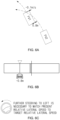
- FIGS. 4A, 4B and 4C are views illustrating that the steering of the preceding vehicle is displayed when the preceding vehicle is followed on a linear line, according to a first form of the present disclosure.
- the target time of alignment is two seconds when the present relative lateral speed is 0.1 m/s (the FV1 is slightly moving to the left) and the present relative lateral distance is -0.2 m (the FV1 is slightly away to the right from the central line of the FV2, which is a host vehicle), based on the FV2.
- the target relative lateral speed is calculated through -1*(-0.2)/2 to become 0.1.
- the steering information displaying apparatus 100 may determine a present state as a safe state as illustrated in FIG. 4B because the FV1 is moving to the left although the FV1 is at the right, and the present relative lateral speed is equal to the target relative lateral speed. Accordingly, the steering information displaying apparatus 100 may display the present relative lateral speed region in green on the bar graph and may display a screen for guiding the present steering to be maintained as illustrated in FIG. 4C .
- FIGS. 5A, 5B and 5C are views illustrating that the steering of the preceding vehicle is displayed when the preceding vehicle enters a left curved road, according to the first form of the present disclosure.
- the FV1 enters the left curved road, the FV2 is maintained straight, so the present relative lateral distance and the present relative lateral speed start to be coordinated between the FV1 and the FV2.
- the target relative lateral speed become -0.2 through -1 * (0.4)/2.
- the FV1 is to the left from the central line of the FV2.
- the steering information displaying apparatus 100 may determine a present situation as a slightly dangerous situation, when the target relative lateral speed and the present relative lateral speed are positioned in opposition to each other based on the reference point on the bar graph and when the difference between the target relative lateral speed and the present relative lateral speed is greater than the first reference value and less than the second reference value as in FIG. 5B . Accordingly, the steering information displaying apparatus 100 may display the present relative lateral speed in yellow on the bar graph.
- the steering information displaying apparatus 100 requires the steering control to the left to match the present relative lateral speed to the target relative lateral speed as in FIG. 5C , and a driver recognizing the screens as in FIGS. 5B and 5C may perform the steering control as in FIG. 5C .
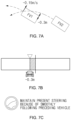
- FIGS. 6A, 6B and 6C are views illustrating that the steering of the preceding vehicle is displayed when the present relative lateral distance is further increased while the following vehicle is steering to the left to follow the preceding vehicle, according to the first form of the present disclosure.
- the FV1 starts to move to the right with the present relative lateral speed of -0.1 m/s
- the target time of alignment is two seconds
- the target relative lateral speed becomes '-0.4' through - 1*(0.8)/2.
- the steering information displaying apparatus 100 may determine the present state as the safe state to display the present relative lateral speed region in green on the bar graph as in FIG. 6B .
- the steering information displaying apparatus 100 may display that the steering to the left is desired such that the present relative lateral speed is followed the target relative lateral speed as in FIG. 6B .
- FIGS. 7A, 7B and 7C are views illustrating an example of displaying the steering of the preceding vehicle when the difference in present relative lateral distance between the following vehicle and the preceding vehicle is made even though the present relative lateral speed becomes equal to the target relative lateral speed as the following vehicle continuously performs the steering to the left to follow the preceding vehicle, according to the first form of the present disclosure.
- the present relative lateral distance fails to converge to zero even though the present relative lateral speed becomes equal to the target relative lateral speed as the following vehicle continuously performs the steering to the left under the situation of FIG. 6C .
- the target relative lateral speed becomes -0.15 through -1*(0.3)/2, when the FV1 is moving to the right from the FV2 with the present relative lateral speed of - 0.15 m/s, when the FV1 is slightly away to the left from the FV2 with the present relative lateral distance of 0.3 m, and when the target time of alignment is two seconds.
- the steering information displaying apparatus 100 determines a present state as a safe state to display the present relative lateral speed region in green on the bar graph because the target relative lateral speed is equal to the present relative lateral speed as in FIG. 7B .
- the steering information displaying apparatus 100 may display a screen for performing guidance such that the present steering is maintained as in FIG. 7C because the FV1 is moving to the right although the FV1 is to the left from the FV2, and the present relative lateral speed is equal to the target relative lateral speed.
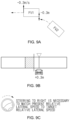
- FIGS. 8A, 8B and 8C are views illustrating that the steering of the preceding vehicle is displayed when the preceding vehicle is followed on a curved road, according to the first form of the present disclosure.
- the FV2 continuously follows the FV1 by continuously performing steering control at the target relative lateral speed on the curved road.
- the target relative lateral speed becomes 0 through -1*(0)/2, because the FV1 has a lateral sped of 0 m/s, which is equal to that of the FV2, is aligned with the FV2 in line with the relative lateral distance of 0 m, and the target time of alignment is two seconds.
- the bar graph is shown as in FIG. 8B .
- a screen for performing guidance to maintain present steering may be displayed as in FIG. 8C .
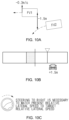
- FIGS. 9A, 9B and 9C are views illustrating that the steering of the preceding vehicle is displayed when the preceding vehicle enters to a linear road from a curved road, so the present relative lateral distance and the desired speed start to be coordinated, according to the first form of the present disclosure.
- steering information is displayed when the preceding vehicle enters a linear section, so the present relative lateral distance and the present relative lateral speed start to be coordinated.
- the target relative lateral speed becomes 0.15 through -1*(-0.3)/2, when the FV1 is moving to the right from the FV2 at the present relative lateral speed of - 0.3 m/s, when the FV1 is slightly away to the right from the FV2 with the present relative lateral distance of - 0.3m, and when the target time of alignment is two seconds.
- the steering information displaying apparatus 100 may determine the present situation as the slightly dangerous situation, when the present relative lateral speed is positioned in opposition to the target relative lateral speed on a bar graph, and when the difference between the target relative lateral speed and the present relative lateral speed is greater than the first reference value, which is preset, and less than the second reference value, the steering information displaying apparatus 100 may display a present relative lateral speed region in yellow on the bar graph as in FIG. 9B .
- the steering information displaying apparatus 100 may display a screen for performing guidance of steering control to the right as in FIG. 9C because the FV1 becomes away to the right from the FV2 while moving to the right, so the steering control to the right is desired.
- FIGS. 10A, 10B and 10C are views illustrating that the steering of the preceding vehicle is displayed, when the relative lateral speed and the present relative lateral distance are rapidly increased by maintaining a present steering state as a driver fails to recognize that the steering control to the right is desired, even though the steering control to the right is desired.
- the target relative lateral speed becomes 0.5 through -1*(-1.5)/3, when the FV1 is moving to the right from the FV2 at the present relative lateral speed of - 0.3 m/s, when the FV1 is slightly away to the right from the FV2 with the present relative lateral distance of - 1.5 m, and when the target time of alignment is three seconds.
- the steering information displaying apparatus 100 may limit the target relative lateral speed for saving and increase the target time of alignment.
- the steering information displaying apparatus 100 may determine a present situation as a dangerous state and may display the present relative lateral speed region in red on the bar graph because the difference between the present relative lateral speed and the target relative lateral speed is greater than the second reference value which is preset.
- the steering information displaying apparatus 100 may determine that the steering control to the right is desired and display a screen for performing guidance of steering control to the right as in FIG. 10C because the FV1 is to the right from the FV2 with a specific distance or more while continuously moving to the right.
- FIGS. 11A, 11B and 11C are views illustrating that the steering of the preceding vehicle is displayed when the following vehicle recognizes a dangerous situation and rapidly performs the steering control to the right, according to one form of the present disclosure.
- the target relative lateral speed becomes 0.5 through -1*(-1)/2, when the FV1 is moving to the left from the FV2 at the present relative lateral speed of 0.1 m/s, when the FV1 is slightly away to the right from the FV2 because the present relative lateral distance is - 1 m, and when the target time of alignment is two seconds.
- the steering information displaying apparatus 100 may determine the present situation as being continuously dangerous as the yaw rate of the host vehicle belongs to a dangerous range due to the rapid steering even though the difference between the target relative lateral speed and the present relative lateral speed is less than the second reference value, which is preset, and may display the present relative lateral speed region in red on the bar graph as in FIG. 11B .
- the FV1 is to the right from the FV2 and the present relative lateral speed does not reach the target relative lateral speed, so the steering to the right is desired. Accordingly, the steering information displaying apparatus 100 may display the screen for guidance of the steering control to the right as in FIG. 11C .
- FIGS. 12A and 12B are views illustrating the procedure of converting lane information measured by the preceding vehicle in the viewpoint of the following vehicle, according to a second form of the present disclosure
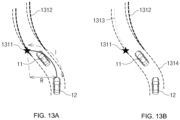
- FIGS. 13A and 13B are views illustrating that the steering information of the preceding vehicle is displayed based on the lane information measured by the preceding vehicle, according to the second form of the present disclosure.
- lane information 1211 is displayed in the viewpoint of the preceding vehicle 11
- FIG. 12B illustrates that lane information 1212 obtained through the conversion into the viewpoint of the following vehicle 12 is displayed.
- the steering information displaying apparatus 100 mounted in a following vehicle 12 receives lane information, which is measured by a preceding vehicle 11, from the preceding vehicle 11 and measures a heading angle of the preceding vehicle 11 and a heading angle of the following vehicle 12.
- the steering information displaying apparatus 100 mounted in the following vehicle 12 converts the lane information of the preceding vehicle into lane information viewed in the viewpoint of the following vehicle by rotating the lane information, which is measured by the preceding vehicle, by the difference between the heading angle of the preceding vehicle and the heading angle of the following vehicle, and by moving the lane information, which is measured by the preceding vehicle, by the distance in a longitudinal/lateral direction between the origin point of the preceding vehicle and the origin point of the following vehicle.
- FIG. 13A illustrates the calculation of a lane departure predicted time point and a lane departure position
- FIG. 13B illustrates that a lane departure warning is displayed.
- the steering information displaying apparatus 100 of the following vehicle may calculate a lane departure predicted time point, based on the viewpoint-converted lane information, which is measured by the preceding vehicle, of the following vehicle, the predicted driving route of the host vehicle, and the speed of the host vehicle, may compare the calculated lane departure predicted time point with a preset threshold value, and may display the lane departure warning when the calculated lane departure predicted time point is equal to or less than the preset threshold value.
- the steering information displaying apparatus 100 may determine, as the lane departure time point, a point, which has the longest longitudinal distance of 'y' from the host vehicle, among coordinates of lanes smaller than 'R' in the distance to the central point (-R, 0) of the route of the host vehicle, and the time point (time to cross) that lane departure is predicted may be calculated using the speed of the host vehicle and the distance to the point that the lane is departed.
- the steering information displaying apparatus 100 of the following vehicle 12 may display viewpoint-converted lane information 1312, which is measured by the preceding vehicle, of the following vehicle, lane information 1314 measured by the following vehicle, a position, which is measured by the following vehicle, of the preceding vehicle 11, a position for a lane departure warning 1311, and lane information 1313 in the lane departure.
- the lane departure position may be displayed in a specific shape (e.g., a bomb shape or a star shape) and the lane departure position and the lane information 1313 after the lane departure position may be displayed in colors different coordinate colors of the measured lane information 1314 and the viewpoint-converted lane information 1312.
- FIG. 14 is a view illustrating that precise map based steering information of the preceding vehicle, according to a third form of the present disclosure.
- the steering information displaying apparatus 100 of the following vehicle 12 extracts lane information 1411 based on a precise map provided in the following vehicle 12, displays the position, which is measured by the following vehicle 12, of the preceding vehicle 11 on the lane information 1411, and calculates the lane departure predicted time point by using the predicted driving route and speed of the host vehicle. Accordingly, the steering information displaying apparatus 100 may compare the calculated departure predicted time point with the threshold value, which is preset, and may display a warning of the lane departure position 1412 when the calculated lane departure predicted time point is equal to or less than the threshold value.
- FIGS. 15A, 15B, 15C and 15D are views illustrating that the steering information of the preceding vehicle is displayed based on steering angle information received from the preceding vehicle, according to a fourth form of the present disclosure.
- the steering information displaying apparatus 100 of the following vehicle 12 may receive the steering angle information and the lane departure warning information of the preceding vehicle 11 and the lane information, which is measured by the preceding vehicle 11, from the preceding vehicle 11 through V2V communication.
- the steering information displaying apparatus 100 of the following vehicle 12 may display the steering angle information of the preceding vehicle together with lane information 1511 measured by the following vehicle 12.
- the steering angle information of the preceding vehicle may be displayed in a steering wheel form 1512, and may be displayed by changing the direction of the steering wheel form 1512 based on the direction of the steering angle.
- the steering information displaying apparatus 100 of the following vehicle 12 may display a lane departure warning 1513 by differently displaying the color, the thickness, or the shape of a lane, which is predicted to be departed, of the lane information 1511 measured by the following vehicle 12.
- the steering information displaying apparatus 100 of the following vehicle 12 may display even the curvature of the front lane covered by the preceding vehicle using the lane information 1514 measured by the preceding vehicle 11.
- the steering information displaying apparatus 100 of the following vehicle 12 may display the lane departure warning 1515 by differently displaying the color, the thickness, or the shape of a lane which is predicted to be departed.
- FIG. 16 is a flowchart illustrating the method for displaying the steering information of the preceding vehicle, wherein said method does not form part of the claims but is provided to enhance the understanding of the invention) .
- the steering information displaying apparatus 100 of FIG. 1 performs a process of FIG. 16 . Especially, it is assumed that the steering information displaying apparatus 100 mounted in the following vehicle performs the process. In addition, in the following description made with reference to FIG. 16 , it may be understood that the operation described as being performed by the steering information displaying apparatus 100 is controlled by the processor 140 of the steering information displaying apparatus 100.
- the steering information displaying apparatus 100 may determine whether a preceding vehicle is present during platooning (S101), and may display a bar graph in a default state that a target relative lateral speed is zero, when the preceding vehicle is absent (S108).
- the steering information displaying apparatus 100 calculates the target relative lateral speed using the target time of alignment and the present relative lateral distance when the preceding vehicle is present (S102).
- the target time of alignment may be determined depending on the present speed, the yaw rate, the lateral relative distance, or the lane departure predicted time, and the present relative lateral distance may be obtained from a sensing result value of a sensing device 200.
- the steering information displaying apparatus 100 determines the degree of a dangerous situation based on the target relative lateral speed, the present relative lateral speed, the yaw rate of the host vehicle, the present relative lateral distance, or the lane departure time.
- the following description will be made by subdividing the dangerous situation into a first level (caution) and a second level (severe), and the present disclosure is not limited thereto.
- the dangerous situation may be sub-divided into three levels and defined.
- the first reference value and the second reference value, which is greater than the first reference value, for determining the dangerous situation may be previously calculated based on experimental values.
- the steering information displaying apparatus 100 may determine whether the dangerous situation is severe in the second level (S103). When the dangerous situation is determined as being server in the second level, the steering information displaying apparatus 100 may display the target relative lateral speed and the present relative lateral speed on the bar graph and may display the present relative lateral speed region in the first color (red) (S104). In this case, the steering information displaying apparatus 100 may determine the dangerous situation as being in the second level when the target relative lateral speed, the present relative lateral speed, the yaw rate of the host vehicle, the present relative lateral distance, the lane departure time, or the difference between the target relative lateral speed and the present relative lateral speed exceeds the second reference values, respectively.
- the steering information displaying apparatus 100 determines whether the dangerous situation is in the first level (caution) (S105).
- the steering information displaying apparatus 100 may display the target relative lateral speed and the present relative lateral speed on the bar graph, and may display the present relative lateral speed region in the second color (yellow) (S106).
- the steering information displaying apparatus 100 may determine the dangerous situation as being in the first level when the target relative lateral speed, the present relative lateral speed, the yaw rate of the host vehicle, the present relative lateral distance, the lane departure time, or the difference between the target relative lateral speed and the present relative lateral speed exceeds the first reference values, which are preset, respectively.
- the steering information displaying apparatus 100 may display the target relative lateral speed and the present relative lateral speed on the bar graph and may display the present relative lateral speed region in the third color (green) (S107).
- the steering information displaying apparatus 100 may help the driver of the following vehicle to easily perform safe steering control and intuitively recognize the dangerous situation, even if the visual field is limited due to the preceding vehicle travelling with a narrow inter-vehicle distance, thereby improving the safety in platooning.
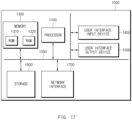
- FIG. 17 illustrates a computing system, wherein said computing system does not form part of the claims but is provided to enhance the understanding of the present invention.
- a computing system 1000 may include at least one processor 1100, a memory 1300, a user interface input device 1400, a user interface output device 1500, a storage 1600, and a network interface 1700, which are connected with each other via a bus 1200.
- the processor 1100 may be a central processing unit (CPU) or a semiconductor device for processing instructions stored in the memory 1300 or the storage 1600.
- CPU central processing unit
- Each of the memory 1300 and the storage 1600 may include various types of volatile or non-volatile storage media.
- the memory 1300 may include a read only memory (ROM) and a random access memory (RAM).
- the operations of the methods or algorithms described in connection with the forms disclosed in the present disclosure may be directly implemented with a hardware module, a software module, or the combinations thereof, executed by the processor 1100.
- the software module may reside on a storage medium (i.e., the memory 1300 or the storage 1600), such as a RAM, a flash memory, a ROM, an erasable and programmable ROM (EPROM), an electrically EPROM (EEPROM), a register, a hard disc, a removable disc, or a compact disc-ROM (CD-ROM).
- the exemplary storage medium may be coupled to the processor 1100.
- the processor 1100 may read out information from the storage medium and may write information in the storage medium.
- the storage medium may be integrated with the processor 1100.
- the processor and storage medium may reside in an application specific integrated circuit (ASIC) .
- the ASIC may reside in a user terminal.
- the processor and the storage medium may reside as separate components of the terminal of the user.
- the steering information of the preceding vehicle is provided to the driver of the following vehicle in platooning, so the problem that the preceding vehicle obstructs the visual field of the driver of the following vehicle may be resolved.
- displaying, the target relative lateral speed and the present relative lateral speed calculated based on the present relative lateral distance to the preceding vehicle are displayed to the driver of the following vehicle to control platooning to be safe.
- the information on the lane, which is covered by the preceding vehicle is generated based on the lane information measured by the preceding vehicle, and the generated information of the lane is displayed to the driver of the following vehicle
- the lane information is obtained from the precise map and displayed to the driver of the following vehicle, thereby controlling the platooning to be safe.
- the information on the steering angle and the lane departure warning of the preceding vehicle, which is received from the preceding vehicle, is displayed to the driver of the following vehicle, thereby controlling the platooning to be safe.
Landscapes
- Engineering & Computer Science (AREA)
- Mechanical Engineering (AREA)
- Transportation (AREA)
- Combustion & Propulsion (AREA)
- Chemical & Material Sciences (AREA)
- Automation & Control Theory (AREA)
- Physics & Mathematics (AREA)
- General Physics & Mathematics (AREA)
- Mathematical Physics (AREA)
- Human Computer Interaction (AREA)
- Business, Economics & Management (AREA)
- Emergency Management (AREA)
- Traffic Control Systems (AREA)
- Aviation & Aerospace Engineering (AREA)
- Radar, Positioning & Navigation (AREA)
- Remote Sensing (AREA)
Description
- This application claims priority to and the benefit of
Korean Patent Application No. 10-2019-0149938, filed on November 20, 2019 - The present disclosure relates to an apparatus for displaying steering information, and more particularly to a technology of displaying steering status of a platooning vehicle.
- The statements in this section merely provide background information related to the present disclosure and may not constitute prior art.
-
JP 2012 076639 A
Besides,US 2017/361762 A1 discloses a system and method including a light source projector with a positional actuator mounted on a subject vehicle that projects a laser line on a roadway upon which the subject vehicle is traveling; and a controller that is in communication with a platoon vehicle traveling in front of or behind the subject vehicle in a platoon and controls the positional actuator to project the laser line on the roadway between the subject vehicle and the at least one platoon vehicle.
Platooning is a technology that enables a plurality of vehicles to autonomously drive while the vehicles are aligned with each other and spaced apart from each other by a specified distance. During platooning, a leading platoon vehicle, which is positioned at the front most of a platoon, may control at least one following platoon vehicle which follows the leading platoon vehicle. The leading platoon vehicle may control a plurality of platoon vehicles to maintain a predetermined distance between the plurality of platoon vehicles included in the platoon and may exchange the behavior information of the plurality of platoon vehicles and also driving situation information thereof through inter-vehicle communication. - A longitudinal distance between the platoon vehicles included in the platooning group may be controlled to maintain a specific distance during platoon driving based on information from a vehicle sensor and a steering device. However, we have discovered that a driver of the platoon vehicle controls the steering of the vehicle for safety reason.
- We have also found that when the inter-vehicle distance (i.e., a distance between a leading platoon vehicle and a following platoon vehicle) is short and the height of the leading platoon vehicle (e.g., a truck) is high enough to interrupt the visual field of a driver of the following platoon vehicle, the driver of the following platoon vehicle has to perform steering control of the vehicle while seeing only the back of the leading platoon vehicle, without having a clear front view of the driving road. Accordingly, the driver of the following platoon vehicle has a heavy burden in performing the steering control.
- The present disclosure has been made to solve the above-mentioned problems occurring in the prior art while advantages achieved by the prior art are maintained intact.
- An aspect of the present disclosure provides a steering information displaying apparatus, capable of controlling platooning to be safe by resolving a problem that among a plurality of platooning vehicles, a preceding vehicle obstructs a visual field of a driver of a following vehicle, by exchanging steering information of the preceding vehicle and displaying the steering information to the driver of the following vehicle in platooning.
- Another aspect of the present disclosure provides a steering information displaying apparatus, capable of displaying, to a driver of a following vehicle (e.g., a host vehicle), a target relative lateral speed and a present relative lateral speed calculated based on a present relative lateral distance to a preceding vehicle.
- Another aspect of the present disclosure provides a steering information displaying apparatus, capable of coordinating information on a lane, which is covered by a preceding vehicle, based on lane information measured by the preceding vehicle, and displaying the coordinated information of the lane to a driver of a following vehicle.
- Still another aspect of the present disclosure provides a steering information displaying apparatus, capable of obtaining lane information from a precise map and displaying the lane information to a driver of a following vehicle.
- Still yet another aspect of the present disclosure provides a steering information displaying apparatus, capable of displaying, to a driver of a following vehicle, information on a steering angle and a lane departure warning of a preceding vehicle, which is received from the preceding vehicle.
- The technical problems to be solved by the present inventive concept are not limited to the aforementioned problems, and any other technical problems not mentioned herein will be clearly understood from the following description by those skilled in the art to which the present disclosure pertains.
- To this end the present invention provides an apparatus for displaying steering information of a vehicle, including: a processor of a host vehicle that receives the steering information of a preceding vehicle among a plurality of platooning vehicles including the host vehicle; and a display controlled by the processor to display the steering information of the preceding vehicle.
- The processor calculates a target relative lateral speed of the host vehicle with respect to the preceding vehicle using a present relative lateral distance to the preceding vehicle from the host vehicle, displays, on the display, the target relative lateral speed and a present relative lateral speed of the host vehicle relative to the preceding vehicle, determines a dangerous situation resulting from steering control, and displays the determined dangerous situation on the display.
- According to some forms, the processor may determine a degree of the determined dangerous situation based on at least one of the target relative lateral speed, a yaw rate of a host vehicle, the present relative lateral speed, the present relative lateral distance, or a lane departure time of the host vehicle.
- According to some forms, the processor may display, on the display, a bar graph with a reference point that defines a right side representing a plus direction at the right of the reference point on the bar graph and a left side representing a minus direction at the left of the reference point on the bar graph, and the processor may display the target relative lateral speed and the present relative lateral speed on the bar graph.
- According to some forms, the processor may mark, on the bar graph, the target relative lateral speed with a triangular mark and a solid line, and the present relative lateral speed with a bar (e.g., a vertical solid line).
- According to some forms, the processor may display, on the display, a target relative lateral speed region, which is defined as a specific range of the target relative lateral speed, marked on the bar graph.
- According to some forms, the processor may determine a size of the target relative lateral speed region based on a difference between the target relative lateral speed and the present relative lateral speed.
- According to some forms, the processor may display, on the display, regions, which is to mark the present relative lateral speed, of the bar graph in colors distinguished depending on levels of the dangerous situation.
- According to some forms, the processor may display, on the display, the present relative lateral distance of the preceding vehicle together with the target relative lateral speed and the present relative lateral speed.
- According to some forms, the processor may display, on the display, a vehicle icon based on the present relative lateral distance of the preceding vehicle on the bar graph or display the present relative lateral distance in numerical value.
- According to some forms, the processor may display, on the display, information desired for the steering control depending on the target relative lateral speed, the present relative lateral speed to the preceding vehicle, and the dangerous situation determination result.
- According to some forms, the processor may calculate the target relative lateral speed using a target time of alignment determined depending on the present relative lateral distance and a driving situation.
- According to some forms, the processor may determine a present level as a first level having a lower dangerousness and display the bar graph in first color, when the target relative lateral speed is equal to the present relative lateral speed, and a relative lateral distance of the preceding vehicle is equal to or less than a preset reference value.
- According to some forms, the processor may determine the present level as a second level having dangerousness higher than the dangerousness of the first level and display the bar graph in second color different from the first color, when a difference between the target relative lateral speed and the present relative lateral speed is greater than the first reference value and equal to or less than a second reference value and when the target relative lateral speed and the present relative lateral speed are positioned in opposition to each other based on a reference point of a bar graph.
- According to some forms, the processor may determine the present level as a third level having dangerousness higher than the dangerousness of the second level and display the bar graph in third color different from the first and second colors, when the difference between the target relative lateral speed and the present relative lateral speed is greater than the second reference value.
- According to some forms, the processor may determine the present level as a third level having dangerousness higher than the dangerousness of the second level and display the bar graph in third color different from the first and second colors, when the difference between the target relative lateral speed and the present relative lateral speed is greater than the second reference value.
- According to some forms, the processor may display, on the display, information on a lane covered by the preceding vehicle using lane information measured by the preceding vehicle.
- According to some forms, the processor may provide a lane departure warning by converting the lane information, which is measured by the preceding vehicle into lane information viewed in a viewpoint of a host vehicle, and calculating a lane departure predicted time point using the converted lane information, which is viewed in the viewpoint of the host vehicle, a predicted driving route of the host vehicle, a speed of the host vehicle.
- According to some forms, the processor may display, on the display, at least one of the converted lane information which is viewed in the viewpoint of the host vehicle, the lane information measured by the host vehicle, a position, which is measured by the host vehicle, of the preceding vehicle, or the lane departure warning.
- According to some forms, the processor may display, on the display, precise map based lane information and a position of the preceding vehicle on the lane information, and perform a lane departure warning by calculating a lane departure predicted time point using a predicted driving route of a host vehicle and a speed of the host vehicle.
- According to some forms, the processor may display, on the display, steering angle information and lane departure information of the preceding vehicle, which are received from the preceding vehicle.
- According to some forms, the processor may display, on the display, information on a curvature of a front lane covered by the preceding vehicle using lane information, which is measured by the preceding vehicle, received from the preceding vehicle.
- According to another aspect of the present disclosure, which does not form part of the claims, a method for displaying steering information may include coordinating the steering information of a preceding vehicle in platooning of vehicles, and displaying the steering information of the preceding vehicle.
- According to some method forms which do not form part of the claims, the displaying of the steering information of the preceding vehicle may include performing a control operations to calculate a target relative lateral speed using a present relative lateral distance to the preceding vehicle, to display, on a display, the target relative lateral speed and a present relative lateral speed to the preceding vehicle, to determine a dangerous situation resulting from steering control, and to display a dangerous situation determination result.
- According to some method forms which do not form part of the claims, the displaying of the steering information of the preceding vehicle may include performing a control operation to display information on a lane covered by the preceding vehicle using lane information measured by the preceding vehicle.
- According to some method forms which do not form part of the claims, the displaying of the steering information of the preceding vehicle may include provide a lane departure warning by converting the lane information, which is measured by the preceding vehicle into lane information viewed in a viewpoint of a host vehicle, and calculating a lane departure predicted time point using the converted lane information, which is viewed in the viewpoint of the host vehicle, a predicted driving route of the host vehicle, a speed of the host vehicle.
- According to some method forms which do not form part of the claims, the displaying of the steering information of the preceding vehicle may include performing a control operation to display at least one of the converted lane information which is viewed in the viewpoint of the host vehicle, the lane information measured by the host vehicle, a position, which is measured by the host vehicle, of the preceding vehicle, or the lane departure warning.
- According to some method forms which do not form part of the claims, the displaying of the steering information of the preceding vehicle may include performing a control operation to display precise map based lane information and a position of the preceding vehicle on the lane information, and provide a lane departure warning by calculating a lane departure predicted time point using a predicted driving route of a host vehicle and a speed of the host vehicle.
- According to some method forms which do not form part of the claims, the displaying of the steering information of the preceding vehicle may include performing a control operation to display a curvature of a front lane covered by the preceding vehicle by using steering angle information and lane departure warning information of the preceding vehicle, and lane information measured by the preceding vehicle, which are received from the preceding vehicle.
- Further areas of applicability will become apparent from the description provided herein. It should be understood that the description and specific examples are intended for purposes of illustration only and are not intended to limit the scope of the present disclosure.
- In order that the disclosure may be well understood, there will now be described various forms thereof, given by way of example, reference being made to the accompanying drawings, in which:
-
FIG. 1 is a block diagram illustrating the configuration of a vehicle system including an apparatus for displaying steering information in platooning of vehicles in one form of the present disclosure; -
FIG. 2 is a view illustrating a method (which does not form part of the claims but is provided to enhance the understanding of the invention) for calculating a target relative lateral speed in a first form of the present disclosure; -
FIGS. 3A and 3B are views respectively illustrating a screen to display the steering information of a proceeding vehicle, according to the first form of the present disclosure; -
FIGS. 4A, 4B and 4C are views illustrating that the steering of the preceding vehicle is displayed when the preceding vehicle is followed on a linear road, according to the first form of the present disclosure; -
FIGS. 5A, 5B and 5C are views illustrating that the steering of the preceding vehicle is displayed when the preceding vehicle enters a left curved road, according to the first form of the present disclosure. -
FIGS. 6A, 6B and 6C are views illustrating that the steering of the preceding vehicle is displayed when the present relative lateral distance is further increased during steering to the left to follow the preceding vehicle, according to the first form of the present disclosure; -
FIGS. 7A, 7B and 7C are views illustrating that the steering of the preceding vehicle is displayed when the difference in present relative lateral distance between the following vehicle and the preceding vehicle is made even though the present relative lateral speed becomes equal to the target relative lateral speed as the following vehicle continuously perform the steering to the left to follow the preceding vehicle, according to one form of the present disclosure; -
FIGS. 8A, 8B and 8C are views illustrating that the steering of the preceding vehicle is displayed when the preceding vehicle is followed on a curved road, according to the first form of the present disclosure; -
FIGS. 9A, 9B and 9C are views illustrating that the steering of the preceding vehicle is displayed when the preceding vehicle enters to a linear road from a curved road, so the present relative lateral distance and the desired speed start to be coordinated, according to the first form of the present disclosure; -
FIGS. 10A, 10B and 10C are views illustrating that the steering of the preceding vehicle is displayed, when the relative lateral speed and the present relative lateral distance are rapidly increased by maintaining a present steering state as a driver fails to recognize that the steering control to the right is necessary, even though the steering control to the right is necessary, according to one form of the present disclosure; -
FIGS. 11A, 11B and 11C are views illustrating that the steering of the preceding vehicle is displayed when the following vehicle recognizes a dangerous situation and rapidly performs the steering control to the right, according to the first form of the present disclosure; -
FIGS. 12A and 12B are views illustrating the procedure of converting lane information, which is measured by the preceding vehicle, into lane information viewed in the viewpoint of the following vehicle, according to a second form of the present disclosure; -
FIGS. 13A and 13B are views illustrating that the steering information of the preceding vehicle is displayed based on the lane information measured by the preceding vehicle, according to the second form of the present disclosure; -
FIG. 14 is a view illustrating that precise map based steering information of a preceding vehicle, according to a third form of the present disclosure; -
FIGS. 15A, 15B, 15C and 15D are views illustrating steering information of a preceding vehicle based on steering angle information received from a preceding vehicle, according to a fourth form of the present disclosure; -
FIG. 16 is a flowchart illustrating a method (which does not form part of the claims but is provided to enhance the understanding of the invention) for displaying steering information of a preceding vehicle, according to one form of the present disclosure; and -
FIG. 17 is a view illustrating a computing system (which does not form part of the claims but is provided to enhance the understanding of the invention), according to one form of the present disclosure. - The drawings described herein are for illustration purposes only and are not intended to limit the scope of the present disclosure in any way.
- The following description is merely exemplary in nature and is not intended to limit the present disclosure, application, or uses. It should be understood that throughout the drawings, corresponding reference numerals indicate like or corresponding parts and features.
- Hereinafter, some forms of the present disclosure will be described in detail with reference to the exemplary drawings. In adding the reference numerals to the components of each drawing, it should be noted that the identical or equivalent component is designated by the identical numeral even when they are displayed on other drawings. Further, in describing the form of the present disclosure, a detailed description of well-known features or functions will be ruled out in order not to unnecessarily obscure the gist of the present disclosure.
- In describing the components of the form according to the present disclosure, terms such as first, second, "A", "B", (a), (b), and the like may be used. These terms are merely intended to distinguish one component from another component, and the terms do not limit the nature, sequence or order of the constituent components. In addition, unless otherwise defined, all terms used herein, including technical or scientific terms, have the same meanings as those generally understood by those skilled in the art to which the present disclosure pertains. Such terms as those defined in a generally used dictionary are to be interpreted as having meanings equal to the contextual meanings in the relevant field of art, and are not to be interpreted as having ideal or excessively formal meanings unless clearly defined in the present application.
- In platooning of vehicles, a leading vehicle (LV) and a following vehicle (FV) included in a platooning group may perform platooning on a road. The LV and the FV may travel while maintaining a specific distance therebetween. The LV or the FV may adjust the distance between the LV and the FV while during. The LV or the FV may increase or decrease the inter-vehicle distance depending on the manipulation of a driver.
- The present disclosure discloses a technology of determining, in advance, and displaying a steering control situation and a dangerous situation of a preceding vehicle so as to control steering in platooning of vehicles, thereby allowing a driver to recognize the steering control situation and the dangerous situation of the preceding vehicle and to perform steering control.
- Therefore, according to the present disclosure, the FV may include all FVs other than the LV. Hereinafter, the preceding vehicle and the following vehicle will be referred to as "FV1" and "FV2", respectively.
- Hereinafter, forms of the disclosure will be described in detail with reference to
FIGS. 1 to 17 . -
FIG. 1 is a block diagram illustrating the configuration of a vehicle system including an apparatus (steering information displaying apparatus) 100 for displaying steering information in platooning of vehicles, according to one form of the present disclosure. - The steering
information displaying apparatus 100 may be mounted in all vehicles in a platoon. Hereinafter, an example that the steeringinformation displaying apparatus 100 mounted in an FV2 in the platoon displays steering information of an FV1 (a front vehicle in immediately front of the FV2) will be described below according to the present disclosure. - The steering
information displaying apparatus 100 may coordinate steering information of the preceding vehicle and display the steering information of the preceding vehicle such that a driver recognize the steering information of the preceding vehicle, when a front lane is not viewed as the front lane is covered by the preceding vehicle in the platooning of the vehicle. In addition, the steeringinformation displaying apparatus 100 may determine a dangerous situation resulting from steering control and display the dangerous situation, thereby allowing the driver to prepare for the dangerous situation. - In this case, the steering information may include a present relative lateral speed to the preceding vehicle, a target relative lateral speed to the preceding vehicle, a dangerous situation, lane information obtained through viewpoint-converted using the lane information measured by the preceding vehicle, precise map based lane information, steering angle information of the preceding vehicle, and lane departure warning information.
- To this end, the steering
information displaying apparatus 100 may include acommunication part 110, astorage 120, adisplay 130, and aprocessor 140. - The
communication part 110 is a hardware device implemented with various electronic circuits to transmit and receive a signal through wireless or wired connection. According to the present disclosure, thecommunication part 110 may make in-vehicle communication through controller area network (CAN) communication or local interconnect network (LIN) communication, and Ethernet communication. Thecommunication part 110 may receive driving information (e.g., a speed or a yaw rate) when determining the dangerous situation through communication with devices inside a vehicle and provide the driving information to theprocessor 140. - The
storage 120 may store a sensing result of thesensing device 200 and information (e.g., a first reference value or a second reference value) for determining a dangerous degree by theprocessor 140. Thestorage 120 may be implemented with at least one storage medium of a memory in a flash memory type, a hard disk type, a micro type, the type of a card (e.g., a Security Digital (SD) card or an extreme digital card), a Random Access Memory (RAM), a Static RAM (SRAM), a Read Only Memory (ROM), a Programmable ROM (PROM), an Electrically Erasable and Programmable ROM (EEPROM), a magnetic RAM (MRAM), a magnetic disk-type memory, or an optical disk-type memory. - The
display 130 may be controlled by theprocessor 140 to display a target relative lateral speed, a present relative lateral speed, and a dangerous situation in the form of bar graphs varied depending on colors, and may display a screen for guidance of steering control. Thedisplay 130 may be implemented with a head up display (HUD), a cluster, an audio video navigation (AVN), a human machine interface (HMI), or a vehicle windshield display. In addition, thedisplay 130 may include at least one of a liquid crystal display (LCD), a thin film transistor-liquid crystal display (TFT LCD), a light emitting diode (LED), an organic light-emitting diode (OLED), an active matrix OLED (AMOLED), a flexible display, a bended display, or a third dimension (3D) display. Among them, some displays may be implemented with transparent displays configured in a transparent type or a translucence type such that the displays are viewed from the outside. In addition, thedisplay 130 is implemented with a touchscreen including a touch panel to be used as an input device in addition to an output device. - The
processor 140 may be electrically connected with thecommunication part 110, thestorage 120, thedisplay 130, and the like, may electrically control each component, may be an electric circuit. Accordingly, theprocessor 140 may perform various data processing and calculation, to be described below. - The
processor 140 may calculate the target relative lateral speed using the present relative lateral distance to the preceding vehicle, may determine a dangerous level based on the target relative lateral speed, the yaw rate, the present relative lateral speed, the present relative lateral distance, or the lane departure time, and may display, on thedisplay 130, the target relative lateral speed, the present relative lateral speed to the preceding vehicle, and the dangerous level in the form of a bar graph. In this case, a condition for determining a dangerous situation is not limited thereto, and theprocessor 140 may determine the dangerous situation using various conditions. In this case, theprocessor 140 may calculate a target relative lateral speed using a target time of alignment determined depending on the present relative lateral distance and the driving situation. - The
processor 140 may display, on the display, the target relative lateral speed and the present relative lateral speed on the bar graph representing a minus direction at the right of a reference point on the bar graph and representing a plus direction at the right direction of the reference point on the bar graph. In addition, theprocessor 140 may display the target relative lateral speed and the present relative lateral speed on the bar graph together with the present target relative lateral distance. Theprocessor 140 may display, on thedisplay 130, a vehicle icon based on the present relative lateral distance of the preceding vehicle on the bar graph or may display the present relative lateral distance in numerical value on thedisplay 130. - The
processor 140 may display, on thedisplay 130, the target relative lateral speed having a triangular mark and a solid line marked on the bar graph, and the present relative lateral speed in a bar type. - The
processor 140 may display a target relative lateral speed region, which is defined as the specific range of the target relative lateral speed, marked on the bar graph on thedisplay 130. In this case, theprocessor 140 may determine the size of the target relative lateral speed region based on the difference between the target relative lateral speed and the present relative lateral speed. In this case, the target relative lateral speed range may be varied depending on the driving condition. In other words, theprocessor 140 may widely display the target relative lateral speed region to allow a driver to intuitively recognize that a situation is relaxed when the difference between the target relative lateral speed and an actual lateral speed is small. To the contrary, when the difference between the target relative lateral speed and the actual lateral speed is great, theprocessor 140 may narrowly display the target relative lateral speed region to allow the driver to intuitively recognize that the situation is urgent. - The
processor 140 may display, on thedisplay 130, the regions, which is to mark the present relative lateral speed, of the bar graph in various colors or hatching manners distinguished depending on levels of the dangerous situation. - The
processor 140 may display, on thedisplay 130, information desired for the steering control depending on the target relative lateral speed, the present relative lateral speed to the preceding vehicle, and information desired for steering control resulting from the determination result of the dangerous situation. - The
processor 140 may determine a present level as a first level (safe level) having a lower dangerousness and may display the bar graph in first color on thedisplay 130, when the target relative lateral speed is equal to the present relative lateral speed, and the relative lateral distance of the preceding vehicle is equal to or less than a preset reference value. - The
processor 140 may determine the present level as a second level having dangerousness higher than the dangerousness of the first level and may display the bar graph in second color different from the first color on thedisplay 130, when the difference between the target relative lateral speed and the present relative lateral speed is greater than the first reference value and equal to or less than a second reference value, and when the target relative lateral speed and the present relative lateral speed are positioned in opposition to each other based on the reference point of the bar graph. - The
processor 140 may determine the present level as a third level dangerousness higher than the dangerousness of the second level and may display the bar graph in third color different from the first and second colors on thedisplay 130, when the difference between the target relative lateral speed and the present relative lateral speed is greater than the second reference value. - The
processor 140 may determine the present level as the third level in dangerous higher than the second level and may display the bar graph in third color different from the first and second colors on thedisplay 130, when the difference between the target relative lateral speed and the present relative lateral speed is greater than the first reference value and less than the second reference value. - In this case, the first reference value and the second reference value for determining the dangerous degree may be previously calculated based on experimental values. In addition, the first color, the second color, and the third color may be set to Green, Yellow, and Red, respectively, but the present disclosure is not limited thereto. In other words, the first color, the second color, and the third color may be set to different colors from the above colors if desired.
- The
processor 140 may display, on thedisplay 130, information on a lane covered by the preceding vehicle using lane information measured by the preceding vehicle. In other words, theprocessor 140 may perform a control operation such that the information on the lane covered by the preceding vehicle is displayed by converting the lane information measured by the preceding vehicle lane information which is viewed in the view point of the host vehicle. In this case, theprocessor 140 may provide a lane departure warning by calculating a lane departure predicted time point using the lane the converted information which is viewed in the viewpoint of the host vehicle, the predicted driving route of the host vehicle, and the speed of the host vehicle. Theprocessor 140 may display the positions of the preceding vehicle and the host vehicle on the front lane information obtained by converting the lane information, which is measured by the preceding vehicle, in the viewpoint and may display the lane departure time point. Accordingly, theprocessor 140 may display, on thedisplay 130, at least one of the converted lane information which is viewed in the viewpoint of the host vehicle, the lane information measured by the host vehicle, the position, which is measured by the host vehicle, of the preceding vehicle measured, or the lane departure warning. - The
processor 140 may display, on thedisplay 130, precise map based lane information and the position of the preceding vehicle on the lane information, and may perform the lane departure warning by calculating the lane departure predicted time point using the predicted driving route of the host vehicle and the speed of the host vehicle. Theprocessor 140 may obtain and display lane information from a precision map provided in the vehicle, may display front lane information and positions of the preceding vehicle and the host vehicle on the front lane information, and may display a lane departure point, and a lane departure time point. - The
processor 140 may display, on thedisplay 130, the steering angle information and lane departure information of the preceding vehicle, which are received from the preceding vehicle. - The
processor 140 may receive the steering angle information and the lane departure information of the preceding vehicle from the preceding vehicle through V2V communication. In addition, theprocessor 140 may display the curvature of the front lane covered by the preceding vehicle using the steering angle information of the preceding vehicle and the front lane information measured by the preceding vehicle. - The
sensing device 200 may sense a relative lateral distance to the preceding vehicle, a relative lateral speed to the preceding vehicle, a yaw rate of the host vehicle, or the lane departure time and may provide the relative lateral distance, the relative lateral speed, the yaw rate, and the lane departure time to the steeringinformation displaying apparatus 100. To this end, thesensing device 200 may include an ultrasonic sensor, a radar, a camera, a laser scanner or a corner radar, a LiDAR, an acceleration sensor, a yaw rate sensor, a torque measurement sensor or a wheel speed sensor, and a steering angle sensor. - A
communication device 300 may be configured to make communication with the outside and may make the wireless communication with vehicles in the platoon through V2V communication. To this end, thecommunication device 300 may include various communication units such as a mobile communication unit, a broadcast receiving unit such as a digital multimedia broadcasting (DMB) module or a digital video broadcasting-handheld (DVB-H) module, a short-range communication unit such as a ZigBee module or a near field communication (NFC) module, which is a Bluetooth module, and a Wi-Fi communication unit. -
FIG. 2 is a view illustrating a method (which does not form part of the claims but is provided to enhance the understanding of the invention) for calculating a target relative lateral speed, according to a first form of the present disclosure. - Referring to
FIG. 2 , when the FV2 exactly follows the FV1 in platooning, a present relative lateral distance and a relative lateral speed should be zero. In this case, to make the present relative lateral distance to be zero, the steeringinformation displaying apparatus 100 requires a target relative lateral speed which has the size proportional to the size of the present relative lateral distance and represents a direction opposite to the direction of the present relative lateral distance. The steeringinformation displaying apparatus 100 may calculate the target relative lateral speed using a target time of alignment taken to align the FV1 and the FV2 according toEquation 1.
- As in
Equation 1, the steeringinformation displaying apparatus 100 may calculate the target relative lateral speed by multiplying the present relative lateral distance by `-1', and dividing the result by the target time of alignment. - In this case, the target time of alignment may vary depending on the present speed, the yaw rate, the present relative lateral distance, or the lane departure predicted time.
- When the driver performs the steering control of the vehicle based on the calculated target relative lateral speed, the present relative lateral distance gradually decreases and converges to zero. When the present relative lateral distance becomes zero, the target relative lateral speed becomes zero. Accordingly, the present relative lateral speed becomes zero, so the FV2 may exactly follow the FV1.
-
FIGS. 3A and 3B are views respectively illustrating a screen to display the steering information of the preceding vehicle, according to the first form of the present disclosure. - Referring to
FIG. 3A , the steeringinformation displaying apparatus 100 may display a presentrelative lateral distance 312 of a vehicle, a target relativelateral speed 313, and a presentrelative lateral speed 314 on abar graph 311. - The steering
information displaying apparatus 100 may display the present relative lateral distance in a numeric value on thebar graph 311, may display avehicle icon 312 at a position of the bar graph corresponding to the present relative lateral distance, and may move the position of thevehicle icon 312 depending on the variation of the present relative lateral distance. In this case, a driver frequently recognizes a right vehicle as being in the plus (+) direction. Accordingly, the steeringinformation displaying apparatus 100 may display the host vehicle such that the right of the host vehicle represents the plus value of the present relative lateral distance on thebar graph 311. - The steering
information displaying apparatus 100 may display the target relativelateral speed 313 of the vehicle using a triangular mark and a solid line on thebar graph 311. In this case, since the target relative lateral speed is proportional to `-1' * (present relative lateral distance), the target relative lateral speed and thevehicle icon 312 may be positioned at the same positions. - The steering
information displaying apparatus 100 may display the presentrelative lateral speed 314 by adjusting the length of a bar on thebar graph 311. - In addition, the steering
information displaying apparatus 100 may apply a color or perform hatching with respect to a region, which is referred to as the present relativelateral speed region 315, from a reference point to a position of representing the presentrelative lateral speed 314. In this case, the steeringinformation displaying apparatus 100 may display the present relativelateral speed region 315 in red when determining that a present situation is severely dangerous. When the present situation is slightly dangerous, the steeringinformation displaying apparatus 100 may display the present relativelateral speed region 315 in yellow. When the present situation is normal, the steeringinformation displaying apparatus 100 may display the present relativelateral speed region 315 in green. - Referring to
FIG. 3B , the steeringinformation displaying apparatus 100 may display the presentrelative lateral distance 322 of the vehicle, the target relativelateral speed 323, and the presentrelative lateral speed 324 on thebar graph 321. - In other words, the steering
information displaying apparatus 100 may display a specific region of the target relative lateral speed as the target relativelateral speed region 323, and the specific range may be varied depending on the driving conditions. In this case, theprocessor 140 may widely display the target relative lateral speed region to allow a driver to intuitively recognize that a situation is relaxed when the difference between the target relative lateral speed and an actual lateral speed is small. To the contrary, when the difference between the target relative lateral speed and the actual lateral speed is great, theprocessor 140 may narrowly display the target relative lateral speed region to allow the driver to intuitively recognize that the situation is urgent. - The steering
information displaying apparatus 100 may determine the present situation as the dangerous situation, and may display the presentrelative lateral speed 325 in red when the difference between the target relative lateral speed and the present relative lateral speed is greater than a specific second reference value as the presentrelative lateral speed 324 is positioned in opposition to the target relativelateral speed region 323 on thebar graph 321. - Hereinafter, an example of displaying steering information of the preceding vehicle in platooning will be described with reference to
FIGS. 4 to 11 according to a first form of the present disclosure. -
FIGS. 4A, 4B and 4C are views illustrating that the steering of the preceding vehicle is displayed when the preceding vehicle is followed on a linear line, according to a first form of the present disclosure. - The following description will be made with reference to
FIG. 4A , regarding that the FV1 is slightly moving to the left when the FV2 follows the FV1 on the linear road. For example, it is assumed that the target time of alignment is two seconds when the present relative lateral speed is 0.1 m/s (the FV1 is slightly moving to the left) and the present relative lateral distance is -0.2 m (the FV1 is slightly away to the right from the central line of the FV2, which is a host vehicle), based on the FV2. The target relative lateral speed is calculated through -1*(-0.2)/2 to become 0.1. - In other words, the steering
information displaying apparatus 100 may determine a present state as a safe state as illustrated inFIG. 4B because the FV1 is moving to the left although the FV1 is at the right, and the present relative lateral speed is equal to the target relative lateral speed. Accordingly, the steeringinformation displaying apparatus 100 may display the present relative lateral speed region in green on the bar graph and may display a screen for guiding the present steering to be maintained as illustrated inFIG. 4C . -
FIGS. 5A, 5B and 5C are views illustrating that the steering of the preceding vehicle is displayed when the preceding vehicle enters a left curved road, according to the first form of the present disclosure. - Referring to
FIG. 5A , although the FV1 enters the left curved road, the FV2 is maintained straight, so the present relative lateral distance and the present relative lateral speed start to be coordinated between the FV1 and the FV2. - For example, when the preceding vehicle FV1 is moving to the left at the present relative lateral speed of 0.5 m/s, the FV1 is to the left with the present relative lateral distance of 0.4 m, and the target time of alignment is 2 seconds, the target relative lateral speed become -0.2 through -1 * (0.4)/2.
- In other words, the FV1 is to the left from the central line of the FV2. In this case, since the FV1 keeps moving to the left away from the central line of the FV2, the steering control to the left is desired. In addition, the steering
information displaying apparatus 100 may determine a present situation as a slightly dangerous situation, when the target relative lateral speed and the present relative lateral speed are positioned in opposition to each other based on the reference point on the bar graph and when the difference between the target relative lateral speed and the present relative lateral speed is greater than the first reference value and less than the second reference value as inFIG. 5B . Accordingly, the steeringinformation displaying apparatus 100 may display the present relative lateral speed in yellow on the bar graph. - In addition, the steering
information displaying apparatus 100 requires the steering control to the left to match the present relative lateral speed to the target relative lateral speed as inFIG. 5C , and a driver recognizing the screens as inFIGS. 5B and 5C may perform the steering control as inFIG. 5C . -
FIGS. 6A, 6B and 6C are views illustrating that the steering of the preceding vehicle is displayed when the present relative lateral distance is further increased while the following vehicle is steering to the left to follow the preceding vehicle, according to the first form of the present disclosure. - Referring to
FIG. 6A , when the present relative lateral distance is increased although the relative lateral speed between the FV1 and the FV2 is decreased as the FV2 performs steering to the left to follow the FV1, the steering control to the left is continuously desired. - For example, although the FV1 starts to move to the right with the present relative lateral speed of -0.1 m/s, when the FV1 is significantly away to the left from the FV2 with the present relative lateral distance of 0.8 m and the target time of alignment is two seconds, the target relative lateral speed becomes '-0.4' through - 1*(0.8)/2.
- As the difference between the target relative lateral speed and the present relative lateral speed is more decreased when compared to
FIG. 5 , the steeringinformation displaying apparatus 100 may determine the present state as the safe state to display the present relative lateral speed region in green on the bar graph as inFIG. 6B . In addition, since the target relative lateral speed is less than the present relative lateral speed, the steeringinformation displaying apparatus 100 may display that the steering to the left is desired such that the present relative lateral speed is followed the target relative lateral speed as inFIG. 6B . -
FIGS. 7A, 7B and 7C are views illustrating an example of displaying the steering of the preceding vehicle when the difference in present relative lateral distance between the following vehicle and the preceding vehicle is made even though the present relative lateral speed becomes equal to the target relative lateral speed as the following vehicle continuously performs the steering to the left to follow the preceding vehicle, according to the first form of the present disclosure. - Referring to
FIG. 7A , the present relative lateral distance fails to converge to zero even though the present relative lateral speed becomes equal to the target relative lateral speed as the following vehicle continuously performs the steering to the left under the situation ofFIG. 6C . - For example, the target relative lateral speed becomes -0.15 through -1*(0.3)/2, when the FV1 is moving to the right from the FV2 with the present relative lateral speed of - 0.15 m/s, when the FV1 is slightly away to the left from the FV2 with the present relative lateral distance of 0.3 m, and when the target time of alignment is two seconds.
- In other words, the steering
information displaying apparatus 100 determines a present state as a safe state to display the present relative lateral speed region in green on the bar graph because the target relative lateral speed is equal to the present relative lateral speed as inFIG. 7B . In addition, the steeringinformation displaying apparatus 100 may display a screen for performing guidance such that the present steering is maintained as inFIG. 7C because the FV1 is moving to the right although the FV1 is to the left from the FV2, and the present relative lateral speed is equal to the target relative lateral speed. -
FIGS. 8A, 8B and 8C are views illustrating that the steering of the preceding vehicle is displayed when the preceding vehicle is followed on a curved road, according to the first form of the present disclosure. - Referring to
FIG. 8A , the FV2 continuously follows the FV1 by continuously performing steering control at the target relative lateral speed on the curved road. - For example, the target relative lateral speed becomes 0 through -1*(0)/2, because the FV1 has a lateral sped of 0 m/s, which is equal to that of the FV2, is aligned with the FV2 in line with the relative lateral distance of 0 m, and the target time of alignment is two seconds.
- Since the present relative lateral speed and the present relative lateral distance are all zeros, the bar graph is shown as in
FIG. 8B . In addition, since the FV2 exactly follows the FV1, a screen for performing guidance to maintain present steering may be displayed as inFIG. 8C . -
FIGS. 9A, 9B and 9C are views illustrating that the steering of the preceding vehicle is displayed when the preceding vehicle enters to a linear road from a curved road, so the present relative lateral distance and the desired speed start to be coordinated, according to the first form of the present disclosure. - Referring to
FIGS. 9 A, 9B and 9C , steering information is displayed when the preceding vehicle enters a linear section, so the present relative lateral distance and the present relative lateral speed start to be coordinated. - For example, as in
FIG. 9A , the target relative lateral speed becomes 0.15 through -1*(-0.3)/2, when the FV1 is moving to the right from the FV2 at the present relative lateral speed of - 0.3 m/s, when the FV1 is slightly away to the right from the FV2 with the present relative lateral distance of - 0.3m, and when the target time of alignment is two seconds. - The steering
information displaying apparatus 100 may determine the present situation as the slightly dangerous situation, when the present relative lateral speed is positioned in opposition to the target relative lateral speed on a bar graph, and when the difference between the target relative lateral speed and the present relative lateral speed is greater than the first reference value, which is preset, and less than the second reference value, the steeringinformation displaying apparatus 100 may display a present relative lateral speed region in yellow on the bar graph as inFIG. 9B . - The steering
information displaying apparatus 100 may display a screen for performing guidance of steering control to the right as inFIG. 9C because the FV1 becomes away to the right from the FV2 while moving to the right, so the steering control to the right is desired. -
FIGS. 10A, 10B and 10C are views illustrating that the steering of the preceding vehicle is displayed, when the relative lateral speed and the present relative lateral distance are rapidly increased by maintaining a present steering state as a driver fails to recognize that the steering control to the right is desired, even though the steering control to the right is desired. - Referring to
FIG. 10A , the target relative lateral speed becomes 0.5 through -1*(-1.5)/3, when the FV1 is moving to the right from the FV2 at the present relative lateral speed of - 0.3 m/s, when the FV1 is slightly away to the right from the FV2 with the present relative lateral distance of - 1.5 m, and when the target time of alignment is three seconds. In this case, the steeringinformation displaying apparatus 100 may limit the target relative lateral speed for saving and increase the target time of alignment. - Referring to
FIG. 10B , the steeringinformation displaying apparatus 100 may determine a present situation as a dangerous state and may display the present relative lateral speed region in red on the bar graph because the difference between the present relative lateral speed and the target relative lateral speed is greater than the second reference value which is preset. - The steering
information displaying apparatus 100 may determine that the steering control to the right is desired and display a screen for performing guidance of steering control to the right as inFIG. 10C because the FV1 is to the right from the FV2 with a specific distance or more while continuously moving to the right. -
FIGS. 11A, 11B and 11C are views illustrating that the steering of the preceding vehicle is displayed when the following vehicle recognizes a dangerous situation and rapidly performs the steering control to the right, according to one form of the present disclosure. - Referring to
FIG. 11A , the target relative lateral speed becomes 0.5 through -1*(-1)/2, when the FV1 is moving to the left from the FV2 at the present relative lateral speed of 0.1 m/s, when the FV1 is slightly away to the right from the FV2 because the present relative lateral distance is - 1 m, and when the target time of alignment is two seconds. - The steering
information displaying apparatus 100 may determine the present situation as being continuously dangerous as the yaw rate of the host vehicle belongs to a dangerous range due to the rapid steering even though the difference between the target relative lateral speed and the present relative lateral speed is less than the second reference value, which is preset, and may display the present relative lateral speed region in red on the bar graph as inFIG. 11B . - The FV1 is to the right from the FV2 and the present relative lateral speed does not reach the target relative lateral speed, so the steering to the right is desired. Accordingly, the steering
information displaying apparatus 100 may display the screen for guidance of the steering control to the right as inFIG. 11C . -
FIGS. 12A and 12B are views illustrating the procedure of converting lane information measured by the preceding vehicle in the viewpoint of the following vehicle, according to a second form of the present disclosure, andFIGS. 13A and 13B are views illustrating that the steering information of the preceding vehicle is displayed based on the lane information measured by the preceding vehicle, according to the second form of the present disclosure. - Referring to
FIG. 12A ,lane information 1211 is displayed in the viewpoint of the precedingvehicle 11, andFIG. 12B illustrates thatlane information 1212 obtained through the conversion into the viewpoint of the followingvehicle 12 is displayed. - In this case, the steering
information displaying apparatus 100 mounted in a followingvehicle 12 receives lane information, which is measured by a precedingvehicle 11, from the precedingvehicle 11 and measures a heading angle of the precedingvehicle 11 and a heading angle of the followingvehicle 12. - Accordingly, the steering
information displaying apparatus 100 mounted in the followingvehicle 12 converts the lane information of the preceding vehicle into lane information viewed in the viewpoint of the following vehicle by rotating the lane information, which is measured by the preceding vehicle, by the difference between the heading angle of the preceding vehicle and the heading angle of the following vehicle, and by moving the lane information, which is measured by the preceding vehicle, by the distance in a longitudinal/lateral direction between the origin point of the preceding vehicle and the origin point of the following vehicle. -
FIG. 13A illustrates the calculation of a lane departure predicted time point and a lane departure position, andFIG. 13B illustrates that a lane departure warning is displayed. - The steering
information displaying apparatus 100 of the following vehicle may calculate a lane departure predicted time point, based on the viewpoint-converted lane information, which is measured by the preceding vehicle, of the following vehicle, the predicted driving route of the host vehicle, and the speed of the host vehicle, may compare the calculated lane departure predicted time point with a preset threshold value, and may display the lane departure warning when the calculated lane departure predicted time point is equal to or less than the preset threshold value. In this case, the steeringinformation displaying apparatus 100 may determine, as the lane departure time point, a point, which has the longest longitudinal distance of 'y' from the host vehicle, among coordinates of lanes smaller than 'R' in the distance to the central point (-R, 0) of the route of the host vehicle, and the time point (time to cross) that lane departure is predicted may be calculated using the speed of the host vehicle and the distance to the point that the lane is departed. - Therefore, as illustrated in
FIG. 13B , the steeringinformation displaying apparatus 100 of the followingvehicle 12 may display viewpoint-convertedlane information 1312, which is measured by the preceding vehicle, of the following vehicle,lane information 1314 measured by the following vehicle, a position, which is measured by the following vehicle, of the precedingvehicle 11, a position for alane departure warning 1311, andlane information 1313 in the lane departure. In this case, the lane departure position may be displayed in a specific shape (e.g., a bomb shape or a star shape) and the lane departure position and thelane information 1313 after the lane departure position may be displayed in colors different coordinate colors of the measuredlane information 1314 and the viewpoint-convertedlane information 1312. -
FIG. 14 is a view illustrating that precise map based steering information of the preceding vehicle, according to a third form of the present disclosure. - Referring to
FIG. 14 , the steeringinformation displaying apparatus 100 of the followingvehicle 12extracts lane information 1411 based on a precise map provided in the followingvehicle 12, displays the position, which is measured by the followingvehicle 12, of the precedingvehicle 11 on thelane information 1411, and calculates the lane departure predicted time point by using the predicted driving route and speed of the host vehicle. Accordingly, the steeringinformation displaying apparatus 100 may compare the calculated departure predicted time point with the threshold value, which is preset, and may display a warning of thelane departure position 1412 when the calculated lane departure predicted time point is equal to or less than the threshold value. -
FIGS. 15A, 15B, 15C and 15D are views illustrating that the steering information of the preceding vehicle is displayed based on steering angle information received from the preceding vehicle, according to a fourth form of the present disclosure. - Referring to
FIGS. 15A, 15B, 15C and 15D , the steeringinformation displaying apparatus 100 of the followingvehicle 12 may receive the steering angle information and the lane departure warning information of the precedingvehicle 11 and the lane information, which is measured by the precedingvehicle 11, from the precedingvehicle 11 through V2V communication. - Referring to
FIG. 15A , the steeringinformation displaying apparatus 100 of the followingvehicle 12 may display the steering angle information of the preceding vehicle together withlane information 1511 measured by the followingvehicle 12. In this case, the steering angle information of the preceding vehicle may be displayed in asteering wheel form 1512, and may be displayed by changing the direction of thesteering wheel form 1512 based on the direction of the steering angle. - Referring to
FIG. 15B , the steeringinformation displaying apparatus 100 of the followingvehicle 12 may display alane departure warning 1513 by differently displaying the color, the thickness, or the shape of a lane, which is predicted to be departed, of thelane information 1511 measured by the followingvehicle 12. - Referring to
FIG. 15C , the steeringinformation displaying apparatus 100 of the followingvehicle 12 may display even the curvature of the front lane covered by the preceding vehicle using thelane information 1514 measured by the precedingvehicle 11. - In addition, referring to
FIG. 15D , the steeringinformation displaying apparatus 100 of the followingvehicle 12 may display thelane departure warning 1515 by differently displaying the color, the thickness, or the shape of a lane which is predicted to be departed. - Hereinafter, a method for displaying steering information of the preceding vehicle according to one form of the present disclosure will be described in detail with reference to
FIG. 16. FIG. 16 is a flowchart illustrating the method for displaying the steering information of the preceding vehicle, wherein said method does not form part of the claims but is provided to enhance the understanding of the invention) . - Hereinafter, the steering
information displaying apparatus 100 ofFIG. 1 performs a process ofFIG. 16 . Especially, it is assumed that the steeringinformation displaying apparatus 100 mounted in the following vehicle performs the process. In addition, in the following description made with reference toFIG. 16 , it may be understood that the operation described as being performed by the steeringinformation displaying apparatus 100 is controlled by theprocessor 140 of the steeringinformation displaying apparatus 100. - Referring to
FIG. 16 , the steeringinformation displaying apparatus 100 may determine whether a preceding vehicle is present during platooning (S101), and may display a bar graph in a default state that a target relative lateral speed is zero, when the preceding vehicle is absent (S108). - Meanwhile, the steering
information displaying apparatus 100 calculates the target relative lateral speed using the target time of alignment and the present relative lateral distance when the preceding vehicle is present (S102). In this case, the target time of alignment may be determined depending on the present speed, the yaw rate, the lateral relative distance, or the lane departure predicted time, and the present relative lateral distance may be obtained from a sensing result value of asensing device 200. - The steering
information displaying apparatus 100 determines the degree of a dangerous situation based on the target relative lateral speed, the present relative lateral speed, the yaw rate of the host vehicle, the present relative lateral distance, or the lane departure time. In this case, the following description will be made by subdividing the dangerous situation into a first level (caution) and a second level (severe), and the present disclosure is not limited thereto. For example, the dangerous situation may be sub-divided into three levels and defined. In this case, the first reference value and the second reference value, which is greater than the first reference value, for determining the dangerous situation may be previously calculated based on experimental values. - The steering
information displaying apparatus 100 may determine whether the dangerous situation is severe in the second level (S103). When the dangerous situation is determined as being server in the second level, the steeringinformation displaying apparatus 100 may display the target relative lateral speed and the present relative lateral speed on the bar graph and may display the present relative lateral speed region in the first color (red) (S104). In this case, the steeringinformation displaying apparatus 100 may determine the dangerous situation as being in the second level when the target relative lateral speed, the present relative lateral speed, the yaw rate of the host vehicle, the present relative lateral distance, the lane departure time, or the difference between the target relative lateral speed and the present relative lateral speed exceeds the second reference values, respectively. - Meanwhile, when the dangerous situation is not in the second level, the steering
information displaying apparatus 100 determines whether the dangerous situation is in the first level (caution) (S105). When the dangerous situation is in the first step, the steeringinformation displaying apparatus 100 may display the target relative lateral speed and the present relative lateral speed on the bar graph, and may display the present relative lateral speed region in the second color (yellow) (S106). In this case, the steeringinformation displaying apparatus 100 may determine the dangerous situation as being in the first level when the target relative lateral speed, the present relative lateral speed, the yaw rate of the host vehicle, the present relative lateral distance, the lane departure time, or the difference between the target relative lateral speed and the present relative lateral speed exceeds the first reference values, which are preset, respectively. - In addition, when the dangerous situation is not in the first level, the steering
information displaying apparatus 100 may display the target relative lateral speed and the present relative lateral speed on the bar graph and may display the present relative lateral speed region in the third color (green) (S107). - As described above, according to the present disclosure, in platooning, when calculating the target relative lateral speed using the present relative lateral distance and the target time of alignment with respect to the preceding vehicle, and displaying and using the target relative lateral speed and the present relative lateral speed together, the steering
information displaying apparatus 100 may help the driver of the following vehicle to easily perform safe steering control and intuitively recognize the dangerous situation, even if the visual field is limited due to the preceding vehicle travelling with a narrow inter-vehicle distance, thereby improving the safety in platooning. -
FIG. 17 illustrates a computing system, wherein said computing system does not form part of the claims but is provided to enhance the understanding of the present invention. - Referring to
FIG. 17 , acomputing system 1000 may include at least oneprocessor 1100, amemory 1300, a userinterface input device 1400, a userinterface output device 1500, astorage 1600, and anetwork interface 1700, which are connected with each other via abus 1200. - The
processor 1100 may be a central processing unit (CPU) or a semiconductor device for processing instructions stored in thememory 1300 or thestorage 1600. Each of thememory 1300 and thestorage 1600 may include various types of volatile or non-volatile storage media. For example, thememory 1300 may include a read only memory (ROM) and a random access memory (RAM). - Thus, the operations of the methods or algorithms described in connection with the forms disclosed in the present disclosure may be directly implemented with a hardware module, a software module, or the combinations thereof, executed by the
processor 1100. The software module may reside on a storage medium (i.e., thememory 1300 or the storage 1600), such as a RAM, a flash memory, a ROM, an erasable and programmable ROM (EPROM), an electrically EPROM (EEPROM), a register, a hard disc, a removable disc, or a compact disc-ROM (CD-ROM). - The exemplary storage medium may be coupled to the
processor 1100. Theprocessor 1100 may read out information from the storage medium and may write information in the storage medium. Alternatively, the storage medium may be integrated with theprocessor 1100. The processor and storage medium may reside in an application specific integrated circuit (ASIC) . The ASIC may reside in a user terminal. Alternatively, the processor and the storage medium may reside as separate components of the terminal of the user. - As described above, according to the present disclosure, the steering information of the preceding vehicle is provided to the driver of the following vehicle in platooning, so the problem that the preceding vehicle obstructs the visual field of the driver of the following vehicle may be resolved.
- In addition, according to the present disclosure, displaying, the target relative lateral speed and the present relative lateral speed calculated based on the present relative lateral distance to the preceding vehicle are displayed to the driver of the following vehicle to control platooning to be safe.
- Further, according to the present disclosure, the information on the lane, which is covered by the preceding vehicle, is generated based on the lane information measured by the preceding vehicle, and the generated information of the lane is displayed to the driver of the following vehicle
- In addition, according to the present disclosure, the lane information is obtained from the precise map and displayed to the driver of the following vehicle, thereby controlling the platooning to be safe.
- Further, according to the present disclosure, the information on the steering angle and the lane departure warning of the preceding vehicle, which is received from the preceding vehicle, is displayed to the driver of the following vehicle, thereby controlling the platooning to be safe.
- Besides, a variety of effects directly or indirectly understood through the disclosure may be provided.
- Hereinabove, although the present disclosure has been described with reference to exemplary forms and the accompanying drawings, the present disclosure is not limited thereto, but may be variously modified and altered by those skilled in the art to which the present disclosure pertains without departing from the scope of the present disclosure claimed in the following claims.
Claims (14)
- An apparatus (100) for displaying steering information of a vehicle, the apparatus (100) comprising:a processor (140) of a host vehicle, where the processor (140) is configured to receive steering information of a preceding vehicle (FV1, 11) among a plurality of platooning vehicles including the host vehicle; anda display (130) controlled by the processor (140) and configured to display the received steering information of the preceding vehicle (FV1, 11),wherein the processor (140) is configured to:calculate a target relative lateral speed (313) of the host vehicle with respect to the preceding vehicle (FV1) based on a present relative lateral distance (312, 322) to the preceding vehicle (FV1) from the host vehicle; anddisplay, on the display (130), the target relative lateral speed (313) and a present relative lateral speed (314, 324) of the host vehicle relative to the preceding vehicle (FV1); anddetermine a dangerous situation resulting from a steering control; anddisplay the determined dangerous situation on the display (130).
- The apparatus (100) of claim 1, wherein the processor (140) is configured to:
determine a degree of the determined dangerous situation based on at least one of the target relative lateral speed (313), a yaw rate of the host vehicle, the present relative lateral speed (314, 324), the present relative lateral distance (312, 322), or a lane departure time of the host vehicle. - The apparatus (100) of claim 1, wherein the processor (140) is configured to:display, on the display (130), a bar graph (311, 321) with a reference point defining a right side representing a plus direction and a left side representing a minus direction, anddisplay the target relative lateral speed (313) and the present relative lateral speed (314, 324) on the bar graph (311, 321).
- The apparatus (100) of claim 3, wherein the processor (140) is configured to:
mark, on the bar graph (311, 321), the target relative lateral speed (313) with a triangular mark and a solid line, and the present relative lateral speed (314, 324) with a bar. - The apparatus (100) of claim 3, wherein the processor (140) is configured to:display, on the bar graph (321), a target relative lateral speed region (323),wherein the processor (140) is configured to:
determine a size of the target relative lateral speed region (323) based on a difference between the target relative lateral speed (313) and the present relative lateral speed (324). - The apparatus (100) of claim 3, wherein the processor (140) is configured to:
mark, on the bar graph (311, 321), a plurality of regions with different colors representing different levels of the determined dangerous situation. - The apparatus (100) of claim 1, wherein the processor (140) is configured to:display, on the display (130), the present relative lateral distance (312, 322) of the preceding vehicle (FV1),wherein the processor (140) is configured to:
display, on the display (130), a vehicle icon (312) based on the present relative lateral distance (312, 322) of the preceding vehicle (FV1) on a bar graph (311, 321), or display the present relative lateral distance (312, 322) in numerical value. - The apparatus (100) of claim 1, wherein the processor (140) is configured to:
display, on the display (130), information desired for a steering control of the host vehicle based on the target relative lateral speed (313), the present relative lateral speed (314, 324), and the determined dangerous situation. - The apparatus (100) of claim 1, wherein the processor (140) is configured to:calculate the target relative lateral speed (313) using a target time of alignment determined based on the present relative lateral distance (312) and a driving situation,wherein the processor (140) is configured to:when the target relative lateral speed (313) is equal to the present relative lateral speed (314, 324), and the present relative lateral distance (312, 322) of the preceding vehicle (FV1) is equal to or less than a preset reference value, determine a present level as a first level having a lower dangerousness and display a bar graph (311, 321) in a first color,wherein the processor (140) is configured to:
determine the present level as a second level having dangerousness higher than the dangerousness of the first level and display the bar graph (321) in second color different from the first color, when a difference between the target relative lateral speed and the present relative lateral speed (324) is greater than a first reference value and equal to or less than a second reference value and when the target relative lateral speed and the present relative lateral speed (324) are positioned in opposition to each other based on a reference point of a bar graph (321), - The apparatus (100) of claim 9, wherein the processor (140) is configured to:
determine the present level as a third level having dangerousness higher than the dangerousness of the second level and display the bar graph (311, 321) in third color different from the first and second colors, when the difference between the target relative lateral speed (313) and the present relative lateral speed (314, 324) is greater than the second reference value. - The apparatus (100) of claim 9, wherein the processor (140) is configured to:
determine the present level as a third level having dangerousness higher than the dangerousness of the second level and display the bar graph (311, 321) in third color different from the first and second colors, when the difference between the target relative lateral speed (313) and the present relative lateral speed (314, 324) is greater than the second reference value. - The apparatus (100) of claim 1, wherein the processor (140) is configured to:display, on the display (130), information on a lane covered by the preceding vehicle (11) using lane information measured by the preceding vehicle (11),wherein the processor (140) is configured to:provide a lane departure warning (1311) by converting the lane information (1313), which is measured by the preceding vehicle (11) into lane information viewed in a viewpoint of a host vehicle, and calculating a lane departure predicted time point using the converted lane information, which is viewed in the viewpoint of the host vehicle, a predicted driving route of the host vehicle, a speed of the host vehicle,wherein the processor (140) is configured to:
display, on the display (130), at least one of the converted lane information which is viewed in the viewpoint of the host vehicle, the lane information measured by the host vehicle, a position, which is measured by the host vehicle, of the preceding vehicle (11), or the lane departure warning (1311). - The apparatus (100) of claim 1, wherein the processor (140) is configured to:display, on the display (130), precise map based lane information (1411) and a position of the preceding vehicle (11) on the precise map based lane information (1411); andprovide a lane departure warning (1311) by calculating a lane departure predicted time point using a predicted driving route of a host vehicle and a speed of the host vehicle.
- The apparatus (100) of claim 1, wherein the processor (140) is configured to:display, on the display (130), steering angle information and lane departure information of the preceding vehicle (11), which are received from the preceding vehicle (11),wherein the processor (140) is configured to:
display, on the display (130), information on a curvature of a front lane covered by the preceding vehicle (11) using lane information, which is measured by the preceding vehicle, received from the preceding vehicle (11).
Applications Claiming Priority (1)
| Application Number | Priority Date | Filing Date | Title |
|---|---|---|---|
| KR1020190149938A KR20210062143A (en) | 2019-11-20 | 2019-11-20 | Apparatus for displaying steering information of preceding vehicle and method thereof |
Publications (2)
| Publication Number | Publication Date |
|---|---|
| EP3825209A1 EP3825209A1 (en) | 2021-05-26 |
| EP3825209B1 true EP3825209B1 (en) | 2023-10-04 |
Family
ID=71894649
Family Applications (1)
| Application Number | Title | Priority Date | Filing Date |
|---|---|---|---|
| EP20188561.3A Active EP3825209B1 (en) | 2019-11-20 | 2020-07-30 | Apparatus for displaying steering information of preceding vehicle and method thereof |
Country Status (4)
| Country | Link |
|---|---|
| US (1) | US11094199B2 (en) |
| EP (1) | EP3825209B1 (en) |
| KR (1) | KR20210062143A (en) |
| CN (1) | CN112824200A (en) |
Families Citing this family (3)
| Publication number | Priority date | Publication date | Assignee | Title |
|---|---|---|---|---|
| JP7435429B2 (en) * | 2020-12-14 | 2024-02-21 | トヨタ自動車株式会社 | Safe driving level evaluation device |
| US11697346B1 (en) * | 2022-03-29 | 2023-07-11 | GM Global Technology Operations LLC | Lane position in augmented reality head-up display system |
| CN114643988B (en) * | 2022-05-20 | 2022-10-21 | 杭州宏景智驾科技有限公司 | Tracking target determination method and device, electronic equipment and storage medium |
Family Cites Families (26)
| Publication number | Priority date | Publication date | Assignee | Title |
|---|---|---|---|---|
| JP4169065B2 (en) * | 2006-02-13 | 2008-10-22 | 株式会社デンソー | Vehicle control device |
| JP2012076639A (en) * | 2010-10-04 | 2012-04-19 | Suzuki Motor Corp | Preceding vehicle following support device |
| EP2637072B1 (en) * | 2012-03-05 | 2017-10-11 | Volvo Car Corporation | Path following of a target vehicle |
| JP6265179B2 (en) * | 2015-08-03 | 2018-01-24 | トヨタ自動車株式会社 | Display device |
| JP6335155B2 (en) * | 2015-12-07 | 2018-05-30 | 株式会社Subaru | Vehicle travel control device |
| EP3465371A4 (en) * | 2016-05-31 | 2019-12-18 | Peloton Technology Inc. | STATE MACHINE FOR PLATOON REGULATOR |
| US9878657B2 (en) * | 2016-06-15 | 2018-01-30 | Denso International America, Inc. | Projected laser lines/graphics onto the road for indicating truck platooning/warning to other drivers of presence of truck platoon |
| US10286913B2 (en) * | 2016-06-23 | 2019-05-14 | Honda Motor Co., Ltd. | System and method for merge assist using vehicular communication |
| US10449962B2 (en) * | 2016-06-23 | 2019-10-22 | Honda Motor Co., Ltd. | System and method for vehicle control using vehicular communication |
| US10459455B2 (en) * | 2016-07-28 | 2019-10-29 | Lg Electronics Inc. | Vehicle control apparatus and vehicle including the same |
| DE102016009762A1 (en) * | 2016-08-11 | 2018-02-15 | Trw Automotive Gmbh | Control system and control method for determining a likelihood of a lane change of a preceding motor vehicle |
| US10372123B2 (en) * | 2016-12-30 | 2019-08-06 | Bendix Commercial Vehicle Systems Llc | “V” shaped and wide platoon formations |
| JP6930120B2 (en) * | 2017-02-02 | 2021-09-01 | 株式会社リコー | Display device, mobile device and display method. |
| US10737695B2 (en) * | 2017-07-01 | 2020-08-11 | Tusimple, Inc. | System and method for adaptive cruise control for low speed following |
| US10818189B2 (en) * | 2017-07-31 | 2020-10-27 | Ford Global Technologies, Llc | Platooning vehicle order |
| KR102350092B1 (en) * | 2017-11-13 | 2022-01-12 | 현대자동차주식회사 | Apparatus for controlling cluster driving of vehicle and method thereof |
| KR102043152B1 (en) * | 2017-11-17 | 2019-12-02 | 엘지전자 주식회사 | Vehicle control device mounted on vehicle and method for controlling the vehicle |
| KR102417906B1 (en) * | 2017-12-11 | 2022-07-07 | 현대자동차주식회사 | Apparatus and method for controlling platooning of leading vehicle |
| KR102417905B1 (en) * | 2017-12-11 | 2022-07-07 | 현대자동차주식회사 | Apparatus and method for controlling platooning of leading vehicle |
| KR102014262B1 (en) * | 2017-12-11 | 2019-08-26 | 엘지전자 주식회사 | Display device mounted on vehicle and method for controlling the display device |
| KR102406522B1 (en) * | 2017-12-12 | 2022-06-10 | 현대자동차주식회사 | Apparatus for controlling platooning based-on weather environment, system having the same and method thereof |
| JP2019159829A (en) * | 2018-03-13 | 2019-09-19 | 本田技研工業株式会社 | Vehicle control device, vehicle control method, and program |
| KR102637599B1 (en) * | 2018-10-08 | 2024-02-19 | 주식회사 에이치엘클레무브 | Apparatus and Method for Controlling Lane Changing using Vehicle-to-Vehicle Communication and Tendency Information Calculation Apparatus therefor |
| US20200122741A1 (en) * | 2018-10-22 | 2020-04-23 | Bendix Commercial Vehicle Systems Llc | System and Method for Providing User-Specific Driver Assistance |
| US20200135033A1 (en) * | 2018-10-29 | 2020-04-30 | Peloton Technology, Inc. | Systems and methods for managing platoons |
| KR102463723B1 (en) * | 2018-11-07 | 2022-11-07 | 현대자동차주식회사 | Apparatus for controlling steering of platooning vehicle and method thereof |
-
2019
- 2019-11-20 KR KR1020190149938A patent/KR20210062143A/en active Pending
-
2020
- 2020-07-30 EP EP20188561.3A patent/EP3825209B1/en active Active
- 2020-08-17 US US16/995,501 patent/US11094199B2/en active Active
- 2020-09-21 CN CN202010995404.4A patent/CN112824200A/en active Pending
Also Published As
| Publication number | Publication date |
|---|---|
| CN112824200A (en) | 2021-05-21 |
| US20210150906A1 (en) | 2021-05-20 |
| KR20210062143A (en) | 2021-05-31 |
| US11094199B2 (en) | 2021-08-17 |
| EP3825209A1 (en) | 2021-05-26 |
Similar Documents
| Publication | Publication Date | Title |
|---|---|---|
| CN112824186B (en) | Device and method for displaying virtual lanes when platooning | |
| CN110371120B (en) | Device for controlling lane change of vehicle, system having the same and method thereof | |
| US10479373B2 (en) | Determining driver intention at traffic intersections for automotive crash avoidance | |
| KR102882413B1 (en) | Apparatus for controlling platooning, and method thereof | |
| EP3825209B1 (en) | Apparatus for displaying steering information of preceding vehicle and method thereof | |
| CN112092804B (en) | Automatic parking method and system | |
| US10847034B2 (en) | Apparatus and method for controlling lane change for vehicle | |
| KR102842920B1 (en) | Apparatus for controlling a lane keeping of vehicle with trailer, system having the same and method thereof | |
| CN108128244B (en) | Display device for vehicle | |
| US20160264047A1 (en) | Systems and methods for a passing lane vehicle rear approach alert | |
| US20220161805A1 (en) | Vehicle controller and method thereof | |
| EP3552905B1 (en) | Vehicle apparatus, system having the same and method for automatically changing operable range thereof | |
| KR102598953B1 (en) | Apparatus for controlling a vehicle, system having the same and method thereof | |
| US11188077B2 (en) | Apparatus and method for controlling driving of vehicle | |
| KR20220036456A (en) | Apparatus for displaying information based on augmented reality | |
| KR20200131640A (en) | Vehicle and method for controlling thereof | |
| KR20220023528A (en) | Apparatus and method for controlling platooning information of vehicle | |
| US11580861B2 (en) | Platooning controller, system including the same, and method thereof | |
| CN114170846A (en) | Vehicle lane change early warning method, device, equipment and storage medium | |
| KR102895444B1 (en) | Apparatus for controlling platooning, system having the same and method thereof | |
| EP3467801A1 (en) | Driver assistance system, vehicle, and distance control method | |
| US12546625B2 (en) | System and method for providing driver assistance | |
| KR102636106B1 (en) | Apparatus and method for evaluating driving ability of driver | |
| KR102518552B1 (en) | Apparatus for controlling driving of platooning vehicle, system having the same and method thereof | |
| US20250218292A1 (en) | System and method for controlling vehicle |
Legal Events
| Date | Code | Title | Description |
|---|---|---|---|
| PUAI | Public reference made under article 153(3) epc to a published international application that has entered the european phase |
Free format text: ORIGINAL CODE: 0009012 |
|
| STAA | Information on the status of an ep patent application or granted ep patent |
Free format text: STATUS: THE APPLICATION HAS BEEN PUBLISHED |
|
| AK | Designated contracting states |
Kind code of ref document: A1 Designated state(s): AL AT BE BG CH CY CZ DE DK EE ES FI FR GB GR HR HU IE IS IT LI LT LU LV MC MK MT NL NO PL PT RO RS SE SI SK SM TR |
|
| RAP3 | Party data changed (applicant data changed or rights of an application transferred) |
Owner name: HYUNDAI MOTOR COMPANY Owner name: KIA CORPORATION |
|
| STAA | Information on the status of an ep patent application or granted ep patent |
Free format text: STATUS: REQUEST FOR EXAMINATION WAS MADE |
|
| 17P | Request for examination filed |
Effective date: 20210805 |
|
| RBV | Designated contracting states (corrected) |
Designated state(s): AL AT BE BG CH CY CZ DE DK EE ES FI FR GB GR HR HU IE IS IT LI LT LU LV MC MK MT NL NO PL PT RO RS SE SI SK SM TR |
|
| GRAP | Despatch of communication of intention to grant a patent |
Free format text: ORIGINAL CODE: EPIDOSNIGR1 |
|
| STAA | Information on the status of an ep patent application or granted ep patent |
Free format text: STATUS: GRANT OF PATENT IS INTENDED |
|
| INTG | Intention to grant announced |
Effective date: 20230424 |
|
| P01 | Opt-out of the competence of the unified patent court (upc) registered |
Effective date: 20230523 |
|
| GRAS | Grant fee paid |
Free format text: ORIGINAL CODE: EPIDOSNIGR3 |
|
| GRAA | (expected) grant |
Free format text: ORIGINAL CODE: 0009210 |
|
| STAA | Information on the status of an ep patent application or granted ep patent |
Free format text: STATUS: THE PATENT HAS BEEN GRANTED |
|
| AK | Designated contracting states |
Kind code of ref document: B1 Designated state(s): AL AT BE BG CH CY CZ DE DK EE ES FI FR GB GR HR HU IE IS IT LI LT LU LV MC MK MT NL NO PL PT RO RS SE SI SK SM TR |
|
| REG | Reference to a national code |
Ref country code: GB Ref legal event code: FG4D |
|
| REG | Reference to a national code |
Ref country code: CH Ref legal event code: EP |
|
| REG | Reference to a national code |
Ref country code: IE Ref legal event code: FG4D |
|
| REG | Reference to a national code |
Ref country code: DE Ref legal event code: R096 Ref document number: 602020018498 Country of ref document: DE |
|
| REG | Reference to a national code |
Ref country code: SE Ref legal event code: TRGR |
|
| REG | Reference to a national code |
Ref country code: NL Ref legal event code: FP |
|
| REG | Reference to a national code |
Ref country code: LT Ref legal event code: MG9D |
|
| REG | Reference to a national code |
Ref country code: AT Ref legal event code: MK05 Ref document number: 1617500 Country of ref document: AT Kind code of ref document: T Effective date: 20231004 |
|
| PG25 | Lapsed in a contracting state [announced via postgrant information from national office to epo] |
Ref country code: GR Free format text: LAPSE BECAUSE OF FAILURE TO SUBMIT A TRANSLATION OF THE DESCRIPTION OR TO PAY THE FEE WITHIN THE PRESCRIBED TIME-LIMIT Effective date: 20240105 |
|
| PG25 | Lapsed in a contracting state [announced via postgrant information from national office to epo] |
Ref country code: IS Free format text: LAPSE BECAUSE OF FAILURE TO SUBMIT A TRANSLATION OF THE DESCRIPTION OR TO PAY THE FEE WITHIN THE PRESCRIBED TIME-LIMIT Effective date: 20240204 |
|
| PG25 | Lapsed in a contracting state [announced via postgrant information from national office to epo] |
Ref country code: LT Free format text: LAPSE BECAUSE OF FAILURE TO SUBMIT A TRANSLATION OF THE DESCRIPTION OR TO PAY THE FEE WITHIN THE PRESCRIBED TIME-LIMIT Effective date: 20231004 |
|
| PG25 | Lapsed in a contracting state [announced via postgrant information from national office to epo] |
Ref country code: AT Free format text: LAPSE BECAUSE OF FAILURE TO SUBMIT A TRANSLATION OF THE DESCRIPTION OR TO PAY THE FEE WITHIN THE PRESCRIBED TIME-LIMIT Effective date: 20231004 |
|
| PG25 | Lapsed in a contracting state [announced via postgrant information from national office to epo] |
Ref country code: ES Free format text: LAPSE BECAUSE OF FAILURE TO SUBMIT A TRANSLATION OF THE DESCRIPTION OR TO PAY THE FEE WITHIN THE PRESCRIBED TIME-LIMIT Effective date: 20231004 |
|
| PG25 | Lapsed in a contracting state [announced via postgrant information from national office to epo] |
Ref country code: LT Free format text: LAPSE BECAUSE OF FAILURE TO SUBMIT A TRANSLATION OF THE DESCRIPTION OR TO PAY THE FEE WITHIN THE PRESCRIBED TIME-LIMIT Effective date: 20231004 Ref country code: IS Free format text: LAPSE BECAUSE OF FAILURE TO SUBMIT A TRANSLATION OF THE DESCRIPTION OR TO PAY THE FEE WITHIN THE PRESCRIBED TIME-LIMIT Effective date: 20240204 Ref country code: GR Free format text: LAPSE BECAUSE OF FAILURE TO SUBMIT A TRANSLATION OF THE DESCRIPTION OR TO PAY THE FEE WITHIN THE PRESCRIBED TIME-LIMIT Effective date: 20240105 Ref country code: ES Free format text: LAPSE BECAUSE OF FAILURE TO SUBMIT A TRANSLATION OF THE DESCRIPTION OR TO PAY THE FEE WITHIN THE PRESCRIBED TIME-LIMIT Effective date: 20231004 Ref country code: BG Free format text: LAPSE BECAUSE OF FAILURE TO SUBMIT A TRANSLATION OF THE DESCRIPTION OR TO PAY THE FEE WITHIN THE PRESCRIBED TIME-LIMIT Effective date: 20240104 Ref country code: AT Free format text: LAPSE BECAUSE OF FAILURE TO SUBMIT A TRANSLATION OF THE DESCRIPTION OR TO PAY THE FEE WITHIN THE PRESCRIBED TIME-LIMIT Effective date: 20231004 Ref country code: PT Free format text: LAPSE BECAUSE OF FAILURE TO SUBMIT A TRANSLATION OF THE DESCRIPTION OR TO PAY THE FEE WITHIN THE PRESCRIBED TIME-LIMIT Effective date: 20240205 |
|
| PG25 | Lapsed in a contracting state [announced via postgrant information from national office to epo] |
Ref country code: RS Free format text: LAPSE BECAUSE OF FAILURE TO SUBMIT A TRANSLATION OF THE DESCRIPTION OR TO PAY THE FEE WITHIN THE PRESCRIBED TIME-LIMIT Effective date: 20231004 Ref country code: PL Free format text: LAPSE BECAUSE OF FAILURE TO SUBMIT A TRANSLATION OF THE DESCRIPTION OR TO PAY THE FEE WITHIN THE PRESCRIBED TIME-LIMIT Effective date: 20231004 Ref country code: NO Free format text: LAPSE BECAUSE OF FAILURE TO SUBMIT A TRANSLATION OF THE DESCRIPTION OR TO PAY THE FEE WITHIN THE PRESCRIBED TIME-LIMIT Effective date: 20240104 Ref country code: LV Free format text: LAPSE BECAUSE OF FAILURE TO SUBMIT A TRANSLATION OF THE DESCRIPTION OR TO PAY THE FEE WITHIN THE PRESCRIBED TIME-LIMIT Effective date: 20231004 Ref country code: HR Free format text: LAPSE BECAUSE OF FAILURE TO SUBMIT A TRANSLATION OF THE DESCRIPTION OR TO PAY THE FEE WITHIN THE PRESCRIBED TIME-LIMIT Effective date: 20231004 |
|
| REG | Reference to a national code |
Ref country code: DE Ref legal event code: R097 Ref document number: 602020018498 Country of ref document: DE |
|
| PG25 | Lapsed in a contracting state [announced via postgrant information from national office to epo] |
Ref country code: DK Free format text: LAPSE BECAUSE OF FAILURE TO SUBMIT A TRANSLATION OF THE DESCRIPTION OR TO PAY THE FEE WITHIN THE PRESCRIBED TIME-LIMIT Effective date: 20231004 |
|
| PG25 | Lapsed in a contracting state [announced via postgrant information from national office to epo] |
Ref country code: CZ Free format text: LAPSE BECAUSE OF FAILURE TO SUBMIT A TRANSLATION OF THE DESCRIPTION OR TO PAY THE FEE WITHIN THE PRESCRIBED TIME-LIMIT Effective date: 20231004 |
|
| PG25 | Lapsed in a contracting state [announced via postgrant information from national office to epo] |
Ref country code: SK Free format text: LAPSE BECAUSE OF FAILURE TO SUBMIT A TRANSLATION OF THE DESCRIPTION OR TO PAY THE FEE WITHIN THE PRESCRIBED TIME-LIMIT Effective date: 20231004 |
|
| PG25 | Lapsed in a contracting state [announced via postgrant information from national office to epo] |
Ref country code: SM Free format text: LAPSE BECAUSE OF FAILURE TO SUBMIT A TRANSLATION OF THE DESCRIPTION OR TO PAY THE FEE WITHIN THE PRESCRIBED TIME-LIMIT Effective date: 20231004 Ref country code: SK Free format text: LAPSE BECAUSE OF FAILURE TO SUBMIT A TRANSLATION OF THE DESCRIPTION OR TO PAY THE FEE WITHIN THE PRESCRIBED TIME-LIMIT Effective date: 20231004 Ref country code: RO Free format text: LAPSE BECAUSE OF FAILURE TO SUBMIT A TRANSLATION OF THE DESCRIPTION OR TO PAY THE FEE WITHIN THE PRESCRIBED TIME-LIMIT Effective date: 20231004 Ref country code: EE Free format text: LAPSE BECAUSE OF FAILURE TO SUBMIT A TRANSLATION OF THE DESCRIPTION OR TO PAY THE FEE WITHIN THE PRESCRIBED TIME-LIMIT Effective date: 20231004 Ref country code: DK Free format text: LAPSE BECAUSE OF FAILURE TO SUBMIT A TRANSLATION OF THE DESCRIPTION OR TO PAY THE FEE WITHIN THE PRESCRIBED TIME-LIMIT Effective date: 20231004 Ref country code: CZ Free format text: LAPSE BECAUSE OF FAILURE TO SUBMIT A TRANSLATION OF THE DESCRIPTION OR TO PAY THE FEE WITHIN THE PRESCRIBED TIME-LIMIT Effective date: 20231004 |
|
| PLBE | No opposition filed within time limit |
Free format text: ORIGINAL CODE: 0009261 |
|
| STAA | Information on the status of an ep patent application or granted ep patent |
Free format text: STATUS: NO OPPOSITION FILED WITHIN TIME LIMIT |
|
| 26N | No opposition filed |
Effective date: 20240705 |
|
| PG25 | Lapsed in a contracting state [announced via postgrant information from national office to epo] |
Ref country code: SI Free format text: LAPSE BECAUSE OF FAILURE TO SUBMIT A TRANSLATION OF THE DESCRIPTION OR TO PAY THE FEE WITHIN THE PRESCRIBED TIME-LIMIT Effective date: 20231004 |
|
| PG25 | Lapsed in a contracting state [announced via postgrant information from national office to epo] |
Ref country code: SI Free format text: LAPSE BECAUSE OF FAILURE TO SUBMIT A TRANSLATION OF THE DESCRIPTION OR TO PAY THE FEE WITHIN THE PRESCRIBED TIME-LIMIT Effective date: 20231004 |
|
| PG25 | Lapsed in a contracting state [announced via postgrant information from national office to epo] |
Ref country code: MC Free format text: LAPSE BECAUSE OF FAILURE TO SUBMIT A TRANSLATION OF THE DESCRIPTION OR TO PAY THE FEE WITHIN THE PRESCRIBED TIME-LIMIT Effective date: 20231004 |
|
| REG | Reference to a national code |
Ref country code: CH Ref legal event code: PL |
|
| PG25 | Lapsed in a contracting state [announced via postgrant information from national office to epo] |
Ref country code: LU Free format text: LAPSE BECAUSE OF NON-PAYMENT OF DUE FEES Effective date: 20240730 |
|
| PG25 | Lapsed in a contracting state [announced via postgrant information from national office to epo] |
Ref country code: LU Free format text: LAPSE BECAUSE OF NON-PAYMENT OF DUE FEES Effective date: 20240730 |
|
| PG25 | Lapsed in a contracting state [announced via postgrant information from national office to epo] |
Ref country code: CH Free format text: LAPSE BECAUSE OF NON-PAYMENT OF DUE FEES Effective date: 20240731 Ref country code: BE Free format text: LAPSE BECAUSE OF NON-PAYMENT OF DUE FEES Effective date: 20240731 |
|
| REG | Reference to a national code |
Ref country code: BE Ref legal event code: MM Effective date: 20240731 |
|
| PGFP | Annual fee paid to national office [announced via postgrant information from national office to epo] |
Ref country code: GB Payment date: 20250624 Year of fee payment: 6 |
|
| PGFP | Annual fee paid to national office [announced via postgrant information from national office to epo] |
Ref country code: NL Payment date: 20250623 Year of fee payment: 6 |
|
| PGFP | Annual fee paid to national office [announced via postgrant information from national office to epo] |
Ref country code: FR Payment date: 20250624 Year of fee payment: 6 |
|
| PG25 | Lapsed in a contracting state [announced via postgrant information from national office to epo] |
Ref country code: IE Free format text: LAPSE BECAUSE OF NON-PAYMENT OF DUE FEES Effective date: 20240730 |
|
| PGFP | Annual fee paid to national office [announced via postgrant information from national office to epo] |
Ref country code: SE Payment date: 20250624 Year of fee payment: 6 |
|
| PG25 | Lapsed in a contracting state [announced via postgrant information from national office to epo] |
Ref country code: FI Free format text: LAPSE BECAUSE OF FAILURE TO SUBMIT A TRANSLATION OF THE DESCRIPTION OR TO PAY THE FEE WITHIN THE PRESCRIBED TIME-LIMIT Effective date: 20231004 |
|
| PGFP | Annual fee paid to national office [announced via postgrant information from national office to epo] |
Ref country code: DE Payment date: 20250624 Year of fee payment: 6 |
|
| PGFP | Annual fee paid to national office [announced via postgrant information from national office to epo] |
Ref country code: IT Payment date: 20250624 Year of fee payment: 6 |
|
| PG25 | Lapsed in a contracting state [announced via postgrant information from national office to epo] |
Ref country code: CY Free format text: LAPSE BECAUSE OF FAILURE TO SUBMIT A TRANSLATION OF THE DESCRIPTION OR TO PAY THE FEE WITHIN THE PRESCRIBED TIME-LIMIT; INVALID AB INITIO Effective date: 20200730 |
|
| PG25 | Lapsed in a contracting state [announced via postgrant information from national office to epo] |
Ref country code: HU Free format text: LAPSE BECAUSE OF FAILURE TO SUBMIT A TRANSLATION OF THE DESCRIPTION OR TO PAY THE FEE WITHIN THE PRESCRIBED TIME-LIMIT; INVALID AB INITIO Effective date: 20200730 |