EP3824609B1 - Mehrfach-x-schlüsselverkettung für generische bootstrap-architektur (gba) - Google Patents
Mehrfach-x-schlüsselverkettung für generische bootstrap-architektur (gba) Download PDFInfo
- Publication number
- EP3824609B1 EP3824609B1 EP18759171.4A EP18759171A EP3824609B1 EP 3824609 B1 EP3824609 B1 EP 3824609B1 EP 18759171 A EP18759171 A EP 18759171A EP 3824609 B1 EP3824609 B1 EP 3824609B1
- Authority
- EP
- European Patent Office
- Prior art keywords
- subscriber
- key
- security
- entities
- request
- Prior art date
- Legal status (The legal status is an assumption and is not a legal conclusion. Google has not performed a legal analysis and makes no representation as to the accuracy of the status listed.)
- Active
Links
Images







Classifications
-
- H—ELECTRICITY
- H04—ELECTRIC COMMUNICATION TECHNIQUE
- H04L—TRANSMISSION OF DIGITAL INFORMATION, e.g. TELEGRAPHIC COMMUNICATION
- H04L63/00—Network architectures or network communication protocols for network security
- H04L63/06—Network architectures or network communication protocols for network security for supporting key management in a packet data network
- H04L63/062—Network architectures or network communication protocols for network security for supporting key management in a packet data network for key distribution, e.g. centrally by trusted party
-
- H—ELECTRICITY
- H04—ELECTRIC COMMUNICATION TECHNIQUE
- H04W—WIRELESS COMMUNICATION NETWORKS
- H04W12/00—Security arrangements; Authentication; Protecting privacy or anonymity
- H04W12/03—Protecting confidentiality, e.g. by encryption
- H04W12/033—Protecting confidentiality, e.g. by encryption of the user plane, e.g. user's traffic
-
- G—PHYSICS
- G06—COMPUTING OR CALCULATING; COUNTING
- G06F—ELECTRIC DIGITAL DATA PROCESSING
- G06F21/00—Security arrangements for protecting computers, components thereof, programs or data against unauthorised activity
- G06F21/60—Protecting data
- G06F21/62—Protecting access to data via a platform, e.g. using keys or access control rules
-
- H—ELECTRICITY
- H04—ELECTRIC COMMUNICATION TECHNIQUE
- H04L—TRANSMISSION OF DIGITAL INFORMATION, e.g. TELEGRAPHIC COMMUNICATION
- H04L9/00—Cryptographic mechanisms or cryptographic arrangements for secret or secure communications; Network security protocols
- H04L9/08—Key distribution or management, e.g. generation, sharing or updating, of cryptographic keys or passwords
- H04L9/0816—Key establishment, i.e. cryptographic processes or cryptographic protocols whereby a shared secret becomes available to two or more parties, for subsequent use
- H04L9/0838—Key agreement, i.e. key establishment technique in which a shared key is derived by parties as a function of information contributed by, or associated with, each of these
- H04L9/0847—Key agreement, i.e. key establishment technique in which a shared key is derived by parties as a function of information contributed by, or associated with, each of these involving identity based encryption [IBE] schemes
-
- H—ELECTRICITY
- H04—ELECTRIC COMMUNICATION TECHNIQUE
- H04L—TRANSMISSION OF DIGITAL INFORMATION, e.g. TELEGRAPHIC COMMUNICATION
- H04L9/00—Cryptographic mechanisms or cryptographic arrangements for secret or secure communications; Network security protocols
- H04L9/08—Key distribution or management, e.g. generation, sharing or updating, of cryptographic keys or passwords
- H04L9/0861—Generation of secret information including derivation or calculation of cryptographic keys or passwords
- H04L9/0866—Generation of secret information including derivation or calculation of cryptographic keys or passwords involving user or device identifiers, e.g. serial number, physical or biometrical information, DNA, hand-signature or measurable physical characteristics
-
- H—ELECTRICITY
- H04—ELECTRIC COMMUNICATION TECHNIQUE
- H04L—TRANSMISSION OF DIGITAL INFORMATION, e.g. TELEGRAPHIC COMMUNICATION
- H04L9/00—Cryptographic mechanisms or cryptographic arrangements for secret or secure communications; Network security protocols
- H04L9/14—Cryptographic mechanisms or cryptographic arrangements for secret or secure communications; Network security protocols using a plurality of keys or algorithms
-
- H—ELECTRICITY
- H04—ELECTRIC COMMUNICATION TECHNIQUE
- H04L—TRANSMISSION OF DIGITAL INFORMATION, e.g. TELEGRAPHIC COMMUNICATION
- H04L9/00—Cryptographic mechanisms or cryptographic arrangements for secret or secure communications; Network security protocols
- H04L9/32—Cryptographic mechanisms or cryptographic arrangements for secret or secure communications; Network security protocols including means for verifying the identity or authority of a user of the system or for message authentication, e.g. authorization, entity authentication, data integrity or data verification, non-repudiation, key authentication or verification of credentials
- H04L9/3271—Cryptographic mechanisms or cryptographic arrangements for secret or secure communications; Network security protocols including means for verifying the identity or authority of a user of the system or for message authentication, e.g. authorization, entity authentication, data integrity or data verification, non-repudiation, key authentication or verification of credentials using challenge-response
-
- H—ELECTRICITY
- H04—ELECTRIC COMMUNICATION TECHNIQUE
- H04W—WIRELESS COMMUNICATION NETWORKS
- H04W12/00—Security arrangements; Authentication; Protecting privacy or anonymity
- H04W12/04—Key management, e.g. using generic bootstrapping architecture [GBA]
- H04W12/043—Key management, e.g. using generic bootstrapping architecture [GBA] using a trusted network node as an anchor
- H04W12/0431—Key distribution or pre-distribution; Key agreement
-
- H—ELECTRICITY
- H04—ELECTRIC COMMUNICATION TECHNIQUE
- H04W—WIRELESS COMMUNICATION NETWORKS
- H04W12/00—Security arrangements; Authentication; Protecting privacy or anonymity
- H04W12/06—Authentication
-
- H—ELECTRICITY
- H04—ELECTRIC COMMUNICATION TECHNIQUE
- H04W—WIRELESS COMMUNICATION NETWORKS
- H04W12/00—Security arrangements; Authentication; Protecting privacy or anonymity
- H04W12/08—Access security
-
- H—ELECTRICITY
- H04—ELECTRIC COMMUNICATION TECHNIQUE
- H04W—WIRELESS COMMUNICATION NETWORKS
- H04W8/00—Network data management
- H04W8/18—Processing of user or subscriber data, e.g. subscribed services, user preferences or user profiles; Transfer of user or subscriber data
Definitions
- the present application relates generally to the fields of data security, data encryption, and data privacy, and, more specifically, to apparatus, methods, and computer-readable media that provide end-to end security, encryption, identity management, and key management in a multi-device, multi-persona, multi-user, and/or multi-domain (collectively referred to as "multi-x") environment.
- multi-x multi-domain
- Cyber-physical system is often used to refer to a physical system that is controlled and/or monitored by computer-based algorithms, tightly integrated with the Internet and its users.
- CPS physical and software components can be deeply intertwined, each operating on different spatial and temporal scales, exhibiting multiple and distinct behavioral modalities, and interacting with each other in various ways that can change with context.
- Examples of CPS include cloud computing systems (CCS), smart grid systems, medical monitoring, autonomous vehicle systems, process control systems, robotics, and automated-pilot avionics.
- Machine to Machine (M2M) communication also referred to as Machine Type Communication (MTC) - represents a significant growth opportunity for the 3GPP ecosystem.
- MTC Machine Type Communication
- IoT Internet of Things
- 3GPP operators must address usage scenarios with devices that are power-efficient (e.g ., battery life of several years), can be reached in challenging coverage conditions (e.g ., indoor and basements), and are cost-effective so that they can be deployed on a mass scale and even be disposable.
- a further requirement on the 3GPP IoT ecosystem is support for a large number of MTC or M2M devices, each generating a small amount of data.
- At cell level in a network it is expected that each household in a cell may have up to 40 MTC devices with a household density per cell according to the assumptions in Annex A of 3GPP TR 36.888.
- Multi-X refers to support of one or more of: multi-persona, multi-user, multi-device, and/or multi-domain.
- Figure 1 shows an exemplary multi-device scenario, in which a user maintains multiple devices under a single subscription profile and/or telephone number. Each device utilizes a SIM (Subscriber Identification Module), Non-SIM, or eSIM containing information from which the subscriber's network identity is derived, and that must be physically loaded onto the particular device in use.
- SIM Subscriber Identification Module
- eSIM eSIM
- Figure 2 shows an exemplary multi-user scenario, in which a single subscription is shared among multiple individuals (e.g., family plan) or a single connected device (e.g., automobile) is shared by multiple users, each having a different subscription. In the latter case, each user has a different identity, which requires the device to have the ability to adapt and switch between user profiles.
- individuals e.g., family plan
- a single connected device e.g., automobile
- Figure 3 shows an exemplary multi-persona scenario, in which a single device can host multiple "personas" (also referred to as “virtual environments” or “virtual devices”) that are securely separated from each other.
- a particular device can host multiple personas of a single subscriber (e.g ., personal and business personas) while maintaining a single subscription identity from a network access perspective.
- a particular device can host personas associated with different subscribers.
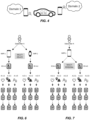
- Figure 4 shows an exemplary multi-domain scenario, in which users from different domains can share a single device under different subscription identities.
- security of the data of the individual users is critically important.
- PKI public key infrastructure
- PKI includes roles, policies, and procedures in order to create, manage, distribute, use, store, and revoke digital certificates and manage public-key encryption.
- PKI requires large infrastructure (e.g ., Certifying Authorities, Registration authorities, Repository, Archives and End Entity) to manage and maintain the certificates used.
- PKI is generally non-scalable (e.g ., due to its centralized configuration) and does not include provisions for user consents, which makes it easier to compromise.
- GBA Generic Bootstrapping Architecture
- AKA Authentication Key Agreement protocol
- BSF Bootstrapping Server Function
- E2E end-to-end
- Document US 2013/0152208 A1 discloses a bootstrapping architecture in which a bootstrapping server function may group one or more applications to be run on a user equipment into a service package. Each service package may be provided with a service package identifier which may be used as security key parameter for a Key Derivation Function (KDF) of the bootstrapping server function, when generating security keys (GBA keys) for the service package.
- KDF Key Derivation Function
- GBA keys security keys
- Document WO 2018/021964 A1 discloses a key generation and distribution method for an authentication framework for an operator provider network and a service provider network. The method comprises receiving requests comprising a plurality of identities. A new ID is generated for each identity. A secret key is generated for each new ID.
- Exemplary embodiments of the present disclosure address these and other challenges by providing confidential, secure end-to-end communications throughout a network via a flexible, scalable, single-key encryption/decryption management solution.
- Exemplary embodiments can fulfill newly imposed privacy regulations, enabling users, operators, and application/service providers to leverage the full power of IoT and multi-X, while providing new access control solutions for identity and access management.
- exemplary embodiments of the present disclosure provide end-to-end security and key chaining encryption for Multi-X with identity and key management by extending the Generic Bootstrapping Architecture (GBA).
- GBA Generic Bootstrapping Architecture
- Certain exemplary embodiments include methods and/or procedures, performed by a subscriber device, for facilitating secure communication between a subscriber to a mobile communication network and one or more service providers (SPs), wherein the subscriber is associated with a plurality of entities comprising any combination of devices and profiles.
- the exemplary methods and/or procedures can include obtaining a security identifier (ID) associated with the subscriber.
- the exemplary methods and/or procedures can also include, based on the security ID, establishing an identity hierarchy comprising the plurality of entities associated with the subscriber.
- the exemplary methods and/or procedures can also include, based on the security ID, establishing consents for one or more SPs to access data generated by the entities included in the identity hierarchy.
- the exemplary methods and/or procedures can also include, in response to a request comprising the security ID, receiving a public key (PK) usable to encrypt data for sending to a particular SP, wherein the data is decryptable using a corresponding secret key (SK) associated with an established consent for the particular SP.
- PK public key
- SK secret key
- the exemplary methods and/or procedures can also include encrypting the data using the PK and the identity hierarchy.
- exemplary embodiments include methods and/or procedures, performed by a server, for facilitating secure communication between a subscriber to a mobile communication network and one or more service providers (SPs), wherein the subscriber is associated with a plurality of entities comprising any combination of devices and profiles.
- the exemplary methods and/or procedures can include performing an authentication key agreement (AKA) with a subscriber device.
- AKA authentication key agreement
- the exemplary methods and/or procedures can also include deriving and storing a bootstrap identifier (BTID) and a plurality of keys associated with the BTID.
- the exemplary methods and/or procedures can also include sending the BTID to the subscriber device.
- the exemplary methods and/or procedures can also include receiving a first request for a first key of the plurality, wherein the first request comprises an associated BTID.
- the exemplary methods and/or procedures can also include, based on determining that the associated BTID matches the stored BTID, sending the first key in response to the first request.
- exemplary embodiments include methods and/or procedures, performed by a server, for facilitating secure communication between a subscriber to a mobile communication network and one or more service providers (SPs), wherein the subscriber is associated with a plurality of entities comprising any combination of devices and profiles.
- the exemplary methods and/or procedures can include receiving, from the subscriber device, a request comprising a security identifier (ID) associated with the subscriber.
- the exemplary methods and/or procedures can also include, based on the security ID, establishing an identity hierarchy comprising the plurality of entities associated with the subscriber.
- the exemplary methods and/or procedures can also include generating a public key (PK) associated with the subscriber.
- exemplary methods and/or procedures can also include generating a hierarchy of secret keys (SKs) corresponding to the identity hierarchy.
- the exemplary methods and/or procedures can also include providing the PK to a particular device or profile included in the identity hierarchy.
- exemplary embodiments include methods and/or procedures, performed by a server, for facilitating secure communication between a subscriber to a mobile communication network and one or more service providers (SPs), wherein the subscriber is associated with a plurality of entities comprising any combination of devices and profiles.
- the exemplary methods and/or procedures can include receiving, from the subscriber device, a request comprising a security identifier (ID) associated with the subscriber.
- the exemplary methods and/or procedures can also include authenticating the subscriber based on subscriber information associated with the security ID.
- the exemplary methods and/or procedures can also include sending, to the subscriber device, a list of entities, comprising any combination of devices and profiles, associated with the subscriber.
- the exemplary methods and/or procedures can also include receiving, from the subscriber device, consents for one or more service providers (SPs) to access data generated by the entities included in the list.
- SPs service providers
- the exemplary methods and/or procedures can also include mapping the received consents into an identity hierarchy comprising the entities associated with the subscriber.
- exemplary embodiments include subscriber devices (e.g ., user equipment or UE) and server apparatus comprising communication transceivers, processor(s), and memory(ies) storing computer-executable instructions that, when executed by the processor(s), configure the subscriber device or the server apparatus to perform operations corresponding to any of the exemplary methods and/or procedures disclosed herein
- subscriber devices e.g ., user equipment or UE
- server apparatus comprising communication transceivers, processor(s), and memory(ies) storing computer-executable instructions that, when executed by the processor(s), configure the subscriber device or the server apparatus to perform operations corresponding to any of the exemplary methods and/or procedures disclosed herein
- exemplary embodiments include non-transitory, computer-readable media storing program instructions that, when executed by a subscriber device or a server apparatus, configure the subscriber device or the server apparatus to perform operations corresponding to any of the exemplary methods and/or procedures disclosed herein.
- GBA has various drawbacks that are particular to multi-X scenarios and/or applications.
- GBA requires generation of multiple keys for multi-X, has no hierarchy for sub-keys generation, and assigns keys only for specific time periods.
- Such massive encryption with multiple keys creates in turns scalability bottleneck and inefficiency, as well as very complex data access control and trust data management.
- GBA provides no mechanisms to generate a specific key for each service provider nor to decrypt massive data encrypted by different keys.
- PKI has been proposed to resolve security issues for IoT gateways that aggregate health sensor data through digital certificates and PKI data encryption [13].
- PKI model uses a pair of mathematically related keys. If one key is used to encrypt information, then only the related key can decrypt that information. In case the public key gets compromised, still it is not computationally feasible to retrieve the private key. However, it relies on a trusted authority in order to perform the encryption and decryption activities.
- HIBE Hierarchical Identity Based Encryption
- IBE Boneh-Franklin identity-based encryption
- IBE Boneh-Franklin identity-based encryption
- IBE is a public key system where the public key can be an arbitrary string such as an email address.
- a central authority uses a master key to issue private keys to identities that request them.
- HIBE is a generalization of IBE that mirrors an organizational hierarchy. An identity at level k of the hierarchy tree can issue private keys to its descendant identities, but cannot decrypt messages intended for other identities.
- HIBE utilizes a root key to generate the lower level keys which have IDs incorporated into them.
- the message is encrypted with ID-tuple.
- Various works [16]-[17]) have proposed constant size ciphertext, leading to lower decrypting complexity, history-free updates, security against insiders, and resistance to decryption key exposure.
- HIBE includes seven different algorithms: setup, key generation, key update, key derivation, encrypt, decrypt, and key revocation.
- Various other works [18]-[21] have explored various aspects of HIBE, but none have taken into consideration the specific requirements of multi-X use cases, including automotive use cases.
- Attribute-based encryption is another type of public-key encryption in which the secret key of a user and the ciphertext are dependent upon user attributes (e.g. , the country in which they live, or the kind of subscription they have).
- user attributes e.g. , the country in which they live, or the kind of subscription they have.
- the decryption of a ciphertext is possible only if the set of attributes of the user key matches the attributes of the ciphertext.
- ABE has been used for fine-grained access control of encrypted data [22]. Nevertheless, due to its public-key nature, ABE relies on a trusted authority in order to perform the encryption and decryption activities.
- exemplary embodiments of the present disclosure address these challenges by providing secure end-to-end communications throughout a network via a flexible, scalable, single-key encryption/decryption management solution.
- Exemplary embodiments can fulfill the newly imposed privacy regulations, enabling users, operators, and application providers to leverage the full power of IoT and Multi-X, while providing new access control solutions for identity and access management.
- exemplary embodiments of the present disclosure provide end-to-end security and key chaining encryption for Multi-X with identity and key management by extending the Generic Bootstrapping Architecture (GBA).
- GBA Generic Bootstrapping Architecture
- exemplary embodiments provide hierarchical classification of devices based on the subscriber/user using the information from the Mobile Network Operator (MNO).
- MNO Mobile Network Operator
- the device IDs are further extended using time-based identities, thereby facilitating better access control.
- Exemplary embodiments use a key from GBA to generate an encryption parameter, and a single key for encryption and decryption.
- the single-key encryption/decryption allows access control and authorization, and consent is provided by the subscriber for the data.
- Figure 5 shows a high-level diagram of a system utilizing GBA architecture and hierarchical ID-based encryption in multi-X environment, according to exemplary embodiments of the present disclosure.
- Subscriber A referred to as "Sub A”
- User B User B
- User C User C
- Sub A and User B are part of Domain 1
- User C is part of Domain 2.
- IMP1-5 various exemplary devices, labeled IMP1-5.
- IMP1 and IMPI2 represent two devices associated with a single subscriber (Sub A).
- IMPI1 can represent a smartphone and IMPI2 a smartwatch and/or personal fitness tracker.
- IMPI3 can represent an automobile (e.g ., car) that is shared by multiple users.
- each profile associated with a particular top-level subscriber, user, or user "persona.”
- Below each profile are device applications associated with the profile, and below each application is a time-series of data generated by the application as instances 1, 2, ... N.
- FIG. 6 further illustrates how multiple devices can be associated with a single subscriber or user, according to various exemplary embodiments of the present disclosure.
- devices utilize a hierarchical ID with the subscriber at the root.
- the heart monitor application of profile A-1 e.g. , Sub A's profile on the smartphone device
- Sub A/A-1/A-1-1 can be identified as "Sub A/A-1/A-1-1”.
- This hierarchical ID allows individual devices (or a particular device profile) to be uniquely identified, which gives the subscriber the ability to narrowly tailor consent for which data can be shared with application/service providers (SP).
- SP application/service providers
- FIG. 7 further illustrates how multiple personas can be associated with a single subscriber/user and single device, according to various exemplary embodiments of the present disclosure.
- Sub A uses two profiles or personas on smartphone device IMPI1. These two profiles - labelled ID A-1 and ID A-2 - could be for personal and business use, respectively.
- Each of Sub A's applications will have a unique ID associated with each of Sub A's profiles on IMPI1. For example, the ID for the heart monitor application of profile A-2 will be "Sub A/A-2/A-2-1", while for profile A-1 the unique ID of the same application is "Sub A/A-1/A-1-1.”
- the hierarchical ID arrangement can be further extended to facilitate unique identification of specific time-domain data, thereby providing the subscriber/user the ability to provide consent on individual data segments.
- profile A-1 can be identified by the hierarchical ID "Sub A/A-1/A-1-1-T1.”
- the data produced at times 1 and time 2 can be identified as "Sub A/A-1/A-1-1-T1/A-1-1-T2,” and so on.
- Figure 8 further illustrates how multiple subscribers or users can be associated with a single device, according to various exemplary embodiments of the present disclosure.
- the device When multiple users share a device, the device will adopt a profile associated with the subscriber who is using it.
- the physical device will provide multiple "virtual devices," each associated with a profile of a subscriber/user/persona that accesses or uses it.
- the car is divided into a "virtual car" for each subscriber/user/persona accessing it, i.e., profile A-3 of Sub A and profile B-2 of User B.
- the hierarchical ID of the car's speedometer as associated with Sub A will be "Sub A/A-3/A-3-1," whereas the hierarchical ID for the same physical speedometer will be "User B/B-2/B-2-1" when associated with User B.
- Figure 9 further illustrates how multiple subscribers or users from different domains can be associated with a single device, according to various exemplary embodiments of the present disclosure.
- This scenario is similar to the one shown in Figure 8 , except that Sub A and User C - which share use of automotive device IMPI3 - are from different Domains 1 and 2, respectively.
- Domains 1 and 2 can represent different mobile network operators (MNOs).
- the consent and access control can be achieved by encrypting the data generated from all the devices of the subscribers.
- Hierarchical IDs provide a parameter for the encryption scheme. More specifically, various embodiments utilize the exemplary hierarchical IDs discussed above with a HIBE encryption scheme, in which a key (called Ks) derived from GBA is used as an input during setup.
- Ks a key
- HIBE HIBE encryption scheme
- SP service provider
- SK secret key
- FIG. 10 shows a diagram of an exemplary architecture of a multi-X Key Chaining (MXKC) according to embodiments of the present disclosure, which leverages GBA components to address the multi-X scenarios and requirements discussed above.
- the architecture is divided into several modules and/or components whose functions and/or operations can be summarized as follows:
- the subscriber derives Ks based on utilizing GBA for this bootstrapping operation.
- MX-KC uses Ks to initialize itself for generating the hierarchy of device IDs, PK (required by the devices for encryption), and MSK (required to generating the user secret key (SK) to be used, by the SP, for that subscriber/user.
- the subscriber uses MX-CAS to set up the consents for the devices, which are mapped into parameter and then forwarded to the MX-KC.
- MX-KC generates the secret key for the SP and sends it to KMS.
- a subscriber device and/or application wants to send encrypted data to a business application or application server (e.g., of the SP), it can authenticate itself to the MX-KC in order to the get the PK needed for the encryption.
- the device uses the PK and its identity to encrypt and send data to the business application.
- the SP wants to decrypt the received data, it can request a SK from the KMS and, if the SP has the access privilege for that data, the SP will receive the SK and be able to decrypt the data.
- the details of these process are shown in the sequence diagrams below.
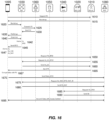
- Figure 11 shows a signal flow diagram of an exemplary method and/or procedure for subscriber initialization, according to various exemplary embodiments of the present disclosure.
- the exemplary method and/or procedure can be used when a subscriber wants to set up their devices for the first time for use with MX-KC.
- the exemplary method and/or procedure can be performed on a "master device" associated with the subscriber.
- the particular device can be identified as a "master device” based on its performance of the exemplary method and/or procedure.
- FIG. 11 Although the operations shown in Figure 11 are illustrated in a particular order, this order is exemplary and the operations shown can be performed in different orders, and can be combined and/or divided into operations having different functionality than shown in Figure 11 .
- the exemplary method and/or procedure shown in Figure 11 can be complementary to other exemplary methods and/or procedures disclosed herein, such that they are capable of being used cooperatively to provide the benefits, advantages, and/or solutions to problems described hereinabove.
- the exemplary method and/or procedure shown in Figure 11 can be used with one or more of the exemplary methods and/or procedures shown in Figures 12-16 .
- the subscriber sends an initialization request to MX-KC, which responds (operation 1120) to the subscriber with a request to authenticate via bootstrapping.
- the subscriber sends a bootstrap request to the BSF, which is accompanied with the subscriber's ID (e.g., IMS private user identity (IMPI) associated with the mobile network).
- the BSF sends the subscriber ID to the HSS with a request for an authentication vector (AV) for that subscriber, which the HSS provides in operation 1150 so long as the subscriber ID is valid.
- AV authentication vector
- the AV can include a challenge (e.g., a random number), an expected response, and a cipher key usable in the authentication.
- the BSF sends the challenge to the subscriber, which returns a response in 1170. If the response matches the expected response, the BSF derives the bootstrap key Ks and the associated bootstrap identifier (BTID) parameter (operation 1175), then sends BTID to the subscriber (operation 1180).
- the BSF also retains the BTID, which it can later use to identify the associated Ks used to generate session keys for various entities, as explained below.
- the subscriber uses it to derive its own bootstrap key Ks, as well as keys Ks CAS and Ks KC used for further secure communication with MX-CAS and MX-KC (operation 1185).
- Operation 1200 key-chaining (KC) initialization
- KC key-chaining
- MX-KC responds to the subscriber with a request to perform CAS initialization.
- the resulting operation 1300 (CAS initialization) is described below in relation to Figure 13 .
- Figure 12 shows a signal flow diagram of an exemplary method and/or procedure for key-chaining (KC) initialization, according to various exemplary embodiments of the present disclosure.
- the exemplary method and/or procedure can be used to set up the hierarchy of the subscriber's devices and applications and generates the parameters for encryption according to this hierarchy.
- the operations are illustrated in a particular order, this order is exemplary and the operations shown can be performed in different orders, and can be combined and/or divided into operations having different functionality than shown in Figure 12 .
- the exemplary method and/or procedure shown in Figure 12 can be complementary to other exemplary methods and/or procedures disclosed herein, such that they are capable of being used cooperatively to provide the benefits, advantages, and/or solutions to problems described hereinabove.
- the exemplary method and/or procedure shown in Figure 12 can be used with one or more of the exemplary methods and/or procedures shown in Figures 11 and 13-16 .
- the subscriber sends a request for initialization to MX-KC along with ID parameter BTID (derived, e.g., by BSF in operation 1175).
- the MX-KC sends a request to the BSF for the key Ks KC to be used for further communication with the subscriber, which the MX-KC identifies using the BTID received in operation 1210.
- the BSF responds with both Ks KC and the subscriber information (e.g. , a subscriber identifier).
- MX-KC uses this received information to authenticate the subscriber.
- MX-KC requests Ks from the subscriber, which the subscriber provides in operation 1250.
- the MX-KC requests the application- or service-specific profile of the subscriber from the TAS.
- the TAS can be provisioned by the subscriber's mobile network operator.
- the MX-KC identifies the particular subscriber to the TAS using the subscriber ID received in operation 1230.
- the TAS responds with the application- or service-specific profile of the subscriber, which MX-KC uses in operation 1275 to generate and store a hierarchy of device/application IDs.
- the MX-KC generates the subscriber's public key (PK) and master secret key (MSK). The MX-KC then stores these generated parameters in preparation for possible future use, as explained below.
- PK public key
- MSK master secret key
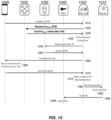
- Figure 13 shows a signal flow diagram of an exemplary method and/or procedure for context-aware service (CAS) initialization, according to various exemplary embodiments of the present disclosure.
- the exemplary method and/or procedure can be used to facilitate initialization of consent settings for any or all of the subscriber's devices and/or applications.
- the operations are illustrated in a particular order, this order is exemplary and the operations shown can be performed in different orders, and can be combined and/or divided into operations having different functionality than shown in Figure 13 .
- the exemplary method and/or procedure shown in Figure 13 can be complementary to other exemplary methods and/or procedures disclosed herein, such that they are capable of being used cooperatively to provide the benefits, advantages, and/or solutions to problems described hereinabove.
- the exemplary method and/or procedure shown in Figure 13 can be used with one or more of the exemplary methods and/or procedures shown in Figures 11-12 and 14-16 .
- the subscriber sends a request for initialization to MX-CAS along with bootstrapping identity BTID.
- the MX-CAS sends a request to the BSF for the key Ks CAS to be used for further communication with the subscriber, which the MX-CAS identifies using the BTID received in operation 1310.
- BSF responds with both Ks CAS and the subscriber information (e.g ., a subscriber identifier).
- MX-CAS uses this received information to authenticate the subscriber.
- MX-CAS requests the list of entities associated with the subscriber from the TAS, identifying the particular subscriber using the subscriber ID received in operation 1330.
- the TAS responds with the list of entities associated with the subscriber.
- the MX-CAS responds to the subscriber's initialization request (made, e.g., in operation 1310) by sending the list of entities associated with the subscriber. This list can be secured using the key Ks CAS received in operation 1330.
- the subscriber establishes (e.g ., initializes) the consents for the entities comprising the list. For example, for each device and/or profile on the list, consents can be established with respect to one or more SPs.
- Ks CAS using Ks CAS , the subscriber securely sends the consents to MX-CAS, which maps the consents into the ID hierarchy (operation 1375) and sends the ID hierarchy to MX-KC (operation 1380).
- MX-KC generates the secret key (SK) based on the subscriber consents and ID hierarchy, as well as the subscriber MSK previously stored ( e.g., in operation 1275).
- the MX-KC sends the SK to the key management system (KMS) database, where it is stored (operation 1395) for subsequent distribution upon valid request by SPs ( e.g ., as needed to decrypt data sent by the subscriber).
- KMS key management system
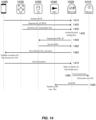
- Figure 14 shows a signal flow diagram of an exemplary method and/or procedure for context-aware service (CAS) update, according to various exemplary embodiments of the present disclosure.
- the exemplary method and/or procedure can be used to by the subscriber to update consents for the associated devices.
- the CAS update operations shown in Figure 14 are substantially similar to the CAS initialization operations shown in Figure 13 (CAS initialization), the above descriptions of particular operations apply equally to like-numbered operations in Figure 14 .
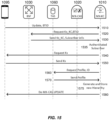
- Figure 15 shows a signal flow diagram of an exemplary method and/or procedure for key-chaining (KC) update, according to various exemplary embodiments of the present disclosure.
- KC key-chaining
- the operations are illustrated in a particular order, this order is exemplary and the operations shown can be performed in different orders, and can be combined and/or divided into operations having different functionality than shown in Figure 15 .
- the exemplary method and/or procedure shown in Figure 15 can be complementary to other exemplary methods and/or procedures disclosed herein, such that they are capable of being used cooperatively to provide the benefits, advantages, and/or solutions to problems described hereinabove.
- the exemplary method and/or procedure shown in Figure 15 can be used with one or more of the exemplary methods and/or procedures shown in Figures 11-14 and 16 .
- Operations 1510-1570 shown in Figure 15 are substantially similar to respective CAS initialization operations 1210-1270 shown in Figure 12 and, as such, will not be described further below.
- MX-KC After generating and storing an updated hierarchy of device/application IDs (operation 1575), MX-KC requests the subscriber to perform a CAS update to incorporate the updated hierarchy (operation 1580). The subscriber can perform such an update using the exemplary method and/or procedure shown in Figure 14 .
- Figure 16 shows a signal flow diagram of an exemplary method and/or procedure for device initialization, according to various exemplary embodiments of the present disclosure.
- the exemplary method and/or procedure can be used to initialize a particular device before sending data (e.g ., from that device) to an application/service provider for the first time.
- the exemplary method and/or procedure in Figure 16 can be used to initialize a "secondary device" after a "master device” has performed the exemplary method and/or procedure shown in Figure 11 .
- the operations are illustrated in a particular order, this order is exemplary and the operations shown can be performed in different orders, and can be combined and/or divided into operations having different functionality than shown in Figure 16 .
- the exemplary method and/or procedure shown in Figure 16 can be complementary to other exemplary methods and/or procedures disclosed herein, such that they are capable of being used cooperatively to provide the benefits, advantages, and/or solutions to problems described hereinabove.
- the exemplary method and/or procedure shown in Figure 16 can be used with one or more of the exemplary methods and/or procedures shown in Figures 11-15 .
- the device sends a request to MX-KC for a public key (PK) to be used for subscriber communication with SP's NAF.
- MX-KC responds to the device with a request to authenticate via bootstrapping.
- the device sends a bootstrap request to the BSF, which is accompanied with a device ID.
- the BSF sends the device ID to the HSS with a request for an authentication vector (AV) for that device, which the HSS provides in operation 1630 so long as the device ID is valid.
- the AV can include a challenge (e.g ., a random number), an expected response, and a cipher key used in the authentication.
- the device again requests from MX-KC the public key (PK) that is usable for encrypting user data to be sent to the NAF, using the BTID parameter (received in operation 1645) subscriber identifying information.
- the MX-KC sends a request to the BSF for key Ks KC to be used for secure communication with the subscriber device, identified using the BTID received in operation 1650.
- the BSF responds with Ks KC and the subscriber identifying information.
- the MX-KC identifies the public key (PK) usable for the device's communication with NAF, encrypts it using Ks KC , and sends it to the device.
- the device encrypts data with the received PK and its own ID, associates its own BTID parameter with the encrypted data, then uses Ks NAF to securely send the combined information to the NAF (operation 1670).
- the NAF requests from BSF the key Ks NAF usable for communicating with the user device, the request including the BTID associated with the device (received in operation 1670) and the service provider ID (SPID) associated with the NAF.
- the BSF responds with Ks NAF .
- the NAF requests, from the key management system (KMS), the secret key (SK) usable to secure data communication from the device to the SP.
- the request includes the SPID.
- KMS responds to NAF with the SK.
- operation 1695 using this SK and the PK retrieved by the device in operation 1665, the NAF and the subscriber's device are able to communicate securely.
- MX-CAS and MX-KC Two primary components of the exemplary embodiments described above are the MX-CAS and MX-KC, which are responsible for the consent management and key generations for encryption. In various embodiments, both of these components can be implemented and/or deployed in various locations according to requirements and/or agreements between subscriber and mobile network operation (MNO).
- MNO mobile network operation
- FIGS 17A-C show high-level diagrams of three different options and/or architectures for deployment of MX-CAS and MX-KC, according to various exemplary embodiments of the present disclosure.
- both MX-CAS and MX-KC are substantially located in a subscriber device, e.g., in a secure, tamper-resistant environment.
- various security-related operations described above with respect to Figures 11-16 may not be required and/or relevant.
- operations 1210-1235 in Figure 12 , 1310-1335 in Figure 13 , 1410-1435 in Figure 14 , 1510-1535 in Figure 15 , and 1610-1665 in Figure 16 are not required if MX-KC and MX-CAS are located within the subscriber device.
- Figure 17B illustrates other exemplary embodiments in which both MX-CAS and MX-KC can be deployed at the gateway level (e.g., a gateway to a particular domain).
- Figure 17C illustrates other exemplary embodiments in which both MX-CAS and MX-KC can be deployed at the mobile network operator (MNO) level ( e.g., in an MNO data center).
- MNO mobile network operator
- Other exemplary embodiments can include combinations of the three deployment options illustrated in Figures 17A-C .
- Figure 18 shows a flow diagram of an exemplary method and/or procedure for facilitating secure communication between a subscriber to a mobile communication network and one or more service providers (SPs), wherein the subscriber is associated with a plurality of entities comprising any combination of devices and profiles, according to various exemplary embodiments of the present disclosure.
- the exemplary method and/or procedure shown in Figure 18 can be performed by a subscriber device, such as a user equipment (UE).
- UE user equipment
- the operations are illustrated in a particular order, this order is exemplary and the operations shown can be performed in different orders, and can be combined and/or divided into operations having different functionality than shown in Figure 18 . Dashed lines indicate optional operations.
- the exemplary method and/or procedure shown in Figure 18 can be complementary to other exemplary methods and/or procedures disclosed herein, such that they are capable of being used cooperatively to provide the benefits, advantages, and/or solutions to problems described herein.
- the exemplary method and/or procedure shown in Figure 18 can be used with one or more of the exemplary methods and/or procedures shown in Figures 19-21 .
- the exemplary method and/or procedure can include operations of block 1810, in which the subscriber device can obtain a security identifier (ID) associated with the subscriber.
- the security ID comprises a bootstrap identifier (BTID)
- BTID bootstrap identifier
- AKA authentication key agreement
- BSF bootstrapping server
- this can include, various ones of operations 1110 to 1180 shown in Figure 11 or operations 1610 to 1645 shown in Figure 16 .
- performing and AKA with the BSF can include sending a bootstrap request to the BSF; receiving an authenticate challenge from the BSF; sending an authentication response to the BSF; and receiving the BTID.
- the exemplary method and/or procedure can also include the operations of block 1830, in which the subscriber device can generate a plurality of keys based on the security ID.
- the exemplary method and/or procedure can also include operations of block 1820, in which the subscriber device can, based on the security ID, establish an identity hierarchy comprising the plurality of entities associated with the subscriber.
- the identity hierarchy further comprises one or more applications associated with each of the entities.
- the identity hierarchy further comprises one or more time periods associated with at least a portion of the applications.
- establishing the identity hierarchy can include sending an initialization request comprising the security ID, wherein the initialization request is encrypted using a second key derivable based on the security ID; receiving a request for a first key of the plurality of keys generated based on the security ID; decrypting the request using the second key; and sending a response comprising the first key, wherein the response is encrypted using the second key.
- these operations can correspond to various ones of operations 1210 to 1275 shown in Figure 12 .
- the exemplary method and/or procedure can also include operations of block 1830, in which the subscriber device can, based on the security ID, establish consents for one or more SPs to access data generated by the entities included in the identity hierarchy. In some embodiments, this can include establishing consents for the one or more SPs to access data generated by the one or more applications associated with each of the entities. In some embodiments, this can include establishing consents for the one or more SPs to access data generated during the one or more time periods by the at least a portion of the applications.
- the operations of block 1830 can include sending a request comprising the security ID, wherein the request is encrypted using a third key derivable based on the security ID; receiving a list of entities, comprising any combination of devices and profiles, associated with the subscriber; decrypting the list of entities using the third key; associating consents, for each of the one or more SPs, with the entities included in the list; and sending a response comprising the consents, wherein the response is encrypted using the third key.
- these operations can correspond to various ones of operations 1310 to 1370 shown in Figure 13 .
- the exemplary method and/or procedure can also include operations of block 1840, in which the subscriber device can, in response to a request comprising the security ID, receive a public key (PK) usable to encrypt data for sending to a particular SP, wherein the data is decryptable using a corresponding secret key (SK) associated with an established consent for the particular SP.
- receiving the PK usable to encrypt data for sending to a particular SP can include sending a request for the PK, wherein the request comprises the security ID and is encrypted using a second key derivable based on the security ID; receiving a response comprising the PK; and decrypting the response using the second key.
- these operations can correspond to various ones of operations 1650 to 1665 shown in Figure 16 .
- the exemplary method and/or procedure can also include operations of block 1850, in which the subscriber device can encrypt the data using the PK and the identity hierarchy.
- the exemplary method and/or procedure can also include the operations of block 1860, in which the subscriber device can send the data, encrypted by the PK, to the SP in association with the security ID, wherein the data encrypted by the PK and the security ID are further encrypted by a fourth key derivable based on the security ID.
- Figure 19 shows a flow diagram of another exemplary method and/or procedure for facilitating secure communication between a subscriber to a mobile communication network and one or more service providers (SPs), wherein the subscriber is associated with a plurality of entities comprising any combination of devices and profiles, according to various exemplary embodiments of the present disclosure.
- the exemplary method and/or procedure shown in Figure 19 can be performed by a server (e.g., a boostrapping server (BSF) as described herein).
- BSF boostrapping server
- the operations are illustrated in a particular order, this order is exemplary and the operations shown can be performed in different orders, and can be combined and/or divided into operations having different functionality than shown in Figure 19 . Dashed lines indicate optional operations.
- the exemplary method and/or procedure shown in Figure 19 can be complementary to other exemplary methods and/or procedures disclosed herein, such that they are capable of being used cooperatively to provide the benefits, advantages, and/or solutions to problems described herein.
- the exemplary method and/or procedure shown in Figure 19 can be used with one or more of the exemplary methods and/or procedures shown in Figures 18 , 20 , and 21 .
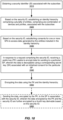
- the exemplary method and/or procedure can include operations of block 1910, in which the BSF can perform an authentication key agreement (AKA) with a subscriber device. In some embodiments, this can correspond to various ones of operations 1130 to 1170 shown in Figure 11 or operations 1620 to 1640 shown in Figure 16 .
- the exemplary method and/or procedure can also include the operations of block 1920, in which the BSF can derive and store a bootstrap identifier (BTID) and a plurality of keys associated with the BTID. In some embodiments, this can correspond to operation 1175 shown in Figure 11 or operation 1642 shown in Figure 16 .
- the exemplary method and/or procedure can also include the operations of block 1930, in which the BSF can send the BTID to the subscriber device. In some embodiments, this can correspond to operation 1180 shown in Figure 11 or operation 1645 in Figure 16 .
- the exemplary method and/or procedure can also include operations of block 1940, in which the BSF can receive a first request for a first key of the plurality, wherein the first request comprises an associated BTID.
- the exemplary method and/or procedure can also include the operations of block 1950, in which the BSF can, based on determining that the associated BTID matches the stored BTID, send the first key in response to the first request.
- the first request is received from a key-chaining (KC) server; and the first key is sent to the KC server.
- these operations can correspond to various ones of operations 1220 to 1230 shown in Figure 12 , operations 1520 to 1530 shown in Figure 15 , or operations 1655 to 1660 shown in Figure 16 .
- the exemplary method and/or procedure can also include the operations of block 1960, in which the BSF can receive a second request for a second key of the plurality, wherein the second request comprises an associated BTID.
- the exemplary method and/or procedure can also include the operations of block 1970, in which the BSF can, based on determining that the associated BTID matches the stored BTID, send the second key in response to the second request.
- the second request is received from a context-aware service (CAS) server; and the second key is sent to the CAS server.
- these operations can correspond to various ones of operations 1320 to 1330 shown in Figure 13 or operations 1420 to 1430 shown in Figure 14 .
- Figure 20 shows a flow diagram of another exemplary method and/or procedure for facilitating secure communication between a subscriber to a mobile communication network and one or more service providers (SPs), wherein the subscriber is associated with a plurality of entities comprising any combination of devices and profiles, according to various exemplary embodiments of the present disclosure.
- the exemplary method and/or procedure shown in Figure 20 can be performed by a server (e.g., a key-chaining (KC) server as described herein).
- KC key-chaining
- the exemplary method and/or procedure shown in Figure 20 can be complementary to other exemplary methods and/or procedures disclosed herein, such that they are capable of being used cooperatively to provide the benefits, advantages, and/or solutions to problems described herein.
- the exemplary method and/or procedure shown in Figure 20 can be used with one or more of the exemplary methods and/or procedures shown in Figures 18 , 19 , and/or 21.
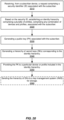
- the exemplary method and/or procedure can include operations of block 2010, in which the KC server can receive, from the subscriber device, a request comprising a security identifier (ID) associated with the subscriber. In some embodiments, this can correspond to operation 1210 shown in Figure 12 or operation 1510 shown in Figure 15 . In some embodiments, receiving the request can include receiving a first initialization request from the subscriber device; sending a response instructing the subscriber device to perform bootstrapping; and receiving, from the subscriber device, a further initialization request comprising the security ID. In some embodiments, these operations can correspond to various ones of operations 1110 to 1120 shown in Figure 11 and operation 1210 shown in Figure 12 .
- the exemplary method and/or procedure can include operations of block 2020, in which the KC server can, based on the security ID, establish an identity hierarchy comprising the plurality of entities associated with the subscriber.
- establishing the identity hierarchy can also include receiving a list of entities, comprising any combination of devices and profiles, associated with the subscriber; and generating the identity hierarchy based on the list of entities.
- these operations can correspond to various ones of operations 1270 to 1275 shown in Figure 12 and operation 1570 to 1575 shown in Figure 15 .
- the identity hierarchy further comprises one or more applications associated with each of the entities.
- the identity hierarchy further comprises one or more time periods associated with at least a portion of the applications.
- establishing the identity hierarchy can also include sending a request for a second key of a plurality of keys derivable based on the security ID, wherein the request includes the security ID; receiving the second key and subscriber identity information; and authenticating the subscriber device based on the subscriber identity information.
- these operations can correspond to various ones of operations 1220 to 1235 shown in Figure 12 and operation 1520 to 1535 shown in Figure 15 .
- establishing the identity hierarchy can also include sending, to the authenticated subscriber device, a request for a first key of the plurality, wherein the request is encrypted using the second key; receiving, from the authenticated subscriber device, a response comprising the first key; and decrypting the response using the second key.
- these operations can correspond to various ones of operations 1240 to 1250 shown in Figure 12 or operation 1540 to 1550 shown in Figure 15 .
- the exemplary method and/or procedure can include operations of block 2030, in which the KC server can generate a public key (PK) associated with the subscriber.
- the PK can be generated based on the first key. In some embodiments, this can correspond to operations 1275 shown in Figure 12 .
- the exemplary method and/or procedure can include operations of block 2040, in which the KC server can generate a hierarchy of secret keys (SKs) corresponding to the identity hierarchy.
- the hierarchy of SKs comprises respective SKs for the one or more SPs to access data generated by the one or more applications associated with each of the entities.
- the hierarchy of SKs comprises respective SKs for the one or more SPs to access data generated during the one or more time periods by the at least a portion of the applications.
- generating the hierarchy of SKs comprises receiving consents for one or more SPs to access data generated by the entities included in the identity hierarchy; and generating the hierarchy of SKs based on the consents and a master secret key (MSK).
- MSK master secret key
- these operations can correspond to various ones of operations 1370 to 1375 shown in Figure 13 or operations 1470 to 1475 shown in Figure 14 .
- the exemplary method and/or procedure can also include operations of block 2050, in which the KC server can send the hierarchy of SKs to a key management system (KMS) for storage.
- KMS key management system
- these operations can correspond to operation 1390 shown in Figure 13 or operations 1490 shown in Figure 14 .
- the exemplary method and/or procedure can include operations of block 2060, in which the KC server can provide the PK to a particular device or profile included in the identity hierarchy.
- providing the PK to a particular device or profile included in the identity hierarchy can include receiving a request for the PK from a first device, the request comprising the security ID; sending a request for a second key of a plurality of keys derivable based on the security ID, wherein the request includes the security ID; receiving the second key; and sending the PK to the first device, wherein the PK is encrypted using the second key.
- these operations can correspond to operations 1650 to 1665 shown in Figure 16 .
- the security ID comprises a bootstrap identifier (BTID); the request for the second key is sent to a bootstrapping server (BSF); and the second key is received from the BSF.
- BSF bootstrapping server
- Figure 21 shows a flow diagram of another exemplary method and/or procedure for facilitating secure communication between a subscriber to a mobile communication network and one or more service providers (SPs), wherein the subscriber is associated with a plurality of entities comprising any combination of devices and profiles, according to various exemplary embodiments of the present disclosure.
- the exemplary method and/or procedure shown in Figure 21 can be performed by a server (e.g., a context-aware service (CAS) server as described herein).
- CAS context-aware service
- the exemplary method and/or procedure shown in Figure 21 can be complementary to other exemplary methods and/or procedures disclosed herein, such that they are capable of being used cooperatively to provide the benefits, advantages, and/or solutions to problems described herein.
- the exemplary method and/or procedure shown in Figure 21 can be used with one or more of the exemplary methods and/or procedures shown in Figures 18-20 .
- the exemplary method and/or procedure can include operations of block 2110, in which the CAS server can receive, from the subscriber device, a request comprising a security identifier (ID) associated with the subscriber. In some embodiments, this can correspond to operation 1310 shown in Figure 13 or operation 1410 shown in Figure 14 .
- ID security identifier
- the exemplary method and/or procedure can also include operations of block 2120, in which the CAS server can authenticate the subscriber based on subscriber information associated with the security ID.
- authenticating the subscriber comprises sending a request for a second key derivable based on the security ID, wherein the request includes the security ID; receiving the second key and subscriber identity information; and authenticating the subscriber based on the subscriber identity information.
- these operations can correspond to various ones of operations 1320 to 1335 shown in Figure 13 or operation 1420 to 1435 shown in Figure 14 .
- the exemplary method and/or procedure can also include operations of block 2130, in which the CAS server can send, to the subscriber device, a list of entities, comprising any combination of devices and profiles, associated with the subscriber.
- the list of entities sent to the subscriber device is encrypted with the second key. In some embodiments, this can correspond to operation 1360 shown in Figure 13 or operation 1460 shown in Figure 14 .
- the exemplary method and/or procedure can also include operations of block 2140, in which the CAS server can receive, from the subscriber device, consents for one or more service providers (SPs) to access data generated by the entities included in the list.
- SPs service providers
- this can correspond to operation 1370 shown in Figure 13 or operation 1470 shown in Figure 14 .
- the consents received from the subscriber device are decrypted using the second key.
- mapping the received consents further comprises mapping consents for the one or more SPs to access data generated by the one or more applications associated with each of the entities.
- mapping the received consents further comprises mapping consents for the one or more SPs to access data generated during the one or more time periods by the at least a portion of the applications. In some embodiments, this can correspond to operation 1375 shown in Figure 13 or operation 1475 shown in Figure 14 .
- Figure 22 shows a block diagram of an exemplary subscriber device or user equipment (UE) configurable according to various exemplary embodiments of the present disclosure described herein.
- UE user equipment
- the exemplary device shown in Figure 22 can be configured to perform operations corresponding to those shown in the flow diagram of Figure 18 .
- Exemplary device 2200 can comprise a processor 2210 that can be operably connected to a program memory 2220 and/or a data memory 2230 via a bus 2270 that can comprise parallel address and data buses, serial ports, or other methods and/or structures known to those of ordinary skill in the art.
- Program memory 2220 comprises software code or program executed by processor 2210 that facilitates, causes and/or programs exemplary device 2200 to communicate using one or more wired or wireless communication protocols, including one or more wireless communication protocols standardized by 3GPP, 3GPP2, or IEEE, such as those commonly known as 5G/NR, LTE, LTE-A, UMTS, HSPA, GSM, GPRS, EDGE, 1xRTT, CDMA2000, 802.11 WiFi, HDMI, USB, Firewire, etc., or any other current or future protocols that can be utilized in conjunction with communication transceiver 2240, user interface 2250, and/or host interface 2260.
- 3GPP 3GPP2
- IEEE such as those commonly known as 5G/NR, LTE, LTE-A, UMTS, HSPA, GSM, GPRS, EDGE, 1xRTT, CDMA2000, 802.11 WiFi, HDMI, USB, Firewire, etc., or any other current or future protocols that can be utilized in conjunction with communication transceiver 2240, user
- processor 2210 can execute program code stored in program memory 2220 that corresponds to MAC, RLC, PDCP, and RRC layer protocols standardized by 3GPP (e.g., for NR and/or LTE).
- processor 2210 can execute program code stored in program memory 2220 that, together with communication transceiver 2240, implements corresponding PHY layer protocols, such as Orthogonal Frequency Division Multiplexing (OFDM), Orthogonal Frequency Division Multiple Access (OFDMA), and Single-Carrier Frequency Division Multiple Access (SC-FDMA).
- OFDM Orthogonal Frequency Division Multiplexing
- OFDMA Orthogonal Frequency Division Multiple Access
- SC-FDMA Single-Carrier Frequency Division Multiple Access
- Program memory 2220 can also comprises software code executed by processor 2210 to control the functions of device 2200, including configuring and controlling various components such as communication transceiver 2240, user interface 2250, and/or host interface 2260.
- Program memory 2220 can also comprise one or more application programs and/or modules comprising computer-executable instructions embodying any of the exemplary methods and/or procedures described herein.
- Such software code can be specified or written using any known or future developed programming language, such as e.g., Java, C++, C, Objective C, HTML, XHTML, machine code, and Assembler, as long as the desired functionality, e.g ., as defined by the implemented method steps, is preserved.
- program memory 2220 can comprise an external storage arrangement (not shown) remote from device 2200, from which the instructions can be downloaded into program memory 2220 located within or removably coupled to device 2200, so as to enable execution of such instructions.
- Data memory 2230 can comprise memory area for processor 2210 to store variables used in protocols, configuration, control, and other functions of device 2200, including operations corresponding to, or comprising, any of the exemplary methods and/or procedures described herein.
- program memory 2220 and/or data memory 2230 can comprise non-volatile memory (e.g ., flash memory), volatile memory (e.g., static or dynamic RAM), or a combination thereof.
- data memory 2230 can comprise a memory slot by which removable memory cards in one or more formats (e.g., SD Card, Memory Stick, Compact Flash, etc .) can be inserted and removed.
- processor 2210 can comprise multiple individual processors (including, e.g. , multi-core processors), each of which implements a portion of the functionality described above. In such cases, multiple individual processors can be commonly connected to program memory 2220 and data memory 2230 or individually connected to multiple individual program memories and or data memories. More generally, persons of ordinary skill in the art will recognize that various protocols and other functions of device 2200 can be implemented in many different computer arrangements comprising different combinations of hardware and software including, but not limited to, application processors, signal processors, general-purpose processors, multi-core processors, ASICs, fixed and/or programmable digital circuitry, analog baseband circuitry, radio-frequency circuitry, software, firmware, and middleware.
- Communication transceiver 2240 can comprise a radio-frequency transmitter and/or receiver functionality that facilitates the device 2200 to communicate with other equipment supporting like wireless communication standards and/or protocols.
- communication transceiver 2240 includes a transmitter and a receiver that enable device 2200 to communicate with various 5G/NR networks according to various protocols and/or methods proposed for standardization by 3GPP and/or other standards bodies.
- such functionality can operate cooperatively with processor 2210 to implement a PHY layer based on OFDM, OFDMA, and/or SC-FDMA technologies, such as described herein with respect to other figures.
- communication transceiver 2240 includes an LTE transmitter and receiver that can facilitate the device 2200 to communicate with various LTE LTE-Advanced (LTE-A), and/or NR networks according to standards promulgated by 3GPP.
- LTE-A LTE LTE-Advanced
- communication transceiver 2240 includes circuitry, firmware, etc. necessary for the device 2200 to communicate with various 5G/NR, LTE, LTE-A, UMTS, and/or GSM/EDGE networks, also according to 3GPP standards.
- communication transceiver 2240 includes circuitry, firmware, etc. necessary for the device 2200 to communicate with various CDMA2000 networks, according to 3GPP2 standards.
- User interface 2250 can take various forms depending on the particular embodiment of device 2200, or can be absent from device 2200 entirely.
- user interface 2250 can comprise a microphone, a loudspeaker, slidable buttons, depressable buttons, a display, a touchscreen display, a mechanical or virtual keypad, a mechanical or virtual keyboard, and/or any other user-interface features commonly found on mobile phones.
- the device 2200 can comprise a tablet computing device including a larger touchscreen display.
- the device 2200 can be a digital computing device, such as a laptop computer, desktop computer, workstation, etc. that comprises a mechanical keyboard that can be integrated, detached, or detachable depending on the particular exemplary embodiment.
- a digital computing device can also comprise a touch screen display.
- Many exemplary embodiments of the device 2200 having a touch screen display are capable of receiving user inputs, such as inputs related to exemplary methods and/or procedures described herein or otherwise known to persons of ordinary skill in the art.
- the device 2200 can comprise more functionality than is shown in Figure 22 including, for example, a video and/or still-image camera, microphone, media player and/or recorder, etc.
- communication transceiver 2240 can include circuitry necessary to communicate using additional radio-frequency communication standards including Bluetooth, GPS, and/or others.
- the processor 2210 can execute software code stored in the program memory 2220 to control such additional functionality.
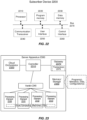
- FIG 23 is a block diagram of an exemplary server apparatus configurable according to one or more exemplary embodiments of the present disclosure.
- apparatus 2300 can be configured to perform any of the exemplary methods and/or procedures described herein, such as those shown in Figures 19-21 .
- Apparatus 2300 comprises a controller 2310 that is connected to a plurality of processing elements (PEs, or "processors") 2330-2333 via a virtual switch (Vswitch) 2340.
- PEs 2330-2333 can be configured as one or more virtual computing machines (VMs), the number of which can be the same as, or different than, the number of PEs 2330-2333.
- VMs virtual computing machines
- Vswitch 2340 can also facilitate communications among the various PEs 2330-2333 (and/or the configured VMs) via local-area network (LAN) functionality, such as Ethernet.
- LAN local-area network
- cloud orchestrator 2320 can allocate a medium access control (MAC) address to this new VM. All subsequent communications to and from the VM can use this unique MAC address.
- An exemplary Cloud Orchestrator 2320 is OpenStack, in which the "Nova" component pre-determines MAC and Internet Protocol (IP) addresses of VMs in the DC.
- Apparatus 2300 can communicate externally via one (or more) gateways, such as gateway 2370.
- apparatus 2300 can communicate with a peer parallel computing apparatus via gateway 2370 and a compatible peer gateway.
- gateway 2370 can comprise a communication transceiver 2375 (e.g., a Gigabit Ethernet transceiver, an optical transceiver, a radio transceiver, etc .).
- Apparatus 2300 can comprise memory/storage 2350 that is operably connected to PEs 2330-2333 and controller 2310.
- Memory/storage 2350 can store various information including, e.g., program(s) and/or modules executable by PEs 2330-2333 and/or controller 2310.
- memory/storage 2350 can store computer-executable instructions that, when executed, configure controller 2310 and/or PEs 2330-2333 to perform operations corresponding to any of the exemplary methods and/or procedures described above.
- memory/storage 2350 can comprise software code that can facilitate and specifically configure apparatus 2300 to communicate via gateway 2370 using appropriate protocols known to skilled persons.
- a portion of memory/storage 2350 can also be used for permanent, semi-permanent, and/or temporary storage of data for further processing and/or communication by controller 2310 and/or PEs 2330-2333. Moreover, a portion of memory/storage 2350 can also be used for permanent, semi-permanent, and/or temporary storage of configuration(s) pertaining to controller 2310, PEs 2330-2333, and/or any other component of apparatus 2300. Persons of ordinary skill in the art will recognize that memory/storage 2350 can be configured in various ways with respect to controller 2310 and/or PEs 2330-2333. For example, multiple individual PEs can be commonly connected to memory/storage 2350, or individually connected to multiple individual memories comprising memory/storage 2350.
- apparatus 2300 can be implemented in many different combinations of hardware and software including, but not limited to, application processors, signal processors, general-purpose processors, multi-core processors, ASICs, fixed digital circuitry, programmable digital circuitry, analog baseband circuitry, radio-frequency circuitry, software, firmware, and middleware.
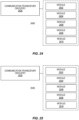
- Figure 24 illustrates an exemplary functional module or circuit architecture as can be implemented in an exemplary communication device 2400.
- exemplary communication device 2400 can represent a substantially similar device as exemplary device 2200 shown in Figure 22 , albeit configured in a different manner according to various functional modules.
- device 2400 can include communication transceiver circuitry 2420, which in some embodiments can be substantially similar to communication transceiver 2240 of device 2200. In other embodiments, transceiver circuitry 2420 can have more, less, or different features than the features of transceiver 2240.
- device 2400 can include a plurality of functional modules, labelled 2402-2410 respectively in Figure 24 . Although five modules are shown, this is merely exemplary such that device 2400 can be configured with a greater or lesser number of modules.
- each of modules 2402-2410 can comprise different combinations of analog and/or digital hardware, one or more processors, and/or memory storing computer-executable instructions ( e.g., executable by the one or more processors).
- the hardware and/or software comprising a particular module need not be mutually exclusive, such that different modules can utilize the same hardware and/or software ( e.g., in a time-shared manner).
- each module can be configured to perform one or more particular functions or operations.
- each module can be configured to perform a particular operation corresponding to one (or more) of the operations shown in or described above in relation to Figure 18 .
- each of modules 2402-2410 can be configured to perform a respective one of operations 1810-1850 shown in Figure 18 .
- other modules can be included in device 2400 to perform additional, or different, operations.
- device 2500 can include a plurality of functional modules, labelled 2502-2510 respectively in Figure 25 . Although five modules are shown, this is merely exemplary such that device 2500 can be configured with a greater or lesser number of modules.
- each of modules 2502-2510 can comprise different combinations of analog and/or digital hardware, one or more processors, and/or memory storing computer-executable instructions ( e.g., executable by the one or more processors).
- the hardware and/or software comprising a particular module need not be mutually exclusive, such that different modules can utilize the same hardware and/or software ( e.g., in a time-shared manner).
- each module can be configured to perform one or more particular functions or operations.
- each module can be configured to perform a particular operation corresponding to one (or more) of the operations shown in or described above in relation to Figures 19-21 .
- each of modules 2502-2510 can be configured to perform a respective one of operations 1910-1950 shown in Figure 19 .
- other modules can be included in device 2500 to perform additional operations, such as operations 1960-1980 shown in Figure 19 .
- each of modules 2502-2510 can be configured to perform a respective one of operations 2010-2050 shown in Figure 20 , and an additional module (e.g., a module 2512) can be included to perform operation 2060.
- each of modules 2502-2510 can be configured to perform a respective one of operations 2110-2150 shown in Figure 21 .
Landscapes
- Engineering & Computer Science (AREA)
- Computer Security & Cryptography (AREA)
- Computer Networks & Wireless Communication (AREA)
- Signal Processing (AREA)
- Computer Hardware Design (AREA)
- Theoretical Computer Science (AREA)
- General Engineering & Computer Science (AREA)
- Health & Medical Sciences (AREA)
- Bioethics (AREA)
- General Health & Medical Sciences (AREA)
- Software Systems (AREA)
- Physics & Mathematics (AREA)
- General Physics & Mathematics (AREA)
- Computing Systems (AREA)
- Databases & Information Systems (AREA)
- Mobile Radio Communication Systems (AREA)
- Telephonic Communication Services (AREA)
Claims (15)
- Verfahren (1800), das von einem Teilnehmergerät durchgeführt wird, zum Ermöglichen einer sicheren Kommunikation zwischen einem Teilnehmer eines mobilen Kommunikationsnetzwerks und einem oder mehreren Dienstanbietern (SPs), wobei der Teilnehmer mit einer Vielzahl an Einheiten verbunden ist, die eine beliebige Kombination aus Geräten und Profilen umfassen, wobei das Verfahren Folgendes umfasst:Erhalten (1810, 1180) einer Sicherheitsidentifikation (Sicherheits-ID) in Verbindung mit dem Teilnehmer;basierend auf der Sicherheits-ID (1310), Empfangen (1360), von einem Server für kontextbewusste Mehrfach-X-Dienste, MX-CAS, einer Liste mit Einheiten, die eine beliebige Kombination aus Geräten und Profilen umfassen, die mit dem Teilnehmer verbunden sind, und Festlegen (1820) einer Identitätshierarchie, die die Liste mit Einheiten in Verbindung mit dem Teilnehmer umfasst;basierend auf der Sicherheits-ID, Festlegen (1830, 1365) von Zustimmungen für einen oder mehrere SPs zum Zugreifen auf Daten, die von den Einheiten erzeugt wurden, die in der Identitätshierarchie beinhaltet sind, und Senden (1370) der Zustimmungen an den MX-CAS-Server;als Antwort auf eine Anforderung (1650), die die Sicherheits-ID umfasst, Empfangen (1840, 1665), von einem Server zur Mehrfach-X-Schlüsselverkettung, MX-KC, eines öffentlichen Schlüssels (PK), der dazu verwendbar ist, Daten zum Senden an einen bestimmten SP zu verschlüsseln, wobei die Daten unter Verwendung eines entsprechenden geheimen Schlüssels (SK) in Verbindung mit einer festgelegten Zustimmung für den bestimmten SP entschlüsselbar sind;Verschlüsseln (1850, 1667) der Daten unter Verwendung des PK und der Identitätshierarchie.
- Verfahren nach Anspruch 1, wobei die Identitätshierarchie ferner eine oder mehrere Anwendungen in Verbindung mit jeder der Einheiten umfasst; und das Festlegen (1830) von Zustimmungen ferner Festlegen von Zustimmungen für den einen oder die mehreren SPs zum Zugreifen auf Daten umfasst, die von der einen oder den mehreren Anwendungen in Verbindung mit jeder der Einheiten erzeugt wurden, und wobei die Identitätshierarchie optional ferner eine oder mehrere Zeiträume in Verbindung mit mindestens einem Teil der Anwendungen umfasst; und das Festlegen (1830) von Zustimmungen ferner Festlegen von Zustimmungen für den einen oder die mehreren SPs zum Zugreifen auf Daten umfasst, die während des einen Zeitraums oder der mehreren Zeiträume von dem mindestens einem Teil der Anwendungen erzeugt wurden.
- Verfahren nach einem der Ansprüche 1 oder 2, wobei die Sicherheits-ID eine Bootstrap-Identifikation (BTID) umfasst, und das Erhalten (1810) der Sicherheits-ID Durchführen einer Authentifizierungs-Schlüsselvereinbarung (AKA) mit einem Bootstrapping-Server (BSF) und Empfangen der BTID umfasst, und wobei das Durchführen einer AKA mit dem BSF optional Folgendes umfasst:Senden einer Bootstrap-Anforderung an den BSF;Empfangen einer Authentifizierungsabfrage von dem BSF;Senden einer Authentifizierungsantwort an den BSF; undEmpfangen der BTID.
- Verfahren nach einem der Ansprüche 1 bis 3, wobei(i) das Verfahren ferner Folgendes umfasst:
Erzeugen einer Vielzahl an Schlüsseln basierend auf der Sicherheits-ID und/oder wobei(ii) das Festlegen (1820) der Identitätshierarchie Folgendes umfasst:Senden einer Initialisierungsanforderung, die die Sicherheits-ID umfasst, wobei die Initialisierungsanforderung unter Verwendung eines zweiten Schlüssels verschlüsselt ist, der basierend auf der Sicherheits-ID herleitbar ist;Empfangen einer Anforderung für einen ersten Schlüssel, der basierend auf der Sicherheits-ID herleitbar ist;Entschlüsseln der Anforderung unter Verwendung des zweiten Schlüssels; undSenden einer Antwort, die den ersten Schlüssel umfasst, wobei die Antwort unter Verwendung des zweiten Schlüssels verschlüsselt ist und/oder wobei(iii)das Festlegen (1830) der Zustimmungen für einen oder mehrere SPs Folgendes umfasst:Senden einer Anforderung, die die Sicherheits-ID umfasst, wobei die Anforderung unter Verwendung eines dritten Schlüssel verschlüsselt ist, der basierend auf der Sicherheits-ID herleitbar ist;Empfangen der Liste mit Einheiten, die eine beliebige Kombination aus Geräten und Profilen umfassen, die mit dem Teilnehmer verbunden sind;Entschlüsseln der Liste mit Einheiten unter Verwendung des dritten Schlüssels;Verbinden von Zustimmungen für jeden des einen oder der mehreren SPs mit den Einheiten, die in der Liste mit Einheiten beinhaltet sind; undSenden einer Antwort, die die Zustimmungen umfasst, wobei die Antwort unter Verwendung des dritten Schlüssels verschlüsselt ist und/oder wobei(iv) das Empfangen (1840) des PK, der dazu verwendbar ist, Daten zum Senden an einen bestimmten SP zu verschlüsseln, Folgendes umfasst:Senden einer Anforderung für den PK, wobei die Anforderung die Sicherheits-ID umfasst und unter Verwendung eines zweiten Schlüssels verschlüsselt ist, der basierend auf der Sicherheits-ID herleitbar ist;Empfangen einer Antwort, die den PK umfasst; undEntschlüsseln der Antwort unter Verwendung des zweiten Schlüssels und/oder(v) das Verfahren ferner Folgendes umfasst
Senden (1860) der Daten, die mit dem PK verschlüsselt sind, an den SP in Verbindung mit der Sicherheits-ID, wobei die Daten, die mit dem PK und der Sicherheits-ID verschlüsselt sind, ferner mit einem vierten Schlüssel verschlüsselt sind, der basierend auf der Sicherheits-ID herleitbar ist. - Verfahren (2000), das von einem Server (1010, 2300) zur Mehrfach-X-Schlüsselverkettung, MX-KC, durchgeführt wird, zum Ermöglichen einer sicheren Kommunikation zwischen einem Teilnehmer eines mobilen Kommunikationsnetzwerks und einem oder mehreren Dienstanbietern (SPs), wobei der Teilnehmer mit einer Vielzahl an Einheiten verbunden ist, die eine beliebige Kombination aus Geräten und Profilen umfassen, wobei das Verfahren Folgendes umfasst:Empfangen (2010, 1210, 1650), von einem Teilnehmergerät, einer Anforderung, die eine Sicherheitsidentifikation (Sicherheits-ID) in Verbindung mit dem Teilnehmer umfasst;basierend auf der Sicherheits-ID, Festlegen (2020, 1275) einer Identitätshierarchie, die die Vielzahl an Einheiten in Verbindung mit dem Teilnehmer umfasst;Erzeugen (2030, 1275) eines öffentlichen Schlüssels (PK) in Verbindung mit dem Teilnehmer;Empfangen (1380), von einem Server für kontextbewusste Mehrfach-X-Dienste, MX-CAS, von Zustimmungen für den einen oder die mehreren Dienstanbieter zum Zugreifen auf Daten, die von den Einheiten erzeugt wurden, die in der Identitätshierarchie beinhaltet sind, und Erzeugen (2024, 1385) einer Hierarchie von geheimen Schlüsseln (SKs), die der Identitätshierarchie basierend auf den Zustimmungen entsprechen; undBereitstellen (2050, 1665) des PK für ein bestimmtes Gerät oder Profil, das in der Identitätshierarchie beinhaltet ist.
- Verfahren nach Anspruch 5, wobei(i) das Verfahren ferner Folgendes umfasst:Senden (2060) der Hierarchie von SKs an ein Schlüsselmanagementsystem (KMS) zur Lagerung und/oder wobei:
(ii) die Identitätshierarchie ferner eine oder mehrere Anwendungen in Verbindung mit jeder der Einheiten umfasst; unddie Hierarchie der SKS jeweilige SKs für den einen oder die mehreren SPs zum Zugreifen auf Daten umfasst, die von der einen oder den mehreren Anwendungen in Verbindung mit jeder der Einheiten erzeugt wurden, wobei optional:die Identitätshierarchie ferner einen oder mehrere Zeiträume in Verbindung mit mindestens einem Teil der Anwendungen umfasst; unddie Hierarchie der SKs jeweilige SKs für den einen oder die mehreren SPs zum Zugreifen auf Daten umfasst, die während des einen oder der mehreren Zeiträume von dem mindestens einem Teil der Anwendungen erzeugt wurden. - Verfahren nach Anspruch 5 oder 6, wobei(i) das Festlegen (2020) der Identitätshierarchie Folgendes umfasst:Senden einer Anforderung für einen zweiten Schlüssel einer Vielzahl an Schlüsseln, die basierend auf der Sicherheits-ID herleitbar sind, wobei die Anforderung die Sicherheits-ID beinhaltet;Empfangen des zweiten Schlüssels und von Teilnehmeridentitätsinformationen; undAuthentifizieren des Teilnehmergeräts basierend auf den Teilnehmeridentitätsinformationen und wobei das Festlegen (2020) der Identitätshierarchie optional ferner Folgendes umfasst:Senden, an das authentifizierte Teilnehmergerät, einer Anforderung für einen ersten Schlüssel der Vielzahl, wobei die Anforderung unter Verwendung des zweiten Schlüssels verschlüsselt ist;Empfangen, von dem authentifizierten Teilnehmergerät, einer Antwort, die den ersten Schlüssel umfasst; undEntschlüsseln der Antwort unter Verwendung des zweiten Schlüssels und wobei der PK ferner optional basierend auf dem ersten Schlüssel erzeugt wird und optional fernerErzeugen, basierend auf dem ersten Schlüssel, eines geheimen Master-Schlüssels (MSK).
- Verfahren nach einem der Ansprüche 5 bis 7, wobei(i) das Festlegen (2020) der Identitätshierarchie ferner Folgendes umfasst:Empfangen einer Liste mit Einheiten, die eine beliebige Kombination aus Geräten und Profilen umfassen, die mit dem Teilnehmer verbunden sind; undErzeugen der Identitätshierarchie basierend auf der Liste mit Einheiten und/oder wobei(ii) das Erzeugen (2040) der Hierarchie der SKs Folgendes umfasst:Empfangen der Zustimmungen für einen oder mehrere SPs zum Zugreifen auf Daten, die von den Einheiten erzeugt wurden, die in der Identitätshierarchie beinhaltet sind; undErzeugen der Hierarchie von SKs basierend auf den Zustimmungen und einem geheimen Master-Schlüssel (MSK) und/oder wobei(iii)das Empfangen (2010) der Anforderung Folgendes umfasst:Empfangen einer ersten Initialisierungsanforderung von dem Teilnehmergerät;Senden einer Antwort, die das Teilnehmergerät anweist, Bootstrapping durchzuführen; undEmpfangen, von dem Teilnehmergerät, einer weiteren Initialisierungsanforderung, die die Sicherheits-ID umfasst, und/oder wobei(iv) das Bereitstellen (2050) des PK für ein bestimmtes Gerät oder Profil, das in der Identitätshierarchie beinhaltet ist, Folgendes umfasst:Empfangen einer Anforderung für den PK von einem ersten Gerät, wobei die Anforderung die Sicherheits-ID umfasst;Senden einer Anforderung für einen zweiten Schlüssel einer Vielzahl an Schlüsseln, die basierend auf der Sicherheits-ID herleitbar sind, wobei die Anforderung die Sicherheits-ID beinhaltet;Empfangen des zweiten Schlüssels; undSenden des PK an das erste Gerät, wobei der PK unter Verwendung des zweiten Schlüssels verschlüsselt ist und wobei optional:die Sicherheits-ID eine Bootstrap-Identifikation (BTID) umfasst;die Anforderung für den zweiten Schlüssel an einen Bootstrapping-Server (BSF) gesendet wird; undder zweite Schlüssel von dem BSF empfangen wird.
- Verfahren (2100), das von einem Server (1020, 2300) für kontextbewusste Mehrfach-X-Dienste, MX-CAS, durchgeführt wird, zum Ermöglichen einer sicheren Kommunikation zwischen einem Teilnehmer eines mobilen Kommunikationsnetzwerks und einem oder mehreren Dienstanbietern (SPs), wobei der Teilnehmer mit einer Vielzahl an Einheiten verbunden ist, die eine beliebige Kombination aus Geräten und Profilen umfassen, wobei das Verfahren Folgendes umfasst:Empfangen (2110, 1310), von einem Teilnehmergerät, einer Anforderung, die eine Sicherheitsidentifikation (Sicherheits-ID) in Verbindung mit dem Teilnehmer umfasst;Authentifizieren (2120) des Teilnehmers basierend auf Teilnehmerinformationen in Verbindung mit der Sicherheits-ID, wobei das Authentifizieren (2120) des Teilnehmers Folgendes umfasst:Senden (1320) einer Anforderung für einen zweiten Schlüssel, der basierend auf der Sicherheits-ID herleitbar ist,wobei die Anforderung die Sicherheits-ID beinhaltet;Empfangen (1330) des zweiten Schlüssels und Teilnehmeridentitätsinformationen; undAuthentifizieren (1335) des Teilnehmers basierend auf den Teilnehmeridentitätsinformationen;wobei das Verfahren ferner Folgendes umfasst:bei Authentifizierung des Teilnehmers Senden (2130, 1360), an das Teilnehmergerät, einer Liste mit Einheiten, die eine beliebige Kombination aus Geräten und Profilen umfassen, die mit dem Teilnehmer verbunden sind;Empfangen (2140, 1370), von dem Teilnehmergerät, von Zustimmungen für einen oder mehrere Dienstanbieter (SPs) zum Zugreifen auf Daten, die von den Einheiten erzeugt wurden, die in der Liste beinhaltet sind; undAbbilden (2150, 1375) der empfangenen Zustimmungen in einer Identitätshierarchie, die die Einheiten umfasst, die mit dem Teilnehmer verbunden sind, und Senden (1380) der Zustimmungen an einen Server zur Mehrfach-X-Schlüsselverkettung, MX-KC.
- Verfahren nach Anspruch 9, wobei die Identitätshierarchie ferner eine oder mehrere Anwendungen in Verbindung mit jeder der Einheiten umfasst; und das Abbilden (2150) der empfangenen Zustimmungen ferner Abbilden von Zustimmungen für den einen oder die mehreren SPs zum Zugreifen auf Daten umfasst, die von der einen oder den mehreren Anwendungen in Verbindung mit jeder der Einheiten erzeugt wurden, und wobei die Identitätshierarchie ferner optional einen oder mehrere Zeiträume in Verbindung mit mindestens einem Teil der Anwendungen umfasst; und das Abbilden (2150) der empfangenen Zustimmungen ferner Abbilden von Zustimmungen für den einen oder die mehreren SPs zum Zugreifen auf Daten umfasst, die während des einen oder der mehreren Zeiträume von dem mindestens einen Teil der Anwendungen erzeugt wurden.
- Verfahren nach Anspruch 9 oder 10, wobei:(i) die Liste mit Einheiten, die an das Teilnehmergerät gesendet wird, mit dem zweiten Schlüssel verschlüsselt ist; unddie Zustimmungen, die von dem Teilnehmergerät empfangen werden, unter Verwendung des zweiten Schlüssels entschlüsselt werden und/oder wobei:
(ii) die Sicherheits-ID eine Bootstrap-Identifikation (BTID) umfasst;die Anforderung für den zweiten Schlüssel an einen Bootstrapping-Server (BSF) gesendet wird; undder zweite Schlüssel und die Teilnehmeridentitätsinformationen von dem BSF empfangen werden. - Teilnehmergerät (2200), das dazu konfigurierbar ist, eine sichere Kommunikation zwischen einem Teilnehmer eines mobilen Kommunikationsnetzwerks und einem oder mehreren Dienstanbietern (SPs) zu ermöglichen, wobei der Teilnehmer mit einer Vielzahl an Einheiten verbunden ist, die eine beliebige Kombination aus Geräten und Profilen umfassen, wobei das Teilnehmergerät Folgendes umfasst:einen Kommunikations-Sendeempfänger (2240);mindestens einen Prozessor (2210), der betriebsmäßig mit dem Kommunikations-Sendeempfänger gekoppelt ist; undmindestens einen Speicher (2220), der von einem Computer ausführbare Anweisungen speichert, die, wenn sie von dem mindestens einen Prozessor ausgeführt werden, das Teilnehmergerät dazu konfigurieren, Operationen durchzuführen, die einem der Verfahren nach den Ansprüchen 1 bis 4 entsprechen.
- Servervorrichtung (1010, 1020, 1030, 2300), die dazu konfigurierbar ist, eine sichere Kommunikation zwischen einem Teilnehmer eines mobilen Kommunikationsnetzwerks und einem oder mehreren Dienstanbietern (SPs) zu ermöglichen, wobei der Teilnehmer mit einer Vielzahl an Einheiten verbunden ist, die eine beliebige Kombination aus Geräten und Profilen umfassen, wobei die Servervorrichtung Folgendes umfasst:einen Kommunikations-Sendeempfänger (2375);mindestens einen Prozessor (2330-2333), der betriebsmäßig mit dem Kommunikations-Sendeempfänger gekoppelt ist; undmindestens einen Speicher (2350), der von einem Computer ausführbare Anweisungen speichert, die, wenn sie von dem mindestens einem Prozessor ausgeführt werden, die Servervorrichtung dazu konfigurieren, Operationen durchzuführen, die einem der Verfahren nach den Ansprüchen 5 bis 11 entsprechen.
- Nicht-transitorisches, computerlesbares Medium (2220), das von einem Computer ausführbare Anweisungen speichert, die, wenn sie von mindestens einem Prozessor (2210) ausgeführt werden, der von einem Teilnehmergerät (1095, 2200) umfasst ist, das Teilnehmergerät dazu konfigurieren, eine sichere Kommunikation zwischen einem Teilnehmer eines mobilen Kommunikationsnetzwerks und einem oder mehreren Dienstanbietern (SPs) zu ermöglichen, wobei der Teilnehmer mit einer Vielzahl an Einheiten verbunden ist, die eine beliebige Kombination aus Geräten und Profilen umfassen, durch Durchführen von Operationen, die einem der Verfahren nach den Ansprüchen 1 bis 4 entsprechen.
- Nicht-transitorisches, computerlesbares Medium (2350), das von einem Computer ausführbare Anweisungen speichert, die, wenn sie von mindestens einem Prozessor (2330-2333) ausgeführt werden, der von einer Servervorrichtung (1010, 1020, 1030, 2300) umfasst ist, die Servervorrichtung dazu konfigurieren, eine sichere Kommunikation zwischen einem Teilnehmer eines mobilen Kommunikationsnetzwerks und einem oder mehreren Dienstanbietern (SPs) zu ermöglichen, wobei der Teilnehmer mit einer Vielzahl an Einheiten verbunden ist, die eine beliebige Kombination aus Geräten und Profilen umfassen, durch Durchführen von Operationen, die einem der Verfahren nach den Ansprüchen 5 bis 11 entsprechen.
Applications Claiming Priority (1)
| Application Number | Priority Date | Filing Date | Title |
|---|---|---|---|
| PCT/IB2018/055303 WO2020016628A1 (en) | 2018-07-17 | 2018-07-17 | Multi-x key chaining for generic bootstrapping architecture (gba) |
Publications (2)
| Publication Number | Publication Date |
|---|---|
| EP3824609A1 EP3824609A1 (de) | 2021-05-26 |
| EP3824609B1 true EP3824609B1 (de) | 2025-05-07 |
Family
ID=63350575
Family Applications (1)
| Application Number | Title | Priority Date | Filing Date |
|---|---|---|---|
| EP18759171.4A Active EP3824609B1 (de) | 2018-07-17 | 2018-07-17 | Mehrfach-x-schlüsselverkettung für generische bootstrap-architektur (gba) |
Country Status (4)
| Country | Link |
|---|---|
| US (1) | US11800351B2 (de) |
| EP (1) | EP3824609B1 (de) |
| CN (1) | CN112425132B (de) |
| WO (1) | WO2020016628A1 (de) |
Families Citing this family (4)
| Publication number | Priority date | Publication date | Assignee | Title |
|---|---|---|---|---|
| EP3824609B1 (de) * | 2018-07-17 | 2025-05-07 | Telefonaktiebolaget LM Ericsson (publ) | Mehrfach-x-schlüsselverkettung für generische bootstrap-architektur (gba) |
| CN111935702B (zh) * | 2020-09-08 | 2022-09-02 | 中国联合网络通信集团有限公司 | 处理业务的方法和装置 |
| US12470538B2 (en) * | 2021-12-21 | 2025-11-11 | Cisco Technology, Inc. | IoT bootstrapping and certificate management using zero-touch deployment (ZTD) services |
| US12381883B2 (en) | 2023-01-31 | 2025-08-05 | Bank Of America Corporation | Hierarchical based decryption for improved content security |
Family Cites Families (25)
| Publication number | Priority date | Publication date | Assignee | Title |
|---|---|---|---|---|
| FI102235B1 (fi) * | 1996-01-24 | 1998-10-30 | Nokia Telecommunications Oy | Autentikointiavainten hallinta matkaviestinjärjestelmässä |
| US7076558B1 (en) * | 2002-02-27 | 2006-07-11 | Microsoft Corporation | User-centric consent management system and method |
| US7349538B2 (en) | 2002-03-21 | 2008-03-25 | Ntt Docomo Inc. | Hierarchical identity-based encryption and signature schemes |
| KR100744531B1 (ko) * | 2003-12-26 | 2007-08-01 | 한국전자통신연구원 | 무선 단말기용 암호키 관리 시스템 및 방법 |
| GB0414421D0 (en) | 2004-06-28 | 2004-07-28 | Nokia Corp | Authenticating users |
| US7480385B2 (en) | 2004-11-05 | 2009-01-20 | Cable Television Laboratories, Inc. | Hierarchical encryption key system for securing digital media |
| CN1956459A (zh) * | 2005-10-27 | 2007-05-02 | 日电(中国)有限公司 | 虚拟用户标识符系统和方法 |
| US7788484B2 (en) * | 2005-11-30 | 2010-08-31 | Microsoft Corporation | Using hierarchical identity based cryptography for authenticating outbound mail |
| US8023478B2 (en) * | 2006-03-06 | 2011-09-20 | Cisco Technology, Inc. | System and method for securing mesh access points in a wireless mesh network, including rapid roaming |
| CA2734774C (en) * | 2008-08-26 | 2015-03-24 | Ringleader Digital, Inc. | A user-transparent system for uniquely identifying network-distributed devices without explicitly provided device or user identifying information |
| CN101873214A (zh) * | 2009-04-24 | 2010-10-27 | 索尼株式会社 | 广播加密中用于密钥生成、加密和解密的方法、设备 |
| WO2011054555A1 (en) * | 2009-11-06 | 2011-05-12 | International Business Machines Corporation | Method and system for managing security objects |
| US8484366B2 (en) * | 2010-01-05 | 2013-07-09 | Accenture Global Services Limited | Hierarchical service management |
| US8509431B2 (en) * | 2010-09-20 | 2013-08-13 | Interdigital Patent Holdings, Inc. | Identity management on a wireless device |
| US8635464B2 (en) * | 2010-12-03 | 2014-01-21 | Yacov Yacobi | Attribute-based access-controlled data-storage system |
| US9251315B2 (en) | 2011-12-09 | 2016-02-02 | Verizon Patent And Licensing Inc. | Security key management based on service packaging |
| US9215076B1 (en) * | 2012-03-27 | 2015-12-15 | Amazon Technologies, Inc. | Key generation for hierarchical data access |
| CN105144656A (zh) | 2013-04-26 | 2015-12-09 | 交互数字专利控股公司 | 用于实现要求的认证确保级别的多因素认证 |
| US9621357B2 (en) * | 2014-10-16 | 2017-04-11 | Verato, Inc. | System and method for providing consent management |
| US20160286395A1 (en) * | 2015-03-24 | 2016-09-29 | Intel Corporation | Apparatus, system and method of securing communication between wireless devices |
| KR101709086B1 (ko) | 2015-12-24 | 2017-02-23 | 서강대학교산학협력단 | 사물 인터넷 환경에서의 컨텍스트 기반 보안방법 및 그에 따른 시스템 |
| SG10201606165SA (en) | 2016-07-26 | 2018-02-27 | Huawei Int Pte Ltd | A key generation and distribution method based on identity-based cryptography |
| US11184161B2 (en) * | 2017-07-18 | 2021-11-23 | Legic Identsystems Ag | Method and devices for verifying authorization of an electronic device |
| CN108063754B (zh) | 2017-11-10 | 2020-11-13 | 西安电子科技大学 | 面向可穿戴健康监测设备匿名化数据的属性基加密方法 |
| EP3824609B1 (de) * | 2018-07-17 | 2025-05-07 | Telefonaktiebolaget LM Ericsson (publ) | Mehrfach-x-schlüsselverkettung für generische bootstrap-architektur (gba) |
-
2018
- 2018-07-17 EP EP18759171.4A patent/EP3824609B1/de active Active
- 2018-07-17 US US17/258,572 patent/US11800351B2/en active Active
- 2018-07-17 CN CN201880095732.XA patent/CN112425132B/zh active Active
- 2018-07-17 WO PCT/IB2018/055303 patent/WO2020016628A1/en not_active Ceased
Also Published As
| Publication number | Publication date |
|---|---|
| CN112425132B (zh) | 2024-02-20 |
| WO2020016628A1 (en) | 2020-01-23 |
| EP3824609A1 (de) | 2021-05-26 |
| CN112425132A (zh) | 2021-02-26 |
| US20210274343A1 (en) | 2021-09-02 |
| US11800351B2 (en) | 2023-10-24 |
Similar Documents
| Publication | Publication Date | Title |
|---|---|---|
| JP7326521B2 (ja) | 加入秘匿化識別子 | |
| US12306976B2 (en) | Hosted device provisioning protocol with servers and a networked initiator | |
| US10958425B2 (en) | Hosted dynamic provisioning protocol with servers and a networked responder | |
| Sanchez-Gomez et al. | Integrating LPWAN technologies in the 5G ecosystem: A survey on security challenges and solutions | |
| EP3432532B1 (de) | Verfahren zur verteilung und authentifizierung von schlüsseln, vorrichtung und system | |
| US9077690B2 (en) | Preservation of user data privacy in a network | |
| KR102021213B1 (ko) | 엔드 투 엔드 서비스 계층 인증 | |
| EP3883279A1 (de) | Kommunikationsverfahren und zugehöriges produkt | |
| CN107852405B (zh) | 用于服务层的内容安全性的装置 | |
| EP3691316A1 (de) | Parameterschutzverfahren, vorrichtung und system | |
| CN114258693A (zh) | 无电子用户身份模块(esim)凭证的移动设备认证 | |
| WO2015036782A1 (en) | Communicating with a device | |
| US11800351B2 (en) | Multi-X key chaining for Generic Bootstrapping Architecture (GBA) | |
| EP3570487B1 (de) | Verfahren, vorrichtung und system zur generierung eines privaten schlüssels | |
| Anggorojati et al. | Securing communication in inter domains Internet of Things using identity-based cryptography | |
| US11979743B2 (en) | Systems and methods for secure access to 5G non-public networks using mobile network operator credentials | |
| US20260129435A1 (en) | Shared Secret Key Architecture and Distribution | |
| WO2025156497A1 (en) | Method, device and system for ue identity privacy in communication networks | |
| Mudugodu Seetarama | Secure device bootstrapping with the nimble out of band authentication protocol | |
| CN120358493A (zh) | 通信方法和通信装置 | |
| CN119342458A (zh) | 传输协议中应用元数据的保护 | |
| Hiltunen et al. | 5G-ENSURE-D3. 2 5G-PPP security enablers open specifications (v1. 0) |
Legal Events
| Date | Code | Title | Description |
|---|---|---|---|
| STAA | Information on the status of an ep patent application or granted ep patent |
Free format text: STATUS: UNKNOWN |
|
| STAA | Information on the status of an ep patent application or granted ep patent |
Free format text: STATUS: THE INTERNATIONAL PUBLICATION HAS BEEN MADE |
|
| PUAI | Public reference made under article 153(3) epc to a published international application that has entered the european phase |
Free format text: ORIGINAL CODE: 0009012 |
|
| STAA | Information on the status of an ep patent application or granted ep patent |
Free format text: STATUS: REQUEST FOR EXAMINATION WAS MADE |
|
| 17P | Request for examination filed |
Effective date: 20210201 |
|
| AK | Designated contracting states |
Kind code of ref document: A1 Designated state(s): AL AT BE BG CH CY CZ DE DK EE ES FI FR GB GR HR HU IE IS IT LI LT LU LV MC MK MT NL NO PL PT RO RS SE SI SK SM TR |
|
| DAV | Request for validation of the european patent (deleted) | ||
| DAX | Request for extension of the european patent (deleted) | ||
| REG | Reference to a national code |
Ref country code: DE Ref legal event code: R079 Free format text: PREVIOUS MAIN CLASS: H04L0029060000 Ipc: H04L0009400000 Ref country code: DE Ref legal event code: R079 Ref document number: 602018081727 Country of ref document: DE Free format text: PREVIOUS MAIN CLASS: H04L0029060000 Ipc: H04L0009400000 |
|
| GRAP | Despatch of communication of intention to grant a patent |
Free format text: ORIGINAL CODE: EPIDOSNIGR1 |
|
| STAA | Information on the status of an ep patent application or granted ep patent |
Free format text: STATUS: GRANT OF PATENT IS INTENDED |
|
| RIC1 | Information provided on ipc code assigned before grant |
Ipc: H04W 8/18 20090101ALI20241205BHEP Ipc: H04W 12/0431 20210101ALI20241205BHEP Ipc: H04W 12/043 20210101ALI20241205BHEP Ipc: H04L 9/40 20220101AFI20241205BHEP |
|
| INTG | Intention to grant announced |
Effective date: 20241220 |
|
| GRAS | Grant fee paid |
Free format text: ORIGINAL CODE: EPIDOSNIGR3 |
|
| GRAA | (expected) grant |
Free format text: ORIGINAL CODE: 0009210 |
|
| STAA | Information on the status of an ep patent application or granted ep patent |
Free format text: STATUS: THE PATENT HAS BEEN GRANTED |
|
| AK | Designated contracting states |
Kind code of ref document: B1 Designated state(s): AL AT BE BG CH CY CZ DE DK EE ES FI FR GB GR HR HU IE IS IT LI LT LU LV MC MK MT NL NO PL PT RO RS SE SI SK SM TR |
|
| REG | Reference to a national code |
Ref country code: GB Ref legal event code: FG4D |
|
| REG | Reference to a national code |
Ref country code: CH Ref legal event code: EP |
|
| REG | Reference to a national code |
Ref country code: DE Ref legal event code: R096 Ref document number: 602018081727 Country of ref document: DE |
|
| REG | Reference to a national code |
Ref country code: IE Ref legal event code: FG4D |
|
| REG | Reference to a national code |
Ref country code: NL Ref legal event code: MP Effective date: 20250507 |
|
| PG25 | Lapsed in a contracting state [announced via postgrant information from national office to epo] |
Ref country code: FI Free format text: LAPSE BECAUSE OF FAILURE TO SUBMIT A TRANSLATION OF THE DESCRIPTION OR TO PAY THE FEE WITHIN THE PRESCRIBED TIME-LIMIT Effective date: 20250507 Ref country code: PT Free format text: LAPSE BECAUSE OF FAILURE TO SUBMIT A TRANSLATION OF THE DESCRIPTION OR TO PAY THE FEE WITHIN THE PRESCRIBED TIME-LIMIT Effective date: 20250908 Ref country code: ES Free format text: LAPSE BECAUSE OF FAILURE TO SUBMIT A TRANSLATION OF THE DESCRIPTION OR TO PAY THE FEE WITHIN THE PRESCRIBED TIME-LIMIT Effective date: 20250507 |
|
| REG | Reference to a national code |
Ref country code: LT Ref legal event code: MG9D |
|
| PG25 | Lapsed in a contracting state [announced via postgrant information from national office to epo] |
Ref country code: NO Free format text: LAPSE BECAUSE OF FAILURE TO SUBMIT A TRANSLATION OF THE DESCRIPTION OR TO PAY THE FEE WITHIN THE PRESCRIBED TIME-LIMIT Effective date: 20250807 Ref country code: GR Free format text: LAPSE BECAUSE OF FAILURE TO SUBMIT A TRANSLATION OF THE DESCRIPTION OR TO PAY THE FEE WITHIN THE PRESCRIBED TIME-LIMIT Effective date: 20250808 |
|
| PG25 | Lapsed in a contracting state [announced via postgrant information from national office to epo] |
Ref country code: PL Free format text: LAPSE BECAUSE OF FAILURE TO SUBMIT A TRANSLATION OF THE DESCRIPTION OR TO PAY THE FEE WITHIN THE PRESCRIBED TIME-LIMIT Effective date: 20250507 Ref country code: NL Free format text: LAPSE BECAUSE OF FAILURE TO SUBMIT A TRANSLATION OF THE DESCRIPTION OR TO PAY THE FEE WITHIN THE PRESCRIBED TIME-LIMIT Effective date: 20250507 |
|
| REG | Reference to a national code |
Ref country code: AT Ref legal event code: MK05 Ref document number: 1793710 Country of ref document: AT Kind code of ref document: T Effective date: 20250507 |
|
| PG25 | Lapsed in a contracting state [announced via postgrant information from national office to epo] |
Ref country code: BG Free format text: LAPSE BECAUSE OF FAILURE TO SUBMIT A TRANSLATION OF THE DESCRIPTION OR TO PAY THE FEE WITHIN THE PRESCRIBED TIME-LIMIT Effective date: 20250507 |
|
| PGFP | Annual fee paid to national office [announced via postgrant information from national office to epo] |
Ref country code: GB Payment date: 20250728 Year of fee payment: 8 |
|
| PG25 | Lapsed in a contracting state [announced via postgrant information from national office to epo] |
Ref country code: HR Free format text: LAPSE BECAUSE OF FAILURE TO SUBMIT A TRANSLATION OF THE DESCRIPTION OR TO PAY THE FEE WITHIN THE PRESCRIBED TIME-LIMIT Effective date: 20250507 |
|
| PG25 | Lapsed in a contracting state [announced via postgrant information from national office to epo] |
Ref country code: AT Free format text: LAPSE BECAUSE OF FAILURE TO SUBMIT A TRANSLATION OF THE DESCRIPTION OR TO PAY THE FEE WITHIN THE PRESCRIBED TIME-LIMIT Effective date: 20250507 |
|
| PG25 | Lapsed in a contracting state [announced via postgrant information from national office to epo] |
Ref country code: RS Free format text: LAPSE BECAUSE OF FAILURE TO SUBMIT A TRANSLATION OF THE DESCRIPTION OR TO PAY THE FEE WITHIN THE PRESCRIBED TIME-LIMIT Effective date: 20250807 |
|
| PG25 | Lapsed in a contracting state [announced via postgrant information from national office to epo] |
Ref country code: IS Free format text: LAPSE BECAUSE OF FAILURE TO SUBMIT A TRANSLATION OF THE DESCRIPTION OR TO PAY THE FEE WITHIN THE PRESCRIBED TIME-LIMIT Effective date: 20250907 |
|
| PG25 | Lapsed in a contracting state [announced via postgrant information from national office to epo] |
Ref country code: LV Free format text: LAPSE BECAUSE OF FAILURE TO SUBMIT A TRANSLATION OF THE DESCRIPTION OR TO PAY THE FEE WITHIN THE PRESCRIBED TIME-LIMIT Effective date: 20250507 |
|
| PG25 | Lapsed in a contracting state [announced via postgrant information from national office to epo] |
Ref country code: SM Free format text: LAPSE BECAUSE OF FAILURE TO SUBMIT A TRANSLATION OF THE DESCRIPTION OR TO PAY THE FEE WITHIN THE PRESCRIBED TIME-LIMIT Effective date: 20250507 Ref country code: DK Free format text: LAPSE BECAUSE OF FAILURE TO SUBMIT A TRANSLATION OF THE DESCRIPTION OR TO PAY THE FEE WITHIN THE PRESCRIBED TIME-LIMIT Effective date: 20250507 |
|
| PG25 | Lapsed in a contracting state [announced via postgrant information from national office to epo] |
Ref country code: CZ Free format text: LAPSE BECAUSE OF FAILURE TO SUBMIT A TRANSLATION OF THE DESCRIPTION OR TO PAY THE FEE WITHIN THE PRESCRIBED TIME-LIMIT Effective date: 20250507 |
|
| PG25 | Lapsed in a contracting state [announced via postgrant information from national office to epo] |
Ref country code: EE Free format text: LAPSE BECAUSE OF FAILURE TO SUBMIT A TRANSLATION OF THE DESCRIPTION OR TO PAY THE FEE WITHIN THE PRESCRIBED TIME-LIMIT Effective date: 20250507 |
|
| PG25 | Lapsed in a contracting state [announced via postgrant information from national office to epo] |
Ref country code: SK Free format text: LAPSE BECAUSE OF FAILURE TO SUBMIT A TRANSLATION OF THE DESCRIPTION OR TO PAY THE FEE WITHIN THE PRESCRIBED TIME-LIMIT Effective date: 20250507 Ref country code: RO Free format text: LAPSE BECAUSE OF FAILURE TO SUBMIT A TRANSLATION OF THE DESCRIPTION OR TO PAY THE FEE WITHIN THE PRESCRIBED TIME-LIMIT Effective date: 20250507 |
|
| PG25 | Lapsed in a contracting state [announced via postgrant information from national office to epo] |
Ref country code: IT Free format text: LAPSE BECAUSE OF FAILURE TO SUBMIT A TRANSLATION OF THE DESCRIPTION OR TO PAY THE FEE WITHIN THE PRESCRIBED TIME-LIMIT Effective date: 20250507 |
|
| REG | Reference to a national code |
Ref country code: DE Ref legal event code: R119 Ref document number: 602018081727 Country of ref document: DE |
|
| REG | Reference to a national code |
Ref country code: CH Ref legal event code: H13 Free format text: ST27 STATUS EVENT CODE: U-0-0-H10-H13 (AS PROVIDED BY THE NATIONAL OFFICE) Effective date: 20260224 |
|
| PLBE | No opposition filed within time limit |
Free format text: ORIGINAL CODE: 0009261 |
|
| STAA | Information on the status of an ep patent application or granted ep patent |
Free format text: STATUS: NO OPPOSITION FILED WITHIN TIME LIMIT |
|
| PG25 | Lapsed in a contracting state [announced via postgrant information from national office to epo] |
Ref country code: LU Free format text: LAPSE BECAUSE OF NON-PAYMENT OF DUE FEES Effective date: 20250717 |
|
| REG | Reference to a national code |
Ref country code: CH Ref legal event code: L10 Free format text: ST27 STATUS EVENT CODE: U-0-0-L10-L00 (AS PROVIDED BY THE NATIONAL OFFICE) Effective date: 20260318 |
|
| REG | Reference to a national code |
Ref country code: BE Ref legal event code: MM Effective date: 20250731 |
|
| PG25 | Lapsed in a contracting state [announced via postgrant information from national office to epo] |
Ref country code: DE Free format text: LAPSE BECAUSE OF NON-PAYMENT OF DUE FEES Effective date: 20260203 |
|
| 26N | No opposition filed |
Effective date: 20260210 |
|
| PG25 | Lapsed in a contracting state [announced via postgrant information from national office to epo] |
Ref country code: BE Free format text: LAPSE BECAUSE OF NON-PAYMENT OF DUE FEES Effective date: 20250731 |
|
| PG25 | Lapsed in a contracting state [announced via postgrant information from national office to epo] |
Ref country code: FR Free format text: LAPSE BECAUSE OF NON-PAYMENT OF DUE FEES Effective date: 20250731 |
|
| PG25 | Lapsed in a contracting state [announced via postgrant information from national office to epo] |
Ref country code: CH Free format text: LAPSE BECAUSE OF NON-PAYMENT OF DUE FEES Effective date: 20250731 |
|
| PG25 | Lapsed in a contracting state [announced via postgrant information from national office to epo] |
Ref country code: LT Free format text: LAPSE BECAUSE OF FAILURE TO SUBMIT A TRANSLATION OF THE DESCRIPTION OR TO PAY THE FEE WITHIN THE PRESCRIBED TIME-LIMIT Effective date: 20250507 |
|
| PG25 | Lapsed in a contracting state [announced via postgrant information from national office to epo] |
Ref country code: IE Free format text: LAPSE BECAUSE OF NON-PAYMENT OF DUE FEES Effective date: 20250717 |
|
| PG25 | Lapsed in a contracting state [announced via postgrant information from national office to epo] |
Ref country code: MC Free format text: LAPSE BECAUSE OF FAILURE TO SUBMIT A TRANSLATION OF THE DESCRIPTION OR TO PAY THE FEE WITHIN THE PRESCRIBED TIME-LIMIT Effective date: 20250507 |
|
| PG25 | Lapsed in a contracting state [announced via postgrant information from national office to epo] |
Ref country code: SE Free format text: LAPSE BECAUSE OF FAILURE TO SUBMIT A TRANSLATION OF THE DESCRIPTION OR TO PAY THE FEE WITHIN THE PRESCRIBED TIME-LIMIT Effective date: 20250507 Ref country code: CY Free format text: LAPSE BECAUSE OF FAILURE TO SUBMIT A TRANSLATION OF THE DESCRIPTION OR TO PAY THE FEE WITHIN THE PRESCRIBED TIME-LIMIT Effective date: 20250507 |