EP3823953B1 - A novel process for the preparation of anthranilic diamides - Google Patents
A novel process for the preparation of anthranilic diamides Download PDFInfo
- Publication number
- EP3823953B1 EP3823953B1 EP19773505.3A EP19773505A EP3823953B1 EP 3823953 B1 EP3823953 B1 EP 3823953B1 EP 19773505 A EP19773505 A EP 19773505A EP 3823953 B1 EP3823953 B1 EP 3823953B1
- Authority
- EP
- European Patent Office
- Prior art keywords
- alkyl
- group
- hydrogen
- compound
- cycloalkyl
- Prior art date
- Legal status (The legal status is an assumption and is not a legal conclusion. Google has not performed a legal analysis and makes no representation as to the accuracy of the status listed.)
- Active
Links
Classifications
-
- C—CHEMISTRY; METALLURGY
- C07—ORGANIC CHEMISTRY
- C07C—ACYCLIC OR CARBOCYCLIC COMPOUNDS
- C07C255/00—Carboxylic acid nitriles
- C07C255/49—Carboxylic acid nitriles having cyano groups bound to carbon atoms of six-membered aromatic rings of a carbon skeleton
- C07C255/58—Carboxylic acid nitriles having cyano groups bound to carbon atoms of six-membered aromatic rings of a carbon skeleton containing cyano groups and singly-bound nitrogen atoms, not being further bound to other hetero atoms, bound to the carbon skeleton
- C07C255/60—Carboxylic acid nitriles having cyano groups bound to carbon atoms of six-membered aromatic rings of a carbon skeleton containing cyano groups and singly-bound nitrogen atoms, not being further bound to other hetero atoms, bound to the carbon skeleton at least one of the singly-bound nitrogen atoms being acylated
-
- C—CHEMISTRY; METALLURGY
- C07—ORGANIC CHEMISTRY
- C07C—ACYCLIC OR CARBOCYCLIC COMPOUNDS
- C07C59/00—Compounds having carboxyl groups bound to acyclic carbon atoms and containing any of the groups OH, O—metal, —CHO, keto, ether, groups, groups, or groups
- C07C59/40—Unsaturated compounds
- C07C59/76—Unsaturated compounds containing keto groups
- C07C59/90—Unsaturated compounds containing keto groups containing singly bound oxygen-containing groups
-
- C—CHEMISTRY; METALLURGY
- C07—ORGANIC CHEMISTRY
- C07D—HETEROCYCLIC COMPOUNDS
- C07D401/00—Heterocyclic compounds containing two or more hetero rings, having nitrogen atoms as the only ring hetero atoms, at least one ring being a six-membered ring with only one nitrogen atom
- C07D401/14—Heterocyclic compounds containing two or more hetero rings, having nitrogen atoms as the only ring hetero atoms, at least one ring being a six-membered ring with only one nitrogen atom containing three or more hetero rings
-
- C—CHEMISTRY; METALLURGY
- C07—ORGANIC CHEMISTRY
- C07C—ACYCLIC OR CARBOCYCLIC COMPOUNDS
- C07C237/00—Carboxylic acid amides, the carbon skeleton of the acid part being further substituted by amino groups
- C07C237/28—Carboxylic acid amides, the carbon skeleton of the acid part being further substituted by amino groups having the carbon atom of at least one of the carboxamide groups bound to a carbon atom of a non-condensed six-membered aromatic ring of the carbon skeleton
- C07C237/42—Carboxylic acid amides, the carbon skeleton of the acid part being further substituted by amino groups having the carbon atom of at least one of the carboxamide groups bound to a carbon atom of a non-condensed six-membered aromatic ring of the carbon skeleton having nitrogen atoms of amino groups bound to the carbon skeleton of the acid part, further acylated
Definitions
- the present invention relates to a novel process for the preparation of anthranilic diamides of the formula 1
- 1-Heteroarylpyrazole-5-carboxylic acids are known to be important intermediates in the agrochemical industry, e. g. for the synthesis of anthranilic diamides which are useful to protect crops against harmful pests.
- Several methods have been disclosed in literature, by which these intermediates can be obtained.
- the formation of pyrazoles by the reaction of 1,3-dicarbonyls or of corresponding 1,3-bis-electrophilic compounds with hydrazines has been described in Synthesis 2004, pages 43-52 .
- the product formed in such reactions consists of a mixture of regioisomeric pyrazoles, meaning that the selectivity in the synthesis of the desired product is a challenge.
- WO2007144100 describes a process for preparing tetrazolyl substituted N-(aryl or heteroaryl) pyrazole-5-carboxylic acid in which diisobutylaluminium hydride (DIBAL) or lithium aluminium hydride (LiAIH 4 ) is used.
- DIBAL diisobutylaluminium hydride
- LiAIH 4 lithium aluminium hydride
- WO2010069502 describes that tetrazolyl substituted anthranilic diamides can be prepared by reacting tetrazolyl substituted N-heteroaryl pyrazole acid with anthranilamides. It also describes that tetrazolyl substituted anthranilic diamides can be prepared by reacting tetrazolyl substituted benzoxazinones with appropriate amines. However, both the processes rarely offer good yield.
- WO2010112178 describes a method for producing 1-pyridinylpyrazole-5-carboxylic acids or esters by the reaction of trihalo substituted acetylene ketones with pyridinyl hydrazines to first obtain an intermediate having a trihalomethyl substituent on the dihydro pyrazole ring, followed by dehydration and an oxidation step.
- trihalo substituted acetylene ketones are expensive starting materials which make this process economically unviable.
- WO2011157664 and WO2013030100 disclose the following process for preparing tetrazolyl substituted 1-heteroarylpyrazole-5-carboxylic acid esters or 1-arylpyrazole-5-carboxylic acid esters:
- WO2013030100 additionally discloses a method for the preparation of tetrazolyl substituted anthranilic diamides from tetrazolyl substituted pyrazole carboxylic acids.
- WO2011073101 describes a process for the preparation of 1-alkyl- or 1-aryl-substituted 5-pyrazolecarboxylic acids which involves the steps of converting substituted 1,3-dioxolanes or 1,4-dioxanes into 1-alkyl- or 1-aryl-substituted dihydro-1H-pyrazoles by reaction with alkyl or aryl hydrazines, and further converting said pyrazoles into 1-alkyl- or 1-aryl-substituted 5-pyrazole carboxylic acids.
- DE102006032168 discloses the following two processes for the preparation of 1-heteroarylpyrazole-5-carboxylic acids as key intermediates:
- WO2011009551 describes a process for the preparation of 1-heteroaryl substituted pyrazole-5-carboxylic acids by reacting trihalo substituted alkoxy enones or enaminoketones with hydrazines to obtain 1-heteroaryl substituted dihydro-1H-pyrazoles as intermediates, followed by eliminating water and subsequent oxidation.
- WO2013007604 describes a method for the preparation of tetrazolyl substituted anthranilic diamides by reacting pyrazole carboxylic acids with anthranilic esters, followed by hydrolysis to obtain acid intermediates which are then reacted with an appropriate amine.
- Another objective was to provide novel intermediates for the preparation of anthranilic diamides of formula I.
- the present invention provides a solution to these objectives by offering a novel high yielding and economically attractive process that allows the preparation of anthranilic diamides and / or novel key intermediates to prepare such anthranilic diamides, overcoming at least one of the shortcomings of the processes described in the prior art.
- the compound of formula V is obtained from a compound of formula VI
- the compound of formula VI is obtained by reacting a compound of formula VII and a compound of formula VIII wherein, R 2 , R 8 , m, T, W 1 , LG 2 and LG 4 are each as defined in the description.
- the compound of formula VIII is obtained by reacting a compound of formula IX and a compound of formula X wherein, LG 2 , LG 4 and LGs are each as defined in the description.
- transitional phrase “consisting essentially of” is used to define a composition or method that includes materials, steps, features, components or elements, in addition to those literally disclosed, provided that these additional materials, steps, features, components or elements do not materially affect the basic and novel characteristic(s) of the claimed invention.
- the term “consisting essentially of” occupies a middle ground between “comprising” and “consisting of”.
- Stereoisomers of the present disclosure may be present either in pure form or as mixtures of different possible isomeric forms such as stereoisomers or constitutional isomers.
- the various stereoisomers include enantiomers, diastereomers, chiral isomers, atropisomers, conformers, rotamers, tautomers, optical isomers, polymorphs, and geometric isomers. Any desired mixtures of these isomers fall within the scope of the claims of the present disclosure.
- one stereoisomer may be more active and/or may exhibit beneficial effects when enriched relative to the other isomer(s) or when separated from the other isomer(s). Additionally, the person skilled in the art knows processes or methods or technology to separate, enrich, and/or to selectively prepare said isomers.
- alkyl used either alone or in compound words such as “alkylthio” or “haloalkyl” or -N(alkyl) or alkylcarbonylalkyl or alkylsuphonylamino includes straight-chain or branched C 1 to C 24 alkyl, preferably C 1 to C 15 alkyl, more preferably C 1 to C 10 alkyl, most preferably C 1 to C 6 alkyl.
- alkyl examples include methyl, ethyl, propyl, 1-methylethyl, butyl, 1-methylpropyl, 2-methylpropyl, 1,1-dimethylethyl, pentyl, 1-methylbutyl, 2-methylbutyl, 3-methylbutyl, 2,2-dimethylpropyl, 1-ethylpropyl, hexyl, 1,1-dimethylpropyl, 1,2-dimethylpropyl, 1-methylpentyl, 2-methylpentyl, 3-methylpentyl, 4-methylpentyl, 1,1-dimethylbutyl, 1,2-dimethylbutyl, 1,3-dimethylbutyl, 2,2-dimethylbutyl, 2,3-dimethylbutyl, 3,3-dimethylbutyl, 1-ethylbutyl, 2-ethylbutyl, 1,1,2-trimethylpropyl, 1,2,2-trimethylpropyl, 1-ethyl-1-methylpropyl
- the alkyl is at the end of a composite substituent, as, for example, in alkylcycloalkyl
- the part of the composite substituent at the start for example the cycloalkyl
- other radicals for example alkenyl, alkynyl, hydroxyl, halogen, carbonyl, carbonyloxy and the like, are at the end.
- alkenyl used either alone or in compound words includes straight-chain or branched C 2 to C 24 alkenes, preferably C 2 to C 15 alkenes, more preferably C 2 to C 10 alkenes, most preferably C 2 to C 6 alkenes.
- Non-limiting examples of alkenes include ethenyl, 1-propenyl, 2-propenyl, 1-methylethenyl, 1-butenyl, 2-butenyl, 3-butenyl, 1-methyl-1-propenyl, 2-methyl-l-propenyl, 1-methyl-2-propenyl, 2-methyl-2-propenyl, 1-pentenyl, 2-pentenyl, 3-pentenyl, 4-pentenyl, 1-methyl-1-butenyl, 2-methyl-1-butenyl, 3-methyl-1-butenyl, l-methyl-2-butenyl, 2-methyl-2-butenyl, 3-methyl-2-butenyl, l-methyl-3-butenyl, 2-methyl-3-butenyl, 3-methyl-3-butenyl, 1,1-dimethyl-2-propenyl, 1,2-dimethyl-1-propenyl, 1,2-dimethyl-2 - propenyl, 1-ethyl-1-propenyl, l-
- Alkenyl also includes polyenes such as 1,2-propadienyl and 2,4-hexadienyl. This definition also applies to alkenyl as a part of a composite substituent, for example haloalkenyl and the like, unless defined specifically elsewhere.
- Non-limiting examples of alkynes include ethynyl, 1-propynyl, 2-propynyl, 1-butynyl, 2-butynyl, 3-butynyl, 1-methyl-2-propynyl, 1-pentynyl, 2-pentynyl, 3-pentynyl, 4-pentynyl, l-methyl-2-butynyl, 1-methyl-3-butynyl, 2-methyl-3-butynyl, 3-methyl-l-butynyl, 1,1-dimethyl-2-propynyl, 1-ethyl -2-propynyl, 1-hexynyl, 2-hexynyl, 3-hexynyl, 4-hexynyl, 5-hexynyl, 1-methyl-2-pentynyl, l-methyl-3-pentynyl, 1-methyl-4-pentynyl, 2-methyl-3-pentynyl, 2-methyl-4
- alkynyl as a part of a composite substituent, for example haloalkynyl etc., unless specifically defined elsewhere.
- Alkynyl can also include moieties comprised of multiple triple bonds such as 2,5-hexadiynyl.
- cycloalkyl means alkyl closed to form a ring. Non-limiting examples include cyclopropyl, cyclobutyl, cyclopentyl and cyclohexyl. This definition also applies to cycloalkyl as a part of a composite substituent, for example cycloalkylalkyl etc., unless specifically defined elsewhere.
- Cycloalkenyl means alkenyl closed to form a ring including monocyclic, partially unsaturated hydrocarbyl groups. Non-limiting examples include cyclopentenyl and cyclohexenyl. This definition also applies to cycloalkenyl as a part of a composite substituent, for example cycloalkenylalkyl etc., unless specifically defined elsewhere.
- Cycloalkynyl means alkynyl closed to form a ring including monocyclic, partially unsaturated groups. This definition also applies to cycloalkynyl as a part of a composite substituent, for example cycloalkynylalkyl etc., unless specifically defined elsewhere.
- cycloalkoxy cycloalkenyloxy
- cycloalkoxy cycloalkenyloxy
- Non limiting examples of cycloalkoxy include cyclopropyloxy, cyclopentyloxy and cyclohexyloxy. This definition also applies to cycloalkoxy as a part of a composite substituent, for example cycloalkoxy alkyl etc., unless specifically defined elsewhere.
- halogen either alone or in compound words such as “haloalkyl”, includes F, Cl, Br or I. Further, when used in compound words such as “haloalkyl”, said alkyl may be partially or fully substituted with halogen atoms which may be the same or different.
- haloalkyl include chloromethyl, bromomethyl, dichloromethyl, trichloromethyl, fluoromethyl, difluoromethyl, trifluoromethyl, chlorofluoromethyl, dichlorofluoromethyl, chlorodifluoromethyl, 1-chloroethyl, 1-bromoethyl, 1-fluoroethyl, 2-fluoroethyl, 2,2-difluoroethyl, 2,2,2-trifluoroethyl, 2-chloro-2-fluoroethyl, 2-chloro-2,2-difluoroethyl, 2,2-dichloro-2-fluoroethyl, 2,2,2-trichloroethyl, pentafluoroethyl, 1,1-dichloro-2,2,2-trifluoroethyl, and 1,1,1-trifluoroprop-2-yl. This definition also applies to haloalkyl as a part
- haloalkenyl and “haloalkynyl” are defined analogously except that, instead of alkyl groups, alkenyl and alkynyl groups are present as a part of the substituent.
- haloalkoxy means straight-chain or branched alkoxy groups where some or all of the hydrogen atoms in these groups may be replaced by halogen atoms as specified above.
- Non-limiting examples of haloalkoxy include chloromethoxy, bromomethoxy, dichloromethoxy, trichloromethoxy, fluoromethoxy, difluoromethoxy, trifluoromethoxy, chlorofluoromethoxy, dichlorofluoromethoxy, chlorodifluoromethoxy, 1-chloroethoxy, 1-bromoethoxy, 1-fluoroethoxy, 2-fluoroethoxy, 2,2-difluoroethoxy, 2,2,2-trifluoroethoxy, 2-chloro-2-fluoroethoxy, 2-chloro-2,2-difluoroethoxy, 2,2-dichloro-2-fluoroethoxy, 2,2,2-trichloroethoxy, pentafluoroethoxy and l,l
- haloalkylthio means straight-chain or branched alkylthio groups where some or all of the hydrogen atoms in these groups may be replaced by halogen atoms as specified above.
- Non-limiting examples of haloalkylthio include chloromethylthio, bromomethylthio, dichloromethylthio, trichloromethylthio, fluoromethylthio, difluoromethylthio, trifluoromethylthio, chlorofluoromethylthio, dichlorofluoromethylthio, chlorodifluoromethylthio, 1-chloroethylthio, 1-bromoethylthio, 1-fluoroethylthio, 2-fluoroethylthio, 2,2-difluoroethylthio, 2,2,2-trifluoroethylthio, 2-chloro-2-fluoroethylthio, 2-chloro-2,2-difluoroethylthio,
- haloalkylsulfinyl examples include CF 3 S(O), CCl 3 S(O), CF 3 CH 2 S(O) and CF 3 CF 2 S(O).
- haloalkylsulfonyl examples include CF 3 S(O) 2 , CCl 3 S(O) 2 , CF 3 CH 2 S(O) 2 and CF 3 CF 2 S(O) 2 .
- Hydroxy means -OH
- Amino means -NRR, wherein R can be H or any possible substituent such as alkyl.
- Carbonyl means -C(O)-
- carbonyloxy means -OC(O)-
- sulfinyl means SO
- sulfonyl means S(O) 2 .
- alkoxy used either alone or in compound words included C 1 to C 24 alkoxy, preferably C 1 to C 15 alkoxy, more preferably C 1 to C 10 alkoxy, most preferably C 1 to C 6 alkoxy.
- alkoxy include methoxy, ethoxy, propoxy, 1-methylethoxy, butoxy, 1-methylpropoxy, 2-methylpropoxy, 1,1-dimethylethoxy, pentoxy, 1-methylbutoxy, 2-methylbutoxy, 3-methylbutoxy, 2,2-dimethylpropoxy, 1-ethylpropoxy, hexoxy, 1,1-dimethylpropoxy, 1,2-dimethylpropoxy, 1-methylpentoxy, 2-methylpentoxy, 3-methylpentoxy, 4-methylpentoxy, 1,1-dimethylbutoxy, 1,2-dimethylbutoxy, 1,3-dimethylbutoxy, 2,2-dimethylbutoxy, 2,3-dimethylbutoxy, 3,3-dimethylbutoxy, 1-ethylbutoxy, 2-ethylbutoxy,
- Alkoxyalkyl denotes alkoxy substitution on alkyl.
- alkoxyalkyl include CH 3 OCH 2 , CH 3 OCH 2 CH 2 , CH 3 CH 2 OCH 2 , CH 3 CH 2 CH 2 CH 2 OCH 2 and CH 3 CH 2 OCH 2 CH 2 .
- alkoxyalkoxy denotes alkoxy substitution on alkoxy.
- alkylthio includes branched or straight-chain alkylthio moieties such as methylthio, ethylthio, propylthio, 1-methylethylthio, butylthio, 1-methylpropylthio, 2-methylpropylthio, 1,1-dimethylethylthio, pentylthio, 1-methylbutylthio, 2-methylbutylthio, 3-methylbutylthio, 2,2-dimethylpropylthio, 1-ethylpropylthio, hexylthio, 1,1-dimethylpropylthio, 1,2-dimethylpropylthio, 1-methylpentylthio, 2-methylpentylthio, 3-methylpentylthio, 4-methylpentylthio, 1,1-dimethylbutylthio, 1,2-dimethylbutylthio, 1,3-dimethylbutylthio, 2,2-dimethylbutylthio
- Halocycloalkyl, halocycloalkenyl, alkylcycloalkyl, cycloalkylalkyl, cycloalkoxyalkyl, alkylsulfinylalkyl, alkylsulfonylalkyl, haloalkylcarbonyl, cycloalkylcarbonyl, haloalkoxylalkyl, and the like, are defined analogously to the above examples.
- alkylthioalkyl denotes alkylthio substitution on alkyl.
- alkylthioalkyl include CH 2 SCH 2 , CH 2 SCH 2 CH 2 , CH 3 CH 2 SCH 2 , CH 3 CH 2 CH 2 CH 2 SCH 2 and CH 3 CH 2 SCH 2 CH 2 .
- Alkylthioalkoxy denotes alkylthio substitution on alkoxy.
- cycloalkylalkylamino denotes cycloalkyl substitution on alkyl amino.
- alkoxyalkoxyalkyl alkylaminoalkyl, dialkylaminoalkyl, cycloalkylaminoalkyl, cycloalkylaminocarbonyl and the like, are defined analogously to "alkylthioalkyl” or cycloalkylalkylamino.
- alkoxycarbonyl is an alkoxy group bonded to a skeleton via a carbonyl group (-CO-). This definition also applies to alkoxycarbonyl as a part of a composite substituent, for example cycloalkylalkoxycarbonyl and the like, unless specifically defined elsewhere.
- alkoxycarbonylalkylamino denotes alkoxy carbonyl substitution on alkyl amino.
- Alkylcarbonylalkylamino denotes alkyl carbonyl substitution on alkyl amino.
- alkylthioalkoxycarbonyl, cycloalkylalkylaminoalkyl and the like are defined analogously.
- alkylsulfinyl include methylsulphinyl, ethylsulphinyl, propylsulphinyl, 1-methylethylsulphinyl, butylsulphinyl, 1-methylpropylsulphinyl, 2-methylpropylsulphinyl, 1,1-dimethylethylsulphinyl, pentylsulphinyl, 1-methylbutylsulphinyl, 2-methylbutylsulphinyl, 3-methylbutylsulphinyl, 2,2-dimethylpropylsulphinyl, 1-ethylpropylsulphinyl, hexylsulphinyl, 1,1-dimethylpropylsulphinyl, 1,2-dimethylpropylsulphinyl, 1-methylpentylsulphinyl, 2-methylpentylsulphinyl, 3-methylpentylsulphinyl, 4-methylpentylsulphiny
- arylsulfinyl includes Ar-S(O), wherein Ar can be any carbocyle or heterocylcle. This definition also applies to alkylsulphinyl as a part of a composite substituent, for example haloalkylsulphinyl etc., unless specifically defined elsewhere.
- alkylsulfonyl include methylsulphonyl, ethylsulphonyl, propylsulphonyl, 1-methylethylsulphonyl, butylsulphonyl, 1-methylpropylsulphonyl, 2-methylpropylsulphonyl, 1,1-dimethylethylsulphonyl, pentylsulphonyl, 1-methylbutylsulphonyl, 2-methylbutylsulphonyl, 3-methylbutylsulphonyl, 2,2-dimethylpropylsulphonyl, 1-ethylpropylsulphonyl, hexylsulphonyl, 1,1-dimethylpropylsulphonyl, 1,2-dimethylpropylsulphonyl, 1-methylpentylsulphonyl, 2-methylpentylsulphonyl, 3-methylpentylsulphonyl, 4-methylpentylsulphony
- arylsulfonyl includes Ar-S(O) 2 , wherein Ar can be any carbocyle or heterocylcle. This definition also applies to alkylsulphonyl as a part of a composite substituent, for example alkylsulphonylalkyl etc., unless defined elsewhere.
- Alkylamino "dialkylamino”, and the like, are defined analogously to the above examples.
- Carbocycle or carbocyclic includes “aromatic carbocyclic ring system” and “nonaromatic carbocylic ring system” or polycyclic or bicyclic (spiro, fused, bridged, nonfused) ring compounds in which ring may be aromatic or non-aromatic (where aromatic indicates that the Hückel's rule is satisfied and non-aromatic indicates that the Hückel's rule is not statisfied).
- non-aromatic heterocycle or “non-aromatic heterocyclic” means three- to fifteen-membered, preferably three- to twelve-membered, saturated or partially unsaturated heterocycle containing one to four heteroatoms from the group of oxygen, nitrogen and sulphur: mono, bi- or tricyclic heterocycles which contain, in addition to carbon ring members, one to three nitrogen atoms and/or one oxygen or sulphur atom or one or two oxygen and/or sulphur atoms; if the ring contains more than one oxygen atom, they are not directly adjacent; for example (but not limited to) oxetanyl, oxiranyl, aziridinyl, 2-tetrahydrofuranyl, 3-tetrahydrofuranyl, 2-tetrahydrothienyl, 3-tetrahydrothienyl, 1-pyrrolidinyl, 2-pyrrolidinyl, 3-pyrrolidinyl, 3-isoxazolidinyl, 4-
- heteroaryl means 5 or 6-membered, fully unsaturated monocyclic ring system containing one to four heteroatoms from the group of oxygen, nitrogen and sulphur; if the ring contains more than one oxygen atom, they are not directly adjacent; 5-membered heteroaryl containing one to four nitrogen atoms or one to three nitrogen atoms and one sulphur or oxygen atom: 5-membered heteroaryl groups which, in addition to carbon atoms, may contain one to four nitrogen atoms or one to three nitrogen atoms and one sulphur or oxygen atom as ring members, for example (but not limited thereto) furyl, thienyl, pyrrolyl, isoxazolyl, isothiazolyl, pyrazolyl, oxazolyl, thiazolyl, imidazolyl, l,2,4-oxadiazolyl, l,2,4-thiadiazolyl, l,2,4-triazolyl, l,3,
- 6-membered heteroaryl which contains one to four nitrogen atoms: 6-membered heteroaryl groups which, in addition to carbon atoms, may contain, respectively, one to three and one to four nitrogen atoms as ring members, for example (but not limited thereto) 2-pyridinyl, 3-pyridinyl, 4-pyridinyl, 3-pyridazinyl, 4-pyridazinyl, 2-pyrimidinyl, 4-pyrimidinyl, 5-pyrimidinyl, 2-pyrazinyl, l,3,5-triazin-2-yl, l,2,4-triazin-3-yl and l,2,4,5-tetrazin-3-yl; benzofused 5-membered heteroaryl containing one to three nitrogen atoms or one nitrogen atom and one oxygen or sulphur atom: for example (but not limited to) indol-l-yl, indol-2-yl, indol-3-yl, indol-4-y
- heteroaryl as a part of a composite substituent, for example heteroarylalkyl etc., unless specifically defined elsewhere.
- Trialkylsilyl includes 3 branched and/or straight-chain alkyl radicals attached to and linked through a silicon atom such as trimethylsilyl, triethylsilyl and t-butyl-dimethylsilyl.
- Hydrochalotrialkylsilyl denotes at least one of the three alkyl radicals is partially or fully substituted with halogen atoms which may be the same or different.
- Alkoxytrialkylsilyl denotes at least one of the three alkyl radicals is substituted with one or more alkoxy radicals which may be the same or different.
- Trialkylsilyloxy denotes a trialkylsilyl moiety attached through oxygen.
- alkylcarbonyl examples include C(O)CH 3 , C(O)CH 2 CH 2 CH 3 and C(O)CH(CH 3 ) 2 .
- haloalkylsufonylaminocarbonyl alkylsulfonylaminocarbonyl, alkylthioalkoxycarbonyl, alkoxycarbonylalkyl amino and the like are defined analogously.
- C i -C j The total number of carbon atoms in a substituent group is indicated by the "C i -C j " prefix where i and j are numbers from 1 to 21.
- C 1 -C 3 alkylsulfonyl designates methylsulfonyl through propylsulfonyl
- C 2 alkoxyalkyl designates CH 3 OCH 2
- C 3 alkoxyalkyl designates, for example, CH 3 CH(OCH 3 ), CH 3 OCH 2 CH 2 or CH 3 CH 2 OCH 2
- C 4 alkoxyalkyl designates the various isomers of an alkyl group substituted with an alkoxy group containing a total of four carbon atoms, examples including CH 3 CH 2 CH 2 OCH 2 and CH 3 CH 2 OCH 2 CH 2 .
- the compounds synthesized by the novel and inventive process of the present invention may, if appropriate, be present as mixtures of different possible isomeric forms, especially of stereoisomers, for example E and Z, threo and erythro, and also optical isomers, but if appropriate also of tautomers. Both the E and the Z isomers, and also the threo and erythro isomers, and the optical isomers, any desired mixtures of these isomers and the possible tautomeric forms are disclosed and claimed.
- the present invention relates to a novel process for preparing a compound of formula I; wherein,
- the present invention relates to a novel process for preparing a compound of formula I; wherein,
- the present invention relates to a novel process for preparing a compound of formula I; wherein, R 8 is NR 1a R 1b , wherein, R 1a is hydrogen; and R 1b is C 1 -C 6 -alkyl, (C 1 -C 6 -alkyl)-C 3 -C 6 -cycloalkyl and (C 3 -C 6 -cycloalkyl)-C 1 -C 6 -alkyl; W 1 is O; T is phenyl; R 2 is selected from the group consisting of halogen, cyano and C 1 -C 6 -alkyl; A is N; R 3 is C 1 -C 6 -haloalkyl; R 4 is halogen; Q is a tetrazolyl ring; n is an integer 1; m is an integer 2; p is an integer 1.
- the present invention relates to a novel process for preparing a compound of formula I; wherein, R 8 is NR 1a R 1b , wherein, R 1a is hydrogen; and R 1b is methyl or 1-cyclopropylethyl; W 1 is O; T is phenyl; R 2 is 4-cyano and 2-methyl, or 2-bromo and 4-chloro; A is N; R 3 is 5-trifluoro methyl; R 4 is 3-chlorine; Q is a 2-tetrazolyl ring; n is an integer 1; m is an integer 2; p is an integer 1.
- the compound of formula VI may be isolated.
- the compound of formula VI may not be isolated.
- the suitable solvent useful for the purpose of process step (a) is selected from the group consisting of aliphatic, alicyclic or aromatic hydrocarbons, for example petroleum ether, n-hexane, n-heptane, cyclohexane, methylcyclohexane, benzene, toluene, xylene or decalin; halogenated hydrocarbons, for example chlorobenzene, dichlorobenzene, dichloromethane, chloroform, tetrachloromethane, dichloroethane or trichloroethane; ethers such as diethyl ether, diisopropyl ether, methyl tert-butyl ether, methyl tert-amyl ether, dioxane, tetrahydrofuran, 2-methyl tetrahydrofuran, 1,2-dimethoxyethane, 1,2-diethoxyethane, cyclopentylmethylether or ani
- the following coupling reagents are useful: pyridine, 1- or 2- or 3-picoline, triethyl amine, N,N -diisopropylethylamine, 2,6-di-tert-butylpyridine, 1,5-diazabicyclo(4.3.0)non-5-ene, 1,8-diazabicycloundec-7-ene, lithium diisopropylamide, sodium bis(trimethylsilyl)amide, and potassium bis(trimethylsilyl)amide or combinations thereof.
- the formation of the compound of formula VI is carried out within a temperature range of from 0 to 120 °C.
- reaction time is not critical and depends on the batch size, temperature, reagent and solvent employed. Typically, the reaction time may vary from few minutes to several hours.
- the process step (a) is usually performed under standard pressure conditions. It is, however, also possible to perform the process step (a) under reduced pressure or elevated pressure conditions.
- the compound of formula VIII is obtained by reacting a compound of formula X with a compound of formula IX in a suitable solvent and optionally a suitable reagent; wherein, LG 5 is hydroxy or halogen; and LG 2 and LG 4 are each as defined herein above.
- the suitable solvent useful for the purpose preparing the compound of formula VIII is selected from the group consisting of aliphatic, alicyclic or aromatic hydrocarbons, for example petroleum ether, n-hexane, n-heptane, cyclohexane, methylcyclohexane, benzene, toluene, xylene or decalin; halogenated hydrocarbons, for example chlorobenzene, dichlorobenzene, dichloromethane, chloroform, tetrachloromethane, dichloroethane or trichloroethane; ethers such as diethyl ether, diisopropyl ether, methyl tert-butyl ether, methyl tert-amyl ether, dioxane, tetrahydrofuran, 2-methyl tetrahydrofuran, 1,2-dimethoxyethane, 1,2-diethoxyethane, cyclopentylmethylether or
- the suitable reagent useful in obtaining the compound of formula VIII is selected from the group consisting of pyridine, 1- or 2- or 3-picoline, triethyl amine, N,N -diisopropylethylamine, 2,6-di-tert-butylpyridine, 1,5-diazabicyclo(4.3.0)non-5-ene, 1,8-diazabicycloundec-7-ene, lithium diisopropylamide, sodium bis(trimethylsilyl)amide, and potassium bis(trimethylsilyl)amide or combinations thereof.
- the formation of the compound of formula VIII is carried out within a temperature range of from 0 to 120 °C.
- reaction time is not critical and depends on the batch size, temperature, reagent and solvent employed. Typically, the reaction time may vary from few minutes to several hours.
- the process for the formation of the compound of formula VIII is usually performed under standard pressure conditions. It is, however, also possible to perform the formation of the compound of formula VIII under reduced pressure or elevated pressure conditions.
- the compound of formula VIII may be isolated.
- the compound of formula VIII may not be isolated.
- the suitable halogenating agent is selected from the group consisting of N-halosuccinimide, X 2 , N-halosaccharine and halohydantoine.
- N-halosuccinimide is selected from the group consisting of N-chlorosuccinimide, N-bromosuccinimide and N-iodosuccinimide.
- N-halosuccinimide is N-chlorosuccinimide and N-bromosuccinimide.
- X 2 is selected from the group consisting of Cl 2 , Br 2 or I 2 .
- N-halosaccharine is selected from the group consisting of N-chlorosaccharine, N-bromosaccharine and N-iodosaccharine.
- N-halosaccharine is N-chlorosaccharine and N-bromosaccharine.
- N-halohydantoine is selected from the group consisting of N-chlorohydantoine, N-bromohydantoine and N-iodohydantoine.
- N-halohydantoine is N-chlorohydantoine and N-bromohydantoine.
- the halogenation reaction can be accelerated by the addition of radical initiators such as dibenzoyl peroxide, hydrogen peroxide, di(n-propyl)peroxydicarbonate, t-butyl peroxybenzoate, methyl ethyl ketone peroxide, 2,5-dimethyl-2,5-di(t-butylperoxy)-3-hexyne, di(t-butyl)peroxide, acetone peroxide, dicumyl peroxide, azobisisobutyronitrile, bis(2-ethylhexyl)peroxydicarbonate, (peroxybis(propane-2,2-diyl))dibenzene, peracetic acid, metachloroperbenzoic acid, Payne's reagent, magnesium monoperphthalate, trifluroperacetic acid, trichloroperacetic acid, 2, 4-dinitorperbenzoic acid, caro's acid and potassium caroate.
- the halogenation reaction when carried out using X 2 as halogenating agent then it can be accelerated by using a source of light hv.
- the suitable solvent useful for the purpose halogenation of the compound of formula VI is selected from the group consisting of aliphatic, alicyclic or aromatic hydrocarbons, for example petroleum ether, n-hexane, n-heptane, cyclohexane, methylcyclohexane, benzene, toluene, xylene or decalin; halogenated hydrocarbons, for example chlorobenzene, dichlorobenzene, dichloromethane, chloroform, tetrachloromethane, dichloroethane or trichloroethane; ethers such as diethyl ether, diisopropyl ether, methyl tert-butyl ether, methyl tert-amyl ether, dioxane, tetrahydrofuran, 2-methyl tetrahydrofuran, 1,2-dimethoxyethane, 1,2-diethoxyethane, cyclopentyl
- the halogenation reaction is carried out within a temperature range of from 0 to 120 °C.
- reaction time is not critical and depends on the batch size, temperature, reagent and solvent employed. Typically, the reaction time may vary from few minutes to several hours.
- the halogenation reaction is usually performed under standard pressure conditions. It is, however, also possible to perform the halogenation reaction under reduced pressure or elevated pressure conditions.
- the compound of formula V may be isolated.
- the compound of formula V may not be isolated.
- the suitable solvent useful for the purpose substituting LG 1 with the compound of formula IV leading to the formation of the compound of formula III is selected from the group consisting of aliphatic, alicyclic or aromatic hydrocarbons, for example petroleum ether, n-hexane, n-heptane, cyclohexane, methylcyclohexane, benzene, toluene, xylene or decalin; halogenated hydrocarbons, for example chlorobenzene, dichlorobenzene, dichloromethane, chloroform, tetrachloromethane, dichloroethane or trichloroethane; ethers such as diethyl ether, diisopropyl ether, methyl tert-butyl ether, methyl tert-amyl ether, dioxane, tetrahydrofuran, 2-methyl tetrahydrofuran, 1,2-dimethoxyethane, 1,2-diethoxy
- the formation of the compound of formula III is carried out within a temperature range of from 15 to 150 °C.
- reaction time is not critical and depends on the batch size, temperature, reagent and solvent employed. Typically, the reaction time may vary from few minutes to several hours.
- the formation of the compound of formula III is usually performed under standard pressure conditions. It is, however, also possible to perform the halogenation reaction under reduced pressure or elevated pressure conditions.
- the compound of formula III may be isolated.
- the compound of formula III may not be isolated.
- reaction is highly regioselective.
- Q is tetrazolyl ring
- R 3 is trifluoro methyl
- LG 1 is halogen
- LG 2 is OMe
- n is an integer 1
- the product III-1 is formed in higher percentage than that of the product III-2: wherein, R 2 , R 8 , W 1 , and T are as defined herein above.
- the substituent LG 2 in the compounds of formulae VIII, VI, V, and III is selected from the group consisting of chlorine, bromine or OR 12 , wherein, R 12 is C 1 -C 6 -alkyl.
- the substituent LG 2 in the compounds of formulae VIII, VI, V, and III is OR 12 , wherein, R 12 is C 1 -C 3 -alkyl.
- the substituent LG 4 in the compound of formula VIII is selected from the group consisting of chlorine or OR 13 , wherein, R 13 is selected from the group consisting of hydrogen or C 1 -C 6 -alkyl.
- the substituent LG 4 in the compound of formula VIII is chlorine.
- the substituent LG 1 in compound V is selected from the group consisting of chlorine or bromine.
- the substituent LG 1 in compound V is bromine.
- the substituent LG 3 in the compound of formula IV is alkali metal selected from sodium, potassium and lithium.
- the substituent LG 3 in compound IV is sodium.
- the suitable solvent useful is the process step (d) is selected from the group consisting of aliphatic, alicyclic or aromatic hydrocarbons, for example petroleum ether, n-hexane, n-heptane, cyclohexane, methylcyclohexane, benzene, toluene, xylene or decalin; halogenated hydrocarbons, for example chlorobenzene, dichlorobenzene, dichloromethane, chloroform, tetrachloromethane, dichloroethane or trichloroethane; ethers such as diethyl ether, diisopropyl ether, methyl tert-butyl ether, methyl tert-amyl ether, dioxane, tetrahydrofuran, 2-methyl tetrahydrofuran, 1,2-dimethoxyethane, 1,2-diethoxyethane, cyclopentylmethylether or anisole;
- the suitable dehydrating reagent that facilitates the reaction depicted in the process step (d) is selected from the group consisting of hydrochloric acid, sulfuric acid, orthoformic acid, phorphorous pentoxide, phosphoryl chloride, calcium oxide, iron (III) chloride, N, N'-dicyclohexylcarbodiimide, cyanuric chloride and burgess reagent.
- the process step (d) is carried out within a temperature range of from 15 to 150 °C.
- reaction time is not critical and depends on the batch size, temperature, reagent and solvent employed. Typically, the reaction time may vary from few minutes to several hours.
- the process step (d) is usually performed under standard pressure conditions. It is, however, also possible to perform the process step (d) under reduced pressure or elevated pressure conditions.
- the bulky compound such as the compound of formula III can be cyclized with the compound of formula II.
- the process step (d) is not only novel but also a very innovative and inventive process as a person ordinary skilled in the art would not have anticipated or learnt that the compound of formula III having bulky groups such as T and Q can be cyclized with the compound of formula II.
- the inventors of the invention unexpectedly and surprisingly were able to cyclize the compound of formula III with the compound of formula II leading to the formation of the compound of formula I in a yield as high as >90%.
- a compound of formula V can be obtained by halogenating a compound of formula VIII to obtain a compound of formula XI and then reacting the compound of formula XI with a compound of formula VII; wherein, R 2 , R 8 , m, T, W 1 , LG 1 , LG 2 and LG 4 are each as defined hereinabove.
- the compound of formula XI may be isolated.
- the compound of formula XI may not be isolated.
- the alternate process step (i) is carried out at a temperature ranging from 0 to 120 °C.
- the suitable halogenating agent in the alternate process step (i) is selected from the group consisting of N-chlorosuccinimide, N-bromosuccinimide and N-iodosuccinimide, N-chlorosaccharine, N-bromosaccharine and N-iodosaccharine, N-chlorohydantoine, N-bromohydantoine and N-iodohydantoine, Cl 2 , Br 2 or I 2 .
- the alternate process step (i) can be accelerated by using a radical initiator selected from the group consisting of hv, dibenzoyl peroxide, hydrogen peroxide, di(n-propyl)peroxydicarbonate, t-butyl peroxybenzoate, methyl ethyl ketone peroxide, 2,5-dimethyl-2,5-di(t-butylperoxy)-3-hexyne, di(t-butyl)peroxide, acetone peroxide, dicumyl peroxide, azobisisobutyronitrile, bis(2-ethylhexyl)peroxydicarbonate, (peroxybis(propane-2,2-diyl))dibenzene, peracetic acid, metachloroperbenzoic acid, Payne's reagent, magnesium monoperphthalate, trifluroperacetic acid, trichloroperacetic acid, 2, 4-dinitorperbenzoic acid, caro's
- the alternate process step (ii) is carried out at a temperature ranging from 0 to 120 °C.
- the alternate process step (ii) can be assisted by a suitable coupling reagent selected from the group consisting of pyridine, 1- or 2- or 3-picoline, triethyl amine, N,N -diisopropylethylamine, 2,6-di-tert-butylpyridine, 1,5-diazabicyclo(4.3.0)non-5-ene, 1,8-diazabicycloundec-7-ene, lithium diisopropylamide, sodium bis(trimethylsilyl)amide, and potassium bis(trimethylsilyl)amide or combinations thereof.
- a suitable coupling reagent selected from the group consisting of pyridine, 1- or 2- or 3-picoline, triethyl amine, N,N -diisopropylethylamine, 2,6-di-tert-butylpyridine, 1,5-diazabicyclo(4.3.0)non-5-ene, 1,8-diazabicycloundec
- the compounds of formula I can be prepared by reacting a compound of formula V with a compound of formula II to obtain a compound of formula XII and then reacting the compound of formula XII with a compound of formula IV; wherein, R 2 , R 3 , R 4 , R 8 , m, n, p, A, Q, T, W 1 LG 1 , LG 2 and LG 3 are each as defined hereinabove.
- the compound of formula XII may be isolated.
- the compound of formula XII may not be isolated.
- the alternate process step (iii) is carried out at a temperature ranging from 15 to 150 °C, optionally using a suitable reagent known in the literature.
- the alternate process step (iii) can be assisted by using a suitable dehydrating agent selected from the group consisting of hydrochloric acid, sulfuric acid, orthoformic acid, phorphorous pentoxide, phosphoryl chloride, calcium oxide, iron (III) chloride, N, N'-dicyclohexylcarbodiimide, cyanuric chloride and burgess reagent.
- a suitable dehydrating agent selected from the group consisting of hydrochloric acid, sulfuric acid, orthoformic acid, phorphorous pentoxide, phosphoryl chloride, calcium oxide, iron (III) chloride, N, N'-dicyclohexylcarbodiimide, cyanuric chloride and burgess reagent.
- the alternate process step (ii) is carried out at a temperature ranging from 15 to 150 °C.
- the suitable solvent in alternate process steps (i), (ii), (iii) and (iv) is selected from the group consisting of petroleum ether, n-hexane, n-heptane, cyclohexane, methylcyclohexane, benzene, toluene, xylene, decalin, chlorobenzene, dichlorobenzene, dichloromethane, chloroform, tetrachloromethane, dichloroethane, trichloroethane, diethyl ether, diisopropyl ether, methyl tert-butyl ether, methyl tert-amyl ether, dioxane, tetrahydrofuran, 2-methyl tetrahydrofuran, 1,2-dimethoxyethane, 1,2-diethoxyethane, cyclopentylmethylether, anisole, acetonitrile, propionitrile, n-butyronit
- R 8 is hydrogen, hydroxy, chlorine, bromine, iodine, C 1 -C 6 -alkoxy, or C 3 -C 8 -cycloalkoxy is/are converted into the compound of formulae VII, VI, V, III, and 1, respectively, wherein R 8 is NR 1a R 1b , wherein, R 1a and R 1b are each as defined herein above using the processes known in the literature.
- a compound of formula VI wherein R 8 is OMe
- R 8 is OH
- a compound of formula V, wherein R 8 is OH can be converted into a compound of formula V, wherein R 8 is Cl, by the process reported in Tetrahedron Letters (1993), 34(51), 8267-70 .
- a compound of formula XII wherein R 8 is OH or Cl
- R 8 is NR 1a R 1b
- a compound of formula III, wherein W 1 is S can be converted into a compound of formula III, wherein W 1 is O, by the processes reported in Journal of Chemical Research, (2003), Synopses, (6), pages 348-350 or Synthesis (2008), (21), 3443-3446 , or Chemica Scripta (1994), 24(2), 80-83 .
- compounds of formula XII-a or XII-b can be converted into compounds of formula XII using the process reported in above mentioned literature.
- novel compound formula XIII as well as the use of the novel compound of formula VIII as an intermediate in the process of the invention, are also comprised within the scope of the present invention.
- the present invention further relates to the use as an intermediate in the process of the invention of a compound of formula VIII wherein, LG 2 is C 1 -C 6 -alkoxy or halogen selected from the group consisting of iodide, chloride and bromide; and LG 4 is halogen selected from the group consisting of iodide, chloride and bromide.
- the present invention still further relates to a compound of formula XIII, wherein,
- the present invention relates to the compound of formula XIII, wherein
- the present invention relates to the compound of formula XIII, wherein wherein,
- reagents such as, organic and inorganic acids and organic and inorganic bases known in the art may be used to assist or accelerate or facilitate the process steps (a to d) or alternate process steps (I to iv).
- process steps a to d
- alternate process steps I to iv
- Non limiting representative examples of reagents and catalysts useful in the process of the present invention can be seen in the preparation examples.
- Step c Synthesis of 2-(5-bromo-4-methoxy-2-oxopent-3-enamido)-5-cyano-N,3-dimethylbenzamide (V-1):
- Step d Synthesis of 5-cyano-2-(4-methoxy-2-oxo-5-(5-(trifluoromethyl)-2H-tetrazol-2-yl)pent-3-enamido)-N,3-dimethylbenzamide (III-1):
- Step e Synthesis of 1-(3-chloropyridin-2-yl)-N-(4-cyano-2-methyl-6-(methylcarbamoyl)phenyl)-3-((5-(trifluoromethyl)-2H-tetrazol-2-yl)methyl)-1H-pyrazole-5-carboxamide (I-1):
Landscapes
- Chemical & Material Sciences (AREA)
- Organic Chemistry (AREA)
- Organic Low-Molecular-Weight Compounds And Preparation Thereof (AREA)
- Plural Heterocyclic Compounds (AREA)
- Heterocyclic Carbon Compounds Containing A Hetero Ring Having Nitrogen And Oxygen As The Only Ring Hetero Atoms (AREA)
Description
- The present invention relates to a novel process for the preparation of anthranilic diamides of the formula 1

- wherein, R2, R3, R4, R8, m, n, p, A, Q and T are as defined in the description,
- which can be used as insecticides.
- 1-Heteroarylpyrazole-5-carboxylic acids are known to be important intermediates in the agrochemical industry, e. g. for the synthesis of anthranilic diamides which are useful to protect crops against harmful pests. Several methods have been disclosed in literature, by which these intermediates can be obtained. The formation of pyrazoles by the reaction of 1,3-dicarbonyls or of corresponding 1,3-bis-electrophilic compounds with hydrazines has been described in Synthesis 2004, pages 43-52. However, according to other references, namely
WO2003016282 , and Tetrahedron (2003), vol. 59, pages 2197-2205, the product formed in such reactions consists of a mixture of regioisomeric pyrazoles, meaning that the selectivity in the synthesis of the desired product is a challenge. -
WO2007144100 describes a process for preparing tetrazolyl substituted N-(aryl or heteroaryl) pyrazole-5-carboxylic acid in which diisobutylaluminium hydride (DIBAL) or lithium aluminium hydride (LiAIH4) is used. Typical shortcomings of this process are that it requires very low temperature conditions and that the use of DIBAL as a reagent is uneconomical. -
WO2010069502 describes that tetrazolyl substituted anthranilic diamides can be prepared by reacting tetrazolyl substituted N-heteroaryl pyrazole acid with anthranilamides. It also describes that tetrazolyl substituted anthranilic diamides can be prepared by reacting tetrazolyl substituted benzoxazinones with appropriate amines. However, both the processes rarely offer good yield. -
WO2010112178 describes a method for producing 1-pyridinylpyrazole-5-carboxylic acids or esters by the reaction of trihalo substituted acetylene ketones with pyridinyl hydrazines to first obtain an intermediate having a trihalomethyl substituent on the dihydro pyrazole ring, followed by dehydration and an oxidation step. However, trihalo substituted acetylene ketones are expensive starting materials which make this process economically unviable. -
WO2011157664 andWO2013030100 disclose the following process for preparing tetrazolyl substituted 1-heteroarylpyrazole-5-carboxylic acid esters or 1-arylpyrazole-5-carboxylic acid esters:
-
WO2013030100 additionally discloses a method for the preparation of tetrazolyl substituted anthranilic diamides from tetrazolyl substituted pyrazole carboxylic acids. -
WO2011073101 describes a process for the preparation of 1-alkyl- or 1-aryl-substituted 5-pyrazolecarboxylic acids which involves the steps of converting substituted 1,3-dioxolanes or 1,4-dioxanes into 1-alkyl- or 1-aryl-substituted dihydro-1H-pyrazoles by reaction with alkyl or aryl hydrazines, and further converting said pyrazoles into 1-alkyl- or 1-aryl-substituted 5-pyrazole carboxylic acids. - Another prior art,
DE102006032168 discloses the following two processes for the preparation of 1-heteroarylpyrazole-5-carboxylic acids as key intermediates:

-
WO2011009551 describes a process for the preparation of 1-heteroaryl substituted pyrazole-5-carboxylic acids by reacting trihalo substituted alkoxy enones or enaminoketones with hydrazines to obtain 1-heteroaryl substituted dihydro-1H-pyrazoles as intermediates, followed by eliminating water and subsequent oxidation. -
WO2013007604 describes a method for the preparation of tetrazolyl substituted anthranilic diamides by reacting pyrazole carboxylic acids with anthranilic esters, followed by hydrolysis to obtain acid intermediates which are then reacted with an appropriate amine. - An article published in SYNLETT 2005, No. 20, pp 3079-3082 discloses a method for the synthesis of useful intermediates as 1-phenyl-N-pyrazolylmethylpyrimidinones from 5-bromo-1,1,1-trichloro(fluoro)-4-methoxypent-3-en-2-ones with a moderate yield of 60-70%.
- These processes described in the prior art have shortcomings such as poor yields of the desired intermediates or products, or synthetic procedures being not amenable to commercial scale, or of involving extreme reaction conditions or of lengthy reaction sequences making them uneconomical.
- Thus, there is still a need for a process that obviates at least one shortcomings associated with the known processes.
- It was therefore an objective to provide a novel and economically viable process for the preparation of anthranilic diamides of formula I.
- Another objective was to provide novel intermediates for the preparation of anthranilic diamides of formula I.
- Surprisingly, the present invention provides a solution to these objectives by offering a novel high yielding and economically attractive process that allows the preparation of anthranilic diamides and / or novel key intermediates to prepare such anthranilic diamides, overcoming at least one of the shortcomings of the processes described in the prior art.
- These objectives were achieved according to the present invention by finding a process for preparing anthranilic diamides in which a compound of formula III

- wherein, R2, R3, R8, n, m, T, Q, W1 and LG2 are each as defined in the description,
- is obtained by reacting a compound of formula V and a compound of formula IV

- wherein, R2, R3, R8, n, m, T, Q, W1, LG1, LG2 and LG3 are each as defined in the description.
- The compound of formula V is obtained from a compound of formula VI

- wherein, R2, R8, m, T, W1 and LG2 are each as defined in the description,
- by a halogenation reaction.
- The compound of formula VI is obtained by reacting a compound of formula VII and a compound of formula VIII

- In an embodiment of the invention the compound of formula VIII is obtained by reacting a compound of formula IX and a compound of formula X

- Finally, the compound of formula III is reacted with a hydrazine compound to obtain a compound of formula I.
- The definitions provided herein for the terminologies used in the present disclosure are for illustrative purpose only and in no manner limit the scope of the present invention disclosed in the present disclosure. As used herein, the terms "comprises", "comprising", "includes", "including", "has", "having", "contains", "containing", "characterized by" or any other variation thereof, are intended to cover a non-exclusive inclusion, subject to any limitation explicitly indicated. For example, a composition, mixture, process or method that comprises a list of elements is not necessarily limited to only those elements but may include other elements not expressly listed or inherent to such composition, mixture, process or method.
- The transitional phrase "consisting of" excludes any element, step or ingredient not specified. If in the claim, such would close the claim to the inclusion of materials other than those recited except for impurities ordinarily associated therewith. When the phrase "consisting of" appears in a clause of the body of a claim, rather than immediately following the preamble, it limits only the element set forth in that clause; other elements are not excluded from the claim as a whole.
- The transitional phrase "consisting essentially of" is used to define a composition or method that includes materials, steps, features, components or elements, in addition to those literally disclosed, provided that these additional materials, steps, features, components or elements do not materially affect the basic and novel characteristic(s) of the claimed invention. The term "consisting essentially of" occupies a middle ground between "comprising" and "consisting of".
- Further, unless expressly stated to the contrary, "or" refers to an inclusive "or" and not to an exclusive "or". For example, a condition A "or" B is satisfied by any one of the following: A is true (or present) and B is false (or not present), A is false (or not present) and B is true (or present), and both A and B are true (or present).
- Also, the indefinite articles "a" and "an" preceding an element or component of the present invention are intended to be nonrestrictive regarding the number of instances (i.e. occurrences) of the element or component. Therefore "a" or "an" should be read to include one or at least one, and the singular word form of the element or component also includes the plural unless the number is obviously meant to be singular.
- Compounds of the present disclosure may be present either in pure form or as mixtures of different possible isomeric forms such as stereoisomers or constitutional isomers. The various stereoisomers include enantiomers, diastereomers, chiral isomers, atropisomers, conformers, rotamers, tautomers, optical isomers, polymorphs, and geometric isomers. Any desired mixtures of these isomers fall within the scope of the claims of the present disclosure. One skilled in the art will appreciate that one stereoisomer may be more active and/or may exhibit beneficial effects when enriched relative to the other isomer(s) or when separated from the other isomer(s). Additionally, the person skilled in the art knows processes or methods or technology to separate, enrich, and/or to selectively prepare said isomers.
- The meaning of various terms used in the description shall now be illustrated.
- The term "alkyl", used either alone or in compound words such as "alkylthio" or "haloalkyl" or -N(alkyl) or alkylcarbonylalkyl or alkylsuphonylamino includes straight-chain or branched C1 to C24 alkyl, preferably C1 to C15 alkyl, more preferably C1 to C10 alkyl, most preferably C1 to C6 alkyl. Non-limiting examples of alkyl include methyl, ethyl, propyl, 1-methylethyl, butyl, 1-methylpropyl, 2-methylpropyl, 1,1-dimethylethyl, pentyl, 1-methylbutyl, 2-methylbutyl, 3-methylbutyl, 2,2-dimethylpropyl, 1-ethylpropyl, hexyl, 1,1-dimethylpropyl, 1,2-dimethylpropyl, 1-methylpentyl, 2-methylpentyl, 3-methylpentyl, 4-methylpentyl, 1,1-dimethylbutyl, 1,2-dimethylbutyl, 1,3-dimethylbutyl, 2,2-dimethylbutyl, 2,3-dimethylbutyl, 3,3-dimethylbutyl, 1-ethylbutyl, 2-ethylbutyl, 1,1,2-trimethylpropyl, 1,2,2-trimethylpropyl, 1-ethyl-1-methylpropyl and l-ethyl-2-methylpropyl or the different isomers. If the alkyl is at the end of a composite substituent, as, for example, in alkylcycloalkyl, the part of the composite substituent at the start, for example the cycloalkyl, may be mono- or polysubstituted identically or differently and independently by alkyl. The same also applies to composite substituents in which other radicals, for example alkenyl, alkynyl, hydroxyl, halogen, carbonyl, carbonyloxy and the like, are at the end.
- The term "alkenyl", used either alone or in compound words includes straight-chain or branched C2 to C24 alkenes, preferably C2 to C15 alkenes, more preferably C2 to C10 alkenes, most preferably C2 to C6 alkenes. Non-limiting examples of alkenes include ethenyl, 1-propenyl, 2-propenyl, 1-methylethenyl, 1-butenyl, 2-butenyl, 3-butenyl, 1-methyl-1-propenyl, 2-methyl-l-propenyl, 1-methyl-2-propenyl, 2-methyl-2-propenyl, 1-pentenyl, 2-pentenyl, 3-pentenyl, 4-pentenyl, 1-methyl-1-butenyl, 2-methyl-1-butenyl, 3-methyl-1-butenyl, l-methyl-2-butenyl, 2-methyl-2-butenyl, 3-methyl-2-butenyl, l-methyl-3-butenyl, 2-methyl-3-butenyl, 3-methyl-3-butenyl, 1,1-dimethyl-2-propenyl, 1,2-dimethyl-1-propenyl, 1,2-dimethyl-2 - propenyl, 1-ethyl-1-propenyl, l-ethyl-2-propenyl, 1-hexenyl, 2-hexenyl, 3-hexenyl, 4-hexenyl, 5-hexenyl, 1-methyl-1-pentenyl, 2-methyl-1-pentenyl, 3-methyl-1-pentenyl, 4-methyl-1-pentenyl, 1-methyl-2-pentenyl, 2-methyl-2-pentenyl, 3-methyl-2-pentenyl, 4-methyl-2-pentenyl, l-methyl-3-pentenyl, 2-methyl-3-pentenyl, 3-methyl-3-pentenyl, 4-methyl-3-pentenyl, 1-methyl-4-pentenyl, 2-methyl-4-pentenyl, 3-methyl-4-pentenyl, 4-methyl-4-pentenyl, 1,1-dimethyl-2-butenyl, l,l-dimethyl-3-butenyl, 1,2-dimethyl-l-butenyl, 1,2-dimethyl-2-butenyl, 1,2-dimethyl-3-butenyl, 1,3-dimethyl-1-butenyl, l,3-dimethyl-2-butenyl, l,3-dimethyl-3-butenyl, 2,2-dimethyl-3-butenyl, 2,3-dimethyl-1-butenyl, 2,3-dimethyl-2-butenyl, 2,3-dimethyl-3-butenyl, 3,3-dimethyl-l-butenyl, 3,3-dimethyl-2-butenyl, 1-ethyl-1-butenyl, 1-ethyl-2-butenyl, 1-ethyl-3-butenyl, 2-ethyl- 1-butenyl, 2-ethyl-2-butenyl, 2-ethyl-3-butenyl, l,l,2-trimethyl-2-propenyl, 1-ethyl-l-methyl-2-propenyl, l-ethyl-2-methyl-l-propenyl and l-ethyl-2-methyl-2-propenyl and the different isomers. "Alkenyl" also includes polyenes such as 1,2-propadienyl and 2,4-hexadienyl. This definition also applies to alkenyl as a part of a composite substituent, for example haloalkenyl and the like, unless defined specifically elsewhere.
- Non-limiting examples of alkynes include ethynyl, 1-propynyl, 2-propynyl, 1-butynyl, 2-butynyl, 3-butynyl, 1-methyl-2-propynyl, 1-pentynyl, 2-pentynyl, 3-pentynyl, 4-pentynyl, l-methyl-2-butynyl, 1-methyl-3-butynyl, 2-methyl-3-butynyl, 3-methyl-l-butynyl, 1,1-dimethyl-2-propynyl, 1-ethyl -2-propynyl, 1-hexynyl, 2-hexynyl, 3-hexynyl, 4-hexynyl, 5-hexynyl, 1-methyl-2-pentynyl, l-methyl-3-pentynyl, 1-methyl-4-pentynyl, 2-methyl-3-pentynyl, 2-methyl-4-pentynyl, 3-methyl-l-pentynyl, 3-methyl-4-pentynyl, 4-methyl-l-pentynyl, 4-methyl-2-pentynyl, 1,1-dimethyl-2-butynyl, l,l-dimethyl-3-butynyl, 1,2-dimethyl-3-butynyl, 2,2-dimethyl-3-butynyl, 3,3-dimethyl-l-butynyl, l-ethyl-2-butynyl, l-ethyl-3-butynyl, 2-ethyl-3-butynyl and 1-ethyl-l-methyl-2-propynyl and the different isomers. This definition also applies to alkynyl as a part of a composite substituent, for example haloalkynyl etc., unless specifically defined elsewhere. "Alkynyl" can also include moieties comprised of multiple triple bonds such as 2,5-hexadiynyl.
- The term "cycloalkyl" means alkyl closed to form a ring. Non-limiting examples include cyclopropyl, cyclobutyl, cyclopentyl and cyclohexyl. This definition also applies to cycloalkyl as a part of a composite substituent, for example cycloalkylalkyl etc., unless specifically defined elsewhere.
- Cycloalkenyl means alkenyl closed to form a ring including monocyclic, partially unsaturated hydrocarbyl groups. Non-limiting examples include cyclopentenyl and cyclohexenyl. This definition also applies to cycloalkenyl as a part of a composite substituent, for example cycloalkenylalkyl etc., unless specifically defined elsewhere.
- Cycloalkynyl means alkynyl closed to form a ring including monocyclic, partially unsaturated groups. This definition also applies to cycloalkynyl as a part of a composite substituent, for example cycloalkynylalkyl etc., unless specifically defined elsewhere.
- The term "cycloalkoxy", "cycloalkenyloxy" and the like are defined analogously. Non limiting examples of cycloalkoxy include cyclopropyloxy, cyclopentyloxy and cyclohexyloxy. This definition also applies to cycloalkoxy as a part of a composite substituent, for example cycloalkoxy alkyl etc., unless specifically defined elsewhere.
- The term "halogen", either alone or in compound words such as "haloalkyl", includes F, Cl, Br or I. Further, when used in compound words such as "haloalkyl", said alkyl may be partially or fully substituted with halogen atoms which may be the same or different.
- Non-limiting examples of "haloalkyl" include chloromethyl, bromomethyl, dichloromethyl, trichloromethyl, fluoromethyl, difluoromethyl, trifluoromethyl, chlorofluoromethyl, dichlorofluoromethyl, chlorodifluoromethyl, 1-chloroethyl, 1-bromoethyl, 1-fluoroethyl, 2-fluoroethyl, 2,2-difluoroethyl, 2,2,2-trifluoroethyl, 2-chloro-2-fluoroethyl, 2-chloro-2,2-difluoroethyl, 2,2-dichloro-2-fluoroethyl, 2,2,2-trichloroethyl, pentafluoroethyl, 1,1-dichloro-2,2,2-trifluoroethyl, and 1,1,1-trifluoroprop-2-yl. This definition also applies to haloalkyl as a part of a composite substituent, for example haloalkylaminoalkyl etc., unless specifically defined elsewhere.
- The terms "haloalkenyl" and "haloalkynyl" are defined analogously except that, instead of alkyl groups, alkenyl and alkynyl groups are present as a part of the substituent.
- The term "haloalkoxy" means straight-chain or branched alkoxy groups where some or all of the hydrogen atoms in these groups may be replaced by halogen atoms as specified above. Non-limiting examples of haloalkoxy include chloromethoxy, bromomethoxy, dichloromethoxy, trichloromethoxy, fluoromethoxy, difluoromethoxy, trifluoromethoxy, chlorofluoromethoxy, dichlorofluoromethoxy, chlorodifluoromethoxy, 1-chloroethoxy, 1-bromoethoxy, 1-fluoroethoxy, 2-fluoroethoxy, 2,2-difluoroethoxy, 2,2,2-trifluoroethoxy, 2-chloro-2-fluoroethoxy, 2-chloro-2,2-difluoroethoxy, 2,2-dichloro-2-fluoroethoxy, 2,2,2-trichloroethoxy, pentafluoroethoxy and l,l,l-trifluoroprop-2-oxy. This definition also applies to haloalkoxy as a part of a composite substituent, for example haloalkoxyalkyl etc., unless specifically defined elsewhere.
- The term "haloalkylthio" means straight-chain or branched alkylthio groups where some or all of the hydrogen atoms in these groups may be replaced by halogen atoms as specified above. Non-limiting examples of haloalkylthio include chloromethylthio, bromomethylthio, dichloromethylthio, trichloromethylthio, fluoromethylthio, difluoromethylthio, trifluoromethylthio, chlorofluoromethylthio, dichlorofluoromethylthio, chlorodifluoromethylthio, 1-chloroethylthio, 1-bromoethylthio, 1-fluoroethylthio, 2-fluoroethylthio, 2,2-difluoroethylthio, 2,2,2-trifluoroethylthio, 2-chloro-2-fluoroethylthio, 2-chloro-2,2-difluoroethylthio, 2,2-dichloro-2-fluoroethylthio, 2,2,2-trichloroethylthio, pentafluoroethylthio and l,l,l-trifluoroprop-2-ylthio. This definition also applies to haloalkylthio as a part of a composite substituent, for example haloalkylthioalkyl etc., unless specifically defined elsewhere.
- Examples of "haloalkylsulfinyl" include CF3S(O), CCl3S(O), CF3CH2S(O) and CF3CF2S(O). Examples of "haloalkylsulfonyl" include CF3S(O)2, CCl3S(O)2, CF3CH2S(O)2 and CF3CF2S(O)2.
- Hydroxy means -OH, Amino means -NRR, wherein R can be H or any possible substituent such as alkyl. Carbonyl means -C(O)- , carbonyloxy means -OC(O)-, sulfinyl means SO, sulfonyl means S(O)2.
- The term "alkoxy" used either alone or in compound words included C1 to C24 alkoxy, preferably C1 to C15 alkoxy, more preferably C1 to C10 alkoxy, most preferably C1 to C6 alkoxy. Examples of alkoxy include methoxy, ethoxy, propoxy, 1-methylethoxy, butoxy, 1-methylpropoxy, 2-methylpropoxy, 1,1-dimethylethoxy, pentoxy, 1-methylbutoxy, 2-methylbutoxy, 3-methylbutoxy, 2,2-dimethylpropoxy, 1-ethylpropoxy, hexoxy, 1,1-dimethylpropoxy, 1,2-dimethylpropoxy, 1-methylpentoxy, 2-methylpentoxy, 3-methylpentoxy, 4-methylpentoxy, 1,1-dimethylbutoxy, 1,2-dimethylbutoxy, 1,3-dimethylbutoxy, 2,2-dimethylbutoxy, 2,3-dimethylbutoxy, 3,3-dimethylbutoxy, 1-ethylbutoxy, 2-ethylbutoxy, 1,1,2-trimethylpropoxy, 1,2,2-trimethylpropoxy, 1-ethyl-1-methylpropoxy and l-ethyl-2-methylpropoxy and the different isomers. This definition also applies to alkoxy as a part of a composite substituent, for example haloalkoxy, alkynylalkoxy, etc., unless specifically defined elsewhere.
- "Alkoxyalkyl" denotes alkoxy substitution on alkyl. Non-limiting examples of "alkoxyalkyl" include CH3OCH2, CH3OCH2CH2, CH3CH2OCH2, CH3CH2CH2CH2OCH2 and CH3CH2OCH2CH2.
- The term "alkoxyalkoxy" denotes alkoxy substitution on alkoxy.
- The term "alkylthio" includes branched or straight-chain alkylthio moieties such as methylthio, ethylthio, propylthio, 1-methylethylthio, butylthio, 1-methylpropylthio, 2-methylpropylthio, 1,1-dimethylethylthio, pentylthio, 1-methylbutylthio, 2-methylbutylthio, 3-methylbutylthio, 2,2-dimethylpropylthio, 1-ethylpropylthio, hexylthio, 1,1-dimethylpropylthio, 1,2-dimethylpropylthio, 1-methylpentylthio, 2-methylpentylthio, 3-methylpentylthio, 4-methylpentylthio, 1,1-dimethylbutylthio, 1,2-dimethylbutylthio, 1,3-dimethylbutylthio, 2,2-dimethylbutylthio, 2,3-dimethylbutylthio, 3,3-dimethylbutylthio, 1-ethylbutylthio, 2-ethylbutylthio, 1,1,2-trimethylpropylthio, 1,2,2-trimethylpropylthio, 1-ethyl-1-methylpropylthio and l-ethyl-2-methylpropylthio and the different isomers.
- Halocycloalkyl, halocycloalkenyl, alkylcycloalkyl, cycloalkylalkyl, cycloalkoxyalkyl, alkylsulfinylalkyl, alkylsulfonylalkyl, haloalkylcarbonyl, cycloalkylcarbonyl, haloalkoxylalkyl, and the like, are defined analogously to the above examples.
- The term "alkylthioalkyl" denotes alkylthio substitution on alkyl. Non-limiting examples of "alkylthioalkyl" include CH2SCH2, CH2SCH2CH2, CH3CH2SCH2, CH3CH2CH2CH2SCH2 and CH3CH2SCH2CH2. "Alkylthioalkoxy" denotes alkylthio substitution on alkoxy. The term "cycloalkylalkylamino" denotes cycloalkyl substitution on alkyl amino.
- The terms alkoxyalkoxyalkyl, alkylaminoalkyl, dialkylaminoalkyl, cycloalkylaminoalkyl, cycloalkylaminocarbonyl and the like, are defined analogously to "alkylthioalkyl" or cycloalkylalkylamino.
- The term "alkoxycarbonyl" is an alkoxy group bonded to a skeleton via a carbonyl group (-CO-). This definition also applies to alkoxycarbonyl as a part of a composite substituent, for example cycloalkylalkoxycarbonyl and the like, unless specifically defined elsewhere.
- The term "alkoxycarbonylalkylamino" denotes alkoxy carbonyl substitution on alkyl amino.
- "Alkylcarbonylalkylamino" denotes alkyl carbonyl substitution on alkyl amino. The terms alkylthioalkoxycarbonyl, cycloalkylalkylaminoalkyl and the like are defined analogously.
- Non-limiting examples of "alkylsulfinyl" include methylsulphinyl, ethylsulphinyl, propylsulphinyl, 1-methylethylsulphinyl, butylsulphinyl, 1-methylpropylsulphinyl, 2-methylpropylsulphinyl, 1,1-dimethylethylsulphinyl, pentylsulphinyl, 1-methylbutylsulphinyl, 2-methylbutylsulphinyl, 3-methylbutylsulphinyl, 2,2-dimethylpropylsulphinyl, 1-ethylpropylsulphinyl, hexylsulphinyl, 1,1-dimethylpropylsulphinyl, 1,2-dimethylpropylsulphinyl, 1-methylpentylsulphinyl, 2-methylpentylsulphinyl, 3-methylpentylsulphinyl, 4-methylpentylsulphinyl, 1,1-dimethylbutylsulphinyl, 1,2-dimethylbutylsulphinyl, 1,3-dimethylbutylsulphinyl, 2,2-dimethylbutylsulphinyl, 2,3-dimethylbutylsulphinyl, 3,3-dimethylbutylsulphinyl, 1-ethylbutylsulphinyl, 2-ethylbutylsulphinyl, 1,1,2-trimethylpropylsulphinyl, 1,2,2-trimethylpropylsulphinyl, 1-ethyl-1-methylpropylsulphinyl and 1-ethyl-2-methylpropylsulphinyl and the different isomers. The term "arylsulfinyl" includes Ar-S(O), wherein Ar can be any carbocyle or heterocylcle. This definition also applies to alkylsulphinyl as a part of a composite substituent, for example haloalkylsulphinyl etc., unless specifically defined elsewhere. Non-limiting examples of "alkylsulfonyl" include methylsulphonyl, ethylsulphonyl, propylsulphonyl, 1-methylethylsulphonyl, butylsulphonyl, 1-methylpropylsulphonyl, 2-methylpropylsulphonyl, 1,1-dimethylethylsulphonyl, pentylsulphonyl, 1-methylbutylsulphonyl, 2-methylbutylsulphonyl, 3-methylbutylsulphonyl, 2,2-dimethylpropylsulphonyl, 1-ethylpropylsulphonyl, hexylsulphonyl, 1,1-dimethylpropylsulphonyl, 1,2-dimethylpropylsulphonyl, 1-methylpentylsulphonyl, 2-methylpentylsulphonyl, 3-methylpentylsulphonyl, 4-methylpentylsulphonyl, 1,1-dimethylbutylsulphonyl, 1,2-dimethylbutylsulphonyl, 1,3-dimethylbutylsulphonyl, 2,2-dimethylbutylsulphonyl, 2,3-dimethylbutylsulphonyl, 3,3-dimethylbutylsulphonyl, 1-ethylbutylsulphonyl, 2-ethylbutylsulphonyl, 1,1,2-trimethylpropylsulphonyl, 1,2,2-trimethylpropylsulphonyl, 1-ethyl-1-methylpropylsulphonyl and 1-ethyl-2-methylpropylsulphonyl and the different isomers. The term "arylsulfonyl" includes Ar-S(O)2, wherein Ar can be any carbocyle or heterocylcle. This definition also applies to alkylsulphonyl as a part of a composite substituent, for example alkylsulphonylalkyl etc., unless defined elsewhere.
- "Alkylamino", "dialkylamino", and the like, are defined analogously to the above examples.
- The term "carbocycle or carbocyclic" includes "aromatic carbocyclic ring system" and "nonaromatic carbocylic ring system" or polycyclic or bicyclic (spiro, fused, bridged, nonfused) ring compounds in which ring may be aromatic or non-aromatic (where aromatic indicates that the Hückel's rule is satisfied and non-aromatic indicates that the Hückel's rule is not statisfied).
- The term "heterocycle" or "heterocyclic" includes "aromatic heterocycle" or "heteroaryl ring system" and "nonaromatic heterocycle ring system" or polycyclic or bicyclic (spiro, fused, bridged, non-fused) ring compounds in which ring may be aromatic or non-aromatic, wherein the heterocycle ring contains at least one heteroatom selected from N, O, S(O)0-2, and or C ring member of the heterocycle may be replaced by C(=O), C(=S), C(=CR*R*) and C=NR*, * indicates integers.
- The term "non-aromatic heterocycle" or "non-aromatic heterocyclic" means three- to fifteen-membered, preferably three- to twelve-membered, saturated or partially unsaturated heterocycle containing one to four heteroatoms from the group of oxygen, nitrogen and sulphur: mono, bi- or tricyclic heterocycles which contain, in addition to carbon ring members, one to three nitrogen atoms and/or one oxygen or sulphur atom or one or two oxygen and/or sulphur atoms; if the ring contains more than one oxygen atom, they are not directly adjacent; for example (but not limited to) oxetanyl, oxiranyl, aziridinyl, 2-tetrahydrofuranyl, 3-tetrahydrofuranyl, 2-tetrahydrothienyl, 3-tetrahydrothienyl, 1-pyrrolidinyl, 2-pyrrolidinyl, 3-pyrrolidinyl, 3-isoxazolidinyl, 4-isoxazolidinyl, 5-isoxazolidinyl, 3-isothiazolidinyl, 4-isothiazolidinyl, 5-isothiazolidinyl, 1-pyrazolidinyl, 3-pyrazolidinyl, 4-pyrazolidinyl, 5-pyrazolidinyl, 2-oxazolidinyl, 4-oxazolidinyl, 5-oxazolidinyl, 2-thiazolidinyl, 4-thiazolidinyl, 5-thiazolidinyl, 1-imidazolidinyl, 2-imidazolidinyl, 4-imidazolidinyl, 1,2,4-oxadiazolidin-3-yl, l,2,4-oxadiazolidin-5-yl, l,2,4-thiadiazolidin-3-yl, 1,2,4-thiadiazolidin-5-yl, l,2,4-triazolidin-1-yl, l,2,4-triazolidin-3-yl, 1,3,4-oxadiazolidin-2-yl, l,3,4-thiadiazolidin-2-yl, 1,3,4-triazolidin-1-yl, 1,3,4-triazolidin-2-yl, 2,3-dihydrofur-2-yl, 2,3-dihydrofur-3-yl, 2,4-dihydrofur-2-yl, 2,4-dihydrofur-3-yl, 2,3-dihydrothien-2-yl, 2,3-dihydrothien-3-yl, 2,4-dihydrothien-2-yl, 2,4-dihydrothien-3-yl, pyrrolinyl, 2-pyrrolin-2-yl, 2-pyrrolin-3-yl, 3-pyrrolin-2-yl, 3-pyrrolin-3-yl, 2-isoxazolin-3-yl, 3-isoxazolin-3-yl, 4-isoxazolin-3-yl, 2-isoxazolin-4-yl, 3-isoxazolin-4-yl, 4-isoxazolin-4-yl, 2-isoxazolin-5-yl, 3-isoxazolin-5-yl, 4-isoxazolin-5-yl, 2-isothiazolin-3-yl, 3-isothiazolin-3-yl, 4-isothiazolin-3-yl, 2-isothiazolin-4-yl, 3-isothiazolin-4-yl, 4-isothiazolin-4-yl, 2-isothiazolin-5-yl, 3-isothiazolin-5-yl, 4-isothiazolin-5-yl, 2,3-dihydropyrazol-l-yl, 2,3-dihydropyrazol-2-yl, 2,3-dihydropyrazol-3-yl, 2,3-dihydropyrazol-4-yl, 2,3-dihydropyrazol-5-yl, 3,4-dihydropyrazol-l-yl, 3,4-dihydropyrazol-3-yl, 3,4-dihydropyrazol-4-yl, 3,4-dihydropyrazol-5-yl, 4,5-dihydropyrazol-l-yl, 4,5-dihydropyrazol-3-yl, 4,5-dihydropyrazol-4-yl, 4,5-dihydropyrazol-5-yl, 2,3-dihydrooxazol-2-yl, 2,3-dihydrooxazol-3-yl, 2,3-dihydrooxazol-4-yl, 2,3-dihydrooxazol-5-yl, 3,4-dihydrooxazol-2-yl, 3,4-dihydrooxazol-3-yl, 3,4-dihydrooxazol-4-yl, 3,4-dihydrooxazol-5-yl, 3,4-dihydrooxazol-2-yl, 3,4-dihydrooxazol-3-yl, 3,4-dihydrooxazol-4-yl, piperidinyl, 2-piperidinyl, 3-piperidinyl, 4-piperidinyl, pyrazynyl, morpholinyl, thiomorphlinyl, l,3-dioxan-5-yl, 2-tetrahydropyranyl, 4-tetrahydropyranyl, 2-tetrahydrothienyl, 3-hexahydropyridazinyl, 4-hexahydropyridazinyl, 2-hexahydropyrimidinyl, 4-hexahydropyrimidinyl, 5-hexahydropyrimidinyl, 2-piperazinyl, 1,3,5-hexahydrotriazin-2-yl, l,2,4-hexahydrotriazin-3-yl, cycloserines, 2,3,4,5-tetrahydro[1H]azepin-1- or -2- or -3- or -4- or -5- or -6- or -7- yl, 3,4,5,6-tetra-hydro[2H]azepin-2- or -3- or -4- or -5- or -6- or-7-yl, 2,3,4,7-tetrahydro[1H]azepin-1- or -2- or -3- or -4- or -5- or -6- or-7- yl, 2,3,6,7-tetrahydro[1H]azepin-1- or -2- or -3- or -4- or -5- or -6- or -7- yl, hexahydroazepin-1- or -2- or -3- or -4- yl, tetra- and hexahydrooxepinyl such as 2,3,4,5-tetrahydro[1 H]oxepin-2- or -3- or -4- or -5- or -6- or -7- yl, 2,3,4,7-tetrahydro[1H]oxepin-2- or -3- or -4- or -5- or -6- or -7- yl, 2,3,6,7-tetrahydro[1H]oxepin-2- or -3- or -4- or -5- or -6- or -7- yl, hexahydroazepin-1- or -2- or -3- or -4- yl, tetra- and hexahydro-1,3-diazepinyl, tetra- and hexahydro-1,4-diazepinyl, tetra- and hexahydro-1,3-oxazepinyl, tetra- and hexahydro-1,4-oxazepinyl, tetra- and hexahydro-1,3-dioxepinyl, tetra- and hexahydro-1,4-dioxepinyl. This definition also applies to heterocyclyl as a part of a composite substituent, for example heterocyclylalkyl etc., unless specifically defined elsewhere.
- The term "heteroaryl" means 5 or 6-membered, fully unsaturated monocyclic ring system containing one to four heteroatoms from the group of oxygen, nitrogen and sulphur; if the ring contains more than one oxygen atom, they are not directly adjacent; 5-membered heteroaryl containing one to four nitrogen atoms or one to three nitrogen atoms and one sulphur or oxygen atom: 5-membered heteroaryl groups which, in addition to carbon atoms, may contain one to four nitrogen atoms or one to three nitrogen atoms and one sulphur or oxygen atom as ring members, for example (but not limited thereto) furyl, thienyl, pyrrolyl, isoxazolyl, isothiazolyl, pyrazolyl, oxazolyl, thiazolyl, imidazolyl, l,2,4-oxadiazolyl, l,2,4-thiadiazolyl, l,2,4-triazolyl, l,3,4-oxadiazolyl, l,3,4-thiadiazolyl, l,3,4-triazolyl, tetrazolyl; nitrogen-bonded 5-membered heteroaryl containing one to four nitrogen atoms, or benzofused nitrogen-bonded 5-membered heteroaryl containing one to three nitrogen atoms: 5-membered heteroaryl groups which, in addition to carbon atoms, may contain one to four nitrogen atoms or one to three nitrogen atoms as ring members and in which two adjacent carbon ring members or one nitrogen and one adjacent carbon ring member may be bridged by a buta-l,3-diene-l,4-diyl group in which one or two carbon atoms may be replaced by nitrogen atoms, where these rings are attached to the skeleton via one of the nitrogen ring members, for example (but not limited to) 1-pyrrolyl, 1-pyrazolyl, 1,2,4-triazol-l- yl, 1-imidazolyl, 1,2,3-triazol-l-yl and 1,3,4-triazol-l-yl.
- 6-membered heteroaryl which contains one to four nitrogen atoms: 6-membered heteroaryl groups which, in addition to carbon atoms, may contain, respectively, one to three and one to four nitrogen atoms as ring members, for example (but not limited thereto) 2-pyridinyl, 3-pyridinyl, 4-pyridinyl, 3-pyridazinyl, 4-pyridazinyl, 2-pyrimidinyl, 4-pyrimidinyl, 5-pyrimidinyl, 2-pyrazinyl, l,3,5-triazin-2-yl, l,2,4-triazin-3-yl and l,2,4,5-tetrazin-3-yl; benzofused 5-membered heteroaryl containing one to three nitrogen atoms or one nitrogen atom and one oxygen or sulphur atom: for example (but not limited to) indol-l-yl, indol-2-yl, indol-3-yl, indol-4-yl, indol-5-yl, indol-6-yl, indol-7-yl, benzimidazol-l-yl, benzimidazol-2-yl, benzimidazol-4-yl, benzimidazol-5-yl, indazol-l-yl, indazol-3-yl, indazol-4-yl, indazol-5-yl, indazol-6-yl, indazol-7-yl, indazol-2-yl, l-benzofuran-2-yl, l-benzofuran-3-yl, l-benzofuran-4-yl, l-benzofuran-5-yl, 1-benzofuran- 6-yl, l-benzofuran-7-yl, l-benzothiophen-2-yl, l-benzothiophen-3-yl, l-benzothiophen-4-yl, 1-benzothiophen-5-yl, l-benzothiophen-6-yl, l-benzothiophen-7-yl, l,3-benzothiazol-2-yl, 1,3- benzothiazol-4-yl, l,3-benzothiazol-5-yl, l,3-benzothiazol-6-yl, l,3-benzothiazol-7-yl, l,3-benzoxazol-2-yl, 1,3-benzoxazol-4-yl, l,3-benzoxazol-5-yl, 1,3-benzoxazol-6-yl and l,3-benzoxazol-7-yl; benzofused 6-membered heteroaryl which contains one to three nitrogen atoms: for example (but not limited to) quinolin-2-yl, quinolin-3-yl, quinolin-4-yl, quinolin-5-yl, quinolin-6-yl, quinolin-7-yl, quinolin-8-yl, isoquinolin-l-yl, isoquinolin-3-yl, isoquinolin-4-yl, isoquinolin-5-yl, isoquinolin-6-yl, isoquinolin-7-yl and isoquinolin-8-yl.
- This definition also applies to heteroaryl as a part of a composite substituent, for example heteroarylalkyl etc., unless specifically defined elsewhere.
- "Trialkylsilyl" includes 3 branched and/or straight-chain alkyl radicals attached to and linked through a silicon atom such as trimethylsilyl, triethylsilyl and t-butyl-dimethylsilyl. "Halotrialkylsilyl" denotes at least one of the three alkyl radicals is partially or fully substituted with halogen atoms which may be the same or different. "Alkoxytrialkylsilyl" denotes at least one of the three alkyl radicals is substituted with one or more alkoxy radicals which may be the same or different. "Trialkylsilyloxy" denotes a trialkylsilyl moiety attached through oxygen.
- Non-limiting examples of "alkylcarbonyl" include C(O)CH3, C(O)CH2CH2CH3 and C(O)CH(CH3)2. Non-limiting examples of "alkoxycarbonyl" include CH3OC(=O), CH3CH2OC(=O), CH3CH2CH2OC(=O), (CH3)2CHOC(=O) and the different butoxy or pentoxycarbonyl isomers. Non-limiting examples of "alkylaminocarbonyl" include CH3NHC(=O), CH3CH2NHC(=O), CH3CH2CH2NHC(=O), (CH3)2CHNHC(=O) and the different butylamino -or pentylaminocarbonyl isomers. Non-limiting examples of "dialkylaminocarbonyl" include (CH3)2NC(=O), (CH3CH2)2NC(=O), CH3CH2(CH3)NC(=O), CH3CH2CH2(CH3)NC(=O) and (CH3)2CHN(CH3)C(=O). Non-limiting examples of "alkoxyalkylcarbonyl" include CH3OCH2C(=O), CH3OCH2CH2C(=O), CH3CH2OCH2C(=O), CH3CH2CH2CH2OCH2C(=O) and CH3CH2OCH2CH2C(=O). Non-limiting examples of "alkylthioalkylcarbonyl" include CH3SCH2C(=O), CH3SCH2CH2C(=O), CH3CH2SCH2C(=O), CH3CH2CH2CH2SCH2C(=O) and CH3CH2SCH2CH2C(=O). The term haloalkylsufonylaminocarbonyl, alkylsulfonylaminocarbonyl, alkylthioalkoxycarbonyl, alkoxycarbonylalkyl amino and the like are defined analogously.
- Non-limiting examples of "alkylaminoalkylcarbonyl" include CH3NHCH2C(=O), CH3NHCH2CH2C(=O), CH3CH2NHCH2C(=O), CH3CH2CH2CH2NHCH2C(=O) and CH3CH2NHCH2CH2C(=O).
- The term "amide" means A-R'C=ONR"-B, wherein R' and R" indicates substituents and A and B indicate any group.
- The term "thioamide" means A-R'C=SNR"-B, wherein R' and R" indicates substituents and A and B indicate any group.
- The total number of carbon atoms in a substituent group is indicated by the "Ci-Cj" prefix where i and j are numbers from 1 to 21. For example, C1-C3 alkylsulfonyl designates methylsulfonyl through propylsulfonyl; C2 alkoxyalkyl designates CH3OCH2; C3 alkoxyalkyl designates, for example, CH3CH(OCH3), CH3OCH2CH2 or CH3CH2OCH2; and C4 alkoxyalkyl designates the various isomers of an alkyl group substituted with an alkoxy group containing a total of four carbon atoms, examples including CH3CH2CH2OCH2 and CH3CH2OCH2CH2. In the above recitations, when a compound of Formula I is comprised of one or more heterocyclic rings, all substituents are attached to these rings through any available carbon or nitrogen by replacement of a hydrogen on said carbon or nitrogen. When a compound is substituted with a substituent bearing a subscript that indicates the number of said substituents can exceed 1, said substituents (when they exceed 1) are independently selected from the group of defined substituents. Further, when the subscript m in (R)m indicates an integer ranging from for example 0 to 4 then the number of substituents may be selected from the integers between 0 and 4 inclusive.
- When a group contains a substituent which can be hydrogen, then, when this substituent is taken as hydrogen, it is recognized that said group is being un-substituted.
- The embodiments herein and the various features and advantageous details thereof are explained with reference to the non-limiting embodiments in the description. Descriptions of well-known components and processing techniques are omitted so as to not unnecessarily obscure the embodiments herein. The examples used herein are intended merely to facilitate an understanding of ways in which the embodiments herein may be practiced and to further enable those of skilled in the art to practice the embodiments herein. Accordingly, the examples should not be construed as limiting the scope of the embodiments herein.
- The description of the specific embodiments will so fully reveal the general nature of the embodiments herein that others can, by applying current knowledge, readily modify and/or adapt for various applications such specific embodiments without departing from the generic concept, and, therefore, such adaptations and modifications should and are intended to be comprehended within the meaning and range of equivalents of the disclosed embodiments. It is to be understood that the phraseology or terminology employed herein is for the purpose of description and not of limitation. Therefore, while the embodiments herein have been described in terms of preferred embodiments, those skilled in the art will recognize that the embodiments herein can be practiced with modification within the scope of the embodiments as described herein.
- Any discussion of documents, acts, materials, devices, articles and the like that has been included in this specification is solely for the purpose of providing a context for the disclosure. It is not to be taken as an admission that any or all of these matters form a part of the prior art base or were common general knowledge in the field relevant to the disclosure as it existed anywhere before the priority date of this application.
- The compounds synthesized by the novel and inventive process of the present invention may, if appropriate, be present as mixtures of different possible isomeric forms, especially of stereoisomers, for example E and Z, threo and erythro, and also optical isomers, but if appropriate also of tautomers. Both the E and the Z isomers, and also the threo and erythro isomers, and the optical isomers, any desired mixtures of these isomers and the possible tautomeric forms are disclosed and claimed.
- The present invention relates to a novel process for preparing a compound of formula I;
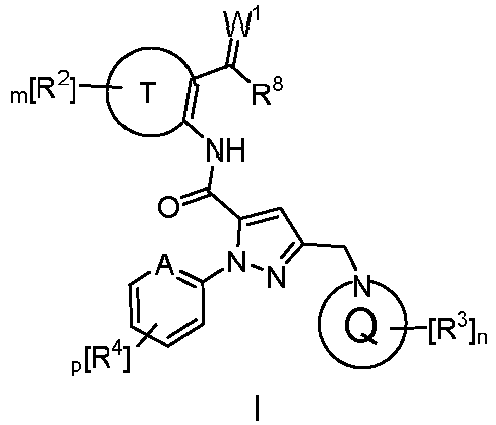
- R8 is selected from the group consisting of hydrogen, hydroxy, chlorine, bromine, iodine, C1-C6-alkoxy, C3-C8-cycloalkoxy or NR1aR1b;
wherein,- R1a and R1b are independently selected from the group consisting of hydrogen, C1-C6-alkyl, C1-C6-haloalkyl, C3-C6-cycloalkyl, (C1-C6-alkyl)-C3-C6-cycloalkyl and (C3-C6-cycloalkyl)-C1-C6-alkyl, or
- R1a and R1b together with the N atom to which they are attached form N=S(=O)0-2(C1-C6-alkyl)2 or 3- or 4- or 5- or 6- membered heterocyclic ring comprising one or more heteroatoms selected from N, O and S; and the C atom of the heterocyclic ring may be replaced with C(=O), C(=S) and C(=NR7),
wherein,- the heterocyclic ring may be substituted with at least group selected from the group consisting of halogen, cyano, nitro, hydroxy, C1-C6-alkyl, C1-C6-haloalkyl, C3-C6-cycloalkyl, C3-C6-halocycloalkyl, C1-C6-alkoxy, C1-C6-haloalkoxy, C1-C6-alkylthio, C1-C6-alkylsulphinyl, C1-C6-alkylsulphonyl, C1-C6-haloalkylthio, C1-C6-haloalkylsulphinyl, C1-C6-haloalkylsulphonyl, and
- R7 is selected from the group consisting of hydrogen, hydroxy, cyano, C1-C6-alkyl, C1-C6-haloalkyl, C1-C6-alkoxy, C1-C6-haloalkoxy, C3-C6-cycloalkyl, C3-C6-halocycloalkyl, C3-C6-cycloalkoxy, C3-C6-halocycloalkoxy;
- W1 is selected from O, S or NR5,
wherein, R5 is selected from the group consisting of hydrogen, hydroxy, cyano, nitro, halogen, C1-C6-alkyl, C1-C6-haloalkyl, C1-C6-alkoxy, C1-C6-haloalkoxy, C3-C6-cycloalkyl, C3-C6-halocycloalkyl;
or
W1 and R8 together with the carbon atom to which they are attached may form an oxazoline ring
-

- R6 is independently hydrogen or C1-C6-alkyl;
-
- aryl or a heteroaryl ring or ring system;
- R2 is selected from the group consisting of hydrogen, halogen, cyano, nitro, C1-C6-alkyl, C1-C6-haloalkyl and C3-C6-cycloalkyl;
- A is N or C;
- R3 is selected from the group consisting of hydrogen, halogen, cyano, nitro, hydroxy, C1-C6-alkyl, C1-C6-haloalkyl, C3-C6-cycloalkyl, C3-C6-halocycloalkyl, C1-C6-alkoxy, C1-C6-haloalkoxy, C1-C6-alkylthio, C1-C6-alkylsulphinyl, C1-C6-alkylsulphonyl, C1-C6-haloalkylthio, C1-C6-haloalkylsulphinyl and C1-C6-haloalkylsulphonyl;
- R4 is selected from the group consisting of hydrogen, halogen, cyano, nitro, hydroxy, C1-C6-alkyl, C1-C6-haloalkyl, C3-C6-cycloalkyl, C3-C6-halocycloalkyl, C1-C6-alkoxy, C1-C6-haloalkoxy, C1-C6-alkylthio, C1-C6-alkylsulphinyl, C1-C6-alkylsulphonyl, C1-C6-haloalkylthio, C1-C6-haloalkylsulphinyl, C1-C6-haloalkylsulphonyl or NRaRb;
wherein, Ra and Rb are independently selected from the group consisting of hydrogen, C1-C6-alkyl, C3-C6-cycloalkyl or Ra and Rb together with the N atom to which they are attached form a substituted or unsubstituted 3- to 6- membered heterocylic ring,
wherein, the substitution on 3- to 6- membered heterocyclic ring is selected from the group consisting of halogen, cyano, nitro, hydroxy, C1-C6-alkyl, C1-C6-haloalkyl, C3-C6-cycloalkyl, C3-C6-halocycloalkyl, C1-C6-alkoxy, C1-C6-haloalkoxy, C1-C6-alkylthio, C1-C6-alkylsulphinyl, C1-C6-alkylsulphonyl, C1-C6-haloalkylthio, C1-C6-haloalkylsulphinyl and C1-C6-haloalkylsulphonyl; - Q is a 3-, 4- or 5 membered heterocyclic ring;
- n is an integer 0 to 4;
- m is an integer 0 to 6; and
- p is an integer 0 to 5.
- In one of the particular embodiments the present invention relates to a novel process for preparing a compound of formula I;
wherein, - R8 is selected from the group consisting of hydroxy, chlorine, C1-C6-alkoxy or NR1aR1b, wherein, R1a and R1b are independently selected from the group consisting of hydrogen, C1-C6-alkyl, (C1-C6-alkyl)-C3-C6-cycloalkyl and (C3-C6-cycloalkyl)-C1-C6-alkyl;
- W1 is O; T is phenyl; R2 is selected from the group consisting of hydrogen, halogen, cyano and C1-C6-alkyl; A is N; R3 is selected from the group consisting of hydrogen, halogen and C1-C6-haloalkyl; R4 is selected from the group consisting of hydrogen or halogen; Q is a 5 membered heterocyclic ring; n is an integer 1; m is an integer 2; p is an integer 1 or 2.
- In another particular embodiment the present invention relates to a novel process for preparing a compound of formula I;
wherein,
R8 is NR1aR1b, wherein, R1a is hydrogen; and R1b is C1-C6-alkyl, (C1-C6-alkyl)-C3-C6-cycloalkyl and (C3-C6-cycloalkyl)-C1-C6-alkyl; W1 is O; T is phenyl; R2 is selected from the group consisting of halogen, cyano and C1-C6-alkyl; A is N; R3 is C1-C6-haloalkyl; R4 is halogen; Q is a tetrazolyl ring; n is an integer 1; m is an integer 2; p is an integer 1. - In yet another particular embodiment the present invention relates to a novel process for preparing a compound of formula I;
wherein,
R8 is NR1aR1b, wherein, R1a is hydrogen; and R1b is methyl or 1-cyclopropylethyl; W1 is O; T is phenyl; R2 is 4-cyano and 2-methyl, or 2-bromo and 4-chloro; A is N; R3 is 5-trifluoro methyl; R4 is 3-chlorine; Q is a 2-tetrazolyl ring; n is an integer 1; m is an integer 2; p is an integer 1. - The process for preparing the compounds of formula I is described herein after.
- Process step (a): In the step (a) of the process, a compound of formula VIII and a compound of formula VII are reacted in a suitable solvent and optionally using a suitable coupling reagent to obtain a compound of formula VI;

- LG2 is selected from the group consisting of fluorine, chlorine, bromine, iodine or OR12,
- wherein, R12 is selected from the group consisting of hydrogen, substituted or unsubstituted C1-C6-alkyl, substituted or unsubstituted aryl-C1-C6-alkyl, substituted or unsubstituted aryl, -(C=O)-C1-C6-alkyl, -(C=O)-C1-C6-haloalkyl, -(C=O)O-C1-C6-alkyl, -(C=O)O-haloC1-C6-alkyl, SO2-C1-C6-alkyl, SO2-C1-C6-haloalkyl, substituted or unsubstituted SO2-aryl and alkylthio;
- LG4 is selected from the group consisting of chlorine, bromine, iodine, N(OR13)R13, OR13 or

wherein, the substitutions on C1-C6-alkyl, aryl-C1-C6-alkyl, aryl and SO2-aryl of R12 and R13 are independently selected from the group consisting of halogen, cyano, nitro, hydroxy, C1-C6-alkyl, C1-C6-haloalkyl, C3-C6-cycloalkyl, C3-C6-halocycloalkyl, C1-C6-alkoxy, C1-C6-haloalkoxy, C1-C6-alkylthio, C1-C6-alkylsulphinyl, C1-C6-alkylsulphonyl, C1-C6-haloalkylthio, C1-C6-haloalkylsulphinyl and C1-C6-haloalkylsulphonyl,
- W2 and A1 are independently selected from O, S or NR5, and
R9 is selected from the group consisting of hydrogen, halogen, cyano, C1-C6-alkyl, C1-C6-haloalkyl, C1-C6-alkoxy, C1-C6-haloalkoxy, C3-C6-cycloalkyl, C3-C6-halocycloalkyl, C1-C6-alkylthio, C1-C6-haloalkylthio, C1-C6-alkylsulphinyl, C1-C6-haloalkylsulphinyl, C1-C6-alkylsulphonyl, C1-C6-haloalkylsulphonyl, aryl and arylalkyl; - R2, R5, R8, m, T, and W1 are each as defined herein above.
- In one embodiment the compound of formula VI may be isolated.
- In another embodiment the compound of formula VI may not be isolated.
- The suitable solvent useful for the purpose of process step (a) is selected from the group consisting of aliphatic, alicyclic or aromatic hydrocarbons, for example petroleum ether, n-hexane, n-heptane, cyclohexane, methylcyclohexane, benzene, toluene, xylene or decalin; halogenated hydrocarbons, for example chlorobenzene, dichlorobenzene, dichloromethane, chloroform, tetrachloromethane, dichloroethane or trichloroethane; ethers such as diethyl ether, diisopropyl ether, methyl tert-butyl ether, methyl tert-amyl ether, dioxane, tetrahydrofuran, 2-methyl tetrahydrofuran, 1,2-dimethoxyethane, 1,2-diethoxyethane, cyclopentylmethylether or anisole; nitriles such as acetonitrile, propionitrile, n- or isobutyronitrile or benzonitrile; amides such as N,N-dimethylformamide, N,N-dimethylacetamide, N-methylformanilide, N-methylpyrrolidone or hexanlethylphosphoranlide; sulphoxides such as dimethyl sulphoxide; sulphones such as sulpholane; alcohols such as methanol, ethanol, or isopropanol.
- For coupling of the compound of formula VIII and the compound of formula VII leading to the formation of the compound of formula VI the following coupling reagents are useful: pyridine, 1- or 2- or 3-picoline, triethyl amine, N,N-diisopropylethylamine, 2,6-di-tert-butylpyridine, 1,5-diazabicyclo(4.3.0)non-5-ene, 1,8-diazabicycloundec-7-ene, lithium diisopropylamide, sodium bis(trimethylsilyl)amide, and potassium bis(trimethylsilyl)amide or combinations thereof.
- The formation of the compound of formula VI is carried out within a temperature range of from 0 to 120 °C.
- The reaction time is not critical and depends on the batch size, temperature, reagent and solvent employed. Typically, the reaction time may vary from few minutes to several hours.
- The process step (a) is usually performed under standard pressure conditions. It is, however, also possible to perform the process step (a) under reduced pressure or elevated pressure conditions.
- The compound of formula VIII, wherein LG4 is N(OR13)R13, OR13, or

- In one embodiment, the compound of formula VIII is obtained by reacting a compound of formula X with a compound of formula IX in a suitable solvent and optionally a suitable reagent;

- The suitable solvent useful for the purpose preparing the compound of formula VIII is selected from the group consisting of aliphatic, alicyclic or aromatic hydrocarbons, for example petroleum ether, n-hexane, n-heptane, cyclohexane, methylcyclohexane, benzene, toluene, xylene or decalin; halogenated hydrocarbons, for example chlorobenzene, dichlorobenzene, dichloromethane, chloroform, tetrachloromethane, dichloroethane or trichloroethane; ethers such as diethyl ether, diisopropyl ether, methyl tert-butyl ether, methyl tert-amyl ether, dioxane, tetrahydrofuran, 2-methyl tetrahydrofuran, 1,2-dimethoxyethane, 1,2-diethoxyethane, cyclopentylmethylether or anisole; nitriles such as acetonitrile, propionitrile, n- or isobutyronitrile or benzonitrile; amides such as N,N-dimethylformamide, N,N-dimethylacetamide, N-methylformanilide, N-methylpyrrolidone or hexanlethylphosphoranlide; sulphoxides such as dimethyl sulphoxide; sulphones such as sulpholane; alcohols such as methanol, ethanol, or isopropanol.
- The suitable reagent useful in obtaining the compound of formula VIII is selected from the group consisting of pyridine, 1- or 2- or 3-picoline, triethyl amine, N,N-diisopropylethylamine, 2,6-di-tert-butylpyridine, 1,5-diazabicyclo(4.3.0)non-5-ene, 1,8-diazabicycloundec-7-ene, lithium diisopropylamide, sodium bis(trimethylsilyl)amide, and potassium bis(trimethylsilyl)amide or combinations thereof.
- The formation of the compound of formula VIII is carried out within a temperature range of from 0 to 120 °C.
- The reaction time is not critical and depends on the batch size, temperature, reagent and solvent employed. Typically, the reaction time may vary from few minutes to several hours.
- The process for the formation of the compound of formula VIII is usually performed under standard pressure conditions. It is, however, also possible to perform the formation of the compound of formula VIII under reduced pressure or elevated pressure conditions.
- In one embodiment the compound of formula VIII may be isolated.
- In one embodiment the compound of formula VIII may not be isolated.
- Process step (b): In the process step (b), the compound of formula VI is halogenated into a compound of formula V by using a suitable halogenating agent in a suitable solvent;

- The suitable halogenating agent is selected from the group consisting of N-halosuccinimide, X2, N-halosaccharine and halohydantoine.
- N-halosuccinimide is selected from the group consisting of N-chlorosuccinimide, N-bromosuccinimide and N-iodosuccinimide. Preferably, N-halosuccinimide is N-chlorosuccinimide and N-bromosuccinimide.
- X2 is selected from the group consisting of Cl2, Br2 or I2.
- N-halosaccharine is selected from the group consisting of N-chlorosaccharine, N-bromosaccharine and N-iodosaccharine. Preferably, N-halosaccharine is N-chlorosaccharine and N-bromosaccharine.
- N-halohydantoine is selected from the group consisting of N-chlorohydantoine, N-bromohydantoine and N-iodohydantoine. Preferably, N-halohydantoine is N-chlorohydantoine and N-bromohydantoine.
- The halogenation reaction can be accelerated by the addition of radical initiators such as dibenzoyl peroxide, hydrogen peroxide, di(n-propyl)peroxydicarbonate, t-butyl peroxybenzoate, methyl ethyl ketone peroxide, 2,5-dimethyl-2,5-di(t-butylperoxy)-3-hexyne, di(t-butyl)peroxide, acetone peroxide, dicumyl peroxide, azobisisobutyronitrile, bis(2-ethylhexyl)peroxydicarbonate, (peroxybis(propane-2,2-diyl))dibenzene, peracetic acid, metachloroperbenzoic acid, Payne's reagent, magnesium monoperphthalate, trifluroperacetic acid, trichloroperacetic acid, 2, 4-dinitorperbenzoic acid, caro's acid and potassium caroate.
- The halogenation reaction when carried out using X2 as halogenating agent then it can be accelerated by using a source of light hv.
- The suitable solvent useful for the purpose halogenation of the compound of formula VI is selected from the group consisting of aliphatic, alicyclic or aromatic hydrocarbons, for example petroleum ether, n-hexane, n-heptane, cyclohexane, methylcyclohexane, benzene, toluene, xylene or decalin; halogenated hydrocarbons, for example chlorobenzene, dichlorobenzene, dichloromethane, chloroform, tetrachloromethane, dichloroethane or trichloroethane; ethers such as diethyl ether, diisopropyl ether, methyl tert-butyl ether, methyl tert-amyl ether, dioxane, tetrahydrofuran, 2-methyl tetrahydrofuran, 1,2-dimethoxyethane, 1,2-diethoxyethane, cyclopentylmethylether or anisole; nitriles such as acetonitrile, propionitrile, n- or isobutyronitrile or benzonitrile; amides such as N,N-dimethylformamide, N,N-dimethylacetamide, N-methylformanilide, N-methylpyrrolidone or hexanlethylphosphoranlide; sulphoxides such as dimethyl sulphoxide; sulphones such as sulpholane; alcohols such as methanol, ethanol, or isopropanol.
- The halogenation reaction is carried out within a temperature range of from 0 to 120 °C.
- The reaction time is not critical and depends on the batch size, temperature, reagent and solvent employed. Typically, the reaction time may vary from few minutes to several hours.
- The halogenation reaction is usually performed under standard pressure conditions. It is, however, also possible to perform the halogenation reaction under reduced pressure or elevated pressure conditions.
- In one embodiment the compound of formula V may be isolated.
- In one embodiment the compound of formula V may not be isolated.
- Process step (c): In the process step (c), the compound of formula V is reacted with a compound of formula IV in a suitable solvent to obtain a compound of formula III;

- LG3 is selected from the group consisting of hydrogen, halogen, Si(R11)3 and alkali metal selected from sodium, potassium and lithium,
wherein, R11 is selected from the group consisting of hydrogen, halogen, hydroxy, C1-C6-alkyl, C1-C6-haloalkyl, C3-C6-cycloalkyl, C3-C6-halocycloalkyl, C1-C6-alkoxy and C1-C6-haloalkoxy; - R2, R3, R8, m, n, Q, T, W1, LG1 and LG2 are each as defined herein above.
- The suitable solvent useful for the purpose substituting LG1 with the compound of formula IV leading to the formation of the compound of formula III is selected from the group consisting of aliphatic, alicyclic or aromatic hydrocarbons, for example petroleum ether, n-hexane, n-heptane, cyclohexane, methylcyclohexane, benzene, toluene, xylene or decalin; halogenated hydrocarbons, for example chlorobenzene, dichlorobenzene, dichloromethane, chloroform, tetrachloromethane, dichloroethane or trichloroethane; ethers such as diethyl ether, diisopropyl ether, methyl tert-butyl ether, methyl tert-amyl ether, dioxane, tetrahydrofuran, 2-methyl tetrahydrofuran, 1,2-dimethoxyethane, 1,2-diethoxyethane, cyclopentylmethylether or anisole; nitriles such as acetonitrile, propionitrile, n- or isobutyronitrile or benzonitrile; amides such as N,N-dimethylformamide, N,N-dimethylacetamide, N-methylformanilide, N-methylpyrrolidone or hexanlethylphosphoranlide; sulphoxides such as dimethyl sulphoxide; sulphones such as sulpholane; alcohols such as methanol, ethanol, or isopropanol.
- The formation of the compound of formula III is carried out within a temperature range of from 15 to 150 °C.
- The reaction time is not critical and depends on the batch size, temperature, reagent and solvent employed. Typically, the reaction time may vary from few minutes to several hours.
- The formation of the compound of formula III is usually performed under standard pressure conditions. It is, however, also possible to perform the halogenation reaction under reduced pressure or elevated pressure conditions.
- In one embodiment the compound of formula III may be isolated.
- In one embodiment the compound of formula III may not be isolated.
- It has been found that the replacement of LG1 by the compound of formula IV in the process step (d) is also critical to the present invention as none of the prior art discloses or suggests to coupling of the compound of formula V and the compound of formula IV.
- It is also found that the reaction is highly regioselective. For example, when Q is tetrazolyl ring, R3 is trifluoro methyl, LG1 is halogen, LG2 is OMe and n is an integer 1, the product III-1 is formed in higher percentage than that of the product III-2:

- Process step (d): In the process step (d), the compound of formula III is reacted with a compound of formula II in a suitable solevent and using a suitable dehydrating agent to obtain the compound of formula I;

- Particularly, the substituent LG2 in the compounds of formulae VIII, VI, V, and III is selected from the group consisting of chlorine, bromine or OR12, wherein, R12 is C1-C6-alkyl.
- More particularly, the substituent LG2 in the compounds of formulae VIII, VI, V, and III is OR12, wherein, R12 is C1-C3-alkyl.
- Most particularly, the substituent LG2 in the compounds of formulae VIII, VI, V, and III is methoxy.
- Particularly, the substituent LG4 in the compound of formula VIII is selected from the group consisting of chlorine or OR13, wherein, R13 is selected from the group consisting of hydrogen or C1-C6-alkyl.
- More particularly, the substituent LG4 in the compound of formula VIII is chlorine.
- Particularly, the substituent LG1 in compound V is selected from the group consisting of chlorine or bromine.
- More particularly, the substituent LG1 in compound V is bromine.
- Particularly, the substituent LG3 in the compound of formula IV is alkali metal selected from sodium, potassium and lithium.
- More particularly, the substituent LG3 in compound IV is sodium.
- The suitable solvent useful is the process step (d) is selected from the group consisting of aliphatic, alicyclic or aromatic hydrocarbons, for example petroleum ether, n-hexane, n-heptane, cyclohexane, methylcyclohexane, benzene, toluene, xylene or decalin; halogenated hydrocarbons, for example chlorobenzene, dichlorobenzene, dichloromethane, chloroform, tetrachloromethane, dichloroethane or trichloroethane; ethers such as diethyl ether, diisopropyl ether, methyl tert-butyl ether, methyl tert-amyl ether, dioxane, tetrahydrofuran, 2-methyl tetrahydrofuran, 1,2-dimethoxyethane, 1,2-diethoxyethane, cyclopentylmethylether or anisole; nitriles such as acetonitrile, propionitrile, n- or isobutyronitrile or benzonitrile; amides such as N,N-dimethylformamide, N,N-dimethylacetamide, N-methylformanilide, N-methylpyrrolidone or hexanlethylphosphoranlide; sulphoxides such as dimethyl sulphoxide; sulphones such as sulpholane; alcohols such as methanol, ethanol, or isopropanol.
- The suitable dehydrating reagent that facilitates the reaction depicted in the process step (d) is selected from the group consisting of hydrochloric acid, sulfuric acid, orthoformic acid, phorphorous pentoxide, phosphoryl chloride, calcium oxide, iron (III) chloride, N, N'-dicyclohexylcarbodiimide, cyanuric chloride and burgess reagent.
- The process step (d) is carried out within a temperature range of from 15 to 150 °C.
- The reaction time is not critical and depends on the batch size, temperature, reagent and solvent employed. Typically, the reaction time may vary from few minutes to several hours.
- The process step (d) is usually performed under standard pressure conditions. It is, however, also possible to perform the process step (d) under reduced pressure or elevated pressure conditions.
- It is considered to be surprising that the bulky compound such as the compound of formula III can be cyclized with the compound of formula II. The process step (d) is not only novel but also a very innovative and inventive process as a person ordinary skilled in the art would not have anticipated or learnt that the compound of formula III having bulky groups such as T and Q can be cyclized with the compound of formula II. The inventors of the invention unexpectedly and surprisingly were able to cyclize the compound of formula III with the compound of formula II leading to the formation of the compound of formula I in a yield as high as >90%.
- Alternate process steps (i & ii) (not part of the claimed invention): Alternatively, a compound of formula V can be obtained by halogenating a compound of formula VIII to obtain a compound of formula XI and then reacting the compound of formula XI with a compound of formula VII;

- In one embodiment the compound of formula XI may be isolated.
- In one embodiment the compound of formula XI may not be isolated.
- The alternate process step (i) is carried out at a temperature ranging from 0 to 120 °C.
- The suitable halogenating agent in the alternate process step (i) is selected from the group consisting of N-chlorosuccinimide, N-bromosuccinimide and N-iodosuccinimide, N-chlorosaccharine, N-bromosaccharine and N-iodosaccharine, N-chlorohydantoine, N-bromohydantoine and N-iodohydantoine, Cl2, Br2 or I2.
- The alternate process step (i) can be accelerated by using a radical initiator selected from the group consisting of hv, dibenzoyl peroxide, hydrogen peroxide, di(n-propyl)peroxydicarbonate, t-butyl peroxybenzoate, methyl ethyl ketone peroxide, 2,5-dimethyl-2,5-di(t-butylperoxy)-3-hexyne, di(t-butyl)peroxide, acetone peroxide, dicumyl peroxide, azobisisobutyronitrile, bis(2-ethylhexyl)peroxydicarbonate, (peroxybis(propane-2,2-diyl))dibenzene, peracetic acid, metachloroperbenzoic acid, Payne's reagent, magnesium monoperphthalate, trifluroperacetic acid, trichloroperacetic acid, 2, 4-dinitorperbenzoic acid, caro's acid and potassium caroate.
- The alternate process step (ii) is carried out at a temperature ranging from 0 to 120 °C.
- The alternate process step (ii) can be assisted by a suitable coupling reagent selected from the group consisting of pyridine, 1- or 2- or 3-picoline, triethyl amine, N,N-diisopropylethylamine, 2,6-di-tert-butylpyridine, 1,5-diazabicyclo(4.3.0)non-5-ene, 1,8-diazabicycloundec-7-ene, lithium diisopropylamide, sodium bis(trimethylsilyl)amide, and potassium bis(trimethylsilyl)amide or combinations thereof.
- Alternate process steps (iii & iv) (not part of the claimed invention): Alternatively, the compounds of formula I can be prepared by reacting a compound of formula V with a compound of formula II to obtain a compound of formula XII and then reacting the compound of formula XII with a compound of formula IV;

- In one embodiment the compound of formula XII may be isolated.
- In one embodiment the compound of formula XII may not be isolated.
- The alternate process step (iii) is carried out at a temperature ranging from 15 to 150 °C, optionally using a suitable reagent known in the literature.
- The alternate process step (iii) can be assisted by using a suitable dehydrating agent selected from the group consisting of hydrochloric acid, sulfuric acid, orthoformic acid, phorphorous pentoxide, phosphoryl chloride, calcium oxide, iron (III) chloride, N, N'-dicyclohexylcarbodiimide, cyanuric chloride and burgess reagent.
- The alternate process step (ii) is carried out at a temperature ranging from 15 to 150 °C.
- The suitable solvent in alternate process steps (i), (ii), (iii) and (iv) is selected from the group consisting of petroleum ether, n-hexane, n-heptane, cyclohexane, methylcyclohexane, benzene, toluene, xylene, decalin, chlorobenzene, dichlorobenzene, dichloromethane, chloroform, tetrachloromethane, dichloroethane, trichloroethane, diethyl ether, diisopropyl ether, methyl tert-butyl ether, methyl tert-amyl ether, dioxane, tetrahydrofuran, 2-methyl tetrahydrofuran, 1,2-dimethoxyethane, 1,2-diethoxyethane, cyclopentylmethylether, anisole, acetonitrile, propionitrile, n-butyronitrile, iso-butyronitrile, benzonitrile, N,N-dimethylformamide, N,N-dimethylacetamide, N-methylformanilide, N-methylpyrrolidone, hexan-1-ethylphosphoranlide, dimethyl sulphoxide, sulpholane, methanol, ethanol, isopropanol or combinations thereof.
- The compounds, such as, of formulae VII, VI, V, III, and 1 wherein R8 is hydrogen, hydroxy, chlorine, bromine, iodine, C1-C6-alkoxy, or C3-C8-cycloalkoxy is/are converted into the compound of formulae VII, VI, V, III, and 1, respectively, wherein R8 is NR1aR1b, wherein, R1a and R1b are each as defined herein above using the processes known in the literature.
- For example, a compound of formula VI, wherein R8 is OMe, can be converted into a compound of formula VI, wherein R8 is OH, by the process reported in
CN106565675 . - In another example, a compound of formula V, wherein R8 is OH, can be converted into a compound of formula V, wherein R8 is Cl, by the process reported in Tetrahedron Letters (1993), 34(51), 8267-70.
- In another example, a compound of formula XII, wherein R8 is OH or Cl, can be converted into a compound of formula XII, wherein R8 is NR1aR1b, by the process reported in Journal of Organic Chemistry (2017), 82(19), 10470-10478.
- The compounds, such as characterized by formula VI, V, III and XII, wherein W1 is NR5 or S can be converted into the corresponding carbonyl compounds by processes known in the literature.
- For example, compounds of formula VI, wherein W1 is NR5, can be converted into compounds of formula VI, wherein W1 is O, by the process reported in Green Chemistry, Vol.15, Issue 8, pages 2252-2260.
- In another example, a compound of formula III, wherein W1 is S, can be converted into a compound of formula III, wherein W1 is O, by the processes reported in Journal of Chemical Research, (2003), Synopses, (6), pages 348-350 or Synthesis (2008), (21), 3443-3446, or Chemica Scripta (1994), 24(2), 80-83.
- The compounds characterized by formula VI, V, III, XII and VII, wherein W1 and R8 together with the carbon atom to which they are attached form
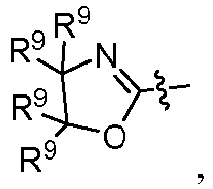
- For example, compounds of formula XII-a or XII-b can be converted into compounds of formula XII using the process reported in above mentioned literature.


- In the preparation of the compound of formula I several novel compounds were being formed.
- The novel compound formula XIII, as well as the use of the novel compound of formula VIII as an intermediate in the process of the invention, are also comprised within the scope of the present invention.
- Accordingly, the present invention further relates to the use as an intermediate in the process of the invention of a compound of formula VIII

- The present invention still further relates to a compound of formula XIII,

- R10 is hydrogen, LG1, or

- wherein,
- LG1 is selected from the group consisting of fluorine, chlorine, bromine or iodine,
- R3 is selected from the group consisting of hydrogen, halogen, cyano, nitro, hydroxy, C1-C6-alkyl, C1-C6-haloalkyl, C3-C6-cycloalkyl, C3-C6-halocycloalkyl, C1-C6-alkoxy, C1-C6-haloalkoxy, C1-C6-alkylthio, C1-C6-alkylsulphinyl, C1-C6-alkylsulphonyl, C1-C6-haloalkylthio, C1-C6-haloalkylsulphinyl and C1-C6-haloalkylsulphonyl,
- Q is a 3-, 4- or 5 membered heterocyclic ring, and
- n is an integer 0 to 4;
- R8 is selected from the group consisting of hydrogen, hydroxy, chlorine, bromine, iodine, C1-C6-alkoxy, C3-C8-cycloalkoxy or NR1aR1b;
wherein,- R1a and R1b are independently selected from the group consisting of hydrogen, C1-C6-alkyl, C1-C6-haloalkyl, C3-C6-cycloalkyl, (C1-C6-alkyl)-C3-C6-cycloalkyl and (C3-C6-cycloalkyl)-C1-C6-alkyl, or
- R1a and R1b together with the N atom to which they are attached form N=S(=O)0-2(C1-C6-alkyl)2 or 3- or 4- or 5- or 6- membered heterocyclic ring comprising one or more heteroatoms selected from N, O and S; and the C atom of the heterocyclic ring may be replaced with C(=O), C(=S) and C(=NR7),
wherein,- the heterocyclic ring may be substituted with at least group selected from the group consisting of halogen, cyano, nitro, hydroxy, C1-C6-alkyl, C1-C6-haloalkyl, C3-C6-cycloalkyl, C3-C6-halocycloalkyl, C1-C6-alkoxy, C1-C6-haloalkoxy, C1-C6-alkylthio, C1-C6-alkylsulphinyl, C1-C6-alkylsulphonyl, C1-C6-haloalkylthio, C1-C6-haloalkylsulphinyl, C1-C6-haloalkylsulphonyl, and
- R7 is selected from the group consisting of hydrogen, hydroxy, cyano, C1-C6-alkyl, C1-C6-haloalkyl, C1-C6-alkoxy, C1-C6-haloalkoxy, C3-C6-cycloalkyl, C3-C6-halocycloalkyl, C3-C6-cycloalkoxy, C3-C6-halocycloalkoxy;
- W1 is selected from O, S or NR5;
R5 is selected from the group consisting of hydrogen, hydroxy, cyano, nitro, halogen, C1-C6-alkyl, C1-C6-haloalkyl, C1-C6-alkoxy, C1-C6-haloalkoxy, C3-C6-cycloalkyl, C3-C6-halocycloalkyl;
or - W1 and R8 together with the carbon atom to which they are attached may form an oxazoline ring

-

- R6 is independently hydrogen or C1-C6-alkyl; and
-
- aryl or a heteroaryl ring or ring system;
- R2 is selected from the group consisting of hydrogen, halogen, cyano, nitro, C1-C6-alkyl, C1-C6-haloalkyl and C3-C6-cycloalkyl;
- m is an integer 2; and
LG2 is C1-C6-alkloxy or halogen selected from the group consisting of iodide, chloride and bromide. - Particularly, the present invention relates to the compound of formula XIII, wherein
- R10 is hydrogen, LG1, or

- LG1 is chlorine or bromine,
- R3 is C1-C6-haloalkyl,
- Q is a 5 membered heterocyclic ring, and
- n is an integer 1;
- R8 is selected from the group consisting of hydroxy, chlorine, C1-C6-alkoxy, or NR1aR1b;
wherein,- R1a is hydrogen, and
- R1b is C1-C6-alkyl, (C1-C6-alkyl)-C3-C6-cycloalkyl or (C3-C6-cycloalkyl)-C1-C6-alkyl;
- W1 is selected from O; T is phenyl; R2 is selected from the group consisting of halogen, cyano, C1-C6-alkyl; m is an integer 2; and LG2 is methoxy or ethoxy.
- More particularly, the present invention relates to the compound of formula XIII, wherein
wherein, - R10 is hydrogen, LG1, or

- LG1 is bromine,
- R3 is 5-trifluoro methyl,
- Q is a 2-tetrazolyl ring, and
- n is an integer 1;
- R8 is NR1aR1b;
wherein,- R1a is hydrogen, and
- R1b is methyl or 1-cyclopropylethyl;
- Also described herein but not part of the claimed invention are the compounds of formula XI and XII;

- The reagents, such as, organic and inorganic acids and organic and inorganic bases known in the art may be used to assist or accelerate or facilitate the process steps (a to d) or alternate process steps (I to iv). Non limiting representative examples of reagents and catalysts useful in the process of the present invention can be seen in the preparation examples.
- The present invention is further described in detailed as illustrated in the non-limiting examples. It should be understood that variations and modifications of the processes are possible within the ambit of the invention as defined by the appended claims.

- A solution of oxalyl chloride (X-1) (2.4 mL, 27.7 mmol) in dichloromethane (5 mL) was added to a stirred solution of 2-methoxyprop-1-ene (IX-1) (1.3 mL, 13.87 mmol) and pyridine (2.3 mL, 29.1 mmol) in dichloromethane (15 mL) at 0 °C over 5 min. The resultant mixture was stirred at 0 °C for 30 min and then dichloromethane was distilled off. The residue was dissolved in acetonitrile (20 mL) at 0 °C, and 2-amino-5-cyano-N,3-dimethylbenzamide (VII-1) (2.6 g, 13.87 mmol) was added to the resulting reaction mixture. The reaction mixture was stirred at 50 °C for 2 h. The reaction mixture was cooled and poured onto crushed ice. The precipitate was filtered and washed with water and hexane to obtain a crude product which was purified by flash chromotography to obtain pure 5-cyano-2-(4-methoxy-2-oxopent-3-enamido)-N,3-dimethylbenzamide (VI-1) (1.6 g).
- 1H-NMR (400 MHz, CDCl3) δ 10.54 (bs, 1H), 7.61-7.63 (m, 2H), 6.56 (s, 1H), 6.15-6.16 (m, 1H), 3.83 (s, 3H), 2.98 (d, 3H), 2.45 (s, 3H), 2.31 (s, 3H).
- LCMS: [314]M-H.
- A solution of bromine (0.07 mL, 1.3 mmol) in dichloromethane (1 mL) was added drop wise to a stirred solution of 5-cyano-2-(4-methoxy-2-oxopent-3-enamido)-N,3-dimethylbenzamide (VI-1) (0.4 g, 1.3 mmol) in dichloromethane (2 mL) at 0 °C. The resulting reaction mixture was stirred at 0 °C for 15 min followed by addition of a solution of pyridine (0.1 mL, 1.3 mmol) in dichloromethane (0.5 mL) at 0 °C.
- After completion of the reaction, the reaction mixture was diluted with dichloromethane (20 mL). The dichloromethane layer was washed subsequently with saturated aqueous sodium bicarbonate solution (20 mL) followed by water (20 mL), then with 2 N aqueous hydrogen chloride (10 mL) and finally with brine solution (20 mL). The dichloromethane layer was dried over anhydrous sodium sulphate and concentrated under reduced pressure to obtain crude 2-(5-bromo-4-methoxy-2-oxopent-3-enamido)-5-cyano-N,3-dimethylbenzamide (V-1; 0.4 g, 1.0 mmol, 78% yield).
- 1H-NMR (400 MHz, CDCl3) δ 10.6 (bs, 1H), 7.61-7.64 (m, 2H), 6.66 (s, 1H), 6.12-6.13 (m, 1H), 4.55 (s, 2H), 3.89 (s, 3H), 2.98 (d, 3H), 2.32 (s, 3H).
- LCMS: [392]M-H.
- Sodium 5-(trifluoromethyl)tetrazol-1-ide (IV-1) (0.1 g, 0.6 mmol) was added to a stirred solution of 2-(5-bromo-4-methoxy-2-oxopent-3-enamido)-5-cyano-N,3-dimethylbenzamide (V-1) (0.2 g, 0.50 mmol) in acetonitrile (3 mL) at 25 °C. The resulting reaction mixture was heated to 50 °C for 4 h under stirring.
- After completion of the reaction, the reaction mixture was cooled to 25 °C and volatiles were removed to obtain a crude 5-cyano-2-(4-methoxy-2-oxo-5-(5-(trifluoromethyl)-2H-tetrazol-2-yl)pent-3-enamido)-N,3-dimethylbenzamide (III-1; 0.2 g, 0.4 mmol, 87% yield).
- 1H-NMR (400 MHz, CDCl3) δ 10.81 (bs, 1H), 7.62-7.65 (m, 2H), 6.84 (s, 1H), 6.44-6.45 (m, 1H), 6.18 (s, 2H), 3.82 (s, 3H), 2.99 (d, 3H), 2.33 (s, 3H).
- 19F-NMR (400 MHz, CDCl3) δ. -63.57 (s)
- LCMS: [561]M-H.
- A solution of 3-chloro-2-hydrazinylpyridine (II-1) (32 mg, 0.2 mmol) and 5-cyano-2-(4-methoxy-2-oxo-5-(5-(trifluoromethyl)-2H-tetrazol-2-yl)pent-3-enamido)-N,3-dimethylbenzamide (III-1) (100 mg, 0.2 mmol) in methanol (2 mL) was stirred at 25 °C for 1 h. After completion of the reaction, a solution of 4 M hydrochloric acid in methanol (1 mL) was added to the reaction mixture and allowed to stir at 25 °C for 1 h. Methanol was distilled off under reduced pressure to obtain 1-(3-chloropyridin-2-yl)-N-(4-cyano-2-methyl-6-(methylcarbamoyl)phenyl)-3-((5-(trifluoromethyl)-2H-tetrazol-2-yl)methyl)-1H-pyrazole-5-carboxamide (I-1) (116 mg, 0.2 mmol, 96% yield).
- 1H-NMR (400 MHz, DMSO-d6) δ. 10.52 (s, 1H), 8.47 (dd, 1H), 8.36 (m, 1H), 8.15 (dd, 1H), 7.85 (d, 1H), 7.73 (d, 1H), 7.59 (m, 1H), 7.38 (s, 1H), 6.32 (s, 2H), 2.64 (d, 3H), 2.18 (s, 3H),
19F-NMR (400 MHz, DMSO-d6) δ. -62.61(s) - LCMS: [543]M-H.

- Sodium 5-(trifluoromethyl)tetrazol-1-ide (IV-1) (0.1 g, 0.6 mmol) was added to a stirred solution of 2-(5-bromo-4-methoxy-2-oxopent-3-enamido)-5-cyano-N,3-dimethylbenzamide (V-1) (0.2 g, 0.5 mmol) in acetonitrile (3 mL) at 25 °C. The resulting reaction mixture was heated to 50 °C for 3 h under stirring. After completion of the reaction, the reaction mixture was cooled to 25 °C. 3-chloro-2-hydrazinylpyridine (II-1) (73 mg, 0.5 mmol) was added to the reaction mixture and stirred at 25 °C for 1 h. After completion of the reaction, a solution of 4 M hydrochloric acid in dioxane (1 mL) was added to the reaction mixture and stirred at 25 °C for 1 h. Volatiles were distilled off out under reduced pressure to obtain crude 1-(3-chloropyridin-2-yl)-N-(4-cyano-2-methyl-6-(methylcarbamoyl)phenyl)-3-((5-(trifluoromethyl)-2H-tetrazol-2-yl)methyl)-1H-pyrazole-5-carboxamide (I-1) (201 mg, 0.37 mmol, 74% yield).
- 1H-NMR (400 MHz, DMSO-d6) δ. 10.52 (s, 1H), 8.47 (dd, 1H), 8.36 (m, 1H), 8.15 (dd, 1H), 7.85 (d, 1H), 7.73 (d, 1H), 7.59 (m, 1H), 7.38 (s, 1H), 6.32 (s, 2H), 2.64 (d, 3H), 2.18 (s, 3H), 19F-NMR (400 MHz, DMSO-d6) δ. -62.61(s)
LCMS: [543]M-H
Claims (15)
- A process for preparing a compound of formula I,
 R8 is selected from the group consisting of hydrogen, hydroxy, chlorine, bromine, iodine, C1-C6-alkoxy, C3-C8-cycloalkoxy or NR1aR1b;
wherein,R1a and R1b are independently selected from the group consisting of hydrogen, C1-C6-alkyl, C1-C6-haloalkyl, C3-C6-cycloalkyl, (C1-C6-alkyl)-C3-C6-cycloalkyl and (C3-C6-cycloalkyl)-C1-C6-alkyl, orR1a and R1b together with the N atom to which they are attached form N=S(=O)0-2(C1-C6-alkyl)2 or 3- or 4- or 5- or 6- membered heterocyclic ring comprising one or more heteroatoms selected from N, O and S; and the C atom of the heterocyclic ring may be replaced with C(=O), C(=S) and C(=NR7), wherein,the heterocyclic ring may be substituted with one or more substituent selected from the group consisting of halogen, cyano, nitro, hydroxy, C1-C6-alkyl, C1-C6-haloalkyl, C3-C6-cycloalkyl, C3-C6-halocycloalkyl, C1-C6-alkoxy, C1-C6-haloalkoxy, C1-C6-alkylthio, C1-C6-alkylsulphinyl, C1-C6-alkylsulphonyl, C1-C6-haloalkylthio, C1-C6-haloalkylsulphinyl, C1-C6-haloalkylsulphonyl, andR7 is selected from the group consisting of hydrogen, hydroxy, cyano, C1-C6-alkyl, C1-C6-haloalkyl, C1-C6-alkoxy, C1-C6-haloalkoxy, C3-C6-cycloalkyl, C3-C6-halocycloalkyl, C3-C6-cycloalkoxy, C3-C6-halocycloalkoxy;W1 is selected from O, S or NR5,
wherein, R5 is selected from the group consisting of hydrogen, hydroxy, cyano, nitro, halogen, C1-C6-alkyl, C1-C6-haloalkyl, C1-C6-alkoxy, C1-C6-haloalkoxy, C3-C6-cycloalkyl, C3-C6-halocycloalkyl;
orW1 and R8 together with the carbon atom to which they are attached may form an oxazoline ring
wherein, R6 is independently hydrogen or C1-C6-alkyl;aryl or a heteroaryl ring or ring system;R2 is selected from the group consisting of hydrogen, halogen, cyano, nitro, C1-C6-alkyl, C1-C6-haloalkyl and C3-C6-cycloalkyl;A is N or C;R3 is selected from the group consisting of hydrogen, halogen, cyano, nitro, hydroxy, C1-C6-alkyl, C1-C6-haloalkyl, C3-C6-cycloalkyl, C3-C6-halocycloalkyl, C1-C6-alkoxy, C1-C6-haloalkoxy, C1-C6-alkylthio, C1-C6-alkylsulphinyl, C1-C6-alkylsulphonyl, C1-C6-haloalkylthio, C1-C6-haloalkylsulphinyl and C1-C6-haloalkylsulphonyl;R4 is selected from the group consisting of hydrogen, halogen, cyano, nitro, hydroxy, C1-C6-alkyl, C1-C6-haloalkyl, C3-C6-cycloalkyl, C3-C6-halocycloalkyl, C1-C6-alkoxy, C1-C6-haloalkoxy, C1-C6-alkylthio, C1-C6-alkylsulphinyl, C1-C6-alkylsulphonyl, C1-C6-haloalkylthio, C1-C6-haloalkylsulphinyl, C1-C6-haloalkylsulphonyl or NRaRb;
wherein, Ra and Rb are independently selected from the group consisting of hydrogen, C1-C6-alkyl, C3-C6-cycloalkyl or Ra and Rb together with the N atom to which they are attached form a substituted or unsubstituted 3- to 6- membered heterocylic ring,
wherein, the substitution on 3- to 6- membered heterocyclic ring is selected from the group consisting of halogen, cyano, nitro, hydroxy, C1-C6-alkyl, C1-C6-haloalkyl, C3-C6-cycloalkyl, C3-C6-halocycloalkyl, C1-C6-alkoxy, C1-C6-haloalkoxy, C1-C6-alkylthio, C1-C6-alkylsulphinyl, C1-C6-alkylsulphonyl, C1-C6-haloalkylthio, C1-C6-haloalkylsulphinyl and C1-C6-haloalkylsulphonyl;Q is a 3-, 4- or 5 membered heterocyclic ring;n is an integer 0 to 4;m is an integer 0 to 6; andp is an integer 0 to 5;said process comprising the steps of:a) obtaining a compound of formula VI by reacting a compound of formula VIII and a compound of formula VII in a suitable solvent optionally using a suitable coupling reagent; LG2 is selected from the group consisting of fluorine, chlorine, bromine, iodine or OR12, wherein, R12 is selected from the group consisting of hydrogen, substituted or unsubstituted C1-C6-alkyl, substituted or unsubstituted aryl-C1-C6-alkyl, substituted or unsubstituted aryl, -(C=O)-C1-C6-alkyl, -(C=O)-C1-C6-haloalkyl, -(C=O)O-C1-C6-alkyl, -(C=O)O-haloC1-C6-alkyl, SO2-C1-C6-alkyl, SO2-C1-C6-haloalkyl, substituted or unsubstituted SOz-aryl and alkylthio;LG4 is selected from the group consisting of chlorine, bromine, iodine, N(OR13)R13, OR13 or
 W2 and A1 are independently selected from O, S or NR5, andR9 is selected from the group consisting of hydrogen, halogen, cyano, C1-C6-alkyl, C1-C6-haloalkyl, C1-C6-alkoxy, C1-C6-haloalkoxy, C3-C6-cycloalkyl, C3-C6-halocycloalkyl, C1-C6-alkylthio, C1-C6-haloalkylthio, C1-C6-alkylsulphinyl, C1-C6-haloalkylsulphinyl, C1-C6-alkylsulphonyl, C1-C6-haloalkylsulphonyl, aryl and arylalkyl;R2, R5, R8, m, T, and W1 are each as defined herein above;b) halogenating the compound of formula VI using a suitable halogenating agent in a suitable solvent, optionally in the presence of a radical initiator to obtain a compound of formula V;
 LG1 is selected from the group consisting of fluorine, chlorine, bromine or iodine; andR2, R8, m, T, W1 and LG2 are each as defined herein above,c) reacting the compound of formula V and a compound of formula IV in a suitable solvent to obtain a compound of formula III;
 LG3 is selected from the group consisting of hydrogen, halogen, Si(R11)3 and alkali metal selected from sodium, potassium and lithium,
wherein, R11 is selected from the group consisting of hydrogen, halogen, hydroxy, C1-C6-alkyl, C1-C6-haloalkyl, C3-C6-cycloalkyl, C3-C6-halocycloalkyl, C1-C6-alkoxy and C1-C6-haloalkoxy;R2, R3, R8, m, n, Q, T, W1, LG1 and LG2 are each as defined herein above;d) the compound of formula III is reacted with a compound of formula II in a suitable solvent and a suitable dehydrating agent to obtain the compound of formula I; the compounds of formulae VI, V and III may or may not be isolated,R2, R3, R4, R8, m, n, p, A, Q, T, W1 and LG2 are each as defined herein above, andoptionally, any or all of the compounds of formulae VII, VI, V, and III, wherein R8 is hydrogen, hydroxy, chlorine, bromine, iodine, C1-C6-alkoxy, or C3-C8-cycloalkoxy is/are converted into the compound of formulae VII, VI, V, and III, respectively, wherein R8 is NR1aR1b, and R1a and R1b are each as defined herein above.
 - The process as claimed in claim 1, wherein,R8 is selected from the group consisting of hydroxy, chlorine, C1-C6-alkoxy or NR1aR1b,
wherein, R1a and R1b are independently selected from the group consisting of hydrogen, C1-C6-alkyl, (C1-C6-alkyl)-C3-C6-cycloalkyl and (C3-C6-cycloalkyl)-C1-C6-alkyl;W1 is O; T is phenyl; R2 is selected from the group consisting of hydrogen, halogen, cyano and C1-C6-alkyl; A is N; R3 is selected from the group consisting of hydrogen, halogen and C1-C6-haloalkyl; R4 is selected from the group consisting of hydrogen or halogen; Q is a 5 membered heterocyclic ring; n is an integer 1; m is an integer 2; p is an integer 1 or 2;LG2 is selected from the group consisting of chlorine, bromine or OR12,
wherein, R12 is C1-C6-alkyl;LG4 is selected from the group consisting of chlorine or OR13,
wherein, R13 is selected from the group consisting of hydrogen or C1-C6-alkyl; andLG1 is selected from the group consisting of chlorine or bromine; and LG3 is alkali metal selected from sodium, potassium and lithium. - The process as claimed in claim 1,
wherein,
R8 is NR1aR1b, wherein, R1a is hydrogen; and R1b is C1-C6-alkyl, (C1-C6-alkyl)-C3-C6-cycloalkyl and (C3-C6-cycloalkyl)-C1-C6-alkyl; W1 is O; T is phenyl; R2 is selected from the group consisting of halogen, cyano and C1-C6-alkyl; A is N; R3 is C1-C6-haloalkyl; R4 is halogen; Q is a tetrazolyl ring; n is an integer 1; m is an integer 2; p is an integer 1; LG2 is OR12, wherein, R12 is C1-C3-alkyl; LG4 is chlorine; LG1 is bromine; and LG3 is sodium. - The process as claimed in claim 1,
wherein,
R8 is NR1aR1b, wherein, R1a is hydrogen; and R1b is methyl or 1-cyclopropylethyl; W1 is O; T is phenyl; R2 is 4-cyano and 2-methyl, or 2-bromo and 4-chloro; A is N; R3 is 5-trifluoro methyl; R4 is 3-chlorine; Q is a 2-tetrazolyl ring; n is an integer 1; m is an integer 2; p is an integer 1; LG2 is methoxy; LG4 is chlorine; LG1 is bromine; and LG3 is sodium. - The process as claimed in claim 1, wherein the said process comprises a pre-step of obtaining the compound of formula VIII by reacting a compound of formula IX and a compound of formula X in a suitable solvent and optionally a suitable reagent,
 LG5 is hydroxy or halogen; and LG2 and LG4 are each as defined in claim 1;the suitable solvent is selected from the group consisting of petroleum ether, n-hexane, n-heptane, cyclohexane, methylcyclohexane, benzene, toluene, xylene, decalin, chlorobenzene, dichlorobenzene, dichloromethane, chloroform, tetrachloromethane, dichloroethane, trichloroethane, diethyl ether, diisopropyl ether, methyl tert-butyl ether, methyl tert-amyl ether, dioxane, tetrahydrofuran, 2-methyl tetrahydrofuran, 1,2-dimethoxyethane, 1,2-diethoxyethane, cyclopentylmethylether, anisole, acetonitrile, propionitrile, n-butyronitrile, iso-butyronitrile, benzonitrile or combinations thereof;the suitable reagent is selected from the group consisting of pyridine, 1- or 2- or 3-picoline, triethyl amine, N,N-diisopropylethylamine, 2,6-di-tert-butylpyridine, 1,5-diazabicyclo(4.3.0)non-5-ene, 1,8-diazabicycloundec-7-ene, lithium diisopropylamide, sodium bis(trimethylsilyl)amide, and potassium bis(trimethylsilyl)amide or combinations thereof; andthe compound of formula VIII may or may not be isolated.
 - The process as claimed in claim 1, wherein the suitable solvent in steps (a), (b), (c) and (d) is selected from the group consisting of aliphatic, alicyclic or aromatic hydrocarbons, halogenated hydrocarbons, ethers, nitriles, amides, alcohols or combinations thereof.
- The process as claimed in claim 1, wherein the suitable solvent in steps (a), (b), (c) and (d) is selected from the group consisting of petroleum ether, n-hexane, n-heptane, cyclohexane, methylcyclohexane, benzene, toluene, xylene, decalin, chlorobenzene, dichlorobenzene, dichloromethane, chloroform, tetrachloromethane, dichloroethane, trichloroethane, diethyl ether, diisopropyl ether, methyl tert-butyl ether, methyl tert-amyl ether, dioxane, tetrahydrofuran, 2-methyl tetrahydrofuran, 1,2-dimethoxyethane, 1,2-diethoxyethane, cyclopentylmethylether, anisole, acetonitrile, propionitrile, n-butyronitrile, iso-butyronitrile, benzonitrile, N,N-dimethylformamide, N,N-dimethylacetamide, N-methylformanilide, N-methylpyrrolidone, hexan-1-ethylphosphoranlide, dimethyl sulphoxide, sulpholane, methanol, ethanol, isopropanol or combinations thereof.
- The process as claimed in claim 1, whereina) the step (a) is carried out at a temperature ranging from 0 to 120 °C; andb) the suitable coupling reagent in step (a) is selected from the group consisting of pyridine, 1- or 2- or 3-picoline, triethyl amine, N,N-diisopropylethylamine, 2,6-di-tert-butylpyridine, 1,5-diazabicyclo(4.3.0)non-5-ene, 1,8-diazabicycloundec-7-ene, lithium diisopropylamide, sodium bis(trimethylsilyl)amide, and potassium bis(trimethylsilyl)amide or combinations thereof.
- The process as claimed in claim 1, whereina) the step (b) is carried out at a temperature ranging from 0 to 120 °C; andb) the suitable halogenating agent in step (b) is selected from the group consisting of N-chlorosuccinimide, N-bromosuccinimide and N-iodosuccinimide, N-chlorosaccharine, N-bromosaccharine and N-iodosaccharine, N-chlorohydantoine, N-bromohydantoine and N-iodohydantoine, Cl2, Br2 or I2; andc) the radical initiator in step (b) is selected from the group consisting of hv, dibenzoyl peroxide, hydrogen peroxide, di(n-propyl)peroxydicarbonate, t-butyl peroxybenzoate, methyl ethyl ketone peroxide, 2,5-dimethyl-2,5-di(t-butylperoxy)-3-hexyne, di(t-butyl)peroxide, acetone peroxide, dicumyl peroxide, azobisisobutyronitrile, bis(2-ethylhexyl)peroxydicarbonate, (peroxybis(propane-2,2-diyl))dibenzene, peracetic acid, metachloroperbenzoic acid, Payne's reagent, magnesium monoperphthalate, trifluroperacetic acid, trichloroperacetic acid, 2, 4-dinitorperbenzoic acid, caro's acid and potassium caroate.
- The process as claimed in claim 1, wherein the step (c) is carried out at a temperature ranging from 15 to 150 °C.
- The process as claimed in claim 1, whereina) the step (d) is carried out at a temperature ranging from 15 to 150 °C; andb) the suitable dehydrating agent in step (d) is selected from the group consisting of hydrochloric acid, sulfuric acid, orthoformic acid, phorphorous pentoxide, phosphoryl chloride, calcium oxide, iron (III) chloride, N, N'-dicyclohexylcarbodiimide, cyanuric chloride and burgess reagent.
- Use of a compound of formula VIII,

- A compound of formula XIII,
 R10 is hydrogen, LG1, or
 wherein,LG1 is selected from the group consisting of fluorine, chlorine, bromine or iodine,R3 is selected from the group consisting of hydrogen, halogen, cyano, nitro, hydroxy, C1-C6-alkyl, C1-C6-haloalkyl, C3-C6-cycloalkyl, C3-C6-halocycloalkyl, C1-C6-alkoxy, C1-C6-haloalkoxy, C1-C6-alkylthio, Ci-Ce-alkylsulphinyl, C1-C6-alkylsulphonyl, Ci-Ce-haloalkylthio, C1-C6-haloalkylsulphinyl and C1-C6-haloalkylsulphonyl,Q is a 3-, 4- or 5 membered heterocyclic ring, andn is an integer 0 to 4;R8 is selected from the group consisting of hydrogen, hydroxy, chlorine, bromine, iodine, C1-C6-alkoxy, C3-C8-cycloalkoxy or NR1aR1b;
wherein,R1a and R1b are independently selected from the group consisting of hydrogen, C1-C6-alkyl, C1-C6-haloalkyl, C3-C6-cycloalkyl, (C1-C6-alkyl)-C3-C6-cycloalkyl and (C3-C6-cycloalkyl)-C1-C6-alkyl, orR1a and R1b together with the N atom to which they are attached form N=S(=O)0-2(C1-C6-alkyl)2 or 3- or 4- or 5- or 6- membered heterocyclic ring comprising one or more heteroatoms selected from N, O and S; and the C atom of the heterocyclic ring may be replaced with C(=O), C(=S) and C(=NR7),
wherein,the heterocyclic ring may be substituted with at least group selected from the group consisting of halogen, cyano, nitro, hydroxy, C1-C6-alkyl, C1-C6-haloalkyl, C3-C6-cycloalkyl, C3-C6-halocycloalkyl, C1-C6-alkoxy, C1-C6-haloalkoxy, C1-C6-alkylthio, C1-C6-alkylsulphinyl, C1-C6-alkylsulphonyl, C1-C6-haloalkylthio, C1-C6-haloalkylsulphinyl, C1-C6-haloalkylsulphonyl, andR7 is selected from the group consisting of hydrogen, hydroxy, cyano, C1-C6-alkyl, C1-C6-haloalkyl, C1-C6-alkoxy, C1-C6-haloalkoxy, C3-C6-cycloalkyl, C3-C6-halocycloalkyl, C3-C6-cycloalkoxy, C3-C6-halocycloalkoxy;W1 is selected from O, S or NR5;
R5 is selected from the group consisting of hydrogen, hydroxy, cyano, nitro, halogen, C1-C6-alkyl, C1-C6-haloalkyl, C1-C6-alkoxy, C1-C6-haloalkoxy, C3-C6-cycloalkyl, C3-C6-halocycloalkyl;
orW1 and R8 together with the carbon atom to which they are attached may form an oxazoline ring
 R6 is independently hydrogen or C1-C6-alkyl; andaryl or a heteroaryl ring or ring system;R2 is selected from the group consisting of hydrogen, halogen, cyano, nitro, C1-C6-alkyl, C1-C6-haloalkyl and C3-C6-cycloalkyl;m is an integer 2; andLG2 is C1-C6-alkloay or halogen selected from the group consisting of iodide, chloride and bromide.
 - The compound as claimed in claim 13, wherein,R10 is hydrogen, LG1, or
 LG1 is chlorine or bromine,R3 is C1-C6-haloalkyl,Q is a 5 membered heterocyclic ring, andn is an integer 1;R8 is selected from the group consisting of hydroxy, chlorine, C1-C6-alkoxy, or NR1aR1b;
wherein,R1a is hydrogen, andR1b is C1-C6-alkyl, (C1-C6-alkyl)-C3-C6-cycloalkyl or (C3-C6-cycloalkyl)-C1-C6-alkyl;W1 is selected from O; T is phenyl; R2 is selected from the group consisting of halogen, cyano, C1-C6-alkyl; m is an integer 2; and LG2 is methoxy or ethoxy. - The compound as claimed in claim 13,
wherein,R10 is hydrogen, LG1, or LG1 is bromine,R3 is 5-trifluoro methyl,Q is a 2-tetrazolyl ring, andn is an integer 1;R8 is NR1aR1b;
wherein,R1a is hydrogen, andR1b is methyl or 1-cyclopropylethyl;W1 is selected from O; T is phenyl; R2 is 4-cyano and 2-methyl, or 2-bromo and 4-chloro; m is an integer 2; and LG2 is methoxy.
Applications Claiming Priority (2)
| Application Number | Priority Date | Filing Date | Title |
|---|---|---|---|
| IN201811027212 | 2018-07-20 | ||
| PCT/IB2019/056187 WO2020016841A1 (en) | 2018-07-20 | 2019-07-19 | A novel process for the preparation of anthranilic diamides |
Publications (2)
| Publication Number | Publication Date |
|---|---|
| EP3823953A1 EP3823953A1 (en) | 2021-05-26 |
| EP3823953B1 true EP3823953B1 (en) | 2024-09-11 |
Family
ID=68051833
Family Applications (1)
| Application Number | Title | Priority Date | Filing Date |
|---|---|---|---|
| EP19773505.3A Active EP3823953B1 (en) | 2018-07-20 | 2019-07-19 | A novel process for the preparation of anthranilic diamides |
Country Status (10)
| Country | Link |
|---|---|
| EP (1) | EP3823953B1 (en) |
| KR (1) | KR102790425B1 (en) |
| CN (1) | CN112469687B (en) |
| FI (1) | FI3823953T3 (en) |
| HU (1) | HUE070027T2 (en) |
| IL (1) | IL279890B2 (en) |
| MX (1) | MX2021000226A (en) |
| PT (1) | PT3823953T (en) |
| TW (1) | TWI813725B (en) |
| WO (1) | WO2020016841A1 (en) |
Families Citing this family (2)
| Publication number | Priority date | Publication date | Assignee | Title |
|---|---|---|---|---|
| EP3964506A1 (en) * | 2020-09-04 | 2022-03-09 | Bayer Aktiengesellschaft | Method for producing tetrazole-substituted anthranilic acid diamide derivative |
| AR132134A1 (en) * | 2023-03-22 | 2025-05-28 | Pi Industries Ltd | A METHOD FOR THE PREPARATION OF ANTHRANILIC DIAMIDES |
Family Cites Families (15)
| Publication number | Priority date | Publication date | Assignee | Title |
|---|---|---|---|---|
| JP3872317B2 (en) * | 2001-07-10 | 2007-01-24 | 独立行政法人科学技術振興機構 | 4-halo-2-oxo-3-butenoic acid ester derivative and method for producing the same |
| US7038057B2 (en) | 2001-08-13 | 2006-05-02 | E.I. Du Pont De Nemours And Company | Substituted 1H-dihydropyrazoles, their preparation and use |
| CN101466702B (en) * | 2006-06-13 | 2014-04-02 | 拜尔农作物科学股份公司 | Anthranilamide derivatives with heteroaromatic and heterocyclic substituents |
| DE102006032168A1 (en) | 2006-06-13 | 2007-12-20 | Bayer Cropscience Ag | Anthranilic acid diamide derivatives with heteroaromatic substituents |
| KR101687743B1 (en) | 2008-12-18 | 2016-12-19 | 바이엘 인텔렉쳐 프로퍼티 게엠베하 | Tetrazole substituted anthranilic amides as pesticides |
| EP2243777A1 (en) | 2009-04-03 | 2010-10-27 | Bayer CropScience AG | Method for manufacturing Pyridyl-substituted pyrazoles |
| KR101701335B1 (en) * | 2009-07-23 | 2017-02-01 | 바이엘 인텔렉쳐 프로퍼티 게엠베하 | Process for producing aryl-substituted pyrazoles |
| BR112012014683B1 (en) | 2009-12-15 | 2017-11-07 | Bayer Cropscience Ag | PROCESS FOR PRODUCTION OF 5-PYRAZOLCARBOXYLIC ACID DERIVATIVES 1-ALKYL- / 1-ARYL-SUBSTITUTED AND COMPOUND ACID |
| EP2558460B1 (en) * | 2010-04-16 | 2015-03-04 | Bayer Intellectual Property GmbH | Triazol-substituted anthranilic acid amides as pesticides |
| JP6199739B2 (en) * | 2010-06-15 | 2017-09-20 | バイエル・インテレクチュアル・プロパティ・ゲゼルシャフト・ミット・ベシュレンクテル・ハフツングBayer Intellectual Property GmbH | Tetrazole-substituted anthranilamide derivatives and process for producing novel crystalline polymorphs of these derivatives |
| BR112014000471B1 (en) | 2011-07-08 | 2020-06-30 | Bayer Intellectual Property Gmbh. | process for preparing diamide derivatives of anthranilic acid substituted with tetrazole by reacting pyrazoles with anthranilic esters |
| MX349771B (en) | 2011-08-26 | 2017-08-10 | Bayer Ip Gmbh | Method for producing tetrazole-substituted anthranilic acid diamide derivatives by reacting benzoxazinones with amines. |
| CN105189477A (en) * | 2013-05-17 | 2015-12-23 | 巴斯夫欧洲公司 | Process for preparing n-substituted 1h-pyrazole-5-carboxylic acid compounds and derivatives thereof |
| CN106565675B (en) | 2016-10-26 | 2019-08-02 | 暨南大学 | A kind of cape jasmine amide A- Tacrine dyad compound and its preparation method and application |
| CN112119071B (en) * | 2018-05-21 | 2024-08-02 | Pi工业有限公司 | Process for preparing anthranilamides |
-
2019
- 2019-07-19 IL IL279890A patent/IL279890B2/en unknown
- 2019-07-19 PT PT197735053T patent/PT3823953T/en unknown
- 2019-07-19 EP EP19773505.3A patent/EP3823953B1/en active Active
- 2019-07-19 CN CN201980045785.5A patent/CN112469687B/en active Active
- 2019-07-19 HU HUE19773505A patent/HUE070027T2/en unknown
- 2019-07-19 WO PCT/IB2019/056187 patent/WO2020016841A1/en not_active Ceased
- 2019-07-19 TW TW108125750A patent/TWI813725B/en active
- 2019-07-19 KR KR1020217001158A patent/KR102790425B1/en active Active
- 2019-07-19 MX MX2021000226A patent/MX2021000226A/en unknown
- 2019-07-19 FI FIEP19773505.3T patent/FI3823953T3/en active
Also Published As
| Publication number | Publication date |
|---|---|
| KR20210034580A (en) | 2021-03-30 |
| TW202016066A (en) | 2020-05-01 |
| TWI813725B (en) | 2023-09-01 |
| HUE070027T2 (en) | 2025-05-28 |
| IL279890B1 (en) | 2023-10-01 |
| KR102790425B1 (en) | 2025-04-04 |
| IL279890A (en) | 2021-03-01 |
| IL279890B2 (en) | 2024-02-01 |
| EP3823953A1 (en) | 2021-05-26 |
| FI3823953T3 (en) | 2024-12-13 |
| CN112469687A (en) | 2021-03-09 |
| WO2020016841A1 (en) | 2020-01-23 |
| MX2021000226A (en) | 2021-03-31 |
| PT3823953T (en) | 2024-12-16 |
| CN112469687B (en) | 2023-10-13 |
Similar Documents
| Publication | Publication Date | Title |
|---|---|---|
| EP3797103B1 (en) | A novel process for the preparation of anthranilic diamides | |
| US11124528B2 (en) | Process for preparing optically active 2,3-dihydrothiazolo[3,2-A]pyrimidin-4-ium compounds | |
| US11034703B2 (en) | Process for preparing chiral 2,3-dihydrothiazolo[3,2-A] pyrimidin-4-ium compounds | |
| WO2020240391A1 (en) | Process for preparation of bromo formimine compounds | |
| CN112469687B (en) | New method for preparing o-carboxamidobenzamide compounds | |
| US8362272B2 (en) | Process for preparing 1,3-disubstituted pyrazole compounds | |
| US8362273B2 (en) | Process for preparing aminale and their use for preparing 1,3-disubstituted pyrazole compounds | |
| EP4334313A1 (en) | Diazepane derivatives, processes for their preparation, and uses thereof for the amelioration, prevention and/or treatment of mental and neurological diseases | |
| TWI780230B (en) | Process for preparing s-containing pyrimidinium compounds | |
| TWI797167B (en) | Process for preparing an optically active pyrimidinium compounds |
Legal Events
| Date | Code | Title | Description |
|---|---|---|---|
| STAA | Information on the status of an ep patent application or granted ep patent |
Free format text: STATUS: UNKNOWN |
|
| STAA | Information on the status of an ep patent application or granted ep patent |
Free format text: STATUS: THE INTERNATIONAL PUBLICATION HAS BEEN MADE |
|
| PUAI | Public reference made under article 153(3) epc to a published international application that has entered the european phase |
Free format text: ORIGINAL CODE: 0009012 |
|
| STAA | Information on the status of an ep patent application or granted ep patent |
Free format text: STATUS: REQUEST FOR EXAMINATION WAS MADE |
|
| 17P | Request for examination filed |
Effective date: 20210216 |
|
| AK | Designated contracting states |
Kind code of ref document: A1 Designated state(s): AL AT BE BG CH CY CZ DE DK EE ES FI FR GB GR HR HU IE IS IT LI LT LU LV MC MK MT NL NO PL PT RO RS SE SI SK SM TR |
|
| DAV | Request for validation of the european patent (deleted) | ||
| DAX | Request for extension of the european patent (deleted) | ||
| RIC1 | Information provided on ipc code assigned before grant |
Ipc: C07D 401/14 20060101ALI20211126BHEP Ipc: C07C 255/60 20060101ALI20211126BHEP Ipc: C07C 237/42 20060101ALI20211126BHEP Ipc: C07C 59/90 20060101AFI20211126BHEP |
|
| STAA | Information on the status of an ep patent application or granted ep patent |
Free format text: STATUS: EXAMINATION IS IN PROGRESS |
|
| 17Q | First examination report despatched |
Effective date: 20220114 |
|
| P01 | Opt-out of the competence of the unified patent court (upc) registered |
Effective date: 20230613 |
|
| GRAP | Despatch of communication of intention to grant a patent |
Free format text: ORIGINAL CODE: EPIDOSNIGR1 |
|
| STAA | Information on the status of an ep patent application or granted ep patent |
Free format text: STATUS: GRANT OF PATENT IS INTENDED |
|
| INTG | Intention to grant announced |
Effective date: 20240402 |
|
| GRAS | Grant fee paid |
Free format text: ORIGINAL CODE: EPIDOSNIGR3 |
|
| GRAA | (expected) grant |
Free format text: ORIGINAL CODE: 0009210 |
|
| STAA | Information on the status of an ep patent application or granted ep patent |
Free format text: STATUS: THE PATENT HAS BEEN GRANTED |
|
| AK | Designated contracting states |
Kind code of ref document: B1 Designated state(s): AL AT BE BG CH CY CZ DE DK EE ES FI FR GB GR HR HU IE IS IT LI LT LU LV MC MK MT NL NO PL PT RO RS SE SI SK SM TR |
|
| REG | Reference to a national code |
Ref country code: GB Ref legal event code: FG4D |
|
| REG | Reference to a national code |
Ref country code: CH Ref legal event code: EP |
|
| REG | Reference to a national code |
Ref country code: DE Ref legal event code: R096 Ref document number: 602019058739 Country of ref document: DE |
|
| REG | Reference to a national code |
Ref country code: IE Ref legal event code: FG4D |
|
| REG | Reference to a national code |
Ref country code: FI Ref legal event code: FGE |
|
| REG | Reference to a national code |
Ref country code: PT Ref legal event code: SC4A Ref document number: 3823953 Country of ref document: PT Date of ref document: 20241216 Kind code of ref document: T Free format text: AVAILABILITY OF NATIONAL TRANSLATION Effective date: 20241210 |
|
| REG | Reference to a national code |
Ref country code: NL Ref legal event code: FP |
|
| REG | Reference to a national code |
Ref country code: LT Ref legal event code: MG9D |
|
| PG25 | Lapsed in a contracting state [announced via postgrant information from national office to epo] |
Ref country code: NO Free format text: LAPSE BECAUSE OF FAILURE TO SUBMIT A TRANSLATION OF THE DESCRIPTION OR TO PAY THE FEE WITHIN THE PRESCRIBED TIME-LIMIT Effective date: 20241211 |
|
| PG25 | Lapsed in a contracting state [announced via postgrant information from national office to epo] |
Ref country code: GR Free format text: LAPSE BECAUSE OF FAILURE TO SUBMIT A TRANSLATION OF THE DESCRIPTION OR TO PAY THE FEE WITHIN THE PRESCRIBED TIME-LIMIT Effective date: 20241212 |
|
| PG25 | Lapsed in a contracting state [announced via postgrant information from national office to epo] |
Ref country code: BG Free format text: LAPSE BECAUSE OF FAILURE TO SUBMIT A TRANSLATION OF THE DESCRIPTION OR TO PAY THE FEE WITHIN THE PRESCRIBED TIME-LIMIT Effective date: 20240911 |
|
| PG25 | Lapsed in a contracting state [announced via postgrant information from national office to epo] |
Ref country code: LV Free format text: LAPSE BECAUSE OF FAILURE TO SUBMIT A TRANSLATION OF THE DESCRIPTION OR TO PAY THE FEE WITHIN THE PRESCRIBED TIME-LIMIT Effective date: 20240911 |
|
| PG25 | Lapsed in a contracting state [announced via postgrant information from national office to epo] |
Ref country code: HR Free format text: LAPSE BECAUSE OF FAILURE TO SUBMIT A TRANSLATION OF THE DESCRIPTION OR TO PAY THE FEE WITHIN THE PRESCRIBED TIME-LIMIT Effective date: 20240911 |
|
| PG25 | Lapsed in a contracting state [announced via postgrant information from national office to epo] |
Ref country code: ES Free format text: LAPSE BECAUSE OF FAILURE TO SUBMIT A TRANSLATION OF THE DESCRIPTION OR TO PAY THE FEE WITHIN THE PRESCRIBED TIME-LIMIT Effective date: 20240911 Ref country code: RS Free format text: LAPSE BECAUSE OF FAILURE TO SUBMIT A TRANSLATION OF THE DESCRIPTION OR TO PAY THE FEE WITHIN THE PRESCRIBED TIME-LIMIT Effective date: 20241211 |
|
| PG25 | Lapsed in a contracting state [announced via postgrant information from national office to epo] |
Ref country code: RS Free format text: LAPSE BECAUSE OF FAILURE TO SUBMIT A TRANSLATION OF THE DESCRIPTION OR TO PAY THE FEE WITHIN THE PRESCRIBED TIME-LIMIT Effective date: 20241211 Ref country code: NO Free format text: LAPSE BECAUSE OF FAILURE TO SUBMIT A TRANSLATION OF THE DESCRIPTION OR TO PAY THE FEE WITHIN THE PRESCRIBED TIME-LIMIT Effective date: 20241211 Ref country code: LV Free format text: LAPSE BECAUSE OF FAILURE TO SUBMIT A TRANSLATION OF THE DESCRIPTION OR TO PAY THE FEE WITHIN THE PRESCRIBED TIME-LIMIT Effective date: 20240911 Ref country code: HR Free format text: LAPSE BECAUSE OF FAILURE TO SUBMIT A TRANSLATION OF THE DESCRIPTION OR TO PAY THE FEE WITHIN THE PRESCRIBED TIME-LIMIT Effective date: 20240911 Ref country code: GR Free format text: LAPSE BECAUSE OF FAILURE TO SUBMIT A TRANSLATION OF THE DESCRIPTION OR TO PAY THE FEE WITHIN THE PRESCRIBED TIME-LIMIT Effective date: 20241212 Ref country code: ES Free format text: LAPSE BECAUSE OF FAILURE TO SUBMIT A TRANSLATION OF THE DESCRIPTION OR TO PAY THE FEE WITHIN THE PRESCRIBED TIME-LIMIT Effective date: 20240911 Ref country code: BG Free format text: LAPSE BECAUSE OF FAILURE TO SUBMIT A TRANSLATION OF THE DESCRIPTION OR TO PAY THE FEE WITHIN THE PRESCRIBED TIME-LIMIT Effective date: 20240911 |
|
| REG | Reference to a national code |
Ref country code: AT Ref legal event code: MK05 Ref document number: 1722580 Country of ref document: AT Kind code of ref document: T Effective date: 20240911 |
|
| PG25 | Lapsed in a contracting state [announced via postgrant information from national office to epo] |
Ref country code: IS Free format text: LAPSE BECAUSE OF FAILURE TO SUBMIT A TRANSLATION OF THE DESCRIPTION OR TO PAY THE FEE WITHIN THE PRESCRIBED TIME-LIMIT Effective date: 20250111 |
|
| PG25 | Lapsed in a contracting state [announced via postgrant information from national office to epo] |
Ref country code: RO Free format text: LAPSE BECAUSE OF FAILURE TO SUBMIT A TRANSLATION OF THE DESCRIPTION OR TO PAY THE FEE WITHIN THE PRESCRIBED TIME-LIMIT Effective date: 20240911 Ref country code: SM Free format text: LAPSE BECAUSE OF FAILURE TO SUBMIT A TRANSLATION OF THE DESCRIPTION OR TO PAY THE FEE WITHIN THE PRESCRIBED TIME-LIMIT Effective date: 20240911 |
|
| PG25 | Lapsed in a contracting state [announced via postgrant information from national office to epo] |
Ref country code: EE Free format text: LAPSE BECAUSE OF FAILURE TO SUBMIT A TRANSLATION OF THE DESCRIPTION OR TO PAY THE FEE WITHIN THE PRESCRIBED TIME-LIMIT Effective date: 20240911 Ref country code: AT Free format text: LAPSE BECAUSE OF FAILURE TO SUBMIT A TRANSLATION OF THE DESCRIPTION OR TO PAY THE FEE WITHIN THE PRESCRIBED TIME-LIMIT Effective date: 20240911 |
|
| PG25 | Lapsed in a contracting state [announced via postgrant information from national office to epo] |
Ref country code: PL Free format text: LAPSE BECAUSE OF FAILURE TO SUBMIT A TRANSLATION OF THE DESCRIPTION OR TO PAY THE FEE WITHIN THE PRESCRIBED TIME-LIMIT Effective date: 20240911 Ref country code: CZ Free format text: LAPSE BECAUSE OF FAILURE TO SUBMIT A TRANSLATION OF THE DESCRIPTION OR TO PAY THE FEE WITHIN THE PRESCRIBED TIME-LIMIT Effective date: 20240911 |
|
| PG25 | Lapsed in a contracting state [announced via postgrant information from national office to epo] |
Ref country code: SK Free format text: LAPSE BECAUSE OF FAILURE TO SUBMIT A TRANSLATION OF THE DESCRIPTION OR TO PAY THE FEE WITHIN THE PRESCRIBED TIME-LIMIT Effective date: 20240911 |
|
| REG | Reference to a national code |
Ref country code: HU Ref legal event code: AG4A Ref document number: E070027 Country of ref document: HU |
|
| REG | Reference to a national code |
Ref country code: DE Ref legal event code: R097 Ref document number: 602019058739 Country of ref document: DE |
|
| PG25 | Lapsed in a contracting state [announced via postgrant information from national office to epo] |
Ref country code: DK Free format text: LAPSE BECAUSE OF FAILURE TO SUBMIT A TRANSLATION OF THE DESCRIPTION OR TO PAY THE FEE WITHIN THE PRESCRIBED TIME-LIMIT Effective date: 20240911 |
|
| PLBE | No opposition filed within time limit |
Free format text: ORIGINAL CODE: 0009261 |
|
| STAA | Information on the status of an ep patent application or granted ep patent |
Free format text: STATUS: NO OPPOSITION FILED WITHIN TIME LIMIT |
|
| PGFP | Annual fee paid to national office [announced via postgrant information from national office to epo] |
Ref country code: NL Payment date: 20250723 Year of fee payment: 7 |
|
| 26N | No opposition filed |
Effective date: 20250612 |
|
| PG25 | Lapsed in a contracting state [announced via postgrant information from national office to epo] |
Ref country code: SE Free format text: LAPSE BECAUSE OF FAILURE TO SUBMIT A TRANSLATION OF THE DESCRIPTION OR TO PAY THE FEE WITHIN THE PRESCRIBED TIME-LIMIT Effective date: 20240911 |
|
| PGFP | Annual fee paid to national office [announced via postgrant information from national office to epo] |
Ref country code: HU Payment date: 20250625 Year of fee payment: 7 |
|
| PGFP | Annual fee paid to national office [announced via postgrant information from national office to epo] |
Ref country code: FI Payment date: 20250723 Year of fee payment: 7 Ref country code: PT Payment date: 20250708 Year of fee payment: 7 |
|
| PGFP | Annual fee paid to national office [announced via postgrant information from national office to epo] |
Ref country code: DE Payment date: 20250723 Year of fee payment: 7 |
|
| PGFP | Annual fee paid to national office [announced via postgrant information from national office to epo] |
Ref country code: IT Payment date: 20250722 Year of fee payment: 7 |
|
| PGFP | Annual fee paid to national office [announced via postgrant information from national office to epo] |
Ref country code: FR Payment date: 20250723 Year of fee payment: 7 |
|
| PGFP | Annual fee paid to national office [announced via postgrant information from national office to epo] |
Ref country code: IE Payment date: 20250723 Year of fee payment: 7 |
|
| REG | Reference to a national code |
Ref country code: CH Ref legal event code: H13 Free format text: ST27 STATUS EVENT CODE: U-0-0-H10-H13 (AS PROVIDED BY THE NATIONAL OFFICE) Effective date: 20260224 |
|
| PG25 | Lapsed in a contracting state [announced via postgrant information from national office to epo] |
Ref country code: LU Free format text: LAPSE BECAUSE OF NON-PAYMENT OF DUE FEES Effective date: 20250719 |
|
| GBPC | Gb: european patent ceased through non-payment of renewal fee |
Effective date: 20250719 |
|
| REG | Reference to a national code |
Ref country code: BE Ref legal event code: MM Effective date: 20250731 |
|
| PG25 | Lapsed in a contracting state [announced via postgrant information from national office to epo] |
Ref country code: GB Free format text: LAPSE BECAUSE OF NON-PAYMENT OF DUE FEES Effective date: 20250719 |
|
| PG25 | Lapsed in a contracting state [announced via postgrant information from national office to epo] |
Ref country code: BE Free format text: LAPSE BECAUSE OF NON-PAYMENT OF DUE FEES Effective date: 20250731 |
|
| PG25 | Lapsed in a contracting state [announced via postgrant information from national office to epo] |
Ref country code: CH Free format text: LAPSE BECAUSE OF NON-PAYMENT OF DUE FEES Effective date: 20250731 |