EP3823080B1 - Battery module - Google Patents
Battery module Download PDFInfo
- Publication number
- EP3823080B1 EP3823080B1 EP20206079.4A EP20206079A EP3823080B1 EP 3823080 B1 EP3823080 B1 EP 3823080B1 EP 20206079 A EP20206079 A EP 20206079A EP 3823080 B1 EP3823080 B1 EP 3823080B1
- Authority
- EP
- European Patent Office
- Prior art keywords
- battery module
- battery
- liquid coolant
- batteries
- thermal
- Prior art date
- Legal status (The legal status is an assumption and is not a legal conclusion. Google has not performed a legal analysis and makes no representation as to the accuracy of the status listed.)
- Active
Links
Images




Classifications
-
- H—ELECTRICITY
- H01—ELECTRIC ELEMENTS
- H01M—PROCESSES OR MEANS, e.g. BATTERIES, FOR THE DIRECT CONVERSION OF CHEMICAL ENERGY INTO ELECTRICAL ENERGY
- H01M10/00—Secondary cells; Manufacture thereof
- H01M10/60—Heating or cooling; Temperature control
- H01M10/62—Heating or cooling; Temperature control specially adapted for specific applications
- H01M10/625—Vehicles
-
- H—ELECTRICITY
- H01—ELECTRIC ELEMENTS
- H01M—PROCESSES OR MEANS, e.g. BATTERIES, FOR THE DIRECT CONVERSION OF CHEMICAL ENERGY INTO ELECTRICAL ENERGY
- H01M10/00—Secondary cells; Manufacture thereof
- H01M10/60—Heating or cooling; Temperature control
- H01M10/61—Types of temperature control
- H01M10/613—Cooling or keeping cold
-
- H—ELECTRICITY
- H01—ELECTRIC ELEMENTS
- H01M—PROCESSES OR MEANS, e.g. BATTERIES, FOR THE DIRECT CONVERSION OF CHEMICAL ENERGY INTO ELECTRICAL ENERGY
- H01M10/00—Secondary cells; Manufacture thereof
- H01M10/60—Heating or cooling; Temperature control
- H01M10/64—Heating or cooling; Temperature control characterised by the shape of the cells
- H01M10/647—Prismatic or flat cells, e.g. pouch cells
-
- B—PERFORMING OPERATIONS; TRANSPORTING
- B60—VEHICLES IN GENERAL
- B60L—PROPULSION OF ELECTRICALLY-PROPELLED VEHICLES; SUPPLYING ELECTRIC POWER FOR AUXILIARY EQUIPMENT OF ELECTRICALLY-PROPELLED VEHICLES; ELECTRODYNAMIC BRAKE SYSTEMS FOR VEHICLES IN GENERAL; MAGNETIC SUSPENSION OR LEVITATION FOR VEHICLES; MONITORING OPERATING VARIABLES OF ELECTRICALLY-PROPELLED VEHICLES; ELECTRIC SAFETY DEVICES FOR ELECTRICALLY-PROPELLED VEHICLES
- B60L50/00—Electric propulsion with power supplied within the vehicle
- B60L50/50—Electric propulsion with power supplied within the vehicle using propulsion power supplied by batteries or fuel cells
- B60L50/60—Electric propulsion with power supplied within the vehicle using propulsion power supplied by batteries or fuel cells using power supplied by batteries
-
- B—PERFORMING OPERATIONS; TRANSPORTING
- B60—VEHICLES IN GENERAL
- B60L—PROPULSION OF ELECTRICALLY-PROPELLED VEHICLES; SUPPLYING ELECTRIC POWER FOR AUXILIARY EQUIPMENT OF ELECTRICALLY-PROPELLED VEHICLES; ELECTRODYNAMIC BRAKE SYSTEMS FOR VEHICLES IN GENERAL; MAGNETIC SUSPENSION OR LEVITATION FOR VEHICLES; MONITORING OPERATING VARIABLES OF ELECTRICALLY-PROPELLED VEHICLES; ELECTRIC SAFETY DEVICES FOR ELECTRICALLY-PROPELLED VEHICLES
- B60L58/00—Methods or circuit arrangements for monitoring or controlling batteries or fuel cells, specially adapted for electric vehicles
- B60L58/10—Methods or circuit arrangements for monitoring or controlling batteries or fuel cells, specially adapted for electric vehicles for monitoring or controlling batteries
- B60L58/24—Methods or circuit arrangements for monitoring or controlling batteries or fuel cells, specially adapted for electric vehicles for monitoring or controlling batteries for controlling the temperature of batteries
- B60L58/26—Methods or circuit arrangements for monitoring or controlling batteries or fuel cells, specially adapted for electric vehicles for monitoring or controlling batteries for controlling the temperature of batteries by cooling
-
- B—PERFORMING OPERATIONS; TRANSPORTING
- B60—VEHICLES IN GENERAL
- B60L—PROPULSION OF ELECTRICALLY-PROPELLED VEHICLES; SUPPLYING ELECTRIC POWER FOR AUXILIARY EQUIPMENT OF ELECTRICALLY-PROPELLED VEHICLES; ELECTRODYNAMIC BRAKE SYSTEMS FOR VEHICLES IN GENERAL; MAGNETIC SUSPENSION OR LEVITATION FOR VEHICLES; MONITORING OPERATING VARIABLES OF ELECTRICALLY-PROPELLED VEHICLES; ELECTRIC SAFETY DEVICES FOR ELECTRICALLY-PROPELLED VEHICLES
- B60L58/00—Methods or circuit arrangements for monitoring or controlling batteries or fuel cells, specially adapted for electric vehicles
- B60L58/10—Methods or circuit arrangements for monitoring or controlling batteries or fuel cells, specially adapted for electric vehicles for monitoring or controlling batteries
- B60L58/24—Methods or circuit arrangements for monitoring or controlling batteries or fuel cells, specially adapted for electric vehicles for monitoring or controlling batteries for controlling the temperature of batteries
- B60L58/27—Methods or circuit arrangements for monitoring or controlling batteries or fuel cells, specially adapted for electric vehicles for monitoring or controlling batteries for controlling the temperature of batteries by heating
-
- B—PERFORMING OPERATIONS; TRANSPORTING
- B64—AIRCRAFT; AVIATION; COSMONAUTICS
- B64D—EQUIPMENT FOR FITTING IN OR TO AIRCRAFT; FLIGHT SUITS; PARACHUTES; ARRANGEMENT OR MOUNTING OF POWER PLANTS OR PROPULSION TRANSMISSIONS IN AIRCRAFT
- B64D27/00—Arrangement or mounting of power plants in aircraft; Aircraft characterised by the type or position of power plants
- B64D27/02—Aircraft characterised by the type or position of power plants
-
- B—PERFORMING OPERATIONS; TRANSPORTING
- B64—AIRCRAFT; AVIATION; COSMONAUTICS
- B64D—EQUIPMENT FOR FITTING IN OR TO AIRCRAFT; FLIGHT SUITS; PARACHUTES; ARRANGEMENT OR MOUNTING OF POWER PLANTS OR PROPULSION TRANSMISSIONS IN AIRCRAFT
- B64D27/00—Arrangement or mounting of power plants in aircraft; Aircraft characterised by the type or position of power plants
- B64D27/02—Aircraft characterised by the type or position of power plants
- B64D27/026—Aircraft characterised by the type or position of power plants comprising different types of power plants, e.g. combination of a piston engine and a gas-turbine
-
- B—PERFORMING OPERATIONS; TRANSPORTING
- B64—AIRCRAFT; AVIATION; COSMONAUTICS
- B64D—EQUIPMENT FOR FITTING IN OR TO AIRCRAFT; FLIGHT SUITS; PARACHUTES; ARRANGEMENT OR MOUNTING OF POWER PLANTS OR PROPULSION TRANSMISSIONS IN AIRCRAFT
- B64D27/00—Arrangement or mounting of power plants in aircraft; Aircraft characterised by the type or position of power plants
- B64D27/02—Aircraft characterised by the type or position of power plants
- B64D27/24—Aircraft characterised by the type or position of power plants using steam or spring force
-
- B—PERFORMING OPERATIONS; TRANSPORTING
- B64—AIRCRAFT; AVIATION; COSMONAUTICS
- B64D—EQUIPMENT FOR FITTING IN OR TO AIRCRAFT; FLIGHT SUITS; PARACHUTES; ARRANGEMENT OR MOUNTING OF POWER PLANTS OR PROPULSION TRANSMISSIONS IN AIRCRAFT
- B64D27/00—Arrangement or mounting of power plants in aircraft; Aircraft characterised by the type or position of power plants
- B64D27/02—Aircraft characterised by the type or position of power plants
- B64D27/30—Aircraft characterised by electric power plants
- B64D27/35—Arrangements for on-board electric energy production, distribution, recovery or storage
- B64D27/357—Arrangements for on-board electric energy production, distribution, recovery or storage using batteries
-
- H—ELECTRICITY
- H01—ELECTRIC ELEMENTS
- H01M—PROCESSES OR MEANS, e.g. BATTERIES, FOR THE DIRECT CONVERSION OF CHEMICAL ENERGY INTO ELECTRICAL ENERGY
- H01M10/00—Secondary cells; Manufacture thereof
- H01M10/05—Accumulators with non-aqueous electrolyte
- H01M10/052—Li-accumulators
- H01M10/0525—Rocking-chair batteries, i.e. batteries with lithium insertion or intercalation in both electrodes; Lithium-ion batteries
-
- H—ELECTRICITY
- H01—ELECTRIC ELEMENTS
- H01M—PROCESSES OR MEANS, e.g. BATTERIES, FOR THE DIRECT CONVERSION OF CHEMICAL ENERGY INTO ELECTRICAL ENERGY
- H01M10/00—Secondary cells; Manufacture thereof
- H01M10/60—Heating or cooling; Temperature control
- H01M10/61—Types of temperature control
- H01M10/615—Heating or keeping warm
-
- H—ELECTRICITY
- H01—ELECTRIC ELEMENTS
- H01M—PROCESSES OR MEANS, e.g. BATTERIES, FOR THE DIRECT CONVERSION OF CHEMICAL ENERGY INTO ELECTRICAL ENERGY
- H01M10/00—Secondary cells; Manufacture thereof
- H01M10/60—Heating or cooling; Temperature control
- H01M10/62—Heating or cooling; Temperature control specially adapted for specific applications
-
- H—ELECTRICITY
- H01—ELECTRIC ELEMENTS
- H01M—PROCESSES OR MEANS, e.g. BATTERIES, FOR THE DIRECT CONVERSION OF CHEMICAL ENERGY INTO ELECTRICAL ENERGY
- H01M10/00—Secondary cells; Manufacture thereof
- H01M10/60—Heating or cooling; Temperature control
- H01M10/65—Means for temperature control structurally associated with the cells
- H01M10/653—Means for temperature control structurally associated with the cells characterised by electrically insulating or thermally conductive materials
-
- H—ELECTRICITY
- H01—ELECTRIC ELEMENTS
- H01M—PROCESSES OR MEANS, e.g. BATTERIES, FOR THE DIRECT CONVERSION OF CHEMICAL ENERGY INTO ELECTRICAL ENERGY
- H01M10/00—Secondary cells; Manufacture thereof
- H01M10/60—Heating or cooling; Temperature control
- H01M10/65—Means for temperature control structurally associated with the cells
- H01M10/655—Solid structures for heat exchange or heat conduction
- H01M10/6556—Solid parts with flow channel passages or pipes for heat exchange
-
- H—ELECTRICITY
- H01—ELECTRIC ELEMENTS
- H01M—PROCESSES OR MEANS, e.g. BATTERIES, FOR THE DIRECT CONVERSION OF CHEMICAL ENERGY INTO ELECTRICAL ENERGY
- H01M10/00—Secondary cells; Manufacture thereof
- H01M10/60—Heating or cooling; Temperature control
- H01M10/65—Means for temperature control structurally associated with the cells
- H01M10/655—Solid structures for heat exchange or heat conduction
- H01M10/6556—Solid parts with flow channel passages or pipes for heat exchange
- H01M10/6557—Solid parts with flow channel passages or pipes for heat exchange arranged between the cells
-
- H—ELECTRICITY
- H01—ELECTRIC ELEMENTS
- H01M—PROCESSES OR MEANS, e.g. BATTERIES, FOR THE DIRECT CONVERSION OF CHEMICAL ENERGY INTO ELECTRICAL ENERGY
- H01M10/00—Secondary cells; Manufacture thereof
- H01M10/60—Heating or cooling; Temperature control
- H01M10/65—Means for temperature control structurally associated with the cells
- H01M10/656—Means for temperature control structurally associated with the cells characterised by the type of heat-exchange fluid
- H01M10/6561—Gases
- H01M10/6563—Gases with forced flow, e.g. by blowers
-
- H—ELECTRICITY
- H01—ELECTRIC ELEMENTS
- H01M—PROCESSES OR MEANS, e.g. BATTERIES, FOR THE DIRECT CONVERSION OF CHEMICAL ENERGY INTO ELECTRICAL ENERGY
- H01M10/00—Secondary cells; Manufacture thereof
- H01M10/60—Heating or cooling; Temperature control
- H01M10/65—Means for temperature control structurally associated with the cells
- H01M10/656—Means for temperature control structurally associated with the cells characterised by the type of heat-exchange fluid
- H01M10/6567—Liquids
-
- H—ELECTRICITY
- H01—ELECTRIC ELEMENTS
- H01M—PROCESSES OR MEANS, e.g. BATTERIES, FOR THE DIRECT CONVERSION OF CHEMICAL ENERGY INTO ELECTRICAL ENERGY
- H01M10/00—Secondary cells; Manufacture thereof
- H01M10/60—Heating or cooling; Temperature control
- H01M10/65—Means for temperature control structurally associated with the cells
- H01M10/656—Means for temperature control structurally associated with the cells characterised by the type of heat-exchange fluid
- H01M10/6567—Liquids
- H01M10/6568—Liquids characterised by flow circuits, e.g. loops, located externally to the cells or cell casings
-
- H—ELECTRICITY
- H01—ELECTRIC ELEMENTS
- H01M—PROCESSES OR MEANS, e.g. BATTERIES, FOR THE DIRECT CONVERSION OF CHEMICAL ENERGY INTO ELECTRICAL ENERGY
- H01M10/00—Secondary cells; Manufacture thereof
- H01M10/60—Heating or cooling; Temperature control
- H01M10/65—Means for temperature control structurally associated with the cells
- H01M10/658—Means for temperature control structurally associated with the cells by thermal insulation or shielding
-
- H—ELECTRICITY
- H01—ELECTRIC ELEMENTS
- H01M—PROCESSES OR MEANS, e.g. BATTERIES, FOR THE DIRECT CONVERSION OF CHEMICAL ENERGY INTO ELECTRICAL ENERGY
- H01M50/00—Constructional details or processes of manufacture of the non-active parts of electrochemical cells other than fuel cells, e.g. hybrid cells
- H01M50/10—Primary casings; Jackets or wrappings
- H01M50/14—Primary casings; Jackets or wrappings for protecting against damage caused by external factors
- H01M50/143—Fireproof; Explosion-proof
-
- H—ELECTRICITY
- H01—ELECTRIC ELEMENTS
- H01M—PROCESSES OR MEANS, e.g. BATTERIES, FOR THE DIRECT CONVERSION OF CHEMICAL ENERGY INTO ELECTRICAL ENERGY
- H01M50/00—Constructional details or processes of manufacture of the non-active parts of electrochemical cells other than fuel cells, e.g. hybrid cells
- H01M50/20—Mountings; Secondary casings or frames; Racks, modules or packs; Suspension devices; Shock absorbers; Transport or carrying devices; Holders
-
- H—ELECTRICITY
- H01—ELECTRIC ELEMENTS
- H01M—PROCESSES OR MEANS, e.g. BATTERIES, FOR THE DIRECT CONVERSION OF CHEMICAL ENERGY INTO ELECTRICAL ENERGY
- H01M50/00—Constructional details or processes of manufacture of the non-active parts of electrochemical cells other than fuel cells, e.g. hybrid cells
- H01M50/20—Mountings; Secondary casings or frames; Racks, modules or packs; Suspension devices; Shock absorbers; Transport or carrying devices; Holders
- H01M50/204—Racks, modules or packs for multiple batteries or multiple cells
- H01M50/207—Racks, modules or packs for multiple batteries or multiple cells characterised by their shape
- H01M50/211—Racks, modules or packs for multiple batteries or multiple cells characterised by their shape adapted for pouch cells
-
- H—ELECTRICITY
- H01—ELECTRIC ELEMENTS
- H01M—PROCESSES OR MEANS, e.g. BATTERIES, FOR THE DIRECT CONVERSION OF CHEMICAL ENERGY INTO ELECTRICAL ENERGY
- H01M50/00—Constructional details or processes of manufacture of the non-active parts of electrochemical cells other than fuel cells, e.g. hybrid cells
- H01M50/20—Mountings; Secondary casings or frames; Racks, modules or packs; Suspension devices; Shock absorbers; Transport or carrying devices; Holders
- H01M50/233—Mountings; Secondary casings or frames; Racks, modules or packs; Suspension devices; Shock absorbers; Transport or carrying devices; Holders characterised by physical properties of casings or racks, e.g. dimensions
- H01M50/24—Mountings; Secondary casings or frames; Racks, modules or packs; Suspension devices; Shock absorbers; Transport or carrying devices; Holders characterised by physical properties of casings or racks, e.g. dimensions adapted for protecting batteries from their environment, e.g. from corrosion
-
- H—ELECTRICITY
- H01—ELECTRIC ELEMENTS
- H01M—PROCESSES OR MEANS, e.g. BATTERIES, FOR THE DIRECT CONVERSION OF CHEMICAL ENERGY INTO ELECTRICAL ENERGY
- H01M50/00—Constructional details or processes of manufacture of the non-active parts of electrochemical cells other than fuel cells, e.g. hybrid cells
- H01M50/20—Mountings; Secondary casings or frames; Racks, modules or packs; Suspension devices; Shock absorbers; Transport or carrying devices; Holders
- H01M50/249—Mountings; Secondary casings or frames; Racks, modules or packs; Suspension devices; Shock absorbers; Transport or carrying devices; Holders specially adapted for aircraft or vehicles, e.g. cars or trains
-
- B—PERFORMING OPERATIONS; TRANSPORTING
- B60—VEHICLES IN GENERAL
- B60L—PROPULSION OF ELECTRICALLY-PROPELLED VEHICLES; SUPPLYING ELECTRIC POWER FOR AUXILIARY EQUIPMENT OF ELECTRICALLY-PROPELLED VEHICLES; ELECTRODYNAMIC BRAKE SYSTEMS FOR VEHICLES IN GENERAL; MAGNETIC SUSPENSION OR LEVITATION FOR VEHICLES; MONITORING OPERATING VARIABLES OF ELECTRICALLY-PROPELLED VEHICLES; ELECTRIC SAFETY DEVICES FOR ELECTRICALLY-PROPELLED VEHICLES
- B60L2200/00—Type of vehicles
- B60L2200/10—Air crafts
-
- B—PERFORMING OPERATIONS; TRANSPORTING
- B64—AIRCRAFT; AVIATION; COSMONAUTICS
- B64D—EQUIPMENT FOR FITTING IN OR TO AIRCRAFT; FLIGHT SUITS; PARACHUTES; ARRANGEMENT OR MOUNTING OF POWER PLANTS OR PROPULSION TRANSMISSIONS IN AIRCRAFT
- B64D2221/00—Electric power distribution systems onboard aircraft
-
- B—PERFORMING OPERATIONS; TRANSPORTING
- B64—AIRCRAFT; AVIATION; COSMONAUTICS
- B64D—EQUIPMENT FOR FITTING IN OR TO AIRCRAFT; FLIGHT SUITS; PARACHUTES; ARRANGEMENT OR MOUNTING OF POWER PLANTS OR PROPULSION TRANSMISSIONS IN AIRCRAFT
- B64D27/00—Arrangement or mounting of power plants in aircraft; Aircraft characterised by the type or position of power plants
- B64D27/02—Aircraft characterised by the type or position of power plants
- B64D27/30—Aircraft characterised by electric power plants
- B64D27/34—All-electric aircraft
-
- H—ELECTRICITY
- H01—ELECTRIC ELEMENTS
- H01M—PROCESSES OR MEANS, e.g. BATTERIES, FOR THE DIRECT CONVERSION OF CHEMICAL ENERGY INTO ELECTRICAL ENERGY
- H01M2220/00—Batteries for particular applications
- H01M2220/20—Batteries in motive systems, e.g. vehicle, ship, plane
-
- H—ELECTRICITY
- H01—ELECTRIC ELEMENTS
- H01M—PROCESSES OR MEANS, e.g. BATTERIES, FOR THE DIRECT CONVERSION OF CHEMICAL ENERGY INTO ELECTRICAL ENERGY
- H01M50/00—Constructional details or processes of manufacture of the non-active parts of electrochemical cells other than fuel cells, e.g. hybrid cells
- H01M50/20—Mountings; Secondary casings or frames; Racks, modules or packs; Suspension devices; Shock absorbers; Transport or carrying devices; Holders
- H01M50/233—Mountings; Secondary casings or frames; Racks, modules or packs; Suspension devices; Shock absorbers; Transport or carrying devices; Holders characterised by physical properties of casings or racks, e.g. dimensions
- H01M50/242—Mountings; Secondary casings or frames; Racks, modules or packs; Suspension devices; Shock absorbers; Transport or carrying devices; Holders characterised by physical properties of casings or racks, e.g. dimensions adapted for protecting batteries against vibrations, collision impact or swelling
-
- Y—GENERAL TAGGING OF NEW TECHNOLOGICAL DEVELOPMENTS; GENERAL TAGGING OF CROSS-SECTIONAL TECHNOLOGIES SPANNING OVER SEVERAL SECTIONS OF THE IPC; TECHNICAL SUBJECTS COVERED BY FORMER USPC CROSS-REFERENCE ART COLLECTIONS [XRACs] AND DIGESTS
- Y02—TECHNOLOGIES OR APPLICATIONS FOR MITIGATION OR ADAPTATION AGAINST CLIMATE CHANGE
- Y02E—REDUCTION OF GREENHOUSE GAS [GHG] EMISSIONS, RELATED TO ENERGY GENERATION, TRANSMISSION OR DISTRIBUTION
- Y02E60/00—Enabling technologies; Technologies with a potential or indirect contribution to GHG emissions mitigation
- Y02E60/10—Energy storage using batteries
-
- Y—GENERAL TAGGING OF NEW TECHNOLOGICAL DEVELOPMENTS; GENERAL TAGGING OF CROSS-SECTIONAL TECHNOLOGIES SPANNING OVER SEVERAL SECTIONS OF THE IPC; TECHNICAL SUBJECTS COVERED BY FORMER USPC CROSS-REFERENCE ART COLLECTIONS [XRACs] AND DIGESTS
- Y02—TECHNOLOGIES OR APPLICATIONS FOR MITIGATION OR ADAPTATION AGAINST CLIMATE CHANGE
- Y02T—CLIMATE CHANGE MITIGATION TECHNOLOGIES RELATED TO TRANSPORTATION
- Y02T10/00—Road transport of goods or passengers
- Y02T10/60—Other road transportation technologies with climate change mitigation effect
- Y02T10/70—Energy storage systems for electromobility, e.g. batteries
Definitions
- the present disclosure relates to a battery module.
- German patent application publication DE102012218724A1 relates to an arrangement for controlling the temperature of lithium-ion battery cells for hybrid vehicles.
- the arrangement includes two cover sheets and an intermediate plate.
- One or more channels for conducting a fluid medium is included between the cover sheets.
- Unites States patent application publication US 2013/0171493 A1 relates to a battery heat exchanger assembly.
- the assembly includes a fluid transfer layer and an external layer.
- the external layer includes flexible graphite.
- the fluid transfer layer includes at least one channel and is configured to form a passage for receive a thermal transfer fluid.
- a battery module comprising a plurality of electrically connected pouch cell batteries and a corresponding plurality of thermal regulating units for regulating the temperature of the pouch cell batteries.
- Each thermal regulating unit is formed as a container having: a spacer element which substantially completely fills the thermal regulating unit and includes one or more internal cooling channels for conveying a liquid coolant through the unit; a flexible outer covering which contains the spacer element and its one or more cooling channels; and inlet and outlet ports which penetrate the covering for respectively providing liquid coolant to and removing the liquid coolant from the one or more cooling channels.
- the flexible outer covering forms a substantially flat major external surface of the unit for pressing against a correspondingly shaped major external surface of one of the pouch cell batteries such that the thermal regulating unit and the pouch cell battery can be held in face-to-face contact.
- the one or more cooling channels are arranged in the flexible outer covering such that when the provided liquid coolant is pressurized it causes the unit to expand and exert pressure against the major external surface of the pouch cell battery.
- the pouch cell batteries and thermal regulating units are arranged within a casing. Spaces within the casing surrounding the pouch cell batteries and thermal regulating units are filled with flame-retardant and electrically-insulating expanded foam.
- the thermal regulating unit can thus keep the battery cool, allowing high discharge currents to be drawn from the battery, while also exerting a pressure on the battery which helps it to operate at high altitudes.
- the pressing of the thermal regulating unit against the battery can provide mechanical support and help to reduce vibrations.
- the flexible outer covering of the unit may be formed of a plastic material having a thermal conductivity of at least 0.2 W/mK.
- a plastic material having a thermal conductivity of at least 0.2 W/mK.
- it may be formed of polypropylene, polyethylene, nylon, or some other polymer resistant to the liquid coolant.
- the flexible outer covering allows the liquid coolant to be a means by which the thermal regulating unit can both cool the battery and exert a pressure on the battery.
- the pouch cell battery may be a lithium ion pouch cell battery.
- the liquid coolant may be water or water-glycol (e.g. a 50:50 mixture).
- the major external surface of the thermal regulating unit of the first or second aspect may be rectangular, i.e. corresponding in shape to, and for pressing against, a rectangular major external surface of the pouch cell battery.
- the unit can have a prismatic 3D shape, matching a rectangular prismatic 3D shape of the pouch cell battery.
- the cooling channels may follow a serpentine path from the inlet port to the outlet port.
- the path can thereby allow the channels to cover an area substantially matching that of the major external surface of the unit.
- the unit contains a spacer element which limits the expansion of the unit.
- the spacer element may be a body (e.g. of rectangular prismatic 3D shape) which substantially completely fills the unit, the cooling channels being formed as cut-outs through or recesses in the body.
- the body can be formed from a plastic such as polypropylene, polyethylene, nylon, or some other polymer resistant to the liquid coolant.
- each battery/unit combination may be contained in a respective restraining jacket formed of non-combustible material.
- the jacket thus provides a non-combustible thermal barrier around the battery. However, it also helps to mechanically protect the battery and unit and keep them in close contact.
- Each pouch cell battery and corresponding thermal regulating unit may be contained in a restraining jacket formed of non-combustible material with the major external surface of the unit in face-to-face contact with the major external surface of the pouch cell battery.
- the restraining jacket can be a flexible restraining jacket.
- the non-combustible material can be an inorganic fibre material, such as a felt or a woven fibre material.
- the fibres can be alumina-silicate ceramic fibres.
- the battery module may retain or comprise a void (i.e. a space not filled with expanded foam) for collection of gas and smoke from the batteries in the event of thermal runaway of one or more of the batteries, and for channelling the collected gas and smoke to a burst valve located in the casing.
- a void i.e. a space not filled with expanded foam
- the casing may have a distribution port penetrating therethough which is fluidly connected to the inlet ports of the thermal regulating units, and a collection port penetrating therethough which is fluidly connected to the outlet ports of the thermal regulating units.
- the liquid coolant can then enter and leave the casing via respectively the distribution and collection ports.
- the battery module may further include a coolant circuit, wherein the coolant circuit has a pump to pump the liquid coolant from the collection port back to the distribution port via a heat exchanger (such as a fan-assisted radiator) to reduce the temperature of the pumped liquid coolant and thereby remove waste heat from the battery module.
- a heat exchanger such as a fan-assisted radiator
- the coolant circuit can also provide an option to warm the batteries.
- battery modules are typically positioned in an unheated region of the aircraft. There may therefore be long periods of time where the batteries are exposed to very low ambient temperatures during flight, e.g. -40°C or colder. Such low temperatures are not necessarily detrimental to the cells, but it may be important that the battery modules are ready for service at any time during the flight, and typically an optimal temperature range for battery operation is between 10°C and 35°C. Thus despite their location, the temperature of the batteries is preferably maintainable at a level where power can be drawn from the cells.
- the coolant circuit may further have a heater to heat the pumped liquid coolant and thereby increase the temperature of the batteries, the heater and the heat exchanger being controllable such that the pumped liquid coolant is either cooled by the heat exchanger or heated by the heater.
- the coolant circuit may conveniently be configured to control the pressure of the pumped liquid coolant to thereby control the pressure exerted on the major external surface of the batteries by expansion of the units.
- the coolant circuit may have a fixed or variable orifice downstream of the collection port to maintain a controlled pressure in the pumped liquid coolant.
- the coolant circuit may have a pressure release valve in a bypass line across distribution and collection ports. In the event of over-pressure across the battery module, the pressure release valve can open to shunt pumped liquid coolant flow away from the module.
- an electrical power supply system having: a DC distribution bus; a motor and a DC/AC converter which converts DC power absorbed from the DC distribution bus into AC power and delivers that AC power to the motor; and (i) the battery module according to the third aspect, or (ii) the combination according to the fifth aspect of the battery module and the coolant circuit, and a DC/DC converter operatively connected between the battery module and the DC distribution bus, wherein the battery module delivers DC power to the DC distribution bus in a discharge mode of operation, and absorbs DC power from the DC distribution bus in a recharge mode of operation.
- the electrical power supply system may further comprise a generator and an AC/DC converter which converts AC power produced by the generator into DC power and delivers that DC power to the DC distribution bus.
- an aircraft propulsion system having: the electrical power supply system according to the sixth aspect; and a propulsive fan or propeller which is powered by the motor.
- the aircraft propulsion system may further comprise a gas turbine engine which powers the generator.
- an aircraft having the propulsion system.
- FIG. 1 shows schematically a hybrid electric aircraft propulsion system.
- the aircraft has a high voltage DC (HVDC) distribution bus 10.
- a generator 12 produces AC electrical power, which is converted to DC power by an AC/DC converter 14 for feeding into the bus.
- the generator can be powered by a gas turbine engine 16.
- Power is withdrawn from the bus by a DC/AC converter 18, which supplies the withdrawn power to a motor 20 and which in turn drives a propulsive propeller or fan 22 of the aircraft.
- the propulsion system also has a stack of rechargeable, lithium ion battery modules 24.
- the modules are connected electrically in series to form a battery pack.
- the battery modules provide extra power at take-off, and more generally assist in the regulation of the voltage level in the HVDC distribution bus 10.
- the battery modules deliver DC power to the DC distribution bus in a power delivery mode of operation, and absorb DC power from the DC distribution bus in a power absorption mode of operation.
- a DC/DC converter 26 operatively connects the battery modules to HVDC distribution bus and helps the AC/DC converter 14 to maintain the voltage level of the bus at a fixed level.
- Each battery module 24 contains plural pouch cell batteries and plural thermal regulating units for the batteries.
- Figure 2 shows a schematic perspective view, from a battery side, of a combination of one of these pouch cell batteries 30 and its thermal regulating unit 40 in face-to-face contact
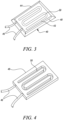
- Figure 3 shows a schematic perspective view of the combination from the unit side.
- the battery 30 has electrical connection tabs 32 (which can both be at one end, as shown, or at opposite ends), and welded pouch side seams 34.
- the battery is substantially rectangular prismatic in shape and has two flat rectangular major external surfaces.
- the thermal regulating unit 40 is formed as a bag-like container having a flexible outer covering 42, welded side seams 44, and inlet and outlet ports 46 for respectively providing liquid coolant (such as water, or water-glycol mixture, e.g. a 50:50 mixture) to and removing the liquid coolant from the unit.
- liquid coolant such as water, or water-glycol mixture, e.g. a 50:50 mixture
- Filling the unit is a spacer element 48 in the form of a smooth edged, substantially rectangular prismatic body, shown schematically in perspective view in Figure 4 . This gives the unit a corresponding rectangular prismatic external shape, similar to that of the battery 30, including two rectangular major external surfaces, one of which is in face-to-face contact at an interface 36 with one of the rectangular major external surfaces of the battery 30.
- the spacer element is smooth edged to protect the outer covering 42, and contains cut-outs or recesses which define channels 50 for the coolant following a serpentine path from the inlet port to the outlet port.
- the element and the channels can be formed by die cutting, injection moulding, 3D printing, or other suitable process.
- the outer covering 42 can be formed of, for example, polyethylene, polypropylene, nylon or other suitable plastic film. It may be a multi-layer laminate, with or without reinforcement and impermeable barriers (such as aluminium foil).
- the spacer element 48 may likewise be formed of polyethylene, polypropylene, nylon or other suitable plastic resistant to the liquid coolant.
- the ports 46 can be provided by respective pieces of tubing which are preferably formed of the same material as the material of the outer covering for ease of joining (e.g. by welding) thereto, and which feed through the spacer element to the channels 50. When the tubing is fed through in this manner, the spacer element can retain a unitary structure which enhances the rigidity of the thermal regulating unit 40 as a whole.
- the flexible outer covering 42 can be welded (for example by radio frequency welding) along the seams 44 and around the tubing pieces.
- the liquid coolant is pumped through the thermal regulating unit 40 by a coolant circuit (discussed below). This cools the battery 30 by heat transferred across the contact interface 36. In particular, as the areas of the contacting surfaces are relatively large, the thermal impedance between battery and the unit is reduced. The pumped coolant also pressurises the unit, causing the outer covering 42 to expand and press the unit against the battery across the interface, thereby further reducing the thermal impedance. The pressure exerted by the unit on the battery also helps to restrain the expansion of the battery in high altitude (low air pressure) environments, preserving cycle life.
- the thickness of the material of the outer covering 42 is selected to provide adequate electrical isolation of the liquid coolant from the surface of the battery 30.
- a covering formed of plastic film having a thickness of 0.2 mm to 0.5 mm plastic may be sufficient; plastic films typically having insulation ratings of about 20 kV/mm.
- the covering must be sufficiently thin to allow sufficient heat to pass therethrough, from the battery to the liquid coolant.
- Typical plastic films have thermal conductivities of between 0.2 to 0.5 W/mK.
- the composition of the pouch material can also be considered.
- Commercial pouch cell laminates typically have multiple layers. For example, an inner layer may be composed of polypropylene (20-40 ⁇ m), a middle layer of aluminium foil (5-30 ⁇ m) and an outer layer of nylon 6 (10-40 ⁇ m), although materials and laminates configurations may be substituted.
- Various adhesive layers may also be present to bind the laminates but these are thin and do not significantly affect the thermal performance of the laminate.
- the estimated thermal resistance is quite low and suggests that it may be possible to increase the thickness of the outer covering material so as to improve upon electrical isolation, water permeation resistance and water pressure withstand resistance.
- the thermal regulating unit 40 provides a flat major external surface at the interface 36 so that the unit exerts an even pressing force against the battery 30 which does not deform the cell electrode stack within.
- Additional films may be placed between the battery 30 and the unit 40. These may serve various functions such as
- Thermally conductive grease may also be applied to fill microscopic voids at the interface 36.
- the combination of the pouch cell battery 30 and the thermal regulating unit 40 is inserted into a close-fitting, sewn, restraining jacket 60 formed from non-combustible inorganic fibre material, such as felt. Eyelets 62 are sewn into the envelope to allow the tabs 32 and the inlet/outlet ports 46 to pass out of the jacket.
- the inorganic fibres may be alumina-silicate ceramic fibre, which has very high temperature withstand capability, and can be used continuously at up to 1260°C.
- the jacket 60 provides a non-combustible thermal barrier around the battery 30 and the unit 40. It also helps to mechanically protect the battery and unit and keep them in close contact. In the event of electrolyte venting from the battery or thermal runaway, the ceramic fibres do not prevent the release of vapour and smoke. These will pass through the material to an air plenum (void space) above the cells, as described below.
- the battery module 24 contains plural battery/unit pair combinations, each in its own jacket 60 and each mounted in a light scaffold placed within a casing, the battery/unit pair combinations and scaffold being encapsulated with form-in-place fire retardant polyurethane foam.
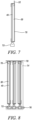
- Figure 6 is a transparent perspective view and Figure 7 a cross-sectional side view of one such pair combination, the views also showing the respective portion of scaffolding 70, and connectors 72 for the inlet/outlet ports 46.
- Figure 8 is a cross-sectional side view of three such aligned pair combinations, and also shows the encapsulating foam 74, piping 76 joining the connectors 72, and a portion of a printed circuit board (PCB) 78 which electrically connects the tabs 32.
- PCB printed circuit board
- Figure 9 is an exploded view of the module, showing a complete row of aligned battery/unit pair combinations of the module encapsulated in the foam 74, the PCB 78 and parts of a casing 80 for the module.
- Figure 10 shows a transparent perspective view of the finally assembled module, and also shows distribution and collection ports 82 for the piping 76, the ports allowing the liquid coolant to respectively enter and leave the casing.
- the foam 74 may possess phosphate based flame retardant, such as Swiftbond TM 4006BFR 'Flame Retardant Encapsulation Foam' containing 20-30% retardant, manufactured by H.B.Fuller. Such foam does not sustain combustion in normal atmosphere and is rated UL94 HBF at 3.2 mm and UL94 VO at 6.35 mm.
- the foam also has a low viscosity before setting, allowing for intricate parts to be encapsulated.
- the foam is electrically insulating, e.g. with an insulation rating of 3 kV/mm. Thus, suspending the batteries 30 within the foam helps to electrically isolate them and the electrical system from the casing 80 and coolant system which are at ground potential.
- a further function of the foam 74 is to securely but gently fix the battery/unit combinations in place. As the foam expands it collapses voids in the fibrous jacket 60 and presses the thermal regulating units 40 against their batteries 30. As mentioned above, such pressure improves the thermal contact between units and the batteries, and also helps maintain cell capacity in high altitude environments.
- the foam 74 also fills the module casing 80, enhancing the rigidity of the casing and removing air space within the casing, except for a small void above the tabs 32.
- the foam 74 also fills the module casing 80, enhancing the rigidity of the casing and removing air space within the casing, except for a small void above the tabs 32.
- void air plenum
- FIG 11 shows schematically a stack of six of the modules 24 in a circuit for the liquid coolant.
- the circuit has a header inlet which sends coolant to the distribution ports of the modules, and a header outlet which receives coolant from the collection ports of the modules.
- the circuit also has electric pump for circulating the coolant around the circuit, and a heat exchanger based on a radiator and cooler fan to reduce the temperature of the pumped coolant and thereby remove waste heat from the modules.
- a thermal bypass valve (TBV) operates to allow the coolant to bypass the heat exchanger when the coolant is at or below a predetermined temperature.
- the circuit has a heater element which can heat the coolant in a plenum before entry into the header inlet, the heater and the heat exchanger being controllable such that the coolant is either cooled by the heat exchanger or heated by the heater.
- a heater element which can heat the coolant in a plenum before entry into the header inlet, the heater and the heat exchanger being controllable such that the coolant is either cooled by the heat exchanger or heated by the heater.
- the circuit has a pressure release valve (PRV) across the module stack.
- PRV pressure release valve
- the PRV opens and shunt coolant flow away from the modules.
- the outer coverings 42 of the thermal regulating units 40 are formed from plastic sheet, their pressure withstand capability is relatively low. The PRV thus provides a means to prevent coolant over-pressure that may damage the units.
- the back pressure helps to expand the units and keep them pressed against the batteries 30. This may be achieved by providing a fixed or variable control orifice in the circuit downstream from the module stack.
- the circuit has a temperature sensor (TS) and a pressure sensor (P) to allow for health monitoring and feedback control of the various functions discussed above.
- TS temperature sensor
- P pressure sensor
Landscapes
- Engineering & Computer Science (AREA)
- Chemical & Material Sciences (AREA)
- General Chemical & Material Sciences (AREA)
- Chemical Kinetics & Catalysis (AREA)
- Electrochemistry (AREA)
- Manufacturing & Machinery (AREA)
- Aviation & Aerospace Engineering (AREA)
- Life Sciences & Earth Sciences (AREA)
- Sustainable Development (AREA)
- Sustainable Energy (AREA)
- Power Engineering (AREA)
- Transportation (AREA)
- Mechanical Engineering (AREA)
- Materials Engineering (AREA)
- Secondary Cells (AREA)
- Battery Mounting, Suspending (AREA)
Description
- The present disclosure relates to a battery module.
- The performance requirements placed upon batteries used in land-based electric vehicles and the regulatory requirements governing this class of product have given rise to battery modules based on pouch cell batteries designed specifically for the land-based electric vehicle market. However, these designs are generally unsuitable for aerospace applications, particularly electric and hybrid electric propulsion systems, where the operating environment, load profile and regulatory environment are quite different.
- In particular, aerospace applications present the following technical challenges:
- 1) High discharge rates. High discharge currents are drawn from the battery particularly during takeoff and landing. The high currents give rise to internal cell heating and potentially high cell temperatures and/or temperature gradients within the cell which consequently reduce the cell cycle life. A technical challenge is to provide adequate cooling to the cell, maintaining a uniform temperature throughout the body of the cell within the optimum range of between 10 and 35°C.
- 2) High altitude operation. The battery module may be required to operate at altitudes of for example 30,000 ft or more (9 km or more). The reduced air pressure/density lowers the insulation properties of air, making it problematic to provide adequate isolation without incurring excessive weight/size penalty. Moreover, pouch cell batteries operating in a low pressure or vacuum environment may undergo expansion and contraction cycling. This may lead to electrode damage and premature loss discharge capacity. To address this it may be necessary to apply a restraining pressure to the electrode stack. This has been demonstrated to reduce capacity degradation even under near vacuum (0.1 psi, about 0.7kPa) conditions.
- 3) Vibration and mechanical stress. The aircraft environment is characterized by high vibration, accelerations in both vertical and horizontal directions and orientation changes (pitch and roll). A support structure may thus be needed that can support the cells in any orientation and dampen vibrations which lead to material fatigue.
- 4) Thermal runaway containment. While the incidence of thermal runaway can be reduced by appropriate cell selection, thermal management and protection algorithms employed by the battery management system, it is nonetheless possible that a thermal runaway event may still occur. RTCA DO-311A 2.4.5.5 'Battery Thermal Runaway Containment Test' examines the performance of the module when multiple cells are forced into thermal runaway. The pass criterion for this test is that no smoke or debris be released from the module. One technical challenge is to contain a fire so that thermal runaway of one cell does not propagate to another. A second technical challenge is to prevent escape of smoke or debris from a battery module.
- 5) Explosion containment. In the event of cell venting, it is possible that the air spaces within a module become filled with electrolyte vapour. This vapour may explode if an ignition source is present. RTCA DO-311A 2.4.5.6 'Explosion Containment Test' examines the performance of a battery module under such an event and specifies that no smoke or debris shall be permitted to exit from the module. A technical challenge is thus to configure a lightweight casing for a module that is able to withstand such an explosion.
- German patent application publication
DE102012218724A1 relates to an arrangement for controlling the temperature of lithium-ion battery cells for hybrid vehicles. The arrangement includes two cover sheets and an intermediate plate. One or more channels for conducting a fluid medium is included between the cover sheets. - Unites States patent application publication
US 2013/0171493 A1 relates to a battery heat exchanger assembly. The assembly includes a fluid transfer layer and an external layer. The external layer includes flexible graphite. The fluid transfer layer includes at least one channel and is configured to form a passage for receive a thermal transfer fluid. - Aspects of the present disclosure aim to address these challenges.
- According to the appended claims, there is provided a battery module comprising a plurality of electrically connected pouch cell batteries and a corresponding plurality of thermal regulating units for regulating the temperature of the pouch cell batteries. Each thermal regulating unit is formed as a container having: a spacer element which substantially completely fills the thermal regulating unit and includes one or more internal cooling channels for conveying a liquid coolant through the unit; a flexible outer covering which contains the spacer element and its one or more cooling channels; and inlet and outlet ports which penetrate the covering for respectively providing liquid coolant to and removing the liquid coolant from the one or more cooling channels. The flexible outer covering forms a substantially flat major external surface of the unit for pressing against a correspondingly shaped major external surface of one of the pouch cell batteries such that the thermal regulating unit and the pouch cell battery can be held in face-to-face contact. The one or more cooling channels are arranged in the flexible outer covering such that when the provided liquid coolant is pressurized it causes the unit to expand and exert pressure against the major external surface of the pouch cell battery. The pouch cell batteries and thermal regulating units are arranged within a casing. Spaces within the casing surrounding the pouch cell batteries and thermal regulating units are filled with flame-retardant and electrically-insulating expanded foam.
- The thermal regulating unit can thus keep the battery cool, allowing high discharge currents to be drawn from the battery, while also exerting a pressure on the battery which helps it to operate at high altitudes. In addition, the pressing of the thermal regulating unit against the battery can provide mechanical support and help to reduce vibrations.
- For example, the flexible outer covering of the unit may be formed of a plastic material having a thermal conductivity of at least 0.2 W/mK. For example, it may be formed of polypropylene, polyethylene, nylon, or some other polymer resistant to the liquid coolant.
- Advantageously, the flexible outer covering allows the liquid coolant to be a means by which the thermal regulating unit can both cool the battery and exert a pressure on the battery.
- Optional features and further aspects of the present disclosure are now set out.
- The pouch cell battery may be a lithium ion pouch cell battery.
- The liquid coolant may be water or water-glycol (e.g. a 50:50 mixture).
- The major external surface of the thermal regulating unit of the first or second aspect may be rectangular, i.e. corresponding in shape to, and for pressing against, a rectangular major external surface of the pouch cell battery. Thus conveniently the unit can have a prismatic 3D shape, matching a rectangular prismatic 3D shape of the pouch cell battery.
- The cooling channels may follow a serpentine path from the inlet port to the outlet port. The path can thereby allow the channels to cover an area substantially matching that of the major external surface of the unit.
- The unit contains a spacer element which limits the expansion of the unit. For example, the spacer element may be a body (e.g. of rectangular prismatic 3D shape) which substantially completely fills the unit, the cooling channels being formed as cut-outs through or recesses in the body. The body can be formed from a plastic such as polypropylene, polyethylene, nylon, or some other polymer resistant to the liquid coolant.
- Conveniently each battery/unit combination may be contained in a respective restraining jacket formed of non-combustible material. The jacket thus provides a non-combustible thermal barrier around the battery. However, it also helps to mechanically protect the battery and unit and keep them in close contact.
- Each pouch cell battery and corresponding thermal regulating unit may be contained in a restraining jacket formed of non-combustible material with the major external surface of the unit in face-to-face contact with the major external surface of the pouch cell battery.
- The restraining jacket can be a flexible restraining jacket. For example, the non-combustible material can be an inorganic fibre material, such as a felt or a woven fibre material. The fibres can be alumina-silicate ceramic fibres.
- Spaces within the casing surrounding the battery cells and thermal regulating units are filled with flame-retardant and electrically-insulating expanded foam. The foam can then also apply pressure to the battery/unit combinations to further reinforce the face-to-face contact between the unit and the battery of each combination. However, the battery module may retain or comprise a void (i.e. a space not filled with expanded foam) for collection of gas and smoke from the batteries in the event of thermal runaway of one or more of the batteries, and for channelling the collected gas and smoke to a burst valve located in the casing.
- The casing may have a distribution port penetrating therethough which is fluidly connected to the inlet ports of the thermal regulating units, and a collection port penetrating therethough which is fluidly connected to the outlet ports of the thermal regulating units. The liquid coolant can then enter and leave the casing via respectively the distribution and collection ports.
- The battery module may further include a coolant circuit, wherein the coolant circuit has a pump to pump the liquid coolant from the collection port back to the distribution port via a heat exchanger (such as a fan-assisted radiator) to reduce the temperature of the pumped liquid coolant and thereby remove waste heat from the battery module.
- The coolant circuit can also provide an option to warm the batteries. In particular, battery modules are typically positioned in an unheated region of the aircraft. There may therefore be long periods of time where the batteries are exposed to very low ambient temperatures during flight, e.g. -40°C or colder. Such low temperatures are not necessarily detrimental to the cells, but it may be important that the battery modules are ready for service at any time during the flight, and typically an optimal temperature range for battery operation is between 10°C and 35°C. Thus despite their location, the temperature of the batteries is preferably maintainable at a level where power can be drawn from the cells. Accordingly, the coolant circuit may further have a heater to heat the pumped liquid coolant and thereby increase the temperature of the batteries, the heater and the heat exchanger being controllable such that the pumped liquid coolant is either cooled by the heat exchanger or heated by the heater.
- The coolant circuit may conveniently be configured to control the pressure of the pumped liquid coolant to thereby control the pressure exerted on the major external surface of the batteries by expansion of the units. For example, the coolant circuit may have a fixed or variable orifice downstream of the collection port to maintain a controlled pressure in the pumped liquid coolant. Additionally or alternatively, the coolant circuit may have a pressure release valve in a bypass line across distribution and collection ports. In the event of over-pressure across the battery module, the pressure release valve can open to shunt pumped liquid coolant flow away from the module.
- According to another aspect of the present disclosure there is provided an electrical power supply system having: a DC distribution bus; a motor and a DC/AC converter which converts DC power absorbed from the DC distribution bus into AC power and delivers that AC power to the motor; and (i) the battery module according to the third aspect, or (ii) the combination according to the fifth aspect of the battery module and the coolant circuit, and a DC/DC converter operatively connected between the battery module and the DC distribution bus, wherein the battery module delivers DC power to the DC distribution bus in a discharge mode of operation, and absorbs DC power from the DC distribution bus in a recharge mode of operation.
- The electrical power supply system may further comprise a generator and an AC/DC converter which converts AC power produced by the generator into DC power and delivers that DC power to the DC distribution bus.
- According to another aspect of the present disclosure there is provided an aircraft propulsion system having: the electrical power supply system according to the sixth aspect; and a propulsive fan or propeller which is powered by the motor.
- The aircraft propulsion system may further comprise a gas turbine engine which powers the generator.
- According to another aspect of the present disclosure there is provided an aircraft having the propulsion system.
- The skilled person will appreciate that except where mutually exclusive, a feature described in relation to any one of the above aspects may be applied mutatis mutandis to any other aspect. Furthermore except where mutually exclusive any feature described herein may be applied to any aspect and/or combined with any other feature described herein.
- Embodiments will now be described by way of example only, with reference to the Figures, in which:
-
Figure 1 shows schematically a hybrid electric aircraft propulsion system; -
Figure 2 shows a schematic perspective view, from a battery side, of a combination of a pouch cell battery and a thermal regulating unit in face-to-face contact; -
Figure 3 shows a schematic perspective view of the combination ofFigure 2 from the thermal regulating unit side (pouch cell tabs not visible); -
Figure 4 shows a schematic perspective view of a spacer element which fills the thermal regulating unit ofFigures 2 and3 ; -
Figure 5 shows a schematic perspective view of the combination of the pouch cell battery and the thermal regulating unit ofFigures 2 and3 inserted into a restraining jacket; -
Figure 6 is a transparent perspective view of a pair combination of a pouch cell battery and a thermal regulating unit from a battery module; -
Figure 7 is a cross-sectional side view of the pair combination ofFigure 6 ; -
Figure 8 is a cross-sectional side view of three aligned pair combinations of a pouch cell battery and a thermal regulating unit from the battery module; -
Figure 9 is an exploded view of the battery module; -
Figure 10 is a transparent perspective view of the finally assembled battery module; and -
Figure 11 shows schematically a stack of six of battery modules in a circuit for a liquid coolant. - Aspects and embodiments of the present disclosure will now be discussed with reference to the accompanying figures. Further aspects and embodiments will be apparent to those skilled in the art.
-
Figure 1 shows schematically a hybrid electric aircraft propulsion system. The aircraft has a high voltage DC (HVDC)distribution bus 10. Agenerator 12 produces AC electrical power, which is converted to DC power by an AC/DC converter 14 for feeding into the bus. Conveniently, the generator can be powered by agas turbine engine 16. Power is withdrawn from the bus by a DC/AC converter 18, which supplies the withdrawn power to amotor 20 and which in turn drives a propulsive propeller orfan 22 of the aircraft. - The propulsion system also has a stack of rechargeable, lithium
ion battery modules 24. The modules are connected electrically in series to form a battery pack. The battery modules provide extra power at take-off, and more generally assist in the regulation of the voltage level in theHVDC distribution bus 10. The battery modules deliver DC power to the DC distribution bus in a power delivery mode of operation, and absorb DC power from the DC distribution bus in a power absorption mode of operation. A DC/DC converter 26 operatively connects the battery modules to HVDC distribution bus and helps the AC/DC converter 14 to maintain the voltage level of the bus at a fixed level. - Each
battery module 24 contains plural pouch cell batteries and plural thermal regulating units for the batteries.Figure 2 shows a schematic perspective view, from a battery side, of a combination of one of thesepouch cell batteries 30 and itsthermal regulating unit 40 in face-to-face contact, andFigure 3 shows a schematic perspective view of the combination from the unit side. - The
battery 30 has electrical connection tabs 32 (which can both be at one end, as shown, or at opposite ends), and welded pouch side seams 34. The battery is substantially rectangular prismatic in shape and has two flat rectangular major external surfaces. - The
thermal regulating unit 40 is formed as a bag-like container having a flexible outer covering 42, welded side seams 44, and inlet andoutlet ports 46 for respectively providing liquid coolant (such as water, or water-glycol mixture, e.g. a 50:50 mixture) to and removing the liquid coolant from the unit. Filling the unit is aspacer element 48 in the form of a smooth edged, substantially rectangular prismatic body, shown schematically in perspective view inFigure 4 . This gives the unit a corresponding rectangular prismatic external shape, similar to that of thebattery 30, including two rectangular major external surfaces, one of which is in face-to-face contact at aninterface 36 with one of the rectangular major external surfaces of thebattery 30. The spacer element is smooth edged to protect theouter covering 42, and contains cut-outs or recesses which definechannels 50 for the coolant following a serpentine path from the inlet port to the outlet port. The element and the channels can be formed by die cutting, injection moulding, 3D printing, or other suitable process. - Instead of the
channels 50 following a serpentine path in thespacer element 48, other internal structures for guiding the flow of coolant liquid through thethermal regulating unit 40 and maintaining the shape of the unit with a flat major surface are possible. For example, an arrangement of internal baffles could be used. - The
outer covering 42 can be formed of, for example, polyethylene, polypropylene, nylon or other suitable plastic film. It may be a multi-layer laminate, with or without reinforcement and impermeable barriers (such as aluminium foil). Thespacer element 48 may likewise be formed of polyethylene, polypropylene, nylon or other suitable plastic resistant to the liquid coolant. Conveniently, theports 46 can be provided by respective pieces of tubing which are preferably formed of the same material as the material of the outer covering for ease of joining (e.g. by welding) thereto, and which feed through the spacer element to thechannels 50. When the tubing is fed through in this manner, the spacer element can retain a unitary structure which enhances the rigidity of thethermal regulating unit 40 as a whole. Once the tubing pieces are inserted through side holes in the spacer element, the flexible outer covering 42 can be welded (for example by radio frequency welding) along theseams 44 and around the tubing pieces. - The liquid coolant is pumped through the
thermal regulating unit 40 by a coolant circuit (discussed below). This cools thebattery 30 by heat transferred across thecontact interface 36. In particular, as the areas of the contacting surfaces are relatively large, the thermal impedance between battery and the unit is reduced. The pumped coolant also pressurises the unit, causing theouter covering 42 to expand and press the unit against the battery across the interface, thereby further reducing the thermal impedance. The pressure exerted by the unit on the battery also helps to restrain the expansion of the battery in high altitude (low air pressure) environments, preserving cycle life. - The thickness of the material of the
outer covering 42 is selected to provide adequate electrical isolation of the liquid coolant from the surface of thebattery 30. For electrical systems where the HVDC bus voltage approaches 1kV, a covering formed of plastic film having a thickness of 0.2 mm to 0.5 mm plastic may be sufficient; plastic films typically having insulation ratings of about 20 kV/mm. On the other hand, the covering must be sufficiently thin to allow sufficient heat to pass therethrough, from the battery to the liquid coolant. Typical plastic films have thermal conductivities of between 0.2 to 0.5 W/mK. - When determining the thermal resistance between the cell electrode stack within the
battery 30 and the liquid coolant, the composition of the pouch material can also be considered. Commercial pouch cell laminates typically have multiple layers. For example, an inner layer may be composed of polypropylene (20-40 µm), a middle layer of aluminium foil (5-30 µm) and an outer layer of nylon 6 (10-40 µm), although materials and laminates configurations may be substituted. Various adhesive layers may also be present to bind the laminates but these are thin and do not significantly affect the thermal performance of the laminate. - The effectiveness of cooling across the
interface 36 can be readily estimated. For example, if the interfacial area is 10 cm x 20 cm, the thickness of the material of the outer covering is 500 µm, the thickness of the pouch material is 80 µm, and the thermal conductivities of the outer covering material and the pouch material are both 0.4 W/mK, then the effective thermal resistance R between the cell electrode stack and the liquid coolant can be estimated as:
- In this example the estimated thermal resistance is quite low and suggests that it may be possible to increase the thickness of the outer covering material so as to improve upon electrical isolation, water permeation resistance and water pressure withstand resistance.
- The
thermal regulating unit 40 provides a flat major external surface at theinterface 36 so that the unit exerts an even pressing force against thebattery 30 which does not deform the cell electrode stack within. - Additional films may be placed between the
battery 30 and theunit 40. These may serve various functions such as - accommodating irregularities in the surfaces at the
interface 36; - spreading the heat across the interface; and
- adhering the
unit 40 to thebattery 30 across the interface. - Thermally conductive grease may also be applied to fill microscopic voids at the
interface 36. - As shown schematically in
Figure 5 , the combination of thepouch cell battery 30 and thethermal regulating unit 40 is inserted into a close-fitting, sewn, restrainingjacket 60 formed from non-combustible inorganic fibre material, such as felt.Eyelets 62 are sewn into the envelope to allow thetabs 32 and the inlet/outlet ports 46 to pass out of the jacket. - The inorganic fibres may be alumina-silicate ceramic fibre, which has very high temperature withstand capability, and can be used continuously at up to 1260°C. The
jacket 60 provides a non-combustible thermal barrier around thebattery 30 and theunit 40. It also helps to mechanically protect the battery and unit and keep them in close contact. In the event of electrolyte venting from the battery or thermal runaway, the ceramic fibres do not prevent the release of vapour and smoke. These will pass through the material to an air plenum (void space) above the cells, as described below. - The
battery module 24 contains plural battery/unit pair combinations, each in itsown jacket 60 and each mounted in a light scaffold placed within a casing, the battery/unit pair combinations and scaffold being encapsulated with form-in-place fire retardant polyurethane foam.Figure 6 is a transparent perspective view andFigure 7 a cross-sectional side view of one such pair combination, the views also showing the respective portion ofscaffolding 70, andconnectors 72 for the inlet/outlet ports 46.Figure 8 is a cross-sectional side view of three such aligned pair combinations, and also shows the encapsulatingfoam 74, piping 76 joining theconnectors 72, and a portion of a printed circuit board (PCB) 78 which electrically connects thetabs 32.Figure 9 is an exploded view of the module, showing a complete row of aligned battery/unit pair combinations of the module encapsulated in thefoam 74, thePCB 78 and parts of acasing 80 for the module.Figure 10 shows a transparent perspective view of the finally assembled module, and also shows distribution andcollection ports 82 for the piping 76, the ports allowing the liquid coolant to respectively enter and leave the casing. - The
foam 74 may possess phosphate based flame retardant, such as Swiftbond™ 4006BFR 'Flame Retardant Encapsulation Foam' containing 20-30% retardant, manufactured by H.B.Fuller. Such foam does not sustain combustion in normal atmosphere and is rated UL94 HBF at 3.2 mm and UL94 VO at 6.35 mm. The foam also has a low viscosity before setting, allowing for intricate parts to be encapsulated. In addition, the foam is electrically insulating, e.g. with an insulation rating of 3 kV/mm. Thus, suspending thebatteries 30 within the foam helps to electrically isolate them and the electrical system from thecasing 80 and coolant system which are at ground potential. - A further function of the
foam 74 is to securely but gently fix the battery/unit combinations in place. As the foam expands it collapses voids in thefibrous jacket 60 and presses thethermal regulating units 40 against theirbatteries 30. As mentioned above, such pressure improves the thermal contact between units and the batteries, and also helps maintain cell capacity in high altitude environments. - The
foam 74 also fills themodule casing 80, enhancing the rigidity of the casing and removing air space within the casing, except for a small void above thetabs 32. When the volume of free space is decreased within themodule 24, the severity of explosions that may occur within the module due to ignition of electrolyte vapour is reduced, and routes for air to enter into module and support the fire are reduced. Decreasing the free space also increases the probability that any explosions proceed as deflagrations rather than detonations (which give rise to higher pressure waves that are more difficult to contain). - However the void (air plenum) above the
tabs 32 can: - Provide a venting space in case of electrolyte discharge;
- Act as a manifold to collect gas/smoke in case of thermal runaway;
- Channel gas/smoke from the
module casing 80 to the outside through a burst valve (not shown) located on a wall of the casing; - Provide space for components and activities such as a bus bar, welding of a bus bar, a PCB, connectors and sensors which are connected/performed after the batteries are fixed in place by the
foam 74. -
Figure 11 shows schematically a stack of six of themodules 24 in a circuit for the liquid coolant. The circuit has a header inlet which sends coolant to the distribution ports of the modules, and a header outlet which receives coolant from the collection ports of the modules. The circuit also has electric pump for circulating the coolant around the circuit, and a heat exchanger based on a radiator and cooler fan to reduce the temperature of the pumped coolant and thereby remove waste heat from the modules. A thermal bypass valve (TBV) operates to allow the coolant to bypass the heat exchanger when the coolant is at or below a predetermined temperature. In addition, the circuit has a heater element which can heat the coolant in a plenum before entry into the header inlet, the heater and the heat exchanger being controllable such that the coolant is either cooled by the heat exchanger or heated by the heater. In this way, an option is available to warm the batteries. In particular, battery modules are typically positioned in an unheated region of the aircraft, and there may therefore be long periods of time where the batteries are exposed to very low ambient temperatures during flight when the batteries are not in use. The heater can thus heat the coolant and keep the batteries in an optimal temperature range of 10°C and 35°C ready for immediate operation. - The circuit has a pressure release valve (PRV) across the module stack. In the event of over-pressure across the modules, the PRV opens and shunt coolant flow away from the modules. As the
outer coverings 42 of thethermal regulating units 40 are formed from plastic sheet, their pressure withstand capability is relatively low. The PRV thus provides a means to prevent coolant over-pressure that may damage the units. - However, it is desirable to keep maintain a slight pressure within the
units 40 during operation. The back pressure helps to expand the units and keep them pressed against thebatteries 30. This may be achieved by providing a fixed or variable control orifice in the circuit downstream from the module stack. - The circuit has a temperature sensor (TS) and a pressure sensor (P) to allow for health monitoring and feedback control of the various functions discussed above.
- It will be understood that the invention is not limited to the embodiments above-described and various modifications and improvements can be made without departing from the concepts described herein. Except where mutually exclusive, any of the features may be employed separately or in combination with any other features and the disclosure extends to and includes all combinations and sub-combinations of one or more features described herein.
Claims (13)
- A battery module (24) comprising a plurality of electrically connected pouch cell batteries (30) and a corresponding plurality of thermal regulating units (40) for regulating the temperature of the pouch cell batteries (30), each thermal regulating unit being formed as a container having:a spacer element (48) which substantially completely fills the thermal regulating unit (40) and includes one or more internal cooling channels (50) for conveying a liquid coolant through the thermal regulating unit (40);a flexible outer covering (42) which contains the spacer element and its one or more cooling channels; andinlet and outlet ports (46) which penetrate the covering for respectively providing liquid coolant to and removing the liquid coolant from the one or more cooling channels,wherein the flexible outer covering (42) forms a substantially flat major external surface of the thermal regulating unit (40) for pressing against a correspondingly shaped major external surface of one of the pouch cell batteries (30) such that the thermal regulating unit (40) and the pouch cell battery (30) can be held in face-to-face contact;wherein the one or more cooling channels are arranged in the flexible outer covering such that when the provided liquid coolant is pressurized it causes the unit to expand and press against the major external surface of the pouch cell battery (30); andwherein the pouch cell batteries (30) and thermal regulating units (40) are arranged within a casing (80), spaces within the casing surrounding the pouch cell batteries and thermal regulating units being filled with flame-retardant and electrically-insulating expanded foam (74).
- The battery module (24) according to claim 1, wherein the flexible outer covering (42) is formed of a plastic material having a thermal conductivity of at least 0.2 W/mK.
- The battery module (24) according to claim 1 or 2, wherein the cooling channels (50) follow a serpentine path from the inlet port to the outlet port.
- The battery module (24) according to claim 1, wherein the cooling channels (50) are formed as cut-outs through or recesses in a body of the spacer element (48).
- The battery module (24) according to any one of the preceding claims, wherein each pouch cell battery (30) and corresponding thermal regulating unit (40) is contained in a respective restraining jacket (60) formed of non-combustible material.
- The battery module (24) according to claim 5, wherein the non-combustible material is an inorganic fibre material.
- The battery module (24) according to any one of the preceding claims, retaining a void for collection of gas and smoke from the batteries in the event of thermal runaway of one or more of the batteries, and for channelling the collected gas and smoke to a burst valve located in the casing.
- The battery module (24) according to any one of the preceding claims, wherein the casing has a distribution port (82) penetrating therethough which is fluidly connected to the inlet ports of the thermal regulating units, and a collection port (82) penetrating therethough which is fluidly connected to the outlet ports of the thermal regulating units, wherein the liquid coolant can enter and leave the casing via respectively the distribution and collection ports.
- The battery module (24) according to claim 8, further comprising a coolant circuit, wherein the coolant circuit has a pump to pump the liquid coolant from the collection port back to the distribution port via a heat exchanger to reduce the temperature of the pumped liquid coolant and thereby remove waste heat from the battery module.
- The battery module (24) according to claim 9, wherein the coolant circuit further has a heater to heat the pumped liquid coolant and thereby increase the temperature of the batteries, the heater and the heat exchanger being selectably controllable such that the liquid coolant is either cooled by the heat exchanger or heated by the heater.
- The battery module (24) according to claim 9 or 10, wherein the coolant circuit is configured to control the pressure of the pumped liquid coolant to thereby control the pressure exerted on the major external surface of the batteries by expansion of the units.
- An aircraft propulsion system including the battery module (24) according to any one of the preceding claims.
- An aircraft comprising the aircraft propulsion system according to claim 12.
Applications Claiming Priority (1)
| Application Number | Priority Date | Filing Date | Title |
|---|---|---|---|
| GB1916484.7A GB2588910A (en) | 2019-11-13 | 2019-11-13 | Battery thermal regulating unit |
Publications (2)
| Publication Number | Publication Date |
|---|---|
| EP3823080A1 EP3823080A1 (en) | 2021-05-19 |
| EP3823080B1 true EP3823080B1 (en) | 2024-02-07 |
Family
ID=69062303
Family Applications (1)
| Application Number | Title | Priority Date | Filing Date |
|---|---|---|---|
| EP20206079.4A Active EP3823080B1 (en) | 2019-11-13 | 2020-11-06 | Battery module |
Country Status (4)
| Country | Link |
|---|---|
| US (1) | US11936018B2 (en) |
| EP (1) | EP3823080B1 (en) |
| CN (1) | CN112886088A (en) |
| GB (1) | GB2588910A (en) |
Families Citing this family (26)
| Publication number | Priority date | Publication date | Assignee | Title |
|---|---|---|---|---|
| JP7237899B2 (en) * | 2020-09-03 | 2023-03-13 | 三恵技研工業株式会社 | Battery heat exchange structure |
| US11628745B2 (en) * | 2021-02-05 | 2023-04-18 | Beta Air, Llc | Apparatus for a ground-based battery management for an electric aircraft |
| WO2022217108A1 (en) * | 2021-04-09 | 2022-10-13 | Brunswick Corporation | Marine battery safety system and method |
| US12166222B2 (en) | 2021-04-09 | 2024-12-10 | Rolls-Royce Corporation | Battery pack core for fire and explosion protection for battery module |
| US20220328913A1 (en) * | 2021-04-09 | 2022-10-13 | Rolls-Royce Corporation | Fill material for fire and explosion protection for battery module |
| CN113437424B (en) * | 2021-07-01 | 2023-09-15 | 湖南兆科动力新能源有限公司 | Single lithium battery pack of new energy automobile |
| US11437662B1 (en) * | 2021-07-23 | 2022-09-06 | Beta Air, Llc | Battery assembly for use in an electric aircraft |
| JP7522221B2 (en) * | 2021-07-30 | 2024-07-24 | 寧徳時代新能源科技股▲分▼有限公司 | Battery, power consumption device, battery manufacturing method and battery manufacturing device |
| US11984611B2 (en) | 2021-08-17 | 2024-05-14 | Beta Air, Llc | Stack battery pack for electric vertical take-off and landing aircraft |
| US20230136731A1 (en) * | 2021-09-15 | 2023-05-04 | Beta Air, Llc | Battery system and method of an electric aircraft with spring conductors |
| EP4199224B1 (en) * | 2021-12-17 | 2024-10-23 | EnerSys Delaware Inc. | Battery safety arrangement |
| EP4199223A1 (en) * | 2021-12-17 | 2023-06-21 | EnerSys Delaware Inc. | Metal ion battery safety arrangement |
| US11817567B2 (en) * | 2021-12-28 | 2023-11-14 | Beta Air, Llc | System for battery temperature management in an electric aircraft |
| CN114388955B (en) * | 2022-01-11 | 2024-02-02 | 中原工学院 | Cylindrical battery fixing support and hybrid battery thermal management method |
| US12107285B2 (en) * | 2022-01-13 | 2024-10-01 | GM Global Technology Operations LLC | Systems and methods for responding to thermal excursions in a battery |
| US11557811B1 (en) * | 2022-03-23 | 2023-01-17 | Beta Air, Llc | System for battery environment management in an electric aircraft and a method for its use |
| US11824176B2 (en) | 2022-03-25 | 2023-11-21 | Beta Air, Llc | Systems and methods for battery pack cooling using a cooling fin |
| US20230352760A1 (en) * | 2022-04-29 | 2023-11-02 | Pratt & Whitney Canada Corp. | Electrical heating system for hybrid powerplant electrical power source |
| US11936063B1 (en) | 2023-01-12 | 2024-03-19 | Beta Air, Llc | Battery module and a method for cooling a battery module of an electric vehicle |
| CN120937175A (en) * | 2023-04-14 | 2025-11-11 | Sabic环球技术有限责任公司 | Tray and system for housing at least one battery module and method for cooling at least one battery module housed in a system tray |
| DE102023119944A1 (en) | 2023-07-27 | 2025-01-30 | Dr. Ing. H.C. F. Porsche Aktiengesellschaft | battery cell and battery module |
| KR20250096278A (en) * | 2023-12-20 | 2025-06-27 | 에스케이온 주식회사 | Battery Assembly And Controlling Method Of The same |
| SE548246C2 (en) | 2024-02-20 | 2026-04-30 | Heart Aerospace AB | Method of managing conditioning fluid of a thermal management system for an aircraft |
| CN222072062U (en) * | 2024-04-01 | 2024-11-26 | 株式会社Aesc日本 | Battery Pack |
| DE102024131139A1 (en) | 2024-10-25 | 2026-04-30 | Audi Aktiengesellschaft | Intercell cooling unit for a battery, battery module and method for manufacturing an intercell cooling unit |
| CN119994356B (en) * | 2025-04-17 | 2025-10-17 | 宁德时代新能源科技股份有限公司 | Battery devices and electrical equipment |
Family Cites Families (17)
| Publication number | Priority date | Publication date | Assignee | Title |
|---|---|---|---|---|
| DE60213474T2 (en) * | 2002-02-19 | 2007-03-15 | 3M Innovative Properties Co., St. Paul | DEVICE AND METHOD FOR TEMPERATURE CONTROL IN ELECTROCHEMICAL CELLS WITH HIGH ENERGY DENSITY |
| FR2962261B1 (en) * | 2010-07-02 | 2013-08-02 | Saft Groupe Sa | BATTERY OF ELECTROCHEMICAL GENERATORS COMPRISING FOAM AS FILLING MATERIAL BETWEEN GENERATORS |
| JP5673374B2 (en) * | 2011-06-10 | 2015-02-18 | 株式会社Gsユアサ | Nonaqueous electrolyte secondary battery |
| US20130171491A1 (en) * | 2011-12-30 | 2013-07-04 | PEV Power Systems Inc. | Apparatus for transferring thermal energy to or from a battery cell |
| WO2013101737A1 (en) * | 2011-12-30 | 2013-07-04 | Graftech International Holdings Inc. | Battery heat exchanger |
| DE102012218724A1 (en) * | 2012-10-15 | 2014-04-17 | Continental Automotive Gmbh | Arrangement i.e. cooling fin, for temperature controlling lithium-ion-cell for e.g. hybrid vehicle, has slots comprising rods that abut at respective cover plates such that slots are covered by plates, where channels are formed by slots |
| TWI489674B (en) * | 2014-01-13 | 2015-06-21 | 新普科技股份有限公司 | Heat spreader and battery module |
| CN107431147B (en) * | 2015-02-27 | 2021-05-18 | 株式会社Lg化学 | battery module |
| CN204720491U (en) * | 2015-05-07 | 2015-10-21 | 郑州宇通客车股份有限公司 | A kind of battery core filling member and use battery core unit, the battery of this battery core filling member |
| US20180301774A1 (en) * | 2015-08-18 | 2018-10-18 | Gerard R. Campeau | Heat exchanger device for confined spaces |
| EP3449527A1 (en) * | 2016-04-25 | 2019-03-06 | Telefonaktiebolaget LM Ericsson (PUBL) | A battery and a battery thermal arrangement |
| CN114407614A (en) * | 2016-09-02 | 2022-04-29 | 苹果公司 | Thermal management system and method |
| US10749225B2 (en) * | 2017-03-14 | 2020-08-18 | Ford Global Technologies, Llc | Thermal management assembly for traction battery cells |
| EP3731300A4 (en) | 2017-12-19 | 2021-03-10 | SANYO Electric Co., Ltd. | POWER SUPPLY DEVICE AND POWER SUPPLY DEVICE SEPARATOR |
| FR3079210B1 (en) * | 2018-03-26 | 2021-04-16 | Safran | MULTIROTOR AIRCRAFT PROPULSION SYSTEM WITH RECONFIGURABLE ELECTRICAL NETWORK |
| WO2021019495A1 (en) * | 2019-08-01 | 2021-02-04 | 3M Innovative Properties Company | Fire barriers for electric vehicle battery modules |
| WO2021059206A1 (en) * | 2019-09-27 | 2021-04-01 | 3M Innovative Properties Company | Detection and capture of fluorine containing toxic byproducts of electrochemical cell packs |
-
2019
- 2019-11-13 GB GB1916484.7A patent/GB2588910A/en not_active Withdrawn
-
2020
- 2020-10-16 CN CN202011114735.9A patent/CN112886088A/en active Pending
- 2020-10-26 US US17/079,940 patent/US11936018B2/en active Active
- 2020-11-06 EP EP20206079.4A patent/EP3823080B1/en active Active
Also Published As
| Publication number | Publication date |
|---|---|
| CN112886088A (en) | 2021-06-01 |
| GB201916484D0 (en) | 2019-12-25 |
| US20210143492A1 (en) | 2021-05-13 |
| EP3823080A1 (en) | 2021-05-19 |
| GB2588910A (en) | 2021-05-19 |
| US11936018B2 (en) | 2024-03-19 |
Similar Documents
| Publication | Publication Date | Title |
|---|---|---|
| US11936018B2 (en) | Battery thermal regulating unit | |
| US12100850B2 (en) | Systems and methods for improved battery assemblies for eVTOL aircraft | |
| US20250055120A1 (en) | Apparatus for mitigation of thermal event propagation for battery systems | |
| US20230231226A1 (en) | Partition member and assembled battery | |
| US11799162B2 (en) | Light weight thermal runaway and explosion resistant aerospace battery | |
| EP3391436B1 (en) | Passive thermal management system for battery | |
| US20240021906A1 (en) | Coolant reservoir and circulation assemblies and systems | |
| US20220402620A1 (en) | Aircraft battery systems | |
| US9912019B2 (en) | Thermal management of electrical storage devices by coolant pool | |
| CN115036611A (en) | Battery cooling device, battery module, aircraft, charging system and cooling method | |
| US12109911B2 (en) | VTOL aircraft including a reconfigurable battery thermal regulation system | |
| CA2896887A1 (en) | Aircraft including mitigation system for rechargeable batteries | |
| EP4106080A1 (en) | Aircraft battery systems | |
| WO2023285882A1 (en) | Battery module for an electrically-driven aircraft, method for manufacturing a battery module and electrically-driven aircraft powered by a battery module | |
| CA3226851A1 (en) | Battery module for an electrically-driven aircraft, method for manufacturing a battery module and electrically-driven aircraft powered by a battery module | |
| US20230054839A1 (en) | Light weight thermal runaway and explosion resistant aerospace battery | |
| US12555994B2 (en) | Systems and methods for improved battery assemblies for eVTOL aircraft | |
| EP4553960A1 (en) | Battery pack module | |
| WO2025041027A1 (en) | A battery module | |
| WO2024107608A1 (en) | Systems and methods for improved battery assemblies for evtol aircraft | |
| US12068498B1 (en) | Systems and methods for improved battery assemblies for EVTOL aircraft | |
| US20250349961A1 (en) | Integrated battery in composite panels | |
| JP2025539753A (en) | Heat exchanger assembly and cooling system for an EVTOL aircraft |
Legal Events
| Date | Code | Title | Description |
|---|---|---|---|
| PUAI | Public reference made under article 153(3) epc to a published international application that has entered the european phase |
Free format text: ORIGINAL CODE: 0009012 |
|
| STAA | Information on the status of an ep patent application or granted ep patent |
Free format text: STATUS: THE APPLICATION HAS BEEN PUBLISHED |
|
| AK | Designated contracting states |
Kind code of ref document: A1 Designated state(s): AL AT BE BG CH CY CZ DE DK EE ES FI FR GB GR HR HU IE IS IT LI LT LU LV MC MK MT NL NO PL PT RO RS SE SI SK SM TR |
|
| STAA | Information on the status of an ep patent application or granted ep patent |
Free format text: STATUS: REQUEST FOR EXAMINATION WAS MADE |
|
| STAA | Information on the status of an ep patent application or granted ep patent |
Free format text: STATUS: EXAMINATION IS IN PROGRESS |
|
| 17P | Request for examination filed |
Effective date: 20211102 |
|
| RBV | Designated contracting states (corrected) |
Designated state(s): AL AT BE BG CH CY CZ DE DK EE ES FI FR GB GR HR HU IE IS IT LI LT LU LV MC MK MT NL NO PL PT RO RS SE SI SK SM TR |
|
| 17Q | First examination report despatched |
Effective date: 20211124 |
|
| GRAP | Despatch of communication of intention to grant a patent |
Free format text: ORIGINAL CODE: EPIDOSNIGR1 |
|
| STAA | Information on the status of an ep patent application or granted ep patent |
Free format text: STATUS: GRANT OF PATENT IS INTENDED |
|
| GRAS | Grant fee paid |
Free format text: ORIGINAL CODE: EPIDOSNIGR3 |
|
| GRAA | (expected) grant |
Free format text: ORIGINAL CODE: 0009210 |
|
| STAA | Information on the status of an ep patent application or granted ep patent |
Free format text: STATUS: THE PATENT HAS BEEN GRANTED |
|
| INTG | Intention to grant announced |
Effective date: 20231218 |
|
| P01 | Opt-out of the competence of the unified patent court (upc) registered |
Effective date: 20231221 |
|
| AK | Designated contracting states |
Kind code of ref document: B1 Designated state(s): AL AT BE BG CH CY CZ DE DK EE ES FI FR GB GR HR HU IE IS IT LI LT LU LV MC MK MT NL NO PL PT RO RS SE SI SK SM TR |
|
| REG | Reference to a national code |
Ref country code: GB Ref legal event code: FG4D |
|
| REG | Reference to a national code |
Ref country code: CH Ref legal event code: EP |
|
| REG | Reference to a national code |
Ref country code: IE Ref legal event code: FG4D |
|
| REG | Reference to a national code |
Ref country code: DE Ref legal event code: R096 Ref document number: 602020025267 Country of ref document: DE |
|
| REG | Reference to a national code |
Ref country code: LT Ref legal event code: MG9D |
|
| REG | Reference to a national code |
Ref country code: NL Ref legal event code: MP Effective date: 20240207 |
|
| PG25 | Lapsed in a contracting state [announced via postgrant information from national office to epo] |
Ref country code: IS Free format text: LAPSE BECAUSE OF FAILURE TO SUBMIT A TRANSLATION OF THE DESCRIPTION OR TO PAY THE FEE WITHIN THE PRESCRIBED TIME-LIMIT Effective date: 20240607 |
|
| PG25 | Lapsed in a contracting state [announced via postgrant information from national office to epo] |
Ref country code: LT Free format text: LAPSE BECAUSE OF FAILURE TO SUBMIT A TRANSLATION OF THE DESCRIPTION OR TO PAY THE FEE WITHIN THE PRESCRIBED TIME-LIMIT Effective date: 20240207 |
|
| PG25 | Lapsed in a contracting state [announced via postgrant information from national office to epo] |
Ref country code: GR Free format text: LAPSE BECAUSE OF FAILURE TO SUBMIT A TRANSLATION OF THE DESCRIPTION OR TO PAY THE FEE WITHIN THE PRESCRIBED TIME-LIMIT Effective date: 20240508 |
|
| REG | Reference to a national code |
Ref country code: AT Ref legal event code: MK05 Ref document number: 1655955 Country of ref document: AT Kind code of ref document: T Effective date: 20240207 |
|
| PG25 | Lapsed in a contracting state [announced via postgrant information from national office to epo] |
Ref country code: HR Free format text: LAPSE BECAUSE OF FAILURE TO SUBMIT A TRANSLATION OF THE DESCRIPTION OR TO PAY THE FEE WITHIN THE PRESCRIBED TIME-LIMIT Effective date: 20240207 Ref country code: NL Free format text: LAPSE BECAUSE OF FAILURE TO SUBMIT A TRANSLATION OF THE DESCRIPTION OR TO PAY THE FEE WITHIN THE PRESCRIBED TIME-LIMIT Effective date: 20240207 |
|
| PG25 | Lapsed in a contracting state [announced via postgrant information from national office to epo] |
Ref country code: ES Free format text: LAPSE BECAUSE OF FAILURE TO SUBMIT A TRANSLATION OF THE DESCRIPTION OR TO PAY THE FEE WITHIN THE PRESCRIBED TIME-LIMIT Effective date: 20240207 |
|
| PG25 | Lapsed in a contracting state [announced via postgrant information from national office to epo] |
Ref country code: AT Free format text: LAPSE BECAUSE OF FAILURE TO SUBMIT A TRANSLATION OF THE DESCRIPTION OR TO PAY THE FEE WITHIN THE PRESCRIBED TIME-LIMIT Effective date: 20240207 |
|
| PG25 | Lapsed in a contracting state [announced via postgrant information from national office to epo] |
Ref country code: NO Free format text: LAPSE BECAUSE OF FAILURE TO SUBMIT A TRANSLATION OF THE DESCRIPTION OR TO PAY THE FEE WITHIN THE PRESCRIBED TIME-LIMIT Effective date: 20240507 Ref country code: NL Free format text: LAPSE BECAUSE OF FAILURE TO SUBMIT A TRANSLATION OF THE DESCRIPTION OR TO PAY THE FEE WITHIN THE PRESCRIBED TIME-LIMIT Effective date: 20240207 Ref country code: LT Free format text: LAPSE BECAUSE OF FAILURE TO SUBMIT A TRANSLATION OF THE DESCRIPTION OR TO PAY THE FEE WITHIN THE PRESCRIBED TIME-LIMIT Effective date: 20240207 Ref country code: IS Free format text: LAPSE BECAUSE OF FAILURE TO SUBMIT A TRANSLATION OF THE DESCRIPTION OR TO PAY THE FEE WITHIN THE PRESCRIBED TIME-LIMIT Effective date: 20240607 Ref country code: HR Free format text: LAPSE BECAUSE OF FAILURE TO SUBMIT A TRANSLATION OF THE DESCRIPTION OR TO PAY THE FEE WITHIN THE PRESCRIBED TIME-LIMIT Effective date: 20240207 Ref country code: GR Free format text: LAPSE BECAUSE OF FAILURE TO SUBMIT A TRANSLATION OF THE DESCRIPTION OR TO PAY THE FEE WITHIN THE PRESCRIBED TIME-LIMIT Effective date: 20240508 Ref country code: FI Free format text: LAPSE BECAUSE OF FAILURE TO SUBMIT A TRANSLATION OF THE DESCRIPTION OR TO PAY THE FEE WITHIN THE PRESCRIBED TIME-LIMIT Effective date: 20240207 Ref country code: ES Free format text: LAPSE BECAUSE OF FAILURE TO SUBMIT A TRANSLATION OF THE DESCRIPTION OR TO PAY THE FEE WITHIN THE PRESCRIBED TIME-LIMIT Effective date: 20240207 Ref country code: BG Free format text: LAPSE BECAUSE OF FAILURE TO SUBMIT A TRANSLATION OF THE DESCRIPTION OR TO PAY THE FEE WITHIN THE PRESCRIBED TIME-LIMIT Effective date: 20240207 Ref country code: AT Free format text: LAPSE BECAUSE OF FAILURE TO SUBMIT A TRANSLATION OF THE DESCRIPTION OR TO PAY THE FEE WITHIN THE PRESCRIBED TIME-LIMIT Effective date: 20240207 |
|
| PG25 | Lapsed in a contracting state [announced via postgrant information from national office to epo] |
Ref country code: PT Free format text: LAPSE BECAUSE OF FAILURE TO SUBMIT A TRANSLATION OF THE DESCRIPTION OR TO PAY THE FEE WITHIN THE PRESCRIBED TIME-LIMIT Effective date: 20240607 Ref country code: PL Free format text: LAPSE BECAUSE OF FAILURE TO SUBMIT A TRANSLATION OF THE DESCRIPTION OR TO PAY THE FEE WITHIN THE PRESCRIBED TIME-LIMIT Effective date: 20240207 |
|
| PG25 | Lapsed in a contracting state [announced via postgrant information from national office to epo] |
Ref country code: SE Free format text: LAPSE BECAUSE OF FAILURE TO SUBMIT A TRANSLATION OF THE DESCRIPTION OR TO PAY THE FEE WITHIN THE PRESCRIBED TIME-LIMIT Effective date: 20240207 Ref country code: PT Free format text: LAPSE BECAUSE OF FAILURE TO SUBMIT A TRANSLATION OF THE DESCRIPTION OR TO PAY THE FEE WITHIN THE PRESCRIBED TIME-LIMIT Effective date: 20240607 Ref country code: PL Free format text: LAPSE BECAUSE OF FAILURE TO SUBMIT A TRANSLATION OF THE DESCRIPTION OR TO PAY THE FEE WITHIN THE PRESCRIBED TIME-LIMIT Effective date: 20240207 Ref country code: LV Free format text: LAPSE BECAUSE OF FAILURE TO SUBMIT A TRANSLATION OF THE DESCRIPTION OR TO PAY THE FEE WITHIN THE PRESCRIBED TIME-LIMIT Effective date: 20240207 |
|
| PG25 | Lapsed in a contracting state [announced via postgrant information from national office to epo] |
Ref country code: DK Free format text: LAPSE BECAUSE OF FAILURE TO SUBMIT A TRANSLATION OF THE DESCRIPTION OR TO PAY THE FEE WITHIN THE PRESCRIBED TIME-LIMIT Effective date: 20240207 |
|
| PG25 | Lapsed in a contracting state [announced via postgrant information from national office to epo] |
Ref country code: SM Free format text: LAPSE BECAUSE OF FAILURE TO SUBMIT A TRANSLATION OF THE DESCRIPTION OR TO PAY THE FEE WITHIN THE PRESCRIBED TIME-LIMIT Effective date: 20240207 |
|
| PG25 | Lapsed in a contracting state [announced via postgrant information from national office to epo] |
Ref country code: CZ Free format text: LAPSE BECAUSE OF FAILURE TO SUBMIT A TRANSLATION OF THE DESCRIPTION OR TO PAY THE FEE WITHIN THE PRESCRIBED TIME-LIMIT Effective date: 20240207 Ref country code: EE Free format text: LAPSE BECAUSE OF FAILURE TO SUBMIT A TRANSLATION OF THE DESCRIPTION OR TO PAY THE FEE WITHIN THE PRESCRIBED TIME-LIMIT Effective date: 20240207 |
|
| PG25 | Lapsed in a contracting state [announced via postgrant information from national office to epo] |
Ref country code: SK Free format text: LAPSE BECAUSE OF FAILURE TO SUBMIT A TRANSLATION OF THE DESCRIPTION OR TO PAY THE FEE WITHIN THE PRESCRIBED TIME-LIMIT Effective date: 20240207 |
|
| PG25 | Lapsed in a contracting state [announced via postgrant information from national office to epo] |
Ref country code: SM Free format text: LAPSE BECAUSE OF FAILURE TO SUBMIT A TRANSLATION OF THE DESCRIPTION OR TO PAY THE FEE WITHIN THE PRESCRIBED TIME-LIMIT Effective date: 20240207 Ref country code: SK Free format text: LAPSE BECAUSE OF FAILURE TO SUBMIT A TRANSLATION OF THE DESCRIPTION OR TO PAY THE FEE WITHIN THE PRESCRIBED TIME-LIMIT Effective date: 20240207 Ref country code: RO Free format text: LAPSE BECAUSE OF FAILURE TO SUBMIT A TRANSLATION OF THE DESCRIPTION OR TO PAY THE FEE WITHIN THE PRESCRIBED TIME-LIMIT Effective date: 20240207 Ref country code: EE Free format text: LAPSE BECAUSE OF FAILURE TO SUBMIT A TRANSLATION OF THE DESCRIPTION OR TO PAY THE FEE WITHIN THE PRESCRIBED TIME-LIMIT Effective date: 20240207 Ref country code: DK Free format text: LAPSE BECAUSE OF FAILURE TO SUBMIT A TRANSLATION OF THE DESCRIPTION OR TO PAY THE FEE WITHIN THE PRESCRIBED TIME-LIMIT Effective date: 20240207 Ref country code: CZ Free format text: LAPSE BECAUSE OF FAILURE TO SUBMIT A TRANSLATION OF THE DESCRIPTION OR TO PAY THE FEE WITHIN THE PRESCRIBED TIME-LIMIT Effective date: 20240207 |
|
| REG | Reference to a national code |
Ref country code: DE Ref legal event code: R097 Ref document number: 602020025267 Country of ref document: DE |
|
| PG25 | Lapsed in a contracting state [announced via postgrant information from national office to epo] |
Ref country code: IT Free format text: LAPSE BECAUSE OF FAILURE TO SUBMIT A TRANSLATION OF THE DESCRIPTION OR TO PAY THE FEE WITHIN THE PRESCRIBED TIME-LIMIT Effective date: 20240207 |
|
| PLBE | No opposition filed within time limit |
Free format text: ORIGINAL CODE: 0009261 |
|
| STAA | Information on the status of an ep patent application or granted ep patent |
Free format text: STATUS: NO OPPOSITION FILED WITHIN TIME LIMIT |
|
| PG25 | Lapsed in a contracting state [announced via postgrant information from national office to epo] |
Ref country code: IT Free format text: LAPSE BECAUSE OF FAILURE TO SUBMIT A TRANSLATION OF THE DESCRIPTION OR TO PAY THE FEE WITHIN THE PRESCRIBED TIME-LIMIT Effective date: 20240207 |
|
| 26N | No opposition filed |
Effective date: 20241108 |
|
| PG25 | Lapsed in a contracting state [announced via postgrant information from national office to epo] |
Ref country code: SI Free format text: LAPSE BECAUSE OF FAILURE TO SUBMIT A TRANSLATION OF THE DESCRIPTION OR TO PAY THE FEE WITHIN THE PRESCRIBED TIME-LIMIT Effective date: 20240207 |
|
| PG25 | Lapsed in a contracting state [announced via postgrant information from national office to epo] |
Ref country code: RS Free format text: LAPSE BECAUSE OF FAILURE TO SUBMIT A TRANSLATION OF THE DESCRIPTION OR TO PAY THE FEE WITHIN THE PRESCRIBED TIME-LIMIT Effective date: 20240207 |
|
| REG | Reference to a national code |
Ref country code: CH Ref legal event code: PL |
|
| PG25 | Lapsed in a contracting state [announced via postgrant information from national office to epo] |
Ref country code: MC Free format text: LAPSE BECAUSE OF FAILURE TO SUBMIT A TRANSLATION OF THE DESCRIPTION OR TO PAY THE FEE WITHIN THE PRESCRIBED TIME-LIMIT Effective date: 20240207 |
|
| PG25 | Lapsed in a contracting state [announced via postgrant information from national office to epo] |
Ref country code: LU Free format text: LAPSE BECAUSE OF NON-PAYMENT OF DUE FEES Effective date: 20241106 |
|
| REG | Reference to a national code |
Ref country code: CH Ref legal event code: PL |
|
| PG25 | Lapsed in a contracting state [announced via postgrant information from national office to epo] |
Ref country code: CH Free format text: LAPSE BECAUSE OF NON-PAYMENT OF DUE FEES Effective date: 20241130 |
|
| REG | Reference to a national code |
Ref country code: BE Ref legal event code: MM Effective date: 20241130 |
|
| PG25 | Lapsed in a contracting state [announced via postgrant information from national office to epo] |
Ref country code: BE Free format text: LAPSE BECAUSE OF NON-PAYMENT OF DUE FEES Effective date: 20241130 |
|
| PG25 | Lapsed in a contracting state [announced via postgrant information from national office to epo] |
Ref country code: IE Free format text: LAPSE BECAUSE OF NON-PAYMENT OF DUE FEES Effective date: 20241106 |
|
| PGFP | Annual fee paid to national office [announced via postgrant information from national office to epo] |
Ref country code: DE Payment date: 20251126 Year of fee payment: 6 |
|
| PGFP | Annual fee paid to national office [announced via postgrant information from national office to epo] |
Ref country code: GB Payment date: 20251125 Year of fee payment: 6 |
|
| PGFP | Annual fee paid to national office [announced via postgrant information from national office to epo] |
Ref country code: FR Payment date: 20251124 Year of fee payment: 6 |
|
| PG25 | Lapsed in a contracting state [announced via postgrant information from national office to epo] |
Ref country code: HU Free format text: LAPSE BECAUSE OF FAILURE TO SUBMIT A TRANSLATION OF THE DESCRIPTION OR TO PAY THE FEE WITHIN THE PRESCRIBED TIME-LIMIT; INVALID AB INITIO Effective date: 20201106 |
|
| PG25 | Lapsed in a contracting state [announced via postgrant information from national office to epo] |
Ref country code: CY Free format text: LAPSE BECAUSE OF FAILURE TO SUBMIT A TRANSLATION OF THE DESCRIPTION OR TO PAY THE FEE WITHIN THE PRESCRIBED TIME-LIMIT; INVALID AB INITIO Effective date: 20201106 |