EP3823077A1 - Electrode current collector comprising heat-pressure conversion layer between two or more metal foils, electrode comprising same, and lithium secondary battery - Google Patents
Electrode current collector comprising heat-pressure conversion layer between two or more metal foils, electrode comprising same, and lithium secondary battery Download PDFInfo
- Publication number
- EP3823077A1 EP3823077A1 EP20829527.9A EP20829527A EP3823077A1 EP 3823077 A1 EP3823077 A1 EP 3823077A1 EP 20829527 A EP20829527 A EP 20829527A EP 3823077 A1 EP3823077 A1 EP 3823077A1
- Authority
- EP
- European Patent Office
- Prior art keywords
- current collector
- heat
- electrode
- electrode current
- conversion layer
- Prior art date
- Legal status (The legal status is an assumption and is not a legal conclusion. Google has not performed a legal analysis and makes no representation as to the accuracy of the status listed.)
- Pending
Links
Images



Classifications
-
- H—ELECTRICITY
- H01—ELECTRIC ELEMENTS
- H01M—PROCESSES OR MEANS, e.g. BATTERIES, FOR THE DIRECT CONVERSION OF CHEMICAL ENERGY INTO ELECTRICAL ENERGY
- H01M4/00—Electrodes
- H01M4/02—Electrodes composed of, or comprising, active material
- H01M4/64—Carriers or collectors
- H01M4/66—Selection of materials
- H01M4/665—Composites
- H01M4/667—Composites in the form of layers, e.g. coatings
-
- H—ELECTRICITY
- H01—ELECTRIC ELEMENTS
- H01M—PROCESSES OR MEANS, e.g. BATTERIES, FOR THE DIRECT CONVERSION OF CHEMICAL ENERGY INTO ELECTRICAL ENERGY
- H01M10/00—Secondary cells; Manufacture thereof
- H01M10/42—Methods or arrangements for servicing or maintenance of secondary cells or secondary half-cells
- H01M10/4235—Safety or regulating additives or arrangements in electrodes, separators or electrolyte
-
- H—ELECTRICITY
- H01—ELECTRIC ELEMENTS
- H01M—PROCESSES OR MEANS, e.g. BATTERIES, FOR THE DIRECT CONVERSION OF CHEMICAL ENERGY INTO ELECTRICAL ENERGY
- H01M10/00—Secondary cells; Manufacture thereof
- H01M10/05—Accumulators with non-aqueous electrolyte
- H01M10/052—Li-accumulators
-
- H—ELECTRICITY
- H01—ELECTRIC ELEMENTS
- H01M—PROCESSES OR MEANS, e.g. BATTERIES, FOR THE DIRECT CONVERSION OF CHEMICAL ENERGY INTO ELECTRICAL ENERGY
- H01M10/00—Secondary cells; Manufacture thereof
- H01M10/05—Accumulators with non-aqueous electrolyte
- H01M10/052—Li-accumulators
- H01M10/0525—Rocking-chair batteries, i.e. batteries with lithium insertion or intercalation in both electrodes; Lithium-ion batteries
-
- H—ELECTRICITY
- H01—ELECTRIC ELEMENTS
- H01M—PROCESSES OR MEANS, e.g. BATTERIES, FOR THE DIRECT CONVERSION OF CHEMICAL ENERGY INTO ELECTRICAL ENERGY
- H01M10/00—Secondary cells; Manufacture thereof
- H01M10/60—Heating or cooling; Temperature control
- H01M10/61—Types of temperature control
- H01M10/615—Heating or keeping warm
-
- H—ELECTRICITY
- H01—ELECTRIC ELEMENTS
- H01M—PROCESSES OR MEANS, e.g. BATTERIES, FOR THE DIRECT CONVERSION OF CHEMICAL ENERGY INTO ELECTRICAL ENERGY
- H01M10/00—Secondary cells; Manufacture thereof
- H01M10/60—Heating or cooling; Temperature control
- H01M10/62—Heating or cooling; Temperature control specially adapted for specific applications
- H01M10/625—Vehicles
-
- H—ELECTRICITY
- H01—ELECTRIC ELEMENTS
- H01M—PROCESSES OR MEANS, e.g. BATTERIES, FOR THE DIRECT CONVERSION OF CHEMICAL ENERGY INTO ELECTRICAL ENERGY
- H01M10/00—Secondary cells; Manufacture thereof
- H01M10/60—Heating or cooling; Temperature control
- H01M10/65—Means for temperature control structurally associated with the cells
- H01M10/654—Means for temperature control structurally associated with the cells located inside the innermost case of the cells, e.g. mandrels, electrodes or electrolytes
-
- H—ELECTRICITY
- H01—ELECTRIC ELEMENTS
- H01M—PROCESSES OR MEANS, e.g. BATTERIES, FOR THE DIRECT CONVERSION OF CHEMICAL ENERGY INTO ELECTRICAL ENERGY
- H01M4/00—Electrodes
- H01M4/02—Electrodes composed of, or comprising, active material
- H01M4/13—Electrodes for accumulators with non-aqueous electrolyte, e.g. for lithium-accumulators; Processes of manufacture thereof
- H01M4/131—Electrodes based on mixed oxides or hydroxides, or on mixtures of oxides or hydroxides, e.g. LiCoOx
-
- H—ELECTRICITY
- H01—ELECTRIC ELEMENTS
- H01M—PROCESSES OR MEANS, e.g. BATTERIES, FOR THE DIRECT CONVERSION OF CHEMICAL ENERGY INTO ELECTRICAL ENERGY
- H01M4/00—Electrodes
- H01M4/02—Electrodes composed of, or comprising, active material
- H01M4/13—Electrodes for accumulators with non-aqueous electrolyte, e.g. for lithium-accumulators; Processes of manufacture thereof
- H01M4/134—Electrodes based on metals, Si or alloys
-
- H—ELECTRICITY
- H01—ELECTRIC ELEMENTS
- H01M—PROCESSES OR MEANS, e.g. BATTERIES, FOR THE DIRECT CONVERSION OF CHEMICAL ENERGY INTO ELECTRICAL ENERGY
- H01M4/00—Electrodes
- H01M4/02—Electrodes composed of, or comprising, active material
- H01M4/36—Selection of substances as active materials, active masses, active liquids
- H01M4/38—Selection of substances as active materials, active masses, active liquids of elements or alloys
- H01M4/386—Silicon or alloys based on silicon
-
- H—ELECTRICITY
- H01—ELECTRIC ELEMENTS
- H01M—PROCESSES OR MEANS, e.g. BATTERIES, FOR THE DIRECT CONVERSION OF CHEMICAL ENERGY INTO ELECTRICAL ENERGY
- H01M4/00—Electrodes
- H01M4/02—Electrodes composed of, or comprising, active material
- H01M4/36—Selection of substances as active materials, active masses, active liquids
- H01M4/48—Selection of substances as active materials, active masses, active liquids of inorganic oxides or hydroxides
- H01M4/483—Selection of substances as active materials, active masses, active liquids of inorganic oxides or hydroxides for non-aqueous cells
-
- H—ELECTRICITY
- H01—ELECTRIC ELEMENTS
- H01M—PROCESSES OR MEANS, e.g. BATTERIES, FOR THE DIRECT CONVERSION OF CHEMICAL ENERGY INTO ELECTRICAL ENERGY
- H01M4/00—Electrodes
- H01M4/02—Electrodes composed of, or comprising, active material
- H01M4/36—Selection of substances as active materials, active masses, active liquids
- H01M4/48—Selection of substances as active materials, active masses, active liquids of inorganic oxides or hydroxides
- H01M4/50—Selection of substances as active materials, active masses, active liquids of inorganic oxides or hydroxides of manganese
- H01M4/505—Selection of substances as active materials, active masses, active liquids of inorganic oxides or hydroxides of manganese of mixed oxides or hydroxides containing manganese for inserting or intercalating light metals, e.g. LiMn2O4 or LiMn2OxFy
-
- H—ELECTRICITY
- H01—ELECTRIC ELEMENTS
- H01M—PROCESSES OR MEANS, e.g. BATTERIES, FOR THE DIRECT CONVERSION OF CHEMICAL ENERGY INTO ELECTRICAL ENERGY
- H01M4/00—Electrodes
- H01M4/02—Electrodes composed of, or comprising, active material
- H01M4/36—Selection of substances as active materials, active masses, active liquids
- H01M4/48—Selection of substances as active materials, active masses, active liquids of inorganic oxides or hydroxides
- H01M4/52—Selection of substances as active materials, active masses, active liquids of inorganic oxides or hydroxides of nickel, cobalt or iron
- H01M4/525—Selection of substances as active materials, active masses, active liquids of inorganic oxides or hydroxides of nickel, cobalt or iron of mixed oxides or hydroxides containing iron, cobalt or nickel for inserting or intercalating light metals, e.g. LiNiO2, LiCoO2 or LiCoOxFy
-
- H—ELECTRICITY
- H01—ELECTRIC ELEMENTS
- H01M—PROCESSES OR MEANS, e.g. BATTERIES, FOR THE DIRECT CONVERSION OF CHEMICAL ENERGY INTO ELECTRICAL ENERGY
- H01M4/00—Electrodes
- H01M4/02—Electrodes composed of, or comprising, active material
- H01M4/64—Carriers or collectors
- H01M4/66—Selection of materials
- H01M4/661—Metal or alloys, e.g. alloy coatings
-
- H—ELECTRICITY
- H01—ELECTRIC ELEMENTS
- H01M—PROCESSES OR MEANS, e.g. BATTERIES, FOR THE DIRECT CONVERSION OF CHEMICAL ENERGY INTO ELECTRICAL ENERGY
- H01M4/00—Electrodes
- H01M4/02—Electrodes composed of, or comprising, active material
- H01M4/64—Carriers or collectors
- H01M4/66—Selection of materials
- H01M4/663—Selection of materials containing carbon or carbonaceous materials as conductive part, e.g. graphite, carbon fibres
-
- H—ELECTRICITY
- H01—ELECTRIC ELEMENTS
- H01M—PROCESSES OR MEANS, e.g. BATTERIES, FOR THE DIRECT CONVERSION OF CHEMICAL ENERGY INTO ELECTRICAL ENERGY
- H01M4/00—Electrodes
- H01M4/02—Electrodes composed of, or comprising, active material
- H01M4/64—Carriers or collectors
- H01M4/66—Selection of materials
- H01M4/664—Ceramic materials
-
- H—ELECTRICITY
- H01—ELECTRIC ELEMENTS
- H01M—PROCESSES OR MEANS, e.g. BATTERIES, FOR THE DIRECT CONVERSION OF CHEMICAL ENERGY INTO ELECTRICAL ENERGY
- H01M4/00—Electrodes
- H01M4/02—Electrodes composed of, or comprising, active material
- H01M4/64—Carriers or collectors
- H01M4/66—Selection of materials
- H01M4/665—Composites
- H01M4/666—Composites in the form of mixed materials
-
- H—ELECTRICITY
- H01—ELECTRIC ELEMENTS
- H01M—PROCESSES OR MEANS, e.g. BATTERIES, FOR THE DIRECT CONVERSION OF CHEMICAL ENERGY INTO ELECTRICAL ENERGY
- H01M4/00—Electrodes
- H01M4/02—Electrodes composed of, or comprising, active material
- H01M4/64—Carriers or collectors
- H01M4/66—Selection of materials
- H01M4/668—Composites of electroconductive material and synthetic resins
-
- H—ELECTRICITY
- H01—ELECTRIC ELEMENTS
- H01M—PROCESSES OR MEANS, e.g. BATTERIES, FOR THE DIRECT CONVERSION OF CHEMICAL ENERGY INTO ELECTRICAL ENERGY
- H01M4/00—Electrodes
- H01M4/02—Electrodes composed of, or comprising, active material
- H01M2004/026—Electrodes composed of, or comprising, active material characterised by the polarity
- H01M2004/028—Positive electrodes
-
- H—ELECTRICITY
- H01—ELECTRIC ELEMENTS
- H01M—PROCESSES OR MEANS, e.g. BATTERIES, FOR THE DIRECT CONVERSION OF CHEMICAL ENERGY INTO ELECTRICAL ENERGY
- H01M2200/00—Safety devices for primary or secondary batteries
- H01M2200/20—Pressure-sensitive devices
-
- H—ELECTRICITY
- H01—ELECTRIC ELEMENTS
- H01M—PROCESSES OR MEANS, e.g. BATTERIES, FOR THE DIRECT CONVERSION OF CHEMICAL ENERGY INTO ELECTRICAL ENERGY
- H01M4/00—Electrodes
- H01M4/02—Electrodes composed of, or comprising, active material
- H01M4/64—Carriers or collectors
- H01M4/66—Selection of materials
- H01M4/665—Composites
-
- Y—GENERAL TAGGING OF NEW TECHNOLOGICAL DEVELOPMENTS; GENERAL TAGGING OF CROSS-SECTIONAL TECHNOLOGIES SPANNING OVER SEVERAL SECTIONS OF THE IPC; TECHNICAL SUBJECTS COVERED BY FORMER USPC CROSS-REFERENCE ART COLLECTIONS [XRACs] AND DIGESTS
- Y02—TECHNOLOGIES OR APPLICATIONS FOR MITIGATION OR ADAPTATION AGAINST CLIMATE CHANGE
- Y02E—REDUCTION OF GREENHOUSE GAS [GHG] EMISSIONS, RELATED TO ENERGY GENERATION, TRANSMISSION OR DISTRIBUTION
- Y02E60/00—Enabling technologies; Technologies with a potential or indirect contribution to GHG emissions mitigation
- Y02E60/10—Energy storage using batteries
Definitions
- the present disclosure relates to an electrode current collector comprising a heat-pressure conversion layer between two or more metal foils, an electrode comprising the same, and a lithium secondary battery.
- EV electric vehicles
- HEV hybrid electric vehicles
- Plug-in HEV plug-in hybrid electric vehicles
- an electric vehicle which is driven only by a secondary battery
- a hybrid electric vehicle which combines a conventional engine with a secondary battery
- Ni-MH nickel-metal hydride
- Such a lithium secondary battery is manufactured by a process in which an electrode slurry containing an electrode active material is applied to an electrode current collector, dried, and rolled to produce an electrode, and an electrode assembly in which a separator is interposed between these electrodes is built in a battery case together with an electrolyte.
- the electrode is a positive electrode or a negative electrode
- a carbon material is mainly used as the negative electrode active material, and use of lithium metal, sulfur compounds, and the like is also considered.
- lithium-containing cobalt oxide (LiCoO 2 ) is mainly used as the positive electrode active material.
- use of lithium-containing manganese oxides such as LiMnO 2 having a layered crystal structure and LiMn 2 O 4 having a spinel crystal structure, and lithium-containing nickel oxide (LiNiO 2 ) are also considered.
- lithium nickel-cobalt-manganese oxide is used in a large amount as a lithium nickel-based oxide exhibiting excellent performance in terms of these performances.
- the lithium secondary battery containing such an active material has a problem that rapid charging performance is insufficient.
- the present disclosure has been directed to solve the above-mentioned problems of the prior arts and other technical problems that have yet to be resolved.
- an object of the present disclosure to provide an electrode current collector capable of improving the rapid charging performance of a secondary battery by generating heat by the operation of the secondary battery to raise the temperature of the battery.
- an electrode current collector for a lithium secondary battery comprising: two or more metal foil layers, and a heat-pressure conversion layer positioned between the two or more metal foil layers, wherein the heat-pressure conversion layer includes a heat-pressure exchange ceramic material, a conductive material, and an adhesive.
- the heat-pressure conversion layer may be interposed between two or more flat metal foil layers.
- the electrode current collector may be configured to include a lower current collector, a first heat-pressure conversion layer located on the lower current collector, an intermediate current collector located on the first heat-pressure conversion layer, a second heat-pressure conversion layer located on the intermediate current collector, and an upper current collector located on the second heat-pressure conversion layer.
- At least one metal foil layer of the two or more metal foil layers has a concavo-convex portion including a convex portion and a concave portion on the surface thereof, and the heat-pressure conversion layer may be formed in the concave portion.
- the convex portion and the concave portion may be formed at regular intervals.
- the heat-pressure exchange ceramic material may be trititanium pentoxide, and the lambda-trititanium pentoxide and beta-trititanium pentoxide can undergo a reversible phase transition by heat and pressure.
- the heat-pressure exchange ceramic material undergoes a phase transition from lambda-trititanium pentoxide to beta-trititanium pentoxide by pressing, and it can undergo a phase transition from beta-trititanium pentoxide to lambda-trititanium pentoxide by heat absorption.
- the heat-pressure conversion layer may have a thickness of 5 to 50 ⁇ m.
- the two or more metal foil layers may be made of mutually identical metals.
- the two or more metal foil layers are made of Al metal
- the electrode current collector may be a positive electrode current collector
- the two or more metal foil layers are made of Cu metal
- the electrode current collector may be a negative electrode current collector.
- the two or more metal foils may have a thickness of 10 to 100 ⁇ m, respectively.
- an electrode in which an electrode mixture containing an electrode active material, a binder and a conductive material is formed on at least one surface of the electrode current collector.
- the electrode active material may include a lithium transition metal oxide represented by the following chemical formula 1. Li a Ni 1-x-y Mn x Co y O 2-b A b (1) wherein,
- the electrode active material may include one or more silicon-based materials selected from the group consisting of Si/C composite, SiO x (0 ⁇ x ⁇ 2), metal-doped SiO x (0 ⁇ x ⁇ 2), SiO x /C(0 ⁇ x ⁇ 2), pure Si, and Si-alloy.
- a lithium secondary battery in which an electrode assembly containing the electrode is built in a prismatic or cylindrical battery case made of metal together with a lithium-containing non-aqueous electrolyte.
- an electrode current collector for a lithium secondary battery comprising two or more metal foil layers, and a heat-pressure conversion layer positioned between the two or more metal foil layers, wherein the heat-pressure conversion layer includes a heat-pressure exchange ceramic material, a conductive material, and an adhesive.
- the electrode current collector is not limited as long as it has a structure including a heat-pressure conversion layer between the two or more metal foil layers, and various structures are possible.
- the heat-pressure conversion layer may be interposed between two or more flat metal foil layers.
- it may be a shape interposing as one layer between two or more metal foil layers.
- this is a structure in which a heat-pressure conversion layer is interposed as one layer between two metal foil layers, and may be composed of a lower current collector, a heat-pressure conversion layer located on the lower current collector, and an upper current collector located on the heat-pressure conversion layer.
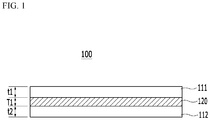
- FIG. 1 schematically shows a vertical cross-sectional view of such an electrode current collector.
- the electrode current collector 100 has a structure in which a heat-pressure conversion layer 120 is interposed between two metal foil layers 111 and 112.
- the electrode current collector is composed of a lower current collector 112, a heat-pressure conversion layer 120 located on the lower current collector 112, and an upper current collector 111 located on the heat-pressure conversion layer 120.
- the electrode current collector may have a structure in which the metal foil layers are three or more, the heat-pressure conversion layers are two or more, and the heat-pressure conversion layers are interposed between the metal foil layers.
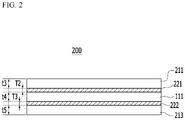
- FIG. 2 schematically shows a vertical cross-sectional view of the electrode current collector.
- the electrode current collector 200 is composed of a structure including a lower current collector 213, a first heat-pressure conversion layer 222 located on the lower current collector 213, an intermediate current collector 212 located on the first heat-pressure conversion layer 222, a second heat-pressure conversion layer 221 located on the intermediate current collector 212, and an upper current collector 211 located on the second heat-pressure conversion layer 221.
- At least one metal foil layer of the two or more metal foil layers may have a concavo-convex portion including a convex portion and a concave portion on the surface thereof, and the heat-pressure conversion layer may be formed in the concave portion.
- the electrode current collector may be a structure having a concavo-convex portion including a convex portion and a concave portion on one surface of the metal foil layers facing each other, wherein the heat-pressure conversion layer is formed in the concave portion.
- FIG. 3 a vertical cross-sectional view of such electrode current collector is schematically shown in FIG. 3 .
- the electrode current collector 300 includes an upper current collector 311, a lower current collector 312, and a heat-pressure conversion layer 320 positioned between the upper current collector 311 and the lower current collector 312.
- the lower current collector 312 has a concave-convex portion including a convex portion A and a concave portion B on the surface, wherein the heat-pressure conversion layer 320 is formed in the concave portion B.
- the electrode current collector may be a structure having a concavo-convex portion including a convex portion and a concave portion on the surface of both the metal foil layers facing each other, wherein the heat-pressure conversion layer is formed in the concave portion.
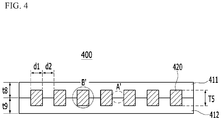
- FIG. 4 schematically shows a vertical cross-sectional view of the electrode current collector.
- the electrode current collector 400 has a structure having a concavo-convex portion including a convex portion A' and a concave portion B' on the surfaces of the upper current collector 411 and the lower current collector 412, wherein the convex portions A' face each other, the concave portions B' face each other, and a heat-pressure conversion layer 420 is formed in the concave portions B' facing each other.
- the convex portion of the upper current collector, and the concave portion of the lower current collector may face each other.
- a heat-pressure conversion layer may be formed in respective concave portions.
- the interval is not limited thereto as long as it is a case including a heat-pressure conversion layer in a sufficient level to exhibit the effect according to the present disclosure, and the interval may be appropriately selected.
- the intervals d1 and d2 may be 100 ⁇ m to 200 ⁇ m, respectively.
- the planar shape of the concave portion is not limited, and may be a linear shape, a circular shape, or a polygonal shape.
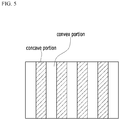
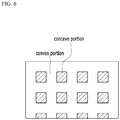
- FIGS. 5 to 7 show plan views of metal foils having a concave portion and a convex portion.
- FIG. 5 shows a case where the planar shape of the concave portion is linear
- FIG. 6 shows a case where the planar shape of the concave portion is square
- FIG. 7 shows a case where the planar shape of the concave portion is circle.
- the vertical cross-sectional shape can be a semicircle unlike in FIGS. 3 to 4
- the two or more metal foil layers are not limited in terms of the material, but copper, stainless steel, aluminum, nickel, titanium, sintered carbon, or copper; stainless steel treated with carbon, nickel, titanium, silver on the surface thereof; aluminum-cadmium alloy, or the like can be used.
- the two or more metal foil layers may be selected and used among the above materials, and may be formed of the same or different metals from each other. However, considering that the resistance is increased or the same active material is used on both sides, the metal foil layers may be made of mutually identical metals.
- the two or more metal foil layers may be made of Al metal.
- the two or more metal foil layers may be made of Cu metal.
- the thicknesses t 1 , t 2 , t 3 , t 4 , t 5 , t 6 , t 7 , t 8 and t 9 of the metal foil layers 111, 112, 211, 212, 213, 311, 312, 411 and 412 may be 10 to 100 ⁇ m, respectively.
- the shape of the metal foil layer can increase the binding force of the active material by forming a fine concavo-convex on the surface thereof, and various shapes such as a film, a sheet, a foil, a net, a porous body, a foam body and a non-woven fabric can be used.
- the thicknesses T 1 , T 2 , T 3 , T 4 , and T 5 of the heat-pressure conversion layers 120, 221, 222, 320 and 420 may be 5 to 50 ⁇ m, respectively.
- the thickness When the thickness is too thin outside the above range, it may not act as a heat-pressure conversion layer. When the thickness is too thick, rather, it may act as a resistive layer even during normal operation to reduce electronic conductivity, resulting in an increase in overall volume and a reduction in an energy density per volume, which is not preferable.
- the heat-pressure conversion layers 120, 221, 222, 320, and 420 may include a heat-pressure exchange ceramic material, a conductive material, and an adhesive.
- the heat-pressure exchange ceramic material receives a pressure by a battery case while increasing the volume of the electrode assembly is increasing according to the operation of the secondary battery, more specifically, the charging and discharging of the secondary battery, it can release heat to improve a rapid charging performance.
- the heat-pressure exchange ceramic material is not limited as long as it is a material that absorbs and releases pressure or heat while changing its conditions by heat and pressure, but specifically, it can be a trititanium pentoxide.
- the trititanium pentoxide is a material that undergoes a reversible phase transition between lambda-trititanium pentoxide and beta-trititanium pentoxide by heat and pressure. More specifically, it is a material that undergoes a phase transition from lambda-trititanium pentoxide to beta-trititanium pentoxide by pressurization and undergoes a phase transition from beta-trititanium pentoxide to lambda-trititanium pentoxide by heat absorption.
- the trititanium pentoxide reversibly exists as beta-trititanium pentoxide and lambda-trititanium pentoxide.
- a pressure of 60 Mpa or more is applied to the lambda-trititanium pentoxide, it undergoes a phase transition to beta-trititanium pentoxide while releasing heat of about 230 kJ/L.
- beta-trititanium pentoxide absorbs heat, it undergoes a phase transition to lambda-trititanium pentoxide again.
- a heat-pressure conversion layer is formed by using a lambda-trititanium pentoxide during manufacture of the electrode current collector, while converting to beta-trititanium pentoxide with only a predetermined pressure and releasing heat in the subsequent operation of the secondary battery, the temperature of the lithium secondary battery including the same is improved, thereby increasing the reaction rate and improving a rapid charging performance.
- the heat-pressure exchange ceramic material may be included in an amount of 20 to 50% by weight based on the total weight of the heat-pressure conversion layer.
- the conductive material plays a role in connecting the electronic conductivity of two or more metal foils formed on both sides of the heat-pressure conversion layer.
- Such a conductive material is a material that can be used in a general lithium secondary battery, and is not particularly limited as long as a corresponding battery has conductivity without causing a chemical change, and for example, carbon blacks such as carbon black, acetylene black, ketjen black, channel black, furnace black, lamp black, and thermal black; conductive fibers such as carbon fiber and metal fiber; metal powders such as carbon fluoride powder, aluminum powder, and nickel powder; conductive whiskey such as zinc oxide and potassium titanate; conductive metal oxides such as titanium oxide; conductive materials such as polyphenylene derivatives may be used. Specific examples may be at least one selected from the group consisting of carbon-based materials and metal materials.
- the conductive material may be included in an amount of 5 to 40% by weight based on the total weight of the heat-pressure conversion layer.
- the conductive material When the conductive material is included in a too small amount outside the above range, sufficient conductivity in the heat-pressure conversion layer cannot be secured, and when the conductive material is included in a too large amount, the safety may be deteriorated by the flow of a large number of electrons, which is not preferable.
- the heat-pressure conversion layer must also perform a role of bonding two or more metal foil layers, and thus also includes an adhesive.
- the adhesive forms the binding between the metal foil and the heat-pressure conversion layer, and also assists in the binding between the conductive material and the heat-pressure exchange ceramic material.
- Such adhesive is not limited as long as it is a component that does not induce a chemical change in the battery.
- Examples thereof may be at least one selected from the group consisting of polyvinylidene fluoride, polyvinyl alcohol, carboxymethylcellulose (CMC), starch, hydroxypropylcellulose, regenerated cellulose, polyvinylpyrrolidone, tetrafluoroethylene, polyethylene, polypropylene, an ethylene-propylene-diene terpolymer (EPDM), a sulfonated EPDM, a styrene-butadiene rubber and a fluorine rubber.
- CMC carboxymethylcellulose
- EPDM ethylene-propylene-diene terpolymer
- EPDM ethylene-propylene-diene terpolymer
- sulfonated EPDM a styrene-butadiene rubber
- fluorine rubber fluorine rubber
- the adhesive may be included in an amount of 5 to 40% by weight based on the total weight of the heat-pressure conversion layer.
- the adhesive When the adhesive is included in a too small amount outside the above range, the adhesive force between the heat-pressure conversion layer and the metal foil cannot be secured, and when the adhesive is included in a too large amount, the content of other materials decreases and the resistance may increase, which is not preferable.
- the heat-pressure conversion layer is disposed on the electrode current collector in this way, even if the capacity does not decrease due to the decrease in the content of the active material caused by the inclusion in the electrode mixture, and even if the current density is not increased for a secondary battery with reduced rapid charging performance, the rapid charging performance can be improved.
- the present disclosure further provides an electrode in which an electrode mixture containing an electrode active material, a binder, and a conductive material is formed on at least one surface of the electrode current collector.
- the electrode current collector has a structure as described above, and the electrode may be a positive electrode and a negative electrode.
- the electrode current collector may be a positive electrode current collector, and may have a structure in which a positive electrode mixture containing a positive electrode active material, a binder, and a conductive material is formed on at least one surface of the positive electrode current collector.
- the electrode active material when the electrode active material is a positive electrode active material, specifically, it may include a lithium transition metal oxide represented by the following chemical formula 1, which is not excellent in the characteristics of rapid charging performance.
- the binder is not limited as long as it is a component that assists in the binding between the active material and the conductive material and in the binding with the current collector.
- the binder may be selected from polyvinylidene fluoride, polyvinyl alcohol, carboxymethylcellulose (CMC), starch, hydroxypropylcellulose, regenerated cellulose, polyvinylpyrrolidone, tetrafluoroethylene, polyethylene, polypropylene, an ethylene-propylene-diene terpolymer (EPDM), a sulfonated EPDM, a styrene-butadiene rubber, a fluorine rubber, various copolymers, and the like.
- CMC carboxymethylcellulose
- EPDM ethylene-propylene-diene terpolymer
- EPDM ethylene-propylene-diene terpolymer
- sulfonated EPDM a styrene-butadiene rubber
- fluorine rubber various copolymers
- the conductive material is not particularly limited as long as a corresponding battery has conductivity without causing a chemical change in a conventional battery, and for example, carbon blacks such as carbon black, acetylene black, ketjen black, channel black, furnace black, lamp black, and thermal black; conductive fibers such as carbon fiber and metal fiber; metal powders such as carbon fluoride powder, aluminum powder, and nickel powder; conductive whiskey such as zinc oxide and potassium titanate; conductive metal oxides such as titanium oxide; conductive materials such as polyphenylene derivatives may be used.
- carbon blacks such as carbon black, acetylene black, ketjen black, channel black, furnace black, lamp black, and thermal black
- conductive fibers such as carbon fiber and metal fiber
- metal powders such as carbon fluoride powder, aluminum powder, and nickel powder
- conductive whiskey such as zinc oxide and potassium titanate
- conductive metal oxides such as titanium oxide
- conductive materials such as polyphenylene derivatives may be used.
- the conductive material and the binder may be, respectively, contained in an amount of 0.1 to 30% by weight, specifically, 0.5 to 10% by weight, more specifically, 1 to 5% by weight based on the total weight of the positive electrode mixture.
- the electrode current collector may be a negative electrode current collector, and may be a structure in which a negative electrode mixture containing a negative electrode active material, a binder, and a conductive material is formed on at least one surface of the negative electrode current collector.
- the negative electrode active material may include one or more carbon-based materials selected from the group consisting of artificial crystalline graphite, natural crystalline graphite, amorphous hard carbon, low-crystalline soft carbon, carbon black, acetylene black, ketjen black, Super-P, graphene and fibrous carbon, Si-based materials, metal composite oxides such as Li x Fe 2 O 3 (0 ⁇ x ⁇ 1), Li x WO 2 (0 ⁇ x ⁇ 1), Sn x Me 1-x Me' y O z (Me: Mn, Fe, Pb, Ge; Me': Al, B, P, Si, Group 1, 2, 3 elements in the periodic table, halogen; 0 ⁇ x ⁇ 1; 1 ⁇ y ⁇ 3; 1 ⁇ z ⁇ 8); lithium metals; lithium alloys; silicon-based alloys; tin-based alloys; metal-based oxides such as SnO, SnO 2 , PbO, PbO 2 , Pb 2 O 3 , Pb 3 O 4 , Sb 2 O 3 ,
- the electrode active material when the electrode active material is a negative electrode active material, specifically, it may be a silicon-based material that has a large volume change and is easily affected by the heat-pressure exchange ceramic substance of the electrode current collector. Specifically, it may be at least one selected from the group consisting of Si/C composite, SiOx(0 ⁇ x ⁇ 2), metal-doped SiOx(0 ⁇ x ⁇ 2), SiOx/C(0 ⁇ x ⁇ 2), pure Si, and Si-alloy.
- the electrode mixture may optionally further include a filler or the like.
- the filler is optionally used as a component for suppressing expansion of a positive electrode, and is not particularly limited as long as the filler is a fibrous material without causing a chemical change in the battery.
- olefinic polymers such as polyethylene and polypropylene
- fibrous materials such as glass fibers and carbon fibers are used.
- the present disclosure further provides a lithium secondary battery in which the electrode assembly including the electrode is built in a battery case together with a lithium-containing non-aqueous electrolyte.
- the electrode assembly includes an electrode according to the present disclosure, a counter electrode and a separator interposed therebetween.
- the counter electrode when the electrode is a positive electrode, the counter electrode is a negative electrode, and when the electrode is a negative electrode, the counter electrode is a positive electrode.
- the electrode current collector of the counter electrode may be a conventionally disclosed electrode current collector, or may be the same as the structure according to the present disclosure.
- the active material of the counter electrode the active material as described above can be used.
- the active material contained in the counter electrode may include a silicon-based material.
- the active material contained in the counter electrode may include a lithium transition metal oxide represented by the chemical formula 1.
- the active material can be a combination of the above.
- the electrode current collector according to the present disclosure can, regardless of where it is used as the positive electrode and/or the negative electrode, exhibit the effect when the volume expansion is made according to the charge and discharge of the secondary battery.
- an insulating thin film having high ion permeability and mechanical strength is used as the separator interposed between the electrode and the counter electrode.
- a pore diameter of the separator is generally 0.01 to 10 ⁇ m and a thickness thereof is generally 5 to 300 ⁇ m.
- Olefin-based polymers such as polypropylene, which is chemically resistant and hydrophobic; a sheet or a non-woven fabric made of glass fiber, polyethylene or the like may be used as an example of the separator.
- the solid electrolyte such as a polymer is used as the electrolyte, the solid electrolyte may also serve as a separator.
- the non-aqueous electrolyte containing a lithium salt may include a non-aqueous electrolyte and a lithium salt.
- non-protic organic solvents such as N-methyl-2-pyrollidinone, propylene carbonate, ethylene carbonate, butylene carbonate, dimethyl carbonate, diethyl carbonate, gamma-butyro lactone, 1,2-dimethoxy ethane, tetrahydroxyfuran, 2-methyl tetrahydrofuran, dimethylsulfoxide, 1,3-dioxolane, formamide, dimethylformamide, dioxolane, acetonitrile, nitromethane, methyl formate, methyl acetate, phosphoric acid triester, trimethoxy methane, dioxolane derivatives, sulfolane, methyl sulfolane, 1,3-dimethyl-2-imidazolidinone, propylene carbonate derivatives, tetrahydrofuran derivatives, ether, methyl propionate, and ethyl propionate
- non-protic organic solvents such as N-methyl-2-pyr
- the lithium salt is a material that is readily soluble in the above-mentioned non-aqueous electrolyte.
- the lithium salt may include, for example, LiCI, LiBr, Lil, LiClO 4 , LiBF 4 , LiB 10 Cl 10 , LiPF 6 , LiCF 3 SO 3 , LiCF 3 CO 2 , LiAsF 6 , LiSbF 6 , LiAlCl 4 , CH 3 SO 3 Li, CF 3 SO 3 Li, (CF 3 SO 2 ) 2 NLi, chloroborane lithium, lower aliphatic carboxylic acid lithium, lithium tetraphenyl borate, and imide.
- an organic solid electrolyte an inorganic solid electrolyte, or the like may be used.
- organic solid electrolyte examples include polyethylene derivatives, polyethylene oxide derivatives, polypropylene oxide derivatives, phosphoric acid ester polymers, poly agitation lysine, polyester sulfide, polyvinyl alcohols, polyvinylidene fluoride, and polymers containing ionic dissociation groups.
- Examples of the inorganic solid electrolyte include nitrides, halides and sulfates of lithium (Li) such as Li 3 N, LiI, Li 5 NI 2 , Li 3 N-LiI-LiOH, LiSiO 4 , LiSiO 4 -LiI-LiOH, Li 2 SiS 3 , Li 4 SiO 4 , Li 4 SiO 4 -LiI-LiOH, Li 3 PO 4 -Li 2 S-SiS 2 .
- Li lithium
- pyridine triethylphosphite, triethanolamine, cyclic ether, ethylenediamine, n-glyme, hexaphosphoric triamide, nitrobenzene derivatives, sulfur, quinone imine dyes, N-substituted oxazolidinone, N,N-substituted imidazolidine, ethylene glycol dialkyl ether, ammonium salts, pyrrole, 2-methoxy ethanol, aluminum trichloride, or the like may be added to the non-aqueous electrolyte.
- the electrolyte may further include halogen-containing solvents, such as carbon tetrachloride and ethylene trifluoride. Furthermore, in order to improve high-temperature retention characteristics, the electrolyte may further include carbon dioxide gas.
- the battery case is not limited as long as it has a structure capable of incorporating an electrode assembly, and may be a pouch type battery case, and a prismatic or cylindrical battery case made of metal can which are conventionally known in the art. In detail, it may be a prismatic or cylindrical battery case made of metal to facilitate the operation of the heat-pressure conversion layer.
- the lithium secondary battery can be included as an unit battery of the devices, and the devices may be selected from the group consisting of a mobile phone, a portable computer, a smart phone, a tablet PC, a smart pad, a netbook computer, a light electronic vehicle (LEV), an electric vehicle, a hybrid electric vehicle, a plug-in hybrid electric vehicle, and a power storage apparatus.
- a mobile phone a portable computer
- a smart phone a tablet PC
- a smart pad a netbook computer
- LEV light electronic vehicle
- an electric vehicle a hybrid electric vehicle
- plug-in hybrid electric vehicle a plug-in hybrid electric vehicle
- the electrode current collector As described above, in the electrode current collector according to the present disclosure, as a heat-pressure conversion layer containing a heat-pressure exchange ceramic material is disposed between two or more metal foils, when the pressure in the battery increases by the operation of the secondary battery, it releases heat from the pressure-heat exchange ceramic material to raise the temperature of the secondary battery, thereby exhibiting the effect of improving the rapid charging performance.
Landscapes
- Chemical & Material Sciences (AREA)
- Electrochemistry (AREA)
- General Chemical & Material Sciences (AREA)
- Chemical Kinetics & Catalysis (AREA)
- Engineering & Computer Science (AREA)
- Materials Engineering (AREA)
- Manufacturing & Machinery (AREA)
- Composite Materials (AREA)
- Inorganic Chemistry (AREA)
- Ceramic Engineering (AREA)
- Battery Electrode And Active Subsutance (AREA)
- Secondary Cells (AREA)
- Cell Electrode Carriers And Collectors (AREA)
Abstract
Description
- This application claims the benefit of Korean Patent Application No.
10-2019-0115356 filed on September 19, 2019 - The present disclosure relates to an electrode current collector comprising a heat-pressure conversion layer between two or more metal foils, an electrode comprising the same, and a lithium secondary battery.
- Recently, along with the increase of the technological development and demand for a mobile device, demand for a secondary battery capable of charging and discharging as an energy source rapidly increases, and accordingly, many researches of the battery capable of meeting a variety of needs are emerging. Further, the secondary battery has attracted considerable attention as a power source for electric vehicles (EV), hybrid electric vehicles (HEV), and plug-in hybrid electric vehicles (Plug-in HEV), which have been developed to solve problems, such as air pollution, caused by existing gasoline and diesel vehicles using fossil fuels.
- Therefore, an electric vehicle (EV), which is driven only by a secondary battery, and a hybrid electric vehicle (HEV), which combines a conventional engine with a secondary battery, have been developed and some thereof have been commercialized. A nickel-metal hydride (Ni-MH) secondary battery has been mainly used as the power source of EV and HEV. Recently, however, studies using lithium secondary batteries having high energy density, high discharge voltage and output stability have been actively conducted, and some thereof have been commercialized.
- Such a lithium secondary battery is manufactured by a process in which an electrode slurry containing an electrode active material is applied to an electrode current collector, dried, and rolled to produce an electrode, and an electrode assembly in which a separator is interposed between these electrodes is built in a battery case together with an electrolyte.
- Here, the electrode is a positive electrode or a negative electrode, and as for the electrode active material, a carbon material is mainly used as the negative electrode active material, and use of lithium metal, sulfur compounds, and the like is also considered. Further, lithium-containing cobalt oxide (LiCoO2) is mainly used as the positive electrode active material. In addition, use of lithium-containing manganese oxides such as LiMnO2 having a layered crystal structure and LiMn2O4 having a spinel crystal structure, and lithium-containing nickel oxide (LiNiO2) are also considered.
- In recent years, high energy density, long life, durability and the like are important issues. Thus, lithium nickel-cobalt-manganese oxide is used in a large amount as a lithium nickel-based oxide exhibiting excellent performance in terms of these performances.
- However, the lithium secondary battery containing such an active material has a problem that rapid charging performance is insufficient.
- Meanwhile, if the charging current density is increased in order to improve the rapid charging performance, there is a problem that lithium plating occurs at the negative electrode, and thus there is a limit in increasing the charging current density.
- Accordingly, there is a high need for a technology that can solve the above problems and improve the rapid charging performance of the lithium secondary battery.
- The present disclosure has been directed to solve the above-mentioned problems of the prior arts and other technical problems that have yet to be resolved.
- Specifically, it is an object of the present disclosure to provide an electrode current collector capable of improving the rapid charging performance of a secondary battery by generating heat by the operation of the secondary battery to raise the temperature of the battery.
- In order to achieve the above object, according to an embodiment of the present disclosure, there is provided an electrode current collector for a lithium secondary battery,
the electrode current collector comprising: two or more metal foil layers, and a heat-pressure conversion layer positioned between the two or more metal foil layers,
wherein the heat-pressure conversion layer includes a heat-pressure exchange ceramic material, a conductive material, and an adhesive. - In one embodiment, the heat-pressure conversion layer may be interposed between two or more flat metal foil layers.
- For example, the electrode current collector may be configured to include a lower current collector, a first heat-pressure conversion layer located on the lower current collector, an intermediate current collector located on the first heat-pressure conversion layer, a second heat-pressure conversion layer located on the intermediate current collector, and an upper current collector located on the second heat-pressure conversion layer.
- In another embodiment, at least one metal foil layer of the two or more metal foil layers has a concavo-convex portion including a convex portion and a concave portion on the surface thereof, and the heat-pressure conversion layer may be formed in the concave portion.
- At this time, the convex portion and the concave portion may be formed at regular intervals.
- Meanwhile, the heat-pressure exchange ceramic material may be trititanium pentoxide, and the lambda-trititanium pentoxide and beta-trititanium pentoxide can undergo a reversible phase transition by heat and pressure.
- Specifically, the heat-pressure exchange ceramic material undergoes a phase transition from lambda-trititanium pentoxide to beta-trititanium pentoxide by pressing, and it can undergo a phase transition from beta-trititanium pentoxide to lambda-trititanium pentoxide by heat absorption.
- The heat-pressure conversion layer may have a thickness of 5 to 50 µm.
- The two or more metal foil layers may be made of mutually identical metals. For example, the two or more metal foil layers are made of Al metal, the electrode current collector may be a positive electrode current collector, the two or more metal foil layers are made of Cu metal, and the electrode current collector may be a negative electrode current collector.
- The two or more metal foils may have a thickness of 10 to 100 µm, respectively.
- Meanwhile, according to another embodiment of the present disclosure, there is provided an electrode in which an electrode mixture containing an electrode active material, a binder and a conductive material is formed on at least one surface of the electrode current collector.
- Here, the electrode active material may include a lithium transition metal oxide represented by the following chemical formula 1.
LiaNi1-x-yMnxCoyO2-bAb (1)
wherein, - A is an oxygen-substituted halogen,
- 1.00≤a≤1.05, 0.1≤x≤0.6, 0.1≤y≤0.6, and 0≤b≤0.1.
- Further, the electrode active material may include one or more silicon-based materials selected from the group consisting of Si/C composite, SiOx(0<x<2), metal-doped SiOx(0<x<2), SiOx/C(0<x<2), pure Si, and Si-alloy.
- According to yet another embodiment of the present disclosure, there is provided a lithium secondary battery in which an electrode assembly containing the electrode is built in a prismatic or cylindrical battery case made of metal together with a lithium-containing non-aqueous electrolyte.
-
-
FIG. 1 is a vertical cross-sectional view of an electrode current collector according to an embodiment of the present disclosure. -
FIG. 2 is a vertical cross-sectional view of an electrode current collector according to another embodiment of the present disclosure. -
FIG. 3 is a vertical cross-sectional view of an electrode current collector according to another embodiment of the present disclosure. -
FIG. 4 is a vertical cross-sectional view of an electrode current collector according to yet another embodiment of the present disclosure. -
FIG. 5 is a plan view of an electrode current collector according to yet another embodiment of the present disclosure. -
FIG. 6 is a plan view of an electrode current collector according to further embodiment of the present disclosure. -
FIG. 7 is a plan view of an electrode current collector according to further embodiment of the present disclosure. -
FIG. 8 is a schematic diagram showing the reversible characteristics of the heat-pressure exchange ceramic material of the present disclosure. - According to the present disclosure, there is provided an electrode current collector for a lithium secondary battery,
the electrode current collector comprising two or more metal foil layers, and a heat-pressure conversion layer positioned between the two or more metal foil layers,
wherein the heat-pressure conversion layer includes a heat-pressure exchange ceramic material, a conductive material, and an adhesive. - The electrode current collector is not limited as long as it has a structure including a heat-pressure conversion layer between the two or more metal foil layers, and various structures are possible.
- As one example, the heat-pressure conversion layer may be interposed between two or more flat metal foil layers. In other words, it may be a shape interposing as one layer between two or more metal foil layers.
- Specifically, this is a structure in which a heat-pressure conversion layer is interposed as one layer between two metal foil layers, and may be composed of a lower current collector, a heat-pressure conversion layer located on the lower current collector, and an upper current collector located on the heat-pressure conversion layer.
- Here, and hereinafter, these are terms for dividing the structure including the lower current collector, the upper current collector, the intermediate current collector, etc., and correspond to the metal foil layer.
-
FIG. 1 schematically shows a vertical cross-sectional view of such an electrode current collector. - Referring to
FIG. 1 , the electrodecurrent collector 100 according to the present disclosure has a structure in which a heat-pressure conversion layer 120 is interposed between twometal foil layers - Specifically, the electrode current collector is composed of a lower
current collector 112, a heat-pressure conversion layer 120 located on the lowercurrent collector 112, and an uppercurrent collector 111 located on the heat-pressure conversion layer 120. - Alternatively, the electrode current collector may have a structure in which the metal foil layers are three or more, the heat-pressure conversion layers are two or more, and the heat-pressure conversion layers are interposed between the metal foil layers.
-
FIG. 2 schematically shows a vertical cross-sectional view of the electrode current collector. - Referring to
FIG. 2 , the electrodecurrent collector 200 according to the present disclosure is composed of a structure including a lowercurrent collector 213, a first heat-pressure conversion layer 222 located on the lowercurrent collector 213, an intermediate current collector 212 located on the first heat-pressure conversion layer 222, a second heat-pressure conversion layer 221 located on the intermediate current collector 212, and an uppercurrent collector 211 located on the second heat-pressure conversion layer 221. - As another example, at least one metal foil layer of the two or more metal foil layers may have a concavo-convex portion including a convex portion and a concave portion on the surface thereof, and the heat-pressure conversion layer may be formed in the concave portion..
- Specifically, the electrode current collector may be a structure having a concavo-convex portion including a convex portion and a concave portion on one surface of the metal foil layers facing each other, wherein the heat-pressure conversion layer is formed in the concave portion.
- In order to show such a structure, a vertical cross-sectional view of such electrode current collector is schematically shown in
FIG. 3 . - Referring to
FIG. 3 , the electrodecurrent collector 300 according to the present disclosure includes an uppercurrent collector 311, a lowercurrent collector 312, and a heat-pressure conversion layer 320 positioned between the uppercurrent collector 311 and the lowercurrent collector 312. - At this time, the lower
current collector 312 has a concave-convex portion including a convex portion A and a concave portion B on the surface, wherein the heat-pressure conversion layer 320 is formed in the concave portion B. - Alternatively, the electrode current collector may be a structure having a concavo-convex portion including a convex portion and a concave portion on the surface of both the metal foil layers facing each other, wherein the heat-pressure conversion layer is formed in the concave portion.
-
FIG. 4 schematically shows a vertical cross-sectional view of the electrode current collector. - Referring to
FIG. 4 , the electrodecurrent collector 400 according to the present disclosure has a structure having a concavo-convex portion including a convex portion A' and a concave portion B' on the surfaces of the uppercurrent collector 411 and the lowercurrent collector 412, wherein the convex portions A' face each other, the concave portions B' face each other, and a heat-pressure conversion layer 420 is formed in the concave portions B' facing each other. - Meanwhile, although not shown in the figures, the convex portion of the upper current collector, and the concave portion of the lower current collector may face each other. In this case, a heat-pressure conversion layer may be formed in respective concave portions.
- In the case of a metal foil layer which the convex portion and the concave portion are formed as shown in
FIGS. 3 and4 , the convex portions A and A' and the concave portions B and B' may be formed at regular intervals d1 = d2. Of course, the interval is not limited thereto as long as it is a case including a heat-pressure conversion layer in a sufficient level to exhibit the effect according to the present disclosure, and the interval may be appropriately selected. For example, the intervals d1 and d2 may be 100 µm to 200 µm, respectively. - Meanwhile, when the concave portion and the convex portion are formed in this way, the planar shape of the concave portion is not limited, and may be a linear shape, a circular shape, or a polygonal shape.
- In order to show these examples,
FIGS. 5 to 7 show plan views of metal foils having a concave portion and a convex portion. -
FIG. 5 shows a case where the planar shape of the concave portion is linear,FIG. 6 shows a case where the planar shape of the concave portion is square, andFIG. 7 shows a case where the planar shape of the concave portion is circle. In the case likeFIG. 7 , the vertical cross-sectional shape can be a semicircle unlike inFIGS. 3 to 4 - In the case of having a concave portion and a convex portion and forming a heat-pressure conversion layer in the concave portion in this way, the entire volume of the current collector due to the interposition of the heat-pressure conversion layer can be reduced, and the respective metal foil layers may also be in direct contact with each other. Thus, it has an advantage that conductivity can be sufficiently secured like the existing single current collector, and thus can prevent deterioration in energy density and output characteristics compared to the volume of a secondary battery including the same.
- Meanwhile, regardless of any structure, the two or more metal foil layers are not limited in terms of the material, but copper, stainless steel, aluminum, nickel, titanium, sintered carbon, or copper; stainless steel treated with carbon, nickel, titanium, silver on the surface thereof; aluminum-cadmium alloy, or the like can be used.
- The two or more metal foil layers may be selected and used among the above materials, and may be formed of the same or different metals from each other. However, considering that the resistance is increased or the same active material is used on both sides, the metal foil layers may be made of mutually identical metals.
- Specifically, when the electrode current collector is used as a positive electrode current collector, the two or more metal foil layers may be made of Al metal. When the electrode current collector is used as a negative electrode current collector, the two or more metal foil layers may be made of Cu metal.
- Further, referring back to
FIGS. 1 to 4 , the thicknesses t1, t2, t3, t4, t5, t6, t7, t8 and t9 of the metal foil layers 111, 112, 211, 212, 213, 311, 312, 411 and 412 may be 10 to 100 µm, respectively. - When the thickness of each of the metal foil layers is too thin outside the above range, output characteristics are reduced, and when the thickness is too thick, the electronic conductivity is too high under non-ideal battery operating conditions, thus causing safety problems, which is not preferable.
- Further, the shape of the metal foil layer can increase the binding force of the active material by forming a fine concavo-convex on the surface thereof, and various shapes such as a film, a sheet, a foil, a net, a porous body, a foam body and a non-woven fabric can be used.
- Meanwhile, the thicknesses T1, T2, T3, T4, and T5 of the heat-pressure conversion layers 120, 221, 222, 320 and 420 may be 5 to 50 µm, respectively.
- When the thickness is too thin outside the above range, it may not act as a heat-pressure conversion layer. When the thickness is too thick, rather, it may act as a resistive layer even during normal operation to reduce electronic conductivity, resulting in an increase in overall volume and a reduction in an energy density per volume, which is not preferable.
- Meanwhile, the heat-pressure conversion layers 120, 221, 222, 320, and 420 may include a heat-pressure exchange ceramic material, a conductive material, and an adhesive.
- Here, when the heat-pressure exchange ceramic material receives a pressure by a battery case while increasing the volume of the electrode assembly is increasing according to the operation of the secondary battery, more specifically, the charging and discharging of the secondary battery, it can release heat to improve a rapid charging performance.
- The heat-pressure exchange ceramic material is not limited as long as it is a material that absorbs and releases pressure or heat while changing its conditions by heat and pressure, but specifically, it can be a trititanium pentoxide.
- Specifically, the trititanium pentoxide is a material that undergoes a reversible phase transition between lambda-trititanium pentoxide and beta-trititanium pentoxide by heat and pressure. More specifically, it is a material that undergoes a phase transition from lambda-trititanium pentoxide to beta-trititanium pentoxide by pressurization and undergoes a phase transition from beta-trititanium pentoxide to lambda-trititanium pentoxide by heat absorption.
- This reversibility is schematically illustrated in
FIG. 8 . - Referring to
FIG. 8 , the trititanium pentoxide reversibly exists as beta-trititanium pentoxide and lambda-trititanium pentoxide. When a predetermined pressure, a pressure of 60 Mpa or more, is applied to the lambda-trititanium pentoxide, it undergoes a phase transition to beta-trititanium pentoxide while releasing heat of about 230 kJ/L. When beta-trititanium pentoxide absorbs heat, it undergoes a phase transition to lambda-trititanium pentoxide again. - Therefore, in the present disclosure, when a heat-pressure conversion layer is formed by using a lambda-trititanium pentoxide during manufacture of the electrode current collector, while converting to beta-trititanium pentoxide with only a predetermined pressure and releasing heat in the subsequent operation of the secondary battery, the temperature of the lithium secondary battery including the same is improved, thereby increasing the reaction rate and improving a rapid charging performance.
- In addition, since such material is reversible, it can be converted back into lambda-trititanium pentoxide either by residual heat or by adding additional heat even after the rapid charging performance, so that it can be reused and can act as a material capable of permanently improving the rapid charging performance.
- At this time, the heat-pressure exchange ceramic material may be included in an amount of 20 to 50% by weight based on the total weight of the heat-pressure conversion layer.
- When the heat-pressure exchange ceramic material is included in a too small amount outside the above range, heat release due to sufficient predetermined pressure is impossible, and when the heat-pressure exchange ceramic material is included in a too large amount, it may affect the safety of the secondary battery itself by a large amount of heat release, which is not preferable.
- The conductive material plays a role in connecting the electronic conductivity of two or more metal foils formed on both sides of the heat-pressure conversion layer.
- Such a conductive material is a material that can be used in a general lithium secondary battery, and is not particularly limited as long as a corresponding battery has conductivity without causing a chemical change, and for example, carbon blacks such as carbon black, acetylene black, ketjen black, channel black, furnace black, lamp black, and thermal black; conductive fibers such as carbon fiber and metal fiber; metal powders such as carbon fluoride powder, aluminum powder, and nickel powder; conductive whiskey such as zinc oxide and potassium titanate; conductive metal oxides such as titanium oxide; conductive materials such as polyphenylene derivatives may be used. Specific examples may be at least one selected from the group consisting of carbon-based materials and metal materials.
- The conductive material may be included in an amount of 5 to 40% by weight based on the total weight of the heat-pressure conversion layer.
- When the conductive material is included in a too small amount outside the above range, sufficient conductivity in the heat-pressure conversion layer cannot be secured, and when the conductive material is included in a too large amount, the safety may be deteriorated by the flow of a large number of electrons, which is not preferable.
- Further, the heat-pressure conversion layer must also perform a role of bonding two or more metal foil layers, and thus also includes an adhesive.
- The adhesive forms the binding between the metal foil and the heat-pressure conversion layer, and also assists in the binding between the conductive material and the heat-pressure exchange ceramic material.
- Such adhesive is not limited as long as it is a component that does not induce a chemical change in the battery. Examples thereof may be at least one selected from the group consisting of polyvinylidene fluoride, polyvinyl alcohol, carboxymethylcellulose (CMC), starch, hydroxypropylcellulose, regenerated cellulose, polyvinylpyrrolidone, tetrafluoroethylene, polyethylene, polypropylene, an ethylene-propylene-diene terpolymer (EPDM), a sulfonated EPDM, a styrene-butadiene rubber and a fluorine rubber.
- The adhesive may be included in an amount of 5 to 40% by weight based on the total weight of the heat-pressure conversion layer.
- When the adhesive is included in a too small amount outside the above range, the adhesive force between the heat-pressure conversion layer and the metal foil cannot be secured, and when the adhesive is included in a too large amount, the content of other materials decreases and the resistance may increase, which is not preferable.
- As the heat-pressure conversion layer is disposed on the electrode current collector in this way, even if the capacity does not decrease due to the decrease in the content of the active material caused by the inclusion in the electrode mixture, and even if the current density is not increased for a secondary battery with reduced rapid charging performance, the rapid charging performance can be improved.
- The present disclosure further provides an electrode in which an electrode mixture containing an electrode active material, a binder, and a conductive material is formed on at least one surface of the electrode current collector.
- The electrode current collector has a structure as described above, and the electrode may be a positive electrode and a negative electrode.
- When the electrode is a positive electrode, the electrode current collector may be a positive electrode current collector, and may have a structure in which a positive electrode mixture containing a positive electrode active material, a binder, and a conductive material is formed on at least one surface of the positive electrode current collector.
- The positive electrode active material may be, for example, a layered compound such as lithium cobalt oxide (LiCoO2) or lithium nickel oxide (LiNiO2) or a compound substituted with one or more transition metals; lithium manganese oxides such as chemical formula Li1+xMn2-xO4 (where, x is 0 to 0.33), LiMnO3, LiMn2O3, LiMnO2; lithium copper oxide (Li2CuO2); vanadium oxides such as LiV3O8, LiV3O4, V2O5, and Cu2V2O7; a Ni-site type lithium nickel oxide represented by chemical formula LiNi1-xMxO2 (where, M = Co, Mn, Al, Cu, Fe, Mg, B or Ga, and x= 0.01 to 0.3); lithium manganese composite oxide represented by chemical formula LiMn2-xMxO2 (where, M = Co, Ni, Fe, Cr, Zn or Ta, and x = 0.01 to 0.1) or Li2Mn3MO8 (where, M = Fe, Co, Ni, Cu or Zn ); LiMn2O4 with a Li portion of chemical formula substituted with an alkaline earth metal ion; a disulfide compound; Fe2(MoO4)3, and the like, but is not limited thereto.
- Meanwhile, according to the present disclosure, when the electrode active material is a positive electrode active material, specifically, it may include a lithium transition metal oxide represented by the following chemical formula 1, which is not excellent in the characteristics of rapid charging performance.
LiaNi1-x-yMnxCoyO2-bAb (1)
wherein, - A is an oxygen-substituted halogen,
- 1.00≤a≤1.05, 0.1≤x≤0.6, 0.1≤y≤0.6, and 0≤b≤0.1.
- The binder is not limited as long as it is a component that assists in the binding between the active material and the conductive material and in the binding with the current collector. For example, the binder may be selected from polyvinylidene fluoride, polyvinyl alcohol, carboxymethylcellulose (CMC), starch, hydroxypropylcellulose, regenerated cellulose, polyvinylpyrrolidone, tetrafluoroethylene, polyethylene, polypropylene, an ethylene-propylene-diene terpolymer (EPDM), a sulfonated EPDM, a styrene-butadiene rubber, a fluorine rubber, various copolymers, and the like.
- The conductive material is not particularly limited as long as a corresponding battery has conductivity without causing a chemical change in a conventional battery, and for example, carbon blacks such as carbon black, acetylene black, ketjen black, channel black, furnace black, lamp black, and thermal black; conductive fibers such as carbon fiber and metal fiber; metal powders such as carbon fluoride powder, aluminum powder, and nickel powder; conductive whiskey such as zinc oxide and potassium titanate; conductive metal oxides such as titanium oxide; conductive materials such as polyphenylene derivatives may be used.
- At this time, the conductive material and the binder may be, respectively, contained in an amount of 0.1 to 30% by weight, specifically, 0.5 to 10% by weight, more specifically, 1 to 5% by weight based on the total weight of the positive electrode mixture.
- When the electrode is a negative electrode, the electrode current collector may be a negative electrode current collector, and may be a structure in which a negative electrode mixture containing a negative electrode active material, a binder, and a conductive material is formed on at least one surface of the negative electrode current collector.
- The negative electrode active material may include one or more carbon-based materials selected from the group consisting of artificial crystalline graphite, natural crystalline graphite, amorphous hard carbon, low-crystalline soft carbon, carbon black, acetylene black, ketjen black, Super-P, graphene and fibrous carbon, Si-based materials, metal composite oxides such as LixFe2O3(0≤x≤1), LixWO2(0≤x≤1), SnxMe1-xMe'yOz(Me: Mn, Fe, Pb, Ge; Me': Al, B, P, Si, Group 1, 2, 3 elements in the periodic table, halogen; 0<x≤1; 1≤y≤3; 1≤z≤8); lithium metals; lithium alloys; silicon-based alloys; tin-based alloys; metal-based oxides such as SnO, SnO2, PbO, PbO2, Pb2O3, Pb3O4, Sb2O3, Sb2O4, Sb2O5, GeO, GeO2, Bi2O3, Bi2O4, and Bi2O5; a conductive polymer such as polyacetylene; Li-Co-Ni based materials; titanium oxide; lithium titanium oxide, and the like, but are not limited thereto.
- However, according to the present disclosure, when the electrode active material is a negative electrode active material, specifically, it may be a silicon-based material that has a large volume change and is easily affected by the heat-pressure exchange ceramic substance of the electrode current collector. Specifically, it may be at least one selected from the group consisting of Si/C composite, SiOx(0<x<2), metal-doped SiOx(0<x<2), SiOx/C(0<x<2), pure Si, and Si-alloy.
- The details of the conductive material and the binder are the same as described with respect to the positive electrode,
- Furthermore, the electrode mixture may optionally further include a filler or the like.
- The filler is optionally used as a component for suppressing expansion of a positive electrode, and is not particularly limited as long as the filler is a fibrous material without causing a chemical change in the battery. For example, olefinic polymers such as polyethylene and polypropylene, and fibrous materials such as glass fibers and carbon fibers are used.
- The present disclosure further provides a lithium secondary battery in which the electrode assembly including the electrode is built in a battery case together with a lithium-containing non-aqueous electrolyte.
- Here, the electrode assembly includes an electrode according to the present disclosure, a counter electrode and a separator interposed therebetween.
- At this time, when the electrode is a positive electrode, the counter electrode is a negative electrode, and when the electrode is a negative electrode, the counter electrode is a positive electrode.
- Further, in this case, the electrode current collector of the counter electrode may be a conventionally disclosed electrode current collector, or may be the same as the structure according to the present disclosure.
- Further, as the active material of the counter electrode, the active material as described above can be used.
- For example, when the active material contained in the electrode according to the present disclosure includes a lithium transition metal oxide represented by the chemical formula 1, the active material contained in the counter electrode may include a silicon-based material. Alternatively, when the active material contained in the electrode according to the present disclosure includes a silicon-based material, the active material contained in the counter electrode may include a lithium transition metal oxide represented by the chemical formula 1.
- That is, even when the counter electrode is the conventionally disclosed electrode current collector, the active material can be a combination of the above.
- That is, the electrode current collector according to the present disclosure, can, regardless of where it is used as the positive electrode and/or the negative electrode, exhibit the effect when the volume expansion is made according to the charge and discharge of the secondary battery.
- Meanwhile, as the separator interposed between the electrode and the counter electrode, an insulating thin film having high ion permeability and mechanical strength is used. A pore diameter of the separator is generally 0.01 to 10 µm and a thickness thereof is generally 5 to 300 µm. Olefin-based polymers such as polypropylene, which is chemically resistant and hydrophobic; a sheet or a non-woven fabric made of glass fiber, polyethylene or the like may be used as an example of the separator. When a solid electrolyte such as a polymer is used as the electrolyte, the solid electrolyte may also serve as a separator.
- The non-aqueous electrolyte containing a lithium salt may include a non-aqueous electrolyte and a lithium salt.
- As examples of the non-aqueous organic solvent, mention may be made of non-protic organic solvents, such as N-methyl-2-pyrollidinone, propylene carbonate, ethylene carbonate, butylene carbonate, dimethyl carbonate, diethyl carbonate, gamma-butyro lactone, 1,2-dimethoxy ethane, tetrahydroxyfuran, 2-methyl tetrahydrofuran, dimethylsulfoxide, 1,3-dioxolane, formamide, dimethylformamide, dioxolane, acetonitrile, nitromethane, methyl formate, methyl acetate, phosphoric acid triester, trimethoxy methane, dioxolane derivatives, sulfolane, methyl sulfolane, 1,3-dimethyl-2-imidazolidinone, propylene carbonate derivatives, tetrahydrofuran derivatives, ether, methyl propionate, and ethyl propionate.
- The lithium salt is a material that is readily soluble in the above-mentioned non-aqueous electrolyte. The lithium salt may include, for example, LiCI, LiBr, Lil, LiClO4, LiBF4, LiB10Cl10, LiPF6, LiCF3SO3, LiCF3CO2, LiAsF6, LiSbF6, LiAlCl4, CH3SO3Li, CF3SO3Li, (CF3SO2)2NLi, chloroborane lithium, lower aliphatic carboxylic acid lithium, lithium tetraphenyl borate, and imide.
- If necessary, an organic solid electrolyte, an inorganic solid electrolyte, or the like may be used.
- Examples of the organic solid electrolyte include polyethylene derivatives, polyethylene oxide derivatives, polypropylene oxide derivatives, phosphoric acid ester polymers, poly agitation lysine, polyester sulfide, polyvinyl alcohols, polyvinylidene fluoride, and polymers containing ionic dissociation groups.
- Examples of the inorganic solid electrolyte include nitrides, halides and sulfates of lithium (Li) such as Li3N, LiI, Li5NI2, Li3N-LiI-LiOH, LiSiO4, LiSiO4-LiI-LiOH, Li2SiS3, Li4SiO4, Li4SiO4-LiI-LiOH, Li3PO4-Li2S-SiS2.
- In addition, for the purpose of improving charge and discharge characteristics, flame retardancy and the like, for example, pyridine, triethylphosphite, triethanolamine, cyclic ether, ethylenediamine, n-glyme, hexaphosphoric triamide, nitrobenzene derivatives, sulfur, quinone imine dyes, N-substituted oxazolidinone, N,N-substituted imidazolidine, ethylene glycol dialkyl ether, ammonium salts, pyrrole, 2-methoxy ethanol, aluminum trichloride, or the like may be added to the non-aqueous electrolyte. In some cases, in order to impart incombustibility, the electrolyte may further include halogen-containing solvents, such as carbon tetrachloride and ethylene trifluoride. Furthermore, in order to improve high-temperature retention characteristics, the electrolyte may further include carbon dioxide gas.
- The battery case is not limited as long as it has a structure capable of incorporating an electrode assembly, and may be a pouch type battery case, and a prismatic or cylindrical battery case made of metal can which are conventionally known in the art. In detail, it may be a prismatic or cylindrical battery case made of metal to facilitate the operation of the heat-pressure conversion layer.
- The lithium secondary battery can be included as an unit battery of the devices, and the devices may be selected from the group consisting of a mobile phone, a portable computer, a smart phone, a tablet PC, a smart pad, a netbook computer, a light electronic vehicle (LEV), an electric vehicle, a hybrid electric vehicle, a plug-in hybrid electric vehicle, and a power storage apparatus.
- The structure and manufacturing method of the device are well known in the art to which the present disclosure pertains, and therefore a detailed description thereof will be omitted.
- Although the exemplary embodiments of the present disclosure have been disclosed for illustrative purposes, those skilled in the art will appreciate that various application and modifications can be made, without departing from the scope and spirit of the invention as disclosed in the accompanying claims.
- As described above, in the electrode current collector according to the present disclosure, as a heat-pressure conversion layer containing a heat-pressure exchange ceramic material is disposed between two or more metal foils, when the pressure in the battery increases by the operation of the secondary battery, it releases heat from the pressure-heat exchange ceramic material to raise the temperature of the secondary battery, thereby exhibiting the effect of improving the rapid charging performance.
Claims (15)
- An electrode current collector for a lithium secondary battery,
the electrode current collector comprising: two or more metal foil layers, and a heat-pressure conversion layer positioned between the two or more metal foil layers,
wherein the heat-pressure conversion layer includes a heat-pressure exchange ceramic material, a conductive material, and an adhesive. - The electrode current collector according to claim 1, wherein the heat-pressure conversion layer is interposed between two or more flat metal foil layers.
- The electrode current collector according to claim 2, wherein the electrode current collector includes a lower current collector, a first heat-pressure conversion layer located on the lower current collector, an intermediate current collector located on the first heat-pressure conversion layer, a second heat-pressure conversion layer located on the intermediate current collector, and an upper current collector located on the second heat-pressure conversion layer.
- The electrode current collector according to claim 1, wherein at least one metal foil layer of the two or more metal foil layers has a concavo-convex portion including a convex portion and a concave portion on the surface thereof, and a heat-pressure conversion layer is formed in the concave portion.
- The electrode current collector according to claim 4, wherein the convex portion and the concave portion are formed at regular intervals.
- The electrode current collector according to claim 1, wherein the heat-pressure exchange ceramic material is trititanium pentoxide.
- The electrode current collector according to claim 1, wherein the heat-pressure exchange ceramic material undergoes a reversible phase transition between lambda-trititanium pentoxide and beta-trititanium pentoxide by heat and pressure.
- The electrode current collector according to claim 1, wherein the heat-pressure conversion layer has a thickness of 5 to 50 µm.
- The electrode current collector according to claim 1, wherein the two or more metal foil layers are made of Al metal, and the electrode current collector is a positive electrode current collector.
- The electrode current collector according to claim 1, wherein the two or more metal foil layers are made of Cu metal, and the electrode current collector is a negative electrode current collector.
- The electrode current collector according to claim 1, wherein the two or more metal foil layers have a thickness of 10 to 100 µm, respectively.
- An electrode in which an electrode mixture containing an electrode active material, a binder and a conductive material is formed on at least one surface of the electrode current collector according to claim 1.
- The electrode according to claim 12, wherein the electrode active material includes a lithium transition metal oxide represented by the following chemical formula 1.
LiaNi1-x-yMnxCoyO2-bAb (1)
wherein,A is an oxygen-substituted halogen,1.00≤a≤1.05, 0.1≤x≤0.6, 0.1≤y≤0.6, and 0≤b≤0.1. - The electrode according to claim 12, wherein the electrode active material includes one or more silicon-based materials selected from the group consisting of Si/C composite, SiOx(0<x<2), metal-doped SiOx(0<x<2), SiOx/C(0<x<2), pure Si, and Si-alloy.
- A lithium secondary battery in which an electrode assembly including the electrode according to claim 12 is built in a prismatic or cylindrical battery case made of metal together with a lithium-containing non-aqueous electrolyte.
Applications Claiming Priority (2)
| Application Number | Priority Date | Filing Date | Title |
|---|---|---|---|
| KR1020190115356A KR102698850B1 (en) | 2019-09-19 | 2019-09-19 | Electrode Current Collector Comprising a Heat-Pressure Conversion Layer Between Two or More Metal Foils, Electrode Comprising the Same, and Lithium Secondary Battery |
| PCT/KR2020/009792 WO2021054596A1 (en) | 2019-09-19 | 2020-07-24 | Electrode current collector comprising heat-pressure conversion layer between two or more metal foils, electrode comprising same, and lithium secondary battery |
Publications (2)
| Publication Number | Publication Date |
|---|---|
| EP3823077A1 true EP3823077A1 (en) | 2021-05-19 |
| EP3823077A4 EP3823077A4 (en) | 2021-12-15 |
Family
ID=74883821
Family Applications (1)
| Application Number | Title | Priority Date | Filing Date |
|---|---|---|---|
| EP20829527.9A Pending EP3823077A4 (en) | 2019-09-19 | 2020-07-24 | ELECTRODE CURRENT COLLECTOR INCLUDING A THERMAL PRESSURE CONVERSION LAYER BETWEEN AT LEAST TWO METAL SHEETS, ELECTRODE INCLUDING IT, AND SECONDARY LITHIUM BATTERY |
Country Status (6)
| Country | Link |
|---|---|
| US (1) | US12107274B2 (en) |
| EP (1) | EP3823077A4 (en) |
| JP (1) | JP7138787B2 (en) |
| KR (1) | KR102698850B1 (en) |
| CN (1) | CN112825620B (en) |
| WO (1) | WO2021054596A1 (en) |
Families Citing this family (3)
| Publication number | Priority date | Publication date | Assignee | Title |
|---|---|---|---|---|
| US12658450B2 (en) * | 2021-12-10 | 2026-06-16 | Uop Llc | Current collector for redox flow batteries |
| CN121586951A (en) * | 2023-08-17 | 2026-02-27 | 株式会社Lg新能源 | Electrode collector, electrode assembly including the same, and method of manufacturing the same |
| KR20260043294A (en) | 2024-09-24 | 2026-03-31 | 김동해 | Electrode assembly structure for all-solid battery and its manufacturing method |
Family Cites Families (33)
| Publication number | Priority date | Publication date | Assignee | Title |
|---|---|---|---|---|
| US5521029A (en) | 1995-02-22 | 1996-05-28 | At&T Corp. | Current collecting elements |
| JPH09316576A (en) * | 1996-05-29 | 1997-12-09 | Furukawa Electric Co Ltd:The | Sliding plate for current collector |
| RU2325006C1 (en) * | 2004-04-16 | 2008-05-20 | Эл Джи Кем, Лтд. | Battery safety device for and battery equipped with this device |
| KR100654567B1 (en) | 2004-04-16 | 2006-12-05 | 주식회사 엘지화학 | Safety element for battery and battery with the same |
| JP4967267B2 (en) | 2005-07-19 | 2012-07-04 | パナソニック株式会社 | Laminated metal foil for lithium ion battery and lithium ion battery using the same |
| KR100921347B1 (en) * | 2005-11-08 | 2009-10-14 | 주식회사 엘지화학 | Vertical folding electrode assembly and electrochemical cell containing the same |
| KR101174923B1 (en) * | 2006-03-28 | 2012-08-17 | 삼성에스디아이 주식회사 | Electrode current collector for battery and secondary battery using the same |
| US20080261113A1 (en) * | 2006-11-15 | 2008-10-23 | Haitao Huang | Secondary electrochemical cell with high rate capability |
| JP2008262785A (en) | 2007-04-11 | 2008-10-30 | Matsushita Electric Ind Co Ltd | Nonaqueous electrolyte secondary battery |
| JP2009059571A (en) * | 2007-08-31 | 2009-03-19 | Sanyo Electric Co Ltd | Current collector for battery, and battery using this |
| KR101503458B1 (en) * | 2008-06-25 | 2015-03-18 | 삼성전자주식회사 | Secondary battery provided improved flexibility |
| GB0911616D0 (en) * | 2009-07-03 | 2009-08-12 | Atraverda Ltd | Ceramic material |
| KR101132957B1 (en) * | 2010-07-16 | 2012-04-13 | 넥스콘 테크놀러지 주식회사 | electrode of battery |
| JP6008389B2 (en) * | 2012-06-01 | 2016-10-19 | セイコーインスツル株式会社 | Electronic component and electronic device |
| FR2993098B1 (en) * | 2012-07-09 | 2019-11-01 | Commissariat A L'energie Atomique Et Aux Energies Alternatives | CURRENT COLLECTOR FOR LITHIUM BATTERY |
| EP3053981B1 (en) | 2013-10-04 | 2019-04-03 | The University of Tokyo | Use of heat storage/dissipation material and heat storage/dissipation system |
| CN103730683B (en) * | 2013-12-27 | 2015-08-19 | 惠州亿纬锂能股份有限公司 | A kind of lithium battery and preparation method thereof |
| KR20150114862A (en) | 2014-04-02 | 2015-10-13 | 현대자동차주식회사 | A battery module having a pressure sensitive thermal controlling material |
| KR101905246B1 (en) * | 2014-09-30 | 2018-10-05 | 주식회사 엘지화학 | Manufacturing method of lithium secondary battery |
| JP6777388B2 (en) * | 2015-02-27 | 2020-10-28 | パナソニック株式会社 | Non-aqueous electrolyte secondary battery |
| JP6188770B2 (en) * | 2015-11-18 | 2017-08-30 | 新日本電工株式会社 | Exhaust gas purification method and apparatus for automobile |
| CN105514521A (en) | 2015-12-07 | 2016-04-20 | 湖南立方新能源科技有限责任公司 | Lithium ion battery with temperature regulation function |
| JP6687467B2 (en) * | 2016-06-07 | 2020-04-22 | トヨタ自動車株式会社 | Internal combustion engine |
| JP6183935B1 (en) * | 2016-06-28 | 2017-08-23 | 新日本電工株式会社 | Engine exhaust heat recovery method |
| KR102207524B1 (en) * | 2016-09-01 | 2021-01-26 | 주식회사 엘지화학 | Methode of preparing electrodes for lithium secondary battery and the electrodes for lithium secondary battery manufactured by the same |
| WO2018062172A1 (en) | 2016-09-30 | 2018-04-05 | 積水化学工業株式会社 | Thermally conductive, thermally expandable resin composition, thermally conductive, thermally expandable molded body, battery module, and battery pack |
| JP2018092804A (en) * | 2016-12-05 | 2018-06-14 | セイコーエプソン株式会社 | Battery, battery manufacturing method, and electronic apparatus |
| WO2019054259A1 (en) | 2017-09-15 | 2019-03-21 | パナソニックIpマネジメント株式会社 | Control device, secondary battery system, and vehicle |
| CN109873165B (en) | 2017-12-05 | 2021-07-06 | 宁德时代新能源科技股份有限公司 | A current collector, its pole piece and battery |
| US12230844B2 (en) * | 2018-06-25 | 2025-02-18 | American Lithium Energy Corporation | Safety layer for battery cells |
| US10797320B2 (en) * | 2018-09-11 | 2020-10-06 | Ford Global Technologies, Llc | Cell design to prevent over-discharge in li-ion batteries |
| CN109830774B (en) * | 2019-01-10 | 2021-06-22 | 欣旺达电子股份有限公司 | Self-cooling heat dissipation current collector and power battery cell |
| JP7211900B2 (en) * | 2019-06-06 | 2023-01-24 | トヨタ自動車株式会社 | Positive electrode material for secondary battery, and secondary battery using the same |
-
2019
- 2019-09-19 KR KR1020190115356A patent/KR102698850B1/en active Active
-
2020
- 2020-07-24 WO PCT/KR2020/009792 patent/WO2021054596A1/en not_active Ceased
- 2020-07-24 CN CN202080004009.3A patent/CN112825620B/en active Active
- 2020-07-24 EP EP20829527.9A patent/EP3823077A4/en active Pending
- 2020-07-24 US US17/271,919 patent/US12107274B2/en active Active
- 2020-07-24 JP JP2021522428A patent/JP7138787B2/en active Active
Also Published As
| Publication number | Publication date |
|---|---|
| CN112825620A (en) | 2021-05-21 |
| JP2022505769A (en) | 2022-01-14 |
| KR102698850B1 (en) | 2024-08-23 |
| CN112825620B (en) | 2024-07-02 |
| US12107274B2 (en) | 2024-10-01 |
| US20210391582A1 (en) | 2021-12-16 |
| WO2021054596A1 (en) | 2021-03-25 |
| KR20210033722A (en) | 2021-03-29 |
| JP7138787B2 (en) | 2022-09-16 |
| EP3823077A4 (en) | 2021-12-15 |
Similar Documents
| Publication | Publication Date | Title |
|---|---|---|
| US12113220B2 (en) | Multi-layer negative electrode comprising natural graphite and artificial graphite and lithium secondary battery comprising the same | |
| KR102325727B1 (en) | Positive electrode active material for lithium secondary battery, preparing method of the same, positive electrode and lithium secondary battery including the same | |
| EP3163647B1 (en) | Prismatic battery cell comprising two or more case members | |
| US12126026B2 (en) | Electrode current collector comprising resistive layer between two or more metal foils, electrode comprising the same, and lithium secondary battery | |
| KR101551520B1 (en) | Mixed positive-electrode material with improved output property and lithium secondary battery comprising the same | |
| CN113711391A (en) | Positive electrode active material, method for preparing same, and positive electrode and lithium secondary battery comprising same | |
| EP3401984A2 (en) | Method for manufacturing electrode for lithium secondary battery, and electrode for lithium secondary battery manufactured thereby | |
| KR102120271B1 (en) | Positive Electrode Active Material Comprising High-voltage Lithium Cobalt Oxide Having Doping element for Lithium Secondary Battery and Method of Manufacturing the Same | |
| EP3196970B1 (en) | Method for manufacturing lithium secondary battery and lithium secondary battery manufactured using same | |
| JP6249497B2 (en) | Electrode laminate including electrodes having different areas and secondary battery including the same | |
| US12057565B2 (en) | Jelly-roll type electrode assembly having anode in which anode mixtures containing active material with different composition are formed on both sides of electrode current collector, secondary battery comprising the same, and device comprising secondary battery | |
| EP4164004A1 (en) | Sacrificial positive electrode material with reduced gas emissions, and lithium secondary battery comprising same | |
| US12107274B2 (en) | Electrode current collector comprising a heat-pressure conversion layer between two or more metal foils, electrode comprising the same, and lithium secondary battery | |
| CN105431970A (en) | Lithium-cobalt-based composite oxide having excellent life characteristics and positive electrode active material for secondary battery containing same | |
| KR102201630B1 (en) | Battery Cell with Less Modification of External Form of Battery Case | |
| EP2806491B1 (en) | Lithium secondary battery exhibiting excellent performance | |
| KR20140007744A (en) | High voltage positive active material and method for preparing the same | |
| CN109314238B (en) | Metal-doped positive electrode active material for high voltage | |
| US20230331583A1 (en) | Sacrificial Positive Electrode Material With Reduced Gas Generation And Method For Preparing Same | |
| KR20200099744A (en) | Tray for activating battery cell to improve electrolyte wetting and the batter cell manufacturing method using thereof | |
| KR20210077457A (en) | Electrode Current Collector Formed with Polymer Coating Layer, Electrode and Lithium Secondary Battery Comprising the Same |
Legal Events
| Date | Code | Title | Description |
|---|---|---|---|
| STAA | Information on the status of an ep patent application or granted ep patent |
Free format text: STATUS: UNKNOWN |
|
| STAA | Information on the status of an ep patent application or granted ep patent |
Free format text: STATUS: THE INTERNATIONAL PUBLICATION HAS BEEN MADE |
|
| PUAI | Public reference made under article 153(3) epc to a published international application that has entered the european phase |
Free format text: ORIGINAL CODE: 0009012 |
|
| STAA | Information on the status of an ep patent application or granted ep patent |
Free format text: STATUS: REQUEST FOR EXAMINATION WAS MADE |
|
| 17P | Request for examination filed |
Effective date: 20210112 |
|
| AK | Designated contracting states |
Kind code of ref document: A1 Designated state(s): AL AT BE BG CH CY CZ DE DK EE ES FI FR GB GR HR HU IE IS IT LI LT LU LV MC MK MT NL NO PL PT RO RS SE SI SK SM TR |
|
| RIC1 | Information provided on ipc code assigned before grant |
Ipc: H01M 10/052 20100101ALI20210804BHEP Ipc: H01M 4/38 20060101ALI20210804BHEP Ipc: H01M 4/48 20100101ALI20210804BHEP Ipc: H01M 4/505 20100101ALI20210804BHEP Ipc: H01M 4/525 20100101ALI20210804BHEP Ipc: H01M 4/131 20100101ALI20210804BHEP Ipc: H01M 4/66 20060101ALI20210804BHEP Ipc: H01M 10/42 20060101AFI20210804BHEP |
|
| A4 | Supplementary search report drawn up and despatched |
Effective date: 20211111 |
|
| RIC1 | Information provided on ipc code assigned before grant |
Ipc: H01M 10/052 20100101ALI20211105BHEP Ipc: H01M 4/38 20060101ALI20211105BHEP Ipc: H01M 4/48 20100101ALI20211105BHEP Ipc: H01M 4/505 20100101ALI20211105BHEP Ipc: H01M 4/525 20100101ALI20211105BHEP Ipc: H01M 4/131 20100101ALI20211105BHEP Ipc: H01M 4/66 20060101ALI20211105BHEP Ipc: H01M 10/42 20060101AFI20211105BHEP |
|
| RAP1 | Party data changed (applicant data changed or rights of an application transferred) |
Owner name: LG ENERGY SOLUTION LTD. |
|
| RAP3 | Party data changed (applicant data changed or rights of an application transferred) |
Owner name: LG ENERGY SOLUTION, LTD. |
|
| DAV | Request for validation of the european patent (deleted) | ||
| DAX | Request for extension of the european patent (deleted) | ||
| STAA | Information on the status of an ep patent application or granted ep patent |
Free format text: STATUS: EXAMINATION IS IN PROGRESS |
|
| 17Q | First examination report despatched |
Effective date: 20240531 |
|
| GRAP | Despatch of communication of intention to grant a patent |
Free format text: ORIGINAL CODE: EPIDOSNIGR1 |
|
| STAA | Information on the status of an ep patent application or granted ep patent |
Free format text: STATUS: GRANT OF PATENT IS INTENDED |
|
| INTG | Intention to grant announced |
Effective date: 20260508 |
|
| GRAS | Grant fee paid |
Free format text: ORIGINAL CODE: EPIDOSNIGR3 |
|
| GRAA | (expected) grant |
Free format text: ORIGINAL CODE: 0009210 |
|
| STAA | Information on the status of an ep patent application or granted ep patent |
Free format text: STATUS: THE PATENT HAS BEEN GRANTED |