EP3822952B1 - System und verfahren zur qualitätsgesicherten analytischen prüfung - Google Patents
System und verfahren zur qualitätsgesicherten analytischen prüfung Download PDFInfo
- Publication number
- EP3822952B1 EP3822952B1 EP20200355.4A EP20200355A EP3822952B1 EP 3822952 B1 EP3822952 B1 EP 3822952B1 EP 20200355 A EP20200355 A EP 20200355A EP 3822952 B1 EP3822952 B1 EP 3822952B1
- Authority
- EP
- European Patent Office
- Prior art keywords
- user
- analytical
- testing
- instrument
- certified
- Prior art date
- Legal status (The legal status is an assumption and is not a legal conclusion. Google has not performed a legal analysis and makes no representation as to the accuracy of the status listed.)
- Active
Links
Images


Classifications
-
- G—PHYSICS
- G06—COMPUTING OR CALCULATING; COUNTING
- G06F—ELECTRIC DIGITAL DATA PROCESSING
- G06F21/00—Security arrangements for protecting computers, components thereof, programs or data against unauthorised activity
- G06F21/30—Authentication, i.e. establishing the identity or authorisation of security principals
- G06F21/31—User authentication
- G06F21/33—User authentication using certificates
-
- G—PHYSICS
- G09—EDUCATION; CRYPTOGRAPHY; DISPLAY; ADVERTISING; SEALS
- G09B—EDUCATIONAL OR DEMONSTRATION APPLIANCES; APPLIANCES FOR TEACHING, OR COMMUNICATING WITH, THE BLIND, DEAF OR MUTE; MODELS; PLANETARIA; GLOBES; MAPS; DIAGRAMS
- G09B23/00—Models for scientific, medical, or mathematical purposes, e.g. full-sized devices for demonstration purposes
- G09B23/28—Models for scientific, medical, or mathematical purposes, e.g. full-sized devices for demonstration purposes for medicine
-
- G—PHYSICS
- G06—COMPUTING OR CALCULATING; COUNTING
- G06F—ELECTRIC DIGITAL DATA PROCESSING
- G06F21/00—Security arrangements for protecting computers, components thereof, programs or data against unauthorised activity
- G06F21/60—Protecting data
- G06F21/62—Protecting access to data via a platform, e.g. using keys or access control rules
-
- G—PHYSICS
- G06—COMPUTING OR CALCULATING; COUNTING
- G06F—ELECTRIC DIGITAL DATA PROCESSING
- G06F21/00—Security arrangements for protecting computers, components thereof, programs or data against unauthorised activity
- G06F21/60—Protecting data
- G06F21/62—Protecting access to data via a platform, e.g. using keys or access control rules
- G06F21/629—Protecting access to data via a platform, e.g. using keys or access control rules to features or functions of an application
-
- G—PHYSICS
- G09—EDUCATION; CRYPTOGRAPHY; DISPLAY; ADVERTISING; SEALS
- G09B—EDUCATIONAL OR DEMONSTRATION APPLIANCES; APPLIANCES FOR TEACHING, OR COMMUNICATING WITH, THE BLIND, DEAF OR MUTE; MODELS; PLANETARIA; GLOBES; MAPS; DIAGRAMS
- G09B19/00—Teaching not covered by other main groups of this subclass
- G09B19/24—Use of tools
-
- G—PHYSICS
- G09—EDUCATION; CRYPTOGRAPHY; DISPLAY; ADVERTISING; SEALS
- G09B—EDUCATIONAL OR DEMONSTRATION APPLIANCES; APPLIANCES FOR TEACHING, OR COMMUNICATING WITH, THE BLIND, DEAF OR MUTE; MODELS; PLANETARIA; GLOBES; MAPS; DIAGRAMS
- G09B7/00—Electrically-operated teaching apparatus or devices working with questions and answers
- G09B7/02—Electrically-operated teaching apparatus or devices working with questions and answers of the type wherein the student is expected to construct an answer to the question which is presented or wherein the machine gives an answer to the question presented by a student
-
- G—PHYSICS
- G16—INFORMATION AND COMMUNICATION TECHNOLOGY [ICT] SPECIALLY ADAPTED FOR SPECIFIC APPLICATION FIELDS
- G16H—HEALTHCARE INFORMATICS, i.e. INFORMATION AND COMMUNICATION TECHNOLOGY [ICT] SPECIALLY ADAPTED FOR THE HANDLING OR PROCESSING OF MEDICAL OR HEALTHCARE DATA
- G16H10/00—ICT specially adapted for the handling or processing of patient-related medical or healthcare data
- G16H10/20—ICT specially adapted for the handling or processing of patient-related medical or healthcare data for electronic clinical trials or questionnaires
-
- G—PHYSICS
- G16—INFORMATION AND COMMUNICATION TECHNOLOGY [ICT] SPECIALLY ADAPTED FOR SPECIFIC APPLICATION FIELDS
- G16H—HEALTHCARE INFORMATICS, i.e. INFORMATION AND COMMUNICATION TECHNOLOGY [ICT] SPECIALLY ADAPTED FOR THE HANDLING OR PROCESSING OF MEDICAL OR HEALTHCARE DATA
- G16H40/00—ICT specially adapted for the management or administration of healthcare resources or facilities; ICT specially adapted for the management or operation of medical equipment or devices
- G16H40/40—ICT specially adapted for the management or administration of healthcare resources or facilities; ICT specially adapted for the management or operation of medical equipment or devices for the management of medical equipment or devices, e.g. scheduling maintenance or upgrades
Definitions
- the present invention concerns the field of analytical testing for diagnostic purposes. Diagnostic testing is valuable for providing doctors with clinical data for supporting their diagnoses and medical actions.
- One field of diagnostic testing is conducted with large analytical instruments in specialized laboratories. These instruments are operated by highly specialized operators which are very well educated for this purpose.
- Another field of diagnostic testing which is primarily addressed by the present invention is called bedside testing or point of care testing. This type of diagnostic testing is being done by nurses or medical staff primarily educated for patient care and not much focused on using diagnostic instruments. Quality assurance of this type of testing is therefore much harder to achieve, especially in view of the large number of persons involved.
- the testing is done on patients by typically nurses, medical staff or doctors which are collectively called "users" herein.
- Patent US 6,386,882 B1 discloses training software and certification for implantable medical devices.
- US patent application 2008/0184330 A1 is related to providing access to advanced medical diagnostic imaging applications only for trained users.
- US patent application 2002/0001794 A1 discloses a method for training users in understanding and use of medical devices.
- Certain testing instruments as e.g. the Accu-Check Inform of Roche Diagnostics allows to control who is allowed to do testing. For this purpose a list of users is stored in the instrument and only these users can log in and do testing. Registering of the users is being done by a supervisor based on his personal decision.
- the present invention allows a much tighter and more reliable control of instrument usage so that only well educated users with proven knowledge are allowed to do testing with the analytical instrument.
- exams are set up which need to be taken by users who want to be certified for doing testing.
- Checking the answers of examined users in response to questions which concern the particular analytical instrument and / or an analytical test to be performed allows to assure that all users of an analytical instrument have a sufficient knowledge about the instrument and related testing procedures. Wrong or unreliable test data can so be avoided to a greater extent.
- Performing the exam with a computerized, preferably web-based, examination tool ensures that all important topics are checked which a human trainer on a case by case training of users could forget.
- the present invention concerns a system for quality assured analytical testing whereas the system comprises an analytical instrument which has an input section for determining an actual user and further has as a testing section which runs a testing routine.
- the system of the invention comprises an examination module which is programmed to conduct an exam for a potential user during which it prompts questions to the user which relate to the analytical instrument and / or a diagnostic test to be conducted therewith and receives answers from the user to the questions and evaluates the answers.
- the examination module further determines if the user has passed the exam and if so, transmits a user certificate to the analytical instrument.
- the analytical instrument is programmed to control access to a testing routine by the user and only provides access to it if a user certificate for the actual user is available.
- the invention further concerns a method for quality assured analytical testing comprising the steps of
- the user will be certified.
- the user is prompted to input a user identification and it is being determined by the instrument if the user is a certified user. In case the user is a certified user access to a testing routine of the analytical instrument is provided.
- Analytical testing means that a patient sample is reacted with reagents to perform a chemical or biochemical reaction resulting in a detectable change which allows to detect or quantify an analyte.
- Typical patient samples are blood, salvia, tissue, interstitial fluid, spinal fluid and the like. Often such patient samples are treated before analytical testing is done. Blood sampled from a patient is e.g. centrifuged to obtain serum or treated with anti-coagulants to obtain plasma. The term "patient sample” is meant to cover treated original patient samples as well.
- the patient sample is removed from the patient prior to analytical testing by e.g. a vacutainer for sampling blood, a syringe or by a finger prick and taking up the blood with a test element.
- analytical testing is performed extra corporal.
- Analytical testing has the goal to determine the presence and/or concentration of an analyte in a patient sample.
- Analyte is a general term for substances for which information about presence and/or concentration is intended.
- Exemplary analytes are e.g. glucose, coagulation parameters, endogenic proteins (e.g. proteins released from the heart muscle), metabolites, nucleic acids and so on.
- reagents for analytical testing are well known in the art.
- Typical reagents e.g. comprise enzymes reacting with an analyte to obtain detectable products or e.g. antibodies which specifically bind to an analyte (i.e. an immunological reaction) for indicating presence and/or concentration of the analyte.
- test elements which contain reagents and which are discarded after analytical testing.
- test elements are e.g. the well known test strips for testing blood glucose or test strips for measuring coagulation parameters.
- test elements in the form of cartridges for e.g. immunological testing.
- An analytical instrument according to the present invention preferably is a bedside testing instrument as e.g. a blood glucose or coagulation testing meter.
- An analytical instrument according to the present invention may further be an analytical instrument as used in bedside testing or critical care as e.g. a blood gas analyzer.
- These analytical instruments are typically operated by medical staff who are not primarily employed to set up and administrate analytical instruments.
- the analytical instruments determine the presence and/or concentration of analytes by measuring detectable changes due to a reaction of analytes with reagents.
- Suitable detection methods are e.g. optical (e.g. absorption, remission, fluorescence) or electrochemical (e.g. aniperometric, conductometric, coulometric etc).
- the input section further may receive information regarding patients on which testing is conducted (e.g. patient ID, age, sex).
- the input section typically comprises a display and input keys or a keyboard. If a touch screen is employed further input keys may be obsolete.
- the input section at least allows input of information which allows to identify the actual user.
- the input section may also be a barcode reader, a fingerprint reader, an ID card reader or the like to read an identification means in the possession of the user.
- the instrument further comprises a microprocessor programmed to perform a testing routine for conducting an analytical test.
- the instrument checks if the current user is a certified user and if so, allows him to conduct the testing routine. This can be done by selecting the testing routine on the instrument by e.g. pressing a key of the instrument (e.g. a region on a touch screen).
- the instrument then conducts analysis by e.g. treating an electrochemical test strip with a voltage profile and reading a current profile or by illuminating an optical strip and recording reflected light. Further interactions by the user may be required as e.g. input of calibration data, insertion/change of test elements, input of comments.
- a system according to the present invention further comprises an examination module which is programmed to conduct an exam.
- the examination module may be a programmed computer and is interactive in the sense that it prompts questions to a user and receives answers.
- the examination module may further reside on a programmed analytical instrument, the internet or may be even distributed over certain physical locations as a server of an instrument management system and a client computer.
- the questions are typically set up or selected by an administrator and replace those questions which he otherwise would ask a user in person to check if the user is able to employ the analytical instrument or to perform a diagnostic test without systematic errors.
- the present invention it is also possible to set up standard exams by specialists and to provide the LMS admin with either complete exams or modules from which he can choose.
- specialists may be e.g. employees of the manufacturer of analytical instruments who know the details of the instruments and also legal/regulatory requirements for clinical testing.
- the present invention therefore provides an option for hospitals and labs to employ administrators who focus on administration but do not need to be experts in analytical testing or knowing the analytical instruments in very detail.
- Questions posed by the examination module may concern the pre-phase of analytical testing which involves a handling of the instrument or the preparation of the patient (e.g. cleaning a lancing site on the patient skin where a blood sample is to be taken).
- the questions may further relate to the testing procedure as such, e.g.
- test strips or modules of a blood gas analyzer are fed with a blood sample and how the instrument is operated to do the analysis.
- the questions may concern the phase after analysis which inter alia comprises the storage or transfer of analytical data and the discharge of analytical items (e.g. test strips or lancets) without contamination. Questions can also concern clinical knowledge, materials (test strips etc.) and maintenance.
- the examination module receives answers from the user preferably by multiple choice, which means that a number of predefined answers are displayed to the user and the user can select one or more of these answers to be correct. Receiving answers alternatively or in addition may also involve the input of text by the user or a drag and drop exam where the user needs to drop certain predefined terms on the respective parts of an analytical instrument which are shown on a screen. The input of answers by the user may also be conducted by speech.
- the examination module determines if the user has passed the exam. This may be conducted by a plain comparison of the user answers with predefined correct answers and counting the number of correct answers versus wrong answers. Such a plain evaluation of the answers may be replaced or accompanied by more sophisticated evaluations as described in more detail for figure 1 .
- the administrator may have the choice to define the type of evaluation and setting the thresholds when a user can be regarded to be experienced enough for using the particular analytical instrument and for conducting the respective analytical test.
- the computer is programmed by a software which supports the administrator in setting up the questions as well as in setting up the passing criteria of the exam.
- a software which supports the administrator in setting up the questions as well as in setting up the passing criteria of the exam.
- it preferably already comprises the passing criteria or at least a scheme which supports the administrator to define the passing criteria.
- the examination module decides based on the user answers and the predefined passing criteria if the user has passed the exam. If the user has passed, the examination module transmits a user certificate to the analytical instrument. This can be a direct transfer to the instrument(s) or it can happen via intermediary devices, e.g. a server running an Instrument Management System. Passing on the certificate to the instrument is not limited to a push-service as described before but also may be a pull-service where the instrument pulls the certificate.
- a user certificate is an information or a physical embodiment thereof which allows the analytical instrument to decide if the actual user has passed an exam so that he is allowed to do testing.
- a user certificate according to the present invention is not restricted to embodiments which are titled "certificate" or physical embodiments having a related title.
- a user certificate according to the present invention is provided by an entry of a user in a list of certified users. In this case the instrument checks if the user who logs in is on the list of certified users. If a user logs in who is not on the certified user list he will not be granted access to the testing section of the analytical instrument.
- the entry into the user list may be a user ID, a representation of a user and/or a password employed by the user . Further the entry may comprise a date of issuance of the certificate or a date of expiry. Based on this the analytical instrument can check if the certificate for the actual user is still valid at the time of log-on.
- the user certificate is stored in the analytical instrument. It is, however, also possible that the analytical instrument retrieves the information if the user is a certified user from a connected device, e.g. a server.
- the analytical instrument has a microprocessor which is programmed to check if a user certificate for the actual user is available.
- the analytical instrument has an input section for determining the actual user. Based on this input and the user certificates stored in the instrument it can be determined if the user is certified to use the particular instrument and/or the analytical test he intends to conduct. This check is described in more detail for the embodiment of figure 1 . It should, however, be noted that the check of certificate may also involve checking which test the user actually wants to perform and also a check of the current date. Checking the date is important if the certificates are only valid for a certain timeframe, what often is the case or may be even required by law. Checking the test intended by the user allows to check if the user is certified to conduct this particular analytical test.
- the certificates according to the present invention may be specific for the type of the instrument as well as specific for the analytical tests. Accordingly the user may be certified for specific tests only and so the instrument would allow him to perform the respective tests while excluding him from other analytical tests.
- the present invention further concerns a method for quality assured analytical testing.
- the user is prompted with questions which relate to analytical test to be conducted or an analytical instrument to be employed.
- this prompting is initiated by an examination program .
- the prompting typically appears on a screen of a workstation or other device which the user uses to run the examination program.
- the user typically also makes his inputs to enter the answers at the same workstation or device.
- the inputs rendered by the user for answering the questions are evaluated to determine to which degree the inputs are correct. Particulars of this evaluation have already been described before or will be described in the context of figure 1 .
- the degree of correct inputs is above a preset threshold the user is certified to be a certified user.
- the user intends to do an analytical test with an instrument he needs to input his user identification. Based on the user identification it is determined if the user is a certified user, which means that a certificate for this particular user is available.
- the instrument has determined the user to be a certified user it provides access to a testing routine to allow the user to perform analytical testing.
- Figure 1 shows the principal workflow underlining the present invention.
- Figure 1 depicts four columns which represent four different locations for conducting the respective steps.
- the left most column shows actions taken by a Learning Management System (LMS) administrator.
- LMS Learning Management System
- IMS Instrument Management System
- An IMS comprises a computer which is directly or indirectly connected to analytical instruments to be managed.
- Said computer preferably is a server but other embodiments are also possible.
- the computer of the IMS is programmed by a software which allows management of the connected analytical instruments.
- Such management comprises the retrieval of analytical data from the instruments and may also comprise the download of program data or content data to the instruments.
- Program data would program the instruments to operate in a different way, e.g. a new input screen or a changed voltage profile for performing testing with electrochemical test strips.
- Content data are e.g. changed thresholds for warning messages or calibration data for calibrating the instruments.
- the LMS admin may retrieve user data from the IMS for reviewing active users or changes in a user list and may create additional user accounts within the system. Further the LMS admin may enter into the IMS data of further users who will do testing with analytical instruments in the future. The LMS admin then installs an exam which means he sets up an examination for users who want to be certified or installs an exam provided by an expert, e.g. a manufacturer of the analytical instruments. By a suitable software running on the workstation 10 the LMS admin may set up an examination from scratch or he may retrieve a course already available on the instrument management system and modify it. The LMS admin may further set up different exams (exam types) for different groups of users and/or different exam types for different instruments or even for different analytical tests .
- This local type of administration may involve the set up of instrument screens, activation of certain testing routines, changes of user profiles and quality control of the instruments.
- the LMS admin may spread the information that a new course is available. This information can be spread verbally, by information (e.g. pop up) on a user terminal or the information can be transmitted to the analytical devices to be shown on the screen. Further it is possible that a user of a diagnostic instrument simply recognizes the need for new examination due to the fact that be cannot log on to the analytical instrument or run a testing routine because he is no longer certified.
- the next column in figure 1 is titled "LMS nurse".
- This column schematically shows a terminal for users of the diagnostic instruments.
- a user in most cases a nurse
- the terminal can be e.g. a client computer.
- the user then can choose an exam dedicated to the instruments or analytical test he wants to perform in the future.
- the user has chosen an exam certain questions as defined by the LMS admin are prompted and he can input his answers.
- the answers are given by multiple choice or multiple selects but answers by typing or speech input may also be possible.
- the answers given by the actual user are compared to correct answers as defined by the LMS admin or by the author of the exam. If the degree of correct answers is above a threshold the user will be registered as a certified user.
- the degree of correct answers may be determined by a plain number of correct and wrong answers or the single questions can be rated so that for example questions relating to the avoidance of analytical mistakes are more important than e.g. to know how to change the battery. It may also be provided that a wrong answer to a very important question may lead to failing the exam if making the same mistake in practice would lead to analytical errors. If the user fails the exam he may be de-certified instead of certified.
- Certification can be handled in various ways. In the most simple case, the system registers the user ID and so this user becomes “known” to the system and he can log into the instrument or run a testing routine later on. This would mean that the instrument only allows testing for users which input a user ID known to the instrument. The de-certification of a user in this context would mean to delete him from the list of certified users.
- the system may use a flag connected to a user ID to indicate if a certain user is a certified or an non-certified user.
- the instrument checks for a user who logs on to the instrument if the flag has a "certified" status.
- a plain flag it is also possible to employ a data field which indicates the date on which the respective user has passed the exam or alternatively a future date up to which the user is certified. Both options allow an improved quality control because the LMS admin may determine a time frame for which a once issued certificate is valid. In the first case the LMS admin may set a time frame of e.g. one year and after passing this year the certificate for the respective user will be automatically withdrawn or the instrument may recognize that the certificate has expired. If the LMS admin sets a future date e.g. one year after passing the exam, the instrument compares this date with the actual date and if the date of certificate expiry lies in the past the instrument may deny access to its testing routine.
- a user may be able to print his certificate for documentation. From a regulatory standpoint it is of high importance in hospitals to document that medical care people are well educated. This can be very well supported by the system according to the present invention.
- FIG 3 in figure 1 schematically shows the screen (30) of an Instrument Management System (IMS).
- IMS Instrument Management System
- the core of such an IMS is typically a server on which the IMS program runs.
- the cobas IT 1000 software provided by Roche Diagnostics is employed.
- the IMS server is connected to analytical instruments in a way which will be described later on.
- Another connection of the IMS often exists to a so called hospital information system (HIS) which holds data of patients, doctors, nurses and so on.
- the Instrument Management System primarily holds the data of performed analytical tests, the instruments and data to be used for test evaluation as e.g. calibration data.
- the IMS server can be accessed by the LMS admin via his workstation (10).
- the IMS server may further hold the exam .
- the exam may be stored on a different computer or server.
- the IMS has or receives the information which users are certified. The IMS then transmits this information to the connected analytical instruments so that the instruments later on can control access.
- the IMS may establish or receive the expiration date or alternatively the term of validity of a certificate.
- the right most column in figure 1 shows a device for diagnostic testing.
- the depicted analytical instrument is an Accu-Chek Inform which is available from Roche Diagnostics. Details of this instrument will be provided later on.
- the analytical instrument (40) receives information from the IMS according to certified users. This may be a push service where the IMS server e.g. sends a list of certified users to the analytical instrument or it may be a pull service where the analytical instrument asks the IMS server for such a list of certified users. Alternatively the analytical instrument may request from the IMS the status of certification for an actual user who tries to log in to the analytical instrument (40). For this purpose the analytical instrument has an input section in to which the user inputs a user identification. If the user is a certified user and his certificate is valid the analytical instrument allows access to its analytical routine. The procedure of user input and analytical testing will be described later on in more detail.
- Figure 2 shows a different set up of the present invention. It can be seen that the present invention can be practiced without the need of an Instrument Management System.
- the LMS admin sets up an examination on a workstation (10) and makes it available for users.
- a user may log in on his terminal (20) and logs on to the workstation of the LMS administrator to conduct the examination.
- the workstation of the LMS administrator transmits the user certificate to the analytical instrument (40). Details in which way certifications are transmitted to the analytical instrument have already been described in respect of figure 1 and can be applied to the set-up of figure 2 and in an analogous manner.
- Figure 3 depicts an instrument centric embodiment of the present invention.
- the LMS administrator creates an examination on his workstation (10) and stores the examination in the analytical instrument (40).
- the user may access the instrument from his terminal (20) and conducts the examination as provided by the analytical instrument. Based on the examination result the instrument allows access for the user to the analytical testing section of the analytical instrument.
- the exam may be conducted directly on the analytical instrument.
- a number of instruments in intensive care units, e.g. blood gas analyzers have a screen large enough to conduct an exam but even on the smaller screen of a handheld analytical meter and the limited input keys of such an instrument simple exams are possible.
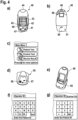
- Figure 4 depicts some more details of the analytical instrument (40) as employed in the foregoing examples.
- Figure 4a shows the front side of the instrument while figure 4b shows the back side.
- the instrument has a centrally located on/of-button (41) and a so called forward arrow button (42) for moving from one screen to another.
- a central feature of the instrument is the touch screen (43) which operates as display and further allows multiple user inputs.
- the depicted instrument employs disposable diagnostics tests strips.
- the instrument has a slot (44) to receive the disposable strips.
- the instrument has a menu button (45) for going to the main menu screen at any time.
- the backlight button (46) which allows to turn on the backlight for the display.
- the analytical instrument has a connector (47) for connecting it to a base unit which will be described later on.
- Figure 4b shows the back side of the instrument which has a slot (48) for receiving a code chip.
- the code chip allows to calibrate the analytical instrument in respect of the lot of test strips actually employed.
- the instrument has a scanner (49) which emits a laser beam for barcode scanning. With this scanner (49) the instrument can read patient information from e.g. a wristband of a patient so that no manual input of a patient identification is necessary. Further, a barcode of the instrument user may be read to identify the actual user (the barcode scanner therefore may be also regarded as an input section according to the present invention). It is further possible that the user may scan a printed certificate certifying that he has passed the exam. This print-out may e.g.
- the user may just scan the barcode on the printed exam and by that log in to the analytical section of the instrument.
- the user further needs to input a user ID and/or a password, so that it can be prevented that another person just takes a printout and uses it for identification.
- Figure 4b further depicts a battery compartment (50) as well as a reset button (51).
- Figure 4c shows an enlarged view of the instrument touch screen (43).
- the main menu allows to choose between conducting a patient test, conduction a control test or reviewing testing results.
- the user By pressing onto the "patient test" region of the touch screen the user selects to conduct a patient test and will only be granted access if he is a certified user.
- the analytical instrument may ask the user at this point for his user identification for checking if the current user is a certified user.
- Figure 4d shows the base unit (55) which is also called cradle.
- the base unit (55) has a data port (56) and a power connector (57).
- the analytical instrument (40) is placed onto the base unit (55) as shown in figure 4e the instrument connects to the data port as well as to the power connector for charging the instrument.
- the base unit may be connected via a cable or a radio frequency transmitter to the instrument management system in the embodiment of figure 1 , to the workstation of the administrator in case of the embodiment of figure 2 or to an administrator workstation and a user terminal (20) in case of figure 3 .
- this connection does not necessarily need to be a direct connection but can be also established via servers and a network (e.g. a local area network, a wide area network or the internet).
- Figures 4f and g further show input screens of the analytical instrument.
- the touch screen (43) allows input of numbers as well as alphanumeric characters. This input can be used to enter patient IDs, operator IDs, remarks, messages and further information.
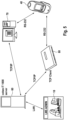
- Fig. 5 shows a connectivity scheme of devices for embodying the present invention.
- the LMS admin has a workstation (10) which is connected via a hospital network (typically a Local Area Network) to a cobas IT 1000 server (60) (i.e. a server running the cobas IT 1000 software).
- the cobas IT 1000 server in this embodiment represents the Instrument Management System according to the invention.
- the cobas IT 1000 server is connected to a client computer (70) for sampling data from testing devices and to transmit the data to the cobas IT 1000 server. Further the testing device (40) is connected via a modem (80) to the cobas IT 1000 server.
- An exam which is set up by the LMS admin is downloaded to the cobas IT 1000 server and can be taken by a user on the client computer (70) or on a terminal connected to the client computer.
- the exam software or parts thereof may be installed on the cobas IT 1000 server and the client computer.
- the questions of the exam are transferred together to the client computer and the answers are transmitted back to the cobas IT 1000 server where they are evaluated.
- the result of the exam is then send to the client computer to inform the user if he has passed the exam.
- the cobas IT 1000 server updates the user list (i.e. a list of certified users) and transmits this via the client computer (70) or via the modem (80) to the analytical instrument(s) (40).
- the IMS can be connected to a number of analytical instruments so that the updated list of certified users can be send to them in parallel.
- certified users can do testing with not only one instrument but in principle with all of the instruments to which his certification is sent. These are e.g. all intensive care and bedside testing instruments located in the same hospital.
Landscapes
- Engineering & Computer Science (AREA)
- Theoretical Computer Science (AREA)
- Business, Economics & Management (AREA)
- Health & Medical Sciences (AREA)
- Physics & Mathematics (AREA)
- General Physics & Mathematics (AREA)
- General Health & Medical Sciences (AREA)
- Educational Technology (AREA)
- Educational Administration (AREA)
- Medical Informatics (AREA)
- Epidemiology (AREA)
- Public Health (AREA)
- Primary Health Care (AREA)
- General Business, Economics & Management (AREA)
- Biomedical Technology (AREA)
- Computer Security & Cryptography (AREA)
- General Engineering & Computer Science (AREA)
- Computer Hardware Design (AREA)
- Software Systems (AREA)
- Entrepreneurship & Innovation (AREA)
- Bioethics (AREA)
- Chemical & Material Sciences (AREA)
- Medicinal Chemistry (AREA)
- Algebra (AREA)
- Computational Mathematics (AREA)
- Mathematical Analysis (AREA)
- Mathematical Optimization (AREA)
- Mathematical Physics (AREA)
- Pure & Applied Mathematics (AREA)
- Medical Treatment And Welfare Office Work (AREA)
- Automatic Analysis And Handling Materials Therefor (AREA)
- Management, Administration, Business Operations System, And Electronic Commerce (AREA)
Claims (18)
- System zum qualitätsgesicherten Testen auf dem Gebiet des extrakorporalen analytischen Testens, wobei das System Folgendes umfasst- eine Vielzahl von Analysegeräten (40) zum Durchführen einer analytischen Testung, wobei jedes Analysegerät (40) der Vielzahl von Analysegeräten Folgendes umfasst:• eine Testsektion, die dazu ausgebildet ist, eine Testroutine zum Durchführen eines analytischen Tests, in dem eine Patientenprobe mit einem Reagens zur Reaktion gebracht wird, zu durchlaufen, und• eine Eingabesektion, die dazu ausgebildet ist, eine Benutzeridentifikation zu empfangen,- ein Prüfmodul, das dazu programmiert ist, eine Prüfung durchzuführen, während welcher es Folgendes vornimmt:wobei die Analysegeräte (40) jeweils dazu programmiert sind, basierend auf einer Benutzeridentifikation, die an der Eingabesektion eingegeben wird, zu kontrollieren, ob ein Benutzer ein zertifizierter Benutzer ist, indem sie kontrollieren, ob die eingegebene Benutzeridentifikation einem Benutzer auf einer Liste von zertifizierten Benutzern entspricht, und wobei die Analysegeräte (40) jeweils dazu programmiert sind, Zugriff auf die Testroutine nur dann zu gewähren, wenn der Benutzer ein zertifizierter Benutzer ist.- Stellen von Fragen an den Benutzer, die sich auf die Analysegeräte (40) und/oder einen mit diesen durchzuführenden diagnostischen Test beziehen,- Empfangen von Antworten von dem Benutzer auf die Fragen und Auswerten der Antworten,- Bestimmen, ob der Benutzer die Prüfung bestanden hat, und- wenn bestimmt wird, dass der Benutzer die Prüfung bestanden hat, Senden eines Benutzerzertifikats an die Analysegeräte;
- System nach Anspruch 1, wobei das Prüfmodul getrennt ist von den Analysegeräten.
- System nach einem vorstehenden Anspruch, wobei die Analysegeräte (40) die Liste von zertifizierten Benutzern speichern.
- System nach einem vorstehenden Anspruch, wobei ein Server die Liste von zertifizierten Benutzern an die Analysegeräte sendet.
- System nach Anspruch 4, wobei der Server die Liste von zertifizierten Benutzern an die Analysegeräte als ein Push-Service sendet.
- System nach Anspruch 4, wobei der Server die Liste von zertifizierten Benutzern an die Analysegeräte als ein Pull-Service sendet, wenn die Analysegeräte den Server nach der Liste von zertifizierten Benutzern fragen.
- System nach einem der vorstehenden Ansprüche,- wobei die Liste von zertifizierten Benutzern ein Ausstellungsdatum oder ein Ablaufdatum der jeweiligen Benutzerzertifikate umfasst und- wobei das Kontrollieren, ob der Benutzer ein zertifizierter Benutzer ist, Folgendes umfasst- Kontrollieren des aktuellen Datums und- Kontrollieren, ob das Benutzerzertifikat für den Benutzer abgelaufen ist.
- System nach einem der vorstehenden Ansprüche, wobei die Analysegeräte (40) zum Dezertifizieren eines Benutzers ausgebildet sind, indem sie den Benutzer von der Liste von zertifizierten Benutzern streichen.
- System nach einem der vorstehenden Ansprüche, wobei das System ein Gerätemanagementsystem (30) umfasst, wobei das Prüfmodul dazu ausgebildet ist, die Benutzerzertifikate an die Analysegeräte (40) unter Verwendung des Gerätemanagementsystems (30) zu senden.
- System nach einem der vorstehenden Ansprüche, wobei das System ein Terminal (20) umfasst, das verschieden ist von den Analysegeräten (40), und wobei das Prüfmodul zu Folgendem ausgebildet ist:- Stellen von Fragen an den Benutzer, die sich auf die Analysegeräte (40) und/oder einen mit diesen durchzuführenden diagnostischen Test beziehen, und- Empfangen von Antworten von dem Benutzer auf die Fragen und Auswerten der Antworten mittels des Terminals (20).
- System nach einem der vorstehenden Ansprüche, wobei jedes Analysegerät (40) dazu programmiert, bei einem Login des Benutzers zu kontrollieren, ob ein Benutzer ein zertifizierter Benutzer ist.
- System nach einem der vorstehenden Ansprüche, wobei die Eingabesektion eine Leseeinheit zum Lesen von Identifikationsmitteln umfasst.
- System nach einem der vorstehenden Ansprüche, wobei das Benutzerzertifikat eine Benutzeridentifikation umfasst.
- System nach einem der vorstehenden Ansprüche, wobei die Eingabesektion und ein Sensor jedes Analysegerätes (40), das dazu ausgelegt ist, eine Testroutine zu durchlaufen, in einem gemeinsamen Gehäuse angeordnet sind.
- System nach einem der vorstehenden Ansprüche, wobei jedes Analysegerät ein Handmessgerät ist.
- System nach einem der vorstehenden Ansprüche, wobei das analytische Testen mit einem Testelement durchgeführt wird, das ein Reagenz enthält, das mit einem Analyten in einer Patientenprobe reagiert.
- Verfahren zum qualitätsgesicherten extrakorporalen analytischen Testen für ein System, umfassend eine Vielzahl von Analysegeräten zum Durchführen einer analytischen Testung, wobei jedes Analysegerät der Vielzahl von Analysegeräten Folgendes umfasst:• eine Testsektion, die dazu ausgebildet ist, eine Testroutine zum Durchführen eines analytischen Tests, in dem eine Patientenprobe mit einem Reagens zur Reaktion gebracht wird, zu durchlaufen; und• eine Eingabesektion, die dazu ausgebildet ist, eine Benutzeridentifikation zu empfangen;wobei das Verfahren die folgenden Schritte umfasst:- Stellen von Fragen an einen Benutzer, die sich auf die Analysegeräte (40) und/oder einen mit diesen durchzuführenden diagnostischen Test beziehen,- Empfangen von Eingaben von dem Benutzer auf diese Fragen,- Auswerten der Eingaben und Bestimmen, zu welchem Grad die Eingaben korrekt sind,- Zertifizieren des Benutzers, wenn der bestimmte Grad über einer vorgegebenen Schwelle liegt,- Auffordern des Benutzers, eine Benutzeridentifikation einzugeben,- Bestimmen, ob der Benutzer ein zertifizierter Benutzer ist, basierend auf einer eingegebenen Benutzeridentifikation, indem kontrolliert wird, ob die eingegebene Benutzeridentifikation einem Benutzer auf einer Liste von zertifizierten Benutzern entspricht,- Bereitstellen von Zugriff auf eine Testroutine zum Durchführen eines analytischen Tests der Analysegeräte (40), wenn der Benutzer ein zertifizierter Benutzer ist.
- Verfahren nach Anspruch 17, wobei das Verfahren ferner die folgenden Schritte umfasst- Durchführen eines analytischen Tests und- Senden eines Ergebnisses des analytischen Tests an ein Gerätemanagementsystem (30).
Applications Claiming Priority (2)
| Application Number | Priority Date | Filing Date | Title |
|---|---|---|---|
| EP08105083 | 2008-08-20 | ||
| EP09167117A EP2157529A1 (de) | 2008-08-20 | 2009-08-03 | System und Verfahren zur qualitätsgesicherten analytischen Prüfung |
Related Parent Applications (1)
| Application Number | Title | Priority Date | Filing Date |
|---|---|---|---|
| EP09167117A Division EP2157529A1 (de) | 2008-08-20 | 2009-08-03 | System und Verfahren zur qualitätsgesicherten analytischen Prüfung |
Publications (3)
| Publication Number | Publication Date |
|---|---|
| EP3822952A1 EP3822952A1 (de) | 2021-05-19 |
| EP3822952B1 true EP3822952B1 (de) | 2025-06-04 |
| EP3822952C0 EP3822952C0 (de) | 2025-06-04 |
Family
ID=40193698
Family Applications (2)
| Application Number | Title | Priority Date | Filing Date |
|---|---|---|---|
| EP20200355.4A Active EP3822952B1 (de) | 2008-08-20 | 2009-08-03 | System und verfahren zur qualitätsgesicherten analytischen prüfung |
| EP09167117A Ceased EP2157529A1 (de) | 2008-08-20 | 2009-08-03 | System und Verfahren zur qualitätsgesicherten analytischen Prüfung |
Family Applications After (1)
| Application Number | Title | Priority Date | Filing Date |
|---|---|---|---|
| EP09167117A Ceased EP2157529A1 (de) | 2008-08-20 | 2009-08-03 | System und Verfahren zur qualitätsgesicherten analytischen Prüfung |
Country Status (5)
| Country | Link |
|---|---|
| US (2) | US8495707B2 (de) |
| EP (2) | EP3822952B1 (de) |
| CA (2) | CA3141092C (de) |
| DE (2) | DE09167117T8 (de) |
| ES (1) | ES3034252T3 (de) |
Families Citing this family (22)
| Publication number | Priority date | Publication date | Assignee | Title |
|---|---|---|---|---|
| US7008403B1 (en) * | 2002-07-19 | 2006-03-07 | Cognitive Ventures Corporation | Infusion pump and method for use |
| EP3822952B1 (de) * | 2008-08-20 | 2025-06-04 | F. Hoffmann-La Roche AG | System und verfahren zur qualitätsgesicherten analytischen prüfung |
| US8926561B2 (en) | 2009-07-30 | 2015-01-06 | Tandem Diabetes Care, Inc. | Infusion pump system with disposable cartridge having pressure venting and pressure feedback |
| US20120077167A1 (en) * | 2010-09-27 | 2012-03-29 | Yvonne Weideman | Multi-Unit Interactive Dual-Video Medical Education System |
| US20130203037A1 (en) * | 2012-02-07 | 2013-08-08 | Tata Consultancy Services Limited | Examination mangement |
| US9180242B2 (en) | 2012-05-17 | 2015-11-10 | Tandem Diabetes Care, Inc. | Methods and devices for multiple fluid transfer |
| US10388176B2 (en) * | 2012-11-28 | 2019-08-20 | Vrsim, Inc. | Simulator for skill-oriented training |
| US9319778B2 (en) * | 2013-03-13 | 2016-04-19 | Google Inc. | Communicating via a body-area network |
| US9173998B2 (en) | 2013-03-14 | 2015-11-03 | Tandem Diabetes Care, Inc. | System and method for detecting occlusions in an infusion pump |
| EP2973098B1 (de) | 2013-03-15 | 2020-05-06 | Abbott Point Of Care, Inc. | Verwaltungssystem zur pflegepunktprüfung |
| US10229607B2 (en) * | 2013-04-30 | 2019-03-12 | Elwha Llc | Systems and methods for competency training and use authorization for dispensing an agent |
| US10398362B2 (en) * | 2014-02-09 | 2019-09-03 | Phc Holdings Corporation | Measurement device, management device, measurement skill management system, and measurement skill management method |
| RU2586030C2 (ru) * | 2014-04-22 | 2016-06-10 | Иван Сергеевич Котяшкин | Способ и система тестирования |
| EP3091458B1 (de) | 2015-05-02 | 2021-02-24 | F. Hoffmann-La Roche AG | System für patientennahe labordiagnostik (point-of-care testing) |
| EP3457409B1 (de) | 2015-05-02 | 2023-06-07 | F. Hoffmann-La Roche AG | System zur vor-ort-diagnose |
| US10557862B2 (en) | 2015-06-05 | 2020-02-11 | Abbott Point Of Care Inc. | Systems for assuring quality compliance of point-of-care single-use testing devices |
| WO2016195896A1 (en) | 2015-06-05 | 2016-12-08 | Abbott Point Of Care Inc. | Systems and methods for assuring quality compliance of point-of-care instruments used with single-use testing devices |
| AU2018367618B2 (en) | 2017-11-20 | 2020-12-03 | Siemens Healthcare Diagnostics Inc. | User interface for managing a multiple diagnostic engine environment |
| EP4293361A3 (de) | 2017-12-26 | 2024-07-03 | Hitachi High-Tech Corporation | Automatisierter analysator und automatisiertes analyseverfahren |
| US11164473B2 (en) * | 2019-02-18 | 2021-11-02 | International Business Machines Corporation | Generating probing questions to test attention to automated educational materials |
| CN112842540B (zh) * | 2021-02-24 | 2022-04-15 | 浙江大学 | 一种内镜中心的传递窗信息交互系统及方法 |
| WO2024192493A1 (pt) * | 2023-03-22 | 2024-09-26 | Hi Technologies Ltda. | Analisador de amostras biológicas por microscopia e espectrometria |
Family Cites Families (12)
| Publication number | Priority date | Publication date | Assignee | Title |
|---|---|---|---|---|
| US7947270B2 (en) * | 1992-05-22 | 2011-05-24 | Arcimboldo Ab | Removing dental plaque with krill enzymes |
| FI118509B (fi) * | 1996-02-12 | 2007-12-14 | Nokia Oyj | Menetelmä ja laitteisto potilaan veren glukoosipitoisuuden ennustamiseksi |
| US6386882B1 (en) * | 1999-11-10 | 2002-05-14 | Medtronic, Inc. | Remote delivery of software-based training for implantable medical device systems |
| US6290435B1 (en) * | 1999-12-15 | 2001-09-18 | Ouellette Machinery System, Inc | Spacing tool for use with bottle conveyor |
| WO2002003355A2 (en) * | 2000-06-30 | 2002-01-10 | University Of Florida | Method, system, and apparatus for medical device training |
| DE10058570C2 (de) | 2000-11-24 | 2002-11-14 | Siemens Ag | Automatisches Qualifikations-Management-System |
| JP4331914B2 (ja) * | 2002-02-26 | 2009-09-16 | シスメックス株式会社 | プログラム管理方法 |
| US20060019222A1 (en) * | 2004-06-14 | 2006-01-26 | Lelito Lisa F | On-line educational course delivery system for medical and other applications |
| US20060240394A1 (en) * | 2005-04-20 | 2006-10-26 | Management Simulations, Inc. | Examination simulation system and method |
| CA2607437A1 (en) * | 2005-06-08 | 2006-12-14 | Agamatrix, Inc. | Data collection system and interface |
| US20080184330A1 (en) * | 2007-01-25 | 2008-07-31 | Lal Rakesh M | Levels of access to medical diagnostic features based on user login |
| EP3822952B1 (de) * | 2008-08-20 | 2025-06-04 | F. Hoffmann-La Roche AG | System und verfahren zur qualitätsgesicherten analytischen prüfung |
-
2009
- 2009-08-03 EP EP20200355.4A patent/EP3822952B1/de active Active
- 2009-08-03 EP EP09167117A patent/EP2157529A1/de not_active Ceased
- 2009-08-03 ES ES20200355T patent/ES3034252T3/es active Active
- 2009-08-03 DE DE09167117T patent/DE09167117T8/de active Active
- 2009-08-03 DE DE202009018545U patent/DE202009018545U1/de not_active Expired - Lifetime
- 2009-08-14 CA CA3141092A patent/CA3141092C/en active Active
- 2009-08-14 CA CA2675564A patent/CA2675564C/en active Active
- 2009-08-19 US US12/543,610 patent/US8495707B2/en active Active
-
2013
- 2013-07-08 US US13/936,452 patent/US8990894B2/en active Active
Also Published As
| Publication number | Publication date |
|---|---|
| ES3034252T3 (en) | 2025-08-14 |
| DE09167117T8 (de) | 2013-04-25 |
| CA2675564C (en) | 2022-03-08 |
| US8990894B2 (en) | 2015-03-24 |
| CA3141092A1 (en) | 2010-02-20 |
| DE202009018545U1 (de) | 2012-03-01 |
| US8495707B2 (en) | 2013-07-23 |
| CA3141092C (en) | 2024-03-12 |
| EP3822952C0 (de) | 2025-06-04 |
| US20100050236A1 (en) | 2010-02-25 |
| EP2157529A1 (de) | 2010-02-24 |
| US20130302770A1 (en) | 2013-11-14 |
| EP3822952A1 (de) | 2021-05-19 |
| CA2675564A1 (en) | 2010-02-20 |
| DE09167117T1 (de) | 2012-09-06 |
Similar Documents
| Publication | Publication Date | Title |
|---|---|---|
| EP3822952B1 (de) | System und verfahren zur qualitätsgesicherten analytischen prüfung | |
| US20250057632A1 (en) | Patient id and sample id workflow methods and apparatus for facilitating diagnostic testing | |
| JP5995576B2 (ja) | 分析システムおよび分析装置 | |
| JP5995577B2 (ja) | 分析装置、分析方法およびコンピュータプログラム | |
| JP7465910B2 (ja) | 複数の診断エンジン環境を管理するためのユーザインターフェース | |
| AU2022209251A1 (en) | Multiple diagnostic engine environment | |
| JP5995578B2 (ja) | 分析装置、分析方法およびコンピュータプログラム | |
| Main et al. | Data management programs for bedside glucose testing | |
| WO2024177880A1 (en) | Methods and apparatus for preventing patient and sample mismatch during diagnostic testing |
Legal Events
| Date | Code | Title | Description |
|---|---|---|---|
| PUAI | Public reference made under article 153(3) epc to a published international application that has entered the european phase |
Free format text: ORIGINAL CODE: 0009012 |
|
| STAA | Information on the status of an ep patent application or granted ep patent |
Free format text: STATUS: THE APPLICATION HAS BEEN PUBLISHED |
|
| AC | Divisional application: reference to earlier application |
Ref document number: 2157529 Country of ref document: EP Kind code of ref document: P |
|
| AK | Designated contracting states |
Kind code of ref document: A1 Designated state(s): AT BE BG CH CY CZ DE DK EE ES FI FR GB GR HR HU IE IS IT LI LT LU LV MC MK MT NL NO PL PT RO SE SI SK SM TR |
|
| STAA | Information on the status of an ep patent application or granted ep patent |
Free format text: STATUS: REQUEST FOR EXAMINATION WAS MADE |
|
| 17P | Request for examination filed |
Effective date: 20211117 |
|
| RBV | Designated contracting states (corrected) |
Designated state(s): AT BE BG CH CY CZ DE DK EE ES FI FR GB GR HR HU IE IS IT LI LT LU LV MC MK MT NL NO PL PT RO SE SI SK SM TR |
|
| STAA | Information on the status of an ep patent application or granted ep patent |
Free format text: STATUS: EXAMINATION IS IN PROGRESS |
|
| 17Q | First examination report despatched |
Effective date: 20230207 |
|
| GRAP | Despatch of communication of intention to grant a patent |
Free format text: ORIGINAL CODE: EPIDOSNIGR1 |
|
| STAA | Information on the status of an ep patent application or granted ep patent |
Free format text: STATUS: GRANT OF PATENT IS INTENDED |
|
| INTG | Intention to grant announced |
Effective date: 20240315 |
|
| RAP3 | Party data changed (applicant data changed or rights of an application transferred) |
Owner name: ROCHE DIAGNOSTICS GMBH Owner name: F. HOFFMANN-LA ROCHE AG |
|
| GRAJ | Information related to disapproval of communication of intention to grant by the applicant or resumption of examination proceedings by the epo deleted |
Free format text: ORIGINAL CODE: EPIDOSDIGR1 |
|
| STAA | Information on the status of an ep patent application or granted ep patent |
Free format text: STATUS: EXAMINATION IS IN PROGRESS |
|
| INTC | Intention to grant announced (deleted) | ||
| GRAP | Despatch of communication of intention to grant a patent |
Free format text: ORIGINAL CODE: EPIDOSNIGR1 |
|
| STAA | Information on the status of an ep patent application or granted ep patent |
Free format text: STATUS: GRANT OF PATENT IS INTENDED |
|
| INTG | Intention to grant announced |
Effective date: 20240801 |
|
| GRAJ | Information related to disapproval of communication of intention to grant by the applicant or resumption of examination proceedings by the epo deleted |
Free format text: ORIGINAL CODE: EPIDOSDIGR1 |
|
| STAA | Information on the status of an ep patent application or granted ep patent |
Free format text: STATUS: EXAMINATION IS IN PROGRESS |
|
| GRAP | Despatch of communication of intention to grant a patent |
Free format text: ORIGINAL CODE: EPIDOSNIGR1 |
|
| RAP1 | Party data changed (applicant data changed or rights of an application transferred) |
Owner name: F. HOFFMANN-LA ROCHE AG |
|
| STAA | Information on the status of an ep patent application or granted ep patent |
Free format text: STATUS: GRANT OF PATENT IS INTENDED |
|
| INTC | Intention to grant announced (deleted) | ||
| RIN1 | Information on inventor provided before grant (corrected) |
Inventor name: MILLER, STEVE |
|
| INTG | Intention to grant announced |
Effective date: 20250102 |
|
| GRAS | Grant fee paid |
Free format text: ORIGINAL CODE: EPIDOSNIGR3 |
|
| GRAA | (expected) grant |
Free format text: ORIGINAL CODE: 0009210 |
|
| STAA | Information on the status of an ep patent application or granted ep patent |
Free format text: STATUS: THE PATENT HAS BEEN GRANTED |
|
| AC | Divisional application: reference to earlier application |
Ref document number: 2157529 Country of ref document: EP Kind code of ref document: P |
|
| AK | Designated contracting states |
Kind code of ref document: B1 Designated state(s): AT BE BG CH CY CZ DE DK EE ES FI FR GB GR HR HU IE IS IT LI LT LU LV MC MK MT NL NO PL PT RO SE SI SK SM TR |
|
| REG | Reference to a national code |
Ref country code: GB Ref legal event code: FG4D |
|
| REG | Reference to a national code |
Ref country code: CH Ref legal event code: EP |
|
| REG | Reference to a national code |
Ref country code: IE Ref legal event code: FG4D |
|
| U01 | Request for unitary effect filed |
Effective date: 20250604 |
|
| U07 | Unitary effect registered |
Designated state(s): AT BE BG DE DK EE FI FR IT LT LU LV MT NL PT RO SE SI Effective date: 20250612 |
|
| REG | Reference to a national code |
Ref country code: ES Ref legal event code: FG2A Ref document number: 3034252 Country of ref document: ES Kind code of ref document: T3 Effective date: 20250814 |
|
| U20 | Renewal fee for the european patent with unitary effect paid |
Year of fee payment: 17 Effective date: 20250723 |
|
| PGFP | Annual fee paid to national office [announced via postgrant information from national office to epo] |
Ref country code: ES Payment date: 20250901 Year of fee payment: 17 |
|
| PG25 | Lapsed in a contracting state [announced via postgrant information from national office to epo] |
Ref country code: NO Free format text: LAPSE BECAUSE OF FAILURE TO SUBMIT A TRANSLATION OF THE DESCRIPTION OR TO PAY THE FEE WITHIN THE PRESCRIBED TIME-LIMIT Effective date: 20250904 Ref country code: GR Free format text: LAPSE BECAUSE OF FAILURE TO SUBMIT A TRANSLATION OF THE DESCRIPTION OR TO PAY THE FEE WITHIN THE PRESCRIBED TIME-LIMIT Effective date: 20250905 |
|
| PG25 | Lapsed in a contracting state [announced via postgrant information from national office to epo] |
Ref country code: PL Free format text: LAPSE BECAUSE OF FAILURE TO SUBMIT A TRANSLATION OF THE DESCRIPTION OR TO PAY THE FEE WITHIN THE PRESCRIBED TIME-LIMIT Effective date: 20250604 |
|
| PGFP | Annual fee paid to national office [announced via postgrant information from national office to epo] |
Ref country code: GB Payment date: 20250725 Year of fee payment: 17 |
|
| PG25 | Lapsed in a contracting state [announced via postgrant information from national office to epo] |
Ref country code: HR Free format text: LAPSE BECAUSE OF FAILURE TO SUBMIT A TRANSLATION OF THE DESCRIPTION OR TO PAY THE FEE WITHIN THE PRESCRIBED TIME-LIMIT Effective date: 20250604 |
|
| PG25 | Lapsed in a contracting state [announced via postgrant information from national office to epo] |
Ref country code: IS Free format text: LAPSE BECAUSE OF FAILURE TO SUBMIT A TRANSLATION OF THE DESCRIPTION OR TO PAY THE FEE WITHIN THE PRESCRIBED TIME-LIMIT Effective date: 20251004 |
|
| PG25 | Lapsed in a contracting state [announced via postgrant information from national office to epo] |
Ref country code: SM Free format text: LAPSE BECAUSE OF FAILURE TO SUBMIT A TRANSLATION OF THE DESCRIPTION OR TO PAY THE FEE WITHIN THE PRESCRIBED TIME-LIMIT Effective date: 20250604 |
|
| PG25 | Lapsed in a contracting state [announced via postgrant information from national office to epo] |
Ref country code: CZ Free format text: LAPSE BECAUSE OF FAILURE TO SUBMIT A TRANSLATION OF THE DESCRIPTION OR TO PAY THE FEE WITHIN THE PRESCRIBED TIME-LIMIT Effective date: 20250604 |
|
| PG25 | Lapsed in a contracting state [announced via postgrant information from national office to epo] |
Ref country code: SK Free format text: LAPSE BECAUSE OF FAILURE TO SUBMIT A TRANSLATION OF THE DESCRIPTION OR TO PAY THE FEE WITHIN THE PRESCRIBED TIME-LIMIT Effective date: 20250604 |
|
| REG | Reference to a national code |
Ref country code: CH Ref legal event code: H13 Free format text: ST27 STATUS EVENT CODE: U-0-0-H10-H13 (AS PROVIDED BY THE NATIONAL OFFICE) Effective date: 20260324 |