EP3822542A1 - A method for manufacturing a component of or a blank sheet for forming a component of a household appliance, component for a household appliance and household appliance - Google Patents
A method for manufacturing a component of or a blank sheet for forming a component of a household appliance, component for a household appliance and household appliance Download PDFInfo
- Publication number
- EP3822542A1 EP3822542A1 EP20199030.6A EP20199030A EP3822542A1 EP 3822542 A1 EP3822542 A1 EP 3822542A1 EP 20199030 A EP20199030 A EP 20199030A EP 3822542 A1 EP3822542 A1 EP 3822542A1
- Authority
- EP
- European Patent Office
- Prior art keywords
- component
- coating
- printing
- blank sheet
- household appliance
- Prior art date
- Legal status (The legal status is an assumption and is not a legal conclusion. Google has not performed a legal analysis and makes no representation as to the accuracy of the status listed.)
- Pending
Links
- 238000000034 method Methods 0.000 title claims abstract description 35
- 238000004519 manufacturing process Methods 0.000 title claims abstract description 10
- 238000000576 coating method Methods 0.000 claims abstract description 98
- 239000011248 coating agent Substances 0.000 claims abstract description 96
- 238000010411 cooking Methods 0.000 claims abstract description 31
- 238000001994 activation Methods 0.000 claims abstract description 25
- 238000009736 wetting Methods 0.000 claims abstract description 22
- 239000010410 layer Substances 0.000 claims description 39
- 239000000463 material Substances 0.000 claims description 24
- 239000011241 protective layer Substances 0.000 claims description 23
- 210000003298 dental enamel Anatomy 0.000 claims description 18
- 230000008569 process Effects 0.000 claims description 14
- 238000005516 engineering process Methods 0.000 claims description 13
- 239000004411 aluminium Substances 0.000 claims description 9
- 229910052782 aluminium Inorganic materials 0.000 claims description 9
- XAGFODPZIPBFFR-UHFFFAOYSA-N aluminium Chemical compound [Al] XAGFODPZIPBFFR-UHFFFAOYSA-N 0.000 claims description 9
- 239000010935 stainless steel Substances 0.000 claims description 8
- 229910001220 stainless steel Inorganic materials 0.000 claims description 8
- 238000011282 treatment Methods 0.000 claims description 8
- 230000009972 noncorrosive effect Effects 0.000 claims description 6
- 229910000831 Steel Inorganic materials 0.000 claims description 5
- 239000011521 glass Substances 0.000 claims description 5
- 239000010959 steel Substances 0.000 claims description 5
- 239000002241 glass-ceramic Substances 0.000 claims description 4
- 239000005341 toughened glass Substances 0.000 claims description 4
- 238000013532 laser treatment Methods 0.000 claims description 3
- 239000000126 substance Substances 0.000 claims description 3
- 238000005488 sandblasting Methods 0.000 claims description 2
- 238000004140 cleaning Methods 0.000 description 11
- 238000005260 corrosion Methods 0.000 description 11
- 230000007797 corrosion Effects 0.000 description 11
- 239000002585 base Substances 0.000 description 10
- 230000002209 hydrophobic effect Effects 0.000 description 10
- 230000003670 easy-to-clean Effects 0.000 description 8
- 229910052751 metal Inorganic materials 0.000 description 7
- 239000002184 metal Substances 0.000 description 7
- 230000003746 surface roughness Effects 0.000 description 6
- 230000000694 effects Effects 0.000 description 4
- PNEYBMLMFCGWSK-UHFFFAOYSA-N Alumina Chemical compound [O-2].[O-2].[O-2].[Al+3].[Al+3] PNEYBMLMFCGWSK-UHFFFAOYSA-N 0.000 description 3
- 230000004913 activation Effects 0.000 description 3
- 238000013459 approach Methods 0.000 description 3
- 239000000203 mixture Substances 0.000 description 3
- 239000000843 powder Substances 0.000 description 3
- OKTJSMMVPCPJKN-UHFFFAOYSA-N Carbon Chemical compound [C] OKTJSMMVPCPJKN-UHFFFAOYSA-N 0.000 description 2
- 229910001209 Low-carbon steel Inorganic materials 0.000 description 2
- 239000000654 additive Substances 0.000 description 2
- 230000000996 additive effect Effects 0.000 description 2
- 229910052799 carbon Inorganic materials 0.000 description 2
- 239000000969 carrier Substances 0.000 description 2
- 238000004049 embossing Methods 0.000 description 2
- 238000012986 modification Methods 0.000 description 2
- 230000004048 modification Effects 0.000 description 2
- 238000002360 preparation method Methods 0.000 description 2
- 239000000758 substrate Substances 0.000 description 2
- XLYOFNOQVPJJNP-UHFFFAOYSA-N water Substances O XLYOFNOQVPJJNP-UHFFFAOYSA-N 0.000 description 2
- 241000467686 Eschscholzia lobbii Species 0.000 description 1
- PXGOKWXKJXAPGV-UHFFFAOYSA-N Fluorine Chemical compound FF PXGOKWXKJXAPGV-UHFFFAOYSA-N 0.000 description 1
- BLRPTPMANUNPDV-UHFFFAOYSA-N Silane Chemical compound [SiH4] BLRPTPMANUNPDV-UHFFFAOYSA-N 0.000 description 1
- 238000005299 abrasion Methods 0.000 description 1
- 229910000272 alkali metal oxide Inorganic materials 0.000 description 1
- 229910000287 alkaline earth metal oxide Inorganic materials 0.000 description 1
- 230000008901 benefit Effects 0.000 description 1
- 239000003054 catalyst Substances 0.000 description 1
- 230000003197 catalytic effect Effects 0.000 description 1
- 238000005524 ceramic coating Methods 0.000 description 1
- 235000013351 cheese Nutrition 0.000 description 1
- 239000003795 chemical substances by application Substances 0.000 description 1
- 239000008199 coating composition Substances 0.000 description 1
- 238000013461 design Methods 0.000 description 1
- 239000006119 easy-to-clean coating Substances 0.000 description 1
- 235000019197 fats Nutrition 0.000 description 1
- 229910052731 fluorine Inorganic materials 0.000 description 1
- 239000011737 fluorine Substances 0.000 description 1
- 235000013305 food Nutrition 0.000 description 1
- 238000013467 fragmentation Methods 0.000 description 1
- 238000006062 fragmentation reaction Methods 0.000 description 1
- 230000009477 glass transition Effects 0.000 description 1
- 238000010438 heat treatment Methods 0.000 description 1
- 239000007788 liquid Substances 0.000 description 1
- 238000012423 maintenance Methods 0.000 description 1
- 239000003921 oil Substances 0.000 description 1
- 235000019198 oils Nutrition 0.000 description 1
- 230000003647 oxidation Effects 0.000 description 1
- 238000007254 oxidation reaction Methods 0.000 description 1
- WQGWDDDVZFFDIG-UHFFFAOYSA-N pyrogallol Chemical compound OC1=CC=CC(O)=C1O WQGWDDDVZFFDIG-UHFFFAOYSA-N 0.000 description 1
- 238000007788 roughening Methods 0.000 description 1
- 235000015067 sauces Nutrition 0.000 description 1
- 229910000077 silane Inorganic materials 0.000 description 1
- RMAQACBXLXPBSY-UHFFFAOYSA-N silicic acid Chemical compound O[Si](O)(O)O RMAQACBXLXPBSY-UHFFFAOYSA-N 0.000 description 1
- 238000003980 solgel method Methods 0.000 description 1
- 238000010561 standard procedure Methods 0.000 description 1
- 229910000314 transition metal oxide Inorganic materials 0.000 description 1
- 239000000037 vitreous enamel Substances 0.000 description 1
Images

Classifications
-
- F—MECHANICAL ENGINEERING; LIGHTING; HEATING; WEAPONS; BLASTING
- F24—HEATING; RANGES; VENTILATING
- F24C—DOMESTIC STOVES OR RANGES ; DETAILS OF DOMESTIC STOVES OR RANGES, OF GENERAL APPLICATION
- F24C15/00—Details
- F24C15/16—Shelves, racks or trays inside ovens; Supports therefor
-
- A—HUMAN NECESSITIES
- A21—BAKING; EDIBLE DOUGHS
- A21B—BAKERS' OVENS; MACHINES OR EQUIPMENT FOR BAKING
- A21B3/00—Parts or accessories of ovens
- A21B3/13—Baking-tins; Baking forms
-
- B—PERFORMING OPERATIONS; TRANSPORTING
- B05—SPRAYING OR ATOMISING IN GENERAL; APPLYING FLUENT MATERIALS TO SURFACES, IN GENERAL
- B05D—PROCESSES FOR APPLYING FLUENT MATERIALS TO SURFACES, IN GENERAL
- B05D3/00—Pretreatment of surfaces to which liquids or other fluent materials are to be applied; After-treatment of applied coatings, e.g. intermediate treating of an applied coating preparatory to subsequent applications of liquids or other fluent materials
- B05D3/14—Pretreatment of surfaces to which liquids or other fluent materials are to be applied; After-treatment of applied coatings, e.g. intermediate treating of an applied coating preparatory to subsequent applications of liquids or other fluent materials by electrical means
- B05D3/141—Plasma treatment
- B05D3/145—After-treatment
- B05D3/148—After-treatment affecting the surface properties of the coating
-
- B—PERFORMING OPERATIONS; TRANSPORTING
- B05—SPRAYING OR ATOMISING IN GENERAL; APPLYING FLUENT MATERIALS TO SURFACES, IN GENERAL
- B05D—PROCESSES FOR APPLYING FLUENT MATERIALS TO SURFACES, IN GENERAL
- B05D5/00—Processes for applying liquids or other fluent materials to surfaces to obtain special surface effects, finishes or structures
- B05D5/06—Processes for applying liquids or other fluent materials to surfaces to obtain special surface effects, finishes or structures to obtain multicolour or other optical effects
-
- C—CHEMISTRY; METALLURGY
- C23—COATING METALLIC MATERIAL; COATING MATERIAL WITH METALLIC MATERIAL; CHEMICAL SURFACE TREATMENT; DIFFUSION TREATMENT OF METALLIC MATERIAL; COATING BY VACUUM EVAPORATION, BY SPUTTERING, BY ION IMPLANTATION OR BY CHEMICAL VAPOUR DEPOSITION, IN GENERAL; INHIBITING CORROSION OF METALLIC MATERIAL OR INCRUSTATION IN GENERAL
- C23C—COATING METALLIC MATERIAL; COATING MATERIAL WITH METALLIC MATERIAL; SURFACE TREATMENT OF METALLIC MATERIAL BY DIFFUSION INTO THE SURFACE, BY CHEMICAL CONVERSION OR SUBSTITUTION; COATING BY VACUUM EVAPORATION, BY SPUTTERING, BY ION IMPLANTATION OR BY CHEMICAL VAPOUR DEPOSITION, IN GENERAL
- C23C18/00—Chemical coating by decomposition of either liquid compounds or solutions of the coating forming compounds, without leaving reaction products of surface material in the coating; Contact plating
- C23C18/02—Chemical coating by decomposition of either liquid compounds or solutions of the coating forming compounds, without leaving reaction products of surface material in the coating; Contact plating by thermal decomposition
- C23C18/12—Chemical coating by decomposition of either liquid compounds or solutions of the coating forming compounds, without leaving reaction products of surface material in the coating; Contact plating by thermal decomposition characterised by the deposition of inorganic material other than metallic material
- C23C18/1204—Chemical coating by decomposition of either liquid compounds or solutions of the coating forming compounds, without leaving reaction products of surface material in the coating; Contact plating by thermal decomposition characterised by the deposition of inorganic material other than metallic material inorganic material, e.g. non-oxide and non-metallic such as sulfides, nitrides based compounds
- C23C18/122—Inorganic polymers, e.g. silanes, polysilazanes, polysiloxanes
-
- C—CHEMISTRY; METALLURGY
- C23—COATING METALLIC MATERIAL; COATING MATERIAL WITH METALLIC MATERIAL; CHEMICAL SURFACE TREATMENT; DIFFUSION TREATMENT OF METALLIC MATERIAL; COATING BY VACUUM EVAPORATION, BY SPUTTERING, BY ION IMPLANTATION OR BY CHEMICAL VAPOUR DEPOSITION, IN GENERAL; INHIBITING CORROSION OF METALLIC MATERIAL OR INCRUSTATION IN GENERAL
- C23C—COATING METALLIC MATERIAL; COATING MATERIAL WITH METALLIC MATERIAL; SURFACE TREATMENT OF METALLIC MATERIAL BY DIFFUSION INTO THE SURFACE, BY CHEMICAL CONVERSION OR SUBSTITUTION; COATING BY VACUUM EVAPORATION, BY SPUTTERING, BY ION IMPLANTATION OR BY CHEMICAL VAPOUR DEPOSITION, IN GENERAL
- C23C18/00—Chemical coating by decomposition of either liquid compounds or solutions of the coating forming compounds, without leaving reaction products of surface material in the coating; Contact plating
- C23C18/02—Chemical coating by decomposition of either liquid compounds or solutions of the coating forming compounds, without leaving reaction products of surface material in the coating; Contact plating by thermal decomposition
- C23C18/12—Chemical coating by decomposition of either liquid compounds or solutions of the coating forming compounds, without leaving reaction products of surface material in the coating; Contact plating by thermal decomposition characterised by the deposition of inorganic material other than metallic material
- C23C18/1225—Deposition of multilayers of inorganic material
-
- C—CHEMISTRY; METALLURGY
- C23—COATING METALLIC MATERIAL; COATING MATERIAL WITH METALLIC MATERIAL; CHEMICAL SURFACE TREATMENT; DIFFUSION TREATMENT OF METALLIC MATERIAL; COATING BY VACUUM EVAPORATION, BY SPUTTERING, BY ION IMPLANTATION OR BY CHEMICAL VAPOUR DEPOSITION, IN GENERAL; INHIBITING CORROSION OF METALLIC MATERIAL OR INCRUSTATION IN GENERAL
- C23C—COATING METALLIC MATERIAL; COATING MATERIAL WITH METALLIC MATERIAL; SURFACE TREATMENT OF METALLIC MATERIAL BY DIFFUSION INTO THE SURFACE, BY CHEMICAL CONVERSION OR SUBSTITUTION; COATING BY VACUUM EVAPORATION, BY SPUTTERING, BY ION IMPLANTATION OR BY CHEMICAL VAPOUR DEPOSITION, IN GENERAL
- C23C28/00—Coating for obtaining at least two superposed coatings either by methods not provided for in a single one of groups C23C2/00 - C23C26/00 or by combinations of methods provided for in subclasses C23C and C25C or C25D
- C23C28/30—Coatings combining at least one metallic layer and at least one inorganic non-metallic layer
- C23C28/32—Coatings combining at least one metallic layer and at least one inorganic non-metallic layer including at least one pure metallic layer
- C23C28/321—Coatings combining at least one metallic layer and at least one inorganic non-metallic layer including at least one pure metallic layer with at least one metal alloy layer
-
- C—CHEMISTRY; METALLURGY
- C23—COATING METALLIC MATERIAL; COATING MATERIAL WITH METALLIC MATERIAL; CHEMICAL SURFACE TREATMENT; DIFFUSION TREATMENT OF METALLIC MATERIAL; COATING BY VACUUM EVAPORATION, BY SPUTTERING, BY ION IMPLANTATION OR BY CHEMICAL VAPOUR DEPOSITION, IN GENERAL; INHIBITING CORROSION OF METALLIC MATERIAL OR INCRUSTATION IN GENERAL
- C23C—COATING METALLIC MATERIAL; COATING MATERIAL WITH METALLIC MATERIAL; SURFACE TREATMENT OF METALLIC MATERIAL BY DIFFUSION INTO THE SURFACE, BY CHEMICAL CONVERSION OR SUBSTITUTION; COATING BY VACUUM EVAPORATION, BY SPUTTERING, BY ION IMPLANTATION OR BY CHEMICAL VAPOUR DEPOSITION, IN GENERAL
- C23C28/00—Coating for obtaining at least two superposed coatings either by methods not provided for in a single one of groups C23C2/00 - C23C26/00 or by combinations of methods provided for in subclasses C23C and C25C or C25D
- C23C28/30—Coatings combining at least one metallic layer and at least one inorganic non-metallic layer
- C23C28/34—Coatings combining at least one metallic layer and at least one inorganic non-metallic layer including at least one inorganic non-metallic material layer, e.g. metal carbide, nitride, boride, silicide layer and their mixtures, enamels, phosphates and sulphates
- C23C28/345—Coatings combining at least one metallic layer and at least one inorganic non-metallic layer including at least one inorganic non-metallic material layer, e.g. metal carbide, nitride, boride, silicide layer and their mixtures, enamels, phosphates and sulphates with at least one oxide layer
-
- F—MECHANICAL ENGINEERING; LIGHTING; HEATING; WEAPONS; BLASTING
- F24—HEATING; RANGES; VENTILATING
- F24C—DOMESTIC STOVES OR RANGES ; DETAILS OF DOMESTIC STOVES OR RANGES, OF GENERAL APPLICATION
- F24C15/00—Details
- F24C15/005—Coatings for ovens
-
- F—MECHANICAL ENGINEERING; LIGHTING; HEATING; WEAPONS; BLASTING
- F24—HEATING; RANGES; VENTILATING
- F24C—DOMESTIC STOVES OR RANGES ; DETAILS OF DOMESTIC STOVES OR RANGES, OF GENERAL APPLICATION
- F24C15/00—Details
- F24C15/08—Foundations or supports plates; Legs or pillars; Casings; Wheels
-
- F—MECHANICAL ENGINEERING; LIGHTING; HEATING; WEAPONS; BLASTING
- F24—HEATING; RANGES; VENTILATING
- F24C—DOMESTIC STOVES OR RANGES ; DETAILS OF DOMESTIC STOVES OR RANGES, OF GENERAL APPLICATION
- F24C15/00—Details
- F24C15/12—Side rests; Side plates; Cover lids; Splash guards; Racks outside ovens, e.g. for drying plates
-
- F—MECHANICAL ENGINEERING; LIGHTING; HEATING; WEAPONS; BLASTING
- F24—HEATING; RANGES; VENTILATING
- F24C—DOMESTIC STOVES OR RANGES ; DETAILS OF DOMESTIC STOVES OR RANGES, OF GENERAL APPLICATION
- F24C3/00—Stoves or ranges for gaseous fuels
- F24C3/08—Arrangement or mounting of burners
- F24C3/085—Arrangement or mounting of burners on ranges
-
- B—PERFORMING OPERATIONS; TRANSPORTING
- B05—SPRAYING OR ATOMISING IN GENERAL; APPLYING FLUENT MATERIALS TO SURFACES, IN GENERAL
- B05D—PROCESSES FOR APPLYING FLUENT MATERIALS TO SURFACES, IN GENERAL
- B05D2202/00—Metallic substrate
- B05D2202/10—Metallic substrate based on Fe
-
- B—PERFORMING OPERATIONS; TRANSPORTING
- B05—SPRAYING OR ATOMISING IN GENERAL; APPLYING FLUENT MATERIALS TO SURFACES, IN GENERAL
- B05D—PROCESSES FOR APPLYING FLUENT MATERIALS TO SURFACES, IN GENERAL
- B05D2202/00—Metallic substrate
- B05D2202/20—Metallic substrate based on light metals
- B05D2202/25—Metallic substrate based on light metals based on Al
-
- B—PERFORMING OPERATIONS; TRANSPORTING
- B05—SPRAYING OR ATOMISING IN GENERAL; APPLYING FLUENT MATERIALS TO SURFACES, IN GENERAL
- B05D—PROCESSES FOR APPLYING FLUENT MATERIALS TO SURFACES, IN GENERAL
- B05D2350/00—Pretreatment of the substrate
- B05D2350/60—Adding a layer before coating
- B05D2350/63—Adding a layer before coating ceramic layer
-
- B—PERFORMING OPERATIONS; TRANSPORTING
- B41—PRINTING; LINING MACHINES; TYPEWRITERS; STAMPS
- B41M—PRINTING, DUPLICATING, MARKING, OR COPYING PROCESSES; COLOUR PRINTING
- B41M1/00—Inking and printing with a printer's forme
- B41M1/02—Letterpress printing, e.g. book printing
- B41M1/04—Flexographic printing
-
- B—PERFORMING OPERATIONS; TRANSPORTING
- B41—PRINTING; LINING MACHINES; TYPEWRITERS; STAMPS
- B41M—PRINTING, DUPLICATING, MARKING, OR COPYING PROCESSES; COLOUR PRINTING
- B41M1/00—Inking and printing with a printer's forme
- B41M1/12—Stencil printing; Silk-screen printing
-
- B—PERFORMING OPERATIONS; TRANSPORTING
- B41—PRINTING; LINING MACHINES; TYPEWRITERS; STAMPS
- B41M—PRINTING, DUPLICATING, MARKING, OR COPYING PROCESSES; COLOUR PRINTING
- B41M1/00—Inking and printing with a printer's forme
- B41M1/26—Printing on other surfaces than ordinary paper
-
- B—PERFORMING OPERATIONS; TRANSPORTING
- B41—PRINTING; LINING MACHINES; TYPEWRITERS; STAMPS
- B41M—PRINTING, DUPLICATING, MARKING, OR COPYING PROCESSES; COLOUR PRINTING
- B41M1/00—Inking and printing with a printer's forme
- B41M1/26—Printing on other surfaces than ordinary paper
- B41M1/28—Printing on other surfaces than ordinary paper on metals
-
- B—PERFORMING OPERATIONS; TRANSPORTING
- B41—PRINTING; LINING MACHINES; TYPEWRITERS; STAMPS
- B41M—PRINTING, DUPLICATING, MARKING, OR COPYING PROCESSES; COLOUR PRINTING
- B41M1/00—Inking and printing with a printer's forme
- B41M1/26—Printing on other surfaces than ordinary paper
- B41M1/34—Printing on other surfaces than ordinary paper on glass or ceramic surfaces
-
- B—PERFORMING OPERATIONS; TRANSPORTING
- B41—PRINTING; LINING MACHINES; TYPEWRITERS; STAMPS
- B41M—PRINTING, DUPLICATING, MARKING, OR COPYING PROCESSES; COLOUR PRINTING
- B41M5/00—Duplicating or marking methods; Sheet materials for use therein
- B41M5/0011—Pre-treatment or treatment during printing of the recording material, e.g. heating, irradiating
-
- C—CHEMISTRY; METALLURGY
- C23—COATING METALLIC MATERIAL; COATING MATERIAL WITH METALLIC MATERIAL; CHEMICAL SURFACE TREATMENT; DIFFUSION TREATMENT OF METALLIC MATERIAL; COATING BY VACUUM EVAPORATION, BY SPUTTERING, BY ION IMPLANTATION OR BY CHEMICAL VAPOUR DEPOSITION, IN GENERAL; INHIBITING CORROSION OF METALLIC MATERIAL OR INCRUSTATION IN GENERAL
- C23C—COATING METALLIC MATERIAL; COATING MATERIAL WITH METALLIC MATERIAL; SURFACE TREATMENT OF METALLIC MATERIAL BY DIFFUSION INTO THE SURFACE, BY CHEMICAL CONVERSION OR SUBSTITUTION; COATING BY VACUUM EVAPORATION, BY SPUTTERING, BY ION IMPLANTATION OR BY CHEMICAL VAPOUR DEPOSITION, IN GENERAL
- C23C18/00—Chemical coating by decomposition of either liquid compounds or solutions of the coating forming compounds, without leaving reaction products of surface material in the coating; Contact plating
- C23C18/02—Chemical coating by decomposition of either liquid compounds or solutions of the coating forming compounds, without leaving reaction products of surface material in the coating; Contact plating by thermal decomposition
- C23C18/12—Chemical coating by decomposition of either liquid compounds or solutions of the coating forming compounds, without leaving reaction products of surface material in the coating; Contact plating by thermal decomposition characterised by the deposition of inorganic material other than metallic material
- C23C18/125—Process of deposition of the inorganic material
- C23C18/1254—Sol or sol-gel processing
-
- C—CHEMISTRY; METALLURGY
- C23—COATING METALLIC MATERIAL; COATING MATERIAL WITH METALLIC MATERIAL; CHEMICAL SURFACE TREATMENT; DIFFUSION TREATMENT OF METALLIC MATERIAL; COATING BY VACUUM EVAPORATION, BY SPUTTERING, BY ION IMPLANTATION OR BY CHEMICAL VAPOUR DEPOSITION, IN GENERAL; INHIBITING CORROSION OF METALLIC MATERIAL OR INCRUSTATION IN GENERAL
- C23D—ENAMELLING OF, OR APPLYING A VITREOUS LAYER TO, METALS
- C23D5/00—Coating with enamels or vitreous layers
- C23D5/04—Coating with enamels or vitreous layers by dry methods
Definitions
- the present invention relates to a method for manufacturing a component of or a blank sheet for forming a component of a household appliance, in particular of a cooking appliance.
- the present invention further relates to a component of a household appliance, in particular obtainable by such a method and a household appliance comprising such a component.
- said components e.g. walls of an oven cavity or top plates of a cooking hob as well as accessories for use in household appliances such as cooking good carriers, e.g. baking trays
- said components also have, besides mechanical functionality, an aesthetic appearance and are treated by their users by touching or have to be cleaned after usage. Therefore, such components are equipped with a self-cleaning and/or an easy-to-clean and/or a hydrophobic characteristic as well as with specific printing for applying product name and/or symbols for a user interface.
- Different approaches are known for performing components with such characteristic and specific printing.
- One approach provides a functional coating which results in said self-cleaning and/or an easy-to-clean and/or a hydrophobic characteristic and which is applied on the surface of the component after forming process and after having applied a specific printing to the component, e.g. by laser technology.
- the functional coating may be applied to the blank sheet of the component, thus prior to the forming process.
- This alternative solution allows a significant cost advantage over the first approach, due to simplified logistics in terms of transportation costs and component codes fragmentation.
- this alternative solution may result in corrosion problems on the component, even in case of using stainless steel material, when the functional coating is removed for applying the printing on the component.
- the printing may be non-durable due to lack of adhesion of the printing material due to the hydrophobic behaviour of the coated surface, if considering traditional serigraphy or tampography. Further, the aesthetical appearance may suffer from the printing on the coating and/or the surface may lose its self-cleaning or easy-to-clean effect.
- symbols or product names may be applied to the component by mechanical embossing or stamping, but this solution is aesthetically not appealing as the other solutions and shows some limitations in symbols design and size.
- the first object of the invention is achieved by a method for manufacturing a component of a household appliance according to the features of claim 1.
- a method for manufacturing a component of or for a household appliance, in particular a cooking appliance, or a blank sheet from which the component is formed, the component or the blank sheet having a printing on its surface is provided.
- the method comprises at least the following steps: A blank sheet from which the component is formed or the component is provided, the blank sheet or component having a surface to be coated.
- the blank sheet or component have a base structure or base layer, hereinafter also referred to as component body.
- the surface is in particular an outer surface.
- a non-stick and/or non-wetting coating is applied to the surface, the coating having an exposed (or: outer) surface. Said exposed surface may be arranged at the coating opposite to a boundary surface adjacent the base structure or base layer.
- the coating may in particular have self-cleaning and/or easy-to-clean properties and/or show a hydrophobic characteristic.
- a self-cleaning and/or easy-to-clean and/or hydrophobic effect or characteristic is received by means of a self-cleaning coating and/or an easy-to-clean coating and/or a hydrophobic coating which is applied to the surface.
- an activation process is performed on at least a part of the exposed surface of the coating in order to provide an activated surface area.
- the activation process in particular increases the surface tension within the activated surface area compared to the remaining exposed surface of the coating before the activation process or parts of the exposed surface that are not activated.
- a printing or printing materiel, like ink is applied to the activated surface area, thus on said parts of the exposed surface of the coating for or on which the activation process has been carried out.
- a method for manufacturing a blank sheet for or component of a household appliance, in particular of a cooking appliance, more in particular of a cooking hob, the blank sheet or component having a base structure or base layer and a surface, in particular an outer surface, is provided.
- the surface receives or has received a self-cleaning and/or an easy-to-clean and/or a hydrophobic characteristic.
- at least one printing is applied to the surface.
- non-stick indicates a surface that resists adherence of food items, such as cheese, sauces, oils, fat or the like, what permits easy cleaning of the component, in particular the top plate or the burner cap.
- non-wetting terms a surface that repels liquids, e.g. water. The property is evidenced by a large contact angle between a drop of water and the surface on which the drop rests, wherein a contact angle of at least 95 degree is desirable.
- performing a preliminary activation process on the coating increases locally the surface tension so that the coating shows good adhesion properties in said activated areas for subsequent applying of the printing. Said activation lasts for some hours, allowing a convenient application of symbols or the like, in particular by using traditional ink technologies.
- a preferred embodiment is characterized by an activation process which is performed using plasma technology.
- a plasma technology gun or pin is used, moving on or above the part of the exposed surface of the coating to be treated and performing the activation process passing over said area.
- the coating is essentially non polar and shows non-wetting properties. Due to the activation process within the plasma, polar groups are formed at the exposed surface of the coating that increase the wettability of its surface. Subsequently, the printing can adhere to the surface.
- the activation process may be performed by limiting to the area or areas receiving a printing. Hence, areas without any printing may be excluded from such treatment.
- the exposed surface of the coating is covered at least partially, thus blank or non-printed areas are covered before performing the activation process in order to limit the part of the exposed surface on which the activation process is performed, in particular by covering parts of the exposed surface by means of respective cover elements or cover means.
- the plasma technology gun or pin may be deactivated when passing over the blank or non-printed areas.
- the printing is based on ink application technology, preferably using serigraphy or tampography.
- the non-stick and/or non-wetting coating is a sol-gel coating, in particular comprising at least a first and a second layer.
- a coating is for example a transparent or pigmented coatings for stainless steel and ceramic coatings for enameled component.
- Such coating is for example available under the name XERA-DUR or XERADUR 2 ( Industrielack AG, Haemmerli 1, CH-8855 Wangen).
- EP 2 177 580 B1 discloses such a coating obtained by a sol-gel process from compositions comprising at least a silica sol and a silane. Besides a good cleaning behaviour, such coatings shows good abrasion-resistant and a great surface hardness what leads to an increased lifetime.
- the blank sheet or component can be made of different materials, the material being suitable for intended use.
- the blank sheet or component is a made of a corrosive material, in particular corrosive steel, or made of a non-corrosive material, in particular stainless steel and/or aluminium, or made of glass, in particular a tempered glass, or made of glass ceramics.
- Corrosive steel is also known as so-called low-carbon steel, typically containing a small percentage of carbon, approximately about 0.05 to 0.30% carbon.
- a protective layer is advantageous if the component is made of any corrosive material so that the non-stick and/or non-wetting coating can also be used with base material or substrate that is corrosive itself.
- the step of applying a protective layer may be optional. In particular an enamel layer and/or an aluminium layer and/or a layer comprising aluminium, is applied to the surface. The coating is then applied to an exposed surface of the protective layer.
- the protective layer has a thickness between 50 and 250 ⁇ m, in particular between 100 and 200 ⁇ m.
- the surface of the blank sheet or component is pretreated before applying the protective layer or the coating and/or the exposed surface of the protective layer is pretreated before applying the coating, in each case for providing a surface having a roughness being suitable for applying the protective layer and/or the coating.
- Said pretreatment is in particular carried out by mechanical treatment, physical treatment or chemical treatment, more preferably by sandblasting and/or laser treatment and/or an enamelling process to form a ground layer.
- the ground layer in particular the enamel layer obtainable by the enamelling process, may have a layer thickness between 5 and 100 ⁇ m, in particular between 10 and 80pm, more particularly between 20 and 50 ⁇ m.
- the adhesion of the non-stick and/or non-wetting coating may particularly depend on the surface roughness so that a roughening of the surface is advantageous for the adhesion properties. Therefore an advantageous surface structure may reduce the risk of peel off of the non-stick and/or non-wetting coating and at the same time allow to reduce the amount of coating and thus decrease costs.
- a surface roughness, which is too high may also be disadvantageous, as the adhesion of the coating may be not optimal and/or the amount of coating needed will be higher than necessary.
- the surface might be roughened and/or protected against corrosion by applying a ground layer by an enamelling process, thus by applying an enamel layer, to the surface.
- the enamelling process in particular comprises applying an enamel powder onto the upper surface of the component and/or onto the surface of the protective layer, and heating the enamel powder for providing a ground layer with a surface having a roughness being suitable for applying the non-stick and/or non-wetting coating and/or being corrosion resistant.
- Such a ground layer is useful for all base materials in order to prepare the component for subsequent coating, thus for providing a good wettability and clean surface to obtain good adhesion performances on the full surface and no detachment of the non-stick and/or non-wetting coating.
- said ground layer may provide corrosion resistance for the surface of the component so that it also functions as a protective layer, in case of a component made of a non-corrosive material itself.
- the protective layer and/or the ground layer might be made of a so-called pyro or vitreous enamel that essentially consists of melted and fused glass powder.
- high burning temperatures from about 820 to 840°C are needed.
- Another kind of protective layer and/or the ground layer might be made of an enamel having a low softening point between 450°C and 560°C, respectively a low glass transition temperature, a so-called "low-temperature enamel".
- the softening point is defined as a temperature, respectively a temperature range, at which the material, e.g. the enamel turns from its hard and relatively brittle state into a molten or rubber-like state when temperature is increased. Therefore, said low-temperature enamel can be applied to the surface of the component at lower burning temperatures.
- Said enamel is for example an aluminium enamel that comprises aluminium oxide. Compositions of such conventional enamels are known for example from WO 02/02471 A1 or GB 718,132 .
- Another kind of protective layer and/or the ground layer might be made of a catalytic enamel, for example known from EP 0 565 941 A1 , disclosing a catalytically active coating composition comprising an enamel frit, inert substances and an oxidation catalyst, or from GB 1 418 842 disclosing a catalytically active enamel layer for a cooking appliances.
- a catalytic enamel for example known from EP 0 565 941 A1 , disclosing a catalytically active coating composition comprising an enamel frit, inert substances and an oxidation catalyst, or from GB 1 418 842 disclosing a catalytically active enamel layer for a cooking appliances.
- ground coat compositions comprising generally a glassy component and an additive component might be used for forming the protective layer and/or the ground layer that provides the effect of a rough and binding surface.
- Such ground coats are for example described in US 8,778,455 B2 and comprise a combination of one or more alkali oxides, one or more alkaline earth oxides and one or more various transition metal oxides as glassy component, and additive such as fluorine.
- a surface roughness of a surface of the blank sheet or component and/or a surface of the ground layer and/or a surface of the protective layer achieved with such pretreatment step is between Ra 0.01 ⁇ m to 10.00 ⁇ m, more preferably between Ra 0.10 ⁇ m to 5.00 ⁇ m, still more preferably between Ra 0.20 ⁇ m to 5.00 ⁇ m, still more preferably between Ra 0.50 ⁇ m to 5.00 ⁇ m, still more preferably between Ra 2.00 ⁇ m to 5.00 ⁇ m, still more preferably between Ra 2.50 ⁇ m to 5.00 ⁇ m.
- Such an advantageous surface structure with a roughness within the above limits may further reduces the risk of peel off of the non-stick and/or non-wetting coating and at the same time allow to reduce the amount of coating and thus decrease costs in a favorite manner. It has found that a roughness within the above limits further improves the adhesion of subsequent layers.
- the person skilled in the art knows various standard methods to determine the surface roughness value Ra.
- the surface roughness may be preferably determined in accordance with BS EN ISO 4287:2000 British standard, identical with the ISO 4287:1997 standard.
- the blank sheet is formed into the component after applying of the coating.
- forming may happen after coating application or preferably before coating application.
- the activation is preferably performed after coating application.
- the second object of the invention is achieved by a component of a household appliance, in particular obtainable by a method as described above, according to the features of claim 10.
- the Component in particular a wall of a household appliance, in particular a wall of a cooking appliance, and/or a fan cover of a cooking appliance and/or a component of or for a cooking hob, in particular a top plate of a cooking hob and/or a burner cap of a gas burner for a gas hob, and/or an accessory for a household appliance, in particular a cooking good carrier for a cooking appliance, has a component body and a surface.
- the surface is coated with a non-wetting and/or non-stick coating having an exposed surface, wherein at least a part of the exposed surface of the coating provides an activated surface area.
- a printing is applied to the activated surface area.
- component within the meaning of the application covers both, parts of the household appliance itself as well as accessories which can be used in conjunction with a household appliance, e.g. cooking good carriers like baking trays or frying pans or the like.
- the component may further comprise a protective layer and/or a ground layer arranged between the component body and the coating.
- the printing is not touching the component body of the component.
- the component is a made of a corrosive material, in particular corrosive steel, or made of a non-corrosive material, in particular stainless steel and/or aluminium, or made of glass, in particular a tempered glass, or made of glass ceramics.
- the non-stick and/or non-wetting properties of the coating are not interrupted or disrupted at the area or areas with printing.
- the third object of the invention is achieved by a household appliance, in particular a cooking appliance, according to the features of claim 15.
- a household appliance in particular a cooking appliance, more in particular an oven or a cooking hob, is provided which comprises a component having at least a component body and a surface, wherein the surface is coated with a non-wetting and/or non-stick coating having an exposed surface, wherein at least a part of the exposed surface of the coating provides an activated surface area, and wherein a printing is applied to the activated surface area.
- FIG 1 illustrates a sectional view on a small section of a component of a household appliance.
- the small section represent a cutout of a user interface area arranged on a worktop of a cooking hob which may be a conventional electric hob or a gas hob or an area for applying a symbol or product name.
- the component is made of a metal sheet 1 which is formed out of a flat metal plate material, e. g. a stainless steel plate, by stamping and embossing.
- the coating 3 is a sol-gel coating.
- a printing 5 is arranged on the component.
- the printing is realized with a traditional ink application technology, in particular by means of serigraphy or tampography.
- the printing 5 may be applied on the exposed surface 7 of the coating 3 as illustrated with FIG 2 .
- Such solution is unfavourable with respect to a durability of the printing since the printing 5 is lacking adhesion of the ink due to the hydrophobic behaviour of the coated surface 7 when using traditional serigraphy or tampography.
- FIG 3 An alternative solution is illustrated with FIG 3 .
- This alternative solution is characterized by a removal of the coating 3 in the area of printing 5.
- the coating removing process is usually executed by means of laser technology.
- a laser beam 9 cuts out the area where the printing 5 shall be placed prior to the application of ink for performing the printing process.
- the coating 3 is removed completely down to the upper or outer surface 11 of the component or blank metal sheet 1.
- the outer surface 11 is suitable for enabling a durable printing thereon.
- This solution is more expensive than the solution according to FIG 2 .
- corrosion may occur later on due to lack of a corrosion protection effect by the coating 3.
- the manufacturing of a component of a household appliance, in particular a cooking appliance, or a blank sheet from which the component is formed, e. g. of a top plate of a cooking hob, is exemplary started with a blank metal sheet 1, in particular a stainless steel plate, on which a non-stick and/or non-wetting coating 3 is applied.
- a user interface application is performed in a second step, after forming the blank metal sheet 1.
- the user interface application is realized with a well-known ink application process based on serigraphy or tampography, however, according to the invention, by means of a two-step application process.
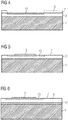
- a first step thereof is illustrated with FIG 4 .
- a preliminary activation process is performed on at least a part of the exposed surface of the coating in order to provide an activated surface area 13 or user interface area using a plasma technology pin or gun which moves on the selected area 13 to be treated.
- the process increases locally the surface tension and the activation lasts for some days, allowing a convenient application of symbols, marking or lettering with traditional ink technologies.
- the exposed surface 7 of the coating 3 is covered partially before and during performing the activation process, for example by a cover element 15 as indicated by the dashed lines in FIG 4 .
- ink application step the second printing step
- FIG 5 Said ink application step, the second printing step, is shown with FIG 5 .
- ink 5 is applied on the destined area.
- the respective surface i. e. the activated surface area 13
- the respective surface i. e. the activated surface area 13
- the preparation results in the provision of the activated surface area 13 which may protrude the area for the printing 5, as can be seen in FIG 5 .
- the printing 5 is not touching the component body of the component.
- the non-stick and/or non-wetting properties of the coating 3 are not interrupted or disrupted at the area or areas with printing 5.
- the component may comprise a protective layer and/or ground layer 17 being applied to the surface of the blank sheet 1 before applying of the coating in order to provide good adhesion properties of the coating 3.
- the ground layer 17 is presently formed by an enamelling process, thus the ground layer 17 is an enamel layer, and shows a surface roughness Ra of about 2 to 3.5 ⁇ m at its exposed surface.
- the thickness of the ground layer 17 is about 20pm.
- Ground layer 17 also shows corrosion resistant properties so that the component is protected against corrosion, what is in particular useful if said component is made of a corrosive material, for example a low carbon steel to save costs.
Landscapes
- Chemical & Material Sciences (AREA)
- Engineering & Computer Science (AREA)
- Mechanical Engineering (AREA)
- Inorganic Chemistry (AREA)
- Materials Engineering (AREA)
- Metallurgy (AREA)
- Organic Chemistry (AREA)
- Chemical Kinetics & Catalysis (AREA)
- General Engineering & Computer Science (AREA)
- Combustion & Propulsion (AREA)
- Physics & Mathematics (AREA)
- General Chemical & Material Sciences (AREA)
- Thermal Sciences (AREA)
- Life Sciences & Earth Sciences (AREA)
- Food Science & Technology (AREA)
- Dispersion Chemistry (AREA)
- Plasma & Fusion (AREA)
- Cookers (AREA)
- Structures Of Non-Positive Displacement Pumps (AREA)
- Application Of Or Painting With Fluid Materials (AREA)
Abstract
Description
- The present invention relates to a method for manufacturing a component of or a blank sheet for forming a component of a household appliance, in particular of a cooking appliance. The present invention further relates to a component of a household appliance, in particular obtainable by such a method and a household appliance comprising such a component.
- Currently, in the manufacturing process of components and/or household appliances comprising such components, said components, e.g. walls of an oven cavity or top plates of a cooking hob as well as accessories for use in household appliances such as cooking good carriers, e.g. baking trays, also have, besides mechanical functionality, an aesthetic appearance and are treated by their users by touching or have to be cleaned after usage. Therefore, such components are equipped with a self-cleaning and/or an easy-to-clean and/or a hydrophobic characteristic as well as with specific printing for applying product name and/or symbols for a user interface. Different approaches are known for performing components with such characteristic and specific printing.
- One approach provides a functional coating which results in said self-cleaning and/or an easy-to-clean and/or a hydrophobic characteristic and which is applied on the surface of the component after forming process and after having applied a specific printing to the component, e.g. by laser technology.
- In an alternative solution, the functional coating may be applied to the blank sheet of the component, thus prior to the forming process. This alternative solution allows a significant cost advantage over the first approach, due to simplified logistics in terms of transportation costs and component codes fragmentation. On the other hand, this alternative solution may result in corrosion problems on the component, even in case of using stainless steel material, when the functional coating is removed for applying the printing on the component. Alternatively, in case of not removing the coating, the printing may be non-durable due to lack of adhesion of the printing material due to the hydrophobic behaviour of the coated surface, if considering traditional serigraphy or tampography. Further, the aesthetical appearance may suffer from the printing on the coating and/or the surface may lose its self-cleaning or easy-to-clean effect.
- As a third option, symbols or product names may be applied to the component by mechanical embossing or stamping, but this solution is aesthetically not appealing as the other solutions and shows some limitations in symbols design and size.
- It is an object of the present invention to provide a method for manufacturing a component of a household appliance as well as a component of a household appliance and a household appliance having such a component which overcomes the above-described disadvantages.
- The first object of the invention is achieved by a method for manufacturing a component of a household appliance according to the features of
claim 1. - A method for manufacturing a component of or for a household appliance, in particular a cooking appliance, or a blank sheet from which the component is formed, the component or the blank sheet having a printing on its surface, is provided. The method comprises at least the following steps:
A blank sheet from which the component is formed or the component is provided, the blank sheet or component having a surface to be coated. Furthermore, the blank sheet or component have a base structure or base layer, hereinafter also referred to as component body. The surface is in particular an outer surface. - A non-stick and/or non-wetting coating is applied to the surface, the coating having an exposed (or: outer) surface. Said exposed surface may be arranged at the coating opposite to a boundary surface adjacent the base structure or base layer. The coating may in particular have self-cleaning and/or easy-to-clean properties and/or show a hydrophobic characteristic. In other words: A self-cleaning and/or easy-to-clean and/or hydrophobic effect or characteristic is received by means of a self-cleaning coating and/or an easy-to-clean coating and/or a hydrophobic coating which is applied to the surface.
- After applying of the coating, an activation process is performed on at least a part of the exposed surface of the coating in order to provide an activated surface area. The activation process in particular increases the surface tension within the activated surface area compared to the remaining exposed surface of the coating before the activation process or parts of the exposed surface that are not activated.
- In a further step, a printing or printing materiel, like ink, is applied to the activated surface area, thus on said parts of the exposed surface of the coating for or on which the activation process has been carried out.
- In other words: A method for manufacturing a blank sheet for or component of a household appliance, in particular of a cooking appliance, more in particular of a cooking hob, the blank sheet or component having a base structure or base layer and a surface, in particular an outer surface, is provided. The surface receives or has received a self-cleaning and/or an easy-to-clean and/or a hydrophobic characteristic. According to the present invention, at least one printing is applied to the surface. By applying at least one printing or printing material to the surface, a surface with slightly aesthetical appearance and continuous self-cleaning and/or easy-to-clean and/or hydrophobic effect or characteristic is provided.
- The expression "non-stick" indicates a surface that resists adherence of food items, such as cheese, sauces, oils, fat or the like, what permits easy cleaning of the component, in particular the top plate or the burner cap. The expression "non-wetting" terms a surface that repels liquids, e.g. water. The property is evidenced by a large contact angle between a drop of water and the surface on which the drop rests, wherein a contact angle of at least 95 degree is desirable.
- In case that the coating is applied to the blank sheet before forming the component a faster and more effective application can be achieved.
- Furthermore, performing a preliminary activation process on the coating increases locally the surface tension so that the coating shows good adhesion properties in said activated areas for subsequent applying of the printing. Said activation lasts for some hours, allowing a convenient application of symbols or the like, in particular by using traditional ink technologies.
- As the printing is applied to the coating without need of removing parts of said coating, e.g. by laser treatment before, corrosion issues are avoided.
- A preferred embodiment is characterized by an activation process which is performed using plasma technology. Particularly, a plasma technology gun or pin is used, moving on or above the part of the exposed surface of the coating to be treated and performing the activation process passing over said area. The coating is essentially non polar and shows non-wetting properties. Due to the activation process within the plasma, polar groups are formed at the exposed surface of the coating that increase the wettability of its surface. Subsequently, the printing can adhere to the surface.
- In order to perform a quick and cost-efficient treatment, the activation process may be performed by limiting to the area or areas receiving a printing. Hence, areas without any printing may be excluded from such treatment. In order to reach this target, the exposed surface of the coating is covered at least partially, thus blank or non-printed areas are covered before performing the activation process in order to limit the part of the exposed surface on which the activation process is performed, in particular by covering parts of the exposed surface by means of respective cover elements or cover means. Alternatively, the plasma technology gun or pin may be deactivated when passing over the blank or non-printed areas.
- In particular, the printing is based on ink application technology, preferably using serigraphy or tampography.
- According to a preferred embodiment, the non-stick and/or non-wetting coating is a sol-gel coating, in particular comprising at least a first and a second layer. Such a coating is for example a transparent or pigmented coatings for stainless steel and ceramic coatings for enameled component. Such coating is for example available under the name XERA-DUR or XERADUR 2 (Industrielack AG, Haemmerli 1, CH-8855 Wangen). Furthermore,
EP 2 177 580 B1 discloses such a coating obtained by a sol-gel process from compositions comprising at least a silica sol and a silane. Besides a good cleaning behaviour, such coatings shows good abrasion-resistant and a great surface hardness what leads to an increased lifetime. - The blank sheet or component can be made of different materials, the material being suitable for intended use. Preferably, the blank sheet or component is a made of a corrosive material, in particular corrosive steel, or made of a non-corrosive material, in particular stainless steel and/or aluminium, or made of glass, in particular a tempered glass, or made of glass ceramics. Corrosive steel is also known as so-called low-carbon steel, typically containing a small percentage of carbon, approximately about 0.05 to 0.30% carbon.
- It is a preferred embodiment, in particular with regard to blank sheets or components made of a corrosive material, to apply a protective layer to the surface of the blank sheet or component before applying the coating. This is due to the reason, that the non-stick and/or non-wetting coating itself does not protect the base material or substrate, thus the component, from corrosion. Therefore, an additional corrosion protection layer is advantageous if the component is made of any corrosive material so that the non-stick and/or non-wetting coating can also be used with base material or substrate that is corrosive itself. In case the base material is non-corrosive itself, the step of applying a protective layer may be optional. In particular an enamel layer and/or an aluminium layer and/or a layer comprising aluminium, is applied to the surface. The coating is then applied to an exposed surface of the protective layer.
- Preferably the protective layer has a thickness between 50 and 250µm, in particular between 100 and 200µm.
- In order to clean the surface and to provide good adhesion properties for the protective layer and/or the coating, the surface of the blank sheet or component is pretreated before applying the protective layer or the coating and/or the exposed surface of the protective layer is pretreated before applying the coating, in each case for providing a surface having a roughness being suitable for applying the protective layer and/or the coating. Said pretreatment is in particular carried out by mechanical treatment, physical treatment or chemical treatment, more preferably by sandblasting and/or laser treatment and/or an enamelling process to form a ground layer.
- The ground layer, in particular the enamel layer obtainable by the enamelling process, may have a layer thickness between 5 and 100µm, in particular between 10 and 80pm, more particularly between 20 and 50µm.
- It has been found that the adhesion of the non-stick and/or non-wetting coating may particularly depend on the surface roughness so that a roughening of the surface is advantageous for the adhesion properties. Therefore an advantageous surface structure may reduce the risk of peel off of the non-stick and/or non-wetting coating and at the same time allow to reduce the amount of coating and thus decrease costs. However, a surface roughness, which is too high, may also be disadvantageous, as the adhesion of the coating may be not optimal and/or the amount of coating needed will be higher than necessary.
- The surface might be roughened and/or protected against corrosion by applying a ground layer by an enamelling process, thus by applying an enamel layer, to the surface. The enamelling process in particular comprises applying an enamel powder onto the upper surface of the component and/or onto the surface of the protective layer, and heating the enamel powder for providing a ground layer with a surface having a roughness being suitable for applying the non-stick and/or non-wetting coating and/or being corrosion resistant.
- Such a ground layer is useful for all base materials in order to prepare the component for subsequent coating, thus for providing a good wettability and clean surface to obtain good adhesion performances on the full surface and no detachment of the non-stick and/or non-wetting coating.
- Furthermore, said ground layer may provide corrosion resistance for the surface of the component so that it also functions as a protective layer, in case of a component made of a non-corrosive material itself.
- The protective layer and/or the ground layer might be made of a so-called pyro or vitreous enamel that essentially consists of melted and fused glass powder. For applying said enamel layer to the component, high burning temperatures from about 820 to 840°C are needed.
- Another kind of protective layer and/or the ground layer might be made of an enamel having a low softening point between 450°C and 560°C, respectively a low glass transition temperature, a so-called "low-temperature enamel". The softening point is defined as a temperature, respectively a temperature range, at which the material, e.g. the enamel turns from its hard and relatively brittle state into a molten or rubber-like state when temperature is increased. Therefore, said low-temperature enamel can be applied to the surface of the component at lower burning temperatures. Said enamel is for example an aluminium enamel that comprises aluminium oxide. Compositions of such conventional enamels are known for example from
WO 02/02471 A1 GB 718,132 - Another kind of protective layer and/or the ground layer might be made of a catalytic enamel, for example known from
EP 0 565 941 A1 , disclosing a catalytically active coating composition comprising an enamel frit, inert substances and an oxidation catalyst, or fromGB 1 418 842 - Furthermore, so-called ground coat compositions comprising generally a glassy component and an additive component might be used for forming the protective layer and/or the ground layer that provides the effect of a rough and binding surface. Such ground coats are for example described in
US 8,778,455 B2 and comprise a combination of one or more alkali oxides, one or more alkaline earth oxides and one or more various transition metal oxides as glassy component, and additive such as fluorine. - A surface roughness of a surface of the blank sheet or component and/or a surface of the ground layer and/or a surface of the protective layer achieved with such pretreatment step is between Ra 0.01 µm to 10.00 µm, more preferably between Ra 0.10 µm to 5.00 µm, still more preferably between Ra 0.20 µm to 5.00 µm, still more preferably between Ra 0.50 µm to 5.00 µm, still more preferably between Ra 2.00 µm to 5.00 µm, still more preferably between Ra 2.50 µm to 5.00 µm.
- Such an advantageous surface structure with a roughness within the above limits may further reduces the risk of peel off of the non-stick and/or non-wetting coating and at the same time allow to reduce the amount of coating and thus decrease costs in a favorite manner. It has found that a roughness within the above limits further improves the adhesion of subsequent layers.
- The person skilled in the art knows various standard methods to determine the surface roughness value Ra. Particularly the surface roughness may be preferably determined in accordance with BS EN ISO 4287:2000 British standard, identical with the ISO 4287:1997 standard.
- For receiving a component, the blank sheet is formed into the component after applying of the coating. A person skilled in the art will understand that forming may happen after coating application or preferably before coating application. In contrast thereto, the activation is preferably performed after coating application.
- The second object of the invention is achieved by a component of a household appliance, in particular obtainable by a method as described above, according to the features of claim 10.
- The Component, in particular a wall of a household appliance, in particular a wall of a cooking appliance, and/or a fan cover of a cooking appliance and/or a component of or for a cooking hob, in particular a top plate of a cooking hob and/or a burner cap of a gas burner for a gas hob, and/or an accessory for a household appliance, in particular a cooking good carrier for a cooking appliance, has a component body and a surface. The surface is coated with a non-wetting and/or non-stick coating having an exposed surface, wherein at least a part of the exposed surface of the coating provides an activated surface area. A printing is applied to the activated surface area.
- The expression "component" within the meaning of the application covers both, parts of the household appliance itself as well as accessories which can be used in conjunction with a household appliance, e.g. cooking good carriers like baking trays or frying pans or the like.
- The component may further comprise a protective layer and/or a ground layer arranged between the component body and the coating.
- According to a preferred embodiment, the printing is not touching the component body of the component.
- Preferably, the component is a made of a corrosive material, in particular corrosive steel, or made of a non-corrosive material, in particular stainless steel and/or aluminium, or made of glass, in particular a tempered glass, or made of glass ceramics.
- Regarding the activation process, printing and the materials used, we herewith explicitly refer to the explanations and examples described with regard to the method according to the invention.
- The non-stick and/or non-wetting properties of the coating are not interrupted or disrupted at the area or areas with printing.
- The third object of the invention is achieved by a household appliance, in particular a cooking appliance, according to the features of
claim 15. - A household appliance, in particular a cooking appliance, more in particular an oven or a cooking hob, is provided which comprises a component having at least a component body and a surface, wherein the surface is coated with a non-wetting and/or non-stick coating having an exposed surface, wherein at least a part of the exposed surface of the coating provides an activated surface area, and wherein a printing is applied to the activated surface area.
- Novel and inventive features of the present invention are set forth in the appended claims.
- The present invention will be described in further detail with reference to the drawings, in which
- FIG 1
- is a sectional view of a small section of a component of a household appliance before receiving any printing;
- FIG 2
- illustrates a first solution for applying a printing on the component section of
FIG 1 according to the prior art; - FIG 3
- illustrates a second solution for applying a printing on the component section of
FIG 1 according to the prior art; - FIG 4
- illustrates an embodiment of the invention for applying a printing on the component section of
FIG 1 , wherein the surface of the coating is at least partially activated; - FIG 5
- illustrates the embodiment according to
FIG 4 , wherein the printing is applied to the component section; - FIG 6
- illustrates a further embodiment of the invention.
-
FIG 1 illustrates a sectional view on a small section of a component of a household appliance. By way of example, the small section represent a cutout of a user interface area arranged on a worktop of a cooking hob which may be a conventional electric hob or a gas hob or an area for applying a symbol or product name. The component is made of ametal sheet 1 which is formed out of a flat metal plate material, e. g. a stainless steel plate, by stamping and embossing. Its outer or upper surface, which is facing the user or which is exposed to the user's touching, is covered, at least in the area of a user interface of the household appliance, with a non-stick and/ornon-wetting coating 3, which has a self-cleaning and/or an easy-to-clean and/or a hydrophobic characteristic or effect in order to meet the user's desire for a low-maintenance appliance. Exemplary, thecoating 3 is a sol-gel coating. - Mainly for the purpose of applying a product name on the household appliance and/or symbols on a user interface thereof, a
printing 5 is arranged on the component. The printing is realized with a traditional ink application technology, in particular by means of serigraphy or tampography. - The
printing 5 may be applied on the exposedsurface 7 of thecoating 3 as illustrated withFIG 2 . Such solution, however, is unfavourable with respect to a durability of the printing since theprinting 5 is lacking adhesion of the ink due to the hydrophobic behaviour of thecoated surface 7 when using traditional serigraphy or tampography. - In order to overcome the afore-described lack of adhesion, an alternative solution is illustrated with
FIG 3 . This alternative solution is characterized by a removal of thecoating 3 in the area ofprinting 5. The coating removing process is usually executed by means of laser technology. A laser beam 9 cuts out the area where theprinting 5 shall be placed prior to the application of ink for performing the printing process. Thecoating 3 is removed completely down to the upper orouter surface 11 of the component orblank metal sheet 1. Theouter surface 11 is suitable for enabling a durable printing thereon. This solution, however, is more expensive than the solution according toFIG 2 . Moreover, due to the laser-supported removal of thecoating 3, corrosion may occur later on due to lack of a corrosion protection effect by thecoating 3. - The problems occurring with the solutions according to
FIGs 2 and 3 are solved with a two-step printing process shown inFIG 3 and4 . - The manufacturing of a component of a household appliance, in particular a cooking appliance, or a blank sheet from which the component is formed, e. g. of a top plate of a cooking hob, is exemplary started with a
blank metal sheet 1, in particular a stainless steel plate, on which a non-stick and/ornon-wetting coating 3 is applied. This allows a faster and more effective application. A user interface application is performed in a second step, after forming theblank metal sheet 1. The user interface application is realized with a well-known ink application process based on serigraphy or tampography, however, according to the invention, by means of a two-step application process. - A first step thereof is illustrated with
FIG 4 . In order to cause the ink to adhere to the coated surface, a preliminary activation process is performed on at least a part of the exposed surface of the coating in order to provide an activatedsurface area 13 or user interface area using a plasma technology pin or gun which moves on the selectedarea 13 to be treated. The process increases locally the surface tension and the activation lasts for some days, allowing a convenient application of symbols, marking or lettering with traditional ink technologies. - In order to limit the part of the exposed
surface 7 of thecoating 3 to said area on which the activation process shall be performed, the exposedsurface 7 of thecoating 3 is covered partially before and during performing the activation process, for example by acover element 15 as indicated by the dashed lines inFIG 4 . - Said ink application step, the second printing step, is shown with
FIG 5 . According to a printing pattern,ink 5 is applied on the destined area. As illustrated, the respective surface, i. e. the activatedsurface area 13, is prepared for a durable reception of theprinting ink 5, which preparation has been performed with the first step, as described above. The preparation results in the provision of the activatedsurface area 13 which may protrude the area for theprinting 5, as can be seen inFIG 5 . Theprinting 5 is not touching the component body of the component. Furthermore, the non-stick and/or non-wetting properties of thecoating 3 are not interrupted or disrupted at the area or areas withprinting 5. - As shown in
FIG 6 , the component may comprise a protective layer and/orground layer 17 being applied to the surface of theblank sheet 1 before applying of the coating in order to provide good adhesion properties of thecoating 3. Theground layer 17 is presently formed by an enamelling process, thus theground layer 17 is an enamel layer, and shows a surface roughness Ra of about 2 to 3.5µm at its exposed surface. The thickness of theground layer 17 is about 20pm.Ground layer 17 also shows corrosion resistant properties so that the component is protected against corrosion, what is in particular useful if said component is made of a corrosive material, for example a low carbon steel to save costs. - Although an illustrative embodiment of the present invention has been described herein with reference to the accompanying drawing, it is to be understood that the present invention is not limited to that precise embodiment, and that various other changes and modifications may be affected therein by one skilled in the art without departing from the scope or spirit of the invention. All such changes and modifications are intended to be included within the scope of the invention as defined by the appended claims.
-
- 1
- metal sheet
- 3
- coating
- 5
- printing / ink
- 7
- outer surface of coating
- 9
- laser beam
- 11
- metal sheet surface
- 13
- selected area
- 15
- cover element
- 17
- ground layer
Claims (15)
- A method for manufacturing a component of a household appliance, in particular a cooking appliance, or a blank sheet (1) from which the component is formed, the component or the blank sheet (1) having a printing on its surface, comprising at least the following steps:- providing the blank sheet (1) or providing the component, the blank sheet (1) or component having a surface (11) to be coated,- applying a non-stick and/or non-wetting coating (3) to the surface, the coating (3) having an exposed surface (7),- performing an activation process on at least a part of the exposed surface (7) of the coating (3) in order to provide an activated surface area (13), wherein the activation process in particular increases the surface tension within the activated surface area (13),- applying a printing (5) to the activated surface area.
- The method according to claim 1, characterized in that the activation process is performed using plasma technology, in particular by means of a plasma technology gun or pin being moved on or above the part of the exposed surface (7) of the coating (3).
- The method according to any of claims 1 or 2, characterized in that the exposed surface (7) of the coating (3) is covered at least partially before performing the activation process in order to limit the part of the exposed surface (7) on which the activation process is performed, in particular by covering parts of the exposed surface by means of respective cover elements (15) or cover means.
- The method according to any one of the preceding claims, characterized in that the printing (5) is applied by means of ink technology, in particular using serigraphy or tampography.
- The method according to any one of the preceding claims, characterized in that the non-stick and/or non-wetting coating (3) is a sol-gel coating, in particular comprising at least a first and a second layer.
- The method according to any one of the preceding claims, characterized in that the blank sheet or component (1) is a made of a corrosive material, in particular corrosive steel, or made of a non-corrosive material, in particular stainless steel and/or aluminium, or made of glass, in particular a tempered glass, or made of glass ceramics.
- The method according to any one of the preceding claims, characterized in that a protective layer is applied to the surface (11) of the blank sheet or component (1) before applying the coating (3), in particular an enamel layer and/or an aluminium layer and/or a layer comprising aluminium, and the coating (3) is applied to an exposed surface of the protective layer.
- The method according to any one of the preceding claims, wherein the surface of the blank sheet or component is pretreated before applying the protective layer or the coating and/or wherein the exposed surface of the protective layer is pretreated before applying the coating (3), in each case for providing a surface having a roughness being suitable for applying the protective layer and/or the coating (3), in particular by mechanical treatment, physical treatment or chemical treatment, more preferably by sandblasting and/or laser treatment and/or an enamelling process to form a ground layer (17).
- Method according to any one of the preceding claims, characterized in that the blank sheet is formed into the component after applying of the coating (3).
- Component (1), in particular obtainable by a method according to any one of the preceding claims, in particular a wall of a household appliance, in particular a wall of a cooking appliance, and/or a fan cover of a cooking appliance and/or a component of or for a cooking hob, in particular a top plate of a cooking hob and/or a burner cap of a gas burner for a gas hob, and/or an accessory for use in a household appliance, in particular a cooking good carrier for a cooking appliance, having a component body and a surface (11), wherein the surface (11) is coated with a non-wetting and/or non-stick coating (3) having an exposed surface (7), wherein at least a part of the exposed surface (7) of the coating (3) provides an activated surface area (13), and wherein a printing (5) is applied to the activated surface area (13).
- Component (1) according to claim 10, further comprising a protective layer and/or a ground layer (17) arranged between the component body and the coating (3).
- Component (1) according to any one of the claims 10 to 11, wherein the printing (3) is not touching the component body of the component (1).
- Component (1) according to any one of the claims 10 to 12, characterized in that the component (1) is a made of a corrosive material, in particular corrosive steel, or made of a non-corrosive material, in particular stainless steel and/or aluminium, or made of glass, in particular a tempered glass, or made of glass ceramics.
- Component (1) according to any one of the claims 10 to 13, characterized in that the non-stick and/or non-wetting properties of the coating (3) are not interrupted or disrupted at the area or areas with printing (5).
- A household appliance, in particular a cooking appliance, more in particular an oven or a cooking hob, comprising a component (1) according to any one of the claims 10 to 14.
Applications Claiming Priority (2)
| Application Number | Priority Date | Filing Date | Title |
|---|---|---|---|
| EP19209417 | 2019-11-15 | ||
| PCT/CN2020/083446 WO2020207367A1 (en) | 2019-04-09 | 2020-04-07 | Cavity having a non-stick and/or non-wetting coating, cooking appliance comprising such a cavity and method for manufacturing a cavity |
Publications (1)
| Publication Number | Publication Date |
|---|---|
| EP3822542A1 true EP3822542A1 (en) | 2021-05-19 |
Family
ID=68583176
Family Applications (4)
| Application Number | Title | Priority Date | Filing Date |
|---|---|---|---|
| EP20775898.8A Pending EP4058734A1 (en) | 2019-11-15 | 2020-09-29 | Fan cover having a non-stick and/or non-wetting coating, cooking appliance comprising such a fan cover and method for manufacturing a fan cover |
| EP20796687.0A Pending EP4058735A1 (en) | 2019-11-15 | 2020-09-29 | Component, in particular a top plate and/or a burner cap of a gas hob having a non-stick and/or non-wetting coating, gas hob comprising such a component and method for manufacturing a component |
| EP20199030.6A Pending EP3822542A1 (en) | 2019-11-15 | 2020-09-29 | A method for manufacturing a component of or a blank sheet for forming a component of a household appliance, component for a household appliance and household appliance |
| EP20796686.2A Pending EP4057821A1 (en) | 2019-11-15 | 2020-09-29 | Baking tray or baking grid having a non-stick and/or non-wetting coating, cooking appliance comprising such a baking tray or baking grid and method for manufacturing a baking tray or baking grid |
Family Applications Before (2)
| Application Number | Title | Priority Date | Filing Date |
|---|---|---|---|
| EP20775898.8A Pending EP4058734A1 (en) | 2019-11-15 | 2020-09-29 | Fan cover having a non-stick and/or non-wetting coating, cooking appliance comprising such a fan cover and method for manufacturing a fan cover |
| EP20796687.0A Pending EP4058735A1 (en) | 2019-11-15 | 2020-09-29 | Component, in particular a top plate and/or a burner cap of a gas hob having a non-stick and/or non-wetting coating, gas hob comprising such a component and method for manufacturing a component |
Family Applications After (1)
| Application Number | Title | Priority Date | Filing Date |
|---|---|---|---|
| EP20796686.2A Pending EP4057821A1 (en) | 2019-11-15 | 2020-09-29 | Baking tray or baking grid having a non-stick and/or non-wetting coating, cooking appliance comprising such a baking tray or baking grid and method for manufacturing a baking tray or baking grid |
Country Status (6)
| Country | Link |
|---|---|
| US (3) | US12543746B2 (en) |
| EP (4) | EP4058734A1 (en) |
| CN (1) | CN114667417A (en) |
| AU (3) | AU2020381822A1 (en) |
| BR (2) | BR112022009063A2 (en) |
| WO (3) | WO2021094030A1 (en) |
Citations (15)
| Publication number | Priority date | Publication date | Assignee | Title |
|---|---|---|---|---|
| CH8855A (en) | 1894-10-22 | 1895-01-31 | Spaelty J Rud | Herb cheese grinder |
| GB718132A (en) | 1951-03-22 | 1954-11-10 | Du Pont | Vitreous phosphate enamels and their use |
| GB1418842A (en) | 1972-03-08 | 1975-12-24 | Bayer Rickmann Gmbh | Catalytically acitve enamel layer |
| EP0565941A1 (en) | 1992-04-16 | 1993-10-20 | MERCK PATENT GmbH | Catalytically active coating composition |
| WO2002002471A1 (en) | 2000-06-28 | 2002-01-10 | Ferro France - S.A.R.L. | Enamel composition |
| DE202004021240U1 (en) * | 2003-11-04 | 2007-05-10 | Schott Ag | Easy clean surface, subject to high temperatures and heavy soiling, has an outer hydrophobic layer with a component reacting with free OH groups and an inner inorganic sol-gel layer |
| EP2177580B1 (en) | 2008-10-16 | 2011-01-19 | Looser Holding AG | Non-stick coatings |
| US20110097574A1 (en) * | 2007-12-26 | 2011-04-28 | Julien Faldysta | Roll-Up Polyester Film Comprising, on at Least One of the Faces Thereof, a Scratch-Resistant Cross-Linked Coating, Method for Obtaining this Polyester Film |
| US20120216880A1 (en) * | 2009-11-04 | 2012-08-30 | Ssw Holding Company, Inc. | Cooking appliance surfaces having spill containment pattern and methods of making the same |
| US8778455B2 (en) | 2010-04-27 | 2014-07-15 | Ferro Corporation | Enamel and ground coat compositions |
| US20140238379A1 (en) * | 2013-02-28 | 2014-08-28 | General Electric Company | Non-stick, pyrolytic coatings for heating devices |
| US20150219312A1 (en) * | 2012-08-14 | 2015-08-06 | Eurokera S.N.C. | Glass-ceramic article comprising a luminous color display |
| DE102014220457A1 (en) * | 2014-10-09 | 2016-04-14 | Schott Ag | A process for producing a coated substrate, disc-shaped substrate comprising at least two layers applied by heating and use of the coated substrate |
| US20180222794A1 (en) * | 2017-02-07 | 2018-08-09 | Schott Ag | Coated protective glazing |
| EP3715722A1 (en) * | 2019-03-26 | 2020-09-30 | Electrolux Appliances Aktiebolag | A method for manufacturing a wall of a household appliance and household appliance |
Family Cites Families (30)
| Publication number | Priority date | Publication date | Assignee | Title |
|---|---|---|---|---|
| JPS6176828A (en) | 1984-09-21 | 1986-04-19 | Hitachi Heating Appliance Co Ltd | Heating cooker |
| JP2763833B2 (en) | 1991-07-25 | 1998-06-11 | シャープ株式会社 | Cooking surface structure of cooking equipment for high-temperature heating |
| US5382552A (en) | 1993-09-14 | 1995-01-17 | Miles Inc. | Rare earth-containing alkali silicate frits and their use for the preparation of porcelain enamel coatings with improved cleanability |
| US5513562A (en) * | 1995-08-25 | 1996-05-07 | Zyliss U.S.A Corp. | Non-stick garlic press with integrated cleaner |
| DE19915378A1 (en) | 1999-04-06 | 2000-10-12 | Inst Neue Mat Gemein Gmbh | Household appliances with a catalytic composition |
| DE10016485A1 (en) * | 2000-04-01 | 2001-10-11 | Dmc2 Degussa Metals Catalysts | Glass, ceramic and metal substrates with a self-cleaning surface, process for their production and their use |
| DE10236728A1 (en) | 2002-08-09 | 2004-02-26 | Schott Glas | Easy to clean device |
| DE10306582A1 (en) | 2003-02-17 | 2004-08-26 | BSH Bosch und Siemens Hausgeräte GmbH | Surface coating for a cooker or oven comprises a vitreous enamel layer with embedded crystal zones that provide both coarse and fine surface roughness |
| DE10314513A1 (en) * | 2003-03-31 | 2004-10-14 | BSH Bosch und Siemens Hausgeräte GmbH | Catalyst system for odor reduction |
| US7488515B2 (en) * | 2004-03-19 | 2009-02-10 | All-Clad Metalcrafters Llc | Method of making non-stick cookware |
| DE102005039883A1 (en) | 2005-08-23 | 2007-03-22 | BSH Bosch und Siemens Hausgeräte GmbH | Device with a cooking appliance accessory |
| EP1767668A1 (en) | 2005-09-23 | 2007-03-28 | Cosma S.p.A. | Method for enamelling cast parts of standard hypoeutectic gray iron |
| EP1770070A3 (en) | 2005-10-03 | 2007-09-12 | Smartpool Incorporated | Disposable electrolytic chlorine generator |
| FR2904206B1 (en) * | 2006-07-31 | 2008-09-26 | Seb Sa | CULINARY ARTICLE HAVING IMPROVED HYDROPHOBIC PROPERTIES AND METHOD OF MANUFACTURING SUCH ARTICLE |
| EP1898153B1 (en) * | 2006-09-06 | 2009-11-25 | Electrolux Home Products Corporation N.V. | Gas burner for cooking appliances |
| KR101295565B1 (en) | 2006-10-10 | 2013-08-09 | 엘지전자 주식회사 | Cooking device and Manufacturing method for the same |
| DE102007034683A1 (en) * | 2007-07-25 | 2009-01-29 | BSH Bosch und Siemens Hausgeräte GmbH | layer body |
| US8840942B2 (en) | 2010-09-24 | 2014-09-23 | Emisshield, Inc. | Food product and method and apparatus for baking |
| ES2385155B1 (en) | 2010-12-22 | 2013-05-24 | BSH Electrodomésticos España S.A. | Cooking flask |
| FR2992313B1 (en) | 2012-06-21 | 2014-11-07 | Eurokera | VITROCERAMIC ARTICLE AND METHOD OF MANUFACTURE |
| CN104769049A (en) * | 2012-07-13 | 2015-07-08 | 哈佛学院 | multifunctional resistant material |
| JP6128865B2 (en) | 2013-01-31 | 2017-05-17 | 大阪ガスケミカル株式会社 | Composition for outermost surface of gas cooker |
| FR3025995B1 (en) | 2014-09-23 | 2017-02-17 | Seb Sa | COOKING CONTAINER COMPRISING A PARTIALLY COATED STAINLESS STEEL INTERIOR SIDE AND PROCESS FOR OBTAINING THE SAME |
| EP3026349B1 (en) * | 2014-11-26 | 2020-12-30 | Miele & Cie. KG | Cooking device component and method for producing same |
| CN204427604U (en) | 2014-12-19 | 2015-07-01 | 佛山市顺德区美的电热电器制造有限公司 | Pan |
| DE102015122203A1 (en) | 2015-12-18 | 2017-06-22 | Fissler Gmbh | Tube with thermochromic indicator coating |
| JP2017201232A (en) | 2016-02-12 | 2017-11-09 | 三星電子株式会社Samsung Electronics Co.,Ltd. | Oven device |
| JP6519881B2 (en) | 2016-03-09 | 2019-05-29 | パナソニックIpマネジメント株式会社 | Cooker |
| KR102524063B1 (en) | 2016-09-09 | 2023-04-21 | 삼성전자주식회사 | Oven |
| EP3327358B1 (en) * | 2016-11-25 | 2022-03-23 | Electrolux Appliances Aktiebolag | A cavity having an enamel coating, a cooking appliance comprising such a cavity and a method for manufacturing such a cavity |
-
2020
- 2020-09-29 AU AU2020381822A patent/AU2020381822A1/en active Pending
- 2020-09-29 WO PCT/EP2020/077238 patent/WO2021094030A1/en not_active Ceased
- 2020-09-29 WO PCT/EP2020/077239 patent/WO2021094031A1/en not_active Ceased
- 2020-09-29 EP EP20775898.8A patent/EP4058734A1/en active Pending
- 2020-09-29 EP EP20796687.0A patent/EP4058735A1/en active Pending
- 2020-09-29 CN CN202080078284.XA patent/CN114667417A/en active Pending
- 2020-09-29 US US17/776,877 patent/US12543746B2/en active Active
- 2020-09-29 BR BR112022009063A patent/BR112022009063A2/en unknown
- 2020-09-29 WO PCT/EP2020/077245 patent/WO2021094032A1/en not_active Ceased
- 2020-09-29 US US17/776,825 patent/US20220404026A1/en not_active Abandoned
- 2020-09-29 BR BR112022008684A patent/BR112022008684A2/en unknown
- 2020-09-29 AU AU2020381676A patent/AU2020381676A1/en active Pending
- 2020-09-29 AU AU2020381844A patent/AU2020381844A1/en active Pending
- 2020-09-29 EP EP20199030.6A patent/EP3822542A1/en active Pending
- 2020-09-29 EP EP20796686.2A patent/EP4057821A1/en active Pending
- 2020-09-29 US US17/776,841 patent/US12290076B2/en active Active
Patent Citations (15)
| Publication number | Priority date | Publication date | Assignee | Title |
|---|---|---|---|---|
| CH8855A (en) | 1894-10-22 | 1895-01-31 | Spaelty J Rud | Herb cheese grinder |
| GB718132A (en) | 1951-03-22 | 1954-11-10 | Du Pont | Vitreous phosphate enamels and their use |
| GB1418842A (en) | 1972-03-08 | 1975-12-24 | Bayer Rickmann Gmbh | Catalytically acitve enamel layer |
| EP0565941A1 (en) | 1992-04-16 | 1993-10-20 | MERCK PATENT GmbH | Catalytically active coating composition |
| WO2002002471A1 (en) | 2000-06-28 | 2002-01-10 | Ferro France - S.A.R.L. | Enamel composition |
| DE202004021240U1 (en) * | 2003-11-04 | 2007-05-10 | Schott Ag | Easy clean surface, subject to high temperatures and heavy soiling, has an outer hydrophobic layer with a component reacting with free OH groups and an inner inorganic sol-gel layer |
| US20110097574A1 (en) * | 2007-12-26 | 2011-04-28 | Julien Faldysta | Roll-Up Polyester Film Comprising, on at Least One of the Faces Thereof, a Scratch-Resistant Cross-Linked Coating, Method for Obtaining this Polyester Film |
| EP2177580B1 (en) | 2008-10-16 | 2011-01-19 | Looser Holding AG | Non-stick coatings |
| US20120216880A1 (en) * | 2009-11-04 | 2012-08-30 | Ssw Holding Company, Inc. | Cooking appliance surfaces having spill containment pattern and methods of making the same |
| US8778455B2 (en) | 2010-04-27 | 2014-07-15 | Ferro Corporation | Enamel and ground coat compositions |
| US20150219312A1 (en) * | 2012-08-14 | 2015-08-06 | Eurokera S.N.C. | Glass-ceramic article comprising a luminous color display |
| US20140238379A1 (en) * | 2013-02-28 | 2014-08-28 | General Electric Company | Non-stick, pyrolytic coatings for heating devices |
| DE102014220457A1 (en) * | 2014-10-09 | 2016-04-14 | Schott Ag | A process for producing a coated substrate, disc-shaped substrate comprising at least two layers applied by heating and use of the coated substrate |
| US20180222794A1 (en) * | 2017-02-07 | 2018-08-09 | Schott Ag | Coated protective glazing |
| EP3715722A1 (en) * | 2019-03-26 | 2020-09-30 | Electrolux Appliances Aktiebolag | A method for manufacturing a wall of a household appliance and household appliance |
Also Published As
| Publication number | Publication date |
|---|---|
| US20230358410A1 (en) | 2023-11-09 |
| BR112022008684A2 (en) | 2022-07-19 |
| US20220404026A1 (en) | 2022-12-22 |
| AU2020381844A1 (en) | 2022-04-07 |
| BR112022009063A2 (en) | 2022-10-11 |
| US20220386627A1 (en) | 2022-12-08 |
| US12290076B2 (en) | 2025-05-06 |
| WO2021094030A1 (en) | 2021-05-20 |
| EP4058735A1 (en) | 2022-09-21 |
| EP4057821A1 (en) | 2022-09-21 |
| AU2020381822A1 (en) | 2022-04-07 |
| AU2020381676A1 (en) | 2022-04-07 |
| US12543746B2 (en) | 2026-02-10 |
| WO2021094031A1 (en) | 2021-05-20 |
| WO2021094032A1 (en) | 2021-05-20 |
| EP4058734A1 (en) | 2022-09-21 |
| CN114667417A (en) | 2022-06-24 |
Similar Documents
| Publication | Publication Date | Title |
|---|---|---|
| CA2722559C (en) | Improved cleanability of ovens and cooktops | |
| CN101384202B (en) | Anodized cooking utensil and method for manufacturing the utensil | |
| CA2530716C (en) | Glassware with silicone support | |
| EP2206801A1 (en) | Composite cookware comprising a vitreous protective coating | |
| EP0127489B1 (en) | Method of enamelling the bottom of a cooking vessel, and such a cooking vessel | |
| EP4099877B1 (en) | Container for cooking foods comprising a non-stick coating | |
| KR20110133469A (en) | Enamel Coating, Coated Articles and Coating Methods of Articles | |
| JP5391795B2 (en) | Inner pan for electromagnetic induction heating type electric rice cooker | |
| US12290076B2 (en) | Baking tray or baking grid having a non-stick and/or non-wetting coating, cooking appliance comprising such a baking tray or baking grid and method for manufacturing a baking tray or baking grid | |
| JP6170825B2 (en) | Bakeware | |
| AU2020256589B2 (en) | Cavity having a non-stick and/or non-wetting coating, cooking appliance comprising such a cavity and method for manufacturing a cavity | |
| EP3715722A1 (en) | A method for manufacturing a wall of a household appliance and household appliance | |
| EP3722674A1 (en) | Cavity having a non-stick and/or non-wetting coating, cooking appliance comprising such a cavity and method for manufacturing a cavity | |
| JP5391794B2 (en) | Inner pan for electromagnetic induction heating type electric rice cooker | |
| CN220045631U (en) | Corrosion-resistant rust-proof non-stick pan | |
| EP2505688B1 (en) | Decoration method for a cooking vessel | |
| WO2024106007A1 (en) | Coated member and cooker or cooking utensil both including same | |
| JPH03120349A (en) | Method for coating with fluoroplastic | |
| JP2001234364A (en) | Non-sticky enamel and cookware using the same | |
| HK1163049A (en) | Enamel coating, coated article and method of coating an article |
Legal Events
| Date | Code | Title | Description |
|---|---|---|---|
| PUAI | Public reference made under article 153(3) epc to a published international application that has entered the european phase |
Free format text: ORIGINAL CODE: 0009012 |
|
| STAA | Information on the status of an ep patent application or granted ep patent |
Free format text: STATUS: THE APPLICATION HAS BEEN PUBLISHED |
|
| AK | Designated contracting states |
Kind code of ref document: A1 Designated state(s): AL AT BE BG CH CY CZ DE DK EE ES FI FR GB GR HR HU IE IS IT LI LT LU LV MC MK MT NL NO PL PT RO RS SE SI SK SM TR |
|
| STAA | Information on the status of an ep patent application or granted ep patent |
Free format text: STATUS: REQUEST FOR EXAMINATION WAS MADE |
|
| 17P | Request for examination filed |
Effective date: 20211119 |
|
| RBV | Designated contracting states (corrected) |
Designated state(s): AL AT BE BG CH CY CZ DE DK EE ES FI FR GB GR HR HU IE IS IT LI LT LU LV MC MK MT NL NO PL PT RO RS SE SI SK SM TR |
|
| STAA | Information on the status of an ep patent application or granted ep patent |
Free format text: STATUS: EXAMINATION IS IN PROGRESS |
|
| 17Q | First examination report despatched |
Effective date: 20250207 |