EP3822473B1 - Cooling structure for engine, engine, and vehicle - Google Patents
Cooling structure for engine, engine, and vehicle Download PDFInfo
- Publication number
- EP3822473B1 EP3822473B1 EP20206591.8A EP20206591A EP3822473B1 EP 3822473 B1 EP3822473 B1 EP 3822473B1 EP 20206591 A EP20206591 A EP 20206591A EP 3822473 B1 EP3822473 B1 EP 3822473B1
- Authority
- EP
- European Patent Office
- Prior art keywords
- bore
- water
- cylinder
- engine
- jacket
- Prior art date
- Legal status (The legal status is an assumption and is not a legal conclusion. Google has not performed a legal analysis and makes no representation as to the accuracy of the status listed.)
- Active
Links
Images





Classifications
-
- F—MECHANICAL ENGINEERING; LIGHTING; HEATING; WEAPONS; BLASTING
- F02—COMBUSTION ENGINES; HOT-GAS OR COMBUSTION-PRODUCT ENGINE PLANTS
- F02F—CYLINDERS, PISTONS OR CASINGS, FOR COMBUSTION ENGINES; ARRANGEMENTS OF SEALINGS IN COMBUSTION ENGINES
- F02F1/00—Cylinders; Cylinder heads
- F02F1/02—Cylinders; Cylinder heads having cooling means
- F02F1/10—Cylinders; Cylinder heads having cooling means for liquid cooling
- F02F1/14—Cylinders with means for directing, guiding or distributing liquid stream
-
- F—MECHANICAL ENGINEERING; LIGHTING; HEATING; WEAPONS; BLASTING
- F01—MACHINES OR ENGINES IN GENERAL; ENGINE PLANTS IN GENERAL; STEAM ENGINES
- F01P—COOLING OF MACHINES OR ENGINES IN GENERAL; COOLING OF INTERNAL-COMBUSTION ENGINES
- F01P3/00—Liquid cooling
- F01P3/02—Arrangements for cooling cylinders or cylinder heads
-
- F—MECHANICAL ENGINEERING; LIGHTING; HEATING; WEAPONS; BLASTING
- F01—MACHINES OR ENGINES IN GENERAL; ENGINE PLANTS IN GENERAL; STEAM ENGINES
- F01P—COOLING OF MACHINES OR ENGINES IN GENERAL; COOLING OF INTERNAL-COMBUSTION ENGINES
- F01P3/00—Liquid cooling
- F01P3/02—Arrangements for cooling cylinders or cylinder heads
- F01P2003/021—Cooling cylinders
-
- F—MECHANICAL ENGINEERING; LIGHTING; HEATING; WEAPONS; BLASTING
- F01—MACHINES OR ENGINES IN GENERAL; ENGINE PLANTS IN GENERAL; STEAM ENGINES
- F01P—COOLING OF MACHINES OR ENGINES IN GENERAL; COOLING OF INTERNAL-COMBUSTION ENGINES
- F01P3/00—Liquid cooling
- F01P3/02—Arrangements for cooling cylinders or cylinder heads
- F01P2003/024—Cooling cylinder heads
-
- F—MECHANICAL ENGINEERING; LIGHTING; HEATING; WEAPONS; BLASTING
- F02—COMBUSTION ENGINES; HOT-GAS OR COMBUSTION-PRODUCT ENGINE PLANTS
- F02F—CYLINDERS, PISTONS OR CASINGS, FOR COMBUSTION ENGINES; ARRANGEMENTS OF SEALINGS IN COMBUSTION ENGINES
- F02F1/00—Cylinders; Cylinder heads
- F02F1/02—Cylinders; Cylinder heads having cooling means
- F02F1/10—Cylinders; Cylinder heads having cooling means for liquid cooling
- F02F1/108—Siamese-type cylinders, i.e. cylinders cast together
-
- F—MECHANICAL ENGINEERING; LIGHTING; HEATING; WEAPONS; BLASTING
- F02—COMBUSTION ENGINES; HOT-GAS OR COMBUSTION-PRODUCT ENGINE PLANTS
- F02F—CYLINDERS, PISTONS OR CASINGS, FOR COMBUSTION ENGINES; ARRANGEMENTS OF SEALINGS IN COMBUSTION ENGINES
- F02F1/00—Cylinders; Cylinder heads
- F02F1/02—Cylinders; Cylinder heads having cooling means
- F02F1/10—Cylinders; Cylinder heads having cooling means for liquid cooling
- F02F2001/104—Cylinders; Cylinder heads having cooling means for liquid cooling using an open deck, i.e. the water jacket is open at the block top face
Definitions
- the present invention relates to a cooling structure for an engine, including a water-jacket spacer which is arranged inside a water jacket of an engine block and provided to regulate flowing of cooling water.
- the present invention also relates to an engine and a vehicle.
- the water jacket as a flow passage of the cooling water, is provided at the engine block of a multi-cylinder type of internal combustion engine such that the cooling water flows through a cylinder wall, that is - a bore central wall which is a peripheral wall of each cylinder and an inter-bore wall which is a wall interposed between adjacent cylinders.
- the water-jacket spacer provided to regulate flowing of the cooling water may be arranged inside the water jacket.
- the temperature of the bore central wall and the inter-bore wall can be set at a target value by regulating the cooling-water flowing.
- the water-jacket spacer separates the flow passage of the cooling water into a bore-side passage which is close to the cylinders and an anti-bore-side passage which is far from the cylinders.
- Japanese Patent Laid-Open Publication No. 2016-180314 discloses a technology that an expansive member which is configured to expand through its contacting with the water is attached to a bore-side wall surface (internal surface) of the water-jacket spacer.
- This expansive member is arranged over a range from a lower end to an upper end, in a cylinder-axis direction, of the water-jacket spacer at a position which faces the bore central wall.
- This expansive member is configured to close a gap between the water-jacket spacer and the bore central wall when it has expanded, whereby the flowing of the cooling water is regulated. Thereby, excessive cooling of the bore central wall can be suppressed.
- the technology of arranging the expansive member disclosed in the above-described patent document may be useful in suppression of the above-described improper natural convection.
- the above-described arrangement of the expansive member over the range from the lower end to the upper end, in the cylinder-axis direction, of the water-jacket spacer at the position which faces the bore central wall as disclosed in the patent document is insufficient in order to perfectly suppress the natural convection of the cooling water.
- WO 2018/225735 A1 describes a water jacket spacer that is installed in a groove-shaped coolant channel of a cylinder block of an internal combustion engine having a cylinder bore so as to be positioned along part or all of the circumference of the groove-shaped coolant channel when viewed in the circumferential direction.
- An object of the present invention is to properly suppress the natural convection of the cooling water from occurring between an internal surface and an external surface of the water-jacket spacer inside the water jacket.
- the present invention is a cooling structure for an engine as defined in claim 1.
- the natural convection of the cooling water can be properly suppressed from occurring between the internal surface and the external surface of the spacer body inside the water jacket by means of the expansive member which is provided at the internal surface of the spacer body. That is, the expansive member is provided to extend continuously over the range from the one-end side of the cylinder line to the other-end side of the cylinder line at the internal surface of the spacer body. Accordingly, the expansive member fills the gap between the internal surface of the spacer body and the cylinder wall of the engine block over an entire length of the cylinder line when it has expanded, so that occurring of the natural convection of the cooling water can be suppressed.
- the expansive member is provided at the lower part (or the lower area), in the cylinder-axis direction, of the internal surface of the spacer body.
- the heated cooling water can be made to stay in an upper part located above the above-described lower part of the internal space of the spacer body where the expansive member is not arranged. Accordingly, moving (flowing) of the cooling water between the internal surface of the spacer body and the external surface of the spacer body, i.e., the natural convection of the cooling water is suppressed from occurring properly, so that the heat retaining property of the cylinders can be improved.
- the cooling structure of the engine further includes a piston provided to reciprocate in the cylinder-axis direction inside each cylinder and including a skirt portion, wherein the lower part, in the cylinder-axis direction, of the internal surface of the spacer body where the expansive member is provided is an area (or a part) which is configured to face a part of the wall surface of the engine block which is located below a lower end of the skirt portion of the piston when the piston is positioned at a top dead center.
- an area (or a part) from the upper end of the cylinder to the lower end of the skirt portion of the piston positioned at the top dead center becomes an area (or a part) of a heat source where the heat is generated through the combustion occurring inside the cylinder.
- the heated cooling water can be made to stay in a part which faces this heat-source area, the heat retaining property of the hear-source area can be improved.
- the engine block comprises an inter-bore wall which is interposed between adjacent cylinders and a bore central wall which is another part of a peripheral wall of each cylinder than the inter-bore wall.
- the bore central wall is a portion of the peripheral wall of each cylinder excluding the inter-bore wall. Thickness, in a direction perpendicular to the specified arrangement direction of the plural cylinders in a horizontal plane, of the expansive member in an expanded state of the expansive member is set such that the expansive member is capable to close a gap between the internal surface of the spacer body of the water-jacket spacer and the inter-bore wall and the bore central wall of the engine block.
- the expansive member is configured to expand so as to close or fill a gap between the internal surface of the spacer body of the water-jacket spacer and the inter-bore wall and/or a gap between the internal surface of the spacer body of the water-jacket spacer and the bore central wall of the engine block.
- the gap between the internal surface of the spacer body and the inter-bore wall and the bore central wall of the engine block can be securely closed with the expansive member when the expansive member has expanded. Accordingly, the occurring of the natural convection of the cooling water can be securely suppressed over the entire length of the cylinder line.
- the water-jacket spacer is configured to separate a flow passage of the cooling water inside the water jacket into a bore-side passage (or an inner passage) which is close to the cylinders and an anti-bore-side passage (or an outer passage) which is far from the cylinders, and the water-jacket spacer is arranged inside the water jacket such that a lateral width of the bore-side passage is narrower than that of the anti-bore-side passage.
- the lateral width of the bore-side passage is set to be narrower than that of the anti-bore-side passage, a structure in which the flowing of the cooling water is difficult to occur in the bore-side passage can be provided. Accordingly, the suppression performance of the natural convection by means of the expansive member can be promoted.
- a part of the expansive member which is provided to face the both cylinders located at the one-end side of the cylinder line and the other-end side of the cylinder line is provided not only at the lower part, in the cylinder-axis direction, of the internal surface of the spacer body but at an upper part of the internal surface of the spacer body which is located above the lower part.
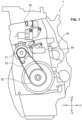
- FIG. 1 is a front view of an engine 1 to which an engine cooling structure according to the present invention is applied.
- the engine 1 which is installed to or mounted on a vehicle as a driving power source is a multi-cylinder four-cycle diesel engine, for example.
- the engine 1 comprises an engine body 10 which includes a cylinder block 2 (engine block; FIG. 2 ) provided with plural cylinders, a cylinder head mounted onto an upper face of the cylinder block 2 , and pistons stored inside the cylinders.
- the cylinder head is particularly provided above the cylinder block 2 when the engine 2 is mounted on the vehicle.
- the engine 1 is equipped with a water pump 11 for compulsorily circulating cooling water (or coolant) into the engine body 10 .
- the water pump 11 is an impeller type of pump with an impeller to pressurize and supply the cooling water.
- the water pump 11 is driven by a driving force generated by the engine body 10 . That is, the driving force of a crankshaft provided at the engine body 10 is transmitted to the water pump 11 via a crank pulley 12 which is attached to the crankshaft and a stretch belt 13 which is stretched between the water pump 11 and the crank pulley 12 .
- FIG. 1 shows a cooling-water inlet 14 to introduce the cooling water into the engine body 10 and a cooling-water outlet 15 to discharge the cooling water flowing through a flow passage formed inside the engine body 10 .
- the water pump 11 is set into the flow passage of the cooling water.
- the cooling water not only flows down the flow passage of the engine body 10 but circulates in a circulating passage extending through a heater unit for heating, a radiator for heat radiation, and so on.
- FIG. 2 is an exploded perspective view showing a part of the flow passage which is positioned at the cylinder block 2 of the engine body 10 .
- FIG. 2 shows the cylinder block 2 and a water-jacket spacer 3 which is installed to the cylinder block 2 .
- the cylinder block 2 comprises a cylinder line 21L where one or more cylinders, particularly six cylinders 21 are arranged in the X direction (specified direction) in line and a water jacket 22 which is a drain (groove) provided to surround the cylinder line 21L .
- the water jacket 22 forms the flow passage of the cooling water at the cylinder block 2 .
- the X direction is a longitudinal direction of the vehicle in a case where the engine 1 is arranged longitudinally.
- the water-jacket spacer 3 is arranged inside the water jacket 22 .
- the cylinder block 2 is a substantially rectangular-parallelepiped block which in elongated in the X direction.
- a block-side inlet 14H which is an inlet of the cooling water flowing to the cylinder block 2 is provided at a side face (or a lateral side face) of the cylinder block 2 which is positioned on the -X side.
- the block-side inlet 14H is connected to the cooling-water inlet 14 shown in FIG. 1 .
- the cooling water flows into the water jacket 22 from the block-side inlet 14 by being pressurized and supplied by the water pump 11 .
- the cooling water flows inside the water jacket 22 from the -X-side side face of the cylinder block 2 toward the +X-side side face of the cylinder block 2 . That is, the water jacket 22 is the flow passage where the cooling water flows from a one-end side of the cylinder line 21L (the -X side) to the other-end side face of the cylinder line 21L (the +X side).
- the cylinder head is mounted onto the upper face (+Z face) of the cylinder block such that it closes over an upper-face opening of each cylinder of the cylinder line 21L .
- the cylinder head is provided with an intake port and an intake valve to supply intake air to each cylinder 21 and an exhaust port and an exhaust valve to exhaust combustion gas from each cylinder 21 .
- FIG. 2 shows indications of an "intake side” where the respective intake valves are arranged and an "exhaust side” where the respective exhaust valves are arranged relative to an arrangement line of the cylinder line 21L (a line of the X direction).
- the water jacket 22 includes an intake-side jacket 22IN which is positioned on the intake side of the cylinder line 21L and an exhaust-side jacket 22EX of the cylinder line 21L .
- FIG. 3 is a sectional view of the cylinder block 2 in an XY plane.
- FIG. 4 is a sectional view taken along line IV-IV of FIG. 3
- FIG. 5 is a sectional view taken along line V-V of FIG. 3 .
- the cylinder block 2 includes an internal block 23 and an outside block 24 which is provided to surround the internal block 23 .
- the internal block 23 includes an internal peripheral wall 231 which is a cylindrical wall surface partitioning the cylinder 21 and an external wall 232 which is a wall surface partitioning an internal surface of the water jacket 22 .
- the internal block 23 further comprises an inter-bore wall 25 and a bore central wall 26.
- the inter-bore wall 25 is a wall positioned in an area P1 substantially shown in FIG. 3 , which is interposed between adjacent cylinders 21 in the X direction at the cylinder block 2.
- the inter-bore wall 25 receives heat from a heat source of the two adjacent cylinders 21, so that the temperature of this wall 25 tends to become high.
- the bore central wall 26 is a wall positioned in an area P2 substantially shown in FIG. 3 , which is another part of a peripheral wall of the cylinder 21 than the inter-bore wall 25.
- a pair of arc-shaped walls, positioned on the +Y side and the -Y side, of each cylinder 21 which is not positioned at both-side ends of the cylinder line 21L constitute (form) the bore-central wall 26
- another pair of arc-shaped walls, positioned on the +X side and the -X side, of each cylinder 21 constitute (form) the inter-bore wall 25
- a liner 211 on which the piston, not illustrated, slides is arranged at the internal peripheral wall 231 of the internal block 23 .
- a cross drill 27 as a flow passage of the cooling water is formed at the inter-bore wall 25 .
- the cross drill 27 is provided to cool the inter-bore wall 25 which tends to have a high temperature, which is a penetrating hole extending across the inter-bore wall 25 in the Y direction (a direction perpendicular to a cylinder-line direction in a horizonal plane).
- the cross drill 27 has a flow-passage shape in which an upstream drill hole 271 which extends obliquely downwardly from the +Y side to the -Y side and a downstream drill hole 272 which extends obliquely downwardly from the Y side to the +Y side join (merge) at a downstream side (a joining portion 275 ).
- a large-sized introduction opening 273 is provided at an upper end of the upstream drill hole 271
- a large-sized exit opening 274 is provided at an upper end of the downstream drill hole 272 .
- An inlet hole 28 is formed near an upper end of the external wall 232 of the internal block 23 which partitions the exhaust-side jacket 22EX .
- the inlet hole 28 is a hole for introducing the cooling water into the cross drill 27 , which is connected to the introduction opening 273 of the cross drill 27 .
- the exit opening 274 of the cross drill 27 is not directly connected to the intake-side jacket 22IN .
- the exit opening 274 is connected to a water jacket which is provided at the cylinder head, not illustrated.
- the inter-bore wall 25 is configured such that its exhaust side has a higher temperature than its intake side. Accordingly, the exhaust side of the inter-bore wall 25 which tends to have the high temperature can be properly cooled by providing the inlet hole 28 at the external wall 232 partitioning the exhaust-side jacket 22EX .
- the external block 24 includes an internal wall 241 which is a wall surface partitioning an internal surface of the water jacket 22 .
- a gap between this internal wall 241 and the external wall 232 of the internal block 23 is a space of the water jacket 22 where the cooling water flows.
- the thickness of the internal block 23 is substantially constant in a radial direction of the cylinder 21 , except the inter-bore wall 25 . Accordingly, the external wall 232 of the internal block 23 has an uneven curved-surface shape along a contour of the six cylinders aligned in the X direction in a top view.
- a part of the external wall 232 around the inter-bore wall 25 has an inwardly-concave curved surface
- another part of the external wall 232 around the bore central wall 26 has an outwardly-convex curved surface.
- the internal wall 241 of the external block 24 has also an uneven curved-surface shape which corresponds to the uneven curved-surface shape of the external wall 232 . Accordingly, a gap between the internal wall 241 and the external wall 232 is nearly or substantially constant in an extensive direction (X direction) of the water jacket 22 .
- the water-jacket spacer 3 has an uneven curved-surface shape which corresponds to the uneven curved-surface shape of the internal wall 241 and the external wall 232 as well.
- the water-jacket spacer 3 is arranged inside the water jacket 22 and separates the flow passage of the cooling water inside the water jacket 22 into a bore-side passage (or an inner passge) 22A and an anti-bore-side passage (or an outer passage) 22B.
- the bore-side passage 22A is the passage which is close to the cylinder 21 in the radial direction of the cylinder 21.
- the anti-bore-side passage 22B is the passage which is positioned on the outside of the bore-side passage 22A and far from the cylinder 21. Particularly, the anti-bore-side passage 22B is located around the bore-side passage 22A in the radial direction of the cylinder 21.
- the water-jacket spacer 3 performs regulating of the flowing of the cooling water inside the water jacket 22 when the water pump 11 operates (during compulsory circulation of the cooling water). Further, the water-jacket spacer 3 is provided with an expansive member 4 to suppress the natural convection of the cooling water from occurring when the water pump 11 stops. Hereafter, the water-jacket spacer 3 will be described specifically.
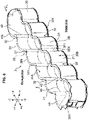
- FIG. 6 is a perspective view of the water-jacket spacer 3.
- the water-jacket spacer 3 comprises a spacer body 30 and the expansive member 4 provided at the spacer body 30 .
- the spacer body 30 particularly has a cylindrical shape surrounding the cylinder line 21L , i.e., a convex surface and a concave surface which are respectively shaped along an outer-peripheral shape of the cylinder line 21L .
- the spacer body 30 includes an internal surface 30A facing the cylinders 21 (the internal block 23 ) and an external surface 30B positioned on an opposite side to the internal surface 30A and facing the external block 24 in a state where the spacer body 30 is arranged inside the water jacket 22 .
- An upper-end flange 301 is provided at an upper end (+Z end) of the spacer body 30, and a lower-end flange 304 is provided at a lower end (-Z end) of the spacer body 30 .
- These flanges 301, 304 contribute to positioning maintenance of the water-jacket spacer 3 inside the water jacket 22 , forming a desirable cooling-water flowing, and so on.
- An inlet flange 302 is formed at an upstream-end side, in the cooling-water flow direction shown by the arrow FL , of the upper-end flange 301 .
- a cutout portion 303 is formed at a downstream-end side of the upper-end flange 301 . The cooling water is introduced into the water jacket arranged inside the cylinder head, not illustrated through this cutout portion 303 .
- the water-jacket spacer 3 comprises an intake-side spacer 3IN positioned on the +Y side and an exhaust-side spacer 3EX positioned on the -Y side.
- the intake-side spacer 3IN is a spacer portion arranged inside the intake-side jacket 22IN of the water jacket 2
- the exhaust-side spacer 3EX is another spacer portion arranged inside the exhaust-side jacket 22EX of the water jacket 2 .
- the intake-side spacer 3IN and the exhaust-side spacer 3EX are respectively provided with the spacer body 30 and the extensive member 4 .
- the spacer body 30 comprises a central spacer portion 31 and an inter-bore spacer portion 32 .
- the central spacer portion 31 is a portion which protrudes in a convex shape in the +Y direction or the -Y direction according to the external shape of the cylinder 21 . Specifically, the central spacer portion 31 protrudes in the convex shape in the +Y direction at the intake-side spacer 3IN , and the central spacer portion 31 protrudes in the convex shape in the Y direction at the exhaust-side spacer 3EX .
- the inter-bore spacer portion 32 is a portion which is curved in a concave shape in the Y direction at the intake-side spacer 3IN or curved in the concave shape in the +Y direction at the exhaust-side spacer 3EX .
- the intake-side spacer 3IN and the exhaust-side spacer 3EX are connected to each other at the +X-side end portion and the -X-side end portion and these are integrated.
- the central spacer portion 31 faces the bore central wall 26 of the internal block 23 and the inter-bore spacer portion 32 faces the inter-bore wall 25 of the internal bock 23 .
- the water jacket 22 is formed in the drain (groove) shape such that it is partitioned by the external wall of the internal block 23 and the internal wall 241 of the external block 24 and its upper end is open.
- the water jacket 22 has a U-shaped drain (groove) shape which is elongated in the vertical direction (the Z direction).
- the water-jacket spacer 3 is inserted into this water jacket 22 , thereby separating the flow passage of the cooling water into the bore-side passage 22A and the anti-bore-side passage 22B inside the water jacket 22 .
- the bore-side passage 22A is a passage which is formed between the internal surface 30A of the spacer body 30 and the external wall 232 of the internal block 23 .
- the anti-bore-side passage 22B is another passage which is formed between the external surface 30B of the spacer body 30 and the internal wall 241 of the external block 24 .
- the water-jacket spacer 3 separates the flowing of the cooling water inside the water jacket 22 such that a mainstream of the cooling water is formed at the anti-bore-side passage 22B . That is, the flowing of the cooling water is formed aggressively in the anti-bore-side passage 22B (mainstream forming), whereas the flowing of the cooling water is regulated by the water-jacket spacer 3 in the bore-side passage 22A so that the flowing of the cooling water is not formed aggressively.
- This flowing regulating is executed because the cylinder 21 is so overcooled by the aggressive forming of the cooling-water flowing in the bore-side passage 22A which is close to the cylinder 21 that a cooling loss may be caused improperly.
- a lateral width of the bore-side passage 22A is set to be narrower than that of the anti-bore-side passage 22B .
- the water-jacket spacer 3 is arranged in the water jacket 22 such that a relationship d2 > d1 is satisfied, wherein d1 denotes the width (lateral width), in the Y direction, of the bore-side passage 22A and d2 denotes the width (lateral width), in the Y direction, of the anti-bore-side passage 22B .
- the Y-direction width d1 of the bore-side passage 22A is a gap between the internal surface 30A and the external wall 232 .
- the Y-direction width d2 of the anti-bore-side passage 22B is a gap between the external surface 30B and the internal wall 241 .
- a value of the width d2 can be selected from a range from about 1. 5 - 4 times of a value of the width d1.
- the width d2 When the width d2 is sufficiently larger than the width d1, the flow resistance of the cooling water of the anti-bore-side passage 22B becomes lower than that of the bore-side passage 22A . Therefore, in a case where the cooling water is supplied in the arrow FL direction at a specified supply pressure from the block-side inlet 14H ( FIG. 3 ), the cooling-water flowing is formed in the anti-bore-side passage 22B primarily. In the bore-side passage 22A having the higher flow resistance of the cooling water, the flowing of the cooling water becomes relatively gentle. Accordingly, it can be suppressed that the cylinder 21 is excessively cooled.
- the expansive member 4 is a member which is provided at the internal surface 30A of the spacer body 30 and configured to be expandable according to an external factor.
- a material which is expandable according to its contacting with the water is applied to the expansive member 4 .
- the expansive member 4 is made of cellulose-based sponge which is configured to recover to its pre-compressed state from its compressed state through its contacting with the cooling water flowing inside the water jacket 22 .
- the cellulose-based sponge is a natural material which comprises cellulose made from pulp and natural fiber added as reinforcing fiber and is porous. Any other material than the cellulose-based sponge, such as the one made of foamed rubber which has been fixed in a compressed state by means of water-soluble binder, is applicable. Alternatively, a material which is expandable in response to the heat can be used.
- FIG. 7 is a side view of the internal surface 30A of the spacer body 30 where the extensive member 4 is provided.
- the expansive member 4 is provided at a lower part (or a lower area) (-Z side), in the cylindrical-axis direction (Z direction, or a vertical direction), of the internal surface 30A of the spacer body 30 .
- the expansive member 4 is further provided at the internal surface 30A of the spacer body 30 such that the expansive member 4 extends continuously over a range from an one-end side of the cylinder line 21L to the other-end side of the cylinder line 21L.
- the expansive member 4 extends continuously from the end (or the front end) of the first cylinder to the end (or the rear end) of the sixth cylinder.
- the expansive member 4 comprises a concave-surface part 41 and a convex-surface part 42 .
- the concave-surface part 41 of the expansive member 4 is provided at the concave surface of the spacer body 30.
- the convex-surface part 42 of the expansive member 4 is provided at the convex surface of the spacer body 30.
- the concave surface is the internal surface 30A of the central spacer portion 31 and the convex surface is the internal surface 30A of the inter-bore spacer portion 32. Accordingly, the concave-surface part 41 is provided to adhere to a lower part of the central spacer portion 31, and the convex-surface part 42 is provided to adhere to a lower part of the inter-bore spacer portion 32.
- the expansive member 4 is formed integrally with the spacer body 30 by an insert-molding process, for example. That is, the water-jacket spacer 3 can be manufactured by conducting the insert-molding process to the spacer body 30 in a state where the cellulose-based sponge is set in a shaping mold. Alternatively, the expansive member 4 may be attached to the internal surface 30A by a screw-attachment process, an adhesive agent, or the like in a state where the cellulose-based sponge is formed in a sheet-peace manner.
- the concave-surface part 41 of the expansive member 4 is set to have a slightly wider than the convex-surface part 42 in the Z-direction width.
- the +Z end of the convex-surface part 42 is located at a lower level than the +Z end of the concave-surface part 41, and the -Z end of the convex-surface part 42 is located at a higher level than the -Z end of the concave-surface part 41.
- These parts 41, 42 are provided at the lower part of the internal surface 30A in a state where these parts 41, 42 are arranged closely to each other, having no gap therebetween, in the X direction. The arrangement of the expansive member 4 will be described specifically later.
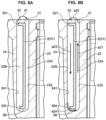
- FIG. 8A is a sectional view showing the flowing of cooling water when the water pump 11 operates
- FIG. 8B is a sectional view showing the flowing (natural convection) of the cooling water when the water pump 11 stops.
- the compulsory circulation of the cooling water starts in a circulation passage of the cooling water flowing in the engine body 10 as shown by the arrow FL of FIG. 2 .
- the water-jacket spacer 3 partitions the space inside the water jacket 22 such that the anti-bore-side passage 22B is wider than the bore-side passage 22A. Accordingly, since the flow resistance of the bore-side passage 22A is relatively large, the cooling water flows in the anti-bore-side passage 22B primarily when the water pump 11 operates.
- the cooling water flows into the bore-side passage 22A from the anti-bore-side passage 2B such that the cooling water flows over the upper-end flange 301 of the spacer body 30 as shown by an arrow a1 in FIG. 8A . That is, the cooling water flows into the bore-side passage 22A from the anti-bore-side passage 22B through a gap between the internal wall 241 and the upper-end flange 301 and then flows in the he bore-side passage 22A. The amount of cooling water flowing in the bore-side passage 22A is smaller than that of cooling water flowing in the anti-bore-side passage 22B.
- the above-described compulsory circulation of the cooling water stops. Since the cooling water contacts the internal block 23 (the inter-bore wall 25 and the bore central wall 26 ) which is the cylinder wall during the engine stop, the temperature of the cooling water becomes relatively high. Meanwhile, the temperature of the cooling water in the anti-bore-side passage 22B becomes relatively low because of the heat exchange of the cooling water with the outside air. This kind of temperature difference of the cooling water may cause the natural convection occurring between the bore-side passage 22A and the anti-bore-side passage 22B .
- the specific gravity of the cooling water in the bore-side passage 22A becomes lighter because its temperature increases, so that this cooling water rises in the bore-side passage 22A as shown by an arrow a21 .
- the specific gravity of the cooling water in the anti-bore-side passage 22B becomes heavier because its temperature decreases, so that this cooling water rises in the anti-bore-side passage 22B as shown by an arrow a23 . Consequently, a flow movement of the cooling water occurs at the upper end 3T of the water-jacket spacer 3 such that the cooling water flows into the anti-bore-side passage 22B from the bore-side passage 22A as shown by an arrow a22 .
- the cylinder wall may be cooled. That is, if the movement of the cooling water is generated due to the natural convection occurring in the bore-side passage 22A , the heat of the bore central wall 26 and the inter-bore wall 25 is extracted, so that these walls 26 , 25 may be overcooled. In this case, the warming-up state of the engine may not be maintained.
- This overcooling of the cylinder wall which is caused by the above-described natural convection of the cooling water is suppressed by the expansive member 4 provided at the internal surface 30A of the spacer body 30 .
- FIG. 9A is a sectional view showing a state before the expansive member 4 provided at the water-jacket spacer 3 expands
- FIG. 9B is a sectional view showing a state after the expansive member 4 expands.
- FIG. 9A shows a state where the water-jacket spacer 3 provided with the expansive member 4 is arranged inside the water jacket 22 when the cooling water has not been supplied inside the water jacket 22 , for example, in an assembling process of the engine body.
- the expansive member 4 since the expansive member 4 has not expanded yet, a worker can easily assemble (insert) the water-jacket spacer 3 into the water jacket 22 . Further, a gap is generated between the expansive member 4 and the external wall 232 of the internal block 23 after this assembling of the water-jacket spacer 3 .
- FIG. 9B shows a state after the cooling water has been supplied into the water jacket 22 .
- the expansive member 4 expands through its contracting with the cooling water, so that the lateral width thereof increases.
- a right surface of the expansive member 4 contacts the external wall 232 of the internal block 23 , so that a lower part of the bore-side passage 22A is substantially closed. Consequently, the natural convection of the cooling water which occurs during the engine stop or in the stop mode of the water pump 11 , which is shown in FIG. 8B , is suppressed. That is, since the lower part of the bore-side passage 22A is closed by the expansive member 4 , the flow movement of the cooling water, like the circulation through the bore-side passage 22A and the anti-bore-side passage 22B , is not generated. Accordingly, the cylinder 21 can be suppressed from being excessively cooled (i.e., overcooled) during the engine stop or the like.
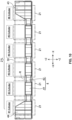
- FIG. 10 is a side view of the internal-surface side 30A of the water-jacket spacer 3 , which shows relationships with cylinders 21.
- the cylinder line 21L including the #1 - #6 cylinders 21 is shown by an imaginary line.
- the expansive member 4 comprises the concave-surface part 41, the convex-surface part 42, a first-end part 43 which faces the #6 cylinder 21 positioned at the - X-end side of the cylinder line 21L, and a second-end part 44 which faces the #1 cylinder 21 positioned at the +X-end side of the cylinder line 21L.
- the expansive member 4 is provided at the water-jacket spacer 3 such that it extends continuously over the range from the one-end side (+X) of the cylinder line 21L to the other-end side (-X) of the cylinder line 21L. This is because if an expansive-member missing part where no expansive member is provided exists in the X direction, the natural convection of the cooling water shown in FIG. 8B may be generated by way of this missing part.
- the concave-surface part 41 and the convex-surface part 42 are continuously provided to be close to each other, having no gap therebetween, in the X direction in an area which faces the #2 cylinder 21- the #5 cylinder 21 .
- the second-end part 44 facing the #1 cylinder 21 is provided at the +X side of this continuous body of the concave-surface part 41 and the convex-surface part 42
- the first-end part 43 facing the #6 cylinder 21 is provided at the -X side of this continuous body of the concave-surface part 41 and the convex-surface part 42 . Accordingly, the expansive member 4 which extends continuously over an entire length of the area facing the #1 - #6 cylinders 21 is provided.
- the expansive member 4 which has expanded so fills the gap of the bore-side passage 22A over the entire length of the cylinder line 21L that the natural convection of the cooling water can be suppressed from occurring.
- the expansive member 4 is arranged in the anti-bore-side passage 22B (on the side of the external surface 30B of the spacer body 30 ), the movement (flowing) of the cooling water in the anti-bore-side passage 22B stagnates, so that the cooling water flows in the bore-side passage 22A .
- the expansive member 4 be arranged in the bore-side passage 22A (on the side of the internal surface 30A of the spacer body 30 ).
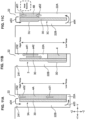
- FIG. 11A a diagram showing the flowing of the cooling water when the water pump stops in a case where a water-jacket spacer 3A provided with an expansive member 4A of a comparative example is used.
- FIG. 11A shows an example where the expansive member 4A is provided to extend over the entire length of the spacer body 30 in the Z direction.
- the cellulose-based sponge used for the expansive member 4A is not a perfect impermeable material but allows the water to pass through it to a certain extent. Further, the cooling water of the bore-side passage 22A has a tendency that the temperature of its upper side is higher than that of its lower side. Accordingly, the cooling water is going to rise inside the bore-side passage 22A . In the comparative example of FIG. 11A , even if the flow resistance of the bore-side passage 22A becomes high because of the entire-length arrangement of the expansive member 4A , the flow resistance is constant over the entire length, in the Z direction, of the bore-side passage 22A .
- FIG. 11B shows the flowing of the cooling water in a case where the spacer body 30 provided with the expansive member 4 of the present embodiment is used.
- the expansive member 4 is provided at a lower part 3D of the spacer body 30 . Therefore, the flow resistance of the bore-side passage 22A at the lower part 3D of the spacer body 30 where the expansive member 4 is provided is high, whereas the flow resistance of the bore-side passage 22A at an upper part of the spacer body 30 where no expansive member 4 is provided is low. That is, the flow resistance of the bore-side passage 22A is not constant in the Z direction but there exists a gap in the flow resistance.
- the circulating flowing of the cooling water which is generated only in the upper part of the bore-side passage 22A occurs primarily. That is, even if the flowing of the cooling water (an arrow a41 ) which is going to rise because of the heat exchange with the cylinder wall occurs, this flowing does not reach the ant-bore-side passage 22B and becomes the flowing of the cooling water (an arrow a42 ) which lowers in the upper part of the bore-side passage 22A .
- the cooling water does not flow toward the upper end of the anti-bore-side passage 22B which is a higher flow-resistance route, so that the lowering flow shown by the arrow a42 is generated.
- the cooling water substantially stays in the upper part of the bore-side passage 22A , the heat exchange with the cylinder wall decreases. That is, the natural convection of the cooling water is so suppressed from occurring that the heat retaining property of the cylinder wall can be improved.
- FIG. 11C shows the flowing of the cooling water in a case where a water-jacket spacer 3C provided with an expansive member 4B of another comparative example.
- the expansive member 4B is provided at an upper part 3U of the spacer body 30.
- This upper part 3U is an area which faces a heat-source area at the cylinder block 2.
- This heat-source area is an area where the heat is generated through the combustion inside the cylinder 21 .
- the expansive member 4B faces the above-described heat-source area, the flowing of the cooling water (an arrow a51 ) which is going to rise in the expansive member 4B is generated. There occurs the flowing of the cooling water (an arrow a52 ) which flows into the expansive member 4B from the lower part of the bore-side passage 22A by being drawn by the flowing shown by the arrow a51 . That is, the expansive member 4B becomes a starting point of occurrence of the cooling-water flowing. Further, the flow resistance of another area than the area where of the expansive member 4B is provided is relatively low.
- the lower part of the internal surface 30A of the spacer body 30 where the expansive member 4 is provided according to the present embodiment which is shown in FIG. 11B is an area which faces a portion of the internal peripheral wall 231 of the internal block 23 which is located at the lower level than the above-described heat-source area.
- the cooling water heated in the heat-source area can be made to stay in the upper part of the bore-side passage 22A which faces the heat-source area. Accordingly, the heat retaining property of the heat-source area can be improved when the water pump 11 stops.
- FIG. 12 is a sectional view showing a preferred arrangement position of the expansive member 4 .
- a piston 5 is provided to reciprocate in the Z direction inside the cylinder 21 .
- the piston 5 includes a skirt portion 51 at its lower side.
- the lower part 3D of the internal surface 30A can be set at an area which faces a portion of the external wall 232 of the internal block 23 which is located below a lower end 51B of the skirt portion 51 of the piston 5 is positioned at a top dead center.
- FIG. 12 shows an exemplified embodiment in which the expansive member 4 is provided in an area extending from a point on an extension line of the lower end 51B of the skirt portion 51 to the lower end of the spacer body 30 , that is - in all area of the lower part 3D .
- the area from the upper end of the cylinder 21 to the lower end 51B of the skirt portion 51 of the piston 5 positioned at the top dead center becomes the heat-source area where the heat caused by the combustion inside the cylinder 21 is generated. Accordingly, the heat retaining property of this heat-source area can be improved by providing the expansive member 4 at the lower part 3D so as to make the cooling water stay at a portion of the bore-side passage 22A which faces the heat-source area.
- the two parts of the expansive member 4 which are provided to face the both cylinders located at the one-end side of the cylinder line 21L and the other-end side of the cylinder line 21L are respectively provided at the lower part 3D and an upper part which is located above the lower part 3D . That is, the expansive member 4 is configured such that its first-end part 43 facing the #6 cylinder 21 positioned at the -X-end side of the cylinder line 21L and its second-end part 44 facing the #1 cylinder 21 positioned at the +X-end side of the cylinder line 21L are provided not only at the lower part 3D but at the upper part which is located above the lower part 3D .
- the #1 cylinder 21 and the #6 cylinder 21 positioned at the both ends of the cylinder line 21L do not receive the heat influence of the combustion very much, compared with the other cylinders, because they are positioned at the both ends of the cylinder line 21L .
- the #1 cylinder 21 is adjacent only to the #2 cylinder 21 and the #6 cylinder 21 is adjacent only to the #5 cylinder 21 , and these #1, #6 cylinders 21 are not interposed between the two cylinders unlike the other cylinders. Therefore, these #1, #6 cylinders 21 tend to have the lower temperature than the other #2 - #5 cylinders 21.
- the thickness, in a direction (Y direction) perpendicular to the cylinder-line direction (X direction) in a horizontal plane, of the expansive member 4 is selected according to a lateral width of the bore-side passage 22A. It is required that there occurs no gap between the expansive member 4 which has expanded and the external wall 232 of the internal block 23 in order to perfectly suppress the natural convection of the cooling water. Therefore, it is preferable that the thickness of the expansive member 4 which has not expanded yet be set so that the expansive member in its expansion state can close the gap between the inter-bore wall 25 and the bore central wall 26 and the internal surface 30A of the spacer body 30 (see FIG. 9B ).
- the water-jacket spacer 3 is arranged inside the water jacket 22 such that the Y-direction width (lateral width) d1 of the bore-side passage 22A is narrower than the Y-direction width d2 of the anti-bore-side passage 22B .
- This contributes to the suppression of the natural convection of the cooling water as well. That is, this structure is configured such that the flowing of the cooling water is not generated inside the bore-side passage 22A substantially because of the relationship of d2 > d1. Accordingly, the suppression effect of the natural convection of the cooling water by providing the expansive member 4 is achieved properly.
Landscapes
- Engineering & Computer Science (AREA)
- Chemical & Material Sciences (AREA)
- Combustion & Propulsion (AREA)
- Mechanical Engineering (AREA)
- General Engineering & Computer Science (AREA)
- Cylinder Crankcases Of Internal Combustion Engines (AREA)
Description
- The present invention relates to a cooling structure for an engine, including a water-jacket spacer which is arranged inside a water jacket of an engine block and provided to regulate flowing of cooling water. The present invention also relates to an engine and a vehicle.
- The water jacket, as a flow passage of the cooling water, is provided at the engine block of a multi-cylinder type of internal combustion engine such that the cooling water flows through a cylinder wall, that is - a bore central wall which is a peripheral wall of each cylinder and an inter-bore wall which is a wall interposed between adjacent cylinders. The water-jacket spacer provided to regulate flowing of the cooling water may be arranged inside the water jacket. The temperature of the bore central wall and the inter-bore wall can be set at a target value by regulating the cooling-water flowing.
- In general, the water-jacket spacer separates the flow passage of the cooling water into a bore-side passage which is close to the cylinders and an anti-bore-side passage which is far from the cylinders.
Japanese Patent Laid-Open Publication No. 2016-180314 - There is a concern that there may occur some natural convection which is generated between the above-described bore-side passage and the above-described anti-bore-side flow passage, which are separated by the water-jacket spacer, and causes the excessive cooling of the cylinder wall. For example, when the engine stops, the temperature of the cooling water in the bore-side passage becomes relatively high because this cooling water contacts the cylinder wall, whereas the temperature of the cooling water in the anti-bore-side passage becomes relatively low because of the heat exchange of this cooling water with the outside air. This kind of temperature difference of the cooling water may cause the natural convection occurring between the bore-side passage and the anti-bore-side passage.
- The technology of arranging the expansive member disclosed in the above-described patent document may be useful in suppression of the above-described improper natural convection. However, it has been found that the above-described arrangement of the expansive member over the range from the lower end to the upper end, in the cylinder-axis direction, of the water-jacket spacer at the position which faces the bore central wall as disclosed in the patent document is insufficient in order to perfectly suppress the natural convection of the cooling water.
-
WO 2018/225735 A1 describes a water jacket spacer that is installed in a groove-shaped coolant channel of a cylinder block of an internal combustion engine having a cylinder bore so as to be positioned along part or all of the circumference of the groove-shaped coolant channel when viewed in the circumferential direction. - An object of the present invention is to properly suppress the natural convection of the cooling water from occurring between an internal surface and an external surface of the water-jacket spacer inside the water jacket.
- The present invention is a cooling structure for an engine as defined in
claim 1. - According to the present invention, the natural convection of the cooling water can be properly suppressed from occurring between the internal surface and the external surface of the spacer body inside the water jacket by means of the expansive member which is provided at the internal surface of the spacer body. That is, the expansive member is provided to extend continuously over the range from the one-end side of the cylinder line to the other-end side of the cylinder line at the internal surface of the spacer body. Accordingly, the expansive member fills the gap between the internal surface of the spacer body and the cylinder wall of the engine block over an entire length of the cylinder line when it has expanded, so that occurring of the natural convection of the cooling water can be suppressed. Further, the expansive member is provided at the lower part (or the lower area), in the cylinder-axis direction, of the internal surface of the spacer body. Thereby, the heated cooling water can be made to stay in an upper part located above the above-described lower part of the internal space of the spacer body where the expansive member is not arranged. Accordingly, moving (flowing) of the cooling water between the internal surface of the spacer body and the external surface of the spacer body, i.e., the natural convection of the cooling water is suppressed from occurring properly, so that the heat retaining property of the cylinders can be improved.
- The cooling structure of the engine further includes a piston provided to reciprocate in the cylinder-axis direction inside each cylinder and including a skirt portion, wherein the lower part, in the cylinder-axis direction, of the internal surface of the spacer body where the expansive member is provided is an area (or a part) which is configured to face a part of the wall surface of the engine block which is located below a lower end of the skirt portion of the piston when the piston is positioned at a top dead center.
- In general, an area (or a part) from the upper end of the cylinder to the lower end of the skirt portion of the piston positioned at the top dead center becomes an area (or a part) of a heat source where the heat is generated through the combustion occurring inside the cylinder. According to the invention, since the heated cooling water can be made to stay in a part which faces this heat-source area, the heat retaining property of the hear-source area can be improved.
- In another embodiment of the present invention, the engine block comprises an inter-bore wall which is interposed between adjacent cylinders and a bore central wall which is another part of a peripheral wall of each cylinder than the inter-bore wall. Particularly, the bore central wall is a portion of the peripheral wall of each cylinder excluding the inter-bore wall. Thickness, in a direction perpendicular to the specified arrangement direction of the plural cylinders in a horizontal plane, of the expansive member in an expanded state of the expansive member is set such that the expansive member is capable to close a gap between the internal surface of the spacer body of the water-jacket spacer and the inter-bore wall and the bore central wall of the engine block. Particularly, the expansive member is configured to expand so as to close or fill a gap between the internal surface of the spacer body of the water-jacket spacer and the inter-bore wall and/or a gap between the internal surface of the spacer body of the water-jacket spacer and the bore central wall of the engine block.
- According to this embodiment, the gap between the internal surface of the spacer body and the inter-bore wall and the bore central wall of the engine block can be securely closed with the expansive member when the expansive member has expanded. Accordingly, the occurring of the natural convection of the cooling water can be securely suppressed over the entire length of the cylinder line.
- In another embodiment of the present invention, the water-jacket spacer is configured to separate a flow passage of the cooling water inside the water jacket into a bore-side passage (or an inner passage) which is close to the cylinders and an anti-bore-side passage (or an outer passage) which is far from the cylinders, and the water-jacket spacer is arranged inside the water jacket such that a lateral width of the bore-side passage is narrower than that of the anti-bore-side passage.
- According to this embodiment, since the lateral width of the bore-side passage is set to be narrower than that of the anti-bore-side passage, a structure in which the flowing of the cooling water is difficult to occur in the bore-side passage can be provided. Accordingly, the suppression performance of the natural convection by means of the expansive member can be promoted.
- In another embodiment of the present invention, a part of the expansive member which is provided to face the both cylinders located at the one-end side of the cylinder line and the other-end side of the cylinder line is provided not only at the lower part, in the cylinder-axis direction, of the internal surface of the spacer body but at an upper part of the internal surface of the spacer body which is located above the lower part.
- Since the cylinders located at the one-end side of the cylinder line and the other-end side of the cylinder line are positioned at both ends of cylinder line, these cylinders tend not to receive the heat influence caused by the combustion of the other cylinders very much. Therefore, according to this embodiment, contacting with the cooling water regarding these cylinders is properly avoided by providing the expansive member not only at the lower part, in the cylinder-axis direction, of the internal surface of the spacer body but at the upper part of the internal surface of the spacer body. Thereby, the heat retaining property of these cylinders can be improved properly.
- The present invention will become apparent from the following description which refers to the accompanying drawings.
-
-
FIG. 1 is a front view of an engine to which an engine cooling structure according to the present invention is applied. -
FIG. 2 is an exploded perspective view showing a cylinder block and a water-jacket spacer. -
FIG. 3 is a sectional view of the cylinder block in an XY plane. -
FIG. 4 is a sectional view taken along line IV-IV ofFIG. 3 . -
FIG. 5 is a sectional view taken along line V-V ofFIG. 3 . -
FIG. 6 is a perspective view of the water-jacket spacer. -
FIG. 7 is a side view of an internal-surface side of the water-jacket spacer. -
FIG. 8A is a sectional view showing flowing of cooling water when a water pump operates,FIG. 8B is a sectional view showing natural convection of the cooling water when the water pump stops. -
FIG. 9A is a sectional view showing a state before an expansive member provided at the water-jacket spacer expands,FIG. 9B is a sectional view showing a state after the expansive member expands. -
FIG. 10 is a side view of the internal-surface side of the water-jacket spacer, which shows relationships with cylinders. -
FIGS. 11A - 11C are diagrams showing the flowing of the cooling water when the water pump stops in cases where respective expansive members of comparative examples and the present embodiment are used. -
FIG. 12 is a sectional view showing a preferred arrangement position of the expansive member provided at the water-jacket spacer. - Hereafter, an embodiment of the present invention will be specifically described referring to the drawings. All of the features as shown in the drawings may not necessarily be essential.
FIG. 1 is a front view of anengine 1 to which an engine cooling structure according to the present invention is applied. Theengine 1 which is installed to or mounted on a vehicle as a driving power source is a multi-cylinder four-cycle diesel engine, for example. - The
engine 1 comprises anengine body 10 which includes a cylinder block 2 (engine block;FIG. 2 ) provided with plural cylinders, a cylinder head mounted onto an upper face of thecylinder block 2, and pistons stored inside the cylinders. Theengine 1 is arranged longitudinally or laterally at the vehicle. In a case of the engine's longitudinal arrangement, a Y direction shows a lateral direction, whereas a Z direction shows a vertical direction (+Z = upper, -Z = lower) inFIG. 1 . The cylinder head is particularly provided above thecylinder block 2 when theengine 2 is mounted on the vehicle. - The
engine 1 is equipped with awater pump 11 for compulsorily circulating cooling water (or coolant) into theengine body 10. Thewater pump 11 is an impeller type of pump with an impeller to pressurize and supply the cooling water. Thewater pump 11 is driven by a driving force generated by theengine body 10. That is, the driving force of a crankshaft provided at theengine body 10 is transmitted to thewater pump 11 via acrank pulley 12 which is attached to the crankshaft and astretch belt 13 which is stretched between thewater pump 11 and thecrank pulley 12. -
FIG. 1 shows a cooling-water inlet 14 to introduce the cooling water into theengine body 10 and a cooling-water outlet 15 to discharge the cooling water flowing through a flow passage formed inside theengine body 10. Thewater pump 11 is set into the flow passage of the cooling water. Herein, the cooling water not only flows down the flow passage of theengine body 10 but circulates in a circulating passage extending through a heater unit for heating, a radiator for heat radiation, and so on. -
FIG. 2 is an exploded perspective view showing a part of the flow passage which is positioned at thecylinder block 2 of theengine body 10.FIG. 2 shows thecylinder block 2 and a water-jacket spacer 3 which is installed to thecylinder block 2. Thecylinder block 2 comprises acylinder line 21L where one or more cylinders, particularly sixcylinders 21 are arranged in the X direction (specified direction) in line and awater jacket 22 which is a drain (groove) provided to surround thecylinder line 21L. Thewater jacket 22 forms the flow passage of the cooling water at thecylinder block 2. Herein, the X direction is a longitudinal direction of the vehicle in a case where theengine 1 is arranged longitudinally. The water-jacket spacer 3 is arranged inside thewater jacket 22. - The
cylinder block 2 is a substantially rectangular-parallelepiped block which in elongated in the X direction. A block-side inlet 14H which is an inlet of the cooling water flowing to thecylinder block 2 is provided at a side face (or a lateral side face) of thecylinder block 2 which is positioned on the -X side. The block-side inlet 14H is connected to the cooling-water inlet 14 shown inFIG. 1 . The cooling water flows into thewater jacket 22 from the block-side inlet 14 by being pressurized and supplied by thewater pump 11. Then, as shown by an arrow FL, the cooling water flows inside thewater jacket 22 from the -X-side side face of thecylinder block 2 toward the +X-side side face of thecylinder block 2. That is, thewater jacket 22 is the flow passage where the cooling water flows from a one-end side of thecylinder line 21L (the -X side) to the other-end side face of thecylinder line 21L (the +X side). - The cylinder head, not illustrated, is mounted onto the upper face (+Z face) of the cylinder block such that it closes over an upper-face opening of each cylinder of the
cylinder line 21L. The cylinder head is provided with an intake port and an intake valve to supply intake air to eachcylinder 21 and an exhaust port and an exhaust valve to exhaust combustion gas from eachcylinder 21.FIG. 2 shows indications of an "intake side" where the respective intake valves are arranged and an "exhaust side" where the respective exhaust valves are arranged relative to an arrangement line of thecylinder line 21L (a line of the X direction). Thewater jacket 22 includes an intake-side jacket 22IN which is positioned on the intake side of thecylinder line 21L and an exhaust-side jacket 22EX of thecylinder line 21L. - The
cylinder block 2 will be described further specifically.FIG. 3 is a sectional view of thecylinder block 2 in an XY plane.FIG. 4 is a sectional view taken along line IV-IV ofFIG. 3 , andFIG. 5 is a sectional view taken along line V-V ofFIG. 3 . Thecylinder block 2 includes aninternal block 23 and anoutside block 24 which is provided to surround theinternal block 23. As shown inFIGS. 4 and5 , theinternal block 23 includes an internalperipheral wall 231 which is a cylindrical wall surface partitioning thecylinder 21 and anexternal wall 232 which is a wall surface partitioning an internal surface of thewater jacket 22. - The
internal block 23 further comprises aninter-bore wall 25 and a borecentral wall 26. Theinter-bore wall 25 is a wall positioned in an area P1 substantially shown inFIG. 3 , which is interposed betweenadjacent cylinders 21 in the X direction at thecylinder block 2. Theinter-bore wall 25 receives heat from a heat source of the twoadjacent cylinders 21, so that the temperature of thiswall 25 tends to become high. The borecentral wall 26 is a wall positioned in an area P2 substantially shown inFIG. 3 , which is another part of a peripheral wall of thecylinder 21 than theinter-bore wall 25. That is, a pair of arc-shaped walls, positioned on the +Y side and the -Y side, of eachcylinder 21 which is not positioned at both-side ends of thecylinder line 21L constitute (form) the bore-central wall 26, whereas another pair of arc-shaped walls, positioned on the +X side and the -X side, of eachcylinder 21 constitute (form) theinter-bore wall 25. Aliner 211 on which the piston, not illustrated, slides is arranged at the internalperipheral wall 231 of theinternal block 23. - Referring to
FIG. 5 , across drill 27 as a flow passage of the cooling water is formed at theinter-bore wall 25. Thecross drill 27 is provided to cool theinter-bore wall 25 which tends to have a high temperature, which is a penetrating hole extending across theinter-bore wall 25 in the Y direction (a direction perpendicular to a cylinder-line direction in a horizonal plane). Thecross drill 27 has a flow-passage shape in which anupstream drill hole 271 which extends obliquely downwardly from the +Y side to the -Y side and adownstream drill hole 272 which extends obliquely downwardly from the Y side to the +Y side join (merge) at a downstream side (a joining portion 275). A large-sized introduction opening 273 is provided at an upper end of theupstream drill hole 271, and a large-sized exit opening 274 is provided at an upper end of thedownstream drill hole 272. - An
inlet hole 28 is formed near an upper end of theexternal wall 232 of theinternal block 23 which partitions the exhaust-side jacket 22EX. Theinlet hole 28 is a hole for introducing the cooling water into thecross drill 27, which is connected to the introduction opening 273 of thecross drill 27. Meanwhile, the exit opening 274 of thecross drill 27 is not directly connected to the intake-side jacket 22IN. Theexit opening 274 is connected to a water jacket which is provided at the cylinder head, not illustrated. Theinter-bore wall 25 is configured such that its exhaust side has a higher temperature than its intake side. Accordingly, the exhaust side of theinter-bore wall 25 which tends to have the high temperature can be properly cooled by providing theinlet hole 28 at theexternal wall 232 partitioning the exhaust-side jacket 22EX. - The
external block 24 includes aninternal wall 241 which is a wall surface partitioning an internal surface of thewater jacket 22. A gap between thisinternal wall 241 and theexternal wall 232 of theinternal block 23 is a space of thewater jacket 22 where the cooling water flows. The thickness of theinternal block 23 is substantially constant in a radial direction of thecylinder 21, except theinter-bore wall 25. Accordingly, theexternal wall 232 of theinternal block 23 has an uneven curved-surface shape along a contour of the six cylinders aligned in the X direction in a top view. That is, a part of theexternal wall 232 around theinter-bore wall 25 has an inwardly-concave curved surface, whereas another part of theexternal wall 232 around the borecentral wall 26 has an outwardly-convex curved surface. Theinternal wall 241 of theexternal block 24 has also an uneven curved-surface shape which corresponds to the uneven curved-surface shape of theexternal wall 232. Accordingly, a gap between theinternal wall 241 and theexternal wall 232 is nearly or substantially constant in an extensive direction (X direction) of thewater jacket 22. - The water-
jacket spacer 3 has an uneven curved-surface shape which corresponds to the uneven curved-surface shape of theinternal wall 241 and theexternal wall 232 as well. The water-jacket spacer 3 is arranged inside thewater jacket 22 and separates the flow passage of the cooling water inside thewater jacket 22 into a bore-side passage (or an inner passge) 22A and an anti-bore-side passage (or an outer passage) 22B. The bore-side passage 22A is the passage which is close to thecylinder 21 in the radial direction of thecylinder 21. The anti-bore-side passage 22B is the passage which is positioned on the outside of the bore-side passage 22A and far from thecylinder 21. Particularly, the anti-bore-side passage 22B is located around the bore-side passage 22A in the radial direction of thecylinder 21. - The water-
jacket spacer 3 performs regulating of the flowing of the cooling water inside thewater jacket 22 when thewater pump 11 operates (during compulsory circulation of the cooling water). Further, the water-jacket spacer 3 is provided with anexpansive member 4 to suppress the natural convection of the cooling water from occurring when thewater pump 11 stops. Hereafter, the water-jacket spacer 3 will be described specifically. -
FIG. 6 is a perspective view of the water-jacket spacer 3. The water-jacket spacer 3 comprises aspacer body 30 and theexpansive member 4 provided at thespacer body 30. - The
spacer body 30 particularly has a cylindrical shape surrounding thecylinder line 21L, i.e., a convex surface and a concave surface which are respectively shaped along an outer-peripheral shape of thecylinder line 21L. Thespacer body 30 includes aninternal surface 30A facing the cylinders 21 (the internal block 23) and anexternal surface 30B positioned on an opposite side to theinternal surface 30A and facing theexternal block 24 in a state where thespacer body 30 is arranged inside thewater jacket 22. - An upper-
end flange 301 is provided at an upper end (+Z end) of thespacer body 30, and a lower-end flange 304 is provided at a lower end (-Z end) of thespacer body 30. Theseflanges jacket spacer 3 inside thewater jacket 22, forming a desirable cooling-water flowing, and so on. Aninlet flange 302 is formed at an upstream-end side, in the cooling-water flow direction shown by the arrow FL, of the upper-end flange 301. Meanwhile, acutout portion 303 is formed at a downstream-end side of the upper-end flange 301. The cooling water is introduced into the water jacket arranged inside the cylinder head, not illustrated through thiscutout portion 303. - The water-
jacket spacer 3 comprises an intake-side spacer 3IN positioned on the +Y side and an exhaust-side spacer 3EX positioned on the -Y side. The intake-side spacer 3IN is a spacer portion arranged inside the intake-side jacket 22IN of thewater jacket 2, and the exhaust-side spacer 3EX is another spacer portion arranged inside the exhaust-side jacket 22EX of thewater jacket 2. The intake-side spacer 3IN and the exhaust-side spacer 3EX are respectively provided with thespacer body 30 and theextensive member 4. - The
spacer body 30 comprises acentral spacer portion 31 and aninter-bore spacer portion 32. Thecentral spacer portion 31 is a portion which protrudes in a convex shape in the +Y direction or the -Y direction according to the external shape of thecylinder 21. Specifically, thecentral spacer portion 31 protrudes in the convex shape in the +Y direction at the intake-side spacer 3IN, and thecentral spacer portion 31 protrudes in the convex shape in the Y direction at the exhaust-side spacer 3EX. Theinter-bore spacer portion 32 is a portion which is curved in a concave shape in the Y direction at the intake-side spacer 3IN or curved in the concave shape in the +Y direction at the exhaust-side spacer 3EX. The intake-side spacer 3IN and the exhaust-side spacer 3EX are connected to each other at the +X-side end portion and the -X-side end portion and these are integrated. In the state where the water-jacket spacer 3 is arranged inside thewater jacket 22, thecentral spacer portion 31 faces the borecentral wall 26 of theinternal block 23 and theinter-bore spacer portion 32 faces theinter-bore wall 25 of theinternal bock 23. - As described above, the
water jacket 22 is formed in the drain (groove) shape such that it is partitioned by the external wall of theinternal block 23 and theinternal wall 241 of theexternal block 24 and its upper end is open. In the Y-direction section shown inFIGS. 4 and5 , thewater jacket 22 has a U-shaped drain (groove) shape which is elongated in the vertical direction (the Z direction). The water-jacket spacer 3 is inserted into thiswater jacket 22, thereby separating the flow passage of the cooling water into the bore-side passage 22A and the anti-bore-side passage 22B inside thewater jacket 22. The bore-side passage 22A is a passage which is formed between theinternal surface 30A of thespacer body 30 and theexternal wall 232 of theinternal block 23. The anti-bore-side passage 22B is another passage which is formed between theexternal surface 30B of thespacer body 30 and theinternal wall 241 of theexternal block 24. - In the present embodiment, the water-
jacket spacer 3 separates the flowing of the cooling water inside thewater jacket 22 such that a mainstream of the cooling water is formed at the anti-bore-side passage 22B. That is, the flowing of the cooling water is formed aggressively in the anti-bore-side passage 22B (mainstream forming), whereas the flowing of the cooling water is regulated by the water-jacket spacer 3 in the bore-side passage 22A so that the flowing of the cooling water is not formed aggressively. This flowing regulating is executed because thecylinder 21 is so overcooled by the aggressive forming of the cooling-water flowing in the bore-side passage 22A which is close to thecylinder 21 that a cooling loss may be caused improperly. - Therefore, a lateral width of the bore-
side passage 22A is set to be narrower than that of the anti-bore-side passage 22B. Specifically, referring toFIG. 4 , the water-jacket spacer 3 is arranged in thewater jacket 22 such that a relationship d2 > d1 is satisfied, wherein d1 denotes the width (lateral width), in the Y direction, of the bore-side passage 22A and d2 denotes the width (lateral width), in the Y direction, of the anti-bore-side passage 22B. The Y-direction width d1 of the bore-side passage 22A is a gap between theinternal surface 30A and theexternal wall 232. The Y-direction width d2 of the anti-bore-side passage 22B is a gap between theexternal surface 30B and theinternal wall 241. For example, a value of the width d2 can be selected from a range from about 1. 5 - 4 times of a value of the width d1. - When the width d2 is sufficiently larger than the width d1, the flow resistance of the cooling water of the anti-bore-
side passage 22B becomes lower than that of the bore-side passage 22A. Therefore, in a case where the cooling water is supplied in the arrow FL direction at a specified supply pressure from the block-side inlet 14H (FIG. 3 ), the cooling-water flowing is formed in the anti-bore-side passage 22B primarily. In the bore-side passage 22A having the higher flow resistance of the cooling water, the flowing of the cooling water becomes relatively gentle. Accordingly, it can be suppressed that thecylinder 21 is excessively cooled. - The
expansive member 4 is a member which is provided at theinternal surface 30A of thespacer body 30 and configured to be expandable according to an external factor. In the present embodiment, a material which is expandable according to its contacting with the water is applied to theexpansive member 4. Theexpansive member 4 is made of cellulose-based sponge which is configured to recover to its pre-compressed state from its compressed state through its contacting with the cooling water flowing inside thewater jacket 22. The cellulose-based sponge is a natural material which comprises cellulose made from pulp and natural fiber added as reinforcing fiber and is porous. Any other material than the cellulose-based sponge, such as the one made of foamed rubber which has been fixed in a compressed state by means of water-soluble binder, is applicable. Alternatively, a material which is expandable in response to the heat can be used. -
FIG. 7 is a side view of theinternal surface 30A of thespacer body 30 where theextensive member 4 is provided. Theexpansive member 4 is provided at a lower part (or a lower area) (-Z side), in the cylindrical-axis direction (Z direction, or a vertical direction), of theinternal surface 30A of thespacer body 30. Theexpansive member 4 is further provided at theinternal surface 30A of thespacer body 30 such that theexpansive member 4 extends continuously over a range from an one-end side of thecylinder line 21L to the other-end side of thecylinder line 21L. Particularly, theexpansive member 4 extends continuously from the end (or the front end) of the first cylinder to the end (or the rear end) of the sixth cylinder. Theexpansive member 4 comprises a concave-surface part 41 and a convex-surface part 42. - The concave-
surface part 41 of theexpansive member 4 is provided at the concave surface of thespacer body 30. The convex-surface part 42 of theexpansive member 4 is provided at the convex surface of thespacer body 30. In the present embodiment, since theexpansive member 4 is provided at theinternal surface 30A, the concave surface is theinternal surface 30A of thecentral spacer portion 31 and the convex surface is theinternal surface 30A of theinter-bore spacer portion 32. Accordingly, the concave-surface part 41 is provided to adhere to a lower part of thecentral spacer portion 31, and the convex-surface part 42 is provided to adhere to a lower part of theinter-bore spacer portion 32. - The
expansive member 4 is formed integrally with thespacer body 30 by an insert-molding process, for example. That is, the water-jacket spacer 3 can be manufactured by conducting the insert-molding process to thespacer body 30 in a state where the cellulose-based sponge is set in a shaping mold. Alternatively, theexpansive member 4 may be attached to theinternal surface 30A by a screw-attachment process, an adhesive agent, or the like in a state where the cellulose-based sponge is formed in a sheet-peace manner. The concave-surface part 41 of theexpansive member 4 is set to have a slightly wider than the convex-surface part 42 in the Z-direction width. That is, the +Z end of the convex-surface part 42 is located at a lower level than the +Z end of the concave-surface part 41, and the -Z end of the convex-surface part 42 is located at a higher level than the -Z end of the concave-surface part 41. Theseparts internal surface 30A in a state where theseparts expansive member 4 will be described specifically later. - Subsequently, the flowing of the cooling water inside the
water jacket 22 will be described. The flowing of the cooling water in a case where no expansive member is provided at thespacer body 30 will be described referring toFIGS. 8A, 8B first.FIG. 8A is a sectional view showing the flowing of cooling water when thewater pump 11 operates, andFIG. 8B is a sectional view showing the flowing (natural convection) of the cooling water when thewater pump 11 stops. - When the
water pump 11 starts operating, the compulsory circulation of the cooling water starts in a circulation passage of the cooling water flowing in theengine body 10 as shown by the arrow FL ofFIG. 2 . As described previously, the water-jacket spacer 3 partitions the space inside thewater jacket 22 such that the anti-bore-side passage 22B is wider than the bore-side passage 22A. Accordingly, since the flow resistance of the bore-side passage 22A is relatively large, the cooling water flows in the anti-bore-side passage 22B primarily when thewater pump 11 operates. - The cooling water flows into the bore-
side passage 22A from the anti-bore-side passage 2B such that the cooling water flows over the upper-end flange 301 of thespacer body 30 as shown by an arrow a1 inFIG. 8A . That is, the cooling water flows into the bore-side passage 22A from the anti-bore-side passage 22B through a gap between theinternal wall 241 and the upper-end flange 301 and then flows in the he bore-side passage 22A. The amount of cooling water flowing in the bore-side passage 22A is smaller than that of cooling water flowing in the anti-bore-side passage 22B. - In the exhaust-side jacket 22EX having the
inlet hole 28 of thecross drill 27, the flowing of the cooling water shown by the arrow a1 is promoted. That is, a suction force to suck the cooling water is generated at theinlet hole 28. This suction force forces the cooling water to be drawn into the bore-side passage 22A from the anti-bore-side passage 22B. - Meanwhile, when the
water pump 11 stops because of an engine stop, execution of a water-stop mode during engine worming-up, or the like, the above-described compulsory circulation of the cooling water stops. Since the cooling water contacts the internal block 23 (theinter-bore wall 25 and the bore central wall 26) which is the cylinder wall during the engine stop, the temperature of the cooling water becomes relatively high. Meanwhile, the temperature of the cooling water in the anti-bore-side passage 22B becomes relatively low because of the heat exchange of the cooling water with the outside air. This kind of temperature difference of the cooling water may cause the natural convection occurring between the bore-side passage 22A and the anti-bore-side passage 22B. - As shown in
FIG. 8B , the specific gravity of the cooling water in the bore-side passage 22A becomes lighter because its temperature increases, so that this cooling water rises in the bore-side passage 22A as shown by an arrow a21. To the contrary, the specific gravity of the cooling water in the anti-bore-side passage 22B becomes heavier because its temperature decreases, so that this cooling water rises in the anti-bore-side passage 22B as shown by an arrow a23. Consequently, a flow movement of the cooling water occurs at theupper end 3T of the water-jacket spacer 3 such that the cooling water flows into the anti-bore-side passage 22B from the bore-side passage 22A as shown by an arrow a22. Meanwhile, another flow movement of the cooling water occurs at thelower end 3B of the water-jacket spacer 3 such that the cooling water flows into the bore-side passage 22A from the anti-bore-side passage 22B as shown by an arrow a24. That is, there occurs the natural convection of the cooling water which flows as shown by the rows a21, a22, a23 and a24. - If the above-described natural convection of the cooling water occurs during the engine stop, the cylinder wall may be cooled. That is, if the movement of the cooling water is generated due to the natural convection occurring in the bore-
side passage 22A, the heat of the borecentral wall 26 and theinter-bore wall 25 is extracted, so that thesewalls expansive member 4 provided at theinternal surface 30A of thespacer body 30. -
FIG. 9A is a sectional view showing a state before theexpansive member 4 provided at the water-jacket spacer 3 expands, andFIG. 9B is a sectional view showing a state after theexpansive member 4 expands.FIG. 9A shows a state where the water-jacket spacer 3 provided with theexpansive member 4 is arranged inside thewater jacket 22 when the cooling water has not been supplied inside thewater jacket 22, for example, in an assembling process of the engine body. In this case, since theexpansive member 4 has not expanded yet, a worker can easily assemble (insert) the water-jacket spacer 3 into thewater jacket 22. Further, a gap is generated between theexpansive member 4 and theexternal wall 232 of theinternal block 23 after this assembling of the water-jacket spacer 3. -
FIG. 9B shows a state after the cooling water has been supplied into thewater jacket 22. Theexpansive member 4 expands through its contracting with the cooling water, so that the lateral width thereof increases. A right surface of theexpansive member 4 contacts theexternal wall 232 of theinternal block 23, so that a lower part of the bore-side passage 22A is substantially closed. Consequently, the natural convection of the cooling water which occurs during the engine stop or in the stop mode of thewater pump 11, which is shown inFIG. 8B , is suppressed. That is, since the lower part of the bore-side passage 22A is closed by theexpansive member 4, the flow movement of the cooling water, like the circulation through the bore-side passage 22A and the anti-bore-side passage 22B, is not generated. Accordingly, thecylinder 21 can be suppressed from being excessively cooled (i.e., overcooled) during the engine stop or the like. - As described above, the
expansive member 4 is provided at theinternal surface 30A of the water-jacket spacer 3 such that it extends continuously over the range from the one-end side of thecylinder line 21L to the other-end side of thecylinder line 21L at the lower part, in the cylinder-axis direction, of theinternal surface 30A of the water-jacket spacer 3. Hereafter, the arrangement of theexpansive member 4 will be described specifically.FIG. 10 is a side view of the internal-surface side 30A of the water-jacket spacer 3, which shows relationships withcylinders 21. InFIG. 10 , thecylinder line 21L including the #1 - #6cylinders 21 is shown by an imaginary line. Theexpansive member 4 comprises the concave-surface part 41, the convex-surface part 42, a first-end part 43 which faces the #6cylinder 21 positioned at the - X-end side of thecylinder line 21L, and a second-end part 44 which faces the #1cylinder 21 positioned at the +X-end side of thecylinder line 21L. - First of all, it is required in order to perfectly suppress the natural convection of the cooling water that the
expansive member 4 is provided at the water-jacket spacer 3 such that it extends continuously over the range from the one-end side (+X) of thecylinder line 21L to the other-end side (-X) of thecylinder line 21L. This is because if an expansive-member missing part where no expansive member is provided exists in the X direction, the natural convection of the cooling water shown inFIG. 8B may be generated by way of this missing part. - Therefore, according to the
expansive member 4 of the present embodiment, the concave-surface part 41 and the convex-surface part 42 are continuously provided to be close to each other, having no gap therebetween, in the X direction in an area which faces the #2 cylinder 21- the #5cylinder 21. The second-end part 44 facing the #1cylinder 21 is provided at the +X side of this continuous body of the concave-surface part 41 and the convex-surface part 42, and the first-end part 43 facing the #6cylinder 21 is provided at the -X side of this continuous body of the concave-surface part 41 and the convex-surface part 42. Accordingly, theexpansive member 4 which extends continuously over an entire length of the area facing the #1 - #6cylinders 21 is provided. Thus, by arranging the water-jacket spacer 3 provided with the above-describedexpansive member 4 inside thewater jacket 22, theexpansive member 4 which has expanded so fills the gap of the bore-side passage 22A over the entire length of thecylinder line 21L that the natural convection of the cooling water can be suppressed from occurring. - Next, the meaning of arranging the
expansive member 4 at the lower part, in the cylinder-axis direction, of theinternal surface 30A of thespacer body 30 will be described. In order to suppress the natural convection of the cooling water between the bore-side passage 22A and the anti-bore-side passage 22B, it may be enough to arrange theexpansive member 4 in any one of the bore-side passage 22A and the anti-bore-side passage 22B so as to close the circulation passage of the cooling water. However, if theexpansive member 4 is arranged in the anti-bore-side passage 22B (on the side of theexternal surface 30B of the spacer body 30), the movement (flowing) of the cooling water in the anti-bore-side passage 22B stagnates, so that the cooling water flows in the bore-side passage 22A. In this case, since the cylinder wall including theinter-bore wall 25 and the borecentral wall 26 is cooled excessively (overcooled), this situation is not good. Accordingly, it is preferable that theexpansive member 4 be arranged in the bore-side passage 22A (on the side of theinternal surface 30A of the spacer body 30). - The place where the
expansive member 4 is to be arranged at the bore-side passage 22A will be described referring toFIG. 11A - 11C. FIG. 11A a diagram showing the flowing of the cooling water when the water pump stops in a case where a water-jacket spacer 3A provided with anexpansive member 4A of a comparative example is used.FIG. 11A shows an example where theexpansive member 4A is provided to extend over the entire length of thespacer body 30 in the Z direction. - The cellulose-based sponge used for the
expansive member 4A is not a perfect impermeable material but allows the water to pass through it to a certain extent. Further, the cooling water of the bore-side passage 22A has a tendency that the temperature of its upper side is higher than that of its lower side. Accordingly, the cooling water is going to rise inside the bore-side passage 22A. In the comparative example ofFIG. 11A , even if the flow resistance of the bore-side passage 22A becomes high because of the entire-length arrangement of theexpansive member 4A, the flow resistance is constant over the entire length, in the Z direction, of the bore-side passage 22A. Therefore, as shown by arrows a31, a32 in the figure, once the water flowing penetrating theexpansive member 4A is generated, the natural convection occurs. That is, there occurs the flowing of the cooling water (an arrow a33) which is directed from a lower end of the anti-bore-side passage 22B toward the bore-side passage 22A at the lower side of thespacer body 30 by being drawn by the flowing shown by the arrow a31. At the upper part of thespacer body 30, meanwhile, there occurs the flowing of the cooling water (an arrow a34) which is directed from the bore-side passage 22A toward the anti-bore-side passage 22B having the lower flow resistance. Thus, the natural convection of the cooling water circulating as shown by the arrows a31, a32, a34, a33 may occur even though this circulating flowing is not so strong. -
FIG. 11B shows the flowing of the cooling water in a case where thespacer body 30 provided with theexpansive member 4 of the present embodiment is used. In the present embodiment, theexpansive member 4 is provided at alower part 3D of thespacer body 30. Therefore, the flow resistance of the bore-side passage 22A at thelower part 3D of thespacer body 30 where theexpansive member 4 is provided is high, whereas the flow resistance of the bore-side passage 22A at an upper part of thespacer body 30 where noexpansive member 4 is provided is low. That is, the flow resistance of the bore-side passage 22A is not constant in the Z direction but there exists a gap in the flow resistance. - In the case of the present embodiment shown in
FIG. 11B , the circulating flowing of the cooling water which is generated only in the upper part of the bore-side passage 22A occurs primarily. That is, even if the flowing of the cooling water (an arrow a41) which is going to rise because of the heat exchange with the cylinder wall occurs, this flowing does not reach the ant-bore-side passage 22B and becomes the flowing of the cooling water (an arrow a42) which lowers in the upper part of the bore-side passage 22A. If theexpansive member 4 is not arranged at thelower part 3D of the bore-side passage 22A, once the flowing shown by the arrow a41 occurs, a circulating passage where the water flowing goes in to the upper end of the anti-bore-side passage 22B and then returns to the bore-side passage 22A from the lower end of the anti-bore-side passage 22B is generated. According to the present embodiment, however, since theexpansive member 4 is provided, the flow resistance of the above-described circulating passage becomes high. Accordingly, when the rising flow shown by the arrow a41 is generated, the cooling water does not flow toward the upper end of the anti-bore-side passage 22B which is a higher flow-resistance route, so that the lowering flow shown by the arrow a42 is generated. In this case, since the cooling water substantially stays in the upper part of the bore-side passage 22A, the heat exchange with the cylinder wall decreases. That is, the natural convection of the cooling water is so suppressed from occurring that the heat retaining property of the cylinder wall can be improved. - Herein, while it may be considered that the
expansive member 4 is arranged only in the upper part of the bore-side passage 22A, this arrangement cannot suppress the natural convection from occurring.FIG. 11C shows the flowing of the cooling water in a case where a water-jacket spacer 3C provided with anexpansive member 4B of another comparative example. In the comparative example ofFIG. 11C , theexpansive member 4B is provided at anupper part 3U of thespacer body 30. Thisupper part 3U is an area which faces a heat-source area at thecylinder block 2. This heat-source area is an area where the heat is generated through the combustion inside thecylinder 21. - In this case, since the
expansive member 4B faces the above-described heat-source area, the flowing of the cooling water (an arrow a51) which is going to rise in theexpansive member 4B is generated. There occurs the flowing of the cooling water (an arrow a52) which flows into theexpansive member 4B from the lower part of the bore-side passage 22A by being drawn by the flowing shown by the arrow a51. That is, theexpansive member 4B becomes a starting point of occurrence of the cooling-water flowing. Further, the flow resistance of another area than the area where of theexpansive member 4B is provided is relatively low. Accordingly, there occurs the flowing of the cooling water (an arrow a54) which is directed from the bore-side passage 22A toward the anti-bore-side passage 22B at the upper-end side of thespacer body 30. At the lower-end side of thespacer body 30, meanwhile, there occurs the flowing of the cooling water (an arrow a54) which is directed from the lower end of the anti-bore-side passage 22B toward the bore-side passage 22A. Accordingly, the naturel convection of the cooling water circulating as shown by the arrows a51, a53, a54, a52 may occur. Therefore, it is preferable that theexpansive member 4 be provided at thelower part 3D of thespacer body 30. - The lower part of the
internal surface 30A of thespacer body 30 where theexpansive member 4 is provided according to the present embodiment which is shown inFIG. 11B is an area which faces a portion of the internalperipheral wall 231 of theinternal block 23 which is located at the lower level than the above-described heat-source area. Thereby, as show inFIG. 11B , the cooling water heated in the heat-source area can be made to stay in the upper part of the bore-side passage 22A which faces the heat-source area. Accordingly, the heat retaining property of the heat-source area can be improved when thewater pump 11 stops. - Specifically, the above-described
lower part 3D can be set in a relationship with the piston arranged in thecylinder 21.FIG. 12 is a sectional view showing a preferred arrangement position of theexpansive member 4. Apiston 5 is provided to reciprocate in the Z direction inside thecylinder 21. Thepiston 5 includes askirt portion 51 at its lower side. Thelower part 3D of theinternal surface 30A can be set at an area which faces a portion of theexternal wall 232 of theinternal block 23 which is located below alower end 51B of theskirt portion 51 of thepiston 5 is positioned at a top dead center. -
FIG. 12 shows an exemplified embodiment in which theexpansive member 4 is provided in an area extending from a point on an extension line of thelower end 51B of theskirt portion 51 to the lower end of thespacer body 30, that is - in all area of thelower part 3D. In general, the area from the upper end of thecylinder 21 to thelower end 51B of theskirt portion 51 of thepiston 5 positioned at the top dead center becomes the heat-source area where the heat caused by the combustion inside thecylinder 21 is generated. Accordingly, the heat retaining property of this heat-source area can be improved by providing theexpansive member 4 at thelower part 3D so as to make the cooling water stay at a portion of the bore-side passage 22A which faces the heat-source area. - Referring to
FIG. 10 , the two parts of theexpansive member 4 which are provided to face the both cylinders located at the one-end side of thecylinder line 21L and the other-end side of thecylinder line 21L are respectively provided at thelower part 3D and an upper part which is located above thelower part 3D. That is, theexpansive member 4 is configured such that its first-end part 43 facing the #6cylinder 21 positioned at the -X-end side of thecylinder line 21L and its second-end part 44 facing the #1cylinder 21 positioned at the +X-end side of thecylinder line 21L are provided not only at thelower part 3D but at the upper part which is located above thelower part 3D. - The #1
cylinder 21 and the #6cylinder 21 positioned at the both ends of thecylinder line 21L do not receive the heat influence of the combustion very much, compared with the other cylinders, because they are positioned at the both ends of thecylinder line 21L. Specifically, the #1cylinder 21 is adjacent only to the #2cylinder 21 and the #6cylinder 21 is adjacent only to the #5cylinder 21, and these #1, #6cylinders 21 are not interposed between the two cylinders unlike the other cylinders. Therefore, these #1, #6cylinders 21 tend to have the lower temperature than the other #2 - #5cylinders 21. It is avoided to make the cylinder wall (internal block 23) partitioned the #1cylinder 21 and the #6cylinder 21 contact the cooling water by providing theexpansive member 4 not only at thelower part 3D but at the upper part. Thereby, the heat retaining of the #1cylinder 21 and the #6cylinder 21 can be achieved. - The thickness, in a direction (Y direction) perpendicular to the cylinder-line direction (X direction) in a horizontal plane, of the
expansive member 4 is selected according to a lateral width of the bore-side passage 22A. It is required that there occurs no gap between theexpansive member 4 which has expanded and theexternal wall 232 of theinternal block 23 in order to perfectly suppress the natural convection of the cooling water. Therefore, it is preferable that the thickness of theexpansive member 4 which has not expanded yet be set so that the expansive member in its expansion state can close the gap between theinter-bore wall 25 and the borecentral wall 26 and theinternal surface 30A of the spacer body 30 (seeFIG. 9B ). - Herein, in the present embodiment, the water-
jacket spacer 3 is arranged inside thewater jacket 22 such that the Y-direction width (lateral width) d1 of the bore-side passage 22A is narrower than the Y-direction width d2 of the anti-bore-side passage 22B. This contributes to the suppression of the natural convection of the cooling water as well. That is, this structure is configured such that the flowing of the cooling water is not generated inside the bore-side passage 22A substantially because of the relationship of d2 > d1. Accordingly, the suppression effect of the natural convection of the cooling water by providing theexpansive member 4 is achieved properly. - The present invention should not be limited to the above-described embodiment and any other modifications or improvements may be applied within the scope of a spirit of the present invention.
- (1) The above-described embodiment exemplified the case where the
expansive member 4 is provided at theinternal surface 30A of thespacer body 30 such an upper end of theexpansive member 4 is located on the extension line of thelower end 51B of the skirt portion 51 (FIG. 12 ). In place of this case, theexpansive member 4 may be provided such that its upper end is located at a lower level than the extension line of thelower end 51B of theskirt portion 51. - (2) The above-described embodiment exemplified the case, as shown in
FIGS. 7 and10 , where the Z-direction width of the convex-surface part 42 of theexpansive member 4 is narrower than that of the concave-surface part 41. Alternatively, the both Z-direction widths of thesesurface parts surface parts spacer body 30, thesesurface parts spacer body 30. - (3) Regarding the bore-
side passage 22A and the anti-bore-side passage 22B which are partitioned by the water-jacket spacer 3 in the above-described embodiment, the relationship d2 > d1 is satisfied such that the flowing of the cooling water is primarily formed in the anti-bore-side passage 22B as shown inFIG. 4 . However, this was merely one example, and the respective widths of thesepassages jacket spacer 3, and others can be set properly according to a cooling control strategy of theengine body 10.
Claims (14)
- A cooling structure for an engine (1), comprising:an engine block (2) provided with a wall surface (231) which partitions a cylinder line (21L) including plural cylinders (21) arranged in a specified direction (X) and a water jacket (22) provided to surround the cylinder line (21L) and allow cooling water to flow therein; anda water-jacket spacer (3) arranged inside the water jacket (22) and provided to regulate flowing of the cooling water in the water jacket (22),wherein the water-jacket spacer (3) comprises a spacer body (30) which has a shape along an outer-peripheral shape of the cylinder line (21L) and includes an internal surface (30A) facing the cylinders (21) and an external surface (30B) positioned on an opposite side to the internal surface (30A), andan expansive member (4) configured to be expandable according to an external factor is provided at the internal surface (30A) of the spacer body (30) of the water-jacket spacer (3) such that the expansive member (4) extends continuously over a range from an one-end side of the cylinder line (21L) to the other-end side of the cylinder line (21L) at a lower part (3D), in a cylinder-axis direction, of the internal surface (30A) of the spacer body (30),characterized bya piston (5) provided to reciprocate in the cylinder-axis direction inside each cylinder (21) and including a skirt portion (51), wherein the lower part (3D), in the cylinder-axis direction, of the internal surface (30A) of the spacer body (30) where the expansive member (4) is an area or a part which faces a portion of the wall surface (231) of the engine block (2) which is located below a lower end of the skirt portion (51) of the piston (5) when the piston (5) is positioned at a top dead center.
- The cooling structure for the engine (1) of claim 1, wherein the engine block (2) comprises an inter-bore wall (25) which is interposed between adjacent cylinders (21) and a bore central wall (26) which is another part of a peripheral wall of each cylinder (21) than the inter-bore wall (25), and thickness, in a direction perpendicular to the specified arrangement direction of the plural cylinders (21) in a horizontal plane, of the expansive member (4) in an expanded state of the expansive member (4) is set such that the expansive member (4) closes a gap between the internal surface (30A) of the spacer body (30) of the water-jacket spacer (3) and the inter-bore wall (25) and/or the bore central wall (26) of the engine block (2).
- The cooling structure for the engine (1) of claim 2, wherein a flow passage (27) of the cooling water is formed at the inter-bore wall (25).
- The cooling structure for the engine (1) of claim 3, wherein the flow passage (27) is configured to extend or penetrate the inter-bore wall (25) in a direction perpendicular to a cylinder-line direction in a horizontal plane.
- The cooling structure for the engine (1) of any one of the preceding claims, wherein the water-jacket spacer (3) is configured to separate a flow passage of the cooling water inside the water jacket (22) into a bore-side passage (22A) which is close to the cylinders (21) and an anti-bore-side passage (22B) which is far from the cylinders (21), and the water-jacket spacer (3) is arranged inside the water jacket (22) such that a lateral width of the bore-side passage (22A) is narrower than that of the anti-bore-side passage (22B).
- The cooling structure for the engine (1) of claim 5, wherein any one of the preceding claims, wherein and the water jacket (22) is configured such that the cooling water flows into the bore-side passage (22A) from the anti-bore-side passage (22B).
- The cooling structure for the engine (1) of any one of the preceding claims, wherein a part of the expansive member (4) which is provided to face the both cylinders (21) located at the one-end side of the cylinder line (21L) and the other-end side of the cylinder line (21L) is provided not only at the lower part (3D), in the cylinder-axis direction, of the internal surface (30A) of the spacer body (30) but at an upper part of the internal surface (30A) of the spacer body (30) which is located above the lower part (3D).
- The cooling structure for the engine (1) of any one of the preceding claims,wherein the external factor is the cooling water, and/orwherein the expansive member (4) is configured to expand when the cooling water is applied.
- The cooling structure for the engine (1) of any one of the preceding claims, wherein the expansive member (4) is a sponge or a cellulose-based sponge.
- The cooling structure for the engine (1) of any one of the preceding claims, wherein the expansive member (4) is configured to recover to its pre-compressed state from its compressed state through its contacting with the cooling water.
- The cooling structure for the engine (1) of any one of the preceding claims, wherein the expansive member (4) is formed integrally with the spacer body (30).
- The cooling structure for the engine (1) of any one of the preceding claims, wherein the expansive member (4) is attached to the spacer body (30).
- An engine (1) comprising the cooling structure of any one of the preceding claims.
- A vehicle comprising the engine (1) of claim 13.
Applications Claiming Priority (1)
| Application Number | Priority Date | Filing Date | Title |
|---|---|---|---|
| JP2019207721A JP7352170B2 (en) | 2019-11-18 | 2019-11-18 | Engine cooling structure |
Publications (2)
| Publication Number | Publication Date |
|---|---|
| EP3822473A1 EP3822473A1 (en) | 2021-05-19 |
| EP3822473B1 true EP3822473B1 (en) | 2023-03-22 |
Family
ID=73288401
Family Applications (1)
| Application Number | Title | Priority Date | Filing Date |
|---|---|---|---|
| EP20206591.8A Active EP3822473B1 (en) | 2019-11-18 | 2020-11-10 | Cooling structure for engine, engine, and vehicle |
Country Status (3)
| Country | Link |
|---|---|
| US (1) | US20210148303A1 (en) |
| EP (1) | EP3822473B1 (en) |
| JP (1) | JP7352170B2 (en) |
Families Citing this family (2)
| Publication number | Priority date | Publication date | Assignee | Title |
|---|---|---|---|---|
| CN111878246A (en) * | 2020-03-02 | 2020-11-03 | 广西玉柴机器股份有限公司 | Water inlet and return structure of cylinder body |
| AT525164B1 (en) | 2021-10-21 | 2023-01-15 | Avl List Gmbh | ENGINE WITH ONE CYLINDER BLOCK |
Citations (1)
| Publication number | Priority date | Publication date | Assignee | Title |
|---|---|---|---|---|
| JP2017223166A (en) * | 2016-06-15 | 2017-12-21 | 内山工業株式会社 | Regulation member and cellulose-based sponge |
Family Cites Families (8)
| Publication number | Priority date | Publication date | Assignee | Title |
|---|---|---|---|---|
| JPS6363555U (en) * | 1986-10-15 | 1988-04-26 | ||
| JP2003262155A (en) * | 2002-03-08 | 2003-09-19 | Toyota Motor Corp | Cylinder block |
| JP2007162596A (en) * | 2005-12-14 | 2007-06-28 | Toyota Central Res & Dev Lab Inc | Cylinder block and internal combustion engine |
| JP5812530B2 (en) * | 2011-10-04 | 2015-11-17 | 内山工業株式会社 | Water jacket spacer |
| JP6542554B2 (en) | 2015-03-23 | 2019-07-10 | 内山工業株式会社 | Regulating member |
| US10221752B2 (en) * | 2016-04-20 | 2019-03-05 | Hyundai Motor Company | Split cooling apparatus for internal combustion engine |
| WO2018225735A1 (en) * | 2017-06-07 | 2018-12-13 | ニチアス株式会社 | Water jacket spacer, cylinder bore wall insulator, internal combustion engine, and vehicle |
| JP6575578B2 (en) * | 2017-10-13 | 2019-09-18 | マツダ株式会社 | Multi-cylinder engine cooling structure |
-
2019
- 2019-11-18 JP JP2019207721A patent/JP7352170B2/en active Active
-
2020
- 2020-09-03 US US17/011,305 patent/US20210148303A1/en not_active Abandoned
- 2020-11-10 EP EP20206591.8A patent/EP3822473B1/en active Active
Patent Citations (1)
| Publication number | Priority date | Publication date | Assignee | Title |
|---|---|---|---|---|
| JP2017223166A (en) * | 2016-06-15 | 2017-12-21 | 内山工業株式会社 | Regulation member and cellulose-based sponge |
Also Published As
| Publication number | Publication date |
|---|---|
| US20210148303A1 (en) | 2021-05-20 |
| JP2021080859A (en) | 2021-05-27 |
| EP3822473A1 (en) | 2021-05-19 |
| JP7352170B2 (en) | 2023-09-28 |
Similar Documents
| Publication | Publication Date | Title |
|---|---|---|
| US8960137B2 (en) | Integrated exhaust cylinder head | |
| EP3822473B1 (en) | Cooling structure for engine, engine, and vehicle | |
| EP0356227B1 (en) | Cooling system for multi-cylinder engine | |
| CN110469419B (en) | water jacket structure | |
| KR101776756B1 (en) | Engine having water jacket | |
| US10018099B2 (en) | Engine cooling system | |
| JP6384492B2 (en) | Multi-cylinder engine cooling structure | |
| JP2007127066A (en) | Internal combustion engine cooling structure and water channel forming member | |
| JP2014145285A (en) | Cylinder head of internal combustion engine | |
| CN110886645B (en) | Internal combustion engine body | |
| EP3034846A1 (en) | Cylinder block | |
| US20200256278A1 (en) | Block insert and cylinder structure of vehicle engine including the same | |
| JP2010203245A (en) | Cooling structure of internal combustion engine | |
| KR102335493B1 (en) | Water jacket for engine | |
| JP2007285197A (en) | Water jacket spacer and internal combustion engine cooling structure | |
| JP6096518B2 (en) | Cylinder head of internal combustion engine | |
| JP7391320B2 (en) | water jacket spacer | |
| JP2002256966A (en) | Cylinder head cooling structure | |
| JP7322672B2 (en) | engine cooling structure | |
| JP2000161130A (en) | Head overheat part cooling structure for monoblock engine | |
| KR101610788B1 (en) | The sealing structure of condenser and radiator | |
| US6520126B2 (en) | Cylinder head cooling passage structure of overhead cam type engine | |
| JP3916043B2 (en) | Cylinder head cooling structure | |
| JP2004225582A (en) | Engine cooling structure | |
| JP7058683B2 (en) | Internal combustion engine cylinder head |
Legal Events
| Date | Code | Title | Description |
|---|---|---|---|
| PUAI | Public reference made under article 153(3) epc to a published international application that has entered the european phase |
Free format text: ORIGINAL CODE: 0009012 |
|
| STAA | Information on the status of an ep patent application or granted ep patent |
Free format text: STATUS: THE APPLICATION HAS BEEN PUBLISHED |
|
| AK | Designated contracting states |
Kind code of ref document: A1 Designated state(s): AL AT BE BG CH CY CZ DE DK EE ES FI FR GB GR HR HU IE IS IT LI LT LU LV MC MK MT NL NO PL PT RO RS SE SI SK SM TR |
|
| STAA | Information on the status of an ep patent application or granted ep patent |
Free format text: STATUS: REQUEST FOR EXAMINATION WAS MADE |
|
| 17P | Request for examination filed |
Effective date: 20211021 |
|
| RBV | Designated contracting states (corrected) |
Designated state(s): AL AT BE BG CH CY CZ DE DK EE ES FI FR GB GR HR HU IE IS IT LI LT LU LV MC MK MT NL NO PL PT RO RS SE SI SK SM TR |
|
| GRAP | Despatch of communication of intention to grant a patent |
Free format text: ORIGINAL CODE: EPIDOSNIGR1 |
|
| STAA | Information on the status of an ep patent application or granted ep patent |
Free format text: STATUS: GRANT OF PATENT IS INTENDED |
|
| INTG | Intention to grant announced |
Effective date: 20221206 |
|
| GRAS | Grant fee paid |
Free format text: ORIGINAL CODE: EPIDOSNIGR3 |
|
| GRAA | (expected) grant |
Free format text: ORIGINAL CODE: 0009210 |
|
| STAA | Information on the status of an ep patent application or granted ep patent |
Free format text: STATUS: THE PATENT HAS BEEN GRANTED |
|
| AK | Designated contracting states |
Kind code of ref document: B1 Designated state(s): AL AT BE BG CH CY CZ DE DK EE ES FI FR GB GR HR HU IE IS IT LI LT LU LV MC MK MT NL NO PL PT RO RS SE SI SK SM TR |
|
| REG | Reference to a national code |
Ref country code: GB Ref legal event code: FG4D |
|
| REG | Reference to a national code |
Ref country code: CH Ref legal event code: EP |
|
| REG | Reference to a national code |
Ref country code: DE Ref legal event code: R096 Ref document number: 602020009000 Country of ref document: DE |
|
| REG | Reference to a national code |
Ref country code: IE Ref legal event code: FG4D |
|
| REG | Reference to a national code |
Ref country code: AT Ref legal event code: REF Ref document number: 1555424 Country of ref document: AT Kind code of ref document: T Effective date: 20230415 |
|
| REG | Reference to a national code |
Ref country code: LT Ref legal event code: MG9D |
|
| REG | Reference to a national code |
Ref country code: NL Ref legal event code: MP Effective date: 20230322 |
|
| PG25 | Lapsed in a contracting state [announced via postgrant information from national office to epo] |
Ref country code: RS Free format text: LAPSE BECAUSE OF FAILURE TO SUBMIT A TRANSLATION OF THE DESCRIPTION OR TO PAY THE FEE WITHIN THE PRESCRIBED TIME-LIMIT Effective date: 20230322 Ref country code: NO Free format text: LAPSE BECAUSE OF FAILURE TO SUBMIT A TRANSLATION OF THE DESCRIPTION OR TO PAY THE FEE WITHIN THE PRESCRIBED TIME-LIMIT Effective date: 20230622 Ref country code: LV Free format text: LAPSE BECAUSE OF FAILURE TO SUBMIT A TRANSLATION OF THE DESCRIPTION OR TO PAY THE FEE WITHIN THE PRESCRIBED TIME-LIMIT Effective date: 20230322 Ref country code: LT Free format text: LAPSE BECAUSE OF FAILURE TO SUBMIT A TRANSLATION OF THE DESCRIPTION OR TO PAY THE FEE WITHIN THE PRESCRIBED TIME-LIMIT Effective date: 20230322 Ref country code: HR Free format text: LAPSE BECAUSE OF FAILURE TO SUBMIT A TRANSLATION OF THE DESCRIPTION OR TO PAY THE FEE WITHIN THE PRESCRIBED TIME-LIMIT Effective date: 20230322 |
|
| REG | Reference to a national code |
Ref country code: AT Ref legal event code: MK05 Ref document number: 1555424 Country of ref document: AT Kind code of ref document: T Effective date: 20230322 |
|
| PG25 | Lapsed in a contracting state [announced via postgrant information from national office to epo] |
Ref country code: SE Free format text: LAPSE BECAUSE OF FAILURE TO SUBMIT A TRANSLATION OF THE DESCRIPTION OR TO PAY THE FEE WITHIN THE PRESCRIBED TIME-LIMIT Effective date: 20230322 Ref country code: NL Free format text: LAPSE BECAUSE OF FAILURE TO SUBMIT A TRANSLATION OF THE DESCRIPTION OR TO PAY THE FEE WITHIN THE PRESCRIBED TIME-LIMIT Effective date: 20230322 Ref country code: GR Free format text: LAPSE BECAUSE OF FAILURE TO SUBMIT A TRANSLATION OF THE DESCRIPTION OR TO PAY THE FEE WITHIN THE PRESCRIBED TIME-LIMIT Effective date: 20230623 Ref country code: FI Free format text: LAPSE BECAUSE OF FAILURE TO SUBMIT A TRANSLATION OF THE DESCRIPTION OR TO PAY THE FEE WITHIN THE PRESCRIBED TIME-LIMIT Effective date: 20230322 |
|
| PG25 | Lapsed in a contracting state [announced via postgrant information from national office to epo] |
Ref country code: SM Free format text: LAPSE BECAUSE OF FAILURE TO SUBMIT A TRANSLATION OF THE DESCRIPTION OR TO PAY THE FEE WITHIN THE PRESCRIBED TIME-LIMIT Effective date: 20230322 Ref country code: RO Free format text: LAPSE BECAUSE OF FAILURE TO SUBMIT A TRANSLATION OF THE DESCRIPTION OR TO PAY THE FEE WITHIN THE PRESCRIBED TIME-LIMIT Effective date: 20230322 Ref country code: PT Free format text: LAPSE BECAUSE OF FAILURE TO SUBMIT A TRANSLATION OF THE DESCRIPTION OR TO PAY THE FEE WITHIN THE PRESCRIBED TIME-LIMIT Effective date: 20230724 Ref country code: ES Free format text: LAPSE BECAUSE OF FAILURE TO SUBMIT A TRANSLATION OF THE DESCRIPTION OR TO PAY THE FEE WITHIN THE PRESCRIBED TIME-LIMIT Effective date: 20230322 Ref country code: EE Free format text: LAPSE BECAUSE OF FAILURE TO SUBMIT A TRANSLATION OF THE DESCRIPTION OR TO PAY THE FEE WITHIN THE PRESCRIBED TIME-LIMIT Effective date: 20230322 Ref country code: AT Free format text: LAPSE BECAUSE OF FAILURE TO SUBMIT A TRANSLATION OF THE DESCRIPTION OR TO PAY THE FEE WITHIN THE PRESCRIBED TIME-LIMIT Effective date: 20230322 |
|
| PG25 | Lapsed in a contracting state [announced via postgrant information from national office to epo] |
Ref country code: SK Free format text: LAPSE BECAUSE OF FAILURE TO SUBMIT A TRANSLATION OF THE DESCRIPTION OR TO PAY THE FEE WITHIN THE PRESCRIBED TIME-LIMIT Effective date: 20230322 Ref country code: PL Free format text: LAPSE BECAUSE OF FAILURE TO SUBMIT A TRANSLATION OF THE DESCRIPTION OR TO PAY THE FEE WITHIN THE PRESCRIBED TIME-LIMIT Effective date: 20230322 Ref country code: IS Free format text: LAPSE BECAUSE OF FAILURE TO SUBMIT A TRANSLATION OF THE DESCRIPTION OR TO PAY THE FEE WITHIN THE PRESCRIBED TIME-LIMIT Effective date: 20230722 |
|
| REG | Reference to a national code |
Ref country code: DE Ref legal event code: R097 Ref document number: 602020009000 Country of ref document: DE |
|
| PLBE | No opposition filed within time limit |
Free format text: ORIGINAL CODE: 0009261 |
|
| STAA | Information on the status of an ep patent application or granted ep patent |
Free format text: STATUS: NO OPPOSITION FILED WITHIN TIME LIMIT |
|
| PG25 | Lapsed in a contracting state [announced via postgrant information from national office to epo] |
Ref country code: SI Free format text: LAPSE BECAUSE OF FAILURE TO SUBMIT A TRANSLATION OF THE DESCRIPTION OR TO PAY THE FEE WITHIN THE PRESCRIBED TIME-LIMIT Effective date: 20230322 Ref country code: DK Free format text: LAPSE BECAUSE OF FAILURE TO SUBMIT A TRANSLATION OF THE DESCRIPTION OR TO PAY THE FEE WITHIN THE PRESCRIBED TIME-LIMIT Effective date: 20230322 Ref country code: CZ Free format text: LAPSE BECAUSE OF FAILURE TO SUBMIT A TRANSLATION OF THE DESCRIPTION OR TO PAY THE FEE WITHIN THE PRESCRIBED TIME-LIMIT Effective date: 20230322 |
|
| 26N | No opposition filed |
Effective date: 20240102 |
|
| PG25 | Lapsed in a contracting state [announced via postgrant information from national office to epo] |
Ref country code: IT Free format text: LAPSE BECAUSE OF FAILURE TO SUBMIT A TRANSLATION OF THE DESCRIPTION OR TO PAY THE FEE WITHIN THE PRESCRIBED TIME-LIMIT Effective date: 20230322 |
|
| REG | Reference to a national code |
Ref country code: CH Ref legal event code: PL |
|
| PG25 | Lapsed in a contracting state [announced via postgrant information from national office to epo] |
Ref country code: MC Free format text: LAPSE BECAUSE OF FAILURE TO SUBMIT A TRANSLATION OF THE DESCRIPTION OR TO PAY THE FEE WITHIN THE PRESCRIBED TIME-LIMIT Effective date: 20230322 |
|
| PG25 | Lapsed in a contracting state [announced via postgrant information from national office to epo] |
Ref country code: LU Free format text: LAPSE BECAUSE OF NON-PAYMENT OF DUE FEES Effective date: 20231110 |
|
| PG25 | Lapsed in a contracting state [announced via postgrant information from national office to epo] |
Ref country code: CH Free format text: LAPSE BECAUSE OF NON-PAYMENT OF DUE FEES Effective date: 20231130 |
|
| PG25 | Lapsed in a contracting state [announced via postgrant information from national office to epo] |
Ref country code: MC Free format text: LAPSE BECAUSE OF FAILURE TO SUBMIT A TRANSLATION OF THE DESCRIPTION OR TO PAY THE FEE WITHIN THE PRESCRIBED TIME-LIMIT Effective date: 20230322 Ref country code: LU Free format text: LAPSE BECAUSE OF NON-PAYMENT OF DUE FEES Effective date: 20231110 Ref country code: CH Free format text: LAPSE BECAUSE OF NON-PAYMENT OF DUE FEES Effective date: 20231130 |
|
| REG | Reference to a national code |
Ref country code: BE Ref legal event code: MM Effective date: 20231130 |
|
| REG | Reference to a national code |
Ref country code: IE Ref legal event code: MM4A |
|
| PG25 | Lapsed in a contracting state [announced via postgrant information from national office to epo] |
Ref country code: IE Free format text: LAPSE BECAUSE OF NON-PAYMENT OF DUE FEES Effective date: 20231110 |
|
| PG25 | Lapsed in a contracting state [announced via postgrant information from national office to epo] |
Ref country code: BE Free format text: LAPSE BECAUSE OF NON-PAYMENT OF DUE FEES Effective date: 20231130 |
|
| PG25 | Lapsed in a contracting state [announced via postgrant information from national office to epo] |
Ref country code: FR Free format text: LAPSE BECAUSE OF NON-PAYMENT OF DUE FEES Effective date: 20231130 |
|
| PG25 | Lapsed in a contracting state [announced via postgrant information from national office to epo] |
Ref country code: IE Free format text: LAPSE BECAUSE OF NON-PAYMENT OF DUE FEES Effective date: 20231110 Ref country code: FR Free format text: LAPSE BECAUSE OF NON-PAYMENT OF DUE FEES Effective date: 20231130 Ref country code: BE Free format text: LAPSE BECAUSE OF NON-PAYMENT OF DUE FEES Effective date: 20231130 |
|
| PG25 | Lapsed in a contracting state [announced via postgrant information from national office to epo] |
Ref country code: BG Free format text: LAPSE BECAUSE OF FAILURE TO SUBMIT A TRANSLATION OF THE DESCRIPTION OR TO PAY THE FEE WITHIN THE PRESCRIBED TIME-LIMIT Effective date: 20230322 |
|
| PG25 | Lapsed in a contracting state [announced via postgrant information from national office to epo] |
Ref country code: BG Free format text: LAPSE BECAUSE OF FAILURE TO SUBMIT A TRANSLATION OF THE DESCRIPTION OR TO PAY THE FEE WITHIN THE PRESCRIBED TIME-LIMIT Effective date: 20230322 |
|
| GBPC | Gb: european patent ceased through non-payment of renewal fee |
Effective date: 20241110 |
|
| PG25 | Lapsed in a contracting state [announced via postgrant information from national office to epo] |
Ref country code: CY Free format text: LAPSE BECAUSE OF FAILURE TO SUBMIT A TRANSLATION OF THE DESCRIPTION OR TO PAY THE FEE WITHIN THE PRESCRIBED TIME-LIMIT; INVALID AB INITIO Effective date: 20201110 |
|
| PG25 | Lapsed in a contracting state [announced via postgrant information from national office to epo] |
Ref country code: HU Free format text: LAPSE BECAUSE OF FAILURE TO SUBMIT A TRANSLATION OF THE DESCRIPTION OR TO PAY THE FEE WITHIN THE PRESCRIBED TIME-LIMIT; INVALID AB INITIO Effective date: 20201110 |
|
| PG25 | Lapsed in a contracting state [announced via postgrant information from national office to epo] |
Ref country code: GB Free format text: LAPSE BECAUSE OF NON-PAYMENT OF DUE FEES Effective date: 20241110 |
|
| PG25 | Lapsed in a contracting state [announced via postgrant information from national office to epo] |
Ref country code: TR Free format text: LAPSE BECAUSE OF FAILURE TO SUBMIT A TRANSLATION OF THE DESCRIPTION OR TO PAY THE FEE WITHIN THE PRESCRIBED TIME-LIMIT Effective date: 20230322 |
|
| PGFP | Annual fee paid to national office [announced via postgrant information from national office to epo] |
Ref country code: DE Payment date: 20250930 Year of fee payment: 6 |