EP3822277A1 - Rare-earth complex, light-emitting material, light-emitting object, light-emitting device, interlayer for laminated glass, laminated glass, windshield for vehicle, wavelength conversion material, and security material - Google Patents
Rare-earth complex, light-emitting material, light-emitting object, light-emitting device, interlayer for laminated glass, laminated glass, windshield for vehicle, wavelength conversion material, and security material Download PDFInfo
- Publication number
- EP3822277A1 EP3822277A1 EP19835116.5A EP19835116A EP3822277A1 EP 3822277 A1 EP3822277 A1 EP 3822277A1 EP 19835116 A EP19835116 A EP 19835116A EP 3822277 A1 EP3822277 A1 EP 3822277A1
- Authority
- EP
- European Patent Office
- Prior art keywords
- rare
- condensed polycyclic
- polycyclic aromatic
- formula
- earth complex
- Prior art date
- Legal status (The legal status is an assumption and is not a legal conclusion. Google has not performed a legal analysis and makes no representation as to the accuracy of the status listed.)
- Granted
Links
- 0 *C(C(*)=O)=C(N)O Chemical compound *C(C(*)=O)=C(N)O 0.000 description 2
Images



Classifications
-
- C—CHEMISTRY; METALLURGY
- C07—ORGANIC CHEMISTRY
- C07F—ACYCLIC, CARBOCYCLIC OR HETEROCYCLIC COMPOUNDS CONTAINING ELEMENTS OTHER THAN CARBON, HYDROGEN, HALOGEN, OXYGEN, NITROGEN, SULFUR, SELENIUM OR TELLURIUM
- C07F5/00—Compounds containing elements of Groups 3 or 13 of the Periodic Table
- C07F5/003—Compounds containing elements of Groups 3 or 13 of the Periodic Table without C-Metal linkages
-
- H—ELECTRICITY
- H10—SEMICONDUCTOR DEVICES; ELECTRIC SOLID-STATE DEVICES NOT OTHERWISE PROVIDED FOR
- H10H—INORGANIC LIGHT-EMITTING SEMICONDUCTOR DEVICES HAVING POTENTIAL BARRIERS
- H10H20/00—Individual inorganic light-emitting semiconductor devices having potential barriers, e.g. light-emitting diodes [LED]
- H10H20/80—Constructional details
- H10H20/85—Packages
- H10H20/851—Wavelength conversion means
- H10H20/8511—Wavelength conversion means characterised by their material, e.g. binder
- H10H20/8512—Wavelength conversion materials
-
- B—PERFORMING OPERATIONS; TRANSPORTING
- B32—LAYERED PRODUCTS
- B32B—LAYERED PRODUCTS, i.e. PRODUCTS BUILT-UP OF STRATA OF FLAT OR NON-FLAT, e.g. CELLULAR OR HONEYCOMB, FORM
- B32B17/00—Layered products essentially comprising sheet glass, or glass, slag, or like fibres
- B32B17/06—Layered products essentially comprising sheet glass, or glass, slag, or like fibres comprising glass as the main or only constituent of a layer, next to another layer of a specific material
- B32B17/10—Layered products essentially comprising sheet glass, or glass, slag, or like fibres comprising glass as the main or only constituent of a layer, next to another layer of a specific material of synthetic resin
- B32B17/10005—Layered products essentially comprising sheet glass, or glass, slag, or like fibres comprising glass as the main or only constituent of a layer, next to another layer of a specific material of synthetic resin laminated safety glass or glazing
- B32B17/10009—Layered products essentially comprising sheet glass, or glass, slag, or like fibres comprising glass as the main or only constituent of a layer, next to another layer of a specific material of synthetic resin laminated safety glass or glazing characterized by the number, the constitution or treatment of glass sheets
- B32B17/10036—Layered products essentially comprising sheet glass, or glass, slag, or like fibres comprising glass as the main or only constituent of a layer, next to another layer of a specific material of synthetic resin laminated safety glass or glazing characterized by the number, the constitution or treatment of glass sheets comprising two outer glass sheets
-
- B—PERFORMING OPERATIONS; TRANSPORTING
- B32—LAYERED PRODUCTS
- B32B—LAYERED PRODUCTS, i.e. PRODUCTS BUILT-UP OF STRATA OF FLAT OR NON-FLAT, e.g. CELLULAR OR HONEYCOMB, FORM
- B32B17/00—Layered products essentially comprising sheet glass, or glass, slag, or like fibres
- B32B17/06—Layered products essentially comprising sheet glass, or glass, slag, or like fibres comprising glass as the main or only constituent of a layer, next to another layer of a specific material
- B32B17/10—Layered products essentially comprising sheet glass, or glass, slag, or like fibres comprising glass as the main or only constituent of a layer, next to another layer of a specific material of synthetic resin
- B32B17/10005—Layered products essentially comprising sheet glass, or glass, slag, or like fibres comprising glass as the main or only constituent of a layer, next to another layer of a specific material of synthetic resin laminated safety glass or glazing
- B32B17/10165—Functional features of the laminated safety glass or glazing
- B32B17/10174—Coatings of a metallic or dielectric material on a constituent layer of glass or polymer
-
- B—PERFORMING OPERATIONS; TRANSPORTING
- B32—LAYERED PRODUCTS
- B32B—LAYERED PRODUCTS, i.e. PRODUCTS BUILT-UP OF STRATA OF FLAT OR NON-FLAT, e.g. CELLULAR OR HONEYCOMB, FORM
- B32B17/00—Layered products essentially comprising sheet glass, or glass, slag, or like fibres
- B32B17/06—Layered products essentially comprising sheet glass, or glass, slag, or like fibres comprising glass as the main or only constituent of a layer, next to another layer of a specific material
- B32B17/10—Layered products essentially comprising sheet glass, or glass, slag, or like fibres comprising glass as the main or only constituent of a layer, next to another layer of a specific material of synthetic resin
- B32B17/10005—Layered products essentially comprising sheet glass, or glass, slag, or like fibres comprising glass as the main or only constituent of a layer, next to another layer of a specific material of synthetic resin laminated safety glass or glazing
- B32B17/1055—Layered products essentially comprising sheet glass, or glass, slag, or like fibres comprising glass as the main or only constituent of a layer, next to another layer of a specific material of synthetic resin laminated safety glass or glazing characterized by the resin layer, i.e. interlayer
- B32B17/10761—Layered products essentially comprising sheet glass, or glass, slag, or like fibres comprising glass as the main or only constituent of a layer, next to another layer of a specific material of synthetic resin laminated safety glass or glazing characterized by the resin layer, i.e. interlayer containing vinyl acetal
-
- C—CHEMISTRY; METALLURGY
- C07—ORGANIC CHEMISTRY
- C07F—ACYCLIC, CARBOCYCLIC OR HETEROCYCLIC COMPOUNDS CONTAINING ELEMENTS OTHER THAN CARBON, HYDROGEN, HALOGEN, OXYGEN, NITROGEN, SULFUR, SELENIUM OR TELLURIUM
- C07F5/00—Compounds containing elements of Groups 3 or 13 of the Periodic Table
-
- C—CHEMISTRY; METALLURGY
- C09—DYES; PAINTS; POLISHES; NATURAL RESINS; ADHESIVES; COMPOSITIONS NOT OTHERWISE PROVIDED FOR; APPLICATIONS OF MATERIALS NOT OTHERWISE PROVIDED FOR
- C09K—MATERIALS FOR MISCELLANEOUS APPLICATIONS, NOT PROVIDED FOR ELSEWHERE
- C09K11/00—Luminescent materials, e.g. electroluminescent or chemiluminescent
- C09K11/06—Luminescent materials, e.g. electroluminescent or chemiluminescent containing organic luminescent materials
-
- G—PHYSICS
- G02—OPTICS
- G02B—OPTICAL ELEMENTS, SYSTEMS OR APPARATUS
- G02B27/00—Optical systems or apparatus not provided for by any of the groups G02B1/00 - G02B26/00, G02B30/00
- G02B27/01—Head-up displays
- G02B27/0101—Head-up displays characterised by optical features
-
- H—ELECTRICITY
- H10—SEMICONDUCTOR DEVICES; ELECTRIC SOLID-STATE DEVICES NOT OTHERWISE PROVIDED FOR
- H10H—INORGANIC LIGHT-EMITTING SEMICONDUCTOR DEVICES HAVING POTENTIAL BARRIERS
- H10H20/00—Individual inorganic light-emitting semiconductor devices having potential barriers, e.g. light-emitting diodes [LED]
- H10H20/80—Constructional details
- H10H20/85—Packages
- H10H20/851—Wavelength conversion means
-
- H—ELECTRICITY
- H10—SEMICONDUCTOR DEVICES; ELECTRIC SOLID-STATE DEVICES NOT OTHERWISE PROVIDED FOR
- H10K—ORGANIC ELECTRIC SOLID-STATE DEVICES
- H10K85/00—Organic materials used in the body or electrodes of devices covered by this subclass
- H10K85/30—Coordination compounds
- H10K85/351—Metal complexes comprising lanthanides or actinides, e.g. comprising europium
-
- B—PERFORMING OPERATIONS; TRANSPORTING
- B32—LAYERED PRODUCTS
- B32B—LAYERED PRODUCTS, i.e. PRODUCTS BUILT-UP OF STRATA OF FLAT OR NON-FLAT, e.g. CELLULAR OR HONEYCOMB, FORM
- B32B2605/00—Vehicles
- B32B2605/08—Cars
-
- G—PHYSICS
- G02—OPTICS
- G02B—OPTICAL ELEMENTS, SYSTEMS OR APPARATUS
- G02B27/00—Optical systems or apparatus not provided for by any of the groups G02B1/00 - G02B26/00, G02B30/00
- G02B27/01—Head-up displays
- G02B2027/0192—Supplementary details
- G02B2027/0194—Supplementary details with combiner of laminated type, for optical or mechanical aspects
Definitions
- the present invention relates to a rare-earth complex, a light-emitting material, a light-emitting object, a light-emitting device, an interlayer for a laminated glass, a laminated glass, a windshield for a vehicle, a wavelength conversion material, and a security material.
- Patent Literature 1 Japanese Unexamined Patent Publication No. 2016-166139
- the rare-earth complex For application as a light-emitting material, it is desirable for the rare-earth complex to emit light at an emission intensity as large as possible.
- An aspect of the present invention relates to a rare-earth complex including a rare-earth ion, and a ligand coordinate-bonded to the rare-earth ion and having a condensed polycyclic aromatic group.
- the condensed polycyclic aromatic group is a residue formed by removing a hydrogen atom bonded to a condensed aromatic ring of a condensed polycyclic aromatic compound represented by the following Formula (I) from the condensed polycyclic aromatic compound.
- R 1 and R 2 represent hydrogen atoms or groups which are bonded to each other to form one aromatic ring or a condensed aromatic ring including two or more aromatic rings.
- the condensed aromatic ring of the condensed polycyclic aromatic compound represented by Formula (I) optionally has a substituent.
- the rare-earth complex which has a ligand having a condensed polycyclic aromatic group, emits light at a large emission intensity.
- the condensed polycyclic aromatic group having a structure in which a plurality of aromatic rings are linked in a zig-zag manner shows an extremely large molar extinction coefficient with respect to visible-ultraviolet light and efficiently causes energy transfer to Eu(III).
- Another aspect of the present invention provides a light-emitting material containing the above-described rare-earth complex, a light-emitting object containing the light-emitting material, a wavelength conversion material, and a security material.
- the light-emitting object can be utilized, for example, as a light source of a light-emitting device.
- Still another aspect of the present invention relates to an interlayer for a laminated glass, which has a light-emitting layer containing the above-described rare-earth complex, and a laminated glass including the interlayer. This laminated glass can be used, for example, as a windshield for a vehicle having a light-emitting function.
- the rare-earth complex according to the aspect of the present invention can emit light at a large emission intensity.
- the rare-earth complex according to the aspect of the present invention can be used, for example, as a light-emitting material constituting a light-emitting object which emits red light.
- the rare-earth complex according to the aspect of the present invention also has high heat resistance.
- the rare-earth complex according to the aspect of the present invention exhibits properties greatly changing emission properties depending on temperatures. Therefore, the rare-earth complex can also be applied as a temperature sensing material.
- a rare-earth complex according to an embodiment has a rare-earth ion and a plurality of ligands coordinate-bonded to the rare-earth ion.
- the rare-earth ion is, for example, an ion of a rare-earth element selected from europium (Eu), neodymium (Nd), ytterbium (Yb), and gadolinium (Gd).
- Eu europium
- Nd neodymium
- Yb ytterbium
- Gd gadolinium
- Eu 3+ trivalent cation
- At least a part of the plurality of ligands included in the rare-earth complex has a condensed polycyclic aromatic group.
- This condensed polycyclic aromatic group is a group derived from a condensed polycyclic aromatic compound represented by the following Formula (I).
- the condensed polycyclic aromatic group can be a residue formed by removing a hydrogen atom bonded to a condensed aromatic ring of the condensed polycyclic aromatic compound represented by Formula (I).
- R 1 and R 2 represent hydrogen atoms or groups which are bonded to each other to form one aromatic ring or a condensed aromatic ring including two or more aromatic rings.
- R 1 and R 2 may be bonded to each other to form one 6-membered ring to be condensed with a 6-membered ring to which R 1 and R 2 are bonded, and R 1 and R 2 may be bonded to each other to form a condensed aromatic ring composed of two or more 6-membered rings.
- the total number of 6-membered rings of the condensed polycyclic aromatic compound of Formula (1) may be 4 to 6.
- the condensed polycyclic aromatic group derived from the condensed polycyclic aromatic compound of Formula (I) may be a monovalent or divalent group formed by removing one or two hydrogen atoms from the condensed aromatic ring.
- the condensed aromatic ring from which a hydrogen atom may be removed also includes a condensed ring formed by R 1 and R 2 .
- the condensed aromatic ring of the condensed polycyclic aromatic compound represented by Formula (I) may have a substituent.
- the substituent bonded to the condensed aromatic ring may be, for example, an alkyl group such as a methyl group or a halogen atom such as a fluorine atom.
- a part or all of hydrogen atoms bonded to the condensed aromatic ring may be a deuterium atom.
- the condensed polycyclic aromatic compound represented by Formula (I) may be, for example, a compound represented by the following Formula (1-1), (1-2), or (1-3).
- the condensed aromatic rings of these compounds may have a substituent.
- the condensed polycyclic aromatic group derived by removing a hydrogen atom from these compounds may be, for example, a monovalent group represented by the following Formula (I-1a), (I-2a), or (I-2b) and may be a divalent group represented by Formula (I-1b).
- the ligand having a condensed polycyclic aromatic group may be, for example, at least one of a phosphine oxide ligand represented by the following Formula (10) or a diketone ligand represented by the following Formula (20).
- Z represents the condensed polycyclic aromatic group derived from the condensed polycyclic aromatic compound of Formula (I) mentioned above, and R 11 and R 12 each independently represent an aryl group different from the condensed polycyclic aromatic group.
- Z represents the condensed polycyclic aromatic group derived from the condensed polycyclic aromatic compound of Formula (I) mentioned above, and R 21 and R 22 each independently represent a hydrogen atom, an alkyl group, a halogenated alkyl group, an aryl group different from the condensed polycyclic aromatic group, or a heteroaryl group.
- Z may be a monovalent group represented by Formula (I-1a), (I-2a), or (I-2b), or a monovalent group represented by Formula (I-1a) or (I-2b).
- the aryl group for R 11 or R 12 can be a residue formed by removing one hydrogen atom from an aromatic compound.
- the number of carbon atoms of the aryl group is, for example, 6 to 14.
- Specific examples of the aryl group include residues formed by removing one hydrogen atom from substituted or unsubstituted benzene, substituted or unsubstituted naphthalene, substituted or unsubstituted anthracene, or substituted or unsubstituted phenanthrene.
- R 11 and R 12 may be a substituted or unsubstituted phenyl group.
- the number of carbon atoms of the alkyl group and the halogenated alkyl group for R 21 or R 22 may be 1 to 15, 1 to 5, or 1 to 3.
- the halogenated alkyl group may be a fluorinated alkyl group such as a trifluoromethyl group.
- Examples of the aryl group and the heteroaryl group for R 21 or R 22 include a phenyl group, a naphthyl group, and a thienyl group.
- R 21 may be a methyl group, a trifluoromethyl group, a tert-butyl group, or a phenyl group.
- R 22 may be a hydrogen atom.
- the hydrogen atom for R 22 may be a deuterium atom.
- the ligand having a condensed polycyclic aromatic group may be, for example, a bidentate phosphine oxide ligand represented by the following Formula (30).
- Z, R 11 , and R 12 in Formula (30) are similarly defined as Z, R 11 , and R 12 in Formula (10).
- the phosphine oxide ligand of Formula (30) is generally coordinate-bonded to two rare-earth ions. Two or more rare-earth ions may be linked to each other through the phosphine oxide ligand of Formula (30).
- Z in Formula (30) may be a divalent group of Formula (I-1b) mentioned above.
- the rare-earth complex may further have other ligands in addition to the ligand having a condensed polycyclic aromatic group.
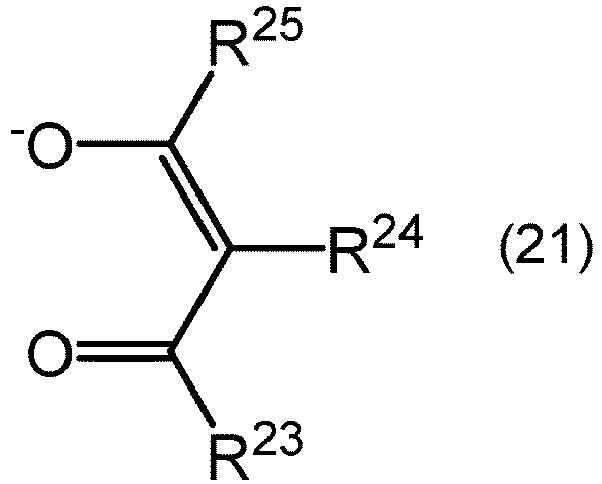
- the other ligands include a phosphine oxide ligand represented by the following Formula (11) and a diketone ligand represented by the following Formula (21).
- R 13 , R 14 , and R 15 each independently represent an aryl group different from the condensed polycyclic aromatic group derived from the condensed polycyclic aromatic compound of Formula (I) mentioned above.
- Examples of the aryl group for R 13 , R 14 , or R 15 include the same as those for R 11 and R 12 in Formula (10).
- R 13 , R 14 , and R 15 may be a substituted or unsubstituted phenyl group.
- R 23 , R 24 , and R 25 each independently represent a hydrogen atom, an alkyl group, a halogenated alkyl group, an aryl group different from the condensed polycyclic aromatic group derived from the condensed polycyclic aromatic compound of Formula (I) mentioned above, or a heteroaryl group.
- R 23 , R 24 , and R 25 include the same as those for R 21 and R 22 in Formula (20).
- R 23 and R 25 each independently may be a methyl group, a trifluoromethyl group, a tert-butyl group, or a phenyl group, and R 24 may be a hydrogen atom.
- the hydrogen atom for R 24 may be a deuterium atom.
- the rare-earth complex including the diketone ligand represented by Formula (20) or Formula (21) may have still further excellent properties from the viewpoint of strong emission and the like. For this reason, as the ligand of the rare-earth complex, a combination of the diketone ligand represented by Formula (20) and having a condensed polycyclic aromatic group and the phosphine oxide ligand represented by Formula (11) or a combination of the diketone ligand represented by Formula (21) and the phosphine oxide ligand represented by Formula (10) and having a condensed polycyclic aromatic group may be selected.
- the rare-earth complex may be a complex represented by the following Formula (C1) or (C2). In Formulas (C1) and (C2), Ln(III) represents a trivalent rare-earth ion.
- the rare-earth complex having a diketone ligand may have a bidentate ligand represented by Formula (30).
- a complex represented by the following (C3) is mentioned.
- the definition of each symbol in Formula (C3) is the same as described above.
- two rare-earth ions Ln(III) are linked to each other by two bidentate ligands.
- a repeating structure may be formed by linking the bidentate phosphine oxide ligand represented by Formula (30) and the rare-earth ion alternately.
- the definition of each symbol in Formula (C4) is the same as described above, and n is an integer of 2 or more representing the number of repetitions.
- the rare-earth complex according to the present embodiment and the ligand constituting this rare-earth complex can be synthesized by general methods.
- An example of the method for synthesizing a ligand having a condensed polycyclic aromatic group includes brominating the condensed polycyclic aromatic compound represented by Formula (I), substituting the introduced bromo group with diarylphosphine, and oxidizing the phosphine group.
- the rare-earth complex according to the embodiment which has been described above, can be configured, alone or in combination with other materials such as a thermoplastic resin, as a light-emitting object efficiently emitting light even at high temperatures and a light-emitting material for forming the light-emitting object, by utilizing the fluorescence properties of the rare-earth complex.
- the light-emitting object can be used, for example, as light sources in various light-emitting devices such as LEDs.
- the rare-earth complex according to the present embodiment is also useful as a wavelength conversion material or a security material.
- the security material is used, for example, for giving encrypted information to various materials such as plastic materials.
- the rare-earth complex according to the present embodiment can also be used as a light-emitting material for providing a light-emitting function to a laminated glass.
- a laminated glass according to an embodiment includes two glass plates facing each other and an interlayer disposed between these two glass plates, and the interlayer can have a light-emitting layer containing the rare-earth complex according to the present embodiment.
- This laminated glass is assumed to be applied, for example, as a windshield for a vehicle which undergoes self-luminescence to display information such as characters.
- Ligand precursor 6-bromochrysene
- 6-Bromochrysene (1.22 g, 3.97 mmol) was dissolved in dehydrated DMA (14 mL), and potassium acetate (481 mg, 4.90 mmol) and palladium(II) acetate (8.8 mg, 3.91 ⁇ 10 -2 mmol) were added thereto, thereby preparing a reaction solution.
- diphenylphosphine (0.70 mL, 4.03 mmol) was added to the reaction solution under an argon atmosphere, the color of the reaction solution was promptly changed into dark red. Subsequently, the reaction solution was stirred at 60°C for 24 hours. The reaction solution was mixed with distilled water (200 mL), thereby generating the precipitate.
- the generated precipitate was recovered by suction filtration, the recovered precipitate was extracted with dichloromethane (30 mL ⁇ 3), and the resulting dichloromethane solution was washed with saturated saline.
- Dichloromethane was distilled off from the dichloromethane solution with an evaporator, and the residual solid was mixed with hydrogen peroxide (about 3 mL) in chloroform (30 mL).
- the obtained reaction solution was stirred at room temperature for 3 hours.
- the reaction solution was extracted with chloroform (30 mL ⁇ 3), and the obtained chloroform solution was washed with saturated saline. Chloroform was distilled off from the chloroform solution with an evaporator to obtain a solid crude product.
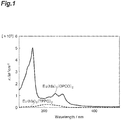
- FIG. 1 is ultraviolet-visible light absorption spectra of Eu(hfa) 3 (DPCO) 2 and Eu(hfa) 3 (TPPO) 2 .
- Eu(hfa) 3 (DPCO) 2 showed an extremely large molar extinction coefficient for the Eu(III) complex that was maximally about 500000 cm -1 M -1 .
- FIG. 2 is excitation and emission spectra of Eu(hfa) 3 (DPCO) 2 .
- the excitation spectrum was measured by using a CDCl 3 solution of Eu(hfa) 3 (DPCO) 2 and setting a fluorescence wavelength ⁇ em to 610 nm.
- the emission spectrum was measured by using powder of Eu(hfa) 3 (DPCO) 2 and setting an excitation wavelength ⁇ ex to 380 nm.
- the emission intensity per one molecule of Eu(hfa) 3 (DPCO) 2 at 365 nm was 40 times or more the existing data of Eu(hfa) 3 (TPPO) 2 .
- FIG. 3 is a graph showing results of thermogravimetry-differential thermal analysis of Eu 2 (hfa) 6 (DPCO) 2 and Eu(hfa) 3 (TPPO) 2 . It was confirmed that Eu 2 (hfa) 6 (DPCO) 2 shows a high decomposition temperature exceeding 300°C.
- FIG. 4 is a graph showing a relation between emission lifetime of Eu 2 (hfa) 6 (DPCO) 2 and temperatures. It was confirmed that the emission lifetime of Eu 2 (hfa) 6 (DPCO) 2 greatly changes depending on temperatures. Therefore, the rare-earth complex according to the aspect of the present invention has strong emission properties as well as a temperature sensing function.
- Ligand precursor 5-bromopicene
- 5-bromopicene (966.5 mg, 2.71 mmol), potassium acetate (333.4 mg, 3.40 mmol), and palladium(II) acetate (7.0 mg, 0.03 mmol) were dissolved in dehydrated DMA (50 mL) while being heated at 100°C.
- diphenylphosphine (0.47 mL, 2.7 mmol) was added to the obtained solution, the color of the solution was promptly changed into dark red.
- the reaction solution was mixed with distilled water (200 mL), and the deposited powder was recovered by suction filtration.
- a product was extracted from the obtained powder by using dichloromethane (30 mL ⁇ 3) and saturated saline, and the solvent was distilled off from the dichloromethane solution by an evaporator.
- the solidified residue was mixed with an aqueous solution of 30% hydrogen peroxide (about 3 mL) in chloroform (50 mL), and the obtained mixed liquid was stirred for 3 hours at room temperature.
- a product was extracted from the mixed liquid by using chloroform (30 mL ⁇ 3) and saturated saline, and the solvent was distilled off from the chloroform solution by an evaporator.
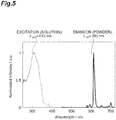
- FIG. 5 is excitation and emission spectra of Eu(hfa) 3 (PIPO) 2 .
- the excitation spectrum was measured by using a CHCl 3 solution (9.8 ⁇ 10 -5 M) of Eu(hfa) 3 (PIPO) 2 and setting a fluorescence wavelength ⁇ em to 610 nm.
- the emission spectrum was measured by using powder of Eu(hfa) 3 (PIPO) 2 and setting an excitation wavelength ⁇ ex to 390 nm.
- the emission intensity per one molecule of Eu(hfa) 3 (PIPO) 2 at 365 nm was 20 times or more the existing data of Eu(hfa) 3 (TPPO) 2 .
- a product was extracted from the obtained powder by using dichloromethane (30 mL ⁇ 3) and saturated saline, and the solvent was distilled off from the dichloromethane solution by an evaporator.
- the solidified residue was mixed with a solution of 30% hydrogen peroxide (about 3 mL) in chloroform (50 mL), and the obtained mixed liquid was stirred for 3 hours at room temperature.
- a product was extracted from the mixed liquid by using chloroform (30 mL ⁇ 3) and saturated saline, and the solvent was distilled off from the chloroform solution by an evaporator.
- a product was separated from the residual crude product by silica gel (60 N) chromatography.
- the obtained product was recrystallized from dichloromethane and a small amount of hexane, thereby obtaining crystals of 6,12-DPCO.
- the obtained crystals were identified by 1 H-NMR, ESI-Mass, and elemental analysis (yield rate: 49% (546.0 mg, 0.869 mmol)).
- FIG. 6 is excitation and emission spectra of [Eu(hfa) 3 (6,12-DPCO)] n .
- the excitation spectrum was measured by using powder of [Eu(hfa) 3 (6,12-DPCO)] n and setting a fluorescence wavelength ⁇ em to 610 nm.
- the emission spectrum was measured by using powder of [Eu(hfa) 3 (6,12-DPCO)] n and setting an excitation wavelength ⁇ ex to 390 nm. Similarly to the mononuclear complex, high luminance emission of light was shown.
Landscapes
- Chemical & Material Sciences (AREA)
- Organic Chemistry (AREA)
- Engineering & Computer Science (AREA)
- Materials Engineering (AREA)
- Physics & Mathematics (AREA)
- Inorganic Chemistry (AREA)
- General Physics & Mathematics (AREA)
- Optics & Photonics (AREA)
- Optical Filters (AREA)
- Organic Low-Molecular-Weight Compounds And Preparation Thereof (AREA)
- Electroluminescent Light Sources (AREA)
Abstract
Description
- The present invention relates to a rare-earth complex, a light-emitting material, a light-emitting object, a light-emitting device, an interlayer for a laminated glass, a laminated glass, a windshield for a vehicle, a wavelength conversion material, and a security material.
- As a rare-earth complex which exhibits emission of red light, for example, a europium complex having a hexafluoroacetylacetonate (hfa) derivative and a phosphine oxide compound as ligands has been reported (Patent Literature 1).
- Patent Literature 1: Japanese Unexamined Patent Publication No.
2016-166139 - For application as a light-emitting material, it is desirable for the rare-earth complex to emit light at an emission intensity as large as possible.
- An aspect of the present invention relates to a rare-earth complex including a rare-earth ion, and a ligand coordinate-bonded to the rare-earth ion and having a condensed polycyclic aromatic group. The condensed polycyclic aromatic group is a residue formed by removing a hydrogen atom bonded to a condensed aromatic ring of a condensed polycyclic aromatic compound represented by the following Formula (I) from the condensed polycyclic aromatic compound.

- In Formula (I), R1 and R2 represent hydrogen atoms or groups which are bonded to each other to form one aromatic ring or a condensed aromatic ring including two or more aromatic rings. The condensed aromatic ring of the condensed polycyclic aromatic compound represented by Formula (I) optionally has a substituent.
- As shown in Formula (I), the rare-earth complex, which has a ligand having a condensed polycyclic aromatic group, emits light at a large emission intensity. The reason for this is considered that the condensed polycyclic aromatic group having a structure in which a plurality of aromatic rings are linked in a zig-zag manner shows an extremely large molar extinction coefficient with respect to visible-ultraviolet light and efficiently causes energy transfer to Eu(III).
- Another aspect of the present invention provides a light-emitting material containing the above-described rare-earth complex, a light-emitting object containing the light-emitting material, a wavelength conversion material, and a security material. The light-emitting object can be utilized, for example, as a light source of a light-emitting device. Still another aspect of the present invention relates to an interlayer for a laminated glass, which has a light-emitting layer containing the above-described rare-earth complex, and a laminated glass including the interlayer. This laminated glass can be used, for example, as a windshield for a vehicle having a light-emitting function.
- The rare-earth complex according to the aspect of the present invention can emit light at a large emission intensity. The rare-earth complex according to the aspect of the present invention can be used, for example, as a light-emitting material constituting a light-emitting object which emits red light. The rare-earth complex according to the aspect of the present invention also has high heat resistance.
- In addition, the rare-earth complex according to the aspect of the present invention exhibits properties greatly changing emission properties depending on temperatures. Therefore, the rare-earth complex can also be applied as a temperature sensing material.
-
-
FIG. 1 is ultraviolet-visible light absorption spectra of Eu(hfa)3(DPCO)2 and Eu(hfa)3(TPPO)2. -
FIG. 2 is excitation and emission spectra of Eu(hfa)3(DPCO)2. -
FIG. 3 is a graph showing results of thermogravimetry-differential thermal analysis of Eu2(hfa)6(DPCO)2 and Eu(hfa)3(TPPO)2. -
FIG. 4 is a graph showing a relation between emission lifetime of Eu2(hfa)6(DPCO)2 and temperatures. -
FIG. 5 is excitation and emission spectra of Eu(hfa)3(PIPO)2. -
FIG. 6 is excitation and emission spectra of [Eu(hfa)3(6,12-DPCO)]n. - Hereinafter, several embodiments of the present invention will be described in detail. However, the present invention is not limited to the following embodiments.
- A rare-earth complex according to an embodiment has a rare-earth ion and a plurality of ligands coordinate-bonded to the rare-earth ion.
- The rare-earth ion is, for example, an ion of a rare-earth element selected from europium (Eu), neodymium (Nd), ytterbium (Yb), and gadolinium (Gd). For example, europium as a trivalent cation (Eu3+) forms a complex.
- At least a part of the plurality of ligands included in the rare-earth complex has a condensed polycyclic aromatic group. This condensed polycyclic aromatic group is a group derived from a condensed polycyclic aromatic compound represented by the following Formula (I). In other words, the condensed polycyclic aromatic group can be a residue formed by removing a hydrogen atom bonded to a condensed aromatic ring of the condensed polycyclic aromatic compound represented by Formula (I).

- In Formula (I), R1 and R2 represent hydrogen atoms or groups which are bonded to each other to form one aromatic ring or a condensed aromatic ring including two or more aromatic rings. R1 and R2 may be bonded to each other to form one 6-membered ring to be condensed with a 6-membered ring to which R1 and R2 are bonded, and R1 and R2 may be bonded to each other to form a condensed aromatic ring composed of two or more 6-membered rings. The total number of 6-membered rings of the condensed polycyclic aromatic compound of Formula (1) may be 4 to 6. The condensed polycyclic aromatic group derived from the condensed polycyclic aromatic compound of Formula (I) may be a monovalent or divalent group formed by removing one or two hydrogen atoms from the condensed aromatic ring. The condensed aromatic ring from which a hydrogen atom may be removed also includes a condensed ring formed by R1 and R2.
- The condensed aromatic ring of the condensed polycyclic aromatic compound represented by Formula (I) may have a substituent. The substituent bonded to the condensed aromatic ring may be, for example, an alkyl group such as a methyl group or a halogen atom such as a fluorine atom. A part or all of hydrogen atoms bonded to the condensed aromatic ring may be a deuterium atom.
- The condensed polycyclic aromatic compound represented by Formula (I) may be, for example, a compound represented by the following Formula (1-1), (1-2), or (1-3). The condensed aromatic rings of these compounds may have a substituent.


- The condensed polycyclic aromatic group derived by removing a hydrogen atom from these compounds may be, for example, a monovalent group represented by the following Formula (I-1a), (I-2a), or (I-2b) and may be a divalent group represented by Formula (I-1b).


- The ligand having a condensed polycyclic aromatic group may be, for example, at least one of a phosphine oxide ligand represented by the following Formula (10) or a diketone ligand represented by the following Formula (20).
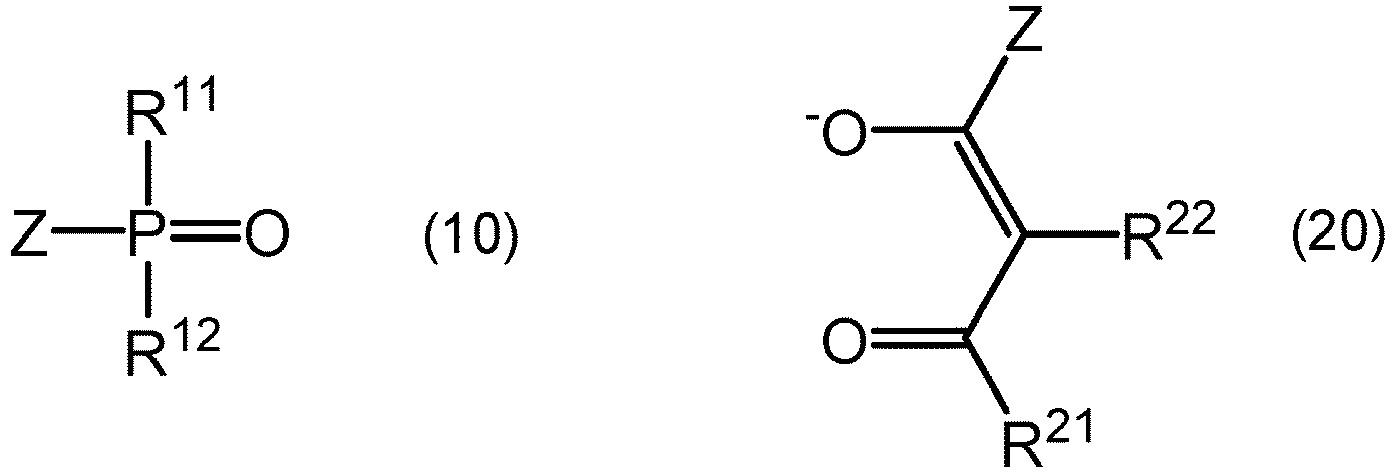
- In Formula (10), Z represents the condensed polycyclic aromatic group derived from the condensed polycyclic aromatic compound of Formula (I) mentioned above, and R11 and R12 each independently represent an aryl group different from the condensed polycyclic aromatic group. In Formula (20), Z represents the condensed polycyclic aromatic group derived from the condensed polycyclic aromatic compound of Formula (I) mentioned above, and R21 and R22 each independently represent a hydrogen atom, an alkyl group, a halogenated alkyl group, an aryl group different from the condensed polycyclic aromatic group, or a heteroaryl group. Z may be a monovalent group represented by Formula (I-1a), (I-2a), or (I-2b), or a monovalent group represented by Formula (I-1a) or (I-2b).
- The aryl group for R11 or R12 can be a residue formed by removing one hydrogen atom from an aromatic compound. The number of carbon atoms of the aryl group is, for example, 6 to 14. Specific examples of the aryl group include residues formed by removing one hydrogen atom from substituted or unsubstituted benzene, substituted or unsubstituted naphthalene, substituted or unsubstituted anthracene, or substituted or unsubstituted phenanthrene. In particular, R11 and R12 may be a substituted or unsubstituted phenyl group.
- The number of carbon atoms of the alkyl group and the halogenated alkyl group for R21 or R22 may be 1 to 15, 1 to 5, or 1 to 3. The halogenated alkyl group may be a fluorinated alkyl group such as a trifluoromethyl group. Examples of the aryl group and the heteroaryl group for R21 or R22 include a phenyl group, a naphthyl group, and a thienyl group. R21 may be a methyl group, a trifluoromethyl group, a tert-butyl group, or a phenyl group. R22 may be a hydrogen atom. The hydrogen atom for R22 may be a deuterium atom.
- The ligand having a condensed polycyclic aromatic group may be, for example, a bidentate phosphine oxide ligand represented by the following Formula (30). Z, R11, and R12 in Formula (30) are similarly defined as Z, R11, and R12 in Formula (10). The phosphine oxide ligand of Formula (30) is generally coordinate-bonded to two rare-earth ions. Two or more rare-earth ions may be linked to each other through the phosphine oxide ligand of Formula (30). Z in Formula (30) may be a divalent group of Formula (I-1b) mentioned above.

- The rare-earth complex may further have other ligands in addition to the ligand having a condensed polycyclic aromatic group. Examples of the other ligands include a phosphine oxide ligand represented by the following Formula (11) and a diketone ligand represented by the following Formula (21).


- In Formula (11), R13, R14, and R15 each independently represent an aryl group different from the condensed polycyclic aromatic group derived from the condensed polycyclic aromatic compound of Formula (I) mentioned above. Examples of the aryl group for R13, R14, or R15 include the same as those for R11 and R12 in Formula (10). R13, R14, and R15 may be a substituted or unsubstituted phenyl group.
- In Formula (21), R23 , R24, and R25 each independently represent a hydrogen atom, an alkyl group, a halogenated alkyl group, an aryl group different from the condensed polycyclic aromatic group derived from the condensed polycyclic aromatic compound of Formula (I) mentioned above, or a heteroaryl group. Examples of R23, R24, and R25 include the same as those for R21 and R22 in Formula (20). R23 and R25 each independently may be a methyl group, a trifluoromethyl group, a tert-butyl group, or a phenyl group, and R24 may be a hydrogen atom. The hydrogen atom for R24 may be a deuterium atom.
- The rare-earth complex including the diketone ligand represented by Formula (20) or Formula (21) may have still further excellent properties from the viewpoint of strong emission and the like. For this reason, as the ligand of the rare-earth complex, a combination of the diketone ligand represented by Formula (20) and having a condensed polycyclic aromatic group and the phosphine oxide ligand represented by Formula (11) or a combination of the diketone ligand represented by Formula (21) and the phosphine oxide ligand represented by Formula (10) and having a condensed polycyclic aromatic group may be selected. For example, the rare-earth complex may be a complex represented by the following Formula (C1) or (C2). In Formulas (C1) and (C2), Ln(III) represents a trivalent rare-earth ion.


- The rare-earth complex having a diketone ligand may have a bidentate ligand represented by Formula (30). As an example thereof, a complex represented by the following (C3) is mentioned. The definition of each symbol in Formula (C3) is the same as described above. In the complex represented by Formula (C3), two rare-earth ions Ln(III) are linked to each other by two bidentate ligands.

- Like a rare-earth complex represented by the following Formula (C4), a repeating structure may be formed by linking the bidentate phosphine oxide ligand represented by Formula (30) and the rare-earth ion alternately. The definition of each symbol in Formula (C4) is the same as described above, and n is an integer of 2 or more representing the number of repetitions.

- The rare-earth complex according to the present embodiment and the ligand constituting this rare-earth complex can be synthesized by general methods. An example of the method for synthesizing a ligand having a condensed polycyclic aromatic group includes brominating the condensed polycyclic aromatic compound represented by Formula (I), substituting the introduced bromo group with diarylphosphine, and oxidizing the phosphine group.
- The rare-earth complex according to the embodiment, which has been described above, can be configured, alone or in combination with other materials such as a thermoplastic resin, as a light-emitting object efficiently emitting light even at high temperatures and a light-emitting material for forming the light-emitting object, by utilizing the fluorescence properties of the rare-earth complex. The light-emitting object can be used, for example, as light sources in various light-emitting devices such as LEDs. The rare-earth complex according to the present embodiment is also useful as a wavelength conversion material or a security material. The security material is used, for example, for giving encrypted information to various materials such as plastic materials.
- Moreover, the rare-earth complex according to the present embodiment can also be used as a light-emitting material for providing a light-emitting function to a laminated glass. A laminated glass according to an embodiment includes two glass plates facing each other and an interlayer disposed between these two glass plates, and the interlayer can have a light-emitting layer containing the rare-earth complex according to the present embodiment. This laminated glass is assumed to be applied, for example, as a windshield for a vehicle which undergoes self-luminescence to display information such as characters.
- Hereinafter, the present invention will be described in more detail by means of Examples. However, the present invention is not limited to these Examples.
-

- Under an argon atmosphere, chrysene (1.00 g, 4.38 mmol) and N-bromosuccinimide (788 mg, 4.43 mmol) were dissolved in dehydrated DMF (30 mL) to prepare a reaction solution, and this reaction solution was stirred at 60°C for 20 hours. Next, the reaction solution was mixed with distilled water (200 mL), thereby generating the precipitate. The generated precipitate was recovered by suction filtration. The recovered precipitate was washed with distilled water, methanol, and hexane and vacuum-dried, thereby obtaining powder of 6-bromochrysene (yield rate: 91%, yield: 1.22 g (3.97 mmol). The resulting product was identified by 1H-NMR.
1H-NMR (400 MHz, CDCl3/TMS) δ/ppm = 9.07(s, 1H),8.80(d, 1H, J = 7.2 Hz), 8.71(dd, 2H, J = 9.6 Hz, 10 Hz), 8.45(d, 1H, J = 9.6 Hz), 8.02(dd, 2H, J = 9.2 Hz, 6.0 Hz), 7.79-7.72(m, 3H), 7.68-7.65(m, 1H) -

- 6-Bromochrysene (1.22 g, 3.97 mmol) was dissolved in dehydrated DMA (14 mL), and potassium acetate (481 mg, 4.90 mmol) and palladium(II) acetate (8.8 mg, 3.91×10⁻² mmol) were added thereto, thereby preparing a reaction solution. When diphenylphosphine (0.70 mL, 4.03 mmol) was added to the reaction solution under an argon atmosphere, the color of the reaction solution was promptly changed into dark red. Subsequently, the reaction solution was stirred at 60°C for 24 hours. The reaction solution was mixed with distilled water (200 mL), thereby generating the precipitate. The generated precipitate was recovered by suction filtration, the recovered precipitate was extracted with dichloromethane (30 mL × 3), and the resulting dichloromethane solution was washed with saturated saline. Dichloromethane was distilled off from the dichloromethane solution with an evaporator, and the residual solid was mixed with hydrogen peroxide (about 3 mL) in chloroform (30 mL). The obtained reaction solution was stirred at room temperature for 3 hours. Next, the reaction solution was extracted with chloroform (30 mL × 3), and the obtained chloroform solution was washed with saturated saline. Chloroform was distilled off from the chloroform solution with an evaporator to obtain a solid crude product. The crude product was purified with silica gel chromatography (developing solvent: dichloromethane/ethyl acetate = 8/2). The obtained product was further recrystallized from dichloromethane. The obtained crystals of DPCO were identified based on 1H-NMR, ESI-Mass, and elemental analysis (yield rate: 40%, yield: 733 mg, 1.56 mmol).
1H-NMR (400 MHz, CDCl3/TMS) δ/ppm = 8.83 (d, 1H, J= 8.0 Hz), 8.73 (dd, 2H, J = 6.0 Hz, 3.2 Hz), 8.63 (d, 1H, J = 17 Hz), 8.11 (d, 1H, J = 9.2 Hz), 8.05 (d, 1H, J = 8.0 Hz), 8.98 (d, 1H, J = 8.0 Hz), 7.79 (dd, 4H, J = 6.8 Hz, 5.2 Hz), 7.71 (t, 1H, J = 8.0 Hz, 7.6 Hz), 7.65-7.50 (m, 9H) ESI-MS: m/z calcd. for C30H22OP[M+H]+ = 429.14; found: 429.14
elemental analysis calcd. (%) for C30H21OP+0.5CH2Cl2,C 77.79, H 4.71; found: C 77.66, H 4.53 -

- DPCO (180 mg, 0.419 mmol) and Eu(hfa)3(H2O)2 (531 mg, 0.66 mmol) were mixed in dichloromethane (15 mL), and the obtained reaction solution was stirred at room temperature for 12 hours. The reaction solution was filtered by suction, and the solvent was distilled off from the filtrate by an evaporator, thereby obtaining a powdery crude product. This powdery crude product was recrystallized from dichloromethane, thereby obtaining crystals of a target europium complex Eu(hfa)3(DPCO)2. The obtained crystals were identified by ESI-Mass, elemental analysis, and FT-IR (yield rate: 36%, yield: 251 mg, 0.15 mmol).
ESI-MS: m/z calcd for C70H41EuF12O6P2[M-hfa]+ = 1421.15; found: 1421.16
elemental analysis calcd. (%) for C75H42EuF18O8P2+0.5CH2Cl2,C 53.32, H 2.59; found: C 53.52, H 2.52
IR (ATR) = 1653 (st, C=O), 1251 (st, C-F), 1133 (st, P=O) cm1 - For comparison, a europium complex Eu(hfa)3(TPPO)2 represented by the following formula was prepared.

- Ultraviolet-visible light absorption properties of Eu(hfa)3(DPCO)2 and Eu(hfa)3(TPPO)2 were measured by using deuterated chloroform solutions thereof.
FIG. 1 is ultraviolet-visible light absorption spectra of Eu(hfa)3(DPCO)2 and Eu(hfa)3(TPPO)2. Eu(hfa)3(DPCO)2 showed an extremely large molar extinction coefficient for the Eu(III) complex that was maximally about 500000 cm-1M-1. -
FIG. 2 is excitation and emission spectra of Eu(hfa)3(DPCO)2. The excitation spectrum was measured by using a CDCl3 solution of Eu(hfa)3(DPCO)2 and setting a fluorescence wavelength λem to 610 nm. The emission spectrum was measured by using powder of Eu(hfa)3(DPCO)2 and setting an excitation wavelength λex to 380 nm. The emission intensity per one molecule of Eu(hfa)3(DPCO)2 at 365 nm was 40 times or more the existing data of Eu(hfa)3(TPPO)2. -
FIG. 3 is a graph showing results of thermogravimetry-differential thermal analysis of Eu2(hfa)6(DPCO)2 and Eu(hfa)3(TPPO)2. It was confirmed that Eu2(hfa)6(DPCO)2 shows a high decomposition temperature exceeding 300°C. -
FIG. 4 is a graph showing a relation between emission lifetime of Eu2(hfa)6(DPCO)2 and temperatures. It was confirmed that the emission lifetime of Eu2(hfa)6(DPCO)2 greatly changes depending on temperatures. Therefore, the rare-earth complex according to the aspect of the present invention has strong emission properties as well as a temperature sensing function. -

- Picene (1.00 g, 3.59 mmol) was dissolved in chlorobenzene (100 mL). Br2 (0.19 mL, 3.6 mmol) was added dropwise thereto, and then the reaction liquid was stirred at 60°C for 33 hours. The reaction liquid was cooled to 0°C. The deposited precipitate was recovered by suction filtration and washed with ethanol, thereby obtaining powder of 5-bromopicene. The obtained powder was identified by 1H-NMR (yield rate: 75% (967.0 mg, 2.71 mmol)).
1H-NMR (400 MHz, CDCl3/TMS) δ/ppm = 9.14 (s, 1H), 9.02-8.91 (m, 2H), 8.86 (t, 2H, J = 7.6 Hz, 8.4 Hz), 8.70 (d, 1H, J = 9.7 Hz), 8.47 (dd, 1H, J = 6.3 Hz, 2.1 Hz), 8.05 (dd, 2H, J = 4.4 Hz, 9.2 Hz), 7.82-7.44 (m, 3H), 7.68 (t, 1H, J = 8.0 Hz, 8.4 Hz) -

- Under an argon atmosphere, 5-bromopicene (966.5 mg, 2.71 mmol), potassium acetate (333.4 mg, 3.40 mmol), and palladium(II) acetate (7.0 mg, 0.03 mmol) were dissolved in dehydrated DMA (50 mL) while being heated at 100°C. When diphenylphosphine (0.47 mL, 2.7 mmol) was added to the obtained solution, the color of the solution was promptly changed into dark red. After being stirred at 100°C for 24 hours, the reaction solution was mixed with distilled water (200 mL), and the deposited powder was recovered by suction filtration. A product was extracted from the obtained powder by using dichloromethane (30 mL × 3) and saturated saline, and the solvent was distilled off from the dichloromethane solution by an evaporator. The solidified residue was mixed with an aqueous solution of 30% hydrogen peroxide (about 3 mL) in chloroform (50 mL), and the obtained mixed liquid was stirred for 3 hours at room temperature. A product was extracted from the mixed liquid by using chloroform (30 mL × 3) and saturated saline, and the solvent was distilled off from the chloroform solution by an evaporator. A product was separated from the residual crude product by silica gel (60 N) chromatography (developing solvent: dichloromethane/ethyl acetate = 8/2). The obtained product was recrystallized from dichloromethane and a small amount of hexane, thereby obtaining crystals of PIPO. The obtained crystals were identified by 1H-NMR, ESI-Mass, and elemental analysis (yield rate: 38% (650.8 mg, 1.36 mmol)).
1H-NMR (400 MHz, CDCl3/TMS) δ/ppm= 9.06 (d, 1H, J = 9.6 Hz), 8.96 (d, 1H, J = 9.2 Hz), 8.90 (d, 1H, J = 8.4), 8.84 (d, 1H, J = 8.8 Hz), 8.72 (t, 2H, J = 8.4 Hz, 9.2 Hz), 7.96 (d, 1H, J = 8.0 Hz), 7.90 (d, 1H, J = 9.2 Hz), 7.83 (dd, 2H, J = 6.8 Hz, 1.2 Hz), 7.69-7.62 (m, 3H), 7.59-7.52 (m, 5H) ESI-MS: m/z calcd. for C34H24OP, [M+H]+ = 479.16; found: 479.16; elemental analysis calcd. (%) for C 85.34, H 4.84; found: C 84.67, H 4.70 -

- PIPO (336.4 mg, 0.703 mmol) and Eu(hfa)3(H2O)2 (406.3 mg, 0.502 mmol) were dissolved in dichloromethane (10 mL). The reaction solution was stirred at 12 hours at room temperature and then filtered, and the solvent was distilled off from the filtrate by an evaporator. The residual powder was recrystallized at -18°C from dichloromethane and a small amount of hexane, thereby obtaining crystals of Eu(hfa)3(PIPO)2. The obtained crystals were identified by ESI-Mass, elemental analysis, and IR (yield rate: 68% (409.4 mg, 0.237 mmol)).
ESI-MS: m/z calcd. for C78H48EuF12O6P2, [M-hfa]+ = 1523.19; found: 1523.18; elemental analysis calcd. (%) for C 57.62, H 2.85, found: C 56.99, H: 2.60; IR (ATR) = 1653 (st, C=O), 1252 (st, C-F), 1145 (st, P=O) cm-1 -
FIG. 5 is excitation and emission spectra of Eu(hfa)3(PIPO)2. The excitation spectrum was measured by using a CHCl3 solution (9.8×10⁻⁵ M) of Eu(hfa)3(PIPO)2 and setting a fluorescence wavelength λem to 610 nm. The emission spectrum was measured by using powder of Eu(hfa)3(PIPO)2 and setting an excitation wavelength λex to 390 nm. The emission intensity per one molecule of Eu(hfa)3(PIPO)2 at 365 nm was 20 times or more the existing data of Eu(hfa)3(TPPO)2. -

- Under an argon atmosphere, 6,12-dibromochrysene (678.3 mg, 1.76 mmol), potassium acetate (471.0 mg, 4.80 mmol), and palladium(II) acetate (8.6 mg, 0.04 mmol) were dissolved in dehydrated DMA (40 mL) while being heated at 100°C. When diphenylphosphine (0.45 mL, 2.6 mmol) was added to the obtained solution, the color of the solution was promptly changed into dark red. After being stirred at 100°C for 42 hours, the reaction solution was mixed with distilled water (200 mL), and the deposited powder was recovered by suction filtration. A product was extracted from the obtained powder by using dichloromethane (30 mL × 3) and saturated saline, and the solvent was distilled off from the dichloromethane solution by an evaporator. The solidified residue was mixed with a solution of 30% hydrogen peroxide (about 3 mL) in chloroform (50 mL), and the obtained mixed liquid was stirred for 3 hours at room temperature. A product was extracted from the mixed liquid by using chloroform (30 mL × 3) and saturated saline, and the solvent was distilled off from the chloroform solution by an evaporator. A product was separated from the residual crude product by silica gel (60 N) chromatography. The developing solvent was changed from the mixed liquid of dichloromethane/ethyl acetate = 1/1 until ethyl acetate remained alone. The obtained product was recrystallized from dichloromethane and a small amount of hexane, thereby obtaining crystals of 6,12-DPCO. The obtained crystals were identified by 1H-NMR, ESI-Mass, and elemental analysis (yield rate: 49% (546.0 mg, 0.869 mmol)).
1H-NMR (400 MHz, CDCl3/TMS) δ/ppm = 8.73 (d, 2H, J = 8.4 Hz), 8.63 (s, 1H), 8.59 (s, 1H), 8.08 (d, 2H, J = 8.4 Hz), 7.78 (dd, 8H, J = 4.0 Hz, 8.0 Hz), 7.63 (t, 4H, J = 8.0 Hz, 6.8 Hz), 7.58-7.49 (m, 12H)
ESI-MS: m/z calcd. for C42H31O2P2, [M+H]+ = 629.18; found: 629.18; elemental analysis calcd. (%) for C 80.12, H 4.96; found: C 79.97, H 4.66 -

- 6,12-DPCO (281.4 mg, 0.448 mmol) and Eu(hfa)3(H2O)2 (370.5 mg, 0.457 mmol) were dissolved in dichloromethane (15 mL). The reaction solution was stirred at 12 hours at room temperature, and then the deposited precipitate was recovered by filtration, thereby obtaining powder of [Eu(hfa)3(6,12-DPCO)]n. The obtained powder was dissolved in THF and recrystallized. The obtained crystals were identified by ESI-Mass, elemental analysis, and IR (yield rate: 13% (82.1 mg)).
ESI-MS: m/z calcd. for C52H32EuF12O6P2, [M-hfa]+ = 1195.07; found: 1195.14, calcd. for C109H65Eu2F30O14P42, [M-hfa]+ = 2596.13; found: 2596.27, calcd. for C151H95Eu2F30O16P6, [M-hfa]+ = 3225.30; found: 3225.43
elemental analysis calcd. (%) for C 48.84, H 2.37; found: C 49.05, H 2.48; IR (ATR) = 1653 (st, C=O), 1253 (st, C-F), 1145 (st, P=O) cm-1 -
FIG. 6 is excitation and emission spectra of [Eu(hfa)3(6,12-DPCO)]n. The excitation spectrum was measured by using powder of [Eu(hfa)3(6,12-DPCO)]n and setting a fluorescence wavelength λem to 610 nm. The emission spectrum was measured by using powder of [Eu(hfa)3(6,12-DPCO)]n and setting an excitation wavelength λex to 390 nm. Similarly to the mononuclear complex, high luminance emission of light was shown.
Claims (15)
- A rare-earth complex comprising: a rare-earth ion; and a ligand coordinate-bonded to the rare-earth ion and having a condensed polycyclic aromatic group, wherein
the condensed polycyclic aromatic group is a residue formed by removing a hydrogen atom bonded to a condensed aromatic ring from a condensed polycyclic aromatic compound represented by the following Formula (I):
- The rare-earth complex according to claim 1, wherein the ligand having a condensed polycyclic aromatic group is at least one of a phosphine oxide ligand represented by the following Formula (10) or a diketone ligand represented by the following Formula (20):

in Formula (20), Z represents the condensed polycyclic aromatic group, and R21 and R22 each independently represent a hydrogen atom, an alkyl group, a halogenated alkyl group, an aryl group different from the condensed polycyclic aromatic group, or a heteroaryl group. - The rare-earth complex according to claim 2, wherein the ligand having a condensed polycyclic aromatic group is the phosphine oxide ligand represented by the Formula (10), and
the rare-earth complex further comprises a diketone ligand coordinate-bonded to the rare-earth ion and represented by the following Formula (21):
- The rare-earth complex according to claim 2, wherein the ligand having a condensed polycyclic aromatic group is the diketone ligand represented by the Formula (20), and
the rare-earth complex further comprises a phosphine oxide ligand coordinate-bonded to the rare-earth ion and represented by the following Formula (11):
- The rare-earth complex according to claim 1, wherein the rare-earth complex comprises two or more of the rare-earth ions, and
the ligand having a condensed polycyclic aromatic group is a bidentate phosphine oxide ligand represented by the following Formula (30) and the phosphine oxide ligand is coordinate-bonded to two of the rare-earth ions:
- The rare-earth complex according to claim 5, wherein the rare-earth complex forms a repeating structure by linking the bidentate phosphine oxide ligand represented by the Formula (30) and the rare-earth ion alternately.
- The rare-earth complex according to claim 5 or 6, wherein the rare-earth complex further comprises a diketone ligand coordinate-bonded to the rare-earth ion and represented by the following Formula (21):
- A light-emitting material comprising the rare-earth complex according to any one of claims 1 to 7.
- A light-emitting object comprising the light-emitting material according to claim 8.
- A light-emitting device comprising the light-emitting object according to claim 9.
- An interlayer for a laminated glass comprising a light-emitting layer containing the rare-earth complex according to any one of claims 1 to 7.
- A laminated glass comprising:two glass plates facing each other; andthe interlayer for a laminated glass according to claim 11 disposed between the two glass plates.
- A windshield for a vehicle, comprising the laminated glass according to claim 12.
- A wavelength conversion material comprising the rare-earth complex according to any one of claims 1 to 7.
- A security material comprising the rare-earth complex according to any one of claims 1 to 7.
Applications Claiming Priority (2)
| Application Number | Priority Date | Filing Date | Title |
|---|---|---|---|
| JP2018130925 | 2018-07-10 | ||
| PCT/JP2019/026751 WO2020013087A1 (en) | 2018-07-10 | 2019-07-04 | Rare-earth complex, light-emitting material, light-emitting object, light-emitting device, interlayer for laminated glass, laminated glass, windshield for vehicle, wavelength conversion material, and security material |
Publications (3)
| Publication Number | Publication Date |
|---|---|
| EP3822277A1 true EP3822277A1 (en) | 2021-05-19 |
| EP3822277A4 EP3822277A4 (en) | 2022-03-16 |
| EP3822277B1 EP3822277B1 (en) | 2025-09-03 |
Family
ID=69142428
Family Applications (1)
| Application Number | Title | Priority Date | Filing Date |
|---|---|---|---|
| EP19835116.5A Active EP3822277B1 (en) | 2018-07-10 | 2019-07-04 | Rare-earth complex, light-emitting material, light-emitting object, light-emitting device, interlayer for laminated glass, laminated glass, windshield for vehicle, wavelength conversion material, and security material |
Country Status (5)
| Country | Link |
|---|---|
| US (1) | US12312369B2 (en) |
| EP (1) | EP3822277B1 (en) |
| JP (1) | JP7317376B2 (en) |
| CN (1) | CN112384518B (en) |
| WO (1) | WO2020013087A1 (en) |
Family Cites Families (12)
| Publication number | Priority date | Publication date | Assignee | Title |
|---|---|---|---|---|
| JP4003388B2 (en) * | 2000-10-17 | 2007-11-07 | コニカミノルタホールディングス株式会社 | Electroluminescence element and color conversion filter |
| JP2005008872A (en) * | 2003-05-22 | 2005-01-13 | Mitsubishi Chemicals Corp | Light emitting device and phosphor |
| CN1687080A (en) | 2005-04-14 | 2005-10-26 | 复旦大学 | Rare earth complexes chelated by aromatic base substituted diphosphine dioxide and its synthesizing process |
| JP2007269780A (en) * | 2006-03-08 | 2007-10-18 | Nissan Chem Ind Ltd | Phosphonic acid-diketone composite rare earth metal complex |
| JP4956174B2 (en) * | 2006-12-20 | 2012-06-20 | 株式会社東芝 | Organic electroluminescence device and display system using fluorescent complex |
| EP2471799B1 (en) * | 2009-07-29 | 2015-04-15 | National University Corporation Nara Institute of Science and Technology | Samarium complex and uses thereof |
| US9051427B2 (en) | 2011-05-02 | 2015-06-09 | National University Corporation Hokkaido University | Rare-earth complex polymer and plastic molded product |
| CN103320117B (en) * | 2013-04-12 | 2015-04-01 | 中国工程物理研究院化工材料研究所 | Sensing material for concentration and temperature |
| KR20160119047A (en) * | 2014-01-31 | 2016-10-12 | 이데미쓰 고산 가부시키가이샤 | Compound, material for organic electroluminescent elements, organic electroluminescent element and electronic device |
| KR20160114032A (en) * | 2014-01-31 | 2016-10-04 | 이데미쓰 고산 가부시키가이샤 | Compound, material for organic electroluminescent elements, organic electroluminescent element and electronic device |
| JP2016166139A (en) * | 2015-03-09 | 2016-09-15 | 国立大学法人北海道大学 | Rare earth complex and light emitting device |
| CN110337441B (en) * | 2017-02-27 | 2022-09-06 | 国立大学法人北海道大学 | Rare earth complex and light-emitting element |
-
2019
- 2019-07-04 EP EP19835116.5A patent/EP3822277B1/en active Active
- 2019-07-04 WO PCT/JP2019/026751 patent/WO2020013087A1/en not_active Ceased
- 2019-07-04 US US17/258,320 patent/US12312369B2/en active Active
- 2019-07-04 CN CN201980045748.4A patent/CN112384518B/en active Active
- 2019-07-04 JP JP2020530150A patent/JP7317376B2/en active Active
Also Published As
| Publication number | Publication date |
|---|---|
| EP3822277B1 (en) | 2025-09-03 |
| JP7317376B2 (en) | 2023-07-31 |
| WO2020013087A1 (en) | 2020-01-16 |
| CN112384518A (en) | 2021-02-19 |
| EP3822277A4 (en) | 2022-03-16 |
| US12312369B2 (en) | 2025-05-27 |
| US20210269460A1 (en) | 2021-09-02 |
| JPWO2020013087A1 (en) | 2021-08-19 |
| CN112384518B (en) | 2023-10-20 |
Similar Documents
| Publication | Publication Date | Title |
|---|---|---|
| JP5904600B2 (en) | Rare earth complex polymer and plastic molding | |
| JP6765107B2 (en) | Method for producing iridium complex, iridium complex and luminescent material composed of the compound | |
| KR101604237B1 (en) | Method for manufacturing triarylpyrazine derivative | |
| EP3587429A1 (en) | Rare earth complex and light emitting element | |
| Wu et al. | Photophysical properties of homobimetallic Cu (i)–Cu (i) and heterobimetallic Cu (i)–Ag (i) complexes of 2-(6-bromo-2-pyridyl)-1 H-imidazo [4, 5-f][1, 10] phenanthroline | |
| Atencio et al. | Tuning luminescence in gold (I)-phosphine complexes: structural, photophysical, and theoretical insights | |
| EP3822277B1 (en) | Rare-earth complex, light-emitting material, light-emitting object, light-emitting device, interlayer for laminated glass, laminated glass, windshield for vehicle, wavelength conversion material, and security material | |
| Guo et al. | Preparation, luminescent properties of N-phenyl-2-{2′-[(phenyl-ethyl-carbamoyl)-methoxy]-biphenyl-2-yloxy}-N-ethyl-acetamide (L) lanthanide complexes and the supramolecular structures of [La (pic) 3L] and 2 [La (NO3) 3L (H2O)]· H2O· 0.5 C2H5OH | |
| JP7072261B2 (en) | Phosphine oxide compounds, rare earth complexes and luminescent materials | |
| Talavera et al. | Rhodafuran from a methoxy (alkenyl) carbene by the rhoda-1, 3, 5-hexatriene route | |
| JP6842096B2 (en) | An iridium complex having a phenyltriazole ligand and a luminescent material using the compound | |
| Ionkin et al. | Synthesis, structural characterization and the first electroluminescent properties of tris-and bis-cycloiridiated complexes of sterically hindered electron-poor 2-(3, 5-bis (trifluoromethyl) phenyl)-4-trifluoromethylpyridine | |
| EP3904359A1 (en) | Rare earth compound, phosphine oxide compound, and luminescent body | |
| JP7274134B2 (en) | Rare earth compounds, light emitters, light emitting devices, wavelength conversion materials and security materials | |
| JP7688398B2 (en) | Rare Earth Complexes | |
| JP3777428B2 (en) | Triphenylene compound having silylethynyl group and process for producing the same | |
| JP7528585B2 (en) | Compound | |
| KR102110059B1 (en) | Phenacene compound, manufacturing method of phenacene compound, and organic light emitting device | |
| KR100699506B1 (en) | Aromatic Dimethylridine Compounds Containing Fluorine | |
| Cho | Synthesis and Characterization of New Luminescent Lanthanide Complexes | |
| Piña et al. | INORGANIC | |
| JP2017154993A (en) | Phenacene compound, method for producing phenacene compound and organic light emitting element | |
| JP2014152120A (en) | Organometallic complex |
Legal Events
| Date | Code | Title | Description |
|---|---|---|---|
| STAA | Information on the status of an ep patent application or granted ep patent |
Free format text: STATUS: THE INTERNATIONAL PUBLICATION HAS BEEN MADE |
|
| PUAI | Public reference made under article 153(3) epc to a published international application that has entered the european phase |
Free format text: ORIGINAL CODE: 0009012 |
|
| STAA | Information on the status of an ep patent application or granted ep patent |
Free format text: STATUS: REQUEST FOR EXAMINATION WAS MADE |
|
| 17P | Request for examination filed |
Effective date: 20210128 |
|
| AK | Designated contracting states |
Kind code of ref document: A1 Designated state(s): AL AT BE BG CH CY CZ DE DK EE ES FI FR GB GR HR HU IE IS IT LI LT LU LV MC MK MT NL NO PL PT RO RS SE SI SK SM TR |
|
| DAV | Request for validation of the european patent (deleted) | ||
| DAX | Request for extension of the european patent (deleted) | ||
| A4 | Supplementary search report drawn up and despatched |
Effective date: 20220216 |
|
| RIC1 | Information provided on ipc code assigned before grant |
Ipc: G02B 27/01 20060101ALI20220210BHEP Ipc: H01L 33/50 20100101ALI20220210BHEP Ipc: G02B 5/20 20060101ALI20220210BHEP Ipc: C09K 11/06 20060101ALI20220210BHEP Ipc: C07F 5/00 20060101AFI20220210BHEP |
|
| STAA | Information on the status of an ep patent application or granted ep patent |
Free format text: STATUS: EXAMINATION IS IN PROGRESS |
|
| 17Q | First examination report despatched |
Effective date: 20221104 |
|
| RIC1 | Information provided on ipc code assigned before grant |
Ipc: H10H 20/851 20250101ALI20250204BHEP Ipc: H10K 85/30 20230101ALI20250204BHEP Ipc: G02B 27/01 20060101ALI20250204BHEP Ipc: G02B 5/20 20060101ALI20250204BHEP Ipc: C09K 11/06 20060101ALI20250204BHEP Ipc: C07F 5/00 20060101AFI20250204BHEP |
|
| GRAP | Despatch of communication of intention to grant a patent |
Free format text: ORIGINAL CODE: EPIDOSNIGR1 |
|
| STAA | Information on the status of an ep patent application or granted ep patent |
Free format text: STATUS: GRANT OF PATENT IS INTENDED |
|
| INTG | Intention to grant announced |
Effective date: 20250320 |
|
| RIN1 | Information on inventor provided before grant (corrected) |
Inventor name: FUSHIMI, KOJI Inventor name: NAKANISHI, TAKAYUKI Inventor name: HASEGAWA, YASUCHIKA Inventor name: KUMAGAI, MARINA Inventor name: KITAGAWA, YUICHI |
|
| GRAS | Grant fee paid |
Free format text: ORIGINAL CODE: EPIDOSNIGR3 |
|
| GRAA | (expected) grant |
Free format text: ORIGINAL CODE: 0009210 |
|
| STAA | Information on the status of an ep patent application or granted ep patent |
Free format text: STATUS: THE PATENT HAS BEEN GRANTED |
|
| AK | Designated contracting states |
Kind code of ref document: B1 Designated state(s): AL AT BE BG CH CY CZ DE DK EE ES FI FR GB GR HR HU IE IS IT LI LT LU LV MC MK MT NL NO PL PT RO RS SE SI SK SM TR |
|
| REG | Reference to a national code |
Ref country code: CH Ref legal event code: EP |
|
| REG | Reference to a national code |
Ref country code: DE Ref legal event code: R096 Ref document number: 602019075246 Country of ref document: DE |
|
| REG | Reference to a national code |
Ref country code: IE Ref legal event code: FG4D |
|
| REG | Reference to a national code |
Ref country code: NL Ref legal event code: MP Effective date: 20250903 |
|
| PG25 | Lapsed in a contracting state [announced via postgrant information from national office to epo] |
Ref country code: NO Free format text: LAPSE BECAUSE OF FAILURE TO SUBMIT A TRANSLATION OF THE DESCRIPTION OR TO PAY THE FEE WITHIN THE PRESCRIBED TIME-LIMIT Effective date: 20251203 |
|
| REG | Reference to a national code |
Ref country code: LT Ref legal event code: MG9D |
|
| PG25 | Lapsed in a contracting state [announced via postgrant information from national office to epo] |
Ref country code: FI Free format text: LAPSE BECAUSE OF FAILURE TO SUBMIT A TRANSLATION OF THE DESCRIPTION OR TO PAY THE FEE WITHIN THE PRESCRIBED TIME-LIMIT Effective date: 20250903 |
|
| PG25 | Lapsed in a contracting state [announced via postgrant information from national office to epo] |
Ref country code: HR Free format text: LAPSE BECAUSE OF FAILURE TO SUBMIT A TRANSLATION OF THE DESCRIPTION OR TO PAY THE FEE WITHIN THE PRESCRIBED TIME-LIMIT Effective date: 20250903 |
|
| PG25 | Lapsed in a contracting state [announced via postgrant information from national office to epo] |
Ref country code: GR Free format text: LAPSE BECAUSE OF FAILURE TO SUBMIT A TRANSLATION OF THE DESCRIPTION OR TO PAY THE FEE WITHIN THE PRESCRIBED TIME-LIMIT Effective date: 20251204 |
|
| PG25 | Lapsed in a contracting state [announced via postgrant information from national office to epo] |
Ref country code: SE Free format text: LAPSE BECAUSE OF FAILURE TO SUBMIT A TRANSLATION OF THE DESCRIPTION OR TO PAY THE FEE WITHIN THE PRESCRIBED TIME-LIMIT Effective date: 20250903 |
|
| PG25 | Lapsed in a contracting state [announced via postgrant information from national office to epo] |
Ref country code: LV Free format text: LAPSE BECAUSE OF FAILURE TO SUBMIT A TRANSLATION OF THE DESCRIPTION OR TO PAY THE FEE WITHIN THE PRESCRIBED TIME-LIMIT Effective date: 20250903 |
|
| PG25 | Lapsed in a contracting state [announced via postgrant information from national office to epo] |
Ref country code: BG Free format text: LAPSE BECAUSE OF FAILURE TO SUBMIT A TRANSLATION OF THE DESCRIPTION OR TO PAY THE FEE WITHIN THE PRESCRIBED TIME-LIMIT Effective date: 20250903 Ref country code: PL Free format text: LAPSE BECAUSE OF FAILURE TO SUBMIT A TRANSLATION OF THE DESCRIPTION OR TO PAY THE FEE WITHIN THE PRESCRIBED TIME-LIMIT Effective date: 20250903 |
|
| PG25 | Lapsed in a contracting state [announced via postgrant information from national office to epo] |
Ref country code: RS Free format text: LAPSE BECAUSE OF FAILURE TO SUBMIT A TRANSLATION OF THE DESCRIPTION OR TO PAY THE FEE WITHIN THE PRESCRIBED TIME-LIMIT Effective date: 20251203 |
|
| PG25 | Lapsed in a contracting state [announced via postgrant information from national office to epo] |
Ref country code: ES Free format text: LAPSE BECAUSE OF FAILURE TO SUBMIT A TRANSLATION OF THE DESCRIPTION OR TO PAY THE FEE WITHIN THE PRESCRIBED TIME-LIMIT Effective date: 20250903 |
|
| REG | Reference to a national code |
Ref country code: AT Ref legal event code: MK05 Ref document number: 1832952 Country of ref document: AT Kind code of ref document: T Effective date: 20250903 |
|
| PG25 | Lapsed in a contracting state [announced via postgrant information from national office to epo] |
Ref country code: NL Free format text: LAPSE BECAUSE OF FAILURE TO SUBMIT A TRANSLATION OF THE DESCRIPTION OR TO PAY THE FEE WITHIN THE PRESCRIBED TIME-LIMIT Effective date: 20250903 |
|
| PG25 | Lapsed in a contracting state [announced via postgrant information from national office to epo] |
Ref country code: SM Free format text: LAPSE BECAUSE OF FAILURE TO SUBMIT A TRANSLATION OF THE DESCRIPTION OR TO PAY THE FEE WITHIN THE PRESCRIBED TIME-LIMIT Effective date: 20250903 |
|
| PG25 | Lapsed in a contracting state [announced via postgrant information from national office to epo] |
Ref country code: AT Free format text: LAPSE BECAUSE OF FAILURE TO SUBMIT A TRANSLATION OF THE DESCRIPTION OR TO PAY THE FEE WITHIN THE PRESCRIBED TIME-LIMIT Effective date: 20250903 |
|
| PG25 | Lapsed in a contracting state [announced via postgrant information from national office to epo] |
Ref country code: IT Free format text: LAPSE BECAUSE OF FAILURE TO SUBMIT A TRANSLATION OF THE DESCRIPTION OR TO PAY THE FEE WITHIN THE PRESCRIBED TIME-LIMIT Effective date: 20250903 |
|
| PG25 | Lapsed in a contracting state [announced via postgrant information from national office to epo] |
Ref country code: IS Free format text: LAPSE BECAUSE OF FAILURE TO SUBMIT A TRANSLATION OF THE DESCRIPTION OR TO PAY THE FEE WITHIN THE PRESCRIBED TIME-LIMIT Effective date: 20260103 |
|
| PG25 | Lapsed in a contracting state [announced via postgrant information from national office to epo] |
Ref country code: PT Free format text: LAPSE BECAUSE OF FAILURE TO SUBMIT A TRANSLATION OF THE DESCRIPTION OR TO PAY THE FEE WITHIN THE PRESCRIBED TIME-LIMIT Effective date: 20260105 Ref country code: CZ Free format text: LAPSE BECAUSE OF FAILURE TO SUBMIT A TRANSLATION OF THE DESCRIPTION OR TO PAY THE FEE WITHIN THE PRESCRIBED TIME-LIMIT Effective date: 20250903 |
|
| PG25 | Lapsed in a contracting state [announced via postgrant information from national office to epo] |
Ref country code: SK Free format text: LAPSE BECAUSE OF FAILURE TO SUBMIT A TRANSLATION OF THE DESCRIPTION OR TO PAY THE FEE WITHIN THE PRESCRIBED TIME-LIMIT Effective date: 20250903 Ref country code: EE Free format text: LAPSE BECAUSE OF FAILURE TO SUBMIT A TRANSLATION OF THE DESCRIPTION OR TO PAY THE FEE WITHIN THE PRESCRIBED TIME-LIMIT Effective date: 20250903 |