EP3821519B1 - Alignment of vehicles prior to wireless charging - Google Patents
Alignment of vehicles prior to wireless charging Download PDFInfo
- Publication number
- EP3821519B1 EP3821519B1 EP19834203.2A EP19834203A EP3821519B1 EP 3821519 B1 EP3821519 B1 EP 3821519B1 EP 19834203 A EP19834203 A EP 19834203A EP 3821519 B1 EP3821519 B1 EP 3821519B1
- Authority
- EP
- European Patent Office
- Prior art keywords
- transmission line
- vehicle
- antennas
- signal
- alignment
- Prior art date
- Legal status (The legal status is an assumption and is not a legal conclusion. Google has not performed a legal analysis and makes no representation as to the accuracy of the status listed.)
- Active
Links
Images




Classifications
-
- H—ELECTRICITY
- H02—GENERATION; CONVERSION OR DISTRIBUTION OF ELECTRIC POWER
- H02J—ELECTRIC POWER NETWORKS; CIRCUIT ARRANGEMENTS OR SYSTEMS FOR SUPPLYING OR DISTRIBUTING ELECTRIC POWER; SYSTEMS FOR STORING ELECTRIC ENERGY
- H02J50/00—Circuit arrangements or systems for wireless supply or distribution of electric power
- H02J50/90—Circuit arrangements or systems for wireless supply or distribution of electric power involving detection or optimisation of position, e.g. alignment
-
- B—PERFORMING OPERATIONS; TRANSPORTING
- B60—VEHICLES IN GENERAL
- B60L—PROPULSION OF ELECTRICALLY-PROPELLED VEHICLES; SUPPLYING ELECTRIC POWER FOR AUXILIARY EQUIPMENT OF ELECTRICALLY-PROPELLED VEHICLES; ELECTRODYNAMIC BRAKE SYSTEMS FOR VEHICLES IN GENERAL; MAGNETIC SUSPENSION OR LEVITATION FOR VEHICLES; MONITORING OPERATING VARIABLES OF ELECTRICALLY-PROPELLED VEHICLES; ELECTRIC SAFETY DEVICES FOR ELECTRICALLY-PROPELLED VEHICLES
- B60L53/00—Methods of charging batteries, specially adapted for electric vehicles; Charging stations or on-board charging equipment therefor; Exchange of energy storage elements in electric vehicles
- B60L53/10—Methods of charging batteries, specially adapted for electric vehicles; Charging stations or on-board charging equipment therefor; Exchange of energy storage elements in electric vehicles characterised by the energy transfer between the charging station and the vehicle
- B60L53/12—Inductive energy transfer
-
- B—PERFORMING OPERATIONS; TRANSPORTING
- B60—VEHICLES IN GENERAL
- B60L—PROPULSION OF ELECTRICALLY-PROPELLED VEHICLES; SUPPLYING ELECTRIC POWER FOR AUXILIARY EQUIPMENT OF ELECTRICALLY-PROPELLED VEHICLES; ELECTRODYNAMIC BRAKE SYSTEMS FOR VEHICLES IN GENERAL; MAGNETIC SUSPENSION OR LEVITATION FOR VEHICLES; MONITORING OPERATING VARIABLES OF ELECTRICALLY-PROPELLED VEHICLES; ELECTRIC SAFETY DEVICES FOR ELECTRICALLY-PROPELLED VEHICLES
- B60L53/00—Methods of charging batteries, specially adapted for electric vehicles; Charging stations or on-board charging equipment therefor; Exchange of energy storage elements in electric vehicles
- B60L53/30—Constructional details of charging stations
- B60L53/35—Means for automatic or assisted adjustment of the relative position of charging devices and vehicles
- B60L53/36—Means for automatic or assisted adjustment of the relative position of charging devices and vehicles by positioning the vehicle
-
- B—PERFORMING OPERATIONS; TRANSPORTING
- B60—VEHICLES IN GENERAL
- B60L—PROPULSION OF ELECTRICALLY-PROPELLED VEHICLES; SUPPLYING ELECTRIC POWER FOR AUXILIARY EQUIPMENT OF ELECTRICALLY-PROPELLED VEHICLES; ELECTRODYNAMIC BRAKE SYSTEMS FOR VEHICLES IN GENERAL; MAGNETIC SUSPENSION OR LEVITATION FOR VEHICLES; MONITORING OPERATING VARIABLES OF ELECTRICALLY-PROPELLED VEHICLES; ELECTRIC SAFETY DEVICES FOR ELECTRICALLY-PROPELLED VEHICLES
- B60L53/00—Methods of charging batteries, specially adapted for electric vehicles; Charging stations or on-board charging equipment therefor; Exchange of energy storage elements in electric vehicles
- B60L53/30—Constructional details of charging stations
- B60L53/35—Means for automatic or assisted adjustment of the relative position of charging devices and vehicles
- B60L53/38—Means for automatic or assisted adjustment of the relative position of charging devices and vehicles specially adapted for charging by inductive energy transfer
-
- H—ELECTRICITY
- H02—GENERATION; CONVERSION OR DISTRIBUTION OF ELECTRIC POWER
- H02J—ELECTRIC POWER NETWORKS; CIRCUIT ARRANGEMENTS OR SYSTEMS FOR SUPPLYING OR DISTRIBUTING ELECTRIC POWER; SYSTEMS FOR STORING ELECTRIC ENERGY
- H02J2105/00—Networks for supplying or distributing electric power characterised by their spatial reach or by the load
- H02J2105/30—Networks for supplying or distributing electric power characterised by their spatial reach or by the load the load networks being external to vehicles, i.e. exchanging power with vehicles
- H02J2105/33—Networks for supplying or distributing electric power characterised by their spatial reach or by the load the load networks being external to vehicles, i.e. exchanging power with vehicles exchanging power with road vehicles
- H02J2105/37—Networks for supplying or distributing electric power characterised by their spatial reach or by the load the load networks being external to vehicles, i.e. exchanging power with vehicles exchanging power with road vehicles exchanging power with electric vehicles [EV] or with hybrid electric vehicles [HEV]
-
- H—ELECTRICITY
- H02—GENERATION; CONVERSION OR DISTRIBUTION OF ELECTRIC POWER
- H02J—ELECTRIC POWER NETWORKS; CIRCUIT ARRANGEMENTS OR SYSTEMS FOR SUPPLYING OR DISTRIBUTING ELECTRIC POWER; SYSTEMS FOR STORING ELECTRIC ENERGY
- H02J50/00—Circuit arrangements or systems for wireless supply or distribution of electric power
- H02J50/10—Circuit arrangements or systems for wireless supply or distribution of electric power using inductive coupling
- H02J50/12—Circuit arrangements or systems for wireless supply or distribution of electric power using inductive coupling of the resonant type
-
- Y—GENERAL TAGGING OF NEW TECHNOLOGICAL DEVELOPMENTS; GENERAL TAGGING OF CROSS-SECTIONAL TECHNOLOGIES SPANNING OVER SEVERAL SECTIONS OF THE IPC; TECHNICAL SUBJECTS COVERED BY FORMER USPC CROSS-REFERENCE ART COLLECTIONS [XRACs] AND DIGESTS
- Y02—TECHNOLOGIES OR APPLICATIONS FOR MITIGATION OR ADAPTATION AGAINST CLIMATE CHANGE
- Y02T—CLIMATE CHANGE MITIGATION TECHNOLOGIES RELATED TO TRANSPORTATION
- Y02T10/00—Road transport of goods or passengers
- Y02T10/60—Other road transportation technologies with climate change mitigation effect
- Y02T10/70—Energy storage systems for electromobility, e.g. batteries
-
- Y—GENERAL TAGGING OF NEW TECHNOLOGICAL DEVELOPMENTS; GENERAL TAGGING OF CROSS-SECTIONAL TECHNOLOGIES SPANNING OVER SEVERAL SECTIONS OF THE IPC; TECHNICAL SUBJECTS COVERED BY FORMER USPC CROSS-REFERENCE ART COLLECTIONS [XRACs] AND DIGESTS
- Y02—TECHNOLOGIES OR APPLICATIONS FOR MITIGATION OR ADAPTATION AGAINST CLIMATE CHANGE
- Y02T—CLIMATE CHANGE MITIGATION TECHNOLOGIES RELATED TO TRANSPORTATION
- Y02T10/00—Road transport of goods or passengers
- Y02T10/60—Other road transportation technologies with climate change mitigation effect
- Y02T10/7072—Electromobility specific charging systems or methods for batteries, ultracapacitors, supercapacitors or double-layer capacitors
-
- Y—GENERAL TAGGING OF NEW TECHNOLOGICAL DEVELOPMENTS; GENERAL TAGGING OF CROSS-SECTIONAL TECHNOLOGIES SPANNING OVER SEVERAL SECTIONS OF THE IPC; TECHNICAL SUBJECTS COVERED BY FORMER USPC CROSS-REFERENCE ART COLLECTIONS [XRACs] AND DIGESTS
- Y02—TECHNOLOGIES OR APPLICATIONS FOR MITIGATION OR ADAPTATION AGAINST CLIMATE CHANGE
- Y02T—CLIMATE CHANGE MITIGATION TECHNOLOGIES RELATED TO TRANSPORTATION
- Y02T90/00—Enabling technologies or technologies with a potential or indirect contribution to GHG emissions mitigation
- Y02T90/10—Technologies relating to charging of electric vehicles
- Y02T90/12—Electric charging stations
-
- Y—GENERAL TAGGING OF NEW TECHNOLOGICAL DEVELOPMENTS; GENERAL TAGGING OF CROSS-SECTIONAL TECHNOLOGIES SPANNING OVER SEVERAL SECTIONS OF THE IPC; TECHNICAL SUBJECTS COVERED BY FORMER USPC CROSS-REFERENCE ART COLLECTIONS [XRACs] AND DIGESTS
- Y02—TECHNOLOGIES OR APPLICATIONS FOR MITIGATION OR ADAPTATION AGAINST CLIMATE CHANGE
- Y02T—CLIMATE CHANGE MITIGATION TECHNOLOGIES RELATED TO TRANSPORTATION
- Y02T90/00—Enabling technologies or technologies with a potential or indirect contribution to GHG emissions mitigation
- Y02T90/10—Technologies relating to charging of electric vehicles
- Y02T90/14—Plug-in electric vehicles
Definitions
- This patent application describes a vehicle alignment system as it pertains to wireless charging through use of magnetic resonant induction.
- Resonant induction wireless charging makes use of an air core transformer consisting of two concentric coils displaced along a common coil axis. Transformer coupling coefficient and wireless power transfer efficiency is degraded if the primary and secondary coils are not axially aligned. For vehicle wireless charging this means some provision must be made so that the vehicle parking position is precise and repeatable in order to ensure coil axial alignment.
- US 2017/111088 A1 describes a method for ensuring magnetic field alignment in wireless power charging system for electrical vehicles (EV).
- the method includes: transmitting a first signal through a first antenna and a second signal through a second antenna, wherein each of the first signal and the second signal includes an antenna identifier, and the first antenna and the second antenna are antennas used for a smart key (SMK) system installed in the EV; receiving a response signal in response to the first signal and the second signal from a transponder in a location corresponding to a primary coil of the wireless charging system; and estimating a position of the primary coil based on a received signal strength of the first signal and a received signal strength of the second signal, which are included in the received response signal.
- SMS smart key
- US 8 513 915 B2 also concerns the alignment of a vehicle to facilitate inductive charging.
- a logic is configured to execute on a control system. The logic is configured to define a first orientation for a first antenna and a second antenna, which are disposed on the vehicle. The logic is also configured to define a second orientation specifying a location of a vehicle charging device disposed on the vehicle relative to the first and second antennae. The logic is further configured to determine a location of an inductive charging device relative to the vehicle by performing triangulation analysis using data from the first and second orientations in conjunction with signals received from the first and second antennae. The logic is also configured to calculate a direction to the location using voltage values from the signals, such that movement of the vehicle in the direction brings the vehicle charging device closer to the inductive charging device.
- the invention is a vehicle alignment system and method for aligning a vehicle as defined in the appended claims.
- a vehicle alignment system aligns a vehicle with a wireless power induction coil for wireless charging through use of magnetic resonant induction.
- the system includes a transmission line leaking a signal having an operating frequency and that is disposed in a parking slot containing the wireless power induction coil.
- the transmission line guides the vehicle to the wireless power induction coil for charging.
- At least two vehicle mounted antennas mounted on respective sides of, and preferably symmetrically with respect to, the transmission line when the vehicle is aligned in the parking slot detect the signal that leaks from the transmission line.
- Signal processing circuitry detects a relative signal phase between the signals received by the antennas on opposite sides of the transmission line. The relative phase differences between the detected signals from the antennas are representative of alignment of the vehicle left-right with respect to the transmission line.
- the transmission line leaks a signal at an operating frequency and is disposed along or parallel to but offset from a centerline of the parking slot or is curved along a trajectory to guide the vehicle to the wireless power induction coil in the parking slot.
- the transmission line may comprise a 300 ohm characteristic impedance transmission line or a 50 or 75 ohm coaxial cable with slots in outer shielding of the coaxial cable and a termination resistor that is matched to a characteristic impedance of the coaxial cable.
- the signal processing circuitry includes a frequency modulation receiver for detection of relative phase differences between the signals detected by the respective antennas as determined by vehicle parking slot alignment, where the phase differences are induced by sequential switching when the antennas are not an equal distance from the transmission line.
- the signal processing circuitry may also include an antenna switch that switches between two or more vehicle mounted antennas.
- the signal processing circuitry may further include a synchronous detector responsive to antenna switching frequency components present in the output of the frequency modulation receiver, a voltage comparator that determines alignment error polarity from an output of the synchronous detector, and an absolute value circuit that determines alignment error magnitude from the output of the synchronous detector.
- the system may also include visible, audible, or tactile means for directing the driver to adjust the alignment of the vehicle in response to the alignment error polarity and the alignment error magnitude.
- the operating frequency is the 40.68 MHz or the 13.56 MHz ISM frequency, although frequencies up to 61.5 MHz or more may be used depending upon the dimensions of the parking space and the spacing of the antennas on the vehicle.
- a method for aligning a vehicle with a wireless power induction coil for wireless charging through use of magnetic resonant induction is also provided.
- a transmission line disposed in the parking slot leaks a signal having an operating frequency and is disposed in the parking slot so as to guide the vehicle to the wireless power induction coil for charging.
- the vehicle is aligned left-right in the parking slot relative to the transmission line using at least two vehicle mounted antennas mounted on opposite sides the transmission line when the vehicle is aligned in the parking slot.
- the antennas detect the signal having the operating frequency that leaks from the transmission line and alignment of the vehicle is adjusted relative to the wireless power induction coil based on relative phase differences between the detected signals from the antennas as representative of alignment of the vehicle with respect to the transmission line.
- the method may also include switching between two or more vehicle-mounted antennas and detecting relative phase differences between the signals detected by the respective antennas wherein the phase differences are induced by sequential switching when the antennas are not an equal distance from the transmission line.
- the sequential switching includes a synchronous detector responsive to antenna switching frequency components present in the output of the frequency modulation receiver switching between the antennas, a voltage comparator determining alignment error polarity from an output of the synchronous detector, and an absolute value circuit determining alignment error magnitude from the output of the synchronous detector.
- the adjusting step may also comprise directing the driver to adjust the alignment of the vehicle in response to the alignment error polarity and the alignment error magnitude using visible, audible, or tactile means.
- FIGURES 1-5 A detailed description of illustrative embodiments will now be described with reference to FIGURES 1-5 .
- this description provides a detailed example of possible implementations of the systems and methods described herein, it should be noted that these details are intended to be by way of example only and in no way delimit the scope of the claimed subject matter.
- FIG la is a schematic representation of an automotive parking slot 10.
- the wireless power transfer primary coil 12 is shown near the head of the parking slot 10, although the wireless power transfer primary coil 12 could also be located at the foot of the parking slot 10 or elsewhere within the parking slot boundaries. No matter what the primary coil location, the vehicle must be parked within the indicated boundaries of the parking slot 10.
- a buried or surface mounted transmission line 14 extends along the parking slot centerline. This transmission line 14, connected to a low power continuous wave radio frequency source 20 ( Figure 2 ), creates a localized radio frequency field used by the vehicle mounted electronics to determine vehicle alignment within the perimeter of the parking slot 10.
- the transmission line 14. can vary in length and orientation from the short and straight embodiment shown in Figure 1a or longer and curved as shown in Figures 1b and 1c .
- Figure 1b is a representation of a series of angled parking slots 10.
- the wireless power transfer primary coil 12 is shown in each of the angled parking slots 10 near the head-end.
- a buried or surface mount transmission line 14 runs within the parking slot along the centerline and extends out of the parking slot, curving into the lane of vehicle travel along a trajectory to guide the vehicle to the wireless power induction coil 12 in the parking slot 10.
- a vehicle 15 travels in a direction from right to left and receives the alignment signal from the transmission line and a low power continuous wave radio frequency source 20 ( Figure 2 ) for the appropriate slot where a charging primary coil 12 is available.
- the vehicle 15 uses the alignment signal from the transmission line 14 in conjunction with receive antennas on the vehicle 15 as described below with respect to Figure 2 .
- Figure 1c is a representation of a bus 16 approaching a wireless inductive charging station including wireless power induction coil 12 after completing a turn. It is important that the bus 16 be properly aligned at the wireless power induction coil 12, and proper turning radius and location is critical in achieving the correct trajectory.
- transmission line 14 has a length many tens of feet long and embedded in the roadway 17 with the proper orientation to consistently guide the bus 16 along the correct path for proper alignment at the charging coil 12.
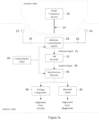
- FIG. 2a is a block diagram representation of the alignment electronics.
- a radio frequency source 20 On the ground, there is a radio frequency source 20 and a length of transmission line 14.
- antennas 22, 24 mounted equal distant to the left and the right of the vehicle centerline.
- the antennas 22, 24 are connected by coaxial cable 26 to an antenna switch 28.
- the antenna switch 28 is controlled by the antenna commutation clock 30 to alternately connect one then the other antenna 22, 24 to a conventional frequency modulation radio receiver 32.
- the commutation signal is a 50% duty cycle square wave.
- the commutating action of the antenna switch 28 has no effect upon the receiver signal.
- the amplitude and the phase of the two antenna input signals 31 are identical and there is no response from the receiver 32.
- the vehicle antennas 22, 24 are no longer symmetrical with respect to the transmission line 14.
- the antenna switching action then introduces signal amplitude and phase perturbations at the commutation rate.
- the signal from the antenna closer to the transmission line 14 will have larger amplitude and leading phase with respect to the more distant antenna.
- the frequency modulation receiver 32 ignores the amplitude perturbations but detects the phase perturbations, frequency being the time rate of change of phase, thereby replicating the antenna switch commutation signal in the receiver audio output 34.
- the receiver audio commutation signal replica is altered by the limited receiver bandwidth. If the commutating signal frequency is above the receiver recovered audio pass band, there is no recovered commutation signal. If the commutating signal frequency is just above the lower receiver audio pass band frequency, the recovered commutation signal will approximate the original commutation square wave albeit low pass filtered by the receiver upper audio pass band limit. A commutation signal frequency in the upper half of the receiver audio pass band leads to a largely sinusoidal recovered audio signal.
- the audio output 34 is provided to synchronous detector 36 to detect the phase differences between the respective antenna signals, and output signals representative of any misalignments are provided to a voltage comparator 38 to determine alignment error polarity based on which signal has a leading phase or lagging phase and to an absolute value detector 40 that determines the alignment error magnitude.
- the alignment error polarity and alignment error magnitude signals are provided to a display device and other audiovisual means to provide feedback to the driver for adjusting the vehicle in the parking slot 10 with respect to the wireless power induction coil 12.
- Figure 2b depicts an example representation of phase differences between the respective alignment antennas as a function of the alignment error or displacement from centerline.
- the system maximum operating frequency provided by radio frequency source 20 is set by the separation between the two vehicle mounted antennas 22, 24 which must be less than the width of the vehicle. In the United States, the average parking slot width is about nine feet. Automobiles are typically no more than 8 feet wide. In order to avoid phase ambiguity, the two sensing antennas 22, 24 must be spaced no more than ⁇ /2 apart at the operating frequency. For two sensing antennas separated by eight feet, the maximum system operating frequency is about 61.5 MHz. Higher frequencies and narrower antenna spacing is possible if the vehicle driver can be assumed to enter the parking slot with an initial alignment error less than 1 ⁇ 2 of the parking slot width. Higher operating frequencies are also possible with the use of more than two vehicle mounted antennas with the additional antenna or antennas used to resolve phase ambiguity. Those skilled in the art will appreciate that there is no lower limit on the system operating frequency except the signal to noise ratio of alignment error becomes progressively worse as the operating frequency is lowered.
- the apparatus described herein provides for vehicle alignment left-right with respect to the parking slot centerline.
- Vehicle left-right misalignment is indicated to the driver by visible, audible or tactile means.
- a visual indication can be an illuminated indicator, a graphical display or software generated graphical overlay imposed upon a video camera image.
- An audible indication may be a continuous or pulsating sound or a software generated speech synthesizer.
- Tactile indication can be provided by the vehicle steering wheel or steering mechanism, gear shift lever, the driver's seat or through the vehicle floor or through floor mounted vehicle control pedals.
- Driver visual cues or technical means described, for example, in U.S. Provisional Patent Application No. 61/862,572, filed August 6, 2013 may be used to indicate and control where the aligned vehicle should stop for axial coil alignment in the front-back directions for assurance that the driver pulls far enough into the parking slot 10 to align the magnetic coils for charging.
- Figures 3a and 3b illustrate sample embodiments of the transmission line 14.
- Figure 3a shows the radio frequency source 20 and a buried or surface mounted transmission line 14 that leaks a signal at the operating frequency.
- a 40.68 MHz, fiftyohm impedance continuous wave radio frequency source 20 provides radio frequency excitation.
- a power level of about 1 mW is used.
- a mini-circuits RF transformer 42, model number ADT 4-6'1' is used as an impedance matching balun.
- the transmission line 14 is implemented with a length of ordinary 300-ohm characteristic impedance balance transmission line. While this transmission line is not designed to be leaky, there is sufficient leakage to be picked up by antennas 22, 24 in sample embodiments.
- a 300-ohm resistor 44 terminates the end of the balance line in order to eliminate reflections and standing waves.
- the transmission line does not have to be balanced; a leaky un-balanced coaxial line would be equally suitable.
- other transmission line impedances such as 50 or 75-ohm coaxial cable with slots in the outer shielding could equally be used.
- Figure 3b depicts an unbalanced 50 or 75 Ohm coaxial cable transmission line 14' with specially designed slots 43 and termination resistor 45 that is matched to the coaxial cable's characteristic impedance.
- FIG 4 shows the circuitry associated with the antennas 22, 24, antenna commutating switch 28, and commutation clock 30 of Figure 2 .
- the antennas 22, 24 include rectangular spirals fabricated on a printed circuit board to ensure antenna-to-antenna consistency. The number of turns for the rectangular spirals depends on the desired value of inductance for the antenna that will be resonated with capacitance to achieve the desired response at the operating frequency. In a sample configuration, ten turn rectangular spirals were used for antennas 22, 24.
- the antennas 22, 24 are electrically small and are not resonant at the operating frequency without the employment of an additional capacitance.
- Each antenna 22, 24 is connected to a length of ordinary 50-ohm characteristic impedance coaxial cable 26.
- the two cables 26 are equal in length when the antennas are symmetrically spaced with respect to the centerline of the vehicle and each has a ferrite sleeve 46 including several ferrite beads slipped over the cable 26 at the ends connected to the antennas 22, 24 to serve as baluns and to suppress RF currents that would otherwise be induced on the cable outer conductors. Induced RF currents introduce significant system errors and must be suppressed.
- An operation frequency of 40.68 MHz is used in a sample embodiment. This frequency is near optimum for this application and is allocated nationally and internationally for ISM (Industrial, Scientific and Medical) uses which include RF heating, Doppler based frequency or phase sensitive motion and intrusion alarms, diathermy, cauterization and other non-communications uses.
- ISM frequencies are set aside for non-communications uses, but they can also be used for communications if the users are willing to accept the possibility of radio interference from the primary ISM applications.
- the advantage for doing so is significantly reduced equipment certification and spectrum allocation regulatory burdens.
- the maximum range of the vehicle alignment system described herein is a few feet at most, the probability of radio interference from other 40.68 MHz ISM frequency users is quite remote.
- An RC oscillator 30 comprised of two logic inverters 4-8, resistors R6 and R7 along with capacitor C6 generates a rectangular wave signal at twice the desired antenna commutation frequency which is then divided by 2 by a D flip-flop 50, thereby generating a commutation clock at the desired frequency with 50-50 duty cycle.
- Components R1, R3, R4, DI, D2, and LI comprise a diode RF switch 28 controlled by the Q and not Q flip-flop outputs.
- R2, R5, C4, and C5 slow the leading and trailing edges of the switch control waveform thereby limiting switching transients.
- R8, C8 and associated logic inverters 52 delay the antenna commutation clock control signal to compensate for the receiver delay.
- FIG. 5 shows the post receiver signal processing circuitry.
- the output of the antenna commutation switch 28 goes to the antenna input of a conventional narrowband FM receiver 32.
- the circuit includes a consumer grade pocket sized scanning receiver, a Uniden BC72XLY compact scanner, but any narrowband VHF FM receiver implementation, analog or digital, hardware or software is acceptable.
- Vehicle alignment error appears in the receiver audio output as a bandwidth limited square wave at the antenna commutation clock frequency. Square wave magnitude indicates alignment error magnitude; square wave polarity indicates alignment error direction, left or right. Synchronous detection then produces a DC voltage with amplitude proportional to alignment error and with polarity indicating alignment error direction.
- the two op-amps 54 amplify the audio signal from the FM receiver by gains of one and minus one.
- Integrated circuit 56 contains three single-pole double throw (SPDT) CMOS FET switches one of which is used as a synchronous rectifier driven by the delayed antenna commutation switch control signal.
- a low pass filter 58 comprised of resistor R16 and capacitor Cl I follows the SPDT switch 56 removing all commutation frequency ripples leaving a direct current signal with amplitude proportional to vehicle misalignment and polarity determined by the direction of the vehicle alignment error, left or right of the parking slot centerline.
- An absolute magnitude circuit recovers the magnitude of the vehicle displacement error while a voltage comparator determines the error polarity.
- the two op-amps 60, 62 are used as a post RC low pass filter buffer amplifier and as a zero-reference voltage comparator, respectively.
- the components associated with transistor 64 keep the op-amp section out of voltage saturation thereby avoiding the subtle problems sometimes experienced when using op-amps in an open-loop connection as voltage comparators.
- the voltage comparator 38 implemented by op-amp 62, provides a logic level signal that indicates the polarity of the alignment error, left or right.
- Op-amps 66 and associated components comprise an absolute value detector 40 providing a unipolar representation of the alignment error magnitude independent of the polarity of the post synchronous detector signal.
- the vehicle dual sense antennas 22, 24 and the transmission line 14 are mounted along the vehicle centerline and parking slot center line, respectively. Offset locations as might be required to avoid vehicle underbody and parking slot obstacles can be accommodated by including the appropriate offset correction in the post synchronous detector hardware or software. In the latter situation, the required offset correction is provided by the ground to vehicle communications link.
Landscapes
- Engineering & Computer Science (AREA)
- Power Engineering (AREA)
- Transportation (AREA)
- Mechanical Engineering (AREA)
- Computer Networks & Wireless Communication (AREA)
- Electric Propulsion And Braking For Vehicles (AREA)
- Near-Field Transmission Systems (AREA)
- Charge And Discharge Circuits For Batteries Or The Like (AREA)
- Current-Collector Devices For Electrically Propelled Vehicles (AREA)
Description
- This patent application claims the benefit of priority to
United States Patent Application Serial No. 16/030,036, filed July 9, 2018 . - This patent application describes a vehicle alignment system as it pertains to wireless charging through use of magnetic resonant induction.
- Resonant induction wireless charging makes use of an air core transformer consisting of two concentric coils displaced along a common coil axis. Transformer coupling coefficient and wireless power transfer efficiency is degraded if the primary and secondary coils are not axially aligned. For vehicle wireless charging this means some provision must be made so that the vehicle parking position is precise and repeatable in order to ensure coil axial alignment.
-
US 2017/111088 A1 describes a method for ensuring magnetic field alignment in wireless power charging system for electrical vehicles (EV). The method includes: transmitting a first signal through a first antenna and a second signal through a second antenna, wherein each of the first signal and the second signal includes an antenna identifier, and the first antenna and the second antenna are antennas used for a smart key (SMK) system installed in the EV; receiving a response signal in response to the first signal and the second signal from a transponder in a location corresponding to a primary coil of the wireless charging system; and estimating a position of the primary coil based on a received signal strength of the first signal and a received signal strength of the second signal, which are included in the received response signal. -
US 8 513 915 B2 also concerns the alignment of a vehicle to facilitate inductive charging. A logic is configured to execute on a control system. The logic is configured to define a first orientation for a first antenna and a second antenna, which are disposed on the vehicle. The logic is also configured to define a second orientation specifying a location of a vehicle charging device disposed on the vehicle relative to the first and second antennae. The logic is further configured to determine a location of an inductive charging device relative to the vehicle by performing triangulation analysis using data from the first and second orientations in conjunction with signals received from the first and second antennae. The logic is also configured to calculate a direction to the location using voltage values from the signals, such that movement of the vehicle in the direction brings the vehicle charging device closer to the inductive charging device. - The invention is a vehicle alignment system and method for aligning a vehicle as defined in the appended claims. A vehicle alignment system aligns a vehicle with a wireless power induction coil for wireless charging through use of magnetic resonant induction. The system includes a transmission line leaking a signal having an operating frequency and that is disposed in a parking slot containing the wireless power induction coil. The transmission line guides the vehicle to the wireless power induction coil for charging. At least two vehicle mounted antennas mounted on respective sides of, and preferably symmetrically with respect to, the transmission line when the vehicle is aligned in the parking slot detect the signal that leaks from the transmission line. Signal processing circuitry detects a relative signal phase between the signals received by the antennas on opposite sides of the transmission line. The relative phase differences between the detected signals from the antennas are representative of alignment of the vehicle left-right with respect to the transmission line.
- In sample embodiments, the transmission line leaks a signal at an operating frequency and is disposed along or parallel to but offset from a centerline of the parking slot or is curved along a trajectory to guide the vehicle to the wireless power induction coil in the parking slot. The transmission line may comprise a 300 ohm characteristic impedance transmission line or a 50 or 75 ohm coaxial cable with slots in outer shielding of the coaxial cable and a termination resistor that is matched to a characteristic impedance of the coaxial cable. In sample embodiments, the signal processing circuitry includes a frequency modulation receiver for detection of relative phase differences between the signals detected by the respective antennas as determined by vehicle parking slot alignment, where the phase differences are induced by sequential switching when the antennas are not an equal distance from the transmission line. The signal processing circuitry may also include an antenna switch that switches between two or more vehicle mounted antennas. The signal processing circuitry may further include a synchronous detector responsive to antenna switching frequency components present in the output of the frequency modulation receiver, a voltage comparator that determines alignment error polarity from an output of the synchronous detector, and an absolute value circuit that determines alignment error magnitude from the output of the synchronous detector. The system may also include visible, audible, or tactile means for directing the driver to adjust the alignment of the vehicle in response to the alignment error polarity and the alignment error magnitude. In a sample embodiment, the operating frequency is the 40.68 MHz or the 13.56 MHz ISM frequency, although frequencies up to 61.5 MHz or more may be used depending upon the dimensions of the parking space and the spacing of the antennas on the vehicle.
- A method is also provided for aligning a vehicle with a wireless power induction coil for wireless charging through use of magnetic resonant induction. A transmission line disposed in the parking slot leaks a signal having an operating frequency and is disposed in the parking slot so as to guide the vehicle to the wireless power induction coil for charging. The vehicle is aligned left-right in the parking slot relative to the transmission line using at least two vehicle mounted antennas mounted on opposite sides the transmission line when the vehicle is aligned in the parking slot. The antennas detect the signal having the operating frequency that leaks from the transmission line and alignment of the vehicle is adjusted relative to the wireless power induction coil based on relative phase differences between the detected signals from the antennas as representative of alignment of the vehicle with respect to the transmission line.
- The method may also include switching between two or more vehicle-mounted antennas and detecting relative phase differences between the signals detected by the respective antennas wherein the phase differences are induced by sequential switching when the antennas are not an equal distance from the transmission line. The sequential switching includes a synchronous detector responsive to antenna switching frequency components present in the output of the frequency modulation receiver switching between the antennas, a voltage comparator determining alignment error polarity from an output of the synchronous detector, and an absolute value circuit determining alignment error magnitude from the output of the synchronous detector. The adjusting step may also comprise directing the driver to adjust the alignment of the vehicle in response to the alignment error polarity and the alignment error magnitude using visible, audible, or tactile means.
- The foregoing and other beneficial features and advantages of the systems and methods described herein will become apparent from the following detailed description in connection with the attached figures, of which:
-
Figure 1a shows a representation of a vehicle parking slot with an induction wireless power sending coil and an alignment system including a transmission line coincident with the parking slot center line. -
Figure 1b shows a representation of a vehicle parking lot with angled parking slots, induction wireless power sending coils, and an alignment system that includes curved transmission lines that assist in guiding a vehicle to the proper location within the parking slot for charging. -
Figure 1c shows a representation of a bus approaching an inductive charging location after a turn whereby a long curved transmission line of the alignment system ensures proper trajectory to get into alignment at the charging coil. -
Figure 2a shows a conceptual representation of the apparatus for vehicle parking alignment in accordance with a sample embodiment. -
Figure 2b shows a representative relationship between vehicle antenna phase difference and vehicle alignment. -
Figure 3a shows an embodiment of the parking slot radio frequency source and transmission line implemented as a 300 Ohm balanced transmission line. -
Figure 3b shows an alternate embodiment of the parking slot radio frequency source and transmission line implemented as a terminated 50 or 75 Ohm coaxial cable with specially designed slots in the outer conductor or shield. -
Figure 4 shows an embodiment of the antenna commutation switch and associated circuitry. -
Figure 5 shows an embodiment of the post FM receiver signal processing circuitry. - The inventive systems and methods may be understood more readily by reference to the following detailed description taken in connection with the accompanying figures and examples, which form a part of this disclosure. It is to be understood that systems and methods are not limited to the specific products, methods, conditions or parameters described and/or shown herein, and that the terminology used herein is for the purpose of describing particular embodiments by way of example only and is not intended to be limiting. Similarly, any description as to a possible mechanism or mode of action or reason for improvement is meant to be illustrative only, and the systems and methods described herein are not to be constrained by the correctness or incorrectness of any such suggested mechanism or mode of action or reason for improvement. Throughout this text, it is recognized that the descriptions refer both to methods and software for implementing such methods.
- A detailed description of illustrative embodiments will now be described with reference to
FIGURES 1-5 . Although this description provides a detailed example of possible implementations of the systems and methods described herein, it should be noted that these details are intended to be by way of example only and in no way delimit the scope of the claimed subject matter. - Figure la is a schematic representation of an
automotive parking slot 10. The wireless power transferprimary coil 12 is shown near the head of theparking slot 10, although the wireless power transferprimary coil 12 could also be located at the foot of theparking slot 10 or elsewhere within the parking slot boundaries. No matter what the primary coil location, the vehicle must be parked within the indicated boundaries of theparking slot 10. A buried or surface mountedtransmission line 14 extends along the parking slot centerline. Thistransmission line 14, connected to a low power continuous wave radio frequency source 20 (Figure 2 ), creates a localized radio frequency field used by the vehicle mounted electronics to determine vehicle alignment within the perimeter of theparking slot 10. Thetransmission line 14. can vary in length and orientation from the short and straight embodiment shown inFigure 1a or longer and curved as shown inFigures 1b and1c . -
Figure 1b is a representation of a series ofangled parking slots 10. The wireless power transferprimary coil 12 is shown in each of theangled parking slots 10 near the head-end. A buried or surfacemount transmission line 14 runs within the parking slot along the centerline and extends out of the parking slot, curving into the lane of vehicle travel along a trajectory to guide the vehicle to the wirelesspower induction coil 12 in theparking slot 10. Avehicle 15 travels in a direction from right to left and receives the alignment signal from the transmission line and a low power continuous wave radio frequency source 20 (Figure 2 ) for the appropriate slot where a chargingprimary coil 12 is available. Thevehicle 15 uses the alignment signal from thetransmission line 14 in conjunction with receive antennas on thevehicle 15 as described below with respect toFigure 2 . -
Figure 1c is a representation of abus 16 approaching a wireless inductive charging station including wirelesspower induction coil 12 after completing a turn. It is important that thebus 16 be properly aligned at the wirelesspower induction coil 12, and proper turning radius and location is critical in achieving the correct trajectory. In this example,transmission line 14 has a length many tens of feet long and embedded in theroadway 17 with the proper orientation to consistently guide thebus 16 along the correct path for proper alignment at the chargingcoil 12. -
Figure 2a is a block diagram representation of the alignment electronics. On the ground, there is aradio frequency source 20 and a length oftransmission line 14. On the vehicle, there are twosmall antennas antenna antennas coaxial cable 26 to anantenna switch 28. Theantenna switch 28 is controlled by theantenna commutation clock 30 to alternately connect one then theother antenna modulation radio receiver 32. In a sample embodiment, the commutation signal is a 50% duty cycle square wave. - When the two receiving
antennas transmission line 14 as is the case when the vehicle is symmetrically aligned within theparking slot 10 perimeter, the commutating action of theantenna switch 28 has no effect upon the receiver signal. The amplitude and the phase of the two antenna input signals 31 are identical and there is no response from thereceiver 32. However, if the vehicle is mis-aligned within theparking slot 10, thevehicle antennas transmission line 14. The antenna switching action then introduces signal amplitude and phase perturbations at the commutation rate. The signal from the antenna closer to thetransmission line 14 will have larger amplitude and leading phase with respect to the more distant antenna. Thefrequency modulation receiver 32 ignores the amplitude perturbations but detects the phase perturbations, frequency being the time rate of change of phase, thereby replicating the antenna switch commutation signal in thereceiver audio output 34. The receiver audio commutation signal replica is altered by the limited receiver bandwidth. If the commutating signal frequency is above the receiver recovered audio pass band, there is no recovered commutation signal. If the commutating signal frequency is just above the lower receiver audio pass band frequency, the recovered commutation signal will approximate the original commutation square wave albeit low pass filtered by the receiver upper audio pass band limit. A commutation signal frequency in the upper half of the receiver audio pass band leads to a largely sinusoidal recovered audio signal. - As further illustrated in
Figure 2a , theaudio output 34 is provided tosynchronous detector 36 to detect the phase differences between the respective antenna signals, and output signals representative of any misalignments are provided to avoltage comparator 38 to determine alignment error polarity based on which signal has a leading phase or lagging phase and to anabsolute value detector 40 that determines the alignment error magnitude. In sample embodiments, the alignment error polarity and alignment error magnitude signals are provided to a display device and other audiovisual means to provide feedback to the driver for adjusting the vehicle in theparking slot 10 with respect to the wirelesspower induction coil 12. -
Figure 2b depicts an example representation of phase differences between the respective alignment antennas as a function of the alignment error or displacement from centerline. - The system maximum operating frequency provided by
radio frequency source 20 is set by the separation between the two vehicle mountedantennas sensing antennas - The apparatus described herein provides for vehicle alignment left-right with respect to the parking slot centerline. Vehicle left-right misalignment is indicated to the driver by visible, audible or tactile means. A visual indication can be an illuminated indicator, a graphical display or software generated graphical overlay imposed upon a video camera image. An audible indication may be a continuous or pulsating sound or a software generated speech synthesizer. Tactile indication can be provided by the vehicle steering wheel or steering mechanism, gear shift lever, the driver's seat or through the vehicle floor or through floor mounted vehicle control pedals. Driver visual cues or technical means described, for example, in
U.S. Provisional Patent Application No. 61/862,572, filed August 6, 2013 parking slot 10 to align the magnetic coils for charging. -
Figures 3a and 3b illustrate sample embodiments of thetransmission line 14. In particular,Figure 3a shows theradio frequency source 20 and a buried or surface mountedtransmission line 14 that leaks a signal at the operating frequency. In this embodiment, a 40.68 MHz, fiftyohm impedance continuous waveradio frequency source 20 provides radio frequency excitation. A power level of about 1 mW is used. Amini-circuits RF transformer 42, model number ADT 4-6'1' is used as an impedance matching balun. Thetransmission line 14 is implemented with a length of ordinary 300-ohm characteristic impedance balance transmission line. While this transmission line is not designed to be leaky, there is sufficient leakage to be picked up byantennas ohm resistor 44 terminates the end of the balance line in order to eliminate reflections and standing waves. The transmission line does not have to be balanced; a leaky un-balanced coaxial line would be equally suitable. Alternatively, other transmission line impedances such as 50 or 75-ohm coaxial cable with slots in the outer shielding could equally be used.Figure 3b depicts an unbalanced 50 or 75 Ohm coaxial cable transmission line 14' with specially designedslots 43 andtermination resistor 45 that is matched to the coaxial cable's characteristic impedance. -
Figure 4 shows the circuitry associated with theantennas antenna commutating switch 28, andcommutation clock 30 ofFigure 2 . Theantennas antennas antennas antenna coaxial cable 26. The twocables 26 are equal in length when the antennas are symmetrically spaced with respect to the centerline of the vehicle and each has aferrite sleeve 46 including several ferrite beads slipped over thecable 26 at the ends connected to theantennas - An
RC oscillator 30 comprised of two logic inverters 4-8, resistors R6 and R7 along with capacitor C6 generates a rectangular wave signal at twice the desired antenna commutation frequency which is then divided by 2 by a D flip-flop 50, thereby generating a commutation clock at the desired frequency with 50-50 duty cycle. Components R1, R3, R4, DI, D2, and LI comprise adiode RF switch 28 controlled by the Q and not Q flip-flop outputs. R2, R5, C4, and C5 slow the leading and trailing edges of the switch control waveform thereby limiting switching transients. R8, C8 and associatedlogic inverters 52 delay the antenna commutation clock control signal to compensate for the receiver delay. -
Figure 5 shows the post receiver signal processing circuitry. The output of theantenna commutation switch 28 goes to the antenna input of a conventionalnarrowband FM receiver 32. The circuit includes a consumer grade pocket sized scanning receiver, a Uniden BC72XLY compact scanner, but any narrowband VHF FM receiver implementation, analog or digital, hardware or software is acceptable. Vehicle alignment error appears in the receiver audio output as a bandwidth limited square wave at the antenna commutation clock frequency. Square wave magnitude indicates alignment error magnitude; square wave polarity indicates alignment error direction, left or right. Synchronous detection then produces a DC voltage with amplitude proportional to alignment error and with polarity indicating alignment error direction. - The two op-
amps 54 amplify the audio signal from the FM receiver by gains of one and minus one. Integratedcircuit 56 contains three single-pole double throw (SPDT) CMOS FET switches one of which is used as a synchronous rectifier driven by the delayed antenna commutation switch control signal. Alow pass filter 58 comprised of resistor R16 and capacitor Cl I follows theSPDT switch 56 removing all commutation frequency ripples leaving a direct current signal with amplitude proportional to vehicle misalignment and polarity determined by the direction of the vehicle alignment error, left or right of the parking slot centerline. An absolute magnitude circuit recovers the magnitude of the vehicle displacement error while a voltage comparator determines the error polarity. - The two op-
amps transistor 64 keep the op-amp section out of voltage saturation thereby avoiding the subtle problems sometimes experienced when using op-amps in an open-loop connection as voltage comparators. Thevoltage comparator 38, implemented by op-amp 62, provides a logic level signal that indicates the polarity of the alignment error, left or right. Op-amps 66 and associated components comprise anabsolute value detector 40 providing a unipolar representation of the alignment error magnitude independent of the polarity of the post synchronous detector signal. - In the implementation described above, the vehicle
dual sense antennas transmission line 14 are mounted along the vehicle centerline and parking slot center line, respectively. Offset locations as might be required to avoid vehicle underbody and parking slot obstacles can be accommodated by including the appropriate offset correction in the post synchronous detector hardware or software. In the latter situation, the required offset correction is provided by the ground to vehicle communications link.
Claims (15)
- A vehicle alignment system for aligning a vehicle (15) with a ground side wireless power induction coil (12) for wireless charging through use of magnetic resonant induction, comprising:a transmission line (14) configured to be disposed at least one of:along a centerline of a parking slot (10),parallel to but offset from the centerline of the parking slot, oralong a curved trajectoryso as to guide the vehicle to the wireless power induction coil (12) for charging, the transmission line leaking a signal having an operating frequency;at least two vehicle mounted antennas (22, 24) configured to be mounted on opposite sides of the transmission line (14) when the vehicle (15) is aligned in the parking slot (10) or moving along the curved trajectory, said antennas detecting said signal having said operating frequency that leaks from the transmission line; andsignal processing circuitry (32, 36, 38, 40) configured to detect a relative signal phase between signals detected by the antennas on opposite sides of the transmission line,wherein relative phase differences between the detected signals from the antennas (22, 24) are representative of alignment of the vehicle (15) left-right with respect to the transmission line (14).
- A system as in claim 1, wherein the operating frequency is below 61.5 MHz, and optionally 40.68 MHz or 13.56 MHz.
- A system as in claim 1, wherein the vehicle mounted antennas (22, 24) are offset symmetrically from a centerline of the vehicle (15).
- A system as in claim 1, wherein the signal processing circuitry includes an antenna switch (28) that switches between two or more vehicle mounted antennas (22, 24).
- A system as in claim 1, wherein the signal processing circuitry (32) detects a relative signal phase between signals detected by the antennas (22, 24) on opposite sides of the transmission line (14) and determines alignment error polarity and alignment error magnitude when the antennas are not equidistant from the transmission line.
- A system as in claim 1, further comprising visible, audible, or tactile means (34) for directing a driver to adjust alignment of the vehicle relative to the transmission line in response to said alignment error polarity and said alignment error magnitude.
- A system as in claim 1, further comprising a continuous wave radio frequency source that provides radio frequency excitation to the transmission line at a power level of about 1 mW.
- A system as in claim 7, wherein the transmission line comprises a 300-ohm characteristic impedance transmission line.
- A system as in claim 7, wherein the transmission line comprises a 50 or 75-ohm coaxial cable with slots in outer shielding of the coaxial cable and a termination resistor that is matched to a characteristic impedance of the coaxial cable.
- A system as in claim 1, wherein the signal processing circuitry comprises:a frequency modulation receiver (32) for detection of the relative phase differences between the signals detected by the respective antennas (22, 24), said phase differences induced by sequential switching when the antennas are not an equal distance from the transmission line (14),a synchronous detector (36) responsive to antenna switching frequency components present in the output of said frequency modulation receiver (32),a voltage comparator (38) that determines alignment error polarity from an output of said synchronous detector (36), andan absolute value circuit (40) that determines alignment error magnitude from said output of said synchronous detector (36).
- A method for aligning a vehicle with a ground side wireless power induction coil for wireless charging through use of magnetic resonant induction, comprising:disposing a transmission line at least one of:along a centerline of a parking slot,parallel to but offset from the centerline of the parking slot, oralong a curved trajectory,wherein the transmission line is configured to leak a signal having an operating frequency, said transmission line being disposed in the parking slot so as to guide the vehicle to the wireless power induction coil for charging;aligning the vehicle left-right relative to the transmission line for charging by the wireless power induction coil, the aligning comprising at least two vehicle mounted antennas mounted on opposite sides of the transmission line when the vehicle is aligned in the parking slot or moving along the curved trajectory detecting said signal having said operating frequency that leaks from the transmission line; andadjusting alignment of the vehicle relative to the wireless power induction coil based on relative phase differences between the detected signals from the antennas as representative of alignment of the vehicle left-right with respect to the transmission line.
- A method as in claim 11, wherein the transmission line leaks the signal through slots in outer shielding of a 50 or 75-ohm coaxial cable.
- A method as in claim 11, wherein the operating frequency is below 61.5 MHz.
- A method as in claim 13, wherein the operating frequency is 13.56 MHz.
- A method as in claim 11, wherein the aligning comprises:a frequency modulation receiver detecting a relative signal phase between signals detected by the antennas on opposite sides of the transmission line, said phase differences induced by sequential switching when the antennas are not an equal distance from the transmission line, wherein said sequential switching includes a synchronous detector responsive to antenna switching frequency components present in the output of said frequency modulation receiver switching between the antennas,a voltage comparator determining alignment error polarity from an output of said synchronous detector, andan absolute value circuit determining alignment error magnitude from said output of said synchronous detector.
Applications Claiming Priority (2)
| Application Number | Priority Date | Filing Date | Title |
|---|---|---|---|
| US16/030,036 US10814729B2 (en) | 2013-11-14 | 2018-07-09 | Method and apparatus for the alignment of a vehicle and charging coil prior to wireless charging |
| PCT/US2019/039161 WO2020013989A1 (en) | 2018-07-09 | 2019-06-26 | Alignment of vehicles prior to wireless charging |
Publications (3)
| Publication Number | Publication Date |
|---|---|
| EP3821519A1 EP3821519A1 (en) | 2021-05-19 |
| EP3821519A4 EP3821519A4 (en) | 2021-09-01 |
| EP3821519B1 true EP3821519B1 (en) | 2023-08-16 |
Family
ID=69141900
Family Applications (1)
| Application Number | Title | Priority Date | Filing Date |
|---|---|---|---|
| EP19834203.2A Active EP3821519B1 (en) | 2018-07-09 | 2019-06-26 | Alignment of vehicles prior to wireless charging |
Country Status (8)
| Country | Link |
|---|---|
| EP (1) | EP3821519B1 (en) |
| JP (1) | JP7281832B2 (en) |
| KR (1) | KR102746818B1 (en) |
| CN (1) | CN112425031A (en) |
| ES (1) | ES2955420T3 (en) |
| MX (1) | MX2021000249A (en) |
| PT (1) | PT3821519T (en) |
| WO (1) | WO2020013989A1 (en) |
Families Citing this family (5)
| Publication number | Priority date | Publication date | Assignee | Title |
|---|---|---|---|---|
| US10814729B2 (en) | 2013-11-14 | 2020-10-27 | Momentum Dynamics Corporation | Method and apparatus for the alignment of a vehicle and charging coil prior to wireless charging |
| US11241970B2 (en) | 2013-11-14 | 2022-02-08 | Momentum Dynamics Corporation | Method and apparatus for the alignment of vehicles prior to wireless charging |
| CN110435645B (en) * | 2019-08-28 | 2021-11-26 | 江西江铃集团新能源汽车有限公司 | Automatic parking control method, device and system and readable storage medium |
| MX2024008219A (en) * | 2022-01-03 | 2024-07-19 | Inductev Inc | Method and apparatus for the selective guidance of vehicles to a wireless charger. |
| US12145461B2 (en) | 2022-01-06 | 2024-11-19 | Ev Charging Solutions, Llc | Inductive charging station |
Family Cites Families (31)
| Publication number | Priority date | Publication date | Assignee | Title |
|---|---|---|---|---|
| US4219821A (en) * | 1978-09-07 | 1980-08-26 | Regency Electronics, Inc. | Automatic direction finding system |
| JPS63115207A (en) * | 1986-10-31 | 1988-05-19 | Murata Mach Ltd | Traveling guide device for unattended vehicle |
| JPH10103965A (en) * | 1996-09-27 | 1998-04-24 | Fujitsu Ten Ltd | A method for detecting the displacement of a vehicle with respect to a radio wave reflector |
| JP3520765B2 (en) * | 1998-04-28 | 2004-04-19 | 株式会社デンソー | Lane change management system using vehicle guidance tags |
| JP2001005523A (en) | 1999-06-22 | 2001-01-12 | Uchihashi Estec Co Ltd | Automatic parking method |
| JP2007010639A (en) * | 2004-08-16 | 2007-01-18 | Rcs:Kk | Active tag apparatus |
| JP2006072431A (en) * | 2004-08-31 | 2006-03-16 | Matsushita Electric Ind Co Ltd | Automatic parking system |
| CN101371541A (en) | 2006-01-11 | 2009-02-18 | 鲍尔卡斯特公司 | Pulse transmission method |
| CN1891966B (en) * | 2006-02-28 | 2012-06-27 | 谢明宗 | Trackless door driving guide device |
| JP2010246348A (en) | 2009-04-09 | 2010-10-28 | Fujitsu Ten Ltd | Power receiving device and power transmitting device |
| WO2012018268A1 (en) * | 2010-08-05 | 2012-02-09 | Auckland Uniservices Limited | Inductive power transfer apparatus |
| US8513915B2 (en) * | 2010-10-21 | 2013-08-20 | GM Global Technology Operations LLC | Vehicle alignment for inductive charging |
| US10090885B2 (en) * | 2011-04-13 | 2018-10-02 | Qualcomm Incorporated | Antenna alignment and vehicle guidance for wireless charging of electric vehicles |
| WO2013003527A1 (en) * | 2011-06-28 | 2013-01-03 | Wireless Ev Charge, Llc | Alignment, verification, and optimization of high power wireless charging systems |
| CN202711064U (en) * | 2012-01-09 | 2013-01-30 | 谢朝京 | AGV guiding sensing device |
| CN102819265A (en) * | 2012-08-29 | 2012-12-12 | 上海富洋自动化工程设备有限公司 | Carrier robot self-propelled vehicle for continuous absolute address system |
| US9409490B2 (en) * | 2013-09-27 | 2016-08-09 | Qualcomm Incorporated | Device alignment in inductive power transfer systems |
| DE102013227129B4 (en) * | 2013-12-23 | 2016-01-14 | Continental Automotive Gmbh | Method for detecting a relative position, method for wireless charging of a vehicle, orientation signal receiver and inductive charging device |
| US9772401B2 (en) * | 2014-03-17 | 2017-09-26 | Qualcomm Incorporated | Systems, methods, and apparatus for radar-based detection of objects in a predetermined space |
| EP3197705B1 (en) * | 2014-09-25 | 2023-04-05 | Continental Automotive Technologies GmbH | Localization of charging coils, which is integrated in distance sensors |
| US10411524B2 (en) | 2015-06-23 | 2019-09-10 | Witricity Corporation | Systems, methods and apparatuses for guidance and alignment in electric vehicles wireless inductive charging systems |
| CN204808055U (en) * | 2015-07-22 | 2015-11-25 | 厦门新页科技有限公司 | Electric automobile is wireless to charge transmission and receives automatic alignment system |
| KR101803151B1 (en) | 2015-10-16 | 2017-11-29 | 현대자동차주식회사 | Method and apparatus for magnetic field alignment in wireless power charging system and primary pad used therein |
| US10336194B2 (en) * | 2015-11-13 | 2019-07-02 | Nio Usa, Inc. | Electric vehicle charging device alignment and method of use |
| CN205264050U (en) * | 2015-12-24 | 2016-05-25 | 上海展为软件技术有限公司 | Microwave vehicles detection device based on earth magnetism guide |
| US9837706B2 (en) * | 2016-02-19 | 2017-12-05 | Ford Global Technologies, Llc | Directing electromagnetic waves in vehicle communications |
| US10011182B2 (en) * | 2016-03-24 | 2018-07-03 | Ford Global Technologies, Llc | Inductive charger alignment systems for vehicles |
| US10369894B2 (en) * | 2016-10-21 | 2019-08-06 | Hevo, Inc. | Parking alignment sequence for wirelessly charging an electric vehicle |
| CN106981215B (en) * | 2017-03-23 | 2020-09-11 | 北京联合大学 | A multi-sensor combined automatic parking space guidance method |
| CN206851844U (en) * | 2017-05-04 | 2018-01-09 | 曲靖师范学院 | A kind of long-distance intelligent control pesticide-spraying cart |
| CN107757397A (en) * | 2017-09-19 | 2018-03-06 | 深圳大学 | A control device and method for correcting alignment error of vehicle wireless charging |
-
2019
- 2019-06-26 JP JP2021500391A patent/JP7281832B2/en active Active
- 2019-06-26 EP EP19834203.2A patent/EP3821519B1/en active Active
- 2019-06-26 ES ES19834203T patent/ES2955420T3/en active Active
- 2019-06-26 MX MX2021000249A patent/MX2021000249A/en unknown
- 2019-06-26 CN CN201980046097.0A patent/CN112425031A/en active Pending
- 2019-06-26 WO PCT/US2019/039161 patent/WO2020013989A1/en not_active Ceased
- 2019-06-26 KR KR1020217003717A patent/KR102746818B1/en active Active
- 2019-06-26 PT PT198342032T patent/PT3821519T/en unknown
Also Published As
| Publication number | Publication date |
|---|---|
| JP2021530950A (en) | 2021-11-11 |
| EP3821519A4 (en) | 2021-09-01 |
| CN112425031A (en) | 2021-02-26 |
| JP7281832B2 (en) | 2023-05-26 |
| MX2021000249A (en) | 2021-05-12 |
| KR20210029797A (en) | 2021-03-16 |
| WO2020013989A1 (en) | 2020-01-16 |
| PT3821519T (en) | 2023-09-05 |
| KR102746818B1 (en) | 2024-12-27 |
| EP3821519A1 (en) | 2021-05-19 |
| ES2955420T3 (en) | 2023-11-30 |
| CA3105049A1 (en) | 2020-01-16 |
Similar Documents
| Publication | Publication Date | Title |
|---|---|---|
| US10814729B2 (en) | Method and apparatus for the alignment of a vehicle and charging coil prior to wireless charging | |
| US11241970B2 (en) | Method and apparatus for the alignment of vehicles prior to wireless charging | |
| EP3821519B1 (en) | Alignment of vehicles prior to wireless charging | |
| US10040360B1 (en) | Method and apparatus for the alignment of vehicles prior to wireless charging including a transmission line that leaks a signal for alignment | |
| US10404107B2 (en) | Non-contact charging device, and non-contact power supply system using same | |
| EP2961036B1 (en) | Foreign object detection device, foreign object detection method, and non-contact charging system | |
| EP3031128B1 (en) | A method of and apparatus for detecting coil alignment error in wireless inductive power transmission | |
| US20190058362A1 (en) | System and a Method for Determining a Relative Position and/or Orientation Between a Primary and a Secondary Winding Structure | |
| US20150355360A1 (en) | Foreign object detection device, foreign object detection method, and non-contact charging system | |
| US9812254B2 (en) | Wireless power feeder | |
| KR20150038050A (en) | Device alignment and identification in inductive power transfer systems | |
| CA3163907C (en) | Method and apparatus for the alignment of vehicles prior to wireless charging | |
| CA3105049C (en) | Alignment of vehicles prior to wireless charging | |
| EP3900152B1 (en) | An antenna arrangement and a method of operating an antenna arrangement | |
| EP1869612B1 (en) | Rfid reader with an antenna and method for operating the same | |
| JP3339421B2 (en) | Contactless power supply system | |
| US20250214469A1 (en) | Method for positioning a vehicle | |
| CA3247511A1 (en) | System for inductive energy transfer |
Legal Events
| Date | Code | Title | Description |
|---|---|---|---|
| STAA | Information on the status of an ep patent application or granted ep patent |
Free format text: STATUS: THE INTERNATIONAL PUBLICATION HAS BEEN MADE |
|
| PUAI | Public reference made under article 153(3) epc to a published international application that has entered the european phase |
Free format text: ORIGINAL CODE: 0009012 |
|
| STAA | Information on the status of an ep patent application or granted ep patent |
Free format text: STATUS: REQUEST FOR EXAMINATION WAS MADE |
|
| 17P | Request for examination filed |
Effective date: 20210126 |
|
| AK | Designated contracting states |
Kind code of ref document: A1 Designated state(s): AL AT BE BG CH CY CZ DE DK EE ES FI FR GB GR HR HU IE IS IT LI LT LU LV MC MK MT NL NO PL PT RO RS SE SI SK SM TR |
|
| A4 | Supplementary search report drawn up and despatched |
Effective date: 20210729 |
|
| RIC1 | Information provided on ipc code assigned before grant |
Ipc: H02J 50/90 20160101AFI20210723BHEP Ipc: B60L 53/12 20190101ALI20210723BHEP Ipc: B60L 53/36 20190101ALI20210723BHEP Ipc: B60L 53/38 20190101ALI20210723BHEP |
|
| DAV | Request for validation of the european patent (deleted) | ||
| DAX | Request for extension of the european patent (deleted) | ||
| RAP3 | Party data changed (applicant data changed or rights of an application transferred) |
Owner name: INDUCTEV INC. |
|
| GRAP | Despatch of communication of intention to grant a patent |
Free format text: ORIGINAL CODE: EPIDOSNIGR1 |
|
| STAA | Information on the status of an ep patent application or granted ep patent |
Free format text: STATUS: GRANT OF PATENT IS INTENDED |
|
| INTG | Intention to grant announced |
Effective date: 20230320 |
|
| RAP3 | Party data changed (applicant data changed or rights of an application transferred) |
Owner name: INDUCTEV INC. |
|
| GRAS | Grant fee paid |
Free format text: ORIGINAL CODE: EPIDOSNIGR3 |
|
| GRAA | (expected) grant |
Free format text: ORIGINAL CODE: 0009210 |
|
| STAA | Information on the status of an ep patent application or granted ep patent |
Free format text: STATUS: THE PATENT HAS BEEN GRANTED |
|
| AK | Designated contracting states |
Kind code of ref document: B1 Designated state(s): AL AT BE BG CH CY CZ DE DK EE ES FI FR GB GR HR HU IE IS IT LI LT LU LV MC MK MT NL NO PL PT RO RS SE SI SK SM TR |
|
| REG | Reference to a national code |
Ref country code: CH Ref legal event code: EP |
|
| REG | Reference to a national code |
Ref country code: PT Ref legal event code: SC4A Ref document number: 3821519 Country of ref document: PT Date of ref document: 20230905 Kind code of ref document: T Free format text: AVAILABILITY OF NATIONAL TRANSLATION Effective date: 20230828 |
|
| REG | Reference to a national code |
Ref country code: DE Ref legal event code: R096 Ref document number: 602019035271 Country of ref document: DE |
|
| REG | Reference to a national code |
Ref country code: IE Ref legal event code: FG4D |
|
| REG | Reference to a national code |
Ref country code: SE Ref legal event code: TRGR |
|
| REG | Reference to a national code |
Ref country code: ES Ref legal event code: FG2A Ref document number: 2955420 Country of ref document: ES Kind code of ref document: T3 Effective date: 20231130 |
|
| REG | Reference to a national code |
Ref country code: LT Ref legal event code: MG9D |
|
| REG | Reference to a national code |
Ref country code: NL Ref legal event code: MP Effective date: 20230816 |
|
| PG25 | Lapsed in a contracting state [announced via postgrant information from national office to epo] |
Ref country code: GR Free format text: LAPSE BECAUSE OF FAILURE TO SUBMIT A TRANSLATION OF THE DESCRIPTION OR TO PAY THE FEE WITHIN THE PRESCRIBED TIME-LIMIT Effective date: 20231117 |
|
| PG25 | Lapsed in a contracting state [announced via postgrant information from national office to epo] |
Ref country code: IS Free format text: LAPSE BECAUSE OF FAILURE TO SUBMIT A TRANSLATION OF THE DESCRIPTION OR TO PAY THE FEE WITHIN THE PRESCRIBED TIME-LIMIT Effective date: 20231216 |
|
| PG25 | Lapsed in a contracting state [announced via postgrant information from national office to epo] |
Ref country code: RS Free format text: LAPSE BECAUSE OF FAILURE TO SUBMIT A TRANSLATION OF THE DESCRIPTION OR TO PAY THE FEE WITHIN THE PRESCRIBED TIME-LIMIT Effective date: 20230816 Ref country code: NO Free format text: LAPSE BECAUSE OF FAILURE TO SUBMIT A TRANSLATION OF THE DESCRIPTION OR TO PAY THE FEE WITHIN THE PRESCRIBED TIME-LIMIT Effective date: 20231116 Ref country code: NL Free format text: LAPSE BECAUSE OF FAILURE TO SUBMIT A TRANSLATION OF THE DESCRIPTION OR TO PAY THE FEE WITHIN THE PRESCRIBED TIME-LIMIT Effective date: 20230816 Ref country code: LV Free format text: LAPSE BECAUSE OF FAILURE TO SUBMIT A TRANSLATION OF THE DESCRIPTION OR TO PAY THE FEE WITHIN THE PRESCRIBED TIME-LIMIT Effective date: 20230816 Ref country code: LT Free format text: LAPSE BECAUSE OF FAILURE TO SUBMIT A TRANSLATION OF THE DESCRIPTION OR TO PAY THE FEE WITHIN THE PRESCRIBED TIME-LIMIT Effective date: 20230816 Ref country code: IS Free format text: LAPSE BECAUSE OF FAILURE TO SUBMIT A TRANSLATION OF THE DESCRIPTION OR TO PAY THE FEE WITHIN THE PRESCRIBED TIME-LIMIT Effective date: 20231216 Ref country code: HR Free format text: LAPSE BECAUSE OF FAILURE TO SUBMIT A TRANSLATION OF THE DESCRIPTION OR TO PAY THE FEE WITHIN THE PRESCRIBED TIME-LIMIT Effective date: 20230816 Ref country code: GR Free format text: LAPSE BECAUSE OF FAILURE TO SUBMIT A TRANSLATION OF THE DESCRIPTION OR TO PAY THE FEE WITHIN THE PRESCRIBED TIME-LIMIT Effective date: 20231117 Ref country code: FI Free format text: LAPSE BECAUSE OF FAILURE TO SUBMIT A TRANSLATION OF THE DESCRIPTION OR TO PAY THE FEE WITHIN THE PRESCRIBED TIME-LIMIT Effective date: 20230816 |
|
| PG25 | Lapsed in a contracting state [announced via postgrant information from national office to epo] |
Ref country code: PL Free format text: LAPSE BECAUSE OF FAILURE TO SUBMIT A TRANSLATION OF THE DESCRIPTION OR TO PAY THE FEE WITHIN THE PRESCRIBED TIME-LIMIT Effective date: 20230816 |
|
| PG25 | Lapsed in a contracting state [announced via postgrant information from national office to epo] |
Ref country code: SM Free format text: LAPSE BECAUSE OF FAILURE TO SUBMIT A TRANSLATION OF THE DESCRIPTION OR TO PAY THE FEE WITHIN THE PRESCRIBED TIME-LIMIT Effective date: 20230816 Ref country code: RO Free format text: LAPSE BECAUSE OF FAILURE TO SUBMIT A TRANSLATION OF THE DESCRIPTION OR TO PAY THE FEE WITHIN THE PRESCRIBED TIME-LIMIT Effective date: 20230816 Ref country code: EE Free format text: LAPSE BECAUSE OF FAILURE TO SUBMIT A TRANSLATION OF THE DESCRIPTION OR TO PAY THE FEE WITHIN THE PRESCRIBED TIME-LIMIT Effective date: 20230816 Ref country code: DK Free format text: LAPSE BECAUSE OF FAILURE TO SUBMIT A TRANSLATION OF THE DESCRIPTION OR TO PAY THE FEE WITHIN THE PRESCRIBED TIME-LIMIT Effective date: 20230816 Ref country code: CZ Free format text: LAPSE BECAUSE OF FAILURE TO SUBMIT A TRANSLATION OF THE DESCRIPTION OR TO PAY THE FEE WITHIN THE PRESCRIBED TIME-LIMIT Effective date: 20230816 Ref country code: SK Free format text: LAPSE BECAUSE OF FAILURE TO SUBMIT A TRANSLATION OF THE DESCRIPTION OR TO PAY THE FEE WITHIN THE PRESCRIBED TIME-LIMIT Effective date: 20230816 |
|
| REG | Reference to a national code |
Ref country code: DE Ref legal event code: R097 Ref document number: 602019035271 Country of ref document: DE |
|
| PLBE | No opposition filed within time limit |
Free format text: ORIGINAL CODE: 0009261 |
|
| STAA | Information on the status of an ep patent application or granted ep patent |
Free format text: STATUS: NO OPPOSITION FILED WITHIN TIME LIMIT |
|
| 26N | No opposition filed |
Effective date: 20240517 |
|
| PG25 | Lapsed in a contracting state [announced via postgrant information from national office to epo] |
Ref country code: SI Free format text: LAPSE BECAUSE OF FAILURE TO SUBMIT A TRANSLATION OF THE DESCRIPTION OR TO PAY THE FEE WITHIN THE PRESCRIBED TIME-LIMIT Effective date: 20230816 |
|
| PG25 | Lapsed in a contracting state [announced via postgrant information from national office to epo] |
Ref country code: BG Free format text: LAPSE BECAUSE OF FAILURE TO SUBMIT A TRANSLATION OF THE DESCRIPTION OR TO PAY THE FEE WITHIN THE PRESCRIBED TIME-LIMIT Effective date: 20230816 |
|
| PG25 | Lapsed in a contracting state [announced via postgrant information from national office to epo] |
Ref country code: BG Free format text: LAPSE BECAUSE OF FAILURE TO SUBMIT A TRANSLATION OF THE DESCRIPTION OR TO PAY THE FEE WITHIN THE PRESCRIBED TIME-LIMIT Effective date: 20230816 |
|
| PG25 | Lapsed in a contracting state [announced via postgrant information from national office to epo] |
Ref country code: MC Free format text: LAPSE BECAUSE OF FAILURE TO SUBMIT A TRANSLATION OF THE DESCRIPTION OR TO PAY THE FEE WITHIN THE PRESCRIBED TIME-LIMIT Effective date: 20230816 |
|
| REG | Reference to a national code |
Ref country code: CH Ref legal event code: PL |
|
| PG25 | Lapsed in a contracting state [announced via postgrant information from national office to epo] |
Ref country code: LU Free format text: LAPSE BECAUSE OF NON-PAYMENT OF DUE FEES Effective date: 20240626 |
|
| PGFP | Annual fee paid to national office [announced via postgrant information from national office to epo] |
Ref country code: SE Payment date: 20250313 Year of fee payment: 7 |
|
| PG25 | Lapsed in a contracting state [announced via postgrant information from national office to epo] |
Ref country code: IE Free format text: LAPSE BECAUSE OF NON-PAYMENT OF DUE FEES Effective date: 20240626 |
|
| PG25 | Lapsed in a contracting state [announced via postgrant information from national office to epo] |
Ref country code: BE Free format text: LAPSE BECAUSE OF NON-PAYMENT OF DUE FEES Effective date: 20240630 Ref country code: CH Free format text: LAPSE BECAUSE OF NON-PAYMENT OF DUE FEES Effective date: 20240630 |
|
| REG | Reference to a national code |
Ref country code: BE Ref legal event code: MM Effective date: 20240630 |
|
| PGFP | Annual fee paid to national office [announced via postgrant information from national office to epo] |
Ref country code: DE Payment date: 20250513 Year of fee payment: 7 |
|
| PGFP | Annual fee paid to national office [announced via postgrant information from national office to epo] |
Ref country code: GB Payment date: 20250513 Year of fee payment: 7 |
|
| PGFP | Annual fee paid to national office [announced via postgrant information from national office to epo] |
Ref country code: IT Payment date: 20250409 Year of fee payment: 7 |
|
| PGFP | Annual fee paid to national office [announced via postgrant information from national office to epo] |
Ref country code: PT Payment date: 20250408 Year of fee payment: 7 |
|
| PGFP | Annual fee paid to national office [announced via postgrant information from national office to epo] |
Ref country code: FR Payment date: 20250509 Year of fee payment: 7 |
|
| PGFP | Annual fee paid to national office [announced via postgrant information from national office to epo] |
Ref country code: AT Payment date: 20250512 Year of fee payment: 7 |
|
| PGFP | Annual fee paid to national office [announced via postgrant information from national office to epo] |
Ref country code: ES Payment date: 20250708 Year of fee payment: 7 |
|
| PG25 | Lapsed in a contracting state [announced via postgrant information from national office to epo] |
Ref country code: CY Free format text: LAPSE BECAUSE OF FAILURE TO SUBMIT A TRANSLATION OF THE DESCRIPTION OR TO PAY THE FEE WITHIN THE PRESCRIBED TIME-LIMIT; INVALID AB INITIO Effective date: 20190626 |
|
| PG25 | Lapsed in a contracting state [announced via postgrant information from national office to epo] |
Ref country code: HU Free format text: LAPSE BECAUSE OF FAILURE TO SUBMIT A TRANSLATION OF THE DESCRIPTION OR TO PAY THE FEE WITHIN THE PRESCRIBED TIME-LIMIT; INVALID AB INITIO Effective date: 20190626 |