EP3821418B1 - Information, warning and braking request generation for turn assist functionality - Google Patents
Information, warning and braking request generation for turn assist functionality Download PDFInfo
- Publication number
- EP3821418B1 EP3821418B1 EP19732956.8A EP19732956A EP3821418B1 EP 3821418 B1 EP3821418 B1 EP 3821418B1 EP 19732956 A EP19732956 A EP 19732956A EP 3821418 B1 EP3821418 B1 EP 3821418B1
- Authority
- EP
- European Patent Office
- Prior art keywords
- vehicle
- driver
- turn
- monitoring area
- quadrilateral
- Prior art date
- Legal status (The legal status is an assumption and is not a legal conclusion. Google has not performed a legal analysis and makes no representation as to the accuracy of the status listed.)
- Active
Links
Images

Classifications
-
- B—PERFORMING OPERATIONS; TRANSPORTING
- B60—VEHICLES IN GENERAL
- B60T—VEHICLE BRAKE CONTROL SYSTEMS OR PARTS THEREOF; BRAKE CONTROL SYSTEMS OR PARTS THEREOF, IN GENERAL; ARRANGEMENT OF BRAKING ELEMENTS ON VEHICLES IN GENERAL; PORTABLE DEVICES FOR PREVENTING UNWANTED MOVEMENT OF VEHICLES; VEHICLE MODIFICATIONS TO FACILITATE COOLING OF BRAKES
- B60T7/00—Brake-action initiating means
- B60T7/12—Brake-action initiating means for automatic initiation; for initiation not subject to will of driver or passenger
-
- B—PERFORMING OPERATIONS; TRANSPORTING
- B60—VEHICLES IN GENERAL
- B60Q—ARRANGEMENT OF SIGNALLING OR LIGHTING DEVICES, THE MOUNTING OR SUPPORTING THEREOF OR CIRCUITS THEREFOR, FOR VEHICLES IN GENERAL
- B60Q9/00—Arrangement or adaptation of signal devices not provided for in one of main groups B60Q1/00 - B60Q7/00, e.g. haptic signalling
- B60Q9/008—Arrangement or adaptation of signal devices not provided for in one of main groups B60Q1/00 - B60Q7/00, e.g. haptic signalling for anti-collision purposes
-
- B—PERFORMING OPERATIONS; TRANSPORTING
- B60—VEHICLES IN GENERAL
- B60W—CONJOINT CONTROL OF VEHICLE SUB-UNITS OF DIFFERENT TYPE OR DIFFERENT FUNCTION; CONTROL SYSTEMS SPECIALLY ADAPTED FOR HYBRID VEHICLES; ROAD VEHICLE DRIVE CONTROL SYSTEMS FOR PURPOSES NOT RELATED TO THE CONTROL OF A PARTICULAR SUB-UNIT
- B60W30/00—Purposes of road vehicle drive control systems not related to the control of a particular sub-unit, e.g. of systems using conjoint control of vehicle sub-units
- B60W30/08—Active safety systems predicting or avoiding probable or impending collision or attempting to minimise its consequences
- B60W30/095—Predicting travel path or likelihood of collision
- B60W30/0953—Predicting travel path or likelihood of collision the prediction being responsive to vehicle dynamic parameters
-
- B—PERFORMING OPERATIONS; TRANSPORTING
- B60—VEHICLES IN GENERAL
- B60W—CONJOINT CONTROL OF VEHICLE SUB-UNITS OF DIFFERENT TYPE OR DIFFERENT FUNCTION; CONTROL SYSTEMS SPECIALLY ADAPTED FOR HYBRID VEHICLES; ROAD VEHICLE DRIVE CONTROL SYSTEMS FOR PURPOSES NOT RELATED TO THE CONTROL OF A PARTICULAR SUB-UNIT
- B60W30/00—Purposes of road vehicle drive control systems not related to the control of a particular sub-unit, e.g. of systems using conjoint control of vehicle sub-units
- B60W30/08—Active safety systems predicting or avoiding probable or impending collision or attempting to minimise its consequences
- B60W30/095—Predicting travel path or likelihood of collision
- B60W30/0956—Predicting travel path or likelihood of collision the prediction being responsive to traffic or environmental parameters
-
- B—PERFORMING OPERATIONS; TRANSPORTING
- B60—VEHICLES IN GENERAL
- B60W—CONJOINT CONTROL OF VEHICLE SUB-UNITS OF DIFFERENT TYPE OR DIFFERENT FUNCTION; CONTROL SYSTEMS SPECIALLY ADAPTED FOR HYBRID VEHICLES; ROAD VEHICLE DRIVE CONTROL SYSTEMS FOR PURPOSES NOT RELATED TO THE CONTROL OF A PARTICULAR SUB-UNIT
- B60W30/00—Purposes of road vehicle drive control systems not related to the control of a particular sub-unit, e.g. of systems using conjoint control of vehicle sub-units
- B60W30/18—Propelling the vehicle
- B60W30/18009—Propelling the vehicle related to particular drive situations
- B60W30/18145—Cornering
-
- B—PERFORMING OPERATIONS; TRANSPORTING
- B60—VEHICLES IN GENERAL
- B60W—CONJOINT CONTROL OF VEHICLE SUB-UNITS OF DIFFERENT TYPE OR DIFFERENT FUNCTION; CONTROL SYSTEMS SPECIALLY ADAPTED FOR HYBRID VEHICLES; ROAD VEHICLE DRIVE CONTROL SYSTEMS FOR PURPOSES NOT RELATED TO THE CONTROL OF A PARTICULAR SUB-UNIT
- B60W50/00—Details of control systems for road vehicle drive control not related to the control of a particular sub-unit, e.g. process diagnostic or vehicle driver interfaces
- B60W50/08—Interaction between the driver and the control system
- B60W50/14—Means for informing the driver, warning the driver or prompting a driver intervention
-
- G—PHYSICS
- G08—SIGNALLING
- G08G—TRAFFIC CONTROL SYSTEMS
- G08G1/00—Traffic control systems for road vehicles
- G08G1/16—Anti-collision systems
- G08G1/166—Anti-collision systems for active traffic, e.g. moving vehicles, pedestrians, bikes
-
- B—PERFORMING OPERATIONS; TRANSPORTING
- B60—VEHICLES IN GENERAL
- B60T—VEHICLE BRAKE CONTROL SYSTEMS OR PARTS THEREOF; BRAKE CONTROL SYSTEMS OR PARTS THEREOF, IN GENERAL; ARRANGEMENT OF BRAKING ELEMENTS ON VEHICLES IN GENERAL; PORTABLE DEVICES FOR PREVENTING UNWANTED MOVEMENT OF VEHICLES; VEHICLE MODIFICATIONS TO FACILITATE COOLING OF BRAKES
- B60T2201/00—Particular use of vehicle brake systems; Special systems using also the brakes; Special software modules within the brake system controller
- B60T2201/02—Active or adaptive cruise control system; Distance control
- B60T2201/022—Collision avoidance systems
-
- B—PERFORMING OPERATIONS; TRANSPORTING
- B60—VEHICLES IN GENERAL
- B60T—VEHICLE BRAKE CONTROL SYSTEMS OR PARTS THEREOF; BRAKE CONTROL SYSTEMS OR PARTS THEREOF, IN GENERAL; ARRANGEMENT OF BRAKING ELEMENTS ON VEHICLES IN GENERAL; PORTABLE DEVICES FOR PREVENTING UNWANTED MOVEMENT OF VEHICLES; VEHICLE MODIFICATIONS TO FACILITATE COOLING OF BRAKES
- B60T2250/00—Monitoring, detecting, estimating vehicle conditions
- B60T2250/03—Vehicle yaw rate
-
- B—PERFORMING OPERATIONS; TRANSPORTING
- B60—VEHICLES IN GENERAL
- B60T—VEHICLE BRAKE CONTROL SYSTEMS OR PARTS THEREOF; BRAKE CONTROL SYSTEMS OR PARTS THEREOF, IN GENERAL; ARRANGEMENT OF BRAKING ELEMENTS ON VEHICLES IN GENERAL; PORTABLE DEVICES FOR PREVENTING UNWANTED MOVEMENT OF VEHICLES; VEHICLE MODIFICATIONS TO FACILITATE COOLING OF BRAKES
- B60T2250/00—Monitoring, detecting, estimating vehicle conditions
- B60T2250/04—Vehicle reference speed; Vehicle body speed
-
- B—PERFORMING OPERATIONS; TRANSPORTING
- B60—VEHICLES IN GENERAL
- B60W—CONJOINT CONTROL OF VEHICLE SUB-UNITS OF DIFFERENT TYPE OR DIFFERENT FUNCTION; CONTROL SYSTEMS SPECIALLY ADAPTED FOR HYBRID VEHICLES; ROAD VEHICLE DRIVE CONTROL SYSTEMS FOR PURPOSES NOT RELATED TO THE CONTROL OF A PARTICULAR SUB-UNIT
- B60W50/00—Details of control systems for road vehicle drive control not related to the control of a particular sub-unit, e.g. process diagnostic or vehicle driver interfaces
- B60W50/08—Interaction between the driver and the control system
- B60W50/14—Means for informing the driver, warning the driver or prompting a driver intervention
- B60W2050/143—Alarm means
-
- B—PERFORMING OPERATIONS; TRANSPORTING
- B60—VEHICLES IN GENERAL
- B60W—CONJOINT CONTROL OF VEHICLE SUB-UNITS OF DIFFERENT TYPE OR DIFFERENT FUNCTION; CONTROL SYSTEMS SPECIALLY ADAPTED FOR HYBRID VEHICLES; ROAD VEHICLE DRIVE CONTROL SYSTEMS FOR PURPOSES NOT RELATED TO THE CONTROL OF A PARTICULAR SUB-UNIT
- B60W2300/00—Indexing codes relating to the type of vehicle
- B60W2300/12—Trucks; Load vehicles
-
- B—PERFORMING OPERATIONS; TRANSPORTING
- B60—VEHICLES IN GENERAL
- B60W—CONJOINT CONTROL OF VEHICLE SUB-UNITS OF DIFFERENT TYPE OR DIFFERENT FUNCTION; CONTROL SYSTEMS SPECIALLY ADAPTED FOR HYBRID VEHICLES; ROAD VEHICLE DRIVE CONTROL SYSTEMS FOR PURPOSES NOT RELATED TO THE CONTROL OF A PARTICULAR SUB-UNIT
- B60W2554/00—Input parameters relating to objects
- B60W2554/40—Dynamic objects, e.g. animals, windblown objects
- B60W2554/402—Type
- B60W2554/4029—Pedestrians
Definitions
- the invention relates to a method for warning a driver of a vehicle, in particular a truck, in turn manoeuvres, as well as a computer program and a turn assist system for a vehicle, in particular a truck.
- Driver assistance systems can include sensors located on the vehicle to detect an oncoming collision. The systems may warn the driver of various driving situations to prevent or minimize collisions using any number of available warning systems. Furthermore, driver assistance systems can provide specialized warnings for any number of conditions that could potentially lead to a collision. For example, alerts may be provided for lane departure warnings, forward collision, warnings, blind spot detection, etc.
- Existing warning systems typically provide either an audible warning, a dashboard/windshield mounted visual cue, or a combination of the two.
- the dashboard/windshield mounted visual cues assume that the driver is attentive and forward facing. In cases where the driver is not attentive, or is looking elsewhere, the dashboard/windshield mounted visual cues are ineffective.
- driver alert system that provides safety benefits for various different kinds of drivers.
- DE 10 2014 212 047 discloses a method for operating a vehicle, including the following: detection of a vehicle environment; detection of a steering angle for a vehicle wheel that is defined by a steering device; ascertainment of a collision probability for the vehicle based on the detected vehicle environment and the detected steering angle in the case of an unchanged steering angle; correction of the steering angle if the ascertained collision probability is greater than or equal to a predetermined collision probability threshold in order to prevent a collision. Also described is a device for operating a vehicle and a computer program.
- DE 10 2012 108 563 A1 discloses a system for a truck, which issues a first level warning signal when a second vehicle is identified in vicinity of the truck.
- the system moreover determines an actual movement of the truck into the direction of the second vehicle, e.g. due to a line change, and then issues a second level warning signal.
- the actual movement is determined based on a camera image of the road in front of the truck and a steering wheel angle, a lateral velocity and/or a yaw rate.
- a trajectory prediction of the second vehicle might also be taken into account when issuing the warning signals.
- Known systems may also use the turn indicator signal for triggering a warning signal or to determine a line change intention of the driver.
- Such a system for example is disclosed in DE 10 2011 077 384 A1 , DE 10 2008 033 432 , or EP 1 508 476 A1 .
- Most systems use fixed warning or monitoring areas, which may be provided around the vehicle.
- One example in connection with a truck is disclosed in US 8,310,335 B2 .
- the system uses three areas, one in front of the truck, and one on each lateral side.
- the areas have a rectangular shape and a signal is generated as soon as an object enters one of the areas.
- EP 1 504 276 B1 discloses an imaging system for a vehicle comprising: an imaging array sensor comprising a plurality of photo-sensing pixels, the imaging array sensor being positioned at the vehicle and having a field of view exteriorly of the vehicle, the imaging array sensor being operable to capture an image data set representative of a scene occurring exteriorly of the vehicle and in the exterior field of view of the imaging array sensor, and a processor for processing the captured image data set, the processor including a microprocessor comprising an edge detection algorithm. The processor selects a reduced image data set of said image data set and applies the edge detection algorithm to the reduced image data set of the image data set to detect edges of objects present exteriorly of the vehicle and within a target zone within the exterior field of view of the imaging sensor.
- the reduced image data set is representative of the target zone within the exterior field of view of the imaging sensor.
- the processor is operable to process the reduced image data set more than other image data of the image data set to detect objects present exteriorly of the vehicle and within the target zone.
- the target zone encompasses a geographic area of the exterior scene where an object of interest to the driver of the vehicle is realistically expected to be present and the other image data is representative of other geographic areas of the exterior scene where an object of interest is unrealistically expected to be present or cannot be present.
- the target zone according to this disclosure is selected in accordance with an adjustment input comprising at least one of (a) an output from an ambient light sensor, (b) a headlamp control, (c) a manual control, (d) a daytime driving condition for the vehicle, (e) a night-time driving condition for the vehicle, (f) the vehicle travelling through or along a curved section of road, (g) an output from a separate forward facing imaging system, (h) an external lighting condition, and (i) a mathematical adjustment of the height of the camera image such that the geometry of the target zone is adjusted.
- an adjustment input comprising at least one of (a) an output from an ambient light sensor, (b) a headlamp control, (c) a manual control, (d) a daytime driving condition for the vehicle, (e) a night-time driving condition for the vehicle, (f) the vehicle travelling through or along a curved section of road, (g) an output from a separate forward facing imaging system, (h) an external lighting condition, and (i) a mathematical
- a time to collision-based approach for example is known from EP 2 084 045 A1 .
- a vehicle is known with a front and a lateral side, and a dead angle assistance system comprising at least a sensor at the front.
- WO 2017/030493 A1 it is known a method, control unit and system for avoiding a collision with vulnerable road users.
- the method comprises: predicting a future path of the vehicle; detecting the VRU and the position of the VRU; determining the velocity of the detected VRU; predicting a future position of the detected VRU, based on the VRU position upon detection and the determined VRU velocity; and performing an action for avoiding a collision, when the predicted future position of the VRU is overlapping the predicted future path of the vehicle.
- the driving assist apparatus of a vehicle predicts as a predicted minimum left turn radius, a curvature radius of a moving route of the vehicle at a point, where a curvature radius of the moving route is predicted to become smallest when the vehicle turns left. It also sets a route curved along an arc having the predicted minimum left turn radius as a predicted moving route predicted for the vehicle to move.
- the apparatus predicts, as a predetermined minimum right turn radius, the curvature radius of the moving route of the vehicle at the point where the curvature radius is predicted to become smallest when the vehicle turns right, and sets the route curved along the arc having the predicted minimum right turn radius as the predicted moving route.
- the system comprises further sensors distributed over the whole lateral side of the vehicle for observing the area adjacent the lateral side.
- the observed area is dependent on the vehicle speed. When the speed is higher, the observed area on the lateral side of the vehicle is smaller.
- adaptive means that the size, shape and/or direction of the adaptive monitoring area is changed based on a change in the first vehicle parameter, i.e. the maximum lateral acceleration and the current longitudinal velocity.
- the invention is based on the idea that not only the vehicle velocity is taken into account, but also the maximum lateral acceleration at this current longitudinal velocity.
- the maximum lateral acceleration is the acceleration, which could be reached in a safe turn manoeuvre. That means, at each current longitudinal velocity, there is a certain maximum lateral acceleration, which could act on the vehicle, if the vehicle starts to turn.
- the driver's intention to turn is taken into account.
- This intention to turn might be based on a sensor signal, e.g. a steering wheel sensor or other sensors, for example, turn indicator activation sensor.
- the warning signal is outputted.
- driver's intention to turn may also be used to generate the adaptive monitoring area, and/or the generated adaptive monitoring area may be changed and adapted based on the driver's intention to turn.
- the adaptive monitoring area preferably at least comprises a first quadrilateral in front of the vehicle.
- the quadrilateral in this instance refers to areas on the ground, i.e. the monitoring area usually is a volume, however, in this instance is only referred to a 2D-area in front or beside the vehicle measured from the ground.
- a quadrilateral could be a rectangle, or a trapezoid. In particular, a trapezoid shall be contemplated, which widens or flares outwardly from the vehicle in the driving direction, to take into account uncertainty for later points of time.
- the adaptive monitoring area comprises at least a second quadrilateral and a third quadrilateral in front of the vehicle, wherein the first quadrilateral and the second quadrilateral comprise one first common side, and the second quadrilateral and the third quadrilateral comprise one second common side.
- the quadrilaterals contact each other.
- they are arranged in a direction in front of the vehicle, in particular, along a trajectory.
- the first common side and the second common side preferably are substantially traverse to the driving direction and, in particular, are substantially perpendicular to a driving trajectory running along and within the adaptive monitoring area.
- the adaptive monitoring area comprises fourth, fifth, sixth and so forth quadrilaterals, each being stacked upon each other in front of the vehicle.
- the adaptive monitoring area covers a predetermined time frame for a movement of the vehicle, wherein the predetermined time frame is in the range of 1,0 seconds to 3,0 seconds, preferably at least for inner city scenarios.
- the predetermined time frame is in an appropriate range for inner city scenarios.
- the boundaries of such a time frame are the logical borders defined by inner city scenarios.
- the method preferably further comprises: splitting the predetermined time frame by a predetermined number of quadrilaterals such that each quadrilateral covers a portion of the predetermined time frame.
- each quadrilateral should cover a range of 0.25 seconds.
- the first quadrilateral, directly in front of the vehicle covers the first 0.25 seconds
- the second quadrilateral covers the second 0.25 second, and so forth.
- Each quadrilateral preferably is determined separately and then in a second step merged together, to form the adaptive monitoring area.
- the maximum lateral acceleration and the longitudinal velocity of the vehicle, as well as the driver's intention to turn are determined. Since for quadrilaterals, which are further away from the vehicle front, uncertainty increases, these quadrilaterals usually will be larger than the ones closer to the vehicle.
- the step of generating the adaptive monitoring area for the vehicle is further based on a maximum road radius and/or minimum road radius.
- the maximum and minimum road radius are further constraints for the turning manoeuvre of the vehicle and it can be assumed that the turning radius of the vehicle is not lower than the minimum road radius at a certain spot. Both, the minimum and maximum road radius can be obtained from a navigation system and/or regulations of the specific country. These constraints further help to narrow the adaptive monitoring area and to avoid false detection. For example, where it is determined that a pedestrian is standing on the pedestrian's way and for a collision, the turning radius of the vehicle needs to be much lower than the minimum road radius at this certain point, it may be determined that there is no collision risk between the vehicle and the vulnerable road user and no warning signal is outputted.
- the step of generating the adaptive monitoring area for the vehicle is further based on a maximum longitudinal acceleration and or change in acceleration of the vehicle.
- a maximum longitudinal acceleration and or change in acceleration of the vehicle In particular, for quadrilaterals, which are farther away from the vehicle, it needs to be taken into account that the driver could accelerate or decelerate the vehicle.
- Physical constraints are the maximum longitudinal acceleration at this specific longitudinal velocity of the vehicle, which might be dependent on the slope of the street, physical power of the vehicle and also load of the vehicle. Further constraints to take into account could also be the maximum velocity at the certain spot.
- the step of generating the adaptive monitoring area for the vehicle is further based on a maximum yaw rate and/or change in yaw rate of the vehicle. Moreover, also the current yaw rate can be taken into account.
- the step of determining the driver's intention to turn the vehicle includes: determining a probability that the driver intends to turn; and determining a probability of the driver is turning.
- the probability that the driver intends to turn is determined based on a steering wheel angle, a rate of change of the steering wheel angle; and a velocity of the vehicle.
- the driver's intention to turn is also determined based on a turn indicator sensor.
- the rate of change of the steering wheel angle is high, it is an indication, that the turn manoeuvre will be relatively strong, while a low rate of change identifies a smoother turn manoeuvre.
- a high velocity of the vehicle normally indicates that the probability of a turn manoeuvre is relatively low, while a lower velocity of the vehicle might indicate a higher probability of a turning manoeuvre.
- data of the navigation system could also be taken into account.
- the method further comprises: calculating a predicted steering wheel angle for the adaptive monitoring area using the steering wheel angle, the rate of change of the steering wheel angle, and the velocity of the vehicle. Based on these values, a predicted steering wheel angle for each quadrilateral of the predetermined time frame can be calculated. For calculating the predicted steering wheel angle, also a minimum and maximum road radius could be contemplated.
- the determined probability that the driver intends to turn is 70% or more, it is assumed that it is the driver's intention to turn.
- a predefined probability threshold is used and a Bayesian probability of the driver's intention to turn is calculated. More thresholds could be used and these thresholds could be weighted against each other.
- the probability that the driver is turning is determined based on: a steering wheel angle; and a velocity of the vehicle.
- the rate of change of the steering wheel angle is not taken into account.
- the turn indicator sensor can be taken into account.
- the determined probability that the driver is turning is 70% or more, it is assumed that the driver is turning.
- the velocity is relatively low and the steering wheel angel is high, it is a relatively safe indicator that the driver is actually turning.
- the method further comprises, when it is determined that: a vulnerable road user is identified within the adaptive monitoring area, the driver does not intent to turn, and the driver is not turning: an information signal is output for informing the driver that a vulnerable road user is in vicinity of the vehicle.
- an output may comprise a visual output in the windshield or head-up display region of the vehicle. It may also include a warning lamp being switched on. Such warning lamp could be, e.g., mounted in the vehicle side mirror.
- a warning signal is output warning the driver that a vulnerable road user is in vicinity of the vehicle and that a collision may occur when the driver actually starts turning.
- Such signal could be a visual signal and/or an audio signal as, e.g., a warning sound. It could also be a vibration signal, e.g., vibration of the steering wheel, when the driver actually starts turning the steering wheel.
- the signal should be designed such that the driver knows that when he turns a potentially dangerous situation may occur.
- a braking signal is output for braking the vehicle.
- the vehicle automatically and autonomously brakes such that a collision between a vehicle and a vulnerable road user may be avoided.
- a vehicle 1 in particular a truck 3, has an adaptive monitoring area 2 in front of it.
- the vehicle 1 has specific vehicle parameters, namely a maximum lateral acceleration 4, a current longitudinal velocity 6, and a maximum longitudinal acceleration 7.
- the vehicle 1 comprises a yaw rate 16. These values are normally measured using sensors in a known manner.
- the adaptive monitoring area 2 is generated based on these values and in Fig. 1 shown to be curved to the right-hand side of Fig. 1 . This is due to the fact that the vehicle 1 is turning and running along a curve to the right.
- the curve is characterized by a maximum road radius R MAX and a minimum road radius R MIN .
- the minimum road radius R MIN may be defined by the curve of the street, or the the pedestrians' way or the edge of the street.
- Maximum road radius R MAX in this instance may be defined by the maximum radius the vehicle 1 could take without running into the wrong direction, i.e. the lane of the other direction.
- the adaptive monitoring area 2 is generated also based on this minimum and maximum road radius R MIN , R MAX .
- the adaptive monitoring area 2 comprises three quadrilaterals, namely a first quadrilateral 10, a second quadrilateral 12 and a third quadrilateral 14.
- the adaptive monitoring area 2 is generated to cover a predetermined time frame t, which in this embodiment may be 1.5 seconds.
- This predetermined time frame t is divided by the number of quadrilaterals, in this case three.
- this quadrilateral is associated for a time of 0.5 seconds.
- the first quadrilateral 10 is associated with the time frame t0 of 0.5 seconds
- the second quadrilateral 12 is associated with the second time frame t1 of 0.5 seconds
- the third quadrilateral 14 is associated with a third time frame t2 of 0.5 seconds. Together they shall cover the time of predetermined time frame t and the area, in which the vehicle 1 could be within this predetermined time frame t.
- the quadrilaterals 10, 12, 14 are stacked in front of each other such that the first and second quadrilateral 10, 12 comprise a first common side 11 and the second and third quadrilateral comprise a second common side 13.
- the adaptive monitoring area 2 comprises further quadrilaterals as, e.g. a fourth, fifth, and so forth quadrilateral, again, they would be stacked in front of the third quadrilateral 14 and comprise a third common side with the third quadrilateral 14.
- the invention is not restricted to three quadrilaterals and that a number of quadrilaterals could be chosen dependent on the application, or could also change during a single ride of the vehicle 1. E.g., the number of quadrilaterals could be based on the current velocity of the vehicle 1 and/or the load of the vehicle 1.
- the quadrilaterals 10, 12, 14 are wider to the front to account for the higher uncertainty for later time frames as, in particular, the latest time frame t2 in this embodiment.
- a vulnerable road user (VRU) 8 is present in the current third quadrilateral 14.
- a vulnerable road user might be any vulnerable user as, e.g., a pedestrian, cyclist, motorcycle rider, car driver, or the like.
- the vulnerable road user 8 has the vicinity V to the vehicle 1.
- the definition of whether there is a collision risk may in one embodiment answered with "yes", when the vulnerable road user 8 is within the adaptive monitoring area 2.
- additional information such as a likely trajectory of the vehicle 1 could be taken into account to determine whether there is a collision risk.
- the vulnerable road user 8 When, for example, the vulnerable road user 8 has a high velocity himself, e.g, with respect to Fig. 1 into the upper-left direction such that it is estimated when the vehicle 1 moves forward that the vulnerable road user 8 would not be within the adaptive monitoring area 2 anymore, and it could be determined that there is no collision risk.
- one or more actions could be taken as, in particular, outputting a warning signal SW (see Fig., 3 , 4 ).
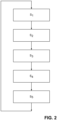
- the general structure of the method according to the present application is shown in Fig. 2 .
- the steps S1 to S5, shown in Fig. 2 might be carried out at least partially in a parallel manner, or one after each other.
- the method preferably is run again and again during the complete travel of the vehicle 1 as it is necessary to adapt the adaptive monitoring area 2 dependent on different driving situations.
- an adaptive monitoring area for the vehicle is generated. This is carried out as has been described with respect to Fig. 1 , based on at least a maximum lateral acceleration 4 of the vehicle 1 at a current longitudinal velocity 6 of the vehicle 1. Moreover, the maximum longitudinal acceleration 7, the yaw rate 16, and change in this yaw rate 16, as well as minimum and maximum road radius R MIN , R MAX , can be taken into account.
- the adaptive monitoring area 2 For actually calculating the adaptive monitoring area 2, it is important to take into account all possible vehicle positions in future. To do this for the left edge of the adaptive monitoring area 2 (see Fig.1 ), the maximum road radius R MAX and maximum feasible lateral acceleration 4 constraints are considered. Similarly, for right edge calculation, the calculation of the adaptive monitoring area 2 (see Fig. 1 ) minimum road radius R MIN and maximum feasible lateral acceleration 4 constraints are considered. Also for acceleration of the adaptive monitoring area 2, to detect the scenario where braking intervention via outputting the braking signal SB is required, only current dynamics of the vehicle 1 are taken into account, i.e. current velocity 6, yaw rate 16. No assumptions on dynamic and environmental constraints are considered for braking related adaptive monitoring area 2 acceleration.
- step S2 When the adaptive monitoring area 2 has been generated, it is monitored all the time.
- step S2 a vulnerable road user 8 is identified within the adaptive monitoring area 2 (see also Fig. 1 ).
- step S2 it is determined whether it is the driver's intention to turn.
- Step S3 the probability that the driver intends to turn is determined.
- Step S4 the probability that the driver is turning is determined.
- the step determining S3 a probability of the driver intends to turn 40 is based on a steering wheel angle ⁇ , a rate of change dcp of the steering wheel angle ⁇ and a velocity 6 of the vehicle 1.
- the steering wheel angle ⁇ is still rather small, but the rate of change dcp of the steering wheel angle ⁇ is high, and the velocity 6 of the vehicle 1 is low, the probability that the driver intends to turn is rather high.
- the step determining S4 a probability of the driver is turning, in one aspect of the invention is based on the steering wheel angle ⁇ and the velocity 6 of the vehicle 1.
- the probability of the driver intends to turn and he probability of the driver is turning it is assumed that when this probability value is 70% or more that the driver actually intends to turn and that the driver is turning respectively.
- a warning signal SW may be outputted based on the above.
- Such a warning signal SW could include a visual or audio signal or also vibration signal of e.g. the steering wheel 50.
- a visual signal may include a respective sign in the windshield area or in a head-up display area or a side mirror
- a braking signal SB When additionally, it is determined that the driver 100 is turning 44, not only a warning signal SW is output, but preferably a braking signal SB.
- the braking signal SB preferably is provided via a BUS-system 30 (see Fig. 4 ) to a central unit of a braking system of the vehicle 1, such that the vehicle 1 autonomously automatically brakes when it is determined that the driver is turning 44 within step S4.
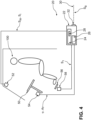
- Fig. 4 shows a basic principle of a cabin of the vehicle 1, having the turn assist system 20.
- the turn assist system 20 comprises a control unit 22, which may be provided within the vehicle.
- Control unit 22 comprises a memory 24 and a processor 26.
- a computer program 28 comprising instructions, which, when carried out by the processor 26, cause the processor 26 to carry out the steps of the method according to any of claims 1 to 17.
- the control unit 22 moreover comprises an interface 32 for a connection to the BUS-system 30.
- the vehicle cabin comprises a steering wheel 50 as it is known in the art.
- a signal element 52 for outputting the warning signal SW and potential information signal SI.
- the steering wheel 50 is provided with a steering wheel sensor 54, which provides the steering angle ⁇ and change in the steering wheel angle d ⁇ to the control unit 22.
- Control unit 22 moreover is connected to a gas pedal 56, in particular to a gas pedal sensor 58.
- Gas pedal sensor 58 provides a gas signal S1 to the control unit 22.
- control unit 22 determines that a vulnerable road user 8 is within the adaptive monitoring area 2, and that a collision risk between the vehicle 1 and the vulnerable road user 8 is present, at least a warning signal SW is output via the signal element 52, and/or a braking signal SB is output via the BUS-system 30 to a central control of the braking system.
Landscapes
- Engineering & Computer Science (AREA)
- Mechanical Engineering (AREA)
- Transportation (AREA)
- Automation & Control Theory (AREA)
- Physics & Mathematics (AREA)
- General Physics & Mathematics (AREA)
- Human Computer Interaction (AREA)
- Traffic Control Systems (AREA)
- Control Of Driving Devices And Active Controlling Of Vehicle (AREA)
Description
- The invention relates to a method for warning a driver of a vehicle, in particular a truck, in turn manoeuvres, as well as a computer program and a turn assist system for a vehicle, in particular a truck.
- Advancements in available sensor technologies allow for improved safety systems for vehicles. One such improved system is an arrangement and method for detecting and avoiding collisions. This type of system is referred to as a driver assistance system. Driver assistance systems can include sensors located on the vehicle to detect an oncoming collision. The systems may warn the driver of various driving situations to prevent or minimize collisions using any number of available warning systems. Furthermore, driver assistance systems can provide specialized warnings for any number of conditions that could potentially lead to a collision. For example, alerts may be provided for lane departure warnings, forward collision, warnings, blind spot detection, etc.
- Existing warning systems typically provide either an audible warning, a dashboard/windshield mounted visual cue, or a combination of the two. The dashboard/windshield mounted visual cues assume that the driver is attentive and forward facing. In cases where the driver is not attentive, or is looking elsewhere, the dashboard/windshield mounted visual cues are ineffective.
- In addition, different drivers have different average reaction times in response to a vehicle alert. For example, some drivers take longer than others to response to an alert produced from a vehicle. Such drivers may not have enough time to react appropriately in response to the warning, which may result in compromising their safety or the safety of others around them. Other drivers may react quickly to warnings or alerts, such that an alert may come too early and be an annoyance. These drivers may attempt to deactivate the alert system altogether to avoid the annoyances of early alert signals. Accordingly, there exists a need for a driver alert system that provides safety benefits for various different kinds of drivers.
-
DE 10 2014 212 047 discloses a method for operating a vehicle, including the following: detection of a vehicle environment; detection of a steering angle for a vehicle wheel that is defined by a steering device; ascertainment of a collision probability for the vehicle based on the detected vehicle environment and the detected steering angle in the case of an unchanged steering angle; correction of the steering angle if the ascertained collision probability is greater than or equal to a predetermined collision probability threshold in order to prevent a collision. Also described is a device for operating a vehicle and a computer program. -
DE 10 2012 108 563 A1 discloses a system for a truck, which issues a first level warning signal when a second vehicle is identified in vicinity of the truck. The system moreover determines an actual movement of the truck into the direction of the second vehicle, e.g. due to a line change, and then issues a second level warning signal. The actual movement is determined based on a camera image of the road in front of the truck and a steering wheel angle, a lateral velocity and/or a yaw rate. Moreover, a trajectory prediction of the second vehicle might also be taken into account when issuing the warning signals. - Known systems may also use the turn indicator signal for triggering a warning signal or to determine a line change intention of the driver. Such a system for example is disclosed in
DE 10 2011 077 384 A1 ,DE 10 2008 033 432 , orEP 1 508 476 A1 . - Most systems use fixed warning or monitoring areas, which may be provided around the vehicle. One example in connection with a truck is disclosed in
US 8,310,335 B2 . The system uses three areas, one in front of the truck, and one on each lateral side. The areas have a rectangular shape and a signal is generated as soon as an object enters one of the areas. -
EP 1 504 276 B1 discloses an imaging system for a vehicle comprising: an imaging array sensor comprising a plurality of photo-sensing pixels, the imaging array sensor being positioned at the vehicle and having a field of view exteriorly of the vehicle, the imaging array sensor being operable to capture an image data set representative of a scene occurring exteriorly of the vehicle and in the exterior field of view of the imaging array sensor, and a processor for processing the captured image data set, the processor including a microprocessor comprising an edge detection algorithm. The processor selects a reduced image data set of said image data set and applies the edge detection algorithm to the reduced image data set of the image data set to detect edges of objects present exteriorly of the vehicle and within a target zone within the exterior field of view of the imaging sensor. The reduced image data set is representative of the target zone within the exterior field of view of the imaging sensor. The processor is operable to process the reduced image data set more than other image data of the image data set to detect objects present exteriorly of the vehicle and within the target zone. Moreover, the target zone encompasses a geographic area of the exterior scene where an object of interest to the driver of the vehicle is realistically expected to be present and the other image data is representative of other geographic areas of the exterior scene where an object of interest is unrealistically expected to be present or cannot be present. The target zone according to this disclosure is selected in accordance with an adjustment input comprising at least one of (a) an output from an ambient light sensor, (b) a headlamp control, (c) a manual control, (d) a daytime driving condition for the vehicle, (e) a night-time driving condition for the vehicle, (f) the vehicle travelling through or along a curved section of road, (g) an output from a separate forward facing imaging system, (h) an external lighting condition, and (i) a mathematical adjustment of the height of the camera image such that the geometry of the target zone is adjusted. - A time to collision-based approach for example is known from
EP 2 084 045 A1 - From
DE 10 2009 041 556 A1 a vehicle is known with a front and a lateral side, and a dead angle assistance system comprising at least a sensor at the front. - From
WO 2017/030493 A1 it is known a method, control unit and system for avoiding a collision with vulnerable road users. The method comprises: predicting a future path of the vehicle; detecting the VRU and the position of the VRU; determining the velocity of the detected VRU; predicting a future position of the detected VRU, based on the VRU position upon detection and the determined VRU velocity; and performing an action for avoiding a collision, when the predicted future position of the VRU is overlapping the predicted future path of the vehicle. - From
US 2018/178721 A1 a driving assist apparatus is known. The driving assist apparatus of a vehicle predicts as a predicted minimum left turn radius, a curvature radius of a moving route of the vehicle at a point, where a curvature radius of the moving route is predicted to become smallest when the vehicle turns left. It also sets a route curved along an arc having the predicted minimum left turn radius as a predicted moving route predicted for the vehicle to move. The apparatus predicts, as a predetermined minimum right turn radius, the curvature radius of the moving route of the vehicle at the point where the curvature radius is predicted to become smallest when the vehicle turns right, and sets the route curved along the arc having the predicted minimum right turn radius as the predicted moving route. - The system comprises further sensors distributed over the whole lateral side of the vehicle for observing the area adjacent the lateral side. The observed area is dependent on the vehicle speed. When the speed is higher, the observed area on the lateral side of the vehicle is smaller.
- It is desirable to provide a method computer program and turn assist system, which are improved in view of false detection and unnecessary information to the driver. It is required that the driver is informed in vulnerable situations, however, a false detection shall be avoided as much as possible.
- This problem is solved by the method according to claim 1.
- The term "adaptive" means that the size, shape and/or direction of the adaptive monitoring area is changed based on a change in the first vehicle parameter, i.e. the maximum lateral acceleration and the current longitudinal velocity. The invention is based on the idea that not only the vehicle velocity is taken into account, but also the maximum lateral acceleration at this current longitudinal velocity.
- The maximum lateral acceleration is the acceleration, which could be reached in a safe turn manoeuvre. That means, at each current longitudinal velocity, there is a certain maximum lateral acceleration, which could act on the vehicle, if the vehicle starts to turn.
- Moreover, according to the invention, the driver's intention to turn is taken into account. This intention to turn might be based on a sensor signal, e.g. a steering wheel sensor or other sensors, for example, turn indicator activation sensor.
- Only if both, a vulnerable road user within the adaptive monitoring area and a collision risk between the vulnerable road user and the vehicle are determined, based also on the driver's intention to turn, the warning signal is outputted.
- It shall be understood that the driver's intention to turn may also be used to generate the adaptive monitoring area, and/or the generated adaptive monitoring area may be changed and adapted based on the driver's intention to turn.
- The adaptive monitoring area preferably at least comprises a first quadrilateral in front of the vehicle. The quadrilateral in this instance refers to areas on the ground, i.e. the monitoring area usually is a volume, however, in this instance is only referred to a 2D-area in front or beside the vehicle measured from the ground. A quadrilateral could be a rectangle, or a trapezoid. In particular, a trapezoid shall be contemplated, which widens or flares outwardly from the vehicle in the driving direction, to take into account uncertainty for later points of time.
- Particularly preferred is that the adaptive monitoring area comprises at least a second quadrilateral and a third quadrilateral in front of the vehicle, wherein the first quadrilateral and the second quadrilateral comprise one first common side, and the second quadrilateral and the third quadrilateral comprise one second common side. This means that the quadrilaterals contact each other. Preferably, they are arranged in a direction in front of the vehicle, in particular, along a trajectory. The first common side and the second common side preferably are substantially traverse to the driving direction and, in particular, are substantially perpendicular to a driving trajectory running along and within the adaptive monitoring area. Moreover, it is preferred that the adaptive monitoring area comprises fourth, fifth, sixth and so forth quadrilaterals, each being stacked upon each other in front of the vehicle.
- Preferably, the adaptive monitoring area covers a predetermined time frame for a movement of the vehicle, wherein the predetermined time frame is in the range of 1,0 seconds to 3,0 seconds, preferably at least for inner city scenarios. Preferably, the predetermined time frame is in an appropriate range for inner city scenarios. The boundaries of such a time frame are the logical borders defined by inner city scenarios. Thus, the actual size of the adaptive monitoring area will change with velocity of the vehicle, in particular, it increases. Dependent on the velocity, it is necessary to identify vulnerable road users in a greater distance to the vehicle to have sufficient time to react.
- The method preferably further comprises: splitting the predetermined time frame by a predetermined number of quadrilaterals such that each quadrilateral covers a portion of the predetermined time frame. Thus, when e.g. the time frame equals 1 second, and four quadrilaterals should be used, each quadrilateral should cover a range of 0.25 seconds. The first quadrilateral, directly in front of the vehicle, covers the first 0.25 seconds, the second quadrilateral covers the second 0.25 second, and so forth. Each quadrilateral preferably is determined separately and then in a second step merged together, to form the adaptive monitoring area. For each quadrilateral of the adaptive monitoring area, the maximum lateral acceleration and the longitudinal velocity of the vehicle, as well as the driver's intention to turn, are determined. Since for quadrilaterals, which are further away from the vehicle front, uncertainty increases, these quadrilaterals usually will be larger than the ones closer to the vehicle.
- Preferably, the step of generating the adaptive monitoring area for the vehicle is further based on a maximum road radius and/or minimum road radius. The maximum and minimum road radius are further constraints for the turning manoeuvre of the vehicle and it can be assumed that the turning radius of the vehicle is not lower than the minimum road radius at a certain spot. Both, the minimum and maximum road radius can be obtained from a navigation system and/or regulations of the specific country. These constraints further help to narrow the adaptive monitoring area and to avoid false detection. For example, where it is determined that a pedestrian is standing on the pedestrian's way and for a collision, the turning radius of the vehicle needs to be much lower than the minimum road radius at this certain point, it may be determined that there is no collision risk between the vehicle and the vulnerable road user and no warning signal is outputted.
- Moreover, it is preferred that the step of generating the adaptive monitoring area for the vehicle is further based on a maximum longitudinal acceleration and or change in acceleration of the vehicle. In particular, for quadrilaterals, which are farther away from the vehicle, it needs to be taken into account that the driver could accelerate or decelerate the vehicle. Physical constraints are the maximum longitudinal acceleration at this specific longitudinal velocity of the vehicle, which might be dependent on the slope of the street, physical power of the vehicle and also load of the vehicle. Further constraints to take into account could also be the maximum velocity at the certain spot.
- Further, it is preferred that the step of generating the adaptive monitoring area for the vehicle is further based on a maximum yaw rate and/or change in yaw rate of the vehicle. Moreover, also the current yaw rate can be taken into account.
- The step of determining the driver's intention to turn the vehicle includes: determining a probability that the driver intends to turn; and determining a probability of the driver is turning.
- Preferably, the probability that the driver intends to turn is determined based on a steering wheel angle, a rate of change of the steering wheel angle; and a velocity of the vehicle. Preferably, the driver's intention to turn is also determined based on a turn indicator sensor. When the rate of change of the steering wheel angle is high, it is an indication, that the turn manoeuvre will be relatively strong, while a low rate of change identifies a smoother turn manoeuvre. Also, a high velocity of the vehicle normally indicates that the probability of a turn manoeuvre is relatively low, while a lower velocity of the vehicle might indicate a higher probability of a turning manoeuvre. Also, data of the navigation system could also be taken into account.
- Preferably, the method further comprises: calculating a predicted steering wheel angle for the adaptive monitoring area using the steering wheel angle, the rate of change of the steering wheel angle, and the velocity of the vehicle. Based on these values, a predicted steering wheel angle for each quadrilateral of the predetermined time frame can be calculated. For calculating the predicted steering wheel angle, also a minimum and maximum road radius could be contemplated.
- Preferably, when the determined probability that the driver intends to turn is 70% or more, it is assumed that it is the driver's intention to turn. In this step, preferably, a predefined probability threshold is used and a Bayesian probability of the driver's intention to turn is calculated. More thresholds could be used and these thresholds could be weighted against each other.
- Moreover, it is preferred that the probability that the driver is turning is determined based on: a steering wheel angle; and a velocity of the vehicle. In this step, preferably, the rate of change of the steering wheel angle is not taken into account. Additionally, the turn indicator sensor can be taken into account.
- Similar to the determination of the probability that the driver intends to turn, it is also preferred that when the determined probability that the driver is turning is 70% or more, it is assumed that the driver is turning. When, for example, the velocity is relatively low and the steering wheel angel is high, it is a relatively safe indicator that the driver is actually turning.
- Preferably, the method further comprises, when it is determined that: a vulnerable road user is identified within the adaptive monitoring area, the driver does not intent to turn, and the driver is not turning: an information signal is output for informing the driver that a vulnerable road user is in vicinity of the vehicle. Such an output may comprise a visual output in the windshield or head-up display region of the vehicle. It may also include a warning lamp being switched on. Such warning lamp could be, e.g., mounted in the vehicle side mirror.
- Moreover, when it is determined that a vulnerable road user is identified within the adaptive monitoring area, the driver intends to turn, and the driver is not turning: a warning signal is output warning the driver that a vulnerable road user is in vicinity of the vehicle and that a collision may occur when the driver actually starts turning. Such signal could be a visual signal and/or an audio signal as, e.g., a warning sound. It could also be a vibration signal, e.g., vibration of the steering wheel, when the driver actually starts turning the steering wheel. The signal should be designed such that the driver knows that when he turns a potentially dangerous situation may occur.
- Furthermore, when it is determined that: a vulnerable road user is identified within the adaptive monitoring area; the driver intends to turn; and the driver is turning; a braking signal is output for braking the vehicle. In this situation, the vehicle automatically and autonomously brakes such that a collision between a vehicle and a vulnerable road user may be avoided.
- According to a second aspect of the invention, the problem mentioned above is solved by a computer program according to the appended claims.
- Moreover, in a third aspect of the invention, the above-mentioned problem is solved by a turn assist system for a vehicle, in particular a truck, according to the claims.
- For a more complete understanding of the invention, the invention will now be described in detail with reference to the accompanying drawings. The detailed description will illustrate and describe what is considered as a preferred embodiment of the invention. It is therefore intended that the invention may not be limited to the exact form and detail shown and described herein, nor to anything less than the whole of the invention disclosed herein and as claimed herein after. In particular, any reference signs in the claims shall not be construed as limiting the scope of the invention. The wording "comprising" does not exclude other elements or steps. The word "a" or "an" does not exclude the plurality. The wording "a number of" items comprising also the number 1, i.e. a single item, and further numbers like 2, 3, 4 and so forth. In the accompanying drawings:
-
Fig. 1 a schematic view of a vehicle and an adaptive monitoring area; -
Fig. 2 a schematic flow diagram of the method for warning a driver of a vehicle; -
Fig. 3 a further flow chart of a part of the method of warning the driver of the vehicle; and -
Fig. 4 a schematic side view of a vehicle comprising a turn assist system. - According to
Fig. 1 , a vehicle 1, in particular a truck 3, has anadaptive monitoring area 2 in front of it. The vehicle 1 has specific vehicle parameters, namely a maximumlateral acceleration 4, a current longitudinal velocity 6, and a maximum longitudinal acceleration 7. Moreover, the vehicle 1 comprises ayaw rate 16. These values are normally measured using sensors in a known manner. - The
adaptive monitoring area 2 is generated based on these values and inFig. 1 shown to be curved to the right-hand side ofFig. 1 . This is due to the fact that the vehicle 1 is turning and running along a curve to the right. The curve is characterized by a maximum road radius RMAX and a minimum road radius RMIN. The minimum road radius RMIN may be defined by the curve of the street, or the the pedestrians' way or the edge of the street. Maximum road radius RMAX in this instance may be defined by the maximum radius the vehicle 1 could take without running into the wrong direction, i.e. the lane of the other direction. Theadaptive monitoring area 2 is generated also based on this minimum and maximum road radius RMIN, RMAX. - In the embodiments shown in
Fig. 1 , theadaptive monitoring area 2 comprises three quadrilaterals, namely afirst quadrilateral 10, a second quadrilateral 12 and a third quadrilateral 14. Theadaptive monitoring area 2 is generated to cover a predetermined time frame t, which in this embodiment may be 1.5 seconds. This predetermined time frame t is divided by the number of quadrilaterals, in this case three. Thus, this quadrilateral is associated for a time of 0.5 seconds. Thefirst quadrilateral 10 is associated with the time frame t0 of 0.5 seconds, the second quadrilateral 12 is associated with the second time frame t1 of 0.5 seconds and the third quadrilateral 14 is associated with a third time frame t2 of 0.5 seconds. Together they shall cover the time of predetermined time frame t and the area, in which the vehicle 1 could be within this predetermined time frame t. - As can be seen, the
quadrilaterals 10, 12, 14 are stacked in front of each other such that the first and second quadrilateral 10, 12 comprise a first common side 11 and the second and third quadrilateral comprise a secondcommon side 13. In case theadaptive monitoring area 2 comprises further quadrilaterals as, e.g. a fourth, fifth, and so forth quadrilateral, again, they would be stacked in front of the third quadrilateral 14 and comprise a third common side with the third quadrilateral 14. It shall be understood that the invention is not restricted to three quadrilaterals and that a number of quadrilaterals could be chosen dependent on the application, or could also change during a single ride of the vehicle 1. E.g., the number of quadrilaterals could be based on the current velocity of the vehicle 1 and/or the load of the vehicle 1. - As it can also be seen in
Fig. 1 , thequadrilaterals 10, 12, 14 are wider to the front to account for the higher uncertainty for later time frames as, in particular, the latest time frame t2 in this embodiment. - In the embodiment shown in
Fig. 1 , a vulnerable road user (VRU) 8 is present in the current third quadrilateral 14. A vulnerable road user might be any vulnerable user as, e.g., a pedestrian, cyclist, motorcycle rider, car driver, or the like. Thevulnerable road user 8 has the vicinity V to the vehicle 1. When such avulnerable road user 8 is identified within theadaptive monitoring area 2, it is further determined, whether there is a collision risk between the vehicle 1 and thevulnerable road user 8. The definition of whether there is a collision risk may in one embodiment answered with "yes", when thevulnerable road user 8 is within theadaptive monitoring area 2. Moreover, additional information such as a likely trajectory of the vehicle 1 could be taken into account to determine whether there is a collision risk. When, for example, thevulnerable road user 8 has a high velocity himself, e.g, with respect toFig. 1 into the upper-left direction such that it is estimated when the vehicle 1 moves forward that thevulnerable road user 8 would not be within theadaptive monitoring area 2 anymore, and it could be determined that there is no collision risk. - Dependent on further actions of the driver 100 (see
Fig. 4 ), one or more actions could be taken as, in particular, outputting a warning signal SW (seeFig., 3 ,4 ). - The general structure of the method according to the present application is shown in
Fig. 2 . The steps S1 to S5, shown inFig. 2 , might be carried out at least partially in a parallel manner, or one after each other. The method preferably is run again and again during the complete travel of the vehicle 1 as it is necessary to adapt theadaptive monitoring area 2 dependent on different driving situations. - In the first step S1, an adaptive monitoring area for the vehicle is generated. This is carried out as has been described with respect to
Fig. 1 , based on at least a maximumlateral acceleration 4 of the vehicle 1 at a current longitudinal velocity 6 of the vehicle 1. Moreover, the maximum longitudinal acceleration 7, theyaw rate 16, and change in thisyaw rate 16, as well as minimum and maximum road radius RMIN, RMAX, can be taken into account. - For actually calculating the
adaptive monitoring area 2, it is important to take into account all possible vehicle positions in future. To do this for the left edge of the adaptive monitoring area 2 (seeFig.1 ), the maximum road radius RMAX and maximum feasiblelateral acceleration 4 constraints are considered. Similarly, for right edge calculation, the calculation of the adaptive monitoring area 2 (seeFig. 1 ) minimum road radius RMIN and maximum feasiblelateral acceleration 4 constraints are considered. Also for acceleration of theadaptive monitoring area 2, to detect the scenario where braking intervention via outputting the braking signal SB is required, only current dynamics of the vehicle 1 are taken into account, i.e. current velocity 6,yaw rate 16. No assumptions on dynamic and environmental constraints are considered for braking relatedadaptive monitoring area 2 acceleration. - When the
adaptive monitoring area 2 has been generated, it is monitored all the time. In step S2, avulnerable road user 8 is identified within the adaptive monitoring area 2 (see alsoFig. 1 ). When thevulnerable road user 8 is identified (S2) it is determined whether it is the driver's intention to turn. This, according to the present embodiment, includes two steps S3, S4. In Step S3, the probability that the driver intends to turn is determined. In Step S4, the probability that the driver is turning is determined. - In one aspect of the invention, the step determining S3 a probability of the driver intends to turn 40 (see also
Fig. 3 ) is based on a steering wheel angle ϕ, a rate of change dcp of the steering wheel angle ϕ and a velocity 6 of the vehicle 1. When, for example, the steering wheel angle ϕ is still rather small, but the rate of change dcp of the steering wheel angle ϕ is high, and the velocity 6 of the vehicle 1 is low, the probability that the driver intends to turn is rather high. On the other hand, when the steering wheel angle ϕ is small, a rate of change dcp of the steering wheel angle ϕ is low, and the velocity 6 of the vehicle is high, the probability of the driver intends to turn 40 is normally rather low and the small steering wheel angle ϕ is an indicator for a lengthy stretched curve. - In a similar manner, the step determining S4 a probability of the driver is turning, in one aspect of the invention is based on the steering wheel angle ϕ and the velocity 6 of the vehicle 1.
- For both values, the probability of the driver intends to turn and he probability of the driver is turning, it is assumed that when this probability value is 70% or more that the driver actually intends to turn and that the driver is turning respectively.
- In the last step S5, it is determined whether there is a collision risk between the vehicle 1 and the
vulnerable road user 8, based on the adaptive monitoring area and the driver's intention to turn. Optionally, a warning signal SW may be outputted based on the above. - According to the present application, there are three levels of actions, which will be described now with respect to
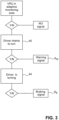
Fig. 3 . - When there is no
vulnerable road user 8 in theadaptive monitoring area 2, no signal is output. When avulnerable road user 8 is identified within theadaptive monitoring area 2, in the next step, it is determined whether thedriver 100 intends to turn. This is done with respect toFig. 2 , in steps S3 and S4. When it is determined that thedriver 100 does not intend to turn, the warning signal SW is output. Usually, in this case, it is determined that there is no collision risk, even though thevulnerable road user 8 is identified within theadaptive monitoring area 2, the vehicle 1 will trespass along thevulnerable road user 8 without any further collision risk. Thedriver 100, however, is notified of thevulnerable road user 8 being in the adaptive monitoring area by the warning signal. Such a warning signal SW could include a visual or audio signal or also vibration signal of e.g. thesteering wheel 50. A visual signal may include a respective sign in the windshield area or in a head-up display area or a side mirror When additionally, it is determined that thedriver 100 is turning 44, not only a warning signal SW is output, but preferably a braking signal SB. The braking signal SB preferably is provided via a BUS-system 30 (seeFig. 4 ) to a central unit of a braking system of the vehicle 1, such that the vehicle 1 autonomously automatically brakes when it is determined that the driver is turning 44 within step S4. -
Fig. 4 shows a basic principle of a cabin of the vehicle 1, having the turn assistsystem 20. The turn assistsystem 20 comprises acontrol unit 22, which may be provided within the vehicle.Control unit 22 comprises amemory 24 and aprocessor 26. On thememory 24, acomputer program 28 comprising instructions, which, when carried out by theprocessor 26, cause theprocessor 26 to carry out the steps of the method according to any of claims 1 to 17. Thecontrol unit 22 moreover comprises aninterface 32 for a connection to the BUS-system 30. - The vehicle cabin comprises a
steering wheel 50 as it is known in the art. In the cabin, moreover, there is asignal element 52 for outputting the warning signal SW and potential information signal SI. Thesteering wheel 50 is provided with asteering wheel sensor 54, which provides the steering angle ϕ and change in the steering wheel angle dϕ to thecontrol unit 22.Control unit 22 moreover is connected to agas pedal 56, in particular to agas pedal sensor 58.Gas pedal sensor 58 provides a gas signal S1 to thecontrol unit 22. - When
control unit 22 determined that avulnerable road user 8 is within theadaptive monitoring area 2, and that a collision risk between the vehicle 1 and thevulnerable road user 8 is present, at least a warning signal SW is output via thesignal element 52, and/or a braking signal SB is output via the BUS-system 30 to a central control of the braking system. -
- 1
- vehicle
- 2
- adaptive monitoring area
- 3
- truck
- 4
- maximum lateral acceleration
- 6
- current longitudinal velocity
- 7
- maximum longitudinal acceleration
- 8
- vulnerable road user (VRU)
- 10
- first quadrilateral
- 11
- first common side
- 12
- second quadrilateral
- 13
- second common side
- 14
- third quadrilateral
- 16
- yaw rate
- 20
- turn assist system
- 22
- control unit
- 24
- memory
- 26
- processor
- 28
- computer program
- 30
- BUS-system
- 32
- interface
- 40
- probability of the driver intents to turn
- 44
- probability of the driver is turning
- 50
- steering wheel
- 52
- signal element
- 54
- steering wheel sensor
- 56
- gas pedal
- 58
- gas pedal sensor
- 100
- driver
- Rmax
- maximum road radius
- Rmin
- minimum road radius
- S1
- generating an adaptive monitoring area
- S2
- identifying a VRU
- S3
- determining a probability of the driver intents to turn
- S4
- determining a probability of the driver is turning
- S5
- determining collision risk
- SW
- warning signal
- SB
- braking signal
- t
- predetermined time frame
- t0
- first time frame
- t1
- second time frame
- t2
- third time frame
- V
- vicinity
Claims (16)
- Method for warning a driver of a vehicle (1), in particular a truck, in turn manoeuvres comprising:- Generating (S1) an adaptive monitoring area (2) for the vehicle (1) based on at least a maximum lateral acceleration (4) of the vehicle (1) at a current longitudinal velocity (6) of the vehicle (1);- Identifying (S2) a vulnerable road user ,VRU, (8) within the adaptive monitoring area (2);- Determining (S3, S4) a driver's intention to turn (40) the vehicle (1);- wherein the step of determining the driver's intention to turn the vehicle (1) includes:- Determining (S3) a probability of the driver intends to turn (40); and- Determining (S4) a probability of the driver is turning (44);- Determining (S5) whether there is a collision risk between the vehicle (1) and the VRU (8); andwherein, when it is determined that:- a VRU (8) is identified within the adaptive monitoring area (2); and,- the driver does not intend to turn (40) based on the determined probability of the driver intends to turn lying below a first threshold;a warning signal SW, is output warning the driver (100) that a VRU (8) is in vicinity of the vehicle (1) and that a collision may occur in case the driver (100) starts turning; and when it is determined that- the driver is turning (44) based on the determined probability of the driver is turning lying above a second threshold;a braking signal, SB, is additionally output for braking the vehicle (1).
- Method according to claim 1, wherein the adaptive monitoring area (2) comprises at least a first quadrilateral (10) in front of the vehicle (1).
- Method according to claim 2, wherein the adaptive monitoring area (2) comprises at least a second quadrilateral (12) and a third quadrilateral (14) in front of the vehicle (1), wherein the first quadrilateral (10) and second quadrilateral (12) comprise one first common side (11), and the second quadrilateral (12) and the third quadrilateral (14) comprise one second common side (13).
- Method according to any of the preceding claims, wherein the adaptive monitoring area (2) covers a predetermined time frame, t, for a movement of the vehicle (1), wherein the predetermined time frame, t, is in the range of 1,0 second to 3,0 seconds.
- Method according to claims 2 and 4, comprising:
splitting the predetermined time frame (t) by a predetermined number of quadrilaterals (10, 12, 14) such that each quadrilateral (10, 12, 14) covers a portion, t0, t1, t2, of the predetermined time frame,t. - Method according to any of the preceding claims, wherein generating (S1) the adaptive monitoring area (2) for the vehicle (1) is further based on a maximum road radius, Rmax, and minimum road radius, Rmin.
- Method according to any of the preceding claims, wherein generating (S1) the adaptive monitoring area (2) for the vehicle (1) is further based on a maximum longitudinal acceleration (7) and/or change in acceleration (7) of the vehicle (1).
- Method according to any of the preceding claims, wherein generating (S1) the adaptive monitoring area (2) for the vehicle (1) is further based on a maximum yaw rate (16) and/or change in yaw rate (16) of the vehicle (1).
- Method according to any of the preceding claims, wherein the probability of the driver intends to turn (40) is determined based on:- a steering wheel angle (ϕ);- a rate of change (dϕ) of the steering wheel angle (ϕ); and- a velocity (6) of the vehicle (1).
- Method according to claim 9, comprising:- calculating a predicted steering wheel angle (ϕ) for the adaptive monitoring area (2) using the steering wheel angle (ϕ), the rate of change (d ϕ) of the steering wheel angle (ϕ), and the velocity (6) of the vehicle (1).
- Method according to claim 9 or 10, wherein when the determined probability of the driver intends to turn (40) is 70% or more, it is assumed that it is the driver's intention to turn (40).
- Method according to any of the preceding claims, wherein the probability of the driver is turning is determined based on:- a steering wheel angle (ϕ); and- a velocity (6) of the vehicle (1).
- Method according to claim 12, wherein when the determined probability of the driver is turning (44) is 70% or more, it is assumed that the driver is turning (44).
- A computer program (28) comprising instructions which, when the program (28) is executed by a processor (26), cause the processor (26) to carry out steps of the method according to any of claims 1 to 13.
- Turn assist system (20) for a vehicle (1), in particular a truck (3), for warning a driver (100) of the vehicle (1) in turn manoeuvres, comprising a control unit for a vehicle (1), the control unit (22) comprising:- a memory (24) with the computer program (28) of claim 14 stored;- a processor (26) configured to perform of the computer program (28).
- Turn assist system (20) of claim 15, wherein the control unit (22) comprises an interface (32) for communicating with an internal BUS-system (30) of the vehicle (1) to provide at least a braking signal, SB, to the BUS-system (30).
Applications Claiming Priority (2)
| Application Number | Priority Date | Filing Date | Title |
|---|---|---|---|
| DE102018116857 | 2018-07-12 | ||
| PCT/EP2019/066113 WO2020011501A1 (en) | 2018-07-12 | 2019-06-19 | Information, warning and braking request generation for turn assist functionality |
Publications (2)
| Publication Number | Publication Date |
|---|---|
| EP3821418A1 EP3821418A1 (en) | 2021-05-19 |
| EP3821418B1 true EP3821418B1 (en) | 2024-07-03 |
Family
ID=67003483
Family Applications (1)
| Application Number | Title | Priority Date | Filing Date |
|---|---|---|---|
| EP19732956.8A Active EP3821418B1 (en) | 2018-07-12 | 2019-06-19 | Information, warning and braking request generation for turn assist functionality |
Country Status (4)
| Country | Link |
|---|---|
| US (1) | US12049211B2 (en) |
| EP (1) | EP3821418B1 (en) |
| CN (1) | CN112292718B (en) |
| WO (1) | WO2020011501A1 (en) |
Families Citing this family (20)
| Publication number | Priority date | Publication date | Assignee | Title |
|---|---|---|---|---|
| JP7145034B2 (en) * | 2018-10-26 | 2022-09-30 | 株式会社デンソー | Driving support device |
| WO2020160748A1 (en) * | 2019-02-04 | 2020-08-13 | Nokia Technologies Oy | Improving operation of wireless communication networks for detecting vulnerable road users |
| DE102019205455A1 (en) * | 2019-04-16 | 2020-10-22 | Zf Friedrichshafen Ag | Control device, control method and computer program product for a vehicle which has a chassis part and a driver's cab part located on the chassis part |
| IT201900012414A1 (en) * | 2019-07-19 | 2021-01-19 | Ubiquicom S R L | Anti-collision system and method of land vehicles |
| JP7265971B2 (en) * | 2019-10-11 | 2023-04-27 | 株式会社デンソー | Control device |
| JP7328863B2 (en) * | 2019-10-11 | 2023-08-17 | 株式会社デンソー | Control device |
| US11080993B1 (en) * | 2020-03-26 | 2021-08-03 | Qualcomm Incorporated | Vehicle to everything communication management according to a vulnerable roadside user device configuration |
| CN112793507A (en) * | 2020-11-16 | 2021-05-14 | 理工雷科智途(北京)科技有限公司 | Blind area early warning braking system based on inertial device perception vehicle right turn motion characteristic |
| CN112389448B (en) * | 2020-11-23 | 2022-07-01 | 重庆邮电大学 | Abnormal driving behavior identification method based on vehicle state and driver state |
| CN112530165B (en) * | 2020-11-30 | 2022-01-28 | 中国民航信息网络股份有限公司 | Method and device for judging violation of regulations of apron support vehicle based on Internet of things |
| JP7414025B2 (en) | 2021-01-21 | 2024-01-16 | トヨタ自動車株式会社 | Collision avoidance support device |
| EP4068153B1 (en) * | 2021-03-31 | 2026-01-28 | Honda Motor Co., Ltd. | Advanced driver assistance system for assisting a driver of a vehicle |
| EP4112411B1 (en) * | 2021-07-01 | 2024-03-27 | Zenseact AB | Estimation of accident intensity for vehicles |
| JP7472866B2 (en) * | 2021-07-06 | 2024-04-23 | トヨタ自動車株式会社 | Vehicle steering guide torque control device |
| CN113516862A (en) * | 2021-07-22 | 2021-10-19 | 中国第一汽车股份有限公司 | Early warning method and device, electronic equipment and storage medium |
| EP4381490A1 (en) * | 2021-08-02 | 2024-06-12 | Mobileye Vision Technologies Ltd. | Vulnerable road user (vru) collision avoidance system |
| JP7775130B2 (en) * | 2022-03-30 | 2025-11-25 | ダイハツ工業株式会社 | Vehicle control device |
| JP7647677B2 (en) * | 2022-05-20 | 2025-03-18 | トヨタ自動車株式会社 | Driver Assistance Systems |
| CN118343161A (en) * | 2024-05-13 | 2024-07-16 | 广州小鹏自动驾驶科技有限公司 | Vehicle turning control method, device, vehicle and storage medium |
| CN119116938B (en) * | 2024-10-29 | 2025-12-09 | 厦门理工学院 | Vehicle control method and system for preventing driver from maliciously colliding |
Family Cites Families (23)
| Publication number | Priority date | Publication date | Assignee | Title |
|---|---|---|---|---|
| AU2003225228A1 (en) | 2002-05-03 | 2003-11-17 | Donnelly Corporation | Object detection system for vehicle |
| DE10338647B4 (en) | 2003-08-22 | 2005-06-23 | Audi Ag | Driver assistance system |
| DE102005039525A1 (en) * | 2005-08-18 | 2007-02-22 | Daimlerchrysler Ag | Method for determining a driving route within which a vehicle is likely to travel |
| DE102006047634A1 (en) | 2006-10-09 | 2008-04-10 | Robert Bosch Gmbh | Method for detecting an environment of a vehicle |
| US8310335B2 (en) | 2007-09-07 | 2012-11-13 | Verizon Patent And Licensing Inc. | Network-based access and control of home automation systems |
| JP5004865B2 (en) | 2008-05-08 | 2012-08-22 | 日立オートモティブシステムズ株式会社 | Obstacle detection device for automobile |
| DE102008033432A1 (en) | 2008-07-16 | 2010-01-21 | Volkswagen Ag | Method for controlling steering intervention for motor vehicle, involves detecting traffic lane on which vehicle moves and position of vehicle to traffic lane |
| DE102009041556A1 (en) | 2009-09-15 | 2010-06-17 | Daimler Ag | Vehicle i.e. passenger car, has dead angle assisting device comprising sensors at front side, where sensors are arranged along longitudinal side in distributed manner and determine distance of object by vehicle in assisting device |
| DE102010048144A1 (en) * | 2010-10-11 | 2011-07-28 | Daimler AG, 70327 | Vehicle i.e. lorry, has sensor arranged such that surrounding area of vehicle is detectable, where surrounding area extends in sections along long side, runs over entire length of long side and runs in sections in region before front side |
| DE102011077384A1 (en) | 2011-06-10 | 2012-12-13 | Robert Bosch Gmbh | Device and method for warning a driver of a motor vehicle |
| FR2988507B1 (en) * | 2012-03-23 | 2014-04-25 | Inst Francais Des Sciences Et Technologies Des Transports De Lamenagement Et Des Reseaux | ASSISTANCE SYSTEM FOR A ROAD VEHICLE |
| DE102012108563A1 (en) | 2012-09-13 | 2014-03-13 | Scania Cv Ab | Method and devices for collision warning during lane changes |
| DE102014202385B4 (en) * | 2014-02-11 | 2026-03-26 | Robert Bosch Gmbh | Driver assistance system for motor vehicles with a method for detecting a driver's desire to evade a collision |
| DE102014212047A1 (en) | 2014-06-24 | 2015-12-24 | Robert Bosch Gmbh | Method and device for operating a vehicle |
| JP6222476B2 (en) | 2014-12-03 | 2017-11-01 | マツダ株式会社 | Vehicle travel line generator |
| US9896030B2 (en) * | 2015-04-30 | 2018-02-20 | Honda Motor Co., Ltd. | System and method for vehicle collision mitigation with vulnerable road user context sensing |
| JP6432447B2 (en) * | 2015-05-27 | 2018-12-05 | 株式会社デンソー | Vehicle control apparatus and vehicle control method |
| SE539097C2 (en) * | 2015-08-20 | 2017-04-11 | Scania Cv Ab | Method, control unit and system for avoiding collision with vulnerable road users |
| SE539098C2 (en) | 2015-08-20 | 2017-04-11 | Scania Cv Ab | Method, control unit and system for path prediction |
| US10479373B2 (en) * | 2016-01-06 | 2019-11-19 | GM Global Technology Operations LLC | Determining driver intention at traffic intersections for automotive crash avoidance |
| DE102016116964B4 (en) * | 2016-09-09 | 2019-05-16 | Knorr-Bremse Systeme für Nutzfahrzeuge GmbH | Device for warning a driver of a vehicle in front of a stationary object and vehicle with such a device |
| DE102016116963B4 (en) | 2016-09-09 | 2024-11-07 | Knorr-Bremse Systeme für Nutzfahrzeuge GmbH | Device for warning a driver of a vehicle of an object and vehicle with such a device |
| JP6515912B2 (en) * | 2016-12-22 | 2019-05-22 | トヨタ自動車株式会社 | Vehicle driving support device |
-
2019
- 2019-06-19 CN CN201980040482.4A patent/CN112292718B/en active Active
- 2019-06-19 US US17/258,198 patent/US12049211B2/en active Active
- 2019-06-19 WO PCT/EP2019/066113 patent/WO2020011501A1/en not_active Ceased
- 2019-06-19 EP EP19732956.8A patent/EP3821418B1/en active Active
Also Published As
| Publication number | Publication date |
|---|---|
| CN112292718A (en) | 2021-01-29 |
| WO2020011501A1 (en) | 2020-01-16 |
| US12049211B2 (en) | 2024-07-30 |
| US20210268998A1 (en) | 2021-09-02 |
| EP3821418A1 (en) | 2021-05-19 |
| CN112292718B (en) | 2023-06-06 |
Similar Documents
| Publication | Publication Date | Title |
|---|---|---|
| EP3821418B1 (en) | Information, warning and braking request generation for turn assist functionality | |
| US10994732B2 (en) | Controller for a vehicle | |
| US10166918B2 (en) | Drive assisting apparatus | |
| EP2302412B1 (en) | System and method for evaluation of an automotive vehicle forward collision threat | |
| EP2923912B1 (en) | Driver intention estimation arrangement | |
| US8896433B2 (en) | Driver assistance system and method for supporting the driver of a vehicle in maintaining a traffic lane limited by traffic lane markings | |
| JP4628683B2 (en) | Pedestrian detection device and vehicle driving support device including the pedestrian detection device | |
| EP3476676A1 (en) | System and method for performing autonomous emergency braking | |
| US20150166059A1 (en) | Autonomous vehicle driving support system and autonomous driving method performed by the same | |
| JP4604691B2 (en) | Alarm device for vehicle, alarm method of vehicle surrounding situation | |
| WO2018194016A1 (en) | Vehicle driving assistance device | |
| US11465616B2 (en) | Cross traffic alert with flashing indicator recognition | |
| WO2019034514A1 (en) | Method and a system for collision avoidance of a vehicle | |
| KR20150051548A (en) | Driver assistance systems and controlling method for the same corresponding to dirver's predisposition | |
| EP2211322A1 (en) | Method and system for forward collision avoidance in an automotive vehicle | |
| CN118082817A (en) | Collision-avoiding vehicle and method of operating the same | |
| JP6428838B2 (en) | Vehicle driving support device | |
| JP2008186384A (en) | Vehicle control device | |
| JP4876772B2 (en) | Interrupting vehicle determination device | |
| JP6604354B2 (en) | Vehicle driving support device | |
| JP2007128227A (en) | Driver psychological state determination device and driver psychological state determination system | |
| JP2007128430A (en) | Vehicle alarm device | |
| JP2008282168A (en) | Consciousness detection device | |
| KR20180078363A (en) | Method and apparatus of avoiding vehicle collision | |
| JP7658746B2 (en) | Vehicle surrounding moving object detection device |
Legal Events
| Date | Code | Title | Description |
|---|---|---|---|
| STAA | Information on the status of an ep patent application or granted ep patent |
Free format text: STATUS: UNKNOWN |
|
| STAA | Information on the status of an ep patent application or granted ep patent |
Free format text: STATUS: THE INTERNATIONAL PUBLICATION HAS BEEN MADE |
|
| PUAI | Public reference made under article 153(3) epc to a published international application that has entered the european phase |
Free format text: ORIGINAL CODE: 0009012 |
|
| STAA | Information on the status of an ep patent application or granted ep patent |
Free format text: STATUS: REQUEST FOR EXAMINATION WAS MADE |
|
| 17P | Request for examination filed |
Effective date: 20210212 |
|
| AK | Designated contracting states |
Kind code of ref document: A1 Designated state(s): AL AT BE BG CH CY CZ DE DK EE ES FI FR GB GR HR HU IE IS IT LI LT LU LV MC MK MT NL NO PL PT RO RS SE SI SK SM TR |
|
| RAP3 | Party data changed (applicant data changed or rights of an application transferred) |
Owner name: ZF CV SYSTEMS HANNOVER GMBH |
|
| DAV | Request for validation of the european patent (deleted) | ||
| DAX | Request for extension of the european patent (deleted) | ||
| RAP1 | Party data changed (applicant data changed or rights of an application transferred) |
Owner name: ZF CV SYSTEMS EUROPE BV |
|
| STAA | Information on the status of an ep patent application or granted ep patent |
Free format text: STATUS: EXAMINATION IS IN PROGRESS |
|
| 17Q | First examination report despatched |
Effective date: 20221104 |
|
| GRAP | Despatch of communication of intention to grant a patent |
Free format text: ORIGINAL CODE: EPIDOSNIGR1 |
|
| STAA | Information on the status of an ep patent application or granted ep patent |
Free format text: STATUS: GRANT OF PATENT IS INTENDED |
|
| INTG | Intention to grant announced |
Effective date: 20240219 |
|
| GRAS | Grant fee paid |
Free format text: ORIGINAL CODE: EPIDOSNIGR3 |
|
| GRAA | (expected) grant |
Free format text: ORIGINAL CODE: 0009210 |
|
| STAA | Information on the status of an ep patent application or granted ep patent |
Free format text: STATUS: THE PATENT HAS BEEN GRANTED |
|
| AK | Designated contracting states |
Kind code of ref document: B1 Designated state(s): AL AT BE BG CH CY CZ DE DK EE ES FI FR GB GR HR HU IE IS IT LI LT LU LV MC MK MT NL NO PL PT RO RS SE SI SK SM TR |
|
| REG | Reference to a national code |
Ref country code: CH Ref legal event code: EP |
|
| REG | Reference to a national code |
Ref country code: DE Ref legal event code: R096 Ref document number: 602019054588 Country of ref document: DE |
|
| REG | Reference to a national code |
Ref country code: LT Ref legal event code: MG9D |
|
| REG | Reference to a national code |
Ref country code: NL Ref legal event code: MP Effective date: 20240703 |
|
| PG25 | Lapsed in a contracting state [announced via postgrant information from national office to epo] |
Ref country code: PT Free format text: LAPSE BECAUSE OF FAILURE TO SUBMIT A TRANSLATION OF THE DESCRIPTION OR TO PAY THE FEE WITHIN THE PRESCRIBED TIME-LIMIT Effective date: 20241104 |
|
| REG | Reference to a national code |
Ref country code: AT Ref legal event code: MK05 Ref document number: 1700666 Country of ref document: AT Kind code of ref document: T Effective date: 20240703 |
|
| PG25 | Lapsed in a contracting state [announced via postgrant information from national office to epo] |
Ref country code: NL Free format text: LAPSE BECAUSE OF FAILURE TO SUBMIT A TRANSLATION OF THE DESCRIPTION OR TO PAY THE FEE WITHIN THE PRESCRIBED TIME-LIMIT Effective date: 20240703 |
|
| PG25 | Lapsed in a contracting state [announced via postgrant information from national office to epo] |
Ref country code: PT Free format text: LAPSE BECAUSE OF FAILURE TO SUBMIT A TRANSLATION OF THE DESCRIPTION OR TO PAY THE FEE WITHIN THE PRESCRIBED TIME-LIMIT Effective date: 20241104 Ref country code: NL Free format text: LAPSE BECAUSE OF FAILURE TO SUBMIT A TRANSLATION OF THE DESCRIPTION OR TO PAY THE FEE WITHIN THE PRESCRIBED TIME-LIMIT Effective date: 20240703 |
|
| PG25 | Lapsed in a contracting state [announced via postgrant information from national office to epo] |
Ref country code: NO Free format text: LAPSE BECAUSE OF FAILURE TO SUBMIT A TRANSLATION OF THE DESCRIPTION OR TO PAY THE FEE WITHIN THE PRESCRIBED TIME-LIMIT Effective date: 20241003 |
|
| PG25 | Lapsed in a contracting state [announced via postgrant information from national office to epo] |
Ref country code: FI Free format text: LAPSE BECAUSE OF FAILURE TO SUBMIT A TRANSLATION OF THE DESCRIPTION OR TO PAY THE FEE WITHIN THE PRESCRIBED TIME-LIMIT Effective date: 20240703 Ref country code: PL Free format text: LAPSE BECAUSE OF FAILURE TO SUBMIT A TRANSLATION OF THE DESCRIPTION OR TO PAY THE FEE WITHIN THE PRESCRIBED TIME-LIMIT Effective date: 20240703 Ref country code: GR Free format text: LAPSE BECAUSE OF FAILURE TO SUBMIT A TRANSLATION OF THE DESCRIPTION OR TO PAY THE FEE WITHIN THE PRESCRIBED TIME-LIMIT Effective date: 20241004 |
|
| PG25 | Lapsed in a contracting state [announced via postgrant information from national office to epo] |
Ref country code: BG Free format text: LAPSE BECAUSE OF FAILURE TO SUBMIT A TRANSLATION OF THE DESCRIPTION OR TO PAY THE FEE WITHIN THE PRESCRIBED TIME-LIMIT Effective date: 20240703 |
|
| PG25 | Lapsed in a contracting state [announced via postgrant information from national office to epo] |
Ref country code: LV Free format text: LAPSE BECAUSE OF FAILURE TO SUBMIT A TRANSLATION OF THE DESCRIPTION OR TO PAY THE FEE WITHIN THE PRESCRIBED TIME-LIMIT Effective date: 20240703 |
|
| PG25 | Lapsed in a contracting state [announced via postgrant information from national office to epo] |
Ref country code: AT Free format text: LAPSE BECAUSE OF FAILURE TO SUBMIT A TRANSLATION OF THE DESCRIPTION OR TO PAY THE FEE WITHIN THE PRESCRIBED TIME-LIMIT Effective date: 20240703 Ref country code: IS Free format text: LAPSE BECAUSE OF FAILURE TO SUBMIT A TRANSLATION OF THE DESCRIPTION OR TO PAY THE FEE WITHIN THE PRESCRIBED TIME-LIMIT Effective date: 20241103 |
|
| PG25 | Lapsed in a contracting state [announced via postgrant information from national office to epo] |
Ref country code: CZ Free format text: LAPSE BECAUSE OF FAILURE TO SUBMIT A TRANSLATION OF THE DESCRIPTION OR TO PAY THE FEE WITHIN THE PRESCRIBED TIME-LIMIT Effective date: 20240703 Ref country code: HR Free format text: LAPSE BECAUSE OF FAILURE TO SUBMIT A TRANSLATION OF THE DESCRIPTION OR TO PAY THE FEE WITHIN THE PRESCRIBED TIME-LIMIT Effective date: 20240703 |
|
| PG25 | Lapsed in a contracting state [announced via postgrant information from national office to epo] |
Ref country code: RS Free format text: LAPSE BECAUSE OF FAILURE TO SUBMIT A TRANSLATION OF THE DESCRIPTION OR TO PAY THE FEE WITHIN THE PRESCRIBED TIME-LIMIT Effective date: 20241003 Ref country code: ES Free format text: LAPSE BECAUSE OF FAILURE TO SUBMIT A TRANSLATION OF THE DESCRIPTION OR TO PAY THE FEE WITHIN THE PRESCRIBED TIME-LIMIT Effective date: 20240703 |
|
| PG25 | Lapsed in a contracting state [announced via postgrant information from national office to epo] |
Ref country code: IS Free format text: LAPSE BECAUSE OF FAILURE TO SUBMIT A TRANSLATION OF THE DESCRIPTION OR TO PAY THE FEE WITHIN THE PRESCRIBED TIME-LIMIT Effective date: 20241103 Ref country code: HR Free format text: LAPSE BECAUSE OF FAILURE TO SUBMIT A TRANSLATION OF THE DESCRIPTION OR TO PAY THE FEE WITHIN THE PRESCRIBED TIME-LIMIT Effective date: 20240703 Ref country code: GR Free format text: LAPSE BECAUSE OF FAILURE TO SUBMIT A TRANSLATION OF THE DESCRIPTION OR TO PAY THE FEE WITHIN THE PRESCRIBED TIME-LIMIT Effective date: 20241004 Ref country code: FI Free format text: LAPSE BECAUSE OF FAILURE TO SUBMIT A TRANSLATION OF THE DESCRIPTION OR TO PAY THE FEE WITHIN THE PRESCRIBED TIME-LIMIT Effective date: 20240703 Ref country code: ES Free format text: LAPSE BECAUSE OF FAILURE TO SUBMIT A TRANSLATION OF THE DESCRIPTION OR TO PAY THE FEE WITHIN THE PRESCRIBED TIME-LIMIT Effective date: 20240703 Ref country code: CZ Free format text: LAPSE BECAUSE OF FAILURE TO SUBMIT A TRANSLATION OF THE DESCRIPTION OR TO PAY THE FEE WITHIN THE PRESCRIBED TIME-LIMIT Effective date: 20240703 Ref country code: BG Free format text: LAPSE BECAUSE OF FAILURE TO SUBMIT A TRANSLATION OF THE DESCRIPTION OR TO PAY THE FEE WITHIN THE PRESCRIBED TIME-LIMIT Effective date: 20240703 Ref country code: AT Free format text: LAPSE BECAUSE OF FAILURE TO SUBMIT A TRANSLATION OF THE DESCRIPTION OR TO PAY THE FEE WITHIN THE PRESCRIBED TIME-LIMIT Effective date: 20240703 Ref country code: RS Free format text: LAPSE BECAUSE OF FAILURE TO SUBMIT A TRANSLATION OF THE DESCRIPTION OR TO PAY THE FEE WITHIN THE PRESCRIBED TIME-LIMIT Effective date: 20241003 Ref country code: PL Free format text: LAPSE BECAUSE OF FAILURE TO SUBMIT A TRANSLATION OF THE DESCRIPTION OR TO PAY THE FEE WITHIN THE PRESCRIBED TIME-LIMIT Effective date: 20240703 Ref country code: NO Free format text: LAPSE BECAUSE OF FAILURE TO SUBMIT A TRANSLATION OF THE DESCRIPTION OR TO PAY THE FEE WITHIN THE PRESCRIBED TIME-LIMIT Effective date: 20241003 Ref country code: LV Free format text: LAPSE BECAUSE OF FAILURE TO SUBMIT A TRANSLATION OF THE DESCRIPTION OR TO PAY THE FEE WITHIN THE PRESCRIBED TIME-LIMIT Effective date: 20240703 |
|
| REG | Reference to a national code |
Ref country code: DE Ref legal event code: R097 Ref document number: 602019054588 Country of ref document: DE |
|
| PG25 | Lapsed in a contracting state [announced via postgrant information from national office to epo] |
Ref country code: RO Free format text: LAPSE BECAUSE OF FAILURE TO SUBMIT A TRANSLATION OF THE DESCRIPTION OR TO PAY THE FEE WITHIN THE PRESCRIBED TIME-LIMIT Effective date: 20240703 Ref country code: SM Free format text: LAPSE BECAUSE OF FAILURE TO SUBMIT A TRANSLATION OF THE DESCRIPTION OR TO PAY THE FEE WITHIN THE PRESCRIBED TIME-LIMIT Effective date: 20240703 Ref country code: DK Free format text: LAPSE BECAUSE OF FAILURE TO SUBMIT A TRANSLATION OF THE DESCRIPTION OR TO PAY THE FEE WITHIN THE PRESCRIBED TIME-LIMIT Effective date: 20240703 |
|
| PG25 | Lapsed in a contracting state [announced via postgrant information from national office to epo] |
Ref country code: EE Free format text: LAPSE BECAUSE OF FAILURE TO SUBMIT A TRANSLATION OF THE DESCRIPTION OR TO PAY THE FEE WITHIN THE PRESCRIBED TIME-LIMIT Effective date: 20240703 |
|
| PG25 | Lapsed in a contracting state [announced via postgrant information from national office to epo] |
Ref country code: SK Free format text: LAPSE BECAUSE OF FAILURE TO SUBMIT A TRANSLATION OF THE DESCRIPTION OR TO PAY THE FEE WITHIN THE PRESCRIBED TIME-LIMIT Effective date: 20240703 Ref country code: IT Free format text: LAPSE BECAUSE OF FAILURE TO SUBMIT A TRANSLATION OF THE DESCRIPTION OR TO PAY THE FEE WITHIN THE PRESCRIBED TIME-LIMIT Effective date: 20240703 |
|
| PLBE | No opposition filed within time limit |
Free format text: ORIGINAL CODE: 0009261 |
|
| STAA | Information on the status of an ep patent application or granted ep patent |
Free format text: STATUS: NO OPPOSITION FILED WITHIN TIME LIMIT |
|
| 26N | No opposition filed |
Effective date: 20250404 |
|
| PGFP | Annual fee paid to national office [announced via postgrant information from national office to epo] |
Ref country code: DE Payment date: 20250402 Year of fee payment: 7 |
|
| PGFP | Annual fee paid to national office [announced via postgrant information from national office to epo] |
Ref country code: GB Payment date: 20250401 Year of fee payment: 7 |
|
| PGFP | Annual fee paid to national office [announced via postgrant information from national office to epo] |
Ref country code: FR Payment date: 20250409 Year of fee payment: 7 |
|
| PG25 | Lapsed in a contracting state [announced via postgrant information from national office to epo] |
Ref country code: SE Free format text: LAPSE BECAUSE OF FAILURE TO SUBMIT A TRANSLATION OF THE DESCRIPTION OR TO PAY THE FEE WITHIN THE PRESCRIBED TIME-LIMIT Effective date: 20240703 |
|
| REG | Reference to a national code |
Ref country code: CH Ref legal event code: H13 Free format text: ST27 STATUS EVENT CODE: U-0-0-H10-H13 (AS PROVIDED BY THE NATIONAL OFFICE) Effective date: 20260127 |
|
| PG25 | Lapsed in a contracting state [announced via postgrant information from national office to epo] |
Ref country code: MC Free format text: LAPSE BECAUSE OF FAILURE TO SUBMIT A TRANSLATION OF THE DESCRIPTION OR TO PAY THE FEE WITHIN THE PRESCRIBED TIME-LIMIT Effective date: 20240703 |
|
| PG25 | Lapsed in a contracting state [announced via postgrant information from national office to epo] |
Ref country code: LU Free format text: LAPSE BECAUSE OF NON-PAYMENT OF DUE FEES Effective date: 20250619 |
|
| REG | Reference to a national code |
Ref country code: BE Ref legal event code: MM Effective date: 20250630 |
|
| PG25 | Lapsed in a contracting state [announced via postgrant information from national office to epo] |
Ref country code: IE Free format text: LAPSE BECAUSE OF NON-PAYMENT OF DUE FEES Effective date: 20250619 |
|
| PG25 | Lapsed in a contracting state [announced via postgrant information from national office to epo] |
Ref country code: BE Free format text: LAPSE BECAUSE OF NON-PAYMENT OF DUE FEES Effective date: 20250630 |
|
| PG25 | Lapsed in a contracting state [announced via postgrant information from national office to epo] |
Ref country code: CH Free format text: LAPSE BECAUSE OF NON-PAYMENT OF DUE FEES Effective date: 20250630 |