EP3819997B1 - Adapter assembly - Google Patents
Adapter assembly Download PDFInfo
- Publication number
- EP3819997B1 EP3819997B1 EP20170657.9A EP20170657A EP3819997B1 EP 3819997 B1 EP3819997 B1 EP 3819997B1 EP 20170657 A EP20170657 A EP 20170657A EP 3819997 B1 EP3819997 B1 EP 3819997B1
- Authority
- EP
- European Patent Office
- Prior art keywords
- housing
- adapter
- latching element
- insulation
- terminals
- Prior art date
- Legal status (The legal status is an assumption and is not a legal conclusion. Google has not performed a legal analysis and makes no representation as to the accuracy of the status listed.)
- Active
Links
Images





Classifications
-
- H—ELECTRICITY
- H01—ELECTRIC ELEMENTS
- H01R—ELECTRICALLY-CONDUCTIVE CONNECTIONS; STRUCTURAL ASSOCIATIONS OF A PLURALITY OF MUTUALLY-INSULATED ELECTRICAL CONNECTING ELEMENTS; COUPLING DEVICES; CURRENT COLLECTORS
- H01R13/00—Details of coupling devices of the kinds covered by groups H01R12/70 or H01R24/00 - H01R33/00
- H01R13/62—Means for facilitating engagement or disengagement of coupling parts or for holding them in engagement
- H01R13/627—Snap or like fastening
- H01R13/6271—Latching means integral with the housing
- H01R13/6272—Latching means integral with the housing comprising a single latching arm
-
- H—ELECTRICITY
- H01—ELECTRIC ELEMENTS
- H01R—ELECTRICALLY-CONDUCTIVE CONNECTIONS; STRUCTURAL ASSOCIATIONS OF A PLURALITY OF MUTUALLY-INSULATED ELECTRICAL CONNECTING ELEMENTS; COUPLING DEVICES; CURRENT COLLECTORS
- H01R13/00—Details of coupling devices of the kinds covered by groups H01R12/70 or H01R24/00 - H01R33/00
- H01R13/62—Means for facilitating engagement or disengagement of coupling parts or for holding them in engagement
- H01R13/627—Snap or like fastening
- H01R13/6271—Latching means integral with the housing
-
- B—PERFORMING OPERATIONS; TRANSPORTING
- B60—VEHICLES IN GENERAL
- B60L—PROPULSION OF ELECTRICALLY-PROPELLED VEHICLES; SUPPLYING ELECTRIC POWER FOR AUXILIARY EQUIPMENT OF ELECTRICALLY-PROPELLED VEHICLES; ELECTRODYNAMIC BRAKE SYSTEMS FOR VEHICLES IN GENERAL; MAGNETIC SUSPENSION OR LEVITATION FOR VEHICLES; MONITORING OPERATING VARIABLES OF ELECTRICALLY-PROPELLED VEHICLES; ELECTRIC SAFETY DEVICES FOR ELECTRICALLY-PROPELLED VEHICLES
- B60L53/00—Methods of charging batteries, specially adapted for electric vehicles; Charging stations or on-board charging equipment therefor; Exchange of energy storage elements in electric vehicles
- B60L53/10—Methods of charging batteries, specially adapted for electric vehicles; Charging stations or on-board charging equipment therefor; Exchange of energy storage elements in electric vehicles characterised by the energy transfer between the charging station and the vehicle
- B60L53/14—Conductive energy transfer
- B60L53/16—Connectors, e.g. plugs or sockets, specially adapted for charging electric vehicles
-
- H—ELECTRICITY
- H01—ELECTRIC ELEMENTS
- H01R—ELECTRICALLY-CONDUCTIVE CONNECTIONS; STRUCTURAL ASSOCIATIONS OF A PLURALITY OF MUTUALLY-INSULATED ELECTRICAL CONNECTING ELEMENTS; COUPLING DEVICES; CURRENT COLLECTORS
- H01R13/00—Details of coupling devices of the kinds covered by groups H01R12/70 or H01R24/00 - H01R33/00
- H01R13/46—Bases; Cases
- H01R13/502—Bases; Cases composed of different pieces
-
- H—ELECTRICITY
- H01—ELECTRIC ELEMENTS
- H01R—ELECTRICALLY-CONDUCTIVE CONNECTIONS; STRUCTURAL ASSOCIATIONS OF A PLURALITY OF MUTUALLY-INSULATED ELECTRICAL CONNECTING ELEMENTS; COUPLING DEVICES; CURRENT COLLECTORS
- H01R13/00—Details of coupling devices of the kinds covered by groups H01R12/70 or H01R24/00 - H01R33/00
- H01R13/46—Bases; Cases
- H01R13/52—Dustproof, splashproof, drip-proof, waterproof, or flameproof cases
- H01R13/5219—Sealing means between coupling parts, e.g. interfacial seal
-
- H—ELECTRICITY
- H01—ELECTRIC ELEMENTS
- H01R—ELECTRICALLY-CONDUCTIVE CONNECTIONS; STRUCTURAL ASSOCIATIONS OF A PLURALITY OF MUTUALLY-INSULATED ELECTRICAL CONNECTING ELEMENTS; COUPLING DEVICES; CURRENT COLLECTORS
- H01R13/00—Details of coupling devices of the kinds covered by groups H01R12/70 or H01R24/00 - H01R33/00
- H01R13/46—Bases; Cases
- H01R13/53—Bases or cases for heavy duty; Bases or cases for high voltage with means for preventing corona or arcing
-
- H—ELECTRICITY
- H01—ELECTRIC ELEMENTS
- H01R—ELECTRICALLY-CONDUCTIVE CONNECTIONS; STRUCTURAL ASSOCIATIONS OF A PLURALITY OF MUTUALLY-INSULATED ELECTRICAL CONNECTING ELEMENTS; COUPLING DEVICES; CURRENT COLLECTORS
- H01R13/00—Details of coupling devices of the kinds covered by groups H01R12/70 or H01R24/00 - H01R33/00
- H01R13/62—Means for facilitating engagement or disengagement of coupling parts or for holding them in engagement
- H01R13/625—Casing or ring with bayonet engagement
-
- H—ELECTRICITY
- H01—ELECTRIC ELEMENTS
- H01R—ELECTRICALLY-CONDUCTIVE CONNECTIONS; STRUCTURAL ASSOCIATIONS OF A PLURALITY OF MUTUALLY-INSULATED ELECTRICAL CONNECTING ELEMENTS; COUPLING DEVICES; CURRENT COLLECTORS
- H01R13/00—Details of coupling devices of the kinds covered by groups H01R12/70 or H01R24/00 - H01R33/00
- H01R13/62—Means for facilitating engagement or disengagement of coupling parts or for holding them in engagement
- H01R13/629—Additional means for facilitating engagement or disengagement of coupling parts, e.g. aligning or guiding means, levers, gas pressure electrical locking indicators, manufacturing tolerances
-
- H—ELECTRICITY
- H01—ELECTRIC ELEMENTS
- H01R—ELECTRICALLY-CONDUCTIVE CONNECTIONS; STRUCTURAL ASSOCIATIONS OF A PLURALITY OF MUTUALLY-INSULATED ELECTRICAL CONNECTING ELEMENTS; COUPLING DEVICES; CURRENT COLLECTORS
- H01R13/00—Details of coupling devices of the kinds covered by groups H01R12/70 or H01R24/00 - H01R33/00
- H01R13/62—Means for facilitating engagement or disengagement of coupling parts or for holding them in engagement
- H01R13/629—Additional means for facilitating engagement or disengagement of coupling parts, e.g. aligning or guiding means, levers, gas pressure electrical locking indicators, manufacturing tolerances
- H01R13/633—Additional means for facilitating engagement or disengagement of coupling parts, e.g. aligning or guiding means, levers, gas pressure electrical locking indicators, manufacturing tolerances for disengagement only
-
- H—ELECTRICITY
- H01—ELECTRIC ELEMENTS
- H01R—ELECTRICALLY-CONDUCTIVE CONNECTIONS; STRUCTURAL ASSOCIATIONS OF A PLURALITY OF MUTUALLY-INSULATED ELECTRICAL CONNECTING ELEMENTS; COUPLING DEVICES; CURRENT COLLECTORS
- H01R13/00—Details of coupling devices of the kinds covered by groups H01R12/70 or H01R24/00 - H01R33/00
- H01R13/62—Means for facilitating engagement or disengagement of coupling parts or for holding them in engagement
- H01R13/639—Additional means for holding or locking coupling parts together, after engagement, e.g. separate keylock, retainer strap
-
- H—ELECTRICITY
- H01—ELECTRIC ELEMENTS
- H01R—ELECTRICALLY-CONDUCTIVE CONNECTIONS; STRUCTURAL ASSOCIATIONS OF A PLURALITY OF MUTUALLY-INSULATED ELECTRICAL CONNECTING ELEMENTS; COUPLING DEVICES; CURRENT COLLECTORS
- H01R24/00—Two-part coupling devices, or either of their cooperating parts, characterised by their overall structure
-
- H—ELECTRICITY
- H01—ELECTRIC ELEMENTS
- H01R—ELECTRICALLY-CONDUCTIVE CONNECTIONS; STRUCTURAL ASSOCIATIONS OF A PLURALITY OF MUTUALLY-INSULATED ELECTRICAL CONNECTING ELEMENTS; COUPLING DEVICES; CURRENT COLLECTORS
- H01R31/00—Coupling parts supported only by co-operation with counterpart
- H01R31/06—Intermediate parts for linking two coupling parts, e.g. adapter
-
- H—ELECTRICITY
- H01—ELECTRIC ELEMENTS
- H01R—ELECTRICALLY-CONDUCTIVE CONNECTIONS; STRUCTURAL ASSOCIATIONS OF A PLURALITY OF MUTUALLY-INSULATED ELECTRICAL CONNECTING ELEMENTS; COUPLING DEVICES; CURRENT COLLECTORS
- H01R13/00—Details of coupling devices of the kinds covered by groups H01R12/70 or H01R24/00 - H01R33/00
- H01R13/44—Means for preventing access to live contacts
- H01R13/447—Shutter or cover plate
- H01R13/453—Shutter or cover plate opened by engagement of counterpart
- H01R13/4532—Rotating shutter
-
- H—ELECTRICITY
- H01—ELECTRIC ELEMENTS
- H01R—ELECTRICALLY-CONDUCTIVE CONNECTIONS; STRUCTURAL ASSOCIATIONS OF A PLURALITY OF MUTUALLY-INSULATED ELECTRICAL CONNECTING ELEMENTS; COUPLING DEVICES; CURRENT COLLECTORS
- H01R13/00—Details of coupling devices of the kinds covered by groups H01R12/70 or H01R24/00 - H01R33/00
- H01R13/64—Means for preventing incorrect coupling
-
- H—ELECTRICITY
- H01—ELECTRIC ELEMENTS
- H01R—ELECTRICALLY-CONDUCTIVE CONNECTIONS; STRUCTURAL ASSOCIATIONS OF A PLURALITY OF MUTUALLY-INSULATED ELECTRICAL CONNECTING ELEMENTS; COUPLING DEVICES; CURRENT COLLECTORS
- H01R2107/00—Four or more poles
-
- H—ELECTRICITY
- H01—ELECTRIC ELEMENTS
- H01R—ELECTRICALLY-CONDUCTIVE CONNECTIONS; STRUCTURAL ASSOCIATIONS OF A PLURALITY OF MUTUALLY-INSULATED ELECTRICAL CONNECTING ELEMENTS; COUPLING DEVICES; CURRENT COLLECTORS
- H01R2201/00—Connectors or connections adapted for particular applications
- H01R2201/26—Connectors or connections adapted for particular applications for vehicles
-
- H—ELECTRICITY
- H01—ELECTRIC ELEMENTS
- H01R—ELECTRICALLY-CONDUCTIVE CONNECTIONS; STRUCTURAL ASSOCIATIONS OF A PLURALITY OF MUTUALLY-INSULATED ELECTRICAL CONNECTING ELEMENTS; COUPLING DEVICES; CURRENT COLLECTORS
- H01R24/00—Two-part coupling devices, or either of their cooperating parts, characterised by their overall structure
- H01R24/86—Parallel contacts arranged about a common axis
-
- Y—GENERAL TAGGING OF NEW TECHNOLOGICAL DEVELOPMENTS; GENERAL TAGGING OF CROSS-SECTIONAL TECHNOLOGIES SPANNING OVER SEVERAL SECTIONS OF THE IPC; TECHNICAL SUBJECTS COVERED BY FORMER USPC CROSS-REFERENCE ART COLLECTIONS [XRACs] AND DIGESTS
- Y02—TECHNOLOGIES OR APPLICATIONS FOR MITIGATION OR ADAPTATION AGAINST CLIMATE CHANGE
- Y02T—CLIMATE CHANGE MITIGATION TECHNOLOGIES RELATED TO TRANSPORTATION
- Y02T10/00—Road transport of goods or passengers
- Y02T10/60—Other road transportation technologies with climate change mitigation effect
- Y02T10/70—Energy storage systems for electromobility, e.g. batteries
-
- Y—GENERAL TAGGING OF NEW TECHNOLOGICAL DEVELOPMENTS; GENERAL TAGGING OF CROSS-SECTIONAL TECHNOLOGIES SPANNING OVER SEVERAL SECTIONS OF THE IPC; TECHNICAL SUBJECTS COVERED BY FORMER USPC CROSS-REFERENCE ART COLLECTIONS [XRACs] AND DIGESTS
- Y02—TECHNOLOGIES OR APPLICATIONS FOR MITIGATION OR ADAPTATION AGAINST CLIMATE CHANGE
- Y02T—CLIMATE CHANGE MITIGATION TECHNOLOGIES RELATED TO TRANSPORTATION
- Y02T10/00—Road transport of goods or passengers
- Y02T10/60—Other road transportation technologies with climate change mitigation effect
- Y02T10/7072—Electromobility specific charging systems or methods for batteries, ultracapacitors, supercapacitors or double-layer capacitors
-
- Y—GENERAL TAGGING OF NEW TECHNOLOGICAL DEVELOPMENTS; GENERAL TAGGING OF CROSS-SECTIONAL TECHNOLOGIES SPANNING OVER SEVERAL SECTIONS OF THE IPC; TECHNICAL SUBJECTS COVERED BY FORMER USPC CROSS-REFERENCE ART COLLECTIONS [XRACs] AND DIGESTS
- Y02—TECHNOLOGIES OR APPLICATIONS FOR MITIGATION OR ADAPTATION AGAINST CLIMATE CHANGE
- Y02T—CLIMATE CHANGE MITIGATION TECHNOLOGIES RELATED TO TRANSPORTATION
- Y02T90/00—Enabling technologies or technologies with a potential or indirect contribution to GHG emissions mitigation
- Y02T90/10—Technologies relating to charging of electric vehicles
- Y02T90/14—Plug-in electric vehicles
Definitions
- the present disclosure relates to an adapter assembly, and more particularly to an adapter assembly with safety design to avoid electric arc result in carbon deposition, temperature rise too high, electrical shock issue and provide waterproof and dustproof functions.
- an adapter assembly has been used for transferring electric power from a charging station or a utility power source to a battery mounted in an electric vehicle or a hybrid electric vehicle
- an electrical connector assembly including an industrial plug and a socket has been used for transferring power from a power source to an electrical equipment.
- Trust in the safety and reliability of the electrical connector assembly or adapter assembly is very important for user. Namely, it is very import that the electrical connector assembly or the adapter assembly should not suffer from leakage of electricity.
- the electrical connector assembly or adapter assembly are often used outdoors, there is a great risk that some environmental substances such as water or dust may enter into the electrical connector assembly or adapter assembly. If the water or dust is introduced into the electrical connector or adapter, the user may suffer from an electrical shock at the moment that the electrical connector or adapter is connected with a matching electrical connector or adapter to transfer electric power and at the moment that the electrical connector or adapter is detached from a matching electrical connector or adapter to interrupt the power transmission.
- the charging adapter is often used outdoor. If water or dust is entered into the charging adapter, the user may suffer from an electrical shock at the moment that the charging adapter is connected with a matching adapter or connector to transfer electric power and at the moment that the charging adapter is detached from a matching adapter or connector to interrupt the power transmission.
- the charging adapter is equipped with a cap or lid for selectively covering or uncovering the electrical contacts thereof so as to protect against water and dust to a certain degree.
- the user does not have the habit of covering the cover or lid on the opening of the charging adapter when the charging adapter is not in use. Under this circumstance, the electrical contacts of the charging adapter are exposed to the environment which may cause the electrical contacts to corrode. In addition, the user may touch the electrical contacts of the charging adapter accidently and suffer from an electrical shock. Moreover, if the user forgets to cover the opening of the charging adapter and water or moisture is entered into the charging adapter, the user may suffer from an electrical shock at the moment that the charging adapter is connected with a matching adapter or connector to transfer electric power and at the moment that the charging adapter is detached from a matching adapter or connector to interrupt the power transmission. Moreover, the prior art also fails to provide a safety structure capable of preventing accident detachment between the charging adapter and a matching adapter or connector to address the electrical shock issue.
- EP 0 644 622 A1 relates to an electric vehicle charging connector assembly used for charging a power battery of an electric vehicle which includes a vehicle side connector body mounted on an electric vehicle body, vehicle side power terminals enclosed in the vehicle side connector body, an external connector body mated with and unmated from the vehicle side connector body, external power terminals enclosed in the external connector body, a cam connecting mechanism disposed either on the vehicle side or external connector body and including cam grooves and cam projections engaged with the respective cam grooves, clearance grooves continuous to the respective cam grooves and each extending at the side of the external connector body relative to a final mating location of both connector bodies along a direction in which both connector bodies are mated together, a lock mechanism holding both connector bodies in a mated state when both connector bodies reach the final mating location, and a return spring disposed either on the vehicle side connector body or the external connector body for urging both connector bodies in a direction opposite the direction in which both connector bodies are mated together when the cam projections are engaged with the respective clearance grooves.
- the adapter assembly including a first adapter and a second adapter.
- the first adapter connects to a power supply, and the second adapter connects to a control module.
- two corresponding latching element are axially coupled to a first position, so that first electrical terminals and second electrical terminals are coupled with each other but no power transmission provided for charging.
- the first adapter is radial with respect to the second adapter.
- the first housing and the second housing rotate with each other until the two latching elements are moved to a second position, so that the first adapter and the second adapter are securely fastened. Consequently, the first signal terminals are coupled with the second signal terminals, and an enabling signal is delivered to the control module, so as to enable the power transmission between the first electrical terminals and the second electrical terminals. Consequently, the problems of the carbon deposition generated at the electrical terminals and the temperature rise too high can be avoided, and the purpose of insulation and sealing protection is achieved. Moreover, due to corresponding design of the latching elements, it is labor-saving, time-saving and cost-saving to maintain the safety of utilizing the adapter assembly.
- an adapter assembly as defined in the appended claim 1 is provided.
- an adapter assembly including a first adapter and a second adapter.
- the first adapter connects to a power supply.
- the first adapter comprises a first housing, a plurality of first electrical terminals and a plurality of first signal terminals.
- the first housing includes at least one first latching element.
- the second adapter connects to a control module.
- the second adapter comprises a second housing, a plurality of second electrical terminals and a plurality of second signal terminals.
- the second housing includes at least one second latching element.
- the at least one first latching element is axially coupled with the at least one second latching element to a first position.
- the plurality of first electrical terminals and the plurality of second electrical terminals are coupled with each other but no power transmission provided for charging.
- the first housing is radial with respect to the second housing.
- the first housing and the second housing rotate with each other until the at least one first latching element and the at least one second latching element are moved to a second position.
- the first housing and the second housing are securely fastened.
- the plurality of first signal terminals are coupled with the plurality of second signal terminals.
- An enabling signal is delivered to the control module, so as to enable the power transmission between the plurality of first electrical terminals and the plurality of second electrical terminals.
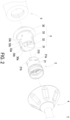
- FIGS. 1 and 2 are explored views illustrating an adapter assembly including a first adapter and a second adapter separated from each other according to a first embodiment of the present disclosure.
- FIG. 3 is a schematic perspective view illustrating the adapter assembly of FIG. 1 after assembling.
- the adapter assembly 1 includes a first adapter 2 and a second adapter 3.
- the first adapter 2 electrically couples with a power supply 4, and the second adapter 3 electrically couples with a control module 5.
- the power supply 4 could be the mains or the industrial power supply.
- the adapter assembly 1 is applicable to various fields for conveying electric power from a power supplying end to a power receiving end.
- the adapter assembly 1 including a first adapter 2 and a second adapter 3 can be used for transferring electric power from a charging station or a utility power source to a battery mounted in an electric vehicle or a hybrid electric vehicle.
- the adapter assembly 1 including an industrial plug and a socket can be used for transferring power from a power source to an electrical equipment.
- the adapter assembly 1 is not limited to the above embodiments and can be varied according to the practical requirements. More specifically, in the embodiment, the adapter assembly 1 electrically couples with the power supply 4 via a power cable 41, wherein the power cable 41 is exemplified and may be varied according to the practical requirements.
- the control module 5 is applicable to be utilized in vehicle system, but not limited thereto.
- the control module 5 includes a controller (not shown) for receiving enabling signals and delivering controlling signals correspondingly.
- the first adapter 2 includes a first housing 20, an insulation housing 21, a plurality of first electrical terminals 22 and a plurality of first signal terminals 23, wherein the plurality of first electrical terminals 22 and the plurality of first signal terminals 23 are disposed within the first housing 20.
- the length of the plurality of first electrical terminals 22 is larger than the length of the plurality of first signal terminals 23.
- the insulation housing 21 is a hollow cylindrical structure, and is used to be inserted in the first housing 20.
- the insulation housing 21 includes an insulation cover 210 for covering one side of the hollow cylindrical structure of the insulation housing 21.
- the insulation cover 210 includes a plurality of through holes 211, which are disposed in correspondence with the plurality of first electrical terminals 22 and the plurality of first signal terminals 23.
- the insulation cover 210 may be omitted by taking other insulation manners. Namely, the insulation cover 210 is exemplified and may be varied according to the practical requirements.
- the first housing 20 further includes at least one first latching element 24.
- the first latching element 24 is disposed on an inner surface of the first housing 20, and the number of the first latching element 24 is 3, but not limited thereto, the arrangement and the number of the first latching element 24 may be varied according to the practical requirements.
- the insulation housing 21 can be made of a polytetrafluoroethylene (also called as Teflon) material, but not limited thereto.
- the second adapter 3 includes a second housing 30, a plurality of second electrical terminals 31 and a plurality of second signal terminals 32, wherein the plurality of second electrical terminals 31 and the plurality of second signal terminals 32 are disposed within the second housing 30.
- the length of the plurality of second electrical terminals 31 is larger than the length of the plurality of second signal terminals 32.
- the second housing 30 further includes at least one second latching element 33.
- the second latching element 33 is disposed on an outer surface of the second housing 30, and the number of the second latching element 33 is 3, wherein the position and the number of the second latching element 33 is in correspondence with the first latching element 24.
- the first adapter 2 and the second adapter 3 can be for example a female adapter and a male adapter, respectively, which are matched with each other.
- the insulation housing 21 comprises a plurality of protruding pins 21a and a plurality of positioning elements 21b.
- the insulation housing 21 of the present disclosure comprises two protruding pins 21a opposite to each other and symmetrically disposed around and protruded from the outer edge thereof.
- the insulation housing 21 further includes two positioning elements 21b protruded from the outer edge thereof.
- the two positioning elements 21b may be but not limited to be triangle bulges.
- the guiding grooves 30a are spatially corresponding to the protruding pins 21a.
- the protruding pin 21a and the guiding groove 30a are a protrusion and a recess, respectively.
- the number and the arrangement of the protruding pin 21a and the guiding groove 30a are adjustable according to the practical requirements, and not redundantly described herein.
- the guiding groove 30a is a recess with a slope for guiding the protruding pin 21a.
- the protruding pin 21a matches with the guiding groove 30a, it slides to a specification position along the slope. Consequently, the protruding pin 21a is fixedly disposed in the guiding groove 30a, and the insulation housing 21 can be fastened to the second housing 30 thereby.
- the shape and profile of the positioning groove 30b of the second housing 30 is in correspondence with the positioning element 21b.
- the positioning groove 30b is triangle recesses for matching with the positioning element 21b.
- the insulation housing 21 can be fixed to the second housing 30 due to the matching of the protruding pins 21a and the guiding grooves 30a.
- the insulation housing 21 when the insulation housing 21 is inserted into the first housing 20, the insulation housing 21 is rotatable fastened to the first housing 20 in accordance with the invention.
- the plurality of first electrical terminals 22 and the plurality of first signal terminals 23 are covered and protected by the insulation housing 21. Consequently, the first adapter 2 can prevent electrical shock issue and provide waterproof and dustproof functions without using additional cover.
- the structure of the first housing 20 and the insulation housing 21 are waterproof and dustproof and in complying with the IP 24 class of protection of the IEC/EN 60529 standard of the international Electrotechnical Commission.
- the first adapter 2 After assembling the first housing 20 with the insulation housing 21 as the first adapter 2, the first adapter 2 is corresponding assembled with the second adapter 3.
- the assembling process is first to align the positioning element 21b of the insulation housing 21 to the positioning groove 30b of the second housing 30, and align the protruding pin 21a of the insulation housing 21 to the guiding groove 30a of the second housing 30. After that is to rotate the first adapter 2 with respect to the second adapter 3, wherein the insulation housing 21 can be fastened to the inside of the second housing 30, so as to complete the assembling structure of the adapter assembly 1 as shown in Figure 3 .
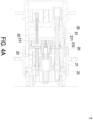
- FIGS. 4A to 4C are explored views showing the assembling process of the first adapter and the second adapter according to the first embodiment of the present disclosure.
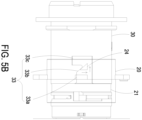
- FIGS. 5A to 5C are schematic perspective views showing the assembling process of the first latching element of the first adapter and the second latching element the second adapter according to the first embodiment of the present disclosure.
- FIG. 4A when the first adapter 2 assemblies with the second adapter 3, the first housing 20 sheathes on the second housing 30, and the insulation housing 21 is inserted within the second housing 30.
- the insulation housing 21 is easily disposed into the second housing 30 due to the positioning of the positioning element 21b of the insulation housing 21 and the positioning groove 30b of the second housing 30.
- the insulation housing 21 is fastened to the second housing 30 due to the matching of the protruding pin 21a of the insulation housing 21 and the guiding groove 30a of the second housing 30.
- the first housing 20 correspondingly sheathes on the second housing 30 by the matching of the first latching element 24 disposed on the inner surface of the first housing 20 and the second latching element 33 of the second housing 30.
- the first latching element 24 may be but not limited to be a triangle bulge
- the second latching element 33 may be an irregular groove structure.
- the triangle bulge of the first latching element 24 first slides along the linear groove 33a of the second latching element 33 (as shown in the arrows of FIG. 5A ) axially.
- the triangle bulge of the first latching element 24 moves to the end of the linear groove 33a of the second latching element 33, it abuts to a slope 33b.
- the plurality of second electrical terminals 31 of the second housing 30 run through the plurality of the through holes 211 of the insulation cover 210, and are in contact with the plurality of first electrical terminals 22 of the first housing 20. Meanwhile, the first latching element 24 and the second latching element 33 are disposed at first position. Although the plurality of second electrical terminals 31 is contacted to the plurality of first electrical terminals 22, there is no power transmission provided for charging at this moment.
- the first electrical terminal 22 and the second electrical terminal 31 can be, for example, a female conductive terminal and a male conductive terminal, respectively, which are matched with each other, but is not limited thereto.
- FIG. 4A the plurality of second electrical terminals 31 of the second housing 30 run through the plurality of the through holes 211 of the insulation cover 210, and are in contact with the plurality of first electrical terminals 22 of the first housing 20. Meanwhile, the first latching element 24 and the second latching element 33 are disposed at first position. Although the plurality of second electrical terminals 31 is contacted to the
- the length of the first signal terminals 23 and the second signal terminals 32 are respectively shorter than the first electrical terminals 22 and the second electrical terminals 31. Namely, when the first electrical terminals 22 and the second electrical terminals 31 contact with each other, the second signal terminals 32 still not penetrate the through holes 211 of the insulation housing 21. Consequently, the first signal terminals 23 fail to contact to the second signal terminals 32.
- the first signal terminal 23 and the second signal terminal 32 can be but not limited to be a female conductive terminal and a male conductive terminal, respectively.
- FIG. 5A when the triangle bulge of the first latching element 24 abuts the slope 33b of the second latching element 33, the first latching element 24 and the second latching element 33 are disposed at the first position. At this time, if an external force is provided to the first housing 20 by user, the first housing 20 and the second housing 30 are keeping in connection with each other in the radial direction. Namely, the first housing 20 is radial with respect to the second housing 30, and rotates with each other. As shown in FIG. 5A , the triangle bulge of the first latching element 24 slides along the slope 33b of the second latching element 33 until the top of the slope 33b.
- the first housing 20 rotates with respect to the second housing 30 due to the guiding by the slope 33b.
- the first latching element 24 slides to the top of the slope 33b of the second latching element 33
- the first electrical terminals 22 and the second electrical terminals 31 are contacted with each other, but there is still no power transmission provided for charging.
- the second signal terminals 32 have already run through the through holes of the insulation housing 21, while still fail to contact to the first signal terminals 23.
- FIG. 5C when the external force keeps on pushing, the triangle bulge of the first latching element 24 will cross the top of the slope 33b of the second latching element 33, and to be disposed within a fastening recess 33c. Namely, the first latching element 24 and the second latching element 33 are disposed at the second position. At this moment, the triangle bulge of the first latching element 24 abuts the vertical surface 33d of the second latching element 33, so as to be fastened in the fastening recess 33c to avoid movement. According to the latching means described above, the first housing 20 and the second housing 30 are securely fastened with each other. Meanwhile, as shown in FIG.
- the first housing 20 moves both in the axis direction and in the radial direction with respect to the second housing 30.
- the first signal terminals 23 of the first housing 20 are coupled with the second signal terminals 32 of the second housing 30, so that an enabling signal is delivered to the control module 5.
- a controlling signal is delivered to the adapter assembly 1, and the power transmission is enabled by the first electrical terminals 22 and the second electrical terminals 31, so as to provide power for charging.
- the safety design of the present disclosure when the first housing 20 is not completely connected to the second housing, more specifically, if the first latching element 24 and the second latching element 33 are not disposed at the second position, there will be no power transmission provided for charging between the first adapter 2 and the second adapter 3. Consequently, the drawbacks of the carbon deposition generated at the electrical terminals, the temperature rise too high and the instant arcing result from the instant over large current can be avoid due to the safety design. Consequently, the product life of the adapter assembly 1 is enlarged, and the electrical shock manner is also avoided. In addition, since the corresponding design of the first latching element 24 and the second latching element 33 are easily to move and fasten with each other, it is labor-saving, time-saving and cost-saving to maintain the safety of utilizing the adapter assembly 1.
- an adapter assembly including a first adapter and a second adapter.
- the first adapter includes a first housing, a plurality of first electrical terminals and a plurality of first signal terminals, and the length of the first electrical terminals is larger than the first signal terminals.
- the second adapter includes a second housing, a plurality of second electrical terminals and a plurality of second signal terminals, and the length of the second electrical terminals is larger than the second signal terminals.
- the first latching element of the first housing is axially coupled with the second latching element of the second housing to a first position, and the plurality of first electrical terminals and the plurality of second electrical terminals are coupled with each other but no power transmission provided for charging.
- the first housing is radial with respect to the second housing.
- the first housing and the second housing rotate with each other until the first latching element and the second latching element are moved to a second position, so that the first housing and the second housing are securely fastened. Consequently, the plurality of first signal terminals are coupled with the plurality of second signal terminals, and an enabling signal is delivered to the control module, so as to enable the power transmission between the plurality of first electrical terminals and the plurality of second electrical terminals.
- the adapter assembly with safety design can avoid electrical shock issue and provide waterproof and dustproof functions due to the protection of an insulation housing of the first housing. Since the corresponding design of the first and the second latching element are easily to move and fasten with each other, it is labor-saving, time-saving and cost-saving to maintain the safety of utilizing the adapter assembly.
Landscapes
- Engineering & Computer Science (AREA)
- Power Engineering (AREA)
- Transportation (AREA)
- Mechanical Engineering (AREA)
- Connector Housings Or Holding Contact Members (AREA)
- Charge And Discharge Circuits For Batteries Or The Like (AREA)
- Details Of Connecting Devices For Male And Female Coupling (AREA)
Description
- The present disclosure relates to an adapter assembly, and more particularly to an adapter assembly with safety design to avoid electric arc result in carbon deposition, temperature rise too high, electrical shock issue and provide waterproof and dustproof functions.
- Electrical connector assembly or adapter assembly has been widely applied in various fields for conveying electric power from a power supplying end to a power receiving end. For example, an adapter assembly has been used for transferring electric power from a charging station or a utility power source to a battery mounted in an electric vehicle or a hybrid electric vehicle, and an electrical connector assembly including an industrial plug and a socket has been used for transferring power from a power source to an electrical equipment.
- Trust in the safety and reliability of the electrical connector assembly or adapter assembly is very important for user. Namely, it is very import that the electrical connector assembly or the adapter assembly should not suffer from leakage of electricity. The electrical connector assembly or adapter assembly are often used outdoors, there is a great risk that some environmental substances such as water or dust may enter into the electrical connector assembly or adapter assembly. If the water or dust is introduced into the electrical connector or adapter, the user may suffer from an electrical shock at the moment that the electrical connector or adapter is connected with a matching electrical connector or adapter to transfer electric power and at the moment that the electrical connector or adapter is detached from a matching electrical connector or adapter to interrupt the power transmission.
- For example, when an electric vehicle is charged from a charging station or a utility power source, the user has to use a charging adapter carefully. The charging adapter is often used outdoor. If water or dust is entered into the charging adapter, the user may suffer from an electrical shock at the moment that the charging adapter is connected with a matching adapter or connector to transfer electric power and at the moment that the charging adapter is detached from a matching adapter or connector to interrupt the power transmission. In order to prevent water and dust from being introduced into the charging adapter when the charging adapter is not in use, the charging adapter is equipped with a cap or lid for selectively covering or uncovering the electrical contacts thereof so as to protect against water and dust to a certain degree. However, these prior arts suffer from numerous disadvantages and inconvenience. The user does not have the habit of covering the cover or lid on the opening of the charging adapter when the charging adapter is not in use. Under this circumstance, the electrical contacts of the charging adapter are exposed to the environment which may cause the electrical contacts to corrode. In addition, the user may touch the electrical contacts of the charging adapter accidently and suffer from an electrical shock. Moreover, if the user forgets to cover the opening of the charging adapter and water or moisture is entered into the charging adapter, the user may suffer from an electrical shock at the moment that the charging adapter is connected with a matching adapter or connector to transfer electric power and at the moment that the charging adapter is detached from a matching adapter or connector to interrupt the power transmission. Moreover, the prior art also fails to provide a safety structure capable of preventing accident detachment between the charging adapter and a matching adapter or connector to address the electrical shock issue.
- Usually, a large amount of electric power is conveyed during the electric vehicle charging and power transmission. Consequently, during the plug-in or plug-out process of the charging adapter, the electric power is directly conveyed instantly and at a large flow. Namely, a carbon deposition is easily generated at the electrical terminals due to the electric arc occur, and the temperature may rise too high, even an instant arcing may also occur. As accumulated over time, it may reduce the product life of the charging adapter, and it also may cause the safety problems in use.
EP 0 644 622 A1 relates to an electric vehicle charging connector assembly used for charging a power battery of an electric vehicle which includes a vehicle side connector body mounted on an electric vehicle body, vehicle side power terminals enclosed in the vehicle side connector body, an external connector body mated with and unmated from the vehicle side connector body, external power terminals enclosed in the external connector body, a cam connecting mechanism disposed either on the vehicle side or external connector body and including cam grooves and cam projections engaged with the respective cam grooves, clearance grooves continuous to the respective cam grooves and each extending at the side of the external connector body relative to a final mating location of both connector bodies along a direction in which both connector bodies are mated together, a lock mechanism holding both connector bodies in a mated state when both connector bodies reach the final mating location, and a return spring disposed either on the vehicle side connector body or the external connector body for urging both connector bodies in a direction opposite the direction in which both connector bodies are mated together when the cam projections are engaged with the respective clearance grooves. - Therefore, there is a need of providing an adapter assembly with safety design to obviate the drawbacks encountered from the prior arts.
- It is an object of the present disclosure to provide an adapter assembly with safety design to avoid carbon deposition generated at the electrical terminals, temperature rise too high, electrical shock issue and provide waterproof and dustproof functions. The adapter assembly including a first adapter and a second adapter. The first adapter connects to a power supply, and the second adapter connects to a control module. When the first adapter and the second adapter are matched with each other, two corresponding latching element are axially coupled to a first position, so that first electrical terminals and second electrical terminals are coupled with each other but no power transmission provided for charging. When an external force is provided, the first adapter is radial with respect to the second adapter. The first housing and the second housing rotate with each other until the two latching elements are moved to a second position, so that the first adapter and the second adapter are securely fastened. Consequently, the first signal terminals are coupled with the second signal terminals, and an enabling signal is delivered to the control module, so as to enable the power transmission between the first electrical terminals and the second electrical terminals. Consequently, the problems of the carbon deposition generated at the electrical terminals and the temperature rise too high can be avoided, and the purpose of insulation and sealing protection is achieved. Moreover, due to corresponding design of the latching elements, it is labor-saving, time-saving and cost-saving to maintain the safety of utilizing the adapter assembly.
- To solve the above problem, an adapter assembly as defined in the appended
claim 1 is provided. - In accordance with an aspect of the present disclosure, there is provided an adapter assembly including a first adapter and a second adapter. The first adapter connects to a power supply. The first adapter comprises a first housing, a plurality of first electrical terminals and a plurality of first signal terminals. The first housing includes at least one first latching element. The second adapter connects to a control module. The second adapter comprises a second housing, a plurality of second electrical terminals and a plurality of second signal terminals. The second housing includes at least one second latching element. When the first adapter and the second adapter are matched with each other, the first housing sheathes on the second housing. The at least one first latching element is axially coupled with the at least one second latching element to a first position. The plurality of first electrical terminals and the plurality of second electrical terminals are coupled with each other but no power transmission provided for charging. When an external force is provided, the first housing is radial with respect to the second housing. The first housing and the second housing rotate with each other until the at least one first latching element and the at least one second latching element are moved to a second position. The first housing and the second housing are securely fastened. The plurality of first signal terminals are coupled with the plurality of second signal terminals. An enabling signal is delivered to the control module, so as to enable the power transmission between the plurality of first electrical terminals and the plurality of second electrical terminals.
- The above contents of the present invention will become more readily apparent to those ordinarily skilled in the art after reviewing the following detailed description and accompanying drawings, in which:
-
-
FIG. 1 is an explored view illustrating an adapter assembly including a first adapter and a second adapter separated from each other according to a first embodiment of the present disclosure; -
FIG. 2 is an explored view illustrating the adapter assembly including the first adapter and the second adapter separated from each other according to the first embodiment of the present disclosure and taken at a different observation angle; -
FIG. 3 is a schematic perspective view illustrating the adapter assembly ofFIG. 1 after assembling; -
FIGS. 4A to 4C are explored views showing the assembling process of the first adapter and the second adapter according to the first embodiment of the present disclosure; and -
FIGS. 5A to 5C are schematic perspective views showing the assembling process of the first latching element of the first adapter and the second latching element the second adapter according to the first embodiment of the present disclosure. - The present invention will now be described more specifically with reference to the following embodiments. It is to be noted that the following descriptions of preferred embodiments of this invention are presented herein for purpose of illustration and description only. It is not intended to be exhaustive or to be limited to the precise form disclosed.
-
FIGS. 1 and2 are explored views illustrating an adapter assembly including a first adapter and a second adapter separated from each other according to a first embodiment of the present disclosure.FIG. 3 is a schematic perspective view illustrating the adapter assembly ofFIG. 1 after assembling. As shown inFIG. 1 , theadapter assembly 1 includes afirst adapter 2 and asecond adapter 3. Thefirst adapter 2 electrically couples with apower supply 4, and thesecond adapter 3 electrically couples with acontrol module 5. In some embodiments, thepower supply 4 could be the mains or the industrial power supply. Namely, theadapter assembly 1 is applicable to various fields for conveying electric power from a power supplying end to a power receiving end. In an embodiment, theadapter assembly 1 including afirst adapter 2 and asecond adapter 3 can be used for transferring electric power from a charging station or a utility power source to a battery mounted in an electric vehicle or a hybrid electric vehicle. In some embodiments, theadapter assembly 1 including an industrial plug and a socket can be used for transferring power from a power source to an electrical equipment. It is noted that theadapter assembly 1 is not limited to the above embodiments and can be varied according to the practical requirements. More specifically, in the embodiment, theadapter assembly 1 electrically couples with thepower supply 4 via apower cable 41, wherein thepower cable 41 is exemplified and may be varied according to the practical requirements. Thecontrol module 5 is applicable to be utilized in vehicle system, but not limited thereto. Thecontrol module 5 includes a controller (not shown) for receiving enabling signals and delivering controlling signals correspondingly. - Please refer to
FIG. 1 , thefirst adapter 2 includes afirst housing 20, aninsulation housing 21, a plurality of firstelectrical terminals 22 and a plurality offirst signal terminals 23, wherein the plurality of firstelectrical terminals 22 and the plurality offirst signal terminals 23 are disposed within thefirst housing 20. In this embodiment, the length of the plurality of firstelectrical terminals 22 is larger than the length of the plurality offirst signal terminals 23. Theinsulation housing 21 is a hollow cylindrical structure, and is used to be inserted in thefirst housing 20. Theinsulation housing 21 includes aninsulation cover 210 for covering one side of the hollow cylindrical structure of theinsulation housing 21. When theinsulation housing 21 is correspondingly inserted in thefirst housing 20, the plurality of firstelectrical terminals 22 and the plurality offirst signal terminals 23 are covered by theinsulation cover 210 and to be protected within theinsulation housing 21. Besides, theinsulation cover 210 includes a plurality of throughholes 211, which are disposed in correspondence with the plurality of firstelectrical terminals 22 and the plurality offirst signal terminals 23. In some embodiments, theinsulation cover 210 may be omitted by taking other insulation manners. Namely, theinsulation cover 210 is exemplified and may be varied according to the practical requirements. In the embodiment, thefirst housing 20 further includes at least onefirst latching element 24. Thefirst latching element 24 is disposed on an inner surface of thefirst housing 20, and the number of thefirst latching element 24 is 3, but not limited thereto, the arrangement and the number of thefirst latching element 24 may be varied according to the practical requirements. In other embodiments, theinsulation housing 21 can be made of a polytetrafluoroethylene (also called as Teflon) material, but not limited thereto. - Please refer to
FIG. 1 andFIG. 2 . Thesecond adapter 3 includes asecond housing 30, a plurality of secondelectrical terminals 31 and a plurality ofsecond signal terminals 32, wherein the plurality of secondelectrical terminals 31 and the plurality ofsecond signal terminals 32 are disposed within thesecond housing 30. The length of the plurality of secondelectrical terminals 31 is larger than the length of the plurality ofsecond signal terminals 32. In the embodiment, thesecond housing 30 further includes at least onesecond latching element 33. Thesecond latching element 33 is disposed on an outer surface of thesecond housing 30, and the number of thesecond latching element 33 is 3, wherein the position and the number of thesecond latching element 33 is in correspondence with thefirst latching element 24. In some embodiments, thefirst adapter 2 and thesecond adapter 3 can be for example a female adapter and a male adapter, respectively, which are matched with each other. - Please refer to
FIG. 2 again. In the embodiment, theinsulation housing 21 comprises a plurality of protrudingpins 21a and a plurality ofpositioning elements 21b. For example, theinsulation housing 21 of the present disclosure comprises two protrudingpins 21a opposite to each other and symmetrically disposed around and protruded from the outer edge thereof. Besides, theinsulation housing 21 further includes twopositioning elements 21b protruded from the outer edge thereof. The twopositioning elements 21b may be but not limited to be triangle bulges. In correspondence with the protrudingpins 21a and thepositioning elements 21b, there are a plurality of guidinggrooves 30a and a plurality ofpositioning grooves 30b disposed on the inner surface of thesecond housing 30, respectively. Consequently, there are two guidinggrooves 30a opposite to each other and symmetrically disposed around the inner surface of thesecond housing 30. The guidinggrooves 30a are spatially corresponding to the protrudingpins 21a. Preferably but not exclusively, the protrudingpin 21a and the guidinggroove 30a are a protrusion and a recess, respectively. With the symmetrical arrangement of the protrudingpin 21a and the guidinggroove 30a, it facilitates theinsulation housing 21 to move stably relative to thesecond housing 30. It is noted that the number and the arrangement of the protrudingpin 21a and the guidinggroove 30a are adjustable according to the practical requirements, and not redundantly described herein. - As shown in
FIG. 2 , the guidinggroove 30a is a recess with a slope for guiding the protrudingpin 21a. When the protrudingpin 21a matches with the guidinggroove 30a, it slides to a specification position along the slope. Consequently, the protrudingpin 21a is fixedly disposed in the guidinggroove 30a, and theinsulation housing 21 can be fastened to thesecond housing 30 thereby. The shape and profile of thepositioning groove 30b of thesecond housing 30 is in correspondence with thepositioning element 21b. In this embodiment, thepositioning groove 30b is triangle recesses for matching with thepositioning element 21b. Consequently, when assembling theinsulation housing 21 with thesecond housing 30, the purpose of rapid positioning could be achieved via the corresponding shapes and profiles of thepositioning elements 21b and thepositioning grooves 30b. In addition, theinsulation housing 21 can be fixed to thesecond housing 30 due to the matching of the protrudingpins 21a and the guidinggrooves 30a. - In the embodiment, when the
insulation housing 21 is inserted into thefirst housing 20, theinsulation housing 21 is rotatable fastened to thefirst housing 20 in accordance with the invention. In this circumstance, the plurality of firstelectrical terminals 22 and the plurality offirst signal terminals 23 are covered and protected by theinsulation housing 21. Consequently, thefirst adapter 2 can prevent electrical shock issue and provide waterproof and dustproof functions without using additional cover. Preferably but not exclusively, the structure of thefirst housing 20 and theinsulation housing 21 are waterproof and dustproof and in complying with theIP 24 class of protection of the IEC/EN 60529 standard of the international Electrotechnical Commission. - After assembling the
first housing 20 with theinsulation housing 21 as thefirst adapter 2, thefirst adapter 2 is corresponding assembled with thesecond adapter 3. The assembling process is first to align thepositioning element 21b of theinsulation housing 21 to thepositioning groove 30b of thesecond housing 30, and align the protrudingpin 21a of theinsulation housing 21 to the guidinggroove 30a of thesecond housing 30. After that is to rotate thefirst adapter 2 with respect to thesecond adapter 3, wherein theinsulation housing 21 can be fastened to the inside of thesecond housing 30, so as to complete the assembling structure of theadapter assembly 1 as shown inFigure 3 . -
FIGS. 4A to 4C are explored views showing the assembling process of the first adapter and the second adapter according to the first embodiment of the present disclosure.FIGS. 5A to 5C are schematic perspective views showing the assembling process of the first latching element of the first adapter and the second latching element the second adapter according to the first embodiment of the present disclosure. As shown inFIG. 4A , when thefirst adapter 2 assemblies with thesecond adapter 3, thefirst housing 20 sheathes on thesecond housing 30, and theinsulation housing 21 is inserted within thesecond housing 30. In the embodiment, theinsulation housing 21 is easily disposed into thesecond housing 30 due to the positioning of thepositioning element 21b of theinsulation housing 21 and thepositioning groove 30b of thesecond housing 30. As mentioned above, theinsulation housing 21 is fastened to thesecond housing 30 due to the matching of the protrudingpin 21a of theinsulation housing 21 and the guidinggroove 30a of thesecond housing 30. Meanwhile, thefirst housing 20 correspondingly sheathes on thesecond housing 30 by the matching of thefirst latching element 24 disposed on the inner surface of thefirst housing 20 and thesecond latching element 33 of thesecond housing 30. As shown inFIG. 5A , in this embodiment, thefirst latching element 24 may be but not limited to be a triangle bulge, and thesecond latching element 33 may be an irregular groove structure. During assembling, the triangle bulge of thefirst latching element 24 first slides along thelinear groove 33a of the second latching element 33 (as shown in the arrows ofFIG. 5A ) axially. When the triangle bulge of thefirst latching element 24 moves to the end of thelinear groove 33a of thesecond latching element 33, it abuts to aslope 33b. - Please refer to
FIG. 4A again. As shown inFIG. 4A , the plurality of secondelectrical terminals 31 of thesecond housing 30 run through the plurality of the throughholes 211 of theinsulation cover 210, and are in contact with the plurality of firstelectrical terminals 22 of thefirst housing 20. Meanwhile, thefirst latching element 24 and thesecond latching element 33 are disposed at first position. Although the plurality of secondelectrical terminals 31 is contacted to the plurality of firstelectrical terminals 22, there is no power transmission provided for charging at this moment. In the embodiment, the firstelectrical terminal 22 and the secondelectrical terminal 31 can be, for example, a female conductive terminal and a male conductive terminal, respectively, which are matched with each other, but is not limited thereto. Moreover, as shown inFIG. 4A , the length of thefirst signal terminals 23 and thesecond signal terminals 32 are respectively shorter than the firstelectrical terminals 22 and the secondelectrical terminals 31. Namely, when the firstelectrical terminals 22 and the secondelectrical terminals 31 contact with each other, thesecond signal terminals 32 still not penetrate the throughholes 211 of theinsulation housing 21. Consequently, thefirst signal terminals 23 fail to contact to thesecond signal terminals 32. In the embodiment, thefirst signal terminal 23 and thesecond signal terminal 32 can be but not limited to be a female conductive terminal and a male conductive terminal, respectively. - Please refer to
FIG. 4B ,FIG. 5A andFIG. 5B . As shown inFIG. 5A , when the triangle bulge of thefirst latching element 24 abuts theslope 33b of thesecond latching element 33, thefirst latching element 24 and thesecond latching element 33 are disposed at the first position. At this time, if an external force is provided to thefirst housing 20 by user, thefirst housing 20 and thesecond housing 30 are keeping in connection with each other in the radial direction. Namely, thefirst housing 20 is radial with respect to thesecond housing 30, and rotates with each other. As shown inFIG. 5A , the triangle bulge of thefirst latching element 24 slides along theslope 33b of thesecond latching element 33 until the top of theslope 33b. In the meantime, thefirst housing 20 rotates with respect to thesecond housing 30 due to the guiding by theslope 33b. As shown inFIGS. 4B and5B , when thefirst latching element 24 slides to the top of theslope 33b of thesecond latching element 33, the firstelectrical terminals 22 and the secondelectrical terminals 31 are contacted with each other, but there is still no power transmission provided for charging. Also, as shown inFIG. 4B , thesecond signal terminals 32 have already run through the through holes of theinsulation housing 21, while still fail to contact to thefirst signal terminals 23. - Please refer to
FIG. 4C andFIG. 5C . As shown inFIG. 5C , when the external force keeps on pushing, the triangle bulge of thefirst latching element 24 will cross the top of theslope 33b of thesecond latching element 33, and to be disposed within afastening recess 33c. Namely, thefirst latching element 24 and thesecond latching element 33 are disposed at the second position. At this moment, the triangle bulge of thefirst latching element 24 abuts thevertical surface 33d of thesecond latching element 33, so as to be fastened in thefastening recess 33c to avoid movement. According to the latching means described above, thefirst housing 20 and thesecond housing 30 are securely fastened with each other. Meanwhile, as shown inFIG. 5C , during this assembling process, thefirst housing 20 moves both in the axis direction and in the radial direction with respect to thesecond housing 30. Also, as shown inFIG. 4C , thefirst signal terminals 23 of thefirst housing 20 are coupled with thesecond signal terminals 32 of thesecond housing 30, so that an enabling signal is delivered to thecontrol module 5. When the controller of thecontrol module 5 receives the enabling signal, a controlling signal is delivered to theadapter assembly 1, and the power transmission is enabled by the firstelectrical terminals 22 and the secondelectrical terminals 31, so as to provide power for charging. According to the safety design of the present disclosure, when thefirst housing 20 is not completely connected to the second housing, more specifically, if thefirst latching element 24 and thesecond latching element 33 are not disposed at the second position, there will be no power transmission provided for charging between thefirst adapter 2 and thesecond adapter 3. Consequently, the drawbacks of the carbon deposition generated at the electrical terminals, the temperature rise too high and the instant arcing result from the instant over large current can be avoid due to the safety design. Consequently, the product life of theadapter assembly 1 is enlarged, and the electrical shock manner is also avoided. In addition, since the corresponding design of thefirst latching element 24 and thesecond latching element 33 are easily to move and fasten with each other, it is labor-saving, time-saving and cost-saving to maintain the safety of utilizing theadapter assembly 1. - From the above descriptions, the present disclosure provides an adapter assembly including a first adapter and a second adapter. The first adapter includes a first housing, a plurality of first electrical terminals and a plurality of first signal terminals, and the length of the first electrical terminals is larger than the first signal terminals. The second adapter includes a second housing, a plurality of second electrical terminals and a plurality of second signal terminals, and the length of the second electrical terminals is larger than the second signal terminals. When the first adapter and the second adapter are matched with each other, the first housing sheathes on the second housing. The first latching element of the first housing is axially coupled with the second latching element of the second housing to a first position, and the plurality of first electrical terminals and the plurality of second electrical terminals are coupled with each other but no power transmission provided for charging. When an external force is provided, the first housing is radial with respect to the second housing. The first housing and the second housing rotate with each other until the first latching element and the second latching element are moved to a second position, so that the first housing and the second housing are securely fastened. Consequently, the plurality of first signal terminals are coupled with the plurality of second signal terminals, and an enabling signal is delivered to the control module, so as to enable the power transmission between the plurality of first electrical terminals and the plurality of second electrical terminals. Namely, it is to make sure of the securely fastening of the first adapter and the second adapter via the design of the present disclosure, and the enabling signal can be transmitted only during the connection between the first and the second signal terminals, so as to enable the power transmission between the first and the second electrical terminals. Consequently, the drawbacks of the carbon deposition generated at the electrical terminals, the temperature rise too high and the instant arcing result from the instant over large current can be avoid, so as to enlarge the product life of the adapter assembly. In addition, the adapter assembly with safety design can avoid electrical shock issue and provide waterproof and dustproof functions due to the protection of an insulation housing of the first housing. Since the corresponding design of the first and the second latching element are easily to move and fasten with each other, it is labor-saving, time-saving and cost-saving to maintain the safety of utilizing the adapter assembly.
Claims (9)
- An adapter assembly (1), comprising:a first adapter (2) for connecting to a power supply (4) and comprising a first housing (20), a plurality of first electrical terminals (22) and a plurality of first signal terminals (23), wherein the length of the plurality of first electrical terminals (22) is larger than the plurality of first signal terminals (23), and the first housing (20) includes at least one first latching element (24); anda second adapter (3) for connecting to a control module (5) and comprising a second housing (30), a plurality of second electrical terminals (31) and a plurality of second signal terminals (32), wherein the length of the plurality of second electrical terminals (31) is larger than the plurality of second signal terminals (32), and the second housing (30) includes at least one second latching element (33);wherein when the first adapter (2) and the second adapter (3) are matched with each other, the first housing (20) sheathes on the second housing (30), and the at least one first latching element (24) is axially coupled with the at least one second latching element (33) to a first position, wherein the plurality of first electrical terminals (22) and the plurality of second electrical terminals (31) are coupled with each other, when an external force is provided, the first housing (20) is radial with respect to the second housing (30), and rotates with each other until the at least one first latching element (24) and the at least one second latching element (33) are moved to a second position, so that the first housing (20) and the second housing (30) are securely fastened, and the plurality of first signal terminals (23) are coupled with the plurality of second signal terminals (32), wherein an enabling signal can be delivered to the control module (5), so as to enable the power transmission between the plurality of first electrical terminals (22) and the plurality of second electrical terminals (31),wherein the first adapter (2) comprises an insulation housing (21), and the insulation housing (21) comprises an insulation cover (210), the insulation cover (210) has a plurality of through holes (211) disposed in correspondence to the plurality of first electrical terminals (22) and the plurality of first signal terminals (23), when the insulation housing (21) is correspondingly inserted in the first housing (20), the insulation cover (210) covers one side of the insulation housing (21), the plurality of first electrical terminals (22) and the plurality of first signal terminals (23) are covered by the insulation cover (210) and to be protected within the insulation housing (22), and the insulation housing (21) is rotatable fastened to the first housing (20);characterized in that:
the insulation housing (21) comprises at least one protruding pin (21a), the at least one protruding pin (21a) is disposed on an outer edge of the insulation cover (210) and protruded outwardly from the outer edge of the insulation cover (210), and the second housing (30) includes at least one guiding groove (30a), the at least one guiding groove (30a) is disposed on the inner surface of the second housing (30), and is in correspondence to the at least one protruding pin (21a) for guiding the at least one protruding pin (21a) to be securely disposed along the at least one guiding groove (30a). - The adapter assembly (1) according to claim 1, wherein the first adapter (2) and the second adapter (3) are a female adapter and a male adapter, respectively.
- The adapter assembly (1) according to claim 1, wherein the at least one first latching element (24) is disposed on an inner surface of the first housing (20), and the at least one first latching element (24) is a triangle bulge.
- The adapter assembly (1) according to claim 3, wherein the at least one second latching element (33) is disposed on an outer surface of the second housing (30), and the at least one second latching element (33) is an irregular groove for matching with the at least one first latching element (24).
- The adapter assembly (1) according to claim 4, wherein when the at least one first latching element (24) and the at least one second latching element (33) are at the first position, the triangle bulge of the at least one first latching element (24) abuts a slope (33b) of the at least one second latching element (33).
- The adapter assembly (1) according to claim 5, wherein when the at least one first latching element (24) and the at least one second latching element (33) are at the second position, the triangle bulge of the at least one first latching element (24) crosses the slope (33b) of the at least one second latching element (33), and the triangle bulge is then disposed in a fastening recess (33c) and abuts a vertical surface (33d) of the at least one second latching element (33).
- The adapter assembly (1) according to claim 1, wherein the insulation housing (21) comprises at least one positioning element (21b), the at least one positioning element (21b) is protruded from an outer edge of the insulation cover (210).
- The adapter assembly (1) according to claim 7, wherein the second housing (30) comprises at least one positioning groove (30b), the at least one positioning groove (30b) is disposed on the inner surface of the second housing (30), and is in correspondence to the at least one positioning element (21b) for positioning with the at least one positioning element (21b).
- The adapter assembly (1) according to claim 1, wherein each first electrical terminal (22) and each second electrical terminal (31) are respectively a female conductive terminal and a male conductive terminal, and each first signal terminal (23) and each second signal terminal (32) are respectively a female conductive terminal and a male conductive terminal.
Applications Claiming Priority (1)
| Application Number | Priority Date | Filing Date | Title |
|---|---|---|---|
| CN201911083272.1A CN112838432B (en) | 2019-11-07 | 2019-11-07 | Power Adapter Module |
Publications (3)
| Publication Number | Publication Date |
|---|---|
| EP3819997A1 EP3819997A1 (en) | 2021-05-12 |
| EP3819997B1 true EP3819997B1 (en) | 2024-12-25 |
| EP3819997C0 EP3819997C0 (en) | 2024-12-25 |
Family
ID=70390898
Family Applications (1)
| Application Number | Title | Priority Date | Filing Date |
|---|---|---|---|
| EP20170657.9A Active EP3819997B1 (en) | 2019-11-07 | 2020-04-21 | Adapter assembly |
Country Status (4)
| Country | Link |
|---|---|
| US (1) | US11233357B2 (en) |
| EP (1) | EP3819997B1 (en) |
| CN (1) | CN112838432B (en) |
| ES (1) | ES3015140T3 (en) |
Families Citing this family (7)
| Publication number | Priority date | Publication date | Assignee | Title |
|---|---|---|---|---|
| US11955260B2 (en) * | 2020-12-18 | 2024-04-09 | Webasto Charging Systems, Inc. | Metal-oxide varistors (MOVs) in grid cord connector |
| DE102021111619A1 (en) | 2021-05-05 | 2022-11-10 | Bayerische Motoren Werke Aktiengesellschaft | Electrical plug connection, in particular for charging electrically operated vehicles, and charging system |
| TWI784701B (en) * | 2021-09-03 | 2022-11-21 | 太康精密股份有限公司 | Electrical connectors for power and signal transmission |
| CN114243380B (en) * | 2021-12-10 | 2024-01-12 | 深圳市麦电创新科技有限公司 | Internet remote control type power adapter |
| EP4336671A1 (en) * | 2022-09-07 | 2024-03-13 | TE Connectivity India Private Limited | Electric connector assembly |
| DE102023104462A1 (en) * | 2023-02-23 | 2024-08-29 | Te Connectivity Solutions Gmbh | Contact protection cover, connection part, module connector and battery system |
| CN120073384A (en) * | 2023-11-29 | 2025-05-30 | 台达电子工业股份有限公司 | Connector with a plurality of connectors |
Family Cites Families (24)
| Publication number | Priority date | Publication date | Assignee | Title |
|---|---|---|---|---|
| US2690542A (en) * | 1949-11-10 | 1954-09-28 | Albert & J M Anderson Mfg Co | Electrical connector |
| US3569908A (en) * | 1968-12-11 | 1971-03-09 | Arthur I Appleton | Connector assembly |
| US3719918A (en) * | 1971-11-04 | 1973-03-06 | Schlumberger Technology Corp | Electrical connector |
| BE1000101A6 (en) * | 1987-02-03 | 1988-03-22 | Anner Res And Dev Ltd | Electrical connectors. |
| JPH06283233A (en) * | 1993-03-27 | 1994-10-07 | Sumitomo Wiring Syst Ltd | Connector with fitting detecting function |
| JP2914088B2 (en) * | 1993-04-16 | 1999-06-28 | 住友電装株式会社 | Connector with rotation guide |
| JP2910500B2 (en) * | 1993-04-19 | 1999-06-23 | 住友電装株式会社 | Electric vehicle charging connector |
| ITTO980287A1 (en) * | 1998-03-31 | 1999-10-01 | Framatome Connectors Italia | ELECTRIC CONNECTION UNIT. |
| JP2001250646A (en) * | 2000-03-02 | 2001-09-14 | Yazaki Corp | Arc discharge prevention connector and arc discharge prevention circuit |
| US6527573B2 (en) * | 2001-05-22 | 2003-03-04 | Delphi Technologies, Inc. | Slide contact electrical connector |
| DE60123676T2 (en) * | 2001-10-11 | 2007-08-30 | Lear Automotive (EEDS) Spain, S.L., Valls | SYSTEM AND PREVENT ELECTRIC ARC IN CONNECTORS DELIVERING CHARGES |
| US6776638B2 (en) * | 2002-07-23 | 2004-08-17 | Alden Products Company | Breakaway locking connector |
| TWM245644U (en) | 2002-10-21 | 2004-10-01 | Simula Co Ltd | Power plug and power socket with detection pins |
| JP4711808B2 (en) * | 2005-11-25 | 2011-06-29 | 日本圧着端子製造株式会社 | connector |
| TWM340648U (en) * | 2008-04-18 | 2008-09-11 | Cheng Uei Prec Ind Co Ltd | Power adapter |
| JP5715879B2 (en) * | 2011-05-20 | 2015-05-13 | 矢崎総業株式会社 | Arc discharge prevention connector |
| CN202651552U (en) * | 2012-04-17 | 2013-01-02 | 广州睿玛科防水电器实业有限公司 | Water-proof signal line connector |
| FR2997800B1 (en) * | 2012-11-06 | 2015-01-30 | Souriau | SECURE LATCHING SYSTEM AND CONNECTOR HAVING SUCH A SYSTEM |
| TWM461168U (en) | 2013-03-27 | 2013-09-01 | Ant Prec Industry Co Ltd | Power connector and assembly thereof |
| DE102014101952B4 (en) * | 2014-02-17 | 2018-02-01 | Phoenix Contact E-Mobility Gmbh | Connector part with a locking element |
| DE102016112937B4 (en) * | 2016-07-14 | 2025-02-27 | Phoenix Contact E-Mobility Gmbh | connector part with a locking element |
| CN108199194B (en) * | 2018-02-06 | 2024-05-24 | 绵阳鼎圣机械有限公司 | Connector and automobile charging device using the connector |
| CN109038125B (en) * | 2018-06-26 | 2019-06-21 | 东南大学 | Mobile open and closed photoelectric composite underwater wet plug connector |
| FR3086895B1 (en) * | 2018-10-08 | 2020-11-06 | Alstom Transp Tech | DEVICE FOR AUTOMATIC DISCOUPLING OF A CONNECTOR INSERTED IN A SOCKET OF AN ELECTRIC VEHICLE |
-
2019
- 2019-11-07 CN CN201911083272.1A patent/CN112838432B/en active Active
-
2020
- 2020-04-21 EP EP20170657.9A patent/EP3819997B1/en active Active
- 2020-04-21 ES ES20170657T patent/ES3015140T3/en active Active
- 2020-04-22 US US16/855,884 patent/US11233357B2/en active Active
Also Published As
| Publication number | Publication date |
|---|---|
| EP3819997A1 (en) | 2021-05-12 |
| EP3819997C0 (en) | 2024-12-25 |
| CN112838432A (en) | 2021-05-25 |
| US11233357B2 (en) | 2022-01-25 |
| ES3015140T3 (en) | 2025-04-29 |
| US20210143576A1 (en) | 2021-05-13 |
| CN112838432B (en) | 2022-12-20 |
Similar Documents
| Publication | Publication Date | Title |
|---|---|---|
| EP3819997B1 (en) | Adapter assembly | |
| EP2556567B1 (en) | Electrical connector system | |
| US10559916B1 (en) | Adapter assembly | |
| US11424577B2 (en) | High-current electrical connector and electrical connector system | |
| KR102181424B1 (en) | Right angle header assembly | |
| EP2517312B1 (en) | Electrical connector assembly | |
| US9236694B2 (en) | Coaxial, plug and socket connectors with precision centering means | |
| US9281638B2 (en) | Connectors | |
| US5820409A (en) | Rotatable pin connector | |
| US5378165A (en) | Plug detection electrical receptacle | |
| TWI818772B (en) | Power storage connector | |
| US20240405473A1 (en) | Electrical Connector and Connector Assembly | |
| US12224528B2 (en) | Connector and connector assembly | |
| CN101248560B (en) | Plug housing and electrical plug for transmission of electrical driving force | |
| JP4144247B2 (en) | Electrical connector | |
| EP3846294B1 (en) | Terminal assembly for a charging connector including an improved thermal monitoring | |
| US20230021775A1 (en) | Electrical coax contact system | |
| TWI708465B (en) | Adapter assembly | |
| US12170425B2 (en) | Connector and connector assembly | |
| CN214849388U (en) | Plug of high-voltage connector with shielding | |
| US20220200193A1 (en) | Battery connector for electric bicycle | |
| TWM642755U (en) | Power storage connector | |
| JPH09147674A (en) | Changeover switch unit |
Legal Events
| Date | Code | Title | Description |
|---|---|---|---|
| PUAI | Public reference made under article 153(3) epc to a published international application that has entered the european phase |
Free format text: ORIGINAL CODE: 0009012 |
|
| STAA | Information on the status of an ep patent application or granted ep patent |
Free format text: STATUS: THE APPLICATION HAS BEEN PUBLISHED |
|
| AK | Designated contracting states |
Kind code of ref document: A1 Designated state(s): AL AT BE BG CH CY CZ DE DK EE ES FI FR GB GR HR HU IE IS IT LI LT LU LV MC MK MT NL NO PL PT RO RS SE SI SK SM TR |
|
| STAA | Information on the status of an ep patent application or granted ep patent |
Free format text: STATUS: REQUEST FOR EXAMINATION WAS MADE |
|
| 17P | Request for examination filed |
Effective date: 20211112 |
|
| RBV | Designated contracting states (corrected) |
Designated state(s): AL AT BE BG CH CY CZ DE DK EE ES FI FR GB GR HR HU IE IS IT LI LT LU LV MC MK MT NL NO PL PT RO RS SE SI SK SM TR |
|
| STAA | Information on the status of an ep patent application or granted ep patent |
Free format text: STATUS: EXAMINATION IS IN PROGRESS |
|
| 17Q | First examination report despatched |
Effective date: 20221111 |
|
| GRAP | Despatch of communication of intention to grant a patent |
Free format text: ORIGINAL CODE: EPIDOSNIGR1 |
|
| STAA | Information on the status of an ep patent application or granted ep patent |
Free format text: STATUS: GRANT OF PATENT IS INTENDED |
|
| RIC1 | Information provided on ipc code assigned before grant |
Ipc: H01R 24/86 20110101ALN20240502BHEP Ipc: H01R 13/453 20060101ALN20240502BHEP Ipc: H01R 107/00 20060101ALN20240502BHEP Ipc: H01R 13/64 20060101ALN20240502BHEP Ipc: H01R 13/44 20060101ALN20240502BHEP Ipc: H01R 13/625 20060101AFI20240502BHEP |
|
| INTG | Intention to grant announced |
Effective date: 20240522 |
|
| GRAJ | Information related to disapproval of communication of intention to grant by the applicant or resumption of examination proceedings by the epo deleted |
Free format text: ORIGINAL CODE: EPIDOSDIGR1 |
|
| STAA | Information on the status of an ep patent application or granted ep patent |
Free format text: STATUS: EXAMINATION IS IN PROGRESS |
|
| GRAS | Grant fee paid |
Free format text: ORIGINAL CODE: EPIDOSNIGR3 |
|
| STAA | Information on the status of an ep patent application or granted ep patent |
Free format text: STATUS: GRANT OF PATENT IS INTENDED |
|
| GRAP | Despatch of communication of intention to grant a patent |
Free format text: ORIGINAL CODE: EPIDOSNIGR1 |
|
| INTC | Intention to grant announced (deleted) | ||
| RIC1 | Information provided on ipc code assigned before grant |
Ipc: H01R 24/86 20110101ALN20241010BHEP Ipc: H01R 13/453 20060101ALN20241010BHEP Ipc: H01R 107/00 20060101ALN20241010BHEP Ipc: H01R 13/64 20060101ALN20241010BHEP Ipc: H01R 13/44 20060101ALN20241010BHEP Ipc: H01R 13/625 20060101AFI20241010BHEP |
|
| INTG | Intention to grant announced |
Effective date: 20241021 |
|
| GRAA | (expected) grant |
Free format text: ORIGINAL CODE: 0009210 |
|
| STAA | Information on the status of an ep patent application or granted ep patent |
Free format text: STATUS: THE PATENT HAS BEEN GRANTED |
|
| AK | Designated contracting states |
Kind code of ref document: B1 Designated state(s): AL AT BE BG CH CY CZ DE DK EE ES FI FR GB GR HR HU IE IS IT LI LT LU LV MC MK MT NL NO PL PT RO RS SE SI SK SM TR |
|
| REG | Reference to a national code |
Ref country code: GB Ref legal event code: FG4D |
|
| REG | Reference to a national code |
Ref country code: CH Ref legal event code: EP |
|
| REG | Reference to a national code |
Ref country code: DE Ref legal event code: R096 Ref document number: 602020043580 Country of ref document: DE |
|
| REG | Reference to a national code |
Ref country code: IE Ref legal event code: FG4D |
|
| U01 | Request for unitary effect filed |
Effective date: 20250115 |
|
| U07 | Unitary effect registered |
Designated state(s): AT BE BG DE DK EE FI FR IT LT LU LV MT NL PT RO SE SI Effective date: 20250122 |
|
| PG25 | Lapsed in a contracting state [announced via postgrant information from national office to epo] |
Ref country code: HR Free format text: LAPSE BECAUSE OF FAILURE TO SUBMIT A TRANSLATION OF THE DESCRIPTION OR TO PAY THE FEE WITHIN THE PRESCRIBED TIME-LIMIT Effective date: 20241225 |
|
| U20 | Renewal fee for the european patent with unitary effect paid |
Year of fee payment: 6 Effective date: 20250320 |
|
| PG25 | Lapsed in a contracting state [announced via postgrant information from national office to epo] |
Ref country code: GR Free format text: LAPSE BECAUSE OF FAILURE TO SUBMIT A TRANSLATION OF THE DESCRIPTION OR TO PAY THE FEE WITHIN THE PRESCRIBED TIME-LIMIT Effective date: 20250326 |
|
| PG25 | Lapsed in a contracting state [announced via postgrant information from national office to epo] |
Ref country code: RS Free format text: LAPSE BECAUSE OF FAILURE TO SUBMIT A TRANSLATION OF THE DESCRIPTION OR TO PAY THE FEE WITHIN THE PRESCRIBED TIME-LIMIT Effective date: 20250325 |
|
| REG | Reference to a national code |
Ref country code: ES Ref legal event code: FG2A Ref document number: 3015140 Country of ref document: ES Kind code of ref document: T3 Effective date: 20250429 |
|
| PG25 | Lapsed in a contracting state [announced via postgrant information from national office to epo] |
Ref country code: SM Free format text: LAPSE BECAUSE OF FAILURE TO SUBMIT A TRANSLATION OF THE DESCRIPTION OR TO PAY THE FEE WITHIN THE PRESCRIBED TIME-LIMIT Effective date: 20241225 |
|
| PG25 | Lapsed in a contracting state [announced via postgrant information from national office to epo] |
Ref country code: PL Free format text: LAPSE BECAUSE OF FAILURE TO SUBMIT A TRANSLATION OF THE DESCRIPTION OR TO PAY THE FEE WITHIN THE PRESCRIBED TIME-LIMIT Effective date: 20241225 |
|
| PGFP | Annual fee paid to national office [announced via postgrant information from national office to epo] |
Ref country code: ES Payment date: 20250509 Year of fee payment: 6 |
|
| PG25 | Lapsed in a contracting state [announced via postgrant information from national office to epo] |
Ref country code: IS Free format text: LAPSE BECAUSE OF FAILURE TO SUBMIT A TRANSLATION OF THE DESCRIPTION OR TO PAY THE FEE WITHIN THE PRESCRIBED TIME-LIMIT Effective date: 20250425 |
|
| PGFP | Annual fee paid to national office [announced via postgrant information from national office to epo] |
Ref country code: NO Payment date: 20250409 Year of fee payment: 6 |
|
| PG25 | Lapsed in a contracting state [announced via postgrant information from national office to epo] |
Ref country code: SK Free format text: LAPSE BECAUSE OF FAILURE TO SUBMIT A TRANSLATION OF THE DESCRIPTION OR TO PAY THE FEE WITHIN THE PRESCRIBED TIME-LIMIT Effective date: 20241225 |
|
| PG25 | Lapsed in a contracting state [announced via postgrant information from national office to epo] |
Ref country code: CZ Free format text: LAPSE BECAUSE OF FAILURE TO SUBMIT A TRANSLATION OF THE DESCRIPTION OR TO PAY THE FEE WITHIN THE PRESCRIBED TIME-LIMIT Effective date: 20241225 |
|
| PLBE | No opposition filed within time limit |
Free format text: ORIGINAL CODE: 0009261 |
|
| STAA | Information on the status of an ep patent application or granted ep patent |
Free format text: STATUS: NO OPPOSITION FILED WITHIN TIME LIMIT |
|
| REG | Reference to a national code |
Ref country code: CH Ref legal event code: L10 Free format text: ST27 STATUS EVENT CODE: U-0-0-L10-L00 (AS PROVIDED BY THE NATIONAL OFFICE) Effective date: 20251105 |
|
| REG | Reference to a national code |
Ref country code: CH Ref legal event code: H13 Free format text: ST27 STATUS EVENT CODE: U-0-0-H10-H13 (AS PROVIDED BY THE NATIONAL OFFICE) Effective date: 20251125 |
|
| 26N | No opposition filed |
Effective date: 20250926 |
|
| PG25 | Lapsed in a contracting state [announced via postgrant information from national office to epo] |
Ref country code: MC Free format text: LAPSE BECAUSE OF FAILURE TO SUBMIT A TRANSLATION OF THE DESCRIPTION OR TO PAY THE FEE WITHIN THE PRESCRIBED TIME-LIMIT Effective date: 20241225 |
|
| PG25 | Lapsed in a contracting state [announced via postgrant information from national office to epo] |
Ref country code: CH Free format text: LAPSE BECAUSE OF NON-PAYMENT OF DUE FEES Effective date: 20250430 |
|
| PGFP | Annual fee paid to national office [announced via postgrant information from national office to epo] |
Ref country code: GB Payment date: 20260313 Year of fee payment: 7 |
|
| PG25 | Lapsed in a contracting state [announced via postgrant information from national office to epo] |
Ref country code: IE Free format text: LAPSE BECAUSE OF NON-PAYMENT OF DUE FEES Effective date: 20250421 |
|
| U20 | Renewal fee for the european patent with unitary effect paid |
Year of fee payment: 7 Effective date: 20260310 |