EP3819961A1 - Battery case structure - Google Patents
Battery case structure Download PDFInfo
- Publication number
- EP3819961A1 EP3819961A1 EP20152371.9A EP20152371A EP3819961A1 EP 3819961 A1 EP3819961 A1 EP 3819961A1 EP 20152371 A EP20152371 A EP 20152371A EP 3819961 A1 EP3819961 A1 EP 3819961A1
- Authority
- EP
- European Patent Office
- Prior art keywords
- arm
- battery
- battery case
- main body
- case structure
- Prior art date
- Legal status (The legal status is an assumption and is not a legal conclusion. Google has not performed a legal analysis and makes no representation as to the accuracy of the status listed.)
- Pending
Links
- 230000004308 accommodation Effects 0.000 claims abstract description 41
- 239000012530 fluid Substances 0.000 claims description 3
- 230000002708 enhancing effect Effects 0.000 description 2
- 238000012986 modification Methods 0.000 description 2
- 230000004048 modification Effects 0.000 description 2
Images




Classifications
-
- H—ELECTRICITY
- H01—ELECTRIC ELEMENTS
- H01M—PROCESSES OR MEANS, e.g. BATTERIES, FOR THE DIRECT CONVERSION OF CHEMICAL ENERGY INTO ELECTRICAL ENERGY
- H01M50/00—Constructional details or processes of manufacture of the non-active parts of electrochemical cells other than fuel cells, e.g. hybrid cells
- H01M50/20—Mountings; Secondary casings or frames; Racks, modules or packs; Suspension devices; Shock absorbers; Transport or carrying devices; Holders
- H01M50/204—Racks, modules or packs for multiple batteries or multiple cells
- H01M50/207—Racks, modules or packs for multiple batteries or multiple cells characterised by their shape
- H01M50/209—Racks, modules or packs for multiple batteries or multiple cells characterised by their shape adapted for prismatic or rectangular cells
-
- H—ELECTRICITY
- H01—ELECTRIC ELEMENTS
- H01M—PROCESSES OR MEANS, e.g. BATTERIES, FOR THE DIRECT CONVERSION OF CHEMICAL ENERGY INTO ELECTRICAL ENERGY
- H01M50/00—Constructional details or processes of manufacture of the non-active parts of electrochemical cells other than fuel cells, e.g. hybrid cells
- H01M50/20—Mountings; Secondary casings or frames; Racks, modules or packs; Suspension devices; Shock absorbers; Transport or carrying devices; Holders
-
- H—ELECTRICITY
- H01—ELECTRIC ELEMENTS
- H01M—PROCESSES OR MEANS, e.g. BATTERIES, FOR THE DIRECT CONVERSION OF CHEMICAL ENERGY INTO ELECTRICAL ENERGY
- H01M2220/00—Batteries for particular applications
- H01M2220/10—Batteries in stationary systems, e.g. emergency power source in plant
-
- H—ELECTRICITY
- H01—ELECTRIC ELEMENTS
- H01M—PROCESSES OR MEANS, e.g. BATTERIES, FOR THE DIRECT CONVERSION OF CHEMICAL ENERGY INTO ELECTRICAL ENERGY
- H01M2220/00—Batteries for particular applications
- H01M2220/30—Batteries in portable systems, e.g. mobile phone, laptop
-
- Y—GENERAL TAGGING OF NEW TECHNOLOGICAL DEVELOPMENTS; GENERAL TAGGING OF CROSS-SECTIONAL TECHNOLOGIES SPANNING OVER SEVERAL SECTIONS OF THE IPC; TECHNICAL SUBJECTS COVERED BY FORMER USPC CROSS-REFERENCE ART COLLECTIONS [XRACs] AND DIGESTS
- Y02—TECHNOLOGIES OR APPLICATIONS FOR MITIGATION OR ADAPTATION AGAINST CLIMATE CHANGE
- Y02E—REDUCTION OF GREENHOUSE GAS [GHG] EMISSIONS, RELATED TO ENERGY GENERATION, TRANSMISSION OR DISTRIBUTION
- Y02E60/00—Enabling technologies; Technologies with a potential or indirect contribution to GHG emissions mitigation
- Y02E60/10—Energy storage using batteries
Definitions
- the present disclosure relates to a battery case structure, and more particularly to a battery case structure capable of withdrawing a battery therefrom easily and conveniently.
- the electronic device For accommodating the battery in the electronic device conveniently, the electronic device includes a battery case for accommodating the battery therein. The battery is maintained and replaced frequently.
- the conventional battery case includes two elongated openings located on the two opposite sides of the housing of the battery case, respectively. While the battery is withdrawn from the battery case, the user needs to touch the battery in the battery case through the two elongated openings and push the battery to move so as to withdraw the battery form the battery case through an opening on the top of the battery case. However, the user needs to apply force at least equal to the weight of the battery on the battery so as to withdraw the battery from the battery case.
- the operation of withdrawing the battery from the battery case is laborious.
- the user must touch the battery in the battery case through the elongated openings of the battery case so as to withdraw the battery from the battery case. Consequently, the position and the angle of the force applied on the battery are limited, and the battery is not easy to be withdrawn from the battery case.
- An object of the present disclosure provides a battery case structure having advantages of withdrawing a battery therefrom easily and conveniently.
- a battery case structure accommodates at least one battery therein.
- the battery case structure comprises a housing, a shaft, a fixing part and at least one lever part.
- the housing comprises a plurality of side walls and a bottom plate.
- the plurality of side walls are connected with each other and connected with the bottom plate respectively.
- the plurality of side walls and the bottom plate define an accommodation space disposed in the housing and comprising a first opening.
- the battery is disposed in the accommodation space through the first opening.
- One of the plurality of side walls comprises at least one second opening in fluid communication with the accommodation space.
- the fixing part is disposed in and connecting with the housing.
- the shaft is fixed to the housing through the fixing part.
- the at least one lever part comprises at least one first through hole, a first arm and a second arm.
- the first arm comprises a main body and at least one extension portion.
- the main body is connected with the second arm.
- the extension portion is connected with the main body and extended from the main body toward the accommodation space.
- the second arm is in contact with the battery while the battery is disposed in the accommodation space.
- the first through hole is disposed on the extension portion.
- the shaft is penetrated through the first through hole, so that the lever part is rotated around the shaft.
- the main body of the first arm is rotated around the shaft along a direction from the second opening and away from the battery.
- the main body of the first arm drives the second arm to rotate around the shaft toward the first opening, so that the second arm drives the battery to be withdrawn from the housing through the first opening.
- FIG. 1 is a schematic perspective view illustrating a battery case structure according to a first embodiment of the present disclosure.
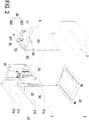
- FIG. 2 is a schematic exploded view illustrating the battery case structure of FIG. 1 .
- FIG. 3 is a schematic exploded view illustrating a shaft, a fixing part and a lever part of the battery case structure of FIG. 1 .
- at least one battery 2 is accommodated in the battery case structure 1.
- the at least one battery 2 includes two batteries 2 (see FIG. 2 ).
- the battery case structure 1 includes a housing 3, a shaft 4, a fixing part 5 and at least one lever part 6.
- the housing 3 includes a plurality of side walls 31 and a bottom plate 32.
- the plurality of side walls 31 are connected with each other and form a cuboid structure.
- the plurality of side walls 31 are connected with the bottom plate 32, respectively, and disposed around the edge of the bottom plate 32.
- the plurality of side walls 31 and the bottom plate 32 collaboratively define an accommodation space 34 disposed in the housing 3 and including a first opening 33.
- the battery 2 is disposed in the accommodation space 34 through the first opening 33.
- the first opening 33 is corresponding in position to the bottom plate 32, and the first opening 33 and the bottom plate 32 are located in two opposite sides of the housing 3.
- the plurality of side walls 31 include a first side wall 31a, a second side wall 31b, a third side wall 31c and a fourth side wall 31d.
- the first side wall 31a and the second side wall 31b are located in two opposite sides of the housing 3.
- the third side wall 31c and the fourth side wall 31d are located in two opposite sides of the housing 3.
- the third side wall 31c and the fourth side wall 31d are located between the first side wall 31a and the second side wall 31b.
- the first side wall 31a further includes at least one second opening 35 in fluid communication with the accommodation space 34.
- the at least one second opening 35 includes two second openings 35, as shown in FIG. 1 .
- each battery 2 is corresponding in position to a corresponding second opening 35 of the two second openings 35.
- the fixing part 5 is disposed in the housing 3, and two ends of the fixing part 5 are connected with the third side wall 31c and the fourth side wall 31d, respectively.
- the shaft 4 is disposed on the fixing part 5, and the shaft 4 is disposed in and fixed to the housing 3 through the fixing part 5.
- the at least one lever part 6 is disposed in the housing 3.
- the battery case structure 1 includes two lever parts 6.
- Each lever part 6 includes at least one first through hole 61, a first arm 62 and a second arm 63.
- the first arm 62 includes a main body 621 and two extension portions 622.
- the main body 621 of the first arm 62 is connected with the second arm 63 and vertical to the second arm 63.
- the main body 621 includes a first surface 621a and a second surface 621b.
- the first surface 621a of the main body 621 of the first arm 62 faces to the accommodation space 34.
- the second surface 621b of the main body 621 of the first arm 62 faces the exterior of the housing 3.
- the two extension portions 622 are connected with two opposite sides of the main body 621, respectively.
- the two extension portions 622 are extended toward the accommodation space 34 of the housing 3.
- each lever part 6 includes two first through holes 61.
- Each first through hole 61 is disposed on the corresponding extension portion 622 of the first arm 62.
- One end of the shaft 4 is penetrated through the two first through holes 61. Therefore, the lever part 6 is rotated around the shaft 4.
- the main body 621 of the first arm 62 is served as a force-exerting portion for receiving a force thereon selectively.
- the battery 2 is disposed on the second arm 63 so that the second arm 63 is attached to the bottom plate 32 and located between the bottom plate 32 and the battery 2 due to the weight of the battery 2.
- the second arm 63 is parallel to the bottom plate 32 and the bottom of the battery 2. Since the main body 621 of the first arm 62 is perpendicular to the second arm 63, the main body 621 of the first arm 62 is located in the second opening 35, and the main body 621 of the first arm 62 is located at the same surface with the first side wall 31a having the second opening 35.
- the main body 621 of the first arm 62 (for example the main body 621 of the first arm 62 of the lever part 6 as shown in the right side of FIG. 1 ) is rotated around the shaft 4 along a direction from the second opening 35 and away from the battery 2. Since the main body 621 of the first arm 62 is connected with the second arm 63, the main body 621 of the first arm 62 drives the second arm 63 to rotate around the shaft 4 toward the first opening 33, so that the second arm 63 drives the battery 2 to be withdrawn from the housing 3 through the first opening 33.
- the battery case structure 1 of the present disclosure includes a housing 3, a shaft 4, a fixing part 5 and at least one lever part 6. While the force from the accommodation space 34 toward the exterior of the housing 3 is applied on the main body 621 of the first arm 62 of the lever part 6, the main body 621 of the first arm 62 drives the second arm 63 to rotate around the shaft 4, so that second arm 63 drives the battery 2 to be withdrawn from the housing 3 through the first opening 33.
- the conventional battery case structure the user needs to touch the battery in the battery case through two elongated openings on two opposite sides of the battery case and push the battery simultaneously.
- the user can withdraw the battery 2 from the battery case structure 1 by applying force on the main body 621 of the first arm 62 of the lever part 6 merely. Consequently, the operation of withdrawing the battery 2 from the battery case structure 1 is labor-saving and convenient.
- the cross sectional area of the second opening 35 is greater than the cross sectional area of the main body 621 of the first arm 62.
- the profile of the second opening 35 covers the profile of the main body 621 of the first arm 62, so that the main body 621 of the first arm 62 fails to cover the second opening 35 completely. Therefore, a space is reserved in the second opening 35 for allowing the tool of the user (for example one finger of the user) to apply the force.
- the user can utilize the tool to apply the force on the first surface 621a of the main body 621 of the first arm 62 through the space reserved in the second opening 35.
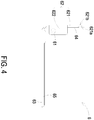
- FIG. 4 is a schematic perspective view illustrating the lever part of the battery case structure of FIG. 1 .
- the first arm 62 includes a first protrusion 64 formed on the first surface 621a of the first arm 62.
- the first protrusion 64 is a strip structure for enhancing the structure strength of the first arm 62 and preventing the structure of the first arm 62 from being damaged while the user applies force on the first surface 621a of the main body 621 of the first arm 62.
- the second arm 63 includes a second protrusion 65 formed on the side of the second arm 63 facing the first opening 33.
- the second protrusion 65 is a strip structure for enhancing the structure strength of the second arm 63.
- the second protrusion 65 prevents the structure of the second arm 63 from being damaged due to the weight of the battery 2 disposed on the second arm 63.
- the bottom of the battery 2 has a specific length.
- the length of the section of the second arm 63 in contact with the bottom of the battery 2 is equal to half of the specific length of the battery 2. Therefore, an end of the second arm 63 keeping away from the first arm 62 is in contact with a midpoint of a surface of the bottom of the battery 2. While the second arm 63 drives the battery 2 to move, the second arm 63 applies force on the midpoint of the bottom of the battery 2.
- the housing 3 includes a detachable cover 30.
- the cover 30 is detachably connected with the side walls 31 of the housing 3 and covers the first opening 33 to seal the accommodation space 34. While the battery 2 is disposed in the accommodation space 34 through the first opening 33 or the battery 2 is driven by the second arm 63 to be withdrawn from the housing 3, the cover 30 is detached from the housing 3.
- the accommodation space 34 is exposed to facilitate disposing the battery 2 in the accommodation space 34 through the first opening 33 or withdrawing the battery 2 from the accommodation space 34.
- a side of the cover 30 is connected with one of the plurality of the side walls 31.
- the cover 30 is rotated around the side of the cover 30 connected with the side wall 31, so that the cover 30 is lifted off and the accommodation space 34 is exposed.
- the battery 2 is disposed in the accommodation space 34 through the first opening 33 or the battery 2 is driven by the second arm 63 to be withdrawn from the housing 3, the user rotates the cover 30 and the accommodation space 34 is exposed to facilitate disposing the battery 2 in the accommodation space 34 through the first opening 33 or withdrawing the battery 2 from the accommodation space 34.
- the fixing part 5 includes a first supporting wall 51 and two second supporting walls 52.
- the two second supporting walls 52 are connected with the first supporting wall 51, respectively. Two sides of the first supporting wall 51 are fixed on the third side wall 31c and the fourth side wall 31d, respectively, so that the fixing part 5 is fixed on the housing 3 through the first supporting wall 51.
- the two second supporting walls 52 are extended from two opposite ends of the first supporting wall 51 toward the second opening 35.
- the two second supporting walls 52 are parallel to each other, and each of the two second supporting walls 52 includes a second through hole 53 corresponding in position to a corresponding first through hole 61 of the first arm 62.
- the fixing part 5 further includes two fixing elements 54.
- Each fixing element 54 is penetrated through the corresponding second through hole 53 and engaged with a corresponding end of the shaft 4 so as to fix the end of the shaft 4. Consequently, the shaft 4 is fixed between the two second supporting walls 52 and the shaft 4 is fixed on the housing 3 through the fixing part 5.
- the structure of the fixing part 5 is not limited to the above embodiment and can be varied according to the practical requirements.
- the fixing part 5 is extended from the first side wall 31a of the housing 3, and the fixing part 5 and the first side wall 31a of the housing 3 are integrally formed into one piece.
- the fixing part 5 can be any form to allow the shaft 4 to penetrate therethrough.
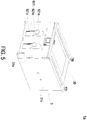
- FIG. 5 is a schematic perspective view illustrating a battery case structure according to a second embodiment of the present disclosure.
- FIG. 6 is a schematic exploded view illustrating the battery case structure of FIG. 5 .
- FIG. 7 is a schematic exploded view illustrating a shaft, a fixing part and a lever part of the battery case structure of FIG. 5 .
- the battery case structure 1a of this embodiment includes a housing 3, a shaft 4, a fixing part 5 and at least one lever part 6.
- the structures and functions of the housing 3, the shaft 4, the fixing part 5 and the lever part 6 of the battery case structure 1a of this embodiment are similar to those of the first embodiment.
- the main body 621 of the first arm 62 of the lever part 6 of this embodiment further includes a first portion 621c, a second portion 621d and a third portion 621e.
- An end of the first portion 621c is connected with an end of the second arm 63.
- the other end of the first portion 621c is connected with an end of the second portion 621d.
- the second portion 621d is extended from the accommodation space 34 toward the exterior of the housing 3.
- the other end of the second portion 621d is connected with an end of the third portion 621e.
- the third portion 621e is extended from the end connected with the second portion 621d toward the first opening 33. While no force is applied on the lever part 6, the second portion 621d and the third portion 621e of the main body 621 of the first arm 62 are located at the exterior of the housing 3, and a gap is formed between the second portion 621d and the second opening 35 and between the third portion 621e and the second opening 35. While the user desires to apply force on the first arm 62, the user doesn't need to put the tool into the accommodation space 34 through the second opening 35. The user only needs to apply force on the first surface 621a of the third portion 621e of the main body 621 of the first arm 62 from the exterior of the housing 3. Consequently, the second arm 63 is driven to rotate around the shaft 4 and push the battery 2 to be withdrawn from the housing 3, so that the battery 2 is withdrawn from the battery case structure 1a easily.
- FIG. 8 is a schematic perspective view illustrating a battery case structure according to a third embodiment of the present disclosure.
- FIG. 9 is a schematic exploded view illustrating the battery case structure of FIG. 8 .
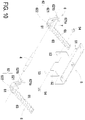
- FIG. 10 is a schematic exploded view illustrating a shaft, a fixing part and a lever part of the battery case structure of FIG. 8 .
- the battery case structure 1b of this embodiment includes a housing 3, a shaft 4, a fixing part 5 and at least one lever part 6.
- the structures and functions of the housing 3, the shaft 4, the fixing part 5 and the lever part 6 of the battery case structure 1b of this embodiment are similar to those of the first embodiment.
- the battery case structure 1b of this embodiment further includes a connection arm 7.
- Two ends of the connection arm 7 are connected with the ends of the main bodies 621 of the first arms 62 of the two lever parts 6, respectively.
- the connection arm 7 and the two lever parts 6 are formed into an inverted U-shaped structure.
- the first side wall 31a includes a single second opening 35.
- the second opening 35 is an inverted U-shaped opening.
- the connection arm 7 is served as a force-exerting portion for receiving the force thereon selectively.
- the battery 2 is disposed on the second arm 63 so that the second arm 63 is attached to the bottom plate 32 and located between the bottom plate 32 and the battery 2 due to the weight of the battery 2. Moreover, the second arm 63 is parallel to the bottom plate 32 and the battery 2. Since the plane defined by the main body 621 of the first arm 62 and the connection arm 7 is perpendicular to the second arm 63, the main body 621 of the first arm 62 and the connection arm 7 are located in the second opening 35, and the main body 621 of the first arm 62 and the connection arm 7 are located at the same surface with the first side wall 31a having the second opening 35.
- connection arm 7 drives the main bodies 621 of the first arms 62 of the two lever parts 6 to rotate around the shaft 4 along a direction from the second opening 35 and away from the battery 2.
- connection arm 7 and one of the two lever parts 6 are integrally formed into one piece. In other embodiment, the connection arm 7 and the two lever parts 6 are integrally formed into one piece.
- the battery case structure of the present disclosure includes a housing, a shaft, a fixing part and at least one lever part. While the force from the accommodation space toward the exterior of the housing is applied on the main body of the first arm of the lever part, the main body of the first arm drives the second arm to rotate around the shaft, so that the second arm drives the battery to be withdrawn from the housing through the first opening.
- the user needs to touch the battery in the battery case structure through two elongated openings on two opposite sides of the battery case and push the battery simultaneously. Comparing with the conventional battery case structure with the battery case structure of the present disclosure, the user can withdraw the battery from the battery case structure by applying force on the main body of the first arm of the lever part merely.
- the operation of withdrawing the battery from the battery case structure is labor-saving and convenient.
- the battery case structure of the present disclosure is locked and fixed on a din rail for providing electric power to an electric equipment disposed on the din rail.
- the electric equipment is a power supply or a server.
Landscapes
- Chemical & Material Sciences (AREA)
- Chemical Kinetics & Catalysis (AREA)
- Electrochemistry (AREA)
- General Chemical & Material Sciences (AREA)
- Battery Mounting, Suspending (AREA)
Abstract
Description
- The present disclosure relates to a battery case structure, and more particularly to a battery case structure capable of withdrawing a battery therefrom easily and conveniently.
- Nowadays, battery has been widely employed in variety electronic devices. For accommodating the battery in the electronic device conveniently, the electronic device includes a battery case for accommodating the battery therein. The battery is maintained and replaced frequently. For allowing the battery to be withdrawn from the battery case, the conventional battery case includes two elongated openings located on the two opposite sides of the housing of the battery case, respectively. While the battery is withdrawn from the battery case, the user needs to touch the battery in the battery case through the two elongated openings and push the battery to move so as to withdraw the battery form the battery case through an opening on the top of the battery case. However, the user needs to apply force at least equal to the weight of the battery on the battery so as to withdraw the battery from the battery case. Consequently, the operation of withdrawing the battery from the battery case is laborious. Moreover, the user must touch the battery in the battery case through the elongated openings of the battery case so as to withdraw the battery from the battery case. Consequently, the position and the angle of the force applied on the battery are limited, and the battery is not easy to be withdrawn from the battery case.
- Therefore, there is a need of providing a battery case structure so as to address the issues encountered by the prior arts.
- An object of the present disclosure provides a battery case structure having advantages of withdrawing a battery therefrom easily and conveniently.
- In accordance with an aspect of the present disclosure, a battery case structure is provided. The battery case structure accommodates at least one battery therein. The battery case structure comprises a housing, a shaft, a fixing part and at least one lever part. The housing comprises a plurality of side walls and a bottom plate. The plurality of side walls are connected with each other and connected with the bottom plate respectively. The plurality of side walls and the bottom plate define an accommodation space disposed in the housing and comprising a first opening. The battery is disposed in the accommodation space through the first opening. One of the plurality of side walls comprises at least one second opening in fluid communication with the accommodation space. The fixing part is disposed in and connecting with the housing. The shaft is fixed to the housing through the fixing part. The at least one lever part comprises at least one first through hole, a first arm and a second arm. The first arm comprises a main body and at least one extension portion. The main body is connected with the second arm. The extension portion is connected with the main body and extended from the main body toward the accommodation space. The second arm is in contact with the battery while the battery is disposed in the accommodation space. The first through hole is disposed on the extension portion. The shaft is penetrated through the first through hole, so that the lever part is rotated around the shaft. In response to a force applied on the main body of the first arm. The main body of the first arm is rotated around the shaft along a direction from the second opening and away from the battery. The main body of the first arm drives the second arm to rotate around the shaft toward the first opening, so that the second arm drives the battery to be withdrawn from the housing through the first opening.
- The above contents of the present disclosure will become more readily apparent to those ordinarily skilled in the art after reviewing the following detailed description and accompanying drawings, in which:
-
-
FIG. 1 is a schematic perspective view illustrating a battery case structure according to a first embodiment of the present disclosure; -
FIG. 2 is a schematic exploded view illustrating the battery case structure ofFIG. 1 ; -
FIG. 3 is a schematic exploded view illustrating a shaft, a fixing part and a lever part of the battery case structure ofFIG. 1 ; -
FIG. 4 is a schematic perspective view illustrating the lever part of the battery case structure ofFIG. 1 ; -
FIG. 5 is a schematic perspective view illustrating a battery case structure according to a second embodiment of the present disclosure; -
FIG. 6 is a schematic exploded view illustrating the battery case structure ofFIG. 5 ; -
FIG. 7 is a schematic exploded view illustrating a shaft, a fixing part and a lever part of the battery case structure ofFIG. 5 ; -
FIG. 8 is a schematic perspective view illustrating a battery case structure according to a third embodiment of the present disclosure; -
FIG. 9 is a schematic exploded view illustrating the battery case structure ofFIG. 8 ; and -
FIG. 10 is a schematic exploded view illustrating a shaft, a fixing part and a lever part of the battery case structure ofFIG. 8 . - The present disclosure will now be described more specifically with reference to the following embodiments. It is to be noted that the following descriptions of preferred embodiments of this disclosure are presented herein for purpose of illustration and description only. It is not intended to be exhaustive or to be limited to the precise form disclosed.
-
FIG. 1 is a schematic perspective view illustrating a battery case structure according to a first embodiment of the present disclosure.FIG. 2 is a schematic exploded view illustrating the battery case structure ofFIG. 1 .FIG. 3 is a schematic exploded view illustrating a shaft, a fixing part and a lever part of the battery case structure ofFIG. 1 . As shown inFIGS. 1 to 3 , in this embodiment, at least onebattery 2 is accommodated in thebattery case structure 1. For example, the at least onebattery 2 includes two batteries 2 (seeFIG. 2 ). Thebattery case structure 1 includes ahousing 3, ashaft 4, afixing part 5 and at least onelever part 6. - The
housing 3 includes a plurality ofside walls 31 and abottom plate 32. The plurality ofside walls 31 are connected with each other and form a cuboid structure. The plurality ofside walls 31 are connected with thebottom plate 32, respectively, and disposed around the edge of thebottom plate 32. The plurality ofside walls 31 and thebottom plate 32 collaboratively define anaccommodation space 34 disposed in thehousing 3 and including afirst opening 33. Thebattery 2 is disposed in theaccommodation space 34 through thefirst opening 33. Thefirst opening 33 is corresponding in position to thebottom plate 32, and the first opening 33 and thebottom plate 32 are located in two opposite sides of thehousing 3. In this embodiment, the plurality ofside walls 31 include afirst side wall 31a, asecond side wall 31b, athird side wall 31c and afourth side wall 31d. Thefirst side wall 31a and thesecond side wall 31b are located in two opposite sides of thehousing 3. Thethird side wall 31c and thefourth side wall 31d are located in two opposite sides of thehousing 3. Thethird side wall 31c and thefourth side wall 31d are located between thefirst side wall 31a and thesecond side wall 31b. Moreover, thefirst side wall 31a further includes at least onesecond opening 35 in fluid communication with theaccommodation space 34. For example, the at least onesecond opening 35 includes twosecond openings 35, as shown inFIG. 1 . In this embodiment, when thebatteries 2 are disposed in theaccommodation space 34, eachbattery 2 is corresponding in position to a correspondingsecond opening 35 of the twosecond openings 35. - The fixing
part 5 is disposed in thehousing 3, and two ends of the fixingpart 5 are connected with thethird side wall 31c and thefourth side wall 31d, respectively. Theshaft 4 is disposed on the fixingpart 5, and theshaft 4 is disposed in and fixed to thehousing 3 through the fixingpart 5. - In this embodiment, the at least one
lever part 6 is disposed in thehousing 3. Preferably but not exclusively, thebattery case structure 1 includes twolever parts 6. Eachlever part 6 includes at least one first throughhole 61, afirst arm 62 and asecond arm 63. Thefirst arm 62 includes amain body 621 and twoextension portions 622. Themain body 621 of thefirst arm 62 is connected with thesecond arm 63 and vertical to thesecond arm 63. Themain body 621 includes afirst surface 621a and asecond surface 621b. Thefirst surface 621a of themain body 621 of thefirst arm 62 faces to theaccommodation space 34. Thesecond surface 621b of themain body 621 of thefirst arm 62 faces the exterior of thehousing 3. The twoextension portions 622 are connected with two opposite sides of themain body 621, respectively. The twoextension portions 622 are extended toward theaccommodation space 34 of thehousing 3. - The
second arm 63 is disposed in theaccommodation space 34. While thebatteries 2 are disposed in theaccommodation space 34, eachsecond arm 63 is in contact with the bottom of acorresponding battery 2 of the twobatteries 2 so as to support thebattery 2, but not limited thereto. In this embodiment, eachlever part 6 includes two first through holes 61. Each first throughhole 61 is disposed on thecorresponding extension portion 622 of thefirst arm 62. One end of theshaft 4 is penetrated through the two first through holes 61. Therefore, thelever part 6 is rotated around theshaft 4. Themain body 621 of thefirst arm 62 is served as a force-exerting portion for receiving a force thereon selectively. While no force is applied on themain body 621 of the first arm 62 (for example themain body 621 of thefirst arm 62 of thelever part 6 as shown in the right side ofFIG. 1 ), thebattery 2 is disposed on thesecond arm 63 so that thesecond arm 63 is attached to thebottom plate 32 and located between thebottom plate 32 and thebattery 2 due to the weight of thebattery 2. Moreover, thesecond arm 63 is parallel to thebottom plate 32 and the bottom of thebattery 2. Since themain body 621 of thefirst arm 62 is perpendicular to thesecond arm 63, themain body 621 of thefirst arm 62 is located in thesecond opening 35, and themain body 621 of thefirst arm 62 is located at the same surface with thefirst side wall 31a having thesecond opening 35. While a force from theaccommodation space 34 toward the exterior of thehousing 3 is applied on thefirst surface 621a of themain body 621 of thefirst arm 62, themain body 621 of the first arm 62 (for example themain body 621 of thefirst arm 62 of thelever part 6 as shown in the right side ofFIG. 1 ) is rotated around theshaft 4 along a direction from thesecond opening 35 and away from thebattery 2. Since themain body 621 of thefirst arm 62 is connected with thesecond arm 63, themain body 621 of thefirst arm 62 drives thesecond arm 63 to rotate around theshaft 4 toward thefirst opening 33, so that thesecond arm 63 drives thebattery 2 to be withdrawn from thehousing 3 through thefirst opening 33. - From above, the
battery case structure 1 of the present disclosure includes ahousing 3, ashaft 4, a fixingpart 5 and at least onelever part 6. While the force from theaccommodation space 34 toward the exterior of thehousing 3 is applied on themain body 621 of thefirst arm 62 of thelever part 6, themain body 621 of thefirst arm 62 drives thesecond arm 63 to rotate around theshaft 4, so thatsecond arm 63 drives thebattery 2 to be withdrawn from thehousing 3 through thefirst opening 33. By using the conventional battery case structure, the user needs to touch the battery in the battery case through two elongated openings on two opposite sides of the battery case and push the battery simultaneously. Comparing the conventional battery case structure with the battery case structure of the present disclosure, the user can withdraw thebattery 2 from thebattery case structure 1 by applying force on themain body 621 of thefirst arm 62 of thelever part 6 merely. Consequently, the operation of withdrawing thebattery 2 from thebattery case structure 1 is labor-saving and convenient. - In this embodiment, for allowing the user to apply the force on the
main body 621 of thefirst arm 62 of thelever part 6, the cross sectional area of thesecond opening 35 is greater than the cross sectional area of themain body 621 of thefirst arm 62. Namely, the profile of thesecond opening 35 covers the profile of themain body 621 of thefirst arm 62, so that themain body 621 of thefirst arm 62 fails to cover thesecond opening 35 completely. Therefore, a space is reserved in thesecond opening 35 for allowing the tool of the user (for example one finger of the user) to apply the force. Hence, the user can utilize the tool to apply the force on thefirst surface 621a of themain body 621 of thefirst arm 62 through the space reserved in thesecond opening 35. -
FIG. 4 is a schematic perspective view illustrating the lever part of the battery case structure ofFIG. 1 . Please refer toFIGS. 1 to 4 . In this embodiment, thefirst arm 62 includes afirst protrusion 64 formed on thefirst surface 621a of thefirst arm 62. Thefirst protrusion 64 is a strip structure for enhancing the structure strength of thefirst arm 62 and preventing the structure of thefirst arm 62 from being damaged while the user applies force on thefirst surface 621a of themain body 621 of thefirst arm 62. Moreover, thesecond arm 63 includes asecond protrusion 65 formed on the side of thesecond arm 63 facing thefirst opening 33. Thesecond protrusion 65 is a strip structure for enhancing the structure strength of thesecond arm 63. While the user applies force on themain body 621 of thefirst arm 62 to drive thesecond arm 63 to rotate around theshaft 4, thesecond protrusion 65 prevents the structure of thesecond arm 63 from being damaged due to the weight of thebattery 2 disposed on thesecond arm 63. - While the
battery 2 is disposed in theaccommodation space 34 completely, a part of the bottom of thebattery 2 is in contact with thesecond arm 63. In some embodiments, the bottom of thebattery 2 has a specific length. The length of the section of thesecond arm 63 in contact with the bottom of thebattery 2 is equal to half of the specific length of thebattery 2. Therefore, an end of thesecond arm 63 keeping away from thefirst arm 62 is in contact with a midpoint of a surface of the bottom of thebattery 2. While thesecond arm 63 drives thebattery 2 to move, thesecond arm 63 applies force on the midpoint of the bottom of thebattery 2. Consequently, thebattery 2 is withdrawn from thehousing 3 along the direction perpendicular to thebottom plate 32 of thehousing 3 for avoiding the oblique of thebattery 2, so that thebattery 2 is withdrawn from thehousing 3 easily. In some embodiments, thehousing 3 includes adetachable cover 30. Thecover 30 is detachably connected with theside walls 31 of thehousing 3 and covers thefirst opening 33 to seal theaccommodation space 34. While thebattery 2 is disposed in theaccommodation space 34 through thefirst opening 33 or thebattery 2 is driven by thesecond arm 63 to be withdrawn from thehousing 3, thecover 30 is detached from thehousing 3. Theaccommodation space 34 is exposed to facilitate disposing thebattery 2 in theaccommodation space 34 through thefirst opening 33 or withdrawing thebattery 2 from theaccommodation space 34. In some embodiments, a side of thecover 30 is connected with one of the plurality of theside walls 31. Thecover 30 is rotated around the side of thecover 30 connected with theside wall 31, so that thecover 30 is lifted off and theaccommodation space 34 is exposed. While thebattery 2 is disposed in theaccommodation space 34 through thefirst opening 33 or thebattery 2 is driven by thesecond arm 63 to be withdrawn from thehousing 3, the user rotates thecover 30 and theaccommodation space 34 is exposed to facilitate disposing thebattery 2 in theaccommodation space 34 through thefirst opening 33 or withdrawing thebattery 2 from theaccommodation space 34. - Please refer to
FIGS. 1 to 3 again. In this embodiment, the fixingpart 5 includes a first supportingwall 51 and two second supportingwalls 52. The two second supportingwalls 52 are connected with the first supportingwall 51, respectively. Two sides of the first supportingwall 51 are fixed on thethird side wall 31c and thefourth side wall 31d, respectively, so that the fixingpart 5 is fixed on thehousing 3 through the first supportingwall 51. The two second supportingwalls 52 are extended from two opposite ends of the first supportingwall 51 toward thesecond opening 35. The two second supportingwalls 52 are parallel to each other, and each of the two second supportingwalls 52 includes a second throughhole 53 corresponding in position to a corresponding first throughhole 61 of thefirst arm 62. The fixingpart 5 further includes two fixingelements 54. Each fixingelement 54 is penetrated through the corresponding second throughhole 53 and engaged with a corresponding end of theshaft 4 so as to fix the end of theshaft 4. Consequently, theshaft 4 is fixed between the two second supportingwalls 52 and theshaft 4 is fixed on thehousing 3 through the fixingpart 5. It is noted that the structure of the fixingpart 5 is not limited to the above embodiment and can be varied according to the practical requirements. For example, the fixingpart 5 is extended from thefirst side wall 31a of thehousing 3, and the fixingpart 5 and thefirst side wall 31a of thehousing 3 are integrally formed into one piece. The fixingpart 5 can be any form to allow theshaft 4 to penetrate therethrough. -
FIG. 5 is a schematic perspective view illustrating a battery case structure according to a second embodiment of the present disclosure.FIG. 6 is a schematic exploded view illustrating the battery case structure ofFIG. 5 .FIG. 7 is a schematic exploded view illustrating a shaft, a fixing part and a lever part of the battery case structure ofFIG. 5 . As shown inFIGS. 5 to 7 , thebattery case structure 1a of this embodiment includes ahousing 3, ashaft 4, a fixingpart 5 and at least onelever part 6. The structures and functions of thehousing 3, theshaft 4, the fixingpart 5 and thelever part 6 of thebattery case structure 1a of this embodiment are similar to those of the first embodiment. Component parts and elements corresponding to those of the first embodiment are designated by identical numeral references, and detailed descriptions thereof are omitted. Different from themain body 621 of thefirst arm 62 of thelever part 6 of the first embodiment, themain body 621 of thefirst arm 62 of thelever part 6 of this embodiment further includes afirst portion 621c, asecond portion 621d and athird portion 621e. An end of thefirst portion 621c is connected with an end of thesecond arm 63. The other end of thefirst portion 621c is connected with an end of thesecond portion 621d. Thesecond portion 621d is extended from theaccommodation space 34 toward the exterior of thehousing 3. The other end of thesecond portion 621d is connected with an end of thethird portion 621e. Thethird portion 621e is extended from the end connected with thesecond portion 621d toward thefirst opening 33. While no force is applied on thelever part 6, thesecond portion 621d and thethird portion 621e of themain body 621 of thefirst arm 62 are located at the exterior of thehousing 3, and a gap is formed between thesecond portion 621d and thesecond opening 35 and between thethird portion 621e and thesecond opening 35. While the user desires to apply force on thefirst arm 62, the user doesn't need to put the tool into theaccommodation space 34 through thesecond opening 35. The user only needs to apply force on thefirst surface 621a of thethird portion 621e of themain body 621 of thefirst arm 62 from the exterior of thehousing 3. Consequently, thesecond arm 63 is driven to rotate around theshaft 4 and push thebattery 2 to be withdrawn from thehousing 3, so that thebattery 2 is withdrawn from thebattery case structure 1a easily. -
FIG. 8 is a schematic perspective view illustrating a battery case structure according to a third embodiment of the present disclosure.FIG. 9 is a schematic exploded view illustrating the battery case structure ofFIG. 8 .FIG. 10 is a schematic exploded view illustrating a shaft, a fixing part and a lever part of the battery case structure ofFIG. 8 . As shown inFIGS. 8 to 10 , thebattery case structure 1b of this embodiment includes ahousing 3, ashaft 4, a fixingpart 5 and at least onelever part 6. The structures and functions of thehousing 3, theshaft 4, the fixingpart 5 and thelever part 6 of thebattery case structure 1b of this embodiment are similar to those of the first embodiment. Component parts and elements corresponding to those of the first embodiment are designated by identical numeral references, and detailed descriptions thereof are omitted. Different from thebattery case structure 1 of the first embodiment, thebattery case structure 1b of this embodiment further includes aconnection arm 7. Two ends of theconnection arm 7 are connected with the ends of themain bodies 621 of thefirst arms 62 of the twolever parts 6, respectively. Theconnection arm 7 and the twolever parts 6 are formed into an inverted U-shaped structure. In this embodiment, thefirst side wall 31a includes a singlesecond opening 35. Preferably but not exclusively, thesecond opening 35 is an inverted U-shaped opening. Theconnection arm 7 is served as a force-exerting portion for receiving the force thereon selectively. While no force is applied on theconnection arm 7, thebattery 2 is disposed on thesecond arm 63 so that thesecond arm 63 is attached to thebottom plate 32 and located between thebottom plate 32 and thebattery 2 due to the weight of thebattery 2. Moreover, thesecond arm 63 is parallel to thebottom plate 32 and thebattery 2. Since the plane defined by themain body 621 of thefirst arm 62 and theconnection arm 7 is perpendicular to thesecond arm 63, themain body 621 of thefirst arm 62 and theconnection arm 7 are located in thesecond opening 35, and themain body 621 of thefirst arm 62 and theconnection arm 7 are located at the same surface with thefirst side wall 31a having thesecond opening 35. While the force from theaccommodation space 34 toward the exterior of thehousing 3 is applied on a side of theconnection arm 7 adjacent to theaccommodation space 34, theconnection arm 7 drives themain bodies 621 of thefirst arms 62 of the twolever parts 6 to rotate around theshaft 4 along a direction from thesecond opening 35 and away from thebattery 2. - Since the
main body 621 of eachfirst arm 62 is connected with the correspondingsecond arm 63, themain body 621 of eachfirst arm 62 drives the correspondingsecond arm 63 to rotate around theshaft 4 toward thefirst opening 33, so that the twosecond arms 63 drive the twobatteries 2 to be withdrawn from thehousing 3 through thefirst opening 33, respectively. Since the twolever parts 6 drive the twobatteries 2 to be withdrawn from thehousing 3 simultaneously, the twobatteries 2 are withdrawn simultaneously by one force exerted by the user. Consequently, thebatteries 2 are withdrawn from thehousing 3 conveniently. In some embodiments, theconnection arm 7 and one of the twolever parts 6 are integrally formed into one piece. In other embodiment, theconnection arm 7 and the twolever parts 6 are integrally formed into one piece. - From the above descriptions, the battery case structure of the present disclosure includes a housing, a shaft, a fixing part and at least one lever part. While the force from the accommodation space toward the exterior of the housing is applied on the main body of the first arm of the lever part, the main body of the first arm drives the second arm to rotate around the shaft, so that the second arm drives the battery to be withdrawn from the housing through the first opening. By using the conventional battery case structure, the user needs to touch the battery in the battery case structure through two elongated openings on two opposite sides of the battery case and push the battery simultaneously. Comparing with the conventional battery case structure with the battery case structure of the present disclosure, the user can withdraw the battery from the battery case structure by applying force on the main body of the first arm of the lever part merely. Consequently, the operation of withdrawing the battery from the battery case structure is labor-saving and convenient. Furthermore, the battery case structure of the present disclosure is locked and fixed on a din rail for providing electric power to an electric equipment disposed on the din rail. Preferably but not exclusively, the electric equipment is a power supply or a server.
- While the disclosure has been described in terms of what is presently considered to be the most practical and preferred embodiments, it is to be understood that the disclosure needs not be limited to the disclosed embodiment. On the contrary, it is intended to cover various modifications and similar arrangements included within the spirit and scope of the appended claims which are to be accorded with the broadest interpretation so as to encompass all such modifications and similar structures.
Claims (13)
- A battery case structure (1) for accommodating at least one battery (2) therein, the battery case structure (1) comprising:a housing (3) comprising a plurality of side walls (31) and a bottom plate (32), wherein the plurality of side walls (31) are connected with each other and connected with the bottom plate (32) respectively, the plurality of side walls (31) and the bottom plate (32) define an accommodation space (34) in the housing (3) and comprising a first opening (33), the battery (2) is disposed in the accommodation space (34) through the first opening (33), and one of the plurality of side walls (31) comprises at least one second opening (35) in fluid communication with the accommodation space (34);a shaft (4);a fixing part (5) disposed in and connecting with the housing (3), wherein the shaft (4) is fixed to the housing (3) through the fixing part (5); andat least one lever part (6) comprising at least one first through hole (61), a first arm (62) and a second arm (63), wherein the first arm (62) comprises a main body (621) and at least one extension portion (622), the main body (621) is connected with the second arm (63), the extension portion (622) is connected with the main body (621) and extended from the main body (621) toward the accommodation space (34), the second arm (63) is in contact with the battery (2) while the battery (2) is disposed in the accommodation space (34), and the first through hole (61) is disposed on the extension portion (622), wherein the shaft (4) is penetrated through the first through hole (61), so that the lever part (6) is rotated around the shaft (4);wherein in response to a force applied on the main body (621) of the first arm (62), the main body (621) of the first arm (62) is rotated around the shaft (4) along a direction from the second opening (35) and away from the battery (2), and the main body (621) of the first arm (62) drives the second arm (63) to rotate around the shaft (4) toward the first opening (33), so that the second arm (63) drives the battery (2) to be withdrawn from the housing (3) through the first opening (33).
- The battery case structure (1) according to claim 1, wherein the plurality of side walls (31) comprises a first side wall (31a), a second side wall (31b), a third side wall (31c) and a fourth side wall (31d), the first side wall (31a) and the second side wall (31b) are located in two opposite sides of the housing (3), the third side wall (31c) and the fourth side wall (31d) are located in two opposite sides of the housing (3) and located between the first side wall (31a) and the second side wall (31b), the first side wall (31a) comprises the second opening (35), and two ends of the fixing part (5) are connected with the third side wall (31c) and the fourth side wall (31d) of the housing (3), respectively.
- The battery case structure (1) according to claim 1, wherein the main body (621) of the first arm (62) is connected with the second arm (63) and perpendicular to the second arm (63), the main body (621) of the first arm (62) comprises a first surface (621a) and a second surface (621b), the first surface (621a) faces to the accommodation space (34), and the second surface (621b) faces to the exterior of the housing (3), wherein the force from the accommodation space (34) toward the exterior of the housing (3) is applied on the first surface (621a) of the main body (621) of the first arm (62).
- The battery case structure (1) according to claim 3, wherein the first arm (62) comprises a first protrusion (64) formed on the first surface (621a) of the main body (621), and the first protrusion (64) is a strip structure.
- The battery case structure (1) according to claim 1, wherein second arm (63) comprises a second protrusion (65), the second protrusion (65) is formed on a side of the second arm (63) facing the first opening (33), and the second protrusion (65) is a strip structure.
- The battery case structure (1) according to claim 1, wherein a cross sectional area of the second opening (35) is greater than a cross sectional area of the main body (621) of the first arm (62).
- The battery case structure (1) according to claim 1, wherein while the battery (2) is disposed in the accommodation space (34) completely, the battery (2) has a bottom having a specific length, and the length of a section of the second arm (63) in contact with the bottom of the battery (2) is equal to half of the specific length of the battery (2).
- The battery case structure (1) according to claim 1, wherein the main body (621) of the first arm (62) is located in the second opening (35) and located at the same surface with the side wall (31) having the second opening (35) while no force is applied on the main body (621) of the first arm (62).
- The battery case structure (1) according to claim 1, wherein the fixing part (5) comprises a first supporting wall (51) and two second supporting walls (52), the two second supporting walls (52) are connected with the first supporting wall (51) respectively, and two ends of the first supporting wall (51) are fixed on the corresponding side walls (31), respectively, wherein the two second supporting walls (52) are extended from the two opposite ends of the first supporting wall (51) toward the second opening (35), and the two second supporting walls (52) are parallel to each other.
- The battery case structure (1) according to claim 9, wherein the fixing part (5) comprises two fixing elements (54), and each of the two second supporting walls (52) comprises a second through hole (53), wherein each fixing element (54) is penetrated through the corresponding second through hole (53) to fix an end of the shaft (4) on the fixing part (5), so as to fix the shaft (4) between the two second supporting walls (52).
- The battery case structure (1) according to claim 1, wherein the main body (621) comprises a first portion (621c), a second portion (621d) and a third portion (621e), an end of the first portion (621c) is connected with an end of the second arm (63), the other end of the first portion (621c) is connected with an end of the second portion (621d), the second portion (621d) is extended from the accommodation space (34) toward the exterior of the housing (3), the other end of the second portion (621d) is connected with an end of the third portion (621e), and the third portion (621e) is extended toward the first opening (33) from the end of the third portion (621e) connecting with the second portion (621d).
- The battery case structure (1) according to claim 1, wherein the at least one lever part (6) comprises two lever parts (6), and the battery case structure (1) comprises a connection arm (7), wherein two ends of the connection arm (7) are connected with one end of the main bodies of the first arms (62) of the two lever parts (6), respectively.
- The battery case structure (1) according to claim 1, wherein the fixing part (5) is extended from the housing (3), the fixing part (5) and the housing (3) are integrally formed into one piece.
Applications Claiming Priority (1)
| Application Number | Priority Date | Filing Date | Title |
|---|---|---|---|
| CN201911084635.3A CN112838317A (en) | 2019-11-07 | 2019-11-07 | Battery box structure |
Publications (1)
| Publication Number | Publication Date |
|---|---|
| EP3819961A1 true EP3819961A1 (en) | 2021-05-12 |
Family
ID=69177045
Family Applications (1)
| Application Number | Title | Priority Date | Filing Date |
|---|---|---|---|
| EP20152371.9A Pending EP3819961A1 (en) | 2019-11-07 | 2020-01-17 | Battery case structure |
Country Status (3)
| Country | Link |
|---|---|
| US (1) | US20210143376A1 (en) |
| EP (1) | EP3819961A1 (en) |
| CN (1) | CN112838317A (en) |
Families Citing this family (1)
| Publication number | Priority date | Publication date | Assignee | Title |
|---|---|---|---|---|
| CN116315392B (en) * | 2023-05-10 | 2023-08-11 | 深圳市德兰明海新能源股份有限公司 | Battery pack and energy storage power supply capable of detachably replacing battery pack |
Citations (3)
| Publication number | Priority date | Publication date | Assignee | Title |
|---|---|---|---|---|
| JPH10144274A (en) * | 1996-11-13 | 1998-05-29 | Saitama Nippon Denki Kk | Battery detachable structure |
| JP2008117610A (en) * | 2006-11-02 | 2008-05-22 | Ricoh Co Ltd | Battery housing and electronic device |
| WO2019073949A1 (en) * | 2017-10-10 | 2019-04-18 | マクセルホールディングス株式会社 | Battery mounting unit, electric device, and power supply unit |
Family Cites Families (11)
| Publication number | Priority date | Publication date | Assignee | Title |
|---|---|---|---|---|
| US4031295A (en) * | 1976-03-11 | 1977-06-21 | General Time Corporation | Combination housing with compartment and ejector mechanism for ejecting a battery therefrom |
| CN201142339Y (en) * | 2007-11-02 | 2008-10-29 | 福桑联合企业股份有限公司 | Secondary battery box with withdrawing mechanism and charging seat structure thereof |
| CN101562240B (en) * | 2008-04-18 | 2012-05-23 | 深圳富泰宏精密工业有限公司 | Battery cover snapclose structure |
| CN101990013B (en) * | 2009-07-31 | 2014-10-22 | 赛恩倍吉科技顾问(深圳)有限公司 | Opening and closing mechanism for batteries and portable electronic device with same |
| CN101990014B (en) * | 2009-08-04 | 2014-10-22 | 赛恩倍吉科技顾问(深圳)有限公司 | Battery ejection device and portable electronic device with same |
| CN103730612A (en) * | 2012-10-12 | 2014-04-16 | 佛山普立华科技有限公司 | Battery lock structure |
| CN105990541B (en) * | 2015-02-04 | 2018-08-21 | 纬创资通(中山)有限公司 | Battery accommodating module and electronic device |
| JP7288269B2 (en) * | 2017-10-10 | 2023-06-07 | 古河電池株式会社 | Battery mounting unit, electric equipment and power supply unit |
| CN108428831B (en) * | 2018-03-20 | 2021-02-02 | 湖北三江航天红峰控制有限公司 | Battery case suitable for microgravity environment |
| CN208781917U (en) * | 2018-09-30 | 2019-04-23 | 欧姆龙株式会社 | Battery fastening structure and electronic equipment |
| CN109895930A (en) * | 2019-02-03 | 2019-06-18 | 星恒电源股份有限公司 | A kind of battery box for electric vehicle liftout attachment and extrusion method |
-
2019
- 2019-11-07 CN CN201911084635.3A patent/CN112838317A/en active Pending
-
2020
- 2020-01-10 US US16/739,330 patent/US20210143376A1/en not_active Abandoned
- 2020-01-17 EP EP20152371.9A patent/EP3819961A1/en active Pending
Patent Citations (3)
| Publication number | Priority date | Publication date | Assignee | Title |
|---|---|---|---|---|
| JPH10144274A (en) * | 1996-11-13 | 1998-05-29 | Saitama Nippon Denki Kk | Battery detachable structure |
| JP2008117610A (en) * | 2006-11-02 | 2008-05-22 | Ricoh Co Ltd | Battery housing and electronic device |
| WO2019073949A1 (en) * | 2017-10-10 | 2019-04-18 | マクセルホールディングス株式会社 | Battery mounting unit, electric device, and power supply unit |
Also Published As
| Publication number | Publication date |
|---|---|
| US20210143376A1 (en) | 2021-05-13 |
| CN112838317A (en) | 2021-05-25 |
Similar Documents
| Publication | Publication Date | Title |
|---|---|---|
| US8870311B2 (en) | Track-bearing cabinet fastener | |
| EP2031595B1 (en) | Fixing apparatus for hard disk drive | |
| US7164577B2 (en) | Electronic apparatus having storage device | |
| EP3819961A1 (en) | Battery case structure | |
| US7772488B2 (en) | Case assembly structure and electronic device with same | |
| US7445498B2 (en) | Fixed seat of a socket | |
| US11427383B2 (en) | Plastic enclosure for enclosing industrial components | |
| US8899124B2 (en) | Industrial robot | |
| CN102096450A (en) | Computer case | |
| JP2003333730A (en) | Lightweight partitioning wall wiring box and lightweight partitioning wall wiring box device | |
| EP3389246B1 (en) | Card holder apparatus used for mounting telephone card, and mobile device | |
| CN110610666A (en) | Flexible Display Mounting Device and Display Device | |
| TW201343042A (en) | Electronic device enclosure with cable management tray | |
| CN218919161U (en) | battery energy storage system | |
| CN103369881A (en) | Electronic equipment | |
| JP4933136B2 (en) | Electrical equipment storage box | |
| CN102104213A (en) | Connector assembly | |
| US8345443B2 (en) | Supporting frame for circuit board | |
| US11653448B2 (en) | Circuit board module and electronic device | |
| TWI705597B (en) | Battery box structure | |
| CN116505152A (en) | End cover assembly and battery cell | |
| US8467173B2 (en) | Electronic device and component | |
| JP7767230B2 (en) | Box and box fixing structure | |
| CN217969014U (en) | File box and equipment provided with same | |
| KR20220057977A (en) | a case with a subrack |
Legal Events
| Date | Code | Title | Description |
|---|---|---|---|
| PUAI | Public reference made under article 153(3) epc to a published international application that has entered the european phase |
Free format text: ORIGINAL CODE: 0009012 |
|
| STAA | Information on the status of an ep patent application or granted ep patent |
Free format text: STATUS: THE APPLICATION HAS BEEN PUBLISHED |
|
| AK | Designated contracting states |
Kind code of ref document: A1 Designated state(s): AL AT BE BG CH CY CZ DE DK EE ES FI FR GB GR HR HU IE IS IT LI LT LU LV MC MK MT NL NO PL PT RO RS SE SI SK SM TR |
|
| STAA | Information on the status of an ep patent application or granted ep patent |
Free format text: STATUS: REQUEST FOR EXAMINATION WAS MADE |
|
| 17P | Request for examination filed |
Effective date: 20210531 |
|
| RBV | Designated contracting states (corrected) |
Designated state(s): AL AT BE BG CH CY CZ DE DK EE ES FI FR GB GR HR HU IE IS IT LI LT LU LV MC MK MT NL NO PL PT RO RS SE SI SK SM TR |