EP3819375A1 - Smut resistance-associated marker of plant of genus saccharum and use thereof - Google Patents
Smut resistance-associated marker of plant of genus saccharum and use thereof Download PDFInfo
- Publication number
- EP3819375A1 EP3819375A1 EP19830417.2A EP19830417A EP3819375A1 EP 3819375 A1 EP3819375 A1 EP 3819375A1 EP 19830417 A EP19830417 A EP 19830417A EP 3819375 A1 EP3819375 A1 EP 3819375A1
- Authority
- EP
- European Patent Office
- Prior art keywords
- sugarcane
- seq
- nucleotide sequence
- smut resistance
- markers
- Prior art date
- Legal status (The legal status is an assumption and is not a legal conclusion. Google has not performed a legal analysis and makes no representation as to the accuracy of the status listed.)
- Pending
Links
- 239000003550 marker Substances 0.000 title claims abstract description 149
- 241000196324 Embryophyta Species 0.000 title claims description 21
- 241000209051 Saccharum Species 0.000 title description 2
- 240000000111 Saccharum officinarum Species 0.000 claims abstract description 251
- 235000007201 Saccharum officinarum Nutrition 0.000 claims abstract description 244
- 239000002773 nucleotide Substances 0.000 claims abstract description 157
- 125000003729 nucleotide group Chemical group 0.000 claims abstract description 157
- 150000007523 nucleic acids Chemical group 0.000 claims abstract description 63
- 108020004707 nucleic acids Proteins 0.000 claims abstract description 61
- 102000039446 nucleic acids Human genes 0.000 claims abstract description 61
- 210000000349 chromosome Anatomy 0.000 claims abstract description 38
- 108091028043 Nucleic acid sequence Proteins 0.000 claims description 25
- 239000000523 sample Substances 0.000 claims description 23
- 230000001976 improved effect Effects 0.000 claims description 13
- 238000004519 manufacturing process Methods 0.000 claims description 11
- 238000000018 DNA microarray Methods 0.000 claims description 10
- 108020004414 DNA Proteins 0.000 description 57
- 238000004458 analytical method Methods 0.000 description 34
- 230000002068 genetic effect Effects 0.000 description 30
- 238000010586 diagram Methods 0.000 description 27
- 108090000623 proteins and genes Proteins 0.000 description 24
- 238000009402 cross-breeding Methods 0.000 description 21
- 238000000034 method Methods 0.000 description 20
- 239000012634 fragment Substances 0.000 description 17
- 230000003321 amplification Effects 0.000 description 13
- 238000003199 nucleic acid amplification method Methods 0.000 description 13
- 238000004364 calculation method Methods 0.000 description 10
- 230000000694 effects Effects 0.000 description 10
- 108091093088 Amplicon Proteins 0.000 description 8
- OPTASPLRGRRNAP-UHFFFAOYSA-N cytosine Chemical compound NC=1C=CNC(=O)N=1 OPTASPLRGRRNAP-UHFFFAOYSA-N 0.000 description 8
- UYTPUPDQBNUYGX-UHFFFAOYSA-N guanine Chemical compound O=C1NC(N)=NC2=C1N=CN2 UYTPUPDQBNUYGX-UHFFFAOYSA-N 0.000 description 8
- 238000012360 testing method Methods 0.000 description 8
- RWQNBRDOKXIBIV-UHFFFAOYSA-N thymine Chemical compound CC1=CNC(=O)NC1=O RWQNBRDOKXIBIV-UHFFFAOYSA-N 0.000 description 8
- 238000007796 conventional method Methods 0.000 description 7
- 206010052428 Wound Diseases 0.000 description 6
- 208000027418 Wounds and injury Diseases 0.000 description 6
- 239000002131 composite material Substances 0.000 description 6
- 238000009826 distribution Methods 0.000 description 6
- 230000001747 exhibiting effect Effects 0.000 description 6
- 238000013507 mapping Methods 0.000 description 6
- 244000005700 microbiome Species 0.000 description 6
- 208000035240 Disease Resistance Diseases 0.000 description 5
- 238000011161 development Methods 0.000 description 5
- 230000018109 developmental process Effects 0.000 description 5
- 238000002360 preparation method Methods 0.000 description 5
- GFFGJBXGBJISGV-UHFFFAOYSA-N Adenine Chemical compound NC1=NC=NC2=C1N=CN2 GFFGJBXGBJISGV-UHFFFAOYSA-N 0.000 description 4
- 229930024421 Adenine Natural products 0.000 description 4
- 229960000643 adenine Drugs 0.000 description 4
- 230000000875 corresponding effect Effects 0.000 description 4
- 229940104302 cytosine Drugs 0.000 description 4
- 238000003205 genotyping method Methods 0.000 description 4
- 238000009396 hybridization Methods 0.000 description 4
- 238000011081 inoculation Methods 0.000 description 4
- 239000000203 mixture Substances 0.000 description 4
- 238000005457 optimization Methods 0.000 description 4
- 238000011160 research Methods 0.000 description 4
- 241000894007 species Species 0.000 description 4
- 229940113082 thymine Drugs 0.000 description 4
- 238000012300 Sequence Analysis Methods 0.000 description 3
- 201000010099 disease Diseases 0.000 description 3
- 208000037265 diseases, disorders, signs and symptoms Diseases 0.000 description 3
- 239000000975 dye Substances 0.000 description 3
- 208000015181 infectious disease Diseases 0.000 description 3
- 238000007852 inverse PCR Methods 0.000 description 3
- 238000002493 microarray Methods 0.000 description 3
- 239000002994 raw material Substances 0.000 description 3
- 102000016928 DNA-directed DNA polymerase Human genes 0.000 description 2
- 108010014303 DNA-directed DNA polymerase Proteins 0.000 description 2
- 108091034117 Oligonucleotide Proteins 0.000 description 2
- 240000004155 Saccharum barberi Species 0.000 description 2
- 235000014704 Saccharum spontaneum Nutrition 0.000 description 2
- 241000226724 Sporisorium scitamineum Species 0.000 description 2
- 241000221566 Ustilago Species 0.000 description 2
- 240000008042 Zea mays Species 0.000 description 2
- 230000000295 complement effect Effects 0.000 description 2
- 238000005516 engineering process Methods 0.000 description 2
- 230000035784 germination Effects 0.000 description 2
- 238000011835 investigation Methods 0.000 description 2
- 230000003902 lesion Effects 0.000 description 2
- 230000007774 longterm Effects 0.000 description 2
- 239000000463 material Substances 0.000 description 2
- 230000008774 maternal effect Effects 0.000 description 2
- 230000008775 paternal effect Effects 0.000 description 2
- 238000000746 purification Methods 0.000 description 2
- 108091008146 restriction endonucleases Proteins 0.000 description 2
- 150000003839 salts Chemical class 0.000 description 2
- 238000003860 storage Methods 0.000 description 2
- FWMNVWWHGCHHJJ-SKKKGAJSSA-N 4-amino-1-[(2r)-6-amino-2-[[(2r)-2-[[(2r)-2-[[(2r)-2-amino-3-phenylpropanoyl]amino]-3-phenylpropanoyl]amino]-4-methylpentanoyl]amino]hexanoyl]piperidine-4-carboxylic acid Chemical compound C([C@H](C(=O)N[C@H](CC(C)C)C(=O)N[C@H](CCCCN)C(=O)N1CCC(N)(CC1)C(O)=O)NC(=O)[C@H](N)CC=1C=CC=CC=1)C1=CC=CC=C1 FWMNVWWHGCHHJJ-SKKKGAJSSA-N 0.000 description 1
- 241000219310 Beta vulgaris subsp. vulgaris Species 0.000 description 1
- 241000142758 Gynerium sagittatum Species 0.000 description 1
- 241000238631 Hexapoda Species 0.000 description 1
- 108091092878 Microsatellite Proteins 0.000 description 1
- 241001230286 Narenga Species 0.000 description 1
- 240000007594 Oryza sativa Species 0.000 description 1
- 235000007164 Oryza sativa Nutrition 0.000 description 1
- 241000209504 Poaceae Species 0.000 description 1
- 208000020584 Polyploidy Diseases 0.000 description 1
- 240000009056 Saccharum arundinaceum Species 0.000 description 1
- 244000130271 Saccharum robustum Species 0.000 description 1
- 240000005382 Saccharum spontaneum Species 0.000 description 1
- 240000006394 Sorghum bicolor Species 0.000 description 1
- 235000015505 Sorghum bicolor subsp. bicolor Nutrition 0.000 description 1
- 235000011684 Sorghum saccharatum Nutrition 0.000 description 1
- 235000021536 Sugar beet Nutrition 0.000 description 1
- 235000007244 Zea mays Nutrition 0.000 description 1
- 235000016383 Zea mays subsp huehuetenangensis Nutrition 0.000 description 1
- 235000002017 Zea mays subsp mays Nutrition 0.000 description 1
- 238000003556 assay Methods 0.000 description 1
- 239000011324 bead Substances 0.000 description 1
- 239000002551 biofuel Substances 0.000 description 1
- 230000015572 biosynthetic process Effects 0.000 description 1
- 238000009395 breeding Methods 0.000 description 1
- 230000001488 breeding effect Effects 0.000 description 1
- 239000000969 carrier Substances 0.000 description 1
- 230000001364 causal effect Effects 0.000 description 1
- 230000002596 correlated effect Effects 0.000 description 1
- 230000007423 decrease Effects 0.000 description 1
- 238000001962 electrophoresis Methods 0.000 description 1
- 239000007850 fluorescent dye Substances 0.000 description 1
- 239000011521 glass Substances 0.000 description 1
- 239000012510 hollow fiber Substances 0.000 description 1
- 235000009973 maize Nutrition 0.000 description 1
- 239000011325 microbead Substances 0.000 description 1
- HSQLWDFHNPKAME-UHFFFAOYSA-J nickel tetrafluoride Chemical compound F[Ni](F)(F)F HSQLWDFHNPKAME-UHFFFAOYSA-J 0.000 description 1
- 102000054765 polymorphisms of proteins Human genes 0.000 description 1
- 229920001296 polysiloxane Polymers 0.000 description 1
- 230000003449 preventive effect Effects 0.000 description 1
- 230000002285 radioactive effect Effects 0.000 description 1
- 230000002441 reversible effect Effects 0.000 description 1
- 235000009566 rice Nutrition 0.000 description 1
- 230000001954 sterilising effect Effects 0.000 description 1
- 238000004659 sterilization and disinfection Methods 0.000 description 1
- 230000000638 stimulation Effects 0.000 description 1
- 239000000126 substance Substances 0.000 description 1
- 239000000758 substrate Substances 0.000 description 1
- 239000000725 suspension Substances 0.000 description 1
- 208000024891 symptom Diseases 0.000 description 1
Images










Classifications
-
- C—CHEMISTRY; METALLURGY
- C12—BIOCHEMISTRY; BEER; SPIRITS; WINE; VINEGAR; MICROBIOLOGY; ENZYMOLOGY; MUTATION OR GENETIC ENGINEERING
- C12N—MICROORGANISMS OR ENZYMES; COMPOSITIONS THEREOF; PROPAGATING, PRESERVING, OR MAINTAINING MICROORGANISMS; MUTATION OR GENETIC ENGINEERING; CULTURE MEDIA
- C12N15/00—Mutation or genetic engineering; DNA or RNA concerning genetic engineering, vectors, e.g. plasmids, or their isolation, preparation or purification; Use of hosts therefor
- C12N15/09—Recombinant DNA-technology
- C12N15/63—Introduction of foreign genetic material using vectors; Vectors; Use of hosts therefor; Regulation of expression
- C12N15/79—Vectors or expression systems specially adapted for eukaryotic hosts
- C12N15/82—Vectors or expression systems specially adapted for eukaryotic hosts for plant cells, e.g. plant artificial chromosomes (PACs)
- C12N15/8241—Phenotypically and genetically modified plants via recombinant DNA technology
- C12N15/8261—Phenotypically and genetically modified plants via recombinant DNA technology with agronomic (input) traits, e.g. crop yield
- C12N15/8271—Phenotypically and genetically modified plants via recombinant DNA technology with agronomic (input) traits, e.g. crop yield for stress resistance, e.g. heavy metal resistance
- C12N15/8279—Phenotypically and genetically modified plants via recombinant DNA technology with agronomic (input) traits, e.g. crop yield for stress resistance, e.g. heavy metal resistance for biotic stress resistance, pathogen resistance, disease resistance
- C12N15/8282—Phenotypically and genetically modified plants via recombinant DNA technology with agronomic (input) traits, e.g. crop yield for stress resistance, e.g. heavy metal resistance for biotic stress resistance, pathogen resistance, disease resistance for fungal resistance
-
- C—CHEMISTRY; METALLURGY
- C12—BIOCHEMISTRY; BEER; SPIRITS; WINE; VINEGAR; MICROBIOLOGY; ENZYMOLOGY; MUTATION OR GENETIC ENGINEERING
- C12Q—MEASURING OR TESTING PROCESSES INVOLVING ENZYMES, NUCLEIC ACIDS OR MICROORGANISMS; COMPOSITIONS OR TEST PAPERS THEREFOR; PROCESSES OF PREPARING SUCH COMPOSITIONS; CONDITION-RESPONSIVE CONTROL IN MICROBIOLOGICAL OR ENZYMOLOGICAL PROCESSES
- C12Q1/00—Measuring or testing processes involving enzymes, nucleic acids or microorganisms; Compositions therefor; Processes of preparing such compositions
- C12Q1/68—Measuring or testing processes involving enzymes, nucleic acids or microorganisms; Compositions therefor; Processes of preparing such compositions involving nucleic acids
- C12Q1/6876—Nucleic acid products used in the analysis of nucleic acids, e.g. primers or probes
- C12Q1/6888—Nucleic acid products used in the analysis of nucleic acids, e.g. primers or probes for detection or identification of organisms
- C12Q1/6895—Nucleic acid products used in the analysis of nucleic acids, e.g. primers or probes for detection or identification of organisms for plants, fungi or algae
-
- A—HUMAN NECESSITIES
- A01—AGRICULTURE; FORESTRY; ANIMAL HUSBANDRY; HUNTING; TRAPPING; FISHING
- A01H—NEW PLANTS OR NON-TRANSGENIC PROCESSES FOR OBTAINING THEM; PLANT REPRODUCTION BY TISSUE CULTURE TECHNIQUES
- A01H1/00—Processes for modifying genotypes ; Plants characterised by associated natural traits
- A01H1/04—Processes of selection involving genotypic or phenotypic markers; Methods of using phenotypic markers for selection
- A01H1/045—Processes of selection involving genotypic or phenotypic markers; Methods of using phenotypic markers for selection using molecular markers
-
- A—HUMAN NECESSITIES
- A01—AGRICULTURE; FORESTRY; ANIMAL HUSBANDRY; HUNTING; TRAPPING; FISHING
- A01H—NEW PLANTS OR NON-TRANSGENIC PROCESSES FOR OBTAINING THEM; PLANT REPRODUCTION BY TISSUE CULTURE TECHNIQUES
- A01H1/00—Processes for modifying genotypes ; Plants characterised by associated natural traits
- A01H1/12—Processes for modifying agronomic input traits, e.g. crop yield
- A01H1/122—Processes for modifying agronomic input traits, e.g. crop yield for stress resistance, e.g. heavy metal resistance
- A01H1/1245—Processes for modifying agronomic input traits, e.g. crop yield for stress resistance, e.g. heavy metal resistance for biotic stress resistance, e.g. pathogen, pest or disease resistance
- A01H1/1255—Processes for modifying agronomic input traits, e.g. crop yield for stress resistance, e.g. heavy metal resistance for biotic stress resistance, e.g. pathogen, pest or disease resistance for fungal resistance
-
- A—HUMAN NECESSITIES
- A01—AGRICULTURE; FORESTRY; ANIMAL HUSBANDRY; HUNTING; TRAPPING; FISHING
- A01H—NEW PLANTS OR NON-TRANSGENIC PROCESSES FOR OBTAINING THEM; PLANT REPRODUCTION BY TISSUE CULTURE TECHNIQUES
- A01H6/00—Angiosperms, i.e. flowering plants, characterised by their botanic taxonomy
- A01H6/46—Gramineae or Poaceae, e.g. ryegrass, rice, wheat or maize
-
- C—CHEMISTRY; METALLURGY
- C12—BIOCHEMISTRY; BEER; SPIRITS; WINE; VINEGAR; MICROBIOLOGY; ENZYMOLOGY; MUTATION OR GENETIC ENGINEERING
- C12Q—MEASURING OR TESTING PROCESSES INVOLVING ENZYMES, NUCLEIC ACIDS OR MICROORGANISMS; COMPOSITIONS OR TEST PAPERS THEREFOR; PROCESSES OF PREPARING SUCH COMPOSITIONS; CONDITION-RESPONSIVE CONTROL IN MICROBIOLOGICAL OR ENZYMOLOGICAL PROCESSES
- C12Q2600/00—Oligonucleotides characterized by their use
- C12Q2600/13—Plant traits
-
- C—CHEMISTRY; METALLURGY
- C12—BIOCHEMISTRY; BEER; SPIRITS; WINE; VINEGAR; MICROBIOLOGY; ENZYMOLOGY; MUTATION OR GENETIC ENGINEERING
- C12Q—MEASURING OR TESTING PROCESSES INVOLVING ENZYMES, NUCLEIC ACIDS OR MICROORGANISMS; COMPOSITIONS OR TEST PAPERS THEREFOR; PROCESSES OF PREPARING SUCH COMPOSITIONS; CONDITION-RESPONSIVE CONTROL IN MICROBIOLOGICAL OR ENZYMOLOGICAL PROCESSES
- C12Q2600/00—Oligonucleotides characterized by their use
- C12Q2600/156—Polymorphic or mutational markers
Definitions
- the present invention relates to a marker associated with smut resistance that enables selection of a sugarcane line resistant to smut and a method for using the same.
- Sugarcane has been cultivated for edible use such as a raw material for sugar, liquor, and the like.
- sugarcane has been used in a variety of industrial fields, including the use thereof as a raw material for biofuel.
- desirable characteristics e.g., sugar content, enhanced vegetative capacity, sprouting capacity, disease resistance, insect resistance, cold resistance, an increase in leaf blade length, an increase in leaf area, and an increase in stalk length.
- Non-Patent Literature 2 suggests the possibility that a sugarcane genetic map can be prepared by increasing the number of markers, comparing individual markers in terms of a characteristic relation, and verifying the results. However, Non-Patent Literature 2 does not disclose a sufficient number of markers, and markers linked to characteristics of interest have not been found.
- Patent Literature 1 a marker associated with black root rot resistance in sugar beet is known as a marker associated with disease resistance.
- Patent Literature 2 also discloses a technique of selecting a zea mays variety using a maker linked to a trait of interest.
- sugarcane smut causative microorganisms of sugarcane smut have high-level infectivity, and, therefore, the onset of smut results in immediate infection of the entire field.
- Sugarcane crops affected with smut cannot be used as raw material for sugar production, and, in addition, such affected crops would wither and die. Therefore, development of smut will cause a significant decline in yield in the following year and later. Damage due to smut has been reported in 28 or more countries, including Brazil, U.S.A., Australia, China, and Indonesia. Smut can be prevented by sterilization treatment at the time of planting; however, preventive effects are limited to the early growth period. Thus, cultivation of a sugarcane variety imparted with smut resistance has been awaited.
- Patent Literature 3 discloses markers linked to smut resistance that were discovered by preparing many sugarcane plant markers and conducting linkage analysis of quantitative traits along with such markers for hybrid progeny lines.
- Patent Literature 3 discloses markers linked to smut resistance
- development of smut resistance markers exhibiting higher association with smut resistance had been awaited.
- the present invention is intended to provide an improved smut resistance marker exhibiting higher association with smut resistance.
- the present inventors have conducted intensive studies to achieve the object.
- the present inventors prepared many markers of particular sugarcane varieties and conducted linkage analysis of quantitative traits along with such markers for hybrid progeny lines. Accordingly, the present inventors found markers linked to quantitative traits such as smut resistance. This has led to the completion of the present invention.
- the present invention encompasses the following.
- the present invention can provide a novel marker associated with sugarcane smut resistance that is linked particularly to smut resistance among various sugarcane quantitative traits.
- a novel marker associated with sugarcane smut resistance of the present invention With the use of the marker associated with sugarcane smut resistance of the present invention, smut resistance of hybrid sugarcane progeny lines can be tested. Thus, a sugarcane variety with improved smut resistance can be identified in a very cost-effective manner.
- the marker associated with sugarcane smut resistance according to the present invention and the method for using the same are described below.
- a method for producing a sugarcane line using a marker associated with sugarcane smut resistance is described.
- the marker associated with sugarcane smut resistance of the present invention is a particular region present on a sugarcane chromosome, it is linked to a causative gene (or a group of causative genes) for a trait of sugarcane smut resistance, and it can be thus used for identification of a trait of sugarcane smut resistance. Therefore, whether or not a progeny line obtained with the use of a known sugarcane line has a trait of improving smut resistance can be determined by confirming the presence or absence of the marker associated with sugarcane smut resistance in such progeny line.
- the term "smut" refers to a disease characterized by lesion formation due to infection with a microorganism of the genus Ustilago.
- a microorganism of the genus Ustilago is Ustilago scitaminea.
- the term "marker associated with sugarcane smut resistance” refers to a marker linked to a causal gene (or a group of causative genes) of a trait of improving smut resistance. In the presence of the marker of interest in a certain sugarcane variety, for example, such sugarcane variety can be determined to have improved smut resistance.
- saccharum refers to a plant belonging to the genus Saccharum of the family Poaceae.
- saccharum officinarum refers to a plant belonging to the genus Saccharum of the family Poaceae.
- wild cane refers to a plant belonging to the genus Saccharum of the family Poaceae.
- Saccharum officinarum refers to a plant belonging to the genus Saccharum of the family Poaceae.
- wild cane scientific name: Saccharum spontaneum
- Saccharum barberi Saccharum sinense
- sugarcane variety/line is not particularly limited. It includes any variety/line usable in Japan and any variety/line used outside Japan. Examples of sugarcane varieties cultivated in Japan include, but are not particularly limited to, Ni1, NiN2, NiF3, NiF4, NiF5, Ni6, NiN7, NiF8, Ni9, NiTn10, Ni11, Nil2, Nil4, Ni15, Nil6, Ni17, NiTn19, NiTn20, Ni22, and Ni23. Examples of major sugarcane varieties used in Japan include, but are not particularly limited to, NiF8, Ni9, NiTn10, and Nil5.
- sugarcane varieties and lines are wild-type varieties with excellent disease resistance, and wild-type varieties with excellent smut resistance are used.
- wild-type varieties with excellent smut resistance include, but are not particularly limited to, JW90, Iriomote 15, and Iriomote 8.
- a progeny line may be a line obtained by crossing a maternal plant and a paternal plant of the same species, each of which is a sugarcane variety/line, or it may be a hybrid line obtained from parent plants when one thereof is a sugarcane variety/line and the other is a closely related variety/line (Erianthus arundinaceus).
- a progeny line may be obtained by so-called backcrossing.
- both or either the maternal line and the paternal line is preferably a wild-type variety with excellent smut resistance, such as JW90, Iriomote 15, or Iriomote 8.
- the marker associated with sugarcane smut resistance was newly identified by quantitative trait loci (QTL) analysis using a genetic linkage map comprising 86 linkage groups including 31,191 markers (4,503 thereof are derived from JW90) originally obtained from sugarcane chromosomes and the sugarcane smut resistance data.
- QTL quantitative trait loci
- many genes are presumably associated with sugarcane smut resistance, which is a quantitative trait characterized by a continuous distribution. That is, sugarcane smut resistance is evaluated based on the morbidity of smut characterized by such continuous distribution.
- the QTL Cartographer gene analysis software Wang S., C. J. Basten, and Z.-B. Zeng, 2010; Windows QTL Cartographer 2.5, Department of Statistics, North Carolina State University, Raleigh, N.C .
- CCM composite interval mapping
- morgan (M) refers to a unit representing the relative distance between genes on a chromosome, and it expresses the crossover rate in percent figures. In the case of a sugarcane chromosome, 1 cM corresponds to approximately 2,000 kb.
- a causative gene or a group of causative genes for a trait that improves smut resistance could be present at the peak position or in the vicinity thereof.
- the 8.4 cM region comprises 6 types of markers listed in Table 1 in the order shown therein and it is linked to a trait of improving smut resistance.
- Table 1 Varity Linkage group Position (cM) Range (cM) Adjacent marker LOD value Effects (%) JW90 42 0.0 8.4 AMP0121265 (SEQ ID NO: 1)-AMP0120752 (SEQ ID NO: 2)- 24.5 -47.2 AMP0035185 (SEQ ID NO: 3)-AMP0114852 (SEQ ID NO: 4)- AMP0089904 (SEQ ID NO: 5)-AMP0100370 (SEQ ID NO: 6)
- Linkage group represents the number given to each group among a plurality of linkage groups specified by QTL analysis.
- the name of the marker provided in the column indicating adjacent markers represents the name given to each marker originally obtained in the present invention.
- the peak included in the 8.4 cM region is present adjacent to the marker comprising the nucleotide sequence as shown in SEQ ID NO: 1 (AMP0121265).
- nucleic acid region refers to a region comprising a nucleotide sequence having 95% or less, preferably 90% or less, more preferably 80% or less, and most preferably 70% or less identity to a different region present on a sugarcane chromosome. If the identity of a nucleic acid region serving as a marker associated with sugarcane smut resistance to a different region falls within the above range, the nucleic acid region can be specifically detected in accordance with a conventional technique. The identity value described herein can be calculated using, for example, BLAST with default parameter settings.
- the nucleic acid region serving as a marker associated with sugarcane smut resistance can comprise 8 or more, preferably 15 or more, more preferably 20 or more, and most preferably 30 nucleotides. If the length of the nucleic acid region serving as a marker associated with sugarcane smut resistance falls within the above range, the nucleic acid region can be specifically detected in accordance with a conventional technique.
- the marker associated with sugarcane smut resistance may be any continuous nucleic acid region selected from the 8.4 cM region.
- the nucleotide sequence of the 8.4 cM region can be identified by flanking sequence analysis such as inverse PCR analysis using primers designed based on the nucleotide sequences as shown in SEQ ID NOs: 1 to 6.
- the marker associated with sugarcane smut resistance is preferably selected from a region adjacent to the nucleotide sequence as shown in SEQ ID NO: 1 or 2 in the 8.4 cM region described above because of the presence of the peak adjacent to the nucleotide sequence as shown in SEQ ID NO: 1.
- the 6 types of the markers or some thereof can be used as the marker associated with sugarcane smut resistance. Specifically, one or more markers selected from among the 6 types of markers can be used as the markers associated with sugarcane smut resistance. Alternatively, a partial region of the 6 types of markers can be used as the marker associated with sugarcane smut resistance.
- the marker associated with sugarcane smut resistance was newly identified by quantitative trait loci (QTL) analysis using a genetic linkage map of progeny plants of Iriomote 15 comprising 58 linkage groups including 64,757 markers (1,166 thereof are derived from progeny plants of Iriomote 15) originally obtained from sugarcane chromosomes and the sugarcane smut resistance data.
- QTL quantitative trait loci
- many genes are presumably associated with sugarcane smut resistance, which is a quantitative trait characterized by a continuous distribution. That is, sugarcane smut resistance is evaluated based on the morbidity of smut characterized by such continuous distribution.
- the QTL Cartographer gene analysis software Wang S., C. J. Basten, and Z.-B. Zeng, 2010; Windows QTL Cartographer 2.5, Department of Statistics, North Carolina State University, Raleigh, N.C .
- CCM composite interval mapping
- morgan (M) refers to a unit representing the relative distance between genes on a chromosome, and it expresses the crossover rate in percent figures. In the case of a sugarcane chromosome, 1 cM corresponds to approximately 2,000 kb.
- a causative gene or a group of causative genes for a trait that improves smut resistance could be present at the peak position or in the vicinity thereof.
- the 26.6 cM region comprises 9 types of markers listed in Table 2 in the order shown therein and it is linked to a trait of improving smut resistance.
- Linkage group represents the number given to each group among a plurality of linkage groups specified by QTL analysis.
- the name of the marker provided in the column indicating adjacent markers represents the name given to each marker originally obtained in the present invention.
- the peak included in the 26.6 cM region is present in a position between the marker comprising the nucleotide sequence as shown in SEQ ID NO: 138 (AMP0032477) and the marker comprising the nucleotide sequence as shown in SEQ ID NO: 140 (AMP002312).
- the peak is present adjacent to the marker comprising the nucleotide sequence as shown in SEQ ID NO: 139 (AMP0018405).
- nucleic acid region refers to a region comprising a nucleotide sequence having 95% or less, preferably 90% or less, more preferably 80% or less, and most preferably 70% or less identity to a different region present on a sugarcane chromosome. If the identity of a nucleic acid region serving as a marker associated with sugarcane smut resistance to a different region falls within the above range, the nucleic acid region can be specifically detected in accordance with a conventional technique. The identity value described herein can be calculated using, for example, BLAST with default parameter settings.
- the nucleic acid region serving as a marker associated with sugarcane smut resistance can comprise 8 or more, preferably 15 or more, more preferably 20 or more, and most preferably 30 nucleotides. If the length of the nucleic acid region serving as a marker associated with sugarcane smut resistance falls within the above range, the nucleic acid region can be specifically detected in accordance with a conventional technique.
- the marker associated with sugarcane smut resistance may be any continuous nucleic acid region selected from the 26.6 cM region.
- the nucleotide sequence of the 26.6 cM region can be identified by flanking sequence analysis such as inverse PCR analysis using primers designed based on the nucleotide sequences as shown in SEQ ID NOs: 135 to 143.
- the marker associated with sugarcane smut resistance is preferably selected from the region between the nucleotide sequence as shown in SEQ ID NO: 138 and the nucleotide sequence as shown in SEQ ID NO: 140 in the 26.6 cM region described above.
- the marker associated with sugarcane smut resistance is preferably selected from the region comprising the nucleotide sequence as shown in SEQ ID NO: 139 and a nucleotide sequence adjacent to the nucleotide sequence as shown in SEQ ID NO: 139 in the 26.6 cM region described above.
- the marker is preferably selected in such manner because of the presence of the peak in the region between the nucleotide sequence as shown in SEQ ID NO: 138 and the nucleotide sequence as shown in SEQ ID NO: 140, which is adjacent to the nucleotide sequence as shown in SEQ ID NO: 139.
- the 9 types of the markers or some thereof can be used as the markers associated with sugarcane smut resistance. Specifically, one or more markers selected from among the 9 types of markers can be used as the markers associated with sugarcane smut resistance. Alternatively, a partial region of the 9 types of markers can be used as the marker associated with sugarcane smut resistance.
- the marker associated with sugarcane smut resistance was newly identified by quantitative trait loci (QTL) analysis using a genetic linkage map derived from the progeny line "KY09-6092" of Iriomote 8 comprising 117 linkage groups including 57,444 markers (2,936 thereof are derived from the progeny line "KY09-6092" of Iriomote 8) originally obtained from sugarcane chromosomes and the sugarcane smut resistance data.
- QTL quantitative trait loci
- sugarcane smut resistance is a quantitative trait characterized by a continuous distribution. That is, sugarcane smut resistance is evaluated based on the morbidity of smut characterized by such continuous distribution.
- QTL Cartographer gene analysis software Wang S., C. J. Basten, and Z.-B. Zeng, 2010; Windows QTL Cartographer 2.5, Department of Statistics, North Carolina State University, Raleigh, N.C .
- CCM composite interval mapping
- a region included in the above genetic linkage map with LOD scores equivalent to or exceeding a given threshold i.e., 2.5
- a given threshold e.g., 2.5
- morgan (M) refers to a unit representing the relative distance between genes on a chromosome, and it expresses the crossover rate in percent figures.
- 1 cM corresponds to approximately 2,000 kb.
- a causative gene or a group of causative genes for a trait that improves smut resistance could be present at the peak position or in the vicinity thereof.
- the 12.27 cM region comprises 7 types of markers listed in Table 3 in the order shown therein and it is linked to a trait of improving smut resistance.
- Linkage group represents the number given to each group among a plurality of linkage groups specified by QTL analysis.
- the name of the marker provided in the column indicating adjacent markers represents the name given to each marker originally obtained in the present invention.
- AMP0063683 is a nucleic acid region comprising the nucleotide sequence as shown in SEQ ID NO: 144 and the nucleotide sequence as shown in SEQ ID NO: 145 at both ends. Markers other than AMP0063683 are each a nucleic acid region comprising a single nucleotide sequence.
- the peak included in the 12.27 cM region is present adjacent to the marker comprising the nucleotide sequence as shown in SEQ ID NO: 151 (AMP0091501).
- nucleic acid region refers to a region comprising a nucleotide sequence having 95% or less, preferably 90% or less, more preferably 80% or less, and most preferably 70% or less identity to a different region present on a sugarcane chromosome. If the identity of a nucleic acid region serving as a marker associated with sugarcane smut resistance to a different region falls within the above range, the nucleic acid region can be specifically detected in accordance with a conventional technique. The identity value described herein can be calculated using, for example, BLAST with default parameter settings.
- the nucleic acid region serving as a marker associated with sugarcane smut resistance can comprise 8 or more, preferably 15 or more, more preferably 20 or more, and most preferably 30 nucleotides. If the length of the nucleic acid region serving as a marker associated with sugarcane smut resistance falls within the above range, the nucleic acid region can be specifically detected in accordance with a conventional technique.
- the marker associated with sugarcane smut resistance may be any continuous nucleic acid region selected from the 12.27 cM region.
- the nucleotide sequence of the 12.27 cM region can be identified by flanking sequence analysis such as inverse PCR analysis using primers designed based on the nucleotide sequences as shown in SEQ ID NOs: 144 to 151.
- the marker associated with sugarcane smut resistance is preferably selected from a region between the nucleotide sequence as shown in SEQ ID NO: 150 and the nucleotide sequence as shown in SEQ ID NO: 151 in the 12.27 cM region described above because of the presence of the peak adjacent to the nucleotide sequence as shown in SEQ ID NO: 151.
- the 7 types of the markers or some thereof can be used as the marker associated with sugarcane smut resistance. Specifically, one or more markers selected from among the 7 types of markers can be used as the markers associated with sugarcane smut resistance. Alternatively, a partial region of the 7 types of markers can be used as the marker associated with sugarcane smut resistance.
- a part of the 12.27 cM region comprising the markers shown in Table 3 comprises a partial region in common with a part of the 8.4 cM region comprising the markers shown in Table 1.
- the nucleotide sequence of a region in the vicinity of the peak included in the 12.27 cM region is in common with the nucleotide sequence of a region in the vicinity of the peak included in the 8.4 cM region.
- nucleotide sequence of an adjacent region comprising AMP0121265 located at 0 cM among the markers associated with sugarcane smut resistance derived from JW90 shown in Table 1 is in common with the nucleotide sequence of an adjacent region comprising AMP0091501 located at 83.76 cM among the markers associated with sugarcane smut resistance derived from Iriomote 8 shown in Table 3. Accordingly, it is highly likely that the regions comprising the common nucleotide sequence comprises a factor (e.g., a causative gene) that improves sugarcane smut resistance. It is more preferable that such regions be used as the markers associated with sugarcane smut resistance.
- a factor e.g., a causative gene
- markers associated with sugarcane smut resistance were identified from among 31,191 markers originally obtained from sugarcane chromosomes (4,503 markers thereof are derived from JW90), 64,757 markers originally obtained from sugarcane chromosomes (1,166 markers thereof are derived from the progeny lines "KY08-6023,” “KY08-6039,” and “KY08-6041” of Iriomote 15), and 57,444 markers originally obtained from sugarcane chromosomes (2,936 markers thereof are derived from the progeny line "KY09-6092" of Iriomote 8) in the present invention.
- the 31,191 markers (4,503 markers thereof are derived from JW90), the 64,757 markers (1,166 markers thereof are derived from the progeny lines "KY08-6023,” “KY08-6039,” and “KY08-6041” of Iriomote 15), and the 57,444 markers (2,936 markers thereof are derived from the progeny line "KY09-6092" of Iriomote 8) are described herein.
- a DNA library was prepared in accordance with the method for preparing a DNA library disclosed in WO 2018/003220 .
- a nucleic acid amplification reaction is carried out in a reaction solution in which a primer comprising an arbitrary nucleotide sequence (hereafter, referred to as a "random primer") is adjusted at high concentration, and the amplified nucleic acid fragments are served as a DNA library.
- a primer comprising an arbitrary nucleotide sequence hereafter, referred to as a "random primer”
- high concentration refers to higher concentration than the primer concentration in a conventional nucleic acid amplification reaction.
- the method for preparing a DNA library according to the present invention involves the use of a random primer at higher concentration than the primer concentration in a conventional nucleic acid amplification reaction.
- genomic DNA prepared from an organism, the DNA library of which is to be prepared can be used as a template included in the reaction solution.
- the sequence of the random primer is not particularly limited.
- a nucleotide comprising 9 to 30 bases can be used.
- a random primer is a nucleotide comprising an arbitrary sequence of 9 to 30 bases.
- a nucleotide type (a sequence type) is not particularly limited, and 1 or more types of nucleotides, preferably 1 to 10,000 types of nucleotides, more preferably 1 to 1,000 types of nucleotides, further preferably 1 to 100 types of nucleotides, and most preferably 1 to 96 types of nucleotides may be used.
- nucleotides a group of nucleotides
- amplified nucleic acid fragments can be obtained with higher reproducibility.
- a random primer comprises a plurality of nucleotides, it is not necessary that all nucleotides comprise the same number of bases (9 to 30 bases), and a random primer may comprise a plurality of nucleotides of a different number of bases.
- nucleotide sequences of primers are designed in accordance with the amplicon of interest.
- a pair of primers is designed to flank the position corresponding to the amplicon in template DNA, such as genomic DNA.
- primers are designed to hybridize to a specific region in the template, and it can thus be referred to as "specific primers.”
- a random primer is not designed to hybridize to a specific region in template DNA, but it is designed to obtain a random amplicon.
- a random primer may comprise any nucleotide sequence. It accidentally hybridizes to a complementary region in template DNA and it can thus be involved in random amplicon amplification.
- a random primer can be a nucleotide comprising an arbitrary sequence involved in random amplicon amplification, as described above.
- An arbitrary sequence is not particularly limited. For example, it may be designed as a nucleotide sequence of nucleotides randomly selected from the group consisting of adenine, guanine, cytosine, and thymine, or it may be designed as a particular nucleotide sequence. Examples of particular nucleotide sequences include a nucleotide sequence comprising a restriction enzyme recognition sequence or a nucleotide sequence comprising an adaptor sequence applied to a next-generation sequencer.
- a plurality of nucleotide sequences of given length can be designed by randomly selecting nucleotides from the group consisting of adenine, guanine, cytosine, and thymine.
- a plurality of types of nucleotides are designed as random primers, alternatively, a plurality of nucleotide sequences each comprising a common region composed of a particular nucleotide sequence and an uncommon region composed of an arbitrary nucleotide sequence can be designed.
- An uncommon region may be composed of a nucleotide sequence of nucleotides randomly selected from the group consisting of adenine, guanine, cytosine, and thymine.
- an uncommon region may comprise all of the 4 types of nucleotides; i.e., adenine, guanine, cytosine, and thymine, or some thereof.
- a common region is not particularly limited, and it may be composed of any nucleotide sequence.
- a common region can be a nucleotide sequence comprising a restriction enzyme recognition sequence, a nucleotide sequence comprising an adaptor sequence applied to a next-generation sequencer, or a nucleotide sequence that is common among a particular gene family.
- a plurality of nucleotide sequences of given length are designed by randomly selecting nucleotides from among 4 types of nucleotides as a plurality of random primers
- a plurality of nucleotide sequences are preferably designed to have 70% or lower, preferably 60% or lower, more preferably 50% or lower, and most preferably 40% or lower identity in regions constituting 30% or more, preferably 50% or more, more preferably 70% or more, and further preferably 90% or more of the entire sequences.
- nucleotide sequences of given length are designed by randomly selecting nucleotides from among 4 types of nucleotides as a plurality of random primers, the nucleotide sequences are designed to comprise the nucleotides having the identity within the range described above.
- amplified fragments can be obtained over the entire genomic DNA of the target organism species. That is, homogeneity of amplified fragments can be enhanced.
- nucleotide sequences each comprising a common region composed of a particular nucleotide sequence and an uncommon region composed of an arbitrary nucleotide sequence are designed as a plurality of random primers
- several 3'-terminal nucleotides can be designed as an uncommon region, and remaining 5'-terminal nucleotides can be designed as a common region.
- the "n" number of 3'-terminal nucleotides is designated as an uncommon region, 4 n types of random primers can be designed.
- the number "n" can be 1 to 5, preferably 2 to 4, and more preferably 2 or 3.
- random primers each comprising a common region and an uncommon region for example, 16 types of random primers each comprising a 5'-terminal adaptor sequence applied to a next-generation sequencer (a common region) and a 3'-terminal region of 2 nucleotides (an uncommon region) can be designed in total.
- a 3'-terminal region is designed to comprise 3 nucleotides (an uncommon region)
- 64 types of random primers can be designed in total.
- amplified fragments can be more extensively obtained throughout the entire genomic DNA of the target organism species.
- it is preferable that a 3'-terminal region comprise 3 nucleotides.
- 64 types of nucleotide sequences each comprising a common region and an uncommon region of 3 nucleotides may be first designed, and up to 63 types of random primers selected from among the 64 types of nucleotide sequences may then be used.
- use of up to 63 types of random primers can occasionally yield results of analysis conducted by a nucleic acid amplification reaction or with the use of a next-generation sequencer superior to those attained with the use of all of 64 types of random primers.
- random primer concentration be adequately determined in accordance with a base length of the random primer.
- the base length of the random primer can be the average (it may be a simple average or weight average by taking the amount of nucleotides into consideration).
- a nucleic acid amplification reaction is carried out with the use of a random primer with a 9 to 30 base length at 4 to 200 microM, and preferably at 4 to 100 microM. Under such conditions, many amplified fragments, and, in particular, many amplified fragments of 100 to 500 base length, can be obtained with high reproducibility via a nucleic acid amplification reaction.
- random primer concentration is preferably 40 to 60 microM when a random primer is of 9 to 10 base length.
- random primer concentration is preferably at a level that satisfies y > 3E + 08x -6.974 and 100 microM or lower, provided that "y" represents the base length of the random primer and "x" represents random primer concentration.
- random primer concentration is preferably 4 to 100 microM.
- random primer concentration be 4 microM or higher and satisfies y ⁇ 8E + 08x -5.533 .
- random primer concentration is preferably 6 to 10 microM.
- the amount of genomic DNA used as a template in a nucleic acid amplification reaction is not particularly limited.
- the amount of genomic DNA is preferably 0.1 to 1,000 ng, more preferably 1 to 500 ng, further preferably 5 to 200 ng, and most preferably 10 to 100 ng.
- a DNA library can be produced from sugarcane with excellent smut resistance, and a DNA library can be produced from sugarcane with smut susceptibility.
- the nucleotide sequences in these DNA libraries are analyzed with the use of a next-generation sequencer, the read number of fragments constituting the library is compared with each other, and fragments peculiar to the DNA library produced from sugarcane with excellent smut resistance can be selected.
- the present inventors subjected a wild-type sugarcane line (Iriomote 15) to crossbreeding with a known sugarcane variety (NiF8) to obtain progeny lines (3 lines), subjected the obtained progeny lines to crossbreeding with the wild-type sugarcane line (JW90) to obtain progeny lines (33 lines, 35 line, and 35 lines, respectively), and prepared a DNA library thereof.
- the resulting DNA library was applied to a next-generation sequencer to obtain the read number data, the genotype data were obtained therefrom, and position information of the marker in the chromosome was determined based on the genotype data using the AntMap software for constructing genetic linkage maps ( Iwata H, Ninomiya S, 2006, AntMap: Constructing genetic linkage maps using an ant colony optimization algorithm, Breed Sci., 56: 371-378 ) in accordance with the Kosambi's genetic distance formula. Further, a genetic map datasheet was prepared based on the obtained marker position information using Mapmaker/EXP ver. 3.0 ( A Whitehead Institute for Biomedical Research Technical Report, Third Edition, January, 1993 ).
- the 31,191 markers including the aforementioned 6 types of markers associated with sugarcane smut resistance shown in SEQ ID NOs: 1 to 6 were identified.
- the step of obtaining the read number data by applying the DNA library to the next-generation sequencer was repeated two times to obtain a larger amount of the read number data, and the genotype data were obtained from the read number data.
- 64,757 markers including 9 types of the markers associated with sugarcane smut resistance as shown in SEQ ID NOs: 135 to 143 were identified in the same manner.
- the present inventors subjected a wild-type sugarcane line (Iriomote 8) to crossbreeding with a known sugarcane variety (NiF8) to obtain progeny lines, subjected a sugarcane variety "NiTn18” to crossbreeding with a sugarcane variety "NiTn24” to obtain progeny lines, obtained 154 progeny lines therefrom, and prepared a DNA library thereof.
- the resulting DNA library was applied to a next-generation sequencer to obtain the read number data, the genotype data were obtained therefrom, and position information of the marker in the chromosome was determined based on the genotype data using the AntMap software for constructing genetic linkage maps ( Iwata H, Ninomiya S, 2006, AntMap: Constructing genetic linkage maps using an ant colony optimization algorithm, Breed Sci., 56: 371-377 ) in accordance with the Kosambi's genetic distance formula. Further, a genetic map datasheet was prepared based on the obtained marker position information using Mapmaker/EXP ver. 3.0 ( A Whitehead Institute for Biomedical Research Technical Report, Third Edition, January, 1993 ). As a result, 57,444 markers including 7 types of the markers associated with sugarcane smut resistance as shown in SEQ ID NOs: 144 (and 145) to 151 indicated above were identified.
- the adjacent region comprising the marker associated with sugarcane smut resistance having the nucleotide sequence as shown in SEQ ID NO: 151 and the adjacent region comprising the marker associated with sugarcane smut resistance having the nucleotide sequence as shown in SEQ ID NO: 1 were identified independently of each other; however, these regions comprise a plurality of markers having the identical nucleotide sequence.
- markers associated with sugarcane smut resistance With the use of markers associated with sugarcane smut resistance, whether or not a sugarcane progeny line or the like whose phenotype concerning smut resistance remains unknown would exhibit a phenotype for improved smut resistance can be determined.
- the marker associated with sugarcane smut resistance one or more nucleic acid regions included in the 8.4 cM region mentioned above may be used.
- one or more nucleic acid regions included in the 26.6 cM region mentioned above may be used as the markers associated with sugarcane smut resistance.
- one or more nucleic acid regions included in the 12.27 cM region may be used as the markers associated with sugarcane smut resistance.
- one or more nucleic acid regions included in the 8.4 cM region, one or more nucleic acid regions included in the 26.6 cM region, or one or more nucleic acid regions included in the 12.27 cM region may be used as the markers associated with sugarcane smut resistance.
- the use of the markers associated with sugarcane smut resistance encompasses an embodiment involving a nucleic acid amplification reaction with the use of a pair of primers that specifically amplifies the markers and an embodiment involving the use of a DNA microarray having probes corresponding to the markers.
- a pair of primers that specifically amplifies the markers associated with sugarcane smut resistance can be adequately designed in accordance with the nucleotide sequence of the 8.4 cM region, the nucleotide sequence of the 26.6 cM region, and the nucleotide sequence of the 12.27 cM region.
- a pair of primers can be designed to amplify a region included in the nucleotide sequence of the 8.4 cM region, the nucleotide sequence of the 26.6 cM region, and the nucleotide sequence of the 12.27 cM region, such as a region of 1 kbp or smaller, 800 bp or smaller, 500 bp or smaller, or 350 bp or smaller.
- a pair of primers can be designed to amplify a part of or the entire nucleic acid region comprising the nucleotide sequence as shown in any of SEQ ID NO: 1 to 6, 135 to 143, and 144 (145) to 151.
- a part of the nucleic acid region can be composed of 10 continuous bases, 20 continuous bases, 40 continuous bases, 80 continuous bases, 100 continuous bases, or 140 continuous bases included in the nucleotide sequence as shown in any of SEQ ID NO: 1 to 6, 135 to 143, and 144 (145) to 151.
- a probe corresponding to the marker associated with sugarcane smut resistance is an oligonucleotide that can specifically hybridize under stringent conditions to the marker associated with sugarcane smut resistance as defined above.
- such oligonucleotide can be designed as a partial region of at least 10 continuous bases, 15 continuous bases, 20 continuous bases, 25 continuous bases, 30 continuous bases, 35 continuous bases, 40 continuous bases, 45 continuous bases, or 50 continuous bases of the entire region of the nucleotide sequence of the marker associated with sugarcane smut resistance as defined above or a complementary strand thereof.
- the probe can be immobilized on a support.
- any type of microarray such as a microarray having a planar substrate made of glass or silicone as a carrier, a bead array comprising microbeads as carriers, or a three-dimensional microarray comprising a probe immobilized on an inner wall of a hollow fiber, can be used.
- genomic DNA is first extracted from a sugarcane sample.
- a sugarcane sample is a sugarcane line such as a sugarcane progeny line whose phenotype concerning smut resistance remains unknown and/or a parent sugarcane line used for producing a progeny line.
- sugarcane lines are to be evaluated as to have a trait for improved smut resistance.
- plants other than sugarcane such as graminaceous plants including Sorghum or Erianthus, may be employed as plant samples and smut resistance of such plant samples may be evaluated.
- a nucleic acid amplification reaction is carried out with the use of the extracted genomic DNA as a template and the pair of primers described above, so as to amplify the marker associated with sugarcane smut resistance.
- one of the primers may be labeled with a fluorescent dye and so on, so that the amplified genomic DNA fragment can be labeled. Any conventional substance may be used as a label. Examples of labels that can be used include fluorescent molecules, dye molecules, radioactive molecules, and so on.
- a labeled genomic DNA fragment is brought into contact with the DNA microarray under given conditions, so as to allow a probe immobilized on the DNA microarray to hybridize to the labeled genomic DNA fragment.
- hybridization is preferably carried out under highly stringent conditions.
- stringent conditions can be adjusted in terms of reaction temperature and salt concentration. That is, higher stringency can be realized by raising temperature or lowering salt concentration.
- higher stringency can be realized by performing hybridization at 40 degrees C to 44 degrees C in 0.21 SDS and 6 ⁇ SSC.
- hybridization between a probe and a labeled genomic DNA fragment can be confirmed by detecting a label.
- a label After the above hybridization reaction between the labeled genomic DNA fragment and the probe, specifically, an unreacted genomic DNA fragment or the like is washed, and the label bound to the genomic DNA fragment specifically hybridized to the probe is then observed.
- the label is a fluorescent material, for example, the fluorescence wavelength is detected.
- the label is a dye molecule, the dye wavelength is detected. More specifically, an apparatus, such as a fluorescent detector or an image analyzer used for conventional DNA microarray analysis, can be used.
- the genomic DNA extracted from a sugarcane sample is used as a template and the read number of the marker associated with sugarcane smut resistance is measured using a next-generation sequencer.
- the presence or absence of the marker associated with sugarcane smut resistance can be determined with high accuracy.
- the sugarcane sample has the marker associated with sugarcane smut resistance can be determined.
- the marker associated with sugarcane smut resistance is linked to a trait of improving smut resistance. If the marker associated with sugarcane smut resistance is present in a sugarcane sample, accordingly, the sugarcane sample can be identified as a variety with improved smut resistance.
- markers associated with sugarcane smut resistance eliminates the need of actual infection with a causative microorganism of smut (Ustilago scitaminea), and the cost of facilities such as a large-scale special-purpose greenhouse, a special-purpose field, or a facility isolated from an external environment, can be reduced.
- a marker associated with sugarcane smut resistance may be first determined, so as to select a parent variety with excellent smut resistance.
- a parent variety with excellent smut resistance may be preferentially used to produce a progeny line, so that development of a progeny line with excellent smut resistance with high frequency can be expected.
- Genomic DNAs were extracted from the sugarcane variety (NiF8), the wild-type sugarcane variety (Iriomote 15), 3 progeny lines (KY08-6023), (KY08-6039), and (KY08-6041) resulting from crossbreeding between (NiF8) and (Iriomote 15), and 33, 35, and 35 progeny lines resulting from crossbreeding between (KY08-6023) and the wild-type sugarcane variety (JW90), between (KY08-6039) and the wild-type sugarcane variety (JW90), and between (KY08-6041) and the wild-type sugarcane variety (JW90), respectively.
- the extracted genomic DNAs were purified with the use of the DNeasy Plant Mini Kit (QIAGEN).
- a DNA library was prepared in accordance with the method for preparing a DNA library described in WO 2018/003220 . Specifically, a dNTP mixture (final concentration 0.2 mM) was added to 15.0 ng of the genomic DNA obtained in (1) above, a 60 microM random primer was added to 0.625 units of Prime STAR DNA Polymerase (Takara Bio Inc.), and the resulting mixtures were each subjected to PCR in the final reaction amount of 25 microliters. PCR was carried out through treatment at 98 degrees C for 2 minutes, and 30 cycles of 98 degrees C for 10 seconds, 50 degrees C for 15 seconds, and 72 degrees C for 20 seconds, followed by storage at 4 degrees C.
- a dNTP mixture (final concentration 0.2 mM), 1.25 units of PrimeSTAR HS DNA Polymerase (Takara Bio Inc.), and a set of primers were added to 1.5 microliters of the solution after the reaction of (2) and the resulting mixtures were each subjected to PCR in the final reaction amount of 50 microliters.
- PCR was carried out through treatment at 95 degrees C for 2 minutes, and 25 cycles of 98 degrees C for 15 seconds, 55 degrees C for 15 seconds, and 72 degrees C for 20 seconds, followed by storage at 4 degrees C.
- the forward primers (SEQ ID NOs: 19 to 133) shown in Table 5 and the reverse primer (5 '-AATGATACGGCGACCACCGAGATCTACACCGCGCAGATCGTCGGCAGCGTCAG ATGTGTATAAGAGACAG-3' (SEQ ID NO: 134)) were used in combination for a total of 115 combinations of 103 lines resulting from crossbreeding between (KY08-6023), (KY08-6039), or (KY08-6041) and (JW90) (33, 35, and 35 lines, respectively) and 6 lines of the parent and grandparent lines (i.e., (NiF8), (Iriomote 15), (KY08-6023), (KY08-6039), (KY08-6041), and (JW90)) (2 repeats each).
- the DNA library obtained in (3) was analyzed using the Hiseq4000 Sequence System (Illumina) using paired-end 100 bp reads.
- the read data obtained in (5) above were analyzed using analytical software (GRAS-Di, Toyota Motor Corporation) to obtain the genotype data of 31,191 markers.
- genetic map data comprising 86 linkage groups were obtained with the use of the AntMap software for constructing genetic linkage maps ( Iwata H, Ninomiya, S., 2006, AntMap: Constructing genetic linkage maps using an ant colony optimization algorithm, Breed Sci., 56: 371-377 ) by calculation using the Kosambi's genetic distance formula.
- the 86 linkage groups include genotype data of 4,503 markers of JW90.
- Stalks were collected from the 3 progeny lines resulting from crossbreeding between the sugarcane variety (NiF8) and the wild-type sugarcane variety (Iriomote 15); i.e., (KY08-6023), (KY08-6039), and (KY08-6041), and 33, 35, and 35 progeny lines resulting from crossbreeding between (KY08-6023), (KY08-6039), and (KY08-6041) and the wild-type sugarcane variety (JW90), and the collected stalks were subjected to germination stimulation at room temperature and high humidity for 2 to 3 days, followed by wound inoculation with smut spores.
- wounds were made on both sides of buds (6 wounds in total; approximately 4.0 mm in depth), and a spore suspension (10 7 to 10 8 spores/ml) was then applied to the wounds using a brush.
- Seedlings subjected to wound inoculation were cultivated for 2 to 3 days at room temperature and high humidity and planted in nursery boxes (40 buds/box, 2 boxes/line). The planted seedlings were cultivated at high humidity in a greenhouse. The degree of the development of smut was investigated by counting, as the number of affected seedlings, the number of seedlings showing a symptom of smut, which is the outgrowth of a smut whip from the apex of a stalk.
- Fig. 1 (A) shows the results of calculation of the morbidity of smut of the progeny line resulting from crossbreeding between (KY08-6023) and (JW90)
- Fig. 1 (B) shows the results of calculation of the morbidity of smut of the progeny line resulting from crossbreeding between (KY08-6039) and (JW90)
- Fig. 1 (C) shows the results of calculation of the morbidity of smut of the progeny line resulting from crossbreeding between (KY08-6041) and (JW90).
- the range including the markers AMP0121265 to AMP0100370 in the 42nd linkage group observed in the present example exhibits a significantly higher LOD value and significantly improved effects, compared with those described in WO 2012/147635 .
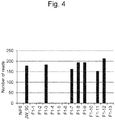
- genotypes of the markers i.e., the line samples, have the selection markers was determined by designating the threshold of each number of reads as 10, evaluating as "present” when the number of reads is 10 or more, and evaluating as “absent” when the number of reads is less than 10 ( Figs. 3 to 8 , Table 8).
- a line sample exhibiting a lower morbidity of smut has a significantly larger number of markers than a line sample exhibiting a higher morbidity of smut.
- Such results demonstrate that continuous nucleic acid regions selected from the region of approximately 8.4 cM including AMP0121265, AMP0120752, AMP0035185, AMP0114852, AMP0089904, and AMP0100370 can be used as the markers associated with sugarcane smut resistance.
- Example 1 the marker associated with sugarcane smut resistance was identified based on the genotype data of 4,503 markers of JW90 among the genotype data of the 31,191 markers.
- the genotype data of Iriomote 15 were collected, and the marker associated with sugarcane smut resistance was identified in the same manner.
- the DNA library prepared in Example 1 was subjected to the analysis using a next-generation sequencer as described in (5) two times in order to increase the amount of genotype data of Iriomote 15.
- the read data thus obtained were analyzed using analytical software (GRAS-Di, Toyota Motor Corporation) to obtain the genotype data of 64,757 markers.
- genetic map data comprising 58 linkage groups were obtained with the use of the AntMap software for constructing genetic linkage maps ( Iwata H, Ninomiya, S., 2006, AntMap: Constructing genetic linkage maps using an ant colony optimization algorithm, Breed Sci., 56: 371-377 ) by calculation using the Kosambi's genetic distance formula in the same manner as in Example 1.
- the 58 linkage groups include genotype data of 4,503 markers of the progeny lines; i.e., KY08-6023, KY08-6039, and KY08-6041, of Iriomote 15.
- the range including the markers AMP0014532 to AMP0015886 in the 15th linkage group observed in Example 2 was found to exhibit a significantly higher LOD value and significantly improved effects, compared with those described in WO 2012/147635 .
- the markers included in the QTL region linked to sugarcane smut resistance thus confirmed i.e., AMP0014532, AMP0043152, AMP0069135, AMP0032477, AMP0018405, AMP0002312, AMP0007121, AMP0090108, and AMP0015886
- Varity Linkage group Marker Nucleotide sequence information SEQ ID NO: Iriomote 15 15 AMP0014532 SEQ ID NO: 135 Iriomote 15 15 AMP0043152 SEQ ID NO: 136 Iriomote 15 15 AMP0069135 SEQ ID NO: 137 Iriomote 15 15 AMP0032477 SEQ ID NO: 138 Iriomote 15 15 AMP0018405 SEQ ID NO: 139 Iriomote 15 15 AMP0002312 SEQ ID NO: 140 Iriomote 15 15 AMP0007121 SEQ ID NO: 141 Varity Linkage group Marker Nucleotide sequence information SEQ ID NO: Iriomote 15 15 AMP0090108 SEQ ID NO: 142 Iriomote 15 15 AMP0015886 SEQ ID NO: 143
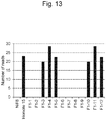
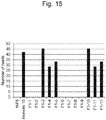
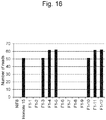
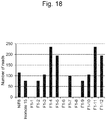
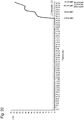
- genotypes of the markers i.e., the line samples, have the selection markers was determined by designating the threshold of each number of reads as 10, evaluating as "present” when the number of reads is 10 or more, and evaluating as “absent” when the number of reads is less than 10 ( Figs. 10 to 18 , Table 11).
- the marker associated with sugarcane smut resistance derived from the wild-type sugarcane line "Iriomote 8" was identified in the same manner as in Example 1, except for the use of the progeny line "KY09-6092” resulting from crossbreeding between the sugarcane variety "NiF8" and the wild-type sugarcane line "Iriomote 8," the progeny line "KY08-129” resulting from crossbreeding between the sugarcane variety "NiTn18” and the sugarcane variety "NiN24,” and the 154 progeny lines resulting from crossbreeding between "KY09-6092" and "KY08-129.”
- the read data obtained in the same manner as in Example 1 except for the use of the forward primers shown in Table 12 instead of the forward primers shown in Table 5 for preparation of the DNA library for a next-generation sequencer were analyzed using analytical software (GRAS-Di, Toyota Motor Corporation) to obtain the genotype data of 57,444 markers.
- the range including the markers AMP0063683 to AMP0091501 in the 8th linkage group observed in this example was found to exhibit a significantly higher LOD value and significantly improved effects, compared with those described in WO 2012/147635 .
- the markers included in the QTL region linked to sugarcane smut resistance confirmed in this example i.e., AMP0063683, AMP0082090, AMP0013802, AMP0083204, AMP0043774, AMP0094596, and AMP0091501 were selected as selection markers (Table 14).
- AMP0063683 is defined as a nucleic acid region comprising Read 1 (SEQ ID NO: 144) and Read 2 (SEQ ID NO: 145) with the nucleotide sequences being determined using the next-generation sequencer at both ends.
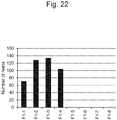
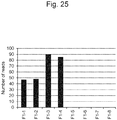
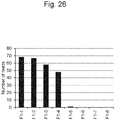
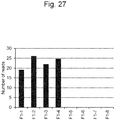
- genotypes of the markers i.e., the line samples, have the selection markers was determined by designating the threshold of each number of reads as 10, evaluating as "present” when the number of reads is 10 or more, and evaluating as "absent” when the number of reads is less than 10 ( Figs. 21 to 27 , Table 15).
- line samples with the low morbidity of smut have a significantly larger number of markers than line samples with the high morbidity of smut.
- nucleotide sequence of the region of approximately 8.4 cM comprising the marker associated with sugarcane smut resistance derived from JW90 identified in Example 1 was compared with the nucleotide sequence of the region of approximately 12.27 cM comprising the marker associated with sugarcane smut resistance derived from Iriomote 8 identified in Example 3.
- the adjacent region comprising AMP0121265 located at 0 cM among the markers associated with sugarcane smut resistance derived from JW90 identified in Example 1 and the adjacent region comprising AMP0091501 located at 83.76 cM among the markers associated with sugarcane smut resistance derived from Iriomote 8 identified in Example 3 were found to comprise a plurality of markers having the identical nucleotide sequence.
- Table 16 summarizes markers included in the adjacent region comprising AMP0121265 located at 0 cM among the markers associated with sugarcane smut resistance derived from JW90 identified in Example 1.
- Table 17 summarizes markers included in the adjacent region comprising AMP0091501 located at 83.76 cM among the markers associated with sugarcane smut resistance derived from Iriomote 8 identified in Example 3.
- the column indicating the nucleotide sequence information of markers shows the nucleotide sequences of contig sequences when the contig sequences can be led from a pair of read data obtained via analysis using a next-generation sequencer, or a pair of read sequences (the read sequence 1 and the read sequence 2) when the contig sequence cannot be led.
- the markers shown in Tables 16 and 17 can be defined by the nucleotide sequences of the contig sequences or the nucleotide sequences of the read sequence 1 and the read sequence 2.
- Iriomote 8 marker ID shows "Present” and ID of the marker derived from Iriomote 8 having the identical nucleotide sequence.
- JW90 marker ID shows "Present” and ID of the marker derived from JW90 having the identical nucleotide sequence.
- the adjacent region comprising AMP0121265 located at 0 cM among the markers associated with sugarcane smut resistance derived from JW90 was found to comprise 36 markers.
- the adjacent region comprising AMP0091501 located at 83.76 cM among the markers associated with sugarcane smut resistance derived from Iriomote 8 was found to comprise 18 markers. Among them, 5 markers were found to comprise the identical nucleotide sequence.
- the region comprising the 36 markers shown in Table 16 and the region comprising the 18 markers shown in Table 17 can be regarded as QTLs that are highly correlated with sugarcane smut resistance.
- both JW90 and Iriomote 8 have the QTL of sugarcane smut resistance identified in this example. Accordingly, such QTL is considered to be present in an extensive range of sugarcane varieties without particular limitation.
- this example demonstrates that the 36 markers shown in Table 16 and the 18 markers shown in Table 17 can be used as particularly excellent markers associated with sugarcane smut resistance.
Landscapes
- Life Sciences & Earth Sciences (AREA)
- Health & Medical Sciences (AREA)
- Chemical & Material Sciences (AREA)
- Genetics & Genomics (AREA)
- Engineering & Computer Science (AREA)
- Organic Chemistry (AREA)
- Zoology (AREA)
- Wood Science & Technology (AREA)
- Biotechnology (AREA)
- Analytical Chemistry (AREA)
- Proteomics, Peptides & Aminoacids (AREA)
- General Health & Medical Sciences (AREA)
- Botany (AREA)
- Bioinformatics & Cheminformatics (AREA)
- General Engineering & Computer Science (AREA)
- Molecular Biology (AREA)
- Physics & Mathematics (AREA)
- Microbiology (AREA)
- Biochemistry (AREA)
- Biophysics (AREA)
- Environmental Sciences (AREA)
- Developmental Biology & Embryology (AREA)
- Biomedical Technology (AREA)
- Mycology (AREA)
- Immunology (AREA)
- Cell Biology (AREA)
- Plant Pathology (AREA)
- Spectroscopy & Molecular Physics (AREA)
- Physiology (AREA)
- Natural Medicines & Medicinal Plants (AREA)
- Measuring Or Testing Involving Enzymes Or Micro-Organisms (AREA)
- Breeding Of Plants And Reproduction By Means Of Culturing (AREA)
Abstract
Description
- The present invention relates to a marker associated with smut resistance that enables selection of a sugarcane line resistant to smut and a method for using the same.
- Sugarcane has been cultivated for edible use such as a raw material for sugar, liquor, and the like. In addition, sugarcane has been used in a variety of industrial fields, including the use thereof as a raw material for biofuel. Under such circumstances, there is a need to develop novel sugarcane varieties having desirable characteristics (e.g., sugar content, enhanced vegetative capacity, sprouting capacity, disease resistance, insect resistance, cold resistance, an increase in leaf blade length, an increase in leaf area, and an increase in stalk length).
- In general, there are three methods for identification of a plant variety/line: that is, "characteristics comparison" for comparison of characteristics data; "comparison during cultivation" for comparison of plants cultivated under the same conditions; and "DNA assay" for DNA analysis. There are many problems in line identification by means of characteristics comparison or comparison during cultivation, such as lowered precision due to differences in cultivation conditions and long-term field research that requires a number of steps. In particular, sugarcane plants are much larger than other graminaceous crops such as rice and maize, and it is thus difficult to conduct line identification through field research.
- In order to identify a variety resistant to a certain disease, in addition, it is necessary to carry out an inoculation test using a causative microorganism of a disease after long-term cultivation of sugarcane and then collect disease resistance data by observing lesions and the like. When the test is carried out, however, it is necessary to prevent the causative microorganism from propagation to an external environment more definitely and provide facilities, such as a large-scale special-purpose greenhouse, a special-purpose field, or a facility isolated from an external environment. In order to prepare a novel sugarcane variety, in addition, tens of thousands of hybrids are first prepared via crossing, followed by seedling selection and stepwise selection of elite lines. Eventually, 2 or 3 types of candidate novel varieties having desirable characteristics can be obtained. For preparation of a novel sugarcane variety, as described above, it is necessary to cultivate and evaluate an enormous number of lines, and it is also necessary to prepare the large-scale greenhouse or field as described above and make time-consuming efforts.
- Therefore, it has been required to develop a method for identification of a sugarcane line having disease resistance with the use of markers present in the sugarcane genome. If markers excellent in a variety of characteristics could be used for production of a novel sugarcane variety, in particular, various problems peculiar to sugarcane as described above would be resolved, and the markers would be able to serve as very effective tools. However, sugarcane plants have a large number of chromosomes (approximately 100 to 130) due to higher polyploidy, and the development of marker technology has been thus slow. In the case of sugarcane, the USDA reported genotyping with the use of SSR markers (Non-Patent Literature 1), although precision of genotyping is low because of the small numbers of markers and polymorphisms in each marker. In addition, the above genotyping is available only for American/Australian varieties, and it cannot be used for identification of major varieties cultivated in Japan, Taiwan, India, and other countries and lines serving as useful genetic resources.
- In addition, Non-Patent
Literature 2 suggests the possibility that a sugarcane genetic map can be prepared by increasing the number of markers, comparing individual markers in terms of a characteristic relation, and verifying the results. However, Non-Patent Literature 2 does not disclose a sufficient number of markers, and markers linked to characteristics of interest have not been found. - As disclosed in
Patent Literature 1, a marker associated with black root rot resistance in sugar beet is known as a marker associated with disease resistance.Patent Literature 2 also discloses a technique of selecting a zea mays variety using a maker linked to a trait of interest. - Meanwhile, causative microorganisms of sugarcane smut have high-level infectivity, and, therefore, the onset of smut results in immediate infection of the entire field. Sugarcane crops affected with smut cannot be used as raw material for sugar production, and, in addition, such affected crops would wither and die. Therefore, development of smut will cause a significant decline in yield in the following year and later. Damage due to smut has been reported in 28 or more countries, including Brazil, U.S.A., Australia, China, and Indonesia. Smut can be prevented by sterilization treatment at the time of planting; however, preventive effects are limited to the early growth period. Thus, cultivation of a sugarcane variety imparted with smut resistance has been awaited.
- Patent Literature 3 discloses markers linked to smut resistance that were discovered by preparing many sugarcane plant markers and conducting linkage analysis of quantitative traits along with such markers for hybrid progeny lines.
-
- Non Patent Literature 1: Maydica 48, 2003, 319-329, "Molecular genotyping of sugarcane clones with microsatellite DNA markers"
- Non Patent Literature 2: Nathalie Piperidis et al., Molecular Breeding, 2008, Vol. 21, 233-247 Patent Literature
-
- Patent Literature 1:
WO 2007/125958 - Patent Literature 2:
JP 2010-516236 A - Patent Literature 3:
WO 2012/147635 - While Patent Literature 3 discloses markers linked to smut resistance, development of smut resistance markers exhibiting higher association with smut resistance had been awaited. Under the above circumstances, the present invention is intended to provide an improved smut resistance marker exhibiting higher association with smut resistance.
- The present inventors have conducted intensive studies to achieve the object. The present inventors prepared many markers of particular sugarcane varieties and conducted linkage analysis of quantitative traits along with such markers for hybrid progeny lines. Accordingly, the present inventors found markers linked to quantitative traits such as smut resistance. This has led to the completion of the present invention.
- The present invention encompasses the following.
- (1) A marker associated with sugarcane smut resistance, which consists of a continuous nucleic acid region existing in a region between the nucleotide sequence as shown in SEQ ID NO: 1 and the nucleotide sequence as shown in SEQ ID NO: 6, a region between the nucleotide sequence as shown in SEQ ID NO: 135 and the nucleotide sequence as shown in SEQ ID NO: 143, or a region between the nucleotide sequence as shown in SEQ ID NO: 144 or 145 and the nucleotide sequence as shown in SEQ ID NO: 151 of a sugarcane chromosome.
- (2) The marker associated with sugarcane smut resistance according to (1), wherein the nucleic acid region comprises any nucleotide sequence selected from the group consisting of the nucleotide sequences as shown in SEQ ID NOs: 1 to 6, 135 to 143, and 144 to 151 or a part of the nucleotide sequence.
- (3) The marker associated with sugarcane smut resistance according to (1), wherein the nucleic acid region comprises the nucleotide sequence as shown in SEQ ID NO: 1 or 2 of a sugarcane chromosome or a part of the nucleotide sequence.
- (4) The marker associated with sugarcane smut resistance according to (1), wherein the nucleic acid region comprises any nucleotide sequence selected from the group consisting of the nucleotide sequences as shown in SEQ ID NOs: 138 to 140 of a sugarcane chromosome or a part of the nucleotide sequence.
- (5) The marker associated with sugarcane smut resistance according to (1), wherein the nucleic acid region comprises a nucleotide sequence as shown in SEQ ID NO: 149 or 151 of a sugarcane chromosome or a part of the nucleotide sequence.
- (6) The marker associated with sugarcane smut resistance according to (1), wherein the nucleic acid region comprises any nucleotide sequence selected from the group consisting of the nucleotide sequences as shown in SEQ ID NOs: 298, 303, 307, 311, and 316 of a sugarcane chromosome or a part of the nucleotide sequence.
- (7) A method for producing a sugarcane line having improved smut resistance comprising: a step of extracting a chromosome of a progeny plant obtained from parent plants, at least one of which is a sugarcane plant, and/or a chromosome of a parent sugarcane plant; and a step of determining the presence or absence of the marker associated with sugarcane smut resistance according to any one of (1) to (6) in the obtained chromosome.
- (8) The method for producing a sugarcane line according to (7), wherein the step of determination involves the use of a DNA chip comprising a probe corresponding to the marker associated with sugarcane smut resistance.
- (9) The method for producing a sugarcane line according to (7), wherein the progeny plant is a seed or young seedling and the chromosome is extracted from the seed or young seedling.
- This description includes part or all of the content as disclosed in the descriptions and/or drawings of Japanese Patent Application Nos.
2018-127142 2018-197546 2019-122913 - The present invention can provide a novel marker associated with sugarcane smut resistance that is linked particularly to smut resistance among various sugarcane quantitative traits. With the use of the marker associated with sugarcane smut resistance of the present invention, smut resistance of hybrid sugarcane progeny lines can be tested. Thus, a sugarcane variety with improved smut resistance can be identified in a very cost-effective manner.
-
-
Fig. 1 shows characteristic diagrams showing: (A) the results of calculation of the morbidity of smut of a progeny line resulting from crossbreeding between "KY08-6023" and "JW90"; (B) the results of calculation of the morbidity of smut of a progeny line resulting from crossbreeding between "KY08-6039" and "JW90"; and (C) the results of calculation of the morbidity of smut of a progeny line resulting from crossbreeding between "KY08-6041" and "JW90". -
Fig. 2 shows a characteristic diagram showing the results of QTL analysis concerning smut resistance conducted in Example 1. -
Fig. 3 shows a characteristic diagram showing the number of reads of AMP0121265 in each line. -
Fig. 4 shows a characteristic diagram showing the number of reads of AMP0120752 in each line. -
Fig. 5 shows a characteristic diagram showing the number of reads of AMP0035185 in each line. -
Fig. 6 shows a characteristic diagram showing the number of reads of AMP0114852 in each line. -
Fig. 7 shows a characteristic diagram showing the number of reads of AMP0089904 in each line. -
Fig. 8 shows a characteristic diagram showing the number of reads of AMP0100370 in each line. -
Fig. 9 shows a characteristic diagram showing the results of QTL analysis concerning smut resistance conducted in Example 2. -
Fig. 10 shows a characteristic diagram showing the number of reads of AMP0014532 in each line. -
Fig. 11 shows a characteristic diagram showing the number of reads of AMP0043152 in each line. -
Fig. 12 shows a characteristic diagram showing the number of reads of AMP0069135 in each line. -
Fig. 13 shows a characteristic diagram showing the number of reads of AMP0032477 in each line. -
Fig. 14 shows a characteristic diagram showing the number of reads of AMP0018405 in each line. -
Fig. 15 shows a characteristic diagram showing the number of reads of AMP0002312 in each line. -
Fig. 16 shows a characteristic diagram showing the number of reads of AMP0007121 in each line. -
Fig. 17 shows a characteristic diagram showing the number of reads of AMP0090108 in each line. -
Fig. 18 shows a characteristic diagram showing the number of reads of AMP0015886 in each line. -
Fig. 19 shows a characteristic diagram showing the results of calculation of the morbidity of smut for progeny lines resulting from crossing between "KY09-6092" and "KY08-129." -
Fig. 20 shows a characteristic diagram showing the results of QTL analysis of smut resistance performed in Example 3. -
Fig. 21 shows a characteristic diagram showing the number of reads of AMP0063683 in each line. -
Fig. 22 shows a characteristic diagram showing the number of reads of AMP0082090 in each line. -
Fig. 23 shows a characteristic diagram showing the number of reads of AMP0013802 in each line. -
Fig. 24 shows a characteristic diagram showing the number of reads of AMP0083204 in each line. -
Fig. 25 shows a characteristic diagram showing the number of reads of AMP0043774 in each line. -
Fig. 26 shows a characteristic diagram showing the number of reads of AMP0094596 in each line. -
Fig. 27 shows a characteristic diagram showing the number of reads of AMP0091501 in each line. - The marker associated with sugarcane smut resistance according to the present invention and the method for using the same are described below. In particular, a method for producing a sugarcane line using a marker associated with sugarcane smut resistance is described.
- The marker associated with sugarcane smut resistance of the present invention is a particular region present on a sugarcane chromosome, it is linked to a causative gene (or a group of causative genes) for a trait of sugarcane smut resistance, and it can be thus used for identification of a trait of sugarcane smut resistance. Therefore, whether or not a progeny line obtained with the use of a known sugarcane line has a trait of improving smut resistance can be determined by confirming the presence or absence of the marker associated with sugarcane smut resistance in such progeny line. In the present invention, the term "smut" refers to a disease characterized by lesion formation due to infection with a microorganism of the genus Ustilago. One example of a microorganism of the genus Ustilago is Ustilago scitaminea.
- In addition, the term "marker associated with sugarcane smut resistance" refers to a marker linked to a causal gene (or a group of causative genes) of a trait of improving smut resistance. In the presence of the marker of interest in a certain sugarcane variety, for example, such sugarcane variety can be determined to have improved smut resistance.
- The term "sugarcane" used herein refers to a plant belonging to the genus Saccharum of the family Poaceae. In addition, the term "sugarcane" includes so-called noble cane (scientific name: Saccharum officinarum) and wild cane (scientific name: Saccharum spontaneum), Saccharum barberi, Saccharum sinense, and the earlier species of Saccharum officinarum
- (Saccharum robustum). The term "known sugarcane variety/line" is not particularly limited. It includes any variety/line usable in Japan and any variety/line used outside Japan. Examples of sugarcane varieties cultivated in Japan include, but are not particularly limited to, Ni1, NiN2, NiF3, NiF4, NiF5, Ni6, NiN7, NiF8, Ni9, NiTn10, Ni11, Nil2, Nil4, Ni15, Nil6, Ni17, NiTn19, NiTn20, Ni22, and Ni23. Examples of major sugarcane varieties used in Japan include, but are not particularly limited to, NiF8, Ni9, NiTn10, and Nil5. Further, examples of major sugarcane varieties that have been introduced into Japan include, but are not limited to, F177, Nco310, and F172. In addition, sugarcane varieties and lines are wild-type varieties with excellent disease resistance, and wild-type varieties with excellent smut resistance are used. Examples of wild-type varieties with excellent smut resistance include, but are not particularly limited to, JW90,
Iriomote 15, andIriomote 8. - In addition, a progeny line may be a line obtained by crossing a maternal plant and a paternal plant of the same species, each of which is a sugarcane variety/line, or it may be a hybrid line obtained from parent plants when one thereof is a sugarcane variety/line and the other is a closely related variety/line (Erianthus arundinaceus). In addition, a progeny line may be obtained by so-called backcrossing. In particular, both or either the maternal line and the paternal line is preferably a wild-type variety with excellent smut resistance, such as JW90,
Iriomote 15, orIriomote 8. - The marker associated with sugarcane smut resistance was newly identified by quantitative trait loci (QTL) analysis using a genetic linkage map comprising 86 linkage groups including 31,191 markers (4,503 thereof are derived from JW90) originally obtained from sugarcane chromosomes and the sugarcane smut resistance data. In addition, many genes are presumably associated with sugarcane smut resistance, which is a quantitative trait characterized by a continuous distribution. That is, sugarcane smut resistance is evaluated based on the morbidity of smut characterized by such continuous distribution. For QTL analysis, the QTL Cartographer gene analysis software (Wang S., C. J. Basten, and Z.-B. Zeng, 2010; Windows QTL Cartographer 2.5, Department of Statistics, North Carolina State University, Raleigh, N.C.) is used, and the analysis is carried out by the composite interval mapping (CIM) method.
- Specifically, a region included in the above genetic linkage map with LOD scores equivalent to or exceeding a given threshold (e.g., 2.5); i.e., a region of approximately 8.4 cM (centimorgan), was identified by the QTL analysis described above. The term "morgan (M)" used herein refers to a unit representing the relative distance between genes on a chromosome, and it expresses the crossover rate in percent figures. In the case of a sugarcane chromosome, 1 cM corresponds to approximately 2,000 kb. In addition, it is suggested that a causative gene (or a group of causative genes) for a trait that improves smut resistance could be present at the peak position or in the vicinity thereof.
- The 8.4 cM region comprises 6 types of markers listed in Table 1 in the order shown therein and it is linked to a trait of improving smut resistance.
[Table 1] Varity Linkage group Position (cM) Range (cM) Adjacent marker LOD value Effects (%) JW90 42 0.0 8.4 AMP0121265 (SEQ ID NO: 1)-AMP0120752 (SEQ ID NO: 2)- 24.5 -47.2 AMP0035185 (SEQ ID NO: 3)-AMP0114852 (SEQ ID NO: 4)- AMP0089904 (SEQ ID NO: 5)-AMP0100370 (SEQ ID NO: 6) - In Table 1, "Linkage group" represents the number given to each group among a plurality of linkage groups specified by QTL analysis. In Table 1, the name of the marker provided in the column indicating adjacent markers represents the name given to each marker originally obtained in the present invention.
- In addition, the peak included in the 8.4 cM region is present adjacent to the marker comprising the nucleotide sequence as shown in SEQ ID NO: 1 (AMP0121265).
- A continuous nucleic acid region existing in the 8.4 cM region containing markers shown in Table 1 can be used as a marker associated with sugarcane smut resistance. The term "nucleic acid region" used herein refers to a region comprising a nucleotide sequence having 95% or less, preferably 90% or less, more preferably 80% or less, and most preferably 70% or less identity to a different region present on a sugarcane chromosome. If the identity of a nucleic acid region serving as a marker associated with sugarcane smut resistance to a different region falls within the above range, the nucleic acid region can be specifically detected in accordance with a conventional technique. The identity value described herein can be calculated using, for example, BLAST with default parameter settings.
- The nucleic acid region serving as a marker associated with sugarcane smut resistance can comprise 8 or more, preferably 15 or more, more preferably 20 or more, and most preferably 30 nucleotides. If the length of the nucleic acid region serving as a marker associated with sugarcane smut resistance falls within the above range, the nucleic acid region can be specifically detected in accordance with a conventional technique.
- The marker associated with sugarcane smut resistance may be any continuous nucleic acid region selected from the 8.4 cM region. The nucleotide sequence of the 8.4 cM region can be identified by flanking sequence analysis such as inverse PCR analysis using primers designed based on the nucleotide sequences as shown in SEQ ID NOs: 1 to 6.
- In particular, the marker associated with sugarcane smut resistance is preferably selected from a region adjacent to the nucleotide sequence as shown in SEQ ID NO: 1 or 2 in the 8.4 cM region described above because of the presence of the peak adjacent to the nucleotide sequence as shown in SEQ ID NO: 1.
- The 6 types of the markers or some thereof can be used as the marker associated with sugarcane smut resistance. Specifically, one or more markers selected from among the 6 types of markers can be used as the markers associated with sugarcane smut resistance. Alternatively, a partial region of the 6 types of markers can be used as the marker associated with sugarcane smut resistance.
- The marker associated with sugarcane smut resistance was newly identified by quantitative trait loci (QTL) analysis using a genetic linkage map of progeny plants of
Iriomote 15 comprising 58 linkage groups including 64,757 markers (1,166 thereof are derived from progeny plants of Iriomote 15) originally obtained from sugarcane chromosomes and the sugarcane smut resistance data. In addition, many genes are presumably associated with sugarcane smut resistance, which is a quantitative trait characterized by a continuous distribution. That is, sugarcane smut resistance is evaluated based on the morbidity of smut characterized by such continuous distribution. For QTL analysis, the QTL Cartographer gene analysis software (Wang S., C. J. Basten, and Z.-B. Zeng, 2010; Windows QTL Cartographer 2.5, Department of Statistics, North Carolina State University, Raleigh, N.C.) is used, and the analysis is carried out by the composite interval mapping (CIM) method. - Specifically, a region included in the above genetic linkage map with LOD scores equivalent to or exceeding a given threshold (e.g., 2.5); i.e., a region of approximately 26.6 cM (centimorgan), was identified by the QTL analysis described above. The term "morgan (M)" used herein refers to a unit representing the relative distance between genes on a chromosome, and it expresses the crossover rate in percent figures. In the case of a sugarcane chromosome, 1 cM corresponds to approximately 2,000 kb. In addition, it is suggested that a causative gene (or a group of causative genes) for a trait that improves smut resistance could be present at the peak position or in the vicinity thereof.
- The 26.6 cM region comprises 9 types of markers listed in Table 2 in the order shown therein and it is linked to a trait of improving smut resistance.
[Table 2] Varity Linkage group Position (cM) Range (cM) Adjacent marker LOD value Effects (%) Iriomote 1515 25.7 26.6 AMP0014532 (SEQ ID NO: 135)-AMP0043152 (SEQ ID NO: 136)- 11.5 -37.8 AMP0069135 (SEQ ID NO: 137)-AMP0032477 (SEQ ID NO: 138)- AMP0018405 (SEQ ID NO: 139)-AMP0002312 (SEQ ID NO: 140)- AMP0007121 (SEQ ID NO: 141)-AMP0090108 (SEQ ID NO: 142)- AMP0015886 (SEQ ID NO: 143) - In Table 2, "Linkage group" represents the number given to each group among a plurality of linkage groups specified by QTL analysis. In Table 2, the name of the marker provided in the column indicating adjacent markers represents the name given to each marker originally obtained in the present invention.
- In addition, the peak included in the 26.6 cM region is present in a position between the marker comprising the nucleotide sequence as shown in SEQ ID NO: 138 (AMP0032477) and the marker comprising the nucleotide sequence as shown in SEQ ID NO: 140 (AMP002312). In particular, the peak is present adjacent to the marker comprising the nucleotide sequence as shown in SEQ ID NO: 139 (AMP0018405).
- A continuous nucleic acid region existing in the 26.6 cM region containing markers shown in Table 2 can be used as a marker associated with sugarcane smut resistance. The term "nucleic acid region" used herein refers to a region comprising a nucleotide sequence having 95% or less, preferably 90% or less, more preferably 80% or less, and most preferably 70% or less identity to a different region present on a sugarcane chromosome. If the identity of a nucleic acid region serving as a marker associated with sugarcane smut resistance to a different region falls within the above range, the nucleic acid region can be specifically detected in accordance with a conventional technique. The identity value described herein can be calculated using, for example, BLAST with default parameter settings.
- The nucleic acid region serving as a marker associated with sugarcane smut resistance can comprise 8 or more, preferably 15 or more, more preferably 20 or more, and most preferably 30 nucleotides. If the length of the nucleic acid region serving as a marker associated with sugarcane smut resistance falls within the above range, the nucleic acid region can be specifically detected in accordance with a conventional technique.
- The marker associated with sugarcane smut resistance may be any continuous nucleic acid region selected from the 26.6 cM region. The nucleotide sequence of the 26.6 cM region can be identified by flanking sequence analysis such as inverse PCR analysis using primers designed based on the nucleotide sequences as shown in SEQ ID NOs: 135 to 143.
- In particular, the marker associated with sugarcane smut resistance is preferably selected from the region between the nucleotide sequence as shown in SEQ ID NO: 138 and the nucleotide sequence as shown in SEQ ID NO: 140 in the 26.6 cM region described above. In addition, the marker associated with sugarcane smut resistance is preferably selected from the region comprising the nucleotide sequence as shown in SEQ ID NO: 139 and a nucleotide sequence adjacent to the nucleotide sequence as shown in SEQ ID NO: 139 in the 26.6 cM region described above. The marker is preferably selected in such manner because of the presence of the peak in the region between the nucleotide sequence as shown in SEQ ID NO: 138 and the nucleotide sequence as shown in SEQ ID NO: 140, which is adjacent to the nucleotide sequence as shown in SEQ ID NO: 139.
- The 9 types of the markers or some thereof can be used as the markers associated with sugarcane smut resistance. Specifically, one or more markers selected from among the 9 types of markers can be used as the markers associated with sugarcane smut resistance. Alternatively, a partial region of the 9 types of markers can be used as the marker associated with sugarcane smut resistance.
- The marker associated with sugarcane smut resistance was newly identified by quantitative trait loci (QTL) analysis using a genetic linkage map derived from the progeny line "KY09-6092" of
Iriomote 8 comprising 117 linkage groups including 57,444 markers (2,936 thereof are derived from the progeny line "KY09-6092" of Iriomote 8) originally obtained from sugarcane chromosomes and the sugarcane smut resistance data. - In addition, many genes are presumably associated with sugarcane smut resistance, which is a quantitative trait characterized by a continuous distribution. That is, sugarcane smut resistance is evaluated based on the morbidity of smut characterized by such continuous distribution. For QTL analysis, the QTL Cartographer gene analysis software (Wang S., C. J. Basten, and Z.-B. Zeng, 2010; Windows QTL Cartographer 2.5, Department of Statistics, North Carolina State University, Raleigh, N.C.) is used, and the analysis is carried out by the composite interval mapping (CIM) method.
- Specifically, a region included in the above genetic linkage map with LOD scores equivalent to or exceeding a given threshold (e.g., 2.5); i.e., a region of approximately 12.27 cM (centimorgan), was identified by the QTL analysis described above. The term "morgan (M)" used herein refers to a unit representing the relative distance between genes on a chromosome, and it expresses the crossover rate in percent figures. In the case of a sugarcane chromosome, 1 cM corresponds to approximately 2,000 kb. In addition, it is suggested that a causative gene (or a group of causative genes) for a trait that improves smut resistance could be present at the peak position or in the vicinity thereof.
- The 12.27 cM region comprises 7 types of markers listed in Table 3 in the order shown therein and it is linked to a trait of improving smut resistance.
[Table 3] Varity Linkage group Position (cM) Range (cM) Adjacent marker LOD value Effects (%) Iriomote 88 83.8 12.27 AMP0063683 (SEQ ID NOs: 144, 145)- 68.7 -54.2 AMP0082090 (SEQ ID NO: 146)- AMP0013802 (SEQ ID NO: 147)- AMP0083204 (SEQ ID NO: 148)- AMP0043774 (SEQ ID NO: 149)- AMP0094596 (SEQ ID NO: 150)-AMP0091501 (SEQ ID NO: 151) - In Table 3, "Linkage group" represents the number given to each group among a plurality of linkage groups specified by QTL analysis. In Table 3, the name of the marker provided in the column indicating adjacent markers represents the name given to each marker originally obtained in the present invention. Among the markers shown in Table 3, AMP0063683 is a nucleic acid region comprising the nucleotide sequence as shown in SEQ ID NO: 144 and the nucleotide sequence as shown in SEQ ID NO: 145 at both ends. Markers other than AMP0063683 are each a nucleic acid region comprising a single nucleotide sequence.
- In addition, the peak included in the 12.27 cM region is present adjacent to the marker comprising the nucleotide sequence as shown in SEQ ID NO: 151 (AMP0091501).
- A continuous nucleic acid region existing in the 12.27 cM region containing markers shown in Table 3 can be used as a marker associated with sugarcane smut resistance. The term "nucleic acid region" used herein refers to a region comprising a nucleotide sequence having 95% or less, preferably 90% or less, more preferably 80% or less, and most preferably 70% or less identity to a different region present on a sugarcane chromosome. If the identity of a nucleic acid region serving as a marker associated with sugarcane smut resistance to a different region falls within the above range, the nucleic acid region can be specifically detected in accordance with a conventional technique. The identity value described herein can be calculated using, for example, BLAST with default parameter settings.
- The nucleic acid region serving as a marker associated with sugarcane smut resistance can comprise 8 or more, preferably 15 or more, more preferably 20 or more, and most preferably 30 nucleotides. If the length of the nucleic acid region serving as a marker associated with sugarcane smut resistance falls within the above range, the nucleic acid region can be specifically detected in accordance with a conventional technique.
- The marker associated with sugarcane smut resistance may be any continuous nucleic acid region selected from the 12.27 cM region. The nucleotide sequence of the 12.27 cM region can be identified by flanking sequence analysis such as inverse PCR analysis using primers designed based on the nucleotide sequences as shown in SEQ ID NOs: 144 to 151.
- In particular, the marker associated with sugarcane smut resistance is preferably selected from a region between the nucleotide sequence as shown in SEQ ID NO: 150 and the nucleotide sequence as shown in SEQ ID NO: 151 in the 12.27 cM region described above because of the presence of the peak adjacent to the nucleotide sequence as shown in SEQ ID NO: 151.
- The 7 types of the markers or some thereof can be used as the marker associated with sugarcane smut resistance. Specifically, one or more markers selected from among the 7 types of markers can be used as the markers associated with sugarcane smut resistance. Alternatively, a partial region of the 7 types of markers can be used as the marker associated with sugarcane smut resistance.
- A part of the 12.27 cM region comprising the markers shown in Table 3 comprises a partial region in common with a part of the 8.4 cM region comprising the markers shown in Table 1. Specifically, the nucleotide sequence of a region in the vicinity of the peak included in the 12.27 cM region is in common with the nucleotide sequence of a region in the vicinity of the peak included in the 8.4 cM region. More specifically, the nucleotide sequence of an adjacent region comprising AMP0121265 located at 0 cM among the markers associated with sugarcane smut resistance derived from JW90 shown in Table 1 is in common with the nucleotide sequence of an adjacent region comprising AMP0091501 located at 83.76 cM among the markers associated with sugarcane smut resistance derived from
Iriomote 8 shown in Table 3. Accordingly, it is highly likely that the regions comprising the common nucleotide sequence comprises a factor (e.g., a causative gene) that improves sugarcane smut resistance. It is more preferable that such regions be used as the markers associated with sugarcane smut resistance. - As described above, markers associated with sugarcane smut resistance were identified from among 31,191 markers originally obtained from sugarcane chromosomes (4,503 markers thereof are derived from JW90), 64,757 markers originally obtained from sugarcane chromosomes (1,166 markers thereof are derived from the progeny lines "KY08-6023," "KY08-6039," and "KY08-6041" of Iriomote 15), and 57,444 markers originally obtained from sugarcane chromosomes (2,936 markers thereof are derived from the progeny line "KY09-6092" of Iriomote 8) in the present invention. The 31,191 markers (4,503 markers thereof are derived from JW90), the 64,757 markers (1,166 markers thereof are derived from the progeny lines "KY08-6023," "KY08-6039," and "KY08-6041" of Iriomote 15), and the 57,444 markers (2,936 markers thereof are derived from the progeny line "KY09-6092" of Iriomote 8) are described herein. When identifying these markers, a DNA library was prepared in accordance with the method for preparing a DNA library disclosed in
WO 2018/003220 . - Specifically, a nucleic acid amplification reaction is carried out in a reaction solution in which a primer comprising an arbitrary nucleotide sequence (hereafter, referred to as a "random primer") is adjusted at high concentration, and the amplified nucleic acid fragments are served as a DNA library. Here, the term "high concentration" refers to higher concentration than the primer concentration in a conventional nucleic acid amplification reaction. Specifically, the method for preparing a DNA library according to the present invention involves the use of a random primer at higher concentration than the primer concentration in a conventional nucleic acid amplification reaction. As a template included in the reaction solution, genomic DNA prepared from an organism, the DNA library of which is to be prepared, can be used.
- The sequence of the random primer is not particularly limited. For example, a nucleotide comprising 9 to 30 bases can be used. In particular, a random primer is a nucleotide comprising an arbitrary sequence of 9 to 30 bases. A nucleotide type (a sequence type) is not particularly limited, and 1 or more types of nucleotides, preferably 1 to 10,000 types of nucleotides, more preferably 1 to 1,000 types of nucleotides, further preferably 1 to 100 types of nucleotides, and most preferably 1 to 96 types of nucleotides may be used. With the use of nucleotides (a group of nucleotides) within the range described above as a random primer, amplified nucleic acid fragments can be obtained with higher reproducibility. When a random primer comprises a plurality of nucleotides, it is not necessary that all nucleotides comprise the same number of bases (9 to 30 bases), and a random primer may comprise a plurality of nucleotides of a different number of bases.
- In order to obtain a particular amplicon via a nucleic acid amplification reaction, in general, nucleotide sequences of primers are designed in accordance with the amplicon of interest. For example, a pair of primers is designed to flank the position corresponding to the amplicon in template DNA, such as genomic DNA. In such a case, primers are designed to hybridize to a specific region in the template, and it can thus be referred to as "specific primers."
- Unlike a primer designed to obtain a particular amplicon, in contrast, a random primer is not designed to hybridize to a specific region in template DNA, but it is designed to obtain a random amplicon. A random primer may comprise any nucleotide sequence. It accidentally hybridizes to a complementary region in template DNA and it can thus be involved in random amplicon amplification.
- Specifically, a random primer can be a nucleotide comprising an arbitrary sequence involved in random amplicon amplification, as described above. An arbitrary sequence is not particularly limited. For example, it may be designed as a nucleotide sequence of nucleotides randomly selected from the group consisting of adenine, guanine, cytosine, and thymine, or it may be designed as a particular nucleotide sequence. Examples of particular nucleotide sequences include a nucleotide sequence comprising a restriction enzyme recognition sequence or a nucleotide sequence comprising an adaptor sequence applied to a next-generation sequencer.
- When a plurality of types of nucleotides are designed as random primers, a plurality of nucleotide sequences of given length can be designed by randomly selecting nucleotides from the group consisting of adenine, guanine, cytosine, and thymine. When a plurality of types of nucleotides are designed as random primers, alternatively, a plurality of nucleotide sequences each comprising a common region composed of a particular nucleotide sequence and an uncommon region composed of an arbitrary nucleotide sequence can be designed. An uncommon region may be composed of a nucleotide sequence of nucleotides randomly selected from the group consisting of adenine, guanine, cytosine, and thymine. Alternatively, an uncommon region may comprise all of the 4 types of nucleotides; i.e., adenine, guanine, cytosine, and thymine, or some thereof. A common region is not particularly limited, and it may be composed of any nucleotide sequence. For example, a common region can be a nucleotide sequence comprising a restriction enzyme recognition sequence, a nucleotide sequence comprising an adaptor sequence applied to a next-generation sequencer, or a nucleotide sequence that is common among a particular gene family.
- When a plurality of nucleotide sequences of given length are designed by randomly selecting nucleotides from among 4 types of nucleotides as a plurality of random primers, a plurality of nucleotide sequences are preferably designed to have 70% or lower, preferably 60% or lower, more preferably 50% or lower, and most preferably 40% or lower identity in regions constituting 30% or more, preferably 50% or more, more preferably 70% or more, and further preferably 90% or more of the entire sequences. When a plurality of nucleotide sequences of given length are designed by randomly selecting nucleotides from among 4 types of nucleotides as a plurality of random primers, the nucleotide sequences are designed to comprise the nucleotides having the identity within the range described above. Thus, amplified fragments can be obtained over the entire genomic DNA of the target organism species. That is, homogeneity of amplified fragments can be enhanced.
- When a plurality of nucleotide sequences each comprising a common region composed of a particular nucleotide sequence and an uncommon region composed of an arbitrary nucleotide sequence are designed as a plurality of random primers, for example, several 3'-terminal nucleotides can be designed as an uncommon region, and remaining 5'-terminal nucleotides can be designed as a common region. If the "n" number of 3'-terminal nucleotides is designated as an uncommon region, 4n types of random primers can be designed. The number "n" can be 1 to 5, preferably 2 to 4, and more preferably 2 or 3.
- As random primers each comprising a common region and an uncommon region, for example, 16 types of random primers each comprising a 5'-terminal adaptor sequence applied to a next-generation sequencer (a common region) and a 3'-terminal region of 2 nucleotides (an uncommon region) can be designed in total. When a 3'-terminal region is designed to comprise 3 nucleotides (an uncommon region), 64 types of random primers can be designed in total. As the types of random primers are increased, amplified fragments can be more extensively obtained throughout the entire genomic DNA of the target organism species. When designing a random primer comprising a common region and an uncommon region, accordingly, it is preferable that a 3'-terminal region comprise 3 nucleotides.
- Alternatively, 64 types of nucleotide sequences each comprising a common region and an uncommon region of 3 nucleotides may be first designed, and up to 63 types of random primers selected from among the 64 types of nucleotide sequences may then be used. In other words, use of up to 63 types of random primers can occasionally yield results of analysis conducted by a nucleic acid amplification reaction or with the use of a next-generation sequencer superior to those attained with the use of all of 64 types of random primers.
- It is preferable that random primer concentration be adequately determined in accordance with a base length of the random primer. When a plurality of types of nucleotides with different base length are used as random primers, the base length of the random primer can be the average (it may be a simple average or weight average by taking the amount of nucleotides into consideration).
- Specifically, a nucleic acid amplification reaction is carried out with the use of a random primer with a 9 to 30 base length at 4 to 200 microM, and preferably at 4 to 100 microM. Under such conditions, many amplified fragments, and, in particular, many amplified fragments of 100 to 500 base length, can be obtained with high reproducibility via a nucleic acid amplification reaction.
- More specifically, random primer concentration is preferably 40 to 60 microM when a random primer is of 9 to 10 base length. When a random primer is of 10 to 14 base length, random primer concentration is preferably at a level that satisfies y > 3E + 08x-6.974 and 100 microM or lower, provided that "y" represents the base length of the random primer and "x" represents random primer concentration. When a random primer is of 14 to 18 base length, random primer concentration is preferably 4 to 100 microM. When a random primer is of 18 to 28 base length, it is preferable that random primer concentration be 4 microM or higher and satisfies y < 8E + 08x-5.533. When a random primer is of 28 to 29 base length, random primer concentration is preferably 6 to 10 microM. By adjusting the random primer concentration at the level described above in accordance with the base length of the random primer, many amplified fragments can be obtained more definitely while achieving high reproducibility.
- The inequations described above; i.e., y > 3E + 08x-6.974 and y < 8E + 08x-5.533, were formed as a result of thorough investigation of the correlation between the length and the concentration of a random primer as described in
WO 2018/003220 , so that many DNA fragments of 100 to 500 base length can be amplified with high reproducibility. - The amount of genomic DNA used as a template in a nucleic acid amplification reaction is not particularly limited. When the amount of the reaction solution is 50 microliters, the amount of genomic DNA is preferably 0.1 to 1,000 ng, more preferably 1 to 500 ng, further preferably 5 to 200 ng, and most preferably 10 to 100 ng. By adjusting the amount of genomic DNA used as a template in such range, an amplification reaction from the random primer would not be inhibited, and many amplified fragments can be obtained with high reproducibility.
- In accordance with the method described above, a DNA library can be produced from sugarcane with excellent smut resistance, and a DNA library can be produced from sugarcane with smut susceptibility. The nucleotide sequences in these DNA libraries are analyzed with the use of a next-generation sequencer, the read number of fragments constituting the library is compared with each other, and fragments peculiar to the DNA library produced from sugarcane with excellent smut resistance can be selected.
- More specifically, the present inventors subjected a wild-type sugarcane line (Iriomote 15) to crossbreeding with a known sugarcane variety (NiF8) to obtain progeny lines (3 lines), subjected the obtained progeny lines to crossbreeding with the wild-type sugarcane line (JW90) to obtain progeny lines (33 lines, 35 line, and 35 lines, respectively), and prepared a DNA library thereof. The resulting DNA library was applied to a next-generation sequencer to obtain the read number data, the genotype data were obtained therefrom, and position information of the marker in the chromosome was determined based on the genotype data using the AntMap software for constructing genetic linkage maps (Iwata H, Ninomiya S, 2006, AntMap: Constructing genetic linkage maps using an ant colony optimization algorithm, Breed Sci., 56: 371-378) in accordance with the Kosambi's genetic distance formula. Further, a genetic map datasheet was prepared based on the obtained marker position information using Mapmaker/EXP ver. 3.0 (A Whitehead Institute for Biomedical Research Technical Report, Third Edition, January, 1993). As a result, the 31,191 markers including the aforementioned 6 types of markers associated with sugarcane smut resistance shown in SEQ ID NOs: 1 to 6 were identified. In addition, the step of obtaining the read number data by applying the DNA library to the next-generation sequencer was repeated two times to obtain a larger amount of the read number data, and the genotype data were obtained from the read number data. Thus, 64,757 markers including 9 types of the markers associated with sugarcane smut resistance as shown in SEQ ID NOs: 135 to 143 were identified in the same manner.
- In addition, the present inventors subjected a wild-type sugarcane line (Iriomote 8) to crossbreeding with a known sugarcane variety (NiF8) to obtain progeny lines, subjected a sugarcane variety "NiTn18" to crossbreeding with a sugarcane variety "NiTn24" to obtain progeny lines, obtained 154 progeny lines therefrom, and prepared a DNA library thereof. The resulting DNA library was applied to a next-generation sequencer to obtain the read number data, the genotype data were obtained therefrom, and position information of the marker in the chromosome was determined based on the genotype data using the AntMap software for constructing genetic linkage maps (Iwata H, Ninomiya S, 2006, AntMap: Constructing genetic linkage maps using an ant colony optimization algorithm, Breed Sci., 56: 371-377) in accordance with the Kosambi's genetic distance formula. Further, a genetic map datasheet was prepared based on the obtained marker position information using Mapmaker/EXP ver. 3.0 (A Whitehead Institute for Biomedical Research Technical Report, Third Edition, January, 1993). As a result, 57,444 markers including 7 types of the markers associated with sugarcane smut resistance as shown in SEQ ID NOs: 144 (and 145) to 151 indicated above were identified.
- The adjacent region comprising the marker associated with sugarcane smut resistance having the nucleotide sequence as shown in SEQ ID NO: 151 and the adjacent region comprising the marker associated with sugarcane smut resistance having the nucleotide sequence as shown in SEQ ID NO: 1 were identified independently of each other; however, these regions comprise a plurality of markers having the identical nucleotide sequence.
- With the use of markers associated with sugarcane smut resistance, whether or not a sugarcane progeny line or the like whose phenotype concerning smut resistance remains unknown would exhibit a phenotype for improved smut resistance can be determined. As the marker associated with sugarcane smut resistance, one or more nucleic acid regions included in the 8.4 cM region mentioned above may be used. Alternatively, one or more nucleic acid regions included in the 26.6 cM region mentioned above may be used as the markers associated with sugarcane smut resistance. Further, one or more nucleic acid regions included in the 12.27 cM region may be used as the markers associated with sugarcane smut resistance. Furthermore, one or more nucleic acid regions included in the 8.4 cM region, one or more nucleic acid regions included in the 26.6 cM region, or one or more nucleic acid regions included in the 12.27 cM region may be used as the markers associated with sugarcane smut resistance. In this case, the use of the markers associated with sugarcane smut resistance encompasses an embodiment involving a nucleic acid amplification reaction with the use of a pair of primers that specifically amplifies the markers and an embodiment involving the use of a DNA microarray having probes corresponding to the markers.
- A pair of primers that specifically amplifies the markers associated with sugarcane smut resistance can be adequately designed in accordance with the nucleotide sequence of the 8.4 cM region, the nucleotide sequence of the 26.6 cM region, and the nucleotide sequence of the 12.27 cM region. For example, a pair of primers can be designed to amplify a region included in the nucleotide sequence of the 8.4 cM region, the nucleotide sequence of the 26.6 cM region, and the nucleotide sequence of the 12.27 cM region, such as a region of 1 kbp or smaller, 800 bp or smaller, 500 bp or smaller, or 350 bp or smaller. Alternatively, a pair of primers can be designed to amplify a part of or the entire nucleic acid region comprising the nucleotide sequence as shown in any of SEQ ID NO: 1 to 6, 135 to 143, and 144 (145) to 151. A part of the nucleic acid region can be composed of 10 continuous bases, 20 continuous bases, 40 continuous bases, 80 continuous bases, 100 continuous bases, or 140 continuous bases included in the nucleotide sequence as shown in any of SEQ ID NO: 1 to 6, 135 to 143, and 144 (145) to 151.
- A probe corresponding to the marker associated with sugarcane smut resistance is an oligonucleotide that can specifically hybridize under stringent conditions to the marker associated with sugarcane smut resistance as defined above. For example, such oligonucleotide can be designed as a partial region of at least 10 continuous bases, 15 continuous bases, 20 continuous bases, 25 continuous bases, 30 continuous bases, 35 continuous bases, 40 continuous bases, 45 continuous bases, or 50 continuous bases of the entire region of the nucleotide sequence of the marker associated with sugarcane smut resistance as defined above or a complementary strand thereof. The probe can be immobilized on a support. Specifically, any type of microarray, such as a microarray having a planar substrate made of glass or silicone as a carrier, a bead array comprising microbeads as carriers, or a three-dimensional microarray comprising a probe immobilized on an inner wall of a hollow fiber, can be used.
- With the use of the DNA microarray thus prepared, whether or not a sugarcane line whose phenotype concerning smut resistance remains unknown as typified by a progeny line or the like would exhibit a phenotype for improved smut resistance can be determined. By any method other than the method involving the use of a DNA microarray as described above, whether or not a sugarcane line whose phenotype concerning smut resistance remains unknown would exhibit a phenotype for improved smut resistance may be determined by detecting the marker associated with sugarcane smut resistance in accordance with a conventional technique.
- More specifically, genomic DNA is first extracted from a sugarcane sample. In this case, a sugarcane sample is a sugarcane line such as a sugarcane progeny line whose phenotype concerning smut resistance remains unknown and/or a parent sugarcane line used for producing a progeny line. Such sugarcane lines are to be evaluated as to have a trait for improved smut resistance. Also, plants other than sugarcane, such as graminaceous plants including Sorghum or Erianthus, may be employed as plant samples and smut resistance of such plant samples may be evaluated.
- Subsequently, a nucleic acid amplification reaction is carried out with the use of the extracted genomic DNA as a template and the pair of primers described above, so as to amplify the marker associated with sugarcane smut resistance. In this case, one of the primers may be labeled with a fluorescent dye and so on, so that the amplified genomic DNA fragment can be labeled. Any conventional substance may be used as a label. Examples of labels that can be used include fluorescent molecules, dye molecules, radioactive molecules, and so on.
- Subsequently, a labeled genomic DNA fragment is brought into contact with the DNA microarray under given conditions, so as to allow a probe immobilized on the DNA microarray to hybridize to the labeled genomic DNA fragment. In such a case, hybridization is preferably carried out under highly stringent conditions. Thus, whether or not a sugarcane sample has the marker associated with sugarcane smut resistance can be determined with higher accuracy. In addition, stringent conditions can be adjusted in terms of reaction temperature and salt concentration. That is, higher stringency can be realized by raising temperature or lowering salt concentration. When a probe of 50- to 75-base length is used, for example, higher stringency can be realized by performing hybridization at 40 degrees C to 44 degrees C in 0.21 SDS and 6× SSC.
- In addition, hybridization between a probe and a labeled genomic DNA fragment can be confirmed by detecting a label. After the above hybridization reaction between the labeled genomic DNA fragment and the probe, specifically, an unreacted genomic DNA fragment or the like is washed, and the label bound to the genomic DNA fragment specifically hybridized to the probe is then observed. When the label is a fluorescent material, for example, the fluorescence wavelength is detected. When the label is a dye molecule, the dye wavelength is detected. More specifically, an apparatus, such as a fluorescent detector or an image analyzer used for conventional DNA microarray analysis, can be used.
- It is also possible to detect the marker associated with sugarcane smut resistance in the genomic DNA extracted from a sugarcane sample by a method other than the method involving the use of DNA microarrays described above. For example, the genomic DNA extracted from a sugarcane sample is used as a template and the read number of the marker associated with sugarcane smut resistance is measured using a next-generation sequencer. Thus, the presence or absence of the marker associated with sugarcane smut resistance can be determined with high accuracy.
- With the use of the DNA microarray or next-generation sequencer, as described above, whether or not the sugarcane sample has the marker associated with sugarcane smut resistance can be determined. The marker associated with sugarcane smut resistance is linked to a trait of improving smut resistance. If the marker associated with sugarcane smut resistance is present in a sugarcane sample, accordingly, the sugarcane sample can be identified as a variety with improved smut resistance.
- According to the method described above, in particular, it is not necessary to cultivate sugarcane samples to such an extent that an actual smut resistance test can be performed. For instance, seeds of a progeny line or a young seedling obtained as a result of germination of such seeds can be used. Therefore, the area of a field used for cultivation of sugarcane samples and other factors such as cost of cultivation can be significantly reduced with the use of the markers associated with sugarcane smut resistance. In addition, use of markers associated with sugarcane smut resistance eliminates the need of actual infection with a causative microorganism of smut (Ustilago scitaminea), and the cost of facilities such as a large-scale special-purpose greenhouse, a special-purpose field, or a facility isolated from an external environment, can be reduced.
- When producing a novel sugarcane variety, it is particularly preferable that several tens of thousands of hybrids be first produced via crossbreeding and evaluated with the use of markers associated with sugarcane smut resistance prior to or instead of seedling selection. Thus, the number of elite lines to be cultivated in actual fields can be reduced to a significant extent, and time-consuming efforts and the cost required for production of a novel sugarcane variety can be reduced to a significant extent.
- When producing a novel sugarcane variety, alternatively, whether or not a marker associated with sugarcane smut resistance is present in a parent variety subjected to crossbreeding may be first determined, so as to select a parent variety with excellent smut resistance. A parent variety with excellent smut resistance may be preferentially used to produce a progeny line, so that development of a progeny line with excellent smut resistance with high frequency can be expected. Thus, the number of elite lines to be cultivated can be reduced to a significant extent, and time-consuming efforts and the cost required for production of a novel sugarcane variety can be reduced to a significant extent.
- The present invention is hereafter described in greater detail with reference to the following examples, although the technical scope of the present invention is not limited thereto.
- Genomic DNAs were extracted from the sugarcane variety (NiF8), the wild-type sugarcane variety (Iriomote 15), 3 progeny lines (KY08-6023), (KY08-6039), and (KY08-6041) resulting from crossbreeding between (NiF8) and (Iriomote 15), and 33, 35, and 35 progeny lines resulting from crossbreeding between (KY08-6023) and the wild-type sugarcane variety (JW90), between (KY08-6039) and the wild-type sugarcane variety (JW90), and between (KY08-6041) and the wild-type sugarcane variety (JW90), respectively. The extracted genomic DNAs were purified with the use of the DNeasy Plant Mini Kit (QIAGEN).
- In this example, a DNA library was prepared in accordance with the method for preparing a DNA library described in
WO 2018/003220 . Specifically, a dNTP mixture (final concentration 0.2 mM) was added to 15.0 ng of the genomic DNA obtained in (1) above, a 60 microM random primer was added to 0.625 units of Prime STAR DNA Polymerase (Takara Bio Inc.), and the resulting mixtures were each subjected to PCR in the final reaction amount of 25 microliters. PCR was carried out through treatment at 98 degrees C for 2 minutes, and 30 cycles of 98 degrees C for 10 seconds, 50 degrees C for 15 seconds, and 72 degrees C for 20 seconds, followed by storage at 4 degrees C. - The random primers used in this example are summarized in Table 4.
[Table 4] No Sequence (5' → 3') SEQ ID NO: 1 TAAGAGACAGAGA 7 2 TAAGAGACAGAGC 8 3 TAAGAGACAGCGT 9 4 TAAGAGACAGCTA 10 5 TAAGAGACAGCTC 11 6 TAAGAGACAGGCT 12 7 TAAGAGACAGGTA 13 8 TAAGAGACAGGTC 14 9 TAAGAGACAGTAC 15 10 TAAGAGACAGTCA 16 11 TAAGAGACAGTGA 17 12 TAAGAGACAGTTG 18 - A dNTP mixture (final concentration 0.2 mM), 1.25 units of PrimeSTAR HS DNA Polymerase (Takara Bio Inc.), and a set of primers were added to 1.5 microliters of the solution after the reaction of (2) and the resulting mixtures were each subjected to PCR in the final reaction amount of 50 microliters. PCR was carried out through treatment at 95 degrees C for 2 minutes, and 25 cycles of 98 degrees C for 15 seconds, 55 degrees C for 15 seconds, and 72 degrees C for 20 seconds, followed by storage at 4 degrees C. In this example, the forward primers (SEQ ID NOs: 19 to 133) shown in Table 5 and the reverse primer
(5 '-AATGATACGGCGACCACCGAGATCTACACCGCGCAGATCGTCGGCAGCGTCAG ATGTGTATAAGAGACAG-3' (SEQ ID NO: 134)) were used in combination for a total of 115 combinations of 103 lines resulting from crossbreeding between (KY08-6023), (KY08-6039), or (KY08-6041) and (JW90) (33, 35, and 35 lines, respectively) and 6 lines of the parent and grandparent lines (i.e., (NiF8), (Iriomote 15), (KY08-6023), (KY08-6039), (KY08-6041), and (JW90)) (2 repeats each).[Table 5] No Forward (5' → 3') SEQ ID NO: 1 CAAGCAGAAGACGGCATACGAGATTCGTCAGAGTCTCGTGGGCTCGGAGATGTGTATAAGAGACAG 19 2 CAAGCAGAAGACGGCATACGAGATCGCTAGCGGTCTCGTGGGCTCGGAGATGTGTATAAGAGACAG 20 3 CAAGCAGAAGACGGCATACGAGATTCTCAGTAGTCTCGTGGGCTCGGAGATGTGTATAAGAGACAG 21 4 CAAGCAGAAGACGGCATACGAGATCGTAGATAGTCTCGTGGGCTCGGAGATGTGTATAAGAGACAG 22 5 CAAGCAGAAGACGGCATACGAGATACGAGCAGGTCTCGTGGGCTCGGAGATGTGTATAAGAGACAG 23 6 CAAGCAGAAGACGGCATACGAGATATACGTGAGTCTCGTGGGCTCGGAGATGTGTATAAGAGACAG 24 7 CAAGCAGAAGACGGCATACGAGATGTCTAGAGGTCTCGTGGGCTCGGAGATGTGTATAAGAGACAG 25 8 CAAGCAGAAGACGGCATACGAGATAGTCGACAGTCTCGTGGGCTCGGAGATGTGTATAAGAGACAG 26 9 CAAGCAGAAGACGGCATACGAGATCTCACAGAGTCTCGTGGGCTCGGAGATGTGTATAAGAGACAG 27 10 CAAGCAGAAGACGGCATACGAGATAGACATAGGTCTCGTGGGCTCGGAGATGTGTATAAGAGACAG 28 11 CAAGCAGAAGACGGCATACGAGATAGCGACGCGTCTCGTGGGCTCGGAGATGTGTATAAGAGACAG 29 12 CAAGCAGAAGACGGCATACGAGATTGATAGAGGTCTCGTGGGCTCGGAGATGTGTATAAGAGACAG 30 13 CAAGCAGAAGACGGCATACGAGATGACGACTGGTCTCGTGGGCTCGGAGATGTGTATAAGAGACAG 31 14 CAAGCAGAAGACGGCATACGAGATTGTGCTCAGTCTCGTGGGCTCGGAGATGTGTATAAGAGACAG 32 15 CAAGCAGAAGACGGCATACGAGATATGAGCTGGTCTCGTGGGCTCGGAGATGTGTATAAGAGACAG 33 16 CAAGCAGAAGACGGCATACGAGATTCTCTCACGTCTCGTGGGCTCGGAGATGTGTATAAGAGACAG 34 17 CAAGCAGAAGACGGCATACGAGATGCAGATCAGTCTCGTGGGCTCGGAGATGTGTATAAGAGACAG 35 18 CAAGCAGAAGACGGCATACGAGATTCTGCAGAGTCTCGTGGGCTCGGAGATGTGTATAAGAGACAG 36 19 CAAGCAGAAGACGGCATACGAGATACGTGAGCGTCTCGTGGGCTCGGAGATGTGTATAAGAGACAG 37 20 CAAGCAGAAGACGGCATACGAGATCGCGTGAGGTCTCGTGGGCTCGGAGATGTGTATAAGAGACAG 38 21 CAAGCAGAAGACGGCATACGAGATCATACTACGTCTCGTGGGCTCGGAGATGTGTATAAGAGACAG 39 22 CAAGCAGAAGACGGCATACGAGATTCTACACAGTCTCGTGGGCTCGGAGATGTGTATAAGAGACAG 40 23 CAAGCAGAAGACGGCATACGAGATGATAGATCGTCTCGTGGGCTCGGAGATGTGTATAAGAGACAG 41 24 CAAGCAGAAGACGGCATACGAGATGAGCGTACGTCTCGTGGGCTCGGAGATGTGTATAAGAGACAG 42 25 CAAGCAGAAGACGGCATACGAGATCAGAGACAGTCTCGTGGGCTCGGAGATGTGTATAAGAGACAG 43 26 CAAGCAGAAGACGGCATACGAGATCATAGATGGTCTCGTGGGCTCGGAGATGTGTATAAGAGACAG 44 27 CAAGCAGAAGACGGCATACGAGATAGATGCTAGTCTCGTGGGCTCGGAGATGTGTATAAGAGACAG 45 28 CAAGCAGAAGACGGCATACGAGATCTCATCTCGTCTCGTGGGCTCGGAGATGTGTATAAGAGACAG 46 29 CAAGCAGAAGACGGCATACGAGATTATCTATGGTCTCGTGGGCTCGGAGATGTGTATAAGAGACAG 47 30 CAAGCAGAAGACGGCATACGAGATAGAGTATCGTCTCGTGGGCTCGGAGATGTGTATAAGAGACAG 48 31 CAAGCAGAAGACGGCATACGAGATGTGACTAGGTCTCGTGGGCTCGGAGATGTGTATAAGAGACAG 49 32 CAAGCAGAAGACGGCATACGAGATCTATGCTCGTCTCGTGGGCTCGGAGATGTGTATAAGAGACAG 50 33 CAAGCAGAAGACGGCATACGAGATCTGACTACGTCTCGTGGGCTCGGAGATGTGTATAAGAGACAG 51 34 CAAGCAGAAGACGGCATACGAGATTATCAGTAGTCTCGTGGGCTCGGAGATGTGTATAAGAGACAG 52 35 CAAGCAGAAGACGGCATACGAGATGAGTCTGCGTCTCGTGGGCTCGGAGATGTGTATAAGAGACAG 53 36 CAAGCAGAAGACGGCATACGAGATCAGTCGCAGTCTCGTGGGCTCGGAGATGTGTATAAGAGACAG 54 37 CAAGCAGAAGACGGCATACGAGATGACATCTAGTCTCGTGGGCTCGGAGATGTGTATAAGAGACAG 55 38 CAAGCAGAAGACGGCATACGAGATCTGTGACGGTCTCGTGGGCTCGGAGATGTGTATAAGAGACAG 56 39 CAAGCAGAAGACGGCATACGAGATAAGAGGCAGTCTCGTGGGCTCGGAGATGTGTATAAGAGACAG 57 No Forward (5' → 3') SEQ I NO: 40 CAAGCAGAAGACGGCATACGAGATCTAGTACGGTCTCGTGGGCTCGGAGATGTGTATAAGAGACAG 58 41 CAAGCAGAAGACGGCATACGAGATAGGAGTCCGTCTCGTGGGCTCGGAGATGTGTATAAGAGACAG 59 42 CAAGCAGAAGACGGCATACGAGATCATGCCTAGTCTCGTGGGCTCGGAGATGTGTATAAGAGACAG 60 43 CAAGCAGAAGACGGCATACGAGATGTAGAGAGGTCTCGTGGGCTCGGAGATGTGTATAAGAGACAG 61 44 CAAGCAGAAGACGGCATACGAGATCCTCTCTGGTCTCGTGGGCTCGGAGATGTGTATAAGAGACAG 62 45 CAAGCAGAAGACGGCATACGAGATAGCGTAGCGTCTCGTGGGCTCGGAGATGTGTATAAGAGACAG 63 46 CAAGCAGAAGACGGCATACGAGATTCCTCTACGTCTCGTGGGCTCGGAGATGTGTATAAGAGACAG 64 47 CAAGCAGAAGACGGCATACGAGATGACGTACAGTCTCGTGGGCTCGGAGATGTGTATAAGAGACAG 65 48 CAAGCAGAAGACGGCATACGAGATGACTGTAGGTCTCGTGGGCTCGGAGATGTGTATAAGAGACAG 66 49 CAAGCAGAAGACGGCATACGAGATTCAGTACAGTCTCGTGGGCTCGGAGATGTGTATAAGAGACAG 67 50 CAAGCAGAAGACGGCATACGAGATCATGATAGGTCTCGTGGGCTCGGAGATGTGTATAAGAGACAG 68 51 CAAGCAGAAGACGGCATACGAGATGCATCTCGGTCTCGTGGGCTCGGAGATGTGTATAAGAGACAG 69 52 CAAGCAGAAGACGGCATACGAGATTGCACAGAGTCTCGTGGGCTCGGAGATGTGTATAAGAGACAG 70 53 CAAGCAGAAGACGGCATACGAGATGAGCTATAGTCTCGTGGGCTCGGAGATGTGTATAAGAGACAG 71 54 CAAGCAGAAGACGGCATACGAGATAGTCTGCAGTCTCGTGGGCTCGGAGATGTGTATAAGAGACAG 72 55 CAAGCAGAAGACGGCATACGAGATCGCTGTGAGTCTCGTGGGCTCGGAGATGTGTATAAGAGACAG 73 56 CAAGCAGAAGACGGCATACGAGATCTGATGTGGTCTCGTGGGCTCGGAGATGTGTATAAGAGACAG 74 57 CAAGCAGAAGACGGCATACGAGATGCACTCTAGTCTCGTGGGCTCGGAGATGTGTATAAGAGACAG 75 58 CAAGCAGAAGACGGCATACGAGATTCTGCTCAGTCTCGTGGGCTCGGAGATGTGTATAAGAGACAG 76 59 CAAGCAGAAGACGGCATACGAGATTGTATCTAGTCTCGTGGGCTCGGAGATGTGTATAAGAGACAG 77 60 CAAGCAGAAGACGGCATACGAGATACAGTGAGGTCTCGTGGGCTCGGAGATGTGTATAAGAGACAG 78 61 CAAGCAGAAGACGGCATACGAGATATGCGATAGTCTCGTGGGCTCGGAGATGTGTATAAGAGACAG 79 62 CAAGCAGAAGACGGCATACGAGATGAGACATGGTCTCGTGGGCTCGGAGATGTGTATAAGAGACAG 80 63 CAAGCAGAAGACGGCATACGAGATGTCATGTGGTCTCGTGGGCTCGGAGATGTGTATAAGAGACAG 81 64 CAAGCAGAAGACGGCATACGAGATTCATGATAGTCTCGTGGGCTCGGAGATGTGTATAAGAGACAG 82 65 CAAGCAGAAGACGGCATACGAGATGTCATCTCGTCTCGTGGGCTCGGAGATGTGTATAAGAGACAG 83 66 CAAGCAGAAGACGGCATACGAGATTATCTCTAGTCTCGTGGGCTCGGAGATGTGTATAAGAGACAG 84 67 CAAGCAGAAGACGGCATACGAGATCTGATATAGTCTCGTGGGCTCGGAGATGTGTATAAGAGACAG 85 68 CAAGCAGAAGACGGCATACGAGATTACGCATGGTCTCGTGGGCTCGGAGATGTGTATAAGAGACAG 86 69 CAAGCAGAAGACGGCATACGAGATCGTGAGTGGTCTCGTGGGCTCGGAGATGTGTATAAGAGACAG 87 70 CAAGCAGAAGACGGCATACGAGATGACACATGGTCTCGTGGGCTCGGAGATGTGTATAAGAGACAG 88 71 CAAGCAGAAGACGGCATACGAGATACATGACGGTCTCGTGGGCTCGGAGATGTGTATAAGAGACAG 89 72 CAAGCAGAAGACGGCATACGAGATGCGTCTAGGTCTCGTGGGCTCGGAGATGTGTATAAGAGACAG 90 73 CAAGCAGAAGACGGCATACGAGATTCACGCTGGTCTCGTGGGCTCGGAGATGTGTATAAGAGACAG 91 74 CAAGCAGAAGACGGCATACGAGATTCATGTACGTCTCGTGGGCTCGGAGATGTGTATAAGAGACAG 92 75 CAAGCAGAAGACGGCATACGAGATTAGTGACGGTCTCGTGGGCTCGGAGATGTGTATAAGAGACAG 93 76 CAAGCAGAAGACGGCATACGAGATCACGATAGGTCTCGTGGGCTCGGAGATGTGTATAAGAGACAG 94 77 CAAGCAGAAGACGGCATACGAGATACACACTGGTCTCGTGGGCTCGGAGATGTGTATAAGAGACAG 95 78 CAAGCAGAAGACGGCATACGAGATAGCATCACGTCTCGTGGGCTCGGAGATGTGTATAAGAGACAG 96 79 CAAGCAGAAGACGGCATACGAGATTAGTCGTAGTCTCGTGGGCTCGGAGATGTGTATAAGAGACAG 97 80 CAAGCAGAAGACGGCATACGAGATGCATCGCGGTCTCGTGGGCTCGGAGATGTGTATAAGAGACAG 98 No Forward (5' → 3') SEQ ID NO: 81 CAAGCAGAAGACGGCATACGAGATATCATGTCGTCTCGTGGGCTCGGAGATGTGTATAAGAGACAG 99 82 CAAGCAGAAGACGGCATACGAGATGTACTCTAGTCTCGTGGGCTCGGAGATGTGTATAAGAGACAG 100 83 CAAGCAGAAGACGGCATACGAGATAGTGCATAGTCTCGTGGGCTCGGAGATGTGTATAAGAGACAG 101 84 CAAGCAGAAGACGGCATACGAGATCGCATCAGGTCTCGTGGGCTCGGAGATGTGTATAAGAGACAG 102 85 CAAGCAGAAGACGGCATACGAGATCGCTATAGGTCTCGTGGGCTCGGAGATGTGTATAAGAGACAG 103 86 CAAGCAGAAGACGGCATACGAGATTAGCTCTAGTCTCGTGGGCTCGGAGATGTGTATAAGAGACAG 104 87 CAAGCAGAAGACGGCATACGAGATGTCGATAGGTCTCGTGGGCTCGGAGATGTGTATAAGAGACAG 105 88 CAAGCAGAAGACGGCATACGAGATAGCTCGTAGTCTCGTGGGCTCGGAGATGTGTATAAGAGACAG 106 89 CAAGCAGAAGACGGCATACGAGATACACAGTAGTCTCGTGGGCTCGGAGATGTGTATAAGAGACAG 107 90 CAAGCAGAAGACGGCATACGAGATCAGATGTAGTCTCGTGGGCTCGGAGATGTGTATAAGAGACAG 108 91 CAAGCAGAAGACGGCATACGAGATCTCTACAGGTCTCGTGGGCTCGGAGATGTGTATAAGAGACAG 109 92 CAAGCAGAAGACGGCATACGAGATGTCACTAGGTCTCGTGGGCTCGGAGATGTGTATAAGAGACAG 110 93 CAAGCAGAAGACGGCATACGAGATTGTACTAGGTCTCGTGGGCTCGGAGATGTGTATAAGAGACAG 111 94 CAAGCAGAAGACGGCATACGAGATACGCTATGGTCTCGTGGGCTCGGAGATGTGTATAAGAGACAG 112 95 CAAGCAGAAGACGGCATACGAGATATGTATAGGTCTCGTGGGCTCGGAGATGTGTATAAGAGACAG 113 96 CAAGCAGAAGACGGCATACGAGATTGTGACAGGTCTCGTGGGCTCGGAGATGTGTATAAGAGACAG 114 97 CAAGCAGAAGACGGCATACGAGATGACGTCAGGTCTCGTGGGCTCGGAGATGTGTATAAGAGACAG 115 98 CAAGCAGAAGACGGCATACGAGATAGATCGAGGTCTCGTGGGCTCGGAGATGTGTATAAGAGACAG 116 99 CAAGCAGAAGACGGCATACGAGATATAGTAGAGTCTCGTGGGCTCGGAGATGTGTATAAGAGACAG 117 100 CAAGCAGAAGACGGCATACGAGATTATGACTAGTCTCGTGGGCTCGGAGATGTGTATAAGAGACAG 118 101 CAAGCAGAAGACGGCATACGAGATTAGAGATGGTCTCGTGGGCTCGGAGATGTGTATAAGAGACAG 119 102 CAAGCAGAAGACGGCATACGAGATAGCTGAGAGTCTCGTGGGCTCGGAGATGTGTATAAGAGACAG 120 103 CAAGCAGAAGACGGCATACGAGATACATCTGAGTCTCGTGGGCTCGGAGATGTGTATAAGAGACAG 121 104 CAAGCAGAAGACGGCATACGAGATGCGTGCTAGTCTCGTGGGCTCGGAGATGTGTATAAGAGACAG 122 105 CAAGCAGAAGACGGCATACGAGATACATGTAGGTCTCGTGGGCTCGGAGATGTGTATAAGAGACAG 123 106 CAAGCAGAAGACGGCATACGAGATATAGAGAGGTCTCGTGGGCTCGGAGATGTGTATAAGAGACAG 124 107 CAAGCAGAAGACGGCATACGAGATGTATCTAGGTCTCGTGGGCTCGGAGATGTGTATAAGAGACAG 125 108 CAAGCAGAAGACGGCATACGAGATATACTGTAGTCTCGTGGGCTCGGAGATGTGTATAAGAGACAG 126 109 CAAGCAGAAGACGGCATACGAGATGCACATAGGTCTCGTGGGCTCGGAGATGTGTATAAGAGACAG 127 110 CAAGCAGAAGACGGCATACGAGATATGATGAGGTCTCGTGGGCTCGGAGATGTGTATAAGAGACAG 128 111 CAAGCAGAAGACGGCATACGAGATAGTAGTAGGTCTCGTGGGCTCGGAGATGTGTATAAGAGACAG 129 112 CAAGCAGAAGACGGCATACGAGATTATGTCAGGTCTCGTGGGCTCGGAGATGTGTATAAGAGACAG 130 113 CAAGCAGAAGACGGCATACGAGATGTGTGTGAGTCTCGTGGGCTCGGAGATGTGTATAAGAGACAG 131 114 CAAGCAGAAGACGGCATACGAGATTACGACAGGTCTCGTGGGCTCGGAGATGTGTATAAGAGACAG 132 115 CAAGCAGAAGACGGCATACGAGATATGTGATGGTCTCGTGGGCTCGGAGATGTGTATAAGAGACAG 133 - Equivalent amounts of the solutions after the reaction in (3) above were mixed in a tube, 50 microliters were separated therefrom and purified using the MinElute PCR Purification Kit (QIAGEN), and the resultant was electrophoresed using the Agilent 2100 bioanalyzer (Agilent Technology) to obtain a fluorescence unit (FU).
- The DNA library obtained in (3) was analyzed using the Hiseq4000 Sequence System (Illumina) using paired-
end 100 bp reads. - The read data obtained in (5) above were analyzed using analytical software (GRAS-Di, Toyota Motor Corporation) to obtain the genotype data of 31,191 markers.
- On the basis of the genotype data obtained from JW90 in (6) above, genetic map data comprising 86 linkage groups were obtained with the use of the AntMap software for constructing genetic linkage maps (Iwata H, Ninomiya, S., 2006, AntMap: Constructing genetic linkage maps using an ant colony optimization algorithm, Breed Sci., 56: 371-377) by calculation using the Kosambi's genetic distance formula. The 86 linkage groups include genotype data of 4,503 markers of JW90.
- Stalks were collected from the 3 progeny lines resulting from crossbreeding between the sugarcane variety (NiF8) and the wild-type sugarcane variety (Iriomote 15); i.e., (KY08-6023), (KY08-6039), and (KY08-6041), and 33, 35, and 35 progeny lines resulting from crossbreeding between (KY08-6023), (KY08-6039), and (KY08-6041) and the wild-type sugarcane variety (JW90), and the collected stalks were subjected to germination stimulation at room temperature and high humidity for 2 to 3 days, followed by wound inoculation with smut spores. For wound inoculation, wounds were made on both sides of buds (6 wounds in total; approximately 4.0 mm in depth), and a spore suspension (107 to 108 spores/ml) was then applied to the wounds using a brush. Seedlings subjected to wound inoculation were cultivated for 2 to 3 days at room temperature and high humidity and planted in nursery boxes (40 buds/box, 2 boxes/line). The planted seedlings were cultivated at high humidity in a greenhouse. The degree of the development of smut was investigated by counting, as the number of affected seedlings, the number of seedlings showing a symptom of smut, which is the outgrowth of a smut whip from the apex of a stalk. After the investigation of the number of the affected seedlings, the plant bodies of affected seedlings were harvested at the ground level and removed. The morbidity of smut was calculated as a percentage of the number of germinating stocks (excluding stocks killed by non-smut causes) accounted for by the number of affected stocks.
Fig. 1 (A) shows the results of calculation of the morbidity of smut of the progeny line resulting from crossbreeding between (KY08-6023) and (JW90),Fig. 1 (B) shows the results of calculation of the morbidity of smut of the progeny line resulting from crossbreeding between (KY08-6039) and (JW90), andFig. 1 (C) shows the results of calculation of the morbidity of smut of the progeny line resulting from crossbreeding between (KY08-6041) and (JW90). - Based on the genetic map data obtained from JW90 in (7) above and the smut resistance test data obtained in (8) above, QTL analysis was carried out by the composite interval mapping (CIM) method using the QTL Cartographer gene analysis software (http://statgen.ncsu.edu/qtlcart/cartographer.html). The LOD threshold was determined to be 2.5. As a result, the presence of QTL linked to sugarcane smut resistance was confirmed in a region of approximately 8.4 cM including the markers AMP0121265 to AMP0100370 in the 42nd linkage group of the wild-type sugarcane variety (JW90) (Table 6 and
Fig. 2 ). When the value indicating the effect is negative, QTL is linked to a trait of improving smut resistance.[Table 6] Varity Linkage group Position (cM) Range (cM) Adjacent marker LOD value Effects (%) JW90 42 0.0 8.4 AMP0121265-AMP0100370 24.5 -47.2 - As shown in Table 6 and
Fig. 2 , the range including the markers AMP0121265 to AMP0100370 in the 42nd linkage group observed in the present example exhibits a significantly higher LOD value and significantly improved effects, compared with those described inWO 2012/147635 . - The markers included in the QTL region linked to sugarcane smut resistance confirmed in (9) above (i.e., AMP0121265, AMP0120752, AMP0035185, AMP0114852, AMP0089904, and AMP0100370) were selected as selection markers (Table 7).
[Table 7] Varity Linkage group Marker Nucleotide sequence information SEQ ID NO: JW90 42 AMP0121265 
SEQ ID NO: 1 JW90 42 AMP0120752 
SEQ ID NO: 2 JW90 42 AMP0035185 
SEQ ID NO: 3 JW90 42 AMP0114852 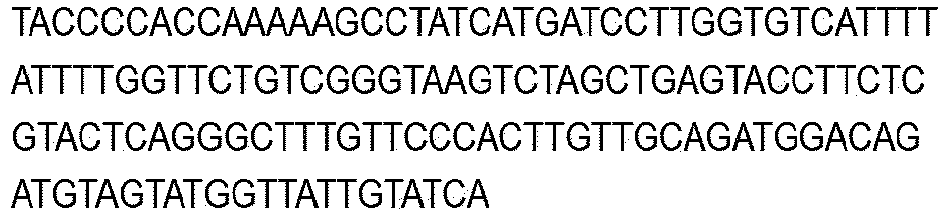
SEQ ID NO: 4 JW90 42 AMP0089904 
SEQ ID NO: 5 JW90 42 AMP0100370 
SEQ ID NO: 6 - Whether or not genotypes of the markers; i.e., the line samples, have the selection markers was determined by designating the threshold of each number of reads as 10, evaluating as "present" when the number of reads is 10 or more, and evaluating as "absent" when the number of reads is less than 10 (
Figs. 3 to 8 , Table 8).[Table 8] Marker NiF8 JW_90 F1-1 F1-2 F1-3 F1-4 F1-5 F1-6 F1-7 F1-8 F1-9 F1-10 F1-11 F1-12 F1-13 AMP0121265 0 30 0 0 25.9 0 0 0 30.4 22.3 21.2 0 23.5 14.9 0 AMP0120752 0 178.2 0 1 183.6 1.1 0 1.1 162.6 193.5 194.1 0 153 212.6 0 AMP0035185 0 27 0 0 38.4 0 30 0 48 23.6 27.1 0 31.8 27.6 0 AMP0114852 0 16 3.2 0 28 3.3 20 0 15.7 24.8 25.9 1.1 24.7 27.6 1.3 AMP0089904 0 122.1 0 1 116.2 1.1 93.3 0 102.9 111.6 105.9 0 83.6 108 0 AMP0100370 0 150.2 0 0 149.4 0 135.5 0 154.8 129 161.1 1.1 118.9 113.8 0 Incidence of smut (%) 40.8 0 50.9 50 0 70.1 87.7 90.7 0 0 0 80.3 0 0 97.3 - As shown in Table 8 and
Figs. 3 to 8 , a line sample exhibiting a lower morbidity of smut has a significantly larger number of markers than a line sample exhibiting a higher morbidity of smut. Such results demonstrate that continuous nucleic acid regions selected from the region of approximately 8.4 cM including AMP0121265, AMP0120752, AMP0035185, AMP0114852, AMP0089904, and AMP0100370 can be used as the markers associated with sugarcane smut resistance. - In Example 1, the marker associated with sugarcane smut resistance was identified based on the genotype data of 4,503 markers of JW90 among the genotype data of the 31,191 markers. In this example, the genotype data of
Iriomote 15 were collected, and the marker associated with sugarcane smut resistance was identified in the same manner. - In this example, the DNA library prepared in Example 1 was subjected to the analysis using a next-generation sequencer as described in (5) two times in order to increase the amount of genotype data of
Iriomote 15. The read data thus obtained were analyzed using analytical software (GRAS-Di, Toyota Motor Corporation) to obtain the genotype data of 64,757 markers. - On the basis of the genotype data obtained from progeny lines; i.e., KY08-6023, KY08-6039, and KY08-6041, of
Iriomote 15, genetic map data comprising 58 linkage groups were obtained with the use of the AntMap software for constructing genetic linkage maps (Iwata H, Ninomiya, S., 2006, AntMap: Constructing genetic linkage maps using an ant colony optimization algorithm, Breed Sci., 56: 371-377) by calculation using the Kosambi's genetic distance formula in the same manner as in Example 1. The 58 linkage groups include genotype data of 4,503 markers of the progeny lines; i.e., KY08-6023, KY08-6039, and KY08-6041, ofIriomote 15. - Based on the genetic map data thus obtained and the smut resistance test data obtained in Example 1, QTL analysis was carried out by the composite interval mapping (CIM) method using the QTL Cartographer gene analysis software (http://statgen.ncsu.edu/qtlcart/cartographer.html). The LOD threshold was determined to be 2.5. As a result, the presence of QTL linked to sugarcane smut resistance was confirmed in a region between the markers AMP0014532 and AMP0015886 in the 15th linkage group of the wild-type sugarcane variety (Iriomote 15) (Table 9 and
Fig. 9 ). When the value indicating the effect is negative, QTL is linked to a trait of improving the smut resistance.[Table 9] Varity Linkage group Position (cM) Range (cM) Adjacent marker LOD value Effects (%) Iriomote 1515 25.7 26.6 AMP0014532-AMP0015886 11.5 -37.8 - As shown in Table 9 and
Fig. 9 , the range including the markers AMP0014532 to AMP0015886 in the 15th linkage group observed in Example 2 was found to exhibit a significantly higher LOD value and significantly improved effects, compared with those described inWO 2012/147635 . In this example, the markers included in the QTL region linked to sugarcane smut resistance thus confirmed (i.e., AMP0014532, AMP0043152, AMP0069135, AMP0032477, AMP0018405, AMP0002312, AMP0007121, AMP0090108, and AMP0015886) were selected as selection markers (Table 10).[Table 10] Varity Linkage group Marker Nucleotide sequence information SEQ ID NO: Iriomote 1515 AMP0014532 
SEQ ID NO: 135 Iriomote 1515 AMP0043152 
SEQ ID NO: 136 Iriomote 1515 AMP0069135 
SEQ ID NO: 137 Iriomote 1515 AMP0032477 
SEQ ID NO: 138 Iriomote 1515 AMP0018405 
SEQ ID NO: 139 Iriomote 1515 AMP0002312 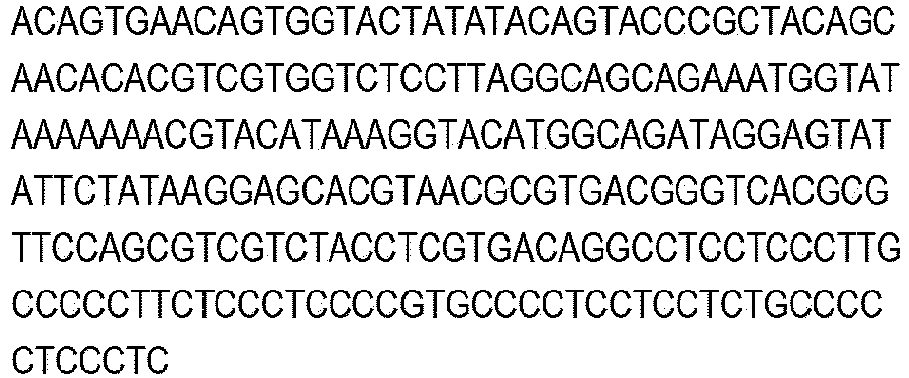
SEQ ID NO: 140 Iriomote 1515 AMP0007121 
SEQ ID NO: 141 Varity Linkage group Marker Nucleotide sequence information SEQ ID NO: Iriomote 1515 AMP0090108 
SEQ ID NO: 142 Iriomote 1515 AMP0015886 
SEQ ID NO: 143 - Whether or not genotypes of the markers; i.e., the line samples, have the selection markers was determined by designating the threshold of each number of reads as 10, evaluating as "present" when the number of reads is 10 or more, and evaluating as "absent" when the number of reads is less than 10 (
Figs. 10 to 18 , Table 11).[Table 11] Marker NiF8 Iriomote 15 F1-1 F1-2 F1-3 F1-4 F1-5 F1-6 F1-7 F1-8 F1-9 F1-10 F1-11 F1-12 AMP0014532 0 18 0 12 25.6 0 22.5 0 0 0 12 25.6 0 22.5 AMP0043152 0 215.3 0 1.1 188.4 217.6 186.5 1.1 1.1 0 1.1 188.4 217.6 186.5 AMP0069135 0 13 0 0 12.8 14.8 19.3 0 1.1 0 0 12.8 14.8 19.3 AMP0032477 0 23 0 0 19.8 28.5 22.5 0 0 0 0 19.8 28.5 22.5 AMP0018405 0 150.2 0 1.1 150.1 191.4 216.5 0 1.1 0 1.1 150.1 191.4 216.5 AMP0002312 0 42.1 0 0 45.4 28.5 33.2 0 0 0 0 45.4 28.5 33.2 AMP0007121 0 51.1 0 0 51.2 61.5 62.2 0 0 0 0 51.2 61.5 62.2 AMP0090108 0 24 0 0 24.4 29.6 24.6 0 0 0 0 24.4 29.6 24.6 AMP0015886 113.9 76.1 0 75.5 104.7 234.6 194 0 98.6 0 75.5 104.7 234.6 194 Incidence of smut (%) 40.8 0 97.3 89.7 0 3.6 1.5 98.6 80.3 97.3 89.7 0 3.6 1.5 - As shown in Table 11 and
Figs. 10 to 18 , a line sample exhibiting a lower morbidity of smut was found to have a significantly larger number of markers than a line sample exhibiting a higher morbidity of smut. Such results demonstrate that continuous nucleic acid regions selected from the region of approximately 26.6 cM including AMP0014532, AMP0043152, AMP0069135, AMP0032477, AMP0018405, AMP0002312, AMP007121, AMP0090108, and AMP0015886 can be used as the markers associated with sugarcane smut resistance. - In this example, the marker associated with sugarcane smut resistance derived from the wild-type sugarcane line "
Iriomote 8" was identified in the same manner as in Example 1, except for the use of the progeny line "KY09-6092" resulting from crossbreeding between the sugarcane variety "NiF8" and the wild-type sugarcane line "Iriomote 8," the progeny line "KY08-129" resulting from crossbreeding between the sugarcane variety "NiTn18" and the sugarcane variety "NiN24," and the 154 progeny lines resulting from crossbreeding between "KY09-6092" and "KY08-129." - In this example, the read data obtained in the same manner as in Example 1 except for the use of the forward primers shown in Table 12 instead of the forward primers shown in Table 5 for preparation of the DNA library for a next-generation sequencer were analyzed using analytical software (GRAS-Di, Toyota Motor Corporation) to obtain the genotype data of 57,444 markers.
[Table 12] No Forward (5' → 3') SEQ ID NO: 1 CAAGCAGAAGACGGCATACGAGATTCGTCAGAGTCTCGTGGGCTCGGAGATGTGTATAAGAGACAG 152 2 CAAGCAGAAGACGGCATACGAGATCGCTAGCGGTCTCGTGGGCTCGGAGATGTGTATAAGAGACAG 153 3 CAAGCAGAAGACGGCATACGAGATTCTCAGTAGTCTCGTGGGCTCGGAGATGTGTATAAGAGACAG 154 4 CAAGCAGAAGACGGCATACGAGATCGTAGATAGTCTCGTGGGCTCGGAGATGTGTATAAGAGACAG 155 5 CAAGCAGAAGACGGCATACGAGATATACGTGAGTCTCGTGGGCTCGGAGATGTGTATAAGAGACAG 156 6 CAAGCAGAAGACGGCATACGAGATGTCTAGAGGTCTCGTGGGCTCGGAGATGTGTATAAGAGACAG 157 7 CAAGCAGAAGACGGCATACGAGATAGTCGACAGTCTCGTGGGCTCGGAGATGTGTATAAGAGACAG 158 8 CAAGCAGAAGACGGCATACGAGATAGCGACGCGTCTCGTGGGCTCGGAGATGTGTATAAGAGACAG 159 9 CAAGCAGAAGACGGCATACGAGATTGATAGAGGTCTCGTGGGCTCGGAGATGTGTATAAGAGACAG 160 10 CAAGCAGAAGACGGCATACGAGATGACGACTGGTCTCGTGGGCTCGGAGATGTGTATAAGAGACAG 161 11 CAAGCAGAAGACGGCATACGAGATTGTGCTCAGTCTCGTGGGCTCGGAGATGTGTATAAGAGACAG 162 12 CAAGCAGAAGACGGCATACGAGATATGAGCTGGTCTCGTGGGCTCGGAGATGTGTATAAGAGACAG 163 13 CAAGCAGAAGACGGCATACGAGATTCTCTCACGTCTCGTGGGCTCGGAGATGTGTATAAGAGACAG 164 14 CAAGCAGAAGACGGCATACGAGATGCAGATCAGTCTCGTGGGCTCGGAGATGTGTATAAGAGACAG 165 15 CAAGCAGAAGACGGCATACGAGATTCTGCAGAGTCTCGTGGGCTCGGAGATGTGTATAAGAGACAG 166 16 CAAGCAGAAGACGGCATACGAGATACGTGAGCGTCTCGTGGGCTCGGAGATGTGTATAAGAGACAG 167 17 CAAGCAGAAGACGGCATACGAGATCGCGTGAGGTCTCGTGGGCTCGGAGATGTGTATAAGAGACAG 168 18 CAAGCAGAAGACGGCATACGAGATCATACTACGTCTCGTGGGCTCGGAGATGTGTATAAGAGACAG 169 19 CAAGCAGAAGACGGCATACGAGATTCTACACAGTCTCGTGGGCTCGGAGATGTGTATAAGAGACAG 170 20 CAAGCAGAAGACGGCATACGAGATGATAGATCGTCTCGTGGGCTCGGAGATGTGTATAAGAGACAG 171 21 CAAGCAGAAGACGGCATACGAGATGAGCGTACGTCTCGTGGGCTCGGAGATGTGTATAAGAGACAG 172 22 CAAGCAGAAGACGGCATACGAGATCAGAGACAGTCTCGTGGGCTCGGAGATGTGTATAAGAGACAG 173 23 CAAGCAGAAGACGGCATACGAGATCATAGATGGTCTCGTGGGCTCGGAGATGTGTATAAGAGACAG 174 24 CAAGCAGAAGACGGCATACGAGATAGATGCTAGTCTCGTGGGCTCGGAGATGTGTATAAGAGACAG 175 25 CAAGCAGAAGACGGCATACGAGATCTCATCTCGTCTCGTGGGCTCGGAGATGTGTATAAGAGACAG 176 26 CAAGCAGAAGACGGCATACGAGATTATCTATGGTCTCGTGGGCTCGGAGATGTGTATAAGAGACAG 177 27 CAAGCAGAAGACGGCATACGAGATAGAGTATCGTCTCGTGGGCTCGGAGATGTGTATAAGAGACAG 178 28 CAAGCAGAAGACGGCATACGAGATGTGACTAGGTCTCGTGGGCTCGGAGATGTGTATAAGAGACAG 179 29 CAAGCAGAAGACGGCATACGAGATCTATGCTCGTCTCGTGGGCTCGGAGATGTGTATAAGAGACAG 180 30 CAAGCAGAAGACGGCATACGAGATCTGACTACGTCTCGTGGGCTCGGAGATGTGTATAAGAGACAG 181 31 CAAGCAGAAGACGGCATACGAGATTATCAGTAGTCTCGTGGGCTCGGAGATGTGTATAAGAGACAG 182 32 CAAGCAGAAGACGGCATACGAGATGAGTCTGCGTCTCGTGGGCTCGGAGATGTGTATAAGAGACAG 183 33 CAAGCAGAAGACGGCATACGAGATCAGTCGCAGTCTCGTGGGCTCGGAGATGTGTATAAGAGACAG 184 34 CAAGCAGAAGACGGCATACGAGATGACATCTAGTCTCGTGGGCTCGGAGATGTGTATAAGAGACAG 185 35 CAAGCAGAAGACGGCATACGAGATCTGTGACGGTCTCGTGGGCTCGGAGATGTGTATAAGAGACAG 186 36 CAAGCAGAAGACGGCATACGAGATAAGAGGCAGTCTCGTGGGCTCGGAGATGTGTATAAGAGACAG 187 37 CAAGCAGAAGACGGCATACGAGATCTAGTACGGTCTCGTGGGCTCGGAGATGTGTATAAGAGACAG 188 38 CAAGCAGAAGACGGCATACGAGATAGGAGTCCGTCTCGTGGGCTCGGAGATGTGTATAAGAGACAG 189 39 CAAGCAGAAGACGGCATACGAGATCATGCCTAGTCTCGTGGGCTCGGAGATGTGTATAAGAGACAG 190 No Forward (5' → 3') SEQ ID NO: 40 CAAGCAGAAGACGGCATACGAGATGTAGAGAGGTCTCGTGGGCTCGGAGATGTGTATAAGAGACAG 191 41 CAAGCAGAAGACGGCATACGAGATCCTCTCTGGTCTCGTGGGCTCGGAGATGTGTATAAGAGACAG 192 42 CAAGCAGAAGACGGCATACGAGATAGCGTAGCGTCTCGTGGGCTCGGAGATGTGTATAAGAGACAG 193 43 CAAGCAGAAGACGGCATACGAGATTCCTCTACGTCTCGTGGGCTCGGAGATGTGTATAAGAGACAG 194 44 CAAGCAGAAGACGGCATACGAGATGACGTACAGTCTCGTGGGCTCGGAGATGTGTATAAGAGACAG 195 45 CAAGCAGAAGACGGCATACGAGATGACTGTAGGTCTCGTGGGCTCGGAGATGTGTATAAGAGACAG 196 46 CAAGCAGAAGACGGCATACGAGATTCAGTACAGTCTCGTGGGCTCGGAGATGTGTATAAGAGACAG 197 47 CAAGCAGAAGACGGCATACGAGATCATGATAGGTCTCGTGGGCTCGGAGATGTGTATAAGAGACAG 198 48 CAAGCAGAAGACGGCATACGAGATGCATCTCGGTCTCGTGGGCTCGGAGATGTGTATAAGAGACAG 199 49 CAAGCAGAAGACGGCATACGAGATTGCACAGAGTCTCGTGGGCTCGGAGATGTGTATAAGAGACAG 200 50 CAAGCAGAAGACGGCATACGAGATGAGCTATAGTCTCGTGGGCTCGGAGATGTGTATAAGAGACAG 201 51 CAAGCAGAAGACGGCATACGAGATAGTCTGCAGTCTCGTGGGCTCGGAGATGTGTATAAGAGACAG 202 52 CAAGCAGAAGACGGCATACGAGATCGCTGTGAGTCTCGTGGGCTCGGAGATGTGTATAAGAGACAG 203 53 CAAGCAGAAGACGGCATACGAGATCTGATGTGGTCTCGTGGGCTCGGAGATGTGTATAAGAGACAG 204 54 CAAGCAGAAGACGGCATACGAGATGCACTCTAGTCTCGTGGGCTCGGAGATGTGTATAAGAGACAG 205 55 CAAGCAGAAGACGGCATACGAGATTCTGCTCAGTCTCGTGGGCTCGGAGATGTGTATAAGAGACAG 206 56 CAAGCAGAAGACGGCATACGAGATTGTATCTAGTCTCGTGGGCTCGGAGATGTGTATAAGAGACAG 207 57 CAAGCAGAAGACGGCATACGAGATACAGTGAGGTCTCGTGGGCTCGGAGATGTGTATAAGAGACAG 208 58 CAAGCAGAAGACGGCATACGAGATATGCGATAGTCTCGTGGGCTCGGAGATGTGTATAAGAGACAG 209 59 CAAGCAGAAGACGGCATACGAGATGAGACATGGTCTCGTGGGCTCGGAGATGTGTATAAGAGACAG 210 60 CAAGCAGAAGACGGCATACGAGATGTCATGTGGTCTCGTGGGCTCGGAGATGTGTATAAGAGACAG 211 61 CAAGCAGAAGACGGCATACGAGATTCATGATAGTCTCGTGGGCTCGGAGATGTGTATAAGAGACAG 212 62 CAAGCAGAAGACGGCATACGAGATGTCATCTCGTCTCGTGGGCTCGGAGATGTGTATAAGAGACAG 213 63 CAAGCAGAAGACGGCATACGAGATTATCTCTAGTCTCGTGGGCTCGGAGATGTGTATAAGAGACAG 214 64 CAAGCAGAAGACGGCATACGAGATCTGATATAGTCTCGTGGGCTCGGAGATGTGTATAAGAGACAG 215 65 CAAGCAGAAGACGGCATACGAGATTACGCATGGTCTCGTGGGCTCGGAGATGTGTATAAGAGACAG 216 66 CAAGCAGAAGACGGCATACGAGATCGTGAGTGGTCTCGTGGGCTCGGAGATGTGTATAAGAGACAG 217 67 CAAGCAGAAGACGGCATACGAGATGACACATGGTCTCGTGGGCTCGGAGATGTGTATAAGAGACAG 218 68 CAAGCAGAAGACGGCATACGAGATACATGACGGTCTCGTGGGCTCGGAGATGTGTATAAGAGACAG 219 69 CAAGCAGAAGACGGCATACGAGATGCGTCTAGGTCTCGTGGGCTCGGAGATGTGTATAAGAGACAG 220 70 CAAGCAGAAGACGGCATACGAGATTCACGCTGGTCTCGTGGGCTCGGAGATGTGTATAAGAGACAG 221 71 CAAGCAGAAGACGGCATACGAGATTCATGTACGTCTCGTGGGCTCGGAGATGTGTATAAGAGACAG 222 72 CAAGCAGAAGACGGCATACGAGATTAGTGACGGTCTCGTGGGCTCGGAGATGTGTATAAGAGACAG 223 73 CAAGCAGAAGACGGCATACGAGATCACGATAGGTCTCGTGGGCTCGGAGATGTGTATAAGAGACAG 224 74 CAAGCAGAAGACGGCATACGAGATACACACTGGTCTCGTGGGCTCGGAGATGTGTATAAGAGACAG 225 75 CAAGCAGAAGACGGCATACGAGATAGCATCACGTCTCGTGGGCTCGGAGATGTGTATAAGAGACAG 226 76 CAAGCAGAAGACGGCATACGAGATTAGTCGTAGTCTCGTGGGCTCGGAGATGTGTATAAGAGACAG 227 77 CAAGCAGAAGACGGCATACGAGATGCATCGCGGTCTCGTGGGCTCGGAGATGTGTATAAGAGACAG 228 78 CAAGCAGAAGACGGCATACGAGATATCATGTCGTCTCGTGGGCTCGGAGATGTGTATAAGAGACAG 229 79 CAAGCAGAAGACGGCATACGAGATGTACTCTAGTCTCGTGGGCTCGGAGATGTGTATAAGAGACAG 230 80 CAAGCAGAAGACGGCATACGAGATAGTGCATAGTCTCGTGGGCTCGGAGATGTGTATAAGAGACAG 231 No Forward (5' → 3') SEQ ID NO: 81 CAAGCAGAAGACGGCATACGAGATCGCATCAGGTCTCGTGGGCTCGGAGATGTGTATAAGAGACAG 232 82 CAAGCAGAAGACGGCATACGAGATCGCTATAGGTCTCGTGGGCTCGGAGATGTGTATAAGAGACAG 233 83 CAAGCAGAAGACGGCATACGAGATGTCGATAGGTCTCGTGGGCTCGGAGATGTGTATAAGAGACAG 234 84 CAAGCAGAAGACGGCATACGAGATACACAGTAGTCTCGTGGGCTCGGAGATGTGTATAAGAGACAG 235 85 CAAGCAGAAGACGGCATACGAGATCAGATGTAGTCTCGTGGGCTCGGAGATGTGTATAAGAGACAG 236 86 CAAGCAGAAGACGGCATACGAGATCTCTACAGGTCTCGTGGGCTCGGAGATGTGTATAAGAGACAG 237 87 CAAGCAGAAGACGGCATACGAGATGTCACTAGGTCTCGTGGGCTCGGAGATGTGTATAAGAGACAG 238 88 CAAGCAGAAGACGGCATACGAGATTGTACTAGGTCTCGTGGGCTCGGAGATGTGTATAAGAGACAG 239 89 CAAGCAGAAGACGGCATACGAGATACGCTATGGTCTCGTGGGCTCGGAGATGTGTATAAGAGACAG 240 90 CAAGCAGAAGACGGCATACGAGATATGTATAGGTCTCGTGGGCTCGGAGATGTGTATAAGAGACAG 241 91 CAAGCAGAAGACGGCATACGAGATTGTGACAGGTCTCGTGGGCTCGGAGATGTGTATAAGAGACAG 242 - Among them, 2,936 genotypes of KY09-6092 and 1,877 genotypes of KY08-129 were obtained. The genetic map data comprising 117 linkage groups derived from "KY09-6092" and the genetic map data comprising 123 linkage groups derived from "KY08-129" were obtained. In addition, the smut resistance test data of the 154 progeny lines resulting from crossbreeding between "KY09-6092" and "KY08-129" were obtained under the same conditions as in Example 1, and the results of calculation of the morbidity of smut were shown in
Fig. 19 . Based on the genetic map data and the smut resistance test data, QTL analysis was carried out by the composite interval mapping (CIM) method using the QTL Cartographer gene analysis software (http://statgen.ncsu.edu/qtlcart/cartographer.html). The LOD threshold was determined to be 2.5. - As a result, the presence of QTL linked to sugarcane smut resistance was confirmed in a region of approximately 12.27 cM including the markers AMP0063683 to AMP0091501 in the 8th linkage group of "KY09-6092" (Table 13 and
Fig. 20 ). When the value indicating the effect is negative, QTL is linked to a trait of improving smut resistance.[Table 13] Linkage group Position (cM) Range (cM) Adjacent marker LOD value Effects (%) 8 83.8 12.27 AMP0063683-AMP0091501 68.7 -54.2 - As shown in Table 13 and
Fig. 20 , the range including the markers AMP0063683 to AMP0091501 in the 8th linkage group observed in this example was found to exhibit a significantly higher LOD value and significantly improved effects, compared with those described inWO 2012/147635 . The markers included in the QTL region linked to sugarcane smut resistance confirmed in this example (i.e., AMP0063683, AMP0082090, AMP0013802, AMP0083204, AMP0043774, AMP0094596, and AMP0091501) were selected as selection markers (Table 14).[Table 14] Varity Linkage group Marker PCR amplicon sequence SEQ ID NO: Iriomote 88 AMP0063683 
SEQ ID NOs: 144, 145 
Iriomote 88 AMP0082090 
SEQ ID NO: 146 Iriomote 88 AMP0013802 
SEQ ID NO: 147 Iriomote 88 AMP0083204 
SEQ ID NO: 148 Iriomote 88 AMP0043774 
SEQ ID NO: 149 Iriomote 88 AMP0094596 
SEQ ID NO: 150 Iriomote 88 AMP0091501 
SEQ ID NO: 151 - Among the markers shown in Table 14, the PCR product of AMP0063683 is 200 bp or larger. Thus, AMP0063683 is defined as a nucleic acid region comprising Read 1 (SEQ ID NO: 144) and Read 2 (SEQ ID NO: 145) with the nucleotide sequences being determined using the next-generation sequencer at both ends.
- Whether or not genotypes of the markers; i.e., the line samples, have the selection markers was determined by designating the threshold of each number of reads as 10, evaluating as "present" when the number of reads is 10 or more, and evaluating as "absent" when the number of reads is less than 10 (
Figs. 21 to 27 , Table 15).[Table 15] Marker F1-1 F1-2 F1-3 F1-4 F1-5 F1-6 F1-7 F1-8 AMP0063683 49.4 39.4 27.4 41.2 0 0 0 0 AMP0082090 70.9 128.1 133.4 104.1 0 0 0 0 AMP0013802 34.1 54.2 59.6 58.1 0 0 0 0 AMP0083204 61 87.5 101.2 93.7 0 0 0 0 AMP0043774 46.7 48 89.9 85.3 0 0 0 0 AMP0094596 68.2 66.5 57.7 47.8 0.8 0 0 0 AMP0091501 19 26.1 21.9 24.6 0 0 0 0 Incidence of smut (%) 0 0 0 0 70.28 18.8 61.74 52.63 - As shown in Table 15 and
Figs. 21 to 27 , line samples with the low morbidity of smut have a significantly larger number of markers than line samples with the high morbidity of smut. This demonstrates that continuous nucleic acid regions selected from a region of approximately 12.27 cM comprising AMP0063683, AMP0082090, AMP0013802, AMP0083204, AMP0043774, AMP0094596, and AMP0091501 can be used as the markers associated with sugarcane smut resistance. - In this example, the nucleotide sequence of the region of approximately 8.4 cM comprising the marker associated with sugarcane smut resistance derived from JW90 identified in Example 1 was compared with the nucleotide sequence of the region of approximately 12.27 cM comprising the marker associated with sugarcane smut resistance derived from
Iriomote 8 identified in Example 3. As a result, the adjacent region comprising AMP0121265 located at 0 cM among the markers associated with sugarcane smut resistance derived from JW90 identified in Example 1 and the adjacent region comprising AMP0091501 located at 83.76 cM among the markers associated with sugarcane smut resistance derived fromIriomote 8 identified in Example 3 were found to comprise a plurality of markers having the identical nucleotide sequence. - Table 16 summarizes markers included in the adjacent region comprising AMP0121265 located at 0 cM among the markers associated with sugarcane smut resistance derived from JW90 identified in Example 1. Table 17 summarizes markers included in the adjacent region comprising AMP0091501 located at 83.76 cM among the markers associated with sugarcane smut resistance derived from
Iriomote 8 identified in Example 3. In Tables 16 and 17, the column indicating the nucleotide sequence information of markers shows the nucleotide sequences of contig sequences when the contig sequences can be led from a pair of read data obtained via analysis using a next-generation sequencer, or a pair of read sequences (theread sequence 1 and the read sequence 2) when the contig sequence cannot be led. Specifically, the markers shown in Tables 16 and 17 can be defined by the nucleotide sequences of the contig sequences or the nucleotide sequences of theread sequence 1 and theread sequence 2. - Among the markers shown in Table 16, concerning the markers having the identical nucleotide sequence with the markers included in the adjacent region including AMP0179276 shown in Table 17, the column indicating "Presence or absence of DNA marker derived from Iriomote 8 ():
Iriomote 8 marker ID" shows "Present" and ID of the marker derived fromIriomote 8 having the identical nucleotide sequence. Similarly, among the markers shown in Table 17, concerning the markers having the identical nucleotide sequence with the markers included in the adjacent region including AMP0121265 shown in Table 16, the column indicating "Presence or absence of DNA marker derived from JW90 (): JW90 marker ID" shows "Present" and ID of the marker derived from JW90 having the identical nucleotide sequence.[Table 16] Marker ID Origin Nucleotide sequence information SEQ ID NO: Presence or absence of DNA marker derived from Iriomote 8 ():Marker ID AMP0129420 JW90 
SEQ ID NO: 243 - AMP0010186 JW90 
SEQ ID NO: 244 - AMP0010846 JW90 
SEQ ID NO: 245 - AMP0015478 JW90 
SEQ ID NO: 246 - AMP0019992 JW90 
SEQ ID NO: 247 - AMP0020554 JW90 
SEQ ID NO: 248 Present (AMP0016471) AMP0022987 JW90 
SEQ ID NOs: 249, 250 - 
AMP0130766 JW90 
SEQ ID NO: 251 - Marker ID Origin Nucleotide sequence information SEQ ID NO: Presence or absence of DNA marker derived from Iriomote 8 ():Marker ID AMP0030465 JW90 
SEQ ID NOs: 252, 253 - 
AMP0031132 JW90 
SEQ ID NOs: 254, 255 - 
AMP0033330 JW90 
SEQ ID NOs: 256, 257 - 
AMP0036149 JW90 
SEQ ID NOs: 258, 259 - 
Marker ID Origin Nucleotide sequence information SEQ ID NO: Presence or absence of DNA marker derived from Iriomote 8 ():Marker ID AMP0036465 JW90 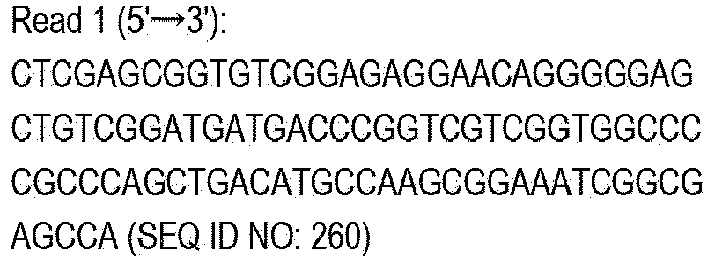
SEQ ID NOs: 260,261 - 
AMP0039231 JW90 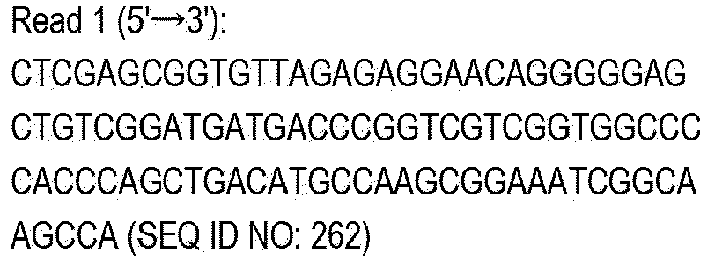
SEQ ID NOs: 262, 263 - 
AMP0040432 JW90 
SEQ ID NOs: 264, 265 - 
AMP0041203 JW90 
SEQ ID NOs: 266, 267 - 
Marker ID Origin Nucleotide sequence information SEQ ID NO: Presence or absence of DNA marker derived from Iriomote 8 ():Marker ID AMP0041520 JW90 
SEQ ID NOs: 268,269 - 
AMP0045000 JW90 
SEQ ID NO: 270 Present (AMP0036426) AMP0057239 JW90 
SEQ ID NO: 271 Present (AMP0046626) AMP0059273 JW90 
SEQ ID NO: 272 - AMP0062853 JW90 
SEQ ID NO: 273 Present (AMP0052709) AMP0064313 JW90 
SEQ ID NO: 274 - AMP0132654 JW90 
SEQ ID NOs: 275, 276 - 
Marker ID Origin Nucleotide sequence information SEQ ID NO: Presence or absence of DNA marker derived from Iriomote 8 ():Marker ID AMP0070602 JW90 
SEQ ID NOs: 277, 278 - 
AMP0133317 JW90 
SEQ ID NOs: 279, 280 - 
AMP0090028 JW90 
SEQ ID NOs: 281,282 - 
AMP0100461 JW90 
SEQ ID NO: 283 - AMP0134140 JW90 
SEQ ID NO: 284 - Marker ID Origin Nucleotide sequence information SEQ ID NO: Presence or absence of DNA marker derived from Iriomote 8 ():Marker ID AMP0103131 JW90 
SEQ ID NOs: 285, 286 - AMP0105230 JW90 
SEQ ID NO: 287 - AMP0107179 JW90 
SEQ ID NO: 288 - AMP0107330 JW90 
SEQ ID NO: 289 - AMP0108751 JW90 SEQ ID NOs: 290, 291 - 
AMP0111891 JW90 
SEQ ID NO: 292 Present (AMP0091501) Marker ID Origin Nucleotide sequence information SEQ ID NO: Presence or absence of DNA marker derived from Iriomote 8 ():Marker ID AMP0121265 JW90 
SEQ ID NO: 293 - AMP0135444 JW90 
SEQ ID NO: 294 - [Table 17] Marker ID Origin Nucleotide sequence information SEQ ID NO: Presence or absence of JW90DNA marker (): Marker ID AMP0007142 Iriomote 8 
SEQ ID NO: 295 - AMP0008511 Iriomote 8 
SEQ ID NOs: 296, 297 - 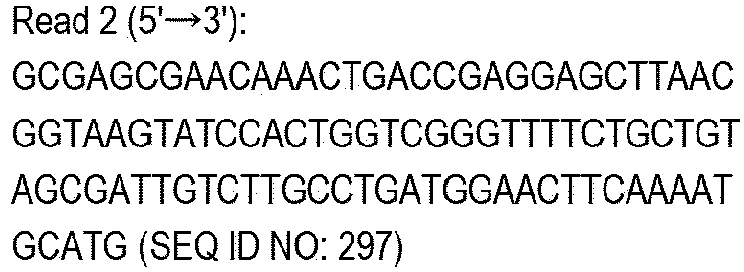
AMP0016471 Iriomote 8 
SEQ ID NO: 298 Present (AMP0020554) AMP0017797 Iriomote 8 
SEQ ID NOs: 299, 300 - 
AMP0033151 Iriomote 8 
SEQ ID NOs: 301,302 - 
Marker ID Origin Nucleotide sequence information SEQ ID NO: Presence or absence of JW90DNA marker (): Marker ID AMP0036426 Iriomote 8 
SEQ ID NO: 303 Present (AMP0045000) AMP0038963 Iriomote 8 
SEQ ID NOs: 304, 305 - 
AMP0039429 Iriomote 8 
SEQ ID NO: 306 - AMP0090720 Iriomote 8 SEQ ID NO: 307 Present (AMP0057239) AMP0047005 Iriomote 8 
SEQ ID NOs: 308, 309 - 
AMP0048243 Iriomote 8 
SEQ ID NO: 310 - AMP0052709 Iriomote 8 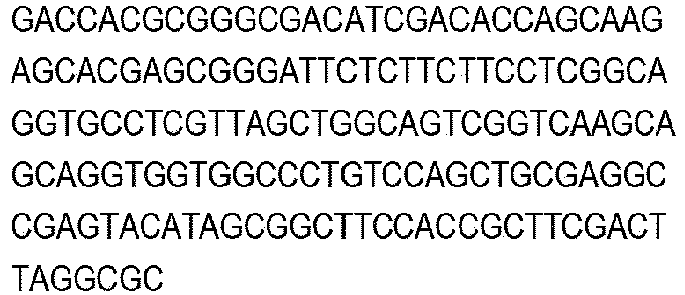
SEQ ID NO: 311 Present (AMP0062853) Marker ID Origin Nucleotide sequence information SEQ ID NO: Presence or absence of JW90DNA marker (): Marker ID AMP0054926 Iriomote 8 
SEQ ID NOs: 312, 313 - 
AMP0059174 Iriomote 8 
SEQ ID NO: 314 - AMP0059536 Iriomote 8 
SEQ ID NO: 315 - AMP0091501 Iriomote 8 
SEQ ID NO: 316 Present (AMP0111891) AMP0101156 Iriomote 8 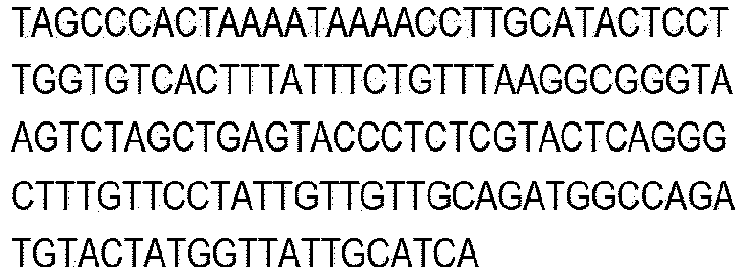
SEQ ID NO: 317 - AMP0107476 Iriomote 8 
SEQ ID NO: 318 - - As shown in Table 16, the adjacent region comprising AMP0121265 located at 0 cM among the markers associated with sugarcane smut resistance derived from JW90 was found to comprise 36 markers. As shown in Table 17, the adjacent region comprising AMP0091501 located at 83.76 cM among the markers associated with sugarcane smut resistance derived from
Iriomote 8 was found to comprise 18 markers. Among them, 5 markers were found to comprise the identical nucleotide sequence. On the basis of such results, the region comprising the 36 markers shown in Table 16 and the region comprising the 18 markers shown in Table 17 can be regarded as QTLs that are highly correlated with sugarcane smut resistance. In particular, both JW90 andIriomote 8 have the QTL of sugarcane smut resistance identified in this example. Accordingly, such QTL is considered to be present in an extensive range of sugarcane varieties without particular limitation. - In particular, this example demonstrates that the 36 markers shown in Table 16 and the 18 markers shown in Table 17 can be used as particularly excellent markers associated with sugarcane smut resistance.
- Among the 36 markers shown in Table 16 and the 18 markers shown in Table 17, in addition, 5 markers that were found to have the identical nucleotide sequence (i.e., AMP0016471 (SEQ ID NO: 298) = AMP0020554 (SEQ ID NO: 248), AMP0036426 (SEQ ID NO: 303) = AMP0045000 (SEQ ID NO: 270), AMP0046626 (SEQ ID NO: 307) = AMP0057239 (SEQ ID NO: 271), AMP0052709 (SEQ ID NO: 311) = AMP0062853 (SEQ ID NO: 273), and AMP0091501 (SEQ ID NO: 316) = AMP0111891 (SEQ ID NO: 292)) were found to be usable as the most excellent markers associated with sugarcane smut resistance.
- All publications, patents, and patent applications cited herein are incorporated herein by reference in their entirety.


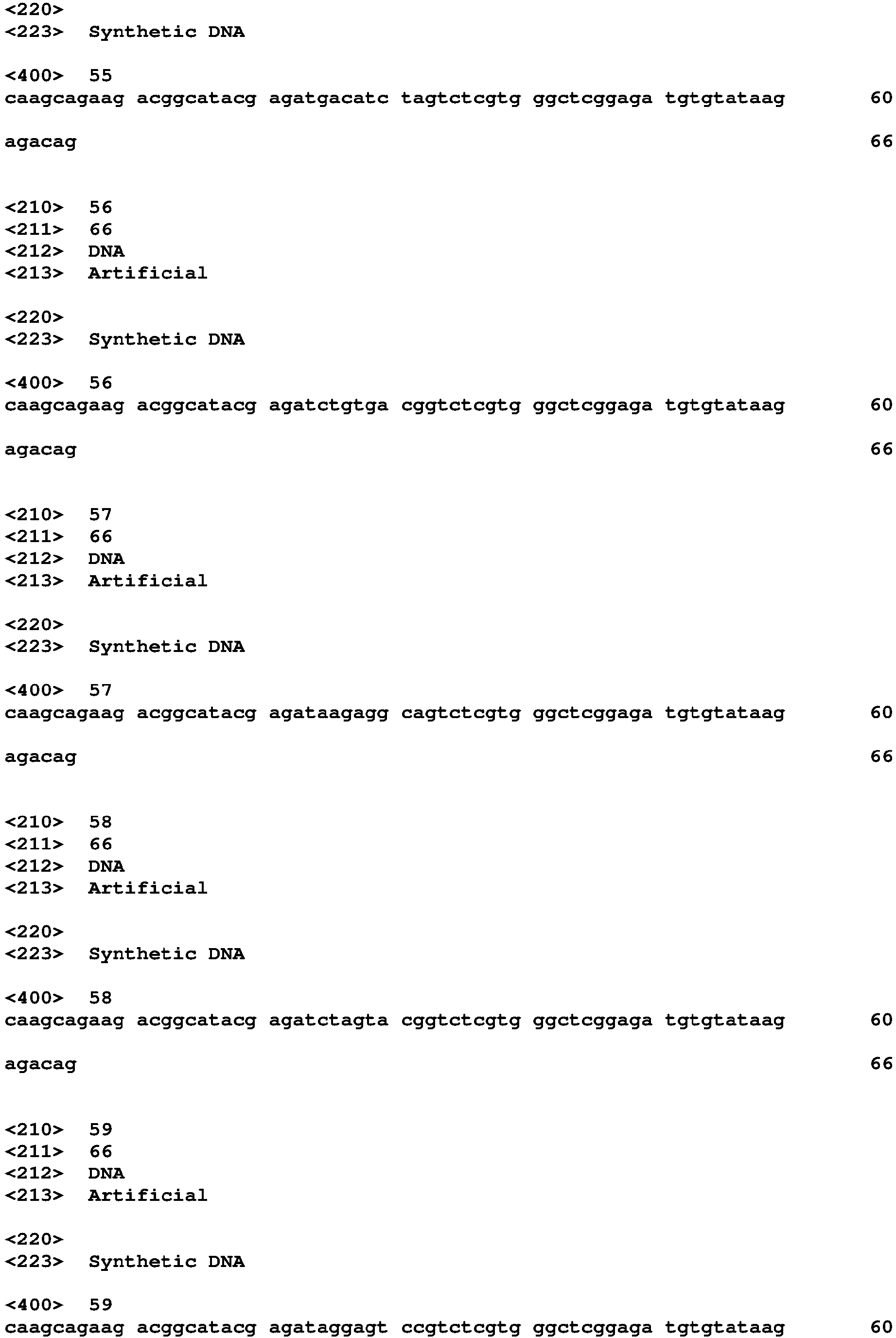
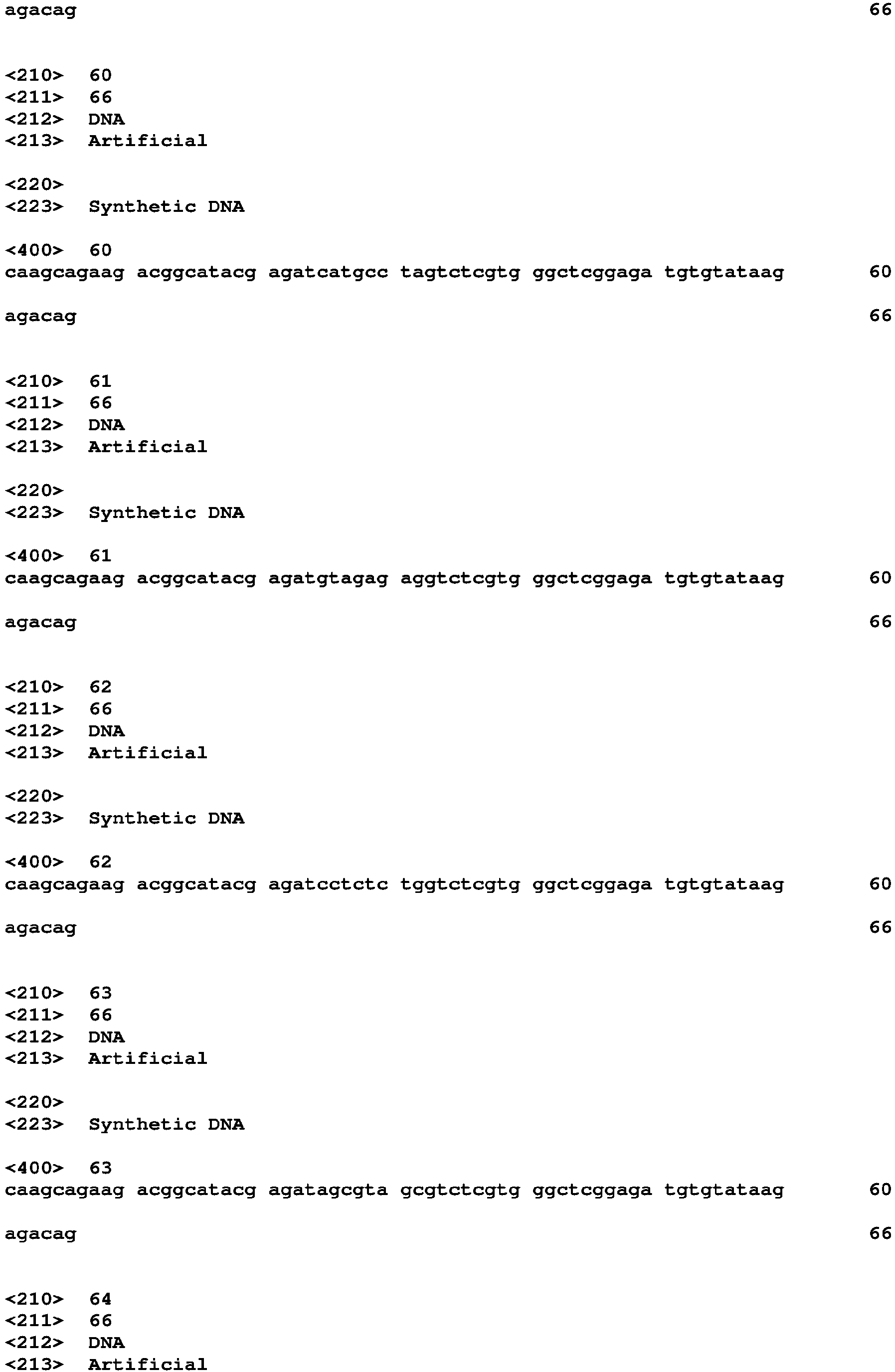


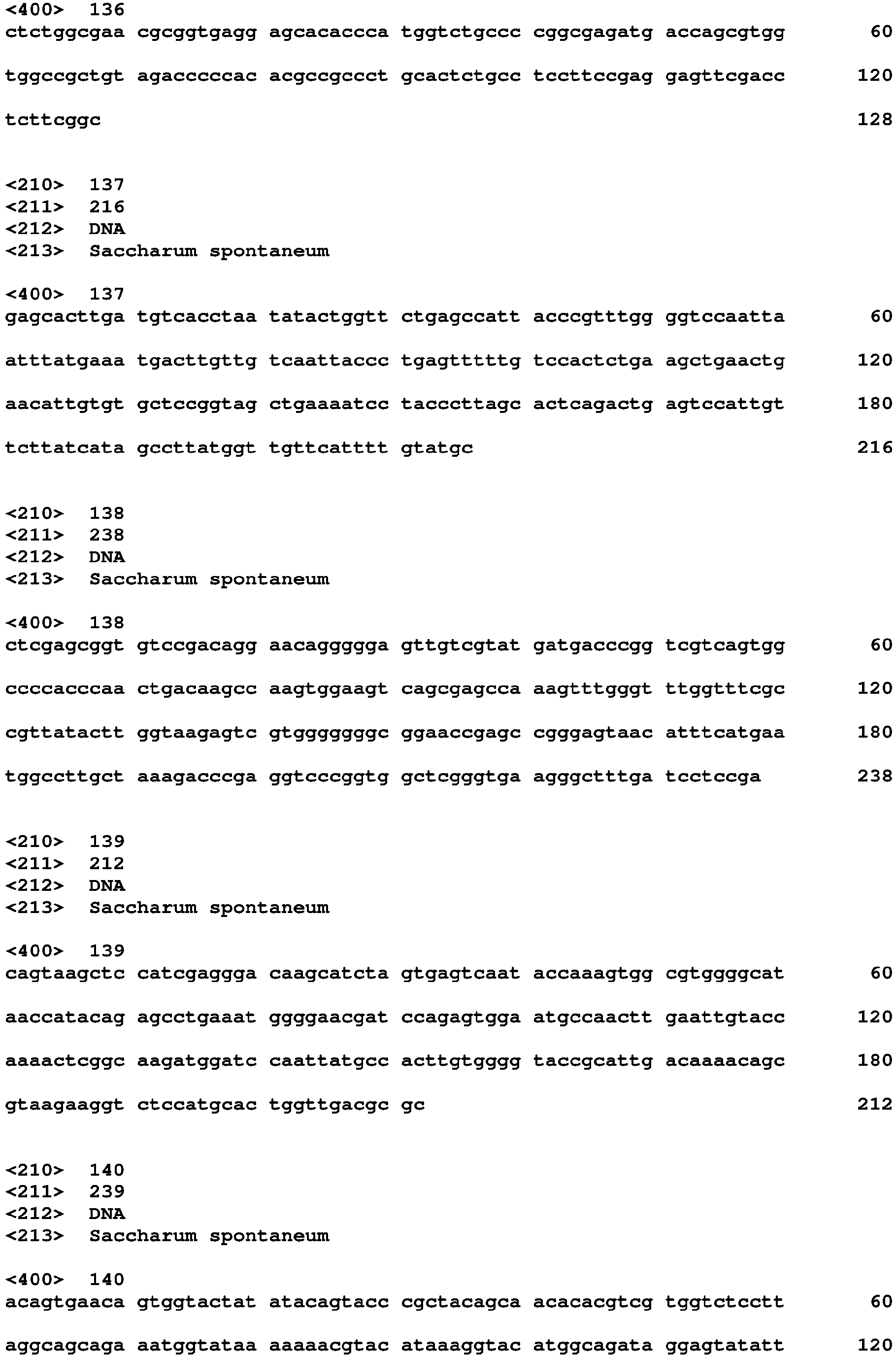





Claims (9)
- A marker associated with sugarcane smut resistance, which consists of a continuous nucleic acid region existing in a region between the nucleotide sequence as shown in SEQ ID NO: 1 and the nucleotide sequence as shown in SEQ ID NO: 6, a region between the nucleotide sequence as shown in SEQ ID NO: 135 and the nucleotide sequence as shown in SEQ ID NO: 143, or a region between the nucleotide sequence as shown in SEQ ID NO: 144 or 145 and the nucleotide sequence as shown in SEQ ID NO: 151 of a sugarcane chromosome.
- The marker associated with sugarcane smut resistance according to claim 1, wherein the nucleic acid region comprises any nucleotide sequence selected from the group consisting of the nucleotide sequences as shown in SEQ ID NOs: 1 to 6, 135 to 143, and 144 to 151 or a part of the nucleotide sequence.
- The marker associated with sugarcane smut resistance according to claim 1, wherein the nucleic acid region comprises the nucleotide sequence as shown in SEQ ID NO: 1 or 2 of a sugarcane chromosome or a part of the nucleotide sequence.
- The marker associated with sugarcane smut resistance according to claim 1, wherein the nucleic acid region comprises any nucleotide sequence selected from the group consisting of the nucleotide sequences as shown in SEQ ID NOs: 138 to 140 of a sugarcane chromosome or a part of the nucleotide sequence.
- The marker associated with sugarcane smut resistance according to claim 1, wherein the nucleic acid region comprises a nucleotide sequence as shown in SEQ ID NO: 149 or 151 of a sugarcane chromosome or a part of the nucleotide sequence.
- The marker associated with sugarcane smut resistance according to claim 1, wherein the nucleic acid region comprises any nucleotide sequence selected from the group consisting of the nucleotide sequences as shown in SEQ ID NOs: 298, 303, 307, 311, and 316 of a sugarcane chromosome or a part of the nucleotide sequence.
- A method for producing a sugarcane line having improved smut resistance comprising: a step of extracting a chromosome of a progeny plant obtained from parent plants, at least one of which is a sugarcane plant, and/or a chromosome of a parent sugarcane plant; and a step of determining the presence or absence of the marker associated with sugarcane smut resistance according to any one of claims 1 to 6 in the obtained chromosome.
- The method for producing a sugarcane line according to claim 7, wherein the step of determination involves the use of a DNA chip comprising a probe corresponding to the marker associated with sugarcane smut resistance.
- The method for producing a sugarcane line according to claim 7, wherein the progeny plant is a seed or young seedling and the chromosome is extracted from the seed or young seedling.
Applications Claiming Priority (4)
| Application Number | Priority Date | Filing Date | Title |
|---|---|---|---|
| JP2018127142 | 2018-07-03 | ||
| JP2018197546 | 2018-10-19 | ||
| JP2019122913A JP7161727B2 (en) | 2018-07-03 | 2019-07-01 | Smut resistance-related markers for Saccharum plants and their use |
| PCT/JP2019/026324 WO2020009113A1 (en) | 2018-07-03 | 2019-07-02 | Smut resistance-associated marker of plant of genus saccharum and use thereof |
Publications (2)
| Publication Number | Publication Date |
|---|---|
| EP3819375A1 true EP3819375A1 (en) | 2021-05-12 |
| EP3819375A4 EP3819375A4 (en) | 2021-09-15 |
Family
ID=70388822
Family Applications (1)
| Application Number | Title | Priority Date | Filing Date |
|---|---|---|---|
| EP19830417.2A Pending EP3819375A4 (en) | 2018-07-03 | 2019-07-02 | MARKER OF PLANTS OF THE GENUS SACCHARUM AND ITS USES ASSOCIATED WITH CEREAL FIRE RESISTANCE |
Country Status (5)
| Country | Link |
|---|---|
| US (1) | US11814638B2 (en) |
| EP (1) | EP3819375A4 (en) |
| JP (1) | JP7161727B2 (en) |
| CN (1) | CN112752843B (en) |
| BR (1) | BR112020026955A2 (en) |
Families Citing this family (2)
| Publication number | Priority date | Publication date | Assignee | Title |
|---|---|---|---|---|
| CN116769800A (en) * | 2023-06-15 | 2023-09-19 | 广西大学 | SsglcP gene of ustilago cane and application of SsglcP gene in disease-resistant breeding of ustilago cane smut |
| CN120775805B (en) * | 2025-08-22 | 2025-11-25 | 广东省科学院南繁种业研究所 | Application of pathogenic factors of black fungus of sugarcane whip in regulating and controlling pathogenicity of black fungus of sugarcane whip |
Family Cites Families (5)
| Publication number | Priority date | Publication date | Assignee | Title |
|---|---|---|---|---|
| US8519223B2 (en) | 2006-04-28 | 2013-08-27 | National Agriculture And Food Research Organization | Marker for selecting an aphanomyces cochlioides-resistant variety and selection method therefor |
| EP1947198A1 (en) | 2007-01-18 | 2008-07-23 | Syngeta Participations AG | Maize plants characterised by quantitative trait loci (QTL) |
| JP5653957B2 (en) * | 2011-04-28 | 2015-01-14 | トヨタ自動車株式会社 | Markers for resistance to smut of sugarcane plants and their use |
| WO2015036593A2 (en) * | 2013-09-13 | 2015-03-19 | University Of Bremen | Transgenic plants for nitrogen fixation |
| CN107043778B (en) * | 2017-03-14 | 2021-08-17 | 广西大学 | A near-in situ complementation method for site-directed insertional mutagenesis of fungal genes |
-
2019
- 2019-07-01 JP JP2019122913A patent/JP7161727B2/en active Active
- 2019-07-02 US US17/257,453 patent/US11814638B2/en active Active
- 2019-07-02 EP EP19830417.2A patent/EP3819375A4/en active Pending
- 2019-07-02 CN CN201980044267.1A patent/CN112752843B/en active Active
- 2019-07-02 BR BR112020026955-7A patent/BR112020026955A2/en unknown
Also Published As
| Publication number | Publication date |
|---|---|
| BR112020026955A2 (en) | 2021-04-06 |
| CN112752843A (en) | 2021-05-04 |
| CN112752843B (en) | 2024-11-29 |
| US11814638B2 (en) | 2023-11-14 |
| JP2020065540A (en) | 2020-04-30 |
| EP3819375A4 (en) | 2021-09-15 |
| JP7161727B2 (en) | 2022-10-27 |
| US20210139929A1 (en) | 2021-05-13 |
Similar Documents
| Publication | Publication Date | Title |
|---|---|---|
| EP3054766B1 (en) | Methods and compositions for peronospora resistance in spinach | |
| US10526666B2 (en) | Marker associated with resistance to smut in plant belonging to genus Saccharum, and use thereof | |
| EP3045533B1 (en) | Marker associated with anthracnose resistance in plants of the genus fragaria and use thereof | |
| US11814638B2 (en) | Marker associated with smut resistance in plant belonging to genus Saccharum and use thereof | |
| US20240043862A1 (en) | Marker associated with smut resistance in plant belonging to genus saccharum and use thereof | |
| JP2008237175A (en) | Production of rice plant resistant to rice blast | |
| WO2012017679A1 (en) | Stalk-length-related marker of plant of the genus saccharum and the use thereof | |
| WO2012017682A2 (en) | Leaf-blade-length-related marker of plant of the genus saccharum and the use thereof | |
| WO2012073495A2 (en) | Sugarcane-stalk-number-related marker and the use thereof | |
| US9677134B2 (en) | Sugarcane-stalk-sugar-content-related marker and the use thereof | |
| WO2012017683A1 (en) | Leaf-area-related marker of plant of the genus saccharum and the use thereof | |
| WO2012073494A2 (en) | Sugarcane-stalk-diameter-related marker and the use thereof | |
| WO2012073496A2 (en) | Sugarcane-stalk-weight-related marker and the use thereof | |
| WO2012073497A2 (en) | Sugarcane-single-stalk-weight-related marker and the use thereof | |
| US20130237448A1 (en) | Sugarcane-sugar-yield-related marker and the use thereof |
Legal Events
| Date | Code | Title | Description |
|---|---|---|---|
| STAA | Information on the status of an ep patent application or granted ep patent |
Free format text: STATUS: THE INTERNATIONAL PUBLICATION HAS BEEN MADE |
|
| PUAI | Public reference made under article 153(3) epc to a published international application that has entered the european phase |
Free format text: ORIGINAL CODE: 0009012 |
|
| STAA | Information on the status of an ep patent application or granted ep patent |
Free format text: STATUS: REQUEST FOR EXAMINATION WAS MADE |
|
| 17P | Request for examination filed |
Effective date: 20210129 |
|
| AK | Designated contracting states |
Kind code of ref document: A1 Designated state(s): AL AT BE BG CH CY CZ DE DK EE ES FI FR GB GR HR HU IE IS IT LI LT LU LV MC MK MT NL NO PL PT RO RS SE SI SK SM TR |
|
| A4 | Supplementary search report drawn up and despatched |
Effective date: 20210813 |
|
| RIC1 | Information provided on ipc code assigned before grant |
Ipc: C12Q 1/6895 20180101ALI20210809BHEP Ipc: A01H 6/46 20180101ALI20210809BHEP Ipc: A01H 1/00 20060101ALI20210809BHEP Ipc: C12N 15/09 20060101AFI20210809BHEP |
|
| DAV | Request for validation of the european patent (deleted) | ||
| DAX | Request for extension of the european patent (deleted) | ||
| STAA | Information on the status of an ep patent application or granted ep patent |
Free format text: STATUS: EXAMINATION IS IN PROGRESS |
|
| 17Q | First examination report despatched |
Effective date: 20241122 |