EP3819286A1 - Phenalkamine epoxy curing agents from methylene bridged poly(cyclohexyl-aromatic) amines and epoxy resin compositions containing the same - Google Patents
Phenalkamine epoxy curing agents from methylene bridged poly(cyclohexyl-aromatic) amines and epoxy resin compositions containing the same Download PDFInfo
- Publication number
- EP3819286A1 EP3819286A1 EP20203494.8A EP20203494A EP3819286A1 EP 3819286 A1 EP3819286 A1 EP 3819286A1 EP 20203494 A EP20203494 A EP 20203494A EP 3819286 A1 EP3819286 A1 EP 3819286A1
- Authority
- EP
- European Patent Office
- Prior art keywords
- phenalkamine
- independently
- mixture
- amine
- aromatic
- Prior art date
- Legal status (The legal status is an assumption and is not a legal conclusion. Google has not performed a legal analysis and makes no representation as to the accuracy of the status listed.)
- Granted
Links
- 0 CC1=CC=CC(O)=C*1C(*)NC1CCC(Cc2cc(N)c(CC(CC3)CCC3N)cc2)CC1 Chemical compound CC1=CC=CC(O)=C*1C(*)NC1CCC(Cc2cc(N)c(CC(CC3)CCC3N)cc2)CC1 0.000 description 5
Classifications
-
- C—CHEMISTRY; METALLURGY
- C07—ORGANIC CHEMISTRY
- C07C—ACYCLIC OR CARBOCYCLIC COMPOUNDS
- C07C215/00—Compounds containing amino and hydroxy groups bound to the same carbon skeleton
- C07C215/46—Compounds containing amino and hydroxy groups bound to the same carbon skeleton having hydroxy groups bound to carbon atoms of at least one six-membered aromatic ring and amino groups bound to acyclic carbon atoms or to carbon atoms of rings other than six-membered aromatic rings of the same carbon skeleton
- C07C215/48—Compounds containing amino and hydroxy groups bound to the same carbon skeleton having hydroxy groups bound to carbon atoms of at least one six-membered aromatic ring and amino groups bound to acyclic carbon atoms or to carbon atoms of rings other than six-membered aromatic rings of the same carbon skeleton with amino groups linked to the six-membered aromatic ring, or to the condensed ring system containing that ring, by carbon chains not further substituted by hydroxy groups
- C07C215/50—Compounds containing amino and hydroxy groups bound to the same carbon skeleton having hydroxy groups bound to carbon atoms of at least one six-membered aromatic ring and amino groups bound to acyclic carbon atoms or to carbon atoms of rings other than six-membered aromatic rings of the same carbon skeleton with amino groups linked to the six-membered aromatic ring, or to the condensed ring system containing that ring, by carbon chains not further substituted by hydroxy groups with amino groups and the six-membered aromatic ring, or the condensed ring system containing that ring, bound to the same carbon atom of the carbon chain
-
- C—CHEMISTRY; METALLURGY
- C08—ORGANIC MACROMOLECULAR COMPOUNDS; THEIR PREPARATION OR CHEMICAL WORKING-UP; COMPOSITIONS BASED THEREON
- C08G—MACROMOLECULAR COMPOUNDS OBTAINED OTHERWISE THAN BY REACTIONS ONLY INVOLVING UNSATURATED CARBON-TO-CARBON BONDS
- C08G59/00—Polycondensates containing more than one epoxy group per molecule; Macromolecules obtained by polymerising compounds containing more than one epoxy group per molecule using curing agents or catalysts which react with the epoxy groups
- C08G59/18—Macromolecules obtained by polymerising compounds containing more than one epoxy group per molecule using curing agents or catalysts which react with the epoxy groups ; e.g. general methods of curing
- C08G59/40—Macromolecules obtained by polymerising compounds containing more than one epoxy group per molecule using curing agents or catalysts which react with the epoxy groups ; e.g. general methods of curing characterised by the curing agents used
- C08G59/62—Alcohols or phenols
- C08G59/621—Phenols
- C08G59/623—Aminophenols
-
- C—CHEMISTRY; METALLURGY
- C08—ORGANIC MACROMOLECULAR COMPOUNDS; THEIR PREPARATION OR CHEMICAL WORKING-UP; COMPOSITIONS BASED THEREON
- C08G—MACROMOLECULAR COMPOUNDS OBTAINED OTHERWISE THAN BY REACTIONS ONLY INVOLVING UNSATURATED CARBON-TO-CARBON BONDS
- C08G59/00—Polycondensates containing more than one epoxy group per molecule; Macromolecules obtained by polymerising compounds containing more than one epoxy group per molecule using curing agents or catalysts which react with the epoxy groups
- C08G59/18—Macromolecules obtained by polymerising compounds containing more than one epoxy group per molecule using curing agents or catalysts which react with the epoxy groups ; e.g. general methods of curing
- C08G59/40—Macromolecules obtained by polymerising compounds containing more than one epoxy group per molecule using curing agents or catalysts which react with the epoxy groups ; e.g. general methods of curing characterised by the curing agents used
- C08G59/50—Amines
- C08G59/5033—Amines aromatic
-
- C—CHEMISTRY; METALLURGY
- C08—ORGANIC MACROMOLECULAR COMPOUNDS; THEIR PREPARATION OR CHEMICAL WORKING-UP; COMPOSITIONS BASED THEREON
- C08G—MACROMOLECULAR COMPOUNDS OBTAINED OTHERWISE THAN BY REACTIONS ONLY INVOLVING UNSATURATED CARBON-TO-CARBON BONDS
- C08G59/00—Polycondensates containing more than one epoxy group per molecule; Macromolecules obtained by polymerising compounds containing more than one epoxy group per molecule using curing agents or catalysts which react with the epoxy groups
- C08G59/18—Macromolecules obtained by polymerising compounds containing more than one epoxy group per molecule using curing agents or catalysts which react with the epoxy groups ; e.g. general methods of curing
- C08G59/40—Macromolecules obtained by polymerising compounds containing more than one epoxy group per molecule using curing agents or catalysts which react with the epoxy groups ; e.g. general methods of curing characterised by the curing agents used
- C08G59/62—Alcohols or phenols
- C08G59/621—Phenols
-
- C—CHEMISTRY; METALLURGY
- C04—CEMENTS; CONCRETE; ARTIFICIAL STONE; CERAMICS; REFRACTORIES
- C04B—LIME, MAGNESIA; SLAG; CEMENTS; COMPOSITIONS THEREOF, e.g. MORTARS, CONCRETE OR LIKE BUILDING MATERIALS; ARTIFICIAL STONE; CERAMICS; REFRACTORIES; TREATMENT OF NATURAL STONE
- C04B26/00—Compositions of mortars, concrete or artificial stone, containing only organic binders, e.g. polymer or resin concrete
- C04B26/02—Macromolecular compounds
- C04B26/10—Macromolecular compounds obtained otherwise than by reactions only involving carbon-to-carbon unsaturated bonds
- C04B26/14—Polyepoxides
-
- C—CHEMISTRY; METALLURGY
- C08—ORGANIC MACROMOLECULAR COMPOUNDS; THEIR PREPARATION OR CHEMICAL WORKING-UP; COMPOSITIONS BASED THEREON
- C08G—MACROMOLECULAR COMPOUNDS OBTAINED OTHERWISE THAN BY REACTIONS ONLY INVOLVING UNSATURATED CARBON-TO-CARBON BONDS
- C08G59/00—Polycondensates containing more than one epoxy group per molecule; Macromolecules obtained by polymerising compounds containing more than one epoxy group per molecule using curing agents or catalysts which react with the epoxy groups
- C08G59/18—Macromolecules obtained by polymerising compounds containing more than one epoxy group per molecule using curing agents or catalysts which react with the epoxy groups ; e.g. general methods of curing
- C08G59/40—Macromolecules obtained by polymerising compounds containing more than one epoxy group per molecule using curing agents or catalysts which react with the epoxy groups ; e.g. general methods of curing characterised by the curing agents used
- C08G59/4007—Curing agents not provided for by the groups C08G59/42 - C08G59/66
- C08G59/4014—Nitrogen containing compounds
-
- C—CHEMISTRY; METALLURGY
- C08—ORGANIC MACROMOLECULAR COMPOUNDS; THEIR PREPARATION OR CHEMICAL WORKING-UP; COMPOSITIONS BASED THEREON
- C08G—MACROMOLECULAR COMPOUNDS OBTAINED OTHERWISE THAN BY REACTIONS ONLY INVOLVING UNSATURATED CARBON-TO-CARBON BONDS
- C08G59/00—Polycondensates containing more than one epoxy group per molecule; Macromolecules obtained by polymerising compounds containing more than one epoxy group per molecule using curing agents or catalysts which react with the epoxy groups
- C08G59/18—Macromolecules obtained by polymerising compounds containing more than one epoxy group per molecule using curing agents or catalysts which react with the epoxy groups ; e.g. general methods of curing
- C08G59/40—Macromolecules obtained by polymerising compounds containing more than one epoxy group per molecule using curing agents or catalysts which react with the epoxy groups ; e.g. general methods of curing characterised by the curing agents used
- C08G59/50—Amines
- C08G59/5026—Amines cycloaliphatic
-
- C—CHEMISTRY; METALLURGY
- C08—ORGANIC MACROMOLECULAR COMPOUNDS; THEIR PREPARATION OR CHEMICAL WORKING-UP; COMPOSITIONS BASED THEREON
- C08G—MACROMOLECULAR COMPOUNDS OBTAINED OTHERWISE THAN BY REACTIONS ONLY INVOLVING UNSATURATED CARBON-TO-CARBON BONDS
- C08G59/00—Polycondensates containing more than one epoxy group per molecule; Macromolecules obtained by polymerising compounds containing more than one epoxy group per molecule using curing agents or catalysts which react with the epoxy groups
- C08G59/18—Macromolecules obtained by polymerising compounds containing more than one epoxy group per molecule using curing agents or catalysts which react with the epoxy groups ; e.g. general methods of curing
- C08G59/40—Macromolecules obtained by polymerising compounds containing more than one epoxy group per molecule using curing agents or catalysts which react with the epoxy groups ; e.g. general methods of curing characterised by the curing agents used
- C08G59/50—Amines
- C08G59/56—Amines together with other curing agents
-
- C—CHEMISTRY; METALLURGY
- C08—ORGANIC MACROMOLECULAR COMPOUNDS; THEIR PREPARATION OR CHEMICAL WORKING-UP; COMPOSITIONS BASED THEREON
- C08G—MACROMOLECULAR COMPOUNDS OBTAINED OTHERWISE THAN BY REACTIONS ONLY INVOLVING UNSATURATED CARBON-TO-CARBON BONDS
- C08G59/00—Polycondensates containing more than one epoxy group per molecule; Macromolecules obtained by polymerising compounds containing more than one epoxy group per molecule using curing agents or catalysts which react with the epoxy groups
- C08G59/18—Macromolecules obtained by polymerising compounds containing more than one epoxy group per molecule using curing agents or catalysts which react with the epoxy groups ; e.g. general methods of curing
- C08G59/40—Macromolecules obtained by polymerising compounds containing more than one epoxy group per molecule using curing agents or catalysts which react with the epoxy groups ; e.g. general methods of curing characterised by the curing agents used
- C08G59/62—Alcohols or phenols
-
- C—CHEMISTRY; METALLURGY
- C09—DYES; PAINTS; POLISHES; NATURAL RESINS; ADHESIVES; COMPOSITIONS NOT OTHERWISE PROVIDED FOR; APPLICATIONS OF MATERIALS NOT OTHERWISE PROVIDED FOR
- C09D—COATING COMPOSITIONS, e.g. PAINTS, VARNISHES OR LACQUERS; FILLING PASTES; CHEMICAL PAINT OR INK REMOVERS; INKS; CORRECTING FLUIDS; WOODSTAINS; PASTES OR SOLIDS FOR COLOURING OR PRINTING; USE OF MATERIALS THEREFOR
- C09D163/00—Coating compositions based on epoxy resins; Coating compositions based on derivatives of epoxy resins
-
- C—CHEMISTRY; METALLURGY
- C09—DYES; PAINTS; POLISHES; NATURAL RESINS; ADHESIVES; COMPOSITIONS NOT OTHERWISE PROVIDED FOR; APPLICATIONS OF MATERIALS NOT OTHERWISE PROVIDED FOR
- C09J—ADHESIVES; NON-MECHANICAL ASPECTS OF ADHESIVE PROCESSES IN GENERAL; ADHESIVE PROCESSES NOT PROVIDED FOR ELSEWHERE; USE OF MATERIALS AS ADHESIVES
- C09J163/00—Adhesives based on epoxy resins; Adhesives based on derivatives of epoxy resins
-
- C—CHEMISTRY; METALLURGY
- C04—CEMENTS; CONCRETE; ARTIFICIAL STONE; CERAMICS; REFRACTORIES
- C04B—LIME, MAGNESIA; SLAG; CEMENTS; COMPOSITIONS THEREOF, e.g. MORTARS, CONCRETE OR LIKE BUILDING MATERIALS; ARTIFICIAL STONE; CERAMICS; REFRACTORIES; TREATMENT OF NATURAL STONE
- C04B2111/00—Mortars, concrete or artificial stone or mixtures to prepare them, characterised by specific function, property or use
- C04B2111/00474—Uses not provided for elsewhere in C04B2111/00
- C04B2111/00482—Coating or impregnation materials
-
- C—CHEMISTRY; METALLURGY
- C04—CEMENTS; CONCRETE; ARTIFICIAL STONE; CERAMICS; REFRACTORIES
- C04B—LIME, MAGNESIA; SLAG; CEMENTS; COMPOSITIONS THEREOF, e.g. MORTARS, CONCRETE OR LIKE BUILDING MATERIALS; ARTIFICIAL STONE; CERAMICS; REFRACTORIES; TREATMENT OF NATURAL STONE
- C04B2111/00—Mortars, concrete or artificial stone or mixtures to prepare them, characterised by specific function, property or use
- C04B2111/00474—Uses not provided for elsewhere in C04B2111/00
- C04B2111/00482—Coating or impregnation materials
- C04B2111/00491—Primers
-
- C—CHEMISTRY; METALLURGY
- C04—CEMENTS; CONCRETE; ARTIFICIAL STONE; CERAMICS; REFRACTORIES
- C04B—LIME, MAGNESIA; SLAG; CEMENTS; COMPOSITIONS THEREOF, e.g. MORTARS, CONCRETE OR LIKE BUILDING MATERIALS; ARTIFICIAL STONE; CERAMICS; REFRACTORIES; TREATMENT OF NATURAL STONE
- C04B2111/00—Mortars, concrete or artificial stone or mixtures to prepare them, characterised by specific function, property or use
- C04B2111/00474—Uses not provided for elsewhere in C04B2111/00
- C04B2111/00482—Coating or impregnation materials
- C04B2111/00525—Coating or impregnation materials for metallic surfaces
-
- C—CHEMISTRY; METALLURGY
- C04—CEMENTS; CONCRETE; ARTIFICIAL STONE; CERAMICS; REFRACTORIES
- C04B—LIME, MAGNESIA; SLAG; CEMENTS; COMPOSITIONS THEREOF, e.g. MORTARS, CONCRETE OR LIKE BUILDING MATERIALS; ARTIFICIAL STONE; CERAMICS; REFRACTORIES; TREATMENT OF NATURAL STONE
- C04B2111/00—Mortars, concrete or artificial stone or mixtures to prepare them, characterised by specific function, property or use
- C04B2111/60—Flooring materials
-
- C—CHEMISTRY; METALLURGY
- C07—ORGANIC CHEMISTRY
- C07C—ACYCLIC OR CARBOCYCLIC COMPOUNDS
- C07C2601/00—Systems containing only non-condensed rings
- C07C2601/12—Systems containing only non-condensed rings with a six-membered ring
- C07C2601/14—The ring being saturated
Definitions
- the Mannich reaction is based on the reaction of an aldehyde, such as formaldehyde, a phenolic compound and an amine. Various forms of phenolic compounds, amines and aldehydes are utilized in this reaction.
- the Mannich base products are particularly suitable for curing epoxy resins.
- Phenalkamine curing agents are a class of Mannich bases obtained by reacting cardanol-a phenolic extract of cashew nutshell liquid, an aldehyde compound, such as formaldehyde, and an amine. Generally, they are produced from the reaction of one molar equivalent of cardanol with one to two molar equivalent of an aliphatic polyethylene polyamine and one to two molar equivalent of formaldehyde at 80-100°C. Aromatic polyamines are also suitable for this reaction.
- the commercially available phenalkamines NC 541 and NC 540 available from Cardolite Inc. and Sunmide CX105 available from Evonik Corp. use ethylenediamine and diethylenetriamine as the amine sources.
- the Sunmide 1151 phenalkamine available from Evonik Corp. utilizes m-xylenediamine as the amine raw material.
- Phenalkamines are good epoxy resin hardeners for room temperature or low temperature curing applications. In addition, they offer good chemical resistance, excellent water resistance, good compatibility with epoxy resins, low toxicity and good flexibility. As a result, they are used in marine, industrial maintenance and civil engineering applications.
- GB Patent No. 1,529,740 describes phenalkamines as mixtures of poly(aminoalkylene) substituted phenols (structure below) prepared from cardanol with polyethylene polyamines and formaldehyde. In general, easy control of the molecular weight distribution of these products is not possible and hence they are mostly viscous liquids.
- U.S. Patent No. 6,262,148 B1 describes compositions of phenalkamines bearing aromatic or alicyclic rings. These compositions were prepared from cardanol with aldehydes and alicyclic or aromatic polyamines.
- International Application Publication No. WO 2009/080209 A1 describes the preparation of epoxy curing agents comprising phenalkamines blended with polyamine salts. These curing agents were used to enhance the rate of cure of epoxy resins.
- This invention relates to phenalkamines which are obtained with a mixture of methylene bridged poly(cycloaliphatic-aromatic)amines (sometimes referred to as "MPCA") as the amine source. Consequently, the present disclosure discloses a new structural class of phenalkamine, curing agent compositions, methods of making such phenalkamine, and methods of making such compositions. These curing-agent compositions may be used to cure, harden, and/or crosslink an epoxy resin.
- these inventive phenalkamine curing agents can provide dry cure of epoxy coatings at ambient temperature (23°C) in ⁇ 8h or at 5°C in ⁇ 16h and provide improved coating performance as shown by enhanced low temperature surface appearance and improvements in chemical resistance. This combination of properties would allow for the further utilization of MPCA based phenalkamines as curing agents for low temperature tank linings where improved chemical resistance for transportation and storage of chemicals in the oil & gas sectors are required.
- the inventive MPCA based phenalkamines in comparison with the phenalkamines of the state of the art, have the advantage of providing a faster amine-epoxy reaction rate.
- This unique property provides the advantages of lower tendency to carbamate and shorter time for coatings to dry as compared to traditional phenalkamine products derived from alkylene amines such as ethylenediamine.
- coating compositions based on the MPCA phenalkamine curing agents of the present invention exhibit very good chemical resistance to a range of chemical reagents including alcohols (ethanol, methanol), xylenes, ketones (methyl isobutyl ketone), caustic soda and sulfuric acid and is superior in this respect to coatings made from phenalkamines derived from ethylenediamine.
- the present invention relates to a phenalkamine mixture obtained by reacting cardanol (structure according to formula III below) with MPCA (structure according to formula II above) and an aldehyde to obtain the composition represented by the structure according to formula IV below. While formula IV shows the composition of the aldehyde and cardanol with one amino group of MPCA it is possible for the other amino groups of MPCA to react in a similar manner to generate a mixture of amine-substituted products.
- R' H or C 1 alkyl.
- the present disclosure also provides for a curing agent composition comprising the phenalkamine mixture of formula (IV).
- Preferable curing agent compositions of the present disclosure have an amine hydrogen equivalent weight (AHEW) based on 100% solids from about 50 to about 500.
- AHEW amine hydrogen equivalent weight
- the present disclosure in another aspect, provides amine-epoxy compositions and the cured products produced therefrom.
- an amine-epoxy composition in accordance with the present disclosure, comprises a curing agent composition containing the novel phenalkamine composition comprising at least one cardanol group and having at least two active amine hydrogen atoms and an epoxy composition comprising at least one multifunctional epoxy resin.
- the present disclosure also provides for the use of a curing agent composition comprising the phenalkamine mixture of formula (IV) as a hardener for epoxy resins.
- Articles of manufacture produced from amine-epoxy compositions disclosed herein include, but are not limited to, adhesives, coatings, primers, sealants, curing compounds, construction products, flooring products, and composite products. Further, such coatings, primers, sealants, or curing compounds may be applied to metal or cementitious substrates.
- the mix of curing agent and epoxy resin often requires no "ripening time" for obtaining contact products with high gloss and clarity. Ripening time or incubation time is defined as the time between mixing epoxy resin with amine and applying the product onto the target substrate. It could also be defined as the time required for the mix to become clear.
- R' H or C 1 alkyl.
- R' H or C 1 alkyl.
- R' H or C 1 alkyl.
- the phenalkamine mixture comprises each of the six phenalkamines listed in the above group.
- the phenalkamines are present in the mixture as follows: 3-9 wt% phenalkamine of formula (VII), 3-11 wt% phenalkamine of formula (VIII), 30-45 wt% phenalkamine of formula (IX), 10-17 wt% phenalkamine of formula (X), 5-10 wt% phenalkamine of formula (XI), and 15-30 wt% phenalkamine of formula (XII).
- R' H or C 1 alkyl.
- the present disclosure also provides for a curing agent composition comprising a phenalkamine mixture of any of formulas (IV), (V), or (VI).
- the curing agent composition comprises a phenalkamine mixture comprising at least one phenalkamine of formula (VII), (VIII), (IX), (X), (XI), or (XII).
- the curing agent composition comprises a phenalkamine mixture comprising six phenalkamines from the phenalkamines of formulas (VII), (VIII), (IX), (X), (XI) and (XII).
- the curing agent composition may further include an additional amine having at least two amine functionalities.
- the phenalkamine curing agent of this invention may be used in combination with an additional amine curing agent (as a co-curing agent) for curing epoxy resins.
- additional amines having at least two amine functionalities include diethylenetriamine (DETA), triethylenetetramine (TETA), tetraethylenepentamine (TEPA), pentaethylenehexamine (PEHA), hexamethylenediamine (HMDA), 1,3-pentanediamine (DYTEKTM EP), 2-methyl-1,5-pentanediamine (DYTEKTMA), triaminononane, N-(2-aminoethyl)-1, 3-propanediamine (N 3 -Amine), N, N'-1, 2-ethanediylbis-1, 3-propanediamine (N 4 -amine), or dipropylenetriamine; an arylaliphatic amine such as m-xylylenediamine (mXDA), or p-xylylenediamine; a cycloaliphatic amine such as 1,3-bis(aminomethyl)cyclohexylamine (1,3-BAC), isophorone diamine (DETA), tri
- Additional amines having at least two amine functionalities include amidoamine and polyamide curing agents.
- Polyamide curing agents are comprised of the reaction products of dimerized fatty acid (dimer acid) and polyethyleneamines, and usually a certain amount of monomeric fatty acid which helps to control molecular weight and viscosity.
- dimerized fatty acid dimerized fatty acid
- polyethyleneamines usually a certain amount of monomeric fatty acid which helps to control molecular weight and viscosity.
- “Dimerized” or “dimer” or “polymerized” fatty acid refers, to polymerized acids obtained from unsaturated fatty acids.
- Common mono-functional unsaturated C-6 to C-20 fatty acids also employed in making polyamides include tall oil fatty acid (TOFA) or soya fatty acid or the like.
- TOFA tall oil fatty acid
- Additional amines having at least two amine functionalities include phenalkamines and Mannich bases of phenolic compounds with amines and formaldehyde.
- the present disclosure also provides amine-epoxy compositions and the cured products produced therefrom. The latter comprises the reaction product of:
- the present disclosure also provides for the use of a curing agent composition comprising a phenalkamine mixture of any of formulas (IV), (V) or (VI) as a hardener for epoxy resins.
- the present disclosure also provides for the use of a curing agent composition comprising a phenalkamine mixture comprising at least one phenalkamine of formula (VII), (VIII), (IX), (X), (XI), or (XII) as a hardener for epoxy resins.
- the curing agent composition comprises a phenalkamine mixture comprising at least six phenalkamines from the phenalkamines of formulas (VII), (VIII), (IX), (X), (XI) and (XII).
- Amine-epoxy compositions of the present disclosure comprise a curing agent composition and an epoxy composition comprising at least one multifunctional epoxy resin.
- Multifunctional epoxy resin describes compounds containing 2 or more 1,2-epoxy groups per molecule.
- the epoxy resin is preferably selected from the group consisting of aromatic epoxy resin, alicyclic epoxy resin, aliphatic epoxy resin, glycidyl ester resin, thioglycidyl ether resin, N-glycidyl ether resin, and combinations thereof.
- Preferable aromatic epoxy resin suitable for use in the present disclosure comprises the glycidyl ethers of polyhydric phenols, including the glycidyl ethers of dihydric phenols. Further preferred are the glycidyl ethers of resorcinol, hydroquinone, bis-(4-hydroxy-3,5-difluorophenyl)-methane, 1,1-bis-(4-hydroxyphenyl)-ethane, 2,2-bis-(4-hydroxy-3-methylphenyl)-propane, 2,2-bis-(4-hydroxy-3,5-dichlorophenyl) propane, 2,2-bis-(4-hydroxyphenyl)-propane (commercially known as bisphenol A), bis-(4-hydroxyphenyl)-methane (commercially known as bisphenol F, and which may contain varying amounts of 2-hydroxyphenyl isomers), and the like, or any combination thereof.
- resorcinol hydroquinone
- R' is a divalent hydrocarbon radical of a dihydric phenol, such as those dihydric phenols listed above, and p is an average value between 0 and about 7.
- Materials according to this formula may be prepared by polymerizing mixtures of a dihydric phenol and epichlorohydrin, or by advancing a mixture of a diglycidyl ether of the dihydric phenol and the dihydric phenol. While in any given molecule the value of p is an integer, the materials are invariably mixtures which may be characterized by an average value of p which is not necessarily a whole number. Polymeric materials with an average value of p between 0 and about 7 may be used in one aspect of the present disclosure.
- the at least one multifunctional epoxy resin is preferably a diglycidyl ether of bisphenol-A (DGEBA), an advanced or higher molecular weight version of DGEBA, a diglycidyl ether of bisphenol-F, a diglycidyl ether of novolac resin, or any combination thereof.
- DGEBA diglycidyl ether of bisphenol-A
- EW epoxy equivalent weights
- DGEBA or advanced DGEBA resins are often used in coating formulations due to a combination of their low cost and high performance properties. Commercial grades of DGEBA having an EEW ranging from about 174 to about 250, and more commonly from about 185 to about 195, are readily available. At these low molecular weights, the epoxy resins are liquids and are often referred to as liquid epoxy resins.
- alicyclic epoxy compounds include, but are not limited to, polyglycidyl ethers of polyols having at least one alicyclic ring, or compounds including cyclohexene oxide or cyclopentene oxide obtained by epoxidizing compounds including a cyclohexene ring or cyclopentene ring with an oxidizer.
- Some particular examples include, but are not limited to hydrogenated bisphenol A diglycidyl ether; 3,4-epoxycyclohexylmethyl-3,4-epoxycyclohexyl carboxylate; 3,4-epoxy-1-methylcyclohexyl-3,4-epoxy-1-methylhexane carboxylate; 6-methyl-3,4-epoxycyclohexylmethyl-6-methyl-3,4-epoxycyclohexane carboxylate; 3,4-epoxy-3-methylcyclohexylmethyl-3,4-epoxy-3-methylcyclohexane carboxylate; 3,4-epoxy-5-methylcyclohexylmethyl-3,4-epoxy-5-methylcyclohexane carboxylate; bis(3,4-epoxycyclohexylmethyl)adipate; methylene-bis(3,4-epoxycyclohexane); 2,2-bis(3,4-epoxycyclohexyl)propane;
- aliphatic epoxy compounds include, but are not limited to, polyglycidyl ethers of aliphatic polyols or alkylene-oxide adducts thereof, polyglycidyl esters of aliphatic long-chain polybasic acids, homopolymers synthesized by vinyl-polymerizing glycidyl acrylate or glycidyl methacrylate, and copolymers synthesized by vinyl-polymerizing glycidyl acrylate or glycidyl methacrylate and other vinyl monomers.
- Some particular examples include, but are not limited to, glycidyl ethers of polyols, such as 1,4-butanediol diglycidyl ether; 1,6-hexanediol diglycidyl ether; a triglycidyl ether of glycerin; a triglycidyl ether of trimethylol propane; a tetraglycidyl ether of sorbitol; a hexaglycidyl ether of dipentaerythritol; a diglycidyl ether of polyethylene glycol; and a diglycidyl ether of polypropylene glycol; polyglycidyl ethers of polyether polyols obtained by adding one type, or two or more types, of alkylene oxide to aliphatic polyols, such as ethylene glycol, propylene glycol, trimethylol propane, and glycerin.
- Glycidyl ester resins are obtained by reacting a polycarboxylic acid compound having at least two carboxyl acid groups in the molecule and epichlorohydrin.
- polycarboxylic acids include aliphatic, cycloaliphatic, and aromatic polycarboxylic acids.
- aliphatic polycarboxylic acids include oxalic acid, succinic acid, glutaric acid, adipic acid, pimelic acid, sebacic acid, suberic acid, azelaic acid, or dimerised or trimerised linoleic acid.
- Cycloaliphatic polycarboxylic acids include tetrahydrophthalic acid, 4-methyltetrahydrophthalic acid, hexahydrophthalic acid or 4-methylhexahydrophthalic acid and aromatic polycarboxylic acids include phthalic acid, isophthalic acid or terephthalic acid.
- Thioglycidyl ether resins are derived from dithiols, for example, ethane-1,2-dithiol or bis(4-mercaptomethylphenyl) ether.
- N-glycidyl resins are obtained by dehydrochlorination of the reaction products of epichlorohydrin with amines containing at least two amine hydrogen atoms.
- amines are, for example, aniline, n-butylamine, bis(4-aminophenyl)methane, m-xylylenediamine or bis(4-methylaminophenyl)methane.
- the N-glycidyl resins also include, however, triglycidyl isocyanurate, N,N'-diglycidyl derivatives of cycloalkylene ureas, e.g., ethylene urea or 1,3-propylene urea, and diglycidyl derivatives of hydantoins, e.g., 5,5-dimethylhydantoin.
- the resin component further includes a reactive diluent.
- Reactive diluents are compounds that participate in a chemical reaction with the hardener component during the curing process and become incorporated into the cured composition, and are preferably monofunctional epoxides. Reactive diluents may also be used to vary the viscosity and/or cure properties of the curable compositions for various applications. For some applications, reactive diluents may impart a lower viscosity to influence flow properties, extend pot life and/or improve adhesion properties of the curable compositions.
- the viscosity may be reduced to allow an increase in the level of pigment in a formulation or composition while still permitting easy application, or to allow the use of a higher molecular weight epoxy resin.
- the epoxy component which comprises at least one multifunctional epoxy resin, to further comprise a monofunctional epoxide.
- monoepoxides include, but are not limited to, styrene oxide, cyclohexene oxide and the glycidyl ethers of phenol, cresols, tert-butylphenol, other alkyl phenols, butanol, 2-ethylhexanol, C4 to C14 alcohols, and the like, or combinations thereof.
- the multifunctional epoxy resin may also be present in a solution or emulsion, with the diluent being water, an organic solvent, or a mixture thereof.
- the amount of multifunctional epoxy resin may range from about 50% to 100%, about 50% to about 90%, about 60% to about 90%, about 70% to about 90%, and in some cases about 80% to about 90%, by weight, of the epoxy component.
- the reactive diluent is less than 60 weight percent of a total weight of the resin component.
- Particularly suitable multifunctional epoxy compounds are the diglycidyl ethers of bisphenol-A and bisphenol-F, the advanced diglycidyl ethers of bisphenol-A and bisphenol-F, and the epoxy novolac resins.
- the epoxy resin may be a single resin, or it may be a mixture of mutually compatible epoxy resins.
- Amine-epoxy compositions of the present disclosure preferably have stoichiometric ratios of epoxy groups in the epoxy composition to amine hydrogens in the curing agent composition ranging from 1.5:1 to 0.7:1.
- such amine-epoxy compositions may preferably have stoichiometric ratios of 1.5:1, 1.4:1, 1.3:1, 1.2:1, 1.1:1, 1:1, 0.9:1, 0.8:1, or 0.7:1.
- the stoichiometric ratio ranges from 1.3:1 to 0.7:1, or from 1.2:1 to 0.8:1, or from 1.1:1 to 0.9:1.
- the combined MPCA derived Mannich base of cardanol (phenalkamine) and amine co-curing agent epoxy compositions of the present disclosure preferably have stoichiometric ratios of epoxy groups in the epoxy composition to amine hydrogens in the curing agent composition ranging from 1.5:1 to 0.7:1.
- such amine-epoxy compositions may have stoichiometric ratios of 1.5:1, 1.4:1, 1.3:1, 1.2:1, 1.1:1, 1:1, 0.9:1, 0.8:1, or 0.7:1.
- the stoichiometric ratio ranges from 1.3:1 to 0.7:1, or from 1.2:1 to 0.8:1, or from 1.1:1 to 0.9:1.
- the weight ratio of the MPCA derived Mannich base of cardanol (phenalkamine) and amine co-curing agent is about 1:1 to about 1:0.05. In another embodiment, preferably the weight ratio of the MPCA-derived Mannich base of cardanol (phenalkamine) and amine co-curing agent is about 1:0.75 to about 1:0.25.
- the mole ratio of cardanol to MPCA is within the range of from 1:1 to 1:3. In another embodiment, preferably the mole ratio of cardanol to MPCA is within the range of from 1:1 to 1:2. Preferably, the mole ratio of MPCA to aldehyde is within the range of from 1:1 to 1:3. In another embodiment, preferably the mole ratio of MPCA to aldehyde is within the range of from 1:1 to 1:1.2.
- the reaction can be carried out in a one-step process by mixing the cardanol with the amine and treating this mixture with formaldehyde at the desired reaction temperature.
- the cardanol may preferably be mixed with the aldehyde and treated with the MPCA at the reaction temperature.
- the reaction may be carried out at 40°C-150°C. In another preferable embodiment, the reaction may be carried out at 80°C-120°C.
- the product is preferably obtained by distillation of water after the reaction is completed.
- Preferable aldehydes are formaldehyde, acetaldehyde, propionaldehyde, butyraldehyde, pentanal, hexanal, heptanal, octanal, nonanal, decanal, benzaldehyde, cyclopentanecarboxaldehyde, and cyclohexanecarboxaldehyde.
- Most preferred aldehydes are formaldehyde and acetaldehyde.
- Formaldehyde can be used as an aqueous solution or in the polymeric form, paraformaldehyde.
- the mole ratio of cardanol to MPCA and the aldehyde determines the extent of the reaction of the amino substituents in MPCA. Mixtures of amino substituents are expected.
- the ratio of higher substituted (>1) amine substituent on cardanol increases when the molar ratio of amino groups to cardanol is >1.0 assuming an equivalent molar ratio of amino groups to aldehyde.
- the present disclosure is also directed to a method for producing a curing agent composition including the steps of combining a phenalkamine of any of formulas (IV), (V), or (VI) and an additional amine having at least two amine functionalities.
- compositions of the present disclosure may be used to produce various hardened articles of manufacture.
- various additives may be employed in the formulations and compositions to tailor specific properties.
- additives include, but are not limited to, solvents (including water), accelerators, plasticizers, fillers, fibers, such as glass or carbon fibers, pigments, pigment dispersing agents, rheology modifiers, thixotropes, flow or leveling aids, surfactants, defoamers, biocides, or any combination thereof. It is understood that other mixtures or materials that are known in the art may be included in the compositions or formulations and are within the scope of the present disclosure.
- an article may comprise an amine-epoxy composition which comprises a curing agent composition and an epoxy composition.
- the curing agent composition may comprise the MPCA derived Mannich base of cardanol (phenalkamine).
- the epoxy composition may comprise at least one multifunctional epoxy resin.
- various additives may be present in the compositions or formulations used to produce fabricated articles, dependent upon the desired properties.
- additives may include, but are not limited to, solvents (including water), accelerators, plasticizers, fillers, fibers, such as glass or carbon fibers, pigments, pigment dispersing agents, rheology modifiers, thixotropes, flow or leveling aids, surfactants, defoamers, biocides, or any combination thereof.
- solvents including water
- accelerators plasticizers
- fillers such as glass or carbon fibers
- pigments such as glass or carbon fibers
- pigments pigment dispersing agents
- rheology modifiers such as rheology modifiers
- thixotropes such as thixotropes
- flow or leveling aids such as surfactants, defoamers, biocides, or any combination thereof.
- surfactants defoamers
- biocides biocides, or any combination thereof.
- Representative accelerators which may be used, although not mandatory include: boron trifluoride amine complexes, substituted phenols such as 2,4,6
- Preferred articles in accordance with the present disclosure include, but are not limited to, a coating, an adhesive, a primer, a sealant, a curing compound, a construction product, a flooring product, a composite product, laminate, potting compounds, grouts, fillers, cementitious grouts, or self-leveling flooring.
- Coatings based on these amine-epoxy compositions may contain diluents, such as water or organic solvents, as needed for the particular application. Coatings may contain various types and levels of pigments for use in paint and primer applications.
- Amine-epoxy coating compositions comprise a layer having a thickness ranging from 40 to 400 ⁇ m (micrometer), preferably 80 to 300 ⁇ m, more preferably 100 to 250 ⁇ m, for use in a protective coating applied onto metal substrates.
- coating compositions comprise a layer having a thickness ranging from 50 to 10,000 ⁇ m, depending on the type of product and the required end-properties.
- a coating product that delivers limited mechanical and chemical resistances comprises a layer having a thickness ranging from 50 to 500 ⁇ m, preferably 100 to 300 ⁇ m; whereas a coating product, such as, for example, a self-leveling floor that delivers high mechanical and chemical resistances comprises a layer having a thickness ranging from 1,000 to 10,000 ⁇ m, preferably 1,500 to 5,000 ⁇ m.
- compositions of the present disclosure may be used together with the compositions of the present disclosure to produce articles of manufacture. Further, such coatings, primers, sealants, curing compounds or grouts may be applied to metal or cementitious substrates.
- the relative amount chosen for the epoxy composition versus that of the curing agent composition may vary depending upon, for example, the end-use article, its desired properties, and the fabrication method and conditions used to produce the end-use article. For instance, in coating applications using certain amine-epoxy compositions, incorporating more epoxy resin relative to the amount of the curing agent composition may result in coatings which have increased drying time, but with increased hardness and improved appearance as measured by gloss.
- Various substrates are suitable for the application of coatings of this invention with proper surface preparation, as is well known to one of ordinary skill in the art.
- Such substrates include, but are not limited to, concrete and various types of metals and alloys, such as steel and aluminum.
- Coatings of the present disclosure are suitable for the painting or coating of large metal objects or cementitious substrates including ships, bridges, industrial plants and equipment, and floors.
- Coatings of this invention may be applied by any number of techniques including spray, brush, roller, paint mitt, and the like.
- plural component spray application equipment may be used, in which the amine and epoxy components are mixed in the lines leading to the spray gun, in the spray gun itself, or by mixing the two components together as they leave the spray gun.
- Heated plural component equipment may be employed to reduce the viscosity of the components, thereby improving ease of application.
- Construction and flooring applications include compositions comprising the amine-epoxy compositions of the present disclosure in combination with concrete or other materials commonly used in the construction industry.
- Applications of compositions of the present disclosure include, but are not limited to, its use as a primer, a deep penetrating primer, a coating, a curing compound, and/or a sealant for new or old concrete, such as referenced in ASTM C309-97, which is incorporated herein by reference.
- the amine-epoxy compositions of the present disclosure may be applied to surfaces to improve adhesive bonding prior to the application of a coating.
- a coating is an agent used for application on a surface to create a protective or decorative layer or a coat.
- Crack injection and crack filling products also may be prepared from the compositions disclosed herein.
- Amine-epoxy compositions of the present disclosure may be mixed with cementitious materials, such as concrete mix, to form polymer or modified cements, tile grouts, and the like.
- cementitious materials such as concrete mix
- Non-limiting examples of composite products or articles comprising amine-epoxy compositions disclosed herein include tennis rackets, skis, bike frames, airplane wings, glass fiber reinforced composites, and other molded products.
- coatings may be applied to various substrates, such as concrete and metal surfaces at low temperature, with fast cure speed and good coating appearance. This is especially important for top-coat application where good aesthetics is desired, and provides a solution to a long-standing challenge in the industry where fast low- temperature cure with good coating appearance remains to be overcome.
- fast low- temperature cure speed the time service or equipment is down may be shortened, or for outdoor applications, the work season may be extended in cold climates.
- Fast epoxy curing agents enable amine-cured epoxy coatings to cure in a short period of time with a high degree of cure.
- the cure speed of a coating is monitored by thin film set time (TFST) which measures the time period a coating dries.
- the thin film set time is categorized in 4 stages: phase 1, set to touch; phase 2, tack free: phase 3, dry hard; and phase 4, dry through.
- the phase 3 dry time is indicative of how fast a coating cures and dries.
- phase 3 dry time is less than 6 hours, or less than 4 hours, or preferred to be less than 4 hours.
- Low temperature cure typically refers to cure temperature below ambient temperature, 10°C or 5°C, or 0°C in some cases.
- phase 3 dry time at 5°C is less than 16 hours, with a significant productivity benefit being provided for values where phase 3 dry times are less than 10 hours and preferably less than 8 hours.
- Degree of cure is often determined by using DSC (differential scanning calorimetry) technique which is well-known to those skilled in the art.
- a coating that cures thoroughly will have a degree of cure at ambient temperature (25°C) of at least 85%, or at least 90%, or at least 95% after 7 days.
- a coating that cures thoroughly will have a degree of cure at 5°C of at least 80%, or at least 85%, or at least 90% after 7 days.
- fast low temperature epoxy curing agents may cure an epoxy resin fast.
- poor compatibility of the epoxy resin and curing agents especially at low temperature of 10°C or 5°C, there is phase separation between resin and curing agent and curing agent migrating to coating surface, resulting in poor coating appearance manifested as sticky and cloudy coatings.
- Good compatibility between epoxy resin and curing agent leads to clear glossy coating with good carbamation resistance and good coating appearance.
- the curing agent compositions of the present disclosure offers the combination of fast cure speed, good compatibility and high degree of cure.
- Example 1 Synthesis of the phenalkamine of MPCA with molar ratio of cardanol: MPCA:formaldehyde (1:1:1)
- Example 2 Synthesis of the phenalkamine of MPCA with molar ratio of cardanol: MPCA:formaldehyde (1:1.5:1.0)
- Example 3 Synthesis of the phenalkamine of MPCA with molar ratio of cardanol: MPCA:formaldehyde (1:1.5:1.25)
- Example 4 Synthesis of the phenalkamine of MPCA with molar ratio of cardanol: MPCA: Aminopropyl cyclohexylamine: formaldehyde (1:0: 0.8:0.2:1.0)
- a 3-neck 1L round bottom flask equipped with N 2 inlet, addition funnel and temperature probe was charged with cardanol (298g, 1.0 mole), MPCA (280g, 0.8 mole) and aminopropyl cyclohexylamine (31.25g, 0.2 mole).
- the mixture was heated to 80°C.
- a 37% solution of formaldehyde (81 g, 37 wt. %, 30 g, 1.0 mole) was added to maintain a reaction temperature of 80-90°C. After the addition, the mixture was kept at 90-95°C for 1h. Water was distilled at 120°C and the product was obtained as a light brown liquid.
- This product was cooled to ambient temperature and treated with 2,4,6-tri(dimethylaminomethyl)phenol (32.7g) and benzyl alcohol (163.6g).
- the resultant product had a viscosity of 2,440 mPa.s @ 23°C and a theoretical AHEW of 233 g/eq.
- Example 5 Synthesis of the phenalkamine of MPCA with molar ratio of cardanol: MPCA: aminopropyl cyclohexylamine: formaldehyde (1:0: 1.2:0.3:1.0)
- a 3-neck 1L round bottom flask equipped with N 2 inlet, addition funnel and temperature probe was charged with cardanol (298g, 1.0 mole), MPCA (420g, 1.2 mole) and aminopropyl cyclohexylamine (46.88g, 0.3 mole).
- the mixture was heated to 80°C.
- a 37% solution of formaldehyde (81 g, 37 wt. %, 30 g, 1.0 mole) was added to maintain a reaction temperature of 80-90°C. After the addition, the mixture was kept at 90-95°C for 1h. Water was distilled at 120°C and the product was obtained as a light brown liquid.
- This product was cooled to ambient temperature and treated with 2,4,6-tri(dimethylaminomethyl)phenol (40.9g) and benzyl alcohol (204.5g).
- the resultant product had a viscosity of 2,250 mPa.s @ 23°C and a theoretical AHEW of 230 g/eq.
- Example 6 Synthesis of the phenalkamine of MPCA with molar ratio of cardanol: MPCA:triaminonane: formaldehyde (1:0: 0.65: 0.65 :1.3)
- This product was cooled to ambient temperature and treated with 2,4,6-tri(dimethylaminomethyl)phenol (34.41 g) and benzyl alcohol (172.03g).
- the resultant product had a viscosity of 2,100 mPa.s @ 23°C and a theoretical AHEW of 136 g/eq.
- Curing agent mixtures were prepared by mixing the components given in the above examples. with the epoxy component of standard bisphenol-A based epoxy resin of (Epon 828, DER 331 type), EEW 190, unless specified otherwise.
- the formulations used are defined in Table 1. They were then mixed employing a stoichiometric level of 1:1 (amine: epoxy equivalents). TABLE 1.
- Anchor K54 was added to the formulation in order to achieve same accelerator level as present in all MPCA based formulations (Form [A]- [D]) • Form [F] is an example of a blend of Example 1 with a fast co-amine crosslinker Ancamine® 2801 (ex-Evonik)
- the gel time characterizes the time a composition transitions from a liquid to a gel.
- the gel time of the amine-epoxy compositions was measured with a TECHNE gelation timer model FGT 6 using ASTM D2471.
- the dry time or thin film set time (TFST) was determined using a Beck-Koller recorder, in accordance with ASTM D5895.
- the amine-epoxy coatings were prepared on standard glass panels at a wet film thickness of 150 ⁇ m WFT (wet film thickness) using a Bird applicator resulting in dry film thicknesses of ⁇ 100 ⁇ m.
- the coatings were cured at 23°C and 5°C and 60% relative humidity (RH) in a Lunaire (TPS) environmental chamber.
- the coatings compositions based on the curing agents of the present invention exhibit several improved properties vs those obtained with a standard commercially available EDA based phenalkamine when cured at both 23°C and 5°C. These include a faster thin film dry time, hardness development and enhanced low temperature surface appearance, most noticeably when coatings are cured under adverse low temperature conditions. The results are deemed a significant performance benefit for these type of coatings as the faster property development and enhanced low temperature cure performance can provide productivity benefits in the marine and protective coating coatings market.
- Form [F] is an example where the addition of a second curing agent, to the new MPCA phenalkamine to form a co-mixture can also enhance performance properties.
- Ancamine 2801 curing agent at 5% lowers the initial curing agent viscosity shown by Example 1 by ⁇ 40% and in addition provides an improvement in the low temperature cure development without adversely impacting other properties such as the water spot resistance.
- the cotton patch was dampened with 2-3 ml of de-mineralized water and covered with a suitable lid (e.g. watch glass).
- the panel was left undisturbed for the specified time (standard times is 24h). After that time, the patch was removed and the coating was dried with a cloth or tissue.
- the panel was examined immediately for carbamation and rated. In the test used by Evonik a rating of 5 represents no carbamation and excellent surface, whereas 0 represents excessive whitening or severe carbamation.
- For water spot test a water droplet is applied to the coating, in the absence of the lint free cloth. The rating for water spot resistance is the same as for carbamation.
- Table 3 indicates that the coatings cured with the curing agents of the present invention provide improved carbamation and water spot resistance vs the reference phenalkamine, especially when applied at low temperature of 5° C.
Landscapes
- Chemical & Material Sciences (AREA)
- Organic Chemistry (AREA)
- Chemical Kinetics & Catalysis (AREA)
- Medicinal Chemistry (AREA)
- Polymers & Plastics (AREA)
- Health & Medical Sciences (AREA)
- Engineering & Computer Science (AREA)
- Materials Engineering (AREA)
- Life Sciences & Earth Sciences (AREA)
- Wood Science & Technology (AREA)
- Ceramic Engineering (AREA)
- Structural Engineering (AREA)
- Epoxy Resins (AREA)
- Organic Low-Molecular-Weight Compounds And Preparation Thereof (AREA)
- Paints Or Removers (AREA)
Abstract
Description
- The Mannich reaction is based on the reaction of an aldehyde, such as formaldehyde, a phenolic compound and an amine. Various forms of phenolic compounds, amines and aldehydes are utilized in this reaction. The Mannich base products are particularly suitable for curing epoxy resins.
- Phenalkamine curing agents are a class of Mannich bases obtained by reacting cardanol-a phenolic extract of cashew nutshell liquid, an aldehyde compound, such as formaldehyde, and an amine. Generally, they are produced from the reaction of one molar equivalent of cardanol with one to two molar equivalent of an aliphatic polyethylene polyamine and one to two molar equivalent of formaldehyde at 80-100°C. Aromatic polyamines are also suitable for this reaction.
- The commercially available phenalkamines NC 541 and NC 540 available from Cardolite Inc. and Sunmide CX105 available from Evonik Corp. use ethylenediamine and diethylenetriamine as the amine sources. The Sunmide 1151 phenalkamine available from Evonik Corp. utilizes m-xylenediamine as the amine raw material.
- Phenalkamines are good epoxy resin hardeners for room temperature or low temperature curing applications. In addition, they offer good chemical resistance, excellent water resistance, good compatibility with epoxy resins, low toxicity and good flexibility. As a result, they are used in marine, industrial maintenance and civil engineering applications.
-
GB Patent No. 1,529,740 
-
U.S. Patent No. 6,262,148 B1 describes compositions of phenalkamines bearing aromatic or alicyclic rings. These compositions were prepared from cardanol with aldehydes and alicyclic or aromatic polyamines. International Application Publication No.WO 2009/080209 A1 describes the preparation of epoxy curing agents comprising phenalkamines blended with polyamine salts. These curing agents were used to enhance the rate of cure of epoxy resins. - This invention relates to phenalkamines which are obtained with a mixture of methylene bridged poly(cycloaliphatic-aromatic)amines (sometimes referred to as "MPCA") as the amine source. Consequently, the present disclosure discloses a new structural class of phenalkamine, curing agent compositions, methods of making such phenalkamine, and methods of making such compositions. These curing-agent compositions may be used to cure, harden, and/or crosslink an epoxy resin. In addition, these inventive phenalkamine curing agents can provide dry cure of epoxy coatings at ambient temperature (23°C) in <8h or at 5°C in <16h and provide improved coating performance as shown by enhanced low temperature surface appearance and improvements in chemical resistance. This combination of properties would allow for the further utilization of MPCA based phenalkamines as curing agents for low temperature tank linings where improved chemical resistance for transportation and storage of chemicals in the oil & gas sectors are required.
- The inventive MPCA based phenalkamines, in comparison with the phenalkamines of the state of the art, have the advantage of providing a faster amine-epoxy reaction rate. This unique property provides the advantages of lower tendency to carbamate and shorter time for coatings to dry as compared to traditional phenalkamine products derived from alkylene amines such as ethylenediamine. In addition, coating compositions based on the MPCA phenalkamine curing agents of the present invention exhibit very good chemical resistance to a range of chemical reagents including alcohols (ethanol, methanol), xylenes, ketones (methyl isobutyl ketone), caustic soda and sulfuric acid and is superior in this respect to coatings made from phenalkamines derived from ethylenediamine.
- In the preparation of the MPCA mixture, a condensation product of aniline or toluidine with formaldehyde containing substantial amounts of oligomer, is subjected to a catalytic hydrogenation process. The more volatile hydrogenated and partially hydrogenated products are separated by distillation and the heavier component (MPCA) or bottoms of the original mixture is thereby obtained. MPCA is represented by the chemical structure below:


- The present invention relates to a phenalkamine mixture obtained by reacting cardanol (structure according to formula III below) with MPCA (structure according to formula II above) and an aldehyde to obtain the composition represented by the structure according to formula IV below. While formula IV shows the composition of the aldehyde and cardanol with one amino group of MPCA it is possible for the other amino groups of MPCA to react in a similar manner to generate a mixture of amine-substituted products.


- The present disclosure also provides for a curing agent composition comprising the phenalkamine mixture of formula (IV).
- Preferable curing agent compositions of the present disclosure have an amine hydrogen equivalent weight (AHEW) based on 100% solids from about 50 to about 500. The present disclosure, in another aspect, provides amine-epoxy compositions and the cured products produced therefrom. For example, an amine-epoxy composition, in accordance with the present disclosure, comprises a curing agent composition containing the novel phenalkamine composition comprising at least one cardanol group and having at least two active amine hydrogen atoms and an epoxy composition comprising at least one multifunctional epoxy resin.
- The present disclosure also provides for the use of a curing agent composition comprising the phenalkamine mixture of formula (IV) as a hardener for epoxy resins.
Articles of manufacture produced from amine-epoxy compositions disclosed herein include, but are not limited to, adhesives, coatings, primers, sealants, curing compounds, construction products, flooring products, and composite products. Further, such coatings, primers, sealants, or curing compounds may be applied to metal or cementitious substrates. The mix of curing agent and epoxy resin often requires no "ripening time" for obtaining contact products with high gloss and clarity. Ripening time or incubation time is defined as the time between mixing epoxy resin with amine and applying the product onto the target substrate. It could also be defined as the time required for the mix to become clear. - The novel phenalkamine mixture of the present invention can be prepared by reacting cardanol with an aldehyde compound and MPCA to produce the composition represented by the structure according to formula (IV) below:


- In a preferred embodiment, the phenalkamine mixture is represented by the structure according to formula (V) below:


- In another preferred embodiment, the phenalkamine mixture is represented by the structure according to formula (VI) below:


- Preferably, the phenalkamine mixture includes at least one phenalkamine selected from the following group


- The present disclosure also provides for a curing agent composition comprising a phenalkamine mixture of any of formulas (IV), (V), or (VI). In a preferred embodiment, the curing agent composition comprises a phenalkamine mixture comprising at least one phenalkamine of formula (VII), (VIII), (IX), (X), (XI), or (XII). In another preferred embodiment, the curing agent composition comprises a phenalkamine mixture comprising six phenalkamines from the phenalkamines of formulas (VII), (VIII), (IX), (X), (XI) and (XII).
- In a preferable embodiment, the curing agent composition may further include an additional amine having at least two amine functionalities. The phenalkamine curing agent of this invention may be used in combination with an additional amine curing agent (as a co-curing agent) for curing epoxy resins.
- Preferable examples of additional amines having at least two amine functionalities include diethylenetriamine (DETA), triethylenetetramine (TETA), tetraethylenepentamine (TEPA), pentaethylenehexamine (PEHA), hexamethylenediamine (HMDA), 1,3-pentanediamine (DYTEK™ EP), 2-methyl-1,5-pentanediamine (DYTEK™A), triaminononane, N-(2-aminoethyl)-1, 3-propanediamine (N3-Amine), N, N'-1, 2-ethanediylbis-1, 3-propanediamine (N4-amine), or dipropylenetriamine; an arylaliphatic amine such as m-xylylenediamine (mXDA), or p-xylylenediamine; a cycloaliphatic amine such as 1,3-bis(aminomethyl)cyclohexylamine (1,3-BAC), isophorone diamine (IPDA), 4,4'-methylenebiscyclohexanamine, 1,2-diaminocyclohexylamine (DCHA), aminopropylcyclohexylamine (APCHA), a methylene bridged poly (cycloaliphatic-aromatic) amine such as MPCA, an aromatic amine such as m-phenylenediamine, diaminodiphenylmethane (DDM), or diaminodiphenylsulfone (DDS); a heterocyclic amine such as N-aminoethylpiperazine (NAEP), or 3,9-bis(3-aminopropyl)2, 4,8, 10-tetraoxaspiro (5,5)undecane; a polyalkoxyamine where the alkoxy group can be an oxyethylene, oxypropylene, oxy-1, 2- butylene, oxy-1, 4-butylene or co-polymers thereof such as 4,7-dioxadecane-1, 10-diamine, I-propanamine, 3,3'-(oxybis (2, 1-ethanediyloxy))bis(diaminopropylated diethylene glycol) (ANCAMINE1922A), poly(oxy(methyl-1, 2-ethanediyl)), α-(2-aminomethylethyl) ω-(2-aminomethylethoxy) (JEFFAMINE D 230, D-400), triethyleneglycoldiamine and oligomers (JEFFAMINEXTJ-504, JEFFAMINE XTJ-512), poly(oxy(methyl-1, 2-ethanediyl)), α,α'-(oxydi-2,1-ethanediyl)bis(ω-(aminomethylethoxy)) (JEFFAMINE XTJ-511), bis(3-aminopropyl)polytetrahydrofuran 350, bis(3-aminopropyl)polytetrahydrofuran 750, poly(oxy(methyl-1, 2-ethanediyl)), α-hydro-ω-(2-aminomethylethoxy)ether with 2-ethyl-2-(hydroxymethyl)-1, 3-propanediol (3:I) (JEFFAMINE T-403),and diaminopropyldiaminopropyl dipropylene glycol.
- Other additional amines having at least two amine functionalities include amidoamine and polyamide curing agents. Polyamide curing agents are comprised of the reaction products of dimerized fatty acid (dimer acid) and polyethyleneamines, and usually a certain amount of monomeric fatty acid which helps to control molecular weight and viscosity. "Dimerized" or "dimer" or "polymerized" fatty acid refers, to polymerized acids obtained from unsaturated fatty acids. Common mono-functional unsaturated C-6 to C-20 fatty acids also employed in making polyamides include tall oil fatty acid (TOFA) or soya fatty acid or the like.
- Other additional amines having at least two amine functionalities include phenalkamines and Mannich bases of phenolic compounds with amines and formaldehyde. The present disclosure also provides amine-epoxy compositions and the cured products produced therefrom. The latter comprises the reaction product of:
- (a) a curing agent composition comprising the MPCA derived Mannich base of cardanol (phenalkamine) shown below:


- (b) an epoxy composition comprising at least one multifunctional epoxy resin.
- The present disclosure also provides for the use of a curing agent composition comprising a phenalkamine mixture of any of formulas (IV), (V) or (VI) as a hardener for epoxy resins. The present disclosure also provides for the use of a curing agent composition comprising a phenalkamine mixture comprising at least one phenalkamine of formula (VII), (VIII), (IX), (X), (XI), or (XII) as a hardener for epoxy resins. In a preferred embodiment, the curing agent composition comprises a phenalkamine mixture comprising at least six phenalkamines from the phenalkamines of formulas (VII), (VIII), (IX), (X), (XI) and (XII).
- Amine-epoxy compositions of the present disclosure comprise a curing agent composition and an epoxy composition comprising at least one multifunctional epoxy resin. Multifunctional epoxy resin, as used herein, describes compounds containing 2 or more 1,2-epoxy groups per molecule. The epoxy resin is preferably selected from the group consisting of aromatic epoxy resin, alicyclic epoxy resin, aliphatic epoxy resin, glycidyl ester resin, thioglycidyl ether resin, N-glycidyl ether resin, and combinations thereof.
- Preferable aromatic epoxy resin suitable for use in the present disclosure comprises the glycidyl ethers of polyhydric phenols, including the glycidyl ethers of dihydric phenols. Further preferred are the glycidyl ethers of resorcinol, hydroquinone, bis-(4-hydroxy-3,5-difluorophenyl)-methane, 1,1-bis-(4-hydroxyphenyl)-ethane, 2,2-bis-(4-hydroxy-3-methylphenyl)-propane, 2,2-bis-(4-hydroxy-3,5-dichlorophenyl) propane, 2,2-bis-(4-hydroxyphenyl)-propane (commercially known as bisphenol A), bis-(4-hydroxyphenyl)-methane (commercially known as bisphenol F, and which may contain varying amounts of 2-hydroxyphenyl isomers), and the like, or any combination thereof. Additionally, advanced dihydric phenols of the following structure also are useful in the present disclosure:

- In one aspect of the present disclosure, the at least one multifunctional epoxy resin is preferably a diglycidyl ether of bisphenol-A (DGEBA), an advanced or higher molecular weight version of DGEBA, a diglycidyl ether of bisphenol-F, a diglycidyl ether of novolac resin, or any combination thereof. Higher molecular weight versions or derivatives of DGEBA are prepared by the advancement process, where excess DGEBA is reacted with bisphenol-A to yield epoxy terminated products. The epoxy equivalent weights (EEW) for such products range from about 450 to about 3000 or more. Because these products are solid at room temperature, they are often referred to as solid epoxy resins.
- In preferred embodiments, the at least one multifunctional epoxy resin is the diglycidyl ether of bisphenol-F or bisphenol-A represented by the following structure:

- Examples of alicyclic epoxy compounds include, but are not limited to, polyglycidyl ethers of polyols having at least one alicyclic ring, or compounds including cyclohexene oxide or cyclopentene oxide obtained by epoxidizing compounds including a cyclohexene ring or cyclopentene ring with an oxidizer. Some particular examples include, but are not limited to hydrogenated bisphenol A diglycidyl ether; 3,4-epoxycyclohexylmethyl-3,4-epoxycyclohexyl carboxylate; 3,4-epoxy-1-methylcyclohexyl-3,4-epoxy-1-methylhexane carboxylate; 6-methyl-3,4-epoxycyclohexylmethyl-6-methyl-3,4-epoxycyclohexane carboxylate; 3,4-epoxy-3-methylcyclohexylmethyl-3,4-epoxy-3-methylcyclohexane carboxylate; 3,4-epoxy-5-methylcyclohexylmethyl-3,4-epoxy-5-methylcyclohexane carboxylate; bis(3,4-epoxycyclohexylmethyl)adipate; methylene-bis(3,4-epoxycyclohexane); 2,2-bis(3,4-epoxycyclohexyl)propane; dicyclopentadiene diepoxide; ethylene-bis(3,4-epoxycyclohexane carboxylate); dioctyl epoxyhexahydrophthalate; and di-2-ethylhexyl epoxyhexahydrophthalate.
- Examples of aliphatic epoxy compounds include, but are not limited to, polyglycidyl ethers of aliphatic polyols or alkylene-oxide adducts thereof, polyglycidyl esters of aliphatic long-chain polybasic acids, homopolymers synthesized by vinyl-polymerizing glycidyl acrylate or glycidyl methacrylate, and copolymers synthesized by vinyl-polymerizing glycidyl acrylate or glycidyl methacrylate and other vinyl monomers. Some particular examples include, but are not limited to, glycidyl ethers of polyols, such as 1,4-butanediol diglycidyl ether; 1,6-hexanediol diglycidyl ether; a triglycidyl ether of glycerin; a triglycidyl ether of trimethylol propane; a tetraglycidyl ether of sorbitol; a hexaglycidyl ether of dipentaerythritol; a diglycidyl ether of polyethylene glycol; and a diglycidyl ether of polypropylene glycol; polyglycidyl ethers of polyether polyols obtained by adding one type, or two or more types, of alkylene oxide to aliphatic polyols, such as ethylene glycol, propylene glycol, trimethylol propane, and glycerin.
- Glycidyl ester resins are obtained by reacting a polycarboxylic acid compound having at least two carboxyl acid groups in the molecule and epichlorohydrin. Examples of such polycarboxylic acids include aliphatic, cycloaliphatic, and aromatic polycarboxylic acids. Examples of aliphatic polycarboxylic acids include oxalic acid, succinic acid, glutaric acid, adipic acid, pimelic acid, sebacic acid, suberic acid, azelaic acid, or dimerised or trimerised linoleic acid. Cycloaliphatic polycarboxylic acids include tetrahydrophthalic acid, 4-methyltetrahydrophthalic acid, hexahydrophthalic acid or 4-methylhexahydrophthalic acid and aromatic polycarboxylic acids include phthalic acid, isophthalic acid or terephthalic acid.
- Thioglycidyl ether resins are derived from dithiols, for example, ethane-1,2-dithiol or bis(4-mercaptomethylphenyl) ether.
- N-glycidyl resins are obtained by dehydrochlorination of the reaction products of epichlorohydrin with amines containing at least two amine hydrogen atoms. Such amines are, for example, aniline, n-butylamine, bis(4-aminophenyl)methane, m-xylylenediamine or bis(4-methylaminophenyl)methane. The N-glycidyl resins also include, however, triglycidyl isocyanurate, N,N'-diglycidyl derivatives of cycloalkylene ureas, e.g., ethylene urea or 1,3-propylene urea, and diglycidyl derivatives of hydantoins, e.g., 5,5-dimethylhydantoin.
- For one or more of the embodiments, the resin component further includes a reactive diluent. Reactive diluents are compounds that participate in a chemical reaction with the hardener component during the curing process and become incorporated into the cured composition, and are preferably monofunctional epoxides. Reactive diluents may also be used to vary the viscosity and/or cure properties of the curable compositions for various applications. For some applications, reactive diluents may impart a lower viscosity to influence flow properties, extend pot life and/or improve adhesion properties of the curable compositions. For example, the viscosity may be reduced to allow an increase in the level of pigment in a formulation or composition while still permitting easy application, or to allow the use of a higher molecular weight epoxy resin. Thus, it is within the scope of the present disclosure for the epoxy component, which comprises at least one multifunctional epoxy resin, to further comprise a monofunctional epoxide. Examples of monoepoxides include, but are not limited to, styrene oxide, cyclohexene oxide and the glycidyl ethers of phenol, cresols, tert-butylphenol, other alkyl phenols, butanol, 2-ethylhexanol, C4 to C14 alcohols, and the like, or combinations thereof. The multifunctional epoxy resin may also be present in a solution or emulsion, with the diluent being water, an organic solvent, or a mixture thereof. The amount of multifunctional epoxy resin may range from about 50% to 100%, about 50% to about 90%, about 60% to about 90%, about 70% to about 90%, and in some cases about 80% to about 90%, by weight, of the epoxy component. For one or more of the embodiments, the reactive diluent is less than 60 weight percent of a total weight of the resin component.
- Particularly suitable multifunctional epoxy compounds are the diglycidyl ethers of bisphenol-A and bisphenol-F, the advanced diglycidyl ethers of bisphenol-A and bisphenol-F, and the epoxy novolac resins. The epoxy resin may be a single resin, or it may be a mixture of mutually compatible epoxy resins.
- Amine-epoxy compositions of the present disclosure preferably have stoichiometric ratios of epoxy groups in the epoxy composition to amine hydrogens in the curing agent composition ranging from 1.5:1 to 0.7:1. For example, such amine-epoxy compositions may preferably have stoichiometric ratios of 1.5:1, 1.4:1, 1.3:1, 1.2:1, 1.1:1, 1:1, 0.9:1, 0.8:1, or 0.7:1. In another aspect, the stoichiometric ratio ranges from 1.3:1 to 0.7:1, or from 1.2:1 to 0.8:1, or from 1.1:1 to 0.9:1.
- The combined MPCA derived Mannich base of cardanol (phenalkamine) and amine co-curing agent epoxy compositions of the present disclosure preferably have stoichiometric ratios of epoxy groups in the epoxy composition to amine hydrogens in the curing agent composition ranging from 1.5:1 to 0.7:1. For example, such amine-epoxy compositions may have stoichiometric ratios of 1.5:1, 1.4:1, 1.3:1, 1.2:1, 1.1:1, 1:1, 0.9:1, 0.8:1, or 0.7:1. In another aspect, the stoichiometric ratio ranges from 1.3:1 to 0.7:1, or from 1.2:1 to 0.8:1, or from 1.1:1 to 0.9:1.
- Preferably, the weight ratio of the MPCA derived Mannich base of cardanol (phenalkamine) and amine co-curing agent is about 1:1 to about 1:0.05. In another embodiment, preferably the weight ratio of the MPCA-derived Mannich base of cardanol (phenalkamine) and amine co-curing agent is about 1:0.75 to about 1:0.25.
- The present disclosure is also directed to a method for producing the phenalkamine mixture represented by any of formulas (IV), (V), or (VI) including the steps of reacting (i) cardanol represented by the formula


- In a preferred embodiment of the method, the mole ratio of cardanol to MPCA is within the range of from 1:1 to 1:3. In another embodiment, preferably the mole ratio of cardanol to MPCA is within the range of from 1:1 to 1:2. Preferably, the mole ratio of MPCA to aldehyde is within the range of from 1:1 to 1:3. In another embodiment, preferably the mole ratio of MPCA to aldehyde is within the range of from 1:1 to 1:1.2.
- In a preferred embodiment of the method, the reaction can be carried out in a one-step process by mixing the cardanol with the amine and treating this mixture with formaldehyde at the desired reaction temperature. Alternately in another preferred embodiment of the method, the cardanol may preferably be mixed with the aldehyde and treated with the MPCA at the reaction temperature. The reaction may be carried out at 40°C-150°C. In another preferable embodiment, the reaction may be carried out at 80°C-120°C. The product is preferably obtained by distillation of water after the reaction is completed.
- In a preferred embodiment of the method, the aldehyde compound used is represented by the structural formula RCOH, where R = H, C1-C10 alkyl, Ph, C5-C6 cycloaliphatic group, C5-C10 aromatic group or mixtures thereof. Preferable aldehydes are formaldehyde, acetaldehyde, propionaldehyde, butyraldehyde, pentanal, hexanal, heptanal, octanal, nonanal, decanal, benzaldehyde, cyclopentanecarboxaldehyde, and cyclohexanecarboxaldehyde. Most preferred aldehydes are formaldehyde and acetaldehyde. Formaldehyde can be used as an aqueous solution or in the polymeric form, paraformaldehyde.
- The mole ratio of cardanol to MPCA and the aldehyde determines the extent of the reaction of the amino substituents in MPCA. Mixtures of amino substituents are expected. The ratio of higher substituted (>1) amine substituent on cardanol increases when the molar ratio of amino groups to cardanol is >1.0 assuming an equivalent molar ratio of amino groups to aldehyde.
- The present disclosure is also directed to a method for producing a curing agent composition including the steps of combining a phenalkamine of any of formulas (IV), (V), or (VI) and an additional amine having at least two amine functionalities.
- Compositions of the present disclosure may be used to produce various hardened articles of manufacture. Depending on the requirements during the manufacturing of or for the end-use application of the article, various additives may be employed in the formulations and compositions to tailor specific properties. These additives include, but are not limited to, solvents (including water), accelerators, plasticizers, fillers, fibers, such as glass or carbon fibers, pigments, pigment dispersing agents, rheology modifiers, thixotropes, flow or leveling aids, surfactants, defoamers, biocides, or any combination thereof. It is understood that other mixtures or materials that are known in the art may be included in the compositions or formulations and are within the scope of the present disclosure.
- The present disclosure is also directed to use of compositions of the present invention to prepare hardened articles of manufacture. For example, an article may comprise an amine-epoxy composition which comprises a curing agent composition and an epoxy composition. The curing agent composition may comprise the MPCA derived Mannich base of cardanol (phenalkamine). The epoxy composition may comprise at least one multifunctional epoxy resin. Optionally, various additives may be present in the compositions or formulations used to produce fabricated articles, dependent upon the desired properties. These additives may include, but are not limited to, solvents (including water), accelerators, plasticizers, fillers, fibers, such as glass or carbon fibers, pigments, pigment dispersing agents, rheology modifiers, thixotropes, flow or leveling aids, surfactants, defoamers, biocides, or any combination thereof. The selection and amount of these additives is at the option of the formulator. Representative accelerators which may be used, although not mandatory include: boron trifluoride amine complexes, substituted phenols such as 2,4,6-tri(dimethylaminomethyl)phenol, tertiary amines such as benzyldimethylamine and imidazoles.
- Preferred articles in accordance with the present disclosure include, but are not limited to, a coating, an adhesive, a primer, a sealant, a curing compound, a construction product, a flooring product, a composite product, laminate, potting compounds, grouts, fillers, cementitious grouts, or self-leveling flooring. Coatings based on these amine-epoxy compositions may contain diluents, such as water or organic solvents, as needed for the particular application. Coatings may contain various types and levels of pigments for use in paint and primer applications. Amine-epoxy coating compositions comprise a layer having a thickness ranging from 40 to 400 µm (micrometer), preferably 80 to 300 µm, more preferably 100 to 250 µm, for use in a protective coating applied onto metal substrates. In addition, for use in a flooring product or a construction product, coating compositions comprise a layer having a thickness ranging from 50 to 10,000 µm, depending on the type of product and the required end-properties. A coating product that delivers limited mechanical and chemical resistances comprises a layer having a thickness ranging from 50 to 500 µm, preferably 100 to 300 µm; whereas a coating product, such as, for example, a self-leveling floor that delivers high mechanical and chemical resistances comprises a layer having a thickness ranging from 1,000 to 10,000 µm, preferably 1,500 to 5,000 µm.
- Additional components or additives may be used together with the compositions of the present disclosure to produce articles of manufacture. Further, such coatings, primers, sealants, curing compounds or grouts may be applied to metal or cementitious substrates.
- The relative amount chosen for the epoxy composition versus that of the curing agent composition, may vary depending upon, for example, the end-use article, its desired properties, and the fabrication method and conditions used to produce the end-use article. For instance, in coating applications using certain amine-epoxy compositions, incorporating more epoxy resin relative to the amount of the curing agent composition may result in coatings which have increased drying time, but with increased hardness and improved appearance as measured by gloss.
- Various substrates are suitable for the application of coatings of this invention with proper surface preparation, as is well known to one of ordinary skill in the art. Such substrates include, but are not limited to, concrete and various types of metals and alloys, such as steel and aluminum. Coatings of the present disclosure are suitable for the painting or coating of large metal objects or cementitious substrates including ships, bridges, industrial plants and equipment, and floors.
- Coatings of this invention may be applied by any number of techniques including spray, brush, roller, paint mitt, and the like. In order to apply very high solids content or 100% solids coatings of this invention, plural component spray application equipment may be used, in which the amine and epoxy components are mixed in the lines leading to the spray gun, in the spray gun itself, or by mixing the two components together as they leave the spray gun. Using this technique may alleviate limitations with regard to the pot life of the formulation, which typically decreases as both the amine reactivity and the solids content increases. Heated plural component equipment may be employed to reduce the viscosity of the components, thereby improving ease of application.
- Construction and flooring applications include compositions comprising the amine-epoxy compositions of the present disclosure in combination with concrete or other materials commonly used in the construction industry. Applications of compositions of the present disclosure include, but are not limited to, its use as a primer, a deep penetrating primer, a coating, a curing compound, and/or a sealant for new or old concrete, such as referenced in ASTM C309-97, which is incorporated herein by reference. As a primer or a sealant, the amine-epoxy compositions of the present disclosure may be applied to surfaces to improve adhesive bonding prior to the application of a coating. As it pertains to concrete and cementitious application, a coating is an agent used for application on a surface to create a protective or decorative layer or a coat. Crack injection and crack filling products also may be prepared from the compositions disclosed herein. Amine-epoxy compositions of the present disclosure may be mixed with cementitious materials, such as concrete mix, to form polymer or modified cements, tile grouts, and the like. Non-limiting examples of composite products or articles comprising amine-epoxy compositions disclosed herein include tennis rackets, skis, bike frames, airplane wings, glass fiber reinforced composites, and other molded products.
- In a particular use of the curing agent composition of the present disclosure, coatings may be applied to various substrates, such as concrete and metal surfaces at low temperature, with fast cure speed and good coating appearance. This is especially important for top-coat application where good aesthetics is desired, and provides a solution to a long-standing challenge in the industry where fast low- temperature cure with good coating appearance remains to be overcome. With fast low- temperature cure speed, the time service or equipment is down may be shortened, or for outdoor applications, the work season may be extended in cold climates.
- Fast epoxy curing agents enable amine-cured epoxy coatings to cure in a short period of time with a high degree of cure. The cure speed of a coating is monitored by thin film set time (TFST) which measures the time period a coating dries. The thin film set time is categorized in 4 stages: phase 1, set to touch; phase 2, tack free: phase 3, dry hard; and phase 4, dry through. The phase 3 dry time is indicative of how fast a coating cures and dries. For a fast ambient cure coating, phase 3 dry time is less than 6 hours, or less than 4 hours, or preferred to be less than 4 hours. Low temperature cure typically refers to cure temperature below ambient temperature, 10°C or 5°C, or 0°C in some cases. For a fast low temperature cure, phase 3 dry time at 5°C is less than 16 hours, with a significant productivity benefit being provided for values where phase 3 dry times are less than 10 hours and preferably less than 8 hours.
- How well a coating cures is measured by the degree of cure. Degree of cure is often determined by using DSC (differential scanning calorimetry) technique which is well-known to those skilled in the art. A coating that cures thoroughly will have a degree of cure at ambient temperature (25°C) of at least 85%, or at least 90%, or at least 95% after 7 days. A coating that cures thoroughly will have a degree of cure at 5°C of at least 80%, or at least 85%, or at least 90% after 7 days.
- Many of the fast low temperature epoxy curing agents may cure an epoxy resin fast. However due to poor compatibility of the epoxy resin and curing agents especially at low temperature of 10°C or 5°C, there is phase separation between resin and curing agent and curing agent migrating to coating surface, resulting in poor coating appearance manifested as sticky and cloudy coatings. Good compatibility between epoxy resin and curing agent leads to clear glossy coating with good carbamation resistance and good coating appearance. The curing agent compositions of the present disclosure offers the combination of fast cure speed, good compatibility and high degree of cure.
- These examples are provided to demonstrate certain aspects of the invention and shall not limit the scope of the claims appended hereto.
- A 3-neck 1L round bottom flask equipped with N2 inlet, addition funnel and temperature probe was charged with cardanol (298g, 1.0 mole) and MPCA (350 g, 1.0 mole). The mixture was heated to 80°C. A 37% solution of formaldehyde (81g, 37 wt.%, 30 g, 1.0 mole) was added to maintain a reaction temperature of 80-90°C. After the addition, the mixture was kept at 90-95°C for 1h. Water was distilled at 120°C and the product was obtained as a light brown liquid. This product was cooled to ambient temperature and treated with 2,4,6-tri(dimethylaminomethyl)phenol (34.7g) and benzyl alcohol (173g). The resultant product had a viscosity of 5,710 mPa.s @ 23°C and a theoretical AHEW of 150 g/eq.
- A 3-neck 1L round bottom flask equipped with N2 inlet, addition funnel and temperature probe was charged with cardanol (298g, 1.0 mole) and MPCA (525g, 1.50 mole). The mixture was heated to 80°C. A 37% solution of formaldehyde (81g, 37 wt. %, 30g, 1.0 mole) was added to maintain a reaction temperature of 80-90°C. After the addition the mixture was kept at 90-95°C for 1h. Water was distilled at 120°C and the product was obtained as a light brown liquid. This product was cooled to ambient temperature and treated with 2,4,6-tri(dimethylaminomethyl)phenol (43.95g) and benzyl alcohol (219.74g). The resultant product had a viscosity of 6,290 mPa.s @ 23°C and a theoretical AHEW of 154 g/eq.
- A 3-neck 1L round bottom flask equipped with N2 inlet, addition funnel and temperature probe was charged with cardanol (298g, 1.0 mole) and MPCA (525g, 1.50 mole). The mixture was heated to 80°C. A 37% solution of formaldehyde (101.35g, 37 wt. %, 37.5 g, 1.25 mole) was added to maintain a reaction temperature of 80-90°C. After the addition, the mixture was kept at 90-95°C for 1h. Water was distilled at 120°C and the product was obtained as a light brown liquid. This product was cooled to ambient temperature and treated with 2,4,6-tri(dimethylaminomethyl)phenol (44.10g) and benzyl alcohol (220.5 g). The resultant product had a viscosity of 10,970 mPa.s @ 23°C and a theoretical AHEW of 182 g/eq.
- A 3-neck 1L round bottom flask equipped with N2 inlet, addition funnel and temperature probe was charged with cardanol (298g, 1.0 mole), MPCA (280g, 0.8 mole) and aminopropyl cyclohexylamine (31.25g, 0.2 mole). The mixture was heated to 80°C. A 37% solution of formaldehyde (81 g, 37 wt. %, 30 g, 1.0 mole) was added to maintain a reaction temperature of 80-90°C. After the addition, the mixture was kept at 90-95°C for 1h. Water was distilled at 120°C and the product was obtained as a light brown liquid. This product was cooled to ambient temperature and treated with 2,4,6-tri(dimethylaminomethyl)phenol (32.7g) and benzyl alcohol (163.6g). The resultant product had a viscosity of 2,440 mPa.s @ 23°C and a theoretical AHEW of 233 g/eq.
- A 3-neck 1L round bottom flask equipped with N2 inlet, addition funnel and temperature probe was charged with cardanol (298g, 1.0 mole), MPCA (420g, 1.2 mole) and aminopropyl cyclohexylamine (46.88g, 0.3 mole). The mixture was heated to 80°C. A 37% solution of formaldehyde (81 g, 37 wt. %, 30 g, 1.0 mole) was added to maintain a reaction temperature of 80-90°C. After the addition, the mixture was kept at 90-95°C for 1h. Water was distilled at 120°C and the product was obtained as a light brown liquid. This product was cooled to ambient temperature and treated with 2,4,6-tri(dimethylaminomethyl)phenol (40.9g) and benzyl alcohol (204.5g). The resultant product had a viscosity of 2,250 mPa.s @ 23°C and a theoretical AHEW of 230 g/eq.
- A 3-neck 1L round bottom flask equipped with N2 inlet, addition funnel and temperature probe was charged with cardanol (298g, 1.0 mole), MPCA (227.5g, 0.65 mole) and triaminononane (112.65g, 0.65 mole). The mixture was heated to 80°C. A 37% solution of formaldehyde (105.4g, 37 wt. %, 39 g, 1.3 mole) was added to maintain a reaction temperature of 80-90°C. After the addition, the mixture was kept at 90-95°C for 1h. Water was distilled at 120°C and the product was obtained as a light brown liquid. This product was cooled to ambient temperature and treated with 2,4,6-tri(dimethylaminomethyl)phenol (34.41 g) and benzyl alcohol (172.03g). The resultant product had a viscosity of 2,100 mPa.s @ 23°C and a theoretical AHEW of 136 g/eq.
- Curing agent mixtures were prepared by mixing the components given in the above examples. with the epoxy component of standard bisphenol-A based epoxy resin of (Epon 828, DER 331 type), EEW 190, unless specified otherwise. The formulations used are defined in Table 1. They were then mixed employing a stoichiometric level of 1:1 (amine: epoxy equivalents).
TABLE 1. Clear Coat Formulation Screening - MPCA Phenalkamines Formulation Form [A] Form [B] Form [C] Form [D] Form [E] Form [F] Liquid BADGE Epoxy resin (EEW 190) g 100 100 100 100 100 100 Example 1 g 90 80 Example 2 g 82.0 Example 4 g 124.0 Example 6 g 72.0 Commercial [EDA] phenalkamine (AHEW 125) g 65.0 Anchor K54 g 3.4 Ancamine 2801 g 5 Total mix g 190 182 224 172 165 185 • Form [E], the EDA based phenalkamine is the commercial product Sunmide® CX105 (ex-Evonik). Anchor K54 was added to the formulation in order to achieve same accelerator level as present in all MPCA based formulations (Form [A]- [D])
• Form [F] is an example of a blend of Example 1 with a fast co-amine crosslinker Ancamine® 2801 (ex-Evonik) - Formulations as defined in Table 1, were subjected to a series of application tests to determine their performance attributes. The test protocols adapted are defined in Table 2.
TABLE 2: Test Methods Property Response Test Method Gel time 150 g sample (mins) D2471 Drying time: Beck -Koller (BK) recorder Thin film set times phase III (h) ASTM D5895 Specular gloss Gloss at 60° ASTM D523 Persoz pendulum hardness Persoz hardness (s) ASTM D4366 Carbamation/ Water spot resistance Whitening of film after exposure to water droplet for 24hrs @ 23°C & 5°C Internal Chemical resistance - Immersion Weight gain after 7 days & 28 days continuous immersion ASTM D543 - The gel time characterizes the time a composition transitions from a liquid to a gel. The gel time of the amine-epoxy compositions was measured with a TECHNE gelation timer model FGT 6 using ASTM D2471. The dry time or thin film set time (TFST) was determined using a Beck-Koller recorder, in accordance with ASTM D5895. The amine-epoxy coatings were prepared on standard glass panels at a wet film thickness of 150 µm WFT (wet film thickness) using a Bird applicator resulting in dry film thicknesses of ± 100 µm. The coatings were cured at 23°C and 5°C and 60% relative humidity (RH) in a Lunaire (TPS) environmental chamber. The data for all the systems evaluated are reported in Table 3.
TABLE 3. Performance Properties of MPCA Phenalkamine Curing Agent Property Conditions Unit Form [A] Form [B] Form [C] Form [D] Form [E] Form [F] Curing agent viscosity 23°C mPa. s 5,710 6,290 2,440 2,100 2,890 3,360 Gel time 23°C min 59 64 64 58 68 53 BK-TFST (phase III) 23°C h 5.1 4.2 5.1 4.3 6.5 4.5 5°C/60%RH h 15.3 11.5 13.0 9.5 21.0 11.8 Persoz Hardness 23°C 1d (s) 227 238 304 297 86 305 7d (s) 335 339 339 330 285 337 Coating appearance 23°C Clear, glossy Clear, glossy Clear, glossy Clear, glossy Clear, sl haze Clear, glossy 5°C Clear, glossy Clear, glossy Clear, sl haze Clear, glossy hazy Clear, glossy Specular Gloss 60° 23°C 1d 112 115 110 109 100 111 5°C 106 108 93 105 72 108 Water spot resistance 23°C 1d/7d 5/5 5/5 4/5 3/4 4/4 5/5 5°C 1d/7d 5/5 5/5 3/4 3/4 1/3 4/5 - The coatings compositions based on the curing agents of the present invention exhibit several improved properties vs those obtained with a standard commercially available EDA based phenalkamine when cured at both 23°C and 5°C. These include a faster thin film dry time, hardness development and enhanced low temperature surface appearance, most noticeably when coatings are cured under adverse low temperature conditions. The results are deemed a significant performance benefit for these type of coatings as the faster property development and enhanced low temperature cure performance can provide productivity benefits in the marine and protective coating coatings market. Form [F] is an example where the addition of a second curing agent, to the new MPCA phenalkamine to form a co-mixture can also enhance performance properties. In this example, Ancamine 2801 curing agent at 5% lowers the initial curing agent viscosity shown by Example 1 by ± 40% and in addition provides an improvement in the low temperature cure development without adversely impacting other properties such as the water spot resistance.
- At 23°C all coatings showed good gloss development and were free from any greasy amine and surface defects. At lower application temperatures the coatings based on MPCA maintained a very high gloss and grease free surface, whereas the reference phenalkamine used in Form [E] showed a decrease in the gloss and the clear coats developed a slight haze, which became more pronounced when this system was applied and cured at 5°C. The gloss and surface retention for formulations based on MPCA-phenalkamines developed from Examples 1, 2, and 6 were superior vs the EDA based control, which indicates improved compatibility for the curing agent technology based on the MPCA amine. The results obtained clearly show that the coatings containing the curing agent of the present invention possess both fast cure and good coating appearance, indicative of good compatibility between curing agent and epoxy resin.
- Many amine-based systems are prone to poor early water spot resistance and carbamation. The latter is where free amine present on the surface of a coating reacts with moisture and carbon dioxide in the atmosphere and the result is the formation of an insoluble white salt on the coating surface. In order to assess this, clear coatings were applied to clean Lenata charts at a wet film thickness of about 75µm (wet film thickness) using a Bird applicator. The Lenata chart was cleaned with ethanol before use. The coatings were cured at 23° C and 5° C and 60% relative humidity (RH) for 1 day and 7 days. A lint free cotton patch was placed on the test panel, ensuring that it is at least 12 mm from the edge of the panel. The cotton patch was dampened with 2-3 ml of de-mineralized water and covered with a suitable lid (e.g. watch glass). The panel was left undisturbed for the specified time (standard times is 24h). After that time, the patch was removed and the coating was dried with a cloth or tissue. The panel was examined immediately for carbamation and rated. In the test used by Evonik a rating of 5 represents no carbamation and excellent surface, whereas 0 represents excessive whitening or severe carbamation. For water spot test a water droplet is applied to the coating, in the absence of the lint free cloth. The rating for water spot resistance is the same as for carbamation. The data, as summarized in Table 3, indicates that the coatings cured with the curing agents of the present invention provide improved carbamation and water spot resistance vs the reference phenalkamine, especially when applied at low temperature of 5° C.
- Several of the formulations based on the amine curing agents were also assessed for their base chemical resistance properties. In this test cured pucks with an approximate weight of 20.00g (diameter ±55 mm, thickness ±10 mm) were prepared. Immersion studies following ASTM D543 were performed using standard liquid bisphenol-A based (DGEBA, EEW=190) epoxy resin cured with the curing agents from Example 1 for 7 days at 23°C. Two samples were tested for each reagent. Table 4 shows the average percentage weight change after immersion at 23°C for 7 days, and 28 days in various chemicals.
TABLE 4: Chemical Resistance for MPCA-Phenalkamines - Continuous Immersion Form [A] MPCA Phenalkamine Form [E] EDA Phenalkamine Reagent 7 days % wt. change 28 days % wt. change 7 days % wt. change 28 days % wt. change Deionized Water 0.58 0.74 0.41 0.88 Methanol 6.51 10.70 5.88 10.45 Ethanol 1.75 3.11 2.40 4.42 Xylenes mixture 0.33 0.82 26.2 44.41 Methyl isobutyl ketone (MIBK) 0.70 2.02 10.44 18.92 10% Caustic (NaOH) 0.41 0.57 0.50 0.52 10% Sulfuric Acid (H2SO4) 1.02 1.29 1.56 2.32 - These studies show that the coating compositions based on the MPCA phenalkamine curing agents of the present invention exhibit very good chemical resistance to a range of chemical reagents. Most noticeably when compared to the standard EDA based phenalkamine is the superior resistance to xylene mixtures and methyl isobutyl ketone (MIBK). In this study pucks based on Form [A] exhibited very low levels of weight gain during immersion, whereas the EDA control showed several swelling and weight gains after 28 days immersion of 18.9% and 44.4% in MIBK and xylene respectively.
Claims (16)
- A phenalkamine mixture comprising at least one phenalkamine represented by the structure of formula (IV)


- The phenalkamine mixture of claim 1 wherein the at least one phenalkamine is represented by the structure of formula (V)


- The phenalkamine mixture of claim 1 wherein the at least one phenalkamine is represented by the structure of formula (VI)
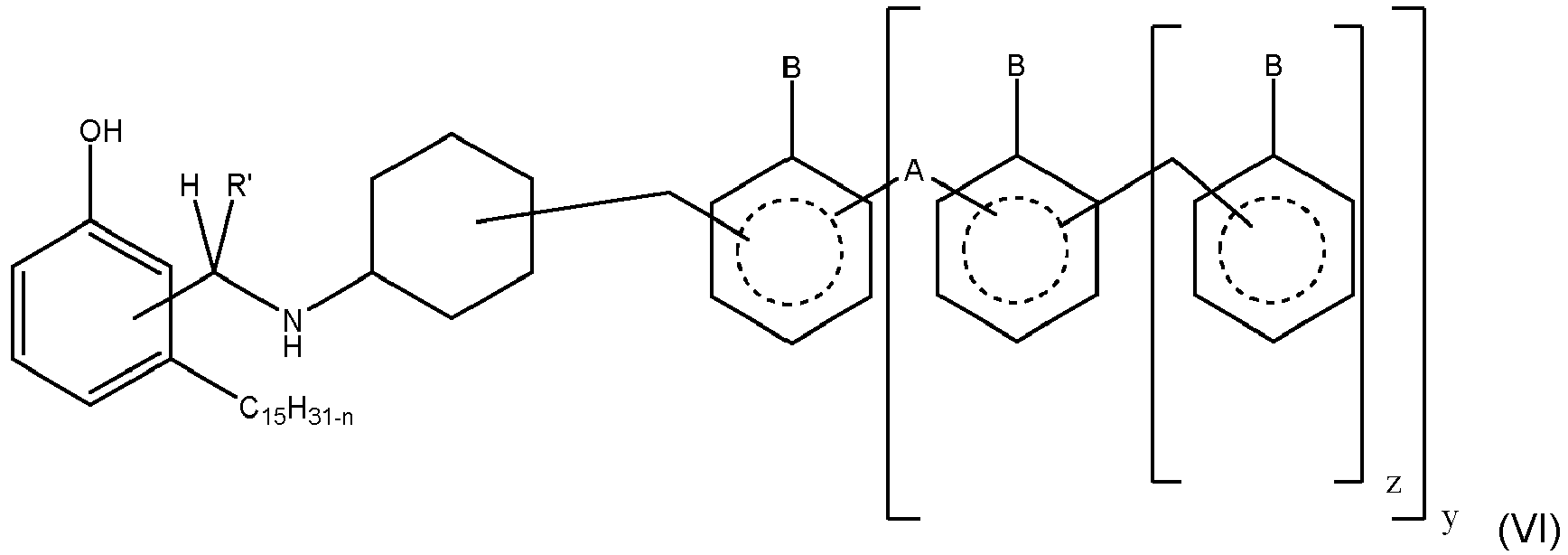

- The phenalkamine mixture of claim 3 wherein the at least one phenalkamine is selected from the group consisting of


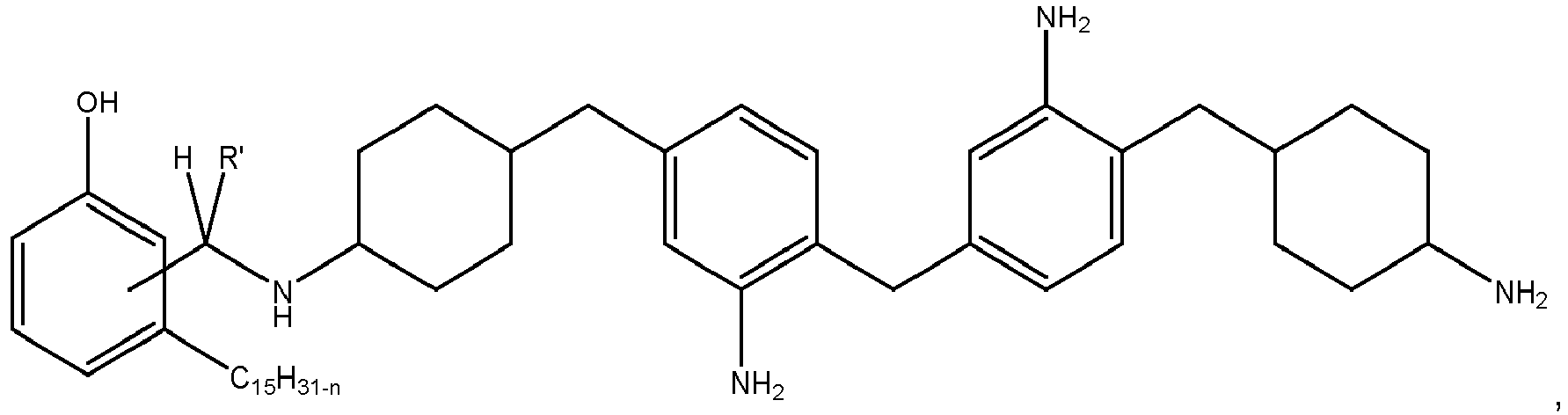

- The phenalkamine mixture of claim 4 comprising six phenalkamines from those present in claim 4.
- A curing agent composition comprising the phenalkamine mixture according to any of claims 1-5.
- The curing agent composition of claim 6 further comprising an additional amine having at least two amine functionalities.
- Use of a phenalkamine mixture according to any of claims 1-5 or of a curing agent composition according to any of claims 6-7 as hardener for epoxy resins.
- A method for producing the phenalkamine mixture of any of claims 1-5 comprising the steps of reacting (i) cardanol represented by the formula


- The method of claim 9 wherein the mole ratio of cardanol to methylene bridged poly(cycloaliphatic-aromatic)amines is within the range of from 1:1 to 1:3 and the mole ratio of methylene bridged poly(cycloaliphatic-aromatic)amines to aldehyde is within the range of from 1:1 to 1:3.
- The method of claim 9 wherein the cardanol and at least one methylene bridged poly(cycloaliphatic-aromatic)amine are mixed at temperature of 40-150°C and then treated with an aldehyde at temperature of 40-150°C.
- The method of claim 9 wherein the cardanol and aldehyde are mixed at a temperature of 40-150°C and then treated with at least one methylene bridged poly(cycloaliphatic-aromatic)amine at a temperature of 40-150°C.
- The method of claim 9 wherein the aldehyde is selected from the group consisting of formaldehyde, paraformaldehyde, acetaldehyde, propionaldehyde, butyraldehyde, pentanal, hexanal, heptanal, octanal, nonanal, decanal, benzaldehyde, cyclopentanecarboxaldehyde, and cyclohexanecarboxaldehyde.
- A method for producing the curing agent composition of claim 7 comprising combining a phenalkamine mixture of formula (IV) and an additional amine having at least two amine functionalities.
- Use of a phenalkamine mixture according to any of claims 1-5 or of a curing agent composition according to any of claims 6-7, together with at least one epoxy resin, for the preparation of hardened articles of manufacture.
- The use of claim 15, wherein the article is a coating, an adhesive, a construction product, a flooring product, or a composite product.
Applications Claiming Priority (1)
| Application Number | Priority Date | Filing Date | Title |
|---|---|---|---|
| US201962933024P | 2019-11-08 | 2019-11-08 |
Publications (2)
| Publication Number | Publication Date |
|---|---|
| EP3819286A1 true EP3819286A1 (en) | 2021-05-12 |
| EP3819286B1 EP3819286B1 (en) | 2024-08-21 |
Family
ID=73013345
Family Applications (1)
| Application Number | Title | Priority Date | Filing Date |
|---|---|---|---|
| EP20203494.8A Active EP3819286B1 (en) | 2019-11-08 | 2020-10-23 | Phenalkamine epoxy curing agents from methylene bridged poly(cyclohexyl-aromatic) amines and epoxy resin compositions containing the same |
Country Status (5)
| Country | Link |
|---|---|
| US (1) | US11891476B2 (en) |
| EP (1) | EP3819286B1 (en) |
| JP (1) | JP7699917B2 (en) |
| KR (1) | KR20210056244A (en) |
| CN (1) | CN112778500B (en) |
Families Citing this family (6)
| Publication number | Priority date | Publication date | Assignee | Title |
|---|---|---|---|---|
| EP4073138A4 (en) * | 2019-12-13 | 2024-01-17 | Mangesh Nadkarni, Jayram | Distilled cashew nut shell liquid based, water thinable phenalkamine as curing agent for epoxy paint compositions |
| WO2023210628A1 (en) * | 2022-04-26 | 2023-11-02 | サカタインクス株式会社 | Phenoxy(meth)acrylate resin, composition, cured object, and method for producing phenoxy(meth)acrylate resin |
| GB2619321B (en) * | 2022-05-31 | 2025-07-02 | Jones Paul | Process for preparing bio-based cured epoxy resin, and bio-based resins obtainable therefrom |
| CN118290277A (en) * | 2023-01-04 | 2024-07-05 | 万华化学集团股份有限公司 | A liquefied polysecondary amine and its preparation method and application |
| CN117550984B (en) * | 2024-01-12 | 2024-04-19 | 长春中科赫帝森材料科技有限公司 | Polyether amine curing agent, epoxy resin curing material, preparation method and application thereof |
| CN121181874B (en) * | 2025-08-21 | 2026-05-01 | 荆州市隆华石油化工有限公司 | Low-temperature polyether demulsifier for oil and gas gathering and transportation and preparation method thereof |
Citations (4)
| Publication number | Priority date | Publication date | Assignee | Title |
|---|---|---|---|---|
| GB1529740A (en) | 1975-03-17 | 1978-10-25 | Minnesota Mining & Mfg | Polyaminoalkylene substituted phenols and their application as curing agents for epoxy resins |
| US6262148B1 (en) | 1998-07-01 | 2001-07-17 | Vantico Inc. | Phenalkamine curing agents and epoxy resin compositions containing the same |
| WO2009080209A1 (en) | 2007-12-19 | 2009-07-02 | Cognis Ip Management Gmbh | Phenalkamine and salted amine blends as curing agents for epoxy resins |
| EP3170849A1 (en) * | 2015-11-17 | 2017-05-24 | Air Products And Chemicals, Inc. | Nitrogen-containing heterocyclic epoxy curing agents, compositions and methods |
Family Cites Families (16)
| Publication number | Priority date | Publication date | Assignee | Title |
|---|---|---|---|---|
| AU586013B2 (en) | 1985-08-19 | 1989-06-29 | Mitsubishi Kasei Corporation | Plastisol composition, undercoating material and blocked polyisocyanurate |
| JP2578161B2 (en) | 1988-04-26 | 1997-02-05 | サンスター技研株式会社 | Plastisol composition |
| US5130402A (en) | 1988-07-01 | 1992-07-14 | Sanyo Chemical Industries, Ltd. | Coating composition and plastisol composition, and articles coated therewith |
| US5280091A (en) * | 1992-02-07 | 1994-01-18 | Air Products And Chemicals, Inc. | Epoxy resins cured with mixed methylene bridged poly(cyclohexyl-aromatic)amine curing agents |
| US8735512B2 (en) | 2008-04-09 | 2014-05-27 | Air Products And Chemicals, Inc. | Curing agent for low temperature cure applications |
| CN102134306B (en) | 2011-03-04 | 2012-08-08 | 广东工业大学 | Cardanol epoxy floor curing agent and preparation method thereof |
| CN103102506B (en) | 2011-11-11 | 2015-02-18 | 林登科 | Accelerator and curing agent and its preparation method and application |
| CN102633992A (en) | 2012-04-11 | 2012-08-15 | 上海经天新材料科技有限公司 | Low-viscosity anacardol modified amine curing agent as well as preparation method and application thereof |
| CN104736634A (en) | 2012-10-31 | 2015-06-24 | 陶氏环球技术有限公司 | Curable epoxy resin composition |
| US9862798B2 (en) | 2013-09-30 | 2018-01-09 | Evonik Degussa Gmbh | Epoxy liquid curing agent compositions |
| CN105764951A (en) | 2013-12-09 | 2016-07-13 | 蓝立方知识产权有限责任公司 | Thermoplastic polyaminoether |
| US20170022317A1 (en) | 2014-03-31 | 2017-01-26 | Dow Global Technologies Llc | Natural oil derived blocked prepolymers and acrylic plastisol compositions having the blocked prepolymers |
| US10465039B2 (en) * | 2015-11-17 | 2019-11-05 | Evonik Degussa Gmbh | Epoxy curing agents, compositions and uses thereof |
| EP3205682A1 (en) | 2016-02-15 | 2017-08-16 | Sika Technology AG | Hardener for low-emission epoxy resin compositions |
| CN108779248B (en) * | 2016-02-22 | 2021-08-13 | 赢创运营有限公司 | Benzylated Mannich base curing agents, compositions and methods |
| CN107663268B (en) | 2016-07-28 | 2020-06-16 | 航天特种材料及工艺技术研究所 | Fast curing epoxy resin suitable for HP-RTM and preparation method thereof |
-
2020
- 2020-10-22 US US17/076,866 patent/US11891476B2/en active Active
- 2020-10-23 EP EP20203494.8A patent/EP3819286B1/en active Active
- 2020-11-04 KR KR1020200145927A patent/KR20210056244A/en active Pending
- 2020-11-06 JP JP2020185795A patent/JP7699917B2/en active Active
- 2020-11-06 CN CN202011230099.6A patent/CN112778500B/en active Active
Patent Citations (4)
| Publication number | Priority date | Publication date | Assignee | Title |
|---|---|---|---|---|
| GB1529740A (en) | 1975-03-17 | 1978-10-25 | Minnesota Mining & Mfg | Polyaminoalkylene substituted phenols and their application as curing agents for epoxy resins |
| US6262148B1 (en) | 1998-07-01 | 2001-07-17 | Vantico Inc. | Phenalkamine curing agents and epoxy resin compositions containing the same |
| WO2009080209A1 (en) | 2007-12-19 | 2009-07-02 | Cognis Ip Management Gmbh | Phenalkamine and salted amine blends as curing agents for epoxy resins |
| EP3170849A1 (en) * | 2015-11-17 | 2017-05-24 | Air Products And Chemicals, Inc. | Nitrogen-containing heterocyclic epoxy curing agents, compositions and methods |
Also Published As
| Publication number | Publication date |
|---|---|
| CN112778500B (en) | 2024-08-23 |
| JP2021075720A (en) | 2021-05-20 |
| KR20210056244A (en) | 2021-05-18 |
| JP7699917B2 (en) | 2025-06-30 |
| EP3819286B1 (en) | 2024-08-21 |
| US20210139642A1 (en) | 2021-05-13 |
| CN112778500A (en) | 2021-05-11 |
| US11891476B2 (en) | 2024-02-06 |
Similar Documents
| Publication | Publication Date | Title |
|---|---|---|
| EP3819286B1 (en) | Phenalkamine epoxy curing agents from methylene bridged poly(cyclohexyl-aromatic) amines and epoxy resin compositions containing the same | |
| EP3774984B1 (en) | Phenalkamine epoxy curing agents and epoxy resin compositions containing the same | |
| EP3420016B1 (en) | Benzylated mannich base curing agents, compositions, and methods | |
| US8518547B2 (en) | Alkylated polyalkylene polyamines and uses thereof | |
| JP6178383B2 (en) | Polyamides and amidoamines obtained from selectively modified amines | |
| US8198395B2 (en) | Alkylated aminopropylated ethylenediamines and uses thereof | |
| EP3774718A1 (en) | Process for producing phenalkamines | |
| EP3411421B1 (en) | Amidoamine and polyamide curing agents, compositions, and methods | |
| US20190330412A1 (en) | Room temperature ionic liquid curing agent | |
| US20090018278A1 (en) | Alkylated Aminopropylated Methylene-Di-(Cyclohexylamine) And Uses Thereof | |
| JP7728876B2 (en) | Epoxy hardeners and uses thereof | |
| WO2023057234A9 (en) | Compositions of epoxy curing agent incorporating naphthol and naphthol derivatives | |
| WO2025181188A1 (en) | Benzylated polyalkylene polyamines composition with enhanced epoxy coatings performance |
Legal Events
| Date | Code | Title | Description |
|---|---|---|---|
| PUAI | Public reference made under article 153(3) epc to a published international application that has entered the european phase |
Free format text: ORIGINAL CODE: 0009012 |
|
| STAA | Information on the status of an ep patent application or granted ep patent |
Free format text: STATUS: REQUEST FOR EXAMINATION WAS MADE |
|
| 17P | Request for examination filed |
Effective date: 20201023 |
|
| AK | Designated contracting states |
Kind code of ref document: A1 Designated state(s): AL AT BE BG CH CY CZ DE DK EE ES FI FR GB GR HR HU IE IS IT LI LT LU LV MC MK MT NL NO PL PT RO RS SE SI SK SM TR |
|
| STAA | Information on the status of an ep patent application or granted ep patent |
Free format text: STATUS: EXAMINATION IS IN PROGRESS |
|
| 17Q | First examination report despatched |
Effective date: 20230405 |
|
| GRAP | Despatch of communication of intention to grant a patent |
Free format text: ORIGINAL CODE: EPIDOSNIGR1 |
|
| STAA | Information on the status of an ep patent application or granted ep patent |
Free format text: STATUS: GRANT OF PATENT IS INTENDED |
|
| GRAS | Grant fee paid |
Free format text: ORIGINAL CODE: EPIDOSNIGR3 |
|
| INTG | Intention to grant announced |
Effective date: 20240613 |
|
| GRAA | (expected) grant |
Free format text: ORIGINAL CODE: 0009210 |
|
| STAA | Information on the status of an ep patent application or granted ep patent |
Free format text: STATUS: THE PATENT HAS BEEN GRANTED |
|
| AK | Designated contracting states |
Kind code of ref document: B1 Designated state(s): AL AT BE BG CH CY CZ DE DK EE ES FI FR GB GR HR HU IE IS IT LI LT LU LV MC MK MT NL NO PL PT RO RS SE SI SK SM TR |
|
| REG | Reference to a national code |
Ref country code: GB Ref legal event code: FG4D |
|
| REG | Reference to a national code |
Ref country code: CH Ref legal event code: EP |
|
| P01 | Opt-out of the competence of the unified patent court (upc) registered |
Free format text: CASE NUMBER: APP_44112/2024 Effective date: 20240730 |
|
| REG | Reference to a national code |
Ref country code: DE Ref legal event code: R096 Ref document number: 602020036099 Country of ref document: DE |
|
| REG | Reference to a national code |
Ref country code: IE Ref legal event code: FG4D |
|
| REG | Reference to a national code |
Ref country code: LT Ref legal event code: MG9D |
|
| REG | Reference to a national code |
Ref country code: NL Ref legal event code: MP Effective date: 20240821 |
|
| PG25 | Lapsed in a contracting state [announced via postgrant information from national office to epo] |
Ref country code: NO Free format text: LAPSE BECAUSE OF FAILURE TO SUBMIT A TRANSLATION OF THE DESCRIPTION OR TO PAY THE FEE WITHIN THE PRESCRIBED TIME-LIMIT Effective date: 20241121 |
|
| REG | Reference to a national code |
Ref country code: AT Ref legal event code: MK05 Ref document number: 1715393 Country of ref document: AT Kind code of ref document: T Effective date: 20240821 |
|
| PG25 | Lapsed in a contracting state [announced via postgrant information from national office to epo] |
Ref country code: NL Free format text: LAPSE BECAUSE OF FAILURE TO SUBMIT A TRANSLATION OF THE DESCRIPTION OR TO PAY THE FEE WITHIN THE PRESCRIBED TIME-LIMIT Effective date: 20240821 Ref country code: PT Free format text: LAPSE BECAUSE OF FAILURE TO SUBMIT A TRANSLATION OF THE DESCRIPTION OR TO PAY THE FEE WITHIN THE PRESCRIBED TIME-LIMIT Effective date: 20241223 Ref country code: FI Free format text: LAPSE BECAUSE OF FAILURE TO SUBMIT A TRANSLATION OF THE DESCRIPTION OR TO PAY THE FEE WITHIN THE PRESCRIBED TIME-LIMIT Effective date: 20240821 Ref country code: GR Free format text: LAPSE BECAUSE OF FAILURE TO SUBMIT A TRANSLATION OF THE DESCRIPTION OR TO PAY THE FEE WITHIN THE PRESCRIBED TIME-LIMIT Effective date: 20241122 Ref country code: PL Free format text: LAPSE BECAUSE OF FAILURE TO SUBMIT A TRANSLATION OF THE DESCRIPTION OR TO PAY THE FEE WITHIN THE PRESCRIBED TIME-LIMIT Effective date: 20240821 |
|
| PG25 | Lapsed in a contracting state [announced via postgrant information from national office to epo] |
Ref country code: BG Free format text: LAPSE BECAUSE OF FAILURE TO SUBMIT A TRANSLATION OF THE DESCRIPTION OR TO PAY THE FEE WITHIN THE PRESCRIBED TIME-LIMIT Effective date: 20240821 |
|
| PG25 | Lapsed in a contracting state [announced via postgrant information from national office to epo] |
Ref country code: LV Free format text: LAPSE BECAUSE OF FAILURE TO SUBMIT A TRANSLATION OF THE DESCRIPTION OR TO PAY THE FEE WITHIN THE PRESCRIBED TIME-LIMIT Effective date: 20240821 |
|
| PG25 | Lapsed in a contracting state [announced via postgrant information from national office to epo] |
Ref country code: AT Free format text: LAPSE BECAUSE OF FAILURE TO SUBMIT A TRANSLATION OF THE DESCRIPTION OR TO PAY THE FEE WITHIN THE PRESCRIBED TIME-LIMIT Effective date: 20240821 Ref country code: IS Free format text: LAPSE BECAUSE OF FAILURE TO SUBMIT A TRANSLATION OF THE DESCRIPTION OR TO PAY THE FEE WITHIN THE PRESCRIBED TIME-LIMIT Effective date: 20241221 |
|
| PG25 | Lapsed in a contracting state [announced via postgrant information from national office to epo] |
Ref country code: HR Free format text: LAPSE BECAUSE OF FAILURE TO SUBMIT A TRANSLATION OF THE DESCRIPTION OR TO PAY THE FEE WITHIN THE PRESCRIBED TIME-LIMIT Effective date: 20240821 |
|
| PG25 | Lapsed in a contracting state [announced via postgrant information from national office to epo] |
Ref country code: ES Free format text: LAPSE BECAUSE OF FAILURE TO SUBMIT A TRANSLATION OF THE DESCRIPTION OR TO PAY THE FEE WITHIN THE PRESCRIBED TIME-LIMIT Effective date: 20240821 Ref country code: RS Free format text: LAPSE BECAUSE OF FAILURE TO SUBMIT A TRANSLATION OF THE DESCRIPTION OR TO PAY THE FEE WITHIN THE PRESCRIBED TIME-LIMIT Effective date: 20241121 |
|
| PG25 | Lapsed in a contracting state [announced via postgrant information from national office to epo] |
Ref country code: RS Free format text: LAPSE BECAUSE OF FAILURE TO SUBMIT A TRANSLATION OF THE DESCRIPTION OR TO PAY THE FEE WITHIN THE PRESCRIBED TIME-LIMIT Effective date: 20241121 Ref country code: PT Free format text: LAPSE BECAUSE OF FAILURE TO SUBMIT A TRANSLATION OF THE DESCRIPTION OR TO PAY THE FEE WITHIN THE PRESCRIBED TIME-LIMIT Effective date: 20241223 Ref country code: PL Free format text: LAPSE BECAUSE OF FAILURE TO SUBMIT A TRANSLATION OF THE DESCRIPTION OR TO PAY THE FEE WITHIN THE PRESCRIBED TIME-LIMIT Effective date: 20240821 Ref country code: NO Free format text: LAPSE BECAUSE OF FAILURE TO SUBMIT A TRANSLATION OF THE DESCRIPTION OR TO PAY THE FEE WITHIN THE PRESCRIBED TIME-LIMIT Effective date: 20241121 Ref country code: NL Free format text: LAPSE BECAUSE OF FAILURE TO SUBMIT A TRANSLATION OF THE DESCRIPTION OR TO PAY THE FEE WITHIN THE PRESCRIBED TIME-LIMIT Effective date: 20240821 Ref country code: LV Free format text: LAPSE BECAUSE OF FAILURE TO SUBMIT A TRANSLATION OF THE DESCRIPTION OR TO PAY THE FEE WITHIN THE PRESCRIBED TIME-LIMIT Effective date: 20240821 Ref country code: IS Free format text: LAPSE BECAUSE OF FAILURE TO SUBMIT A TRANSLATION OF THE DESCRIPTION OR TO PAY THE FEE WITHIN THE PRESCRIBED TIME-LIMIT Effective date: 20241221 Ref country code: HR Free format text: LAPSE BECAUSE OF FAILURE TO SUBMIT A TRANSLATION OF THE DESCRIPTION OR TO PAY THE FEE WITHIN THE PRESCRIBED TIME-LIMIT Effective date: 20240821 Ref country code: GR Free format text: LAPSE BECAUSE OF FAILURE TO SUBMIT A TRANSLATION OF THE DESCRIPTION OR TO PAY THE FEE WITHIN THE PRESCRIBED TIME-LIMIT Effective date: 20241122 Ref country code: FI Free format text: LAPSE BECAUSE OF FAILURE TO SUBMIT A TRANSLATION OF THE DESCRIPTION OR TO PAY THE FEE WITHIN THE PRESCRIBED TIME-LIMIT Effective date: 20240821 Ref country code: ES Free format text: LAPSE BECAUSE OF FAILURE TO SUBMIT A TRANSLATION OF THE DESCRIPTION OR TO PAY THE FEE WITHIN THE PRESCRIBED TIME-LIMIT Effective date: 20240821 Ref country code: BG Free format text: LAPSE BECAUSE OF FAILURE TO SUBMIT A TRANSLATION OF THE DESCRIPTION OR TO PAY THE FEE WITHIN THE PRESCRIBED TIME-LIMIT Effective date: 20240821 Ref country code: AT Free format text: LAPSE BECAUSE OF FAILURE TO SUBMIT A TRANSLATION OF THE DESCRIPTION OR TO PAY THE FEE WITHIN THE PRESCRIBED TIME-LIMIT Effective date: 20240821 |
|
| PG25 | Lapsed in a contracting state [announced via postgrant information from national office to epo] |
Ref country code: RO Free format text: LAPSE BECAUSE OF FAILURE TO SUBMIT A TRANSLATION OF THE DESCRIPTION OR TO PAY THE FEE WITHIN THE PRESCRIBED TIME-LIMIT Effective date: 20240821 Ref country code: DK Free format text: LAPSE BECAUSE OF FAILURE TO SUBMIT A TRANSLATION OF THE DESCRIPTION OR TO PAY THE FEE WITHIN THE PRESCRIBED TIME-LIMIT Effective date: 20240821 Ref country code: SM Free format text: LAPSE BECAUSE OF FAILURE TO SUBMIT A TRANSLATION OF THE DESCRIPTION OR TO PAY THE FEE WITHIN THE PRESCRIBED TIME-LIMIT Effective date: 20240821 |
|
| PG25 | Lapsed in a contracting state [announced via postgrant information from national office to epo] |
Ref country code: EE Free format text: LAPSE BECAUSE OF FAILURE TO SUBMIT A TRANSLATION OF THE DESCRIPTION OR TO PAY THE FEE WITHIN THE PRESCRIBED TIME-LIMIT Effective date: 20240821 |
|
| PG25 | Lapsed in a contracting state [announced via postgrant information from national office to epo] |
Ref country code: CZ Free format text: LAPSE BECAUSE OF FAILURE TO SUBMIT A TRANSLATION OF THE DESCRIPTION OR TO PAY THE FEE WITHIN THE PRESCRIBED TIME-LIMIT Effective date: 20240821 |
|
| PG25 | Lapsed in a contracting state [announced via postgrant information from national office to epo] |
Ref country code: SK Free format text: LAPSE BECAUSE OF FAILURE TO SUBMIT A TRANSLATION OF THE DESCRIPTION OR TO PAY THE FEE WITHIN THE PRESCRIBED TIME-LIMIT Effective date: 20240821 |
|
| REG | Reference to a national code |
Ref country code: DE Ref legal event code: R097 Ref document number: 602020036099 Country of ref document: DE |
|
| REG | Reference to a national code |
Ref country code: CH Ref legal event code: PL |
|
| PLBE | No opposition filed within time limit |
Free format text: ORIGINAL CODE: 0009261 |
|
| STAA | Information on the status of an ep patent application or granted ep patent |
Free format text: STATUS: NO OPPOSITION FILED WITHIN TIME LIMIT |
|
| PG25 | Lapsed in a contracting state [announced via postgrant information from national office to epo] |
Ref country code: MC Free format text: LAPSE BECAUSE OF FAILURE TO SUBMIT A TRANSLATION OF THE DESCRIPTION OR TO PAY THE FEE WITHIN THE PRESCRIBED TIME-LIMIT Effective date: 20240821 |
|
| PG25 | Lapsed in a contracting state [announced via postgrant information from national office to epo] |
Ref country code: BE Free format text: LAPSE BECAUSE OF NON-PAYMENT OF DUE FEES Effective date: 20241031 Ref country code: LU Free format text: LAPSE BECAUSE OF NON-PAYMENT OF DUE FEES Effective date: 20241023 |
|
| PG25 | Lapsed in a contracting state [announced via postgrant information from national office to epo] |
Ref country code: CH Free format text: LAPSE BECAUSE OF NON-PAYMENT OF DUE FEES Effective date: 20241031 |
|
| 26N | No opposition filed |
Effective date: 20250522 |
|
| REG | Reference to a national code |
Ref country code: BE Ref legal event code: MM Effective date: 20241031 |
|
| PG25 | Lapsed in a contracting state [announced via postgrant information from national office to epo] |
Ref country code: SE Free format text: LAPSE BECAUSE OF FAILURE TO SUBMIT A TRANSLATION OF THE DESCRIPTION OR TO PAY THE FEE WITHIN THE PRESCRIBED TIME-LIMIT Effective date: 20240821 |
|
| PG25 | Lapsed in a contracting state [announced via postgrant information from national office to epo] |
Ref country code: IE Free format text: LAPSE BECAUSE OF NON-PAYMENT OF DUE FEES Effective date: 20241023 |
|
| PGFP | Annual fee paid to national office [announced via postgrant information from national office to epo] |
Ref country code: DE Payment date: 20251021 Year of fee payment: 6 |
|
| PGFP | Annual fee paid to national office [announced via postgrant information from national office to epo] |
Ref country code: GB Payment date: 20251022 Year of fee payment: 6 |
|
| PGFP | Annual fee paid to national office [announced via postgrant information from national office to epo] |
Ref country code: IT Payment date: 20251024 Year of fee payment: 6 |
|
| PGFP | Annual fee paid to national office [announced via postgrant information from national office to epo] |
Ref country code: FR Payment date: 20251030 Year of fee payment: 6 |
|
| PG25 | Lapsed in a contracting state [announced via postgrant information from national office to epo] |
Ref country code: CY Free format text: LAPSE BECAUSE OF FAILURE TO SUBMIT A TRANSLATION OF THE DESCRIPTION OR TO PAY THE FEE WITHIN THE PRESCRIBED TIME-LIMIT; INVALID AB INITIO Effective date: 20201023 |
|
| PG25 | Lapsed in a contracting state [announced via postgrant information from national office to epo] |
Ref country code: HU Free format text: LAPSE BECAUSE OF FAILURE TO SUBMIT A TRANSLATION OF THE DESCRIPTION OR TO PAY THE FEE WITHIN THE PRESCRIBED TIME-LIMIT; INVALID AB INITIO Effective date: 20201023 |