EP3819189B1 - Venting device and electric power steering device - Google Patents
Venting device and electric power steering device Download PDFInfo
- Publication number
- EP3819189B1 EP3819189B1 EP18925627.4A EP18925627A EP3819189B1 EP 3819189 B1 EP3819189 B1 EP 3819189B1 EP 18925627 A EP18925627 A EP 18925627A EP 3819189 B1 EP3819189 B1 EP 3819189B1
- Authority
- EP
- European Patent Office
- Prior art keywords
- electric power
- power steering
- steering device
- breathing
- control unit
- Prior art date
- Legal status (The legal status is an assumption and is not a legal conclusion. Google has not performed a legal analysis and makes no representation as to the accuracy of the status listed.)
- Active
Links
Images



Classifications
-
- H—ELECTRICITY
- H02—GENERATION; CONVERSION OR DISTRIBUTION OF ELECTRIC POWER
- H02K—DYNAMO-ELECTRIC MACHINES
- H02K5/00—Casings; Enclosures; Supports
- H02K5/04—Casings or enclosures characterised by the shape, form or construction thereof
- H02K5/10—Casings or enclosures characterised by the shape, form or construction thereof with arrangements for protection from ingress, e.g. water or fingers
-
- B—PERFORMING OPERATIONS; TRANSPORTING
- B60—VEHICLES IN GENERAL
- B60R—VEHICLES, VEHICLE FITTINGS, OR VEHICLE PARTS, NOT OTHERWISE PROVIDED FOR
- B60R16/00—Electric or fluid circuits specially adapted for vehicles and not otherwise provided for; Arrangement of elements of electric or fluid circuits specially adapted for vehicles and not otherwise provided for
- B60R16/02—Electric or fluid circuits specially adapted for vehicles and not otherwise provided for; Arrangement of elements of electric or fluid circuits specially adapted for vehicles and not otherwise provided for electric constitutive elements
- B60R16/0207—Wire harnesses
-
- B—PERFORMING OPERATIONS; TRANSPORTING
- B62—LAND VEHICLES FOR TRAVELLING OTHERWISE THAN ON RAILS
- B62D—MOTOR VEHICLES; TRAILERS
- B62D5/00—Power-assisted or power-driven steering
- B62D5/04—Power-assisted or power-driven steering electrical, e.g. using an electric servo-motor connected to, or forming part of, the steering gear
- B62D5/0457—Power-assisted or power-driven steering electrical, e.g. using an electric servo-motor connected to, or forming part of, the steering gear characterised by control features of the drive means as such
- B62D5/046—Controlling the motor
-
- H—ELECTRICITY
- H02—GENERATION; CONVERSION OR DISTRIBUTION OF ELECTRIC POWER
- H02K—DYNAMO-ELECTRIC MACHINES
- H02K11/00—Structural association of dynamo-electric machines with electric components or with devices for shielding, monitoring or protection
- H02K11/30—Structural association with control circuits or drive circuits
- H02K11/33—Drive circuits, e.g. power electronics
-
- H—ELECTRICITY
- H02—GENERATION; CONVERSION OR DISTRIBUTION OF ELECTRIC POWER
- H02K—DYNAMO-ELECTRIC MACHINES
- H02K5/00—Casings; Enclosures; Supports
- H02K5/04—Casings or enclosures characterised by the shape, form or construction thereof
- H02K5/22—Auxiliary parts of casings not covered by groups H02K5/06-H02K5/20, e.g. shaped to form connection boxes or terminal boxes
- H02K5/225—Terminal boxes or connection arrangements
-
- B—PERFORMING OPERATIONS; TRANSPORTING
- B62—LAND VEHICLES FOR TRAVELLING OTHERWISE THAN ON RAILS
- B62D—MOTOR VEHICLES; TRAILERS
- B62D5/00—Power-assisted or power-driven steering
- B62D5/04—Power-assisted or power-driven steering electrical, e.g. using an electric servo-motor connected to, or forming part of, the steering gear
- B62D5/0403—Power-assisted or power-driven steering electrical, e.g. using an electric servo-motor connected to, or forming part of, the steering gear characterised by constructional features, e.g. common housing for motor and gear box
-
- B—PERFORMING OPERATIONS; TRANSPORTING
- B62—LAND VEHICLES FOR TRAVELLING OTHERWISE THAN ON RAILS
- B62D—MOTOR VEHICLES; TRAILERS
- B62D5/00—Power-assisted or power-driven steering
- B62D5/04—Power-assisted or power-driven steering electrical, e.g. using an electric servo-motor connected to, or forming part of, the steering gear
- B62D5/0403—Power-assisted or power-driven steering electrical, e.g. using an electric servo-motor connected to, or forming part of, the steering gear characterised by constructional features, e.g. common housing for motor and gear box
- B62D5/0406—Power-assisted or power-driven steering electrical, e.g. using an electric servo-motor connected to, or forming part of, the steering gear characterised by constructional features, e.g. common housing for motor and gear box including housing for electronic control unit
-
- H—ELECTRICITY
- H02—GENERATION; CONVERSION OR DISTRIBUTION OF ELECTRIC POWER
- H02K—DYNAMO-ELECTRIC MACHINES
- H02K2205/00—Specific aspects not provided for in the other groups of this subclass relating to casings, enclosures, supports
- H02K2205/09—Machines characterised by drain passages or by venting, breathing or pressure compensating means
-
- H—ELECTRICITY
- H02—GENERATION; CONVERSION OR DISTRIBUTION OF ELECTRIC POWER
- H02K—DYNAMO-ELECTRIC MACHINES
- H02K2211/00—Specific aspects not provided for in the other groups of this subclass relating to measuring or protective devices or electric components
- H02K2211/03—Machines characterised by circuit boards, e.g. pcb
Definitions
- the present invention relates to an electric power steering device having a breathing device.
- some devices such as electric power steering devices and motor generators including a rotating machine and a control unit integrated with each other are mounted to a vehicle in the vicinity of a rack shaft outside a cabin.
- methods such as application of a sealing material and installation of an O-ring are employed not only as the waterproof structure for the rotating machine and the control unit but also as the waterproof structure for connection surfaces of the rotating machine and the control unit.
- an electric power steering device which is configured to prevent clogging of a breathing hole and a filter to improve ventilation efficiency of a case, and is configured to reduce a pressure difference between an outside and an inside of the case when the temperature and pressure in the case rapidly increase (see, for example, JP 2005-132165 A ).
- US 2009/047890 discloses a vent member protruding from a housing. Nevertheless, this document does not disclose an electric power steering device.
- US 2016/280249 discloses a motor-driven power steering apparatus 1 including a rack shaft housing 10A having an internal pressure adjusting unit 100.
- US 2011/097219 discloses a water pump for pumping ice water including a motor assembly, a cover, and a tube.
- Document US 2017/282965 discloses (see Fig. 1 , 4 , 5 ) a power steering electric motor with an breathing valve in the upward facing inverter casing wall, arranged in-between the power and signal connectors.
- a case forming a breather includes a breathing hole provided with a filter.
- This filter is water-repellent, and thus is impermeable to water but permeable to air. Therefore, the filter provides a certain level of waterproofness against water spray such as rain.
- a way of use is devised in an environment in which a pressure difference equal to or larger than that expected according to a standard specification occurs due to, for example, a temperature difference equal to or larger than a difference determined in advance.
- the present invention has been made to solve such a problem, and has an object to provide a breathing device capable of improving waterproofness, and an electric power steering device.
- the breathing device can improve the waterproofness of the electric power steering device.
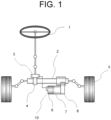
- FIG. 1 is a schematic view for illustrating a main part of a vehicle to which an electric power steering device 10 according to a first embodiment of the present invention is mounted.
- the main part of the vehicle includes a steering wheel 1, a rack shaft 2, a torque sensor 3, a pinion 4, tires 5, and the electric power steering device 10.
- the torque sensor 3 among these components is mounted to a column extending from the steering wheel 1, and is configured to detect a steering torque by a driver.
- the electric power steering device 10 has the waterproof structure formed through integration of a motor 7, which is a rotating machine, and a control unit 6, and is configured to mesh with a gear 8 along a rack shaft 2.
- the electric power steering device 10 is mounted at a position closer to the ground than the rack shaft 2 along the rack shaft 2. Compared with the case in which the electric power steering device 10 is mounted to a portion above the rack shaft 2 as in the case of the torque sensor 3, when the electric power steering device 10 is mounted at the position close to the ground, higher waterproofness are essentially required in specifications.
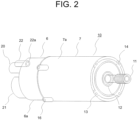
- FIG. 2 is a partially transparent perspective view for illustrating the basic structure of the electric power steering device 10.
- the motor 7 incorporates a stator, windings, a rotor, and the like in a motor housing 7a, as is publicly known.
- the motor housing 7a is made of metal, and has a bottom on a right side of FIG. 2 and an opening on a left side. Therefore, the entry of water from a side surface of the motor 7 illustrated in FIG. 2 can completely be blocked.
- motor mounting portions 13 provided at four positions and the gear 8 are fixed to each other by fastening with screws.
- the motor mounting portions 13 may be provided at three positions depending on a mounting direction. In this case, the waterproofness between the motor 7 and the gear 8 is secured by fitting an O-ring to an O-ring groove 14 formed on a radially inner side of the motor mounting portions 13.
- a bearing 12 is mounted at a base portion of the output shaft 11 in a surface of the motor mounting portions 13 on a radially inner side of the O-ring groove 14.
- the bearing 12 may have the non-waterproof structure or the waterproof structure.
- the waterproof structure for example, it is only required that the O-ring be mounted on an outer periphery and that a seal member obtained by affixing rubber to an outer periphery of a metal plate be mounted to each of an inner ring and an outer ring. With such structure, a breathing passage is eliminated between an inside and an outside of this bearing 12.
- the waterproof structure is not employed in the bearing 12, the waterproof performance may be secured through installation of an oil seal on the gear side of the bearing 12.
- control unit 6 integrally coupled to the motor housing 7a incorporates, for example, a circuit network and the like in a case 6a made of an insulation resin material.
- the motor housing 7a and the case 6a are mounted to each other so as to form the waterproof structure by fastening with screws at three positions of mounting portions 16, and further, for example, applying a gasket or a sealing material to inner walls on contact surfaces of the motor housing 7a and the case 6a.
- a power supply connector 20 and a signal connector 21 including a torque sensor 3 are formed integrally with the case 6a in a rear end portion of the control unit 6.
- both of the motor 7 and the control unit 6, which serves to control the drive of the motor 7, generate heat.
- a heat radiation member is arranged so as to transfer the heat also to the motor 7 and the motor components.
- a breathing device 22 is arranged at a position close to the power supply connector 20 and the signal connector 21 on an end surface of the control unit 6 on the side opposite to the output shaft 11 of the motor 7.
- the breathing device 22 includes a ventilator which protrudes from an inside of the electric power steering device 10 to an outside of the electric power steering device 10, to thereby be capable of ventilation.
- the breathing device 22 is configured to provide the breathing action through ventilation between the inside and the outside of the electric power steering device 10. It is only required that the ventilator protrude basically in a horizontal direction or upward with respect to the horizontal direction, and may be considered as a tubular chimney in terms of functionality.
- the breathing device 22 when the breathing device 22 is mounted to a lowest portion of the vehicle, there is a risk in that the entire electric power steering device 10 may be submerged due to, for example, traveling in a puddle. In consideration of this point, it is preferred that the breathing device 22 be arranged at a position as high as possible on the end surface of the control unit 6.
- the breathing device 22 include a water-repellent filter 22a mounted on an inner side of the electric power steering device 10.
- the water-repellant filter 22a can prevent the entry of water into the control unit 6 when the water enters the breathing device 22.
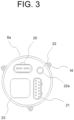
- FIG. 3 is an end view for illustrating the electric power steering device 10 as seen from the control unit 6 side.
- FIG. 4 is a partially cutaway side view for illustrating the electric power steering device 10, with vehicle members, as seen from a side-surface side of the control unit 6.
- the breathing device 22 is arranged at a substantially middle position between the power supply connector 20 and the signal connector 21 on the end surface of the electric power steering device 10 on the control unit 6 side. Moreover, a large-component accommodation portion 23 configured to incorporate large components such as a noise filter and a capacitor, which are difficult to be incorporated in the control unit 6, is provided in a diagonal direction of the breathing device 22.
- the power supply connector 20 includes two terminals on a plus side and a minus side. Sectional areas of the terminals are set to be large so that a large current for driving the motor 7 can be supplied. In contrast, in the signal connector 21, a large number of small terminals are arranged so as to be used for inputting information on the vehicle side such as that from the torque sensor 3 and vehicle speed and outputting transmission signals from the control unit 6. A ventilation hole is formed at the center of the breathing device 22 so as to be capable of ventilation.
- a vehicle-side connector 20a is connected to the power supply connector 20, and a harness 20b is further connected to the vehicle-side connector 20a.
- a vehicle-side connector 21a is connected also to the signal connector 21, and a harness 21b, which is a signal line, is further connected to the vehicle-side connector 21a. All of these connectors have waterproof specifications.
- the mounting position of the electric power steering device 10 to the vehicle is on the lowest layer, and hence all of the vehicle side connectors 20a and 21a and the harnesses 20b and 21b are connected so as to extend upward.
- the torque sensor 3 is illustrated in FIG. 1 , and other components such as a battery and a vehicle speed sensor are arranged above the rack shaft 2. Therefore, the harnesses 20b and 21b extend upward.
- a ventilation part 22b of the breathing device 22 extends so as to protrude on the outer side of the case 6a.
- the structure that includes the ventilation part 22b as a part and is further extended can be employed.
- a pipe, a tube 22c, or the like can be added to a distal end portion of the ventilation part 22b. It is preferred that, as illustrated in FIG. 4 , the pipe, the tube 22c, or the like have a shape bent upward.
- the breathing device 22 having the extended structure including the ventilation part 22b may be arranged in a lower portion of the end surface of the control unit 6.
- the ventilation part 22b and the tube 22c may be extended along the vehicle-side harnesses 20b and 21b, or may be fixed together with the harnesses 20b and 21b.
- a distal end portion of the tube 22c is extended to an inside of the vehicle body in which there is not a fear of exposure to water, complete waterproofness is achieved.
- the water-repellant filter 22a of the breathing device 22 is not required.
- a ventilation passage from the breathing device 22 to the inside the electric power steering device 10 in a case of the motor 7, for example, a gap defined between the stator and the rotor or a gap defined between an outer layer of the stator and an inner surface of the motor housing 7a may be used.
- a control CPU, various electric lines, ICs, a drive circuit for the motor windings, and the like are mounted to substrates, relay members, and heatsinks inside the control unit 6. Many spaces are defined between the substrates, the relay members, the heatsinks, and the like, and the case 6a, and an infinite number of ventilation passages thus is present. Therefore, as the ventilation passages inside the control unit 6 and the motor 7, the spaces defined by respective portions can be used.
- the electric power steering device has the configuration in which the breathing device is arranged on the outer surface of the case of the control unit. Therefore, while the breathing action of the breathing device effectively functions, the waterproofness can be secured even in an environment in which a pressure difference equal to or larger than that expected according to a standard specification occurs. Moreover, the breathing action of the breathing device can prevent deterioration of the waterproof performance of the electric power steering device.
- the waterproof structure can be provided by extending the ventilator of the breathing device, and arranging the extension along the harnesses or fixing the extension together with the harnesses. With this configuration, even when the electric power steering device is submerged, the breathing action of the breathing device can be secured. Moreover, when the ventilator of the breathing device is extended, the structure to achieve complete waterproofness of the ventilator is not required. Further, the ventilation passage can be secured through use of a path having suitable shape inside the electric power steering device.
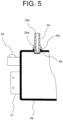
- FIG. 5 is a side sectional view for illustrating the control unit 6 side of a main part of the electric power steering device according to a second embodiment of the present invention.
- components of the electric power steering device having the same configuration are denoted by the same reference numerals as those in the first embodiment. Thus, description of those components is omitted, and description is mainly given of different configurations.
- a breathing device 24 is provided on a side surface of the case 6a, which has a cylindrical case, of the control unit 6.
- the breathing device 24 is provided separately from the case 6a. Therefore, a mounting hole 6b for mounting the breathing device 24 is formed in the case 6a.
- a water-repellant filter 24a is mounted to a lower end portion of the breathing device 24 located inside the control unit 6.
- the breathing device 24 includes a ventilation part 24b extending upward.
- an O-ring 24c is arranged between an outer peripheral wall of the case 6a and a lower portion of the breathing device 24 in order to secure waterproofness between the case 6a and the breathing device 24.
- a waterproof adhesive or a sealing material may be used in place of the O-ring 24c.
- the breathing device 24 according to the second embodiment is provided in an upper portion of the side surface of the control unit 6, and the exposure to water of the breathing device 24 thus is less liable to occur. Therefore, the water-repellant filter 24a is not always required.
- FIG. 5 illustration is given of an example case in which a diameter of the ventilation passage of the ventilation part 24b is constant.
- the ventilation passage of the ventilation part 24b may be formed so that the diameter thereof increases as the position approaches the water-repellant filter 24a.
- the water-repellant filter 24a In the breathing device 24, in consideration of a resistance in the breathing action, the water-repellant filter 24a has the highest resistance, and a portion causing a resistance is not present in the ventilation passage in the ventilation part 24b. Therefore, even when the diameter of the ventilation passage is smaller than the hole diameter at the mounting position of the water-repellant filter 24a, the effect of the breathing action is not reduced.
- the breathing device 24 is mounted to the upper portion of the side surface of the control unit 6.
- the breathing device 24 may be mounted to an upper portion of the side surface of the motor housing 7a illustrated in FIG. 2 .
- the motor housing 7a incorporates the stator, the motor windings, and the like, and it is thus required to mount the breathing device 24 at a position without interference with these components.
- the ventilation passage at the center of the ventilation part 24b extends upward in the form of a chimney also in the breathing device 24 provided separately of the case 6a.
- the ventilation part 24b can be used as a ventilation passage, and the ventilation in the control unit 6 is thus particularly achieved.
- a change in pressure inside the electric power steering device can be reduced through use of the breathing action of the breathing device 24, and deterioration of a waterproof function of other portions can also be prevented.
- the breathing device 24 according to the second embodiment be arranged in a position as high as possible in the electric power steering device. Moreover, there is given the configuration in which the water-repellant filter 24a is mounted to the lower portion of the ventilation part 24b, but the water-repellant filter 24a may be mounted to an upper portion of the ventilation part 24b.
- FIG. 6 is a partially cutaway side sectional view for illustrating the basic structure of the electric power steering device according to a third embodiment of the present invention, with an inside thereof being exposed.
- components of the electric power steering device having the same configuration are denoted by the same reference numerals as those in the first and second embodiments. Thus, description of those components is omitted, and description is mainly given of different configurations.
- the breathing device 24 is provided on an end surface of the motor housing 7a of the motor 7.
- the electric power steering device according to the third embodiment is of a type in which the control unit 6 is arranged on the output side of the output shaft 11 of the motor 7.
- a rotor 72, a stator 71, and windings 73 are arranged inside the motor housing 7a from the output shaft 11 as a central axis toward an outer side in a radial direction. End portions of the windings 73 are connected by an annular circuit 74, and are further extended to a unit inner portion 6c of the control unit 6.
- Bearings 12a and 12b are respectively interposed on both of end sides of the output shaft 11. The output shaft 11 can freely be rotated through use of these bearings 12a and 12b.
- the control unit 6 includes a housing 6d made of, for example, aluminum, so as to also serve as a heat radiation member.
- a relay member 63, a control substrate 60, power elements 62, and the like are arranged in the unit inner portion 6c.
- the relay member 63 is configured to mount wires and components.
- the control substrate 60 includes electronic components such as the CPU 61 mounted thereon.
- the power elements 62 are configured to supply currents to the motor windings 73.
- the power supply connector 20 and the signal connector 21 for the electrical connection to the vehicle are arranged so as to protrude from the side surface of the control unit 6.
- a hole is formed in an end surface of a rear end portion of the motor 7 in order to arrange an axial center of the output shaft 11 with high accuracy.
- the breathing device 24 is arranged so as to close this hole.
- the breathing device 24 itself has basically the same structure as that described in the second embodiment. That is, the breathing device 24 includes the water-repellant filter 24a, the O-ring 24c, and the ventilation part 24b.
- an extended ventilation part 24e bent upward is provided in a distal end portion of the ventilation part 24b.
- the extended ventilation part 24e is illustrated in a state in which the extended ventilation part 24e is bent toward the right side, but this right side corresponds to the upper side in a state in which the motor 7 is actually installed.
- the electric power steering device according to the third embodiment When the electric power steering device according to the third embodiment is arranged below the rack shaft 2 illustrated in FIG. 1 , it is only required that the extended ventilator 24e of the breathing device 24 be extended to a position close to the rack shaft 2. In this case, even when the electric power steering device is submerged, the breathing action of the breathing device 24 can be secured.
- the extended ventilator 24e of the breathing device 24 may be extended downward.
- the extended ventilator 24e of the breathing device 24 is extended downward, there is an advantage in that entry of dust or foreign matters into the ventilation part 24b is significantly rare. Further, ventilation performance can also be improved through elimination of the water-repellant filter 24a depending on a total length of the ventilation part 24b and the extended ventilation part 24e.
- the breathing device 24 there is given the structure in which the hole formed in the end surface of the rear end portion of the motor 7 is used to mount the breathing device 24.
- the direction of the extended ventilator 24e of the breathing device 24 can be changed in accordance with the arrangement, the waterproof performance, and the like of the electric power steering device. Even in such a case, the breathing action of the breathing device 24 can be secured.
- FIG. 7 is a plan view for illustrating a power supply connector 20A provided on an end surface of the control unit 6 in a fourth embodiment which is not part of the present invention.
- FIG. 8 is a side sectional view for illustrating a part of the power supply connector 20A illustrated in FIG. 7 taken along the line C-C.
- components of the electric power steering device having the same configuration are denoted by the same reference numerals as those in the first to third embodiments. Thus, description of those components is omitted, and description is mainly given of different configurations.
- a ventilator is formed of gaps 20f defined between terminals 20c and a connector housing 20e in the power supply connector 20A on the end surface of the control unit 6 on the side opposite to the output shaft 11 of the motor 7. That is, this ventilator functions as the breathing device.
- the power supply connector 20A illustrated in FIG. 7 has the structure in which two terminals 20c are arranged side by side. Referring to FIG. 7 , gaps 20f each having a width narrower than that of the terminal 20c are formed in a widthwise direction of the terminals 20c. Further, referring to FIG. 8 , the gaps 20f having the same width are formed on both sides of each of the terminal 20c.
- the terminals 20c are made of copper, and the connector housing 20e is made of a plastic resin.
- the connector housing 20e serves to support the terminals 20c. Therefore, contact portions between the terminals 20c and the connector housing 20e have certain amounts of area and length. Therefore, the length of the gaps 20f is long along the terminals 20c, and the gaps 20f can be considered as tubular chimneys.
- the width of the terminal 20c is represented by L
- the half width of the gap 20f is represented by ⁇ /2.
- the gaps 20f serve as holes for the breathing.
- the width of the gap 20f is determined in accordance with the ambient temperature and linear expansion coefficients of respective portions.
- the gaps 20f configured to promote the breathing action are provided in the vicinities of the terminals 20c of the power supply connector 20A, and the area of the gaps 20f can be determined in consideration of a usage environment temperature of the electric power steering device.
- the gaps 20f are used as the chimneys, to thereby be able to secure the breathing action as the breathing device without providing a ventilator as the breathing device separately of the case 6a.
- the ventilators of the breathing devices described in the respective embodiments may have any suitable shape within the scope of the independent claims, which includes the cases in which the ventilators are extended, as long as the waterproofness of the distal end portions is secured.
Landscapes
- Engineering & Computer Science (AREA)
- Power Engineering (AREA)
- Mechanical Engineering (AREA)
- Microelectronics & Electronic Packaging (AREA)
- Chemical & Material Sciences (AREA)
- Combustion & Propulsion (AREA)
- Transportation (AREA)
- Power Steering Mechanism (AREA)
- Motor Or Generator Frames (AREA)
- Casings For Electric Apparatus (AREA)
Description
- The present invention relates to an electric power steering device having a breathing device.
- Hitherto, some devices such as electric power steering devices and motor generators including a rotating machine and a control unit integrated with each other are mounted to a vehicle in the vicinity of a rack shaft outside a cabin. In such devices, in order to secure waterproofness, methods such as application of a sealing material and installation of an O-ring are employed not only as the waterproof structure for the rotating machine and the control unit but also as the waterproof structure for connection surfaces of the rotating machine and the control unit.
- Incidentally, when such a device has the sealed structure for complete waterproofness, the air inside the device expands due to generation of heat from the rotating machine or the control unit, and the air inside the device shrinks when the device is cooled thereafter. Such a load deteriorates the waterproof structure, and hence the structure for promoting a breathing action is required.
- Therefore, as a related art, there has been known an electric power steering device which is configured to prevent clogging of a breathing hole and a filter to improve ventilation efficiency of a case, and is configured to reduce a pressure difference between an outside and an inside of the case when the temperature and pressure in the case rapidly increase (see, for example,
JP 2005-132165 A -
US 2009/047890 discloses a vent member protruding from a housing. Nevertheless, this document does not disclose an electric power steering device.US 2016/280249 discloses a motor-drivenpower steering apparatus 1 including a rack shaft housing 10A having an internal pressure adjusting unit 100.US 2011/097219 discloses a water pump for pumping ice water including a motor assembly, a cover, and a tube. DocumentUS 2017/282965 discloses (seeFig. 1 ,4 ,5 ) a power steering electric motor with an breathing valve in the upward facing inverter casing wall, arranged in-between the power and signal connectors. - According to the above-mentioned technology disclosed in
JP 2005-132165 A - The present invention has been made to solve such a problem, and has an object to provide a breathing device capable of improving waterproofness, and an electric power steering device.
- In order to achieve the above-mentioned object, there is provided an electric power steering device according to
claim 1. - According to the present invention, through employment of the above-mentioned configuration, the breathing device can improve the waterproofness of the electric power steering device.
-
-
FIG. 1 is a schematic view for illustrating a main part of a vehicle to which an electric power steering device according to a first embodiment of the present invention is mounted. -
FIG. 2 is a partially transparent perspective view for illustrating the basic structure of the electric power steering device illustrated inFIG. 1 . -
FIG. 3 is an end view for illustrating the electric power steering device illustrated inFIG. 2 as seen from a control unit side. -
FIG. 4 is a partially cutaway side view for illustrating the electric power steering device illustrated inFIG. 2 , with vehicle members, as seen from a side-surface side of the control unit. -
FIG. 5 is a side sectional view for illustrating the control unit side of a main part of the electric power steering device according to a second embodiment of the present invention. -
FIG. 6 is a partially cutaway side sectional view for illustrating the basic structure of the electric power steering device according to a third embodiment of the present invention, with an inside thereof being exposed. -
FIG. 7 is a plan view for illustrating a connector provided on an end surface of the control unit of the main part of the electric power steering device according to a fourth embodiment being not part of the present invention. -
FIG. 8 is a side sectional view for illustrating a part of the connector illustrated inFIG. 7 taken along the line C-C. - Now, with reference to drawings, a detailed description is given of a breathing device and an electric power steering device according to the present invention with several embodiments.
-
FIG. 1 is a schematic view for illustrating a main part of a vehicle to which an electricpower steering device 10 according to a first embodiment of the present invention is mounted. - Referring to
FIG. 1 , the main part of the vehicle includes asteering wheel 1, arack shaft 2, atorque sensor 3, apinion 4,tires 5, and the electricpower steering device 10. Thetorque sensor 3 among these components is mounted to a column extending from thesteering wheel 1, and is configured to detect a steering torque by a driver. The electricpower steering device 10 has the waterproof structure formed through integration of amotor 7, which is a rotating machine, and acontrol unit 6, and is configured to mesh with agear 8 along arack shaft 2. - The electric
power steering device 10 is mounted at a position closer to the ground than therack shaft 2 along therack shaft 2. Compared with the case in which the electricpower steering device 10 is mounted to a portion above therack shaft 2 as in the case of thetorque sensor 3, when the electricpower steering device 10 is mounted at the position close to the ground, higher waterproofness are essentially required in specifications. -
FIG. 2 is a partially transparent perspective view for illustrating the basic structure of the electricpower steering device 10. - Referring to
FIG. 2 , in the electricpower steering device 10, themotor 7 incorporates a stator, windings, a rotor, and the like in amotor housing 7a, as is publicly known. A distal end of anoutput shaft 11 protruding from an end surface meshes with thegear 8 of the vehicle. Themotor housing 7a is made of metal, and has a bottom on a right side ofFIG. 2 and an opening on a left side. Therefore, the entry of water from a side surface of themotor 7 illustrated inFIG. 2 can completely be blocked. - When the
motor 7 is mounted to thegear 8 of the vehicle,motor mounting portions 13 provided at four positions and thegear 8 are fixed to each other by fastening with screws. Themotor mounting portions 13 may be provided at three positions depending on a mounting direction. In this case, the waterproofness between themotor 7 and thegear 8 is secured by fitting an O-ring to an O-ring groove 14 formed on a radially inner side of themotor mounting portions 13. - A
bearing 12 is mounted at a base portion of theoutput shaft 11 in a surface of themotor mounting portions 13 on a radially inner side of the O-ring groove 14. Thebearing 12 may have the non-waterproof structure or the waterproof structure. In the case of the waterproof structure, for example, it is only required that the O-ring be mounted on an outer periphery and that a seal member obtained by affixing rubber to an outer periphery of a metal plate be mounted to each of an inner ring and an outer ring. With such structure, a breathing passage is eliminated between an inside and an outside of this bearing 12. Moreover, when the waterproof structure is not employed in thebearing 12, the waterproof performance may be secured through installation of an oil seal on the gear side of thebearing 12. - Meanwhile, the
control unit 6 integrally coupled to themotor housing 7a incorporates, for example, a circuit network and the like in acase 6a made of an insulation resin material. Themotor housing 7a and thecase 6a are mounted to each other so as to form the waterproof structure by fastening with screws at three positions of mountingportions 16, and further, for example, applying a gasket or a sealing material to inner walls on contact surfaces of themotor housing 7a and thecase 6a. Apower supply connector 20 and asignal connector 21 including atorque sensor 3 are formed integrally with thecase 6a in a rear end portion of thecontrol unit 6. - When the electric
power steering device 10 is driven, both of themotor 7 and thecontrol unit 6, which serves to control the drive of themotor 7, generate heat. Particularly, in order to radiate the heat generated inside thecontrol unit 6 when themotor 7 is driven, there is provided the structure in which a heat radiation member is arranged so as to transfer the heat also to themotor 7 and the motor components. - Incidentally, most of structures of the
motor 7 itself are made of metal, and theentire motor 7 thus also serves as a heat radiation member. When themotor 7 is driven, the air expands due to the generation of heat in the electricpower steering device 10. In contrast, when the electricpower steering device 10 is cooled while driving of the vehicle is stopped, the air becomes negative in pressure and thus shrinks. Therefore, the structure configured to provide a breathing action is required for the electricpower steering device 10. - For that purpose, in the electric
power steering device 10, abreathing device 22 is arranged at a position close to thepower supply connector 20 and thesignal connector 21 on an end surface of thecontrol unit 6 on the side opposite to theoutput shaft 11 of themotor 7. Thebreathing device 22 includes a ventilator which protrudes from an inside of the electricpower steering device 10 to an outside of the electricpower steering device 10, to thereby be capable of ventilation. Thebreathing device 22 is configured to provide the breathing action through ventilation between the inside and the outside of the electricpower steering device 10. It is only required that the ventilator protrude basically in a horizontal direction or upward with respect to the horizontal direction, and may be considered as a tubular chimney in terms of functionality. - In the arrangement of the
breathing device 22, when thebreathing device 22 is mounted to a lowest portion of the vehicle, there is a risk in that the entire electricpower steering device 10 may be submerged due to, for example, traveling in a puddle. In consideration of this point, it is preferred that thebreathing device 22 be arranged at a position as high as possible on the end surface of thecontrol unit 6. - It is preferred that the
breathing device 22 include a water-repellent filter 22a mounted on an inner side of the electricpower steering device 10. The water-repellant filter 22a can prevent the entry of water into thecontrol unit 6 when the water enters thebreathing device 22. -
FIG. 3 is an end view for illustrating the electricpower steering device 10 as seen from thecontrol unit 6 side.FIG. 4 is a partially cutaway side view for illustrating the electricpower steering device 10, with vehicle members, as seen from a side-surface side of thecontrol unit 6. - Referring to
FIG. 3 , thebreathing device 22 is arranged at a substantially middle position between thepower supply connector 20 and thesignal connector 21 on the end surface of the electricpower steering device 10 on thecontrol unit 6 side. Moreover, a large-component accommodation portion 23 configured to incorporate large components such as a noise filter and a capacitor, which are difficult to be incorporated in thecontrol unit 6, is provided in a diagonal direction of thebreathing device 22. - The
power supply connector 20 includes two terminals on a plus side and a minus side. Sectional areas of the terminals are set to be large so that a large current for driving themotor 7 can be supplied. In contrast, in thesignal connector 21, a large number of small terminals are arranged so as to be used for inputting information on the vehicle side such as that from thetorque sensor 3 and vehicle speed and outputting transmission signals from thecontrol unit 6. A ventilation hole is formed at the center of thebreathing device 22 so as to be capable of ventilation. - Referring to
FIG. 4 , in the electricpower steering device 10, moreover, a vehicle-side connector 20a is connected to thepower supply connector 20, and aharness 20b is further connected to the vehicle-side connector 20a. A vehicle-side connector 21a is connected also to thesignal connector 21, and aharness 21b, which is a signal line, is further connected to the vehicle-side connector 21a. All of these connectors have waterproof specifications. - The mounting position of the electric
power steering device 10 to the vehicle is on the lowest layer, and hence all of thevehicle side connectors harnesses torque sensor 3 is illustrated inFIG. 1 , and other components such as a battery and a vehicle speed sensor are arranged above therack shaft 2. Therefore, theharnesses - In the
breathing device 22, when the water-repellant filter 22a is to be mounted, it is only required that the water-repellant filter 22a be mounted so as to cover the hole formed in a part of an inner peripheral surface of thecase 6a. Moreover, aventilation part 22b of thebreathing device 22 extends so as to protrude on the outer side of thecase 6a. The structure that includes theventilation part 22b as a part and is further extended can be employed. For example, a pipe, atube 22c, or the like can be added to a distal end portion of theventilation part 22b. It is preferred that, as illustrated inFIG. 4 , the pipe, thetube 22c, or the like have a shape bent upward. - The
breathing device 22 having the extended structure including theventilation part 22b may be arranged in a lower portion of the end surface of thecontrol unit 6. Moreover, for example, theventilation part 22b and thetube 22c may be extended along the vehicle-side harnesses 20b and 21b, or may be fixed together with theharnesses tube 22c is extended to an inside of the vehicle body in which there is not a fear of exposure to water, complete waterproofness is achieved. When thetube 22c can be extended to the inside of the cabin, the water-repellant filter 22a of thebreathing device 22 is not required. - As a ventilation passage from the
breathing device 22 to the inside the electricpower steering device 10, in a case of themotor 7, for example, a gap defined between the stator and the rotor or a gap defined between an outer layer of the stator and an inner surface of themotor housing 7a may be used. Moreover, a control CPU, various electric lines, ICs, a drive circuit for the motor windings, and the like are mounted to substrates, relay members, and heatsinks inside thecontrol unit 6. Many spaces are defined between the substrates, the relay members, the heatsinks, and the like, and thecase 6a, and an infinite number of ventilation passages thus is present. Therefore, as the ventilation passages inside thecontrol unit 6 and themotor 7, the spaces defined by respective portions can be used. - As described above, the electric power steering device according to the first embodiment has the configuration in which the breathing device is arranged on the outer surface of the case of the control unit. Therefore, while the breathing action of the breathing device effectively functions, the waterproofness can be secured even in an environment in which a pressure difference equal to or larger than that expected according to a standard specification occurs. Moreover, the breathing action of the breathing device can prevent deterioration of the waterproof performance of the electric power steering device.
- Further, in the electric power steering device according to the first embodiment, the waterproof structure can be provided by extending the ventilator of the breathing device, and arranging the extension along the harnesses or fixing the extension together with the harnesses. With this configuration, even when the electric power steering device is submerged, the breathing action of the breathing device can be secured. Moreover, when the ventilator of the breathing device is extended, the structure to achieve complete waterproofness of the ventilator is not required. Further, the ventilation passage can be secured through use of a path having suitable shape inside the electric power steering device.
-
FIG. 5 is a side sectional view for illustrating thecontrol unit 6 side of a main part of the electric power steering device according to a second embodiment of the present invention. In the second embodiment, components of the electric power steering device having the same configuration are denoted by the same reference numerals as those in the first embodiment. Thus, description of those components is omitted, and description is mainly given of different configurations. - In the electric power steering device according to the second embodiment, a
breathing device 24 is provided on a side surface of thecase 6a, which has a cylindrical case, of thecontrol unit 6. In this configuration, thebreathing device 24 is provided separately from thecase 6a. Therefore, a mountinghole 6b for mounting thebreathing device 24 is formed in thecase 6a. - A water-
repellant filter 24a is mounted to a lower end portion of thebreathing device 24 located inside thecontrol unit 6. Thebreathing device 24 includes aventilation part 24b extending upward. When thebreathing device 24 is inserted into a mountinghole 6b of thecase 6a to be mounted, an O-ring 24c is arranged between an outer peripheral wall of thecase 6a and a lower portion of thebreathing device 24 in order to secure waterproofness between thecase 6a and thebreathing device 24. Through the insertion of thebreathing device 24 into the mountinghole 6b to be mounted, the O-ring 24c is compressed, thereby securing the waterproofness. A waterproof adhesive or a sealing material may be used in place of the O-ring 24c. - The
breathing device 24 according to the second embodiment is provided in an upper portion of the side surface of thecontrol unit 6, and the exposure to water of thebreathing device 24 thus is less liable to occur. Therefore, the water-repellant filter 24a is not always required. Moreover, inFIG. 5 , illustration is given of an example case in which a diameter of the ventilation passage of theventilation part 24b is constant. However, the ventilation passage of theventilation part 24b may be formed so that the diameter thereof increases as the position approaches the water-repellant filter 24a. - In the
breathing device 24, in consideration of a resistance in the breathing action, the water-repellant filter 24a has the highest resistance, and a portion causing a resistance is not present in the ventilation passage in theventilation part 24b. Therefore, even when the diameter of the ventilation passage is smaller than the hole diameter at the mounting position of the water-repellant filter 24a, the effect of the breathing action is not reduced. - In the case of the electric power steering device according to the second embodiment, description is given of the configuration in which the
breathing device 24 is mounted to the upper portion of the side surface of thecontrol unit 6. However, in place of this configuration, thebreathing device 24 may be mounted to an upper portion of the side surface of themotor housing 7a illustrated inFIG. 2 . Themotor housing 7a incorporates the stator, the motor windings, and the like, and it is thus required to mount thebreathing device 24 at a position without interference with these components. - Incidentally, in a case in which the generation of heat on the
motor 7 side is large due to the presence of the motor windings and the like, when thebreathing device 24 is mounted to themotor housing 7a, the pressure difference between the inside and the outside of the electricpower steering device 10 can be promptly eliminated. Moreover, in the case in which the generation of heat on thecontrol unit 6 side is large due to the presence of the CPU and the like, when thebreathing device 24 is mounted to thecase 6a, the pressure difference between the inside and the outside of the electricpower steering device 10 can be promptly eliminated. - In the second embodiment, the ventilation passage at the center of the
ventilation part 24b extends upward in the form of a chimney also in thebreathing device 24 provided separately of thecase 6a. With this configuration, theventilation part 24b can be used as a ventilation passage, and the ventilation in thecontrol unit 6 is thus particularly achieved. As a result, a change in pressure inside the electric power steering device can be reduced through use of the breathing action of thebreathing device 24, and deterioration of a waterproof function of other portions can also be prevented. - It is preferred that the
breathing device 24 according to the second embodiment be arranged in a position as high as possible in the electric power steering device. Moreover, there is given the configuration in which the water-repellant filter 24a is mounted to the lower portion of theventilation part 24b, but the water-repellant filter 24a may be mounted to an upper portion of theventilation part 24b. -
FIG. 6 is a partially cutaway side sectional view for illustrating the basic structure of the electric power steering device according to a third embodiment of the present invention, with an inside thereof being exposed. In the third embodiment, components of the electric power steering device having the same configuration are denoted by the same reference numerals as those in the first and second embodiments. Thus, description of those components is omitted, and description is mainly given of different configurations. - In the electric power steering device according to the third embodiment, the
breathing device 24 is provided on an end surface of themotor housing 7a of themotor 7. Moreover, the electric power steering device according to the third embodiment is of a type in which thecontrol unit 6 is arranged on the output side of theoutput shaft 11 of themotor 7. - In the
motor 7, as in the related-art type, arotor 72, astator 71, andwindings 73 are arranged inside themotor housing 7a from theoutput shaft 11 as a central axis toward an outer side in a radial direction. End portions of thewindings 73 are connected by anannular circuit 74, and are further extended to a unitinner portion 6c of thecontrol unit 6.Bearings output shaft 11. Theoutput shaft 11 can freely be rotated through use of thesebearings - The
control unit 6 includes ahousing 6d made of, for example, aluminum, so as to also serve as a heat radiation member. Arelay member 63, acontrol substrate 60,power elements 62, and the like are arranged in the unitinner portion 6c. Therelay member 63 is configured to mount wires and components. Thecontrol substrate 60 includes electronic components such as theCPU 61 mounted thereon. Thepower elements 62 are configured to supply currents to themotor windings 73. Moreover, thepower supply connector 20 and thesignal connector 21 for the electrical connection to the vehicle are arranged so as to protrude from the side surface of thecontrol unit 6. - As described above, in the integrated structure of the
motor 7 and thecontrol unit 6 arranged on the output side of theoutput shaft 11, in some cases, a hole is formed in an end surface of a rear end portion of themotor 7 in order to arrange an axial center of theoutput shaft 11 with high accuracy. - In view of such cases, in the electric power steering device according to the third embodiment, the
breathing device 24 is arranged so as to close this hole. Thebreathing device 24 itself has basically the same structure as that described in the second embodiment. That is, thebreathing device 24 includes the water-repellant filter 24a, the O-ring 24c, and theventilation part 24b. However, in thebreathing device 24 according to the third embodiment, anextended ventilation part 24e bent upward is provided in a distal end portion of theventilation part 24b. In the drawing ofFIG. 6 , theextended ventilation part 24e is illustrated in a state in which the extendedventilation part 24e is bent toward the right side, but this right side corresponds to the upper side in a state in which themotor 7 is actually installed. - When the electric power steering device according to the third embodiment is arranged below the
rack shaft 2 illustrated inFIG. 1 , it is only required that theextended ventilator 24e of thebreathing device 24 be extended to a position close to therack shaft 2. In this case, even when the electric power steering device is submerged, the breathing action of thebreathing device 24 can be secured. - Conversely, when the electric power steering device according to the third embodiment is arranged above the
rack shaft 2, theextended ventilator 24e of thebreathing device 24 may be extended downward. When theextended ventilator 24e of thebreathing device 24 is extended downward, there is an advantage in that entry of dust or foreign matters into theventilation part 24b is significantly rare. Further, ventilation performance can also be improved through elimination of the water-repellant filter 24a depending on a total length of theventilation part 24b and theextended ventilation part 24e. - In the third embodiment, there is given the structure in which the hole formed in the end surface of the rear end portion of the
motor 7 is used to mount thebreathing device 24. The direction of theextended ventilator 24e of thebreathing device 24 can be changed in accordance with the arrangement, the waterproof performance, and the like of the electric power steering device. Even in such a case, the breathing action of thebreathing device 24 can be secured. -
FIG. 7 is a plan view for illustrating apower supply connector 20A provided on an end surface of thecontrol unit 6 in a fourth embodiment which is not part of the present invention. Moreover,FIG. 8 is a side sectional view for illustrating a part of thepower supply connector 20A illustrated inFIG. 7 taken along the line C-C. In the fourth embodiment, components of the electric power steering device having the same configuration are denoted by the same reference numerals as those in the first to third embodiments. Thus, description of those components is omitted, and description is mainly given of different configurations. - In the electric power steering device according to the fourth embodiment, a ventilator is formed of
gaps 20f defined betweenterminals 20c and aconnector housing 20e in thepower supply connector 20A on the end surface of thecontrol unit 6 on the side opposite to theoutput shaft 11 of themotor 7. That is, this ventilator functions as the breathing device. - Specifically, the
power supply connector 20A illustrated inFIG. 7 has the structure in which twoterminals 20c are arranged side by side. Referring toFIG. 7 ,gaps 20f each having a width narrower than that of the terminal 20c are formed in a widthwise direction of theterminals 20c. Further, referring toFIG. 8 , thegaps 20f having the same width are formed on both sides of each of the terminal 20c. - In the
power supply connector 20A, theterminals 20c are made of copper, and theconnector housing 20e is made of a plastic resin. Theconnector housing 20e serves to support theterminals 20c. Therefore, contact portions between theterminals 20c and theconnector housing 20e have certain amounts of area and length. Therefore, the length of thegaps 20f is long along theterminals 20c, and thegaps 20f can be considered as tubular chimneys. - For example, as illustrated in
FIG. 8 , the width of the terminal 20c is represented by L, and the half width of thegap 20f is represented by α/2. Thegaps 20f serve as holes for the breathing. The width of thegap 20f is determined in accordance with the ambient temperature and linear expansion coefficients of respective portions. - Thus, the following representative values are given as specific examples.
- Linear expansion coefficient Ec of the copper of the
terminals 20c: 16.5 ppm - Linear expansion coefficient Ep of the resin of the
connector housing 20e: 100 ppm (polybutylene terephthalate (PBT)) - Ambient temperature: -40°C to normal temperature of 25°C
- Width L of the
terminals 20c: 8 mm - Width of the
gaps 20f: α (mm) - In consideration of the fact that the width of the
gaps 20f decreases as theterminals 20c and theconnector housing 20e shrink, it is required to determine the width α of thegaps 20f at the normal temperature. For the determination of the width α, the following relational expression (1) is considered.(L+α) (1+Ep* (-40-25)) -L* (1+Ec* (-40-25)) =65*L* (ec-Ep)+(1-65Ep)*α - In consideration of path resistances and volumes of the
control unit 6 and themotor 7, in order to secure agap 20f=0.1 mm even at low temperature, it is required to satisfy relational expression (1)>0.1 as given by the following.

- Thus, when approximately 0.1 mm is secured as the width α of the
gap 20f, the chimneys are not blocked in the usage environment, and the breathing action given by the ventilator of the breathing device can be secured. - In the fourth embodiment, the
gaps 20f configured to promote the breathing action are provided in the vicinities of theterminals 20c of thepower supply connector 20A, and the area of thegaps 20f can be determined in consideration of a usage environment temperature of the electric power steering device. As a result, thegaps 20f are used as the chimneys, to thereby be able to secure the breathing action as the breathing device without providing a ventilator as the breathing device separately of thecase 6a. - The ventilators of the breathing devices described in the respective embodiments may have any suitable shape within the scope of the independent claims, which includes the cases in which the ventilators are extended, as long as the waterproofness of the distal end portions is secured.
- 1 steering wheel, 2 rack shaft, 3 torque sensor, 4 pinion, 5 tire, 6 control unit, 6a case, 6b mounting hole, 6c unit inner portion, 6d housing, 7 motor (rotating machine), 7a motor housing, 10 electric power steering device, 11 output shaft, 12, 12a, 12b bearing, 13 motor mounting portion, 14 O-ring groove, 16 mounting portion, 20, 20A power supply connector, 20a, 21a vehicle-side connector, 20b, 21b harness, 20c terminal, 20e connector housing, 20f gap, 21 signal connector, 22, 24 breathing device, 22a, 24a water-repellant filter, 22b, 24b ventilation part, 22c tube, 24c O-ring, 24e extended ventilation part
- 1 steering wheel, 2 rack shaft, 3 torque sensor, 4 pinion, 5 tire, 6 control unit, 6a case, 6b mounting hole, 6c unit inner portion, 6d housing, 7 motor (rotating machine), 7a motor housing, 10 electric power steering device, 11 output shaft, 12, 12a, 12b bearing, 13 motor mounting portion, 14 O-ring groove, 16 mounting portion, 20, 20A power supply connector, 20a, 21a vehicle-side connector, 20b, 21b harness, 20c terminal, 20e connector housing, 20f gap, 21 signal connector, 22, 24 breathing device, 22a, 24a water-repellant filter, 22b, 24b ventilator, 22c tube, 24c O-ring, 24e extended ventilator
Claims (4)
- An electric power steering device (10) intended to be mounted to a vehicle, the electric power steering device (10) having a rotating machine (7) and a control unit (6), and being configured to mesh with a gear (8) along a rack shaft (2), the electric power steering device (10) comprising a breathing device (22, 24); the rotating machine (7) including a motor housing (7a) and an output shaft (11), a distal end of the output shaft (11) protruding from an end surface of the motor housing (7a) and being intended to mesh with the gear (8) of the vehicle, the breathing device (22, 24) comprising a ventilation part (22b, 24b), which is provided to the electric power steering device (10), and is arranged so as to protrude from an inside of the electric power steering device (10) to an outside of the electric power steering device (10), the ventilation part (22b, 24b) being configured to provide a breathing action through ventilation between the inside and the outside of the electric power steering device (10), the control unit (6) being configured to drive the rotating machine (7),
characterized in that:the control unit (6) and the rotating machine (7) being integrated with each other so as to have waterproof structure, the rotating machine (7) being intended to be arranged so that its axial direction is in the horizontal, the electric power steering device (10) being intended to be mounted along the rack shaft (2) and at a position closer to the ground than said rack shaft (2)wherein the ventilation part (22b) having a tubular shape, and the breathing device (22) are arranged at a position close to the power supply connector (20), orwhereinthe ventilation part (22b, 24b) is formed of a gap (20f) defined between a terminal (20c) and a connector housing (20e) in said power supply connector (20) provided on an end surface of the control unit (6) on a side opposite to an output shaft (11) of the rotating machine (7), so configured that a pipe or tube (22c) can be added to a distal end portion of the ventilation part (22b, 24b) to extend along, or be fixed together with, a vehicle side harness (20b) comprising a vehicle side power supply connector (20a) to the inside of the vehicle cabin. - The electric power steering device (10)according to claim 1, wherein the breathing device (24) is provided separately from the case (6a) of the control unit (6) or the housing (7a) of the rotating machine (7).
- The electric power steering device (10)according to claim 1 or 2, wherein the ventilation part (22b, 24b) is arranged along a harness (20b, 21b) on the vehicle side, or is fixed together with the harness (20b, 21b), and a distal end portion of the ventilation part (22b, 24b) is arranged so as to be extended.
- The electric power steering device (10)according to any one of claims 1 to 3, wherein a distal end portion of the ventilation part (22b, 24b) on the vehicle side is extended to a vicinity of a cabin.
Applications Claiming Priority (1)
| Application Number | Priority Date | Filing Date | Title |
|---|---|---|---|
| PCT/JP2018/025575 WO2020008605A1 (en) | 2018-07-05 | 2018-07-05 | Venting device and electric power steering device |
Publications (3)
| Publication Number | Publication Date |
|---|---|
| EP3819189A1 EP3819189A1 (en) | 2021-05-12 |
| EP3819189A4 EP3819189A4 (en) | 2021-07-14 |
| EP3819189B1 true EP3819189B1 (en) | 2024-07-17 |
Family
ID=69060052
Family Applications (1)
| Application Number | Title | Priority Date | Filing Date |
|---|---|---|---|
| EP18925627.4A Active EP3819189B1 (en) | 2018-07-05 | 2018-07-05 | Venting device and electric power steering device |
Country Status (5)
| Country | Link |
|---|---|
| US (1) | US12184145B2 (en) |
| EP (1) | EP3819189B1 (en) |
| JP (1) | JP7084481B2 (en) |
| CN (1) | CN112351932A (en) |
| WO (1) | WO2020008605A1 (en) |
Families Citing this family (3)
| Publication number | Priority date | Publication date | Assignee | Title |
|---|---|---|---|---|
| JP7848580B2 (en) * | 2022-05-09 | 2026-04-21 | 日産自動車株式会社 | Electrical equipment units and connectors |
| US20240175777A1 (en) * | 2022-11-25 | 2024-05-30 | Ferrari S.P.A. | Electric machine for motor vehicles, method for testing the sealing of gaskets provided in such an electric machine, and motor vehicle axle provided with such electric machine |
| WO2025085620A1 (en) * | 2023-10-20 | 2025-04-24 | Vitesco Technologies USA, LLC | Overmolded electronic controller with integrated motor bearing holder for a drivetrain actuator |
Citations (1)
| Publication number | Priority date | Publication date | Assignee | Title |
|---|---|---|---|---|
| US20160181885A1 (en) * | 2014-12-22 | 2016-06-23 | Denso Corporation | Drive device |
Family Cites Families (21)
| Publication number | Priority date | Publication date | Assignee | Title |
|---|---|---|---|---|
| FR2708396B1 (en) * | 1993-06-30 | 1995-09-08 | Valeo Systemes Dessuyage | Air vent assembly and electrical connector intended for a sealed motor, and sealed motor using such an assembly. |
| JP3308391B2 (en) * | 1994-05-23 | 2002-07-29 | 自動車電機工業株式会社 | Motor with breather |
| JP3219700B2 (en) * | 1996-09-18 | 2001-10-15 | 日東電工株式会社 | Vent filter member |
| JP2002079950A (en) | 2000-09-08 | 2002-03-19 | Unisia Jecs Corp | Electric power steering system |
| JP3630416B2 (en) * | 2002-06-27 | 2005-03-16 | 三菱電機株式会社 | Electro-hydraulic power steering device and method for manufacturing the same |
| JP2004320844A (en) | 2003-04-11 | 2004-11-11 | Asmo Co Ltd | Motor |
| JP2005132165A (en) | 2003-10-29 | 2005-05-26 | Nsk Ltd | Electric power steering device |
| JP4672530B2 (en) * | 2005-11-17 | 2011-04-20 | 日東電工株式会社 | Ventilation member |
| JP5119066B2 (en) * | 2008-07-04 | 2013-01-16 | トヨタ自動車株式会社 | Ventilation connector and drive device |
| US20110097219A1 (en) * | 2009-10-25 | 2011-04-28 | Kuo-Tung Hsu | Ice water pump |
| JP5008742B2 (en) * | 2010-03-31 | 2012-08-22 | 三菱電機株式会社 | Electric drive |
| JP5829133B2 (en) * | 2012-01-13 | 2015-12-09 | 日立オートモティブシステムズステアリング株式会社 | Power steering device |
| JP6119631B2 (en) * | 2014-02-18 | 2017-04-26 | 株式会社デンソー | Rotating electric machine |
| JP6179476B2 (en) * | 2014-07-31 | 2017-08-16 | 株式会社デンソー | DRIVE DEVICE AND ELECTRIC POWER STEERING DEVICE USING THE SAME |
| JP2016158454A (en) * | 2015-02-26 | 2016-09-01 | 三菱電機株式会社 | Motor and electric power steering device |
| JP6272265B2 (en) * | 2015-03-24 | 2018-01-31 | 株式会社ショーワ | Steering device and ventilation device |
| JP2016194464A (en) | 2015-04-01 | 2016-11-17 | 日立オートモティブシステムズ株式会社 | Physical quantity sensor device |
| JP6390531B2 (en) * | 2015-06-11 | 2018-09-19 | 株式会社デンソー | Housing member and in-vehicle electronic device using the same |
| JP2017177996A (en) | 2016-03-29 | 2017-10-05 | 株式会社ショーワ | Power transmission mechanism and steering device |
| JP6837257B2 (en) * | 2016-09-02 | 2021-03-03 | 日立Astemo株式会社 | Electric drive device and electric power steering device |
| JP7054650B2 (en) * | 2018-06-14 | 2022-04-14 | 日立Astemo株式会社 | Electric drive device and electric power steering device |
-
2018
- 2018-07-05 WO PCT/JP2018/025575 patent/WO2020008605A1/en not_active Ceased
- 2018-07-05 CN CN201880095013.8A patent/CN112351932A/en active Pending
- 2018-07-05 EP EP18925627.4A patent/EP3819189B1/en active Active
- 2018-07-05 JP JP2020528638A patent/JP7084481B2/en active Active
- 2018-07-05 US US16/980,595 patent/US12184145B2/en active Active
Patent Citations (1)
| Publication number | Priority date | Publication date | Assignee | Title |
|---|---|---|---|---|
| US20160181885A1 (en) * | 2014-12-22 | 2016-06-23 | Denso Corporation | Drive device |
Also Published As
| Publication number | Publication date |
|---|---|
| CN112351932A (en) | 2021-02-09 |
| US12184145B2 (en) | 2024-12-31 |
| JP7084481B2 (en) | 2022-06-14 |
| EP3819189A1 (en) | 2021-05-12 |
| WO2020008605A1 (en) | 2020-01-09 |
| US20210057958A1 (en) | 2021-02-25 |
| EP3819189A4 (en) | 2021-07-14 |
| JPWO2020008605A1 (en) | 2021-02-15 |
Similar Documents
| Publication | Publication Date | Title |
|---|---|---|
| CN112118998B (en) | Electric power steering apparatus | |
| CN109643938B (en) | Electric drive and electric power steering | |
| EP3819189B1 (en) | Venting device and electric power steering device | |
| JP4602392B2 (en) | Inner rotor type brushless motor | |
| CN103687394A (en) | Electronic control device | |
| US20100096938A1 (en) | Blower motor | |
| CN103204179A (en) | Power Steering System | |
| JP6981050B2 (en) | Electronic device | |
| KR20140089360A (en) | Electronic module for operation in a transmission | |
| CN109643929B (en) | Electric drive and electric power steering | |
| JP6121879B2 (en) | Controller unit | |
| CN106256075A (en) | Control apparatus of vehicle | |
| JP2010098817A (en) | Outer-rotor brushless motor | |
| US10777933B2 (en) | Cover member and wire harness | |
| US11952054B2 (en) | Electric power steering apparatus | |
| CN102638149A (en) | Fan motor | |
| JP2018148684A (en) | Waterproof device for motor | |
| CN215292863U (en) | Electric pump | |
| US20230182806A1 (en) | Housing cover unit for a transmission and power steering drive housing, and steering unit for a vehicle | |
| EP4726977A1 (en) | Motor control apparatus, electrical power steering device, and vehicle | |
| CN210609941U (en) | Dustproof and waterproof's vehicle terminal | |
| JP2010130787A (en) | Electric motor |
Legal Events
| Date | Code | Title | Description |
|---|---|---|---|
| STAA | Information on the status of an ep patent application or granted ep patent |
Free format text: STATUS: THE INTERNATIONAL PUBLICATION HAS BEEN MADE |
|
| PUAI | Public reference made under article 153(3) epc to a published international application that has entered the european phase |
Free format text: ORIGINAL CODE: 0009012 |
|
| STAA | Information on the status of an ep patent application or granted ep patent |
Free format text: STATUS: REQUEST FOR EXAMINATION WAS MADE |
|
| 17P | Request for examination filed |
Effective date: 20201102 |
|
| AK | Designated contracting states |
Kind code of ref document: A1 Designated state(s): AL AT BE BG CH CY CZ DE DK EE ES FI FR GB GR HR HU IE IS IT LI LT LU LV MC MK MT NL NO PL PT RO RS SE SI SK SM TR |
|
| REG | Reference to a national code |
Ref country code: DE Ref legal event code: R079 Ipc: H02K0005100000 Ref country code: DE Ref legal event code: R079 Ref document number: 602018072041 Country of ref document: DE Free format text: PREVIOUS MAIN CLASS: B62D0005040000 Ipc: H02K0005100000 |
|
| A4 | Supplementary search report drawn up and despatched |
Effective date: 20210610 |
|
| RIC1 | Information provided on ipc code assigned before grant |
Ipc: H02K 5/10 20060101AFI20210604BHEP Ipc: H02K 11/33 20160101ALI20210604BHEP Ipc: B62D 5/04 20060101ALN20210604BHEP Ipc: H02K 5/22 20060101ALN20210604BHEP |
|
| DAV | Request for validation of the european patent (deleted) | ||
| DAX | Request for extension of the european patent (deleted) | ||
| STAA | Information on the status of an ep patent application or granted ep patent |
Free format text: STATUS: EXAMINATION IS IN PROGRESS |
|
| 17Q | First examination report despatched |
Effective date: 20230130 |
|
| GRAP | Despatch of communication of intention to grant a patent |
Free format text: ORIGINAL CODE: EPIDOSNIGR1 |
|
| STAA | Information on the status of an ep patent application or granted ep patent |
Free format text: STATUS: GRANT OF PATENT IS INTENDED |
|
| RIC1 | Information provided on ipc code assigned before grant |
Ipc: H02K 5/22 20060101ALN20240130BHEP Ipc: B62D 5/04 20060101ALN20240130BHEP Ipc: H02K 11/33 20160101ALI20240130BHEP Ipc: H02K 5/10 20060101AFI20240130BHEP |
|
| RIC1 | Information provided on ipc code assigned before grant |
Ipc: H02K 5/22 20060101ALN20240208BHEP Ipc: B62D 5/04 20060101ALN20240208BHEP Ipc: H02K 11/33 20160101ALI20240208BHEP Ipc: H02K 5/10 20060101AFI20240208BHEP |
|
| INTG | Intention to grant announced |
Effective date: 20240228 |
|
| GRAS | Grant fee paid |
Free format text: ORIGINAL CODE: EPIDOSNIGR3 |
|
| GRAA | (expected) grant |
Free format text: ORIGINAL CODE: 0009210 |
|
| STAA | Information on the status of an ep patent application or granted ep patent |
Free format text: STATUS: THE PATENT HAS BEEN GRANTED |
|
| AK | Designated contracting states |
Kind code of ref document: B1 Designated state(s): AL AT BE BG CH CY CZ DE DK EE ES FI FR GB GR HR HU IE IS IT LI LT LU LV MC MK MT NL NO PL PT RO RS SE SI SK SM TR |
|
| REG | Reference to a national code |
Ref country code: CH Ref legal event code: EP |
|
| REG | Reference to a national code |
Ref country code: DE Ref legal event code: R096 Ref document number: 602018072041 Country of ref document: DE |
|
| REG | Reference to a national code |
Ref country code: IE Ref legal event code: FG4D |
|
| REG | Reference to a national code |
Ref country code: LT Ref legal event code: MG9D |
|
| REG | Reference to a national code |
Ref country code: NL Ref legal event code: MP Effective date: 20240717 |
|
| PG25 | Lapsed in a contracting state [announced via postgrant information from national office to epo] |
Ref country code: PT Free format text: LAPSE BECAUSE OF FAILURE TO SUBMIT A TRANSLATION OF THE DESCRIPTION OR TO PAY THE FEE WITHIN THE PRESCRIBED TIME-LIMIT Effective date: 20241118 |
|
| REG | Reference to a national code |
Ref country code: AT Ref legal event code: MK05 Ref document number: 1705064 Country of ref document: AT Kind code of ref document: T Effective date: 20240717 |
|
| PG25 | Lapsed in a contracting state [announced via postgrant information from national office to epo] |
Ref country code: NL Free format text: LAPSE BECAUSE OF FAILURE TO SUBMIT A TRANSLATION OF THE DESCRIPTION OR TO PAY THE FEE WITHIN THE PRESCRIBED TIME-LIMIT Effective date: 20240717 |
|
| PG25 | Lapsed in a contracting state [announced via postgrant information from national office to epo] |
Ref country code: PT Free format text: LAPSE BECAUSE OF FAILURE TO SUBMIT A TRANSLATION OF THE DESCRIPTION OR TO PAY THE FEE WITHIN THE PRESCRIBED TIME-LIMIT Effective date: 20241118 Ref country code: NL Free format text: LAPSE BECAUSE OF FAILURE TO SUBMIT A TRANSLATION OF THE DESCRIPTION OR TO PAY THE FEE WITHIN THE PRESCRIBED TIME-LIMIT Effective date: 20240717 |
|
| PG25 | Lapsed in a contracting state [announced via postgrant information from national office to epo] |
Ref country code: NO Free format text: LAPSE BECAUSE OF FAILURE TO SUBMIT A TRANSLATION OF THE DESCRIPTION OR TO PAY THE FEE WITHIN THE PRESCRIBED TIME-LIMIT Effective date: 20241017 |
|
| PG25 | Lapsed in a contracting state [announced via postgrant information from national office to epo] |
Ref country code: GR Free format text: LAPSE BECAUSE OF FAILURE TO SUBMIT A TRANSLATION OF THE DESCRIPTION OR TO PAY THE FEE WITHIN THE PRESCRIBED TIME-LIMIT Effective date: 20241018 Ref country code: FI Free format text: LAPSE BECAUSE OF FAILURE TO SUBMIT A TRANSLATION OF THE DESCRIPTION OR TO PAY THE FEE WITHIN THE PRESCRIBED TIME-LIMIT Effective date: 20240717 Ref country code: PL Free format text: LAPSE BECAUSE OF FAILURE TO SUBMIT A TRANSLATION OF THE DESCRIPTION OR TO PAY THE FEE WITHIN THE PRESCRIBED TIME-LIMIT Effective date: 20240717 |
|
| PG25 | Lapsed in a contracting state [announced via postgrant information from national office to epo] |
Ref country code: BG Free format text: LAPSE BECAUSE OF FAILURE TO SUBMIT A TRANSLATION OF THE DESCRIPTION OR TO PAY THE FEE WITHIN THE PRESCRIBED TIME-LIMIT Effective date: 20240717 |
|
| PG25 | Lapsed in a contracting state [announced via postgrant information from national office to epo] |
Ref country code: LV Free format text: LAPSE BECAUSE OF FAILURE TO SUBMIT A TRANSLATION OF THE DESCRIPTION OR TO PAY THE FEE WITHIN THE PRESCRIBED TIME-LIMIT Effective date: 20240717 |
|
| PG25 | Lapsed in a contracting state [announced via postgrant information from national office to epo] |
Ref country code: IS Free format text: LAPSE BECAUSE OF FAILURE TO SUBMIT A TRANSLATION OF THE DESCRIPTION OR TO PAY THE FEE WITHIN THE PRESCRIBED TIME-LIMIT Effective date: 20241117 Ref country code: AT Free format text: LAPSE BECAUSE OF FAILURE TO SUBMIT A TRANSLATION OF THE DESCRIPTION OR TO PAY THE FEE WITHIN THE PRESCRIBED TIME-LIMIT Effective date: 20240717 |
|
| PG25 | Lapsed in a contracting state [announced via postgrant information from national office to epo] |
Ref country code: HR Free format text: LAPSE BECAUSE OF FAILURE TO SUBMIT A TRANSLATION OF THE DESCRIPTION OR TO PAY THE FEE WITHIN THE PRESCRIBED TIME-LIMIT Effective date: 20240717 |
|
| PG25 | Lapsed in a contracting state [announced via postgrant information from national office to epo] |
Ref country code: ES Free format text: LAPSE BECAUSE OF FAILURE TO SUBMIT A TRANSLATION OF THE DESCRIPTION OR TO PAY THE FEE WITHIN THE PRESCRIBED TIME-LIMIT Effective date: 20240717 Ref country code: RS Free format text: LAPSE BECAUSE OF FAILURE TO SUBMIT A TRANSLATION OF THE DESCRIPTION OR TO PAY THE FEE WITHIN THE PRESCRIBED TIME-LIMIT Effective date: 20241017 |
|
| PG25 | Lapsed in a contracting state [announced via postgrant information from national office to epo] |
Ref country code: RS Free format text: LAPSE BECAUSE OF FAILURE TO SUBMIT A TRANSLATION OF THE DESCRIPTION OR TO PAY THE FEE WITHIN THE PRESCRIBED TIME-LIMIT Effective date: 20241017 Ref country code: PL Free format text: LAPSE BECAUSE OF FAILURE TO SUBMIT A TRANSLATION OF THE DESCRIPTION OR TO PAY THE FEE WITHIN THE PRESCRIBED TIME-LIMIT Effective date: 20240717 Ref country code: NO Free format text: LAPSE BECAUSE OF FAILURE TO SUBMIT A TRANSLATION OF THE DESCRIPTION OR TO PAY THE FEE WITHIN THE PRESCRIBED TIME-LIMIT Effective date: 20241017 Ref country code: LV Free format text: LAPSE BECAUSE OF FAILURE TO SUBMIT A TRANSLATION OF THE DESCRIPTION OR TO PAY THE FEE WITHIN THE PRESCRIBED TIME-LIMIT Effective date: 20240717 Ref country code: IS Free format text: LAPSE BECAUSE OF FAILURE TO SUBMIT A TRANSLATION OF THE DESCRIPTION OR TO PAY THE FEE WITHIN THE PRESCRIBED TIME-LIMIT Effective date: 20241117 Ref country code: HR Free format text: LAPSE BECAUSE OF FAILURE TO SUBMIT A TRANSLATION OF THE DESCRIPTION OR TO PAY THE FEE WITHIN THE PRESCRIBED TIME-LIMIT Effective date: 20240717 Ref country code: GR Free format text: LAPSE BECAUSE OF FAILURE TO SUBMIT A TRANSLATION OF THE DESCRIPTION OR TO PAY THE FEE WITHIN THE PRESCRIBED TIME-LIMIT Effective date: 20241018 Ref country code: FI Free format text: LAPSE BECAUSE OF FAILURE TO SUBMIT A TRANSLATION OF THE DESCRIPTION OR TO PAY THE FEE WITHIN THE PRESCRIBED TIME-LIMIT Effective date: 20240717 Ref country code: ES Free format text: LAPSE BECAUSE OF FAILURE TO SUBMIT A TRANSLATION OF THE DESCRIPTION OR TO PAY THE FEE WITHIN THE PRESCRIBED TIME-LIMIT Effective date: 20240717 Ref country code: BG Free format text: LAPSE BECAUSE OF FAILURE TO SUBMIT A TRANSLATION OF THE DESCRIPTION OR TO PAY THE FEE WITHIN THE PRESCRIBED TIME-LIMIT Effective date: 20240717 Ref country code: AT Free format text: LAPSE BECAUSE OF FAILURE TO SUBMIT A TRANSLATION OF THE DESCRIPTION OR TO PAY THE FEE WITHIN THE PRESCRIBED TIME-LIMIT Effective date: 20240717 |
|
| PG25 | Lapsed in a contracting state [announced via postgrant information from national office to epo] |
Ref country code: RO Free format text: LAPSE BECAUSE OF FAILURE TO SUBMIT A TRANSLATION OF THE DESCRIPTION OR TO PAY THE FEE WITHIN THE PRESCRIBED TIME-LIMIT Effective date: 20240717 Ref country code: DK Free format text: LAPSE BECAUSE OF FAILURE TO SUBMIT A TRANSLATION OF THE DESCRIPTION OR TO PAY THE FEE WITHIN THE PRESCRIBED TIME-LIMIT Effective date: 20240717 Ref country code: SM Free format text: LAPSE BECAUSE OF FAILURE TO SUBMIT A TRANSLATION OF THE DESCRIPTION OR TO PAY THE FEE WITHIN THE PRESCRIBED TIME-LIMIT Effective date: 20240717 |
|
| REG | Reference to a national code |
Ref country code: DE Ref legal event code: R097 Ref document number: 602018072041 Country of ref document: DE |
|
| PG25 | Lapsed in a contracting state [announced via postgrant information from national office to epo] |
Ref country code: EE Free format text: LAPSE BECAUSE OF FAILURE TO SUBMIT A TRANSLATION OF THE DESCRIPTION OR TO PAY THE FEE WITHIN THE PRESCRIBED TIME-LIMIT Effective date: 20240717 |
|
| PG25 | Lapsed in a contracting state [announced via postgrant information from national office to epo] |
Ref country code: CZ Free format text: LAPSE BECAUSE OF FAILURE TO SUBMIT A TRANSLATION OF THE DESCRIPTION OR TO PAY THE FEE WITHIN THE PRESCRIBED TIME-LIMIT Effective date: 20240717 |
|
| PG25 | Lapsed in a contracting state [announced via postgrant information from national office to epo] |
Ref country code: SK Free format text: LAPSE BECAUSE OF FAILURE TO SUBMIT A TRANSLATION OF THE DESCRIPTION OR TO PAY THE FEE WITHIN THE PRESCRIBED TIME-LIMIT Effective date: 20240717 |
|
| PLBE | No opposition filed within time limit |
Free format text: ORIGINAL CODE: 0009261 |
|
| STAA | Information on the status of an ep patent application or granted ep patent |
Free format text: STATUS: NO OPPOSITION FILED WITHIN TIME LIMIT |
|
| 26N | No opposition filed |
Effective date: 20250422 |
|
| PGFP | Annual fee paid to national office [announced via postgrant information from national office to epo] |
Ref country code: FR Payment date: 20250610 Year of fee payment: 8 |
|
| PG25 | Lapsed in a contracting state [announced via postgrant information from national office to epo] |
Ref country code: SE Free format text: LAPSE BECAUSE OF FAILURE TO SUBMIT A TRANSLATION OF THE DESCRIPTION OR TO PAY THE FEE WITHIN THE PRESCRIBED TIME-LIMIT Effective date: 20240717 |
|
| P01 | Opt-out of the competence of the unified patent court (upc) registered |
Free format text: CASE NUMBER: UPC_APP_4937_3819189/2025 Effective date: 20250827 |
|
| PGFP | Annual fee paid to national office [announced via postgrant information from national office to epo] |
Ref country code: DE Payment date: 20250528 Year of fee payment: 8 |
|
| PG25 | Lapsed in a contracting state [announced via postgrant information from national office to epo] |
Ref country code: IT Free format text: LAPSE BECAUSE OF FAILURE TO SUBMIT A TRANSLATION OF THE DESCRIPTION OR TO PAY THE FEE WITHIN THE PRESCRIBED TIME-LIMIT Effective date: 20240717 |
|
| REG | Reference to a national code |
Ref country code: CH Ref legal event code: H13 Free format text: ST27 STATUS EVENT CODE: U-0-0-H10-H13 (AS PROVIDED BY THE NATIONAL OFFICE) Effective date: 20260224 |
|
| PG25 | Lapsed in a contracting state [announced via postgrant information from national office to epo] |
Ref country code: LU Free format text: LAPSE BECAUSE OF NON-PAYMENT OF DUE FEES Effective date: 20250705 |
|
| GBPC | Gb: european patent ceased through non-payment of renewal fee |
Effective date: 20250705 |
|
| REG | Reference to a national code |
Ref country code: BE Ref legal event code: MM Effective date: 20250731 |
|
| PG25 | Lapsed in a contracting state [announced via postgrant information from national office to epo] |
Ref country code: GB Free format text: LAPSE BECAUSE OF NON-PAYMENT OF DUE FEES Effective date: 20250705 |
|
| PG25 | Lapsed in a contracting state [announced via postgrant information from national office to epo] |
Ref country code: BE Free format text: LAPSE BECAUSE OF NON-PAYMENT OF DUE FEES Effective date: 20250731 |
|
| PG25 | Lapsed in a contracting state [announced via postgrant information from national office to epo] |
Ref country code: CH Free format text: LAPSE BECAUSE OF NON-PAYMENT OF DUE FEES Effective date: 20250731 |