EP3819005B1 - Vorrichtung zur krebsbehandlung mit elektrischen feldern unter verwendung eines optimierungsalgorithmus - Google Patents
Vorrichtung zur krebsbehandlung mit elektrischen feldern unter verwendung eines optimierungsalgorithmus Download PDFInfo
- Publication number
- EP3819005B1 EP3819005B1 EP19831280.3A EP19831280A EP3819005B1 EP 3819005 B1 EP3819005 B1 EP 3819005B1 EP 19831280 A EP19831280 A EP 19831280A EP 3819005 B1 EP3819005 B1 EP 3819005B1
- Authority
- EP
- European Patent Office
- Prior art keywords
- electric field
- tumors
- electrodes
- optimization algorithm
- optimizer
- Prior art date
- Legal status (The legal status is an assumption and is not a legal conclusion. Google has not performed a legal analysis and makes no representation as to the accuracy of the status listed.)
- Active
Links
Images


Classifications
-
- A—HUMAN NECESSITIES
- A61—MEDICAL OR VETERINARY SCIENCE; HYGIENE
- A61B—DIAGNOSIS; SURGERY; IDENTIFICATION
- A61B5/00—Measuring for diagnostic purposes; Identification of persons
- A61B5/0033—Features or image-related aspects of imaging apparatus, e.g. for MRI, optical tomography or impedance tomography apparatus; Arrangements of imaging apparatus in a room
- A61B5/004—Features or image-related aspects of imaging apparatus, e.g. for MRI, optical tomography or impedance tomography apparatus; Arrangements of imaging apparatus in a room adapted for image acquisition of a particular organ or body part
- A61B5/0042—Features or image-related aspects of imaging apparatus, e.g. for MRI, optical tomography or impedance tomography apparatus; Arrangements of imaging apparatus in a room adapted for image acquisition of a particular organ or body part for the brain
-
- A—HUMAN NECESSITIES
- A61—MEDICAL OR VETERINARY SCIENCE; HYGIENE
- A61B—DIAGNOSIS; SURGERY; IDENTIFICATION
- A61B5/00—Measuring for diagnostic purposes; Identification of persons
- A61B5/48—Other medical applications
- A61B5/4836—Diagnosis combined with treatment in closed-loop systems or methods
-
- A—HUMAN NECESSITIES
- A61—MEDICAL OR VETERINARY SCIENCE; HYGIENE
- A61N—ELECTROTHERAPY; MAGNETOTHERAPY; RADIATION THERAPY; ULTRASOUND THERAPY
- A61N1/00—Electrotherapy; Circuits therefor
- A61N1/02—Details
- A61N1/04—Electrodes
- A61N1/0404—Electrodes for external use
- A61N1/0472—Structure-related aspects
- A61N1/0492—Patch electrodes
-
- A—HUMAN NECESSITIES
- A61—MEDICAL OR VETERINARY SCIENCE; HYGIENE
- A61N—ELECTROTHERAPY; MAGNETOTHERAPY; RADIATION THERAPY; ULTRASOUND THERAPY
- A61N1/00—Electrotherapy; Circuits therefor
- A61N1/02—Details
- A61N1/08—Arrangements or circuits for monitoring, protecting, controlling or indicating
-
- A—HUMAN NECESSITIES
- A61—MEDICAL OR VETERINARY SCIENCE; HYGIENE
- A61N—ELECTROTHERAPY; MAGNETOTHERAPY; RADIATION THERAPY; ULTRASOUND THERAPY
- A61N1/00—Electrotherapy; Circuits therefor
- A61N1/18—Applying electric currents by contact electrodes
- A61N1/32—Applying electric currents by contact electrodes alternating or intermittent currents
- A61N1/36—Applying electric currents by contact electrodes alternating or intermittent currents for stimulation
- A61N1/36002—Cancer treatment, e.g. tumour
-
- A—HUMAN NECESSITIES
- A61—MEDICAL OR VETERINARY SCIENCE; HYGIENE
- A61N—ELECTROTHERAPY; MAGNETOTHERAPY; RADIATION THERAPY; ULTRASOUND THERAPY
- A61N1/00—Electrotherapy; Circuits therefor
- A61N1/18—Applying electric currents by contact electrodes
- A61N1/32—Applying electric currents by contact electrodes alternating or intermittent currents
- A61N1/36—Applying electric currents by contact electrodes alternating or intermittent currents for stimulation
- A61N1/36014—External stimulators, e.g. with patch electrodes
- A61N1/3603—Control systems
-
- A—HUMAN NECESSITIES
- A61—MEDICAL OR VETERINARY SCIENCE; HYGIENE
- A61N—ELECTROTHERAPY; MAGNETOTHERAPY; RADIATION THERAPY; ULTRASOUND THERAPY
- A61N1/00—Electrotherapy; Circuits therefor
- A61N1/40—Applying electric fields by inductive or capacitive coupling ; Applying radio-frequency signals
-
- G—PHYSICS
- G06—COMPUTING OR CALCULATING; COUNTING
- G06F—ELECTRIC DIGITAL DATA PROCESSING
- G06F18/00—Pattern recognition
- G06F18/20—Analysing
- G06F18/24—Classification techniques
-
- G—PHYSICS
- G16—INFORMATION AND COMMUNICATION TECHNOLOGY [ICT] SPECIALLY ADAPTED FOR SPECIFIC APPLICATION FIELDS
- G16H—HEALTHCARE INFORMATICS, i.e. INFORMATION AND COMMUNICATION TECHNOLOGY [ICT] SPECIALLY ADAPTED FOR THE HANDLING OR PROCESSING OF MEDICAL OR HEALTHCARE DATA
- G16H20/00—ICT specially adapted for therapies or health-improving plans, e.g. for handling prescriptions, for steering therapy or for monitoring patient compliance
- G16H20/30—ICT specially adapted for therapies or health-improving plans, e.g. for handling prescriptions, for steering therapy or for monitoring patient compliance relating to physical therapies or activities, e.g. physiotherapy, acupressure or exercising
-
- G—PHYSICS
- G16—INFORMATION AND COMMUNICATION TECHNOLOGY [ICT] SPECIALLY ADAPTED FOR SPECIFIC APPLICATION FIELDS
- G16H—HEALTHCARE INFORMATICS, i.e. INFORMATION AND COMMUNICATION TECHNOLOGY [ICT] SPECIALLY ADAPTED FOR THE HANDLING OR PROCESSING OF MEDICAL OR HEALTHCARE DATA
- G16H30/00—ICT specially adapted for the handling or processing of medical images
- G16H30/40—ICT specially adapted for the handling or processing of medical images for processing medical images, e.g. editing
-
- G—PHYSICS
- G16—INFORMATION AND COMMUNICATION TECHNOLOGY [ICT] SPECIALLY ADAPTED FOR SPECIFIC APPLICATION FIELDS
- G16H—HEALTHCARE INFORMATICS, i.e. INFORMATION AND COMMUNICATION TECHNOLOGY [ICT] SPECIALLY ADAPTED FOR THE HANDLING OR PROCESSING OF MEDICAL OR HEALTHCARE DATA
- G16H50/00—ICT specially adapted for medical diagnosis, medical simulation or medical data mining; ICT specially adapted for detecting, monitoring or modelling epidemics or pandemics
- G16H50/50—ICT specially adapted for medical diagnosis, medical simulation or medical data mining; ICT specially adapted for detecting, monitoring or modelling epidemics or pandemics for simulation or modelling of medical disorders
-
- A—HUMAN NECESSITIES
- A61—MEDICAL OR VETERINARY SCIENCE; HYGIENE
- A61B—DIAGNOSIS; SURGERY; IDENTIFICATION
- A61B5/00—Measuring for diagnostic purposes; Identification of persons
- A61B5/05—Detecting, measuring or recording for diagnosis by means of electric currents or magnetic fields; Measuring using microwaves or radio waves
- A61B5/055—Detecting, measuring or recording for diagnosis by means of electric currents or magnetic fields; Measuring using microwaves or radio waves involving electronic [EMR] or nuclear [NMR] magnetic resonance, e.g. magnetic resonance imaging
Definitions
- the present disclosure describes an apparatus for alternating electric fields therapy using an optimization algorithm.
- this algorithm is designed to optimize the magnitude of electric fields, such that the prescribed or higher electric field intensity is applied to tumors in a patient's body while minimizing the electric field intensity transmitted to normal tissues.
- Electromagnetic waves are used to treat tumors, with the effects depending on the frequency of the waves.
- X-rays which have a frequency of about 10 10 MHz, treat cancers by breaking the DNA double helix of cancer cells, causing cell death.
- application of electromagnetic waves with frequencies in the range of about 10 MHz to tumors in the human body produces heat inside the tumors.
- Tumor therapy using electromagnetic waves in the range of 100 to 300 kHz is known as Tumor Treating Fields (TTFields). This technology treats tumors by delaying cell division to induce cell death. Although introduced less than 10 years ago, TTFields is currently used to treat patients in about 1000 treatment centers worldwide.
- TTFields greatly affects cells that are dividing, it has little effect on normal cells that divide more slowly than tumor cells or on cells that virtually do not divide. Only a few studies to date have described the effects of TTFields on normal cells or the effects of electric fields on each major organ in the human body. Additionally, because this technology has been used for only 10 years, the potential risks of long-term side effects remain unclear.
- the present disclosure describes an apparatus for applying alternating electric fields therapy to treat tumors and a method for planning therapy.
- this method not only the position of the electrodes but the voltage applied to each is calculated through an optimization algorithm to further reduce electric fields unnecessarily transmitted to normal tissues.
- US 2004/176804 A1 discloses an apparatus and a method to compute the optimal spatial and temporal characteristics for combating tumor growth within a body on the basis of cytological (as provided by biopsies, etc.) and anatomical data (as provided by CT, MRI, PET, etc.), as well as the electric properties of the different elements.
- the apparatus applies the fields that have maximal effect on the tumor and minimal effect on all other tissues by adjusting both the field generator output characteristics and by optimal positioning of the insulated electrodes or isolects on the patient's body.
- US 2018/160933 A1 discloses a method comprising receiving images of a body area of a patient, identifying abnormal tissue in the image, generating a data set with the abnormal tissue masked out, deforming a model template in space so that features in the deformed model template line up with corresponding features in the data set, placing data representing the abnormal tissue back into the deformed model template, generating a model of electrical properties of tissues in the body area based on the deformed and modified model template, and determining an electrode placement layout that maximizes field strength in the abnormal tissue by using the model of electrical properties to simulate electromagnetic field distributions in the body area caused by simulated electrodes placed respective to the body area.
- the present disclosure describes an apparatus and method for alternating electric fields therapy using an algorithm that optimizes the magnitude of the electric fields applied to tumors while minimizing the electric field intensity applied to normal tissues.
- an apparatus for alternating electric fields therapy to treat tumors in a patient applies electric fields to tumors and normal tissues using one or more pairs of electrode pads, with most of these electrodes being arranged according to an embodiment of the present disclosure.
- This includes an image classifier to classify at least one organ in patient imaging of each organ, as well as an electric field optimizer to set the number and position of the applied individual electrodes, based on the classification of tissues as tumors or normal tissues.
- These electrodes are arranged on electrode pads of preset sizes, and the magnitudes of voltage for the set electrodes determined.
- the electric field optimizer can set the magnitude of the voltage applied to most electrodes based on least one of the tumor types to be treated, the position of these tumors, and the boundary conditions with normal tissues.
- This electric field optimizer can calculate the magnitude of the voltage to be applied to the tumors, with this voltage being at least the prescribed electric field intensity, while applying a minimal electric field intensity to normal organs.
- This electric field optimizer can set the electric field limit value according to the importance of the organs, thereby allowing the electrodes to transmit the preset or lower electric field limit value.
- This electric field optimizer can have an object function, which is set using the intensity of at least one of the electric fields transmitted to tumors or normal organs, with a weighting for each normal organ or an electric field limit value.
- One pair of electrode pads can form a ground.
- This method for planning therapy to treat tumors in patients by applying electric fields to the tumors and normal tissues involves one or more pairs of electrode pads, with most electrodes being arranged according to an embodiment of the present disclosure.
- This method includes patient imaging and classifying the image for each organ, creating at least one treatment plan by arranging the number and position of electrodes on the electrode pads of a preset size based on the tumors in the patient and the boundary conditions between the tumors and normal tissues. The magnitude of the voltage applied to most of the electrodes is set using an electric field optimizer. Each formulated treatment plan is subsequently analyzed and evaluated.
- the magnitude of voltage applied to the electrodes can be calculated using an electric field optimizer to apply prescribed or higher electric fields to the tumors and minimal electric fields to normal tissues.
- the voltage applied to the electrodes can be between 0 V and 150 V and the frequency between 100 kHz and 300 kHz.
- the magnitude of the voltage to be applied to the electrodes can be determined based on the magnitude of the electric fields prescribed for the tumors, the weighting assigned to each organ and/or the preset electric field limit.
- the apparatus and method for alternating electric fields therapy using an optimization algorithm apply different electric fields to tumors and normal tissues.
- the voltage applied to each electrode using the optimization algorithm was designed to reduce the magnitude of electric fields transmitted to the normal tissues, so that it was less than the magnitude applied to the tumors, thereby reducing the risk of side effects of treatment and increasing the probability of treatment success.
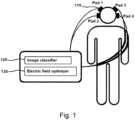
- FIG. 1 shows a conceptual diagram of an apparatus for alternating electric fields therapy using an optimization algorithm, as embodied in the present disclosure
- FIG. 2 shows a conceptual diagram showing the arrangement of electrodes of an apparatus for alternating electric fields as describe in the present disclosure.
- the apparatus for alternating electric fields using an optimization algorithm is configured to treat tumors in a patient by applying voltage to form separate electric fields in tumors and normal tissues.
- This apparatus includes a pair of electrode pads 110, an image classifier 120 and an electric field optimizer 130.
- the pair of electrode pads 110 includes most of the electrodes 111, which are variously arranged according to the shape of the electrode pads 110.
- FIG. 2 shows the electrodes 111 arranged in a 3 ⁇ 3 matrix, as illustrated, the numbers of electrodes 111 and the interval between them may be modified through the electric field optimizer 130, as described below. The shape and arrangement are not limited to those shown in FIG. 2 . Although two pairs of electrode pads 110 are shown, the number of electrode pads 110 may increase or decrease depending on the patient's treatment conditions.
- the magnitudes of the electric fields transmitted to the tumors and normal tissues can be altered by arranging the configuration of the electrodes 111 to adjust the applied frequency and voltage, thereby providing effective treatment based on the boundary conditions between a patient's tumors and normal tissues.
- the pair of electrode pads 110 may form the ground G on one of the pair.
- the image classifier 120 serves to classify at least one organ in a patient's image.
- This image may be a magnetic resonance (MR) or computed tomography (CT) image.
- MR or CT image includes the tumors together with a variety of organs.
- the image classifier 120 classifies most of the images for each organ, and determines the distance between normal tissues and tumors along with their positional relationships.
- the image classifier 120 may use the data to adjust the size of the pair of electrode pads 110 or the arrangement of the electrodes by automatically classifying them according to the organ or by setting the boundaries for each organ according to the user definition.
- the image classifier 120 can reconstruct each image into a 3-dimensional image of each organ and clearly determine their positional relationships.
- the electric field optimizer 130 sets the number and position of applied electrodes based on the classified tumors and normal tissues, arranges the electrodes on electrode pads 110 of preset size, and determines the magnitudes of voltage for the set electrodes. That is, the electric field optimizer 130 sets the magnitude of voltage applied to the electrodes by considering the classified tumors and normal tissues and the conditions of the tumors.
- the electric field optimizer 130 can set the magnitude of voltage applied to the electrodes by considering at least one of the types of tumors to be treated, the position of the tumors, and the boundary conditions between the tumors and normal tissues. In this instance, the electric field optimizer 130 can set the electrode weighting as a variable, divide most of the electrodes into those applying voltage and a ground electrode, and set the frequency of most of the electrodes depending on the type of tumors. For example, the weighting and voltage of each electrode can be calculated by setting the frequency to 200 kHz for glioblastomas and 150 kHz for lung cancers.
- the electric field optimizer 130 can have an object function that is set based on the intensity of at least one of the electric fields transmitted to the tumors or the normal organs, the weighting assigned to each normal organ or the electric field limit. Additionally, the electric field optimizer 130 can set the electric field limit according to the importance of organs, allowing the electrodes to transmit the preset or lower electric field.
- the electric field limit refers to the range of electric fields set to prevent the preset or higher electric field intensity from being transmitted to normal organs.
- the object function can adjust the electric field intensity to apply minimal electric fields to the major organs of normal tissues.
- the prescribed electric field is the magnitude of electric fields for transmitting a predetermined or higher electric field intensity to the total volume of the tumors
- the electric field limit is the magnitude of electric fields for transmitting the predetermined or lower electric field intensity to the total volume of the normal organs.
- a treatment plan can be created through optimization to apply a prescribed electric field intensity of 1.5 V/cm to tumors and transmit an electric field intensity limit of ⁇ 0.5 V/cm to the total volume of major organs.
- the average electric field intensity is the average transmitted to one organ, with the same electric field not transmitted to all parts of that organ. Because the transmitted electric field intensity is different for each microvolume, the average electric field intensity is determined for individual organs.
- Equation 1 After setting an electric field at position E i , spaced a predetermined distance from the tumor, as in Equation 1, the electric field intensity can be calculated from the conditions shown in Equations 2 to 4.
- E i is the electric field intensity value at the i th position
- w j is the weighting of the j th electrode
- e ij is the electric field intensity transmitted to the i th position by the j th electrode.
- Equation 2 calculates electric fields based on the prescribed electric field intensity.
- E 0 is the prescribed electric field intensity.
- Equation 3 calculates electric fields based on the object function f, considering that the weighting was dependent on the importance of organs and the electric field intensity limit of normal organs.
- the electric field intensity limit is a constant that differs depending on the importance of organs.
- W N is the weighting for each organ and E o organN is the electric field intensity limit for the N th normal organ.
- W N is the weighting for each organ and E ave organN is the average electric field intensity of the N th normal organ.
- the object function for calculating the electric fields acting on normal organs is not limited to the above Equation and differs depending on the type and position of tumors.
- the present disclosure sets the electric field based on a voltage of 0 V to 150 V applied to the electrodes and a frequency of 100 kHz to 300 kHz, as well as on the position of the tumors and the importance of each organ. This electric field intensity is converted to the voltage applied to the electrodes.
- the voltage range of 0 V to 150 V may be similar to the range used for conventional treatment apparatuses, but the present disclosure sets the arrangement and position of the electrodes by considering the position of the tumors and normal organs and their relationship, and applies different magnitudes of therapeutic and general electric fields to most of the electrodes, preventing damage to normal tissues.
- FIG. 3 shows a flowchart of a method for alternating electric fields therapy using an optimization algorithm according to an embodiment of the present disclosure. This method treats tumors in a patient by transmitting electric fields to the tumors and normal tissues using one or more pairs of electrode pads that include most of the electrodes.
- an image is retrieved based on imaging of the patient, and the retrieved image is classified for each organ (S100).
- Organs may be classified more effectively according to their importance by setting the resolution range for each organ individually.
- At least one treatment plan is created by arranging the number and position of electrodes on the electrode pads of a preset size, based on the patient's tumors and the boundary conditions between the tumors and normal tissues, and by setting the magnitude of voltage applied to most electrodes through the electric field optimizer (S200).
- S200 electric field optimizer
- three or more treatment plans can be created, with these plans adapted for different sizes and numbers of electrodes.
- the electrodes can be arranged in a matrix ( FIG. 2 ), they can also be arranged in other configurations; for example, asymmetrically or at different intervals. In this example, the pair of electrodes facing each other may be placed at the same position. Additionally, the applied voltage and frequency may differ between tumors and normal tissues, with voltages ranging from 0 V to 150 V and frequencies from 100 kHz to 300 kHz.
- the created treatment plans are analyzed and evaluated (S300).
- the conditions for optimal results may be determined by individually analyzing and evaluating each of the treatment plans.
- the patient is treated by applying the set voltage to most of the electrodes under the optimal conditions determined by the analyzed treatment plans (S400).
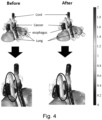
- FIG. 4 and 5 show diagrams comparing simulations by an apparatus for alternating electric fields therapy using an optimization algorithm, as embodied in the present disclosure, and the conventional method.
- FIG. 4 shows the electric field distributions when the same voltage is applied to all electrodes in the conventional manner (before) and when different voltages are applied to the electrodes using the electric field optimizer (after).
- Table 1 lists the findings of a quantitative analysis of the results shown in FIG. 4 .
- FIG. 5 shows the electric field distributions when the same voltage is applied to all electrodes in the conventional manner (before) and when different voltages are applied to the electrodes using the optimization algorithm (after).
- Table 2 lists the findings of a quantitative analysis of the results in FIG. 5 , showing that the indicator values are all reduced after application of the electric field optimizer. That is, the electric field intensity transmitted to normal organs is greatly reduced after application of the electric field optimizer.
- Table 2 Liver Stomach Right kidney Left Kidney Before After Difference Before After Difference Before After Difference V 30 100 100 0 100 100 0 100 100 0 0 60 100 84 16 100 100 0 100 100 0 V 90 25 11 14 94 50 44 92 71 21 Eave 1.256 1.082 0.174 1.784 1.363 0.421 1.730 1.481 0.249
Landscapes
- Health & Medical Sciences (AREA)
- Engineering & Computer Science (AREA)
- Life Sciences & Earth Sciences (AREA)
- Public Health (AREA)
- General Health & Medical Sciences (AREA)
- Radiology & Medical Imaging (AREA)
- Nuclear Medicine, Radiotherapy & Molecular Imaging (AREA)
- Biomedical Technology (AREA)
- Veterinary Medicine (AREA)
- Animal Behavior & Ethology (AREA)
- Medical Informatics (AREA)
- Heart & Thoracic Surgery (AREA)
- Biophysics (AREA)
- Oncology (AREA)
- Hospice & Palliative Care (AREA)
- Data Mining & Analysis (AREA)
- Physics & Mathematics (AREA)
- Primary Health Care (AREA)
- Epidemiology (AREA)
- Pathology (AREA)
- Neurology (AREA)
- Theoretical Computer Science (AREA)
- Surgery (AREA)
- Molecular Biology (AREA)
- General Physics & Mathematics (AREA)
- Bioinformatics & Computational Biology (AREA)
- Computer Vision & Pattern Recognition (AREA)
- Evolutionary Biology (AREA)
- Bioinformatics & Cheminformatics (AREA)
- Artificial Intelligence (AREA)
- Evolutionary Computation (AREA)
- General Engineering & Computer Science (AREA)
- Physical Education & Sports Medicine (AREA)
- Databases & Information Systems (AREA)
- Electrotherapy Devices (AREA)
- Measurement And Recording Of Electrical Phenomena And Electrical Characteristics Of The Living Body (AREA)
Claims (6)
- Vorrichtung für elektrische Wechselfeldtherapie unter Verwendung eines Optimierungsalgorithmus, um Tumore in einem Patienten zu behandeln, durch Anlegen elektrischer Felder an die Tumore und normales Gewebe unter Verwendung eines oder mehrerer Paare von Elektrodenpads, welche die meisten der Elektroden enthalten, wobei die Vorrichtung besteht aus:einem Bildklassifizierer, der dazu konfiguriert ist, wenigstens ein Organ auf einer Patientenabbildung zu klassifizieren; undeinem Elektrofeldoptimierer, der dazu konfiguriert ist, durch Einstellen der Anzahl und Position der aufgebrachten individuellen Elektroden basierend auf den Klassifizierungen der Tumore und des normalen Gewebes, Anordnen der Elektroden auf den Elektrodenpads mit einer voreingestellten Größe, und Bestimmen der an die Elektroden anzulegenden Spannungsgrößen einen Behandlungsplan zu erstellen, wobei der Elektrofeldoptimierer dazu konfiguriert ist, eine individuelle elektrische Feldstärke basierend auf der nachstehenden folgenden Gleichung zu bestimmen
 und dazu konfiguriert ist, das elektrische Feld basierend auf der folgenden Gleichung zu berechnen
 wobei Ei der elektrische Feldstärkewert an der i-ten Position ist, wj die Gewichtung der j-ten Elektrode ist, eij die elektrische Feldstärke ist, die zu der i-ten Position durch die j-te Elektrode übertragen wird, und E 0 die vorgeschriebene elektrische Feldstärke ist.
 - Vorrichtung für elektrische Wechselfeldtherapie unter Verwendung eines Optimierungsalgorithmus nach Anspruch 1, wobei der Elektrofeldoptimierer dazu konfiguriert ist, die an die meisten der Elektroden anzulegende Spannungsgröße durch In-Betracht-Ziehen wenigstens eines der Art der zu behandelnden Tumore, der Position der Tumore und/oder Grenzbedingungen zwischen den Tumoren und normalem Gewebe einzustellen.
- Vorrichtung für elektrische Wechselfeldtherapie unter Verwendung eines Optimierungsalgorithmus nach Anspruch 2, wobei der Elektrofeldoptimierer dazu konfiguriert ist, die Spannungsgröße der Elektroden zum Anlegen einer vorgeschriebenen oder höheren elektrischen Feldstärke an Tumore und zum Übertragen einer minimalen elektrischen Feldstärke zu normalen Organen zu berechnen.
- Vorrichtung für elektrische Wechselfeldtherapie unter Verwendung eines Optimierungsalgorithmus nach Anspruch 2, wobei der Elektrofeldoptimierer dazu konfiguriert ist, eine Elektrofeldgrenze gemäß der Wichtigkeit der Organe einzustellen, was den Elektorden erlaubt, die voreingestellte oder niedrigere Elektrofeldgrenze zu übertragen.
- Vorrichtung für elektrische Wechselfeldtherapie unter Verwendung eines Optimierungsalgorithmus nach Anspruch 3, wobei der Elektrofeldoptimierer eine Objektfunktion aufweist, die unter Verwendung wenigstens eines der zu den Tumoren oder normalen Organen übertragenen elektrischen Feldstärken, einer Gewichtung für jedes normale Organ und/oder einer Elektrofeldgrenze eingestellt ist.
- Vorrichtung für elektrische Wechselfeldtherapie unter Verwendung eines Optimierungsalgorithmus nach Anspruch 1, wobei das Paar von Elektrodenpads eine Masse (G) an einem Pad des Paars bildet.
Applications Claiming Priority (3)
| Application Number | Priority Date | Filing Date | Title |
|---|---|---|---|
| KR20180077093 | 2018-07-03 | ||
| KR1020180097291A KR102104961B1 (ko) | 2018-07-03 | 2018-08-21 | 최적화 알고리즘을 이용한 전기장 암치료장치 |
| PCT/KR2019/002009 WO2020009306A1 (ko) | 2018-07-03 | 2019-02-20 | 최적화 알고리즘을 이용한 전기장 암치료장치 및 방법 |
Publications (4)
| Publication Number | Publication Date |
|---|---|
| EP3819005A1 EP3819005A1 (de) | 2021-05-12 |
| EP3819005A4 EP3819005A4 (de) | 2022-03-30 |
| EP3819005C0 EP3819005C0 (de) | 2025-06-11 |
| EP3819005B1 true EP3819005B1 (de) | 2025-06-11 |
Family
ID=69153375
Family Applications (1)
| Application Number | Title | Priority Date | Filing Date |
|---|---|---|---|
| EP19831280.3A Active EP3819005B1 (de) | 2018-07-03 | 2019-02-20 | Vorrichtung zur krebsbehandlung mit elektrischen feldern unter verwendung eines optimierungsalgorithmus |
Country Status (3)
| Country | Link |
|---|---|
| US (1) | US11833351B2 (de) |
| EP (1) | EP3819005B1 (de) |
| KR (1) | KR102104961B1 (de) |
Families Citing this family (13)
| Publication number | Priority date | Publication date | Assignee | Title |
|---|---|---|---|---|
| KR102464313B1 (ko) | 2020-05-18 | 2022-11-08 | 주식회사 필드큐어 | 전기장 암 치료 시스템을 위한 품질 보증 장치 및 방법 |
| KR102490645B1 (ko) * | 2020-07-16 | 2023-01-25 | 고려대학교 산학협력단 | 흡수에너지 기반 전기장 암치료 계획 시스템 및 방법 |
| KR102458768B1 (ko) * | 2020-09-29 | 2022-10-26 | 고려대학교 산학협력단 | 체내 온도 제어 및 흡수에너지 기반 종양치료 전기장 최적화 방법 및 시스템, 및 이를 포함하는 전기장 시스템 구동 방법 및 시스템 |
| KR102556846B1 (ko) * | 2020-10-26 | 2023-07-18 | 주식회사 뉴아인 | 비정상 분열 세포에 대한 사멸 유도 장치 및 이의 구동 방법 |
| US20240165419A1 (en) | 2021-04-04 | 2024-05-23 | Dignity Health | Systems and methods for machine-learning guided treatment planning and monitoring of electric field therapy implants |
| KR102562095B1 (ko) * | 2021-06-14 | 2023-08-02 | 주식회사 필드큐어 | 전기요법에서의 전극 어레이 구조 최적화 방법 및 시스템 |
| CN113663215B (zh) * | 2021-10-22 | 2022-01-21 | 杭州维纳安可医疗科技有限责任公司 | 电场发生装置及其控制方法、计算机可读存储介质 |
| KR102833919B1 (ko) * | 2022-04-27 | 2025-07-15 | 한국전자통신연구원 | 개인 맞춤형 전기장 암 치료 방법 및 장치 |
| EP4338789B1 (de) * | 2022-09-16 | 2025-03-12 | Fieldcure Co., Ltd. | System zur bestimmung und auswertung eines tumorbehandlungsplans unter verwendung einer impulsbasierten dosis |
| KR20240149472A (ko) | 2023-04-05 | 2024-10-15 | 주식회사 뉴아인 | 세포사멸을 위한 전기장 집속 장치 |
| WO2025049735A1 (en) * | 2023-08-30 | 2025-03-06 | Boston Scientific Scimed, Inc. | Implantable medical systems for cancer treatment with activation energy based therapy modulation |
| CN117180617B (zh) * | 2023-10-09 | 2025-01-21 | 深圳奥派森生物电磁科技有限公司 | 电场治疗用电极及系统 |
| KR102869039B1 (ko) * | 2024-11-19 | 2025-10-14 | 고려대학교 산학협력단 | 시간 순차 온도-체적 히스토그램의 산출방법, 시스템 및 이를 포함한 고주파 자극 시스템 |
Family Cites Families (13)
| Publication number | Priority date | Publication date | Assignee | Title |
|---|---|---|---|---|
| US6853864B2 (en) * | 2000-02-02 | 2005-02-08 | Catholic University Of America, The | Use of electromagnetic fields in cancer and other therapies |
| US7146210B2 (en) * | 2000-02-17 | 2006-12-05 | Standen Ltd. | Apparatus and method for optimizing tumor treatment efficiency by electric fields |
| US7507829B2 (en) | 2002-12-19 | 2009-03-24 | Teva Pharmaceuticals Industries, Ltd | Solid states of pantoprazole sodium, processes for preparing them and processes for preparing known pantoprazole sodium hydrates |
| US7343030B2 (en) * | 2003-08-05 | 2008-03-11 | Imquant, Inc. | Dynamic tumor treatment system |
| ES2344215T3 (es) | 2004-12-07 | 2010-08-20 | Standen Ltd. | Electrodos para aplicar un campo electrico in vivo durante un dilatado periodo de tiempo. |
| US7590219B2 (en) * | 2006-04-07 | 2009-09-15 | Accuray Incorporated | Automatically determining a beam parameter for radiation treatment planning |
| EP2413833A1 (de) * | 2009-03-31 | 2012-02-08 | AngioDynamics, Inc. | System und verfahren zur bestimmung einer behandlungsregion für ein medizinisches behandlungsgerät und zur interaktiven planung der behandlung eines patienten |
| WO2015111091A1 (ja) * | 2014-01-21 | 2015-07-30 | 新エネルギー産業株式会社 | 電位変動式医療機器 |
| US10096386B2 (en) | 2014-07-03 | 2018-10-09 | Duke University | Systems and methods for model-based optimization of spinal cord stimulation electrodes and devices |
| KR101688520B1 (ko) | 2015-05-14 | 2016-12-22 | 고려대학교 산학협력단 | 불연속적인 분할 교류 전기장을 이용한 암 치료 장치 및 방법 |
| US10188851B2 (en) | 2015-10-28 | 2019-01-29 | Novocure Limited | TTField treatment with optimization of electrode positions on the head based on MRI-based conductivity measurements |
| WO2018106843A1 (en) | 2016-12-06 | 2018-06-14 | The Regents Of The University Of California | Optimal multi-electrode transcutaneous stimulation with high focality and intensity |
| DK3554631T3 (da) | 2016-12-13 | 2022-05-30 | Novocure Gmbh | Behandling af patienter med ttfields med elektrodepositionerne optimeret under anvendelse af deformerbare skabeloner |
-
2018
- 2018-08-21 KR KR1020180097291A patent/KR102104961B1/ko active Active
-
2019
- 2019-02-20 US US17/257,252 patent/US11833351B2/en active Active
- 2019-02-20 EP EP19831280.3A patent/EP3819005B1/de active Active
Also Published As
| Publication number | Publication date |
|---|---|
| EP3819005C0 (de) | 2025-06-11 |
| KR20200004228A (ko) | 2020-01-13 |
| US11833351B2 (en) | 2023-12-05 |
| KR102104961B1 (ko) | 2020-04-27 |
| EP3819005A4 (de) | 2022-03-30 |
| US20210228896A1 (en) | 2021-07-29 |
| EP3819005A1 (de) | 2021-05-12 |
Similar Documents
| Publication | Publication Date | Title |
|---|---|---|
| EP3819005B1 (de) | Vorrichtung zur krebsbehandlung mit elektrischen feldern unter verwendung eines optimierungsalgorithmus | |
| US12515044B2 (en) | Using power loss density and related measures to quantify the dose of tumor treating fields (TTFields) | |
| US11890467B2 (en) | Delivering tumor treating fields (TTFields) to the neck | |
| EP3775956B1 (de) | Aus zwei mrt-bildern mit unterschiedlichen wiederholzeiten abgeleitete niederfrequente (<1 mhz) wechselstromleitfähigkeitsschätzungen | |
| KR102278628B1 (ko) | MRI 기반 전도도 측정에 기반한 머리 위 전극 위치의 최적화된 TTField 치료 | |
| Leibel et al. | Improved dose distributions for 3D conformal boost treatments in carcinoma of the nasopharynx | |
| Pinzi et al. | Hypofractionated radiosurgery for large or in critical-site intracranial meningioma: results of a phase 2 prospective study | |
| Patel et al. | Comparison of whole versus partial vertebral body stereotactic body radiation therapy for spinal metastases | |
| Murzin et al. | 4π plan optimization for cortical-sparing brain radiotherapy | |
| Mihai et al. | Inverse vs. forward breast IMRT planning | |
| EP3967365A1 (de) | System und verfahren zur planung der behandlung von krebs mit einem elektrischen feld basierend auf absorptionsenergie | |
| Moszyńska-Zielińska et al. | Does obesity hinder radiotherapy in endometrial cancer patients? The implementation of new techniques in adjuvant radiotherapy–focus on obese patients | |
| Vellini et al. | A deep learning algorithm to generate synthetic computed tomography images for brain treatments from 0.35 T magnetic resonance imaging | |
| Bomzon et al. | Using computational phantoms to improve delivery of Tumor Treating Fields (TTFields) to patients | |
| Suzuki et al. | Impact of lifetime attributable risk of radiation-induced secondary cancer in proton craniospinal irradiation with vertebral-body-sparing for young pediatric patients with medulloblastoma | |
| Boughalia et al. | Assessment and quantification of patient set-up errors in nasopharyngeal cancer patients and their biological and dosimetric impact in terms of generalized equivalent uniform dose (gEUD), tumour control probability (TCP) and normal tissue complication probability (NTCP) | |
| Czech et al. | Proliferative activity as measured by MIB-1 labeling index and long-term outcome of visual pathway astrocytomas in children | |
| Nangia et al. | Compensator-based intensity-modulated radiotherapy in head and neck cancer: our experience in achieving dosimetric parameters and their clinical correlation | |
| Chang et al. | A retrospective study on the investigation of potential clinical benefits of online adaptive proton therapy for head and neck cancer | |
| Ko et al. | Effect of Electrode Array Position on Electric Field Intensity in Glioblastoma Patients Undergoing Electric Field Therapy | |
| Shimizu et al. | Dosimetric effects of dose calculation grid size on the epidural space dose | |
| US20240416125A1 (en) | Method for Non-Invasive or Minimally-Invasive Stimulation of Deep Brain Targets | |
| Dahbi et al. | Radiation-Induced Lumbosacral Radiculopathy: A Comprehensive Clinical and Dosimetric Study | |
| Vos et al. | Determination of an optimal treatment margin for intracranial tumours treated with radiotherapy at Groote Schuur Hospital | |
| Van Hoornweder et al. | Using head models to minimize electric field strength variability induced by tES: introducing GetTissueThickness (GTT) and 2-Sample Prospective E-field Dosing (2-SPED) |
Legal Events
| Date | Code | Title | Description |
|---|---|---|---|
| STAA | Information on the status of an ep patent application or granted ep patent |
Free format text: STATUS: THE INTERNATIONAL PUBLICATION HAS BEEN MADE |
|
| PUAI | Public reference made under article 153(3) epc to a published international application that has entered the european phase |
Free format text: ORIGINAL CODE: 0009012 |
|
| STAA | Information on the status of an ep patent application or granted ep patent |
Free format text: STATUS: REQUEST FOR EXAMINATION WAS MADE |
|
| 17P | Request for examination filed |
Effective date: 20210108 |
|
| AK | Designated contracting states |
Kind code of ref document: A1 Designated state(s): AL AT BE BG CH CY CZ DE DK EE ES FI FR GB GR HR HU IE IS IT LI LT LU LV MC MK MT NL NO PL PT RO RS SE SI SK SM TR |
|
| DAV | Request for validation of the european patent (deleted) | ||
| DAX | Request for extension of the european patent (deleted) | ||
| A4 | Supplementary search report drawn up and despatched |
Effective date: 20220228 |
|
| RIC1 | Information provided on ipc code assigned before grant |
Ipc: G16H 50/50 20180101ALI20220222BHEP Ipc: A61B 5/055 20060101ALI20220222BHEP Ipc: A61B 5/00 20060101ALI20220222BHEP Ipc: A61N 1/04 20060101ALI20220222BHEP Ipc: A61N 1/08 20060101ALI20220222BHEP Ipc: A61N 1/36 20060101ALI20220222BHEP Ipc: A61N 1/40 20060101AFI20220222BHEP |
|
| GRAP | Despatch of communication of intention to grant a patent |
Free format text: ORIGINAL CODE: EPIDOSNIGR1 |
|
| STAA | Information on the status of an ep patent application or granted ep patent |
Free format text: STATUS: GRANT OF PATENT IS INTENDED |
|
| INTG | Intention to grant announced |
Effective date: 20250130 |
|
| GRAS | Grant fee paid |
Free format text: ORIGINAL CODE: EPIDOSNIGR3 |
|
| GRAA | (expected) grant |
Free format text: ORIGINAL CODE: 0009210 |
|
| STAA | Information on the status of an ep patent application or granted ep patent |
Free format text: STATUS: THE PATENT HAS BEEN GRANTED |
|
| AK | Designated contracting states |
Kind code of ref document: B1 Designated state(s): AL AT BE BG CH CY CZ DE DK EE ES FI FR GB GR HR HU IE IS IT LI LT LU LV MC MK MT NL NO PL PT RO RS SE SI SK SM TR |
|
| REG | Reference to a national code |
Ref country code: GB Ref legal event code: FG4D |
|
| REG | Reference to a national code |
Ref country code: CH Ref legal event code: EP |
|
| REG | Reference to a national code |
Ref country code: IE Ref legal event code: FG4D |
|
| REG | Reference to a national code |
Ref country code: DE Ref legal event code: R096 Ref document number: 602019071087 Country of ref document: DE |
|
| U01 | Request for unitary effect filed |
Effective date: 20250612 |
|
| U07 | Unitary effect registered |
Designated state(s): AT BE BG DE DK EE FI FR IT LT LU LV MT NL PT RO SE SI Effective date: 20250623 |
|
| PG25 | Lapsed in a contracting state [announced via postgrant information from national office to epo] |
Ref country code: ES Free format text: LAPSE BECAUSE OF FAILURE TO SUBMIT A TRANSLATION OF THE DESCRIPTION OR TO PAY THE FEE WITHIN THE PRESCRIBED TIME-LIMIT Effective date: 20250611 |
|
| PG25 | Lapsed in a contracting state [announced via postgrant information from national office to epo] |
Ref country code: GR Free format text: LAPSE BECAUSE OF FAILURE TO SUBMIT A TRANSLATION OF THE DESCRIPTION OR TO PAY THE FEE WITHIN THE PRESCRIBED TIME-LIMIT Effective date: 20250912 Ref country code: NO Free format text: LAPSE BECAUSE OF FAILURE TO SUBMIT A TRANSLATION OF THE DESCRIPTION OR TO PAY THE FEE WITHIN THE PRESCRIBED TIME-LIMIT Effective date: 20250911 |
|
| PG25 | Lapsed in a contracting state [announced via postgrant information from national office to epo] |
Ref country code: HR Free format text: LAPSE BECAUSE OF FAILURE TO SUBMIT A TRANSLATION OF THE DESCRIPTION OR TO PAY THE FEE WITHIN THE PRESCRIBED TIME-LIMIT Effective date: 20250611 |
|
| PG25 | Lapsed in a contracting state [announced via postgrant information from national office to epo] |
Ref country code: RS Free format text: LAPSE BECAUSE OF FAILURE TO SUBMIT A TRANSLATION OF THE DESCRIPTION OR TO PAY THE FEE WITHIN THE PRESCRIBED TIME-LIMIT Effective date: 20250911 |
|
| PG25 | Lapsed in a contracting state [announced via postgrant information from national office to epo] |
Ref country code: IS Free format text: LAPSE BECAUSE OF FAILURE TO SUBMIT A TRANSLATION OF THE DESCRIPTION OR TO PAY THE FEE WITHIN THE PRESCRIBED TIME-LIMIT Effective date: 20251011 |
|
| PG25 | Lapsed in a contracting state [announced via postgrant information from national office to epo] |
Ref country code: SM Free format text: LAPSE BECAUSE OF FAILURE TO SUBMIT A TRANSLATION OF THE DESCRIPTION OR TO PAY THE FEE WITHIN THE PRESCRIBED TIME-LIMIT Effective date: 20250611 |
|
| U20 | Renewal fee for the european patent with unitary effect paid |
Year of fee payment: 8 Effective date: 20251211 |
|
| PG25 | Lapsed in a contracting state [announced via postgrant information from national office to epo] |
Ref country code: CZ Free format text: LAPSE BECAUSE OF FAILURE TO SUBMIT A TRANSLATION OF THE DESCRIPTION OR TO PAY THE FEE WITHIN THE PRESCRIBED TIME-LIMIT Effective date: 20250611 |
|
| PG25 | Lapsed in a contracting state [announced via postgrant information from national office to epo] |
Ref country code: PL Free format text: LAPSE BECAUSE OF FAILURE TO SUBMIT A TRANSLATION OF THE DESCRIPTION OR TO PAY THE FEE WITHIN THE PRESCRIBED TIME-LIMIT Effective date: 20250611 |
|
| PG25 | Lapsed in a contracting state [announced via postgrant information from national office to epo] |
Ref country code: SK Free format text: LAPSE BECAUSE OF FAILURE TO SUBMIT A TRANSLATION OF THE DESCRIPTION OR TO PAY THE FEE WITHIN THE PRESCRIBED TIME-LIMIT Effective date: 20250611 |
|
| PLBE | No opposition filed within time limit |
Free format text: ORIGINAL CODE: 0009261 |
|
| STAA | Information on the status of an ep patent application or granted ep patent |
Free format text: STATUS: NO OPPOSITION FILED WITHIN TIME LIMIT |
|
| REG | Reference to a national code |
Ref country code: CH Ref legal event code: L10 Free format text: ST27 STATUS EVENT CODE: U-0-0-L10-L00 (AS PROVIDED BY THE NATIONAL OFFICE) Effective date: 20260423 |