EP3817976B1 - Boat stabilization system - Google Patents
Boat stabilization system Download PDFInfo
- Publication number
- EP3817976B1 EP3817976B1 EP19744891.3A EP19744891A EP3817976B1 EP 3817976 B1 EP3817976 B1 EP 3817976B1 EP 19744891 A EP19744891 A EP 19744891A EP 3817976 B1 EP3817976 B1 EP 3817976B1
- Authority
- EP
- European Patent Office
- Prior art keywords
- fin
- stabilizer
- hull
- gyro
- boat
- Prior art date
- Legal status (The legal status is an assumption and is not a legal conclusion. Google has not performed a legal analysis and makes no representation as to the accuracy of the status listed.)
- Active
Links
Images



Classifications
-
- B—PERFORMING OPERATIONS; TRANSPORTING
- B63—SHIPS OR OTHER WATERBORNE VESSELS; RELATED EQUIPMENT
- B63B—SHIPS OR OTHER WATERBORNE VESSELS; EQUIPMENT FOR SHIPPING
- B63B39/00—Equipment to decrease pitch, roll, or like unwanted vessel movements; Apparatus for indicating vessel attitude
- B63B39/04—Equipment to decrease pitch, roll, or like unwanted vessel movements; Apparatus for indicating vessel attitude to decrease vessel movements by using gyroscopes directly
-
- B—PERFORMING OPERATIONS; TRANSPORTING
- B63—SHIPS OR OTHER WATERBORNE VESSELS; RELATED EQUIPMENT
- B63B—SHIPS OR OTHER WATERBORNE VESSELS; EQUIPMENT FOR SHIPPING
- B63B39/00—Equipment to decrease pitch, roll, or like unwanted vessel movements; Apparatus for indicating vessel attitude
- B63B39/06—Equipment to decrease pitch, roll, or like unwanted vessel movements; Apparatus for indicating vessel attitude to decrease vessel movements by using foils acting on ambient water
-
- B—PERFORMING OPERATIONS; TRANSPORTING
- B63—SHIPS OR OTHER WATERBORNE VESSELS; RELATED EQUIPMENT
- B63J—AUXILIARIES ON VESSELS
- B63J3/00—Driving of auxiliaries
- B63J3/04—Driving of auxiliaries from power plant other than propulsion power plant
-
- B—PERFORMING OPERATIONS; TRANSPORTING
- B63—SHIPS OR OTHER WATERBORNE VESSELS; RELATED EQUIPMENT
- B63B—SHIPS OR OTHER WATERBORNE VESSELS; EQUIPMENT FOR SHIPPING
- B63B39/00—Equipment to decrease pitch, roll, or like unwanted vessel movements; Apparatus for indicating vessel attitude
- B63B39/06—Equipment to decrease pitch, roll, or like unwanted vessel movements; Apparatus for indicating vessel attitude to decrease vessel movements by using foils acting on ambient water
- B63B2039/067—Equipment to decrease pitch, roll, or like unwanted vessel movements; Apparatus for indicating vessel attitude to decrease vessel movements by using foils acting on ambient water effecting motion dampening by means of fixed or movable resistance bodies, e.g. by bilge keels
-
- B—PERFORMING OPERATIONS; TRANSPORTING
- B63—SHIPS OR OTHER WATERBORNE VESSELS; RELATED EQUIPMENT
- B63B—SHIPS OR OTHER WATERBORNE VESSELS; EQUIPMENT FOR SHIPPING
- B63B2209/00—Energy supply or activating means
-
- G—PHYSICS
- G01—MEASURING; TESTING
- G01C—MEASURING DISTANCES, LEVELS OR BEARINGS; SURVEYING; NAVIGATION; GYROSCOPIC INSTRUMENTS; PHOTOGRAMMETRY OR VIDEOGRAMMETRY
- G01C19/00—Gyroscopes; Turn-sensitive devices using vibrating masses; Turn-sensitive devices without moving masses; Measuring angular rate using gyroscopic effects
- G01C19/02—Rotary gyroscopes
- G01C19/04—Details
- G01C19/30—Erection devices, i.e. devices for restoring rotor axis to a desired position
Definitions
- the present invention relates to a boat stabilization system, comprising interworking gyro and fin stabilizers.
- the traditional stabilization systems used in passenger vessels, naval vessels etc. were generally designed for use in underway situations and mostly for boats cruising in displacement mode and thereby in relatively low velocities.
- the watercraft that have traditionally been using stabilizers have also by their size and hull shapes generally had long roll times, thereby requiring relatively slow acting stabilization system, where counter forces are applied to the waves forces over relatively long time periods.
- Gyroscopic roll stabilizers for boats have been known for a long time, e.g. from US patent application 2005274210 .
- the stabilizer includes a flywheel, a flywheel drive motor configured to spin the flywheel about a spin axis, a gimbal structure configured to permit flywheel precession about a gimbal axis, and a device for applying a torque to the flywheel about the gimbal axis.
- the flywheel and gimbal structure are configured so that when installed in the boat the stabilizer damps roll motion of the boat.
- the gyro stabilizer When the gyro stabilizer is arranged in the vessel or boat, it is oriented with the flywheel spin axis, the gimbal axis and the vessel roll axis, i.e. the longitudinal direction of the vessel orthogonal. As the boat rolls, a precession-inducing torque is applied to the gyroscope cage or housing, such that the resulting gyroscopic reaction moment will tend to right the boat.
- Two different configurations are possible to counteract roll motion. In the first configuration the flywheel spin axis is vertical and the frame gimbal's axis athwartships.
- the precession When the boat is rolling, the precession will be converted into a rotation about the yaw axis, while in the second configuration the precession will be converted into a rotation about the pitch axis.
- the flywheel angle During precession, i.e. when the gyro is precessing to counteract roll, the flywheel angle will vary with respect to the hull, resulting in precession components in both yaw and pitch directions.
- the vessel is in general resistant to both pitch and yaw rotation resulting from roll precession forces.
- the first of the generally known issues is that with the watercraft not moving forward through the water, thus being able to make use of the forces in the waterflow passing the fins by the forward motion of the vessel to create a force to counter the waves forces that rolls the watercraft, the only way a fin stabilizer can apply a counter force, is to flap / swim the fins.
- the force is a result of the size of fin and the speed the fin is moved, and as an opposite, the faster the fin is moved, the shorter a time period the force can be applied as there is a limited physical movement of the fin, and it also has to be stopped without causing too much counter force in the undesired direction at the time.
- Modern, fast watercrafts have a hull shape and a weight that makes their natural roll periods a lot shorter than the traditional vessels where stabilizers have been installed, and also that their physical requirement for stabilizer force is a higher factor compared to the boat size in comparison with the traditional watercraft equipped with stabilizers.
- the principal mathematical way to calculate the necessary force of a stabilizing system to reduce the roll by a desired amount is mostly based on a factor called Metacentric height (GM). This is a factor decided by how stiff the watercraft is on the water, i.e. the more it follows the waves angles, the more force is required from the stabilizer system to counter this roll, and what a stabilizer system actually does, is to force the boat to not follow the waves angle.
- GM Metacentric height
- the total force impulse is in principally determined by the fin size.
- the efficiency of fin stabilizers depends not only of the size of the fin, but also on the geometry.
- a stabilizer fin with improved efficiency both at anchor and in cruising due to its geometry is disclosed in WO2014065672A1 .
- a fin stabilizer device wherein the fin blade has a dual motion, is disclosed.
- a fin displacement means can also move the fin in parallel with the hull.
- precession resistance may prevent roll reduction forces in very slow roll motion situations.
- Many of the existing solution are only utilizing a part of the available precession force. Further, precession motion "reduction" by braking waste energy to heat.
- Gyro stabilizers cannot maintain a constant force over time in cruising, since there must be an active precession motion to cause roll reducing. They have a very low total roll reduction force compared to fins as total roll reduction force is the same in all speeds and in all roll periods. Complimentary force directions and general resistance to roll motion can make the boat difficult to control/steer under some conditions. For any conceivable efficiency above slow cruising speeds, size and weight becomes very significant. In general a high weight that will cause speed loss and increased fuel consumption in speeds above displacement speeds.
- US2004/244513A discloses a gyro stabilizer and proposes use power produced by braking or damping precession aboard the boat for e.g. to charge a battery, and/or power the flywheel drive motor, and/or power a cooling or lubrication circuit for the flywheel bearings. It also mentions that the roll stabilizer could be combined with fin stabilizers, where the fin stabilizers could be relied on for roll stability underway, and the CMG stabilizer relied on for roll stability at rest or low speed.
- GB191122260 A discloses the application of a gyrostat employed in conjunction with and to control a clutch mechanism supplied with power from the engine or some other part of the machine. The clutch mechanism will impart a motion to other parts of the mechanism which work with ailerons, elevators, rudders, or weights, in such a direction as will reveres or tend to reverse and so destroy the undesirable motion of the body.
- US4972792A and US2892435A propose to mechanically connect a gyro to a bow rudder for a hydrofoil and a ship, respectively.
- the gyro experiences that the hydrofoil or ship leans over, it will precess and turn the rudder.
- the hydrofoil or ship then turns as a response to the leaning to the side. The turn will after some time counteract the leaning.
- This solution may lead to an unwanted wobbling behaviour.
- the system is designed to work only when the boat has a certain speed. If the system is used at anchor, power used to spin the gyro will be wasted to turn the vertical rudder which does not have any stabilizing effect at anchor.
- US1800408A discloses a control mechanism for stabilizer fins where control gyroscopes are used as input to the control system.
- GB2485861A Proposes the combination of a gyro and hydraulically or electrically powered trim planes located near the bow.
- KR 20160042600A discloses a power generating system for a leisure vessel using the gyro stabilizer capable of generating power by using the torque of a gimbal shaft in the case of the rolling or pitching of a hull by coinciding a pitching axis with the gimbal shaft of the gyro stabilizer equipped in the hull of the leisure vessel.
- Fin stabilizers at anchor are in general less energy efficient than gyro stabilizers. They may even have a negative effect opposite the intended direction when the fin has to brake or stop at the end of the stroke. A typical actuator driven fin "flapping" around a forward rotation point may cause some forward “swimming" motion.
- Fins in cruising are able to set up anti-roll forces over a long time by producing lift or downforce.
- the anti-roll force is proportional to the square of the boats speed. However, they may cause direct drag in the water leading to reduced speed or increased fuel consumption at higher speeds, typically above displacement speed. Further, since fins are extending from the hull they may come in the way and hit obstructions.
- a goal with the present invention is to overcome the problems of prior art, and to disclose a cost efficient and versatile boat stabilizer system that can be used for both at anchor and cruising applications.
- the boat stabilizer system of the invention is energy efficient and provides stabilization both at anchor and when cruising.
- breaking devices may be reduced in size or limited compared to prior art.
- the boat stabilizer system (1) comprises;
- the boat stabilizer system (1) comprises a power transmission (4) interconnecting the first gyro stabilizer (2) and the first fin stabilizer (3), wherein the power transmission (4) is arranged to transfer energy derived from precession torque of the first gyro stabilizer (2) to the first fin stabilizer (3) to actuate the fin (33).
- first gyro stabilizer (2) comprises a precessing element (24) and the first fin stabilizer (3) comprises a movable element (34) connected to the fin (33).
- the power transmission (4) is arranged to transfer energy between the precessing element (24) and the movable element (34).
- the precessing element (24) is a precession shaft, and the movable element (34) is a drive shaft connected to the fin (33).
- the precession element (24) and the movable element (34) are co-axial.
- the power transmission (4) is a shaft integrating the precessing element (24) and the movable element (34) and the drive shaft and the fin extend laterally from the hull.
- the power transmission (4) has a fixed transmission ratio.
- the transmission ratio is 1:1.
- the precession element (24) and the movable element (34) are integrated as in a single shaft, which constitutes the drive shaft.
- the fin stabilizer (3) is directly connected to the gyro stabilizer (2).
- the flywheel (22) is spinning in the right direction, precession will turn the movable element (34) so that the fin (33) counteracts the roll motion of the hull (H).
- the flywheel (22) is has a first spin axis (S1) which may be horizontal.
- the flywheel (22) is supported by bearings (23), allowing the flywheel to spin around the spin axis (S1).
- the spin axis (S1) should further be arranged athwartship.
- the precession element (24) is rotationally fixed to the housing (21) comprising the bearings (23) holding the flywheel (22).
- the braking resistance of the fin may be adapted by altering the fin size and shape. This braking force may be used to secure the gyro stabilizer against over-load and too fast precession, which is a major concern with prior art stabilizers, since uncontrolled precession forces may harm the mounting means or the boat itself.
- the boat stabilizer system (1) comprises a rotational bearing (35) fixed relative the hull (H), supporting radial load of the shaft.
- both the fin stabilizer (3) and the gyro stabilizer (2) may be supported by only one set of one or more common bearings (35). This will in turn result in a more compact and cost-effective boat stabilizer system.
- the power transmission (4) has a fixed transmission ratio which is different from 1:1.
- the movable element (34) is arranged to rotate with a different rotational speed than the precession element (24).
- the transmission ratio can be fixed to a specific ratio by selecting design parameters for the power transmission (4).
- the boat stabilizer system (1) comprises a control system (5).
- the control system may be arranged to control the transmission ratio. Altering the transmission ratio will change the impact a roll motion has on the fin (33) displacement. It further affects the breaking force experienced by the gyro stabilizer (2). E.g. if the gear ratio is large, such as e.g. 3:1, the fin (33) will have a relatively small displacement for a roll motion compared to a small gear ratio of e.g. 1:1. Accordingly, the gyro stabilizer (2) will experience relatively more breaking force from the fin when the gear ratio is small.
- the gear ratio may be varied to control how much of the precession generated force is used for gyro stabilization and for fin stabilization. This is advantageous, since gyro stabilizers and fin stabilizers behave differently at anchor and in cruising.
- control system (5) may control any of the valves (44), (45a), (45b), (45c), (45d), (46), (47) in any of the embodiments in Fig. 4a, 4b, 4c, 4d , 4e and 4f .
- a gyro stabilizer may not work as intended due to inertia and friction in bearings etc. Further, the gyro stabilizer may not be able to provide the necessary power to turn the fins in all situations.
- a boat stabilizer system (1) may comprise an external power source arranged to provide energy to the boat stabilizer system (1).
- the external power source may be connected to and provide power to the power transmission (4).
- the external energy may be used to activate the gyro by setting up a roll dependent precession torque felt by the gyro.
- the gyro stabilizer (2) will then be able to stabilize the boat even as a result of smaller roll motions.
- the external energy may be used to provide additional power to move or rotate the fin of the fin stabilizer (3) when the energy from the gyro precession is not sufficient.
- Fig. 4f illustrates in a diagram a hydraulic system where additional power can be be supported from the hydraulic circuit on board the boat, where the valves indicated can be controlled from a control system, e.g. as a function of roll measurements.
- Additional energy may also be supported as electric power in a corresponding electric power transmission (4), or by means of e.g. a clutch in a mechanical system.
- the boat stabilizer system (1) comprises a clutch arranged in series with the power transmission (4).
- the clutch may be arranged to transfer a variable amount of torque and to engage up to a pre-defined torque limit and slip above the torque limit.
- the fin stabilizer (3) comprises a first fin connection element (61) connected to the fin (33) in a first connection point (62).
- the first fin connection element (61) could e.g. be a shaft fixed to the fin base of the fin, as illustrated in Fig. 2a .
- the first fin connection element (61) coincides and is integrated with the movable element (34) of the fin stabilizer (3).
- the fin stabilizer (3) comprises a fin blade displacement means interconnecting the movable element (34) and the fin connection element (61).
- the movable element (34) and the fin connection element (61) are not integrated, and may be co-axial or not co-axial.
- the fin blade displacement means may be e.g. a link arm, a gear or a transmission interconnecting the fin connection element (61) and the movable element (34), so that when the movable element (34) is pivoted as a result of precession of the gyro stabilizer (2), the rotational energy of the movable element (34) results in rotation and/or displacement of the fin connection element (61) and the fin relative the hull (H).
- the hull (H) is illustrated with dashed lines in figure 2a and 2b .
- the fin blade displacement means is arranged for displacing the first fin connection point (62) a first displacement (3), in parallel with a lower surface of said hull (H), and perpendicular to a hull forward direction.
- the fin connection point (62) is where the fin connection element (61), e.g. shaft is fixed to the fin (33) and the fin (33) will therefore move with a lateral vertical and horizontal component relative the hull (H), where the angle between the two components depend on the deadrise where the fin stabilizer (3) is arranged.
- the fin blade displacement means may further be arranged for pivoting the fin base about the first connection point (62).
- actuating the fin used in this document may include both rotation of the fin (33) and/or displacement of the fin and the fin base relative the hull.
- the fin stabilizer (3) comprises a hull element (31) arranged to be fixed to the hull (H).
- the hull element (31) may comprise an inner part (31a) and a releasable outer part (31b) as illustrated in Fig. 2b , for easy mounting of the stabilizer system (1).
- the hull element (31) may comprise on or more bearings (35) supporting the fin connection element (61).
- the fin connection element (61) is integrated with the movable element (34) or drive shaft.
- the fin or fins (33) can be used for stabilizing a boat or vessel it may take different geometrical forms. It may be e.g. a flat fin, a curved fin, a T-foil, interceptor type trim tab or a plate type trim tab.
- the fin or fins (33) may be arranged at various locations. This may depend on the hull type and the desired behavior. Locations could orthogonal downward with respect to deadrise of hull, lateral extending, mounted on transom etc.
- the power transmission (4) comprises a second fin stabilizer comprising a second fin configured to be arranged outside the hull (H) and move relative the hull (H), wherein the power transmission (4) interconnects the first gyro stabilizer (2) and the second stabilizer, and wherein the power transmission (4) is arranged to transfer energy derived from precession torque of the first gyro stabilizer (2) to the second fin stabilizer to actuate the fin.
- the second fin stabilizer could have any of the properties of the first fin stabilizer (3), except from having its drive shaft integrated with the precession element (24) of the gyro stabilizer (2).
- the power transmission (4) could be e.g. mechanical, electric, hydraulic or pneumatic.
- a gyro stabilizer (2) In a first gyro stabilizer embodiment that may be combined with any of the embodiments above, the components of a gyro stabilizer (2) is known from prior art, and from the descriptions above.
- the flywheel of the gyro stabilizer may be arranged e.g. within a normal pressure housing or inside a vacuum chamber.
- flywheel spin motor may be e.g. electric or hydraulic.
- the power transmission (4) comprises a second gyro stabilizer comprising configured to be arranged inside the hull (H), wherein the power transmission (4) interconnects the second gyro stabilizer and the first fin stabilizer (3), and wherein the power transmission (4) is arranged to transfer energy derived from precession torque of the second gyro stabilizer (2) to the first fin stabilizer (3) to actuate the fin.
- the second gyro stabilizer could have any of the properties of the first gyro stabilizer, except from having its precession element (24) integrated with the movable element (34) of the fin stabilizer (3).
- the power transmission (4) could be e.g. mechanical, electric, hydraulic or pneumatic.
- the gyro stabilizer or stabilizers (2) may also be arranged at various locations inside the hull. However, due to weight and angular momentum it could be beneficial to arrange them symmetric about the centerline, or on the centerline if only one gyro stabilizer is used.
- two or more gyro stabilizers may actuate two or more fin stabilizers by adapting the power transmission (4) to interconnect more elements, and then connecting the stabilizers to the power transmission (4).
- Such power distribution can be achieved e.g. with hydraulic transfer means and proper valve arrangement.
- the boat stabilizer system comprises energy harwesting means and an energy storage arranged to harwest energy by re-generate braking energy from braking the flywheel.
- the energy storage could be e.g. an electric capacitor or a battery.
- flywheel spin motor arranged to be powered from the energy storage.
- the gyro stabilizer(s) and fin stabilizer(s) above will have an inherent breaking force, but may comprise dampening end stops and/or additional brakes to limit precession. Brakes could be passive or active. It may also comprise a locking system to prevent movement and actuation when enabled.
- the second fin stabilizer could have any of the properties of the first fin stabilizer (3), except from having its drive shaft integrated with the precession element (24) of the gyro stabilizer (2).
- the power transmission (4) could be e.g. mechanical, electric, hydraulic or pneumatic.
- a gyro stabilizer (2) In a first gyro stabilizer embodiment that may be combined with any of the embodiments above, the components of a gyro stabilizer (2) is known from prior art, and from the descriptions above.
- the flywheel of the gyro stabilizer may be arranged e.g. within a normal pressure housing or inside a vacuum chamber.
- flywheel spin motor may be e.g. electric or hydraulic.
- the power transmission (4) comprises a second gyro stabilizer comprising configured to be arranged inside the hull (H), wherein the power transmission (4) interconnects the second gyro stabilizer and the first fin stabilizer (3), and wherein the power transmission (4) is arranged to transfer energy derived from precession torque of the second gyro stabilizer (2) to the first fin stabilizer (3) to actuate the fin.
- the second gyro stabilizer could have any of the properties of the first gyro stabilizer, except from having its precession element (24) integrated with the movable element (34) of the fin stabilizer (3).
- the power transmission (4) could be e.g. mechanical, electric, hydraulic or pneumatic.
- the gyro stabilizer or stabilizers (2) may also be arranged at various locations inside the hull. However, due to weight and angular momentum it could be beneficial to arrange them symmetric about the centerline, or on the centerline if only one gyro stabilizer is used.
- two or more gyro stabilizers may actuate two or more fin stabilizers by adapting the power transmission (4) to interconnect more elements, and then connecting the stabilizers to the power transmission (4).
- Such power distribution can be achieved e.g. with hydraulic transfer means and proper valve arrangement.
- the boat stabilizer system comprises energy harwesting means and an energy storage arranged to harwest energy by re-generate braking energy from braking the flywheel.
- the energy storage could be e.g. an electric capacitor or a battery.
- flywheel spin motor arranged to be powered from the energy storage.
- the gyro stabilizer(s) and fin stabilizer(s) above will have an inherent breaking force, but may comprise dampening end stops and/or additional brakes to limit precession. Brakes could be passive or active. It may also comprise a locking system to prevent movement and actuation when enabled.
Landscapes
- Engineering & Computer Science (AREA)
- Chemical & Material Sciences (AREA)
- Combustion & Propulsion (AREA)
- Mechanical Engineering (AREA)
- Ocean & Marine Engineering (AREA)
- Physics & Mathematics (AREA)
- General Physics & Mathematics (AREA)
- Radar, Positioning & Navigation (AREA)
- Remote Sensing (AREA)
- Other Liquid Machine Or Engine Such As Wave Power Use (AREA)
Description
- The present invention relates to a boat stabilization system, comprising interworking gyro and fin stabilizers.
- The art of reducing the unpleasant and at times dangerous roll motion of boats and ships in waves have evolved over many years, and there are many principle technologies used with varying benefits and results for different conditions, type of watercraft and not least cost of implementation and operation. Such different systems include fin stabilizers, gyro stabilizers and bilge tanks to mention the most common ones.
- The traditional stabilization systems used in passenger vessels, naval vessels etc., were generally designed for use in underway situations and mostly for boats cruising in displacement mode and thereby in relatively low velocities. The watercraft that have traditionally been using stabilizers have also by their size and hull shapes generally had long roll times, thereby requiring relatively slow acting stabilization system, where counter forces are applied to the waves forces over relatively long time periods.
- Gyroscopic roll stabilizers for boats have been known for a long time, e.g. from
US patent application 2005274210 . The stabilizer includes a flywheel, a flywheel drive motor configured to spin the flywheel about a spin axis, a gimbal structure configured to permit flywheel precession about a gimbal axis, and a device for applying a torque to the flywheel about the gimbal axis. The flywheel and gimbal structure are configured so that when installed in the boat the stabilizer damps roll motion of the boat. - When the gyro stabilizer is arranged in the vessel or boat, it is oriented with the flywheel spin axis, the gimbal axis and the vessel roll axis, i.e. the longitudinal direction of the vessel orthogonal. As the boat rolls, a precession-inducing torque is applied to the gyroscope cage or housing, such that the resulting gyroscopic reaction moment will tend to right the boat.
Two different configurations are possible to counteract roll motion. In the first configuration the flywheel spin axis is vertical and the frame gimbal's axis athwartships. When the boat is rolling, the precession will be converted into a rotation about the yaw axis, while in the second configuration the precession will be converted into a rotation about the pitch axis. During precession, i.e. when the gyro is precessing to counteract roll, the flywheel angle will vary with respect to the hull, resulting in precession components in both yaw and pitch directions. However, the vessel is in general resistant to both pitch and yaw rotation resulting from roll precession forces. - Over the last 15 years, the market has evolved to where there is a requirement for also providing roll stabilization when the watercraft is at anchor, i.e. not having any forward motion, as well as stabilization systems being installed in much faster boats, including planning boats. These changes create many new challenges and issues, as explained below.
- The first of the generally known issues is that with the watercraft not moving forward through the water, thus being able to make use of the forces in the waterflow passing the fins by the forward motion of the vessel to create a force to counter the waves forces that rolls the watercraft, the only way a fin stabilizer can apply a counter force, is to flap / swim the fins. This means that both the peak force possible as well as the time such a force can be applied is limited. The force is a result of the size of fin and the speed the fin is moved, and as an opposite, the faster the fin is moved, the shorter a time period the force can be applied as there is a limited physical movement of the fin, and it also has to be stopped without causing too much counter force in the undesired direction at the time.
- Modern, fast watercrafts have a hull shape and a weight that makes their natural roll periods a lot shorter than the traditional vessels where stabilizers have been installed, and also that their physical requirement for stabilizer force is a higher factor compared to the boat size in comparison with the traditional watercraft equipped with stabilizers. The principal mathematical way to calculate the necessary force of a stabilizing system to reduce the roll by a desired amount is mostly based on a factor called Metacentric height (GM). This is a factor decided by how stiff the watercraft is on the water, i.e. the more it follows the waves angles, the more force is required from the stabilizer system to counter this roll, and what a stabilizer system actually does, is to force the boat to not follow the waves angle.
- The total force impulse is in principally determined by the fin size. However, the efficiency of fin stabilizers depends not only of the size of the fin, but also on the geometry. A stabilizer fin with improved efficiency both at anchor and in cruising due to its geometry is disclosed in
WO2014065672A1 . - Further, in
WO2018044173A1 a fin stabilizer device wherein the fin blade has a dual motion, is disclosed. In addition to the pivoting motion about the rotational axis, a fin displacement means can also move the fin in parallel with the hull. - In general, some of the disadvantages of gyro stabilizers and fin stabilizers can be summarized as follows;
- For gyro stabilizer at anchor, internal precession resistance may prevent roll reduction forces in very slow roll motion situations. Many of the existing solution are only utilizing a part of the available precession force. Further, precession motion "reduction" by braking waste energy to heat.
- Gyro stabilizers cannot maintain a constant force over time in cruising, since there must be an active precession motion to cause roll reducing.
They have a very low total roll reduction force compared to fins as total roll reduction force is the same in all speeds and in all roll periods. Complimentary force directions and general resistance to roll motion can make the boat difficult to control/steer under some conditions. For any conceivable efficiency above slow cruising speeds, size and weight becomes very significant. In general a high weight that will cause speed loss and increased fuel consumption in speeds above displacement speeds. -
US2004/244513A discloses a gyro stabilizer and proposes use power produced by braking or damping precession aboard the boat for e.g. to charge a battery, and/or power the flywheel drive motor, and/or power a cooling or lubrication circuit for the flywheel bearings. It also mentions that the roll stabilizer could be combined with fin stabilizers, where the fin stabilizers could be relied on for roll stability underway, and the CMG stabilizer relied on for roll stability at rest or low speed.GB191122260 A -
US4972792A andUS2892435A propose to mechanically connect a gyro to a bow rudder for a hydrofoil and a ship, respectively. When the gyro experiences that the hydrofoil or ship leans over, it will precess and turn the rudder. The hydrofoil or ship then turns as a response to the leaning to the side. The turn will after some time counteract the leaning. This solution may lead to an unwanted wobbling behaviour. The system is designed to work only when the boat has a certain speed. If the system is used at anchor, power used to spin the gyro will be wasted to turn the vertical rudder which does not have any stabilizing effect at anchor. -
US1800408A discloses a control mechanism for stabilizer fins where control gyroscopes are used as input to the control system. -
GB2485861A -
KR 20160042600A - Fin stabilizers at anchor are in general less energy efficient than gyro stabilizers. They may even have a negative effect opposite the intended direction when the fin has to brake or stop at the end of the stroke. A typical actuator driven fin "flapping" around a forward rotation point may cause some forward "swimming" motion.
- Fins in cruising are able to set up anti-roll forces over a long time by producing lift or downforce. The anti-roll force is proportional to the square of the boats speed. However, they may cause direct drag in the water leading to reduced speed or increased fuel consumption at higher speeds, typically above displacement speed. Further, since fins are extending from the hull they may come in the way and hit obstructions.
- A goal with the present invention is to overcome the problems of prior art, and to disclose a cost efficient and versatile boat stabilizer system that can be used for both at anchor and cruising applications.
- The invention solving these problems is a boat stabilizer system according to the independent claims.
- The boat stabilizer system of the invention is energy efficient and provides stabilization both at anchor and when cruising.
- Due to the inherent resistance in the sea experienced by the fin, breaking devices may be reduced in size or limited compared to prior art.
-
-
Fig. 1 illustrates in a perspective view an embodiment of the boat stabilizer system (1). A detail of the housing (21) is cut away to show the flywheel (22) and the flywheel bearing (23). -
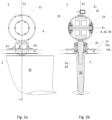
Fig. 2a and 2b illustrates in a side view and a cross section, respectively, the same embodiment as illustrated inFig. 1 , wherein the power transmission (4) is a common shaft interconnecting the housing (21) of the gyro stabilizer (2) and the movable element (34) of the fin stabilizer (3). When the cage or housing (21) precesses about the precession axis (P1) as a result of roll, the fin (33) will pivot. -
Fig. 3 illustrates in a perspective view an embodiment not covered by the claims of the boat stabilizer system (100), where the power transmission (4) is a hydraulic power transmission. When the housing (21) precesses about the precession axis (P2) as a result of roll, a hydraulic pressure is set up in the hydraulic power transmission and the fin (33) will pivot. -
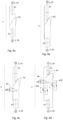
Fig. 4a, 4b, 4c, 4d ,4e and 4f illustrates in diagrams different embodiments, that are not covered by the claims, of the hydraulic power transmission (4) interconnecting the first gyro stabilizer (2) and the first fin stabilizer (3). The precession of the gyro stabilizer (2) resulting in pivoting about the precession element (24) is converted into hydraulic pressure in hydraulic cylinders acting as the power source (41). The hydraulic pressure is further transferred in in the drive section (42) in the form of hydraulic lines to the fin stabilizer actuator (43) in form of hydraulic cylinders connected to the movable element (34). - In
Fig. 4a, 4b and 4c , the power source hydraulic cylinders (41) are always directly connected to the power source hydraulic cylinders (41) fin stabilizer actuator (43). A pivot of the precession element (24) will pivot the movable element (34). - In
Fig. 4a the diameter of the cylinders of the fin stabilizer actuator (43) and the power source (43) have the same cross section. This results in a transmission ratio of 1:1 provided the ratio in the connections to the precession axis (24) and movable element (34) are similar. - In
Fig. 4b , the diameter of the cylinders of the fin stabilizer actuator (43) and the power source (43) have the same different sections. This results in a transmission ratio of different from 1:1 provided the ratio in the connections to the precession axis (24) and movable element (34) are similar.
In the following embodiments shown inFigures 4c to 4f the cylinders may or may not have the same cross section. - In
Fig. 4c , a first lock valve (44) is arranged in the hydraulic circuit. The lock valve (44) may be a two way, two position solenoid valve with spring return as illustrated. In the normal position the double lock valve will close the circuit and the cylinders lock. In activated position the circuit is open in both directions. The rest of the circuit may be similar to the embodiment ofFig. 4a or 4b . - In
Fig. 4d , the circuit comprises a first and second variable flow rate valve (45a, 45b) in series with each of the hydraulic lines. The variable flow rate valves (45) could be pressure compensated as indicated by the arrow. The rest of the circuit may be similar to the embodiment ofFig. 4c . It is possible to break the system by reducing flow in the flow control valves (45a, 45b). - In
Fig. 4e , the circuit comprises a third and fourth variable flow rate valve (45c, 45d) arranged in opposite directions in parallel with the fin stabilizer (3). The variable flow rate valves (45c, 45d) could be pressure compensated as indicated by the arrow. The rest of the hydraulic circuit is similar to the embodiment ofFig. 4c , but could also have been implemented without the first variable flow rate valve (45). This embodiment allows speed control of the fin stabilizer (3) relative to the gyro stabilizer (2). - In
Fig. 4f , one of the lines can further be connected to an hydraulic circuit onboard the vessel, either directly, or through a directional valve (46). The illustrated valve is a proportional four way directional valve connected to tank pressure (T) in normal position, which however may be changed by operating the valve. The three way directional valve (47) and pressure compensated flow control valves (45a, 45b) together with the lock valves (44), here normally closed, allows individual operation of gyro stabilizer and fin stabilizer (3). If needed, additional pressure may be supported from the hydraulic circuit on board the boat. - In the following description, various examples and embodiments of the invention are set forth in order to provide the skilled person with a more thorough understanding of the invention. The specific details described in the context of the various embodiments and with reference to the attached drawings are not intended to be construed as limitations. Rather, the scope of the invention is defined in the appended claims.
- The embodiments described below are numbered. In addition, dependent or related embodiments defined in relation to the numbered embodiments are described. Unless otherwise specified, any embodiment that can be combined with one or more numbered embodiments may also be combined directly with any of the related embodiments of the numbered embodiment(s) referred to.
- In a first embodiment wherein the features can be seen in
Fig. 1 ,2a and 2b , the boat stabilizer system (1) comprises; - a hull (H)
- a first gyro stabilizer (2) arranged inside a hull (H), and
- a first fin stabilizer (3) comprising a fin (33) arranged outside the hull (H) and arranged to move relative the hull (H).
- Further, the boat stabilizer system (1) comprises a power transmission (4) interconnecting the first gyro stabilizer (2) and the first fin stabilizer (3), wherein the power transmission (4) is arranged to transfer energy derived from precession torque of the first gyro stabilizer (2) to the first fin stabilizer (3) to actuate the fin (33).
- Further, the first gyro stabilizer (2) comprises a precessing element (24) and the first fin stabilizer (3) comprises a movable element (34) connected to the fin (33). The power transmission (4) is arranged to transfer energy between the precessing element (24) and the movable element (34).
- The precessing element (24) is a precession shaft, and the movable element (34) is a drive shaft connected to the fin (33).
- The precession element (24) and the movable element (34) are co-axial.
- The power transmission (4) is a shaft integrating the precessing element (24) and the movable element (34) and the drive shaft and the fin extend laterally from the hull.
- In a second embodiment that may be combined with the first embodiment and any of its related embodiments, the power transmission (4) has a fixed transmission ratio.
- In a first related embodiment the transmission ratio is 1:1.
- In a second related embodiment that may be combined with the first related embodiment, the precession element (24) and the movable element (34) are integrated as in a single shaft, which constitutes the drive shaft. In this case the fin stabilizer (3) is directly connected to the gyro stabilizer (2). Provided the flywheel (22) is spinning in the right direction, precession will turn the movable element (34) so that the fin (33) counteracts the roll motion of the hull (H).
- To explain the dynamic behavior of the second related embodiment, rotational axis and movements have been indicated in
Fig. 1 . First of all, the flywheel (22) is has a first spin axis (S1) which may be horizontal. The flywheel (22) is supported by bearings (23), allowing the flywheel to spin around the spin axis (S1). The spin axis (S1) should further be arranged athwartship. The precession element (24) is rotationally fixed to the housing (21) comprising the bearings (23) holding the flywheel (22). - Thus, when a roll motion (R) is converted into a force acting vertically on the flywheel axis (S1), the flywheel (22) and its housing (21) starts precessing (P) relative the hull (H). Since the precession element (24) is rotationally fixed to the housing (21) and the precession element (24) and the movable element (34) are integrated, the fin (33) will pivot (F). In this case the movable element (34) is co-axial with the fins pivot axis.
- Due to the inherent resistance in the sea experienced by a rotating fin, breaking devices may be reduced in size or limited compared to prior art. Accordingly, the braking resistance of the fin may be adapted by altering the fin size and shape. This braking force may be used to secure the gyro stabilizer against over-load and too fast precession, which is a major concern with prior art stabilizers, since uncontrolled precession forces may harm the mounting means or the boat itself.
- In a related embodiment the boat stabilizer system (1) comprises a rotational bearing (35) fixed relative the hull (H), supporting radial load of the shaft.
- With this configuration both the fin stabilizer (3) and the gyro stabilizer (2) may be supported by only one set of one or more common bearings (35). This will in turn result in a more compact and cost-effective boat stabilizer system.
- In a third embodiment that may be combined with the first embodiment and any of its related embodiments, the power transmission (4) has a fixed transmission ratio which is different from 1:1. Thus, the movable element (34) is arranged to rotate with a different rotational speed than the precession element (24).
- The transmission ratio can be fixed to a specific ratio by selecting design parameters for the power transmission (4).
- In an embodiment that may be combined with any of the embodiments above, the boat stabilizer system (1) comprises a control system (5).
- In a first related embodiment that can be implemented when the power transmission ratio is variable, the control system may be arranged to control the transmission ratio. Altering the transmission ratio will change the impact a roll motion has on the fin (33) displacement. It further affects the breaking force experienced by the gyro stabilizer (2). E.g. if the gear ratio is large, such as e.g. 3:1, the fin (33) will have a relatively small displacement for a roll motion compared to a small gear ratio of e.g. 1:1. Accordingly, the gyro stabilizer (2) will experience relatively more breaking force from the fin when the gear ratio is small.
- Thus, the gear ratio may be varied to control how much of the precession generated force is used for gyro stabilization and for fin stabilization. This is advantageous, since gyro stabilizers and fin stabilizers behave differently at anchor and in cruising.
- In an embodiment not covered by the claims, the control system (5) may control any of the valves (44), (45a), (45b), (45c), (45d), (46), (47) in any of the embodiments in
Fig. 4a, 4b, 4c, 4d ,4e and 4f . - In some situations, it may be possible to improve the anti-roll stabilization further. In smooth sea with small roll motions of e.g. less than 1 degree, a gyro stabilizer may not work as intended due to inertia and friction in bearings etc. Further, the gyro stabilizer may not be able to provide the necessary power to turn the fins in all situations.
- A boat stabilizer system (1) may comprise an external power source arranged to provide energy to the boat stabilizer system (1). The external power source may be connected to and provide power to the power transmission (4). The external energy may be used to activate the gyro by setting up a roll dependent precession torque felt by the gyro. The gyro stabilizer (2) will then be able to stabilize the boat even as a result of smaller roll motions. Further, the external energy may be used to provide additional power to move or rotate the fin of the fin stabilizer (3) when the energy from the gyro precession is not sufficient.
-
Fig. 4f illustrates in a diagram a hydraulic system where additional power can be be supported from the hydraulic circuit on board the boat, where the valves indicated can be controlled from a control system, e.g. as a function of roll measurements. - Additional energy may also be supported as electric power in a corresponding electric power transmission (4), or by means of e.g. a clutch in a mechanical system.
- When the power transmission (4) is not a drive shaft directly connecting the precession element (24) and the movable element (34), the boat stabilizer system (1) comprises a clutch arranged in series with the power transmission (4).
- The clutch may be arranged to transfer a variable amount of torque and to engage up to a pre-defined torque limit and slip above the torque limit.
- According to a first fin stabilizer embodiment that can be combined with any of the embodiments above, the fin stabilizer (3) comprises a first fin connection element (61) connected to the fin (33) in a first connection point (62).
- In a first related embodiment, the first fin connection element (61) could e.g. be a shaft fixed to the fin base of the fin, as illustrated in
Fig. 2a . In this embodiment the first fin connection element (61) coincides and is integrated with the movable element (34) of the fin stabilizer (3). - In a second related embodiment, the fin stabilizer (3) comprises a fin blade displacement means interconnecting the movable element (34) and the fin connection element (61). In this embodiment the movable element (34) and the fin connection element (61) are not integrated, and may be co-axial or not co-axial. The fin blade displacement means may be e.g. a link arm, a gear or a transmission interconnecting the fin connection element (61) and the movable element (34), so that when the movable element (34) is pivoted as a result of precession of the gyro stabilizer (2), the rotational energy of the movable element (34) results in rotation and/or displacement of the fin connection element (61) and the fin relative the hull (H). The hull (H) is illustrated with dashed lines in
figure 2a and 2b . - In a third related embodiment that may be combined with the second related embodiment, the fin blade displacement means is arranged for displacing the first fin connection point (62) a first displacement (3), in parallel with a lower surface of said hull (H), and perpendicular to a hull forward direction. The fin connection point (62) is where the fin connection element (61), e.g. shaft is fixed to the fin (33) and the fin (33) will therefore move with a lateral vertical and horizontal component relative the hull (H), where the angle between the two components depend on the deadrise where the fin stabilizer (3) is arranged.
- The fin blade displacement means may further be arranged for pivoting the fin base about the first connection point (62). Thus, the term "actuating the fin" used in this document may include both rotation of the fin (33) and/or displacement of the fin and the fin base relative the hull.
- Further, as illustrated in
Fig. 2a and 2b , the fin stabilizer (3) comprises a hull element (31) arranged to be fixed to the hull (H). The hull element (31) may comprise an inner part (31a) and a releasable outer part (31b) as illustrated inFig. 2b , for easy mounting of the stabilizer system (1). - The hull element (31) may comprise on or more bearings (35) supporting the fin connection element (61). In the basic fin stabilizer embodiment of
Fig. 2a and 2b , the fin connection element (61) is integrated with the movable element (34) or drive shaft. - As long as the fin or fins (33) can be used for stabilizing a boat or vessel it may take different geometrical forms. It may be e.g. a flat fin, a curved fin, a T-foil, interceptor type trim tab or a plate type trim tab.
- Further, the fin or fins (33) may be arranged at various locations. This may depend on the hull type and the desired behavior. Locations could orthogonal downward with respect to deadrise of hull, lateral extending, mounted on transom etc.
- Two or more fin stabilizers may be actuated from the gyro stabilizer (2). According to a second fin stabilizer embodiment that may be combined with any of the embodiments above, the power transmission (4) comprises a second fin stabilizer comprising a second fin configured to be arranged outside the hull (H) and move relative the hull (H), wherein the power transmission (4) interconnects the first gyro stabilizer (2) and the second stabilizer, and wherein the power transmission (4) is arranged to transfer energy derived from precession torque of the first gyro stabilizer (2) to the second fin stabilizer to actuate the fin. The second fin stabilizer could have any of the properties of the first fin stabilizer (3), except from having its drive shaft integrated with the precession element (24) of the gyro stabilizer (2). The power transmission (4) could be e.g. mechanical, electric, hydraulic or pneumatic.
- In a first gyro stabilizer embodiment that may be combined with any of the embodiments above, the components of a gyro stabilizer (2) is known from prior art, and from the descriptions above. The flywheel of the gyro stabilizer may be arranged e.g. within a normal pressure housing or inside a vacuum chamber.
- Further, the flywheel spin motor may be e.g. electric or hydraulic.
- Two or more gyro stabilizers may actuate the first fin stabilizer (3). In a second gyro stabilizer embodiment, that may be combined with any of the embodiments above, the power transmission (4) comprises a second gyro stabilizer comprising configured to be arranged inside the hull (H), wherein the power transmission (4) interconnects the second gyro stabilizer and the first fin stabilizer (3), and wherein the power transmission (4) is arranged to transfer energy derived from precession torque of the second gyro stabilizer (2) to the first fin stabilizer (3) to actuate the fin. The second gyro stabilizer could have any of the properties of the first gyro stabilizer, except from having its precession element (24) integrated with the movable element (34) of the fin stabilizer (3). The power transmission (4) could be e.g. mechanical, electric, hydraulic or pneumatic.
- The gyro stabilizer or stabilizers (2) may also be arranged at various locations inside the hull. However, due to weight and angular momentum it could be beneficial to arrange them symmetric about the centerline, or on the centerline if only one gyro stabilizer is used.
- Further, as will be understood, from the above, two or more gyro stabilizers may actuate two or more fin stabilizers by adapting the power transmission (4) to interconnect more elements, and then connecting the stabilizers to the power transmission (4). Such power distribution can be achieved e.g. with hydraulic transfer means and proper valve arrangement.
- In an embodiment that may be combined with any of the embodiments above, the boat stabilizer system comprises energy harwesting means and an energy storage arranged to harwest energy by re-generate braking energy from braking the flywheel. The energy storage could be e.g. an electric capacitor or a battery.
- In a related embodiment the flywheel spin motor arranged to be powered from the energy storage.
- In most implementations it is desirable to be able to limit maximum precession in order to reduce the forces between the boat and the gyro stabilizer, which in worst case could lead to material damages. The gyro stabilizer(s) and fin stabilizer(s) above will have an inherent breaking force, but may comprise dampening end stops and/or additional brakes to limit precession. Brakes could be passive or active. It may also comprise a locking system to prevent movement and actuation when enabled.
- In the exemplary embodiments, various features and details are shown in combination. The fact that several features are described with respect to a particular example should not be construed as implying that those features by necessity have to be included together in all embodiments of the invention. Conversely, features that are described with reference to different embodiments should not be construed as mutually exclusive. As those with skill in the art will readily understand, embodiments that incorporate any subset of features described herein and that are not expressly interdependent have been contemplated by the inventor and are part of the intended disclosure. However, explicit description of all such embodiments would not contribute to the understanding of the principles of the invention, and consequently some permutations of features have been omitted for the sake of simplicity or brevity.
stabilizer, and wherein the power transmission (4) is arranged to transfer energy derived from precession torque of the first gyro stabilizer (2) to the second fin stabilizer to actuate the fin. The second fin stabilizer could have any of the properties of the first fin stabilizer (3), except from having its drive shaft integrated with the precession element (24) of the gyro stabilizer (2). The power transmission (4) could be e.g. mechanical, electric, hydraulic or pneumatic. - In a first gyro stabilizer embodiment that may be combined with any of the embodiments above, the components of a gyro stabilizer (2) is known from prior art, and from the descriptions above. The flywheel of the gyro stabilizer may be arranged e.g. within a normal pressure housing or inside a vacuum chamber.
- Further, the flywheel spin motor may be e.g. electric or hydraulic.
- Two or more gyro stabilizers may actuate the first fin stabilizer (3). In a second gyro stabilizer embodiment, that may be combined with any of the embodiments above, the power transmission (4) comprises a second gyro stabilizer comprising configured to be arranged inside the hull (H), wherein the power transmission (4) interconnects the second gyro stabilizer and the first fin stabilizer (3), and wherein the power transmission (4) is arranged to transfer energy derived from precession torque of the second gyro stabilizer (2) to the first fin stabilizer (3) to actuate the fin. The second gyro stabilizer could have any of the properties of the first gyro stabilizer, except from having its precession element (24) integrated with the movable element (34) of the fin stabilizer (3). The power transmission (4) could be e.g. mechanical, electric, hydraulic or pneumatic.
- The gyro stabilizer or stabilizers (2) may also be arranged at various locations inside the hull. However, due to weight and angular momentum it could be beneficial to arrange them symmetric about the centerline, or on the centerline if only one gyro stabilizer is used.
- Further, as will be understood, from the above, two or more gyro stabilizers may actuate two or more fin stabilizers by adapting the power transmission (4) to interconnect more elements, and then connecting the stabilizers to the power transmission (4). Such power distribution can be achieved e.g. with hydraulic transfer means and proper valve arrangement.
- In an embodiment that may be combined with any of the embodiments above, the boat stabilizer system comprises energy harwesting means and an energy storage arranged to harwest energy by re-generate braking energy from braking the flywheel. The energy storage could be e.g. an electric capacitor or a battery.
- In a related embodiment the flywheel spin motor arranged to be powered from the energy storage.
- In most implementations it is desirable to be able to limit maximum precession in order to reduce the forces between the boat and the gyro stabilizer, which in worst case could lead to material damages. The gyro stabilizer(s) and fin stabilizer(s) above will have an inherent breaking force, but may comprise dampening end stops and/or additional brakes to limit precession. Brakes could be passive or active. It may also comprise a locking system to prevent movement and actuation when enabled.
- In the exemplary embodiments, various features and details are shown in combination. The fact that several features are described with respect to a particular example should not be construed as implying that those features by necessity have to be included together in all embodiments of the invention. Conversely, features that are described with reference to different embodiments should not be construed as mutually exclusive. As those with skill in the art will readily understand, embodiments that incorporate any subset of features described herein and that are not expressly interdependent have been contemplated by the inventor and are part of the intended disclosure. However, explicit description of all such embodiments would not contribute to the understanding of the principles of the invention, and consequently some permutations of features have been omitted for the sake of simplicity or brevity.
Claims (5)
- A boat stabilizer system (1) comprising:- a hull (H),- a first gyro stabilizer (2) arranged inside the hull (H),- a first fin stabilizer (3) comprising a fin (33) arranged outside the hull (H) and arranged to move relative to the hull (H),- a power transmission (4) interconnecting the first gyro stabilizer (2) and the first fin stabilizer (3),wherein the power transmission (4) is arranged to transfer energy, derived from precession torque of the first gyro stabilizer (2), to the first fin stabilizer (3) to actuate the fin (33), wherein the first gyro stabilizer (2) comprises a precessing element (24) and the first fin stabilizer (3) comprises a movable element (34) connected to the fin (33), wherein the power transmission (4) is arranged to transfer energy from the precessing element (24) to the movable element (34), wherein the precessing element (24) is a precession shaft and the movable element (34) is a drive shaft connected to the fin (33), wherein the processing element (24) and the movable element (34) are co-axial, and wherein the power transmission (4) is a shaft integrating the precessing element (24) and the movable element (34), characterized in that the drive shaft and the fin extend laterally from the hull.
- The boat stabilizer system (1) of claim 1 , wherein the power transmission (4) has a fixed transmission ratio.
- The boat stabilizer system (1) of claim 2, wherein the transmission ratio is 1:1.
- The boat stabilizer system (1) of claim 3, comprising a rotational bearing (35) fixed relative the hull (H), supporting radial load of the shaft.
- The boat stabilizer system (1) of any of claims 1 to 4, comprising a hull element (31) fixed to the hull (H), wherein the hull element (31) comprises an inner part (31a) and a releasable outer part (31b).
Applications Claiming Priority (2)
| Application Number | Priority Date | Filing Date | Title |
|---|---|---|---|
| GB1811126.0A GB2575315B (en) | 2018-07-06 | 2018-07-06 | Boat stabilizer fin powered by precession torque of stabilizing gyro |
| PCT/NO2019/050129 WO2020009585A1 (en) | 2018-07-06 | 2019-06-20 | Boat stabilization system |
Publications (3)
| Publication Number | Publication Date |
|---|---|
| EP3817976A1 EP3817976A1 (en) | 2021-05-12 |
| EP3817976B1 true EP3817976B1 (en) | 2024-07-31 |
| EP3817976C0 EP3817976C0 (en) | 2024-07-31 |
Family
ID=63170805
Family Applications (1)
| Application Number | Title | Priority Date | Filing Date |
|---|---|---|---|
| EP19744891.3A Active EP3817976B1 (en) | 2018-07-06 | 2019-06-20 | Boat stabilization system |
Country Status (4)
| Country | Link |
|---|---|
| US (1) | US11975806B2 (en) |
| EP (1) | EP3817976B1 (en) |
| GB (1) | GB2575315B (en) |
| WO (1) | WO2020009585A1 (en) |
Families Citing this family (11)
| Publication number | Priority date | Publication date | Assignee | Title |
|---|---|---|---|---|
| EP3784561A4 (en) * | 2018-05-31 | 2021-07-21 | Wave Tamer LLC | GYROSCOPIC ROLLER STABILIZER |
| CN110641642A (en) * | 2019-10-31 | 2020-01-03 | 无锡市东舟船舶设备股份有限公司 | The structure of marine retractable fin stabilizer |
| AU2021231492C1 (en) | 2020-03-02 | 2024-06-20 | Wavetamer Llc | Gyroscopic boat roll stabilizer with bearing cooling |
| WO2022072350A1 (en) | 2020-09-30 | 2022-04-07 | Wavetamer Llc | Gyroscopic roll stabilizer with flywheel shaft through passage |
| US11807344B2 (en) | 2020-09-30 | 2023-11-07 | Wavetamer Llc | Gyroscopic roll stabilizer with flywheel cavity seal arrangement |
| CN113291426B (en) * | 2021-06-28 | 2024-05-28 | 上海衡拓船舶设备有限公司 | Push-pull type full navigational speed stabilizer based on gear transmission |
| US20240400167A1 (en) * | 2021-11-24 | 2024-12-05 | Dometic Marine Canada Inc. | Roll stabilization and related apparatuses |
| US20260103268A1 (en) * | 2022-09-27 | 2026-04-16 | Veem Ltd | Gyrostabiliser with active precession control and energy recuperation system |
| CN116118961B (en) * | 2023-04-17 | 2023-06-16 | 兴化市远洋机械有限公司 | Ship anti-rolling device |
| US12227271B1 (en) * | 2023-09-11 | 2025-02-18 | Wavetamer Llc | Deceleration of gyroscopic boat roll stabilizer |
| CN116923657B (en) * | 2023-09-12 | 2023-12-26 | 兴化市远洋机械有限公司 | Modularized ship anti-rolling mechanism and use method thereof |
Citations (1)
| Publication number | Priority date | Publication date | Assignee | Title |
|---|---|---|---|---|
| US20040244513A1 (en) * | 2003-06-04 | 2004-12-09 | Adams John D. | Gyroscopic roll stabilizer for boats |
Family Cites Families (10)
| Publication number | Priority date | Publication date | Assignee | Title |
|---|---|---|---|---|
| GB191122260A (en) * | 1911-10-10 | 1912-10-10 | Thomas Wigston Kinglake Clarke | Improvements in and relating to Imparting of Stability or Permanence of Direction to otherwise Unstable or Undirected Bodies. |
| US1800408A (en) * | 1928-01-11 | 1931-04-14 | Sperry Gyroscope Co Inc | Roll and pitch reducing device for ships |
| US2892435A (en) * | 1953-02-20 | 1959-06-30 | Ljungstrom Fredrik | Method for controlling rolling movements of a ship |
| JPH01278895A (en) * | 1988-04-30 | 1989-11-09 | Yamaha Motor Co Ltd | Lateral stabilizer for fully-submersible type hydrofoil |
| US5909859A (en) * | 1996-03-28 | 1999-06-08 | Janicki; Stephen J. | Multi-rotor kite glider |
| JP5827245B2 (en) * | 2010-02-17 | 2015-12-02 | ヴィーム リミテッドVeem Ltd | Active adaptive gyro-stabilizer control system |
| GB201020053D0 (en) * | 2010-11-26 | 2011-01-12 | Beardsmore Stephen J | Offshore windfarm supply and maintenance vessel |
| CN105121272B (en) | 2013-04-18 | 2017-06-23 | 罗尼·斯考恩 | Fin stabilizers and active stabilization systems for ships |
| KR20160042600A (en) * | 2014-10-10 | 2016-04-20 | 재단법인한국조선해양기자재연구원 | Power system of leisure boat using a gyro stabilizer |
| EP3507189B1 (en) | 2016-09-02 | 2023-12-13 | Sleipner Motor AS | Stabilizer fin for a watercraft |
-
2018
- 2018-07-06 GB GB1811126.0A patent/GB2575315B/en active Active
-
2019
- 2019-06-20 WO PCT/NO2019/050129 patent/WO2020009585A1/en not_active Ceased
- 2019-06-20 US US17/258,036 patent/US11975806B2/en active Active
- 2019-06-20 EP EP19744891.3A patent/EP3817976B1/en active Active
Patent Citations (1)
| Publication number | Priority date | Publication date | Assignee | Title |
|---|---|---|---|---|
| US20040244513A1 (en) * | 2003-06-04 | 2004-12-09 | Adams John D. | Gyroscopic roll stabilizer for boats |
Also Published As
| Publication number | Publication date |
|---|---|
| WO2020009585A1 (en) | 2020-01-09 |
| EP3817976A1 (en) | 2021-05-12 |
| GB201811126D0 (en) | 2018-08-22 |
| GB2575315A (en) | 2020-01-08 |
| GB2575315B (en) | 2021-01-13 |
| EP3817976C0 (en) | 2024-07-31 |
| US11975806B2 (en) | 2024-05-07 |
| US20210171165A1 (en) | 2021-06-10 |
Similar Documents
| Publication | Publication Date | Title |
|---|---|---|
| EP3817976B1 (en) | Boat stabilization system | |
| US5488919A (en) | Canted rudder system for pitch roll and steering control | |
| CN108770353B (en) | A method to slow down the swing of a ship | |
| EP1639314A1 (en) | Gyroscopic roll stabilizer for boats | |
| RU2617159C1 (en) | Stabilizing fin and active stabilization system of vessel | |
| JP7486969B2 (en) | Active stabilization device and method | |
| EP3507189B1 (en) | Stabilizer fin for a watercraft | |
| AU2004270614B2 (en) | Two degree of freedom rudder/stabilizer for waterborne vessels | |
| JP6515171B1 (en) | Steering device and ship | |
| US10363999B2 (en) | Active roll stabilisation system for damping a ship's motion | |
| WO2009083892A2 (en) | Device for stabilising the rolling motion of boats. | |
| KR102902411B1 (en) | Active stabilizing device and method | |
| HK1205075B (en) | Stabilizer fin and active stabilizer system for a watercraft |
Legal Events
| Date | Code | Title | Description |
|---|---|---|---|
| STAA | Information on the status of an ep patent application or granted ep patent |
Free format text: STATUS: UNKNOWN |
|
| STAA | Information on the status of an ep patent application or granted ep patent |
Free format text: STATUS: THE INTERNATIONAL PUBLICATION HAS BEEN MADE |
|
| PUAI | Public reference made under article 153(3) epc to a published international application that has entered the european phase |
Free format text: ORIGINAL CODE: 0009012 |
|
| STAA | Information on the status of an ep patent application or granted ep patent |
Free format text: STATUS: REQUEST FOR EXAMINATION WAS MADE |
|
| 17P | Request for examination filed |
Effective date: 20201229 |
|
| AK | Designated contracting states |
Kind code of ref document: A1 Designated state(s): AL AT BE BG CH CY CZ DE DK EE ES FI FR GB GR HR HU IE IS IT LI LT LU LV MC MK MT NL NO PL PT RO RS SE SI SK SM TR |
|
| DAV | Request for validation of the european patent (deleted) | ||
| DAX | Request for extension of the european patent (deleted) | ||
| STAA | Information on the status of an ep patent application or granted ep patent |
Free format text: STATUS: EXAMINATION IS IN PROGRESS |
|
| 17Q | First examination report despatched |
Effective date: 20221216 |
|
| GRAP | Despatch of communication of intention to grant a patent |
Free format text: ORIGINAL CODE: EPIDOSNIGR1 |
|
| STAA | Information on the status of an ep patent application or granted ep patent |
Free format text: STATUS: GRANT OF PATENT IS INTENDED |
|
| INTG | Intention to grant announced |
Effective date: 20240221 |
|
| GRAS | Grant fee paid |
Free format text: ORIGINAL CODE: EPIDOSNIGR3 |
|
| GRAA | (expected) grant |
Free format text: ORIGINAL CODE: 0009210 |
|
| STAA | Information on the status of an ep patent application or granted ep patent |
Free format text: STATUS: THE PATENT HAS BEEN GRANTED |
|
| AK | Designated contracting states |
Kind code of ref document: B1 Designated state(s): AL AT BE BG CH CY CZ DE DK EE ES FI FR GB GR HR HU IE IS IT LI LT LU LV MC MK MT NL NO PL PT RO RS SE SI SK SM TR |
|
| REG | Reference to a national code |
Ref country code: CH Ref legal event code: EP Ref country code: GB Ref legal event code: FG4D |
|
| REG | Reference to a national code |
Ref country code: DE Ref legal event code: R096 Ref document number: 602019056114 Country of ref document: DE |
|
| REG | Reference to a national code |
Ref country code: IE Ref legal event code: FG4D |
|
| U01 | Request for unitary effect filed |
Effective date: 20240826 |
|
| U07 | Unitary effect registered |
Designated state(s): AT BE BG DE DK EE FI FR IT LT LU LV MT NL PT RO SE SI Effective date: 20240904 |
|
| PG25 | Lapsed in a contracting state [announced via postgrant information from national office to epo] |
Ref country code: NO Free format text: LAPSE BECAUSE OF FAILURE TO SUBMIT A TRANSLATION OF THE DESCRIPTION OR TO PAY THE FEE WITHIN THE PRESCRIBED TIME-LIMIT Effective date: 20241031 |
|
| PG25 | Lapsed in a contracting state [announced via postgrant information from national office to epo] |
Ref country code: GR Free format text: LAPSE BECAUSE OF FAILURE TO SUBMIT A TRANSLATION OF THE DESCRIPTION OR TO PAY THE FEE WITHIN THE PRESCRIBED TIME-LIMIT Effective date: 20241101 Ref country code: PL Free format text: LAPSE BECAUSE OF FAILURE TO SUBMIT A TRANSLATION OF THE DESCRIPTION OR TO PAY THE FEE WITHIN THE PRESCRIBED TIME-LIMIT Effective date: 20240731 |
|
| PG25 | Lapsed in a contracting state [announced via postgrant information from national office to epo] |
Ref country code: IS Free format text: LAPSE BECAUSE OF FAILURE TO SUBMIT A TRANSLATION OF THE DESCRIPTION OR TO PAY THE FEE WITHIN THE PRESCRIBED TIME-LIMIT Effective date: 20241130 |
|
| PG25 | Lapsed in a contracting state [announced via postgrant information from national office to epo] |
Ref country code: HR Free format text: LAPSE BECAUSE OF FAILURE TO SUBMIT A TRANSLATION OF THE DESCRIPTION OR TO PAY THE FEE WITHIN THE PRESCRIBED TIME-LIMIT Effective date: 20240731 |
|
| PG25 | Lapsed in a contracting state [announced via postgrant information from national office to epo] |
Ref country code: ES Free format text: LAPSE BECAUSE OF FAILURE TO SUBMIT A TRANSLATION OF THE DESCRIPTION OR TO PAY THE FEE WITHIN THE PRESCRIBED TIME-LIMIT Effective date: 20240731 Ref country code: RS Free format text: LAPSE BECAUSE OF FAILURE TO SUBMIT A TRANSLATION OF THE DESCRIPTION OR TO PAY THE FEE WITHIN THE PRESCRIBED TIME-LIMIT Effective date: 20241031 |
|
| PG25 | Lapsed in a contracting state [announced via postgrant information from national office to epo] |
Ref country code: RS Free format text: LAPSE BECAUSE OF FAILURE TO SUBMIT A TRANSLATION OF THE DESCRIPTION OR TO PAY THE FEE WITHIN THE PRESCRIBED TIME-LIMIT Effective date: 20241031 Ref country code: PL Free format text: LAPSE BECAUSE OF FAILURE TO SUBMIT A TRANSLATION OF THE DESCRIPTION OR TO PAY THE FEE WITHIN THE PRESCRIBED TIME-LIMIT Effective date: 20240731 Ref country code: NO Free format text: LAPSE BECAUSE OF FAILURE TO SUBMIT A TRANSLATION OF THE DESCRIPTION OR TO PAY THE FEE WITHIN THE PRESCRIBED TIME-LIMIT Effective date: 20241031 Ref country code: IS Free format text: LAPSE BECAUSE OF FAILURE TO SUBMIT A TRANSLATION OF THE DESCRIPTION OR TO PAY THE FEE WITHIN THE PRESCRIBED TIME-LIMIT Effective date: 20241130 Ref country code: HR Free format text: LAPSE BECAUSE OF FAILURE TO SUBMIT A TRANSLATION OF THE DESCRIPTION OR TO PAY THE FEE WITHIN THE PRESCRIBED TIME-LIMIT Effective date: 20240731 Ref country code: GR Free format text: LAPSE BECAUSE OF FAILURE TO SUBMIT A TRANSLATION OF THE DESCRIPTION OR TO PAY THE FEE WITHIN THE PRESCRIBED TIME-LIMIT Effective date: 20241101 Ref country code: ES Free format text: LAPSE BECAUSE OF FAILURE TO SUBMIT A TRANSLATION OF THE DESCRIPTION OR TO PAY THE FEE WITHIN THE PRESCRIBED TIME-LIMIT Effective date: 20240731 |
|
| PG25 | Lapsed in a contracting state [announced via postgrant information from national office to epo] |
Ref country code: SM Free format text: LAPSE BECAUSE OF FAILURE TO SUBMIT A TRANSLATION OF THE DESCRIPTION OR TO PAY THE FEE WITHIN THE PRESCRIBED TIME-LIMIT Effective date: 20240731 |
|
| PG25 | Lapsed in a contracting state [announced via postgrant information from national office to epo] |
Ref country code: CZ Free format text: LAPSE BECAUSE OF FAILURE TO SUBMIT A TRANSLATION OF THE DESCRIPTION OR TO PAY THE FEE WITHIN THE PRESCRIBED TIME-LIMIT Effective date: 20240731 |
|
| PG25 | Lapsed in a contracting state [announced via postgrant information from national office to epo] |
Ref country code: SK Free format text: LAPSE BECAUSE OF FAILURE TO SUBMIT A TRANSLATION OF THE DESCRIPTION OR TO PAY THE FEE WITHIN THE PRESCRIBED TIME-LIMIT Effective date: 20240731 |
|
| PLBE | No opposition filed within time limit |
Free format text: ORIGINAL CODE: 0009261 |
|
| STAA | Information on the status of an ep patent application or granted ep patent |
Free format text: STATUS: NO OPPOSITION FILED WITHIN TIME LIMIT |
|
| 26N | No opposition filed |
Effective date: 20250501 |
|
| U20 | Renewal fee for the european patent with unitary effect paid |
Year of fee payment: 7 Effective date: 20250627 |
|
| REG | Reference to a national code |
Ref country code: CH Ref legal event code: H13 Free format text: ST27 STATUS EVENT CODE: U-0-0-H10-H13 (AS PROVIDED BY THE NATIONAL OFFICE) Effective date: 20260127 |
|
| PG25 | Lapsed in a contracting state [announced via postgrant information from national office to epo] |
Ref country code: MC Free format text: LAPSE BECAUSE OF FAILURE TO SUBMIT A TRANSLATION OF THE DESCRIPTION OR TO PAY THE FEE WITHIN THE PRESCRIBED TIME-LIMIT Effective date: 20240731 |
|
| GBPC | Gb: european patent ceased through non-payment of renewal fee |
Effective date: 20250620 |
|
| PG25 | Lapsed in a contracting state [announced via postgrant information from national office to epo] |
Ref country code: GB Free format text: LAPSE BECAUSE OF NON-PAYMENT OF DUE FEES Effective date: 20250620 |
|
| PG25 | Lapsed in a contracting state [announced via postgrant information from national office to epo] |
Ref country code: IE Free format text: LAPSE BECAUSE OF NON-PAYMENT OF DUE FEES Effective date: 20250620 |
|
| PG25 | Lapsed in a contracting state [announced via postgrant information from national office to epo] |
Ref country code: CH Free format text: LAPSE BECAUSE OF NON-PAYMENT OF DUE FEES Effective date: 20250630 |