EP3817942B1 - Lock of a motor vehicle lid with position sensor - Google Patents
Lock of a motor vehicle lid with position sensor Download PDFInfo
- Publication number
- EP3817942B1 EP3817942B1 EP19739526.2A EP19739526A EP3817942B1 EP 3817942 B1 EP3817942 B1 EP 3817942B1 EP 19739526 A EP19739526 A EP 19739526A EP 3817942 B1 EP3817942 B1 EP 3817942B1
- Authority
- EP
- European Patent Office
- Prior art keywords
- locking pin
- lock
- pin
- locking
- central pin
- Prior art date
- Legal status (The legal status is an assumption and is not a legal conclusion. Google has not performed a legal analysis and makes no representation as to the accuracy of the status listed.)
- Active
Links
Images









Classifications
-
- B—PERFORMING OPERATIONS; TRANSPORTING
- B60—VEHICLES IN GENERAL
- B60K—ARRANGEMENT OR MOUNTING OF PROPULSION UNITS OR OF TRANSMISSIONS IN VEHICLES; ARRANGEMENT OR MOUNTING OF PLURAL DIVERSE PRIME-MOVERS IN VEHICLES; AUXILIARY DRIVES FOR VEHICLES; INSTRUMENTATION OR DASHBOARDS FOR VEHICLES; ARRANGEMENTS IN CONNECTION WITH COOLING, AIR INTAKE, GAS EXHAUST OR FUEL SUPPLY OF PROPULSION UNITS IN VEHICLES
- B60K15/00—Arrangement in connection with fuel supply of combustion engines or other fuel consuming energy converters, e.g. fuel cells; Mounting or construction of fuel tanks
- B60K15/03—Fuel tanks
- B60K15/04—Tank inlets
- B60K15/05—Inlet covers
-
- B—PERFORMING OPERATIONS; TRANSPORTING
- B60—VEHICLES IN GENERAL
- B60K—ARRANGEMENT OR MOUNTING OF PROPULSION UNITS OR OF TRANSMISSIONS IN VEHICLES; ARRANGEMENT OR MOUNTING OF PLURAL DIVERSE PRIME-MOVERS IN VEHICLES; AUXILIARY DRIVES FOR VEHICLES; INSTRUMENTATION OR DASHBOARDS FOR VEHICLES; ARRANGEMENTS IN CONNECTION WITH COOLING, AIR INTAKE, GAS EXHAUST OR FUEL SUPPLY OF PROPULSION UNITS IN VEHICLES
- B60K15/00—Arrangement in connection with fuel supply of combustion engines or other fuel consuming energy converters, e.g. fuel cells; Mounting or construction of fuel tanks
- B60K15/03—Fuel tanks
- B60K15/04—Tank inlets
- B60K15/0406—Filler caps for fuel tanks
-
- B—PERFORMING OPERATIONS; TRANSPORTING
- B60—VEHICLES IN GENERAL
- B60K—ARRANGEMENT OR MOUNTING OF PROPULSION UNITS OR OF TRANSMISSIONS IN VEHICLES; ARRANGEMENT OR MOUNTING OF PLURAL DIVERSE PRIME-MOVERS IN VEHICLES; AUXILIARY DRIVES FOR VEHICLES; INSTRUMENTATION OR DASHBOARDS FOR VEHICLES; ARRANGEMENTS IN CONNECTION WITH COOLING, AIR INTAKE, GAS EXHAUST OR FUEL SUPPLY OF PROPULSION UNITS IN VEHICLES
- B60K15/00—Arrangement in connection with fuel supply of combustion engines or other fuel consuming energy converters, e.g. fuel cells; Mounting or construction of fuel tanks
- B60K15/03—Fuel tanks
- B60K15/04—Tank inlets
- B60K15/05—Inlet covers
- B60K2015/0515—Arrangements for closing or opening of inlet cover
- B60K2015/053—Arrangements for closing or opening of inlet cover with hinged connection to the vehicle body
-
- B—PERFORMING OPERATIONS; TRANSPORTING
- B60—VEHICLES IN GENERAL
- B60K—ARRANGEMENT OR MOUNTING OF PROPULSION UNITS OR OF TRANSMISSIONS IN VEHICLES; ARRANGEMENT OR MOUNTING OF PLURAL DIVERSE PRIME-MOVERS IN VEHICLES; AUXILIARY DRIVES FOR VEHICLES; INSTRUMENTATION OR DASHBOARDS FOR VEHICLES; ARRANGEMENTS IN CONNECTION WITH COOLING, AIR INTAKE, GAS EXHAUST OR FUEL SUPPLY OF PROPULSION UNITS IN VEHICLES
- B60K15/00—Arrangement in connection with fuel supply of combustion engines or other fuel consuming energy converters, e.g. fuel cells; Mounting or construction of fuel tanks
- B60K15/03—Fuel tanks
- B60K15/04—Tank inlets
- B60K15/05—Inlet covers
- B60K2015/0546—Arrangements for checking the position of the inlet cover
-
- B—PERFORMING OPERATIONS; TRANSPORTING
- B60—VEHICLES IN GENERAL
- B60K—ARRANGEMENT OR MOUNTING OF PROPULSION UNITS OR OF TRANSMISSIONS IN VEHICLES; ARRANGEMENT OR MOUNTING OF PLURAL DIVERSE PRIME-MOVERS IN VEHICLES; AUXILIARY DRIVES FOR VEHICLES; INSTRUMENTATION OR DASHBOARDS FOR VEHICLES; ARRANGEMENTS IN CONNECTION WITH COOLING, AIR INTAKE, GAS EXHAUST OR FUEL SUPPLY OF PROPULSION UNITS IN VEHICLES
- B60K15/00—Arrangement in connection with fuel supply of combustion engines or other fuel consuming energy converters, e.g. fuel cells; Mounting or construction of fuel tanks
- B60K15/03—Fuel tanks
- B60K15/04—Tank inlets
- B60K15/05—Inlet covers
- B60K2015/0561—Locking means for the inlet cover
- B60K2015/0576—Locking means for the inlet cover with actuator fixed to the vehicle body
-
- B—PERFORMING OPERATIONS; TRANSPORTING
- B60—VEHICLES IN GENERAL
- B60K—ARRANGEMENT OR MOUNTING OF PROPULSION UNITS OR OF TRANSMISSIONS IN VEHICLES; ARRANGEMENT OR MOUNTING OF PLURAL DIVERSE PRIME-MOVERS IN VEHICLES; AUXILIARY DRIVES FOR VEHICLES; INSTRUMENTATION OR DASHBOARDS FOR VEHICLES; ARRANGEMENTS IN CONNECTION WITH COOLING, AIR INTAKE, GAS EXHAUST OR FUEL SUPPLY OF PROPULSION UNITS IN VEHICLES
- B60K15/00—Arrangement in connection with fuel supply of combustion engines or other fuel consuming energy converters, e.g. fuel cells; Mounting or construction of fuel tanks
- B60K15/03—Fuel tanks
- B60K15/04—Tank inlets
- B60K15/05—Inlet covers
- B60K2015/0561—Locking means for the inlet cover
- B60K2015/0584—Locking means for the inlet cover the locking bolt is linearly moved to lock or unlock
Definitions
- the present patent application for industrial invention relates to a lock of a motor vehicle lid, and particularly to a lock of a fuel tank lid in vehicles with internal combustion engine or to a lock of a lid of an electric charging socket for vehicles with electric motor.
- EP1295748 patent application in the name of Volkswagen discloses a closure mechanism of the fuel tank lid comprising an actuator assembly that actuates a rototranslating pin with a "T-shaped" head in axial section, which is engaged in a slot or eyelet obtained in a seat of a fuel tank lid in such a way to close the fuel tank safely.
- EP1295748 does not disclose the use of sensors to detect the closure of the lid or of the rototranslating pin.
- sensors which generally consist in microswitches, is known to detect the closing of the locking pin of the lid lock. In fact, when the lid is closed manually, said lid pushes the locking pin, which reaches its end-of-travel position. A sensor detects such a closing position of the locking pin and sends a confirmation signal to an actuator that blocks the locking pin in locking position.
- US2010/045049 discloses an opening and closing device for lids, with particular reference to the lids of fuel tanks in cars and motorcycles.
- the purpose of the present invention is to eliminate the drawbacks of the prior art by providing a lock for a fuel tank lid of a motor vehicle that is reliable and suitable for avoiding the involuntary tampering of the locking pin of the lock.
- Another purpose is to disclose such a lock that has a reduced volume, a limited number of parts, is inexpensive and easy to make and install.
- the lock of the invention is defined by claim 1.
- the lock (100) comprises a box (1) and a cover (10) that contain the parts of the lock.
- An electric connector (11) is connected to the box (1) by means of a gasket.
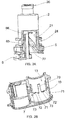
- the cover (10) has an axial channel (13) ( Fig. 2B ) where a locking pin (2) is mounted.
- the locking pin (2) has a head (20) suitable for engaging a housing (201) ( Fig. 5 ) of a lid (200).
- the head (20) of the locking pin has a T-shaped axial section.
- the head (20) of the locking pin protrudes from the cover (10) in upper position.
- the locking pin (2) moves inside the cover with a rototranslation movement in order to go from an extracted opening position ( Figs. 3 and 5 ), wherein the lid (200) is open, to a retracted closing position ( Figs. 4 and 6 ), wherein the lid (200) is closed and the head (20) of the locking pin engages the housing (201) of the lid.
- a helical coupling is provided between the locking pin (2) and the box (1) or the cover (10), in such a way to obtain a rototranslation movement of the locking pin (2).
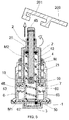
- the locking pin (2) is internally empty and comprises an axial through channel (21) ( Figs. 5 and 6 ) that is open in upper and lower position.
- a shank (65) is integral with the box (1). The shank (65) is disposed in the axial channel (21) of the locking pin.
- the shank (65) has a projection (66) that projects outwards and is engaged in a guiding groove (22) obtained in an internal surface of the locking pin (2).
- the guiding groove (22) has a helical shape. In view of the above, the locking pin (20) is forced to make a rototranslation movement.
- a central pin (4) is mounted with possibility of axially sliding in the shank (65) and in the axial channel (21) of the locking pin, in order to go from a retracted position ( Figs. 3 and 5 ), wherein an upper portion (45) of the central pin protrudes from the head (20) of the locking pin, to a retracted position ( Figs. 4 and 6 ), wherein the central pin is retracted inside the locking pin.
- the central pin (4) has an external collar (40) that protrudes radially outwards.
- the shank (65) has an internal collar (67) that protrudes radially inwards.
- the locking pin (2) comprises a shoulder (25).
- a spring (M) is disposed inside the shank (65) around the central pin (4).
- the spring (M) has a first end (M1) that is stopped against the internal collar (67) of the shank, and a second end (M2) that is stopped against the external collar (40) of the central pin.
- the spring (M) pushes the central pin (4) upwards, until the external collar (40) of the central pin is stopped against the shoulder (25) of the locking pin. In such a situation, the spring (M) keeps on pushing the central pin (4) and the locking pin (2) upwards.
- Detection means (3) detect when the central pin (4) is in retracted position or in extracted position.
- the detection means (3) are connected to a control unit of the vehicle in order to provide information on the status of the central pin (4).
- the central pin has a lower portion (46) opposite to the upper portion (45).
- the detection means (3) are mounted in the box (1) or in the shank (65) to detect when the lower portion (46) of the central pin (4) moves close to the detection means (3) or touches the detection means (3) in such a way to detect when the central pin (4) has reached its retracted position.
- the detection means (3) comprise a Reed switch (30) mounted on a printed circuit board (31) provided with a hole for the insertion of a lower portion of the central pin (4).
- a magnet (43) is disposed in the lower part (46) of the central pin (4).
- the Reed switch (30) changes its status, informing that the central pin (4) is in retracted position.
- the Reed switch (30) is normally open and closes when the magnet (43) of the central pin is close to the Reed switch.
- the detection means (2) can comprise a microswitch disposed in such a way to be activated by the lower end of the central pin (4).
- the lock (100) is of push type, and can be open by pushing the lid (200) towards the lock, in such a way to push the locking pin (2) inwards.
- the lock (100) comprises:
- the lower cam (6) can be integral with the shank (65).
- the lower cam (6) has a cylindrical body disposed around the shank (65).
- the lower cam (6) has an upper edge with a triangular sawtoothed profile comprising a plurality of ramps (60) that end into corresponding seats (61).
- the upper cam (7) is disposed in the cover (10).
- the upper cam (7) has a cylindrical body provided with a lower edge with a square wave profile, which comprises first ramps (71) that end into corresponding seats (72), and second ramps (73) that end into longitudinal grooves (70).
- the lower cam (6) and the upper cam (7) are disposed one in front of the other, in such a way that the seats (61) of the lower cam are disposed in correspondence of the first ramps (71) of the upper cam; the seats (72) of the upper cam are disposed in correspondence of the ramps (60) of the lower cam; and the longitudinal grooves (70) of the upper cam are disposed in correspondence of the ramps (60) of the lower cam.
- the lock comprises a ring (5) that is revolvingly mounted in an annular seat (23) obtained in the locking pin (2).
- a plurality of followers (50) protrudes radially from the ring (5).
- At least one follower (50) can be provided.
- the number of followers (50) can be 3 or a multiple of 3 and in such a case they are disposed at the same angular distance.
- Each follower (50) has a hexagonal shape with an upward point and a downward point.
- the lock (100) comprises a locking device (9) suitable for locking the locking pin (2) in retracted closing position.
- the locking device can go from a locking position, in which it blocks the locking pin, to an unlocking position, in which it unblocks the locking pin.
- the blocking device (9) is controlled by an actuator (8) that is actuated by the control unit of the vehicle.
- the actuator (8) is activated when the vehicle is stopped in order to bring the locking device to the locking position.
- the locking device (9) comprises a projection (90) that projects radially from the locking device and is engaged in a locking seat (24) of the locking pin (2).
- the locking seat (24) can have an annular shape defined between two annular ribs and is obtained above the annular seat (23) that houses the ring with the followers (50).
- the actuator (8) comprises an electric motor (80) with a drive shaft (81) whereon a screw (82) that engages with a female screw (83) is mounted.
- the female screw (83) has at least one follower (84) that slides in a cam (92) of the locking device (9).
- a translation of the female screw (83) causes a translation of the locking device (9) in such a way that the projection (90) of the locking device engages or disengages the locking seat (24) of the locking pin.
- the female screw (83) has a fastener (85) fastened to an emergency cable (86) that can be pulled manually by a user in order to move the locking device (9) to its unlocking position.
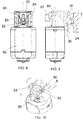
- Figs. 7 , 8 and 10 show the actuator (80) and the locking device (9) in locking position.
- Figs. 11, 12 and 13 show the actuator (80) and the locking device (9) in unlocking position.
- the detection means (3) detect the presence of the central pin (4) and send a signal to the control unit of the vehicle. While the central pin is pressed, the detection means (3) signal the presence of the central pin. Therefore, the control unit can be programmed in such a way to have a delay in reading the signal from the detection means (3) to avoid a possible signal caused by an involuntary actuation of the central pin (4).
- the central pin (4) will not remain in closed or retracted position without an external force (such as the lid (200)) that constantly pushes the central pin (4) in contact with the detection means (3). Therefore, if the actuator (8) is involuntarily closed, the locking pin (2) will remain blocked, whereas the central pin (4) will be free to return to the extracted position and therefore the control unit of the car will receive the open lid signal.
- an external force such as the lid (200)
- the lock (100) is closed, so the projection (90) of the locking device in the locking seat (24) of the locking pin (2), and the locking pin (2) cannot move in axial direction.
- the control unit of the vehicle controls the actuator (8) that moves the locking device (9) backwards in the direction of the arrow F1.
- the locking device (9) is in unlocking position; therefore the projection (9) of the unlocking device does not engage the locking seat (24) and the locking pin is unblocked.
- the lock will not open because the follower (50) connected to the locking pin is stopped against the upper cam (7).
- the user pushes the lid, which pushes the locking pin (2) downwards in the direction of the arrow F2.
- the follower (50) is stopped against the ramp (60) of the lower cam; therefore the ring (5) rotates in the direction of the arrow F3, whereas the follower (50) follows the ramp (60) up to the seat (61) of the lower cam.
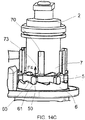
- Fig. 14C shows when the follower (50) has reached the seat (61) of the lower ramp.
- the spring is compressed (M) and therefore, when the user releases the lid, the locking pin (2) tends to rise because of the thrust of the spring (M) and the follower (50) is moved upwards in the direction of the arrow F4, being stopped against the second ramp (73) of the upper cam.
- the ring (5) rotates while the follower (50) follows the second ramp (73) of the upper cam towards the longitudinal groove (70).
- Fig. 14D shows when the follower (50) has reached the longitudinal groove (70) of the upper ramp.
- the locking pin (2) tends to rise because of the thrust of the spring (M), therefore the follower (50) is moved upwards in the longitudinal groove (70) of the upper cam in direction of the arrow F5.
- the helical guiding groove (66) ( Fig. 2A ) of the locking pin slides on the projection (66) of the shank, causing a rotation of the locking pin in the direction of the arrow F6.
- the pitch of the helical guiding groove (22) of the locking pin and the length of the longitudinal groove (70) of the upper cam are such to permit a rotation of the locking pin (2) of approximately 90°.
- the device can also operate with a rotation of the locking pin that is lower than 90°. Consequently, the head (20) of the locking pin rotates by 90° and disengages the housing (201) of the lid ( Fig. 5 ).
- Fig. 14D shows when the follower (50) has reached the end of the longitudinal groove (70) of the upper cam and therefore the head (20) of the locking pin is rotated by 90° relative to the position of Fig. 14D , in such a way to disengage the housing (201) of the lid.
Landscapes
- Engineering & Computer Science (AREA)
- Life Sciences & Earth Sciences (AREA)
- Sustainable Development (AREA)
- Sustainable Energy (AREA)
- Chemical & Material Sciences (AREA)
- Combustion & Propulsion (AREA)
- Transportation (AREA)
- Mechanical Engineering (AREA)
- Lock And Its Accessories (AREA)
Description
- The present patent application for industrial invention relates to a lock of a motor vehicle lid, and particularly to a lock of a fuel tank lid in vehicles with internal combustion engine or to a lock of a lid of an electric charging socket for vehicles with electric motor.
- Although the following description will refer to a fuel tank lid, the invention is also extended to a lock of a lid of an electric charging socket.
- Various types of locks of fuel tank lids are known on the market.
- The
EP1295748 patent application in the name of Volkswagen discloses a closure mechanism of the fuel tank lid comprising an actuator assembly that actuates a rototranslating pin with a "T-shaped" head in axial section, which is engaged in a slot or eyelet obtained in a seat of a fuel tank lid in such a way to close the fuel tank safely. However,EP1295748 does not disclose the use of sensors to detect the closure of the lid or of the rototranslating pin. - The use of sensors, which generally consist in microswitches, is known to detect the closing of the locking pin of the lid lock. In fact, when the lid is closed manually, said lid pushes the locking pin, which reaches its end-of-travel position. A sensor detects such a closing position of the locking pin and sends a confirmation signal to an actuator that blocks the locking pin in locking position.
- However, such a detection system is impaired by a severe drawback. In fact, if the user accidentally pushes the locking pin when the lid is open, said locking pin will reach the closing position. Therefore, the sensor will detect that the locking pin is in closing position and the actuator will lock the pin when the lid is open. It must be considered that such an involuntary actuation of the locking pin is quite common, considering for example the numerous situations in which the user introduces the fuel pump nozzle in the mouth of the fuel conduit that is close to the locking pin.
-
US2010/045049 discloses an opening and closing device for lids, with particular reference to the lids of fuel tanks in cars and motorcycles. - The purpose of the present invention is to eliminate the drawbacks of the prior art by providing a lock for a fuel tank lid of a motor vehicle that is reliable and suitable for avoiding the involuntary tampering of the locking pin of the lock.
- Another purpose is to disclose such a lock that has a reduced volume, a limited number of parts, is inexpensive and easy to make and install.
- These purposes are achieved according to the invention with the characteristics of the
independent claim 1. - Advantageous embodiments of the invention appear from the dependent claims.
- The lock of the invention is defined by
claim 1. - Additional features of the invention will appear manifest from the following detailed description, which refers to a merely illustrative, not limiting embodiment illustrated in the attached figures, wherein:
-
Fig. 1 is an exploded side view of the parts of the lock of the invention; -
Fig. 2 is a perspective view of the lock ofFig. 1 in assembled condition, without the lid; -
Figs. 2a and 2B are sectional views of two details of the lock ofFig. 2 ; -
Figs. 3 and 4 are side views of the lock ofFig. 1 , respectively in open position and in closed position; -
Figs. 5 and6 are two axial views respectively taken along the section planes V-V and VI-VI ofFigs. 3 and 4 ; -
Figs. 7A, 7B, and 7C are perspective side views that show an accidental actuation of the locking pin of the lock according to the invention; -
Fig. 8 is a front view of the actuator of the lock according to the invention in locking position; -
Fig. 9 is a side view of the actuator ofFig. 8 ; -
Fig. 10 is a perspective view of a portion of the actuator ofFig. 8 ; -
Fig. 11 is a front view of the actuator of the lock according to the invention in unlocking position; -
Fig. 12 is a side view of the actuator ofFig. 11 ; -
Fig. 13 is a perspective view of a portion of the actuator ofFig. 11 ; -
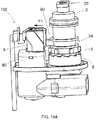
Figs. 14A ,14B ,14C ,14D and14E are perspective side views that show five operating steps of the lock according to the invention. - With reference to the Figures, the lock of the invention is disclosed, which is generally indicated with
reference numeral 100. - In the following description, the terms "upper" and "lower" will refer to the position of the lock in the figures, it being understood that the lock can be installed in the vehicle in any direction.
- With reference to
Figs. 1 and2 , the lock (100) comprises a box (1) and a cover (10) that contain the parts of the lock. An electric connector (11) is connected to the box (1) by means of a gasket. - The cover (10) has an axial channel (13) (
Fig. 2B ) where a locking pin (2) is mounted. The locking pin (2) has a head (20) suitable for engaging a housing (201) (Fig. 5 ) of a lid (200). The head (20) of the locking pin has a T-shaped axial section. The head (20) of the locking pin protrudes from the cover (10) in upper position. - The locking pin (2) moves inside the cover with a rototranslation movement in order to go from an extracted opening position (
Figs. 3 and5 ), wherein the lid (200) is open, to a retracted closing position (Figs. 4 and6 ), wherein the lid (200) is closed and the head (20) of the locking pin engages the housing (201) of the lid. - A helical coupling is provided between the locking pin (2) and the box (1) or the cover (10), in such a way to obtain a rototranslation movement of the locking pin (2). The locking pin (2) is internally empty and comprises an axial through channel (21) (
Figs. 5 and6 ) that is open in upper and lower position. A shank (65) is integral with the box (1). The shank (65) is disposed in the axial channel (21) of the locking pin. - The shank (65) has a projection (66) that projects outwards and is engaged in a guiding groove (22) obtained in an internal surface of the locking pin (2). The guiding groove (22) has a helical shape. In view of the above, the locking pin (20) is forced to make a rototranslation movement.
- A central pin (4) is mounted with possibility of axially sliding in the shank (65) and in the axial channel (21) of the locking pin, in order to go from a retracted position (
Figs. 3 and5 ), wherein an upper portion (45) of the central pin protrudes from the head (20) of the locking pin, to a retracted position (Figs. 4 and6 ), wherein the central pin is retracted inside the locking pin. - The central pin (4) has an external collar (40) that protrudes radially outwards. The shank (65) has an internal collar (67) that protrudes radially inwards. The locking pin (2) comprises a shoulder (25).
- A spring (M) is disposed inside the shank (65) around the central pin (4). The spring (M) has a first end (M1) that is stopped against the internal collar (67) of the shank, and a second end (M2) that is stopped against the external collar (40) of the central pin. In view of the above, the spring (M) pushes the central pin (4) upwards, until the external collar (40) of the central pin is stopped against the shoulder (25) of the locking pin. In such a situation, the spring (M) keeps on pushing the central pin (4) and the locking pin (2) upwards.
- When the collar (40) of the central pin is stopped against the shoulder (25) of the locking pin, the central pin is in extracted position.
- Detection means (3) detect when the central pin (4) is in retracted position or in extracted position. The detection means (3) are connected to a control unit of the vehicle in order to provide information on the status of the central pin (4).
- The central pin has a lower portion (46) opposite to the upper portion (45). Advantageously, the detection means (3) are mounted in the box (1) or in the shank (65) to detect when the lower portion (46) of the central pin (4) moves close to the detection means (3) or touches the detection means (3) in such a way to detect when the central pin (4) has reached its retracted position.
- Advantageously, the detection means (3) comprise a Reed switch (30) mounted on a printed circuit board (31) provided with a hole for the insertion of a lower portion of the central pin (4). In such a case, a magnet (43) is disposed in the lower part (46) of the central pin (4). When the magnet (43) of the central pin is close to the Reed switch (30), the Reed switch (30) changes its status, informing that the central pin (4) is in retracted position. The Reed switch (30) is normally open and closes when the magnet (43) of the central pin is close to the Reed switch.
- In place of the Reed switch, the detection means (2) can comprise a microswitch disposed in such a way to be activated by the lower end of the central pin (4).
- The lock (100) is of push type, and can be open by pushing the lid (200) towards the lock, in such a way to push the locking pin (2) inwards.
- In order to perform the "push" function, the lock (100) comprises:
- a lower cam (6) fixed to the box (1);
- an upper cam (7) integral with the cover (10); and
- and at least one follower (50) connected to the locking pin (2) and disposed between the lower cam (6) and the upper cam (7).
- The lower cam (6) can be integral with the shank (65). The lower cam (6) has a cylindrical body disposed around the shank (65). The lower cam (6) has an upper edge with a triangular sawtoothed profile comprising a plurality of ramps (60) that end into corresponding seats (61).
- With reference to
Fig. 2B , the upper cam (7) is disposed in the cover (10). The upper cam (7) has a cylindrical body provided with a lower edge with a square wave profile, which comprises first ramps (71) that end into corresponding seats (72), and second ramps (73) that end into longitudinal grooves (70). - With reference to
Fig. 14B the lower cam (6) and the upper cam (7) are disposed one in front of the other, in such a way that the seats (61) of the lower cam are disposed in correspondence of the first ramps (71) of the upper cam; the seats (72) of the upper cam are disposed in correspondence of the ramps (60) of the lower cam; and the longitudinal grooves (70) of the upper cam are disposed in correspondence of the ramps (60) of the lower cam. - The lock comprises a ring (5) that is revolvingly mounted in an annular seat (23) obtained in the locking pin (2). A plurality of followers (50) protrudes radially from the ring (5). At least one follower (50) can be provided. Advantageously, the number of followers (50) can be 3 or a multiple of 3 and in such a case they are disposed at the same angular distance. Each follower (50) has a hexagonal shape with an upward point and a downward point.
- The lock (100) comprises a locking device (9) suitable for locking the locking pin (2) in retracted closing position. The locking device can go from a locking position, in which it blocks the locking pin, to an unlocking position, in which it unblocks the locking pin.
- The blocking device (9) is controlled by an actuator (8) that is actuated by the control unit of the vehicle. For example, the actuator (8) is activated when the vehicle is stopped in order to bring the locking device to the locking position.
- The locking device (9) comprises a projection (90) that projects radially from the locking device and is engaged in a locking seat (24) of the locking pin (2). The locking seat (24) can have an annular shape defined between two annular ribs and is obtained above the annular seat (23) that houses the ring with the followers (50).
- The actuator (8) comprises an electric motor (80) with a drive shaft (81) whereon a screw (82) that engages with a female screw (83) is mounted. The female screw (83) has at least one follower (84) that slides in a cam (92) of the locking device (9). A translation of the female screw (83) causes a translation of the locking device (9) in such a way that the projection (90) of the locking device engages or disengages the locking seat (24) of the locking pin.
- The female screw (83) has a fastener (85) fastened to an emergency cable (86) that can be pulled manually by a user in order to move the locking device (9) to its unlocking position.
-
Figs. 7 ,8 and 10 show the actuator (80) and the locking device (9) in locking position. -
Figs. 11, 12 and 13 show the actuator (80) and the locking device (9) in unlocking position. - With reference to
Fig. 7A , when the lid is open, the locking pin (2) and the central pin (4) are in extracted position, therefore the detection means (3) do not detect the central pin (4), signaling the opening status. - If a user accidentally pushes the central pin (4) and the locking pin (2) to the retracted position, as shown in
Fig. 7B , the detection means (3) detect the presence of the central pin (4) and send a signal to the control unit of the vehicle. While the central pin is pressed, the detection means (3) signal the presence of the central pin. Therefore, the control unit can be programmed in such a way to have a delay in reading the signal from the detection means (3) to avoid a possible signal caused by an involuntary actuation of the central pin (4). - It must noted that, moving independently relative to the locking pin (2), the central pin (4) will not remain in closed or retracted position without an external force (such as the lid (200)) that constantly pushes the central pin (4) in contact with the detection means (3). Therefore, if the actuator (8) is involuntarily closed, the locking pin (2) will remain blocked, whereas the central pin (4) will be free to return to the extracted position and therefore the control unit of the car will receive the open lid signal.
- Then, when the user release the central pin (4) and the locking pin (2), as shown in
Fig. 7C , the central pin (4) returns to the extracted position because of the thrust of the spring (M) on the central pin (4). So, the detection means (3) will not detect the central pin and will indicate the open lid condition to the control unit. - With reference to
Figs. 14A to 14E , the operation of the lock (100) is described. - As shown in
Fig. 14A , the lock (100) is closed, so the projection (90) of the locking device in the locking seat (24) of the locking pin (2), and the locking pin (2) cannot move in axial direction. When the vehicle is stopped (and is closed), the control unit of the vehicle controls the actuator (8) that moves the locking device (9) backwards in the direction of the arrow F1. - With reference to
Fig. 14B , the locking device (9) is in unlocking position; therefore the projection (9) of the unlocking device does not engage the locking seat (24) and the locking pin is unblocked. However, the lock will not open because the follower (50) connected to the locking pin is stopped against the upper cam (7). - In order to open the lock, the user pushes the lid, which pushes the locking pin (2) downwards in the direction of the arrow F2. The follower (50) is stopped against the ramp (60) of the lower cam; therefore the ring (5) rotates in the direction of the arrow F3, whereas the follower (50) follows the ramp (60) up to the seat (61) of the lower cam.
-
Fig. 14C shows when the follower (50) has reached the seat (61) of the lower ramp. Now, the spring is compressed (M) and therefore, when the user releases the lid, the locking pin (2) tends to rise because of the thrust of the spring (M) and the follower (50) is moved upwards in the direction of the arrow F4, being stopped against the second ramp (73) of the upper cam. The ring (5) rotates while the follower (50) follows the second ramp (73) of the upper cam towards the longitudinal groove (70). -
Fig. 14D shows when the follower (50) has reached the longitudinal groove (70) of the upper ramp. Now, the locking pin (2) tends to rise because of the thrust of the spring (M), therefore the follower (50) is moved upwards in the longitudinal groove (70) of the upper cam in direction of the arrow F5. During the upward movement of the locking pin (2), the helical guiding groove (66) (Fig. 2A ) of the locking pin slides on the projection (66) of the shank, causing a rotation of the locking pin in the direction of the arrow F6. - The pitch of the helical guiding groove (22) of the locking pin and the length of the longitudinal groove (70) of the upper cam are such to permit a rotation of the locking pin (2) of approximately 90°. Obviously, the device can also operate with a rotation of the locking pin that is lower than 90°. Consequently, the head (20) of the locking pin rotates by 90° and disengages the housing (201) of the lid (
Fig. 5 ). -
Fig. 14D shows when the follower (50) has reached the end of the longitudinal groove (70) of the upper cam and therefore the head (20) of the locking pin is rotated by 90° relative to the position ofFig. 14D , in such a way to disengage the housing (201) of the lid.
Claims (10)
- Lock (100) for a motor vehicle lid comprising:- a box (1) and a cover (10),- a locking pin (2) provided with a head (20) that protrudes from the cover (10) to engage with a housing (201) of a lid (200) to close the lid; said locking pin (2) being mounted in such a way to make a rototranslation movement in said cover (10) to go from a retracted closing position, wherein the head of the locking pin engages the seat of the cover, to an extracted opening position;characterized in thatsaid locking pin (2) is internally empty and comprises an axial through channel (21); andsaid lock also comprises:- a central pin (4) that is mounted with possibility of sliding axially in said axial through channel (21) of the locking pin, in order to go from a retracted position inside said locking pin to an extracted position wherein an upper portion (45) of the central pin protrudes upperly from the head (20) of the locking pin,- a spring (M) disposed between said box (1) and said central pin (4) to push the central pin (4) and the locking pin (2) to the extracted position, and- detection means (3) disposed in said box (1) to detect when the central pin (4) is in retracted position or in extracted position.
- The lock (100) of claim 1, whereinsaid locking pin (2) comprises a shoulder (25);said central pin (4) comprises an external collar (40) that protrudes radially outwards to stop against said shoulder (25) of the locking pin; andsaid spring (M) is disposed between said box (1) and said external collar (40) of the central pin.
- The lock (100) of claim 1 or 2, wherein said central pin (4) has a lower portion (46) opposite to said upper portion (45) and said detection means (3) are arranged in such a way to detect the lower portion (46) of said central pin (4).
- The lock (100) of any one of the preceding claims, wherein said detection means (3) comprise a Reed switch (30) and a magnet (43) is disposed in said central pin (4) in order to be detected by the Reed switch (30).
- The lock (100) of any one of the preceding claims, also comprising a shank (65) fixed to the box (1) and disposed inside said axial through channel (21) of the locking pin; said shank (65) being provided with a projection (66) disposed in a helical guiding groove (22) obtained in an internal surface of said locking pin.
- The lock (100) of claim 5 when depending on claim 2, wherein said shank (65) has an internal collar (67) and said spring (M) has a first end (M1) on the internal collar (67) of the shank and a second end (M2) stopped against said external collar (40) of the central pin.
- The lock (100) of any one of the preceding claims, also comprising:- a lower cam (6) fixed to the box (1);- an upper cam (7) integral with the cover (10);- and at least one follower (50) connected to the locking pin (2) and disposed between the lower cam (6) and the upper cam (7).
- The lock (100) of claim 7, comprising:- a ring (5) that is revolvingly mounted in an annular seat (23) of said locking pin; and- a plurality of followers (50) that protrude radially from said ring (5).
- The lock (100) of claim 7 or 8, whereinthe lower cam (6) has a cylindrical body provided with an upper edge with a triangular sawtoothed profile comprising a plurality of ramps (60) that end in corresponding seats (61); andthe upper cam (7) has a cylindrical body provided with a lower edge with a square wave profile comprising first ramps (71) that end in corresponding seats (72) and second ramps (73) that end in longitudinal grooves (70).
- The lock (100) of any one of the preceding claims, also comprising:- a locking device (9) suitable for locking said locking pin (2) and- an actuator (8) that actuates said locking device (9); said actuator (8) being electrically connected to a control unit of the vehicle.
Applications Claiming Priority (2)
| Application Number | Priority Date | Filing Date | Title |
|---|---|---|---|
| IT102018000006901A IT201800006901A1 (en) | 2018-07-03 | 2018-07-03 | LOCK FOR VEHICLE DOOR WITH POSITION SENSOR. |
| PCT/EP2019/067374 WO2020007737A1 (en) | 2018-07-03 | 2019-06-28 | Lock of a motor vehicle lid with position sensor |
Publications (2)
| Publication Number | Publication Date |
|---|---|
| EP3817942A1 EP3817942A1 (en) | 2021-05-12 |
| EP3817942B1 true EP3817942B1 (en) | 2022-01-05 |
Family
ID=64316619
Family Applications (1)
| Application Number | Title | Priority Date | Filing Date |
|---|---|---|---|
| EP19739526.2A Active EP3817942B1 (en) | 2018-07-03 | 2019-06-28 | Lock of a motor vehicle lid with position sensor |
Country Status (7)
| Country | Link |
|---|---|
| US (1) | US11254204B2 (en) |
| EP (1) | EP3817942B1 (en) |
| CN (1) | CN112334350B (en) |
| ES (1) | ES2910430T3 (en) |
| IT (1) | IT201800006901A1 (en) |
| MX (1) | MX2020013766A (en) |
| WO (1) | WO2020007737A1 (en) |
Families Citing this family (4)
| Publication number | Priority date | Publication date | Assignee | Title |
|---|---|---|---|---|
| JP7054372B2 (en) * | 2018-08-24 | 2022-04-13 | 中央発條株式会社 | Closure opening and closing device |
| US11473355B2 (en) * | 2020-03-30 | 2022-10-18 | The Boeing Company | Press-to-deploy rotatable latch assembly |
| JP7440386B2 (en) * | 2020-09-24 | 2024-02-28 | 株式会社ハイレックスコーポレーション | Advance/retreat movement device |
| JP7680390B2 (en) * | 2022-03-10 | 2025-05-20 | 株式会社ハイレックスコーポレーション | Advance/retreat movement device |
Family Cites Families (26)
| Publication number | Priority date | Publication date | Assignee | Title |
|---|---|---|---|---|
| IT238933Y1 (en) * | 1995-03-16 | 2001-02-19 | Italiana Serrature Affini | IMPROVING A DEVICE TO LOCK THE LOCKS IN A SECURITY DOOR |
| DE10148199A1 (en) | 2001-09-21 | 2003-04-10 | Volkswagen Ag | Actuating device for a cover of a body opening |
| US7484777B2 (en) * | 2006-06-30 | 2009-02-03 | Sargent Manufacturing Company | Electronic push retraction exit device |
| ITMC20060150A1 (en) * | 2006-11-13 | 2008-05-14 | So Ge Mi Spa | OPENING AND CLOSING DEVICE FOR DOORS. |
| JP5171237B2 (en) * | 2007-12-17 | 2013-03-27 | 日本電産サンキョー株式会社 | Lid lock device |
| DE102009060119B4 (en) * | 2009-12-15 | 2018-03-01 | Illinois Tool Works Inc. | actuator |
| US20130154402A1 (en) * | 2010-05-28 | 2013-06-20 | Kiekert Ag | Actuating drive for a motor vehicle |
| DE102011116067A1 (en) * | 2011-07-22 | 2013-01-24 | Kiekert Ag | Tank flap lock with reduced number of components |
| DE102012004071A1 (en) * | 2012-03-02 | 2013-09-05 | Illinois Tool Works Inc. | actuator |
| FR3001488B1 (en) * | 2013-01-29 | 2015-06-26 | Coutier Moulage Gen Ind | ASSEMBLY FOR LOCKING AND UNLOCKING AN ARTICULATING OPENING TO A DORMANT |
| DE202013001917U1 (en) * | 2013-02-27 | 2013-03-13 | GM Global Technology Operations LLC (n. d. Ges. d. Staates Delaware) | Locking arrangement for a motor vehicle door |
| CN105164352A (en) * | 2013-04-29 | 2015-12-16 | 莫尔锁系统有限公司 | Cylinder lock with anti-break feature |
| JP6232612B2 (en) * | 2013-08-07 | 2017-11-22 | 三井金属アクト株式会社 | Door latch device for automobile |
| JP6211909B2 (en) * | 2013-12-02 | 2017-10-11 | 株式会社ニフコ | Lid device |
| JP6180992B2 (en) * | 2014-04-25 | 2017-08-16 | 株式会社ニフコ | Lid device |
| JP6396163B2 (en) * | 2014-10-08 | 2018-09-26 | 株式会社ハイレックスコーポレーション | Advance / Retreat Device |
| KR101567246B1 (en) * | 2014-10-17 | 2015-11-06 | 현대자동차주식회사 | Actuator integrated push opener |
| JP2016117313A (en) * | 2014-12-18 | 2016-06-30 | 株式会社城南製作所 | Lid opening/closing device |
| PL3265333T3 (en) * | 2015-03-02 | 2019-10-31 | Cebi Italy Spa | Lid-closing device with rocker |
| DE102015120597A1 (en) * | 2015-11-27 | 2017-06-01 | Hella Kgaa Hueck & Co. | Actuating device for a fuel cap arranged movably on a vehicle |
| KR101776461B1 (en) * | 2016-02-24 | 2017-09-07 | 현대자동차주식회사 | Fuel door opener |
| CN105946571B (en) * | 2016-05-04 | 2018-11-06 | 杰必机电配件(上海)有限公司 | Cover board control device and automobile |
| IT201600104772A1 (en) * | 2016-10-18 | 2018-04-18 | Cebi Italy Spa | SYSTEM FOR THE CLOSING OF A DOOR OF THE FUEL TANK. |
| IT201600131138A1 (en) * | 2016-12-27 | 2018-06-27 | Cebi Italy Spa | PERFECT CLOSING DEVICE OF A DOOR OF THE FUEL TANK OF A VEHICLE. |
| JP7003779B2 (en) * | 2018-03-23 | 2022-01-21 | トヨタ自動車株式会社 | Vehicle refueling section structure |
| EP3760465B1 (en) * | 2019-06-07 | 2022-02-16 | Asahi Denso Co., Ltd. | Fuel tank cap locking device |
-
2018
- 2018-07-03 IT IT102018000006901A patent/IT201800006901A1/en unknown
-
2019
- 2019-06-28 EP EP19739526.2A patent/EP3817942B1/en active Active
- 2019-06-28 ES ES19739526T patent/ES2910430T3/en active Active
- 2019-06-28 WO PCT/EP2019/067374 patent/WO2020007737A1/en not_active Ceased
- 2019-06-28 MX MX2020013766A patent/MX2020013766A/en unknown
- 2019-06-28 US US16/973,293 patent/US11254204B2/en active Active
- 2019-06-28 CN CN201980044390.3A patent/CN112334350B/en active Active
Also Published As
| Publication number | Publication date |
|---|---|
| US20210245598A1 (en) | 2021-08-12 |
| BR112020025429A2 (en) | 2021-03-16 |
| ES2910430T3 (en) | 2022-05-12 |
| US11254204B2 (en) | 2022-02-22 |
| EP3817942A1 (en) | 2021-05-12 |
| CN112334350B (en) | 2024-04-12 |
| MX2020013766A (en) | 2021-03-02 |
| IT201800006901A1 (en) | 2020-01-03 |
| WO2020007737A1 (en) | 2020-01-09 |
| CN112334350A (en) | 2021-02-05 |
Similar Documents
| Publication | Publication Date | Title |
|---|---|---|
| EP3817942B1 (en) | Lock of a motor vehicle lid with position sensor | |
| EP3348432B1 (en) | Improved closing device of a fuel tank lid for vehicles | |
| EP3078792B1 (en) | Lid device | |
| US20150061314A1 (en) | Actuation device | |
| CN102656044B (en) | Actuation device | |
| US11098506B2 (en) | Actuating apparatus | |
| US20130154402A1 (en) | Actuating drive for a motor vehicle | |
| US20200408007A1 (en) | Vehicle Door Latch with Safety Device | |
| CN108474220B (en) | vehicle door latch system | |
| CN116134201B (en) | Locking system for vehicle hood | |
| US11933085B2 (en) | Motorized vehicle door latch with emergency release | |
| US4280347A (en) | Torque override threaded locking cap | |
| EP1090796A2 (en) | Fuel tank inlet cover for a motor vehicle | |
| CN114096731A (en) | Electronic lock latch for vehicle door | |
| US20100011819A1 (en) | Anti-theft security device for vehicles | |
| EP2763866A2 (en) | A device for closing the access compartment of a filler pipe of a car fuel tank | |
| JP2007205366A (en) | Adjusting device and control cable with adjusting device | |
| GB2053163A (en) | Locking cap for a threaded filler neck | |
| US11591829B2 (en) | Lid opening and closing device for vehicle | |
| CN112217051A (en) | A new energy vehicle electronic lock with feedback function and clutch mechanism | |
| WO2019115288A1 (en) | Lock for vehicle lid | |
| US4468058A (en) | Locking fuel cap | |
| BR112020025429B1 (en) | LOCKING A MOTOR VEHICLE LID WITH POSITION SENSOR | |
| TWI722667B (en) | Main switch lock | |
| TWI854696B (en) | Keyless master switch lock |
Legal Events
| Date | Code | Title | Description |
|---|---|---|---|
| STAA | Information on the status of an ep patent application or granted ep patent |
Free format text: STATUS: UNKNOWN |
|
| STAA | Information on the status of an ep patent application or granted ep patent |
Free format text: STATUS: THE INTERNATIONAL PUBLICATION HAS BEEN MADE |
|
| PUAI | Public reference made under article 153(3) epc to a published international application that has entered the european phase |
Free format text: ORIGINAL CODE: 0009012 |
|
| STAA | Information on the status of an ep patent application or granted ep patent |
Free format text: STATUS: REQUEST FOR EXAMINATION WAS MADE |
|
| 17P | Request for examination filed |
Effective date: 20201124 |
|
| AK | Designated contracting states |
Kind code of ref document: A1 Designated state(s): AL AT BE BG CH CY CZ DE DK EE ES FI FR GB GR HR HU IE IS IT LI LT LU LV MC MK MT NL NO PL PT RO RS SE SI SK SM TR |
|
| DAV | Request for validation of the european patent (deleted) | ||
| DAX | Request for extension of the european patent (deleted) | ||
| GRAP | Despatch of communication of intention to grant a patent |
Free format text: ORIGINAL CODE: EPIDOSNIGR1 |
|
| STAA | Information on the status of an ep patent application or granted ep patent |
Free format text: STATUS: GRANT OF PATENT IS INTENDED |
|
| GRAS | Grant fee paid |
Free format text: ORIGINAL CODE: EPIDOSNIGR3 |
|
| INTG | Intention to grant announced |
Effective date: 20211102 |
|
| GRAA | (expected) grant |
Free format text: ORIGINAL CODE: 0009210 |
|
| STAA | Information on the status of an ep patent application or granted ep patent |
Free format text: STATUS: THE PATENT HAS BEEN GRANTED |
|
| AK | Designated contracting states |
Kind code of ref document: B1 Designated state(s): AL AT BE BG CH CY CZ DE DK EE ES FI FR GB GR HR HU IE IS IT LI LT LU LV MC MK MT NL NO PL PT RO RS SE SI SK SM TR |
|
| REG | Reference to a national code |
Ref country code: GB Ref legal event code: FG4D |
|
| REG | Reference to a national code |
Ref country code: CH Ref legal event code: EP |
|
| REG | Reference to a national code |
Ref country code: AT Ref legal event code: REF Ref document number: 1460225 Country of ref document: AT Kind code of ref document: T Effective date: 20220115 |
|
| REG | Reference to a national code |
Ref country code: DE Ref legal event code: R096 Ref document number: 602019010719 Country of ref document: DE |
|
| REG | Reference to a national code |
Ref country code: IE Ref legal event code: FG4D |
|
| REG | Reference to a national code |
Ref country code: LT Ref legal event code: MG9D |
|
| REG | Reference to a national code |
Ref country code: NL Ref legal event code: MP Effective date: 20220105 |
|
| REG | Reference to a national code |
Ref country code: ES Ref legal event code: FG2A Ref document number: 2910430 Country of ref document: ES Kind code of ref document: T3 Effective date: 20220512 |
|
| REG | Reference to a national code |
Ref country code: AT Ref legal event code: MK05 Ref document number: 1460225 Country of ref document: AT Kind code of ref document: T Effective date: 20220105 |
|
| PG25 | Lapsed in a contracting state [announced via postgrant information from national office to epo] |
Ref country code: NL Free format text: LAPSE BECAUSE OF FAILURE TO SUBMIT A TRANSLATION OF THE DESCRIPTION OR TO PAY THE FEE WITHIN THE PRESCRIBED TIME-LIMIT Effective date: 20220105 |
|
| PG25 | Lapsed in a contracting state [announced via postgrant information from national office to epo] |
Ref country code: SE Free format text: LAPSE BECAUSE OF FAILURE TO SUBMIT A TRANSLATION OF THE DESCRIPTION OR TO PAY THE FEE WITHIN THE PRESCRIBED TIME-LIMIT Effective date: 20220105 Ref country code: RS Free format text: LAPSE BECAUSE OF FAILURE TO SUBMIT A TRANSLATION OF THE DESCRIPTION OR TO PAY THE FEE WITHIN THE PRESCRIBED TIME-LIMIT Effective date: 20220105 Ref country code: PT Free format text: LAPSE BECAUSE OF FAILURE TO SUBMIT A TRANSLATION OF THE DESCRIPTION OR TO PAY THE FEE WITHIN THE PRESCRIBED TIME-LIMIT Effective date: 20220505 Ref country code: NO Free format text: LAPSE BECAUSE OF FAILURE TO SUBMIT A TRANSLATION OF THE DESCRIPTION OR TO PAY THE FEE WITHIN THE PRESCRIBED TIME-LIMIT Effective date: 20220405 Ref country code: LT Free format text: LAPSE BECAUSE OF FAILURE TO SUBMIT A TRANSLATION OF THE DESCRIPTION OR TO PAY THE FEE WITHIN THE PRESCRIBED TIME-LIMIT Effective date: 20220105 Ref country code: HR Free format text: LAPSE BECAUSE OF FAILURE TO SUBMIT A TRANSLATION OF THE DESCRIPTION OR TO PAY THE FEE WITHIN THE PRESCRIBED TIME-LIMIT Effective date: 20220105 Ref country code: BG Free format text: LAPSE BECAUSE OF FAILURE TO SUBMIT A TRANSLATION OF THE DESCRIPTION OR TO PAY THE FEE WITHIN THE PRESCRIBED TIME-LIMIT Effective date: 20220405 |
|
| PG25 | Lapsed in a contracting state [announced via postgrant information from national office to epo] |
Ref country code: PL Free format text: LAPSE BECAUSE OF FAILURE TO SUBMIT A TRANSLATION OF THE DESCRIPTION OR TO PAY THE FEE WITHIN THE PRESCRIBED TIME-LIMIT Effective date: 20220105 Ref country code: LV Free format text: LAPSE BECAUSE OF FAILURE TO SUBMIT A TRANSLATION OF THE DESCRIPTION OR TO PAY THE FEE WITHIN THE PRESCRIBED TIME-LIMIT Effective date: 20220105 Ref country code: GR Free format text: LAPSE BECAUSE OF FAILURE TO SUBMIT A TRANSLATION OF THE DESCRIPTION OR TO PAY THE FEE WITHIN THE PRESCRIBED TIME-LIMIT Effective date: 20220406 Ref country code: FI Free format text: LAPSE BECAUSE OF FAILURE TO SUBMIT A TRANSLATION OF THE DESCRIPTION OR TO PAY THE FEE WITHIN THE PRESCRIBED TIME-LIMIT Effective date: 20220105 Ref country code: AT Free format text: LAPSE BECAUSE OF FAILURE TO SUBMIT A TRANSLATION OF THE DESCRIPTION OR TO PAY THE FEE WITHIN THE PRESCRIBED TIME-LIMIT Effective date: 20220105 |
|
| PG25 | Lapsed in a contracting state [announced via postgrant information from national office to epo] |
Ref country code: IS Free format text: LAPSE BECAUSE OF FAILURE TO SUBMIT A TRANSLATION OF THE DESCRIPTION OR TO PAY THE FEE WITHIN THE PRESCRIBED TIME-LIMIT Effective date: 20220505 |
|
| REG | Reference to a national code |
Ref country code: DE Ref legal event code: R097 Ref document number: 602019010719 Country of ref document: DE |
|
| PG25 | Lapsed in a contracting state [announced via postgrant information from national office to epo] |
Ref country code: SM Free format text: LAPSE BECAUSE OF FAILURE TO SUBMIT A TRANSLATION OF THE DESCRIPTION OR TO PAY THE FEE WITHIN THE PRESCRIBED TIME-LIMIT Effective date: 20220105 Ref country code: SK Free format text: LAPSE BECAUSE OF FAILURE TO SUBMIT A TRANSLATION OF THE DESCRIPTION OR TO PAY THE FEE WITHIN THE PRESCRIBED TIME-LIMIT Effective date: 20220105 Ref country code: RO Free format text: LAPSE BECAUSE OF FAILURE TO SUBMIT A TRANSLATION OF THE DESCRIPTION OR TO PAY THE FEE WITHIN THE PRESCRIBED TIME-LIMIT Effective date: 20220105 Ref country code: EE Free format text: LAPSE BECAUSE OF FAILURE TO SUBMIT A TRANSLATION OF THE DESCRIPTION OR TO PAY THE FEE WITHIN THE PRESCRIBED TIME-LIMIT Effective date: 20220105 Ref country code: DK Free format text: LAPSE BECAUSE OF FAILURE TO SUBMIT A TRANSLATION OF THE DESCRIPTION OR TO PAY THE FEE WITHIN THE PRESCRIBED TIME-LIMIT Effective date: 20220105 Ref country code: CZ Free format text: LAPSE BECAUSE OF FAILURE TO SUBMIT A TRANSLATION OF THE DESCRIPTION OR TO PAY THE FEE WITHIN THE PRESCRIBED TIME-LIMIT Effective date: 20220105 |
|
| PLBE | No opposition filed within time limit |
Free format text: ORIGINAL CODE: 0009261 |
|
| STAA | Information on the status of an ep patent application or granted ep patent |
Free format text: STATUS: NO OPPOSITION FILED WITHIN TIME LIMIT |
|
| PG25 | Lapsed in a contracting state [announced via postgrant information from national office to epo] |
Ref country code: AL Free format text: LAPSE BECAUSE OF FAILURE TO SUBMIT A TRANSLATION OF THE DESCRIPTION OR TO PAY THE FEE WITHIN THE PRESCRIBED TIME-LIMIT Effective date: 20220105 |
|
| 26N | No opposition filed |
Effective date: 20221006 |
|
| PG25 | Lapsed in a contracting state [announced via postgrant information from national office to epo] |
Ref country code: MC Free format text: LAPSE BECAUSE OF FAILURE TO SUBMIT A TRANSLATION OF THE DESCRIPTION OR TO PAY THE FEE WITHIN THE PRESCRIBED TIME-LIMIT Effective date: 20220105 |
|
| REG | Reference to a national code |
Ref country code: CH Ref legal event code: PL |
|
| REG | Reference to a national code |
Ref country code: BE Ref legal event code: MM Effective date: 20220630 |
|
| PG25 | Lapsed in a contracting state [announced via postgrant information from national office to epo] |
Ref country code: LU Free format text: LAPSE BECAUSE OF NON-PAYMENT OF DUE FEES Effective date: 20220628 Ref country code: LI Free format text: LAPSE BECAUSE OF NON-PAYMENT OF DUE FEES Effective date: 20220630 Ref country code: IE Free format text: LAPSE BECAUSE OF NON-PAYMENT OF DUE FEES Effective date: 20220628 Ref country code: CH Free format text: LAPSE BECAUSE OF NON-PAYMENT OF DUE FEES Effective date: 20220630 |
|
| PG25 | Lapsed in a contracting state [announced via postgrant information from national office to epo] |
Ref country code: BE Free format text: LAPSE BECAUSE OF NON-PAYMENT OF DUE FEES Effective date: 20220630 |
|
| P01 | Opt-out of the competence of the unified patent court (upc) registered |
Effective date: 20230628 |
|
| PG25 | Lapsed in a contracting state [announced via postgrant information from national office to epo] |
Ref country code: MK Free format text: LAPSE BECAUSE OF FAILURE TO SUBMIT A TRANSLATION OF THE DESCRIPTION OR TO PAY THE FEE WITHIN THE PRESCRIBED TIME-LIMIT Effective date: 20220105 Ref country code: CY Free format text: LAPSE BECAUSE OF FAILURE TO SUBMIT A TRANSLATION OF THE DESCRIPTION OR TO PAY THE FEE WITHIN THE PRESCRIBED TIME-LIMIT Effective date: 20220105 |
|
| PG25 | Lapsed in a contracting state [announced via postgrant information from national office to epo] |
Ref country code: HU Free format text: LAPSE BECAUSE OF FAILURE TO SUBMIT A TRANSLATION OF THE DESCRIPTION OR TO PAY THE FEE WITHIN THE PRESCRIBED TIME-LIMIT; INVALID AB INITIO Effective date: 20190628 |
|
| PG25 | Lapsed in a contracting state [announced via postgrant information from national office to epo] |
Ref country code: TR Free format text: LAPSE BECAUSE OF FAILURE TO SUBMIT A TRANSLATION OF THE DESCRIPTION OR TO PAY THE FEE WITHIN THE PRESCRIBED TIME-LIMIT Effective date: 20220105 |
|
| PGFP | Annual fee paid to national office [announced via postgrant information from national office to epo] |
Ref country code: GB Payment date: 20240628 Year of fee payment: 6 |
|
| PG25 | Lapsed in a contracting state [announced via postgrant information from national office to epo] |
Ref country code: MT Free format text: LAPSE BECAUSE OF FAILURE TO SUBMIT A TRANSLATION OF THE DESCRIPTION OR TO PAY THE FEE WITHIN THE PRESCRIBED TIME-LIMIT Effective date: 20220105 |
|
| PGFP | Annual fee paid to national office [announced via postgrant information from national office to epo] |
Ref country code: DE Payment date: 20250626 Year of fee payment: 7 |
|
| PGFP | Annual fee paid to national office [announced via postgrant information from national office to epo] |
Ref country code: IT Payment date: 20250418 Year of fee payment: 7 |
|
| PGFP | Annual fee paid to national office [announced via postgrant information from national office to epo] |
Ref country code: FR Payment date: 20250624 Year of fee payment: 7 |
|
| PGFP | Annual fee paid to national office [announced via postgrant information from national office to epo] |
Ref country code: ES Payment date: 20250710 Year of fee payment: 7 |
|
| PG25 | Lapsed in a contracting state [announced via postgrant information from national office to epo] |
Ref country code: SI Free format text: LAPSE BECAUSE OF FAILURE TO SUBMIT A TRANSLATION OF THE DESCRIPTION OR TO PAY THE FEE WITHIN THE PRESCRIBED TIME-LIMIT Effective date: 20220105 |
|
| GBPC | Gb: european patent ceased through non-payment of renewal fee |
Effective date: 20250628 |
|
| PG25 | Lapsed in a contracting state [announced via postgrant information from national office to epo] |
Ref country code: GB Free format text: LAPSE BECAUSE OF NON-PAYMENT OF DUE FEES Effective date: 20250628 |