EP3817226A1 - Method and device for processing information, terminal device, and storage medium - Google Patents
Method and device for processing information, terminal device, and storage medium Download PDFInfo
- Publication number
- EP3817226A1 EP3817226A1 EP20160612.6A EP20160612A EP3817226A1 EP 3817226 A1 EP3817226 A1 EP 3817226A1 EP 20160612 A EP20160612 A EP 20160612A EP 3817226 A1 EP3817226 A1 EP 3817226A1
- Authority
- EP
- European Patent Office
- Prior art keywords
- audio signal
- output voltage
- parameter
- gain
- processing module
- Prior art date
- Legal status (The legal status is an assumption and is not a legal conclusion. Google has not performed a legal analysis and makes no representation as to the accuracy of the status listed.)
- Granted
Links
Images




Classifications
-
- H—ELECTRICITY
- H03—ELECTRONIC CIRCUITRY
- H03G—CONTROL OF AMPLIFICATION
- H03G3/00—Gain control in amplifiers or frequency changers
- H03G3/007—Control dependent on the supply voltage
-
- H—ELECTRICITY
- H04—ELECTRIC COMMUNICATION TECHNIQUE
- H04R—LOUDSPEAKERS, MICROPHONES, GRAMOPHONE PICK-UPS OR LIKE ACOUSTIC ELECTROMECHANICAL TRANSDUCERS; ELECTRIC HEARING AIDS; PUBLIC ADDRESS SYSTEMS
- H04R29/00—Monitoring arrangements; Testing arrangements
- H04R29/001—Monitoring arrangements; Testing arrangements for loudspeakers
-
- H—ELECTRICITY
- H04—ELECTRIC COMMUNICATION TECHNIQUE
- H04R—LOUDSPEAKERS, MICROPHONES, GRAMOPHONE PICK-UPS OR LIKE ACOUSTIC ELECTROMECHANICAL TRANSDUCERS; ELECTRIC HEARING AIDS; PUBLIC ADDRESS SYSTEMS
- H04R3/00—Circuits for transducers
- H04R3/12—Circuits for transducers for distributing signals to two or more loudspeakers
-
- G—PHYSICS
- G01—MEASURING; TESTING
- G01R—MEASURING ELECTRIC VARIABLES; MEASURING MAGNETIC VARIABLES
- G01R31/00—Arrangements for testing electric properties; Arrangements for locating electric faults; Arrangements for electrical testing characterised by what is being tested not provided for elsewhere
- G01R31/28—Testing of electronic circuits, e.g. by signal tracer
- G01R31/282—Testing of electronic circuits specially adapted for particular applications not provided for elsewhere
- G01R31/2825—Testing of electronic circuits specially adapted for particular applications not provided for elsewhere in household appliances or professional audio/video equipment
-
- G—PHYSICS
- G06—COMPUTING OR CALCULATING; COUNTING
- G06F—ELECTRIC DIGITAL DATA PROCESSING
- G06F11/00—Error detection; Error correction; Monitoring
- G06F11/30—Monitoring
- G06F11/3058—Monitoring arrangements for monitoring environmental properties or parameters of the computing system or of the computing system component, e.g. monitoring of power, currents, temperature, humidity, position, vibrations
-
- H—ELECTRICITY
- H03—ELECTRONIC CIRCUITRY
- H03G—CONTROL OF AMPLIFICATION
- H03G9/00—Combinations of two or more types of control, e.g. gain control and tone control
- H03G9/005—Combinations of two or more types of control, e.g. gain control and tone control of digital or coded signals
-
- H—ELECTRICITY
- H04—ELECTRIC COMMUNICATION TECHNIQUE
- H04R—LOUDSPEAKERS, MICROPHONES, GRAMOPHONE PICK-UPS OR LIKE ACOUSTIC ELECTROMECHANICAL TRANSDUCERS; ELECTRIC HEARING AIDS; PUBLIC ADDRESS SYSTEMS
- H04R3/00—Circuits for transducers
- H04R3/04—Circuits for transducers for correcting frequency response
-
- H—ELECTRICITY
- H04—ELECTRIC COMMUNICATION TECHNIQUE
- H04R—LOUDSPEAKERS, MICROPHONES, GRAMOPHONE PICK-UPS OR LIKE ACOUSTIC ELECTROMECHANICAL TRANSDUCERS; ELECTRIC HEARING AIDS; PUBLIC ADDRESS SYSTEMS
- H04R2430/00—Signal processing covered by H04R, not provided for in its groups
Definitions
- the present disclosure relates to the field of information processing technology, and more particularly to a method and device for processing information, a terminal device, and a storage medium.
- a loudspeaker as a device for converting an electrical signal into an acoustic signal, is widely applied in terminal devices, to output sound for the terminal devices, such as a mobile phone, a tablet PC, and a smart watch.
- the volume of the sound outputted by the terminal device through the loudspeaker drops significantly, which affects user experience.
- the present disclosure provides a method and device for processing information, a terminal device, and a storage medium.
- a method for processing information is provided, which may include operations as follows.
- a current output voltage of a power supply module in a terminal device is determined.
- a target parameter of an audio processing module in the terminal device is determined according to the current output voltage.
- the audio processing module for processing an audio signal is configured according to the target parameter.
- An audio processing module for processing an audio signal is configured according to a target parameter, which is determined by a current output voltage of the power supply module, and an audio signal is processed by the configured audio processing module.
- a target parameter which is determined by a current output voltage of the power supply module
- an audio signal is processed by the configured audio processing module.
- the method may further include an operation as follows.
- a current temperature and/or a current power capacity of the power supply module is detected.
- the operation that the current output voltage of the power supply module in the terminal device is determined may include an operation.
- a current output voltage value of the power supply module is determined according to the current temperature and/or the current power capacity.
- the current output voltage value of the power supply module is determined according to the current temperature and/or the current power capacity. In this way, an impact of a change of the current temperature and/or the current power capacity of the power supply module on output volume of a loudspeaker can be reduced, and further the problem that the output volume of the loudspeaker drops in a scenario of low temperature or low power capacity, thereby improving user experience.
- the operation that the audio processing module for processing the audio signal is configured according to the target parameter may include at least one of the following operations.
- a filter in the audio processing module is configured according to the filtering parameter, and the filter is configured to filter the audio signal.
- a dynamic range controller in the audio processing module is configured according to the gain parameter of the digital audio signal, and the dynamic range controller is configured to provide a digital gain for the filtered audio signal.
- an amplifier in the audio processing module is configured according to the gain parameter of the analog audio signal, and the amplifier is configured to amplify the audio signal which is converted into an analog signal.
- the target parameter includes the filtering parameter, the gain parameter of the digital audio signal and the gain parameter of the analog audio signal.
- At least one device included in the audio processing module may be configured through the target parameter. Bases on this, the audio signal is processed by the configured audio processing module, thereby solving the problem that the output volume of the loudspeaker decreases due to the change of the current temperature and the current power capacity of the power supply module, and improving user experience.
- the gain parameter of the digital audio signal includes: a first gain parameter corresponding to the output voltage value greater than the output voltage threshold, and a second gain parameter corresponding to the output voltage value less than or equal to the output voltage threshold.
- the audio processing module processes the audio signal based on the first gain parameter, such that a third gain value for the audio signal is obtained.
- the audio processing module processes the audio signal based on the second gain parameter, such that a fourth gain value for the audio signal is obtained.
- the fourth gain value is greater than the third gain value.
- the gain parameter of the analog audio signal includes: a third gain parameter corresponding to the output voltage value greater than the output voltage threshold, and a fourth gain parameter corresponding to the output voltage value less than or equal to the output voltage threshold.
- the audio processing module processes the audio signal based on the third gain parameter, such that a fifth gain value for the audio signal is obtained.
- the audio processing module processes the audio signal based on the fourth gain parameter, such that a sixth gain value for the audio signal is obtained.
- the sixth gain value is greater than the fifth gain value.
- the change of output voltage of the power supply module will affect the output volume of the loudspeaker.
- different parameters corresponding to the output voltages are determined, so that various devices in the audio processing module can perform different processing on the audio signal based on the different parameters to compensate the change of volume of the loudspeaker caused by the change of the output voltage.
- the operation that the filter in the audio processing module is configured according to the filtering parameter may include an operation as follows.
- a filtering parameter for configuring a predetermined frequency sub-band in a first filtering frequency band of the filter is adjusted according to an adjustment range of the filtering parameter, to enable the audio signal in the predetermined frequency sub-band to pass.
- the frequency of the predetermined frequency sub-band ranges from 2KHz to 4KHz.
- the frequency of the predetermined frequency sub-band ranges 2KHz to 4KHz.
- the frequency of the predetermined frequency sub-band corresponds to a frequency band which is most sensitive to the human ear. Therefore, by adjusting an amplitude of the frequency band according to the filtering parameter, users' perception for the decrease of output volume corresponding to the audio signal in the frequency band can be reduced on one hand, adjusting time may be saved and further adjusting efficiency may be improved as compared with adjusting the whole frequency band of the audio signal on the other hand.
- the operation that the target parameter of the audio processing module in the terminal device is determined according to the current output voltage may include an operation as follows,
- the target parameter of the audio processing module in the terminal device is obtained by looking up pre-established correspondences between output voltage ranges of the power supply module and the target parameters.
- the audio processing module includes the filter, the dynamic range controller and the amplifier, and the correspondingly target parameter includes the filtering parameter, the gain parameter of the digital audio signal and the gain parameter of the analog audio signal
- the correspondingly target parameter includes the filtering parameter, the gain parameter of the digital audio signal and the gain parameter of the analog audio signal
- correspondences between the voltage ranges and the filtering parameters, the gain parameters of the digital audio signal and the gain parameters of the analog audio signal in the target parameter may be established. In this way, after the current output voltage is determined, the target parameter corresponding to the device may be found directly.
- a device for processing information may include a first obtaining module, a second obtaining module and a parameter configuring module.
- the first obtaining module is configured to determine a current output voltage of a power supply module in a terminal device
- the second obtaining module is configured to determine a target parameter of an audio processing module in the terminal device according to the current output voltage.
- the parameter configuring module is configured to configure the audio processing module for processing an audio signal according to the target parameter.
- the device may further include a detecting module.
- the detecting module is configured to detect a current temperature and/or current power capacity of the power supply module; and
- the first obtaining module is configured to determine a current output voltage value according to the current temperature and/or the current power capacity.
- the parameter configuring module may include at least one of a first configuring module, a second configuring module and a third configuring module.
- the first configuring module is configured to configure, in responsive to that the target parameter includes a filtering parameter, a filter in the audio processing module according to the filtering parameter.
- the filter is configured to filter the audio signal.
- the second configuring module is configured to configure, in responsive to that the target parameter includes a gain parameter of a digital audio signal, a dynamic range controller in the audio processing module according to the gain parameter of the digital audio signal.
- the dynamic range controller is configured to provide a digital gain for the filtered audio signal.
- the third configuring module is configured to configure, in responsive to that the target parameter includes a gain parameter of an analog audio signal, an amplifier in the audio processing module according to the gain parameter of the analog audio signal.
- the amplifier is configured to amplify the audio signal which is converted into an analog signal
- the filtering parameter includes a first filtering parameter corresponding to an output voltage value greater than an output voltage threshold, and a second filtering parameter corresponding to an output voltage value less than or equal to the output voltage threshold.
- the audio processing module processes the audio signal based on the first filtering parameter, such that a first gain value for the audio signal is obtained, and the audio processing module processes the audio signal based on the second filtering parameter, such that a second gain value for the audio signal is obtained.
- the second gain value is greater than the first gain value.
- the gain parameter of the digital audio signal includes a first gain parameter corresponding to the output voltage value greater than the output voltage threshold, and a second gain parameter corresponding to the output voltage value less than or equal to the output voltage threshold.
- the audio processing module processes the audio signal based on the first gain parameter, such that a third gain value for the audio signal is obtained, and the audio processing module processes the audio signal based on the second gain parameter, such that a fourth gain value for the audio signal is obtained.
- the fourth gain value is greater than the third gain value
- the gain parameter of the analog audio signal includes: a third gain parameter corresponding to the output voltage value greater than the output voltage threshold, and a fourth gain parameter corresponding to the output voltage value less than or equal to the output voltage threshold.
- the audio processing module processes the audio signal based on the third gain parameter, such that a fifth gain value for the audio signal is obtained, and the audio processing module processes the audio signal based on the fourth gain parameter, such that a sixth gain value for the audio signal is obtained.
- the sixth gain value is greater than the fifth gain value
- the first configuring module is configured to configure a filtering parameter of a predetermined frequency sub-band in a first filtering frequency band of the filter according to the filtering parameter, to enable the audio signal of the predetermined frequency sub-band to pass.
- a frequency of the predetermined frequency sub-band ranges from 2KHz to 4KHz.
- the second obtaining module is configured to obtain the target parameter of the audio processing module in the terminal device by looking up pre-established correspondences between output voltage ranges of the power supply module and the target parameters.
- a terminal device which may include:
- the processor is configured to execute the method for processing information in the above first aspect.
- a storage medium is provided.
- An instruction in the storage medium when being executed by a processor of a terminal, enables the terminal to perform the method for processing information in the above first aspect.
- the storage medium can be any entity or device capable of storing the instruction.
- the support can include storage means such as a ROM, for example a CD ROM or a microelectronic circuit ROM, or magnetic storage means, for example a diskette (floppy disk) or a hard disk.
- the storage medium can be an integrated circuit in which the instruction is incorporated, the circuit being adapted to execute the method in question or to be used in its execution.
- FIG. 1 is a first flow chart showing a method for processing information according to an embodiment of the present disclosure. As shown in FIG. 1 , the method applied to a terminal device may include the following operations.
- a current output voltage of a power supply module in a terminal device is determined.
- a target parameter of an audio processing module in the terminal device is determined according to the current output voltage.
- an audio processing module for processing an audio signal is configured according to the target parameter.
- the terminal device may be a wearable electronic device and a mobile terminal.
- the mobile terminal may include a mobile phone, a laptop and a tablet PC, and the wearable electronic device may include a smart watch, which are not limited in the embodiments of the present disclosure.
- the power supply module is a battery.
- the battery includes, but is not limited to, a lithium ion battery, a lead-acid battery or an alkaline battery.
- the target parameter of the audio processing module in the terminal device may be determined according to the current output voltage, and the audio processing module is configured according to the target parameter.
- the method may further include an operation as follows.
- An audio signal is configured by the configured audio processing module.
- the terminal device configures the audio processing module based on the target parameter which is determined according to the current output voltage of the power supply module.
- the configured audio processing module may be directly configured to process the audio signal to obtain the processed audio signal. In this way, an impact of a change of the output voltage of the power supply module on the output volume of a loudspeaker can be reduced.
- the audio signal is processed by the above configured audio processing module, and the processed audio signal is outputted through the loudspeaker of the terminal device.
- the audio processing module includes, but is not limited to, a filter, a gainer, and a dynamic range controller or an amplifier.
- the above processing on the audio signal may include but be not limited to filtering or gain processing on the audio signal, and the target parameter includes, but is not limited to, a filtering parameter or a gain parameter.
- An output power of the loudspeaker varies with different power supply voltages of the audio processing module in the terminal device, which may result in a change of the output volume of the loudspeaker.
- the power supply voltage of the audio processing module is provided by the power supply module. Therefore, a change of the output voltage of the power supply module will results in a change of the output volume of the loudspeaker.
- either a change of a temperature or a change of power capacity of the power supply module results in a change of an internal resistance of the power supply module, and further affects the output voltage of the power supply module.
- the internal resistance of the power supply module increases, further the output voltage of the power supply module decreases, and the output volume of the loudspeaker reduces.
- the internal resistance of the battery includes ohmic internal resistance and polarization resistance.
- the ohmic internal resistance is composed of electrode materials, electrolyte, diaphragm resistance and contact resistances of various parts. Therefore, when the power supply module is at low temperature or low power capacity, the ohmic internal resistance of the power supply module increases.
- FIG. 2 shows correspondences between the power capacity and the output voltages of the lithium ion battery. As the power capacity of the lithium ion battery decreases from 100% to 0, the output voltage of the lithium ion battery decreases from 4.4 to 3.
- both the temperature and the power capacity of the power supply module will affect the output voltage of the power supply module, and further affect the output volume of the loudspeaker.
- the output voltage of the power supply module of the terminal device is stable at the room temperature, which will not result in a decrease of the output volume of the loudspeaker.
- the output voltage of the power supply module drops, which results in a decrease of the output volume of the loudspeaker.
- a temperature range corresponding to the room temperature includes, but is not limited to 0 degree to 50 degrees Celsius, and a temperature range corresponding to the low temperature may include a temperature lower than 0 degree Celsius.
- the output voltage of the power supply module is stable, which does not affect the output volume of the loudspeaker.
- the power capacity of the power supply module in the terminal device changes from high power capacity to low power capacity, and the output voltage of the power supply module decreases, and further the output volume of the loudspeaker decreases.
- the high power capacity of the power supply module may correspondingly include a power capacity of the power supply module, a ratio of which to the total power capacity is greater than 30%
- the low power capacity of the power supply module may correspondingly include a power capacity of the power supply module, a ratio of which to the total power is lower than 30%.
- the embodiments of the present disclosure provide a solution that a target parameter of the audio processing module in the terminal device is determined based on a current output voltage, and an audio processing module for processing an audio signal is configured based on the target parameter.
- the configured audio processing module can reduce the impact of the change of the temperature or the power capacity of the power supply module on the output volume of the loudspeaker, and can solve a problem that the output volume of the loudspeaker decreases at the low temperature or low power capacity, and that the output volume of the loudspeaker decreases due to a change of the output voltage of the power supply module, thereby improving user experience.
- the embodiments of the present disclosure are adaptable in scenarios of different temperatures and different powers, which expand the use scenarios of the terminal device.
- the method may further include an operation as follows.
- a current temperature and/or a current power capacity of the power supply module is detected.
- the operation that the current output voltage of the power supply module in the terminal device is determined may include an operation as follows.
- a current output voltage value of the power supply module is determined according to the current temperature and/or the current power capacity of the power supply module.
- both the temperature and the power capacity of the power supply module affect the output voltage of the power supply module.
- the output voltage of the power supply module in the terminal device changes.
- the output voltages of the power supply module also changes.
- whether the output voltage of the power supply module changes is determined by determining a change of a temperature of an environment which the terminal device is placed, that is, a change of the current temperature of the power supply module, and whether the output voltage of the power supply module changes is determined by determining a change of the current power of the terminal device, and whether the output voltage of the power supply module changes is determined by a change of the current power and a change of the current temperature of the power supply module.
- the operation that the current output voltage of the power supply module is determined may include an operation as follows.
- the current output voltage value of the power supply module is determined according to the current temperature of the power supply module.
- the current output voltage value of the power supply module is determined according to the current power capacity of the power supply module.
- the current output voltage value of the power supply module is determined according to the current power capacity and the current temperature of the power supply module.
- the current temperature and/or the current power capacity of the power supply module may be detected by a detecting module disposed on the terminal device.
- the detecting module includes, but is not limited to, a temperature sensor, a thermistor or a voltameter.
- the operation that the current temperature of the power supply module is detected may include an operation as follows.
- the current temperature of the power supply module is detected by means of the thermistor disposed adjacent to the power supply module.
- a resistance value of the thermistor can change as the temperature.
- the thermistor includes a positive temperature coefficient thermistor and a negative temperature coefficient thermistor.
- the resistance value of the positive temperature coefficient thermistor increases as the temperature increases, and the resistance value of the negative temperature coefficient thermistor decreases as the temperature increases. Therefore, the resistance value of the thermistor can reflect the temperature of the power supply module adjacent thereto, and the current temperature of the power supply module is determined by determining the resistance value of the thermistor.
- the operation that the current power capacity of the power supply module is detected may include an operation as follows.
- the current power capacity of the power supply module is determined by means of the voltameter serially connected in a power supply circuit of the power supply module.
- the voltameter detects a current in the power supply circuit per unit time to determine a current difference in the power supply circuit, and then integrates the current difference, to calculate the power capacity of the power supply module.
- the operation that the audio processing module for processing the audio signal is configured according to the target parameter may include at least one of the following operations.
- a filter in the audio processing module is configured according to the filtering parameter.
- the filter is configured to filter the audio signal.
- a dynamic range controller in the audio processing module is configured according to the gain parameter of the digital audio signal.
- the dynamic range controller is configured to provide a digital gain on the filtered audio signal.
- an amplifier in the audio processing module is configured according to the gain parameter of the analog audio signal.
- the amplifier is configured to amplify the audio signal which is converted into an analog signal.
- the target parameter includes the filtering parameter, the gain parameter of the digital audio signal and the gain parameter of the analog audio signal.
- At least one device included in the audio processing module may be configured through the target parameter. Bases on this, the audio signal is processed by the configured audio processing module, thereby solving the problem that the output volume of the loudspeaker decreases due to the change of the current temperature and the current power capacity of the power supply module, and improving user experience.
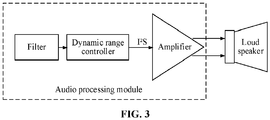
- the filter is connected to the dynamic range controller, the dynamic range controller is connected to the amplifier, and the amplifier is connected to the loudspeaker.
- the gain or the power of the amplifier is a gain adjustable amplifier and a power adjustable amplifier.
- the filter In processing an audio signal, the filter processes a digital audio signal, and the filtered audio signal is outputted to the dynamic range controller, the dynamic range controller performs digital gain processing on the filtered audio signal, and the audio signal obtained after the digital gain processing is outputted to the amplifier through Inter-IC Sound (I 2 S) of an audio input interface, and the audio signal is outputted through the loudspeaker.
- I 2 S Inter-IC Sound
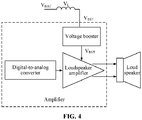
- the amplifier includes a digital-to-analog converter, a loudspeaker amplifier and a voltage booster.
- the voltage booster is connected to an output end of the power supply module through an inductor.
- V BAT represents an output voltage of the power supply module
- V L represents a discharge voltage of the inductor
- V BST represents an output voltage of the voltage booster.
- the sum of the output voltage of the power supply module and the discharge voltage of the inductor is equal to the output voltage of the voltage booster. It can be seen that a change of the output voltage of the power supply module will affect the output voltage of the voltage booster, and further affect the output volume of the loudspeaker.
- a digital signal is outputted after the dynamic range controller processes the filtered audio signal. It is necessary to convert the digital signal into an analog signal by means of the digital-to-analog converter.
- the loudspeaker amplifier amplifies the audio signal converted into the analog signal.
- the voltage booster drives the loudspeaker to output the amplified to-be-outputted signal with high power.
- a gain value obtained for the audio signal corresponding to the output voltage value greater than an output voltage threshold is less than a gain value obtained for the audio signal corresponding to the output voltage value less than the output voltage threshold.
- the filtering parameter includes: a first filtering parameter corresponding to the output voltage value greater than the output voltage threshold, and a second filtering parameter corresponding to the output voltage value less than or equal to the output voltage threshold.
- the gain parameter of the digital audio signal includes a first gain parameter corresponding to the output voltage value greater than the output voltage threshold, and a second gain parameter corresponding to the output voltage value less than or equal to the output voltage threshold.
- a third gain value for the audio signal is obtained.
- a fourth gain value for the audio signal is obtained. The fourth gain value is greater than the third gain value.
- the gain parameter of the analog audio signal includes: a third gain parameter corresponding to the output voltage value greater than the output voltage threshold, and a fourth gain parameter corresponding to the output voltage value less than or equal to the output voltage threshold.
- a third gain parameter corresponding to the output voltage value greater than the output voltage threshold
- a fourth gain parameter corresponding to the output voltage value less than or equal to the output voltage threshold.
- the change of output voltage of the power supply module will affect the output volume of the loudspeaker.
- different parameters corresponding to the output voltages are determined, so that various devices in the audio processing module can perform different processing on the audio signal based on the different parameters to compensate the change of volume of the loudspeaker caused by the change of the output voltage.
- the filter is configured by using the second filtering parameter
- the dynamic range controller is configured by using the second gain parameter
- the amplifier is configured by using the fourth gain parameter, which facilitates processing the audio signal by the configured audio processing module, thereby reducing the situation that the volume of the loudspeaker decreases due to the change of output voltage.
- the audio signal may be compensated by increasing a gain value, to reduce an obvious difference of the output volume of the loudspeaker.
- an operation that the gain value for the audio signal is obtained by the audio processing module includes an operation that a gain value corresponding to the volume of the audio signal is increased by configuring the audio processing module. For example, when the audio processing module is the amplifier, the volume of the audio signal in the analog signal may be increased. When the audio processing module is the dynamic range controller, the volume of the audio signal in the digital signal may be increased.
- a first gain value and a second value may be set according to actual needs.
- the first gain value is 0 or 1
- the second gain value may be set as 8 or 10, which are not limited in the embodiments of the present disclosure.
- the operation that the filter in the audio processing module is configured according to the filtering parameter may include an operation as follows.
- a filtering parameter of a predetermined frequency sub-band in a first filtering frequency band of the filter is configured according to the filtering parameter, to enable the audio signal of the predetermined frequency sub-band to pass.
- a frequency of the predetermined frequency sub-band ranges 2KHz to 4KHz.
- the frequency of the predetermined frequency sub-band ranges 2KHz to 4KHz.
- the frequency of the predetermined frequency sub-band corresponds to a frequency band which is most sensitive to the human ear. Therefore, by adjusting an amplitude of the frequency band according to the filtering parameter, users' perception for the decrease of output volume corresponding to the audio signal in the frequency band can be reduced on one hand, adjusting time may be saved and further adjusting efficiency may be improved as compared with adjusting the whole frequency band of the audio signal on the other hand.
- a distance between a low-pressure position at the opening of an ear canal and a closed end is the length of the ear canal.
- L of the ear canal is 2.5cm
- L is 1/4 of the wavelength of an acoustic wave in the air
- a speed v at which sound travels in the air is equal to 340m/s.
- a most sensitive frequency point for listening of the human ear is 3400Hz. Because there is a different for ear canals of different people, a frequency band ranging from 2KHz to 4KHz may be taken as an adjustment and improvement part, so as to increase the volume in the frequency band ranging from 2KHz to 4KHz.
- the operation that the target parameter of the audio processing module in the terminal device is determined according to the current output voltage may include an operation as follows.
- the target parameter of the audio processing module in the terminal device is obtained by looking up the pre-established correspondences between the output voltage ranges of the power supply module and the target parameters.
- the target parameter is used for configuring the audio processing module for processing the audio signal. Therefore, in the process of establishing the correspondences between the output voltage ranges and the target parameters, the correspondences may be established according to the devices included in the audio processing module.
- the audio processing module includes the filter, the dynamic range controller and the amplifier, and the correspondingly target parameter includes the filtering parameter, the gain parameter of the digital audio signal and the gain parameter of the analog audio signal
- the correspondingly target parameter includes the filtering parameter, the gain parameter of the digital audio signal and the gain parameter of the analog audio signal
- correspondences between the voltage ranges and the filtering parameters, the gain parameters of the digital audio signal and the gain parameters of the analog audio signal in the target parameter may be established. In this way, after the current output voltage is determined, the target parameter corresponding to the device may be found directly.
- the embodiments of the present disclosure are not limited to determining the target parameter by looking up the pre-established correspondences of the various devices in the audio processing module, the target parameter may also be obtained based on function calculation, which are not limited by the embodiments of the present disclosure.
- the target parameters corresponding to different devices may be found based on the correspondences when the output voltage changes, which facilitates the subsequent configuration processing.
- the terminal device includes the power supply module, a processor, the audio processing module and the loudspeaker.
- the processor is connected to the power supply module.
- the processor outputs a control instruction to the audio processing module by controlling an Inter-Integrated Circuit (I 2 C) bus.
- the loudspeaker outputs the audio signal processed by the audio processing module.
- the output voltage of the power supply module is determined, and then the target parameter of the audio processing module in the terminal device is obtained by looking up the pre-established correspondences between the output voltage ranges and the target parameters.
- the processor controls the audio processing module to configure the target parameter, and the configured audio processing module processes the audio signal. In such a manner, by monitoring the output voltage of the power supply module in real time, a situation that the output volume of the loudspeaker decreases due to the change of output voltage of the power supply module can be reduced, thereby improving user experience.
- FIG. 7 is a schematic diagram of a device for processing information according to an exemplary embodiment.
- the device 1000 for processing information includes a first obtaining module 1001, a second obtaining module 1002, and a parameter configuring module 1003.
- the first obtaining module 1001 is configured to determine a current output voltage of the power supply module in the terminal device.
- the second obtaining module 1002 is configured to determine a target parameter of an audio processing module in the terminal device according to the current output voltage.
- the parameter configuring module 1003 is configured to configure the audio processing module for processing an audio signal according to the target parameter.
- a detecting module is configured to detect a current temperature and/or a current power capacity of the power supply module.
- the first obtaining module is configured to detect the current temperature and/or the current power capacity of the power supply module in the terminal device, and determine a current output voltage value of the power supply module based on the current temperature and/or the current power capacity.
- the parameter configuring module 1003 may include at least one of a first configuring module, a second configuring module and a third configuring module.
- the first configuring module is configured to configure, in responsive to that the target parameter includes a filtering parameter, a filter in the audio processing module according to the filtering parameter.
- the filter is configured to filter the audio signal.
- the second configuring module is configured to configure, in responsive to that the target parameter includes a gain parameter of a digital audio signal, a dynamic range controller in the audio processing module according to the gain parameter of the digital audio signal.
- the dynamic range controller is configured to provide a digital gain on the filtered audio signal.
- the third configuring module is configured to configure, in responsive to that the target parameter includes a gain parameter of an analog audio signal, an amplifier in the audio processing module according to the gain parameter of the analog audio signal.
- the amplifier is configured to amplify the audio signal which is converted into an analog signal.
- the filtering parameter includes: a first filtering parameter corresponding to the output voltage value greater than the output voltage threshold, and a second filtering parameter corresponding to the output voltage value less than or equal to the output voltage threshold.
- the audio processing module processes the audio signal based on the first filtering parameter, such that a first gain value for the audio signal is obtained.
- the audio processing module processes the audio signal based on the second filtering parameter, such that a second gain value for the audio signal is obtained.
- the second gain value is greater than the first gain value.
- the gain parameter of the digital audio signal includes a first gain parameter corresponding to the output voltage value greater than the output voltage threshold, and a second gain parameter corresponding to the output voltage value less than or equal to the output voltage threshold.
- the audio processing module processes the audio signal based on the first gain parameter, such that a third gain value for the audio signal is obtained.
- the audio processing module processes the audio signal based on the second gain parameter, such that a fourth gain value for the audio signal is obtained.
- the fourth gain value is greater than the third gain value.
- the gain parameter of the analog audio signal includes: a third gain parameter corresponding to the output voltage value greater than the output voltage threshold, and a fourth gain parameter corresponding to the output voltage value less than or equal to the output voltage threshold.
- the audio processing module processes the audio signal based on the third gain parameter, such that a fifth gain value for the audio signal is obtained.
- the audio processing module processes the audio signal based on the fourth gain parameter, such that a sixth gain value for the audio signal is obtained.
- the sixth gain value is greater than the fifth gain value.
- the first configuring module is configured to configure a filtering parameter of a predetermined frequency sub-band in a first filtering frequency band of the filter according to the filtering parameter, to enable a audio signal of the predetermined frequency sub-band to pass.
- a frequency of the predetermined frequency sub-band ranges from 2KHz to 4KHz.
- the second obtaining module 1002 is configured to obtain the target parameter of the audio processing module in the terminal device by looking up the pre-established correspondences between the output voltage ranges of the power supply module and the target parameters.
- FIG. 8 is a structure block diagram of a terminal device, according to an exemplary embodiment.
- the terminal device may be a mobile phone, a mobile computer, and so on.
- the terminal device may include one or more of the following components: a processing component 802, a memory 804, a power component 806, a multimedia component 808, an audio component 810, an Input/Output (I/O) interface 812, a sensor component 814, and a communication component 816.
- a processing component 802 a memory 804
- a power component 806 a multimedia component 808, an audio component 810, an Input/Output (I/O) interface 812, a sensor component 814, and a communication component 816.
- I/O Input/Output
- the processing component 802 is typically configured to control overall operations of the terminal device, such as the operations associated with display, telephone calls, data communications, camera operations, and recording operations.
- the processing component 802 may include one or more processors 820 to execute instructions to perform all or part of the operations in the abovementioned method.
- the processing component 802 may include one or more modules which facilitate interaction between the processing component 802 and other components.
- the processing component 802 may include a multimedia module to facilitate interaction between the multimedia component 808 and the processing component 802.
- the memory 804 is configured to store various types of data to support the operation of the device. Examples of such data include instructions for any application programs or methods operated on the device, contact data, phonebook data, messages, pictures, video, etc.
- the memory 804 may be implemented by any type of volatile or non-volatile memory devices, or a combination thereof, such as a Static Random Access Memory (SRAM), an Electrically Erasable Programmable Read-Only Memory (EEPROM), an Erasable Programmable Read-Only Memory (EPROM), a Programmable Read-Only Memory (PROM), a Read-Only Memory (ROM), a magnetic memory, a flash memory, and a magnetic or optical disk.
- SRAM Static Random Access Memory
- EEPROM Electrically Erasable Programmable Read-Only Memory
- EPROM Erasable Programmable Read-Only Memory
- PROM Programmable Read-Only Memory
- ROM Read-Only Memory
- magnetic memory a magnetic memory
- flash memory and a magnetic or optical disk.
- the power component 806 is configured to provide power for various components of the device.
- the power component 806 may include a power management system, one or more power supplies, and other components associated with generation, management and distribution of power for the device.
- the multimedia component 808 may include a screen for providing an output interface between the terminal device and a user.
- the screen may include a Liquid Crystal Display (LCD) and a Touch Panel (TP). If the screen includes the TP, the screen may be implemented as a touch screen to receive an input signal from the user.
- the TP includes one or more touch sensors to sense touches, swipes and gestures on the TP. The touch sensors may not only sense a boundary of a touch or swipe action but also detect a duration and pressure associated with the touch or swipe action.
- the multimedia component 808 may include a front camera and/or a rear camera. The front camera and/or the rear camera may receive external multimedia data when the device is in an operation mode, such as a photographing mode or a video mode. Each of the front camera and the rear camera may be a fixed optical lens system or have focusing and optical zooming capabilities.
- the audio component 810 is configured to output and/or input an audio signal.
- the audio component 810 includes a Microphone (MIC), and the MIC is configured to receive an external audio signal when the terminal is in the operation mode, such as a call mode, a recording mode and a voice recognition mode.
- the received audio signal may further be stored in the memory 804 or transmitted through the communication component 816.
- the audio component 810 may further include a speaker configured to output the audio signal.
- the I/O interface 812 is configured to provide an interface between the processing component 802 and a peripheral interface module, and the peripheral interface module may be a keyboard, a click wheel, a button and the like.
- the button may include, but not limited to: a home button, a volume button, a starting button and a locking button.
- the sensor component 814 may include one or more sensors configured to provide status assessment in various aspects for the device. For instance, the sensor component 814 may detect an on/off status of the device and relative positioning of components, such as a display and small keyboard of the device, and the sensor component 814 may further detect a change in a position of the device or a component of the terminal, presence or absence of contact between the user and the device, orientation or acceleration/deceleration of the device and a change in temperature of the device.
- the sensor component 814 may include a proximity sensor configured to detect presence of an object nearby without any physical contact.
- the sensor component 814 may also include a light sensor, such as a Complementary Metal Oxide Semiconductor (CMOS) or Charge Coupled Device (CCD) image sensor, configured for use in an imaging APP.
- CMOS Complementary Metal Oxide Semiconductor
- CCD Charge Coupled Device
- the sensor component 814 may also include an acceleration sensor, a gyroscope sensor, a magnetic sensor, a pressure sensor or a temperature sensor.
- the communication component 816 is configured to facilitate wired or wireless communication between the device and other equipment.
- the device may access a communication-standard-based wireless network, such as a Wireless Fidelity (Wi-Fi) network, a 2 nd -Generation (2G), 3 rd -Generation (3G), 4 th -Generation (4G), or 5 th -Generation (5G) network or a combination thereof.
- Wi-Fi Wireless Fidelity
- 2G 2 nd -Generation
- 3G 3 rd -Generation
- 4G 4 th -Generation
- 5G 5 th -Generation
- the communication component 816 is configured to receive a broadcast signal or broadcast associated information from an external broadcast management system through a broadcast channel.
- the communication component 816 may further include a Near Field Communication (NFC) module to facilitate short-range communication.
- NFC Near Field Communication
- the NFC module may be implemented based on a Radio Frequency Identification (RFID) technology, an Infrared Data Association (IrDA) technology, an Ultra-WideBand (UWB) technology, a Bluetooth (BT) technology and another technology.
- RFID Radio Frequency Identification
- IrDA Infrared Data Association
- UWB Ultra-WideBand
- BT Bluetooth
- the device may be implemented by one or more Application Specific Integrated Circuits (ASICs), Digital Signal Processors (DSPs), Digital Signal Processing Devices (DSPDs), Programmable Logic Devices (PLDs), Field Programmable Gate Arrays (FPGAs), controllers, microcontrollers, microprocessors or other electronic components, and is configured to execute the abovementioned method.
- ASICs Application Specific Integrated Circuits
- DSPs Digital Signal Processors
- DSPDs Digital Signal Processing Devices
- PLDs Programmable Logic Devices
- FPGAs Field Programmable Gate Arrays
- controllers microcontrollers, microprocessors or other electronic components, and is configured to execute the abovementioned method.
- a non-transitory computer-readable storage medium including an instruction is further provided, such as the memory 804 including an instruction, and the instruction may be executed by the processor 820 of the device to implement the abovementioned method.
- the non-transitory computer-readable storage medium may be a ROM, a random access memory (RAM), a Compact Disc Read-Only Memory (CD-ROM), a magnetic tape, a floppy disc, an optical data storage device and the like.
- a non-transitory computer-readable storage medium is provided.
- the terminal device can execute the method for processing information.
- the method may include operations as follows.
- a current temperature and/or a current power capacity of the power supply module in the terminal device is determined.
- a target parameter of the audio processing module in the terminal device are determined according to the current temperature and/or the current power capacity
- An audio processing module for processing the audio signal is configured according to the target parameter.
Landscapes
- Engineering & Computer Science (AREA)
- Physics & Mathematics (AREA)
- Signal Processing (AREA)
- Acoustics & Sound (AREA)
- General Engineering & Computer Science (AREA)
- General Physics & Mathematics (AREA)
- Theoretical Computer Science (AREA)
- Otolaryngology (AREA)
- General Health & Medical Sciences (AREA)
- Health & Medical Sciences (AREA)
- Multimedia (AREA)
- Computing Systems (AREA)
- Quality & Reliability (AREA)
- Circuit For Audible Band Transducer (AREA)
- Amplifiers (AREA)
Abstract
Description
- The present disclosure relates to the field of information processing technology, and more particularly to a method and device for processing information, a terminal device, and a storage medium.
- A loudspeaker, as a device for converting an electrical signal into an acoustic signal, is widely applied in terminal devices, to output sound for the terminal devices, such as a mobile phone, a tablet PC, and a smart watch. In some environments of, for example, low temperature or low power capacity, the volume of the sound outputted by the terminal device through the loudspeaker drops significantly, which affects user experience.
- The present disclosure provides a method and device for processing information, a terminal device, and a storage medium.
- According a first aspect of the present invention, a method for processing information is provided, which may include operations as follows.
- A current output voltage of a power supply module in a terminal device is determined.
- A target parameter of an audio processing module in the terminal device is determined according to the current output voltage.
- The audio processing module for processing an audio signal is configured according to the target parameter.
- The technical solutions provided in the embodiments of the present disclosure may have the following beneficial effects.
- An audio processing module for processing an audio signal is configured according to a target parameter, which is determined by a current output voltage of the power supply module, and an audio signal is processed by the configured audio processing module. In this way, an impact of a change of the output voltage of the power supply module on output volume of a loudspeaker can be reduced, and further the problem that the output volume of the loudspeaker drops in a scenario of low temperature or low power capacity, thereby improving user experience. Also, the method for processing information according to the embodiments of the present disclosure can be applied for audio processing under the change of output voltage of the power supply module caused by different usage scenarios, thereby expanding the usage scenarios of the terminal device.
- According to an exemplary embodiment, the method may further include an operation as follows.
- A current temperature and/or a current power capacity of the power supply module is detected.
- The operation that the current output voltage of the power supply module in the terminal device is determined may include an operation.
- A current output voltage value of the power supply module is determined according to the current temperature and/or the current power capacity.
- In above exemplary embodiment, the current output voltage value of the power supply module is determined according to the current temperature and/or the current power capacity. In this way, an impact of a change of the current temperature and/or the current power capacity of the power supply module on output volume of a loudspeaker can be reduced, and further the problem that the output volume of the loudspeaker drops in a scenario of low temperature or low power capacity, thereby improving user experience.
- According to an exemplary embodiment, the operation that the audio processing module for processing the audio signal is configured according to the target parameter may include at least one of the following operations.
- In responsive to that the target parameter includes a filtering parameter, a filter in the audio processing module is configured according to the filtering parameter, and the filter is configured to filter the audio signal.
- In responsive to that the target parameter includes a gain parameter of a digital audio signal, a dynamic range controller in the audio processing module is configured according to the gain parameter of the digital audio signal, and the dynamic range controller is configured to provide a digital gain for the filtered audio signal.
- In responsive to that the target parameter includes a gain parameter of an analog audio signal, an amplifier in the audio processing module is configured according to the gain parameter of the analog audio signal, and the amplifier is configured to amplify the audio signal which is converted into an analog signal.
- In above exemplary embodiment, the target parameter includes the filtering parameter, the gain parameter of the digital audio signal and the gain parameter of the analog audio signal. At least one device included in the audio processing module may be configured through the target parameter. Bases on this, the audio signal is processed by the configured audio processing module, thereby solving the problem that the output volume of the loudspeaker decreases due to the change of the current temperature and the current power capacity of the power supply module, and improving user experience.
- According to an exemplary embodiment, the filtering parameter include: a first filtering parameter corresponding to an output voltage value greater than an output voltage threshold, and a second filtering parameter corresponding to an output voltage value less than or equal to the output voltage threshold. The audio processing module processes the audio signal based on the first filtering parameter, such that a first gain value for the audio signal is obtained. The audio processing module processes the audio signal based on the second filtering parameter, such that a second gain value for the audio signal is obtained. The second gain value is greater than the first gain value.
- Alternatively, the gain parameter of the digital audio signal includes: a first gain parameter corresponding to the output voltage value greater than the output voltage threshold, and a second gain parameter corresponding to the output voltage value less than or equal to the output voltage threshold. The audio processing module processes the audio signal based on the first gain parameter, such that a third gain value for the audio signal is obtained. The audio processing module processes the audio signal based on the second gain parameter, such that a fourth gain value for the audio signal is obtained. The fourth gain value is greater than the third gain value.
- Alternatively, the gain parameter of the analog audio signal includes: a third gain parameter corresponding to the output voltage value greater than the output voltage threshold, and a fourth gain parameter corresponding to the output voltage value less than or equal to the output voltage threshold. The audio processing module processes the audio signal based on the third gain parameter, such that a fifth gain value for the audio signal is obtained. The audio processing module processes the audio signal based on the fourth gain parameter, such that a sixth gain value for the audio signal is obtained. The sixth gain value is greater than the fifth gain value.
- In the above exemplary embodiment, the change of output voltage of the power supply module will affect the output volume of the loudspeaker. For different output voltages, different parameters corresponding to the output voltages are determined, so that various devices in the audio processing module can perform different processing on the audio signal based on the different parameters to compensate the change of volume of the loudspeaker caused by the change of the output voltage.
- According to an exemplary embodiment, the operation that the filter in the audio processing module is configured according to the filtering parameter may include an operation as follows.
- A filtering parameter for configuring a predetermined frequency sub-band in a first filtering frequency band of the filter is adjusted according to an adjustment range of the filtering parameter, to enable the audio signal in the predetermined frequency sub-band to pass. The frequency of the predetermined frequency sub-band ranges from 2KHz to 4KHz.
- In the above exemplary embodiment, the frequency of the predetermined frequency sub-band ranges 2KHz to 4KHz. The frequency of the predetermined frequency sub-band corresponds to a frequency band which is most sensitive to the human ear. Therefore, by adjusting an amplitude of the frequency band according to the filtering parameter, users' perception for the decrease of output volume corresponding to the audio signal in the frequency band can be reduced on one hand, adjusting time may be saved and further adjusting efficiency may be improved as compared with adjusting the whole frequency band of the audio signal on the other hand.
- According to an exemplary embodiment, the operation that the target parameter of the audio processing module in the terminal device is determined according to the current output voltage may include an operation as follows,
- The target parameter of the audio processing module in the terminal device is obtained by looking up pre-established correspondences between output voltage ranges of the power supply module and the target parameters.
- In the above exemplary embodiment, for example, when the audio processing module includes the filter, the dynamic range controller and the amplifier, and the correspondingly target parameter includes the filtering parameter, the gain parameter of the digital audio signal and the gain parameter of the analog audio signal, correspondences between the voltage ranges and the filtering parameters, the gain parameters of the digital audio signal and the gain parameters of the analog audio signal in the target parameter may be established. In this way, after the current output voltage is determined, the target parameter corresponding to the device may be found directly.
- According to a second aspect of the present invention, a device for processing information is provided, which may include a first obtaining module, a second obtaining module and a parameter configuring module.
- The first obtaining module is configured to determine a current output voltage of a power supply module in a terminal device;
- The second obtaining module is configured to determine a target parameter of an audio processing module in the terminal device according to the current output voltage.
- The parameter configuring module is configured to configure the audio processing module for processing an audio signal according to the target parameter.
- The advantages and technical effects of the device according to the invention correspond to those of the method presented above.
- According to an exemplary embodiment, the device may further include a detecting module.
- The detecting module is configured to detect a current temperature and/or current power capacity of the power supply module; and
The first obtaining module is configured to determine a current output voltage value according to the current temperature and/or the current power capacity. - According to an exemplary embodiment, the parameter configuring module may include at least one of a first configuring module, a second configuring module and a third configuring module.
- The first configuring module is configured to configure, in responsive to that the target parameter includes a filtering parameter, a filter in the audio processing module according to the filtering parameter. The filter is configured to filter the audio signal.
- The second configuring module is configured to configure, in responsive to that the target parameter includes a gain parameter of a digital audio signal, a dynamic range controller in the audio processing module according to the gain parameter of the digital audio signal. The dynamic range controller is configured to provide a digital gain for the filtered audio signal.
- The third configuring module is configured to configure, in responsive to that the target parameter includes a gain parameter of an analog audio signal, an amplifier in the audio processing module according to the gain parameter of the analog audio signal. The amplifier is configured to amplify the audio signal which is converted into an analog signal
- According to an exemplary embodiment, the filtering parameter includes a first filtering parameter corresponding to an output voltage value greater than an output voltage threshold, and a second filtering parameter corresponding to an output voltage value less than or equal to the output voltage threshold. The audio processing module processes the audio signal based on the first filtering parameter, such that a first gain value for the audio signal is obtained, and the audio processing module processes the audio signal based on the second filtering parameter, such that a second gain value for the audio signal is obtained. The second gain value is greater than the first gain value.
- Alternatively, the gain parameter of the digital audio signal includes a first gain parameter corresponding to the output voltage value greater than the output voltage threshold, and a second gain parameter corresponding to the output voltage value less than or equal to the output voltage threshold. The audio processing module processes the audio signal based on the first gain parameter, such that a third gain value for the audio signal is obtained, and the audio processing module processes the audio signal based on the second gain parameter, such that a fourth gain value for the audio signal is obtained. The fourth gain value is greater than the third gain value
- Alternatively, the gain parameter of the analog audio signal includes: a third gain parameter corresponding to the output voltage value greater than the output voltage threshold, and a fourth gain parameter corresponding to the output voltage value less than or equal to the output voltage threshold. The audio processing module processes the audio signal based on the third gain parameter, such that a fifth gain value for the audio signal is obtained, and the audio processing module processes the audio signal based on the fourth gain parameter, such that a sixth gain value for the audio signal is obtained. The sixth gain value is greater than the fifth gain value
- According to an exemplary embodiment, the first configuring module is configured to configure a filtering parameter of a predetermined frequency sub-band in a first filtering frequency band of the filter according to the filtering parameter, to enable the audio signal of the predetermined frequency sub-band to pass. A frequency of the predetermined frequency sub-band ranges from 2KHz to 4KHz.
- According to an exemplary embodiment, the second obtaining module is configured to obtain the target parameter of the audio processing module in the terminal device by looking up pre-established correspondences between output voltage ranges of the power supply module and the target parameters.
- According to a third aspect of the present invention, a terminal device is provided, which may include:
- a processor; and
- a memory configured to store an processor-executable instruction.
- The processor is configured to execute the method for processing information in the above first aspect.
- According to a fourth aspect of the present invention, a storage medium is provided.
- An instruction in the storage medium, when being executed by a processor of a terminal, enables the terminal to perform the method for processing information in the above first aspect.
- The storage medium can be any entity or device capable of storing the instruction. For example, the support can include storage means such as a ROM, for example a CD ROM or a microelectronic circuit ROM, or magnetic storage means, for example a diskette (floppy disk) or a hard disk.
- Alternatively, the storage medium can be an integrated circuit in which the instruction is incorporated, the circuit being adapted to execute the method in question or to be used in its execution.
- It is to be understood that the above general descriptions and the following detailed descriptions are only exemplary and explanatory, rather than limiting the present disclosure.
- The accompanying drawings, which are incorporated in and constitute a part of the specification, illustrate embodiments consistent with the present disclosure and, along with the description, serve to explain the principles of the present disclosure.
-
FIG. 1 is a flow chart of a method for processing information according to an exemplary embodiment. -
FIG. 2 is a schematic diagram of audio signal processing in a terminal device according to an exemplary embodiment. -
FIG. 3 is a schematic diagram of processing an audio signal by an amplifier in a terminal device according to an exemplary embodiment. -
FIG. 4 is a schematic diagram of performing a method for processing information by a terminal device according to an exemplary embodiment. -
FIG. 5 is a schematic diagram of a device for processing information according to an exemplary embodiment. -
FIG. 6 is a structural block diagram of a terminal device according to an exemplary embodiment. - Reference will now be made in detail to exemplary embodiments, examples of which are illustrated in the accompanying drawings. The following description refers to the accompanying drawings in which the same numbers in different drawings represent the same or similar elements unless otherwise stated. The implementations set forth in the following description of exemplary embodiments do not represent all implementations consistent with the present disclosure. Instead, the disclosed implementations are provided merely as examples of apparatuses and methods consistent with aspects related to the present disclosure and as recited in the appended claims.
-
FIG. 1 is a first flow chart showing a method for processing information according to an embodiment of the present disclosure. As shown inFIG. 1 , the method applied to a terminal device may include the following operations. - At S11, a current output voltage of a power supply module in a terminal device is determined.
- At S12, a target parameter of an audio processing module in the terminal device is determined according to the current output voltage.
- At S13, an audio processing module for processing an audio signal is configured according to the target parameter.
- The terminal device may be a wearable electronic device and a mobile terminal. The mobile terminal may include a mobile phone, a laptop and a tablet PC, and the wearable electronic device may include a smart watch, which are not limited in the embodiments of the present disclosure.
- The power supply module is a battery. The battery includes, but is not limited to, a lithium ion battery, a lead-acid battery or an alkaline battery.
- After the current output voltage of the power supply module is determined, the target parameter of the audio processing module in the terminal device may be determined according to the current output voltage, and the audio processing module is configured according to the target parameter.
- In an embodiment, after the audio processing module is configured according to the target parameter, the method may further include an operation as follows. An audio signal is configured by the configured audio processing module.
- In the embodiments of the present disclosure, the terminal device configures the audio processing module based on the target parameter which is determined according to the current output voltage of the power supply module. When an audio signal is outputted by the terminal device, the configured audio processing module may be directly configured to process the audio signal to obtain the processed audio signal. In this way, an impact of a change of the output voltage of the power supply module on the output volume of a loudspeaker can be reduced.
- The audio signal is processed by the above configured audio processing module, and the processed audio signal is outputted through the loudspeaker of the terminal device.
- The audio processing module includes, but is not limited to, a filter, a gainer, and a dynamic range controller or an amplifier.
- The above processing on the audio signal may include but be not limited to filtering or gain processing on the audio signal, and the target parameter includes, but is not limited to, a filtering parameter or a gain parameter.
- An output power of the loudspeaker varies with different power supply voltages of the audio processing module in the terminal device, which may result in a change of the output volume of the loudspeaker. The power supply voltage of the audio processing module is provided by the power supply module. Therefore, a change of the output voltage of the power supply module will results in a change of the output volume of the loudspeaker.
- It is to be noted that either a change of a temperature or a change of power capacity of the power supply module results in a change of an internal resistance of the power supply module, and further affects the output voltage of the power supply module. When the power supply module is at a low temperature or low power capacity, the internal resistance of the power supply module increases, further the output voltage of the power supply module decreases, and the output volume of the loudspeaker reduces.
- With taking a lithium ion battery as an example of the power supply module, when the lithium ion battery is in a low-temperature environment or at low power capacity, the activity of anode and cathode materials decreases, and the conductivity of electrolyte also decreases, which results in an increase of the internal resistance of the lithium ion battery. The internal resistance of the battery includes ohmic internal resistance and polarization resistance. The ohmic internal resistance is composed of electrode materials, electrolyte, diaphragm resistance and contact resistances of various parts. Therefore, when the power supply module is at low temperature or low power capacity, the ohmic internal resistance of the power supply module increases.
- In this case, with the lithium ion battery generates a lot of joule heat in operation, the output voltage of the lithium ion battery decreases.
FIG. 2 shows correspondences between the power capacity and the output voltages of the lithium ion battery. As the power capacity of the lithium ion battery decreases from 100% to 0, the output voltage of the lithium ion battery decreases from 4.4 to 3. - It can be seen that both the temperature and the power capacity of the power supply module will affect the output voltage of the power supply module, and further affect the output volume of the loudspeaker. For example, the output voltage of the power supply module of the terminal device is stable at the room temperature, which will not result in a decrease of the output volume of the loudspeaker. When the temperature of the power supply module changes to the low temperature from the room temperature, the output voltage of the power supply module drops, which results in a decrease of the output volume of the loudspeaker. A temperature range corresponding to the room temperature includes, but is not limited to 0 degree to 50 degrees Celsius, and a temperature range corresponding to the low temperature may include a temperature lower than 0 degree Celsius.
- In another example, when the power supply module in the terminal device is at high power capacity, the output voltage of the power supply module is stable, which does not affect the output volume of the loudspeaker. As the use time of the terminal device increases, the power capacity of the power supply module in the terminal device changes from high power capacity to low power capacity, and the output voltage of the power supply module decreases, and further the output volume of the loudspeaker decreases. The high power capacity of the power supply module may correspondingly include a power capacity of the power supply module, a ratio of which to the total power capacity is greater than 30%, and the low power capacity of the power supply module may correspondingly include a power capacity of the power supply module, a ratio of which to the total power is lower than 30%.
- Based on this, in view of finding that the output volume of the loudspeaker decreases when the terminal device is in a scenario of low power capacity or low temperature, and analyzing that relationship between the output voltage of the power supply module and the output volume of the loudspeaker, the embodiments of the present disclosure provide a solution that a target parameter of the audio processing module in the terminal device is determined based on a current output voltage, and an audio processing module for processing an audio signal is configured based on the target parameter. Therefore, the configured audio processing module can reduce the impact of the change of the temperature or the power capacity of the power supply module on the output volume of the loudspeaker, and can solve a problem that the output volume of the loudspeaker decreases at the low temperature or low power capacity, and that the output volume of the loudspeaker decreases due to a change of the output voltage of the power supply module, thereby improving user experience. Also, the embodiments of the present disclosure are adaptable in scenarios of different temperatures and different powers, which expand the use scenarios of the terminal device.
- In an embodiment, the method may further include an operation as follows.
- A current temperature and/or a current power capacity of the power supply module is detected.
- The operation that the current output voltage of the power supply module in the terminal device is determined may include an operation as follows. A current output voltage value of the power supply module is determined according to the current temperature and/or the current power capacity of the power supply module.
- In the embodiments of the present disclosure, both the temperature and the power capacity of the power supply module affect the output voltage of the power supply module. For example, when an environment in which the terminal device is used changes, that is, the environment in which the terminal device is used changes to a low temperature environment from a room temperature environment, the output voltage of the power supply module in the terminal device changes. In the use process of the terminal device, when the power capacity of the power supply module changes from high power capacity to low power capacity, the output voltages of the power supply module also changes.
- Based on this, in a process of determining the current output voltage of the power supply module, whether the output voltage of the power supply module changes is determined by determining a change of a temperature of an environment which the terminal device is placed, that is, a change of the current temperature of the power supply module, and whether the output voltage of the power supply module changes is determined by determining a change of the current power of the terminal device, and whether the output voltage of the power supply module changes is determined by a change of the current power and a change of the current temperature of the power supply module.
- In another embodiment, the operation that the current output voltage of the power supply module is determined may include an operation as follows. The current output voltage value of the power supply module is determined according to the current temperature of the power supply module. Alternatively, the current output voltage value of the power supply module is determined according to the current power capacity of the power supply module. Alternatively, the current output voltage value of the power supply module is determined according to the current power capacity and the current temperature of the power supply module.
- It is to be noted that the current temperature and/or the current power capacity of the power supply module may be detected by a detecting module disposed on the terminal device. The detecting module includes, but is not limited to, a temperature sensor, a thermistor or a voltameter.
- In another embodiment, the operation that the current temperature of the power supply module is detected may include an operation as follows. The current temperature of the power supply module is detected by means of the thermistor disposed adjacent to the power supply module.
- A resistance value of the thermistor can change as the temperature. The thermistor includes a positive temperature coefficient thermistor and a negative temperature coefficient thermistor. The resistance value of the positive temperature coefficient thermistor increases as the temperature increases, and the resistance value of the negative temperature coefficient thermistor decreases as the temperature increases. Therefore, the resistance value of the thermistor can reflect the temperature of the power supply module adjacent thereto, and the current temperature of the power supply module is determined by determining the resistance value of the thermistor.
- In another embodiment, the operation that the current power capacity of the power supply module is detected may include an operation as follows. The current power capacity of the power supply module is determined by means of the voltameter serially connected in a power supply circuit of the power supply module.
- In the embodiments of the present disclosure, the voltameter detects a current in the power supply circuit per unit time to determine a current difference in the power supply circuit, and then integrates the current difference, to calculate the power capacity of the power supply module.
- In an embodiment, the operation that the audio processing module for processing the audio signal is configured according to the target parameter may include at least one of the following operations.
- In responsive to that the target parameter includes a filtering parameter, a filter in the audio processing module is configured according to the filtering parameter. The filter is configured to filter the audio signal.
- In responsive to that the target parameter includes a gain parameter of a digital audio signal, a dynamic range controller in the audio processing module is configured according to the gain parameter of the digital audio signal. The dynamic range controller is configured to provide a digital gain on the filtered audio signal.
- In responsive to that the target parameter includes a gain parameter of an analog audio signal, an amplifier in the audio processing module is configured according to the gain parameter of the analog audio signal. The amplifier is configured to amplify the audio signal which is converted into an analog signal.
- In the embodiments of the present disclosure, the target parameter includes the filtering parameter, the gain parameter of the digital audio signal and the gain parameter of the analog audio signal. At least one device included in the audio processing module may be configured through the target parameter. Bases on this, the audio signal is processed by the configured audio processing module, thereby solving the problem that the output volume of the loudspeaker decreases due to the change of the current temperature and the current power capacity of the power supply module, and improving user experience.
- As shown in
FIG. 3 , the filter is connected to the dynamic range controller, the dynamic range controller is connected to the amplifier, and the amplifier is connected to the loudspeaker. The gain or the power of the amplifier is a gain adjustable amplifier and a power adjustable amplifier. - In processing an audio signal, the filter processes a digital audio signal, and the filtered audio signal is outputted to the dynamic range controller, the dynamic range controller performs digital gain processing on the filtered audio signal, and the audio signal obtained after the digital gain processing is outputted to the amplifier through Inter-IC Sound (I2S) of an audio input interface, and the audio signal is outputted through the loudspeaker.
- As shown in
FIG. 4 , the amplifier includes a digital-to-analog converter, a loudspeaker amplifier and a voltage booster. The voltage booster is connected to an output end of the power supply module through an inductor. VBAT represents an output voltage of the power supply module, VL represents a discharge voltage of the inductor, and VBST represents an output voltage of the voltage booster. The sum of the output voltage of the power supply module and the discharge voltage of the inductor is equal to the output voltage of the voltage booster. It can be seen that a change of the output voltage of the power supply module will affect the output voltage of the voltage booster, and further affect the output volume of the loudspeaker. - A digital signal is outputted after the dynamic range controller processes the filtered audio signal. It is necessary to convert the digital signal into an analog signal by means of the digital-to-analog converter. The loudspeaker amplifier amplifies the audio signal converted into the analog signal. The voltage booster drives the loudspeaker to output the amplified to-be-outputted signal with high power.
- In the embodiments of the present disclosure, a gain value obtained for the audio signal corresponding to the output voltage value greater than an output voltage threshold is less than a gain value obtained for the audio signal corresponding to the output voltage value less than the output voltage threshold.
- In an embodiment, the filtering parameter includes: a first filtering parameter corresponding to the output voltage value greater than the output voltage threshold, and a second filtering parameter corresponding to the output voltage value less than or equal to the output voltage threshold. After the audio processing module processes the audio signal based on the first filtering parameter, a first gain value for the audio signal is obtained. After the audio processing module processes the audio signal based on the second filtering parameter, a second gain value for the audio signal is obtained. The second gain value is greater than the first gain value.
- Alternatively, the gain parameter of the digital audio signal includes a first gain parameter corresponding to the output voltage value greater than the output voltage threshold, and a second gain parameter corresponding to the output voltage value less than or equal to the output voltage threshold. After the audio processing module processes the audio signal based on the first gain parameter, a third gain value for the audio signal is obtained. After the audio processing module processes the audio signal based on the second gain parameter, a fourth gain value for the audio signal is obtained. The fourth gain value is greater than the third gain value.
- Alternatively, the gain parameter of the analog audio signal includes: a third gain parameter corresponding to the output voltage value greater than the output voltage threshold, and a fourth gain parameter corresponding to the output voltage value less than or equal to the output voltage threshold. After the audio processing module processes the audio signal based on the third gain parameter, a fifth gain value for the audio signal is obtained. After the audio processing module processes the audio signal based on the fourth gain parameter, a sixth gain value for the audio signal is obtained. The sixth gain value is greater than the fifth gain value.
- In the embodiments of the present disclosure, the change of output voltage of the power supply module will affect the output volume of the loudspeaker. For different output voltages, different parameters corresponding to the output voltages are determined, so that various devices in the audio processing module can perform different processing on the audio signal based on the different parameters to compensate the change of volume of the loudspeaker caused by the change of the output voltage.
- It is to be noted that as compared to the output volume of the loudspeaker when the output voltage value of the power supply module is greater than the output voltage threshold, the output volume of the loudspeaker when the output voltage value of the power supply module is less than the output voltage threshold drops significantly. Therefore, two parameters may be set correspondingly for two output voltage ranges. When the current output voltage value of the power supply module is less than the output voltage threshold, the filter is configured by using the second filtering parameter, the dynamic range controller is configured by using the second gain parameter, and the amplifier is configured by using the fourth gain parameter, which facilitates processing the audio signal by the configured audio processing module, thereby reducing the situation that the volume of the loudspeaker decreases due to the change of output voltage.
- In the process of determining the target parameter, the audio signal may be compensated by increasing a gain value, to reduce an obvious difference of the output volume of the loudspeaker. It is to be noted that an operation that the gain value for the audio signal is obtained by the audio processing module includes an operation that a gain value corresponding to the volume of the audio signal is increased by configuring the audio processing module. For example, when the audio processing module is the amplifier, the volume of the audio signal in the analog signal may be increased. When the audio processing module is the dynamic range controller, the volume of the audio signal in the digital signal may be increased.
- In the embodiments of the present disclosure, a first gain value and a second value may be set according to actual needs. For example, when the first gain value is 0 or 1, the second gain value may be set as 8 or 10, which are not limited in the embodiments of the present disclosure.
- In an embodiment, the operation that the filter in the audio processing module is configured according to the filtering parameter may include an operation as follows.
- A filtering parameter of a predetermined frequency sub-band in a first filtering frequency band of the filter is configured according to the filtering parameter, to enable the audio signal of the predetermined frequency sub-band to pass. A frequency of the predetermined frequency sub-band ranges 2KHz to 4KHz.
- In the embodiments of the present disclosure, the frequency of the predetermined frequency sub-band ranges 2KHz to 4KHz. The frequency of the predetermined frequency sub-band corresponds to a frequency band which is most sensitive to the human ear. Therefore, by adjusting an amplitude of the frequency band according to the filtering parameter, users' perception for the decrease of output volume corresponding to the audio signal in the frequency band can be reduced on one hand, adjusting time may be saved and further adjusting efficiency may be improved as compared with adjusting the whole frequency band of the audio signal on the other hand.
- As shown in
FIG. 5 , a distance between a low-pressure position at the opening of an ear canal and a closed end (a high-pressure position at an eardrum) is the length of the ear canal. It is assumed that the length L of the ear canal is 2.5cm, L is 1/4 of the wavelength of an acoustic wave in the air, and a speed v at which sound travels in the air is equal to 340m/s. In this case, the wavelength λ of the acoustic wave is represented as λ=4L=4x2.5cm=10cm, and a sound frequency f is represented as f=v/λ=340m/s/0.1m=3400Hz. It is can be seen that a most sensitive frequency point for listening of the human ear is 3400Hz. Because there is a different for ear canals of different people, a frequency band ranging from 2KHz to 4KHz may be taken as an adjustment and improvement part, so as to increase the volume in the frequency band ranging from 2KHz to 4KHz. - In an embodiment, the operation that the target parameter of the audio processing module in the terminal device is determined according to the current output voltage may include an operation as follows. The target parameter of the audio processing module in the terminal device is obtained by looking up the pre-established correspondences between the output voltage ranges of the power supply module and the target parameters.
- It is to be noted that the target parameter is used for configuring the audio processing module for processing the audio signal. Therefore, in the process of establishing the correspondences between the output voltage ranges and the target parameters, the correspondences may be established according to the devices included in the audio processing module.
- For example, when the audio processing module includes the filter, the dynamic range controller and the amplifier, and the correspondingly target parameter includes the filtering parameter, the gain parameter of the digital audio signal and the gain parameter of the analog audio signal, correspondences between the voltage ranges and the filtering parameters, the gain parameters of the digital audio signal and the gain parameters of the analog audio signal in the target parameter may be established. In this way, after the current output voltage is determined, the target parameter corresponding to the device may be found directly.
- It is to be noted that the embodiments of the present disclosure are not limited to determining the target parameter by looking up the pre-established correspondences of the various devices in the audio processing module, the target parameter may also be obtained based on function calculation, which are not limited by the embodiments of the present disclosure.
- It is understandable that by looking up the pre-established correspondences of the various devices in the audio processing module, the target parameters corresponding to different devices may be found based on the correspondences when the output voltage changes, which facilitates the subsequent configuration processing.
- As shown in
FIG. 6 , the terminal device includes the power supply module, a processor, the audio processing module and the loudspeaker. The processor is connected to the power supply module. The processor outputs a control instruction to the audio processing module by controlling an Inter-Integrated Circuit (I2C) bus. The loudspeaker outputs the audio signal processed by the audio processing module. In a process of outputting the audio signal, the output voltage of the power supply module is determined, and then the target parameter of the audio processing module in the terminal device is obtained by looking up the pre-established correspondences between the output voltage ranges and the target parameters. In this case, the processor controls the audio processing module to configure the target parameter, and the configured audio processing module processes the audio signal. In such a manner, by monitoring the output voltage of the power supply module in real time, a situation that the output volume of the loudspeaker decreases due to the change of output voltage of the power supply module can be reduced, thereby improving user experience. -
FIG. 7 is a schematic diagram of a device for processing information according to an exemplary embodiment. Referring toFIG. 7 , thedevice 1000 for processing information includes a first obtainingmodule 1001, a second obtainingmodule 1002, and a parameter configuring module 1003. - The first obtaining
module 1001 is configured to determine a current output voltage of the power supply module in the terminal device. - The second obtaining
module 1002 is configured to determine a target parameter of an audio processing module in the terminal device according to the current output voltage. - The parameter configuring module 1003 is configured to configure the audio processing module for processing an audio signal according to the target parameter.
- In an embodiment, a detecting module is configured to detect a current temperature and/or a current power capacity of the power supply module.
- The first obtaining module is configured to detect the current temperature and/or the current power capacity of the power supply module in the terminal device, and determine a current output voltage value of the power supply module based on the current temperature and/or the current power capacity.
- In an embodiment, the parameter configuring module 1003 may include at least one of a first configuring module, a second configuring module and a third configuring module.
- The first configuring module is configured to configure, in responsive to that the target parameter includes a filtering parameter, a filter in the audio processing module according to the filtering parameter. The filter is configured to filter the audio signal.
- The second configuring module is configured to configure, in responsive to that the target parameter includes a gain parameter of a digital audio signal, a dynamic range controller in the audio processing module according to the gain parameter of the digital audio signal. The dynamic range controller is configured to provide a digital gain on the filtered audio signal.
- The third configuring module is configured to configure, in responsive to that the target parameter includes a gain parameter of an analog audio signal, an amplifier in the audio processing module according to the gain parameter of the analog audio signal. The amplifier is configured to amplify the audio signal which is converted into an analog signal.
- In an embodiment, the filtering parameter includes: a first filtering parameter corresponding to the output voltage value greater than the output voltage threshold, and a second filtering parameter corresponding to the output voltage value less than or equal to the output voltage threshold. The audio processing module processes the audio signal based on the first filtering parameter, such that a first gain value for the audio signal is obtained. The audio processing module processes the audio signal based on the second filtering parameter, such that a second gain value for the audio signal is obtained. The second gain value is greater than the first gain value.
- Alternatively, the gain parameter of the digital audio signal includes a first gain parameter corresponding to the output voltage value greater than the output voltage threshold, and a second gain parameter corresponding to the output voltage value less than or equal to the output voltage threshold. The audio processing module processes the audio signal based on the first gain parameter, such that a third gain value for the audio signal is obtained. The audio processing module processes the audio signal based on the second gain parameter, such that a fourth gain value for the audio signal is obtained. The fourth gain value is greater than the third gain value.
- Alternatively, the gain parameter of the analog audio signal includes: a third gain parameter corresponding to the output voltage value greater than the output voltage threshold, and a fourth gain parameter corresponding to the output voltage value less than or equal to the output voltage threshold. The audio processing module processes the audio signal based on the third gain parameter, such that a fifth gain value for the audio signal is obtained. The audio processing module processes the audio signal based on the fourth gain parameter, such that a sixth gain value for the audio signal is obtained. The sixth gain value is greater than the fifth gain value.
- In an embodiment, the first configuring module is configured to configure a filtering parameter of a predetermined frequency sub-band in a first filtering frequency band of the filter according to the filtering parameter, to enable a audio signal of the predetermined frequency sub-band to pass. A frequency of the predetermined frequency sub-band ranges from 2KHz to 4KHz.
- In an embodiment, the second obtaining
module 1002 is configured to obtain the target parameter of the audio processing module in the terminal device by looking up the pre-established correspondences between the output voltage ranges of the power supply module and the target parameters. - Regarding the device in the above embodiments, the specific modes of performing operations by various modules have been described in detail in the embodiments for the method, which are not be repeated here anymore.
-
FIG. 8 is a structure block diagram of a terminal device, according to an exemplary embodiment. For example, the terminal device may be a mobile phone, a mobile computer, and so on. - Referring to
FIG. 8 , the terminal device may include one or more of the following components: aprocessing component 802, amemory 804, apower component 806, amultimedia component 808, anaudio component 810, an Input/Output (I/O)interface 812, asensor component 814, and acommunication component 816.. - The
processing component 802 is typically configured to control overall operations of the terminal device, such as the operations associated with display, telephone calls, data communications, camera operations, and recording operations. Theprocessing component 802 may include one ormore processors 820 to execute instructions to perform all or part of the operations in the abovementioned method. Moreover, theprocessing component 802 may include one or more modules which facilitate interaction between theprocessing component 802 and other components. For instance, theprocessing component 802 may include a multimedia module to facilitate interaction between themultimedia component 808 and theprocessing component 802. - The
memory 804 is configured to store various types of data to support the operation of the device. Examples of such data include instructions for any application programs or methods operated on the device, contact data, phonebook data, messages, pictures, video, etc. Thememory 804 may be implemented by any type of volatile or non-volatile memory devices, or a combination thereof, such as a Static Random Access Memory (SRAM), an Electrically Erasable Programmable Read-Only Memory (EEPROM), an Erasable Programmable Read-Only Memory (EPROM), a Programmable Read-Only Memory (PROM), a Read-Only Memory (ROM), a magnetic memory, a flash memory, and a magnetic or optical disk. - The
power component 806 is configured to provide power for various components of the device. Thepower component 806 may include a power management system, one or more power supplies, and other components associated with generation, management and distribution of power for the device. - The
multimedia component 808 may include a screen for providing an output interface between the terminal device and a user. In some examples, the screen may include a Liquid Crystal Display (LCD) and a Touch Panel (TP). If the screen includes the TP, the screen may be implemented as a touch screen to receive an input signal from the user. The TP includes one or more touch sensors to sense touches, swipes and gestures on the TP. The touch sensors may not only sense a boundary of a touch or swipe action but also detect a duration and pressure associated with the touch or swipe action. In some examples, themultimedia component 808 may include a front camera and/or a rear camera. The front camera and/or the rear camera may receive external multimedia data when the device is in an operation mode, such as a photographing mode or a video mode. Each of the front camera and the rear camera may be a fixed optical lens system or have focusing and optical zooming capabilities. - The
audio component 810 is configured to output and/or input an audio signal. For example, theaudio component 810 includes a Microphone (MIC), and the MIC is configured to receive an external audio signal when the terminal is in the operation mode, such as a call mode, a recording mode and a voice recognition mode. The received audio signal may further be stored in thememory 804 or transmitted through thecommunication component 816. In some examples, theaudio component 810 may further include a speaker configured to output the audio signal. - The I/
O interface 812 is configured to provide an interface between theprocessing component 802 and a peripheral interface module, and the peripheral interface module may be a keyboard, a click wheel, a button and the like. The button may include, but not limited to: a home button, a volume button, a starting button and a locking button. - The
sensor component 814 may include one or more sensors configured to provide status assessment in various aspects for the device. For instance, thesensor component 814 may detect an on/off status of the device and relative positioning of components, such as a display and small keyboard of the device, and thesensor component 814 may further detect a change in a position of the device or a component of the terminal, presence or absence of contact between the user and the device, orientation or acceleration/deceleration of the device and a change in temperature of the device. Thesensor component 814 may include a proximity sensor configured to detect presence of an object nearby without any physical contact. Thesensor component 814 may also include a light sensor, such as a Complementary Metal Oxide Semiconductor (CMOS) or Charge Coupled Device (CCD) image sensor, configured for use in an imaging APP. In some examples, thesensor component 814 may also include an acceleration sensor, a gyroscope sensor, a magnetic sensor, a pressure sensor or a temperature sensor. - The
communication component 816 is configured to facilitate wired or wireless communication between the device and other equipment. The device may access a communication-standard-based wireless network, such as a Wireless Fidelity (Wi-Fi) network, a 2nd-Generation (2G), 3rd-Generation (3G), 4th-Generation (4G), or 5th -Generation (5G) network or a combination thereof. In some embodiments of the present disclosure, thecommunication component 816 is configured to receive a broadcast signal or broadcast associated information from an external broadcast management system through a broadcast channel. In some embodiments of the present disclosure, thecommunication component 816 may further include a Near Field Communication (NFC) module to facilitate short-range communication. For example, the NFC module may be implemented based on a Radio Frequency Identification (RFID) technology, an Infrared Data Association (IrDA) technology, an Ultra-WideBand (UWB) technology, a Bluetooth (BT) technology and another technology. - In some embodiments of the present disclosure, the device may be implemented by one or more Application Specific Integrated Circuits (ASICs), Digital Signal Processors (DSPs), Digital Signal Processing Devices (DSPDs), Programmable Logic Devices (PLDs), Field Programmable Gate Arrays (FPGAs), controllers, microcontrollers, microprocessors or other electronic components, and is configured to execute the abovementioned method.
- In some embodiments of the present disclosure, a non-transitory computer-readable storage medium including an instruction is further provided, such as the
memory 804 including an instruction, and the instruction may be executed by theprocessor 820 of the device to implement the abovementioned method. For example, the non-transitory computer-readable storage medium may be a ROM, a random access memory (RAM), a Compact Disc Read-Only Memory (CD-ROM), a magnetic tape, a floppy disc, an optical data storage device and the like. - A non-transitory computer-readable storage medium is provided. When an instruction in the storage medium is executed by the processor of the terminal device, the terminal device can execute the method for processing information. The method may include operations as follows.
- A current temperature and/or a current power capacity of the power supply module in the terminal device is determined.
- A target parameter of the audio processing module in the terminal device are determined according to the current temperature and/or the current power capacity; and
- An audio processing module for processing the audio signal is configured according to the target parameter.
- Other implementation solutions of the present disclosure will be apparent to those skilled in the art from consideration of the specification and practice of the present disclosure. This present application is intended to cover any variations, uses, or adaptations of the present disclosure conforming to the general principles thereof and including such departures from the present disclosure as come within known or customary practice in the art. The specification and embodiments are exemplary, and a true scope and spirit of the present disclosure are indicated by the following claims.
- It will be appreciated that the present disclosure is not limited to the exact construction that has been described above and illustrated in the accompanying drawings, and that various modifications and changes may be made without departing from the scope of the present disclosure. It is intended that the scope of the present disclosure is only limited by the appended claims.
Claims (15)
- A method for processing information, characterized in that the method comprises:determining a current output voltage of a power supply module in a terminal device (S11);determining a target parameter of an audio processing module in the terminal device according to the current output voltage (S12); andconfiguring the audio processing module for processing an audio signal according to the target parameter (S13).
- The method of claim 1, further comprising:detecting at least one of a current temperature or a current power capacity of the power supply module,wherein determining the current output voltage of the power supply module in the terminal device comprises:
determining a current output voltage value of the power supply module according to at least one of the current temperature or the current power capacity. - The method of claim 1 or 2, wherein configuring the audio processing module for processing the audio signal according to the target parameter (S13) comprises at least one of operations as follows:in responsive to that the target parameter comprises a filtering parameter, configuring a filter in the audio processing module according to the filtering parameter, with the filter being configured to filter the audio signal;in responsive to that the target parameter comprises a gain parameter of a digital audio signal, configuring a dynamic range controller in the audio processing module according to the gain parameter of the digital audio signal, with the dynamic range controller being configured to provide a digital gain for the filtered audio signal; orin responsive to that the target parameter comprises a gain parameter of an analog audio signal, configuring an amplifier in the audio processing module according to the gain parameter of the analog audio signal, with the amplifier being configured to amplify the audio signal which is converted into an analog signal.
- The method of claim 3, whereinthe filtering parameter comprises a first filtering parameter corresponding to an output voltage value greater than an output voltage threshold, and a second filtering parameter corresponding to an output voltage value less than or equal to the output voltage threshold, wherein the audio processing module processes the audio signal based on the first filtering parameter, such that a first gain value for the audio signal is obtained, and the audio processing module processes the audio signal based on the second filtering parameter, such that a second gain value for the audio signal is obtained, the second gain value is greater than the first gain value; orthe gain parameter of the digital audio signal comprises a first gain parameter corresponding to the output voltage value greater than the output voltage threshold, and a second gain parameter corresponding to the output voltage value less than or equal to the output voltage threshold, wherein the audio processing module processes the audio signal based on the first gain parameter, such that a third gain value for the audio signal is obtained, and the audio processing module processes the audio signal based on the second gain parameter, such that a fourth gain value for the audio signal is obtained , the fourth gain value is greater than the third gain value; or,the gain parameter of the analog audio signal comprises: a third gain parameter corresponding to the output voltage value greater than the output voltage threshold, and a fourth gain parameter corresponding to the output voltage value less than or equal to the output voltage threshold, wherein the audio processing module processes the audio signal based on the third gain parameter, such that a fifth gain value for the audio signal is obtained, and the audio processing module processes the audio signal based on the fourth gain parameter, a sixth gain value for the audio signal is obtained, the sixth gain value is greater than the fifth gain value.
- The method of claim 3 or 4, wherein configuring the filter in the audio processing module according to the filtering parameter comprises:
configuring a filtering parameter of a predetermined frequency sub-band in a first filtering frequency band of the filter according to the filtering parameter, to enable the audio signal of the predetermined frequency sub-band to pass, wherein a frequency of the predetermined frequency sub-band ranges from 2KHz to 4KHz. - The method of any one of the preceding claims, wherein determining the target parameter of the audio processing module in the terminal device according to the current output voltage (S12) comprises:
obtaining the target parameter of the audio processing module in the terminal device by looking up pre-established correspondences between output voltage ranges of the power supply module and the target parameters. - A device for processing information, characterized in that the device comprises:a first obtaining module (1001) configured to determine a current output voltage of a power supply module in a terminal device;a second obtaining module (1002) configured to determine a target parameter of an audio processing module in the terminal device according to the current output voltage; anda parameter configuring module (1003) configured to configure the audio processing module for processing an audio signal according to the target parameter.
- The device of claim 7, further comprising:a detecting module, configured to detect at least one of a current temperature or a current power capacity of the power supply module, andwherein the first obtaining module (1001) is configured to determine a current output voltage value of the power supply module according to at least one of the current temperature or the current power capacity of the power supply module.
- The device of claim 7 or 8, wherein the parameter configuring module (1003) comprises at least one of:a first configuring module configured to configure, in responsive to that the target parameter comprises a filtering parameter, a filter in the audio processing module according to the filtering parameter, with the filter being configured to filter the audio signal;a second configuring module configured to configure, in responsive to that the target parameter comprises a gain parameter of a digital audio signal, a dynamic range controller in the audio processing module according to the gain parameter of the digital audio signal, with the dynamic range controller being configured to provide a digital gain for the filtered audio signal; ora third configuring module configured to configure, in responsive to that the target parameter comprises a gain parameter of an analog audio signal, an amplifier in the audio processing module according to the gain parameter of the analog audio signal, with the amplifier being configured to amplify the audio signal which is converted into an analog signal.
- The device of claim 9 or 10, whereinthe filtering parameter comprises a first filtering parameter corresponding to an output voltage value greater than an output voltage threshold, and a second filtering parameter corresponding to an output voltage value less than or equal to the output voltage threshold, wherein the audio processing module processes the audio signal based on the first filtering parameter, such that a first gain value for the audio signal is obtained, and the audio processing module processes the audio signal based on the second filtering parameter, such that a second gain value for the audio signal is obtained, the second gain value is greater than the first gain value; orthe gain parameter of the digital audio signal comprises a first gain parameter corresponding to the output voltage value greater than the output voltage threshold, and a second gain parameter corresponding to the output voltage value less than or equal to the output voltage threshold, wherein the audio processing module processes the audio signal based on the first gain parameter, such that a third gain value for the audio signal is obtained, and the audio processing module processes the audio signal based on the second gain parameter, such that a fourth gain value for the audio signal is obtained, the fourth gain value is greater than the third gain value; or,the gain parameter of the analog audio signal comprises: a third gain parameter corresponding to the output voltage value greater than the output voltage threshold, and a fourth gain parameter corresponding to the output voltage value less than or equal to the output voltage threshold, wherein the audio processing module processes the audio signal based on the third gain parameter, such that a fifth gain value for the audio signal is obtained, and the audio processing module processes the audio signal based on the fourth gain parameter, such that a sixth gain value for the audio signal is obtained, the sixth gain value is greater than the fifth gain value.
- The device of claim 9 or 10, wherein the first configuring module is configured to configure a filtering parameter of a predetermined frequency sub-band in a first filtering frequency band of the filter according to the filtering parameter, to enable the audio signal of the predetermined frequency sub-band to pass, wherein a frequency of the predetermined frequency sub-band ranges from 2KHz to 4KHz.
- The device ofany one of claims 7 to 11, wherein the second obtaining module (1002) is configured to obtain the target parameter of the audio processing module in the terminal device by looking up pre-established correspondences between output voltage ranges of the power supply module and the target parameters.
- The device ofany one of claims 9 to 12, wherein the filter is connected to the dynamic range controller, the dynamic range controller is connected to the amplifier, and the amplifier is connected to a loudspeaker of the terminal device.
- A terminal device, comprising:a processor; anda memory configured to store a processor-executable instruction;wherein the processor is configured to execute the method for processing information of any one of claims 1 to 6.
- A non-transitory computer-readable storage medium, wherein an instruction in the storage medium, when being executed by a processor of a terminal, enables the terminal to perform the method for processing information of any one of claims 1 to 6.
Applications Claiming Priority (1)
| Application Number | Priority Date | Filing Date | Title |
|---|---|---|---|
| CN201911046038.1A CN112752197A (en) | 2019-10-30 | 2019-10-30 | Information processing method and device, terminal device and storage medium |
Publications (2)
| Publication Number | Publication Date |
|---|---|
| EP3817226A1 true EP3817226A1 (en) | 2021-05-05 |
| EP3817226B1 EP3817226B1 (en) | 2025-12-03 |
Family
ID=69770439
Family Applications (1)
| Application Number | Title | Priority Date | Filing Date |
|---|---|---|---|
| EP20160612.6A Active EP3817226B1 (en) | 2019-10-30 | 2020-03-03 | Method and device for processing information, terminal device, and storage medium |
Country Status (3)
| Country | Link |
|---|---|
| US (2) | US11375330B2 (en) |
| EP (1) | EP3817226B1 (en) |
| CN (1) | CN112752197A (en) |
Families Citing this family (4)
| Publication number | Priority date | Publication date | Assignee | Title |
|---|---|---|---|---|
| CN113099352B (en) * | 2021-03-25 | 2023-04-07 | 维沃移动通信有限公司 | Audio signal processing method, audio signal processing device, electronic equipment and storage medium |
| CN115373622B (en) * | 2021-05-17 | 2026-04-21 | 广东小天才科技有限公司 | Methods, devices, terminal equipment, and storage media for switching audio amplifier modes |
| GB2618668B (en) * | 2022-03-25 | 2025-07-09 | Cirrus Logic Int Semiconductor Ltd | Integrated circuits for driving transducers |
| CN116074695A (en) * | 2023-01-11 | 2023-05-05 | 联想(北京)有限公司 | Control method and control equipment |
Citations (4)
| Publication number | Priority date | Publication date | Assignee | Title |
|---|---|---|---|---|
| US20040091123A1 (en) * | 2002-11-08 | 2004-05-13 | Stark Michael W. | Automobile audio system |
| US20050100179A1 (en) * | 2003-11-06 | 2005-05-12 | Ali Behboodian | System and method for controlling audio output |
| EP1798852A2 (en) * | 2005-12-15 | 2007-06-20 | Harman International Industries, Incorporated | Distortion compensation |
| US20100322438A1 (en) * | 2009-06-17 | 2010-12-23 | Sony Ericsson Mobile Communications Ab | Method and circuit for controlling an output of an audio signal of a battery-powered device |
Family Cites Families (9)
| Publication number | Priority date | Publication date | Assignee | Title |
|---|---|---|---|---|
| CH642808B (en) * | 1981-01-05 | 1900-01-01 | Rolex Montres | PROCESS FOR DETERMINING THE DISCHARGE STATE OF AN ELECTRIC BATTERY AND DEVICE FOR IMPLEMENTING THIS PROCESS. |
| CN102571011A (en) * | 2011-12-15 | 2012-07-11 | 无锡中星微电子有限公司 | Method and device for adjusting sound volume |
| US9401687B2 (en) * | 2013-04-09 | 2016-07-26 | Honeywell International Inc. | Voice alarm amplifier |
| CN103414444B (en) * | 2013-07-09 | 2015-09-02 | 苏州佳世达电通有限公司 | A kind of voice output control method, control system and intelligent mobile terminal |
| CN104423541B (en) * | 2013-08-22 | 2017-06-16 | 瑞昱半导体股份有限公司 | Audio devices and audio application method with sense of touch compensation function |
| CN104954935B (en) * | 2014-03-26 | 2018-11-06 | 瑞昱半导体股份有限公司 | Audio device and control method thereof |
| CN105553434A (en) * | 2015-10-28 | 2016-05-04 | 东莞酷派软件技术有限公司 | Audio control method and system for smart terminal and smart terminal |
| US10212514B2 (en) * | 2016-06-10 | 2019-02-19 | Cirrus Logic, Inc. | Method for limiting amplifier input current to avoid low voltage conditions |
| CN110022515A (en) * | 2019-04-30 | 2019-07-16 | 广州三星通信技术研究有限公司 | Electronic equipment and its control method |
-
2019
- 2019-10-30 CN CN201911046038.1A patent/CN112752197A/en active Pending
-
2020
- 2020-02-11 US US16/787,929 patent/US11375330B2/en active Active
- 2020-03-03 EP EP20160612.6A patent/EP3817226B1/en active Active
-
2022
- 2022-05-17 US US17/746,854 patent/US11750993B2/en active Active
Patent Citations (4)
| Publication number | Priority date | Publication date | Assignee | Title |
|---|---|---|---|---|
| US20040091123A1 (en) * | 2002-11-08 | 2004-05-13 | Stark Michael W. | Automobile audio system |
| US20050100179A1 (en) * | 2003-11-06 | 2005-05-12 | Ali Behboodian | System and method for controlling audio output |
| EP1798852A2 (en) * | 2005-12-15 | 2007-06-20 | Harman International Industries, Incorporated | Distortion compensation |
| US20100322438A1 (en) * | 2009-06-17 | 2010-12-23 | Sony Ericsson Mobile Communications Ab | Method and circuit for controlling an output of an audio signal of a battery-powered device |
Also Published As
| Publication number | Publication date |
|---|---|
| US20210136504A1 (en) | 2021-05-06 |
| US11375330B2 (en) | 2022-06-28 |
| US20220279297A1 (en) | 2022-09-01 |
| EP3817226B1 (en) | 2025-12-03 |
| CN112752197A (en) | 2021-05-04 |
| US11750993B2 (en) | 2023-09-05 |
Similar Documents
| Publication | Publication Date | Title |
|---|---|---|
| US11750993B2 (en) | Method and device for processing information, terminal device, and storage medium | |
| JP6420493B2 (en) | Volume adjustment method, apparatus and terminal | |
| JP7556948B2 (en) | Method and apparatus for improving the sound quality of a loudspeaker | |
| CN108365657B (en) | Method, device and storage medium for controlling charging current | |
| EP3829191A1 (en) | Method and device for controlling sound field, mobile terminal and storage medium | |
| CN106161781A (en) | Method for regulation of sound volume and device | |
| US9398130B2 (en) | Mobile terminal and method for controlling answer mode of the mobile terminal and non-transitory computer-readable storage medium | |
| CN107493500A (en) | Multimedia resource player method and device | |
| EP3952052A1 (en) | Charging control method, charging control device and storage medium | |
| EP3373282A1 (en) | Method and device for adjusting current of backlight, and display apparatus | |
| CN108462784A (en) | In Call method of adjustment and device | |
| CN112448052B (en) | Battery charging control method and device | |
| CN108600503B (en) | Control method and device for voice call | |
| CN108539804A (en) | Battery charging control method, battery charging control device and electronic equipment | |
| EP4415207A1 (en) | Power supply method and apparatus, electronic device and storage medium | |
| CN109213264A (en) | Electronic equipment, volume adjusting method and device, computer readable storage medium | |
| CN106603882A (en) | Incoming call sound volume adjusting method, incoming call sound volume adjusting device and terminal | |
| CN108429312B (en) | Charging control method and device | |
| EP4152609A1 (en) | Working state adjustment method and apparatus, terminal and storage medium | |
| CN107677363B (en) | Noise prompting method and intelligent terminal | |
| CN115278441B (en) | Voice detection method, device, earphone and storage medium | |
| CN112118502B (en) | Headphone control method, device, device and storage medium | |
| CN112886650B (en) | Charging control method, device and storage medium | |
| CN106792366A (en) | Audio output device and electronic equipment | |
| CN115866128A (en) | Electronic device control method, electronic device control device, electronic device control medium, and electronic device |
Legal Events
| Date | Code | Title | Description |
|---|---|---|---|
| PUAI | Public reference made under article 153(3) epc to a published international application that has entered the european phase |
Free format text: ORIGINAL CODE: 0009012 |
|
| STAA | Information on the status of an ep patent application or granted ep patent |
Free format text: STATUS: THE APPLICATION HAS BEEN PUBLISHED |
|
| AK | Designated contracting states |
Kind code of ref document: A1 Designated state(s): AL AT BE BG CH CY CZ DE DK EE ES FI FR GB GR HR HU IE IS IT LI LT LU LV MC MK MT NL NO PL PT RO RS SE SI SK SM TR |
|
| STAA | Information on the status of an ep patent application or granted ep patent |
Free format text: STATUS: REQUEST FOR EXAMINATION WAS MADE |
|
| 17P | Request for examination filed |
Effective date: 20211029 |
|
| RBV | Designated contracting states (corrected) |
Designated state(s): AL AT BE BG CH CY CZ DE DK EE ES FI FR GB GR HR HU IE IS IT LI LT LU LV MC MK MT NL NO PL PT RO RS SE SI SK SM TR |
|
| STAA | Information on the status of an ep patent application or granted ep patent |
Free format text: STATUS: EXAMINATION IS IN PROGRESS |
|
| 17Q | First examination report despatched |
Effective date: 20230426 |
|
| GRAP | Despatch of communication of intention to grant a patent |
Free format text: ORIGINAL CODE: EPIDOSNIGR1 |
|
| STAA | Information on the status of an ep patent application or granted ep patent |
Free format text: STATUS: GRANT OF PATENT IS INTENDED |
|
| INTG | Intention to grant announced |
Effective date: 20250723 |
|
| GRAS | Grant fee paid |
Free format text: ORIGINAL CODE: EPIDOSNIGR3 |
|
| GRAA | (expected) grant |
Free format text: ORIGINAL CODE: 0009210 |
|
| STAA | Information on the status of an ep patent application or granted ep patent |
Free format text: STATUS: THE PATENT HAS BEEN GRANTED |
|
| AK | Designated contracting states |
Kind code of ref document: B1 Designated state(s): AL AT BE BG CH CY CZ DE DK EE ES FI FR GB GR HR HU IE IS IT LI LT LU LV MC MK MT NL NO PL PT RO RS SE SI SK SM TR |
|
| REG | Reference to a national code |
Ref country code: CH Ref legal event code: F10 Free format text: ST27 STATUS EVENT CODE: U-0-0-F10-F00 (AS PROVIDED BY THE NATIONAL OFFICE) Effective date: 20251203 Ref country code: GB Ref legal event code: FG4D |
|
| REG | Reference to a national code |
Ref country code: DE Ref legal event code: R096 Ref document number: 602020063078 Country of ref document: DE |
|
| REG | Reference to a national code |
Ref country code: IE Ref legal event code: FG4D |
|
| REG | Reference to a national code |
Ref country code: NL Ref legal event code: MP Effective date: 20251203 |
|
| PGFP | Annual fee paid to national office [announced via postgrant information from national office to epo] |
Ref country code: GB Payment date: 20260119 Year of fee payment: 7 |
|
| PG25 | Lapsed in a contracting state [announced via postgrant information from national office to epo] |
Ref country code: ES Free format text: LAPSE BECAUSE OF FAILURE TO SUBMIT A TRANSLATION OF THE DESCRIPTION OR TO PAY THE FEE WITHIN THE PRESCRIBED TIME-LIMIT Effective date: 20251203 |
|
| REG | Reference to a national code |
Ref country code: LT Ref legal event code: MG9D |
|
| PG25 | Lapsed in a contracting state [announced via postgrant information from national office to epo] |
Ref country code: NO Free format text: LAPSE BECAUSE OF FAILURE TO SUBMIT A TRANSLATION OF THE DESCRIPTION OR TO PAY THE FEE WITHIN THE PRESCRIBED TIME-LIMIT Effective date: 20260303 |
|
| PG25 | Lapsed in a contracting state [announced via postgrant information from national office to epo] |
Ref country code: FI Free format text: LAPSE BECAUSE OF FAILURE TO SUBMIT A TRANSLATION OF THE DESCRIPTION OR TO PAY THE FEE WITHIN THE PRESCRIBED TIME-LIMIT Effective date: 20251203 Ref country code: HR Free format text: LAPSE BECAUSE OF FAILURE TO SUBMIT A TRANSLATION OF THE DESCRIPTION OR TO PAY THE FEE WITHIN THE PRESCRIBED TIME-LIMIT Effective date: 20251203 |
|
| PG25 | Lapsed in a contracting state [announced via postgrant information from national office to epo] |
Ref country code: RS Free format text: LAPSE BECAUSE OF FAILURE TO SUBMIT A TRANSLATION OF THE DESCRIPTION OR TO PAY THE FEE WITHIN THE PRESCRIBED TIME-LIMIT Effective date: 20260303 |
|
| PG25 | Lapsed in a contracting state [announced via postgrant information from national office to epo] |
Ref country code: PL Free format text: LAPSE BECAUSE OF FAILURE TO SUBMIT A TRANSLATION OF THE DESCRIPTION OR TO PAY THE FEE WITHIN THE PRESCRIBED TIME-LIMIT Effective date: 20251203 |
|
| PG25 | Lapsed in a contracting state [announced via postgrant information from national office to epo] |
Ref country code: LV Free format text: LAPSE BECAUSE OF FAILURE TO SUBMIT A TRANSLATION OF THE DESCRIPTION OR TO PAY THE FEE WITHIN THE PRESCRIBED TIME-LIMIT Effective date: 20251203 |
|
| PG25 | Lapsed in a contracting state [announced via postgrant information from national office to epo] |
Ref country code: BG Free format text: LAPSE BECAUSE OF FAILURE TO SUBMIT A TRANSLATION OF THE DESCRIPTION OR TO PAY THE FEE WITHIN THE PRESCRIBED TIME-LIMIT Effective date: 20251203 |