EP3816189A1 - Separating agent - Google Patents
Separating agent Download PDFInfo
- Publication number
- EP3816189A1 EP3816189A1 EP19825288.4A EP19825288A EP3816189A1 EP 3816189 A1 EP3816189 A1 EP 3816189A1 EP 19825288 A EP19825288 A EP 19825288A EP 3816189 A1 EP3816189 A1 EP 3816189A1
- Authority
- EP
- European Patent Office
- Prior art keywords
- amino acid
- seq
- acid sequence
- sequence represented
- protein
- Prior art date
- Legal status (The legal status is an assumption and is not a legal conclusion. Google has not performed a legal analysis and makes no representation as to the accuracy of the status listed.)
- Pending
Links
Images


Classifications
-
- C—CHEMISTRY; METALLURGY
- C07—ORGANIC CHEMISTRY
- C07K—PEPTIDES
- C07K16/00—Immunoglobulins [IG], e.g. monoclonal or polyclonal antibodies
- C07K16/40—Immunoglobulins [IG], e.g. monoclonal or polyclonal antibodies against enzymes
-
- C—CHEMISTRY; METALLURGY
- C07—ORGANIC CHEMISTRY
- C07K—PEPTIDES
- C07K1/00—General methods for the preparation of peptides, i.e. processes for the organic chemical preparation of peptides or proteins of any length
- C07K1/14—Extraction; Separation; Purification
- C07K1/16—Extraction; Separation; Purification by chromatography
- C07K1/22—Affinity chromatography or related techniques based upon selective absorption processes
-
- C—CHEMISTRY; METALLURGY
- C07—ORGANIC CHEMISTRY
- C07K—PEPTIDES
- C07K16/00—Immunoglobulins [IG], e.g. monoclonal or polyclonal antibodies
- C07K16/18—Immunoglobulins [IG], e.g. monoclonal or polyclonal antibodies against material from animals or humans
- C07K16/28—Immunoglobulins [IG], e.g. monoclonal or polyclonal antibodies against material from animals or humans against receptors, cell surface antigens or cell surface determinants
- C07K16/2803—Immunoglobulins [IG], e.g. monoclonal or polyclonal antibodies against material from animals or humans against receptors, cell surface antigens or cell surface determinants against the immunoglobulin superfamily
- C07K16/283—Immunoglobulins [IG], e.g. monoclonal or polyclonal antibodies against material from animals or humans against receptors, cell surface antigens or cell surface determinants against the immunoglobulin superfamily against Fc-receptors, e.g. CD16, CD32, CD64
-
- C—CHEMISTRY; METALLURGY
- C07—ORGANIC CHEMISTRY
- C07K—PEPTIDES
- C07K16/00—Immunoglobulins [IG], e.g. monoclonal or polyclonal antibodies
- C07K16/42—Immunoglobulins [IG], e.g. monoclonal or polyclonal antibodies against immunoglobulins
-
- C—CHEMISTRY; METALLURGY
- C07—ORGANIC CHEMISTRY
- C07K—PEPTIDES
- C07K17/00—Carrier-bound or immobilised peptides; Preparation thereof
- C07K17/14—Peptides being immobilised on, or in, an inorganic carrier
-
- C—CHEMISTRY; METALLURGY
- C07—ORGANIC CHEMISTRY
- C07K—PEPTIDES
- C07K2317/00—Immunoglobulins specific features
- C07K2317/60—Immunoglobulins specific features characterized by non-natural combinations of immunoglobulin fragments
- C07K2317/62—Immunoglobulins specific features characterized by non-natural combinations of immunoglobulin fragments comprising only variable region components
- C07K2317/622—Single chain antibody (scFv)
-
- C—CHEMISTRY; METALLURGY
- C07—ORGANIC CHEMISTRY
- C07K—PEPTIDES
- C07K2317/00—Immunoglobulins specific features
- C07K2317/90—Immunoglobulins specific features characterized by (pharmaco)kinetic aspects or by stability of the immunoglobulin
- C07K2317/92—Affinity (KD), association rate (Ka), dissociation rate (Kd) or EC50 value
Definitions
- the present invention relates to a separating agent.
- immunoglobulin-binding proteins and the like have been developed, including an immunoglobulin-binding protein subjected to amino acid substitutions or the like to reduce as much as possible the number of lysine residues present on the protein surfaces of helix 1 and helix 2, which are immunoglobulin-binding regions, and to increase as much as possible the number of lysine residues on the protein surfaces of and around helix 3 in protein A.
- This modified protein has been reported to have high immunoglobulin binding activity and be stable even under acidic pH and alkaline pH conditions in which proteins usually lose their functions (Patent Document 1).
- variable region of an antibody is expressed as a single-chain antibody (scFv) on a phage surface by the phage display method, and a phage binding to a desired antigen is selected.
- the DNA sequence encoding the single-chain antibody binding to the antigen can be determined by analysis of the gene of the selected phage.
- use of the single-chain antibody binding to the antigen can produce a separating agent for the antigen.
- the separating agent is typically produced by binding the single-chain antibody to a carrier of the separating agent (Patent Documents 2 and 3).
- the present inventors have found that when a separating agent in which a single-chain antibody is bound to a surface of a carrier and which is used as a separating agent to separate a target substance from a mixed liquid of two or more water-soluble substances, is continually treated by cleaning-in-place (CIP) under alkaline pH conditions, a dynamic binding capacity (DBC) of the separating agent to the target substance significantly decreases depending on the amino acid sequence contained in the single-chain antibody.
- CIP cleaning-in-place
- DDC dynamic binding capacity
- An object of the present invention is to provide a separating agent that does not have a significantly reduced dynamic binding capacity (DBC) to a target substance even when the separating agent is continually CIP-treated under alkaline pH conditions.
- another object of the present invention is to preferably provide a separating agent with an improved dynamic binding capacity (DBC) to a target substance.
- the present inventors found that the above objects can be solved by employing the following constitutions (1) and (2) as the separating agent.
- An embodiment of the present invention is a separating agent including a carrier and a protein, wherein the protein is a protein containing an amino acid sequence represented by SEQ ID NO: 1, an amino acid sequence represented by SEQ ID NO: 2, and an amino acid sequence represented by SEQ ID NO: 3 arranged sequentially from the N-terminus; or a protein containing an amino acid sequence represented by SEQ ID NO: 3, an amino acid sequence represented by SEQ ID NO: 16, and an amino acid sequence represented by SEQ ID NO: 1 arranged sequentially from the N-terminus; wherein one or more lysine residues present in two or more of regions represented by (a) to (j) below are conserved, and/or one or more amino acid residues other than a lysine residue present in two or more of regions represented by (a) to (j) below are substituted with lysine residues; in each of regions represented by (e), (f), and (j) below, 1 to 12 amino acid residues including one lysine residue or 2 to 12 lysine residues
- another aspect of the present invention is a method for separating a water-soluble substance with the protein bound from a mixed liquid of two or more water-soluble substances using the separating agent described above.
- another aspect of the invention is a protein containing an amino acid sequence represented by SEQ ID NO: 1, an amino acid sequence represented by SEQ ID NO: 2, and an amino acid sequence represented by SEQ ID NO: 3 arranged sequentially from the N-terminus; or a protein containing an amino acid sequence represented by SEQ ID NO: 3, an amino acid sequence represented by SEQ ID NO: 16, and an amino acid sequence represented by SEQ ID NO: 1 arranged sequentially from the N-terminus; wherein one or more lysine residues present in two or more of regions represented by (a) to (j) below are conserved, and/or one or more amino acid residues other than a lysine residue present in two or more of regions represented by (a) to (j) below are substituted with lysine residues; in each of regions represented by (e), (f), and (j) below, 1 to 12 amino acid residues including one lysine residue or 2 to 12 lysine residues that may be consecutive may be inserted or added; all lysine residues
- the present invention can provide a separating agent that does not have a significantly reduced dynamic binding capacity (DBC) to a target substance even when the separating agent is continually CIP-treated under alkaline pH conditions.
- the present invention can also preferably provide a separating agent with an improved dynamic binding capacity (DBC) to a target substance.
- the present invention includes an aspect related to a separating agent (a first aspect of the present invention) and an aspect related to a method for separating a water-soluble substance with the protein bound from a mixed liquid of two or more water-soluble substances using the separating agent (a second aspect of the present invention).
- a single-chain antibody may be referred to in the art, for example, as a single-chain Fv (scFv) as one of low molecular weight antibodies.
- the single-chain antibodies described in the present specification also include a single-chain antibody derived from a rabbit, but this is merely an example where the single-chain antibody is derived from a rabbit, and the single-chain antibodies described in the present specification are not limited to a single-chain antibody derived from a rabbit.
- a first aspect of the present invention is a separating agent including a carrier and a protein, wherein the protein is a protein containing an amino acid sequence represented by SEQ ID NO: 1, an amino acid sequence represented by SEQ ID NO: 2, and an amino acid sequence represented by SEQ ID NO: 3 arranged sequentially from the N-terminus; or a protein containing an amino acid sequence represented by SEQ ID NO: 3, an amino acid sequence represented by SEQ ID NO: 16, and an amino acid sequence represented by SEQ ID NO: 1 arranged sequentially from the N-terminus; wherein one or more lysine residues present in two or more of regions represented by (a) to (j) below are conserved, and/or one or more amino acid residues other than a lysine residue present in two or more of regions represented by (a) to (j) below are substituted with lysine residues; in each of regions represented by (e), (f), and (j) below, 1 to 12 amino acid residues including one lysine residue or 2 to 12 lysine residue
- the carrier used in the first aspect of the present invention is preferably a water-insoluble carrier.
- the water-insoluble carrier include inorganic carriers, such as glass beads and silica gels; organic carriers composed of a synthetic polymer, such as a crosslinked polyvinyl alcohol, a crosslinked polyacrylate, a crosslinked polyacrylamide, or a crosslinked polystyrene, or a polysaccharide, such as a crystalline cellulose, a crosslinked cellulose, a crosslinked agarose, or a crosslinked dextran; and composite carriers obtained by combining these carriers, such as organic-organic or organic-inorganic composite carriers.
- a hydrophilic carrier has relatively low non-specific adsorption and good selectivity for the protein used in the first aspect of the present invention and thus is preferred.
- the hydrophilic carrier as used herein refers to a carrier having a contact angle with water of 60 degrees or less as measured when a compound constituting the carrier is formed into a flat plate shape.
- examples of such carriers include polysaccharides, such as cellulose, chitosan, and dextran; polyvinyl alcohol; a saponified product of an ethylene -vinyl acetate copolymer; polyacrylamide; polyacrylic acid; polymethacrylic acid; methyl polymethacrylate; polyacrylic acid-grafted polyethylene; polyacrylamide-grafted polyethylene; and glass.
- GCL2000 and GC700 are porous cellulose gels
- Sephacryl S-1000 obtained by covalently crosslinking allyl dextran and methylenebisacrylamide
- Toyopearl which is an acrylate-based carrier
- Sepharose CL4B which is an agarose-based crosslinked carrier
- Eupergit C250L which is a polymethacrylamide activated with epoxy groups.
- the carrier is not limited to only these carriers or activated carriers.
- the carriers described above may be used alone, or any two or more may be mixed.
- the water-insoluble carrier used in the first aspect of the present invention desirably has large surface area and thus preferably has many pores with suitable size, that is, the water-insoluble carrier is preferably porous.
- the carrier can be in any form, such as beads, fibers, and membranes (including hollow fibers), and a carrier in any form can be selected.
- a carrier in the form of beads is particularly preferably used because of ease of preparing a carrier having a specific exclusion limit molecular weight.
- a carrier in the form of beads with an average particle size from 10 to 2500 ⁇ m is easy to use, and in particular, a carrier with an average particle size ranging from 25 ⁇ m to 800 ⁇ m is preferred because of ease of immobilization of the protein used in the first aspect of the present invention on the carrier surface via a lysine residue.
- a functional group that can be used in a chemical bonding reaction with a lysine residue in the protein used in the first aspect of the present invention is present on the carrier surface.
- the functional group include a hydroxyl group, an amino group, an aldehyde group, a carboxyl group, a thiol group, a silanol group, an amide group, an epoxy group, a succinylimide group, an acid anhydride group, and an iodoacetyl group.
- Examples of a method for chemically bonding the carrier surface and the protein used in the first aspect of the present invention via the lysine residue in the protein include a method of chemically bonding via an ⁇ -amino group of the lysine residue, including, for example, a method of covalently bonding the protein to the carrier by a coupling method known in the art.
- Examples of the coupling method include methods commonly employed for immobilizing a protein or a peptide on a carrier.
- Examples include a method of reacting the carrier with cyanogen bromide, epichlorohydrin, diglycidyl ether, tosyl chloride, tresyl chloride, hydrazine, sodium periodate, or the like to activate the carrier (or introducing a reactive functional group to the carrier surface) and then performing a coupling reaction with the lysine residue; and a method of adding a condensation reagent, such as carbodiimide, or a reagent having a plurality of functional groups in a molecule, such as glutaraldehyde, into a system with the carrier and the lysine residue present, to condense or crosslink them.
- a condensation reagent such as carbodiimide
- a reagent having a plurality of functional groups in a molecule such as glutaraldehyde
- a bonding method that allows the lysine residue not to be easily eliminated from the carrier during sterilization or use of the separating agent.
- a spacer molecule composed of a plurality of atoms may be introduced between the lysine residue and the carrier, or the lysine residue may be directly immobilized on the carrier.
- the protein used in the first aspect of the present invention is a protein containing an amino acid sequence represented by SEQ ID NO: 1, an amino acid sequence represented by SEQ ID NO: 2, and an amino acid sequence represented by SEQ ID NO: 3 arranged sequentially from the N-terminus; or a protein containing an amino acid sequence represented by SEQ ID NO: 3, an amino acid sequence represented by SEQ ID NO: 16, and an amino acid sequence represented by SEQ ID NO: 1 arranged sequentially from the N-terminus; wherein one or more lysine residues present in two or more of regions represented by (a) to (j) below are conserved, and/or one or more amino acid residues other than a lysine residue present in two or more of regions represented by (a) to (j) below are substituted with lysine residues; in each of regions represented by (e), (f), and (j) below, 1 to 12 amino acid residues including one lysine residue or 2 to 12 lysine residues that may be consecutive may be inserted or added; all ly
- the amino acid sequence represented by SEQ ID NO: 1 is an amino acid sequence of a heavy chain (H chain) variable region (V H domain) in a single-chain antibody R3-26 described in Patent Documents 2 and 3.
- the amino acid sequence represented by SEQ ID NO: 3 is an amino acid sequence of a light chain (L chain) variable region (V L domain) in the single-chain antibody R3-26 described in Patent Documents 2 and 3.
- amino acid sequence represented by SEQ ID NO: 2 and the amino acid sequence represented by SEQ ID NO: 16 are linker sequences linking the V H domain and the V L domain in the single-chain antibody R3-26 described in Patent Documents 2 and 3.
- the single-chain antibody R3-26 recognizes and binds to a human serum-derived IgG polyclonal antibody. Furthermore, referring to Patent Documents 2 and 3, it can be understood that the single-chain antibody R3-26 recognizes and binds to one or more antibodies selected from the group consisting of a human serum-derived IgG1 polyclonal antibody, a human serum-derived IgG2 polyclonal antibody, a human serum-derived IgG3 polyclonal antibody, and a human serum-derived IgG4 polyclonal antibody, which are subtypes of a human serum-derived IgG polyclonal antibody.
- the single-chain antibody R3-26 is a single-chain antibody derived from a rabbit, but the animal from which the single-chain antibody is derived is not particularly limited. Examples of the animal from which the single-chain antibody is derived include a human, a rat, a mouse, a rabbit, a chicken, a goat, a sheep, a cow, a horse, a dog, a cat, and a monkey.
- all lysine residues excluding the conserved lysine residue, the lysine residue after the substitution, and the lysine residue inserted or added are substituted with amino acid residues other than a cysteine residue.
- the amino acid residue other than a cysteine residue is preferably an arginine residue, a serine residue, a threonine residue, or a glutamic acid residue.
- a cysteine residue at position 96 designated by the IMGT numbering in the amino acid sequence represented by SEQ ID NO: 3 is substituted with an amino acid residue other than a cysteine residue.
- the amino acid residue other than a cysteine residue is preferably an arginine residue, a serine residue, a threonine residue, or a glutamic acid residue.
- region (e) of the protein used in the first aspect of the present invention is "a region of 1 to 12 amino acid residues from the C-terminus in the amino acid sequence represented by SEQ ID NO: 1" as described above but may be "a region of 1 to 5 amino acid residues from the C-terminus in the amino acid sequence represented by SEQ ID NO: 1".
- amino acid residues including one lysine residue or 2 to 12 lysine residues that may be consecutive are preferably added to the C-terminus side of one amino acid residue from the C-terminus in the amino acid sequence represented by SEQ ID NO: 1. This is because it is more advantageous to preserve the structure of the original protein when the lysine residue is present far from the amino acid that may be involved in the formation of a higher-order structure of the protein.
- region (f) of the protein used in the first aspect of the present invention is "a region of 1 to 12 amino acid residues from the N-terminus in the amino acid sequence represented by SEQ ID NO: 2 or 16" as described above but may be "a region of 1 to 5 amino acid residues from the N-terminus in the amino acid sequence represented by SEQ ID NO: 2 or 16".
- region (j) of the protein used in the first aspect of the present invention is "a region of 1 to 12 amino acid residues from the C-terminus in the amino acid sequence represented by SEQ ID NO: 3" as described above but may be “a region of 1 to 5 amino acid residues from the C-terminus in the amino acid sequence represented by SEQ ID NO: 3" or may be "a region of 1 to 3 amino acid residues from the C-terminus in the amino acid sequence represented by SEQ ID NO: 3".
- amino acid residues other than a lysine residue in the “one or more amino acid residues other than a lysine residue are substituted with lysine residues” are preferably an amino acid residue present in a region of 1 to 3 amino acid residues from the C-terminus in the amino acid sequence represented by SEQ ID NO: 3.
- amino acid residues including one lysine residue or 2 to 12 lysine residues that may be consecutive are preferably inserted to a region of 1 to 3 amino acid residues from the C-terminus in the amino acid sequence represented by SEQ ID NO: 3 or preferably added to the C-terminus side of one amino acid residue from the C-terminus in the amino acid sequence represented by SEQ ID NO: 3.
- the amino acid sequence represented by SEQ ID NO: 1 may be an amino acid sequence substantially equivalent to the amino acid sequence represented by SEQ ID NO: 1 as long as the effects of the present invention can be achieved.
- the amino acid sequence substantially equivalent to the amino acid sequence represented by SEQ ID NO: 1 is an amino acid sequence that is not the amino acid sequence represented by SEQ ID NO: 1 but is an amino acid sequence that can achieve the effects of the present invention, where the amino acid sequence has a homology of 70% or higher, 75% or higher, 80% or higher, 85% or higher, 90% or higher, or 95% or higher in increasing preference order in comparison of the amino acid sequences excluding the CDR regions of the V H domain.
- Examples of such an amino acid sequence include SEQ ID NO: 21 (homology: 79.3%), SEQ ID NO: 22 (homology: 79.3%), SEQ ID NO: 23 (homology: 88.6%), SEQ ID NO: 24 (homology: 86.2%), SEQ ID NO: 25 (homology: 81.6%), SEQ ID NO: 26 (homology: 81.8%), SEQ ID NO: 27 (homology: 80.5%), and SEQ ID NO: 28 (homology: 81.6%).
- amino acid sequences having a homology with each of these amino acid sequences of preferably 85% or higher, more preferably 90% or higher, and even more preferably 95% or higher are also included in the amino acid sequence substantially equivalent to the amino acid sequence represented by SEQ ID NO: 1.
- amino acid sequence represented by SEQ ID NO: 3 may be an amino acid sequence substantially equivalent to the amino acid sequence represented by SEQ ID NO: 3 as long as the effects of the present invention can be achieved.
- the amino acid sequence substantially equivalent to the amino acid sequence represented by SEQ ID NO: 3 is an amino acid sequence that is not the amino acid sequence represented by SEQ ID NO: 3 but is an amino acid sequence that can achieve the effects of the present invention, where the amino acid sequence has a homology of 70% or higher, 75% or higher, 80% or higher, 85% or higher, 90% or higher, or 95% or higher in increasing preference order in comparison of the amino acid sequences excluding the CDR regions of the V L domain.
- Examples of such an amino acid sequence include SEQ ID NO: 29 (homology: 78.0%), SEQ ID NO: 30 (homology: 89.0%), SEQ ID NO: 31 (homology: 86.4%), SEQ ID NO: 32 (homology: 81.3%), SEQ ID NO: 33 (homology: 87.9%), SEQ ID NO: 34 (homology: 85.7%), SEQ ID NO: 35 (homology: 82.4%), and SEQ ID NO: 36 (homology: 92.3%).
- amino acid sequences having a homology with each of these amino acid sequences of preferably 85% or higher, more preferably 90% or higher, and even more preferably 95% or higher are also included in the amino acid sequence substantially equivalent to the amino acid sequence represented by SEQ ID NO: 3.
- amino acid sequence substantially equivalent to the amino acid sequence represented by SEQ ID NO: 1 and the amino acid sequence substantially equivalent to the amino acid sequence represented by SEQ ID NO: 3 may be amino acid sequences with a homology score value by BLOSUM 62 of NCBI of 500 or higher, 550 or higher, 600 or higher, 650 or higher, or 700 or higher in increasing preference order, as calculated for the entire amino acid sequence excluding amino acid sequences of the CDR regions of the V H domain and amino acid sequences of the CDR regions of the V L domain, assuming that the amino acid sequence represented by SEQ ID NO: 1 and the amino acid sequence represented by SEQ ID NO: 3 are linked.
- amino acid sequence substantially equivalent to the amino acid sequence represented by SEQ ID NO: 1 and the amino acid sequence substantially equivalent to the amino acid sequence represented by SEQ ID NO: 3 may be amino acid sequences with a homology of 70% or higher, 75% or higher, 80% or higher, 85% or higher, 90% or higher, or 95% or higher in increasing preference order, as calculated for the entire amino acid sequence formed by linking, excluding amino acid sequences of the CDR regions of the V H domain and amino acid sequences of the CDR regions of the V L domain.
- amino acid sequences are, for example,
- each of amino acid sequences having a homology with each of these amino acid sequences of preferably 85% or higher, more preferably 90% or higher, and even more preferably 95% or higher is also included in the amino acid sequence substantially equivalent to the amino acid sequence represented by SEQ ID NO: 1 and the amino acid sequence substantially equivalent to the amino acid sequence represented by SEQ ID NO: 3.
- the amino acid sequence represented by SEQ ID NO: 2 may be an amino acid sequence substantially equivalent to the amino acid sequence represented by SEQ ID NO: 2 as long as the effects of the present invention can be achieved.
- the amino acid sequence substantially equivalent to the amino acid sequence represented by SEQ ID NO: 2 is an amino acid sequence that is not the amino acid sequence represented by SEQ ID NO: 2 but is an amino acid sequence that can achieve the effects of the present invention, where the amino acid sequence has a homology of preferably 85% or higher, more preferably 90% or higher, and even more preferably 95% or higher with the amino represented by SEQ ID NO: 2.
- the amino acid sequence represented by SEQ ID NO: 1 and the amino acid sequences substantially identical to the amino acid sequence represented by SEQ ID NO: 1 are shown in FIG. 4-1
- the amino acid sequence represented by SEQ ID NO: 3 and the amino acid sequences substantially identical to the amino acid sequence represented by SEQ ID NO: 3 are shown in FIG. 4-2 .
- the clone number in each figure is the clone number of each single-chain antibody described in Patent Documents 2 and 3, and each sequence is the sequence of the V H domain and the V L domain in each single-chain antibody. CDR regions and FR regions in each domain are also described for understanding.
- amino acid sequence represented by SEQ ID NO: 1 may be an amino acid sequence in which one or more amino acids of the amino acid sequence represented by SEQ ID NO: 1 is substituted, deleted, inserted, and/or added as long as the effect of the present invention can be achieved. "One or more" is from 1 to 12, from 1 to 10, from 1 to 5, or from 1 to 3 in increasing preference order.
- amino acid sequence represented by SEQ ID NO: 3 may be an amino acid sequence in which one or more amino acids of the amino acid sequence represented by SEQ ID NO: 3 is substituted, deleted, inserted, and/or added as long as the effects of the present invention can be achieved. "One or more" is from 1 to 12, from 1 to 10, from 1 to 5, or from 1 to 3 in increasing preference order.
- amino acid sequence represented by SEQ ID NO: 2 may be an amino acid sequence in which one or more amino acids of the amino acid sequence represented by SEQ ID NO: 2 is substituted, deleted, inserted, and/or added as long as the effects of the present invention can be achieved. "One or more" is from 1 to 3, from 1 to 2, or one in increasing preference order.
- amino acid sequence represented by SEQ ID NO: 16 may be an amino acid sequence in which one or more amino acids of the amino acid sequence represented by SEQ ID NO: 16 is substituted, deleted, inserted, and/or added as long as the effects of the present invention can be achieved. "One or more" is from 1 to 3, from 1 to 2, or one in increasing preference order.
- substitution, deletion, insertion, and/or addition of one or more amino acids in the amino acid sequence represented by SEQ ID NO: 1 are conservative mutations that maintain the normal function of the protein containing the amino acid sequence represented by SEQ ID NO: 1.
- a representative conservative mutation is a conservative substitution.
- the conservative substitutions are mutual substitutions between Phe, Trp, and Tyr when the substitution site is an aromatic amino acid, between Leu, Ile, and Val when the substitution site is a hydrophobic amino acid, between Gln and Asn when the substitution site is a polar amino acid, between Lys, Arg, and His when the substitution site is a basic amino acid, between Asp and Glu when the substitution site is an acidic amino acid, or between Ser and Thr when the substitution site is an amino acid having a hydroxyl group.
- Examples of the conservative substitution specifically include a substitution of Ala with Ser or Thr, a substitution of Arg with Gln, His, or Lys, a substitution of Asn with Glu, Gln, Lys, His, or Asp, a substitution of Asp with Asn, Glu, or Gln, a substitution of Cys with Ser or Ala, a substitution of Gln with Asn, Glu, Lys, His, Asp, or Arg, a substitution of Glu with Gly, Asn, Gln, Lys, or Asp, a substitution of Gly with Pro, a substitution of His with Asn, Lys, Gln, Arg, or Tyr, a substitution of Ile with Leu, Met, Val, or Phe, a substitution of Leu with Ile, Met, Val, or Phe, a substitution of Lys with Asn, Glu, Gln, His, or Arg, a substitution of Met with Ile, Leu, Val, or Phe, a substitution of Phe with
- amino acid sequence represented by SEQ ID NO: 2 the amino acid sequence represented by SEQ ID NO: 16 and the amino acid sequence represented by SEQ ID NO: 3.
- a tag such as a His tag, a GST tag, or a FLAG tag
- a tag may be attached to the C-terminus of the protein used in the first aspect of the present invention as long as the effects of the present invention are achieved.
- one or more linker amino acid sequences may be added to the N-terminus side of these tags.
- One or more amino acids means preferably from 1 to 25, more preferably from 1 to 15, and even more preferably from 1 to 5.
- linker sequence examples include AAALE (SEQ ID NO: 17), AAAGGGGSKIE (SEQ ID NO: 18), AAALE (SEQ ID NO: 19), and AAAGGGGSKKKKKIE (SEQ ID NO: 20).
- the single-chain antibody R3-26 can be obtained by the method described in Patent Documents 2 and 3 or can be also obtained by a known genetic engineering technique, protein engineering technique, or the like.
- a protein containing an amino acid sequence substantially equivalent to the amino acid sequence of the single-chain antibody R3-26 can also be obtained by the method described in Patent Documents 2 and 3 or can be also obtained by modifying the amino acid sequence of the single-chain antibody R3-26 by a known genetic engineering technique, protein engineering technique, or the like.
- any technique can be used without limitation as long as a protein containing the single-chain antibody R3-26 or an amino acid sequence substantially equivalent to the amino acid sequence of the single-chain antibody R3-26 can be consequently obtained.
- the protein used in the first aspect of the present invention can be obtained by modifying the amino acid sequence of the single-chain antibody R3-26 or an amino acid sequence substantially equivalent to the amino acid sequence of the single-chain antibody R3-26 by a known genetic engineering technique, protein engineering technique, or the like, but any technique can be used without limitation as long as a protein containing the target amino acid sequence can be consequently obtained.
- a dynamic binding capacity (DBC) of the separating agent according to the first aspect of the present invention is not less than, that is, greater than or equal to a dynamic binding capacity (DBC) of a separating agent in which the single-chain antibody R3-26 is bound to the surface of the carrier via an original lysine residue in the amino acid sequence of the single-chain antibody R3-26.
- the dynamic binding capacity (DBC) of the separating agent according to the first aspect of the present invention expressed as a value of [10% DBC (mg/mL) at a flow rate of 1.0 mL/min]/[an amount of the protein immobilized on a column (mg)] is preferably 1.00-fold or greater, more preferably 1.02-fold or greater, even more preferably 1.04-fold or greater, and still more preferably 1.05-fold or greater than that of a separating agent in which the single-chain antibody R3-26 is bound to the surface of the carrier via an original lysine residue in the amino acid sequence of the single-chain antibody R3-26.
- the dynamic binding capacity (DBC) of the separating agent is not less than, that is, greater than or equal to the dynamic binding capacity (DBC) of a separating agent in which the single-chain antibody R3-26 is bound to the surface of the carrier via an original lysine residue in the amino acid sequence of the single-chain antibody R3-26.
- the dynamic binding capacity (DBC) of the separating agent according to the first aspect of the present invention in this case expressed as a value of [10% DBC (mg/mL) at a flow rate of 1.0 mL/min]/[an amount of the protein immobilized on a column (mg)], for example, after performing CIP treatment described in Examples 10 times as the CIP treatment under alkaline pH conditions is preferably 1.01-fold or greater, more preferably 1.05-fold or greater, and even more preferably 1.10-fold or greater than that of a separating agent in which the single-chain antibody R3-26 is bound to the surface of the carrier via an original lysine residue in the amino acid sequence of the single-chain antibody R3-26.
- the dynamic binding capacity (DBC) of the separating agent according to the first aspect of the present invention can be measured by a known method, for example, a method described in Examples.
- a second aspect of the present invention is a method for separating a water-soluble substance with the protein bound from a mixed liquid of two or more water-soluble substances using the separating agent according to the first aspect of the present invention.
- One of the two or more water-soluble substances is preferably a human serum-derived IgG polyclonal antibody and more preferably one or more antibodies selected from the group consisting of a human serum-derived IgG1 polyclonal antibody, a human serum-derived IgG2 polyclonal antibody, a human serum-derived IgG3 polyclonal antibody, and a human serum-derived IgG4 polyclonal antibody, which are subtypes of a human serum-derived IgG polyclonal antibody.
- the method according to the second aspect of the present invention can analyze a sample and separate a water-soluble substance with the protein bound from a sample by an operation similar to a typical affinity chromatography in which an antibody is immobilized on a carrier.
- Another aspect of the present invention is a protein containing an amino acid sequence represented by SEQ ID NO: 1, an amino acid sequence represented by SEQ ID NO: 2, and an amino acid sequence represented by SEQ ID NO: 3 arranged sequentially from the N-terminus; or a protein containing an amino acid sequence represented by SEQ ID NO: 3, an amino acid sequence represented by SEQ ID NO: 16, and an amino acid sequence represented by SEQ ID NO: 1 arranged sequentially from the N-terminus; wherein one or more lysine residues present in two or more of regions represented by (a) to (j) below are conserved, and/or one or more amino acid residues other than a lysine residue present in two or more of regions represented by (a) to (j) below are substituted with lysine residues; in each of regions represented by (e), (f), and (j) below, 1 to 12 amino acid residues including one lysine residue or 2 to 12 lysine residues that may be consecutive may be inserted or added; all lysine residues
- the protein according to the present aspect has an activity of binding to a human serum-derived IgG polyclonal antibody. Furthermore, the protein has an activity of binding to one or more antibodies selected from the group consisting of a human serum-derived IgG1 polyclonal antibody, a human serum-derived IgG2 polyclonal antibody, a human serum-derived IgG3 polyclonal antibody, and a human serum-derived IgG4 polyclonal antibody, which are subtypes of a human serum-derived IgG polyclonal antibody.
- a vector for expressing a protein was constructed from DNA (SEQ ID NO: 8) encoding the protein (the single-chain antibody R3-26 described in Patent Documents 2 and 3) containing the amino acid sequence represented by SEQ ID NO: 1, the amino acid sequence represented by SEQ ID NO: 2, and the amino acid sequence represented by SEQ ID NO: 3 arranged sequentially from the N-terminus, with reference to Patent Documents 2 and 3.
- amino acid sequence containing the protein containing the amino acid sequence represented by SEQ ID NO: 1, the amino acid sequence represented by SEQ ID NO: 2, and the amino acid sequence represented by SEQ ID NO: 3 arranged sequentially from the N-terminus is shown as SEQ ID NO: 4.
- the amino acid sequence represented by SEQ ID NO: 4 does not include an amino acid sequence represented by SEQ ID NO: 12 described later.
- the constructed single-chain antibody expression vector is expressed in a form in which a periplasm migration signal (pelB leader signal) sequence is fused to the N-terminus, and AAALEHHHHHH (SEQ ID NO: 12) is fused to the C-terminus. After the expression, the protein migrates to the periplasm, and the pelB leader signal sequence is cleaved by a signal peptidase.
- a periplasm migration signal (pelB leader signal) sequence is fused to the N-terminus
- AAALEHHHHHH SEQ ID NO: 12
- the constructed expression vector was used to transform Escherichia coli Rosetta (DE3), and the transformed Escherichia coli was cultured on an LB agar plate (50 mg/L ampicillin). The resulting single colony was cultured overnight in 10 mL of an LB medium (50 mg/L ampicillin). The resulting culture liquid was inoculated in 50 mL of Overnight Express TB medium (Merck KGaA) and incubated at 37°C and 200 rpm for 24 hours.
- E3 Escherichia coli Rosetta
- the resulting single colony was cultured overnight in 10 mL of an LB medium (50 mg/L ampicillin).
- the resulting culture liquid was inoculated in 50 mL of Overnight Express TB medium (Merck KGaA) and incubated at 37°C and 200 rpm for 24 hours.
- the resulting culture liquid was centrifuged (10000 rpm, 4°C, 15 minutes), and a culture supernatant was obtained.
- the culture supernatant was filtered through a 0.45 ⁇ m pore size hydrophilic Durapore membrane (Merck KGaA), the filtrate was applied to a HisTrap FF crude column (GE Healthcare), and the protein was captured on the column.
- the captured protein was eluted using 0.4 M imidazole.
- the protein concentration after elution was quantified by DC Protein assay (Biorad).
- the purity of the protein in the eluant was determined by SDS-PAGE.
- the solvent of the collected protein solution was replaced with PBST, and the dissociation constant K D was measured with Biacore X-100 as described later.
- the protein containing the amino acid sequence represented by SEQ ID NO: 4 used in Production Example 1 was modified as follows.
- the modified protein is referred to as "R3-26 repCK+K” and its amino acid sequence is shown as SEQ ID NO: 5.
- the amino acid sequence represented by SEQ ID NO: 5 does not include an amino acid sequence represented by SEQ ID NO: 13 described later.
- AAAGGGGSKIEHHHHHH SEQ ID NO: 13 was allowed to be present sequentially from the N-terminus side to the C-terminus side.
- the protein containing the amino acid sequence represented by SEQ ID NO: 4 used in Production Example 1 was modified as follows.
- the modified protein is referred to as "R3-26 repCK+ori6K" and its amino acid sequence is shown as SEQ ID NO: 6.
- the amino acid sequence represented by SEQ ID NO: 6 does not include an amino acid sequence represented by SEQ ID NO: 14 described later.
- AAALEHHHHHH SEQ ID NO: 14 was allowed to be present sequentially from the N-terminus side to the C-terminus side.
- the protein containing the amino acid sequence represented by SEQ ID NO: 4 used in Production Example 1 was modified as follows.
- the modified protein is referred to as "R3-26 repCK+K5" and its amino acid sequence is shown as SEQ ID NO: 7.
- the amino acid sequence represented by SEQ ID NO: 7 does not include an amino acid sequence represented by SEQ ID NO: 15 described later.
- AAAGGGGSKKKKKIEHHHHHH SEQ ID NO: 15 was allowed to be present sequentially from the N-terminus side to the C-terminus side.
- the protein containing the amino acid sequence represented by SEQ ID NO: 4 used in Production Example 1 was modified as follows.
- the modified protein is referred to as "R3-26 repCK+ori6K+VH4KVL4K” and its amino acid sequence is shown as SEQ ID NO: 37.
- the amino acid sequence represented by SEQ ID NO: 37 does not include an amino acid sequence represented by SEQ ID NO: 14 described later.
- AAALEHHHHHH SEQ ID NO: 14 was allowed to be present sequentially from the N-terminus side to the C-terminus side.
- the base sequence of the DNA encoding the amino acid sequence of the R3-26 repCK+ori6K+VH4KVL4K is shown as SEQ ID NO: 38.
- the purified protein was supplied to a HiTrap NHS-activated HP Column 1 mL (GE Healthcare) and immobilized via an amino group of lysine residues contained in the protein. An unreacted NHS ester was blocked by adding tris-hydroxymethylaminomethane. The amount of the protein immobilized on the column was 4.0 mg.
- the column with the protein immobilized thereon was set in a chromatography system AKTA Purifier UPC 10 (GH Healthcare) and equilibrated with PBS.
- a human serum-derived IgG polyclonal antibody (WAKO) prepared at 1 mg/mL was continuously supplied at a flow rate of 1 mL/min, and a breakthrough curve was obtained. From the elution capacity at 10% breakthrough point of the resulting breakthrough curve, a 10% dynamic binding capacity (DBC) was calculated.
- the results are summarized in Table 2.
- the result of Reference Example in the table is the average value of the results of Reference Example 1-1 and Reference Example 1-2.
- the DBC value per amount of the immobilized protein increased in the use of the immobilized protein of Example 1 more than in the use of the immobilized protein of Reference Examples.
- the DBC value per amount of the immobilized protein was smaller in the use of the immobilized protein of Comparative Example 1 than in the use of the immobilized protein of Reference Examples.
- the results are shown in FIG. 1 .
- the dashed line is the approximate straight line of the resulting plot.
- the results are shown in FIG. 2 .
- the dashed line is the approximate straight line of the resulting plot.
- a column was produced in the same manner as in Reference Example 1-1 except for using the protein "R3-26 repCK+K5" produced in Production Example 4 as the protein and changing the immobilized amount to 9.9 mg, and the procedure was performed using the column in the same manner as in Reference Example 4.
- the relative 10% dynamic binding capacity (%) was lower than 80% after performing the CIP treatment 10 times in Reference Example 4, but the relative 10% dynamic binding capacity (%) was higher than 80% after performing the CIP treatment 10 times in Example 4 and Example 5.
- DRC dynamic binding capacity
- the result demonstrates that the improvement of the alkali resistance requires not only removing lysine residues from the vicinity of the recognition site of the target substance but also disposing an appropriate number of lysine residues at appropriate positions far from the recognition site of the target substance when the protein included in the separating agent forms a three-dimensional structure.
Landscapes
- Chemical & Material Sciences (AREA)
- Organic Chemistry (AREA)
- Health & Medical Sciences (AREA)
- General Health & Medical Sciences (AREA)
- Biochemistry (AREA)
- Biophysics (AREA)
- Life Sciences & Earth Sciences (AREA)
- Genetics & Genomics (AREA)
- Medicinal Chemistry (AREA)
- Molecular Biology (AREA)
- Proteomics, Peptides & Aminoacids (AREA)
- Immunology (AREA)
- Inorganic Chemistry (AREA)
- Analytical Chemistry (AREA)
- Peptides Or Proteins (AREA)
Abstract
Description
- The present invention relates to a separating agent.
- Various technological developments have been made to improve the performance of affinity chromatography columns so far. For example, immunoglobulin-binding proteins and the like have been developed, including an immunoglobulin-binding protein subjected to amino acid substitutions or the like to reduce as much as possible the number of lysine residues present on the protein surfaces of
helix 1 andhelix 2, which are immunoglobulin-binding regions, and to increase as much as possible the number of lysine residues on the protein surfaces of and aroundhelix 3 in protein A. This modified protein has been reported to have high immunoglobulin binding activity and be stable even under acidic pH and alkaline pH conditions in which proteins usually lose their functions (Patent Document 1). - On the other hand, a method is known in which the variable region of an antibody is expressed as a single-chain antibody (scFv) on a phage surface by the phage display method, and a phage binding to a desired antigen is selected. The DNA sequence encoding the single-chain antibody binding to the antigen can be determined by analysis of the gene of the selected phage. In addition, use of the single-chain antibody binding to the antigen can produce a separating agent for the antigen. To form a separating agent for an antigen using a single-chain antibody, the separating agent is typically produced by binding the single-chain antibody to a carrier of the separating agent (
Patent Documents 2 and 3). -
- Patent Document 1:
JP 2007-252368 A - Patent Document 2:
WO 2017/082213 - Patent Document 3:
WO 2017/082214 - The present inventors have found that when a separating agent in which a single-chain antibody is bound to a surface of a carrier and which is used as a separating agent to separate a target substance from a mixed liquid of two or more water-soluble substances, is continually treated by cleaning-in-place (CIP) under alkaline pH conditions, a dynamic binding capacity (DBC) of the separating agent to the target substance significantly decreases depending on the amino acid sequence contained in the single-chain antibody.
- An object of the present invention is to provide a separating agent that does not have a significantly reduced dynamic binding capacity (DBC) to a target substance even when the separating agent is continually CIP-treated under alkaline pH conditions. In addition, another object of the present invention is to preferably provide a separating agent with an improved dynamic binding capacity (DBC) to a target substance.
- The present inventors found that the above objects can be solved by employing the following constitutions (1) and (2) as the separating agent.
- (1) Substituting, with amino acid residues other than a lysine residue, lysine residues present in the vicinity of a recognition site of the target substance when the single-chain antibody included in the separating agent forms a three-dimensional structure.
- (2) Substituting, with lysine residues, amino acid residues other than a lysine residue, which are present far from the recognition site of the target substance when the single-chain antibody included in the separating agent forms a three-dimensional structure.
- The above is specifically described as follows.
- An embodiment of the present invention is a separating agent including a carrier and a protein, wherein
the protein is
a protein containing an amino acid sequence represented by SEQ ID NO: 1, an amino acid sequence represented by SEQ ID NO: 2, and an amino acid sequence represented by SEQ ID NO: 3 arranged sequentially from the N-terminus; or
a protein containing an amino acid sequence represented by SEQ ID NO: 3, an amino acid sequence represented by SEQ ID NO: 16, and an amino acid sequence represented by SEQ ID NO: 1 arranged sequentially from the N-terminus;
wherein one or more lysine residues present in two or more of regions represented by (a) to (j) below are conserved, and/or one or more amino acid residues other than a lysine residue present in two or more of regions represented by (a) to (j) below are substituted with lysine residues;
in each of regions represented by (e), (f), and (j) below, 1 to 12 amino acid residues including one lysine residue or 2 to 12 lysine residues that may be consecutive may be inserted or added;
all lysine residues excluding the conserved lysine residue, the lysine residue after the substitution, and the lysine residue inserted or added are substituted with amino acid residues other than a cysteine residue; and
a cysteine residue at position 96 designated by the IMGT numbering in the amino acid sequence represented by SEQ ID NO: 3 is substituted with an amino acid residue other than a cysteine residue; and
wherein a surface of the carrier and the lysine residue in the protein are bound by a chemical bond: - (a) a region at
positions 14 to 18 designated by the IMGT numbering in the amino acid sequence represented by SEQ ID NO: 1 - (b) a region at positions 45 to 50 designated by the IMGT numbering in the amino acid sequence represented by SEQ ID NO:1
- (c) a region at positions 72 to 75 designated by the IMGT numbering in the amino acid sequence represented by SEQ ID NO: 1
- (d) a region at positions 92 to 96 designated by the IMGT numbering in the amino acid sequence represented by SEQ ID NO: 1
- (e) a region of 1 to 12 amino acid residues from the C-terminus in the amino acid sequence represented by SEQ ID NO: 1
- (f) a region of 1 to 12 amino acid residues from the N-terminus in the amino acid sequence represented by SEQ ID NO: 2 or 16
- (g) a region at
positions 14 to 18 designated by the IMGT numbering in the amino acid sequence represented by SEQ ID NO: 3 - (h) a region at positions 45 to 50 designated by the IMGT numbering in the amino acid sequence represented by SEQ ID NO: 3
- (i) a region at positions 82 to 86 designated by the IMGT numbering in the amino acid sequence represented by SEQ ID NO: 3
- (j) a region of 1 to 12 amino acid residues from the C-terminus in the amino acid sequence represented by SEQ ID NO: 3.
- In addition, another aspect of the present invention is a method for separating a water-soluble substance with the protein bound from a mixed liquid of two or more water-soluble substances using the separating agent described above.
- In addition, another aspect of the invention is
a protein containing an amino acid sequence represented by SEQ ID NO: 1, an amino acid sequence represented by SEQ ID NO: 2, and an amino acid sequence represented by SEQ ID NO: 3 arranged sequentially from the N-terminus; or
a protein containing an amino acid sequence represented by SEQ ID NO: 3, an amino acid sequence represented by SEQ ID NO: 16, and an amino acid sequence represented by SEQ ID NO: 1 arranged sequentially from the N-terminus;
wherein one or more lysine residues present in two or more of regions represented by (a) to (j) below are conserved, and/or one or more amino acid residues other than a lysine residue present in two or more of regions represented by (a) to (j) below are substituted with lysine residues;
in each of regions represented by (e), (f), and (j) below, 1 to 12 amino acid residues including one lysine residue or 2 to 12 lysine residues that may be consecutive may be inserted or added;
all lysine residues excluding the conserved lysine residue, the lysine residue after the substitution, and the lysine residue inserted or added are substituted with amino acid residues other than a cysteine residue; and
a cysteine residue at position 96 designated by the IMGT numbering in the amino acid sequence represented by SEQ ID NO: 3 is substituted with an amino acid residue other than a cysteine residue: - (a) a region at
positions 14 to 18 designated by the IMGT numbering in the amino acid sequence represented by SEQ ID NO: 1 - (b) a region at positions 45 to 50 designated by the IMGT numbering in the amino acid sequence represented by SEQ ID NO:1
- (c) a region at positions 72 to 75 designated by the IMGT numbering in the amino acid sequence represented by SEQ ID NO: 1
- (d) a region at positions 92 to 96 designated by the IMGT numbering in the amino acid sequence represented by SEQ ID NO: 1
- (e) a region of 1 to 12 amino acid residues from the C-terminus in the amino acid sequence represented by SEQ ID NO: 1
- (f) a region of 1 to 12 amino acid residues from the N-terminus in the amino acid sequence represented by SEQ ID NO: 2 or 16
- (g) a region at
positions 14 to 18 designated by the IMGT numbering in the amino acid sequence represented by SEQ ID NO: 3 - (h) a region at positions 45 to 50 designated by the IMGT numbering in the amino acid sequence represented by SEQ ID NO: 3
- (i) a region at positions 82 to 86 designated by the IMGT numbering in the amino acid sequence represented by SEQ ID NO: 3
- (j) a region of 1 to 12 amino acid residues from the C-terminus in the amino acid sequence represented by SEQ ID NO: 3.
- The present invention can provide a separating agent that does not have a significantly reduced dynamic binding capacity (DBC) to a target substance even when the separating agent is continually CIP-treated under alkaline pH conditions. In addition, the present invention can also preferably provide a separating agent with an improved dynamic binding capacity (DBC) to a target substance.
-
-
FIG. 1 is a graph showing the relationship between the amount of a protein immobilized on an affinity chromatography column and a 10% dynamic binding capacity (DBC) according to an embodiment of the present invention. -
FIG. 2 is a graph showing the relationship between the amount of a protein immobilized on an affinity chromatography column and a 10% dynamic binding capacity (DBC) according to an embodiment of the present invention. -
FIG. 3 is a graph showing a relative 10% dynamic binding capacity (%) after each CIP treatment according to an embodiment of the present invention, when a 10% dynamic binding capacity without performing CIP treatment is defined as 100%. -
FIG. 4-1 is a diagram showing an amino acid sequence represented by SEQ ID NO: 1 and amino acid sequences substantially identical to the amino acid sequence represented by SEQ ID NO: 1 according to an embodiment of the present invention. -
FIG. 4-2 is a diagram showing an amino acid sequence represented by SEQ ID NO: 3 and amino acid sequences substantially identical to the amino acid sequence represented by SEQ ID NO: 3 according to an embodiment of the present invention. - The present invention includes an aspect related to a separating agent (a first aspect of the present invention) and an aspect related to a method for separating a water-soluble substance with the protein bound from a mixed liquid of two or more water-soluble substances using the separating agent (a second aspect of the present invention).
- A single-chain antibody may be referred to in the art, for example, as a single-chain Fv (scFv) as one of low molecular weight antibodies. In addition, the single-chain antibodies described in the present specification also include a single-chain antibody derived from a rabbit, but this is merely an example where the single-chain antibody is derived from a rabbit, and the single-chain antibodies described in the present specification are not limited to a single-chain antibody derived from a rabbit.
- A first aspect of the present invention is a separating agent including a carrier and a protein, wherein
the protein is
a protein containing an amino acid sequence represented by SEQ ID NO: 1, an amino acid sequence represented by SEQ ID NO: 2, and an amino acid sequence represented by SEQ ID NO: 3 arranged sequentially from the N-terminus; or
a protein containing an amino acid sequence represented by SEQ ID NO: 3, an amino acid sequence represented by SEQ ID NO: 16, and an amino acid sequence represented by SEQ ID NO: 1 arranged sequentially from the N-terminus;
wherein one or more lysine residues present in two or more of regions represented by (a) to (j) below are conserved, and/or one or more amino acid residues other than a lysine residue present in two or more of regions represented by (a) to (j) below are substituted with lysine residues;
in each of regions represented by (e), (f), and (j) below, 1 to 12 amino acid residues including one lysine residue or 2 to 12 lysine residues that may be consecutive may be inserted or added;
all lysine residues excluding the conserved lysine residue, the lysine residue after the substitution, and the lysine residue inserted or added are substituted with amino acid residues other than a cysteine residue; and
a cysteine residue at position 96 designated by the IMGT numbering in the amino acid sequence represented by SEQ ID NO: 3 is substituted with an amino acid residue other than a cysteine residue; and
wherein a surface of the carrier and the lysine residue in the protein are bound by a chemical bond: - (a) a region at
positions 14 to 18 designated by the IMGT numbering in the amino acid sequence represented by SEQ ID NO: 1 - (b) a region at positions 45 to 50 designated by the IMGT numbering in the amino acid sequence represented by SEQ ID NO:1
- (c) a region at positions 72 to 75 designated by the IMGT numbering in the amino acid sequence represented by SEQ ID NO: 1
- (d) a region at positions 92 to 96 designated by the IMGT numbering in the amino acid sequence represented by SEQ ID NO: 1
- (e) a region of 1 to 12 amino acid residues from the C-terminus in the amino acid sequence represented by SEQ ID NO: 1
- (f) a region of 1 to 12 amino acid residues from the N-terminus in the amino acid sequence represented by SEQ ID NO: 2 or 16
- (g) a region at
positions 14 to 18 designated by the IMGT numbering in the amino acid sequence represented by SEQ ID NO: 3 - (h) a region at positions 45 to 50 designated by the IMGT numbering in the amino acid sequence represented by SEQ ID NO: 3
- (i) a region at positions 82 to 86 designated by the IMGT numbering in the amino acid sequence represented by SEQ ID NO: 3
- (j) a region of 1 to 12 amino acid residues from the C-terminus in the amino acid sequence represented by SEQ ID NO: 3.
- The carrier used in the first aspect of the present invention is preferably a water-insoluble carrier. Examples of the water-insoluble carrier include inorganic carriers, such as glass beads and silica gels; organic carriers composed of a synthetic polymer, such as a crosslinked polyvinyl alcohol, a crosslinked polyacrylate, a crosslinked polyacrylamide, or a crosslinked polystyrene, or a polysaccharide, such as a crystalline cellulose, a crosslinked cellulose, a crosslinked agarose, or a crosslinked dextran; and composite carriers obtained by combining these carriers, such as organic-organic or organic-inorganic composite carriers. Among these carriers, a hydrophilic carrier has relatively low non-specific adsorption and good selectivity for the protein used in the first aspect of the present invention and thus is preferred. The hydrophilic carrier as used herein refers to a carrier having a contact angle with water of 60 degrees or less as measured when a compound constituting the carrier is formed into a flat plate shape. Examples of such carriers include polysaccharides, such as cellulose, chitosan, and dextran; polyvinyl alcohol; a saponified product of an ethylene-vinyl acetate copolymer; polyacrylamide; polyacrylic acid; polymethacrylic acid; methyl polymethacrylate; polyacrylic acid-grafted polyethylene; polyacrylamide-grafted polyethylene; and glass.
- Commercially available carriers can be exemplified by GCL2000 and GC700, which are porous cellulose gels; Sephacryl S-1000, obtained by covalently crosslinking allyl dextran and methylenebisacrylamide; Toyopearl, which is an acrylate-based carrier; Sepharose CL4B, which is an agarose-based crosslinked carrier; and Eupergit C250L, which is a polymethacrylamide activated with epoxy groups. In the first aspect of the present invention, however, the carrier is not limited to only these carriers or activated carriers. The carriers described above may be used alone, or any two or more may be mixed. In addition, in view of the intended use and method of the present separating agent, the water-insoluble carrier used in the first aspect of the present invention desirably has large surface area and thus preferably has many pores with suitable size, that is, the water-insoluble carrier is preferably porous.
- The carrier can be in any form, such as beads, fibers, and membranes (including hollow fibers), and a carrier in any form can be selected. A carrier in the form of beads is particularly preferably used because of ease of preparing a carrier having a specific exclusion limit molecular weight. A carrier in the form of beads with an average particle size from 10 to 2500 µm is easy to use, and in particular, a carrier with an average particle size ranging from 25 µm to 800 µm is preferred because of ease of immobilization of the protein used in the first aspect of the present invention on the carrier surface via a lysine residue.
- Furthermore, it is favorable that a functional group that can be used in a chemical bonding reaction with a lysine residue in the protein used in the first aspect of the present invention is present on the carrier surface. Representative examples of the functional group include a hydroxyl group, an amino group, an aldehyde group, a carboxyl group, a thiol group, a silanol group, an amide group, an epoxy group, a succinylimide group, an acid anhydride group, and an iodoacetyl group.
- Examples of a method for chemically bonding the carrier surface and the protein used in the first aspect of the present invention via the lysine residue in the protein (an immobilization method) include a method of chemically bonding via an ε-amino group of the lysine residue, including, for example, a method of covalently bonding the protein to the carrier by a coupling method known in the art. Examples of the coupling method include methods commonly employed for immobilizing a protein or a peptide on a carrier. Examples include a method of reacting the carrier with cyanogen bromide, epichlorohydrin, diglycidyl ether, tosyl chloride, tresyl chloride, hydrazine, sodium periodate, or the like to activate the carrier (or introducing a reactive functional group to the carrier surface) and then performing a coupling reaction with the lysine residue; and a method of adding a condensation reagent, such as carbodiimide, or a reagent having a plurality of functional groups in a molecule, such as glutaraldehyde, into a system with the carrier and the lysine residue present, to condense or crosslink them. It is more preferred, however, to use a bonding method that allows the lysine residue not to be easily eliminated from the carrier during sterilization or use of the separating agent. In addition, a spacer molecule composed of a plurality of atoms may be introduced between the lysine residue and the carrier, or the lysine residue may be directly immobilized on the carrier.
- Specific examples of chemically bonding the carrier surface and the protein used in the first aspect of the present invention via a lysine residue in the protein include an immobilization method using HiTrap NHS-activated HP Columns (GE Healthcare Inc.) as described in Examples.
- The protein used in the first aspect of the present invention is
a protein containing an amino acid sequence represented by SEQ ID NO: 1, an amino acid sequence represented by SEQ ID NO: 2, and an amino acid sequence represented by SEQ ID NO: 3 arranged sequentially from the N-terminus; or
a protein containing an amino acid sequence represented by SEQ ID NO: 3, an amino acid sequence represented by SEQ ID NO: 16, and an amino acid sequence represented by SEQ ID NO: 1 arranged sequentially from the N-terminus;
wherein one or more lysine residues present in two or more of regions represented by (a) to (j) below are conserved, and/or one or more amino acid residues other than a lysine residue present in two or more of regions represented by (a) to (j) below are substituted with lysine residues;
in each of regions represented by (e), (f), and (j) below, 1 to 12 amino acid residues including one lysine residue or 2 to 12 lysine residues that may be consecutive may be inserted or added;
all lysine residues excluding the conserved lysine residue, the lysine residue after the substitution, and the lysine residue inserted or added are substituted with amino acid residues other than a cysteine residue; and
a cysteine residue at position 96 designated by the IMGT numbering in the amino acid sequence represented by SEQ ID NO: 3 is substituted with an amino acid residue other than a cysteine residue: - (a) a region at
positions 14 to 18 designated by the IMGT numbering in the amino acid sequence represented by SEQ ID NO: 1 - (b) a region at positions 45 to 50 designated by the IMGT numbering in the amino acid sequence represented by SEQ ID NO:1
- (c) a region at positions 72 to 75 designated by the IMGT numbering in the amino acid sequence represented by SEQ ID NO: 1
- (d) a region at positions 92 to 96 designated by the IMGT numbering in the amino acid sequence represented by SEQ ID NO: 1
- (e) a region of 1 to 12 amino acid residues from the C-terminus in the amino acid sequence represented by SEQ ID NO: 1
- (f) a region of 1 to 12 amino acid residues from the N-terminus in the amino acid sequence represented by SEQ ID NO: 2 or 16
- (g) a region at
positions 14 to 18 designated by the IMGT numbering in the amino acid sequence represented by SEQ ID NO: 3 - (h) a region at positions 45 to 50 designated by the IMGT numbering in the amino acid sequence represented by SEQ ID NO: 3
- (i) a region at positions 82 to 86 designated by the IMGT numbering in the amino acid sequence represented by SEQ ID NO: 3
- (j) a region of 1 to 12 amino acid residues from the C-terminus in the amino acid sequence represented by SEQ ID NO: 3.
- The amino acid sequence represented by SEQ ID NO: 1 is an amino acid sequence of a heavy chain (H chain) variable region (VH domain) in a single-chain antibody R3-26 described in
Patent Documents - The amino acid sequence represented by SEQ ID NO: 3 is an amino acid sequence of a light chain (L chain) variable region (VL domain) in the single-chain antibody R3-26 described in
Patent Documents - The amino acid sequence represented by SEQ ID NO: 2 and the amino acid sequence represented by SEQ ID NO: 16 are linker sequences linking the VH domain and the VL domain in the single-chain antibody R3-26 described in
Patent Documents - Referring to
Patent Documents Patent Documents - In the protein used in the first aspect of the present invention, "all lysine residues excluding the conserved lysine residue, the lysine residue after the substitution, and the lysine residue inserted or added" are substituted with amino acid residues other than a cysteine residue. The amino acid residue other than a cysteine residue is preferably an arginine residue, a serine residue, a threonine residue, or a glutamic acid residue.
- In addition, in the protein used in the first aspect of the present invention, a cysteine residue at position 96 designated by the IMGT numbering in the amino acid sequence represented by SEQ ID NO: 3 is substituted with an amino acid residue other than a cysteine residue. The amino acid residue other than a cysteine residue is preferably an arginine residue, a serine residue, a threonine residue, or a glutamic acid residue.
- In addition, the region (e) of the protein used in the first aspect of the present invention is "a region of 1 to 12 amino acid residues from the C-terminus in the amino acid sequence represented by SEQ ID NO: 1" as described above but may be "a region of 1 to 5 amino acid residues from the C-terminus in the amino acid sequence represented by SEQ ID NO: 1".
- Furthermore, in the region (e), "1 to 12 amino acid residues including one lysine residue or 2 to 12 lysine residues that may be consecutive" in the "1 to 12 amino acid residues including one lysine residue or 2 to 12 lysine residues that may be consecutive may be inserted or added" are preferably added to the C-terminus side of one amino acid residue from the C-terminus in the amino acid sequence represented by SEQ ID NO: 1. This is because it is more advantageous to preserve the structure of the original protein when the lysine residue is present far from the amino acid that may be involved in the formation of a higher-order structure of the protein.
- In addition, the region (f) of the protein used in the first aspect of the present invention is "a region of 1 to 12 amino acid residues from the N-terminus in the amino acid sequence represented by SEQ ID NO: 2 or 16" as described above but may be "a region of 1 to 5 amino acid residues from the N-terminus in the amino acid sequence represented by SEQ ID NO: 2 or 16".
- In addition, the region (j) of the protein used in the first aspect of the present invention is "a region of 1 to 12 amino acid residues from the C-terminus in the amino acid sequence represented by SEQ ID NO: 3" as described above but may be "a region of 1 to 5 amino acid residues from the C-terminus in the amino acid sequence represented by SEQ ID NO: 3" or may be "a region of 1 to 3 amino acid residues from the C-terminus in the amino acid sequence represented by SEQ ID NO: 3".
- Furthermore, in the region (j), "one or more amino acid residues other than a lysine residue" in the "one or more amino acid residues other than a lysine residue are substituted with lysine residues" are preferably an amino acid residue present in a region of 1 to 3 amino acid residues from the C-terminus in the amino acid sequence represented by SEQ ID NO: 3.
- Moreover, in the region (j), "1 to 12 amino acid residues including one lysine residue or 2 to 12 lysine residues that may be consecutive" in the "1 to 12 amino acid residues including one lysine residue or 2 to 12 lysine residues that may be consecutive may be inserted or added" are preferably inserted to a region of 1 to 3 amino acid residues from the C-terminus in the amino acid sequence represented by SEQ ID NO: 3 or preferably added to the C-terminus side of one amino acid residue from the C-terminus in the amino acid sequence represented by SEQ ID NO: 3.
- The amino acid sequence represented by SEQ ID NO: 1 may be an amino acid sequence substantially equivalent to the amino acid sequence represented by SEQ ID NO: 1 as long as the effects of the present invention can be achieved.
- The amino acid sequence substantially equivalent to the amino acid sequence represented by SEQ ID NO: 1 is an amino acid sequence that is not the amino acid sequence represented by SEQ ID NO: 1 but is an amino acid sequence that can achieve the effects of the present invention, where the amino acid sequence has a homology of 70% or higher, 75% or higher, 80% or higher, 85% or higher, 90% or higher, or 95% or higher in increasing preference order in comparison of the amino acid sequences excluding the CDR regions of the VH domain.
- Examples of such an amino acid sequence include SEQ ID NO: 21 (homology: 79.3%), SEQ ID NO: 22 (homology: 79.3%), SEQ ID NO: 23 (homology: 88.6%), SEQ ID NO: 24 (homology: 86.2%), SEQ ID NO: 25 (homology: 81.6%), SEQ ID NO: 26 (homology: 81.8%), SEQ ID NO: 27 (homology: 80.5%), and SEQ ID NO: 28 (homology: 81.6%). In addition, amino acid sequences having a homology with each of these amino acid sequences of preferably 85% or higher, more preferably 90% or higher, and even more preferably 95% or higher are also included in the amino acid sequence substantially equivalent to the amino acid sequence represented by SEQ ID NO: 1.
- Furthermore, the amino acid sequence represented by SEQ ID NO: 3 may be an amino acid sequence substantially equivalent to the amino acid sequence represented by SEQ ID NO: 3 as long as the effects of the present invention can be achieved.
- The amino acid sequence substantially equivalent to the amino acid sequence represented by SEQ ID NO: 3 is an amino acid sequence that is not the amino acid sequence represented by SEQ ID NO: 3 but is an amino acid sequence that can achieve the effects of the present invention, where the amino acid sequence has a homology of 70% or higher, 75% or higher, 80% or higher, 85% or higher, 90% or higher, or 95% or higher in increasing preference order in comparison of the amino acid sequences excluding the CDR regions of the VL domain.
- Examples of such an amino acid sequence include SEQ ID NO: 29 (homology: 78.0%), SEQ ID NO: 30 (homology: 89.0%), SEQ ID NO: 31 (homology: 86.4%), SEQ ID NO: 32 (homology: 81.3%), SEQ ID NO: 33 (homology: 87.9%), SEQ ID NO: 34 (homology: 85.7%), SEQ ID NO: 35 (homology: 82.4%), and SEQ ID NO: 36 (homology: 92.3%). In addition, amino acid sequences having a homology with each of these amino acid sequences of preferably 85% or higher, more preferably 90% or higher, and even more preferably 95% or higher are also included in the amino acid sequence substantially equivalent to the amino acid sequence represented by SEQ ID NO: 3.
- Furthermore, the amino acid sequence substantially equivalent to the amino acid sequence represented by SEQ ID NO: 1 and the amino acid sequence substantially equivalent to the amino acid sequence represented by SEQ ID NO: 3 may be amino acid sequences with a homology score value by BLOSUM 62 of NCBI of 500 or higher, 550 or higher, 600 or higher, 650 or higher, or 700 or higher in increasing preference order, as calculated for the entire amino acid sequence excluding amino acid sequences of the CDR regions of the VH domain and amino acid sequences of the CDR regions of the VL domain, assuming that the amino acid sequence represented by SEQ ID NO: 1 and the amino acid sequence represented by SEQ ID NO: 3 are linked. In addition, the amino acid sequence substantially equivalent to the amino acid sequence represented by SEQ ID NO: 1 and the amino acid sequence substantially equivalent to the amino acid sequence represented by SEQ ID NO: 3 may be amino acid sequences with a homology of 70% or higher, 75% or higher, 80% or higher, 85% or higher, 90% or higher, or 95% or higher in increasing preference order, as calculated for the entire amino acid sequence formed by linking, excluding amino acid sequences of the CDR regions of the VH domain and amino acid sequences of the CDR regions of the VL domain.
- Such amino acid sequences are, for example,
- SEQ ID NO: 21 as an amino acid sequence substantially equivalent to the amino acid sequence represented by SEQ ID NO: 1 and SEQ ID NO: 29 as an amino acid sequence substantially equivalent to the amino acid sequence represented by SEQ ID NO: 3 (homology score value: 718 and identity: 78.70%),
- SEQ ID NO: 22 as an amino acid sequence substantially equivalent to the amino acid sequence represented by SEQ ID NO: 1 and SEQ ID NO: 30 as an amino acid sequence substantially equivalent to the amino acid sequence represented by SEQ ID NO: 3 (homology score value: 762 and identity: 84.30%),
- SEQ ID NO: 23 as an amino acid sequence substantially equivalent to the amino acid sequence represented by SEQ ID NO: 1 and SEQ ID NO: 31 as an amino acid sequence substantially equivalent to the amino acid sequence represented by SEQ ID NO: 3 (homology score value: 807 and identity: 87.50%),
- SEQ ID NO: 24 as an amino acid sequence substantially equivalent to the amino acid sequence represented by SEQ ID NO: 1 and SEQ ID NO: 32 as an amino acid sequence substantially equivalent to the amino acid sequence represented by SEQ ID NO: 3 (homology score value: 737 and identity: 80.90%),
- SEQ ID NO: 25 as an amino acid sequence substantially equivalent to the amino acid sequence represented by SEQ ID NO: 1 and SEQ ID NO: 33 as an amino acid sequence substantially equivalent to the amino acid sequence represented by SEQ ID NO: 3 (homology score value: 763 and identity: 84.80%),
- SEQ ID NO: 26 as an amino acid sequence substantially equivalent to the amino acid sequence represented by SEQ ID NO: 1 and SEQ ID NO: 34 as an amino acid sequence substantially equivalent to the amino acid sequence represented by SEQ ID NO: 3 (homology score value: 766 and identity: 83.80%),
- SEQ ID NO: 27 as an amino acid sequence substantially equivalent to the amino acid sequence represented by SEQ ID NO: 1 and SEQ ID NO: 35 as an amino acid sequence substantially equivalent to the amino acid sequence represented by SEQ ID NO: 3 (homology score value: 740 and identity: 81.50%), and
- SEQ ID NO: 28 as an amino acid sequence substantially equivalent to the amino acid sequence represented by SEQ ID NO: 1 and SEQ ID NO: 36 as an amino acid sequence substantially equivalent to the amino acid sequence represented by SEQ ID NO: 3 (homology score value: 744 and identity: 87.10%).
- In addition, each of amino acid sequences having a homology with each of these amino acid sequences of preferably 85% or higher, more preferably 90% or higher, and even more preferably 95% or higher is also included in the amino acid sequence substantially equivalent to the amino acid sequence represented by SEQ ID NO: 1 and the amino acid sequence substantially equivalent to the amino acid sequence represented by SEQ ID NO: 3.
- The amino acid sequence represented by SEQ ID NO: 2 may be an amino acid sequence substantially equivalent to the amino acid sequence represented by SEQ ID NO: 2 as long as the effects of the present invention can be achieved.
- The amino acid sequence substantially equivalent to the amino acid sequence represented by SEQ ID NO: 2 is an amino acid sequence that is not the amino acid sequence represented by SEQ ID NO: 2 but is an amino acid sequence that can achieve the effects of the present invention, where the amino acid sequence has a homology of preferably 85% or higher, more preferably 90% or higher, and even more preferably 95% or higher with the amino represented by SEQ ID NO: 2.
- This is also the same for the amino acid sequence represented by SEQ ID NO: 16.
- The amino acid sequence represented by SEQ ID NO: 1 and the amino acid sequences substantially identical to the amino acid sequence represented by SEQ ID NO: 1 are shown in
FIG. 4-1 , and the amino acid sequence represented by SEQ ID NO: 3 and the amino acid sequences substantially identical to the amino acid sequence represented by SEQ ID NO: 3 are shown inFIG. 4-2 . The clone number in each figure is the clone number of each single-chain antibody described inPatent Documents - In addition, the amino acid sequence represented by SEQ ID NO: 1 may be an amino acid sequence in which one or more amino acids of the amino acid sequence represented by SEQ ID NO: 1 is substituted, deleted, inserted, and/or added as long as the effect of the present invention can be achieved. "One or more" is from 1 to 12, from 1 to 10, from 1 to 5, or from 1 to 3 in increasing preference order.
- In addition, the amino acid sequence represented by SEQ ID NO: 3 may be an amino acid sequence in which one or more amino acids of the amino acid sequence represented by SEQ ID NO: 3 is substituted, deleted, inserted, and/or added as long as the effects of the present invention can be achieved. "One or more" is from 1 to 12, from 1 to 10, from 1 to 5, or from 1 to 3 in increasing preference order.
- In addition, the amino acid sequence represented by SEQ ID NO: 2 may be an amino acid sequence in which one or more amino acids of the amino acid sequence represented by SEQ ID NO: 2 is substituted, deleted, inserted, and/or added as long as the effects of the present invention can be achieved. "One or more" is from 1 to 3, from 1 to 2, or one in increasing preference order.
- In addition, the amino acid sequence represented by SEQ ID NO: 16 may be an amino acid sequence in which one or more amino acids of the amino acid sequence represented by SEQ ID NO: 16 is substituted, deleted, inserted, and/or added as long as the effects of the present invention can be achieved. "One or more" is from 1 to 3, from 1 to 2, or one in increasing preference order.
- The substitution, deletion, insertion, and/or addition of one or more amino acids in the amino acid sequence represented by SEQ ID NO: 1 are conservative mutations that maintain the normal function of the protein containing the amino acid sequence represented by SEQ ID NO: 1.
- A representative conservative mutation is a conservative substitution. The conservative substitutions are mutual substitutions between Phe, Trp, and Tyr when the substitution site is an aromatic amino acid, between Leu, Ile, and Val when the substitution site is a hydrophobic amino acid, between Gln and Asn when the substitution site is a polar amino acid, between Lys, Arg, and His when the substitution site is a basic amino acid, between Asp and Glu when the substitution site is an acidic amino acid, or between Ser and Thr when the substitution site is an amino acid having a hydroxyl group.
- Examples of the conservative substitution specifically include a substitution of Ala with Ser or Thr, a substitution of Arg with Gln, His, or Lys, a substitution of Asn with Glu, Gln, Lys, His, or Asp, a substitution of Asp with Asn, Glu, or Gln, a substitution of Cys with Ser or Ala, a substitution of Gln with Asn, Glu, Lys, His, Asp, or Arg, a substitution of Glu with Gly, Asn, Gln, Lys, or Asp, a substitution of Gly with Pro, a substitution of His with Asn, Lys, Gln, Arg, or Tyr, a substitution of Ile with Leu, Met, Val, or Phe, a substitution of Leu with Ile, Met, Val, or Phe, a substitution of Lys with Asn, Glu, Gln, His, or Arg, a substitution of Met with Ile, Leu, Val, or Phe, a substitution of Phe with Trp, Tyr, Met, Ile, or Leu, a substitution of Ser with Thr or Ala, a substitution of Thr with Ser or Ala, a substitution of Trp with Phe or Tyr, a substitution of Tyr with His, Phe, or Trp, and a substitution of Val with Met, Ile, or Leu.
- This is also the same for the amino acid sequence represented by SEQ ID NO: 2, the amino acid sequence represented by SEQ ID NO: 16, and the amino acid sequence represented by SEQ ID NO: 3.
- In addition, a tag, such as a His tag, a GST tag, or a FLAG tag, may be attached to the C-terminus of the protein used in the first aspect of the present invention as long as the effects of the present invention are achieved. Furthermore, one or more linker amino acid sequences may be added to the N-terminus side of these tags. One or more amino acids means preferably from 1 to 25, more preferably from 1 to 15, and even more preferably from 1 to 5.
- Examples of the linker sequence include AAALE (SEQ ID NO: 17), AAAGGGGSKIE (SEQ ID NO: 18), AAALE (SEQ ID NO: 19), and AAAGGGGSKKKKKIE (SEQ ID NO: 20).
- The single-chain antibody R3-26 can be obtained by the method described in
Patent Documents - In addition, a protein containing an amino acid sequence substantially equivalent to the amino acid sequence of the single-chain antibody R3-26 can also be obtained by the method described in
Patent Documents - Whichever the case, any technique can be used without limitation as long as a protein containing the single-chain antibody R3-26 or an amino acid sequence substantially equivalent to the amino acid sequence of the single-chain antibody R3-26 can be consequently obtained.
- Furthermore, the protein used in the first aspect of the present invention can be obtained by modifying the amino acid sequence of the single-chain antibody R3-26 or an amino acid sequence substantially equivalent to the amino acid sequence of the single-chain antibody R3-26 by a known genetic engineering technique, protein engineering technique, or the like, but any technique can be used without limitation as long as a protein containing the target amino acid sequence can be consequently obtained.
- When the conditions, such as the amount of the protein immobilized on the carrier and the flow rate, are the same, a dynamic binding capacity (DBC) of the separating agent according to the first aspect of the present invention is not less than, that is, greater than or equal to a dynamic binding capacity (DBC) of a separating agent in which the single-chain antibody R3-26 is bound to the surface of the carrier via an original lysine residue in the amino acid sequence of the single-chain antibody R3-26.
- The dynamic binding capacity (DBC) of the separating agent according to the first aspect of the present invention expressed as a value of [10% DBC (mg/mL) at a flow rate of 1.0 mL/min]/[an amount of the protein immobilized on a column (mg)] is preferably 1.00-fold or greater, more preferably 1.02-fold or greater, even more preferably 1.04-fold or greater, and still more preferably 1.05-fold or greater than that of a separating agent in which the single-chain antibody R3-26 is bound to the surface of the carrier via an original lysine residue in the amino acid sequence of the single-chain antibody R3-26.
- In addition, even when the separating agent according to the first aspect of the present invention is continually CIP-treated under alkaline pH conditions, the dynamic binding capacity (DBC) of the separating agent is not less than, that is, greater than or equal to the dynamic binding capacity (DBC) of a separating agent in which the single-chain antibody R3-26 is bound to the surface of the carrier via an original lysine residue in the amino acid sequence of the single-chain antibody R3-26.
- The dynamic binding capacity (DBC) of the separating agent according to the first aspect of the present invention in this case expressed as a value of [10% DBC (mg/mL) at a flow rate of 1.0 mL/min]/[an amount of the protein immobilized on a column (mg)], for example, after performing CIP treatment described in Examples 10 times as the CIP treatment under alkaline pH conditions is preferably 1.01-fold or greater, more preferably 1.05-fold or greater, and even more preferably 1.10-fold or greater than that of a separating agent in which the single-chain antibody R3-26 is bound to the surface of the carrier via an original lysine residue in the amino acid sequence of the single-chain antibody R3-26.
- The dynamic binding capacity (DBC) of the separating agent according to the first aspect of the present invention can be measured by a known method, for example, a method described in Examples.
- A second aspect of the present invention is a method for separating a water-soluble substance with the protein bound from a mixed liquid of two or more water-soluble substances using the separating agent according to the first aspect of the present invention.
- One of the two or more water-soluble substances is preferably a human serum-derived IgG polyclonal antibody and more preferably one or more antibodies selected from the group consisting of a human serum-derived IgG1 polyclonal antibody, a human serum-derived IgG2 polyclonal antibody, a human serum-derived IgG3 polyclonal antibody, and a human serum-derived IgG4 polyclonal antibody, which are subtypes of a human serum-derived IgG polyclonal antibody.
- The method according to the second aspect of the present invention can analyze a sample and separate a water-soluble substance with the protein bound from a sample by an operation similar to a typical affinity chromatography in which an antibody is immobilized on a carrier.
- Another aspect of the present invention is
a protein containing an amino acid sequence represented by SEQ ID NO: 1, an amino acid sequence represented by SEQ ID NO: 2, and an amino acid sequence represented by SEQ ID NO: 3 arranged sequentially from the N-terminus; or
a protein containing an amino acid sequence represented by SEQ ID NO: 3, an amino acid sequence represented by SEQ ID NO: 16, and an amino acid sequence represented by SEQ ID NO: 1 arranged sequentially from the N-terminus;
wherein one or more lysine residues present in two or more of regions represented by (a) to (j) below are conserved, and/or one or more amino acid residues other than a lysine residue present in two or more of regions represented by (a) to (j) below are substituted with lysine residues;
in each of regions represented by (e), (f), and (j) below, 1 to 12 amino acid residues including one lysine residue or 2 to 12 lysine residues that may be consecutive may be inserted or added;
all lysine residues excluding the conserved lysine residue, the lysine residue after the substitution, and the lysine residue inserted or added are substituted with amino acid residues other than a cysteine residue; and
a cysteine residue at position 96 designated by the IMGT numbering in the amino acid sequence represented by SEQ ID NO: 3 is substituted with an amino acid residue other than a cysteine residue: - (a) a region at
positions 14 to 18 designated by the IMGT numbering in the amino acid sequence represented by SEQ ID NO: 1 - (b) a region at positions 45 to 50 designated by the IMGT numbering in the amino acid sequence represented by SEQ ID NO:1
- (c) a region at positions 72 to 75 designated by the IMGT numbering in the amino acid sequence represented by SEQ ID NO: 1
- (d) a region at positions 92 to 96 designated by the IMGT numbering in the amino acid sequence represented by SEQ ID NO: 1
- (e) a region of 1 to 12 amino acid residues from the C-terminus in the amino acid sequence represented by SEQ ID NO: 1
- (f) a region of 1 to 12 amino acid residues from the N-terminus in the amino acid sequence represented by SEQ ID NO: 2 or 16
- (g) a region at
positions 14 to 18 designated by the IMGT numbering in the amino acid sequence represented by SEQ ID NO: 3 - (h) a region at positions 45 to 50 designated by the IMGT numbering in the amino acid sequence represented by SEQ ID NO: 3
- (i) a region at positions 82 to 86 designated by the IMGT numbering in the amino acid sequence represented by SEQ ID NO: 3
- (j) a region of 1 to 12 amino acid residues from the C-terminus in the amino acid sequence represented by SEQ ID NO: 3.
- For details of the protein according to the present aspect, the description in the section "Protein" in the description of the first aspect of the present invention is cited.
- Thus, the protein according to the present aspect has an activity of binding to a human serum-derived IgG polyclonal antibody. Furthermore, the protein has an activity of binding to one or more antibodies selected from the group consisting of a human serum-derived IgG1 polyclonal antibody, a human serum-derived IgG2 polyclonal antibody, a human serum-derived IgG3 polyclonal antibody, and a human serum-derived IgG4 polyclonal antibody, which are subtypes of a human serum-derived IgG polyclonal antibody.
- Hereinafter, the present invention will be described more specifically with reference to examples, but the present invention is not limited to the following examples as long as the gist of the present invention is not deviated.
- A vector for expressing a protein was constructed from DNA (SEQ ID NO: 8) encoding the protein (the single-chain antibody R3-26 described in
Patent Documents 2 and 3) containing the amino acid sequence represented by SEQ ID NO: 1, the amino acid sequence represented by SEQ ID NO: 2, and the amino acid sequence represented by SEQ ID NO: 3 arranged sequentially from the N-terminus, with reference toPatent Documents - The amino acid sequence containing the protein containing the amino acid sequence represented by SEQ ID NO: 1, the amino acid sequence represented by SEQ ID NO: 2, and the amino acid sequence represented by SEQ ID NO: 3 arranged sequentially from the N-terminus is shown as SEQ ID NO: 4. The amino acid sequence represented by SEQ ID NO: 4 does not include an amino acid sequence represented by SEQ ID NO: 12 described later.
- The constructed single-chain antibody expression vector is expressed in a form in which a periplasm migration signal (pelB leader signal) sequence is fused to the N-terminus, and AAALEHHHHHH (SEQ ID NO: 12) is fused to the C-terminus. After the expression, the protein migrates to the periplasm, and the pelB leader signal sequence is cleaved by a signal peptidase.
- The constructed expression vector was used to transform Escherichia coli Rosetta (DE3), and the transformed Escherichia coli was cultured on an LB agar plate (50 mg/L ampicillin). The resulting single colony was cultured overnight in 10 mL of an LB medium (50 mg/L ampicillin). The resulting culture liquid was inoculated in 50 mL of Overnight Express TB medium (Merck KGaA) and incubated at 37°C and 200 rpm for 24 hours.
- The resulting culture liquid was centrifuged (10000 rpm, 4°C, 15 minutes), and a culture supernatant was obtained. The culture supernatant was filtered through a 0.45 µm pore size hydrophilic Durapore membrane (Merck KGaA), the filtrate was applied to a HisTrap FF crude column (GE Healthcare), and the protein was captured on the column. The captured protein was eluted using 0.4 M imidazole. In addition, the protein concentration after elution was quantified by DC Protein assay (Biorad). Furthermore, the purity of the protein in the eluant was determined by SDS-PAGE. The solvent of the collected protein solution was replaced with PBST, and the dissociation constant KD was measured with Biacore X-100 as described later.
- The protein containing the amino acid sequence represented by SEQ ID NO: 4 used in Production Example 1 was modified as follows. The modified protein is referred to as "R3-26 repCK+K" and its amino acid sequence is shown as SEQ ID NO: 5. The amino acid sequence represented by SEQ ID NO: 5 does not include an amino acid sequence represented by SEQ ID NO: 13 described later.
- In the amino acid sequence represented by SEQ ID NO: 1, the lysine residue at
position 14 designated by the IMGT numbering was substituted with a threonine residue, the lysine residue at position 48 designated by the IMGT numbering was substituted with a glutamic acid residue, and the lysine residues atpositions - In the amino acid sequence represented by SEQ ID NO: 2, amino acid residues were not substituted.
- In the amino acid sequence represented by SEQ ID NO: 3, the lysine residue at
position 22 designated by the IMGT numbering was substituted with an asparagine residue, the lysine residue at position 51 designated by the IMGT numbering was substituted with an arginine residue, the lysine residue at position 77 designated by the IMGT numbering was substituted with a serine residue, and the cysteine residue at position 96 designated by the IMGT numbering was substituted with a serine residue. - At the C-terminus of the amino acid sequence represented by SEQ ID NO: 3, AAAGGGGSKIEHHHHHH (SEQ ID NO: 13) was allowed to be present sequentially from the N-terminus side to the C-terminus side.
- In addition, the base sequence of the DNA encoding the amino acid sequence of the R3-26 repCK+K is shown as SEQ ID NO: 9.
- The protein containing the amino acid sequence represented by SEQ ID NO: 4 used in Production Example 1 was modified as follows. The modified protein is referred to as "R3-26 repCK+ori6K" and its amino acid sequence is shown as SEQ ID NO: 6. The amino acid sequence represented by SEQ ID NO: 6 does not include an amino acid sequence represented by SEQ ID NO: 14 described later.
- In the amino acid sequence represented by SEQ ID NO: 1, the lysine residues at
positions 14 and 48 designated by the IMGT numbering were conserved, the lysine residues atpositions - In the amino acid sequence represented by SEQ ID NO: 2, amino acid residues were not substituted.
- In the amino acid sequence represented by SEQ ID NO: 3, the alanine residue at
position 14 designated by the IMGT numbering was substituted with a lysine residue, the lysine residue atposition 22 designated by the IMGT numbering was substituted with an asparagine residue, the arginine residue at position 45 designated by the IMGT numbering was substituted with a lysine residue, the lysine residue at position 51 designated by the IMGT numbering was substituted with an arginine residue, the lysine residue at position 77 designated by the IMGT numbering was substituted with a serine residue, the cysteine residue at position 96 designated by the IMGT numbering was substituted with a lysine residue, and the tyrosine residue, the third residue from the C-terminus, was substituted with a lysine residue. - At the C-terminus of the amino acid sequence represented by SEQ ID NO: 3, AAALEHHHHHH (SEQ ID NO: 14) was allowed to be present sequentially from the N-terminus side to the C-terminus side.
- In addition, the base sequence of the DNA encoding the amino acid sequence of the R3-26 repCK+ori6K is shown as SEQ ID NO: 10.
- The protein containing the amino acid sequence represented by SEQ ID NO: 4 used in Production Example 1 was modified as follows. The modified protein is referred to as "R3-26 repCK+K5" and its amino acid sequence is shown as SEQ ID NO: 7. The amino acid sequence represented by SEQ ID NO: 7 does not include an amino acid sequence represented by SEQ ID NO: 15 described later.
- In the amino acid sequence represented by SEQ ID NO: 1, the lysine residue at
position 14 designated by the IMGT numbering was substituted with a threonine residue, the lysine residue at position 48 designated by the IMGT numbering was substituted with a glutamic acid residue, and the lysine residues atpositions - In the amino acid sequence represented by SEQ ID NO: 2, amino acid residues were not substituted.
- In the amino acid sequence represented by SEQ ID NO: 3, the lysine residue at
position 22 designated by the IMGT numbering was substituted with an asparagine residue, the lysine residue at position 51 designated by the IMGT numbering was substituted with an arginine residue, the lysine residue at position 77 designated by the IMGT numbering was substituted with a serine residue, and the cysteine residue at position 96 designated by the IMGT numbering was substituted with a serine residue. - At the C-terminus of the amino acid sequence represented by SEQ ID NO: 3, AAAGGGGSKKKKKIEHHHHHH (SEQ ID NO: 15) was allowed to be present sequentially from the N-terminus side to the C-terminus side.
- In addition, the base sequence of the DNA encoding the amino acid sequence of the R3-26 repCK+K5 is shown as SEQ ID NO: 11.
- The protein containing the amino acid sequence represented by SEQ ID NO: 4 used in Production Example 1 was modified as follows. The modified protein is referred to as "R3-26 repCK+ori6K+VH4KVL4K" and its amino acid sequence is shown as SEQ ID NO: 37. The amino acid sequence represented by SEQ ID NO: 37 does not include an amino acid sequence represented by SEQ ID NO: 14 described later.
- In the amino acid sequence represented by SEQ ID NO: 1, the lysine residues at
positions 14 and 48 designated by the IMGT numbering were conserved, the lysine residues atpositions - In the amino acid sequence represented by SEQ ID NO: 2, amino acid residues were not substituted.
- In the amino acid sequence represented by SEQ ID NO: 3, the alanine residue at
position 14 designated by the IMGT numbering was substituted with a lysine residue, the lysine residue atposition 22 designated by the IMGT numbering was substituted with an asparagine residue, the arginine residue at position 45 designated by the IMGT numbering was substituted with a lysine residue, the lysine residue at position 51 designated by the IMGT numbering was substituted with an arginine residue, the lysine residue at position 77 designated by the IMGT numbering was substituted with a serine residue, the cysteine residue at position 96 designated by the IMGT numbering was substituted with a serine residue, the tyrosine residue, the third residue from the C-terminus, was substituted with a lysine residue, and four consecutive lysine residues were further inserted between the second and third residues from the C-terminus. - At the C-terminus of the amino acid sequence represented by SEQ ID NO: 3, AAALEHHHHHH (SEQ ID NO: 14) was allowed to be present sequentially from the N-terminus side to the C-terminus side.
- In addition, the base sequence of the DNA encoding the amino acid sequence of the R3-26 repCK+ori6K+VH4KVL4K is shown as SEQ ID NO: 38.
- The measurement of the dissociation constant KD using the proteins obtained in Production Examples 1 to 3, and 5 was performed under the following measurement conditions.
Sensor chip: human IgG1-coupled CM5
Running buffer: PBST
Binding time: 180 sec
Dissociation time: 600 to 800 sec
Elution: 10 mM Glycine, pH 1.5
Mode: Single cycle kinetics mode - The measurement results of the yield at preparation and the dissociation constant KD of the proteins obtained in Production Examples 1 to 3, and 5 are summarized in Table 1. In comparison with the protein obtained in Production Example 1, no decrease in production quantity was observed for any of the proteins obtained in Production Examples 2 and 3, and the production quantity was not 1/10 or lower even in Production Example 5, and the dissociation constant KD was in the same order or less.
- The above results showed that the modification of the amino acid sequence does not cause a significant decrease in the productivity and the binding capacity indicated by the dissociation constant KD.
-
Table 1 Production quantity per 1 L of medium (g/L) Human IgG Immobilized amount (RU) Kon (M-1s-1) Koff (s-1) KD (M) Rmax (RU) Production Example 1 0.10 5000 2.1 x 10⁴ 4.3 x 10⁻⁵ 2.1 x 10⁻⁹ 329.4 Production Example 2 0.23 2050 5.6 x 10⁴ 9.1 x 10⁻⁵ 1.6 x 10⁻⁹ 128.2 Production Example 3 0.19 2050 7.9 x 10⁴ 6.2 x 10⁻⁵ 7.9 x 10⁻⁹ 137.0 Production Example 5 0.070 2191 3.0 x 10⁵ 1.6 x 10⁻⁵ 5.3 x 10⁻¹¹ 234.0 - The procedure was performed in the same manner as in Production Example 1, and the solvent of the protein solution collected by ultrafiltration was replaced with 0.2 M sodium hydrogen carbonate buffer (pH 8.3) containing 0.5 M NaCl.
- The purified protein was supplied to a HiTrap NHS-activated
HP Column 1 mL (GE Healthcare) and immobilized via an amino group of lysine residues contained in the protein. An unreacted NHS ester was blocked by adding tris-hydroxymethylaminomethane. The amount of the protein immobilized on the column was 4.0 mg. - The column with the protein immobilized thereon was set in a chromatography system AKTA Purifier UPC 10 (GH Healthcare) and equilibrated with PBS. A human serum-derived IgG polyclonal antibody (WAKO) prepared at 1 mg/mL was continuously supplied at a flow rate of 1 mL/min, and a breakthrough curve was obtained. From the elution capacity at 10% breakthrough point of the resulting breakthrough curve, a 10% dynamic binding capacity (DBC) was calculated.
- The procedure was performed in the same manner as in Reference Example 1-1 except for changing the amount of the protein immobilized on the column to 34.4 mg.
- The procedure was performed in the same manner as in Reference Example 1-1 except for using the protein "R3-26 repCK+K" produced in Production Example 2 as the protein.
- The procedure was performed in the same manner as in Reference Example 1-1 except for using the protein "R3-26 repCK+ori6K" produced in Production Example 3 as the protein and changing the immobilized amount to 33.6 mg.
- The results are summarized in Table 2. The result of Reference Example in the table is the average value of the results of Reference Example 1-1 and Reference Example 1-2.
- The DBC value per amount of the immobilized protein increased in the use of the immobilized protein of Example 1 more than in the use of the immobilized protein of Reference Examples.
- On the other hand, the DBC value per amount of the immobilized protein was smaller in the use of the immobilized protein of Comparative Example 1 than in the use of the immobilized protein of Reference Examples.
- The above results demonstrate that the capture efficiency of the target substance on the carrier is improved by substituting, with amino acid residues other than a lysine residue, lysine residues present in the vicinity of a recognition site of the target substance, and substituting, with lysine residues, amino acid residues other than a lysine residue present far from the recognition site of the target substance when the protein included in the separating agent forms a three-dimensional structure.
- In addition, the results showed that the improvement of the capture efficiency of the target substance cannot be achieved by a modification, such as those allowing a linker amino acid sequence, such as those containing one lysine residue, to be present at the C-terminus of the protein and requires selection of appropriate number and appropriate positions of lysine residues.
-
Table 2 [10% DBC (mg/mL) at flow rate of 1.0 mL/min] / [amount of protein immobilized on column (mg)] Reference Example 0.736 Comparative Example 1 0.625 Example 1 0.777 - The procedure was performed in the same manner as in Reference Example 1-1 except for changing the amount of the protein immobilized on the column to a wide range of amounts.
- The procedure was performed in the same manner as in Reference Example 2 except for changing the amount of the protein "R3-26 repCK+ori6K" produced in Production Example 3 immobilized on the column to a wide range of amounts.
- The results are shown in
FIG. 1 . The dashed line is the approximate straight line of the resulting plot. - The results showed that the capture efficiency of the target substance was higher in Example 2 than in Reference Example 2 over a wide range of the immobilized amount.
- The procedure was performed in the same manner as in Reference Example 1-1 except for changing the amount of the protein immobilized on the column to a wide range of amounts, using a chromatography system AKTA pure 25 M1 (GH Healthcare) in the dynamic binding capacity measurement, and using γ-Globulin from Human Blood (Sigma-Aldrich) as the antibody sample.
- The procedure was performed in the same manner as in Reference Example 3 except for using the protein "R3-26 repCK+ori6K+VH4KVL4K" produced in Production Example 5 as the protein.
- The results are shown in
FIG. 2 . The dashed line is the approximate straight line of the resulting plot. - The results showed that the capture efficiency of the target substance was higher in Example 3 than in Reference Example 3 over a wide range of the immobilized amount.
- The procedure was performed in the same manner as in Reference Example 1-1 except for changing the amount of the protein immobilized on the column to 8.5 mg. An operation (CIP treatment) of supplying a 0.1 N NaOH solution to the column at 1 mL/min for 10 minutes and equilibrating with PBS was repeated. Using the column CIP-treated for given number of times, a 10% dynamic binding capacity was measured.
- The procedure was performed in the same manner as in Reference Example 4 except for using the protein "R3-26 repCK+ori6K" produced in Production Example 3 as the protein and changing the immobilized amount to 9.8 mg.
- A column was produced in the same manner as in Reference Example 1-1 except for using the protein "R3-26 repCK+K5" produced in Production Example 4 as the protein and changing the immobilized amount to 9.9 mg, and the procedure was performed using the column in the same manner as in Reference Example 4.
- The procedure was performed in the same manner as in Reference Example 4 except for using the protein "R3-26 repCK+ori6K+VH4KVL4K" as the protein, changing the immobilized amount to 15.7 mg, using a chromatography system AKTA pure 25 M1 (GH Healthcare) in the dynamic binding capacity measurement, and using γ-Globulin from Human Blood (Sigma-Aldrich) as the antibody sample.
- Relative 10% dynamic binding capacities (%) after each CIP treatment when a 10% dynamic binding capacity without performing CIP treatment is defined as 100% are shown in
FIG. 3 . - The relative 10% dynamic binding capacity (%) was lower than 80% after performing the
CIP treatment 10 times in Reference Example 4, but the relative 10% dynamic binding capacity (%) was higher than 80% after performing theCIP treatment 10 times in Example 4 and Example 5. This demonstrates that the dynamic binding capacity (DBC) did not significantly decrease even when the separating agent is continually CIP-treated under alkaline pH conditions, and the alkali resistance was improved by substituting, with amino acid residues other than a lysine residue, lysine residues present in the vicinity of the recognition site of the target substance and substituting, with lysine residues, amino acid residues other than a lysine residue present far from the recognition site of the target substance when the protein included in the separating agent forms a three-dimensional structure. - On the other hand, the relative 10% dynamic binding capacity (%) after performing the
CIP treatment 10 times in Comparative Example 3 was significantly smaller than the relative 10% dynamic binding capacity (%) after performing theCIP treatment 10 times in Reference Example 4, demonstrating that the alkali resistance decreased. - The result demonstrates that the improvement of the alkali resistance requires not only removing lysine residues from the vicinity of the recognition site of the target substance but also disposing an appropriate number of lysine residues at appropriate positions far from the recognition site of the target substance when the protein included in the separating agent forms a three-dimensional structure.


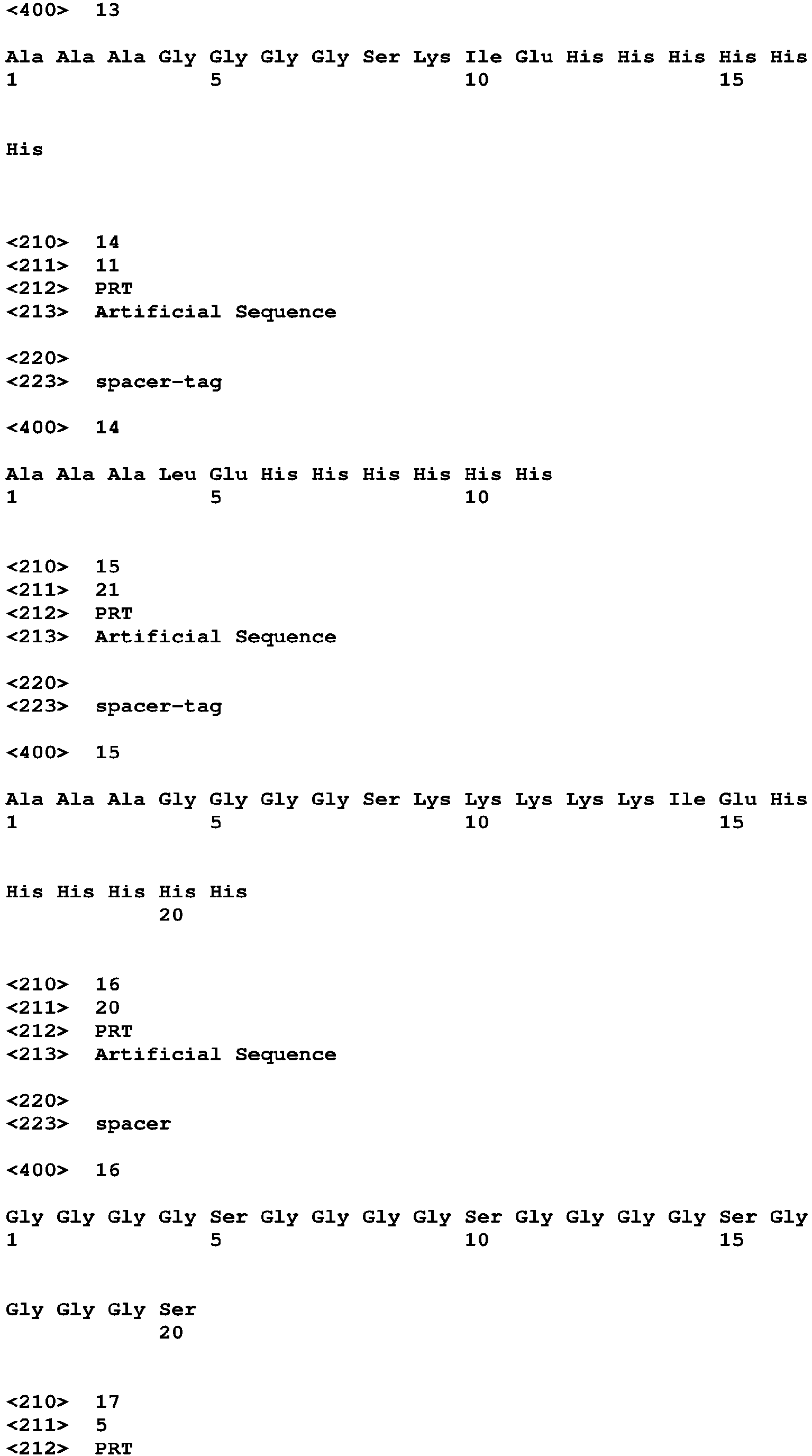

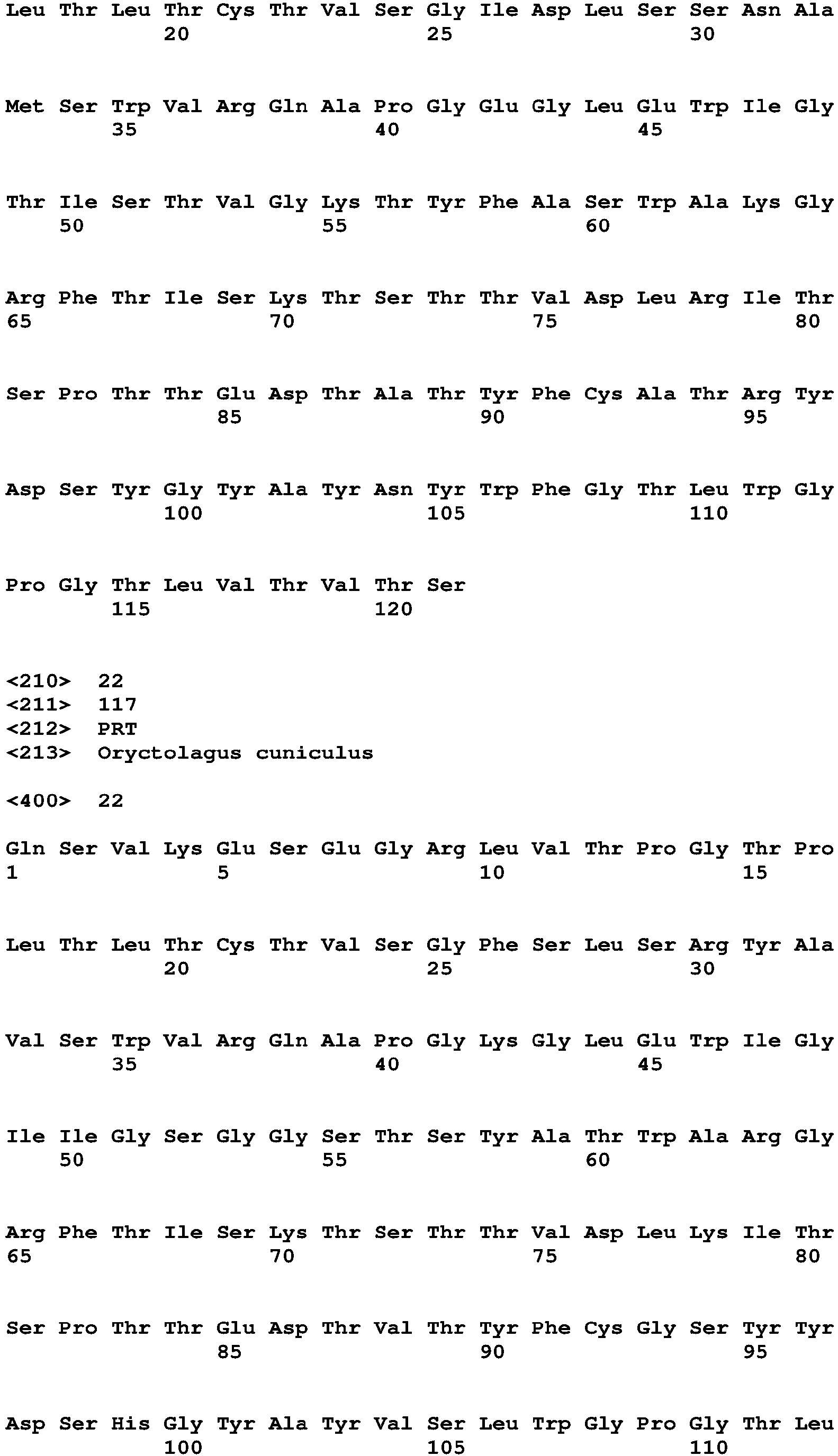


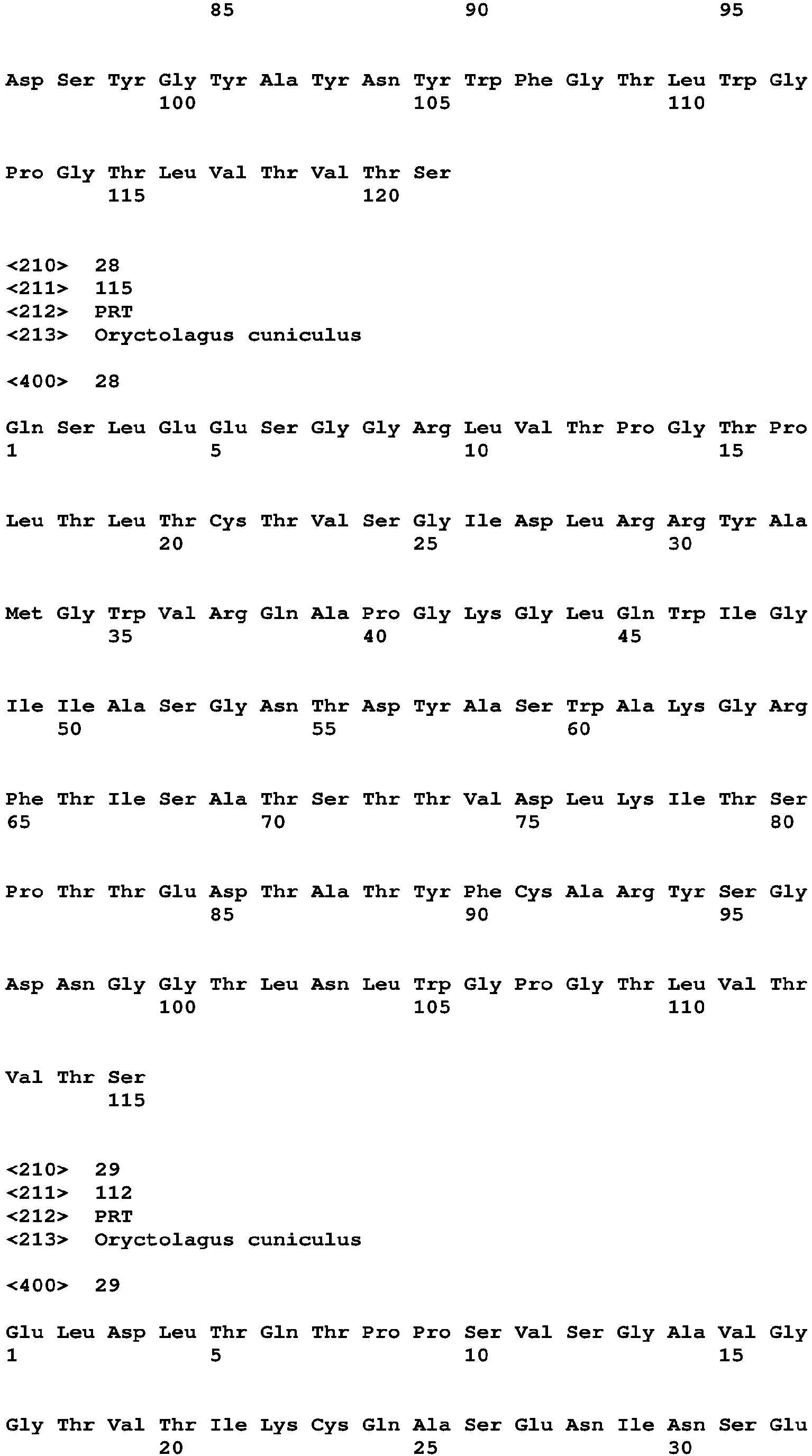


Claims (3)
- A separating agent comprising a carrier and a protein, wherein
the protein is
a protein comprising an amino acid sequence represented by SEQ ID NO: 1, an amino acid sequence represented by SEQ ID NO: 2, and an amino acid sequence represented by SEQ ID NO: 3 arranged sequentially from the N-terminus; or
a protein comprising an amino acid sequence represented by SEQ ID NO: 3, an amino acid sequence represented by SEQ ID NO: 16, and an amino acid sequence represented by SEQ ID NO: 1 arranged sequentially from the N-terminus;
wherein one or more lysine residues present in two or more of regions represented by (a) to (j) below are conserved, and/or one or more amino acid residues other than a lysine residue present in two or more of regions represented by (a) to (j) below are substituted with lysine residues;
in each of regions represented by (e), (f), and (j) below, 1 to 12 amino acid residues including one lysine residue or 2 to 12 lysine residues that may be consecutive may be inserted or added;
all lysine residues excluding the conserved lysine residue, the lysine residue after the substitution, and the lysine residue inserted or added are substituted with amino acid residues other than a cysteine residue; and
a cysteine residue at position 96 designated by the IMGT numbering in the amino acid sequence represented by SEQ ID NO: 3 is substituted with an amino acid residue other than a cysteine residue; and
wherein a surface of the carrier and the lysine residue in the protein are bound by a chemical bond:(a) a region at positions 14 to 18 designated by the IMGT numbering in the amino acid sequence represented by SEQ ID NO: 1(b) a region at positions 45 to 50 designated by the IMGT numbering in the amino acid sequence represented by SEQ ID NO:1(c) a region at positions 72 to 75 designated by the IMGT numbering in the amino acid sequence represented by SEQ ID NO: 1(d) a region at positions 92 to 96 designated by the IMGT numbering in the amino acid sequence represented by SEQ ID NO: 1(e) a region of 1 to 12 amino acid residues from the C-terminus in the amino acid sequence represented by SEQ ID NO: 1(f) a region of 1 to 12 amino acid residues from the N-terminus in the amino acid sequence represented by SEQ ID NO: 2 or 16(g) a region at positions 14 to 18 designated by the IMGT numbering in the amino acid sequence represented by SEQ ID NO: 3(h) a region at positions 45 to 50 designated by the IMGT numbering in the amino acid sequence represented by SEQ ID NO: 3(i) a region at positions 82 to 86 designated by the IMGT numbering in the amino acid sequence represented by SEQ ID NO: 3(j) a region of 1 to 12 amino acid residues from the C-terminus in the amino acid sequence represented by SEQ ID NO: 3. - A method for separating a water-soluble substance with the protein bound from a mixed liquid of two or more water-soluble substances using the separating agent according to claim 1.
- A protein comprising an amino acid sequence represented by SEQ ID NO: 1, an amino acid sequence represented by SEQ ID NO: 2, and an amino acid sequence represented by SEQ ID NO: 3 arranged sequentially from the N-terminus; or
a protein comprising an amino acid sequence represented by SEQ ID NO: 3, an amino acid sequence represented by SEQ ID NO: 16, and an amino acid sequence represented by SEQ ID NO: 1 arranged sequentially from the N-terminus;
wherein one or more lysine residues present in two or more of regions represented by (a) to (j) below are conserved, and/or one or more amino acid residues other than a lysine residue present in two or more of regions represented by (a) to (j) below are substituted with lysine residues;
in each of regions represented by (e), (f), and (j) below, 1 to 12 amino acid residues including one lysine residue or 2 to 12 lysine residues that may be consecutive may be inserted or added;
all lysine residues excluding the conserved lysine residue, the lysine residue after the substitution, and the lysine residue inserted or added are substituted with amino acid residues other than a cysteine residue; and
a cysteine residue at position 96 designated by the IMGT numbering in the amino acid sequence represented by SEQ ID NO: 3 is substituted with an amino acid residue other than a cysteine residue:(a) a region at positions 14 to 18 designated by the IMGT numbering in the amino acid sequence represented by SEQ ID NO: 1(b) a region at positions 45 to 50 designated by the IMGT numbering in the amino acid sequence represented by SEQ ID NO:1(c) a region at positions 72 to 75 designated by the IMGT numbering in the amino acid sequence represented by SEQ ID NO: 1(d) a region at positions 92 to 96 designated by the IMGT numbering in the amino acid sequence represented by SEQ ID NO: 1(e) a region of 1 to 12 amino acid residues from the C-terminus in the amino acid sequence represented by SEQ ID NO: 1(f) a region of 1 to 12 amino acid residues from the N-terminus in the amino acid sequence represented by SEQ ID NO: 2 or 16(g) a region at positions 14 to 18 designated by the IMGT numbering in the amino acid sequence represented by SEQ ID NO: 3(h) a region at positions 45 to 50 designated by the IMGT numbering in the amino acid sequence represented by SEQ ID NO: 3(i) a region at positions 82 to 86 designated by the IMGT numbering in the amino acid sequence represented by SEQ ID NO: 3(j) a region of 1 to 12 amino acid residues from the C-terminus in the amino acid sequence represented by SEQ ID NO: 3.
Applications Claiming Priority (2)
| Application Number | Priority Date | Filing Date | Title |
|---|---|---|---|
| JP2018123954 | 2018-06-29 | ||
| PCT/JP2019/026176 WO2020004671A1 (en) | 2018-06-29 | 2019-07-01 | Separating agent |
Publications (2)
| Publication Number | Publication Date |
|---|---|
| EP3816189A1 true EP3816189A1 (en) | 2021-05-05 |
| EP3816189A4 EP3816189A4 (en) | 2021-09-22 |
Family
ID=68987227
Family Applications (1)
| Application Number | Title | Priority Date | Filing Date |
|---|---|---|---|
| EP19825288.4A Pending EP3816189A4 (en) | 2018-06-29 | 2019-07-01 | SEPARATION AGENT |
Country Status (5)
| Country | Link |
|---|---|
| US (1) | US12195498B2 (en) |
| EP (1) | EP3816189A4 (en) |
| JP (1) | JP7783585B2 (en) |
| CN (1) | CN112334491A (en) |
| WO (1) | WO2020004671A1 (en) |
Family Cites Families (9)
| Publication number | Priority date | Publication date | Assignee | Title |
|---|---|---|---|---|
| JP4179517B2 (en) | 2006-02-21 | 2008-11-12 | プロテノバ株式会社 | Immunoglobulin affinity ligand |
| WO2007097361A1 (en) * | 2006-02-21 | 2007-08-30 | Protenova Co., Ltd. | Immunoglobulin affinity ligand |
| JP5008027B2 (en) * | 2006-10-10 | 2012-08-22 | 独立行政法人産業技術総合研究所 | Method for designing a protein suitable for protein orientation control immobilization |
| AU2011230313B2 (en) * | 2010-03-24 | 2015-01-22 | Kaneka Corporation | Protein capable of binding specifically to immunoglobulin, and immunoglobulin-binding affinity ligand |
| JP2012034668A (en) | 2010-08-12 | 2012-02-23 | Tohoku Univ | Fragment of humanized anti-egfr antibody substituted-lysine variable region, and use thereof |
| EP2690173B1 (en) | 2011-03-25 | 2019-07-03 | Kaneka Corporation | Protein for affinity-separation matrix |
| SG11201502238PA (en) * | 2012-09-21 | 2015-05-28 | Kaneka Corp | Protein ligand for affinity isolation matrix |
| EP3042912B1 (en) * | 2013-09-04 | 2026-02-25 | Protenova Co., Ltd. | Immunoglobulin-binding domain multimer |
| EP3375875B1 (en) | 2015-11-09 | 2026-04-15 | National University Corporation Kyoto Institute of Technology | Separating agent for human serum-derived igg polyclonal antibodies, and method for separating human serum-derived igg polyclonal antibodies using same |
-
2019
- 2019-07-01 WO PCT/JP2019/026176 patent/WO2020004671A1/en not_active Ceased
- 2019-07-01 EP EP19825288.4A patent/EP3816189A4/en active Pending
- 2019-07-01 JP JP2020527711A patent/JP7783585B2/en active Active
- 2019-07-01 CN CN201980043888.8A patent/CN112334491A/en active Pending
- 2019-07-01 US US17/256,566 patent/US12195498B2/en active Active
Also Published As
| Publication number | Publication date |
|---|---|
| EP3816189A4 (en) | 2021-09-22 |
| US20220127304A1 (en) | 2022-04-28 |
| JPWO2020004671A1 (en) | 2021-08-12 |
| JP7783585B2 (en) | 2025-12-10 |
| US12195498B2 (en) | 2025-01-14 |
| CN112334491A (en) | 2021-02-05 |
| WO2020004671A1 (en) | 2020-01-02 |
Similar Documents
| Publication | Publication Date | Title |
|---|---|---|
| JP2024100775A (en) | Modified kappa light chain binding polypeptides | |
| JP7335881B2 (en) | Immunoglobulin-binding protein and affinity carrier using the same | |
| CN105111289A (en) | Caustic stable chromatography ligands | |
| WO2011118599A1 (en) | Filler for affinity chromatography and method for isolating immunoglobulin | |
| JP7002733B2 (en) | Separation method of solid-phase carrier containing IgG-binding peptide and IgG | |
| US10450344B2 (en) | Antibody-binding polypeptide, antibody-binding fusion polypeptide, and adsorption material | |
| WO2017082214A1 (en) | Screening method for single-chain antibodies, and single-chain antibodies | |
| JP7117741B2 (en) | Solid-phase carrier containing IgG-binding peptide and method for separating IgG | |
| EP3816188B1 (en) | Separating agent | |
| US12195498B2 (en) | Separating agent | |
| JP7202577B2 (en) | peptide fusion protein | |
| JP2026515232A (en) | Split-intein for affinity capture | |
| WO2026096416A1 (en) | Affinity resins for the purification of hepatitis b surface antigen |
Legal Events
| Date | Code | Title | Description |
|---|---|---|---|
| STAA | Information on the status of an ep patent application or granted ep patent |
Free format text: STATUS: THE INTERNATIONAL PUBLICATION HAS BEEN MADE |
|
| PUAI | Public reference made under article 153(3) epc to a published international application that has entered the european phase |
Free format text: ORIGINAL CODE: 0009012 |
|
| STAA | Information on the status of an ep patent application or granted ep patent |
Free format text: STATUS: REQUEST FOR EXAMINATION WAS MADE |
|
| 17P | Request for examination filed |
Effective date: 20210129 |
|
| AK | Designated contracting states |
Kind code of ref document: A1 Designated state(s): AL AT BE BG CH CY CZ DE DK EE ES FI FR GB GR HR HU IE IS IT LI LT LU LV MC MK MT NL NO PL PT RO RS SE SI SK SM TR |
|
| A4 | Supplementary search report drawn up and despatched |
Effective date: 20210825 |
|
| RIC1 | Information provided on ipc code assigned before grant |
Ipc: A61K 39/44 20060101ALI20210819BHEP Ipc: C12N 15/13 20060101ALI20210819BHEP Ipc: G01N 33/50 20060101ALI20210819BHEP Ipc: C07K 16/42 20060101ALI20210819BHEP Ipc: C07K 17/00 20060101AFI20210819BHEP |
|
| DAV | Request for validation of the european patent (deleted) | ||
| DAX | Request for extension of the european patent (deleted) | ||
| STAA | Information on the status of an ep patent application or granted ep patent |
Free format text: STATUS: EXAMINATION IS IN PROGRESS |
|
| 17Q | First examination report despatched |
Effective date: 20241121 |