EP3815997B1 - Vehicle brake hydraulic pressure control device - Google Patents
Vehicle brake hydraulic pressure control device Download PDFInfo
- Publication number
- EP3815997B1 EP3815997B1 EP19826580.3A EP19826580A EP3815997B1 EP 3815997 B1 EP3815997 B1 EP 3815997B1 EP 19826580 A EP19826580 A EP 19826580A EP 3815997 B1 EP3815997 B1 EP 3815997B1
- Authority
- EP
- European Patent Office
- Prior art keywords
- valve
- hydraulic pressure
- pumps
- mounting hole
- brake
- Prior art date
- Legal status (The legal status is an assumption and is not a legal conclusion. Google has not performed a legal analysis and makes no representation as to the accuracy of the status listed.)
- Active
Links
Images









Classifications
-
- F—MECHANICAL ENGINEERING; LIGHTING; HEATING; WEAPONS; BLASTING
- F04—POSITIVE - DISPLACEMENT MACHINES FOR LIQUIDS; PUMPS FOR LIQUIDS OR ELASTIC FLUIDS
- F04B—POSITIVE-DISPLACEMENT MACHINES FOR LIQUIDS; PUMPS
- F04B11/00—Equalisation of pulses, e.g. by use of air vessels; Counteracting cavitation
- F04B11/005—Equalisation of pulses, e.g. by use of air vessels; Counteracting cavitation using two or more pumping pistons
-
- B—PERFORMING OPERATIONS; TRANSPORTING
- B60—VEHICLES IN GENERAL
- B60T—VEHICLE BRAKE CONTROL SYSTEMS OR PARTS THEREOF; BRAKE CONTROL SYSTEMS OR PARTS THEREOF, IN GENERAL; ARRANGEMENT OF BRAKING ELEMENTS ON VEHICLES IN GENERAL; PORTABLE DEVICES FOR PREVENTING UNWANTED MOVEMENT OF VEHICLES; VEHICLE MODIFICATIONS TO FACILITATE COOLING OF BRAKES
- B60T17/00—Component parts, details, or accessories of power brake systems not covered by groups B60T8/00, B60T13/00 or B60T15/00, or presenting other characteristic features
- B60T17/02—Arrangements of pumps or compressors, or control devices therefor
-
- B—PERFORMING OPERATIONS; TRANSPORTING
- B60—VEHICLES IN GENERAL
- B60T—VEHICLE BRAKE CONTROL SYSTEMS OR PARTS THEREOF; BRAKE CONTROL SYSTEMS OR PARTS THEREOF, IN GENERAL; ARRANGEMENT OF BRAKING ELEMENTS ON VEHICLES IN GENERAL; PORTABLE DEVICES FOR PREVENTING UNWANTED MOVEMENT OF VEHICLES; VEHICLE MODIFICATIONS TO FACILITATE COOLING OF BRAKES
- B60T8/00—Arrangements for adjusting wheel-braking force to meet varying vehicular or ground-surface conditions, e.g. limiting or varying distribution of braking force
- B60T8/32—Arrangements for adjusting wheel-braking force to meet varying vehicular or ground-surface conditions, e.g. limiting or varying distribution of braking force responsive to a speed condition, e.g. acceleration or deceleration
- B60T8/34—Arrangements for adjusting wheel-braking force to meet varying vehicular or ground-surface conditions, e.g. limiting or varying distribution of braking force responsive to a speed condition, e.g. acceleration or deceleration having a fluid pressure regulator responsive to a speed condition
-
- B—PERFORMING OPERATIONS; TRANSPORTING
- B60—VEHICLES IN GENERAL
- B60T—VEHICLE BRAKE CONTROL SYSTEMS OR PARTS THEREOF; BRAKE CONTROL SYSTEMS OR PARTS THEREOF, IN GENERAL; ARRANGEMENT OF BRAKING ELEMENTS ON VEHICLES IN GENERAL; PORTABLE DEVICES FOR PREVENTING UNWANTED MOVEMENT OF VEHICLES; VEHICLE MODIFICATIONS TO FACILITATE COOLING OF BRAKES
- B60T8/00—Arrangements for adjusting wheel-braking force to meet varying vehicular or ground-surface conditions, e.g. limiting or varying distribution of braking force
- B60T8/32—Arrangements for adjusting wheel-braking force to meet varying vehicular or ground-surface conditions, e.g. limiting or varying distribution of braking force responsive to a speed condition, e.g. acceleration or deceleration
- B60T8/34—Arrangements for adjusting wheel-braking force to meet varying vehicular or ground-surface conditions, e.g. limiting or varying distribution of braking force responsive to a speed condition, e.g. acceleration or deceleration having a fluid pressure regulator responsive to a speed condition
- B60T8/48—Arrangements for adjusting wheel-braking force to meet varying vehicular or ground-surface conditions, e.g. limiting or varying distribution of braking force responsive to a speed condition, e.g. acceleration or deceleration having a fluid pressure regulator responsive to a speed condition connecting the brake actuator to an alternative or additional source of fluid pressure, e.g. traction control systems
-
- F—MECHANICAL ENGINEERING; LIGHTING; HEATING; WEAPONS; BLASTING
- F04—POSITIVE - DISPLACEMENT MACHINES FOR LIQUIDS; PUMPS FOR LIQUIDS OR ELASTIC FLUIDS
- F04B—POSITIVE-DISPLACEMENT MACHINES FOR LIQUIDS; PUMPS
- F04B23/00—Pumping installations or systems
- F04B23/02—Pumping installations or systems having reservoirs
-
- F—MECHANICAL ENGINEERING; LIGHTING; HEATING; WEAPONS; BLASTING
- F04—POSITIVE - DISPLACEMENT MACHINES FOR LIQUIDS; PUMPS FOR LIQUIDS OR ELASTIC FLUIDS
- F04B—POSITIVE-DISPLACEMENT MACHINES FOR LIQUIDS; PUMPS
- F04B23/00—Pumping installations or systems
- F04B23/04—Combinations of two or more pumps
- F04B23/06—Combinations of two or more pumps the pumps being all of reciprocating positive-displacement type
-
- F—MECHANICAL ENGINEERING; LIGHTING; HEATING; WEAPONS; BLASTING
- F04—POSITIVE - DISPLACEMENT MACHINES FOR LIQUIDS; PUMPS FOR LIQUIDS OR ELASTIC FLUIDS
- F04B—POSITIVE-DISPLACEMENT MACHINES FOR LIQUIDS; PUMPS
- F04B49/00—Control, e.g. of pump delivery, or pump pressure of, or safety measures for, machines, pumps, or pumping installations, not otherwise provided for, or of interest apart from, groups F04B1/00 - F04B47/00
- F04B49/06—Control using electricity
-
- F—MECHANICAL ENGINEERING; LIGHTING; HEATING; WEAPONS; BLASTING
- F04—POSITIVE - DISPLACEMENT MACHINES FOR LIQUIDS; PUMPS FOR LIQUIDS OR ELASTIC FLUIDS
- F04B—POSITIVE-DISPLACEMENT MACHINES FOR LIQUIDS; PUMPS
- F04B53/00—Component parts, details or accessories not provided for in, or of interest apart from, groups F04B1/00 - F04B23/00 or F04B39/00 - F04B47/00
- F04B53/16—Casings; Cylinders; Cylinder liners or heads; Fluid connections
Definitions
- the present invention relates to a vehicle brake hydraulic pressure control device.
- Patent Literature 1 Disclosed in Patent Literature 1 is a vehicle brake hydraulic pressure control device configured to boost hydraulic pressure in a master cylinder with a pump and cause the hydraulic pressure to act on a wheel brake.
- the vehicle brake hydraulic pressure control device of Patent Literature 1 includes a pressure-adjusting reservoir connected between the master cylinder and an intake valve of the pump.
- the pressure-adjusting reservoir includes a reservoir and a mechanical suction valve, and the mechanical suction valve includes a diaphragm configured to operate mechanically by a pressure difference.
- Patent Literature 2 discloses a brake apparatus configured to be disposed between a master cylinder and a wheel brake, the brake apparatus comprising a pump and a pressure regulating reservoir disposed between the master cylinder and intake port of the pump.
- Patent Literature 3 discloses a pump comprising two reciprocating pump heads, wherein the two pump heads have discharge cycles shifted from each other by half a cycle.
- the pump used in the vehicle brake hydraulic pressure control device of Patent Literature 1 is a pump of a so-called plunger type provided with check valves at an intake port and a discharge port, respectively. Therefore, suction and discharge during an operation of the pump tend to cause pulsation, and the caused pulsation may be transmitted to the diaphragm and affect the durability of the diaphragm.
- an aspect of the present invention provides a vehicle brake hydraulic pressure control device equipped with a pair of pumps and a drive source for driving both of the pumps, and configured to be disposed between a master cylinder and a wheel brake, comprising: a suction valve disposed between the master cylinder and intake ports of the pair of pumps, and a base body for attaching the suction valve, the pair of pumps, and the drive source, wherein one system of the master cylinder and the wheel brake is connected to the base body; wherein the suction valve is configured to be opened by a pressure difference between a brake hydraulic pressure on the master cylinder side and a brake hydraulic pressure on an intake port side of the pumps, at which a vacuum is created when the pumps are operated, wherein each of the pumps includes a plunger, an intake valve, and a discharge valve, wherein the pair of pumps are capable of discharging brake fluid to a flow path in communication with the master cylinder and the wheel brake, and discharge cycles of brake fluid are shifted from each other by half a cycle; and wherein
- the pair of pumps are driven by the single drive source.
- This configuration requires only the single drive source, and thus the entire device may have a compact profile.
- Such a vehicle brake hydraulic pressure control device is preferable especially for vehicles with a bar handle such as motorcycles or three-wheeled vehicles. Furthermore, superior mountability is achieved.
- the suction valve includes a normally-closed one-way valve and a plunger configured to open a valve body of the one-way valve, and is configured to bias the one-way valve to a valve opening direction by the plunger, the plunger being pushed by a diaphragm by a vacuum created on the intake port side by an operation of the pair of pumps.
- the one-way valve is accommodated in an accommodating part provided on the base body, and an effective diameter of the diaphragm is larger than an inner diameter of the accommodating part.
- the diaphragm having an effective diameter larger than the inner diameter of the accommodating part enables enhancement of workability of the diaphragm even when the brake hydraulic pressure from the master cylinder side is relatively high, and thus improvement of openability of the suction valve is achieved.
- a vehicle brake hydraulic pressure control device including a suction valve provided with a diaphragm, improvement of durability of the diaphragm is achieved.
- a vehicle brake hydraulic pressure control device (hereinafter, referred to simply as “brake hydraulic pressure control device") U of the present embodiment is used for vehicles with a bar handle such as motorcycles, three-wheeled vehicles, and all terrain vehicles (ATV).
- the vehicles for mounting the device has preferably a front wheel brake unit and a rear wheel brake unit separated from each other.
- a brake hydraulic pressure control device configured to control the brake hydraulic pressure acting on a rear wheel brake will be described.
- the brake hydraulic pressure control device U includes a base body 100, a motor (electric motor) 200 as a drive source, a control housing 300, and a control device 400 as illustrated in Fig. 1 .
- the motor 200 is attached to a rear surface 11b of the base body 100.
- the control housing 300 is attached to a front surface 11a of the base body 100 (see Fig. 3(b)).
- the control device 400 is accommodated in the control housing 300.
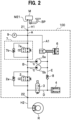
- the brake hydraulic pressure control device U is an embodied hydraulic pressure circuit illustrated in Fig. 2 .
- the brake hydraulic pressure control device U can execute anti-locking braking control of a wheel brake R and pressurization control of the wheel brake R.
- output hydraulic pressure line A a flow path extending from the master cylinder M to a regulator 7
- wheel hydraulic pressure line B a flow path extending from the regulator 7 to an outlet valve 3 and the wheel brake R
- a pair of flow paths extending from pumps 5a, 5b to the wheel hydraulic pressure line B are referred to as “discharge hydraulic pressure lines C, C”
- release line D a flow path extending from the outlet valve 3 to a reservoir 4
- intake hydraulic pressure passage E A flow path branched from the output hydraulic pressure line A and reaches to the suction valve 6
- branch hydraulic line A1 A flow path branched from the output hydraulic pressure line A and reaches to the suction valve 6
- the brake hydraulic pressure circuit of the brake hydraulic pressure control device U is a circuit extending from an inlet port 21 to an outlet port 22.
- a pipe H1 connected to an output port M21 of the master cylinder M, which is a hydraulic pressure source, is connected to the inlet port 21.
- a pipe H2 extending to the wheel brake R is connected to the outlet port 22.
- the inlet port 21 is formed on a right area of an upper surface 11c of the base body 100 as illustrated in Fig. 3(a).
- the outlet port 22 is formed on a left area of the upper surface 11c of the base body 100, which is on an opposite side from the inlet port 21.
- a brake pedal BP which is a brake operation element, is connected to the master cylinder M.
- the hydraulic pressure circuit mainly includes an inlet valve 2, the outlet valve 3, the reservoir 4, the pumps 5a, 5b, the suction valve 6, and the regulator 7.
- the master cylinder M produces a brake hydraulic pressure according to a force applied to the brake pedal BP by a driver.
- the master cylinder M is connected to the wheel brake R (wheel cylinder) via the pipe H1, the output hydraulic pressure line A, the wheel hydraulic pressure line B, and the pipe H2.
- the fluid paths connected to the master cylinder M (output hydraulic pressure line A and wheel hydraulic pressure line B) normally communicate the master cylinder M with the wheel brake R. Accordingly, the brake hydraulic pressure generated by an operation of the brake pedal BP is transmitted to the wheel brake R.
- the regulator 7, the inlet valve 2, and the outlet valve 3 are provided on the fluid path connecting the master cylinder M and the wheel brake R.
- the regulator 7 has a function of switching a state of conduction of the brake fluid in the output hydraulic pressure line A between an allowing state and a blocked state.
- the regulator 7 has a function of adjusting the brake hydraulic pressure in the wheel hydraulic pressure line B to a level below a predetermined value when the conduction of the brake fluid in the output hydraulic pressure line A is blocked.
- the regulator 7 includes a cut valve 7a and a check valve 7b.
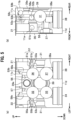
- the regulator 7 is mounted in a cut valve mounting hole 36 formed on a right upper portion of the front surface 11a of the base body 100 as illustrated in Fig. 3(b) and Fig. 5(a) .
- the cut valve mounting hole 36 is formed at a position on an upper side with respect to a pump axis Y1 of a right pump mounting hole 31 (see Fig. 5(b) ) in a right area of left and right halves delimited by a reference plane X1 orthogonal to the front surface 11a of the base body 100 as illustrated in Fig. 3(b).
- the pump axis Y1 is a center axial line of the left and right pump mounting holes 31, 31.
- the reference plane X1 is a plane having the pump axis Y1 as a normal line and is a plane including a motor shaft, not illustrated, of the motor 200.
- the cut valve 7a is a normally-opened linear solenoid valve interposed between the output hydraulic pressure line A and the wheel hydraulic pressure line B.
- the cut valve 7a is configured to switch a state of conduction of the brake fluid from the output hydraulic pressure line A to the wheel hydraulic pressure line B between an allowing state and a blocked state.
- the cut valve 7a has a configuration capable of adjusting a valve-opening pressure by controlling energization of the solenoid (a configuration having also a function of a relief valve).
- the cut valve 7a When the cut valve 7a is in a valve-opened state, it is a state allowing the brake fluid discharged from the pumps 5a, 5b to the discharge hydraulic pressure lines C, C and flowed into the wheel hydraulic pressure line B to flow back (to circulate) to the intake hydraulic pressure passage E through the output hydraulic pressure line A, the branch hydraulic line A1, and the suction valve 6.
- the cut valve 7a is closed under the control of the control device 400 (see Fig. 1 , the same applies to the description below) when performing pressurization control, which will be described later.
- the cut valve 7a releases the brake hydraulic pressure of the wheel hydraulic pressure line B toward the output hydraulic pressure line A for adjustment.
- the check valve 7b is connected in parallel to the cut valve 7a.
- the check valve 7b is a one-way valve which allows a flow of the brake fluid from the output hydraulic pressure line A to the wheel hydraulic pressure line B.
- the check valve 7b is integrally provided with a normally-opened solenoid valve which constitutes the regulator 7.
- the inlet valve 2 includes the normally-opened solenoid valve provided in the wheel hydraulic pressure line B, and is provided between the regulator 7 and the wheel brake R.
- the inlet valve 2 when in the valve-opened state, allows transmission of brake hydraulic pressure from the master cylinder M or brake fluid boosted in pressure by the pumps 5a, 5b to the wheel brake R.
- the inlet valve 2 also blocks the brake hydraulic pressure applied to the wheel brake R by being blocked by the control device 400 when the wheels are about to be locked.
- Such an inlet valve 2 is mounted in an inlet valve mounting hole 32 provided on a left upper portion of the front surface 11a of the base body 100 as illustrated in Fig. 3 (b) and Fig. 5 (a) .
- the inlet valve mounting hole 32 is formed at positions on an upper side of the pump axis Y1 of the left pump mounting hole 31 (see Fig. 6(b) ) in a left area of the two left and right halves divided by the reference plane X1 as illustrated in Fig. 3(b).
- the inlet valve mounting hole 32 is formed on the same side as the outlet port 22 of the upper surface 11c of the base body 100.
- a check valve 2a is connected to the inlet valve 2 in parallel.
- the check valve 2a is a valve configured to allow only a flow of the brake fluid from the wheel brake R toward the master cylinder M.
- the check valve 2a allows the inflow of the brake fluid from the wheel brake R side toward the master cylinder M even when the inlet valve 2 is closed in a case where an input of the brake pedal BP is released.
- the check valve 2a is integrally provided with the normally-opened solenoid valve which constitutes the inlet valve 2.
- the outlet valve 3 is made of the normally-closed solenoid valve.
- the outlet valve 3 is provided between the wheel brake R and the reservoir 4 (between the wheel hydraulic pressure line B and the release line D).
- the outlet valve 3 is normally closed but releases the brake hydraulic pressure applied to the wheel brake R to the reservoir 4 by being opened by the control device 400 when a rear wheel is about to be locked.
- Such an outlet valve 3 is mounted in an outlet valve mounting hole 33 provided on a left lower portion of the front surface 11a of the base body 100 as illustrated in Fig. 3(b) and Fig. 5(a) .
- the outlet valve mounting hole 33 is formed at positions on a lower side of the pump axis Y1 of the left pump mounting hole 31 (see Fig. 6(b) ) in a left area of the two left and right halves divided by the reference plane X1 as illustrated in Fig. 3(b).
- the outlet valve mounting hole 33 is provided on the same side as the inlet valve mounting hole 32 in the vertical direction of the base body 100.
- the reservoir 4 has a function of temporarily storing the brake fluid released by opening the outlet valve 3.
- the reservoir 4 is mounted in a reservoir mounting hole 34 illustrated in Fig. 4(b) .
- the reservoir mounting hole 34 is opening on the left area of a lower surface 11d of the base body 100. In other words, the reservoir 4 is provided in the left lower portion of the base body 100.
- the pumps 5a, 5b are arranged in lateral symmetry with respect to the reference plane X1 (see Fig. 3(b)).
- the pumps 5a, 5b are plunger pumps driven by the electric motor 200.
- the pumps 5a, 5b are each provided with a plunger, not illustrated, and an intake valve and a discharge valve, not illustrated.
- One pump 5a is interposed between the intake hydraulic pressure passage E and one discharge hydraulic pressure line C, and the other pump 5b is interposed between the intake hydraulic pressure passage E and the other discharge hydraulic pressure line C.
- the pumps 5a, 5b are driven by a rotational force of the motor 200.
- the pumps 5a, 5b are differentiated in discharge cycle of the brake fluid by half a cycle.
- the pumps 5a, 5b are shifted in discharge cycle from each other by half a cycle and are configured to discharge the brake fluid twice to the wheel hydraulic pressure line B while an output shaft of the motor 200 makes one turn.
- the pumps 5a, 5b suck the brake fluid stored temporarily in the reservoir 4 and discharge the same to the discharge hydraulic pressure lines C, C.
- the pumps 5a, 5b also suck the brake fluid stored in the master cylinder M, the branch hydraulic line A1, the intake hydraulic pressure passage E, and the reservoir 4 and discharge the same to the discharge hydraulic pressure lines C, C when the cut valve 7a is in the valve-closed state and the suction valve 6 is in the valve-opened state. Accordingly, the brake hydraulic pressure generated by an operation of the brake pedal BP may be increased. Furthermore, even in the state in which the brake pedal BP is not operated, the brake hydraulic pressure may be made act on the wheel brake R (pressurization control) .
- Such pumps 5a, 5b are mounted in the pump mounting holes 31, 31 drilled from a left side surface 11e and a right side surface 11f of the base body 100 as illustrated in Figs. 3(c) (d) and so forth.
- the suction valve 6 is a suction valve of a mechanical type and is configured to switch a state of connection between the branch hydraulic line A1 and the intake hydraulic pressure passage E from an opened state to a blocked state and vice versa.
- the suction valve 6 is configured to open by a pressure difference between the brake hydraulic pressure on the master cylinder M side (the branched hydraulic pressure line side) and the brake hydraulic pressure on the intake port side (the intake hydraulic pressure passage E side) of the pumps 5a, 5b, at which a vacuum is created by the operation of the pumps 5a, 5b.
- the suction valve 6 is mounted in a suction valve mounting hole 38 illustrated in Fig. 4(b) , Fig. 5(a) and so forth.
- the suction valve mounting hole 38 is opened on the right area of the lower surface 11d of the base body 100. In other words, the suction valve 6 is provided in the right lower portion of the base body 100.
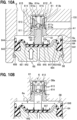
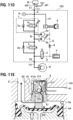
- the suction valve 6 includes a normally-closed one-way valve 61, a plunger 62, a plunger plate 63, a diaphragm 64, and a lid member 65 as a plug for fixing the diaphragm 64 as illustrated in Fig. 10A .
- the one-way valve 61 is a valve to be mounted in a one-way valve mounting hole 38a as an accommodating part formed on a bottom portion of the suction valve mounting hole 38 of the base body 100.
- the one-way valve mounting hole 38a is smaller than the suction valve mounting hole 38 in diameter.
- the branch hydraulic line A1 communicates with the one-way valve mounting hole 38a.
- the one-way valve 61 includes an annular fixed portion 611, a retainer 612 to be fixed to an upper end portion of the fixed portion 611, a large diameter valve 613 disposed in the retainer 612, and a spherical small diameter valve 614 disposed inside the large diameter valve 613.
- the fixed portion 611 is fixed to an inner wall of an opening of the one-way valve mounting hole 38a by swaging.
- An annular valve seat 611a on which the large diameter valve 613 is seated is formed on the upper end portion of the fixed portion 611.
- the valve seat 611a is formed into a tapered shape in cross section.
- the retainer 612 has a substantially hat shape in cross section.
- the large diameter valve 613 and the small diameter valve 614 are accommodated in an interior of the retainer 612.
- a lower end portion of the retainer 612 is fitted at an upper end on an outer peripheral wall of the fixed portion 611.
- the retainer 612 includes an insertion hole 615 to allow conduction of the brake fluid on a peripheral wall and a bottom portion thereof.
- the large diameter valve 613 has a recessed shape in cross-section.
- the small diameter valve 614 is accommodated inside the large diameter valve 613.
- An outer peripheral surface of a bottom portion of the large diameter valve 613 is formed into a tapered shape or an arcuate shape in cross section corresponding to the valve seat 611a of the fixed portion 611.
- the large diameter valve 613 is biased in a seating direction by a coil-shaped valve spring 613s provided in a compressed state between the large diameter valve 613 and the bottom portion of the retainer 612 and is seated on the valve seat 611a.
- An insertion hole 613a is formed in the bottom portion of the large diameter valve 613.
- the insertion hole 613a is formed into a size which allows insertion of a protrusion 62a of the plunger 62.
- An annular valve seat 613b is formed at an opening edge portion on an upper side of the insertion hole 613a.
- the valve seat 613b is formed into a tapered shape in cross section and allows the small diameter valve 614 to be seated.
- the small diameter valve 614 is biased in the seating direction by a coil-shaped valve spring 614s provided in a compressed state between the small diameter valve 614 and the bottom portion of the retainer 612 and is seated on the valve seat 613b.
- the valve spring 614s is smaller than the valve spring 613s in diameter.
- the plunger 62 is a column shaped member. An upper portion of the plunger 62 is inserted inside the fixed portion 611 of the one-way valve 61.
- the plunger 62 has a substantially triangular shape in cross section in a direction orthogonal to an axial direction. Accordingly, a space S1 is formed between an outer surface of the plunger 62 and an inner surface of the fixed portion 611 of the one-way valve 61.
- the space S1 serves as a conduction flow path for the brake fluid.
- the protrusion 62a protruding upward is formed on an upper end surface of the plunger 62.
- the protrusion 62a is formed at a position corresponding to the insertion hole 613a of the bottom portion of the large diameter valve 613.
- the protrusion 62a is inserted into the insertion hole 613a when the plunger 62 described later moves upward and presses the small diameter valve 614 seated on the valve seat 613b upward. Accordingly, the small diameter valve 614 moves away from the valve seat 613b.
- An upper surface of the plunger 62 is formed into a flat shape other than the protrusion 62a and thus can come into contact with the lower surface of the bottom portion of the large diameter valve 613.
- the upper surface of the plunger 62 comes into contact with the lower surface of the bottom portion of the large diameter valve 613 and presses the large diameter valve 613 upward when the plunger 62 described later moves upward.
- the large diameter valve 613 moves away from the valve seat 611a by being pushed in this manner.
- a groove or a recess which allows smooth conduction of the brake fluid may be formed on the upper surface of the plunger 62 or the lower end surface of the large diameter valve 613.
- the plunger 62 is fixed in a state of being erected on an upper surface of the plunger plate 63.
- the plunger plate 63 has a disk shape.
- the plunger plate 63 is placed at a center portion of the upper surface of the diaphragm 64.
- An annular rib 63a in which the lower portion of the plunger 62 is fitted and held is formed on the upper surface of the plunger plate 63.
- An outer peripheral edge portion of the plunger plate 63 rises upward in an arcuate shape in cross section.
- the diaphragm 64 includes an annular seal portion 641 in tight contact with an inner peripheral surface of the suction valve mounting hole 38, and a thin film drive unit 642 continuing radially inward of the seal portion 641 and pushes the plunger 62.
- the seal portion 641 includes a first seal portion 643, and an annular cup seal portion 644 continuing from the first seal portion 643 and extending upward so as to be opposite side from an opening of the suction valve mounting hole 38.
- the first seal portion 643 includes a thickness in the radial direction and formed into an annular shape and is tightly fitted to an inner peripheral surface of the suction valve mounting hole 38 on the opening side to seal to avoid suction of air from outside due to a vacuum created when the pump is operated.
- the cup seal portion 644 has a substantially cup shape in cross section and is tightly adhered to the inner peripheral surface of the suction valve mounting hole 38 on the opposite side from the opening to seal.
- the cup seal portion 644 is configured to prevent the brake fluid from leaking out when receiving the brake fluid on the master cylinder M side, for example, in a case where the suction valve 6 is immobilized in the opened state.
- the thin film drive unit 642 includes a rising portion 646 formed to be thinner than the seal portion 641 and extending in an arcuate shape radially inward from the seal portion 641, and a flat portion 647 continuing radially inward of the rising portion 646.
- a vacuum is created in a vacuum chamber 6a partitioned by the diaphragm 64, the rising portion 646 is subject to elastic deformation and moved so that the flat portion 647 rises toward the one-way valve 61.
- An annular rib 645 is formed on a lower surface of the flat portion 647 for preventing tight contact of the flat portion 647 to an upper surface of the lid member 65.
- An effective diameter L1 of the diaphragm 64 is set to be larger than an inner diameter L3 of the one-way valve mounting hole 38a as illustrated in Fig. 10B .
- the effective diameter L1 is always larger than the outer diameter of the large diameter valve 613 disposed in the one-way valve mounting hole 38a, whereby a pressure-receiving surface area of the effective diameter L1 portion of the diaphragm 64 is set to be larger than the pressure-receiving surface area of the large diameter valve 613 as a matter of necessity.
- the lid member 65 is a member to be inserted inside the opening of the suction valve mounting hole 38 to fix the diaphragm 64 in the suction valve mounting hole 38 (in the base body 100).
- the lid member 65 is provided with a base portion 651, a fitting portion 652, a retaining portion 653, a lip portion 654, and an atmosphere communicating hole 655.
- the fitting portion 652 has a flange shape extending radially outward and is fitted into the inner peripheral surface of the suction valve mounting hole 38.
- An engagement ring 656 for retention is engaged with the fitting portion 652 from axially outside.
- the retaining portion 653 is formed by using an upper surface of the fitting portion 652.
- the first seal portion 643 of the diaphragm 64 is fitted on the retaining portion 653.
- the lip portion 654 continues to the retaining portion 653 and protrudes upward from the retaining portion 653.
- An upper end portion of the lip portion 654 has an arcuate shape.
- the lip portion 654 is positioned downward of the rising portion 646 of the diaphragm 64.
- the lip portion 654 is positioned downward of the rising portion 646 to prevent deformation of the diaphragm 64 more than necessary when the brake hydraulic pressure from the master cylinder M side acts on the vacuum chamber 6a, for example, in a case where the suction valve 6 is immobilized in an opened state.
- a check valve 8 is provided in the intake hydraulic pressure passage E.
- the check valve 8 is a one-way valve configured to allow a flow of the brake fluid from the reservoir 4 side toward the pumps 5a, 5b.
- a hydraulic pressure sensor 9 is disposed in the output hydraulic pressure line A.
- the hydraulic pressure sensor 9 is configured to measure a magnitude of the brake hydraulic pressure of the output hydraulic pressure line A, that is, the brake fluid pressure in the master cylinder M.
- a value of the brake hydraulic pressure measured by the hydraulic pressure sensor 9 is retrieved as needed by the control device 400 to determine whether or not the brake fluid pressure is output from the master cylinder M by the control device 400, that is, whether or not the brake pedal BP is pressed. Further, the pressurization control or the like is performed based on the magnitude of the brake hydraulic pressure measured by the hydraulic pressure sensor 9.
- the motor 200 is a common power source of the two pumps 5a, 5b, and is operated based on a command from the control device 400.
- the motor 200 is attached by inserting a motor shaft, not illustrated, into a motor shaft insertion hole 39 having a circular recessed shape of the rear surface (the other surface) 11b of the base body 100 as illustrated in Fig. 4(a) .
- the control device 400 controls opening and closing of the cut valve 7a of the regulator 7, the inlet valve 2 and the outlet valve 3 as well as the operation of the motor 200 based on output from the hydraulic pressure sensor 9, a wheel speed sensor, not illustrated, an acceleration sensor or yaw rate sensor for measuring the movement of a vehicle body, and external sensors such as a radar camera or the like.
- a plurality of electromagnetic coils for driving the above-described plurality of solenoid valves are demagnetized by the control device 400.
- the cut valve 7a and the inlet valve 2 are in the valve-opened state, and the outlet valve 3 is in the valve-closed state.
- the one-way valve 61 of the suction valve 6 is in the valve-closed state.
- the brake hydraulic pressure from the master cylinder M acts on the suction valve 6 via the branch hydraulic line A1. Accordingly, the large diameter valve 613 and the small diameter valve 614 of the one-way valve 61 (see Fig. 10A , the same applies hereinafter) receive the brake hydraulic pressure and are seated respectively, so that the valve-closed state is maintained. In other words, the brake hydraulic pressure from the master cylinder M does not act on the intake hydraulic pressure passage E side.
- the anti-locking braking control is executed when the wheel is about to be brought into a locked state, and is achieved by selecting one of pressure-decreasing, pressure-increasing or maintaining constant the brake hydraulic pressure acting on the wheel brake R as needed. Note that which one of pressure-decreasing, pressure-increasing or maintaining is to be selected is determined by the control device 400 based on the wheel speed obtained from a wheel speed sensor, not illustrated.
- the anti-locking braking control is started by the control device 400.
- the inlet valve 2 is brought into the valve-closed state by the control device 400, and the outlet valve 3 is brought into the valve-opened state.
- the brake fluid of the wheel hydraulic pressure line B communicating with the wheel brake R flows into the reservoir 4 through the release line D. Consequently, the brake hydraulic pressure acting on the wheel brake R is decreased.
- the motor 200 is driven by the control device 400 to actuate the pumps 5a, 5b, and the brake fluid stored in the reservoir 4 is flowed back toward the wheel hydraulic pressure line B via the discharge hydraulic pressure line C.
- the inlet valve 2 and the outlet valve 3 are brought into the valve-closed state by the control device 400.
- the brake fluid is enclosed in the flow path closed by the inlet valve 2 and the outlet valve 3. Consequently, the brake hydraulic pressure acting on the wheel brake R is maintained constant.
- the inlet valve 2 is brought into the valve-opened state and the outlet valve 3 is brought into the valve-closed state by the control device 400.
- the brake hydraulic pressure caused by pressing the brake pedal BP acts directly on the wheel brake R. Consequently, the brake hydraulic pressure acting on the wheel brake R is increased.
- the control device 400 When applying a brake to the wheel by the control device 400 is determined to be necessary in a non-operation state in which the brake pedal BP is not operated, the control device 400 energizes the cut valve 7a to bring the same to the valve-closed state, and drives the pumps 5a, 5b as illustrated in Fig. 11B .
- the large diameter valve 613 moves away from the annular valve seat 611a, and the branch hydraulic line A1 communicates with the vacuum chamber 6a through the space S1 of the plunger 62.
- This communication causes the brake fluid on the master cylinder M side to flow into the vacuum chamber 6a from the branch hydraulic line A1 through the one-way valve 61, and further, flows from the vacuum chamber 6a into the intake hydraulic pressure passage E and is sucked by the pumps 5a, 5b.
- the brake fluid pressurized by the pumps 5a, 5b is discharged from the pumps 5a, 5b to the wheel hydraulic pressure line B as illustrated in Fig. 11B and acts on the wheel brake R. Accordingly, a brake is applied to the wheel.
- control device 400 energizes the cut valve 7a and brings the same into the valve-closed state and drives the pumps 5a, 5b.
- a pressing force of the brake hydraulic pressure on the master cylinder M side caused by a pressing force of the driver and a biasing force of the valve spring 614s act on the small diameter valve 614. Therefore, when a force of the plunger 62 pushing the small diameter valve 614 upward exceeds a resultant force of the pressing force and the biasing force acting on the small diameter valve 614, the small diameter valve 614 moves away from the valve seat 613b. In other words, the small diameter valve 614 is opened by a difference force between the push-up force and the resultant force.
- the branch hydraulic line A1 communicates with the vacuum chamber 6a through the space formed by separation and the space S1 of the plunger 62 as illustrated in Fig. 11E .
- This communication causes the brake fluid on the master cylinder M side to flow into the vacuum chamber 6a from the branch hydraulic line A1 through the one-way valve 61, and further, flows from the vacuum chamber 6a into the intake hydraulic pressure passage E and is sucked by the pumps 5a, 5b.
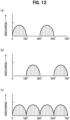
- discharge of the pump 5a alone may be expressed by non-continuous two mountain curves as illustrated in Fig. 12(a) .
- discharge of the pump 5b alone is performed at a phase of 180 degrees shifted from the discharge of the pump 5a by half a cycle and may be expressed by non-continuous two mountain curves as illustrated in Fig. 12(b) . Therefore, combined discharge from the two pumps 5a, 5b is expressed by four continuous mountain curves as illustrated in Fig. 12(c) .
- an effect of alleviation of discharge pulsation is achieved compared with the case where discharge is performed by the single pump 5a, for example.
- the brake hydraulic pressure control device U includes the base body 100, the electric motor 200, the control housing 300, and the control device 400 (see Fig. 1 ) as described above.
- the base body 100 is made of an extruded material or a cast product of aluminum alloy having a substantially cubic shape.
- the front surface 11a of the base body 100 is formed into a substantially flat plane without any depressions and projections.
- the base body 100 is provided with a flow path component which constitutes one brake output system (see Fig. 2 ).
- a flow path component includes a plurality of mounting holes opening on the front surface 11a, and the motor shaft insertion hole 39 opening on the rear surface 11b.
- the flow path component further includes the inlet port 21 and the outlet port 22 opening on the upper surface 11c as well as the pump mounting holes 31, 31, opening on the left side surface 11e and the right side surface 11f.
- the inlet valve mounting hole 32, the outlet valve mounting hole 33, the cut valve mounting hole 36, and a sensor mounting hole 37 are formed as mounting holes in the front surface 11a of the base body 100.
- the inlet valve mounting hole 32 is provided in the left area of the reference plane X1 on an upper side of the base body 100 with respect to the pump axis Y1 of the pump mounting holes 31.
- the outlet valve mounting hole 33 is provided in the left area of the reference plane X1 on a lower side of the base body 100 with respect to the pump axis Y1 of the pump mounting holes 31.
- the cut valve mounting hole 36 is provided in the right area of the reference plane X1 on an upper side of the base body 100 with respect to the pump axis Y1 of the pump mounting holes 31.
- the inlet valve mounting hole 32 and the cut valve mounting hole 36 are provided at positions in symmetry with respect to the reference plane X1.
- inlet valve mounting hole 32, the outlet valve mounting hole 33, and the cut valve mounting hole 36 all have the same diameter.
- the inlet valve 2 is mounted in the inlet valve mounting hole 32, and the outlet valve 3 is mounted in the outlet valve mounting hole 33.
- the cut valve 7a is mounted in the cut valve mounting hole 36.
- the sensor mounting hole 37 is provided in the right area of the reference plane X1 on the lower side of the base body 100 in a state of partly overlapping with the pump axis Y1 of the pump mounting holes 31. Note that the center position of the sensor mounting hole 37 and the center position of the outlet valve mounting hole 33 are positioned in symmetry with respect to the reference plane X1.
- the motor shaft insertion hole 39 is formed at a center portion of the rear surface 11b of the base body 100. Further, around the motor shaft insertion hole 39, a recess 11b1 formed to be deeper than the rear surface 11b and having a U-shape in rear view is formed. A front cover of the housing of the electric motor 200 (see Fig. 1 , the same applies hereinafter) is mounted in the recess 11b1. The electric motor 200 is attached to a mounting hole 11b2 (see Fig. 4(a) ) provided in the rear surface 11b with a mounting screw (not illustrated). A seal member is interposed between the electric motor 200 and the rear surface 11b.
- the rear surface 11b is provided with a hole portion 39a opening for inserting a bus bar (not illustrated) of the electric motor 200 at a position upward of the motor shaft insertion hole 39.
- the hole portion 39a penetrates in the fore-and-aft direction through the base body 100 and opening on the front surface 11a so as to intersect the reference plane X1.
- the inlet port 21 and the outlet port 22 are formed so as to depress in the upper surface 11c of the base body 100.
- the inlet port 21 is provided at a positional relationship corresponding to the cut valve mounting hole 36 as illustrated in Figs. 3(a) (b).
- the outlet port 22 is provided at a positional relationship corresponding to the inlet valve mounting hole 32.
- the pipe H1 (see Fig. 2 ) from the master cylinder M is connected to the inlet port 21.
- the pipe H2 (see Fig. 2 ) extending to the wheel brake R is connected to the outlet port 22.
- a blank space in which the inlet port 21 or the like is not formed is formed in a left and right areas of the upper surface 11c of the base body 100 on the rear side as illustrated in Fig. 3(a).
- the upper surface 11c of the base body 100 includes a blank space where the inlet port 21 or the like can be formed.
- the reservoir mounting hole 34 for mounting the reservoir 4 is formed so as to be recessed in the left area of the lower surface 11d of the base body 100 as illustrated in Fig. 4(b) .
- the suction valve mounting hole 38 for mounting the suction valve 6 is formed so as to be recessed in the right area of the lower surface 11d of the base body 100.
- the reservoir mounting hole 34 and the suction valve mounting hole 38 has the same diameter.
- the pump mounting hole 31 for mounting the pump 5a is formed so as to be recessed in the left side surface 11e of the base body 100 as illustrated in Fig. 3(c) .
- the pump mounting hole 31 for mounting the pump 5b is formed so as to be recessed in the right side surface 11f of the base body 100 as illustrated in Fig. 3(d).
- the pumps 5a, 5b engages cam members, not illustrated, provided on an output shaft of the electric motor 200.
- control housing 300 In the control housing 300 (see Fig. 1 ), an electromagnetic coil to be connected to the control device 400, not illustrated, is provided.
- the electromagnetic coil is attached to the inlet valve 2, the outlet valve 3, and the cut valve 7a protruding from the base body 100.
- the control housing 300 is integrally secured to the front surface 11a of the base body 100 in a state of covering the inlet valve 2, the outlet valve 3, the cut valve 7a, the hydraulic pressure sensor 9, and the bus bar.
- the inlet port 21 is a bottomed cylindrical hole, and communicates with the cut valve mounting hole 36 via a first flow path 51 (see Fig. 8 ).
- the first flow path 51 includes a vertical hole 51a drilled from a bottom portion of the inlet port 21 toward the lower surface 11d of the base body 100, and a lateral hole 51b drilled from the right side surface 11f of the base body 100 toward the cut valve mounting hole 36.
- the lateral hole 51b intersects with the vertical hole 51a at the intermediate portion thereof.
- the left end portion of the lateral hole 51b reaches a side portion of the cut valve mounting hole 36.
- the flow path extending from the bottom portion of the inlet port 21 through the first flow path 51 to the side portion of the cut valve mounting hole 36 corresponds to the output hydraulic pressure line A illustrated in Fig. 2 .
- the cut valve mounting hole 36 is a bottomed and shouldered cylindrical hole.
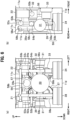
- the cut valve mounting hole 36 communicates with the inlet valve mounting hole 32 through a second flow path 52, a third flow path 53, and a fourth flow path 54 as illustrated in Fig. 9 .
- the second flow path 52 includes a lateral hole 52a drilled from a bottom portion of the cut valve mounting hole 36 toward the rear surface 11b of the base body 100 and a lateral hole 52b drilled from the right side surface 11f of the base body 100 toward the left side surface 11e.
- the left end portion of the lateral hole 52b communicates with a rear end portion of the lateral hole 52a.
- the third flow path 53 includes a vertical hole 53a, a lateral hole 53b, and a vertical hole 53c.
- the vertical hole 53a, the lateral hole 53b, and the vertical hole 53c form a flow path of an inverted angular U shape (the inverted recessed shape) extending between left and right of the base body 100 in rear view.
- the vertical hole 53a is drilled from the upper surface 11c of the base body 100 in the right area toward the lower surface 11d. A lower end portion of the vertical hole 53a extends up to the side portion of the right pump mounting hole 31. A lower portion of the vertical hole 53a intersects with the lateral hole 52b of the second flow path 52.
- the lateral hole 53b is drilled from the left side surface 11e of the base body 100 toward the right side surface 11f. A right end portion of the lateral hole 53b intersects with an upper portion of the vertical hole 53a.
- the vertical hole 53c is drilled from the upper surface 11c of the base body 100 in the left area toward the lower surface 11d. A lower end portion of the vertical hole 53c extends up to the side portion of the left pump mounting hole 31. An upper portion of the vertical hole 53c communicates with the left end portion of the lateral hole 53b.
- the fourth flow path 54 includes a lateral hole 54a drilled from a bottom portion of the inlet valve mounting hole 32 toward the rear surface 11b of the base body 100 and a lateral hole 54b drilled from the left side surface 11e of the base body 100 toward the right side surface 11f.
- a right end portion of the lateral hole 54b communicates with a rear end portion of the lateral hole 54a.
- the outlet port 22 is a bottomed cylindrical hole and communicates with the inlet valve mounting hole 32 via a fifth flow path 55 (see Fig. 5(a) ).
- the fifth flow path 55 includes a vertical hole 55a drilled from a bottom portion of the outlet port 22 toward the lower surface 11d of the base body 100, and a lateral hole 55b drilled from the left side surface 11e of the base body 100 toward the inlet valve mounting hole 32.
- the lateral hole 55b intersects with the vertical hole 55a at an intermediate portion thereof.
- the right end portion of the lateral hole 55b reaches a side portion of the inlet valve mounting hole 32.
- the inlet valve mounting hole 32 is a bottomed and shouldered cylindrical hole.
- the flow path extending up to the inlet valve mounting hole 32 through the second flow path 52, the third flow path 53, and the fourth flow path 54, and further reaches the outlet port 22 through the fifth flow path 55 corresponds to the wheel hydraulic pressure line B illustrated in Fig. 2 .
- the flow path made of vertical hole 53a and the vertical hole 53c of the third flow path 53 corresponds to the discharge hydraulic pressure lines C, C illustrated in Fig. 2 .
- a sixth flow path 56 intersects in the vertical direction with the side portion of the cut valve mounting hole 36 as illustrated in Fig. 8 .
- the sixth flow path 56 includes a vertical hole drilled from the upper surface 11c of the base body 100 in the right area toward the lower surface 11d.
- a lower end portion of the sixth flow path 56 extends up to the side portion of the sensor mounting hole 37.
- the sensor mounting hole 37 is a bottomed and shouldered cylindrical hole. A bottom portion of the sensor mounting hole 37 is directly connected to the one-way valve mounting hole 38a of the suction valve mounting hole 38 disposed rearward thereof, and the sensor mounting hole 37 communicates with the one-way valve mounting hole 38a via the connected portion as illustrated in Fig. 9 .
- the flow path formed at the connecting portion between the sensor mounting hole 37 and the one-way valve mounting hole 38a corresponds to the branch hydraulic line A1 illustrated in Fig. 2 .
- a seventh flow path 57 intersects in the vertical direction with the side portion of the inlet valve mounting hole 32 as illustrated in Fig. 8 .
- the seventh flow path 57 includes a vertical hole drilled from the upper surface 11c of the base body 100 in the left area toward the lower surface 11d.
- a lower end portion of the seventh flow path 57 extends up to the side portion of the outlet valve mounting hole 33.
- the outlet valve mounting hole 33 is a bottomed and shouldered cylindrical hole.
- the outlet valve mounting hole 33 communicates with the reservoir mounting hole 34 via a ninth flow path 59 as illustrated in Fig. 6(b) .
- the ninth flow path 59 includes a lateral hole 59a drilled from a bottom portion of the outlet valve mounting hole 33 toward the rear surface 11b of the base body 100 and a vertical hole 59b drilled from the bottom surface of the reservoir mounting hole 34 toward the upper surface 11c of the base body 100.
- An upper end portion of the vertical hole 59b communicates with a rear end portion of the lateral hole 59a.
- the reservoir mounting hole 34 is a bottomed cylindrical hole.
- the flow path extending up to the reservoir mounting hole 34 through the ninth flow path 59 corresponds to the release line D illustrated in Fig. 2 .
- the suction valve mounting hole 38 is a bottomed cylindrical hole.
- the suction valve mounting hole 38 and the reservoir mounting hole 34 communicate with each other via an eighth flow path 58 as illustrated in Fig. 9 .
- the eighth flow path 58 includes a vertical hole 58a, a lateral hole 58b, and a vertical hole 58c.
- the vertical hole 58a, the lateral hole 58b, and the vertical hole 58c form a flow path of an inverted angular U shape (the inverted recessed shape) extending between left and right of the base body 100 in rear view.
- the vertical hole 58a is drilled from the bottom surface of the suction valve mounting hole 38 toward the upper surface 11c of the base body 100 in the right area. An intermediate portion of the vertical hole 58a intersects with the side portion of the right pump mounting hole 31, which serves as an intake port.
- the vertical hole 58a functions as a first pump intake path connecting the suction valve 6 and the one pump 5a.
- the vertical hole 58c is drilled from a bottom surface of the reservoir mounting hole 34 toward the upper surface 11c of the base body 100 in the left area. An intermediate portion of the vertical hole 58c intersects with the side portion of the left pump mounting hole 31, which serves as an intake port.
- the vertical hole 58c functions as a second pump intake path connecting the reservoir 4 and the other pump 5b.
- the lateral hole 58b is drilled from the right side surface 11f of the base body 100 toward the left side surface 11e. A right portion of the lateral hole 58b communicates with an upper end portion of the vertical hole 58a, and a left end portion of the lateral hole 58b communicates with an upper end portion of the vertical hole 58c.
- the lateral hole 58b functions as a third pump intake path connecting the vertical hole 58a and the vertical hole 58c.
- the reservoir 4, the suction valve 6, and respective intake ports of the pumps 5a, 5b are connected by the eighth flow path 58, which functions as a single pump intake path.
- check valve 8 one-way valve illustrated in Fig. 2 is mounted on a lower end portion of the vertical hole 58c.
- a discharge side of the right pump mounting hole 31 closer to the inlet port 21 communicates with the fourth flow path 54 in the left area via the third flow path 53 and communicates with the inlet valve mounting hole 32 via the fourth flow path 54.
- the discharge side of the left pump mounting hole 31 closer to the outlet port 22 communicates with the inlet valve mounting hole 32 via the vertical hole 53c of the third flow path 53 and the fourth flow path 54 and, from the inlet valve mounting hole 32, communicates with the outlet port 22 via the fifth flow path 55.
- the intake side of the left pump mounting hole 31 communicates with the reservoir mounting hole 34 via the vertical hole 58c of the eighth flow path 58.
- the intake side of the left pump mounting hole 31 communicates with the intake side of the right pump mounting hole 31 and the suction valve mounting hole 38 via the eighth flow path 58.
- the suction valve 6 In the normal braking, the suction valve 6 is in the valve-closed state, and the normally-opened solenoid valve, which serves as the cut valve 7a, is in the valve-opened state as described above. Accordingly, as illustrated in Fig. 13A , the brake fluid inflowing from the inlet port 21 flows into the cut valve mounting hole 36 through the first flow path 51 and flows into the second flow path 52 through the interior of the solenoid valve in the valve-opened state. The brake fluid flowed into the second flow path 52 then flows from the second flow path 52 into the inlet valve mounting hole 32 in the left area via the third flow path 53 and the fourth flow path 54.
- the brake fluid flowed into the inlet valve mounting hole 32 passes in the interior of the inlet valve 2 in the valve-opened state, flows into the outlet port 22 via the fifth flow path 55, and reaches the wheel brake R through the outlet port 22.
- the brake fluid flowed into the inlet valve mounting hole 32 then flows into the outlet valve mounting hole 33 through the seventh flow path 57 located on a lateral side without flowing into the fourth flow path 54 as the inlet valve 2 is in the valve-closed state.
- the brake fluid flowed into the outlet valve mounting hole 33 then flows into the ninth flow path 59 through the interior of the outlet valve 3, being in the valve-opened state, and flows into the reservoir mounting hole 34.
- the motor 200 is driven by the control device 400 and the pumps 5a, 5b are operated. Consequently, the brake fluid stored in the reservoir mounting hole 34 is sucked into the pump mounting holes 31, 31 via the eighth flow path 58 and is discharged into the third flow path 53.
- the brake fluid discharged to the third flow path 53 flows through the third flow path 53 from the left area to the right area of the base body 100 and flows into the cut valve mounting hole 36 through the second flow path 52.
- the brake fluid flowed into the cut valve mounting hole 36 flows into the first flow path 51 through the interior of the cut valve 7a, being in the valve-opened state, and is returned to the master cylinder M side through the inlet port 21.
- the inlet valve 2 When increasing the brake hydraulic pressure acting on the wheel brake R (see Fig. 2 ) by the anti-locking braking control, the inlet valve 2 is brought into the valve-opened state and the outlet valve 3 is brought into the valve-closed state by the control device 400 as described above, and thus the flow of the brake fluid becomes the same as the case of the normal brake control.
- the cut valve 7a is brought into the valve-closed state by the control device 400, and the motor 200 is actuated, so that the pumps 5a, 5b (see Fig. 2 , the same applies hereinafter) are driven as described above.
- the pumps 5a, 5b are driven, the brake fluid in the eighth flow path 58 is sucked by the pumps 5a, 5b, and a vacuum is created in the vacuum chamber 6a of the suction valve 6 communicating with the eighth flow path 58 as illustrated in Fig. 13B .
- the thin film drive unit 642 of the diaphragm 64 is subject to elastic deformation toward the one-way valve 61, and the upper surface of the plunger 62 comes into contact with the lower surface of the large diameter valve 613 to push the large diameter valve 613 upward. This upward pushing causes the large diameter valve 613 to move away from the seat.
- the brake fluid on the master cylinder M side flows into the cut valve mounting hole 36 from the inlet port 21 through the first flow path 51 (see dotted arrows in the drawing).
- the brake fluid flowing into the cut valve mounting hole 36 flows into the sixth flow path 56 through the lateral side of the cut valve 7a in the valve-closed state and flows into the one-way valve mounting hole 38a through the interior of the sensor mounting hole 37 (see dotted arrows in the drawing).
- the brake fluid flowed into the one-way valve mounting hole 38a then flows into the vacuum chamber 6a and is sucked into one pump mounting hole 31 through the vertical hole 58a of the eighth flow path 58 (see solid arrows in the drawing).
- the brake fluid sucked by the one pump mounting hole 31 is pressurized by the one pump 5a (for example, see Fig. 12(a) ), flows from the third flow path 53 into the inlet valve mounting hole 32 through the fourth flow path 54, and then is discharged to the wheel brake R from the outlet port 22 through the fifth flow path 55 (see dotted arrows in the drawing).
- the brake fluid sucked by the other pump mounting hole 31 is pressurized by the pump 5b at a timing shifted from the one pump 5a by half a cycle (for example, see Fig. 12(b) ), flows into the inlet valve mounting hole 32 from the third flow path 53 (vertical hole 53c) through the fourth flow path 54, and then is discharged to the wheel brake R from the outlet port 22 through the fifth flow path 55 (see dash-dot-dash arrows and dotted arrows in the drawing).
- the brake fluid with alleviated pulsation is discharged from the pumps 5a, 5b as illustrated in Fig. 12(c) , and applies a brake on the wheel.
- the cut valve 7a is brought into the valve-closed state by the control device 400, and the motor 200 is actuated, so that the pumps 5a, 5b (see Fig. 2 , the same applies hereinafter) are driven in the same manner.
- the pumps 5a, 5b are driven, a vacuum is created in the vacuum chamber 6a of the suction valve 6 that communicates with the eighth flow path 58, which causes elastic deformation of the thin film drive unit 642 of the diaphragm 64 toward the one-way valve 61 in the same manner.
- the brake fluid on the master cylinder M side flows into the one-way valve mounting hole 38a through the inlet port 21, the first flow path 51, the cut valve mounting hole 36, the sixth flow path 56, and the interior of the sensor mounting hole 37.
- the brake fluid flowed into the one-way valve mounting hole 38a is then sucked by the pump mounting holes 31, 31 from the vacuum chamber 6a though the eighth flow path 58, and is discharged to the wheel brake R from the outlet port 22 through the third flow path 53, the fourth flow path 54, the inlet valve mounting hole 32, and the fifth flow path 55.
- the entire device may have a compact profile.
- the brake hydraulic pressure control device U since one system of the master cylinder M and the wheel brake R is connected to the base body 100, it is suitable for the brake hydraulic pressure control device U used especially for vehicles with a bar handle such as motorcycles or three-wheeled vehicles and has superior mountability.
- the diaphragm 64 having the effective diameter L1 larger than the inner diameter L3 of the one-way valve mounting hole 38a enables enhancement of workability of the diaphragm 64 even when the brake hydraulic pressure from the master cylinder M side is relatively high, and improvement of openability of the suction valve 6 is achieved.
- the brake hydraulic pressure control device U relating to the rear wheel brake R has been described.
- the brake hydraulic pressure control device U relating to the front wheel brake is also applicable by replacing the brake pedal BP with a brake operation element.
- the sensor mounting hole 37 may be formed to have the same diameter as the outlet valve mounting hole 33. In this case, the sensor mounting hole 37 may have the same shape as the outlet valve mounting hole 33.
- suction valve mounting hole 38 may be formed to have an inner diameter different from that of the reservoir mounting hole 34.
Landscapes
- Engineering & Computer Science (AREA)
- Mechanical Engineering (AREA)
- General Engineering & Computer Science (AREA)
- Physics & Mathematics (AREA)
- Fluid Mechanics (AREA)
- Transportation (AREA)
- Regulating Braking Force (AREA)
- Braking Systems And Boosters (AREA)
- Valves And Accessory Devices For Braking Systems (AREA)
- Check Valves (AREA)
- Reciprocating Pumps (AREA)
Description
- The present invention relates to a vehicle brake hydraulic pressure control device.
- Disclosed in
Patent Literature 1 is a vehicle brake hydraulic pressure control device configured to boost hydraulic pressure in a master cylinder with a pump and cause the hydraulic pressure to act on a wheel brake. - The vehicle brake hydraulic pressure control device of
Patent Literature 1 includes a pressure-adjusting reservoir connected between the master cylinder and an intake valve of the pump. The pressure-adjusting reservoir includes a reservoir and a mechanical suction valve, and the mechanical suction valve includes a diaphragm configured to operate mechanically by a pressure difference. -
Patent Literature 2 discloses a brake apparatus configured to be disposed between a master cylinder and a wheel brake, the brake apparatus comprising a pump and a pressure regulating reservoir disposed between the master cylinder and intake port of the pump. -
Patent Literature 3 discloses a pump comprising two reciprocating pump heads, wherein the two pump heads have discharge cycles shifted from each other by half a cycle. -
- Patent Literature 1:
Japanese Patent No. 5304446 - Patent Literature 2: US Application No.
US2006/091725A1 - Patent Literature 3: Japanese Application No.
JPH04137274U - The pump used in the vehicle brake hydraulic pressure control device of
Patent Literature 1 is a pump of a so-called plunger type provided with check valves at an intake port and a discharge port, respectively. Therefore, suction and discharge during an operation of the pump tend to cause pulsation, and the caused pulsation may be transmitted to the diaphragm and affect the durability of the diaphragm. - It is an object of the present invention to provide a vehicle brake hydraulic pressure control device having a configuration including a suction valve with a diaphragm, in which durability of a diaphragm is improved by solving the problem described above.
- To solve the above problem, an aspect of the present invention provides a vehicle brake hydraulic pressure control device equipped with a pair of pumps and a drive source for driving both of the pumps, and configured to be disposed between a master cylinder and a wheel brake, comprising: a suction valve disposed between the master cylinder and intake ports of the pair of pumps, and a base body for attaching the suction valve, the pair of pumps, and the drive source, wherein one system of the master cylinder and the wheel brake is connected to the base body; wherein the suction valve is configured to be opened by a pressure difference between a brake hydraulic pressure on the master cylinder side and a brake hydraulic pressure on an intake port side of the pumps, at which a vacuum is created when the pumps are operated, wherein each of the pumps includes a plunger, an intake valve, and a discharge valve, wherein the pair of pumps are capable of discharging brake fluid to a flow path in communication with the master cylinder and the wheel brake, and discharge cycles of brake fluid are shifted from each other by half a cycle; and wherein the base body comprises a first pump mounting hole formed in a first side surface for mounting one of the pumps and a second pump mounting hole formed in a second side surface opposite the first side surface for mounting the other one of the pumps.
- In the present invention, with the provision of the pair of pumps having discharge cycles of brake fluid shifted by half a cycle, pulsation of discharge caused by the operation of the pumps is alleviated, and such pulsation can hardly be transmitted to the diaphragm of the suction valve. Therefore, improvement in durability of the diaphragm is achieved.
- Preferably, the pair of pumps are driven by the single drive source.
- This configuration requires only the single drive source, and thus the entire device may have a compact profile.
- Such a vehicle brake hydraulic pressure control device is preferable especially for vehicles with a bar handle such as motorcycles or three-wheeled vehicles. Furthermore, superior mountability is achieved.
- Preferably, the suction valve includes a normally-closed one-way valve and a plunger configured to open a valve body of the one-way valve, and is configured to bias the one-way valve to a valve opening direction by the plunger, the plunger being pushed by a diaphragm by a vacuum created on the intake port side by an operation of the pair of pumps. In this case the one-way valve is accommodated in an accommodating part provided on the base body, and an effective diameter of the diaphragm is larger than an inner diameter of the accommodating part.
- The diaphragm having an effective diameter larger than the inner diameter of the accommodating part enables enhancement of workability of the diaphragm even when the brake hydraulic pressure from the master cylinder side is relatively high, and thus improvement of openability of the suction valve is achieved.
- According to the present invention, in a vehicle brake hydraulic pressure control device including a suction valve provided with a diaphragm, improvement of durability of the diaphragm is achieved.
-
- [
Fig. 1] Fig. 1 is a perspective view illustrating a vehicle brake hydraulic pressure control device according to one embodiment of the present invention. - [
Fig. 2] Fig. 2 is a hydraulic pressure circuit diagram of the vehicle brake hydraulic pressure control device according to the embodiment of the present invention. - [
Fig. 3] Fig. 3 illustrates a base body of the vehicle brake hydraulic pressure control device according to the embodiment of the present invention in which (a) is a top view, (b) is a front view, (c) is a left side view, and (d) is a right side view. - [
Fig. 4] Fig. 4 illustrates the base body of the same, in which (a) is a rear view, and (b) is a bottom view. - [
Fig. 5] Fig. 5 is a drawing visualizing inner surfaces of respective mounting holes and flow paths formed in a flow path component of the vehicle brake hydraulic pressure control device according to the embodiment of the present invention, in which (a) is a transparent view viewed from the front, and (b) is a transparent view viewed from the right side. - [
Fig. 6] Fig. 6 is a drawing visualizing inner surfaces of respective mounting holes and flow paths formed in a flow path component of the vehicle brake hydraulic pressure control device according to the embodiment of the present invention, in which (a) is a transparent view viewed from the rear, and (b) is a transparent view viewed from the left side. - [
Fig. 7] Fig. 7 is a drawing visualizing inner surfaces of respective mounting holes and flow paths formed in a flow path component of the vehicle brake hydraulic pressure control device according to the embodiment of the present invention, in which (a) is a transparent view viewed from the top, and (b) is a transparent view viewed from the bottom. - [
Fig. 8] Fig. 8 is a drawing visualizing inner surfaces of respective mounting holes and flow paths formed in the flow path component of the vehicle brake hydraulic pressure control device according to the embodiment of the present invention and is a perspective view viewed from the front side. - [
Fig. 9] Fig. 9 is a drawing visualizing an inner surface of respective mounting holes and flow paths formed in a flow path component of the vehicle brake hydraulic pressure control device according to the embodiment of the present invention and is a perspective view viewed from the rear side. - [
Fig. 10A] Fig. 10A is an enlarged cross-sectional view illustrating a suction valve. - [
Fig. 10B] Fig. 10B is a cross-sectional view illustrating an effective diameter of a diaphragm of the suction valve. - [
Fig. 11A] Fig. 11A is a hydraulic pressure circuit diagram illustrating a flow of a brake fluid during a normal brake operation by operating a pedal. - [
Fig. 11B] Fig. 11B is a hydraulic pressure circuit diagram illustrating a flow of the brake fluid when pressurized by pumps with the pedal not operated. - [
Fig. 11C] Fig. 11C is a cross-sectional view illustrating a state of operation of the suction valve when pressurized by the pumps with the pedal not operated. - [
Fig. 11D] Fig. 11D is a hydraulic pressure circuit diagram illustrating a flow of the brake fluid when pressurized by the pumps with the pedal operated. - [
Fig. 11E] Fig. 11E is a cross-sectional view illustrating a state of operation of the suction valve when pressurized by the pumps with the pedal operated. - [
Fig. 12] Figs. 12(a) to (c) are explanatory drawings illustrating phases of discharge of the pump. - [
Fig. 13A] Fig. 13A is an explanatory drawing illustrating a flow of a brake fluid during the normal brake operation by operating the pedal. - [
Fig. 13B] Fig. 13B is a hydraulic pressure circuit diagram illustrating the flow of the brake fluid when pressurized by the pumps with the pedal not operated and with the pedal operated. - Referring to the drawings as needed, an embodiment of the present invention will be described below in detail. In the following description, when expressing front, rear, up, down, left and right of the vehicle brake hydraulic pressure control device, directions illustrated in
Fig. 1 are used as a reference. Note that the directions illustrated inFig. 1 do not necessarily match the actual state of installation of the device. In the following description, the same components are designated by the same reference signs, and overlapped description will be omitted. Also, in the following, the vehicle brake hydraulic pressure control device of the present embodiment is described as being applied to a vehicle with a bar handle such as motorcycles, three-wheeled vehicles and all terrain vehicles (ATV) for example. However, the description is not intended to limit the vehicles for mounting the device of the present embodiment. - As illustrated in
Fig. 1 , a vehicle brake hydraulic pressure control device (hereinafter, referred to simply as "brake hydraulic pressure control device") U of the present embodiment is used for vehicles with a bar handle such as motorcycles, three-wheeled vehicles, and all terrain vehicles (ATV). The vehicles for mounting the device has preferably a front wheel brake unit and a rear wheel brake unit separated from each other. In the present embodiment, a brake hydraulic pressure control device configured to control the brake hydraulic pressure acting on a rear wheel brake will be described. - The brake hydraulic pressure control device U includes a
base body 100, a motor (electric motor) 200 as a drive source, acontrol housing 300, and acontrol device 400 as illustrated inFig. 1 . Themotor 200 is attached to arear surface 11b of thebase body 100. Thecontrol housing 300 is attached to afront surface 11a of the base body 100 (see Fig. 3(b)). Thecontrol device 400 is accommodated in thecontrol housing 300. - The brake hydraulic pressure control device U is an embodied hydraulic pressure circuit illustrated in
Fig. 2 . The brake hydraulic pressure control device U can execute anti-locking braking control of a wheel brake R and pressurization control of the wheel brake R. - Note that, in the following, the fluid path extending from the master cylinder M to a
regulator 7 is referred to as "output hydraulic pressure line A", and a flow path extending from theregulator 7 to anoutlet valve 3 and the wheel brake R is referred to as "wheel hydraulic pressure line B". A pair of flow paths extending frompumps outlet valve 3 to areservoir 4 is referred to as "release line D". A flow path extending from thereservoir 4 to thepumps suction valve 6 is referred to as "intake hydraulic pressure passage E". A flow path branched from the output hydraulic pressure line A and reaches to thesuction valve 6 is referred to as "branch hydraulic line A1". - In
Fig. 2 , the brake hydraulic pressure circuit of the brake hydraulic pressure control device U is a circuit extending from aninlet port 21 to anoutlet port 22. A pipe H1 connected to an output port M21 of the master cylinder M, which is a hydraulic pressure source, is connected to theinlet port 21. A pipe H2 extending to the wheel brake R is connected to theoutlet port 22. - The
inlet port 21 is formed on a right area of anupper surface 11c of thebase body 100 as illustrated in Fig. 3(a). Theoutlet port 22 is formed on a left area of theupper surface 11c of thebase body 100, which is on an opposite side from theinlet port 21. - Returning back to
Fig. 2 , a brake pedal BP, which is a brake operation element, is connected to the master cylinder M. The hydraulic pressure circuit mainly includes aninlet valve 2, theoutlet valve 3, thereservoir 4, thepumps suction valve 6, and theregulator 7. - The master cylinder M produces a brake hydraulic pressure according to a force applied to the brake pedal BP by a driver. The master cylinder M is connected to the wheel brake R (wheel cylinder) via the pipe H1, the output hydraulic pressure line A, the wheel hydraulic pressure line B, and the pipe H2.
- The fluid paths connected to the master cylinder M (output hydraulic pressure line A and wheel hydraulic pressure line B) normally communicate the master cylinder M with the wheel brake R. Accordingly, the brake hydraulic pressure generated by an operation of the brake pedal BP is transmitted to the wheel brake R.
- The
regulator 7, theinlet valve 2, and theoutlet valve 3 are provided on the fluid path connecting the master cylinder M and the wheel brake R. - The
regulator 7 has a function of switching a state of conduction of the brake fluid in the output hydraulic pressure line A between an allowing state and a blocked state. Theregulator 7 has a function of adjusting the brake hydraulic pressure in the wheel hydraulic pressure line B to a level below a predetermined value when the conduction of the brake fluid in the output hydraulic pressure line A is blocked. Theregulator 7 includes acut valve 7a and acheck valve 7b. - The
regulator 7 is mounted in a cutvalve mounting hole 36 formed on a right upper portion of thefront surface 11a of thebase body 100 as illustrated in Fig. 3(b) andFig. 5(a) . The cutvalve mounting hole 36 is formed at a position on an upper side with respect to a pump axis Y1 of a right pump mounting hole 31 (seeFig. 5(b) ) in a right area of left and right halves delimited by a reference plane X1 orthogonal to thefront surface 11a of thebase body 100 as illustrated in Fig. 3(b). Note that the pump axis Y1 is a center axial line of the left and rightpump mounting holes motor 200. - Returning back to
Fig. 2 , thecut valve 7a is a normally-opened linear solenoid valve interposed between the output hydraulic pressure line A and the wheel hydraulic pressure line B. Thecut valve 7a is configured to switch a state of conduction of the brake fluid from the output hydraulic pressure line A to the wheel hydraulic pressure line B between an allowing state and a blocked state. In other words, thecut valve 7a has a configuration capable of adjusting a valve-opening pressure by controlling energization of the solenoid (a configuration having also a function of a relief valve). - When the
cut valve 7a is in a valve-opened state, it is a state allowing the brake fluid discharged from thepumps suction valve 6. - The
cut valve 7a is closed under the control of the control device 400 (seeFig. 1 , the same applies to the description below) when performing pressurization control, which will be described later. When the brake hydraulic pressure of the wheel hydraulic pressure line B exceeds the brake hydraulic pressure of the output hydraulic pressure line A, and the difference in pressure between the brake hydraulic pressure of the output hydraulic pressure line A and the brake hydraulic pressure of the wheel hydraulic pressure line B exceeds a force of closing the valve, which is controlled by energization to the solenoid, thecut valve 7a releases the brake hydraulic pressure of the wheel hydraulic pressure line B toward the output hydraulic pressure line A for adjustment. - The
check valve 7b is connected in parallel to thecut valve 7a. Thecheck valve 7b is a one-way valve which allows a flow of the brake fluid from the output hydraulic pressure line A to the wheel hydraulic pressure line B. Thecheck valve 7b is integrally provided with a normally-opened solenoid valve which constitutes theregulator 7. - The
inlet valve 2 includes the normally-opened solenoid valve provided in the wheel hydraulic pressure line B, and is provided between theregulator 7 and the wheel brake R. Theinlet valve 2, when in the valve-opened state, allows transmission of brake hydraulic pressure from the master cylinder M or brake fluid boosted in pressure by thepumps inlet valve 2 also blocks the brake hydraulic pressure applied to the wheel brake R by being blocked by thecontrol device 400 when the wheels are about to be locked. - Such an
inlet valve 2 is mounted in an inletvalve mounting hole 32 provided on a left upper portion of thefront surface 11a of thebase body 100 as illustrated in Fig. 3 (b) andFig. 5 (a) . The inletvalve mounting hole 32 is formed at positions on an upper side of the pump axis Y1 of the left pump mounting hole 31 (seeFig. 6(b) ) in a left area of the two left and right halves divided by the reference plane X1 as illustrated in Fig. 3(b). The inletvalve mounting hole 32 is formed on the same side as theoutlet port 22 of theupper surface 11c of thebase body 100. - Returning back to
Fig. 2 , acheck valve 2a is connected to theinlet valve 2 in parallel. Thecheck valve 2a is a valve configured to allow only a flow of the brake fluid from the wheel brake R toward the master cylinder M. Thecheck valve 2a allows the inflow of the brake fluid from the wheel brake R side toward the master cylinder M even when theinlet valve 2 is closed in a case where an input of the brake pedal BP is released. Thecheck valve 2a is integrally provided with the normally-opened solenoid valve which constitutes theinlet valve 2. - The
outlet valve 3 is made of the normally-closed solenoid valve. Theoutlet valve 3 is provided between the wheel brake R and the reservoir 4 (between the wheel hydraulic pressure line B and the release line D). Theoutlet valve 3 is normally closed but releases the brake hydraulic pressure applied to the wheel brake R to thereservoir 4 by being opened by thecontrol device 400 when a rear wheel is about to be locked. - Such an
outlet valve 3 is mounted in an outletvalve mounting hole 33 provided on a left lower portion of thefront surface 11a of thebase body 100 as illustrated in Fig. 3(b) andFig. 5(a) . The outletvalve mounting hole 33 is formed at positions on a lower side of the pump axis Y1 of the left pump mounting hole 31 (seeFig. 6(b) ) in a left area of the two left and right halves divided by the reference plane X1 as illustrated in Fig. 3(b). The outletvalve mounting hole 33 is provided on the same side as the inletvalve mounting hole 32 in the vertical direction of thebase body 100. - Returning back to
Fig. 2 , thereservoir 4 has a function of temporarily storing the brake fluid released by opening theoutlet valve 3. - The
reservoir 4 is mounted in areservoir mounting hole 34 illustrated inFig. 4(b) . Thereservoir mounting hole 34 is opening on the left area of alower surface 11d of thebase body 100. In other words, thereservoir 4 is provided in the left lower portion of thebase body 100. - The
pumps pumps electric motor 200. Thepumps pump 5a is interposed between the intake hydraulic pressure passage E and one discharge hydraulic pressure line C, and theother pump 5b is interposed between the intake hydraulic pressure passage E and the other discharge hydraulic pressure line C. Thepumps motor 200. - The
pumps pumps motor 200 makes one turn. - The
pumps reservoir 4 and discharge the same to the discharge hydraulic pressure lines C, C. The pumps 5a, 5b also suck the brake fluid stored in the master cylinder M, the branch hydraulic line A1, the intake hydraulic pressure passage E, and thereservoir 4 and discharge the same to the discharge hydraulic pressure lines C, C when thecut valve 7a is in the valve-closed state and thesuction valve 6 is in the valve-opened state. Accordingly, the brake hydraulic pressure generated by an operation of the brake pedal BP may be increased. Furthermore, even in the state in which the brake pedal BP is not operated, the brake hydraulic pressure may be made act on the wheel brake R (pressurization control) . -
Such pumps pump mounting holes left side surface 11e and aright side surface 11f of thebase body 100 as illustrated in Figs. 3(c) (d) and so forth. - The
suction valve 6 is a suction valve of a mechanical type and is configured to switch a state of connection between the branch hydraulic line A1 and the intake hydraulic pressure passage E from an opened state to a blocked state and vice versa. Thesuction valve 6 is configured to open by a pressure difference between the brake hydraulic pressure on the master cylinder M side (the branched hydraulic pressure line side) and the brake hydraulic pressure on the intake port side (the intake hydraulic pressure passage E side) of thepumps pumps - The
suction valve 6 is mounted in a suctionvalve mounting hole 38 illustrated inFig. 4(b) ,Fig. 5(a) and so forth. The suctionvalve mounting hole 38 is opened on the right area of thelower surface 11d of thebase body 100. In other words, thesuction valve 6 is provided in the right lower portion of thebase body 100. - The
suction valve 6 includes a normally-closed one-way valve 61, aplunger 62, aplunger plate 63, adiaphragm 64, and alid member 65 as a plug for fixing thediaphragm 64 as illustrated inFig. 10A . The one-way valve 61 is a valve to be mounted in a one-wayvalve mounting hole 38a as an accommodating part formed on a bottom portion of the suctionvalve mounting hole 38 of thebase body 100. The one-wayvalve mounting hole 38a is smaller than the suctionvalve mounting hole 38 in diameter. The branch hydraulic line A1 communicates with the one-wayvalve mounting hole 38a. - The one-
way valve 61 includes an annular fixedportion 611, aretainer 612 to be fixed to an upper end portion of the fixedportion 611, alarge diameter valve 613 disposed in theretainer 612, and a sphericalsmall diameter valve 614 disposed inside thelarge diameter valve 613. The fixedportion 611 is fixed to an inner wall of an opening of the one-wayvalve mounting hole 38a by swaging. Anannular valve seat 611a on which thelarge diameter valve 613 is seated is formed on the upper end portion of the fixedportion 611. Thevalve seat 611a is formed into a tapered shape in cross section. - The
retainer 612 has a substantially hat shape in cross section. Thelarge diameter valve 613 and thesmall diameter valve 614 are accommodated in an interior of theretainer 612. A lower end portion of theretainer 612 is fitted at an upper end on an outer peripheral wall of the fixedportion 611. Theretainer 612 includes aninsertion hole 615 to allow conduction of the brake fluid on a peripheral wall and a bottom portion thereof. - The
large diameter valve 613 has a recessed shape in cross-section. Thesmall diameter valve 614 is accommodated inside thelarge diameter valve 613. An outer peripheral surface of a bottom portion of thelarge diameter valve 613 is formed into a tapered shape or an arcuate shape in cross section corresponding to thevalve seat 611a of the fixedportion 611. Thelarge diameter valve 613 is biased in a seating direction by a coil-shapedvalve spring 613s provided in a compressed state between thelarge diameter valve 613 and the bottom portion of theretainer 612 and is seated on thevalve seat 611a. Aninsertion hole 613a is formed in the bottom portion of thelarge diameter valve 613. Theinsertion hole 613a is formed into a size which allows insertion of aprotrusion 62a of theplunger 62. - An
annular valve seat 613b is formed at an opening edge portion on an upper side of theinsertion hole 613a. Thevalve seat 613b is formed into a tapered shape in cross section and allows thesmall diameter valve 614 to be seated. - The
small diameter valve 614 is biased in the seating direction by a coil-shapedvalve spring 614s provided in a compressed state between thesmall diameter valve 614 and the bottom portion of theretainer 612 and is seated on thevalve seat 613b. Thevalve spring 614s is smaller than thevalve spring 613s in diameter. - The
plunger 62 is a column shaped member. An upper portion of theplunger 62 is inserted inside the fixedportion 611 of the one-way valve 61. Theplunger 62 has a substantially triangular shape in cross section in a direction orthogonal to an axial direction. Accordingly, a space S1 is formed between an outer surface of theplunger 62 and an inner surface of the fixedportion 611 of the one-way valve 61. The space S1 serves as a conduction flow path for the brake fluid. - The
protrusion 62a protruding upward is formed on an upper end surface of theplunger 62. Theprotrusion 62a is formed at a position corresponding to theinsertion hole 613a of the bottom portion of thelarge diameter valve 613. Theprotrusion 62a is inserted into theinsertion hole 613a when theplunger 62 described later moves upward and presses thesmall diameter valve 614 seated on thevalve seat 613b upward. Accordingly, thesmall diameter valve 614 moves away from thevalve seat 613b. - An upper surface of the
plunger 62 is formed into a flat shape other than theprotrusion 62a and thus can come into contact with the lower surface of the bottom portion of thelarge diameter valve 613. The upper surface of theplunger 62 comes into contact with the lower surface of the bottom portion of thelarge diameter valve 613 and presses thelarge diameter valve 613 upward when theplunger 62 described later moves upward. Thelarge diameter valve 613 moves away from thevalve seat 611a by being pushed in this manner. Note that a groove or a recess which allows smooth conduction of the brake fluid may be formed on the upper surface of theplunger 62 or the lower end surface of thelarge diameter valve 613. - The
plunger 62 is fixed in a state of being erected on an upper surface of theplunger plate 63. - The
plunger plate 63 has a disk shape. Theplunger plate 63 is placed at a center portion of the upper surface of thediaphragm 64. Anannular rib 63a in which the lower portion of theplunger 62 is fitted and held is formed on the upper surface of theplunger plate 63. An outer peripheral edge portion of theplunger plate 63 rises upward in an arcuate shape in cross section. - The
diaphragm 64 includes anannular seal portion 641 in tight contact with an inner peripheral surface of the suctionvalve mounting hole 38, and a thinfilm drive unit 642 continuing radially inward of theseal portion 641 and pushes theplunger 62. - The
seal portion 641 includes afirst seal portion 643, and an annularcup seal portion 644 continuing from thefirst seal portion 643 and extending upward so as to be opposite side from an opening of the suctionvalve mounting hole 38. - The
first seal portion 643 includes a thickness in the radial direction and formed into an annular shape and is tightly fitted to an inner peripheral surface of the suctionvalve mounting hole 38 on the opening side to seal to avoid suction of air from outside due to a vacuum created when the pump is operated. Thecup seal portion 644 has a substantially cup shape in cross section and is tightly adhered to the inner peripheral surface of the suctionvalve mounting hole 38 on the opposite side from the opening to seal. Thecup seal portion 644 is configured to prevent the brake fluid from leaking out when receiving the brake fluid on the master cylinder M side, for example, in a case where thesuction valve 6 is immobilized in the opened state. - The thin
film drive unit 642 includes a risingportion 646 formed to be thinner than theseal portion 641 and extending in an arcuate shape radially inward from theseal portion 641, and aflat portion 647 continuing radially inward of the risingportion 646. When a vacuum is created in avacuum chamber 6a partitioned by thediaphragm 64, the risingportion 646 is subject to elastic deformation and moved so that theflat portion 647 rises toward the one-way valve 61. Anannular rib 645 is formed on a lower surface of theflat portion 647 for preventing tight contact of theflat portion 647 to an upper surface of thelid member 65. - An effective diameter L1 of the
diaphragm 64 is set to be larger than an inner diameter L3 of the one-wayvalve mounting hole 38a as illustrated inFig. 10B . In other words, the effective diameter L1 is always larger than the outer diameter of thelarge diameter valve 613 disposed in the one-wayvalve mounting hole 38a, whereby a pressure-receiving surface area of the effective diameter L1 portion of thediaphragm 64 is set to be larger than the pressure-receiving surface area of thelarge diameter valve 613 as a matter of necessity. With such dimensions, even when the brake hydraulic pressure on the master cylinder M side is high when pressurized by the pumps with the brake pedal BP operated, opening of thesuction valve 6 is ensured. - The
lid member 65 is a member to be inserted inside the opening of the suctionvalve mounting hole 38 to fix thediaphragm 64 in the suction valve mounting hole 38 (in the base body 100). Thelid member 65 is provided with abase portion 651, afitting portion 652, a retainingportion 653, alip portion 654, and anatmosphere communicating hole 655. - The
fitting portion 652 has a flange shape extending radially outward and is fitted into the inner peripheral surface of the suctionvalve mounting hole 38. Anengagement ring 656 for retention is engaged with thefitting portion 652 from axially outside. The retainingportion 653 is formed by using an upper surface of thefitting portion 652. Thefirst seal portion 643 of thediaphragm 64 is fitted on the retainingportion 653. Thelip portion 654 continues to the retainingportion 653 and protrudes upward from the retainingportion 653. An upper end portion of thelip portion 654 has an arcuate shape. Thelip portion 654 is positioned downward of the risingportion 646 of thediaphragm 64. Thelip portion 654 is positioned downward of the risingportion 646 to prevent deformation of thediaphragm 64 more than necessary when the brake hydraulic pressure from the master cylinder M side acts on thevacuum chamber 6a, for example, in a case where thesuction valve 6 is immobilized in an opened state. - Returning back to
Fig. 2 , acheck valve 8 is provided in the intake hydraulic pressure passage E. Thecheck valve 8 is a one-way valve configured to allow a flow of the brake fluid from thereservoir 4 side toward thepumps - A
hydraulic pressure sensor 9 is disposed in the output hydraulic pressure line A. Thehydraulic pressure sensor 9 is configured to measure a magnitude of the brake hydraulic pressure of the output hydraulic pressure line A, that is, the brake fluid pressure in the master cylinder M. - A value of the brake hydraulic pressure measured by the
hydraulic pressure sensor 9 is retrieved as needed by thecontrol device 400 to determine whether or not the brake fluid pressure is output from the master cylinder M by thecontrol device 400, that is, whether or not the brake pedal BP is pressed. Further, the pressurization control or the like is performed based on the magnitude of the brake hydraulic pressure measured by thehydraulic pressure sensor 9. - The
motor 200 is a common power source of the twopumps control device 400. Themotor 200 is attached by inserting a motor shaft, not illustrated, into a motorshaft insertion hole 39 having a circular recessed shape of the rear surface (the other surface) 11b of thebase body 100 as illustrated inFig. 4(a) . - The control device 400 (see
Fig. 1 ) controls opening and closing of thecut valve 7a of theregulator 7, theinlet valve 2 and theoutlet valve 3 as well as the operation of themotor 200 based on output from thehydraulic pressure sensor 9, a wheel speed sensor, not illustrated, an acceleration sensor or yaw rate sensor for measuring the movement of a vehicle body, and external sensors such as a radar camera or the like. - Next, referring to the hydraulic pressure circuit illustrated in
Fig. 2 , normal braking, anti-locking braking control, and the pressurization control realized by thecontrol device 400 will be described. - During normal braking in which the respective wheels have no probability of being locked, a plurality of electromagnetic coils for driving the above-described plurality of solenoid valves are demagnetized by the
control device 400. In other words, in the normal braking, thecut valve 7a and theinlet valve 2 are in the valve-opened state, and theoutlet valve 3 is in the valve-closed state. The one-way valve 61 of thesuction valve 6 is in the valve-closed state. - When the driver presses the brake pedal BP in such a state, the brake hydraulic pressure caused by the pressing force is transmitted as-is to the wheel brake R, so that a brake is applied to the wheel as illustrated in
Fig. 11A . - In this case, the brake hydraulic pressure from the master cylinder M acts on the
suction valve 6 via the branch hydraulic line A1. Accordingly, thelarge diameter valve 613 and thesmall diameter valve 614 of the one-way valve 61 (seeFig. 10A , the same applies hereinafter) receive the brake hydraulic pressure and are seated respectively, so that the valve-closed state is maintained. In other words, the brake hydraulic pressure from the master cylinder M does not act on the intake hydraulic pressure passage E side. - The anti-locking braking control is executed when the wheel is about to be brought into a locked state, and is achieved by selecting one of pressure-decreasing, pressure-increasing or maintaining constant the brake hydraulic pressure acting on the wheel brake R as needed. Note that which one of pressure-decreasing, pressure-increasing or maintaining is to be selected is determined by the
control device 400 based on the wheel speed obtained from a wheel speed sensor, not illustrated. - If the wheel is about to be brought into the locked state while pressing the brake pedal BP, the anti-locking braking control is started by the
control device 400. - In the pressure-decreasing control, the
inlet valve 2 is brought into the valve-closed state by thecontrol device 400, and theoutlet valve 3 is brought into the valve-opened state. In this configuration, the brake fluid of the wheel hydraulic pressure line B communicating with the wheel brake R flows into thereservoir 4 through the release line D. Consequently, the brake hydraulic pressure acting on the wheel brake R is decreased. - Note that when the anti-locking braking control is executed, the
motor 200 is driven by thecontrol device 400 to actuate thepumps reservoir 4 is flowed back toward the wheel hydraulic pressure line B via the discharge hydraulic pressure line C. - In the control of maintaining constant, the
inlet valve 2 and theoutlet valve 3 are brought into the valve-closed state by thecontrol device 400. In this configuration, the brake fluid is enclosed in the flow path closed by theinlet valve 2 and theoutlet valve 3. Consequently, the brake hydraulic pressure acting on the wheel brake R is maintained constant. - In the pressure-increasing control, the
inlet valve 2 is brought into the valve-opened state and theoutlet valve 3 is brought into the valve-closed state by thecontrol device 400. In this configuration, the brake hydraulic pressure caused by pressing the brake pedal BP acts directly on the wheel brake R. Consequently, the brake hydraulic pressure acting on the wheel brake R is increased. - When applying a brake to the wheel by the
control device 400 is determined to be necessary in a non-operation state in which the brake pedal BP is not operated, thecontrol device 400 energizes thecut valve 7a to bring the same to the valve-closed state, and drives thepumps Fig. 11B . - When the
pumps pumps vacuum chamber 6a (seeFig. 10A ) of thesuction valve 6 that communicates with the intake hydraulic pressure passage E, and the vacuum causes elastic deformation of the thinfilm drive unit 642 of thediaphragm 64 toward the one-way valve 61. The elastic deformation makes the upper surface of theplunger 62 come into contact with the lower surface of thelarge diameter valve 613 and pushes thelarge diameter valve 613 upward. - Accordingly, as illustrated in
Fig. 11C , thelarge diameter valve 613 moves away from theannular valve seat 611a, and the branch hydraulic line A1 communicates with thevacuum chamber 6a through the space S1 of theplunger 62. This communication causes the brake fluid on the master cylinder M side to flow into thevacuum chamber 6a from the branch hydraulic line A1 through the one-way valve 61, and further, flows from thevacuum chamber 6a into the intake hydraulic pressure passage E and is sucked by thepumps - The brake fluid pressurized by the
pumps pumps Fig. 11B and acts on the wheel brake R. Accordingly, a brake is applied to the wheel. - Next, an operation when application of brake to the wheel by the
control device 400 is determined to be necessary when in the operating state in which the brake pedal BP is operated will be described. In this case as well, as illustrated inFig. 11D , thecontrol device 400 energizes thecut valve 7a and brings the same into the valve-closed state and drives thepumps - When the
pumps pumps vacuum chamber 6a of thesuction valve 6 that communicates with the intake hydraulic pressure passage E, and the vacuum causes elastic deformation of the thinfilm drive unit 642 of thediaphragm 64 toward the one-way valve 61, and theprotrusion 62a on the upper surface of theplunger 62 comes into contact with thesmall diameter valve 614. In this case, a pressing force of the brake hydraulic pressure on the master cylinder M side caused by a pressing force of the driver and a biasing force of thevalve spring 614s act on thesmall diameter valve 614. Therefore, when a force of theplunger 62 pushing thesmall diameter valve 614 upward exceeds a resultant force of the pressing force and the biasing force acting on thesmall diameter valve 614, thesmall diameter valve 614 moves away from thevalve seat 613b. In other words, thesmall diameter valve 614 is opened by a difference force between the push-up force and the resultant force. - When the
small diameter valve 614 moves away from the seat, the branch hydraulic line A1 communicates with thevacuum chamber 6a through the space formed by separation and the space S1 of theplunger 62 as illustrated inFig. 11E . This communication causes the brake fluid on the master cylinder M side to flow into thevacuum chamber 6a from the branch hydraulic line A1 through the one-way valve 61, and further, flows from thevacuum chamber 6a into the intake hydraulic pressure passage E and is sucked by thepumps - At this time, when the brake fluid on the master cylinder M side flows into the
vacuum chamber 6a, the brake hydraulic pressure on the master cylinder M side acts on thediaphragm 64, and the thinfilm drive unit 642 moves back toward thelid member 65. Accordingly, a force of theplunger 62 pushing thesmall diameter valve 614 upward disappears and thus thesmall diameter valve 614 is seated on thevalve seat 613b. - During the operation of the
pumps small diameter valve 614 are repeatedly performed and the brake fluid pressurized by thepumps - When the pressurization control and the like as described above is performed, pulsation of the brake fluid discharged from the
pumps pumps - Specifically, discharge of the
pump 5a alone may be expressed by non-continuous two mountain curves as illustrated inFig. 12(a) . In contrast, discharge of thepump 5b alone is performed at a phase of 180 degrees shifted from the discharge of thepump 5a by half a cycle and may be expressed by non-continuous two mountain curves as illustrated inFig. 12(b) . Therefore, combined discharge from the twopumps Fig. 12(c) . - Accordingly, in the present embodiment, an effect of alleviation of discharge pulsation is achieved compared with the case where discharge is performed by the
single pump 5a, for example. - Referring now to
Fig. 1 andFig. 3 toFig. 9 , specific structure of the brake hydraulic pressure control device U will be described in detail. - The brake hydraulic pressure control device U includes the
base body 100, theelectric motor 200, thecontrol housing 300, and the control device 400 (seeFig. 1 ) as described above. - The
base body 100 is made of an extruded material or a cast product of aluminum alloy having a substantially cubic shape. Thefront surface 11a of thebase body 100 is formed into a substantially flat plane without any depressions and projections. Thebase body 100 is provided with a flow path component which constitutes one brake output system (seeFig. 2 ). - Referring to Figs. 3(a) to (d),
Figs. 4 (a), (b) as needed for description, a flow path component includes a plurality of mounting holes opening on thefront surface 11a, and the motorshaft insertion hole 39 opening on therear surface 11b. The flow path component further includes theinlet port 21 and theoutlet port 22 opening on theupper surface 11c as well as thepump mounting holes left side surface 11e and theright side surface 11f. - The inlet
valve mounting hole 32, the outletvalve mounting hole 33, the cutvalve mounting hole 36, and asensor mounting hole 37 are formed as mounting holes in thefront surface 11a of thebase body 100. The inletvalve mounting hole 32 is provided in the left area of the reference plane X1 on an upper side of thebase body 100 with respect to the pump axis Y1 of the pump mounting holes 31. The outletvalve mounting hole 33 is provided in the left area of the reference plane X1 on a lower side of thebase body 100 with respect to the pump axis Y1 of the pump mounting holes 31. - The cut
valve mounting hole 36 is provided in the right area of the reference plane X1 on an upper side of thebase body 100 with respect to the pump axis Y1 of the pump mounting holes 31. The inletvalve mounting hole 32 and the cutvalve mounting hole 36 are provided at positions in symmetry with respect to the reference plane X1. - Note that the inlet
valve mounting hole 32, the outletvalve mounting hole 33, and the cutvalve mounting hole 36 all have the same diameter. - The
inlet valve 2 is mounted in the inletvalve mounting hole 32, and theoutlet valve 3 is mounted in the outletvalve mounting hole 33. Thecut valve 7a is mounted in the cutvalve mounting hole 36. - The
sensor mounting hole 37 is provided in the right area of the reference plane X1 on the lower side of thebase body 100 in a state of partly overlapping with the pump axis Y1 of the pump mounting holes 31. Note that the center position of thesensor mounting hole 37 and the center position of the outletvalve mounting hole 33 are positioned in symmetry with respect to the reference plane X1. - The motor
shaft insertion hole 39 is formed at a center portion of therear surface 11b of thebase body 100. Further, around the motorshaft insertion hole 39, a recess 11b1 formed to be deeper than therear surface 11b and having a U-shape in rear view is formed. A front cover of the housing of the electric motor 200 (seeFig. 1 , the same applies hereinafter) is mounted in the recess 11b1. Theelectric motor 200 is attached to a mounting hole 11b2 (seeFig. 4(a) ) provided in therear surface 11b with a mounting screw (not illustrated). A seal member is interposed between theelectric motor 200 and therear surface 11b. - The
rear surface 11b is provided with ahole portion 39a opening for inserting a bus bar (not illustrated) of theelectric motor 200 at a position upward of the motorshaft insertion hole 39. Thehole portion 39a penetrates in the fore-and-aft direction through thebase body 100 and opening on thefront surface 11a so as to intersect the reference plane X1. - The
inlet port 21 and theoutlet port 22 are formed so as to depress in theupper surface 11c of thebase body 100. Theinlet port 21 is provided at a positional relationship corresponding to the cutvalve mounting hole 36 as illustrated in Figs. 3(a) (b). Theoutlet port 22 is provided at a positional relationship corresponding to the inletvalve mounting hole 32. The pipe H1 (seeFig. 2 ) from the master cylinder M is connected to theinlet port 21. The pipe H2 (seeFig. 2 ) extending to the wheel brake R is connected to theoutlet port 22. - A blank space in which the
inlet port 21 or the like is not formed is formed in a left and right areas of theupper surface 11c of thebase body 100 on the rear side as illustrated in Fig. 3(a). In other words, theupper surface 11c of thebase body 100 includes a blank space where theinlet port 21 or the like can be formed. - The
reservoir mounting hole 34 for mounting thereservoir 4 is formed so as to be recessed in the left area of thelower surface 11d of thebase body 100 as illustrated inFig. 4(b) . The suctionvalve mounting hole 38 for mounting thesuction valve 6 is formed so as to be recessed in the right area of thelower surface 11d of thebase body 100. Thereservoir mounting hole 34 and the suctionvalve mounting hole 38 has the same diameter. - The
pump mounting hole 31 for mounting thepump 5a is formed so as to be recessed in theleft side surface 11e of thebase body 100 as illustrated in Fig. 3(c) . Thepump mounting hole 31 for mounting thepump 5b is formed so as to be recessed in theright side surface 11f of thebase body 100 as illustrated in Fig. 3(d). In thepump mounting holes pumps electric motor 200. - In the control housing 300 (see
Fig. 1 ), an electromagnetic coil to be connected to thecontrol device 400, not illustrated, is provided. The electromagnetic coil is attached to theinlet valve 2, theoutlet valve 3, and thecut valve 7a protruding from thebase body 100. Thecontrol housing 300 is integrally secured to thefront surface 11a of thebase body 100 in a state of covering theinlet valve 2, theoutlet valve 3, thecut valve 7a, thehydraulic pressure sensor 9, and the bus bar. - The flow path of the flow path component provided on the
base body 100 will now be described in detail. Note that, when describing thefront surface 11a, therear surface 11b, theupper surface 11c, thelower surface 11d, theleft side surface 11e, and theright side surface 11f of the flow path component (base body 100), respective drawings inFig. 3 and respective drawings inFig. 4 are to be referred to. - As illustrated in
Figs. 5 (a), (b) ,Fig. 8 , andFig. 9 , theinlet port 21 is a bottomed cylindrical hole, and communicates with the cutvalve mounting hole 36 via a first flow path 51 (seeFig. 8 ). Thefirst flow path 51 includes avertical hole 51a drilled from a bottom portion of theinlet port 21 toward thelower surface 11d of thebase body 100, and alateral hole 51b drilled from theright side surface 11f of thebase body 100 toward the cutvalve mounting hole 36. Thelateral hole 51b intersects with thevertical hole 51a at the intermediate portion thereof. The left end portion of thelateral hole 51b reaches a side portion of the cutvalve mounting hole 36. - Here, the flow path extending from the bottom portion of the
inlet port 21 through thefirst flow path 51 to the side portion of the cutvalve mounting hole 36 corresponds to the output hydraulic pressure line A illustrated inFig. 2 . - The cut
valve mounting hole 36 is a bottomed and shouldered cylindrical hole. The cutvalve mounting hole 36 communicates with the inletvalve mounting hole 32 through asecond flow path 52, athird flow path 53, and afourth flow path 54 as illustrated inFig. 9 . Thesecond flow path 52 includes alateral hole 52a drilled from a bottom portion of the cutvalve mounting hole 36 toward therear surface 11b of thebase body 100 and alateral hole 52b drilled from theright side surface 11f of thebase body 100 toward theleft side surface 11e. The left end portion of thelateral hole 52b communicates with a rear end portion of thelateral hole 52a. - The
third flow path 53 includes avertical hole 53a, alateral hole 53b, and avertical hole 53c. Thevertical hole 53a, thelateral hole 53b, and thevertical hole 53c form a flow path of an inverted angular U shape (the inverted recessed shape) extending between left and right of thebase body 100 in rear view. - The
vertical hole 53a is drilled from theupper surface 11c of thebase body 100 in the right area toward thelower surface 11d. A lower end portion of thevertical hole 53a extends up to the side portion of the rightpump mounting hole 31. A lower portion of thevertical hole 53a intersects with thelateral hole 52b of thesecond flow path 52. - The
lateral hole 53b is drilled from theleft side surface 11e of thebase body 100 toward theright side surface 11f. A right end portion of thelateral hole 53b intersects with an upper portion of thevertical hole 53a. - The
vertical hole 53c is drilled from theupper surface 11c of thebase body 100 in the left area toward thelower surface 11d. A lower end portion of thevertical hole 53c extends up to the side portion of the leftpump mounting hole 31. An upper portion of thevertical hole 53c communicates with the left end portion of thelateral hole 53b. - The
fourth flow path 54 includes alateral hole 54a drilled from a bottom portion of the inletvalve mounting hole 32 toward therear surface 11b of thebase body 100 and alateral hole 54b drilled from theleft side surface 11e of thebase body 100 toward theright side surface 11f. A right end portion of thelateral hole 54b communicates with a rear end portion of thelateral hole 54a. - The
outlet port 22 is a bottomed cylindrical hole and communicates with the inletvalve mounting hole 32 via a fifth flow path 55 (seeFig. 5(a) ). Thefifth flow path 55 includes avertical hole 55a drilled from a bottom portion of theoutlet port 22 toward thelower surface 11d of thebase body 100, and alateral hole 55b drilled from theleft side surface 11e of thebase body 100 toward the inletvalve mounting hole 32. Thelateral hole 55b intersects with thevertical hole 55a at an intermediate portion thereof. The right end portion of thelateral hole 55b reaches a side portion of the inletvalve mounting hole 32. The inletvalve mounting hole 32 is a bottomed and shouldered cylindrical hole. - Here, the flow path extending up to the inlet
valve mounting hole 32 through thesecond flow path 52, thethird flow path 53, and thefourth flow path 54, and further reaches theoutlet port 22 through thefifth flow path 55 corresponds to the wheel hydraulic pressure line B illustrated inFig. 2 . Also, the flow path made ofvertical hole 53a and thevertical hole 53c of thethird flow path 53 corresponds to the discharge hydraulic pressure lines C, C illustrated inFig. 2 . - A
sixth flow path 56 intersects in the vertical direction with the side portion of the cutvalve mounting hole 36 as illustrated inFig. 8 . Thesixth flow path 56 includes a vertical hole drilled from theupper surface 11c of thebase body 100 in the right area toward thelower surface 11d. A lower end portion of thesixth flow path 56 extends up to the side portion of thesensor mounting hole 37. - The
sensor mounting hole 37 is a bottomed and shouldered cylindrical hole. A bottom portion of thesensor mounting hole 37 is directly connected to the one-wayvalve mounting hole 38a of the suctionvalve mounting hole 38 disposed rearward thereof, and thesensor mounting hole 37 communicates with the one-wayvalve mounting hole 38a via the connected portion as illustrated inFig. 9 . - Here, the flow path formed at the connecting portion between the
sensor mounting hole 37 and the one-wayvalve mounting hole 38a corresponds to the branch hydraulic line A1 illustrated inFig. 2 . - A
seventh flow path 57 intersects in the vertical direction with the side portion of the inletvalve mounting hole 32 as illustrated inFig. 8 . Theseventh flow path 57 includes a vertical hole drilled from theupper surface 11c of thebase body 100 in the left area toward thelower surface 11d. A lower end portion of theseventh flow path 57 extends up to the side portion of the outletvalve mounting hole 33. - The outlet
valve mounting hole 33 is a bottomed and shouldered cylindrical hole. The outletvalve mounting hole 33 communicates with thereservoir mounting hole 34 via aninth flow path 59 as illustrated inFig. 6(b) . Theninth flow path 59 includes alateral hole 59a drilled from a bottom portion of the outletvalve mounting hole 33 toward therear surface 11b of thebase body 100 and avertical hole 59b drilled from the bottom surface of thereservoir mounting hole 34 toward theupper surface 11c of thebase body 100. An upper end portion of thevertical hole 59b communicates with a rear end portion of thelateral hole 59a. Thereservoir mounting hole 34 is a bottomed cylindrical hole. - Here, the flow path extending up to the
reservoir mounting hole 34 through theninth flow path 59 corresponds to the release line D illustrated inFig. 2 . - The suction
valve mounting hole 38 is a bottomed cylindrical hole. The suctionvalve mounting hole 38 and thereservoir mounting hole 34 communicate with each other via aneighth flow path 58 as illustrated inFig. 9 . Theeighth flow path 58 includes avertical hole 58a, alateral hole 58b, and avertical hole 58c. Thevertical hole 58a, thelateral hole 58b, and thevertical hole 58c form a flow path of an inverted angular U shape (the inverted recessed shape) extending between left and right of thebase body 100 in rear view. - The
vertical hole 58a is drilled from the bottom surface of the suctionvalve mounting hole 38 toward theupper surface 11c of thebase body 100 in the right area. An intermediate portion of thevertical hole 58a intersects with the side portion of the rightpump mounting hole 31, which serves as an intake port. Thevertical hole 58a functions as a first pump intake path connecting thesuction valve 6 and the onepump 5a. - The
vertical hole 58c is drilled from a bottom surface of thereservoir mounting hole 34 toward theupper surface 11c of thebase body 100 in the left area. An intermediate portion of thevertical hole 58c intersects with the side portion of the leftpump mounting hole 31, which serves as an intake port. Thevertical hole 58c functions as a second pump intake path connecting thereservoir 4 and theother pump 5b. - The
lateral hole 58b is drilled from theright side surface 11f of thebase body 100 toward theleft side surface 11e. A right portion of thelateral hole 58b communicates with an upper end portion of thevertical hole 58a, and a left end portion of thelateral hole 58b communicates with an upper end portion of thevertical hole 58c. Thelateral hole 58b functions as a third pump intake path connecting thevertical hole 58a and thevertical hole 58c. - In this configuration, the
reservoir 4, thesuction valve 6, and respective intake ports of thepumps eighth flow path 58, which functions as a single pump intake path. - Note that the check valve 8 (one-way valve) illustrated in
Fig. 2 is mounted on a lower end portion of thevertical hole 58c. - A discharge side of the right
pump mounting hole 31 closer to theinlet port 21 communicates with thefourth flow path 54 in the left area via thethird flow path 53 and communicates with the inletvalve mounting hole 32 via thefourth flow path 54. The discharge side of thepump mounting hole 31, after having communicated with the inletvalve mounting hole 32, communicates with theoutlet port 22 via thefifth flow path 55. - An intake side of the right
pump mounting hole 31 communicates with thevacuum chamber 6a of the suctionvalve mounting hole 38 in the right area via thevertical hole 58a of theeighth flow path 58. Further, the intake side of the rightpump mounting hole 31 communicates with the intake side of the leftpump mounting hole 31 and thereservoir mounting hole 34 via theeighth flow path 58. - In contrast, the discharge side of the left
pump mounting hole 31 closer to theoutlet port 22 communicates with the inletvalve mounting hole 32 via thevertical hole 53c of thethird flow path 53 and thefourth flow path 54 and, from the inletvalve mounting hole 32, communicates with theoutlet port 22 via thefifth flow path 55. Further, the intake side of the leftpump mounting hole 31 communicates with thereservoir mounting hole 34 via thevertical hole 58c of theeighth flow path 58. Further, the intake side of the leftpump mounting hole 31 communicates with the intake side of the rightpump mounting hole 31 and the suctionvalve mounting hole 38 via theeighth flow path 58. - Subsequently, a flow of the brake fluid when the normal braking, anti-locking braking control, and the pressurization control are performed will be described in detail.
- In the normal braking, the
suction valve 6 is in the valve-closed state, and the normally-opened solenoid valve, which serves as thecut valve 7a, is in the valve-opened state as described above. Accordingly, as illustrated inFig. 13A , the brake fluid inflowing from theinlet port 21 flows into the cutvalve mounting hole 36 through thefirst flow path 51 and flows into thesecond flow path 52 through the interior of the solenoid valve in the valve-opened state. The brake fluid flowed into thesecond flow path 52 then flows from thesecond flow path 52 into the inletvalve mounting hole 32 in the left area via thethird flow path 53 and thefourth flow path 54. - The brake fluid flowed into the inlet
valve mounting hole 32 passes in the interior of theinlet valve 2 in the valve-opened state, flows into theoutlet port 22 via thefifth flow path 55, and reaches the wheel brake R through theoutlet port 22. - Note that the brake fluid flowed from the
inlet port 21 through thefirst flow path 51 into the cutvalve mounting hole 36 flows into thesensor mounting hole 37 through thesixth flow path 56. Then, the brake hydraulic pressure from the master cylinder M is measured by thehydraulic pressure sensor 9, and the measured value is retrieved by thecontrol device 400 as needed. - Although illustration of arrows indicating the flow of the brake fluid is omitted, when decreasing the brake hydraulic pressure acting on the wheel brake R, for example, by the anti-locking braking control, the
inlet valve 2 is brought into the valve-closed state and theoutlet valve 3 is brought into the valve-opened state by thecontrol device 400 as described above. Accordingly, the brake fluid acting on the wheel brake R flows into the side portion of the inletvalve mounting hole 32 through theoutlet port 22 and thefifth flow path 55. - The brake fluid flowed into the inlet
valve mounting hole 32 then flows into the outletvalve mounting hole 33 through theseventh flow path 57 located on a lateral side without flowing into thefourth flow path 54 as theinlet valve 2 is in the valve-closed state. - The brake fluid flowed into the outlet
valve mounting hole 33 then flows into theninth flow path 59 through the interior of theoutlet valve 3, being in the valve-opened state, and flows into thereservoir mounting hole 34. Note that when executing the anti-locking braking control, themotor 200 is driven by thecontrol device 400 and thepumps reservoir mounting hole 34 is sucked into thepump mounting holes eighth flow path 58 and is discharged into thethird flow path 53. - The brake fluid discharged to the
third flow path 53 flows through thethird flow path 53 from the left area to the right area of thebase body 100 and flows into the cutvalve mounting hole 36 through thesecond flow path 52. The brake fluid flowed into the cutvalve mounting hole 36 flows into thefirst flow path 51 through the interior of thecut valve 7a, being in the valve-opened state, and is returned to the master cylinder M side through theinlet port 21. - Next, when maintaining the brake hydraulic pressure acting on the wheel brake R (see
Fig. 2 ) constant by the anti-locking braking control, theinlet valve 2 and theoutlet valve 3 are brought into the valve-closed state by thecontrol device 400 as described above, and thus neither inflow of the brake fluid to thefifth flow path 55 nor outflow of the brake fluid from thefifth flow path 55 occurs. - When increasing the brake hydraulic pressure acting on the wheel brake R (see
Fig. 2 ) by the anti-locking braking control, theinlet valve 2 is brought into the valve-opened state and theoutlet valve 3 is brought into the valve-closed state by thecontrol device 400 as described above, and thus the flow of the brake fluid becomes the same as the case of the normal brake control. - In the pressurization control in the non-operating state in which the brake pedal BP is not operated, the
cut valve 7a is brought into the valve-closed state by thecontrol device 400, and themotor 200 is actuated, so that thepumps Fig. 2 , the same applies hereinafter) are driven as described above. When thepumps eighth flow path 58 is sucked by thepumps vacuum chamber 6a of thesuction valve 6 communicating with theeighth flow path 58 as illustrated inFig. 13B . - Accordingly, as illustrated in
Fig. 11C , the thinfilm drive unit 642 of thediaphragm 64 is subject to elastic deformation toward the one-way valve 61, and the upper surface of theplunger 62 comes into contact with the lower surface of thelarge diameter valve 613 to push thelarge diameter valve 613 upward. This upward pushing causes thelarge diameter valve 613 to move away from the seat. - Accordingly, as illustrated in
Fig. 13B , the brake fluid on the master cylinder M side flows into the cutvalve mounting hole 36 from theinlet port 21 through the first flow path 51 (see dotted arrows in the drawing). The brake fluid flowing into the cutvalve mounting hole 36 flows into thesixth flow path 56 through the lateral side of thecut valve 7a in the valve-closed state and flows into the one-wayvalve mounting hole 38a through the interior of the sensor mounting hole 37 (see dotted arrows in the drawing). The brake fluid flowed into the one-wayvalve mounting hole 38a then flows into thevacuum chamber 6a and is sucked into onepump mounting hole 31 through thevertical hole 58a of the eighth flow path 58 (see solid arrows in the drawing). In association with this, the brake fluid flowed into thevacuum chamber 6a is sucked into the otherpump mounting hole 31 through thevertical hole 58a, thelateral hole 58b, and thevertical hole 58c of the eighth flow path 58 (see dash-dot-dash arrow in the drawing). - The brake fluid sucked by the one
pump mounting hole 31 is pressurized by the onepump 5a (for example, seeFig. 12(a) ), flows from thethird flow path 53 into the inletvalve mounting hole 32 through thefourth flow path 54, and then is discharged to the wheel brake R from theoutlet port 22 through the fifth flow path 55 (see dotted arrows in the drawing). - The brake fluid sucked by the other
pump mounting hole 31 is pressurized by thepump 5b at a timing shifted from the onepump 5a by half a cycle (for example, seeFig. 12(b) ), flows into the inletvalve mounting hole 32 from the third flow path 53 (vertical hole 53c) through thefourth flow path 54, and then is discharged to the wheel brake R from theoutlet port 22 through the fifth flow path 55 (see dash-dot-dash arrows and dotted arrows in the drawing). - In other words, when the one
pump 5a discharges the brake fluid, theother pump 5b sucks the brake fluid, and when the onepump 5a sucks the brake fluid, theother pump 5b discharges the brake fluid. Accordingly, the brake fluid with alleviated pulsation is discharged from thepumps Fig. 12(c) , and applies a brake on the wheel. - In the pressurization control in the operating state in which the brake pedal BP is operated, the
cut valve 7a is brought into the valve-closed state by thecontrol device 400, and themotor 200 is actuated, so that thepumps Fig. 2 , the same applies hereinafter) are driven in the same manner. When thepumps vacuum chamber 6a of thesuction valve 6 that communicates with theeighth flow path 58, which causes elastic deformation of the thinfilm drive unit 642 of thediaphragm 64 toward the one-way valve 61 in the same manner. - When a force of the
plunger 62 pushing thesmall diameter valve 614 upward exceeds a resultant force of the pressing force on the master cylinder M side and the biasing force of thevalve spring 614s acting on thesmall diameter valve 614, thesmall diameter valve 614 moves away from thevalve seat 613b. - Accordingly, as illustrated in
Fig. 13B , the brake fluid on the master cylinder M side flows into the one-wayvalve mounting hole 38a through theinlet port 21, thefirst flow path 51, the cutvalve mounting hole 36, thesixth flow path 56, and the interior of thesensor mounting hole 37. The brake fluid flowed into the one-wayvalve mounting hole 38a is then sucked by thepump mounting holes vacuum chamber 6a though theeighth flow path 58, and is discharged to the wheel brake R from theoutlet port 22 through thethird flow path 53, thefourth flow path 54, the inletvalve mounting hole 32, and thefifth flow path 55. - Note that when the brake fluid on the master cylinder M side flows into the
vacuum chamber 6a, the brake hydraulic pressure on the master cylinder M side acts on thediaphragm 64, and the thinfilm drive unit 642 returns toward thelid member 65 as described above. - While the
pumps pumps - In the brake hydraulic pressure control device U of the present embodiment described thus far, since the pair of
pumps pumps diaphragm 64 of thesuction valve 6. Therefore, improvement in durability of thediaphragm 64 is achieved. - Since only the single drive source is required for the
pumps - In addition, since one system of the master cylinder M and the wheel brake R is connected to the
base body 100, it is suitable for the brake hydraulic pressure control device U used especially for vehicles with a bar handle such as motorcycles or three-wheeled vehicles and has superior mountability. - Further, the
diaphragm 64 having the effective diameter L1 larger than the inner diameter L3 of the one-wayvalve mounting hole 38a enables enhancement of workability of thediaphragm 64 even when the brake hydraulic pressure from the master cylinder M side is relatively high, and improvement of openability of thesuction valve 6 is achieved. - Although the embodiment of the present invention has been described thus far, the present invention is not limited to the embodiment described above, and modifications may be made without departing the scope of the present invention, which is defined by the appended claims.
- In the embodiment described above, the brake hydraulic pressure control device U relating to the rear wheel brake R has been described. However, the brake hydraulic pressure control device U relating to the front wheel brake is also applicable by replacing the brake pedal BP with a brake operation element.
- Further, the
sensor mounting hole 37 may be formed to have the same diameter as the outletvalve mounting hole 33. In this case, thesensor mounting hole 37 may have the same shape as the outletvalve mounting hole 33. - In addition, the suction
valve mounting hole 38 may be formed to have an inner diameter different from that of thereservoir mounting hole 34. - Furthermore, the positions of the
small diameter valve 614 or thelarge diameter valve 613 in the one-way valve 61 may be set as needed. -
- 5a, 5b pump
- 6 suction valve
- 38a one-way valve mounting hole (accommodating part)
- 61 one-way valve
- 62 plunger
- 64 diaphragm
- 100 base body
- L1 effective diameter
- L3 inner diameter of one-way valve mounting hole (inner diameter of accommodating part)
- M master cylinder
- R wheel brake
- U vehicle brake hydraulic pressure control device
Claims (5)
- A vehicle brake hydraulic pressure control device (U) equipped with a pair of pumps (5a, 5b) and a drive source (200) for driving both of the pumps, and configured to be disposed between a master cylinder (M) and a wheel brake (R), comprising:a suction valve (6) disposed between the master cylinder and intake ports of the pair of pumps, anda base body (100) for attaching the suction valve, the pair of pumps, and the drive source,wherein one system of the master cylinder and the wheel brake is connected to the base body;wherein the suction valve is configured to be opened by a pressure difference between a brake hydraulic pressure on the master cylinder side and a brake hydraulic pressure on an intake port side of the pumps, at which a vacuum is created when the pumps are operated,wherein each of the pumps includes a plunger, an intake valve, and a discharge valve,wherein the pair of pumps are capable of discharging brake fluid to a flow path in communication with the master cylinder and the wheel brake and have discharge cycles of the brake fluid shifted from each other by half a cycle; andwherein the base body comprises a first pump mounting hole (31) formed in a first side surface (11e) for mounting one of the pumps (5a) and a second pump mounting hole (31) formed in a second side surface (11f) opposite the first side surface for mounting the other one of the pumps (5b).
- The vehicle brake hydraulic pressure control device according to Claim 1, wherein the pair of pumps (5a, 5b) are driven by the single drive source (200).
- The vehicle brake hydraulic pressure control device according to Claim 1 or Claim 2, wherein:the suction valve (6) includes a normally-closed one-way valve (61) and a plunger (62) configured to open a valve body (613, 614) of the one-way valve and is configured to bias the one-way valve to a valve opening direction by the plunger, the plunger being pushed by a diaphragm (64) by a vacuum created on the intake port side by an operation of the pair of pumps (5a, 5b)the one-way valve is accommodated in an accommodating part (38a) provided in the base body (100), andthe diaphragm has an effective diameter larger than an inner diameter of the accommodating part.
- The vehicle brake hydraulic pressure control device according to any preceding Claim, wherein the first and second pump mounting holes (31, 31) are aligned along a center axial line of the first and second pump mounting holes to define a pump axis (Y1).
- The vehicle brake hydraulic pressure control device according to any preceding Claim, wherein the drive source is an electric motor (200) comprising an output shaft, and wherein each pump (5a, 5b) engages a cam member provided on the output shaft in its respective pump mounting hole (31, 31).
Applications Claiming Priority (2)
| Application Number | Priority Date | Filing Date | Title |
|---|---|---|---|
| JP2018123667 | 2018-06-28 | ||
| PCT/JP2019/024921 WO2020004310A1 (en) | 2018-06-28 | 2019-06-24 | Vehicle brake hydraulic pressure control device |
Publications (3)
| Publication Number | Publication Date |
|---|---|
| EP3815997A1 EP3815997A1 (en) | 2021-05-05 |
| EP3815997A4 EP3815997A4 (en) | 2022-02-23 |
| EP3815997B1 true EP3815997B1 (en) | 2024-01-10 |
Family
ID=68986922
Family Applications (1)
| Application Number | Title | Priority Date | Filing Date |
|---|---|---|---|
| EP19826580.3A Active EP3815997B1 (en) | 2018-06-28 | 2019-06-24 | Vehicle brake hydraulic pressure control device |
Country Status (4)
| Country | Link |
|---|---|
| EP (1) | EP3815997B1 (en) |
| JP (1) | JP7312747B2 (en) |
| ES (1) | ES2971219T3 (en) |
| WO (1) | WO2020004310A1 (en) |
Families Citing this family (1)
| Publication number | Priority date | Publication date | Assignee | Title |
|---|---|---|---|---|
| EP3815996B1 (en) * | 2018-06-28 | 2024-09-04 | Hitachi Astemo, Ltd. | Vehicle brake hydraulic pressure control device |
Family Cites Families (11)
| Publication number | Priority date | Publication date | Assignee | Title |
|---|---|---|---|---|
| JPS534446B2 (en) | 1973-11-19 | 1978-02-17 | ||
| JPH04137274U (en) * | 1991-06-14 | 1992-12-21 | 株式会社イワキ | Reciprocating type non-pulsation pump |
| JPH106954A (en) * | 1996-06-27 | 1998-01-13 | Unisia Jecs Corp | Pump device and brake control device |
| DE19825114A1 (en) * | 1998-06-05 | 1999-12-09 | Bosch Gmbh Robert | Hydraulic vehicle brake system |
| JP2006151362A (en) * | 2004-11-04 | 2006-06-15 | Advics:Kk | Pressure adjustment reservoir and vehicle brake device using it |
| JP5114716B2 (en) * | 2007-02-26 | 2013-01-09 | 独立行政法人日本原子力研究開発機構 | Direct acting pump device |
| JP4944685B2 (en) * | 2007-06-28 | 2012-06-06 | 日信工業株式会社 | Brake hydraulic pressure control device for bar handle vehicle |
| JP5304446B2 (en) * | 2008-08-28 | 2013-10-02 | 株式会社アドヴィックス | Pressure regulating reservoir |
| JP2012229020A (en) | 2012-08-30 | 2012-11-22 | Hitachi Automotive Systems Ltd | Brake device |
| JP6405933B2 (en) | 2014-11-25 | 2018-10-17 | 株式会社アドヴィックス | Brake hydraulic pressure control device |
| JP2017025873A (en) * | 2015-07-27 | 2017-02-02 | 株式会社アドヴィックス | Pump device and brake device for vehicle with the same |
-
2019
- 2019-06-24 JP JP2020527500A patent/JP7312747B2/en active Active
- 2019-06-24 WO PCT/JP2019/024921 patent/WO2020004310A1/en not_active Ceased
- 2019-06-24 ES ES19826580T patent/ES2971219T3/en active Active
- 2019-06-24 EP EP19826580.3A patent/EP3815997B1/en active Active
Also Published As
| Publication number | Publication date |
|---|---|
| EP3815997A1 (en) | 2021-05-05 |
| EP3815997A4 (en) | 2022-02-23 |
| JPWO2020004310A1 (en) | 2021-08-02 |
| WO2020004310A1 (en) | 2020-01-02 |
| ES2971219T3 (en) | 2024-06-04 |
| JP7312747B2 (en) | 2023-07-21 |
| BR112020023458A2 (en) | 2021-02-23 |
Similar Documents
| Publication | Publication Date | Title |
|---|---|---|
| US9457784B2 (en) | Brake hydraulic pressure generating device | |
| US20070228820A1 (en) | Vehicle brake hydraulic pressure controller | |
| JP4944685B2 (en) | Brake hydraulic pressure control device for bar handle vehicle | |
| EP3831699B1 (en) | Bar handle vehicle brake device | |
| EP3815997B1 (en) | Vehicle brake hydraulic pressure control device | |
| EP3815996B1 (en) | Vehicle brake hydraulic pressure control device | |
| JP6159712B2 (en) | Cylinder device | |
| EP3815998B1 (en) | Vehicle brake hydraulic pressure control device | |
| JP4368828B2 (en) | Brake control device for bar handle vehicle | |
| JP6890492B2 (en) | Brake fluid pressure control device for bar handle vehicles | |
| JP2020083171A (en) | Hydraulic control unit for vehicle braking system | |
| JP7324604B2 (en) | Brake fluid pressure controller | |
| JP5255581B2 (en) | Brake hydraulic pressure control device for vehicles | |
| JP2015116878A (en) | Pressure regulating reservoir | |
| BR112020023458B1 (en) | VEHICLE BRAKE HYDRAULIC PRESSURE CONTROL DEVICE | |
| BR112020025026B1 (en) | VEHICLE BRAKE HYDRAULIC PRESSURE CONTROL DEVICE | |
| JP5558175B2 (en) | Vehicle brake device | |
| JP2020164119A (en) | Brake fluid pressure control device for vehicles | |
| JP2010221873A (en) | Plunger pump and vehicle brake hydraulic pressure control device | |
| JP2001055129A (en) | Normally open solenoid valve for anti-lock brake system for vehicles | |
| JP2012214120A (en) | Vehicle brake fluid pressure control device | |
| JP2016037183A (en) | Brake device |
Legal Events
| Date | Code | Title | Description |
|---|---|---|---|
| STAA | Information on the status of an ep patent application or granted ep patent |
Free format text: STATUS: THE INTERNATIONAL PUBLICATION HAS BEEN MADE |
|
| PUAI | Public reference made under article 153(3) epc to a published international application that has entered the european phase |
Free format text: ORIGINAL CODE: 0009012 |
|
| STAA | Information on the status of an ep patent application or granted ep patent |
Free format text: STATUS: REQUEST FOR EXAMINATION WAS MADE |
|
| 17P | Request for examination filed |
Effective date: 20210125 |
|
| AK | Designated contracting states |
Kind code of ref document: A1 Designated state(s): AL AT BE BG CH CY CZ DE DK EE ES FI FR GB GR HR HU IE IS IT LI LT LU LV MC MK MT NL NO PL PT RO RS SE SI SK SM TR |
|
| DAV | Request for validation of the european patent (deleted) | ||
| DAX | Request for extension of the european patent (deleted) | ||
| A4 | Supplementary search report drawn up and despatched |
Effective date: 20220126 |
|
| RIC1 | Information provided on ipc code assigned before grant |
Ipc: F04B 23/06 20060101ALI20220120BHEP Ipc: F16K 31/365 20060101ALI20220120BHEP Ipc: F16K 27/00 20060101ALI20220120BHEP Ipc: F16K 15/18 20060101ALI20220120BHEP Ipc: F16K 15/06 20060101ALI20220120BHEP Ipc: F04B 11/00 20060101ALI20220120BHEP Ipc: B60T 8/34 20060101ALI20220120BHEP Ipc: B60T 8/48 20060101AFI20220120BHEP |
|
| RAP1 | Party data changed (applicant data changed or rights of an application transferred) |
Owner name: HITACHI ASTEMO, LTD. |
|
| GRAP | Despatch of communication of intention to grant a patent |
Free format text: ORIGINAL CODE: EPIDOSNIGR1 |
|
| STAA | Information on the status of an ep patent application or granted ep patent |
Free format text: STATUS: GRANT OF PATENT IS INTENDED |
|
| INTG | Intention to grant announced |
Effective date: 20230721 |
|
| GRAS | Grant fee paid |
Free format text: ORIGINAL CODE: EPIDOSNIGR3 |
|
| GRAA | (expected) grant |
Free format text: ORIGINAL CODE: 0009210 |
|
| STAA | Information on the status of an ep patent application or granted ep patent |
Free format text: STATUS: THE PATENT HAS BEEN GRANTED |
|
| AK | Designated contracting states |
Kind code of ref document: B1 Designated state(s): AL AT BE BG CH CY CZ DE DK EE ES FI FR GB GR HR HU IE IS IT LI LT LU LV MC MK MT NL NO PL PT RO RS SE SI SK SM TR |
|
| REG | Reference to a national code |
Ref country code: GB Ref legal event code: FG4D |
|
| REG | Reference to a national code |
Ref country code: CH Ref legal event code: EP |
|
| REG | Reference to a national code |
Ref country code: DE Ref legal event code: R096 Ref document number: 602019044998 Country of ref document: DE |
|
| REG | Reference to a national code |
Ref country code: IE Ref legal event code: FG4D |
|
| REG | Reference to a national code |
Ref country code: LT Ref legal event code: MG9D |
|
| REG | Reference to a national code |
Ref country code: NL Ref legal event code: MP Effective date: 20240110 |
|
| REG | Reference to a national code |
Ref country code: ES Ref legal event code: FG2A Ref document number: 2971219 Country of ref document: ES Kind code of ref document: T3 Effective date: 20240604 |
|
| REG | Reference to a national code |
Ref country code: AT Ref legal event code: MK05 Ref document number: 1648679 Country of ref document: AT Kind code of ref document: T Effective date: 20240110 |
|
| PG25 | Lapsed in a contracting state [announced via postgrant information from national office to epo] |
Ref country code: NL Free format text: LAPSE BECAUSE OF FAILURE TO SUBMIT A TRANSLATION OF THE DESCRIPTION OR TO PAY THE FEE WITHIN THE PRESCRIBED TIME-LIMIT Effective date: 20240110 |
|
| PG25 | Lapsed in a contracting state [announced via postgrant information from national office to epo] |
Ref country code: NL Free format text: LAPSE BECAUSE OF FAILURE TO SUBMIT A TRANSLATION OF THE DESCRIPTION OR TO PAY THE FEE WITHIN THE PRESCRIBED TIME-LIMIT Effective date: 20240110 |
|
| PG25 | Lapsed in a contracting state [announced via postgrant information from national office to epo] |
Ref country code: IS Free format text: LAPSE BECAUSE OF FAILURE TO SUBMIT A TRANSLATION OF THE DESCRIPTION OR TO PAY THE FEE WITHIN THE PRESCRIBED TIME-LIMIT Effective date: 20240510 |
|
| PG25 | Lapsed in a contracting state [announced via postgrant information from national office to epo] |
Ref country code: LT Free format text: LAPSE BECAUSE OF FAILURE TO SUBMIT A TRANSLATION OF THE DESCRIPTION OR TO PAY THE FEE WITHIN THE PRESCRIBED TIME-LIMIT Effective date: 20240110 |
|
| PG25 | Lapsed in a contracting state [announced via postgrant information from national office to epo] |
Ref country code: GR Free format text: LAPSE BECAUSE OF FAILURE TO SUBMIT A TRANSLATION OF THE DESCRIPTION OR TO PAY THE FEE WITHIN THE PRESCRIBED TIME-LIMIT Effective date: 20240411 |
|
| PG25 | Lapsed in a contracting state [announced via postgrant information from national office to epo] |
Ref country code: HR Free format text: LAPSE BECAUSE OF FAILURE TO SUBMIT A TRANSLATION OF THE DESCRIPTION OR TO PAY THE FEE WITHIN THE PRESCRIBED TIME-LIMIT Effective date: 20240110 Ref country code: RS Free format text: LAPSE BECAUSE OF FAILURE TO SUBMIT A TRANSLATION OF THE DESCRIPTION OR TO PAY THE FEE WITHIN THE PRESCRIBED TIME-LIMIT Effective date: 20240410 |
|
| PG25 | Lapsed in a contracting state [announced via postgrant information from national office to epo] |
Ref country code: AT Free format text: LAPSE BECAUSE OF FAILURE TO SUBMIT A TRANSLATION OF THE DESCRIPTION OR TO PAY THE FEE WITHIN THE PRESCRIBED TIME-LIMIT Effective date: 20240110 |
|
| PG25 | Lapsed in a contracting state [announced via postgrant information from national office to epo] |
Ref country code: RS Free format text: LAPSE BECAUSE OF FAILURE TO SUBMIT A TRANSLATION OF THE DESCRIPTION OR TO PAY THE FEE WITHIN THE PRESCRIBED TIME-LIMIT Effective date: 20240410 Ref country code: NO Free format text: LAPSE BECAUSE OF FAILURE TO SUBMIT A TRANSLATION OF THE DESCRIPTION OR TO PAY THE FEE WITHIN THE PRESCRIBED TIME-LIMIT Effective date: 20240410 Ref country code: LT Free format text: LAPSE BECAUSE OF FAILURE TO SUBMIT A TRANSLATION OF THE DESCRIPTION OR TO PAY THE FEE WITHIN THE PRESCRIBED TIME-LIMIT Effective date: 20240110 Ref country code: IS Free format text: LAPSE BECAUSE OF FAILURE TO SUBMIT A TRANSLATION OF THE DESCRIPTION OR TO PAY THE FEE WITHIN THE PRESCRIBED TIME-LIMIT Effective date: 20240510 Ref country code: HR Free format text: LAPSE BECAUSE OF FAILURE TO SUBMIT A TRANSLATION OF THE DESCRIPTION OR TO PAY THE FEE WITHIN THE PRESCRIBED TIME-LIMIT Effective date: 20240110 Ref country code: GR Free format text: LAPSE BECAUSE OF FAILURE TO SUBMIT A TRANSLATION OF THE DESCRIPTION OR TO PAY THE FEE WITHIN THE PRESCRIBED TIME-LIMIT Effective date: 20240411 Ref country code: BG Free format text: LAPSE BECAUSE OF FAILURE TO SUBMIT A TRANSLATION OF THE DESCRIPTION OR TO PAY THE FEE WITHIN THE PRESCRIBED TIME-LIMIT Effective date: 20240110 Ref country code: AT Free format text: LAPSE BECAUSE OF FAILURE TO SUBMIT A TRANSLATION OF THE DESCRIPTION OR TO PAY THE FEE WITHIN THE PRESCRIBED TIME-LIMIT Effective date: 20240110 |
|
| PG25 | Lapsed in a contracting state [announced via postgrant information from national office to epo] |
Ref country code: PT Free format text: LAPSE BECAUSE OF FAILURE TO SUBMIT A TRANSLATION OF THE DESCRIPTION OR TO PAY THE FEE WITHIN THE PRESCRIBED TIME-LIMIT Effective date: 20240510 Ref country code: PL Free format text: LAPSE BECAUSE OF FAILURE TO SUBMIT A TRANSLATION OF THE DESCRIPTION OR TO PAY THE FEE WITHIN THE PRESCRIBED TIME-LIMIT Effective date: 20240110 |
|
| PG25 | Lapsed in a contracting state [announced via postgrant information from national office to epo] |
Ref country code: SE Free format text: LAPSE BECAUSE OF FAILURE TO SUBMIT A TRANSLATION OF THE DESCRIPTION OR TO PAY THE FEE WITHIN THE PRESCRIBED TIME-LIMIT Effective date: 20240110 Ref country code: PT Free format text: LAPSE BECAUSE OF FAILURE TO SUBMIT A TRANSLATION OF THE DESCRIPTION OR TO PAY THE FEE WITHIN THE PRESCRIBED TIME-LIMIT Effective date: 20240510 Ref country code: PL Free format text: LAPSE BECAUSE OF FAILURE TO SUBMIT A TRANSLATION OF THE DESCRIPTION OR TO PAY THE FEE WITHIN THE PRESCRIBED TIME-LIMIT Effective date: 20240110 Ref country code: LV Free format text: LAPSE BECAUSE OF FAILURE TO SUBMIT A TRANSLATION OF THE DESCRIPTION OR TO PAY THE FEE WITHIN THE PRESCRIBED TIME-LIMIT Effective date: 20240110 |
|
| PG25 | Lapsed in a contracting state [announced via postgrant information from national office to epo] |
Ref country code: DK Free format text: LAPSE BECAUSE OF FAILURE TO SUBMIT A TRANSLATION OF THE DESCRIPTION OR TO PAY THE FEE WITHIN THE PRESCRIBED TIME-LIMIT Effective date: 20240110 |
|
| REG | Reference to a national code |
Ref country code: DE Ref legal event code: R097 Ref document number: 602019044998 Country of ref document: DE |
|
| PG25 | Lapsed in a contracting state [announced via postgrant information from national office to epo] |
Ref country code: SM Free format text: LAPSE BECAUSE OF FAILURE TO SUBMIT A TRANSLATION OF THE DESCRIPTION OR TO PAY THE FEE WITHIN THE PRESCRIBED TIME-LIMIT Effective date: 20240110 |
|
| PG25 | Lapsed in a contracting state [announced via postgrant information from national office to epo] |
Ref country code: CZ Free format text: LAPSE BECAUSE OF FAILURE TO SUBMIT A TRANSLATION OF THE DESCRIPTION OR TO PAY THE FEE WITHIN THE PRESCRIBED TIME-LIMIT Effective date: 20240110 Ref country code: EE Free format text: LAPSE BECAUSE OF FAILURE TO SUBMIT A TRANSLATION OF THE DESCRIPTION OR TO PAY THE FEE WITHIN THE PRESCRIBED TIME-LIMIT Effective date: 20240110 |
|
| PG25 | Lapsed in a contracting state [announced via postgrant information from national office to epo] |
Ref country code: SK Free format text: LAPSE BECAUSE OF FAILURE TO SUBMIT A TRANSLATION OF THE DESCRIPTION OR TO PAY THE FEE WITHIN THE PRESCRIBED TIME-LIMIT Effective date: 20240110 |
|
| PG25 | Lapsed in a contracting state [announced via postgrant information from national office to epo] |
Ref country code: SM Free format text: LAPSE BECAUSE OF FAILURE TO SUBMIT A TRANSLATION OF THE DESCRIPTION OR TO PAY THE FEE WITHIN THE PRESCRIBED TIME-LIMIT Effective date: 20240110 Ref country code: SK Free format text: LAPSE BECAUSE OF FAILURE TO SUBMIT A TRANSLATION OF THE DESCRIPTION OR TO PAY THE FEE WITHIN THE PRESCRIBED TIME-LIMIT Effective date: 20240110 Ref country code: RO Free format text: LAPSE BECAUSE OF FAILURE TO SUBMIT A TRANSLATION OF THE DESCRIPTION OR TO PAY THE FEE WITHIN THE PRESCRIBED TIME-LIMIT Effective date: 20240110 Ref country code: EE Free format text: LAPSE BECAUSE OF FAILURE TO SUBMIT A TRANSLATION OF THE DESCRIPTION OR TO PAY THE FEE WITHIN THE PRESCRIBED TIME-LIMIT Effective date: 20240110 Ref country code: DK Free format text: LAPSE BECAUSE OF FAILURE TO SUBMIT A TRANSLATION OF THE DESCRIPTION OR TO PAY THE FEE WITHIN THE PRESCRIBED TIME-LIMIT Effective date: 20240110 Ref country code: CZ Free format text: LAPSE BECAUSE OF FAILURE TO SUBMIT A TRANSLATION OF THE DESCRIPTION OR TO PAY THE FEE WITHIN THE PRESCRIBED TIME-LIMIT Effective date: 20240110 |
|
| PLBE | No opposition filed within time limit |
Free format text: ORIGINAL CODE: 0009261 |
|
| STAA | Information on the status of an ep patent application or granted ep patent |
Free format text: STATUS: NO OPPOSITION FILED WITHIN TIME LIMIT |
|
| 26N | No opposition filed |
Effective date: 20241011 |
|
| PG25 | Lapsed in a contracting state [announced via postgrant information from national office to epo] |
Ref country code: MC Free format text: LAPSE BECAUSE OF FAILURE TO SUBMIT A TRANSLATION OF THE DESCRIPTION OR TO PAY THE FEE WITHIN THE PRESCRIBED TIME-LIMIT Effective date: 20240110 |
|
| REG | Reference to a national code |
Ref country code: CH Ref legal event code: PL |
|
| PG25 | Lapsed in a contracting state [announced via postgrant information from national office to epo] |
Ref country code: LU Free format text: LAPSE BECAUSE OF NON-PAYMENT OF DUE FEES Effective date: 20240624 |
|
| PG25 | Lapsed in a contracting state [announced via postgrant information from national office to epo] |
Ref country code: IE Free format text: LAPSE BECAUSE OF NON-PAYMENT OF DUE FEES Effective date: 20240624 |
|
| PG25 | Lapsed in a contracting state [announced via postgrant information from national office to epo] |
Ref country code: SI Free format text: LAPSE BECAUSE OF FAILURE TO SUBMIT A TRANSLATION OF THE DESCRIPTION OR TO PAY THE FEE WITHIN THE PRESCRIBED TIME-LIMIT Effective date: 20240110 Ref country code: BE Free format text: LAPSE BECAUSE OF NON-PAYMENT OF DUE FEES Effective date: 20240630 Ref country code: CH Free format text: LAPSE BECAUSE OF NON-PAYMENT OF DUE FEES Effective date: 20240630 |
|
| REG | Reference to a national code |
Ref country code: BE Ref legal event code: MM Effective date: 20240630 |
|
| PGFP | Annual fee paid to national office [announced via postgrant information from national office to epo] |
Ref country code: DE Payment date: 20250429 Year of fee payment: 7 |
|
| PGFP | Annual fee paid to national office [announced via postgrant information from national office to epo] |
Ref country code: GB Payment date: 20250501 Year of fee payment: 7 |
|
| PGFP | Annual fee paid to national office [announced via postgrant information from national office to epo] |
Ref country code: IT Payment date: 20250522 Year of fee payment: 7 |
|
| PGFP | Annual fee paid to national office [announced via postgrant information from national office to epo] |
Ref country code: FR Payment date: 20250508 Year of fee payment: 7 |
|
| PG25 | Lapsed in a contracting state [announced via postgrant information from national office to epo] |
Ref country code: FI Free format text: LAPSE BECAUSE OF FAILURE TO SUBMIT A TRANSLATION OF THE DESCRIPTION OR TO PAY THE FEE WITHIN THE PRESCRIBED TIME-LIMIT Effective date: 20240110 |
|
| PGFP | Annual fee paid to national office [announced via postgrant information from national office to epo] |
Ref country code: ES Payment date: 20250701 Year of fee payment: 7 |
|
| PG25 | Lapsed in a contracting state [announced via postgrant information from national office to epo] |
Ref country code: CY Free format text: LAPSE BECAUSE OF FAILURE TO SUBMIT A TRANSLATION OF THE DESCRIPTION OR TO PAY THE FEE WITHIN THE PRESCRIBED TIME-LIMIT; INVALID AB INITIO Effective date: 20190624 |
|
| PG25 | Lapsed in a contracting state [announced via postgrant information from national office to epo] |
Ref country code: HU Free format text: LAPSE BECAUSE OF FAILURE TO SUBMIT A TRANSLATION OF THE DESCRIPTION OR TO PAY THE FEE WITHIN THE PRESCRIBED TIME-LIMIT; INVALID AB INITIO Effective date: 20190624 |