EP3813523B1 - Trawl steering system - Google Patents
Trawl steering system Download PDFInfo
- Publication number
- EP3813523B1 EP3813523B1 EP19814121.0A EP19814121A EP3813523B1 EP 3813523 B1 EP3813523 B1 EP 3813523B1 EP 19814121 A EP19814121 A EP 19814121A EP 3813523 B1 EP3813523 B1 EP 3813523B1
- Authority
- EP
- European Patent Office
- Prior art keywords
- trawl
- vessel
- steering system
- target volume
- path
- Prior art date
- Legal status (The legal status is an assumption and is not a legal conclusion. Google has not performed a legal analysis and makes no representation as to the accuracy of the status listed.)
- Active
Links
Images
Classifications
-
- A—HUMAN NECESSITIES
- A01—AGRICULTURE; FORESTRY; ANIMAL HUSBANDRY; HUNTING; TRAPPING; FISHING
- A01K—ANIMAL HUSBANDRY; AVICULTURE; APICULTURE; PISCICULTURE; FISHING; REARING OR BREEDING ANIMALS, NOT OTHERWISE PROVIDED FOR; NEW BREEDS OF ANIMALS
- A01K73/00—Drawn nets
- A01K73/02—Trawling nets
-
- A—HUMAN NECESSITIES
- A01—AGRICULTURE; FORESTRY; ANIMAL HUSBANDRY; HUNTING; TRAPPING; FISHING
- A01K—ANIMAL HUSBANDRY; AVICULTURE; APICULTURE; PISCICULTURE; FISHING; REARING OR BREEDING ANIMALS, NOT OTHERWISE PROVIDED FOR; NEW BREEDS OF ANIMALS
- A01K73/00—Drawn nets
- A01K73/02—Trawling nets
- A01K73/04—Devices for spreading or positioning, e.g. control thereof
-
- A—HUMAN NECESSITIES
- A01—AGRICULTURE; FORESTRY; ANIMAL HUSBANDRY; HUNTING; TRAPPING; FISHING
- A01K—ANIMAL HUSBANDRY; AVICULTURE; APICULTURE; PISCICULTURE; FISHING; REARING OR BREEDING ANIMALS, NOT OTHERWISE PROVIDED FOR; NEW BREEDS OF ANIMALS
- A01K73/00—Drawn nets
- A01K73/02—Trawling nets
- A01K73/04—Devices for spreading or positioning, e.g. control thereof
- A01K73/045—Devices for spreading or positioning, e.g. control thereof for lateral sheering, e.g. trawl boards
-
- A—HUMAN NECESSITIES
- A01—AGRICULTURE; FORESTRY; ANIMAL HUSBANDRY; HUNTING; TRAPPING; FISHING
- A01K—ANIMAL HUSBANDRY; AVICULTURE; APICULTURE; PISCICULTURE; FISHING; REARING OR BREEDING ANIMALS, NOT OTHERWISE PROVIDED FOR; NEW BREEDS OF ANIMALS
- A01K73/00—Drawn nets
- A01K73/02—Trawling nets
- A01K73/10—Determining the quantity of the catch, e.g. by the pull or drag on the lines
-
- A—HUMAN NECESSITIES
- A01—AGRICULTURE; FORESTRY; ANIMAL HUSBANDRY; HUNTING; TRAPPING; FISHING
- A01K—ANIMAL HUSBANDRY; AVICULTURE; APICULTURE; PISCICULTURE; FISHING; REARING OR BREEDING ANIMALS, NOT OTHERWISE PROVIDED FOR; NEW BREEDS OF ANIMALS
- A01K79/00—Methods or means of catching fish in bulk not provided for in groups A01K69/00 - A01K77/00, e.g. fish pumps; Detection of fish; Whale fishery
-
- B—PERFORMING OPERATIONS; TRANSPORTING
- B63—SHIPS OR OTHER WATERBORNE VESSELS; RELATED EQUIPMENT
- B63B—SHIPS OR OTHER WATERBORNE VESSELS; EQUIPMENT FOR SHIPPING
- B63B35/00—Vessels or similar floating structures specially adapted for specific purposes and not otherwise provided for
- B63B35/14—Fishing vessels
- B63B35/16—Trawlers
-
- B—PERFORMING OPERATIONS; TRANSPORTING
- B63—SHIPS OR OTHER WATERBORNE VESSELS; RELATED EQUIPMENT
- B63H—MARINE PROPULSION OR STEERING
- B63H25/00—Steering; Slowing-down otherwise than by use of propulsive elements; Dynamic anchoring, i.e. positioning vessels by means of main or auxiliary propulsive elements
- B63H25/02—Initiating means for steering, for slowing down, otherwise than by use of propulsive elements, or for dynamic anchoring
- B63H25/04—Initiating means for steering, for slowing down, otherwise than by use of propulsive elements, or for dynamic anchoring automatic, e.g. reacting to compass
-
- G—PHYSICS
- G01—MEASURING; TESTING
- G01S—RADIO DIRECTION-FINDING; RADIO NAVIGATION; DETERMINING DISTANCE OR VELOCITY BY USE OF RADIO WAVES; LOCATING OR PRESENCE-DETECTING BY USE OF THE REFLECTION OR RERADIATION OF RADIO WAVES; ANALOGOUS ARRANGEMENTS USING OTHER WAVES
- G01S15/00—Systems using the reflection or reradiation of acoustic waves, e.g. sonar systems
- G01S15/88—Sonar systems specially adapted for specific applications
- G01S15/96—Sonar systems specially adapted for specific applications for locating fish
Definitions
- the present invention relates to a trawl steering system comprising a sea vessel and a trawl system having a trawl, for maneuvring the trawl to a target volume such as a school or a haze/veil of fish, shrimp or other target volumes, in an efficient manner.
- Known trawling systems are based on controlling a vessel where an operator measures the position of a target volume as well as the position of the trawl and steers the vessel in so as to move the trawl through the measured moving target volume.
- Norwegian patent NO120174/ GB1318537 describes a well-known solution for locating a shoal of fish and thereafter aiming a trawl at said shoal of fish.
- Two sonar transducers with overlapping radiation fields in the horizontal plane, and two sonar transducers with overlapping radiation fields in the vertical plane are used to aim the trawl at the shoal of fish.
- the trawl is dragged along a straight line, behind the vessel, towards the shoal.
- JP 2005046034 describes a system for using the vessel steering system to control the trawl movements, while at the same time optimizing trawl symmetry.
- Norwegian patent NO334751 / EP2757877 also discuss a system related to trawl symmetry. This is a complex operation and requires continuous monitoring of both trawl and target as well as environmental conditions such as wind and current.
- the trawl has to be controlled individually in order to maintain the wanted shape and orientation of the trawl and to avoid damage to the trawl.
- Other uses of sensors for monitoring fish and trawl positions are also discussed in EP1594359 , JP S5937416 and JP S60155987 .
- the present invention is based on the realization that the vessel is only one of several components in a system for reaching the target volume, as for example the movement of the vessel may diverge in one direction due to wind while current as well as the target movement may require another type of movement for the trawl.
- the present invention thus provide a means for automatic steering of the trawl toward the target area while taking into account such parameters as wind, current, vessel and trawl characteristics, and may also take into account bottom topography, other fishing equipment and floating or fixed objects etc. for calculating the trawl movements and steering the trawl.
- the trawl movements are prioritized while the vessel movements are only one of many possibilities to achieve this with as low power consumption as possible.
- the system utilizes several steering methods, including the potential use of movements in three dimensions of the trawl by actively adjusting length and position of towing wires/leads, but also potentially actively using individually steerable and/or synchronized doors, deflectors and/or weights, the system utilizes in addition the steering effects of the vessel movements by moving towing points at the vessel, and adjusting length of towing wires/leads, as discussed in Norwegian Patent Application NO20170593 /international application WO2018/186754 , the system utilizes in addition the potential use of traditional vessel steering using rudders and propulsion.
- the individual steering methods are individually known but the present invention provides a system utilizing them to provide an improved system.
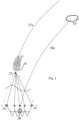
- Figure 1 illustrates a vessel 27 having a path of movement 27a while towing a trawl 28 to be moved in a path 28a toward a target volume 29 e.g. containing fish or shrimps.
- a target volume 29 e.g. containing fish or shrimps.
- the trawl path of movement 28a may differ from the vessel path 27a and the relationship between these paths may be complex.
- the vessel path 27a is determined by the sum of forces over time.
- the trawl path is determined by the sum of forces over time.
- Disturbance in the form of e.g sub surface current will also affect the trawl vector over time.
- the forces affecting the vessel and trawl provide a number of variables that may be measured and used to move the trawl along an optimal and efficient path toward the target area.
- realizing that the main purpose of the movement is not the vessel path 27a but finding the optimal trawl path 28a when considering the minimum power consumption during the operation.
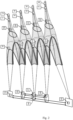
- Figure 2 illustrates an embodiment of a trawl having a number of sensors
- All of these measurements may be included in the calculation of the optimal trawl path along with the measurements of the target position and position of the trawl relative to the target as well as the vessel.
- the calculation means estimates an optimal path based on - fully or partly, but not limited to - the following:
- the system decides how the different alternatives may be used to steer the trawl in the optimal way toward the target volume. This may be performed dynamically depending on the movements of the target volume and how the trawl will meet it.
- a trawl pilot 30 with a trawl pilot control 31 receives a number of data 32 such as, but not limited to the target volume fish school position, depth, size etc., as well as vessel parameters such as position, speed, rate of turn etc., current and wind data and other operational parameters.
- the trawl pilot 30 includes a route estimator 35 proposing a towed path 44, e.g. based on economic priorities and based on this provides necessary commands 34 to the trawl controller 40 including a trawl control unit 36 for adjusting parameters like angle of attach, trawl shape and trawl position.
- trawl movements are then achieved by providing suitable control signals 38 to the relevant steering means. This is done primarily by adjusting the weights and doors Ref Fig 1 ; 24 of the trawl as is well known in the art. Secondarily to adjust trawl gallows and blocks and winches 25 on the vessel, and finally to sending signals 33 to the vessel 21 engaging changes to the rudder and propulsion power 26 on the vessel (ref Fig 3 ). In order to obtain this the trawl controller 40 may also utilize measured or known information 39 about wire tension, doors positions and the symmetry of the system in order to optimize the trawl control. In order to maintain a degree of symmetry while using the doors to contribute to the steering, the individual doors may be synchronized in the control system.
- the acceptable window may thus be based on a model involving the following calculations:
- estimator models such as, but not limited to:
- the route estimator will depend on the different types of trawls and vessels as well as the measurements provided by related sensors and instruments, as well as environmental conditions, e.g. variations in sea floor, depth, currents, trawl size, vessel maneuverability, and safe vessel routes avoiding dangerous or unwanted contacts with other vessels and other fixed or floating objects.
- a trawl steering system comprising a sea vessel and a trawl system, the system including a measuring unit such as a sonar or echosounder system for detecting and monitoring the position and movements of a target volume in the sea where the target volume may be constituted by a school, veil or haze of fish or shrimps to be caught in the trawl.
- the vessel also includes means for monitoring the position of the trawl relative to said target volume.
- the system comprising sampling means for sampling information including wind, current, and vessel and trawl characteristics and a route estimator for estimating the optimal route or path of the trawl.
- the system also comprises a trawl controller for adjusting vessel and trawl parameters so as to provide a movement for the trawl toward the target volume along said optimal path thus increasing the catch and reducing the bunker consumption and associated environmental impact.
- the control means may include a vessel control unit calculating the vessel movements necessary to steer the trawl along the estimated route toward the target volume.
- the trawl also comprises steering means that are adapted to move the trawl relative to the vessel so as to move toward the target area, wherein the steering means include doors, deflectors or weights positioned at the trawl for adjusting the position in the lateral and/or vertical direction relative to said path along said trajectory.
- the route estimator may include interfaces for receiving measurements from the environment, e.g. wind or current, measurements from the vessel and the trawl, as well as the measured movement of the target area and to calculate the trawl trajectory based on said measurements.
- the system may also include a navigation unit monitoring the global position of the vessel, the system being adapted to measure the position of the target volume and the trawl relative to the vessel.
- the system might also include signals from one or several radar units onboard the vessel, and/or other navigational systems giving information about fixed or floating objects to be avoided.
- the steering means may include interactive use of moving the trawl towing points on the vessel laterally and/or vertically, and in addition possibly also by adjusting length of towing wires.
- the system also comprises automation systems, hardware and software systems, based on artificial intelligence to provide a hierarchical list of actions comprising a priority of navigational means such as to ensure safest trawl trajectory route using the least amount of energy.
- This is based on a priority list of a first step to maneuver the trawl relative to the vessel movements so as to move toward the target area and secondly to maneuver the vessel and trawl including interactive use of moving the trawl towing points on the vessel laterally and/or vertically, and in addition possibly also by adjusting length of towing wires, and thirdly to maneuver the vessel and trawl using rudder and propulsion power, or any combination of the above.
Landscapes
- Life Sciences & Earth Sciences (AREA)
- Environmental Sciences (AREA)
- Biodiversity & Conservation Biology (AREA)
- Animal Husbandry (AREA)
- Engineering & Computer Science (AREA)
- Marine Sciences & Fisheries (AREA)
- Ocean & Marine Engineering (AREA)
- Remote Sensing (AREA)
- Combustion & Propulsion (AREA)
- Mechanical Engineering (AREA)
- Chemical & Material Sciences (AREA)
- Radar, Positioning & Navigation (AREA)
- Physics & Mathematics (AREA)
- Computer Networks & Wireless Communication (AREA)
- General Physics & Mathematics (AREA)
- Acoustics & Sound (AREA)
- Control Of Position, Course, Altitude, Or Attitude Of Moving Bodies (AREA)
- Power Steering Mechanism (AREA)
- Steering-Linkage Mechanisms And Four-Wheel Steering (AREA)
- Automatic Cycles, And Cycles In General (AREA)
Description
- The present invention relates to a trawl steering system comprising a sea vessel and a trawl system having a trawl, for maneuvring the trawl to a target volume such as a school or a haze/veil of fish, shrimp or other target volumes, in an efficient manner.
- Known trawling systems are based on controlling a vessel where an operator measures the position of a target volume as well as the position of the trawl and steers the vessel in so as to move the trawl through the measured moving target volume. Norwegian patent NO120174/
GB1318537 -
JP 2005046034 NO334751 EP2757877 also discuss a system related to trawl symmetry. This is a complex operation and requires continuous monitoring of both trawl and target as well as environmental conditions such as wind and current. In addition, the trawl has to be controlled individually in order to
maintain the wanted shape and orientation of the trawl and to avoid damage to the trawl. Other uses of sensors for monitoring fish and trawl positions are also discussed inEP1594359 ,JP S5937416 JP S60155987 - Automatic systems have been suggested but are mainly aimed at controlling the vessel movements using traditional rudders, propulsion power and/or steerable propellers, and through this the following trawl, according to the target position. They are, however, as discussed above still based on the vessel steering as the main means to steer the trawl, including frequent course and velocity adjustments which increases energy consumption up to 30% and wear on the equipment. It is an object of the present invention to provide a flexible and more efficient system, thus also reducing the fuel consumption and, hence reducing the environmental footprint. This is obtained by the invention defined in
claim 1. Preferred embodiments are disclosed in the dependent claims. - The present invention is based on the realization that the vessel is only one of several components in a system for reaching the target volume, as for example the movement of the vessel may diverge in one direction due to wind while current as well as the target movement may require another type of movement for the trawl.
- The present invention thus provide a means for automatic steering of the trawl toward the target area while taking into account such parameters as wind, current, vessel and trawl characteristics, and may also take into account bottom topography, other fishing equipment and floating or fixed objects etc. for calculating the trawl movements and steering the trawl. The trawl movements are prioritized while the vessel movements are only one of many possibilities to achieve this with as low power consumption as possible.
- The system utilizes several steering methods, including the potential use of movements in three dimensions of the trawl by actively adjusting length and position of towing wires/leads, but also potentially actively using individually steerable and/or synchronized doors, deflectors and/or weights, the system utilizes in addition the steering effects of the vessel movements by moving towing points at the vessel, and adjusting length of towing wires/leads, as discussed in Norwegian Patent Application
NO20170593 WO2018/186754 , the system utilizes in addition the potential use of traditional vessel steering using rudders and propulsion. The individual steering methods are individually known but the present invention provides a system utilizing them to provide an improved system. - The present invention will be described more in detail below with reference to the accompanying drawings, illustrating the invention by way of examples.
-
Figure 1 illustrates an overview of the system according to the invention. -
Figure 2 illustrates details of a trawl that may be used in the system. -
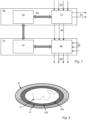
Figure 3 illustrates the structure of the system. -
Figure 4 illustrates the security margins relative to the trawl steering. -
Figure 1 illustrates avessel 27 having a path ofmovement 27a while towing atrawl 28 to be moved in apath 28a toward atarget volume 29 e.g. containing fish or shrimps. Depending on the environmental conditions such as drag, current and wind, the trawl path ofmovement 28a may differ from thevessel path 27a and the relationship between these paths may be complex. - In addition there may be limitations to the freedom of maneuvering the vessel, and/or there might be limitations to the freedom of maneuvering the towed equipment due to for example other vessels, other fishing equipment and subsea topographical restrictions, these factors will potentially be taken into consideration when the system calculates the actual modus operandi from case to case ensuring the minimum use of energy, and thus increasing effectivity in the fisheries and reducing negative environmental impact.
- The
vessel path 27a is determined by the sum of forces over time. - Vessel thrust vector is determined by the propeller thrust and rudder angle.
- Vessel drag is determined by the sum of forces inflicted on the ship over time. This is determined by the shape and state of the hull, position of rudder and/or position and power of steerable propellers if being used.
- Wire drag is determined by the sum of forces inflicted from the towed equipment such as a trawl over time.
- Disturbance in the form of e.g surface current, waves and wind will affect the ship over time.
- The trawl path is determined by the sum of forces over time.
- Trawl drag can be adjusted by changing the shape of the trawl by controlling doors, weights and wire tension and wire length. Trawl drag is also a result of trawl characteristics, filling of trawl and external disturbances like current.
- Trawl movement sideways to the wire drag is determined by sum of sideways forces inflicted by wire drag, trawl doors, trawl weights, seabed topography and current. This can be adjusted by direct control of adjustable doors and weights.
- Wire drag is determined by the sum of forces inflicted backwards from trawl drag, and forwards from the ship over time. Forward forces are controlled by throttle, pitch, rudder, and the point of attach of wire.
- Disturbance in the form of e.g sub surface current will also affect the trawl vector over time.
- The forces discussed above regarding control of both the trawl and vessel path by adjusting the tension and momentum of the wire drag from the trawl to the vessel is also discussed in Norwegian Patent Application
NO20170593 - The forces affecting the vessel and trawl provide a number of variables that may be measured and used to move the trawl along an optimal and efficient path toward the target area. In addition, realizing that the main purpose of the movement is not the
vessel path 27a but finding theoptimal trawl path 28a when considering the minimum power consumption during the operation. -
Figure 2 illustrates an embodiment of a trawl having a number of sensors, where - 1-8 represents catch sensors, measuring the filling of trawl and thus the weight of the trawl.
- 9,12 Measures trawl speed, pitch/roll, depth, distance to bottom, temperature and gives echogram of trawl.
- 10,11 Measures the pitch/roll, depth, distance to bottom, temperature and gives echogram of trawl.
- 14,17 Dual axis clump sensors, measuring distance to trawl door sensors.
- 13,16,18,15 represents door sensors measuring the distance between paired doors and thus the width of the trawl, as well as pitch, roll, depth and temperature.
- 19-22 Catch sensor with echogram to provide detail information about the catch passing into the codend, in addition to distance to bottom, pitch/roll, depth and temperature.
- 23-24 Trawl door sounder to provide rapid accurate distance to seabed, in addition to providing echogram to show catch passing underneath towards the trawl.
- All of these measurements may be included in the calculation of the optimal trawl path along with the measurements of the target position and position of the trawl relative to the target as well as the vessel.
- When a target volume is detected, e.g. using a sonar or echosounder system, the calculation means estimates an optimal path based on - fully or partly, but not limited to - the following:
- 1. The measured movement of the target volume.
- 2. The signals from the trawl sensors providing the true position of the trawl in three dimensions.
- 3. Signals form the trawl relating to symmetry, width, angle, doors, depth etc.
- 4. Signals from the vessel positioning system, e.g. GPS and autopilot, regarding the true position and course of the vessel.
- 5. Signal from the onboard radar and navigation system giving location, speed and course of surrounding vessels.
- 6. Signal from the onboard navigation systems giving information about other fixed or floating objects.
- 7. Signals from the onboard weather station regarding wind strength and direction.
- 8. Signals form doppler log regarding current velocity and direction in several layers in the water column.
- 9. Signals from the heave/pitch/roll sensors.
- 10. Prediction signal from the mapping machine which, based on the above, estimates about the topography and sea bottom conditions, indicates if it allows a trawl tow over a certain area without risking damages.
- Based on these signals the system decides how the different alternatives may be used to steer the trawl in the optimal way toward the target volume. This may be performed dynamically depending on the movements of the target volume and how the trawl will meet it.
- This is illustrated in the system shown in
figure 3 where atrawl pilot 30 with atrawl pilot control 31 receives a number ofdata 32 such as, but not limited to the target volume fish school position, depth, size etc., as well as vessel parameters such as position, speed, rate of turn etc., current and wind data and other operational parameters. Thetrawl pilot 30 includes aroute estimator 35 proposing a towedpath 44, e.g. based on economic priorities and based on this provides
necessary commands 34 to thetrawl controller 40 including atrawl control unit 36 for adjusting parameters like angle of attach, trawl shape and trawl position. - These trawl movements are then achieved by providing suitable control signals 38 to the relevant steering means. This is done primarily by adjusting the weights and doors Ref
Fig 1 ; 24 of the trawl as is well known in the art. Secondarily to adjust trawl gallows and blocks and winches 25 on the vessel, and finally to sendingsignals 33 to thevessel 21 engaging changes to the rudder andpropulsion power 26 on the vessel (refFig 3 ). In order to obtain this thetrawl controller 40 may also utilize measured or knowninformation 39 about wire tension, doors positions and the symmetry of the system in order to optimize the trawl control. In order to maintain a degree of symmetry while using the doors to contribute to the steering, the individual doors may be synchronized in the control system. - The range of priority of above actions might vary in order to obtain the sum of actions ensuring the least use of energy and most effective route optimization. All of above while also taking into consideration the optimum shape of the complete trawl systems and the safest route regarding other vessels and other fishing equipment or other objects.
- In this operation there is also a feedback where the effects on the trawl movements are predicted by a trawl predictor 37 (ref
Fig 3 ) in the trawl controller and fed back to theroute estimator 35 so as to provide a continuous adjustment of the trawl being added to the estimation model and thus influencing the estimated trawl trajectory. - In estimating the trawl trajectory some variations are allowed within an acceptable window of movements, so as to limit the need for fast and power consuming changes. This is illustrated in
figure 4 where asafe envelop boundary 42 enclosing a safety margin is defined and within this an estimated boundary ofcontrollability 41 of the trawl. As a safety precaution theoperating boundary 42b is defined within this, wherein the route estimator and trawl control allow same variations in the trawl movements over a span oftime 43. - The acceptable window may thus be based on a model involving the following calculations:
- Calculate dynamic trawl system behavior
- Calculate operating boundary
- Calculate safety margins
- Calculate trawl resistance
- Calculate Angle of Attack of trawl system
- Calculate effects of wind and current.
- This may be achieved based on different estimator models such as, but not limited to:
- «Trawl safety envelope» model defining the safe trajectory, e.g. avoiding sea bottom or other obstacles along the planned trajectory.
- «Disturbance model» including currents and other dynamic disturbances actively changing the real trajectory.
- «Trawl system dynamic model» describing the dynamic behavior of the trawl during an operation. The real trawl movements should preferably be kept within the limits of these models while calculating the most efficient route and recommending means to achieve this route.
- The precise nature of the models and calculations used by the route estimator will depend on the different types of trawls and vessels as well as the measurements provided by related sensors and instruments, as well as environmental conditions, e.g. variations in sea floor, depth, currents, trawl size, vessel maneuverability, and safe vessel routes avoiding dangerous or unwanted contacts with other vessels and other fixed or floating objects.
- To summarize the present invention thus relates to a trawl steering system comprising a sea vessel and a trawl system, the system including a measuring unit such as a sonar or echosounder system for detecting and monitoring the position and movements of a target volume in the sea where the target volume may be constituted by a school, veil or haze of fish or shrimps to be caught in the trawl. The vessel also includes means for monitoring the position of the trawl relative to said target volume. The system comprising sampling means for sampling information including wind, current, and vessel and trawl characteristics and a route estimator for estimating the optimal route or path of the trawl. The system also comprises a trawl controller for adjusting vessel and trawl parameters so as to provide a movement for the trawl toward the target volume along said optimal path thus increasing the catch and reducing the bunker consumption and associated environmental impact.
- The control means may include a vessel control unit calculating the vessel movements necessary to steer the trawl along the estimated route toward the target volume. The trawl also comprises steering means that are adapted to move the trawl relative to the vessel so as to move toward the target area, wherein the steering means include doors, deflectors or weights positioned at the trawl for adjusting the position in the lateral and/or vertical direction relative to said path along said trajectory.
- The route estimator may include interfaces for receiving measurements from the environment, e.g. wind or current, measurements from the vessel and the trawl, as well as the measured movement of the target area and to calculate the trawl trajectory based on said measurements.
- The system may also include a navigation unit monitoring the global position of the vessel, the system being adapted to measure the position of the target volume and the trawl relative to the vessel.
- The system might also include signals from one or several radar units onboard the vessel, and/or other navigational systems giving information about fixed or floating objects to be avoided.
- The steering means may include interactive use of moving the trawl towing points on the vessel laterally and/or vertically, and in addition possibly also by adjusting length of towing wires.
- The system also comprises automation systems, hardware and software systems, based on artificial intelligence to provide a hierarchical list of actions comprising a priority of navigational means such as to ensure safest trawl trajectory route using the least amount of energy. This is based on a priority list of a first step to maneuver the trawl relative to the vessel movements so as to move toward the target area and secondly to maneuver the vessel and trawl including interactive use of moving the trawl towing points on the vessel laterally and/or vertically, and in addition possibly also by adjusting length of towing wires, and thirdly to maneuver the vessel and trawl using rudder and propulsion power, or any combination of the above.
Claims (6)
- Trawl steering system comprising a sea vessel (27) and a trawl system having a trawl (28), the trawl steering system including:- a measuring unit adapted to detect and monitor the position and movements of a target volume (29) in the sea, the target volume (29) constituted by a school, veil or haze of fish or shrimps to be caught in the trawl (28), and to monitor the position of the trawl (28) relative to said target volume (29);- sampling means adapted to sample information including wind, current, and vessel and trawl characteristics;- a trawl pilot (30) comprising a route estimator (35) adapted to calculate an optimal trawl path (28a) and a trawl pilot control (31) adapted to send signals (33) to the vessel (27); and- controller means (40) adapted to adjust vessel and trawl parameters so as to provide a movement for the trawl (28) toward the target volume (29) along said optimal path (28a), and to receive commands (34) from the trawl pilot (30);- steering means comprising:- weights, doors (24) or deflectors arranged on the trawl (28), and wherein the weights doors (24) or deflectors are adapted to receive control signals (38) from the controller means (40) and to adjust the position of the trawl (28) relative to the sea vessel (27);- trawl towing points on the vessel (27), wherein the trawl towing points are movable laterally and/or vertically on the vessel (27), and towing wire being adjustable in length; and- automation systems, hardware and software systems, which are based on artificial intelligence to provide a hierarchical list of actions comprising a priority of navigational means to ensure the safest trawl path using the least amount of energy, said hierarchical list of actions including one or more of:- adjustment of the weights, doors (24) or deflectors,- lateral and/or vertical movement of the trawl towing points on the vessel (27), possibly including length adjustment of the towing wires, and- use of the vessel's rudder and propulsion power (26).
- Trawl steering system according to claim 1, wherein the route estimator (35) is provided with an estimation model wherein a safe envelop boundary (42) is defined and an estimated boundary of controllability (41) of the trawl (28) is defined within said safe envelop boundary (42) and wherein an operating boundary (42b) is defined within the boundary of controllability (41), so that the route estimator (35) and controller means (40) allow some variations in the trawl movements over a span of time (43).
- Trawl steering system according to claim 2, wherein the controller means (40) comprises a trawl predictor (37) and wherein, in operation, the route estimator (35) is adapted to send and receive feedback to/from the trawl predictor (37) so as to provide a continuous adjustment of the trawl (28) being added to the estimation model and thus influencing the estimated optimal trawl path (28a).
- Trawl steering system according to claim 1, wherein the controller means (40) includes a vessel control unit adapted to calculate the vessel movements necessary to steer the trawl (28) according to the estimated route toward the target volume (29), while avoiding any danger of collision or unwanted interface with other vessels and other fishing equipment.
- Trawl steering system according to claim 1, wherein said route estimator (35) includes interfaces adapted to receive measurements from the environment, e.g. wind or current, measurements from the vessel (27) and the trawl (28), as well as the measured movement of the target volume (29) and to calculate the optimal trawl path based on said measurements.
- Trawl steering system according to claim 1, comprising a navigation unit monitoring the global position of the vessel (27), the trawl steering system being adapted to measure the position of the target volume (29) and the trawl (28) relative to the vessel (27).
Applications Claiming Priority (2)
| Application Number | Priority Date | Filing Date | Title |
|---|---|---|---|
| NO20180775A NO344522B1 (en) | 2018-06-05 | 2018-06-05 | Dynamic trawl steering system |
| PCT/NO2019/000014 WO2019235935A1 (en) | 2018-06-05 | 2019-06-04 | Dynamic trawl steering system |
Publications (3)
| Publication Number | Publication Date |
|---|---|
| EP3813523A1 EP3813523A1 (en) | 2021-05-05 |
| EP3813523A4 EP3813523A4 (en) | 2022-03-02 |
| EP3813523B1 true EP3813523B1 (en) | 2025-03-12 |
Family
ID=68770975
Family Applications (1)
| Application Number | Title | Priority Date | Filing Date |
|---|---|---|---|
| EP19814121.0A Active EP3813523B1 (en) | 2018-06-05 | 2019-06-04 | Trawl steering system |
Country Status (6)
| Country | Link |
|---|---|
| EP (1) | EP3813523B1 (en) |
| CA (1) | CA3102764A1 (en) |
| DK (2) | DK3813523T3 (en) |
| ES (1) | ES3025835T3 (en) |
| NO (1) | NO344522B1 (en) |
| WO (1) | WO2019235935A1 (en) |
Families Citing this family (6)
| Publication number | Priority date | Publication date | Assignee | Title |
|---|---|---|---|---|
| NO344522B1 (en) | 2018-06-05 | 2020-01-20 | Remoey Sea Group As | Dynamic trawl steering system |
| CN111260218B (en) * | 2020-01-16 | 2023-10-17 | 中国水产科学研究院东海水产研究所 | Trawl fishing boat fuel efficiency analysis method |
| CN111820194B (en) * | 2020-06-01 | 2022-05-17 | 中国水产科学研究院东海水产研究所 | Targeting fishing method of Antarctic krill trawling based on shrimp density detection |
| EP4066634A1 (en) * | 2021-03-23 | 2022-10-05 | Volu Ventis ApS | Controllable trawl doors and a method for controlling the same |
| WO2026015980A1 (en) * | 2024-07-17 | 2026-01-22 | Katchi Technologies Incorporated | Systems and methods of controlling position of a trawl net |
| CN119522883B (en) * | 2024-11-14 | 2025-10-24 | 中国水产科学研究院渔业机械仪器研究所 | Trawl net with powered net plate and working method thereof |
Citations (10)
| Publication number | Priority date | Publication date | Assignee | Title |
|---|---|---|---|---|
| JPH01250876A (en) | 1988-03-31 | 1989-10-05 | Chikamasa Hamuro | Operation assisting device |
| NO166778B (en) | 1989-02-07 | 1991-05-27 | Torbjoern Antonsen | CONTROL OF VESSELS USED BY TOWED OBJECTS. |
| WO2002059650A1 (en) | 2001-01-24 | 2002-08-01 | Petroleum Geo-Services Inc. | System for controlling streamers |
| GB2400662A (en) | 2003-04-15 | 2004-10-20 | Westerngeco Seismic Holdings | Positioning system for seismic array |
| JP2005046034A (en) | 2003-07-31 | 2005-02-24 | Nichimo Co Ltd | Auto trawl system |
| US20110286302A1 (en) | 2004-03-17 | 2011-11-24 | Westerngeco, L.L.C. | Marine Seismic Survey Method and System |
| NO341692B1 (en) | 2017-01-24 | 2017-12-27 | Rolls Royce Marine As | Trawl Block suspension |
| WO2018186754A1 (en) | 2017-04-07 | 2018-10-11 | Remøy Sea Group AS | Arrangement for manoeuvring a boat |
| NO20181676A1 (en) | 2018-12-21 | 2019-03-18 | Rolls Royce Marine As | Trawl Events |
| NO20180775A1 (en) | 2018-06-05 | 2019-12-06 | Remoey Sea Group As | Dynamic trawl steering system |
Family Cites Families (8)
| Publication number | Priority date | Publication date | Assignee | Title |
|---|---|---|---|---|
| NO120174B (en) * | 1969-09-15 | 1970-09-07 | Simonsen & Mustad As | |
| JPS5937416B2 (en) | 1979-12-11 | 1984-09-10 | 松下電器産業株式会社 | solar heat collector |
| JPS5937416A (en) * | 1982-08-25 | 1984-02-29 | Furuno Electric Co Ltd | Wake display device |
| JPS60155987A (en) * | 1984-01-26 | 1985-08-16 | Marine Instr Co Ltd | Displaying method of fish finder |
| JP2566577B2 (en) * | 1987-06-04 | 1996-12-25 | 親正 葉室 | Operation support device |
| NO20035478L (en) * | 2003-12-09 | 2005-06-10 | Henning Skjold Larsen | Sensor module for trolley |
| NO334751B1 (en) | 2011-09-22 | 2014-05-19 | Scantrawl As | System and method for controlling trawling |
| US9952595B2 (en) * | 2016-03-01 | 2018-04-24 | Brunswick Corporation | Vessel maneuvering methods and systems |
-
2018
- 2018-06-05 NO NO20180775A patent/NO344522B1/en active IP Right Review Request
-
2019
- 2019-06-04 EP EP19814121.0A patent/EP3813523B1/en active Active
- 2019-06-04 DK DK19814121.0T patent/DK3813523T3/en active
- 2019-06-04 CA CA3102764A patent/CA3102764A1/en active Pending
- 2019-06-04 ES ES19814121T patent/ES3025835T3/en active Active
- 2019-06-04 WO PCT/NO2019/000014 patent/WO2019235935A1/en not_active Ceased
-
2021
- 2021-01-04 DK DKPA202100005A patent/DK202100005A1/en unknown
Patent Citations (11)
| Publication number | Priority date | Publication date | Assignee | Title |
|---|---|---|---|---|
| JPH01250876A (en) | 1988-03-31 | 1989-10-05 | Chikamasa Hamuro | Operation assisting device |
| NO166778B (en) | 1989-02-07 | 1991-05-27 | Torbjoern Antonsen | CONTROL OF VESSELS USED BY TOWED OBJECTS. |
| WO2002059650A1 (en) | 2001-01-24 | 2002-08-01 | Petroleum Geo-Services Inc. | System for controlling streamers |
| GB2400662A (en) | 2003-04-15 | 2004-10-20 | Westerngeco Seismic Holdings | Positioning system for seismic array |
| JP2005046034A (en) | 2003-07-31 | 2005-02-24 | Nichimo Co Ltd | Auto trawl system |
| US20110286302A1 (en) | 2004-03-17 | 2011-11-24 | Westerngeco, L.L.C. | Marine Seismic Survey Method and System |
| NO341692B1 (en) | 2017-01-24 | 2017-12-27 | Rolls Royce Marine As | Trawl Block suspension |
| WO2018186754A1 (en) | 2017-04-07 | 2018-10-11 | Remøy Sea Group AS | Arrangement for manoeuvring a boat |
| NO20180775A1 (en) | 2018-06-05 | 2019-12-06 | Remoey Sea Group As | Dynamic trawl steering system |
| WO2019235935A1 (en) | 2018-06-05 | 2019-12-12 | Remøy Sea Group AS | Dynamic trawl steering system |
| NO20181676A1 (en) | 2018-12-21 | 2019-03-18 | Rolls Royce Marine As | Trawl Events |
Non-Patent Citations (18)
| Title |
|---|
| "Doctoral Thesis", 1 August 2006, NORWEGIAN UNIVERSITY OF SCIENCE AND TECHNOLOGY, ISBN: 978-82-471-8023-5, article REITE KARL-JOHAN: "Modeling and control of trawl systems", pages: 1 - 263, XP093266410 |
| "Master Thesis", 25 June 2017, NORWEGIAN UNIVERSITY OF SCIENCE AND TECHNOLOGY, article ÅSBØ DAG KRISTIAN: "Investigation of thrust loss due to steering while trawling", pages: 1 - 115, XP093266405 |
| ANONYMOUS: "COMMUNICATION FROM THE COMMISSION TO THE EUROPEAN PARLIAMENT, THE EUROPEAN COUNCIL, THE COUNCIL, THE EUROPEAN ECONOMIC AND SOCIAL COMMITTEE AND THE COMMITTEE OF THE REGIONS Artificial Intelligence for Europe COM/2018/237 final", DOCUMENT 52018DC0237, EUROPEAN COMMISSION, 25 April 2018 (2018-04-25), pages 1 - 20, XP093352486, Retrieved from the Internet <URL:https://eur-lex.europa.eu/legal-content/EN/TXT/?uri=celex:52018DC0237> |
| ANONYMOUS: "COMPLETE WINCH SOLUTIONS - WINCHES WITH AUTOMATIC CONTROL SYSTEMS", NAUST MARINE SMART-TRAWLING PUBLICATION, NAUST MARINE, 19 October 2016 (2016-10-19), pages 1 - 12, XP093352436, Retrieved from the Internet <URL:https://www.naust.is/asset/6820/complete_online.pdf> |
| ANONYMOUS: "FISHMASTER Integrated mode based operation", PRODUCT SHEET, KONGSBERG MARITIME, 23 September 2016 (2016-09-23), pages 1 - 4, XP093352483, Retrieved from the Internet <URL:https://www.kongsberg.com/globalassets/kongsberg-maritime/km-products/product-documents/integrated-workstation-for-fishing-vessels-fishmaster/> |
| ANONYMOUS: "Kongsberg Maritime Integrated solution for fishing vessels FISHMASTER", FISHMASTER, KONGSBERG MARITIME, 1 January 2016 (2016-01-01), pages 1 - 27, XP093352475, Retrieved from the Internet <URL:http://www.kongsberg.com> |
| D14A - SIMRAD Fishmaster® Concept Definition, v3, 2013 |
| D16 - Sintef Trawler of Tomorrow |
| D17 - Bjørkum report (STYRING AV FARTØY VED FORFLYTNING AV SLEPEFESTE FOR TRÅLVARP) |
| D20 - Proprietor’s letter of 1 July 2024 |
| INTEGRATED SOLUTION FOR FISHING VESSELS FISHMASTER® PRESENTATION |
| INVENTAS TRONDHEIM AS: "Sikkert arbeidsdekk og styrbare trålblokker: Forprosjekt [Safe working deck and steerable trawl blocks: Preliminary project]", FHF - PROSJEKTBASEN 901142, FISKERI- OG HAVBRUKSNAERINGENS FOSRSKNINGSFINASIERING, NORWAY, 31 December 2015 (2015-12-31), Norway, pages 1 - 3, XP093266409, Retrieved from the Internet <URL:https://www.fhf.no/prosjekter/prosjektbasen/901142> |
| JOHNSON W W: "A Fishing Technologist's Viewpoint on a Canadian Designed Stern Trawler", CANADIAN ATLANTIC OFFSHORE FISHING VESSEL CONFERENCE, MONTREAL, FEBRUARY 7-9 1966, SECRETARIAT, INDUSTRIAL DEVELOPMENT SERVICE, DEPT. OF FISHERIES, CANADA, no. 7, 1 October 1966 (1966-10-01) - 1966-02-09, Canada, pages 259 - 270, XP093352441 |
| MANYIKA JAMES, MICHAEL CHUI, JACQUES BUGHIN, RICHARD DOBBS, PETER BISSON, ALEX MARRS: "Disruptive technologies: Advances that will transform life, business, and the global economy", MCKINSEY GLOBAL INSTITUTE REPORT, MCKINSEY GLOBAL INSTITUTE, 1 May 2013 (2013-05-01), pages 1 - 176, XP093352489, Retrieved from the Internet <URL:https://www.mckinsey.com/~/media/mckinsey/business%20functions/mckinsey%20digital/our%20insights/disruptive%20technologies/mgi_disruptive_technologies_full_report_may2013.pdf> |
| PETTERSEN OVE JORAS, MARTIN GUDEM RINGDALEN, LISA WOLME, MARIA BOE: "SIKRERE OG MER EFFEKTIVE TRÅLDEKK - KONSEPTER FOR ET SIKRERE TRÅLDEKK", FHF - PROSJEKTBASEN 901142, FISKERI- OG HAVBRUKSNAERINGENS FOSRSKNINGSFINASIERING, 31 December 2015 (2015-12-31), pages 1 - 19, XP093352369, Retrieved from the Internet <URL:https://www.fhf.no/prosjekter/prosjektbasen/901142/> |
| SIMRAD BY KONGSBERG: "Fishmaster: This is our concept for sustainable fisheries and aquaculture", 31 October 2017 (2017-10-31), XP093352480, Retrieved from the Internet <URL:https://www.youtube.com/watch?v=XhTVok3icvM> |
| WOLME LISA: "Faglig sluttrapport", FHF - PROSJEKTBASEN 901142, FISKERI- OG HAVBRUKSNAERINGENS FOSRSKNINGSFINASIERING, 31 December 2015 (2015-12-31), pages 1 - 14, XP093352372, Retrieved from the Internet <URL:https://www.fhf.no/prosjekter/prosjektbasen/901142/> |
| WOLME LISA: "Oppsummering fra intervju og arbeidsmøte (workshop)", FHF - PROSJEKTBASEN 901142, FISKERI- OG HAVBRUKSNAERINGENS FOSRSKNINGSFINASIERING, 31 December 2015 (2015-12-31), pages 1 - 62, XP093352370, Retrieved from the Internet <URL:https://www.fhf.no/prosjekter/prosjektbasen/901142/> |
Also Published As
| Publication number | Publication date |
|---|---|
| ES3025835T3 (en) | 2025-06-09 |
| WO2019235935A1 (en) | 2019-12-12 |
| NO20180775A1 (en) | 2019-12-06 |
| NO344522B1 (en) | 2020-01-20 |
| CA3102764A1 (en) | 2019-12-12 |
| DK202100005A1 (en) | 2021-01-07 |
| DK3813523T3 (en) | 2025-05-26 |
| EP3813523A1 (en) | 2021-05-05 |
| EP3813523A4 (en) | 2022-03-02 |
Similar Documents
| Publication | Publication Date | Title |
|---|---|---|
| EP3813523B1 (en) | Trawl steering system | |
| US20220144403A1 (en) | Marine propulsion control system and method | |
| EP3214522B9 (en) | Vessel maneuvering method and system | |
| JP5479788B2 (en) | Automatic steering system and automatic steering device | |
| CN109460035B (en) | A two-level autonomous obstacle avoidance method for unmanned boats at high speed | |
| JP6821437B2 (en) | Mobile control device, mobile control method, and mobile control program | |
| WO2021230356A1 (en) | Method for autonomously guiding vessel, program for autonomously guiding vessel, system for autonomously guiding vessel, and vessel | |
| CN116540730B (en) | Multi-tug cooperation berthing intelligent auxiliary system and method | |
| WO2014066645A1 (en) | Predictive sea state mapping for ship motion control | |
| EP3696078B1 (en) | A method and system for piloting an unmanned surface vessel | |
| KR20150140172A (en) | Dron flight and sea floor scanning exploration system using the same | |
| CN106020212B (en) | Navigation switching system and switching method during a kind of tracking of UUV sea-floor relief | |
| JP2003127983A (en) | Navigation control device for autonomous underwater vehicle | |
| KR102467138B1 (en) | Autonomous navigation system for a sailing yacht and method thereof | |
| KR20240108295A (en) | Control apparatus and control method for auto unberthing or berthing the ship | |
| CN116395111A (en) | An underwater hovering control submarine body based on multiple propellers and its control method | |
| KR102617988B1 (en) | System for autonomous ship berthing using around view | |
| RU2501708C1 (en) | Automatic piloting | |
| US20250382037A1 (en) | Method for A Collision Avoidance System of a Host Marine Vessel, Related to Updating Vessel Classifications and Navigational Statuses of Marine Vessels | |
| Liang et al. | USV path planning algorithm based on 20D-A∗ and IDWA algorithms under COLREGs | |
| CN110456786A (en) | UUV submarine terrain tracking system and tracking method based on terrain feature extraction | |
| JP5755071B2 (en) | Towing body control method and control apparatus therefor, and towed body control system | |
| WO2018189271A1 (en) | Indicator method and system for a vessel | |
| US12503207B1 (en) | Marine propulsion control system and method with proximity-based velocity limiting | |
| CN106843241A (en) | UUV based on auxiliary propeller pinpoints revolution detection method and control system under water |
Legal Events
| Date | Code | Title | Description |
|---|---|---|---|
| STAA | Information on the status of an ep patent application or granted ep patent |
Free format text: STATUS: THE INTERNATIONAL PUBLICATION HAS BEEN MADE |
|
| PUAI | Public reference made under article 153(3) epc to a published international application that has entered the european phase |
Free format text: ORIGINAL CODE: 0009012 |
|
| STAA | Information on the status of an ep patent application or granted ep patent |
Free format text: STATUS: REQUEST FOR EXAMINATION WAS MADE |
|
| 17P | Request for examination filed |
Effective date: 20201204 |
|
| AK | Designated contracting states |
Kind code of ref document: A1 Designated state(s): AL AT BE BG CH CY CZ DE DK EE ES FI FR GB GR HR HU IE IS IT LI LT LU LV MC MK MT NL NO PL PT RO RS SE SI SK SM TR |
|
| DAV | Request for validation of the european patent (deleted) | ||
| DAX | Request for extension of the european patent (deleted) | ||
| A4 | Supplementary search report drawn up and despatched |
Effective date: 20220128 |
|
| RIC1 | Information provided on ipc code assigned before grant |
Ipc: G01S 15/96 20060101ALI20220124BHEP Ipc: A01K 73/04 20060101AFI20220124BHEP |
|
| STAA | Information on the status of an ep patent application or granted ep patent |
Free format text: STATUS: EXAMINATION IS IN PROGRESS |
|
| 17Q | First examination report despatched |
Effective date: 20240315 |
|
| GRAP | Despatch of communication of intention to grant a patent |
Free format text: ORIGINAL CODE: EPIDOSNIGR1 |
|
| STAA | Information on the status of an ep patent application or granted ep patent |
Free format text: STATUS: GRANT OF PATENT IS INTENDED |
|
| INTG | Intention to grant announced |
Effective date: 20241127 |
|
| GRAS | Grant fee paid |
Free format text: ORIGINAL CODE: EPIDOSNIGR3 |
|
| GRAA | (expected) grant |
Free format text: ORIGINAL CODE: 0009210 |
|
| STAA | Information on the status of an ep patent application or granted ep patent |
Free format text: STATUS: THE PATENT HAS BEEN GRANTED |
|
| AK | Designated contracting states |
Kind code of ref document: B1 Designated state(s): AL AT BE BG CH CY CZ DE DK EE ES FI FR GB GR HR HU IE IS IT LI LT LU LV MC MK MT NL NO PL PT RO RS SE SI SK SM TR |
|
| P01 | Opt-out of the competence of the unified patent court (upc) registered |
Free format text: CASE NUMBER: APP_5710/2025 Effective date: 20250203 |
|
| REG | Reference to a national code |
Ref country code: GB Ref legal event code: FG4D |
|
| REG | Reference to a national code |
Ref country code: CH Ref legal event code: EP |
|
| REG | Reference to a national code |
Ref country code: DE Ref legal event code: R096 Ref document number: 602019067233 Country of ref document: DE |
|
| REG | Reference to a national code |
Ref country code: IE Ref legal event code: FG4D |
|
| REG | Reference to a national code |
Ref country code: DK Ref legal event code: T3 Effective date: 20250521 |
|
| REG | Reference to a national code |
Ref country code: ES Ref legal event code: FG2A Ref document number: 3025835 Country of ref document: ES Kind code of ref document: T3 Effective date: 20250609 |
|
| PG25 | Lapsed in a contracting state [announced via postgrant information from national office to epo] |
Ref country code: RS Free format text: LAPSE BECAUSE OF FAILURE TO SUBMIT A TRANSLATION OF THE DESCRIPTION OR TO PAY THE FEE WITHIN THE PRESCRIBED TIME-LIMIT Effective date: 20250612 |
|
| PG25 | Lapsed in a contracting state [announced via postgrant information from national office to epo] |
Ref country code: FI Free format text: LAPSE BECAUSE OF FAILURE TO SUBMIT A TRANSLATION OF THE DESCRIPTION OR TO PAY THE FEE WITHIN THE PRESCRIBED TIME-LIMIT Effective date: 20250312 |
|
| PGFP | Annual fee paid to national office [announced via postgrant information from national office to epo] |
Ref country code: DE Payment date: 20250618 Year of fee payment: 7 |
|
| PGFP | Annual fee paid to national office [announced via postgrant information from national office to epo] |
Ref country code: GB Payment date: 20250416 Year of fee payment: 7 Ref country code: DK Payment date: 20250625 Year of fee payment: 7 |
|
| REG | Reference to a national code |
Ref country code: LT Ref legal event code: MG9D |
|
| PGFP | Annual fee paid to national office [announced via postgrant information from national office to epo] |
Ref country code: IS Payment date: 20250610 Year of fee payment: 7 Ref country code: NO Payment date: 20250623 Year of fee payment: 7 |
|
| PG25 | Lapsed in a contracting state [announced via postgrant information from national office to epo] |
Ref country code: HR Free format text: LAPSE BECAUSE OF FAILURE TO SUBMIT A TRANSLATION OF THE DESCRIPTION OR TO PAY THE FEE WITHIN THE PRESCRIBED TIME-LIMIT Effective date: 20250312 |
|
| REG | Reference to a national code |
Ref country code: NL Ref legal event code: MP Effective date: 20250312 |
|
| PG25 | Lapsed in a contracting state [announced via postgrant information from national office to epo] |
Ref country code: LV Free format text: LAPSE BECAUSE OF FAILURE TO SUBMIT A TRANSLATION OF THE DESCRIPTION OR TO PAY THE FEE WITHIN THE PRESCRIBED TIME-LIMIT Effective date: 20250312 |
|
| PGFP | Annual fee paid to national office [announced via postgrant information from national office to epo] |
Ref country code: FR Payment date: 20250627 Year of fee payment: 7 |
|
| PG25 | Lapsed in a contracting state [announced via postgrant information from national office to epo] |
Ref country code: GR Free format text: LAPSE BECAUSE OF FAILURE TO SUBMIT A TRANSLATION OF THE DESCRIPTION OR TO PAY THE FEE WITHIN THE PRESCRIBED TIME-LIMIT Effective date: 20250613 Ref country code: BG Free format text: LAPSE BECAUSE OF FAILURE TO SUBMIT A TRANSLATION OF THE DESCRIPTION OR TO PAY THE FEE WITHIN THE PRESCRIBED TIME-LIMIT Effective date: 20250312 |
|
| PGFP | Annual fee paid to national office [announced via postgrant information from national office to epo] |
Ref country code: IE Payment date: 20250618 Year of fee payment: 7 |
|
| REG | Reference to a national code |
Ref country code: AT Ref legal event code: MK05 Ref document number: 1774217 Country of ref document: AT Kind code of ref document: T Effective date: 20250312 |
|
| PG25 | Lapsed in a contracting state [announced via postgrant information from national office to epo] |
Ref country code: NL Free format text: LAPSE BECAUSE OF FAILURE TO SUBMIT A TRANSLATION OF THE DESCRIPTION OR TO PAY THE FEE WITHIN THE PRESCRIBED TIME-LIMIT Effective date: 20250312 |
|
| PG25 | Lapsed in a contracting state [announced via postgrant information from national office to epo] |
Ref country code: SE Free format text: LAPSE BECAUSE OF FAILURE TO SUBMIT A TRANSLATION OF THE DESCRIPTION OR TO PAY THE FEE WITHIN THE PRESCRIBED TIME-LIMIT Effective date: 20250312 |
|
| PG25 | Lapsed in a contracting state [announced via postgrant information from national office to epo] |
Ref country code: SM Free format text: LAPSE BECAUSE OF FAILURE TO SUBMIT A TRANSLATION OF THE DESCRIPTION OR TO PAY THE FEE WITHIN THE PRESCRIBED TIME-LIMIT Effective date: 20250312 |
|
| PG25 | Lapsed in a contracting state [announced via postgrant information from national office to epo] |
Ref country code: PT Free format text: LAPSE BECAUSE OF FAILURE TO SUBMIT A TRANSLATION OF THE DESCRIPTION OR TO PAY THE FEE WITHIN THE PRESCRIBED TIME-LIMIT Effective date: 20250714 |
|
| PGFP | Annual fee paid to national office [announced via postgrant information from national office to epo] |
Ref country code: ES Payment date: 20250731 Year of fee payment: 7 |
|
| PG25 | Lapsed in a contracting state [announced via postgrant information from national office to epo] |
Ref country code: IT Free format text: LAPSE BECAUSE OF FAILURE TO SUBMIT A TRANSLATION OF THE DESCRIPTION OR TO PAY THE FEE WITHIN THE PRESCRIBED TIME-LIMIT Effective date: 20250312 Ref country code: PL Free format text: LAPSE BECAUSE OF FAILURE TO SUBMIT A TRANSLATION OF THE DESCRIPTION OR TO PAY THE FEE WITHIN THE PRESCRIBED TIME-LIMIT Effective date: 20250312 |
|
| PG25 | Lapsed in a contracting state [announced via postgrant information from national office to epo] |
Ref country code: AT Free format text: LAPSE BECAUSE OF FAILURE TO SUBMIT A TRANSLATION OF THE DESCRIPTION OR TO PAY THE FEE WITHIN THE PRESCRIBED TIME-LIMIT Effective date: 20250312 |
|
| PG25 | Lapsed in a contracting state [announced via postgrant information from national office to epo] |
Ref country code: CZ Free format text: LAPSE BECAUSE OF FAILURE TO SUBMIT A TRANSLATION OF THE DESCRIPTION OR TO PAY THE FEE WITHIN THE PRESCRIBED TIME-LIMIT Effective date: 20250312 Ref country code: EE Free format text: LAPSE BECAUSE OF FAILURE TO SUBMIT A TRANSLATION OF THE DESCRIPTION OR TO PAY THE FEE WITHIN THE PRESCRIBED TIME-LIMIT Effective date: 20250312 |
|
| PG25 | Lapsed in a contracting state [announced via postgrant information from national office to epo] |
Ref country code: RO Free format text: LAPSE BECAUSE OF FAILURE TO SUBMIT A TRANSLATION OF THE DESCRIPTION OR TO PAY THE FEE WITHIN THE PRESCRIBED TIME-LIMIT Effective date: 20250312 |
|
| PG25 | Lapsed in a contracting state [announced via postgrant information from national office to epo] |
Ref country code: SK Free format text: LAPSE BECAUSE OF FAILURE TO SUBMIT A TRANSLATION OF THE DESCRIPTION OR TO PAY THE FEE WITHIN THE PRESCRIBED TIME-LIMIT Effective date: 20250312 |
|
| REG | Reference to a national code |
Ref country code: DE Ref legal event code: R026 Ref document number: 602019067233 Country of ref document: DE |
|
| PLBI | Opposition filed |
Free format text: ORIGINAL CODE: 0009260 |
|
| REG | Reference to a national code |
Ref country code: CH Ref legal event code: L10 Free format text: ST27 STATUS EVENT CODE: U-0-0-L10-L00 (AS PROVIDED BY THE NATIONAL OFFICE) Effective date: 20251224 |
|
| PLAX | Notice of opposition and request to file observation + time limit sent |
Free format text: ORIGINAL CODE: EPIDOSNOBS2 |
|
| 26 | Opposition filed |
Opponent name: KONGSBERG MARITIME AS Effective date: 20251212 |
|
| REG | Reference to a national code |
Ref country code: CH Ref legal event code: H13 Free format text: ST27 STATUS EVENT CODE: U-0-0-H10-H13 (AS PROVIDED BY THE NATIONAL OFFICE) Effective date: 20260127 |
|
| PG25 | Lapsed in a contracting state [announced via postgrant information from national office to epo] |
Ref country code: MC Free format text: LAPSE BECAUSE OF FAILURE TO SUBMIT A TRANSLATION OF THE DESCRIPTION OR TO PAY THE FEE WITHIN THE PRESCRIBED TIME-LIMIT Effective date: 20250312 |
|
| PG25 | Lapsed in a contracting state [announced via postgrant information from national office to epo] |
Ref country code: LU Free format text: LAPSE BECAUSE OF NON-PAYMENT OF DUE FEES Effective date: 20250604 |
|
| REG | Reference to a national code |
Ref country code: BE Ref legal event code: MM Effective date: 20250630 |