EP3812421A1 - Protection film and sheet - Google Patents
Protection film and sheet Download PDFInfo
- Publication number
- EP3812421A1 EP3812421A1 EP19821944.6A EP19821944A EP3812421A1 EP 3812421 A1 EP3812421 A1 EP 3812421A1 EP 19821944 A EP19821944 A EP 19821944A EP 3812421 A1 EP3812421 A1 EP 3812421A1
- Authority
- EP
- European Patent Office
- Prior art keywords
- protective film
- uva
- ultraviolet absorber
- hydrogen atom
- group
- Prior art date
- Legal status (The legal status is an assumption and is not a legal conclusion. Google has not performed a legal analysis and makes no representation as to the accuracy of the status listed.)
- Pending
Links
- 0 CCCCC(CC)COc(cc1O)ccc1-c1nc(-c2ccc(*)cc2)nc(-c(ccc(OCC(CC)CCCC)c2)c2O)n1 Chemical compound CCCCC(CC)COc(cc1O)ccc1-c1nc(-c2ccc(*)cc2)nc(-c(ccc(OCC(CC)CCCC)c2)c2O)n1 0.000 description 2
- VVBVFVRWEMORTQ-UHFFFAOYSA-N CCCCC(CC)C(OCCOc(cc1)cc(O)c1-c1nc(-c2ccccc2)nc(-c2ccccc2)n1)=O Chemical compound CCCCC(CC)C(OCCOc(cc1)cc(O)c1-c1nc(-c2ccccc2)nc(-c2ccccc2)n1)=O VVBVFVRWEMORTQ-UHFFFAOYSA-N 0.000 description 1
Images

Classifications
-
- C—CHEMISTRY; METALLURGY
- C08—ORGANIC MACROMOLECULAR COMPOUNDS; THEIR PREPARATION OR CHEMICAL WORKING-UP; COMPOSITIONS BASED THEREON
- C08G—MACROMOLECULAR COMPOUNDS OBTAINED OTHERWISE THAN BY REACTIONS ONLY INVOLVING UNSATURATED CARBON-TO-CARBON BONDS
- C08G18/00—Polymeric products of isocyanates or isothiocyanates
- C08G18/06—Polymeric products of isocyanates or isothiocyanates with compounds having active hydrogen
- C08G18/70—Polymeric products of isocyanates or isothiocyanates with compounds having active hydrogen characterised by the isocyanates or isothiocyanates used
- C08G18/72—Polyisocyanates or polyisothiocyanates
- C08G18/77—Polyisocyanates or polyisothiocyanates having heteroatoms in addition to the isocyanate or isothiocyanate nitrogen and oxygen or sulfur
- C08G18/78—Nitrogen
- C08G18/79—Nitrogen characterised by the polyisocyanates used, these having groups formed by oligomerisation of isocyanates or isothiocyanates
- C08G18/791—Nitrogen characterised by the polyisocyanates used, these having groups formed by oligomerisation of isocyanates or isothiocyanates containing isocyanurate groups
- C08G18/792—Nitrogen characterised by the polyisocyanates used, these having groups formed by oligomerisation of isocyanates or isothiocyanates containing isocyanurate groups formed by oligomerisation of aliphatic and/or cycloaliphatic isocyanates or isothiocyanates
-
- B—PERFORMING OPERATIONS; TRANSPORTING
- B32—LAYERED PRODUCTS
- B32B—LAYERED PRODUCTS, i.e. PRODUCTS BUILT-UP OF STRATA OF FLAT OR NON-FLAT, e.g. CELLULAR OR HONEYCOMB, FORM
- B32B15/00—Layered products comprising a layer of metal
- B32B15/04—Layered products comprising a layer of metal comprising metal as the main or only constituent of a layer, which is next to another layer of the same or of a different material
- B32B15/08—Layered products comprising a layer of metal comprising metal as the main or only constituent of a layer, which is next to another layer of the same or of a different material of synthetic resin
- B32B15/085—Layered products comprising a layer of metal comprising metal as the main or only constituent of a layer, which is next to another layer of the same or of a different material of synthetic resin comprising polyolefins
-
- B—PERFORMING OPERATIONS; TRANSPORTING
- B32—LAYERED PRODUCTS
- B32B—LAYERED PRODUCTS, i.e. PRODUCTS BUILT-UP OF STRATA OF FLAT OR NON-FLAT, e.g. CELLULAR OR HONEYCOMB, FORM
- B32B15/00—Layered products comprising a layer of metal
- B32B15/18—Layered products comprising a layer of metal comprising iron or steel
-
- B—PERFORMING OPERATIONS; TRANSPORTING
- B32—LAYERED PRODUCTS
- B32B—LAYERED PRODUCTS, i.e. PRODUCTS BUILT-UP OF STRATA OF FLAT OR NON-FLAT, e.g. CELLULAR OR HONEYCOMB, FORM
- B32B15/00—Layered products comprising a layer of metal
- B32B15/20—Layered products comprising a layer of metal comprising aluminium or copper
-
- B—PERFORMING OPERATIONS; TRANSPORTING
- B32—LAYERED PRODUCTS
- B32B—LAYERED PRODUCTS, i.e. PRODUCTS BUILT-UP OF STRATA OF FLAT OR NON-FLAT, e.g. CELLULAR OR HONEYCOMB, FORM
- B32B25/00—Layered products comprising a layer of natural or synthetic rubber
- B32B25/04—Layered products comprising a layer of natural or synthetic rubber comprising rubber as the main or only constituent of a layer, which is next to another layer of the same or of a different material
- B32B25/08—Layered products comprising a layer of natural or synthetic rubber comprising rubber as the main or only constituent of a layer, which is next to another layer of the same or of a different material of synthetic resin
-
- B—PERFORMING OPERATIONS; TRANSPORTING
- B32—LAYERED PRODUCTS
- B32B—LAYERED PRODUCTS, i.e. PRODUCTS BUILT-UP OF STRATA OF FLAT OR NON-FLAT, e.g. CELLULAR OR HONEYCOMB, FORM
- B32B25/00—Layered products comprising a layer of natural or synthetic rubber
- B32B25/14—Layered products comprising a layer of natural or synthetic rubber comprising synthetic rubber copolymers
-
- B—PERFORMING OPERATIONS; TRANSPORTING
- B32—LAYERED PRODUCTS
- B32B—LAYERED PRODUCTS, i.e. PRODUCTS BUILT-UP OF STRATA OF FLAT OR NON-FLAT, e.g. CELLULAR OR HONEYCOMB, FORM
- B32B25/00—Layered products comprising a layer of natural or synthetic rubber
- B32B25/16—Layered products comprising a layer of natural or synthetic rubber comprising polydienes homopolymers or poly-halodienes homopolymers
-
- B—PERFORMING OPERATIONS; TRANSPORTING
- B32—LAYERED PRODUCTS
- B32B—LAYERED PRODUCTS, i.e. PRODUCTS BUILT-UP OF STRATA OF FLAT OR NON-FLAT, e.g. CELLULAR OR HONEYCOMB, FORM
- B32B27/00—Layered products comprising a layer of synthetic resin
- B32B27/06—Layered products comprising a layer of synthetic resin as the main or only constituent of a layer, which is next to another layer of the same or of a different material
- B32B27/065—Layered products comprising a layer of synthetic resin as the main or only constituent of a layer, which is next to another layer of the same or of a different material of foam
-
- B—PERFORMING OPERATIONS; TRANSPORTING
- B32—LAYERED PRODUCTS
- B32B—LAYERED PRODUCTS, i.e. PRODUCTS BUILT-UP OF STRATA OF FLAT OR NON-FLAT, e.g. CELLULAR OR HONEYCOMB, FORM
- B32B27/00—Layered products comprising a layer of synthetic resin
- B32B27/06—Layered products comprising a layer of synthetic resin as the main or only constituent of a layer, which is next to another layer of the same or of a different material
- B32B27/08—Layered products comprising a layer of synthetic resin as the main or only constituent of a layer, which is next to another layer of the same or of a different material of synthetic resin
-
- B—PERFORMING OPERATIONS; TRANSPORTING
- B32—LAYERED PRODUCTS
- B32B—LAYERED PRODUCTS, i.e. PRODUCTS BUILT-UP OF STRATA OF FLAT OR NON-FLAT, e.g. CELLULAR OR HONEYCOMB, FORM
- B32B27/00—Layered products comprising a layer of synthetic resin
- B32B27/06—Layered products comprising a layer of synthetic resin as the main or only constituent of a layer, which is next to another layer of the same or of a different material
- B32B27/10—Layered products comprising a layer of synthetic resin as the main or only constituent of a layer, which is next to another layer of the same or of a different material of paper or cardboard
-
- B—PERFORMING OPERATIONS; TRANSPORTING
- B32—LAYERED PRODUCTS
- B32B—LAYERED PRODUCTS, i.e. PRODUCTS BUILT-UP OF STRATA OF FLAT OR NON-FLAT, e.g. CELLULAR OR HONEYCOMB, FORM
- B32B27/00—Layered products comprising a layer of synthetic resin
- B32B27/12—Layered products comprising a layer of synthetic resin next to a fibrous or filamentary layer
-
- B—PERFORMING OPERATIONS; TRANSPORTING
- B32—LAYERED PRODUCTS
- B32B—LAYERED PRODUCTS, i.e. PRODUCTS BUILT-UP OF STRATA OF FLAT OR NON-FLAT, e.g. CELLULAR OR HONEYCOMB, FORM
- B32B27/00—Layered products comprising a layer of synthetic resin
- B32B27/16—Layered products comprising a layer of synthetic resin specially treated, e.g. irradiated
-
- B—PERFORMING OPERATIONS; TRANSPORTING
- B32—LAYERED PRODUCTS
- B32B—LAYERED PRODUCTS, i.e. PRODUCTS BUILT-UP OF STRATA OF FLAT OR NON-FLAT, e.g. CELLULAR OR HONEYCOMB, FORM
- B32B27/00—Layered products comprising a layer of synthetic resin
- B32B27/18—Layered products comprising a layer of synthetic resin characterised by the use of special additives
-
- B—PERFORMING OPERATIONS; TRANSPORTING
- B32—LAYERED PRODUCTS
- B32B—LAYERED PRODUCTS, i.e. PRODUCTS BUILT-UP OF STRATA OF FLAT OR NON-FLAT, e.g. CELLULAR OR HONEYCOMB, FORM
- B32B27/00—Layered products comprising a layer of synthetic resin
- B32B27/30—Layered products comprising a layer of synthetic resin comprising vinyl (co)polymers; comprising acrylic (co)polymers
- B32B27/302—Layered products comprising a layer of synthetic resin comprising vinyl (co)polymers; comprising acrylic (co)polymers comprising aromatic vinyl (co)polymers, e.g. styrenic (co)polymers
-
- B—PERFORMING OPERATIONS; TRANSPORTING
- B32—LAYERED PRODUCTS
- B32B—LAYERED PRODUCTS, i.e. PRODUCTS BUILT-UP OF STRATA OF FLAT OR NON-FLAT, e.g. CELLULAR OR HONEYCOMB, FORM
- B32B27/00—Layered products comprising a layer of synthetic resin
- B32B27/30—Layered products comprising a layer of synthetic resin comprising vinyl (co)polymers; comprising acrylic (co)polymers
- B32B27/306—Layered products comprising a layer of synthetic resin comprising vinyl (co)polymers; comprising acrylic (co)polymers comprising vinyl acetate or vinyl alcohol (co)polymers
-
- B—PERFORMING OPERATIONS; TRANSPORTING
- B32—LAYERED PRODUCTS
- B32B—LAYERED PRODUCTS, i.e. PRODUCTS BUILT-UP OF STRATA OF FLAT OR NON-FLAT, e.g. CELLULAR OR HONEYCOMB, FORM
- B32B27/00—Layered products comprising a layer of synthetic resin
- B32B27/30—Layered products comprising a layer of synthetic resin comprising vinyl (co)polymers; comprising acrylic (co)polymers
- B32B27/308—Layered products comprising a layer of synthetic resin comprising vinyl (co)polymers; comprising acrylic (co)polymers comprising acrylic (co)polymers
-
- B—PERFORMING OPERATIONS; TRANSPORTING
- B32—LAYERED PRODUCTS
- B32B—LAYERED PRODUCTS, i.e. PRODUCTS BUILT-UP OF STRATA OF FLAT OR NON-FLAT, e.g. CELLULAR OR HONEYCOMB, FORM
- B32B27/00—Layered products comprising a layer of synthetic resin
- B32B27/32—Layered products comprising a layer of synthetic resin comprising polyolefins
-
- B—PERFORMING OPERATIONS; TRANSPORTING
- B32—LAYERED PRODUCTS
- B32B—LAYERED PRODUCTS, i.e. PRODUCTS BUILT-UP OF STRATA OF FLAT OR NON-FLAT, e.g. CELLULAR OR HONEYCOMB, FORM
- B32B27/00—Layered products comprising a layer of synthetic resin
- B32B27/34—Layered products comprising a layer of synthetic resin comprising polyamides
-
- B—PERFORMING OPERATIONS; TRANSPORTING
- B32—LAYERED PRODUCTS
- B32B—LAYERED PRODUCTS, i.e. PRODUCTS BUILT-UP OF STRATA OF FLAT OR NON-FLAT, e.g. CELLULAR OR HONEYCOMB, FORM
- B32B27/00—Layered products comprising a layer of synthetic resin
- B32B27/36—Layered products comprising a layer of synthetic resin comprising polyesters
-
- B—PERFORMING OPERATIONS; TRANSPORTING
- B32—LAYERED PRODUCTS
- B32B—LAYERED PRODUCTS, i.e. PRODUCTS BUILT-UP OF STRATA OF FLAT OR NON-FLAT, e.g. CELLULAR OR HONEYCOMB, FORM
- B32B27/00—Layered products comprising a layer of synthetic resin
- B32B27/36—Layered products comprising a layer of synthetic resin comprising polyesters
- B32B27/365—Layered products comprising a layer of synthetic resin comprising polyesters comprising polycarbonates
-
- B—PERFORMING OPERATIONS; TRANSPORTING
- B32—LAYERED PRODUCTS
- B32B—LAYERED PRODUCTS, i.e. PRODUCTS BUILT-UP OF STRATA OF FLAT OR NON-FLAT, e.g. CELLULAR OR HONEYCOMB, FORM
- B32B27/00—Layered products comprising a layer of synthetic resin
- B32B27/40—Layered products comprising a layer of synthetic resin comprising polyurethanes
-
- B—PERFORMING OPERATIONS; TRANSPORTING
- B32—LAYERED PRODUCTS
- B32B—LAYERED PRODUCTS, i.e. PRODUCTS BUILT-UP OF STRATA OF FLAT OR NON-FLAT, e.g. CELLULAR OR HONEYCOMB, FORM
- B32B5/00—Layered products characterised by the non- homogeneity or physical structure, i.e. comprising a fibrous, filamentary, particulate or foam layer; Layered products characterised by having a layer differing constitutionally or physically in different parts
- B32B5/02—Layered products characterised by the non- homogeneity or physical structure, i.e. comprising a fibrous, filamentary, particulate or foam layer; Layered products characterised by having a layer differing constitutionally or physically in different parts characterised by structural features of a fibrous or filamentary layer
- B32B5/022—Non-woven fabric
-
- B—PERFORMING OPERATIONS; TRANSPORTING
- B32—LAYERED PRODUCTS
- B32B—LAYERED PRODUCTS, i.e. PRODUCTS BUILT-UP OF STRATA OF FLAT OR NON-FLAT, e.g. CELLULAR OR HONEYCOMB, FORM
- B32B5/00—Layered products characterised by the non- homogeneity or physical structure, i.e. comprising a fibrous, filamentary, particulate or foam layer; Layered products characterised by having a layer differing constitutionally or physically in different parts
- B32B5/18—Layered products characterised by the non- homogeneity or physical structure, i.e. comprising a fibrous, filamentary, particulate or foam layer; Layered products characterised by having a layer differing constitutionally or physically in different parts characterised by features of a layer of foamed material
-
- B—PERFORMING OPERATIONS; TRANSPORTING
- B32—LAYERED PRODUCTS
- B32B—LAYERED PRODUCTS, i.e. PRODUCTS BUILT-UP OF STRATA OF FLAT OR NON-FLAT, e.g. CELLULAR OR HONEYCOMB, FORM
- B32B7/00—Layered products characterised by the relation between layers; Layered products characterised by the relative orientation of features between layers, or by the relative values of a measurable parameter between layers, i.e. products comprising layers having different physical, chemical or physicochemical properties; Layered products characterised by the interconnection of layers
- B32B7/04—Interconnection of layers
- B32B7/12—Interconnection of layers using interposed adhesives or interposed materials with bonding properties
-
- C—CHEMISTRY; METALLURGY
- C08—ORGANIC MACROMOLECULAR COMPOUNDS; THEIR PREPARATION OR CHEMICAL WORKING-UP; COMPOSITIONS BASED THEREON
- C08G—MACROMOLECULAR COMPOUNDS OBTAINED OTHERWISE THAN BY REACTIONS ONLY INVOLVING UNSATURATED CARBON-TO-CARBON BONDS
- C08G18/00—Polymeric products of isocyanates or isothiocyanates
- C08G18/06—Polymeric products of isocyanates or isothiocyanates with compounds having active hydrogen
- C08G18/28—Polymeric products of isocyanates or isothiocyanates with compounds having active hydrogen characterised by the compounds used containing active hydrogen
- C08G18/40—High-molecular-weight compounds
- C08G18/62—Polymers of compounds having carbon-to-carbon double bonds
- C08G18/6216—Polymers of alpha-beta ethylenically unsaturated carboxylic acids or of derivatives thereof
- C08G18/625—Polymers of alpha-beta ethylenically unsaturated carboxylic acids; hydrolyzed polymers of esters of these acids
- C08G18/6254—Polymers of alpha-beta ethylenically unsaturated carboxylic acids and of esters of these acids containing hydroxy groups
-
- C—CHEMISTRY; METALLURGY
- C08—ORGANIC MACROMOLECULAR COMPOUNDS; THEIR PREPARATION OR CHEMICAL WORKING-UP; COMPOSITIONS BASED THEREON
- C08J—WORKING-UP; GENERAL PROCESSES OF COMPOUNDING; AFTER-TREATMENT NOT COVERED BY SUBCLASSES C08B, C08C, C08F, C08G or C08H
- C08J5/00—Manufacture of articles or shaped materials containing macromolecular substances
- C08J5/18—Manufacture of films or sheets
-
- C—CHEMISTRY; METALLURGY
- C08—ORGANIC MACROMOLECULAR COMPOUNDS; THEIR PREPARATION OR CHEMICAL WORKING-UP; COMPOSITIONS BASED THEREON
- C08J—WORKING-UP; GENERAL PROCESSES OF COMPOUNDING; AFTER-TREATMENT NOT COVERED BY SUBCLASSES C08B, C08C, C08F, C08G or C08H
- C08J7/00—Chemical treatment or coating of shaped articles made of macromolecular substances
- C08J7/04—Coating
- C08J7/0427—Coating with only one layer of a composition containing a polymer binder
-
- C—CHEMISTRY; METALLURGY
- C08—ORGANIC MACROMOLECULAR COMPOUNDS; THEIR PREPARATION OR CHEMICAL WORKING-UP; COMPOSITIONS BASED THEREON
- C08K—Use of inorganic or non-macromolecular organic substances as compounding ingredients
- C08K5/00—Use of organic ingredients
- C08K5/16—Nitrogen-containing compounds
- C08K5/17—Amines; Quaternary ammonium compounds
-
- C—CHEMISTRY; METALLURGY
- C08—ORGANIC MACROMOLECULAR COMPOUNDS; THEIR PREPARATION OR CHEMICAL WORKING-UP; COMPOSITIONS BASED THEREON
- C08K—Use of inorganic or non-macromolecular organic substances as compounding ingredients
- C08K5/00—Use of organic ingredients
- C08K5/16—Nitrogen-containing compounds
- C08K5/34—Heterocyclic compounds having nitrogen in the ring
- C08K5/3467—Heterocyclic compounds having nitrogen in the ring having more than two nitrogen atoms in the ring
- C08K5/3477—Six-membered rings
- C08K5/3492—Triazines
-
- C—CHEMISTRY; METALLURGY
- C09—DYES; PAINTS; POLISHES; NATURAL RESINS; ADHESIVES; COMPOSITIONS NOT OTHERWISE PROVIDED FOR; APPLICATIONS OF MATERIALS NOT OTHERWISE PROVIDED FOR
- C09D—COATING COMPOSITIONS, e.g. PAINTS, VARNISHES OR LACQUERS; FILLING PASTES; CHEMICAL PAINT OR INK REMOVERS; INKS; CORRECTING FLUIDS; WOODSTAINS; PASTES OR SOLIDS FOR COLOURING OR PRINTING; USE OF MATERIALS THEREFOR
- C09D175/00—Coating compositions based on polyureas or polyurethanes; Coating compositions based on derivatives of such polymers
- C09D175/04—Polyurethanes
-
- C—CHEMISTRY; METALLURGY
- C09—DYES; PAINTS; POLISHES; NATURAL RESINS; ADHESIVES; COMPOSITIONS NOT OTHERWISE PROVIDED FOR; APPLICATIONS OF MATERIALS NOT OTHERWISE PROVIDED FOR
- C09D—COATING COMPOSITIONS, e.g. PAINTS, VARNISHES OR LACQUERS; FILLING PASTES; CHEMICAL PAINT OR INK REMOVERS; INKS; CORRECTING FLUIDS; WOODSTAINS; PASTES OR SOLIDS FOR COLOURING OR PRINTING; USE OF MATERIALS THEREFOR
- C09D5/00—Coating compositions, e.g. paints, varnishes or lacquers, characterised by their physical nature or the effects produced; Filling pastes
- C09D5/32—Radiation-absorbing paints
-
- C—CHEMISTRY; METALLURGY
- C09—DYES; PAINTS; POLISHES; NATURAL RESINS; ADHESIVES; COMPOSITIONS NOT OTHERWISE PROVIDED FOR; APPLICATIONS OF MATERIALS NOT OTHERWISE PROVIDED FOR
- C09D—COATING COMPOSITIONS, e.g. PAINTS, VARNISHES OR LACQUERS; FILLING PASTES; CHEMICAL PAINT OR INK REMOVERS; INKS; CORRECTING FLUIDS; WOODSTAINS; PASTES OR SOLIDS FOR COLOURING OR PRINTING; USE OF MATERIALS THEREFOR
- C09D7/00—Features of coating compositions, not provided for in group C09D5/00; Processes for incorporating ingredients in coating compositions
- C09D7/40—Additives
- C09D7/48—Stabilisers against degradation by oxygen, light or heat
-
- B—PERFORMING OPERATIONS; TRANSPORTING
- B32—LAYERED PRODUCTS
- B32B—LAYERED PRODUCTS, i.e. PRODUCTS BUILT-UP OF STRATA OF FLAT OR NON-FLAT, e.g. CELLULAR OR HONEYCOMB, FORM
- B32B2255/00—Coating on the layer surface
- B32B2255/02—Coating on the layer surface on fibrous or filamentary layer
-
- B—PERFORMING OPERATIONS; TRANSPORTING
- B32—LAYERED PRODUCTS
- B32B—LAYERED PRODUCTS, i.e. PRODUCTS BUILT-UP OF STRATA OF FLAT OR NON-FLAT, e.g. CELLULAR OR HONEYCOMB, FORM
- B32B2255/00—Coating on the layer surface
- B32B2255/06—Coating on the layer surface on metal layer
-
- B—PERFORMING OPERATIONS; TRANSPORTING
- B32—LAYERED PRODUCTS
- B32B—LAYERED PRODUCTS, i.e. PRODUCTS BUILT-UP OF STRATA OF FLAT OR NON-FLAT, e.g. CELLULAR OR HONEYCOMB, FORM
- B32B2255/00—Coating on the layer surface
- B32B2255/10—Coating on the layer surface on synthetic resin layer or on natural or synthetic rubber layer
-
- B—PERFORMING OPERATIONS; TRANSPORTING
- B32—LAYERED PRODUCTS
- B32B—LAYERED PRODUCTS, i.e. PRODUCTS BUILT-UP OF STRATA OF FLAT OR NON-FLAT, e.g. CELLULAR OR HONEYCOMB, FORM
- B32B2255/00—Coating on the layer surface
- B32B2255/10—Coating on the layer surface on synthetic resin layer or on natural or synthetic rubber layer
- B32B2255/102—Coating on the layer surface on synthetic resin layer or on natural or synthetic rubber layer synthetic resin or rubber layer being a foamed layer
-
- B—PERFORMING OPERATIONS; TRANSPORTING
- B32—LAYERED PRODUCTS
- B32B—LAYERED PRODUCTS, i.e. PRODUCTS BUILT-UP OF STRATA OF FLAT OR NON-FLAT, e.g. CELLULAR OR HONEYCOMB, FORM
- B32B2255/00—Coating on the layer surface
- B32B2255/12—Coating on the layer surface on paper layer
-
- B—PERFORMING OPERATIONS; TRANSPORTING
- B32—LAYERED PRODUCTS
- B32B—LAYERED PRODUCTS, i.e. PRODUCTS BUILT-UP OF STRATA OF FLAT OR NON-FLAT, e.g. CELLULAR OR HONEYCOMB, FORM
- B32B2255/00—Coating on the layer surface
- B32B2255/26—Polymeric coating
-
- B—PERFORMING OPERATIONS; TRANSPORTING
- B32—LAYERED PRODUCTS
- B32B—LAYERED PRODUCTS, i.e. PRODUCTS BUILT-UP OF STRATA OF FLAT OR NON-FLAT, e.g. CELLULAR OR HONEYCOMB, FORM
- B32B2260/00—Layered product comprising an impregnated, embedded, or bonded layer wherein the layer comprises an impregnation, embedding, or binder material
- B32B2260/02—Composition of the impregnated, bonded or embedded layer
- B32B2260/028—Paper layer
-
- B—PERFORMING OPERATIONS; TRANSPORTING
- B32—LAYERED PRODUCTS
- B32B—LAYERED PRODUCTS, i.e. PRODUCTS BUILT-UP OF STRATA OF FLAT OR NON-FLAT, e.g. CELLULAR OR HONEYCOMB, FORM
- B32B2260/00—Layered product comprising an impregnated, embedded, or bonded layer wherein the layer comprises an impregnation, embedding, or binder material
- B32B2260/04—Impregnation, embedding, or binder material
- B32B2260/046—Synthetic resin
-
- B—PERFORMING OPERATIONS; TRANSPORTING
- B32—LAYERED PRODUCTS
- B32B—LAYERED PRODUCTS, i.e. PRODUCTS BUILT-UP OF STRATA OF FLAT OR NON-FLAT, e.g. CELLULAR OR HONEYCOMB, FORM
- B32B2266/00—Composition of foam
- B32B2266/02—Organic
- B32B2266/0214—Materials belonging to B32B27/00
- B32B2266/0221—Vinyl resin
-
- B—PERFORMING OPERATIONS; TRANSPORTING
- B32—LAYERED PRODUCTS
- B32B—LAYERED PRODUCTS, i.e. PRODUCTS BUILT-UP OF STRATA OF FLAT OR NON-FLAT, e.g. CELLULAR OR HONEYCOMB, FORM
- B32B2266/00—Composition of foam
- B32B2266/02—Organic
- B32B2266/0214—Materials belonging to B32B27/00
- B32B2266/0221—Vinyl resin
- B32B2266/0235—Vinyl halide, e.g. PVC, PVDC, PVF, PVDF
-
- B—PERFORMING OPERATIONS; TRANSPORTING
- B32—LAYERED PRODUCTS
- B32B—LAYERED PRODUCTS, i.e. PRODUCTS BUILT-UP OF STRATA OF FLAT OR NON-FLAT, e.g. CELLULAR OR HONEYCOMB, FORM
- B32B2266/00—Composition of foam
- B32B2266/02—Organic
- B32B2266/0214—Materials belonging to B32B27/00
- B32B2266/0242—Acrylic resin
-
- B—PERFORMING OPERATIONS; TRANSPORTING
- B32—LAYERED PRODUCTS
- B32B—LAYERED PRODUCTS, i.e. PRODUCTS BUILT-UP OF STRATA OF FLAT OR NON-FLAT, e.g. CELLULAR OR HONEYCOMB, FORM
- B32B2266/00—Composition of foam
- B32B2266/02—Organic
- B32B2266/0214—Materials belonging to B32B27/00
- B32B2266/025—Polyolefin
-
- B—PERFORMING OPERATIONS; TRANSPORTING
- B32—LAYERED PRODUCTS
- B32B—LAYERED PRODUCTS, i.e. PRODUCTS BUILT-UP OF STRATA OF FLAT OR NON-FLAT, e.g. CELLULAR OR HONEYCOMB, FORM
- B32B2266/00—Composition of foam
- B32B2266/02—Organic
- B32B2266/0214—Materials belonging to B32B27/00
- B32B2266/0257—Polyamide
-
- B—PERFORMING OPERATIONS; TRANSPORTING
- B32—LAYERED PRODUCTS
- B32B—LAYERED PRODUCTS, i.e. PRODUCTS BUILT-UP OF STRATA OF FLAT OR NON-FLAT, e.g. CELLULAR OR HONEYCOMB, FORM
- B32B2266/00—Composition of foam
- B32B2266/02—Organic
- B32B2266/0214—Materials belonging to B32B27/00
- B32B2266/0264—Polyester
-
- B—PERFORMING OPERATIONS; TRANSPORTING
- B32—LAYERED PRODUCTS
- B32B—LAYERED PRODUCTS, i.e. PRODUCTS BUILT-UP OF STRATA OF FLAT OR NON-FLAT, e.g. CELLULAR OR HONEYCOMB, FORM
- B32B2307/00—Properties of the layers or laminate
- B32B2307/40—Properties of the layers or laminate having particular optical properties
- B32B2307/402—Coloured
- B32B2307/4023—Coloured on the layer surface, e.g. ink
-
- B—PERFORMING OPERATIONS; TRANSPORTING
- B32—LAYERED PRODUCTS
- B32B—LAYERED PRODUCTS, i.e. PRODUCTS BUILT-UP OF STRATA OF FLAT OR NON-FLAT, e.g. CELLULAR OR HONEYCOMB, FORM
- B32B2307/00—Properties of the layers or laminate
- B32B2307/40—Properties of the layers or laminate having particular optical properties
- B32B2307/41—Opaque
-
- B—PERFORMING OPERATIONS; TRANSPORTING
- B32—LAYERED PRODUCTS
- B32B—LAYERED PRODUCTS, i.e. PRODUCTS BUILT-UP OF STRATA OF FLAT OR NON-FLAT, e.g. CELLULAR OR HONEYCOMB, FORM
- B32B2307/00—Properties of the layers or laminate
- B32B2307/40—Properties of the layers or laminate having particular optical properties
- B32B2307/412—Transparent
-
- B—PERFORMING OPERATIONS; TRANSPORTING
- B32—LAYERED PRODUCTS
- B32B—LAYERED PRODUCTS, i.e. PRODUCTS BUILT-UP OF STRATA OF FLAT OR NON-FLAT, e.g. CELLULAR OR HONEYCOMB, FORM
- B32B2307/00—Properties of the layers or laminate
- B32B2307/70—Other properties
- B32B2307/71—Resistive to light or to UV
-
- B—PERFORMING OPERATIONS; TRANSPORTING
- B32—LAYERED PRODUCTS
- B32B—LAYERED PRODUCTS, i.e. PRODUCTS BUILT-UP OF STRATA OF FLAT OR NON-FLAT, e.g. CELLULAR OR HONEYCOMB, FORM
- B32B2307/00—Properties of the layers or laminate
- B32B2307/70—Other properties
- B32B2307/712—Weather resistant
-
- B—PERFORMING OPERATIONS; TRANSPORTING
- B32—LAYERED PRODUCTS
- B32B—LAYERED PRODUCTS, i.e. PRODUCTS BUILT-UP OF STRATA OF FLAT OR NON-FLAT, e.g. CELLULAR OR HONEYCOMB, FORM
- B32B2307/00—Properties of the layers or laminate
- B32B2307/70—Other properties
- B32B2307/732—Dimensional properties
-
- B—PERFORMING OPERATIONS; TRANSPORTING
- B32—LAYERED PRODUCTS
- B32B—LAYERED PRODUCTS, i.e. PRODUCTS BUILT-UP OF STRATA OF FLAT OR NON-FLAT, e.g. CELLULAR OR HONEYCOMB, FORM
- B32B2419/00—Buildings or parts thereof
-
- B—PERFORMING OPERATIONS; TRANSPORTING
- B32—LAYERED PRODUCTS
- B32B—LAYERED PRODUCTS, i.e. PRODUCTS BUILT-UP OF STRATA OF FLAT OR NON-FLAT, e.g. CELLULAR OR HONEYCOMB, FORM
- B32B2451/00—Decorative or ornamental articles
-
- B—PERFORMING OPERATIONS; TRANSPORTING
- B32—LAYERED PRODUCTS
- B32B—LAYERED PRODUCTS, i.e. PRODUCTS BUILT-UP OF STRATA OF FLAT OR NON-FLAT, e.g. CELLULAR OR HONEYCOMB, FORM
- B32B2571/00—Protective equipment
-
- B—PERFORMING OPERATIONS; TRANSPORTING
- B32—LAYERED PRODUCTS
- B32B—LAYERED PRODUCTS, i.e. PRODUCTS BUILT-UP OF STRATA OF FLAT OR NON-FLAT, e.g. CELLULAR OR HONEYCOMB, FORM
- B32B2590/00—Signboards, advertising panels, road signs
-
- C—CHEMISTRY; METALLURGY
- C08—ORGANIC MACROMOLECULAR COMPOUNDS; THEIR PREPARATION OR CHEMICAL WORKING-UP; COMPOSITIONS BASED THEREON
- C08J—WORKING-UP; GENERAL PROCESSES OF COMPOUNDING; AFTER-TREATMENT NOT COVERED BY SUBCLASSES C08B, C08C, C08F, C08G or C08H
- C08J2323/00—Characterised by the use of homopolymers or copolymers of unsaturated aliphatic hydrocarbons having only one carbon-to-carbon double bond; Derivatives of such polymers
-
- C—CHEMISTRY; METALLURGY
- C08—ORGANIC MACROMOLECULAR COMPOUNDS; THEIR PREPARATION OR CHEMICAL WORKING-UP; COMPOSITIONS BASED THEREON
- C08J—WORKING-UP; GENERAL PROCESSES OF COMPOUNDING; AFTER-TREATMENT NOT COVERED BY SUBCLASSES C08B, C08C, C08F, C08G or C08H
- C08J2323/00—Characterised by the use of homopolymers or copolymers of unsaturated aliphatic hydrocarbons having only one carbon-to-carbon double bond; Derivatives of such polymers
- C08J2323/02—Characterised by the use of homopolymers or copolymers of unsaturated aliphatic hydrocarbons having only one carbon-to-carbon double bond; Derivatives of such polymers not modified by chemical after treatment
- C08J2323/10—Homopolymers or copolymers of propene
- C08J2323/12—Polypropene
-
- C—CHEMISTRY; METALLURGY
- C08—ORGANIC MACROMOLECULAR COMPOUNDS; THEIR PREPARATION OR CHEMICAL WORKING-UP; COMPOSITIONS BASED THEREON
- C08J—WORKING-UP; GENERAL PROCESSES OF COMPOUNDING; AFTER-TREATMENT NOT COVERED BY SUBCLASSES C08B, C08C, C08F, C08G or C08H
- C08J2475/00—Characterised by the use of polyureas or polyurethanes; Derivatives of such polymers
- C08J2475/04—Polyurethanes
-
- C—CHEMISTRY; METALLURGY
- C08—ORGANIC MACROMOLECULAR COMPOUNDS; THEIR PREPARATION OR CHEMICAL WORKING-UP; COMPOSITIONS BASED THEREON
- C08K—Use of inorganic or non-macromolecular organic substances as compounding ingredients
- C08K5/00—Use of organic ingredients
- C08K5/0008—Organic ingredients according to more than one of the "one dot" groups of C08K5/01 - C08K5/59
- C08K5/005—Stabilisers against oxidation, heat, light, ozone
Definitions
- the present invention relates to a protective film and a sheet using the protective film.
- polyolefins and the like having a cost advantage
- additives such as ultraviolet absorbers are generally used because polyolefins often have insufficient weather resistance.
- hydroxyphenyltriazine compounds have been proposed as ultraviolet absorbers that impart excellent weather resistance (PTL 1 and 2).
- PTL 1 and 2 hydroxyphenyltriazine compounds
- application of a hydroxyphenyltriazine-based ultraviolet absorber to a polyolefin not only causes variations in the weather resistance of the transparent film depending on the structure of the ultraviolet absorber, but also the resulting white turbidity impairs the design properties of the printed matter in some cases.
- the ultraviolet absorber is required to not only have a function of protecting the printed matter, but also a function of suppressing deterioration of the protective film itself; however, it is difficult to achieve both of these functions while avoiding white turbidity in the protective film.
- some protective films have a surface protection layer, and the surface protection layer can sometimes be a transparent hard coat layer which is provided to impart scratch resistance and abrasion resistance to the protective film.
- an additive such as an ultraviolet absorber for imparting weather resistance is sometimes added to the surface protection layer.
- hydroxyphenyltriazine compounds have been proposed as ultraviolet absorbers that impart excellent weather resistance (PTL 1 and 2).
- PTL 1 and 2 weather resistance
- application of a hydroxyphenyltriazine-based ultraviolet absorber to a surface protection layer not only causes variations in the weather resistance depending on the structure of the ultraviolet absorber, but also the resulting white turbidity impairs the design properties of the printed matter in some cases.
- the present invention addresses the above problems, and has an object of providing: a protective film that includes at least one of a transparent polyolefin resin layer and a surface protection layer, and that has excellent weather resistance and a low level of white turbidity, which is a factor that impairs design properties; and a sheet using the protective film.
- the present inventors have found that the above aim is achieved by a protective film whose transparent polyolefin resin layer and/or surface protection layer contains an ultraviolet absorber composed of a hydroxyphenyltriazine compound having a specific structure, and a sheet using the protective film, and have arrived at the present invention.
- An aspect of the present invention for solving the above problem is a protective film comprising at least a transparent polyolefin resin layer, wherein the transparent polyolefin resin layer contains a hydroxyphenyltriazine-based ultraviolet absorber having a structure represented by general formula (1) below.
- R1-R3 each independently represent a hydrogen atom, a methyl group, a phenyl group, or an alkoxy group, and at least two of R1-R3 are an alkoxy group having 8-18 carbon atoms
- R4 and R5 each independently represent a hydroxyl group, a methyl group, or a hydrogen atom
- R6-R8 each independently represent a methyl group or a hydrogen atom.
- a protective film comprising at least a surface protection layer and a transparent resin layer formed below the surface protection layer, wherein the surface protection layer contains a hydroxyphenyltriazine-based ultraviolet absorber having a structure represented by general formula (2) below.
- R1-R3 each independently represent a hydrogen atom, a methyl group, a phenyl group, or an alkoxy group, and at least two of R1-R3 are an alkoxy group having 8-18 carbon atoms and not containing a carbonyl group
- R4 and R5 each independently represent a hydroxyl group, a methyl group, or a hydrogen atom
- R6-R8 each independently represent a methyl group or a hydrogen atom
- An aspect of the present invention provides a protective film that includes at least one of a transparent polyolefin resin layer and a surface protection layer, and that has excellent weather resistance and a low level of white turbidity, which is a factor that impairs design properties; and a sheet using the protective film.
- a protective film 10 in which a surface protection layer 12 is provided on a transparent polyolefin resin layer 11, will be described with reference to Fig. 1 .
- a surface protection layer 12 is provided on a transparent polyolefin resin layer 11
- Fig. 1 the configuration of a protective film 10, in which a surface protection layer 12 is provided on a transparent polyolefin resin layer 11, will be described with reference to Fig. 1 .
- identical or corresponding components are given the same reference numerals throughout the drawings described below, and redundant description will be omitted as appropriate.
- the present embodiment is only an example of a configuration for embodying the technical idea of the present invention, and accordingly, materials, shapes, structures, arrangements, dimensions and the like of the individual parts should not be limited to those described below.
- the technical idea of the present invention can be modified in various ways within the technical scope defined by the claims.
- the protective film 10 comprises a transparent polyolefin resin layer 11, and a surface protection layer 12 formed on one side of the transparent polyolefin resin layer 11, that is, above the transparent polyolefin resin layer 11.
- Examples of the olefin resin constituting the transparent polyolefin resin layer 11 according to the present embodiment include, besides polypropylene, polyethylene, polybutene, and the like, a homopolymer or a copolymer of one or more ⁇ -olefins (e.g., propylene, 1-butene, 1-pentene, 1-hexene, 1-heptene, 1-octene, 1-nonene, 1-decene, 1-undecene, 1-dodecene, tridecene, 1-tetradecene, 1-pentadecene, 1-hexadecene, 1-heptadecene, 1-octadecene, 1-nonadecene, 1-eicosene, 3-methyl-1-butene, 3-methyl-1-pentene, 3-ethyl-1-pentene, 4-methyl-1-pentene, 4-methyl-1-hexene, 4,4-dimethyl
- the transparent polyolefin resin layer 11 preferably contains a first hydroxyphenyltriazine-based ultraviolet absorber (UVA-A) having a structure represented by general formula (1) below, more preferably contains an ultraviolet absorber having a structure represented by general formula (3) below, and still more preferably contains 2,4-bis[2-hydroxy-4-(2-ethylhexyloxy)phenyl)]-6-(4-methoxyphenyl)-s-triazine shown in formula (4) below.
- UVA-A first hydroxyphenyltriazine-based ultraviolet absorber
- R1-R3 each independently represent a hydrogen atom, a methyl group, a phenyl group, or an alkoxy group, and at least two of R1-R3 are an alkoxy group having 8-18 carbon atoms
- R4 and R5 each independently represent a hydroxyl group, a methyl group, or a hydrogen atom
- R6-R8 each independently represent a methyl group or a hydrogen atom.
- R1 and R2 represent an alkoxy group having 8-18 carbon atoms
- R3 represents an alkoxy group having 1-4 carbon atoms
- R4 represents a hydroxyl group
- R5-R8 represent a hydrogen atom.
- the content of the first hydroxyphenyltriazine-based ultraviolet absorber (UVA-A) is not particularly limited, and is appropriately set according to the thickness of the transparent polyolefin resin layer 11 and various conditions relating to the adhesive layer 20 and the substrate 30 described below; however, the content of the first hydroxyphenyltriazine-based ultraviolet absorber (UVA-A) is typically within a range of 0.1 parts by mass or more and 2 parts by mass or less with respect to 100 parts by mass of the olefin resin. If the content of the first hydroxyphenyltriazine-based ultraviolet absorber (UVA-A) is less than 0.1 parts by mass, it may not be possible to impart a sufficient weather resistance to the transparent polyolefin resin layer.
- UVA-A first hydroxyphenyltriazine-based ultraviolet absorber
- the transparent polyolefin resin layer 11 may contain various additives such as an ultraviolet absorber that does not correspond to the first hydroxyphenyltriazine-based ultraviolet absorber (UVA-A) mentioned above, a thermal stabilizer, a light stabilizer, an antiblocking agent, a catalyst scavenger, a colorant, a light scattering agent, and a gloss adjuster as necessary.
- Examples of such an ultraviolet absorber include hydroxyphenyltriazine compounds such as 2,4,6-tris(2-hydroxy-4-hexyloxy-3-methylphenyl)-s-triazine, 2-[2-hydroxy-4-(2-ethylhexyloxy)phenyl]-4,6-dibiphenyl-s-triazine, and 2-[[2-hydroxy-4-[1-(2-ethylhexyloxycarbonyl)ethyloxy]phenyl]]-4,6-diphenyl-s-triazine, and benzotriazole-based ultraviolet absorbers such as 2-(5-chloro-2H-benzotriazol-2-yl)-6-tert-butyl-4-methylphenol, and 2-(5-chloro-2-benzotriazolyl)-6-tert-butyl-p-cresol.
- hydroxyphenyltriazine compounds such as 2,4,6-tris(2-hydroxy-4-hexyloxy-3-methylphen
- the light stabilizer examples include hindered amine light stabilizers such as 2-(3,5-di-tert-butyl-4-hydroxybenzyl)-2'-n-butylmalonate bis(1,2,2,6,6-pentamethyl-4-piperidyl), bis(1,2,2,6,6-pentamethyl-4-piperidyl) sebacate, and tetrakis(2,2,6,6-tetramethyl-4-piperidyl)-1,2,3,4-butanetetracarboxylate.
- hindered amine light stabilizers such as 2-(3,5-di-tert-butyl-4-hydroxybenzyl)-2'-n-butylmalonate bis(1,2,2,6,6-pentamethyl-4-piperidyl), bis(1,2,2,6,6-pentamethyl-4-piperidyl) sebacate, and tetrakis(2,2,6,6-tetramethyl-4-piperidyl)-1,2,3,4-butanetetracar
- the method of producing the transparent polyolefin resin layer 11 is not particularly limited, and common methods such as calender film formation and extrusion film formation can be used to form a transparent polyolefin resin layer containing the olefin resin, the hydroxyphenyltriazine-based ultraviolet absorber, and various additives as described above.
- the surface of the transparent polyolefin resin layer 11 may be provided with asperities to impart design properties.
- the method of providing asperities includes a method in which the transparent polyolefin resin film is formed by extrusion molding and then subjected to hot embossing, and a method in which embossing is carried out at the same time as extrusion molding, using a cooling roll provided with asperities, during extrusion molding.
- the transparent polyolefin resin layer according to the present invention is not limited to the transparent polyolefin resin layer 11 according to the embodiment described above.
- the transparent polyolefin resin layer 11 according to the present embodiment may contain, for example, a second hydroxyphenyltriazine-based ultraviolet absorber (UVA-B) in addition to the first hydroxyphenyltriazine-based ultraviolet absorber (UVA-A).
- UVA-B second hydroxyphenyltriazine-based ultraviolet absorber
- the transparent polyolefin resin layer 11 contains hydroxyphenyltriazine-based ultraviolet absorbers having structures represented by general formulas (1) and (5) below, that is, the first hydroxyphenyltriazine-based ultraviolet absorber UVA-A and the second hydroxyphenyltriazine-based ultraviolet absorber UVA-B, such that the mass ratio between UVA-A and UVA-B (UVA-A/UVA-B) is in a range of 20/80 to 80/20.
- UVA-A/UVA-B the mass ratio between UVA-A and UVA-B
- the content of UVA-A is excessively small, which can cause discoloration of the pattern layer 32 described below to become significant.
- the mass ratio between UVA-A and UVA-B exceeds 20/80, the content of UVA-A is excessively high, which can cause the absorption on the short wavelength side to become weak, and can result in whitening or cracking of the protective film 10. Therefore, in either case, a problem can occur in terms of weather resistance.
- UVA-A is preferably a compound represented by general formula (3) below, and more preferably is the compound shown in formula (4) below, namely 2,4-bis[2-hydroxy-4-(2-ethylhexyloxy)phenyl]-6-(4-methoxyphenyl)-s-triazine.
- UVA-B is preferably a compound represented by formulas (6), (7), and (8) below, and more preferably is the compound shown in formula (6) below, namely 2,4-bis(2,4-dimethylphenyl)-6-[2-hydroxy-4-(octyloxy)phenyl]-s-triazine.
- the octyloxy group of these compounds may include both straight chains and branched chains.
- R1-R3 each independently represent a hydrogen atom, a methyl group, a phenyl group, or an alkoxy group, and at least two of R1-R3 are an alkoxy group having 8-18 carbon atoms
- R4 and R5 each independently represent a hydroxyl group, a methyl group, or a hydrogen atom
- R6-R8 each independently represent a methyl group or a hydrogen atom.
- R1 is an alkoxy group having 8-18 carbon atoms
- R2-R5 each independently represent a hydrogen atom or a methyl group.
- R1 and R2 represent an alkoxy group having 8-18 carbon atoms
- R3 represents an alkoxy group having 1-4 carbon atoms
- R4 represents a hydroxyl group
- R5-R8 represent a hydrogen atom.
- the content of the hydroxyphenyltriazine-based ultraviolet absorber is not particularly limited, and is appropriately set according to the thickness of the transparent polyolefin resin layer 11 and various conditions relating to the adhesive layer 20 and the substrate 30 described below; however, the content of the hydroxyphenyltriazine-based ultraviolet absorber is typically within a range of 0.1 parts by mass or more and 2 parts by mass or less with respect to 100 parts by mass of the olefin resin.
- the content of the hydroxyphenyltriazine-based ultraviolet absorber is less than 0.1 parts by mass with respect to 100 parts by mass of the olefin resin, it may not be possible to impart a sufficient weather resistance to the transparent polyolefin resin layer. Furthermore, if the content of the hydroxyphenyltriazine-based ultraviolet absorber exceeds 2 parts by mass, white turbidity becomes very noticeable in the transparent polyolefin resin layer, and problems can sometimes occur in the design properties of the sheet, such as the decorative sheet 40 described below, in which a protective film 10 and a substrate 30 are bonded together.
- the transparent polyolefin resin layer 11 may have an average absorbance of 0.5 or more in a wavelength range of 250 nm or more and 400 nm or less, and a value obtained by dividing its absorbance at 370 nm by its absorbance at 280 nm within a range of 0.20 or more and 0.9 or less.
- the average absorbance in the wavelength range of 250 nm or more and 400 nm or less is less than 0.5, discoloration of the pattern layer 32 described below may occur, or the weather resistance of the transparent polyolefin resin layer 11 may decrease. Furthermore, if the value obtained by dividing the absorbance at 370 nm by the absorbance at 280 nm is less than 0.20, discoloration of the pattern layer 32 may occur. Moreover, if the value obtained by dividing the absorbance at 370 nm by the absorbance at 280 nm exceeds 0.9, the weather resistance of the transparent polyolefin resin layer 11 may decrease.
- the transparent polyolefin resin layer 11 preferably contains a hindered amine light stabilizer to improve the weather resistance
- hindered amine light stabilizer examples include known materials such as 2-(3,5-di-tert-butyl-4-hydroxybenzyl)-2'-n-butylmalonate bis(1,2,2,6,6-pentamethyl-4-piperidyl), bis(1,2,2,6,6-pentamethyl-4-piperidyl) sebacate, and tetrakis(2,2,6,6-tetramethyl-4-piperidyl)-1,2,3,4-butanetetracarboxylate.
- the content of the hindered amine light stabilizer is preferably in a range of 0.1 parts by mass or more and 5 parts by mass or less with respect to 100 parts by mass of the transparent polyolefin resin, and more preferably in a range of 0.3 parts by mass or more and 3 parts by mass or less. If the content of the hindered amine light stabilizer is less than 0.1 parts by mass, the effect of improving the weather resistance is not sufficiently exhibited, and if the content exceeds 5 parts by mass, there is a greater possibility that the hindered amine light stabilizer will bleed out and cause a reduction in design properties or poor adhesion with the adjacent layer.
- the protective film comprises a transparent polyolefin resin layer containing an ultraviolet absorber composed of a hydroxyphenyltriazine compound having a specific structure in a prescribed mixing ratio
- a protective film that includes a transparent polyolefin resin layer having a low level of white turbidity, which is a factor that impairs design properties, and that achieves both a function of protecting printed matter and a function of suppressing deterioration of the protective film itself, and a sheet using the protective film.
- the surface protection layer 12 is a layer which is provided to impart functions such as weather resistance, scratch resistance, stain resistance, and design properties to the protective film 10.
- the material forming the surface protection layer 12 is not particularly limited, and can be appropriately selected from resin materials such as urethane-based, acrylic-based, acrylic silicone-based, fluorine-based, and epoxy-based resin materials.
- the surface protection layer 12 may contain various additives such as an ultraviolet absorber, a thermal stabilizer, a light stabilizer, an anti-blocking agent, a catalyst scavenger, a colorant, a light scattering agent, and a gloss adjuster as necessary.
- an ultraviolet absorber such as an ultraviolet absorber, a thermal stabilizer, a light stabilizer, an anti-blocking agent, a catalyst scavenger, a colorant, a light scattering agent, and a gloss adjuster as necessary.
- examples of the ultraviolet absorber and the light stabilizer include those applied to the transparent polyolefin resin layer 11 described above.
- the method of forming the surface protection layer 12 is not particularly limited, and the surface protection layer 12 may be formed by applying a liquid coating of the above materials by a common method such as gravure coating, microgravure coating, comma coating, knife coating, or die coating, and then curing the liquid coating by a method suitable for the material, such as heat curing or ultraviolet curing.
- a liquid coating of the above materials by a common method such as gravure coating, microgravure coating, comma coating, knife coating, or die coating, and then curing the liquid coating by a method suitable for the material, such as heat curing or ultraviolet curing.
- the surface protection layer 12 may be provided after bonding the transparent polyolefin resin layer 11 to the substrate 30 described below.
- the surface protection layer according to the present invention is not limited to the surface protection layer 12 according to the embodiment described above.
- the surface protection layer 12 according to the present embodiment may, for example, include a hydroxyphenyltriazine-based ultraviolet absorber.
- the resin layer formed below the surface protection layer 12 is not limited to a transparent polyolefin resin layer formed of a polyolefin resin, and can be any transparent resin layer.
- the protective film 10 may include a transparent resin layer 11, and a surface protection layer 12 formed on one side of the transparent resin layer 11, that is, above the transparent resin layer 11.
- the surface protection layer 12 is a layer provided to impart, for example, weather resistance, scratch resistance, stain resistance, and design properties to the protective film 10, and can be formed, for example, by applying a liquid coating of various curable resin materials to the transparent resin layer 11, and then curing the coating.
- the curable resin material examples include heat-curable resins which contain hydroxyl groups or epoxy groups as curing sites, and ionizing radiation-curable resins containing unsaturated double bonds; heat-curable resins are preferable from the viewpoint of the weather resistance.
- Ionizing radiation curing primarily uses ultraviolet rays or an electron beam. Ionizing radiation curing can have a disadvantage from the viewpoint of weather resistance in that the ultraviolet absorber which is typically included in the surface protection layer 12 inhibits curing, which limits the type of the ultraviolet absorbers that can be used.
- electron beam curing may adversely affect the weather resistance because the electron beam penetrates deeply, and can damage the transparent resin layer below the surface protection layer 12.
- a two-component curing polyurethane resin is particularly preferable as the heat-curable resin according to the present embodiment from the viewpoint of the curing temperature. That is, the surface protection layer 12 according to the present embodiment is preferably formed of a two-component curing polyurethane resin.
- the two-component curing polyurethane resin is, for example, a resin which is cured by forming urethane bonds between a polyol and a polyisocyanate.
- the polyol may be, for example, an acrylic polyol, a polyester polyol, a polycarbonate polyol, or the like.
- the polyisocyanate may be, for example, hexamethylene diisocyanate, isophorone diisocyanate, xylylene diisocyanate, hydrogenated xylene diisocyanate, diphenylmethane diisocyanate, hydrogenated diphenylmethane diisocyanate, or the like.
- the surface protection layer 12 preferably contains a hydroxyphenyltriazine-based ultraviolet absorber having a structure represented by general formula (2) below, more preferably contains an ultraviolet absorber having a structure represented by general formula (3) below, and still more preferably contains 2,4-bis[2-hydroxy-4-(2-ethylhexyloxy)phenyl)]-6-(4-methoxyphenyl)-s-triazine shown in formula (4) below.
- R1-R3 each independently represent a hydrogen atom, a methyl group, a phenyl group, or an alkoxy group, and at least two of R1-R3 are an alkoxy group having 8-18 carbon atoms and not containing a carbonyl group
- R4 and R5 each independently represent a hydroxyl group, a methyl group, or a hydrogen atom
- R6-R8 each independently represent a methyl group or a hydrogen atom.
- R1 and R2 represent an alkoxy group having 8-18 carbon atoms
- R3 represents an alkoxy group having 1-4 carbon atoms
- R4 represents a hydroxyl group
- R5-R8 represent a hydrogen atom.
- the content of the hydroxyphenyltriazine-based ultraviolet absorber is not particularly limited, and is appropriately set according to the thickness of the surface protection layer 12 and various conditions relating to the adhesive layer 20 and the substrate 30 described below; the content of the hydroxyphenyltriazine-based ultraviolet absorber is typically within a range of 1 part by mass or more and 20 parts by mass or less with respect to 100 parts by mass of the resin constituting the surface protection layer 12. If the content of the hydroxyphenyltriazine-based ultraviolet absorber is less than 1 part by mass, it may not be possible to impart sufficient weather resistance to the protective film 10. If the content of the hydroxyphenyltriazine-based ultraviolet absorber exceeds 20 parts by mass, there is a greater possibility that problems such as a reduction in the strength of the surface protection layer 12 and bleeding of the ultraviolet absorber will occur.
- the surface protection layer 12 may contain various additives such as an ultraviolet absorber that does not correspond to the hydroxyphenyltriazine-based ultraviolet absorber mentioned above, a thermal stabilizer, a light stabilizer, an antiblocking agent, a catalyst scavenger, a colorant, a light scattering agent, and a gloss adjuster as necessary.
- Examples of such an ultraviolet absorber include hydroxyphenyltriazine compounds such as 2,4-bis(2,4-dimethylphenyl)-6-(2-hydroxy-4-n-octyloxyphenyl)-s-triazine, 2,4,6-tris(2-hydroxy-4-hexyloxy-3-methylphenyl)-s-triazine, 2-[2-hydroxy-4-(2-ethylhexyloxy)phenyl]-4,6-dibiphenyl-s-triazine, and 2-[[2-hydroxy-4-[1-(2-ethylhexyloxycarbonyl)ethyloxy]phenyl]]-4,6-diphenyl-s-triazine, and benzotriazole-based ultraviolet absorbers such as 2-(5-chloro-2H-benzotriazol-2-yl)-6-tert-butyl-4-methylphenol, and 2-(5-chloro-2-benzotriazolyl)-6-tert-but
- the light stabilizer examples include hindered amine light stabilizers such as 2-(3,5-di-tert-butyl-4-hydroxybenzyl)-2'-n-butylmalonate bis(1,2,2,6,6-pentamethyl-4-piperidyl), bis(1,2,2,6,6-pentamethyl-4-piperidyl) sebacate, and tetrakis(2,2,6,6-tetramethyl-4-piperidyl)-1,2,3,4-butanetetracarboxylate.
- hindered amine light stabilizers such as 2-(3,5-di-tert-butyl-4-hydroxybenzyl)-2'-n-butylmalonate bis(1,2,2,6,6-pentamethyl-4-piperidyl), bis(1,2,2,6,6-pentamethyl-4-piperidyl) sebacate, and tetrakis(2,2,6,6-tetramethyl-4-piperidyl)-1,2,3,4-butanetetracar
- the protective film comprising a surface protection layer and a transparent resin layer is a protective film whose surface protection layer contains an ultraviolet absorber composed of a hydroxyphenyltriazine compound having a specific structure, it is possible to provide a protective film that includes a surface protection layer having superior weather resistance and a low level of white turbidity, which is a factor that impairs design properties, and a sheet using the protective film.
- a configuration in which the protective film 10 according to the first embodiment and a substrate 30 are bonded together to form a decorative sheet 40 will be described with reference to Fig. 2 .
- the decorative sheet 40 is configured by bonding the protective film 10, which comprises a surface protection layer 12 and a transparent polyolefin resin layer 11, that is, the protective film 10 according to the first embodiment, to a substrate 30 via an adhesive layer 20.
- Fig. 2 shows a decorative sheet 40 in which the transparent polyolefin resin layer 11 provided in the protective film 10 and a pattern layer 32 provided in the substrate 30 described below are bonded together via an adhesive layer 20.
- the substrate 30 comprises a primary film 31, and a pattern layer 32 provided on one side of the primary film 31.
- the primary film 31 may be selected from, for example, paper such as tissue paper, titanium paper, and resin-impregnated paper, synthetic resins such as polyethylene, polypropylene, polybutylene, polystyrene, polycarbonate, polyester, polyamide, ethylene-vinyl acetate copolymer, polyvinyl alcohol, and acrylic resin, foams of these synthetic resins, rubber such as ethylene-propylene copolymer rubber, ethylene-propylene-diene copolymer rubber, styrene-butadiene copolymer rubber, styrene-isoprene-styrene block copolymer rubber, styrene-butadiene-styrene block copolymer rubber, and polyurethane, an organic or inorganic nonwoven fabric, synthetic paper, and metal foils such as of aluminum, iron, gold, and silver.
- synthetic resins such as polyethylene, polypropylene, polybutylene, polystyrene,
- one or both surfaces of the primary film 31 may be provided with a primer layer (not shown), and a surface treatment such as corona treatment, plasma treatment, ozone treatment, electron beam treatment, ultraviolet treatment, dichromic acid treatment may also be performed.
- a surface treatment such as corona treatment, plasma treatment, ozone treatment, electron beam treatment, ultraviolet treatment, dichromic acid treatment may also be performed.
- the pattern layer 32 is, for example, a pattern printed on the primary film 31 using an ink.
- the ink used to form the pattern layer 32 may contain a binder, and the binder can be appropriately selected from, for example, nitrocellulose, cellulose, vinyl chloride-vinyl acetate copolymer, polyvinyl butyral, polyurethane, acrylic, and polyester binders, and modified products thereof.
- these may be any of aqueous, solvent, and emulsion types, and may be a one-part type or a two-component type which uses a curing agent.
- Examples of the method of curing the ink used to form the pattern layer 32 include methods that cure an ink by irradiation of ultraviolet light, an electron beam, or the like. Among these, the most typical method is the use of a urethane-based ink cured by isocyanate.
- the ink used to form the pattern layer 32 includes, in addition to these binders, various additives included in a typical ink, and examples include coloring agents such as pigments or dyes, extender pigments, solvents, and light stabilizers.
- coloring agents such as pigments or dyes, extender pigments, solvents, and light stabilizers.
- highly versatile pigments include condensed azo pigments, insoluble azo pigments, quinacridone, isoindoline, anthraquinone, imidazolone, cobalt, phthalocyanine, carbon, titanium oxide, iron oxide, pearl pigments of mica, and the like.
- the method of providing the pattern layer 32 is not particularly limited, and common printing methods such as gravure printing, offset printing, screen printing, flexo printing, and inkjet printing can be used.
- the method of bonding the protective film 10 to the substrate 30 is not particularly limited, and it is possible to use various lamination methods such as heat lamination, extrusion lamination, dry lamination, and sandwich lamination via the adhesive layer 20 as necessary.
- the adhesive layer 20 is not particularly limited, and is formed using appropriately selected resin material, such as a urethane-based, acrylic-based, acrylic silicone-based, fluorine-based, or epoxy-based resin material to form an ink material, and then performing a common coating method such as gravure coating, microgravure coating, comma coating, knife coating, or die coating.
- resin material such as a urethane-based, acrylic-based, acrylic silicone-based, fluorine-based, or epoxy-based resin material to form an ink material
- a common coating method such as gravure coating, microgravure coating, comma coating, knife coating, or die coating.
- the primary film 31 it is preferable for the primary film 31 to have a thickness of 20 ⁇ m to 150 ⁇ m in consideration of, for example, the printing workability and cost, the adhesive layer 20 to have a thickness of 0.2 ⁇ m to 20 ⁇ m, the transparent polyolefin resin layer 11 to have a thickness of 20 ⁇ m to 200 ⁇ m, and the surface protection layer 12 to have a thickness of 3 ⁇ m to 20 ⁇ m. Furthermore, the total thickness of the decorative sheet 40 is preferably in the range of 45 ⁇ m to 250 ⁇ m.
- Example 1-1a was obtained by melt extrusion of the resulting resin composition at a thickness of 80 ⁇ m.
- a substrate was obtained by forming a pattern layer (thickness 3 ⁇ m) by gravure printing a wood grain pattern using a two-component urethane ink (V180; manufactured by Toyo Ink Co., Ltd.) on an opaque polyethylene primary film (thickness 70 ⁇ m), and the substrate was then dry laminated with the protective film of Example 1-1a via an adhesive for dry lamination (Takelac A540; manufactured by Mitsui Chemicals, Inc.) (thickness 2 ⁇ m), and further coated with a surface protection layer in the form of a two-component curing polyurethane resin layer (layer thickness 8 ⁇ m) composed of an acrylic polyol (a copolymer of methyl methacrylate and 2-hydroxymethacrylate) and a curing agent (a nurate of hexamethylene diisocyanate).
- a pattern layer thickness 3 ⁇ m
- a two-component urethane ink V180; manufactured by Toyo Ink Co., Ltd.
- Example 1-1c The protective film of Example 1-1c was obtained using the same method as in Example 1-1a, except for using a content of 1.5 parts by mass of the compound represented by formula (4) below (TINOSORB S; manufactured by BASF Japan Ltd.), which serves as the hydroxyphenyltriazine-based ultraviolet absorber in Example 1-1a.
- TINOSORB S manufactured by BASF Japan Ltd.
- a substrate was obtained by forming a pattern layer (thickness 3 ⁇ m) by gravure printing a wood grain pattern using a two-component urethane ink (V180; manufactured by Toyo Ink Co., Ltd.) on an opaque polyethylene primary film (thickness 70 ⁇ m), and the substrate was then dry laminated with the protective film of Example 1-1c via an adhesive for dry lamination (Takelac A540; manufactured by Mitsui Chemicals, Inc.) (thickness 2 ⁇ m), and further coated with a surface protection layer in the form of a two-component curing polyurethane resin layer (layer thickness 8 ⁇ m) composed of an acrylic polyol (a copolymer of methyl methacrylate and 2-hydroxymethacrylate) and a curing agent (a nurate of hexamethylene diisocyanate).
- a pattern layer thickness 3 ⁇ m
- a two-component urethane ink V180; manufactured by Toyo Ink Co., Ltd.
- the protective film of Comparative Example 1-1a was obtained using the same method as in Example 1-1a, except for adding 0.5 parts by mass of the compound represented by formula (9) below (ADK STAB LA-F70; manufactured by ADEKA Corp.) as the hydroxyphenyltriazine-based ultraviolet absorber of Example 1-1a.
- the decorative sheet of Comparative Example 1-1b was obtained using the same method as in Example 1-1b, except for using the protective film of Comparative Example 1-1a as the protective film of Example 1-1b.
- the protective film of Comparative Example 1-2a was obtained using the same method as in Example 1-1a, except for adding 0.5 parts by mass of the compound represented by formula (10) below (Tinuvin 1600; manufactured by BASF Japan Ltd.) as the hydroxyphenyltriazine-based ultraviolet absorber of Example 1-1a.
- the decorative sheet of Comparative Example 1-2b was obtained using the same method as in Example 1-1b, except for using the protective film of Comparative Example 1-2a as the protective film of Example 1-1b.
- the protective film of Comparative Example 1-3a was obtained using the same method as in Example 1-1a, except for adding 0.5 parts by mass of the compound represented by formula (11) below (CYASORB UV1164; manufactured by Sun Chemical Co., Ltd.) as the hydroxyphenyltriazine-based ultraviolet absorber of Example 1-1a.
- the decorative sheet of Comparative Example 1-3b was obtained using the same method as in Example 1-1b, except for using the protective film of Comparative Example 1-3a as the protective film of Example 1-1b.
- hydroxyphenyltriazine-based ultraviolet absorbers used in the Examples and Comparative Examples have structures in which R1-R8 in general formula (12) below represent the substituents shown in Table 1 below, and of these, the compounds used in Example 1-1a and Example 1-1b correspond to hydroxyphenyltriazine-based ultraviolet absorbers as defined in the present embodiment, and are represented by general formula (1) above.
- the L value was used as an index of the white turbidity of the protective film.
- the protective film was placed on black PET (Lumirror 188X30; manufactured by Toray Industries, Inc.), and the L value was measured using a spectrophotometer (X-Rite 500 series; X-Rite Inc.).
- a reference film was separately prepared which was the same protective film as that of Example 1-1a except for containing no ultraviolet absorbers, the L value of the reference film was similarly measured, and the value ⁇ L was obtained by subtracting the L value of the protective film from the L value of the reference film. A larger ⁇ L value indicates more significant white turbidity compared to the reference film.
- Visual evaluation 2 the appearance of the protective film was visually evaluated after an accelerated weathering test according to the following criteria.
- the accelerated weathering test was performed using an EYE Super UV Tester (SUV-W161; Iwasaki Electric Co., Ltd.), and a total of 30 cycles carried out at a black panel temperature of 63°C and an illuminance of 65 mW/cm 2 , with a single cycle being 20 hours UV irradiation and 4 hours condensation.
- the reference sheet was a separately prepared sheet which was the same decorative sheet as that of Example 1-1b except for containing no ultraviolet absorbers.
- Visual evaluation 4 the appearance of the decorative sheet was visually evaluated after an accelerated weathering test according to the following criteria. The accelerated weathering test was carried out using the same conditions as in visual evaluation 2 above.
- a substrate was obtained by forming a pattern layer (thickness 3 ⁇ m) by gravure printing a wood grain pattern using a two-component urethane ink (V180; manufactured by Toyo Ink Co., Ltd.) on an opaque polyethylene primary film (thickness 70 ⁇ m), and a transparent resin layer, that is to say, a transparent polyolefin resin layer, was formed on the substrate by extrusion laminating the resin composition described below with a thickness of 80 ⁇ m via an adhesive for dry lamination (Takelac A540; manufactured by Mitsui Chemicals, Inc.) (thickness 2 ⁇ m).
- a surface protection layer in the form of a two-component curing polyurethane resin layer (layer thickness 8 ⁇ m) composed of an acrylic polyol (a copolymer of methyl methacrylate and 2-hydroxymethacrylate) and a curing agent (a nurate of hexamethylene diisocyanate), thereby producing the decorative sheet of Example 2-1.
- a surface protection layer in the form of a two-component curing polyurethane resin layer (layer thickness 8 ⁇ m) composed of an acrylic polyol (a copolymer of methyl methacrylate and 2-hydroxymethacrylate) and a curing agent (a nurate of hexamethylene diisocyanate), thereby producing the decorative sheet of Example 2-1.
- UVA-A, UVA-B were each calculated as parts by mass with respect to 99 parts by mass of the transparent homopolypropylene resin and 0.5 parts by mass of the light stabilizer.
- the decorative sheet of Comparative Example 2-3 was obtained using the same method as in Example 2-1, except for substituting UVA-A with ADK STAB LA-F70 (see formula (9) below, ADEKA Corp.), using a content of 0.085 parts by mass of the substituted resin, and a UVA-B content of 0.195 parts by mass in the resin composition of Example 2-1. Note that neither UVA-A nor UVA-B correspond to formula (9) below.
- ADK STAB LA-F70 was calculated as parts by mass with respect to 99 parts by mass of the transparent homopolypropylene resin and 0.5 parts by mass of the light stabilizer.
- the decorative sheet of Comparative Example 2-4 was obtained using the same method as in Example 2-1, except for using a UVA-A content of 0.140 parts by mass, and substituting UVA-B with Tinuvin 1600 (see formula (10) below, BASF Japan Ltd.), and using 0.100 parts by mass of the substituted resin in the resin composition of Example 2-1. Note that neither UVA-A nor UVA-B correspond to formula (10) below.
- Tinuvin 1600 was calculated as parts by mass with respect to 99 parts by mass of the transparent homopolypropylene resin and 0.5 parts by mass of the light stabilizer.
- the ultraviolet absorbers included in the transparent resin layers of the above Examples and Comparative Examples are shown in Table 4 below.
- the "average absorbance” shown in Table 4 indicates the average absorbance in a wavelength region of 250 nm to 400 nm.
- the value "A 370 /A 280 " shown in Table 4 indicates the value obtained by dividing the absorbance of the transparent resin layer at 370 nm by the absorbance at 280 nm.
- the appearance of the decorative sheet was visually evaluated according to the following criteria.
- the reference sheet was a separately prepared sheet which was the same decorative sheet as that of Example 2-1 except for containing no ultraviolet absorbers. Good: no difference in appearance observed compared to the reference sheet Poor: white turbidity is observed compared to the reference sheet
- the appearance of the decorative sheet after the accelerated weathering test was visually observed, and discoloration of the pattern and the change in appearance of the protective film were evaluated according to the following criteria.
- the accelerated weathering test was performed using an EYE Super UV Tester (SUV-W161; Iwasaki Electric Co., Ltd.), and a total of 30 cycles carried out at a black panel temperature of 63°C and an illuminance of 65 mW/cm 2 , with a single cycle being 20 hours UV irradiation and 4 hours condensation.
- UVA-A UVA-B Other ultraviolet absorber UVA-A/B Average absorbance 2 A 370 /A 280 3 Design properties Weather resistance Type Content 1 Type Content 1 Pattern discoloration Change in appearance of protective film
- Example 2-1 TINOSORB S 0.075 CYASORB 1164 0.175 None 30/70 0.58 0.26 Good 2 Good
- Example 2-2 TINOSORB S 0.125 CYASORB 1164 0.125 None 50/50 0.58 0.43 Good 1 Good
- Example 2-3 TINOSORB S 0.175 CYASORB 1164 0.075 None 70/30 0.59 0.66 Good 1 Good
- the decorative sheet according to the present embodiment exemplified in the Examples had excellent design properties due to the low level of white turbidity, and excellent weather resistance.
- a substrate was obtained by forming a pattern layer (thickness 3 ⁇ m) by gravure printing a wood grain pattern using a two-component urethane ink (V180; manufactured by Toyo Ink Co., Ltd.) on an opaque polyethylene primary film (thickness 70 ⁇ m), and the transparent resin layer composition described below was extrusion laminated with a thickness of 80 ⁇ m via an adhesive for dry lamination (Takelac A540; manufactured by Mitsui Chemicals, Inc.) (thickness 2 ⁇ m). Further, the surface protection layer composition below was coated and dried on the transparent resin layer by gravure coating, and cured at 25°C for 3 days, thereby producing the decorative sheet of Example 3-1.
- the decorative sheet of Comparative Example 3-1 was obtained using the same method as in Example 3-1, except for using the compound shown in formula (9) below (ADK STAB LA-F70; manufactured by ADEKA Corp.) as the ultraviolet absorber in the surface protection layer composition of Example 3-1.
- the decorative sheet of Comparative Example 3-2 was obtained using the same method as in Example 3-1, except for using the compound shown in formula (8) below (Tinuvin 400; manufactured by BASF Japan Ltd.) as the ultraviolet absorber in the surface protection layer composition of Example 3-1.
- the decorative sheet of Comparative Example 3-3 was obtained using the same method as in Example 3-1, except for using the compound shown in formula (13) below (Tinuvin 477; manufactured by BASF Japan Ltd.) as the ultraviolet absorber in the surface protection layer composition of Example 3-1.
- the decorative sheet of Comparative Example 3-4 was obtained using the same method as in Example 3-1, except for using the compound shown in formula (14) below (Tinuvin 479; manufactured by BASF Japan Ltd.) as the ultraviolet absorber in the surface protection layer composition of Example 3-1.
- hydroxyphenyltriazine-based ultraviolet absorbers used in the Examples and Comparative Examples have structures in which R1-R8 in general formula (12) below represent the substituents shown in Table 5 below, and of these, the compound used in Example 3-1 corresponds to a hydroxyphenyltriazine-based ultraviolet absorber as defined in the present embodiment, and is represented by general formula (1) above.
- the appearance of the decorative sheet was visually evaluated according to the following criteria.
- the reference sheet was a separately prepared sheet which was the same decorative sheet as that of Example 3-1 except for containing no ultraviolet absorbers. Good: no difference in appearance observed compared to the reference sheet Poor: white turbidity is observed compared to the reference sheet
- the appearance of the decorative sheets was visually observed after an accelerated weathering test, and the sheets were ranked 4, 3, 2, or 1 in order of the largest pattern discoloration.
- the accelerated weathering test was performed using an EYE Super UV Tester (SUV-W161; Iwasaki Electric Co., Ltd.), and a total of 30 cycles carried out at a black panel temperature of 63°C and an illuminance of 65 mW/cm 2 , with a single cycle being 20 hours UV irradiation and 4 hours condensation. If the evaluation of the weather resistance was "1" or "2", the specimen was taken as acceptable because there was no problem associated with its use.
- Example 3-1 As shown in Table 6, in the decorative sheet according to the present embodiment exemplified in Example 3-1, the application of a hydroxyphenyltriazine-based ultraviolet absorber having a specific structure to the surface protection layer resulted in excellent design properties due to the low level of white turbidity, and excellent weather resistance.
- the present invention can be used as sheets used indoors, such as surface materials for joinery and floor materials.
Landscapes
- Chemical & Material Sciences (AREA)
- Organic Chemistry (AREA)
- Engineering & Computer Science (AREA)
- Health & Medical Sciences (AREA)
- Polymers & Plastics (AREA)
- Medicinal Chemistry (AREA)
- Chemical Kinetics & Catalysis (AREA)
- Materials Engineering (AREA)
- Manufacturing & Machinery (AREA)
- Wood Science & Technology (AREA)
- Life Sciences & Earth Sciences (AREA)
- Textile Engineering (AREA)
- Laminated Bodies (AREA)
Abstract
Description
- The present invention relates to a protective film and a sheet using the protective film.
- Conventionally, general printed matter does not have a high resistance to ultraviolet light or water. Therefore, in applications such as decorative sheets and posters used outdoors which require resistance to these (weather resistance), a transparent protective film is provided on the surface layer for the purpose of protecting the printed matter.
- As the material of the transparent protective film, in addition to fluororesins and acrylic resins, which have excellent weather resistance, polyolefins and the like having a cost advantage are preferably used; however, additives such as ultraviolet absorbers are generally used because polyolefins often have insufficient weather resistance. For example, hydroxyphenyltriazine compounds have been proposed as ultraviolet absorbers that impart excellent weather resistance (PTL 1 and 2). However, application of a hydroxyphenyltriazine-based ultraviolet absorber to a polyolefin not only causes variations in the weather resistance of the transparent film depending on the structure of the ultraviolet absorber, but also the resulting white turbidity impairs the design properties of the printed matter in some cases. Furthermore, the ultraviolet absorber is required to not only have a function of protecting the printed matter, but also a function of suppressing deterioration of the protective film itself; however, it is difficult to achieve both of these functions while avoiding white turbidity in the protective film.
- Moreover, some protective films have a surface protection layer, and the surface protection layer can sometimes be a transparent hard coat layer which is provided to impart scratch resistance and abrasion resistance to the protective film. In addition, an additive such as an ultraviolet absorber for imparting weather resistance is sometimes added to the surface protection layer. For example, hydroxyphenyltriazine compounds have been proposed as ultraviolet absorbers that impart excellent weather resistance (PTL 1 and 2). However, application of a hydroxyphenyltriazine-based ultraviolet absorber to a surface protection layer not only causes variations in the weather resistance depending on the structure of the ultraviolet absorber, but also the resulting white turbidity impairs the design properties of the printed matter in some cases.
-
- PTL 1:
US 2004/0241111 A - PTL 2:
US 6191199 B - The present invention addresses the above problems, and has an object of providing: a protective film that includes at least one of a transparent polyolefin resin layer and a surface protection layer, and that has excellent weather resistance and a low level of white turbidity, which is a factor that impairs design properties; and a sheet using the protective film.
- As a result of intensive investigation, the present inventors have found that the above aim is achieved by a protective film whose transparent polyolefin resin layer and/or surface protection layer contains an ultraviolet absorber composed of a hydroxyphenyltriazine compound having a specific structure, and a sheet using the protective film, and have arrived at the present invention.
- An aspect of the present invention for solving the above problem is a protective film comprising at least a transparent polyolefin resin layer, wherein the transparent polyolefin resin layer contains a hydroxyphenyltriazine-based ultraviolet absorber having a structure represented by general formula (1) below.

- In general formula (1), R1-R3 each independently represent a hydrogen atom, a methyl group, a phenyl group, or an alkoxy group, and at least two of R1-R3 are an alkoxy group having 8-18 carbon atoms, R4 and R5 each independently represent a hydroxyl group, a methyl group, or a hydrogen atom, and R6-R8 each independently represent a methyl group or a hydrogen atom.
- Furthermore, another aspect of the present invention for solving the above problem is a protective film comprising at least a surface protection layer and a transparent resin layer formed below the surface protection layer, wherein the surface protection layer contains a hydroxyphenyltriazine-based ultraviolet absorber having a structure represented by general formula (2) below.

- In general formula (2), R1-R3 each independently represent a hydrogen atom, a methyl group, a phenyl group, or an alkoxy group, and at least two of R1-R3 are an alkoxy group having 8-18 carbon atoms and not containing a carbonyl group, R4 and R5 each independently represent a hydroxyl group, a methyl group, or a hydrogen atom, and R6-R8 each independently represent a methyl group or a hydrogen atom)
- An aspect of the present invention provides a protective film that includes at least one of a transparent polyolefin resin layer and a surface protection layer, and that has excellent weather resistance and a low level of white turbidity, which is a factor that impairs design properties; and a sheet using the protective film.
-
-
Fig. 1 is a schematic view showing a cross-section of a protective film according to a first embodiment of the present invention. -
Fig. 2 is a schematic view showing a cross-section of a decorative sheet according to a second embodiment of the present invention. - As a first embodiment of the present invention, the configuration of a
protective film 10, in which asurface protection layer 12 is provided on a transparentpolyolefin resin layer 11, will be described with reference toFig. 1 . It is noted that identical or corresponding components are given the same reference numerals throughout the drawings described below, and redundant description will be omitted as appropriate. The present embodiment is only an example of a configuration for embodying the technical idea of the present invention, and accordingly, materials, shapes, structures, arrangements, dimensions and the like of the individual parts should not be limited to those described below. The technical idea of the present invention can be modified in various ways within the technical scope defined by the claims. - The
protective film 10 according to the present embodiment comprises a transparentpolyolefin resin layer 11, and asurface protection layer 12 formed on one side of the transparentpolyolefin resin layer 11, that is, above the transparentpolyolefin resin layer 11. - Examples of the olefin resin constituting the transparent
polyolefin resin layer 11 according to the present embodiment include, besides polypropylene, polyethylene, polybutene, and the like, a homopolymer or a copolymer of one or more α-olefins (e.g., propylene, 1-butene, 1-pentene, 1-hexene, 1-heptene, 1-octene, 1-nonene, 1-decene, 1-undecene, 1-dodecene, tridecene, 1-tetradecene, 1-pentadecene, 1-hexadecene, 1-heptadecene, 1-octadecene, 1-nonadecene, 1-eicosene, 3-methyl-1-butene, 3-methyl-1-pentene, 3-ethyl-1-pentene, 4-methyl-1-pentene, 4-methyl-1-hexene, 4,4-dimethyl-1-pentene, 4-ethyl-1-hexene, 3-ethyl-1-hexene, 9-methyl-1-decene, 11-methyl-1-dodecene, 12-ethyl-1-tetradecene, etc.), and a copolymer of ethylene or an α-olefin with another monomer, for example, an ethylene-vinyl acetate copolymer, ethylene-vinyl alcohol copolymer, ethylene-methyl methacrylate copolymer, ethylene-ethyl methacrylate copolymer, ethylene-butyl methacrylate copolymer, ethylene-methyl acrylate copolymer, ethylene-ethyl acrylate copolymer, ethylene-butyl acrylate copolymer, and the like. Further, in order to improve the surface hardness of theprotective film 10, highly crystalline polypropylene is preferably used. - The transparent
polyolefin resin layer 11 preferably contains a first hydroxyphenyltriazine-based ultraviolet absorber (UVA-A) having a structure represented by general formula (1) below, more preferably contains an ultraviolet absorber having a structure represented by general formula (3) below, and still more preferably contains 2,4-bis[2-hydroxy-4-(2-ethylhexyloxy)phenyl)]-6-(4-methoxyphenyl)-s-triazine shown in formula (4) below.
- In general formula (1), R1-R3 each independently represent a hydrogen atom, a methyl group, a phenyl group, or an alkoxy group, and at least two of R1-R3 are an alkoxy group having 8-18 carbon atoms, R4 and R5 each independently represent a hydroxyl group, a methyl group, or a hydrogen atom, and R6-R8 each independently represent a methyl group or a hydrogen atom.

- In general formula (3), R1 and R2 represent an alkoxy group having 8-18 carbon atoms, R3 represents an alkoxy group having 1-4 carbon atoms, R4 represents a hydroxyl group, and R5-R8 represent a hydrogen atom.


- The content of the first hydroxyphenyltriazine-based ultraviolet absorber (UVA-A) is not particularly limited, and is appropriately set according to the thickness of the transparent
polyolefin resin layer 11 and various conditions relating to theadhesive layer 20 and thesubstrate 30 described below; however, the content of the first hydroxyphenyltriazine-based ultraviolet absorber (UVA-A) is typically within a range of 0.1 parts by mass or more and 2 parts by mass or less with respect to 100 parts by mass of the olefin resin. If the content of the first hydroxyphenyltriazine-based ultraviolet absorber (UVA-A) is less than 0.1 parts by mass, it may not be possible to impart a sufficient weather resistance to the transparent polyolefin resin layer. Furthermore, if the content of the first hydroxyphenyltriazine-based ultraviolet absorber (UVA-A) exceeds 2 parts by mass, white turbidity becomes very noticeable in the transparent polyolefin resin layer, and problems can sometimes occur in the design properties of the sheet, such as thedecorative sheet 40 described below, in which aprotective film 10 and asubstrate 30 are bonded together. - The transparent
polyolefin resin layer 11 may contain various additives such as an ultraviolet absorber that does not correspond to the first hydroxyphenyltriazine-based ultraviolet absorber (UVA-A) mentioned above, a thermal stabilizer, a light stabilizer, an antiblocking agent, a catalyst scavenger, a colorant, a light scattering agent, and a gloss adjuster as necessary. - Examples of such an ultraviolet absorber include hydroxyphenyltriazine compounds such as 2,4,6-tris(2-hydroxy-4-hexyloxy-3-methylphenyl)-s-triazine, 2-[2-hydroxy-4-(2-ethylhexyloxy)phenyl]-4,6-dibiphenyl-s-triazine, and 2-[[2-hydroxy-4-[1-(2-ethylhexyloxycarbonyl)ethyloxy]phenyl]]-4,6-diphenyl-s-triazine, and benzotriazole-based ultraviolet absorbers such as 2-(5-chloro-2H-benzotriazol-2-yl)-6-tert-butyl-4-methylphenol, and 2-(5-chloro-2-benzotriazolyl)-6-tert-butyl-p-cresol.
- Examples of the light stabilizer include hindered amine light stabilizers such as 2-(3,5-di-tert-butyl-4-hydroxybenzyl)-2'-n-butylmalonate bis(1,2,2,6,6-pentamethyl-4-piperidyl), bis(1,2,2,6,6-pentamethyl-4-piperidyl) sebacate, and tetrakis(2,2,6,6-tetramethyl-4-piperidyl)-1,2,3,4-butanetetracarboxylate.
- The method of producing the transparent
polyolefin resin layer 11 is not particularly limited, and common methods such as calender film formation and extrusion film formation can be used to form a transparent polyolefin resin layer containing the olefin resin, the hydroxyphenyltriazine-based ultraviolet absorber, and various additives as described above. - The surface of the transparent
polyolefin resin layer 11 may be provided with asperities to impart design properties. The method of providing asperities includes a method in which the transparent polyolefin resin film is formed by extrusion molding and then subjected to hot embossing, and a method in which embossing is carried out at the same time as extrusion molding, using a cooling roll provided with asperities, during extrusion molding. - The transparent polyolefin resin layer according to the present invention is not limited to the transparent
polyolefin resin layer 11 according to the embodiment described above. The transparentpolyolefin resin layer 11 according to the present embodiment may contain, for example, a second hydroxyphenyltriazine-based ultraviolet absorber (UVA-B) in addition to the first hydroxyphenyltriazine-based ultraviolet absorber (UVA-A). Hereinafter, this form will be described. - The transparent
polyolefin resin layer 11 contains hydroxyphenyltriazine-based ultraviolet absorbers having structures represented by general formulas (1) and (5) below, that is, the first hydroxyphenyltriazine-based ultraviolet absorber UVA-A and the second hydroxyphenyltriazine-based ultraviolet absorber UVA-B, such that the mass ratio between UVA-A and UVA-B (UVA-A/UVA-B) is in a range of 20/80 to 80/20. - In terms of protecting printed matter using the
protective film 10 according to the present embodiment, if the mass ratio between UVA-A and UVA-B (UVA-A/UVA-B) is less than 20/80, the content of UVA-A is excessively small, which can cause discoloration of thepattern layer 32 described below to become significant. Furthermore, if the mass ratio between UVA-A and UVA-B (UVA-A/UVA-B) exceeds 20/80, the content of UVA-A is excessively high, which can cause the absorption on the short wavelength side to become weak, and can result in whitening or cracking of theprotective film 10. Therefore, in either case, a problem can occur in terms of weather resistance. - UVA-A is preferably a compound represented by general formula (3) below, and more preferably is the compound shown in formula (4) below, namely 2,4-bis[2-hydroxy-4-(2-ethylhexyloxy)phenyl]-6-(4-methoxyphenyl)-s-triazine.
- UVA-B is preferably a compound represented by formulas (6), (7), and (8) below, and more preferably is the compound shown in formula (6) below, namely 2,4-bis(2,4-dimethylphenyl)-6-[2-hydroxy-4-(octyloxy)phenyl]-s-triazine. The octyloxy group of these compounds may include both straight chains and branched chains.


- In general formula (1), R1-R3 each independently represent a hydrogen atom, a methyl group, a phenyl group, or an alkoxy group, and at least two of R1-R3 are an alkoxy group having 8-18 carbon atoms, R4 and R5 each independently represent a hydroxyl group, a methyl group, or a hydrogen atom, and R6-R8 each independently represent a methyl group or a hydrogen atom.

- In general formula (5), R1 is an alkoxy group having 8-18 carbon atoms, and R2-R5 each independently represent a hydrogen atom or a methyl group.
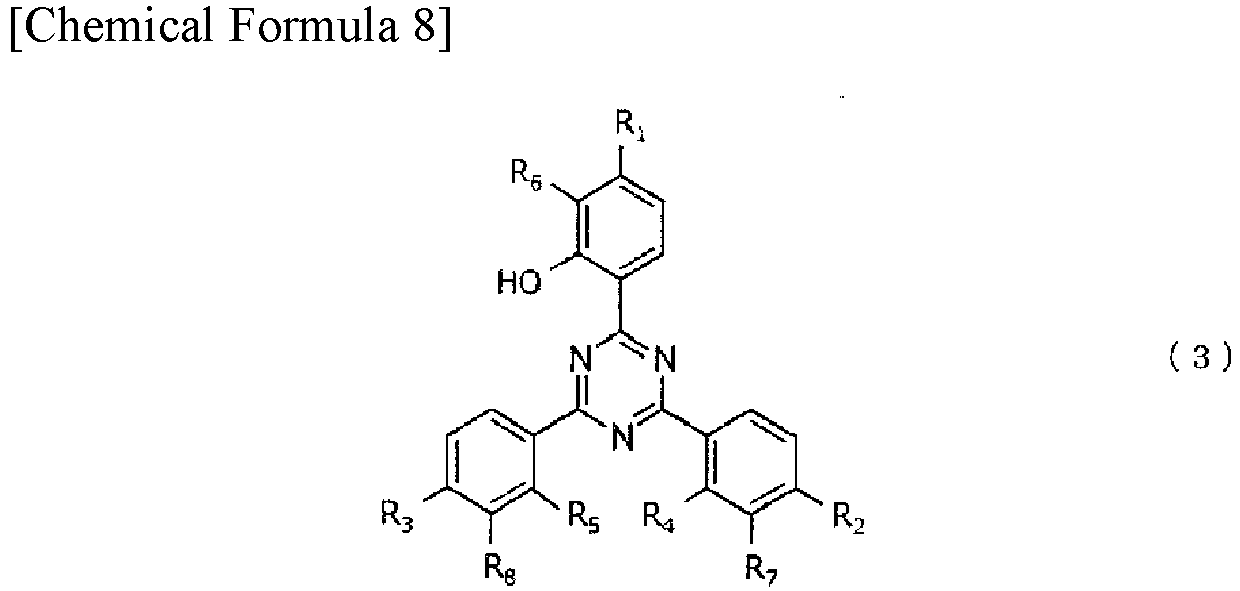
- In general formula (3), R1 and R2 represent an alkoxy group having 8-18 carbon atoms, R3 represents an alkoxy group having 1-4 carbon atoms, R4 represents a hydroxyl group, and R5-R8 represent a hydrogen atom.


- The content of the hydroxyphenyltriazine-based ultraviolet absorber, that is, UVA-A and UVA-B, is not particularly limited, and is appropriately set according to the thickness of the transparent
polyolefin resin layer 11 and various conditions relating to theadhesive layer 20 and thesubstrate 30 described below; however, the content of the hydroxyphenyltriazine-based ultraviolet absorber is typically within a range of 0.1 parts by mass or more and 2 parts by mass or less with respect to 100 parts by mass of the olefin resin. If the content of the hydroxyphenyltriazine-based ultraviolet absorber is less than 0.1 parts by mass with respect to 100 parts by mass of the olefin resin, it may not be possible to impart a sufficient weather resistance to the transparent polyolefin resin layer. Furthermore, if the content of the hydroxyphenyltriazine-based ultraviolet absorber exceeds 2 parts by mass, white turbidity becomes very noticeable in the transparent polyolefin resin layer, and problems can sometimes occur in the design properties of the sheet, such as thedecorative sheet 40 described below, in which aprotective film 10 and asubstrate 30 are bonded together. - The transparent
polyolefin resin layer 11 may have an average absorbance of 0.5 or more in a wavelength range of 250 nm or more and 400 nm or less, and a value obtained by dividing its absorbance at 370 nm by its absorbance at 280 nm within a range of 0.20 or more and 0.9 or less. - If the average absorbance in the wavelength range of 250 nm or more and 400 nm or less is less than 0.5, discoloration of the
pattern layer 32 described below may occur, or the weather resistance of the transparentpolyolefin resin layer 11 may decrease. Furthermore, if the value obtained by dividing the absorbance at 370 nm by the absorbance at 280 nm is less than 0.20, discoloration of thepattern layer 32 may occur. Moreover, if the value obtained by dividing the absorbance at 370 nm by the absorbance at 280 nm exceeds 0.9, the weather resistance of the transparentpolyolefin resin layer 11 may decrease. - The transparent
polyolefin resin layer 11 preferably contains a hindered amine light stabilizer to improve the weather resistance, and examples of the hindered amine light stabilizer that can be used include known materials such as 2-(3,5-di-tert-butyl-4-hydroxybenzyl)-2'-n-butylmalonate bis(1,2,2,6,6-pentamethyl-4-piperidyl), bis(1,2,2,6,6-pentamethyl-4-piperidyl) sebacate, and tetrakis(2,2,6,6-tetramethyl-4-piperidyl)-1,2,3,4-butanetetracarboxylate. - The content of the hindered amine light stabilizer is preferably in a range of 0.1 parts by mass or more and 5 parts by mass or less with respect to 100 parts by mass of the transparent polyolefin resin, and more preferably in a range of 0.3 parts by mass or more and 3 parts by mass or less. If the content of the hindered amine light stabilizer is less than 0.1 parts by mass, the effect of improving the weather resistance is not sufficiently exhibited, and if the content exceeds 5 parts by mass, there is a greater possibility that the hindered amine light stabilizer will bleed out and cause a reduction in design properties or poor adhesion with the adjacent layer.
- As described above, if the protective film comprises a transparent polyolefin resin layer containing an ultraviolet absorber composed of a hydroxyphenyltriazine compound having a specific structure in a prescribed mixing ratio, it is possible to provide a protective film that includes a transparent polyolefin resin layer having a low level of white turbidity, which is a factor that impairs design properties, and that achieves both a function of protecting printed matter and a function of suppressing deterioration of the protective film itself, and a sheet using the protective film.
- The
surface protection layer 12 according to the present embodiment is a layer which is provided to impart functions such as weather resistance, scratch resistance, stain resistance, and design properties to theprotective film 10. The material forming thesurface protection layer 12 is not particularly limited, and can be appropriately selected from resin materials such as urethane-based, acrylic-based, acrylic silicone-based, fluorine-based, and epoxy-based resin materials. - The
surface protection layer 12 may contain various additives such as an ultraviolet absorber, a thermal stabilizer, a light stabilizer, an anti-blocking agent, a catalyst scavenger, a colorant, a light scattering agent, and a gloss adjuster as necessary. Examples of the ultraviolet absorber and the light stabilizer include those applied to the transparentpolyolefin resin layer 11 described above. - The method of forming the
surface protection layer 12 is not particularly limited, and thesurface protection layer 12 may be formed by applying a liquid coating of the above materials by a common method such as gravure coating, microgravure coating, comma coating, knife coating, or die coating, and then curing the liquid coating by a method suitable for the material, such as heat curing or ultraviolet curing. - Furthermore, the
surface protection layer 12 may be provided after bonding the transparentpolyolefin resin layer 11 to thesubstrate 30 described below. - The surface protection layer according to the present invention is not limited to the
surface protection layer 12 according to the embodiment described above. Thesurface protection layer 12 according to the present embodiment may, for example, include a hydroxyphenyltriazine-based ultraviolet absorber. Note that, in an embodiment in which thesurface protection layer 12 contains a hydroxyphenyltriazine-based ultraviolet absorber, the resin layer formed below thesurface protection layer 12 is not limited to a transparent polyolefin resin layer formed of a polyolefin resin, and can be any transparent resin layer. - Hereinafter, an embodiment in which a hydroxyphenyltriazine-based ultraviolet absorber is added to the
surface protection layer 12 will be described. - The
protective film 10 according to the present embodiment may include atransparent resin layer 11, and asurface protection layer 12 formed on one side of thetransparent resin layer 11, that is, above thetransparent resin layer 11. - The
surface protection layer 12 according to the present embodiment is a layer provided to impart, for example, weather resistance, scratch resistance, stain resistance, and design properties to theprotective film 10, and can be formed, for example, by applying a liquid coating of various curable resin materials to thetransparent resin layer 11, and then curing the coating. - Examples of the curable resin material include heat-curable resins which contain hydroxyl groups or epoxy groups as curing sites, and ionizing radiation-curable resins containing unsaturated double bonds; heat-curable resins are preferable from the viewpoint of the weather resistance. Ionizing radiation curing primarily uses ultraviolet rays or an electron beam. Ionizing radiation curing can have a disadvantage from the viewpoint of weather resistance in that the ultraviolet absorber which is typically included in the
surface protection layer 12 inhibits curing, which limits the type of the ultraviolet absorbers that can be used. Furthermore, electron beam curing may adversely affect the weather resistance because the electron beam penetrates deeply, and can damage the transparent resin layer below thesurface protection layer 12. - A two-component curing polyurethane resin is particularly preferable as the heat-curable resin according to the present embodiment from the viewpoint of the curing temperature. That is, the
surface protection layer 12 according to the present embodiment is preferably formed of a two-component curing polyurethane resin. The two-component curing polyurethane resin is, for example, a resin which is cured by forming urethane bonds between a polyol and a polyisocyanate. The polyol may be, for example, an acrylic polyol, a polyester polyol, a polycarbonate polyol, or the like. The polyisocyanate may be, for example, hexamethylene diisocyanate, isophorone diisocyanate, xylylene diisocyanate, hydrogenated xylene diisocyanate, diphenylmethane diisocyanate, hydrogenated diphenylmethane diisocyanate, or the like. - The
surface protection layer 12 preferably contains a hydroxyphenyltriazine-based ultraviolet absorber having a structure represented by general formula (2) below, more preferably contains an ultraviolet absorber having a structure represented by general formula (3) below, and still more preferably contains 2,4-bis[2-hydroxy-4-(2-ethylhexyloxy)phenyl)]-6-(4-methoxyphenyl)-s-triazine shown in formula (4) below.
- In general formula (2), R1-R3 each independently represent a hydrogen atom, a methyl group, a phenyl group, or an alkoxy group, and at least two of R1-R3 are an alkoxy group having 8-18 carbon atoms and not containing a carbonyl group, R4 and R5 each independently represent a hydroxyl group, a methyl group, or a hydrogen atom, and R6-R8 each independently represent a methyl group or a hydrogen atom.


- In general formula (3), R1 and R2 represent an alkoxy group having 8-18 carbon atoms, R3 represents an alkoxy group having 1-4 carbon atoms, R4 represents a hydroxyl group, and R5-R8 represent a hydrogen atom.

- The content of the hydroxyphenyltriazine-based ultraviolet absorber is not particularly limited, and is appropriately set according to the thickness of the
surface protection layer 12 and various conditions relating to theadhesive layer 20 and thesubstrate 30 described below; the content of the hydroxyphenyltriazine-based ultraviolet absorber is typically within a range of 1 part by mass or more and 20 parts by mass or less with respect to 100 parts by mass of the resin constituting thesurface protection layer 12. If the content of the hydroxyphenyltriazine-based ultraviolet absorber is less than 1 part by mass, it may not be possible to impart sufficient weather resistance to theprotective film 10. If the content of the hydroxyphenyltriazine-based ultraviolet absorber exceeds 20 parts by mass, there is a greater possibility that problems such as a reduction in the strength of thesurface protection layer 12 and bleeding of the ultraviolet absorber will occur. - The
surface protection layer 12 may contain various additives such as an ultraviolet absorber that does not correspond to the hydroxyphenyltriazine-based ultraviolet absorber mentioned above, a thermal stabilizer, a light stabilizer, an antiblocking agent, a catalyst scavenger, a colorant, a light scattering agent, and a gloss adjuster as necessary. - Examples of such an ultraviolet absorber include hydroxyphenyltriazine compounds such as 2,4-bis(2,4-dimethylphenyl)-6-(2-hydroxy-4-n-octyloxyphenyl)-s-triazine, 2,4,6-tris(2-hydroxy-4-hexyloxy-3-methylphenyl)-s-triazine, 2-[2-hydroxy-4-(2-ethylhexyloxy)phenyl]-4,6-dibiphenyl-s-triazine, and 2-[[2-hydroxy-4-[1-(2-ethylhexyloxycarbonyl)ethyloxy]phenyl]]-4,6-diphenyl-s-triazine, and benzotriazole-based ultraviolet absorbers such as 2-(5-chloro-2H-benzotriazol-2-yl)-6-tert-butyl-4-methylphenol, and 2-(5-chloro-2-benzotriazolyl)-6-tert-butyl-p-cresol.
- Examples of the light stabilizer include hindered amine light stabilizers such as 2-(3,5-di-tert-butyl-4-hydroxybenzyl)-2'-n-butylmalonate bis(1,2,2,6,6-pentamethyl-4-piperidyl), bis(1,2,2,6,6-pentamethyl-4-piperidyl) sebacate, and tetrakis(2,2,6,6-tetramethyl-4-piperidyl)-1,2,3,4-butanetetracarboxylate.
- As described above, if the protective film comprising a surface protection layer and a transparent resin layer is a protective film whose surface protection layer contains an ultraviolet absorber composed of a hydroxyphenyltriazine compound having a specific structure, it is possible to provide a protective film that includes a surface protection layer having superior weather resistance and a low level of white turbidity, which is a factor that impairs design properties, and a sheet using the protective film.
- As a second embodiment of the present invention, a configuration in which the
protective film 10 according to the first embodiment and asubstrate 30 are bonded together to form adecorative sheet 40 will be described with reference toFig. 2 . - The
decorative sheet 40 is configured by bonding theprotective film 10, which comprises asurface protection layer 12 and a transparentpolyolefin resin layer 11, that is, theprotective film 10 according to the first embodiment, to asubstrate 30 via anadhesive layer 20. Note thatFig. 2 shows adecorative sheet 40 in which the transparentpolyolefin resin layer 11 provided in theprotective film 10 and apattern layer 32 provided in thesubstrate 30 described below are bonded together via anadhesive layer 20. - The
substrate 30 comprises aprimary film 31, and apattern layer 32 provided on one side of theprimary film 31. - The
primary film 31 may be selected from, for example, paper such as tissue paper, titanium paper, and resin-impregnated paper, synthetic resins such as polyethylene, polypropylene, polybutylene, polystyrene, polycarbonate, polyester, polyamide, ethylene-vinyl acetate copolymer, polyvinyl alcohol, and acrylic resin, foams of these synthetic resins, rubber such as ethylene-propylene copolymer rubber, ethylene-propylene-diene copolymer rubber, styrene-butadiene copolymer rubber, styrene-isoprene-styrene block copolymer rubber, styrene-butadiene-styrene block copolymer rubber, and polyurethane, an organic or inorganic nonwoven fabric, synthetic paper, and metal foils such as of aluminum, iron, gold, and silver. - In order to supplement the adhesion of the
primary film 31 with an adjacent layer, for example, one or both surfaces of theprimary film 31 may be provided with a primer layer (not shown), and a surface treatment such as corona treatment, plasma treatment, ozone treatment, electron beam treatment, ultraviolet treatment, dichromic acid treatment may also be performed. - The
pattern layer 32 is, for example, a pattern printed on theprimary film 31 using an ink. The ink used to form thepattern layer 32 may contain a binder, and the binder can be appropriately selected from, for example, nitrocellulose, cellulose, vinyl chloride-vinyl acetate copolymer, polyvinyl butyral, polyurethane, acrylic, and polyester binders, and modified products thereof. Furthermore, these may be any of aqueous, solvent, and emulsion types, and may be a one-part type or a two-component type which uses a curing agent. - Examples of the method of curing the ink used to form the
pattern layer 32 include methods that cure an ink by irradiation of ultraviolet light, an electron beam, or the like. Among these, the most typical method is the use of a urethane-based ink cured by isocyanate. - The ink used to form the
pattern layer 32 includes, in addition to these binders, various additives included in a typical ink, and examples include coloring agents such as pigments or dyes, extender pigments, solvents, and light stabilizers. Examples of highly versatile pigments include condensed azo pigments, insoluble azo pigments, quinacridone, isoindoline, anthraquinone, imidazolone, cobalt, phthalocyanine, carbon, titanium oxide, iron oxide, pearl pigments of mica, and the like. - The method of providing the
pattern layer 32 is not particularly limited, and common printing methods such as gravure printing, offset printing, screen printing, flexo printing, and inkjet printing can be used. - The method of bonding the
protective film 10 to thesubstrate 30 is not particularly limited, and it is possible to use various lamination methods such as heat lamination, extrusion lamination, dry lamination, and sandwich lamination via theadhesive layer 20 as necessary. - The
adhesive layer 20 is not particularly limited, and is formed using appropriately selected resin material, such as a urethane-based, acrylic-based, acrylic silicone-based, fluorine-based, or epoxy-based resin material to form an ink material, and then performing a common coating method such as gravure coating, microgravure coating, comma coating, knife coating, or die coating. - In terms of the thickness of each layer constituting the
decorative sheet 40 according to the present embodiment, it is preferable for theprimary film 31 to have a thickness of 20 µm to 150 µm in consideration of, for example, the printing workability and cost, theadhesive layer 20 to have a thickness of 0.2 µm to 20 µm, the transparentpolyolefin resin layer 11 to have a thickness of 20 µm to 200 µm, and thesurface protection layer 12 to have a thickness of 3 µm to 20 µm. Furthermore, the total thickness of thedecorative sheet 40 is preferably in the range of 45 µm to 250 µm. - Hereinafter, the present invention will be described in detail by way of Examples and Comparative Examples.
- To 100 parts by mass of a transparent homopolypropylene resin (Prime Polypro; manufactured by Prime Polymer Co., Ltd) were added 0.5 parts by mass of a light stabilizer (Tinuvin XT55; manufactured by BASF Japan Ltd.) and 0.5 parts by mass of the compound represented by formula (4) below as a hydroxyphenyltriazine-based ultraviolet absorber (TINOSORB S; manufactured by BASF Japan Ltd.), and the protective film of Example 1-1a was obtained by melt extrusion of the resulting resin composition at a thickness of 80 µm.
- A substrate was obtained by forming a pattern layer (thickness 3 µm) by gravure printing a wood grain pattern using a two-component urethane ink (V180; manufactured by Toyo Ink Co., Ltd.) on an opaque polyethylene primary film (thickness 70 µm), and the substrate was then dry laminated with the protective film of Example 1-1a via an adhesive for dry lamination (Takelac A540; manufactured by Mitsui Chemicals, Inc.) (thickness 2 µm), and further coated with a surface protection layer in the form of a two-component curing polyurethane resin layer (layer thickness 8 µm) composed of an acrylic polyol (a copolymer of methyl methacrylate and 2-hydroxymethacrylate) and a curing agent (a nurate of hexamethylene diisocyanate). This produced the decorative sheet of Example 1-1b.
- The protective film of Example 1-1c was obtained using the same method as in Example 1-1a, except for using a content of 1.5 parts by mass of the compound represented by formula (4) below (TINOSORB S; manufactured by BASF Japan Ltd.), which serves as the hydroxyphenyltriazine-based ultraviolet absorber in Example 1-1a.
- A substrate was obtained by forming a pattern layer (thickness 3 µm) by gravure printing a wood grain pattern using a two-component urethane ink (V180; manufactured by Toyo Ink Co., Ltd.) on an opaque polyethylene primary film (thickness 70 µm), and the substrate was then dry laminated with the protective film of Example 1-1c via an adhesive for dry lamination (Takelac A540; manufactured by Mitsui Chemicals, Inc.) (thickness 2 µm), and further coated with a surface protection layer in the form of a two-component curing polyurethane resin layer (layer thickness 8 µm) composed of an acrylic polyol (a copolymer of methyl methacrylate and 2-hydroxymethacrylate) and a curing agent (a nurate of hexamethylene diisocyanate). This produced the decorative sheet of Example 1-1d.
- The protective film of Comparative Example 1-1a was obtained using the same method as in Example 1-1a, except for adding 0.5 parts by mass of the compound represented by formula (9) below (ADK STAB LA-F70; manufactured by ADEKA Corp.) as the hydroxyphenyltriazine-based ultraviolet absorber of Example 1-1a.
- The decorative sheet of Comparative Example 1-1b was obtained using the same method as in Example 1-1b, except for using the protective film of Comparative Example 1-1a as the protective film of Example 1-1b.
- The protective film of Comparative Example 1-2a was obtained using the same method as in Example 1-1a, except for adding 0.5 parts by mass of the compound represented by formula (10) below (Tinuvin 1600; manufactured by BASF Japan Ltd.) as the hydroxyphenyltriazine-based ultraviolet absorber of Example 1-1a.
- The decorative sheet of Comparative Example 1-2b was obtained using the same method as in Example 1-1b, except for using the protective film of Comparative Example 1-2a as the protective film of Example 1-1b.
- The protective film of Comparative Example 1-3a was obtained using the same method as in Example 1-1a, except for adding 0.5 parts by mass of the compound represented by formula (11) below (CYASORB UV1164; manufactured by Sun Chemical Co., Ltd.) as the hydroxyphenyltriazine-based ultraviolet absorber of Example 1-1a.
- The decorative sheet of Comparative Example 1-3b was obtained using the same method as in Example 1-1b, except for using the protective film of Comparative Example 1-3a as the protective film of Example 1-1b.


- The hydroxyphenyltriazine-based ultraviolet absorbers used in the Examples and Comparative Examples have structures in which R1-R8 in general formula (12) below represent the substituents shown in Table 1 below, and of these, the compounds used in Example 1-1a and Example 1-1b correspond to hydroxyphenyltriazine-based ultraviolet absorbers as defined in the present embodiment, and are represented by general formula (1) above.

[Table 1] Substituent Examples 1-1a, 1-1b, 1-1c, and 1-1d Comparative Examples 1-1a and 1-1b Comparative Examples 1-2a and 1-2b Comparative Examples 1-3a and 1-3b TINOSORB S ADK STAB LA-F70 Tinuvin 1600 CYASORB 1164 R1 2-Ethylhexyloxy group n-Hexyloxy group 2-Ethylhexyloxy group n-Octyloxy group R2 2-Ethylhexyloxy group n-Hexyloxy group Phenyl group Methyl group R3 Methoxy group n-Hexyloxy group Phenyl group Methyl group R4 Hydroxyl group Hydroxyl group Hydrogen atom Methyl group R5 Hydrogen atom Hydroxyl group Hydrogen atom Methyl group R6 Hydrogen atom Methyl group Hydrogen atom Hydrogen atom R7 Hydrogen atom Methyl group Hydrogen atom Hydrogen atom R8 Hydrogen atom Methyl group Hydrogen atom Hydrogen atom - The design properties and weather resistance of the protective films and decorative sheets obtained in the above Examples and Comparative Examples were evaluated according to the following method. The evaluation results for the protective films and the decorative sheets are respectively shown in Table 2 and Table 3 below.
- • ΔL: The L value was used as an index of the white turbidity of the protective film. The protective film was placed on black PET (Lumirror 188X30; manufactured by Toray Industries, Inc.), and the L value was measured using a spectrophotometer (X-Rite 500 series; X-Rite Inc.). A reference film was separately prepared which was the same protective film as that of Example 1-1a except for containing no ultraviolet absorbers, the L value of the reference film was similarly measured, and the value ΔL was obtained by subtracting the L value of the protective film from the L value of the reference film. A larger ΔL value indicates more significant white turbidity compared to the reference film.
- • Visual evaluation 1: the appearance of the protective film was visually evaluated according to the following criteria.
- Good: no difference in white turbidity observed compared to reference film
Poor: significant difference in white turbidity observed compared to reference film - • Visual evaluation 2: the appearance of the protective film was visually evaluated after an accelerated weathering test according to the following criteria. The accelerated weathering test was performed using an EYE Super UV Tester (SUV-W161; Iwasaki Electric Co., Ltd.), and a total of 30 cycles carried out at a black panel temperature of 63°C and an illuminance of 65 mW/cm2, with a single cycle being 20 hours UV irradiation and 4 hours condensation.
- Good: no change in appearance of protective film
Poor: cracking observed in protective film - • Visual evaluation 3: the appearance of the decorative sheet was visually evaluated according to the following criteria.
- Good: no difference in appearance observed compared to reference sheet
Poor: white turbidity is observed compared to reference sheet
Note that the reference sheet was a separately prepared sheet which was the same decorative sheet as that of Example 1-1b except for containing no ultraviolet absorbers. - • Visual evaluation 4: the appearance of the decorative sheet was visually evaluated after an accelerated weathering test according to the following criteria. The accelerated weathering test was carried out using the same conditions as in visual evaluation 2 above.
- Good: minor pattern discoloration in decorative sheet
Poor: significant pattern discoloration observed in decorative sheet[Table 2] Ultraviolet absorber Design properties Weather resistance Product Name Structure □L Visual evaluation 1 Visual evaluation 2 Example 1-1a TINOSORB S Chemical Formula 4 -0.1 Good Good Example 1-1c TINOSORB S Chemical Formula 4 0.5 Good Good Comparative Example 1-1a ADK STAB LA-F70 Chemical Formula 9 6.9 Poor Poor Comparative Example 1-2a Tinuvin 1600 Chemical Formula 103.6 Poor Good Comparative Example 1-3a CYASORB UV-1164 Chemical Formula 11 -0.0 Good Poor [Table 3] Ultraviolet absorber Design properties Weather resistance Product Name Structure Visual evaluation 3 Visual evaluation 4 Example 1-1b TINOSORB S Chemical Formula 4 Good Good Example 1-1d TINOSORB S Chemical Formula 4 Good Good Comparative Example 1-1b ADK STAB LA-F70 Chemical Formula 9 Poor Poor Comparative Example 1-2b Tinuvin 1600 Chemical Formula 10Poor Good Comparative Example 1-3b CYASORB UV-1164 Chemical Formula 11Good Poor - As shown in Table 2 and Table 3, in the protective film and decorative sheet according to the present embodiment exemplified in Examples 1-1a to 1-1d, the application of a hydroxyphenyltriazine-based ultraviolet absorber having a specific structure to the transparent polyolefin resin layer resulted in excellent design properties due to the low level of white turbidity, and excellent weather resistance.
- A substrate was obtained by forming a pattern layer (thickness 3 µm) by gravure printing a wood grain pattern using a two-component urethane ink (V180; manufactured by Toyo Ink Co., Ltd.) on an opaque polyethylene primary film (thickness 70 µm), and a transparent resin layer, that is to say, a transparent polyolefin resin layer, was formed on the substrate by extrusion laminating the resin composition described below with a thickness of 80 µm via an adhesive for dry lamination (Takelac A540; manufactured by Mitsui Chemicals, Inc.) (thickness 2 µm). This was further coated with a surface protection layer in the form of a two-component curing polyurethane resin layer (layer thickness 8 µm) composed of an acrylic polyol (a copolymer of methyl methacrylate and 2-hydroxymethacrylate) and a curing agent (a nurate of hexamethylene diisocyanate), thereby producing the decorative sheet of Example 2-1.
-
- Transparent homopolypropylene resin (Prime Polypro; manufactured by Prime Polymer Co., Ltd.)
··· 99 parts by mass - Light stabilizer (Tinuvin XT55; manufactured by BASF Japan Ltd.)
··· 0.5 parts by mass - UVA-A(TINOSORB S (see formula (4) below), BASF Japan Ltd.)
··· 0.075 parts by mass - UVA-B (CYASORB 1164; (see formula (6) below), Sun Chemical Co., Ltd.)
··· 0.175 parts by mass - Mass ratio (UVA-A/UVA-B) = 30/70
- Note that the content of UVA-A, UVA-B were each calculated as parts by mass with respect to 99 parts by mass of the transparent homopolypropylene resin and 0.5 parts by mass of the light stabilizer.
- The decorative sheet of Example 2-2 was obtained using the same method as in Example 2-1, except for using a UVA-A content of 0.125 parts by mass and a UVA-B content of 0.125 parts by mass (UVA-A/UVA-B = 50/50) in the resin composition of Example 2-1.
- The decorative sheet of Example 2-3 was obtained using the same method as in Example 2-1, except for using a UVA-A content of 0.175 parts by mass and a UVA-B content of 0.075 parts by mass (UVA-A/UVA-B = 70/30) in the resin composition of Example 2-1.
- The decorative sheet of Example 2-4 was obtained using the same method as in Example 2-1, except for using a UVA-A content of 0.085 parts by mass and a UVA-B content of 0.085 parts by mass (UVA-A/UVA-B = 50/50) in the resin composition of Example 2-1.
- The decorative sheet of Comparative Example 2-1 was obtained using the same method as in Example 2-1, except for using a UVA-A content of 0.025 parts by mass and a UVA-B content of 0.225 parts by mass (UVA-A/UVA-B = 10/90) in the resin composition of Example 2-1.
- The decorative sheet of Comparative Example 2-2 was obtained using the same method as in Example 2-1, except for using a UVA-A content of 0.225 parts by mass and a UVA-B content of 0.025 parts by mass (UVA-A/UVA-B = 90/10) in the resin composition of Example 2-1.
- The decorative sheet of Comparative Example 2-3 was obtained using the same method as in Example 2-1, except for substituting UVA-A with ADK STAB LA-F70 (see formula (9) below, ADEKA Corp.), using a content of 0.085 parts by mass of the substituted resin, and a UVA-B content of 0.195 parts by mass in the resin composition of Example 2-1. Note that neither UVA-A nor UVA-B correspond to formula (9) below.
- The content of ADK STAB LA-F70 was calculated as parts by mass with respect to 99 parts by mass of the transparent homopolypropylene resin and 0.5 parts by mass of the light stabilizer.
- The decorative sheet of Comparative Example 2-4 was obtained using the same method as in Example 2-1, except for using a UVA-A content of 0.140 parts by mass, and substituting UVA-B with Tinuvin 1600 (see formula (10) below, BASF Japan Ltd.), and using 0.100 parts by mass of the substituted resin in the resin composition of Example 2-1. Note that neither UVA-A nor UVA-B correspond to formula (10) below.
- Note that the content of Tinuvin 1600 was calculated as parts by mass with respect to 99 parts by mass of the transparent homopolypropylene resin and 0.5 parts by mass of the light stabilizer.


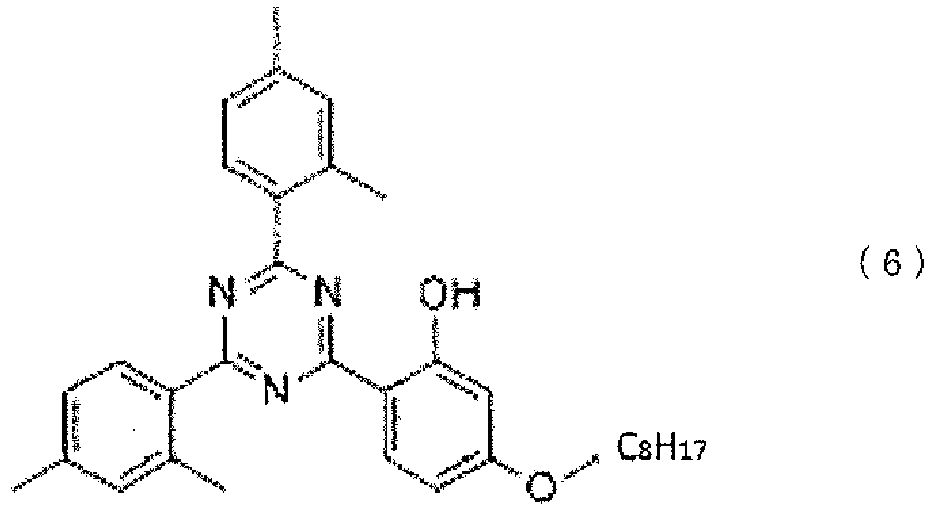


- The ultraviolet absorbers included in the transparent resin layers of the above Examples and Comparative Examples are shown in Table 4 below. The "average absorbance" shown in Table 4 indicates the average absorbance in a wavelength region of 250 nm to 400 nm. Further, the value "A370/A280" shown in Table 4 indicates the value obtained by dividing the absorbance of the transparent resin layer at 370 nm by the absorbance at 280 nm.
- The design properties and weather resistance of the decorative sheets obtained in the above Examples and Comparative Examples were evaluated according to the following method. The evaluation results are shown in Table 4.
- The appearance of the decorative sheet was visually evaluated according to the following criteria. Note that the reference sheet was a separately prepared sheet which was the same decorative sheet as that of Example 2-1 except for containing no ultraviolet absorbers.
Good: no difference in appearance observed compared to the reference sheet
Poor: white turbidity is observed compared to the reference sheet - The appearance of the decorative sheet after the accelerated weathering test was visually observed, and discoloration of the pattern and the change in appearance of the protective film were evaluated according to the following criteria. Note that the accelerated weathering test was performed using an EYE Super UV Tester (SUV-W161; Iwasaki Electric Co., Ltd.), and a total of 30 cycles carried out at a black panel temperature of 63°C and an illuminance of 65 mW/cm2, with a single cycle being 20 hours UV irradiation and 4 hours condensation.
- The evaluation was made according to three levels 3, 2, and 1, with 3 being the largest level of discoloration.
- Good: no difference in appearance observed
Fair: cracking of transparent resin layer observed (minor)
Poor: cracking of transparent resin layer observed (major)[Table 4] UVA-A UVA-B Other ultraviolet absorber UVA-A/B Average absorbance 2
A370/A280 3Design properties Weather resistance Type Content 1Type Content 1Type Content 1Pattern discoloration Change in appearance of protective film Example 2-1 TINOSORB S 0.075 CYASORB 1164 0.175 None 30/70 0.58 0.26 Good 2 Good Example 2-2 TINOSORB S 0.125 CYASORB 1164 0.125 None 50/50 0.58 0.43 Good 1 Good Example 2-3 TINOSORB S 0.175 CYASORB 1164 0.075 None 70/30 0.59 0.66 Good 1 Good Example 2-4 TINOSORB S 0.085 CYASORB 1164 0.085 None 50/50 0.40 0.43 Good 2 Fair Comparative Example 2-1 TINOSORB S 0.025 CYASORB 1164 0.225 None 10/90 0.58 0.15 Good 3 Good Comparative Example 2-2 TINOSORB S 0.225 CYASORB 1164 0.025 None 90/10 0.59 1.04 Good 1 Poor Comparative Example 2-3 None CYASORB 1164 0.195 ADK STAB LA-F70 0.085 - 0.59 0.27 Poor 2 Good Comparative Example 2-4 TINOSORB S 0.140 None Tinuvin 1600 0.100 - 0.60 0.99 Poor 1 Fair 1 Parts by mass with respect to 99 parts by mass of the transparent homopolypropylene resin and 0.5 parts by mass of the light stabilizer
2 250-400 nm
3 A value obtained by dividing the absorbance of the transparent resin layer at 370 nm by the absorbance at 280 nm - As shown in Table 4, the decorative sheet according to the present embodiment exemplified in the Examples had excellent design properties due to the low level of white turbidity, and excellent weather resistance.
- A substrate was obtained by forming a pattern layer (thickness 3 µm) by gravure printing a wood grain pattern using a two-component urethane ink (V180; manufactured by Toyo Ink Co., Ltd.) on an opaque polyethylene primary film (thickness 70 µm), and the transparent resin layer composition described below was extrusion laminated with a thickness of 80 µm via an adhesive for dry lamination (Takelac A540; manufactured by Mitsui Chemicals, Inc.) (thickness 2 µm). Further, the surface protection layer composition below was coated and dried on the transparent resin layer by gravure coating, and cured at 25°C for 3 days, thereby producing the decorative sheet of Example 3-1.
-
- Transparent homopolypropylene resin (Prime Polypro; manufactured by Prime Polymer Co., Ltd.)
··· 99 parts by mass - Ultraviolet absorber (Tinuvin 326; manufactured by BASF Japan Ltd.)
··· 0.5 parts by mass - Light stabilizer (Tinuvin XT55; manufactured by BASF Japan Ltd.)
··· 0.5 parts by mass -
- Base resin (methyl methacrylate/2-hydroxyethyl methacrylate=95/5 copolymer)
··· 90 parts by mass - Ultraviolet absorber (TINOSORB S (formula (4) below)); manufactured by BASF Japan Ltd.)
··· 9 parts by mass - Light stabilizer (Tinuvin 123; manufactured by BASF Japan Ltd.)
··· 1 part by mass - Curing agent (Takenate D-170; Mitsui Chemicals, Inc.) . 10 parts by mass
- Solvent (ethyl acetate) ··· 240 parts by mass
- The decorative sheet of Comparative Example 3-1 was obtained using the same method as in Example 3-1, except for using the compound shown in formula (9) below (ADK STAB LA-F70; manufactured by ADEKA Corp.) as the ultraviolet absorber in the surface protection layer composition of Example 3-1.
- The decorative sheet of Comparative Example 3-2 was obtained using the same method as in Example 3-1, except for using the compound shown in formula (8) below (Tinuvin 400; manufactured by BASF Japan Ltd.) as the ultraviolet absorber in the surface protection layer composition of Example 3-1.
- The decorative sheet of Comparative Example 3-3 was obtained using the same method as in Example 3-1, except for using the compound shown in formula (13) below (Tinuvin 477; manufactured by BASF Japan Ltd.) as the ultraviolet absorber in the surface protection layer composition of Example 3-1.
- The decorative sheet of Comparative Example 3-4 was obtained using the same method as in Example 3-1, except for using the compound shown in formula (14) below (Tinuvin 479; manufactured by BASF Japan Ltd.) as the ultraviolet absorber in the surface protection layer composition of Example 3-1.


- The hydroxyphenyltriazine-based ultraviolet absorbers used in the Examples and Comparative Examples have structures in which R1-R8 in general formula (12) below represent the substituents shown in Table 5 below, and of these, the compound used in Example 3-1 corresponds to a hydroxyphenyltriazine-based ultraviolet absorber as defined in the present embodiment, and is represented by general formula (1) above.
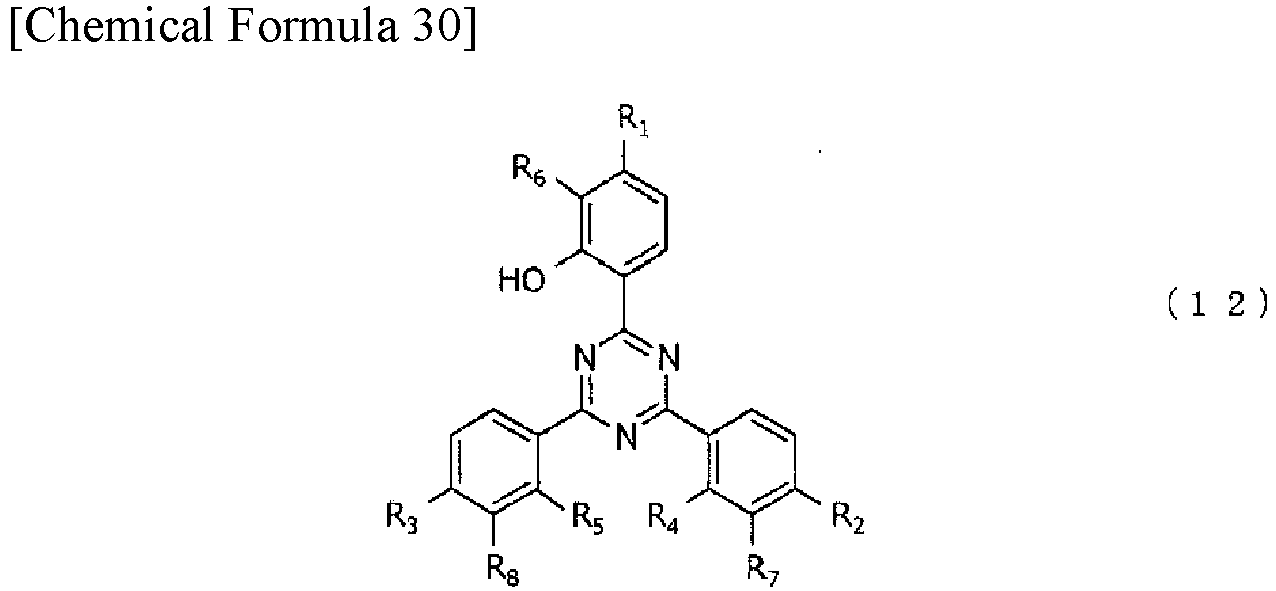
[Table 5] Substituent Example 3-1 Comparative Example 3-1 Comparative Example 3-2 Comparative Example 3-3 Comparative Example 3-4 TINOSORB S ADK STAB LA-F70 Tinuvin 400 Tinuvin 477 Tinuvin 479 R1 2-Ethylhexyloxy group n-Hexyloxy group 2-Hydroxy-3-tridecyloxypropyloxy group or 2-hydroxy-3-dodecyloxypropyloxy group 1 -Octyloxycarbonylethoxy group 1-Isooctyloxycarbonylethoxy group R2 2-Ethylhexyloxy group n-Hexyloxy group Methyl group 1 -Octyloxycarbonylethoxy group Phenyl group R3 Methoxy group n-Hexyloxy group Methyl group 1 -Octyloxycarbonylethoxy group Phenyl group R4 Hydroxyl group Hydroxyl group Methyl group Hydroxy group Hydrogen atom R5 Hydrogen atom Hydroxyl group Methyl group Hydroxy group Hydrogen atom R6 Hydrogen atom Methyl group Hydrogen atom Hydrogen atom Hydrogen atom R7 Hydrogen atom Methyl group Hydrogen atom Hydrogen atom Hydrogen atom R8 Hydrogen atom Methyl group Hydrogen atom Hydrogen atom Hydrogen atom - The design properties and weather resistance of the decorative sheets obtained in the above Examples and Comparative Examples were evaluated according to the following method. The evaluation results are shown in Table 6.
- The appearance of the decorative sheet was visually evaluated according to the following criteria. Note that the reference sheet was a separately prepared sheet which was the same decorative sheet as that of Example 3-1 except for containing no ultraviolet absorbers.
Good: no difference in appearance observed compared to the reference sheet
Poor: white turbidity is observed compared to the reference sheet - The appearance of the decorative sheets was visually observed after an accelerated weathering test, and the sheets were ranked 4, 3, 2, or 1 in order of the largest pattern discoloration. The accelerated weathering test was performed using an EYE Super UV Tester (SUV-W161; Iwasaki Electric Co., Ltd.), and a total of 30 cycles carried out at a black panel temperature of 63°C and an illuminance of 65 mW/cm2, with a single cycle being 20 hours UV irradiation and 4 hours condensation. If the evaluation of the weather resistance was "1" or "2", the specimen was taken as acceptable because there was no problem associated with its use.
[Table 6] Ultraviolet absorber Design properties Weather resistance Example 3-1 TINOSORB S Good 1 Comparative Example 3-1 ADK STAB LA-F70 Poor 2 Comparative Example 3-2 Tinuvin 400 Good 4 Comparative Example 3-3 Tinuvin 477 Good 3 Comparative Example 3-4 Tinuvin 479 Good 3 - As shown in Table 6, in the decorative sheet according to the present embodiment exemplified in Example 3-1, the application of a hydroxyphenyltriazine-based ultraviolet absorber having a specific structure to the surface protection layer resulted in excellent design properties due to the low level of white turbidity, and excellent weather resistance.
- In addition to decorative sheets and sheets used outdoors such as posters and signs, the present invention can be used as sheets used indoors, such as surface materials for joinery and floor materials.
-
- 10 Protective film
- 11 Transparent polyolefin resin layer (transparent resin layer)
- 12 Surface protection layer
- 20 Adhesive layer
- 30 Substrate
- 31 Primary film
- 32 Pattern layer
- 40 Decorative sheet
Claims (16)
- A protective film comprising at least a transparent polyolefin resin layer, wherein
the transparent polyolefin resin layer contains a first hydroxyphenyltriazine-based ultraviolet absorber (UVA-A) having a structure represented by general formula (1) below.
- The protective film according to claim 1, wherein
the protective film further includes a surface protection layer formed on the transparent polyolefin resin layer. - The protective film according to claim 2, wherein
the ultraviolet absorber (UVA-A) has a structure represented by general formula (2) below.

- The protective film according to any one of claims 1 to 3, wherein
the ultraviolet absorber (UVA-A) has a structure represented by formula (3) below.
- The protective film according to any one of claims 1 to 4, wherein
the transparent polyolefin resin layer further includes a second hydroxyphenyltriazine-based ultraviolet absorber (UVA-B) having a structure represented by general formula (4) below, and
the content of the first hydroxyphenyltriazine-based ultraviolet absorber (UVA-A) and the second hydroxyphenyltriazine-based ultraviolet absorber (UVA-B) is in a range of 20/80 to 80/20 as a mass ratio (UVA-A/UVA-B) of the first hydroxyphenyltriazine-based ultraviolet absorber (UVA-A) and the second hydroxyphenyltriazine-based ultraviolet absorber (UVA-B).

- The protective film according to claim 5, wherein
the transparent polyolefin resin layer has an average absorbance of 0.5 or more in a wavelength range of 250 nm or more and 400 nm or less, and a value obtained by dividing an absorbance of the transparent polyolefin resin layer at 370 nm by an absorbance of the transparent polyolefin resin layer at 280 nm is within a range of 0.20 or more and 0.9 or less. - The protective film according to claim 5 or 6, wherein
the ultraviolet absorber (UVA-B) has a structure represented by formula (5) below.
- The protective film according to any one of claims 1 to 7, wherein
the transparent polyolefin resin layer further includes a hindered amine light stabilizer. - A protective film comprising at least a surface protection layer and a transparent resin layer formed below the surface protection layer, wherein
the surface protection layer contains a hydroxyphenyltriazine-based ultraviolet absorber having a structure represented by general formula (6) below.
- The protective film according to claim 9, wherein
the surface protection layer is formed of a two-component curing polyurethane resin. - The protective film according to claim 9 or 10, wherein
the ultraviolet absorber has a structure represented by general formula (2) below.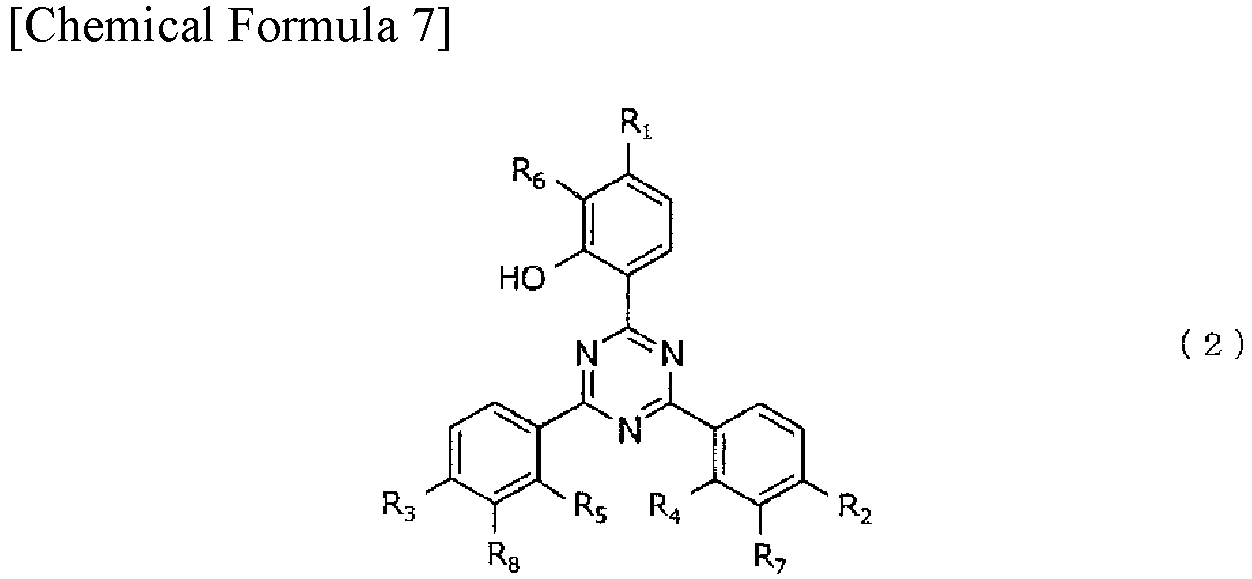
- The protective film according to any one of claims 9 to 11, wherein
the ultraviolet absorber has a structure represented by formula (3) below.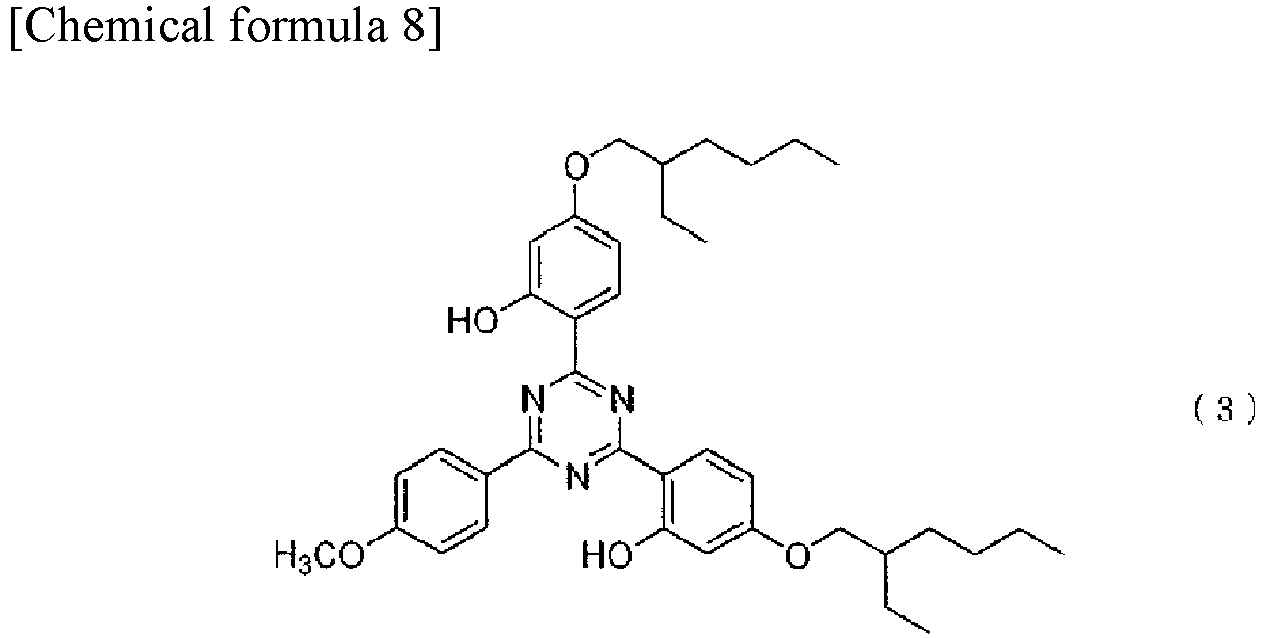
- The protective film according to any one of claims 9 to 12, wherein
the transparent resin layer is a transparent polyolefin resin layer formed of a polyolefin resin, and
the transparent polyolefin resin layer (11) contains a first hydroxyphenyltriazine-based ultraviolet absorber (UVA-A) having a structure represented by general formula (1) below.
- The protective film according to claim 13, wherein
the ultraviolet absorber (UVA-A) has a structure represented by general formula (2) below.
- The protective film according to claim 13 or 14, wherein
the ultraviolet absorber (UVA-A) has a structure represented by formula (3) below.
- A sheet having a configuration in which a protective film according to any one of claims 1 to 15 and a substrate are bonded together.
Applications Claiming Priority (4)
| Application Number | Priority Date | Filing Date | Title |
|---|---|---|---|
| JP2018118254A JP2019218508A (en) | 2018-06-21 | 2018-06-21 | Protective film and sheet |
| JP2018118255A JP7183583B2 (en) | 2018-06-21 | 2018-06-21 | protective films and sheets |
| JP2018118256A JP7192261B2 (en) | 2018-06-21 | 2018-06-21 | protective films and sheets |
| PCT/JP2019/024540 WO2019244986A1 (en) | 2018-06-21 | 2019-06-20 | Protection film and sheet |
Publications (2)
| Publication Number | Publication Date |
|---|---|
| EP3812421A1 true EP3812421A1 (en) | 2021-04-28 |
| EP3812421A4 EP3812421A4 (en) | 2021-09-15 |
Family
ID=68983227
Family Applications (1)
| Application Number | Title | Priority Date | Filing Date |
|---|---|---|---|
| EP19821944.6A Pending EP3812421A4 (en) | 2018-06-21 | 2019-06-20 | PROTECTIVE FILM AND SHEET |
Country Status (5)
| Country | Link |
|---|---|
| US (1) | US12104043B2 (en) |
| EP (1) | EP3812421A4 (en) |
| KR (1) | KR102769555B1 (en) |
| CN (1) | CN112334530B (en) |
| WO (1) | WO2019244986A1 (en) |
Cited By (1)
| Publication number | Priority date | Publication date | Assignee | Title |
|---|---|---|---|---|
| EP3858600A4 (en) * | 2018-09-28 | 2022-06-22 | Dai Nippon Printing Co., Ltd. | Decorative sheet and decorative material using same |
Families Citing this family (2)
| Publication number | Priority date | Publication date | Assignee | Title |
|---|---|---|---|---|
| WO2020203957A1 (en) * | 2019-03-29 | 2020-10-08 | 大日本印刷株式会社 | Cosmetic sheet and cosmetic material using same, and resin composition for surface protection layer |
| CA3243705A1 (en) * | 2022-02-04 | 2023-08-10 | Louisiana-Pacific Corporation | Fire-resistant wall assembly |
Family Cites Families (35)
| Publication number | Priority date | Publication date | Assignee | Title |
|---|---|---|---|---|
| TW308601B (en) * | 1995-01-18 | 1997-06-21 | Ciba Sc Holding Ag | |
| GB2319523B (en) * | 1996-11-20 | 2000-11-08 | Ciba Sc Holding Ag | Hydroxyphenyltriazines |
| JP4070157B2 (en) * | 1997-08-29 | 2008-04-02 | 株式会社Adeka | Triazine compounds and UV absorbers |
| US6117997A (en) * | 1997-11-19 | 2000-09-12 | Ciba Specialty Chemicals Corporation | Hydroxyphenyltriazines |
| US6191199B1 (en) | 1999-05-03 | 2001-02-20 | Ciba Speciatly Chemicals Corporation | Stabilized adhesive compositions containing highly soluble, high extinction photostable hydroxyphenyl-s-triazine UV absorbers and laminated articles derived therefrom |
| JP2000326446A (en) | 1999-05-18 | 2000-11-28 | Toppan Printing Co Ltd | Decorative sheet and decorative material |
| CA2396221C (en) * | 2000-02-01 | 2010-03-23 | Ciba Specialty Chemicals Holding Inc. | Method of content protection with durable uv absorbers |
| CO5231248A1 (en) * | 2000-07-26 | 2002-12-27 | Ciba Sc Holding Ag | LOW CONSISTENCY POLYMER TRANSPARENT ITEMS |
| TWI316513B (en) * | 2001-07-02 | 2009-11-01 | Ciba Sc Holding Ag | Highly compatible hydroxyphenyltriazine uv-absorbers |
| AU2002348236A1 (en) * | 2001-12-27 | 2003-07-24 | Cytec Technology Corp. | Uv stabilized thermoplastic olefins |
| ZA200301683B (en) * | 2002-03-04 | 2004-09-06 | Ciba Sc Holding Ag | Synergistic combinations of UV absorbers for pigmented polyolefins. |
| JP4006248B2 (en) | 2002-03-13 | 2007-11-14 | スリーエム イノベイティブ プロパティズ カンパニー | Image recording medium and image display sheet |
| EP1892262A1 (en) * | 2003-05-26 | 2008-02-27 | Ciba Specialty Chemicals Holding Inc. | Highly compatible and non-migratory polymeric UV-Absorber |
| JP2007217667A (en) * | 2006-01-17 | 2007-08-30 | Sekisui Chem Co Ltd | Thermoplastic resin film, retardation film and polarizer protective film |
| KR101175511B1 (en) * | 2007-06-14 | 2012-08-20 | 가부시기가이샤 닛뽕쇼꾸바이 | Thermoplastic resin composition, molded resin articles and polarizer protecting film made by using the same, and process for production of the articles |
| JP2009006513A (en) | 2007-06-26 | 2009-01-15 | Nof Corp | Hard coat film with UV absorption |
| JP5669584B2 (en) * | 2008-03-12 | 2015-02-12 | ビーエーエスエフ ソシエタス・ヨーロピアBasf Se | Optical film for flat panel display |
| KR20120104164A (en) | 2009-08-18 | 2012-09-20 | 바스프 에스이 | An uv-stabilized photovoltaic module |
| WO2011020760A1 (en) * | 2009-08-18 | 2011-02-24 | Basf Se | Photovoltaic module with stabilized polymeric encapsulant |
| JP2011207186A (en) | 2010-03-30 | 2011-10-20 | Dainippon Printing Co Ltd | Laminated body |
| JP5975032B2 (en) * | 2011-06-30 | 2016-08-23 | Jnc株式会社 | Weatherproof laminated film |
| JP6079085B2 (en) | 2011-09-30 | 2017-02-15 | 大日本印刷株式会社 | Infrared absorbing film for exterior |
| JP5900029B2 (en) | 2012-03-06 | 2016-04-06 | Dic株式会社 | Decorative plate with uneven pattern and method for producing the same |
| EP2647664A1 (en) * | 2012-04-04 | 2013-10-09 | Cytec Technology Corp. | Method for stabilizing polyolefin films against UV degradation |
| JP2014071355A (en) | 2012-09-28 | 2014-04-21 | Dainippon Printing Co Ltd | Front plate for touch panel protection, touch panel sensor, and manufacturing method of front plate for touch panel protection |
| WO2016046300A1 (en) * | 2014-09-24 | 2016-03-31 | Solvay Specialty Polymers Italy S.P.A. | Fluoropolymer composition |
| JP6636776B2 (en) | 2014-11-11 | 2020-01-29 | 凸版印刷株式会社 | Decorative sheet and method for manufacturing decorative sheet |
| JP6789213B2 (en) * | 2015-05-12 | 2020-11-25 | 共同印刷株式会社 | Laminate for packaging with UV absorption layer |
| JP6787641B2 (en) | 2015-08-24 | 2020-11-18 | 凸版印刷株式会社 | Cosmetic sheet |
| EP3345759B1 (en) | 2015-09-04 | 2020-01-01 | Toppan Printing Co., Ltd. | Decorative sheet |
| JP6972527B2 (en) | 2016-09-30 | 2021-11-24 | 大日本印刷株式会社 | Decorative sheets, decorative resin molded products, and methods for manufacturing these |
| JP6402952B2 (en) | 2017-03-24 | 2018-10-10 | 東レフィルム加工株式会社 | UV curable resin layer |
| CN107118481A (en) * | 2017-05-18 | 2017-09-01 | 佛山市金冠高科新材料有限公司 | A kind of outdoor section bar composite protection film and preparation method thereof |
| JP7193227B2 (en) * | 2017-09-06 | 2022-12-20 | 日東電工株式会社 | Adhesive composition for organic EL display device, adhesive layer for organic EL display device, polarizing film with adhesive layer for organic EL display device, and organic EL display device |
| JP7659962B2 (en) * | 2017-12-21 | 2025-04-10 | 日東電工株式会社 | Adhesive sheet with release film |
-
2019
- 2019-06-20 CN CN201980041048.8A patent/CN112334530B/en active Active
- 2019-06-20 EP EP19821944.6A patent/EP3812421A4/en active Pending
- 2019-06-20 KR KR1020217001525A patent/KR102769555B1/en active Active
- 2019-06-20 WO PCT/JP2019/024540 patent/WO2019244986A1/en not_active Ceased
-
2020
- 2020-12-15 US US17/122,804 patent/US12104043B2/en active Active
Cited By (1)
| Publication number | Priority date | Publication date | Assignee | Title |
|---|---|---|---|---|
| EP3858600A4 (en) * | 2018-09-28 | 2022-06-22 | Dai Nippon Printing Co., Ltd. | Decorative sheet and decorative material using same |
Also Published As
| Publication number | Publication date |
|---|---|
| KR20210021541A (en) | 2021-02-26 |
| CN112334530A (en) | 2021-02-05 |
| WO2019244986A1 (en) | 2019-12-26 |
| KR102769555B1 (en) | 2025-02-19 |
| CN112334530B (en) | 2023-12-12 |
| US20210095096A1 (en) | 2021-04-01 |
| US12104043B2 (en) | 2024-10-01 |
| EP3812421A4 (en) | 2021-09-15 |
Similar Documents
| Publication | Publication Date | Title |
|---|---|---|
| JP7009784B2 (en) | Resin molded body and decorative sheet | |
| US11021598B2 (en) | Resin molded product, laminate, and decorative sheet | |
| JP7823688B2 (en) | Laminate and decorative sheet | |
| US12104043B2 (en) | Protective film and sheet | |
| JP7544229B2 (en) | Laminate and decorative sheet using same | |
| JP7459920B2 (en) | Protective films and sheets | |
| JP7322487B2 (en) | protective films and sheets | |
| JP7192261B2 (en) | protective films and sheets | |
| JP7501005B2 (en) | Decorative sheet | |
| JP7183583B2 (en) | protective films and sheets | |
| JP2023079757A (en) | makeup sheet | |
| JP2019218508A (en) | Protective film and sheet | |
| JP7559866B2 (en) | Resin Molding | |
| JP2025067534A (en) | Decorative sheet and method for producing the same | |
| JP2025067535A (en) | Decorative sheet and method for producing the same | |
| JP2025067533A (en) | Decorative sheet and method for producing the same | |
| JP7222194B2 (en) | protective films and sheets | |
| JP2025007929A (en) | Laminate | |
| JP2022009296A (en) | Resin molding and decorative sheet | |
| JP2017124502A (en) | Decorative sheet |
Legal Events
| Date | Code | Title | Description |
|---|---|---|---|
| STAA | Information on the status of an ep patent application or granted ep patent |
Free format text: STATUS: THE INTERNATIONAL PUBLICATION HAS BEEN MADE |
|
| PUAI | Public reference made under article 153(3) epc to a published international application that has entered the european phase |
Free format text: ORIGINAL CODE: 0009012 |
|
| STAA | Information on the status of an ep patent application or granted ep patent |
Free format text: STATUS: REQUEST FOR EXAMINATION WAS MADE |
|
| 17P | Request for examination filed |
Effective date: 20201217 |
|
| AK | Designated contracting states |
Kind code of ref document: A1 Designated state(s): AL AT BE BG CH CY CZ DE DK EE ES FI FR GB GR HR HU IE IS IT LI LT LU LV MC MK MT NL NO PL PT RO RS SE SI SK SM TR |
|
| AX | Request for extension of the european patent |
Extension state: BA ME |
|
| A4 | Supplementary search report drawn up and despatched |
Effective date: 20210818 |
|
| RIC1 | Information provided on ipc code assigned before grant |
Ipc: C09K 3/00 20060101ALI20210812BHEP Ipc: C08K 5/3492 20060101ALI20210812BHEP Ipc: C08J 5/18 20060101ALI20210812BHEP Ipc: B32B 27/18 20060101ALI20210812BHEP Ipc: C08L 23/00 20060101AFI20210812BHEP |
|
| DAV | Request for validation of the european patent (deleted) | ||
| DAX | Request for extension of the european patent (deleted) | ||
| STAA | Information on the status of an ep patent application or granted ep patent |
Free format text: STATUS: EXAMINATION IS IN PROGRESS |
|
| 17Q | First examination report despatched |
Effective date: 20241129 |