EP3812240B1 - Structure for mounting and fixing damper unit in steering wheel, and steering wheel - Google Patents
Structure for mounting and fixing damper unit in steering wheel, and steering wheel Download PDFInfo
- Publication number
- EP3812240B1 EP3812240B1 EP19826157.0A EP19826157A EP3812240B1 EP 3812240 B1 EP3812240 B1 EP 3812240B1 EP 19826157 A EP19826157 A EP 19826157A EP 3812240 B1 EP3812240 B1 EP 3812240B1
- Authority
- EP
- European Patent Office
- Prior art keywords
- steering wheel
- mounting
- damper unit
- pin
- groove part
- Prior art date
- Legal status (The legal status is an assumption and is not a legal conclusion. Google has not performed a legal analysis and makes no representation as to the accuracy of the status listed.)
- Active
Links
Images



Classifications
-
- B—PERFORMING OPERATIONS; TRANSPORTING
- B62—LAND VEHICLES FOR TRAVELLING OTHERWISE THAN ON RAILS
- B62D—MOTOR VEHICLES; TRAILERS
- B62D1/00—Steering controls, i.e. means for initiating a change of direction of the vehicle
- B62D1/02—Steering controls, i.e. means for initiating a change of direction of the vehicle vehicle-mounted
- B62D1/04—Hand wheels
-
- B—PERFORMING OPERATIONS; TRANSPORTING
- B62—LAND VEHICLES FOR TRAVELLING OTHERWISE THAN ON RAILS
- B62D—MOTOR VEHICLES; TRAILERS
- B62D1/00—Steering controls, i.e. means for initiating a change of direction of the vehicle
- B62D1/02—Steering controls, i.e. means for initiating a change of direction of the vehicle vehicle-mounted
- B62D1/04—Hand wheels
- B62D1/10—Hubs; Connecting hubs to steering columns, e.g. adjustable
-
- B—PERFORMING OPERATIONS; TRANSPORTING
- B60—VEHICLES IN GENERAL
- B60Q—ARRANGEMENT OF SIGNALLING OR LIGHTING DEVICES, THE MOUNTING OR SUPPORTING THEREOF OR CIRCUITS THEREFOR, FOR VEHICLES IN GENERAL
- B60Q5/00—Arrangement or adaptation of acoustic signal devices
- B60Q5/001—Switches therefor
- B60Q5/003—Switches therefor mounted on the steering wheel
-
- B—PERFORMING OPERATIONS; TRANSPORTING
- B60—VEHICLES IN GENERAL
- B60R—VEHICLES, VEHICLE FITTINGS, OR VEHICLE PARTS, NOT OTHERWISE PROVIDED FOR
- B60R21/00—Arrangements or fittings on vehicles for protecting or preventing injuries to occupants or pedestrians in case of accidents or other traffic risks
- B60R21/02—Occupant safety arrangements or fittings, e.g. crash pads
- B60R21/16—Inflatable occupant restraints or confinements designed to inflate upon impact or impending impact, e.g. air bags
- B60R21/20—Arrangements for storing inflatable members in their non-use or deflated condition; Arrangement or mounting of air bag modules or components
- B60R21/203—Arrangements for storing inflatable members in their non-use or deflated condition; Arrangement or mounting of air bag modules or components in steering wheels or steering columns
- B60R21/2035—Arrangements for storing inflatable members in their non-use or deflated condition; Arrangement or mounting of air bag modules or components in steering wheels or steering columns using modules containing inflator, bag and cover attachable to the steering wheel as a complete sub-unit
- B60R21/2037—Arrangements for storing inflatable members in their non-use or deflated condition; Arrangement or mounting of air bag modules or components in steering wheels or steering columns using modules containing inflator, bag and cover attachable to the steering wheel as a complete sub-unit the module or a major component thereof being yieldably mounted, e.g. for actuating the horn switch or for protecting the driver in a non-deployment situation
-
- B—PERFORMING OPERATIONS; TRANSPORTING
- B62—LAND VEHICLES FOR TRAVELLING OTHERWISE THAN ON RAILS
- B62D—MOTOR VEHICLES; TRAILERS
- B62D7/00—Steering linkage; Stub axles or their mountings
- B62D7/22—Arrangements for reducing or eliminating reaction, e.g. vibration, from parts, e.g. wheels, of the steering system
-
- B—PERFORMING OPERATIONS; TRANSPORTING
- B62—LAND VEHICLES FOR TRAVELLING OTHERWISE THAN ON RAILS
- B62D—MOTOR VEHICLES; TRAILERS
- B62D7/00—Steering linkage; Stub axles or their mountings
- B62D7/22—Arrangements for reducing or eliminating reaction, e.g. vibration, from parts, e.g. wheels, of the steering system
- B62D7/222—Arrangements for reducing or eliminating reaction, e.g. vibration, from parts, e.g. wheels, of the steering system acting on the steering wheel
Definitions
- the present invention is related to a mounting and securing structure for the damper unit in a steering wheel, and a steering wheel thereof, that enables a mounting pin member to be mounted and secured to the supporting part, can reduce noise and improve durability, and can improve vibration damping of the steering wheel by ensuring appropriate transmission of vibration to the airbag module, and that further has a simple structure and is easy to mount.
- Patent Document 1 regarding a technology having a configuration in which a damper unit that damps vibration of a steering wheel is assembled between the steering wheel and an airbag module functioning as a damper mass.
- the horn switch mechanism is provided with a securing pin that is secured to the core of the steering wheel main body as well as a support member that retractably supports the bag holder with respect to the core, and a movable attachment member as an insulating part that is interposed as electrical insulation between the securing pin and bag holder.
- the horn switch mechanism is provided with a compression coil spring as a biasing member that biases the bag holder away from the cored bar, and a contact terminal as a movable side contact part that moves with the bag holder.
- the contact terminals make contact with the securing pins and conduct based on movement of the bag holder toward the core side against the bias force of compression coil spring, activating the horn mechanism of the vehicle.
- Patent Document 1 Japanese Unexamined Patent Application 2010-69935 .
- Generic JP 2001 233 159 A shows a mounting and securing structure for the damper unit of a steering wheel designed to incorporate a damper unit that dampens the vibrations of the steering wheel between the steering wheel and the airbag module as the damper mass by mounting and securing a mounting pin member for the damper unit to a supporting part of either the steering wheel or the airbag module.
- the mounting and securing structure comprises a collar member that is formed in a hollow cylindrical shape with an opening for inserting the mounting pin member on one end in the length direction, a positioning groove part positioned on the collar member formed in a direction in the length direction, a locking groove part formed on the mounting pin member and positioned on the positioning groove part, and a spring member provided on the supporting part inserted through the positioning groove part.
- Damper units which dampen the vibration of the steering wheel, are normally integrated between the airbag module, which serves as the damper mass, and the steering wheel, and connect the steering wheel and the airbag module.
- Damper units are provided with mounting pin members for this connection.
- the mounting pin member is mounted and secured to a support part of either the steering wheel or the airbag module. As a result, the steering wheel and the airbag module are connected by the damper unit.
- the mounting pin member itself vibrates in the damper unit after mounting to the support part and adversely affects vibration transmission from the steering wheel to the airbag module, which causes problems in that the vibration damping of the steering wheel cannot be ensured as designed, or abnormal sound is generated due to vibration.
- the present invention was conceived in light of the conventional issues described above, and an object thereof is to provide a mounting and securing structure for the damper unit in a steering wheel, and a steering wheel thereof, that enables a mounting pin member to be mounted and secured to the supporting part, can reduce noise and improve durability, and can improve vibration damping of the steering wheel by ensuring appropriate transmission of vibration to the airbag module, and that further has a simple structure and is easy to mount.
- the mounting and securing structure for the damper unit of the steering wheel is designed to incorporate a damper unit that dampens the vibrations of the steering wheel between the steering wheel and the airbag module, as the damper mass, by mounting and securing a mounting pin member for the damper unit to the supporting part of either the steering wheel or the airbag module, and is composed of a collar member that is formed in a hollow cylindrical shape with an opening for inserting the mounting pin member on one end in the length direction, a seat part where the insertion side tip of the mounting pin member is seated provided on the other end in the length direction of the collar member, a positioning groove part positioned on the collar member between the seat part and the opening and formed so as to intersect the length direction, a locking groove part formed on the mounting pin member and positioned on the positioning groove part when the insertion side tip is seated in the seat part, and a spring member provided on the supporting part inserted through the positioning groove part that is elastically locked by the locking groove part when the insertion side tip is seated in the seat
- the seat part is preferably composed of a plurality of lever pieces protruding in a cantilevered manner from an inner circumferential surface of the collar member having a hollow cylindrical shape.
- the seat part preferably includes a grip that grips the insertion side tip of the mounting pin member.
- the steering wheel according to the present invention is provided with a mounting and securing structure for the damper unit for the steering wheel.
- the mounting pin member is prevented from moving (vibrating) between the steering wheel and the airbag module, and the steering wheel can be stably mounted and secured to the support unit, noise reduction and durability can be improved, and the vibration damping effect of the steering wheel can be improved based on ensuring appropriate vibration transmission to the airbag module, and furthermore, a simple configuration and excellent mounting workability can be exhibited.
- FIG. 1 is a diagram illustrating an overview of a steering wheel 1 to which the mounting and securing structure for the damper unit in the steering wheel is applied according to the present invention.
- FIG. 1 (a) illustrates the entirety of the steering wheel 1. Note that in the following drawings including FIG. 1 (a) , each direction is illustrated under the assumption that the steering position of the steering wheel 1 mounted in the vehicle is in a neutral position. For example, for the Z-axis, the direction towards the vehicle front wheels of the steering column (steering shaft, not shown) is down and the direction toward the steering wheel 1 is up.
- the X axis is set from the 9 o'clock direction (left direction) toward the 3 o'clock direction (right direction), while the Y axis is set from the 6 o'clock direction (rear direction) toward the 12 o'clock direction (forward direction), with the 12 o'clock position of an analog 12-hour clock as the front side of the vehicle.
- a side viewed from a side of a driver is referred to as a front side, and an opposite side thereof is referred to as a back side.
- the steering wheel 1 is installed at the driver seat of a vehicle so as to be connected to the steering shaft that passes through the steering column (not shown) and transmits the operating force of the driver to a steering gear or the like.
- An airbag module 2 that functions as a front airbag in an emergency is mounted in the center of the steering wheel 1. This airbag module 2 also functions as a horn switch that a driver pushes to sound the horn during normal times.
- FIG. 1 (b) is an exploded view where the airbag module 2 has been removed from the steering wheel 1 in FIG. 1 (a) .
- the airbag module 2 on the side of the driver is covered with a resin horn cover 3 which functions as a design surface.
- a box-shaped housing 4 is provided below the horn cover 3, such that an airbag cushion (not shown) is folded and stowed thereinside so as to be expanded and deployed in the event of an emergency.
- An inflator (not shown in the drawings) is also provided within the housing 4.
- an inflating gas is supplied from the inflator 6 to the airbag cushion, and the airbag cushion tears open the horn cover 3 to be unfolded and expand in the vehicle compartment to restrain the driver.
- the base part of the steering wheel 1 is composed of a cored bar member 5 made of metal.
- the cored bar member 5 is primarily configured to include a central boss region 6, a circular rim 7 that a driver grips, and spokes 8 that connect the boss region 6 and the rim 7.
- a shaft hole 9 connected to a steering shaft is provided in the boss region 6.
- the airbag module 2 of the present embodiment functions as a horn switch as described above and further as a module damper mechanism that dampens vibrations. Configurational elements that realize the function as the horn switch and the module damper mechanism will be described below.
- the airbag module 2 has a plurality of damper units 10 arranged in the housing 4.
- the damper unit 10 is a member that elastically attaches the housing 4 to the cored bar member 5 and is central to the module damper mechanism.
- a rod-shaped mounting pin member 11 protrudes from the damper unit 10 toward the boss region 6 of the cored bar member 5 positioned in the lower Z-axis region (see FIG. 3 ).
- This pin 11 is inserted into a hole 13 formed on the cored bar member 5 via a collar member 12 attached to the cored bar member 5, and is connected to a shaft-shaped spring 14 installed on a back surface 5a of the cored bar member 5.
- the pin 11 is inserted into the cored bar member 5 through a horn spring 15 and the collar member 12.
- the horn spring 15 is coiled and is installed between the airbag module 2 and the cored bar member 5 to provide a gap between them.
- the airbag module 2 released from being pushed down by the driver during a horn operation is separated from the cored bar member 5 to return to the original position thereof.
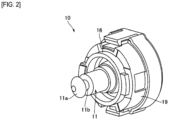
- the damper unit 10 is provided in a manner surrounding an inner sleeve 16 between the inner sleeve 16 and an annular piece 17 locked by an annular sheet 16a formed on the inner sleeve 16 and an annular flange 16b formed outwardly on the inner sleeve 16 in a position facing the annular sheet 16a, is composed of a ring-shaped elastic body 18 and an annular outer sleeve 19 provided covering the exterior of the elastic body 18, where the inside of the inner sleeve 16 is configured such that pins 11 of the damper unit 10 are inserted in a freely sliding manner in the inner sleeve 16.
- the outer sleeve 19 is attached to a through hole 20 in the housing 4 composed of the airbag module 2, which secures the damper unit 10 to the airbag module 2.
- the airbag module 2 provided with the damper unit 10 is connected to the steering wheel 1 by mounting and securing the pin 11 to the cored bar member 5, as described below.
- the airbag module 2 is provided so as to be moveable toward the steering wheel 1 side by means of a pin 11 on the steering wheel 1 side being slidably inserted into the inner sleeve 16 of the damper unit 10.
- the airbag module 2 is elastically supported by the damper unit 10 equipped with the elastic body 18 and is slidably connected to the steering wheel 1 via the pin 11.
- the vibration of the steering wheel 1 is transmitted to the damper unit 10 via the pin 11, and the transmitted vibration is dampened in the damper unit 10 that uses the airbag module 2 as the damper mass.
- the pin 11 is formed of a metal material having electrical conductivity and has a horn switch first contact 21 at one end located on the side of the housing 4.
- the housing 4 is provided with a second contact 22 arranged facing the first contact 21 in the expanding and contracting direction (Z-axis direction) of the horn spring 15.
- the present embodiment is a case in which the damper unit 10 installed on the airbag module 2 side is mounted and secured to the support part of the steering wheel 1 by the mounting pin member 11 of the damper unit 10.
- the cored bar member 5 of the steering wheel 1 is considered to be the support part.
- the present invention includes a configuration in which a damper unit 10 installed on the steering wheel 1 side is mounted and secured to a support part (such as the housing 4) of the airbag module 2 by the mounting pin member 11 of the damper unit 10.
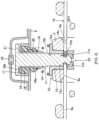
- FIG. 3 is a cross-section view illustrating the mounting and securing structure.
- FIG. 4 is a cross-sectional view taken along the F-F line in FIG.3 .
- FIG. 5 is an explanatory diagram describing the collar member 12 used in the mounting and securing structure for the damper unit in FIG. 3 .
- FIG. 5 (a) is a perspective view of the collar member 12, and
- FIG. 5 (b) is a side cross-sectional view of the same.
- a hole 13 for inserting the pin 11 from the front side toward the back side is formed through the cored bar member 5.
- the collar member 12 is detachably fitted and secured in the hole 13.
- the collar member 12 may be formed from any material, and as an example can be formed using a synthetic resin material.
- the collar member 12 is formed into a hollow cylindrical shape in which an annular flange 12a is provided at one end in the length direction.
- the collar member 12 is secured to the hole 13 by the flange 12a being pressed against the front side of the cored bar member 5.
- the flange 12a also serves as a spring seat for the horn spring 15.
- the collar member 12 has a circular opening 12b for inserting a pin 11 into that collar member 12 at one end in the length direction where the flange 12a is formed.
- the collar member 12 is formed in a truncated cone shape in the length direction (Z-axis direction), such that the outer diameter dimension and the inner diameter dimension successively narrow in order from one end with the opening 12b toward the other end.
- the collar member 12 is firmly fitted and secured in the hole 13 when pressed from the front side of the cored bar member 5 toward the back side.
- a seat part 23 is provided at the other end of the collar member 12 in the length direction, where the insertion side tip 11a of the pin 11, which is passed inwardly into the collar member 12, is seated.
- the seat part 23 is provided by integrally forming the collar member 12.
- the seat part 23 is integrally formed by resin molding.
- “Seated” preferably refers to a state in which the insertion side tip 11a of the pin 11 and the seat part 23 come into contact with each other when the pin 11 is passed toward the collar member 12.
- “Seated” further means to include a non-contact state such that there is a slight gap between the insertion side tip 11a and the collar member 12 and is not limited to a state of contact.
- the pin 11 is provided with a damper unit 10 on one end side in the length direction where the first contact 21 is formed, and the other end in the length direction protruding from the damper unit 10 is the insertion side tip 11a.
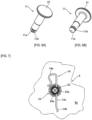
- FIG. 6 is an explanatory diagram describing the mounting pin member used in the mounting and securing structure for the damper unit illustrated in FIG. 3 and FIG. 4 , where FIG. 6 (a) is an oblique view viewed obliquely from above and FIG. 6 (b) is an oblique view viewed obliquely from below.
- the insertion side tip 11a is formed in a cone-shape, and an annular locking groove part 11b is formed on the first contact 21 positioned at a positioning groove part 12d described below when the insertion side tip 11a is seated in the seat part 23.
- the pin 11 is inserted into the collar member 12 to a depth where the insertion side tip 11a reaches the seat part 23.
- the seat part 23 is formed so as to substantially block the other end of the collar member 12.
- the seat part 23 is composed of a plurality of lever pieces 23a. Each lever piece 23a is cantilevered protruding from the inner surface 12c of the collar member 12 towards the central axis C (see FIG. 5(b) ) along the length direction of the collar member 12.
- the lever piece 23a when assuming a wall that blocks the other end of the collar member 12, is demarcated and formed by a small hole formed in a central position of a wall and a plurality of slits extending radially from this small hole toward the inner circumferential surface 12c of the collar member 12.
- the lever piece 23a is formed so that the protruding end of the collar member 12 on the side of the central axis C is elastically deformable in the length direction of the collar member 12 with the inner circumferential surface 12c position of the collar member 12 as the supporting end (see arrow b in FIG. 5 (b) ).
- four lever pieces 23a are provided with the same shape and size, but the number of levers is not restricted.
- the seat part 23 is provided with a grip 23b that grips the insertion side tip 11a of the pin 11.
- the grip 23b is formed to slightly lift from the seat part 21 to the opening 12b side to enclose the insertion side tip 11a of the cone-shaped pin 11.
- the seat part 23 is formed by a plurality of levers 23a, and the grip 23b is formed slightly rising to the protruding end of the lever piece 23a toward the opening 12b.
- the grip 23b of the lever piece 23a elastically clamps and grips and retains the cone-shaped insertion side tip 11a and surrounding area with the elastic righting action of the lever piece 23a elastically deformed by the insertion side tip 11a of the pin 11 seated in the seat part 23.
- the positioning groove part 12d is formed in the collar member 12 at a position on the back side of the cored bar member 5.
- the positioning groove part 12d is formed in a lateral orientation that intersects the length direction of the collar member 12 between the seat part 23 and the opening 12b of the collar member 12.
- the positioning groove part 12d is formed so as to appear to be substantially half the circumference of the outer circumferential surface of the collar member 12.
- the positioning groove part 12d has a groove width dimension G (dimension in the direction along the length direction of the collar member 12) set to a groove width dimension that is the same as or greater than the outer diameter dimension of the axially-shaped spring member 14 described below.
- the outer diameter dimension (diameter) of the spring member 14 is 2 mm
- the groove width dimension G is 2.9 mm.
- the positioning groove part 12d is integrally formed by resin molding as long as the collar member 12 is made of a synthetic resin, and is integrally formed in the collar member 12 even in the case of other materials, and therefore, the groove width G is formed with a high degree of precision.
- an axially-shaped spring member 14 is inserted into the positioning groove part 12d.
- the spring member 14 has a base end 14a formed in an R shape so as to define a surface on one end side in the length direction, and has an insertion end 14b formed by bending slightly on the other end side in the length direction, and a straight part 14c between the insertion end 14b and the base end 14a.
- the spring member 14 When assuming a flat surface, the spring member 14 is molded without twisting the axis of the spring member 14 so that the entirety from the base end 14a to the insertion end 14b via the straight part 14c lies flat on the flat surface.
- the insertion end 14b extends in the outward direction of the collar member 12 through the positioning groove part 12d in the lateral direction intersecting the length direction of the collar member 12 and contacts the back surface 5a of the cored bar member 5, and the base end 14a contacts the back surface 5a of the cored bar member 5 which is outside the collar member 12.
- the straight part 14c of the spring member 14 is supported at both ends so as to be elastically deformable by the base end 14a and the insertion end 14b that are in contact with the cored bar member 5, and is installed in the positioning groove part 12d in an inserted state.
- the spring member 14 When the pin 11 is inserted into the collar member 12 and the insertion side tip 11a is seated in the seat part 23, the spring member 14 is inserted into the positioning groove part 12d from the outside of the collar member 12. The spring member 14 is elastically and disengagably locked to hold the pin 11 against the locking groove part 11b of the pin 11 and the seat 23, thereby retaining the pin 11 in the collar member 12.
- the spring member 14 may be arranged in the positioning groove part 12d in advance prior to inserting the pin 11 into the collar member 12.
- the back side of the cored bar member 5 is formed in a way in which the spring member 14 is sandwiched between the flange 12a side of the collar member 12 and the seat part 23 side in the length direction (Z-axis direction) of the collar member 12.
- the spring member 14, when engaged in the locking groove part 11b of the pin 11, is preferably held in place by the elastic force of the horn spring 15 to contact the back side of the cored bar member 5 on the flange portion 12a side and a gap D1 is created between the spring member and the back side of the cored bar member 5 on the seat part 23 side.
- the groove width of the locking groove part 11b (the length direction dimension of the pin 11 being the same as the length direction of the collar member 12) can be set larger than the outer diameter dimension of the spring member 14, and is preferably set such that the spring member 14 contacts with the seat part 23 side of the locking groove part 11b and creates a gap D2 on the flange 12a side of the locking groove part 11b.
- the pin 11 is then set to the airbag module 2 side.
- the horn spring 15 is installed so as to surround the pin 11.
- the insertion side tip 11a of the pin 11 of the damper unit 10 mounted to the airbag module 2 is inserted into the opening 12b of the collar member 12 while in contact with the horn spring 15 of the flange 12 of the collar member 12.
- the pin 11 is inserted toward the seat part 23 of the collar member 12, and the insertion side tip 11a is seated in the seat part 23.
- the spring member 14 that has been previously inserted into the positioning groove part 12d so as to protrude toward the inside of the collar member 12 is pressed along the inclined portion of the cone-shaped insertion side tip 11a accompanying insertion into the collar member 12 of the pin 11, and is elastically deformed toward the outside of the positioning groove part 12d.
- the spring member 14 recovers elastically and is fitted into and locked into the locking groove part 11b of the pin 11, and the pin 11 is set inside the collar member 12 (in a so-called "snap-in" assembly method).
- the spring member 14 is inserted through the positioning groove part 12d on the back side of the cored bar member 5 and is locked into the locking groove part 11b.
- the insertion side tip 11a of the pin 11 is held by the seat part 23 along the length direction of the collar member 12, and the locking groove part 11b is retained by the locking of the spring member 14.
- the pin 11 is biased toward the airbag module 2 in the length direction (Z-axis direction) of the pin 11 through the damper unit 10 by the horn spring 15, and at the same time, is retained by the collar member 12 resisting the elastic biasing force of the horn spring 15 from the spring member 14, such that in a state of rest, the pin 11 can be retained against the collar member 12 without any looseness. Moreover, even if vibration is applied due to transmission of vibration between the cored bar member 5 and the airbag module 2, the spring member 14 and the horn spring 15 can suppress vibration (movement) of the pin 11 in the length direction (Z-axis direction) of the collar member 12.
- the groove width G dimension of the positioning groove part 12d can be adjusted to the outer diameter of the spring member 14 with high dimensional accuracy by integrally forming with resin molding or the like, the spring member 14, which engages the locking groove part 11b, is restricted from moving inside the positioning groove part 12d.
- the pin 11 is permitted to move in the length direction of the collar member 12 slightly, preventing excessive fixation intensity, and allowing for favorable disassemble workability to be ensured.
- the seat part 23 is integrally molded with the collar member 12 by resin molding or the like, thus preventing noise.
- the seat part 23 is composed of a plurality of lever pieces 23a, the movement of the pin 11 can be elastically absorbed.
- the insertion side tip 11a can be stably seated with respect to the seat part 23, and unnecessary movement of the pin 11 inside the collar member 12 can be restricted.
- the mounting pin member 11 can be mounted and secured to the cored bar member 5 with no looseness, and therefore, allows for efforts in improving noise reduction and durability. This ensures appropriate vibration transmission to the damper unit 10 and also to the airbag module 2 via the mounting pin member 11, significantly improving the vibration damping of the steering wheel 1.
- the elasticity of the spring member 14 is used to separate the spring member 14 from the locking groove part 11b and release the spring member 14 from the positioning groove part 12d. After removing the spring member 14, the pin 11 can be pulled out of the collar member 12 and the disassembly operation can be completed simply by pulling the airbag module 2 away from the cored bar member 5.
- the component structure is exceedingly simple, being composed simply by including a collar member 12 made with a synthetic resin suitable for molding, which can be formed by resin molding to integrally include the opening 12b, seat part 23, and positioning groove part 12d, for example, forming the locking groove part 11b on the pin 11, and including the spring member 14 to be locked in the locking groove part 11b. Therefore, mounting and disassembly work with these components is also simple, and can be done with the insertion and extraction of the pin 11 in the collar member 12 and the attachment and detachment of the spring member 14 to the positioning groove part 12d. This enables ensuring superior mounting workability and disassembly workability.
Landscapes
- Engineering & Computer Science (AREA)
- Mechanical Engineering (AREA)
- Chemical & Material Sciences (AREA)
- Combustion & Propulsion (AREA)
- Transportation (AREA)
- Physics & Mathematics (AREA)
- Acoustics & Sound (AREA)
- Air Bags (AREA)
- Steering Controls (AREA)
Description
- The present invention is related to a mounting and securing structure for the damper unit in a steering wheel, and a steering wheel thereof, that enables a mounting pin member to be mounted and secured to the supporting part, can reduce noise and improve durability, and can improve vibration damping of the steering wheel by ensuring appropriate transmission of vibration to the airbag module, and that further has a simple structure and is easy to mount.
- In the known art, Patent Document 1 is known, regarding a technology having a configuration in which a damper unit that damps vibration of a steering wheel is assembled between the steering wheel and an airbag module functioning as a damper mass.
- In the "steering wheel with airbag device" of the patent document 1, the horn switch mechanism is provided with a securing pin that is secured to the core of the steering wheel main body as well as a support member that retractably supports the bag holder with respect to the core, and a movable attachment member as an insulating part that is interposed as electrical insulation between the securing pin and bag holder. In addition, the horn switch mechanism is provided with a compression coil spring as a biasing member that biases the bag holder away from the cored bar, and a contact terminal as a movable side contact part that moves with the bag holder. Furthermore, the contact terminals make contact with the securing pins and conduct based on movement of the bag holder toward the core side against the bias force of compression coil spring, activating the horn mechanism of the vehicle.
- Patent Document 1:
Japanese Unexamined Patent Application 2010-69935 - Generic
JP 2001 233 159 A - Damper units, which dampen the vibration of the steering wheel, are normally integrated between the airbag module, which serves as the damper mass, and the steering wheel, and connect the steering wheel and the airbag module.
- Damper units are provided with mounting pin members for this connection. The mounting pin member is mounted and secured to a support part of either the steering wheel or the airbag module. As a result, the steering wheel and the airbag module are connected by the damper unit.
- The mounting pin member itself vibrates in the damper unit after mounting to the support part and adversely affects vibration transmission from the steering wheel to the airbag module, which causes problems in that the vibration damping of the steering wheel cannot be ensured as designed, or abnormal sound is generated due to vibration.
- The present invention was conceived in light of the conventional issues described above, and an object thereof is to provide a mounting and securing structure for the damper unit in a steering wheel, and a steering wheel thereof, that enables a mounting pin member to be mounted and secured to the supporting part, can reduce noise and improve durability, and can improve vibration damping of the steering wheel by ensuring appropriate transmission of vibration to the airbag module, and that further has a simple structure and is easy to mount.
- The mounting and securing structure for the damper unit of the steering wheel according to the present invention is designed to incorporate a damper unit that dampens the vibrations of the steering wheel between the steering wheel and the airbag module, as the damper mass, by mounting and securing a mounting pin member for the damper unit to the supporting part of either the steering wheel or the airbag module, and is composed of a collar member that is formed in a hollow cylindrical shape with an opening for inserting the mounting pin member on one end in the length direction, a seat part where the insertion side tip of the mounting pin member is seated provided on the other end in the length direction of the collar member, a positioning groove part positioned on the collar member between the seat part and the opening and formed so as to intersect the length direction, a locking groove part formed on the mounting pin member and positioned on the positioning groove part when the insertion side tip is seated in the seat part, and a spring member provided on the supporting part inserted through the positioning groove part that is elastically locked by the locking groove part when the insertion side tip is seated in the seat part and retains the mounting pin member.
- The seat part is preferably composed of a plurality of lever pieces protruding in a cantilevered manner from an inner circumferential surface of the collar member having a hollow cylindrical shape.
- The seat part preferably includes a grip that grips the insertion side tip of the mounting pin member.
- The steering wheel according to the present invention is provided with a mounting and securing structure for the damper unit for the steering wheel.
- In the mounting and securing structure for the damper unit in the steering wheel and steering wheel according to the present invention, the mounting pin member is prevented from moving (vibrating) between the steering wheel and the airbag module, and the steering wheel can be stably mounted and secured to the support unit, noise reduction and durability can be improved, and the vibration damping effect of the steering wheel can be improved based on ensuring appropriate vibration transmission to the airbag module, and furthermore, a simple configuration and excellent mounting workability can be exhibited.
-
-
FIG. 1 is an explanatory diagram illustrating a configuration of a steering wheel to which a mounting and securing structure for the damper unit is applied to a steering wheel according to the present invention. -
FIG. 2 is a perspective view illustrating an example of a damper unit provided on the steering wheel illustrated inFIG. 1 . -
FIG. 3 is a cross-sectional view illustrating a preferable embodiment of a mounting and securing structure for the damper unit in a steering wheel according to the present invention. -
FIG. 4 is a cross sectional view taken along the F-F line inFIG. 3 . -
FIG. 5 is an explanatory diagram describing a collar member used in the mounting and securing structure for the damper unit illustrated inFIG. 3 . -
FIG. 6 is an explanatory diagram describing the mounting pin member used in the mounting and securing structure for the damper unit illustrated inFIG. 3 . -
FIG. 7 is an explanatory diagram describing a state in which a spring member is installed on the cored bar member and is used in the mounting and securing structure for the damper unit illustrated inFIG. 3 . - Hereinafter, preferred embodiments of a mounting and securing structure for the damper unit on a steering wheel and the steering wheel according to the present invention will be described in detail with reference to accompanying drawings.
FIG. 1 is a diagram illustrating an overview of a steering wheel 1 to which the mounting and securing structure for the damper unit in the steering wheel is applied according to the present invention. -
FIG. 1 (a) illustrates the entirety of the steering wheel 1. Note that in the following drawings includingFIG. 1 (a) , each direction is illustrated under the assumption that the steering position of the steering wheel 1 mounted in the vehicle is in a neutral position. For example, for the Z-axis, the direction towards the vehicle front wheels of the steering column (steering shaft, not shown) is down and the direction toward the steering wheel 1 is up. - In addition, in a plane orthogonal to the Z axis, the X axis is set from the 9 o'clock direction (left direction) toward the 3 o'clock direction (right direction), while the Y axis is set from the 6 o'clock direction (rear direction) toward the 12 o'clock direction (forward direction), with the 12 o'clock position of an analog 12-hour clock as the front side of the vehicle. Alternatively, a side viewed from a side of a driver is referred to as a front side, and an opposite side thereof is referred to as a back side.
- The steering wheel 1 is installed at the driver seat of a vehicle so as to be connected to the steering shaft that passes through the steering column (not shown) and transmits the operating force of the driver to a steering gear or the like.
- An
airbag module 2 that functions as a front airbag in an emergency is mounted in the center of the steering wheel 1. Thisairbag module 2 also functions as a horn switch that a driver pushes to sound the horn during normal times. -
FIG. 1 (b) is an exploded view where theairbag module 2 has been removed from the steering wheel 1 inFIG. 1 (a) . - As illustrated in
FIG. 1 (b) , theairbag module 2 on the side of the driver is covered with aresin horn cover 3 which functions as a design surface. A box-shaped housing 4 is provided below thehorn cover 3, such that an airbag cushion (not shown) is folded and stowed thereinside so as to be expanded and deployed in the event of an emergency. An inflator (not shown in the drawings) is also provided within the housing 4. - When a signal is transmitted from a sensor of the vehicle in an emergency, an inflating gas is supplied from the
inflator 6 to the airbag cushion, and the airbag cushion tears open thehorn cover 3 to be unfolded and expand in the vehicle compartment to restrain the driver. - The base part of the steering wheel 1 is composed of a
cored bar member 5 made of metal. Thecored bar member 5 is primarily configured to include acentral boss region 6, acircular rim 7 that a driver grips, andspokes 8 that connect theboss region 6 and therim 7. A shaft hole 9 connected to a steering shaft is provided in theboss region 6. - In addition to functioning as a front airbag, the
airbag module 2 of the present embodiment functions as a horn switch as described above and further as a module damper mechanism that dampens vibrations. Configurational elements that realize the function as the horn switch and the module damper mechanism will be described below. - The
airbag module 2 has a plurality ofdamper units 10 arranged in the housing 4. Thedamper unit 10 is a member that elastically attaches the housing 4 to thecored bar member 5 and is central to the module damper mechanism. - A rod-shaped mounting pin member 11 (hereinafter referred simply as "pin") protrudes from the
damper unit 10 toward theboss region 6 of thecored bar member 5 positioned in the lower Z-axis region (seeFIG. 3 ). Thispin 11 is inserted into ahole 13 formed on thecored bar member 5 via acollar member 12 attached to thecored bar member 5, and is connected to a shaft-shaped spring 14 installed on aback surface 5a of thecored bar member 5. - This connection between the
pin 11 and thespring 14 attaches theairbag module 2 to thecored bar member 5. - As illustrated in
FIG. 3 , thepin 11 is inserted into thecored bar member 5 through ahorn spring 15 and thecollar member 12. Thehorn spring 15 is coiled and is installed between theairbag module 2 and thecored bar member 5 to provide a gap between them. Hence, theairbag module 2 released from being pushed down by the driver during a horn operation is separated from thecored bar member 5 to return to the original position thereof. - Briefly describing the
damper unit 10, as illustrated inFIG. 2 andFIG. 3 , thedamper unit 10 is provided in a manner surrounding aninner sleeve 16 between theinner sleeve 16 and anannular piece 17 locked by anannular sheet 16a formed on theinner sleeve 16 and anannular flange 16b formed outwardly on theinner sleeve 16 in a position facing theannular sheet 16a, is composed of a ring-shapedelastic body 18 and an annularouter sleeve 19 provided covering the exterior of theelastic body 18, where the inside of theinner sleeve 16 is configured such thatpins 11 of thedamper unit 10 are inserted in a freely sliding manner in theinner sleeve 16. - The
outer sleeve 19 is attached to athrough hole 20 in the housing 4 composed of theairbag module 2, which secures thedamper unit 10 to theairbag module 2. - The
airbag module 2 provided with thedamper unit 10 is connected to the steering wheel 1 by mounting and securing thepin 11 to thecored bar member 5, as described below. - The
airbag module 2 is provided so as to be moveable toward the steering wheel 1 side by means of apin 11 on the steering wheel 1 side being slidably inserted into theinner sleeve 16 of thedamper unit 10. - In other words, the
airbag module 2 is elastically supported by thedamper unit 10 equipped with theelastic body 18 and is slidably connected to the steering wheel 1 via thepin 11. - The vibration of the steering wheel 1 is transmitted to the
damper unit 10 via thepin 11, and the transmitted vibration is dampened in thedamper unit 10 that uses theairbag module 2 as the damper mass. - On the other hand, the
pin 11 is formed of a metal material having electrical conductivity and has a horn switchfirst contact 21 at one end located on the side of the housing 4. - The housing 4 is provided with a
second contact 22 arranged facing thefirst contact 21 in the expanding and contracting direction (Z-axis direction) of thehorn spring 15. - When the
airbag module 2 is pushed in toward the steering wheel 1, theinner sleeve 16 of thedamper unit 10 provided in theairbag module 2 slides relative to thepin 11, compressing thehorn spring 15. - This causes the
second contact 22 to move toward and contact thefirst contact 21, causing the horn to sound. When the push-in pressure on theairbag module 2 is released, theairbag module 2 is retracted by thehorn spring 15, and this causes thesecond contact 22 to move away from thefirst contact 21 and stops the horn from producing sound. - Next, a mounting and securing structure for the damper unit in the steering wheel according to the present embodiment and a steering wheel provided with the mounting and securing structure will be described. As illustrated in
FIG. 3 andFIG. 4 , the present embodiment is a case in which thedamper unit 10 installed on theairbag module 2 side is mounted and secured to the support part of the steering wheel 1 by the mountingpin member 11 of thedamper unit 10. In the illustrated example, the coredbar member 5 of the steering wheel 1 is considered to be the support part. - However, contrary to
FIG. 3 andFIG. 4 , the present invention includes a configuration in which adamper unit 10 installed on the steering wheel 1 side is mounted and secured to a support part (such as the housing 4) of theairbag module 2 by the mountingpin member 11 of thedamper unit 10. -
FIG. 3 is a cross-section view illustrating the mounting and securing structure.FIG. 4 is a cross-sectional view taken along the F-F line inFIG.3 .FIG. 5 is an explanatory diagram describing thecollar member 12 used in the mounting and securing structure for the damper unit inFIG. 3 .FIG. 5 (a) is a perspective view of thecollar member 12, andFIG. 5 (b) is a side cross-sectional view of the same. - A
hole 13 for inserting thepin 11 from the front side toward the back side is formed through the coredbar member 5. Thecollar member 12 is detachably fitted and secured in thehole 13. Thecollar member 12 may be formed from any material, and as an example can be formed using a synthetic resin material. As illustrated inFIG. 3 to FIG. 5 , thecollar member 12 is formed into a hollow cylindrical shape in which anannular flange 12a is provided at one end in the length direction. Thecollar member 12 is secured to thehole 13 by theflange 12a being pressed against the front side of the coredbar member 5. Theflange 12a also serves as a spring seat for thehorn spring 15. - The
collar member 12 has acircular opening 12b for inserting apin 11 into thatcollar member 12 at one end in the length direction where theflange 12a is formed. Thecollar member 12 is formed in a truncated cone shape in the length direction (Z-axis direction), such that the outer diameter dimension and the inner diameter dimension successively narrow in order from one end with the opening 12b toward the other end. By being formed as a truncated cone shape, thecollar member 12 is firmly fitted and secured in thehole 13 when pressed from the front side of the coredbar member 5 toward the back side. - A
seat part 23 is provided at the other end of thecollar member 12 in the length direction, where theinsertion side tip 11a of thepin 11, which is passed inwardly into thecollar member 12, is seated. As an example, theseat part 23 is provided by integrally forming thecollar member 12. In the case where thecollar member 12 is a synthetic resin material, theseat part 23 is integrally formed by resin molding. "Seated" preferably refers to a state in which theinsertion side tip 11a of thepin 11 and theseat part 23 come into contact with each other when thepin 11 is passed toward thecollar member 12. "Seated" further means to include a non-contact state such that there is a slight gap between theinsertion side tip 11a and thecollar member 12 and is not limited to a state of contact. - As described above, the
pin 11 is provided with adamper unit 10 on one end side in the length direction where thefirst contact 21 is formed, and the other end in the length direction protruding from thedamper unit 10 is theinsertion side tip 11a. -
FIG. 6 is an explanatory diagram describing the mounting pin member used in the mounting and securing structure for the damper unit illustrated inFIG. 3 andFIG. 4 , whereFIG. 6 (a) is an oblique view viewed obliquely from above andFIG. 6 (b) is an oblique view viewed obliquely from below. - As illustrated in
FIG. 6 , theinsertion side tip 11a is formed in a cone-shape, and an annularlocking groove part 11b is formed on thefirst contact 21 positioned at apositioning groove part 12d described below when theinsertion side tip 11a is seated in theseat part 23. - The
pin 11 is inserted into thecollar member 12 to a depth where theinsertion side tip 11a reaches theseat part 23. Theseat part 23 is formed so as to substantially block the other end of thecollar member 12. In the present embodiment, theseat part 23 is composed of a plurality oflever pieces 23a. Eachlever piece 23a is cantilevered protruding from theinner surface 12c of thecollar member 12 towards the central axis C (seeFIG. 5(b) ) along the length direction of thecollar member 12. - In other words, the
lever piece 23a, when assuming a wall that blocks the other end of thecollar member 12, is demarcated and formed by a small hole formed in a central position of a wall and a plurality of slits extending radially from this small hole toward the innercircumferential surface 12c of thecollar member 12. - The
lever piece 23a is formed so that the protruding end of thecollar member 12 on the side of the central axis C is elastically deformable in the length direction of thecollar member 12 with the innercircumferential surface 12c position of thecollar member 12 as the supporting end (see arrow b inFIG. 5 (b) ). In the illustrated example, fourlever pieces 23a are provided with the same shape and size, but the number of levers is not restricted. - The
seat part 23 is provided with a grip 23b that grips theinsertion side tip 11a of thepin 11. The grip 23b is formed to slightly lift from theseat part 21 to theopening 12b side to enclose theinsertion side tip 11a of the cone-shapedpin 11. - In the present embodiment, the
seat part 23 is formed by a plurality oflevers 23a, and the grip 23b is formed slightly rising to the protruding end of thelever piece 23a toward theopening 12b. The grip 23b of thelever piece 23a elastically clamps and grips and retains the cone-shapedinsertion side tip 11a and surrounding area with the elastic righting action of thelever piece 23a elastically deformed by theinsertion side tip 11a of thepin 11 seated in theseat part 23. - The
positioning groove part 12d is formed in thecollar member 12 at a position on the back side of the coredbar member 5. Thepositioning groove part 12d is formed in a lateral orientation that intersects the length direction of thecollar member 12 between theseat part 23 and theopening 12b of thecollar member 12. - As illustrated in
FIG. 5 , thepositioning groove part 12d is formed so as to appear to be substantially half the circumference of the outer circumferential surface of thecollar member 12. Thepositioning groove part 12d has a groove width dimension G (dimension in the direction along the length direction of the collar member 12) set to a groove width dimension that is the same as or greater than the outer diameter dimension of the axially-shapedspring member 14 described below. Specifically, for example, the outer diameter dimension (diameter) of thespring member 14 is 2 mm, and the groove width dimension G is 2.9 mm. Thepositioning groove part 12d is integrally formed by resin molding as long as thecollar member 12 is made of a synthetic resin, and is integrally formed in thecollar member 12 even in the case of other materials, and therefore, the groove width G is formed with a high degree of precision. - As illustrated in
FIG. 7 , an axially-shapedspring member 14 is inserted into thepositioning groove part 12d. Thespring member 14 has abase end 14a formed in an R shape so as to define a surface on one end side in the length direction, and has aninsertion end 14b formed by bending slightly on the other end side in the length direction, and astraight part 14c between theinsertion end 14b and thebase end 14a. - When assuming a flat surface, the
spring member 14 is molded without twisting the axis of thespring member 14 so that the entirety from thebase end 14a to theinsertion end 14b via thestraight part 14c lies flat on the flat surface. - For the
spring member 14, theinsertion end 14b extends in the outward direction of thecollar member 12 through thepositioning groove part 12d in the lateral direction intersecting the length direction of thecollar member 12 and contacts theback surface 5a of the coredbar member 5, and thebase end 14a contacts theback surface 5a of the coredbar member 5 which is outside thecollar member 12. As a result, thestraight part 14c of thespring member 14 is supported at both ends so as to be elastically deformable by thebase end 14a and theinsertion end 14b that are in contact with the coredbar member 5, and is installed in thepositioning groove part 12d in an inserted state. - When the
pin 11 is inserted into thecollar member 12 and theinsertion side tip 11a is seated in theseat part 23, thespring member 14 is inserted into thepositioning groove part 12d from the outside of thecollar member 12. Thespring member 14 is elastically and disengagably locked to hold thepin 11 against the lockinggroove part 11b of thepin 11 and theseat 23, thereby retaining thepin 11 in thecollar member 12. - The
spring member 14 may be arranged in thepositioning groove part 12d in advance prior to inserting thepin 11 into thecollar member 12. - As illustrated in
FIG. 4 , the back side of the coredbar member 5 is formed in a way in which thespring member 14 is sandwiched between theflange 12a side of thecollar member 12 and theseat part 23 side in the length direction (Z-axis direction) of thecollar member 12. Thespring member 14, when engaged in the lockinggroove part 11b of thepin 11, is preferably held in place by the elastic force of thehorn spring 15 to contact the back side of the coredbar member 5 on theflange portion 12a side and a gap D1 is created between the spring member and the back side of the coredbar member 5 on theseat part 23 side. - In addition, the groove width of the locking
groove part 11b (the length direction dimension of thepin 11 being the same as the length direction of the collar member 12) can be set larger than the outer diameter dimension of thespring member 14, and is preferably set such that thespring member 14 contacts with theseat part 23 side of the lockinggroove part 11b and creates a gap D2 on theflange 12a side of the lockinggroove part 11b. - When mounting and securing the
pin 11 of thedamper unit 10 to the coredbar member 5, first thecollar member 12 is engaged into thehole 13 of the coredbar member 5. - The
pin 11 is then set to theairbag module 2 side. Here, thehorn spring 15 is installed so as to surround thepin 11. Theinsertion side tip 11a of thepin 11 of thedamper unit 10 mounted to theairbag module 2 is inserted into theopening 12b of thecollar member 12 while in contact with thehorn spring 15 of theflange 12 of thecollar member 12. - Thereafter, while compressing the
horn spring 15, thepin 11 is inserted toward theseat part 23 of thecollar member 12, and theinsertion side tip 11a is seated in theseat part 23. - Here, the
spring member 14 that has been previously inserted into thepositioning groove part 12d so as to protrude toward the inside of thecollar member 12 is pressed along the inclined portion of the cone-shapedinsertion side tip 11a accompanying insertion into thecollar member 12 of thepin 11, and is elastically deformed toward the outside of thepositioning groove part 12d. When theinsertion side tip 11a is seated in theseat part 23, thespring member 14 recovers elastically and is fitted into and locked into the lockinggroove part 11b of thepin 11, and thepin 11 is set inside the collar member 12 (in a so-called "snap-in" assembly method). - The
spring member 14 is inserted through thepositioning groove part 12d on the back side of the coredbar member 5 and is locked into the lockinggroove part 11b. As a result, theinsertion side tip 11a of thepin 11 is held by theseat part 23 along the length direction of thecollar member 12, and the lockinggroove part 11b is retained by the locking of thespring member 14. - The
pin 11 is biased toward theairbag module 2 in the length direction (Z-axis direction) of thepin 11 through thedamper unit 10 by thehorn spring 15, and at the same time, is retained by thecollar member 12 resisting the elastic biasing force of thehorn spring 15 from thespring member 14, such that in a state of rest, thepin 11 can be retained against thecollar member 12 without any looseness. Moreover, even if vibration is applied due to transmission of vibration between the coredbar member 5 and theairbag module 2, thespring member 14 and thehorn spring 15 can suppress vibration (movement) of thepin 11 in the length direction (Z-axis direction) of thecollar member 12. - As the groove width G dimension of the
positioning groove part 12d can be adjusted to the outer diameter of thespring member 14 with high dimensional accuracy by integrally forming with resin molding or the like, thespring member 14, which engages the lockinggroove part 11b, is restricted from moving inside thepositioning groove part 12d. - Because the
spring member 14 is elastically deformable, thepin 11 is permitted to move in the length direction of thecollar member 12 slightly, preventing excessive fixation intensity, and allowing for favorable disassemble workability to be ensured. - Even if slight movement of the
pin 11 occurs based on thespring member 14, theseat part 23 is integrally molded with thecollar member 12 by resin molding or the like, thus preventing noise. - In addition, because the
seat part 23 is composed of a plurality oflever pieces 23a, the movement of thepin 11 can be elastically absorbed. - As the
seat part 23 and thelever pieces 23a are provided with the grip 23b, theinsertion side tip 11a can be stably seated with respect to theseat part 23, and unnecessary movement of thepin 11 inside thecollar member 12 can be restricted. - As described above, the mounting
pin member 11 can be mounted and secured to the coredbar member 5 with no looseness, and therefore, allows for efforts in improving noise reduction and durability. This ensures appropriate vibration transmission to thedamper unit 10 and also to theairbag module 2 via the mountingpin member 11, significantly improving the vibration damping of the steering wheel 1. - When disassembling from a mounted and secured state, the elasticity of the
spring member 14 is used to separate thespring member 14 from the lockinggroove part 11b and release thespring member 14 from thepositioning groove part 12d. After removing thespring member 14, thepin 11 can be pulled out of thecollar member 12 and the disassembly operation can be completed simply by pulling theairbag module 2 away from the coredbar member 5. - The component structure is exceedingly simple, being composed simply by including a
collar member 12 made with a synthetic resin suitable for molding, which can be formed by resin molding to integrally include theopening 12b,seat part 23, andpositioning groove part 12d, for example, forming the lockinggroove part 11b on thepin 11, and including thespring member 14 to be locked in the lockinggroove part 11b. Therefore, mounting and disassembly work with these components is also simple, and can be done with the insertion and extraction of thepin 11 in thecollar member 12 and the attachment and detachment of thespring member 14 to thepositioning groove part 12d. This enables ensuring superior mounting workability and disassembly workability. -
- 1 Steering wheel
- 2 Airbag module
- 5 Cored bar member
- 10 Damper unit
- 11 Mounting pin member (pin)
- 11a Insertion side tip
- 11b Locking groove part
- 12 Collar member
- 12b Opening
- 12c Inner surface
- 12d Positioning groove part
- 14 Spring member
- 23 Seat part
- 23a Lever piece
- 23b Grip
Claims (4)
- A mounting and securing structure for the damper unit (10) of a steering wheel (1), designed to incorporate a damper unit (10) that dampens the vibrations of the steering wheel (1) between the steering wheel (1) and the airbag module (2) as the damper mass, by mounting and securing a mounting pin member (11) for the damper unit (10) to a supporting part of either the steering wheel (1) or the airbag module (2), comprising:a collar member (12) that is formed in a hollow cylindrical shape with an opening (12b) for inserting the mounting pin member (11) on one end in the length direction,a positioning groove part (12d) positioned on the collar member (12) formed so as to intersect the length direction,a locking groove part (11b) formed on the mounting pin member (11) and positioned on the positioning groove part (12d), anda spring member (14) provided on the supporting part inserted through the positioning groove part (12d),characterized in thata seat part (23) where the insertion side tip (11a) of the mounting pin member (11) is seated is provided on the other end in the length direction of the collar member (12),the positioning groove part (12d) is positioned between the seat part (23) and the opening (12b), andthe locking groove part (11b) is positioned on the positioning groove part and the spring member (14) is elastically locked by the locking groove part (11b) and retains the mounting pin member when the insertion side tip (11a) is seated in the seat part (23).
- The mounting and securing structure for the damper unit (10) of the steering wheel (1) according to claim 1, wherein the seat part (23) comprises a plurality of lever pieces (23a) protruding cantilevered from an inner surface (12c) of the hollow cylindrical collar member (12).
- The mounting and securing structure for the damper unit (10) of the steering wheel (1) according to claims 1 or 2, wherein the seat part (23) is provided with a grip (23b) for grasping the insertion side tip (11a) of the mounting pin member (11).
- A steering wheel provided with the mounting and securing structure for the damper unit (10) for the steering wheel according to any of the claims 1 to 3.
Applications Claiming Priority (2)
| Application Number | Priority Date | Filing Date | Title |
|---|---|---|---|
| JP2018119665 | 2018-06-25 | ||
| PCT/JP2019/019042 WO2020003777A1 (en) | 2018-06-25 | 2019-05-14 | Structure for mounting and fixing damper unit in steering wheel, and steering wheel |
Publications (3)
| Publication Number | Publication Date |
|---|---|
| EP3812240A1 EP3812240A1 (en) | 2021-04-28 |
| EP3812240A4 EP3812240A4 (en) | 2022-03-16 |
| EP3812240B1 true EP3812240B1 (en) | 2024-07-24 |
Family
ID=68986312
Family Applications (1)
| Application Number | Title | Priority Date | Filing Date |
|---|---|---|---|
| EP19826157.0A Active EP3812240B1 (en) | 2018-06-25 | 2019-05-14 | Structure for mounting and fixing damper unit in steering wheel, and steering wheel |
Country Status (6)
| Country | Link |
|---|---|
| US (1) | US11383751B2 (en) |
| EP (1) | EP3812240B1 (en) |
| JP (1) | JP6968279B2 (en) |
| KR (1) | KR102497789B1 (en) |
| CN (1) | CN112351929B (en) |
| WO (1) | WO2020003777A1 (en) |
Families Citing this family (26)
| Publication number | Priority date | Publication date | Assignee | Title |
|---|---|---|---|---|
| US11718257B2 (en) * | 2016-12-15 | 2023-08-08 | Zf Passive Safety Systems Us Inc | Coupling device for mounting an airbag module to be oscillating on a vehicle steering wheel |
| EP3741648B1 (en) * | 2018-01-19 | 2024-04-24 | Autoliv Development AB | Steering wheel |
| CN110712674B (en) * | 2018-07-11 | 2022-01-25 | 奥托立夫开发公司 | Steering wheel damper mechanism and vehicle steering wheel device |
| FR3085909B1 (en) * | 2018-09-13 | 2021-05-28 | Autoliv Dev | VEHICLE STEERING WHEEL INCLUDING A HORN CONTROL DEVICE |
| KR102593661B1 (en) * | 2018-11-13 | 2023-10-25 | 현대모비스 주식회사 | Air bag device for driver |
| EP3708864B1 (en) * | 2019-03-15 | 2024-01-31 | Vibracoustic Forsheda AB | A frequency-tuned vibration damper device, a method for its manufacture, and a vibraton damper assembly including the device |
| JP7184024B2 (en) * | 2019-03-29 | 2022-12-06 | 豊田合成株式会社 | Airbag device with horn switch body |
| DE102020201752B4 (en) * | 2019-05-15 | 2022-05-19 | Joyson Safety Systems Germany Gmbh | Vibration damper system for a motor vehicle steering wheel assembly |
| CN111422241A (en) * | 2020-04-29 | 2020-07-17 | 江苏菲姆斯汽车安全系统有限公司 | Novel automobile steering wheel damping mechanism |
| CN111422240A (en) * | 2020-04-29 | 2020-07-17 | 江苏菲姆斯汽车安全系统有限公司 | A new type of steering wheel with anti-vibration function for automobiles |
| CN111619652B (en) * | 2020-07-01 | 2025-04-11 | 锦州锦恒汽车安全系统股份有限公司 | A kind of automobile steering wheel vibration reduction structure |
| CN111994032B (en) * | 2020-07-10 | 2025-12-12 | 上海东方久乐汽车安全气囊有限公司 | A positioning sleeve, a positioning and mating structure, and an automotive steering wheel assembly. |
| EP4206057A4 (en) * | 2020-08-28 | 2024-09-11 | Autoliv Development AB | Steering wheel device for vehicle |
| JP7302561B2 (en) * | 2020-09-14 | 2023-07-04 | 豊田合成株式会社 | Airbag device mounting mechanism |
| JP7286218B2 (en) * | 2020-10-06 | 2023-06-05 | オートリブ ディベロップメント エービー | Fixing structure for damper unit in steering wheel and steering wheel device for vehicle |
| KR20230093450A (en) * | 2020-10-26 | 2023-06-27 | 아우토리브 디벨롭먼트 아베 | Steering wheel and its manufacturing method |
| JP7355042B2 (en) * | 2021-01-08 | 2023-10-03 | 豊田合成株式会社 | Airbag device support structure |
| WO2022158334A1 (en) * | 2021-01-20 | 2022-07-28 | オートリブ ディベロップメント エービー | Driver seat airbag device |
| EP4309971A4 (en) * | 2021-03-19 | 2025-02-19 | Autoliv Development AB | STEERING WHEEL |
| US20240317309A1 (en) * | 2021-07-01 | 2024-09-26 | Autoliv Development Ab | Steering wheel device for vehicle |
| US11603066B2 (en) * | 2021-07-21 | 2023-03-14 | ZF Passive Safety Systems US Inc. | Vibration damper for coupling an airbag module to a vehicle steering wheel |
| JP7815561B2 (en) * | 2022-04-01 | 2026-02-18 | Joyson Safety Systems Japan合同会社 | Steering wheel |
| DE102022116493A1 (en) * | 2022-07-01 | 2024-01-04 | ZF Automotive Safety Germany GmbH | Horn module |
| KR20240033489A (en) * | 2022-09-05 | 2024-03-12 | 현대자동차주식회사 | Steering wheel and damper unit of the steering wheel |
| US12097649B2 (en) * | 2022-09-23 | 2024-09-24 | Aia Co., Ltd. | Directly injection-molded steering wheel damper and manufacturing method thereof |
| DE102022132653A1 (en) * | 2022-12-08 | 2024-06-13 | ZF Automotive Safety Germany GmbH | HORN DEVICE |
Family Cites Families (19)
| Publication number | Priority date | Publication date | Assignee | Title |
|---|---|---|---|---|
| JP2001225703A (en) * | 1999-12-07 | 2001-08-21 | Tokai Rika Co Ltd | Mounting structure of plate body on pad cover |
| JP2001233159A (en) * | 2000-02-18 | 2001-08-28 | Tokai Rika Co Ltd | Air bag device assembling structure |
| US6874808B2 (en) * | 2002-09-20 | 2005-04-05 | Delphi Technologies, Inc. | Apparatus and method for maintaining a uniform gap between an airbag module and its surrounding structure |
| JP5153526B2 (en) | 2008-02-01 | 2013-02-27 | 本田技研工業株式会社 | Steering wheel vibration reduction structure |
| JP4985598B2 (en) | 2008-09-16 | 2012-07-25 | 豊田合成株式会社 | Steering wheel with airbag device |
| KR20100069935A (en) | 2008-12-17 | 2010-06-25 | 삼성전자주식회사 | Thin film transistor array substrate and method for fabricating the same |
| JP5005019B2 (en) * | 2009-11-23 | 2012-08-22 | 本田技研工業株式会社 | Steering wheel |
| JP5746702B2 (en) * | 2010-09-09 | 2015-07-08 | 本田技研工業株式会社 | Steering wheel structure with airbag module |
| JP2013071626A (en) * | 2011-09-28 | 2013-04-22 | Toyoda Gosei Co Ltd | Vibration damping structure for steering wheel |
| JP5797770B2 (en) * | 2011-11-24 | 2015-10-21 | 本田技研工業株式会社 | Steering wheel vibration reduction structure |
| JP2014094703A (en) * | 2012-11-12 | 2014-05-22 | Autoliv Development Ab | Vibration reduction structure of steering wheel |
| WO2015098224A1 (en) * | 2013-12-27 | 2015-07-02 | 本田技研工業株式会社 | Steering wheel structure |
| JP6480930B2 (en) | 2014-06-30 | 2019-03-13 | オートリブ ディベロップメント エービー | Steering wheel vibration reduction structure |
| JP6164175B2 (en) * | 2014-07-30 | 2017-07-19 | 豊田合成株式会社 | Steering wheel |
| WO2016042850A1 (en) * | 2014-09-19 | 2016-03-24 | 本田技研工業株式会社 | Steering wheel structure |
| JP6406149B2 (en) * | 2015-07-23 | 2018-10-17 | 豊田合成株式会社 | Steering wheel |
| US10150441B2 (en) * | 2016-10-21 | 2018-12-11 | Autoliv Asp, Inc. | Dampening driver airbag assemblies and related systems and methods |
| JP6835633B2 (en) * | 2017-03-10 | 2021-02-24 | 芦森工業株式会社 | Steering handle structure |
| US11034374B2 (en) * | 2017-08-10 | 2021-06-15 | Toyoda Gosei Co., Ltd. | Steering wheel |
-
2019
- 2019-05-14 US US17/254,682 patent/US11383751B2/en active Active
- 2019-05-14 JP JP2020527263A patent/JP6968279B2/en active Active
- 2019-05-14 WO PCT/JP2019/019042 patent/WO2020003777A1/en not_active Ceased
- 2019-05-14 EP EP19826157.0A patent/EP3812240B1/en active Active
- 2019-05-14 KR KR1020217000004A patent/KR102497789B1/en active Active
- 2019-05-14 CN CN201980041080.6A patent/CN112351929B/en active Active
Also Published As
| Publication number | Publication date |
|---|---|
| US20210269080A1 (en) | 2021-09-02 |
| WO2020003777A1 (en) | 2020-01-02 |
| EP3812240A1 (en) | 2021-04-28 |
| KR20210016023A (en) | 2021-02-10 |
| EP3812240A4 (en) | 2022-03-16 |
| CN112351929B (en) | 2022-08-30 |
| JPWO2020003777A1 (en) | 2021-04-22 |
| JP6968279B2 (en) | 2021-11-17 |
| KR102497789B1 (en) | 2023-02-08 |
| US11383751B2 (en) | 2022-07-12 |
| CN112351929A (en) | 2021-02-09 |
Similar Documents
| Publication | Publication Date | Title |
|---|---|---|
| EP3812240B1 (en) | Structure for mounting and fixing damper unit in steering wheel, and steering wheel | |
| JP7094763B2 (en) | Steering wheel | |
| CN114845926B (en) | Steering wheel device for vehicle | |
| JP2011189778A (en) | Mounting section structure for airbag device | |
| US11529921B2 (en) | Steering wheel | |
| WO2020162115A1 (en) | Steering wheel | |
| JP6673752B2 (en) | handle | |
| CN116917186A (en) | steering wheel | |
| EP4365059A1 (en) | Steering wheel device for vehicle | |
| CN114750720B (en) | Support structure of air bag device | |
| US20230406252A1 (en) | Steering wheel and method of manufacturing same | |
| JP7286218B2 (en) | Fixing structure for damper unit in steering wheel and steering wheel device for vehicle | |
| US11987309B2 (en) | Steering wheel device for vehicle | |
| JP2019034596A (en) | Steering wheel | |
| JP7846772B2 (en) | Airbag module mounting structure to the steering wheel | |
| JP7607778B2 (en) | Steering Wheel | |
| JP2017065332A (en) | Automotive component | |
| EP4566914A1 (en) | Vehicle steering wheel device | |
| JP7846766B2 (en) | Airbag system installed in the steering wheel | |
| JP2015189390A (en) | steering wheel | |
| JP2015037913A (en) | Air bag device |
Legal Events
| Date | Code | Title | Description |
|---|---|---|---|
| STAA | Information on the status of an ep patent application or granted ep patent |
Free format text: STATUS: THE INTERNATIONAL PUBLICATION HAS BEEN MADE |
|
| PUAI | Public reference made under article 153(3) epc to a published international application that has entered the european phase |
Free format text: ORIGINAL CODE: 0009012 |
|
| STAA | Information on the status of an ep patent application or granted ep patent |
Free format text: STATUS: REQUEST FOR EXAMINATION WAS MADE |
|
| 17P | Request for examination filed |
Effective date: 20210107 |
|
| AK | Designated contracting states |
Kind code of ref document: A1 Designated state(s): AL AT BE BG CH CY CZ DE DK EE ES FI FR GB GR HR HU IE IS IT LI LT LU LV MC MK MT NL NO PL PT RO RS SE SI SK SM TR |
|
| AX | Request for extension of the european patent |
Extension state: BA ME |
|
| DAV | Request for validation of the european patent (deleted) | ||
| DAX | Request for extension of the european patent (deleted) | ||
| A4 | Supplementary search report drawn up and despatched |
Effective date: 20220214 |
|
| RIC1 | Information provided on ipc code assigned before grant |
Ipc: B62D 7/22 20060101ALI20220208BHEP Ipc: B60R 21/203 20060101ALI20220208BHEP Ipc: B62D 1/04 20060101AFI20220208BHEP |
|
| GRAP | Despatch of communication of intention to grant a patent |
Free format text: ORIGINAL CODE: EPIDOSNIGR1 |
|
| STAA | Information on the status of an ep patent application or granted ep patent |
Free format text: STATUS: GRANT OF PATENT IS INTENDED |
|
| INTG | Intention to grant announced |
Effective date: 20240216 |
|
| GRAS | Grant fee paid |
Free format text: ORIGINAL CODE: EPIDOSNIGR3 |
|
| GRAA | (expected) grant |
Free format text: ORIGINAL CODE: 0009210 |
|
| STAA | Information on the status of an ep patent application or granted ep patent |
Free format text: STATUS: THE PATENT HAS BEEN GRANTED |
|
| AK | Designated contracting states |
Kind code of ref document: B1 Designated state(s): AL AT BE BG CH CY CZ DE DK EE ES FI FR GB GR HR HU IE IS IT LI LT LU LV MC MK MT NL NO PL PT RO RS SE SI SK SM TR |
|
| REG | Reference to a national code |
Ref country code: GB Ref legal event code: FG4D |
|
| REG | Reference to a national code |
Ref country code: CH Ref legal event code: EP |
|
| REG | Reference to a national code |
Ref country code: IE Ref legal event code: FG4D Ref country code: DE Ref legal event code: R096 Ref document number: 602019055829 Country of ref document: DE |
|
| REG | Reference to a national code |
Ref country code: LT Ref legal event code: MG9D |
|
| REG | Reference to a national code |
Ref country code: NL Ref legal event code: MP Effective date: 20240724 |
|
| PG25 | Lapsed in a contracting state [announced via postgrant information from national office to epo] |
Ref country code: PT Free format text: LAPSE BECAUSE OF FAILURE TO SUBMIT A TRANSLATION OF THE DESCRIPTION OR TO PAY THE FEE WITHIN THE PRESCRIBED TIME-LIMIT Effective date: 20241125 |
|
| REG | Reference to a national code |
Ref country code: AT Ref legal event code: MK05 Ref document number: 1706061 Country of ref document: AT Kind code of ref document: T Effective date: 20240724 |
|
| PG25 | Lapsed in a contracting state [announced via postgrant information from national office to epo] |
Ref country code: NL Free format text: LAPSE BECAUSE OF FAILURE TO SUBMIT A TRANSLATION OF THE DESCRIPTION OR TO PAY THE FEE WITHIN THE PRESCRIBED TIME-LIMIT Effective date: 20240724 |
|
| PG25 | Lapsed in a contracting state [announced via postgrant information from national office to epo] |
Ref country code: PT Free format text: LAPSE BECAUSE OF FAILURE TO SUBMIT A TRANSLATION OF THE DESCRIPTION OR TO PAY THE FEE WITHIN THE PRESCRIBED TIME-LIMIT Effective date: 20241125 Ref country code: NL Free format text: LAPSE BECAUSE OF FAILURE TO SUBMIT A TRANSLATION OF THE DESCRIPTION OR TO PAY THE FEE WITHIN THE PRESCRIBED TIME-LIMIT Effective date: 20240724 |
|
| PG25 | Lapsed in a contracting state [announced via postgrant information from national office to epo] |
Ref country code: NO Free format text: LAPSE BECAUSE OF FAILURE TO SUBMIT A TRANSLATION OF THE DESCRIPTION OR TO PAY THE FEE WITHIN THE PRESCRIBED TIME-LIMIT Effective date: 20241024 |
|
| PG25 | Lapsed in a contracting state [announced via postgrant information from national office to epo] |
Ref country code: FI Free format text: LAPSE BECAUSE OF FAILURE TO SUBMIT A TRANSLATION OF THE DESCRIPTION OR TO PAY THE FEE WITHIN THE PRESCRIBED TIME-LIMIT Effective date: 20240724 Ref country code: GR Free format text: LAPSE BECAUSE OF FAILURE TO SUBMIT A TRANSLATION OF THE DESCRIPTION OR TO PAY THE FEE WITHIN THE PRESCRIBED TIME-LIMIT Effective date: 20241025 Ref country code: PL Free format text: LAPSE BECAUSE OF FAILURE TO SUBMIT A TRANSLATION OF THE DESCRIPTION OR TO PAY THE FEE WITHIN THE PRESCRIBED TIME-LIMIT Effective date: 20240724 |
|
| PG25 | Lapsed in a contracting state [announced via postgrant information from national office to epo] |
Ref country code: BG Free format text: LAPSE BECAUSE OF FAILURE TO SUBMIT A TRANSLATION OF THE DESCRIPTION OR TO PAY THE FEE WITHIN THE PRESCRIBED TIME-LIMIT Effective date: 20240724 |
|
| PG25 | Lapsed in a contracting state [announced via postgrant information from national office to epo] |
Ref country code: LV Free format text: LAPSE BECAUSE OF FAILURE TO SUBMIT A TRANSLATION OF THE DESCRIPTION OR TO PAY THE FEE WITHIN THE PRESCRIBED TIME-LIMIT Effective date: 20240724 |
|
| PG25 | Lapsed in a contracting state [announced via postgrant information from national office to epo] |
Ref country code: IS Free format text: LAPSE BECAUSE OF FAILURE TO SUBMIT A TRANSLATION OF THE DESCRIPTION OR TO PAY THE FEE WITHIN THE PRESCRIBED TIME-LIMIT Effective date: 20241124 Ref country code: AT Free format text: LAPSE BECAUSE OF FAILURE TO SUBMIT A TRANSLATION OF THE DESCRIPTION OR TO PAY THE FEE WITHIN THE PRESCRIBED TIME-LIMIT Effective date: 20240724 |
|
| PG25 | Lapsed in a contracting state [announced via postgrant information from national office to epo] |
Ref country code: HR Free format text: LAPSE BECAUSE OF FAILURE TO SUBMIT A TRANSLATION OF THE DESCRIPTION OR TO PAY THE FEE WITHIN THE PRESCRIBED TIME-LIMIT Effective date: 20240724 |
|
| PG25 | Lapsed in a contracting state [announced via postgrant information from national office to epo] |
Ref country code: RS Free format text: LAPSE BECAUSE OF FAILURE TO SUBMIT A TRANSLATION OF THE DESCRIPTION OR TO PAY THE FEE WITHIN THE PRESCRIBED TIME-LIMIT Effective date: 20241024 Ref country code: ES Free format text: LAPSE BECAUSE OF FAILURE TO SUBMIT A TRANSLATION OF THE DESCRIPTION OR TO PAY THE FEE WITHIN THE PRESCRIBED TIME-LIMIT Effective date: 20240724 |
|
| PG25 | Lapsed in a contracting state [announced via postgrant information from national office to epo] |
Ref country code: RS Free format text: LAPSE BECAUSE OF FAILURE TO SUBMIT A TRANSLATION OF THE DESCRIPTION OR TO PAY THE FEE WITHIN THE PRESCRIBED TIME-LIMIT Effective date: 20241024 Ref country code: PL Free format text: LAPSE BECAUSE OF FAILURE TO SUBMIT A TRANSLATION OF THE DESCRIPTION OR TO PAY THE FEE WITHIN THE PRESCRIBED TIME-LIMIT Effective date: 20240724 Ref country code: NO Free format text: LAPSE BECAUSE OF FAILURE TO SUBMIT A TRANSLATION OF THE DESCRIPTION OR TO PAY THE FEE WITHIN THE PRESCRIBED TIME-LIMIT Effective date: 20241024 Ref country code: LV Free format text: LAPSE BECAUSE OF FAILURE TO SUBMIT A TRANSLATION OF THE DESCRIPTION OR TO PAY THE FEE WITHIN THE PRESCRIBED TIME-LIMIT Effective date: 20240724 Ref country code: IS Free format text: LAPSE BECAUSE OF FAILURE TO SUBMIT A TRANSLATION OF THE DESCRIPTION OR TO PAY THE FEE WITHIN THE PRESCRIBED TIME-LIMIT Effective date: 20241124 Ref country code: HR Free format text: LAPSE BECAUSE OF FAILURE TO SUBMIT A TRANSLATION OF THE DESCRIPTION OR TO PAY THE FEE WITHIN THE PRESCRIBED TIME-LIMIT Effective date: 20240724 Ref country code: GR Free format text: LAPSE BECAUSE OF FAILURE TO SUBMIT A TRANSLATION OF THE DESCRIPTION OR TO PAY THE FEE WITHIN THE PRESCRIBED TIME-LIMIT Effective date: 20241025 Ref country code: FI Free format text: LAPSE BECAUSE OF FAILURE TO SUBMIT A TRANSLATION OF THE DESCRIPTION OR TO PAY THE FEE WITHIN THE PRESCRIBED TIME-LIMIT Effective date: 20240724 Ref country code: ES Free format text: LAPSE BECAUSE OF FAILURE TO SUBMIT A TRANSLATION OF THE DESCRIPTION OR TO PAY THE FEE WITHIN THE PRESCRIBED TIME-LIMIT Effective date: 20240724 Ref country code: BG Free format text: LAPSE BECAUSE OF FAILURE TO SUBMIT A TRANSLATION OF THE DESCRIPTION OR TO PAY THE FEE WITHIN THE PRESCRIBED TIME-LIMIT Effective date: 20240724 Ref country code: AT Free format text: LAPSE BECAUSE OF FAILURE TO SUBMIT A TRANSLATION OF THE DESCRIPTION OR TO PAY THE FEE WITHIN THE PRESCRIBED TIME-LIMIT Effective date: 20240724 |
|
| PG25 | Lapsed in a contracting state [announced via postgrant information from national office to epo] |
Ref country code: DK Free format text: LAPSE BECAUSE OF FAILURE TO SUBMIT A TRANSLATION OF THE DESCRIPTION OR TO PAY THE FEE WITHIN THE PRESCRIBED TIME-LIMIT Effective date: 20240724 Ref country code: RO Free format text: LAPSE BECAUSE OF FAILURE TO SUBMIT A TRANSLATION OF THE DESCRIPTION OR TO PAY THE FEE WITHIN THE PRESCRIBED TIME-LIMIT Effective date: 20240724 Ref country code: SM Free format text: LAPSE BECAUSE OF FAILURE TO SUBMIT A TRANSLATION OF THE DESCRIPTION OR TO PAY THE FEE WITHIN THE PRESCRIBED TIME-LIMIT Effective date: 20240724 |
|
| PG25 | Lapsed in a contracting state [announced via postgrant information from national office to epo] |
Ref country code: EE Free format text: LAPSE BECAUSE OF FAILURE TO SUBMIT A TRANSLATION OF THE DESCRIPTION OR TO PAY THE FEE WITHIN THE PRESCRIBED TIME-LIMIT Effective date: 20240724 |
|
| PG25 | Lapsed in a contracting state [announced via postgrant information from national office to epo] |
Ref country code: CZ Free format text: LAPSE BECAUSE OF FAILURE TO SUBMIT A TRANSLATION OF THE DESCRIPTION OR TO PAY THE FEE WITHIN THE PRESCRIBED TIME-LIMIT Effective date: 20240724 |
|
| REG | Reference to a national code |
Ref country code: DE Ref legal event code: R097 Ref document number: 602019055829 Country of ref document: DE |
|
| PG25 | Lapsed in a contracting state [announced via postgrant information from national office to epo] |
Ref country code: IT Free format text: LAPSE BECAUSE OF FAILURE TO SUBMIT A TRANSLATION OF THE DESCRIPTION OR TO PAY THE FEE WITHIN THE PRESCRIBED TIME-LIMIT Effective date: 20240724 Ref country code: SK Free format text: LAPSE BECAUSE OF FAILURE TO SUBMIT A TRANSLATION OF THE DESCRIPTION OR TO PAY THE FEE WITHIN THE PRESCRIBED TIME-LIMIT Effective date: 20240724 |
|
| PLBE | No opposition filed within time limit |
Free format text: ORIGINAL CODE: 0009261 |
|
| STAA | Information on the status of an ep patent application or granted ep patent |
Free format text: STATUS: NO OPPOSITION FILED WITHIN TIME LIMIT |
|
| 26N | No opposition filed |
Effective date: 20250425 |
|
| PGFP | Annual fee paid to national office [announced via postgrant information from national office to epo] |
Ref country code: DE Payment date: 20250528 Year of fee payment: 7 |
|
| PGFP | Annual fee paid to national office [announced via postgrant information from national office to epo] |
Ref country code: GB Payment date: 20250520 Year of fee payment: 7 |
|
| PGFP | Annual fee paid to national office [announced via postgrant information from national office to epo] |
Ref country code: FR Payment date: 20250526 Year of fee payment: 7 |
|
| PG25 | Lapsed in a contracting state [announced via postgrant information from national office to epo] |
Ref country code: SE Free format text: LAPSE BECAUSE OF FAILURE TO SUBMIT A TRANSLATION OF THE DESCRIPTION OR TO PAY THE FEE WITHIN THE PRESCRIBED TIME-LIMIT Effective date: 20240724 |
|
| REG | Reference to a national code |
Ref country code: CH Ref legal event code: H13 Free format text: ST27 STATUS EVENT CODE: U-0-0-H10-H13 (AS PROVIDED BY THE NATIONAL OFFICE) Effective date: 20251223 |
|
| PG25 | Lapsed in a contracting state [announced via postgrant information from national office to epo] |
Ref country code: LU Free format text: LAPSE BECAUSE OF NON-PAYMENT OF DUE FEES Effective date: 20250514 |
|
| PG25 | Lapsed in a contracting state [announced via postgrant information from national office to epo] |
Ref country code: CH Free format text: LAPSE BECAUSE OF NON-PAYMENT OF DUE FEES Effective date: 20250531 |
|
| REG | Reference to a national code |
Ref country code: BE Ref legal event code: MM Effective date: 20250531 |
|
| PG25 | Lapsed in a contracting state [announced via postgrant information from national office to epo] |
Ref country code: MC Free format text: LAPSE BECAUSE OF FAILURE TO SUBMIT A TRANSLATION OF THE DESCRIPTION OR TO PAY THE FEE WITHIN THE PRESCRIBED TIME-LIMIT Effective date: 20240724 |
|
| PG25 | Lapsed in a contracting state [announced via postgrant information from national office to epo] |
Ref country code: IE Free format text: LAPSE BECAUSE OF NON-PAYMENT OF DUE FEES Effective date: 20250514 |
|
| PG25 | Lapsed in a contracting state [announced via postgrant information from national office to epo] |
Ref country code: BE Free format text: LAPSE BECAUSE OF NON-PAYMENT OF DUE FEES Effective date: 20250531 |