EP3811280B1 - Article dual material-digital anti-forgery protection - Google Patents
Article dual material-digital anti-forgery protection Download PDFInfo
- Publication number
- EP3811280B1 EP3811280B1 EP19727046.5A EP19727046A EP3811280B1 EP 3811280 B1 EP3811280 B1 EP 3811280B1 EP 19727046 A EP19727046 A EP 19727046A EP 3811280 B1 EP3811280 B1 EP 3811280B1
- Authority
- EP
- European Patent Office
- Prior art keywords
- article
- data
- digital
- aggregated
- signature
- Prior art date
- Legal status (The legal status is an assumption and is not a legal conclusion. Google has not performed a legal analysis and makes no representation as to the accuracy of the status listed.)
- Active
Links
Images




Classifications
-
- G—PHYSICS
- G06—COMPUTING OR CALCULATING; COUNTING
- G06F—ELECTRIC DIGITAL DATA PROCESSING
- G06F16/00—Information retrieval; Database structures therefor; File system structures therefor
- G06F16/20—Information retrieval; Database structures therefor; File system structures therefor of structured data, e.g. relational data
- G06F16/22—Indexing; Data structures therefor; Storage structures
-
- G—PHYSICS
- G06—COMPUTING OR CALCULATING; COUNTING
- G06F—ELECTRIC DIGITAL DATA PROCESSING
- G06F16/00—Information retrieval; Database structures therefor; File system structures therefor
- G06F16/20—Information retrieval; Database structures therefor; File system structures therefor of structured data, e.g. relational data
- G06F16/24—Querying
- G06F16/245—Query processing
- G06F16/2455—Query execution
- G06F16/24553—Query execution of query operations
- G06F16/24554—Unary operations; Data partitioning operations
- G06F16/24556—Aggregation; Duplicate elimination
-
- G—PHYSICS
- G06—COMPUTING OR CALCULATING; COUNTING
- G06V—IMAGE OR VIDEO RECOGNITION OR UNDERSTANDING
- G06V20/00—Scenes; Scene-specific elements
- G06V20/80—Recognising image objects characterised by unique random patterns
-
- G—PHYSICS
- G06—COMPUTING OR CALCULATING; COUNTING
- G06V—IMAGE OR VIDEO RECOGNITION OR UNDERSTANDING
- G06V30/00—Character recognition; Recognising digital ink; Document-oriented image-based pattern recognition
- G06V30/40—Document-oriented image-based pattern recognition
- G06V30/41—Analysis of document content
- G06V30/418—Document matching, e.g. of document images
-
- H—ELECTRICITY
- H04—ELECTRIC COMMUNICATION TECHNIQUE
- H04L—TRANSMISSION OF DIGITAL INFORMATION, e.g. TELEGRAPHIC COMMUNICATION
- H04L9/00—Cryptographic mechanisms or cryptographic arrangements for secret or secure communications; Network security protocols
- H04L9/32—Cryptographic mechanisms or cryptographic arrangements for secret or secure communications; Network security protocols including means for verifying the identity or authority of a user of the system or for message authentication, e.g. authorization, entity authentication, data integrity or data verification, non-repudiation, key authentication or verification of credentials
- H04L9/3247—Cryptographic mechanisms or cryptographic arrangements for secret or secure communications; Network security protocols including means for verifying the identity or authority of a user of the system or for message authentication, e.g. authorization, entity authentication, data integrity or data verification, non-repudiation, key authentication or verification of credentials involving digital signatures
-
- H—ELECTRICITY
- H04—ELECTRIC COMMUNICATION TECHNIQUE
- H04L—TRANSMISSION OF DIGITAL INFORMATION, e.g. TELEGRAPHIC COMMUNICATION
- H04L9/00—Cryptographic mechanisms or cryptographic arrangements for secret or secure communications; Network security protocols
- H04L9/32—Cryptographic mechanisms or cryptographic arrangements for secret or secure communications; Network security protocols including means for verifying the identity or authority of a user of the system or for message authentication, e.g. authorization, entity authentication, data integrity or data verification, non-repudiation, key authentication or verification of credentials
- H04L9/3271—Cryptographic mechanisms or cryptographic arrangements for secret or secure communications; Network security protocols including means for verifying the identity or authority of a user of the system or for message authentication, e.g. authorization, entity authentication, data integrity or data verification, non-repudiation, key authentication or verification of credentials using challenge-response
- H04L9/3278—Cryptographic mechanisms or cryptographic arrangements for secret or secure communications; Network security protocols including means for verifying the identity or authority of a user of the system or for message authentication, e.g. authorization, entity authentication, data integrity or data verification, non-repudiation, key authentication or verification of credentials using challenge-response using physically unclonable functions [PUF]
-
- G—PHYSICS
- G06—COMPUTING OR CALCULATING; COUNTING
- G06V—IMAGE OR VIDEO RECOGNITION OR UNDERSTANDING
- G06V20/00—Scenes; Scene-specific elements
- G06V20/95—Pattern authentication; Markers therefor; Forgery detection
Definitions
- the present invention relates to the technical field of protection of articles and data marked on such articles against forgery or tampering, as well as of conformity of digital images of such marked articles with the original ones, and traceability of articles.
- a conventional way of securing an article is to apply on it a material-based security marking (possibly tamperproof), i.e. a marking having detectable intrinsic physical or chemical property that is very hard (if not impossible) to reproduce. If an appropriate sensor detects this intrinsic property on a marking, this marking is then considered as genuine with a high degree of confidence, and thus also the corresponding marked article.
- a material-based security marking possibly tamperproof
- the marking can include some particles, possibly randomly dispersed, or has a specific layered structure, having intrinsic optical reflection or transmission or absorption or even emission (luminescence, for example, or polarization or diffraction or interference...) properties, possibly detectable upon specific illumination conditions with "light" of specific spectral content.
- This intrinsic property can result from the specific chemical composition of the material of the marking: for example, luminescent pigments (possibly not commercially available) can be dispersed in an ink used for printing some pattern on the article and are used to emit specific light (for example, in a spectral window within the infrared range) upon illumination with a specific light (for example, with light in the UV spectral range). This is used for securing banknotes, for example.
- Other intrinsic properties can be used: for example, the luminescent particles in the marking can have a specific luminescence emission decay time after illumination with an appropriate excitation light pulse.
- intrinsic properties are the magnetic property of included particles, or even a "fingerprint" property of the article itself such as, for example, the relative positioning of inherently randomly dispersed fibers of a paper substrate of a document, in a given zone on the document, which, when observed at sufficient resolution, can serve to extract a unique characterizing signature, or some random printing artefacts of data printed on the article which, viewed with sufficient magnification, can also lead to a unique signature etc....
- the main problem with an inherent fingerprint property of an article is its robustness with respect to aging or wear.
- a material-based security marking does not always allow also securing data associated with the marked article: for example, even if a document is marked with a material-based security marking like a logo printed with a security ink in some zone of the document, data printed on the remaining part of the document can still be falsified.
- too complex authenticating signatures often necessitate significant storage capabilities involving external databases, and communication links for querying such databases, so that offline authentication of an article is not possible.
- One-way accumulators are known to be applied to membership testing concepts as referenced by the paper of Josh Benaloh and Michael de Mare on page 14.
- One aspect of the invention relates to a method of securing a given original article of a batch of a plurality of original articles against forgery or tampering, each original article of the batch having its own associated article data and corresponding article digital data, comprising the steps of:
- the reference aggregated digital signature associated with the batch of original articles may either be published in a media accessible to the user, or stored in a searchable aggregated signature database accessible to the user, or stored in a blockchain, or in a database secured by a blockchain, accessible to the user.
- the marked original article may further comprise aggregated signature access data marked thereto and containing information sufficient to access to the reference aggregated digital signature corresponding to the batch of original articles, said information being a link to an aggregated signature acquisition interface of, respectively, one of the following:
- a virtual article may be included into the batch of original articles, said virtual article having associated virtual article data and its corresponding virtual article digital data, and an associated virtual article digital signature obtained by means of the one-way function, said virtual article being not produced but only used for generating the associated virtual article digital signature from the corresponding virtual article digital data; the reference aggregated digital signature associated with said batch of original articles being calculated from all the article digital signatures of the original articles of the batch, including the virtual article digital signature, by means of the one-way accumulator.
- the one-way function may be a hash function and an article digital signature of an original article may be a sequence of a given plurality of bits of lower weights selected from the bits of a hash value of the corresponding article digital data.
- additional article digital data corresponding to the article data associated with the marked original article may be stored in a searchable information database accessible to the user via an information database interface operable to receive from the user an information request containing article data, or corresponding digital signature data, obtained from a security marking of a marked original article, and send back corresponding additional article digital data.
- the marked original article may further comprise a corresponding article data marking applied thereto, said article data marking including the corresponding article data associated with said marked original article.
- the article digital data of the marked original article may include reference physical characteristic digital data UPC of a corresponding unique physical characteristic of the marked original article, or of an associated object or individual.
- the unique physical characteristic of the marked original article may be that of a material-based security marking applied on the original article.
- Another aspect of the invention relates to a method of verifying the authenticity of an article secured according to the above mentioned method of securing an original article, or the conformity of a copy of such secured article with respect to the original one, comprising the steps of, upon viewing a test object being said article or said copy of the article:
- the verification method wherein the article is secured by storing the reference aggregated digital signature associated with batch of original articles in a searchable aggregated signature database accessible to the user, and wherein the imager is further equipped with a communication unit operable to send and receive back data via a communication link, may comprise the preliminary steps of:
- the article may be secured by including aggregated signature access data as mentioned above and the imager may be further equipped with a communication unit operable to send and receive back data via a communication link, the verification method comprising the preliminary steps of:
- the article may be secured with additional article data as mentioned above, and the imager may further be equipped with communication means operable to send to the information database interface an information request containing article data, or corresponding digital signature data, obtained from the security marking on the test object, and receive back corresponding additional article digital data.
- the article may be secured with an article data marking as mentioned above, the verification method comprising the further steps of:
- the article may be secured with an article data marking and may further have a material-based security marking as mentioned above, and the imager may further be equipped with a sensor operable to detect a unique physical characteristic of a marked original article, or of an associated object or individual, and the CPU is programmed to extract corresponding unique physical characteristic digital data from a detection signal received from the sensor, the imager having stored in the memory reference physical characteristic digital data UPC corresponding to said unique physical characteristic of the marked original article, or of the associated object or individual, comprising the further steps of, upon viewing a subject being said article or said associated object or individual:
- Another aspect of the invention relates to a method of verifying the conformity of an article digital image of an original article secured according to the above mentioned method with respect to the marked original article, comprising the steps of:
- the article may be secured by storing the reference aggregated digital signature associated with batch of original articles in a searchable aggregated signature database accessible to the user as explained above, and the imager may further be equipped with a communication unit operable to send and receive back data via a communication link, the conformity verifying method comprising the preliminary steps of:
- the article may be secured with aggregated signature access data as mentioned above, and the imager may further be equipped with a communication unit operable to send and receive back data via a communication link, the conformity verifying method comprising the preliminary steps of:
- the article may be secured with an article data marking as explained above, and the method of verifying the conformity of the article digital image may comprise the further steps of:
- the invention relates to a marked article belonging to a batch of a plurality of original articles and secured against forgery or tampering according to the above mentioned method, each original article of the batch having its own associated article data and corresponding article digital data, said batch having a corresponding reference aggregated digital signature, comprising: a machine readable security marking applied on it and including a representation of its associated article digital data and a corresponding article verification key.
- the article digital data of the marked article may include reference physical characteristic digital data UPC of a corresponding unique physical characteristic of the marked article, or of an associated object or individual.
- the unique physical characteristic of the marked article may be that of a material-based security marking applied on the marked article.
- the invention further relates to a system for verifying the authenticity of a marked original article secured according to the above mentioned securing method, or the conformity of a copy of such article with respect to the original one, comprising an imager having an imaging unit, a CPU with a memory, and an image processing unit, the memory storing a reference aggregated digital signature of a corresponding batch of articles, and the one-way function and the one-way accumulator being programmed in the CPU, operable to:
- the imager may further be equipped with a sensor operable to detect a unique physical characteristic of a marked original article, or of an associated object or individual, and the CPU is programmed to extract corresponding unique physical characteristic digital data from a detection signal received from the sensor, the imager having stored in the memory reference physical characteristic digital data UPC corresponding to said unique physical characteristic of the marked original article, or of associated object or individual, the system being further operable to:
- the invention also relates to a system for verifying the conformity of an article digital image of an original article secured according to the above mentioned securing method, with respect to the marked original article, comprising an imager having an imaging unit, a CPU with a memory, and an image processing unit, the memory storing a reference aggregated digital signature of a corresponding batch of articles, and the one-way function and the one-way accumulator being programmed in the CPU, operable to:
- Figure 1 illustrates a general concept of the invention relating to securing a batch of articles and a method of computing an encoding of verifying information that may be associated with each article.
- Figure 1 illustrates a group or "batch" of articles A 1 , A 2 , A 3 , ... which may be anything capable of bearing or containing a physical machine readable security marking 110 (here illustrated by a 2D barcode) or of bearing something that in turn bears or contains the physical security marking.
- An article could be a manufactured item or its packaging, a physical document or image, a package containing several items (such as a blister pack of medicine), or a container containing pallets of cartons of goods etc.
- a person or animal could be an "article" in the sense of the embodiments of the invention; for example, authorized attendees at an event or members of a group, or members of a flock or herd, could carry some form of ID badge or (especially in the case of animals) be physically marked.
- a batch might, for example, be a common manufacturing run, items delivered by a particular supplier, items made or shipped during a time period, a set of related images, a group of people, a flock or herd, or any other user-defined grouping of any objects for which data A i can be defined.
- Figure 1 also shows a "virtual article" A v , which is an optional software construct that may be included to enable encoding of selected data. This is explained further below.
- virtual article A v will be assumed to be included, and will be treated below, as other articles A 1 , A 2 , A 3 , ... , since it may be processed substantially in the same way (although it does not correspond to a real object).
- a plurality of virtual articles A v1 ,A v2 , ... , A vk can be used for encoding digital data and produce more robust article digital signatures (see below).
- respective digital article data D 1 , D 2 , D 3 , ... , D v is associated or extracted (or, in the case of virtual article A v , created) using any appropriate method.
- This data might be some measure of physical characteristics, textual data such as completed form or product information, a serial number or other identifier, indications of content, a digital representation of an image, or any other information that the system designer chooses to associate with an article.
- the article digital data D i may be extracted from human readable data (e.g. alphanumeric data) marked on an article (e.g. printed on the article or on a label affixed on the article) by means of a reader capable to produce a corresponding digital data file. Further digital data (e.g. instruction for use of the article or safety instructions etc.) can be associated with the extracted data to constitute the article digital data D i .
- human readable data e.g. alphanumeric data
- Further digital data e.g. instruction for use of the article or safety instructions etc.
- the associated digital data may include, for example, a batch identification number, the number of articles in the batch, a (pseudo-) random number for the sake of increasing security by increasing data entropy, date and/or time information, etc.
- One other form of associated data might be indications of allowable or non-permissible operations rules, expiration dates, etc.
- the digital data D v may be anything that can be represented in digital form.
- each article its respective digital article data D 1 , D 2 , D 3 , ... , D v is preferably transformed mathematically in such a way that it is essentially concealed, although this is not an absolute requirement for any embodiment.
- This transformation applied to the article digital data D i of an article A i serves to create a corresponding digital signature x i .
- This digital signature is produced by means of a one-way function (i.e. a function easy to compute but hard to invert, see S. Goldwasser and M. Bellare "Lecture Notes on Cryptography", MIT, July 2008, http://www-cse.ucsd.edu/users/mihir ).
- Hash function is a well-known example of a one-way function. If a cryptographic hash function such as the SHA (Secure Hash Algorithm) class of functions, for example, SHA-256, is used, then there are the additional benefits that the function is practically irreversible and collision resistant, that is, the probability is negligible that two different inputs will lead to the same output.
- SHA Secure Hash Algorithm
- the article digital signature x j of article A j may even be just a sequence of a given plurality of bits of lower weights selected from the bits of the hash value H(D j ): for example, with the SHA-256 hash function of the SHA-2 family, it suffices to retain only the 128 bits of lower weights from the 256 bits of the signature to still have a robust signature with respect to codebreaking attack.
- An aggregated digital signature, or batch value, B is then computed over X by means of a (quasi-commutative) one-way accumulator (see the article of Josh Benaloh and Michael de Mare "One-Way Accumulators: A Decentralized Alternative to Digital Signatures", Advances in Cryptology - Eurocrypt' 93, LNCS, vol.765, pp. 274-285, Springer-Verlag, 1993 and the article " one way function - Disadvantages of one-way accumulators? - Cryptography Stack Exchange” of an anonymous author, April 12, 2014 ).
- ⁇ signatures x 1 , x 2 , ... .
- a one-way accumulator is chosen for calculating aggregated signatures in view of the constraint of limiting the size of B. Indeed, such accumulator produces a digital value of which size (i.e. number of bits) does not depend on the size of its arguments.
- This one-way accumulator has the following commutativity property (although only quasi-commutativity is necessary for the invention):
- the aggregated digital signature B of the batch of articles is made immutable, and thus forgery-proof, by being published in a (public) media accessible to a user having to check the authenticity of an article (or its associated data), or stored in a searchable aggregated signature database accessible to the user, or, in a preferred mode, stored in a blockchain accessible to the user.
- the user may then store the value B acquired from these available sources.
- a corresponding article verification key k i is then computed by means of a partial one-way accumulator of the other article digital signatures x j (with j ⁇ i), i.e. the one-way accumulator of the digital signatures x 1 , ...
- the one-way accumulator type for f is precisely chosen in view of the technical problem of reducing the size of the verification key data to be included in a security marking.
- the property of quasi-commutativity (or even commutativity) of such accumulators allows signing data of a given article belonging to a batch of articles without having to further include data relating to an ordering of the articles in the batch or a rank of said given article according to the ordering in the batch.
- the verification operations would be much more computer intensive without said quasi-commutativity property.
- a computation module 120 is preferably included within a securing system 100 to execute the code provided for performing the computations for f(X), for the key values k i for the different articles, and for the common B value.
- the securing system 100 may also include suitable modules for inputting (pre-programmed) values corresponding to the digital data D v of the virtual article A v . Hashing of article digital data D i of article A i to yield the corresponding article digital signature x i may also be performed, for example, in the computation module 120. It would also be possible to perform the article-related hashing computations externally (e.g. on a connected distant server), for example, wherever the articles are made, so as to avoid having to transmit raw article data D i over a network from that site (or sites) to the securing system 100, if that is a concern.
- V i For each article A i , corresponding verification information V i is compiled and is encoded in some form of machine readable security marking 110 that is then applied physically to or otherwise associated with the respective article.
- V i could be encoded on an optically or magnetically readable label, RFID tag, etc., that is attached to the article, or is printed directly on the article or its packaging.
- the marking could be on the inside of the article or its packaging if appropriate, either using direct application or, for example, being included on some form of documentation that is inside the packaging.
- Additional article data may further be associated with an article and may include, for example, the batch value B or any other information the system designer chooses to include, such as an item serial number, batch ID, date/time information, product name, a URL that points to other, online information associated with either the individual item (such as an image of the article, or of its labelling or packaging, etc.), or the batch, or the supplier/manufacturer, a telephone number one may call for verification, etc.
- the additional article data may be stored in a searchable information database accessible to a user (via an information database interface).
- QR code As is well known, for a given area, the more data a QR code is able to encode, the higher the module density (roughly, density of black/white "squares") it has and the greater resolution it requires to print and read. In addition to its density (in number of modules squared), QR codes are also generally classified depending on what level of error correction they include. At present, the four different standard "levels”, L, M, Q, and H, each representing the degree of "damage", that is, data loss, the QR code image can sustain and recover from.
- the levels L, M, Q, and H can sustain roughly 7%, 15%, 25% and 30% damage, respectively.
- the following table shows at least approximate values for different QR code versions: Version Size (in modules) Number of encodable bits ECC level L ECC level H 10 57 ⁇ 57 2192 976 25 117 ⁇ 117 10208 4304 40 177 ⁇ 177 23648 10208 Not all of the bits may be used to encode a data "load", however, since some modules are used for scan targets, a mask pattern, and the error-correction modules. There is thus a trade-off between the amount of information that a QR code (or whatever marking 110 is used) can encode, and how much information is included in a verification information V and must be encoded.
- a suitable encoding function f(X) should therefore also be chosen: a function of which output is too large in terms of required bits may be impossible to use at all, and a function of which range is too small may not be secure enough.
- scalability may be an issue. For example, some data security schemes involve signatures that grow as the number of members of a batch increases, and that could impermissibly limit the size of a batch from the perspective of how many bits the security marking 110 can encode. This is why, according to the invention, the type of function chosen is the one-way accumulator.
- the modular multiplication is a very simple example of one-way accumulator (not only quasi-commutative but also commutative), although not robust.
- the batch value B f(X) is computed by multiplying all the article hash values x i together, and then taking the remainder of this product after division by the modulus m.
- this might lead to an impractically large product.
- each hash value xi is 256 bits long (as obtained with a SHA-256 hash function).
- the system may make use of the property of modulo operations that the result may be computed iteratively, pairwise, as illustrated in the following pseudocode:
- the value B may thus be computed without ever having to multiply more than two hash values before determining the product modulo m.
- any other method may be used to compute f(X) using the product-modulo-m method shown above.
- bit length will not be greater than m, which may be chosen by the user.
- computations require no floating-point operations and thus there will be no errors due to truncation - note that a change of a single bit in an article digital signature will produce a totally different batch value.
- the choice of the integer modulus m also reflects a trade-off between security and size, both of the number of bits that the security marking 110 can encode, and of the number of articles in a batch.
- m max(x 1 , x 2 , x 3 ), then:
- m itself per-batch, for example, as a function of the hash values x i .
- the module 120 could then determine the modulus m before performing the other calculations such as f(X), k i and B.
- the module 120 could also input a user-selected encoding size (such as a QR code version) and determine an appropriate modulus (and thus a bit size) to ensure that the encoded data (D i ,k i ) in the security marking will fit, i.e.
- a user, recipient of an article such as A 1 for example, may then scan (or otherwise read) with an imager the security marking on A 1 and extract the article digital data D 1 and the verification key k 1 , (and any other information that may have been encoded into the marking).
- the user may for example receive the one-way function securely (for example, using a public/private key pair) or by requesting this from the article provider or whichever entity having created the signatures and keys, or having it already programmed in a user's processing unit of its imager.
- the user will need to further know the type of one-way accumulator f() to be used for that, here the user needs to know the modulus m of the modular multiplication (or similar information if some other function f was used). Assuming that a "standard" modulus is not used, for example, for all articles from the supplier, the user may then receive the modulus in any known manner, either securely (for example, using a public/private key pair) or simply by requesting this from the article provider or whichever entity created the verification data, or having it already programmed in the user's processing unit.
- the secure marking should preferably be made and/or applied to the article in any difficult-to-copy and/or difficult-to-remove (tamperproof) manner.
- a matching of the aggregated digital signatures can then indicate to the user that the article is likely authentic.
- authentication of article A 1 does not necessitate its material authentication, i.e. via an intrinsic physical characteristic of A 1 or by means of a material-based security marking applied on A 1 .
- a link to access the batch value B for the batch corresponding to the article A 1 could be included in the security marking 110 (for example, a web address, if B can be retrieved on a corresponding web site), although it is not a preferred variant.
- recipients of an article A i may be capable of "visually" extracting the article data corresponding to the digital article data D i directly from the article.
- the article data might be textual, such as a serial number, or text in a descriptive writing, or some alphanumerical encoding elsewhere on the article or its packaging and human readable from the articles themselves or something attached to or included in them.
- the aggregated digital signature (i.e. batch value) B is stored in a searchable aggregated signature database that can be accessed (via a communication link) by the user by means of its imager equipped with a communication unit, as this is the case with the above example of a smart phone.
- the database may be secured by a blockchain in order to strengthen the immutability of the stored aggregated signatures.
- An advantage of the invention is to make the link between a physical object, i.e. an original article, and its attributes, i.e. the associated article data and its belonging to a batch of articles, practically immutable through the corresponding aggregated digital signature.
- the above mentioned verification process of an article A i may also serve to authenticate human readable article data further marked on A i on a corresponding article data marking applied on A i , or printed on a packaging of A i , or on a leaflet. Indeed, a user can read on a display of the imager the corresponding article digital data D i as read on the security marking on the article A i and decoded by the imager, and visually check that the displayed information is consistent with the article data on the article data marking.
- the article data, or its corresponding article digital data D i further include unique physical signature data of a unique physical characteristic of the marked original article A i that can be used for (materially) authenticating A i .
- any other known encoding could be used instead: for example, in order to have a short signature, it is possible to use an elliptic curve digital signature algorithm.
- the digital data UPC i having generated the signature UPS i is the reference physical characteristic digital data for A i and the obtained signature UPS i is the corresponding reference physical signature data for A i .
- UPS i i.e. the reference physical signature data for article A i
- UPS i is stored in a searchable database or in a blockchain (or in a database secured by a blockchain) accessible to the users (for example, via a request containing the article digital data D i read on the security marking of A i , or its corresponding digital signature x i ).
- the stored UPS i acquires an immutable character.
- a copy of UPC i may be further stored in the memory of the user's imager.
- a copy of UPS i may also be further stored in the memory of the user's imager (to allow offline checking operation).
- a user may further check the authenticity of a received article A i , still via offline (self-verifying) process, by detecting said unique physical characteristic on A i , by means of a sensor capable to perform such measurement (here, the imaging unit of the imager), and obtaining a candidate unique physical characteristic digital data UPC i c from the detected characteristic (here, a digital image taken by the imager). Then, the user can compare (via the image processing unit of its imager, or visually on a display of the imager) the obtained UPC i c with a copy of the reference UPC i (stored in the memory of the imager): in case of "reasonable" matching UPC i c ⁇ UPC i (i.e. the two digital data agree within some given tolerance or similarity criterion), the article A i is considered as genuine.
- the copy of the reference physical characteristic digital data UPC i instead of being stored in the memory of the user's imager, is part of the article digital data D i included in the security marking on article A i and can be obtained by reading it on the security marking (with the imager).
- the copy of the reference physical characteristic digital data UPC i may instead be included in the article data marking applied on article A i (and readable by the user's imager).
- any other known intrinsic physical/chemical property can be used to obtain the digital unique physical characteristic UPC i of an article A i , and the corresponding unique physical signature data UPS i .
- the security marking 110 it suffices to illuminate the security marking 110 with excitation light in an illumination wavelength window covering the pigment excitation wavelength window, and collect a resulting luminescence light from the security marking with a sensor capable to detect light intensity within the luminescence emission wavelength window in order to authenticate the security marking.
- the user's imager may be equipped with a flash capable to deliver the excitation light to the security marking, a photodiode capable to collect the corresponding luminescence light intensity profile I(t) (over a detection time interval) from the security marking, and the imager's CPU being programmed to calculate a decay time value from the collected intensity profile I(t).
- the excitation wavelength window may be within the UV (ultra violet) band and the emission wavelength window within the IR (infra red) band. If, during verification of the article, the luminescence light intensity collected by the user's imager shows a characteristic decay over time corresponding to a candidate decay time ⁇ c , then the ink, and consequently the security marking, is considered as genuine if ⁇ c ⁇ ⁇ (within a given range of tolerance).
- the digital data UPC i of a marked article A i includes at least the reference decay time value ⁇ (and possibly data relating to the excitation wavelength window and the emission wavelength window).
- including reference unique physical characteristic digital data in the verification information of a security marking has the technical effect of providing a forgery-proof link between the digital data of an article and the authentication data of this very article.
- any other known (commutative or quasi-commutative) one-way accumulator may be used (with its corresponding operator ⁇ ).
- the article digital signatures x i are calculated, as explained above, by means of any known one-way function.
- the (integer) modulus m is chosen to have a size of at least 2048 bits in order to provide good robustness with respect to codebreaking attacks.
- Another illustrative embodiment of the invention relates to a batch of biometric identification documents, e.g. biometric passports, as shown on Fig.2 .
- a hash function as a one-way function for signing the passport data, preferably a SHA-256 hash function in view of its well-known robustness.
- the hash function that is selected (having its known bucket listing) for the purpose of signing the passport data is thus an example of a one-way encryption function such that each distinct passport has its distinct signature, which thus make the signature unique.
- the domain of a hash function i.e. the set of possible keys) being larger than its range (i.e.
- Fig.2A shows an example of biometric passport A 1 secured with a machine readable security marking 210 (here a QR code), and comprising a passport data marking 230 containing conventional passport data, i.e. visible printed data such as a title of the document 230a ("Passport”), a set of biography data of the owner of the passport 230b: last name ("Doe"), first name ("John”), gender ("M”), date of birth ("March 20, 1975"), citizenship (“USA”), origin (“Des Moines”), place of birth (“Oakland”), a date of emission of the passport 230c ("February 24, 2018”) and a validity period 230d ("February 23, 2020”).
- a machine readable security marking 210 here a QR code
- passport data may further comprise some (unique) serial number(s) 235 assigned by the authority delivering the passport (here "12345").
- the passport data further comprise biometry data of the owner of the passport as data corresponding to a unique physical characteristic (UPC) of an individual associated with the passport.
- UPC unique physical characteristic
- a machine readable representation 230e e.g. an alphanumeric one of data characterizing said unique physical characteristic (not shown), corresponding to said biometry data, is associated with the passport data 230.
- a representation of digital data is to be understood in a broad sense of the term: this representation of data only needs to enable retrieving the original digital data.
- the machine readable data representation 230e i.e.
- biometry data 230e corresponding to a fingerprint of a person may result from an analysis of a set of specific minutia features of fingerprint ridges like ridge ending, bifurcation and short ridges (according to the conventional Henry System of Classification).
- the associated passport digital data D j includes the digital data corresponding to the above mentioned data 230a-230e.
- additional passport digital data are associated with the above mentioned passport data 230.
- these additional passport digital data are stored in a searchable information database 250 that can be searched via an information request containing some passport data (for example, the name of the owner or the biometry data or data from the security marking or the unique serial number 235) to retrieve the corresponding fingerprint pattern data and receive it back.
- a link to the information database 250 is included in an information access marking 240 applied on the passport: here this is a QR code containing a reference index to retrieve corresponding additional data in the information database 250.
- the QR code could contain, for example, the URL of the information database that is accessible via the web.
- the passport digital signatures of all the passports in the batch, for all the different owners, are calculated.
- an aggregated digital signature B is calculated with a one-way accumulator.
- X j (x 1 , x 2 , ...
- a biometric passport secured according to the invention provides both a forgery-proof link between the "personal data” and the “biometry data” of its holder, and a unique and forgery-proof link between the physical person of the holder and the holder's identity.
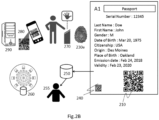
- Fig.2B illustrates a control process of the secured biometric passport A 1 of Fig.2A , with its passport data marking 230 corresponding to a certain John Doe, with its biometry data 230e corresponding to John Doe's fingerprint, and with additional passport digital data corresponding to a digital identity photograph 255 of John Doe that is accessible via the link to the information database 250 included in the information access marking 240.
- the passport data further comprises the unique serial number 235 assigned by the authority having delivered the passport.
- the calculated aggregated digital signature B may further be time-stamped and stored in a blockchain 260.
- the biometry data 230e of the respective holders of the biometric passports of the batch are also stored in the blockchain 260 in association with, respectively, their corresponding unique serial numbers (so as to make these data immutable).
- the stored biometry data of John Doe can be retrieved by sending a request to the blockchain 260 indicating the unique serial number 235 mentioned on his passport.
- the authorities in charge of controlling identity of people can access the blockchain 260 via a communication link, and, in this illustrative embodiment, have also local storage capabilities for storing the (published) aggregated digital signatures of all the delivered batches of biometric passports.
- the information database 250 is local (i.e. directly accessible to the authorities, without having to use a public communication network).
- these authorities are equipped with fingerprint scanners 270 to capture the fingerprints of individuals and calculate corresponding machine readable representations of data characterizing the captured fingerprints, i.e. biometry data 230e.
- the officer takes the secured biometric passport A 1 of John Doe, reads and decodes the verification information (D 1 , k 1 ) stored in the security marking 210 on the passport by means of an appropriate handheld reader 280 connected to a computer 290 (forming an imager), the computer being connected to the local storage capabilities 250.
- the verification information D 1 , k 1
- the computer can, for example, search in the local information database 250 a batch value B matching the value B c : in case there is no matching, the passport is a forged one and "John Doe" (i.e. the screened individual claiming that his name is John Doe) may be arrested. In case B c matches some stored batch value B, the passport is considered as genuine and the officer may perform additional security checks:
- Another illustrative embodiment of the invention relates to components of an aircraft, as shown on Fig.3 .
- These counterfeit airplane parts are generally defective and can cause severe damages or even plane crashes. This is a growing security problem today.
- each component has a corresponding technical data sheet indicating e.g. the component technical name, the component unique serial number, the component manufacturer name, the manufacturing date of the component and certification information.
- a corresponding record contains all the technical data sheets of its respective components.
- counterfeited components may have their corresponding fake technical data sheet and thus, it is not obvious (unless by performing technical tests, for example) to detect fraud. For example, how to be sure that a technical data sheet corresponds well to a component mounted on a specific aircraft (and vice versa)?
- the allowed parts to be used for manufacturing or repairing a given aircraft, or that are mounted on the aircraft are considered as belonging to a batch of "articles" for that very aircraft.
- each article of an aircraft batch i.e. each allowed aircraft component for mount or repair on a given aircraft, has a corresponding aircraft component identification document AC-ID that contains the same component digital data as in a conventional technical data sheet (e.g. the aircraft ID code, the aircraft manufacturer name, the component technical name, the component unique serial number, the component manufacturer name, and the manufacturing date of the component) together with additional digital data corresponding, to the aircraft ID code, the aircraft manufacturer name, the assembly date of the component on the aircraft, the name of the technician in charge of performing the conformity check together with the date of the conformity check, and the corresponding (unique) digital signature of the checker.
- a conventional technical data sheet e.g. the aircraft ID code, the aircraft manufacturer name, the component technical name, the component unique serial number, the component manufacturer name, and the manufacturing date of the component
- each aircraft component identification document AC-ID is secured by means of a machine readable security marking applied on it (preferably tamperproof).
- a machine readable security marking applied on it (preferably tamperproof).
- corresponding secured AC-ID documents are created and a corresponding updated version of the aircraft batch is also created, with the above mentioned corresponding additional digital data (relating to the new mounting operations).
- a security marking 310 (here in the form of a QR code) is printed on each aircraft component identification document, for example AC-ID: A 125 , that is associated with the corresponding aircraft component, here A 125 , mounted on the aircraft HB-SNO.
- Fig.3 particularly shows the component A 125 of the aircraft batch being a turbine blade adapted to the reactor type mounted on the aircraft HB-SNO and marked with a unique manufacturing serial number (here, 12781, generally engraved by the manufacturer).
- the component digital data D 125 (or article digital data) associated with component A 125 comprises the digital data corresponding to that of the data marking 330 printed on the AC-ID:A125: the aircraft ID code 330a (here, HB-SNO), the aircraft manufacturer name 330b (here, AeroABC), the component technical name 330c (here, turbine blade - 1 st ring), the component serial number 330d (here, 12781), the component manufacturer name 330e (here, PCX), the manufacturing date of the component 330f (here, November 13, 2017), the assembly date of the component on the reactor 330g (here, February 24, 2018), the name of the technician in charge of performing the conformity check 330h (here, the checker is Martin White) together with the date of the conformity check 330i (here, March 20, 2018), and the (unique) digital signature of the checker 330j (here, 2w9s02u).
- the aircraft ID code 330a here, HB-SNO
- the aggregated digital signature is then stored in a searchable database (preferably a blockchain) accessible to technicians in charge of controlling or changing the mounted components.
- the associated component digital data D i and the corresponding verification key k i are embedded in the security marking applied on the corresponding aircraft component identification document AC-ID: A i .
- a technician may send a request to the searchable database containing the component serial number 12781 read on the AC-ID: A 125 of component A 125 to be controlled, or its verification key k 125 as read on the security marking 310 on the corresponding AC-ID: A 125 document with an appropriate reader, and will receive back the corresponding batch value B.
- the technician's reader is connected to a computer having a memory storing all the aggregated digital signatures relating to the aircrafts to be controlled.
- the component A 125 is considered as genuine and belongs to the (up-to-date) aircraft batch of allowed components of the HB-SNO aircraft, if B c does not match a stored batch value B, or if the serial numbers do not match, the component A 125 is possibly counterfeit, or is a genuine component not allowed for the aircraft HB-SNO (e.g. A 125 does not belong to the right batch for this aircraft), and must be changed.
- the invention would allow detecting fraud (or errors) from batches of secured AC-IDs of replacement parts stored in a warehouse by verifying the authenticity of the secure markings on the stored parts and checking that the component serial number from the security marking matches that marked on the corresponding component.
- a tamperproof material-based security marking may further be applied on the component, while the digital data relating to the corresponding reference unique physical characteristic UPC (for example, as captured by a suitable sensor when applying the material-based security marking) of this marking is preferably made part of the component digital data D in the secure marking of this component, and a corresponding reference unique physical signature data UPS is calculated (for example, by taking a hash of the digital data UPC, i.e.
- UPS H(UPC)
- UPS H(UPC)
- the reference UPC and UPS are stored in the blockchain (to make them immutable) and are accessible to the technician.
- these reference values may also be further stored in the memory of the technician's computer in order to allow offline authentication of the material-based security marking on the highly critical component.
- the further offline operation of authentication of this material-based security marking may comprise measuring the unique physical characteristic on the component, by means of a suitable sensor connected to the computer, and obtaining a candidate unique physical characteristic digital data UPC c from the measured characteristic (for example, via a specific application programmed in the CPU of his computer). Then, the technician (or the CPU of his computer, if suitably programmed) compares the obtained UPC c with the copy of the reference UPC stored in the memory of the computer: in case of "reasonable" matching UPC c ⁇ UPC (i.e. within some predefined error tolerance criterion), the material-based security marking, and thus the component, are considered as genuine.
- a copy of the reference physical characteristic digital data UPC instead of being stored in the memory of the technician's computer, is part of the article digital data D included in the security marking applied on the component and can be obtained by direct reading on the security marking (with the reader).
- the checking of authenticity of a component by a technician may alternatively be performed via online process in a similar way as already explained with the first detailed embodiment of the invention, and will not be repeated here.
- a digital image of a secured document like an aircraft component identification document AC-ID: A 125 for example, with respect to the original secured document.
- AC-ID an aircraft component identification document
- a technician in charge of control (or repair) operations has only access to a digital image of the secured document, for example by receiving the image of AC-ID: A 125 on its reader (which may be, for example, a smartphone suitably programmed)
- Another illustrative embodiment of the invention relates to self-secure serialization of pharmaceutical products like medicine packs, as shown on Fig.4 .
- This embodiment relates to a production batch of medicine packs of a given type of medicament comprising ⁇ boxes (or articles) A 1 , A 2 ... . A ⁇ .
- tablets for patients are packaged in a set of serialized blister packs 401 (only one is shown) contained in the box A 1 .
- Each blister pack 401 is marked with a unique serial number 435 (here, 12345, applied by the manufacturer), and the box A 1 has conventional information printed on it like the name of the medicine 430a, a logo 430b, a box unique serial number (box ID) 430c, an expiry date 430d.
- additional conventional data are possibly printed on the box (or, in a variant, on a package leaflet put in the box A1): a recommended retail price 430e, a market country 430f, and a sale restriction indication 430g (e.g. to be sold only in pharmacy).
- the box A 1 is secured by means of a machine readable security marking 410 in the form of a printed 2D barcode (or datamatrix) and further secured with a material-based security marking in the form of a separate tamperproof adhesive anti-copy stamp 415 including randomly dispersed particles which is applied on the box A 1 .
- the (random and thus unique) positions of the particles on the stamp in fact are known to constitute a unique physical characteristic of the stamp 415 applied on the box A 1 , and thus here also a unique physical characteristic of the box A 1 itself.
- the detected positions of the dispersed particles on the stamp 415 are conventionally used to calculate corresponding reference unique physical characteristic digital data UPC-A 1 of the box A 1 .
- the detection of the dispersed particles, and their positions is performed via image processing of a digital image of the stamp.
- the particles can be detected upon illumination of the stamp with a mere white flash (a white LED for example), like the flash of a smartphone for example.
- a specific image processing application can be downloaded on a smartphone to make it capable to image a stamp 415, detect the positions of the dispersed particles and calculate from these positions a corresponding unique physical characteristic digital data UPC.
- the barcode 410 of a box A i (i ⁇ ⁇ 1,..., ⁇ ) of the batch contains box digital data D i corresponding to a digital representation of the above mentioned conventional data 430a-430g of the box A i , the respective serial numbers 435 of the blister packs 401 contained in the box A i , and the reference unique physical characteristic digital data UPC-A i ; of the box A i .
- the obtained reference aggregated digital signature B is then either published in a media accessible to a user having to check the validity of a secured medicine pack A i , or stored in a searchable aggregated signature database accessible to the user, or stored in a blockchain (or in a database secured by a blockchain) accessible to the user.
- the user may send a request containing the serial number 430c, read on the security marking 410 on said box A i , to the searchable database or blockckain and receive back the corresponding batch value B.
- a link to access the searchable aggregated signature database via the web, for example), or the blockchain, may be included in a box data marking 440 (shown as a QR code on Fig.4 ) printed on the box A i .
- the reference aggregated digital signature B is made available to the user locally, so that the user can perform the checking operations on offline mode (i.e. by not having to access distant storage means to obtain B): for example, the user has a reader such as a smartphone capable to read and decode the data in the security marking 410 on box A i (by means of a programed application operable to run on the smartphone's CPU) and of which memory stores the reference aggregated digital signature B.
- a reader such as a smartphone capable to read and decode the data in the security marking 410 on box A i (by means of a programed application operable to run on the smartphone's CPU) and of which memory stores the reference aggregated digital signature B.
- the box digital value D i and its corresponding box verification key k i (together constituting the verification information V i of box A i ) are part of the digital data included in the security marking 410 applied on box A i .
- B c B
- the security marking 410 corresponds to that of a genuine box.
- several additional security checks can be performed. For example, with a reader equipped with a display (like the above mentioned smartphone), it is possible to extract from the read box digital data D 1 any one of the information 430a-430d, display the extracted information and visually check that it matches the corresponding information printed on the box A 1 . If a displayed information does not correspond to a printed one, the box is counterfeit.
- a further authentication check of the box A 1 is possible by verifying that the material-based security marking 415 is genuine. It suffices to detect the positions of the dispersed particles by imaging the stamp 415 (for example, with the above mentioned smartphone having image processing capabilities) and calculate from these positions a corresponding candidate unique physical characteristic digital data UPC c - A 1 , and then check that this UPC c - A 1 is indeed similar (within a given margin of error) to the reference unique physical characteristic digital data UPC c - A 1 extracted from the box digital data D 1 : if they agree the stamp 415, and thus the box A 1 , is genuine, if they do not agree the stamp 415, and thus the box A 1 (the stamp being tamperproof), is counterfeit.
- the invention is clearly compatible with offline and local checking operations for verifying the authenticity of a secured article or conformity of data on an image (or copy) of a secured article with respect to the data associated with the original secured article.
- the invention is also compatible with online verification process, for example by receiving (via a communication link) a reference batch value form an external source (e.g. server or blockchain), or performing some or all the calculation steps involving the one-way function or the one-way accumulator via external computing means (e.g. operating on a server), or even performing the verification that a candidate aggregated digital signature matches a reference aggregated digital signature (and just receiving the result).
Landscapes
- Engineering & Computer Science (AREA)
- Theoretical Computer Science (AREA)
- Physics & Mathematics (AREA)
- General Physics & Mathematics (AREA)
- Computer Vision & Pattern Recognition (AREA)
- Computer Security & Cryptography (AREA)
- Multimedia (AREA)
- Computer Networks & Wireless Communication (AREA)
- Signal Processing (AREA)
- Artificial Intelligence (AREA)
- General Engineering & Computer Science (AREA)
- Data Mining & Analysis (AREA)
- Databases & Information Systems (AREA)
- Software Systems (AREA)
- Computational Linguistics (AREA)
- Storage Device Security (AREA)
- Editing Of Facsimile Originals (AREA)
- Inspection Of Paper Currency And Valuable Securities (AREA)
- Management, Administration, Business Operations System, And Electronic Commerce (AREA)
- Credit Cards Or The Like (AREA)
Priority Applications (1)
| Application Number | Priority Date | Filing Date | Title |
|---|---|---|---|
| MA52929A MA52929B1 (fr) | 2018-06-19 | 2019-06-03 | Protection anti-contrefaçon pour article double matériau-numérique |
Applications Claiming Priority (2)
| Application Number | Priority Date | Filing Date | Title |
|---|---|---|---|
| EP18178639 | 2018-06-19 | ||
| PCT/EP2019/064366 WO2019243033A1 (en) | 2018-06-19 | 2019-06-03 | Article dual material-digital anti-forgery protection |
Publications (2)
| Publication Number | Publication Date |
|---|---|
| EP3811280A1 EP3811280A1 (en) | 2021-04-28 |
| EP3811280B1 true EP3811280B1 (en) | 2024-10-30 |
Family
ID=62712921
Family Applications (1)
| Application Number | Title | Priority Date | Filing Date |
|---|---|---|---|
| EP19727046.5A Active EP3811280B1 (en) | 2018-06-19 | 2019-06-03 | Article dual material-digital anti-forgery protection |
Country Status (16)
| Country | Link |
|---|---|
| US (1) | US11875589B2 (pl) |
| EP (1) | EP3811280B1 (pl) |
| JP (1) | JP7408895B2 (pl) |
| KR (1) | KR102901466B1 (pl) |
| CN (1) | CN112585615B (pl) |
| BR (1) | BR112020025737A2 (pl) |
| EA (1) | EA202190069A1 (pl) |
| ES (1) | ES3007816T3 (pl) |
| MA (1) | MA52929B1 (pl) |
| MX (1) | MX2020013910A (pl) |
| MY (1) | MY207329A (pl) |
| PL (1) | PL3811280T3 (pl) |
| PT (1) | PT3811280T (pl) |
| SG (1) | SG11202012552YA (pl) |
| WO (1) | WO2019243033A1 (pl) |
| ZA (1) | ZA202100358B (pl) |
Families Citing this family (10)
| Publication number | Priority date | Publication date | Assignee | Title |
|---|---|---|---|---|
| US11734678B2 (en) * | 2016-01-25 | 2023-08-22 | Apple Inc. | Document importation into secure element |
| JP7419712B2 (ja) * | 2019-09-12 | 2024-01-23 | 富士フイルムビジネスイノベーション株式会社 | 情報処理装置およびプログラム |
| DE102020104115A1 (de) | 2020-02-17 | 2021-08-19 | Bundesdruckerei Gmbh | Verfahren zum Überprüfen eines smartphone-verifizierbaren Sicherheitsmerkmals, Smartphone-verifizierbares Sicherheitsmerkmal und Wert- oder Sicherheitsdokument |
| JP6979099B2 (ja) * | 2020-03-17 | 2021-12-08 | 株式会社大和総研 | 電子認定証受渡システムおよびプログラム |
| JP6979098B2 (ja) * | 2020-03-17 | 2021-12-08 | 株式会社大和総研 | 電子認定証受渡システムおよびプログラム |
| JP6894033B1 (ja) * | 2020-06-15 | 2021-06-23 | クリプトモール オーユー | 鑑定証明システム |
| US11601285B2 (en) * | 2020-06-24 | 2023-03-07 | EMC IP Holding Company LLC | Securely authorizing service level access to a backup system using a specialized access key |
| JP7355247B2 (ja) * | 2020-06-30 | 2023-10-03 | 富士通株式会社 | 署名制御方法、署名制御プログラム、および情報処理装置 |
| AR123354A1 (es) * | 2020-09-02 | 2022-11-23 | Sicpa Holding Sa | Marca de seguridad, método y dispositivo para leer la marca de seguridad, documento de seguridad marcado con la marca de seguridad y método y sistema para verificar dicho documento de seguridad |
| US20240356756A1 (en) * | 2021-09-28 | 2024-10-24 | Visa International Service Association | Device security with one-way function |
Citations (1)
| Publication number | Priority date | Publication date | Assignee | Title |
|---|---|---|---|---|
| US20070036470A1 (en) * | 2005-08-12 | 2007-02-15 | Ricoh Company, Ltd. | Techniques for generating and using a fingerprint for an article |
Family Cites Families (10)
| Publication number | Priority date | Publication date | Assignee | Title |
|---|---|---|---|---|
| US7340607B2 (en) * | 2003-02-04 | 2008-03-04 | Eastman Kodak Company | Preservation system for digitally created and digitally signed documents |
| CN100375111C (zh) * | 2005-07-07 | 2008-03-12 | 复旦大学 | 一种基于射频识别技术的防伪验证方法及防伪系统 |
| RU2309453C1 (ru) * | 2006-01-13 | 2007-10-27 | Георгий Васильевич Бычков | Способ идентификации аутентичности предметов, выпускаемых в обращение |
| US20070168671A1 (en) * | 2006-01-16 | 2007-07-19 | Fujitsu Limited | Digital document management system, digital document management method, and digital document management program |
| US7890763B1 (en) | 2007-09-14 | 2011-02-15 | The United States Of America As Represented By The Director, National Security Agency | Method of identifying invalid digital signatures involving batch verification |
| JP5239849B2 (ja) | 2008-12-26 | 2013-07-17 | 富士通株式会社 | 電子署名方法、電子署名プログラムおよび電子署名装置 |
| US8381973B2 (en) * | 2010-11-22 | 2013-02-26 | International Business Machines Corporation | System and method for providing and verifying a passport |
| TW201443802A (zh) * | 2012-12-21 | 2014-11-16 | Sicpa Holding Sa | 用於對物品進行標記的方法和系統、如此標記的物品以及用於對標記物品進行認證的方法和系統 |
| MY172679A (en) | 2013-06-18 | 2019-12-10 | Mimos Berhad | Non-repudiable collaborative updates of document |
| US9762393B2 (en) | 2015-03-19 | 2017-09-12 | Conduent Business Services, Llc | One-to-many matching with application to efficient privacy-preserving re-identification |
-
2019
- 2019-06-03 MA MA52929A patent/MA52929B1/fr unknown
- 2019-06-03 EA EA202190069A patent/EA202190069A1/ru unknown
- 2019-06-03 JP JP2020569733A patent/JP7408895B2/ja active Active
- 2019-06-03 EP EP19727046.5A patent/EP3811280B1/en active Active
- 2019-06-03 ES ES19727046T patent/ES3007816T3/es active Active
- 2019-06-03 BR BR112020025737-0A patent/BR112020025737A2/pt unknown
- 2019-06-03 SG SG11202012552YA patent/SG11202012552YA/en unknown
- 2019-06-03 PL PL19727046.5T patent/PL3811280T3/pl unknown
- 2019-06-03 MX MX2020013910A patent/MX2020013910A/es unknown
- 2019-06-03 PT PT197270465T patent/PT3811280T/pt unknown
- 2019-06-03 KR KR1020217001129A patent/KR102901466B1/ko active Active
- 2019-06-03 CN CN201980054498.0A patent/CN112585615B/zh active Active
- 2019-06-03 MY MYPI2020006707A patent/MY207329A/en unknown
- 2019-06-03 US US17/254,712 patent/US11875589B2/en active Active
- 2019-06-03 WO PCT/EP2019/064366 patent/WO2019243033A1/en not_active Ceased
-
2021
- 2021-01-18 ZA ZA2021/00358A patent/ZA202100358B/en unknown
Patent Citations (2)
| Publication number | Priority date | Publication date | Assignee | Title |
|---|---|---|---|---|
| US20070036470A1 (en) * | 2005-08-12 | 2007-02-15 | Ricoh Company, Ltd. | Techniques for generating and using a fingerprint for an article |
| EP1883053A1 (en) * | 2006-07-28 | 2008-01-30 | Ricoh Company, Ltd. | Techniques for generating and using a fingerprint for an article |
Also Published As
| Publication number | Publication date |
|---|---|
| KR20210023994A (ko) | 2021-03-04 |
| CN112585615A (zh) | 2021-03-30 |
| KR102901466B1 (ko) | 2025-12-18 |
| SG11202012552YA (en) | 2021-01-28 |
| BR112020025737A2 (pt) | 2021-03-16 |
| EA202190069A1 (ru) | 2021-04-05 |
| MX2020013910A (es) | 2021-03-09 |
| JP7408895B2 (ja) | 2024-01-09 |
| MY207329A (en) | 2025-02-19 |
| ES3007816T3 (en) | 2025-03-20 |
| CA3103856A1 (en) | 2019-12-26 |
| EP3811280A1 (en) | 2021-04-28 |
| MA52929B1 (fr) | 2025-01-31 |
| US20210117671A1 (en) | 2021-04-22 |
| CN112585615B (zh) | 2024-03-08 |
| PL3811280T3 (pl) | 2025-01-13 |
| MA52929A (fr) | 2021-04-28 |
| PT3811280T (pt) | 2024-12-04 |
| ZA202100358B (en) | 2025-10-29 |
| JP2021529448A (ja) | 2021-10-28 |
| WO2019243033A1 (en) | 2019-12-26 |
| US11875589B2 (en) | 2024-01-16 |
Similar Documents
| Publication | Publication Date | Title |
|---|---|---|
| EP3811280B1 (en) | Article dual material-digital anti-forgery protection | |
| EP3820712B1 (en) | Article anti-forgery protection | |
| EP3834362B1 (en) | Digital file anti-forgery protection | |
| EP3811267B1 (en) | Digital file anti-forgery protection | |
| CA3103856C (en) | Article dual material-digital anti-forgery protection | |
| OA19920A (en) | Article dual material-digital anti-forgery protection. | |
| EA040711B1 (ru) | Двойная материально-цифровая защита изделия от подделки | |
| OA19924A (en) | Article anti-forgery protection. | |
| OA19973A (en) | Digital file anti-forgery protection. | |
| EA040918B1 (ru) | Защита изделия от подделки | |
| OA19921A (en) | Digital file anti-forgery protection. | |
| EA042505B1 (ru) | Защита цифрового файла от подделки | |
| EA040639B1 (ru) | Защита цифрового файла от подделки |
Legal Events
| Date | Code | Title | Description |
|---|---|---|---|
| STAA | Information on the status of an ep patent application or granted ep patent |
Free format text: STATUS: UNKNOWN |
|
| STAA | Information on the status of an ep patent application or granted ep patent |
Free format text: STATUS: THE INTERNATIONAL PUBLICATION HAS BEEN MADE |
|
| PUAI | Public reference made under article 153(3) epc to a published international application that has entered the european phase |
Free format text: ORIGINAL CODE: 0009012 |
|
| STAA | Information on the status of an ep patent application or granted ep patent |
Free format text: STATUS: REQUEST FOR EXAMINATION WAS MADE |
|
| 17P | Request for examination filed |
Effective date: 20210118 |
|
| AK | Designated contracting states |
Kind code of ref document: A1 Designated state(s): AL AT BE BG CH CY CZ DE DK EE ES FI FR GB GR HR HU IE IS IT LI LT LU LV MC MK MT NL NO PL PT RO RS SE SI SK SM TR |
|
| AX | Request for extension of the european patent |
Extension state: BA ME |
|
| DAX | Request for extension of the european patent (deleted) | ||
| RAV | Requested validation state of the european patent: fee paid |
Extension state: MA Effective date: 20210118 |
|
| STAA | Information on the status of an ep patent application or granted ep patent |
Free format text: STATUS: EXAMINATION IS IN PROGRESS |
|
| 17Q | First examination report despatched |
Effective date: 20230201 |
|
| P01 | Opt-out of the competence of the unified patent court (upc) registered |
Effective date: 20230523 |
|
| REG | Reference to a national code |
Ref country code: DE Ref legal event code: R079 Ref document number: 602019061107 Country of ref document: DE Free format text: PREVIOUS MAIN CLASS: G06K0009000000 Ipc: G06V0030418000 |
|
| GRAP | Despatch of communication of intention to grant a patent |
Free format text: ORIGINAL CODE: EPIDOSNIGR1 |
|
| STAA | Information on the status of an ep patent application or granted ep patent |
Free format text: STATUS: GRANT OF PATENT IS INTENDED |
|
| RIC1 | Information provided on ipc code assigned before grant |
Ipc: H04L 9/32 20060101ALI20240624BHEP Ipc: G06V 30/418 20220101AFI20240624BHEP |
|
| INTG | Intention to grant announced |
Effective date: 20240712 |
|
| GRAS | Grant fee paid |
Free format text: ORIGINAL CODE: EPIDOSNIGR3 |
|
| GRAA | (expected) grant |
Free format text: ORIGINAL CODE: 0009210 |
|
| STAA | Information on the status of an ep patent application or granted ep patent |
Free format text: STATUS: THE PATENT HAS BEEN GRANTED |
|
| AK | Designated contracting states |
Kind code of ref document: B1 Designated state(s): AL AT BE BG CH CY CZ DE DK EE ES FI FR GB GR HR HU IE IS IT LI LT LU LV MC MK MT NL NO PL PT RO RS SE SI SK SM TR |
|
| RAP3 | Party data changed (applicant data changed or rights of an application transferred) |
Owner name: SICPA HOLDING SA |
|
| REG | Reference to a national code |
Ref country code: GB Ref legal event code: FG4D |
|
| REG | Reference to a national code |
Ref country code: CH Ref legal event code: EP |
|
| REG | Reference to a national code |
Ref country code: IE Ref legal event code: FG4D |
|
| REG | Reference to a national code |
Ref country code: DE Ref legal event code: R096 Ref document number: 602019061107 Country of ref document: DE |
|
| REG | Reference to a national code |
Ref country code: PT Ref legal event code: SC4A Ref document number: 3811280 Country of ref document: PT Date of ref document: 20241204 Kind code of ref document: T Free format text: AVAILABILITY OF NATIONAL TRANSLATION Effective date: 20241128 |
|
| REG | Reference to a national code |
Ref country code: SE Ref legal event code: TRGR |
|
| REG | Reference to a national code |
Ref country code: NL Ref legal event code: FP |
|
| REG | Reference to a national code |
Ref country code: MA Ref legal event code: VAGR Ref document number: 52929 Country of ref document: MA Kind code of ref document: B1 |
|
| REG | Reference to a national code |
Ref country code: LT Ref legal event code: MG9D |
|
| REG | Reference to a national code |
Ref country code: ES Ref legal event code: FG2A Ref document number: 3007816 Country of ref document: ES Kind code of ref document: T3 Effective date: 20250320 |
|
| PG25 | Lapsed in a contracting state [announced via postgrant information from national office to epo] |
Ref country code: IS Free format text: LAPSE BECAUSE OF FAILURE TO SUBMIT A TRANSLATION OF THE DESCRIPTION OR TO PAY THE FEE WITHIN THE PRESCRIBED TIME-LIMIT Effective date: 20250228 Ref country code: HR Free format text: LAPSE BECAUSE OF FAILURE TO SUBMIT A TRANSLATION OF THE DESCRIPTION OR TO PAY THE FEE WITHIN THE PRESCRIBED TIME-LIMIT Effective date: 20241030 |
|
| PG25 | Lapsed in a contracting state [announced via postgrant information from national office to epo] |
Ref country code: FI Free format text: LAPSE BECAUSE OF FAILURE TO SUBMIT A TRANSLATION OF THE DESCRIPTION OR TO PAY THE FEE WITHIN THE PRESCRIBED TIME-LIMIT Effective date: 20241030 |
|
| PG25 | Lapsed in a contracting state [announced via postgrant information from national office to epo] |
Ref country code: BG Free format text: LAPSE BECAUSE OF FAILURE TO SUBMIT A TRANSLATION OF THE DESCRIPTION OR TO PAY THE FEE WITHIN THE PRESCRIBED TIME-LIMIT Effective date: 20241030 |
|
| PG25 | Lapsed in a contracting state [announced via postgrant information from national office to epo] |
Ref country code: NO Free format text: LAPSE BECAUSE OF FAILURE TO SUBMIT A TRANSLATION OF THE DESCRIPTION OR TO PAY THE FEE WITHIN THE PRESCRIBED TIME-LIMIT Effective date: 20250130 |
|
| PG25 | Lapsed in a contracting state [announced via postgrant information from national office to epo] |
Ref country code: GR Free format text: LAPSE BECAUSE OF FAILURE TO SUBMIT A TRANSLATION OF THE DESCRIPTION OR TO PAY THE FEE WITHIN THE PRESCRIBED TIME-LIMIT Effective date: 20250131 Ref country code: LV Free format text: LAPSE BECAUSE OF FAILURE TO SUBMIT A TRANSLATION OF THE DESCRIPTION OR TO PAY THE FEE WITHIN THE PRESCRIBED TIME-LIMIT Effective date: 20241030 |
|
| PG25 | Lapsed in a contracting state [announced via postgrant information from national office to epo] |
Ref country code: RS Free format text: LAPSE BECAUSE OF FAILURE TO SUBMIT A TRANSLATION OF THE DESCRIPTION OR TO PAY THE FEE WITHIN THE PRESCRIBED TIME-LIMIT Effective date: 20250130 |
|
| PGFP | Annual fee paid to national office [announced via postgrant information from national office to epo] |
Ref country code: NL Payment date: 20250520 Year of fee payment: 7 |
|
| PG25 | Lapsed in a contracting state [announced via postgrant information from national office to epo] |
Ref country code: SM Free format text: LAPSE BECAUSE OF FAILURE TO SUBMIT A TRANSLATION OF THE DESCRIPTION OR TO PAY THE FEE WITHIN THE PRESCRIBED TIME-LIMIT Effective date: 20241030 |
|
| PGFP | Annual fee paid to national office [announced via postgrant information from national office to epo] |
Ref country code: PL Payment date: 20250520 Year of fee payment: 7 Ref country code: DE Payment date: 20250520 Year of fee payment: 7 |
|
| PG25 | Lapsed in a contracting state [announced via postgrant information from national office to epo] |
Ref country code: DK Free format text: LAPSE BECAUSE OF FAILURE TO SUBMIT A TRANSLATION OF THE DESCRIPTION OR TO PAY THE FEE WITHIN THE PRESCRIBED TIME-LIMIT Effective date: 20241030 |
|
| PGFP | Annual fee paid to national office [announced via postgrant information from national office to epo] |
Ref country code: GB Payment date: 20250520 Year of fee payment: 7 |
|
| PGFP | Annual fee paid to national office [announced via postgrant information from national office to epo] |
Ref country code: BE Payment date: 20250520 Year of fee payment: 7 Ref country code: IT Payment date: 20250520 Year of fee payment: 7 |
|
| PGFP | Annual fee paid to national office [announced via postgrant information from national office to epo] |
Ref country code: PT Payment date: 20250521 Year of fee payment: 7 |
|
| PG25 | Lapsed in a contracting state [announced via postgrant information from national office to epo] |
Ref country code: EE Free format text: LAPSE BECAUSE OF FAILURE TO SUBMIT A TRANSLATION OF THE DESCRIPTION OR TO PAY THE FEE WITHIN THE PRESCRIBED TIME-LIMIT Effective date: 20241030 |
|
| PGFP | Annual fee paid to national office [announced via postgrant information from national office to epo] |
Ref country code: FR Payment date: 20250520 Year of fee payment: 7 |
|
| PG25 | Lapsed in a contracting state [announced via postgrant information from national office to epo] |
Ref country code: RO Free format text: LAPSE BECAUSE OF FAILURE TO SUBMIT A TRANSLATION OF THE DESCRIPTION OR TO PAY THE FEE WITHIN THE PRESCRIBED TIME-LIMIT Effective date: 20241030 |
|
| PGFP | Annual fee paid to national office [announced via postgrant information from national office to epo] |
Ref country code: AT Payment date: 20250522 Year of fee payment: 7 |
|
| PG25 | Lapsed in a contracting state [announced via postgrant information from national office to epo] |
Ref country code: SK Free format text: LAPSE BECAUSE OF FAILURE TO SUBMIT A TRANSLATION OF THE DESCRIPTION OR TO PAY THE FEE WITHIN THE PRESCRIBED TIME-LIMIT Effective date: 20241030 |
|
| PGFP | Annual fee paid to national office [announced via postgrant information from national office to epo] |
Ref country code: TR Payment date: 20250526 Year of fee payment: 7 |
|
| PG25 | Lapsed in a contracting state [announced via postgrant information from national office to epo] |
Ref country code: CZ Free format text: LAPSE BECAUSE OF FAILURE TO SUBMIT A TRANSLATION OF THE DESCRIPTION OR TO PAY THE FEE WITHIN THE PRESCRIBED TIME-LIMIT Effective date: 20241030 |
|
| PGFP | Annual fee paid to national office [announced via postgrant information from national office to epo] |
Ref country code: IE Payment date: 20250522 Year of fee payment: 7 |
|
| PGFP | Annual fee paid to national office [announced via postgrant information from national office to epo] |
Ref country code: SE Payment date: 20250520 Year of fee payment: 7 |
|
| REG | Reference to a national code |
Ref country code: DE Ref legal event code: R097 Ref document number: 602019061107 Country of ref document: DE |
|
| PLBE | No opposition filed within time limit |
Free format text: ORIGINAL CODE: 0009261 |
|
| STAA | Information on the status of an ep patent application or granted ep patent |
Free format text: STATUS: NO OPPOSITION FILED WITHIN TIME LIMIT |
|
| 26N | No opposition filed |
Effective date: 20250731 |
|
| PGFP | Annual fee paid to national office [announced via postgrant information from national office to epo] |
Ref country code: ES Payment date: 20250701 Year of fee payment: 7 |
|
| PGFP | Annual fee paid to national office [announced via postgrant information from national office to epo] |
Ref country code: CH Payment date: 20250701 Year of fee payment: 7 |
|
| VSFP | Annual fee paid to validation state [announced via postgrant information from national office to epo] |
Ref country code: MA Payment date: 20250606 Year of fee payment: 7 |
|
| PG25 | Lapsed in a contracting state [announced via postgrant information from national office to epo] |
Ref country code: MC Free format text: LAPSE BECAUSE OF FAILURE TO SUBMIT A TRANSLATION OF THE DESCRIPTION OR TO PAY THE FEE WITHIN THE PRESCRIBED TIME-LIMIT Effective date: 20241030 |
|
| PG25 | Lapsed in a contracting state [announced via postgrant information from national office to epo] |
Ref country code: LU Free format text: LAPSE BECAUSE OF NON-PAYMENT OF DUE FEES Effective date: 20250603 |