EP3809292A1 - Authentication device and image formation device - Google Patents
Authentication device and image formation device Download PDFInfo
- Publication number
- EP3809292A1 EP3809292A1 EP19819304.7A EP19819304A EP3809292A1 EP 3809292 A1 EP3809292 A1 EP 3809292A1 EP 19819304 A EP19819304 A EP 19819304A EP 3809292 A1 EP3809292 A1 EP 3809292A1
- Authority
- EP
- European Patent Office
- Prior art keywords
- password
- fixed
- condition
- controller
- entered
- Prior art date
- Legal status (The legal status is an assumption and is not a legal conclusion. Google has not performed a legal analysis and makes no representation as to the accuracy of the status listed.)
- Granted
Links
Images






Classifications
-
- H—ELECTRICITY
- H04—ELECTRIC COMMUNICATION TECHNIQUE
- H04N—PICTORIAL COMMUNICATION, e.g. TELEVISION
- H04N1/00—Scanning, transmission or reproduction of documents or the like, e.g. facsimile transmission; Details thereof
- H04N1/44—Secrecy systems
- H04N1/4406—Restricting access, e.g. according to user identity
-
- H—ELECTRICITY
- H04—ELECTRIC COMMUNICATION TECHNIQUE
- H04N—PICTORIAL COMMUNICATION, e.g. TELEVISION
- H04N1/00—Scanning, transmission or reproduction of documents or the like, e.g. facsimile transmission; Details thereof
- H04N1/44—Secrecy systems
- H04N1/4406—Restricting access, e.g. according to user identity
- H04N1/4413—Restricting access, e.g. according to user identity involving the use of passwords, ID codes or the like, e.g. PIN
-
- B—PERFORMING OPERATIONS; TRANSPORTING
- B41—PRINTING; LINING MACHINES; TYPEWRITERS; STAMPS
- B41J—TYPEWRITERS; SELECTIVE PRINTING MECHANISMS, i.e. MECHANISMS PRINTING OTHERWISE THAN FROM A FORME; CORRECTION OF TYPOGRAPHICAL ERRORS
- B41J29/00—Details of, or accessories for, typewriters or selective printing mechanisms not otherwise provided for
- B41J29/38—Drives, motors, controls or automatic cut-off devices for the entire printing mechanism
-
- G—PHYSICS
- G06—COMPUTING OR CALCULATING; COUNTING
- G06F—ELECTRIC DIGITAL DATA PROCESSING
- G06F21/00—Security arrangements for protecting computers, components thereof, programs or data against unauthorised activity
- G06F21/30—Authentication, i.e. establishing the identity or authorisation of security principals
- G06F21/31—User authentication
-
- G—PHYSICS
- G06—COMPUTING OR CALCULATING; COUNTING
- G06F—ELECTRIC DIGITAL DATA PROCESSING
- G06F21/00—Security arrangements for protecting computers, components thereof, programs or data against unauthorised activity
- G06F21/30—Authentication, i.e. establishing the identity or authorisation of security principals
- G06F21/45—Structures or tools for the administration of authentication
-
- G—PHYSICS
- G06—COMPUTING OR CALCULATING; COUNTING
- G06F—ELECTRIC DIGITAL DATA PROCESSING
- G06F21/00—Security arrangements for protecting computers, components thereof, programs or data against unauthorised activity
- G06F21/60—Protecting data
- G06F21/606—Protecting data by securing the transmission between two devices or processes
- G06F21/608—Secure printing
-
- H—ELECTRICITY
- H04—ELECTRIC COMMUNICATION TECHNIQUE
- H04N—PICTORIAL COMMUNICATION, e.g. TELEVISION
- H04N1/00—Scanning, transmission or reproduction of documents or the like, e.g. facsimile transmission; Details thereof
- H04N1/44—Secrecy systems
- H04N1/4406—Restricting access, e.g. according to user identity
- H04N1/4433—Restricting access, e.g. according to user identity to an apparatus, part of an apparatus or an apparatus function
Definitions
- the present invention relates to authentication devices and image forming apparatuses and particularly relates to a technique for making an authentication using a password.
- a technique is known in which when using a device, a system or the like, an authentication is made using a password.
- Patent Literature 1 discloses a system in which a user previously registers a plurality of one-time passwords in a database on a server and, when, at a user's attempt to log in to the server, a password entered by the user is identical to one of the registered one-time passwords, the server permits the user to log in and removes the one-time password corresponding to the entered password from the database.
- Patent Literature 1 JP-A-2002-312319
- Patent Literature 1 the user can log in to the server simply by entering a password identical to one of the plurality of one-time passwords previously registered and, therefore, the user is more likely to be permitted to log in to the server as compared to the case where only one password is registered for the server.
- the one-time password once used is thrown away, this prevents a decrease in safety due to an increased likelihood of permission for login.
- the user needs to register many one-time passwords one after another and remember them, which makes it difficult to manage the passwords and is therefore user-inconvenient.
- the present invention has been made in view of the above circumstances and, therefore, has an object of making a user more likely to be permitted to log in as compared to the case where only one password is registered, and preventing a decrease in safety due to an increased likelihood of permission for login while ensuring user convenience.
- An authentication device includes: a storage device that previously stores user information for identifying a user and a plurality of fixed passwords in association between the user information and the plurality of fixed passwords; an input device for use in entering user information and a password; and a controller that executes login when user information and a password are entered through the input device and the entered password is identical to one of the plurality of fixed passwords previously stored in association with the entered user information in the storage device, wherein when the entered password is identical to none of the plurality of fixed passwords previously stored in association with the entered user information in the storage device and any one of the plurality of fixed passwords satisfies a predetermined condition on similarity to the entered password, the controller inhibits an authentication based on the fixed password satisfying the predetermined condition from being made for a predetermined period.
- An image forming apparatus includes the above-described authentication device and an image forming device that forms an image on a recording medium when the login is executed by the authentication device.
- the user since the user can log in simply by entering a password identical to one of the plurality of fixed passwords previously registered, the user is more likely to be permitted to log in as compared to the case where only one password is registered, which increases user convenience. Furthermore, when there is a fixed password satisfying the predetermined condition on similarity to the entered password, the making of an authentication based on the fixed password is inhibited. Therefore, a decrease in safety due to an increased likelihood of permission for login can be prevented without using any disposable password, which further increases user convenience.
- Fig. 1 is a perspective view showing an appearance of an image forming apparatus including an authentication device according to the one embodiment of the present invention.
- the image forming apparatus 1 is a multifunction peripheral having multiple functions, including a facsimile function, a copy function, a print function, and a scan function.
- a housing 7 of the image forming apparatus 1 contains a plurality of devices for implementing various functions of the image forming apparatus 1.
- the housing 7 contains an image reading device 11, an image forming device 12 (not shown in Fig. 1 ), a fixing device 13 (not shown in Fig. 1 ), a sheet feed device 14, and so on.
- the image reading device 11 is an ADF (auto document feeder) including: a document feed device 6 capable of feeding an original document; and a scanner that optically reads the original document being fed by the document feed device 6 or an original document placed on an original glass plate.
- the image reading device 11 irradiates an original document with light from a lighting part and receives light reflected from the original document on a CCD (charge-coupled device) sensor to read an image from the original document and generate image data.
- ADF auto document feeder
- the image reading device 11 irradiates an original document with light from a lighting part and receives light reflected from the original document on a CCD (charge-coupled device) sensor to read an image from the original document and generate image data.
- CCD charge-coupled device
- the image forming device 12 includes a photosensitive drum, a charging device, an exposure device, a developing device, and a transfer device.
- the image forming device 12 forms a toner image on a recording paper sheet fed from the sheet feed device 14, based on the image data generated by the image reading device 11, image data sent from a personal computer or another facsimile device connected thereto via a network or other image a data.
- the fixing device 13 applies heat and pressure to the recording paper sheet on the surface of which the toner image is formed by image formation processing of the image forming device 12, thus fixing the toner image on the recording paper sheet. After the fixation of the fixing device 13, the recording paper sheet having an image formed thereon is discharged to a sheet output tray 8.
- the sheet feed device 14 pulls out recording paper sheets contained in a sheet cassette or recording paper sheets put on a manual feed tray sheet by sheet by a pick-up roller and feeds forward the pulled-out recording paper sheet to the image forming device 12.
- the image forming apparatus 1 includes an operation device 15.
- a user can input, through the operation device 15, instructions, data or so on on various functions executable by the image forming apparatus 1.
- the operation device 15 includes a display device 16.
- the display device 16 is a display device including a liquid crystal display.
- the display device 16 displays various screens related to the various functions executable by the image forming apparatus 1.
- the operation device 15 includes a touch panel 15A laid over the display device 16.
- Fig. 2 is a block diagram showing an internal configuration of the image forming apparatus including the authentication device according to the one embodiment of the present invention.
- the image forming apparatus 1 includes a control device 100.
- the control device 100 includes a processor, a RAM (random access memory), a ROM (read only memory), and so on.
- the processor is, for example, a CPU (central processing unit), an MPU (micro-processing unit) or an ASIC (application specific integrated circuit).
- a control program stored in the built-in ROM or on an HDD (hard disk drive) 19 is executed by the processor described above, the control device 100 functions as a controller 10.
- the control device 100 is electrically connected to the document feed device 6, the image reading device 11, the image forming device 12, the fixing device 13, the sheet feed device 14, the operation device 15, an image processing device 17, an image memory 18, the HDD 19, a facsimile communication device 20, a communication device 21, and so on.
- the operation device 15, the HDD 19, and the control device 100 function as an authentication device 2 for implementing first authentication processing.
- the control device 100 governs the overall control of the image forming apparatus 1. More specifically, the control device 100 performs various types of processing, including the operations of the devices of the image forming apparatus 1 and communications with external devices 22, such as a personal computer, connected via a network.
- the image processing device 17 performs, as necessary, image processing of image data generated by the image reading device 11.
- the image memory 18 includes a region for temporarily storing image data to be printed generated by the image reading device 11.
- the HDD 19 is a large storage device capable of storing various types of data, including image data generated by the image reading device 11.
- the HDD 19 stores various computer programs for implementing general operations of the image forming apparatus 1.
- the HDD 19 stores a control program for executing the first authentication processing according to this embodiment.
- the processor operates in accordance with the control program, it executes, as the controller 10, the first authentication processing according to this embodiment.
- the controller 10 may not be implemented by the operation in accordance with the computer program, but may be configured to be operable by a hardware circuit.
- the HDD 19 previously stores, as authentication information, a user name for identifying a user and a plurality of fixed passwords in association between the user name and the plurality of fixed passwords.
- the user previously registers the authentication information by entering it through the operation device 15.
- the fixed password is a password for use in permitting the use of predetermined functions of the image forming apparatus 1.
- the fixed password consists of a fixed character string set by the user.
- the character string contains characters, numbers or the like.
- the fixed password is a password that is not disposable but can be used continuously.
- the controller 10 authenticates user's login to the image forming apparatus 1 and enables the predetermined functions to be executed.
- the above-mentioned predetermined functions include a facsimile function, a copy function, and a print function which are functions for use when the image forming device 12 performs image formation.
- the controller 10 inhibits an authentication based on the fixed password satisfying the condition from being made for a predetermined period.
- the above-mentioned predetermined condition is referred to as an "inhibition condition” and the above-mentioned predetermined period is referred to as an "inhibition period”.
- the HDD 19 previously stores the above-mentioned inhibition condition and inhibition period.
- the user previously inputs, through the operation device 15, the above inhibition condition and inhibition period.
- the controller 10 sets, as the inhibition condition, a condition that, among a character string constituting a fixed password, the number of characters identical to an entered password is equal to or greater than a predetermined ratio (in this case, 80%) to the total number of characters contained in the character string. Furthermore, the controller 10 sets one day as the inhibition period.
- the predetermined ratio may be "90%".
- the facsimile communication device 20 performs connection to a public line and transfers image data to and from other facsimile devices via the public line.
- the communication device 21 includes a communication module, such as a LAN (local area network) board.
- the image forming apparatus 1 performs data communications through the communication device 21 with the external devices 22, such as a personal computer on the network.
- Each of the above devices of the image forming apparatus 1 is connected to a power supply and operates on electric power supplied from the power supply.
- Fig. 3 is a flowchart showing the first authentication processing.
- the control program for executing the first authentication processing is executed by the user inputting, through the operation device 15, an instruction to select a copy function, a scan function or a facsimile function, which are the above-described predetermined functions of the image forming apparatus 1.
- the user previously registers as authentication information a user name "0123" and two fixed passwords associated with the user name by entering them through the operation device 15.
- the above two passwords include a first fixed password composed of a character string "1K83J7YQ47” and a second fixed password composed of a character string "59FVP65BAG”.
- the controller 10 allows the HDD 19 to store the registered authentication information.
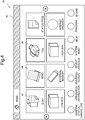
- FIG. 4 is a view showing an example of the home screen.
- the home screen 30 is a screen for use in selecting one of a plurality of functions executable by the image forming apparatus 1.
- the home screen 30 includes, as soft keys, a key 32 for selecting a copy function, a key 34 for selecting a scan function, a key 36 for selecting a facsimile function, and so on.
- step S10 determines whether or not login is currently executed. In this case, login has not been executed from the power-on until this point. Therefore, the controller 10 determines that login is currently not executed (NO in step S10), and allows the display device 16 to display an authentication screen through which a user name and a password are to be entered (step S11).
- Fig. 5 is a view showing an example of the authentication screen.
- the authentication screen 40 contains: a field 42 into which a user name is to be entered; and a field 44 into which a password is to be entered.
- the authentication screen 40 further contains, as soft keys, a key 46 to which an instruction to make an authentication based on a user name and a password entered into the field 42 and the field 44, respectively, is to be input, and a key 48 to which an instruction to cancel the entry of a user name and a password is to be input.
- the controller 10 waits for the acceptance of pressing of the key 46 or key 48 (NO in step S12 and NO in step S19).
- the third person enters "0123" as a user name into the field 42 through the operation device 15.
- the third person further enters, as a password, a character string "1K84J7YQ47", in which a randomly selected number "4" is inserted into an uncertain portion of the acquired password represented by "*”, into the field 44 and then presses the key 46.
- the controller 10 determines that an instruction to make an authentication has been accepted (YES in step S12) and determines whether or not there is any fixed password for which the inhibition period has passed (step S13).
- the controller 10 determines that there is no fixed password for which the inhibition period has passed (NO in step S13), and determines whether or not the entered password is identical to one of the plurality of fixed passwords previously stored on the HDD 19 (hereinafter, referred to simply as "registered") in association with the entered user name (step S15).
- the controller 10 determines that the entered password is identical to none of the plurality of fixed passwords registered in association with the entered user name (NO in step S15), and determines whether or not any one of the plurality of fixed passwords registered in association with the entered user name satisfies the inhibition condition (step S16).
- the controller 10 determines that one of the plurality of registered fixed passwords satisfies the inhibition condition (YES in step S16), makes a setting to inhibit an authentication based on the first fixed password satisfying the inhibition condition from being made for the inhibition period (in this case, one day) (step S17), and allows for the display of an error message prompting to re-enter a password on the authentication screen 40 (step S18).
- Fig. 6 is a view showing an example of the error message.
- the controller 10 allows for the display of an error message 50 "THE PASSWORD IS INCORRECT! PLEASE RE-ENTER PASSWORD.” near the field 44 on the authentication screen 40.
- the third person confirms the error message 50, enters as a password a character string "1K83J7YQ47", in which a randomly selected number "3" is inserted into the uncertain portion of the acquired password represented by "*”, into the field 44 through the operation device 15 and then presses the key 46.
- the controller 10 determines that an instruction to make an authentication has been accepted (YES in step S12) and determines whether or not there is any fixed password for which the inhibition period has passed (step S13).
- the controller 10 determines that there is no fixed password for which the inhibition period has passed (NO in step S13), and determines whether or not the entered password is identical to one of the plurality of fixed passwords which are registered in association with the entered user name and for which there is no setting to inhibit an authentication from being made (step S15).
- the password entered by the third person is identical to the first fixed password, but there is a setting to inhibit an authentication based on the first fixed password from being made. Therefore, the controller 10 determines that the entered password is identical to none of the plurality of fixed passwords which are registered in association with the entered user name and for which there is no setting to inhibit an authentication from being made (NO in step S15), determines that none of the plurality of fixed passwords registered in association with the entered user name satisfies the inhibition condition (NO in step S16), and allows for the display of the error message 50 on the authentication screen 40 (step S18).
- the third person confirms the error message 50, abandons an attempt to make an unauthorized use of the copy function, and then presses the key 48 on the authentication screen 40.
- the controller 10 determines that no instruction to make an authentication has been accepted (NO in step S12), determines that an instruction to cancel the entry of a user name and a password has been accepted (YES in step S19), and allows the display device 16 to display the home screen 30 (step S20).
- a user presses the key 32 on the home screen 30 with a desire to use the copy function.
- the controller 10 executes the processing tasks in steps S10 and S11 in the same manner as described above and allows the display device 16 to display the authentication screen 40.
- the user enters, through the operation device 15, "0123" as a user name into the field 42 and the first fixed password as a password into the field 44 and then presses the key 46.
- the controller 10 executes the processing tasks in steps S12, S13, S15, S16, and S18 in the same manner as described above.
- the user confirms the error message 50, enters the second fixed password as a password into the field 44 through the operation device 15, and then presses the key 46.
- the controller 10 executes the processing tasks in steps S12 and S13 in the same manner as described above.
- the registered second fixed password is identical to the entered password. Therefore, the controller 10 determines that the entered password is identical to one of the plurality of fixed passwords which are registered in association with the entered user name and for which there is no setting to inhibit an authentication from being made (YES in step S15), executes login, and allows the display device 16 to display a setting screen through which various settings for the copy function are to be made, thus enabling the copy function (step S21).
- the controller 10 When the image forming apparatus 1 is powered on by a user on the day following the day on which the above attempt of the third person was made, the controller 10 allows the display device 16 to display the home screen 30. The user presses the key 32 on the home screen 30 with a desire to use the copy function. When the key 32 is pressed, the controller 10 determines whether or not login is currently executed (step S10). In this case, since login has not been executed from the power-on until this point, the controller 10 determines that login is currently not executed (NO in step S10), and allows the display device 16 to display the authentication screen 40 (step S11).
- the user enters, through the operation device 15, "0123" as a user name into the field 42 and the first fixed password as a password into the field 44 and then presses the key 46.
- the controller 10 determines that an instruction to make an authentication has been accepted (YES in step S12), and determines whether or not there is any fixed password for which the inhibition period has passed (step S13).
- the controller 10 determines that there is a fixed password for which the inhibition period has passed (YES in step S13), and removes the setting that an authentication based on the first fixed password is inhibited from being made (step S14).
- the first fixed password an authentication based on which has been removed from inhibition is identical to the entered password. Therefore, the controller 10 determines that the entered password is identical to one of the plurality of fixed passwords registered in association with the entered user name (YES in step S15), executes login, and allows the display device 16 to display a setting screen through which various settings for the copy function are to be made, thus enabling the copy function (step S21).
- the controller 10 executes login.
- the controller 10 inhibits an authentication based on the fixed password satisfying the inhibition condition from being made for the inhibition period.
- the user can log in simply by entering a password identical to one of the plurality of fixed passwords previously registered. Therefore, it can be prevented that a situation occurs that the user has a plurality of passwords, but forgets just the password previously registered and thus fails to log in. Hence, the user is more likely to be permitted to log in as compared to the case where only one password is registered, which increases user convenience.
- controller 10 inhibits an authentication from being made based on a fixed password satisfying the inhibition condition on similarity to the entered password, a decrease in safety due to an increased likelihood of permission for login can be prevented.
- the controller 10 sets, as the inhibition condition, a condition that, among a character string constituting a fixed password, the number of characters identical to an entered password is equal to or greater than a predetermined ratio to the total number of characters contained in the character string.
- the image forming device 12 and so on form an image on a recording paper sheet. Therefore, the user can easily acquire an image while high safety is ensured.
- the configuration of an image forming apparatus 1 containing an authentication device 2 according to a first modification of the present invention is the same as that in the above embodiment, except that second authentication processing is executed instead of the first authentication processing and information stored on the HDD 19 is partially different from that in the above embodiment.
- second authentication processing is executed instead of the first authentication processing and information stored on the HDD 19 is partially different from that in the above embodiment.
- a description will be given of different points compared to the above-described embodiment.
- the HDD 19 stores a control program for executing the second authentication processing according to the first modification.
- the processor operates in accordance with the control program, it executes, as the controller 10, the second authentication processing.
- the controller 10 may not be implemented by the operation in accordance with the computer program, but may be configured to be operable by a hardware circuit.
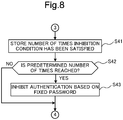
- the HDD 19 stores, in association with each individual one of the plurality of fixed passwords previously stored as authentication information, the number of times the individual fixed password has satisfied the inhibition condition. Each time each individual fixed password satisfies the inhibition condition, the controller 10 updates the number of times the individual fixed password has satisfied the inhibition condition. Each time a setting is made to inhibit an authentication based on each individual fixed password from being made, the controller 10 resets the number of times the individual fixed password has satisfied the inhibition condition.
- the condition on which the above number of times is reset is not limited to the above condition. For example, the controller 10 may reset the above number of times each time the image forming apparatus 1 is powered on.
- the controller 10 when the number of times the above inhibition condition has been satisfied reaches a predetermined number of times, the controller 10 inhibits an authentication based on the fixed password satisfying the inhibition condition from being made for the inhibition period.
- the HDD 19 previously stores the above-mentioned predetermined number of times.
- the controller 10 sets the predetermined number of times according to an instruction input through the operation device 15 by a user. No particular limitation is placed on the above predetermined number of times so long as it is such a number of times that any malicious third person cannot be executed to log in by repetitive entry of characters at random. However, the predetermined number of times is preferably small. In this modification, the following description is based on the assumption that "2" is set as the predetermined number of times.
- FIGs. 7 and 8 are flowcharts showing the second authentication processing.
- processing tasks in steps S30 to S40 are the same as those in steps S10 to S16 and steps S18 to S21.
- different processing tasks compared to the first authentication processing will be mainly described.
- the user previously registers as authentication information a user name "0123" and first and second fixed passwords associated with the user name by entering them through the operation device 15.
- the first fixed password is composed of a character string "1K83J7YQ47”.
- the second fixed password is composed of a character string "59FVP65BAG”.
- the controller 10 allows the HDD 19 to store the registered authentication information.
- the controller 10 When the image forming apparatus 1 is powered on, the controller 10 allows the display device 16 to display the home screen 30. The user presses the key 32 with a desire to use the copy function. When the key 32 is pressed, the controller 10 determines whether or not login is currently executed (step S30). In this case, login has not been executed from the power-on until this point. Therefore, the controller 10 determines that login is currently not executed (NO in step S30), and allows the display device 16 to display the authentication screen 40 (step S31).
- the user enters "0123" as a user name into the field 42 through the operation device 15.
- the user further enters a character string "1K94J7YQ47" as a password.
- the entered character string is a character string in which a portion "83" of the first fixed password has been entered as "94" by an input error. After the entry of the password, the user presses the key 46.
- the controller 10 determines that an instruction to make an authentication has been accepted (YES in step S32) and determines whether or not there is any fixed password for which the inhibition period has passed (step S33).
- the controller 10 determines that there is no fixed password for which the inhibition period has passed (NO in step S33), and determines whether or not the entered password is identical to one of the plurality of fixed passwords registered in association with the entered user name (step S35).
- the controller 10 determines that the entered password is identical to none of the plurality of fixed passwords registered in association with the entered user name (NO in step S35), and determines whether or not any one of the plurality of fixed passwords registered in association with the entered user name satisfies the inhibition condition (step S36).
- the first fixed password composed of a character string "1K83J7YQ47” contains "eight" characters identical to those contained in the entered password "1K94J7YQ47".
- the number of the identical characters accounts for 80% of "ten” which is a total number of characters contained in the character string constituting the first fixed password. Therefore, the controller 10 determines that one of the plurality of registered fixed passwords satisfies the inhibition condition (YES in step S36), and allows the HDD 19 to store the number of times the first fixed password has satisfied the inhibition condition (step S41).
- the controller 10 since the first fixed password has satisfied the inhibition condition for the first time, the controller 10 allows the HDD 19 to store "1" as the number of times the first fixed password has satisfied the inhibition condition, in association with the first fixed password previously stored on the HDD 19.
- the controller 10 determines that the number of times the first fixed password has satisfied the inhibition condition has not reached "2" which is the predetermined number of times (NO in step S42), and allows the display device 16 to display the error message 50 (step S37).
- the user confirms the error message 50 and enters a character string "1K93J7YQ47" as a password through the operation device 15.
- the entered character string is a character string in which a portion "8" of the first fixed password has been entered as "9” by an input error.
- the user presses the key 46.
- the controller 10 executes the processing tasks in steps S32 to S35 in the same manner as described above.
- the first fixed password composed of a character string "1K83J7YQ47” contains "nine" characters identical to those contained in the entered password "1K93J7YQ47".
- the number of the identical characters accounts for 90% of "ten” which is a total number of characters contained in the character string constituting the first fixed password. Therefore, the controller 10 determines that one of the plurality of registered fixed passwords satisfies the inhibition condition (YES in step S36), and allows the HDD 19 to store the number of times the first fixed password has satisfied the inhibition condition (step S41).
- the controller 10 since the first fixed password has satisfied the inhibition condition for the second time, the controller 10 allows the HDD 19 to store "2" as the number of times the first fixed password has satisfied the inhibition condition, in association with the first fixed password previously stored on the HDD 19.
- the controller 10 determines that the number of times the first fixed password has satisfied the inhibition condition has reached "2" which is the predetermined number of times (YES in step S42), makes a setting to inhibit an authentication based on the first fixed password satisfying the inhibition condition from being made for the inhibition period (in this case, one day) (step S43), and allows for the display of the error message 50 on the authentication screen 40 (step S37).
- the controller 10 each time any one of the plurality of fixed passwords satisfies the inhibition condition, the controller 10 allows the HDD 19 to store, in association with the fixed password satisfying the inhibition condition, the number of times the fixed password has satisfied the inhibition condition. Then, when the number of times the fixed password has satisfied the inhibition condition reaches a predetermined number of times, the controller 10 inhibits an authentication based on the fixed password satisfying the inhibition condition from being made for the inhibition period.
- the configuration of an image forming apparatus 1 containing an authentication device 2 according to a second modification of the present invention is the same as that in the above embodiment, except that third authentication processing is executed instead of the first authentication processing and information stored on the HDD 19 is partially different from that in the above embodiment.
- third authentication processing is executed instead of the first authentication processing and information stored on the HDD 19 is partially different from that in the above embodiment.
- a description will be given of different points compared to the above-described embodiment.
- the HDD 19 stores a control program for executing the third authentication processing according to the second modification.
- the processor operates in accordance with the control program, it executes, as the controller 10, the third authentication processing.
- the controller 10 may not be implemented by the operation in accordance with the computer program, but may be configured to be operable by a hardware circuit.
- the HDD 19 previously stores, as inhibition conditions, a first condition indicating that the similarity to an entered password is equal to or greater than a predetermined value, and a second condition indicating that the similarity to an entered password is equal to or greater than a second value lower than the first value.
- the controller 10 previously sets the first condition and the second condition according to instructions input through the operation device 15 by a user.
- the controller 10 sets, as the first condition, a condition that, among a character string constituting a fixed password, the number of characters identical to an entered password is equal to or greater than a predetermined ratio (in this case, "90%" as the first value) to the total number of characters contained in the character string.
- the controller 10 sets, as the second condition, a condition that, among a character string constituting a fixed password, the number of characters identical to an entered password is equal to or greater than a predetermined ratio (in this case, "70%" as the second value) to the total number of characters contained in the character string.
- the HDD 19 stores information indicating a fixed password having most recently satisfied any inhibition condition (hereinafter, referred to as "most recent information"). Each time any fixed password satisfies any inhibition condition, the controller 10 updates the above-mentioned most recent information.
- FIGs. 9 and 10 are flowcharts showing the third authentication processing.
- processing tasks in steps S50 to S58 are the same as those in steps S10 to S15 and steps S19 to S21.
- different processing tasks compared to the first authentication processing will be mainly described.
- the user previously registers as authentication information a user name "0123" and first and second fixed passwords associated with the user name by entering them through the operation device 15.
- the first fixed password is composed of a character string "1K83J7YQ47”.
- the second fixed password is composed of a character string "59FVP65BAG”.
- the controller 10 allows the HDD 19 to store the registered authentication information.
- the controller 10 When the image forming apparatus is powered on, the controller 10 allows the display device 16 to display the home screen 30. Assume that there is a third person who has acquired the user name "0123" and a portion "1K8 ⁇ J7YQ47" of the first fixed password without legitimate authorization. The third person presses the key 32 with a desire to make an unauthorized use of the copy function. When the key 32 is pressed, the controller 10 determines whether or not login is currently executed (step S50). In this case, login has not been executed from the power-on until this point. Therefore, the controller 10 determines that login is currently not executed (NO in step S50), and allows the display device 16 to display the authentication screen 40 (step S51).
- the third person enters "0123" as a user name into the field 42 through the operation device 15.
- the third person further enters, as a password, a character string "1K82J7YQ47", in which a randomly selected number "2" is inserted into an uncertain portion of the acquired password represented by "*”, into the field 44 and then presses the key 46.
- the controller 10 determines that an instruction to make an authentication has been accepted (YES in step S52), and determines whether or not there is any fixed password for which the inhibition period has passed (step S53).
- the controller 10 determines that there is no fixed password for which the inhibition period has passed (NO in step S53), and determines whether or not the entered password is identical to one of the plurality of fixed passwords registered in association with the entered user name (step S55).
- the controller 10 determines that the entered password is identical to none of the plurality of fixed passwords registered in association with the entered user name (NO in step S55), and determines whether or not any one of the plurality of fixed passwords registered in association with the entered user name satisfies the first condition (step S59).
- the first fixed password composed of a character string "1K83J7YQ47" contains "nine" characters identical to those contained in the entered password "1K82J7YQ47".
- the number of the identical characters accounts for 90% of "ten” which is a total number of characters contained in the character string constituting the first fixed password. Therefore, the controller 10 determines that one of the plurality of registered fixed passwords satisfies the first condition (YES in step S59), and makes a setting to inhibit an authentication based on the first fixed password satisfying the first condition from being made for the inhibition period (in this case, one day) (step S62).
- the controller 10 After the setting to inhibit the making of an authentication, the controller 10 allows the HDD 19 to store most recent information indicating that the fixed password having most recently satisfied any inhibition condition is the first fixed password (step S63), and allows for the display of the error message 50 on the authentication screen 40 (step S64).
- the controller 10 When the image forming apparatus is powered on, the controller 10 allows the display device 16 to display the home screen 30. Assume that there is a third person who has acquired the user name "0123" and a portion "59FV***BAG" of the second fixed password without legitimate authorization. The third person presses the key 32 with a desire to make an unauthorized use of the copy function. When the key 32 is pressed, the controller 10 executes the processing tasks in steps S50 and S51 in the same manner as described above.
- the third person enters "0123" as a user name into the field 42 through the operation device 15.
- the third person further enters, as a password, a character string "59FVO54BAG”, in which randomly selected characters "O54” are inserted into uncertain portions of the acquired password represented by "***”, into the field 44 and then presses the key 46.
- the controller 10 executes the processing tasks in steps S52, S53, and S55 in the same manner as described above. In this case, since neither the first fixed password nor the second fixed password is identical to the entered password, the controller 10 determines that the entered password is identical to none of the plurality of fixed passwords registered in association with the entered user name (NO in step S55).
- the second fixed password composed of a character string "59FVP65BAG” contains "seven" characters identical to those contained in the entered password "59FVO54BAG".
- the number of the identical characters accounts for 70% of "ten” which is a total number of characters contained in the character string constituting the second fixed password.
- the controller 10 determines that none of the plurality of registered fixed passwords satisfies the first condition (NO in step S59), determines that one of the plurality of fixed passwords satisfies the second condition (YES in step S60), and determines whether or not the fixed password satisfying the second condition has continuously satisfied the inhibition condition (step S61).
- the controller 10 determines that the fixed password satisfying the second condition does not continuously satisfy the inhibition condition (NO in step S61), allows the HDD 19 to store most recent information indicating that the fixed password having most recently satisfied any inhibition condition is the second fixed password (step S63), and allows for the display of the error message 50 on the authentication screen 40 (step S64).
- the third person confirms the error message 50, enters as a password a character string "59FVP54BAG”, in which other randomly selected characters "P54" are inserted into uncertain portions of the acquired password represented by "***”, into the field 44 through the operation device 15, and then presses the key 46.
- the controller 10 executes the processing tasks in steps S52, S53, and S55 in the same manner as described above. In this case, since neither the first fixed password nor the second fixed password is identical to the entered password, the controller 10 determines that the entered password is identical to none of the plurality of fixed passwords registered in association with the entered user name (NO in step S55).
- the second fixed password composed of a character string "59FVP65BAG” contains "eight" characters identical to those contained in the entered password "59FVP54BAG".
- the number of the identical characters accounts for 80% of "ten” which is a total number of characters contained in the character string constituting the second fixed password.
- the controller 10 determines that none of the plurality of registered fixed passwords satisfies the first condition (NO in step S59), determines that one of the plurality of fixed passwords satisfies the second condition (YES in step S60), and determines whether or not the fixed password satisfying the second condition has continuously satisfied the inhibition condition (step S61).
- the controller 10 determines that the fixed password satisfying the second condition has continuously satisfied the inhibition condition (YES in step S61), and makes a setting to inhibit an authentication based on the second fixed password satisfying the second condition from being made for the inhibition period (in this case, one day) (step S62).
- the controller 10 After the setting to inhibit the making of an authentication, the controller 10 allows the HDD 19 to store most recent information indicating that the fixed password having most recently satisfied any inhibition condition is the second fixed password (step S63), and allows for the display of the error message 50 on the authentication screen 40 (step S64).
- the controller 10 when any one of the plurality of fixed passwords satisfies the first condition, the controller 10 inhibits an authentication based on the fixed password satisfying the first condition from being made for the inhibition period.
- the controller 10 inhibits an authentication based on the fixed password continuously satisfying the second condition from being made for the inhibition period.
- the controller 10 keeps from inhibiting an authentication based on the fixed password satisfying the second condition from being made.
- the controller 10 sets, as an inhibition condition, a condition that, among a character string constituting a fixed password, the number of characters identical to an entered password is equal to or greater than a predetermined ratio to the total number of characters contained in the character string, the present invention is not limited to this embodiment.
- the inhibition condition only has to be a condition according to which, when an entered password is similar to a fixed password, the making of an authentication based on the fixed password can be inhibited.
- the controller 10 may set, as an inhibition condition, a condition that, among a character string constituting a fixed password, the sum of lengths of strings of characters identical to an entered password is equal to or greater than a predetermined ratio (for example, 80%) to the entire length of the character string constituting the fixed password.
- the controller 10 may set, as an inhibition condition, a condition that, among a character string constituting a fixed password, the length of a longest string of characters identical to an entered password is equal to or greater than a predetermined ratio (for example, 80%) to the entire length of the character string constituting the fixed password.
- a predetermined ratio for example, 80%
- the present invention is not limited to this embodiment.
- the number of fixed password to be registered depends on the number of passwords owned by the user and is therefore not particularly limited.
- the user may previously register ten fixed passwords.
- the controller 10 sets one day as an inhibition period
- the present invention is not limited to this embodiment.
- the controller 10 may set one week as an inhibition period.
- the controller 10 may set a plurality of inhibition periods depending on the number of fixed passwords previously registered.
- the controller 10 may set the inhibition period to a period equal to or shorter than a predetermined time (for example, to three hours).
- a predetermined time for example, to three hours.
- the controller 10 may set the inhibition period to a period longer than the predetermined time (for example, to one day).
- the user information may be, for example, a user ID.
- the image forming device 12 forms an image on a recording paper sheet
- the present invention is not limited to this embodiment.
- the image forming device 12 may form an image on any other type of recording medium, not only on a recording paper sheet.
- An example of another type of recording medium that can be cited is an OHP (overhead projector) sheet.
- the present invention is not limited to the above embodiment and can be modified in various ways.
- a multicolor multifunction peripheral is used as the image forming apparatus according to the present invention, this is merely illustrative and any other type of image forming apparatus may be used, such as a black-and-white multifunction peripheral, a printer, a copier or a facsimile machine.
Landscapes
- Engineering & Computer Science (AREA)
- Theoretical Computer Science (AREA)
- Computer Security & Cryptography (AREA)
- Multimedia (AREA)
- Signal Processing (AREA)
- General Physics & Mathematics (AREA)
- Physics & Mathematics (AREA)
- General Engineering & Computer Science (AREA)
- Software Systems (AREA)
- Computer Hardware Design (AREA)
- Health & Medical Sciences (AREA)
- Bioethics (AREA)
- General Health & Medical Sciences (AREA)
- Accessory Devices And Overall Control Thereof (AREA)
- Facsimiles In General (AREA)
- Control Or Security For Electrophotography (AREA)
Abstract
Description
- The present invention relates to authentication devices and image forming apparatuses and particularly relates to a technique for making an authentication using a password.
- A technique is known in which when using a device, a system or the like, an authentication is made using a password.
- For example,
Patent Literature 1 discloses a system in which a user previously registers a plurality of one-time passwords in a database on a server and, when, at a user's attempt to log in to the server, a password entered by the user is identical to one of the registered one-time passwords, the server permits the user to log in and removes the one-time password corresponding to the entered password from the database. - Patent Literature 1:
JP-A-2002-312319 - In many cases, only one password for use in authentication is registered for each device or system. In registering passwords for devices or systems as described above, the user may set different passwords respectively for different devices or systems for the purpose of ensuring safety and thus have a plurality of passwords by oneself. In such a case, the user may forget which password is registered for which device or system and, thus, there arises a problem of difficulty for the user to be permitted to log in to a device or system to which the user desires to log in.
- In the technique disclosed in
Patent Literature 1, the user can log in to the server simply by entering a password identical to one of the plurality of one-time passwords previously registered and, therefore, the user is more likely to be permitted to log in to the server as compared to the case where only one password is registered for the server. In addition, since the one-time password once used is thrown away, this prevents a decrease in safety due to an increased likelihood of permission for login. However, the user needs to register many one-time passwords one after another and remember them, which makes it difficult to manage the passwords and is therefore user-inconvenient. - The present invention has been made in view of the above circumstances and, therefore, has an object of making a user more likely to be permitted to log in as compared to the case where only one password is registered, and preventing a decrease in safety due to an increased likelihood of permission for login while ensuring user convenience.
- An authentication device according to an aspect of the present invention includes: a storage device that previously stores user information for identifying a user and a plurality of fixed passwords in association between the user information and the plurality of fixed passwords; an input device for use in entering user information and a password; and a controller that executes login when user information and a password are entered through the input device and the entered password is identical to one of the plurality of fixed passwords previously stored in association with the entered user information in the storage device, wherein when the entered password is identical to none of the plurality of fixed passwords previously stored in association with the entered user information in the storage device and any one of the plurality of fixed passwords satisfies a predetermined condition on similarity to the entered password, the controller inhibits an authentication based on the fixed password satisfying the predetermined condition from being made for a predetermined period.
- An image forming apparatus according to another aspect of the present invention includes the above-described authentication device and an image forming device that forms an image on a recording medium when the login is executed by the authentication device.
- According to the present invention, since the user can log in simply by entering a password identical to one of the plurality of fixed passwords previously registered, the user is more likely to be permitted to log in as compared to the case where only one password is registered, which increases user convenience. Furthermore, when there is a fixed password satisfying the predetermined condition on similarity to the entered password, the making of an authentication based on the fixed password is inhibited. Therefore, a decrease in safety due to an increased likelihood of permission for login can be prevented without using any disposable password, which further increases user convenience.
-
- [
Fig. 1] Fig. 1 is a perspective view showing an appearance of an image forming apparatus including an authentication device according to one embodiment of the present invention. - [
Fig. 2] Fig. 2 is a block diagram showing an internal configuration of the image forming apparatus including the authentication device according to the one embodiment of the present invention. - [
Fig. 3] Fig. 3 is a flowchart showing first authentication processing. - [
Fig. 4] Fig. 4 is a view showing an example of a home screen. - [
Fig. 5] Fig. 5 is a view showing an example of an authentication screen. - [
Fig. 6] Fig. 6 is a view showing an example of an error message. - [
Fig. 7] Fig. 7 is a flowchart showing second authentication processing. - [
Fig. 8] Fig. 8 is a flowchart showing the second authentication processing. - [
Fig. 9] Fig. 9 is a flowchart showing third authentication processing. - [
Fig. 10] Fig. 10 is a flowchart showing the third authentication processing. - Hereinafter, a description will be given of an authentication device and an image forming apparatus, each according to one embodiment of the present invention, with reference to the drawings.
Fig. 1 is a perspective view showing an appearance of an image forming apparatus including an authentication device according to the one embodiment of the present invention. - The
image forming apparatus 1 is a multifunction peripheral having multiple functions, including a facsimile function, a copy function, a print function, and a scan function. - Referring to
Fig. 1 , ahousing 7 of theimage forming apparatus 1 contains a plurality of devices for implementing various functions of theimage forming apparatus 1. For example, thehousing 7 contains animage reading device 11, an image forming device 12 (not shown inFig. 1 ), a fixing device 13 (not shown inFig. 1 ), asheet feed device 14, and so on. - The
image reading device 11 is an ADF (auto document feeder) including: adocument feed device 6 capable of feeding an original document; and a scanner that optically reads the original document being fed by thedocument feed device 6 or an original document placed on an original glass plate. Theimage reading device 11 irradiates an original document with light from a lighting part and receives light reflected from the original document on a CCD (charge-coupled device) sensor to read an image from the original document and generate image data. - The
image forming device 12 includes a photosensitive drum, a charging device, an exposure device, a developing device, and a transfer device. Theimage forming device 12 forms a toner image on a recording paper sheet fed from thesheet feed device 14, based on the image data generated by theimage reading device 11, image data sent from a personal computer or another facsimile device connected thereto via a network or other image a data. - The
fixing device 13 applies heat and pressure to the recording paper sheet on the surface of which the toner image is formed by image formation processing of theimage forming device 12, thus fixing the toner image on the recording paper sheet. After the fixation of thefixing device 13, the recording paper sheet having an image formed thereon is discharged to asheet output tray 8. - The
sheet feed device 14 pulls out recording paper sheets contained in a sheet cassette or recording paper sheets put on a manual feed tray sheet by sheet by a pick-up roller and feeds forward the pulled-out recording paper sheet to theimage forming device 12. - The
image forming apparatus 1 includes anoperation device 15. A user can input, through theoperation device 15, instructions, data or so on on various functions executable by theimage forming apparatus 1. Theoperation device 15 includes adisplay device 16. Thedisplay device 16 is a display device including a liquid crystal display. Thedisplay device 16 displays various screens related to the various functions executable by theimage forming apparatus 1. Theoperation device 15 includes atouch panel 15A laid over thedisplay device 16. -
Fig. 2 is a block diagram showing an internal configuration of the image forming apparatus including the authentication device according to the one embodiment of the present invention. Referring toFIG. 2 , theimage forming apparatus 1 includes acontrol device 100. Thecontrol device 100 includes a processor, a RAM (random access memory), a ROM (read only memory), and so on. The processor is, for example, a CPU (central processing unit), an MPU (micro-processing unit) or an ASIC (application specific integrated circuit). When a control program stored in the built-in ROM or on an HDD (hard disk drive) 19 is executed by the processor described above, thecontrol device 100 functions as acontroller 10. - The
control device 100 is electrically connected to thedocument feed device 6, theimage reading device 11, theimage forming device 12, thefixing device 13, thesheet feed device 14, theoperation device 15, animage processing device 17, animage memory 18, theHDD 19, afacsimile communication device 20, acommunication device 21, and so on. In this embodiment, theoperation device 15, theHDD 19, and thecontrol device 100 function as anauthentication device 2 for implementing first authentication processing. - The
control device 100 governs the overall control of theimage forming apparatus 1. More specifically, thecontrol device 100 performs various types of processing, including the operations of the devices of theimage forming apparatus 1 and communications withexternal devices 22, such as a personal computer, connected via a network. - The
image processing device 17 performs, as necessary, image processing of image data generated by theimage reading device 11. - The
image memory 18 includes a region for temporarily storing image data to be printed generated by theimage reading device 11. - The
HDD 19 is a large storage device capable of storing various types of data, including image data generated by theimage reading device 11. The HDD 19 stores various computer programs for implementing general operations of theimage forming apparatus 1. - The
HDD 19 stores a control program for executing the first authentication processing according to this embodiment. When the processor operates in accordance with the control program, it executes, as thecontroller 10, the first authentication processing according to this embodiment. Alternatively, thecontroller 10 may not be implemented by the operation in accordance with the computer program, but may be configured to be operable by a hardware circuit. - The
HDD 19 previously stores, as authentication information, a user name for identifying a user and a plurality of fixed passwords in association between the user name and the plurality of fixed passwords. The user previously registers the authentication information by entering it through theoperation device 15. The fixed password is a password for use in permitting the use of predetermined functions of theimage forming apparatus 1. The fixed password consists of a fixed character string set by the user. The character string contains characters, numbers or the like. The fixed password is a password that is not disposable but can be used continuously. - When a user name and a password are entered through the
operation device 15 by the user and the entered password is identical to one of the plurality of fixed password previously stored in association with the same user name as the entered user name (hereinafter, referred to simply as the "entered user name") on theHDD 19, thecontroller 10 authenticates user's login to theimage forming apparatus 1 and enables the predetermined functions to be executed. - In this embodiment, the above-mentioned predetermined functions include a facsimile function, a copy function, and a print function which are functions for use when the
image forming device 12 performs image formation. - Furthermore, when the entered password is identical to none of the plurality of fixed passwords previously stored in association with the entered user name on the
HDD 19 and any one of the plurality of fixed passwords satisfies a predetermined condition on similarity to the entered password, thecontroller 10 inhibits an authentication based on the fixed password satisfying the condition from being made for a predetermined period. Hereinafter, the above-mentioned predetermined condition is referred to as an "inhibition condition" and the above-mentioned predetermined period is referred to as an "inhibition period". - The
HDD 19 previously stores the above-mentioned inhibition condition and inhibition period. The user previously inputs, through theoperation device 15, the above inhibition condition and inhibition period. In this embodiment, in accordance with the contents input by the user, thecontroller 10 sets, as the inhibition condition, a condition that, among a character string constituting a fixed password, the number of characters identical to an entered password is equal to or greater than a predetermined ratio (in this case, 80%) to the total number of characters contained in the character string. Furthermore, thecontroller 10 sets one day as the inhibition period. - No particular limitation is placed on the above predetermined ratio so long as it is set at a value indicating that an entered password has high similarity to a fixed password. For example, the predetermined ratio may be "90%".
- The
facsimile communication device 20 performs connection to a public line and transfers image data to and from other facsimile devices via the public line. - The
communication device 21 includes a communication module, such as a LAN (local area network) board. Theimage forming apparatus 1 performs data communications through thecommunication device 21 with theexternal devices 22, such as a personal computer on the network. - Each of the above devices of the
image forming apparatus 1 is connected to a power supply and operates on electric power supplied from the power supply. - A description will be given below of the control structure of the control program to be executed on the
image forming apparatus 1 in order to execute the first authentication processing, together with an operation of theimage forming apparatus 1.Fig. 3 is a flowchart showing the first authentication processing. The control program for executing the first authentication processing is executed by the user inputting, through theoperation device 15, an instruction to select a copy function, a scan function or a facsimile function, which are the above-described predetermined functions of theimage forming apparatus 1. - The user previously registers as authentication information a user name "0123" and two fixed passwords associated with the user name by entering them through the
operation device 15. The above two passwords include a first fixed password composed of a character string "1K83J7YQ47" and a second fixed password composed of a character string "59FVP65BAG". Thecontroller 10 allows theHDD 19 to store the registered authentication information. - When the
image forming apparatus 1 is powered on, thecontroller 10 allows thedisplay device 16 to display a home screen.FIG. 4 is a view showing an example of the home screen. Referring toFIG. 4 , thehome screen 30 is a screen for use in selecting one of a plurality of functions executable by theimage forming apparatus 1. For example, thehome screen 30 includes, as soft keys, a key 32 for selecting a copy function, a key 34 for selecting a scan function, a key 36 for selecting a facsimile function, and so on. - Assume here that there is a third person who has acquired the user name "0123" and a portion "1K8∗J7YQ47" of the first fixed password without legitimate authorization. The third person presses the key 32 with a desire to make an unauthorized use of the copy function. When the key 32 is pressed, the
controller 10 determines whether or not login is currently executed (step S10). In this case, login has not been executed from the power-on until this point. Therefore, thecontroller 10 determines that login is currently not executed (NO in step S10), and allows thedisplay device 16 to display an authentication screen through which a user name and a password are to be entered (step S11). -
Fig. 5 is a view showing an example of the authentication screen. Referring toFig. 5 , theauthentication screen 40 contains: afield 42 into which a user name is to be entered; and afield 44 into which a password is to be entered. Theauthentication screen 40 further contains, as soft keys, a key 46 to which an instruction to make an authentication based on a user name and a password entered into thefield 42 and thefield 44, respectively, is to be input, and a key 48 to which an instruction to cancel the entry of a user name and a password is to be input. After the display of theauthentication screen 40, thecontroller 10 waits for the acceptance of pressing of the key 46 or key 48 (NO in step S12 and NO in step S19). - The third person enters "0123" as a user name into the
field 42 through theoperation device 15. The third person further enters, as a password, a character string "1K84J7YQ47", in which a randomly selected number "4" is inserted into an uncertain portion of the acquired password represented by "*", into thefield 44 and then presses the key 46. When the key 46 is pressed, thecontroller 10 determines that an instruction to make an authentication has been accepted (YES in step S12) and determines whether or not there is any fixed password for which the inhibition period has passed (step S13). - In this case, there is no fixed password based on which an authentication is inhibited from being made. Therefore, the
controller 10 determines that there is no fixed password for which the inhibition period has passed (NO in step S13), and determines whether or not the entered password is identical to one of the plurality of fixed passwords previously stored on the HDD 19 (hereinafter, referred to simply as "registered") in association with the entered user name (step S15). - In this case, since neither the first fixed password nor the second fixed password is identical to the entered password, the
controller 10 determines that the entered password is identical to none of the plurality of fixed passwords registered in association with the entered user name (NO in step S15), and determines whether or not any one of the plurality of fixed passwords registered in association with the entered user name satisfies the inhibition condition (step S16). - In this case, the first fixed password composed of a character string "1K83J7YQ47" contains "nine" characters identical to those contained in the entered password "1K84J7YQ47". The number of the identical characters accounts for 90% of "ten" which is a total number of characters contained in the character string constituting the first fixed password. Therefore, the
controller 10 determines that one of the plurality of registered fixed passwords satisfies the inhibition condition (YES in step S16), makes a setting to inhibit an authentication based on the first fixed password satisfying the inhibition condition from being made for the inhibition period (in this case, one day) (step S17), and allows for the display of an error message prompting to re-enter a password on the authentication screen 40 (step S18). -
Fig. 6 is a view showing an example of the error message. Referring toFig. 6 , thecontroller 10 allows for the display of anerror message 50 "THE PASSWORD IS INCORRECT! PLEASE RE-ENTER PASSWORD." near thefield 44 on theauthentication screen 40. - The third person confirms the
error message 50, enters as a password a character string "1K83J7YQ47", in which a randomly selected number "3" is inserted into the uncertain portion of the acquired password represented by "*", into thefield 44 through theoperation device 15 and then presses the key 46. When the key 46 is pressed, thecontroller 10 determines that an instruction to make an authentication has been accepted (YES in step S12) and determines whether or not there is any fixed password for which the inhibition period has passed (step S13). - In this case, since the inhibition period for the first fixed password has not yet passed, the
controller 10 determines that there is no fixed password for which the inhibition period has passed (NO in step S13), and determines whether or not the entered password is identical to one of the plurality of fixed passwords which are registered in association with the entered user name and for which there is no setting to inhibit an authentication from being made (step S15). - The password entered by the third person is identical to the first fixed password, but there is a setting to inhibit an authentication based on the first fixed password from being made. Therefore, the
controller 10 determines that the entered password is identical to none of the plurality of fixed passwords which are registered in association with the entered user name and for which there is no setting to inhibit an authentication from being made (NO in step S15), determines that none of the plurality of fixed passwords registered in association with the entered user name satisfies the inhibition condition (NO in step S16), and allows for the display of theerror message 50 on the authentication screen 40 (step S18). - The third person confirms the
error message 50, abandons an attempt to make an unauthorized use of the copy function, and then presses the key 48 on theauthentication screen 40. When the key 48 is pressed, thecontroller 10 determines that no instruction to make an authentication has been accepted (NO in step S12), determines that an instruction to cancel the entry of a user name and a password has been accepted (YES in step S19), and allows thedisplay device 16 to display the home screen 30 (step S20). - After the attempt of the third person to operate the
image forming apparatus 1 and before the elapse of the inhibition period for the first fixed password, a user presses the key 32 on thehome screen 30 with a desire to use the copy function. When the key 32 is pressed, thecontroller 10 executes the processing tasks in steps S10 and S11 in the same manner as described above and allows thedisplay device 16 to display theauthentication screen 40. - The user enters, through the
operation device 15, "0123" as a user name into thefield 42 and the first fixed password as a password into thefield 44 and then presses the key 46. When the key 46 is pressed, thecontroller 10 executes the processing tasks in steps S12, S13, S15, S16, and S18 in the same manner as described above. - The user confirms the
error message 50, enters the second fixed password as a password into thefield 44 through theoperation device 15, and then presses the key 46. When the key 46 is pressed, thecontroller 10 executes the processing tasks in steps S12 and S13 in the same manner as described above. - The registered second fixed password is identical to the entered password. Therefore, the
controller 10 determines that the entered password is identical to one of the plurality of fixed passwords which are registered in association with the entered user name and for which there is no setting to inhibit an authentication from being made (YES in step S15), executes login, and allows thedisplay device 16 to display a setting screen through which various settings for the copy function are to be made, thus enabling the copy function (step S21). - When the
image forming apparatus 1 is powered on by a user on the day following the day on which the above attempt of the third person was made, thecontroller 10 allows thedisplay device 16 to display thehome screen 30. The user presses the key 32 on thehome screen 30 with a desire to use the copy function. When the key 32 is pressed, thecontroller 10 determines whether or not login is currently executed (step S10). In this case, since login has not been executed from the power-on until this point, thecontroller 10 determines that login is currently not executed (NO in step S10), and allows thedisplay device 16 to display the authentication screen 40 (step S11). - The user enters, through the
operation device 15, "0123" as a user name into thefield 42 and the first fixed password as a password into thefield 44 and then presses the key 46. When the key 46 is pressed, thecontroller 10 determines that an instruction to make an authentication has been accepted (YES in step S12), and determines whether or not there is any fixed password for which the inhibition period has passed (step S13). - In this case, the inhibition period for the first fixed password has passed. Therefore, the
controller 10 determines that there is a fixed password for which the inhibition period has passed (YES in step S13), and removes the setting that an authentication based on the first fixed password is inhibited from being made (step S14). - The first fixed password an authentication based on which has been removed from inhibition is identical to the entered password. Therefore, the
controller 10 determines that the entered password is identical to one of the plurality of fixed passwords registered in association with the entered user name (YES in step S15), executes login, and allows thedisplay device 16 to display a setting screen through which various settings for the copy function are to be made, thus enabling the copy function (step S21). - According to the above embodiment, when, upon entry of a user name and a password through the
operation device 15, the entered password is identical to one of the plurality of fixed passwords registered in association with the entered user name, thecontroller 10 executes login. When the entered password is identical to none of the plurality of fixed passwords and any one of the plurality of fixed passwords satisfies the inhibition condition on similarity to the entered password, thecontroller 10 inhibits an authentication based on the fixed password satisfying the inhibition condition from being made for the inhibition period. - As seen from the above, the user can log in simply by entering a password identical to one of the plurality of fixed passwords previously registered. Therefore, it can be prevented that a situation occurs that the user has a plurality of passwords, but forgets just the password previously registered and thus fails to log in. Hence, the user is more likely to be permitted to log in as compared to the case where only one password is registered, which increases user convenience.
- Furthermore, since the
controller 10 inhibits an authentication from being made based on a fixed password satisfying the inhibition condition on similarity to the entered password, a decrease in safety due to an increased likelihood of permission for login can be prevented. - Moreover, according to the above embodiment, the
controller 10 sets, as the inhibition condition, a condition that, among a character string constituting a fixed password, the number of characters identical to an entered password is equal to or greater than a predetermined ratio to the total number of characters contained in the character string. - Since, as thus far described, upon entry of a password similar to a registered fixed password, an authentication based on the fixed password is inhibited from being made, it can be prevented that, for example, a malicious third person having acquired a portion of a registered fixed password repeats entry of characters at random and is eventually executed to log in. Therefore, even when a plurality of fixed passwords are registered, high safety can be ensured.
- Furthermore, according to the above embodiment, when the login is executed by the
authentication device 2, theimage forming device 12 and so on form an image on a recording paper sheet. Therefore, the user can easily acquire an image while high safety is ensured. - The configuration of an
image forming apparatus 1 containing anauthentication device 2 according to a first modification of the present invention is the same as that in the above embodiment, except that second authentication processing is executed instead of the first authentication processing and information stored on theHDD 19 is partially different from that in the above embodiment. Hereinafter, a description will be given of different points compared to the above-described embodiment. - The
HDD 19 stores a control program for executing the second authentication processing according to the first modification. When the processor operates in accordance with the control program, it executes, as thecontroller 10, the second authentication processing. Alternatively, thecontroller 10 may not be implemented by the operation in accordance with the computer program, but may be configured to be operable by a hardware circuit. - The
HDD 19 stores, in association with each individual one of the plurality of fixed passwords previously stored as authentication information, the number of times the individual fixed password has satisfied the inhibition condition. Each time each individual fixed password satisfies the inhibition condition, thecontroller 10 updates the number of times the individual fixed password has satisfied the inhibition condition. Each time a setting is made to inhibit an authentication based on each individual fixed password from being made, thecontroller 10 resets the number of times the individual fixed password has satisfied the inhibition condition. However, the condition on which the above number of times is reset is not limited to the above condition. For example, thecontroller 10 may reset the above number of times each time theimage forming apparatus 1 is powered on. - In the first modification, when the number of times the above inhibition condition has been satisfied reaches a predetermined number of times, the
controller 10 inhibits an authentication based on the fixed password satisfying the inhibition condition from being made for the inhibition period. TheHDD 19 previously stores the above-mentioned predetermined number of times. Thecontroller 10 sets the predetermined number of times according to an instruction input through theoperation device 15 by a user. No particular limitation is placed on the above predetermined number of times so long as it is such a number of times that any malicious third person cannot be executed to log in by repetitive entry of characters at random. However, the predetermined number of times is preferably small. In this modification, the following description is based on the assumption that "2" is set as the predetermined number of times. - A description will be given below of the control structure of the control program to be executed on the
image forming apparatus 1 in order to execute the second authentication processing, together with an operation of theimage forming apparatus 1.Figs. 7 and8 are flowcharts showing the second authentication processing. In the control program for executing the second authentication processing, processing tasks in steps S30 to S40 are the same as those in steps S10 to S16 and steps S18 to S21. Hereinafter, different processing tasks compared to the first authentication processing will be mainly described. - The user previously registers as authentication information a user name "0123" and first and second fixed passwords associated with the user name by entering them through the
operation device 15. The first fixed password is composed of a character string "1K83J7YQ47". The second fixed password is composed of a character string "59FVP65BAG". Thecontroller 10 allows theHDD 19 to store the registered authentication information. - When the
image forming apparatus 1 is powered on, thecontroller 10 allows thedisplay device 16 to display thehome screen 30. The user presses the key 32 with a desire to use the copy function. When the key 32 is pressed, thecontroller 10 determines whether or not login is currently executed (step S30). In this case, login has not been executed from the power-on until this point. Therefore, thecontroller 10 determines that login is currently not executed (NO in step S30), and allows thedisplay device 16 to display the authentication screen 40 (step S31). - The user enters "0123" as a user name into the
field 42 through theoperation device 15. The user further enters a character string "1K94J7YQ47" as a password. The entered character string is a character string in which a portion "83" of the first fixed password has been entered as "94" by an input error. After the entry of the password, the user presses the key 46. - When the key 46 is pressed, the
controller 10 determines that an instruction to make an authentication has been accepted (YES in step S32) and determines whether or not there is any fixed password for which the inhibition period has passed (step S33). - In this case, there is no fixed password based on which an authentication is inhibited. Therefore, the
controller 10 determines that there is no fixed password for which the inhibition period has passed (NO in step S33), and determines whether or not the entered password is identical to one of the plurality of fixed passwords registered in association with the entered user name (step S35). - In this case, since neither the first fixed password nor the second fixed password is identical to the entered password, the
controller 10 determines that the entered password is identical to none of the plurality of fixed passwords registered in association with the entered user name (NO in step S35), and determines whether or not any one of the plurality of fixed passwords registered in association with the entered user name satisfies the inhibition condition (step S36). - In this case, the first fixed password composed of a character string "1K83J7YQ47" contains "eight" characters identical to those contained in the entered password "1K94J7YQ47". The number of the identical characters accounts for 80% of "ten" which is a total number of characters contained in the character string constituting the first fixed password. Therefore, the
controller 10 determines that one of the plurality of registered fixed passwords satisfies the inhibition condition (YES in step S36), and allows theHDD 19 to store the number of times the first fixed password has satisfied the inhibition condition (step S41). - In this case, since the first fixed password has satisfied the inhibition condition for the first time, the
controller 10 allows theHDD 19 to store "1" as the number of times the first fixed password has satisfied the inhibition condition, in association with the first fixed password previously stored on theHDD 19. - The
controller 10 determines that the number of times the first fixed password has satisfied the inhibition condition has not reached "2" which is the predetermined number of times (NO in step S42), and allows thedisplay device 16 to display the error message 50 (step S37). - The user confirms the
error message 50 and enters a character string "1K93J7YQ47" as a password through theoperation device 15. The entered character string is a character string in which a portion "8" of the first fixed password has been entered as "9" by an input error. After the entry of the password, the user presses the key 46. When the key 46 is pressed, thecontroller 10 executes the processing tasks in steps S32 to S35 in the same manner as described above. - In this case, the first fixed password composed of a character string "1K83J7YQ47" contains "nine" characters identical to those contained in the entered password "1K93J7YQ47". The number of the identical characters accounts for 90% of "ten" which is a total number of characters contained in the character string constituting the first fixed password. Therefore, the
controller 10 determines that one of the plurality of registered fixed passwords satisfies the inhibition condition (YES in step S36), and allows theHDD 19 to store the number of times the first fixed password has satisfied the inhibition condition (step S41). - In this case, since the first fixed password has satisfied the inhibition condition for the second time, the
controller 10 allows theHDD 19 to store "2" as the number of times the first fixed password has satisfied the inhibition condition, in association with the first fixed password previously stored on theHDD 19. - The
controller 10 determines that the number of times the first fixed password has satisfied the inhibition condition has reached "2" which is the predetermined number of times (YES in step S42), makes a setting to inhibit an authentication based on the first fixed password satisfying the inhibition condition from being made for the inhibition period (in this case, one day) (step S43), and allows for the display of theerror message 50 on the authentication screen 40 (step S37). - According to the first modification, each time any one of the plurality of fixed passwords satisfies the inhibition condition, the
controller 10 allows theHDD 19 to store, in association with the fixed password satisfying the inhibition condition, the number of times the fixed password has satisfied the inhibition condition. Then, when the number of times the fixed password has satisfied the inhibition condition reaches a predetermined number of times, thecontroller 10 inhibits an authentication based on the fixed password satisfying the inhibition condition from being made for the inhibition period. - Thus, even if a legitimate user has entered a wrong password by a simple input error, it can be avoided that the making of an authentication based on a fixed password similar to the wrong password is immediately inhibited. This increases user convenience.
- The configuration of an
image forming apparatus 1 containing anauthentication device 2 according to a second modification of the present invention is the same as that in the above embodiment, except that third authentication processing is executed instead of the first authentication processing and information stored on theHDD 19 is partially different from that in the above embodiment. Hereinafter, a description will be given of different points compared to the above-described embodiment. - The
HDD 19 stores a control program for executing the third authentication processing according to the second modification. When the processor operates in accordance with the control program, it executes, as thecontroller 10, the third authentication processing. Alternatively, thecontroller 10 may not be implemented by the operation in accordance with the computer program, but may be configured to be operable by a hardware circuit. - The
HDD 19 previously stores, as inhibition conditions, a first condition indicating that the similarity to an entered password is equal to or greater than a predetermined value, and a second condition indicating that the similarity to an entered password is equal to or greater than a second value lower than the first value. Thecontroller 10 previously sets the first condition and the second condition according to instructions input through theoperation device 15 by a user. - In this modification, the
controller 10 sets, as the first condition, a condition that, among a character string constituting a fixed password, the number of characters identical to an entered password is equal to or greater than a predetermined ratio (in this case, "90%" as the first value) to the total number of characters contained in the character string. Thecontroller 10 sets, as the second condition, a condition that, among a character string constituting a fixed password, the number of characters identical to an entered password is equal to or greater than a predetermined ratio (in this case, "70%" as the second value) to the total number of characters contained in the character string. - The
HDD 19 stores information indicating a fixed password having most recently satisfied any inhibition condition (hereinafter, referred to as "most recent information"). Each time any fixed password satisfies any inhibition condition, thecontroller 10 updates the above-mentioned most recent information. - A description will be given below of the control structure of the control program to be executed on the
image forming apparatus 1 in order to execute the third authentication processing, together with an operation of theimage forming apparatus 1.Figs. 9 and10 are flowcharts showing the third authentication processing. In the control program for executing the third authentication processing, processing tasks in steps S50 to S58 are the same as those in steps S10 to S15 and steps S19 to S21. Hereinafter, different processing tasks compared to the first authentication processing will be mainly described. - The user previously registers as authentication information a user name "0123" and first and second fixed passwords associated with the user name by entering them through the
operation device 15. The first fixed password is composed of a character string "1K83J7YQ47". The second fixed password is composed of a character string "59FVP65BAG". Thecontroller 10 allows theHDD 19 to store the registered authentication information. - When the image forming apparatus is powered on, the
controller 10 allows thedisplay device 16 to display thehome screen 30. Assume that there is a third person who has acquired the user name "0123" and a portion "1K8∗J7YQ47" of the first fixed password without legitimate authorization. The third person presses the key 32 with a desire to make an unauthorized use of the copy function. When the key 32 is pressed, thecontroller 10 determines whether or not login is currently executed (step S50). In this case, login has not been executed from the power-on until this point. Therefore, thecontroller 10 determines that login is currently not executed (NO in step S50), and allows thedisplay device 16 to display the authentication screen 40 (step S51). - The third person enters "0123" as a user name into the
field 42 through theoperation device 15. The third person further enters, as a password, a character string "1K82J7YQ47", in which a randomly selected number "2" is inserted into an uncertain portion of the acquired password represented by "*", into thefield 44 and then presses the key 46. - When the key 46 is pressed, the
controller 10 determines that an instruction to make an authentication has been accepted (YES in step S52), and determines whether or not there is any fixed password for which the inhibition period has passed (step S53). - In this case, there is no fixed password based on which an authentication is inhibited. Therefore, the
controller 10 determines that there is no fixed password for which the inhibition period has passed (NO in step S53), and determines whether or not the entered password is identical to one of the plurality of fixed passwords registered in association with the entered user name (step S55). - In this case, since neither the first fixed password nor the second fixed password is identical to the entered password, the
controller 10 determines that the entered password is identical to none of the plurality of fixed passwords registered in association with the entered user name (NO in step S55), and determines whether or not any one of the plurality of fixed passwords registered in association with the entered user name satisfies the first condition (step S59). - In this case, the first fixed password composed of a character string "1K83J7YQ47" contains "nine" characters identical to those contained in the entered password "1K82J7YQ47". The number of the identical characters accounts for 90% of "ten" which is a total number of characters contained in the character string constituting the first fixed password. Therefore, the
controller 10 determines that one of the plurality of registered fixed passwords satisfies the first condition (YES in step S59), and makes a setting to inhibit an authentication based on the first fixed password satisfying the first condition from being made for the inhibition period (in this case, one day) (step S62). - After the setting to inhibit the making of an authentication, the
controller 10 allows theHDD 19 to store most recent information indicating that the fixed password having most recently satisfied any inhibition condition is the first fixed password (step S63), and allows for the display of theerror message 50 on the authentication screen 40 (step S64). - When the image forming apparatus is powered on, the
controller 10 allows thedisplay device 16 to display thehome screen 30. Assume that there is a third person who has acquired the user name "0123" and a portion "59FV***BAG" of the second fixed password without legitimate authorization. The third person presses the key 32 with a desire to make an unauthorized use of the copy function. When the key 32 is pressed, thecontroller 10 executes the processing tasks in steps S50 and S51 in the same manner as described above. - The third person enters "0123" as a user name into the
field 42 through theoperation device 15. The third person further enters, as a password, a character string "59FVO54BAG", in which randomly selected characters "O54" are inserted into uncertain portions of the acquired password represented by "***", into thefield 44 and then presses the key 46. - When the key 46 is pressed, the
controller 10 executes the processing tasks in steps S52, S53, and S55 in the same manner as described above. In this case, since neither the first fixed password nor the second fixed password is identical to the entered password, thecontroller 10 determines that the entered password is identical to none of the plurality of fixed passwords registered in association with the entered user name (NO in step S55). - The second fixed password composed of a character string "59FVP65BAG" contains "seven" characters identical to those contained in the entered password "59FVO54BAG". The number of the identical characters accounts for 70% of "ten" which is a total number of characters contained in the character string constituting the second fixed password.
- Therefore, the
controller 10 determines that none of the plurality of registered fixed passwords satisfies the first condition (NO in step S59), determines that one of the plurality of fixed passwords satisfies the second condition (YES in step S60), and determines whether or not the fixed password satisfying the second condition has continuously satisfied the inhibition condition (step S61). - In this case, since the fixed password having most recently satisfied any inhibition condition is the first fixed password, the
controller 10 determines that the fixed password satisfying the second condition does not continuously satisfy the inhibition condition (NO in step S61), allows theHDD 19 to store most recent information indicating that the fixed password having most recently satisfied any inhibition condition is the second fixed password (step S63), and allows for the display of theerror message 50 on the authentication screen 40 (step S64). - The third person confirms the
error message 50, enters as a password a character string "59FVP54BAG", in which other randomly selected characters "P54" are inserted into uncertain portions of the acquired password represented by "***", into thefield 44 through theoperation device 15, and then presses the key 46. - When the key 46 is pressed, the
controller 10 executes the processing tasks in steps S52, S53, and S55 in the same manner as described above. In this case, since neither the first fixed password nor the second fixed password is identical to the entered password, thecontroller 10 determines that the entered password is identical to none of the plurality of fixed passwords registered in association with the entered user name (NO in step S55). - The second fixed password composed of a character string "59FVP65BAG" contains "eight" characters identical to those contained in the entered password "59FVP54BAG". The number of the identical characters accounts for 80% of "ten" which is a total number of characters contained in the character string constituting the second fixed password.
- Therefore, the
controller 10 determines that none of the plurality of registered fixed passwords satisfies the first condition (NO in step S59), determines that one of the plurality of fixed passwords satisfies the second condition (YES in step S60), and determines whether or not the fixed password satisfying the second condition has continuously satisfied the inhibition condition (step S61). - In this case, since the fixed password having most recently satisfied any inhibition condition is the second fixed password, the
controller 10 determines that the fixed password satisfying the second condition has continuously satisfied the inhibition condition (YES in step S61), and makes a setting to inhibit an authentication based on the second fixed password satisfying the second condition from being made for the inhibition period (in this case, one day) (step S62). - After the setting to inhibit the making of an authentication, the
controller 10 allows theHDD 19 to store most recent information indicating that the fixed password having most recently satisfied any inhibition condition is the second fixed password (step S63), and allows for the display of theerror message 50 on the authentication screen 40 (step S64). - According to the second modification, when any one of the plurality of fixed passwords satisfies the first condition, the
controller 10 inhibits an authentication based on the fixed password satisfying the first condition from being made for the inhibition period. When any one of the plurality of fixed passwords continuously satisfies the second condition, thecontroller 10 inhibits an authentication based on the fixed password continuously satisfying the second condition from being made for the inhibition period. Furthermore, when any one of the plurality of fixed passwords satisfies the second condition, but the fixed password does not continuously satisfy the second condition, thecontroller 10 keeps from inhibiting an authentication based on the fixed password satisfying the second condition from being made. - As thus far described, if the similarity of an entered password to a fixed password is relatively high and it is highly likely that a malicious third person repeats random entry of passwords and may thus easily acquire a registered fixed password, the making of an authentication based on the password is immediately inhibited. On the other hand, if the similarity of an entered password to a fixed password is relatively low and it is less likely that a malicious third person repeats random entry of passwords and may thus easily acquire a registered fixed password, the making of an authentication based on the password is not immediately inhibited in consideration of the possibility of a legitimate user having entered a wrong password by a simple input error. Therefore, user convenience can be further increased.
- Although, in the above embodiment, the
controller 10 sets, as an inhibition condition, a condition that, among a character string constituting a fixed password, the number of characters identical to an entered password is equal to or greater than a predetermined ratio to the total number of characters contained in the character string, the present invention is not limited to this embodiment. - The inhibition condition only has to be a condition according to which, when an entered password is similar to a fixed password, the making of an authentication based on the fixed password can be inhibited. For example, the
controller 10 may set, as an inhibition condition, a condition that, among a character string constituting a fixed password, the sum of lengths of strings of characters identical to an entered password is equal to or greater than a predetermined ratio (for example, 80%) to the entire length of the character string constituting the fixed password. - For another example, the
controller 10 may set, as an inhibition condition, a condition that, among a character string constituting a fixed password, the length of a longest string of characters identical to an entered password is equal to or greater than a predetermined ratio (for example, 80%) to the entire length of the character string constituting the fixed password. - Although in the above embodiment the user previously registers two fixed passwords, the present invention is not limited to this embodiment. The number of fixed password to be registered depends on the number of passwords owned by the user and is therefore not particularly limited. For example, the user may previously register ten fixed passwords.
- Although in the above embodiment the
controller 10 sets one day as an inhibition period, the present invention is not limited to this embodiment. For example, thecontroller 10 may set one week as an inhibition period. Alternatively, thecontroller 10 may set a plurality of inhibition periods depending on the number of fixed passwords previously registered. - For example, when the number of the plurality of fixed passwords previously registered is equal to or smaller than a predetermined number, the
controller 10 may set the inhibition period to a period equal to or shorter than a predetermined time (for example, to three hours). When the number of the plurality of fixed passwords previously registered is greater than the predetermined number, thecontroller 10 may set the inhibition period to a period longer than the predetermined time (for example, to one day). With this configuration, it can be prevented that a situation occurs that, for example, a user having a small number of fixed passwords enters wrong passwords several times by simple input errors and thus fails to log in for a long time. - Although in the above embodiment a user name is cited as an example of user information for use in identifying a user, the present invention is not limited to this embodiment. The user information may be, for example, a user ID.
- Although in the above embodiment the
image forming device 12 forms an image on a recording paper sheet, the present invention is not limited to this embodiment. Theimage forming device 12 may form an image on any other type of recording medium, not only on a recording paper sheet. An example of another type of recording medium that can be cited is an OHP (overhead projector) sheet. - The present invention is not limited to the above embodiment and can be modified in various ways. For example, although in the above embodiments a multicolor multifunction peripheral is used as the image forming apparatus according to the present invention, this is merely illustrative and any other type of image forming apparatus may be used, such as a black-and-white multifunction peripheral, a printer, a copier or a facsimile machine.
- The structures, configurations, and processing of the above embodiment described with reference to
Figs. 1 to 10 are merely embodiments of the present invention and not intended to limit the present invention to these structures, configurations, and processing.
Claims (8)
- An authentication device comprising:a storage device that previously stores user information for identifying a user and a plurality of fixed passwords in association between the user information and the plurality of fixed passwords;an input device for use in entering user information and a password; anda controller that executes login when user information and a password are entered through the input device and the entered password is identical to one of the plurality of fixed passwords previously stored in association with the entered user information in the storage device,wherein when the entered password is identical to none of the plurality of fixed passwords previously stored in association with the entered user information in the storage device and any one of the plurality of fixed passwords satisfies a predetermined condition on similarity to the entered password, the controller inhibits an authentication based on the fixed password satisfying the predetermined condition from being made for a predetermined period.
- The authentication device according to claim 1, wherein the controller sets, as the predetermined condition, a condition that, among a character string constituting the fixed password, a number of characters identical to the entered password is equal to or greater than a predetermined ratio to a total number of characters contained in the character string.
- The authentication device according to claim 1, wherein the controller sets, as the predetermined condition, a condition that, among a character string constituting the fixed password, a length of string of characters identical to the entered password is equal to or greater than a predetermined ratio to an entire length of the character string.
- The authentication device according to claim 1, wherein
each time any one of the plurality of fixed passwords satisfies the predetermined condition, the controller allows the storage device to store, in association with the fixed password satisfying the predetermined condition, a number of times the fixed password has satisfied the predetermined condition, and
when the number of times the fixed password has satisfied the predetermined condition reaches a predetermined number of times, the controller inhibits an authentication based on the fixed password satisfying the predetermined condition from being made for the predetermined period. - The authentication device according to claim 1, wherein
the controller sets, as the predetermined conditions, a first condition indicating that similarity to the entered password is equal to or greater than a predetermined first value, and a second condition indicating that the similarity to the entered password is equal to or greater than a second value lower than the first value,
the controller allows the storage device to store information indicating a fixed password having most recently satisfied the predetermined condition,
when any one of the plurality of fixed passwords satisfies the first condition, the controller inhibits an authentication based on the fixed password satisfying the first condition from being made for the predetermined period, and
when any one of the plurality of fixed passwords continuously satisfies the second condition, the controller inhibits an authentication based on the fixed password continuously satisfying the second condition from being made for the predetermined period. - The authentication device according to claim 5, wherein when any one of the plurality of fixed passwords satisfies the second condition, but the fixed password does not continuously satisfy the second condition, the controller keeps from inhibiting an authentication based on the fixed password satisfying the second condition from being made.
- The authentication device according to claim 1, wherein when a number of the plurality of fixed passwords previously stored in the storage device is equal to or smaller than a predetermined number, the controller sets the inhibition period to a period equal to or shorter than a predetermined time, and wherein when the number of the plurality of fixed passwords is greater than the predetermined number, the controller sets the inhibition period to a period longer than the predetermined time.
- An image forming apparatus comprising:the authentication device according to claim 1; andan image forming device that forms an image on a recording medium when the login is executed by the authentication device.
Applications Claiming Priority (2)
| Application Number | Priority Date | Filing Date | Title |
|---|---|---|---|
| JP2018113775 | 2018-06-14 | ||
| PCT/JP2019/020412 WO2019239834A1 (en) | 2018-06-14 | 2019-05-23 | Authentication device and image formation device |
Publications (3)
| Publication Number | Publication Date |
|---|---|
| EP3809292A1 true EP3809292A1 (en) | 2021-04-21 |
| EP3809292A4 EP3809292A4 (en) | 2021-12-29 |
| EP3809292B1 EP3809292B1 (en) | 2022-11-16 |
Family
ID=68842859
Family Applications (1)
| Application Number | Title | Priority Date | Filing Date |
|---|---|---|---|
| EP19819304.7A Active EP3809292B1 (en) | 2018-06-14 | 2019-05-23 | Authentication device and image formation device |
Country Status (5)
| Country | Link |
|---|---|
| US (1) | US11956404B2 (en) |
| EP (1) | EP3809292B1 (en) |
| JP (1) | JP7006785B2 (en) |
| CN (1) | CN112313646B (en) |
| WO (1) | WO2019239834A1 (en) |
Families Citing this family (1)
| Publication number | Priority date | Publication date | Assignee | Title |
|---|---|---|---|---|
| CN120498816B (en) * | 2025-06-04 | 2026-06-26 | 中国银联股份有限公司 | Methods, devices, equipment, media, and software products for identifying credential stuffing attacks. |
Family Cites Families (112)
| Publication number | Priority date | Publication date | Assignee | Title |
|---|---|---|---|---|
| JPH02162443A (en) * | 1988-12-16 | 1990-06-22 | Toshiba Corp | User confirming system using password |
| US5533125A (en) * | 1993-04-06 | 1996-07-02 | International Business Machines Corporation | Removable computer security device |
| KR100189246B1 (en) * | 1995-12-27 | 1999-06-01 | 윤종용 | Memory receiving method by password for facsimile |
| JPH11227267A (en) * | 1998-02-16 | 1999-08-24 | Canon Inc | Image forming apparatus and control method thereof |
| JP2001117661A (en) * | 1999-10-15 | 2001-04-27 | Casio Comput Co Ltd | Portable information terminal device and its program recording medium |
| US20020135816A1 (en) * | 2001-03-20 | 2002-09-26 | Masahiro Ohwa | Image forming apparatus |
| JP4324951B2 (en) | 2001-04-17 | 2009-09-02 | 横河電機株式会社 | Password system |
| TW588243B (en) * | 2002-07-31 | 2004-05-21 | Trek 2000 Int Ltd | System and method for authentication |
| US20040139355A1 (en) * | 2002-11-07 | 2004-07-15 | Axel David J. | Method and system of accessing a plurality of network elements |
| US7454371B2 (en) * | 2003-05-30 | 2008-11-18 | Sureprep, Llc | System and method for managing login resources for the submission and performance of engagements |
| TW200508915A (en) * | 2003-08-29 | 2005-03-01 | Via Tech Inc | Method and system for public facilities on-line reservation |
| US7743241B1 (en) * | 2003-09-12 | 2010-06-22 | American Megatrends, Inc. | Securing the contents of data storage devices within a computer |
| JP2005208764A (en) * | 2004-01-20 | 2005-08-04 | Kyocera Mita Corp | Password authentication method |
| JP2005208765A (en) * | 2004-01-20 | 2005-08-04 | Kyocera Mita Corp | Password authentication method |
| US7373516B2 (en) * | 2004-08-19 | 2008-05-13 | International Business Machines Corporation | Systems and methods of securing resources through passwords |
| US8839090B2 (en) * | 2004-09-16 | 2014-09-16 | International Business Machines Corporation | System and method to capture and manage input values for automatic form fill |
| US8539248B2 (en) * | 2004-10-02 | 2013-09-17 | International Business Machines Corporation | Associating biometric information with passwords |
| US7941671B2 (en) * | 2004-10-14 | 2011-05-10 | Oracle International Corporation | Method and apparatus for accommodating multiple verifier types with limited storage space |
| US7512967B2 (en) * | 2004-12-29 | 2009-03-31 | Alcatel-Lucent Usa Inc. | User authentication in a conversion system |
| US20070039042A1 (en) * | 2005-08-12 | 2007-02-15 | First Data Corporation | Information-security systems and methods |
| CN1987830B (en) * | 2005-12-19 | 2010-05-26 | 鸿富锦精密工业(深圳)有限公司 | Input device and password control method thereof |
| US8639873B1 (en) * | 2005-12-22 | 2014-01-28 | Imation Corp. | Detachable storage device with RAM cache |
| TW200737876A (en) * | 2006-03-24 | 2007-10-01 | Hon Hai Prec Ind Co Ltd | Telnet security system and method |
| US20080066167A1 (en) * | 2006-09-12 | 2008-03-13 | Andri Michael J | Password based access including error allowance |
| US7865950B2 (en) * | 2007-06-19 | 2011-01-04 | International Business Machines Corporation | System of assigning permissions to a user by password |
| JP2009070031A (en) | 2007-09-12 | 2009-04-02 | Konica Minolta Business Technologies Inc | Information processing device, management method of information processing device, and computer program |
| JP5163042B2 (en) * | 2007-10-02 | 2013-03-13 | 富士通株式会社 | Information processing apparatus, security countermeasure method, and computer program |
| US8341716B2 (en) * | 2007-11-07 | 2012-12-25 | Fuji Xerox Co., Ltd. | Information processing device, information processing method, and storage media storing user certification program |
| US7984008B2 (en) * | 2007-12-13 | 2011-07-19 | Symantec Corporation | Evaluating the predictability of a pass phrase |
| US8161545B2 (en) * | 2008-01-29 | 2012-04-17 | Craine Dean A | Keyboard with programmable username and password keys and system |
| US7992191B2 (en) * | 2008-03-25 | 2011-08-02 | International Business Machines Corporation | System and method for controlling a websphere portal without the requirement of having the administrator credential ID and password |
| US20090249456A1 (en) * | 2008-03-25 | 2009-10-01 | Level 3 Communications Llc | System and method for authorizing and validating user agents based on user agent location |
| US8312540B1 (en) * | 2008-06-13 | 2012-11-13 | Juniper Networks, Inc. | System for slowing password attacks |
| US20100031349A1 (en) * | 2008-07-29 | 2010-02-04 | White Electronic Designs Corporation | Method and Apparatus for Secure Data Storage System |
| JP4589994B2 (en) * | 2008-09-05 | 2010-12-01 | 株式会社沖データ | Image processing apparatus, information management system, multifunction machine and facsimile |
| JP2010097539A (en) * | 2008-10-20 | 2010-04-30 | Oki Data Corp | Image processing apparatus |
| TW201019113A (en) * | 2008-11-06 | 2010-05-16 | Genesys Logic Inc | Authenticable USB storage device and method thereof |
| US8365267B2 (en) * | 2008-11-13 | 2013-01-29 | Yahoo! Inc. | Single use web based passwords for network login |
| US8695085B2 (en) * | 2009-01-09 | 2014-04-08 | Ricoh Company, Ltd. | Self-protecting storage |
| JP4420129B2 (en) | 2009-04-02 | 2010-02-24 | ブラザー工業株式会社 | Password setting system and password setting program |
| JP2011128985A (en) * | 2009-12-18 | 2011-06-30 | Toshiba Corp | Account aggregation system, information processing apparatus and encryption key management method of the account aggregation system |
| JP2011242834A (en) * | 2010-05-14 | 2011-12-01 | Nomura Research Institute Ltd | User authentication device, method and computer program |
| JP5693051B2 (en) * | 2010-06-09 | 2015-04-01 | キヤノン株式会社 | Information processing apparatus and user authentication method for information processing apparatus |
| US8607330B2 (en) * | 2010-09-03 | 2013-12-10 | International Business Machines Corporation | Orderly change between new and old passwords |
| US8769228B2 (en) * | 2010-12-17 | 2014-07-01 | Intel Corporation | Storage drive based antimalware methods and apparatuses |
| JP5522095B2 (en) * | 2011-03-11 | 2014-06-18 | ブラザー工業株式会社 | Printer |
| JP2012208812A (en) * | 2011-03-30 | 2012-10-25 | Buffalo Inc | Data management apparatus and data management method |
| JP5595965B2 (en) | 2011-04-08 | 2014-09-24 | 株式会社東芝 | Storage device, protection method, and electronic device |
| US8490167B2 (en) * | 2011-05-27 | 2013-07-16 | International Business Machines Corporation | Preventing password presentation by a computer system |
| US8677464B2 (en) * | 2011-06-22 | 2014-03-18 | Schweitzer Engineering Laboratories Inc. | Systems and methods for managing secure communication sessions with remote devices |
| US8668144B2 (en) * | 2011-08-12 | 2014-03-11 | Ricoh Company, Ltd. | Method and process for symbolic mark decoding |
| WO2013044138A1 (en) * | 2011-09-21 | 2013-03-28 | Twilio, Inc. | System and method for authorizing and connecting application developers and users |
| US8635684B2 (en) * | 2011-10-06 | 2014-01-21 | Sap Ag | Computer-implemented method for mobile authentication and corresponding computer system |
| US20130254856A1 (en) * | 2011-10-18 | 2013-09-26 | Baldev Krishan | Password Generation And Management |
| US9565558B2 (en) * | 2011-10-21 | 2017-02-07 | At&T Intellectual Property I, L.P. | Securing communications of a wireless access point and a mobile device |
| US9330244B2 (en) * | 2011-12-15 | 2016-05-03 | Kabushiki Kaisha Toshiba | Controller and method of storage apparatus |
| CN102611556B (en) * | 2012-03-31 | 2014-10-29 | 飞天诚信科技股份有限公司 | Working method of dynamic token |
| JP6128753B2 (en) * | 2012-05-21 | 2017-05-17 | キヤノン株式会社 | Printing apparatus, printing apparatus control method, and program |
| US9258118B1 (en) * | 2012-06-25 | 2016-02-09 | Amazon Technologies, Inc. | Decentralized verification in a distributed system |
| US8856892B2 (en) * | 2012-06-27 | 2014-10-07 | Sap Ag | Interactive authentication |
| JP5971038B2 (en) * | 2012-09-03 | 2016-08-17 | 富士通株式会社 | Authentication apparatus, authentication method, and authentication program |
| JP6066647B2 (en) * | 2012-09-27 | 2017-01-25 | キヤノン株式会社 | Device apparatus, control method thereof, and program thereof |
| US8959599B2 (en) * | 2012-11-14 | 2015-02-17 | Avaya Inc. | Password mismatch warning method and apparatus |
| US8949975B2 (en) * | 2013-03-07 | 2015-02-03 | Kabushiki Kaisha Toshiba | Secure data access in hybrid disk drive |
| US9384342B2 (en) * | 2013-05-10 | 2016-07-05 | Blackberry Limited | Methods and devices for providing warnings associated with credentials to be stored in a credential store |
| US9088556B2 (en) * | 2013-05-10 | 2015-07-21 | Blackberry Limited | Methods and devices for detecting unauthorized access to credentials of a credential store |
| US9461820B1 (en) * | 2013-06-05 | 2016-10-04 | Teradici Corporation | Method and apparatus for providing a conditional single sign on |
| WO2014207826A1 (en) * | 2013-06-25 | 2014-12-31 | 楽天株式会社 | User authentication system, user authentication method, program, and information storage medium |
| US20150143510A1 (en) * | 2013-11-21 | 2015-05-21 | Toshiba Global Commerce Solutions Holdings Corporation | Systems and methods for notifying a user of a user entry that matches security information and for hiding display of a user entry that matches security information |
| US9684780B2 (en) * | 2013-11-25 | 2017-06-20 | Yingjie Liu | Dynamic interactive identity authentication method and system |
| JP6135480B2 (en) * | 2013-11-28 | 2017-05-31 | ブラザー工業株式会社 | Information processing program and information processing apparatus |
| TWI584145B (en) * | 2013-12-06 | 2017-05-21 | 神盾股份有限公司 | Biometrics data recognition apparatus, system, method and computer readable medium |
| US9374368B1 (en) * | 2014-01-07 | 2016-06-21 | Amazon Technologies, Inc. | Distributed passcode verification system |
| US9584324B2 (en) * | 2014-01-13 | 2017-02-28 | Sap Se | Centralized datastore password management |
| US9355233B1 (en) * | 2014-01-27 | 2016-05-31 | Sprint Communications Company L.P. | Password reset using hash functions |
| US9600643B2 (en) * | 2014-02-06 | 2017-03-21 | Red Hat, Inc. | Single login multiplexing |
| JP6403591B2 (en) * | 2014-03-03 | 2018-10-10 | キヤノン株式会社 | Image forming apparatus, image forming apparatus control method, and program |
| US9569610B2 (en) * | 2014-03-28 | 2017-02-14 | International Business Machines Corporation | Managing a password |
| US20150371027A1 (en) * | 2014-06-18 | 2015-12-24 | Kabushiki Kaisha Toshiba | Memory system, memory controller and method of controlling memory system |
| JP5731726B1 (en) * | 2014-06-26 | 2015-06-10 | 楽天株式会社 | Information processing apparatus, information processing method, and information processing program |
| JP6204280B2 (en) * | 2014-06-27 | 2017-09-27 | 京セラドキュメントソリューションズ株式会社 | Image reading device |
| US20160072756A1 (en) * | 2014-09-10 | 2016-03-10 | International Business Machines Corporation | Updating a Sender of an Electronic Communication on a Disposition of a Recipient Toward Content of the Electronic Communication |
| US9148408B1 (en) * | 2014-10-06 | 2015-09-29 | Cryptzone North America, Inc. | Systems and methods for protecting network devices |
| US9906497B2 (en) * | 2014-10-06 | 2018-02-27 | Cryptzone North America, Inc. | Multi-tunneling virtual network adapter |
| JP6025797B2 (en) * | 2014-10-07 | 2016-11-16 | キヤノン株式会社 | Image forming apparatus, method for controlling the apparatus, and program |
| CN104333863B (en) * | 2014-10-20 | 2018-11-30 | 小米科技有限责任公司 | Connection management method and device, electronic equipment |
| JP5985590B2 (en) * | 2014-11-26 | 2016-09-06 | 京セラドキュメントソリューションズ株式会社 | Authentication apparatus and authentication method |
| JP6106153B2 (en) * | 2014-12-18 | 2017-03-29 | 京セラドキュメントソリューションズ株式会社 | Image forming apparatus |
| TWI554881B (en) * | 2014-12-27 | 2016-10-21 | 群聯電子股份有限公司 | Method and system for data accessing and memory storage apparatus |
| AU2015200410A1 (en) * | 2015-01-28 | 2016-08-11 | Context Systems Llp | Online collaboration systems and methods |
| US9722996B1 (en) * | 2015-03-23 | 2017-08-01 | EMC IP Holding Company LLC | Partial password-based authentication using per-request risk scores |
| US10922292B2 (en) * | 2015-03-25 | 2021-02-16 | WebCloak, LLC | Metamorphic storage of passcodes |
| US9842205B2 (en) * | 2015-03-30 | 2017-12-12 | At&T Intellectual Property I, L.P. | Time-varying passwords for user authentication |
| US9779225B2 (en) * | 2015-04-08 | 2017-10-03 | Google Inc. | Method and system to provide access to secure features of a device |
| US20160342800A1 (en) * | 2015-05-19 | 2016-11-24 | Hong Fu Jin Precision Industry (Shenzhen) Co., Ltd. | Electronic device and hard disk device of electronic device |
| US9727749B2 (en) * | 2015-06-08 | 2017-08-08 | Microsoft Technology Licensing, Llc | Limited-access functionality accessible at login screen |
| JP6504453B2 (en) * | 2015-07-01 | 2019-04-24 | カシオ計算機株式会社 | Image transmitting apparatus, image transmitting method and program |
| US9985941B2 (en) * | 2015-09-08 | 2018-05-29 | International Business Machines Corporation | Password management system |
| US10031839B2 (en) * | 2015-11-10 | 2018-07-24 | Accenture Global Solutions Limited | Constraint extraction from natural language text for test data generation |
| US10268814B1 (en) * | 2015-12-16 | 2019-04-23 | Western Digital Technologies, Inc. | Providing secure access to digital storage devices |
| US10395065B2 (en) * | 2015-12-28 | 2019-08-27 | International Business Machines Corporation | Password protection under close input observation based on dynamic multi-value keyboard mapping |
| US9871797B2 (en) * | 2016-02-09 | 2018-01-16 | Lookingglass Cyber Solutions, Inc. | Information security apparatus and methods for credential dump authenticity verification |
| US10068074B2 (en) * | 2016-03-25 | 2018-09-04 | Credly, Inc. | Generation, management, and tracking of digital credentials |
| US20170279788A1 (en) * | 2016-03-28 | 2017-09-28 | Internet Brands, Inc. | Secure remote password retrieval |
| US10333982B2 (en) * | 2016-04-19 | 2019-06-25 | Visa International Service Association | Rotation of authorization rules in memory of authorization system |
| US10318725B2 (en) * | 2016-06-30 | 2019-06-11 | Symantec Corporation | Systems and methods to enable automatic password management in a proximity based authentication |
| US10492067B2 (en) * | 2016-11-18 | 2019-11-26 | Siemens Industry, Inc. | Secure access authorization method |
| CN108345785B (en) * | 2017-01-25 | 2021-05-11 | 杨建纲 | Built-in smart security mobile device |
| TWI652592B (en) * | 2017-04-20 | 2019-03-01 | 周宏建 | Storage device and access control method thereof |
| US11087011B2 (en) * | 2017-07-13 | 2021-08-10 | Western Digital Technologies, Inc. | Data storage device with secure access based on tap inputs |
| US11288353B2 (en) * | 2017-07-13 | 2022-03-29 | Western Digital Technologies, Inc. | Data storage device with secure access based on motions of the data storage device |
| US10678950B2 (en) * | 2018-01-26 | 2020-06-09 | Rockwell Automation Technologies, Inc. | Authenticated backplane access |
-
2019
- 2019-05-23 CN CN201980039425.4A patent/CN112313646B/en active Active
- 2019-05-23 WO PCT/JP2019/020412 patent/WO2019239834A1/en not_active Ceased
- 2019-05-23 EP EP19819304.7A patent/EP3809292B1/en active Active
- 2019-05-23 US US16/972,571 patent/US11956404B2/en active Active
- 2019-05-23 JP JP2020525390A patent/JP7006785B2/en not_active Expired - Fee Related
Also Published As
| Publication number | Publication date |
|---|---|
| EP3809292A4 (en) | 2021-12-29 |
| US11956404B2 (en) | 2024-04-09 |
| CN112313646B (en) | 2024-09-17 |
| JPWO2019239834A1 (en) | 2021-07-08 |
| WO2019239834A1 (en) | 2019-12-19 |
| JP7006785B2 (en) | 2022-02-10 |
| EP3809292B1 (en) | 2022-11-16 |
| US20210250467A1 (en) | 2021-08-12 |
| CN112313646A (en) | 2021-02-02 |
Similar Documents
| Publication | Publication Date | Title |
|---|---|---|
| JP4991902B2 (en) | Authentication server, multifunction device, multifunction device control system, program, and recording medium | |
| US20080201771A1 (en) | Authentication apparatus, authentication system, authentication method, and authentication program using biometric information for authentication | |
| JP2012164298A (en) | Printer, print management system and user authentication program | |
| US20140063534A1 (en) | Printing system for improving reliability of temporary authentication in image forming apparatus, and authentication method | |
| JP5069820B2 (en) | Image forming system and user manager server device | |
| US20090313683A1 (en) | Image processing apparatus, data processing apparatus, authentication method, definition data updating method, and authentication program and definition data updating program each embodied on computer readable medium | |
| JP5412335B2 (en) | Image forming system | |
| US9294642B2 (en) | Image forming apparatus, operation control method for the same, and recording medium | |
| EP3809292B1 (en) | Authentication device and image formation device | |
| JP2008003810A (en) | Image forming device, and method and program for user proxy registration | |
| US20080162172A1 (en) | Charging System for Charging for Image Processing Conducted Based on Image Data, Image Processing Apparatus, and Charging Program Embodied on Computer Readable Medium | |
| JP2007102733A (en) | Image processing apparatus | |
| JP5358490B2 (en) | Image forming system and user manager server device | |
| JP2006190204A (en) | Usage restriction system | |
| JP6558342B2 (en) | Image forming system, communication terminal apparatus, image forming apparatus, and server | |
| JP2009284194A (en) | Information processor and information processing program | |
| JP5622342B1 (en) | Printing system | |
| JP2009070031A (en) | Information processing device, management method of information processing device, and computer program | |
| JP6045998B2 (en) | Print number management apparatus and print number management method | |
| JP5033205B2 (en) | Image forming system and user manager server device | |
| JP6515869B2 (en) | Image forming apparatus and information processing apparatus | |
| JP2020057159A (en) | Image forming device | |
| JP2012004832A (en) | Image processing apparatus | |
| JP5094689B2 (en) | Printer driver, program and recording medium | |
| JP7373414B2 (en) | image forming device |
Legal Events
| Date | Code | Title | Description |
|---|---|---|---|
| STAA | Information on the status of an ep patent application or granted ep patent |
Free format text: STATUS: THE INTERNATIONAL PUBLICATION HAS BEEN MADE |
|
| PUAI | Public reference made under article 153(3) epc to a published international application that has entered the european phase |
Free format text: ORIGINAL CODE: 0009012 |
|
| STAA | Information on the status of an ep patent application or granted ep patent |
Free format text: STATUS: REQUEST FOR EXAMINATION WAS MADE |
|
| 17P | Request for examination filed |
Effective date: 20201214 |
|
| AK | Designated contracting states |
Kind code of ref document: A1 Designated state(s): AL AT BE BG CH CY CZ DE DK EE ES FI FR GB GR HR HU IE IS IT LI LT LU LV MC MK MT NL NO PL PT RO RS SE SI SK SM TR |
|
| AX | Request for extension of the european patent |
Extension state: BA ME |
|
| DAV | Request for validation of the european patent (deleted) | ||
| DAX | Request for extension of the european patent (deleted) | ||
| A4 | Supplementary search report drawn up and despatched |
Effective date: 20211201 |
|
| RIC1 | Information provided on ipc code assigned before grant |
Ipc: H04N 1/44 20060101ALI20211125BHEP Ipc: H04N 1/00 20060101ALI20211125BHEP Ipc: G06F 21/45 20130101ALI20211125BHEP Ipc: G06F 3/12 20060101ALI20211125BHEP Ipc: B41J 29/38 20060101ALI20211125BHEP Ipc: B41J 29/00 20060101ALI20211125BHEP Ipc: G06F 21/31 20130101AFI20211125BHEP |
|
| RIC1 | Information provided on ipc code assigned before grant |
Ipc: H04N 1/44 20060101ALI20220428BHEP Ipc: H04N 1/00 20060101ALI20220428BHEP Ipc: G06F 21/45 20130101ALI20220428BHEP Ipc: G06F 3/12 20060101ALI20220428BHEP Ipc: B41J 29/38 20060101ALI20220428BHEP Ipc: B41J 29/00 20060101ALI20220428BHEP Ipc: G06F 21/31 20130101AFI20220428BHEP |
|
| GRAP | Despatch of communication of intention to grant a patent |
Free format text: ORIGINAL CODE: EPIDOSNIGR1 |
|
| STAA | Information on the status of an ep patent application or granted ep patent |
Free format text: STATUS: GRANT OF PATENT IS INTENDED |
|
| INTG | Intention to grant announced |
Effective date: 20220608 |
|
| GRAS | Grant fee paid |
Free format text: ORIGINAL CODE: EPIDOSNIGR3 |
|
| GRAA | (expected) grant |
Free format text: ORIGINAL CODE: 0009210 |
|
| STAA | Information on the status of an ep patent application or granted ep patent |
Free format text: STATUS: THE PATENT HAS BEEN GRANTED |
|
| AK | Designated contracting states |
Kind code of ref document: B1 Designated state(s): AL AT BE BG CH CY CZ DE DK EE ES FI FR GB GR HR HU IE IS IT LI LT LU LV MC MK MT NL NO PL PT RO RS SE SI SK SM TR |
|
| REG | Reference to a national code |
Ref country code: GB Ref legal event code: FG4D |
|
| REG | Reference to a national code |
Ref country code: CH Ref legal event code: EP |
|
| REG | Reference to a national code |
Ref country code: IE Ref legal event code: FG4D |
|
| REG | Reference to a national code |
Ref country code: DE Ref legal event code: R096 Ref document number: 602019022063 Country of ref document: DE |
|
| REG | Reference to a national code |
Ref country code: AT Ref legal event code: REF Ref document number: 1532206 Country of ref document: AT Kind code of ref document: T Effective date: 20221215 |
|
| REG | Reference to a national code |
Ref country code: LT Ref legal event code: MG9D |
|
| REG | Reference to a national code |
Ref country code: NL Ref legal event code: MP Effective date: 20221116 |
|
| REG | Reference to a national code |
Ref country code: AT Ref legal event code: MK05 Ref document number: 1532206 Country of ref document: AT Kind code of ref document: T Effective date: 20221116 |
|
| PG25 | Lapsed in a contracting state [announced via postgrant information from national office to epo] |
Ref country code: SE Free format text: LAPSE BECAUSE OF FAILURE TO SUBMIT A TRANSLATION OF THE DESCRIPTION OR TO PAY THE FEE WITHIN THE PRESCRIBED TIME-LIMIT Effective date: 20221116 Ref country code: PT Free format text: LAPSE BECAUSE OF FAILURE TO SUBMIT A TRANSLATION OF THE DESCRIPTION OR TO PAY THE FEE WITHIN THE PRESCRIBED TIME-LIMIT Effective date: 20230316 Ref country code: NO Free format text: LAPSE BECAUSE OF FAILURE TO SUBMIT A TRANSLATION OF THE DESCRIPTION OR TO PAY THE FEE WITHIN THE PRESCRIBED TIME-LIMIT Effective date: 20230216 Ref country code: LT Free format text: LAPSE BECAUSE OF FAILURE TO SUBMIT A TRANSLATION OF THE DESCRIPTION OR TO PAY THE FEE WITHIN THE PRESCRIBED TIME-LIMIT Effective date: 20221116 Ref country code: FI Free format text: LAPSE BECAUSE OF FAILURE TO SUBMIT A TRANSLATION OF THE DESCRIPTION OR TO PAY THE FEE WITHIN THE PRESCRIBED TIME-LIMIT Effective date: 20221116 Ref country code: ES Free format text: LAPSE BECAUSE OF FAILURE TO SUBMIT A TRANSLATION OF THE DESCRIPTION OR TO PAY THE FEE WITHIN THE PRESCRIBED TIME-LIMIT Effective date: 20221116 Ref country code: AT Free format text: LAPSE BECAUSE OF FAILURE TO SUBMIT A TRANSLATION OF THE DESCRIPTION OR TO PAY THE FEE WITHIN THE PRESCRIBED TIME-LIMIT Effective date: 20221116 |
|
| PG25 | Lapsed in a contracting state [announced via postgrant information from national office to epo] |
Ref country code: RS Free format text: LAPSE BECAUSE OF FAILURE TO SUBMIT A TRANSLATION OF THE DESCRIPTION OR TO PAY THE FEE WITHIN THE PRESCRIBED TIME-LIMIT Effective date: 20221116 Ref country code: PL Free format text: LAPSE BECAUSE OF FAILURE TO SUBMIT A TRANSLATION OF THE DESCRIPTION OR TO PAY THE FEE WITHIN THE PRESCRIBED TIME-LIMIT Effective date: 20221116 Ref country code: LV Free format text: LAPSE BECAUSE OF FAILURE TO SUBMIT A TRANSLATION OF THE DESCRIPTION OR TO PAY THE FEE WITHIN THE PRESCRIBED TIME-LIMIT Effective date: 20221116 Ref country code: IS Free format text: LAPSE BECAUSE OF FAILURE TO SUBMIT A TRANSLATION OF THE DESCRIPTION OR TO PAY THE FEE WITHIN THE PRESCRIBED TIME-LIMIT Effective date: 20230316 Ref country code: HR Free format text: LAPSE BECAUSE OF FAILURE TO SUBMIT A TRANSLATION OF THE DESCRIPTION OR TO PAY THE FEE WITHIN THE PRESCRIBED TIME-LIMIT Effective date: 20221116 Ref country code: GR Free format text: LAPSE BECAUSE OF FAILURE TO SUBMIT A TRANSLATION OF THE DESCRIPTION OR TO PAY THE FEE WITHIN THE PRESCRIBED TIME-LIMIT Effective date: 20230217 |
|
| P01 | Opt-out of the competence of the unified patent court (upc) registered |
Effective date: 20230420 |
|
| PG25 | Lapsed in a contracting state [announced via postgrant information from national office to epo] |
Ref country code: NL Free format text: LAPSE BECAUSE OF FAILURE TO SUBMIT A TRANSLATION OF THE DESCRIPTION OR TO PAY THE FEE WITHIN THE PRESCRIBED TIME-LIMIT Effective date: 20221116 |
|
| PG25 | Lapsed in a contracting state [announced via postgrant information from national office to epo] |
Ref country code: SM Free format text: LAPSE BECAUSE OF FAILURE TO SUBMIT A TRANSLATION OF THE DESCRIPTION OR TO PAY THE FEE WITHIN THE PRESCRIBED TIME-LIMIT Effective date: 20221116 Ref country code: RO Free format text: LAPSE BECAUSE OF FAILURE TO SUBMIT A TRANSLATION OF THE DESCRIPTION OR TO PAY THE FEE WITHIN THE PRESCRIBED TIME-LIMIT Effective date: 20221116 Ref country code: EE Free format text: LAPSE BECAUSE OF FAILURE TO SUBMIT A TRANSLATION OF THE DESCRIPTION OR TO PAY THE FEE WITHIN THE PRESCRIBED TIME-LIMIT Effective date: 20221116 Ref country code: DK Free format text: LAPSE BECAUSE OF FAILURE TO SUBMIT A TRANSLATION OF THE DESCRIPTION OR TO PAY THE FEE WITHIN THE PRESCRIBED TIME-LIMIT Effective date: 20221116 Ref country code: CZ Free format text: LAPSE BECAUSE OF FAILURE TO SUBMIT A TRANSLATION OF THE DESCRIPTION OR TO PAY THE FEE WITHIN THE PRESCRIBED TIME-LIMIT Effective date: 20221116 |
|
| REG | Reference to a national code |
Ref country code: DE Ref legal event code: R097 Ref document number: 602019022063 Country of ref document: DE |
|
| PG25 | Lapsed in a contracting state [announced via postgrant information from national office to epo] |
Ref country code: SK Free format text: LAPSE BECAUSE OF FAILURE TO SUBMIT A TRANSLATION OF THE DESCRIPTION OR TO PAY THE FEE WITHIN THE PRESCRIBED TIME-LIMIT Effective date: 20221116 Ref country code: AL Free format text: LAPSE BECAUSE OF FAILURE TO SUBMIT A TRANSLATION OF THE DESCRIPTION OR TO PAY THE FEE WITHIN THE PRESCRIBED TIME-LIMIT Effective date: 20221116 |
|
| PLBE | No opposition filed within time limit |
Free format text: ORIGINAL CODE: 0009261 |
|
| STAA | Information on the status of an ep patent application or granted ep patent |
Free format text: STATUS: NO OPPOSITION FILED WITHIN TIME LIMIT |
|
| 26N | No opposition filed |
Effective date: 20230817 |
|
| PG25 | Lapsed in a contracting state [announced via postgrant information from national office to epo] |
Ref country code: SI Free format text: LAPSE BECAUSE OF FAILURE TO SUBMIT A TRANSLATION OF THE DESCRIPTION OR TO PAY THE FEE WITHIN THE PRESCRIBED TIME-LIMIT Effective date: 20221116 |
|
| REG | Reference to a national code |
Ref country code: DE Ref legal event code: R119 Ref document number: 602019022063 Country of ref document: DE |
|
| REG | Reference to a national code |
Ref country code: CH Ref legal event code: PL |
|
| PG25 | Lapsed in a contracting state [announced via postgrant information from national office to epo] |
Ref country code: MC Free format text: LAPSE BECAUSE OF FAILURE TO SUBMIT A TRANSLATION OF THE DESCRIPTION OR TO PAY THE FEE WITHIN THE PRESCRIBED TIME-LIMIT Effective date: 20221116 |
|
| GBPC | Gb: european patent ceased through non-payment of renewal fee |
Effective date: 20230523 |
|
| REG | Reference to a national code |
Ref country code: BE Ref legal event code: MM Effective date: 20230531 |
|
| PG25 | Lapsed in a contracting state [announced via postgrant information from national office to epo] |
Ref country code: MC Free format text: LAPSE BECAUSE OF FAILURE TO SUBMIT A TRANSLATION OF THE DESCRIPTION OR TO PAY THE FEE WITHIN THE PRESCRIBED TIME-LIMIT Effective date: 20221116 Ref country code: LU Free format text: LAPSE BECAUSE OF NON-PAYMENT OF DUE FEES Effective date: 20230523 Ref country code: LI Free format text: LAPSE BECAUSE OF NON-PAYMENT OF DUE FEES Effective date: 20230531 Ref country code: CH Free format text: LAPSE BECAUSE OF NON-PAYMENT OF DUE FEES Effective date: 20230531 |
|
| REG | Reference to a national code |
Ref country code: IE Ref legal event code: MM4A |
|
| PG25 | Lapsed in a contracting state [announced via postgrant information from national office to epo] |
Ref country code: IE Free format text: LAPSE BECAUSE OF NON-PAYMENT OF DUE FEES Effective date: 20230523 |
|
| PG25 | Lapsed in a contracting state [announced via postgrant information from national office to epo] |
Ref country code: IE Free format text: LAPSE BECAUSE OF NON-PAYMENT OF DUE FEES Effective date: 20230523 Ref country code: DE Free format text: LAPSE BECAUSE OF NON-PAYMENT OF DUE FEES Effective date: 20231201 Ref country code: GB Free format text: LAPSE BECAUSE OF NON-PAYMENT OF DUE FEES Effective date: 20230523 |
|
| PG25 | Lapsed in a contracting state [announced via postgrant information from national office to epo] |
Ref country code: IT Free format text: LAPSE BECAUSE OF FAILURE TO SUBMIT A TRANSLATION OF THE DESCRIPTION OR TO PAY THE FEE WITHIN THE PRESCRIBED TIME-LIMIT Effective date: 20221116 Ref country code: FR Free format text: LAPSE BECAUSE OF NON-PAYMENT OF DUE FEES Effective date: 20230531 Ref country code: BE Free format text: LAPSE BECAUSE OF NON-PAYMENT OF DUE FEES Effective date: 20230531 |
|
| PG25 | Lapsed in a contracting state [announced via postgrant information from national office to epo] |
Ref country code: BG Free format text: LAPSE BECAUSE OF FAILURE TO SUBMIT A TRANSLATION OF THE DESCRIPTION OR TO PAY THE FEE WITHIN THE PRESCRIBED TIME-LIMIT Effective date: 20221116 |
|
| PG25 | Lapsed in a contracting state [announced via postgrant information from national office to epo] |
Ref country code: BG Free format text: LAPSE BECAUSE OF FAILURE TO SUBMIT A TRANSLATION OF THE DESCRIPTION OR TO PAY THE FEE WITHIN THE PRESCRIBED TIME-LIMIT Effective date: 20221116 |
|
| PG25 | Lapsed in a contracting state [announced via postgrant information from national office to epo] |
Ref country code: CY Free format text: LAPSE BECAUSE OF FAILURE TO SUBMIT A TRANSLATION OF THE DESCRIPTION OR TO PAY THE FEE WITHIN THE PRESCRIBED TIME-LIMIT; INVALID AB INITIO Effective date: 20190523 |
|
| PG25 | Lapsed in a contracting state [announced via postgrant information from national office to epo] |
Ref country code: HU Free format text: LAPSE BECAUSE OF FAILURE TO SUBMIT A TRANSLATION OF THE DESCRIPTION OR TO PAY THE FEE WITHIN THE PRESCRIBED TIME-LIMIT; INVALID AB INITIO Effective date: 20190523 |
|
| PG25 | Lapsed in a contracting state [announced via postgrant information from national office to epo] |
Ref country code: TR Free format text: LAPSE BECAUSE OF FAILURE TO SUBMIT A TRANSLATION OF THE DESCRIPTION OR TO PAY THE FEE WITHIN THE PRESCRIBED TIME-LIMIT Effective date: 20221116 |