EP3808701A1 - Doped lithium manganese iron phosphate-based particulate, doped lithium manganese iron phosphate-based powdery material including the same, and method for preparing powdery material - Google Patents
Doped lithium manganese iron phosphate-based particulate, doped lithium manganese iron phosphate-based powdery material including the same, and method for preparing powdery material Download PDFInfo
- Publication number
- EP3808701A1 EP3808701A1 EP20150982.5A EP20150982A EP3808701A1 EP 3808701 A1 EP3808701 A1 EP 3808701A1 EP 20150982 A EP20150982 A EP 20150982A EP 3808701 A1 EP3808701 A1 EP 3808701A1
- Authority
- EP
- European Patent Office
- Prior art keywords
- iron phosphate
- lithium manganese
- manganese iron
- doped lithium
- particulate
- Prior art date
- Legal status (The legal status is an assumption and is not a legal conclusion. Google has not performed a legal analysis and makes no representation as to the accuracy of the status listed.)
- Pending
Links
- DVATZODUVBMYHN-UHFFFAOYSA-K lithium;iron(2+);manganese(2+);phosphate Chemical compound [Li+].[Mn+2].[Fe+2].[O-]P([O-])([O-])=O DVATZODUVBMYHN-UHFFFAOYSA-K 0.000 title claims abstract description 72
- 239000000463 material Substances 0.000 title claims abstract description 38
- 238000000034 method Methods 0.000 title claims abstract description 23
- HBBGRARXTFLTSG-UHFFFAOYSA-N Lithium ion Chemical compound [Li+] HBBGRARXTFLTSG-UHFFFAOYSA-N 0.000 claims abstract description 36
- 229910001416 lithium ion Inorganic materials 0.000 claims abstract description 36
- 239000000203 mixture Substances 0.000 claims abstract description 26
- 239000011572 manganese Substances 0.000 claims abstract description 21
- 229910019142 PO4 Inorganic materials 0.000 claims abstract description 10
- 229910052721 tungsten Inorganic materials 0.000 claims description 23
- 229910052782 aluminium Inorganic materials 0.000 claims description 19
- 238000005245 sintering Methods 0.000 claims description 17
- XEEYBQQBJWHFJM-UHFFFAOYSA-N Iron Chemical compound [Fe] XEEYBQQBJWHFJM-UHFFFAOYSA-N 0.000 claims description 16
- 229910052799 carbon Inorganic materials 0.000 claims description 15
- OKTJSMMVPCPJKN-UHFFFAOYSA-N Carbon Chemical compound [C] OKTJSMMVPCPJKN-UHFFFAOYSA-N 0.000 claims description 13
- 229910052749 magnesium Inorganic materials 0.000 claims description 13
- 229910052791 calcium Inorganic materials 0.000 claims description 12
- 229910052804 chromium Inorganic materials 0.000 claims description 12
- 229910052712 strontium Inorganic materials 0.000 claims description 12
- 229910052719 titanium Inorganic materials 0.000 claims description 12
- 229910052725 zinc Inorganic materials 0.000 claims description 12
- 239000002019 doping agent Substances 0.000 claims description 9
- 229910052751 metal Inorganic materials 0.000 claims description 9
- 239000002184 metal Substances 0.000 claims description 9
- 238000002156 mixing Methods 0.000 claims description 7
- 230000003247 decreasing effect Effects 0.000 claims description 6
- WHXSMMKQMYFTQS-UHFFFAOYSA-N Lithium Chemical compound [Li] WHXSMMKQMYFTQS-UHFFFAOYSA-N 0.000 claims description 5
- 229910052744 lithium Inorganic materials 0.000 claims description 5
- PWHULOQIROXLJO-UHFFFAOYSA-N Manganese Chemical compound [Mn] PWHULOQIROXLJO-UHFFFAOYSA-N 0.000 claims description 4
- 229910052748 manganese Inorganic materials 0.000 claims description 4
- BHEPBYXIRTUNPN-UHFFFAOYSA-N hydridophosphorus(.) (triplet) Chemical compound [PH] BHEPBYXIRTUNPN-UHFFFAOYSA-N 0.000 claims description 3
- 229910052742 iron Inorganic materials 0.000 claims description 3
- 238000003801 milling Methods 0.000 claims description 3
- 230000000052 comparative effect Effects 0.000 description 38
- 239000011777 magnesium Substances 0.000 description 15
- XAGFODPZIPBFFR-UHFFFAOYSA-N aluminium Chemical compound [Al] XAGFODPZIPBFFR-UHFFFAOYSA-N 0.000 description 11
- 238000009826 distribution Methods 0.000 description 8
- 239000010406 cathode material Substances 0.000 description 7
- WFKWXMTUELFFGS-UHFFFAOYSA-N tungsten Chemical compound [W] WFKWXMTUELFFGS-UHFFFAOYSA-N 0.000 description 7
- 239000010937 tungsten Substances 0.000 description 7
- 229910019500 Mg0.05PO4 Inorganic materials 0.000 description 5
- 239000008151 electrolyte solution Substances 0.000 description 5
- TWNQGVIAIRXVLR-UHFFFAOYSA-N oxo(oxoalumanyloxy)alumane Chemical compound O=[Al]O[Al]=O TWNQGVIAIRXVLR-UHFFFAOYSA-N 0.000 description 5
- 238000002360 preparation method Methods 0.000 description 5
- SECXISVLQFMRJM-UHFFFAOYSA-N N-Methylpyrrolidone Chemical compound CN1CCCC1=O SECXISVLQFMRJM-UHFFFAOYSA-N 0.000 description 4
- NBIIXXVUZAFLBC-UHFFFAOYSA-N Phosphoric acid Chemical compound OP(O)(O)=O NBIIXXVUZAFLBC-UHFFFAOYSA-N 0.000 description 4
- 230000007423 decrease Effects 0.000 description 4
- 238000012423 maintenance Methods 0.000 description 4
- 238000004519 manufacturing process Methods 0.000 description 4
- WMFOQBRAJBCJND-UHFFFAOYSA-M Lithium hydroxide Chemical compound [Li+].[OH-] WMFOQBRAJBCJND-UHFFFAOYSA-M 0.000 description 3
- KRKNYBCHXYNGOX-UHFFFAOYSA-N citric acid Chemical compound OC(=O)CC(O)(C(O)=O)CC(O)=O KRKNYBCHXYNGOX-UHFFFAOYSA-N 0.000 description 3
- CPLXHLVBOLITMK-UHFFFAOYSA-N magnesium oxide Inorganic materials [Mg]=O CPLXHLVBOLITMK-UHFFFAOYSA-N 0.000 description 3
- 238000005259 measurement Methods 0.000 description 3
- 238000001878 scanning electron micrograph Methods 0.000 description 3
- 238000007086 side reaction Methods 0.000 description 3
- -1 Lithium hexafluorophosphate Chemical compound 0.000 description 2
- 229910000147 aluminium phosphate Inorganic materials 0.000 description 2
- 230000009286 beneficial effect Effects 0.000 description 2
- VEPSWGHMGZQCIN-UHFFFAOYSA-H ferric oxalate Chemical compound [Fe+3].[Fe+3].[O-]C(=O)C([O-])=O.[O-]C(=O)C([O-])=O.[O-]C(=O)C([O-])=O VEPSWGHMGZQCIN-UHFFFAOYSA-H 0.000 description 2
- 239000011888 foil Substances 0.000 description 2
- 238000002354 inductively-coupled plasma atomic emission spectroscopy Methods 0.000 description 2
- 239000000395 magnesium oxide Substances 0.000 description 2
- AXZKOIWUVFPNLO-UHFFFAOYSA-N magnesium;oxygen(2-) Chemical compound [O-2].[Mg+2] AXZKOIWUVFPNLO-UHFFFAOYSA-N 0.000 description 2
- RGVLTEMOWXGQOS-UHFFFAOYSA-L manganese(2+);oxalate Chemical compound [Mn+2].[O-]C(=O)C([O-])=O RGVLTEMOWXGQOS-UHFFFAOYSA-L 0.000 description 2
- 239000012299 nitrogen atmosphere Substances 0.000 description 2
- ZNOKGRXACCSDPY-UHFFFAOYSA-N tungsten trioxide Chemical compound O=[W](=O)=O ZNOKGRXACCSDPY-UHFFFAOYSA-N 0.000 description 2
- KMTRUDSVKNLOMY-UHFFFAOYSA-N Ethylene carbonate Chemical compound O=C1OCCO1 KMTRUDSVKNLOMY-UHFFFAOYSA-N 0.000 description 1
- KRHYYFGTRYWZRS-UHFFFAOYSA-N Fluorane Chemical compound F KRHYYFGTRYWZRS-UHFFFAOYSA-N 0.000 description 1
- WQZGKKKJIJFFOK-GASJEMHNSA-N Glucose Natural products OC[C@H]1OC(O)[C@H](O)[C@@H](O)[C@@H]1O WQZGKKKJIJFFOK-GASJEMHNSA-N 0.000 description 1
- 229910001290 LiPF6 Inorganic materials 0.000 description 1
- FYYHWMGAXLPEAU-UHFFFAOYSA-N Magnesium Chemical compound [Mg] FYYHWMGAXLPEAU-UHFFFAOYSA-N 0.000 description 1
- 239000002033 PVDF binder Substances 0.000 description 1
- OAICVXFJPJFONN-UHFFFAOYSA-N Phosphorus Chemical compound [P] OAICVXFJPJFONN-UHFFFAOYSA-N 0.000 description 1
- 239000004743 Polypropylene Substances 0.000 description 1
- KLARSDUHONHPRF-UHFFFAOYSA-N [Li].[Mn] Chemical compound [Li].[Mn] KLARSDUHONHPRF-UHFFFAOYSA-N 0.000 description 1
- 238000004458 analytical method Methods 0.000 description 1
- WQZGKKKJIJFFOK-VFUOTHLCSA-N beta-D-glucose Chemical compound OC[C@H]1O[C@@H](O)[C@H](O)[C@@H](O)[C@@H]1O WQZGKKKJIJFFOK-VFUOTHLCSA-N 0.000 description 1
- 239000006229 carbon black Substances 0.000 description 1
- 230000001351 cycling effect Effects 0.000 description 1
- 238000000354 decomposition reaction Methods 0.000 description 1
- IEJIGPNLZYLLBP-UHFFFAOYSA-N dimethyl carbonate Chemical compound COC(=O)OC IEJIGPNLZYLLBP-UHFFFAOYSA-N 0.000 description 1
- JBTWLSYIZRCDFO-UHFFFAOYSA-N ethyl methyl carbonate Chemical compound CCOC(=O)OC JBTWLSYIZRCDFO-UHFFFAOYSA-N 0.000 description 1
- 239000008103 glucose Substances 0.000 description 1
- 229910001437 manganese ion Inorganic materials 0.000 description 1
- 239000012528 membrane Substances 0.000 description 1
- 239000003960 organic solvent Substances 0.000 description 1
- NBIIXXVUZAFLBC-UHFFFAOYSA-K phosphate Chemical compound [O-]P([O-])([O-])=O NBIIXXVUZAFLBC-UHFFFAOYSA-K 0.000 description 1
- 239000010452 phosphate Substances 0.000 description 1
- 229910052698 phosphorus Inorganic materials 0.000 description 1
- 239000011574 phosphorus Substances 0.000 description 1
- 229920001155 polypropylene Polymers 0.000 description 1
- 229920002981 polyvinylidene fluoride Polymers 0.000 description 1
- 239000002904 solvent Substances 0.000 description 1
- 239000007921 spray Substances 0.000 description 1
- 230000002194 synthesizing effect Effects 0.000 description 1
- XLYOFNOQVPJJNP-UHFFFAOYSA-N water Substances O XLYOFNOQVPJJNP-UHFFFAOYSA-N 0.000 description 1
Images




Classifications
-
- H—ELECTRICITY
- H01—ELECTRIC ELEMENTS
- H01M—PROCESSES OR MEANS, e.g. BATTERIES, FOR THE DIRECT CONVERSION OF CHEMICAL ENERGY INTO ELECTRICAL ENERGY
- H01M4/00—Electrodes
- H01M4/02—Electrodes composed of, or comprising, active material
- H01M4/36—Selection of substances as active materials, active masses, active liquids
- H01M4/58—Selection of substances as active materials, active masses, active liquids of inorganic compounds other than oxides or hydroxides, e.g. sulfides, selenides, tellurides, halogenides or LiCoFy; of polyanionic structures, e.g. phosphates, silicates or borates
- H01M4/5825—Oxygenated metallic salts or polyanionic structures, e.g. borates, phosphates, silicates, olivines
-
- C—CHEMISTRY; METALLURGY
- C01—INORGANIC CHEMISTRY
- C01B—NON-METALLIC ELEMENTS; COMPOUNDS THEREOF; METALLOIDS OR COMPOUNDS THEREOF NOT COVERED BY SUBCLASS C01C
- C01B25/00—Phosphorus; Compounds thereof
- C01B25/16—Oxyacids of phosphorus; Salts thereof
- C01B25/26—Phosphates
- C01B25/45—Phosphates containing plural metal, or metal and ammonium
-
- B—PERFORMING OPERATIONS; TRANSPORTING
- B22—CASTING; POWDER METALLURGY
- B22F—WORKING METALLIC POWDER; MANUFACTURE OF ARTICLES FROM METALLIC POWDER; MAKING METALLIC POWDER; APPARATUS OR DEVICES SPECIALLY ADAPTED FOR METALLIC POWDER
- B22F3/00—Manufacture of workpieces or articles from metallic powder characterised by the manner of compacting or sintering; Apparatus specially adapted therefor ; Presses and furnaces
- B22F3/10—Sintering only
- B22F3/1017—Multiple heating or additional steps
-
- B—PERFORMING OPERATIONS; TRANSPORTING
- B22—CASTING; POWDER METALLURGY
- B22F—WORKING METALLIC POWDER; MANUFACTURE OF ARTICLES FROM METALLIC POWDER; MAKING METALLIC POWDER; APPARATUS OR DEVICES SPECIALLY ADAPTED FOR METALLIC POWDER
- B22F9/00—Making metallic powder or suspensions thereof
- B22F9/02—Making metallic powder or suspensions thereof using physical processes
- B22F9/04—Making metallic powder or suspensions thereof using physical processes starting from solid material, e.g. by crushing, grinding or milling
-
- H—ELECTRICITY
- H01—ELECTRIC ELEMENTS
- H01M—PROCESSES OR MEANS, e.g. BATTERIES, FOR THE DIRECT CONVERSION OF CHEMICAL ENERGY INTO ELECTRICAL ENERGY
- H01M10/00—Secondary cells; Manufacture thereof
- H01M10/05—Accumulators with non-aqueous electrolyte
- H01M10/052—Li-accumulators
- H01M10/0525—Rocking-chair batteries, i.e. batteries with lithium insertion or intercalation in both electrodes; Lithium-ion batteries
-
- H—ELECTRICITY
- H01—ELECTRIC ELEMENTS
- H01M—PROCESSES OR MEANS, e.g. BATTERIES, FOR THE DIRECT CONVERSION OF CHEMICAL ENERGY INTO ELECTRICAL ENERGY
- H01M4/00—Electrodes
- H01M4/02—Electrodes composed of, or comprising, active material
- H01M4/13—Electrodes for accumulators with non-aqueous electrolyte, e.g. for lithium-accumulators; Processes of manufacture thereof
- H01M4/139—Processes of manufacture
- H01M4/1397—Processes of manufacture of electrodes based on inorganic compounds other than oxides or hydroxides, e.g. sulfides, selenides, tellurides, halogenides or LiCoFy
-
- H—ELECTRICITY
- H01—ELECTRIC ELEMENTS
- H01M—PROCESSES OR MEANS, e.g. BATTERIES, FOR THE DIRECT CONVERSION OF CHEMICAL ENERGY INTO ELECTRICAL ENERGY
- H01M4/00—Electrodes
- H01M4/02—Electrodes composed of, or comprising, active material
- H01M4/36—Selection of substances as active materials, active masses, active liquids
- H01M4/362—Composites
- H01M4/364—Composites as mixtures
-
- H—ELECTRICITY
- H01—ELECTRIC ELEMENTS
- H01M—PROCESSES OR MEANS, e.g. BATTERIES, FOR THE DIRECT CONVERSION OF CHEMICAL ENERGY INTO ELECTRICAL ENERGY
- H01M4/00—Electrodes
- H01M4/02—Electrodes composed of, or comprising, active material
- H01M4/36—Selection of substances as active materials, active masses, active liquids
- H01M4/362—Composites
- H01M4/366—Composites as layered products
-
- H—ELECTRICITY
- H01—ELECTRIC ELEMENTS
- H01M—PROCESSES OR MEANS, e.g. BATTERIES, FOR THE DIRECT CONVERSION OF CHEMICAL ENERGY INTO ELECTRICAL ENERGY
- H01M4/00—Electrodes
- H01M4/02—Electrodes composed of, or comprising, active material
- H01M4/36—Selection of substances as active materials, active masses, active liquids
- H01M4/58—Selection of substances as active materials, active masses, active liquids of inorganic compounds other than oxides or hydroxides, e.g. sulfides, selenides, tellurides, halogenides or LiCoFy; of polyanionic structures, e.g. phosphates, silicates or borates
- H01M4/583—Carbonaceous material, e.g. graphite-intercalation compounds or CFx
- H01M4/587—Carbonaceous material, e.g. graphite-intercalation compounds or CFx for inserting or intercalating light metals
-
- B—PERFORMING OPERATIONS; TRANSPORTING
- B22—CASTING; POWDER METALLURGY
- B22F—WORKING METALLIC POWDER; MANUFACTURE OF ARTICLES FROM METALLIC POWDER; MAKING METALLIC POWDER; APPARATUS OR DEVICES SPECIALLY ADAPTED FOR METALLIC POWDER
- B22F9/00—Making metallic powder or suspensions thereof
- B22F9/02—Making metallic powder or suspensions thereof using physical processes
- B22F9/04—Making metallic powder or suspensions thereof using physical processes starting from solid material, e.g. by crushing, grinding or milling
- B22F2009/041—Making metallic powder or suspensions thereof using physical processes starting from solid material, e.g. by crushing, grinding or milling by mechanical alloying, e.g. blending, milling
-
- C—CHEMISTRY; METALLURGY
- C01—INORGANIC CHEMISTRY
- C01P—INDEXING SCHEME RELATING TO STRUCTURAL AND PHYSICAL ASPECTS OF SOLID INORGANIC COMPOUNDS
- C01P2002/00—Crystal-structural characteristics
- C01P2002/50—Solid solutions
- C01P2002/52—Solid solutions containing elements as dopants
-
- C—CHEMISTRY; METALLURGY
- C01—INORGANIC CHEMISTRY
- C01P—INDEXING SCHEME RELATING TO STRUCTURAL AND PHYSICAL ASPECTS OF SOLID INORGANIC COMPOUNDS
- C01P2002/00—Crystal-structural characteristics
- C01P2002/70—Crystal-structural characteristics defined by measured X-ray, neutron or electron diffraction data
- C01P2002/74—Crystal-structural characteristics defined by measured X-ray, neutron or electron diffraction data by peak-intensities or a ratio thereof only
-
- C—CHEMISTRY; METALLURGY
- C01—INORGANIC CHEMISTRY
- C01P—INDEXING SCHEME RELATING TO STRUCTURAL AND PHYSICAL ASPECTS OF SOLID INORGANIC COMPOUNDS
- C01P2004/00—Particle morphology
- C01P2004/01—Particle morphology depicted by an image
- C01P2004/03—Particle morphology depicted by an image obtained by SEM
-
- C—CHEMISTRY; METALLURGY
- C01—INORGANIC CHEMISTRY
- C01P—INDEXING SCHEME RELATING TO STRUCTURAL AND PHYSICAL ASPECTS OF SOLID INORGANIC COMPOUNDS
- C01P2006/00—Physical properties of inorganic compounds
- C01P2006/12—Surface area
-
- C—CHEMISTRY; METALLURGY
- C01—INORGANIC CHEMISTRY
- C01P—INDEXING SCHEME RELATING TO STRUCTURAL AND PHYSICAL ASPECTS OF SOLID INORGANIC COMPOUNDS
- C01P2006/00—Physical properties of inorganic compounds
- C01P2006/40—Electric properties
-
- H—ELECTRICITY
- H01—ELECTRIC ELEMENTS
- H01M—PROCESSES OR MEANS, e.g. BATTERIES, FOR THE DIRECT CONVERSION OF CHEMICAL ENERGY INTO ELECTRICAL ENERGY
- H01M4/00—Electrodes
- H01M4/02—Electrodes composed of, or comprising, active material
- H01M2004/021—Physical characteristics, e.g. porosity, surface area
-
- H—ELECTRICITY
- H01—ELECTRIC ELEMENTS
- H01M—PROCESSES OR MEANS, e.g. BATTERIES, FOR THE DIRECT CONVERSION OF CHEMICAL ENERGY INTO ELECTRICAL ENERGY
- H01M4/00—Electrodes
- H01M4/02—Electrodes composed of, or comprising, active material
- H01M2004/026—Electrodes composed of, or comprising, active material characterised by the polarity
- H01M2004/028—Positive electrodes
-
- Y—GENERAL TAGGING OF NEW TECHNOLOGICAL DEVELOPMENTS; GENERAL TAGGING OF CROSS-SECTIONAL TECHNOLOGIES SPANNING OVER SEVERAL SECTIONS OF THE IPC; TECHNICAL SUBJECTS COVERED BY FORMER USPC CROSS-REFERENCE ART COLLECTIONS [XRACs] AND DIGESTS
- Y02—TECHNOLOGIES OR APPLICATIONS FOR MITIGATION OR ADAPTATION AGAINST CLIMATE CHANGE
- Y02E—REDUCTION OF GREENHOUSE GAS [GHG] EMISSIONS, RELATED TO ENERGY GENERATION, TRANSMISSION OR DISTRIBUTION
- Y02E60/00—Enabling technologies; Technologies with a potential or indirect contribution to GHG emissions mitigation
- Y02E60/10—Energy storage using batteries
Definitions
- the disclosure relates to a doped lithium manganese iron phosphate-based particulate, and more particularly to a doped lithium manganese iron phosphate-based particulate for a cathode of a lithium-ion battery.
- the disclosure also relates to a doped lithium manganese iron phosphate-based powdery material including the particulate, and a method for preparing the powdery material.
- Lithium-ion battery is commonly used as an energy saving device and a power supplying device for consumer electronic products, transportation facilities, etc.
- Conventional lithium manganese iron phosphate used as a cathode of the lithium-ion battery has inferior electric and lithium ion conductivities. Therefore, a carbon source is usually added in a process for preparing a lithium manganese iron phosphate-based cathode material so as to enhance the efficiency of the lithium-ion battery thus made (for example, to increase a discharge specific capacity at a large current) .
- Chinese Invention Patent Publication No. CN 102074690 A discloses a method for synthesizing a cathode material, in which an organic carbon source is added.
- the lithium manganese iron phosphate-based cathode material synthesized by adding the carbon source has an increased carbon amount and an increased specific surface area.
- severe side reactions might be induced by the cathode made from the lithium manganese ion phosphate-based cathode material and an electrolyte solution, for example, decomposition of an organic solvent and production of hydrogen fluoride (HF) , which in turn leads to decrease of the cycle life and the thermal stability of the lithium-ion battery.
- HF hydrogen fluoride
- the lithium manganese iron phosphate-based cathode material having an increased specific surface area is liable to absorb moisture, and thus is difficult to be dispersed, resulting in increased production cost for an electrode made therefrom.
- a first object of the disclosure is to provide a doped lithium manganese iron phosphate-based particulate for a cathode of a lithium-ion battery to overcome the shortcomings described above.
- a second object of the disclosure is to provide a doped lithium manganese iron phosphate-based powdery material, which includes the doped lithium manganese iron phosphate-based particulate, for a cathode of a lithium-ion battery.
- a third object of the disclosure is to provide a method for preparing the doped lithium manganese iron phosphate-based powdery material.
- a doped lithium manganese iron phosphate-based particulate for a cathode of a lithium-ion battery.
- the doped lithium manganese iron phosphate-based particulate includes a composition represented by Formula (1): M m -Li x Mn 1 - y - z Fe y M' z (PO 4 ) n/ C (1) wherein
- a doped lithium manganese iron phosphate-based powdery material for a cathode of a lithium-ion battery.
- the doped lithium manganese iron phosphate-based powdery material includes the doped lithium manganese iron phosphate-based particulate.
- a method for preparing the doped lithium manganese iron phosphate-based powdery material includes the steps of:
- a doped lithium manganese iron phosphate-based particulate for a cathode of a lithium-ion battery includes a composition represented by Formula (1): M m -Li x Mn 1 - y - z Fe y M' z (PO 4 ) n/ C (1) wherein
- M is different from M' so as to be beneficial to the distribution of M in the doped lithium manganese iron phosphate-based particulate.
- M is selected from the group consisting of Al, W, and a combination thereof.
- M' is Mg.
- m is in a range from 0.0005 to 0.05 (i.e., 0.0005 ⁇ m ⁇ 0.05).
- the doped lithium manganese iron phosphate-based particulate has a particulate size ranging from 0.5 ⁇ m to 20 ⁇ m.
- a doped lithium manganese iron phosphate-based powdery material for a cathode of a lithium-ion battery according to the disclosure includes the doped lithium manganese iron phosphate-based particulate described above.
- the doped lithium manganese iron phosphate-based powdery material has a specific surface area of smaller than 25.0 m 2 /g. In certain embodiments, the specific surface area is smaller than 20.0 m 2 /g.
- a method for preparing the doped lithium manganese iron phosphate-based powdery material according to the disclosure includes the steps of:
- the dopant in step d) is different from the additional metal in step a) so as to be beneficial to the distribution of the dopant in the doped lithium manganese iron phosphate-based particulate.
- the dopant in step d) is selected from the group consisting of Al, W, and a combination thereof.
- the additional metal in step a) is Mg.
- step c) the preliminary sintering treatment is implemented at a temperature ranging from 400°C to 850°C.
- step d) the further sintering treatment is implemented at a temperature ranging from 500°C to 950°C.
- the temperature for implementing the further sintering treatment is not lower than that for implementing the preliminary sintering treatment.
- Example 1 Preparation of a powdery material including doped lithium manganese iron phosphate-based particulates of Al 0 . 02 -Li 1 . 02 Mn 0 . 7 Fe 0 . 25 Mg 0 . 05 PO 4 /C (P E1 )
- Manganese oxalate (a source of manganese (Mn)), iron oxalate (a source of iron (Fe)), magnesium oxide (a source of magnesium (Mg)), and phosphoric acid (a source of phosphorus (P)) in a molar ratio of Mn: Fe:Mg: P of 0.70:0.25:0.05:1.00 were added sequentially into a reactor, and were stirred with water for 1.5 hours, followed by blending with lithium hydroxide (a source of lithium, a molar ratio of Li:P is 1.02:1.00) to obtain a blend. Thereafter, the blend was combined with glucose and citric acid (sources of carbon, a molar ratio of C: P is 0. 09 : 1 .
- lithium hydroxide a source of lithium, a molar ratio of Li:P is 1.02:1.00
- the combination was grounded in a ball mill for 4 hours, and was then granulated and dried using a spray granulator to obtain a granulated combination.
- the granulated combination was subjected a preliminary sintering treatment under a nitrogen atmosphere at 450°C for 2 hours and then at 650°C for 2 hours to obtain a preform having a composition of Li 1 . 02 Mn 0 . 7 Fe 0 . 25 Mg 0 . C5 PO 4 /C (LMFP/C) .
- An amount of carbon in the preform was 1.5 wt% based on a total weight of the preform.
- the preform (LMFP/C) was mixed with aluminum oxide (a molar ratio of LMFP/C:Al is 1.00:0.02) to obtain a mixture.
- the mixture was subjected a further sintering treatment under a nitrogen atmosphere at 750°C for 3 hours to obtain a target powdery material including doped lithium manganese iron phosphate-based particulates of Al 0 . 02 -Li 1 . 02 Mn 0 . 7 Fe 0 . 25 Mg 0 . 05 PO 4 /C ⁇
- Example 2 Preparation of a powdery material including doped lithium manganese iron phosphate-based particulates of Al 0 . 01 W 0 . 01 -Li 1 . 02 Mn 0 . 7 Fe 0 . 25 Mg 0 . 05 PO 4 /C (P E2 )
- Example 2 Procedures of Example 2 were similar to those of Example 1 except that in Example 2, the preform was mixed with aluminum oxide and tungsten trioxide in a molar ratio of (LMFP/C):Al:W of 1.00:0.01:0.01.
- Comparative Example 1 Preparation of a powdery material including lithium manganese iron phosphate-based particulates of Li 1 . 02 Mn 0 . 7 Fe 0 . 25 Mg 0 . 05 PO 4 /C (P CE1 )
- Comparative Example 2 Preparation of a powdery material including lithium manganese iron phosphate-based particulates of Li 1 . 02 Mn 0 . 7 Fe 0 . 25 Mg 0 . 05 PO 4 /C (P CE2 )
- Comparative Example 3 Preparation of a powdery material including lithium manganese iron phosphate-based particulates of Li 1.02 Mn 0.685 Fe 0.245 Mg 0.07 PO 4 /C (P CE3 )
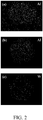
- the aluminum element is distributed substantially evenly on the surface of the doped lithium manganese iron phosphate-based particulate of Example 1.
- the aluminum and tungsten elements are distributed substantially evenly on the surface of the doped lithium manganese iron phosphate-based particulate of Example 2.
- the amounts of the aluminum element of the doped lithium manganese iron phosphate-based particulates of Examples 1 and 2 which were analyzed using inductively coupled plasma optical emission spectrometry (ICP-OES) were 2 mol% and 1 mol%, respectively.
- the amount of the tungsten element of the doped lithium manganese iron phosphate-based particulate of Example 2 was 1 mol%.
- the doped lithium manganese iron phosphate-based particulates of Examples 1 and 2 has an integral structure, rather than a laminated structure.
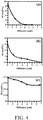
- the amount of the aluminum element of the doped lithium manganese iron phosphate-based particulate of Example 1 decreased in a continuous gradient from about 8.5 mol% to 0 mol% along a radial direction from a surface of the particulate towards a center of the particulate.
- the amounts of the aluminum and tungsten elements of the doped lithium manganese iron phosphate-based particulate of Example 2 decreased in a continuous gradient from about 3.4 mol% to 0 mol% and from about 1.2 mol% to 0.8 mol%, respectively, along a radial direction from a surface of the particulate towards a center of the particulate.
- the powdery material of Comparative Example 1 has a relatively large specific surface area, compared to those of Examples 1 and 2 and Comparative Examples 1 and 2, indicating that the powdery material of Comparative Example 1, in which the amount of carbon is relatively high, has a relatively large specific surface area, and thus a cathode manufactured therefrom may cause severe side reactions with an electrolyte solution.
- Example 1 The powdery material of Example 1, carbon black, and polyvinylidene fluoride were blended at a weight ratio of 93:3:4 to obtain a blend.
- the blend was mixed with N-methyl-2-pyrrolidone to obtain a paste, which was applied using a doctor blade onto an aluminum foil having a thickness of 20 ⁇ m, followed by baking in vacuum at 120°C to remove N-methyl-2-pyrrolidone, thereby obtaining a cathode material.
- the cathode material was pressed using a roller so as to have a thickness of 80 ⁇ m and then cut into a circular cathode having a diameter of 12 mm.
- a lithium foil was used to make an anode with a diameter of 15 mm and a thickness of 0.2 mm.
- Lithium hexafluorophosphate LiPF 6 , 1 M was dissolved in a solvent system composed of ethylene carbonate, ethylmethyl carbonate, and dimethyl carbonate in a volume ratio of 1:1:1 to obtain an electrolyte solution.
- a polypropylene membrane (purchased from Asahi Kasei Corp., a thickness of 25 ⁇ m) was cut into a circular separator with a diameter of 18 mm. The circular separator was immersed into the electrolyte solution and then removed therefrom to obtain an immersed separator.
- the cathode, the anode, and the immersed separator thus prepared were used along with other components to manufacture a CR 2032 coin-type lithium-ion battery.
- Comparative Application Example 1 The procedures of Comparative Application Example 1 were similar to those of Application Example 1 except that the powdery material of Comparative Example 1 was used to make a circular cathode in Comparative Application Example 1.
- Comparative Application Example 2 The procedures of Comparative Application Example 2 were similar to those of Application Example 1 except that the powdery material of Comparative Example 2 was used to make a circular cathode in Comparative Application Example 2.
- Comparative Application Example 3 The procedures of Comparative Application Example 3 were similar to those of Application Example 1 except that the powdery material of Comparative Example 3 was used to make a circular cathode in Comparative Application Example 3.
- Charge/discharge specific capacity of each of the lithium-ion batteries of Application Examples 1 and 2 and Comparative Application Examples 1 to 3 was measured at 25°C using a battery test device (commercially available from MACCOR, USA) at a current level of 1 C/0.1 C and at a voltage ranging from 2.7 V to 4.25 V. The results are shown in Figure 5 .
- the lithium-ion batteries of Application Examples 1 and 2 respectively have discharge specific capacities of 143.1 mAh/g and 145.3 mAh/g.
- the lithium-ion batteries of Comparative Application Examples 2 and 3 respectively have discharge specific capacities of 134.1 mAh/g, and 130.7 mAh/g, which are lower than those (143.1 mAh/g and 145.3 mAh/g) of the lithium-ion batteries of Application Examples 1 and 2.
- the lithium-ion battery of Comparative Application Example 1 has a discharge specific capacity of 143.3 mAh/g, which is substantially equal to that of the lithium-ion battery of Application Example 1.
- the lithium-ion battery of Comparative Application Example 1 is manufactured using the powdery material of Comparative Example 1, which has a relatively large specific surface area, and thus, severe side reactions may occur between the electrolyte solution and the cathode containing the powdery material, as described above.
- Cycle Charge/Discharge Measurement :
- Each of the lithium-ion batteries of Application Examples 1 and 2 and Comparative Application Examples 1 to 3 was measured at 25°C using a battery test device (commercially available from MACCOR, USA) at currents of 1 C/0.1 C, 1 C/1 C, 1 C/5 C, and 1 C/10 C in sequence, and at a voltage ranging from 2.7 V to 4.25 V for 3 charge/discharge cycles for each of the currents. The results are shown in Figure 6 .
- a discharge specific capacity maintenance ratio at a discharge current of 10 C is calculated by dividing the discharge specific capacity at the first charge/discharge cycle at a discharge current of 10 C by the discharge specific capacity at the first charge/discharge cycle at a discharge current of 0.1.
- the discharge specific capacity maintenance ratios of the lithium-ion batteries of Application Examples 1 and 2 are respectively 74.2 % and 74.6%
- the discharge specific capacity maintenance ratios of the lithium-ion batteries of Comparative Application Examples 1 to 3 are respectively 72. 0%, 68.4%, and 71. 7%, which are lower than those (74.2 % and 74.6%) of the lithium-ion batteries of Application Examples 1 and 2.
- the discharge specific capacity of each of the lithium-ion batteries of Application Examples 1 and 2 is larger than 140 mAhg, and does not decrease significantly even after 180 charge/discharge cycles at 60°C. Contrarily, the discharge specific capacity of the lithium-ion battery of Comparative Application Example 1 decreases significantly after 100 charge/discharge cycles. Although the discharge specific capacity of each of the the lithium-ion batteries of Comparative Application Examples 2 and 3 does not decrease significantly after 180 charge/discharge cycles at 60 °C, it is smaller than 140 mAhg. Therefore, the the lithium-ion batteries of Application Examples 1 and 2 have superior cycle life and discharge specific capacity at an elevated temperature.
- the doped lithium manganese iron phosphate-based particulate of the disclosure contains a dopant having a gradient decreasing from a surface of the particulate towards a center of the particulate and has a relatively small amount of carbon, such that it has a relatively small specific surface area.
- the lithium-ion battery manufactured using the powdery material containing the doped lithium manganese iron phosphate-based particulates has a relatively large discharge specific capacity, a relatively high specific capacity maintenance ratio at a large discharge current, and a superior cycle life at an elevated temperature.
Landscapes
- Chemical & Material Sciences (AREA)
- General Chemical & Material Sciences (AREA)
- Chemical Kinetics & Catalysis (AREA)
- Electrochemistry (AREA)
- Inorganic Chemistry (AREA)
- Engineering & Computer Science (AREA)
- Composite Materials (AREA)
- Organic Chemistry (AREA)
- Manufacturing & Machinery (AREA)
- Materials Engineering (AREA)
- Crystallography & Structural Chemistry (AREA)
- Mechanical Engineering (AREA)
- Battery Electrode And Active Subsutance (AREA)
Abstract
Disclosed is a doped lithium manganese iron phosphate-based particulate for a cathode of a lithium-ion battery. The particulate includes a composition represented by a formula of Mm-LixMn1-y-zFeyM'z (PO4)n/C, wherein M, M', x, y, z, m, and n are as defined herein. Also disclosed is a powdery material including the particulate, and a method for preparing the powdery material.
Description
- The disclosure relates to a doped lithium manganese iron phosphate-based particulate, and more particularly to a doped lithium manganese iron phosphate-based particulate for a cathode of a lithium-ion battery. The disclosure also relates to a doped lithium manganese iron phosphate-based powdery material including the particulate, and a method for preparing the powdery material.
- Lithium-ion battery is commonly used as an energy saving device and a power supplying device for consumer electronic products, transportation facilities, etc. Conventional lithium manganese iron phosphate used as a cathode of the lithium-ion battery has inferior electric and lithium ion conductivities. Therefore, a carbon source is usually added in a process for preparing a lithium manganese iron phosphate-based cathode material so as to enhance the efficiency of the lithium-ion battery thus made (for example, to increase a discharge specific capacity at a large current) . For example, Chinese Invention Patent Publication No.
CN 102074690 A discloses a method for synthesizing a cathode material, in which an organic carbon source is added. - However, the lithium manganese iron phosphate-based cathode material synthesized by adding the carbon source has an increased carbon amount and an increased specific surface area. As such, severe side reactions might be induced by the cathode made from the lithium manganese ion phosphate-based cathode material and an electrolyte solution, for example, decomposition of an organic solvent and production of hydrogen fluoride (HF) , which in turn leads to decrease of the cycle life and the thermal stability of the lithium-ion battery. In addition, the lithium manganese iron phosphate-based cathode material having an increased specific surface area is liable to absorb moisture, and thus is difficult to be dispersed, resulting in increased production cost for an electrode made therefrom.
- Therefore, a first object of the disclosure is to provide a doped lithium manganese iron phosphate-based particulate for a cathode of a lithium-ion battery to overcome the shortcomings described above.
- A second object of the disclosure is to provide a doped lithium manganese iron phosphate-based powdery material, which includes the doped lithium manganese iron phosphate-based particulate, for a cathode of a lithium-ion battery.
- A third object of the disclosure is to provide a method for preparing the doped lithium manganese iron phosphate-based powdery material.
- According to a first aspect of the disclosure, there is provided a doped lithium manganese iron phosphate-based particulate for a cathode of a lithium-ion battery. The doped lithium manganese iron phosphate-based particulate includes a composition represented by Formula (1):
Mm-LixMn1-y-zFeyM' z (PO4) n/C (1)
wherein - M is selected from the group consisting of Mg, Ca, Sr, Al, Ti, Cr, Zn, W, and combinations thereof;
- M' is selected from the group consisting of Mg, Ca, Sr, Al, Ti, Cr, Zn, W, and combinations thereof;
- 0.9 ≦ x ≦ 1.2;
- 0.1 ≦ y ≦ 0.4;
- 0 ≦ z ≦ 0.1;
- 0.11 ≦ y+z ≦ 0.4;
- 0.85 ≦ n ≦ 1.15;
- 0.0005 ≦ m ≦ 0.1;
- m has a gradient decreasing from a surface of said particulate towards a center of said particulate; and
- C is in an amount of larger than 0 wt% and up to 3 . 0 wt% based on a total weight of a composition of LixMn1-y-zFeyM' z (PO4) n/C.
- According to a second aspect of the disclosure, there is provided a doped lithium manganese iron phosphate-based powdery material for a cathode of a lithium-ion battery. The doped lithium manganese iron phosphate-based powdery material includes the doped lithium manganese iron phosphate-based particulate.
- According to a third aspect of the disclosure, there is provided a method for preparing the doped lithium manganese iron phosphate-based powdery material. The method includes the steps of:
- a) preparing a blend which includes a lithium source, a manganese source, an iron source, a phosphorous source, and a source of an additional metal selected from the group consisting of Mg, Ca, Sr, Al, Ti, Cr, Zn, W, and combinations thereof;
- b) adding a carbon source to the blend to form a combination and subjecting the combination to milling and granulating to form a granulated combination;
- c) subjecting the granulated combination to a preliminary sintering treatment to form a preform; and
- d) mixing the preform with a source of a dopant selected from the group consisting of Mg, Ca, Sr, Al, Ti, Cr, Zn, W, and combinations thereof to obtain a mixture, and subjecting the mixture to a further sintering treatment to form the doped lithium manganese iron phosphate-based powdery material.
- Other features and advantages of the disclosure will become apparent in the following detailed description of the embodiment with reference to the accompanying drawings, of which:
-
Figure 1 illustrates scanning electron microscope (SEM) images of a doped lithium manganese iron phosphate-based particulate according to the disclosure, in which SEM images (a) and (b) show the doped lithium manganese iron phosphate-based particulates of Examples 1 and 2, respectively; -
Figure 2 illustrates images each showing distribution of a metal element on a surface of a doped lithium manganese iron phosphate-based particulate according to the disclosure, in which images (a) and (b) show the distribution of an aluminum element on the surfaces of the doped lithium manganese iron phosphate-based particulates of Examples 1 and 2, respectively, and image (c) shows the distribution of a tungsten element on the surface of the doped lithium manganese iron phosphate-based particulate of Example 2; -
Figure 3 illustrates enlarged SEM images of a doped lithium manganese iron phosphate-based particulate according to the disclosure, in which images (a) and (b) are the enlarged SEM images of the doped lithium manganese iron phosphate-based particulates of Examples 1 and 2, respectively; -
Figure 4 illustrates graphs each showing a relationship between an amount of a metal element and a distance from a surface of a doped lithium manganese iron phosphate-based particulate according to the disclosure, in which graph (a) shows a relationship between an amount of an aluminum element and a distance from a surface of a doped lithium manganese iron phosphate-based particulate of Example 1, graph (b) shows a relationship between an amount of an aluminum element and a distance from a surface of a doped lithium manganese iron phosphate-based particulate of Example 2, and graph (c) shows a relationship between an amount of a tungsten element and a distance from a surface of a doped lithium manganese iron phosphate-based particulate of Example 2; -
Figure 5 is a graph illustrating charge/discharge specific capacity-voltage relationships of lithium-ion batteries of Application Examples 1 and 2 and Comparative Application Examples 1 to 3; -
Figure 6 is a graph illustrating cycle number-discharge specific capacity relationships of the lithium-ion batteries of Application Examples 1 and 2 and Comparative Application Examples 1 to 3 at various charge/discharge rates; and -
Figure 7 is a graph illustrating cycle number-discharge specific capacity relationships of the lithium-ion batteries of Application Examples 1 and 2 and Comparative Application Examples 1 to 3 under a charge/discharge cycling test at an elevated temperature. - A doped lithium manganese iron phosphate-based particulate for a cathode of a lithium-ion battery according to the disclosure includes a composition represented by Formula (1):
Mm-LixMn1-y-zFeyM' z (PO4) n/C (1)
wherein - M is selected from the group consisting of Mg, Ca, Sr, Al, Ti, Cr, Zn, W, and combinations thereof;
- M' is selected from the group consisting of Mg, Ca, Sr, Al, Ti, Cr, Zn, W, and combinations thereof;
- 0.9 ≦ x ≦ 1.2;
- 0.1 ≦ y ≦ 0.4;
- 0 ≦ z ≦ 0.1;
- 0.11 ≦ y+z ≦ 0.4;
- 0.85 ≦ n ≦ 1.15;
- 0.0005 ≦ m ≦ 0.1;
- m has a gradient decreasing from a surface of said particulate towards a center of said particulate; and
- C (i.e., carbon) is in an amount of larger than 0 wt% and up to 3.0 wt% based on a total weight of a composition of LixMn1-y-zFeyM' z (PO4) n/C.
- In certain embodiments, M is different from M' so as to be beneficial to the distribution of M in the doped lithium manganese iron phosphate-based particulate.
- In certain embodiments, M is selected from the group consisting of Al, W, and a combination thereof.
- In certain embodiments, M' is Mg.
- In certain embodiments, m is in a range from 0.0005 to 0.05 (i.e., 0.0005 ≦ m ≦ 0.05).
- In certain embodiments, the doped lithium manganese iron phosphate-based particulate has a particulate size ranging from 0.5 µm to 20 µm.
- A doped lithium manganese iron phosphate-based powdery material for a cathode of a lithium-ion battery according to the disclosure includes the doped lithium manganese iron phosphate-based particulate described above.
- In certain embodiments, the doped lithium manganese iron phosphate-based powdery material has a specific surface area of smaller than 25.0 m2/g. In certain embodiments, the specific surface area is smaller than 20.0 m2/g.
- A method for preparing the doped lithium manganese iron phosphate-based powdery material according to the disclosure includes the steps of:
- a) preparing a blend which includes a lithium source, a manganese source, an iron source, a phosphorous source, and a source of an additional metal selected from the group consisting of Mg, Ca, Sr, Al, Ti, Cr, Zn, W, and combinations thereof;
- b) adding a carbon source to the blend to form a combination and subjecting the combination to milling and granulating to form a granulated combination;
- c) subjecting the granulated combination to a preliminary sintering treatment to form a preform; and
- d) mixing the preform with a source of a dopant selected from the group consisting of Mg, Ca, Sr, Al, Ti, Cr, Zn, W, and combinations thereof to obtain a mixture, and subjecting the mixture to a further sintering treatment to form the doped lithium manganese iron phosphate-based powdery material.
- In certain embodiments, the dopant in step d) is different from the additional metal in step a) so as to be beneficial to the distribution of the dopant in the doped lithium manganese iron phosphate-based particulate.
- In certain embodiments, the dopant in step d) is selected from the group consisting of Al, W, and a combination thereof.
- In certain embodiments, the additional metal in step a) is Mg.
- In certain embodiments, in step c) , the preliminary sintering treatment is implemented at a temperature ranging from 400°C to 850°C.
- In certain embodiments, in step d), the further sintering treatment is implemented at a temperature ranging from 500°C to 950°C.
- In certain embodiments, the temperature for implementing the further sintering treatment is not lower than that for implementing the preliminary sintering treatment.
- Examples of the disclosure will be described hereinafter. It is to be understood that these examples are exemplary and explanatory and should not be construed as a limitation to the disclosure. Example 1: Preparation of a powdery material including doped lithium manganese iron phosphate-based particulates of Al0.02-Li1.02Mn0.7Fe0.25Mg0.05PO4/C (PE1)
- Manganese oxalate (a source of manganese (Mn)), iron oxalate (a source of iron (Fe)), magnesium oxide (a source of magnesium (Mg)), and phosphoric acid (a source of phosphorus (P)) in a molar ratio of Mn: Fe:Mg: P of 0.70:0.25:0.05:1.00 were added sequentially into a reactor, and were stirred with water for 1.5 hours, followed by blending with lithium hydroxide (a source of lithium, a molar ratio of Li:P is 1.02:1.00) to obtain a blend. Thereafter, the blend was combined with glucose and citric acid (sources of carbon, a molar ratio of C: P is 0. 09 : 1 . 00) to obtain a combination. The combination was grounded in a ball mill for 4 hours, and was then granulated and dried using a spray granulator to obtain a granulated combination. The granulated combination was subjected a preliminary sintering treatment under a nitrogen atmosphere at 450°C for 2 hours and then at 650°C for 2 hours to obtain a preform having a composition of Li1.02Mn0.7Fe0.25Mg0.C5PO4/C (LMFP/C) . An amount of carbon in the preform was 1.5 wt% based on a total weight of the preform.
- The preform (LMFP/C) was mixed with aluminum oxide (a molar ratio of LMFP/C:Al is 1.00:0.02) to obtain a mixture. The mixture was subjected a further sintering treatment under a nitrogen atmosphere at 750°C for 3 hours to obtain a target powdery material including doped lithium manganese iron phosphate-based particulates of Al0.02-Li1.02Mn0.7Fe0.25Mg0.05PO4/C· Example 2: Preparation of a powdery material including doped lithium manganese iron phosphate-based particulates of Al0.01W0.01-Li1.02Mn0.7Fe0.25Mg0.05PO4/C (PE2)
- Procedures of Example 2 were similar to those of Example 1 except that in Example 2, the preform was mixed with aluminum oxide and tungsten trioxide in a molar ratio of (LMFP/C):Al:W of 1.00:0.01:0.01. Comparative Example 1: Preparation of a powdery material including lithium manganese iron phosphate-based particulates of Li1.02Mn0.7Fe0.25Mg0.05PO4/C (PCE1)
- Procedures of Comparative Example 1 were similar to those of Example 1 except that in Comparative Example 1, a molar ratio of C:P was 0.15:1.00, an amount of carbon in the preform (LMFP/C) was 2.5 wt% based on a total weight of the preform, and the preform was subjected to the further sintering treatment without mixing with aluminum oxide.
- Comparative Example 2: Preparation of a powdery material including lithium manganese iron phosphate-based particulates of Li1.02Mn0.7Fe0.25Mg0.05PO4/C (PCE2)
- Procedures of Comparative Example 2 were similar to those of Example 1 except that in Comparative Example 2, the preform (LMFP/C) was subjected to the further sintering treatment without mixing with aluminum oxide.
- Comparative Example 3: Preparation of a powdery material including lithium manganese iron phosphate-based particulates of Li1.02Mn0.685Fe0.245Mg0.07PO4/C (PCE3)
- Procedures of Comparative Example 3 were similar to those of Example 1 except that in Comparative Example 3, manganese oxalate, iron oxalate, magnesium oxide, and phosphoric acid in a molar ratio of Mn:Fe:Mg:P of 0.685: 0.245: 0.07: 1.00 were added sequentially into the reactor, and the preform (LMFP/C) was subjected to the further sintering treatment without mixing with aluminum oxide.
- Scanning Electron Microscope Observation:
The doped lithium manganese iron phosphate-based particulates of Example 1 and 2 were observed using a scanning electron microscope, and images (a) and (b) as shown inFigure 1 were obtained. As shown in images (a) and (b) ofFigure 1 , the doped lithium manganese iron phosphate-based particulates of Example 1 and 2 have a particulate size of about 12 µm to 18 µm. Element Distribution Analysis:
Distribution of an aluminum element on a surface of each of the doped lithium manganese iron phosphate-based particulates of Examples 1 and 2 was analyzed using an energy dispersive spectrometer in combination with a scanning electron microscope, and images (a) and (b) as shown inFigure 2 were obtained. Distribution of a tungsten element on the surface of the doped lithium manganese iron phosphate-based particulate of Example 2 was also analyzed, and image (c) as shown inFigure 2 was obtained. - As shown in image (a) of
Figure 2 , the aluminum element is distributed substantially evenly on the surface of the doped lithium manganese iron phosphate-based particulate of Example 1. Similarly, as shown in images (b) and (c) ofFigure 2 , the aluminum and tungsten elements are distributed substantially evenly on the surface of the doped lithium manganese iron phosphate-based particulate of Example 2. - The amounts of the aluminum element of the doped lithium manganese iron phosphate-based particulates of Examples 1 and 2 which were analyzed using inductively coupled plasma optical emission spectrometry (ICP-OES) were 2 mol% and 1 mol%, respectively. Similarly, the amount of the tungsten element of the doped lithium manganese iron phosphate-based particulate of Example 2 was 1 mol%.
- The amounts of the aluminum element at various positions of the cross sections of the doped lithium manganese iron phosphate-based particulates of Examples 1 and 2, as shown with dots in images (a) and (b) of
Figure 3 , were analyzed using an energy dispersive spectrometer in combination with a scanning electron microscope. The results are shown as graphs (a) and (b) inFigure 4 . Similarly, the amount of the tungsten element at various positions of the cross section of the doped lithium manganese iron phosphate-based particulate of Example 2, as shown with dots in image (b) ofFigure 3 , was analyzed, and the result is shown as graph (c) inFigure 4 . - As shown in images (a) and (b) of
Figure 3 , the doped lithium manganese iron phosphate-based particulates of Examples 1 and 2 has an integral structure, rather than a laminated structure. - As shown in graph (a) of
Figure 4 , the amount of the aluminum element of the doped lithium manganese iron phosphate-based particulate of Example 1 decreased in a continuous gradient from about 8.5 mol% to 0 mol% along a radial direction from a surface of the particulate towards a center of the particulate. Similarly, a shown in images (b) and (c) ofFigure 4 , the amounts of the aluminum and tungsten elements of the doped lithium manganese iron phosphate-based particulate of Example 2 decreased in a continuous gradient from about 3.4 mol% to 0 mol% and from about 1.2 mol% to 0.8 mol%, respectively, along a radial direction from a surface of the particulate towards a center of the particulate. - The specific surface area of each of the powdery materials of Examples 1 and 2 and Comparative Examples 1 to 3 was measured by Brunauer-Emmett-Teller (BET) method using a specific surface area analyzer. The results are shown in Table 1 below.
Table 1 Powdery materials Surface specific area (m2/g) PE1 15.4 PE2 14.8 PCE1 20.8 PCE2 13.4 PCE3 13.9 - As shown in Table 1, the powdery material of Comparative Example 1 has a relatively large specific surface area, compared to those of Examples 1 and 2 and Comparative Examples 1 and 2, indicating that the powdery material of Comparative Example 1, in which the amount of carbon is relatively high, has a relatively large specific surface area, and thus a cathode manufactured therefrom may cause severe side reactions with an electrolyte solution.
- The powdery material of Example 1, carbon black, and polyvinylidene fluoride were blended at a weight ratio of 93:3:4 to obtain a blend. The blend was mixed with N-methyl-2-pyrrolidone to obtain a paste, which was applied using a doctor blade onto an aluminum foil having a thickness of 20 µm, followed by baking in vacuum at 120°C to remove N-methyl-2-pyrrolidone, thereby obtaining a cathode material. The cathode material was pressed using a roller so as to have a thickness of 80 µm and then cut into a circular cathode having a diameter of 12 mm.
- A lithium foil was used to make an anode with a diameter of 15 mm and a thickness of 0.2 mm.
- Lithium hexafluorophosphate (LiPF6, 1 M) was dissolved in a solvent system composed of ethylene carbonate, ethylmethyl carbonate, and dimethyl carbonate in a volume ratio of 1:1:1 to obtain an electrolyte solution.
- A polypropylene membrane (purchased from Asahi Kasei Corp., a thickness of 25 µm) was cut into a circular separator with a diameter of 18 mm. The circular separator was immersed into the electrolyte solution and then removed therefrom to obtain an immersed separator.
- The cathode, the anode, and the immersed separator thus prepared were used along with other components to manufacture a CR 2032 coin-type lithium-ion battery.
- The procedures of Application Example 2 were similar to those of Application Example 1 except that the powdery material of Example 2 was used to make a circular cathode in Application Example 2. Comparative Application Example 1:
- The procedures of Comparative Application Example 1 were similar to those of Application Example 1 except that the powdery material of Comparative Example 1 was used to make a circular cathode in Comparative Application Example 1.
- The procedures of Comparative Application Example 2 were similar to those of Application Example 1 except that the powdery material of Comparative Example 2 was used to make a circular cathode in Comparative Application Example 2.
- The procedures of Comparative Application Example 3 were similar to those of Application Example 1 except that the powdery material of Comparative Example 3 was used to make a circular cathode in Comparative Application Example 3.
- Charge/discharge specific capacity of each of the lithium-ion batteries of Application Examples 1 and 2 and Comparative Application Examples 1 to 3 was measured at 25°C using a battery test device (commercially available from MACCOR, USA) at a current level of 1 C/0.1 C and at a voltage ranging from 2.7 V to 4.25 V. The results are shown in
Figure 5 . - As shown in
Figure 5 , the lithium-ion batteries of Application Examples 1 and 2 respectively have discharge specific capacities of 143.1 mAh/g and 145.3 mAh/g. The lithium-ion batteries of Comparative Application Examples 2 and 3 respectively have discharge specific capacities of 134.1 mAh/g, and 130.7 mAh/g, which are lower than those (143.1 mAh/g and 145.3 mAh/g) of the lithium-ion batteries of Application Examples 1 and 2. The lithium-ion battery of Comparative Application Example 1 has a discharge specific capacity of 143.3 mAh/g, which is substantially equal to that of the lithium-ion battery of Application Example 1. However, the lithium-ion battery of Comparative Application Example 1 is manufactured using the powdery material of Comparative Example 1, which has a relatively large specific surface area, and thus, severe side reactions may occur between the electrolyte solution and the cathode containing the powdery material, as described above. Cycle Charge/Discharge Measurement: - Each of the lithium-ion batteries of Application Examples 1 and 2 and Comparative Application Examples 1 to 3 was measured at 25°C using a battery test device (commercially available from MACCOR, USA) at currents of 1 C/0.1 C, 1 C/1 C, 1 C/5 C, and 1 C/10 C in sequence, and at a voltage ranging from 2.7 V to 4.25 V for 3 charge/discharge cycles for each of the currents. The results are shown in
Figure 6 . - As shown in
Figure 6 , a discharge specific capacity maintenance ratio at a discharge current of 10 C is calculated by dividing the discharge specific capacity at the first charge/discharge cycle at a discharge current of 10 C by the discharge specific capacity at the first charge/discharge cycle at a discharge current of 0.1. At a discharge current of 10 C, the discharge specific capacity maintenance ratios of the lithium-ion batteries of Application Examples 1 and 2 are respectively 74.2 % and 74.6%, and the discharge specific capacity maintenance ratios of the lithium-ion batteries of Comparative Application Examples 1 to 3 are respectively 72. 0%, 68.4%, and 71. 7%, which are lower than those (74.2 % and 74.6%) of the lithium-ion batteries of Application Examples 1 and 2. - The discharge specific capacity of each of the lithium-ion batteries of Application Examples 1 and 2 and Comparative Application Examples 1 to 3 was measured at 60°C using the abovementioned battery test device at a current of 1 C/2 C and at a voltage ranging from 2.7 V to 4.25 V for 180 charge/discharge cycles. The results are shown in
Figure 7 . - As shown in
Figure 7 , the discharge specific capacity of each of the the lithium-ion batteries of Application Examples 1 and 2 is larger than 140 mAhg, and does not decrease significantly even after 180 charge/discharge cycles at 60°C. Contrarily, the discharge specific capacity of the lithium-ion battery of Comparative Application Example 1 decreases significantly after 100 charge/discharge cycles. Although the discharge specific capacity of each of the the lithium-ion batteries of Comparative Application Examples 2 and 3 does not decrease significantly after 180 charge/discharge cycles at 60 °C, it is smaller than 140 mAhg. Therefore, the the lithium-ion batteries of Application Examples 1 and 2 have superior cycle life and discharge specific capacity at an elevated temperature. - In view of the aforesaid, the doped lithium manganese iron phosphate-based particulate of the disclosure contains a dopant having a gradient decreasing from a surface of the particulate towards a center of the particulate and has a relatively small amount of carbon, such that it has a relatively small specific surface area. The lithium-ion battery manufactured using the powdery material containing the doped lithium manganese iron phosphate-based particulates has a relatively large discharge specific capacity, a relatively high specific capacity maintenance ratio at a large discharge current, and a superior cycle life at an elevated temperature.
- In the description above, for the purposes of explanation, numerous specific details have been set forth in order to provide a thorough understanding of the embodiments. It will be apparent, however, to one skilled in the art, that one or more other embodiments may be practiced without some of these specific details. It should also be appreciated that reference throughout this specification to "one embodiment," "an embodiment," an embodiment with an indication of an ordinal number and so forth means that a particular feature, structure, or characteristic may be included in the practice of the disclosure. It should be further appreciated that in the description, various features are sometimes grouped together in a single embodiment, figure, or description thereof for the purpose of streamlining the disclosure and aiding in the understanding of various inventive aspects, and that one or more features or specific details from one embodiment may be practiced together with one or more features or specific details from another embodiment, where appropriate, in the practice of the disclosure.
Claims (13)
- A doped lithium manganese iron phosphate-based particulate for a cathode of a lithium-ion battery, characterized by a composition represented by Formula (1) :
Mm-LixMn1-y-zFeyM' z (PO4) n/C (1)
whereinM is selected from the group consisting of Mg, Ca, Sr, Al, Ti, Cr, Zn, W, and combinations thereof;M' is selected from the group consisting of Mg, Ca, Sr, Al, Ti, Cr, Zn, W, and combinations thereof;0.9 ≦ x ≦ 1.2;0.1 ≦ y ≦ 0.4;0 ≦ z ≦ 0.1;0.11 ≦ y+z ≦ 0.4;0.85 ≦ n ≦ 1.15;0.0005 ≦ m ≦ 0.1;m has a gradient decreasing from a surface of said particulate towards a center of said particulate; andC is in an amount of larger than 0 wt% and up to 3 . 0 wt% based on a total weight of a composition of LixMn1-y-zFeyM' z (PO4) n/C. - The doped lithium manganese iron phosphate-based particulate according to claim 1, characterized in that M is different from M'.
- The doped lithium manganese iron phosphate-based particulate according to claim 1 or 2, characterized in that M is selected from the group consisting of Al, W, and a combination thereof.
- The doped lithium manganese iron phosphate-based particulate according to any one of claims 1 to 3, characterized in that M' is Mg.
- The doped lithium manganese iron phosphate-based particulate according to any one of claims 1 to 4, characterized by having a particulate size ranging from 0.5 µm to 20 µm.
- A doped lithium manganese iron phosphate-based powdery material for a cathode of a lithium-ion battery, characterized by the doped lithium manganese iron phosphate-based particulate according to any one of claims 1 to 5.
- The doped lithium manganese iron phosphate-based powdery material according to claim 6, characterized by having a specific surface area of smaller than 25. 0 m2/g.
- A method for preparing the doped lithium manganese iron phosphate-based powdery material according to claim 6 or 7, characterized by the steps of:a) preparing a blend which includes a lithium source, a manganese source, an iron source, a phosphorous source, and a source of an additional metal selected from the group consisting of Mg, Ca, Sr, Al, Ti, Cr, Zn, W, and combinations thereof;b) adding a carbon source to the blend to form a combination and subjecting the combination to milling and granulating to form a granulated combination;c) subjecting the granulated combination to a preliminary sintering treatment to form a preform; andd) mixing the preform with a source of a dopant selected from the group consisting of Mg, Ca, Sr, Al, Ti, Cr, Zn, W, and combinations thereof to obtain a mixture, and subjecting the mixture to a further sintering treatment to form the doped lithium manganese iron phosphate-based powdery material.
- The method according to claim 8, characterized in that the dopant in step d) is different from the additional metal in step a).
- The method according to claim 8 or 9, characterized in that the dopant in step d) is selected from the group consisting of Al, W, and a combination thereof.
- The method according to any one of claims 8 to 10, characterized in that the additional metal in step a) is Mg.
- The method according to any one of claims 8 to 11, characterized in that in step c), the preliminary sintering treatment is implemented at a temperature ranging from 400°C to 850°C.
- The method according to any one of claims 8 to 12, characterized in that in step d), the further sintering treatment is implemented at a temperature ranging from 500°C to 950°C.
Applications Claiming Priority (2)
| Application Number | Priority Date | Filing Date | Title |
|---|---|---|---|
| TW108137209A TWI718711B (en) | 2019-10-16 | 2019-10-16 | Tungsten-doped lithium ferromanganese phosphate particles and tungsten-doped lithium ferromanganese phosphate powder materials used for positive electrodes of lithium ion batteries and their preparation methods |
| TW108137210A TWI717863B (en) | 2019-10-16 | 2019-10-16 | Doped lithium ferromanganese phosphate particles, doped lithium ferromanganese phosphate powder materials for positive electrodes of lithium ion batteries, and preparation method thereof |
Publications (1)
| Publication Number | Publication Date |
|---|---|
| EP3808701A1 true EP3808701A1 (en) | 2021-04-21 |
Family
ID=69157608
Family Applications (2)
| Application Number | Title | Priority Date | Filing Date |
|---|---|---|---|
| EP20150984.1A Pending EP3808702A1 (en) | 2019-10-16 | 2020-01-09 | Tungsten-doped lithium manganese iron phosphate-based particulate, tungsten-doped lithium manganese iron phosphate-based powdery material including the same, and method for preparing powdery material |
| EP20150982.5A Pending EP3808701A1 (en) | 2019-10-16 | 2020-01-09 | Doped lithium manganese iron phosphate-based particulate, doped lithium manganese iron phosphate-based powdery material including the same, and method for preparing powdery material |
Family Applications Before (1)
| Application Number | Title | Priority Date | Filing Date |
|---|---|---|---|
| EP20150984.1A Pending EP3808702A1 (en) | 2019-10-16 | 2020-01-09 | Tungsten-doped lithium manganese iron phosphate-based particulate, tungsten-doped lithium manganese iron phosphate-based powdery material including the same, and method for preparing powdery material |
Country Status (3)
| Country | Link |
|---|---|
| US (2) | US11616232B2 (en) |
| EP (2) | EP3808702A1 (en) |
| JP (2) | JP7089297B6 (en) |
Cited By (1)
| Publication number | Priority date | Publication date | Assignee | Title |
|---|---|---|---|---|
| CN115448284A (en) * | 2022-09-30 | 2022-12-09 | 曲靖市德方纳米科技有限公司 | Method for preparing battery-grade lithium manganese phosphate composite material from minerals and its application |
Families Citing this family (7)
| Publication number | Priority date | Publication date | Assignee | Title |
|---|---|---|---|---|
| GB202005682D0 (en) * | 2020-04-20 | 2020-06-03 | Johnson Matthey Plc | Process |
| CN114597346B (en) * | 2020-12-02 | 2024-10-18 | 通用汽车环球科技运作有限责任公司 | Thick electrode for electrochemical cells |
| CN115275144A (en) * | 2022-08-02 | 2022-11-01 | 西安合升汇力新材料有限公司 | Phosphate anode material and preparation method and application thereof |
| CN115799468A (en) * | 2022-12-01 | 2023-03-14 | 佛山市德方纳米科技有限公司 | Iron-doped lithium manganese iron phosphate composite material, preparation method, and secondary battery |
| CN116470005B (en) * | 2023-06-16 | 2023-09-08 | 深圳海辰储能控制技术有限公司 | Positive plate, lithium ion battery and energy storage equipment |
| WO2025234728A1 (en) * | 2024-05-08 | 2025-11-13 | 주식회사 엘지화학 | Cathode active material, and cathode and lithium secondary battery comprising same |
| KR20260034491A (en) * | 2024-09-04 | 2026-03-11 | (주)포스코퓨처엠 | Cathode active material for lithium secondary battery and method for manufacturing the same |
Citations (4)
| Publication number | Priority date | Publication date | Assignee | Title |
|---|---|---|---|---|
| CN102074690A (en) | 2010-12-24 | 2011-05-25 | 复旦大学 | A method of coating FePO4 with controllable carbon to synthesize battery cathode material LiFePO4 |
| US20130140497A1 (en) * | 2010-05-27 | 2013-06-06 | Sud-Chemie Ip Gmbh & Co. Kg | Carbon-lithium transition metal phosphate composite material having a low carbon content |
| CN107359342A (en) * | 2017-07-27 | 2017-11-17 | 泓辰电池材料有限公司 | Lithium manganese iron phosphate-based particles, lithium manganese iron phosphate-based powder and preparation method thereof |
| US20180040883A1 (en) * | 2012-12-21 | 2018-02-08 | Dow Global Technologies Llc | LMFP Cathode Materials with Improved Electrochemical Performance |
Family Cites Families (13)
| Publication number | Priority date | Publication date | Assignee | Title |
|---|---|---|---|---|
| JP5314258B2 (en) | 2007-07-27 | 2013-10-16 | 関東電化工業株式会社 | Olivine-type lithium iron phosphate compound and method for producing the same, and positive electrode active material and non-aqueous electrolyte battery using olivine-type lithium iron phosphate compound |
| JP5388822B2 (en) | 2009-03-13 | 2014-01-15 | Jfeケミカル株式会社 | Method for producing lithium iron phosphate |
| US9269955B2 (en) * | 2009-09-24 | 2016-02-23 | Valence Technology Inc. | Manganese phosphates and related electrode active materials |
| CN101777648B (en) | 2010-01-26 | 2012-08-22 | 中国科学院宁波材料技术与工程研究所 | Preparation method of monodisperse lithium iron phosphate nanometer material and lithium-ion secondary battery |
| KR101805541B1 (en) | 2011-06-24 | 2017-12-08 | 삼성에스디아이 주식회사 | Composite cathode active material, cathode and lithium battery comprising the material, and preparation method thereof |
| CN102364726B (en) | 2011-10-21 | 2013-06-12 | 济宁市无界科技有限公司 | Method for producing iron lithium manganese phosphate composite positive electrode material used in lithium ion battery through carbon reduction |
| KR101893955B1 (en) * | 2011-12-16 | 2018-09-03 | 삼성에스디아이 주식회사 | Metal doped crystalline iron phosphate, method for preparation thereof and lithium composite metal phosphorus oxide prepared using the same |
| CA2894672A1 (en) * | 2012-12-21 | 2014-06-26 | Dow Global Technologies Llc | Method for making lithium transition metal olivines using water/cosolvent mixtures |
| US20160240856A1 (en) * | 2013-10-02 | 2016-08-18 | Umicore | Carbon Coated Electrochemically Active Powder |
| CN106935851B (en) | 2015-12-31 | 2019-11-29 | 惠州比亚迪电池有限公司 | A kind of iron manganese phosphate for lithium class material and preparation method thereof and cell size and anode and lithium battery |
| CN110291668B (en) * | 2017-02-15 | 2023-03-07 | 魁北克电力公司 | Electrode material and its preparation method |
| TWI625888B (en) * | 2017-07-14 | 2018-06-01 | Hcm Co Ltd | Lithium iron manganese phosphate particles, lithium iron manganese phosphate powder and preparation method thereof |
| KR102656223B1 (en) * | 2017-11-22 | 2024-04-11 | 주식회사 엘지에너지솔루션 | Positive electrode active material for lithium secondary battery and method for preparing the same |
-
2019
- 2019-12-16 US US16/715,096 patent/US11616232B2/en active Active
- 2019-12-17 US US16/717,180 patent/US11094936B2/en active Active
-
2020
- 2020-01-09 EP EP20150984.1A patent/EP3808702A1/en active Pending
- 2020-01-09 EP EP20150982.5A patent/EP3808701A1/en active Pending
- 2020-04-27 JP JP2020078277A patent/JP7089297B6/en active Active
- 2020-04-27 JP JP2020078217A patent/JP6997366B2/en active Active
Patent Citations (4)
| Publication number | Priority date | Publication date | Assignee | Title |
|---|---|---|---|---|
| US20130140497A1 (en) * | 2010-05-27 | 2013-06-06 | Sud-Chemie Ip Gmbh & Co. Kg | Carbon-lithium transition metal phosphate composite material having a low carbon content |
| CN102074690A (en) | 2010-12-24 | 2011-05-25 | 复旦大学 | A method of coating FePO4 with controllable carbon to synthesize battery cathode material LiFePO4 |
| US20180040883A1 (en) * | 2012-12-21 | 2018-02-08 | Dow Global Technologies Llc | LMFP Cathode Materials with Improved Electrochemical Performance |
| CN107359342A (en) * | 2017-07-27 | 2017-11-17 | 泓辰电池材料有限公司 | Lithium manganese iron phosphate-based particles, lithium manganese iron phosphate-based powder and preparation method thereof |
Cited By (2)
| Publication number | Priority date | Publication date | Assignee | Title |
|---|---|---|---|---|
| CN115448284A (en) * | 2022-09-30 | 2022-12-09 | 曲靖市德方纳米科技有限公司 | Method for preparing battery-grade lithium manganese phosphate composite material from minerals and its application |
| CN115448284B (en) * | 2022-09-30 | 2024-01-30 | 曲靖市德方纳米科技有限公司 | Method for preparing battery-grade lithium manganese phosphate composite material by using minerals and application of battery-grade lithium manganese phosphate composite material |
Also Published As
| Publication number | Publication date |
|---|---|
| JP2021064600A (en) | 2021-04-22 |
| US20210119212A1 (en) | 2021-04-22 |
| US11094936B2 (en) | 2021-08-17 |
| JP7089297B6 (en) | 2023-12-22 |
| US20210119211A1 (en) | 2021-04-22 |
| US11616232B2 (en) | 2023-03-28 |
| EP3808702A1 (en) | 2021-04-21 |
| JP7089297B2 (en) | 2022-06-22 |
| JP2021064599A (en) | 2021-04-22 |
| JP6997366B2 (en) | 2022-01-17 |
Similar Documents
| Publication | Publication Date | Title |
|---|---|---|
| US11616232B2 (en) | Doped lithium manganese iron phosphate-based particulate, doped lithium manganese iron phosphate-based powdery material including the same, and method for preparing powdery material | |
| WO2021001498A1 (en) | Lithium nickel manganese cobalt composite oxide as a positive electrode active material for rechargeable lithium ion batteries | |
| Hou et al. | Drastic enhancement in the rate and cyclic behavior of LiMn2O4 electrodes at elevated temperatures by phosphorus doping | |
| CN111697203B (en) | Lithium manganese iron phosphate composite material and preparation method and application thereof | |
| Mu et al. | Enhancing the electrochemical performance of LiNi0. 5Mn1. 5O4 cathode material by a conductive LaCoO3 coating | |
| Nanini-Maury et al. | Electrochemical behavior of sebaconitrile as a cosolvent in the formulation of electrolytes at high potentials for lithium-ion batteries | |
| US20200251732A1 (en) | Positive electrode active substance for non-aqueous electrolyte secondary battery and method for producing same, positive electrode mixture paste for non-aqueous electrolyte secondary battery, and non-aqueous electrolyte secondary battery | |
| KR102867581B1 (en) | Secondary battery having solid electrolyte interphase layer comprising lithium nitride | |
| JP2023080310A (en) | Positive electrode active material for lithium ion secondary battery, and lithium ion secondary battery | |
| KR20160066668A (en) | Method for preparing polyanion-carbon nanofibers composites applicable to the cathode of sodium ion batteries through electrospinning | |
| EP2369671A1 (en) | Non-aqueous electrolyte secondary battery | |
| EP3410518B1 (en) | Cathode active material and fluoride ion battery | |
| EP3761411B1 (en) | Electrode material, electrode layer and electricity storage device using same, and manufacturing method for electrode material | |
| KR101607233B1 (en) | Cathode active material, cathode comprising the same and lithium battery using the cathode | |
| US8821767B2 (en) | Cathode active material | |
| EP4645447A1 (en) | Sodium battery positive electrode material and preparation method therefor, positive electrode sheet and sodium battery | |
| KR20250025738A (en) | Battery material and method for manufacturing the same, and secondary battery | |
| KR101431879B1 (en) | Cathode material for lithium second battery and manufacturing method thereof | |
| Park et al. | Enhancing electrochemical performance by triggering a local structure distortion in lithium vanadium phosphate cathode for Li ion batteries | |
| Liu et al. | Tri-functional coating to enhance the capacity retention of LiNi0. 5Mn1. 5O4 for high power lithium ion battery | |
| KR20160053147A (en) | Hybrid Electrolyte comprising Lithium Phosphates and Polymer For Li Batteries Operable At Room Temperatures And Li Batteries comprising The Same | |
| US11967717B2 (en) | Tungsten-doped lithium manganese iron phosphate-based particulate and tungsten-doped lithium manganese iron phosphate-based powdery material including the same | |
| CN109980221B (en) | A high-voltage lithium-ion battery positive electrode material and its preparation method and application | |
| KR20120108572A (en) | Cathod for secondary battery and secondary battery including the same | |
| CN112736227A (en) | Composite cathode and secondary battery using the same |
Legal Events
| Date | Code | Title | Description |
|---|---|---|---|
| PUAI | Public reference made under article 153(3) epc to a published international application that has entered the european phase |
Free format text: ORIGINAL CODE: 0009012 |
|
| STAA | Information on the status of an ep patent application or granted ep patent |
Free format text: STATUS: REQUEST FOR EXAMINATION WAS MADE |
|
| 17P | Request for examination filed |
Effective date: 20210128 |
|
| AK | Designated contracting states |
Kind code of ref document: A1 Designated state(s): AL AT BE BG CH CY CZ DE DK EE ES FI FR GB GR HR HU IE IS IT LI LT LU LV MC MK MT NL NO PL PT RO RS SE SI SK SM TR |
|
| AX | Request for extension of the european patent |
Extension state: BA ME |
|
| P01 | Opt-out of the competence of the unified patent court (upc) registered |
Effective date: 20230523 |